
Port Angeles City Zoning Code
CHAPTER 17
46 - PROPERTY TAX EXEMPTIONS FOR MULTI-FAMILY HOUSING
17.46.010 - Findings and purpose.
A.
Findings. The Council of the City of Port Angeles finds that:
1.
Within Port Angeles there are insufficient housing opportunities, including affordable and multi-family housing opportunities; and
2.
Adoption of the ordinance from which this chapter derives will help to increase and improve residential opportunities, including affordable and multi-family housing opportunities, within the City of Port Angeles.
B.
Purpose. The purposes of this chapter are to:
1.
Encourage more multi-family housing opportunities, including affordable housing opportunities, within the City;
2.
Stimulate the construction of new multi-family housing and the rehabilitation of existing vacant and underutilized buildings for multi-family housing opportunities;
3.
Increase the supply of mixed-income, multi-family housing opportunities within the City;
4.
Promote community development, neighborhood revitalization, and availability of affordable housing; and
5.
Encourage additional housing density in areas that are consistent with planning for public transit systems.
C.
Any one or a combination of these purposes may be furthered by the designation of residential target areas under this chapter.
(Ord. 3618 § 1, 2/5/2019)
17.46.020 - Definitions.
The following definitions shall apply to this chapter:
1.
"Affordable housing," means residential housing, that is rented by a person or household whose monthly housing costs, including utilities other than telephone, do not exceed 30 percent of the household's monthly income. For the purposes of housing intended for owner occupancy, "affordable housing" means residential housing that is within the means of low or moderate-income households.
2.
"Assessor" means the Clallam County Assessor.
3.
"Building codes" means the City building and construction codes as set forth in Title 14 PAMC.
4.
"City" means the City of Port Angeles.
5.
"Council" means the Port Angeles City Council.
6.
"Director" means the City's Director of the Community and Economic Development Department and any authorized designee.
7.
"Household" means a single person, family or unrelated persons living together.
8.
"Local housing standards" means the International Property Maintenance Code, as adopted by the City of Port Angeles.
9.
"Low-income household" means a single person, family, or unrelated persons living together whose adjusted income is at or below 80 percent of the median family income adjusted for family size, for Clallam County, as reported by the United States Department of Housing and Urban Development.
10.
"Growth Management Act" means Chapter 36.70A RCW.
11.
"Moderate-income household" means a single person, family, or unrelated persons living together whose adjusted income is more than 80 percent of the median family income adjusted for family size, for Clallam County, as reported by the United States Department of Housing and Urban Development.
12.
"Multiple-unit housing" means a single lot or a building or a group of buildings having four or more dwelling units not designed or used as transient accommodations and not including hotels and motels. Multi-family units may result from the combination of new construction or rehabilitated or conversion of vacant, underutilized, or substandard buildings or lots to multi-family housing.
13.
"Owner" means the property owner of record as filed with the Clallam County Assessor's Office.
14.
"Permanent residential occupancy" means multi-unit housing that provides either rental or owner occupancy on a non-transient basis. This includes owner-occupied or rental accommodation that is leased for a period of at least one month. This excludes hotels and motels that predominately offer rental accommodation on a daily or weekly basis.
15.
"Rehabilitation improvements" means modifications to existing structures that are vacant for 12 months or longer, or modification to existing occupied structures which convert non-residential space to residential space and/or increase the number of multi-family housing units.
16.
"Residential targeted area," also "residential target area," means an area within the City's urban governmental center that has been designated by the Council as lacking sufficient, available, desirable, and convenient residential housing to meet the needs of the public.
17.
"Substantial compliance" means compliance with all local building, fire and zoning code requirements, which are typically required for rehabilitation as opposed to new construction.
18.
"Urban governmental center" is an identifiable district containing several business establishments, adequate public facilities, and a mixture of uses and activities where residents may obtain a variety of products and services. For Port Angeles, the urban governmental center includes the entire incorporated area of the City.
(Ord. 3710 § 1(Att. A), 3/21/2023; Ord. 3618 § 1, 2/5/2019)
17.46.030 - Residential targeted area standards.
A.
Criteria. Following public notice and a public hearing, the Council may, in its sole discretion, designate one or more residential target areas. Each designated target area must meet the following criteria, as determined by the Council:
1.
The target area is within an urban governmental center;
2.
The target area lacks sufficient available, desirable, and convenient residential housing, including multi-family and affordable housing, to meet the needs of the public who would be likely to live in the urban governmental center if affordable, desirable, attractive, and livable residences were available;
3.
The providing additional housing opportunity in the target area will assist in achieving one or more of the following purposes:
a.
Encourage increased residential opportunities within the target area, including mixed income and affordable housing opportunities; or
b.
Stimulate the construction of new multi-family housing and/or the rehabilitation of existing vacant and underutilized buildings for multi-family housing; or
c.
Where appropriate, stimulate the construction, rehabilitation or conversion of existing vacant and underutilized multi-family rental units to owner occupied multi-family housing as such property redevelops.
4.
In designating a residential target area, the Council may also consider other factors, including, but not limited to: whether additional housing, including affordable housing units, in the target area will attract and maintain an increase in the number of permanent residents; whether an increased permanent residential population in the residential targeted area will help to achieve the goals and policies described in the City's comprehensive plan or mandated by the Growth Management Act under Chapter 36.70A.020 RCW; whether encouraging additional housing in the target area is consistent with public transportation plans; and whether additional housing may contribute to revitalization of distressed neighborhoods or areas within the target area.
5.
When designating a residential target area, the Council shall give notice of a hearing to be held on the matter and that notice shall be published once each week for two consecutive weeks, not less than seven days nor more than 30 days before the date of the hearing. The notice must state the time, date, place and purpose of the hearing and generally identify the area proposed to be designated.
B.
Target area standards and guidelines. For each designated residential target area, the Council shall adopt and implement basic requirements for both new construction and rehabilitation, including the application process and procedures. The Council may also adopt guidelines including the following:
1.
Requirements that address demolition of existing structures and site utilization;
2.
Building requirements that may include elements addressing parking, building height, residential density, access to alternative transportation facilities, environmental impact, public benefit features, compatibility with the surrounding properties, and other site layout and design amenities intended to enhance the livability of the residential target area;
3.
More stringent income eligibility, rent, or sale price limits, including limits that apply to a higher percentage of units than the minimum conditions under PAMC 17.46.100.
The required amenities shall be proportional to the size of the proposed project and the tax benefit to be obtained.
C.
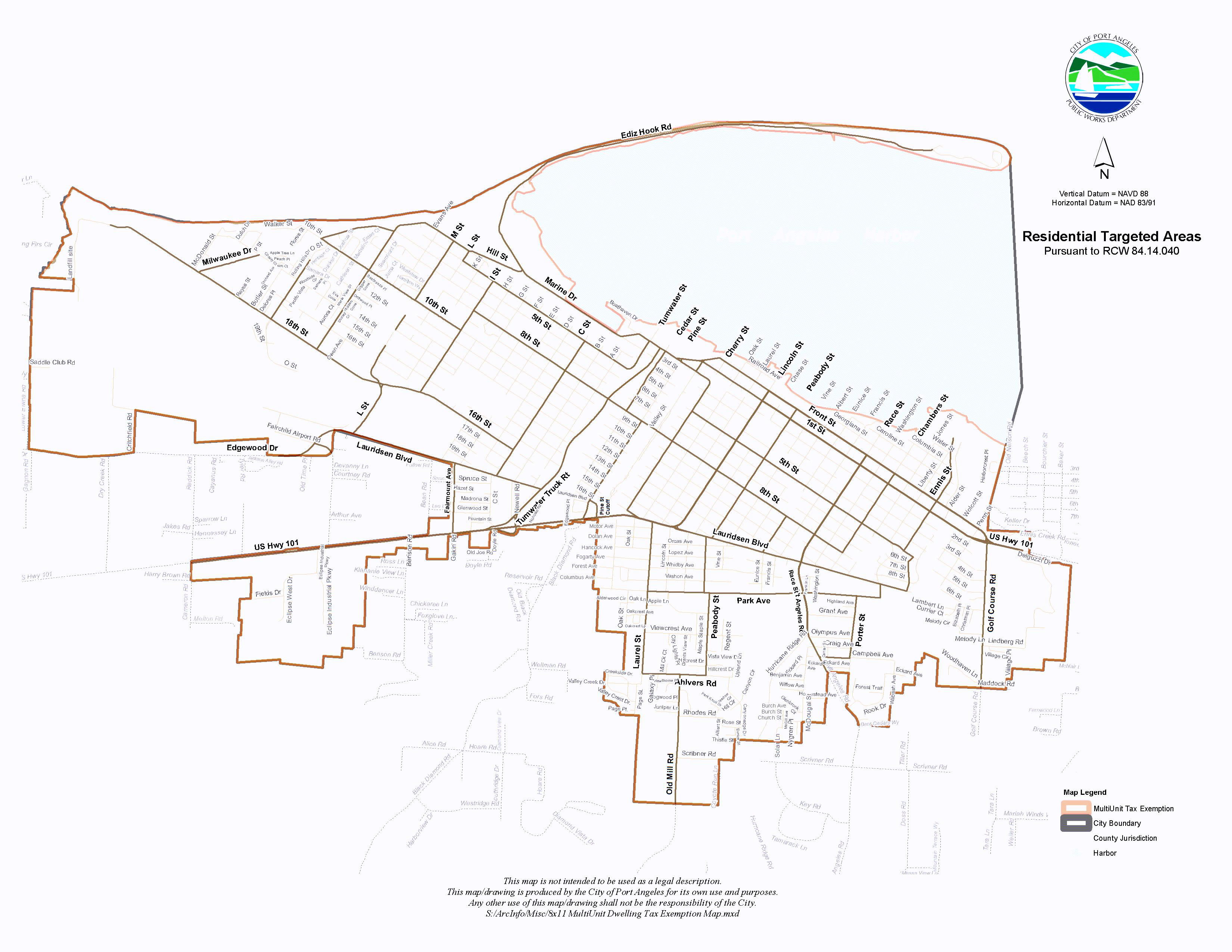
Designated residential target areas. The following areas, as depicted in Figure 1 and the City's adopted map known as "Residential Targeted Areas," have been designated as residential target areas in the City by resolution adopted by the City Council on January 15, 2019.
Figure 1
(Ord. 3618 § 1, 2/5/2019)
17.46.040 - Tax exemption terms and project eligibility.
A.
Duration of exemption. For properties for which applications are submitted under Chapter 84.14 RCW, the value of improvements qualifying under this chapter is exempt from ad valorem property taxation as follows:
1.
For eight successive years beginning January 1st of the year immediately following the calendar year of issuance of the certificate;
2.
For 12 successive years beginning January 1st of the year immediately following the calendar year of issuance of the certificate, if the property otherwise qualifies for the exemption under Chapter 84.14 RCW and meets the conditions in this subsection. For the property to qualify for the 12-year exemption under this subsection, the applicant must commit to renting or selling at least 20 percent of the multi-unit housing units as affordable to low and moderate income households as set forth below:
a.
Owner occupancy. In the case of projects intended exclusively for owner occupancy, the minimum requirement of this subsection may be satisfied solely through housing affordable to moderate-income households during the authorized exemption period.
b.
Rental occupancy. In the case of projects intended for rental occupancy, the minimum requirement of this subsection must be satisfied based on affordability requirements outlined in PAMC 17.46.040.C.9.
B.
Limits on exemption. The exemption does not apply to the value of land or to the value of non-housing related improvements not qualifying under this chapter, nor does the exemption apply to increases in assessed valuation of land and non-qualifying improvements, or to increases made by lawful order of the Clallam County Board of Equalization, the Washington State Department of Revenue, State Board of Tax Appeals, or Clallam County, to a class of property throughout the county or a specific area of the county to achieve uniformity of assessment or appraisal as required by law. In the case of rehabilitation of existing buildings, the exemption does not include the value of improvements constructed prior to submission of the completed application as required under PAMC 17.46.050. The incentive provided by this chapter is in addition to any other incentives, tax credits, grants, or other incentives provided by law.
C.
Project eligibility. To be eligible for exemption from property taxation, the property must satisfy all of the following requirements:
1.
Applications. The Director shall have exclusive authority to determine whether an application is complete. Only complete applications are eligible to be considered for the tax exemptions authorized by this chapter.
2.
Size. The project must include multi-family housing within a residential structure or as part of a mixed-use development. This requirement can be satisfied either by constructing a minimum of four new units in a residential structure, or constructing or converting at least four additional multi-family units to existing occupied multi-family housing. Additionally, this requirement can be satisfied by increasing the number of residential units on a lot to four, excluding ADUs or other accessory housing types. Existing multi-family housing that has been vacant for 12 months or more does not have to provide additional units so long as the project provides for occupancy at least four units of new, converted, or rehabilitated multi-family housing.
3.
Tenant displacement prohibited. The project must not displace existing residential tenants of structures that are proposed for redevelopment. Existing dwelling units proposed for rehabilitation must have been unoccupied for a minimum of 12 months prior to submission of application and must have two or more violations of the applicable City building codes. Applications for new construction cannot be submitted for vacant property upon which an occupied residential rental structure previously stood, unless a minimum of 12 months has elapsed from the time of most recent occupancy.
4.
Permanent residential housing. At least 50 percent of the space designated for multi-family housing must be provided for permanent residential occupancy, as defined in PAMC 17.46.020.
5.
Proposed completion date. New construction multi-unit housing and rehabilitation improvements must be scheduled to be completed within three years from the date of approval of the application.
6.
Compliance with guidelines and standards. The project shall be designed to comply with the City's comprehensive plan, building, housing, and zoning codes, the standards and guidelines adopted by the Council for the residential target area, and with any other applicable regulations in effect at the time the application is approved.
7.
Historic resource protection.
a.
Applications for new construction that require the demolition of structures listed in the local, state or national register, or identified as contributing to an historic district in the City's historic property survey are not eligible for the multi-family tax exemption.
8.
Affordability. Projects intended for rental occupancy seeking a 12-year tax exemption shall provide 20 percent of the multi-unit housing to households whose adjusted income is at or below 80 percent of median family income adjusted for family size in Clallam County.
9.
Contract. The applicant must enter into a contract with the City, approved by the Director, under which the applicant agrees to the implementation of the development on terms and conditions consistent with this chapter and Chapter 84.14 RCW and satisfactory to the Director.
(Ord. 3710 § 1(Att, A), 3/21/2023; Ord. 3618 § 1, 2/5/2019)
17.46.041 - Extension of exemption period.
A.
For properties that qualified for, satisfied the conditions of, and utilized the exemption under PAMC 17.46.040.A.2, following the initial exemption period or the extension period authorized in this section, the exemption period may be extended for an additional 12 years for projects that are within 18 months of expiration contingent on City approval. For the property to qualify for an extension under this section, the applicant must meet at a minimum the locally adopted requirements for the property to qualify for an exemption under PAMC 17.46.040.A.2 as applicable at the time of the extension application, and the applicant commits to renting or selling at least 20 percent of the multi-family housing units as affordable housing units for low-income households.
B.
At the end of both the tenth and eleventh years of an extension, for 12-year extensions of the exemption, applicants must provide tenants of rent-restricted units with notification of intent to provide the tenant with rental relocation assistance:
1.
Except as provided in B of this section, for any 12-year exemption authorized under PAMC 17.46.040.A.2 after July 25, 2021, or for any 12-year exemption extension authorized under this section, at the expiration of the exemption the applicant must provide tenant relocation assistance in an amount equal to one month's rent to a qualified tenant within the final month of the qualified tenant's lease. To be eligible for tenant relocation assistance under this subsection, the tenant must occupy an income-restricted unit at the time the exemption expires and must qualify as a low-income household under this chapter at the time relocation assistance is sought.
2.
If affordability requirements consistent, at a minimum, with those required under PAMC 17.46.040.A.2 remain in place for the unit after the expiration of the exemption, relocation assistance in an amount equal to one month's rent must be provided to a qualified tenant within the final month of a qualified tenant's lease who occupies an income-restricted unit at the time those additional affordability requirements cease to apply to the unit.
C.
No new exemptions may be provided under this section beginning on or after January 1, 2032. No extensions may be granted under subsection A of this section on or after January 1, 2046.
(Ord. 3710 § 1(Att. A), 3/21/2023)
17.46.045 - Twenty-year duration of exemption.
A.
The value of new housing construction, conversion, and rehabilitation improvements qualifying under this chapter is exempt from ad valorem property taxation is for 20 successive years beginning January 1st of the year immediately following the calendar year of issuance of the certificate, if the property otherwise qualifies for the exemption under this chapter and meets the conditions in this section:
1.
At least 25 percent of the units must be built by or sold to a qualified nonprofit or local government that will assure permanent affordable homeownership. The remaining 75 percent of units may be rented or sold at market rates;
2.
Permanently affordable homeownership units or permanently affordable rental units must be sold or rented to households earning no more than 80 percent of the average median income for the City or local jurisdiction in which the unit is located;
3.
The City may assign and collect an administration fee at each point of sale to cover the administrative costs for oversight of the program to maintain permanently affordable housing units consistent with this section;
4.
The exemptions in this section do not include the value of land or nonhousing-related improvements not qualifying under this chapter;
5.
For purposes of this section, "permanently affordable homeownership" means homeownership that, in addition to meeting the definition of "affordable housing" in RCW 43.185A.010, is:
a.
Sponsored by a nonprofit organization or governmental entity;
b.
Subject to a ground lease or deed restriction that includes:
i.
A resale restriction designed to provide affordability for future low and moderate-income homebuyers;
ii.
A right of first refusal for the sponsor organization to purchase the home at resale; and
iii.
A requirement that the sponsor must approve any refinancing, including home equity lines of credit; and
c.
Sponsored by a nonprofit organization or governmental entity and the sponsor organization:
i.
Executes a new ground lease or deed restriction with a duration of at least 99 years at the initial sale and with each successive sale; and
ii.
Supports homeowners and enforces the ground lease or deed restriction.
B.
The Department of Commerce must develop a template for permanent affordability for home or condo ownership through deed restrictions that can be used by the City to ensure compliance with this section.
C.
No new exemptions may be provided under this section beginning on or after January 1, 2032.
(Ord. 3710 § 1(Att. A), 3/21/2023)
17.46.050 - Application procedure.
A.
The owner of property applying for exemption under this chapter shall submit an application to the Director, on a form established by the Director. The owner shall verify the application by oath or affirmation. The application shall contain such information as the Director may deem necessary or useful.
B.
In the case of rehabilitation or where demolition or new construction is required, the owner shall secure from the City, before commencement of rehabilitation improvements or new construction, verification of property noncompliance with applicable building and housing codes.
C.
To encourage development of housing pursuant to this chapter, the City is waiving all fees for applications made pursuant to this chapter.
D.
The Director shall notify the applicant within 30 days of the application being filed if the Director determines that an application is not complete and shall identify what additional information is required before the application will be complete. Within 30 days of receiving additional information, the Director shall notify the applicant in writing if the Director determines that the application is still not complete, and what additional information is necessary.
E.
An application shall be deemed to be complete if the Director does not notify the applicant in writing by the deadlines in this section that the application is incomplete; however, a determination of completeness does not preclude the Director from requiring additional information during the review process if more information is needed to evaluate the application according to the criteria in this chapter.
F.
Application review and issuance of conditional certificate. The Director may certify as eligible an application if the Director finds that:
1.
A minimum of four new units are being constructed, or in the case of occupied rehabilitation or conversion, the development results in a at least four residential units being located on a single lot;
2.
If applicable, the proposed multi-unit housing project meets the affordable housing requirements as described in RCW 84.14.040.A;
3.
The proposed project is, or will be at the time of completion, in conformance with all local laws and regulations that apply at the time the application is approved;
4.
The owner has complied with all standards and guidelines adopted by the City under this chapter;
5.
The site is located in a residential targeted area of an urban center that has been designated in accordance with procedures and guidelines indicated in RCW 84.14.040; and
6.
That the proposed project otherwise complies with the requirements of this chapter and Chapter 84.14 RCW.
G.
A decision to approve or deny an application shall be made within 90 days of receipt of a complete application.
1.
Approval. If an application is conditionally approved, the applicant shall enter into a contract with the city regarding the terms and conditions of the project as provided in PAMC 17.47.040.A.9. The Director shall issue a conditional certificate of acceptance of tax exemption. The conditional certificate expires three years from the date of approval unless an extension is granted as provided in this chapter.
2.
Denial. The Director shall state in writing the reasons for denial and shall send notice to the applicant at the applicant's last known address within ten days of the denial. The applicant may appeal the Director's decision to the hearing examiner. If so, the City's Hearings Examiner shall conduct the appeal hearing and grant or deny the appeal within 30 days of receipt of notice. The appeal before the Hearings Examiner will be based upon the record before the Director, and the Director's decision will be upheld unless the applicant can show that there is no substantial evidence on the record to support the Director's decision.
(Ord. 3710 § 1(Att. A), 3/21/2023; Ord. 3618 § 1, 2/5/2019)
17.46.060 - Extension of conditional certificate.
The conditional certificate may be extended beyond its initial three-year term by the Director for a period not to exceed 24 consecutive months. The applicant must submit a written request stating the grounds for the extension, accompanied by the fee as set forth in a resolution authorized by Chapter 1.25 PAMC, see Appendix A. No conditional certificate shall be is eligible for more than one such extension. An extension may be granted if the Director determines that:
1.
The anticipated failure to complete construction or rehabilitation within the required time period is due to circumstances beyond the control of the owner;
2.
The owner has been acting and could reasonably be expected to continue to act in good faith and with due diligence;
3.
The project will comply with the City's development regulations, building, housing, and zoning codes, and any other applicable regulations in effect at the time the extension of the conditional certificate is granted; and
4.
All the conditions of the original contract between the applicant and the City will be satisfied upon completion of the project.
(Ord. 3719 § 1, 9/5/2023; Ord. 3710 § 1(Att. A), 3/21/2023; Ord. 3618 § 1, 2/5/2019)
17.46.070 - Final certificate—Application—Issuance—Denial and appeal.
A.
Upon completion of the rehabilitation improvements or new construction as provided in the contract between the applicant and the City, and upon issuance of a temporary certificate of occupancy, or a permanent certificate of occupancy if no temporary certificate is issued, the applicant may request a final certificate of tax exemption. The applicant shall file with the Director such information as the Director may deem necessary or useful to evaluate eligibility for the final certificate, and shall include:
1.
A statement of expenditures made with respect to each multi-family housing unit and the total expenditures made with respect to the entire property;
2.
A description of the completed work with evidence of final City inspection of all work completed and a statement of qualification for the exemption;
3.
A statement that the work was completed within the required three-year period or any authorized extension; and
4.
If applicable, a statement that the project meets the affordable housing requirements as described in this chapter.
B.
Issuance of final certificate. Within 30 days of receipt of all materials required for a final certificate, the Director shall determine whether the completed work, and the affordability of the units, is consistent with the contract between the City and owner and is qualified for exemption under this chapter.
1.
If the director determines that the project has been completed in accordance with the contract between the applicant and the City and the requirements of this chapter, including, if applicable, affordable housing requirements, the City shall file a final certificate of tax exemption with the assessor within ten days of the expiration of the 30-day period provided under subsection C of this section.
2.
The Director is authorized to require the applicant or owner to record, in the real property records of the Clallam County Assessor, the contract with the City required under PAMC 17.46.040.A.8, and such other document(s) as will identify such terms and conditions of eligibility for exemption under this chapter as the Director deems appropriate for recording.
3.
The Director shall notify the applicant in writing that the City will not file a final certificate if the Director determines that the project was not completed within the required three-year period or any approved extension, was not completed in accordance with the contract between the applicant and the City and the requirements of this chapter, if applicable, that the affordable housing requirements as described this chapter were not met, or if the owner's property is otherwise not qualified.
C.
Within 14 days of receipt of the Director's denial of a final certificate, the applicant may file an appeal with the hearing examiner, as provided in PAMC 2.56.050.B. The applicant may appeal the hearing examiner's decision to Clallam County Superior Court, if the appeal is filed within 30 days of receiving notice of the Hearing Examiner's decision.
(Ord. 3618 § 1, 2/5/2019)
17.46.080 - Annual compliance review.
A.
Within 30 days after the first anniversary of the date of filing the final certificate of tax exemption and each year thereafter, for the tax exemption period, the property owner, or the qualified nonprofit or local government that will assure permanent affordable homeownership for at least 25 percent of the units for properties receiving an exemption under RCW 84.14.021, shall file a notarized declaration with the Director indicating the following:
1.
A statement of occupancy and vacancy of the multi-family units during the previous year; and
2.
A certification that the property has not changed use and, if applicable, that the property has been in compliance with the affordable housing requirements of this chapter since the date of filing of the final certificate of tax exemption, and continues to be in compliance with the contract with the City and the requirements of this chapter; and
3.
A description of any subsequent improvements or changes to the property; and
4.
A report on affordable housing utilization, if applicable, including:
a.
The total monthly rent or total sale amount of each unit produced;
b.
The income of each renter household at the time of initial occupancy and the income of each initial purchaser of owner-occupied units at the time of purchase for each of the units receiving a tax exemption; and
c.
Any additional information requested by the City in regards to the units receiving a tax exemption.
B.
City staff shall have the right to conduct on-site verification of the declaration.
C.
Failure to submit the annual declaration may result in the tax exemption being canceled.
D.
The City shall report annually by December 31st of each year to the Washington State Department of Commerce as required by RCW 84.14.100(2).
(Ord. 3710 § 1(Att. A), 3/21/2023; Ord. 3618 § 1, 2/5/2019)
17.46.090 - Cancellation of tax exemption—Appeal.
A.
If at any time the Director determines that the property no longer complies with the terms of the contract or with the requirements of this chapter, or for any reason no longer qualifies for the tax exemption, the tax exemption shall be canceled and additional taxes, interest and penalty imposed pursuant to state law.
B.
Upon determining that a tax exemption shall be canceled, the Director shall notify the property owner by certified mail, return receipt requested.
1.
The property owner may appeal the determination by filing a notice of appeal with the Hearings Examiner within 30 days, specifying the factual and legal basis for the appeal.
2.
The Hearing Examiner will conduct a hearing at which all affected parties may be heard and all competent evidence received.
3.
The Hearing Examiner will affirm, modify or repeal the decision to cancel the exemption based on the evidence received. The Hearing Examiner shall give substantial weight to the Director's decision and the burden of overcoming that weight shall be upon the appellant.
4.
An aggrieved party may appeal the Hearing Examiner's decision to the Clallam County Superior Court as provided in RCW 34.05.510 through RCW 34.05.598.
C.
If the property owner sells the affordable multi-family housing units, the new property owner shall file with the City a report indicating that the unit was purchased at a value affordable to low and moderate income persons, to continue to comply with the 20 percent requirement of RCW 84.14.020(1)(ii)(B).
D.
If the owner intends to convert the multi-family housing to another use, or if applicable, if the owner intends to discontinue compliance with the affordable housing requirements as described in RCW 84.14.020(1)(ii)(B), or any other condition to exemption, the owner must notify the Director and the Assessor within 60 days of the change in use or intended discontinuance. If after the issuance of a final tax certificate an owner-occupied multi-family housing unit that initially qualified as a low or moderate-income unit is sold and no longer qualifies as an affordable housing unit, that unit shall lose its tax exempt status and all prior exempt taxes and penalties and interest shall become a lien on the property per RCW 84.14.110 and the subsequent owner shall no longer qualify for the tax exemption. The remaining units' tax exemption status shall not be affected.
E.
The Director may adopt administrative policies and procedures which are not inconsistent the provisions of this chapter and Chapter 84.14 RCW, to implement the reporting requirement for this section.
(Ord. 3618 § 1, 2/5/2019)
17.46.100 - Tax exemption program review.
A.
Not later than the last day of January, 2022, the Director shall report to the Council about the utilization and consequences of the tax exemption created by this chapter. Such report shall include the number of applications filed, the number of tax exemptions granted, the number of housing units created or rehabilitated, and any facts that indicate whether the tax exemption program created by this chapter should, or should not, continue to be available past the last day of February, 2022, as now provided in subsection 17.46.040.C.1.
B.
If and when five projects have been granted tax exemptions under this chapter, the Director shall report to the Council about the utilization and consequences of the tax exemption created by this chapter. Such report shall include the number of applications filed, the number of projects successfully completed, the number of housing units created or rehabilitated, and any additional facts that indicate whether the tax exemption program created by this chapter is achieving any of the purposes identified in subsection 17.46.010.B.
(Ord. 3618 § 1, 2/5/2019)
17.46.110 - Conflict of provisions.
If any provision of this chapter conflicts with any provision of Chapter 84.14 RCW, the provisions of Chapter 84.14 RCW shall apply as if set forth in this chapter.
(Ord. 3710 § 1(Att. A), 3/21/2023; Ord. 3618 § 1, 2/5/2019)

