
Providence City Zoning Code
CHAPTER 10
12 ACCESSORY BUILDING, DWELLINGS, AND STRUCTURES
State law reference—Internal accessory dwelling units, U.C.A. 1953, § 10-9a-530.
10-12-1 Purpose And Definitions
A. The purpose of this chapter is to establish regulations governing the construction and use of accessory buildings, dwellings, and structures; and
B. Definitions for terms used in this chapter are found in Chapter 1-3 of this code.
(Code 1998, § 10-12-1; Ord. No. 002-2006, 1-10-2006; Ord. No. 006-2006, 6-27-2006; Ord. No. 2019-020, 10-22-2019)
Adopted by Ord. 06-2022 on 9/21/2022
Amended by Ord. 11-2024 ADUs IADUs on 5/28/2024
10-12-2 Accessory Buildings And Structures
10-12-2 Accessory Buildings and Structures.
All accessory buildings and structures shall comply with the provisions of this Title.
- Accessory Buildings.
- An accessory building is not a primary dwelling or a detached accessory dwelling unit.
- Except for an accessory farm building, all other accessory building may be constructed simultaneously with, but not prior to, the main building.
- An accessory farm building may be considered an accessory to an agricultural use and be built on a lot /parcel of property without a main building if:
- The lot/parcel is a minimum of 5 acres in size; and
- The lot/parcel is designated as greenbelt or in an agricultural protection area.
- The lot/parcel is a minimum of 5 acres in size; and
- An accessory farm building may be considered an accessory to an agricultural use and be built on a lot /parcel of property without a main building if:
- No accessory building or group of accessory buildings shall occupy more than 25% of the lot not covered by the primary dwelling.
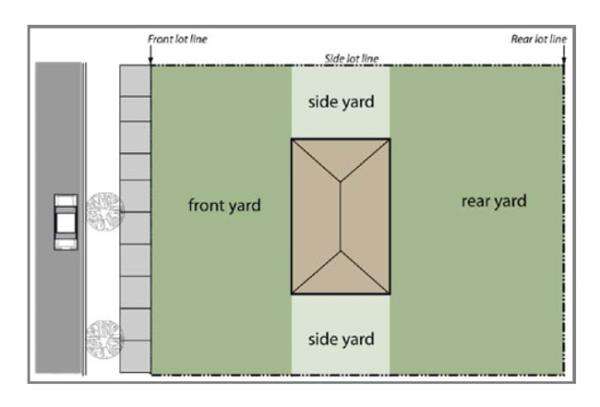
- Distance from principal structure. An accessory building that requires a building permit must be located a minimum of five feet from the principal structure.
- An accessory building is not a primary dwelling or a detached accessory dwelling unit.
- Accessory Structures.
- An accessory structure that requires a building permit must be located a minimum of five feet from the principal structure.
- Swimming pools, detached decks that have an area of 200 square feet or more and are 30 inches or more above grade, require a zoning clearance and a building permit.
- Pools are defined in Chapter 1-3 of this code.
- Fencing requirements for swimming pools, pools, hot tubs, and spas are found in Section 5-4-7 of this code.
- Pools are defined in Chapter 1-3 of this code.
- Pool screening and decking, waterfalls, fountains and barbecue pits with concrete foundations decorative ponds, or sports courts, generally require a zoning clearance and a building permit.
- Portable fountains, birdbaths, benches, or mobile barbecue pits generally do not require a zoning clearance or a building permit.
- Tennis Courts, Sports Courts, Batting Cages, Etc.
Fence type enclosures for uses such as tennis courts, sport courts, ball diamond backstops, batting cages, etc. may be erected to a height not greater than twelve feet, including any retaining walls, provided:
- Any enclosure or part of an enclosure over six feet in height will require engineering and a building permit as defined by Utah State Code, or as required by the currently adopted building code, and may require engineer approval.
- Portions of the enclosure may be located within the rear yard and/or side yard area of the lot.
- No part of the enclosure shall be placed in the front yard setback area of a lot.
- All portions of the enclosure above a height of six feet shall be non-sight obscuring.
- On corner lots, the enclosure shall not be located in the front area, or the clear view area of the lot as defined under Section 10-9-2 of this chapter.
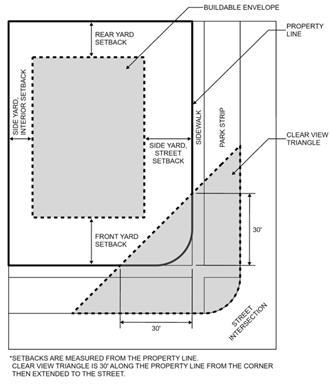
- Any enclosure or part of an enclosure over six feet in height will require engineering and a building permit as defined by Utah State Code, or as required by the currently adopted building code, and may require engineer approval.
- An accessory structure that requires a building permit must be located a minimum of five feet from the principal structure.
Adopted by Ord. 06-2022 on 9/21/2022
Amended by Ord. 11-2024 ADUs IADUs on 5/28/2024
10-12-3 Internal Accessory Dwelling Units (IADU)
10-12-3 Internal Accessory Dwelling Units (IADUs), state law reference Utah Code 10-21-303
- An internal accessory dwelling unit shall be allowed in all single-family residential zones provided that the following conditions are complied with:
- Number allowed. A maximum of one IADU or one ADU shall be allowed on each property associated with a single-family dwelling.
- Occupancy.
- An IADU shall only be permitted when the property owner lives on the property within either the principal dwelling or IADU. For the propose of this section, the term “owner occupied” shall be defined as full-time residency within the home by the bona fide property owner as shown on the county tax assessment rolls, or by any person who is related by blood marriage or adoption, or a trustor of a family trust that possesses legal ownership of the property.
- Within 30 Days of securing approval for the construction of an IADU, the owner shall record against the deed to the subject property, a deed restriction running in favor of the municipality limiting occupancy of either the principal dwelling unit or the AAU IADU to the owner of the property. Proof that such a restriction has been recorded shall be provided to the city prior to the issuance of the occupancy permit for the IADU.
- To encourage reporting of IADUs, the city will pay the homeowner $100 upon receipt of the proof the deed restriction has been recorded. The $100 payment for proof will sunset May 15, 2028, unless extended by action of the city council.
- To encourage reporting of IADUs, the city will pay the homeowner $100 upon receipt of the proof the deed restriction has been recorded. The $100 payment for proof will sunset May 15, 2028, unless extended by action of the city council.
- For the purposes of an existing area of a primary residence that meets the requirements of and IADU but has not been used as one, the owner shall execute the deed restriction listed above and obtain an occupancy permit prior to operating the designated apartment as an IADU.
- Owner occupancy shall not be required when an owner has a bona fide temporary absence of three years or less for activities such as military service, temporary job assignments, work sabbaticals, or voluntary service.
- Neither the primary dwelling unit nor the IADU may be sold separately or any lease would terminate with the sale of the primary dwelling.
- The IADU shall be occupied by a single-family, as defined in U.C.A. 1953, § 10-9a-505.5(2)(b)
- An IADU shall only be permitted when the property owner lives on the property within either the principal dwelling or IADU. For the propose of this section, the term “owner occupied” shall be defined as full-time residency within the home by the bona fide property owner as shown on the county tax assessment rolls, or by any person who is related by blood marriage or adoption, or a trustor of a family trust that possesses legal ownership of the property.
- Design, size.
- The IADU shall be designed so that the appearance of the residence remains as that of a single-family dwelling unit. Entrances to the IADU shall be located on the side or rear of the dwelling unit whenever possible. If a front entrance is required, it shall be visually screened from all public rights-of-way.
- The IADU shall be designed so that the appearance of the residence remains as that of a single-family dwelling unit. Entrances to the IADU shall be located on the side or rear of the dwelling unit whenever possible. If a front entrance is required, it shall be visually screened from all public rights-of-way.
- Off street parking. See Section 10-8-6.A.1 in this code for parking requirements.
- Number allowed. A maximum of one IADU or one ADU shall be allowed on each property associated with a single-family dwelling.
- Requesting Legalization of Existing IADU
- Owners of illegal IADU shall be guilty of a Class B misdemeanor and subject to a penalty listed in PCC 1-4-1. Any existing illegal IADU will not be subject to any enforcement action if:
- The IADU complies with the minimum requirements of the adopted building code.
- The IADU complies with the minimum housing code standards.
- The IADU complies with the provisions in this chapter.
- Owners of illegal IADU shall be guilty of a Class B misdemeanor and subject to a penalty listed in PCC 1-4-1. Any existing illegal IADU will not be subject to any enforcement action if:
- Permit Regulations.
- Building permit. A zoning permit shall be obtained by the homeowner from the city, and a building permit shall be obtained from the designated authority before the commencement of any new construction of an IADU.
- Occupancy permit. Prior to anyone occupying an IADU, a certificate of occupancy shall be obtained by the homeowner from the designated authority.
- Building permit. A zoning permit shall be obtained by the homeowner from the city, and a building permit shall be obtained from the designated authority before the commencement of any new construction of an IADU.
(Code 1998, § 10-12-3; Ord. No. 002-2006, 1-10-2006; Ord. No. 006-2006, 6-27-2006; Ord. No. 2019-020, 10-22-2019)
Adopted by Ord. 06-2022 on 9/21/2022
Amended by Ord. 11-2024 ADUs IADUs on 5/28/2024
Amended by Ord. 10-2026 ADU/IADU Amend. on 6/29/2026
10-12-4 Detached Accessory Dwelling Units (ADU)
10-12-4 Detached Accessory Dwelling Units (ADU) State Law Reference Utah Code 10-21-303
- As stated in the Providence City General Plan, the intent is to promote and encourage the creation of legal ADUs in a manner that enhances residential neighborhoods while respecting the existing look and scale of single-family dwellings. The intent of this chapter is to provide for a broader range of affordable housing options that generate these benefits:
- Provides an alternative for older homeowners who want to remain in their home and would like a family member, caretaker or renter to help make that possible so that the elderly can age in place rather than inhabit senior living centers.
- Make housing affordable for young people to live in desirable communities where single-family homes are out of their reach.
- Contribute to solving the housing shortage.
- Opens up areas for development potential without threatening the existing character of a neighborhood.
- Adds inexpensive rental units to the housing stock to meet the needs of smaller households, both old and young.
- Develops housing units in single-family neighborhoods to serve the needs of the residents through a variety of stages in the life cycle, thereby reducing fluctuations in neighborhood demand for services.
- Requirement that owner be on the premises decreases the chance of ADU tenants inflicting nuisances on the surrounding neighborhood.
- Provide an extra living space for a growing family.
- Is intended to be a family friendly ordinance allowing for young and old to live together, for grown children to stay in the community that they love.
- Enhance neighborhood stability with owners more likely to remain; allow current neighbors to stay through different stages of life.
- Promotes more efficient use of existing housing stock and city infrastructure.
- Provides an alternative for older homeowners who want to remain in their home and would like a family member, caretaker or renter to help make that possible so that the elderly can age in place rather than inhabit senior living centers.
- Permitted Use.
- ADUs are a permitted use in the following residential zones; AGR, R-1-1, R-1-20, R-1-12, R-1-10, R-1-8, R-1-6.
- ADUs must comply with all applicable ordinances.
- A mobile home as defined by Utah Code is not allowed as an ADU.
- An ADU must be on a raised or slab-on-grade foundation.
- Owner Occupied Requirement.
- An ADU shall only be permitted when the property owner lives on the property within either the principal dwelling or ADU. For the purpose of this section, the term "owner occupied" shall be defined as full-time residency within the home by the bona fide property owner as shown on the county tax assessment rolls, or by any person who is related by blood, marriage or adoption, or a trustor of a family trust that possesses legal ownership of the property.
- Within 30 days of securing a building permit for construction of an ADU, the owner shall record against the deed to the subject property, a deed restriction running in favor of the municipality limiting occupancy of either the principal dwelling unit or the ADU to the owner of the property. Proof that such a restriction has been recorded shall be provided to the city prior to issuance of the occupancy permit for the ADU.
- To encourage reporting of ADUs, the city will pay the homeowner $100 upon receipt of the proof the deed restriction has been recorded. The $100 payment for proof will sunset May 15, 2028, unless extended by action of the city council.
- To encourage reporting of ADUs, the city will pay the homeowner $100 upon receipt of the proof the deed restriction has been recorded. The $100 payment for proof will sunset May 15, 2028, unless extended by action of the city council.
- For the purposes of an existing accessory building that meets the requirements of an ADU but has not been used as one, the owner shall execute the deed restriction listed above prior to the use of the ADU.
- Owner occupancy shall not be required when an owner has a bona fide temporary absence of three years or less for activities such as military service, temporary job assignments, sabbaticals or voluntary service.
- Neither the primary dwelling nor the ADU may be sold or conveyed separately.
- An ADU shall only be permitted when the property owner lives on the property within either the principal dwelling or ADU. For the purpose of this section, the term "owner occupied" shall be defined as full-time residency within the home by the bona fide property owner as shown on the county tax assessment rolls, or by any person who is related by blood, marriage or adoption, or a trustor of a family trust that possesses legal ownership of the property.
- Number of Accessory Dwelling Units. A maximum of one IADU or ADU shall be allowed on each property associated with a single-family dwelling.
- Accessory Dwelling Unit Size.
The total area of the ADU shall be less than 50 percent of the total square footage of the primary residence for a detached accessory dwelling, but not more than 1,200 square feet (including attached garage).
- An ADU may be part of a larger accessory building, as long as the ADU portion of the building does not exceed 1,200 square feet. Except as allowed in item H below, an accessory building that includes an ADU must meet the same setback requirements as listed in the area regulation chart.
- An ADU may be part of a larger accessory building, as long as the ADU portion of the building does not exceed 1,200 square feet. Except as allowed in item H below, an accessory building that includes an ADU must meet the same setback requirements as listed in the area regulation chart.
- Yard Limitation. An ADU, as a single unit or in combination with a group of accessory buildings of any kind, is allowed. The total footprint of all accessory buildings is limited to 25 percent of the lot area not covered by the principal residence.
- Building Height. An ADU shall be limited to two stories; and shall not exceed the height permitted by the area regulation chart or the height of the principal residence, whichever is lower.
- Building Setbacks. New ADUs are subject to the same ordinances that apply to the principal dwelling unit as far as zoning and setbacks as listed in the area regulations chart. Existing structures as of February 23, 2022, that do not meet setback requirements may be approved on a conditional basis. Adjacent property owners will be notified, and a public hearing will be held before the administrative land use authority; which will either approve or deny the conditional use in accordance with the conditional use process.
- The street view of an ADU shall be substantially similar in design as the street view of the primary dwelling unit.
- Fire, Building, and Health Codes. An ADU shall comply with all building construction, fire codes and municipal codes in effect at the time the ADU is constructed, created or subsequently remodeled, including the obtaining of required building and other permits.
- Parking. Off-street parking is a requirement. See PCC 10-8-6.1.A. in this code for parking requirements
- Utilities. An ADU may utilize the existing utilities (city supplied culinary water and sanitary sewer) of the principal dwelling. An ADU that requires separate utility hookups will be subject to metering and city connection fees.
- Screening. The orientation of the proposed ADU shall, to the maximum extent practical, maintain the privacy of residents in adjoining dwellings as determined by the physical characteristics surrounding the ADU, including landscape screening, fencing, and window and door placement.
- Penalty and Legalizing ADUs.
Owners of illegal ADUs shall be guilty of a Class B misdemeanor and subject to a penalty listed in PCC 1-4-1. Any existing illegal ADU will not be subject to any enforcement action if:
- The ADU complies with the minimum requirements of the adopted building code.
- The ADU complies with the provisions in this chapter.
(Code 1998, § 10-12-4; Ord. No. 002-2006, 1-10-2006; Ord. No. 006-2006, 6-27-2006; Ord. No. 2019-020, 10-22-2019)
Adopted by Ord. 06-2022 on 9/21/2022
Amended by Ord. 11-2024 ADUs IADUs on 5/28/2024
Amended by Ord. 10-2026 ADU/IADU Amend. on 6/29/2026
10-12-5 (REPELLED)
- Building permit. A zoning permit shall be obtained by the homeowner from the city, and a building permit shall be obtained from the designated authority before the commencement of any new construction of an accessory apartment unit.
- Occupancy permit. Prior to anyone occupying an accessory apartment unit, a certificate of occupancy shall be obtained by the homeowner from the designated authority.
(Code 1998, § 10-12-5; Ord. No. 002-2006, 1-10-2006; Ord. No. 006-2006, 6-27-2006; Ord. No. 2019-020, 10-22-2019)
Adopted by Ord. 06-2022 on 9/21/2022
10-12-6 (REPELLED)
The mayor and city staff shall report to the council once a year the number of new AAUs permitted during the previous 12 months. This report shall be made to the council no later than 30 days after the end of the calendar year.
(Code 1998, § 10-12-6; Ord. No. 002-2006, 1-10-2006; Ord. No. 006-2006, 6-27-2006; Ord. No. 2019-020, 10-22-2019)
Adopted by Ord. 06-2022 on 9/21/2022

