
Rancho Palos Verdes
City Zoning Code
City Zoning Code
ARTICLE I
- RESIDENTIAL DISTRICTS
17.02.010. - Purpose.
The purpose of the Single-Family Residential District (RS) is to provide for individual homes on separate lots, each for the occupancy of one family, at various minimum lot sizes, to provide for a range of yard and lot sizes which are based on the general plan of the city, and to provide for other uses that are associated and compatible with residential uses designated in this title.
(Code 1981, § 17.02.010; Ord. No. 78(part), 1975; Ord. No. 320, § 7(part), 1997)
17.02.020. - Uses and development permitted.
Only the following uses and developments may be conducted or constructed:
A.
Single-family residential buildings, mobilehomes on city approved foundations, as provided in Government Code §§ 65852.3 and 65852.4 and associated accessory structures for the residential use and occupancy of not more than one family and not more than one dwelling unit per lot, with the exception of accessory dwelling units and junior accessory dwelling units approved pursuant to chapter 17.10 (Accessory Dwelling Unit and Junior Accessory Dwelling Unit Development Standards);
B.
Second units and two-unit developments approved pursuant to chapter 17.09 (Second Units and Two-Unit Developments in Single-Family Zones);
C.
Home occupations pursuant to chapter 17.08 (Home Occupations);
D.
Private outdoor recreational uses, such as tennis courts, swimming pools and basketball courts, which are incidental to the residential use of the property;
E.
Residential planned development (RPD), pursuant to chapter 17.42 (Residential Planned Development);
F.
The keeping of animals that are household pets, as defined in section 17.96.945 (Household pets) and small domestic animals for noncommercial purposes. Animals that are not household pets may be permitted pursuant to approval of an exotic animal permit;
G.
The keeping of large domestic animals, pursuant to chapter 17.46 (Equestrian Overlay (Q) District);
H.
The keeping of a maximum of five beehives for noncommercial purposes, except for the RS-A-5 residential zoning district, where a maximum of ten bee hives may be kept upon approval by the director of a site plan review application, which shall be appealable to the planning commission pursuant to chapter 17.80 (Hearing notice and appeal procedures);
I.
The growing of crops and/or fruits on one acre or less for noncommercial purposes;
J.
Small family day care;
K.
Temporary special uses and developments, if a special use permit is first obtained, pursuant to chapter 17.62 (Special Use Permits);
L.
Commercial filming or photography, if a city film permit is first obtained, pursuant to chapter 9.16 (Still Photography, Motion Picture and Television Productions) of this Code;
M.
Garage sales, provided that no more than four sales, each occurring on one calendar day, are held on the same property within a calendar year and that the merchandise for sale, with the exception of neighbors combining items for sale at one property, is the personal property of the resident of the property where the sale is being conducted and is not acquired or consigned for the purpose of resale;
N.
Any other use which specifically is required to be permitted in a single family residential district by state or federal law; and
O.
Other uses as provided in any applicable overlay or special district.
(Code 1981, § 17.02.020; Ord. No. 78(part), 1975; Ord. No. 149, § 5, 1982; Ord. No. 150, § 1, 1982; Ord. No. 194, § 5(part), 1985; amended during 11-97 supplement; Ord. No. 320, § 7(part), 1997; Ord. No. 175, §§ 6—8, 1983; Ord. No. 529, § 17, 11-15-2011; Ord. No. 535, § 3, 4-17-2012; Ord. No. 628, § 7, 10-15-2019; Ord. No. 640, § 6, 1-19-2021; Ord. No. 656U, § 5, 12-21-2021)
17.02.025. - Uses and development permitted by conditional use permit.
Only the following uses and developments may be conducted or constructed with approval of a conditional use permit pursuant to chapter 17.60 (Conditional Use Permits):
A.
The growing of crops and/or fruits on more than one acre or for commercial purposes;
B.
Flower and produce stands, wholesale plant nurseries, horse stables and similar commercial/agricultural uses;
C.
Bed and breakfast inns;
D.
Residential care facilities involving seven or more patients;
E.
Large family day care, pursuant to section 17.76.070 (Large Family Day Care Home Permit);
F.
Commercial antennas, pursuant to section 17.76.020 (Antennas);
G.
Golf courses, driving ranges and related ancillary uses;
H.
Government facilities;
I.
Private educational uses, not including nursery schools and day nurseries;
J.
Public utility structures;
K.
Outdoor active recreational uses and facilities; and
L.
Such other uses as the director deems to be similar and no more intensive. Such a determination may be appealed to the planning commission and the planning commission's decision may be appealed to the city council pursuant to section 17.80.050 (Appeal to Planning Commission). If a proposed use or development is located in the coastal specific plan district, the city's final decision regarding such other use may be appealed to the California Coastal Commission for a determination that the uses are similar and compatible with the local coastal program.
(Code 1981, § 17.02.025; Ord. No. 320, § 7(part), 1997)
17.02.026. - Short-term rentals and advertisement of short-term rentals.
A.
No person shall operate a short-term rental in a single-family residential zoning district.
B.
No responsible party shall post, publish, circulate, broadcast or maintain any advertisement of a short-term rental prohibited in any of the city's single-family residential zoning districts.
(Code 1981, § 17.02.026; Ord. No. 592U, § 4, 12-20-2016; Ord. No. 593, § 4, 1-17-2017)
17.02.030. - Development standards.
A.
Single-family residential development standards chart. The property development standards contained in table 02-A, Single-Family Residential Development Standards shall apply to all land and structures in the RS districts. For exceptions and explanatory description of these standards; for standards of fences, walls and signs; and for off-site improvement and dedication requirements, see article VI (Use and Development Standards) and article VII (Development Application and Review) attached to the ordinance codified in this title and on file with the city. A zoning designation followed by (RPD) indicates that a residential planned development is required; see chapter 17.42 (Residential Planned Development). The number which follows an "RS-" designation indicates the maximum number of lots per acre permitted in the zone; the number which follows an "RS-A" designation indicates the minimum number of acres per lot permitted in the zone.
B.
Neighborhood compatibility.
1.
The following residential development projects shall be compatible with the character of the immediate neighborhood:
a.
A new primary dwelling unit that is proposed to be developed on a vacant lot;
b.
A new primary dwelling unit that is proposed to replace an existing residence;
c.
An existing primary dwelling unit that is proposed to be remodeled or renovated such that 50 percent or greater of any existing interior and exterior walls or existing square footage is demolished;
d.
An addition to an existing primary dwelling unit or the construction of any new detached structure that individually, or when combined with prior additions cumulatively, results in greater than:
i.
750 square feet of additional floor area; or
ii.
A 25 percent expansion of the total square footage of all of the original structures constructed on the property, including the primary dwelling unit, the garage, and all detached structures;
e.
The construction of, or an addition to, a structure exceeding 16 feet in height and requiring a height variation permit pursuant to chapter 17.02.040 (View preservation and restoration);
f.
Projects that result in lot coverage that exceeds the maximum allowed in chapter 17.02 (Single-Family Residential (RS) Districts) of the development code;
g.
The construction of, or an addition to a deck, balcony or roof deck to a second story or higher story if the total areas of the deck is 80 square feet or larger or projects more than six feet from the existing building; and
h.
An addition of a mezzanine to an existing structure that modifies the exterior of the structure, other than the placement of flush mounted doors and windows.
2.
The projects listed in the following subsection (B)(2)(a) through (e) of this section shall be exempt from the neighborhood compatibility requirements of this subsection. However, no property shall be issued a permit for a project that is subject to the same subsection more than once in a two-year period without complying with the neighborhood compatibility requirements:
a.
An addition to an existing single-family residence that meets the following criteria:
i.
Is 16 feet or less in height, as measured according to the criteria stated in section 17.02.040(B);
ii.
Is not being constructed along the facade facing any street;
iii.
Is 250 square feet or less in floor area; and
iv.
Complies with all of the city's residential development standards.
b.
An addition or conversion of non-habitable floor area to habitable floor area that does not result in exterior modifications other than the placement of flush mounted doors and windows.
c.
The construction of a minor non-habitable accessory structure, such as, but not limited to, a cabana, a pool changing room, a storage shed, or a playhouse, that meets the following criteria:
i.
Is 12 feet or less in height, as measured from lowest adjacent grade as stated in section 17.48.050(D);
ii.
Is less than 250 square feet in floor area; and
iii.
Complies with all of the city's residential development standards.
d.
The enclosure of a roofed breezeway between legally permitted structures or the enclosure of a 250 square foot or less patio cover, provided the enclosure:
i.
Is 16 feet or less in height, as measured according to the criteria stated in section 17.02.040(B);
ii.
Is attached to the primary structure; and
iii.
Complies with all of the city's residential development standards.
e.
The reconstruction of a single-family residence damaged or destroyed by fire, earthquake, landslide or an involuntary act of the property owner, provided that the reconstructed residence:
i.
Is the same size and located in the same general location as the original residence;
ii.
Is designed with substantially the same exterior materials, finishes and architectural style as the original residence; and
iii.
Complies with all of the city's residential development standards.
3.
As defined in section 17.02.040(A)(6) of this chapter, neighborhood character means the existing characteristics in terms of the following:
a.
Scale of surrounding residences;
b.
Architectural styles and materials; and
c.
Front, side and rear yard setbacks.
4.
The determination of whether a new single-family residence or an addition to an existing single-family residence is compatible with the neighborhood character shall be made by the director or planning commission in the course of considering the applicable permit applications for the proposed residence.
5.
Public notice. Notice for an application that requires a neighborhood compatibility finding shall be published in a newspaper of general circulation and given to owners of property within 500 feet of the project, to all persons requesting notice, to any affected homeowner's associations, and the applicant pursuant to section 17.80.090 (Notice of hearing) of this title. Said notice shall be given at least 15 days prior to a decision on the application.
C.
Exterior stairs. Exterior stairs to an upper story shall be prohibited, unless leading to and/or connected to a common hallway, deck, or entry, rather than a specific room.
D.
Roof decks and balconies.
1.
The term "deck" means a platform that is freestanding or attached to a building or structure. A deck attached to, and projecting beyond, the vertical surface of a building or structure which is located a minimum of eight feet above adjacent grade shall be considered a balcony.
2.
Decks located upon the roof of a primary building shall be permitted, except for the following decks which shall be prohibited:
a.
Decks which are not directly accessible from habitable floor area located on the same level as the deck;
b.
Decks which are solely accessed by exterior stairs, a roof hatch, or both (or other similar openings); and
c.
Decks located entirely on the roof of an accessory structure or detached garage.
3.
As required in section 17.02.030(B)(1)(g), a roof deck or balcony that exceeds 80 square feet or projects more than six feet from the existing building shall not be approved unless determined to be compatible with the existing neighborhood.
4.
The following standards shall apply to all permitted roof decks and balconies:
a.
A roof deck or balcony shall not create an unreasonable infringement of privacy, as defined by the height variation findings discussed in section 17.02.040(C)(1)(e)(ix) of the occupants of abutting residences.
b.
Any outdoor furnishings, accessories or plants located on a roof deck shall not exceed a height of eight feet or the bottom of the roof eave, whichever is lower, as measured from the finished floor of the deck; and
c.
Any outdoor furnishings, accessories or plants located on a roof deck which exceed the height limits established in section 17.02.040 (View preservation and restoration), shall not significantly impair a view from surrounding properties.
E.
Parking/driveway standards.
1.
A minimum of two enclosed parking spaces shall be provided and maintained in a garage, and a minimum of two unenclosed parking spaces shall be provided and maintained as a driveway, on the property of each single-family dwelling unit containing less than 5,000 square feet of habitable space, as determined by the director.
2.
A minimum of three enclosed parking spaces shall be provided and maintained in a garage, and a minimum of three unenclosed parking spaces shall be provided and maintained as a driveway, on the property of each single-family dwelling unit containing 5,000 square feet or more of habitable space, as determined by the director.
3.
A garage with a direct access driveway from the street of access shall not be located less than 20 feet from the front or street-side property line, whichever is the street of access.
4.
In addition to the parking requirements for the primary single-family residence on a property, parking for city-approved accessory dwelling units shall be provided in accordance with chapter 17.10 (Accessory Dwelling Unit and Junior Accessory Dwelling Unit Development Standards).
5.
An enclosed parking space shall have an unobstructed ground space of no less than nine feet in width by 20 feet in depth, with a minimum of seven feet of vertical clearance over the space. An unenclosed parking space shall have an unobstructed ground space of no less than nine feet in width by 20 feet in depth.
6.
The following minimum driveway widths and turning radii shall be provided for all driveways leading from the street of access to a garage or other parking area on a residential parcel:
a.
A driveway shall be a minimum width of ten feet; and
b.
A paved 25-foot turning radius shall be provided between the garage or other parking area and the street of access for driveways which have an average slope of ten percent or more, and which are 50 feet or more in length.
7.
Driveways shall take into account the driveway standards required by the department of public works for driveway entrances located in the public right-of-way.
8.
A driveway that is located adjacent to a side property line shall provide a minimum 18-inch-wide landscaped area between the side property line and the adjacent driveway, unless such buffer would reduce the minimum width of the driveway to less than ten feet, in which case the width of the landscape buffer may be narrowed or eliminated at the discretion of the director.
9.
All driveways shall be built and maintained in accordance with the specifications of the county fire department. If there is any inconsistency between the standards imposed by this chapter and the standards imposed by the county fire department, the stricter shall apply.
10.
Unless otherwise expressly permitted elsewhere in this title, enclosed tandem parking spaces may only be used for parking spaces in excess of the minimum requirements of subsections (E)(1) and (2) of this section, provided that each space meets the minimum dimensions specified in subsection (E)(5) of this section.
(Code 1981, § 17.02.030; Ord. No. 78(part), 1975; Ord. No. 117, § 6, 1979; Ord. No. 187, § 3, 1984; Ord. No. 194, § 5(part), 1985; Ord. No. 320, § 7(part), 1997; Ord. No. 340, § 8(part), 1998; Ord. No. 355, § 7, 2000; Ord. No. 389, § 4, 2003; Ord. No. 414, § 6, 2004; Ord. No. 463, § 7, 2007; Ord. No. 510, §§ 8, 12, 6-29-2010; Ord. No. 529, § 9, 11-15-2011; Ord. No. 533, § 6, 3-6-2012; Ord. No. 615U, §§ 2, 3, 1-15-2019; Ord. No. 619, §§ 2, 3, 3-19-2019; Ord. No. 628, § 7, 10-15-2019; Ord. No. 640, §§ 8, 9, 1-19-2021)
17.02.035. - Application requirement.
Applications that involve the construction of a new single-family residence shall include a geology report determining that the project is geologically feasible. The city geologist shall review and approve said report prior to the application for said project being deemed complete for processing.
(Code 1981, § 17.02.035; Ord. No. 529, § 6, 11-15-2011)
17.02.040. - View preservation and restoration.
The residents of the city, by the adoption of this section, have made a finding that the peace, health, safety and welfare of the community will be served by the adoption of this section and by the regulations prescribed herein.
A.
Definitions. When not inconsistent with the context, the words used in the present tense include the future; words in the singular number include the plural; and those in the plural number include the singular. In carrying out the intent of this section, words, phrases and terms shall be deemed to have the following meanings ascribed to them:
1.
City means the City of Rancho Palos Verdes and its employees and staff and those designated by the city council to act on behalf of the city.
2.
City council means the duly elected legislative body of the City of Rancho Palos Verdes.
3.
Director means the director of the planning, building and code enforcement department of the City of Rancho Palos Verdes.
4.
Foliage means natural growth of trees, shrubs and other plant life.
5.
Lot coverage means that portion of a lot or building site which is occupied by any building or structure, including trellises; decks over 30 inches in height (as measured from existing adjacent grade); parking areas; driveways; or impervious surfaces (impervious surfaces less than five feet in width and/or one patio area less than 500 square feet in area shall be excluded from the lot coverage calculation).
6.
Neighborhood character means the existing characteristics in terms of the following:
a.
Scale of surrounding residences;
b.
Architectural styles and materials; and
c.
Front, side and rear yard setbacks.
7.
Planning commission means the planning commission of the city as defined in chapter 2.20 (Planning Commission) of this Code.
8.
Privacy means reasonable protection from intrusive visual observation.
9.
Scale means the total square footage and lot coverage of a residence and all ancillary structures.
10.
Setback means the minimum horizontal distance as prescribed by this code, between any property line or private easement boundary used for vehicular and/or pedestrian access and the closest point on any building or structure, below or above ground level, on the property. In cases where there is no structure on a lot, setback shall mean the minimum horizontal distance between the property line or easement boundary line and a line parallel to the property line or easement boundary line. Please refer to chapter 17.48 (Lots, Setbacks, Open Space Area and Building Height) for setback regulations.
11.
Shall and may. The term "shall" is mandatory and the term "may" is permissive.
12.
Structure means anything constructed or built, any edifice or building of any kind, or any piece of work artificially built up or composed of parts joined together in some definite manner, which is located on or on top of the ground on a parcel of land utilized for residential purposes, excluding antennas, skylights, solar panels and similar structures not involving the construction of habitable area.
13.
Style means design elements which consist of, but are not limited to:
a.
Facade treatment;
b.
Height of structure;
c.
Open space between structures;
d.
Roof design;
e.
The apparent bulk or mass of the structure; and
f.
The number of stories.
14.
View. On the Palos Verdes peninsula, it is quite common to have a near view and a far view because of the nature of many of the hills on the peninsula. Therefore, a view which is protected by this section is as follows:
a.
The term "near view" means a scene located on the peninsula, including, but not limited to, a valley, ravine, equestrian trail, pastoral environment or any natural setting; and/or
b.
The term "far view" means a scene located off the peninsula, including, but not limited to, the ocean, Los Angeles basin, city lights at night, harbor, Vincent Thomas Bridge, shoreline or offshore islands.
A view which is protected by this section shall not include vacant land that is developable under this code, distant mountain area not normally visible, nor the sky, either above distant mountain areas or above the height of offshore islands. A view may extend in any horizontal direction (360 degrees of horizontal arc) and shall be considered as a single view, even if broken into segments by foliage, structures or other interference.
15.
Viewing area means that area of a structure (excluding bathrooms, hallways, garages or closets) or that area of a lot (excluding the setback areas) where the owner and city determine the best and most important view exists. In structures, the finished floor elevation of any viewing area must be at or above existing grade adjacent to the exterior wall of the part of the building nearest to said viewing area.
16.
View restoration commission means the planning commission of the city.
B.
Regulations.
1.
Building height. Any individual or persons desiring to build a new structure or an addition to an existing structure shall be permitted to build up to 16 feet in height pursuant to subsection B of this section provided there is no grading, as defined in section 17.76.040 (Grading Permit) of this title, to be performed in connection with the proposed construction, and further provided that no height variation is required, and all applicable residential development standards are or will be met. In cases where an existing structure is voluntarily demolished or is demolished as a result of an involuntary event, a height variation application will not be required to exceed 16 feet in height, provided that the replacement structure will have the same or less square footage and building height as the existing structure and will be reconstructed within the building envelope and footprint of the pre-existing structure. Approval for proposed structures or additions to existing structures exceeding 16 feet in height, may be sought through application for a height variation permit, which, if granted pursuant to the procedures contained herein, will permit the individual to build a structure not exceeding 26 feet in height, except as provided in subsection (B)(1)(d) of this section, or such lower height as approved by the city, measured as follows:
a.
For sloping lots which slope uphill from the street of access or in the same direction as the street of access and for which no building pad exists, the height shall be measured from the preconstruction (existing) grade at the highest point on the lot to be covered by the structure to the ridgeline or the highest point of the structure, as illustrated in figure 1 below.
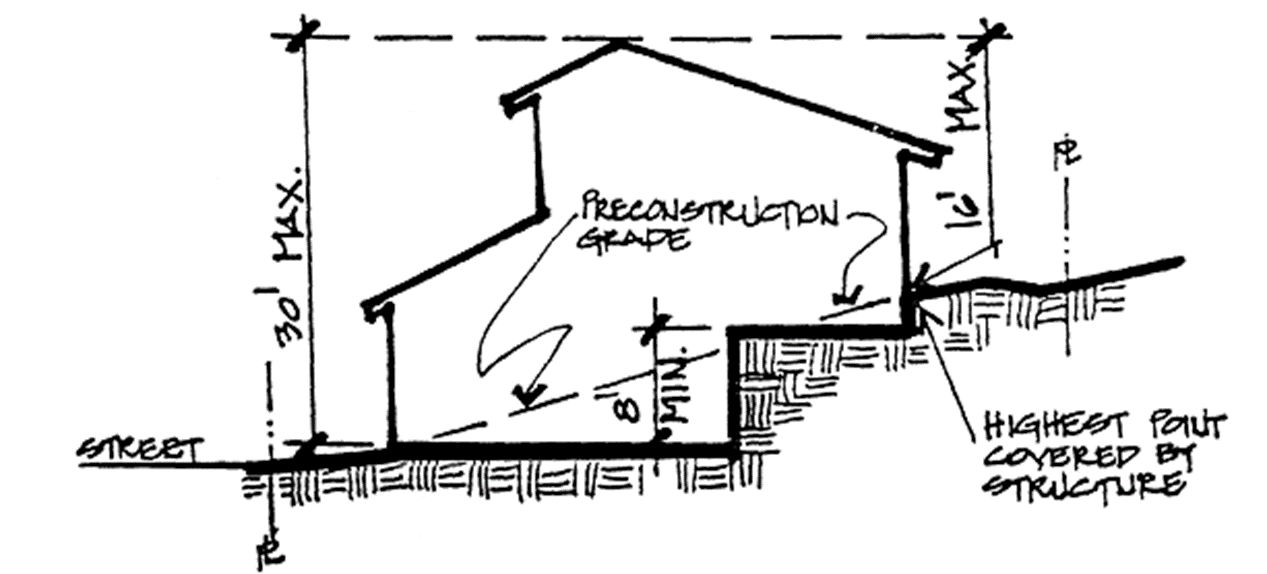
Figure 1
b.
For sloping lots which slope downhill from the street of access and for which no building pad exists, the height shall be measured from the average elevation of the setback line abutting the street of access to the ridgeline or the highest point of the structure, as illustrated in figure 2 below.
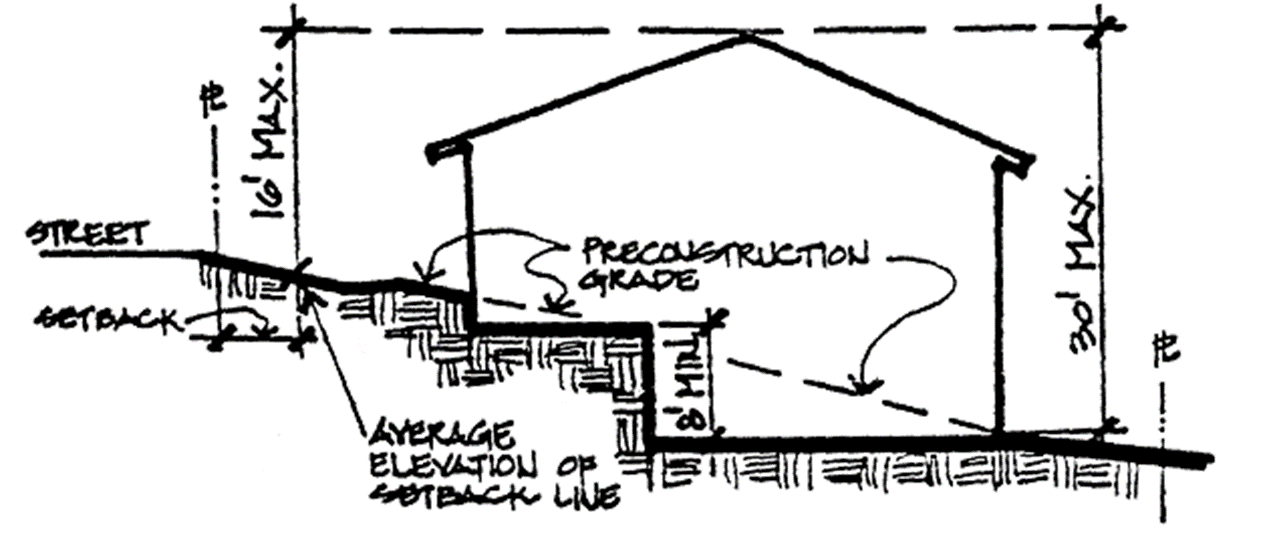
Figure 2
c.
For lots with a building pad at street level or at a different level than the street or lot configurations not previously discussed, the height shall be measured from the preconstruction (existing) grade at the highest elevation of the existing building pad area covered by the structure to the ridgeline or highest point of the structure, as illustrated in figure 3 below. Portions of a structure which extend beyond the building pad area of a lot shall not qualify as the highest elevation covered by the structure, for the purposes of determining maximum building height. Structures allowed pursuant to this subsection shall not exceed 20 feet in height, as measured from the point where the lowest foundation or slab meets finished grade, to the ridgeline or highest point of the structure. Otherwise, a height variation permit shall be required.
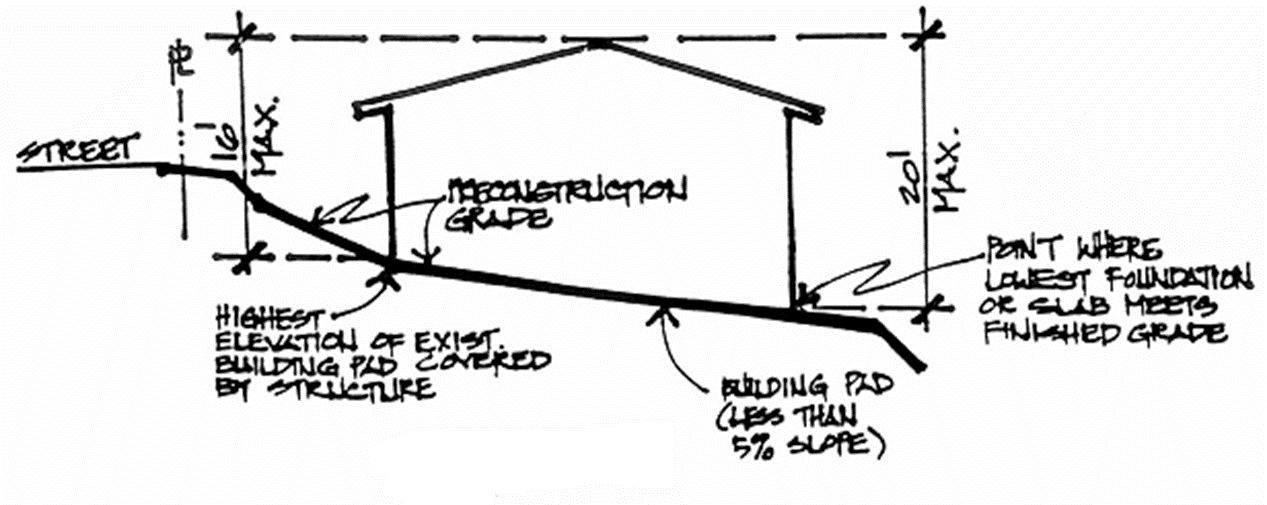
Figure 3
d.
On sloping lots described in subsections (B)(1)(a) and (b) of this section, the foundation of the structure shall contain a minimum eight-foot step with the slope of the lot, as illustrated in figure 4 below. However, no portion of the structure shall exceed 30 feet in height, when measured from the point where the lowest foundation or slab meets finished grade to the ridge line or highest point of the structure. The 30-foot height shall not exceed a horizontally projected 16-foot height line (from the high point of the uphill step of the structure).
2.
Setbacks for sloping lots. On lots which slope uphill from the street of access and where the height of a structure is in excess of 16 feet above the point where the lowest foundation or slab meets the ground, areas in excess of the 16-foot height limit shall be set back one foot from the exterior building facade of the first story, most parallel and closest to the front property line, for every foot of height in excess of 16 feet, as measured from the point where the lowest foundation or slab meets the ground, as illustrated in figure 4 below.
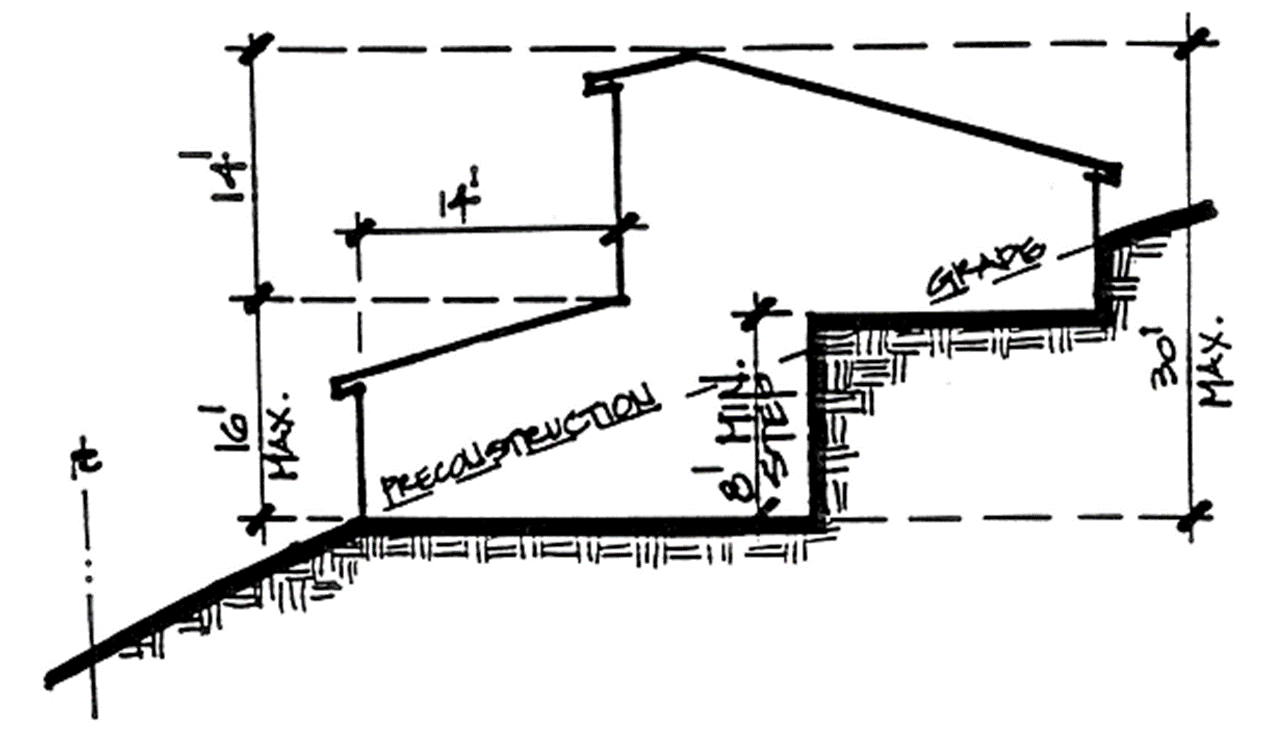
Figure 4
3.
Foliage obstruction. No person shall significantly impair a view from a viewing area of a lot by permitting foliage to grow to a height exceeding:
a.
The height determined by the view restoration commission through issuance of a view restoration permit under subsection (C)(2) of this section; or
b.
If no view restoration permit has been issued by the view restoration commission, a height which is the lesser of:
i.
The ridge line of the primary structure on the property; or
ii.
16 feet.
If foliage on the property already exceeds the provisions of subsections (B)(3)(i) and (ii) of this section on the effective date of this section, as approved by the voters on November 7, 1989, and significantly impairs a view from a viewing area of a lot, then notwithstanding whether any person has sought or obtained issuance of a view restoration permit, the foliage owner shall not let the foliage exceed the foliage height existing on the effective date of this section (November 17, 1989). The purpose of this subsection is to ensure that owners of foliage which violates the provisions of this subsection on the effective date of this section shall not allow the foliage to increase in height. This subsection does not grandfather or otherwise permit such foliage to continue to block a view.
4.
Removal of foliage as condition of permit issuance. The city shall issue no conditional use permit, variance, height variation, building permit or other entitlement to construct a structure, or to add livable area to a structure on a parcel utilized for residential purposes, unless the owner removes that part of the foliage on the lot exceeding 16 feet in height or the ridge line of the primary structure, whichever is lower, that significantly impairs a view from the viewing area of another parcel. The owner of the property is responsible for maintaining the foliage so that the views remain unimpaired. This requirement shall not apply where removal of the foliage would constitute an unreasonable invasion of the privacy of the occupants of the property on which the foliage exists and there is no method by which the property owner can create such privacy through some other means allowed within the development code that does not significantly impair a view from a viewing area of another property. The initial decision on the amount of foliage removal required or the reasonable degree of privacy to be maintained shall be made by the director, the planning commission or the city council, as appropriate for the entitlement in question. If the permit issuance involves property located within the Miraleste Recreation and Park District, the findings of subsection (C)(2)(c)(vi) of this section shall apply. A decision by the director on either of these matters may be appealed to the planning commission, and any decision of the planning commission may be appealed to the city council.
5.
Determination of viewing area. The determination of a viewing area shall be made by balancing the nature of the view to be protected and the importance of the area of the structure or lot from where the view is taken. Once finally determined for a particular application, the viewing area may not be changed for any subsequent application. In the event the city and owner cannot agree on the viewing area, the decision of the city shall control. A property owner may appeal the city's determination of viewing area. In such event, the decision on the viewing area will be made by the body making the final decision on the application. A property owner may preserve their right to dispute the decision on the viewing area for a subsequent application, without disputing the decision on a pending application, by filing a statement to that effect and indicating the viewing area the property owner believes to be more appropriate. The statement shall be filed with the city prior to consideration of the pending application by the city.
C.
Procedures and requirements.
1.
Preservation of views where structures are involved.
a.
Any person proposing to construct a structure above 16 feet shall submit a height variation permit application to the city. A determination on the application shall be made by the director in accordance with the findings described in subsection (C)(1)(e) of this section. The director shall refer a height variation application directly to the planning commission for consideration under the same findings, as part of a public hearing, if any of the following is proposed:
i.
Any portion of a structure which exceeds 16 feet in height extends closer than 25 feet from the front or street-side property line;
ii.
The area of the structure which exceeds 16 feet in height (the second story footprint) exceeds 75 percent of the first story footprint area (residence and attached garage);
iii.
60 percent or more of a garage footprint is covered by a structure which exceeds 16 feet in height (a second story);
iv.
The portion of the structure which exceeds 16 feet in height is being developed as part of a new single-family residence; or
v.
Based on an initial site visit, the director determines that any portion of a structure which is proposed to exceed 16 feet in height may significantly impair a view as defined in this chapter.
b.
The applicant shall take reasonable steps established by the city council to consult with owners of property located within 500 feet of the applicant's property. The applicant shall obtain and submit with the application the signatures of the persons with whom the applicant consulted. Where a homeowner's association existing in the neighborhood affected has provided written notice to the director of its desire to be notified of height variation applications, the applicant shall mail a letter to the association requesting its position on the application. A copy of this letter and the response of the association, if any, shall be submitted with the application. A fee shall be charged for the application as established by resolution of the city council.
c.
The director shall, by written notice, notify property owners within a 500-foot radius of the subject property and the affected homeowner's association, if any, of the application and inform them that any objections to the proposed construction must be submitted to the director within 30 calendar days of the date of the notice.
d.
The applicant shall construct on the site at the applicant's expense, as a visual aid, a temporary frame of the proposed structure.
e.
A height variation application to build a new structure or an addition to an existing structure, either of which exceeds 16 feet in height up to the maximum height permitted in subsection (B)(1) of this section, may be granted with or without conditions if the following findings can be made:
i.
The applicant has complied with the early neighbor consultation process established by the city;
ii.
The proposed new structure that is above 16 feet in height or addition to an existing structure that is above 16 feet in height does not significantly impair a view from public property (parks, major thoroughfares, bike ways, walkways or equestrian trails) which has been identified in the city's general plan or coastal specific plan, as city-designated viewing areas;
iii.
The proposed new structure is not located on a ridge or a promontory;
iv.
The area of a proposed new structure that is above 16 feet in height or addition to an existing structure that is above 16 feet in height, as defined in subsection B of this section, when considered exclusive of existing foliage, does not significantly impair a view from the viewing area of another parcel. If the viewing area is located in a structure, the viewing area shall be located in a portion of a structure which was constructed without a height variation permit or variance, or which would not have required a height variation or variance when originally constructed had this section, as approved by the voters on November 7, 1989, been in effect at the time the structure was constructed, unless the viewing area located in the portion of the existing structure which required a height variation permit or variance constitutes the primary living area (living room, family room, dining room or kitchen) of the residence;
v.
If view impairment exists from the viewing area of another parcel but it is determined not to be significant, as described in subsection (C)(1)(e)(vi) of this section, the proposed new structure that is above 16 feet in height or addition to an existing structure that is above 16 feet in height is designed and situated in such a manner as to reasonably minimize the impairment of a view;
vi.
There is no significant cumulative view impairment caused by granting the application. Cumulative view impairment shall be determined by:
(a)
Considering the amount of view impairment that would be caused by the proposed new structure that is above 16 feet in height or addition to a structure that is above 16 feet in height; and
(b)
Considering the amount of view impairment that would be caused by the construction on other parcels of similar new structures or additions that exceed 16 feet in height;
vii.
The proposed structure complies with all other code requirements;
viii.
The proposed structure is compatible with the immediate neighborhood character;
ix.
The proposed new structure that is above 16 feet in height or addition to an existing structure that is above 16 feet in height does not result in an unreasonable infringement of the privacy of the occupants of abutting residences.
f.
Written notice of the director's or planning commission's decision shall be sent to the applicant, their representative and to all parties who responded to the original notice.
g.
The decision of the director may be appealed to the planning commission by the applicant or any person who responded in writing to the director prior to the director's decision, provided the appeal is filed in writing within 15 calendar days after the date of the director's decision. The appellant shall pay an appeal fee as established by resolution of the city council.
h.
Notice of the public hearing for an initial determination of a height variation application by the planning commission or an appeal to the planning commission and/or city council shall be mailed 30 calendar days prior to the hearing, to property owners within 500 feet of the applicant's property, as well as any additional property owners previously determined by the city to be affected by the proposal.
i.
In hearing an appeal of the director's decision, the planning commission shall grant the application and cause a permit to be issued, only if it finds that all of the requirements of subsection (C)(1)(e) of this section have been met.
j.
A decision of the planning commission may be appealed to the city council by the applicant or any person who commented orally or in writing to the planning commission, provided the appeal is filed in writing within 15 calendar days after the date of the planning commission's decision. The appellant shall pay an appeal fee as established by resolution of the city council. In order to grant a permit, the city council must determine that all of the requirements listed in subsection (C)(1)(e) of this section have been met.
2.
Restoration of views where foliage is a factor.
a.
Any resident owning a residential structure with a view may file an application with the city for a view restoration permit. The applicant shall file with the application proof that the applicant consulted, or attempted to consult, with the property owner whose foliage is in question. The applicant shall pay a fee for the view restoration permit as established by resolution of the city council.
b.
The application shall be submitted to the view restoration commission. Written notice of the time and place for the hearing on the application shall be sent to the applicant and the property owner of the foliage involved at least 30 calendar days prior to the meeting of the commission. Commission members shall inspect the site prior to the public hearing. Only view restoration commission members who make a site inspection may participate in the public hearing.
c.
In order for a view restoration notice to be issued, the commission must find:
i.
The applicant has complied with the early neighbor consultation process and has shown proof of cooperation on their part to resolve conflicts;
ii.
Foliage exceeding 16 feet or the ridge line of the primary structure, whichever is lower, significantly impairs a view from the applicant's viewing area, whether such foliage is located totally on one property, or when combined with foliage located on more than one property;
iii.
The foliage to be removed is located on property, any part of which is less than 1,000 feet from the applicant's property line;
iv.
The foliage significantly impairing the view did not exist, as view impairing vegetation, when the lot from which the view is taken was created;
v.
Removal or trimming of the foliage will not cause an unreasonable infringement of the privacy of the occupants of the property upon which the foliage is located;
vi.
For property located within the boundaries of the Miraleste Recreation and Park District, the commission shall also find the removal or trimming of the foliage strikes a reasonable balance between meeting the purposes of this section, as set forth in the ordinance approved by the voters on November 7, 1989, and preserving the historical developments of the Miraleste Recreation and Park District area with a large number of trees.
d.
Should the commission make findings requiring issuance of a view restoration permit, the director shall send a notice to the property owner to trim, cull, lace or otherwise cause the foliage to be reduced to 16 feet or the ridgeline of the primary structure, whichever is lower, or such limit above that height which will restore the view. The property owner will have 90 calendar days to have the foliage removed. The applicant shall be responsible for the expense of the foliage removal and/or replacement ordered pursuant to this subsection only to the extent of the lowest bid amount provided by contractors licensed to do such work in the city and selected by the applicant. After the initial trimming, culling, lacing or removal of the foliage, the owner, at the owner's expense, shall be responsible for maintaining the foliage so that the view restoration required by the view restoration permit is maintained.
e.
To the extent legally permissible, trees or foliage on property owned by any governmental entity, except the city and the Miraleste Recreation and Park District, shall be subject to view restoration control, as per the provisions of this section; except, that the foliage shall be trimmed or removed 30 calendar days following issuance of the notice. Trees and/or foliage located on city property, or in the public right-of-way, as defined in chapter 17.96 (Definitions), shall be subject to view restoration control.
f.
The view restoration commission may impose such reasonable conditions or restrictions on the approval of a view restoration permit as may be found to be appropriate or necessary to protect the public health, safety or welfare or the foliage owner's reasonable enjoyment of their property. Such conditions or restrictions may include, but are not limited to:
(1)
Requiring the complete removal of the subject foliage when the commission finds that the trimming, culling, lacing or reducing of that foliage to 16 feet or the ridge line is likely to kill the foliage, threaten the public health, safety and welfare, or will destroy the aesthetic value of the foliage that is to be pruned or reduced in height, provided that the property owner consents to the removal; and
(2)
Requiring replacement of such foliage when the commission finds that removal without replacement will cause a significant adverse impact on:
(a)
The public health, safety and welfare;
(b)
The privacy of the property owner;
(c)
Shade provided to the dwelling or the property;
(d)
The energy-efficiency of the dwelling;
(e)
The health or viability of the remaining landscaping; or
(f)
The integrity of the landscape plan, provided that the property owner consents to the replacement.
g.
The applicant, the owner of the property where the foliage is located, or any other interested person may appeal the decision of the view restoration commission to the city council by filing with the city clerk a written notice of appeal, including the grounds for the appeal, and any specific action being requested by the appellant, together with the appeal fee established by resolution of the city council, within 15 calendar days after the view restoration commission adopts the resolution setting forth its decision. The decision of the view restoration commission is final if no appeal is filed within 15 calendar days. If such an appeal is timely and properly filed, a copy of the findings of the view restoration commission and all materials on file with the director shall be transmitted to the city council, which shall be part of the appeal hearing record, together with the notice of appeal and any other written materials submitted by interested parties. Additional written materials shall be submitted to the city clerk at least seven calendar days prior to the date that the appeal will be heard by the city council.
Upon receiving the notice of appeal, the city clerk shall schedule the matter for review at a forthcoming meeting of the city council. At the city council meeting, oral testimony shall be limited to five minutes in length for each of the parties whose properties are affected by the decision and two minutes per person for other individuals. Oral testimony shall be limited to the issues raised in the written appeal. At the conclusion of the oral presentation, the city council may do one of the following:
i.
Affirm the decision of the view restoration commission and approve the application upon finding that all applicable findings have been correctly made and all provisions of subsection (C)(2) of this section are complied with;
ii.
Approve the application but impose additional or different conditions as the city council deems necessary to fulfill the purposes of subsection (C)(2) of this section;
iii.
Disapprove the application upon finding that all applicable findings cannot be made or all provisions of subsection (C)(2) of this section have not been complied with; or
iv.
Refer the matter back to the view restoration commission to conduct further proceedings. The remanded proceedings may include the presentation of significant new evidence which was raised in conjunction with the appeal. The city council shall state the grounds for the remand and shall give instructions to the view restoration commission concerning any error found by the city council in the commission's prior determination.
h.
If, after 90 calendar days, the foliage has not been removed or trimmed in accordance with the requirements of a view restoration or view preservation permit, the city will authorize a bonded tree service to trim, cull, lace or remove the identified foliage at the owner's expense. In the event that the city is required to perform the work, the foliage owner will be billed for all city expenses incurred in enforcing the view restoration or preservation permit (including reasonable attorneys' fees). If the property owner does not pay the city for the amount set forth on the invoice, the city may record a lien or assessment against the foliage owner's property, pursuant to chapter 8.24 (Property Maintenance) of this code, or pursue any and all available criminal or civil remedies for recovery of said city expenses in accordance with subsection (C)(2)(i) of this section or chapter 1.08 (General penalty) of this Code.
i.
The remedies provided in this section are in addition to and do not supersede or limit any other remedies and penalties available under provisions of other applicable city ordinances, the laws of the state, or the laws of the United States. In the event of any violation of this section, the city may pursue any and all available criminal or civil remedies to prevent or remedy violations of this section set forth in chapter 1.08 (General penalty) of the code or as otherwise provided by law. The city shall be entitled to recover its attorneys' fees and costs arising from any civil action or administrative proceeding to enforce the provisions of this chapter and the code if the city is the prevailing party and provided it made the election to seek attorneys' fees at the commencement of the action. A responsible person shall be entitled to recover their attorneys' fees if the city made the election to seek attorneys' fees at the outset of the action and the responsible person prevails in that action. In no such legal action shall an award of costs, including reasonable attorneys' fees, to a prevailing party exceed the amount of costs, including reasonable attorneys' fees, incurred by the city in the action or proceeding.
_____
Table 02-A. Single-Family Residential Development Standards
For exceptions and explanatory descriptions of these standards and for other development standards that apply to single-family residential areas, see articles VI and VII of this title. The number which follows an "RS-" designation indicates the maximum number of lots per acre permitted in the zone; the RS-A number indicates the minimum number of acres per lot permitted.
1.
For an existing lot which does not meet these standards, see chapter 17.84 (Nonconformities).
2.
Lots of record, existing as of November 25, 1975 (adoption of this Code), or within Eastview and existing as of January 5, 1983 (annexation), shall use these development standards for minimum setbacks.
3.
For description, clarification and exceptions, see chapter 17.48 (Lots, Setbacks, Open Space Area and Building Height).
4.
For a description of height measurement methods and the height variation process, see section 17.02.040 (View preservation and restoration) of this chapter. A height variation application shall be referred directly to the planning commission for consideration, if any of the following is proposed:
A.
Any portion of a structure which exceeds 16 feet in height extends closer than 25 feet from the front or street-side property line;
B.
The area of the structure which exceeds 16 feet in height (second story footprint) exceeds 75 percent of the existing first story footprint area (residence and garage);
C.
60 percent or more of an existing garage footprint is covered by a structure which exceeds 16 feet in height (a second story);
D.
The portion of a structure that exceeds 16 feet in height is being developed as part of a new single-family residence; or
E.
Based on an initial site visit, the director determines that any portion of a structure which is proposed to exceed 16 feet in height may significantly impair a view as defined in this chapter.
5.
For parking development standards, see section 17.02.030(B) of this chapter.
6.
A garage with direct access driveway from the street of access shall not be less than 20 feet from the front or street-side property line, whichever is the street of access.
7.
Exterior stairs to an upper story are prohibited, unless leading to and/or connected to a common hallway, deck or entry rather than a specific room.
8.
For purposes of calculating lot coverage, a private street easement shall not be considered a part of the lot area and the improved area of a private street easement shall not be counted as lot coverage.
(Code 1981, § 17.02.040; Ord. No. 78(part), 1975; Ord. No. 90, § 1, 1977; Ord. No. 114, § 1, 1979; Ord. No. 194, § 5(part), 1985; proposition M, 11-7-1989; Ord. No. 262, §§ 2, 3, 1991; Ord. No. 298, § 1, 1994; Ord. No. 319, § 8, 1997; Ord. No. 329U, § 1, 1997; Ord. No. 340, § 8(part), 1998; Ord. No. 355, § 8, 2000; Ord. No. 386, § 3, 2003; Ord. No. 389, § 5, 2003; Ord. No. 400U, §§ 7—9, 2004; Ord. No. 405, §§ 7—9, 2004; Ord. No. 442, § 1, 2006; Ord. No. 481, § 10, 2008; Ord. No. 510, § 9, 6-29-2010; Ord. No. 570, §§ 12, 13, 7-7-2015; Ord. No. 575, § 6, 12-15-2015)
_____
17.04.010. - Purpose.
The purpose of the Multiple-Family Residential Districts (RM) is to provide for residential structures on lots containing one or more dwelling units at various densities which are consistent with the general plan of the city, and to provide for other uses that are associated and compatible with the residential uses.
(Code 1981, § 17.04.010; Ord. No. 320, § 7(part), 1997; Ord. No. 78(part), 1975)
17.04.020. - Uses and development permitted.
Only the following uses and developments may be conducted or constructed:
A.
Single-family and multiple-family residential and associated accessory structures, including accessory dwelling units and junior accessory dwelling units allowed pursuant to chapter 17.10 (Accessory Dwelling Unit and Junior Accessory Dwelling Unit Development Standards), for the residential use and occupancy of not more than one family per dwelling unit and related recreational and community facilities for the use of the residents of the development. All new multiple-family developments may be permitted only with the approval of a residential planned development permit pursuant to chapter 17.74 (Residential Planned Development Permit);
B.
Private outdoor recreational facilities, such as tennis courts, swimming pools and basketball courts, which are incidental to the residential use of the property;
C.
Large family day care, if a large family day care permit is first obtained, pursuant to section 17.76.070 (Large family day care home permit);
D.
Home occupations pursuant to chapter 17.08 (Home Occupations);
E.
The keeping of animals customarily referred to as household pets and small domestic animals for noncommercial purposes;
F.
Temporary special uses and developments, if a special use permit is first obtained, pursuant to chapter 17.62 (Special Use Permits);
G.
Commercial filming or photography, if a city film permit is first obtained, pursuant to chapter 9.16 (Still Photography, Motion Picture and Television Productions) of this municipal code; and
H.
Garage sales, provided that no more than four sales, each occurring on one calendar day, are held on the same property within a calendar year and that the merchandise for sale, with the exception of neighbors combining items for sale at one property, is the personal property of the resident of the property where the sale is being conducted and is not acquired or consigned for the purpose of resale.
I.
Other uses as provided in any applicable overlay or special districts.
(Code 1981, § 17.04.020; Ord. No. 78(part), 1975; Ord. No. 175, §§ 9, 10, 1983; Ord. No. 194, § 6, 1985; Ord. No. 320, § 7(part), 1997; Ord. No. 535, § 4, 4-17-2012; Ord. No. 628, § 8, 10-15-2019; Ord. No. 640, § 7, 1-19-2021)
17.04.030. - Uses and development permitted by conditional use permit.
Only the following uses and developments may be conducted or constructed with approval of a conditional use permit pursuant to chapter 17.60 (Conditional Use Permits):
A.
Condominium, stock cooperative and similar developments where the structure and/or lot is divided for sale, or where exclusive use of a unit is granted to an individual upon purchase of stock;
B.
Minor commercial uses, provided that such commercial uses are clearly incidental and auxiliary to the development, and are designed for the sole use of the residents of the development;
C.
Mobilehome parks, with the following provisions;
1.
Mobilehome parks shall be a minimum area of ten acres;
2.
The lot area per mobilehome or mobilehome space shall not be less than 4,000 square feet;
3.
Mobilehomes shall conform to setback and open space area standards for the district in which they are located;
4.
There shall be a distance of not less than 15 feet between mobilehomes;
5.
Mobilehome parks shall provide a minimum of two, non-tandem parking spaces per mobilehome site;
6.
One storage space shall be provided for recreational vehicles per every five mobilehome sites. Such storage space shall not be tandem to the parking spaces required in section 17.04.030(C)(5) of this chapter;
D.
Residential care facilities involving seven or more patients;
E.
The growing of crops and/or fruits on more than one acre or for commercial purposes;
F.
Bed and breakfast inns;
G.
Commercial antennas and satellite antennas, pursuant to section 17.76.020 (Antennas);
H.
Golf courses, driving ranges and related ancillary uses;
I.
Government facilities;
J.
Public utility structures;
K.
Outdoor active recreational uses and facilities;
L.
Supportive housing and transitional housing; and
M.
Such other uses as the director deems to be similar and no more intensive. Such a determination may be appealed to the planning commission and the planning commission's decision may be appealed to the city council pursuant to section 17.80.050 (Appeal to planning commission). If a proposed use or development is located in the coastal specific plan district, the city's final decision regarding such other use may be appealed to the California Coastal Commission for a determination that the uses are similar and compatible with the local coastal program.
(Code 1981, § 17.04.030; Ord. No. 78(part) 1975; Ord. No. 115, § 7 (1), 1979; Ord. No. 320, § 7(part), 1997; Ord. No. 518, § 10, 4-5-2011)
17.04.040. - Development standards.
The following development standards, including the standards contained in table 04-A: Residential Development Standards, shall apply to all land and structures in the RM districts. For exceptions and explanatory description of these standards; for standards of fences, walls and signs; and for off-site improvement and dedication requirements, see articles VI (Use and Development Standards) and VIII (Development Application and Review) of this title. The number which follows an "RM" designation indicates the maximum number of units which may be allowed per acre in that district.
A.
The following minimum distances between exterior walls on buildings used for residential occupancy on the same lot in an RM district shall apply:
1.
Where there are wall openings (windows and/or doors) on adjacent walls of two buildings or wings of the same building which result in opposite walls into a space, such buildings or wings of a building shall be separated by a distance of not less than 30 feet;
2.
Where there are no wall openings or wall openings only on one adjacent wall of a building or wing, such buildings or wings of a building shall be separated by a distance of not less than ten feet;
3.
Where adjacent buildings or wings exceed 30 feet in height, the space between such buildings or wings shall be increased by 2½ feet for each ten feet in height;
4.
Eaves and other projections from the exterior wall shall not exceed one-third of the height of the exterior wall; however, in no case may two eaves or other projections be closer than ten feet.
B.
State development standards for persons with disabilities shall apply to all multiple-family residential uses in RM districts.
C.
For additional development standards for all multiple-family residential structures, see chapter 17.06 (Attached Unit Development Standards).
D.
Private open space. As part of the open space area required, all of the units shall have an appurtenant private patio, deck, balcony, atrium or solarium with a minimum area of 150 square feet, except that one bedroom unit shall have a minimum of 130 square feet of private open space. Such space shall have a configuration that would allow a horizontal rectangle of 100 square feet in area, and no side shall be less than seven feet in length. Such space shall have at least one electrical outlet. Such space may count for up to 30 percent of the required open space area.
E.
Private storage space. Each unit shall have at least 400 cubic feet of enclosed, weather-proofed and lockable storage space for the sole use of the unit resident, in addition to customary storage space within the unit.
F.
Condominiums, stock cooperatives and similar developments. In addition to the other standards of this chapter, the following standards shall apply:
1.
With the exception of accessory dwelling units approved pursuant to chapter 17.10 (Accessory Dwelling Unit and Junior Accessory Dwelling Unit Development Standards), there shall be no more than one unit in any vertical configuration, unless the planning commission and/or city council finds that such a configuration is consistent with the city's adopted housing element of the general plan.
2.
A condominium, stock cooperative or similar development conversion proposal, which does not comply with all of the precise development standards in this chapter, may be approved where the planning commission and/or city council finds that there are unusual circumstances regarding the development's location, site or configuration; that the project is in substantial compliance with the development standards; and that there are mitigating features incorporated in the project, which tend to further the expressed intent and purposes of this chapter. Recognizing that the conversion of existing multiple-residential structures to condominium, stock cooperative or similar development usage presents unique problems with respect to the requirements of this section, the planning commission and/or city council is empowered to vary any and all requirements contained in this chapter, with regard to a particular conversion proposal, upon a finding that the creation of the proposed condominium, stock cooperative or similar development will not have the potential to contravene the intent and purposes of this chapter. Project characteristics of critical importance in determining whether or not a proposed conversion has that potential include the age of the structure and the degree to which the proposal varies from the required standards for the following: parking, sound transmission characteristics, private open space and storage spaces. The planning commission and/or city council is also empowered to impose conditions on its approval of the conditional use permit, which would require that specified modifications, designed to bring a structure more nearly into compliance with the condominium, stock cooperative and similar development standards contained in this section, be made to the structure proposed for conversion.
Table 04-A. Multiple-Family Residential Development Standards
For exceptions and explanatory descriptions of these standards; for standards of fences, walls, hedges and signs; and for off-site improvement and dedication requirements, see articles VI and VII of this title.
The number which follows an RM designation indicates the maximum number of units which may be allowed per acre in that district.
1 For description, clarification and exceptions, see chapter 17.48 (Lots, Setbacks, Open Space Area and Building Height).
2 For parking area development standards, see chapter 17.50 (Nonresidential Parking and Loading Standards). Any under-building parking structures must be completely enclosed or have openings screened from the public right-of-way and other affected views. In all RM districts, 25 percent of the required parking shall be provided as guest parking in addition to the standard parking requirements.
(Code 1981, § 17.04.040; Ord. No. 78(part), 1975; Ord. No. 115, § 7 (2), 1979; Ord. No. 320, § 7(part), 1997; Ord. No. 628, §§ 7, 8, 10-15-2019; Ord. No. 640, § 10, 1-19-2021)
_____
17.04.050. - Short-term rentals and advertisement of short-term rentals.
A.
No person shall operate a short-term rental in a multifamily residential zoning district.
B.
No responsible party shall post, publish, circulate, broadcast or maintain any advertisement of a short-term rental prohibited in any of the city's multifamily residential zoning districts.
(Code 1981, § 17.04.050; Ord. No. 592U, § 5, 12-20-2016; Ord. No. 593, § 5, 1-17-2017)
17.06.010. - Purpose.
This chapter provides supplemental development standards which shall apply to all residential structures which are constructed with common walls and/or floor/ceiling assemblies (attached single-family, multiple-family, condominiums, stock cooperatives, community apartment houses, etc.).
(Code 1981, § 17.06.010; Ord. No. 78(part), 1975; Ord. No. 320, § 7(part), 1997)
17.06.020. - Development standards.
A.
Attenuation of noise and vibration.
1.
No plumbing fixture or other such permanent device which generates noise or vibration shall be attached to a common wall adjacent to a living room, family room, dining room, den or bedroom of an adjoining unit. All plumbing fixtures or similar devices shall be located on exterior walls, on interior walls within the unit or on common walls, if adjacent to a similar fixture or device.
2.
All water supply lines within common walls and/or floors/ceilings shall be isolated from wood or metal framing with pipe isolators specifically manufactured for that purpose and approved by the city's building official. In multistory residential structures, all vertical drainage pipes shall be surrounded by three-quarter-inch thick dense insulation board or full thick fiberglass or wool blanket insulation for their entire length, excluding the sections that pass through wood or metal framing. The building official may approve other methods of isolating sound transmission through plumbing lines where their effectiveness can be demonstrated.
3.
All common wall assemblies which separate attached single-family units shall be of a cavity-type construction.
4.
All common wall assemblies which separate all other attached dwelling units (multiple-family condominiums, stock cooperatives, community apartment houses) or a dwelling unit and a public or quasi-public space shall be of a staggered-stud construction.
5.
All common wall assemblies which separate dwelling units from each other or from public or quasi-public spaces (interior corridors, laundry rooms, recreation rooms and garages) shall be constructed with a minimum rating of 55 STC (sound transmission class).
6.
All common floor/ceiling assemblies which separate dwelling units from each other or from public or quasi-public spaces (interior corridors, laundry rooms, recreation rooms and garages) shall be constructed with a minimum rating of 50 STC (sound transmission class) and a minimum rating of 55 IIC (impact insulation class). Floor coverings may be included in the assembly to obtain the required ratings but must be retained as a permanent part of the assembly and may only be replaced by another insulation.
7.
STC and IIC ratings shall be based on the result of laboratory measurements and will not be subjected to field testing. The STC rating shall be based on the American Society for Testing and Materials system specified in ASTM number 90-66t or equivalent. The IIC rating shall be based on the system in use at the National Bureau of Standards or equivalent. Ratings obtained from other testing procedures will require adjustment to the above rating systems. In documenting wall and floor/ceiling compliance with the required sound ratings, the applicant shall either furnish the city's building official with data based upon tests performed by a recognized and approved testing laboratory or furnish the building official with verified manufacturer's data on the ratings of the various wall and floor/ceiling assemblies utilized.
B.
Utility easements over private streets and other areas. If private streets are involved, a provision shall be made for public utility easements over the entire private street network. The director and/or planning commission may also require public utility easements adjacent to public streets or over other areas to accommodate fire hydrants, water meters, street furniture, storm drainage, sanitary sewers, water and gas mains, electrical lines and similar urban infrastructure. The director and/or planning commission may also require access routes necessary to ensure that firefighting equipment can reach and operate efficiently in all areas.
(Code 1981, § 17.06.020; Ord. No. 78(part), 1975; Ord. No. 149, §§ 6, 7, 1982; Ord. No. 320, § 7(part), 1997; Ord. No. 463, § 8, 2007)
17.08.010. - Purpose.
This chapter provides that certain incidental and accessory uses may be established in residential neighborhoods under conditions that will ensure their compatibility with the neighborhood. They are intended to protect the rights of the residents to engage in certain home occupations that are harmonious with a residential environment.
(Code 1981, § 17.08.010; Ord. No. 78(part), 1975; Ord. No. 320, § 7(part), 1997)
17.08.020. - Permit required.
It is unlawful for any person, firm or corporation to establish, cause, permit or maintain any type of business, profession or other commercial occupation in any residential zoning district without first securing a home occupation permit from the director. Application for a home occupation permit shall be made on forms provided by the city and shall include a filing fee in an amount established by resolution by the city council.
(Code 1981, § 17.08.020; Ord. No. 320, § 7(part), 1997)
17.08.030. - Review of applications.
Home occupations shall be permitted only if they comply with the following standards, and such other conditions which are imposed by the director:
A.
All structures must comply with general appearance, setbacks and landscaping standards and regulations applicable to all zoning districts of the area in which they are located.
B.
No displays, signs and/or advertisements associated with the home occupation shall be permitted.
C.
The permitted activity shall not be injurious to the use of neighboring property by reason of noise, vibration, odor, fumes, smoke, dust or similar adverse impacts on adjacent properties.
D.
There shall be no radio or television interference created by the home occupation.
E.
A home occupation shall not create vehicular or pedestrian traffic which changes the residential character of the neighborhood and dwelling unit where the business is being conducted, or create a greater demand for parking than can be accommodated on site or on the street frontage abutting the property where the home occupation is being conducted.
F.
There shall be no deliveries to and from the residence of bulk materials which are used in conjunction with the home occupation and no deliveries of materials, goods or retail merchandise associated with a home occupation, if such deliveries change the residential character of the neighborhood and dwelling unit where the business is being conducted.
G.
The person conducting the profession or business must reside within the dwelling unit in which the activity is located.
H.
With the exception of one "home occupation employee," as that term is defined in chapter 17.96 (Definitions), there shall be no employment of help other than individuals residing at the subject residence. The home occupation employee shall park on site.
I.
There shall be no use or storage of dangerous chemicals, acids, caustics, explosives or other such hazardous equipment or materials, other than those materials that are used in typical household activities as classified in the county household hazardous materials list.
J.
There shall be no storage of materials and/or supplies, associated with the home occupation, outside of the residence, which may be visible from adjoining properties and/or the public right-of-way. If the garage is used to store home occupation associated materials, the minimum interior parking dimensions specified in section 17.02.030 (Development Standards) shall be maintained.
K.
There shall be no use of utilities or community facilities which change the residential character of the neighborhood and dwelling unit where the business is being conducted beyond the level which is normal for the use of the property for residential purposes.
L.
The establishment and conduct of a home occupation shall not change the principal residential character of the use of the dwelling unit, nor shall there be any exterior evidence of the home occupation being conducted. The home occupation use shall be clearly incidental to the residential use.
(Code 1981, § 17.08.030; Ord. No. 78(part), 1975; Ord. No. 320, § 7(part), 1997; Ord. No. 529, § 10, 11-15-2011)
17.08.040. - Commercial marijuana activities are prohibited.
Notwithstanding any other provision of this Code, commercial marijuana activities, as defined in section 17.96.445 (Commercial Marijuana Activities), are not permitted as home occupations in the city.
(Code 1981, § 17.08.040; Ord. No. 600U, § 2, 11-8-2017)
17.09.010. - Purpose.
The purpose of this chapter is to establish procedures and standards for the approval and creation of second units and two-unit developments in single-family zones in accordance with the requirements of Government Code § 65852.21.
(Ord. No. 656U, § 6(17.09.010), 12-21-2021)
17.09.020. - Ministerial review; standard for denial.
A.
Notwithstanding any other provision of this Code, an application for a second unit or a two-unit development shall be considered ministerially, without discretionary review or a hearing, and shall be approved if it meets all of the requirements of this chapter.
B.
An application for a second unit or a two-unit development shall be approved or denied by the director through the site plan review process in chapter 17.70.
C.
Notwithstanding subsection A of this section, the city may deny an application for a second unit or two-unit development if the building official, or designee, makes a written finding, based upon a preponderance of the evidence, that the proposed second unit or two-unit development would have a specific, adverse impact, as defined in Government Code § 65589.5(d)(2), upon public health and safety or the physical environment and for which there is no feasible method to satisfactorily mitigate or avoid the specific, adverse impact.
D.
Upon application approval of a second unit or two-unit development, the director shall provide a courtesy notice to owners of all parcels adjacent to the project site, using the last-known county assessor tax roll, including local homeowner's associations, if one exists and is known by the city. Such notice shall not be a requirement of the applicant for the purposes of deeming an application complete for processing.
(Ord. No. 656U, § 6(17.09.020), 12-21-2021; Ord. No. 663, § 4, 10-4-2022)
17.09.030. - Requirements.
Proposed second units and two-unit developments:
A.
Shall be located in the RS zoning district;
B.
Shall be located on a parcel that meets all the requirements of Government Code § 65913.4(a)(6)(B)—(K);
C.
Shall not require or allow the demolition or alteration of any of the following types of housing:
1.
Housing that is subject to a recorded covenant, ordinance, or law that restricts rents to levels affordable to persons and families of moderate, low, or very low income;
2.
Housing that is subject to any form of rent or price control through a public entity's valid exercise of its police power; or
3.
Housing that has been occupied by a tenant in the last three years;
D.
Shall not require or allow the demolition of more than 25 percent of the existing exterior structure walls on the parcel if the parcel has been occupied by a tenant in the last three years;
E.
Shall not be located on a parcel on which an owner of residential real property has exercised the owner's rights under Government Code tit. 1, div. 7, ch. 12.75 (Government Code § 7060 et seq.) to withdraw accommodations from rent or lease within 15 years before the date that the development proponent submits an application;
F.
Shall not be located within a historic district or on property included on the state historic resources inventory, as defined in Public Resources Code § 5020.1, or within a site that is designated or listed as a city or county landmark or historic property or district pursuant to a city or county ordinance; and
G.
Shall not be located in the Greater Portuguese Bend Landslide Complex, as defined in section 15.20.020, unless the proposed project falls within one of the exception categories in section 15.20.040. If applicable, a landslide exception permit shall be obtained by the applicant prior to the approval of the application for a second unit or two-unit development.
(Ord. No. 656U, § 6(17.09.030), 12-21-2021; Ord. No. 663, § 4, 10-4-2022; Ord. No. 696, § 4, 12-2-2025)
17.09.040. - Development standards.
A second unit, and both of the units in a two-unit development, shall comply with all of the following development standards:
A.
Configuration. A second unit may be attached to, adjacent to, or detached from any other dwelling unit on the parcel, subject to section 17.09.030(C) and (D) (Requirements). The units in a two-unit development may be attached or detached from one another.
B.
Size. Notwithstanding any other development standard, a second unit, and both of the units in a two-unit development, may be up to 800 square feet in floor area. Second units, and both units in a two-unit development, that are constructed on a lot that is at least 20,000 square feet may be up to 1,000 square feet in floor area.
C.
Height. Notwithstanding any other development standard, a second unit, and both of the units in a two-unit development, shall be no taller than 16 feet in height as measured from adjacent pre-construction grade and shall be one-story.
D.
Setbacks. No setback beyond the existing setback shall be required for an existing structure or for a unit constructed in the same location and to the same dimensions as an existing structure. In all other circumstances, second units, and both units of a two-unit development, shall be set back at least four feet from the side and rear lot lines.
E.
Parking.
1.
One new off-street parking space, either enclosed or open, is required for a second unit and for each unit of a two-unit development. Such parking spaces shall be in addition to all existing parking spaces on the parcel.
2.
Notwithstanding subsection E.1 of this section, no parking spaces are required for a second unit or a two-unit development if either:
a.
The parcel is located within one-half mile walking distance of either a high-quality transit corridor, as defined in Public Resources Code § 21155(b), or a major transit stop, as defined in Public Resources Code § 21064.3; or
b.
There is a car share vehicle located within one block of the parcel.
3.
If the construction of a second unit or two-unit development requires the conversion or demolition of a garage, carport, or covered parking structure required under section 17.02.030(E), then such covered parking spaces shall be replaced. The replacement parking may be located in any configuration on the same lot, including, but not limited to, as covered spaces, uncovered spaces, or tandem spaces, or by the use of mechanical automobile parking lifts, without adversely impacting traffic flow and public safety. The replacement parking shall comply with the minimum number of spaces and dimensions stated in section 17.02.030(E).
F.
Decks. No attached decks, including roof decks and balconies, will be allowed that exceed six inches in height, as measured from adjacent finished grade, for second units or either unit in a two-unit development.
G.
Grading. For second units and two-unit developments built on sloping lots, grading shall be limited to a combined total of 200 cubic yards, provided the proposed grading is limited to notching the units into the existing slope and no additional grading is proposed to create ancillary flat surfaces around the proposed units, except as may be required for fire safety requirements or access purposes.
H.
Extreme slope. Applications for second units and two-unit developments proposed to be built on extreme slopes may be denied if the city's geologist determines that the proposed structures will result in a specific adverse impact, as defined in Government Code § 65589.5(d)(2), upon public health and safety or the physical environment, that cannot be satisfactorily mitigated or avoided. As a condition of approval of an application for a second unit or two-unit development on an extreme slope or which involves grading to accommodate the units, the applicant shall submit a geological or geotechnical study reasonably required by the city for review and approval by the city's geologist.
I.
Location of second unit. A detached second unit shall be located behind the primary residence, and be clearly subordinate to the primary residence, both in height and width. If it is not legally and/or physically possible for a detached second unit to be built behind the primary residence, then it may be built in front or to the side of the primary residence subject to a minimum front setback of 25 feet.
J.
Separation between detached units. Detached second units and both units of a two-unit development, if detached from one another, built within a very high fire hazard severity zone, must maintain a ten-foot separation from the primary residence or each other, as applicable.
K.
Separate entrances. Detached second units and both units of a two-unit development shall have separate entrances from any other unit.
L.
Driveways. Notwithstanding the number of units on the lot, not more than one driveway approach or other encroachment shall be allowed unless the public works director determines that more than one driveway approach or other encroachment is required for public health and safety purposes.
M.
Additional development standards. Except as provided in subsections A through L of this section, second units, and each unit of a two-unit development, shall comply with all development standards that would be applicable to a primary dwelling unit on the same parcel.
N.
Limitation on enforcement of development standards. If the enforcement of a development standard, with the exceptions of the setback requirements in subsection D of this section or the design standards in section 17.09.050, would physically limit the size of a primary dwelling unit to less than 800 square feet, or would physically limit the property to having only one primary dwelling unit, then the standard shall be relaxed or waived to the extent necessary to allow the unit to be up to 800 square feet, or to allow a second primary dwelling unit on the property, or both, as applicable.
(Ord. No. 656U, § 6(17.09.040), 12-21-2021; Ord. No. 663, § 4, 10-4-2022)
17.09.050. - Design standards.
A.
Second units, and each unit of a two-unit development, shall comply with all objective design standards that would be applicable to a primary dwelling unit on the same parcel.
B.
Each second unit shall be architecturally consistent with the primary residence and both units of a two-unit development shall be architecturally consistent with each other, such that the matching units use complementary color palettes, exterior finishes, and matching roof pitches as viewed from all sides. The roof slope must match that of the dominant roof slope of the primary dwelling or matching unit. The dominant roof slope is the slope shared by the largest portion of the roof.
C.
Any garage door shall be removed from a garage or other accessory structure that is converted to a second unit, and the opening shall be treated and finished to match the primary residence.
D.
The units shall provide privacy mitigation measures by having the entrance to the units face away from the nearest, adjacent property.
E.
No entry to a second unit shall be visible from the public right-of-way.
F.
The exterior lighting on a second unit or two-unit development must comply with section 17.56.030 (Outdoor lighting for residential uses) of this Code.
(Ord. No. 656U, § 6(17.09.050), 12-21-2021; Ord. No. 663, § 4, 10-4-2022)
17.09.060. - Rental term; separate conveyance; use limitations.
A.
Second units and the units in a two-unit development shall not be rented for a term of less than 31 consecutive days, also known as a short-term rental.
B.
A second unit may not be turned into a condominium or otherwise sold separately from the other primary unit on the parcel. The units in a two-unit development may not be turned into condominiums or otherwise sold separately from one another. For purposes of this chapter, the term "primary unit" means a dwelling unit other than an accessory dwelling unit or junior accessory dwelling unit.
C.
Second units and both units in a two-unit development shall not have a primary use other than a residential dwelling.
(Ord. No. 656U, § 6(17.09.060), 12-21-2021; Ord. No. 663, § 4, 10-4-2022)
17.09.070. - Affordable rent requirement.
A.
Whenever a development in a single-family residential zoning district either adds two primary units to a lot, or adds a second primary unit to a lot, one of the two primary units (i.e., 50 percent of the primary units), if rented, shall be rented at no more than an affordable rent for moderate-income households, as defined in Health and Safety Code § 50053, and shall only be rented to persons or families of low or moderate income, as defined in Health and Safety Code § 50093, for a minimum of 55 years. As a condition of approval of, and prior to the issuance of a certificate of occupancy for any second unit or any unit of a two-unit development, the owner of the property shall execute and record on the property a deed restriction, in a form approved by the director and the city attorney, establishing legal restrictions consistent with this section.
B.
In lieu of subsection A, the owner may opt to provide an affordable unit off-site within the city, as a condition of approval of, and prior to the issuance of a certificate of occupancy for any second unit or any unit of a two-unit development. The affordable unit may be provided either through the construction of a new unit, the conversion of an existing non-habitable structure to a habitable structure, or the conversion of an existing market-rate unit to an affordable unit. The off-site unit shall be subject to the same affordability restrictions that would otherwise be applicable to the affordable unit under subsection A of this section, including, but not limited to, the execution and recordation of a deed restriction. The off-site unit shall have at least the same square footage and number of bedrooms as the second unit or the smaller of the two units in the two-unit development.
(Ord. No. 656U, § 6(17.09.070), 12-21-2021; Ord. No. 663, § 4, 10-4-2022)
17.09.080. - Requirement for issuance of building permit.
A building permit shall not be issued for a second unit unless there is one existing primary dwelling unit on the parcel. For purposes of this section, a primary dwelling unit shall be considered to be existing if it has a current valid certificate of occupancy or a building permit that has been finalized.
(Ord. No. 663, § 4, 10-4-2022)
17.09.090. - Total number of units.
A.
Any lot created by a lot split pursuant to chapter 16.40 (Urban Lot Splits) shall be limited to a maximum of two units.
B.
No more than four units shall be permitted on a single-family residential lot that has not undergone a lot split.
C.
The maximum number of units permitted on any single-family residential lot may be any combination of primary dwelling units, second units, two-unit developments, accessory dwelling units, or junior accessory dwelling units, provided that the total permitted number of units per lot is not exceeded, and subject to the limitations on the development of accessory dwelling units and junior accessory dwelling units in chapter 17.10 (Accessory Dwelling Unit and Junior Accessory Dwelling Unit Development Standards).
(Ord. No. 663, § 4, 10-4-2022)
17.09.095. - Limitation applicable to equestrian overlay (Q) district.
Second single-family dwellings shall be prohibited in the equestrian overlay (Q) district pursuant to California Government Code § 66499.41(h)(2), as may be amended.
(Ord. No. 695, § 3, 12-2-2025)
17.09.100. - Coastal permit.
Notwithstanding any other provision of this chapter, the applicant shall comply with the requirements of chapter 17.72 (Coastal Permits).
(Ord. No. 656U, § 6(17.09.080), 12-21-2021; Ord. No. 663, § 4, 10-4-2022)
17.10.010. - Purpose.
This chapter provides standards for the development and maintenance of accessory dwelling units (ADUs) and junior accessory dwelling units (JADUs), in accordance with Government Code § 66310 et seq. An ADU or JADU that conforms to the following requirements shall not be considered to exceed the allowable density (i.e., number of dwelling units per acre) for the lot upon which it is located, and shall be deemed a residential use consistent with the existing general plan and zoning designations for the lot.
(Ord. No. 668U, § 3, 10-18-2022; Ord. No. 678U, § 4(Att. B), 4-16-2024; Ord. No. 680U, § 5(Att. B), 6-4-2024; Ord. No. 681, § 4(Att. B), 6-18-2024)
17.10.020. - Accessory dwelling unit and junior accessory dwelling unit development standards.
ADUs and JADUs shall be subject to the provisions in this section, and Section 17.10.040. JADUs shall additionally be subject to the provisions of Section 17.10.030.
A.
Zoning. An ADU is permitted on any lot zoned to allow single-family or multifamily dwelling residential, and that includes a proposed or existing dwelling; a JADU is permitted on any lot zoned to allow single-family residential, and that includes a proposed or existing dwelling. The city shall not impose any requirement for a zoning clearance or separate zoning review or any other minimum or maximum size for an ADU, size based upon a percentage of the proposed or existing primary dwelling, or limits on lot coverage, floor area ratio, open space, front setbacks, and minimum lot size, for either attached or detached dwellings, that does not permit at least an 800 square foot ADU with four-foot side and rear yard setbacks to be constructed in compliance with all other local development standards.
B.
Number of ADUs or JADUs per lot.
1.
For a lot with an existing or proposed single-family dwelling, no more than one ADU and one JADU.
2.
For a lot with a proposed or existing multiple-family residential development, at least one ADU and/or JADU, but no more than a number of ADUs/JADUs equaling 25 percent of the existing dwelling units, rounded down, may be allowed within the portions of the existing multiple- family residential structure that are not used as livable space, including, but not limited to, storage rooms, boiler rooms, passageways, attics, basements, or garages. An ADU or JADU will only be allowed if the space has been converted to a livable space and has been granted a certificate of occupancy. In addition to any ADUs or JADUs constructed within the existing multiple-family residential development, no more than two detached ADUs may be allowed on a lot that has an existing multiple-family residential structure.
C.
Development standards. ADUs or JADUs shall adhere to the following objective development standards.
1.
Setbacks. No setback shall be required for an existing living area or accessory structure or a structure constructed in the same location and to the same dimensions as an existing structure that is converted to an ADU or to a portion of an ADU, and a setback of no more than four feet from the side and rear lot lines shall be required for an ADU that is not converted from an existing structure or a new structure constructed in the same location and to the same dimensions as an existing structure. Lots located in the very high fire hazard severity zones (VHFHSZ) must include mitigation measures in accordance with the California Building Code, codified as Title 24 of the California Code of Regulations Part 2, Chapter 7A.
2.
Maximum floor area, detached ADU. The total area of floor space for a detached ADU shall not exceed 850 square feet, or 1,000 square feet if the ADU contains more than one bedroom.
3.
Maximum floor area, attached ADU. The total area of floor space for an attached ADU shall not exceed the lesser of the following:
a.
Fifty percent of the primary residence's main building floor area (including any existing primary residence garage area);
b.
Eight hundred fifty square feet for an ADU with one bedroom; or
c.
One thousand square feet if the ADU contains more than one bedroom.
4.
Height. All ADUs shall comply with the following height standards:
a.
A detached ADU shall not exceed 16 feet in height except:
i.
If the ADU is within a one-half mile walking distance of a major transit stop or high-quality transit corridor, as those terms are defined in Public Resources Code § 21155, the maximum height shall not exceed 18 feet.
ii.
If the ADU is on a property with a multi-family, multi-story dwelling, the maximum height shall not exceed 18 feet.
iii.
An additional two feet in height is allowed to accommodate a roof pitch on the ADU that is aligned with the roof pitch of the primary dwelling unit.
b.
An attached ADU shall not exceed the height limitation applicable to the primary dwelling or 25 feet, whichever is lower, for an accessory dwelling unit that is attached to a primary dwelling.
c.
The height of an ADU shall be measured as follows, whichever is lower:
i.
The preconstruction (existing) grade at the highest elevation of the existing building pad area covered by the ADU, to the ridgeline or highest point of the ADU; or
ii.
The post-construction grade where the lowest foundation or slab meets finished grade, to the ridgeline or highest point of the ADU.
5.
Architectural standards. All ADUs shall comply with the following objective architectural standards:
a.
The ADU shall be architecturally consistent with the primary residence, such that it matches the primary residence in the use of color palettes, exterior finishes, and matching roof pitch from all sides. The roof slope must match that of the dominant roof slope of the primary dwelling. The dominant roof slope is the slope shared by the largest portion of the roof.
b.
Where feasible, any garage door shall be removed from a garage or other accessory structure that is converted to an ADU and the opening shall be treated and finished to match the primary residence.
c.
The ADU shall have independent exterior access from the existing dwelling unit.
d.
Where feasible, the ADU shall provide privacy mitigation measures, including:
i.
The entrance to the ADU faces away from the nearest, adjacent property; and
ii.
The ADU shall have windows at or above six feet on any facades that face any adjacent properties.
e.
If it is not legally and/or physically possible for an ADU of at least 800 square feet to be built behind the primary residence, then it may be built in front or to the side of the primary residence.
f.
Where feasible, entry to an ADU shall not be visible from the public right-of-way.
6.
Exterior stairs leading to an ADU or JADU located on the second level of a primary dwelling unit shall be allowed, when compliant with all other applicable development standards.
7.
The ADU shall include at least one full bathroom and shall not include more than one kitchen.
8.
The ADU or JADU may be located on a lot or parcel which is served by a public sanitary sewer system. An ADU or JADU proposed on a lot or parcel that is not served by a public sanitary sewer system shall require approval by the county department of public health, and any other applicable agencies, of a private sewage disposal system, prior to building and safety division permit issuance.
9.
Utility connections. ADUs shall obtain separate connections for all utilities, including water and sewer service. This requirements shall not apply to JADUs and state exemption ADUs.
10.
Passageways. No passageway shall be required in conjunction with the construction of an ADU.
11.
Parking.
a.
A minimum of one parking space, which may be enclosed, shall be provided for the ADU and shall meet the minimum dimensions stated in section 17.02.030.
b.
No parking spaces are required for an ADU if any of the following apply:
i.
The ADU is located within one-half mile walking distance of a public transit stop;
ii.
The ADU is located within an architecturally and historically significant structure;
iii.
The ADU is part of the proposed or existing primary residence;
iv.
When on-street parking permits are required but not offered to the occupant of the ADU;
v.
When there is a car share designated pick-up or drop-off location within one block of the ADU.
vi.
When a permit application for an ADU is submitted with a permit application to create a new single-family dwelling or a new multifamily dwelling on the same lot, provided that the ADU or the parcel satisfies any other criteria listed in subsections (C)(11)(b)(1)—(5).
c.
Offstreet parking is permitted in setback areas, or through tandem parking, unless the city makes specific findings that parking in setback areas or tandem parking is not feasible based upon specific site or regional topographical or fire and life safety conditions.
d.
When a garage, carport, or covered parking structure is demolished in conjunction with the construction of an ADU or converted to an ADU, the offstreet parking is not required to be replaced. If desired, replacement spaces can be located in any other configuration on the same lot as the ADU or JADU, including, but not limited to, as covered spaces, uncovered spaces, or tandem spaces, or by the use of mechanical automobile parking lifts, without adversely impacting traffic flow and public safety.
12.
Ownership. The primary dwelling unit and the ADU shall remain under the same ownership. The ADU shall not be sold separately from the primary dwelling unit, except when the ADU or the primary dwelling was built or developed by a qualified nonprofit corporation and meets all the requirements of Government Code § 66341, including any amendments or successor statutes thereto.
13.
Short-term rental prohibited. An ADU or JADU shall not be used as a short-term rental, in accordance with Section 17.02.026 (short-term rentals and advertisement of short-term rentals).
14.
Fire sprinklers. ADUs or JADUs shall not be required to provide fire sprinklers if they are not required for the primary residence. The construction of an ADU or JADU shall not trigger the requirement for sprinklers for the primary dwelling.
15.
Utility connection. ADUs shall be required to obtain a new or separate utility connection directly between the ADU and the utility. The connection may be subject to a connection fee or capacity charge that shall be proportionate to the burden of the proposed ADU, based upon either its square feet or the number of its drainage fixture unit (DFU) values, as defined in the Uniform Plumbing Code adopted and published by the International Association of Plumbing and Mechanical Officials, upon the water or sewer system. This fee or charge shall not exceed the reasonable cost of providing this service.
16.
Grading. ADUs or JADUs shall comply with the grading standards described in Section 17.76.040 (grading permit), provided that any grading permit for an ADU or JADU shall be processed ministerially.
17.
Roof decks. Roof decks shall not be permitted on a detached ADU.
18.
Exterior lighting. Where feasible, the exterior lighting must comply with Section 17.56.030 (outdoor lighting for residential uses) of this Code.
D.
An ADU or JADU shall be used solely as a dwelling. ADUs and JADUs shall not be utilized as ancillary or accessory uses, including, but not limited to, events, storage, home office, gym/workout studio, and greenhouse.
E.
A trailer or any other recreational vehicle may not be maintained as an ADU or JADU on a residential lot.
F.
Demolition of detached garage. A demolition permit for a detached garage that is to be replaced with an ADU shall be reviewed with the ADU application and issued at the same time.
G.
Fees.
1.
No impact fees, as defined in Government Code § 66324(c)(2), may be imposed on JADUs or ADUs of less than 750 square feet. Any impact fees charged for an ADU of 750 square feet or more shall be charged proportionately in relation to the square footage of the primary dwelling unit.
2.
An ADU shall not be considered to be a new residential use for purposes of calculating connection fees or capacity charges for utilities, including water and sewer service, unless the ADU was constructed with a new single-family dwelling.
H.
Covenant. Prior to the issuance of a certificate of occupancy for an approved ADU a fully-executed use covenant and restriction running with the land shall be recorded by the city with the county recorder's office, and shall include the following:
1.
A declaration that the ADU is constructed and maintained pursuant to this chapter to and shall not be converted to or used for a nonresidential use.
2.
A prohibition on the sale of the ADU separate from the sale of the single-family residence, including a statement that the deed restriction shall be enforced against future purchasers. An ADU may be sold separately only if the ADU or the primary dwelling was built or developed by a qualified nonprofit corporation consistent with the provisions of Government Code § 66341.
(Ord. No. 668U, § 4, 10-18-2022; Ord. No. 678U, § 4(Att. B), 4-16-2024; Ord. No. 680U, § 5(Att. B), 6-4-2024; Ord. No. 681, § 4(Att. B), 6-18-2024)
Editor's note— Ord. No. 681, § 4(Att. B), adopted June 18, 2024, amended the title of § 17.10.020 to read as herein set out. The former § 17.10.020 title pertained to accessory dwelling unit (ADU) and junior accessory dwelling unit (JADU) development standards.
17.10.030. - Junior accessory dwelling units.
A.
A JADU shall comply with the following standards:
1.
JADUs are only allowed in single-family residential zones.
2.
Owner-occupancy is mandatory. The owner may reside in either the remaining portion of the single-family dwelling or in the newly created JADU. Owner-occupancy shall not be required if the owner is another governmental agency, land trust, or housing organization.
3.
The total area of floor space for a JADU shall not exceed 500 square feet.
4.
The primary dwelling and the JADU shall remain under the same ownership. The JADU shall not be sold separately from the primary dwelling.
5.
A JADU must be constructed within the walls of the proposed or existing single-family dwelling, which shall include an attached garage.
6.
The JADU shall include a separate entrance from the main entrance to the proposed or existing single-family residence.
7.
If the JADU does not have its own bathroom, it must have a separate access to the primary dwelling.
8.
The JADU shall include an efficiency kitchen, which shall include all of the following:
a.
A cooking facility with appliances and a sink.
b.
A food preparation counter and storage cabinets.
9.
No additional parking shall be required for a JADU.
B.
The city may require an inspection of the JADU, including the imposition of a fee adopted by city council resolution for that inspection, to determine if the JADU complies with the application therefor, and applicable building standards.
C.
For the purposes of any fire or life protection ordinance or regulation, a JADU shall not be considered a separate or new dwelling unit.
D.
For the purposes of providing service for water, sewer, or power, including a connection fee, JADU shall not be considered a separate or new dwelling unit.
E.
This section shall not be construed to prohibit the city from requiring parking or a service or a connection fee for water, sewer, or power, that applies to a single-family residence that contains a JADU, so long as those requirements apply uniformly to all single-family residences regardless of whether the single-family residence includes a JADU.
F.
A deed restriction running with the land must be recorded which provides that the unit shall not sold separately from the primary dwelling, and that the deed restriction may be enforced against future purchasers, and a restriction of the size and attributes of the JADU the conforms with this section.
(Ord. No. 668U, § 5, 10-18-2022; Ord. No. 678U, § 4(Att. B), 4-16-2024; Ord. No. 680U, § 5(Att. B), 6-4-2024; Ord. No. 681, § 4(Att. B), 6-18-2024)
17.10.040. - State exemption accessory dwelling units and junior accessory dwelling units.
A.
All objective development standards provided for in this section and Sections 17.10.020 and 17.10.030 shall apply to state exemption ADUs and JADUs to the extent they do not conflict with this any provision of this section.
B.
Notwithstanding anything else to the contrary in the chapter, the city shall ministerially approve an application for a building permit within a residential or mixed-use zone to create any ADU or JADU that complies with the following standards (a "state exemption" ADU or JADU). The city's standards addressing lot coverage, floor area ratio, open space, or minimum lot size cannot preclude the construction of a state exemption ADU or JADU.
1.
One ADU and one JADU per lot with a proposed or existing single-family dwelling if all of the following apply:
a.
The ADU or JADU unit is within the proposed space of a single-family dwelling or existing space of a single-family dwelling or accessory structure and may include an expansion of not more than 150 square feet beyond the same physical dimensions as the existing accessory structure. An expansion beyond the physical dimensions of the existing accessory structure shall be limited to accommodating ingress and egress.
b.
The space has exterior access from the proposed or existing single-family dwelling.
c.
The side and rear setbacks are sufficient for fire and safety.
d.
The JADU complies with the requirements of Section 17.10.030.
2.
One detached, new construction, ADU that does not exceed four-foot side and rear yard setbacks for a lot with a proposed or existing single-family dwelling. The ADU may be combined with a junior ADU described in paragraph (1). A local agency may impose the following conditions on the ADU:
a.
A total floor area limitation of not more than 800 square feet.
b.
A height limitation as provided in subsection 17.10.020(C)(4).
3.
Multifamily dwellings.
a.
At least one ADU within an existing multifamily dwelling, but no more than a number equivalent to 25 percent of the existing multifamily dwelling units, within the portions of existing multifamily dwelling structures that are not used as livable space, including, but not limited to, storage rooms, boiler rooms, passageways, attics, basements, or garages, if each unit complies with state building standards for dwellings.
b.
Not more than two ADUs that are located on a lot that has an existing or proposed multifamily dwelling, but are detached from that multifamily dwelling and are subject to a height limitation pursuant to subsection 17.10.020(C)(4), as applicable, and rear yard and side setbacks of no more than four feet.
c.
If the existing multifamily dwelling has a rear or side setback of less than four feet, modification of the existing multifamily dwelling shall not be a condition for approving the application to construct an ADU that satisfies the requirements of this subsection (D)(3).
4.
Correction of nonconforming zoning conditions shall not be required.
5.
The installation of fire sprinklers shall not be required in an ADU if sprinklers are not required for the primary residence. The construction of an ADU shall not trigger a requirement for fire sprinklers to be installed in the existing multifamily dwelling.
6.
A state exemption ADU or JADU shall not be used as a short-term rental, in accordance with Section 17.02.026 (short-term rentals and advertisement of short-term rentals).
7.
Any ADU that shall be connected to an onsite wastewater treatment system must provide, as part of its application, a percolation test completed within the last five years, or, if the percolation test has been recertified, within the last ten years.
C.
A new or separate utility connection directly between a state-exemption ADU and the utility shall not be required, or a related connection fee or capacity charge imposed, unless the ADU was constructed with a new single-family dwelling, or upon separate conveyance of the accessory dwelling unit pursuant to Government Code § 66342.
(Ord. No. 680U, § 5(Att. B), 6-4-2024; Ord. No. 681, § 4(Att. B), 6-18-2024)
Editor's note— Ord. No. 680U, § 5(Att. B), adopted June 4, 2024, renumbered the former § 17.10.040 as § 17.10.050 and enacted a new § 17.10.040 as set out herein. The historical notation has been retained with the amended provisions for reference purposes. Subsequently, Ord. No. 680U, § 5(Att. B), repealed § 17.10.050, which pertained to use covenants and restrictions and derived from Ord. No. 668U, § 7, adopted October 18, 2022; Ord. No. 678U, § 4(Att. B), adopted April 16, 2024.
17.10.050. - Approval process.
A.
ADUs and/or JADUs, either attached or detached, which adhere to the standards in Sections 17.10.020, 17.10.030, or 17.10.040, shall be allowed on any lot zoned for single-family or multifamily residential, on lots with existing or proposed single-family dwelling units, with ministerial approval of a site plan review by the director.
B.
An application to create or serve an ADU or JADU on a lot with an existing dwelling that meets all applicable standards described in this chapter shall be approved or denied ministerially within 60 days after receiving a completed application, without need for a hearing and notwithstanding any ordinance regulating the issuance of variances or special use permits. If the completed application is submitted with a permit application to create a new single-family or multifamily dwelling on the lot, the completed application may be delayed until the single-family or multifamily dwelling application is acted upon.
1.
If denied, the city shall provide a full set of comments to the applicant with a list of items that are deficient and a description of how the application can be remedied.
2.
If an applicant requests a delay, the 60-day time period may be tolled for the period of the delay.
3.
If the city has not approved or denied the completed application within 60 days, the application shall be deemed approved.
4.
No local ordinance, policy, or regulation, other than this chapter shall be the basis for the delay or denial of a building permit or a use permit under this section.
C.
Consideration and issuance of a permit for an ADU or JADU shall not be conditioned on correction of nonconforming zoning conditions, building code violations, or unpermitted structures that do not present a threat to public health and safety and are not affected by the construction of the ADU or JADU.
D.
Any new ADU or JADU may not be converted to primary dwelling unit space for a minimum of 20 years from construction.
E.
The filing fee for an ADU or JADU application shall be as established by resolution of the city council.
F.
All setbacks for the proposed ADU or JADU shall be reviewed and evaluated for fire safety (as may be determined by the county fire department).
G.
For the purposes of this section, an ADU or junior accessory dwelling may be considered solely within the existing or proposed space of another structure if it includes an expansion of not more than 150 square feet beyond the same physical dimensions of the existing structure, as long as that expansion beyond the physical dimensions of the existing structure is only for accommodating ingress and egress and does not exceed 16 feet in height.
H.
Coastal Act. Nothing in this chapter shall be construed to supersede the application of the California Coastal Act, Pub. Res. Code § 30000 et seq., except that no public hearing shall be required for coastal development permit applications for ADUs.
I.
The city shall not deny a permit for an unpermitted ADU constructed prior to January 1, 2018 absent a finding that correcting the violation is necessary to protect the health and safety of the public or the occupant of the ADU, or if the structure is deemed substandard pursuant to Health and Safety Code § 17920.3.
J.
The city shall allow preapproval of ADU plans as per Government Code § 65852.27, effective January 1, 2025.
(Ord. No. 668U, § 6, 10-18-2022; Ord. No. 678U, § 4(Att. B), 4-16-2024; Ord. No. 680U, § 5(Att. B), 6-4-2024; Ord. No. 681, § 4(Att. B), 6-18-2024)
Editor's note— Ord. No. 680U, § 5(Att. B), adopted June 4, 2024, renumbered the former § 17.10.040 as § 17.10.050 and enacted a new § 17.10.040 as set out herein. The historical notation has been retained with the amended provisions for reference purposes. Subsequently, Ord. No. 680U, § 5(Att. B), repealed § 17.10.050, which pertained to use covenants and restrictions and derived from Ord. No. 668U, § 7, adopted October 18, 2022; Ord. No. 678U, § 4(Att. B), adopted April 16, 2024.
17.10.060. - Revocation.
If the site plan review application and/or any other permit issued for the ADU or JADU is revoked by the city pursuant to the provisions of Chapter 17.86 (enforcement) of this Code, then the director shall file notice with the county recorder's office that the permit for the ADU or JADU has been revoked, and the property owner shall forthwith convert the ADU or JADU to a legal structure or shall demolish such structure.
(Code 1981, § 17.10.060; Ord. No. 640, § 10, 1-19-2021; Ord. No. 678U, § 4(Att. B), 4-16-2024; Ord. No. 680U, § 5(Att. B), 6-4-2024; Ord. No. 681, § 4(Att. B), 6-18-2024)
17.10.070. - Definitions.
The following words and phrases shall have the following meanings. In the event any word or phrase conflicts or is inconsistent with any definition in Government Code § 66300 et seq., the latter shall control.
Accessory dwelling unit (ADU) means an attached or a detached residential dwelling unit that provides complete independent living facilities for one or more persons and is located on a lot with a proposed or existing primary residence. It shall include permanent provisions for living, sleeping, eating, cooking, and sanitation on the same parcel as the single-family or multifamily dwelling is or will be situated. An ADU also includes the following:
1.
An efficiency unit.
2.
A manufactured home, as defined in Health and Safety Code § 18007.
3.
An ADU may be attached, detached, or constructed within the within an existing primary dwelling unit or accessory structure.
Accessory structure means a structure that is accessory and incidental to a dwelling located on the same lot.
Efficiency unit has the same meaning as defined in Health and Safety Code § 17958.1.
Junior accessory dwelling unit (JADU) means a unit that is no more than 500 square feet in size and contained entirely within a single-family residence. A JADU may include separate sanitation facilities, or may share sanitation facilities with the existing structure.
Living area. means the interior habitable area of a dwelling unit, including basements and attics, but does not include a garage or any accessory structure
Local agency. means a city, county, or city and county, whether general law or chartered.
Nonconforming zoning condition means a physical improvement on a property that does not conform to current zoning standards.
Objective standards means standards that involve no personal or subjective judgment by a public official and are uniformly verifiable by reference to an external and uniform benchmark or criterion available and knowable by both the development applicant or proponent and the public official prior to submittal.
Passageway means a pathway that is unobstructed clear to the sky and extends from a street to one entrance of the ADU.
Permitting agency means any entity that is involved in the review of a permit for an ADU or JADU and for which there is no substitute, including, but not limited to, applicable planning departments, building departments, utilities, and special districts.
Proposed dwelling means a dwelling that is the subject of a permit application and that meets the requirements for permitting.
Public transit means a location, including, but not limited to, a bus stop or train station, where the public may access buses, trains, subways, and other forms of transportation that charge set fares, run on fixed routes, and are available to the public.
State exemption ADUs and/or JADUs means ADUs or JADUs constructed pursuant to subsection 17.10.020(D), and in accordance with Government Code § 66323.
Tandem parking means that two or more automobiles are parked on a driveway or in any other location on a lot, lined up behind one another.
(Ord. No. 680U, § 5(Att. B), 6-4-2024; Ord. No. 681, § 4(Att. B), 6-18-2024)
17.11.010. - Intent and purpose.
This chapter specifies procedures under which applicants for new residential projects shall receive a density bonus or other incentives for providing housing affordable to low and very low income households. Nothing in this chapter shall be construed to prohibit the city from negotiating for greater numbers of dwelling units affordable to low and very low income households or the provision of varying affordable housing incentives.
In order to provide housing affordable to all segments of the community and preserve and maintain low and moderate income housing opportunities in the coastal specific plan district, consistent with the goals of the city's adopted general plan housing element and state law, this chapter further specifies procedures under which applicants for demolition or conversion of residential units occupied by low or moderate income households in the coastal zone, or for new residential projects, shall be required to provide for housing affordable to very low, low and moderate income households.
It is the preference of the city that persons and entities obligated to provide affordable housing provide such affordable units as part of their project. It is not desirable to accept "in lieu of" fees as an alternative to the provision of actual units, and acceptance of in lieu of fees is discouraged. Persons and entities subject to this chapter shall endeavor to design their projects to include affordable units.
In addition, in order to mitigate the impact of local employment generation on the local housing market, consistent with the goals of the city's adopted general plan housing element and statewide housing goals as declared by the state legislature, this chapter specifies procedures under which applicants of new nonresidential development or conversion of existing development to a more intense use, shall be required to make provisions for housing affordable to low and very low income households.
(Code 1981, § 17.11.010; Ord. No. 320, § 7(part), 1997; Ord. No. 437, § 6, 2006)
17.11.020. - Applicability.
The requirements of this chapter shall apply to all applications which will result in the creation of five or more dwelling units or residential lots, including, but not limited to, applications for a tentative tract map, parcel map, conditional use permit, coastal permit, building permit or other development entitlement. Where an initial project consists of four or fewer units, and application is made within three years of the initial project approval to further subdivide or expand the initial project such that the total number of dwelling units or residential lots is equal to five or more, sections 17.11.040 (Affordable housing requirement) and 17.11.050 (Fees in lieu of providing affordable housing units) of this chapter shall apply.
The requirements of this chapter shall also apply to all applications for demolition or conversion of three or more dwelling units in the coastal specific plan district described in chapter 17.72 (Coastal Permits), as specified in section 17.11.130 (Coastal specific plan district replacement housing requirement) of this chapter. Where an initial project consists of two or fewer units, and application is made within three years of the initial project approval to further subdivide or expand the initial project such that the total number of dwelling units or residential lots is equal to three or more, this chapter shall apply.
The requirements of this chapter shall also apply to any development project that has been approved prior to adoption of this chapter, which contains a condition requiring the provision of affordable housing.
This chapter shall further apply to conversion of existing residential rental projects to condominium or stock cooperative ownership at any location in the city.
No residents may be evicted for the purpose of avoiding the requirements of this section. Where residents have been evicted in the 12 months prior to filing an application listed in this section, a presumption of avoidance shall be made, unless evidence to the contrary is submitted to, and approved by, the city.
(Code 1981, § 17.11.020; Ord. No. 320, § 7(part), 1997; Ord. No. 474, § 5, 2008; Ord. No. 495, § 3, 10-6-2009)
17.11.030. - Exemptions.
The requirements of this chapter shall not apply to:
A.
The reconstruction of any structure which has been destroyed by fire, flood, earthquake or other act of god or nature; and
B.
Projects where the city in its sole and absolute discretion finds the provision of affordable units to be infeasible pursuant to section 17.11.080 (Feasibility) of this chapter.
(Code 1981, § 17.11.030; Ord. No. 320, § 7(part), 1997)
17.11.040. - Affordable housing requirement.
A.
Number of affordable units required. Except as provided for in section 17.11.030 (Exemptions) of this chapter, new residential development of five or more dwelling units shall be required to dedicate up to five percent of all units as affordable to very low income households or dedicate up to ten percent of all units as affordable to low income households. Where a mixture of affordability levels is provided, each very low income affordable unit shall be weighted such that it is equivalent to two low income affordable units, resulting in a total weighted count equal to ten percent of total units. The units provided pursuant to this dedication requirement shall be rented or sold only to households whose income is at a level that does not exceed the required affordability level of the unit. Except where it has been demonstrated not to be feasible, the affordable units shall be similar in exterior appearance, configuration and basic amenities (such as storage space and outdoor living areas) to the market rate units in the proposed project.
Prior to the time the affordable units become available for sale or rent, certificates of occupancy shall not be issued for more than 50 percent of the units in the project nor shall more than 50 percent of the individual lots be sold in cases where a tract map is involved. For phased developments, the provision of the affordable units shall also be phased, proportionate to the size of each development phase.
B.
Location of affordable housing units.
1.
On-site location. The affordable units shall be provided on-site as part of the new residential development, unless the project applicant that is required to provide said units proves to the city council that providing said units on site shall render the project infeasible.
2.
Off-site location. If, as stated above in subsection (B)(1) of this section, the project applicant files a request supported by a feasibility study conforming to the requirements set forth in section 17.11.080, and the city council makes a finding pursuant to section 17.11.080(D)(5) that on-site units would render the project infeasible, the project applicant may then provide said units off site provided that:
a.
The off-site unit would not cause the existing development wherein the off-site unit is to be located to exceed the minimum number of affordable housing units required pursuant to subsection (A) of this section if the development were considered a new development. For the purposes of this section, the term "existing development" shall mean a tract of residential homes (either condominium, townhome, single-family detached or single-family attached) or an existing residential apartment development; and
b.
The off-site unit is not within an existing development of less than five residential units; and
c.
The off-site unit is a newly constructed unit, unless the following occurs:
i.
The project applicant files a request supported by a feasibility study conforming to the requirements set forth in section 17.11.080, and the city council makes a finding pursuant to section 17.11.080(D)(3) that said off-site unit provided as a new construction unit would render the project infeasible, and thus, conversion units may be provided. The term "conversion unit" means an existing developed market-rate unit that has been converted to an affordable housing unit and meets all applicable requirements of chapter 17.11; and
ii.
The city council determines that in meeting its affordable housing construction needs per the regional housing needs assessment as described in the city's current general plan housing element, there are, per the requirements of state law, a sufficient number of conversion units available to allow the project applicant to utilize one of the limited number of conversion units available to the city in meeting its affordable housing construction need. In determining whether there is a sufficient number of conversion units available, the city council shall first consider the city's own needs and/or plans to utilize any available conversion units, then secondly, shall consider any existing agreements/approvals from the city to allow other applicants the ability to utilize a conversion unit. If after considering these two priority positions, there are still available conversion units, then the city council may grant the project applicant the use of any remaining conversion units available.
C.
Timing of providing affordable housing units. Prior to the time the affordable units become available for sale or rent, certificates of occupancy shall not be issued for more than 50 percent of the units in the project nor shall be more than 50 percent of the individual lots sold in cases where a tract map is involved. For phased developments, the provision of the affordable units shall also be phased, proportionate to the size of each development phase.
(Code 1981, § 17.11.040; Ord. No. 320, § 7(part), 1997; Ord. No. 474, § 6, 2008)
17.11.050. - Fees in lieu of providing affordable housing units.
To help meet the city's affordable housing obligation, the payment of fees in lieu of providing one or more affordable housing units shall be permitted only if the applicant proves, to the satisfaction of the city council, that provision of affordable housing units renders the project infeasible. Fees, in an amount set by city council resolution, may be paid in lieu of providing affordable housing units required by section 17.11.040 or 17.11.030, only if the project applicant files a request supported by a feasibility study conforming to the requirements set forth in section 17.11.080, and the request is approved by the city council. In order to grant a request to allow an applicant to pay fees in lieu of providing affordable housing units, the city council must make, in writing, the finding set forth in section 17.11.080(D)(3). The foregoing notwithstanding, an applicant shall provide the maximum number of the required affordable units feasible and shall only be permitted to pay in-lieu fees for that number of the required affordable units that render the project infeasible.
(Code 1981, § 17.11.050; Ord. No. 320, § 7(part), 1997; Ord. No. 437, § 7, 2006)
17.11.060. - Affordable housing incentives.
A.
Density bonus.
1.
A density bonus, as defined in section 17.96.550 of this Code, shall be provided by the city when a developer of a housing development consisting of five or more dwelling units agrees to construct that housing development to contain at least any one of the following:
a.
Ten percent of the total units of a housing development for lower income households, as defined in Health and Safety Code § 50079.5.
b.
Five percent of the total units of a housing development for very low income households, as defined in Health and Safety Code § 50105.
c.
A senior citizen housing development as defined in Civil Code § 51.3, or mobilehome park that limits residency based on age requirements for housing for older persons pursuant to Civil Code § 798.76 or 799.5.
d.
Ten percent of the total dwelling units in a common interest development as defined in Civil Code § 4100 for persons and families of moderate income as defined in Health and Safety Code § 50093, provided that all units in the development are offered to the public for purchase.
2.
In calculating the percentage of units for either a density bonus or an increase in a density bonus, the following shall apply:
a.
The units resulting from the density bonus shall be excluded from the calculation when determining the number of affordable housing units for each income level.
b.
The units set aside as affordable for very low income households or low income households, or both, that are required pursuant to section 17.11.040 of this chapter, shall be counted as part of the total units or total dwelling units in the housing development; however, those section 17.11.040 units shall not be counted as units reserved for very low income households or lower income households, or both, for purposes of calculating whether a developer qualifies for a density bonus or an increase in a density bonus.
c.
The residential units do not have to be based upon individual subdivision maps or parcels.
3.
The amount of density bonus to which the developer is entitled shall vary according to the amount by which the percentage of affordable housing units exceeds the percentage established in subsection (A)(1)(a), (b), (c), or (d) of this section. The applicant may elect to accept a lesser percentage of density bonus. The density bonus shall be permitted in geographic areas of the housing development other than the areas where the units for the lower income households are located. The density bonus shall be calculated as follows:
a.
For housing developments meeting the criteria of subsection (A)(1)(a) of this section, the density bonus shall be 20 percent. For each one percent increase in the number of affordable units above the initial ten percent threshold of units affordable to lower income households, the density bonus shall be increased by 1½ percent up to a maximum of 35 percent.
b.
For housing developments meeting the criteria of subsection (A)(1)(b) of this section, the density bonus shall be 20 percent. For each one percent increase in the number of affordable units above the initial five percent threshold of units affordable to lower income households, the density bonus shall be increased by 2½ percent up to a maximum of 35 percent.
c.
For housing developments meeting the criteria of subsection (A)(1)(c) of this section, the density bonus shall be 20 percent of the number of senior housing units.
d.
For housing developments meeting the criteria of subsection (A)(1)(d) of this section, the density bonus shall be 20 percent. For each one percent increase in the number of affordable units above the initial ten percent threshold of units affordable to persons and families of moderate income, the density bonus shall be increased by one percent up to a maximum of 35 percent.
e.
The city has the authority but not the obligation to grant a density bonus in excess of 35 percent if the applicant provides benefits in the form of additional affordable units beyond the minimums required by this chapter.
f.
For housing developments that will contain a mixture of units restricted by income level, but which will not meet the specified criteria to qualify for a density bonus in each income category, if the development qualifies under one category pursuant to subsection (A)(1)(a), (b), or (d) of this section (the qualifying category), the developer may elect to add the percentages of qualifying and nonqualifying affordable housing units together and apply that percentage to the formula for the highest income units that will be built in order to calculate the density bonus.
g.
All density calculations resulting in fractional units shall be rounded up to the next whole number.
4.
The affordable housing units shall be rented or sold only to households whose income is at a level that does not exceed the required affordability level of the unit.
5.
The affordable housing units shall be similar in exterior appearance, configuration and basic amenities (such as storage space and outdoor living areas) to the market rate units in the proposed project.
6.
The granting of a density bonus shall not be interpreted, in and of itself, to require a general plan amendment, local coastal plan amendment, zoning change, or other discretionary approval.
B.
Condominium conversion. In lieu of subsection (A) of this section, an applicant may elect, at the time of the application, to have the density bonus governed by this subsection if the housing development is eligible for a density bonus pursuant to this subsection.
1.
Where an applicant for a conversion of an apartment project to a condominium project, as defined in Civil Code § 4125(a), agrees to provide at least 33 percent of the total proposed condominium units to persons and families of low and moderate income as defined in Health and Safety Code § 50093, or at least 15 percent of the total units of the proposed condominium project to lower income households as defined in Health and Safety Code § 50079.5, and agrees to pay reasonably necessary administrative costs incurred by the city, the city shall either grant a density bonus, or provide other incentives of equivalent financial value pursuant to subsection (E) of this section. The city shall determine whether a density bonus or an incentive is provided, and at the city's sole discretion, may provide both a density bonus and an incentive.
2.
For the purpose of this subsection:
a.
The term "density bonus" means an increase in units of 25 percent over the number of apartments, to be provided within the existing structure or structures to be converted; and
b.
The term "other incentives of equivalent financial value" shall not be construed to require the city to provide cash transfer payments or other monetary compensation but may include the reduction or waiver of requirements that the city might otherwise apply as conditions of conversion approval.
3.
The units shall be sold only to households whose income is at a level that does not exceed the required affordability level of the unit. Except where it has been demonstrated not to be feasible, the affordable housing units shall be similar in appearance, configuration and amenities to the market rate units in the proposed project.
4.
An applicant for approval to convert apartments to a condominium project may submit a preliminary proposal pursuant to this subsection B prior to the submittal of any formal requests for subdivision map approvals pursuant to the requirements of title 16 of this Code. The city shall, within 90 days of receipt of a written proposal, notify the applicant in writing of the manner in which it will comply with this subsection.
5.
An apartment project originally developed with a density bonus or other incentive pursuant to subsection (A)(1) or (E) of this section shall not be eligible for a further density bonus or incentive under this subsection.
6.
Nothing in this section shall be construed to require the city to approve a proposal to convert apartments to condominiums.
C.
Land donation.
1.
When an applicant for a tentative subdivision map, parcel map, or other residential development approval donates land to the city, the applicant shall be entitled to a density bonus pursuant to subsection (C)(2) of this section, if all of the following conditions are met:
a.
The applicant donates and transfers the land no later than the date of approval of the final subdivision map, parcel map, or residential development application.
b.
The developable acreage and zoning classification of the land being transferred are sufficient to permit construction of units affordable to very low income households as defined in Health and Safety Code § 50105 in an amount not less than ten percent of the number of residential units of the proposed development.
c.
The transferred land is at least one acre in size or of sufficient size to permit development of at least 40 units, has the appropriate general plan designation, is appropriately zoned for development as affordable housing at the density described in Government Code § 65583.2(c)(2), and is or will be served by adequate public facilities and infrastructure. The land shall have appropriate zoning and development standards to make the development of the affordable housing units feasible. No later than the date of approval of the final subdivision map, parcel map, or of the residential development, the transferred land shall have all of the permits and approvals, other than building permits, necessary for the development of the very low income housing units on the transferred land, except that the city may subject the proposed development to subsequent design review to the extent authorized by Government Code § 65583.2(i) if the design is not reviewed by the city prior to the time of transfer.
d.
The transferred land and the affordable housing units shall be subject to a deed restriction ensuring continued affordability of the units consistent with section 17.11.070(A), which shall be recorded on the property at the time of the transfer.
e.
The land is transferred to the city or to a housing developer approved by the city. The city may require the applicant to identify and transfer the land to the developer.
f.
The transferred land shall be within the boundary of the proposed development or, if the city agrees, within one-quarter mile of the boundary of the proposed development.
g.
A proposed source of funding for the very low income units shall be identified not later than the date of approval of the final subdivision map, parcel map, or residential development application.
2.
For land donations meeting the criteria of subsection (C)(1) of this section, the applicant shall be entitled to a 15 percent increase above the otherwise maximum allowable residential density under the applicable zoning ordinance and land use element of the general plan for the entire development. For each one percent increase in the number of affordable units above the initial ten percent threshold of units affordable to very low income households, the density bonus shall be calculated by adding five percent to the percentage of units affordable to very low income households, up to a maximum of 35 percent.
3.
This increase shall be in addition to any increase in density mandated by subsection (A) of this section, up to a maximum combined mandated density increase of 35 percent if an applicant seeks both the increase required pursuant to this subsection C and subsection (A) of this section. All density calculations resulting in fractional units shall be rounded up to the next whole number.
D.
Childcare facility.
1.
When an applicant proposes to construct a housing development that conforms to the requirements of subsection (A)(1) of this section and includes a childcare facility that will be located on the premises of, as part of, or adjacent to, the project, the city shall grant the applicant one of the following:
a.
An additional density bonus that is an amount of square feet of residential space that is equal to or greater than the amount of square feet in the childcare facility.
b.
An additional concession or incentive as set forth in subsection (E) of this section that contributes significantly to the economic feasibility of the construction of the childcare facility. The city is not required to grant the requested additional concession or incentive if written findings are made pursuant to section 17.11.080(D)(2).
2.
The following conditions shall be imposed prior to approving the housing development:
a.
The childcare facility shall remain in operation for a period of time that is as long as or longer than the period of time during which the density bonus units are required to remain affordable pursuant to section 17.11.070 of this chapter.
b.
Of the children who attend the childcare facility, the children of very low income households, lower income households, or families of moderate income shall equal a percentage that is equal to or greater than the percentage of dwelling units that are required pursuant to subsection (A) of this section for very low income households, lower income households, or families of moderate income.
3.
Notwithstanding any other provision of this subsection D, the city shall not be required to provide a density bonus or concession for a childcare facility if it finds, based upon substantial evidence, that the community has adequate childcare facilities.
E.
Incentives or concessions.
1.
The applicant for a density bonus shall receive the following number of incentives or concessions, in addition to the density bonus provided pursuant to subsection (A) of this section, unless the city makes written findings pursuant to section 17.11.080(D)(2) of this chapter:
a.
One incentive or concession for projects that include at least ten percent of the total units for lower income households, at least five percent for very low income households, or at least ten percent for persons and families of moderate income in a common interest development.
b.
Two incentives or concessions for projects that include at least 20 percent of the total units for lower income households, at least ten percent for very low income households, or at least 20 percent for persons and families of moderate income in a common interest development.
c.
Three incentives or concessions for projects that include at least 30 percent of the total units for lower income households, at least 15 percent for very low income households, or at least 30 percent for persons and families of moderate income in a common interest development.
2.
Affordable housing incentives or concessions include, but are not limited to:
a.
A reduction in site development standards or a modification of zoning code requirements or architectural design requirements that exceed the minimum building standards approved by the state building standards commission as provided in Health and Safety Code div. 13, pt. 2.5 (Health and Safety Code § 18901 et seq.), including, but not limited to, a reduction in setback and square footage requirements and in the ratio of vehicular parking spaces that would otherwise be required that results in identifiable, financially sufficient, and actual cost reductions.
b.
Approval of mixed use zoning in conjunction with the housing project if commercial, office, industrial, or other land uses will reduce the cost of the housing development and if the commercial, office, industrial, or other land uses are compatible with the housing project and the existing or planned development in the area where the proposed housing project will be located.
c.
Other regulatory incentives or concessions proposed by the developer or the city that result in identifiable, financially sufficient, and actual cost reductions.
3.
An applicant may request incentives in addition to the mandatory incentives or concessions provided pursuant to this section or incentives in lieu of a density bonus. The city may grant, at its sole discretion, such additional or in-lieu incentives.
4.
This subsection E does not limit or require the provision of direct financial incentives for the housing development by the city, including the provision of publicly owned land, or the waiver of fees or dedication requirements.
5.
If any incentive or concession is granted pursuant to another provision of this Code other than this section, or prior to applying for a density bonus, each such incentive or concession shall be counted as one of the incentives or concessions required pursuant to this section.
F.
Parking ratio.
1.
In the event an applicant requests a reduced vehicular parking ratio pursuant to this subsection, the city shall grant the following vehicular parking ratio, inclusive of handicapped and guest parking, if the development qualifies for a density bonus pursuant to subsection (A)(1) of this section:
a.
Zero to one bedroom: one on-site parking space.
b.
Two to three bedrooms: two on-site parking spaces.
c.
Four and more bedrooms: 2½ parking spaces.
2.
If the total number of parking spaces required for a development is other than a whole number, the number shall be rounded up to the next whole number. For purposes of this subsection, a development may provide on-site parking through tandem parking or uncovered parking, but not through on-street parking.
3.
An applicant may request additional parking incentives or concessions as provided in subsection (E) of this section.
G.
Application. Applicants for density bonuses shall file an application for a density bonus with the director at the time when the initial application for the project is filed. The application shall specify the following information for the proposed housing development: the total number of dwelling units, the number of units for lower income households, the number of units for very low income households, the number of qualifying senior units, the number of common interest development units for persons and families of moderate income, the rent or price of the units, the location of the units, and the means of administering the units. The application shall also specify such other information as may be required by the director. The applicant shall designate whether the density bonus is requested on the basis of subsection (A)(1)(a), (b), (c), or (d), of this section. If an additional incentive is requested, beyond that required pursuant to this section, or if an in-lieu incentive is requested, the feasibility study requirements of section 17.11.080 of this chapter shall also apply. The application shall be accompanied by a fee, to be established by resolution of the city council, to cover the city' s cost of reviewing and administering the proposed density bonus project. Any request for a density bonus or additional affordable housing incentive or concession, which is submitted after the time when the initial project application is submitted, shall be considered to be a major revision to the project and shall be treated as a new application.
H.
If a housing development is eligible for any density bonus, incentive, concession, waiver or reduced parking ratio pursuant to this section (a "bonus") when sections 17.11.070, 17.11.080, 17.11.110, and 17.11.120 of this chapter are applied to that housing development for any purpose related to a bonus, or for any purpose related to the affordable housing units that make the housing development eligible for a bonus, the definitions of the terms "low income," "moderate income," and "very low income," as defined in sections 17.96.960, 17.96.970, and 17.96.980, shall not apply, and the phrases "low income households," "very low income households," "persons and families of low or moderate income," and "persons and families of moderate income" shall have the meaning assigned to those phrases by this section 17.11.060.
(Code 1981, § 17.11.060; Ord. No. 320, § 7(part), 1997; Ord. No. 394, §§ 4—6, 2003; Ord. No. 474, § 7, 2008; Ord. No. 495, §§ 4—8, 10-6-2009)
17.11.070. - Period of affordability.
A.
Units required at specified affordability levels shall remain available and affordable for the longest feasible period of time, as determined by the city. However, where a density bonus, or incentives or concessions of equivalent financial value based upon the land cost per dwelling unit, are provided, units of a housing development for lower income households, very low income households, or persons and families of low and moderate income, shall remain available and affordable for a period of at least 30 years, or a longer period of time if required by the construction or mortgage financing assistance program, mortgage insurance program, or rental subsidy program. In no event may a housing development be converted to a common interest development as defined in Civil Code § 4100 for a period of 30 years from first occupancy if the housing development includes affordable housing units for rent.
1.
Rents for the units for lower income households or very low income households shall be set at an affordable rent as defined in Health and Safety Code § 50053.
2.
Owner-occupied units shall be available at an affordable housing cost as defined in Health and Safety Code § 50052.5.
B.
Notwithstanding the provisions of subsection (A) of this section, the following shall apply to section 17.11.060(A)(1)(d) units:
1.
The initial occupant of the moderate income units that are directly related to the receipt of the density bonus in the common interest development, as defined in Civil Code § 1351, shall be persons and families of moderate income, as defined in Health and Safety Code § 50093, and the units shall be offered at an affordable housing cost, as that cost is defined in Health and Safety Code § 50052.5. An equity-sharing agreement shall be entered into for each unit, unless such an agreement is in conflict with the requirements of another public funding source or law.
2.
The following shall apply to the equity-sharing agreement:
a.
Upon resale, the seller of the unit shall retain the value of any improvements, the down payment, and the seller's proportionate share of appreciation. The city shall recapture any initial subsidy and its proportionate share of appreciation, which shall then be used within five years for any of the purposes described in Health and Safety Code § 33334.2(e) that promote homeownership.
b.
For purposes of this subsection B, the city's initial subsidy shall be equal to the fair market value of the home at the time of initial sale minus the initial sale price to the moderate income household, plus the amount of any down payment assistance or mortgage assistance. If upon resale the market value is lower than the initial market value, then the value at the time of the resale shall be used as the initial market value.
c.
For purposes of this subsection, the city's proportionate share of appreciation shall be equal to the ratio of the city's initial subsidy to the fair market value of the home at the time of initial sale.
3.
In lieu of the provisions of subsection (B)(1) of this section, where there is a direct financial contribution to a housing development through the city's participation in cost of infrastructure, write-down of land costs, or subsidizing the cost of construction, low and moderate income units shall remain available and affordable for 30 years, and the equity sharing agreement shall specify the mechanisms and procedures necessary to carry that out.
C.
A senior citizen housing development, as defined in Civil Code § 51.3, or mobilehome park that limits residency based on age requirements for housing for older persons, pursuant to Civil Code § 798.76 or 799.5 shall remain available to qualifying senior residents for a period of at least 15 years.
(Code 1981, § 17.11.070; Ord. No. 320, § 7(part), 1997; Ord. No. 394, § 7, 2003; Ord. No. 474, § 8, 2008; Ord. No. 495, §§ 9, 10, 10-6-2009)
17.11.080. - Feasibility.
A.
Applicability. A feasibility study shall be required when:
1.
Provision of units affordable to low and very low income households in accordance with section 17.11.040 of this chapter is not contemplated;
2.
An existing development in the coastal specific plan district meets the criteria of section 17.11.130 of this chapter and the provision of replacement units affordable to low and moderate income households is not contemplated;
3.
A developer has requested one or more incentives or concessions in addition to the density bonus, pursuant to section 17.11.060 of this chapter;
4.
A developer has requested to pay a fee in lieu of providing affordable housing units pursuant to section 17.11.050;
5.
A developer has requested to provide required affordable housing units per section 17.11.040 as off-site units;
6.
A developer has requested that proposed off-site units be conversion units as opposed to newly constructed units; or
7.
A developer has requested one or more waivers or reductions of development standards pursuant to subsection (F) of this section.
B.
Application.
1.
Submission of a feasibility study per subsections (A)(1) through (A)(3) of this section shall be as follows: The applicant shall deposit with the city a fee adequate to compensate for the cost of the study in addition to an administrative fee at a level to be established by resolution of the city council. The applicant shall provide a project proforma, data regarding existing rents and existing tenant income for existing residential projects to be converted or demolished, and any other information deemed necessary by the director. The application package shall not be deemed complete until the feasibility study is completed to the satisfaction of the director.
2.
Submission of a feasibility study pursuant to subsection (A)(4) of this section shall be as follows: The applicant shall submit a letter requesting to pay a fee in lieu of providing one or more affordable units and shall deposit with the city a fee to cover the costs of reviewing and processing such request at a level to be established by resolution of the city council. The letter shall include the reason why the request is being made, address all of the items noted in subsection (C)(2) of this section and describe how the request satisfies the finding set forth in subsection (D)(3) of this section. Additionally, the applicant shall provide a project proforma, and/or any other information deemed necessary by the director.
3.
Submission of a feasibility study pursuant to subsection (A)(5) of this section shall be as follows: The applicant shall submit a letter requesting to provide required affordable housing units as off-site units instead of on-site units and shall deposit with the city a fee to cover the costs of reviewing and processing such request at a level to be established by resolution of the city council. The letter shall include the reason why the request is being made, address all of the items noted in subsection (C)(3) of this section and describe how the request satisfies the finding set forth in subsection (D)(5) of this section. Additionally, the applicant shall provide a project proforma, and/or any other information deemed necessary by the director.
4.
Submission of a feasibility study pursuant to subsection (A)(6) of this section shall be as follows: The applicant shall submit a letter requesting to provide required affordable housing units off-site as converted units instead of newly constructed units and shall deposit with the city a fee to cover the costs of reviewing and processing such request at a level to be established by resolution of the city council. The letter shall include the reason why the request is being made, address all of the items noted in subsection (C)(4) of this section and describe how the request satisfies the finding set forth in subsection (D)(5) of this section. Additionally, the applicant shall provide a project proforma, and/or any other information deemed necessary by the director.
C.
Study contents. The study shall examine the feasibility of providing affordable units in accordance with sections 17.11.040 and 17.11.130 of this chapter, as applicable. Additionally:
1.
If an application has been filed for an affordable housing incentive or concession in addition to a density bonus, the study shall examine the feasibility of providing the affordable housing without the additional affordable housing incentive. If this is demonstrated not to be feasible, the study shall examine other affordability scenarios at the discretion of the director. These may include the feasibility of providing fewer units affordable to low and very low income households and units affordable to progressively higher income households, as approved by the director;
2.
If an application has been filed requesting to pay a fee in lieu of providing affordable housing units, then the feasibility study shall evaluate:
a.
The specific economic, environmental or technical factors that may render infeasible the provision of any or all new affordable units required pursuant to section 17.11.040 of this chapter;
b.
The impacts to the development project if the city council denies the applicant's request to pay a fee in lieu of providing affordable housing as part of the development;
c.
The project's profit margin if the applicant is required to provide affordable units compared to the profit margin if the applicant is allowed to pay the in-lieu fees; and
d.
The feasibility of providing some, but not all, of the required affordable housing units, with payment of in-lieu fees paid for the units not provided.
3.
If an application has been filed requesting to provide affordable housing units off-site as opposed to providing them on site as part of the project development, then the feasibility study shall evaluate:
a.
The specific economic, environmental or technical factors that may render infeasible the provision of affordable units on site as part of the project development;
b.
The impacts to the development project if the city council denies the applicant's request to provide units off site as opposed to on site;
c.
The project's profit margin if the applicant is allowed to provide the units off site compared to the profit margin if the applicant is required to provide the units on site;
d.
The feasibility of providing some, but not all, of the required affordable housing units on site.
4.
If an application has been filed requesting that a required affordable housing unit that is to be provided off-site be a conversion unit as opposed to a newly constructed unit, then the feasibility study shall evaluate:
a.
The specific economic, environmental or technical factors that may render infeasible the provision of a newly constructed unit as opposed to a conversion unit;
b.
The impacts to the development project if the city council denies the applicant's request to provide a conversion unit as opposed to a newly constructed unit;
c.
The project's profit margin if the applicant is required to provide a newly constructed unit compared to the profit margin if the applicant is permitted to provide a conversion unit;
d.
The feasibility of providing some, but not all, of the required affordable housing units as newly constructed units.
D.
Written findings required.
1.
Approval of a lesser amount of housing affordable to the specified income groups than would otherwise be required under the provisions of sections 17.11.040 and 17.11.130 of this chapter may be approved by the city council upon adoption of the following findings:
a.
That specific economic, environmental or technical factors render infeasible the provision of new dwelling units affordable to low and/or very low income households, pursuant to the requirements of section 17.11.040 of this chapter, or of replacement units affordable to low and/or moderate income households pursuant to the requirements of section 17.11.130 of this chapter;
b.
That these factors are documented in a feasibility study which has been prepared for the proposed project, which study has been reviewed and approved by the city and is part of the public record for the project.
2.
Approval of an applicant's requested concession or incentive required pursuant to section 17.11.060, or a waiver or modification of development standards in addition to a density bonus or both shall be approved by the city council unless, based on substantial evidence, including a feasibility study that has been reviewed and approved by the city and is part of the public record for the project, one or both of the following written findings is made:
a.
That the concession or incentive is not required in order to provide for affordable housing costs, as defined in Health and Safety Code § 50052.5, or for rents for the targeted units to be set as specified in Government Code § 65915(c);
b.
That the concession or incentive would have a specific adverse impact, as defined in Government Code § 65589.5(d)(2), upon the public health and safety or the physical environment or on any real property that is listed in the state register of historical resources, and for which there is no feasible method to satisfactorily mitigate or avoid the specific adverse impact without rendering the development unaffordable to low and moderate income households; or
c.
That the concession or incentive would be contrary to state or federal law.
3.
Approval of an applicant's request to pay a fee in lieu of providing affordable housing units shall be approved by the city council provided the following finding is made:
a.
Specific economic, environmental or technical factors render infeasible the provision of any or all of the new affordable units required pursuant to section 17.11.040 of this chapter.
4.
Approval of an applicant's request pursuant to section 17.11.060(E)(3) for one or more concessions or incentives that are in addition to mandatory concessions required pursuant to section 17.11.060(E)(1) may be granted if the findings of subsection (D)(2) of this section are made. However, the fact that these findings can be made shall not be construed to require approval of the additional requested concessions or incentives.
5.
Approval of an applicant's request to provide affordable housing units off-site of the project site, and/or to provide any off-site affordable housing units as conversion units as opposed to newly constructed units shall be approved by the city council provided the following finding is made:
a.
Specific economic, environmental or technical factors render infeasible the provision of any or all of the new affordable housing units required pursuant to section 17.11.040 of this chapter as being constructed on-site and therefore warrants the provision of said required units off-site; and/or
b.
Specific economic, environmental or technical factors render infeasible the provision of any or all of the new off-site affordable housing units required pursuant to section 17.11.040 of this chapter as being newly constructed units, and therefore warrant the provision of conversion units.
E.
Public hearing. A noticed public hearing shall be held before the city council prior to adoption of any finding regarding feasibility. This hearing may be held concurrently with any hearing required for the project application.
F.
Waiver or reduction of development standards.
1.
Any development standard set forth in this Code, general plan, any specific plan, condition, policy, law, resolution or regulation that has the effect of physically precluding the construction of a development meeting the criteria of section 17.11.060(A)(1) of this chapter shall be waived or modified pursuant to a request from the applicant, except however nothing in this subsection shall be interpreted to require the city to waive or reduce development standards if the waiver or reduction would have a specific adverse impact, as defined in Government Code § 65589.5(d)(2), upon health, safety, or the physical environment and for which there is no feasible method to satisfactorily mitigate or avoid the specific adverse impact. Nothing in this subsection shall be interpreted to require the city to waive or reduce development standards that would have an adverse impact on any real property that is listed in the state register of historical resources. Nothing in this subsection shall be interpreted to require the city to waive or reduce development standards that would be contrary to state or federal law. A proposal for the waiver or reduction of development standards pursuant to this subsection shall neither reduce nor increase the number of incentives or concessions to which the applicant is entitled pursuant to section 17.11.060(E).
2.
The applicant shall include any request for waiver or reduction of development standards in the application required by subsection B of this section. Further, the study required by subsection C of this section shall study the feasibility of providing affordable housing in a manner that does not require waiver or reduction of the city's development standards.
(Code 1981, § 17.11.080; Ord. No. 320, § 7(part), 1997; Ord. No. 394, §§ 8—9, 2003; Ord. No. 437, § 8, 2006; Ord. No. 474, § 9, 2008; Ord. No. 495, §§ 11, 12, 10-6-2009)
17.11.090. - Agreement.
The applicant shall sign an agreement binding the property owner and their successors in interest to provide the agreed upon number of units as affordable units or affordable housing units for the time prescribed, and agreeing to other conditions governing the affordable units or affordable housing units as may be required by ordinance or by the planning commission or city council. These conditions may address unit configuration and size, reporting requirements, city processing fees for unit monitoring or such other matters that may be deemed appropriate by the city council.
The agreement shall be recorded against the property subject to the affordability requirement prior to the recordation of a tract or parcel map or issuance of any certificate of occupancy for the project subject to the original application. Should the applicant or their successors in interest fail to abide by the terms of the agreement, the city shall have the authority to revoke certificates of occupancy and/or place liens against the properties involved, in addition to any other remedy allowed by law.
(Code 1981, § 17.11.090; Ord. No. 320, § 7(part), 1997; Ord. No. 474, § 10, 2008)
17.11.100. - Tenant/owner qualification.
Tenant and/or buyer selection shall be the right and responsibility of the applicant or their successors in interest subject to the approval of the city. The applicant and/or their successors in interest shall certify that household income of tenants and/or buyers complies with the prescribed income level. In addition, no tenant or buyer of a for-sale affordable unit shall hold title to any real property. Total household assets for prospective tenants shall not exceed the combined total of the required security deposit, plus 12 months' rent. Total household assets for any buyer of a for-sale unit shall not exceed the combined total of unit closing costs, plus 12 months' housing payments, including principal, interest, taxes and insurance.
In no case shall the tenant or buyer be a family member, to include parents, offspring, siblings, spouses, uncles, aunts, cousins, nieces, nephews and grandchildren of the applicant or their successor in interest, unless otherwise approved by the city council. No finder's fee, signing bonus or other similar consideration shall be required or accepted by the project applicant, or their successors in interest, in return for selecting a given tenant or buyer.
(Code 1981, § 17.11.100; Ord. No. 320, § 7(part), 1997)
17.11.110. - Reporting.
Where the units are provided as rental units, the applicant or their successor in interest shall provide an annual report to the city documenting that rents and tenant incomes are in accordance with the agreement.
Where the units are provided as for-sale units, the purchaser of the unit who qualified as a lower income household, very low income household, person and family of low and moderate income, or persons and families of moderate income, shall annually certify that they continue to own the unit and document that the unit is owner occupied or rented to tenants whose incomes are in accordance with the agreement. The seller shall notify the director by certified mail of any change in property title, prior to completion of escrow.
(Code 1981, § 17.11.110; Ord. No. 320, § 7(part), 1997; Ord. No. 474, § 11, 2008)
17.11.120. - Resale.
When the for-sale units for lower income households, very low income households, persons and families of low and moderate income, or persons and families of moderate income are sold, the units shall be sold for no more than the affordability level specified in the agreement. All sales commissions, escrow fees and other property transfer costs shall be the responsibility of the seller and/or buyer. The units shall be sold to households whose income does not exceed the affordability level specified in the agreement, subject to the review and approval of the director. The new buyer of the unit shall provide documentation of income level to the director prior to entering escrow.
(Code 1981, § 17.11.120; Ord. No. 320, § 7(part), 1997; Ord. No. 474, § 12, 2008)
17.11.130. - Coastal specific plan district replacement housing requirement.
This section is in addition to the requirements of section 17.11.020 of this chapter.
A.
Replacement housing requirement. Where units which are located in the coastal specific plan district and occupied by low- or moderate-income households are to be demolished or converted, the units shall be replaced on a one-for-one basis. The replacement units shall be located on the same site as originally provided. If it has been demonstrated that it is not feasible, the replacement units shall be located elsewhere in the coastal specific plan district in the city. If it has been demonstrated that it is not feasible to locate the units within the city's coastal specific plan district, the units shall be located elsewhere in the city within three miles of the coastal specific plan district. Feasibility shall be determined pursuant to the requirements of section 17.11.080 of this chapter.
The units shall be available for occupancy within three years from the date on which work commenced on the conversion or demolition. The city may require the posting of a bond and/or the recordation of a covenant against the site of the new development in order to ensure compliance.
B.
Exemptions.
1.
In addition to the exemptions established by section 17.11.030 of this chapter, the requirements of this section shall not apply to:
a.
The conversion or demolition of two or fewer residential units;
b.
The demolition of any structure which has been deemed to be a public nuisance, in accordance with the provisions of section 8.24.070 of this Code, unless the director determines that the creation of the nuisance was intentional.
2.
Where it has been demonstrated not to be feasible, the requirements of this chapter shall not apply to:
a.
The conversion or demolition of ten or fewer residential units where more than one structure is involved;
b.
The conversion or demolition of residential units for purposes of a nonresidential use which is either "coastal dependent," as that term is defined in Public Resources Code § 30101 or "coastal related," as that term is defined in Public Resources Code § 30101.3, provided the coastal dependent or coastal related use is consistent with the provisions of the city's coastal specific plan.
C.
Application. Applicants for the demolition or conversion of two or more dwelling units located in the coastal specific plan district shall file an application for a coastal residential demolition/conversion permit. The application shall specify the number of dwelling units to be demolished or converted, the replacement use contemplated and provide documentation of the current rents and income of all tenants. Income data for any tenants evicted in the prior 12 months shall also be provided to the city. The application shall be accompanied by a fee to be established by resolution of the city council.
D.
Administration. Where replacement units are required, they shall comply with the provisions of sections 17.11.090 (Agreement), 17.11.100 (Tenant/Owner Qualification), 17.11.110 (Reporting), and 17.11.120 (Resale) of this chapter.
(Code 1981, § 17.11.130; Ord. No. 320, § 7(part), 1997)
17.11.140. - Affordable housing requirements for nonresidential projects.
A.
Applicability. The requirements of this section shall apply to all applications for construction, expansion or intensification of nonresidential uses, including, but not limited to, applications for commercial projects, golf courses, private clubs and institutional developments. Applications to which this section applies include, but are not limited to, applications for a tentative tract map, parcel map, conditional use permit, coastal permit, building permit or other development entitlement whereby more than 30 new full-time and/or part-time jobs are created in the city; or more than 10,000 square feet of space will be created or converted. This requirement shall apply to any jobs or space created or converted within any 12-month period.
B.
Exemptions. The following developments shall be exempt:
1.
Mixed use developments containing at least one low or very low income affordable housing unit for every ten low or moderate income employees anticipated to be generated, or for every 5,000 square feet of nonresidential space. The residential units shall be available for occupancy within one year of occupancy of the first nonresidential space within the project;
2.
Projects where the applicant has agreed to provide at least one low or very low income affordable housing unit for every ten low or moderate income employees anticipated to be generated, or for every 5,000 square feet of nonresidential space either on the site, if residential uses are allowed or conditionally allowed on the site, or at another location in the city. The residential units shall be available for occupancy within one year of occupancy of the first nonresidential space within the project;
3.
Projects where the applicant has demonstrated to the satisfaction of the city that less than ten employment opportunities for persons of low or very low income would be created;
4.
Projects where the city finds the provision of affordable units to be infeasible pursuant to section 17.11.080 of this chapter;
5.
The reconstruction of any structure that has been destroyed by fire, flood, earthquake or other act of God or nature.
C.
Fee required. With the exception of development exempted pursuant to subsection (B) of this section and, except where it has been demonstrated not to be feasible pursuant to section 17.11.080 of this chapter, developers of nonresidential development shall pay a residential impact fee to be set by resolution of the city council. The fee shall be adequate to provide one low or very low income affordable housing unit for each ten employees to be generated by the project. The fee per affordable unit to be provided shall be equal to the difference between the median value of market rate housing and the price affordable to low or very low income households. The fee shall be paid prior to issuance of a certificate of occupancy.
D.
Number of employees determination. For the purpose of determining the anticipated number of new employees to be generated by a new development, typical employee generation rates for other, similar businesses shall be submitted by the applicant to the city. Where a new development replaces a previously existing nonresidential use, and replacement is commenced within 12 months, credit shall be given for the number of employees employed by the previously existing use.
E.
Rebate of fees. If, within one year after the nonresidential project is fully occupied, evidence is submitted to the director that fewer employees have been generated, or that the employees are in higher income groups than had been anticipated, a portion of the residential impact fees may be rebated. Evidence to be submitted may include, but is not limited to, W-2 forms for all employees working within the project.
F.
Administration. Nonresidential projects shall comply with the provision of sections 17.11.080 (Feasibility), 17.11.090 (Agreement), 17.11.100 (Tenant/Owner Qualification), 17.11.110 (Reporting), and 17.11.120 (Resale) of this chapter.
(Code 1981, § 17.11.140; Ord. No. 320, § 7(part), 1997; Ord. No. 474, § 13, 2008)

