
Rancho Palos Verdes
City Zoning Code
City Zoning Code
ARTICLE V
- SPECIAL DISTRICTS
CHAPTER 17.48. - RESIDENTIAL OVERLAY DISTRICT[1]
Editor's note— Ord. No. 678U, § 4(Att. B), adopted April 16, 2024, renumbered the former Ch. 17.48, §§ 17.48.010—17.48.080 as Ch. 17.49, §§ 17.49.010—17.49.080 and enacted a new Ch. 17.48 as set out herein. The historical notation has been retained with the amended provisions for reference purposes.
17.38.010. - Purpose.
A specific plan district designates functionally interrelated geographic areas where detailed studies are being conducted. These studies shall provide the means for coordinating, balancing and regulating the development of property within a specific plan district in order to provide consistency with the goals of the general plan.
(Code 1981, § 17.38.010; Ord. No. 514, § 6, 10-15-2010)
17.38.020. - Establishment.
The planning commission may, or if so directed by the city council, shall, designate districts for which specific plans shall be prepared based on the general plan and recommend regulations, programs and legislation as may, in its judgment, be required for the implementation of the general plan. A specific plan district may be designated while a specific plan is in progress or following its completion. The planning commission may recommend such plans and measures to the city council for adoption according to the provisions of Government Code §§ 65450—65457, which are incorporated into this chapter by this reference, as if fully set forth.
(Code 1981, § 17.38.020; Ord. No. 514, § 6, 10-15-2010)
17.38.030. - Area delineation.
Each specific plan district must encompass an identifiable, functionally interrelated, geographic area. A definite boundary shall be shown or described, although the plan documents may show or provide information concerning land outside the area for reference purposes.
(Code 1981, § 17.38.030; Ord. No. 514, § 6, 10-15-2010)
17.38.040. - Content.
A specific plan may include maps, plans, diagrams, models and text, which shall include, at a minimum, the information required by California Government Code §§ 65451 and 65452.
(Code 1981, § 17.38.040; Ord. No. 514, § 6, 10-15-2010)
17.38.050. - Conflict with other Code provisions.
In the event that the regulations or requirements of a specific plan district are in conflict with other applicable provisions of this title, the specific plan shall govern.
(Code 1981, § 17.38.050; Ord. No. 514, § 6, 10-15-2010)
17.38.060. - Coastal Specific Plan District.
The Coastal Specific Plan District comprises all land seaward of Palos Verdes Drive South and Palos Verdes Drive West as indicated on the city's official zoning map. The provisions and requirements for this district are set forth in chapter 17.72 (Coastal Permits).
(Code 1981, § 17.38.060; Ord. No. 514, § 6, 10-15-2010)
17.38.070. - Western Avenue Specific Plan District 1.
Western Avenue Specific Plan District 1 encompasses The Terraces shopping center at the southwest corner of Caddington Drive and Western Avenue (28901 Western Avenue). The plan strives to provide a safe, convenient and attractive commercial development related to the needs of the area. The current specific plan which sets forth the requirements and standards for this district is on file in the office of the director.
(Code 1981, § 17.38.070; Ord. No. 514, § 6, 10-15-2010)
17.38.080. - Western Avenue Specific Plan District 2.
Western Avenue Specific Plan District 2 encompasses the west side of Western Avenue, south of Crestwood Street to the city boundary (29505—29701 Western Avenue). The plan establishes a guide for the comprehensive renovation of the existing commercial development. The current specific plan which sets forth the requirements and standards for this district is on file in the office of the director.
(Code 1981, § 17.38.080; Ord. No. 514, § 6, 10-15-2010)
17.38.090. - Western Avenue Specific Plan District 3.
Western Avenue Specific Plan District 3 encompasses all properties which front on the west side of Western Avenue from, and including, 29019—29421 Western Avenue. This area is located between Western Avenue specific plan districts 1 and 2. This plan encourages quality renovation and development that builds on the opportunities available to this area and eliminates, or reduces, the constraints this area faces. The plan proposes cohesiveness in design to suggest an identity for the site as well as for the city. The current specific plan which sets forth the requirements and standards for this district is on file in the office of the director.
(Code 1981, § 17.38.090; Ord. No. 514, § 6, 10-15-2010)
17.38.100. - Eastview Park Specific Plan District.
The Eastview Park Specific Plan District encompasses Eastview Park, located at 1700 Westmont Drive. The property is owned by the county sanitation districts and provides a secure access point for the districts' joint outfall system sewer lines. The city leases the property from the districts for park purposes. The plan ensures that the park is maintained and developed for passive recreational use that is compatible with the surrounding residential and commercial lands uses and preserves the districts' rights and ability to access and maintain the underground sewer lines. The current specific plan which sets forth the requirements and standards for this district is on file in the office of the director.
(Code 1981, § 17.38.100; Ord. No. 514, § 6, 10-15-2010)
17.40.010. - Purpose.
Overlay control districts provide criteria which further reduce potential impacts which could be directly created or indirectly induced by proposed and existing developments in sensitive areas of the city. These areas have been defined by the general plan and other studies to be sensitive areas due to unique characteristics contributing significantly to the city's form, appearance, natural setting, and historical and cultural heritage. Therefore, this chapter:
A.
Regulates the manner in which specifically identified critical lands within the city are used and maintained, in order to ensure a proper relationship between inherent, unique features of these lands and urban uses, both existing and future;
B.
Enhances watershed management, controls storm drainage and erosion, and controls the water quality of both urban runoff and natural water bodies within the city;
C.
Maintains and enhances land and water areas necessary for the continued survival of valuable land, and marine-based wildlife and vegetation;
D.
Maintains and promotes the historic and archaeological heritage of the community; and
E.
Maintains and enhances the visual aspects of the community and its setting, including significant views and overall visual qualities which characterize and define the community. The use of overlay control districts provides more flexibility in the design and implementation processes in terms of the mitigation opportunities available to deal with the unique and varied conditions within these districts which will enhance both the proposed use and the unique properties of the areas within these districts.
(Code 1981, § 17.40.010; Ord. No. 78(part), 1975; Ord. No. 320, § 7(part), 1997)
17.40.020. - General exclusions.
The provisions of this chapter shall not apply to:
A.
Removal or clearing of vegetation for the purpose of fire protection, such as the establishment of fuel breaks and fire breaks, thinning or brush clearing, provided such removal or clearing of vegetation follows a plan approved by the county fire department or other applicable approvals required by the city, state or federal government; and
B.
Maintenance or improvement of any public road, utility, drainage structure or similar public service facility within a right-of-way or easement owned by a government or government agency at the effective date of the ordinance codified in this title.
The land coverage provisions of this chapter shall not apply to the use, development or alteration of any public road constructed by any governmental agency.
(Code 1981, § 17.40.020; Ord. No. 78(part), 1975; Ord. No. 320, § 7(part), 1997)
17.40.030. - Designation and effect of overlay control districts and district maps.
A.
Establishment of districts. In order to carry out the purposes of this chapter, the following districts, and symbols therefor, are created:
B.
Maps and other permits. No permit shall be issued by any permit-issuing authority for the use, development or alteration of land within an overlay control district unless the permit applicant presents evidence of compliance with the criteria and regulations of this chapter.
C.
Effect of districts.
1.
The criteria established by this chapter for each overlay control district shall apply to any use, development or alteration of land included in each district, unless otherwise specified in this chapter.
2.
The districts established by this chapter shall be combined with the base zoning districts established by this title and may be combined with each other. In the case of any land for which contradictory criteria or regulations exist because of the combining of districts, the more restrictive criterion or regulation shall apply.
3.
The inclusion of land within an overlay control district shall be indicated on all maps and plans submitted to the city as part of a development application by the district symbols established in subsection a of this section.
D.
Exceptions. Where physical or cultural features or developed areas existing on the ground at the effective date of the ordinance codified in this title are at variance with the indicated overlay control district boundaries, the determination may be made by the director, with appeal to the planning commission and city council pursuant to chapter 17.80 (Hearing notice and appeal procedures) of this title, that the requirements of this chapter do not apply. Said determination shall be made in compliance with section 17.88.030 (Zoning Map).
(Code 1981, § 17.40.030; Ord. No. 320, § 7(part), 1997)
17.40.040. - Natural Overlay Control District (OC-1) and regulations.
A.
Purpose. The Natural Overlay Control District (OC-1) is established to:
1.
Maintain and enhance land and water areas necessary for the survival of valuable land and marine-based wildlife and vegetation; and
2.
Enhance watershed management, control storm drainage and erosion, and control the water quality of both urban runoff and natural water bodies within the city.
B.
Application. The following lands and waters shall be included in this district and shall be maintained in compliance with the criteria of this section, unless otherwise excluded:
1.
All lands identified in the natural environment element of the general plan under category RM-5 (Old Landslide Area) and all lands identified in the coastal specific plan under categories CRM-3 (Hazard), CRM-4 (Marginally Stable) and CRM-5 (Insufficient Information);
2.
All lands identified in the natural environment element of the general plan under category RM-6 (Hydrologic Factors); and all lands identified in the coastal specific plan under categories CRM-7 (Flood/Inundation Hazard) and CRM-8 (Hydrologic Factors), including all identified major and minor natural drainage flows, storm channels and storm drains existing on April 25, 1975, the effective date of Ordinance No. 78 of the city, storm channels and drains proposed after that date, and outfall areas;
3.
All water areas identified in the natural environment element of the general plan under category RM-7 (Marine Resource), including all intertidal marine resources, tide pools, and the ocean waters and bottom within the projected boundaries of the city to the legally established, three-mile offshore limit, and all ocean beaches, bluffs and cliffs;
4.
All lands identified in the natural environment element of the general plan under category RM-8 (Wildlife Habitat) and lands identified in the coastal specific plan under category CRM-9 (Wildlife Habitat);
5.
All lands identified in the natural environment element of the general plan under category RM-9 (Natural Vegetation) and all lands identified in the coastal specific plan under category CRM-10 (Natural Vegetation), also including such areas as are within category RM-8 (Wildlife Habitat) described in this section; and
6.
All such lands and water areas which may be added to any of the above categories, pursuant to chapter 17.68 (Zone Changes and Code Amendments).
C.
Performance criteria. The following criteria shall be used in assessing any and all uses, development and alterations of land included in this district and shall provide that these actions do not:
1.
Cover or alter the land surface configuration by moving earth on more than ten percent of the total land area of the portion of the parcel within the district, excluding the main structure and access;
2.
Alter the course, carrying capacity or gradient of any natural watercourse or drainage course which can be calculated to carry over 100 cubic feet per second once in ten years;
3.
Fill, drain or alter the shape or quality of any water body, spring or related natural spreading area of greater than one acre;
4.
Develop otherwise permitted uses within 50 feet of the edge of a watercourse or drainage course which can be calculated to carry more than 500 cubic feet per second once in ten years;
5.
Clear the vegetation from more than 20 percent of the area of the portion of the parcel within the district, or remove by thinning more than 20 percent of the vegetation on the parcel, excluding dead material and excluding those brush clearance activities necessary for fire protection;
6.
Use herbicides to control or kill vegetation;
7.
Remove vegetation within a designated wildlife habitat area;
8.
Cover more than 20 percent of a parcel known to contain sand, gravel or other materials which may aid in natural beach replenishment;
9.
Alter the characteristics of the surface soils so as to allow surface water to stand for over 12 hours; make the soil inadequate as a bearing surface for pedestrian, equestrian, bicycle or motorized emergency vehicle access; make the soil unstable and subject to sliding, slipping, or water or wind erosion;
10.
Result in chemicals, nutrients or particulate contaminants or siltation being discharged, by stormwater or other runoff, into a natural or manmade drainage course leading to the ocean or any other natural or manmade body of water;
11.
Propose a sewer or wastewater disposal system involving the spreading, injecting or percolating of effluent into the ocean or into the soil of a natural or manmade drainage course, if alternative locations are available;
12.
Alter, penetrate, block or create erosion or significant change of the area within 100 feet of an ocean beach or top edge of an ocean bluff or cliff;
13.
Alter, penetrate, block or create erosion on the shoreline measured at mean high tide or alter the characteristics of the intertidal marine environment;
14.
Alter, dredge, fill or penetrate by drilling, the ocean floor within the jurisdiction of the city; or
15.
Alter any land area which has previously experienced massive downslope movement, so as to reactivate or create conditions which could lead to the reactivation of downslope movement.
D.
Additional materials may be required. Specialized studies may be required by the director or director of public works for particular locations, sites or projects within this district, including, but not limited to, grading report, soils report, drainage report, biota report, water quality report or other scientific and engineering studies.
(Code 1981, § 17.40.040; Ord. No. 78(part), 1975; Ord. No. 117, § 5(part), 1979; Ord. No. 320, § 7(part), 1997)
17.40.050. - Socio-Cultural Overlay Control District (OC-2) and regulations.
A.
Purpose. The Socio-Cultural Overlay Control District (OC-2) is established to:
1.
Preserve, protect and maintain land and water areas, structures and other improvements which have significant historical, archaeological or cultural importance; and
2.
Provide for the designation, protection and maintenance of land and water areas and improvements which may be of unique scientific or educational value.
B.
Application. The following lands, improvements and waters shall be included in this district and shall be maintained in compliance with the criteria of this chapter, unless otherwise excluded:
1.
All land areas, structures and improvements described in the historical resources section of the general plan and coastal specific plan, and sites designated in specific information on file with the director, as well as any additional land areas, structures and improvements which may be designated by the city as being of historical significance;
2.
All land areas within 200 feet of the site boundaries of any of the above or subsequently designated areas of historical significance;
3.
All known and probable archaeological and paleontological sites, as designated in specific information on file with the director, as well as any additional sites which may be added as the result of information provided by qualified authorities in these fields;
4.
General areas designated as archaeologically sensitive in the general plan and coastal specific plan, including all land and water areas within the city's jurisdiction to seaward of Palos Verdes Drive West and Palos Verdes Drive South; all undeveloped land areas south of Crest Road between the Crenshaw Boulevard right-of-way and Hawthorne Boulevard;
5.
All land and water areas within 200 feet of designated, known, or probable archaeological and paleontological sites and within 200 feet of the defined boundaries of the general areas designated as archaeologically sensitive by this section or by the general plan;
6.
All land and water areas within the jurisdiction of the city which, at the time of April 25, 1975, the adoption of Ordinance No. 78 of the city, have been designated and generally delineated by recognized authorities, agencies or institutions as being of scientific or educational value, and which are so designated in information on file with the director, as well as any subsequently designated areas; and
7.
All such land and water areas, structures and improvements which may be added to any of the above categories as a result of the specific plan process or other detailed planning studies by the city.
C.
Performance criteria. The following criteria shall be used in assessing any and all uses, developments and alterations of land included in this district, and shall provide that these actions:
1.
Do not result in the blockage or impeding of views and controlled physical access by easement or passage to land and water areas, as well as improvements, covered by this chapter when such views or access are deemed to be critical to the historical, archaeological, paleontological, scientific or educational value of the designated site, areas or improvement;
2.
Be related to the development of otherwise permitted uses in lands adjacent to and surrounding those areas in the district in such a way as to prevent the proper functioning of these permitted uses without significant exception to these performance standards, thus tying this district to other uses in a nonseverable manner;
3.
Do not result in modifications to terrain, vegetation or other natural features which serve to protect designated archaeological and paleontological sites and sensitive areas from the effects of wind and other climatic factors, including natural or manmade water runoff or which would similarly alter adjacent lands within 200 feet of the boundaries of lands covered by this district in such a way as to render lands within the district susceptible to such impacts;
4.
Do not result in the use or conversions of such designated historical, archaeological, paleontological, scientific or educational lands, water or improvements as commercial profit-making ventures open to the general public without the application of specific approval and control by the city over hours, types, intensities, purposes, fees and other operations of such areas or facilities, including organized tours by motor vehicle, bicycle, pedestrian or boat; and
5.
Do not result in the provision of inadequate security protection against vandalism or uncontrolled public exposure to archaeological or paleontological sites under excavation or study, historic structures, or areas undergoing renovation or maintenance, or scientific or educational research being conducted on-site.
D.
Additional materials may be required. Specialized studies may be required by the director for sites, areas, structures or other improvements covered by both the specific designations and intent of this district, including, but not limited to, historic analysis, architectural history analysis, applications and supporting material as may be required by the National Historic Preservation Act of 1966 or any subsequent state, county or city historic preservation legislation or regulations, detailed archaeological or paleontological studies in support of an environmental impact report by qualified authorities, evidence of the scientific and other bases for any designation of an area covered by this district as being of significant scientific or educational value.
(Code 1981, § 17.40.050; Ord. No. 78(part), 1975; Ord. No. 117, § 5(part), 1979; Ord. No. 320, § 7(part), 1997)
17.40.060. - Urban Appearance Overlay Control District (OC-3) and regulations.
A.
Purpose. The Urban Appearance Overlay Control District (OC-3) is established to:
1.
Preserve, protect and maintain land and water areas, structures and other improvements which are of significant value because of their recreational, aesthetic and scenic qualities, as defined in the visual aspects portion of the general plan and the corridors element of the coastal specific plan;
2.
Preserve, protect and maintain significant views and vistas from major public view corridors and public lands and waters within the city which characterize the city's appearance as defined in the visual aspects portion of the general plan and the corridors element of the coastal specific plan;
3.
Ensure that site planning, grading and landscape techniques, as well as improvement planning, design and construction will preserve, protect and enhance the visual character of the city's predominant land forms, urban form, vegetation and other distinctive features, as identified in the general plan and the coastal specific plan; and
4.
Preserve, protect and maintain significant views of and from slope areas within the community which characterize the city's dominant land form appearance.
B.
Application. The following lands, water and improvements shall be included in this district and shall be maintained in compliance with the criteria of this section, unless otherwise excluded:
1.
All visual accents, view corridors, adjacent lands, impacting corridors and viewing areas, as generally defined by the general plan and the coastal specific plan;
2.
All vehicular thoroughfares which are or may be designated within the city as scenic highways under the provisions of state, county or city law, including lands which may fall within the scenic corridors within which these highways are located; and
3.
All such lands and water areas which may be added to any of the above categories as a result of the specific plan process or other detailed planning studies by the city.
C.
Performance criteria. The following criteria shall be used in assessing any and all uses, developments and alterations of lands included in this district, and shall provide that these actions do not:
1.
Result in the change in elevation of the land or construction of any improvement which would block, alter or impair major views, vistas or viewsheds in existence from designated view corridors, view sites or viewpoints at the dates of adoption of the general plan and the coastal specific plan in such a way as to materially and irrevocably alter the quality of the view as to arc (horizontal and vertical), primary orientation or other characteristics;
2.
Cause the removal or significant alteration of structural focal points and natural focal points, as defined and designated in the general plan;
3.
Cause the mass and finish grading or any topographic alteration which results in uniform, geometrically terraced building sites which are contrary to the natural land forms, which would substantially detract from the scenic and visual quality of the city, which would be contrary to the grading criteria contained in section 17.76.040 (Grading Permit) or which would substantially change the natural characteristics of a drainage course, identified natural vegetation or wildlife habitat area;
4.
Create site plans, building or other improvement designs which would result in other significant changes to the natural topography or which would prevent or hinder the use of naturalized minimum grading techniques to restore an area to its natural contours;
5.
Grade any area or remove vegetation from such an area without replacing such areas with properly drained, impervious surfaces or suitable vegetation within six months of the commencement of such activities;
6.
Propose the use of any vegetative materials which are not compatible with the visual, climatic, soil and ecological characteristics of the city or which require excessive water;
7.
Create a cut or embankment with a slope greater than three feet horizontal to one foot vertical (3:1) and more than 15 feet in total elevation which is located adjacent to a publicly maintained right-of-way or area unless an agreement with the city for the vegetation and perpetual maintenance of such slope at no cost to the city is executed and bonded; and
8.
Result in changes in topography or the construction of improvements which would block, alter or otherwise materially change significant views, vistas and viewshed areas available from major private residential areas of the community which characterize the visual appearance, urban form and economic value of these areas.
D.
Additional materials may be required. Specialized studies may be required by the director for sites, areas, structures or other improvements covered by both the specific designations and intent of this district, including, but not limited to, detailed grading plans, including cross-sections; cut-fill analyses and other supportive information; landscape plans; visual analyses, including sightline, viewshed and view corridor; and three-dimensional models to illustrate important aspects of the proposed activity.
(Code 1981, § 17.40.060; Ord. No. 78(part), 1975; Ord. No. 117, § 5(part), 1979; Ord. No. 320, § 7(part), 1997)
17.40.070. - Automotive Service Station Overlay Control District (OC-4) and regulations.
The Automotive Service Station Overlay Control District is established to encourage service stations to remain in the city in order to address the following concerns. The recent trend toward conversion of service stations and automotive repair businesses on the Palos Verdes peninsula to nonautomotive service uses has resulted in an increasing unavailability of essential automotive services to residents of the city, including automobile refueling and emergency services. Furthermore, closure of service stations and conversion to other uses creates an increase of automobile traffic in the city going to those converted uses, which correspondingly increases the need for automotive service uses and service stations. Thus, at the same time that automotive service uses are disappearing, the need for additional automotive services is increasing. The tension created by the dwindling supply of locations to obtain automotive services and the increased need for those services is detrimental to the public health, safety and welfare. Accordingly, the Automotive Service Overlay Control District (OC-4) is created to facilitate the establishment and continuation of businesses which provide automotive services in the city.
A.
Applicability. The automotive service overlay control district permits uses upon approval of a conditional use permit which provide automotive services to the residents of the city and visitors driving within the city. Notwithstanding section 17.84.050 (Nonconforming Uses), uses which provide automotive services and are located within the automotive service overlay control district shall be considered conforming uses, regardless of the base zoning district and whether a conditional use permit has been approved for the use. The automotive service overlay control district shall be limited to the following eight sites:
B.
Uses permitted with a conditional use permit. In addition to the existing uses permitted under the base zoning district, the following uses shall be allowed in the OC-4 district:
1.
Full-service gasoline stations which provide automotive repair services in addition to the sale of gasoline or other alternative fuels;
2.
Automotive repair businesses;
3.
Self-service gasoline stations (without full-service facilities);
4.
Car washes;
5.
Smog testing businesses;
6.
Oil/fluid change businesses;
7.
Sales of automotive products (e.g., tire sales); and
8.
Sales of items such as prepared foods, beverages and other sundry items, as deemed appropriate by the planning commission, to be clearly ancillary and subordinate to a service station use. If the planning commission finds that the ancillary use is not limited to vending machines, then the planning commission shall analyze the proposed ancillary use pursuant to the criteria set forth in section 17.76.080 (Convenience Stores).
C.
Development guidelines. The following development guidelines shall be used to review automotive service uses within the OC-4 zone when a conditional use permit is required by this Code for a specific development project. In such cases, the OC-4 development guidelines described herein shall supersede the development standards contained in section 17.76.090 (Automobile Service Stations). Additions or expansions to automotive uses located within the automotive service overlay control district which do not require the approval of a conditional use permit shall be reviewed using the development standards of section 17.76.090 (Automobile Service Stations). The guidelines listed below may be deviated from, as determined by the planning commission to be appropriate, in individual cases for the uses permitted in subsection (B) of this section.
1.
Lot area. The minimum area of a site for an automotive service use shall be 20,000 square feet, with a minimum frontage of 100 linear feet on each street side. For those properties with more than two pump islands and three service bays, there shall be 2,000 additional square feet of lot area for each additional pump island; and 20,000 additional square feet of lot area for each additional service bay.
2.
Setbacks. The minimum setback shall be ten feet from any property line. This shall apply to any part of the structure, canopies or building. Pump islands shall be set back 20 feet from any property line.
3.
Building size. Buildings which include service bays shall not be less than 1,200 square feet (exclusive of canopies).
4.
Building height. The maximum allowable building height shall be consistent with the underlying zoning, and shall be compatible with the surrounding uses, as determined by the planning commission.
5.
Curb cuts and driveways. There shall be no more than two vehicular driveways on any one street. No driveway curb cut shall be closer than five feet from the beginning of the curb return at the corner of an intersection. No driveway shall exceed a width of 35 feet. Driveway curb cuts shall be a minimum of 25 feet apart. Entrances to an abutting commercial development or combined driveways will be encouraged to facilitate good circulation.
6.
Parking. Parking of vehicles on site is prohibited except for vehicles which are in the process of being serviced, vehicles belonging to employees, and service and tow trucks owned by the establishment. The parking of vehicles which impede the view of traffic on the public streets is prohibited.
7.
Perimeter walls. Walls may be required on the property lines and along the street planted areas, if the planning commission determines that the site should be buffered from abutting properties, due to incompatibility with adjacent uses.
8.
Refuse area. An enclosed refuse area, to be integrated with the design of the structure, shall be provided to meet the specifications of the city.
9.
Restrooms. All restroom entrances shall be screened from view of adjacent properties or public rights-of-way by solid decorative screening, which is subject to the review and approval of the planning commission.
10.
Utilities. No building permit for a new structure or an addition to an existing structure which adds 25 percent or more to the floor area shall be issued, unless plans to place all utilities underground are reviewed and approved by the planning commission.
11.
Lighting. All exterior lighting shall be so arranged and shielded as to prevent direct illumination of abutting properties and of vehicles passing on the public right-of-way. Luminaries shall be of a low-level indirect and diffused type. All fluorescent bulbs or other lighting under canopies or on the building shall be covered with diffusing lenses and shielded.
12.
Landscaping. Landscaping plans shall be subject to the review and approval by the planning commission. There shall be the following minimum landscaping:
a.
The ten-foot setback along the street frontages shall be landscaped, except where there are driveways. Planting shall not exceed three feet in height, except for trees; and
b.
Eight percent of the total site shall be landscaped in addition to that required under subsection (C)(1) of this section. All landscaped areas shall have permanent automatic irrigation systems and shall be kept well maintained. All planting areas shall be surrounded by six-inch PCC curbs, unless they have higher planter walls.
13.
Off-site improvements. Off-site improvements, including curb, gutter, sidewalk, pavement, streetlights and street trees are required to be installed by the developer. These improvements must meet city specifications. Where future installation is approved by the city, performance bonds are required.
14.
Drainage. All drainage to the street shall be by underground drainage structures to avoid drainage across the surface of city walks or drive aprons. All drainage shall comply with this title and any other title of this Code and any other applicable laws.
15.
Paving. All areas not planted or developed with a building must be paved to meet city specifications (minimum three-inch asphalt concrete).
16.
Signage.
a.
For those sites developed consistent with the underlying zoning district, (e.g., commercial neighborhood, commercial limited, commercial general, residential and institutional), the sign criteria for the underlying zoning district shall apply.
b.
For those sites developed with automotive service uses consistent with OC-4 zoning, signage shall conform to the requirements of subsection (B) of this section.
D.
Operations. The following guidelines apply to those uses permitted under section 17.40.070(B) of this chapter.
1.
Hours of operation shall be as follows:
All hours of operation may be subject to further review and approval by the planning commission.
2.
Permitted outdoor operations shall be limited to the following:
a.
The retail sale of petroleum products;
b.
The supply of air and water;
c.
Auto washing by hand, where an area of not more than 500 square feet is used;
d.
Waxing and polishing automobiles;
e.
Tire changing;
f.
Battery servicing charging and changing; and
g.
Installation of minor accessories, e.g., windshield blades and arms, gas caps, lamps, lamp globes and performance of minor repair jobs.
3.
There shall be no body and fender work, painting, repair and rebuilding of electrochemical batteries or other work of a similar nature.
4.
The rental of cars or trailers is specifically prohibited.
5.
The operation of an approved automotive service station use shall not cause noise exceeding 65 decibels to be audible at the property line of any adjacent residential property.
6.
If approved by the city, any mechanical car wash shall be enclosed within a structure and shall not cause noise exceeding 65 decibels to be audible at the property line of any adjacent residential property. The property owner is responsible to demonstrate annually that the car wash is in compliance with this noise requirement.
E.
Abandonment. If the operation of any use allowed in the OC-4 zone is suspended for more than 180 days, and such suspension is not a result of work ordered to be performed by the city or any other governmental entity, the use shall be deemed abandoned. It shall then become the responsibility of the property owner to destroy and dispose of any and all structures and equipment on the lot and return the condition of the lot to a buildable site.
(Code 1981, § 17.40.070; Ord. No. 294, § 1(part), 1993; Ord. No. 320, § 7(part), 1997)
17.40.080. - Mira Vista Overlay Control District (OC-5) and regulations.
A.
Purpose. The Mira Vista Overlay Control District (OC-5) is established to:
1.
Acknowledge the unique qualities of the overlay area, which is generally characterized by very small homes on small lots, with substandard or no off-street parking facilities; and
2.
Allow for the modernization and enlargement of the homes in the overlay area, in a manner compatible with the unique character of the neighborhood, and with the needs and desires of current property owners.
B.
Application. The Mira Vista Overlay Control District (OC-5) shall be applicable to lots located within Tract No. 16010, as recorded on September 8, 1949, in Book 353, pages 23 through 29 (inclusive), of maps of the county, including therein any lots created through the subsequent subdivision of the 200 15 original lots in the tract, but excluding therefrom that portion of Lot 215 of Tract No. 16010 that was subdivided as a portion of Tract No. 21184, as recorded on September 28, 1955, in Book 578, pages 7 through 8 (inclusive), of maps of the county.
C.
Development standards. The following development standards shall apply to lots subject to the Mira Vista Overlay Control District (OC-5). If not specified below, the RS-5 zoning district and other general development standards shall apply.
1.
Minimum setbacks. The following minimum building setbacks shall be maintained:
2.
Front entry porch. A front entry porch shall be permitted to encroach into the required front-yard setback, provided that the following criteria are met:
a.
The footprint of the porch does not exceed 50 square feet in area;
b.
The footprint of the porch does not encroach more than five feet into the required front yard; and
c.
The height of the porch does not exceed 16 feet in height or the highest roof ridgeline, whichever is lower.
3.
Front-yard landscaped area. If a neighborhood compatibility finding is required for a project, where applicable a landscaped parkway shall be provided by the property owner. Approvals for parkway landscaping shall be obtained from the director of public works prior to issuance of building or grading permits. In addition, at least 50 percent of the front yard area shall be maintained as landscape area, in accordance with as defined in section 17.48.030(D).
4.
Driveways. In cases where a neighborhood compatibility finding is required for a project, if a garage is located in the rear of a property, a minimum nine-foot-wide driveway shall be provided that utilizes grass strips or grasscrete. If a garage is located at the front of a property, a minimum 18-inch-wide landscaped area shall be provided between the side property line and the nearest edge of the driveway.
5.
Garages. As alternatives to the minimum off-street parking requirements specified in section 17.02.030(E), enclosed garage spaces may be provided as follows:
a.
Tandem parking spaces in an attached garage, provided that each garage space meets the minimum dimensions specified in section 17.02.030(E); or
b.
Detached garage encroaching to within five feet of the rear property line provided that:
i.
The each garage space meets the minimum dimensions specified in section 17.02.030(E);
ii.
The maximum height of the garage does not exceed 12 feet;
iii.
The director determines that the detached garage will not result in significant view impacts from the viewing area of any nearby properties; and
iv.
All other development standards are met, including, but not limited to, lot coverage, side setbacks and construction on extreme slopes.
6.
Lot coverage. Notwithstanding the underlying zoning within the overlay control district area, the maximum permitted lot coverage shall be 52 percent, as defined in section 17.02.040(A)(5).
(Code 1981, § 17.40.080; Ord. No. 510, § 7, 6-29-2010)
17.41.010. - Short title.
This chapter shall be known and may be cited as the "Rancho Palos Verdes Coastal Sage Scrub Conservation Ordinance."
(Code 1981, § 17.41.010; Ord. No. 419U, § 2(part), 2005; Ord. No. 420, § 2(part), 2005)
17.41.020. - Purpose and intent.
This chapter establishes policies, regulations, and standards necessary to ensure that the city will continue to realize the benefits provided by its natural environment. The city council finds and declares that it is necessary to adopt this chapter to promote the public health, safety and general welfare by providing requirements and procedures that reduce adverse impacts on threatened or endangered species, which could be directly created or indirectly induced by the unregulated removal of CSS habitat and other vegetation that is occupied by threatened or endangered species, regardless of whether such removal occurs in connection with proposed and existing developments. Coastal sage scrub habitat has been designated by the United States Fish and Wildlife Service as critical habitat essential for the continued survival of, among other species, the coastal California gnatcatcher. Therefore, this chapter establishes a regulatory process for approval of weed abatement and other activities undertaken on properties that are greater than two acres in size and contain CSS habitat to ensure that such activity does not jeopardize the continued viability of any endangered or threatened species due to the removal of, or impact to, occupied habitat.
(Code 1981, § 17.41.020; Ord. No. 419U, § 2(part), 2005; Ord. No. 420, § 2(part), 2005)
17.41.030. - Application of chapter.
This chapter shall apply to all properties in the city that contain CSS habitat, as depicted on the city's most current NCCP map, including any areas subsequently annexed by the city, unless state or federal law prescribes otherwise. Nothing in this chapter shall be construed to authorize the removal of any plant, including, without limitation, CSS, which would constitute a violation of any other applicable state or federal law or regulation, including without limitation, the Endangered Species Act.
Nothing in this chapter shall be construed to authorize the removal of any plant, including, without limitation, CSS, which would constitute a violation of any other applicable state or federal law or regulation, including without limitation, the Endangered Species Act.
(Code 1981, § 17.41.030; Ord. No. 419U, § 2(part), 2005; Ord. No. 420, § 2(part), 2005)
17.41.040. - Definitions.
For the purposes of this chapter, the following definitions shall apply unless the context clearly requires otherwise:
A.
City means the City of Rancho Palos Verdes.
B.
City council means the city council of the City of Rancho Palos Verdes.
C.
Coastal sage scrub or coastal sage scrub plant community (CSS) means a vegetation community composed of relatively low-growing summer deciduous and succulent plants. Coastal sage scrub is the more general name for vegetation communities known as maritime succulent scrub, Diegan (or Riversidian) sage scrub, southern coastal bluff scrub, inland sage scrub, alluvial fan scrub, and mixtures of vegetation communities containing coastal sage elements and providing suitable gnatcatcher habitat. Characteristic plants of this community include, but are not limited to, California sagebrush (Artemisia californica), ashy-leaf buckwheat (Eriogonum cinereum), California sunflower (Encelia californica), coyote brush (Baccharis pilularis), California buckwheat (Eriogonum fasciculatum), lemonadeberry (Rhus integrifolia), purple sage (Salvia leucophylla), black sage (Salvia mellifera), prickly pear and cholla cactus.
D.
Department of Fish and Game means the California Department of Fish and Game.
E.
Director means the director of Planning, Building and Code Enforcement for the City of Rancho Palos Verdes.
F.
Exotic woodland vegetation means a vegetation category identified in the city's NCCP that consists of nonnative trees and shrubs. Some of the introduced species may exist as ornamental vegetation that is used in landscaping and some are invasive and have dispersed into grassland and native habitats. Exotic species include everblooming acacia (Acacia longifolia), Sydney golden wattle (Acacia cyclops), Peruvian pepper tree (Schinus molle), Brazilian pepper tree (Schinus terebenthifolia), black locust, (Robinia pseudoacacia), myoporum (Myoporum laetum), gum tree (Eucalyptus spp.) and pines (pinus spp.).
G.
Fish and Wildlife Service (FWS) means the United States Fish and Wildlife Service.
H.
Gnatcatcher means the coastal California gnatcatcher (Polioptila californica), a small insectivorous songbird that inhabits almost exclusively the coastal sage scrub plant community, although it is found in other plant communities. The gnatcatcher has been listed as a threatened species under the federal endangered species act. The continued existence of the gnatcatcher is threatened by habitat loss and fragmentation occurring in conjunction with urban and agricultural development.
I.
Habitat modification means altering, clearing, cutting, destroying, relocating, or removing any coastal sage scrub, or any other act, which causes, or may be reasonably expected to cause the reduction in habitat value of a plant that makes up the coastal sage scrub plant community, including weed abatement activities. The term "habitat modification or removal" includes, but is not limited to, damaging the plant or root systems by machinery, storage of materials, or soil compaction, excessive pruning, weed abatement, paving with concrete, asphalt, or other impervious material, in the immediate vicinity of the coastal sage scrub, or in a manner which may reasonably be expected to kill a coastal sage scrub plant community, using herbicides to control or kill coastal sage scrub vegetation, or excessive or inadequate irrigation.
J.
Natural communities conservation plan or NCCP means a plan for the conservation of natural communities using an ecosystem approach prepared pursuant to the state's Natural Community Conservation Planning Act (Fish and Game Code § 2800 et seq.).
K.
Weed abatement means, for the purposes of this chapter only, the removal of vegetation by any means, on any property in the city that is greater than two acres in size and contains CSS habitat, as depicted on the city's most current NCCP map, but excluding tree trimming and removal or maintenance of exotic woodland vegetation that does not constitute or contain CSS and is not occupied by an endangered or threatened species.
(Code 1981, § 17.41.040; Ord. No. 419U, § 2(part), 2005; Ord. No. 420, § 2(part), 2005)
17.41.050. - Prohibited conduct.
It is unlawful for any person, firm, business, corporation, or any other entity to perform habitat modification work on any CSS habitat or perform weed abatement on any property greater than two acres in size that is within the geographical limits of the city and contains CSS habitat, as depicted on the city's most current NCCP map, without first complying with the provisions of this chapter.
(Code 1981, § 17.41.050; Ord. No. 419U, § 2(part), 2005; Ord. No. 420, § 2(part), 2005)
17.41.060. - Exemptions.
The provisions of this chapter shall not apply to any of the following activities, provided that the requirements of this chapter are satisfied:
A.
Removal of CSS or any other form of habitat modification or weed abatement for the purpose of fire protection, such as the establishment of fuel modification zones and fire breaks, thinning or brush clearing, provided:
1.
Such actions follow a regulation, a written plan or a written order that is issued or required by the county fire department or by another governmental entity; or
2.
Such actions have been taken on a regular basis (at least once every three years) since June 23, 1997, within an area no larger than what is depicted on the city's official aerial maps on file with the city dated June 23, 1997, as having been cleared previously.
B.
Removal of CSS or any other form of habitat modification required by any written local, county, state, or federally mandated health and safety order; provided such removal or clearing of vegetation follows a regulation, written plan or written order approved and required by the applicable city, state or federal government.
C.
Removal of CSS or any other form of habitat modification performed by the city or by another governmental entity or by a utility in response to an emergency, in order to protect the public health and safety.
D.
Loss of CSS that is the result of a natural event, such as landslide, fire or flood.
E.
Removal of CSS or other non-CSS vegetation pursuant to a validly issued 4(d) permit or 10(a) permit, which shall be provided to the director prior to the commencement of the proposed habitat removal or modification.
(Code 1981, § 17.41.060; Ord. No. 419U, § 2(part), 2005; Ord. No. 420, § 2(part), 2005)
17.41.070. - Application to the director.
A.
An owner of a property within the city that is greater than two acres in size and contains CSS habitat, as depicted on the city's most current NCCP map, who wishes to perform the following weed abatement of non-CSS vegetation, which is not exempt from the provisions of this chapter pursuant to section 17.41.060 (Exemptions) of this chapter, first must apply to the director for approval. The party seeking approval pursuant to this section shall submit an application to the director along with the following:
1.
A plot plan generally depicting the subject property and the areas where the non-CSS vegetation is proposed to be removed, identifying all property lines and the location of any and all CSS on the property and its habitat value;
2.
Evidence and documentation establishing whether any vegetation on the site is occupied by endangered or threatened species; and
3.
A current biological survey identifying those areas of the property that contain CSS and those areas that contain no CSS. The biological survey shall demonstrate to the city's satisfaction that the areas of the property where the work is to be performed are not occupied by threatened or endangered species and that the proposed weed abatement will not take a protected species under either the federal or state endangered species acts and will not have an adverse impact on threatened or endangered species located elsewhere on the property or on adjacent properties. The biological survey shall be prepared by a qualified biologist, who has been certified by either the state department of fish and game or the United States Fish and Wildlife Service to perform gnatcatcher surveys and shall be prepared during the six month period preceding the date when the proposed vegetation removal is to commence.
4.
A payment as determined by the city council resolution to establish a trust deposit to pay for the city's review of the submitted biological survey by the city's consulting biologist.
B.
Upon receipt of an application to perform weed abatement on non-CSS vegetation pursuant to subsection A of this section, the director shall forward the submitted biological survey to the city's consulting biologist for review. The director shall review the application, the biological survey, the city's consulting biologist's report on the submitted biological study and the accompanying material. Within 30 calendar days after receiving the application, the director shall take one of the following actions:
1.
If the information provided to the director is incomplete, the director shall so notify the property owner and shall not continue processing the request until a complete request is submitted;
2.
If the information provided by the property owner demonstrates to the satisfaction of the director that the proposed weed abatement complies with the provisions of this section, the director shall prepare environmental review documents pursuant to the provisions of the California Environmental Quality Act (CEQA) (Public Resources Code § 21000 et seq.). If any interested party submits substantial evidence that the project may cause a significant effect on the environment, the director shall require the preparation of an Environmental Impact Report (EIR) pursuant to the requirements of CEQA. If there is no substantial evidence of a potential significant effect on the environment, then the director shall prepare a negative declaration or mitigated negative declaration, unless the director determines that the proposed action is exempt from the provisions of CEQA. The director shall obtain public comments and comments from other agencies (including DFG and FWS) as required by CEQA. If the EIR, mitigated negative declaration, or negative declaration determines that the proposed action would not cause a significant effect on the environment, or if the certified EIR is accompanied by the approval of a statement of overriding considerations, the director shall issue a written notice to proceed to the property owner and impose any conditions necessary to ensure that the weed abatement is carried out in compliance with this chapter; or
3.
If the director determines that the proposed activity does not comply with the provisions of this section, no weed abatement activities shall be conducted unless and until a 4(d) or 10(a) permit is obtained.
(Code 1981, § 17.41.070; Ord. No. 419U, § 2(part), 2005; Ord. No. 420, § 2(part), 2005)
17.41.080. - Appeal.
The applicant or any interested person (as defined in section 17.96.990 of this Code) may appeal a decision issued by the director pursuant to section 17.41.070 (Application to the Director) of this chapter to the city council, pursuant to chapter 17.80 (Hearing notice and appeal procedures) of this title. The property owner shall not take action to perform any weed abatement activities authorized by the director's decision until the appeal period has been exhausted.
(Code 1981, § 17.41.080; Ord. No. 419U, § 2(part), 2005; Ord. No. 420, § 2(part), 2005)
17.41.090. - Violations and penalties.
A violation of any provision of this chapter is a misdemeanor punishable by a fine of not more than $1,000.00, or by imprisonment in the county jail for a period not exceeding six months, or by both such fine and imprisonment. Any person found to have violated any provision of this chapter shall be deemed guilty of a separate and distinct offense for each day, or portion thereof, during which such violation continues, and shall be punishable accordingly. In addition to the foregoing, the city may require revegetation work be performed by the violator, at a ratio to be determined by the director, and may assess a fine in an amount necessary to ensure that the CSS that was improperly removed can be replaced and maintained for a minimum period of five years or until the CSS is reestablished and sufficient to cover any other costs incurred by the city in achieving compliance with this chapter. Further, the city shall not accept for processing, or grant approval of, any application for development, use, permit, or other entitlement pursuant to title 15, 16 or 17 of this Code until such time that the property owner has complied with the provisions of this chapter and other applicable provisions of this Code.
(Code 1981, § 17.41.090; Ord. No. 419U, § 2(part), 2005; Ord. No. 420, § 2(part), 2005)
17.42.010. - Purpose.
The purpose of the Residential Planned Development (RPD) is to provide greater flexibility in the design of residential developments by encouraging:
A.
A more creative and imaginative approach to the design of residential developments;
B.
A variety of housing types and environments;
C.
A more efficient and harmonious use of the land and natural resources;
D.
The retention of greater amounts of open space and amenities for recreational and visual enjoyment;
E.
The preservation and enhancement of valuable natural areas;
F.
Compatibility with surrounding areas.
(Code 1981, § 17.42.010; Ord. No. 78(part), 1975; Ord. No. 320, § 7(part), 1997)
17.42.020. - Applicability.
A.
These provisions shall, upon application by a property owner for a residential planned development permit pursuant to chapter 17.74 (Residential Planned Development Permit), apply to any parcel or parcels in unit ownership or to be combined in unit ownership, as a condition of approval of a residential planned development permit.
B.
Once a development under these provisions is initiated, the residential planned development permit, the general development plan upon which it is based, and the conditions attached thereto (except as they may be amended) shall be binding upon the applicants, their successors and assigns; shall run with the land; and shall regulate the construction, location, use and maintenance of all land and structures within the development.
C.
The residential planned development designation may be combined with any single-family residential district, thereby requiring application for a residential planned development, when the city council finds that such zoning is necessary to promote the policies of the general plan or coastal specific plan. The zoning designation on the official zoning map is RS-(RPD).
(Code 1981, § 17.42.020; Ord. No. 78(part), 1975; Ord. No. 117, § 7, 1979; Ord. No. 320, § 7(part), 1997)
17.42.030. - Uses and development permitted.
The following types of development and uses may be permitted in any residential planned development pursuant to a residential planned development permit, in addition to any other use which is permitted in the underlying base zoning district:
A.
Single-family and multiple-family residential developments containing any type of housing units, including cluster developments and other variations from standard tract patterns and development standards, except hotels, motels, boarding houses or similar transient residential facilities shall not be permitted;
B.
Related recreational and community facilities for the use of the residents of the development;
C.
Minor commercial uses, provided that such uses are clearly incidental and auxiliary to the development and are designed for the sole use of the residents of the development;
D.
Public recreational uses; and
E.
Uses and developments permitted pursuant to chapters 17.02 (Single-Family Residential Districts) and 17.04 (Multiple-Family Residential Districts).
(Code 1981, § 17.42.030; Ord. No. 78(part), 1975; Ord. No. 150, § 2, 1982; Ord. No. 320, § 7(part), 1997)
17.42.040. - Development standards.
A.
Density. The total number of dwelling units in any residential planned development shall not exceed the number allowed by the development standards of chapter 17.02 (Single-Family Residential Districts) for the base zoning district in which the property is located. In calculating density, areas of extreme slope (35 percent or steeper) and/or areas which are determined unsuitable for development, based on submitted and approved geologic reports, shall be excluded. Proposed net densities, housing types and buffering shall be considered in light of their compatibility with surrounding land uses.
B.
Building standards. The following standards shall apply to all residential planned developments, with a conditional use permit:
1.
The maximum building heights shall not exceed the limits allowed in the base zoning district.
C.
Common open space.
1.
Common open and recreational space shall make up at least 30 percent of the subject property and shall include any permanent open area and any recreational structures and facilities to be held in a single or common ownership or dedicated for public use. Undevelopable areas or areas of extreme slope (35 percent or steeper) may be included as common open space area. Streets, parking areas, patios and yards for private use and areas within an individually owned, single-family lot shall not be considered common open space; however, portions of patio and yard areas in excess of the requirements of this chapter may be included in computing common open space, at the discretion of the planning commission, and need not be in one large area.
2.
All common open space (including both commonly owned and dedicated open space but excluding dedicated public parkland) other than structures or paved areas, shall be irrigated and landscaped by the developer as per an approved plan, except where the planning commission finds that an area, because of its valuable natural beauty, topography or hazardous condition would be more beneficial to the development and general public if left in a natural state.
3.
If a subdivision is involved, all common open space shall remain in common ownership of all property owners in the development as provided by recorded covenants; however, where an open space area is required to serve residents of other developments and the general public, that area may, upon approval of the planning commission, be dedicated to the city or other appropriate agency designated by the city. No dwelling unit or lot may be sold or encumbered separately from an undivided interest in the common open space area not dedicated to the city.
4.
Dedicated open space areas serving as public areas will, upon approval of the planning commission, be maintained by the city, any other appropriate agency designated by the city, or by the formation of a suitable assessment district. All commonly owned open space and recreational facilities shall be maintained by a homeowner's association or similar organization.
5.
All land designated as open space shall be permanent open space by dedication of a fee title or easement, deed restriction or by another method approved by the city.
6.
In the coastal specific plan district the 30 percent minimum common open space, or an equal or greater percentage combining private and common open space areas, shall be sited in a manner that is visible from public roads or walkways and that preserves public views of the coast. This common open space shall not be fenced or screened in a manner that would block public views of the area and shall be sited as visual landscape area enhancing public vistas rather than as interior open space within developments. Greater clustering shall be encouraged, and the design of subdivisions, structures and fencing shall seek to maximize visual open space throughout the developed areas, as viewed from public roads and viewing points.
7.
In the coastal specific plan district, public paths through developed areas to the blufftop, the access corridor (including the blufftop road, bike and pedestrian paths and parking bays, as depicted in the coastal specific plan) and a usable public recreational area (not including steep bluff faces and gullies) seaward of corridor improvements shall be improved and either dedicated or permanently maintained through deed restriction for public use. These blufftop public use areas shall be in addition to the 30 percent common open space requirement.
D.
Private open space. A private open space shall be provided according to the open space requirements and standards set forth for the base zoning district. This area shall be adjacent to and provide a private, usable area for each dwelling unit. In cases where the planning commission finds that provision of all or part of this required private, individual open space is impractical or undesirable, all or part of the area required may be added to the required common open space area.
E.
Public utilities and facilities. The standards for any off-site improvements (streets, parkways, walks, drainage and utilities) as required by the subdivision ordinance may be modified for a residential planned development upon the recommendations of the director of public works and director, and the approval of the city council. Street design shall relate to the function of the street. In hillside areas, and other areas where no on-street parking is necessary or permitted, street widths may be reduced. Innovation in street and walkway design, use of cul-de-sacs and loop streets, and reduction of grading for streets is encouraged. Vehicular access to individual lots or units shall generally be from local streets only.
F.
Parking. In single-family residential developments, the parking provisions of section 17.02.030 (Development Standards) shall apply. In multiple-family residential developments, the following standards shall apply:
1.
A minimum of two garage spaces shall be provided for each dwelling unit;
2.
A minimum of one uncovered parking space shall be provided for each dwelling unit with no or one bedroom and a minimum of two spaces for each unit with two or more bedrooms;
3.
The uncovered spaces shall be in off-street parking areas, except that parallel, on-street parking may be permitted to meet up to one-half of the uncovered parking space requirement, if the planning commission finds this to be the only feasible method to provide required parking;
4.
Parking spaces shall be individually accessible without the need for moving any vehicle to gain access to a space, except that the uncovered spaces may be in the driveway of the unit served. Required spaces shall be located within 300 feet of the dwelling unit served;
5.
The number of uncovered spaces required may be reduced to one per dwelling unit, with approval of the planning commission, where the dwelling units are served with common off-street parking lots in close proximity to the residence; and
6.
Consideration shall be given to the necessity of storage areas for boats, trailers and campers.
(Code 1981, § 17.42.040; Ord. No. 78(part), 1975; Ord. No. 149, §§ 6, 7, 1982; Ord. No. 320, § 7(part), 1997)
17.44.010. - Purpose.
The purpose of the agricultural district is to provide for the preservation and restoration of agricultural uses.
(Code 1981, § 17.44.010; Ord. No. 117, § 4(part), 1979; Ord. No. 320, § 7(part), 1997)
17.44.020. - Uses and development permitted.
Only the following uses may be conducted or constructed in agricultural districts:
A.
Agriculture and horticulture uses, including the growing and raising of trees, vines, shrubs, berries, vegetables, nursery stock, flowers, hay grains and similar food and fiber crops; and
B.
Other uses as provided in any applicable overlay or special districts.
(Code 1981, § 17.44.020; Ord. No. 78(part), 1975; Ord. No. 320, § 7(part), 1997)
17.44.030. - Uses and development permitted by conditional use permit.
The following uses may be permitted in the agriculture district pursuant to a conditional use permit, as per chapter 17.60 (Conditional Use Permits):
A.
Temporary and permanent stands for the sale of agricultural products produced on the premises;
B.
Wholesale plant nurseries;
C.
Storage structures for equipment and supplies necessary for a permitted agricultural use;
D.
Residential structures for a caretaker and family; and
E.
Such other uses as the director deems to be similar and no more intensive. Such a determination may be appealed to the planning commission and the planning commission's decision may be appealed to the city council pursuant to chapter 17.80 (Hearing notice and appeal procedures). If a proposed use or development is located in the coastal specific plan district, the city's final decision regarding such other use may be appealed to the California Coastal Commission for a determination that the uses are similar and compatible with the local coastal program.
(Code 1981, § 17.44.030; Ord. No. 78(part), 1975; Ord. No. 320, § 7(part), 1997)
17.44.035. - Commercial marijuana activities prohibited.
Notwithstanding any other provision of this Code, commercial marijuana activities, as defined in section 17.96.445 (Commercial Marijuana Activities), are prohibited in the agriculture district of the city.
(Code 1981, § 17.44.035; Ord. No. 600U, § 7, 11-8-2017)
17.44.040. - Development standards.
The following standards apply to agricultural districts:
A.
Minimum lot size shall be five acres. Smaller lot sizes may be permitted subject to a conditional use permit;
B.
Setbacks. 25 feet from all property lines;
C.
Building height is limited to 16 feet;
D.
Where an agricultural district abuts a residential district or coastal sage scrub habitat, buffering and screening techniques shall be utilized to protect any residential structures or habitat areas.
(Code 1981, § 17.44.040; Ord. No. 78(part), 1975; Ord. No. 320, § 7(part), 1997)
17.46.010. - Purpose.
Property in an Equestrian Overlay (Q) District may be used for the keeping of horses, other large domestic animals as defined in chapter 17.96 (Definitions), and cows, subject to all applicable requirements of the municipal code and the provisions of this chapter. The Equestrian Overlay (Q) District provides regulations for the keeping of horses and other large domestic animals (goats and sheep) by property owners or lessees, where such use is clearly accessory to the allowable use of the land, as designated in the base zoning district. Such regulations and standards presume a reasonable effort on the part of the animal owner to preserve the rights of neighbors by maintaining and controlling their animals in a safe, sanitary and healthy manner at an appropriate location. Thus, this chapter neither authorizes nor legalizes the maintenance of any private or public nuisance.
(Code 1981, § 17.46.010; Ord. No. 78(part), 1975; Ord. No. 320, § 7(part), 1997)
17.46.020. - Number of large domestic animals permitted without approval of a permit.
A.
Two large domestic animals may be kept or maintained on a developed lot or parcel having a gross lot area of at least 15,000 square feet. One additional large domestic animal may be kept or maintained for each additional 5,000 square feet of gross lot area, not to exceed a total of four large domestic animals. Foals under one year of age shall not be counted towards the maximum number of animals which are permitted.
B.
For purposes of this chapter, a lot or parcel on which the structures consist solely of barns or stables not used for human habitation shall not be considered to be developed and shall be deemed vacant. However, the number of animals that may be kept on a developed lot or parcel pursuant to subsection A of this section, also may be kept on a vacant parcel which is contiguous to the developed lot and is under the same ownership or control, if the number of large domestic animals is not increased above the number that is allowed on the developed lot pursuant to the provisions of subsection A.
(Code 1981, § 17.46.020; Ord. No. 320, § 7(part), 1997)
17.46.030. - Boarding.
Other than the legal nonconforming boarding of large domestic animals which may continue subject to the limitations set forth in section 17.46.080 of this chapter, the boarding of more than four large domestic animals on any vacant or developed lot or on any combination of contiguous lots or parcels which are owned or under the control of the same individual shall be prohibited. For purposes of this chapter, the term "boarding" shall mean the keeping or maintaining of large domestic animals that are not owned by the owners or lessees of the lot or parcel on which the animals are being kept or maintained.
(Code 1981, § 17.46.030; Ord. No. 320, § 7(part), 1997)
17.46.040. - Large domestic animal permit.
The following keeping of large domestic animals in an Equestrian Overlay (Q) District shall require the approval of a large domestic animal permit by the director, pursuant to the provisions of section 17.76.115(A) (Large Domestic Animal Permits) of this title:
A.
The keeping of five to six large domestic animals on a developed lot or parcel; and
B.
The keeping of one to six large domestic animals on a vacant lot or parcel which is contiguous to a developed lot that is under the same ownership or control as the vacant lot, not to exceed a total of six large domestic animals per lot. However, the permit required by this subsection B shall not be required, if the keeping of the large domestic animals is permitted by section 17.46.020 of this chapter.
(Code 1981, § 17.46.040; Ord. No. 320, § 7(part), 1997)
17.46.050. - Conditional large domestic animal permit.
The following animal keeping in an Equestrian Overlay (Q) District shall require the approval of a conditional large domestic animal permit by the equestrian committee or city council, pursuant to the conditional large domestic animal permit procedures contained in section 17.76.115(B) (Large Domestic Animal Permits) of this title:
A.
The keeping of one to six large domestic animals on a vacant lot or parcel that is not contiguous to a developed lot or parcel that is under the same ownership or control as the vacant lot or parcel;
B.
The keeping or maintaining of more than six large domestic animals on any developed or vacant lot or parcel;
C.
The keeping of one or more cows on a vacant or developed lot or parcel;
D.
The operation of an equestrian facility or program by a registered nonprofit 501(c)(3) corporation which provides a benefit to youth or the physically or mentally challenged or has a similar philanthropic purpose that is directly related to and advanced by the proposed equestrian program or facility;
E.
Variations from the lot area requirements and development standards of this chapter by the keeper of the animals. Variations may include, but are not limited to:
1.
The minimum lot or parcel size required to maintain large domestic animals;
2.
The dimensions or locations of fences, enclosures, corrals, barns and other structures, except that the 35 foot minimum setback to habitable structures set forth in section 17.46.060(A)(1) of this chapter cannot be reduced;
3.
The screening requirements;
4.
The animal waste control requirements; and
5.
For registered nonprofit 501(c)(3) corporations only, the following additional variations may be requested:
a.
An increase in the allowable number of animals to be kept or boarded on a lot or parcel, provided that the other requirements of this chapter are adhered to;
b.
The operation of an active outdoor recreational facility or program which provides a benefit to youth or the physically or mentally challenged or has a similar philanthropic purpose, provided that it does not result in significant adverse effects upon other properties in the vicinity of the site; and
c.
Alternatives to the requirement for impermeable paving of off-street parking areas, provided they do not result in significant adverse effects upon drainage and/or soil stability.
(Code 1981, § 17.46.050; Ord. No. 320, § 7(part), 1997; Ord. No. 354, § 7(part), 2000)
17.46.060. - Development standards.
A.
In addition to the development standards governing development in the base zoning district, the following development standards shall apply:
1.
No part of any structures or enclosures for the keeping or maintaining of large domestic animals in the city shall be located within 35 feet of any structure used for human habitation on adjacent property. The owner of an adjacent property shall have the right to construct structures for human habitation within the 35-foot setback area, consistent with all other provisions of the property's underlying zoning designation. However, in such instances, the owner of the property with the structures or enclosures for the keeping or maintaining of large domestic animals shall not be obligated to alter such structures or enclosures to maintain the 35-foot setback.
2.
Horses and cattle shall be maintained in a fenced corral or other area containing at least 400 square feet for each animal. For goats or sheep, the minimum area shall be 200 square feet for each animal.
3.
Stables and barns shall be constructed and maintained in accordance with the building code of the city.
4.
All fences and gates used for the enclosure of horses or other large domestic animals shall be of such design, materials and construction as to prevent the escape of the animals. Fences enclosing horses or cows shall be not less than four feet in height and shall be of the strength equivalent to that of a wood fence with four-by-four-inch posts, no more than ten feet apart, with three two-by-six-inch rails. Electrically charged wires shall be used only to supplement other fences, and shall meet underwriter's standards for electric fences, and shall cause no electric interference with radio and television reception on neighboring parcels. Warning signs shall be posted in a visible location, every 100 feet on the fence, warning that an electric fence is in use. Other electric fences and barbed wire fences are prohibited.
5.
For properties located within an Equestrian Overlay (Q) District that are 15,000 square feet in area or larger, a minimum contiguous area, at least 800 square feet in size, 12 feet in width or depth, having a slope not exceeding 35 percent steepness and vehicular and/or equestrian trail access, may be voluntarily set aside to allow for the future keeping or maintaining of large domestic animals. A site plan identifying the location, dimensions and slope of the 800 square foot area shall be provided to the city and retained in the city's files. The following incentives shall be offered to encourage compliance with the provisions of this subsection:
a.
Site improvements consisting of landscaping and irrigation; detached trellises, patio covers or gazebos; above-grade/portable spas; barbeques and firepits; temporary (as defined by the building code) non-habitable accessory structures that are no more than 120 square feet in size; decks, platforms, walkways, paving or other similar ground surfacing that is no more than six inches tall (as measured from the adjacent grade); and private sewage disposal systems shall be permitted within the 800 square foot area;
b.
Roofed structures for the keeping or maintaining of large domestic animals, up to 800 square feet in area, shall be excluded from the calculation of lot coverage for properties located in an Equestrian Overlay (Q) District.
c.
Properties that provide the 800 square foot area consistent with subsection (A)(5) of this section shall be permitted 800 square feet of additional lot coverage, above and beyond the maximum lot coverage permitted by the underlying zoning district, provided that the additional lot coverage is not within the 800 square foot area that is being set aside for the future keeping or maintaining of large domestic animals.
B.
In addition to the health and safety regulations provided in any other applicable statute, regulation or ordinance the following provisions shall apply:
1.
Each property owner or lessee is responsible for the continuous maintenance of sanitary conditions, including, but not limited to, the cleaning of corrals, stables, barns and other areas to which animals have access; and the proper disposal of manure, offal, soiled straw and other refuse. Animal waste shall not be allowed to accumulate, runoff or leach so as to create a nuisance or be offensive to other persons in the vicinity. Manure may be disposed of by removal from the lot or parcel by a city-licensed waste disposal company, or by composting. If waste or manure is to be composted, the composting material shall be kept in a composting bin, and the composting shall be performed in accordance with city approved composting procedures. Proper procedures must be used to control insects and to minimize offensive odors.
2.
Animal waste, manure, offal, soiled straw and other refuse shall not be allowed to accumulate in any regular, intermittent or seasonal watercourse.
3.
Each lot and structure shall be maintained so that there is no standing surface water or ponding within areas in which large domestic animals are kept.
4.
All buildings used for the keeping of animals and all corral or enclosure fences shall be constructed and maintained in a neat and orderly condition and kept in good repair. Landscaping, or other screening techniques, shall be provided as appropriate to assist in screening of stables, barns, corrals, composting bins and stored hay from public view and from adjacent properties.
5.
Property owners or lessees who keep large domestic animals on their property shall carry out a program of fly control through such means as traps, pesticides or natural predators.
6.
No structure or enclosure for the keeping of large domestic animals shall be constructed or maintained in any regular, intermittent or seasonal watercourse.
7.
A weatherproof notice setting forth the name of the person responsible for such animals and a phone number to be called in the event of an emergency shall be displayed on, or in the vicinity of, any barn, stable enclosure or other area in which large domestic animals are kept.
(Code 1981, § 17.46.060; Ord. No. 78(part), 1975; Ord. No. 320, § 7(part), 1997; Ord. No. 460, § 6, 2007)
17.46.070. - Equestrian committee.
A.
Purpose. The planning commission has taken on the duties of the equestrian committee. In discharging its duties under this chapter, the planning commission shall advise the city council on technical matters pertaining to the implementation and enforcement of this chapter, to assist with the resolution of disputes regarding the keeping of large domestic animals, to discourage the boarding of more than four horses and other large domestic animals, and to consider conditional large domestic animal permit applications in accordance with the terms and requirements of this chapter and the procedures described in section 17.76.115 (Large Domestic Animal Permits) of this title.
B.
Authority. The planning commission shall have the authority to:
1.
Issue conditional large domestic animal permits in accordance with the provisions of this chapter, pursuant to the procedures described in section 17.76.115 (Large Domestic Animal Permits) of this title;
2.
Suspend or revoke large domestic animal permits or conditional large domestic animal permits pursuant to the procedures described in section 17.86.060 (Suspension or Revocation of Permits) of this title; and
3.
Initiate proceedings for abatement of public nuisances described in section 8.24.080 of this Code to remove large domestic animals from private property, or abate any other nuisance identified by the equestrian committee as being out of compliance with the requirements of this chapter.
C.
Appeal. The decisions of the planning commission may be appealed to the city council pursuant to the provisions described in chapter 17.80 (Hearing notice and appeal procedures) of this title.
(Code 1981, § 17.46.070; Ord. No. 320, § 7(part), 1997; Ord. No. 529, § 31, 11-15-2011)
17.46.080. - Nonconformities.
Except as provided in this section, all existing buildings, structures, fences, enclosures and uses of land, including the number of animals allowed by this chapter, which do not conform to the provisions of this chapter, but were existing as legal conforming uses or structures on February 1, 1997, shall be considered legal nonconforming uses and/or structures for purposes of this chapter. The owner of a parcel or use which has been rendered nonconforming by the provisions of this chapter shall file a written nonconformity statement with the director in order to establish a record of the nonconforming use or structure. The written statement shall be filed with the director by October 3, 1997.
A.
A written nonconformity statement shall include:
1.
The ownership of the lot or parcel;
2.
If the nonconformity involves the keeping of more than four large domestic animals on a vacant or developed lot or parcel, or on any combination of contiguous lots or parcels which are owned or under the control of the same individual, a statement identifying the owner of each animal kept on the subject property;
3.
The conditions for which the waiver is requested;
4.
Permission from the owner for a city representative to enter upon said lot or parcel to verify the nonconforming condition; and
5.
Any additional information, as required by the director.
B.
Upon submittal of the written nonconformity statement to the director, the director or their representative shall verify the nonconforming condition through a site visit to the property. Upon verification of the nonconforming condition, the director shall keep on file a record of the nonconforming condition.
C.
Except as provided below, the acceptance and verification of a written nonconformity statement by the director shall permit the nonconforming condition to continue in perpetuity:
1.
The boarding of five to eight large domestic animals on a lot or parcel or on any combination of contiguous lots or parcels which are owned or under the control of the same individual, shall be permitted to continue until the lots or parcels are sold or transferred, or until February 1, 2007, whichever time period is longer. For purposes of this section, change of ownership shall not include inter-spousal transfers in cases of divorce, transfers of property to the transferor's children or inheritance by a spouse or child.
2.
Nonconforming conditions involving the boarding of more than eight large domestic animals shall be discontinued within 12 months after the effective date of the ordinance codified in this title.
3.
The provisions of subsections (C)(1) and (2) of this section shall not apply to any lot or parcel or combination of contiguous lots or parcels which are owned or under the control of the same individual where the boarding of five or more large domestic animals was being conducted lawfully on July 1, 1975. In such cases, the acceptance and verification of the written nonconformity statement by the director shall permit the nonconforming condition to continue in perpetuity.
D.
The director shall cause each nonconformity statement which is issued to be recorded with the county recorder. The recorded document shall clearly describe the uses and/or structures that are allowed to continue on the property.
E.
If no written nonconformity statement has been submitted to the director pursuant to this section, or if the property owner does not allow the director or their representative to verify the nonconforming condition, it shall be presumed that the nonconforming condition was illegal at the time of adoption of this chapter.
F.
If the owner of the property for which a written nonconformity statement was submitted in 1997, or any resident, files a timely challenge to the director's determination of the number of large domestic animals that were kept on the property as of February 1, 1997, based on the challenger's statement that the number of large domestic animals that were kept on the property fluctuated in 1997 such that the number of large domestic animals that were kept on the property as of that time cannot be determined accurately, the city council may approve up to the maximum number of large domestic animals that the property owner testifies were kept on the property at any time during the calendar year 1997, provided that:
1.
The number that is approved does not exceed that maximum number of large domestic animals that could have been kept lawfully on the property as of February 1, 1997; and
2.
The city council finds that the size and shape of the property and the nature and condition of the horse facilities are adequate for the keeping of the number of large domestic animals that is approved.
(Code 1981, § 17.46.080; Ord. No. 78(part), 1975; Ord. No. 90, § 2(part), 1977; Ord. No. 320, § 7(part), 1997; Ord. No. 325U, § 1, 1997; Ord. No. 366, § 7, 2001)
17.46.090. - Establishment of Equestrian Overlay (Q) Districts.
In addition to general zone change procedures, pursuant to chapter 17.68 (Zone Changes and Code Amendments) of this title, the following provisions shall apply to all applications for the establishment of an Equestrian Overlay (Q) District:
A.
An Equestrian Overlay (Q) District may be established where the proposed district contains not less than five acres and is separated by a buffer area of not less than 35 feet from any lot or parcel of land which is used for residential purposes or is located in a residential zone and which is not within the Equestrian Overlay (Q) District. Such buffer area must be permanently established and may consist of either a public or private easement (other than a riding trail), a public street, highway or any other appropriate topographical separation which will provide an equivalent buffer area in keeping with the intent of this chapter.
B.
A petition for the establishment of an Equestrian Overlay (Q) District shall be signed by a majority of the property owners within the area under consideration as shown on the latest available assessment roll of the county. With each petition, the applicant also shall file:
1.
A map drawn to a scale specified by the director, showing the location of all highways, streets, alleys and the dimensions of all lots or parcels of land within the proposed district and within 500 feet from the exterior boundaries of the property under consideration;
2.
A list of the names and addresses of all persons who are shown on the latest available assessment roll of the county as owners of the property within the proposed district and as owning property within a distance of 500 feet from the exterior boundaries of the proposed district;
3.
Such other information as the director may require. The accuracy of all information, maps and lists submitted shall be the responsibility of the applicant.
C.
The planning commission shall hold a public hearing on the petition. The planning commission shall cause notice of such hearing to be sent by first class mail, postage prepaid, to all persons listed on the petition.
D.
Prior to making a recommendation on a petition, the planning commission may forward the petition request to the equestrian committee for review.
E.
The planning commission shall recommend approval of a petition requesting the establishment of an Equestrian Overlay (Q) District to the city council for amendment to this title where the information submitted by the applicant and/or presented at public hearing substantiates the following findings:
1.
The horses and other large domestic animals kept or maintained within the proposed district will not jeopardize, endanger or otherwise be detrimental to the public health, safety or general welfare;
2.
The keeping or maintaining of horses and other large domestic animals within the proposed district will not be a material detriment to the use, enjoyment or valuation of property of other persons in the vicinity of the proposed district; and
3.
That the lots or parcels within the proposed district are adequate in size and shape to accommodate horses and other large domestic animals.
F.
The planning commission shall deny the application where the information submitted by the applicant and/or presented at public hearing fails to substantiate the findings required by subsection E of this section to the satisfaction of the planning commission.
G.
The planning commission in recommending approval of the establishment of an Equestrian Overlay (Q) District may impose such conditions it deems necessary to ensure that animals permitted in such district will be kept or maintained in accord with the findings required by subsection (E) of this section. However, in no instance may the commission impose conditions that are less stringent than the standards and regulations contained in this chapter. Conditions imposed by the planning commission may involve any pertinent factors affecting the establishment, operation and maintenance of the requested use, including, but not limited to:
1.
The number and location of animals;
2.
The type and construction of corrals, stables or other structures used for the housing of such animals;
3.
Fencing requirements;
4.
Required setbacks; and
5.
The inclusion of riding areas and/or bridle trails within the proposed district.
(Code 1981, § 17.46.090; Ord. No. 78(part), 1975; Ord. No. 320, § 7(part), 1997)
17.47.010. - Purpose
The mixed-use overlay district (MUOD) implements various programs in the city's housing element by facilitating the development of a MUOD project of residential-only or mixed-use development with residential and commercial uses on select parcels that encourage:
A.
A compact and infill development pattern that promotes efficient use of land and infrastructure, minimizes automobile dependency, and promotes vibrant and active lifestyles;
B.
A compatible mix of uses including residential, commercial, and office land uses in a horizontal or vertical configuration that co-locates residents with pedestrian-oriented amenities;
C.
A diversity of multi-family housing types in a residential-only or mixed-use configuration to increase housing choice and affordability; and
D.
Revitalization of the city's commercial corridors as places to live, work, and play, thereby supporting the city's economic development initiatives.
(Ord. No. 678U, § 4(Att. B), 4-16-2024; Ord. No. 680U, § 5(Att. B), 6-4-2024; Ord. No. 681, § 4(Att. B), 6-18-2024)
17.47.020. - Applicability.
A.
Applicable parcels. The MUOD is an overlay district applicable to parcels with an underlying nonresidential base district designation. The MUOD shall only apply to the parcels identified in the mixed-use overlay district map on file with the community development department. Any new development or projects that are an addition by increasing the square footage to an existing development on property within this overlay district shall comply with the provisions of this chapter.
B.
Relationship to the underlaying base district. The provisions of the underlying base district shall continue to apply to existing uses and development on a property; however, any new development or projects that are an addition by increasing the square footage to an existing development on a property within this overlay district shall comply with the provisions of this chapter.
C.
Relationship to overlay control districts. If applicable, the objective provisions of any overlay control district shall continue to apply to a property unless specifically superseded by a MUOD project when a property owner initiates provisions of this chapter. In the event that the provisions of any overlay control district are in conflict with provisions of this chapter, this chapter shall govern.
D.
Relationship to state density bonus law. A MUOD project is eligible for a density bonus in accordance with Chapter 17.11 (affordable housing).
E.
Designation. The application of the MUOD shall be signified by the designation of a "MUOD" suffix following the base district designation on the official zoning map. For example, the use of the MUOD in conjunction with the commercial-general district would be designated as "CG-MUOD."
(Ord. No. 678U, § 4(Att. B), 4-16-2024; Ord. No. 680U, § 5(Att. B), 6-4-2024; Ord. No. 681, § 4(Att. B), 6-18-2024; Ord. No. 697U, § 5(Exh. A), 3-3-2026; Ord. No. 698, § 4(Exh. A), 5-19-2026)
17.47.030. - Administrative review.
A.
Ministerial approval. MUOD projects for owner-occupied and rental multifamily residential uses where at least 20 percent of the units are affordable to lower income households, as determined by Government Code § 65589.5 and defined by Health and Safety Code § 50079.5, as it may be amended from time to time, are eligible for ministerial approval. Projects that meet that affordability requirement, comply with the provisions of this chapter, and do not require any of the approvals set forth in subsection B, shall be approved ministerially and are not subject to a conditional use permit, planned unit development permit, or other discretionary local government review or approval. The director shall approve an administrative permit to construct and operate a MUOD project under this chapter if the application complies with the provisions of this chapter. MUOD projects that do not meet the 20 percent affordability requirement must follow the conditional use permit application and approval process.
B.
Need for additional approvals. If an applicant requires approval of an application for a lot line adjustment, merger of parcels, or subdivision in conjunction with approval of an application pursuant to this chapter, a separate application shall proceed in accordance with Title 16, subdivisions.
(Ord. No. 678U, § 4(Att. B), 4-16-2024; Ord. No. 680U, § 5(Att. B), 6-4-2024; Ord. No. 681, § 4(Att. B), 6-18-2024)
17.47.040. - Development standards.
The objective provisions of Article VI (use and development standards) shall apply to all MUOD projects. For exceptions to those provisions and application of additional standards, the development standards contained in this section shall also apply to all MUOD projects. In the event that the provisions of Article VI are in conflict with applicable provisions of this section, this section shall govern.
A.
Building standards.
1.
Residential density.
a.
Density standards shall be prescribed in Table 17.47.040(1) and in this subsection.
b.
For all new development or projects that are an addition by increasing the square footage to an existing development in a MUOD overlay, a minimum of 50 percent of the total gross floor area for the proposed new mixed-use project or addition shall be dedicated to residential uses.
c.
A project in the MUOD may have up to 100 percent residential use of the total floor area of a project.
2.
Setbacks.
a.
The applicable objective provisions of Section 17.48.030 (setbacks) shall apply with the following exceptions and additional standards as prescribed Table 17.47.040(2).
Table 17.47.040(2) Notes:
(1)
Residential units on the ground floor shall have a minimum front and street-side setback of five feet.
(2)
A minimum interior side setback shall be the same as required for a residential use on the abutting RS-district lot. In cases where abutting property is outside of the city boundary, a minimum five-foot setback shall apply.
b.
Setback encroachments. In addition to the applicable exceptions provided in Section 17.48.030 (setbacks), the following setback encroachments are allowed within setbacks not more than six inches for each foot of the required setback:
i.
Landscaping per subsection 17.47.040(B) of this chapter;
ii.
Fences, walls, and hedges per subsection 17.47.040(B) of this chapter;
iii.
Shade structures, such as awnings, trellises, canopies, or sunshades, as approved by the director;
iv.
Architecturally defined building entries, such as porches, stoops, or terraces, as approved by the director;
v.
For mixed-use projects only, outdoor display and sales of merchandise per subsection 17.47.040(D) of this chapter.
3.
Building height.
a.
The applicable objective provisions of Section 17.48.050 (building height) shall apply with the following exceptions as prescribed in Table 17.47.040(3) and in this subsection.
4.
Facade modulation and articulation.
a.
Facade break. Building facades with frontage along a street shall provide for the entirety of the wall plane a projection or recess of five feet in depth for every 50 to 100 feet of continuous horizonal length of building facade, as shown in Figure 17.47.040(1).
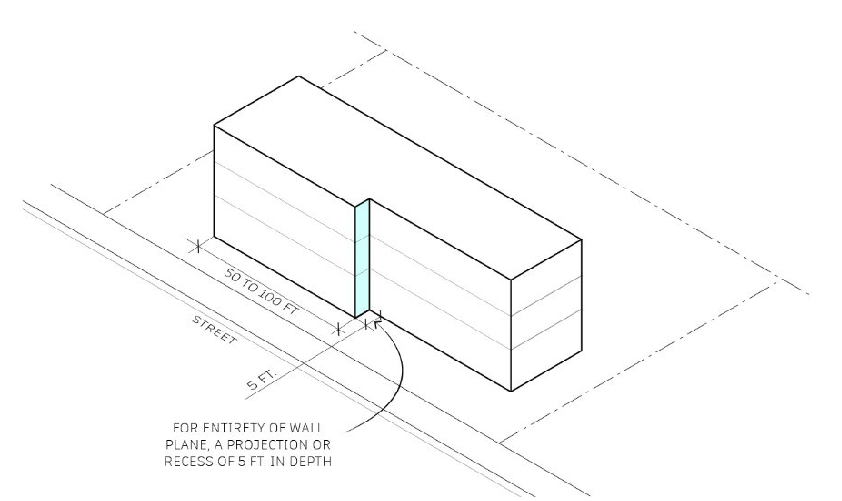
Figure 17.47.040(1)
Facade Break
b.
Blank facades. Blank building facades shall be prohibited. Building facades without the use of windows or doors shall not span a continuous horizontal length greater than 20 feet across any story, as shown in Figure 17.47.040(2).
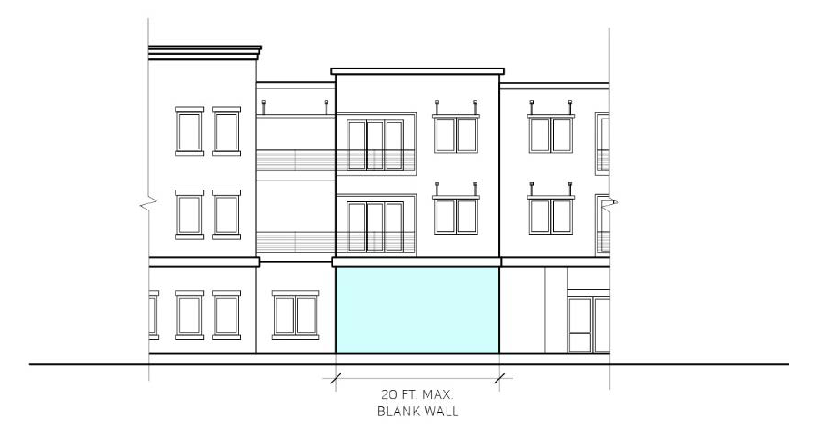
Figure 17.47.040(2)
Blank Facades
c.
Facade modulation and articulation. Building facades facing a street shall incorporate at least one of the following design features for at least 25 percent of the facade area, as shown in Figure 17.47.040(3).
i.
Building step-backs, recesses/reliefs, and/or projections of at least 2 feet in depth,
ii.
Use of balconies, decks, porches, patios, and/or terraces, and/or
iii.
Use of awnings, lattices, louvers, and/or other shading devices as approved by the director.
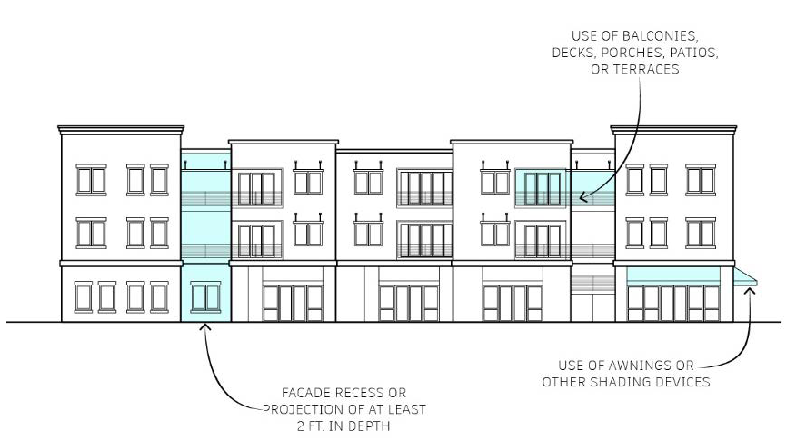
Figure 17.47.040(3)
Facade Modulation and Articulation
5.
Ground floor.
a.
Ground floor building entries. Building facades with frontage along a street shall provide a minimum of one ground floor building entry per building facade. The building entry shall be visible from the street, be oriented towards the street, and provide a pedestrian walkway to the sidewalk along each abutting public right-of-way. Building entries with no frontage along a street shall be oriented towards common areas, such as courtyards, plazas, and paseos.
b.
Ground floor dwelling units. Each at-grade ground floor dwelling unit facing a street shall have its own ground floor building entry that is visible from the street, oriented towards the street, and provides a pedestrian walkway to the sidewalk along the street, as shown in Figure 17.47.040.4.
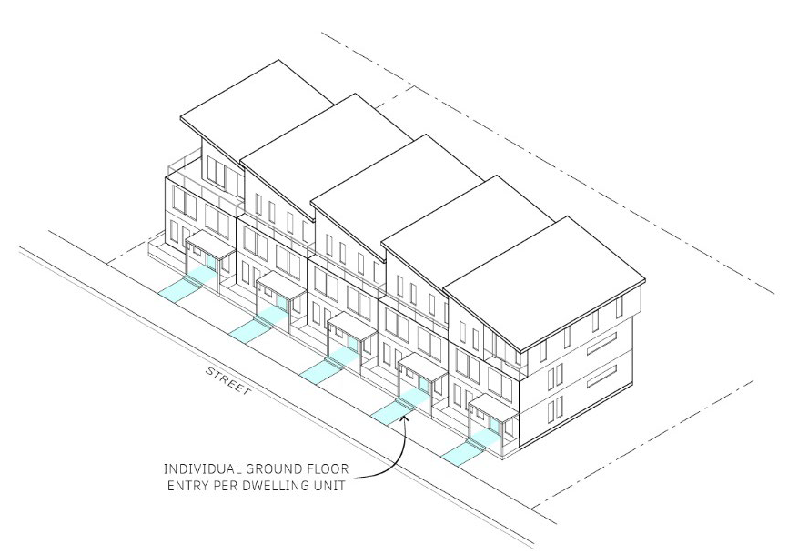
Figure 17.47.040(4)
Ground Floor Dwelling Units
c.
Ground floor facade treatment. Buildings of three or more stories in height shall incorporate one of the following design features along the building facade with frontage along a street, as shown in Figure 17.47.040(5).
i.
A change in facade color between the ground floor and the upper floors.
ii.
A change in facade material between the ground floor and the upper floors, where the ground floor is distinguished through the application of brick, stone, concrete masonry, or other distinct material as approved by the Director.
iii.
Recess or projection of the upper floors from the ground floor of at least two feet in depth.
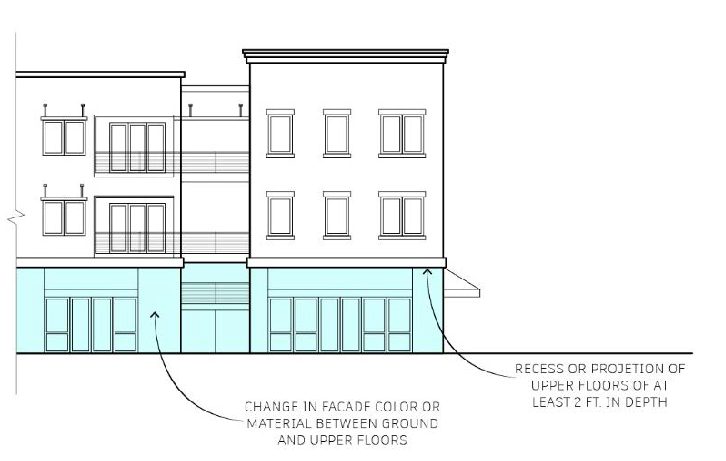
Figure 17.47.040(5)
Ground Floor Facade Treatment
6.
Transparency.
a.
Nonresidential. Each ground floor facade shall dedicate at minimum of 50 percent of the facade area to facade openings, such as windows or doors. The use of tinted, mirrored, or reflective glass is prohibited.
b.
Residential. Each ground floor facade shall dedicate a minimum of 25 percent of the facade area to facade openings, such as windows or doors. The use of tinted, mirrored, or reflective glass is prohibited.
B.
Open space standards.
1.
Private open space.
a.
Private open space standards shall be prescribed in Table 17.47.040(4) and in this subsection.
b.
Each residential unit shall provide at least one private open space that measures at least five feet in length in any direction.
c.
Private open spaces shall not include any portion of required setback area, off-street parking area, driveways, turnaround areas, loading area, storage area or any accessory building.
2.
Common open space.
a.
Common open space requirements are prescribed in Table 17.47.040(5) and in this subsection.
b.
Any common open space shall measure at least 15 feet in length in any direction.
c.
A minimum of 25 percent of the total area of common open spaces shall be landscaped per subsection 17.47.040(B) of this chapter.
d.
A minimum of one tree for every 500 square feet of outdoor common open space area shall be provided within the common open space.
e.
Common open spaces shall not include any portion of required street setback area, off-street parking area, driveways, turnaround areas, loading area, or storage area.
3.
Landscaping.
a.
The applicable objective provisions for landscaping of Chapter 15.34 (water efficient landscaping) shall apply.
4.
Fences, walls, and hedges.
a.
The applicable objective provisions for fences, walls, and hedges of Section 17.76.30 (fences, walls, and hedges) shall apply.
C.
Parking standards.
1.
Applicability.
a.
The applicable objective provisions for parking per Chapter 17.50 (nonresidential parking and loading standards) shall apply to both residential and mixed-use projects in the MUOD with the following exceptions to those provisions and application additional standards in this subsection.
2.
Minimum parking.
a.
Minimum parking requirements are prescribed in Table 17.47.040(6) and in this subsection.
Table 17.47.040(6) Notes:
(1)
Guest residential parking may be shared with commercial parking in mixed-use projects subject to Section 17.50.030 (joint use and common parking facilities).
3.
Parking reduction in proximity to transit.
a.
Pursuant to Government Code § 65863.2, the required off-street vehicular parking may be waived for certain projects within one-half mile distance of public transit, as applicable.
4.
Unbundled parking.
a.
For dwelling units included in MUOD projects, vehicular parking spaces shall be leased or sold separately from dwelling unit rental or purchase fees, such that renters or buyers have the option of renting or buying the dwelling unit at a lower price than if the parking space was included. In addition, the following shall apply:
i.
For deed-restricted affordable dwelling units, one parking space shall be included in the base rent of each unit. The tenant may choose to receive the parking space or receive a rent discount equivalent to half the amount charged for monthly lease of a parking space. Tenants of affordable dwelling units shall not sublease their parking spaces.
ii.
Renters or buyers have the right of first refusal to parking built for their unit. Any remaining spaces may be leased to other users on a month-to-month basis. New occupants shall have the opportunity to lease or purchase parking built for their unit.
5.
Screening.
a.
Screening. All parking areas, including at-grade surface parking and above-grade structured parking, facing a street or abutting a residential use shall be screened by landscaping, buildings, or other screening treatments, such as fencing or green wall, as approved by the director, so as not to be visible from the street or other uses on the site. Entry/exit openings, driveways, drive aisles, curb cuts, and access lanes for vehicular, fire, utilities, and pedestrian access are exempt from screening.
b.
Surface parking. At-grade surface parking shall be prohibited within the street setback, such that parking is located to the rear of the parcel or behind buildings.
c.
Below-grade structured parking. Below-grade structured parking shall be exempt from street setback requirements.
D.
Site standards.
1.
Lot.
a.
The applicable objective provisions for lots of Section 17.48.020 (lot area and dimensions) shall apply.
2.
Access and circulation.
a.
In order of priority and subject to approval by the director and the city's traffic engineer, vehicular access shall be provided from (a) an alley, rear street, or perimeter drive aisle, (b) a side street, (c) an existing or relocated access point on a front street, and (d) a new access point on a front street.
3.
Slope and grading.
a.
The applicable objective provisions for slope and grading shall apply.
i.
Section 17.48.060 (extreme slope);
ii.
Section 17.76.040 (grading permit);
iii.
Section 17.76.060 (extreme slope permit); and
iv.
Section 17.76.130 (geologic investigation permit).
4.
Intersection visibility.
a.
The applicable objective provisions for intersection visibility of Section 17.48.070 (intersection visibility) shall apply.
5.
Exterior lighting.
a.
The applicable objective provisions for exterior lighting of Chapter 17.56 (environmental protection) shall apply.
6.
Underground utilities.
a.
The applicable objective provisions for underground utilities of Section 17.54.020 (underground utilities) shall apply.
7.
Trash and recycling.
a.
The applicable objective provisions for trash and recycling of Section 17.54.030 (trash receptacle enclosures) and Section 17.58.030 (requirements and guidelines for collecting and loading of recyclable materials in development projects) shall apply.
8.
Mechanical equipment, storage areas, and loading docks.
a.
The applicable objective provisions for mechanical equipment, storage areas, and loading docks of Section 17.54.040 (screening of mechanical equipment, storage areas, and loading docks) shall apply.
9.
Signs.
a.
The applicable objective provisions for signs of Chapter 17.75 (sign code) shall apply.
10.
Outdoor display and sales of merchandise.
a.
For mixed-use projects only, The applicable objective provisions of Chapter 17.62 (special use permits) for the temporary outdoor display and sale of merchandise shall apply.
11.
Dedications, ROW improvements, and off-site improvements.
a.
The applicable objective provisions of Chapter 17.52 (dedications, right-of-way improvements, and off-site improvements) shall apply.
12.
Development projects greater than three acres.
a.
Development projects, whether on one parcel or across multiple adjoining parcels, with a total developable area of three acres or more shall provide the following:
i.
Pedestrian accessways, such as walkways, and vehicular accessways with pedestrian access, such as sidewalks, that provide access to public rights-of-way shall be provided for approximately every two acres of developable area. Parking areas, passenger drop-off areas, loading zones, and trash storage areas shall not count as pedestrian accessways.
ii.
A publicly accessible open space, defined as a privately owned space that is open and accessible to the public, such as a plaza or park, shall be provided for approximately every three acres of developable area per the following:
iii.
Publicly accessible open spaces shall have a minimum area of 400 square feet with a minimum dimension of 20 feet in each direction.
iv.
Publicly accessible open spaces shall be accessible to the general public and open at a minimum from 8:00 a.m. to 8:00 p.m.
(Ord. No. 678U, § 4(Att. B), 4-16-2024; Ord. No. 680U, § 5(Att. B), 6-4-2024; Ord. No. 681, § 4(Att. B), 6-18-2024; Ord. No. 697U, § 5(Exh. A), 3-3-2026; Ord. No. 698, § 4(Exh. A), 5-19-2026)
17.47.050. - Requesting a MUOD designation.
For properties not currently included in the MUOD, the following provisions apply:
A.
A request for a MUOD designation may be initiated by an application by a property owner made in accordance with the procedures identified in Chapter 17.68 (zone changes and code amendments).
B.
Application of the overlay district shall be consistent with the objectives of this chapter, the zoning ordinance, and general plan should be reasonably compatible with surrounding land uses, and promote the general health, safety and welfare.
(Ord. No. 678U, § 4(Att. B), 4-16-2024; Ord. No. 680U, § 5(Att. B), 6-4-2024; Ord. No. 681, § 4(Att. B), 6-18-2024)
17.47.060. - Allowed land uses and permit requirements.
A.
Allowed uses and permit requirements in the MUOD are listed in Table 17.47.050(1).
B.
A definition of each land use is listed in Chapter 17.96 (definitions).
C.
Uses not listed in Table 17.47.050(1) are not allowed and subject to Section 17.86.030 (prohibited uses).
D.
All nonconforming uses are subject to Chapter 17.84 (nonconformities).
Key
(Ord. No. 678U, § 4(Att. B), 4-16-2024; Ord. No. 680U, § 5(Att. B), 6-4-2024; Ord. No. 681, § 4(Att. B), 6-18-2024; Ord. No. 697U, § 5(Exh. A), 3-3-2026; Ord. No. 698, § 4(Exh. A), 5-19-2026)
17.48.010. - Purpose.
The residential overlay district (ROD) implements various programs in the city's housing element by facilitating the development of a ROD project of residential-only or residential with limited nonresidential uses on select parcels with an existing institutional underlying base district designation that encourages:
A.
An infill development pattern that is compatible with surrounding neighborhoods;
B.
A compatible mix of uses including residential and supporting, but limited, commercial, institutional, or recreational land uses that co-locates residents with on-site amenities; and
C.
A diversity of single- and/or multi-family housing types in a residential-only or mixed-use configuration to increase housing choice and affordability.
(Ord. No. 678U, § 4(Att. B), 4-16-2024; Ord. No. 680U, § 5(Att. B), 6-4-2024; Ord. No. 681, § 4(Att. B), 6-18-2024)
17.48.020. - Applicability.
A.
Applicable parcels. The ROD is an overlay district applicable to parcels with an institutional underlying base district designation. The ROD shall only apply to the parcels identified in the residential overlay district map on file with the community development department. Any new development or projects that are an addition by increasing the square footage to an existing development on property within this overlay district shall comply with the provisions of this chapter.
B.
Relationship to the underlaying base district. The provisions of the underlying base district shall continue to apply to existing uses and development on a property; however, any new development or projects that are an addition by increasing the square footage to an existing development on a property within this overlay district shall comply with the provisions of this chapter.
C.
Relationship to overlay control districts. If applicable, the objective provisions of any overlay control districts shall continue to apply to a property unless specifically superseded by a ROD project when a property owner initiates provisions of this chapter. In the event that the provisions of any overlay control district are in conflict with provisions of this chapter, this chapter shall govern.
D.
Relationship to state density bonus law. A ROD project is eligible for a density bonus in accordance with Chapter 17.11 (affordable housing).
E.
Designation. The application of the ROD shall be signified by the designation of a "ROD" suffix following the base district designation on the official zoning map. For example, the use of the ROD in conjunction with the institutional district would be designated as "I-ROD."
(Ord. No. 678U, § 4(Att. B), 4-16-2024; Ord. No. 680U, § 5(Att. B), 6-4-2024; Ord. No. 681, § 4(Att. B), 6-18-2024; Ord. No. 697U, § 5(Exh. A), 3-3-2026; Ord. No. 698, § 4(Exh. A), 5-19-2026)
17.48.030. - Administrative review.
A.
Ministerial approval. ROD projects for owner-occupied and rental multifamily residential uses where at least 20 percent of the units are affordable to lower income households, as determined by Government Code § 65589.5 and defined by Health and Safety Code § 50079.5, as may be amended from time to time, are eligible for ministerial approval. Projects that meet that affordability requirement, comply with the provisions of this chapter and do not require any of the approvals set forth in subsection B, shall be approved ministerially and are not subject to a conditional use permit, planned unit development permit, or other discretionary local government review or approval. The director shall approve an administrative permit to construct and operate a ROD project under this chapter if the application complies with the provisions of this chapter. ROD projects that do not meet the 20 percent affordability requirement must follow the conditional use permit application and approval process.
B.
Need for additional approvals. If an applicant requires approval of an application for a lot line adjustment, merger of parcels, or subdivision in conjunction with approval of an application pursuant to this chapter, a separate application shall proceed in accordance with Title 16, subdivisions.
(Ord. No. 678U, § 4(Att. B), 4-16-2024; Ord. No. 680U, § 5(Att. B), 6-4-2024; Ord. No. 681, § 4(Att. B), 6-18-2024)
17.48.040. - Development standards.
The objective provisions of Article VI (use and development standards) and Article III (institutional and cemetery districts) shall apply to all ROD projects. For exceptions to those provisions and application of additional standards, the development standards contained in this section shall also apply to all ROD projects. In the event that the provisions of Articles VI or III are in conflict with applicable provisions of this section, this section shall govern.
A.
Building standards.
1.
Residential density.
a.
Residential density standards shall be prescribed in Table 17.48.040(1) and this subsection.
b.
In calculating density, areas of extreme slope (35 percent or steeper) and/or areas which are determined unsuitable for development, based on submitted and approved geologic reports, shall be excluded.
c.
For all new development or projects that are an addition by increasing the square footage to an existing development in a ROD overlay, a minimum of 50 percent of the total gross floor area for the proposed new mixed-use project or addition shall be dedicated to residential uses.
d.
A project in the ROD may have up to 100 percent residential use of the total floor area of a project.
2.
Setbacks.
a.
The applicable objective provisions for setbacks of Section 17.48.030 (setbacks) and the underlying base district shall apply.
3.
Building height.
a.
The applicable objective provisions for building height of Section 17.48.050 (building height) with the following exceptions as prescribed in Table 17.48.040(2).
4.
Facade modulation and articulation.
a.
Facade break. Building facades with frontage along a street shall provide for the entirety of the wall plane a projection or recess of five feet in depth for every 50 to 100 feet of continuous horizonal length of building facade, as shown in Figure 17.48.040(1).
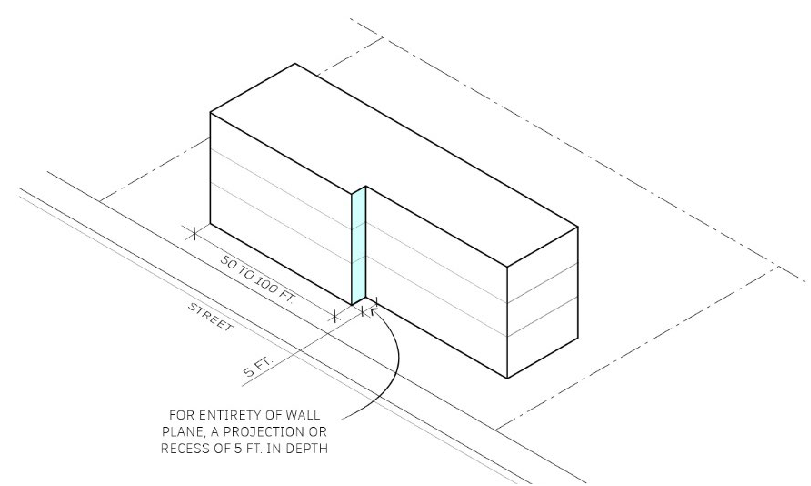
Figure 17.48.040(1)
Facade Break
b.
Blank facades. Blank building facades shall be prohibited. Building facades without the use of windows or doors shall not span a continuous horizontal length greater than 20 feet across any story, as shown in Figure 17.48.040(2).
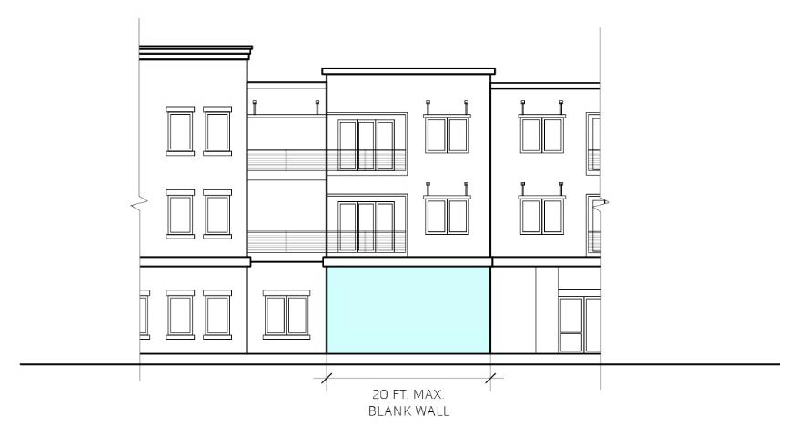
Figure 17.48.040(2)
Blank Facades
c.
Facade modulation and articulation. Building facades facing a street shall incorporate at least one of the following design features for at least 25 percent of the facade area, as shown in Figure 17.48.040(3).
i.
Building step-backs, recesses/reliefs, and/or projections of at least 2 feet in depth,
ii.
Use of balconies, decks, porches, patios, and/or terraces, and/or
iii.
Use of awnings, lattices, louvers, and/or other shading devices as approved by the director.
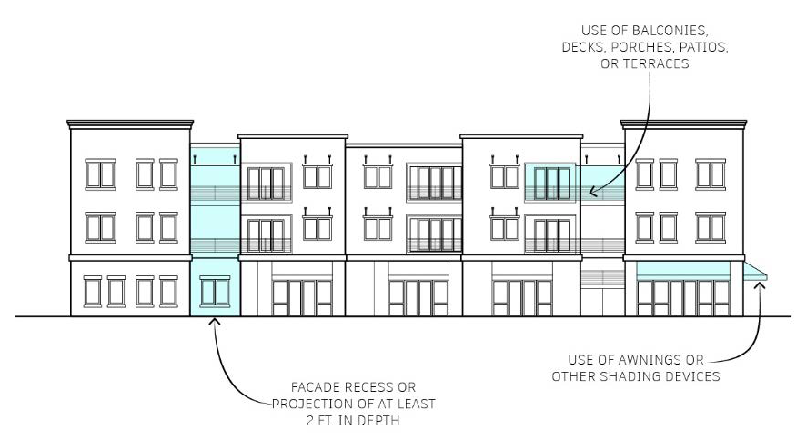
Figure 17.48.040(3)
Facade Modulation and Articulation
5.
Ground floor.
a.
Ground floor building entries. Building facades with frontage along a street shall provide a minimum of one ground floor building entry per building facade. The building entry shall be visible from the street, be oriented towards the street, and provide a pedestrian walkway to the sidewalk along each abutting public right-of-way. Building entries with no frontage along a street shall be oriented towards common areas, such as courtyards, plazas, and paseos.
b.
Ground floor dwelling units. Each at-grade ground floor dwelling unit facing a street shall have its own ground floor building entry that is visible from the street, oriented towards the street, and provides a pedestrian walkway to the sidewalk along the street, as shown in Figure 17.48.040(4).
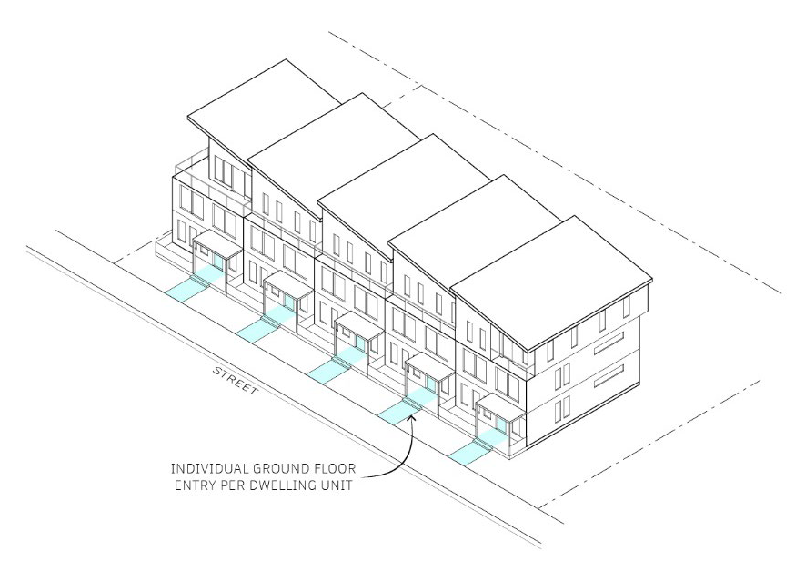
Figure 17.48.040(4)
Ground Floor Dwelling Units
c.
Ground floor facade treatment. Buildings of three or more stories in height shall incorporate one of the following design features along the building facade with frontage along a street, as shown in Figure 17.48.040(5).
i.
A change in facade color between the ground floor and the upper floors.
ii.
A change in facade material between the ground floor and the upper floors, where the ground floor is distinguished through the application of brick, stone, concrete masonry, or other distinct material as approved by the director.
iii.
Recess or projection of the upper floors from the ground floor of at least two feet in depth.
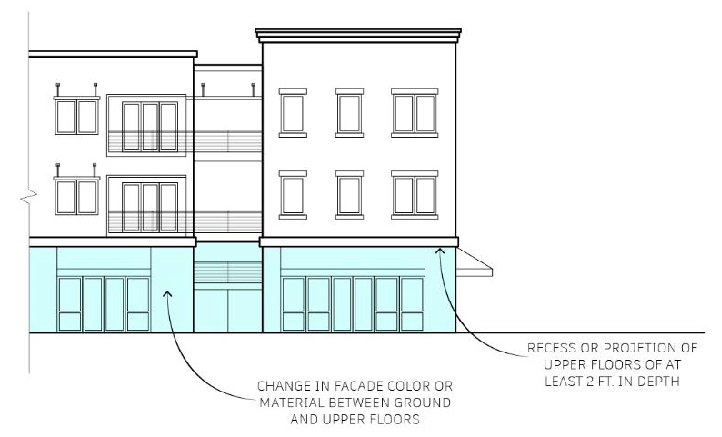
Figure 17.48.040(5)
Ground Floor Facade Treatment
6.
Transparency.
a.
Nonresidential. Each ground floor facade shall dedicate at minimum of 50 percent of the facade area to facade openings, such as windows or doors. The use of tinted, mirrored, or reflective glass is prohibited.
b.
Residential. Each ground floor facade shall dedicate a minimum of 25 percent of the facade area to facade openings, such as windows or doors. The use of tinted, mirrored, or reflective glass is prohibited.
B.
Open space standards.
1.
Private open space.
a.
Private open space standards shall be prescribed in Table 17.48.040(3) and in this subsection.
b.
Each dwelling unit shall provide at least one private open space that measures at least seven feet in length in any direction.
c.
Private open spaces shall be adjacent to and provide a private, usable area for each dwelling unit, and shall not include any portion of required setback area, off-street parking area, driveways, turnaround areas, loading area, storage area or any accessory building.
2.
Common open space.
a.
The applicable objective provisions for common open space of Section 17.42.040 (development standards, residential planned development) shall apply.
3.
Landscaping.
a.
The applicable objective provisions for landscaping of Chapter 15.34 (water efficient landscaping) shall apply.
4.
Fences, walls, and hedges.
a.
The applicable objective provisions for fences, walls, and hedges of Section 17.76.030 (fences, walls, and hedges) shall apply.
C.
Parking standards.
1.
Minimum parking.
a.
For single-family dwelling units, The applicable objective provisions for parking of Section 17.02.030 (development standards, single-family residential districts) shall apply.
b.
For multiple-family dwelling units, The applicable objective provisions for parking of Section 17.42.040 (development standards, residential planned development) shall apply, subject to the exceptions and additional standards in Table 17.48.040(4).
c.
For nonresidential uses, The applicable objective provisions for parking of Chapter 17.50 (nonresidential parking and loading standards) and the underlying base district shall apply.
2.
Screening.
a.
Screening. With the exception of single-family dwelling units, all parking areas, including at- grade surface parking and above-grade structured parking, facing a street or abutting a residential use shall be screened by landscaping, buildings, or other screening treatments, such as fencing or green walls, as approved by the director, so as not to be visible from the street or other uses on the site. Entry/exit openings, driveways, drive aisles, curb cuts, and access lanes for vehicular, fire, utilities, and pedestrian access are exempt from screening.
b.
Surface parking. With the exception of single-family dwelling units, at-grade surface parking shall be prohibited within the street setback, such that parking is located to the rear of the parcel or behind buildings.
D.
Site standards.
1.
Lot.
a.
The applicable objective provisions for lots of Section 17.48.020 (lot area and dimensions) shall apply.
2.
Access and circulation.
a.
In order of priority and subject to approval by the director and the city's traffic engineer, vehicular access shall be provided from (a) an alley, rear street, or perimeter drive aisle, (b) a side street, (c) an existing or relocated access point on a front street, or (d) a new access point on a front street.
3.
Slope and grading.
a.
The applicable objective provisions for slope and grading shall apply:
i.
Section 17.48.060 (extreme slope);
ii.
Section 17.76.040 (grading permit);
iii.
Section 17.76.060 (extreme slope permit); and
iv.
Section 17.76.130 (geologic investigation permit).
4.
Intersection visibility.
a.
The applicable objective provisions for intersection visibility of Section 17.48.070 (intersection visibility) shall apply.
5.
Exterior lighting.
a.
The applicable objective provisions for exterior lighting of Chapter 17.56 (environmental protection) shall apply.
6.
Underground utilities.
a.
The applicable objective provisions for underground utilities of Section 17.54.020 (underground utilities) shall apply.
7.
Trash and recycling.
a.
The applicable objective provisions for trash and recycling of Section 17.54.030 (trash receptacle enclosures) and Section 17.58.030 (requirements and guidelines for collecting and loading of recyclable materials in development projects) shall apply.
8.
Mechanical equipment, storage areas, and loading docks.
a.
The applicable objective provisions for mechanical equipment, storage areas, and loading docks of Section 17.54.040 (screening of mechanical equipment, storage areas, and loading docks) shall apply.
9.
Signs.
a.
The applicable objective provisions for signs of Chapter 17.75 (sign code) shall apply.
10.
Dedications, ROW improvements, and off-site improvements.
a.
The applicable objective provisions for dedications, ROW improvements, and off-site improvements of Chapter 17.52 (dedications, right-of-way improvements, and off-site improvements) shall apply.
(Ord. No. 678U, § 4(Att. B), 4-16-2024; Ord. No. 680U, § 5(Att. B), 6-4-2024; Ord. No. 681, § 4(Att. B), 6-18-2024; Ord. No. 697U, § 5(Exh. A), 3-3-2026; Ord. No. 698, § 4(Exh. A), 5-19-2026)
17.48.050. - Requesting a ROD designation.
For properties not currently included in the ROD, the following provisions apply:
A.
A request for a ROD designation may be initiated by an application by a property owner made in accordance with the procedures identified in Chapter 17.68 (zone changes and code amendments).
B.
Application of the overlay district shall be consistent with the objectives of this chapter, the zoning ordinance, and general plan should be reasonably compatible with surrounding land uses, and promote the general health, safety and welfare.
(Ord. No. 678U, § 4(Att. B), 4-16-2024; Ord. No. 680U, § 5(Att. B), 6-4-2024; Ord. No. 681, § 4(Att. B), 6-18-2024)
17.48.060. - Allowed land uses and permit requirements.
A.
Allowed uses and permit requirements in the ROD are listed in Table 17.48.060(1).
B.
A definition of each land use is listed in Chapter 17.96 (definitions).
C.
Uses not listed in Table 17.48.060(1) are not allowed and subject to Section 17.86.030 (prohibited uses).
D.
All nonconforming uses are subject to Chapter 17.84 (nonconformities).
Key
(Ord. No. 678U, § 4(Att. B), 4-16-2024; Ord. No. 680U, § 5(Att. B), 6-4-2024; Ord. No. 681, § 4(Att. B), 6-18-2024; Ord. No. 697U, § 5(Exh. A), 3-3-2026; Ord. No. 698, § 4(Exh. A), 5-19-2026)

