
Rancho Palos Verdes
City Zoning Code
City Zoning Code
ARTICLE VII
- DEVELOPMENT APPLICATION AND REVIEW
17.60.010.- Purpose.
The conditional use permit procedure provides for uses that are:
A.
Necessary or desirable for the development of the community or region but cannot readily be classified as permitted uses in individual zoning districts by reason of uniqueness of size, scope or possible effect on public facilities or surrounding uses;
B.
Appropriate as accessories to the development of neighborhoods or the city; or
C.
Appropriate uses in the zoning districts in which they are listed as permitted subject to a conditional use permit but requiring specific consideration of the proposed use or development.
(Code 1981, § 17.60.010; Ord. No. 78(part), 1975; Ord. No. 320, § 7(part), 1997)
17.60.020. - Application.
A.
The application for a conditional use permit shall be filed on forms provided by the city. A person may not file, and the director shall not accept, an application which is the same as, or substantially the same as, an application upon which final action has been taken by the director, by the planning commission, or by the city council within 12 months prior to the date of said application, unless accepted by motion of the planning commission or city council, or the previous application is denied without prejudice by the planning commission or city council.
B.
An application shall contain full and complete information pertaining to the request.
C.
The director or the planning commission shall investigate the facts bearing on each case to provide information necessary to ensure action consistent with the intent and purposes of this title.
D.
In cases where the director considers the conditions set forth on the application not within the scope of the conditional use permit procedure, the applicant shall be so informed. Whereupon, if the application is filed, it shall be signed by the applicant to the effect that they were so informed. Filing of an application does not constitute an indication of approval.
E.
In no event shall the acceptance of an application by the city be construed as support for, or the eventual approval of, the proposed use.
F.
For multifamily residential and nonresidential development applications, a temporary framework silhouette of the proposed project shall be required to be constructed as part of an application. Said application will not be deemed complete until the applicant has submitted a signed statement agreeing to construct said silhouette when directed to do so by the director some time prior to the public hearing on the application. The silhouette shall be constructed in accordance with the guidelines established by the city council for nonresidential construction projects.
(Code 1981, § 17.60.020; Ord. No. 78(part), 1975; Ord. No. 320, § 7(part), 1997; Ord. No. 340, § 8(part), 1998; Ord. No. 463, § 9, 2007)
17.60.030. - Filing fee.
The filing fee for a conditional use permit shall be as established by resolution of the city council.
(Code 1981, § 17.60.030; Ord. No. 78(part), 1975; Ord. No. 320, § 7(part), 1997)
17.60.040. - Public hearing.
A.
The public hearing notice shall be published in a newspaper of general circulation and given to owners of property located within 500 feet of the project, to all persons requesting notice, to any affected homeowner's associations, and the applicant pursuant to section 17.80.090 (Notice of Hearing) of this title.
B.
Conditional use permit amendment applications shall require a public hearing and notice similar to an initial conditional use permit application. However, conditional use permit amendment applications for master television antennas in multiple-family developments, including residential planned developments, do not require a public hearing.
C.
Not more than 40 days following said hearing, the planning commission shall announce its findings, as per section 17.60.050 (Findings and Conditions) of this chapter, by formal resolution. The resolution shall recite the findings of the planning commission and set forth the conditions deemed necessary to protect the health, safety and welfare of persons residing in the neighborhood and in the community as a whole.
(Code 1981, § 17.60.040; Ord. No. 78(part), 1975; Ord. No. 90, § 6(part), 1977; Ord. No. 166, § 11, 1983; Ord. No. 320, § 7(part), 1997)
17.60.050. - Findings and conditions.
A.
The planning commission, may grant a conditional use permit, only if it finds:
1.
That the site is adequate in size and shape to accommodate the proposed use and for all of the yards, setbacks, walls, fences, landscaping and other features required by this title or by conditions imposed under this section to integrate said use with those on adjacent land and within the neighborhood;
2.
That the site for the proposed use relates to streets and highways sufficient to carry the type and quantity of traffic generated by the subject use;
3.
That, in approving the subject use at the specific location, there will be no significant adverse effect on adjacent property or the permitted use thereof;
4.
That the proposed use is not contrary to the general plan;
5.
That, if the site of the proposed use is within any of the overlay control districts established by chapter 17.40 (Overlay Control Districts) of this title, the proposed use complies with all applicable requirements of that chapter; and
6.
That conditions regarding any of the requirements listed in this subsection, which the planning commission finds to be necessary to protect the health, safety and general welfare, have been imposed:
a.
Setbacks and buffers;
b.
Fences or walls;
c.
Lighting;
d.
Vehicular ingress and egress;
e.
Noise, vibration, odors and similar emissions;
f.
Landscaping;
g.
Maintenance of structures, grounds or signs;
h.
Service roads or alleys; and
i.
Such other conditions as will make possible development of the city in an orderly and efficient manner and in conformity with the intent and purposes set forth in this title.
B.
Conditional use permits may be granted for such period of time and upon such conditions and limitations as may be required to protect the health, safety and general welfare. Such conditions shall take precedence over development standards otherwise required by the underlying zoning of the subject site.
C.
For multiple use developments under a conditional use permit, where the uses permitted in the development are specified in the conditional use permit resolution, the uses permitted in the zoning district shall not apply unless such uses are among those permitted by the conditional use permit.
D.
When warranted, the planning commission or city council may add conditions requiring compliance review or updating of maintenance, development plans and activities. Such compliance reviews or updates shall be conducted by the final deciding body of a conditional use permit, unless expressly stated in the adopted conditions of approval. The submittal of a fee, as established by resolution of the city council, shall be required for processing such compliance reviews or updates.
F.
When required, the findings, recommendations and notices thereof shall be filed in conformity with the provisions set forth in this section (Findings and Conditions).
(Code 1981, § 17.60.050; Ord. No. 78(part), 1975; Ord. No. 259, § 2, 1990; Ord. No. 320, § 7(part), 1997; Ord. No. 606, § 2, 5-1-2018)
17.60.060. - Appeal.
Any interested person may appeal any decision of the planning commission or any condition imposed by the planning commission pursuant to chapter 17.80 (Hearing notice and appeal procedures) of this title.
(Code 1981, § 17.60.060; Ord. No. 78(part), 1975; Ord. No. 90, § 6(part), 1977; Ord. No. 320, § 7(part), 1997)
17.60.070. - Time limit.
Before approving any conditional use permit, the planning commission shall establish a time limit within which the applicant shall "commence upon the permitted use," as that phrase is defined in section 17.86.070 (Enforcement) of this title. The time limit shall be a reasonable time based on the size and nature of the proposed development. If no date is specified by the planning commission or city council, a conditional use permit shall be valid for one year from the date of final action on the permit or approval. All such permits shall be null and void after that time unless the applicant has commenced upon the permitted use, as that phrase is defined in section 17.86.070 (Expiration of Permit Upon Nonuse) of this title. Upon a showing of substantial hardship, delays beyond the control of the applicant, or other good cause, the planning commission or city council may extend this period one time for up to one additional year.
(Code 1981, § 17.60.070; Ord. No. 78(part), 1975; Ord. No. 320, § 7(part), 1997)
17.60.080. - Failure to comply.
If the time limit expires and no extension has been granted, or if any of the conditions to the use or development are not maintained, then the conditional use permit shall be null and void. Continued operation of a use requiring a conditional use permit after such conditional use permit expires or is found in noncompliance with any condition of a conditional use permit shall constitute a violation of this title.
(Code 1981, § 17.60.080; Ord. No. 78(part), 1975; Ord. No. 320, § 7(part), 1997)
17.60.090. - Amendments.
An amendment to an approved conditional use permit may be initiated by the city or by the property owner pursuant to section 17.78.040 (Amendments to Approved Applications) of this title.
(Code 1981, § 17.60.090; Ord. No. 320, § 7(part), 1997)
17.60.100. - Revocation.
A conditional use permit granted pursuant to this section may be modified, revoked or suspended pursuant to section 17.86.060 (Suspension or Revocation of Permits) of this Code.
(Code 1981, § 17.60.100; Ord. No. 320, § 7(part), 1997)
17.62.010.- Purpose.
This chapter provides for temporary special uses and developments which may, unless special consideration is given and conditions applied, result in an adverse effect on surrounding properties. Such special consideration and the application of conditions as provided in this chapter is deemed necessary for the protection of property values and the public welfare.
(Code 1981, § 17.62.010; Ord. No. 78(part), 1975; Ord. No. 320, § 7(part), 1997)
17.62.020. - Uses and developments permitted with special use permits.
The following uses and developments shall not be initiated or constructed unless a special use permit for said use or development has been issued by the director:
A.
Temporary uses of land involving the erection of temporary structures, such as fences, booths, tents or the parking of trailers, for such activities as carnivals, circuses, fairs, festivals, nonprofit fund-raising events, charitable events or religious meetings;
B.
Temporary outdoor displays for the sale of Christmas trees, Halloween pumpkins, art objects or other items, other than special sales allowed with a temporary vendor permit pursuant to this chapter;
C.
Recycling centers, as defined in chapter 17.96 (Definitions) of this title, in zoning districts in which they are permitted by this title; and
D.
Any other similar activity conducted for a temporary period either outdoors, within temporary structures or within single-family residential zoning districts which, as determined by the director, has the potential to result in an adverse effect on surrounding properties.
(Code 1981, § 17.62.020; Ord. No. 78(part), 1975; Ord. No. 320, § 7(part), 1997)
17.62.030. - Temporary vendor permit.
Certain temporary sales activities may be allowed in conjunction with certain established uses without a special use permit, provided the property owner's permission, a business license if required and a temporary vendor permit is obtained by the vendor and there is no evidence that the temporary sales will create an adverse impact on adjacent uses beyond the impact of the primary use of the site. The following such temporary sales may be conditionally approved by the director without hearing or notice through issuance of a temporary vendor permit:
A.
Temporary sales of goods and/or food items from a mobile nonmotorized cart or temporary booth in commercial, institutional and open space recreational zoning districts, provided the sales occur in conjunction with legal or legal nonconforming commercial, institutional and recreational uses; the sales occur on the same property as the existing uses; and the sales activity occurs for a period of not more than 30 days out of a 12-month period;
B.
Special temporary outdoor sales by an existing retail business, provided the business is a legal or legal nonconforming use located in a commercial zoning district; the sales occur on the same property as the existing business; and the sales activity occurs for a period of not more than 30 days out of a 12-month period; and
C.
Temporary outdoor sales held by nonprofit organizations, provided that the sales occur entirely on the property of the nonprofit organization and for a period of not more than 30 days out of a 12-month period.
(Code 1981, § 17.62.030; Ord. No. 320, § 7(part), 1997)
17.62.040. - Application.
Application for a special use permit or temporary vendor permit shall be made on forms provided by the city and shall include such plans as may reasonably be required by the director for a complete understanding of the proposal, and a filing fee as established by resolution of the city council.
(Code 1981, § 17.62.040; Ord. No. 78(part), 1975; Ord. No. 320, § 7(part), 1997)
17.62.050. - Notification.
Upon determination that an application for a special use permit is complete, the director shall notify the owners of all property and any affected homeowner's association located within a radius of 500 feet from the external boundaries of the property where the special use is proposed to occur, of the application by letter.
(Code 1981, § 17.62.050; Ord. No. 78(part), 1975; Ord. No. 320, § 7(part), 1997)
17.62.060. - Action by director.
A.
Not sooner than 15 days after the notices are mailed, nor later than 30 days after the application for a special use permit is deemed complete, the director shall either grant, deny or conditionally grant the special use permit, based on the following criteria:
1.
That the site is adequate in size and shape to accommodate the proposed special use and/or development;
2.
That the proposed special use and/or development would not adversely interfere with existing uses on the subject property; and would not impede or adversely impact pedestrian access ways and/or vehicular circulation patterns;
3.
That the proposed special use and/or development would not result in a significant adverse effect on adjacent property; and
4.
That by requiring certain safeguards as conditions of approval, the proposed special use and/or development would not be detrimental to the public health, safety and welfare.
B.
In granting a special use permit or temporary vendor permit, the director may impose conditions on the permit which are reasonable to ensure that the proposed use or development will comply with the applicable review criteria of this chapter and any other applicable provisions of this title. Noncompliance with any condition of a special use permit or temporary vendor permit shall constitute a violation of the zoning ordinance. Such conditions shall include, but not be limited to:
1.
Special setbacks and buffers;
2.
Regulation of outdoor lighting;
3.
Regulation of points of vehicular ingress and egress;
4.
Regulation of noise, vibration, odors, etc.;
5.
Regulation of the number, height and size of temporary structures, equipment and/or signs;
6.
Limitations on the hours and/or days of the proposed use;
7.
If special sales are proposed, limitations on the location where sales may occur, the number of vendors and the scope of goods sold;
8.
If necessary, the obtainment of a city business license;
9.
If food sales are involved, obtainment of all the appropriate health department permits; and
10.
If necessary, fire department review and approval.
C.
Upon approval by the director of a special use permit, notice of the decision shall be given to the applicant, any interested person and any affected homeowner's associations, pursuant to section 17.80.040 (Notice of decision by director) of this title.
(Code 1981, § 17.62.060; Ord. No. 78(part), 1975; Ord. No. 90, § 7, 1977; Ord. No. 320, § 7(part), 1997)
17.62.070. - Appeals.
The applicant or any interested person may appeal the director's decision on an application for a special use permit to the planning commission and the planning commission's decision to the city council pursuant to chapter 17.80 (Hearing notice and appeal procedures) of this title. Notwithstanding section 17.80.050(B) (Appeal to Planning Commission) of this title, an appeal of a decision on a special use permit application is not timely if not filed within five days of the date of the notice of the director's or planning commission's decision. No special use permit shall be effective, and no use or development authorized by a special use permit shall be initiated until the appeal period has been exhausted.
(Code 1981, § 17.62.070; Ord. No. 78(part), 1975; Ord. No. 320, § 7(part), 1997)
17.64.010.- Purpose.
A.
When practical difficulties, unnecessary hardships or results inconsistent with the general intent and purpose of this title occur by reason of the strict interpretation of any of its provisions, the planning commission, upon verified application of any interested persons, shall initiate proceedings for consideration of a variance from the development provisions of this title. The planning commission in granting said variance may establish such conditions as it deems necessary to promote the intent and purpose of this title and to protect the public health, safety and welfare.
B.
A variance shall not be construed as an amendment to this title or a change to the maps which are part of this title.
(Code 1981, § 17.64.010; Ord. No. 78(part), 1975; Ord. No. 320, § 7(part), 1997)
17.64.020. - Application.
A.
Applications for variances shall be made to the planning commission on forms provided by the city. A person may not file, and the director shall not accept, an application which is the same as or substantially the same as an application upon which final action has been taken by the planning commission or city council within 12 months prior to the application date, unless the application is accepted by motion by the body that last made a decision on the application, or the previous application was denied without prejudice by that body.
B.
The applicant shall set forth in detail, on forms provided by the city, the reasons for the requested variance and shall show how the requirements of this section are satisfied, and such other information as may be required by the director.
C.
The planning commission shall investigate the facts bearing on each case to provide information necessary to ensure action consistent with the intent and purpose of this title.
(Code 1981, § 17.64.020; Ord. No. 75(part), 1975; Ord. No. 78(part), 1975; Ord. No. 149, § 12, 1982; Ord. No. 259, § 3, 1990; Ord. No. 320, § 7(part), 1997)
17.64.030. - Filing fee.
The filing fee for a variance shall be as established by resolution of the city council.
(Code 1981, § 17.64.030; Ord. No. 78(part), 1975; Ord. No. 320, § 7(part), 1997)
17.64.040. - Public hearing.
A.
Notice shall be published in a newspaper of general circulation and given to owners of property within 500 feet of the project, to all persons requesting notice, to any affected homeowner's associations and the applicant, pursuant to section 17.80.090 (Notice of Hearing) of this title.
B.
Not more than 40 days following said hearing, the planning commission shall announce its findings by formal resolution. Said resolution shall recite the findings of the planning commission and set forth the conditions deemed necessary to serve the intent and purpose of this title.
(Code 1981, § 17.64.040; Ord. No. 78(part), 1975; Ord. No. 90, § 8(part), 1977; Ord. No. 320, § 7(part), 1997)
17.64.050. - Findings.
A.
The planning commission, before granting a variance, shall find as follows:
1.
That there are exceptional or extraordinary circumstances or conditions applicable to the property involved, or to the intended use of the property, which do not apply generally to other property in the same zoning district;
2.
That such variance is necessary for the preservation and enjoyment of a substantial property right of the applicant, which right is possessed by other property owners under like conditions in the same zoning district;
3.
That granting the variance will not be materially detrimental to the public welfare or injurious to property and improvements in the area in which the property is located; and
4.
That granting the variance will not be contrary to the objectives of the general plan or the policies and requirements of the coastal specific plan.
B.
A variance may also be granted if the applicant demonstrates significant error in any order, requirement, permit, decision or determination made in the administration or enforcement of this title or any ordinance adopted pursuant to it and the applicant has commenced construction in reliance upon the error. If a variance is granted under this subsection, required filing fees may be waived pursuant to the fee waiver provisions described in section 17.78.010 (Fee Waivers) of this title.
(Code 1981, § 17.64.050; Ord. No. 75(part), 1975; Ord. No. 149, § 12, 1982; Ord. No. 259, § 3, 1990; Ord. No. 320, § 7(part), 1997)
17.64.060. - Appeal.
Any interested person may appeal the planning commission's decision to the city council pursuant to the appeal procedures described in chapter 17.80 (Hearing notice and appeal procedures) of this title.
(Code 1981, § 17.64.060; Ord. No. 78(part), 1975; Ord. No. 90, § 8(part), 1977; Ord. No. 320, § 7(part), 1997)
17.64.070. - Conditions.
The planning commission, in granting a variance, may impose conditions reasonably required to serve the intent and purpose of this title.
(Code 1981, § 17.64.070; Ord. No. 78(part), 1975; Ord. No. 320, § 7(part), 1997)
17.64.080. - Failure to comply.
A.
Noncompliance with any condition of an approved variance application shall constitute a violation of this title.
B.
Each variance granted under the provisions of this chapter shall become null and void unless the applicant "commences upon the permitted use," as that term is defined in section 17.86.070 (Enforcement) of this title, within 180 days after the variance is granted, or within such other period as the planning commission or city council may have established.
(Code 1981, § 17.64.080; Ord. No. 78(part), 1975; Ord. No. 320, § 7(part), 1997)
17.66.010.- Purpose.
This chapter provides for minor exceptions to the development standards of this title in those cases where such minor exceptions are warranted by practical difficulties, unnecessary hardships or results that may be inconsistent with the general intent of this title. Any minor exception permit in the coastal specific plan district shall be in conformity with the policies and requirements of the coastal specific plan.
(Code 1981, § 17.66.010; Ord. No. 78(part), 1975; Ord. No. 320, § 7(part), 1997)
17.66.020. - Scope.
The director may grant minor exception permits authorizing the following:
A.
Construction of fences, walls or hedges which require a minor exception permit pursuant to section 17.76.030 (Fences, Walls and Hedges);
B.
A reduction of any setback and open space requirement contained in this title by 20 percent or less. However, a minor exception permit shall not be granted to reduce the setback and open space requirements for the following:
1.
New direct access garages or the conversion of existing indirect access garages to direct access garages which encroach into the required front or street-side setback;
2.
A structural addition or modification to an existing structure that has been approved through a discretionary permit by the planning commission or city council within two years of the proposed addition and/or modification.
C.
An increase of no more than 20 percent of the 50 percent land coverage restriction which is applicable to driveways, parking areas and paved walkways within the required front or street-side setback areas in Single-Family Residential (RS) Districts set forth in section 17.48.030 (Lots, Setbacks, Open Space Area and Building Height) of this title.
(Code 1981, § 17.66.020; Ord. No. 78(part), 1975; Ord. No. 149, § 13, 1982; Ord. No. 150, § 17, 1982; Ord. No. 158, § 3, 1982; Ord. No. 194, § 16(part), 1985; Ord. No. 320, § 7(part), 1997; Ord. No. 529, § 15, 11-15-2011)
17.66.030. - Application.
Application for a minor exception permit shall be made on forms provided by the city and shall include such plans as may reasonably be required by the director for a complete understanding of the request, and a filing fee as established by resolution of the city council.
(Code 1981, § 17.66.030; Ord. No. 78(part), 1975; Ord. No. 320, § 7(part), 1997)
17.66.040. - Notification.
Upon receipt of a complete application for a minor exception permit, the director shall notify the owners of all parcels located adjacent to the proposed use or development by letter, using the last-known county assessor tax roll. Notification shall also include all parcels which are located directly across any public or private right-of-way from the subject property.
(Code 1981, § 17.66.040; Ord. No. 78(part), 1975; Ord. No. 194, § 16(part), 1985; Ord. No. 320, § 7(part), 1997)
17.66.050. - Action by the director.
A.
The director may grant a minor exception permit only upon finding that:
1.
The requested minor exception is warranted by practical difficulties;
2.
The requested minor exception is warranted by an unnecessary hardship; or
3.
The requested minor exception is necessary to avoid inconsistencies with the general intent of this title.
B.
The director may impose conditions upon the approval of a minor exception permit to ensure that the minor exception permit is within the intent of this chapter. Noncompliance with any conditions of a minor exception permit shall constitute a violation of this title.
C.
Upon approval of a minor exception permit by the director, notice of the decision shall be given pursuant to section 17.80.040 (Notice of decision by director) of this title.
(Code 1981, § 17.66.050; Ord. No. 78(part), 1975; Ord. No. 90, § 9(part), 1977; Ord. No. 194, § 16(part), 1985; Ord. No. 320, § 7(part), 1997)
17.66.060. - Appeals.
Any interested person may appeal a decision of the director to the planning commission and a decision of the planning commission to the city council pursuant to chapter 17.80 (Hearing notice and appeal procedures) of this title. No minor exception permit shall be effective and no development permitted by a minor exception permit shall be initiated or construction started, until the appeal period has been exhausted.
(Code 1981, § 17.66.060; Ord. No. 78(part), 1975; Ord. No. 90, § 9(part), 1977; Ord. No. 150, §§ 18, 19, 1982; Ord. No. 194, § 16(part), 1985; Ord. No. 320, § 7(part), 1997)
17.67.010.- Purpose.
A.
Pursuant to the federal Fair Housing Amendments Act of 1988 and the California Fair Employment and Housing Act (Government Code § 12900 et seq.), this chapter establishes formal procedures allowing individuals with disabilities and their representatives to request reasonable accommodations in the application of zoning laws and other land use regulations, policies and procedures when necessary to eliminate barriers to housing opportunities.
B.
A reasonable accommodation granted pursuant to this chapter shall not be construed as an amendment to this title or a change to the maps which are part of this title.
(Code 1981, § 17.67.010; Ord. No. 518, § 5, 4-5-2011)
17.67.020. - Applicability.
A.
A request for a reasonable accommodation may be made by any person with a disability, their representative, or any developer or provider of housing for an individual with a disability, when the application of a zoning law or other land use regulation, policy or practice acts as a barrier to fair housing opportunities. This chapter is intended for the benefit of those persons who are defined as disabled under section 17.67.030(B) of this chapter.
B.
A request for a reasonable accommodation may include a modification or exception to the rules, standards and practices for the siting, development and use of housing or housing-related facilities that would eliminate regulatory barriers and provide a person with a disability equal opportunity to the housing of their choice. Requests for a reasonable accommodation shall be made in the manner prescribed by this chapter.
C.
A request for a reasonable accommodation shall be granted to an individual and shall not run with the land, unless the community development director determines that:
1.
The modification is physically integrated into the residential structure and cannot easily be removed or altered to comply with chapters 17.02 and 17.04 of this Code; or
2.
The accommodation is to be used by another individual with a disability.
(Code 1981, § 17.67.020; Ord. No. 518, § 5, 4-5-2011)
17.67.030. - Definitions.
The following words, terms and phrases, when used in this chapter, shall have the meanings ascribed to them in this section, except where the context clearly indicates a different meaning:
A.
Fair housing laws means the federal Fair Housing Amendments Act of 1988 and California's Fair Employment and Housing Act, as these statutes now exist or may be amended from time to time, and each Act's implementing regulations.
B.
Individual with a disability means a person who has a physical or mental impairment that limits one or more major life activities, anyone who is regarded as having that type of impairment or, anyone who has a record of that type of impairment. People who are currently using illegal substances are not considered individuals with a disability under the fair housing laws unless they have an otherwise qualifying disability.
(Code 1981, § 17.67.030; Ord. No. 518, § 5, 4-5-2011)
17.67.040. - Application requirements.
A.
Application. Requests for a reasonable accommodation shall be submitted on an application form provided by the community development department, or in the form of a letter to the community development director. The application shall contain the following information:
1.
The applicant's name, address and telephone number;
2.
Address of the property for which the request is being made;
3.
The current actual use of the property;
4.
Documentation that the applicant is:
(A)
An individual with a disability;
(B)
Applying on behalf of one or more individuals with a disability; or
(C)
A developer or provider of housing for one or more individuals with a disability;
5.
The specific exception or modification to the zoning code provision, regulation, policy, or practice that is being requested;
6.
Documentation that the requested accommodation is necessary to provide one or more individuals with a disability an equal opportunity to use and enjoy the residence.
(Code 1981, § 17.67.040; Ord. No. 518, § 5, 4-5-2011)
17.67.050. - Reviewing authority.
A.
Community development director. Requests for a reasonable accommodation shall be reviewed by the community development director if no approval is sought other than the request for a reasonable accommodation.
(Code 1981, § 17.67.050; Ord. No. 518, § 5, 4-5-2011)
17.67.060. - Procedures.
A.
A written request for reasonable accommodations shall be made pursuant to section 17.67.040 of this Code.
B.
If the applicant needs assistance in making the request for reasonable accommodation, the community development department shall provide the assistance necessary to ensure that the process is accessible to the applicant.
C.
Within 30 days of an application being submitted, the director may request additional information necessary for making a determination regarding the request for a reasonable accommodation that complies with the fair housing law's protections and the privacy rights of the individual with a disability to use the specified housing. If additional information is requested, the 60-day time period for making a determination on the request stops running until the additional information is provided.
(Code 1981, § 17.67.060; Ord. No. 518, § 5, 4-5-2011)
17.67.070. - Action by the director.
A.
The community development director shall issue a written determination within 60 days of the receipt of a complete application, unless extended in writing by mutual agreement of the city and the applicant.
B.
The director may grant a reasonable accommodation request only upon finding that:
1.
The housing, which is the subject of the request for reasonable accommodation, will be used by an individual with a disability protected under the fair housing laws;
2.
The requested accommodation is necessary to make housing available to an individual with a disability protected under the fair housing laws;
3.
The requested accommodation will not impose an undue financial or administrative burden on the city;
4.
The requested accommodation will not require a fundamental alteration in the nature of the city's zoning regulations and policies; and
5.
There are no alternatives to the requested accommodations that may provide an equivalent level of benefit.
C.
The director may impose conditions upon the approval of the reasonable accommodation request deemed reasonable and necessary to ensure that the reasonable accommodation would comply with the findings required by subsection B of this section. Conditions of approval may, where deemed appropriate, provide for any or all of the following:
1.
The reasonable accommodation shall only be applicable to particular individuals.
2.
Periodic inspection of the affected premises, as specified in the conditions, to verify compliance with this chapter and with any applicable conditions of approval.
3.
Prior to any transfer of interest in the premises, notice shall be given to the transferee of the existence of the modification, and the requirements that the transferee apply for a new modification as necessary. Once such transfer takes effect, the originally approved modification shall have no further validity.
4.
Removal of the improvement if the need for which the accommodation was granted no longer exists.
5.
Time limits and/or expiration of the approval if the need for which the accommodation was granted no longer exists.
6.
Other reasonable conditions deemed necessary to protect the public health, safety, and welfare.
D.
Prior to the issuance of any permits relative to an approved reasonable accommodation, the director may require the applicant and/or owner to record a covenant in the county recorder's office acknowledging and agreeing to comply with the terms and conditions established in the determination, and to provide notice to future owners that a reasonable accommodation has been approved.
(Code 1981, § 17.67.070; Ord. No. 518, § 5, 4-5-2011)
17.67.080. - Notice of determination.
Upon approval of a reasonable accommodation request by the director, written notice of such decision shall be given to the applicant and to all owners of property adjacent to the subject property. Notice of denial shall be given to only the applicant.
(Code 1981, § 17.67.080; Ord. No. 518, § 5, 4-5-2011)
17.67.090. - Appeal of determination.
Any interested person may appeal a decision of the director to the planning commission and a decision of the planning commission to the city council pursuant to chapter 17.80 (Hearing and Appeal Procedures) of this title. No reasonable accommodation shall be effective and no development permitted by a reasonable accommodation shall be initiated or construction started, until the appeal period has been exhausted.
(Code 1981, § 17.67.090; Ord. No. 518, § 5, 4-5-2011)
17.67.100. - Expiration of approval.
Any modification granted through a reasonable accommodations procedure for an individual with a disability shall be considered a personal accommodation for the individual applicant and shall not run with the land.
(Code 1981, § 17.67.100; Ord. No. 518, § 5, 4-5-2011)
17.68.010.- Purpose.
This chapter provides for changes of the zoning designation of properties where such change is in conformity with the general plan and where such zone change is warranted by considerations of access, surrounding development, and timing of development. It is also the intent of this chapter to provide for amendments to this title, as the city may deem necessary or desirable.
(Code 1981, § 17.68.010; Ord. No. 75(part), 1975; Ord. No. 320, § 7(part), 1997)
17.68.020. - Adoption procedure.
An amendment to any part of this title pertaining to the development or a change of zone of any property within the city shall be adopted pursuant to this chapter. All other amendments to this title may be adopted pursuant to the procedures that other ordinances are adopted.
(Code 1981, § 17.68.020; Ord. No. 75(part), 1975; Ord. No. 320, § 7(part), 1997)
17.68.030. - Initiation of zone change and/or Code amendment.
A change of the zoning designation of properties and/or an amendment to this title may only be initiated as follows:
A.
City council. An amendment to any part of this title and/or a change of zone of any property within the city may be initiated by the city council at any time it is deemed necessary or desirable.
B.
Director and/or planning commission. An amendment to any part of this title and/or a change of zone of any property within the city may be initiated by the director and/or planning commission, upon petition to the city council. The city council shall review the petition to determine if the requested amendment and/or change is necessary or desirable.
C.
Interested person. Any person having an interest in land may file an application with the city council for a change of zone and/or an amendment to this title upon submission to the director of an initiation application and payment of a filing fee, as established by the city council. A person may not file, and the director shall not accept a petition which is the same as, or substantially the same as, a petition upon which final action has been taken by either the planning commission or the city council within 12 months prior to the date of the initiation application, unless the initiation application is accepted by motion of the city council, or the previous initiation application is denied without prejudice by the city council. The city council shall review an accepted initiation application to determine if the requested amendment and/or change is necessary or desirable. If the initiation application is approved by the city council by a majority of affirmative votes, the proposed zone change and/or Code amendment shall be reviewed in accordance with section 17.68.040 of this chapter.
(Code 1981, § 17.68.030; Ord. No. 75(part), 1975; Ord. No. 320, § 7(part), 1997)
17.68.040. - Zone change and/or Code amendment review procedure.
A zone change and/or Code amendment initiated pursuant to section 17.68.030 of this chapter shall be considered as follows:
A.
The director shall set a time and place for a public hearing by the planning commission and shall order the public notice thereof. If the proposed zone change and/or Code amendment is initiated as a result of an interested person's application, said hearing shall be held not later than 40 days after the director receives the completed zone change and/or Code amendment application.
B.
The planning commission shall hold a public hearing to consider the proposed zone change and/or Code amendment. The planning commission's recommendation and reasons thereof shall be filed with the city council within 40 days after the planning commission's decision. If the recommendation of the planning commission is negative, no further action need be taken.
C.
If a negative recommendation is made by the planning commission, the applicant or other interested person may appeal that decision pursuant to the appeal procedures described in section 17.80.070 (Appeal to city council) of this title. Submission of the written recommendations of the planning commission to the city clerk shall constitute filing with the city council.
D.
If the recommendation is positive or an appeal is filed, the city council shall hold a public hearing after notice of the same. The decision of the city council shall be made public within 60 days after the termination of the public hearing.
(Code 1981, § 17.68.040; Ord. No. 75(part), 1975; Ord. No. 90, § 11(part), 1977; Ord. No. 320, § 7(part), 1997)
17.68.050. - Modification.
The city council may approve, modify or disapprove the recommendation of the planning commission, provided that any modification of the proposed ordinance or amendment by the city council shall first be referred to the planning commission for report and recommendation, but the planning commission shall not be required to hold a public hearing thereon. Failure of the planning commission to report within 40 days after the reference, or such longer period as may be designated by the city council, shall be deemed to be approval of the proposed modification.
(Code 1981, § 17.68.050; Ord. No. 75(part), 1975; Ord. No. 320, § 7(part), 1997)
17.68.060. - Application.
Application for a zone change and/or Code amendment filed by an interested person shall be made on forms provided by the city.
A.
Zone change application. The application shall be full and complete and shall be signed by at least one person owning property within the area proposed for a zone change. Such petition shall include plans for the proposed development of all property within the zone change area; said plans to include, as a minimum, a general site plan showing approximate location and use of all buildings (including number of units for multiple-family developments), location of points of access, parking and loading areas (including number of parking and loading spaces proposed), walkways and planting areas. If the zone change application proposes to eliminate in whole, or in part, an open space hazard zoning district, or a coastal specific plan setback zone within the coastal specific plan district, or if the property which is the subject of the zone change application is located within 1,000 feet of a known landslide, geotechnical and/or soils reports which analyze the stability of the subject area, shall accompany the application.
B.
Code amendment application. The application shall be full and complete and shall be signed by the applicant. The application shall include a detailed explanation of the reasons why the Code amendment is necessary or desirable by the applicant.
(Code 1981, § 17.68.060; Ord. No. 75(part), 1975; Ord. No. 320, § 7(part), 1997)
17.68.070. - Filing fee.
A filing fee for a zone change and/or Code amendment application shall be as established by resolution of the city council.
(Code 1981, § 17.68.070; Ord. No. 75(part), 1975; Ord. No. 320, § 7(part), 1997)
17.68.080. - Notification.
A proposed Code amendment and zone change application shall be noticed pursuant to section 17.80.090 (Notice of Hearing) of this title; except, that a proposed Code amendment application notice need not be given to the owners of property located within 500 feet of the applicant.
(Code 1981, § 17.68.080; Ord. No. 75(part), 1975; Ord. No. 90, § 11(part), 1977; Ord. No. 320, § 7(part), 1997)
17.68.090. - Planning commission action.
A recommendation on a Code amendment and/or zone change shall be made by resolution of the planning commission.
(Code 1981, § 17.68.090; Ord. No. 75(part), 1975; Ord. No. 320, § 7(part), 1997)
17.68.100. - Adverse planning commission recommendation.
In the event the report back of the planning commission on any proposed change, initiated in accordance with this chapter, is adverse to or opposed to the proposed change so referred or in the event the council desires to effect any change in this title contrary to a recommendation of the planning commission submitted to the council, then any ordinance effecting such change shall not be adopted except by at least three affirmative votes of the council.
(Code 1981, § 17.68.100; Ord. No. 75(part), 1975; Ord. No. 320, § 7(part), 1997)
17.68.110. - Time limit for development.
If the applicant does not "commence upon the permitted use," as that term is defined in section 17.86.070 (Expiration of permit upon nonuse) of this title, in accordance with the approved plan within one year of the effective date of the zone change ordinance, the planning commission or city council may initiate proceedings to return the property to its original zoning classification. One extension of up to one year may be granted by the planning commission under the standards of section 17.86.070(B) (Enforcement) of this title.
(Code 1981, § 17.68.110; Ord. No. 75(part), 1975; Ord. No. 320, § 7(part), 1997)
17.68.120. - Extension of decision deadlines.
Where a zone change requires review under the California Environmental Quality Act (CEQA), Public Resources Code § 21000 et seq., which in the view of the director will require more time for a decision than is otherwise permitted by this chapter, the time periods for decision set forth in this chapter shall not commence until the city approves a negative declaration, certifies an environmental impact report, or otherwise renders a final determination pursuant to CEQA for the zone change at issue.
(Code 1981, § 17.68.120; Ord. No. 320, § 7(part), 1997)
17.70.010.- Purpose.
The site plan review procedure enables the director and/or planning commission to check development proposals for conformity with the provisions of this title and for the manner in which they are applied when no other application is required under this title.
(Code 1981, § 17.70.010; Ord. No. 75(part), 1975; Ord. No. 320, § 7(part), 1997)
17.70.020. - Application.
A.
Unless otherwise specified in this title, a site plan review application shall be required for all new development, as defined in chapter 17.96 (Definitions) of this title, which does not otherwise qualify for review under a review process or application procedure listed in this title. The applicant shall submit the site plan review application to the director and shall pay a fee as established by resolution of the city council. The number of site plan copies required shall be determined by the director.
B.
Unless otherwise specified in this title, the site plan shall be reviewed by the director for conformity with provisions of this title.
C.
No building permit shall be issued until all applicable site plans have been approved in accordance with this section and no building permit shall be finalized or certificate of occupancy issued unless the development complies with the approved site plan as conditioned.
D.
The site plan shall indicate the following information clearly and with full dimensions, unless the director waives the requirement of particular information:
1.
Lot dimensions;
2.
The location, size, height, proposed use and location of doors on all buildings and structures;
3.
Yards and space between buildings;
4.
The location, height and materials of walls, fences and landscaping;
5.
The location, dimensions of parking area, number of spaces, arrangement of spaces and internal circulation pattern of off-street parking;
6.
Pedestrian, vehicular and service access and definitions of all points of ingress and egress;
7.
The location, size, height and method of illumination of signs;
8.
The location, dimensions, number of spaces, internal circulation and access from public streets of loading facilities;
9.
The general nature, location and hooding devices of lighting;
10.
Proposed street dedications and improvements;
11.
Landscaping, if required by the provisions of this title;
12.
The type, location and height of screening devices of outdoor storage and activities, if permitted in the zoning district;
13.
Drainage and grading;
14.
Waste disposal facilities;
15.
Location of utility poles;
16.
Location of any easements;
17.
Applications that involve the construction of a new single-family residence shall include a geology report determining that the project is geologically feasible. The city geologist shall review and approve said report prior to the application for said project being deemed complete for processing; and
18.
Such other data as may be required by the director to assist in review of the plan.
(Code 1981, § 17.70.020; Ord. No. 75(part), 1975; Ord. No. 320, § 7(part), 1997; Ord. No. 529, § 7, 11-15-2011)
17.70.025. - Natural communities conservation plan/habitat conservation plan compliance.
Notwithstanding anything to the contrary in this Code, this chapter requires that no new impacts, including, but not limited to, grading, grubbing, development, or conversion to agriculture, within CSS anywhere in the plan area or within any habitat type within the preserve or on vacant lots abutting the preserve, requiring discretionary approval within the city be approved without the city making a determination of conformance to the NCCP/HCP, adopted by the city council pursuant to Resolution 2019-61, and as may later be amended. Conformance will be demonstrated if the impact is associated with a covered project or activity defined in the NCCP/HCP and all relevant avoidance and minimization measures are included per sections 5.5 and 5.6 of the NCCP/HCP. The term "take" shall have the same meaning as that term is defined in section 10.12 of title 50 of the Code of Federal Regulations, including any amendments thereto or successor statutes thereto.
(Code 1981, § 17.70.025; Ord. No. 646, § 3, 5-18-2021)
17.70.030. - Approval.
If the development proposal, with any changes noted by the city, is fully consistent with the provisions of this title, the director or a staff member, authorized by the director, shall sign the site plan to indicate site plan review approval and shall notify the applicant of such. Unless a site plan review application is issued for a discretionary decision, as otherwise specified in this title, the director's approval of the site plan review application is final when rendered and no appeal may be made to the planning commission or city council.
(Code 1981, § 17.70.030; Ord. No. 75(part), 1975; Ord. No. 320, § 7(part), 1997)
17.72.010.- Purpose.
The coastal permit procedure provides for review of proposed development within Specific Plan District I, to determine conformity with the city's coastal specific plan and state regulations.
(Code 1981, § 17.72.010; Ord. No. 149, § 14(part), 1982; Ord. No. 194, § 17(part), 1985; Ord. No. 320, § 7(part), 1997)
17.72.020. - Scope.
Specific Plan District I is the Coastal Specific Plan District. This district comprises all land seaward of Palos Verdes Drive South and Palos Verdes Drive West and is separated into three areas (in addition to the base districts) as indicated on the city official zoning map: the coastal zone, the coastal structure setback zone, and the coastal setback zone. Within these zones are designated areas which development therein is non-appealable or appealable, from a city decision to the coastal commission. As noted on the official map on file with the director, appealable areas are those areas which are located between the mean high tide line and the first public road; and non-appealable areas are those areas which are located landward of the first public road to Palos Verdes Drive South and Palos Verdes Drive West.
(Code 1981, § 17.72.020; Ord. No. 320, § 7(part), 1997)
17.72.030. - Determinations.
The determination of whether a development is excluded from this chapter, appealable or non-appealable shall be made by the director at the time the application for development within the Coastal Specific Plan District is submitted. The director's decision may be appealed to the planning commission and the planning commission's decision may be appealed to the city council pursuant to the appeal procedures described in chapter 17.80 (Hearing notice and appeal procedures) of this title. This determination shall be made with reference to the coastal specific plan, including any maps, exclusions, land use designations and zoning ordinances which are adopted as part of the coastal specific plan. Where an applicant, an interested person or the city has a question as to the appropriate designation for a development, the following procedures shall establish whether a development is excluded, appealable or non-appealable.
A.
The city shall make its determination as to what type of development is being proposed (i.e., excluded, appealable, non-appealable) and shall inform the applicant of the notice and hearing requirements for that particular development.
B.
If the determination of the director is challenged by the applicant or an interested person, or if the city wishes to have a coastal commission determination as to the appropriate designation, the city shall request a written opinion from the executive director of the coastal commission.
C.
Where, after the executive director's investigation, the executive director's determination is not in accordance with the city determination, the coastal commission shall hold a hearing for purposes of determining the appropriate designation for the development.
(Code 1981, § 17.72.030; Ord. No. 149, § 14(part), 1982; Ord. No. 320, § 7(part), 1997)
17.72.040. - Uses and developments permitted.
The following uses and developments may be allowed with the approval of a coastal permit:
A.
Uses and developments permitted in the Coastal Zone. Uses and developments allowed shall be as specified in the base zoning districts.
B.
Uses and developments permitted in the Coastal Structure Setback Zone. Any new permanent structures in this zone are prohibited, including, but not limited to, pools, spas, vertical support members and chimneys. Minor structures and equipment, such as trash enclosures, storage sheds of less than 120 square feet, doghouses, enclosed water heaters, barbecues, garden walls, air conditioners, pool filters, vents and other minor structures and/or equipment may be allowed. In addition, decks, walkways or similar ground surfacing less than six inches in height, as measured from adjacent existing grade, shall be allowed.
C.
Uses and developments permitted in the Coastal Setback Zone. One minor addition may be allowed to each residence that is partially or totally within this zone and was existing as of December 26, 1975, provided:
1.
The addition is less than 250 square feet;
2.
There is no reasonable, alternative location outside the coastal setback zone for the addition;
3.
Grading involving more than 20 cubic yards or more than three feet of cut or fill is not required;
4.
No plumbing is involved, unless a sewer system connection is available or a holding tank is constructed to meet the capacity requirements determined by the city's building official; and
5.
A geology report is submitted by the applicant with the coastal permit application and is approved by the city geologist. Residential density credit will be granted only for areas proven to the city's satisfaction to be stable.
Golf courses, and accessory structures associated with golf courses, public passive recreational improvements, including, but not limited to, trails, signage or protective fencing may be permitted in the coastal setback zone, provided that a conditional use permit is approved pursuant to chapter 17.60 (Conditional Use Permits) of this title, and a geology report is approved by the city's geologist. All other new uses and developments in this zone are prohibited, including, but not limited to, slabs, walkways, decks six inches or more in height, walls or structures over 42 inches in height, fountains, irrigation systems, pools, spas, architectural features, such as cornices, eaves, belt courses, vertical supports or members, and chimneys and grading involving more than 20 cubic yards of earth movement, or more than three feet of cut or fill.
(Code 1981, § 17.72.040; Ord. No. 320, § 7(part), 1997)
17.72.050. - Uses and developments excluded from the coastal permit procedure.
The following uses and developments are not subject to the coastal permit requirements, provided that such uses and developments are not located in the coastal setback zone and do not create a coastal risk of adverse environmental effect, as defined in chapter 17.96 (Definitions) of this title; a significant alteration of landforms; expansion or construction of water wells or septic systems; additional square footage where a previous coastal permit required a permit for future additions; adverse effect on public access; or a change in use contrary to the coastal specific plan:
A.
Trails;
B.
Fences and walls;
C.
Drainage structures;
D.
Landscaping and landscape furniture;
E.
Repairs or maintenance to existing structures;
F.
The installation, testing and placement in service or the replacement of any necessary utility connection between an approved development and an existing service facility, that conforms to city ordinances;
G.
Minor public works projects, such as the erection of public signs; the painting or removing of street lines, parking space designations, or painting or removing paint from curbs; the maintenance and repair of public streets; the installation and maintenance of landscaping; the maintenance of city utilities, repair and improvement of structures maintained, used or owned by the city; and the repair, replacement, maintenance or development of public facilities under emergency circumstances;
H.
Replacement of any structure destroyed by a natural disaster, other than a major public works facility;
I.
Any category of development determined by the coastal commission to have no potential for any significant local impact on coastal resource or public access;
J.
Within the appealable development areas, additions of ten percent or less of the existing square footage, which do not add a story or loft and do not require a variance application;
K.
Within the non-appealable development areas, any changes requiring only a site plan review application;
L.
Filling an existing swimming pool/spa with dirt.
(Code 1981, § 17.72.050; Ord. No. 320, § 7(part), 1997; Ord. No. 529, § 16, 11-15-2011)
17.72.060. - Filing fee.
The filing fee for a coastal permit shall be as established by resolution of the city council.
(Code 1981, § 17.72.060; Ord. No. 149, § 14(part), 1982; Ord. No. 320, § 7(part), 1997)
17.72.070. - Notice.
Notwithstanding the provisions of chapter 17.80 (Hearing notice and appeal procedures) of this title, the provisions of this section shall constitute the minimum notice for the review of coastal development. Notices may be consolidated with other required notices.
A.
Coastal excluded developments. A permit issued by the city for a development which is excluded from the coastal permit requirements, as defined in chapter 17.96 (Definitions) of this title, shall be exempt from the notice and hearing requirements of this chapter.
B.
Coastal appealable developments.
1.
At least ten calendar days prior to the first public hearing on an appealable development proposal, as defined in chapter 17.96 (Definitions) of this title, the city shall provide notice by first class mail of the pending application. This notice shall be provided to:
a.
Each applicant;
b.
All persons who have supplied self-addressed, stamped envelopes for that development project or for coastal decisions within the city;
c.
All owners and residents of property located within 100 feet of the perimeter of the parcel on which the development is proposed; or, if the number of such properties is less than ten, to all owners and residents of the ten properties nearest to such parcel; and
d.
The coastal commission.
2.
The notice shall contain the following information:
a.
A statement that the development is within the coastal specific plan district;
b.
The date of filing of the application and the name of the applicant;
c.
The number assigned to the application;
d.
The location and description of the proposed development;
e.
The date, time and place at which and by whom the application will be heard;
f.
A brief description of the general procedure concerning the conduct of hearing and local actions; and
g.
The system for city and coastal commission appeals.
3.
If a decision on an appealable coastal permit is continued by the city to a time which is neither:
(a)
Previously stated in the notice; nor
(b)
Announced at the hearing as being continued to a time certain, the city shall provide notice of any further hearings and of any action taken on the proposed development, as provided in section 17.72.080(B) of this chapter.
C.
Coastal non-appealable developments with hearing. Notice of non-appealable developments, as defined in chapter 17.96 (Definitions) of this title, within the Coastal Specific Plan District that require a public hearing under city ordinance shall be provided in accordance with existing city notice requirements, incorporating the following criteria:
1.
At least ten calendar days before a hearing, the city shall provide notice by first class mail of the pending application. This notice shall be provided to:
a.
All persons who have supplied self-addressed, stamped envelopes for notice of that development project or for coastal decisions in the city;
b.
All owners and residents of property within 100 feet of the perimeter of the proposed development; or, if the number of such properties is less than ten, to all owners and residents of the ten properties nearest to such parcel; and
c.
The coastal commission.
2.
Notice of the proposed development shall be published in a newspaper of general circulation in the city.
3.
The notice shall contain a statement that the proposed development is within the coastal specific plan district.
D.
Coastal non-appealable developments without hearing. Notice of non-appealable developments, as defined in chapter 17.96 (Definitions) of this title, within the coastal specific plan district which do not require a public hearing under city ordinance, shall be provided as follows:
1.
At least seven calendar days prior to the decision on the application, the city shall provide notice by first class mail of the proposed development. This notice shall be provided to:
a.
All persons who have supplied self-addressed, stamped envelopes for that development project or for coastal decisions within the city;
b.
All owners and residents of property within 100 feet of the perimeter of the parcel on which the development is proposed; and
c.
The coastal commission.
2.
The notice shall contain the following information:
a.
A statement that the development is within the coastal specific plan district;
b.
The date of filing of the application and the name of the applicant;
c.
The number assigned to the application;
d.
The location and description of the proposed development;
e.
The date the application will be acted upon and by whom;
f.
The general procedure of the city concerning the submission of written and oral public comments prior to the decision; and
g.
A statement that a public comment period of sufficient time to allow for the submission of comments by mail will be observed before the decision is made.
E.
Final city decision. This section does not apply to excluded developments. Within seven calendar days of a final decision on an application for any coastal development, after all city appeal periods have been exhausted, the city shall provide notice of its final action by first class mail to the coastal commission and to any persons who specifically requested notice of such final action by submitting a self-addressed, stamped envelope to the city. Such notice shall include written findings and the procedures for appeal of the local decision to the coastal commission.
F.
Failure to act. When the city determines that the time limits established pursuant to Government Code §§ 65950—65957.1 have expired, the city shall, within seven calendar days of such determination, notify any person entitled to receive notice that it has taken final action by operation of law pursuant to Government Code §§ 65950—65957.1. The appeal period for projects approved by operation of law shall begin only upon the receipt of the city notice by the coastal commission. This section shall apply equally to the city determination that the project has been approved by operation of law and to a judicial determination that the project has been approved by operation of law.
(Code 1981, § 17.72.070; Ord. No. 149, § 14, 1982; Ord. No. 194, § 17(part), 1985; Ord. No. 320, § 7(part), 1997)
17.72.080. - Public hearing.
A.
At least one public hearing shall be held on each of the following applications:
1.
For an appealable development; or
2.
For a non-appealable development which requires a public hearing pursuant to section 17.72.070(C), thereby affording any persons the opportunity to appear at the hearing and inform the city of the nature of their concerns regarding the project. The public hearing shall be conducted by the hearings officer, the planning commission or by the city council when the application satisfies the criteria of subsection (C) of this section.
B.
Applications for coastal permits for non-appealable developments which do not require a public hearing under the provisions of this chapter, but which do require a public hearing pursuant to another city ordinance, may be heard concurrently with the other development application.
C.
To expedite review of an application, the city council may conduct the public hearing thereon, without having the application heard first by the hearings officer or the planning commission, when the purpose of the application for a coastal permit is:
1.
To conduct geotechnical or geological investigations, including, but not limited to, associated site preparation or similar work, and construction of access or other improvements necessary to the investigations;
2.
To perform landslide remediation work, including, but not limited to, grading and installation of drainage improvements; or
3.
To maintain access or essential public services.
(Code 1981, § 17.72.080; Ord. No. 149, § 14(part), 1982; Ord. No. 320, § 7(part), 1997)
17.72.090. - Findings.
In granting a coastal permit, the following findings must be made:
A.
That the proposed development is consistent with the coastal specific plan; and
B.
That the proposed development, when located between the sea and the first public road, is consistent with applicable public access and recreation policies of the Coastal Act.
(Code 1981, § 17.72.090; Ord. No. 149, § 14(part), 1982; Ord. No. 320, § 7(part), 1997)
17.72.100. - Appeals.
A.
Appeals to the planning commission. The petitioner or any other interested person may appeal any decision of the hearings officer by filing a written request with the secretary of the planning commission within 15 days after the decision is made. If such an appeal is made, a copy of the hearings officer's findings shall be transmitted to the planning commission and coastal commission together with the request for appeal, and the planning commission shall confirm or deny the appeal. The planning commission shall conduct public hearings subject to the procedures and notification. The planning commission may do one of the following:
1.
Approve the application upon finding that all applicable findings have been correctly made and all of the provisions of titles 16 and 17 of this Code, and the California Coastal Act of 1976 (Public Resources Code § 30000 et seq.), have been complied with;
2.
Approve the application but impose additional or different conditions or guarantees as it deems necessary to fulfill the purposes of titles 16 and 17 of this Code and the California Coastal Act of 1976 (Public Resources Code § 30000 et seq.);
3.
Deny the application without prejudice, upon a finding that all applicable findings have not been correctly made or all provisions of titles 16 and 17 of this Code and the California Coastal Act of 1976 (Public Resources Code § 30000 et seq.) have not been complied with but that, in either case, the application has merit and may possibly be modified to conform with the provisions of titles 16 and 17 of this Code and the California Coastal Act of 1976;
4.
Disapprove the application upon finding that all applicable findings cannot be made or all provisions of titles 16 and 17 of this Code and the California Coastal Act of 1976 (Public Resources Code § 30000 et seq.) have not been complied with; or
5.
Refer the matter to the hearings officer with instructions. Notice of final action shall be given pursuant to section 17.72.080(E) of this chapter, after all city appeal periods have been exhausted.
B.
Appeals to the city council. The petitioner or any other interested person may appeal any decision of the planning commission by filing a written request with the city clerk within 15 calendar days after the planning commission decision is made. If such an appeal is made, a copy of the planning commission findings shall be transmitted to the city council and coastal commission together with the request for appeal and the city council shall confirm or deny the appeal. The city council shall conduct public hearings subject to the procedures and notification required of the planning commission. The city council may do one of the following:
1.
Approve the application upon finding that all applicable findings have been correctly made and all provisions of titles 16 and 17 of this Code and the California Coastal Act of 1976 (Public Resources Code § 30000 et seq.) are complied with;
2.
Approve the application but impose additional or different conditions or guarantees as it deems necessary to fulfill the purposes of titles 16 and 17 of this Code and the California Coastal Act of 1976 (Public Resources Code § 30000 et seq.);
3.
Deny the application without prejudice, upon a finding that all applicable findings have not been correctly made or all provisions of titles 16 and title 17 of this Code and the California Coastal Act of 1976 (Public Resources Code § 30000 et seq.) have not been complied with but that, in either case, the application has merit and may possibly be modified to conform with the provisions of titles 16 and 17 of this Code and the California Coastal Act of 1976;
4.
Disapprove the application upon finding that all applicable findings cannot be made or all provisions of titles 16 and 17 of this Code and the California Coastal Act of 1976 (Public Resources Code § 30000 et seq.) have not been complied with; or
5.
Refer the matter to the planning commission, with instructions.
Notice of final action shall be given pursuant to section 17.72.080(E) of this chapter, after all city appeal periods have been exhausted.
C.
Exhaustion of appeals. Exhaustion of all city appeals shall be required before an appeal is filed with the coastal commission, unless any of the following occur:
1.
The city requires an appellant to appeal to more appellate bodies than have been certified as such, for permits in the coastal specific plan district;
2.
An appellant was denied the right of the initial appeal by a city ordinance which restricts the class of persons who may appeal a city decision;
3.
An appellant was denied the right of city appeal because notices and hearing procedures for the development did not comply with required procedures; or
4.
An appeal fee for the filing or processing of an appeal is not waived by the city.
D.
Appeals to the coastal commission. An appeal of the city's final decision may be filed by an applicant, any aggrieved person or any two members of the coastal commission. Where at any decision stage a project is appealed by any two members of the coastal commission, notice shall be transmitted to the city council. The appeal to the coastal commission shall be suspended pending a decision on the merits by the city council. If the decision of the city council body modifies or reverses the previous decision, the coastal commission may appeal the city council's decision.
E.
Appeal fee waiver. All appeal fees related to the city's coastal permit appellate procedure pursuant to this section shall be waived.
(Code 1981, § 17.72.100; Ord. No. 149, § 14(part), 1982; Ord. No. 320, § 7(part), 1997)
17.72.110. - Final action.
A.
City action. The city decision on an application for a coastal development shall be deemed final when:
(1)
The decision on the application has been made and all required findings have been adopted; and
(2)
All city rights of appeal have been exhausted.
B.
Effective date of city action. A final decision on an application for an appealable development shall become effective after ten working days following the final action if no appeal has been filed to the coastal commission, or after 21 calendar days following the final action unless any of the following occur:
1.
An appeal is filed in accordance with section 17.72.100 of this chapter;
2.
The notice of final city action does not meet the requirements of section 17.72.080(E) of this chapter; and
3.
The notice of final city action is not received in the coastal commission office in time to allow for the ten working day appeal period or the 21 calendar day appeal period after the city's decision.
Where any of the above circumstances occur, the coastal commission shall, within five calendar days of receiving notice of that circumstance, notify the city and the applicant that the effective date of the city action has been suspended.
(Code 1981, § 17.72.110; Ord. No. 149, § 14(part), 1982; Ord. No. 320, § 7(part), 1997)
17.72.120. - Concurrent permits.
A.
If other development permits are granted for a project along with a coastal permit which is appealed to the coastal commission, the date of approval by the city of the other permits, for purposes of determining the life of said permits, shall be coincidental with the life of the coastal commission's permit, unless the approval of the other permits specifically provides to the contrary. This section shall apply retroactively to any applicable project which has been approved by the city but has not yet been developed.
B.
In order to eliminate any ambiguity concerning the application of this section to conditional use permit No. 136, which was approved by the city council in 1991, the city council expressly declares that this section is to apply to that conditional use permit.
(Code 1981, § 17.72.120; Ord. No. 282, 1993; Ord. No. 320, § 7(part), 1997)
17.72.130. - Coastal zone diagram.
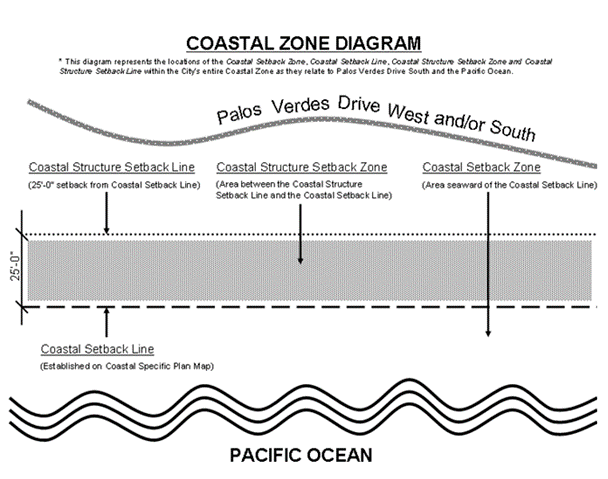
(Code 1981, § 17.72.130; Ord. No. 529, § 38, 11-15-2011)
_____
17.73.010.- Purpose.
A.
The purpose of this chapter is to reasonably regulate, to the extent permitted under California and federal law, the installations, operations, collocations, modifications, replacements and removals of various wireless telecommunications facilities ("WTFs") on private property in the city recognizing the benefits of wireless telecommunications while reasonably respecting other important city needs, including the protection of public health, safety, and welfare, aesthetics and local values.
B.
The overarching intent of this chapter is to make wireless telecommunications reasonably available while protecting scenic views and preserving the semi-rural character and aesthetics of the city. This will be realized by:
1.
Minimizing the visual and physical effects of WTFs through appropriate design, siting, screening techniques and location standards;
2.
Encouraging the installation of visually unobtrusive WTFs at locations where other such facilities already exist; and
3.
Encouraging the installation of such facilities where and in a manner such that potential adverse aesthetic impacts to the community are minimized.
C.
To allow the city to better preserve its semi-rural and unique character, it is the intent to limit the duration of WTF permits, in most cases, to terms of ten years, and to reevaluate existing WTFs at the end of each term for purposes of further minimizing aesthetic impacts on the community.
D.
It is not the purpose or intent of this chapter to:
1.
Prohibit or to have the effect of prohibiting wireless telecommunications services; or
2.
Unreasonably discriminate among providers of functionally equivalent wireless telecommunications services; or
3.
Regulate the placement, construction or modification of WTFs on the basis of the environmental effects of radio frequency ("RF") emissions where it is demonstrated that the WTF does or will comply with the applicable FCC regulations; or
4.
Prohibit or effectively prohibit collocations or modifications that the city must approve under state or federal law.
E.
The provisions in this chapter shall apply to all permit applications to install, operate or change, including, without limitation, to collocate, modify, replace or remove, any new or existing wireless tower or base station within the city.
F.
Nothing in this chapter is intended to allow the city to preempt any state or federal law or regulation applicable to a WTF.
G.
The provisions of this chapter are in addition to, and do not replace, any obligations a WTF permit holder may have under any franchises, licenses, or other permits issued by the city.
(Ord. No. 682, § 3(Exh. A), 6-18-2024)
17.73.020. - Definitions.
For the purpose of this chapter, the words and phrases in this chapter shall be defined as defined at Section 12.18.020, wireless telecommunication facilities in the public right-of-way. In addition, the following definitions shall apply to this chapter:
Antenna means that specific device for transmitting and/or receiving radio frequency or other signals for purposes of wireless telecommunications services. "Antenna" is specific to the antenna portion of a wireless telecommunications facility
Antenna height means the distance from the grade of the property at the base of the antenna or, in the case of a roof-mounted antenna, from the grade at the exterior base of the building to the highest point of the antenna and it associated support structure when fully extended.
City-owned structure without limitation means any pole, building, facility, transportation or traffic sign or other structure owned by the city.
CPUC means the California Public Utilities Commission or its successor agency.
Director means the community development director or their designee.
Eligible facility permit or EFP means a permit for an eligible facilities request that meets the criteria found in Section 17.73.220.
Mock-up means a temporary, full-sized, structural model built to scale chiefly for study, testing, or displaying a wireless telecommunications facility. It is nonfunctional and has no power source.
Nonresidential zone means any zoning district other than the RS, single-family residential zone, or RM, multifamily residential zone.
OTARD antenna means antennas covered by the "over-the-air reception devices" rule in 47 C.F.R. Section 1.4000 et seq., as may be amended.
Private property means any property owned by a private individual or entity, including government owned property such as any property owned in fee by the city or dedicated for public use (i.e., parks).
Screening means the effect of locating an antenna behind a building, wall, facade, fence, landscaping, berm, and/or other specially designed device so that view of the antenna from adjoining and nearby public street rights-of-way and private properties is eliminated or minimized.
Site means the same as defined by the FCC in 47 C.F.R. Section 1.40001(b)(6), as may be amended, which provides that "[f]or towers other than towers in the public rights-of-way, the current boundaries of the leased or owned property surrounding the tower and any access or utility easements currently related to the site, and, for other eligible support structures, further restricted to that area in proximity to the structure and to other transmission equipment already deployed on the ground."
Unconcealed means a wireless telecommunications facility that is not a concealed facility and has no or effectively no camouflage techniques applied such that the wireless telecommunications facility and/or accessory equipment is plainly obvious to the observer.
Wireless facilities provider means an entity utilized by a wireless service provider to construct and/or operate the wireless service provider's wireless facility.
Wireless facility permit, administrative or AWFP means any new facility or collocation or modification to an existing facility that is concealed in a nonresidential zone and integrated into the facade and design of an existing structure or building. If on an existing utility pole in a nonresidential zone, the facility must be integrated into the pole, well designed, and does not substantially change the appearance of the pole as determined by the director.
Wireless facility permit, conditional or CWFP means any new facility, collocation, or modification to an existing facility on private property that is unconcealed, located in a less preferred location, unconcealed in a preferred location, or does not meet the criteria for either an administrative wireless facility permit or an eligible facility permit.
Wireless service provider means the FCC licensed or authorized entity actually offering wireless services to the public.
WTF means wireless telecommunications facility as defined by Section 12.18.020.
(Ord. No. 682, § 3(Exh. A), 6-18-2024)
17.73.030. - Standards generally applicable to all wireless telecommunications facilities.
A.
Height restrictions.
1.
No tower or antenna of any wireless telecommunications facility shall exceed the zone height limit of the zone upon which the wireless telecommunications facility is located, unless otherwise approved pursuant to Section 17.73.070.
2.
The height limitations in subsection (A)(1) of this section are subject to preemption pursuant to 47 U.S.C. Section 14000.
B.
Installation of WTFs. Prior to the installation of a new wireless telecommunications facility or a modification or collocation to an existing wireless telecommunications facility that does not constitute an "eligible facilities request" nor qualify for an eligible facility permit, the owner, or occupant with written permission from the owner of the lot, premises, parcel of land or building on which a wireless telecommunications facility is to be located shall first obtain a conditional wireless facility permit or administrative wireless facility permit from the city pursuant to this chapter.
C.
Installation of eligible facilities. Unless specifically exempt by federal or state law, all applications for the installation of wireless telecommunications facilities that constitute "eligible facilities requests" require the approval of an eligible facility permit as described in Section 17.73.220 prior to construction of such eligible facility.
D.
Exempted facilities. This chapter does not apply to the following:
1.
Amateur radio facilities;
2.
Over-the-air reception devices (OTARD) antennas, up to three on a property;
3.
Facilities owned and operated by the city for its use; or
4.
Any entity legally entitled to an exemption pursuant to state or federal law or governing franchise agreement, excepting that to the extent such the terms of state or federal law, or franchise agreement, are preemptive of the terms of this chapter, then the terms of this chapter shall be severable to the extent of such preemption and all remaining regulations shall remain in full force and effect. Nothing in the exemption shall apply so as to preempt the city's valid exercise of police powers that do not substantially impair franchise contract rights;
E.
Required permits. All proposed facilities and collocations or modifications to facilities governed under this chapter shall be subject to either a conditional wireless facility permit or an administrative wireless facility permit from the city, unless exempted from this chapter as an eligible facility permit under Section 17.73.220.
1.
Conditional wireless facility permit.
a.
A conditional wireless facility permit is required for any new facility or collocation or modification to an existing facility located on private property as follows:
i.
All facilities in less preferred locations, as defined in subsection 17.73.210(C)(1)(b);
ii.
All unconcealed facilities in preferred locations, as defined in subsection 17.73.210(C)(1)(a); and
iii.
All other facilities that do not meet the criteria for either an administrative wireless facility permit described herein or an eligible facility permit described in Section 17.73.220.
b.
Approval of a conditional wireless facility permit for a wireless telecommunications facility shall be subject to the following:
i.
All standards and regulations contained in Section 17.73.210, and any amendments or modifications to the facility as approved by resolution of the planning commission at a noticed public hearing;
ii.
No wireless communications facility proposed within 200 feet from any dwelling lawfully used or approved for a residential use may not be approved unless the proposed facility meets all of the following criteria:
(A)
All accessory equipment associated with the proposed wireless communications facility is placed underground, unless otherwise approved by the planning commission;
(B)
The proposed wireless communications facility is located a minimum of 200 feet from any other wireless communications facility, unless otherwise approved pursuant to Section 17.73.220.
c.
A wireless telecommunications facility application must include all of the contents described in Section 17.73.040.
d.
All decisions for a wireless telecommunications facility must be in writing and contain the reasons for approval or denial.
e.
All approved or deemed-approved wireless telecommunications facilities shall be subject to all the conditions imposed by the planning commission.
f.
Noticing requirements and appeal provisions shall follow the procedures described in Chapter 17.80 (hearing notice and appeal procedures).
2.
Administrative wireless facility permit.
a.
An administrative wireless facility permit is required for any new facility or collocation or modification to an existing facility as follows:
i.
All concealed facilities in a nonresidential zone that are integrated into the facade and design of an existing building;
ii.
All concealed facilities on an existing structure, other than a utility pole, in a nonresidential zone;
iii.
Wireless telecommunication accessory equipment that is incidental to and part of the provision of a public utility, including electrical power, gas, and sewerage, in accordance with a franchise agreement with the city.
b.
Approval of an administrative wireless facility permit shall be subject to the following:
i.
A wireless telecommunications facility application must include all of the contents described in Section 17.73.040.
ii.
All standards and regulations described in Sections 17.73.050 and 17.73.210, and any amendments or modifications to the facility as approved by the director.
iii.
No concealed wireless telecommunications facility proposed within 200 feet from any dwelling used or approved for a residential use may be permitted unless the proposed facility meets all of the following criteria:
(A)
All non-antenna accessory equipment associated with the proposed wireless telecommunications facility is placed underground or concealed into the facade or design of a building;
(B)
No individual antenna on the proposed wireless telecommunications facility exceeds three cubic feet in volume;
(C)
The cumulative antenna volume on any single pole does not exceed nine cubic feet; and
(D)
For facilities not concealed within a building, the proposed wireless telecommunications facility must be located a minimum of 200 feet from any other wireless telecommunications facility located along the same side of a street, unless the existing facility is concealed into the facade or design of a building, and a minimum of 200 feet from any street intersection.
c.
All approved or deemed-approved wireless telecommunications facilities shall be subject to all the conditions imposed by the director.
d.
All decisions for an administrative wireless facility permit must be in writing and contain the reasons for approval or denial. Notice of said decision shall be given to the applicant and to all owners of real property adjacent to subject property. Notice of denial shall be given to the applicant, as well as any persons who have requested notice for these the subject permit, pursuant to subsection 17.80.090(E).
e.
An interested person may appeal the director's decision to the planning commission and the planning commission decision to the city council pursuant to Chapter 17.80 (hearing notice and appeal procedures) of this title.
(Ord. No. 682, § 3(Exh. A), 6-18-2024)
17.73.040. - Application content.
A.
The director shall develop and publish, and from time-to-time modify and republish, an application or applications to be used to apply for permits or extensions thereof.
B.
At a minimum, the director shall include in every application the following information:
1.
Legal description. A legal description of the property where the wireless telecommunications facility is to be installed.
2.
Radius map and certified list. A radius map and a certified list of the names and addresses of all property owners within 500 feet of the exterior boundaries of the property involved, as shown on the latest assessment roll of the county assessor. The radius map and certified list may be reduced for AWFP and EFP applications at the discretion of the director.
3.
Plot plan. A plot plan of the lot, premises or parcel of land showing the exact location of the proposed wireless telecommunications facility (including all related accessory equipment and cables), exact location and dimensions of all buildings, parking lots, walkways, trash enclosures, and property lines.
4.
Elevations and roof plan. Building elevations and roof plan (for building- and/or rooftop-mounted facilities) indicating exact location and dimensions of accessory equipment proposed. For freestanding facilities, indicate surrounding grades, structures, and landscaping from all sides.
5.
Screening. Proposed landscaping and/or nonvegetative screening (including required safety fencing) plan for all aspects of the facility.
6.
Manufacturer's specification. Manufacturer's specifications, including installation specifications, exact location of cables, wiring, materials, color, and any support devices that may be required.
7.
Visual impact letter. Written documentation demonstrating a good faith effort to locate the proposed facility in the least intrusive location and concealed and screened to the greatest extent feasible in accordance with the site selection and visual impact criteria of Section 17.73.210 and if applicable, the extent to which the proposed antenna assembly significantly impairs a view, as defined in Section 17.02.040, view preservation and restoration, of the development code.
8.
Reasonable efforts to collocate required. Applicants proposing new wireless telecommunications facilities must demonstrate that reasonable efforts have been made to locate on existing facilities. The applicant must provide written documentation of all efforts to collocate the proposed facility on an existing facility, or antenna mounting structure, including copies of letters or other correspondence sent to other carriers or tower owners requesting such location and any responses received. This should include all relevant information as applicable regarding existing towers or base stations in the area, topography, signal interference, signal propagation and available land zoning restrictions.
9.
Photographs and photo simulations. Photographs and photo simulations that show the proposed facility in context of the site from reasonable line-of-sight locations from public streets or other adjacent viewpoints, together with a map that shows the photo location of each view angle, as deemed acceptable by the director.
10.
Master plan. If required by the city, a master plan which identifies the location of the proposed facility in relation to all existing and potential facilities maintained by the wireless service provider intended to serve the city. The master plan shall reflect all potential locations that are reasonably anticipated for construction within two years of submittal of the application. Applicants may not file, and the city shall not accept, applications that are not consistent with the master plan for a period of two years from approval of a conditional wireless facility permit or administrative wireless facility permit unless: (a) the applicant demonstrates materially changed conditions which could not have been reasonably anticipated to justify the need for a wireless telecommunications facility site not shown on a master plan submitted to the city within the prior two years, or (b) the applicant establishes before the planning commission that a new wireless telecommunications facility is necessary to close a significant gap in the applicant's service area, and the proposed new installation is the least intrusive means to do so.
11.
Alternative analysis. If required by the city, a siting analysis which identifies a minimum of five other feasible locations within or outside the city which could serve the area intended to be served by the facility, unless the applicant provides compelling technical reasons for providing fewer than the minimum. The alternative site analysis should include at least one collocation site, if feasible.
12.
Noise study. If requested by the city, a noise study prepared and certified by an acoustical engineer licensed by the State of California for the proposed facility and all accessory including all environmental control units, sump pumps, temporary backup power generators, and permanent backup power generators demonstrating compliance with the city's noise regulations. The noise study must also include an analysis of the manufacturers' specifications for all noise-emitting equipment and a depiction of the proposed accessory equipment relative to all adjacent property lines. In lieu of a noise study, the applicant may submit evidence from the equipment manufacturer that the ambient noise emitted from all the proposed accessory equipment will not, both individually and cumulatively, exceed a one dBA increase over ambient noise levels as measured from the property line of any residential property. Within residential zones and properties adjacent to residential zones, soundproofing measures shall be used to reduce noise caused by the operation of a wireless telecommunications facility and all accessory equipment to a level which would have a no-net increase in ambient noise level as measured from the property line of any residential property.
13.
Certificate of public convenience and necessity. Certification that applicant is a telephone corporation or a statement providing the basis for its claimed right to install WTFs in the city. If the applicant has a certificate of public convenience and necessity (CPCN) issued by the California Public Utilities Commission, it shall provide a true and complete copy of its CPCN.
14.
Mock-up. A mock-up including all proposed antenna structures, antennas, cables, hardware and related accessory equipment shall be constructed at least 15 consecutive calendar days, for 24 hours a day, prior to a public hearing, in order for the planning commission or the director to assess aesthetic impacts to surrounding land uses and public rights-of-way. Said mock-up shall remain in place until completion of any appeal process and shall be removed within seven calendar days of any final decision. This requirement may be waived by the director.
a.
Installation of a mock-up can occur prior to submittal of a formal application; provided, that the director has reviewed the plans for the mock-up. and approved or conditionally approved a site plan review permit. Prior to installation of a mock-up, the applicant shall provide notice to all residents and homeowners within 500 feet of the proposed mock-up at least 48 hours in advance. Said notice shall be provided to the director for review and approval prior to issuance of the notice.
b.
Mock-ups shall be required for all proposed wireless communication facilities, except for collocations that do not represent a major modification to visual impact as defined in Section 17.73.210. For proposed rooftop or ground-mounted antennas, a temporary mast approximating the dimensions of the proposed facility shall be raised at the proposed antenna/mast location. For proposed new telecommunications towers the applicant will be required to raise a temporary mast at the maximum height and at the location of the proposed tower. At minimum, the onsite demonstration structure shall be in place prior to the first public hearing to consider project approval, on at least two weekend days and two weekdays between the hours of 8:00 a.m. to 6:00 p.m., for a minimum of ten hours each day. A project description, including photo simulations of the proposed facility, shall be posted at the proposed project site, in a location upon where members of the public may view said description and photos, for the duration of the mock-up display. The director may release an applicant from the requirement to conduct on-site visual mock-ups upon a written finding that in the specific case involved, said mock-ups are not necessary to process or make a decision on the application and would not serve as effective public notice of the proposed facility.
15.
RF exposure compliance report. An RF exposure compliance report prepared and certified by a licensed RF engineer that certifies that the proposed facility, as well as any collocated facilities, will comply with applicable federal RF exposure standards and exposure limits. The RF report must include the actual frequency and power levels (in watts effective radio power (ERP)) for all existing and proposed antennas at the site and exhibits that show the location and orientation of all transmitting antennas and the boundaries of areas with RF exposures in excess of the uncontrolled/general population limit. Each such boundary shall be clearly marked and identified for every transmitting antenna at the project site.
16.
Written authorization from property owner required. Every applicant applying for authorization to construct, modify, or remove a wireless telecommunications facility located on private property must include with its application a written authorization signed by the owner of the property.
17.
Other information. Any other information as deemed necessary by the city in order to consider an application for a wireless telecommunications facility.
18.
Fees. The application shall be accompanied by the appropriate fee in an amount as established by resolution of the city council.
19.
Community meeting. In addition to any other action otherwise required by law pertaining to the processing of a conditional wireless facility permit application, the applicant for which such review is being sought shall take all of the following actions if required by the city:
a.
Send written notice to both the owner(s) of real property, as shown on the latest equalized assessment roll, within 500 feet of the proposed wireless telecommunications facility and the city planning department, of the pendency of the filing of such an application, including with such notice copies of preliminary drawings of the proposed project at a scale no smaller than one inch equals 16 feet. No application for neighborhood review will be accepted as complete unless it contains evidence acceptable to the director that such notice has been sent.
b.
Hold a community meeting at least four weeks before the date of the planning commission meeting at which the application will be heard, and invite the persons entitled to notice pursuant to subsection (B)(19)(a) of this section to attend such meeting to discuss the proposed application. The community meeting shall be held on a nonholiday weekend or during daylight hours and before 9:00 a.m. or after 5:00 p.m. on a weekday. The meeting shall be held at the subject site; provided, however, that if the occupancy of the subject site by a tenant or physical conditions at the subject site make it unsafe or infeasible to provide a table and chairs at the subject site, the meeting may be held at another location within the city. The mock-up of the proposed project shall be erected at the subject site before the meeting. The primary location and all alternative sites shall be presented to the community as well as the reasons for the selection of the primary location. Notice of the date, time and place of such meeting shall be sent at least seven days before the meeting and shall be filed with the planning department.
c.
If the hearing on the application is continued by the planning commission, the applicant is encouraged, but not required, to hold a further meeting with the persons entitled to notice pursuant to (a) of this subsection at least one week prior to the continued hearing.
d.
If a meeting pursuant to subsection (B)(19)(b) of this section results in any modifications to the project prior to the planning commission hearing on the project, the applicant shall (1) notify the director of the proposed modifications, and (2) explain to the planning commission at the hearing on the matter any discrepancy between the project as proposed in the notice sent pursuant to subsection (B)(19)(a) of this section and the project as presented to the planning commission.
e.
A community meeting may be required at the discretion of the director for an application for an administrative wireless facility permit or an eligible facility permit.
C.
Appeals. No decision on any wireless telecommunications facility application shall be considered final until and unless all appeals have been taken or are time-barred.
D.
Effect of state or federal law change. In the event a subsequent state or federal law prohibits the collection of any information described herein, the director is authorized to omit, modify or add to that request from the city's application form.
(Ord. No. 682, § 3(Exh. A), 6-18-2024)
17.73.050. - Independent consultant review.
A.
Authorization. The city council authorizes the director to, in his or her discretion, select and retain an independent consultant with expertise in telecommunications satisfactory to the director in connection with any permit application.
B.
Scope. The director may require the independent consultant to review and comment on any issue that involves specialized or expert knowledge in connection with the application. Such issues may include, but are not limited to:
1.
Permit application completeness or accuracy;
2.
Planned compliance with applicable federal RF exposure standards;
3.
Whether and where a significant gap exists or may exist, and whether such a gap relates to service coverage or service capacity;
4.
Whether technically feasible and potentially available alternative locations and designs exist;
5.
The applicability, reliability and sufficiency of analyses or methodologies used by the applicant to reach conclusions about any issue within this scope; and
6.
Any other application issue or element that requires expert or specialized knowledge.
C.
Deposit. The applicant must pay for the cost of any review required under subsection (B) of this section and for the technical consultant's testimony in any hearing as requested by the director and must provide a reasonable advance deposit of the estimated cost of such review with the city prior to the commencement of any work by the technical consultant. The applicant must provide an additional advance deposit to cover the consultant's testimony and expenses at any meeting where that testimony is requested by the director. Where the advance deposit(s) are insufficient to pay for the cost of such review and/or testimony, the director shall invoice the applicant who shall pay the invoice in full within ten calendar days after receipt of the invoice. No permit shall issue to an applicant where that applicant has not timely paid a required fee, provided any required deposit or paid any invoice as required in the code.
(Ord. No. 682, § 3(Exh. A), 6-18-2024)
17.73.060. - Collocation and modification standards.
The modification or collocation of wireless facilities, not subject to the provisions of Section 17.73.220, shall be denied if any of the following will occur:
A.
The proposed collocation or modification involves excavation outside the current boundaries of the leased or owned property surrounding the wireless tower, including any access or utility easements currently related to the site;
B.
The proposed collocation or modification would defeat or diminish the existing concealment elements of the support structure as determined by the director;
C.
The proposed collocation or modification violates any section of this Chapter, or any prior condition of approval for the site;
D.
If the site is not presently concealed, the proposed collocation or modification does not provide for camouflage.
(Ord. No. 682, § 3(Exh. A), 6-18-2024)
17.73.070. - Exemptions to prevent an effective prohibition.
All requests granted under this chapter are subject to review and consideration by the planning commission. The applicant always bears the burden to demonstrate why an exemption should be granted. An applicant seeking an exemption under this section on the basis that a permit denial would actually or effectively prohibit the provision of the telecommunications service to be provided by the wireless telecommunications facility must demonstrate by clear and convincing evidence that all alternative designs and locations are either technically infeasible or not available.
(Ord. No. 682, § 3(Exh. A), 6-18-2024)
17.73.080. - Compliance report.
A.
Within 30 days after installation or modification of a WTF, the applicant shall deliver to the director a written report that demonstrates that its WTF as constructed and normally operating fully complies with the conditions of the permit, including height restrictions and applicable safety codes, including structural engineering codes. The demonstration shall be provided in writing to the director containing all technical details to demonstrate such compliance and certified as true and accurate by qualified professional engineers, or, in the case of height or size restrictions, by qualified surveyors. This report shall be prepared by the applicant and reviewed by the city at the sole expense of the applicant, which shall promptly reimburse the city for its review expenses. The director may require additional proofs of compliance as part of the application process and on an ongoing basis to the extent the city may do so consistent with federal law.
B.
If the initial report required by this section shows that the WTF does not so comply, the permit shall be deemed suspended, and all rights thereunder of no force and effect, until the applicant demonstrates to the city's satisfaction that the WTF is compliant. Applicant shall promptly reimburse the city for its compliance review expenses.
C.
If the initial report required by this section is not submitted within the time required, the city may, but is not required to, undertake such investigations as are necessary to prepare the report described in subsection A of this section. Applicant shall within five days after receiving written notice from the city that the city is undertaking the review, deposit such additional funds with the city to cover the estimated cost of the city obtaining the report. Once said report is obtained by the city, the city shall then timely refund any unexpended portion of the applicant's deposit. The report shall be provided to the applicant. If the report shows that the applicant is noncompliant, the city may suspend the permit until the applicant demonstrates to the city's satisfaction that the WTF is compliant. During the suspension period, the applicant shall be allowed to activate the WTF for short periods, not to exceed 120 minutes during any 24-hour period, for the purpose of testing and adjusting the site to come into compliance.
D.
If the WTF is not brought into compliance promptly, the city may revoke the permit and require removal of the WTF.
(Ord. No. 682, § 3(Exh. A), 6-18-2024)
17.73.090. - Maintenance.
The site and the facility, including but not limited to all landscaping, fencing and related accessory equipment, must be maintained in a neat and clean manner and in accordance with all approved plans and conditions of approval.
(Ord. No. 682, § 3(Exh. A), 6-18-2024)
17.73.100. - Amortization of nonconforming facilities.
A.
Any nonconforming facility in existence at the time this chapter becomes effective must be brought into conformance with this chapter in accordance with the amortization schedule in this section. As used in this section, the "fair market value" will be the construction costs listed on the building permit application for the subject facility and the "minimum years" allowed will be measured from the date on which this chapter becomes effective.
B.
The director may grant a written extension to a date certain not greater than one year when the facility owner shows (1) a good faith effort to cure nonconformance, and (2) extreme economic hardship would result from strict compliance with the amortization schedule. Any extension must be the minimum time period necessary to avoid such extreme economic hardship. The director must not grant any permanent exemption from this section.
C.
Nothing in this section is intended to limit any permit term to less than ten years. In the event that the amortization required in this section would reduce the permit term to less than ten years for any permit granted on or after December 1, 2023, then the minimum years allowed will be automatically extended by the difference between ten years and the number of years since the city granted such permit. Nothing in this section is intended or may be applied to prohibit any collocation or modification covered under Section 6409 pursuant to Section 17.73.220 on the basis that the subject wireless telecommunications facility is a legal nonconforming facility.
(Ord. No. 682, § 3(Exh. A), 6-18-2024)
17.73.110. - Permit extensions.
An existing wireless telecommunications permit that is subject to term expiration may be extended for an additional ten-year term upon the following conditions:
A.
Every application for an extension shall be:
1.
Made on the extension application form provided by the city; and
2.
Accompanied by a fee in an amount as established by resolution of the city council.
B.
The extension application shall be developed and revised from time to time at the director's discretion. The extension application shall at a minimum require the following:
1.
The identification of the wireless site requested to be extended; and
2.
A true and complete copy of all city-issued permits for the site including any collocations at the site.
C.
The extension application shall be approved by the director only upon the following mandatory showings:
1.
That the site as it exists at the time the extension application is tendered is in all respect compliant with all applicable city permits for the site, including collocations; and
2.
If the site as it exists at the time the extension application is tendered would be approvable consistent with the city's Code in existence at that time.
(Ord. No. 682, § 3(Exh. A), 6-18-2024)
17.73.120. - Temporary wireless facilities.
A.
Temporary wireless facilities, also known as a cell-on-wheels ("COW"), site-on-wheels ("SOW"), cell-on-light-trucks ("COLT"), or other similarly portable wireless telecommunications facilities not permanently affixed to the land, may be placed and operated within the city with a special use permit approved by the director.
B.
By placing a temporary wireless facility pursuant to this section the entity or person placing the temporary wireless facility agrees to and shall defend, indemnify and hold harmless the city, its agents, officers, officials, employees and volunteers from any and all damages, liabilities, injuries, losses, costs and expenses and from any and all claims, demands, lawsuits, writs and other actions or proceedings ("claims") brought against the city or its agents, officers, officials, employees or volunteers for any and all claims of any nature related to the installation, use, nonuse, occupancy, removal, and disposal of the temporary wireless facility.
C.
The temporary wireless facility shall prominently display upon it a legible notice identifying the entity responsible for the placement and operation of the temporary wireless facility, along with the notice of decision for the special use permit.
D.
Any temporary wireless facilities placed pursuant to this section must be removed prior to or at the expiration of the special use permit. In addition, the temporary wireless facilities must be removed or relocated within one hour if required for public safety reasons by law enforcement, fire or public safety officials. In the event that the temporary wireless facility is not removed or relocated as required in this section, the city may at its sole election remove and store or remove and dispose of the temporary wireless facility at the sole cost and risk of the person or entity placing the temporary wireless facility.
E.
Should there be an emergency such that temporary wireless facility is needed immediately to restore service, any person or entity that places temporary wireless facilities pursuant to this section must send the director or city manager an email notice or deliver a written notice by hand within 30 minutes of the placement that identifies the emergency, impact to service or operations, site location of the temporary wireless facility and person responsible for its operation. Said notice shall be followed by a written notice and special use permit application delivered within 12 hours to the director or city manager via prepaid U.S. mail first overnight delivery, such as U.S. Postal Express Mail or its equivalent. Should the special use permit be denied, the temporary wireless facility must be removed immediately.
(Ord. No. 682, § 3(Exh. A), 6-18-2024)
17.73.130. - Revocation.
A.
Grounds for revocation. A permit granted under this chapter may be revoked for noncompliance with any enforceable permit, permit condition or law provision applicable to the facility.
B.
Revocation procedures.
1.
When the director finds reason to believe that grounds for permit revocation exist, the director shall send written notice by certified U.S. mail, return receipt requested, to the permittee at the permittee's last known address that states the nature of the noncompliance as grounds for permit revocation. The permittee shall have a reasonable time from the date of the notice, but no more than 30 days unless authorized by the director, to cure the noncompliance or show that no noncompliance ever occurred.
2.
If after notice and opportunity to show that no noncompliance ever occurred or to cure the noncompliance, the permittee fails to cure the noncompliance, the city council shall conduct a noticed public hearing to determine whether to revoke the permit for the uncured noncompliance. The permittee shall be afforded an opportunity to be heard and may speak and submit written materials to the city council. After the noticed public hearing, the city council may revoke or suspend the permit when it finds that the permittee had notice of the noncompliance and an enforceable permit, permit condition or law applicable to the facility. Written notice of the city council's determination and the reasons therefor shall be dispatched by certified U.S. mail, return receipt requested, to the permittee's last known address. Upon revocation, the city council may take any legally permissible action or combination of actions necessary to protect public health, safety and welfare.
(Ord. No. 682, § 3(Exh. A), 6-18-2024)
17.73.140. - Decommissioned or abandoned wireless telecommunications facilities.
A.
Decommissioned wireless facilities. Any permittee that intends to decommission a wireless telecommunications facility must send 30-days prior written notice by certified U.S. mail to the director. The permit will automatically expire 30 days after the director receives such notice of intent to decommission, unless the permittee rescinds its notice within the 30-day period.
B.
Procedures for abandoned facilities or facilities not kept in operation.
1.
To promote the public health, safety and welfare, the director may declare a facility abandoned when:
a.
The permittee notifies the director that it abandoned the use of a facility for a continuous period of 90 days; or
b.
The permittee fails to respond within 30 days to a written notice sent by certified U.S. mail, return receipt requested, from the director that states the basis for the director's belief that the facility has been abandoned for a continuous period of 90 days; or
c.
The permit expires and the permittee has failed to file a timely application for renewal.
2.
After the director declares a facility abandoned, the permittee shall have 90 days from the date of the declaration (or longer time as the director may approve in writing as reasonably necessary) to:
a.
Reactivate the use of the abandoned facility subject to the provisions of this chapter and all conditions of approval;
b.
Transfer its rights to use the facility, subject to the provisions of this chapter and all conditions of approval, to another person or entity that immediately commences use of the abandoned facility; or
c.
Remove the facility and all improvements installed solely in connection with the facility, and restore the site to a condition compliant with all applicable codes consistent with the then-existing surrounding area.
3.
If the permittee fails to act as required in subsection (B)(2) of this section within the prescribed time period, the city council may deem the facility abandoned and revoke the underlying permit(s) at a noticed public meeting in the same manner as provided in subsection (B)(2) of this section. Further, the city council may take any legally permissible action or combination of actions reasonably necessary to protect the public health, safety and welfare from the abandoned wireless telecommunications facility.
(Ord. No. 682, § 3(Exh. A), 6-18-2024)
17.73.150. - Wireless telecommunications facilities removal or relocation.
A.
Removal by permittee. The permittee or property owner must completely remove the wireless telecommunications facility and all related improvements, without cost or expense to the city, within 90 days after:
1.
The permit expires; or
2.
The city council properly revokes a permit pursuant to subsection 17.73.130(B); or
3.
The permittee decommissions the wireless telecommunications facility; or
4.
The city council deems the wireless telecommunications facility abandoned pursuant to subsection 17.73.140(B); or
5.
Within the 90-day period, the permittee or property owner must restore the former wireless telecommunications facility site area to a condition compliant with all applicable codes and consistent with and/or compatible with the surrounding area.
B.
Removal by city. The city may, but is not obligated to, remove an abandoned wireless telecommunications facility, restore the site to a condition compliant with all applicable codes and consistent with and/compatible with the surrounding area, and repair any and all damages that occurred in connection with such removal and restoration work. The city may, but shall not be obligated to, store the removed wireless telecommunications facility or any part thereof, and may use, sell or otherwise dispose of it in any manner the city deems appropriate in its sole discretion. The last-known permittee or its successor-in-interest and the real property owner shall be jointly liable for all costs incurred by the city in connection with its removal, restoration, repair and storage, and shall promptly reimburse the city upon receipt of a written demand, including any interest on the balance owing at the maximum lawful rate. The city may, but shall not be obligated to, use any financial security required in connection with the granting of the facility permit to recover its costs and interest. A lien may be placed on all abandoned personal property and the real property on which the abandoned wireless telecommunications facility is located for all costs incurred in connection with any removal, repair, restoration and storage performed by the city. The city clerk shall cause such a lien to be recorded with the County of Los Angeles clerk-recorder's office.
(Ord. No. 682, § 3(Exh. A), 6-18-2024)
17.73.170. - Compliance obligations.
An applicant or permittee will not be relieved of its obligation to comply with every applicable provision in the Code, this chapter, any permit, any permit condition or any applicable law or regulation by reason of any failure by the city to timely notice, prompt or enforce compliance by the applicant or permittee.
(Ord. No. 682, § 3(Exh. A), 6-18-2024)
17.73.180. - Conflicts with prior ordinances.
If the provisions in this chapter conflict in whole or in part with any other city regulation or ordinance adopted prior to the effective date of this chapter, the provisions in this chapter will control.
(Ord. No. 682, § 3(Exh. A), 6-18-2024)
17.73.190. - Duty to retain records.
The permittee must maintain complete and accurate copies of all permits and other regulatory approvals (collectively, the "records") issued in connection with the wireless facility, which includes without limitation this approval, the approved plans and photo simulations incorporated into this approval, all conditions associated with this approval and any ministerial permits or approvals issued in connection with this approval. In the event that the permittee does not maintain such records as required in this condition or fails to produce true and complete copies of such records within a reasonable time after a written request from the city, any ambiguities or uncertainties that would be resolved through an inspection of the missing records will be construed against the permittee.
(Ord. No. 682, § 3(Exh. A), 6-18-2024)
17.73.200. - Severability.
In the event that a court of competent jurisdiction holds any section, subsection, paragraph, sentence, clause or phrase in this section unconstitutional, preempted, or otherwise invalid, the invalid portion shall be severed from this section and shall not affect the validity of the remaining portions of this section. The city hereby declares that it would have adopted each section, subsection, paragraph, sentence, clause or phrase in this section irrespective of the fact that any one or more sections, subsections, paragraphs, sentences, clauses or phrases in this section might be declared unconstitutional, preempted or otherwise invalid.
(Ord. No. 682, § 3(Exh. A), 6-18-2024)
17.73.210. - Wireless telecommunications facilities on private property.
A.
Purpose. The following procedures and design standards shall be required for the installation of wireless telecommunications facilities within private property. These criteria are intended to guide and facilitate applicants in locating and designing facilities and accessory equipment in a manner that will be compatible with the purpose, intent, and goals of this section. It is the intent of the city to use its time, place, and manner authority to protect and preserve the aesthetics of the city.
B.
Permit required.
1.
Installation of wireless telecommunications facilities located on private property will be subject to this chapter.
2.
Applicants shall apply for a conditional wireless facility permit or administrative wireless facility permit for any wireless telecommunications facility that it seeks to place on private property.
C.
Design standards. The following general design guidelines shall be considered for regulating the location, design, and aesthetics for a wireless telecommunications facility:
1.
Site selection criteria.
a.
Preferred locations. When doing so would not conflict with one of the standards set forth in this subsection or with federal law, wireless telecommunications facilities shall be located in the most preferred location as described in this subsection, which range from the most preferred to the least preferred locations on private property.
i.
Location on a new or existing building in a nonresidential zoning district including institutional and cemetery districts but not open space districts.
ii.
Location on an existing city-owned structure in a nonresidential zoning district with a facility designed with concealment elements.
iii.
Location on a new concealed structure in a nonresidential zoning district.
iv.
Located more than 200 feet of a residential building or residential lot, excluding out-buildings, unless concealed in or on a nonresidential building (e.g., churches, temples, etc.).
b.
Less preferred locations. To the extent feasible, facilities shall not be located in the following areas:
i.
Environmentally sensitive areas including the Palos Verdes Nature Preserve and those areas with coastal sage scrub governed by Chapter 17.41 (coastal sage scrub conservation and management);
ii.
Installations that would be in violation of Section 17.02.040, view preservation and restoration;
iii.
On a structure, site or in a zoning district designated as a local, state or federal historical landmark, or having significant local historical value as determined by the city council.
c.
No new facility may be placed in a less preferred location unless the applicant demonstrates to the reasonable satisfaction of the planning commission or director that no more preferred location can feasibly serve the area the facility is intended to serve; provided, however, that the planning commission or director may authorize a facility to be established in a less preferred location if doing so is necessary to prevent substantial aesthetic impacts.
d.
All facilities (including all related accessory cabinet(s)) shall meet the setback requirements of the underlying zoning district. In no case shall any portion of a facility be located in a defined front yard or side yard.
e.
In no case shall any part of a facility alter vehicular and/or pedestrian circulation within a site or impede access to and from a site. In no case shall a facility alter off-street parking spaces (such that the required number of parking spaces for a use is decreased) or interfere with the normal operation of the existing use of the site.
f.
All wireless telecommunications facilities shall utilize unmetered commercial power service, or commercial power metering in the enclosure required by the utility, or remote power metering in flush-to-grade vaults. If a commercial power meter is installed and the wireless telecommunications facility can be converted to unmetered or wireless power metering, the permittee shall apply for a permit modification to perform the conversion.
g.
Any freestanding ground-mounted wireless telecommunications facility, including any related accessory cabinet(s) and structure(s), shall apply towards the allowable lot coverage for structures/buildings of the underlying zone.
h.
The antenna height of any wireless telecommunications facility shall not exceed the height limit of the underlying zoning district or the maximum permissible height of property upon which the WTF is located.
D.
General standards.
1.
Unless Government Code § 65964, as may be amended, authorizes the city to issue a permit with a shorter term, a permit for any wireless telecommunications facility shall be valid for a period of ten years, unless pursuant to another provision of this Code it lapses sooner or is revoked. At the end of ten years from the date of issuance, such permit shall automatically expire.
2.
Wireless telecommunications facilities shall not bear any signs or advertising devices other than certification, warning, or other required seals or required signage.
3.
No permittee shall unreasonably restrict access to an existing antenna location if required to collocate by the city, and if feasible to do so.
4.
All antennas shall be designed to prevent unauthorized climbing.
E.
Visual impacts.
1.
Facilities must comply with Section 17.02.040, view preservation and restoration, unless an exemption is granted pursuant to Section 17.73.070.
2.
Facilities shall be designed to be as visually unobtrusive as possible. Facilities shall be sited to avoid or minimize obstruction of views from adjacent properties.
3.
Facilities shall not be of a bright, shiny or glare-reflective finish. Colors and designs must be integrated and compatible with existing on-site and surrounding buildings and/or uses in the area. The facility shall be finished in a color to neutralize it and blend it with, rather than contrast it from, the sky and site improvements immediately surrounding; provided, that, wherever feasible, a light color shall be used to meet this requirement, as deemed acceptable by the director.
4.
If feasible, the base station and all wires and cables necessary for the operation of a facility shall be placed underground so that the antenna is the only portion of the facility that is above ground. If the base station is located within or on the roof of a building, it may be placed in any location not visible from surrounding areas outside the building, with any wires and cables attached to the base station be clipped and screened from public view. The applicant shall demonstrate to the satisfaction of the planning commission or director that it is not technically feasible to locate the base station below ground.
5.
Innovative design to minimize visual impact must be used whenever the screening potential of the site is low. For example, the visual impact of a site may be mitigated by using existing light standards and telephone poles as mounting structures, or by constructing screening structures which are compatible with surrounding architecture.
6.
Screening of the facility should take into account the existing improvements on or adjacent to the site, including landscaping, walls, fences, berms or other specially designed devices which preclude or minimize the visibility of the facility and the grade of the site as related to surrounding nearby grades of properties and public street rights-of-way.
7.
Landscaping or other screening shall be placed so that the antenna and any other aboveground structure is screened from public view. Landscaping or other screening required by this section shall be maintained by the permittee and replaced as necessary as determined by the director. All existing landscaping that has been disturbed by the permittee in the course of placement or maintenance of the wireless facility shall be restored to its original condition as existed prior to placement of the wireless facility by the permittee. Native vegetation shall be preserved to the greatest extent practicable and incorporated into the landscape plan.
8.
Wireless telecommunications facilities shall be located where the existing topography, vegetation, building, or other structures provide the greatest amount of screening.
9.
All building and roof-mounted wireless telecommunications facilities and antennas shall be designed to appear as an integral part of the structure and located to minimize visual impacts.
F.
Undergrounding of accessory equipment. To preserve community aesthetics, all facility accessory equipment, excluding antennas, aboveground vents, to the greatest extent possible, be required to be located underground, flush to the finished grade, shall be fully enclosed, and not cross property lines. Accessory equipment may include, but is not limited to, the following: fiber optic nodes, radio remote units or heads, power filters, cables, cabinets, vaults, junction or power boxes, and gas generators. Wherever possible, wireless metering shall be used. If wireless metering is not an option, electrical meter boxes related to wireless telecommunications facilities shall be appropriately screened, not visible to the general public, and located in less prominent areas on and private property. Where it can be demonstrated that undergrounding of accessory equipment is infeasible due to conflict with other utilities, the director may approve alternative above-grade accessory equipment mounting when adequately screened from public view. Any approved above-grade accessory equipment must be located so as not to cause any physical or visual obstruction to pedestrian or vehicular traffic, or to interfere with or create hazards to pedestrians or motorists.
G.
Soundproofing measures. Within residential zones, and properties adjacent to residential zones, soundproofing measures shall be used to reduce noise caused by the operation of wireless telecommunications facilities and all accessory equipment to a level which would have no net increase in ambient noise level.
H.
Applications deemed withdrawn. To promote efficient review and timely decisions, an application will be automatically deemed withdrawn when an applicant fails to tender a substantive response within 60 days after the city deems the application incomplete in a written notice to the applicant. The director may in the director's discretion grant a written extension for up to an additional 30 days upon a written request for an extension received prior to the 60th day. The director may grant further written extensions only for good cause, which includes circumstances outside the applicant's reasonable control.
(Ord. No. 682, § 3(Exh. A), 6-18-2024)
17.73.220. - Eligible wireless telecommunications facilities.
A.
Purpose. The purpose of this section is to adopt reasonable regulations and procedures, consistent with and subject to federal and California state law, for compliance with Section 6409(a) of the Middle Class Tax Relief and Job Creation Act of 2012, Pub. L. 112-96, codified in 47 U.S.C. Section 1455(a), and related Federal Telecommunications Commission regulations codified in 47 C.F.R. Section 1.40001 et seq.
1.
Section 6409(a) generally requires that state and local governments "may not deny, and shall approve" requests to collocate, remove or replace a WTF at an existing tower or base station. FCC regulations interpret the statute and create procedural rules for local review, which generally preempt subjective land-use regulations, limit application content requirements and provide the applicant with a "deemed granted" remedy when the local government fails to approve or deny the request within 60 days after submittal (accounting for any tolling periods). Moreover, whereas Section 704 of the Telecommunications Act of 1996, Pub. L. 104-104, codified in 47 U.S.C. Section 332, applies to only "personal wireless service facilities" (e.g., cellular telephone towers and accessory equipment), Section 6409(a) applies to all "wireless" facilities licensed or authorized by the FCC (e.g., wi-fi, satellite, or microwave backhaul).
2.
The city council finds that the partial overlap between wireless deployments covered under Section 6409(a) and other wireless deployments, combined with the different substantive and procedural rules applicable to such deployments, creates a potential for confusion that harms the public interest in both efficient wireless telecommunications facilities deployment and deliberately planned community development in accordance with local values. The city council further finds that a separate permit application and review process specifically designed for compliance with Section 6409(a) contained in a section devoted to Section 6409(a) will best prevent such confusion.
3.
Accordingly, the city council adopts this section to reasonably regulate requests submitted for approval under Section 6409(a) to collocate, remove or replace WTFs at an existing wireless tower or base station, in a manner that complies with federal law and protects and promotes the public health, safety and welfare of the citizens of the city.
B.
Prohibition of personal wireless service. This section does not intend to, and shall not be interpreted or applied to: (1) prohibit or effectively prohibit personal wireless services; (2) unreasonably discriminate among providers of functionally equivalent personal wireless services; (3) regulate the installation, operation, collocation, modification or removal of wireless telecommunications facilities on the basis of the environmental effects of radio frequency emissions to the extent that such emissions comply with all applicable FCC regulations; (4) prohibit or effectively prohibit any collocation or modification that the city may not deny under California or federal law; or (5) allow the city to preempt any applicable California or federal law.
C.
Eligible facility permit. Any request to collocate, replace or remove WTFs at an existing wireless tower or base station submitted for approval under Section 6409(a) shall require an eligible facility permit subject to the director's approval, conditional approval or denial under the standards and procedures contained in this section. However, the applicant may alternatively elect to seek either a conditional wireless facility permit or an administrative wireless facility permit described elsewhere in this chapter.
D.
Other regulatory approvals required. No collocation or modification approved under any eligible facility permit may occur unless the applicant also obtains all other permits or regulatory approvals from other city departments and state or federal agencies. An applicant may obtain an eligible facility permit concurrently with permits or other regulatory approvals from other city departments after first consulting with the director. Furthermore, any eligible facility permit granted under this section shall remain subject to the lawful conditions and/or requirements associated with such other permits or regulatory approvals from other city departments and state or federal agencies.
E.
Permit applications—Submittal and review procedures.
1.
Permit application required. The director may not grant any eligible facility permit unless the applicant has submitted a complete application.
2.
Permit application content. This section governs minimum requirements for permit application content and procedures for additions and/or modifications to eligible facility permit applications. The city council directs and authorizes the director to develop and publish application forms, checklists, informational handouts and other related materials that describe required materials and information for a complete application in any publicly stated form. Without further authorization from the city council, the director may from time-to-time update and alter the permit application forms, checklists, informational handouts and other related materials as the director deems necessary or appropriate to respond to regulatory, technological or other changes. The materials required under this section are minimum requirements for any eligible facility permit application the director may develop.
a.
Application fee deposit. The applicable permit application fee established by city council resolution. In the event that the city council has not established an application fee specific to an eligible facility permit, the established fee for an administrative wireless facility permit shall be required.
b.
Prior regulatory approvals. Evidence that the applicant holds all current licenses and registrations from the FCC and any other applicable regulatory bodies where such license(s) or registration(s) are necessary to provide wireless services utilizing the proposed wireless telecommunications facility. For any prior local regulatory approval(s) associated with the wireless telecommunications facility, the applicant must submit copies of all such approvals with any corresponding conditions of approval. Alternatively, a written justification that sets forth reasons why prior regulatory approvals were not required for the wireless telecommunications facility at the time it was constructed or modified.
c.
Site development plans. A fully dimensioned site plan and elevation drawings prepared and sealed by a California-licensed engineer showing any existing wireless telecommunications facilities with all existing accessory equipment and other improvements, the proposed facility with all proposed transmission equipment and other improvements and the legal boundaries of the leased or owned area surrounding the proposed facility and any associated access or utility easements.
d.
Specifications. Specifications that show the height, width, depth and weight for all proposed equipment. For example, dimensioned drawings or the manufacturer's technical specifications would satisfy this requirement.
e.
Photographs and photo simulations. Photographs and photo simulations that show the proposed facility in context of the site from reasonable line-of-sight locations from public streets or other adjacent viewpoints, together with a map that shows the photo location of each view angle. At least one photo simulation must clearly show the impact on the concealment elements of the support structure, if any, from the proposed modification.
f.
RF exposure compliance report. An RF exposure compliance report prepared and certified by an RF engineer acceptable to the city that certifies that the proposed facility, as well as any collocated facilities, will comply with applicable federal RF exposure standards and exposure limits. The RF report must include the actual frequency and power levels (in watts effective radio power (ERP)) for all existing and proposed antennas at the site and exhibits that show the location and orientation of all transmitting antennas and the boundaries of areas with RF exposures in excess of the uncontrolled/general population limit (as that term is defined by the FCC) and also limit (as that term is defined by the FCC). Each such boundary shall be clearly marked and identified for every transmitting antenna at the project site.
g.
Justification analysis. A written statement that explains in plain factual detail whether and why Section 6409(a) and the related FCC regulations at 47 C.F.R. Section 1.40001 et seq. require approval for the specific project. A complete written narrative analysis will state the applicable standard and all the facts that allow the city to conclude the standard has been met—bare conclusions not factually supported do not constitute a complete written analysis. As part of this written statement the applicant must also include (i) whether and why the support structure qualifies as an existing tower or existing base station; and (ii) whether and why the proposed collocation or modification does not cause a substantial change in height, width, excavation, equipment cabinets, concealment or permit compliance.
h.
Noise study. A noise study prepared and certified by an acoustical engineer licensed by the State of California for the proposed facility and all associated equipment including all environmental control units, sump pumps, temporary backup power generators, and permanent backup power generators demonstrating compliance with the city's noise regulations. The noise study must also include an analysis of the manufacturers' specifications for all noise-emitting equipment and a depiction of the proposed equipment relative to all adjacent property lines. In lieu of a noise study, the applicant may submit evidence from the equipment manufacturer that the ambient noise emitted from all the proposed equipment will not, both individually and cumulatively, exceed the applicable limits set out in the noise ordinance.
3.
Pre-application meeting appointment. Prior to application submittal, applicants must schedule and attend a pre-application meeting, either virtual or in person, with city staff for all eligible facility permit applications. Such pre-application meeting is intended to streamline the application review through discussions including, but not limited to, the appropriate project classification, including whether the project qualifies for an eligible facility permit; any latent issues in connection with the existing tower or base station; potential concealment issues (if applicable); coordination with other city departments responsible for application review; and application completeness issues. Applicants must submit a written request for an appointment in the manner prescribed by the director. City staff shall endeavor to provide applicants with an appointment within five working days after receipt of a written request.
4.
Application submittal appointment. All applications for an eligible facility permit must be submitted to the city at a pre-scheduled appointment, either virtual or in person. Applicants may submit up to three WTF site applications per appointment but may schedule successive appointments for additional applications whenever feasible by the director. Applicants must submit a written request for an appointment in the manner prescribed by the director. City staff shall endeavor to provide applicants with an appointment within five working days after receipt of a written request.
5.
Application resubmittal appointment. The director may require application resubmittals be tendered to the city at a pre-scheduled appointment, either virtual or in person. Applicants may resubmit up to three individual WTF site applications per appointment but may schedule successive appointments for additional applications whenever feasible for the city. Applicants must submit a written request for an appointment in the manner prescribed by the director. City staff shall endeavor to provide applicants with an appointment within five working days after receipt of a written request.
6.
Applications deemed withdrawn. To promote efficient review and timely decisions, an application will be automatically deemed withdrawn when an applicant fails to tender a substantive response within 60 days after the city deems the application incomplete in a written notice to the applicant. The director may in the director's discretion grant a written extension for up to an additional 30 days upon a written request for an extension received prior to the sixtieth day. The director may grant further written extensions only for good cause, which includes circumstances outside the applicant's reasonable control.
F.
Notice.
1.
Notice of application submittal. Within 15 days after an applicant submits an application for an eligible facility permit, written notice of the application shall be sent by the city via first-class United States mail to:
a.
Applicant or its duly authorized agent;
b.
Property owner or its duly authorized agent;
c.
All real property owners within 500 feet from the subject site as shown on the latest equalized assessment rolls;
d.
Any person who has filed a written request with either the city clerk or the city council; and
e.
Any city department that will be expected to review the application.
2.
Notice content. The notice required under this section shall include all the following information:
a.
A general explanation of the proposed collocation or modification;
b.
The following statement: "This notice is for information purposes only; no public hearing will be held for this application. Federal law may require approval for this application. Further, Federal Communications Commission regulations may deem this application granted by the operation of law unless the city approves or denies the application, or the city and applicant reach a mutual tolling agreement"; and
c.
A general description, in text or by diagram, of the location of the real property that is the subject of the application.
G.
Approvals—Denials without prejudice. Federal regulations dictate the criteria for approval or denial of approval permit application submitted under Section 6409(a). The findings for approval and criteria for denial without prejudice are derived from and shall be interpreted and applied in a manner consistent with such federal regulations.
1.
Findings for approval. The director may approve or conditionally approve an application for an eligible facility permit only when the director finds all of the following:
a.
The application involves the collocation, removal or replacement of antennas and accessory equipment on an existing wireless tower or base station; and
b.
The proposed changes would not cause a substantial change.
2.
Criteria for a denial without prejudice. The director shall not approve an application for an eligible facility permit when the director finds that the proposed collocation or modification:
a.
Violates any legally enforceable standard or permit condition reasonably related to public health and safety; or
b.
Involves a structure constructed or modified without all approvals required at the time of the construction or modification; or
c.
Involves the replacement of the entire support structure; or
d.
Does not qualify for mandatory approval under Section 6409(a) for any lawful reason.
3.
All eligible facility permit denials are without prejudice. Any "denial" of an eligible facility permit application shall be limited to only the applicant request for approval pursuant to Section 6409(a) and shall be without prejudice to the applicant. Subject to the application and submittal requirements in this chapter, the applicant may immediately submit a new permit application for either a conditional wireless facility permit, administrative wireless facility permit, or submit a new and revised eligible facility permit.
4.
Conditional approvals. Subject to any applicable limitations in federal or state law, nothing in this section is intended to limit the city's authority to conditionally approve an application for an eligible facility permit to protect and promote the public health, safety and welfare.
H.
Standard conditions of approval. Any eligible facility permit approved or deemed granted by the operation of federal law shall be automatically subject to the conditions of approval described in this section.
1.
Permit duration unchanged. The city's grant or grant by operation of law of an eligible facility permit constitutes a federally mandated modification to the underlying permit or approval for the subject tower or base station. The city's grant or grant by operation of law of an eligible facility permit shall not extend the term of the underlying wireless facility permit or any city-authorized extension thereto.
2.
Accelerated permit terms due to invalidation. In the event that any court of competent jurisdiction invalidates any portion of Section 6409(a) or any FCC rule that interprets Section 6409(a) such that federal law would not mandate approval for any eligible facility permit(s), such permit(s) shall automatically expire one year from the effective date of the judicial order, unless the decision would not authorize accelerated termination of previously approved eligible facility permits. A permittee shall not be required to remove its improvements approved under the invalidated eligible facility permit when it has submitted an application for either a conditional wireless facility permit or an administrative wireless facility permit for those improvements before the one-year period ends. The director may extend the expiration date on the accelerated permit upon a written request from the permittee that shows good cause for an extension.
3.
No waiver of standing. The city's grant or grant by operation of law of an eligible facility permit does not waive, and shall not be construed to waive, any standing by the city to challenge Section 6409(a), any FCC rules that interpret Section 6409(a) or any eligible facility permit.
4.
Compliance with all applicable laws. The permittee shall maintain compliance at all times with all federal, state and local laws, statutes, regulations, orders or other rules that carry the force of law ("laws") applicable to the permittee, the subject site, the facility or any use or activities in connection with the use authorized in this permit. The permittee expressly acknowledges and agrees that this obligation is intended to be broadly construed and that no other specific requirements in these conditions are intended to reduce, relieve or otherwise lessen the permittee's obligations to maintain compliance with all laws.
5.
Emergencies. The director may enter onto the facility area to inspect the facility upon reasonable notice to the permittee. The permittee shall cooperate with all inspections. The city reserves the right to enter or direct its designee to enter the facility and support, repair, disable or remove any elements of the facility in emergencies or when the facility threatens imminent harm to persons or property.
6.
Contact information for responsible parties. Permittee shall at all times maintain accurate contact information for all parties responsible for the facility, which shall include a phone number, street mailing address and email address for at least one natural person who is responsible for the facility. All such contact information for responsible parties shall be provided to the director upon permit grant, annually thereafter, and permittee's receipt of the director's written request.
7.
Indemnities. The permittee and, if applicable, the nongovernment owner of the private property upon which the tower and/or base station is installed shall defend, indemnify and hold harmless the city, its agents, officers, officials and employees (a) from any and all damages, liabilities, injuries, losses, costs and expenses and from any and all claims, demands, lawsuits, writs of mandamus and other actions or proceedings brought against the city or its agents, officers, officials or employees to challenge, attack, seek to modify, set aside, void or annul the city's approval of the permit, and (b) from any and all damages, liabilities, injuries, losses, costs and expenses and any and all claims, demands, lawsuits or causes of action and other actions or proceedings of any kind or form, whether for personal injury, death or property damage, arising out of or in connection with the activities or performance of the permittee or, if applicable, the private property owner or any of each one's agents, employees, licensees, contractors, subcontractors or independent contractors. The permittee shall be responsible for costs of determining the source of the interference, all costs associated with eliminating the interference, and all costs arising from third party claims against the city attributable to the interference. In the event the city becomes aware of any such actions or claims the city shall promptly notify the permittee and the private property owner and shall reasonably cooperate in the defense. It is expressly agreed that the city shall have the right to approve, which approval shall not be unreasonably withheld, the legal counsel providing the city's defense, and the property owner and/or permittee (as applicable) shall reimburse the city for any costs and expenses directly and necessarily incurred by the city in the course of the defense.
8.
Adverse impacts on adjacent properties. Permittee shall undertake all reasonable efforts to avoid undue adverse impacts to adjacent properties and/or uses that may arise from the construction, operation, maintenance, modification and removal of the facility. Radio frequency emissions, to the extent that they comply with all applicable FCC regulations, are not considered to be adverse impacts to adjacent properties.
9.
General maintenance. The site and the facility, including but not limited to all landscaping, fencing and related transmission accessory equipment, must be maintained in a neat and clean manner and in accordance with all approved plans and conditions of approval.
10.
Graffiti abatement. Permittee shall remove any graffiti on the wireless telecommunications facility at permittee's sole expense subject to the provisions of Chapter 9.28 of the RPVMC (graffiti prevention and removal).
I.
Notice of Decision—Appeals.
1.
Notice of a decision shall be given to the applicant and to all owners of property adjacent to the subject property. Notice of the decision shall be given to the applicant, as well as any persons who have requested notice for these types of permits, pursuant to subsection 17.80.090(E).
2.
Any interested person may appeal the director's decision to the planning commission and the planning commission decision to the city council pursuant to Chapter 17.80 (hearing notice and appeal procedures) of this title.
3.
Fees for an eligible facilities request and for an appeal of a determination thereon shall be levied as provided for by this Code and established by resolution of the city council.
4.
No decision on any wireless telecommunications facility application shall be considered final until and unless all appeals have been taken or are time-barred.
(Ord. No. 682, § 3(Exh. A), 6-18-2024)
17.73.230. - Amateur radio facilities.
A.
Noncommercial amateur radio antennas.
1.
Applicability. This section regulates noncommercial amateur radio antennas that are affixed to real property and antennas that are located on vehicles parked on lots which exceed 16 feet in height, as measured pursuant to the residential building height measurement methods described in Section 17.02.040, view preservation and restoration, of this title. This subsection does not regulate hand held antennas or antennas located on vehicles parked on lots which are 16 feet or less in height, as measured pursuant to the residential building height measurement methods described in Section 17.02.040, view preservation and restoration, of this title.
2.
General regulations. The installation, erection and/or replacement of noncommercial amateur radio antenna assemblies on lots for noncommercial purposes shall be reviewed by the director through either an antenna site plan review application or by the planning commission through a noncommercial amateur radio antenna permit application.
a.
Antenna assemblies which meet the following criteria shall be considered legal nonconforming: i) legally permitted by the city or the County prior to City incorporation, and which conform to the codes in effect when installed, but do not meet the provisions of this Code; and are ii) existing as of the effective date of this Code.
b.
Antenna assembly height shall be measured as follows:
i.
The height of the antenna assembly shall include the antenna(s) support structure and shall be the maximum to which it is capable of being extended;
ii.
For a ground mounted assembly or one mounted on an accessory structure, the height shall be measured from the highest point of the existing grade covered by the foundation of the structure to the maximum height to which the antenna assembly is capable of being extended; and
iii.
Except for exempt antennas described in subsection (C)(3)(c)(ii) of this section, for an antenna assembly mounted on a main building or an accessory structure, height shall be measured from existing grade to the maximum height to which the antenna assembly is capable of being extended, pursuant to the residential building height measurement methods described in Section 17.02.040, view preservation and restoration, of this title.
c.
Noncommercial amateur radio antennas shall not be located within any front yard area, without approval of a variance pursuant to Chapter 17.64 (variances) of this title.
d.
The use of antennas for noncommercial purposes shall mean that no commercial frequency is used for transmission or propagation, that there is no communication for hire or for material compensation, except as allowed by Federal Communications Commission (FCC) regulations, and that all applicable regulations are complied with at all times, including, without limitation, FCC regulation 97.
e.
A noncommercial amateur radio antenna assembly shall not include oil derrick style structures and no structures with guy wires shall be used or constructed, except as provided for in this section.
f.
No signage shall be allowed on any noncommercial amateur radio antenna assembly, except for requisite safety text and other labeling required by law.
g.
A noncommercial amateur radio antenna assembly shall comply with all city, state and federal laws including Section 17.02.040, view preservation and restoration.
h.
A noncommercial antenna assembly subject to this section shall not be any closer to the property line than the required minimum side and rear yard setbacks for the subject lot without written city approval which shall take into consideration the site-specific conditions.
i.
All antennas capable of being retracted and extended shall be retracted to its minimum size and height when not in use or retracted as required in any conditions of approval issued by the city.
j.
Each noncommercial amateur radio antenna shall be of a color or painted to minimize its reflectivity and blend with its surroundings as much as possible.
k.
Upon the sale or transfer of the subject property any permit issued under this section shall not be transferable to any other person including a new property owner.
3.
Antennas exempt. The following noncommercial amateur radio antenna assemblies may be constructed or installed on a lot without the approval of an antenna site plan review application or noncommercial radio antenna permit;
a.
The replacement of an existing antenna or antenna support structure with an outside diameter of three inches or less with a similar antenna or support structure.
b.
Parabolic dish antennas which are one meter (39.37 inches) or less in diameter. This exemption shall not apply to parabolic dishes in excess of the height limit for the zone upon which the parabolic dish is located unless the applicant can establish an exemption pursuant to Section 17.73.070. Freestanding masts shall be measured from existing adjacent grade. Masts located on a building shall be measured from the point where the mast meets the roof surface.
c.
Any combination of two different antenna assemblies from the following categories:
i.
One antenna assembly which is located outside of any required setback areas and which is 16 feet or less in height, as measured pursuant to the residential building height measurement methods described in Section 17.02.040, view preservation and restoration, of this title.
ii.
One building mounted antenna assembly, located outside of any required setback areas, which does not exceed 12 feet in height, as measured from the point where the antenna assembly meets the roof surface, and which contains radiating elements, each of which does not exceed six feet in total length. If the antenna assembly is mounted onto the roof, or if any portion of the antenna assembly projects above the roofline, not more than one antenna may be affixed to antenna support structure.
iii.
One wire antenna assembly consisting of a single flexible wire, with a diameter not to exceed one-half inch, suspended between two supports, which if man-made do not exceed 41 feet in height as measured from adjacent existing grade, and located outside of any required setback areas.
iv.
One vertical antenna assembly, located outside of any required setback areas, consisting of a single pole or mast with a maximum outside diameter of three inches or less with no guys or horizontal elements located higher than two feet above the ridgeline of the residence, and which does not exceed 41 feet in total height, as measured from adjacent existing grade.
4.
Antenna site plan review approval.
a.
Director review. Director approval of an antenna site plan review application is required for more than two antenna assemblies which are exempt pursuant to subsection (C)(3) of this section, and for any other nonexempt antenna assembly which does not exceed 41 feet in height. The application may be approved provided the director finds as follows:
i.
That adequate provision is made for safety;
ii.
That all applicable building code requirements, such as wind load and seismic design criteria, and development code requirements, such setbacks, are met;
iii.
That no more than one nonexempt antenna support structure will be located on the lot;
iv.
That the placement of the antenna assembly does not significantly impair a view from any surrounding properties, as defined in Section 17.02.040, view preservation and restoration, of this title; and
v.
That the antenna assembly shall be designed to minimize the visual impact to the greatest extent feasible by means of placement, screening, camouflaging, painting and texturing and to be compatible with existing architectural elements, building materials and other site characteristics. The applicant shall use the smallest and least visible antennas possible to accomplish the coverage objectives.
b.
Application. The antenna site plan review application shall be made upon forms provided by the city and shall be accompanied by the following:
i.
Two copies of a scaled site plan showing the location of the antenna assembly, and its relation to property lines, topography and all structures on the property, and two copies of an elevation drawing showing the proposed height, size, vertical and horizontal components, dimensions, color and material of the antenna(s) and antenna support structure. If a building permit is required pursuant to the California Building Code, three copies of the above plans are necessary;
ii.
A typed mailing list of all property owners within a 500-foot radius to the subject property, using the last equalized tax roll of the county assessor and any affected homeowners associations, and a vicinity map identifying all properties included on the mailing list.
iii.
A fee, as established by resolution of the city council.
iv.
Documentation demonstrating that the antenna assembly will comply with all other FCC standards related to radio frequency emissions in OET Bulletin 65, Supplement B. Said documentation shall state if the antenna is categorically exempt or demonstrate compliance with the standards of OET Bulletin 65.
v.
The applicant shall certify that the proposed antennas and installation, comply with FCC regulations related to interference and in the event the interference occurs, the applicant will take all steps necessary to resolve the same.
vi.
The applicant shall, as part of the application, construct at the applicant's expense, a mock-up of the proposed antenna at the proposed location. Said mock-up shall be the same size and dimensions as the proposed antenna. The mock-up shall be coordinated under the direction of the director or his/her designee. Once constructed, the silhouette shall be certified by a licensed engineer on a form provided by the city. In the alternative, the applicant may submit a photo simulation depicting the proposed antenna in size, height, and dimensions, as required by the city to depict the proposed antenna as it would appear from the surrounding areas, and deemed acceptable by the director.
c.
Notice. Upon receipt of a complete antenna site plan review application, the director shall provide written notice of the application to the applicant, property owners within a 500-foot radius, any affected homeowners associations and any interested parties. No sooner than 15 days after the application notices are mailed, the director shall make a decision on the application. Notice of the director's decision shall be provided to the applicant, adjacent property owners, any affected homeowners associations, and any interested parties. The director's decision may be appealed to the planning commission and the planning commission's decision may be appealed to the city council pursuant to Chapter 17.80 (hearing notice and appeal procedures) of this title.
B.
Noncommercial amateur radio antenna permit. Except for antenna assemblies which are exempt pursuant to subsection (C)(3) of this section, antenna assemblies which exceed 41 feet in height or which involve the placement of more than one nonexempt antenna support structure on a lot shall require the approval of a noncommercial amateur radio antenna permit by the planning commission.
1.
Application. Application for a noncommercial amateur radio antenna permit shall be made on forms provided by the city and shall include such plans and documents as may reasonably be required by the director, including submittal requirements for the antenna site plan review application in subsection (4)(b), for a complete understanding of the proposal and a filing fee in an amount established by resolution of the city council.
2.
Notice. Upon receipt of a complete application for a noncommercial amateur radio antenna permit, the director shall provide written notice of the application to all owners of a property shown on the last known county assessor tax roll and homeowner associations located within a radius of 500 feet of the external boundaries of the property where the antenna assembly is proposed.
3.
Action by planning commission. In granting a noncommercial amateur radio antenna permit, the planning commission shall consider:
a.
The extent to which the proposed antenna assembly significantly impairs a view, as defined in Section 17.02.040, view restoration and preservation, from a surrounding lot;
b.
With respect to an antenna assembly that is used for amateur radio purposes, the degree to which refusing or conditioning the permit would interfere with the applicant's ability to receive and/or transmit radio signals on amateur frequencies. In evaluating this criterion the planning commission may establish a maximum height for the antenna assembly that reasonably accommodates the applicant's ability to receive and/or transmit radio signals on amateur frequencies and appropriately balances that right with the goals of the city's general plan and development code;
c.
That adequate provision is made for safety and that all applicable building code requirements such as wind load and seismic design criteria, and development code requirements such as setbacks, are met;
d.
That the antenna assembly shall be designed to minimize the visual impact to the greatest extent feasible by means of placement, screening, camouflaging, painting, and texturing and to be compatible with existing architectural elements, building materials and other site characteristics. The applicant shall use the smallest and least visible antennas possible to accomplish the coverage objectives;
e.
Appropriate conditions to minimize significant view impairment and to promote the goals of the general plan and development code, such as, but not limited to:
i.
Location restrictions;
ii.
Nesting restrictions;
iii.
Array size restrictions;
iv.
Mass of tower restrictions;
v.
Height restrictions;
vi.
Elimination of guy wires;
vii.
Addition of guy wires, if in the opinion of the planning commission allowing guy wires would minimize the aesthetic impacts;
viii.
Screening or camouflaging requirements, provided said requirements have not been shown to be cost prohibitive by the applicant, in which case a less costly alternative shall be imposed; and
ix.
Compliance with any or all applicable regulations listed in subsection 17.76.020(C)(2) above.
f.
That the following additional findings can be made for approval of more than one nonexempt antenna assembly:
i.
The additional antenna assembly cannot be reasonably located on the existing antenna assembly;
ii.
The additional antenna assembly does not significantly impair a view from surrounding properties; and
iii.
The additional antenna assembly balances the effects on the character of the neighborhood while reasonably accommodating the radio amateur operator's ability to transmit and receive radio amateur signals.
4.
If the application is granted or conditionally granted, notice of the planning commission's decision shall be given to the applicant and to all interested persons. Notice of denial shall be given to the applicant, as well as any persons who have requested notice for the subject permit, pursuant to subsection 17.80.090(E). The applicant or any interested person may appeal the planning commission's decision to the city council pursuant to Chapter 17.80 (hearing notice and appeal procedures) of this title.
5.
The noncommercial amateur radio antenna permit shall be valid only so long as all conditions imposed are fully complied with, and the antenna structure is maintained in good repair.
C.
State and federal law. The implementation of this section and decisions on applications for placement of noncommercial amateur radio antennas shall, at a minimum, ensure that the requirements of this section are satisfied, unless it is determined that the applicant has established that denial of an application would, within the meaning of federal law, prohibit or effectively prohibit use of the noncommercial amateur radio antenna, or otherwise violate applicable laws or regulations including but not limited to Government Code § 65850.3 and Section 97.15 of Title 47 of the Code of Federal Regulations. If that determination is made, the requirements of this section may be waived, but only to the minimum extent required to avoid the prohibition or violation. If an applicant contends that denial of the application would prohibit or effectively prohibit the use of the antenna in violation of federal law, or otherwise violate applicable law, the applicant must provide all information on which the applicant relies on in support of that claim.
(Ord. No. 682, § 3(Exh. A), 6-18-2024)
17.73.240. - Over-the-air reception devices.
A.
Applicability. This section applies to all over-the-air reception devices (OTARD) in the city. "OTARD antennas" means antennas covered by the "over-the-air reception devices" rule in Title 47 of the Code of Federal Regulations, Sections 1.4000 et seq., as may be amended or replaced from time to time.
B.
Regulations. OTARDs in all zoning districts are exempted, provided that all of the following conditions are met:
1.
The antenna will be accessory to an existing use and measures 39.37 inches (or one meter) or less in diameter or diagonal measurement.
2.
Similar in height to other roof mounted appurtenances (e.g., chimneys) allowed for by this Code.
3.
The antenna will not be installed in violation of Section 17.02.040, view preservation and restoration.
4.
In the event that the antenna has to be installed such that it is readily visible from the public right-of-way it shall be professionally installed in a location to ensure minimal aesthetic impact to adjacent property owners.
5.
The antenna will not be located within a required setback area, driveway or parking space.
6.
If required by any law, rule or regulation the antenna shall be licensed with the FCC.
7.
The antenna complies with all FCC radio frequency (RF) exposure limits and located such that it will minimize exposure to residents.
8.
Only three antennas shall be allowed per dwelling unit in residential zoning districts or on legal nonconforming residential lots unless approved by the city pursuant to an OTARD permit.
9.
Professional installation shall be required for all transmitting antennas to ensure safety to residents.
C.
OTARD permit.
1.
All OTARD permits shall be processed and reviewed consistent with consistent with the provisions detailed in Chapter 17.73 for a conditional wireless facility permit including the application contents detailed at Section 17.73.040 and shall be reviewed by the planning commission at a noticed public hearing. An interested person may appeal the director's decision to the planning commission and the planning commission decision to the city council pursuant to Chapter 17.80 (hearing notice and appeal procedures) of this title.
2.
OTARD permits shall be granted if the following findings can be made:
a.
The proposed OTARD has been designed and located in compliance with all applicable provisions of this section.
b.
The applicant has demonstrated the proposed installation is designed such that the proposed installation represents the least intrusive means possible, and has shown that all alternative locations and designs identified by the city were technically infeasible or not reasonably available.
c.
The appropriate exemptions have been approved by the director and not appealed. If appealed, the director's decision has been upheld.
D.
State and federal law.
1.
The implementation of this section and decisions on applications for placement of OTARDs shall, at a minimum, ensure that the requirements of this section are satisfied, unless it is determined by the director that an exemption is necessary because the applicant has established that denial of an application would violate federal or state law including but not limited to Code of Federal Regulations at Title 47, Section 1.40000 et seq., including precluding use of the antenna by impacting the reception or transmission of an acceptable quality signal.
2.
If an applicant contends that denial of the application would violate state or federal law, the applicant must provide all information and studies upon which the applicant relies on in support of that claim for the director's review and consideration. No such exemption shall be granted unless the applicant demonstrates with clear and convincing evidence all the following:
a.
The proposed antenna qualifies as an OTARD.
b.
The applicant has demonstrated that strict compliance with any provision in this chapter would violate state or federal law.
c.
If applicable, a clearly defined coverage map for the proposed OTARD(s) including full-color signal propagation maps with objective units of signal strength measurement demonstrating coverage which would be accomplished with the requested exemption(s) and why this coverage is necessary, as compared to an installation without the requested exemption(s).
d.
The applicant has provided the city with a meaningful comparative analysis that includes the factual reasons why any alternative location(s) or design(s), suggested by the city or otherwise, are not technically feasible or reasonably available. In addition, the applicant has provided the city with a meaningful comparative analysis that includes the factual reasons why the proposed location and design which deviates from the requirements of this chapter is the least noncompliant location and design necessary to reasonably achieve the applicant's reasonable objectives.
3.
If the director approves an exemption to the requirements of this chapter, said exemption shall be limited only to the minimum extent required to avoid a potential violation of state or federal law. Notice of such decision shall be given to the applicant, to all owners of property adjacent to the subject property. as well as any persons who have requested notice for the subject permits, pursuant to subsection 17.80.090(E). Any interested person may appeal the director's decision to the planning commission and the planning commission decision to the city council pursuant to Chapter 17.80 (hearing notice and appeal procedures) of this title.
(Ord. No. 682, § 3(Exh. A), 6-18-2024)
17.74.010.- Concept plan review.
Prior to the submission of an application for a residential planned development permit for a residential planned development, the applicant shall submit a concept plan for preliminary review by the director. No decision will be made by the director; however, the comments and suggestions of the director may assist the applicant in developing more precise plans. The concept plan should include, but is not limited to:
A.
A schematic plan showing, in general terms, the uses, proposed densities, types of housing units, open space, streets, extent of grading and landscaping; and
B.
Calculations of the site area, number of dwelling units and open space area.
(Code 1981, § 17.74.010; Ord. No. 320, § 7(part), 1997)
17.74.020. - Residential planned development permit application.
An application for a residential planned development permit to allow a residential planned development shall be filed by the applicant and acted upon by the planning commission. A residential planned development permit is a permit for the development of a residential planned development pursuant to chapter 17.42 (Residential Planned Development) of this title, and shall be controlled by the provisions of chapters 17.42 (Residential Planned Development) and 17.74 (Residential Planned Development Permit) of this title. The application shall be accompanied by the following materials:
A.
15 copies of a general development proposal including the following:
1.
An architectural and topographical survey map of the site and the area within 100 feet of the site, including all existing structures, improvements, trees, natural features, waterways, elevations and contour lines. The contour interval shall not be more than five feet, except where authorized by the director. An aerial photograph may, with approval of the director, be submitted in lieu of the map;
2.
A general development plan showing the general location of all proposed structures and uses, types of housing, location and widths of streets, parking areas, pedestrian and bicycle circulation, recreation facilities, dedicated and commonly owned open space areas, extent of landscaping and grading, (including two section drawings of the site, one generally north-south and one east-west, showing the existing contour and proposed graded contour of the site), geological and soil survey reports method of drainage an indication of the phasing of the development with each phase to be developed, and a time schedule for the completion of each phase;
3.
Computations of gross site area, number and sizes of units of various housing types, common open space area and number of covered and uncovered parking spaces. Where the development is to be completed in phases and these computations shall also be shown for each phase of the development;
4.
Any of the above requirements may be modified or waived by the director, upon the finding that such requirement is unreasonable or unnecessary for a particular proposal.
B.
Three copies of rough drafts of proposed legal agreements and documents, including homeowner's association agreements, deed restrictions, covenants, dedication of development rights, easements and any proposed method of maintenance and perpetuation of open space areas;
C.
Full disclosure of governmental programs, if any, under which the housing will be developed; and
D.
Such other data or plans as may reasonably be required by the planning commission for a proper and complete consideration of the proposed development;
E.
Where subdivision of land is intended, tentative maps may be processed concurrently with the residential planned development permit application. Such tentative maps shall be drawn and submitted as per title 16.
(Code 1981, § 17.74.020; Ord. No. 320, § 7(part), 1997)
17.74.030. - Revisions to plan.
If, at the request of the applicant, revisions to the general development plans are desired, the following guidelines will be used by the director:
A.
For minor revisions not involving a change in use, increase in density or extent or general location of buildings, or reduction in area of open space, the plans need not be returned to the planning commission; however, approval of the director is required.
B.
For revisions involving an increase in density or reduction of open space of no more than ten percent; and which do not entail a major change in the locations of buildings and open space, the revised plans must be reviewed by the planning commission and the residential planned development permit must be amended as necessary.
C.
For major revisions involving a change in use or a decrease in the area of open space exceeding ten percent or any other change which is not addressed by subsections (A) and (B) of this section, a new residential planned development permit application must be filed, a new filing fee paid, and public hearing scheduled.
(Code 1981, § 17.74.030; Ord. No. 320, § 7(part), 1997)
17.74.040. - Bond for all common area and off-site improvements.
Prior to issuance of a building or grading permit, and prior to approval of a final map where a subdivision is involved, a bond, or other acceptable security, shall be posted to ensure the completion of all common area and off-site improvements within any phase of the development, including landscaping, recreational facilities and other site features as per approved plans.
(Code 1981, § 17.74.040; Ord. No. 320, § 7(part), 1997)
17.74.050. - Occupancy permit.
A.
No occupancy permit shall be granted for any structure, and no parcel, lot or portion of a residential planned development shall be separately sold or encumbered, without the approval of the director. The director may grant such approval upon finding that the common area and off-site improvements for the portion of the development in which such structure, parcel or lot is located are sufficiently complete, so that any dwelling units sold, or units to be constructed on lots sold, will be accessible and livable and that all dwelling units indicated upon approved plans are substantially completed to such an extent that all exterior walls are covered. A bond or other guarantee may be accepted by the director in lieu of substantial completion of common area improvements, off-site improvements and dwelling units indicated upon approved plans.
B.
The planning commission may waive the requirement of substantial completion of all dwelling units upon a finding that substantial completion is not necessary to protect the interests of the city and the residents of the development.
C.
The planning commission may authorize the issuance of an occupancy permit for a portion of a residential planned development which is a functional whole, and which meets the density and open space requirements of this title.
D.
The planning commission may waive the requirements of substantial completion pursuant to subsection (B) of this section or authorize division of a residential planned development, pursuant to subsection (C) of this section, at any hearing on the development, noticed pursuant to the conditional use permit notice requirements described in chapter 17.60 (Conditional Use Permits) of this title. An appeal to the city council from any such decision of the planning commission may be made pursuant to chapter 17.80 (Hearing notice and appeal procedures) of this title.
(Code 1981, § 17.74.050; Ord. No. 320, § 7(part), 1997)
17.74.060. - Time limit.
Notwithstanding the permit expiration regulations described in section 17.86.070 (Expiration of Permit Upon Nonuse) of this title, if construction has not been completed to the point of foundation inspection for a unit within one year or if a phase has not been completed within two years from the date of approval of the final development proposal for the phase, the residential planned development permit shall expire and be of no further effect. A one-year extension may be granted by the planning commission for good cause, where conditions of the surrounding area have not changed to the extent that the general development proposal for the development or the final development proposal for any phase no longer meets the residential planned development permit or plan review criteria.
(Code 1981, § 17.74.060; Ord. No. 320, § 7(part), 1997)
17.74.070. - Findings and conditions.
A.
The design of the project shall include common recreation facilities not normally provided in a standard residential development, which would occur under the applicable base zoning district development standards of this title. The planning commission may grant a residential planned development permit only if it finds:
1.
The proposed residential planned development conforms to the intent of the general plan and any specific plan adopted by the city;
2.
The proposed residential planned development conforms to the uses and development standards contained in chapter 17.42 (Residential Planned Development) of this title;
3.
The proposed residential planned development conforms to the intent of the provisions and requirements of this title, including, but not limited to, the residential development standards of chapter 17.02 (Single-Family Residential (RS) Districts) of this title. In particular, the plans indicate that adequate consideration has been given to the scale, architectural styles and materials of both the proposed and surrounding residences;
4.
The site and grading plans indicate adequate consideration for the preservation of existing trees and native plant growth, watercourses and other natural features, and natural topography. Creation of individual pads for each home site, in hillside areas, shall be discouraged. Building design shall accommodate the site;
5.
The plans for the proposed development show that adequate consideration has been given to privacy at the individual, family and neighborhood levels, including visual and acoustical privacy, in terms of the separation or orientation of dwelling units and private outdoor living areas;
6.
The plans indicate that adequate consideration has been given to auto and pedestrian circulation, discouraging through-traffic on local streets, speed control, access, convenience, safety and the recreational aspects of pedestrian and bicycle circulation; and an indication on the plans that the design of any proposed streets that vary from city standards will perform the function required and that the off-site improvements will not create maintenance costs to the city which greatly exceed the costs for standard off-site improvements;
7.
The plans indicate that common open space areas will be suitable for recreational use and valuable for views, conservation or separation of dwelling units;
8.
The plans indicate that adequate consideration has been given to the provision of common recreation areas and facilities, in relation to the size of the private lots and reduced recreation opportunities in private yards;
9.
The plans indicate adequate consideration for adjacent existing and future developments, and the extension of the circulation, open space, drainage and utility systems from one development to another;
10.
That, in approving the subject use at the specific location, there will be no significant adverse effect on adjacent property or the permitted use thereof;
11.
That if the site of the proposed use is within any of the overlay control districts established by chapter 17.40 (Overlay Control Districts) of this title, the proposed use complies with all applicable requirements of that chapter; and
12.
That the conditions regarding any of the following requirements, which the planning commission finds to be necessary to protect the health, safety and general welfare, have been imposed:
a.
Special setbacks and buffers;
b.
Fences or walls;
c.
Lighting;
d.
Vehicular ingress and egress;
e.
Noise, vibration, odors and similar emissions;
f.
Landscaping;
g.
Maintenance of structures, grounds or signs;
h.
Service roads or alleys; and
i.
Such other conditions as will make possible development of the city in an orderly and efficient manner and in conformity with the intent and purposes set forth in this title.
(Code 1981, § 17.74.070; Ord. No. 320, § 7(part), 1997)
17.75.010.- Purpose.
A.
The purpose of this chapter is to promote the public health, safety, and welfare through a comprehensive system of reasonable, effective, consistent, content-neutral, and nondiscriminatory sign standards and requirements to balance the city's interests in aesthetics and traffic safety, on the one hand, the interest of nonresidential uses and their patrons to provide visible information relating to the services or goods provided, on the other hand.
B.
The purpose of this chapter is, further, to provide clear and unambiguous sign standards that enable fair and consistent enforcement.
(Ord. No. 652, § 3(17.75.010), 11-16-2021)
17.75.020. - Applicability.
A.
The provisions of this chapter apply to:
1.
Any sign, sign structure, or display erected, constructed, attached, affixed, or altered on any private property that is visible from public property, private streets, or properties and structures adjacent to the parcel where the sign is located.
2.
Privately owned signs in the public right-of-way, as allowed by section 17.75.120.
B.
This chapter shall not apply to:
1.
Signs or displays that are not visible (i.e., capable of being seen, whether or not capable of being read) by the general public from any public right-of-way or public area, or from an adjacent private property.
2.
Any sign, posting, notice or similar signs placed, installed, or required by law by the city, the county, or a federal or state governmental agency in carrying out its responsibility to protect the public health and safety, including, but not limited to, the following:
a.
Emergency and warning signs necessary for public safety or civil defense;
b.
Traffic and parking signs erected and maintained by an authorized public agency or approved by an authorized public agency;
c.
Numerals and lettering identifying the address from the street to facilitate emergency response and compliant with city requirements;
d.
Signs directing the public to points of interest (e.g., wayfinding signs) erected by the city or other governmental agency; and
e.
Signs showing the location of public facilities.
3.
Signs neatly and permanently affixed to a vehicle, which do not project or deviate above or from the vehicle profile.
4.
Signs that constitute an integral part of a permitted vending machine or similar facility located outside of a business.
(Ord. No. 652, § 3(17.75.020), 11-16-2021)
17.75.030. - Interpretation; substitution clause; severability.
A.
This chapter is not intended to restrict noncommercial speech on the basis of its content, viewpoint, or message. To the extent any provision of this chapter is ambiguous, the term shall be interpreted not to regulate on the basis of the noncommercial content of the message.
B.
No part of this chapter shall be construed to favor commercial speech over noncommercial speech. A noncommercial message may be substituted for any commercial message displayed on a sign, or the content of any noncommercial message displayed on a sign may be changed to a different noncommercial message, without the need for any approval or permit, provided that the sign otherwise complies with the provisions of this chapter.
C.
Where a particular type of sign is proposed, and the type is not expressly allowed, restricted, or prohibited by this chapter, the application shall be approved, conditionally approved, or denied based on the most similar sign type that is expressly regulated by this chapter.
D.
This sign ordinance provides for the maximum allowable signage.
E.
In the event of any conflict between this chapter and any law, rule, or regulation of the state, the requirement that establishes the higher standard of safety shall govern.
F.
The provisions of this chapter shall not require alteration of the display of any registered mark, or any trademark, service mark, trade name, or corporate name that may be associated with or incorporated into a registered mark, where such alteration would require the registered mark to be displayed in a manner differing from the mark as exhibited in the certificate of registration issued by the United States Patent and Trademark Office. It is the responsibility of the sign permit or sign program applicant to establish that a proposed sign includes a registered mark.
G.
If any provision of this chapter becomes illegal, invalid, or unenforceable, the legality, validity, and enforceability of the remaining provisions shall not in any way be affected or impaired thereby.
(Ord. No. 652, § 3(17.75.030), 11-16-2021)
17.75.040. - Sign permit or sign program required.
A.
Sign permit. A sign permit is required to erect, move, alter, replace, suspend, display, or attach a sign, whether permanent or temporary, unless otherwise specified in section 17.75.050.
B.
Sign program. The purpose of a sign program is to facilitate harmonious signs on multi-tenant commercial properties.
1.
A sign program approved by the planning commission is required for any parcel with four or more businesses or commercial tenant spaces, regardless of whether the tenant spaces are occupied. A sign program may be requested by an applicant for a parcel with fewer than four businesses or tenant spaces but is not required.
2.
Individual signs within each sign program must comply with the provisions of this chapter.
3.
Once a sign program is approved, sign permits are not required for individual business signs that are installed in compliance with the sign program. Individual signs in compliance with an approved sign program can be approved by the director through a sign program compliance review.
(Ord. No. 652, § 3(17.75.040), 11-16-2021)
17.75.050. - Signs and sign activities allowed without a permit.
A.
Signs that do not require permits, as may be indicated in sections 17.75.090 (Standards For All Signs on Nonresidential Properties) and 17.75.100 (Standards for all signs on residential properties).
B.
Governmental or other legally required notices or signs, including any city-required window signs for businesses.
C.
The following sign activities, subject to any applicable technical permits:
1.
The normal maintenance of a sign, including cleaning, repainting, or repairing, except when prohibited for a nonconforming sign.
2.
A change in copy or sign face in the same style and color scheme as the existing sign.
3.
Changes to the copy of a changeable copy sign.
4.
Signs that have completed a compliance review by the director and are installed in conformance with an approved sign program.
(Ord. No. 652, § 3(17.75.050), 11-16-2021)
17.75.060. - Sign permit and sign program application procedures; minor exception; permit denial or revocation; appeal.
A.
Review. Sign permit and sign program review shall be performed solely for compliance with this chapter.
B.
Application requirements. An application for a sign permit or sign program shall be filed with the director on a city-approved form and shall include the following information.
1.
Sign permit application requirements.
a.
Property owner permission for the applied-for sign permit or sign program, in writing.
b.
A scaled site plan indicating location of all signs (existing and proposed).
c.
Elevations indicating placement of all proposed signs, as well as color photographs no smaller than four inches by six inches clearly showing the elevation, placement, and sign area of all existing signs, including with relation to neighboring properties and structures.
c.
Written descriptions of proposed colors, font styles, materials, fabrication methods, and letter sizes for each sign for which a permit is being requested.
d.
The address where the proposed signs will be located, including the assessor's parcel number.
2.
Sign program. Two copies of the following information. Approved sign programs will be kept by the planning division and used in the review of any and all sign applications made by the owner or tenants of the subject property.
a.
Overall sign design, location, placement, and sizes of all signs proposed within the center, and any existing signs.
b.
Fully dimensioned and detailed site and elevation plans, colored renderings that clearly show lettering design, including a colors and materials board, and written descriptions of each individual proposed sign, and any existing signs.
d.
For any application involving the revision or addition to an existing sign program, the applicant must submit a new sign program application to include details of the proposed revision as well as a mailing list of the current tenants at the subject site.
e.
The application must include the address where the proposed sign will be located, including the assessor's parcel number.
C.
Other permits required. In addition to the requirements of this chapter, all signs shall comply with applicable building permit and/or electrical permit requirements.
D.
Review and appeal authority. Table 17.75.060-1 identifies the responsible review and appeal authority for each type of sign approval. The appeal authority's decision shall be final.
Table 17.75.060-1
E.
Sign permit findings. The director shall approve a sign permit application, with or without conditions, after making the following findings:
1.
The sign complies with the standards of this chapter, any applicable specific plan, and any applicable previously approved sign program.
2.
The sign will not impair pedestrian and vehicular safety.
3.
The sign's design or proposed construction will not threaten public safety.
F.
Sign program required findings. The planning commission shall approve a sign program application, with or without conditions, after making the following findings:
1.
The sign program complies with the standards of this chapter, and any applicable specific plan requirements.
2.
A sign program that does not comply with the standards of this chapter, shall be approved only if findings consistent with subsection I (Minor exception) of this section can be made.
3.
The sign program standards will result in signs that are visually related or complementary to each other and to the buildings and/or developments they identify through the integration of predominant architectural materials, elements, or details of such buildings or developments.
4.
The sign program will not result in signs that would impair pedestrian and vehicular safety.
5.
The signs' design or proposed construction will not threaten public safety.
G.
Application timelines.
1.
Sign permit.
a.
Completeness. The director shall determine completeness of a sign permit application within 15 days of submission. If the application is deemed incomplete, the director shall inform the applicant in writing, stating the reasons therefor. If the application is deemed incomplete a second time, it shall be denied without prejudice and a new application shall be required.
b.
Decision of director. The director shall grant, conditionally grant, or deny a sign permit application within ten days after it has been deemed complete. In the event of an application being conditionally granted or denied, the director shall provide in writing the reasons therefor.
2.
Sign program.
a.
The director shall determine completeness of a sign program application within 30 days of submission. If the application is deemed incomplete, the director shall inform the applicant in writing, stating the reasons therefor. A sign program application may be resubmitted up to three times following a determination of incompleteness. Thereafter, an incomplete application shall be denied without prejudice and a new application shall be required.
b.
The director shall set for public hearing before the planning commission a completed sign program application on the next available commission meeting, but in no event later than 45 days following a determination of completeness.
H.
Sign permit or sign program conditions. Any condition imposed on a sign permit or sign program will be limited to protecting the public health and safety, or to ensure compliance with view preservation requirements of this Code, and will not affect the sign message, or have the intent or effect of reducing allowable signage for a property.
I.
Minor exception. A minor exception to the limitations in this chapter may be obtained as follows:
a.
There are special circumstances applicable to the property including size, shape, topography, location, surroundings, building placement, or architectural style that warrant modified standards to afford the property privileges enjoyed by other properties in the vicinity and in the same zone.
b.
The modified standards do not constitute a grant of special privileges inconsistent with the limitations upon other properties in the vicinity and in the same zone.
c.
The maximum exception allowed is a ten percent increase in sign area and/or ten percent increase in sign height for any individual sign, and only to the extent necessary to mitigate the special circumstances at the property
d.
A minor exception may not be used to apply for or erect prohibited signs, or signs that would otherwise violate the provisions of this chapter.
d.
An application for a minor exception may be filed pursuant to section 17.66.030 of this Code. The director shall grant or deny the application within ten business days of receipt. The director's decision may be appealed to the planning commission in writing, stating the reasons therefor, within ten calendar days of the date of the decision. The planning commission shall hear the appeal as a noticed public hearing no later than 30 days following the date of the city's receipt of the appeal. The planning commission's decision is final. The time for a challenge to the decision in a court of law shall be governed by Code of Civil Procedure § 1094.8. Notice of the planning commission's decision shall include citation to Code of Civil Procedure § 1094.8.
J.
Modifications to sign permits or sign programs. An approved sign permit or sign program may be modified or amended through the same procedure as the original approval. However, minor amendments to a sign permit or sign program may be approved by the director if it is determined the intent of the original approval, required findings, and any conditions attached thereto, are not affected.
K.
Permit denial or revocation.
1.
A sign permit or sign program may be denied by that permit's review authority on the following grounds:
a.
One or more of the required findings to grant a sign permit or sign program cannot be made.
b.
The applicant has made material misrepresentations on the application.
2.
A sign permit or sign program may be revoked by that permit's review authority on the following grounds:
a.
Any condition of the sign permit or sign program has not been complied with.
b.
Uncorrected violations of this chapter.
c.
The sign is being operated in a manner that constitutes a public nuisance or is a threat to the public health and safety.
L.
Appeals. A review authority's permit decision may be appealed in compliance with chapter 17.80, provided that the appeal must be submitted in writing within seven days of the reviewing authority's decision, and the appeal hearing shall be set no later than 30 days after the appeal is received by the city. When a final decision is issued by the planning commission or city council, the time for a challenge to the decision in a court of law shall be governed by Code of Civil Procedure § 1094.8. Notice of the reviewing body's decision shall include citation to Code of Civil Procedure § 1094.8.
(Ord. No. 652, § 3(17.75.060), 11-16-2021)
17.75.070. - Permit expiration; extensions.
A.
Sign permit.
1.
A sign permit expires 12 months after the date of approval unless the sign has been installed or a different expiration date is stipulated in the approval.
2.
A sign permit expires when the activity, product, business, service, or other use that is being advertised or identified has ceased for a period of not less than 90 days or has moved from the location where the sign was allowed.
3.
A sign permit expires when a sign is removed from the approved location for more than 90 days or a new permit is approved for a replacement sign.
4.
Upon written request by the applicant, the director may extend a sign permit up to an additional 12 months from the original date of expiration based on parcel specific conditions justifying the original approval and whether or not those conditions have changed (e.g., physical site changes such as a new building or effects of a natural disaster, change in applicable sign regulations, etc.). The director may make the extension subject to new conditions of approval should parcel-specific conditions warrant revised or new conditions to meet the required findings.
5.
Notwithstanding any expiration date that may be applicable to a sign permit, the expiration date of that sign permit shall be the same as the latest expiration date of the building permit or other applicable permits for the project for which the sign permit was issued.
B.
Sign program. A sign program has no expiration date but will become moot if the project's entitlements expire.
(Ord. No. 652, § 3(17.75.070), 11-16-2021)
17.75.080. - General requirements for all signs.
A.
Sign readability. A sign's message should be clearly legible for the intended audience (e.g., vehicular traffic, pedestrians, etc.).
B.
Sign measurement criteria.
1.
Sign area. The surface area of a sign is calculated by enclosing the extreme limits of all framing, emblem, logo, representation, writing, element, or other display within a single square or rectangle. Unless otherwise indicated, temporary signs are not counted toward total (permanent) allowable sign area or number.
2.
Sign structure. Supporting sign frame and support structures that are clearly incidental to the display itself are not computed as sign area, except for portable signs.
3.
Double-sided signs. The area of a double-sided sign that has no more than 24 inches separating the outer surfaces of the sign's two parallel planes is computed by multiplying the total height by the total length of only one side of the sign area.
4.
Three-dimensional objects. Where a sign consists of one or more three dimensional objects (e.g., balls, cubes, clusters of objects, sculpture, or statue-like trademarks), the sign area is measured at their maximum projection upon a vertical plane.
5.
Multiple objects. When signs are composed of individual elements, the area of all sign elements, which together convey a single complete message, are considered a single sign.
6.
Sign height. Sign height is measured as the vertical distance from the lowest elevation of the finished grade below or surrounding the base of the sign to the top of the highest element of the sign. In cases where substantial fill is proposed, finished grade shall be established by the director consistent with properties in the immediate vicinity, and shall not be artificially raised to gain additional sign height. If highest finished grade surrounding the sign is lower than the grade of an adjacent road, the height of the sign shall be measured from the top of curb elevation nearest to the sign.
C.
Sign illumination. Sign illumination shall be designed to minimize light and glare on surrounding rights-of-way and properties, according to the following standards:
1.
LED/neon lighting is encouraged for energy conservation purposes and to allow for creatively designed and attractive signs.
2.
Sign illumination shall be limited to avoid light projection or reflection into residential properties.
3.
Sign illuminations shall not blink, flash, flutter, or change light intensity, brightness. Illuminated window signs that are no greater than 2.5 square feet in area are exempt from this standard.
4.
Neither the direct nor reflected light from primary light sources may create hazards for pedestrians or operators of motor vehicles.
5.
Internal and external illumination is permitted provided that any external illumination is directed at the sign only and is pointed away from nearby properties.
6.
The approval of any illuminated sign shall not be final until 30 days after installation, during which period the director may order the dimming of any illumination found to be excessively brilliant and no sign permit shall be valid until such order has been carried out to an extent satisfactory to the director. Illumination shall be considered excessive when it prevents normal perception of objects or buildings beyond or in the vicinity of the sign.
D.
Sign design and materials.
1.
Design and construction.
a.
All signs shall comply with any applicable provisions of the uniform codes of the city.
b.
The size of the structural members (e.g., columns, crossbeams, and braces) shall be proportional to the sign panel they are supporting. In general, fewer larger supporting members are preferable to many smaller supports.
c.
Temporary signs shall be of sufficient weight and durability to withstand wind gusts, storms, etc., and shall be removed if weather conditions are such that the sign may be knocked over or blown away.
d.
Signs shall not include attachments, including, but not limited to, balloons, pennant flags, ribbons, loudspeakers, etc.
2.
Materials.
a.
Sign materials (including framing and supports) shall be characteristic of or compatible with the type and scale of materials used on the parcel of the sign.
b.
Reflective materials shall not be included on signs.
c.
Sign materials shall be durable and capable of withstanding weathering over the life of the sign with reasonable maintenance.
E.
Sign placement.
1.
No sign located within the intersection visibility triangle may exceed 2.5 feet in height.
2.
Signs shall not be placed so as to obstruct ingress and egress into any private or public property, including ADA access.
3.
No sign shall be placed so as to obstruct pedestrians' or motorists' view of signs erected by a local, state, or federal governmental agency, including, but not limited to, traffic signs, public directional signs, parking signs, and street address signs.
4.
No sign shall be placed so as to obstruct or hinder sidewalk or street access or visibility by pedestrians and vehicles.
5.
All signs shall be placed securely and or built in accordance with building code requirements.
6.
Temporary signs shall not be located in any landscaping area and shall not encroach into required parking areas, interfere with pedestrian traffic or ADA access, create traffic hazards, or cause a nuisance or hazard.
7.
Signs within the coastal zone. Any sign placed within the Coastal Zone shall not:
(a)
Obstruct views to or along the coast from publicly accessible places;
(b)
Adversely impact public access to and use of the water;
(c)
Adversely impact public recreation, access, or the visual resources of the coast.
8.
Except as may be permitted by this Code, signs shall not be placed on property fences or walls.
F.
Sign maintenance. All signs, both temporary and permanent, shall be continuously maintained in compliance with the following standards:
1.
Each sign and supporting hardware shall be maintained in good repair so that it is able to function properly at all times. This includes the replacement of burned out or broken light bulbs and repair or replacement of faded, peeled, cracked, or otherwise damaged parts of a sign.
2.
Signs that have structural or electrical components shall be maintained in a safe condition, in accordance with applicable technical codes.
3.
Signs that have been physically damaged by weather or physical impact shall be reviewed by a competent engineer or qualified building inspector, contractor, or sign professional within 24 hours after the damage occurs.
4.
Any repair to a sign shall be of materials and design of equal or better quality as the original sign.
5.
When an existing sign is replaced, all brackets, poles, and other supports that are no longer required shall be removed.
6.
Landscaping required by this chapter shall be maintained in a neat, clean and healthy condition, which includes pruning, mowing of lawns, weeding, removal of litter, fertilizing, replacement of plants when necessary, and the regular watering of all plantings.
(Ord. No. 652, § 3(17.75.080), 11-16-2021)
17.75.090. - Standards for all signs on nonresidential properties.
All signs on nonresidential properties shall comply with the standards provided in this section and, as applicable, in section 17.75.080.
The aggregate sign area for permanent signs on nonresidential properties shall not exceed 0.5 square feet of sign area per linear foot of building frontage.
Table 17.75.090-1. Signs on Nonresidential Properties
A.
Architectural signs. The following standards apply to permanent architectural signs on nonresidential properties (see figure 17.75.090.1):
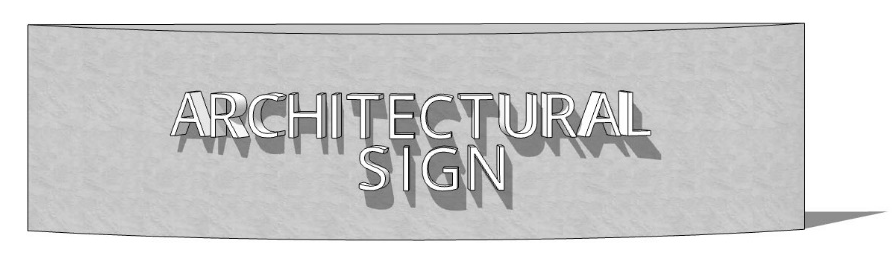
Figure 17.75.090.1
1.
Permit required.
2.
Maximum number: One sign per decorative, fence, or retaining wall, not to exceed two such signs per entrance. The purpose of this limitation is to ensure that signs can be erected at all entrances to a development so as to be visible to vehicles arriving at the property from either direction.
3.
Maximum area: Not applicable.
4.
Maximum height: Signs shall not project above the wall on which they are placed.
5.
Maximum width: Sign lettering shall not extend more than the shorter of 75 percent of the width of the wall or 20 feet.
6.
Illumination: May be internally or externally illuminated consistent with section 17.75.080(C).
7.
Lettering height: Minimum six inches; maximum 12 inches.
8.
Must not project more than eight inches from wall.
B.
Awning or canopy signs. The following standards apply to permanent awning or canopy signs on nonresidential properties (see figure 17.75.090.2):
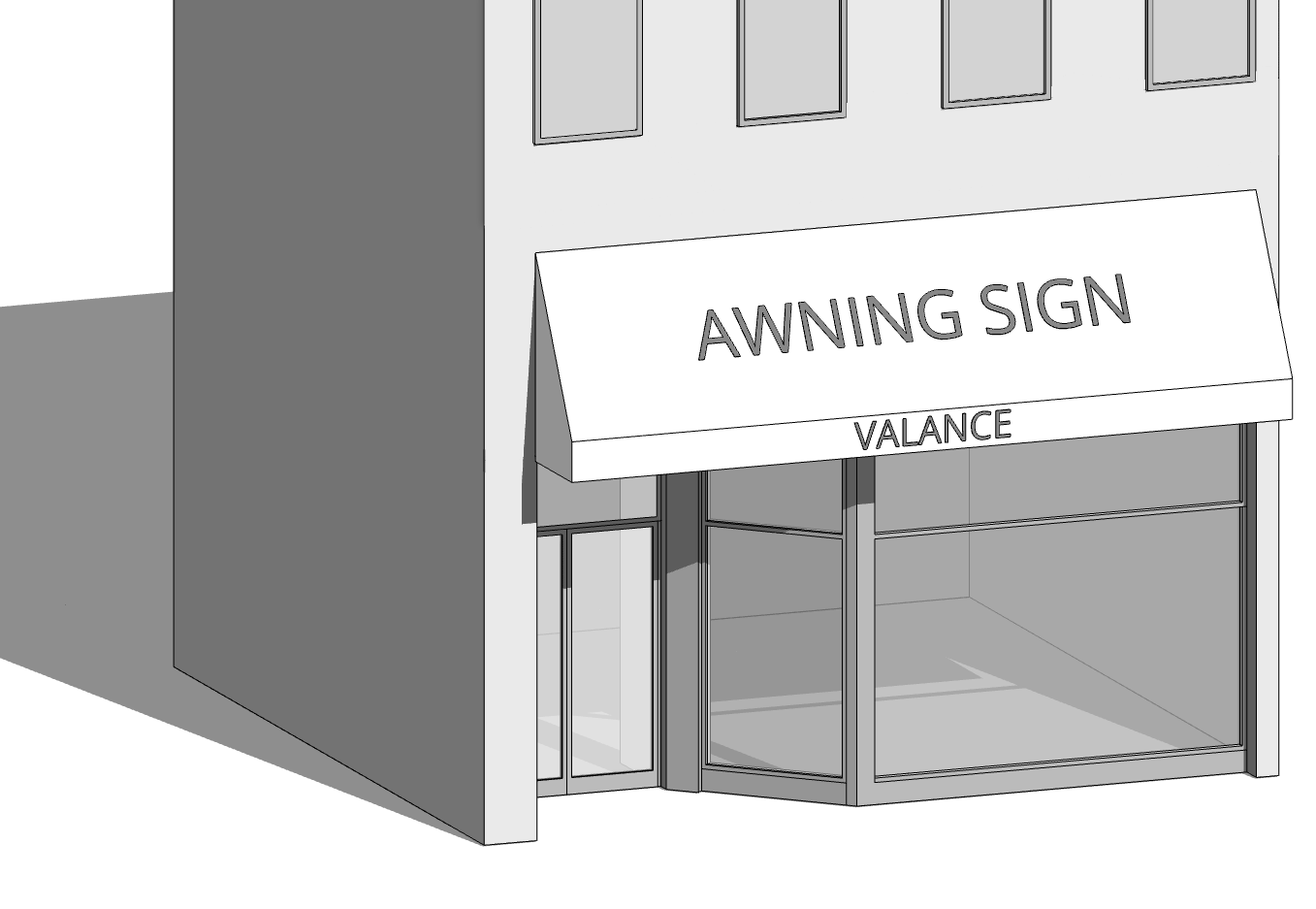
Figure 17.75.090.2
1.
Permit required.
2.
Maximum number: One sign per awning or canopy, and one per valance.
3.
Maximum area: One square foot per one linear foot of awning or canopy width, and 75 percent maximum coverage per valance.
4.
Maximum height: Sign is not to be displayed above the second story.
5.
Maximum width: Sign copy on an awning or canopy shall not exceed 60 percent of awning or canopy width.
5.
Illumination: May be internally or externally illuminated consistent with section 17.75.080(C).
6.
Vertical clearance: Minimum eight feet from bottom of the awning, including valance, or canopy to finished grade.
8.
Setback and projection into public right-of-way: A minimum of two feet between the edge of the awning or canopy and outer curb face shall be maintained.
C.
Banners. The following standards apply to temporary banner signs on nonresidential properties (see figure 17.75.090.3):
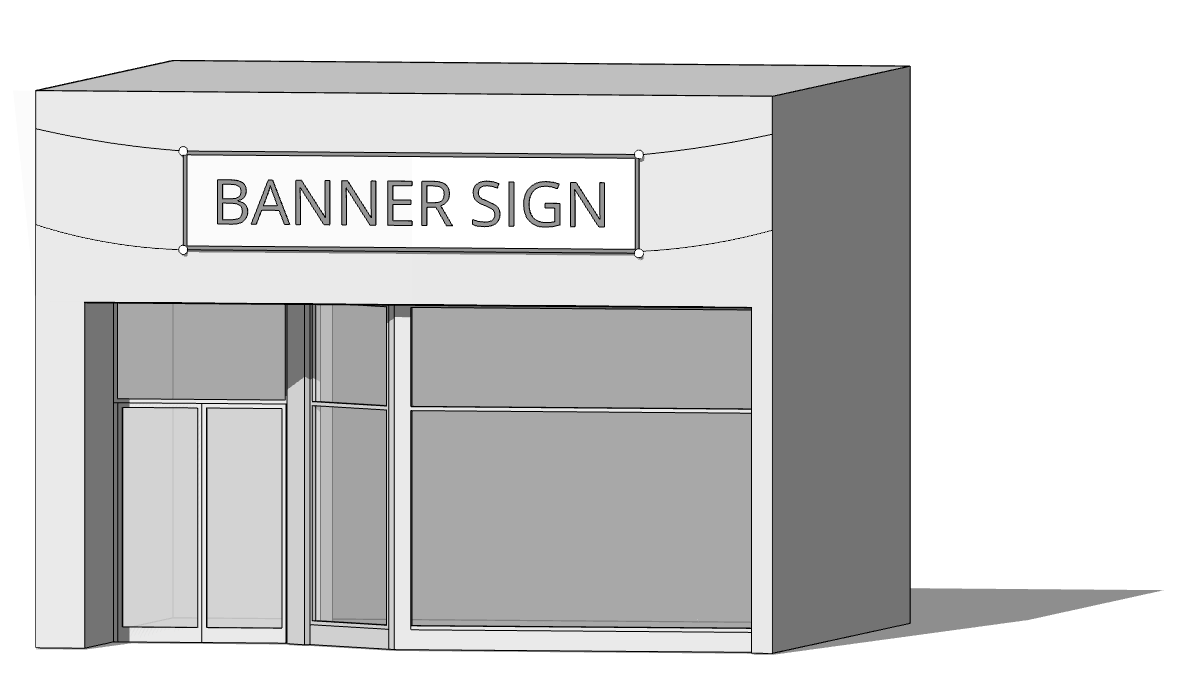
Figure 17.75.090.3
1.
Permit required.
2.
Maximum number: One per business frontage.
3.
Maximum area: 30 square feet or ten percent of business frontage on which the banner is placed, whichever is greater.
4.
Maximum height: Banners shall not be placed above the story of the business to which they apply and shall not project above the edge of the roof of the structure to which they are attached.
5.
Illumination: Not allowed.
6.
Maximum duration: Maximum 30 days per banner, collectively no more than 120 days per calendar year. A new business is allowed to have one banner for up to 90 consecutive days to allow time for a permanent sign to be installed; this initial time period shall not count towards the total allowable time the business may have banners.
7.
Banners shall be affixed to a permanent structure (i.e., cannot be freestanding, such as mounted on temporary posts).
D.
Construction signs (see table 17.75.100-1, Subdivision signs). The following standards apply to temporary construction signs on nonresidential properties (see figure 17.75.090.4):
Figure 17.75.090.4
1.
Permit required.
2.
Maximum number: One per entrance.
3.
Maximum area: 20 square feet.
4.
Maximum height: Six feet.
5.
Illumination: External.
6.
Setback: Minimum five feet from property line.
7.
Construction signs are limited to 12 months.
E.
Electronic readerboards. The following standards apply to permanent electronic readerboards on nonresidential properties (see figure 17.75.090.5):

Figure 17.75.090.5
1.
Permit required.
2.
Maximum number: One per entrance.
3.
Maximum area: 40 square feet.
4.
Maximum height: Six feet.
5.
Setback: Minimum five feet from property line.
6.
Illumination: May be internally illuminated consistent with section 17.75.080(C).
7.
Electronic readerboards are permitted only for institutional uses.
F.
Flags. The following standards apply to flags on nonresidential properties (see figure 17.75.090.6):
Figure 17.75.090.6
1.
Permit not required.
2.
Maximum number: One per business.
3.
Maximum area: 24 square feet per flag.
4.
Maximum total flag area per property: 30 square feet.
5.
Maximum height: 12 feet unless increased to 16 feet with approval of a site plan review.
6.
Vertical clearance: Minimum seven feet from the bottom of the flag when not extended to finished grade.
7.
Setback: Minimum five feet from property line.
8.
Illumination: May be externally illuminated consistent with section 17.75.080(C).
9.
A flag shall be securely attached to a flagpole.
G.
Freestanding signs. The following standards apply to permanent freestanding signs (ground-mounted directory signs and monument signs) on all nonresidential properties (see figures 17.75.090.7 and 17.75.090.8):
Figure 17.75.090.7
Figure 17.75.090.8
1.
Permit required.
2.
Maximum number: One per entrance. Corner lots may have one additional freestanding sign on the corner.
3.
Maximum sign area: 40 square feet.
4.
Maximum structure height: Six feet.
5.
Maximum width: Ten feet, including structure. Sign structures larger than four square feet or taller than three feet shall include a sign base with an aggregate width of at least 40 percent of the width of the sign face.
6.
Setback: Minimum five feet from a property line; the setback may be increased to ensure safe motorist visibility.
7.
Separation: Freestanding signs must be separated from other freestanding signs by at least 30 feet.
8.
Illumination: Internally or externally illuminated consistent with section 17.75.080(C).
H.
Parking lot signs. The following standards apply to permanent parking lot signs on nonresidential properties (see figure 17.75.090.9):
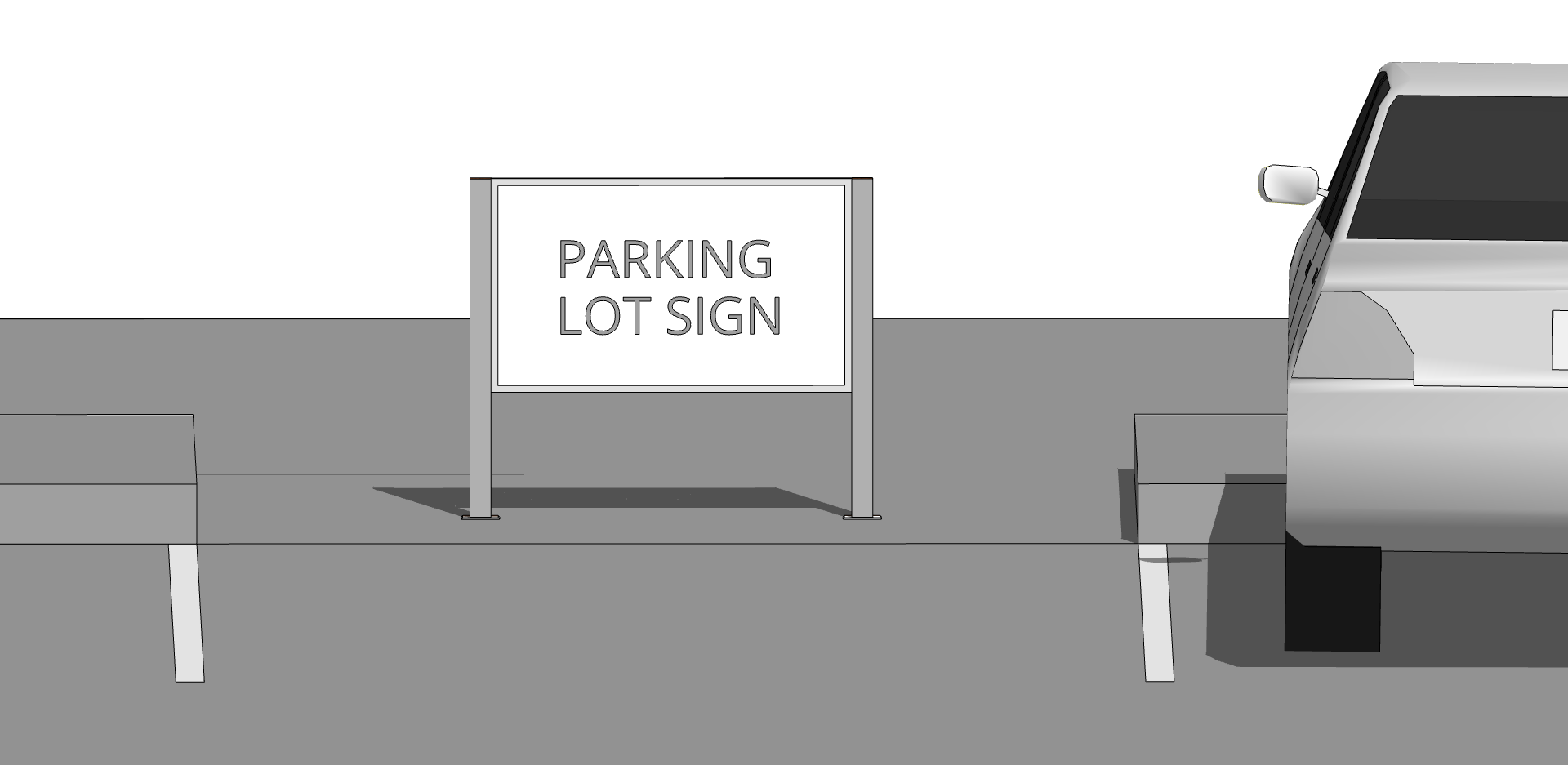
Figure 17.75.090.9
1.
Permit not required.
2.
Maximum number: One sign per parking spot.
3.
Maximum area: Four square feet.
4.
Maximum height: Three feet.
5.
Illumination: May be internally or externally illuminated consistent with section 17.75.080(C).
I.
Pole signs. The following standards apply pole signs on nonresidential properties (see figure 17.75.090.10):
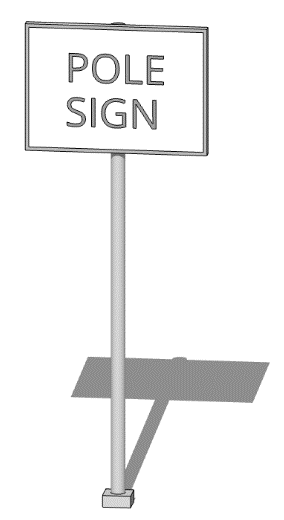
Figure 17.75.090.10
1.
Permit required.
2.
Maximum number: One per entrance.
3.
Maximum area: 40 square feet.
4.
Maximum height: Six feet.
5.
Vertical clearance: None.
6.
Illumination: May be internally illuminated consistent with section 17.75.080.C.
7.
Pole are permitted only for institutional or assembly uses.
J.
Portable signs. The following standards apply to temporary portable signs on nonresidential properties (see figure 17.75.090.11):
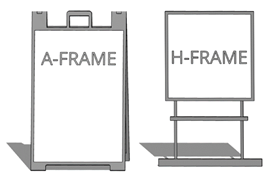
Figure 17.75.090.11
1.
No permit required.
2.
Maximum number: One per business.
3.
Maximum area: Six square feet.
4.
Maximum height: Three feet.
5.
Illumination: Not allowed.
6.
Setback: Minimum five feet from property line.
7.
Signs shall be located maximum of ten feet from the primary business entrance.
8.
Signs shall be removed at the close of business.
K.
Projecting signs/suspended signs. The following standards apply to projecting and suspended signs on nonresidential properties (sometimes also referred to as "blade signs") (see figures 17.75.090.12 and 17.75.090.13):
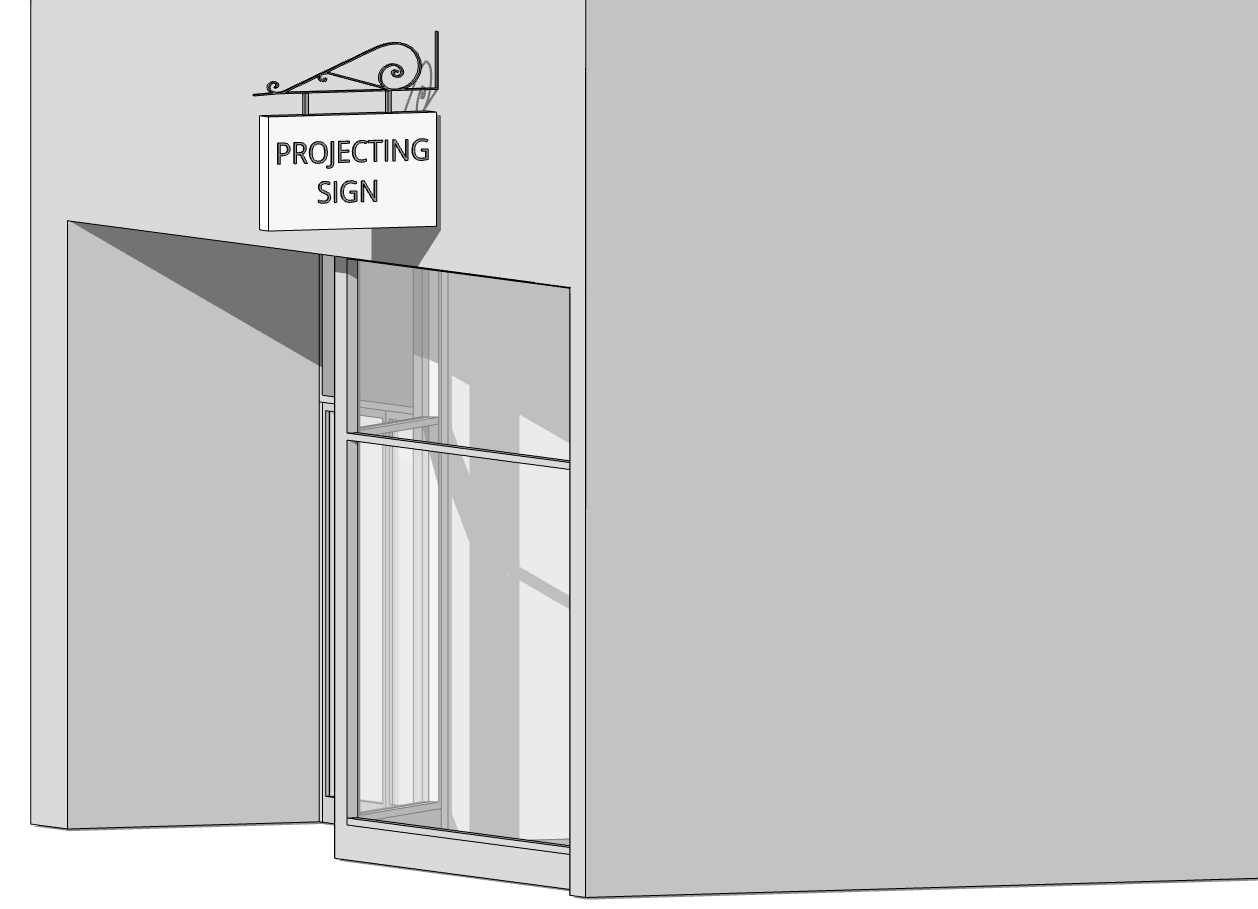
Figure 17.75.090.12
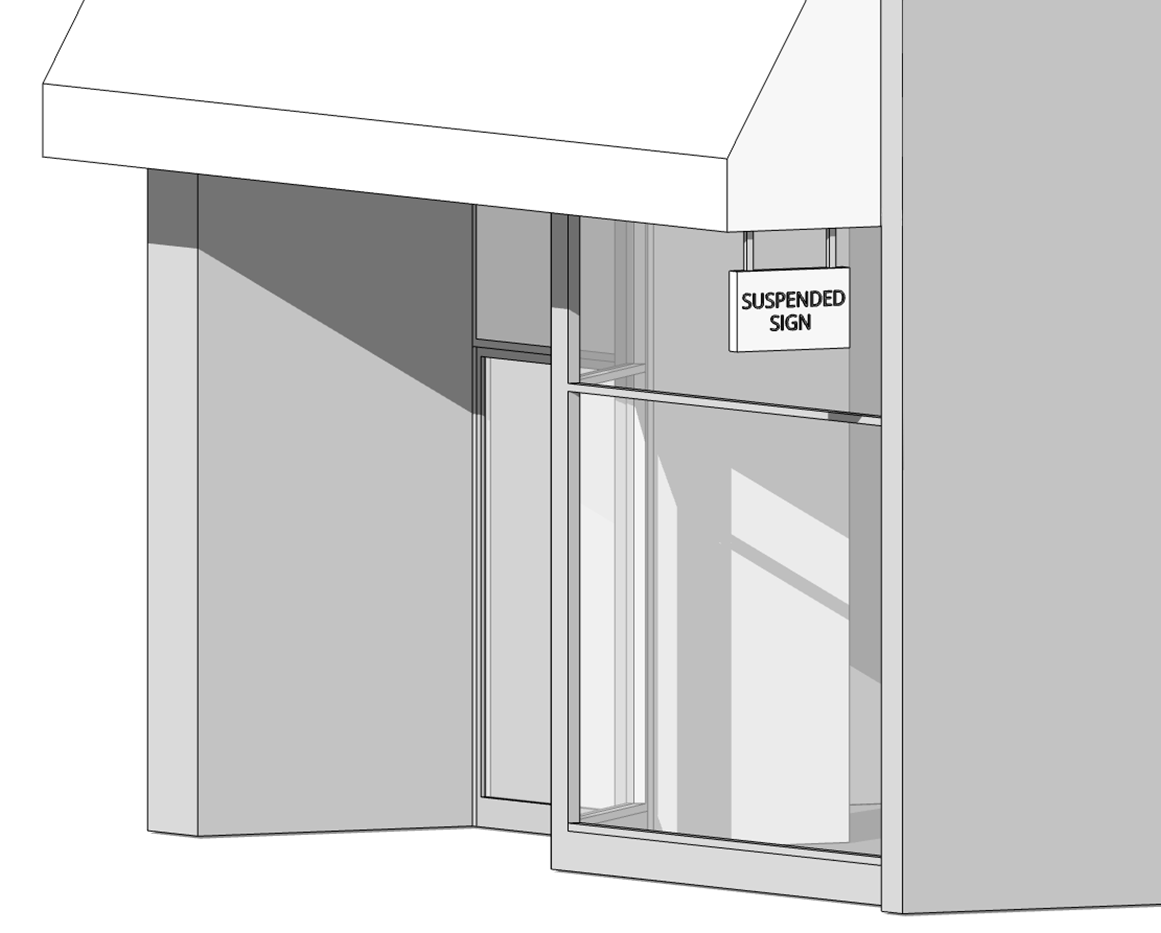
Figure 17.75.090.13
1.
Permit required.
2.
Maximum number: One per business entrance.
3
Maximum area: 12 square feet.
4.
Maximum height: 14 feet above finished grade.
5.
Maximum width: Ten inches.
6.
Vertical clearance: Minimum eight feet from bottom of the sign to finished grade below.
7.
Projecting signs shall not extend more than five feet from a structure wall.
8.
Projecting into public right-of-way: May encroach into the city right-of-way a maximum of three feet if approval is obtained from the city engineer and a city encroachment permit is issued. Approval shall only be withheld if the proposed sign cannot be installed safely. Signs may not encroach into state right-of-way unless authorized by the state.
9.
Illumination: May be internally or externally illuminated consistent with section 17.75.080(C).
10.
Projecting signs shall be double-sided.
L.
Yard signs. The following standards apply to temporary yard signs on nonresidential properties (see figures 17.75.090.14, 17.75.090.15 and 17.75.090.16):
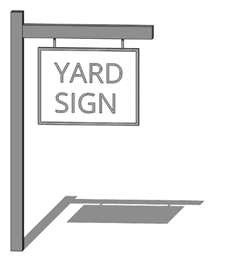
Figure 17.75.090.14
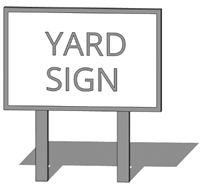
Figure 17.75.090.15
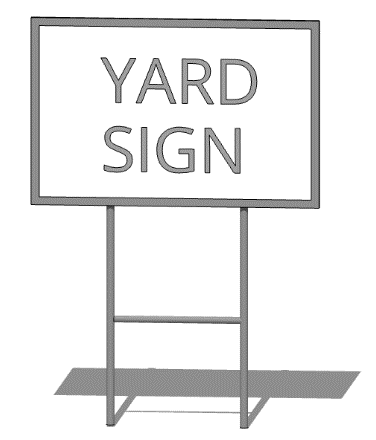
Figure 17.75.090.16
1.
No permit required.
2.
Maximum number: One per business/use frontage.
3.
Maximum area: Five square feet.
4.
Maximum height: Inverted L: Six feet from lowest grade; other yard signs: Three feet from lowest grade.
5.
Illumination: Not allowed.
6.
Setback: Minimum Five feet from property line.
7.
Duration: Maximum 90 days per calendar year.
M.
Wall signs. The following standards apply to permanent wall signs on nonresidential properties (see figures 17.75.090.17 and 17.75.090.18).
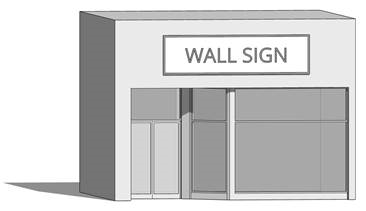
Figure 17.75.090.17
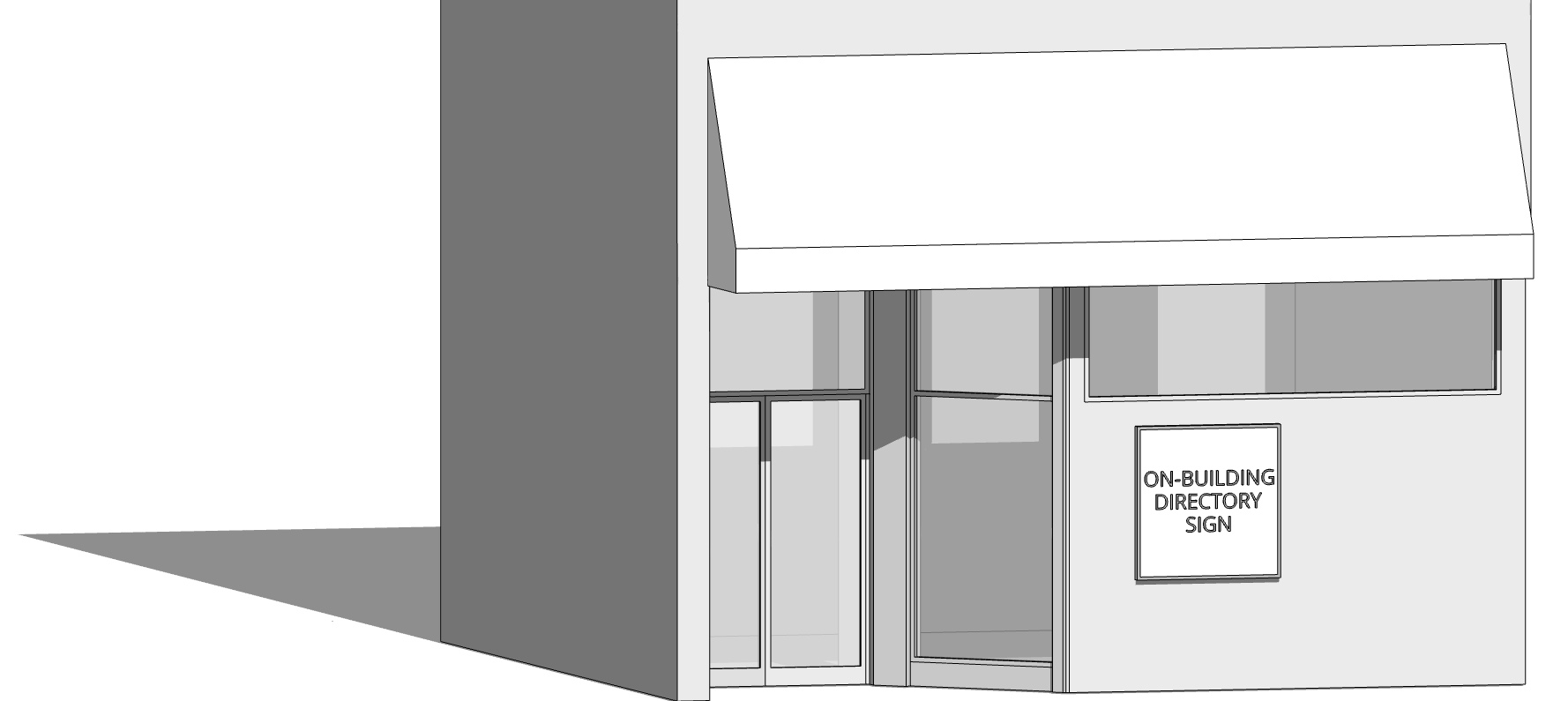
Figure 17.75.090.18
1.
Permit required.
2.
Includes directories mounted on building walls.
3.
Maximum area: One square foot per lineal foot of building facade or business frontage.
4.
Maximum height: Sign is not to be displayed above the second story, but no higher than 25 feet from grade.
5.
Sign width: Maximum 75 percent width of building facade or business frontage.
6.
Projection: Maximum ten inches from the wall to which it is attached.
7.
Vertical clearance: Minimum ten feet from bottom of the sign to finished grade below; not applicable for directories.
8.
Illumination: Internally or externally illuminated consistent with section 17.75.080(C).
N.
Window signs, permanent. The following standards apply to permanent window signs on nonresidential properties (see figure 17.75.090.19):
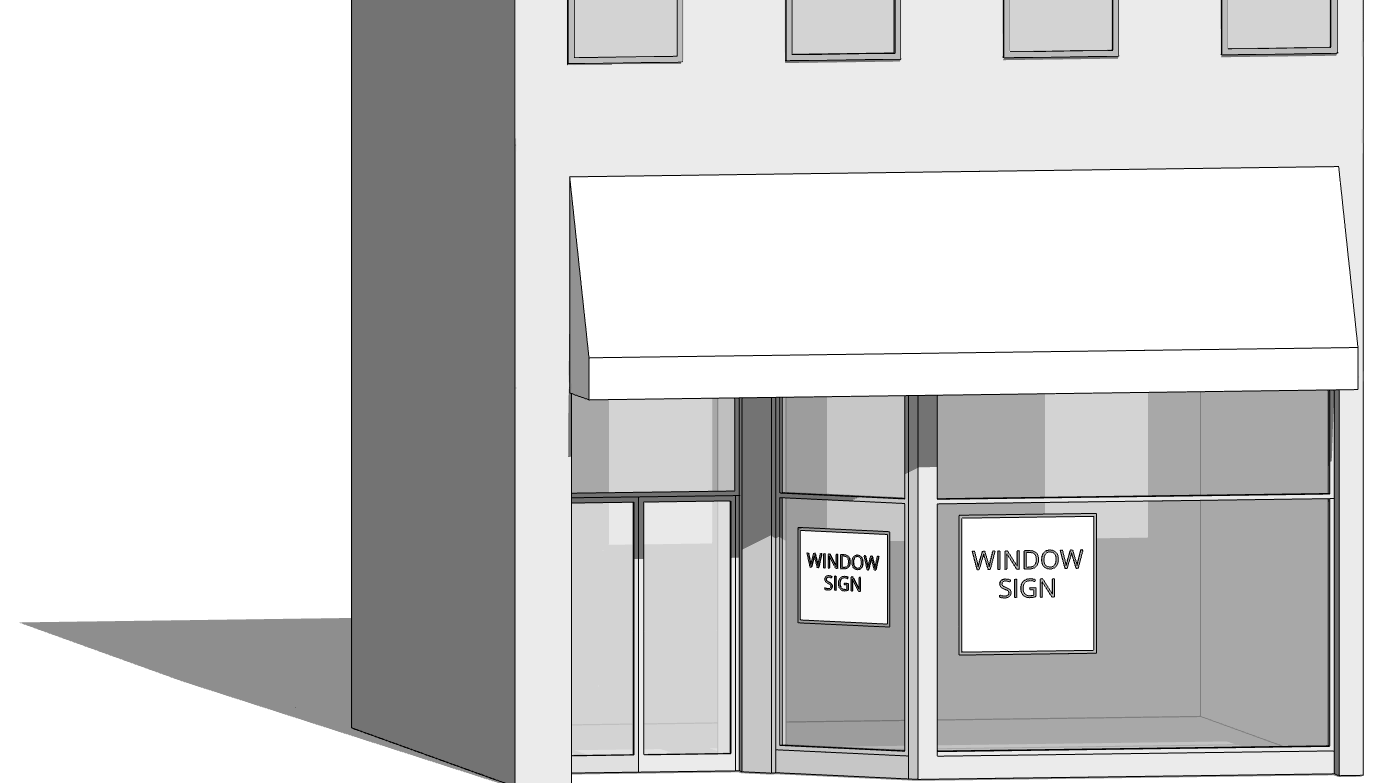
Figure 17.75.090.19
1.
Permit required.
2.
Maximum area: 30 percent of window area (including temporary window signs). This is a per-window limitation, not total window area. Each window shall not be covered by window signs that are larger than 30 percent of the area of the window.
3.
Illumination: May be internally illuminated consistent with section 17.75.080(C).
O.
Window signs, temporary. The following standards apply to temporary window signs on nonresidential properties:
1.
Maximum area: 30 percent of window area. In no event shall more than 30 percent of the total window area be covered by signage, permanent or temporary.
2.
Maximum height: Not applicable.
3.
Illumination: Not allowed.
4.
Duration. Temporary window signs may be displayed for no longer than 60 days per calendar year.
(Ord. No. 652, § 3(17.75.090), 11-16-2021)
17.75.100. - Standards for all signs on residential properties.
Signs on residential properties shall comply with the standards provided in this section and, as applicable, in section 17.75.080. Unless otherwise indicated, all signs require a sign permit or an approved sign program.
Table 17.75.100-1. Signs on Residential Properties
A.
Architectural signs. The following standards apply to permanent architectural signs on residential properties (see figure 17.75.100.1):
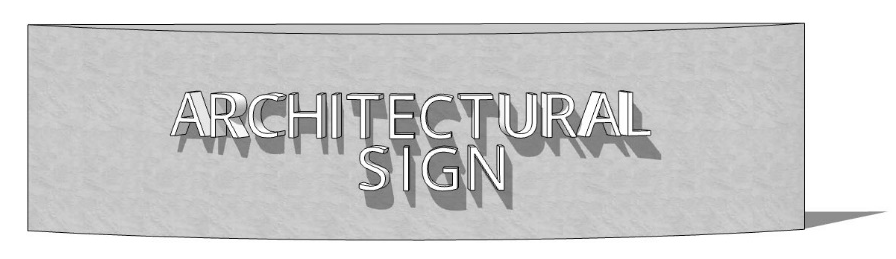
Figure 17.75.100.1
1.
Permit required.
2.
Maximum number: One sign per decorative, fence, or retaining wall for developments of six units or more. The purpose of this limitation is to ensure that signs can be erected at all entrances to a development so as to be visible to vehicles arriving at the property.
3.
Maximum area: Not applicable.
4.
Maximum height: Signs shall not project above the wall on which they are placed.
5.
Maximum width: Sign lettering shall not cover more than 75 percent of the width of the wall.
6.
Illumination: May be internally or externally illuminated consistent with section 17.75.080(C).
7.
Lettering height: Minimum six inches; maximum 12 inches.
8.
Must not project more than eight inches from wall.
B.
Flags. The following standards apply to flags on residential properties (see figure 17.75.100.2):
Figure 17.75.100.2
1.
No permit required.
2.
Maximum area: Individual flags shall not exceed 15 square feet; total flag area per property shall not exceed 30 square feet per property.
3.
Maximum height: Maximum 12 feet from highest point of the pole to finished grade. Flagpole height may be extended to 16 feet with a site plan review.
4.
Illumination: May be externally illuminated consistent with section 17.75.080(C).
5.
Setback: Five feet from property line; flag or flagpole shall not cross over the property line.
6.
A flag shall be securely attached to a flagpole.
C.
Freestanding signs. The following standards apply to permanent freestanding signs (ground-mounted directory signs and monument signs) on all residential properties (see figures 17.75.100.3 and 17.75.100.4):
Figure 17.75.100.3
Figure 17.75.100.4
1.
Permit required.
2.
Maximum number: One per entrance.
3.
Maximum sign area: 40 square feet.
4.
Maximum structure height: Six feet.
5.
Maximum width: Six feet, including structure. Sign structures larger than four square feet or taller than three feet shall include a sign base with an aggregate width of at least 40 percent of the width of the sign face.
6.
Setback: Minimum five feet from a property line; the setback may be increased to ensure safe motorist visibility.
7.
Only permitted for subdivisions of 60 or more units.
8.
Illumination: Internally or externally illuminated consistent with section 17.75.080(C).
D.
Subdivision and construction signs, temporary. The following standards apply to temporary subdivision or construction signs on residential properties (see figure 17.75.100.5):
Figure 17.75.100.5
1.
Permit required.
2.
Maximum number: One sign per 15 units.
3.
Limited to housing developments of Six or more units.
4.
Maximum structure height: Six feet.
5.
Maximum area: 20 square feet per 15 units.
6.
Illumination: External.
7.
Setback: Five feet from property line.
8.
Time limitation: 12 months (may be renewed).
E.
Wall signs. The following standards apply to permanent wall signs (see figure 17.75.100.6):
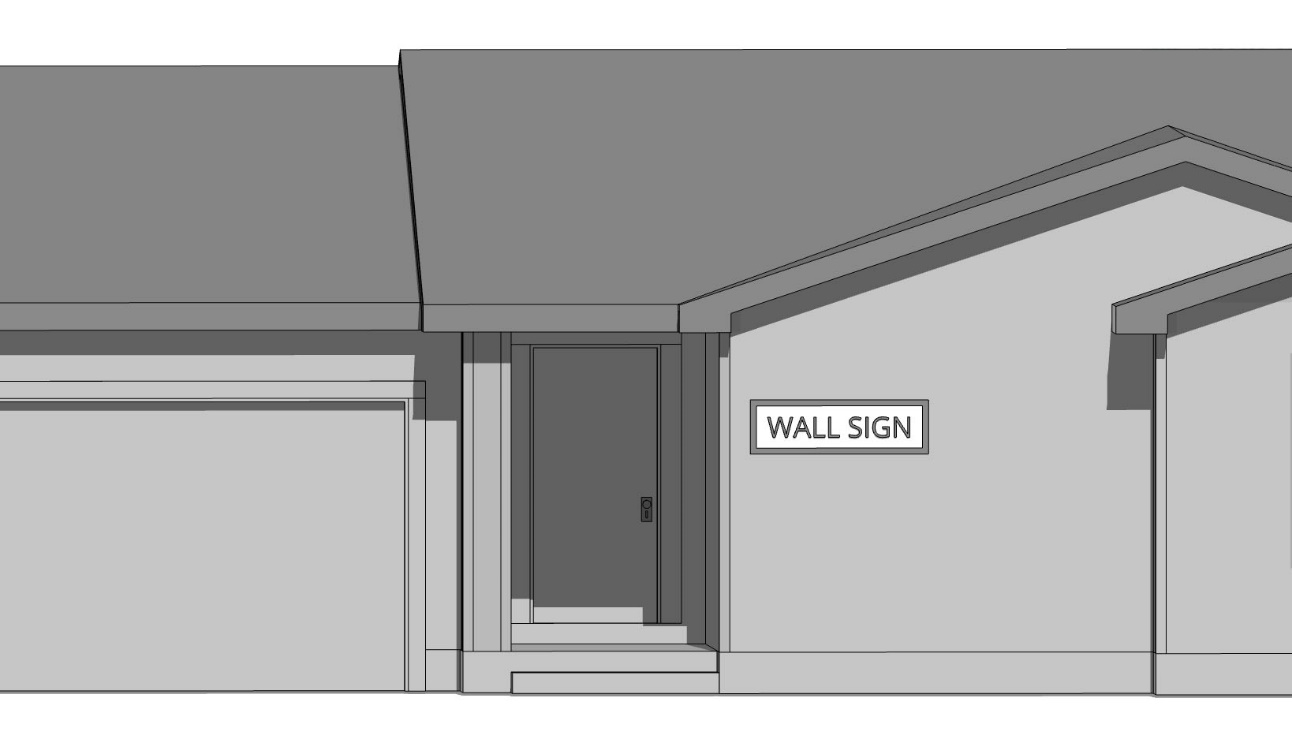
Figure 17.75.100.6
1.
No permit required.
2.
Maximum number: One per property.
3.
Maximum area: Four square feet.
4.
Maximum height: Sign is not to be displayed above top of the structures.
5.
Illumination: Limited, external, and away from other properties.
6.
Projection: Maximum two inches from building surface.
F.
Yard signs. The following standards apply to yard signs on residential properties (see figures 17.75.100.7, 17.75.100.8, and 17.75.100.9). A permit is not required.
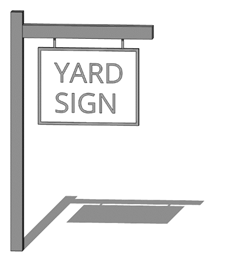
Figure 17.75.100.7
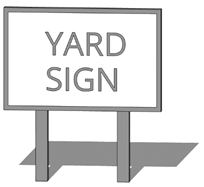
Figure 17.75.100.8
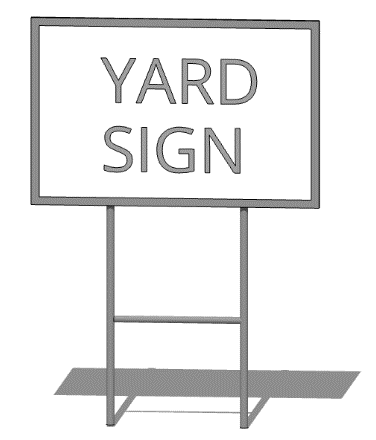
Figure 17.75.100.9
1.
No permit required.
2.
Maximum number: Three per property.
3.
Maximum area: Five square feet per sign.
4.
Maximum height: Inverted L signs: Five feet measured from lowest grade. All other yard signs: Three feet measured from lowest grade.
5.
Illumination: Not allowed.
6.
Setback: No part of the sign shall encroach upon or hang over a public walkway or trail, but in no event shall any part of the sign structure be placed less than two feet from any vehicular travel lane, including overhang.
(Ord. No. 652, § 3(17.75.100), 11-16-2021)
17.75.110. - Signs on public property.
Signs in or on any public property are prohibited, except for temporary signs as follows:
A.
Only A-frame signs are permitted.
B.
Signs may be placed in parkways within the right-of-way only, which shall not include street medians. In the absence of parkways, signs may be placed on unimproved public property within the right-of-way, provided the signs do not obstruct passage of pedestrians or vehicles, and do not interfere with traffic visibility, and are a minimum of two feet from vehicular travel lanes. Signs placed on public property in violation of this subsection are subject to immediate removal.
C.
Signs shall be no taller than 36 inches from grade.
D.
Individual sign faces shall not be larger than five square feet.
E.
No flags, balloons, pennants or any other attachments are permitted.
F.
Signs must not block ingress or egress to any driveway or doorway and must not be placed so as to block or impair motorists' view.
G.
Signs may be placed between 11:00 a.m. and 6:00 p.m. on weekdays and 9:00 a.m. and 6:00 p.m. on weekends and holidays. All signs shall be removed by 6:00 p.m. each day.
H.
No signs that advertise the availability of any products, goods, or services may be placed in the public right-of-way without execution of a release of liability and indemnity agreement with the city, and proof of adequate insurance. This requirement shall be renewed annually.
(Ord. No. 652, § 3(17.75.110), 11-16-2021)
17.75.120. - Murals.
A.
Applicability. The provisions relating to murals shall not be interpreted to violate the federal Visual Artists Rights Act, codified as 17 USC 106A, or the California Art Preservation Act, codified as Civil Code § 987 et seq.
B.
General requirements.
1.
The general requirements for signs articulated in section 17.75.080 do not apply to murals.
2.
The placement of a mural on commercial premises will not be applied to the sign area allotment for those premises.
3.
The property owner is responsible for compliance with these provisions.
4.
Murals may be painted on, tiled, or affixed to a building.
5.
Murals may not depict obscene or defamatory content.
6.
Murals may not contain commercial messages; this prohibition shall include, but not be limited to, advertising for goods or services, corporate logos, sponsorship logos, the name and/or symbol of a recognizable entity, copyright, or trademark information related to a business or commercial enterprise of any kind, as well as artistic depictions of the business, goods, or services being provided on the premises.
7.
Murals must comply with the following construction and placement requirements:
a.
The colors, construction materials and mediums to be used for the mural should be compatible with the architectural style of adjacent buildings and structures. This requirement is not intended to limit or dictate the content and/or message of the mural.
b.
Murals must be permanently affixed to the structure or building and must be constructed of a permanent material or medium to be durable against graffiti, vandalism, fading, and weather. To this end, the material or medium to be used for construction of the mural shall be approved, prior to commencement of the mural, by the director as constituting such permanent and durable nature.
8.
Murals must be maintained in a safe, neat, and orderly manner.
9.
No mural may consist of, or contain, electrical or mechanical components, or changing images, provided that static illumination turned off and back on not more than once every 24 hours is permitted.
10.
Murals may not contain fluorescent colors (i.e., colors that are strikingly bright, vivid, or glowing).
11.
No part of a mural shall exceed the height of the structure on which it is placed.
12.
No part of a mural shall extend more than six inches from the plane of the wall upon which it is placed.
13.
No mural shall be placed so as to interfere with ingress or egress from any structure, or in any way obstruct doors, windows, doors, vents or any other similar building element that would threaten the public health and safety.
14.
No mural shall be arranged and illuminated in a manner that will produce a light intensity of greater than three footcandles above ambient lighting, as measured at the property line of the nearest residentially zoned property. Illumination must be directed so that it only illuminates the mural and does not spill over into residential properties.
16.
Murals on properties in specific plans and overlay districts shall, in addition to the requirements of this chapter, meet any specific design requirements for murals set forth in the ordinances establishing the specific plan or overlay district.
17.
Murals that would result in a property becoming out of compliance with the provisions of this Code or any land use conditions of approval for the property on which a mural is to be located, are prohibited.
(Ord. No. 652, § 3(17.75.120), 11-16-2021)
17.75.130. - Prohibited signs.
The following signs and/or sign structures, temporary or permanent, are prohibited:
A.
Off-premises signs, except as may be provided in section 17.75.110 (Signs on Public Property). The on-premises/off-premises distinction only applies to commercial copy.
B.
Signs on public property, including signs placed on street signs and utility poles, except as may be provided in section 17.75.110 (Signs on Public Property).
C.
Signs or sign structures which by color, wording, or location resemble or conflict with traffic control signs or devices.
D.
Signs which obstruct vehicular views of pedestrians or other vehicles or pedestrian views of vehicles, so as to affect the safety of the public.
E.
Human signs.
F.
Rotating, moving, scintillating, blinking or flashing illumination signs, except for randomly blinking Tivoli lights. Any sign which rotates, moves, scintillates, blinks or flashes, shall be deactivated within 60 days from the effective date of the ordinance from which this chapter is derived, without compensation.
G.
Commercial advertising statuary or holograms.
H.
Airborne signs.
I.
Air dancers.
J.
Billboards.
K.
Mobile billboard advertising displays, and advertising signs on motor vehicles parked or left standing upon a public street.
L.
Signs on hillsides. Signs of any kind, including those created by the arrangement of vegetation, rocks or other objects on a hillside, which are visible from a public right-of-way or a neighboring property.
M.
Feather signs.
N.
Roof signs.
O.
Obscene messages or graphic representations.
(Ord. No. 652, § 3(17.75.130), 11-16-2021)
17.75.140. - Removal without compensation; legal nonconforming signs.
A.
Removal without compensation. The city may require removal, without compensation, of the following signs:
1.
Any sign installed without first complying with all ordinances and regulations in effect at the time of its construction and erection or use.
2.
Any sign found posted, or otherwise affixed upon any public property contrary to the provisions of this chapter. Such signs shall be immediately removed by the city.
B.
Legal nonconforming signs.
1.
Legal nonconforming signs shall be removed without compensation if the sign meets any of the following criteria:
a.
Any sign, including its supporting structure, whose use has ceased, or has been abandoned by its owner, for a period of not less than 90 days. Costs incurred in removing an abandoned sign shall be charged to the property owner.
b.
Any sign which has been more than 50 percent destroyed, and the destruction is other than facial copy replacement.
c.
Any sign that has been moved from its original location on the property, or any sign that has been enlarged by more than five percent sign area or whose height has been increased by five percent without the required approvals.
d.
Any temporary sign which is beyond the time limits set within this chapter for its category of temporary sign.
e.
Any sign which, in the determination of the city's building official, is or may become a danger to the public or which is unsafe.
f.
Any sign which constitutes a traffic hazard not created by relocation of streets or highways or by acts of the city or of the county.
2.
Legal nonconforming signs must be maintained in accordance with section 17.75.080(F).
3.
Reconstruction of a legal nonconforming sign (other than a freestanding monument sign or directory sign, or pole sign) where 30 percent or more of the sign structure is replaced must be brought into full compliance with this chapter.
4.
The remodel and/or reconstruction of an existing nonconforming freestanding monument or directory sign, or pole sign, may be permitted provided that all of the following requirements are met:
a.
The remodeled and/or reconstructed sign and sign structure and framework shall maintain the same type of sign structure and framework.
b.
The sign structure and framework height shall not exceed the existing nonconforming sign's current height.
c.
The remodeled and/or reconstructed sign structure and framework shall be located in the same general location as the existing nonconforming sign, as determined by the director.
d.
The dimensions and square footage of a remodeled and/or reconstructed sign area shall not exceed that of the existing nonconforming sign area.
e.
The lowest portion of the sign area shall not be below the low point of the existing nonconforming sign.
f.
The remodeled and/or reconstructed sign and sign structure do not extend into the public right-of-way, from ground to sky.
g.
The remodeled and/or reconstructed sign and sign structure do not create a public health and safety hazard with regards to sightlines for driveways, intersections, etc., as determined by the public works director.
h.
If the existing lighting on a legal nonconforming sign and/or sign structure changes, that lighting shall comply with the illumination regulations set forth subsection 17.75.080(C).
(Ord. No. 652, § 3(17.75.140), 11-16-2021; Ord. No. 684, § 3, 7-16-2024)
17.75.150. - Abatement.
Signs which may be removed without compensation shall be abated pursuant to the following process:
A.
Director's order. The director shall issue a written order of abatement and give notice thereof.
B.
Notice. Upon issuance of an order, the director must forthwith give written notice of the order by depositing a copy of the order with the United States Postal Service, addressed to the owner of the business and to the owner of the property to which the order relates. Alternatively, the director may have such person served personally with copies of the order.
1.
The order must contain a description of the property affected, the names of the owners and/or persons in possession thereof, the basis for the order, and the time within which the usage must terminate.
2.
The order is deemed final 30 days after the date of the notice unless an appeal is filed.
C.
The sign that is the subject of the order must be removed within the time specified in the order, which may not exceed 60 days from the date the order is placed in the U.S. mail.
D.
If the sign is not removed within the time provided for by the order, the director will arrange for its removal, and the owner or person responsible for the sign shall bear the cost of the sign's removal. The owner of the business and the owner of the property may be jointly and severally responsible for the cost of abatement.
E.
Appeal.
1.
The owner of property, or the owner of the business, to which an order relates may appeal the order, either in propria persona or through their authorized agent. The appeal must be in writing and must articulate the grounds upon which the order is being appealed. The appeal must be filed before the order becomes final and shall include an appeal fee as set by city council resolution.
2.
The appeal shall be set for a de novo hearing before the commission and notice of the hearing shall be provided as specified below.
3.
At the hearing, the commission shall hear evidence to determine whether the sign falls within a category of signs that can be removed without compensation in accordance with section 17.75.140 (Removal Without Compensation; Legal Nonconforming Signs), and any other matter the commission deems relevant for a just resolution. The commission may hear any and all matters that it deems relevant and is not be bound by rules of admissibility of evidence. The commission may hear relevant hearsay evidence but may not base its findings and decisions on hearsay evidence alone.
5.
The commission must make a decision at the conclusion of the hearing, which shall be the effective date of the decision. The decision of the commission is deemed final ten days after the effective date unless a timely appeal is made to the city council.
6.
Notice. Upon a decision by the commission either affirming or vacating an order, the secretary of the commission shall forthwith give written notice of the same. The notice shall contain a description of the property affected, the names of the owners of the property and/or the business affected, the basis for the decision reached, and a timeline for removal of the sign. The notice of such decision must be given in the same manner as set forth in subsection B of this section.
7.
Mobile billboards. Pursuant to the authority set forth in Vehicle Code § 22651, a mobile billboard advertising display may be removed by any police officer when left parked or standing in violation of this chapter, if the registered owner of the vehicle was previously issued a warning citation for violation of this section, advising the registered owner that they may be subject to penalties upon a subsequent violation of this section, that may include removal of the vehicle. Alternatively, a mobile billboard advertising display may be removed without prior issuance of a warning citation, if the city has posted signs in accordance with Vehicle Code § 22507(a), giving notice that it is unlawful to park, stand or otherwise allow to remain upon any city street, any mobile billboard advertising display.
(Ord. No. 652, § 3(17.75.150), 11-16-2021)
17.75.160. - Definitions.
The following words, terms and phrases, when used in this chapter, shall have the meanings ascribed to them in this section, except where the context clearly indicates a different meaning:
Building facade means any exterior elevation of a building.
Building frontage means the width of a building occupied by a single business tenant that fronts on a public way where customer access to the building is available. Width is measured as the widest point on an architectural elevation.
Changeable copy means sign copy designed to be used with removable graphics or letters which will allow changing of copy.
Corporate sign standards means standards for logo or sign design approved by a corporation.
Dilapidated means in a state of disrepair or ruin as a result of age or neglect.
Director means the director of the community development department of the city, including their designee.
Illegal sign means a sign that includes any of the following:
(a)
A sign installed without complying with all regulations in effect at the time of its construction or use;
(b)
A sign installed or maintained contrary to any applicable provision of this chapter.
(c)
A sign which is a danger to the public or is structurally unsafe; or
(d)
A sign which is a traffic hazard not created by relocation of streets or highways or by acts of the city.
Illuminated means signs or individual letters in which an artificial source of light is used to make the message readable and includes both internally and externally illuminated signs.
Externally illuminated means a sign whose light source is external to the sign and which casts its light onto the sign from a distance; or where the light source is behind an opaque sign element and causes it to be outlined by light reflected from the surface to which the sign is mounted.
Internally illuminated means a sign whose light source that is concealed or contained within the sign and becomes visible in darkness through a translucent surface. Message center signs, digital displays, and signs incorporating neon lighting are not considered internally illuminated signs for the purposes of this chapter.
Internally illuminated sign means a sign with a light source located in the interior of the sign so the light shines through the face of the sign, or with a light source which is attached to the face of the sign and is perceived as a design element of the sign.
Intersection visibility triangle. See section 17.48.070.
Mural means an original work of visual art which is composed, created or produced firsthand, and that is painted directly upon, tiled, or affixed directly to an exterior wall of a structure with the permission of the property owner. A mural is distinguishable from graffiti based on the property owner's permission to paint or affix the mural onto the property, and compliance with the permit provisions of this chapter.
Nonconforming sign means any permanent or temporary sign, including its physical structure and supporting elements, which was lawfully erected and maintained in compliance with all applicable laws in effect at the time of original installation, but which does not now comply with the provisions of this chapter.
Obscene speech means a message or graphic representation that is obscene, as that term is defined in Penal Code § 311.
Off-premises sign means a sign identifying a business activity, property, services, or product at some location other than where the sign is displayed, including human signs and hand-held commercial signs.
On-premises sign means a sign identifying a business activity, property, services, or product provided at the location where the sign is located. Any sign displaying noncommercial copy shall be considered an on-premises sign.
Neon lighting means any sign illuminated by or utilizing in any way tubes filled with neon and/or related inert gases, or products that produce the same or similar effect as neon, such as flexible light-emitting diode (LED) neon-like tubing.
Permanent sign means a sign constructed of durable materials and intended to exist for the duration of time that the use or occupant is located on the premises.
Placed means erected, constructed, posted, painted, printed, tacked, glued, carved, or otherwise fastened, affixed or made visible in any manner.
Public area means an area that is accessible or visible to any member of the public.
Public right-of-way means a public street, plaza, courtyard, pedestrian corridor or walkway, city-owned parking lot, or alley.
Review authority means the individual or official city body identified by this chapter as having the responsibility and authority to review, and approve or deny, a permit application.
Sign means any physical form of visual communication, including its structure and component parts, which is exposed to exterior view to attract attention to or provide information about the subject matter or premises, through use of any combination of words, letters, figures, or symbols. (See below for sign types.)
Sign area means the surface space containing words, letters, figures or symbols, together with any frame or material forming an integral part of the display but excluding support structures, the face of the building, and incidental parts not drawing attention to the subject matter. Where freestanding or projecting signs have two sides or faces, but only one face is visible from any point, the surface area of only one side shall be applied to the total sign area permitted.
Sign copy means all portions of a sign displaying a message, including text and symbols, not including the supporting structure or base of a sign.
Sign height means the vertical distance from the uppermost point used in measuring the area of a sign to the normal grade immediately below the sign, including its base or the top of the nearest curb of the street on which the sign fronts, whichever measurement is the greatest.
Sign program means a coordinated design plan of one or more signs for an individual business, a multi-tenant business center, or other site that specifies the number, size, description, and location of all signs located or to be located on the parcel or business site.
Sign width means the measurement of a sign or base of a sign at its full extent from side to side, measured at the widest point.
Sign types.
Abandoned sign means any lawfully erected sign that, for a period of 90 days or more, no longer advertises or identifies an ongoing business, activity, product, service, or other use available on the premises where the sign is located.
A-frame sign means a freestanding portable sign ordinarily in the shape of an "A" or some variation thereof, which is readily moveable and not permanently attached to the ground or any structure; also, a sandwich board sign.
Airborne sign means a sign that is tethered by free-floating, such as a balloon sign, inflatable sign, and/or kite.
Air dancer means a tall, inflatable model, usually of a person or animal, that appears to move around due to the flow of air through it; also known as tube man, fly guy, sky dancer, or wacky waving inflatable arm flailing tube man.
Animated or moving sign means a sign that uses movement, lighting, or special materials to depict action or create a special effect to imitate movement.
Architectural sign means a sign placed on a retaining, fence/perimeter, or decorative wall, usually raceway mounted or with individual letters affixed to the structure. Architectural signs are not affixed to buildings.
Awning or canopy sign means any sign that is painted or applied to the face, valance, or side panel of a projecting structure consisting of a frame and a material covering, attached to and wholly supported by a building wall and installed over and partially in front of doors, windows, or other openings in a building.
Balloon or balloon sign means any inflated or inflatable object, with or without copy.
Banner means a temporary sign composed of cloth, canvas, plastic, fabric, or similar lightweight, non-rigid material that can be mounted to a structure with cord, rope, cable, or a similar method.
Barber pole means a rotating or stationary cylindrical pole of the traditional red, white, and blue spiral striped design, identifying the premises as a barber shop.
Billboard means an off-premises sign designed for changeable advertising copy, which is normally used for the advertisement of goods, products, or services.
Bus bench sign means a temporary message located on the backrest of a city bus bench.
Business information sign means a sign which provides business information, including, but not limited to, credit card acceptance, business hours, open/closed, or menus.
Changeable copy sign means a sign designed to allow the changing of copy through manual, mechanical, or electrical means including time and temperature.
Community information bulletin board means a board or similar posting area installed and maintained by the city for the posting of community information.
Construction sign. See Subdivision sign.
Directory sign means a pedestrian oriented sign used to provide a directory of tenant locations within a multi-tenant building.
Double-sided sign means a sign constructed to display its message on the outer surfaces of two parallel planes.
Electronic readerboard means a sign that contains a video screen, rows of light bulbs or LEDs or other type of electronic display, which when activated forms messages, symbols, or graphics.
Feather sign means a temporary sign constructed of cloth, canvas, plastic fabric, or similar lightweight, non-rigid material and supported by a single vertical pole mounted into the ground or on a portable structure.
Flag means a fabric sheet of square, rectangular, or triangular shape that is mounted on a pole, freestanding or attached to a structure or building. This sign type includes official flags of national, state, or local governments. This sign type does not include feather signs.
Flashing sign means a sign that contains an intermittent or sequential flashing light source.
Freestanding sign means a sign fixed in an upright position on the ground not attached to a structure other than a framework or device erected primarily to support the sign. The term "freestanding sign" includes monument signs and ground mounted directory signs. The term "freestanding sign" does not include pole signs.
H-frame sign means a freestanding portable sign ordinarily in the shape of a sideways "H" or some variation thereof, which is readily moveable and not permanently attached to the ground or any structure.
Human sign means any sign or costume held or worn by an individual for the purpose of advertising a business, goods, or services.
Inflatable sign means a sign that is an air-inflated object, which may be of various shapes, made of flexible fabric, resting on the ground or a structure and equipped with a portable blower motor that provides a constant flow of air into the device.
Mobile billboard advertising display as defined in Vehicle Code § 395.5, including any amendments or successor statutes thereto. Mobile billboards do not include:
(1)
Advertising signs that are permanently affixed to the body of, an integral part of, or a fixture of a motor vehicle for permanent decoration, identification, or display and that do not extend beyond the overall length, width, or height of the vehicle.
(2)
If the license plate frame is installed in compliance with Vehicle Code § 5201, paper advertisements issued by a dealer contained within that license plate frame or any advertisements on that license plate frame. The term "permanently affixed" means any of the following:
(i)
Painted directly on the body of a motor vehicle.
(ii)
Applied as a decal on the body of a motor vehicle.
(iii)
Placed in a location on the body of a motor vehicle that was specifically designed by a vehicle manufacturer as defined in Vehicle Code § 672 and licensed pursuant to Vehicle Code § 11701, in compliance with both state and federal law or guidelines, for the express purpose of containing an advertising sign.
Monument sign means an independent, freestanding sign supported on the ground having a solid base.
Parking lot sign means a sign placed or displayed in parking lots to supply information to people using such lots, including information with respect to liability as well as entry, exit, and directional information, handicapped parking requirements, and other information to facilitate the safe movement of vehicles served by the parking area.
Pennant means a triangular or irregular piece of fabric or other material, whether or not containing a message of any kind, commonly attached by strings or strands, or supported on small poles, intended to flap in the wind.
People sign means a person, live or simulated, who is attired or decorated with insignia, images, costumes, masks, or other symbols that display commercial messages with the purpose of drawing attention to or advertising for an on-premises activity. Such person may or may not be holding a sign. Also known as human mascots, sign spinner, or walking signs.
Permanent vehicle sign means a sign that is painted directly upon the body of a motor vehicle, applied as a decal on the body of a motor vehicle, or placed in a location on the body of a motor vehicle that was specifically designed by a vehicle manufacturer for the express purpose of containing an advertising sign, such that they are an integral part of, or fixture of a motor vehicle for permanent decoration, identification, or display and that do not extend beyond the overall length, width, or height of the vehicle.
Pole sign means an elevated freestanding sign, typically supported by one or two poles or columns.
Portable sign means a sign that rests on the ground and is not designed to be permanently attached to a building or permanently anchored to the ground, including, but not limited to, A-frame and H-frame signs. Portable signs do not include pole or wooden post signs (see Yard sign).
Projecting sign means a sign projecting from and supported by a wall or building with the display surface of the sign perpendicular to the wall or building.
Public property means public property means and includes the public right-of-way, and any property that is owned or controlled by the city or by any other government agency or district, or private and public utilities. Public property includes city hall and the civic center, parks, utility poles, lines, and infrastructure, street trees, traffic control devices, and privately or publicly owned signs.
Roof sign means a sign constructed upon or over a roof or placed so that any portion of the sign extends above the edge of the roof.
Subdivision or construction sign means a temporary sign placed at a construction site that provides information regarding the project architect, owner, contractors, etc.
Suspended sign means a sign that is suspended from the underside of an eave, canopy, awning, arcade, or other covered walkway.
Temporary sign means a sign constructed of paper, cloth, or similar expendable material, which is intended for a definite and limited period of display, and which is not permanently affixed to a structure, sign area, or window.
Wall sign means a sign attached to or painted on the exterior wall of a building with the display surface of the sign approximately parallel to the building. The term "wall sign" includes directories mounted to the walls of a building.
Window sign means a temporary or permanent sign placed on or behind a window facing a public way. Window signs do not include common wall windows on the inside of a building not visible by the general public from any public right-of-way or any public area.
Yard sign means any temporary sign placed in the ground or attached to a supporting structure, posts, or poles, that is not attached to any building, not including banners.
Subdivision housing development means a housing development entitled pursuant to the California Subdivision Map Act.
Street frontage means the portion of the building or property which faces or abuts a street.
Support structure means the structural portion of a sign securing the sign to the ground, a building, or to another structure.
Window area means the area within the perimeter window frames and glass doors located on a business frontage or street frontage."
(Ord. No. 652, § 3(17.75.160), 11-16-2021)
17.76.010.- Parking lot permit.
A.
To ensure compliance with the standards set out in chapter 17.50 (Nonresidential Parking and Loading Standards) and established traffic engineering practices, anyone constructing a parking lot containing six stalls or more in any zoning district, whether separate or in conjunction with a structure, shall obtain a parking lot permit from the director prior to any development. Parking lots approved by the planning commission or staff in conjunction with other permits are exempted from this parking lot permit requirement. The development standards for parking areas set forth in section 17.50.040 (Development Standards) shall apply. A plot plan must be submitted with an application for a parking lot permit indicating the following:
1.
Owner's name, current address and telephone number;
2.
The scale of the plot plan, not smaller than one inch equals 20 feet;
3.
North point at top of page;
4.
All adjacent streets and alleys;
5.
All adjacent sidewalks, curbs, gutters, driveways and street trees;
6.
Dimensions and height of any buildings in number of stories or feet and total floor area;
7.
Completely dimensioned parking layouts, which indicate all handicap parking, compact parking and whether parking spaces are single or double striped;
8.
All parking spaces, wheel bumpers and directional arrows clearly marked;
9.
The type and thickness of the paving;
10.
A grading and drainage plan;
11.
Proposed lighting system, if applicable;
12.
The botanical and common names of the plants and trees to be used, and the size, quantity and spacing of each tree, plant or shrub to be planted;
13.
A satisfactory method of irrigation for all planted areas. This may be a manual or automatic sprinkler system, with consideration in laying out the watering system given to water pressure, pipe sizes, types of irrigation sprinkler heads, hose bibs and volume of water required for the area to be irrigated. Automatic sprinkler systems shall contain flow sensing devices to detect leaks in the irrigation lines. The flow sensing devices shall be inspected regularly and maintained in good working condition by the person having control of such devices; and
14.
For commercial and industrial uses, all loading spaces, loading docks and loading doors on buildings.
B.
A fee is required, as established by resolution of the city council. A parking lot permit requires the written approval of the director after review by the director of public works. The director's decision may be appealed to the planning commission and the planning commission's decision may be appealed to the city council pursuant to chapter 17.80 (Hearing notice and appeal procedures).
C.
Temporary lots. Parking lot permits for temporary parking lots which do not meet the standards for permanent lots may be issued by the director and renewed on an annual basis for a period not to exceed three years, provided that a plot plan, as required above, is submitted by the applicant. A temporary parking lot permit shall be approved only if the parking facility is surfaced and continuously maintained dirt, dust and weed free; existing plant materials are maintained; and a bond or other trust deposit, in an amount to be determined by the director, is posted to ensure the development of the facility to the standards of this section or its removal at the end of the temporary permit period.
(Code 1981, § 17.76.010; Ord. No. 78(part), 1975; Ord. No. 320, § 7(part), 1997)
17.76.020. - Reserved.
Editor's note— Ord. No. 682, § 2, adopted June 18, 2024, repealed § 17.76.020, which pertained to antennas and derived from Code 1981, § 17.76.020; Ord. No. 166, § 8(part), adopted 1983; Ord. No. 226, §§ 12, 13(part), adopted 1988; Ord. No. 320, § 7(part), adopted 1997; Ord. No. 345, § 6, adopted 1999; Ord. No. 374U, § 1, adopted 2002; Ord. No. 529, § 35, adopted November 15, 2011; Ord. No. 637U, § 2(exh. A), adopted October 6, 2020; Ord. No. 638, § 3, adopted October 20, 2020.
17.76.030. - Fences, walls and hedges.
A.
Purpose. These standards provide for the construction of fences, walls and hedges as required for privacy and for protection against hazardous conditions, dangerous visual obstruction at street intersection and unnecessary impairment of views.
B.
Fence/wall permit.
1.
Permit required. A fence/wall permit shall be required for any fence or wall placed within the rear yard or side yard setback adjacent to any contiguous or abutting parcel (as determined by the director), or placed adjacent to or abutting a city-designated viewing station identified in the city's general plan or coastal specific plan, except as specified below:
a.
Fences or walls located where the grade differential between the building pads of adjacent lots, measured perpendicular to the boundary between the two properties contiguous to or abutting the fence, wall or hedge, is two feet or less in elevation;
b.
Fences or walls where the subject lot is located upslope of any property contiguous to or abutting the location of the fence, wall or hedge; or
c.
Fences or walls when the top of the fence or wall is at a lower elevation than that of the pad of the upslope lot.
2.
Initial site visit. Upon submittal of an application and a site inspection fee, as established by resolution of the city council, the director, or their representative, shall conduct an initial site visit in order to determine the type of application process that is required, as follows:
a.
If based on the initial site inspection, the director or their designee is able to determine that there will be no view impairment to an adjacent property owner, or no view impairment from a city-designated viewing station, caused by the proposed new fence or wall and the director can make the finding described in subsection (B)(3)(b) of this section, the fence/wall permit shall be approved. Notice of said approval shall be sent to the property owners adjacent to the subject property, pursuant to section 17.80.040 (Notice of decision by director) of this title. An adjacent property owner may appeal the director's decision to the planning commission pursuant to section 17.80.050 (Appeal to Planning Commission) of this title. The decision of the planning commission may be appealed to the city council pursuant to section 17.80.070 (Appeal to city council) of this title.
b.
If the director is unable to determine that no view impairment will be caused by the proposed new fence or wall, the applicant shall pay the remainder of the application fee established by the city council and the application shall be reviewed as described in subsection (B)(3) of this section.
3.
Findings. A fence/wall permit may be approved only if the director finds as follows:
a.
That the fence or wall would not significantly impair a view from the viewing area, as defined in chapter 17.02 (Single-Family Residential (RS) Districts), of another property or a view from public property which has been identified in the city's general plan or coastal specific plan, as a city-designated viewing area. Within the city's coastal zone, assessments from view corridors and viewing stations shall be taken in accordance with the city's coastal specific plan and/or city council Policy No. 49. Within residential viewing areas, views shall be taken from a standing position;
b.
That all foliage on the applicant's lot which exceeds 16 feet or the ridgeline of the primary structure, whichever is lower, and significantly impairs a view from the viewing area of another parcel, as defined in chapter 17.02 (Single-Family Residential (RS) Districts) or a view from public property which has been identified in the city's general plan or coastal specific plan, as a city-designated viewing station, shall be trimmed or removed prior to permit approval. This requirement shall not apply where trimming or removal of the foliage would constitute an unreasonable invasion of the privacy of the occupants of the property on which the foliage exists and there is no method by which the property owner can create such privacy through some other means permitted by this title that does not impair a view from viewing area of another property;
c.
That placement or construction of the fence or wall shall comply with all applicable standards and requirements of this Code and the general plan;
d.
Notwithstanding a finding as described in subsection (B)(3)(a) of this section, the applicant's request shall be approved if the director determines that findings of subsections (B)(3)(b) and (c) of this section can be made and either:
i.
Denial would constitute an unreasonable invasion of the privacy of the occupants of the applicant's property and there is no method by which the property owner can create such privacy through some other means permitted by this title that would not significantly impair a view from a viewing area of another property or from a city-designated viewing station; or
ii.
Denial would prevent compliance with the swimming pool fencing requirements contained in subsection (F)(3) of this section and there is no reasonable method to comply with subsection (F)(3) of this section that would not significantly impair a view from a viewing area of another property or from a city-designated viewing station.
4.
Notice of decision. The notice of decision of a fence/wall permit made pursuant to subsection (B)(3) of this section shall be given to the applicant and to all owners of property adjacent to the subject property. Notice of denial shall be given only to the applicant. Any interested person may appeal the director's decision to the planning commission pursuant to section 17.80.050 (Appeal to Planning Commission) of this title.
5.
This decision of the planning commission may be appealed to the city council pursuant to section 17.80.070 (Appeal to city council) of this title.
6.
The director, the planning commission and city council may impose such conditions on the approval of a permit as are necessary to protect the public health, safety and welfare and to carry out the purpose and intent of this section.
7.
In the case of conflict between the provisions of this section and other provisions of the development code or the building code, the most restrictive provisions apply.
C.
Fence, walls and hedges allowed without a permit. Unless restricted by conditions imposed through a fence/wall permit issued pursuant to subsection B of this section which meet the following requirements shall be allowed without a permit:
1.
Residential zoning districts.
a.
Fences, walls and hedges located within the front yard setback area shall meet the following standards:
i.
Up to 42 inches in height shall be permitted, except as restricted by the intersection visibility requirements of section 17.48.070 (Intersection visibility) of this title;
ii.
When combined with a retaining wall, the total height may not exceed 42 inches, except as further restricted by the intersection visibility requirements of section 17.48.070 (Intersection visibility) of this title; and
iii.
When located within the front yard of a flag lot and the front property line of the flag lot abuts the rear or interior side property line of an adjacent lot, up to seven feet in height shall be permitted, except for the first 20 feet of the access way (pole), as measured from the location where the pole abuts the street of access, in which case fences, walls and hedges shall be limited to 42 inches in height.
b.
Fences, walls and hedges not subject to subsection (C)(1)(a) of this section shall meet the following standards:
i.
Fences and walls up to seven feet in height shall be permitted on any part of a lot not subject to subsection (C)(1)(a) of this section except as restricted by section 17.48.070 (Intersection visibility) of this title;
ii.
Hedges shall be permitted on any part of a lot not subject to subsection (C)(1)(a) of this section, to a height that does not significantly impair a view from surrounding property, as described in chapter 17.02 (Single-Family Residential (RS) Districts), or from a city-designated viewing station, unless the director determines that a specific hedge height is needed to prevent the unreasonable invasion of privacy of the hedge owner and there is no other method by which the hedge owner can protect their privacy;
iii.
When combined, the total height of a fence, freestanding wall or retaining wall may not exceed eight feet, as measured from grade on the lower side, and may not exceed seven feet, as measured from grade on the higher side;
c.
Temporary construction fences, as defined in chapter 17.96 (Definitions), up to seven feet in height may be located within front or street side setback areas, pursuant to the temporary construction fencing provisions of section 17.56.020(C) of this title.
2.
Nonresidential zoning districts.
a.
Fences, walls and hedges located within the front yard and street-side setback areas shall meet the following standards:
i.
Up to 42 inches in height shall be permitted, except as restricted by the intersection visibility requirements of section 17.48.070 (Intersection visibility) of this title;
ii.
When combined with a retaining wall, the total height may not exceed 42 inches in the front or street-side setback areas, except as restricted by the intersection visibility requirements of section 17.48.070 (Intersection visibility) of this title; and
b.
Fences/walls located behind front and street-side setbacks shall meet the following standards:
i.
Up to seven feet in height shall be permitted on any part of a lot behind the front or street-side setback areas, except as restricted by the intersection visibility requirements of section 17.48.070 (Intersection visibility) of this title;
ii.
When combined with a fence, the total height may not exceed eight feet, as measured from grade on the lower side and may not exceed seven feet as measured from grade on the higher side;
c.
Temporary construction fences, as defined in chapter 17.96 (Definitions), up to seven feet in height may be located within front or street side setback areas, pursuant to the temporary construction fencing provisions of section 17.56.020(C) of this title.
D.
Fences, walls and hedges permitted with a minor exception permit.
1.
The following fences, walls and hedges shall be permitted subject to the approval of a minor exception permit pursuant to chapter 17.66 (Minor Exception Permits):
a.
Fences, as defined in chapter 17.96 (Definitions), higher than 42 inches and up to seven feet in height located in the front setback areas, provided the area between the street and any such fence is landscaped, per a plan approved by the director of community development;
b.
A fence or wall, or any combination thereof, located outside of a front yard setback area which does not exceed 11½ feet in height as measured from grade on the lower side and seven feet in height as measured from grade on the higher side;
c.
Fences higher than seven feet and up to ten feet in height and not within the required setback areas or a combination of a 3½-foot retaining wall and recreational fencing of ten feet in height for downslope and side yard fencing for tennis courts or similar recreational facilities. The fence above the seven-foot height shall be constructed of wire mesh, or similar material, capable of admitting at least 80 percent light as measured on a reputable light meter.
2.
In addition to the review criteria listed in chapter 17.66 (Minor Exception Permits), the director of planning shall use, but not be limited, to the following criteria in assessing such an application:
a.
The height of the fence or wall will not be detrimental to the public safety and welfare;
b.
The line of sight over or through the fence is adequate for safety and does not significantly impair a view from the viewing area, as defined in section 17.02.040 (View preservation and restoration), of an adjacent parcel or from any city-designated street or a public viewing station;
c.
On corner lots, intersection visibility as identified in section 17.48.070 (Intersection visibility) of this title is not obstructed; and
d.
The height of the retaining portion does not exceed the grading limits set forth in section 17.76.040 (Grading Permit) of this title.
E.
Hedges permitted within the front yard setback. Hedges (not fences, walls or combination thereof) that exceed 42 inches in height are allowed within the front-yard setback, including the intersection visibility triangle, provided that:
1.
No portion of the hedge will exceed six feet in height.
2.
The location and/or height of the existing or proposed hedge exceeding 42 inches allows for the safe view of on-coming vehicular traffic and pedestrians by a driver exiting their driveway and does not cause a visual impairment that would adversely affect the public health, as determined by the director of public works.
3.
The height of the hedge exceeding 42 inches does not significantly impair a view from the viewing area of a residential parcel as defined in section 17.02.040 (View preservation and restoration) of this title or from any city-designated viewing station.
4.
The property owner submits a complete application and fee for a minor exception permit and obtains approval of said permit. The approval of said permit shall include a condition of approval that specifies the hedge's permitted height above 42 inches and that the hedge shall be maintained at said height.
5.
Hedges that exceed 30 inches in height and are located within the intersection visibility triangle shall be reviewed pursuant to the criteria set forth in section 17.48.070(D).
F.
General regulations.
1.
Fences, walls and hedges shall be measured as a single unit if built or planted within three feet of each other, as measured from their closest points, unless at least one of the fences, walls or hedges is located on an adjoining lot held under separate ownership. Perpendicular returns connecting two or more parallel walls or fences shall not be considered portions of the wall or fence for purposes of determining whether or not the fences or walls are a single unit.
2.
Retaining walls may exceed the height limits of this section, provided a grading permit is approved pursuant to section 17.76.040 (Grading Permit) of this title.
3.
Fences or walls required. All pools, spas and standing bodies of water 18 inches or more in depth shall be enclosed by a structure and/or a fence or wall not less than five feet in height measured from the outside ground level at a point 12 inches horizontal from the base of the fence or wall. Any gate or door to the outside shall be equipped with a self-closing device and a self-latching device located not less than four feet above the ground. Such fences, walls and gates shall meet city specifications and shall be constructed to the satisfaction of the city's building official.
4.
The use of barbed wire is prohibited unless required by any law or regulation of the state or federal government or any agency thereof. Electrified fencing may only be allowed for the keeping of animals pursuant to chapter 17.46 (Equestrian Overlay (Q) District) of this title. All electrified fences shall contain a warning sign, posted in a visible location, warning that an electrified fence is in use.
5.
Chain link, chicken wire and fiberglass fences are prohibited in front yards between the front property line and the exterior facade of the existing single-family residence closest to the front property line, in side yards between the street-side property line and the exterior facade of the existing single-family residence closest to the street side property line, and within a rear yard setback which abuts the following arterial streets identified in the city's general plan:
a.
Crenshaw Boulevard;
b.
Crest Road;
c.
Hawthorne Boulevard;
d.
Highridge Road;
e.
Miraleste Drive;
f.
Palos Verdes Drive East;
g.
Palos Verdes Drive North;
h.
Palos Verdes Drive South;
i.
Palos Verdes Drive West; and
j.
Silver Spur Road.
6.
Replacement of privately owned fences and walls along arterial streets. Any existing fence or wall that is part of an existing uniform fence or wall design and is located within a rear yard setback of a private property located along any of the arterial streets listed in subsection (F)(5) of this section shall be replaced or repaired at the same height and location and with the same materials and color as the original uniform fence or wall, to the satisfaction of the community development director.
(Code 1981, § 17.76.030; Ord. No. 75(part), 1975; Ord. No. 90, § 5(part), 1977; Ord. No. 132, § 3(part), 1980; Ord. No. 150, §§ 15, 16, 1982; Ord. No. 175, §§ 14—18, 1983; Ord. No. 194, § 10(part), 1985; Ord. No. 254, §§ 2—4, 1990; Ord. No. 320, § 7(part), 1997; Ord. No. 510, §§ 13, 14, 16, 6-29-2010; Ord. No. 540, § 6, 11-20-2012; Ord. No. 546, § 1, 4-1-2014; Ord. No. 559U, § 1, 6-17-2014; Ord. No. 560, § 1, 7-15-2014; Ord. No. 657, § 3, 3-1-2022)
17.76.040. - Grading permit.
A.
Purpose. The city finds and declares that it is necessary to adopt this section to promote the public health, safety and general welfare. Where this section is in conflict with other city ordinances, the stricter shall apply. Specifically, this section provides for:
1.
Permitting reasonable development of land and minimizing fire hazards, ensuring the maximum retention of groundcover to aid in protection against flooding, erosion, earth movement, siltation and other similar hazards;
2.
Ensuring the maximum preservation of the natural scenic character of the area consistent with reasonable economic use of such property;
3.
Ensuring that the development of each parcel of land, as well as watercourses, streets and other public lands and places, occurs in a manner harmonious with adjacent lands so as to minimize problems of flooding, drainage, erosion, earth movement and similar hazards, and to maintain the visual continuity of hill and valley without unsightly continuous benching of buildable sites; and
4.
Ensuring that each project complies with all goals and policies of the general plan, any specific plan and any amendments.
B.
Grading allowed. The following grading may be allowed with a minor grading permit, a major grading permit or a remedial grading permit. Each parcel of land involved requires separate approval:
1.
A minor grading permit shall be used for those projects which meet all of the following criteria:
a.
An excavation, fill or combination thereof, in excess of 20 cubic yards, but less than 50 cubic yards, in any two-year period, on a slope of less than 35 percent; or
b.
An excavation three feet or more, but less than five feet, below natural grade or a fill three feet or more, but less than five feet, above natural grade on a slope of less than 35 percent;
2.
A major grading permit shall be used for those projects which result in any of the following:
a.
An excavation, fill or combination thereof, in excess of 50 cubic yards in any two-year period;
b.
An excavation five feet or more below natural grade or a fill five feet or more above natural grade;
c.
Notwithstanding the exemptions of subsection (C) of this section, any excavation or fill which encroaches on or alters a natural drainage channel or watercourse; and
d.
Unless otherwise exempted by subsection (C) of this section, an excavation or fill on an extreme slope (35 percent or more);
3.
A remedial grading permit shall be used for excavations, fill or any redistribution of earth materials for the purpose of enhancing soil stability and reducing geotechnical hazards due to natural land movement or the presence of natural hazards.
C.
Grading exempt. The following grading shall be exempt from this section:
1.
An excavation, fill or combination thereof, less than 20 cubic yards in any two-year period;
2.
An excavation less than three feet below natural grade, or a fill less than three feet above natural grade;
3.
Grading pursuant to a permit for excavation in public streets;
4.
Grading in connection with a public improvement or other public works project for which inspection is provided by the city or another public agency, as approved by the city engineer;
5.
Grading in private easements by a public utility, cable franchisee or a mutual water company;
6.
An excavation or fill on private property made by an individual to repair or replace a sewer line, water line or other underground utility line;
7.
An excavation less than ten feet below existing grade for the foundation or footings of a structure or a swimming pool located on a slope less than 35 percent and not involving a caisson foundation. Caisson foundations or any excavation for a footing or foundation ten feet or more below existing grade shall require the approval of a minor grading permit. This exemption shall not affect the applicability of this section to, nor the requirement of a grading approval for, any fill made with the material from such excavation; and
8.
Tilling of the soil for agricultural and horticultural purposes; and discing the soil for fire hazard abatement purposes.
For purposes of this section, grading shall be calculated in cubic yards and shall represent the total earth movement on a lot or parcel. The total earth movement shall be the total amount of excavation, plus the total amount of fill, regardless of whether there is a net balance of cut and fill quantities on a site.
D.
Application.
1.
To obtain the approval required by this section, an applicant shall file a completed minor grading, major grading or remedial grading application on a form furnished by the city. The application shall be signed by the owner of the property where the work is to be performed, or by their duly authorized agent. An agent's authority must be shown in writing. The director may require additional information as necessary to carry out the purposes of this section.
2.
Unless waived by the director, the application shall be accompanied by scaled plans or drawings, prepared and signed, as appropriate, by a registered civil engineer, architect or landscape architect which show the following:
a.
A plot plan identifying property lines, easements, existing and proposed structures, accurate contours of existing topographic conditions and finished contours of all proposed grading. One-foot contour intervals are required. Five-foot contour intervals may be accepted if deemed appropriate by the director;
b.
The location of any existing structure within 15 feet of the proposed grading, whether or not that structure is located on the lot to be graded;
c.
Typical and highest/greatest point cross-sections of retaining walls, cut slopes and fill slopes;
d.
Any additional plans, drawings or calculations deemed necessary by the director to demonstrate that the proposed grading complies with the provisions of the development code;
e.
The plot plan shall establish the elevation of some permanent benchmark or other reference point on or adjacent to the subject property. The reference point shall not be altered in elevation or location. Any grading depths and heights of future structures on this property shall be referenced to this point;
f.
The plans shall label the areas of cut and fill with different markings for each, and each area labeled shall designate the amount of cut or fill in cubic yards.
g.
Applications involving vacant property shall indicate the average percent slope of each parcel and shall demonstrate the method used in calculating the average percent slope. Applications involving developed property shall indicate slope averaging calculations using the formulas and methods described in the diagrams contained in exhibit 76-A of this section titled "Slope Calculation and Average Cross Slope Calculation," at various locations on the subject building site, as determined by the director.
h.
Applications which involve the construction of a new single-family residence shall include a geology report determining that the project is geologically feasible. The city geologist shall review and approve said report prior to the application for said project being deemed complete for processing.
3.
Applications for a remedial grading permit shall be accompanied by geological and/or soils reports which justify the need for the remedial grading and indicate that the grading will not aggravate the existing soils and/or geologic conditions. Unless waived by the director, applications for a minor grading or grading permit shall be accompanied by geological and/or soils reports which indicate that the grading will not aggravate the existing soils and/or geologic condition.
4.
Applications referred to planning commission. When a major grading application proposes earth movement involving 1,000 or more cubic yards of earth or when a remedial grading application proposes earth movement involving 5,000 or more cubic yards of earth, the application shall be referred to the planning commission for consideration under the criteria set forth in this section. However, grading for construction of a basement, cellar or other structure located below grade and not visible from any surrounding public right-of-way, shall not be referred to the planning commission regardless of the total cubic yards of earth movement, provided that no exportation of fill off of the grading site results from the grading. An application referred to the planning commission shall be noticed to a newspaper of general circulation and given to owners of property within 500 feet of the project, all persons requesting notice, to any affected homeowner's associations and the applicant pursuant to section 17.80.090 (Notice of Hearing) of this title.
5.
Fees.
a.
Each application shall be accompanied by a fee, as established by resolution of the city council.
b.
Any revision to an approved application must be approved by the review body of the city which gave final approval to the original application and a fee shall be paid, as established by resolution of the city council.
c.
In addition to the application fees, the applicant shall pay building permit and plan check fees as specified by chapter 3 of the California Building Code.
6.
Deposits. If excavated material in excess of 20 cubic yards is to be deposited off the grading site, the applicant shall deposit with the city a deposit fee established by resolution of the city council in the form of cash, check or money order as security for the proper removal of the excavated material before being granted a minor grading, grading or remedial grading permit allowing such excavation, by the city's building official. Such excavated material shall be disposed of in the manner set forth and at the location indicated on the city's Notice to Contractors and Property Owners—Requirements for Removal of Excavated Materials. Upon submission to the building official of dump receipts which substantiate the proper removal of all excavated material from the building site as shown on the notice, the deposit shall be returned. Failure to present valid receipts to the city within 180 days of final approval, cancellation or expiration of the minor grading, grading or remedial grading permit shall result in forfeiture of the security deposit. Forfeited deposits shall be placed in the general fund of the city and used to cover the cost of removing illegally dumped material.
7.
Final approval. Upon approval of the application by the director or planning commission, the applicant must still conform to all conditions imposed by chapter 70 of the California Building Code, including all required fees, and approval by the director is not final until approval has been granted by the city engineer.
E.
Criteria for evaluation of minor grading and major grading applications. A minor grading or major grading application shall be assessed in light of the following criteria:
1.
The grading does not exceed that which is necessary for the permitted primary use of the lot, as defined in chapter 17.96 (Definitions) of this title.
2.
The proposed grading and/or related construction does not significantly adversely affect the visual relationships with, nor the views from the viewing area of neighboring properties. In cases where grading is proposed for a new residence or an addition to an existing residence, this finding shall be satisfied when the proposed grading results in a lower finished grade under the building footprint such that the height of the proposed structure, as measured pursuant to section 17.02.040(B) of this title, is lower than a structure that could have been built in the same location on the lot if measured from preconstruction (existing) grade.
3.
The nature of the grading minimizes disturbance to the natural contours and finished contours are reasonably natural.
4.
The grading takes into account the preservation of natural topographic features and appearances by means of land sculpturing so as to blend any manmade or manufactured slope into the natural topography.
5.
For new single-family residences, the grading and/or related construction is compatible with the immediate neighborhood character, as defined in chapter 17.02 (Single-family Residential Districts).
6.
In new residential tracts, the grading includes provisions for the preservation and introduction of plant materials so as to protect slopes from soil erosion and slippage and minimize the visual effects of grading and construction on hillside areas.
7.
The grading utilizes street designs and improvements which serve to minimize grading alternatives and harmonize with the natural contours and character of the hillside.
8.
The grading would not cause excessive and unnecessary disturbance of the natural landscape or wildlife habitat through removal of vegetation.
9.
The grading conforms to the following standards:
a.
Grading on slopes equal to or exceeding 35 percent shall be allowed on recorded and legally subdivided lots existing as of November 25, 1975, or if within Eastview, existing as of January 5, 1983, which are not currently zoned open space/hazard, if the director or planning commission finds that such grading, as conditioned, will not threaten the public health, safety and welfare.
b.
No finished slopes greater than 35 percent shall be created, except at the point of vehicular access adjacent to driveways, as per subsection (E)(9)(f) of this section.
c.
Except for the excavation of a basement or cellar, a fill or cut shall not exceed a depth of five feet at any point except where the director or the planning commission determines that unusual topography, soil conditions, previous grading or other circumstances make such grading reasonable and necessary.
d.
No fill or cut shall be permitted on a slope exceeding 50 percent gradient, unless the grading is on a 67 percent slope, allowed pursuant to subsection (E)(9)(f) of this section.
e.
Retaining walls:
i.
Unless located within the required front or street side setback, one upslope retaining wall not to exceed eight feet in height may be used. Retaining walls located in the required front or streetside setback shall not exceed 3½ feet in height;
ii.
One downslope retaining wall not to exceed 3½ feet in height may be used;
iii.
On lots sloping with the street and other configurations not discussed above, one retaining wall not to exceed 3½ may be used on each side of the lot;
iv.
Retaining walls may be allowed up to five feet in height, adjacent to driveways, only if required for access or slope stabilization. There shall be no more than one upslope or one downslope retaining wall adjacent to driveways;
v.
Retaining walls which are an integral part of a structure may exceed eight feet, within the building footprint.
f.
Driveways:
i.
Driveways which exceed 20 percent slope shall not be permitted except that one length, not at the point of access, of not more than ten linear feet may have a slope of up to 22 percent;
ii.
Slopes not greater than 67 percent may be permitted adjacent to driveways;
10.
The director may grant a grading permit for development in excess of that permissible under subsection (E)(9) of this section upon finding that:
a.
The criteria of subsections (E)(1) through (8) of this section are satisfied;
b.
The approval is consistent with the purposes set forth in subsection A of this section;
c.
Departure from the standards in subsection (E)(9) of this section will not constitute a grant of special privileges inconsistent with the limitations upon other properties in the vicinity; and
d.
Departure from the standards of subsection (E)(9) of this section will not be detrimental to the public safety nor to other property;
e.
Notice of such decision shall be given to the applicant and to all owners of property adjacent to the subject property. Notice of denial shall be given to only the applicant. Any interested person may appeal the director's decision to the planning commission and the planning commission decision to the city council pursuant to chapter 17.80 (Hearing notice and appeal procedures) of this title.
F.
Criteria for evaluation of remedial grading applications. A remedial grading application shall be assessed in light of the following criteria:
1.
The maximum vertical height of cut or fill should not exceed that which is necessary to enhance soil stability and reduce geotechnical hazards due to natural land movement or the presence of natural hazards, except that fissures of any depth may be filled to the level of the adjacent ground surface. Such grading should be designed to reduce the local topographic relief and in no case should fill be placed on a slope steeper than 35 percent such that it might cause a soil slip or mud-flow.
2.
Where remedial grading on a residential lot involves importation of fill material from a source outside of the lot, no more than that which is necessary to enhance soil stability and reduce geotechnical hazards due to natural land movement or the presence of natural hazards should be permitted.
3.
Remedial grading along private roads should be restricted to maintaining the roads in a safe and usable condition and to improving surface drainage so that runoff water does not flow into closed depressions or fissures. In areas adjacent to scarps, the crests of the scarps should be periodically lowered so as to reduce the volume of imported fill needed to maintain the proper road grade on the down-thrown sides of the scarps. In no event shall remedial grading bring the road surface higher than the original grade. Such remedial grading should be the responsibility of the appropriate homeowner's association or the adjacent property owners.
4.
Stockpiling will be allowed for road repair and remedial grading; providing, the stockpiles in any given area do not exceed 200 cubic yards, are not in yard areas visible from any right-of-way and are not stockpiled for more than six months.
5.
Remedial grading shall be designed to improve surface drainage and in no case cause ponding or surface runoff so as to increase the likelihood of surface water infiltration.
6.
The nature of the grading shall minimize disturbance to the natural contours and finished contours should remain reasonably natural.
7.
The grading shall take into account the preservation of natural topographic features and appearances by means of land sculpturing so as to blend any manmade or manufactured slope into the natural topography.
8.
The grading shall avoid or minimize disturbance to coastal sage scrub habitat. If disturbances or impacts to coastal sage scrub are unavoidable, all impacts shall be mitigated to the satisfaction of the city.
9.
Where appropriate, the grading shall include provisions for the preservation and introduction of plant materials so as to protect slopes from soil erosion and slippage and minimize the visual effects of grading and construction on hillside areas.
10.
Where appropriate, the grading should utilize street designs and improvements which serve to minimize grading alternatives and harmonize with the natural contours and character of the hillside.
11.
The grading should not cause excessive and unnecessary scarring of the natural landscape through removal of vegetation.
G.
Conditions upon issuance. In granting any approval under this chapter, the director or the planning commission may impose such conditions as may be reasonably necessary to prevent danger to public or private property, to prevent conduct likely to create a nuisance or to preserve the intent of any goal or policy of the general plan. No person shall violate any conditions imposed by the director or planning commission. Such conditions may include, but shall not be limited to:
1.
Limitations on the days and hours of operation in which work may be performed;
2.
Designation of routes and means of access to the site;
3.
Designation of the place and manner of disposal of excavated materials and of the acquisition of fill;
4.
Requirements as to the mitigation of dust and dirt, the prevention of noise and other results offensive or injurious to the neighborhood, the general public or any portion thereof, including due consideration, care and respect for the property rights, convenience and reasonable desires and needs of neighbors;
5.
Designation of maximum or minimum slopes;
6.
Regulations as to the use of public streets and places;
7.
Landscaping, in addition to the minimum required by chapter 70 of the California Building Code;
8.
The submittal of a performance bond or trust deposit to ensure that grading, landscaping or other conditions imposed under this section are performed; and
9.
For any remedial grading permit, the recordation of a covenant against the property subject to any significant remedial grading, which is defined as excavation, fill or any combination thereof, which involves the redistribution of earth materials for the purpose of reestablishing the stability and continuity of such area, and which involves:
(1)
Excavation, fill or any combination thereof in excess of 1,000 cubic yards within any two-year period; or
(2)
Excavation ten feet or more below preconstruction grade or fill ten feet or more above preconstruction grade.
The covenant shall document the nature and scope of the significant remedial grading completed to enhance soil stability and reduce geotechnical hazards due to land movement or the presence of natural hazards.
H.
Appeal. Any interested person may appeal any decision of the director to the planning commission and any decision of the planning commission to the city council pursuant to chapter 17.80 (Hearing notice and appeal procedures) of this title.
I.
Prohibited deposits of earth, rock or excavated material. No person shall dump, move or place any earth, sand, gravel, rock, stone or other excavated material or debris so as to cause the same to be deposited upon or to roll, blow, flow or wash upon or over any public place or right-of-way or upon or over the premises of another, without the express written consent of the owner of such premises so affected. No person shall, when hauling any earth, sand, gravel, rock, stone or other excavated material or debris over any public street, alley or other public place, allow such material to blow or spill over and upon such street, alley or place, or adjacent private property. If there is a violation of this subsection whereby any earth, sand, gravel, rock, stone or other excavated material is caused to be deposited upon or to roll, flow or wash upon any public place or private property, the person responsible shall cause the same to be removed from such public place or private property within 36 hours, or immediately after notification by the city if a hazardous condition is caused. In the event it is not so removed, the director of public works shall cause such removal and the cost of such removal shall be paid to the city by the person who failed to so remove the material.
(Code 1981, § 17.76.040; Ord. No. 78(part), 1975; Ord. No. 86, § 1, 1977; Ord. No. 87, § 1, 1977; Ord. No. 89, § 1(part), 1977; Ord. No. 150, §§ 3—5, 1982; Ord. No. 194, § 12(part), 1985; Ord. No. 320, § 7(part), 1997; Ord. No. 340, § 8(part), 1998; Ord. No. 400U, § 10, 2004; Ord. No. 405, § 10, 2004; Ord. No. 416, § 6, 2005; Ord. No. 529, § 8, 11-15-2011)
17.76.060. - Extreme slope permit.
A.
Purpose. This chapter provides standards and procedures for permitting within residential districts the minor encroachments of accessory structures onto extreme slopes (35 percent or more), which are not zoned open space hazard and where such slopes constitute the only reasonable area for development. Extreme slope permits are not required for renewable energy systems such as photovoltaic systems (solar panels) and/or solar water heating systems, which are addressed in section 17.83.050 of this Code.
B.
Scope. The director may grant extreme slope permits for the following uses only:
1.
Decks, which extend or cantilever a maximum of six feet into the extreme slope area, as measured on a horizontal plane from the top or toe of the slope;
2.
Flagpoles up to 16 feet in height, as measured from the grade adjacent to the flagpole base to the top of the flagpole, upon a finding by the director that no significant impact on views from surrounding properties would result.
C.
Application.
1.
The application for an extreme slope permit shall be filed on forms provided by the city. A person may not file, and the director shall not accept, an application which is the same as or substantially the same as, an application upon which final action has been taken by the director or the planning commission within 12 months prior to the date of said application, unless the planning commission or city council approves the acceptance of such an application, or the previous application is denied without prejudice by the planning commission or city council.
2.
The application shall provide full and complete information pertaining to the request.
D.
Filing fee. The filing fee for an extreme slope permit shall be established by resolution of the city council.
E.
Notice. Upon receipt of a complete application for an extreme slope permit, the director shall notify the owners of all parcels located adjacent to the proposed use or development by letter, using the last-known county assessor tax roll. Notification shall also include all parcels which are located directly across any public or private right-of-way from the subject property.
F.
Findings and conditions.
1.
The director may grant an extreme slope permit only upon finding:
a.
That the site cannot reasonably accommodate the structure except on an extreme slope;
b.
That the permit will result in no significant adverse effect on neighboring properties. Factors to be considered in making this finding shall include view impairment, visual impact, slope instability, increased runoff and other adverse impacts found to be significant;
c.
That the structure will not result in an unreasonable infringement of the privacy of the occupants of abutting residences;
d.
That any disturbance of the slope will be insignificant; and
e.
That the permit is consistent with the general plan, coastal specific plan or any other applicable plan.
2.
If necessary to protect the health, safety and general welfare, the director shall condition the approval of the permit with regard to one or more of the following:
a.
Landscaping and maintenance thereof;
b.
The color of the structure;
c.
Complete geology and hydrology reports which address the proposed structure; and
d.
Such other conditions as will promote orderly and efficient development in conformity with the intent and purposes of this title.
G.
Notice of decision. The director shall provide written notice of the approval of an extreme slope permit to the applicant and to all interested persons. Notice of denial shall be given only to the applicant.
H.
Appeal. Any interested person may appeal any decision by the director to the planning commission and any decision by the planning commission to the city council pursuant to chapter 17.80 (Hearing notice and appeal procedures) of this title.
I.
Failure to comply.
1.
Noncompliance with any condition on an extreme slope permit shall constitute a violation of this title.
2.
A permit becomes null and void upon its expiration.
(Code 1981, § 17.76.060; Ord. No. 194, § 15(part), 1985; Ord. No. 320, § 7(part), 1997; Ord. No. 481, §§ 15, 16, 2008)
17.76.070. - Large family day care home permit.
A.
Purpose. This section provides procedures and standards for the granting of large family day care home permits in zoning districts other than single-family residential districts for homes which meet the standards of subsection (B) of this section.
B.
Scope. The director may grant large family day care home permits authorizing the care within a single-family residence of nine to 14 children, including children under the age of ten years, who reside at the home, providing that:
1.
All necessary permits from the state department of social services have been obtained;
2.
Proof that a city business license has been applied for;
3.
Proof of compliance with state fire marshal standards is provided;
4.
The home is not located within 1,000 feet of any other large family day care home;
5.
One on-site parking space is provided for each permanent employee; and
6.
An on-site loading and drop-off area is provided.
C.
Application. Application for a large family day care home permit shall be made on forms provided by the city and shall include such plans and documents as may reasonably be required by the director for a complete understanding of the proposal and a filing fee in an amount established by resolution of the city council.
D.
Notice. Upon receipt of a complete application for a large family day care home permit, the director shall provide written notice of the application to all owners of property shown on the last-known county assessor tax roll and homeowner's associations located within a radius of 500 feet of the external boundaries of the property where the large family day care home is proposed.
E.
Action by director; authority. Not sooner than 15 days after the notices are mailed, the director shall either grant, conditionally grant or deny the application in accordance with the standards listed in subsection (B) of this section. If the application is granted or conditionally granted, notice of the director's decision shall be given to the applicant and to all interested persons. Notice of denial shall be given only to the applicant. The applicant or any interested person may appeal the director's decision to the planning commission and the planning commission's decision to the city council pursuant to chapter 17.80 (Hearing notice and appeal procedures) of this title.
F.
Permit nontransferable. No large family day care home permit may be transferred from one person to another or from one location to another. Such transfer shall make the permit null and void.
(Code 1981, § 17.76.070; Ord. No. 194, § 15(part), 1985; Ord. No. 320, § 7(part), 1997)
17.76.080. - Convenience stores.
A.
Purpose. This section provides criteria for the development, operation and regulation of convenience stores. These criteria ensure that convenience stores are developed and operated on adequate sites, at proper and desirable locations with respect to traffic patterns, adjacent land uses, and the goals and objectives of the general plan and any applicable specific plans. These criteria further ensure that safety, privacy, design, proliferation and the joint sale of alcoholic beverages and motor fuels are considered in reviewing applications for convenience stores.
B.
Applicability.
1.
Conditional use permit required. Any new convenience store, and any existing convenience store that has been closed for business for more than 180 consecutive calendar days shall not be developed or opened for business unless a conditional use permit is issued by the planning commission pursuant to the requirements of this chapter and chapter 17.60 (Conditional Use Permits) of this title.
2.
Nonconforming uses. Notwithstanding chapter 17.84 (Nonconformities), any existing convenience store shall comply with subsections (C)(1)(d) and (D)(1) and (2) of this section within one year of the adoption of the ordinance codified in this chapter unless deviation from these standards is authorized by a conditional use permit. Any intensification of use at any existing convenience store, including, but not limited to, the addition of automated teller machines, video rentals, drive-up windows or sit-down dining, requires approval of a conditional use permit pursuant to this chapter.
3.
Findings. In order to approve a conditional use permit for a convenience store, the planning commission must make the findings listed below and the findings listed in chapter 17.60 (Conditional Use Permits) of this title:
a.
That the proposed convenience store will not contribute to the undesirable proliferation of such uses;
b.
That the design of the proposed convenience store respects the visual character of the site and enhances the surrounding area;
c.
That the operation of this use, and in particular, any sale of alcoholic beverages will not adversely affect adjacent or nearby places of worship, schools, parks, recreation centers, playgrounds or residences;
d.
That a proposed convenience store located within 300 feet of a residential or institutional use or zoning district boundary will be limited in hours of operation or otherwise designed and operated to avoid disturbing neighbors, between 11:00 p.m. and 6:00 a.m.
C.
Development standards.
1.
Residential and institutional interface. The following standards are imposed to reduce the impact of a convenience store use on adjacent residential and institutional zones or uses:
a.
Setbacks. A minimum 20-foot landscaped setback is required between the convenience store building and any accessory structures and the property lines of any adjoining residential or institutional use or zone. The setback shall be continuously maintained in an attractive manner and shall not be used as a storage area or for parking.
b.
Spacing. The convenience store building must be at least 100 feet away from any residential or institutional building other than residential or institutional accessory buildings, such as storage sheds or detached garages.
c.
Public entrances and loading areas. Public entrances and loading areas shall be designed to avoid facing an adjoining residential or institutional use or zone.
d.
Deliveries. Deliveries are not permitted between 9:00 p.m. and 6:00 a.m.
e.
Mechanical equipment. Mechanical equipment must be screened or covered so that it is not visible from any adjacent residential or institutional use or zone. Mechanical equipment shall be located as far as possible from adjacent residential or institutional uses. Noise levels from such mechanical equipment shall not exceed 65 decibels, as measured from the closest property line.
f.
Sensory. Noise and odors emanating from the building shall be minimized by the use of appropriate sound insulation techniques and filters.
g.
Trash enclosures. Trash enclosures, of a design approved by the director, shall be integrated into the site landscaping and design and shall not be located in any setback adjacent to a street, residential use or zone, or institutional use or zone. A 55-gallon outdoor trash container, enclosed in a decorative stone receptacle and placed adjacent to each pedestrian entrance, is also required.
h.
Screening. Six-foot-high solid, decorative, masonry walls or dense landscaping may be required along property lines if the planning commission determines that the site should be screened from adjacent properties and land uses.
i.
Height. Unless otherwise prohibited by this Code, roof-mounted structures, equipment and antennas shall be limited to the lowest practical height as determined by the planning commission to minimize view obstruction.
j.
Utilities. All utilities shall be placed underground from the building to the point of connection to public utility poles or transmission lines.
k.
Lighting. The lighting provisions of section 17.56.040 (Environmental Protection) shall apply and all exterior lighting shall be arranged and shielded to prevent off-site illumination. Only ground-oriented, shielded or diffused lighting shall be allowed in any area directly facing a residential or institutional use or zone.
l.
Roofing. Roofing material shall be consistent with the design of the building and shall be of a color, material and style that enhances the appearance of the building as viewed from adjacent residential and institutional uses or zones.
m.
Intensification of use. Any accessory activities or services that change or intensify the use of a store previously granted a conditional use permit by the planning commission, including, but not limited to, the addition of automated teller machines, video rentals, drive-up windows and sit-down dining, shall require prior review and approval by the director. The director has the discretion to refer the requested activity to the planning commission for review, except that:
i.
Video and arcade games shall not be allowed; and
ii.
The sale of prepared food items for immediate consumption shall only be allowed if 75 square feet of fixed, interior seating area, designated solely for patron use while consuming food products on-premises, is provided.
n.
Signage. Signage shall conform to the requirements of section 17.75.040 (Sign Permit).
o.
Maintenance. The site and store shall be maintained in a neat and orderly manner and operated as specified by the conditional use permit.
2.
Design.
a.
Standardized architectural styles, forms and roof types, established through contractual agreements with franchisers and used repetitively throughout southern California, statewide and nationally, shall be denied if they are not compatible with the architectural styles, forms and roof types of other structures in the immediate vicinity.
b.
Designs based on the unique character of the site, including topography, climate, aspect, location, history and prevailing architectural style are encouraged.
c.
Visually interesting designs incorporating variations in horizontal and vertical planes, setbacks, bulk, materials and colors are encouraged.
d.
Landscaping and irrigation plans must be approved by the director before a certificate of occupancy is issued. Landscaping shall be coordinated with the building design and site layout to provide open space, accents, relief, screening and buffering.
3.
Parking.
a.
One parking space per 200 square feet of net leasable retail area is required; except, that parking for food service areas shall equal one parking space per 50 square feet of food service area or five parking spaces, whichever is greater.
b.
Parking areas adjacent to a street must be screened with a 36-inch high freestanding wall or landscaped berm except within an intersection visibility triangle as defined in section 17.48.070 (Lots, Setbacks, Open Space Area and Building Height) of this title.
D.
Operation guidelines. The guidelines that follow shall be considered by the planning commission and may be incorporated into conditions of approval for any conditional use permit for a convenience store. The planning commission may determine that some or all of these guidelines should not be applicable to a particular project, provided that the planning commission makes written findings to support its determination.
1.
Security program. Store management may be required to prepare and agree to a security program that requires:
a.
Attendance by all management personnel at a sheriff's crime prevention class to acquaint them with personal safety, security and crime prevention techniques, and other law enforcement concerns. Proof of attendance must be provided annually prior to business license renewal;
b.
Staffing of the premises with at least two employees during all hours that the store is open to the public;
c.
Adequate interior and exterior security lighting;
d.
The counter area to be readily visible from the street at all times;
e.
A policy concerning the amount of cash available at the register;
f.
A limited access money depository on the premises.
2.
Hours of operation. Hours of operation shall be limited to 6:00 a.m. to 11:00 p.m. for any convenience store located within 300 feet of a residential or institutional use or zone boundary.
E.
Alcoholic beverage sales.
1.
A conditional use permit is required pursuant to chapter 17.60 (Conditional Use Permits). In addition, the planning commission shall grant a conditional use permit for alcoholic beverage sales in conjunction with the sale of motor fuel at convenience stores or service stations only if it finds:
a.
That the proposed concurrent sale of alcohol and motor fuel at the subject property will not be significantly detrimental to the health, safety and welfare of the community;
b.
That a public hearing notice has been published in a newspaper of general circulation and given to owners of property within 500 feet of the project, to all persons requesting notice, to any affected homeowner's associations, and the applicant pursuant to chapter 17.80 (Hearing notice and appeal procedures);
c.
That the proposed concurrent sale of alcohol and motor fuels conforms to the regulations of this section, section 17.76.090 (Automobile service stations) and article II (Commercial Districts, chapters 17.12 through 17.22) of this title.
2.
Standards. The following standards shall be imposed:
a.
No beer or wine shall be displayed within five feet of the cash register or the front door.
b.
No advertisement of alcoholic beverages shall be displayed at motor fuel islands.
c.
No alcoholic beverages shall be sold from a drive-through window.
d.
Beer or wine shall not be sold from, or displayed in, an ice tub.
e.
No self-illuminated advertising for beer and wine shall be located on buildings or windows.
f.
Employees on duty between the hours of 10:00 p.m. and 2:00 a.m. who sell beer and wine shall be at least 21 years of age.
3.
Appeals. The decision of the planning commission may be appealed to the city council pursuant to section 17.80.070 (Appeal to city council) of this title.
F.
Enforcement. In the event that written complaints are received regarding the operation of a convenience store, the director shall investigate and may refer the complaints to the planning commission. The planning commission will hold a public hearing to review the complaints, the conditional use permit or other approvals, pursuant to chapter 17.60 (Conditional Use Permits) of this title.
1.
Public hearing. If a public hearing is held to review the conditional use permit, the planning commission may add, delete or modify conditions of approval, or revoke the conditional use permit pursuant to section 17.86.060 (Enforcement) of this title.
2.
Appeal. Any decision by the planning commission to add, modify or delete conditions of approval, or to revoke the conditional use permit may be appealed to the city council pursuant to section 17.80.070 (Appeal to city council) of this title.
(Code 1981, § 17.76.080; Ord. No. 217, § 5(part), 1987; Ord. No. 232, § 10, 1988; Ord. No. 320, § 7(part), 1997)
17.76.090. - Automobile service stations.
A.
Purpose. The standards of this section permit service stations only on adequate sites at proper and desirable locations with respect to traffic patterns and adjacent land uses.
B.
Applicability.
1.
No new service station shall be constructed, and no existing station which has ceased operations for more than 180 days, shall be reopened unless a conditional use permit is issued by the planning commission pursuant to chapter 17.60 (Conditional Use Permits) of this title; and
2.
Unless otherwise regulated by the development standards of the automotive service station overlay control district pursuant to chapter 17.40 (Overlay Control Districts), the minimum development standards set forth in this chapter shall be required of all automobile service stations hereafter approved by the planning commission with a conditional use permit. Subsection D of this section shall apply to existing service stations as well as new stations.
C.
Development standards.
1.
Lot area. The minimum area of a site for an automobile service station with no more than two islands and two service bays shall be 22,500 square feet, with a minimum frontage of 120 linear feet on each street. There shall be 2,000 additional square feet of lot area for each additional pump island or service bay.
2.
Setbacks. Any part of the structure, canopies or building shall be set back at least ten feet from any property line. Pump islands shall be set back 25 feet from any property line.
3.
Building size. Buildings which include service bays shall not be less than 1,200 square feet in area, exclusive of canopies.
4.
Curb cuts and driveways. There shall be no more than two driveways on any one street. No curb cut shall be closer than five feet from the beginning of the curb return at the corner of the intersection. No driveway shall exceed a width of 35 feet. Curb cuts shall be a minimum of 25 feet apart. Entrances to an abutting commercial development or combined driveways will be encouraged to facilitate good circulation.
5.
Parking. Parking of vehicles on-site is prohibited except for such vehicles as are in the process of being serviced, those belonging to employees, service and tow trucks owned by the establishment and rental vehicles. Parking is prohibited where it will impede the view of traffic in the public streets.
6.
Perimeter walls. Walls may be required on the property lines and along the street planted areas, if the planning commission determines that the site should be buffered from abutting properties.
7.
Refuse area. An enclosed refuse area shall be provided to meet the specifications of the city's public works department and shall be integrated with the design of the station.
8.
Restrooms. All restroom entrances shall be screened from view from adjacent properties or public rights-of-way by solid decorative screening.
9.
Utilities. All utilities shall be underground.
10.
Lighting. The outdoor lighting provisions of section 17.56.040 (Environmental Protection) of this title shall apply and all exterior lighting shall be so arranged and shielded as to prevent direct illumination of abutting property and to prevent distraction of drivers of vehicles on public rights-of-way. Luminaries shall be of a low-level, indirect and diffused type. All lighting under canopies or on the building shall be covered with diffusing lenses and shielded. Planning commission approval of all outdoor lighting is required.
11.
Landscaping. Landscaping plans shall be approved by the planning commission unless the planning commission refers this task to the director or their designee. There shall be the following minimum landscaping:
a.
The ten-foot setback along the street frontages, except where there are driveways, shall be landscaped and planting shall not exceed three feet in height, except trees; and
b.
Eight percent of the total site shall be landscaped in addition to landscaped street frontage setbacks.
All landscaped areas shall have permanent automatic irrigation systems and shall be well maintained. All planting areas shall be surrounded by six-inch-high cement curbs, unless they have higher planter walls.
12.
Off-site improvements. Off-site improvements, including curb, gutter, sidewalk, pavement, streetlights and street trees are required to be installed by the developer. These improvements must meet city specifications and shall conform to chapter 17.52 (Dedications, Right-of-Way Improvements and Off-Site Improvements) of this title. Where future installation is approved by the city, performance bonds are required.
13.
Drainage. All drainage to the street shall be by underground drainage structures to avoid drainage across the surface of city walks or drive aprons. All drainage shall comply with this title, any other title of this Code and any other applicable laws.
14.
Paving. All areas not planted or used for building must be paved with a minimum of three-inch-thick concrete and paving shall meet city specifications.
D.
Operations.
1.
Operation of an automobile service station shall be limited to the sale of such automotive items and services generally required in the operation and maintenance of motor vehicles, and to the sale of such nonautomotive items as are required by the motorist. The display of automotive merchandise shall be permitted only within the building or in enclosed cases on the pump islands, or adjacent to the building outside. Nonautomotive items, such as cigarettes and soft drinks, may only be displayed in vending machines in specially designed areas approved by the planning commission. Sale or display of nonautomotive items, other than items in vending machines and temporary promotional gifts, is prohibited unless a conditional use permit or a revision to an existing conditional use permit, to allow a convenience store, is obtained pursuant to section 17.76.080 (Convenience stores) of this title.
2.
Outdoor operations shall be limited to:
a.
The retail sale of petroleum products;
b.
The supply of air and water;
c.
Auto washing by hand, where an area of not more than 500 square feet is used;
d.
Waxing and polishing automobiles;
e.
Tire changing;
f.
Battery servicing, charging and changing; and
g.
Installation of minor accessories, e.g., windshield blades and arms, gas caps, lamps, lamp globes and performance of minor repairs.
3.
Other operations related to the servicing of motor vehicles may be conducted within the building. A mechanical car wash may be permitted by conditional use permit or a revision to an existing conditional use permit, provided that it is clearly auxiliary to the service station use, and in a roofed structure enclosed on at least two sides. There shall be no body and fender work, painting, repair and rebuilding of electro-chemical batteries or other work of a similar nature.
4.
The rental of cars or trailers may be permitted as an adjunct to the service station business, provided that:
a.
A conditional use permit or a revision to an existing conditional use permit, pursuant to chapter 17.60 (Conditional Use Permits) of this title, is obtained;
b.
Site area sufficient for the parking of rental vehicles must be provided in addition to the minimum area required for the station, and no more than ten percent of the total lot area may be occupied by rental vehicles;
c.
Rental vehicles may not be parked in required parking spaces, nor in the area between the building setback lines and street right-of-way lines;
d.
The rental of trucks, tractors, trailers or similar large vehicles or implements is prohibited.
E.
Abandonment.
1.
A conditional use permit for a new service station at any location within the corporate limits of the city shall not be approved and granted to any company or to an affiliate of a company that owns, leases, rents or in any manner controls, property within the city that is occupied by an abandoned or vacant service station. The term "abandoned or vacant," as used in this section, shall mean that the service station has not been in operation for a period of 60 days or more prior to the date the planning commission adopts its resolution of decision on the application for a new service station. This provision shall not apply to a service station that is not in operation because it is in the process of being reconstructed or remodeled; having its underground storage tanks replaced; or as a result of an involuntary or voluntary act taken against the buildings and/or land, which is not the fault of the property owner or lessee.
2.
It shall become the responsibility of the property owner to remove any and all structures and equipment both above and below the ground from the lot if the service station has been abandoned, as herein defined, for 180 days. Once this time has elapsed, the property owner will have 90 days to complete the removal of all structures and equipment and the restoration of the site.
(Code 1981, § 17.76.090; Ord. No. 78(part), 1975; Ord. No. 90, § 3(part), 1977; Ord. No. 217, § 6, 1987; Ord. No. 320, § 7(part), 1997)
17.76.110. - Exotic animal permit.
A.
Purpose. The exotic animal permit is established to permit the keeping of animals that are not household pets, as defined in section 17.96.945 (Household Pets).
B.
Procedure.
1.
Written applications shall be filed with the director; except, that no application shall be accepted if final action has been taken on an application requesting the same or substantially the same permit within the previous 12 months, unless the previous application is denied without prejudice by the director, or on appeal by the planning commission or city council. An application for an exotic animal permit shall contain the following information:
a.
The name and address of the applicant and of all persons owning any or all of the property proposed to be used. If applicant does not own the subject property, written permission from the owner to make such application must be included with the application;
b.
The address and legal description of the subject property;
c.
The reason for the request;
d.
A sketch or plan indicating the area and dimensions of the building or enclosure in which the animal or animals are to be kept and the location and the dimensions of all other structures on the subject and adjacent properties; however, no sketch or plan shall be required if the subject of the application involves only the height of fences;
e.
The names and addresses of all persons who are shown on the latest available assessment roll of the county as owning property within 500 feet from the exterior boundaries of the subject lot or parcel;
f.
A fee, as established by resolution of the city council; and
g.
Other appropriate information as the director may require.
2.
The director shall mail a notice to all property owners shown on the application. The notice shall state the location of the subject property, the intent of the application and the recipient's right to oppose the permit. All opposition to the permit must be submitted in writing to the director within ten working days after the mailing of such notice.
3.
The director shall approve an application for an exotic animal permit where the information presented by the applicant substantiates the following findings:
a.
That the permit, if issued, will not be detrimental to the public health, safety or general welfare; and
b.
That the proposed site is adequate in size and shape to accommodate the proposed use without material detriment to the use, enjoyment or valuation of properties in the vicinity of the site, and that the requested use is an appropriate use of the site.
4.
The director may impose such conditions on permits as are deemed necessary to ensure that animals will be maintained in accordance with the provisions of this chapter.
5.
The director shall deny the application where the information presented by the applicant fails to substantiate the required findings to the satisfaction of the director.
6.
The notice of decision of an exotic animal permit shall be given by the director to the applicant and any interested person, pursuant to section 17.80.040 (Notice of decision by director) of this title. Any interested party may appeal the director's decision to the planning commission pursuant to section 17.80.050 (Appeal to Planning Commission) of this title. The decision of the planning commission may be appealed to the city council pursuant to section 17.80.070 (Appeal to city council) of this title.
7.
Each permit shall be permitted to continue until the lot or parcel is sold or transferred, unless a different time period is specified by the city. For purposes of this subsection, the term "change of ownership" shall not include inter-spousal transfers in cases of divorce, or inheritance by a spouse or child.
8.
The permit may be terminated upon the occurrence of the following:
a.
The subject lot or parcel is subdivided, reduced in size or is combined with one or more other lots or parcels; or
b.
A violation of any of the conditions upon which the permit was granted.
9.
The director shall cause each exotic animal permit that is issued to be recorded with the county recorder in order to provide notice of the terms of the permit.
(Code 1981, § 17.76.110; Ord. No. 320, § 7(part), 1997; Ord. No. 529, § 18, 11-15-2011)
17.76.115. - Large domestic animal permits.
A.
Large domestic animal permit.
1.
Purpose. A large domestic animal permit may be issued by the director to allow the following large domestic animal keeping in an Equestrian Overlay (Q) District, provided the review criteria described in subsection (A)(3) of this section can be made:
a.
The keeping of five to six large domestic animals on a developed lot or parcel;
b.
The keeping of one to six large domestic animals on a vacant lot or parcel which is contiguous to a developed lot that is under the same ownership or control as the vacant lot, not to exceed a total of six large domestic animals per lot.
2.
Application.
a.
Written application shall be filed with the director. The applicant shall be the owner of the land on which the animals will be kept. No application shall be accepted if final action has been taken on an application requesting the same or substantially the same permit within the previous 12 months, unless the previous application is denied without prejudice by the director, or on appeal by the planning commission or city council. An application to the director, for a large domestic animal permit shall be executed under the penalty of perjury and shall contain the following information:
i.
The name and address of the applicant and of all persons owning or leasing any or all of the property proposed to be used;
ii.
The address, legal description and ownership of the subject property;
iii.
The total number of animals presently being kept and proposed to be kept on the subject property;
iv.
A statement identifying the owner of each animal kept and/or proposed to be kept on the subject property;
v.
The reason for the request;
vi.
A sketch or plan indicating the area and dimensions of the building or enclosure in which the animal or animals are to be kept and the location and the dimensions of all other structures on the subject and adjacent properties; however, no sketch or plan shall be required if the subject of the application involves only the height of fences;
vii.
The names and addresses of all persons who are shown on the latest available assessment roll of the county as owning property adjacent to the proposed animal keeping use, including parcels which are located directly across any public or private right-of-way from the subject property;
viii.
A fee, as established by resolution of the city council; and
ix.
Other appropriate information as the director may require.
b.
The director shall mail a notice to all property owners and lessees shown on the application. The notice shall state the location of the subject property; the intent of the application; and the recipient's right to oppose the permit before the director. All opposition to the permit must be submitted in writing to the director within ten working days after the mailing of such notice.
3.
Review criteria. The director shall approve an application for a large domestic animal permit, where the information presented by the applicant substantiates the following findings:
a.
The lot or parcel on which the animals will be kept meets the minimum lot area animal keeping requirements described in section 17.46.020 (Number of Large Domestic Animals Permitted Without Approval of a Permit) of this title; and
b.
No more than four large domestic animals will be boarded on any developed lot, or on any combination of contiguous developed or vacant parcels which are under the same ownership or control as the developed lot. For purposes of this finding, the term "boarding" shall mean the keeping or maintaining of large domestic animals that are not owned by the owners or lessees of the lot or parcel upon which the animals are being kept or maintained.
4.
Director action.
a.
The director may impose such conditions on permits as are deemed necessary to insure that animals will be maintained in accordance with the provisions of chapter 17.46 (Equestrian Overlay (Q) District) of this title.
b.
The director shall deny the application where the information presented by the applicant fails to substantiate the required findings to the satisfaction of the director.
5.
Notice of decision. The notice of decision of a large domestic animal permit shall be given by the director to the applicant and any interested person, pursuant to section 17.80.040 (Notice of decision by director) of this title. Any interested person may appeal the director's decision to the planning commission, and the planning commission's decision to the city council pursuant to section 17.80.070 (Appeal to city council) of this title.
6.
Permit life.
a.
Each large domestic animal permit shall continue in perpetuity unless a different time period is specified by the director, or on appeal by the planning commission or city council. The permit may be terminated upon the occurrence of the following:
i.
The subject lot or parcel is subdivided, reduced in size or is combined with one or more other lots or parcels; or
ii.
A violation of any of the conditions upon which the permit was granted.
b.
The director shall cause each large domestic animal permit issued to be recorded with the county recorder in order to provide notice of the terms of the permit.
B.
Conditional large domestic animal permit.
1.
Purpose. Except as noted below, a conditional large domestic animal permit may be issued by the planning commission pursuant to the provisions of section 17.46.070 of this title or by the city council to allow:
a.
The following animal keeping in an Equestrian Overlay (Q) District, provided the planning commission or city council determines that the findings described in subsection (B)(3) of this section can be made:
i.
The keeping of one to six large domestic animals on a vacant lot or parcel that is not contiguous to a developed lot or parcel that is under the same ownership or control as the vacant lot or parcel;
ii.
The keeping or maintaining of more than six large domestic animals on any developed or vacant lot or parcel;
iii.
The keeping of one or more cows on a vacant or developed lot or parcel;
iv.
The operation of an equestrian facility or program by a registered nonprofit 501(c)(3) corporation which provides a benefit to youth or the physically or mentally challenged or has a similar philanthropic purpose that is directly related to and advanced by the proposed equestrian program or facility; however the planning commission's action regarding such applications shall be advisory only, and the final action on such applications shall be taken by the city council;
v.
Variations from the terms and requirements of chapter 17.46 (Equestrian Overlay (Q) District) of this title by the keeper of the animals, including, but not limited to:
(A)
The minimum lot or parcel size required to maintain large domestic animals;
(B)
The dimensions or locations of fences, enclosures, corrals, barns and other structures; except, that the 35-foot minimum setback to habitable structures set forth in section 17.46.060(A)(1) of this title, cannot be reduced;
(C)
The screening requirements;
(D)
The animal waste control requirements; and
(E)
For registered nonprofit 501(c)(3) corporations only, the following additional variations may be requested:
(1)
An increase in the allowable number of animals to be kept or boarded on a lot or parcel, provided that the other requirements of this chapter are adhered to;
(2)
The operation of an active outdoor recreational facility or program which provides a benefit to youth or the physically or mentally challenged or has a similar philanthropic purpose, provided that it does not result in significant adverse effects upon other properties in the vicinity of the site; and
(3)
Alternatives to the requirement for impermeable paving of off-street parking areas, provided they do not result in significant adverse effects upon drainage and/or soil stability.
b.
The keeping of one or more large domestic animals on lots or parcels not located within an Equestrian Overlay (Q) District.
2.
Application.
a.
Written applications shall be filed with the director. The applicant may be either the owner of the land on which the animals will be kept or a lessee, registered nonprofit 501(c)(3) corporation or other party, as authorized in writing by the owner of the land. In the case of applications for the operation of an equestrian facility or program by a registered nonprofit 501(c)(3) corporation, the applicant must be the nonprofit corporation with the consent of the property owner if different from the nonprofit corporation. No application shall be accepted if final action has been taken on an application requesting the same or substantially the same permit within the previous 12 months, unless the previous application is denied without prejudice by the planning commission, or on appeal by the city council. An application to the planning commission or city council for a conditional large domestic animal permit shall be executed under penalty of perjury and shall contain the following information:
i.
The name and address of the applicant and of all persons owning or leasing any or all of the property proposed to be used;
ii.
The address, legal description and ownership of the subject property;
iii.
The total number of animals presently being kept and proposed to be kept on the subject property;
iv.
A statement identifying the owner of each animal kept and/or proposed to be kept on the subject property;
v.
The reason for the request, including, if applicable, a complete description of any nonprofit outdoor active recreational equestrian facility or program, including:
(A)
The type of activity proposed;
(B)
The days and hours of operation;
(C)
The average and maximum number of animals and participants on the site at a given time, including employees, volunteers and clients; and
(D)
The number and types of vehicles likely to be present during hours of operation;
vi.
A sketch or plan indicating the area and dimensions of the building or enclosure in which the animals are to be kept and the location and the dimensions of all other structures on the subject and adjacent properties; however, no sketch or plan shall be required if the subject of the application involves only the height of fences;
vii.
The names and addresses of all persons who are shown on the latest available assessment roll of the county as owning property within 500 feet of the proposed animal keeping use;
viii.
A fee, as established by resolution of the city council;
ix.
Evidence of the registered nonprofit 501(c)(3) corporation status of the applicant, if applicable; and
x.
Other appropriate information as the director may require.
b.
The director shall mail a notice to all property owners shown on the application. The notice shall state the location of the subject property; the intent of the application; the date, time and place of the hearing before the planning commission or city council; and the recipient's right to oppose the permit before the planning commission or city council. All opposition to the permit must be submitted in writing to the director within ten working days after the mailing of such notice.
3.
Findings. The planning commission or city council shall approve an application for a conditional large domestic animal permit, where the information presented by the applicant substantiates the following findings:
a.
That no more than four large domestic animals will be boarded on any vacant or developed lot, or on any combination of contiguous parcels which are owned or under the control of the same individual. For purposes of this finding, the term "boarding" shall mean the keeping or maintaining of large domestic animals that are not owned by the owners or lessees of the lot or parcel on which the animals are being kept or maintained;
b.
That the permit, if issued, will not be detrimental to the public health, safety or general welfare;
c.
That the proposed site is adequate in size and shape to accommodate the proposed use without material detriment to the use, enjoyment or valuation of properties in the vicinity of the site;
d.
That the requested use is an appropriate use of the site; and
e.
For nonprofit equestrian facilities or programs, only the following four findings are required for approval:
i.
That the project applicant is a registered nonprofit 501(c)(3) corporation;
ii.
That the permit, if issued, will not be detrimental to the public health, safety or general welfare;
iii.
That any increase in the number of animals that would otherwise be allowed by the provisions of chapter 17.46 of this title to be kept or boarded on the property and/or the operation of an active outdoor recreational facility or program which provides a benefit to youth or the physically or mentally challenged or has a similar philanthropic purpose will not have significant adverse effects upon other properties in the vicinity of the site; and
iv.
That the cumulative impact, should the requested permit be issued, upon the properties in the vicinity of the site or the community as a whole, shall not, in the aggregate, constitute a significant adverse impact upon the area.
4.
Planning commission or city council action.
a.
The planning commission or city council may impose such conditions on permits as are deemed necessary to ensure that animals will be maintained in accordance with the provisions of this chapter. Such conditions shall include, but are not limited to, an increase in the setbacks between animal keeping areas and adjacent residential structures, additional parking requirements, additional screening requirements, additional waste control requirements and reasonable limitations upon the days, hours and other operating characteristics of any nonprofit equestrian facility or program, including the number, placement and screening of self-contained chemical toilets for the use of program participants.
b.
The planning commission or city council shall deny the application where the information presented by the applicant fails to substantiate the required findings set forth in subsection (B)(3) of this section to the satisfaction of the planning commission or city council.
5.
Notice of decision. The notice of decision of a conditional large domestic animal permit shall be given by the director the applicant and any interested person, pursuant to section 17.80.040 (Notice of decision by director) of this title. Any interested person may appeal the planning commission's decision to the city council pursuant to section 17.80.070 (Appeal to city council) of this title.
6.
Permit life.
a.
Each conditional large domestic animal permit shall continue in perpetuity, unless a different time period is specified by the planning commission, or on appeal by the city council, or pursuant to subsection (B)(6)(b) of this section; or unless the permit allows the keeping or maintaining of large domestic animals, in which case the permit shall terminate when the lot or parcel is sold or transferred. For purposes of this subsection (B)(6), change of ownership shall not include inter-spousal transfers in cases of divorce or inheritance by a spouse or child.
b.
In the case of nonprofit equestrian facilities or programs, the conditional large domestic animal permit shall be granted to the applicant and not to the owner of the subject property, if different from the applicant. The approval of the conditional large domestic animal permit shall be valid for an initial period not to exceed two years from the date of the approval by the city council, and for as long as the applicant continues to utilize the property where the facility or program is conducted in accordance with the terms of the approved permit. In addition, within six months of the commencement of the operation of the facility or program, the operation of the facility or program shall be reviewed by the city council to determine if any conditions of approval need to be added, deleted or modified. At the end of the initial two-year permit period, the city council shall conduct a hearing and may extend the approval for the permit for an additional period of time to be determined by the city council, not to exceed ten years. If the applicant discontinues, vacates or abandons the use of the property where the facility or program is conducted, the rights, privileges and obligations granted by a conditional large domestic animal permit shall terminate. The applicant may, however, request the transfer of the rights, privileges and obligations granted under an existing conditional large domestic animal permit to another property, subject to the following requirements:
i.
The existing permit must be valid and the facility or program must be operating in compliance with all of the conditions of approval for the permit.
ii.
The request to transfer the permit must be submitted in writing, accompanied by additional and/or updated application materials as specified in subsection (B)(2)(a) of this section.
iii.
The request to transfer the permit shall be reviewed by the planning commission and the city council as a revision to the existing conditional large domestic animal permit, pursuant to the required findings and public hearing and notification requirements specified under subsections (B)(3) through (5) of this section.
c.
The permit shall be terminated upon the occurrence of the following:
i.
The subject lot or parcel is subdivided, reduced in size or is combined with one or more other lots or parcels;
ii.
A violation of any of the conditions upon which the permit was granted;
iii.
For registered nonprofit 501(c)(3) equestrian facilities or programs, the applicant discontinues, vacates or abandons the use of the subject lot or parcel in accordance with the terms of the approved permit for a period of more than 180 days;
iv.
For registered nonprofit 501(c)(3) equestrian facilities or programs, the underlying property owner rescinds the authorization for the use of the property by the registered nonprofit 501(c)(3) corporation; or
v.
For registered nonprofit 501(c)(3) equestrian facilities or programs, the applicant no longer qualifies for registered nonprofit 501(c)(3) status, as described in section 17.78.010 of this title. Proof of the registered nonprofit 501(c)(3) status of the applicant must be provided to the director on an annual basis.
d.
The director shall cause each conditional large domestic animal permit issued to be recorded with the county recorder in order to provide notice of the terms of the permit, with the exception of those conditional large domestic animal permits issued to registered nonprofit 501(c)(3) organizations under the provisions of subsection (B)(1)(a)(iv) of this section.
(Code 1981, § 17.76.115; Ord. No. 194, § 15(part), 1985; Ord. No. 320, § 7(part), 1997; Ord. No. 354, § 7(part), 2000; Ord. No. 529, §§ 20—30, 11-15-2011)
17.76.120. - Arcades.
A.
Purpose. This section provides procedures and standards for operating video game arcades, as defined in chapter 17.96 (Definitions) of this title.
B.
Applicability. Any new video game arcade, and any existing video game arcade that has been closed for business for more than 180 consecutive calendar days, shall not be developed or opened for business unless a conditional use permit is issued by the planning commission pursuant to the requirements of this section and chapter 17.60 (Conditional Use Permits) of this title.
C.
Nonconforming uses. Any existing video game arcade shall comply with the standards of this section within one year of the adoption of this section unless deviation from these standards is authorized by a conditional use permit. Any intensification of a use at any existing video game arcade, such as an increase in the number of arcade games or the addition of other arcade uses, requires approval of a conditional use permit pursuant to this section and chapter 17.60 (Conditional Use Permits) of this title.
D.
Development standards. The standards of the commercial zoning district in which the video game arcade is located shall apply. The planning commission may require additional standards that the planning commission deems necessary to protect the public health, safety and welfare, as well as to ensure that the video game arcade will be compatible with the surrounding uses. Such additional standards may include, but shall not be limited to:
1.
Security program. The establishment of a security program similar to that described in section 17.76.080(D)(1) (Convenience Stores) of this title, that requires:
a.
Attendance by all management personnel at a sheriff's crime prevention class to acquaint them with personal safety, security and crime prevention techniques, and other law enforcement concerns. Proof of attendance must be provided annually prior to business license renewal;
b.
Staffing of the premises with at least two employees during all hours that the store is open to the public;
c.
Adequate interior and exterior security lighting;
d.
The counter area to be readily visible from the street at all times;
e.
A policy concerning the amount of cash available at the register; and
f.
A limited access money depository on the premises.
2.
Operation. Restrictions on the days and hours of operation, and on the location of the video game machines on the property.
3.
Location. If a video game arcade constitutes the primary use on a lot or parcel, said video game arcade shall be located a minimum of 100 feet from any residential or institutional building, other than residential or institutional accessory buildings that are not designed for occupancy, such as storage sheds or detached garages.
4.
Use. If a video game arcade constitutes an ancillary use on a lot or parcel, only actual patrons of the primary use shall play the arcade games.
5.
Parking. If a video game arcade constitutes the primary use on a lot or parcel, one parking space for each video game machine, plus one parking space for each full-time employee shall be required.
6.
Hours of operation. Hours of operation shall be limited to 6:00 a.m. to 11:00 p.m. for any video game arcade located within 300 feet of a residential or institutional use or zone.
(Code 1981, § 17.76.120; Ord. No. 320, § 7(part), 1997; Ord. No. 529, § 17, 11-15-2011)
17.76.130. - Geologic investigation permit.
A.
Purpose. The city finds and declares that it is necessary to adopt this section to promote the public health, safety and general welfare by providing for field research for geologic reports. Where this section is in conflict with other city ordinances, the stricter shall apply.
B.
Approval required. A geologic investigation permit is required for all investigative trenching, boring or grading, performed mechanically or by hand. Such trenching, boring or grading shall pertain only to the accumulation of necessary data. If the geologic investigation requires a permanent alternation of the property, resulting in grading which exceeds 20 cubic yards or more of earth movement, approval of a grading permit shall also be obtained pursuant to section 17.76.040 (Grading Permit).
C.
Application. Prior to issuance of a geologic investigation permit, the following shall be submitted to the director:
1.
A completed geologic investigation permit application on a form furnished by the city. The application shall be signed by the owner of the property where the work is to be performed, or by their duly authorized agent. An agent's authority must be shown in writing. The director may require additional information as necessary to carry out the purposes of this section;
2.
Unless waived by the director, the application shall be accompanied by scaled plans or drawings which show the following:
a.
A plot plan of the subject property, at a reasonable scale, identifying all property lines, easements, existing and proposed structures, accurate contours of existing topographic conditions, ingress and egress routes to be used, all grading for access routes and trenching, and the location of all trenching and boring sites;
b.
The location of any existing structure on an adjacent property if within 15 feet of the proposed investigation, whether or not that structure is located on the lot where the investigation is to occur;
3.
A list of all equipment to be used;
4.
Any additional plans, drawings or calculations deemed necessary by the director, to demonstrate that the proposed investigation complies with the provisions of this title;
5.
An application fee, as established by resolution of the city council;
6.
A deposit fee for any off-site placement of material. If excavated material, in excess of 20 cubic yards, is to be deposited off the site, the applicant shall deposit with the city a deposit fee, established by resolution of the city council, in the form of cash, check or money order as security for the proper removal of the excavated material, before being granted a geologic investigation permit allowing such excavation. Such excavated material shall be disposed of in the manner set forth and at the location indicated on the city's Notice to Contractors and Property Owners—Requirements for Removal of Excavated Materials. Upon submission to the city of dump receipts which substantiate the proper removal of all excavated material from the investigation site, as shown on the notice, the deposit shall be returned. Failure to present valid receipts to the city within 180 days of final approval, cancellation or expiration of the geologic investigation permit shall result in forfeiture of the security deposit. Forfeited deposits shall be placed in the general fund of the city and used to cover the cost of removing illegally dumped material; and
7.
A deposit fee for any restoration of the site required by the city. Such deposit shall be refunded upon completion of the site restoration to city standards. If the site is not restored within 30 days of the completion of the investigation, the city may restore the site and utilize the deposit for that purpose. If the restoration by the city exceeds the amount of the deposit, the city shall assess the property owner for the outstanding cost of the restoration as per city procedures.
D.
Criteria for evaluation of a geological investigation permit. The director shall assess an application for a geologic investigation in light of the following criteria:
1.
The trenching, boring or grading for temporary access does not exceed that necessary for the gathering of necessary data.
2.
The trenching, boring or grading does not significantly adversely affect the visual relationships with, or the views from, neighboring sites.
3.
The trenching, boring or grading minimizes disturbance to the natural contours.
4.
The trenching, boring or grading takes into account the preservation of natural topographic features and appearances.
5.
The trenching, boring or grading would not cause excessive and unnecessary disturbance of the natural landscape or wildlife habitat through removal of vegetation.
6.
The trenching, boring or grading avoids, where possible, or minimizes disturbance to archaeological or paleontological resources.
E.
Conditions upon issuance. In granting any approval under this chapter, the director may impose such conditions thereto as may be reasonably necessary to prevent danger to public or private property, to prevent the operation from being conducted in a manner likely to create a nuisance, or to preserve the intent of any goal or policy of the general plan. No person shall violate any conditions so imposed by the director. Such conditions may include, but shall not be limited to:
1.
Limitations on the hours of operation in which work may be performed;
2.
Designation of routes upon which materials may be transported and means of access to the site;
3.
Designation of the place and manner of disposal of excavated materials and of the acquisition of fill materials;
4.
Requirements as to the mitigation of dust and dirt, the prevention of noise and other results offensive or injurious to the neighborhood, the general public or any portion thereof, including due consideration, care and respect for the property rights, convenience and reasonable desires and needs of said neighbors;
5.
Designation of maximum or minimum slopes to be used;
6.
Regulations as to the use of public streets and places in the course of the work; and
7.
Requirements that the site be reasonably restored to its previous condition, including, but not limited to, replacement of any earth that was disturbed and reseeding and/or replanting of any vegetation that was removed.
F.
Appeal. Any interested person may appeal any decision or any condition of the director to the planning commission and of the planning commission to the city council pursuant to chapter 17.80 (Hearing notice and appeal procedures) of this title.
(Code 1981, § 17.76.130; Ord. No. 320, § 7(part), 1997)
17.76.140. - Bed and breakfast inns.
A.
Purpose. This section provides criteria for the development, operation and regulation of bed and breakfast inns in the city. These criteria ensure that bed and breakfast inns are developed and operated on adequate sites, at proper and desirable locations with respect to surrounding land uses, and the goals and objectives of the general plan and any applicable specific plans. These criteria further ensure that if located in residential districts, bed and breakfast inns are compatible with a residential environment.
B.
Applicability.
1.
Conditional use permit required. In zoning districts where such conditional uses are allowed by this title, the development of a bed and breakfast inn or the conversion of any portion of an existing use or structure into a bed and breakfast inn shall require the approval of a conditional use permit by the planning commission pursuant to the requirements of this chapter and chapter 17.60 (Conditional Use Permit) of this title.
2.
Findings. In order to approve a conditional use permit for a bed and breakfast inn, the planning commission must make the findings listed below and the findings listed in chapter 17.60 (Conditional Use Permits) of this title:
a.
That the proposed bed and breakfast inn will not contribute to the undesirable proliferation of such uses;
b.
That the operation of the proposed bed and breakfast inn will not adversely affect adjacent or nearby residences;
c.
If located in a residential zoning district, that the operation of the proposed bed and breakfast inn will not alter the residential character of the neighborhood or create vehicular or pedestrian traffic which changes the residential character of the neighborhood and dwelling unit where the bed and breakfast inn is being operated.
C.
Development standards.
1.
Residential interface. If the proposed bed and breakfast use is located within or adjacent to a residential zoning district, the following standards shall be imposed to reduce the impact of the bed and breakfast inn on adjacent residential uses:
a.
Public entrances. Public entrances and loading areas shall be designed or screened so as to avoid facing an adjoining residence.
b.
Guest arrivals. Guests are not permitted to check in or check out between the hours of 10:00 p.m. and 7:00 a.m.
c.
Use. The establishment and conduct of a bed and breakfast inn in a residential zoning district shall not change the principal residential character of the use of the dwelling unit, nor shall there be any exterior evidence of the bed and breakfast use being conducted. The bed and breakfast inn use shall be clearly incidental to the residential use.
2.
Lighting. The lighting provisions of section 17.56.040 (Environmental Protection) shall apply and all exterior lighting shall be arranged and shielded to prevent off-site illumination. In residential zoning districts, only ground-oriented, shielded or diffused lighting shall be allowed.
3.
Signage. Signage related to the bed and breakfast inn use shall only be allowed in nonresidential zoning districts and shall conform to the requirements of section 17.75.040 (Sign Permit).
4.
Parking. One paved off-street parking space for every bedroom available for lodging shall be provided on the property on which the bed and breakfast use is located.
5.
Employees. With the exception of one outside employee, there shall be no employment of help in connection with the operation of the bed and breakfast inn other than the individuals residing at the residence.
6.
Appearance. All structures must comply with general appearance, setbacks and landscaping standards and regulations applicable to the principal zoning district in which the bed and breakfast inn is located.
7.
Noise. There shall be no noise or other disturbance created by the bed and breakfast inn use.
8.
Location. A bed and breakfast inn shall not be located within 1,000 feet of any other bed and breakfast inn.
9.
Operation. The operators of a bed and breakfast inn must reside on the property on which it is located and the site shall be maintained in a neat and orderly manner and operated as specified by the conditional use permit.
10.
Intensification of use. Any accessory activities or improvements that change or intensify the use of a bed and breakfast inn previously approved through a conditional use permit by the planning commission, including, but not limited to, the addition of bedrooms or exterior improvements, shall require prior review and approval by the director. The director has the discretion to refer the requested activity to the planning commission for review.
D.
Enforcement. In the event that written complaints are received regarding the operation of a bed and breakfast inn, the director shall investigate and may refer the complaints to the planning commission. The planning commission will hold a public hearing to review the complaints, the conditional use permit or other approvals, pursuant to chapter 17.60 (Conditional Use Permits).
1.
Public hearing. If a public hearing is held to review the conditional use permit, the planning commission may add, delete or modify conditions of approval, or revoke the conditional use permit pursuant to section 17.86.060 (Enforcement) of this title.
2.
Appeal. Any decision by the planning commission to add, modify or delete conditions of approval, or to revoke the conditional use permit may be appealed to the city council pursuant to section 17.80.070 (Appeal to city council) of this title.
(Code 1981, § 17.76.140; Ord. No. 320, § 7(part), 1997)
17.76.160. - Disclosure of geological conditions.
Whenever any provision of this title requires, or authorizes the city to require, the preparation of a geological or geotechnical report to evaluate the effect of any proposed building, grading and/or construction or the proposed use of a site, as part of such geological review the property owner shall disclose all of the following information:
A.
The identity of every licensed geological or geotechnical professional that has been engaged, hired or consulted (hereafter collectively referred to as "engaged") to study the geological condition of the property by any of the following:
1.
The owner of the property that is the subject of the application;
2.
The applicant, if different from the property owner;
3.
Any agent or representative of the owner or applicant, including any real estate licentiate or attorney.
B.
Any evidence, whether written or oral, documenting data gathered by or the impressions and/or conclusions of the geological or geotechnical professionals identified in subsection A of this section. Such evidence includes, but is not limited to, statements made by the geological or geotechnical professionals, written notes, reports, draft reports, and field logs.
C.
All known geological data regarding the property, including any reports or analyses obtained by prior owners of the property that is the subject of the application, or by prior applicants, if such reports or analyses have been disclosed or made available to the current property owner or the applicant, regardless whether such data was relied upon by the property owner or the applicant or by the geological or geotechnical professionals identified in subsection A of this section.
D.
If the current property owner or applicant replaced any licensed geologist or geotechnical professional identified in subsection A of this section, an explanation regarding the reasons why that geologist or geotechnical professional was replaced. The explanation must include an affidavit or declaration signed under penalty of perjury stating whether the geologist or geotechnical professional was replaced in whole or in part because the geologist or geotechnical professional provided information that might adversely affect the application.
E.
Whether any licensed geologist or geotechnical professional that has been engaged by the property owner disagreed with or questioned any conclusions contained in any report identified in subsection B or C of this section.
(Code 1981, § 17.76.160; Ord. No. 387, § 3, 2003)
17.76.170. - Review for development within floodprone areas.
The director of planning, building and code enforcement shall consult with the floodplain administrator (director of public works) to determine whether an application proposes new construction or other development within a floodprone area, as defined in chapter 15.42 of this Code.
(Code 1981, § 17.76.170; Ord. No. 441, § 4, 2006)
17.76.180. - Cargo containers.
Cargo containers shall not be stored, maintained, or otherwise kept on any property within the city except as follows:
A.
Temporary construction storage. One or more cargo containers may be used for temporary storage in conjunction with construction allowed through an active building permit, in accordance with the provisions set forth in section 17.56.020(E) of this Code. The time period for which a cargo container may be used for temporary construction storage under this subsection is limited to the time when the building permit is active, as determined by the city's building official.
B.
Temporary emergency storage. In the event that a structure in any zoning district becomes uninhabitable due to an involuntary act, or due to a voluntary act against the structure, which is not the fault of the property owner or lessee, one or more cargo containers may be used for temporary storage of household materials until said structure is repaired or reconstructed, but for no more than 180 days unless additional time is approved by the director of planning, building, and code enforcement. After 180 days, the location of the cargo container is subject to the review and approval of the director of planning, building, and code enforcement and the building official.
C.
City-owned property and city uses. For city-owned property and city uses (regardless of the underlying zoning district), one or more cargo containers for storage use may be permitted with approval of the city manager. The number of cargo containers allowed and the time period for which a cargo container may be used under this subsection shall be established by the city manager.
D.
Residential zones. The use of cargo containers as integral structural elements of a residence utilizing a conventional foundation system may be permitted, provided that all applicable zoning and building code requirements are satisfied.
E.
Portuguese Bend landslide area. For parcels within the most continuously and actively moving portion of the Greater Portuguese Bend Landslide Complex as defined in section 15.20.020, and that have a primary street of access from one of the following streets—Cherry Hill Lane, Kumquat Lane, Limetree Lane, Peppertree Drive, Pomegranate Road, Roseapple Road and Tangerine Road—the use of one cargo container per developed parcel for storage may be permitted through a special use permit application after 15-day notice is provided to adjacent property owners, provided the cargo container is substantially screened from view from any other private property, public right-of-way, or street easement, subject to the review and approval of the director of planning, building, and code enforcement. The applicant shall construct a silhouette of the proposed cargo container to demonstrate to the director that this provision will be satisfied. The cargo container shall also be modified as determined necessary by the director so as to mimic the appearance of a residential accessory structure, including, but not limited to, application of siding and false roof elements. The enclosed area of the cargo container shall not count as additional structure size for the purposes of section 15.20.040 of this Code.
F.
Landslide area. One or more cargo containers may be used as a specialized foundation for a structure located in the areas identified as "Portuguese Bend landslide" and "Abalone Cove landslide" as determined by the city geologist and shall not apply in other areas of the city or other portions of the Greater Portuguese Bend Landslide Complex per section 15.20.020, but only if such use has been approved by the building official, pursuant to section 15.04.060 of this Code.
G.
Development standards. The following development standards shall apply to all cargo containers:
1.
Unless incorporated into the design of a residence that meets all the applicable zoning and building code regulations pursuant to subsection E of this section:
a.
Cargo containers shall not be used for human habitation.
b.
Cargo containers shall not have any factory-built or field applied plumbing, heating, or air conditioning systems.
c.
Cargo containers shall not be stacked on top of each other or on any structure.
2.
Except for temporary construction storage or temporary emergency storage, a scaled site plan drawn to show the location of all existing buildings, parking spaces, and the size and location of the proposed cargo container shall be submitted. Additionally, the site plan shall show all slopes on the lot, as well as all slopes adjacent to the subject site.
3.
Except as otherwise permitted pursuant to subsection E of this section, cargo containers shall be set back a minimum five feet from any property line and a minimum ten feet from any structure.
4.
Cargo containers shall not block, obstruct, or reduce in any manner any required exits, windows, vent shafts, parking spaces, and/or access driveways or any area designated or used for emergency access.
5.
Refuse and/or debris shall not be stored in, against, on, or under the cargo container.
6.
The cargo containers shall be constructed of metal, except for a wood floor within the metal shell. Structural plans and calculations are not required.
7.
The keeping of animals in cargo containers is not permitted at any time.
8.
Cargo containers shall not be placed on extreme slopes (i.e., 35 percent steepness or greater).
9.
Each cargo container permitted pursuant to this section shall be painted an earth-tone color that is approved by the director of planning, building, and code enforcement. No cargo container may contain any names, logos, or other markings painted on, or otherwise attached to, the exterior of the container.
10.
Any permitted cargo container shall not exceed a height of eight feet and six inches, a width of eight feet, and a length of 40 feet.
H.
Amortization. All cargo containers existing in the city as of the effective date of the ordinance codified in this section (September 21, 2007) shall conform to the requirements of this subsection.
1.
Cargo containers for which prior approval was granted by the city or another agency with jurisdiction over permit issuance shall be allowed to remain, subject to continued compliance with their original conditions of approval, if any.
2.
Cargo containers that have been installed without prior approval of the city shall be allowed to remain for one year after which they shall be brought into conformance with the requirements of this chapter or removed within 90 days of the date written notice is mailed to the property owner. Penalty fees are waived for all applications submitted within this period.
(Code 1981, § 17.76.180; Ord. No. 462, § 9, 2007; Ord. No. 696, § 6, 12-2-2025)
17.76.190. - Single-room occupancy facilities.
A.
Purpose. This section provides criteria for the development, operation and regulation of single-room occupancy facilities. These criteria ensure that single-room occupancy facilities are developed and operated on adequate sites, at proper and desirable locations with respect to development patterns, adjacent land uses, and the goals and objectives of the general plan and any applicable specific plans.
B.
Development standards. The following development standards shall apply to single-room occupancy facilities:
1.
Lot area per unit. No minimum lot area per unit standard shall apply to single-room occupancy facilities.
2.
Unit size and occupancy. The minimum size of a single-room occupancy unit shall be 150 square feet and the maximum size shall be 220 square feet which may include bathroom and/or kitchen facilities.
3.
Common area. A minimum of ten square feet per unit or 250 square feet, whichever is greater, shall be provided for common area. All common area shall be within the building. Recreation rooms, meeting rooms, dining rooms, or other similar areas approved by the director may be considered common area. Shared bathrooms and kitchens shall not be considered as common areas.
4.
Management. A single-room occupancy management plan shall be submitted to, reviewed, approved and enforced by the community development director. The management plan shall be approved prior to issuance of a certificate of occupancy. The management plan shall be comprehensive and contain management policies and operations, rental procedures and rates, maintenance plans, residency and guest rules and procedures, security procedures, and staffing needs, including job descriptions. A 24-hour resident manager shall be provided for any single-room occupancy use with 12 or more units.
5.
Development standards. Except as to the development standards expressly set forth herein, single-room occupancy shall meet the commercial development standards of the district in which it is located.
6.
Parking. One parking space for every two units shall be provided, with a minimum of two parking spaces for the entire facility.
7.
Kitchen facilities. In each unit, a kitchen sink serviced with hot and cold water with a garbage disposal and a countertop measuring a minimum of 18 inches wide by 24 inches deep shall be required. A complete kitchen facility available for residents shall be provided on each floor of the structure if each individual unit is not provided with a minimum of a refrigerator and a microwave oven.
8.
Bathroom facilities. For each unit a private toilet in an enclosed compartment with a door shall be provided. This compartment shall be a minimum of 15 square feet. If private bathing facilities are not provided for each unit, shared shower or bathtub facilities shall be provided at a ratio of one shower or bathtub facility for every seven units or fraction thereof. The shared shower or bathtub facility shall be on the same floor as the units it is intended to serve and shall be accessible from a common area or hallway. Each shared shower or bathtub facility shall be provided with an interior lockable door.
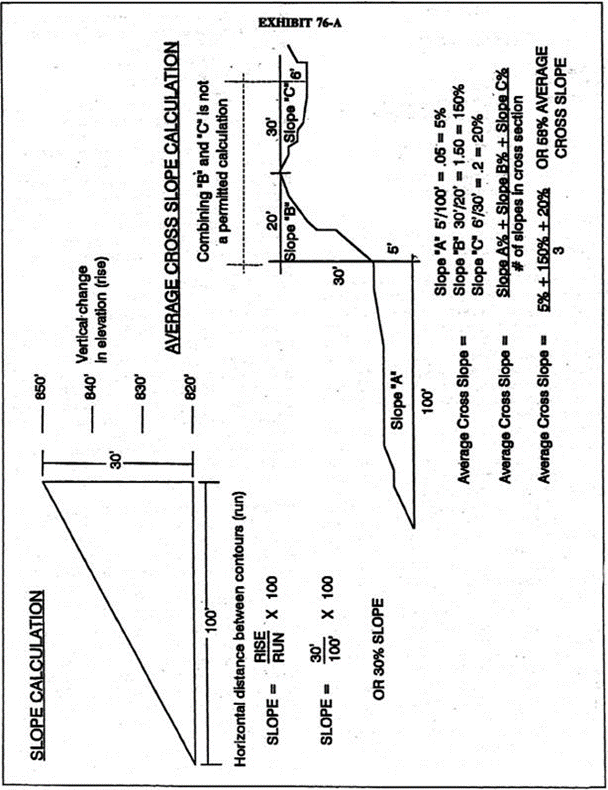
(Code 1981, § 17.76.190; Ord. No. 518, § 9, 4-5-2011)
17.78.010.- Fee waivers.
A.
Except for the application fee exemptions described in subsections (E) and (F) of this section, no appeal, application for a permit or approval under title 15 (Buildings and Construction), 16 (Subdivisions) or this title of this Code may be accepted unless the applicant pays all necessary application, appeal and/or penalty fees as established by the city council. The director may accept requests for waiver of application, appeal and/or penalty fees for presentation to the city council. If a fee waiver request is submitted concurrently with an application or appeal, the application, appeal and/or penalty fee shall be paid by the applicant and the paid fee shall be held by the city until a determination is made on the accompanying fee waiver request.
B.
The city council may, in its discretion, grant such a waiver if it finds:
1.
The applicant or the beneficiary of the use or activity proposed by the applicant is a nonprofit corporation registered with the state;
2.
The use or activity proposed or the activities of the beneficiary of the use or activity proposed are charitable, educational or otherwise provide a substantial benefit to the public; or
3.
The applicant has demonstrated a financial hardship, as determined by the city council, on a case by case basis.
C.
The city council may, in its discretion, grant a fee waiver without making the findings specified in subsection (B) of this section, if the applicant has been granted a variance due to administrative error pursuant to section 17.64.020(C) of this title.
D.
The city council may, in its discretion, grant a penalty fee waiver without making the findings specified in subsection (B) of this section, if the applicant has previously paid the penalty fee for an after-the-fact application that was denied without prejudice, and is submitting a subsequent, modified version of the after-the-fact application within one year of the denial of the previous application.
E.
Registered nonprofit 501(c)(3) corporations that are registered with the secretary of state and which are located or conduct business in the city or provide services available to city residents, shall, upon submittal of reasonable proof as to nonprofit 501(c)(3) status, be exempt from the requirement for payment of application fees associated with processing certain planning applications. This exemption shall apply only to the following types of applications:
1.
Temporary sign permits;
2.
Special use permits;
3.
Sign permits;
4.
Site plan review applications (only where no new expansion of building space or lot coverage is proposed); and
5.
Conditional large domestic animal permits.
This fee exemption shall not be construed as waiving the requirements for submittal and review of the required applications and associated information. This fee exemption shall not apply to appeal fees, penalty fees or fees for building permits or plan check services. Fee waivers for appeal fees, penalty fees and/or building permits or plan check services shall be processed in accordance with the procedures described in this section.
F.
Any permit or application fees (excluding city consultant review fees) associated with the proposed reconstruction of a building or other structure (or portion thereof) that has been damaged or destroyed by fire, earthquake, landslide or an involuntary act of the property owner shall be waived, provided that the rebuilt building or structure is no more than 250 square feet larger than it was prior to the damage or destruction, and provided that the applicant can demonstrate that said fees are not covered by the applicant's homeowners' insurance policy. In the event that three or more properties are affected by any single incident, the city council may, in its discretion:
1.
Grant a fee waiver without making the findings specified in subsection (B) of this section; or
2.
Deny the waiver in its entirety or grant only a partial waiver, based upon a finding of adverse fiscal impact to the city.
(Code 1981, § 17.78.010; Ord. No. 320, § 7(part), 1997; Ord. No. 354, § 7(part), 2000; Ord. No. 463, § 6, 2007)
17.78.020. - Acceptance of conditions.
Any discretionary permit or approval which has been approved by the director, planning commission or city council pursuant to stated conditions shall be null and void on the 91st day after it is granted or upon issuance of a building permit, whichever occurs first, if the applicant has not prior to that date informed the director in writing of their acceptance of the conditions of approval. While this written acceptance may form the basis of an estoppel against the applicant, it shall not create any contractual relationship between the city and the applicant.
(Code 1981, § 17.78.020; Ord. No. 320, § 7(part), 1997)
17.78.030. - Consideration of multiple applications.
A.
When more than one permit, variance or other approval under title 16 (Subdivisions) and this title is necessary for a single development project or use, the applicant shall submit all the applications simultaneously and the applications shall be processed concurrently. Further, all the applications may be considered by a single officer or agency of the city pursuant to this section.
B.
Notwithstanding subsection A, above, an applicant or applicants shall not submit multiple preliminary applications, pursuant to Government Code § 65913.4, as may be amended, or multiple applications for development projects, for the same property, which conflict with one another, such that the approval of one project would preclude the development of all or part of the projects proposed in the other submitted preliminary applications or applications.
C.
If any of the applications would be presented to the planning commission for initial consideration if filed singly, all the applications shall be presented to the planning commission as a package. The planning commission shall then have the authority to act on each application as if the planning commission were the officer, or agency of the city, authorized to act on such an application by title 16 (subdivisions) or this title.
D.
If none of the applications would be presented to the planning commission for initial consideration if filed singly, then all the applications shall be acted upon by the director as a package. The director shall then have the authority to act on each application.
E.
A decision of the director on a group of applications pursuant to this section may be appealed to the planning commission pursuant to Section 17.80.050 (appeal to planning commission) of this title. A decision of the planning commission on a group of applications, pursuant to Section 17.78.030 (consideration of multiple applications) of this chapter, may be appealed to the city council pursuant to Section 17.80.070 (appeal to city council) of this title. An appeal of an application that is part of a package shall serve as an appeal of the entire application package.
F.
Unless an appeal is referred to the director pursuant to subsection 17.80.060(E) of this title, or to the planning commission pursuant to subsection 17.80.080(A)(5) of this title, the appellate body may, in its discretion, consider any issue, any permit or approval approved in the appealed package, whether or not raised or identified in the notice of appeal. Unless an appeal is authorized by this subsection, all decisions rendered pursuant to this section shall be final when rendered.
G.
If any of the applications presented to the planning commission require final approval by the city council, if filed singly, then all the applications shall be forwarded to the city council for final action.
(Code 1981, § 17.78.030; Ord. No. 320, § 7(part), 1997; Ord. No. 683, § 3, 7-16-2024)
17.78.040. - Amendments to approved applications.
A.
An amendment which proposes one or more substantial amendments to a project, plans and/or conditions of approval approved in accordance with this title may be initiated by an applicant/property owner upon petition to the director and submittal of a fee, as established by resolution by the city council. The determination of what constitutes a substantial amendment shall be made by the director.
B.
A substantial amendment to a project shall be considered by the same body which took the final action in approving the original project, utilizing the hearing and noticing procedures, review criteria and appeal procedures as required by this title. A substantial amendment to a project may require a new and separate environmental review.
C.
The director is authorized to modify the approved plans and/or any of the conditions of approval if such modifications are determined by the director to be minor and if the director can make the following findings:
1.
That the proposed modifications achieve substantially the same results as would strict compliance with the approved plans and conditions;
2.
That the proposed modifications remain compatible with the character of the neighborhood;
3.
That the proposed modifications do not result in a new or increased privacy infringement;
4.
That the proposed modifications do not result in a new or increased adverse view impacts; and
5.
That as modified, the project remain consistent with the general plan, development code, and coastal specific plan.
D.
The director shall send a notice of decision approving a minor modification to all interested parties on file with the city when the original project was being processed and to the members of the final deciding body allowing 15 calendar days to appeal the director's decision, pursuant to chapter 17.80 (Hearing notice and appeal procedures) of this title.
(Code 1981, § 17.78.040; Ord. No. 320, § 7(part), 1997; Ord. No. 594, § 4, 3-7-2017)
17.78.050. - Interpretation procedure for approved projects.
A.
In cases of uncertainty or ambiguity as to the meaning or intent of any decision approving a project in accordance with this title, or to further define or enumerate the conditions of approval of an approved project, the body which took the final action in approving the original project shall conduct an interpretation review of the decision in question. Said interpretation review may be initiated by the director, or the final body that took such action, or upon the written request of the applicant/property owner or any other interested person, provided an interpretation review may not be initiated by any person where the subject matter is subject to litigation. Said interpretation review shall utilize the notice, hearing process, review criteria, and appeal process as required by this title. The interpretation review procedure may be initiated in, but shall not be limited to, the following situations:
1.
Discrepancies between approved plans and subsequently revised plans;
2.
Interpretations of conditions of approval; or
3.
New issues stemming from construction of the approved project which were not addressed or considered as part of the original project approval.
B.
In cases involving the interpretation of a decision of the planning commission and/or city council, the director shall prepare a written interpretation and transmit it to the appropriate review body. Upon review of the director's interpretation at a public meeting, the appropriate body shall either:
1.
Concur with the director's interpretation; or
2.
Make a determination that the subject interpretation may result in a substantial revision to the originally approved project and thus require a formal review hearing; utilizing the hearing, noticing requirements, review criteria and appeal procedures, required by this title.
C.
In cases where the interpretation review is initiated by the director or the body that took final action on the approved application, no fee shall be required. In cases where the interpretation review is initiated by an applicant/property owner or interested party, a fee established by resolution of the city council shall be required.
(Code 1981, § 17.78.050; Ord. No. 320, § 7(part), 1997; Ord. No. 594, § 5, 3-7-2017)
17.79.010.- Purpose.
Notwithstanding anything to the contrary anywhere in this Code, this chapter establishes the planning commission's role as an advisory body to the city council for all city projects that require discretionary review.
(Ord. No. 666, § 2, 11-1-2022)
17.79.020. - Procedure.
All city projects that require discretionary review and approval shall be heard by the city council at a duly noticed public hearing as the final approving authority, with the planning commission acting as an advisory body at a duly noticed public hearing. In all other respects, city projects shall be subject to the provisions of this Code.
(Ord. No. 666, § 2, 11-1-2022)
17.80.010.- Title and purpose.
The purpose of this chapter is to establish a procedure for appeals of decisions made pursuant to title 16 (Subdivisions) and this title.
(Code 1981, § 17.80.010; Ord. No. 320, § 7(part), 1997)
17.80.020. - Effect of filing.
The filing of a notice of appeal pursuant to this chapter stays all activity on the project until a final decision on the appeal.
(Code 1981, § 17.80.020; Ord. No. 320, § 7(part), 1997)
17.80.030. - Appellate authority.
A.
Unless otherwise expressly provided in title 16 (Subdivisions) or this title, any decision made by the director pursuant to title 16 (Subdivisions) or this title may be appealed to the planning commission and any decision made by the planning commission or view restoration commission pursuant to title 16 (Subdivisions) or this title, with the exception of decisions described in subsection C of this section, may be appealed to the city council.
B.
The director is designated as a zoning administrator pursuant to Government Code § 65900 with respect to these decisions which may be rendered by that officer or their designees pursuant to this title. When acting as a zoning administrator pursuant to this subsection B, the director shall exercise the authority conferred by this title and authorized by Government Code § 65901.
C.
Any view assessment or trimming/removal determinations made by the director in association with the processing of applications by the public works department for the trimming or removal of city trees are not appealable to the planning commission since such public works department decisions are appealable to the city council pursuant to section 12.08.100 (Interference).
(Code 1981, § 17.80.030; Ord. No. 320, § 7(part), 1997; Ord. No. 575, § 8, 12-15-2015)
17.80.040. - Notice of decision by director.
When notice of a decision is required to be given in accordance with the provisions of this section, the written notice shall:
A.
Provide a general explanation of the decision;
B.
Provide a general description of the property involved;
C.
Inform recipients of the notice of the right of any interested person to appeal the decision to the planning commission or city council and explain how that right may be exercised; and
D.
Be given by first class mail to:
1.
The project applicant and property owner;
2.
Any person who submitted written comments concerning the applicant's request;
3.
Any person who has filed a written request with the city to receive such notice;
4.
Any homeowner's association on file with the city that has jurisdiction over the subject property.
(Code 1981, § 17.80.040; Ord. No. 320, § 7(part), 1997)
17.80.050. - Appeal to planning commission.
A.
Power to hear and decide. The planning commission shall have the power to hear and decide appeals of decisions of the director.
B.
Filing of appeal. Unless otherwise specified in this code, any interested person may file an appeal of a director's decision with the planning commission, provided the appeal is filed in writing within 15 calendar days after the notice of the director's decision is issued and the appropriate fee, as established by resolution of the city council, is paid. The appeal shall set forth the grounds for appeal and any specific action being requested by the appellant. The director's decision is final if not appealed to the planning commission within 15 calendar days.
C.
Hearing and notice. The director shall set a hearing on the appeal within 90 days of the filing of the appeal, which shall be conducted as provided in section 17.80.060 (Action by planning commission) of this chapter. Notice of the hearing shall be given as specified in section 17.80.090 (Notice of hearing) of this chapter.
(Code 1981, § 17.80.050; Ord. No. 320, § 7(part), 1997; Ord. No. 508, § 6, 5-4-2010)
17.80.060. - Action by planning commission.
In conducting an appeal hearing, the planning commission may:
A.
Approve an application upon finding that all applicable findings have been correctly made and all of provisions of title 16 (Subdivisions) and this title have been complied with;
B.
Approve an application but impose additional or different conditions or guarantees as it deems necessary to fulfill the purposes of title 16 (Subdivisions) and this title;
C.
Deny the application without prejudice upon a finding that all applicable findings have not been correctly made or all provisions of title 16 (Subdivisions) and this title have not been complied with but that, in either case, the application has merit and may possibly be modified to conform with the provisions of title 16 (Subdivisions) and this title;
D.
Disapprove the application upon finding that all applicable findings cannot be made or all provisions of title 16 (Subdivisions) and title 17 (Zoning) of this Code have not been complied with; or
E.
Refer the matter to the director with instructions.
(Code 1981, § 17.08.060; Ord. No. 320, § 7(part), 1997)
17.80.070. - Appeal to city council.
A.
Appeal of a planning commission decision. Any interested person may file an appeal of a planning commission's decision to the city council, provided the appeal is filed in writing within 15 calendar days after final action by the planning commission and the appropriate fee, as established by resolution of the city council, is paid. The appeal shall set forth the grounds for appeal and any specific action being requested by the appellant. The planning commission's decision is final if no appeal is filed within 15 calendar days.
B.
Notice of appeal. A notice of appeal shall be filed in writing with the city clerk or the director and shall set forth the grounds for the appeal and any specific action, being requested by the appellant.
C.
Hearing date. The city manager or city clerk shall fix the time for hearing the appeal within 90 days of the filing of the appeal.
D.
Notice. The city clerk or director shall notice the hearing as required by section 17.80.090 (Notice of hearing) of this chapter.
E.
Record on appeal. All materials on file with the director shall be part of the city council appeal hearing record. In addition, any person may offer supplemental evidence during the appeal hearing.
F.
De novo review. The city council appeal hearing is not limited to consideration of the materials presented to the planning commission. Any matter or evidence relating to the action on the application, regardless of the specific issue appealed, may be reviewed by the city council at the appeal hearing.
(Code 1981, § 17.80.070; Ord. No. 320, § 7(part), 1997; Ord. No. 508, § 6, 5-4-2010)
17.80.080. - Action by city council.
A.
Decision. In conducting an appeal hearing, the city council may:
1.
Approve the application upon finding that all applicable findings have been correctly made and all provisions of title 16 (Subdivisions) and this title are complied with;
2.
Approve the application but impose additional or different conditions or guarantees as it deems necessary to fulfill the purposes of title 16 and this title;
3.
Deny the application without prejudice, upon a finding that all applicable findings have not been correctly made or all provisions of title 16 and this title have not been complied with but that, in either case, the application has merit and may possibly be modified to conform with the provisions of title 16 and this title;
4.
Disapprove the application upon finding that all applicable findings cannot be made or all provisions of title 16 and this title have not been complied with; or
5.
Refer the matter to the planning commission with instructions.
B.
Vote required. A simple majority of the city council members voting shall be required to overrule or modify a decision by the director and/or planning commission which is appealed, or to grant an appealed application where the director and/or commission has failed to act within the time permitted by law.
C.
Effective date. A decision of the council sustaining, overruling or modifying any decision, determination or requirement of the planning commission shall be final and conclusive when rendered unless otherwise provided by the council in rules of procedure or elsewhere. In cases where the city council adopts a resolution memorializing the council's decision, final action shall be the adoption of the resolution.
(Code 1981, § 17.80.080; Ord. No. 320, § 7(part), 1997)
17.80.090. - Notice of hearing.
Unless another provision of this Code defines the notice required for a public hearing on an application or appeal, notice shall be provided as set forth in this section.
A.
Time. Notice of public hearing shall be given at least 15 calendar days before the hearing date.
B.
Content. A notice of hearing shall include:
1.
The date, time and place of hearing;
2.
The identity of the hearing body or officer;
3.
A general explanation of the matter to be considered; and
4.
The address or general location of the project site.
C.
Publication. Notice shall be published in a newspaper of general circulation in the city. If no such newspaper exists when notice is required to be given, such notice shall be posted in at least three public places in the city designated by the city council.
D.
Notice to owners of property within 500 feet.
1.
Written notice shall be given to all owners of property within 500 feet of the external boundaries of the subject property. Such written notice shall be made by first class mail or personal delivery to all persons, including businesses, corporations or other public or private entities, shown on the last equalized assessment roll as owning real property within 500 feet of the external boundaries of the subject property.
2.
In the event that the number of owners to whom notice would be sent pursuant to subsection (D)(1) of this section is greater than 1,000, as an alternative to such notice, notice may be given by placing a display advertisement of at least one-eighth page in a newspaper of general circulation within the city.
E.
Notice to persons requesting notice. In all cases, in addition to other notices, notice shall be given by first class mail to any person who has filed a written request with the city to receive notices of public hearings. Such a request may be submitted at any time and shall apply for the balance of the calendar year. A reasonable fee may be imposed on persons requesting such notice to recover the cost of such mailing.
F.
Notice to affected homeowners' associations. In all cases, in addition to all other notices, notice shall be given by first class mail to any homeowners' association on file with the city that have jurisdiction over the subject property and any property located within 500 feet of the subject property.
G.
Property owner. In all cases, in addition to other notices, notice shall be given by first class mail to the owner of the subject property and the applicant, if different from the owner.
(Code 1981, § 17.80.090; Ord. No. 320, § 7(part), 1997)
17.80.100. - Hearing transcript.
Nothing in this title 17 shall require the keeping of a verbatim hearing transcript where such a transcript is not otherwise required by law.
(Code 1981, § 17.80.100; Ord. No. 320, § 7(part), 1997)
17.80.110. - Denial without prejudice.
Notwithstanding the application filing restrictions for a conditional use permit application (section 17.60.020(A)); variance application (section 17.64.020(A)); extreme slope permit application (section 17.76.060(C)(1)); special animal permit application (section 17.76.110(B)(1)); and a zone change/Code amendment petition (section 17.68.030(C)), a land use application that has been denied without prejudice on appeal may be refiled at any time. The refiled application must be accompanied by the standard filing fee, unless the fee is waived by the city council, pursuant to section 17.78.010 (Fee Waivers) of this title.
(Code 1981, § 17.80.110; Ord. No. 320, § 7(part), 1997)
17.80.120. - Appeal fee refund.
All appeal fees shall be refunded to a successful appellant. An appellant is considered successful if a final decision is rendered granting their appeal. If an appeal results in a modification to the project, other than changes specifically requested in the appeal, then one-half of the appeal fee shall be refunded to the successful appellant.
(Code 1981, § 17.80.120; Ord. No. 320, § 7(part), 1997)
17.80.130. - Appeals by city council.
A commission's final decision on an application may be appealed by the city council in the following manner:
A.
Any one city council member may contact the city manager and request that an item be placed on the next city council agenda so that the entire city council can consider whether to appeal a commission's decision on an application. The request from the council member must be made in writing within 15 calendar days of the commission's final decision on an application.
B.
If an appeal request from a council member is received by the city manager, the appeal period for the city council shall be automatically extended by 30 additional calendar days. This extended appeal period shall apply only to city council appeals in order for the city council to determine whether to appeal the commission's decision.
C.
An applicant or any other interested person may file an appeal with the city before or after an appeal request has been made by a council member, provided the appeal is filed within the standard 15-day appeal period. An applicant or any other interested party may not file an appeal during the city's extended 30-day appeal period.
D.
The city council shall determine by a majority vote whether to appeal the commission's decision.
(Code 1981, § 17.80.130; Ord. No. 320, § 7(part), 1997; Ord. No. 340, § 8(part), 1998)
17.82.010.- Purpose.
This chapter establishes the procedures and requirements for the consideration of development agreements for the purposes specified in and as authorized by Government Code title 7, div. 1, ch. 4, art. 2.5 (Government Code § 65864 et seq.).
(Code 1981, § 17.82.010; Ord. No. 326U, § 1(part), 1997; Ord. No. 327, § 1(part), 1997)
17.82.020. - Application.
A.
Only a qualified applicant may file an application for a development agreement. A qualified applicant is a person who has a legal or equitable interest in the real property which is the subject of the development agreement, or an authorized agent of a person who has a legal or equitable interest. The director may require an applicant to submit a title report or other evidence satisfactory to the director to verify the applicant's interest in the real property and of the authority of the agent to act for the applicant.
B.
An application for a development agreement may be filed concurrently with any other application having a direct relationship to the property which is the subject of the proposed agreement. However, an application will not be accepted by the director if the application is substantially the same as an application upon which final action has been taken by the city council within 12 months prior to the date of the subsequent application, unless accepted by motion of the city council, or the prior application was denied without prejudice by the city council.
C.
An application for a development agreement shall contain full and complete information and shall be made on a form provided for that purpose by the department of planning, building and code enforcement, along with the applicable fee established by resolution of the city council.
D.
A draft of the proposed development agreement (along with the required number of copies) may be submitted along with the application. Such agreement shall be in a form acceptable to the city attorney. If deemed appropriate, the city attorney may draft the initial agreement for review by the parties thereto. Any legal fees incurred by the city in drafting or reviewing a development agreement shall be reimbursed by the applicant.
E.
The director may require additional information if deemed necessary to enable the planning commission and city council to determine whether the development agreement is consistent with the objectives of the city's general plan and any applicable specific plan.
(Code 1981, § 17.82.020; Ord. No. 326U, § 1(part), 1997; Ord. No. 327, § 1(part), 1997)
17.82.030. - Notification.
Notice of the intention to consider adoption of a development agreement shall be given in accordance with the provisions of Government Code §§ 65090 and 65091, in addition to any other notice required by law for other actions to be considered concurrently with the development agreement, if any.
(Code 1981, § 17.82.030; Ord. No. 326U, § 1(part), 1997; Ord. No. 327, § 1(part), 1997)
17.82.040. - Action by planning commission.
A.
The planning commission shall hold a public hearing on an application for a development agreement. The hearing shall be set and notice given as prescribed in section 17.82.030. The hearing may be continued from time to time.
B.
The planning commission shall determine whether the development agreement is consistent with the required findings for approval as contained in section 17.82.060, and shall recommend to the city council that the development agreement be approved, approved as amended, or denied. The planning commission's recommendation shall be set forth in a resolution.
(Code 1981, § 17.82.040; Ord. No. 326U, § 1(part), 1997; Ord. No. 327, § 1(part), 1997)
17.82.050. - Action by city council.
A.
Upon receiving a recommendation from the planning commission on a proposed development agreement, the city council shall hold a public hearing. The hearing shall be set and notice given as prescribed in section 17.82.030. The hearing may be continued from time to time.
B.
Following the closing of a public hearing, the council shall determine if the development agreement is consistent with the findings contained within section 17.82.060. If determined to be consistent, the city council shall introduce an ordinance adopting the development agreement.
(Code 1981, § 17.82.050; Ord. No. 326U, § 1(part), 1997; Ord. No. 327, § 1(part), 1997)
17.82.060. - Required findings for approval.
Prior to taking an action to approve or recommend approval of a development agreement, the reviewing authority shall find as follows:
A.
The proposed development agreement conforms with the maps and policies of the general plan and any applicable specific plan including, without limitation, the city's coastal specific plan;
B.
The proposed development agreement complies with the requirements of Government Code §§ 65865 through 65869.5;
C.
The proposed development agreement will not be detrimental to or cause adverse effects to adjacent property owners, residents, or the general public;
D.
The proposed development agreement provides clear and substantial benefit to the residents of the city.
(Code 1981, § 17.82.060; Ord. No. 326U, § 1(part), 1997; Ord. No. 327, § 1(part), 1997)
17.82.070. - Recordation.
No later than ten days after the ordinance approving a development agreement becomes effective, the city clerk shall record a copy of the development agreement with the office of the county recorder.
(Code 1981, § 17.82.070; Ord. No. 326U, § 1(part), 1997; Ord. No. 327, § 1(part), 1997)
17.82.080. - Ongoing review.
At least every 12 months, the city shall review any approved development agreement to determine whether the applicant, or successor in interest thereto, is demonstrating good faith compliance with the terms of the agreement. This review process may require the submittal of an application form, materials, and fees as established by city council resolution.
(Code 1981, § 17.82.080; Ord. No. 326U, § 1(part), 1997; Ord. No. 327, § 1(part), 1997)
17.82.090. - Amendments or repeal of approved development agreements.
Any amendment or a repeal of a previously-approved development agreement shall be reviewed pursuant to the procedures outlined in this chapter for a new application.
(Code 1981, § 17.82.090; Ord. No. 326U, § 1(part), 1997; Ord. No. 327, § 1(part), 1997)
17.83.010.- Intent and purpose.
This chapter establishes the incentives and procedures for participation in the city's voluntary green building program. In addition, this chapter provides criteria, standards and processing procedures for the installation and construction of certain green related improvements such as renewable energy systems, small wind energy systems, and permeable landscaping. This chapter allows owners of properties in the city and their architects, contractors and builders to design and develop and/or remodel single-family, multifamily residential, commercial, institutional and mixed-use projects that are sited, designed, constructed and operated in accordance with the provisions of this chapter to enhance the well-being of occupants, and to minimize negative impacts on the community and natural environment. The voluntary green building program provides the minimum requirements for obtaining certified recognition of a green building within the city.
(Code 1981, § 17.83.010; Ord. No. 481, § 8(part), 2008)
17.83.020. - Incentives for participation in voluntary green building program.
A.
The following incentives shall be available to applicants who participate and meet the minimum requirements established in section 17.83.030 and/or section 17.83.040 of this chapter:
1.
Expedited application review. Any planning applications submitted to the department of planning, building and code enforcement for processing that meet all the requirements contained in section 17.83.030(A)(1) and/or 17.83.040(A)(1) shall be granted processing priority over other non-green planning applications.
2.
Expedited building and safety plan check. Any building permit applications submitted to the department of planning, building and code enforcement for processing that meet all the requirements contained in section 17.83.030(A)(2) and/or 17.83.040(A)(2) shall be granted processing priority over other non-green building permit applications.
3.
Fee rebate for single-family and multifamily residential projects. If after issuance of final approval of a building permit, the applicant submits proof of final certification by Build It Green indicating that the residence has been certified as a green building, the applicant shall be granted a rebate of 50 percent of all planning permit, plan check and building permit application fees paid to department of planning, building and code enforcement. Any fees paid to city consultants for review of the project (including, but not limited to, fees paid to a city consultant for building plan check, building inspections, geologic review, NPDES review, etc.) shall not be refunded. In order to receive a rebate, proof of certification by Build It Green shall be submitted to the city within 90 days of building permit final.
4.
Fee rebate for nonresidential projects. If after issuance of final approval of a building permit, the applicant submits proof of final certification by Leadership in Energy and Design (LEED) indicating that the residence has been certified as a green building, the applicant shall be granted a rebate of 50 percent of all planning permit, plan check and building permit application fees paid to department of planning, building and code enforcement. Any fees paid to city consultants for review of the project (including, but not limited to, fees paid to a city consultant for building plan check, building inspections, geologic review, NPDES review, etc.) shall not be refunded. In order to receive a rebate, proof of certification by LEED shall be submitted to the city within 90 days of building permit final.
(Code 1981, § 17.83.020; Ord. No. 481, § 8(part), 2008)
17.83.030. - Green building application requirements for obtaining single-family and multifamily projects.
A.
Property owners that choose to participate in the city's green building program for single-family or multifamily residential projects shall comply with the following requirements:
1.
In conjunction with submittal of a planning application for a new residence or a major renovation/remodel (whereby more than 50 percent of the existing interior and/or exterior walls are removed), that meets the minimum requirements for obtaining "green" certification, the property owner shall provide all of the following to the director:
a.
A letter of intent to participate in the city green building program, which shall include the following:
i.
The project address;
ii.
A statement from the property owners stating that they have designed and will construct or renovate/remodel a home according to the city's minimum Green Points Rated requirements; and
iii.
A statement acknowledging that compliance is voluntary and benefits will only be granted upon proof of final certification by Build It Green and acceptance of said certification by the director; and
b.
Documentation that the services of a Certified Green Building Professional (CGBP), or an accredited professional through a similarly recognized program subject to the approval of the director has been retained; and
c.
A copy of the proposed Green Points Checklist and any additional supporting documentation indicating how the project will achieve the minimum points required to become Green-Point Rated.
2.
Upon submittal of a green building construction plan, which has been approved by the city's planning department, into building and safety plan check, the property owner shall ensure that:
a.
The submitted building plans and documents indicate in the general notes and/or individual detail drawings the green building measures employed to become Green-Point Rated;
b.
A copy of the Green Points Checklist shall be incorporated in the building plans; and
c.
The services of a Green Points Rator, or an accredited third-party professional through a similarly recognized program that has been approved by the director, has been retained to conduct on-site inspections throughout the construction process to verify that the green measures set forth in the Green Points Checklist have been implemented to become Green-Point Rated.
(Code 1981, § 17.83.030; Ord. No. 481, § 8(part), 2008)
17.83.040. - Green building application requirements for commercial, institutional and/or mixed-use projects.
A.
Property owners that choose to participate in the city's green building program for commercial, institutional and/or mixed-use projects shall comply with the following requirements:
1.
In conjunction with submittal of a planning application for a new development project or a major renovation/remodel (whereby more than 50 percent of the existing interior and/or exterior walls are removed) that meets the minimum requirements for obtaining green certification, the property owner shall provide all of the following to the director:
a.
A letter of intent to participate in the city green building program which shall include the following;
i.
The project address;
ii.
A statement from the property owner indicating that they have designed and intend to construct or renovate/remodel a commercial, institutional and/or mixed-use project according to the minimum Leadership in Energy and Environmental Design (LEED) Certified requirements; and
iii.
Acknowledgement that compliance is voluntary and benefits will only be granted upon proof of final certification by a LEED accredited professional and approval by the director;
b.
Documentation that the services of a LEED accredited professional, or an accredited professional through a similarly recognized program that has been approved by the director prior to submittal of an application, has been retained; and
c.
A copy of the LEED checklist and any supporting documentation indicating how the project will achieve a minimum LEED rating of Certified.
2.
Upon submittal of green building construction, plans, which have been approved by the city's planning department, into building and safety plan check, the property owner shall ensure that:
a.
The submitted building plans and documents specify in the general notes and/or individual detail drawings the green building measures employed to become LEED Certified. A copy of the LEED checklist shall be incorporated in the building plans. The LEED checklist shall be prepared, signed, and dated by the project LEED accredited professional;
b.
The services of a LEED accredited professional, or an accredited third-party professional through a similarly recognized program that has been approved by the director, has been retained to conduct on-site inspections throughout the construction process to verify that the green measures set forth in the LEED checklist have been implemented to achieve a minimum LEED level of Certified; and
c.
The project has been registered with the relevant LEED rating program.
(Code 1981, § 17.83.040; Ord. No. 481, § 8(part), 2008)
17.83.050. - Application procedures for renewable energy systems (photovoltaic and solar water heating).
A.
This section provides standards and procedures for permitting renewable energy systems, such as photovoltaic (solar panels) and/or solar water heating systems, within all zoning districts.
1.
Roof-mounted renewable energy systems. Any roof-mounted renewable energy system may be installed after the applicable building permits have been obtained from the city. Small residential rooftop solar energy systems are governed by section 15.040.070(B) of this Code.
2.
Ground-mounted energy systems. Installation of renewable energy systems are permitted in any zoning district through a minor site plan review application, provided that such systems do not encroach into a setback area or exceed 12 feet in height, as measured from existing grade.
3.
Renewable energy systems on extreme slopes. Installation of renewable energy systems are permitted to be constructed on an extreme slope without the need for an extreme slope permit.
(Code 1981, § 17.83.050; Ord. No. 481, § 8(part), 2008; Ord. No. 574, § 4, 9-1-2015)
17.83.060. - Small wind energy systems.
A.
Purpose. The purposes of this section are as follows:
1.
To provide for the installation and use of small wind energy systems in certain nonurbanized areas of the city to encourage the use of alternative energy sources;
2.
To minimize visual impacts of wind energy towers through careful design, siting and vegetation screening;
3.
To avoid damage to adjacent properties from tower failure through careful design and siting of tower structures; and
4.
To ensure that wind energy towers are compatible with adjacent uses.
B.
Conditional use permit required. The installation and/or operation of a small wind energy system, as defined in chapter 17.96 (Definitions) of this title, shall require a conditional use permit reviewed and approved by the planning commission pursuant to the procedures set forth in chapter 17.60 (Conditional Use Permits). Except as modified by the provisions of this section, all applications for a conditional use permit for a small wind energy system shall comply with the procedures set forth in chapter 17.60 (Conditional Use Permits).
C.
Permissible zones. The development of small wind energy systems shall be permitted in the following zones on lots that are one acre or greater in size: CL (Commercial Limited), CN (Commercial Neighborhood), CP (Commercial Professional), CG (Commercial General), I (institutional), C (Cemetery) and OR (Open Space Recreation).
D.
Requirements. Each small wind energy system shall comply with the following requirements:
1.
Lot size. A small wind energy system may be installed on a lot with a minimum size of one acre.
2.
Tower height. Tower height, as defined in chapter 17.96 (Definitions) shall be measured from lowest finished grade immediately adjacent to the base of the tower. For parcels between one acre and five acres in size, tower height shall be no more than 65 feet. For parcels greater than five acres, tower height shall be no more than 80 feet. Under no circumstances may the height of a tower exceed the height recommended by the manufacturer or distributor of the system. The application shall include evidence that the proposed height of the system does not exceed the manufacturer's recommended height for the system.
3.
Setbacks. All small wind energy systems shall comply with the following setback requirements:
a.
At a minimum, a wind energy system shall be set back from any property line a distance equal to the height of the system. No part of the system, including guy wire anchors, shall extend closer than 30 feet to any property line. In addition, all setbacks comply with applicable fire setback requirements pursuant to Public Resources Code § 4290 or its successor statute.
b.
Placement of more than one tower on a lot may be permitted, provided that all setbacks and all other standards set forth in this section are met by each tower.
c.
The towers may be located as close to each other as is technically feasible.
d.
Any accessory structures used in association with the towers shall meet the setbacks required in the applicable zoning district.
4.
Turbine. Any wind energy system installed pursuant to this section must have a turbine. The system's turbine must be approved by the California Energy Commission as qualifying under the Emerging Renewables Fund of the Energy Commission's Renewables Investment Plan or certified by a national program recognized by the Energy Commission.
5.
Noise level. Noise levels for the system shall be no greater than either 60 decibels measured at the closest neighboring inhabited dwelling or any existing maximum noise levels in the general plan, whichever is lower. The noise levels established by this subsection shall not apply during short-term events such as utility outages and severe windstorms.
6.
Safety standards. A small wind energy system installed pursuant to this section must be designed to meet the most stringent wind requirements (as established by the California Building Code), the requirements for the worst seismic class (Seismic 4), and the weakest soil class, with soil strength of not more than 1,000 pounds per square foot. The application shall include evidence sufficient to demonstrate the system complies with these standards.
7.
Roof mounting prohibited. A small wind energy system may not be mounted on the roof of any structure.
8.
Aviation regulations. The system shall comply with all applicable requirements imposed by the Federal Aviation Administration (FAA), including subpart B (commencing with section 77.11) of part 77 of title 14 of the Code of Federal Regulations, and the State Aeronautics Act (Public Utilities Code § 21001 et seq.).
9.
Primary use. A wind energy system installed pursuant to this section shall be used primarily to reduce onsite consumption of utility power.
10.
Visual impacts. A wind energy system may not impair a view from an adjoining property or create other adverse aesthetic impacts on adjacent properties. The applicant shall demonstrate that the tower will comply with all applicable provisions of section 17.02.040 (View preservation and restoration) of this title. The applicant shall further demonstrate that the tower can be expected to have the least visual impact on the environment, taking into consideration technical, engineering, economic, and other pertinent factors. Towers clustered on the same site shall be of similar height and design whenever possible.
11.
Maintenance impacts. The applicant shall describe anticipated maintenance needs for each wind energy system requested, including the frequency of service, personnel needs, equipment needs, and traffic, noise or safety impacts of such maintenance.
12.
Parking. A minimum of two parking spaces shall be provided on each site. An additional parking space for each two employees shall be provided at facilities that require on-site personnel. Storage of vehicles or equipment on a site housing a small wind energy system requires approval of the director or planning commission. Vehicle and equipment storage must conform to landscape and screening requirements.
13.
Landscaping. The applicant shall provide a landscape plan to be approved by the director or planning commission. The plan shall note specifications for landscape and screening, including plantings, fences, walls and other features designed to screen and buffer towers, accessory uses and stored equipment. Native vegetation shall be preserved to the greatest extent practicable and incorporated into the landscape plan.
14.
Accessory uses. Accessory uses shall include only such buildings and facilities permitted by the underlying zoning or necessary for the operation and maintenance of the wind energy system.
15.
Application of underlying zoning standards. Except as otherwise provided by this section, a small wind energy system shall comply with all applicable development standards for the underlying zone to the extent such standards do not conflict with paramount federal or state law.
16.
Coordination with electric utility service provider. Unless the applicant does not intend to connect the wind energy system to the electricity grid, the applicant shall demonstrate that the electric utility service provider that serves the proposed site has been informed of the applicant's intent to install an interconnected, customer-owned electricity generator.
E.
Prohibited sites. A small wind energy system shall not be allowed on any of the following locations:
1.
A small wind energy system shall not be allowed on any site subject to the city's coastal specific plan and/or the California Coastal Act (commencing with of the Public Resources Code § 30000).
2.
A small wind energy system shall not be permitted on any site that is listed on the National Register of Historic Places or the state register of historical resources pursuant to Public Resources Code § 5024.1.
3.
A small wind energy system shall not be permitted on any parcel that is part of an open space easement entered into pursuant to Civil Code div. 2, pt. 2, title 2, ch. 4 (Civil Code § 815 et seq.).
4.
A small wind energy system shall not be permitted on any parcel that is part of an open space easement entered into pursuant to the Open-Space Easement Act of 1974, Government Code title 5, div. 1, pt. 1, ch. 6.6 (Government Code § 51070 et seq.).
5.
A small wind energy system shall not be permitted on any site designated as an Alquist-Priolo Hazard Zone pursuant to the Alquist-Priolo Earthquake Fault Zoning Act (Public Resources Code § 2621 et seq.).
F.
Requirements for application. Each application for a small wind energy system shall include the following information:
1.
A completed conditional use permit application on a form prescribed by the department of planning, building and code enforcement;
2.
Site plan to scale, specifying the location of the tower, guy wires, equipment building and other accessory uses, access, parking, fences, landscaped areas and screening;
3.
Scaled elevation plans of the proposed tower, equipment building, and other accessory uses and related landscaping and screening;
4.
Standard drawings and an engineering analysis of the tower showing compliance with the California Building Code or the California Building Standards Code (BSC), and certification by a professional mechanical, structural or civil engineer licensed by the state;
5.
A line drawing of the electrical components of the system in sufficient detail to show that the manner of installation conforms with the National Electrical Code and evidence that the electric utility service provider that serves the proposed site has been informed of the applicant's intent to install an interconnected, customer-owned electricity generator;
6.
Evidence demonstrating that the proposed height of the wind energy system does not exceed the manufacturer's recommended height for the system;
7.
Sufficient evidence of the structural integrity of the tower demonstrating compliance with the safety standards set forth in subsection (D)(6) of this section;
8.
An affidavit that the primary purpose of the wind energy system is to reduce onsite consumption of utility power;
9.
A completed environmental assessment application;
10.
A scaled landscape plan indicating size, spacing and type of plantings as required in subsection (D)(13) of this section;
11.
Any additional information requested by the director and reasonably necessary to evaluate the application.
G.
Notice. Notwithstanding the notice provisions of section 17.60.040 (Public Hearing), notice of any application for a conditional use permit for a wind energy system shall be provided to property owners within 300 feet of the property on which the system is to be located.
H.
Findings. In addition to the findings required by section 17.60.050 (Findings and Conditions) of this title, the planning commission may grant a conditional use permit for a small wind energy system only if it finds:
1.
The wind energy system will not impair a view from an adjoining property or create other adverse aesthetic impacts on adjacent properties; and
2.
The wind energy system complies with all applicable safety requirements and will not expose the public to any undue safety risk.
I.
Appeal. The decision of the planning commission may be appealed to the city council in accordance with the procedure set forth in section 17.80.070 (Appeal to city council) of this title.
(Code 1981, § 17.83.060; Ord. No. 377, § 2, 2002; Ord. No. 481, § 9, 2008)

