
Reese City Zoning Code
ARTICLE I
- IN GENERAL
Sec. 36-1.- Definitions and rules of construction.
(a)
Terminology rules. For the purpose of this chapter, the following rules shall apply to the terminology in the text:
(1)
In case of any difference of meaning or implication between the text and any caption or illustration, the text shall take precedence. If the meaning of a word or phrase is unclear in a particular circumstance, the zoning board of appeals (ZBA) shall construe the provision to carry out the intent of this chapter if such can be discerned from other provisions of this chapter or law.
(2)
The phrase "used for" includes "arranged for," "designed for," "intended for," "maintained for" or "occupied for."
(3)
The word "occupied" and the word "used" shall be considered to be followed by the words "or intended, arranged or designed to be used or occupied."
(4)
All words and phrases used in this chapter shall be construed and understood according to the common preferred usage of the language; but technical words and phrases and such as may have acquired a peculiar and appropriate meaning in the law shall be construed and understood according to such peculiar and appropriate meaning.
(5)
Words used in the present tense shall include the future tense, words used in the singular shall include the plural, and words in the plural number shall include the singular, unless the context clearly indicates and stipulates the contrary.
(6)
The words "person," "proprietor," "property owner," and "operator" shall include any recognized form of legal entity.
(7)
The words "property," "lot," "parcel," "real estate," "premises," "plot" and "land" shall be interpreted to mean real property as delineated and described by legal documents and instruments.
(8)
The word "road" shall also mean "highway," "street," "alley," "drive," "cul-de-sac," "land" or other public thoroughfare.
(9)
The words "shall" and "required" are always interpreted as mandatory and never as permissive or discretionary.
(10)
Unless the context clearly indicates the contrary, the conjunctions noted below shall be interpreted as follows:
a.
"And" indicates that all connected items, conditions, provisions, or events shall apply.
b.
"Or" indicates that the connected items, conditions, provisions or events may apply singularly or in any combination.
c.
"Either...or" indicates that the connected items, conditions, provisions or events shall apply singularly but not in combination.
(11)
In computing the number of days, the first day is excluded and the last day is included. If the last day of any period during which an application, filing, or request is required to be made to the city or other governmental agency is a Saturday, Sunday, or legal holiday, the period is extended to include the next day which is not a Saturday, Sunday, or legal holiday.
(b)
Definitions. The following words, terms and phrases, when used in this chapter, shall have the meanings ascribed to them in this subsection, except where the context clearly indicates a different meaning:
Abutting means two or more lots which share a common property line. Lots which are separated by a right-of-way shall not be considered abutting.
Accessory apartment means a single-dwelling-unit apartment located in a residence apparently constructed as, and having the apparent character of, a one-family residence, which apartment does not substantially alter the character and appearance of the residential structure or its conformity with the character of the neighborhood.
Accessory uses and structures means uses and structures which are customarily accessory and clearly incidental and subordinate to, and on the same zoning lot as permitted principal or conditional uses and structures in any zoning district.
Adult foster care family home means a private residence licensed under Public Act No. 218 of 1979 (MCL 400.701 et seq.) for six or fewer adults to be provided with foster care for five or more days a week for two or more consecutive weeks. The adult foster care family home licensee is a member of the household and an occupant of the residence.
Adult foster care large group home means a facility licensed under Public Act No. 218 of 1979 (MCL 400.701 et seq.) to provide foster care for at least 13 but not more than 20 adults.
Adult foster care medium group home means a facility licensed under Public Act No. 218 of 1979 (MCL 400.701 et seq.) to provide foster care for at least seven but no more than 12 adults.
Adult foster care small group home means a facility licensed under Public Act No. 218 of 1979 (MCL 400.701 et seq.) to provide foster care for six or fewer adults.
Adult uses means any use of land, whether vacant or combined with structures or vehicles thereon by which said property is devoted to displaying or exhibiting material for entertainment, a significant portion of which includes matter or actions depicting, describing or presenting specified sexual activities or specified anatomical areas.
(1)
Adult entertainment use shall include, but not be limited to, the following:
a.
An adult motion picture theater is an enclosed building with a capacity of 50 or more persons used for presenting material which has a significant portion of any motion picture or other display depicting or relating to specified sexual activities or specified anatomical areas for observation by patrons therein.
b.
An adult mini-motion picture theater is an enclosed building with a capacity for less than 50 persons used for presenting material which has as a significant portion of any motion picture or other display depicting, describing or presenting specified sexual activities or specified anatomical areas for observation by patrons therein.
c.
An adult motion picture arcade is any place to which the public is permitted or invited wherein coin or slug operated or electronically or mechanically controlled still or motion picture machines, projectors, or other image producing devices are maintained to show images to five or fewer persons per machine at any one time, and where a significant portion of images so displayed depict, describe or relate to specified sexual activities or specified anatomical areas.
d.
An adult bookstore is a use which has a display containing books, magazines, periodicals, slides, pictures, cassettes, or other printed or recorded material which has as a significant portion of its content or exhibit matter or actions depicting, describing or relating to specified sexual activities or specified anatomical areas or an establishment with a substantial segment or section devoted to the sale or display of such material.
e.
An adult cabaret is a nightclub, theater or other establishment which features live performances by topless and/or bottomless dancers, "go-go" dancers, exotic dancers, strippers, or similar entertainers, where a significant portion of such performances show, depict or describe specified sexual activities or specified anatomical areas.
f.
An adult motel is a motel wherein matter, actions or other displays are presented which contain a significant portion depicting, describing, or relating to specified sexual activities or specified anatomical areas.
g.
An adult massage parlor is any place where for any form of consideration or gratuity, massage, alcohol rub, administration of fomentations, electric or magnetic treatment or any other treatment or manipulation of the human body occurs as part of or in connection with specified sexual activities or where any person providing such treatment, manipulation or service related thereto exposes specified anatomical areas.
h.
An adult model studio is any place where, for any form of consideration or gratuity, figure models who display specified anatomical areas are provided to be observed, sketched, drawn, painted, sculptured, photographed, or similarly depicted by persons paying such considerations or gratuities, except that this provision shall not apply to any bona fide art school or similar education institution.
i.
An adult sexual encounter center is any business, agency, or person who, for any form of consideration or gratuity, provides a place where three or more persons, not all members of the same family may congregate, assemble or associate for the purpose of engaging in specified sexual activities or exposing specified anatomical areas.
(2)
Significant portion. As used in the definitions set forth in subsection (1) of this section, the term "significant portion" means and includes:
a.
Any one or more portions of the display having continuous duration in excess of five minutes;
b.
The aggregate of portions of the display having a duration equal to ten percent or more of the display; and/or
c.
The aggregate of portions of the collection of any materials or exhibits composing the display equal to ten percent or more of the display.
(3)
Display. As used in the definitions set forth in subsection (1) of this section, the term "display" means any single motion or still picture, presentation, dance or exhibition, live act, or collection of visual materials such as books, films, slides, periodicals, pictures, computer generated images, video cassettes or any other printed or recorded matter which is open to view or available to the general population whether for free or otherwise.
(4)
Specified sexual activities. As used in the definitions set forth in subsection (1) of this section, the term "specified sexual activities" means and includes:
a.
Human genitals in a state of sexual stimulation or arousal;
b.
Acts of human masturbation, sexual intercourse or sodomy;
c.
Fondling or other erotic touching of human genitals, pubic region, buttock or female breast.
(5)
Specified anatomical areas. As used in the definitions set forth in subsection (1) of this section, the term "specified anatomical areas" means and includes:
a.
Less than completely and opaquely covered:
1.
Human genitals, pubic region;
2.
Buttock; and
3.
Female breast below a point immediately above the top of the areola;
b.
Human male genitals in a discernibly turgid state, even if completely and opaquely covered.
Alley means any dedicated public way affording a secondary means of access to abutting property and not intended for general traffic circulation.
Alteration means any change in size, shape or location of a building or structure in accordance with applicable construction codes.
Body shop means a place for the repair of automobile bodies, including bumping, painting and frame repair.
Buffer or buffer zone means an area established to protect one type of land use from the possibility of undesirable characteristics of another. The purpose is to screen out any potential objectionable features of the more intensive utilization of land from that of the less intensive. Normally, buffers consist of flat or mounded grassy areas, areas planted with hardy shrubs and trees, with fences or walls usually placed to obscure vision by density or height.
Building means any structure, either temporary or permanent, having a roof supported by columns or walls, and intended for the shelter or enclosure of persons, animals or property of any kind.
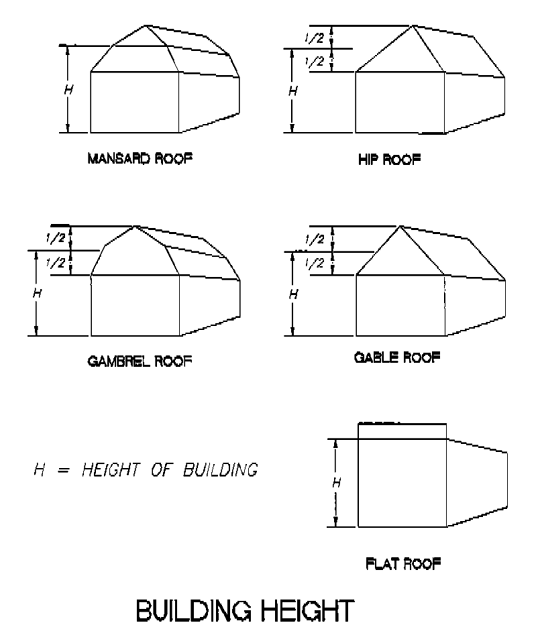
Building, height of, means the vertical distance from the grade at the center of the front of the building to the highest point of the roof surface in a flat roof, to the deck line for mansard roofs, and to the mean height level between eaves and ridge for gable, hip and gambrel roofs.
Building inspector means that person duly charged by the appropriate appointing authority with the responsibility for ensuring that buildings comply with the state construction code.
Conditional use means a use which, owing to some special characteristics attendant to its operation, is permitted within a given zoning district subject to planning commission review and approval by the village council, and subject to special requirements included in this chapter.
Condominium. The following definitions shall apply to all condominium developments:
(1)
Conventional condominium project means a development in which ownership interest is divided under the authority of the Condominium Act, Public Act No. 59 of 1978 (MCL 559.101 et seq.), and in which the condominium unit consists primarily of the dwelling or other principal structure and most of the land in the development is part of the general common area.
(2)
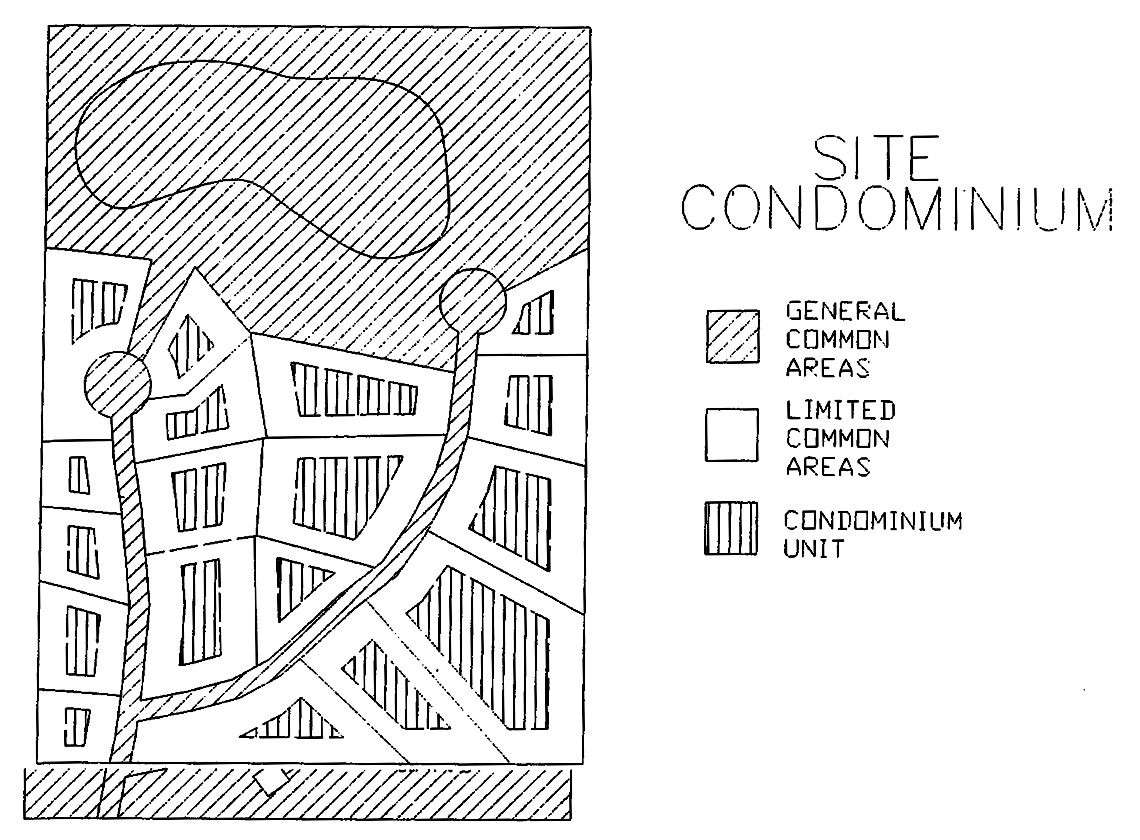
Site condominium project means a development in which ownership interest is divided under the authority of the Condominium Act, Public Act No. 59 of 1978 (MCL 559.101 et seq.), and in which the condominium unit consists of a building site, with or without structures, which, along with associated limited common area, constitutes the equivalent of a lot.
(3)
General common areas means portions of the condominium development owned and maintained by the condominium association.
(4)
Limited common areas means portions of the condominium development other than the condominium unit itself reserved for the exclusive use of less than all of the co-owners of the condominium development.
(5)
Condominium subdivision plan means drawings and information prepared pursuant to section 66 of the Condominium Act, Public Act No. 59 of 1978 (MCL 559.166).
(6)
Master deed means the condominium document recording the condominium project to which are attached as exhibits and incorporated by reference the bylaws for the project and including those items required in section 8 of the Condominium Act, Public Act No. 59 of 1978 (MCL 559.108).
(7)
Contractible condominium means a condominium project from which any portion of the submitted land or building may be withdrawn in accordance with the Condominium Act, Public Act No. 59 of 1978 (MCL 559.101 et seq.).
(8)
Conversion condominium means a condominium project containing condominium units, some or all of which were occupied before the filing of a notice of taking reservations under section 71 of the Condominium Act, Public Act No. 59 of 1978 (MCL 559.171).
(9)
Expandable condominium means a condominium project to which additional land may be added in accordance with the Condominium Act, Public Act No. 59 of 1978 (MCL 559.101 et seq.).
Dwelling, multiple-family, means a residential building designed for or occupied by three or more families, with the number of families in residence not exceeding the number of dwelling units provided.
Dwelling unit means one or more habitable rooms which are occupied or intended for occupancy by one family with facilities for living, sleeping, cooking and eating.
Family. A family shall be deemed as one of the following when living in a single dwelling unit:
(1)
A single individual.
(2)
A group of two or more persons related by blood, marriage or adoption.
(3)
A collective number of individuals domiciled together in one dwelling unit whose relationship is of a continuing, non-transient domestic character and who are cooking and living as a single nonprofit housekeeping unit. This definition shall not include any society, club, fraternity, sorority, association, half-way house, lodge, coterie, organization, group of students, or other individual whose domestic relationship is of a transitory or seasonal nature, is for an anticipated limited duration of school term or during a period of rehabilitation or treatment, or is otherwise not intended to be of a permanent nature.
Fence means a structure serving as an enclosure, barrier, or boundary, usually made of posts, boards, wire, stakes, or rails.
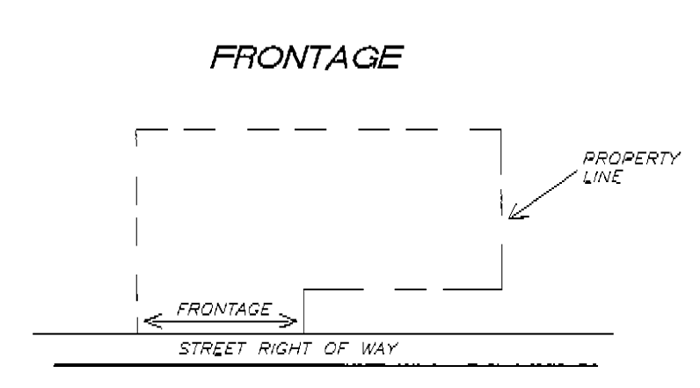
Frontage (lot) means the distance thereof of any lot fronting on one side of a street between side lot lines, intersecting or intercepting streets, or between a street and another right-of-way, waterway, end of a dead end street or village boundary measured along the street line.
Height of a sign means the vertical distance measured from the ground immediately beneath the sign to the highest point of its structure as defined in Chapter 24 Signs, Section 24.1 of this Code.
Loading space, off-street, means space logically and conveniently located for merchandise or passenger pickups and deliveries, located on the same lot with the use which it is to serve for the temporary parking of vehicles which are performing the said pickups and deliveries.
Lot means a parcel, tract or portion of land separated from other parcels or portions of land by description on a recorded plat or by metes and bounds description.
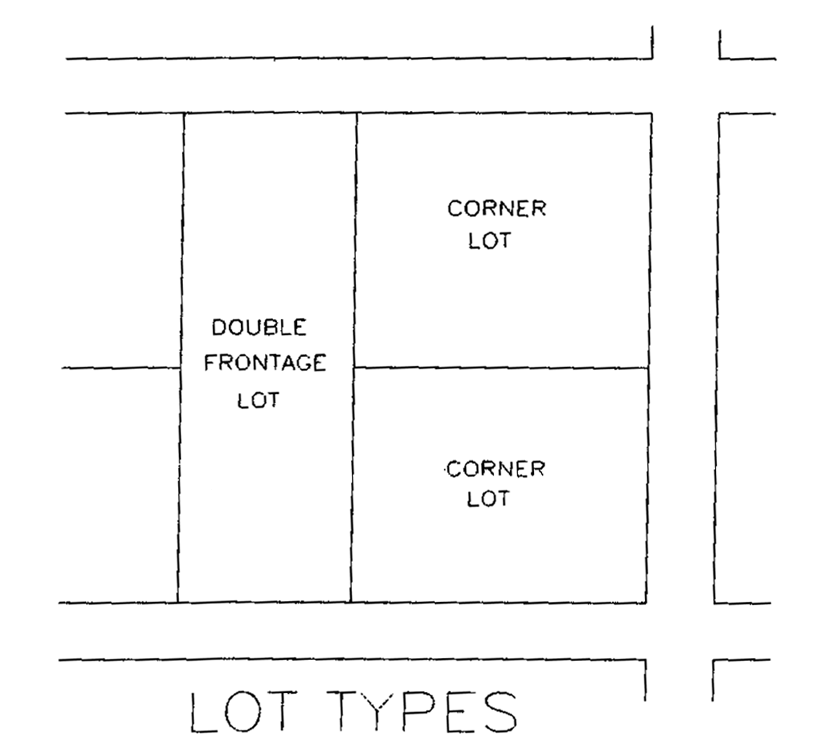
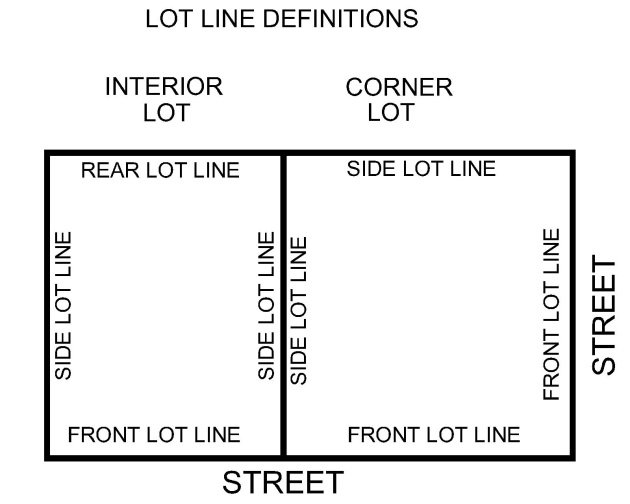
Lot, corner, means any lot having at least two contiguous sides abutting upon one or more streets or roads, provided that the interior angle at the intersection of such two sides is less than 135 degrees.
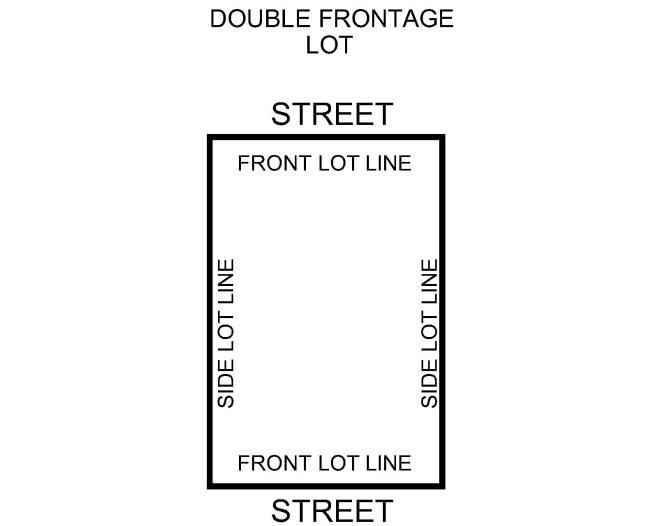
Lot, double frontage, means any lot having two or more sides abutting on more than one street or road. Any lot line separating the lot from any street or road shall be construed as being a front lot line.
Lot line means any line bounding a lot.
(1)
Front lot line means the lot line separating the lot from any street or road right-of-way.
(2)
Rear lot line means the lot line opposite to and most distant from the front lot line as designated for each lot; in the case of irregularly shaped lots, an imaginary line parallel to the front lot line but not less than ten feet long measured within said lot.
(3)
Side lot line means any lot line other than a front or rear lot line.
In the case of a corner lot, both lots fronting on the street shall be considered front lot lines, the opposite lot lines shall be considered side lot lines.
Lot, zoning, means a tract of land, which, at the time of filing for a zoning permit, is designated by its owner or developer as a tract to be used, developed, or built upon as a unit, under single ownership or control. A zoning lot may or may not coincide with a lot of record as filed with the county register of deeds, or may include one or more lots of record provided they are adjacent and under the same ownership. In cases where the zoning lots consist of more than a single lot of record, the village may require that the zoning lot be combined as one tax parcel per section 36-212(l) of this zoning ordinance.
Mobile home means a structure, transportable in one or more sections, which is built on a chassis and designed to be used as a dwelling with or without permanent foundation, when connected to the required utilities, and includes the plumbing, heating, air conditioning, and electrical systems contained in the structure.
Nonconforming use or structure means any use or structure which was lawfully existing immediately prior to the time the ordinance from which this chapter is derived became effective and which does not now comply with the requirements thereof.
Parking space, off-street, means any space used for the off-street parking of motor vehicles in all districts in accordance with section 36-273.
Personal services establishments means establishments offering services for a fee or other remuneration such as financial institutions, barbershops and beauty shops, clothing repair shops, professional offices and other similar uses.
Principal use means the primary or chief purpose for which a lot is used.
Recreational vehicle means a vehicle primarily designed and used as temporary living quarters for recreational, camping, or travel purposes, including a vehicle having its own motor power or a vehicle mounted on or drawn by another vehicle.
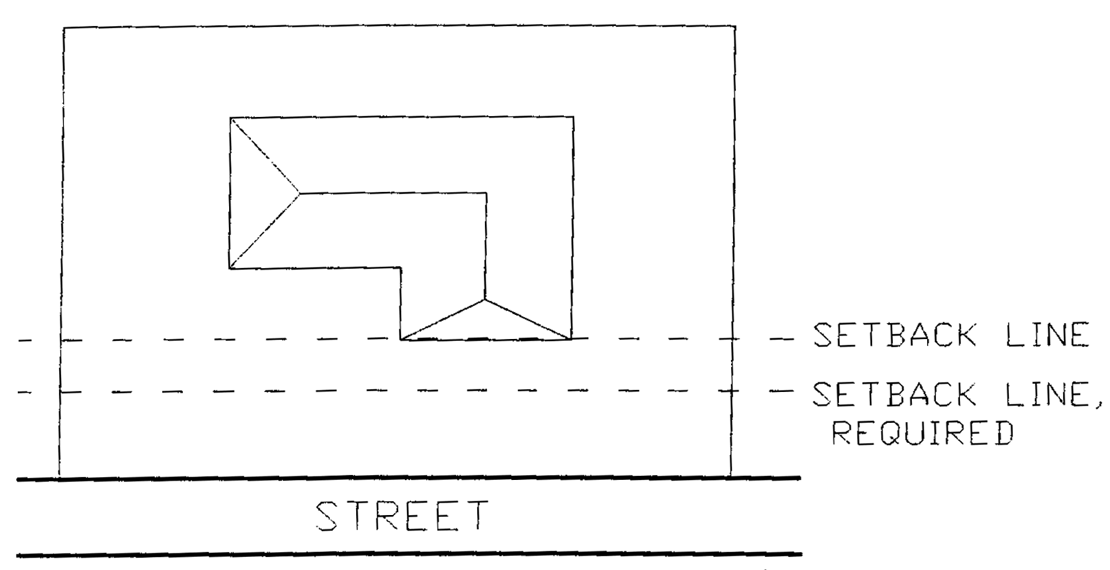
Setback line means a line formed by the face of the building, unless the roof eaves overhang more than two feet, in which case the setback shall be to the edge of the eaves.
Setback line, required. A required setback line is established by the minimum setback requirements of this chapter.
Sign. All of the terms related to signs in this chapter shall have the definitions given to them in chapter 24, pertaining to signs.
Stacking space means a space used by patrons waiting for and receiving service at a drive-through window.
Structure means anything constructed or erected with a fixed location on the ground, or attached to something having a fixed location on the ground including buildings and walls.
Structure, height of, means the vertical distance measured from the average established grade at the front of the structure to the highest point of the structure whether it be a roof, wall, parapet or similar appurtenance of the structure. The method used for measuring the height of a structure is different than the method used for measuring the height of a building.
Usable floor area means the total floor area occupied by a commercial use customarily open to the public for the sale of merchandise or services, or to serve clients or customers. Areas used or intended to be used principally for the storage or processing of merchandise, hallways, mechanical equipment rooms, rooms for heating and cooling equipment, and bathrooms shall be excluded.
Use means the purpose or activity for which the land or building thereon is arranged, occupied or maintained.
Variance means a departure from the literal provisions of this chapter authorized by the ZBA. Use variances allow uses not specifically listed as permitted uses in a given district. Non-use variances allow for departures from other requirements of this chapter including lot size, depth or width, building setbacks, etc. Use variances are not permitted under the provisions of this chapter.
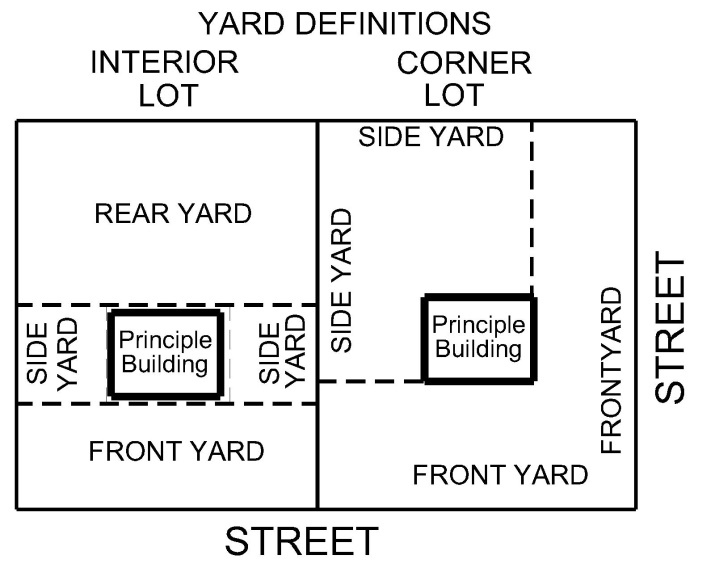
Yard, actual means an open space on the same land with a building or group of buildings, which open space lies between the building or group of buildings and the nearest lot line and is unoccupied and unobstructed from the ground upward, except as otherwise provided in this chapter.
Yard, front means an open space extending the full width of the lot, the uniform depth of which is measured at right angles to the front lot line.
Yard, required means an open space on the same land with a building or group of buildings, which open space lies between a lot line and the required setback from that lot line and is unoccupied and unobstructed from the ground upward, except as otherwise provided in this chapter.
Yard, rear means an open area extending across the full width of the lot, the uniform depth of which is measured at right angles to the rear lot line.
Yard, side means an open unoccupied area between a main building and the side lot lines, extending from the actual front yard to the actual rear yard. The width of the side yard shall be measured horizontally from and at right angles to the nearest point of the side lot line.
Zoning administrator means that person duly charged by the appropriate appointing authority with the responsibility for executing and administering this chapter.
Zoning board of appeals means that body authorized under Article VI of the Michigan Zoning Enabling Act PA 110 of 2006 and authorized to hear requests for variances, appeals, interpretations and other powers granted in under this chapter.
Zoning boundary lines means lines on the zoning map which indicate the limits of the individual zoning districts. Zoning boundary lines normally will follow the village limits lines, centerlines of roads, streets, alleys, easements, railroads or those centerlines extended or lot lines.
Zoning districts means the areas into which the village has been divided and for which the regulations and requirements governing use and size of lots and structures are specified in this chapter.
(Ord. No. 66, § 2, 9-14-2015; Ord. No. 68, § 2, 12-11-2017)

