
Robinson City Zoning Code
ARTICLE 11
- SUPPLEMENTARY DISTRICT REGULATIONS
Section 11.1 - Measurements and Special Cases.
The provisions of this section provide the method of measurement and set forth certain special cases relative to the dimensional standards in article 6 and other sections of this ordinance.
(Ord. No. 2022-019, § 1(Exh. A), 7-5-22)
Section 11.7 - Home Occupations.
The following regulations apply to the conduct of home occupations in any zoning district.
A.
General standards.
1.
A home occupation must take place in a stealth manner and give no appearance of the business or its activities from a street.
2.
The use of a dwelling unit for a home occupation must be clearly compatible, incidental, and subordinate to its use for residential purposes, and must under no circumstances change the residential character of the dwelling or property.
3.
Additional persons from outside the home may be employed at the home occupation. However, the total number of employees, clients, or patrons does not exceed the occupancy limit for the property.
4.
Signs advertising the home occupation are not permitted.
5.
The home and its property, including accessory structures, cannot be used to store inventory or materials for use on jobs at other addresses except as provided in subsection 11.7.D.
6.
It must comply with federal, state, and local law, including fire, building, health, sanitation, transportation, solid waste. hazardous waste, pollution, light, and noise control.
7.
Does not generate on-street parking or a substantial increase in traffic through the area.
8.
Does not substantially increase noise in the area or violate adopted noise standards.
B.
Prohibited characteristics.
1.
A home occupation that creates obnoxious noise, dust, odor, vibrations, glare, radio or television interference, increased traffic or generation of light or smoke is not permitted unless stated in subsection 11.7.D.
2.
No hazardous materials other than those commonly found within a residence shall be used or stored on the site. Such materials and equipment shall be limited to quantities that do not constitute a fire, health or safety hazard.
3.
Work or use in front yards or vehicles in excess of persons in the family living at the home and employed at the home occupation.
C.
Uses prohibited as home occupations. Notwithstanding compliance with subsection A above, prohibited home occupations include, but are not limited to the following uses:
1.
Repair garage;
2.
Beauty barber, or other personal care shop;
3.
Barber shop;
4.
Sexually oriented business;
5.
Contractors shop and storage yard;
6.
Data center beyond customary computer usage at a residence;
7.
Animal grooming;
8.
Massage establishment;
9.
Health club, weight and aerobic center;
10.
General retail or consignment sale other than garage sales allowed twice per year;
11.
Auto or other vehicle sales or rental;
12.
Machinery or equipment sales or rental;
13.
Kennel with or without outside runs;
14.
Uses that allow for the sale of alcohol or drugs.
D.
Permitted home occupations. Notwithstanding compliance with subsection A above, permitted home occupations include, but are not limited to the following uses:
1.
A day care or child care facility/in home is only allowed by specific use permit;
2.
All federal firearm dealer uses are allowed by-right with appropriate licensing from the Bureau of Alcohol, Tobacco, Firearms, and Explosives (ATF);
3.
Hosted residential short term or vacation rental facility (specific use permit may be required);
4.
Home day school or home school;
5.
Pet boarding/day care in home (number of pets limited by animal chapter of Code of Ordinances;
6.
Individual tutoring, instructional art or music lessons to no more than one family;
7.
Caterer.
(Ord. No. 2025-031, § 4, 9-2-25)
Section 11.8 - Alcoholic Beverages.
A.
The citizens of the City of Robinson have not approved package (liquor) stores or establishments for on-premise alcohol consumption without food handler's permit and more than 50 percent of gross daily sales from food sales. Retail sale of pre-packaged beer and wine for off-premise consumption is allowed, and mixed beverage sales for on-premise consumption at restaurants are allowed. However, pursuant to V.T.C.A., Alcoholic Beverage Code ch. 109, such operations are subject to certain regulations of the city.
B.
Operations devoted in whole or in part to the retail sale of pre-packaged beer and/or wine shall only be located within the C-1, C-2, R/O, and I zoning districts. In no circumstance may such an operation be located in a residential district.
C.
Operations devoted in whole or in part to the retail sale of pre-packaged beer and/or wine shall not be located within 300 feet of a church, public or private school, or public hospital. Measurement shall be in accordance with the Texas Alcoholic Beverage Code. The restriction with regard to proximity to a private school is subject to limited exceptions set forth in V.T.C.A., Alcoholic Beverage Code § 109.33(h).
D.
Operations devoted in whole or in part to the retail sale of pre-packaged beer and/or wine shall not be located within 300 feet of a day care or child care facility if the business does not hold a food and beverage certificate. Measurement shall be in accordance with the Texas Alcoholic Beverage Code.
Section 11.9 - Portable Storage Containers.
A.
A portable storage container is a container intended to store or transport personal property which is transported to a desired location for drop-off by truck or trailer. The common name for such containers is PODS, which is an acronym for portable on-demand storage.
B.
Portable storage containers are not permitted except for temporary use as set forth herein in the AG, RE, SF-1, SF-2, SF-3, MF-1, MF-2, MF-3, MH, PD, R/O, C-1, C-2, and I zoning districts.
C.
In the above-referenced zoning districts, a portable storage permit is required if a portable storage container is to be located on property for more than five days in a 360-day period. A portable storage permit must be obtained from the planning director. A permit fee set by the city council is applicable, and must be paid before the permit will issue. The permit duration is 30 days from issuance.
D.
The planning director may grant an extension not to exceed 30 days if the permit holder demonstrates extenuating circumstances beyond his/her control that justify the extension.
E.
If the portable storage container is being used directly in conjunction with work being performed under an unexpired city building permit, the container may be located on the property for a period not to exceed 180 days or the duration of the building permit, whichever is less. The building permit serves in place of the portable storage permit.
F.
Except as otherwise expressly provided in this subsection, the following standards apply to any use of a portable storage container in the above-identified zoning districts:
1.
only one such container is allowed per address in a 360-day period;
2.
if located in a front or side yard, the container must be placed on an asphalt or concrete surface;
3.
the container may not be placed on a street or on street right-of-way; and
4.
the placement of the container must comply with the setback requirements applicable to an accessory structure in the zoning district.
G.
The following exceptions apply:
1.
C-1, C-2, and I Districts. More than one container are allowed per 360-day period and no permit is required even if the total number of days that containers are located on the property exceeds five days in a 360-day period, provided that:
a.
the containers are used for shipping and receiving inventory;
b.
the containers are located in the rear yard of the property;
c.
the containers are placed on a concrete or asphalt surface;
d.
the containers comply with applicable setback requirements for the district; and
e.
on average each container is located on the property for a period of less than ten days.
2.
MF-1, MF-2 Districts. More than one container are allowed per 360-day period and no permit is required even if the total number of days that containers are located on the property exceeds five days in a 360-day period, provided that:
a.
the containers are used solely for moving the personal property of a new resident to the property or removing the personal property of a resident moving from the property;
b.
the containers are placed in an area that does not create a safety hazard; and
c.
each container is on the property for five days or less.
3.
R/O District. More than one container are allowed on the property in a 360-day period for purposes of moving into or out of a structure. A permit will be required for each separate container to be located on the property in excess of ten days in a 360-day period, but the day limit is container-specific.
H.
A portable storage container shall not be used as a permanent substitute for an accessory storage structure in any zoning district.
(Ord. No. 2022-019, § 1(Exh. A), 7-5-22)
Section 11.10 - Dumpsters.
Except for dumpsters customarily used for standard garbage collection for the use associated with the property, dumpsters are not allowed on property in a RE, SF-1, SF-2, SF- 3, and 2F zoning district except that one non-standard dumpster may be utilized on the property temporarily in connection with an unexpired city building permit for a maximum of 180 days or the duration of the permit, whichever is less. The dumpster must be placed on a concrete or asphalt surface if located in the front or side yard of a dwelling in a RE, SF-1, SF-2, SF-3 or 2F zoning district. The placement of the dumpster must comply with the setback requirements for an accessory structure in the applicable zoning district. In no circumstance may the dumpster encroach into the street right-of-way.
(Ord. No. 2022-019, § 1(Exh. A), 7-5-22)
Section 11.11 - Reserved.
Editor's note— Ord. No. 2025-007, § 1, adopted March 18, 2025, repealed §§ 11.11.1—11.11.4, which pertained to site plan approval and derived from Ord. No. 2022-019, § 1(Exh. A), 7-5-22.
11.1.1. - Minimum lot area.
Lot area is measured as the total area within the lot lines of the lot excluding any street rights-of-way.
(Ord. No. 2022-019, § 1(Exh. A), 7-5-22)
11.1.2. - Minimum lot width.
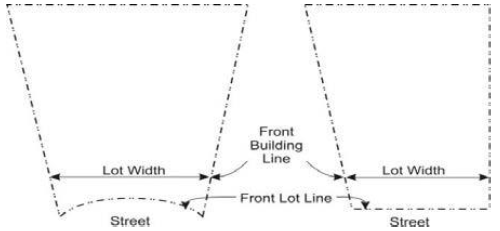
Lot width is measured as the distance between the side lot lines measured at the front building line parallel to the front property line or to the cord of the front property line.
(Ord. No. 2022-019, § 1(Exh. A), 7-5-22)
11.1.3. - Minimum lot depth.
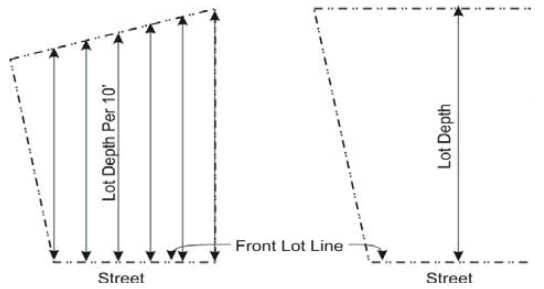
Lot depth is measured as the distance from the front lot line to the rear lot line. Where the front and rear lot lines are not parallel, the lot depth is measured by drawing lines from the front to the rear lot lines, at right angles to the front lot line every ten feet, and averaging the length of these lines.
(Ord. No. 2022-019, § 1(Exh. A), 7-5-22)
11.1.4. - Minimum yards.
A.
Open and unobstructed. Every part of a required front yard must be open and unobstructed except as authorized in this ordinance.
B.
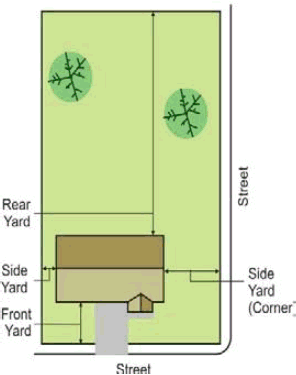
Types of yards. Required yard types are as follows: Front; side; side (corner); and rear.
C.
Measurement of yards. All required yards are measured from the front, side or rear property line to the nearest face of the building, covered porch, covered terrace or attached accessory building.
D.
Features allowed within required yards. The following features may be located within a required yard:
1.
Window sills, belt courses, cornices and other architectural features projecting a maximum of 12 inches into the required side yard; and
2.
Roof eaves or canopies projecting a maximum of 24 inches into the required side yard and a maximum of 48 inches into the required front yard.
3.
Window sills, belt courses, cornices, roof eaves or canopies and other architectural features projecting a maximum of 36 inches into the required rear yard.
4.
Fences that comply with the standards in article 8.
(Ord. No. 2022-019, § 1(Exh. A), 7-5-22)
11.1.8. - Intersection visibility triangle.
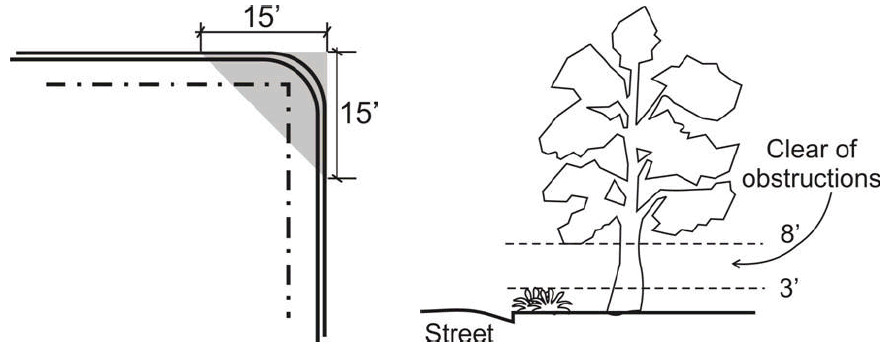
An intersection visibility triangle is established at all intersections where the streets, alleys and driveways intersect. It includes that portion of public street right-of-way and any corner lot in the triangular area formed by extending the curb lines of the intersecting streets to their imaginary point of intersection for the first point of the triangle, then proceeding back from this imaginary point of intersection 15 feet along the curb lines of the intersecting streets to establish the two remaining points of the triangle. These points must then be connected with imaginary lines, thereby forming a triangle. If there are no curbs existing, the triangular area is formed by extending the pavement edges to the imaginary point of intersection of the streets and then proceeding in the same manner described above.
A vehicle, fence, wall, screen, view obstruction, or foliage is not allowed within the intersection visibility triangle at elevations between three feet and eight feet above the average street grade. Obstructions of this nature are a public traffic nuisance. Obstruction of an intersection visibility triangle must be abated within ten days after written notice.
(Ord. No. 2022-019, § 1(Exh. A), 7-5-22)
11.2.1. - General.
All uses in the industrial zoning districts must conform in operation, location and construction to the performance standards specified in this section for noise, smoke and particulate matter, odorous matter, fire and explosive or hazardous matter, toxic and noxious matter, vibration and glare.
(Ord. No. 2022-019, § 1(Exh. A), 7-5-22)
11.2.2. - Noise.
A.
At no point at the property line may a zoning district receive sound pressure levels that exceed the decibel levels specified in the groups designated in the following table:
B.
Decibel (dB) means a unit of measure of sound pressure, or noise level. An increase by ten decibels doubles the volume.
C.
Measurement of the noise level must be made with a decibel meter meeting American National Standards Institute (ANSI) standards using the A-weighted scale.
D.
The noise levels included in this section are not applicable to extraction operations or emergency vehicles.
(Ord. No. 2022-019, § 1(Exh. A), 7-5-22)
11.2.3. - Smoke and particulate matter.
A use in the I zoning district may not cause, create or allow the emission of air contaminants that violate state or federal environmental laws. Open storage and open processing operations, including on-site transportation movements that are a source of wind or airborne dust or other particulate matter, are subject to the standards and regulations specified in this ordinance.
(Ord. No. 2022-019, § 1(Exh. A), 7-5-22)
11.2.4. - Odorous matter.
A.
A use may not be located or operated in the I zoning district that involves the emission of odorous matter from a source of operation where the odorous matter exceeds a concentration at the bounding property line or any point the tract on which such use or operation is located which, when diluted with an equal volume of odor free air, exceeds the odor threshold (two odor units).
B.
The code compliance officer determines the odor threshold as set forth in this ordinance by observation. In any case where uncertainty may arise or where the operator or owner of an odor emitting use may disagree with the enforcing officer or where specific measurement of odor concentration is required, the American Society for Testing of Materials, A.S.T.M.D. 1391-57, Entitled "STANDARD METHOD FOR MEASUREMENT OF ODOR IN ATMOSPHERES", method and procedures must be used and a copy of A.S.T.M.D. 1391-57 is incorporated herein by reference.
(Ord. No. 2022-019, § 1(Exh. A), 7-5-22)
11.2.5. - Fire and explosive hazard material.
A.
A use involving the manufacture or storage of compounds or products that decompose by detonation is not permitted in an I zoning district except that the fire chief may approve chlorates, nitrates, perchlorates phosphorus and similar substances and compounds in small quantities for use by industry, school laboratories, druggists or wholesalers if such substances do not present a fire or explosion hazard.
B.
The storage and use of all flammable liquids and materials such as pyroxylin plastics, nitrocellulose films, solvents and petroleum products are permitted only when such storage or use conforms to the standards and regulations of Chapter 9, Fire Prevention and Protection, of the Code of Ordinances.
(Ord. No. 2022-019, § 1(Exh. A), 7-5-22)
11.2.6. - Toxic and noxious matter.
A.
A use permitted in the I zoning district may not emit a concentration across the property line of the subject property of toxic or noxious matter that exceeds the concentration (exposure) deemed as the threshold limit for an industrial worker as the Texas Department of Health set forth such standards in Threshold Limit Values Occupational Health Regulation No. 3.
B.
A use permitted in the I zoning district may not emit a concentration across the bounding property line of the tract on which such operation or use violating state or federal environmental laws. Open storage and open processing operations, including on-site transportation movements that are a source of wind or airborne dust or other particulate matter, are subject to the standards and regulations specified in this ordinance.
(Ord. No. 2022-019, § 1(Exh. A), 7-5-22)
11.2.7. - Vibration.
A use in the I zoning district may not at any time create earthborn vibration that, when measured at the property line of the subject property, exceed the limit of displacement set forth in the following table in the frequency ranges specified.
(Ord. No. 2022-019, § 1(Exh. A), 7-5-22)
11.2.8. - Glare.
A use in an Industrial District may not be located or conducted so as to produce intense glare or direct illumination across the bounding property line from a visible source of illumination nor may any such light be of such intensity as to create a nuisance or detract from the use and enjoyment of adjacent property.
(Ord. No. 2022-019, § 1(Exh. A), 7-5-22)
11.3.1. - Applicability.
A.
The following access and circulation standards serve as an advisory guide in the determination of drive approaches within the City of Robinson. These standards address factors including curb cut placement, width, angle, number of approaches per tract and other elements as appropriate to provide adequate and safe access between private property and the public street system in the city.
B.
Notwithstanding the provisions of this section, the Texas Department of Transportation requires access points on state-maintained roads to conform to its access management policies.
(Ord. No. 2022-019, § 1(Exh. A), 7-5-22)
11.3.2. - Site plan required.
A site plan must be submitted with the building permit application demonstrating compliance with the standards of this section.
(Ord. No. 2022-019, § 1(Exh. A), 7-5-22)
11.3.3. - General.
A.
If a change in curb cuts or an additional curb cut is proposed which would result in an additional conflict with these regulations, the planning and zoning commission must determine the appropriateness of the request.
B.
The city may impose a more restrictive standard than contained in this section, in conjunction with review of a subdivision plat, if anticipated development under these standards will result in a dangerous or unsafe condition to the public.
C.
The linear feet of property frontage determine the maximum number of drive approaches allowed as shown in the tables in sections 11.3.5 and 11.3.6. Platting or replatting that reduces the property frontage may result in a reduction in the number of permitted drive approaches according to the standards in such tables.
D.
In conjunction with curb cuts approved under this section, medians, signage, striping or other traffic control devices may be required to be installed at the time of permit approval or at some time in the future as needed for public safety or welfare.
E.
Commercial and Industrial drive approaches as set forth in sections 11.3.5 and 11.3.6 must be set at an angle of between 45 and 90 degrees from an abutting two-way public street right-of-way or private access easement. One-way egress or ingress drive approaches may be reduced to an angle of 30 degrees.
F.
Where access to properties is desired at more frequent intervals than these standards permit, the property owner may install service roads or acceleration/deceleration lanes after the applicable authorities, including the director of planning and the Texas Department of Transportation, review and approval such plans.
(Ord. No. 2022-019, § 1(Exh. A), 7-5-22)
11.3.4. - Single- and two-family residential drive approaches.
A.
A drive approach for a single and two-family uses listed in the use table in section 5.2 is prohibited on arterial streets, unless the lot fronts on an arterial street on a final plat.
B.
Joint access curb cuts are encouraged where lots are less than 50 feet in width.
C.
The minimum corner clearance of a residential curb cut is 15 feet.
D.
The minimum radius for a residential curb cut is four feet, if provided.
E.
Where a circular residential driveway is proposed for a corner tract, both curb cuts must meet the minimum corner clearance of 15 feet as set forth in paragraph C above.
F.
Please see the typical details for public infrastructure for drive approach standard details.
(Ord. No. 2022-019, § 1(Exh. A), 7-5-22)
11.3.5. - Commercial, institutional, and multi-family drive approaches.
A.
A drive approach(es) for the commercial, institutional, and multi-family uses listed in the use table in section 5.1 must conform to the standards in the table below:
B.
Maximum drive approach widths and maximum number of drive approaches may be used only where the frontage is sufficient to achieve minimum corner clearance, curb return radii and suggested minimum island width. The width of the combined curb cuts must not exceed 50 percent of the lot frontage.
C.
One-way access curb cuts are permitted, but may not be less than 15 feet in width. The combination of one-way curb cut widths must not exceed the maximum width for a two-way curb cut based on lot frontage.
D.
A minimum edge clearance of five feet must be provided, unless a joint access drive approach is provided.
E.
Joint access curb cuts are encouraged where lots are less than 100 feet in width.
(Ord. No. 2022-019, § 1(Exh. A), 7-5-22)
11.3.6. - Industrial drive approaches.
A.
A drive approach for industrial uses set listed in the use table in section 5.2 must conform to the standards in the table below.
B.
Maximum drive approach widths and maximum number of drive approaches may be used only where the frontage is sufficient to achieve minimum corner clearance, curb return radii and suggested minimum island width.
C.
One-way access curb cuts are permitted, but may not be less than 25 feet. The combination of one-way curb cut widths must not exceed the maximum width for a two-way curb cut based on lot frontage.
(Ord. No. 2022-019, § 1(Exh. A), 7-5-22)
11.4.1. - Purpose.
The purpose of this section is to ensure that developments within the city provide adequate and reasonable parking and loading spaces necessary to serve the development.
(Ord. No. 2022-019, § 1(Exh. A), 7-5-22)
11.4.2. - Applicability.
A.
Except as provided in this section, a building or structure may not be erected, altered or converted for any permitted use unless off-street parking is provided as required in this section.
B.
An established use need not provide required off-street parking as set forth in this section. However, the number of parking spaces in an off-street parking area used in connection with said uses may not be reduced below the minimum number of spaces as required in this section. In addition, established uses without striped and paved parking facilities (concrete or hot mix asphalt) must provide striped and paved parking facilities with the change of use or business (tenant) name.
(Ord. No. 2022-019, § 1(Exh. A), 7-5-22)
11.4.3. - Parking plan required.
A parking plan must be submitted with the building permit application, certificate of occupancy application or as otherwise required demonstrating compliance with the standards of this section.
(Ord. No. 2022-019, § 1(Exh. A), 7-5-22)
11.4.4. - Off-street parking ratios.
A.
Rules for computing required parking and loading spaces. The following rules apply to the minimum parking space requirements set forth in the table below.
1.
Developments containing more than one use must provide parking and loading spaces in an amount equal to the total of the requirements for all uses.
2.
Ratios based on number of employees must be based on the largest number of persons working on any shift.
3.
The gross floor area of a structure devoted to off-street parking may be excluded in computing the off-street parking requirements of any use.
4.
The term "seats" includes "seating spaces" is used herein with regard to uses for which the number of required parking spaces is based on the number of seats [computed based on the maximum seating arrangement].
B.
Required parking ratios. Except as provided in paragraph C below, the following minimum off-street parking requirements apply to all zoning districts.
C.
Because of the limitations on land available for off-street parking development in the C- 2 zoning district, an application for a special exception from the parking requirements in the table above may be made to the zoning board of adjustment with regard to the development of property in the C-2 zoning district. In determining whether to grant the special exception, the zoning board of adjustment must consider:
1.
whether the applicant's plan maximizes the space, if any, actually available for off-street parking;
2.
whether on-street parking is available;
3.
whether any safety hazard or unreasonable impediment to traffic would be created; and
4.
whether an unreasonable burden to the area by the increased demand for on-street parking would be created if the special exception is granted.
The board of adjustment may grant the special exception requested, grant the special exception with conditions or modifications, or deny the special exception.
D.
Private access to parking lots for uses in C-1, C-2, I zoning districts must, where possible, not pass through any portion of a residential zoning district.
(Ord. No. 2022-019, § 1(Exh. A), 7-5-22)
11.4.5. - Off-street parking design standards.
A.
Dimensional and access standards. A typical 90-degree parking space must be striped and measure nine feet by 18 feet. Such space must not be located on a public street or in an alley. Except in the AG zoning district, parking areas must be paved with either asphalt or concrete. Except in the AG zoning district, a parking space or area must include an asphalt or concrete driveway connecting the parking space or area with a street or alley permitting free ingress and egress to the street or alley.
B.
Head-in parking.
1.
No off-street parking space or area may be designed to require or allow parking maneuvers to take place on the public street.
2.
The above provision does not apply to residential uses in the following zoning districts: AG, RE, SF-1, SF-2, SF-3, 2-F, PH, MF-1 (townhome uses only), MF-2 (townhome uses only), and MH if accessed from a local street or alley.
C.
On-street parking. On-street parking is permitted along local streets and adjacent to a mixed-use development or similar urban development via designated angled or parallel parking completely within the right-of-way where sidewalks are provided and thru-lanes are preserved in both directions. Half of the on-street parking immediately adjacent to a development may count toward the development's required off-street parking.
(Ord. No. 2022-019, § 1(Exh. A), 7-5-22)
11.4.6. - Parking requirements for new or unlisted uses.
A.
Where questions arise concerning the minimum off-street parking requirements for any use not specifically listed in the table in paragraph 11.4.4.B, the planning director may apply the parking requirements of a similar use to the use in question.
B.
Where a determination of the minimum parking requirements cannot be readily ascertained for new or unlisted uses according to paragraph A above, the minimum off-street parking requirements are established by the same process as provided in section 5.2 for classifying new and unlisted uses.
(Ord. No. 2022-019, § 1(Exh. A), 7-5-22)
11.4.7. - Off-street loading regulations.
Uses must provide off-street loading in accordance with this subsection.
A.
Except in the C-2, General Commercial zoning district, all non-residential uses except for those specified in paragraph C below must provide and maintain minimum off-street loading areas. Loading areas must be paved with either asphalt or concrete. Such off-street loading space may be adjacent to a public alley or private service drive or may consist of a truck berth within the structure. Such minimum off-street loading space or truck berth must consist of a minimum area of ten feet by 45 feet and such spaces or berths must be provided in accordance with the following table.
B.
The existence of a paved alley a minimum of 20 feet in width adjacent to the property is deemed the equivalent of one berth.
C.
For Office and professional uses and retail, service and light commercial uses as listed in the use table in section 5.2 located in zoning districts other than in the C-2, General Commercial zoning district, minimum off-street loading areas must be provided in accordance with the following table.
11.6.1. - Accessory uses.
A.
In RE, SF-1, SF-2, SF-3, 2F, MF-1, MF-2, MH and PD zoning districts that are residential in nature, the following accessory uses are permitted:
1.
Attached or detached garages;
2.
Tool sheds;
3.
Children's playhouses;
4.
Vegetable and flower gardens;
5.
Private greenhouses;
6.
Private pools;
7.
Pool cabanas or pool houses (recreational);
8.
Private tennis courts;
9.
Guest quarters for non-paying house guests used only for the occasional housing of guests of the occupant of the principal structure and not as a permanent dwelling;
10.
Domestic staff quarters;
11.
Other similar uses customarily accessory to a residential use that are not otherwise prohibited by this ordinance, other ordinances of the city or other law.
B.
In an AG zoning district, all accessory uses identified in section 5.2 are permitted. In addition, barns, stables and other structures customarily accessory to agricultural use are allowed.
C.
In R/O, C-1, and C-2 zoning districts, accessory uses not otherwise prohibited by this ordinance, another ordinance of the city, or other law are permitted where such uses are customarily accessory to the principal use.
D.
In I zoning districts, there may be any accessory use not prohibited by this ordinance, another ordinance of the city or other law as long as the use is related to or in support of the principal use and does not create unreasonable noise, dust or vibration.
E.
Certain conditions, restrictions or permit requirements may be contained in other sections of this ordinance with regard to a particular accessory use or with regard to an accessory use in a particular zoning district.
(Ord. No. 2022-019, § 1(Exh. A), 7-5-22)
11.6.2. - Accessory structures.
A.
Attached accessory structures and accessory structures within six feet of the principal structure must comply with the setback requirements applicable to the principal structure.
B.
In RE, SF-1, SF-2, SF-3, 2-F, MF-1, MF-2, and MH zoning districts, detached accessory structures must:
1.
be located on the rear half of the lot or behind the front façade of the principal structure;
2.
not cover more than 30 percent of the rear yard;
3.
be set back at least three feet from the side lot line (or ten feet setback if on a corner lot);
4.
be set back at least three feet from the rear lot line; and
5.
not be located closer than six feet from the principal structure or other accessory structures.
In addition, where a garage or carport is designed to be entered or exited from a side-street or an alley, the garage or carport must be set back at least 20 feet from the side-street or alley line to facilitate access without interference with traffic.
C.
In C-1, C-2, R/O, I zoning districts, the same setback requirements apply to an accessory structure as apply to the principal structure. If detached, the accessory structure must be located at least 25 feet away from the principal structure.
D.
Height restrictions for accessory structures are the same as for the principal structure in the particular zoning district.
E.
Other dimensional requirements may exist for a particular type of accessory structure or with regard to a particular accessory use as set forth in other sections of this ordinance. In addition, these dimensional allowances are in all cases subject to any contrary fire and safety code regulations.
F.
Accessory building and structures constructed of metal with a span greater than 24 feet must have a structural plan sealed by a professional engineer submitted to the building official prior to issuance of the building permit. In addition, if such an accessory building or structure is welded together rather than bolted together, the welder shall provide state credentials prior to issuance of the building permit.
G.
Foundation plans for accessory buildings and structures are not required to be sealed by a professional engineer.
H.
All new buildings with inhabitable area must have a permanent foundation. No new building with inhabitable area may be issued a building permit without a permanent foundation plan.
11.6.3. - Accessory dwelling units.
Accessory dwelling units shall be allowed on the same lot or tract as the main dwelling unit upon meeting the following standards:
A.
Only one (1) accessory dwelling unit may be constructed by right on any lot with an area not less than 12,000 square feet, unless a lesser lot area is found to be adequate for an accessory dwelling by the city council and is approved as a specific use permit.
B.
Accessory dwelling unit height, area and yard requirements shall be the same as the main structure. An accessory dwelling unit, other than a garage apartment, shall not exceed the height of the principle building on the lot it is constructed.
C.
All accessory dwelling units shall be separate from the main dwelling and must contain kitchen facilities.
D.
An accessory dwelling unit may be constructed only with the issuance of a building permit.
E.
An accessory dwelling unit may be sold only with the sale of the entire property, including the main dwelling unit.
F.
All accessory dwelling units shall be constructed to the rear of the main structure. No accessory buildings are permitted in the front yard setback.
G.
All city related utilities for accessory dwelling units shall follow established city procedures for connection.
H.
An accessory dwelling unit shall not exceed one-half (1/2) of the floor area of the main dwelling area.
I.
An accessory dwelling unit shall not be a HUD-Code Manufactured Home.
(Ord. No. 2022-019, § 1(Exh. A), 7-5-22; Ord. No. 2024-023, § 11, 9-3-24)
11.6.4. - Accessory dwelling units in non-residential districts.
Accessory dwelling units must be located within the main structure. Detached accessory dwelling units are prohibited in non-residential districts.
The following provisions apply to accessory dwelling units in all non-residential zoning districts:
1.
Only one accessory dwelling unit is permitted per lot.
2.
An accessory dwelling unit may not occupy more than 49 percent of the total gross floor area of the main structure.
3.
An employee of the business occupying the main structure and that employee's family are the only persons who may occupy an accessory dwelling unit.
4.
Parking is required for the accessory dwelling unit in accordance with article 11.
(Ord. No. 2022-019, § 1(Exh. A), 7-5-22)

