
Robinson City Zoning Code
ARTICLE 7
- LANDSCAPE REQUIREMENTS
Section 7.1 - Purpose and requirements.
The purpose of this article is to improve and protect the public health, safety and welfare by improving the design, quality and character of new development, ensuring that development proposals are sensitive to natural areas and features, ensure significant canopy shading to reduce glare and heat build-up, and enhance outdoor spaces, reduce erosion and storm water runoff, and mitigate air pollution.
(Ord. No. 2022-019, § 1(Exh. A), 7-5-22; Ord. No. 2025-003, § 2(Exh. A), 2-4-25)
Section 7.2. - Nonconforming Landscape.
All landscaping, or lack thereof, in existence at the time of the adoption of this ordinance, which does not meet the landscape requirements of this section, will be considered a nonconformity. Nonconforming landscaping will be subject to article 4, Nonconformities, unless otherwise provided in this section.
(Ord. No. 2022-019, § 1(Exh. A), 7-5-22)
7.1.1. - Events causing compliance.
This section establishes landscaping requirements in all zoning districts and for all developments and redevelopments. Land uses not previously subject to landscaping requirements may be required to comply with this section upon the occurrence of one of the following events:
A.
A change in zoning;
B.
Requirement of landscaping as conditions of a special use permit;
C.
An expansion or intensification of a use, whereby the existing irrigated landscaped area should exist or is proposed to be reduced;
D.
Main building footprint expansion whereby the use of the property affected by the expansion is changed or intensified; this does not include an expansion of an accessory structure or accessory dwelling unit;
E.
Issuance of a building permit for a new main building or structure; this does not include an accessory structure or accessory dwelling unit;
F.
Loss of legal nonconforming status.
(Ord. No. 2022-019, § 1(Exh. A), 7-5-22; Ord. No. 2025-003, § 2(Exh. A), 2-4-25)
7.1.2. - Landscape and irrigation plan required.
A.
Professional requirements. Depending on the landscape design elements the following requirements for professionals are as denoted below:
1.
Landscaping plans consisting of less than ten trees and/or less than 30 shrubs or ornamental grasses. The landscaping plan may be designed by the applicant or their designee, of which no license or seal is required on the plans.
2.
Landscaping plans consisting of between ten and 29 trees and/or between 30 and 89 shrubs or ornamental grasses. The landscaping plan shall be signed and sealed by a State licensed landscape architect, professional engineer, landscape design professional, licensed nurseryman, or urban forester.
3.
Landscape plans consisting of 30 or more trees and/or ninety (90) or more shrubs or ornamental grasses. The landscaping plan shall only be signed and sealed by a state licensed landscape architect.
B.
The landscape plan must be submitted as a part of the site development plan or a separate submittal as required. However, a landscape plan meeting the requirements of this ordinance shall be provided and approved prior to the issuance of a site development permit, or building permit, if a site development permit is not applicable, or prior to issuance of a certificate of occupancy, if a site development and/or building permit is not needed for the project.
C.
The landscape plan shall contain the following information:
1.
Drawn to scale;
2.
North arrow;
3.
Date of plan submittal;
4.
Location, size and species of all trees to be preserved. The method of preservation during the construction phase of development shall be according to section 7.1.6, Tree Protection;
5.
Location of all plants and landscaping material to be used including paving, benches, screens, fountains, statues, topography, ponds/lakes, or other landscape features;
6.
Size and type of all plant material to be used;
7.
Layout and description of irrigation, sprinkler or water system, including placement of water sources;
8.
Description of maintenance provisions of the landscape plan.
D.
If conventional irrigation is not proposed, then a description of an alternative irrigation method shall be submitted in place of the irrigation plan. The approved alternate irrigation method shall be at a minimum adequate to maintain the health of the plant material during initial growing season.
E.
Validation of using alternative irrigation measures to sustain healthy plantings shall be the burden of the applicant or designer of the landscape plan. In such case, the applicant shall obtain confirmation from a registered landscape architect that the approved species of plantings may be sustained by the alternative irrigation measures proposed. A note shall also be standard on the plan stating that all dead or decaying plantings will be promptly replaced by the property owner. In this event replacement trees must also be confirmed by a registered landscape architect as sustainable by the alternative irrigation.
F.
The irrigation plan is required and shall be prepared by a licensed irrigator. The irrigation plan must be prepared in accordance with adopted local and/or state policy and will need to be approved by the city prior to any development permitting activity.
G.
The irrigation plan shall contain at a minimum the following:
1.
Layout and description of the complete irrigation, sprinkler or water system, including placement of water sources, cross-connection control measures, spray heads, drip irrigation lines, rain sensors, station layout and all other components of the irrigation system.
2.
Persons responsible for the preparation of the irrigation plan including the licensed irrigators shall stamp or seal, sign and date the plan.
(Ord. No. 2022-019, § 1(Exh. A), 7-5-22; Ord. No. 2025-003, § 2(Exh. A), 2-4-25)
7.1.3. - General lanscaping requirements for all zoning districts.
A.
For multi-family and non-residential development, a minimum of 20 percent of the total land area in any proposed development or construction that occurs for any use after the effective date of this ordinance shall be landscaped. This 20 percent requirement shall apply to each phase as it is developed.
B.
Trees shall be a minimum of two inch caliper at the time of installation.
C.
For multi-family and non-residential development there shall be one canopy tree is required for every 50 feet of frontage (exclusive of drive approach throat widths) and these trees are in addition to the overall tree requirement. These trees may be planted uniformly spaced or not as long as spacing is such that canopies may mature without conflict with each other or exterior lighting.
D.
Where the construction is to be a single phase of a multi-phase development, only the area being constructed in the current phase need be subject to the landscape regulations. However, each phase will be required to meet the landscaping requirements as they may hereafter be amended when that phase is developed.
E.
Artificial plants or turf and above ground planters are allowed but do not count toward required plantings. The such must be maintained in good condition and not weathered.
F.
Shrubs shall be a minimum of three gallon container size at the times of installation.
G.
The director may grant exceptions to this section to require a lesser amount of landscaping if the intent of this article is met, and the reduction of the landscape area results in the preservation of natural features having comparable value.
H.
For multi-family and non-residential development there shall be a 15 foot landscape buffer located along the rights-of-way. No buildings or parking facilities shall be located within this landscape buffer. All landscaping that occurs within this 15 foot buffer may be included within the landscape calculation toward meeting the landscape requirements. In situations where there are parallel easements, this landscape buffer shall be located outside of these parallel easements and as close to the right-of-way as possible.
I.
No more than 50 percent of the required trees, shrubs, or ornamental grasses shall be of the same species.
J.
All landscape material shall comply with sight visibility triangle requirements in this appendix.
K.
No trees or shrubs shall be placed within 15 feet of transmission power lines. This subsection shall supersede any requirements in this article.
L.
Only trees or shrubs that are designated to grow at maximum maturity of 20 feet or less in height shall be placed within 15 feet of sub-transmission or distribution power lines. This subsection shall supersede any requirements in this article.
M.
If grass is disturbed or removed in the landscape area within the street yard, newly planted drought tolerant grass is required.
N.
If grass is disturbed or removed in the landscape area outside the street yard it must be planted with drought tolerant grass, or ground cover consisting of live plant materials, or mulch, or pervious decorative ground cover, or any combined types in this definition.
(Ord. No. 2022-019, § 1(Exh. A), 7-5-22; Ord. No. 2025-003, § 2(Exh. A), 2-4-25)
7.1.4. - Special landscaping requirements for certain zoning districts.
A.
Within the MH, MF-1, MF-2, R/O, C-1, C-2 zoning categories. The minimum plantings for every 1,000 square feet of required landscape area shall be one canopy tree, two ornamental trees and six shrubs or ornamental grasses. The director may grant exceptions to this subsection to require a lesser amount of landscaping if the intent of this article is met, and the reduction of the landscape area results in the preservation of natural features having comparable value.
B.
Within the I zoning category. The minimum plantings for every 5,000 square feet of required landscape area shall be one canopy tree and two ornamental trees. The director may grant exceptions to this subsection to require a lesser amount of landscaping if the intent of this article is met, and the reduction of the landscape area results in the preservation of natural features having comparable value.
C.
Within the PDD zoning category. This shall be as listed within the PDD master development plan.
(Ord. No. 2022-019, § 1(Exh. A), 7-5-22; Ord. No. 2025-003, § 2(Exh. A), 2-4-25)
7.1.5. - Tree survey.
A tree survey shall be provided for any new construction prior to permit issuance. The requirements of a tree survey may be waived if a state licensed landscape architect, surveyor, or professional engineer certifies the removed trees are less than six inch caliper. A tree survey will also be required for any remodeling/construction that proposes to enlarge the footprint of the structure and/or requires a building permit. Exception: The planning and development director may waive trees from the tree survey if the tree is located within the proposed building footprint or the grading and/or drainage plan for a development necessitates the trees' removal, trees that cannot survive or thrive due to a change in topography, ponding of water drowning the tree, or the tree obstructing drainage flows are examples of trees exempt from the required tree survey.
A.
This requirement is limited to sites which are located in any non-residential district or for any non-residential use located in a residential district.
B.
The tree survey shall be provided prior to any construction, including any earthwork on any site.
C.
The survey shall be submitted with the site development plan or building permit application (if no site development plan is required). As soon as the city approves the tree survey, earthwork may be initiated in accordance to the discretion of the city; however, no work may be initiated on structural elements of the building without an approved building permit.
D.
The tree survey shall show the exact location of the tree, size of the tree measured by diameter, and the common name of all trees of a six inch caliper or larger.
(Ord. No. 2022-019, § 1(Exh. A), 7-5-22; Ord. No. 2025-003, § 2(Exh. A), 2-4-25)
7.1.6. - Tree protection and preservation.
The following procedures shall be followed on all construction projects to protect existing trees to be preserved in order to satisfy the requirements of this section:
A.
All preserved trees shall be flagged with bright fluorescent orange vinyl tape wrapped around the main trunk at a height of four feet or more so that the tape is very visible to workers operating construction equipment.
B.
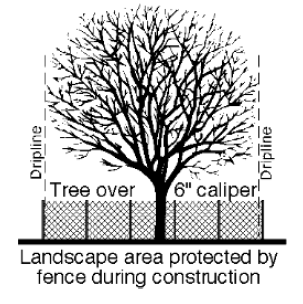
A protective fencing is required for trees to be preserved if located so close to the construction area that construction equipment will infringe upon the root systems. The fence will be placed between the trees and the construction activity in a manner to ensure that the tree roots, up to the drip line, will be protected from construction equipment.
C.
In all zoning districts, ten percent of existing trees shall be preserved, where they are six or more inches in diameter as measured 24 inches above ground. Hackberry trees are exempt from this requirement.
(Ord. No. 2022-019, § 1(Exh. A), 7-5-22; Ord. No. 2025-003, § 2(Exh. A), 2-4-25)
7.1.7. - Alternative landscape plan.
A.
An application for an alternative landscape plan may be submitted for consideration by the director when site conditions make strict compliance with the landscape requirements undesirable or impractical. Examples of such site conditions include, but are not limited to, the following:
1.
Existing buildings, site, utilities, or other improvements.
2.
Unusual shape of lot, tract, or building site.
3.
Topography, soil, geologic, vegetation, or other natural feature.
4.
Safety (e.g. vehicle sight distance, impediments to vehicle maneuvering, visibility of traffic or safety related signage).
5.
Type of land use (e.g. food processing facility, airport).
B.
The alternative landscape plan shall, as a whole, meet or exceed the standards of this article. When a provision is reduced, the plan shall increase other provisions to off-set any noncompliance. For instance, if landscaping plantings are reduced in one area, plantings in other areas that will have a similar beneficial impact shall be increased by an equal or greater amount. If the area of landscaping is decreased, the number of plantings shall be increased.
C.
The director shall consider an alternative landscape plan in accordance with the findings of fact criteria of a special exception. If the decision is to approve, this landscape plan becomes the official landscape plan for the site. If the decision is to disapprove, the director shall state reasons.
D.
Any applicant aggrieved by the decision may file a special exception in accordance with this appendix.
(Ord. No. 2025-003, § 2(Exh. A), 2-4-25)
7.1.8. - Parking area requirements.
Landscaping requirements pertaining to parking areas are as follows:
A.
Landscape planting shall not be erected or installed in such a manner to interfere with exterior lighting, traffic view or impose safety hazards.
B.
Where parking stalls abut and face the landscape buffer along the right-of-way; evergreen shrubs must be provided for screening at a ratio of three shrubs at each parking space. The screening must be established and then maintained no higher than three feet above the adjacent parking space. If the parking spaces are located 50 feet or more from the right-of-way line, no screening shrubs is required.
C.
A landscaped berm may be provided in lieu of or in combination with the required shrubs. The berm must be 18 inches to 40 inches above the average grade of the street and the parking lot curb with a slope not to exceed 3:1. If the parking spaces are located 50 feet or more from the right-of-way line, no berm is required.
D.
Interior parking lot landscaped areas shall have a minimum of one canopy tree in each landscape island. These required trees shall be counted as part of the landscape installation requirements. Additionally, interior parking lot landscaping shall be provided in accordance with the following:
1.
If ten or more parking spaces are required, a landscaped parking island (9' x 18' minus necessary turning radii area) shall be provided at each terminus of a row of parking spaces. Exception — No landscape island is required at the terminus of a row of parking that ends with required Americans with Disabilities Act (ADA) parking, loading/unloading, and route to building entrance areas.
2.
A maximum of 15 parking spaces may be located in a row of parking before an additional internal landscaped parking island (162 square feet in area) is required to break up the run of parking spaces. These shall be independent of the minimum landscape island calculations in this section, but shall count towards the minimum landscaping island standards in this section.
3.
Parking lot landscaping shall be met for all tenant, customer and employee parking. Parking lot landscaping requirements do not apply to storage or standing parking spaces incidental to uses such as sales and rental of motor vehicles, mobile homes, boats, trailers or other similar uses.
4.
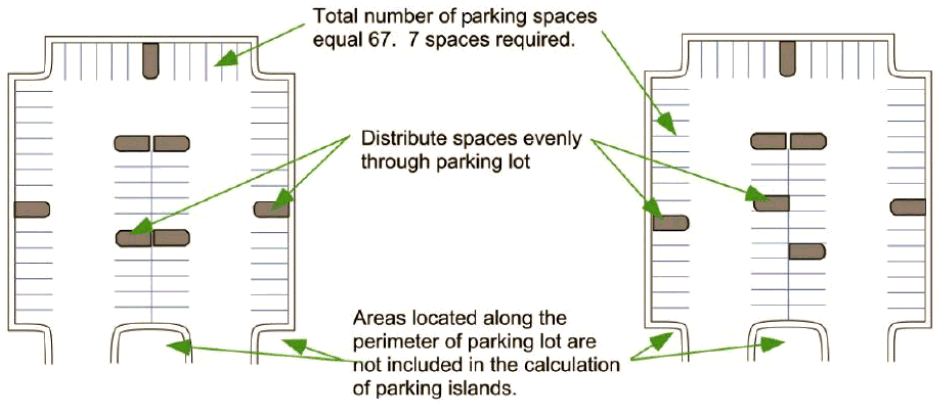
To calculate the total number of landscaped islands required for interior lot landscaping:
(1)
Determine the total number of parking spaces required for the site.
(2)
Divide that number by 12 to determine the total number of landscaped islands required. Fractions shall be rounded up to the next whole number.
(3)
Landscaping areas located along the outside perimeter of the parking lot may not be used to meet the parking lot landscaping requirement.
E.
The required landscaping for parking lots shall be more or less evenly distributed throughout the parking lot, although adjustments may be approved by the director where the shape and size of the parking lot, the location of existing trees or other natural constraints reasonably prevent such distribution.
F.
All landscaped areas, including the permeable areas and drip lines around trees and planting beds used for visual screening which abut any parking lot or vehicular travel area, shall be protected with changes in grade, curbs, tire stops/parking blocks or similar barriers sufficient to protect them from vehicular intrusion. Parking stall depths shall be measured from the appropriate curbs, and tire stops shall be placed to provide two feet of vehicle overhang.
(Ord. No. 2022-019, § 1(Exh. A), 7-5-22; Ord. No. 2025-003, § 2(Exh. A), 2-4-25)
7.3.1. - General.
A.
All required landscaped area shall be permanently landscaped with living plant material and be served with an automatic irrigation system. Water conservation measures are highly encouraged.
B.
Landscaped areas shall be kept free of trash, litter, weeds, and other such material or plants not a part of the landscaping.
C.
All plant materials shall be maintained in a healthy and growing condition as is appropriate for the season of the year. Maintenance shall include mowing, watering, trimming, pruning, etc.
D.
Plant materials which die shall be replaced with plant material of similar variety and size within 90 calendar days, with a one-time extension not exceeding 90 calendar days being provided upon approval of the director of planning and development or his designee.
(Ord. No. 2022-019, § 1(Exh. A), 7-5-22; Ord. No. 2025-003, § 2(Exh. A), 2-4-25)
7.3.2. - Certificate of occupancy.
A.
All landscaping shall be completed and installed in accordance with the approved landscape plan prior to a certificate of occupancy being granted. A one-time, temporary certificate of occupancy, not to exceed 90 calendar days, may be granted based upon documentation of a hardship.
B.
If a temporary certificate of occupancy is granted and the landscaping requirements have not been satisfied within the 90 calendar-day period from when the temporary certificate of occupancy is issued,
(Ord. No. 2022-019, § 1(Exh. A), 7-5-22; Ord. No. 2025-003, § 2(Exh. A), 2-4-25)
7.3.3. - Approved landscaping standards.
Trees, shrubs, ornamental grasses, and grasses (excluding St. Augustine Grass) listed within the "Native and Adapted Landscape Plants; an Earthwise Guide for Central Texas." Alternative species may be used upon approval by the director.
(Ord. No. 2022-019, § 1(Exh. A), 7-5-22; Ord. No. 2025-003, § 2(Exh. A), 2-4-25)

