
Robinson City Zoning Code
ARTICLE 12
- DEFINITIONS
Section 12.1 - Purpose.
For the purpose of these regulations, certain terms and words are to be used and interpreted as defined hereinafter. Words used in the present tense shall include the future tense; words in the singular number include the plural and words in the plural number include the singular, except where the natural construction of the writing indicates otherwise. The word shall be mandatory and not directory.
Section 12.2. - General Definitions
Antenna: See article 9, Personal Wireless Service Facilities — Definitions.
Alley: A minor right-of-way, dedicated to public use, which affords a secondary means of vehicular access to the back or side of properties otherwise abutting a street, and which may be used for public utility purposes.
Automobile: A self-propelled mechanical vehicle designed for use on streets and highways for the conveyance of goods and people including but not limited to the following: Passenger cars, trucks, buses, motor scooters and motorcycles.
Basement (or cellar): A story partly or wholly underground. For purposes of height measurement, a basement shall be counted as a story when more than one-half of its height is above the average level of the adjoining ground or when subdivided and used for commercial or dwelling purposes by other than a janitor employed on the premises.
Board: The city board of adjustment.
Building: Any structure greater than 120 square feet intended for shelter, occupancy, housing or enclosure for persons, animals or chattel. When separated by dividing walls without openings, each portion of such structure so separated shall be deemed a separate building.
Building coverage: Building coverage is the measurement of the maximum percent of a lot or tract that the roof or first floor of a building may cover. Roof eaves extending less than three feet from the walls of a building, swimming pools, uncovered porches, patios or decks may be excluded from the building coverage computations.
Building footprint: The calculated square footage of any building or structure based upon the outline of the total area of a lot or site that is surrounded by the exterior walls of the main floor of such building or portion of building. In the absence of surrounding exterior walls, the building footprint shall be the area under the horizontal projection of the roof supported by posts or additional foundation support. Uncovered courtyards shall not be included in this definition.
Building height: The vertical distance from the average grade of that portion of the lot covered by the building to the highest point of the building, excluding those features permitted for "additional height" in each zoning district.
Building line: A line parallel, or approximately parallel, to any front lot line at a specific distance there from, marking the minimum distance from the front lot line that a building may be erected.
Building, main: A building in which the principal use of the lot on which it is situated is conducted. In a residential district any dwelling or attached garage shall be deemed to be a main building on the lot on which it is situated.
Building official: The inspector or administrative official charged with responsibility for issuing permits and enforcing the zoning ordinance and building code.
Carport: A structure open on a minimum of two sides designed or used to shelter not more than three vehicles and not to exceed 24 feet on its longest dimension. Also called covered parking area.
Certificate of occupancy: An official certificate issued by the city through the building official which indicates conformance with or approved conditional waiver from the zoning regulations and authorizes legal use of the premises for which it is issued; may be referred to as an occupancy permit.
City: The City of Robinson, Texas.
City council: The governing body of the City of Robinson, Texas.
Commission: The city planning and zoning commission.
Comprehensive plan: Graphic and textual form policies which govern the future development of the city and which consist of various components governing specific geographic areas and functions and services of the city.
Council: See "City council."
Court: An open, unobstructed space, bounded on more than two sides by the walls of a building. An inner court is entirely surrounded by the exterior walls of a building. An outer court has one side open to a street, alley, yard, or other permanent open space.
Coverage, building: See "building coverage."
Coverage, impervious: The lot area covered by all buildings and paved areas, including parking lots, driveways, sidewalks, pools, porches and patios.
Department: The city planning and development department.
Director: The city planning and development director of the department.
District: Any section or sections of the city for which the regulations governing the use of land and the use, density, bulk, height and coverage of buildings and other structures are uniform for each class or kind of building therein.
Dwelling: Any building or portion thereof, which is designed or used as living quarters for one or more families, but not including mobile homes. (See "mobile home.")
Dwelling unit area: That area devoted to the living area in a residence or dwelling unit and is exclusive of porches, enclosed or open breezeways, storage area or closets, or other non-living space. The minimum dwelling unit area will generally be that space which is air conditioned.
Dwelling unit (model): A single-family dwelling in a developing subdivision located on a legal lot of record that is limited to temporary use as a sales office for the subdivision and to provide an example of the dwellings which have been built or which are proposed to be built in the same subdivision.
Easement: A grant of one or more of the property rights by the property owner to and/or for the use by the public, a corporation or another person or entity.
Electric, distribution lines: Lines that carry transmission voltages of 34 kilovolts or less of electricity.
Electric, sub-transmission lines: Lines that carry transmission voltages of between 35 kilovolts and 68 kilovolts of electricity.
Electric, transmission lines: Lines that carry transmission voltages of 69 kilovolts or more of electricity.
Exhibition area: An area or space either outside or within a building for the display of topic-specific goods or information.
Family: One or more persons related by blood, marriage, or adoption, or a group not to exceed four persons not all related by blood or marriage, adoption or guardianship, occupying a dwelling unit and living as a single housekeeping unit.
Flood plain: An area of land subject to inundation by a 100-year frequency flood, as shown on the FEMA flood plain map of the City of Robinson.
Floor area: The total gross square feet of floor space within the outside dimensions of a building including each floor level, but excluding carports, residential garages, and breezeways.
Floor area ratio (FAR): The floor area of a main building or buildings on a lot, divided by the lot area.
Garage, parking: Any building, or portion thereof, used for the storage of four or more automobiles in which any servicing provided is incidental to the primary storage use, and where repair facilities are not provided.
Garage, private: An enclosed (on at least three sides) building, or a part of a main building, used for storage of automobiles and used solely by the occupants and their guests of a main building. Also called "enclosed parking space."
Heavy load vehicle: A self-propelled vehicle having a manufacturer's recommended gross vehicle weight (GVW) of greater than 11,000 pounds, such as large recreational vehicles (originally manufactured as RVs, not converted), tractor-trailers, buses, vans, and other similar vehicles. The term "truck" shall be construed to mean "heavy load vehicle" unless specifically stated otherwise.
Improved hard surface: An area set aside on private property for the temporary or permanent placement of motor vehicles, trailers, equipment, merchandise and other similar tangible property, which must be comprised of paved concrete or hot-mix asphalt.
Incidental use: Any use different from the primary use but which compliments and/or supplements the primary use. Incidental shall mean an area which constitutes not more than 15 percent of the main use.
Irrigation, alternative: For the purpose of article 7, Landscape Requirements, alternative irrigation is defined as utilizing a variety of methods including but not limited to water trucks, hand watering, surface run PVC lines, rain collection systems, etc. Alternative irrigation almost never includes underground components.
Irrigation, conventional: For the purpose of article 8, Landscape Requirements, conventional irrigation is defined as irrigation that is underground and includes any irrigation method using underground water lines for landscaping.
Landscaping: Material such as, but not limited to, grass, groundcovers, shrubs, vines, hedges, trees or palms, and non-living durable material commonly used in landscaping, such as, but not limited to, rocks, pebbles, sand, walls or fences, but excluding paving.
Light load vehicles: A self-propelled vehicle having a manufacturer's recommended gross vehicle weight (GVW) not greater than 11,000 pounds and having no more than two axles, such as pick-up trucks, vans, recreational vehicles (less than 32 feet in length), campers and other similar vehicles but not including automobiles and motorcycles.
Loading space: An off-street space or berth used for the delivery and loading or unloading of vehicles.
Lot: Any plot of land occupied or intended to be occupied by one main building and the required parking, or a group of main buildings, and accessory building and uses, including such open spaces as are required by the ordinance, and other laws or ordinances, and having its principal frontage on a public street or officially approved place.
Lot, area: The total area, measured on a horizontal plane, included within lot lines.
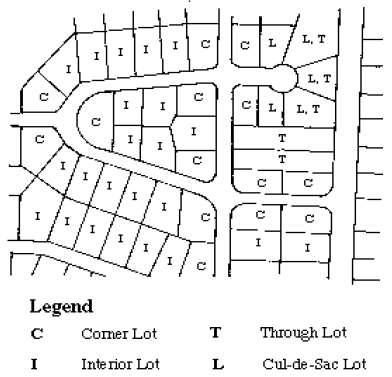
Lot, corner: A lot which has at least two adjacent sides abutting for their full lengths on a street, provided that the interior angle at the intersection of such two sides is less than 135 degrees.
Lot, depth: The mean horizontal distance between the front and rear lot lines.
Lot, double frontage: A lot having a frontage on two non-intersecting streets, as distinguished from a corner lot.
Lot, flag or panhandle: A lot having access to a street by means of a parcel of land having a depth greater than its frontage, and having a width less than the minimum required lot width, but not less than 25 feet. The maximum distance of the area less than the required width from the front property line shall be 110 feet.
Lot, interior: A lot other than a corner lot.
Lot, key: A corner lot that is so designed that the lots located directly behind it face the side street of the corner lot and are not separated by an alley.
Lot frontage: That dimension of a lot or portion of a lot abutting on a street, excluding the side dimension of a corner lot.
Lot line, front: The narrower side of the lot abutting a street. Where two lot lines abutting streets are of equal length, the owner shall have a choice in designating which shall be the lot frontage. For a lot which has a boundary line which does not abut the front street line, is not a rear lot line and lies along the same general directional orientation as the front and rear lot lines, said line shall be considered a front lot line in establishing minimum setback lines.
Lot line, rear: The lot line farthest from and most parallel to the front lot line. For triangular lots, the point opposite the front lot line shall be considered the rear lot line and have a value of zero.
Lot line, side: Any lot line not the front or rear lot line.
Lot lines or property lines: The lines bounding a lot as defined herein.
Lot of record: A lot which is part of a subdivision, the plat of which has been recorded in the office of the County Clerk of McLennan County.
Lot, through: A lot having its front and rear lines on different streets, or having its front or rear line on a street and the other line on a river, lake, creek, or other permanent body of water.
Lot width: The horizontal distance measured between side lot lines parallel to the front lot line, and measured from the point on the building line which is closest to the front lot line.
Major thoroughfare: A dedicated street or highway route designated as a neighborhood collector or arterial by the thoroughfare plan (transportation plan) map of the comprehensive plan.
Model residential unit: See "dwelling unit, model."
Motorcycle: A usually two-wheeled self-propelled vehicle having one or two saddles or seats, and which may have a sidecar attached. For purposes of this ordinance, motorbikes, motor scooters, mopeds, and similar vehicles are classified as motorcycles.
Motor vehicle: Any vehicle designed to carry one or more persons which is propelled or drawn by mechanical power, such as automobiles, trucks, motorcycles, and buses.
Nonconformity: A building, lot of record, use of land or a building, method or requirement for development, or other such use or structure that was lawful when commenced but which are contrary to the regulations set forth in the zoning ordinance because of future amendments to the zoning ordinance, annexation into the city, or eminent domain.
Occupancy: The use or intended use of the land or buildings by proprietors or tenants.
Officially approved place of access: Access, other than a dedicated street, to a property which is approved by the City of Robinson.
Ornamental grasses: A grass-like plant grown in a landscape bed similarly to annuals and perennials which typically requires minimal maintenance and irrigation, and dies back or requires cutting back each winter.
Parking lot: An off-street, ground level area, with an improved hard surface (such as concrete, brick or asphalt) for the temporary placement of motor vehicles.
Parking space: An area designated for off-street parking of one vehicle in accordance with the parking size table in this ordinance nine feet wide by 18 feet in depth for 90-degree head-in parking.
Planned development district: Planned associations of uses developed as integral land use units such as industrial parks or industrial districts, offices, commercial or service centers, shopping centers, residential developments of multiple or mixed housing, including attached single-family dwellings or any appropriate combination of uses which may be planned, developed or operated as integral land use units either by a single owner or a combination of owners.
Planning and zoning commission: A board, appointed by the city council as an advisory body, authorized to recommend changes in the zoning and other planning functions as delegated by the city council. Also referred to as the "commission."
Plat: A plan of a subdivision of land creating building lots or tracts and showing all essential dimensions and other information essential to comply with the subdivision standards of the City of Robinson and subject to approval by the planning and zoning commission and city council and filed in the plat records of McLennan County.
Plot: A single unit or parcel of land or a parcel of land that can be identified and referenced to a recorded plat or map.
Premises: Land together with any buildings or structures situated thereon.
Primary use: The principal or predominant use of any lot or building.
Principal building: Same as "main building."
Recreational vehicle (RV): A portable or mobile living unit used for temporary human occupancy away from the place of permanent residence of the occupants and self-propelled (motorized). Also see "heavy load vehicle."
Refuse facilities: Containers that are recognized and utilized by the city or the city's refuse collection service, that are used to temporarily store trash and refuse on a lot until a refuse collection truck empties them (including, but not limited to metal dumpsters, plastic refuse carts and individual plastic refuse containers).
Residence: Same as a "dwelling;" also, when used with district, an area of residential regulations.
Residential district: District where the primary purpose is residential use.
Room: A building or portion of a building which is arranged, occupied, or intended to be occupied as living or sleeping quarters but not including toilet or cooking facilities.
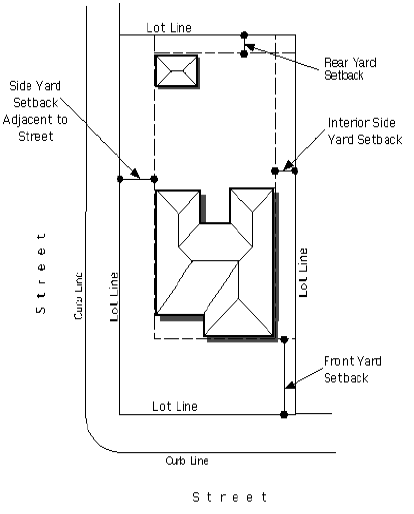
Setback, building: The minimum horizontal distance between the walls of a structure (excluding steps) and the property line.
Shrub: A woody, ornamental landscape plant whose natural form is generally maintained at a minimum height and spread of three feet.
Story: That portion of a building, other than a basement, included between the surface of any floor and the surface of the floor next above it, or, if there be no floor above it, then the space between the floor and the ceiling next above it. The average height for a story shall be defined as 12 feet. Multiple stories, or portions thereof, shall be a result of the number of stories and story height of 12 feet. The definition of a story does not include parapets, gables, and other normal roof structures.
Story, half: A space under a sloping roof which has the line of intersection of roof decking and wall face not more than three feet above the top floor level, and in which space not more than two-thirds of the floor area is finished off for use. A half story containing independent apartment or living quarters shall be counted as a full story.
Street: Any dedicated public thoroughfare which affords the principal means of access to abutting property.
Street, intersection: Any street which joins another street at an angle, whether or not it crosses the other.
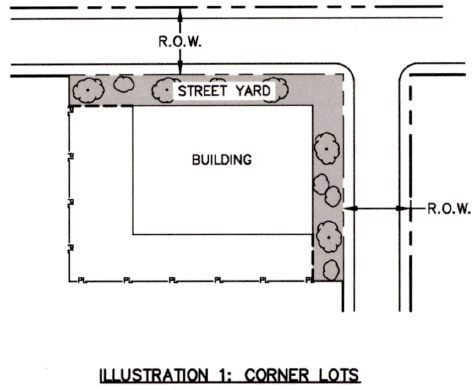
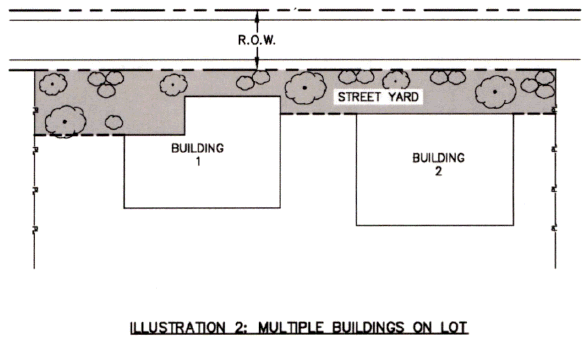
Street yard: means the area of a lot which lies between the street right-of-way or road easement and the actual front wall line of the building, as such building wall line extends from the outward corners of the building, parallel to the street, until such imaginary extension of such building wall line intersects the property lines. Steps and unenclosed porches shall be excluded, but such building wall line shall follow and include the irregular indentions of the building.
A.
On corner lots, the street yard shall consist of all the area of such lot between all abutting street right-of-way lines or road easements and their corresponding actual front building wall lines, as such lines are imaginarily extended in the manner provided above. See illustration 1.
B.
When there are multiple buildings on a lot, the street yard shall consist of all the area of the lot between the street rights-of-way or road easement lines and an imaginary line beginning at one side of the property line, running parallel to the street, connecting to the front most corner of the building wall fronting the street and nearest such side property line, then following and connecting the front-most walls of all buildings fronting on the street, and then extending to the other side property line, running parallel to the street. If a building has a rounded front, the front building wall corners shall be the points closest to the side boundaries; provided, however, that isolated buildings (e.g., photo processing drop-off booths, bank drive-throughs, etc.) shall not be considered delineating the street yard. See illustration 2.
C.
Notwithstanding all of subsections (A) and (B) of this definition, on land used only for parking purposes, the street yard shall consist of the area between the street right-of-way line or road easement line and the back property line.
Structure: Anything constructed or erected, the use of which requires location on the ground or which is attached to something having a location on the ground (also see definition of "building").
Structural alterations: Any change in the supporting members of a building, such as bearing walls or partitions, columns, beams, or girders, or any substantial change in the roof or in the exterior walls.
Trailer, hauling: A vehicle to be pulled behind an automobile or truck which is designed for hauling animals, produce, goods or commodities, including boats.
Trailer or mobile home space: A plot of ground within a mobile home park, trailer court, or mobile home subdivision designed for the accommodation of one mobile home.
Trailer, travel or camper: A portable or mobile living unit used for temporary human occupancy away from the place of residence of the occupants, and not constituting the principal place of residence of the occupants, designed to be towed behind another vehicle.
Tree: A self-supporting, woody perennial plant usually having a single trunk with a diameter of no less than two inches at maturity, measured at one foot above grade, and which normally grows to an overall height of no less than 12 feet.
Tree, canopy: Any tree species that reaches a height of 30 feet or more upon maturity.
Tree, survey: A drawing showing the size, location, species, critical root zone of all existing trees, any tree to be removed or transplanted, a table summarizing all trees, and the total number of caliper inches of trees.
Truck: A heavy load vehicle (see definition for "heavy load vehicle").
Usable open space: An open area or recreational facility which is designed and intended to be used for outdoor living and/or recreation. An area of common usable open space shall have a slope not exceeding ten percent, shall have no dimension of less than ten feet, and may include landscaping, walks, recreational facilities, water features and decorative objects such as art work or fountains. Usable open space shall not include: Rooftops; accessory buildings, except those portions of any building designed specifically for recreational purposes; parking areas; driveways; turnaround areas; or the right-of-way or easement for streets or alleys.
Variance of development standards: An adjustment in the application of the specific regulations of the zoning ordinance to a particular parcel of property.
Variance of use: A variance to allow a use of land in a zoning district where that use of land is not listed as a permitted use in that specific zoning district.
Xeriscaping. the practice of designing landscapes to reduce or eliminate the need for irrigation. This means xeriscaped landscapes need little or no water beyond what the natural climate provides. The term "xeriscape" is registered trademark of the National Xeriscape Council and means water-conserving, drought-tolerant landscaping.
Yard: An open space at grade between a building and the adjoining lot lines, unoccupied and unobstructed by any portion of a structure from the ground upward, except where otherwise specifically provided in this ordinance that the building or structure may be located in a portion of a yard required for a main building. In measuring a yard for the purpose of determining the width of the side yard, the depth of a front yard or the depth of a rear yard, the shortest horizontal distance between the lot line and the main building shall be used.
Yard, front: A yard located in front of the front elevation of a building and extending across a lot between the side yard lines and being the minimum horizontal distance between the front property line and the outside wall of the main building.
Yard, rear: The area extending across the rear of a lot measured between the lot lines and being the minimum horizontal distance between the rear lot line and the rear of the outside wall of the main building. On both corner lots and interior lots, the rear yard shall in all cases be at the opposite end of the lot from the front yard.
Yard, side: The area between the building and side line of the lot and extending from the front lot line to the rear lot line and being the minimum horizontal distance between a side lot line and the outside wall of the side of the main building.
Zero lot line: A development approach in which at least one edge of the main structure on the lot is located on at least one lot line and having no yard requirement on that lot line.
Zoning district map: The official map upon which the boundaries of the various zoning districts are drawn and which is an integral part of the zoning ordinance.
(Ord. No. 2022-019, § 1(Exh. A), 7-5-22; Ord. No. 2024-020, §§ 1, 2, 8-6-24; Ord. No. 2025-003, § 1, 2-4-25)
12.3.1. - Permitted uses definitions.
Accessory building: A subordinate building located on the same premises as the principal building for exclusive use of accessory uses as defined in "accessory uses." In a residential district, an accessory building may include but is not limited to detached garages, private workshops, storage sheds or similar uses, may not be used for commercial purposes, may not be rented and is not habitable. In commercial districts, the use of an accessory building shall be that which is incidental to and used only in conjunction with the main building and shall be required to meet all requirements of the primary building.
Accessory dwelling (commercial): An accessory dwelling located in conjunction with or above a first-floor level commercial or retail business, with occupied by the owner and the owner's family or an employee and the employee's family. For example, a care-taker's quarters or the quarters of a self-storage facility manager.
Accessory dwelling (residential): A subordinate building located on the same premises as the principal building or agriculture use. An accessory dwelling may be used as a residence and shall be incidental to the dominant use of the premises. A garage apartment shall be deemed an accessory dwelling on the lot which it is situated. Accessory dwellings shall comply with all height, area and yard requirements of the respective zoning district.
Accessory use: A use customarily incidental, appropriate and subordinate to the principal use of land or building(s) and located upon the same lot therewith. Accessory uses include permanently installed detached accessory structures such as porches supported by columns, greenhouses, detached garages, private workshops, play structures, gazebos/cabanas/pergolas, storage buildings or similar uses.
Age-restricted community (senior housing): A development with real estate restrictions that include criteria limiting the age of residents (for example, an active living community for seniors age 55 and greater).
Airport landing field, private: A privately owned place where an aircraft can land and take off, usually equipped with hangars, facilities for refueling and repair and various accommodations for passengers.
Airport landing field, public: A publicly owned place where an aircraft can land and take off, usually equipped with hangars, facilities for refueling and repair and various accommodations for passengers.
All-terrain vehicle (ATV): A small, open motor vehicle having a seat and three or more wheels fitted with large, low-pressure tires. It is designed chiefly for recreational use over roadless, rugged terrain.
Amusement (video) arcade: Any building, room, place or establishment of any nature or kind and by whatever name called, the primary use of which is the operation of coin-operated machines that dispense, or is used or is capable of being used to dispense or afford, amusement, skill, or pleasure or is operated for any purpose, other than for dispensing only, music, or service. Forthe purpose of this definition, "primary use" means 51 percent or more of the gross floor area of the portion of the structure being used (not to include any area of a structure being used as storage). The term "amusement (video) arcade":
A.
Includes a marble machine, marble table machine, marble shooting machine, miniature racetrack machine, miniature football machine, miniature golf machine, miniature bowling machine, billiard or pool game, or machines or devices that dispense merchandise or commodities or play music in connection with or in addition to dispensing skill or pleasure; and
B.
Does not include an amusement machine designed exclusively for a child, billiard tables that are not coin-operated machines, and devices designed to train persons in aphaeretic skills of golf, tennis, baseball, archery or other similar sports.
Amusement center, commercial (outdoor): An outdoor area or structure, open to the public which provides entertainment or amusement, including but not limited to batting cages, driving range, miniature golf, go-kart tracks, drive-in theaters, water slides and carnivals.
Amusement center, commercial, indoor: An amusement or entertainment enterprise wholly enclosed and operated within a building. This includes, but is not limited to, bowling alleys, skating rinks, health clubs, racquetball clubs, bingo parlors, indoor tennis courts, gymnasiums, swimming pools and nautilus facilities.
Animal grooming: An establishment that offers to the general public the service of animal grooming for domestic pets. No boarding or medical care is provided.
Animal processing: An establishment that offers to the general public the service of processing and packaging of red meats, fowl and or fish provided the facility complies with all state, federal and local health regulations. All processing is conducted indoors with no emission of noxious odors or noise. This definition does not include the slaughtering or boarding of live animals.
Apartment complex, multi-family: Attached or detached dwelling units for three or more families living independently of one another on the same lot, which may include ancillary facilities such as leasing office, clubhouse, business center, exercise room, pool area and other customary facilities. Where a mixed-use development is allowed, official, retail, and other commercial uses may be located under or beside multi-family apartment dwellings.
Assisted living facility (including independent living): a duplex, multi-family apartment complex, or commercial development housing persons with special needs and persons desiring independent living.
Athletic stadium or field (private): A private field(s) and structure used for sporting events with associated spectator seating, either permanent or temporary.
Athletic stadium or field (public): A public field(s) and structure used for sporting events with associated spectator seating, either permanent or temporary.
Auto leasing or renting: Storage, leasing or renting of automobiles, motorcycles, and light load vehicles.
Auto parking lot or garage: An area or structure designed for the parking of motor vehicles.
Auto parts, sales (enclosed): The use of any building or other premise for the primary inside display and sale of new or used parts for automobiles, panel trucks or vans, trailers, or recreation vehicles.
Auto parts, sales (outside): The use of any land area for the outside display and sale of new or used parts for automobiles, panel trucks or vans, trailers, or recreational vehicles, but not including wrecking yards and junkyards.
Auto, boat, trailer, rv and/or truck storage: The storage or impoundment, on a lot or tract, of operable automobiles, boats, trailers, recreational vehicles and/or trucks.
Automobile repair, major: General repair or reconditioning of engines, air-conditioning systems and transmissions for motor vehicles; wrecker service; collision services, including body, frame or fender straightening or repair; customizing; painting; vehicle steam cleaning; undercoating and rust-proofing.
Automobile repair, minor: Minor repair or replacement of parts, tires, tubes, and batteries; diagnostic services; minor motor services such as grease, oil, spark plug, and filter changing; tune-ups; emergency road service; replacement of starters, alternators, hoses, brake parts; automobile washing and polishing; performing state inspections and making minor repairs necessary to pass said inspection; normal servicing of air-conditioning systems, and other similar minor services for motor vehicles except heavy load vehicles, but not including any operation named under "automobile repair, major" or any other similar use.
Automobile sales, new: The primary sale of new automobiles in a structure or an open lot with secondary sales of used automobiles.
Automobile sales, used: Retail sales or offering for sale of used automobiles or light load vehicles.
Automobile sales, vintage: The display and sales of automobiles in an enclosed building which are characterized by excellence, age or by an enduring classic value.
Automobile service station: Any building, land area or other premises, or portion thereof, used or intended to be used for the retail dispensing or sales of automobile fuels, lubricants, and automobile accessories, including those operations listed under Minor Automobile Repair. Vehicles which are inoperative or are being repaired may not remain parked outside an Automobile Service Station for a period greater than seven days.
Bakery and confectionery works, commercial: A manufacturing facility for the production and distribution of baked goods and confectioneries.
Bank, savings and loan, or credit union: An establishment for the custody, loan, exchange or issue of money, the extension of credit, and/or facilitating the transmission of funds; to include automated teller machines and check-cashing and loan service agencies.
Batching plant, concrete or asphalt (permanent): A permanent manufacturing facility for the production of concrete or asphalt.
Batching plant, concrete or asphalt plant (temporary): A temporary manufacturing facility for the production of concrete or asphalt during construction of a project, and to be removed when the project is completed.
Beauty, barber or other personal care shop: An establishment that provides personal services including haircuts, perms, color treatments, manicures, pedicures and other personal care services.
Boat sales and repair, used: A marine retail sales and service use in which used boats are sold and repaired.
Boat sales and repair, new: A marine retail sales and service use in which new boats are sold and repaired.
Bottling works: A facility for the bottling of products for off-site retail sales.
Brick/stone company sales: An area of land and/or structure used for the storage of bulk brick, stone or other masonry products offered for sale.
Building materials and hardware sales, enclosed: A facility for the sale of materials, tools, and hardware customarily used in the construction of buildings and other structures, including facilities for storage inside a building.
Building materials and hardware sales, outside storage: A facility for the sale of materials, tools, and hardware customarily used in the construction of buildings and other structures, including facilities for storage outside a building and sale of ready-mix concrete from small batching plants, but subject to the following exceptions and/or provisions:
Car wash, automated tunnel: A facility wherein the customer's vehicle passes through a structure with machine operated facilities used principally for cleaning, washing, polishing or waxing of passenger and recreational vehicles or other light duty motor vehicles. This use includes ancillary uses such as vacuum facilities.
Car wash, full-service: An area of land and/or structure with machine or hand operated facilities used principally for cleaning, washing, polishing or waxing of passenger and recreational vehicles or other light duty motor vehicles wherein all work is provided by employees of a car wash facility.
Car wash, self-service: An area of land and/or structure with machine or hand operated facilities used principally for cleaning, washing, polishing or waxing of passenger and recreational vehicles or other light duty motor vehicles wherein the customer provides all the services.
Caretaker/guard residence: A residence located on a premises with a main non-residential use and occupied only by a caretaker or guard employed on the premises.
Caterer: A business to cook, prepare, provide, and/or supply food for gatherings off premises.
Cemetery: Property used for the interring of the dead.
Church: A building for regular assembly for religious worship which is used primarily and designed for such purpose and those accessory activities which are customarily associated therewith, and the place of residence for ministers, priests, nuns or rabbis on the premises (tax exempt as defined by state law). For the purposes of this ordinance, this definition does not apply to bible study and other similar activities which occur in a person's primary residence.
Civic center: A building or complex of buildings that house municipal offices and services, and which may include cultural, recreational, athletic, convention or entertainment facilities owned and/or operated by a governmental agency.
Clinic/office, medical: A facility primarily utilized by a health professional or unit for providing public health services including emergency services and related facilities such as laboratories, clinics and administrative offices operated in connection therewith. Typical uses would be dentist, doctor or chiropractic professional offices and clinics.
Club, private with alcoholic beverages: An establishment providing social and dining facilities, as well as alcoholic beverage service to an association of persons, and otherwise falling with the definition of, and permitted under the provisions of, that portion of V.T.C.A., Alcoholic Beverage Code tit. 3, ch. 32, as the same may be hereafter amended, as it pertains to the operation of private clubs.
College, university: An academic institution of higher learning accredited or recognized by the state and offering a program or series of programs of academic study leading to a recognized degree or advanced degree. Including junior and senior colleges, universities, conservatories and seminaries.
Commercial plant, general: Establishments other than personal service shops for the treatment and/or processing of products as a service on a for profit basis including, but not limited to, newspaper printing, laundry plant, or cleaning and dying plants.
Community care facility: A place where not more than six persons with physical or mental disabilities are provided room and board, as well as supervised care and rehabilitation by not more than two persons. However, this use may not be located closer than one-half mile from another community care facility.
Community center: A building or complex of buildings that house cultural, recreational, athletic, or entertainment facilities owned and/or operated by a governmental agency or private non-profit agency.
Consignment/used merchandise store, indoor: Retail sales of used wearing apparel, furniture or other merchandise. No outdoor sales, display, staging, sorting, storage or drop-off of clothing is permitted.
Consignment/used merchandise store, outdoor activity: Retail sales of used wearing apparel, furniture or other merchandise where outdoor sales, display, staging, sorting, storage or drop-off of clothing is permitted.
Construction equipment, rental and/or sales: A facility, which allows for construction related equipment sales inside the structure as the primary use and also allows for the outside display of small construction equipment on site.
Construction field office, temporary: A permitted, temporary building or structure, of either permanent or temporary construction, used as an office in connection with an active development or construction project for supporting temporary supervisory or administrative functions related to development, construction within the active development or construction project. A construction field office shall not be used as a residence and shall not be constructed with sleeping facilities. RVs, motor homes or mobile homes are not permitted or defined as a construction field office. Active is defined as having a PIA or building permit issued for the site. Upon abandonment, completion, or lack of activity of the project, such field offices shall be removed at the building official's discretion.
Construction yard (temporary): A storage yard or assembly yard for building materials and equipment directly related to a specific construction project and subject to removal at completion of construction.
Contractor's shop or storage yard: A building, part of a building, or land area for the officing, construction or storage of materials, equipment, tools, products, and vehicles. Examples include HVAC contractors, irrigators, plumbers, electricians, builders, utility contractors, fencing contractors, pool builders, and excavators, and similar construction or trade contractors. Not included are landscaping services, plaster shops, moving companies, machinists, sanitarians, and welders.
Convalescent, rest or nursing home: A health facility used for or customarily occupied by persons recovering from illness or suffering from infirmities of age, and furnished meals or continuing nursing care for compensation.
Convenience store, without gas pumps: Any premises offering for sale prepackaged food products, household items and other convenience goods commonly associated with the same. Gasoline and/or other petroleum products are not permitted.
Convenience store, with gas pumps: Any premises where gasoline and/or other petroleum products are sold as a principal use and in connection with the principal use, a convenience store sells prepackaged food products, household items and other goods commonly associated with the same.
Correctional/detention facility (public): A public facility operated by County, State or Federal government, or by a commercial entity under contract to one of these governments utilized for the incarceration of individuals convicted of crimes where these individuals are housed until such time as they have completed their sentences. Such facilities include minimum and maximum-security prisons for adults as well as juvenile detention centers for minors.
Correctional/detention facility (private): A private facility operated by a commercial entity that's primary business venture is to provide for the incarceration of individuals convicted of crimes where these individuals are housed until such time as they have completed their sentences. Such facilities include minimum and maximum-security prisons for adults as well as juvenile detention centers for minors.
Dance hall: An establishment open to the general public for entertainment, in particular, dancing.
Day care or child care center, in home: A private residence where care, protection, and supervision are provided on a regular schedule, at least twice a week to no more than six children, including children of the adult provider.
Day care or child care center: A commercial institution or place designed for the care of four or more unrelated children during the hours of 6:00 a.m. to 10:00 p.m.
Distribution center: A site or building used primarily for the temporary storage and/or distribution of goods, merchandise, supplies. This definition does not include Overnight Delivery [for distribution which is classified elsewhere in this ordinance].
Dry cleaning plant or commercial laundry: An industrial facility where fabrics are cleaned with substantially non-aqueous organic solvents on a commercial or wholesale basis.
Dry cleaning, pick up/drop off: A retail establishment providing a drop-off and pick-up point for customers to leave wearing apparel or other material in need of laundry and dry cleaning, and pick-up of items when laundered and/or dry cleaned.
Dry cleaning, small shop: A custom cleaning shop or pick-up station not exceeding 6,000 square feet of floor area, including but not limited to dry cleaning plants having no more than 1,500 square feet of floor area for dry cleaning equipment.
Duplex: Attached or detached dwellings designed with a common vertical wall between units or designed separately and to be occupied by two families living independently of each other on the same lot.
Dwelling, garage apartment: An accessory dwelling unit for one family erected in conjunction with a garage. See "accessory dwelling."
Dwelling, historically significant: Any dwelling that is not less than 50 years old and that meets the criteria for historically significant structures as established by the Texas State Historic Preservation Office.
Equipment sales, medical: Establishments primarily engaged in the sale of medical equipment including incidental storage, maintenance and servicing of such equipment.
Fairgrounds: An area where outdoor fairs, circuses or exhibitions are held.
Family: One or more persons related by blood, marriage or adoption, or not more than four persons not related by blood, marriage, or adoption, occupying a dwelling unit as an individual housekeeping organization.
Farm, ranch, garden or orchard: An area used for growing usual farm products, vegetables, fruits, trees, and grain and for the raising thereon of the usual farm poultry and farm animals such as horses, cattle, and sheep and including the necessary accessory uses for raising, treating, and storing products raised on the premises, but not including the commercial feeding of offal or garbage to swine or other animals and not including any type of agriculture or husbandry specifically prohibited by ordinance or law.
Feed lot: A lot, yard, corral, buildings or other area in which livestock are confined, primarily for the purposes of feeding and growth prior to slaughter and which is specifically designed as a confinement area where the concentration of animals is such that a vegetative cover cannot be maintained with the enclosure. The term does not include areas which are used for raising crops or other vegetation or upon which livestock are allowed to graze.
Farmer's market: The retail sale of farm produce by individual vendors, for the primary purpose of selling fruits, vegetables, herbs, spices, edible seeds, nuts, live plants, flowers, and honey. The sale of any type of meat, fish or poultry, eggs, refrigerated dairy products, canned foods, packaged items and prepared foods such as salsa, pickles, cookies, etc., shall not be included in this definition.
Feed store: An establishment for the selling of corn, grain and other food stuffs for animals and livestock, and including implements and goods related to agricultural processes, but not including farm machinery.
Fuel/natural resource dispensing station: A service facility providing for the dispensing of fuel or other natural resource(s) to the general public. The facility may be attended or unattended and may offer for sale conventional and/or alternative fuels, such as gasoline, bio-fuel, propane, CNG, ethanol, etc. May also include commercial water sales in areas approved by the City of Robinson.
Fraternal organization lodge, or civic club: An organized group having a restricted membership and specific purpose related to the welfare of the members such as Elks, Masons, Knights of Columbus, or a labor union.
Gasoline service or filling station: See "automobile service station."
General market: An outdoor, or partially indoor, covered premise where the main use is the sale of new and used household goods, fruits, vegetables, herbs, spices, edible seeds, nuts, live plants, flowers, honey, personal effects, tools, art work, small household appliances, and similar merchandise, objects, or equipment, in small quantities, in broken stalls, lots or parcels, not in bulk, for the use or consumption by the immediate purchaser. The sale of any type of meat, fish or poultry, eggs and refrigerated dairy products shall not be included in this definition, nor shall any other merchandise or equipment not permitted to be sold by right within a Light Commercial zoning district. The sale or offering of live animals is also prohibited under this definition. The term general market shall not be deemed to include wholesale sales establishments, personal service establishments or rental service establishments, but shall be deemed to include food service establishments, retail service establishments, and auction establishments.
Golf course/country club, private: An area of 20 acres or more improved with trees, greens, fairways, hazards, and which may include a clubhouse, dining room, tennis courts and similar recreational or service uses available only to members and their guests.
Golf course/county club, public: An area of 20 acres or more improved with trees, greens, fairways, hazards, and which may include a clubhouse, dining room, tennis courts and similar recreational or service uses which is privately owned but open to the public for a fee and operated as a commercial venture.
Halfway house: A home for not more than six persons who have demonstrated a tendency toward alcoholism, drug abuse, antisocial or criminal conduct, together with not more than two persons providing supervision and other services to such persons, all of which live together as a single housekeeping unit.
Health club (weight/aerobic center): A facility where members or nonmembers use equipment or space for the purpose of physical exercise. For example, martial arts studio, instructional dance studio, or gymnastics center.
Heliport: An area of land or water or a structural surface which is used, or intended for use, for the landing and taking off of helicopters, and any appurtenant areas which are used, or intended for use for heliport buildings and other heliport facilities.
Helistop: A landing pad for occasional landing and taking off of helicopters where no regularly scheduled stops occur. No temporary or permanent storage, refueling, maintenance or repairs shall take place on-site. Helicopters may only be located on the landing pad for start-up, shut-down, passenger loading or unloading and restocking of supplies. Generally, helicopters shall not be located on the landing pad for more than 45 minutes at a time.
Home occupation: An occupation or business, for the purpose of manufacturing, providing, or selling a lawful good or providing a lawful service. This occupation or business is secondary to the primary use of a dwelling as a residence, conducted on residential premises solely by an occupant of the residence.
Hospital: An institution providing health services primarily for human inpatient medical or surgical care for the sick or injured and including related facilities such as laboratories, outpatient departments, training facilities, central services facilities, and staff offices which are an integral part of the facilities.
Hospital for insane/narcotic related illnesses: A facility that provides residence and/or outpatient care, with supervisory personnel, to persons regardless of legal relationship, who have demonstrated a tendency towards mental illness, alcoholism or drug abuse.
Individual tutoring, instructional art or music lessons: a place providing tutoring or lessons in the arts to individuals or members of one family at a time.
Industrial manufacturing/fabrication/assembly, enclosed, light: Industrial and manufacturing plants including the processing or assembling of parts for production of finished equipment where the process of manufacturing or treatment of materials is such that no dust, odor, gas, smoke or noise is emitted with no outside storage.
Industrial manufacturing/fabrication/assembly, outside storage, light: Industrial and manufacturing plants including the processing or assembling of parts for production of finished equipment where the process of manufacturing or treatment of materials is such that no dust, odor, gas, smoke or noise is emitted and not more than 20 percent of the lot or tract is used for the open storage of products, materials or equipment.
Industrial manufacturing/fabrication/assembly, enclosed, heavy: Any industrial use whose operation, in the opinion of the fire chief, involves a much higher than average risk to public health and safety. There shall be no outside storage.
Industrial manufacturing/fabrication/assembly, outside storage, heavy: Any industrial use whose operation, in the opinion of the fire chief, involves a much higher than average risk to public health and safety. Outside storage is permitted.
Industrial park: A large tract of land that has been planned, developed and operated as an integrated facility for a number of individual industrial uses, with special attention to circulation, parking, utility needs, aesthetics, and compatibility.
Kennels (indoor pens): An establishment with indoor pens in which more than four dogs or domesticated animals more than one year old are housed, groomed, bred, boarded, trained or sold for commercial purposes.
Kennels (outdoor pens): An establishment with outdoor pens in which more than four dogs or domesticated animals more than one year old are housed, groomed, bred, boarded, trained or sold for commercial purposes.
Key/locksmith shop: A shop that specializes in making, selling and repairing keys, locks and associated material.
Kiosk: A small, free-standing, one-story structure having a maximum floor area of 350 square feet and used for commercial purposes, such as automatic teller machines or the posting of temporary information and/or posters, notices and announcements. If a kiosk is to be occupied, it shall have a minimum floor area of 25 square feet.
Laboratory, medical: A facility used in the research or testing of items related to the physical well-being of a human being or animal, but not including manufacturing.
Landfill (commercial): A commercial use for the disposal of garbage, rubbish, etc., by burying it under a shallow layer of ground.
Laundromat, self-serve: A facility where patrons wash, dry or dry clean clothing and other fabrics in machines operated by the patron.
Library, public: Buildings and structures open for the general public, for which a fee may or may not be charged for the use of book collections.
Machine sales and storage, heavy: A building or open area, other than a right-of-way or public parking area used for the display, sale, rental or storage of heavy machinery, either machines in general or a group of machines which function together as a unit.
Manufactured home (HUD-code) display, sales and services: The offering for sale, storage, or display of trailers or manufactured homes (HUD-code) on a parcel of land but excluding the use of such facilities as dwellings either on a temporary or permanent basis.
Manufactured home (HUD-code manufactured home): A dwelling designed to be transported on its own chassis on the highway in one or more sections by a prime mover and which is constructed with a base section so as to be independently self-supporting and not requiring a permanent foundation for year-round living.
Manufactured housing park (HUD-code): A parcel of land not less than five acres nor greater than 25 acres which has been designed, improved, or intended to be used or rented for occupancy by one or more mobile homes or trailer houses in designated spaces.
Manufactured housing subdivision (HUD-code): A parcel of land which has been designed, platted, improved, and is intended for the placement of individually owned mobile home units on platted lots which can be purchased outright by the owners of the mobile home units.
Manufacturing: See "industrial" categories.
Massage establishment: Any place of business in which massage therapy is practiced by a massage therapist, as defined and licensed by state law. "Massage therapy", as a health care service, means the manipulation of soft tissue for therapeutic purposes. The term includes, but is not limited to, effleurage (stroking), petrissage (kneading), tapotement (percussion), compression, vibration, friction, nerve strokes, and Swedish gymnastics, either by hand or with mechanical or electrical apparatus for the purpose of body massage. Massage therapy may include the use of oil, salt glows, heat lamps, hot and cold packs, tub, shower or cabinet baths. Equivalent terms for "massage therapy" are massage and therapeutic massage. Massage and "therapeutic" do not include diagnosis, the treatment of illness or disease, or any service or procedure for which a license to practice medicine, chiropractic, physical therapy, or podiatry is required by law.
Mausoleum: Property used for the interring of the dead and where bodies are interred above ground in stacked vaults.
Medical offices, professional: A room or group of rooms used for the provision of executive, management, or administrative services for medically related activities.
Model home sales office: An office located in a dwelling unit within a residential subdivision under construction. Only one office shall be used for on-site sales only during the construction of the residential development at a time.
Monument and headstone sales: A retail establishment offering for sale stone monuments produced off-premises.
Mortuary or funeral parlor: A place for the storage of human bodies prior to their burial or cremation, or a building used for the preparation of the deceased for burial and the display of the deceased and ceremonies connected therewith before burial or cremation.
Motel or hotel: A building or group of buildings designed for and occupied as a temporary dwelling place of individuals and providing four or more room units where customary hotel services such as linen, maid service, telephone, and upkeep of furniture is provided.
Motorcycle sales and service, new: The display, sale and servicing, including repair work, of motorcycles.
Multi-family apartment complex (or multiple-family apartment complex): Attached or detached dwelling units for three or more families living independently of one another on the same lot, which may include ancillary facilities such as leasing office, clubhouse, business center, exercise room, pool area and other customary facilities. Where a mixed-use development is allowed, official, retail, and other commercial uses may be located under or beside multi-family apartment dwellings.
Municipally-owned facilities and uses: Any area, land, building, structure, and/or facility owned, used, leased, or operated by the City of Robinson, Texas.
Nursery, retail with outside storage: An establishment, including a building, part of a building or open space, for the growth, display and/or sale of large plants, shrubs, and trees, and other materials used in indoor or outdoor planting.
Office center: A building or complex of buildings used primarily for conducting the affairs of a business, profession, service, industry or government, or like activity that may include ancillary services for office workers such as a coffee shop, newspaper or candy stand.
Office, professional general: A room or group of rooms used for the provision of executive, management, or administrative services. Typical uses include administrative offices, and services including real estate, insurance, property management, investment, personnel, travel, secretarial services, telephone answering, and business offices of public utilities, organizations and associations, but excluding medical offices.
Office-showroom/warehouse: An establishment with a minimum of 75 percent of its total floor area devoted to storage and warehousing, but not accessible to the general public. The remaining area may include retail and wholesale sales areas, sales offices, and display areas for products sold and distributed from the storage and warehousing areas.
Open storage and outside display:
Open storage of products or materials: The keeping in an unroofed area of new or used goods, merchandise, or any materials used in the production, repair or replacement of goods related to the principal business activity of the property on which the open storage occurs. The term "open storage" shall not apply to primary uses indicated by the use chart, which customarily have open storage, such as automotive sales.
Outside display of goods: The display of any product, or item, offered for sale by the occupant of the main use of the property on which the display of goods occurs, in plain view of the public without screening.
Outdoor display, daily: Notwithstanding anything to the contrary contained herein, the open display of items intended for direct retail sales or rental in the appropriate zoning district(s) shall not be subject to the screening requirements set forth in each respective zoning district, provided such display meets all of the following conditions:
A.
Items can only be displayed between the hours of 7:00 a.m. and 7:00 p.m.;
B.
The area used shall not be greater than ten percent of the gross floor area of the establishment maintaining such display;
C.
Items may not occupy any required parking area;
D.
Items may not be displayed in any required front, side, or rear yard setback or public right-of-way;
E.
Items may not obstruct vision sight lines from any public right of way or driveway, be deemed a traffic hazard by the building official, or city engineer, or be located in any required sight visibility easements; and
F.
The display area shall be within 20 feet of the main building; except for special out-of-doors promotional sales, which occur behind the front building line and do not extend longer than four continuous weeks, unless alternative outside display is permitted by the approval of a specific use permit (SUP).
Paint shop: A commercial establishment where painting services are performed.
Park and ride: The temporary storage of automobiles on a daily basis for persons traveling together to and from work either through carpools, van-pools, bus-pools or mass transit.
Park or playground, public: A recreation facility, recreation center, or park owned or operated by a public agency such as a city or school district and available to the general public.
Park or recreation facility, private: A recreation facility operated for the exclusive use of private residents or neighborhood groups and their guests, and not the general public.
Patio home (zero lot line dwelling): A lot which is designed in such a manner that the side yard and adjacent use easement make maximum use of available land area to preserve an open, yet private, use of the side yard, and permits construction of a detached single-family dwelling with one side of such dwelling placed on the side property line.
Pawn shop: An establishment where money is loaned on the security of personal property pledged in the keeping of the owners (pawnbroker). Retail sales also take place of primarily used items.
Pet boarding/day care (commercial): A commercial building or tenant space providing temporary care and housing of pets for a fee.
Pet boarding/day care (in home): A residence with residents providing temporary care and housing of pets for a fee.
Pet shop: A retail establishment offering small animals, fish or birds for sale as pets and where all such creatures are housed within the building.
Petroleum extraction (oil and gas mining): The process of extracting petroleum from the earth.
Portable building sales: An establishment which displays and sells structures capable of being carried and transported to another location, but not including mobile homes.
Printing or reprographic shop: A small establishment which reproduces, in printed form, individual orders from a business profession, service, industry or government organization and occupies less than 4,000 square feet. A printing company shall be any printing business which operates in a space of 4,000 square feet.
Produce stand: A single establishment in a partially enclosed or open-aired structure used for the retail sales and display of fresh fruits, vegetables, flowers, herbs or plants. May also involve the accessory sales of other foodstuffs such as: Jams, jellies, pickles, sauces or baked goods. May also include wood or other seasonal items for sale.
Produce sales (inside): The retail sales of fresh fruits, vegetables, flowers, plants, herbs, or other foodstuffs such as: Jams, jellies, pickles, sauce and baked goods located within a building (which meets the architectural and building standards for construction).
Public or municipally owned facility or uses: Any building (except a building used primarily for general office purposes) which is owned, leased, primarily used and/or primarily occupied by the State of Texas, the United States, the City of Robinson, or any subdivision or agency of the State of Texas, the United States or the City of Robinson, or by any public or quasi-public utility.
Racetrack, horse: A measured course where horses are entered in competition against one another or against time, including tracks used only in the training of animals.
Raceway, motor: A measured course where automobiles compete against one another or against time.
Radio/television broadcasting, without tower: A building or portion of a building used as a place for radio or television broadcasting.
Railroad track and right-of-way: The right-of-way and track used by a railroad, but not including railroad stations, sidings, team tracks, loading facilities, dockyards, or maintenance areas.
Recreation center, private: A place designed and equipped for the conduct of sports, leisure time activities and other customary and usual recreational activities.
Recreation vehicle park: A parcel of land reserved for the location of recreational vehicles and travel trailers for recreational, transient lodging including buildings and sites set aside for related recreational purposes.
Recreation vehicle sales, new: The primary sale of new recreation vehicles in a structure or on open lot with secondary sales of used recreation vehicles.
Recreation vehicle sales and/or service, used: Retail sales and/or repair or service of used recreation vehicles.
Recycling center: A facility that is not a wrecking yard and in which recoverable resources, such as newspapers, glassware, and metal cans are collected, stored, flattened, crushed, or bundled, essentially by hand within a completely enclosed building.
Recycling collection center: An incidental use that serves as a drop-off point for temporary storage of recoverable resources. No processing of such items would be allowed. This facility would generally be located in a shopping center parking lot or in other public/quasi-public areas such as in churches and schools.
Recycling plant: A facility that is not a junkyard and in which recoverable resources, such as newspapers, magazines, books, and other paper products; glass; metal cans; and other products, are recycled, reprocessed, and treated to return such products to a condition in which they may again be used for production.
Restaurant (drive-in type): An eating establishment where primarily food or drink is served to customers in motor vehicles or where facilities are provided on the premises which encourage the serving and consumption of food in automobiles on or near the restaurant premises.
Restaurant, cafe or cafeteria: An eating establishment where customers are primarily served at tables or self-served and food is consumed on the premises, which may include a drive-through window.
Restaurant, incidental to primary use: An eating establishment primarily for the incidental use of the primary use.
Retail or service, incidental: The rendering of retailing or services incidental to the primary use. In the office district, such uses include a barber or beauty shop, smoke shop, candy counter, restaurant, pharmacy or other incidental activity secondary to the primary office occupancy.
Retail sales, general: This major group includes retail stores which sell a number of lines of merchandise including but not limited to dry goods, apparel and accessories, furniture and home furnishings, antiques, small wares, small appliances, hardware, and general grocery sales. The stores included in this group are known as department stores, variety stores, general merchandise stores, general stores, etc. and which may include services incidental to the sale of such goods.
Retirement home: A residential complex containing multi-family dwellings designed for and principally occupied by senior citizens. Such facilities may include a congregate meals program in a common dining area, but exclude institutional care such as medical or nursing care, and are distinguished from convalescent, rest or nursing homes as elsewhere defined.
Rock quarries, sand, gravel or earth extraction: The process of extracting sand, gravel and stone from the earth.
Sanitarium: An institution providing health facilities for inpatient medical treatment or treatment and recuperation making use of natural therapeutic agents.
Seasonal sales: A facility or site used for the sale of merchandise which is available or needed during certain seasons of the year. Use shall generally require one to three months of operation and be similar to firewood sales or Christmas tree sales, seasonal plant material or other types of items for sale as may be determined by the city council to have seasonal characteristics.
Sexually oriented business: means (1) a sex parlor, nude studio, modeling studio, love parlor, adult bookstore, adult movie theatre, adult video arcade, adult movie arcade, adult video store, or adult motel; or (2) any commercial enterprise where the primary business of which is the offering of a service or the selling, renting, or exhibiting of material, devices or other items designed, intended or which provide sexual stimulation or gratification to the customer. the term does not include any of the commercial enterprises or businesses specifically exempted by V.T.C.A., Local Government Code § 243.004, or amendments thereto.
School, home: Educational activities consisting of a defined curriculum with the purpose of satisfying the state educational requirements and said educational activities being conducted in the home of a student living in the home. said educational activities shall be considered a part of the housekeeping activities of a family.
School, home day: Educational activities consisting of a defined curriculum with the purpose of satisfying the state educational requirements and said educational activities being conducted in the home but not necessarily in the home of the student living therein. There shall be no more than six unrelated students not living in the home in which the educational activities are being conducted. The total number of students living in the home in which the activities are being conducted shall not exceed 12 at any given time.
School, institutional, rehabilitation training: A facility that provides rehabilitation and training operated or sponsored by chartered educational, religious or philanthropic organizations, but excluding uses such as trade schools, which are operated primarily on a commercial basis.
School, parochial or private: A school under the sponsorship of a private agency or corporation or religious agency providing elementary or secondary curriculum, but not including private trade or commercial schools.
School, private boarding: Any building or group of buildings with dormitories, dining rooms and other accessory uses for the boarding of students, the use of which meets state requirements for primary, secondary, or higher education and which does not secure the major part of its funding from any governmental agency.
School, public, primary or secondary: A school under the sponsorship of an Independent School District having a curriculum generally equivalent to public elementary or secondary schools.
Schools, business, tutoring or trade: Establishments, other than public or parochial schools, private primary or secondary schools, or colleges, offering lessons, tutoring, training or instruction in a subject, trade and/or an occupation to groups of individuals.
Self service or mini-warehouse: A building or group of buildings in a controlled access and fenced area consisting of various sized industrial, compartmentalized and controlled access self-contained units that are leased or owned for the storage of business and household goods or contractor supplies.
Service and repair shops general: Establishments primarily engaged in the provision of repair and services to individuals and households, rather than businesses, but excluding automotive equipment repair use types. Typical uses include appliance repair, shoe repair, watch and jewelry repair and repair of musical instruments, seamstress and tailor shops.
Shooting range, indoor: A completely enclosed firing range with targets for the supervised discharge of rifles or handguns for practice.
Shopping center: A group of primarily retail and service commercial establishments planned, constructed and managed as a total entity with customer and employee parking provided on-site, provision for goods delivery separated from customer access, provision of aesthetically appropriate design and protection from the elements.
Short-term or vacation rental (commercial): A commercial building that is used for transient lodging with no more than seven guestrooms rented for compensation and located in the principal building. The length of stay is limited to not more than 30 consecutive days.
Short-term or vacation rental (residential): A dwelling unit that is used for transient lodging with no more than seven guestrooms rented for compensation and located in the principal building. The length of stay is limited to not more than 30 consecutive days.
Single-family residential, detached: A detached dwelling designed to be occupied by not more than one family per lot.
Small engine and appliance repair: A service facility which provides for the servicing and repair of small engines, lawnmowers and other lawn related equipment, generators and household appliances, such as washers, dryers, dishwashers.
Stable, commercial: A stable used for the rental of stall space or for the sale or rental of horses or mules.
Stable, private: An area used solely for the owner's private purposes for the sale or keeping of horses, mules or ponies, and not kept for remuneration, hire or sale.
Street vending, temporary: The sale of merchandise from a temporary facility located on public right-of-way, or private property, within a front or side yard area at disassociated periods of time. Street vending shall include any merchandise which is displayed to be sold in an open, or partially open, facility and is not designated as a seasonal item or is associated with any outside display of merchandise offered for sale by the primary use of the lot or tract on which it is located. This definition shall also include any street vendors regarding food preparation and sales to the general public. Special events sponsored by public and non-profit agencies are exempt from this definition (but will be required to register or permit with the Health Officer). Permanent Street Vending or street vending outside of this definition is strictly prohibited.
The term for the permit shall be for a period of 14 consecutive days within a 12-month period and must include the written consent of the property owner. a site plan or other information may be required by the building official upon the review of the temporary permit providing evidence of compliance with parking, access and maneuvering and other site or use related requirements prior to the permit.
Studios, professional: A building or portion of a building used as a place of work by professionals including but not limited to dancers, photographers, musicians or artists.
Tank farm: An open-air facility containing a number of above-ground, large containers for the bulk storage, in liquid or gas form, of petroleum, butane, propane or other gas products.
Tattoo parlor/body piercing studio: An establishment whose principle business activity, either in terms of operation or as held out to the public, is the practice of one or more of the following: (1) placing of designs, letters, figures, symbols, or other marks upon or under the skin of any person, using ink or other substances that result in the permanent coloration of the skin by means of the use of needles or other instruments designed to contact or puncture the skin; (2) creation of an opening in the body of a person for the purpose of inserting jewelry or their decoration.
Tattoo parlor, cosmetic: An establishment where trained personnel apply micro-injections of pigment to the dermal layer of skin such that facial cosmetics are applied on a permanent basis. This does not include a tattoo parlor.
Taxidermist shop: A service and retail establishment for a taxidermist to practice on-site. The service shall include the art of preparing, stuffing, and mounting the skins of animals, and offering the products for sale to the general public.
Terminal, bus: Any premises for the transient housing or parking of motor-driven busses and the loading and unloading of passengers.
Terminal, freight or truck: An area and building where cargo is stored and where trucks, including tractors and trailer units, load and unload cargo on a regular basis. May include facilities for the temporary storage of loads prior to shipment.
Terminal, railroad: Any premises for the transient housing of trains and the loading and unloading of passengers.
Terminal, transfer storage and baggage: A facility for the storage of baggage and other items in transit.
Theater, indoor: A building or part of a building devoted to the showing of motion pictures, or for dramatic, musical or live performances.
Theater, outdoor: An open lot with its appurtenant facilities devoted primarily to the showing of motion pictures or theatrical productions on a paid admission basis, which may include patrons seated in automobiles during the theater performance.
Tire retreading and capping: The process by which tires are treated with a new tread.
Townhouse (townhome): A dwelling that is part of a structure containing two or more units, not to exceed eight, each designed for occupancy by one family with each unit attached by a common wall, a minimum of 20 feet in length.
Trailer rental: The display and offering for rent of trailers designed to be towed by light load vehicles.
Transportation and utility structures and facilities: Permanent facilities and structures operated by companies engaged in providing transportation and utility services including but not limited to railroad track rights-of-way, sewage pumping stations, telephone exchanges, transit station turnarounds, water reservoirs and water pumping stations.
Truck and bus rental leasing: The rental of new or used panel trucks, vans, trailers, recreational vehicles or motor-driven buses in operable condition and where no repair work is done.
Truck and bus repair and overhaul: An establishment providing major and minor repair services to heavy load vehicles.
Truck parking lot: Area for parking heavy load vehicles.
Truck sales, heavy: Display, sale or rental of new or used heavy load vehicles in operable condition.
Truck stop: Any building, land, area, or premise, or portion thereof used for the retail dispensing or sales of fuels, lubricants and accessories commonly utilized by heavy load vehicles, but not including those uses listed under Major Automobile Repair, as applying to heavy load vehicles.
Towing company office with towed vehicle storage yard: An office used for an individual, association, corporation, or other legal, licensed entity that controls, operates, or directs the operation of one or more tow trucks over a public roadway. A tow truck is defined within the Towing Administrative Rules of the Texas Department of Licensing and Regulation. This definition shall include an area designated for the storage of towed vehicles.
Towing company office without towed vehicle storage yard: This definition shall be the same as above but shall exclude the allowance for an area designated for the storage of towed vehicles. Company vehicles, including wreckers and tow trucks shall be permitted.
Utilities, public and private: A closely regulated enterprise with a franchise for providing to the public a utility service deemed necessary for the public health, safety, and welfare. Such public services include but are not limited to water pump stations, water storage tanks, sewage treatment plants, gas regulatory stations and electrical substations.
Veterinarian clinic, with outside pens: An establishment, including outside pens, where animals and pets are admitted for examination and medical treatment.
Veterinarian clinic, without pens: An establishment, not including outside pens, where animals and pets are admitted for examination and medical treatment.
Warehouse, chemical and toxic materials storage: The storage of certain types and volumes of materials (as both primary and supplemental warehousing to support the primary) which would constitute a public health and safety concern as determined by local, state and federal fire, building and health codes.
Warehouse/showroom with office: A building used primarily for the storage of goods and materials with showroom and office space as secondary uses.
Warehouse, wholesale, enclosed: A building used primarily for the storage of goods and materials in a fully enclosed building or area.
Warehouse, wholesale, w/outside storage: A building used primarily for the storage of goods and materials with outside storage facilities.
Wine tasting facility (winery): An establishment that manufactures, bottles, labels, and packages wine to dispense free for consumption on the winery premises or for sale to ultimate consumers for (1) consumption on the Winery premises, and (2) unbroken package off-premise consumption.
Wireless antenna facilities: See article 9, Personal Wireless Facilities Regulations.
Wrecking yard (junkyard): Any lot upon which two or more motor vehicles of any kind, which are incapable of being operated due to condition or lack of license, have been placed for the purpose of obtaining parts for recycling or resale.
Wrecking, salvage, reclamation yard: The reclamation and storage of used products or materials.
(Ord. No. 2022-019, § 1(Exh. A), 7-5-22; Ord. No. 2025-031, § 3, 9-2-25)
12.3.2. - Wireless antenna facilities definitions.
Amateur radio antenna: A radio communication antenna used by a person holding an amateur station license from the Federal Communications Commission.
Antenna: A device used in communications, which transmits or receives radio signals.
Antenna, building attached: Antenna attached to an existing structure in either of two general forms: (1) roof-mounted, in which antennas are placed on the roofs of buildings, or (2) building-mounted, in which antennas are placed on the sides of buildings. These antennas can also be mounted on structures such as water tanks, billboards, church steeples, electrical transmission towers, etc.
Antenna facility: Any structure, monopole, tower, or lattice tower used to support antennas.
Co-location: The act of locating wireless communications equipment for more than one use on a single antenna facility.
Equipment storage building: An unmanned, single-story equipment building used to house radio transmitters and related equipment.
Monopole: A self-supporting antenna facility composed of a single spire used to support communications equipment or other visible items.
Satellite receive-only antenna: An antenna that enables the receipt of television signals transmitted directly from satellites to be viewed on a television monitor. Such antennas are commonly known as a satellite dish, television receive-only antenna, dish antenna, parabolic antenna, or satellite earth station antenna.
Stealth facility: An antenna facility that is virtually transparent or invisible to the surrounding neighborhood. Stealth facilities may include totally enclosed antennas, wireless facilities that replicate or duplicate the construction of common structures such as flagpoles, and camouflaged wireless facilities that are constructed to blend into the surrounding environment.
Tower, lattice: A self-supporting tower having three or four support legs with cross-bracing and the capacity to hold a number and a variety of antennas.
TV antenna: An antenna that enables the receipt of television signals transmitted from broadcast stations.
(Ord. No. 2022-019, § 1(Exh. A), 7-5-22)
12.3.3. - Outdoor lighting definitions.
Cut-off, 80 degree: A fixture that allows no emission above a horizontal plane through the fixture.
Fixture: The assembly that holds the lamp in a lighting system. It includes the elements designed to give light output control, such as a reflector (mirror) or refractor (lens), the ballast, housing and attachment parts.
Foot-candle: A unit of illuminant amounting to one lumen per square foot.
Fully shielded: A luminary constructed or shielded in such a manner that all light emitted by the luminary either directly from the lamp or indirectly from the luminary, is projected below the horizontal plane through the luminary's lowest light emitting part as determined by photometric test or certified by the manufacturer.
Glare: Direct lighting emitted from a luminary that causes reduced vision or temporary blindness.
Halogen lamp: Also known as tungsten-halogen, is a specialized type of incandescent lamp which has a significantly hotter filament than conventional incandescent lights. Rather than filling the bulb with an inert gas, the halogen bulbs use a highly reactive element. The resulting reaction produces a significantly brighter light and at extremely high temperatures.
High pressure sodium (HPS): A high intensity discharge lamp where radiation is produced from sodium vapor at relatively high partial pressures (100 tore). HPS is essentially point source light.
Horizontal plane: A line horizontal to the lowest point on the fixture from which light is emitted.
Iesna: Illuminating Engineering Society of North America.
Incandescent lamp: Any lamp that produces light by heating a filament through use of an electric current.
Light source: A device (such as a lamp) which produces visible energy as distinguished from devices or bodies which reflect or transmit light such as a luminary.
Light trespass: Light from an artificial light source that is intruding into an area where it is not wanted.
Low pressure sodium (lps): A discharge lamp where the light is produced by radiation from sodium vapor at a relatively low partial pressure (about 0.001 tore). LPS is a "tube source" monochromatic light.
Luminary: A device or fixture containing a light source and means for directing and controlling the distribution of light from the source.
Luminance: The physical quantity corresponding to the brightness of a surface (e.g. lamp, luminary, sky, or reflecting material) in a specified direction. It is the luminous intensity of an area of the surface divided by that area. The unit is a candela per square meter.
Mercury lamp: A high intensity discharge lamp where light is produced by radiation from mercury vapor.
Metal halide lamp: A high intensity lamp where light is produced by radiation from metal halide vapor.
Partially shielded: Shielding so that the lower edge of the shield is at or below the centerline of the light source or lamp so as to minimize light transmission above the horizontal plane, or at least 90 percent of the emitted light projects below the horizontal plane as evidenced by the manufacturer's photometry data.
Photometry: Quantitative measurements of light levels and distribution.
Searchlight (or skylight): Any apparatus capable of projecting a beam or beams of light for the purpose of attracting attention to a commercial establishment. searchlights (skylights) are prohibited in the city of robinson, except by written permission received either from the robinson city council or for a temporary event or festival.
Shielding: A physical structure intended to restrict emitted light.
Spill light: Light emitted by the lighting installation that falls outside the boundaries of the property on which the installation is sited.
Non-essential lighting: Lighting that is not required to ensure the security, safety and the general welfare of the public and the premises.
Value measurement, maximum: Represents the measurement of light measured horizontal to the ground and three feet from the ground at the point of greatest intensity between light sources.
Value measurement, minimum: Represents the measurement of light measured horizontal to the ground and three feet from the ground at the point of least intensity between light sources. Minimum values are also the measurements taken for inside structure measurements or in areas of generally uniform coverage such as canopies, ball fields, tennis courts, etc.
(Ord. No. 2022-019, § 1(Exh. A), 7-5-22)

