
Rockford City Zoning Code
CHAPTER 13
12 DEVELOPMENT STANDARDS
26-02 Amending Sign Regulations
Sec 13.12.110 Prohibited Signs
The following signs are prohibited:
- Signs which by coloring, shape, wording or location resemble or conflict with traffic control signs or devices;
- Signs that create a safety hazard for pedestrian or vehicular traffic;
- Flashing signs;
- Portable signs, except A-frame signs and reader boards specifically allowed pursuant to this Code;
- Signs located within the public right-of-way, except official signs and except bus benches placed pursuant to an agreement with the Town;
- Signs attached to or placed on a vehicle or trailer parked on public or private property, provided that this provision shall not be construed as prohibiting the identification of a business or its product on a vehicle operating during the normal course of business;
- Signs obstructing visibility within any clearview triangle as established in this Code;
- Billboards except when permitted as provided in this Code;
- Off-premises signs, except off-premises directional signs allowed pursuant to this Code;
- Temporary signs unless specifically allowed pursuant to this Code;
- Abandoned signs and sign structures. An abandoned sign means any permanent sign or portion thereof that advertises, identifies, or directs attention to a business, commercial activity, product, service, or organization that has permanently ceased operating on the premises for a period of more than ninety (90) consecutive days. The continued display of an abandoned sign beyond the time allowed for compliance, (RMC 13.12.180), shall constitute a public nuisance. Failure to comply with this section shall constitute a civil violation. Penalties for violations shall be assessed in accordance with the Town's adopted Fee Schedule and may continue to accrue until the violation has been corrected.
Exceptions to this section are as follows:
(1) Property Offered for Sale or Lease. The property is actively listed for sale or lease with the intent of securing a new occupant, provided the sign does not create a safety hazard or otherwise violate this Code.
(2) Building Renovation or Change of Occupancy. The building is undergoing remodeling, tenant improvements, or other construction activity in preparation for occupancy by a new business, and the sign is expected to be replaced or modified upon completion.
(3) Historic or Cultural Significance. The sign has been determined by the Town Council to possess historic, architectural, or cultural significance that contributes to the character or history of the Town. Such signs may remain, provided they are maintained in a safe condition.
(4) Temporary Extension. The Mayor or the Mayor's designee may grant a one-time extension of up to ninety (90) additional days upon written request by the property owner when circumstances beyond the owner's reasonable control prevent timely compliance or when removal would create an unnecessary hardship. Any request for an extension shall be submitted prior to the expiration of the original compliance period.
(Ord. No. 19-03, § 3.1.01, 9-4-2019)
Amended by Ord. 26-02 Amending Sign Regulations on 8/5/2026
Sec 13.12.120 Permit Required
- Other than for those uses listed in subsection (b) of this section, a sign permit is required for all allowed permanent signs, temporary signs, unless otherwise specified, and billboards.
- Permits are not required for on-premises official signs; seasonal decorations; merchandise displays; point-of-purchase advertising displays; national and state flags; flags of a political subdivision; notice signs, inflatables; flags with copy; reader boards; temporary signs as listed in this Code; symbolic flags of non-profit institutions dedicated to public service; legal notices required by law; barber poles; historic site designations; commemorative monuments/plaques; donation and recycling containers; lettering or symbols applied directly onto or flush-mounted magnetically to a motor vehicle operating in the normal course of business; political signs supporting political issues, candidates or ballot measures; replacement of copy on signs otherwise permitted; name plates with less than four square feet of copy area; directional signs with less than four square feet of copy area; and murals containing no copy.
- Permit applications shall include a site plan that provides the following information:
- The location of the affected lot, buildings and signs;
- The scale of the site plan;
- The location of all existing signs for the subject applicant including size and height;
- For signs subject to spacing regulations, the location of neighboring signs on adjacent properties;
- Approved sign plan, if applicable; and
- Tax parcel number where the proposed sign will be located.
- Permit applications shall include construction drawings that provide the following information:
- Two complete sets of scaled drawings of the proposed sign or sign revision, including copy, structural footing details, method of attachment and illumination.
- A state-licensed engineer's design, stamp and signature are required on each construction drawing for signs over 30 feet in height, pole and monument signs over 100 square feet in sign area regardless of height, flag signs over ten feet in height regardless of sign area and wall signs where it is determined the size and weight of the sign are factors on the structural integrity of the building or structure.
- Where special conditions exist for any type of sign, the building official is authorized to require additional construction documents to be prepared by a state-licensed engineer and/or special inspections if deemed necessary.
(Ord. No. 19-03, § 3.1.02, 9-4-2019)
Sec 13.12.130 Number, General Regulations For Permitted Permanent Signs
Permitted permanent signs shall comply with the requirements of Table 13.12.130. No more than the maximum numbers of either freestanding pole signs or monument sign structures are allowed per parcel.
Table 13.12.130. Location, Height and Copy Area Requirements
| Land Use | Zoning District | Maximum | Additional Provisions | ||||||
| Number per Parcel | Height (ft.) | Copy Area (ft.2) | Copy Area (ft.2)/Lot Frontage<100 ft. | Copy Area (ft.2)/Lot
Frontage>100 ft. | Side Yard Setback (ft.) | Permit Required | |||
| Attached wall signs: | |||||||||
| Multifamily complex | All zones | * | * | * | * | * | * | Y | One sign up to 20 sq. ft. |
| Institutional1 | Residential zones | * | * | * | N/A | N/A | N/A | Y | *25% of wall area |
| Single business | Residential zones | 1 | N/A | 60 | N/A | N/A | N/A | Y | |
| Nonresidential | All mixed-use and nonresidential zones | * | N/A | * | N/A | N/A | N/A | Y | *25% of wall area per building |
| Freestanding signs: | |||||||||
| Subdivision/area name/multifamily complex/institutional1 | All zones | 1* | 10 | 32 | N/A | N/A | N/A | Y | *One per 200 ft. of street frontage and 1 for each additional 200 ft. or fraction thereof in nonresidential zones. Additional signs allowed on a multi-business complex site may all be freestanding; additional signs allowed on a single business parcel shall be monument signs |
| Single business | All mixed-use and nonresidential zones | 1* | 30 | N/A | 100 | 200 | 5 | Y | |
| Multi-business complex | 1* | 40 | 250 | N/A | N/A | 5 | Y | ||
| Monument signs: | |||||||||
| Subdivision/area name/multifamily complex/institutional1 | All zones | 1 | 10 | 32 | N/A | N/A | N/A | Y | *Per street frontage |
| Single business | All mixed-use and nonresidential zones | 2* | 7 | 90 | N/A | N/A | 5 | Y | *Per street frontage |
| Multi-business complex | 2* | 7 | 150 | N/A | N/A | 5 | Y | ||
| Other signs: | |||||||||
| Directional | All zones | N/A | N/A | 4 | N/A | N/A | N/A | N | |
| Name plates | All zones | 1 | N/A | 4 | N/A | N/A | N/A | N | |
| 1Institutional includes non-profit, religious or public uses, such as a church, library, public or private school, hospital, or government owned or operated building, structure, or land used for public purposes. | |||||||||
- In addition to the permanent signs allowed pursuant to Table 13.12.130, a single decorative emblem (or standard) constructed of durable vinyl with a thickness of not less than 13 mil for every 50 feet of frontage shall be allowed. The lowest horizontal member of the bracket shall be located at a height of not less than seven feet above the adjacent grade.
- Where three or more single businesses agree to share a single sign structure, an additional 20 percent of copy area shall be allowed, up to a maximum of 250 square feet.
- Off-premises directional signs. It is the intent of this subsection to allow the limited placement of off-premises directional signs by co-locating on an existing conforming monument sign, freestanding sign, or building wall. A business placing this type of sign on an existing sign shall conform to the following criteria:
- The business shall be located on a private easement or local access street;
- The business and proposed sign shall be located in a commercial, office, industrial or mixed zone area;
- Text shall be limited to the business name, logo, and a directional arrow and may include certain advancing language as "next right";
- The sign shall be located on the nearest collector or arterial street. If a business has double frontage, staff will review this unique situation to determine if two directional signs are warranted;
- Sign area shall be limited to 15 square feet. This shall not be construed to allow the on-premises sign to increase its sign area;
- If the business using an off-premises directional sign leaves its location, the business shall remove the sign within 60 days; and
- If the site has no existing signage or buildings, then a freestanding sign meeting the requirements above may be allowed.
(Ord. No. 19-03, § 3.1.03, 9-4-2019)
Sec 13.12.140 Temporary Signs
Except as otherwise described under this article, no permit is necessary for temporary signs.
- Number of temporary signs. No more than two of the following signs shall be allowed at any one time for a use, except as permitted in subsection (e) of this section:
- One banner;
- One reader board;
- One flag with copy; or
- Any combination of the above, not to exceed a total of two signs.
- Each sign shall be limited to 32 square feet in size.
- Additional banners or temporary signs advertising a special event, sale, promotion, opening of a new business or a business under new management, including banners, balloons, pennants, flags with copy, streamers, searchlights, and inflatables, are allowed by temporary permit for a period of time not to exceed 60 days a maximum of two times in any calendar year.
- Temporary signs shall not endanger the public safety and shall be removed or relocated if the Public Works Director determines that a sign is unsafe.
- A-frame signs. Each business will be allowed a maximum of one sandwich board or A-frame sign. These signs are in addition to other temporary signs allowed through subsections (a) and (c) of this section, and are subject to the following conditions:
- Size. The area of the sign shall not exceed nine square feet per side in size and shall not exceed three feet in any dimension.
- Maintenance standards. Signs shall be constructed out of materials able to withstand extreme weather conditions. Such materials may be metal, finished wood, chalkboard, whiteboard or plastic. Signs and copy should be of professional quality. Permanent lettering for the business name and logo is required on the sandwich boards. Owners of sandwich board signs shall be required to keep their signs in an intact, reasonably legible, and well-maintained manner. Sandwich boards are not well maintained if any part thereof is broken; letters or graphics are completely or partially missing or obstructed; or the legibility thereof has materially deteriorated.
- Display time. If the sign is displayed past daylight hours, precautions should be taken to place the sign in a lighted area. This shall not be construed to allow the wiring of a sign for lighting.
- Location. Signs shall not be placed in a location which is within the clearview triangle, as defined in this Code, or any other location which will impede vehicular traffic. Further, such signs shall not be placed in a manner which will block or otherwise obstruct the safe use of sidewalks, building entrances or stairs by pedestrians.
- Temporary on-premises commercial signs are allowed without permit when posted in conjunction with the alteration, construction, sale, or lease of real property. Such signs shall not exceed 16 square feet in copy area or seven feet in height. All such signs shall be affixed to either the ground or a permanent structure by rope, wire, or a mechanical device.
- Open house/directional signage. A-frame signs may be used as open house/directional signs and shall be allowed on each access street to the property. Signs shall be placed so as not to interfere with vehicular or pedestrian traffic, shall be used only when the property is open for inspection, shall be unlit, and shall be limited in size to five square feet and limited in height to three feet above grade.
(Ord. No. 19-03, § 3.1.04, 9-4-2019)
Sec 13.12.150 General Provisions Applicable To All Signs
- All signs illuminated with exterior lighting shall have lighting confined to the sign and positioned and shielded to minimize impacts to the surrounding areas. Gooseneck reflectors and lights are permitted on permanent freestanding and wall signs, provided that lighting or glare does not extend beyond the property line.
- Electronic signs shall be permitted on the same basis as other signs, subject to the requirements of Table 13.12.130. All electronic message centers (EMCs) are required to have automatic dimming capability that adjusts the brightness to the ambient light at all times of the day and night. Written documentation that the EMC is equipped with the automatic dimming device shall be submitted with the sign permit application.
- A roof-mounted sign may be substituted for an allowed freestanding sign, provided that the height of the sign structure may not exceed the maximum height requirements of the zoning district in which the sign is located.
- No sign shall be erected, relocated or maintained in a manner that prevents the free ingress or egress from any door, window or fire escape.
- No sign shall be attached to a standpipe or fire escape except official signs.
- Any sign erected or maintained within five feet of public rights-of-way shall be smooth and free of nails, tacks and wires.
- All signs shall be maintained in good repair.
- No sign shall block the view of fire protection equipment from approach.
(Ord. No. 19-03, § 3.1.05, 9-4-2019)
Sec 13.12.160 Sign Location And Front Setbacks
- Monument signs exceeding three feet in height shall be set back ten feet from the front property line and outside any border easement, provided that the requirements of the fencing, screening and landscaping (clearview triangles) provisions in RMC ch. 13.12, art. III, have been met.
- Freestanding signs with structural supports less than two feet in width, with copy area placed at a height of seven feet or more above grade, may be located at the property line, provided that the requirements of the fencing, screening and landscaping (clearview triangles) provisions RMC ch. 13.12, art. III, have been met. Freestanding signs with structural supports of more than two feet shall be set back not less than ten feet from the front property line or border easement.
- All temporary signs, except inflatable signs, shall be located at least five feet from public rights-of-way.
- Inflatable signs shall be set back at least ten feet from public rights-of-way.
- All signs shall meet the vertical and horizontal clearance requirements of electric utilities.
- All new freestanding signs shall comply with the landscaping requirements for freestanding signs.
(Ord. No. 19-03, § 3.1.06, 9-4-2019)
Sec 13.12.170 Sign Area Calculation
- Sign area for wall signs shall be no more than 25 percent of the two-dimensional area of a building's elevation, excluding eaves and gables. Refer to Table 13.12.130.
Figure 5. Wall Sign Dimensions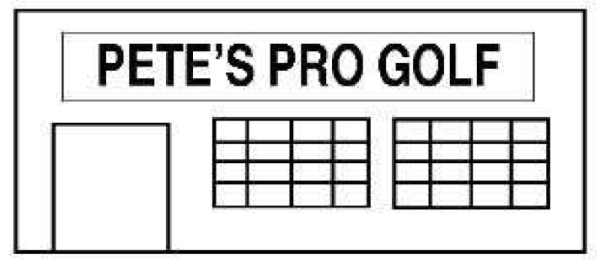
- The sign area of a freestanding sign for a single business shall be calculated as shown in Figure 6. The sign area of a freestanding sign identifying multiple businesses shall be computed by adding together the total areas of all signs as shown in Figure 7. Refer to Table 13.12.130 for minimum and maximum height requirements.
Figure 6. Freestanding Sign Dimensions--Single Business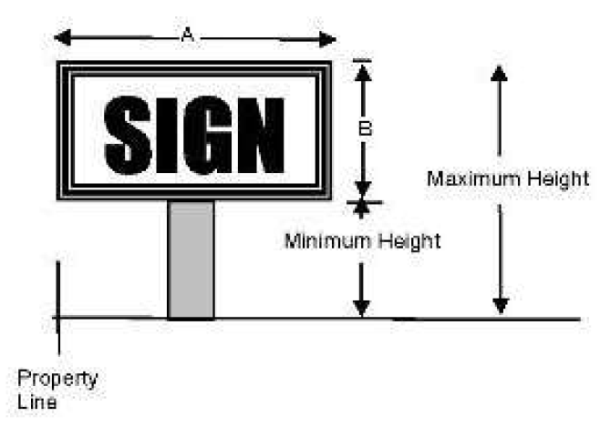
Figure 7. Freestanding Sign Dimensions--Multi-Business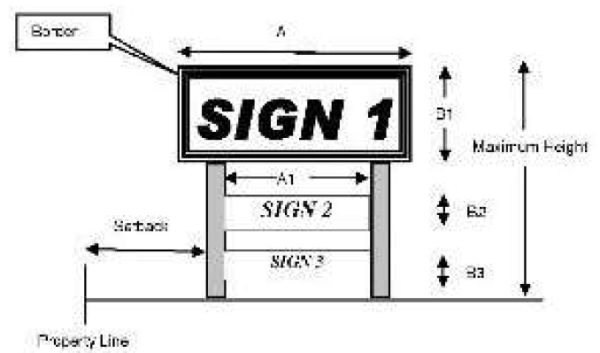
- The sign area for multiple-sided signs shall be calculated as follows:
- The total sign area for a two-sided sign shall be calculated using a single surface of a sign with messages on both sides;
- The sign area for a three-sided sign shall be the sum of all surfaces where two or more signs share a single structure;
- The gross surface area of both faces of a V-shaped sign;
- The copy area of a monument sign.
- For irregularly shaped signs, the sign area is calculated by enclosing the extreme limits of the sign by no more than four rectangles. The sum of the area of the rectangles shall be the gross surface area. The maximum allowable area is reduced by ten percent for the second and each subsequent rectangle used in the calculation, illustrated below.
Figure 8. Sign Dimensions-Irregularly Shaped Area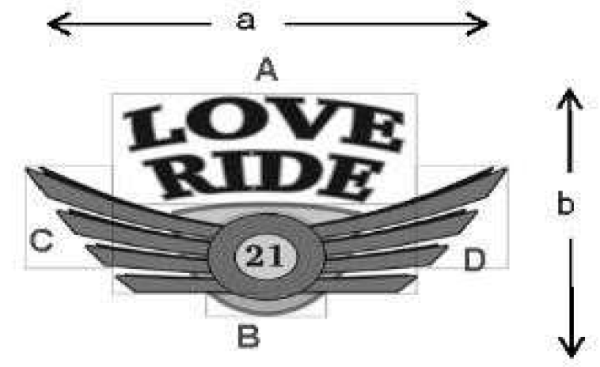
- Conventional measurement. Total area = a x b.
- Sum of rectangles. Total area equals (Area A + Area B + Area C + Area D).
(Ord. No. 19-03, § 3.1.07, 9-4-2019)
Sec 13.12.180 Maintenance Of Signs
- All signs shall be maintained in good repair. The Town Clerk/Treasurer shall have the authority to revoke any permit for signs that are tattered, torn, faded or otherwise in disrepair, and may require the removal of banners, flags, reader boards, pennants and streamers which are torn, discolored or in disrepair.
- All signage shall be maintained by the business owner, or person in possession of the property on which the sign is located. Maintenance shall be such that the signage continues to conform to the conditions imposed by the sign permit.
- Any damaged sign structure shall be repaired within 30 days of notice.
- Any signage which has been damaged to such extent that it may pose a hazard to passersby shall be repaired or removed within 48 hours of notice.
- Any abandoned sign shall be removed by and at the expense of the property owner within 60 days of notice.
- Any abandoned sign support structure shall be removed within 36 months by the owner or lessee of the premises upon which the sign is located.
(Ord. No. 19-03, § 3.1.08, 9-4-2019)
Sec 13.12.190 Existing Nonconforming Signs
- Any permanent sign made nonconforming as a result of the adoption of the ordinance from which this title is derived may be repaired, but not structurally altered or made more nonconforming in any way. If the sign is removed in order to make repairs, it shall be replaced within 60 days or any nonconforming rights shall be terminated. Thereafter, the sign shall conform to the requirements of this chapter.
- Notwithstanding other provisions of this article, any sign for which a temporary permit has been issued by the Town shall be permitted to remain at the location authorized by the permit for as long as the permit is valid, and all the requirements of the permit have been met.
(Ord. No. 19-03, § 3.1.09, 9-4-2019)
Sec 13.12.200 Billboards
New billboards shall be prohibited; provided, however, that existing billboards may be replaced at another location with a structure and copy area of equal or smaller size in mixed-use and nonresidential zoning districts as follows:
- Replacement billboards shall not exceed the height limit in the underlying zoning district, with a maximum height limit of 50 feet in any zone;
- No replacement billboard shall exceed 672 square feet in copy area;
- Any replacement billboard may not be placed less than five feet from the property line. No portion of the sign shall extend beyond the property line;
- No billboard may be located within 1,000 feet of another billboard on the same side of the street. Any replacement billboard shall be offset from any billboard on the opposite side of the street by not less than 250 feet. Offset distance shall be measured from a point perpendicular to and along the alignment of the roadway;
- The owner of the billboard shall file a complete inventory of all billboards located within the Town, including date erected, height, size and location;
- Issuance of a permit for billboard replacement shall be accompanied by a permit for the destruction or removal of the billboard to be replaced; and
- Any billboard that is not replaced within five years following the issuance of a demolition/removal permit shall not be replaced.
(Ord. No. 19-03, § 3.1.10, 9-4-2019)
Sec 13.12.1010 Standards
Any property, structure, object or district that has been designated as historic by being placed on a local, state or National Register of Historic Places shall be subject to the following provisions:
- All permits for remodeling of historic properties shall be reviewed by the Town Council or designee.
- Any remodeling of the exterior appearance of an historic property shall be so constructed as to maintain the style of architecture represented by the original building.
(Ord. No. 19-03, § 3.4.01, 9-4-2019)
Sec 13.12.1020 Criteria For Designation
Any building, structure, site, object, or district may be designated for inclusion in the Town register of historic places if it is significantly associated with the history, architecture, archaeology, engineering, or cultural heritage of the community; has integrity; is at least 50 years old or is of lesser age and has exceptional importance; and falls into at least one of the following categories:
- Is associated with events that have made a significant contribution to the broad patterns of national, state, or local history.
- Embodies the distinctive architectural characteristics of a type, period, style, or method of design or construction, or represents a significant and distinguishable entity whose components may lack individual distinction.
- Is an outstanding work of a designer, builder, or architect who has made a substantial contribution to the art.
- Exemplifies or reflects special elements of the Town's cultural, special, economic, political, aesthetic, engineering, or architectural history.
- Is associated with the lives of persons significant in national, state, or local history.
- Has yielded or may be likely to yield important archaeological information related to history or prehistory.
- Is a building or structure removed from its original location, but which is:
- Significant primarily for architectural value; or
- The only surviving structure significantly associated with an historic person or event.
- Is a birthplace or grave of an historical figure of outstanding importance and is the only surviving structure significantly associated with an historic person or event.
- Is a cemetery that derives its primary significance from age, from distinctive design features, or from association with historic events, or cultural pattern.
- Is a reconstructed building that has been executed in an historically accurate manner on the original site.
- Is a creative and unique example of folk architecture and design created by persons not formally trained in the architectural or design professions, and which does not fit into formal architectural or historic categories.
(Ord. No. 19-03, § 3.4.02, 9-4-2019)
Sec 13.12.1030 Docketing
- Public participation in identifying historical and archeologically significant sites shall be encouraged through docketing citizen suggestions for designating buildings and/or sites of archeological or historical significance.
- All requests for docketing shall be reviewed by the Town Council for determination whether sites of potential historical or archeological significance shall be so designated by the Town.
- Review of docketed properties may be considered by the Council at any time but shall occur no less than once per year.
- The docket shall be kept by the Town and shall include:
- Docket number;
- Date of docket entry;
- Name of person proposing designation;
- Description of the proposed site;
- Purpose for submittal.
(Ord. No. 19-03, § 3.4.03, 9-4-2019)
Sec 13.12.1110 Application
The requirements of this chapter and the state energy code apply to outdoor lighting requirements for all developments except one- and two-family dwellings and public street lighting.
(Ord. No. 19-03, § 3.5.01, 9-4-2019)
Sec 13.12.1120 General Requirements
The installation of new outdoor lighting or the extension, modification or expansion of existing outdoor lighting is subject to the following requirements:
- All outdoor lights shall include a light source and reflector that controls the light beam so that unshielded light does not extend across any bounding property line between incompatible uses or into the public right-of-way.
- Outdoor lighting fixtures shall be designed so that the light source is shielded at any bounding property line except where topographical characteristics make this impossible.
Figure 14. Light Source Shielding Standards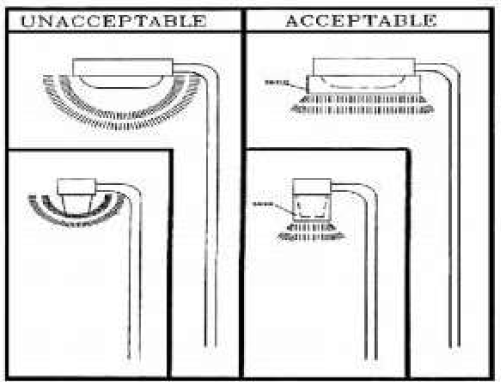
- Applications for commercial development will be evaluated by the Town Clerk/Treasurer or designee to determine if a lighting plan is required to assess and mitigate impacts. The need for a lighting plan will be based on the scope and scale of the project, compatibility with surrounding uses, and anticipated light impacts. If required, the plan will include the following:
- A site plan showing the location of all outdoor light fixtures.
- The type and method of shielding for each light fixture.
- Lighting designed to accent landscaping features or architectural elements, including the illumination of pole-mounted flags of the United States, shall be concealed or positioned so that the light source is not visible at adjacent property lines.
- Lighting for outdoor arenas, stadiums and playfields shall not remain on longer than 30 minutes following the end of the event.
(Ord. No. 19-03, § 3.5.02, 9-4-2019)
Sec 13.12.1130 Prohibited Lights
The following lights are prohibited unless a temporary permit is obtained for specific events with specific times of operation:
- Laser source light, strobe lights and similar high intensity light sources, except those associated with approved activities of the Town. High intensity lights for which a temporary permit is issued shall not project above the horizontal plane nor extend into the public right-of-way.
- Searchlights.
(Ord. No. 19-03, § 3.5.03, 9-4-2019)
Sec 13.12.1140 Exceptions
The following shall be exceptions to the lighting types indicated in RMC 13.12.1130:
- Navigation and airport lighting required for the safe operation of boats and airplanes.
- Emergency lighting required by police, fire, and rescue authorities.
- Lighting for state and federal highways authorized by the state department of transportation.
- Internal lighting of permitted signs.
- Outdoor lighting for public monuments.
- In-pool lighting for private swimming pools.
- Holiday decorations.
(Ord. No. 19-03, § 3.5.04, 9-4-2019)
Sec 13.12.1150 Temporary Lighting
The Town Clerk/Treasurer may authorize temporary exceptions not to exceed 30 days for good cause shown.
(Ord. No. 19-03, § 3.5.05, 9-4-2019)
Sec 13.12.2210 Restriction On Location
- Adult entertainment businesses shall be located no less than 1,000 feet from the following:
- A church, synagogue, mosque, temple or building that is used primarily for religious worship and related religious activities.
- A public or private educational facility, including child day care facilities, nursery schools, preschools, kindergartens, elementary schools, private schools, intermediate schools, junior high schools, middle schools, high schools, secondary schools, special education schools. The term "school" includes the school grounds, but does not include facilities used primarily for another purpose and only incidentally as a school.
- A public park, playground, public plaza or cemetery.
- Another adult entertainment business.
- Adult entertainment businesses shall be located no less than 500 feet from the following: A boundary of any residential zone identified in this title to include Single-Family Residential/Open Space Zones (RO), Single- and Two-Family Residential Zones (R1), Multiple-Family Residential Zones (MF), Mobile Home Park Zones (MHP), and Mixed-Use Zones (MU).
- The location of a newly established public park, church, school or any other newly established place identified in subsections (a)(1) through (3) of this section (within 1,000 feet), or the establishment of a residential zone as defined by subsection (b) of this section (within 500 feet) of an existing adult entertainment business shall not thereby cause the existing adult entertainment business to be deemed a nonconforming use.
(Ord. No. 19-03, § 3.7.20, 9-4-2019)
Sec 13.12.2310 Marijuana Production Standards
- Marijuana production shall be located or maintained at least 1,000 feet from the nearest property line, measured from the nearest property line of the marijuana production facility to the nearest property line of any one or more of the following uses:
- Vacant or undeveloped parcels owned by public school districts as established in RCW title 28A;
- Vacant or undeveloped parcels owned by public library districts as established in RCW ch. 27.12;
- Vacant or undeveloped parcels leased or owned by the Town; provided that the following shall be excluded from consideration:
- Any stormwater facility or right-of-way parcels owned or leased by the Town and designated or identified as a stormwater facility or right-of-way in any document, plan, or program adopted by the Council;
- Town parks and levee path; or
- Any facility or building designated or identified in any document, plan, or program adopted by the Council as "Rockford Town Hall" or other similar term that identifies such facilities or buildings as the Town's primary administrative and legislative location.
- Marijuana production in the Central Commercial Zone (CC) shall only be permitted indoors.
(Ord. No. 19-03, § 3.8.01, 9-4-2019)
Sec 13.12.2320 Marijuana Processing Standards
- Marijuana processing shall be located or maintained at least 1,000 feet from the nearest property line, measured from the nearest property line of the marijuana processing facility to the nearest property line of any one or more of the following uses:
- Vacant or undeveloped parcels owned by public school districts as established in RCW title 28A;
- Vacant or undeveloped parcels owned by public library districts as established in RCW ch. 27.12;
- Vacant or undeveloped parcels leased or owned by the Town; provided that the following shall be excluded from consideration:
- Any stormwater facility or right-of-way parcels owned or leased by the Town and designated or identified as a stormwater facility or right-of-way in any document, plan, or program adopted by the Council;
- Town parks and levee path;
- Any facility or building designated or identified in any document, plan, or program adopted by the Council as "Rockford Town Hall" or other similar term that identifies such facilities or buildings as the Town's primary administrative and legislative location.
- Marijuana processing in the Central Commercial Zone (CC) shall be limited to packaging and labeling of usable marijuana.
(Ord. No. 19-03, § 3.8.02, 9-4-2019)
Sec 13.12.2330 Marijuana Retail Sales Standards
Marijuana retail sales shall not be permitted within the Mixed-Use Zone (MU) and Central Commercial Zone (CC) zoning districts, except with a conditional use permit.
(Ord. No. 19-03, § 3.8.03, 9-4-2019)
Sec 13.12.2340 Other Licensed Or Registered Marijuana Uses Prohibited
Marijuana production and marijuana processing shall be permitted pursuant to this article. All other commercial and noncommercial licensed or registered marijuana uses are prohibited within all zoning districts of the Town. This prohibition includes, but is not limited to, marijuana clubs or lounges and marijuana cooperatives. This prohibition does not apply to home growing or processing of marijuana by qualified patients or designated providers in residential zoning districts as set forth in this article and in compliance with state law.
(Ord. No. 19-03, § 3.8.04, 9-4-2019)
Sec 13.12.2350 Marijuana Production And Processing In Residential Zones
- State law authorizes qualified patients and designated providers to produce marijuana and to process marijuana in dwellings, residences, domiciles, and similar housing units under limited circumstances and with limited processing methods.
- Subject to applicable federal, state, and local laws, any owner, lessor, or leasing agent may request or require disclosure of a renter or lessee's desire to produce or process marijuana within a rented or leased dwelling unit.
- In addition to compliance with any applicable state or federal laws and regulations, lawful production or processing of marijuana by any person in a dwelling, residence, domicile, or other similar housing unit shall be subject to all locally applicable land use, development, zoning, and building regulation requirements, including, but not limited to, all applicable requirements set forth in this title, as the same are now adopted or hereafter amended, and the following regulations:
- Any home production or processing of marijuana by any person pursuant to state law shall not be permitted outside of the dwelling or accessory structure;
- Any home production or processing of marijuana by any person or allowed by state law in a dwelling or accessory structure shall be enclosed, blocked, or sight-screened from the public right-of-way and from adjacent properties so that no portion may be readily seen by normal unaided vision or readily smelled from such locations. Accessory structures shall be permanent structures enclosed by a roof and walls on all sides and connected to a permanent foundation. For the purposes of this section, accessory structures shall not include cargo containers, recreational vehicles, or other similar types of structures. Accessory structures shall be completely opaque in addition to necessary site screening;
- Home processing of marijuana shall not involve any combustible method and shall comply with all federal, state, and local laws and rules, including all standards adopted by the state liquor and cannabis board; and
- Production or processing of marijuana by any person pursuant to state law in a dwelling or accessory structure shall only be allowed in the Single-Family Residential/Open Space Zone (RO) and Single- and Two-Family Residential Zone (R1).
(Ord. No. 19-03, § 3.8.05, 9-4-2019)
Sec 13.12.410 General Fencing
- In residential zoning districts, the height of a fence within the front yard shall be:
- 36 inches or less for sight-obstructing fences; or
- 48 inches or less for non-sight-obstructing fences, such as chainlink fences.
- In residential zoning districts, fences shall not exceed eight feet in height when located on a flanking, side, or rear yard behind the minimum required front yard setback line. Lots with double street frontage may have a fence on the property line not used as the main point of access (the apparent rear yard).
- In nonresidential zoning districts, fences shall not exceed eight feet in height without a conditional use permit except as provided in this section.
- The height of a fence shall be measured from the base of the fence, except as provided in this section.
- Where the elevation of the finished grade within six feet of the fence differs from one side of the fence to the other (as when a fence is placed at the top of a slope or a retaining wall), the height shall be measured from the side with the lowest finished grade elevation.
- In nonresidential zoning districts, barbed wire may be used for security purposes only on the upper one-quarter of the fence unless the use is adjacent to a residential zoning district, in which case no barbed wire shall be allowed on the portion of the fence adjacent to the residential zoning district. An administrative exception may be granted by the Town Manager or designee for public utility distribution or transmission facilities seeking relief from barbed wire requirements.
- Electric fences shall only be allowed to enclose outdoor storage areas in nonresidential zoning districts or to confine animals in residential zoning districts. Electric fences shall not be allowed for any other purpose. Electric fences shall:
- Not exceed ten feet in height when used for outdoor storage or eight feet in height when used to confine animals;
- Be clearly marked with warning signs at least 24 square inches in area located every 60 feet;
- Have an energizer driven by a commercial storage battery that does not exceed 12 volts DC; and
- Not produce a charge upon contact that exceeds the energizer characteristics set forth in paragraph 22.108 and depicted in Figure 102 of International Electrotechnical Commission (IEC) Standard 60335-2-76.
- Fences and all sight obstructions including vegetation shall be located outside of the clearview triangle and shall not block the view of fire protection equipment.
(Ord. No. 19-03, § 3.2.01, 9-4-2019)
Sec 13.12.420 Clearview Triangle
- The term "sight distance" means the length of roadway visible to a driver. The term "clearview triangle" means the triangular area calculated at the intersection of two streets or the intersection of an alley, private street or driveway and a street to provide the required sight distance and provide unobstructed vision to motorists and pedestrians.
- For commercial approaches and controlled intersections, the clearview triangle shall be calculated pursuant to Table 13.12.420 and Figure 6.
Table 13.12.420. Clearview Triangle Calculations--Controlled IntersectionsCase Type Through Street Speed Limit (mph)1 Distance to Point A in Feet Required Sight Distance1,2,3 (BC) in Feet Commercial approaches and stop sign-controlled intersections2 25 15 280 30 335 35 390 Signal-controlled intersection, yield-controlled or all-way stop sign-controlled Per AASHTO Green Book Notes:
1Required sight distance shall be adjusted for grades three percent or greater, more than two lanes, skewed intersections, sharp curves, posted speeds in excess of 35 miles per hour (mph), or for vehicles other than passenger cars pursuant to the street standards as adopted pursuant to the Town's street standards.
2For stop sign-controlled intersections and commercial approaches, use Figure 6 to determine required sight distance and location of Point A.
3To determine the clearview triangle, locate Points A and C, determine the required distance (BC/CB) using Table 13.12.420, locate Point B and connect Points A, B, and C. The area enclosed by Points A, B, and C and the right-of-way is the clearview triangle, hatched area in Figure 6.
Figure 6. Clearview Triangle Calculations--Commercial Approaches and Stop Sign Intersections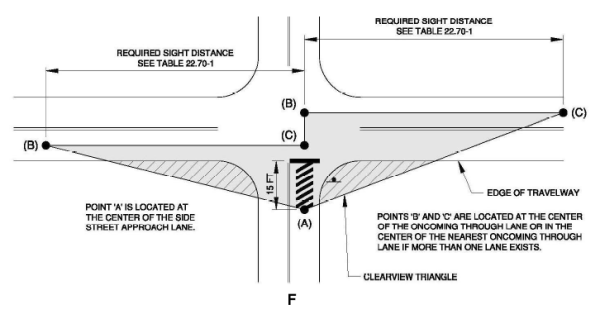
- For uncontrolled street intersections (e.g., intersecting local access streets), the clearview triangle shall be calculated pursuant to Figure 9.
Figure 9. Clearview Triangle Calculation--Uncontrolled Street Intersections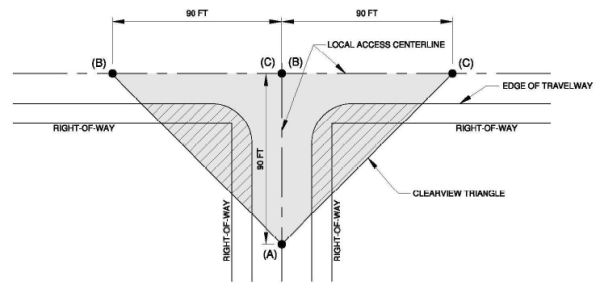
- For noncommercial driveways, the clearview triangle shall be calculated pursuant to Figure 10.
Figure 10. Clearview Triangle for Noncommercial Approaches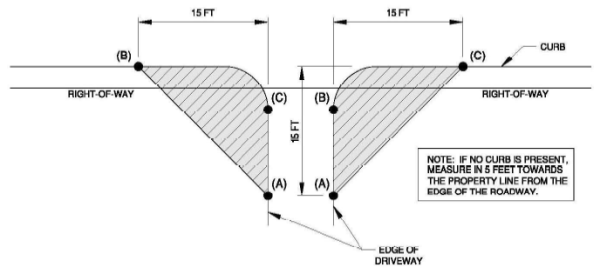
- Within the clearview triangle, the space between 3 1/2 feet and seven feet above the street, or three feet and 6 1/2 feet above the sidewalk, shall be unobstructed from vegetation, structures, signs, and other view obstructions in the manner shown pursuant to Figure 11.
Figure 11. Clearview Vertical Clearance Requirements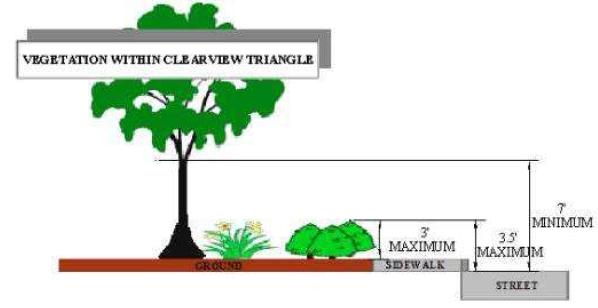
(Ord. No. 19-03, § 3.2.02, 9-4-2019)
Sec 13.12.430 Exemptions For Clearview Triangle
Clearview triangle requirements shall not apply to:
- Public utility poles;
- Trees, so long as they are not planted in the form of a hedge and the shortest branches are trimmed to a height of at least seven feet above the street surface;
- Properties where the natural ground contour penetrates the clearview triangle; or
- Traffic control devices installed by the Town.
(Ord. No. 19-03, § 3.2.03, 9-4-2019)
Sec 13.12.440 Dumpster Screening
- Applicability. The provisions of this section shall apply to new multifamily and nonresidential projects. These provisions shall not apply to projects located in an industrial zoning district.
- Enclosure. Dumpsters shall be enclosed on all four sides by a six-foot-high, 100 percent sight-obscuring fence.
(Ord. No. 19-03, § 3.2.05, 9-4-2019)
Sec 13.12.510 General Landscaping
- Applicability. The provisions of this section shall apply to nonresidential projects, multifamily projects and subdivisions. They shall not apply to projects located in an industrial zoning district.
- Headlight screening.
- Headlight screening shall be provided on the property line adjacent to the parking stalls when parking spaces are perpendicular and/or at an angle facing the public right-of-way or proposed within 20 feet of structures located on adjacent parcels.
- Headlight screening shall be at least 30 inches and a maximum of 42 inches in height for the length of the parking area and shall consist of evergreen plantings, masonry walls, fencing, earthen berms, or other similar materials.
- Headlight screening shall not be required when more stringent buffering is required along the property line adjacent to the parking area.
(Ord. No. 19-03, § 3.2.04, 9-4-2019)
Sec 13.12.520 Location Of Required Landscaping
- Table 13.12.520-1 provides landscaping requirements for uses that are adjacent to a particular zoning classification. The table indicates the type and width of landscaping required alongside any rear property lines not abutting public streets. The requirements are determined by comparing the proposed use (in the left-hand column) to the zoning of adjacent parcels (in the top column).
Table 13.12.520-1. Zone Buffering Urban ZonesUses Zones RO R1 MF MU CC LI Width Type Width Type Width Type Width Type Width Type Width Type Commercial/ Light Industrial 20' I 20' I 20' I N/A N/A N/A N/A N/A N/A MHP 10' I 10' I 10' I 10' I 10' I 20' I Multifamily 10' I N/A N/A N/A N/A 10' I 10' I 10' I Public (1) 10' I 10' I 10' I N/A N/A N/A N/A 10' I (1) Except parks and playgrounds. - Table 13.12.520-2 provides landscaping requirements for uses that are adjacent to an existing use. The table indicates the type and width of landscaping required alongside any rear property lines not abutting public streets. The requirements are determined by comparing the proposed use (in the left-hand column) to the existing use (in the top column). Should there be a conflict in required landscaping between the zone buffering tables (Table 13.12.520-1) and the use buffering table (Table 13.12.520-2), then the table that requires the most landscaping shall apply.
Table 13.12.520-2. Zone Buffering UsesUses Zones RO/R1 MF MHP MU CC LI Width Type Width Type Width Type Width Type Width Type Width Type Commercial/ Light Industrial 20' I 20' I 20' I N/A N/A N/A N/A N/A N/A MHP 10' I 10' I 10' I 10' I 10' I 20' I Multifamily 10' I N/A N/A N/A N/A 10' I 10' I 10' I Public (1) 10' I 10' I 10' I N/A N/A N/A N/A 10' I (1) Except parks and playgrounds. - Landscaping is required adjacent to all public and private roadways as indicated in Table 13.12.520-3, except where permitted structures and driveways are proposed.
Table 13.12.520-3. Frontage LandscapingZone Width of Landscaping Type of Landscaping Single-Family Residential/Open Space Zone RO 5 ft. III Single- and Two-Family Residential Zone R1 5 ft. III Multifamily Residential Zone MF 5 ft. III Mobile Home Park Zone MHP 20 ft. III Mixed-Use Zone MU 5 ft. III Central Commercial Zone CC 5 ft. III Light Industrial Zone LI 5 ft. III Planned Unit Development PUD 5 ft. III - When perimeter fencing is proposed within the developments identified in this section, the landscaping shall be located between the fence and the public/private road rights-of-way.
- Landscaping may be included with the stormwater facilities, providing it does not impede on functionality and is consistent with stormwater guidelines.
(Ord. No. 19-03, § 3.2.06, 9-4-2019)
Sec 13.12.530 Public Utilities; Species Selection Guidelines
Landscaping that is associated with utilities shall be consistent with species selection guidelines as maintained and administered by the Town. The guidelines shall allow only those plantings whose growth or root systems will not negatively affect the utility. Tree selection under power lines shall be limited to trees that have a mature height of 25 feet or less.
(Ord. No. 19-03, § 3.2.07, 9-4-2019)
Sec 13.12.540 Types Of Landscaping
- The following definitions describe the types of landscaping required in this chapter.
- All proposed plant material, sizes and characteristics shall be in accordance with the American Association of Nurserymen Standards.
- Landscaping shall be installed in a manner that does not encroach upon drainage features, drainage easements or drainage facility access easements and does not impede the functioning of such features.
- Type I: Visual screen.
- A mix of evergreen and deciduous trees.
- Evergreen and deciduous trees shall be planted at intervals no greater than 35 feet on center.
- A fully sight-obscuring fence shall be installed consistent with the requirements for a clearview triangle. The fence shall be at least six feet high and 100 percent sight-obscuring. Fences may be made of vinyl, wood, metal, bricks, masonry, or other permanent materials. For required frontage landscaping, the fence shall be located at the rear of the landscaping, farthest away from the road. Chainlink with slats shall not be considered a fully sight-obscuring fence.
- Type II: Visual buffer.
- A mix of evergreen and deciduous trees.
- Evergreen and deciduous trees shall be planted at intervals no greater than 35 feet on center.
- If a fully or partially sight-obscuring fence is installed it shall be consistent with the requirements for a clearview triangle.
- Type III: See-through buffer.
- A mix of evergreen and deciduous trees.
- Evergreen and deciduous trees shall be planted at intervals no greater than 35 feet on center.
- Plantings of shrubs and groundcovers shall be chosen and spaced to result in a total covering of the landscape strip.
- Type I: Visual screen.
(Ord. No. 19-03, § 3.2.08, 9-4-2019)
Sec 13.12.550 Landscaping Requirements For Parking Areas
Landscaping requirements for parking areas are intended to soften the visual effect created by large expanses of barren asphalt and encourage the preservation of mature trees.
- Landscaping on street frontage. Unless otherwise stated herein, a parking area or outdoor display area fronting on a street right-of-way shall provide Type III landscaping of at least five feet in width along the entire street frontage except for driveways, provided that the plantings shall not obstruct the sight distance of street intersections or driveway approaches.
- Additional plantings. Additional plantings may be placed in the street right-of-way between the sidewalk and the property line. The Town is not responsible for maintenance or any damages to the planting areas or landscape features caused by public use of right-of-way or road construction, widening, or maintenance.
- Amount and location. At least ten percent of the parking areas shall be devoted to landscaping. All landscaping must be located between parking stalls, at the end of parking columns, or between stalls and the property line.
- All required landscaping shall meet the clearview triangle requirements in RMC 13.12.420.
- Commercial loading truck maneuvering areas may be excluded from calculations.
- Materials used.
- Planting areas required under subsection (b) of this section shall include liberal landscaping using combinations of such materials as trees, ornamental shrubs, gravel, river rock, driftwood, rockeries, benches or lawn.
- Each landscape area shall contain evergreen or deciduous trees, and staking is required.
- Modifications to protect drainage features, easements, or facilities shall be allowed.
- Internal property lines. When a parking area abuts residentially zoned property along any interior property line, a minimum six-foot-high, fully sight-obscuring fence is required or a minimum five-foot-wide planting area with Type I landscaping shall be installed along the perimeter property line.
- Protective curbing. All landscaped areas shall be protected from vehicle damage by a six-inch-high protective curbing.
- Exceptions. Parking lots containing less than 20 parking spaces need provide only street frontage screening along perimeter property lines as required in this section.
(Ord. No. 19-03, § 3.2.09, 9-4-2019)
Sec 13.12.560 Landscaping Requirements For Planned Unit Development
- Landscape plan required. A preliminary planned unit development plan may not be presented to the Town Council until a landscape plan has been submitted and accepted by the Town Clerk/Treasurer that identifies proposed planting areas and/or types. A final planned unit development shall not be recorded until the Town Clerk/Treasurer or designee approves a landscape plan, consistent with this chapter.
- Common open space. The common open area required per RMC ch. 13.24, art. VII, div. 3, shall be landscaped as follows:
- 50 percent of the required common open area shall contain irrigated plantings to support the aesthetics and function of said common open area. If a common area contains a critical area, such as wetlands, floodplain, geohazard or wildlife habitat, modifications may be approved.
- Landscaping within common open areas shall consist of canopy-type deciduous trees or deciduous ground covers and low shrubs. Planting areas shall be a minimum of 32 square feet in area, with the narrowest dimension not less than four feet. Deciduous trees shall have a minimum truck diameter of 1¾ inches at time of planting (trunk diameter shall be measured at 42 inches above grade). Evergreen trees shall be a minimum of five feet tall at time of planting. Existing vegetation shall be incorporated into the landscape design and shall be considered acceptable in lieu of new plantings if it contributes to achieving the intent of this section. A minimum of ten percent of the required landscaped area shall be planted with trees and shrubs.
- All required landscaping shall be consistent with the requirements for a clearview triangle.
- Street frontage. Street frontage landscaping shall be provided in accordance with RMC 13.12.520.
- Perimeter fencing. When perimeter fencing is used with a planned unit development design, a minimum of five feet of landscaping is required between such fences and public/private pedestrian or roadway rights-of-way.
- Modifications. Modifications to protect drainage features, easements, or facilities shall be allowed.
(Ord. No. 19-03, § 3.2.10, 9-4-2019)
Sec 13.12.570 Landscaping Plan Requirements
- The landscaping plan shall include all of the following information:
- Proposed landscaping including location, common name of each species and size at time of installation.
- Location, common name and size of existing vegetation that is being retained.
- Location of and proposed all buildings and accessory structures.
- Location and height of any existing and proposed berms, walls, fences, retaining walls and similar architectural barriers.
- Location of critical areas and their buffers.
- Location of existing and proposed hardscape such as trellises, decks, patios, signs and similar landscape features.
- The location of clearview triangles per RMC 13.12.420.
- Location of all exterior project lighting, including streetlights.
- Location of proposed and existing water features.
- Location of existing and proposed stormwater drainage features, including, but not limited to, biofiltration swales, detention ponds, drainageways, ditches, drainage easements and drainage facility access easements.
- Location of all existing and proposed overhead and underground utilities, including electric and gas lines.
- North arrow, title block, name and phone number of contact person.
- Location of all streets and alleys.
- The Town Clerk/Treasurer may require the submittal of a letter of intent from the property owners guaranteeing the installation and maintenance of all landscaping illustrated on the approved landscape plan.
(Ord. No. 19-03, § 3.2.11, 9-4-2019)
Sec 13.12.580 Installation, Maintenance And Enforcement
- Required landscaping must be installed before the issuance of a certificate of occupancy and must be maintained pursuant to this chapter. The Town Clerk/Treasurer may authorize a delay where planting season conflicts would produce high probability of plant loss. In the event the Town Clerk/Treasurer authorizes a delay, a temporary certificate of occupancy may be issued for a reasonable period to complete the installation of required landscaping.
- Landscaping requirements that are required in conjunction with short subdivisions, subdivisions, large lot subdivisions, binding site plans and/or planned unit developments shall be installed prior to the recording of any final plat/planned unit development.
- Maintenance of landscaping shall be the responsibility of the property owner. All landscaping required by this chapter shall permanently maintained in a healthy growing condition. Trees that become diseased, severely damaged or die shall be removed by the owner. All trees removed under this section shall be replaced consistent with the approved landscaping plan for the property. Lack of maintenance shall constitute a violation of this Code and/or provisions of the certificate of occupancy.
(Ord. No. 19-03, § 3.2.12, 9-4-2019)
Sec 13.12.590 Irrigation And Water Conservation
- Property owners shall keep the required planting area maintained with an automatic irrigation system unless modifications are approved for xeriscapes or naturalized landscapes.
- When appropriately installed and maintained, xeriscaping and associated irrigation systems intended to conserve water or mitigate the effects of irrigating in stormwater control areas are considered to meet the intent of this chapter.
(Ord. No. 19-03, § 3.2.13, 9-4-2019)
Sec 13.12.710 Required Spaces
- Generally. The number of required new off-street parking spaces shall be based on the following:
- The term "gross square feet" means the total area of the specific use.
- Where fractional spaces result, the parking spaces required shall be rounded to the nearest whole number.
- Uses not specified in Table 13.12.720 shall provide parking based on a use of similar nature.
- Off-street vehicle parking shall be provided prior to occupancy pursuant to Table 13.12.730 for:
- A new structure based on the proposed use;
- An expanded (enlarged) floor area based on the expanded square footage; or
- An existing structure that requires a change of occupancy based on the proposed use.
- In the case of multiple-use occupancies, other than shopping centers, the total requirement for off-street parking shall be the sum of the requirements for the various uses computed separately.
- All driveways, off-street parking, maneuvering, loading, and storage areas shall be paved. An exemption for this requirement may be approved for loading and storage areas in the industrial zones when they are routinely used by cleated and other heavy equipment. Paving shall consist of asphalt or Portland cement. grasscrete, paver blocks, or other equivalent hard surface material may be used for residential driveways and residential off-street parking areas.
- The Town Clerk/Treasurer or designee may allow a reduction up to 25 percent when the applicant makes a written request demonstrating site conditions that prohibit compliance with these requirements.
- Nonresidential projects located within half a mile of a frequent transit route may reduce their required parking up to 25 percent.
- Location of parking spaces.
- For nonresidential uses, new required off-street parking shall be located in a zone which allows the use that requires the parking.
- New required off-street parking shall be located on the same parcel with the use served unless a joint parking agreement is executed in a form acceptable to the Town, stating that the parcel is devoted in whole or in part for the required parking. The agreement shall be binding on both properties and shall be recorded with the County Auditor.
- New required off-street parking shall not be separated from the use by an arterial street unless approved by the Town Clerk/Treasurer or designee.
(Ord. No. 19-03, § 3.3.01(A), (B), 9-4-2019)
Sec 13.12.720 Specific Uses
The following table indicates the required parking spaces for a specific use:
Table 13.12.720. Required Parking Spaces for Specific Uses
| Use | Required Parking |
| Agriculture: | |
| Greenhouse/nursery, commercial | 1 per 500 gross square feet |
| Community services: | |
| Church, temple, mosque, synagogue and house of worship | 1 per 4 fixed seats or 1 per 150 square feet of floor area |
| Community hall, club or lodge | 1 per 350 gross square feet |
| Funeral home | 1 per 500 gross square feet |
| Day care: | |
| Day care, adult, and child | 1 per 500 gross square feet |
| Eating and drinking establishment: | |
| Brewery, winery and/or distillery | 1 per 1,000 gross square feet |
| Espresso establishment, restaurant, tavern/night club, tasting room | 1 per 250 gross square feet, minimum of 2 |
| Education: | |
| Schools, professional, vocational and trade | 1 per 600 gross square feet |
| Schools, specialized training studios | 1 per 350 gross square feet |
| Entertainment: | |
| Cultural facilities | 1 per 800 gross square feet |
| Major event entertainment and indoor theaters | 1 per 4 fixed seats or 1 per 150 square feet of floor area |
| Recreation facility, indoor | 1 per 350 gross square feet |
| Recreation facility, outdoor | 20 per acre of site |
| Group living: | |
| Assisted living facility/convalescent/nursing home | 1 per 4 residents plus 1 per staff on largest shift |
| Community residential facility | 1 per 4 residents |
| Dwelling, congregate | 1 per sleeping room |
| Industrial, light, and heavy: | |
| Assembly/manufacturing/processing, light | 1 per 600 gross square feet |
| Assembly/manufacturing/processing, heavy | 1 per 1,000 gross square feet |
| Industrial service | 1 per 1,000 gross square feet |
| Wrecking, recycling, junk and salvage yards | 1 per 2,000 gross square feet |
| Lodging: | |
| Bed and breakfast, hotel/motel | 1 per guest room and 1 per staff on largest shift |
| Medical: | |
| Medical/dental clinic: | |
| 2 or less professionals | 1 per 500 gross square feet |
| 3 or more professionals | 1 per 350 gross square feet |
| Office: | |
| Animal clinic/veterinary | 1 per 500 gross square feet |
| Call center | 1 per 250 gross square feet |
| Office, professional and general | 1 per 500 gross square feet |
| Residential: | |
| Dwelling, accessory units | 1 per dwelling unit |
| Dwelling, multifamily, studio and 1 bedroom | 1 per dwelling unit, plus 5% of total for guests |
| Dwelling, multifamily, 2 or more bedrooms | 1.5 per dwelling unit, plus 5% of total for guests |
| Dwelling, one- and two-family, townhouse | 2 per dwelling unit |
| Manufactured (mobile) home park | 2 per dwelling unit plus 5% total for guest parking |
| Retail sales and service: | |
| Appliance and furniture sales/service | 1 per 1,000 square feet of display area |
| Banks, savings and loan, and other financial institutions, post office, postal centers, and other similar uses | 1 per 350 gross square feet |
| Building supply and home improvement | 1 per 350 gross square feet |
| Convenience store | 1 per 400 gross square feet |
| Equipment sales, rental, maintenance and repair | 1 per 1,000 gross square feet |
| Landscape materials sales | 1 per 1,000 gross square feet |
| Personal services | 1 per 350 gross square feet |
| Retail sales, indoor, including shopping centers | 1 per 350 gross square feet |
| Retail sales, outdoor | 1 per 5,000 gross square feet of display area |
| Showroom | 1 per 2,000 gross square feet |
| Vehicle services: | |
| Automobile parts, accessories and tires | 1 per 300 gross square feet |
| Automobile/taxi rental, passenger vehicle sales, service and repair | 1 per 1,000 gross square feet of building footprint and 1 per 5,000 square feet of indoor/outdoor display area |
| Automobile/truck/RV/motorcycle service, painting, repair, body and fender works | 1 per 500 gross square feet |
| Boat and RV sales, and service and repair | 1 per 1,000 gross square feet of building footprint and 1 per 5,000 square feet of indoor/outdoor display area |
| Car wash, self-service | 1 per 500 gross square feet |
| Fueling station | 1 per 4 pumps |
| Warehouse, wholesale, and freight movement: | |
| Freight forwarding | 1 per 2,000 gross square feet |
| Storage, general indoors, warehouse | 1 per 3,500 gross square feet |
| Storage, general outdoors, display | 1 per 1,500 gross square feet |
(Ord. No. 19-03, § 3.3.01(B), 9-4-2019)
Sec 13.12.730 Off-Street Parking Design
Off-street parking design shall be pursuant to Table 13.12.730 and Figure 12.
Table 13.12.730. Parking Minimum Design Requirements|
| Standards | |||||
| Parking Angle (in degrees) (A) | Stall Projection (SP) | Minimum Stall Width (B) | Minimum Stall Depth (C) | Minimum Aisle Width (D) | |
| One-Way | Two-Way | ||||
| 0 (parallel) | 22' | 22' | 8'6" | 20' | 20' |
| 45 | 12' | 8'6" | 17'6" | 20' | 20' |
| 60 | 9'6" | 8'6" | 19' | 20' | 20' |
| 75 | 8'10" | 8'6" | 19' | 20' | 22' |
| 90 | 8'6" | 8'6" | 18' | 20' | 22'6" |
Figure 12. Calculation of Parking Spaces
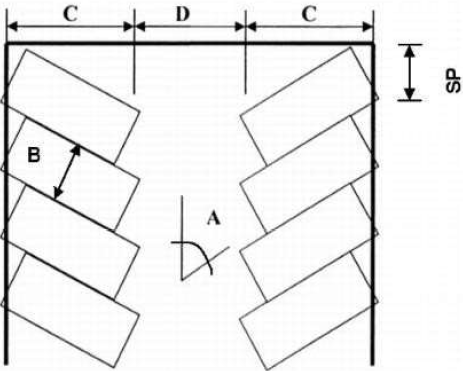
(Ord. No. 19-03, § 3.3.01(C), 9-4-2019)
Sec 13.12.740 Compact Car Allowance
- A maximum of 30 percent of the total required off-street parking stalls may be permitted and designated for compact cars.
- Each compact stall shall be marked with the word "COMPACT" printed onto the stall and maintained as such over the life of the use of both the space and the adjacent structure it serves.
- Dimensions of compact parking stalls shall be eight feet by 17 feet.
- Compact spaces shall be designated in one specific area of the off-street parking facility.
(Ord. No. 19-03, § 3.3.01(D), 9-4-2019)
Sec 13.12.750 Carpool/Vanpool Parking
New office and industrial uses with 50 or more required parking spaces shall designate at least five percent of the spaces for employee carpool or vanpool parking. Employee carpool and vanpool parking shall be located closer to the building entrance or the employee entrance than other employee parking with the exception of accessible parking. The carpool/vanpool spaces shall be clearly marked as "Reserved Carpool/Vanpool Only."
(Ord. No. 19-03, § 3.3.01(E), 9-4-2019
Sec 13.12.760 Emergency Access
All traffic circulation lanes and fire lanes shall be maintained free and clear of merchandise, carts and any other materials to allow for emergency access.
(Ord. No. 19-03, § 3.3.01(F), 9-4-2019)
Sec 13.12.770 Accessible Parking
The intent of this section is to comply with the Americans with Disabilities Act by allowing a person with a physical disability to independently get to a site, facility, building, or element (American National Standards Institute, Inc.).
- Location. Accessible parking spaces shall be located on the shortest accessible route of travel from adjacent parking to an accessible building entrance. Where buildings have multiple accessible entrances with adjacent parking, accessible parking spaces shall be dispersed and located near the accessible entrances.
- Rehabilitation facilities and outpatient physical therapy facilities. At least 20 percent but not less than one of the patient and visitor parking spaces shall be accessible.
- Van spaces. For every six or fraction of six accessible parking spaces, at least one shall be a van-accessible parking space.
Figure 13. Van Spaces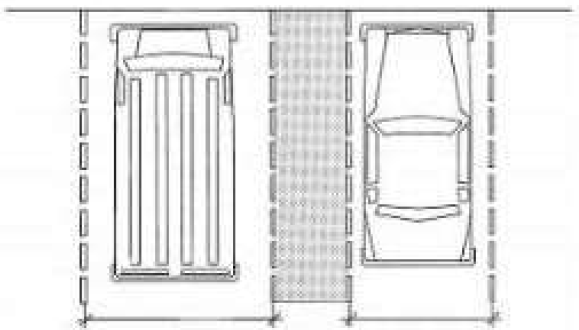
- Space size. Accessible car and van parking space size shall be as follows:
- Car parking spaces shall be eight feet minimum in width.
- Van parking spaces shall be 11 feet minimum in width. Van parking spaces shall be permitted to be a minimum of eight feet in width where the adjacent access aisle is a minimum of eight feet in width.
Table 13.12.770. Accessible Parking Spaces RequiredTotal Parking Spaces Provided Minimum Number of Accessible Spaces 1--100 1, plus 1 for every 25 or fraction thereof 101--200 5, plus 1 for every 50 or fraction thereof 201--500 7, plus 1 for every 100 or fraction thereof 501--1,000 2% of total More than 1,000 20, plus 1 for every 100 over 1,000
(Ord. No. 19-03, § 3.3.01(G), 9-4-2019)
Sec 13.12.780 Compliance With State Law Requirements
Off-street parking shall comply with state law requirements regarding electric vehicle infrastructure, including, but not limited to, RCW chs. 19.27 and 19.28, WAC 51-50-0427, and RCW 46.08.185, as now adopted or hereafter amended.
(Ord. No. 19-03, § 3.3.01(H), 9-4-2019)
Sec 13.12.810 Retail Business, Wholesale, Manufacturing, Etc., Loading Spaces
Every building or part thereof occupied for retail business, service, wholesale, manufacturing, storage, warehousing, hotel/motel, industrial, or any other similar use that receives or distributes materials or merchandise shall provide loading spaces on site in accordance with the following requirements:
- All parking, loading, and maneuvering of trucks shall be conducted on private property and shall not interfere with off-street parking spaces or landscaping.
- Loading spaces shall be located a minimum of 60 feet from any front property line. The Town Clerk/Treasurer may allow exceptions when the applicant makes a written request demonstrating conditions that prohibit compliance with this requirement.
- The minimum dimensions of off-street loading spaces shall be 12 feet wide by 30 feet long.
- Required off-street parking spaces shall not be allowed within the truck dock apron space.
(Ord. No. 19-03, § 3.3.02, 9-4-2019)
Sec 13.12.910 Applicability
Bicycle parking shall be provided for new development in the multifamily and nonresidential zoning districts, except the industrial zoning district. Bicycle parking is not required when the primary use of a business is to service vehicles.
(Ord. No. 19-03, § 3.3.03(A), 9-4-2019)
Sec 13.12.920 Permanent Racks; Location
Bicycle parking shall consist of permanent bicycle racks capable of accommodating two or more bicycles and may be located indoors.
(Ord. No. 19-03, § 3.3.03(B), 9-4-2019)
Sec 13.12.930 Multifamily Developments
Multifamily developments shall provide one bike rack for every two buildings, including clubhouse and rental offices.
(Ord. No. 19-03, § 3.3.03(C), 9-4-2019)
Sec 13.12.940 Commercial Development
Commercial development shall provide bike spaces pursuant to Table 13.12.940.
Table 13.12.940. Required Bicycle Spaces
| Total Parking Spaces Required | Minimum Number of Bicycle Racks Required |
| 0--24 | 0 |
| 25--50 | 1 |
| 50--100 | 2 |
| 100-500 | 3 |
| More than 500 | 4 |
(Ord. No. 19-03, § 3.3.03(D), 9-4-2019)
Sec 13.12.950 Exceptions
The Town Clerk/Treasurer may allow exceptions to this division when the applicant makes a written request demonstrating site conditions that prohibit compliance with these requirements.
(Ord. No. 19-03, § 3.3.03(E), 9-4-2019)
Sec 13.12.1210 Purpose
- In addition to accomplishing the general purposes of this title and the comprehensive plan, the purpose of this article is to set forth the regulations for the placement, development, permitting, and removal of personal wireless communication facilities including support structures and antennas. These standards were designed to comply with the Telecommunications Act of 1996. They are intended to protect property values and minimize visual impact while furthering the development of enhanced telecommunication services in the Town.
- The provisions of this article are not intended to and shall not be interpreted to prohibit or to have the effect of prohibiting personal wireless services. This article shall not be applied in such a manner as to unreasonably discriminate between providers of functionally equivalent personal wireless services.
(Ord. No. 19-03, § 3.6.01, 9-4-2019)
Sec 13.12.1220 Applicability/Exemptions
The requirements of this article shall apply to all new personal wireless communication facilities within the Town and the expansion and/or alteration of any existing personal wireless communication facilities. The following are exempt from the provisions of this article:
- Satellite earth stations using antennas not more than two meters in diameter in commercial and industrial districts and direct-to-home satellite services.
- Send and receive citizen band radio antennas or antennas operated by federally licensed amateur (HAM) radio operators.
- Industrial, scientific and medical equipment using frequencies regulated by the FCC.
- Military and government radar antennas and associated communication towers used for navigational purposes as regulated by the FCC by 47 CFR parts 97 and 95, respectively.
- Military and federal, state and local government communications facilities used for emergency preparedness and public safety purposes.
- Normal, routine and emergency maintenance and repair of existing wireless communication facilities and related equipment which do not increase the size, footprint or bulk of such facilities and which otherwise comply with the Town, state, and federal law and regulations.
(Ord. No. 19-03, § 3.6.02, 9-4-2019)
Sec 13.12.1230 Nonconforming Uses And Structures
Wireless communication uses and structures in existence as of the effective date of the ordinance from which this title is derived that are nonconforming as to the use or development standards of this title shall be subject to the nonconforming provisions of RMC ch. 13.04, art. III. Routine maintenance shall be permitted on exiting towers and antennas. However, new construction other than routine maintenance on existing towers, antennas, buildings or other facilities shall comply with the requirements of this article.
(Ord. No. 19-03, § 3.6.03, 9-4-2019)
Sec 13.12.1240 Priority Of Location And Prohibited Locations
- In reviewing applications for new personal wireless communication facilities, preference shall be given to locations in the following order:
- Attachment on existing structures shall be preferred to the construction of new support structures. Attachment to nonresidential structures will have a higher priority than attachment to residential structures. In all cases, antennas shall not have a negative impact on views from public recreational areas such as parks or trails.
- A new support structure shall only be considered when the applicant demonstrates that it is necessary to provide acceptable service and there are no suitable and available locations on existing structures. Support structures are prohibited within:
- The Shoreline Management Act jurisdictional area;
- Sites in any general use type, other than Light Industrial Zone (LI), designated as historic on any Town, state, or federal register.
- In all cases, towers should not be visible from public recreational areas such as parks and trails.
(Ord. No. 19-03, § 3.6.04, 9-4-2019)
Sec 13.12.1310 Wireless Communication Facility Permit
A wireless communication facility application shall follow the procedures in this article. If a conditional use permit is required, the application shall follow the procedures in RMC ch. 13.28, art. VI, for a conditional use.
(Ord. No. 19-03, § 3.6.11, 9-4-2019)
Sec 13.12.1320 Special Exceptions
- When adherence to all development standards of this article would result in a physical barrier that would block signal reception or transmission or prevent effective communication in all permissible locations, a special exception may be permitted, provided criteria outlined below are met. Exceptions do not apply to variations from the state building code. A variance pursuant to RMC ch. 13.28, art. IV, is required for variations from applicable zoning regulations not described in this article.
- The approval authority for granting of the special exception shall be the same as that of the permit approving the antenna location. A request for a special exception shall be processed in conjunction with the permit approving the antenna location.
- Upon review of special exception requests, the approval authority shall consider first those standards having the least effect upon the resulting aesthetic compatibility of the antenna or tower with the surrounding environment. The approval authority shall review setback, size, screening requirements, and height limits.
- Special exception criteria.
- The applicant shall justify the request for a special exception by demonstrating that the obstruction or inability to receive a communication signal is the result of factors beyond the property owner's or applicant's control. Pictures, scaled drawings, maps and/or manufacturer's specifications, and other technical information, as necessary, should be provided to demonstrate to the Town that the special exception is necessary.
- The applicant for a special exception shall demonstrate that the proposed materials, shape, and color of the antenna will minimize negative visual impacts on adjacent or nearby residential uses to the greatest extent possible. The use of certain materials, shapes and colors may be required in order to minimize visual impacts.
- Attached antennas requesting a special exception for height shall be reviewed through the same process as a support structure in the zone in which the antenna is located.
- Requests for special exceptions for setback reductions shall also be judged based on the following criteria:
- The extent to which screening and camouflaging will be employed to mitigate the effects of the structure versus the value of the setback in providing such screening;
- The need for the setback reduction to facilitate a location or design that better satisfies the criteria of this article;
- The impact on adjacent properties;
- Location in a street right-of-way.
(Ord. No. 19-03, § 3.6.12, 9-4-2019)
Sec 13.12.1330 Application Requirements And Conditions Of Issuance
Applicants shall submit the following information in addition to standard application materials:
- A scaled site plan clearly indicating the location of the proposed facility, all other structures and uses on the site, adjacent roadways, proposed means of access, parking, existing and proposed landscaping and setbacks from property lines.
- Elevation drawings of the proposed tower, the equipment structure, existing structure with proposed antenna, fencing, buffering/screening, type of architectural treatment, and any other feature necessary to show compliance with the applicable standards.
- Legal description and ownership of the parcel.
- A valid agreement for co-location on an existing wireless communication facility support structure or on an existing building or structure; or a location evaluation study as described in subsection (e) of this section.
- For new freestanding support structures, a location evaluation study shall be performed showing that the structure is required for present and future network coverage, that the height requested is the minimum necessary to provide for the function and potential co-located antennas and why the antennas could not be co-located on an existing structure. In residential zones, the applicant shall provide adequate proof that the facility could not be located in a nonresidential zone.
- The applicant shall submit a letter of credit, performance bond or other security acceptable to the Town, as described in RMC ch. 13.24, art. III, to cover future costs of removal of the antenna and/or tower.
- A report from a licensed professional engineer documenting:
- That the support structure is designed for co-location of other antennas (if applicable);
- An estimated number of the wireless communication facilities which the applicant and/or prospective operator of the facility reasonably anticipates placing within the Town's urban growth area during the next five years.
- Proof of license by the FCC, if applicable.
- A copy of the findings from the FAA's Aeronautical Study Determination regarding the proposed wireless communication support structure.
- A declaration under penalty of perjury or sworn statement by the applicant:
- That the antenna usage will not interfere with other adjacent or neighboring transmission or reception communications signals;
- That any tower will comply with all applicable federal and state laws, including specifically FCC and FAA regulations and this title;
- If a leased site, a lease agreement which specifies or shows that it does not preclude the site owner from entering into leases on the site with other providers.
(Ord. No. 19-03, § 3.6.13, 9-4-2019)
Sec 13.12.1340 General Criteria For Issuance Of Permits
- Any applicant for a land use permit (other than a building permit) proposing to install an antenna support structure or mount an antenna on an existing structure shall demonstrate by engineering evidence that:
- The antenna must be located at the site to satisfy its function in the applicant's local grid system. The Town may require the applicant to provide feasibility studies that demonstrate that locations on existing structures and/or in higher priority locations have been explored and are not feasible or available;
- The height requested is the minimum height necessary to fulfill the site's function within the grid system.
- In addition to standard criteria, the authority granting the permit shall find that:
- The facility is to be co-located with an existing wireless communication facility;
- The facility is to be located on an existing building or structure; or
- That all reasonable measures to co-locate the facility or to locate the facility to an existing building or structure have been considered by the applicant and are not feasible.
- The permit may include requirements which:
- Minimize visual impacts to the greatest extent possible by maximum feasible use of camouflage or screening, including, but not limited to, fencing, landscaping, strategic placement adjacent to existing buildings or live or simulated vegetation, undergrounding of accessory equipment structures, incorporation of wireless communication support structures, antennas and other appurtenances into the architectural features of existing buildings or structures and by requiring compatibility with key design elements in the surrounding area (e.g., use of brick or other material similar to that used in adjacent buildings or structures; incorporation of support structures into compatible architectural features such as flag poles, bell towers or cornices; or use of simulated vegetation to camouflage support structures);
- Locate wireless communication facilities so as to minimize the visibility of the facility to residentially zoned land and so as to minimize the obstruction of scenic views from residentially zoned land;
- Require the mounting of the facility on existing buildings or structures, or use of other alternatives with less visual, aesthetic or safety impacts, as an alternative to use of a monopole or lattice tower;
- Require the applicant, owner or operator of the facility to furnish legal indemnification to the Town for any liability related to the installation, operation or maintenance of the facility.
(Ord. No. 19-03, § 3.6.14, 9-4-2019)
Sec 13.12.1510 Applicability; Conflict
The minimum development standards in this subdivision shall apply to all wireless communication facilities. In the event of a conflict between the standards of this section and the general development standards of this title, the more stringent standards shall govern.
(Ord. No. 19-03, § 3.6.05(intro. ¶), 9-4-2019)
Sec 13.12.1520 Anti-Climbing Devices
All wireless communication support structures and required fencing shall be equipped with appropriate anti-climbing devices.
(Ord. No. 19-03, § 3.6.05(1), 9-4-2019)
Sec 13.12.1530 Attachment To Trees Prohibited
It is prohibited to attach any wireless communication facility or portion thereof to any tree.
(Ord. No. 19-03, § 3.6.05(2), 9-4-2019)
Sec 13.12.1540 Signs
All wireless communication support structures shall be identified with a non-illuminated sign not exceeding four square feet. The sign shall list the wireless service provider's name and emergency telephone number and shall be posted in a place visible to the general public. No advertising signs shall be located on support structures or antennas; however, antennas may be camouflaged as otherwise permitted signs.
(Ord. No. 19-03, § 3.6.05(3), 9-4-2019)
Sec 13.12.1550 Lighting
Wireless communication facilities shall not be illuminated except where required by the FAA.
(Ord. No. 19-03, § 3.6.05(4), 9-4-2019)
Sec 13.12.1560 Painting
Wireless communication facilities shall be painted or finished in a manner that blends with the dominant color of the background except where otherwise required by the FAA. The applicant and the operator of the facility shall have a continuing duty to maintain such paint or finish.
(Ord. No. 19-03, § 3.6.05(5), 9-4-2019)
Sec 13.12.1570 Noise From Accessory Equipment
Facilities shall comply with state noise level standards under WAC 173.60, as amended. Generators may only be permitted for emergency operation purposes. If air conditioning or other noise-generating equipment is proposed, the applicant shall provide information detailing the expected noise level and any proposed abatement measures. The Town may require noise attenuation devices or other mitigation measures to minimize impacts.
(Ord. No. 19-03, § 3.6.05(6), 9-4-2019)
Sec 13.12.1580 General Design Standards
- Attached antennas (excluding co-located antennas on existing wireless communication facility structures) shall be designed or placed to blend with the predominant background or architectural features as seen from abutting residential uses, roadways or other public rights-of-way.
- When located on buildings, panel antennas shall be placed closely against walls or parapets and not extend above the wall or parapet unless an alternative design is required to:
- Achieve better compatibility with the building design; or
- To obtain antenna function.
- Accessory equipment structures shall be placed underground or wholly enclosed in an existing structure or building or designed to blend into the architecture and landscaping of the surrounding buildings or structures. When the equipment boxes are placed at ground level, landscaping shall be used to screen them.
- Ground-mounted dishes shall be located outside of any required landscaped area and preferably located in service areas or other less visible locations. They shall be solidly screened to at least as high as the center of the dish when viewed from off the site. Solid screening shall be provided as high as the top of the dish on sides adjacent to residential zones.
- Roof-mounted dishes shall be solidly screened at least as high as the center of the dish. The screening shall be of a material and design compatible with the building, and can include penthouse screening, parapet walls, or other similar screening. They should be placed as close to the center of the roof as possible.
- Antennas on utility poles shall be limited to whip antennas no more than two feet in length and no more than one per pole. No utility pole shall be extended in height in order to accommodate an antenna. No antennas shall be allowed on light standards.
(Ord. No. 19-03, § 3.6.05(7), 9-4-2019)
Sec 13.12.1590 Setbacks Applicable
The following setback standards shall apply to wireless communication facilities:
- Accessory equipment structures shall comply with the setback requirements for main buildings in the underlying district. Support structures attached to buildings or permanent structures shall comply with the setback requirements for main buildings in the underlying district that are determined by the planning commission to be those applicable to a building of a height equal to that of the combined building/structure and antenna.
- Freestanding wireless communication support structures located in a residential district shall be set back from any property line by a distance equal to the height of the wireless communication support structure or the setback of the underlying use district, whichever is greater.
- Freestanding wireless communication support structures located in any other type of district shall be set back from any wireless communication facility site property line abutting or adjacent to a residential use district by a distance equal to the height of the wireless communication support structure or the setback of the underlying use district, whichever is greater.
- Setbacks for freestanding wireless communication support structures shall be measured from the ground-level base of the structure.
- The setback in any district may be reduced at the sole and absolute discretion of the Town subject to satisfaction of the variance criteria in RMC ch. 13.28, art. IV.
(Ord. No. 19-03, § 3.6.05(8), 9-4-2019)
Sec 13.12.1600 Landscaping Standards
Wireless communication facilities shall be subject to the following landscaping and screening standards:
- The perimeter of the wireless communication support structure and any guyed wires and anchors shall be enclosed by a fence or wall at least six feet in height. A row of shrubs spaced not more than five feet apart and capable of growing to form a continuous hedge at least five feet high within five years of planting, and at least one row of trees or shrubs spaced not more than ten feet apart nor less than six feet high when planted. These materials shall be installed on the outside of fences.
- Landscape material should be selected and sited to produce a hardy and drought-resistant landscape area.
- Maintenance of the landscaped area shall be the responsibility of the applicant and/or operator of the facility. Required landscaping must be maintained in a healthy manner. Trees and shrubs that die must be replaced with healthy in-kind materials. Temporary irrigation shall be provided to help ensure survival during the plant establishment period.
- The Town Council may allow the use of any combination of existing vegetation, topography, walls, decorative fences or other features instead of landscaping, if they achieve the same degree of screening as the required landscaping. The Council may waive the standards for those sides of the facility that will not be visible from public streets or adjoining properties.
- Existing vegetation shall be preserved to the maximum extent practicable.
- When landscaping installation is required, a maintenance bond, assignment of funds or other financial guarantee acceptable to the Town shall be provided in the amount of 50 percent of the value of the labor and materials. The guarantee shall be in effect for two years from the date of planting.
(Ord. No. 19-03, § 3.6.05(9), 9-4-2019)
Sec 13.12.1610 General Height Standards
The following standards shall apply to wireless communication facilities:
- The height of a wireless communication facility shall include the support structure and any attached antennas proposed at the time of application.
- The applicant shall demonstrate that the tower and antenna is the minimum height required to function satisfactorily. No tower or antenna that is taller than this minimum height shall be approved.
- A lightning rod, not to exceed ten feet in height, or FAA required lighting shall not be included within the height limitations.
- The height of attached antennas may exceed the height limit of the underlying zone provided the height limits of this article shall apply.
(Ord. No. 19-03, § 3.6.05(10), 9-4-2019)
Sec 13.12.1620 Performance Bond
The operator of the facility shall obtain and keep in force throughout the time the facility is located on the site a performance bond payable to the Town in the amount of 150 percent of the estimated cost of removal as determined by the Town Council, but not less than $1,000.00. The bond is intended to cover the costs of removal of such facility at such time as the facility may be required to be removed.
(Ord. No. 19-03, § 3.6.05(11), 9-4-2019)
Sec 13.12.1630 Building And Other Applicable Permits
The applicant for a permit pursuant to this title shall apply for building and any other applicable permits and obtain these permits prior to installation.
(Ord. No. 19-03, § 3.6.05(12), 9-4-2019)
Sec 13.12.1710 Support Structures
- Lattice towers are prohibited. Monopole support structures are prohibited on sites containing residential uses.
- Monopole wireless communication support structures shall not be located on sites that contain residential uses. The height limits of the zone may be exceeded by 15 feet provided the applicant demonstrates the structure height is the minimum necessary to adequately function. An additional 15 feet may be allowed when co-location is specifically provided for on the tower.
- Support structures shall require a conditional use permit.
(Ord. No. 19-03, § 3.6.06(1), 9-4-2019)
Sec 13.12.1720 Attached Antennas
- Antennas are prohibited on single-family dwellings, duplexes and their accessory structures. Dish antennas shall not be mounted on roofs without a special exception under the provisions of RMC ch. 13.28, art. V.
- The following antennas may be permitted through a wireless communication facility permit:
- Co-location on an existing wireless communication support structure provided that no more than 16 feet is added to the height of the facility;
- Attachment to a nonresidential structure on a site not used exclusively for residential purposes provided that the antenna does not extend more than 16 feet above the roof.
- Ground-mounted dish antennas may be located on sites not used exclusively for residential purposes provided that the antenna is not more than 15 feet in height above ground level nor more than 12 feet in diameter.
- Antennas on a site used exclusively for residential purposes or attached to residential structures require conditional use permit approval. The height limits in this section shall apply.
(Ord. No. 19-03, § 3.6.06(2), 9-4-2019)
Sec 13.12.1810 Support Structures
Support structures shall require a conditional use permit. The height limit of the zone may be exceeded provided the maximum height shall be 100 feet, with a bonus of an additional 20 feet of height if the structure provides for co-location.
(Ord. No. 19-03, § 3.6.07(1), 9-4-2019)
Sec 13.12.1820 Attached Antennas
- Antennas shall not be attached to single-family dwellings, duplexes or their accessory structures.
- Except in the Central Commercial Zone (CC), antennas on sites used exclusively for residential purposes and antennas attached to residential structures shall require a conditional use permit.
- Other attached antennas, ground-mounted dishes and co-located antennas shall require a wireless communication facility permit.
- Antennas attached to structures shall not extend more than 16 feet above the roof or parapet. Co-located antennas shall not extend more than 16 feet above the support structure.
(Ord. No. 19-03, § 3.6.07(2), 9-4-2019)
Sec 13.12.1910 Support Structures
Support structures shall require a conditional use permit and shall not exceed a height of 100 feet. A bonus of 20 feet in height may be granted if the facility provides for co-location.
(Ord. No. 19-03, § 3.6.08(1), 9-4-2019)
Sec 13.12.1920 Attached Antennas
- Antennas shall not be attached to single-family dwellings and duplexes or their accessory structures.
- Attached antennas shall not extend more than 16 feet above the roof or parapet.
- Co-located antennas shall not extend more than 16 feet above the existing structure.
- Attached antennas, ground-mounted dishes and co-located antennas shall require a wireless communication facility permit.
(Ord. No. 19-03, § 3.6.08(2), 9-4-2019)
Sec 13.12.2010 Wireless Communication Facilities
In public utilities zones, any wireless communication facility allowed through a wireless communication facility approval in a Central Commercial Zone (CC) may be permitted through a wireless communication facility permit and shall be subject to the same performance criteria. In other public zones, any wireless communication facility allowed through a wireless communication facility approval in a residential zone may be allowed through a wireless communication facility permit and shall be subject to the same performance criteria.
(Ord. No. 19-03, § 3.6.09(1), 9-4-2019)
Sec 13.12.2020 Conditional Use Permit
Any other wireless communication facility may be considered through a conditional use permit.
(Ord. No. 19-03, § 3.6.09(2), 9-4-2019)
Sec 13.12.2030 Height Restriction
Support structures shall not exceed 100 feet in height. A bonus of 20 feet may be granted if the facility provides for co-location.
(Ord. No. 19-03, § 3.6.09(3), 9-4-2019)
Sec 13.12.2110 Wireless Communication Facilities
Wireless communication facilities may be permitted as a temporary use with review by the Town Council in order to facilitate continuity in wireless communication service during repair or maintenance of existing wireless communication facilities or prior to completion of construction of new wireless communication facilities. Such temporary wireless communication facilities shall operate for not more than 60 days within a six-month period commencing when transmission from such facility begins. The wireless communication facilities shall be removed within 30 days after the facility is no longer needed for telecommunication purposes.
(Ord. No. 19-03, § 3.6.10, 9-4-2019)

