
Rogers City Zoning Code
ARTICLE 125
IV - ZONING DISTRICT STANDARDS
Sec 125-50 - Zoning Districts Established
- Zoning Districts. For the purpose of this Chapter, the City is hereby divided into the following zoning districts.
TABLE 2. ESTABLISHED ZONING DISTRICTSAbbreviation District Name AG Agricultural R1 Rural Residential R2 Single Family Residential R3 Mid-Density Residential R4 Mixed Density Residential R5 High Density Residential OP Parks and Open Space LC Local Employment Center RC Regional Employment Center DT Downtown ND Neighborhood GI General Industrial SB Service Business PUD Planned Unit Development - Zoning Map. The locations and boundaries of the districts established by this Ordinance are hereby set forth on the Zoning Map (Map 1). The map is hereby made a part of this Ordinance and shall be known as the “City of Rogers Zoning Map.” The map and all notations, references and data shown thereon are hereby incorporated by reference into this Ordinance and shall be as much a part of it as if all were fully described herein. It shall be the responsibility of the Zoning Administrator to maintain the map and record map amendments within 30 days after official publication of amendments.
TABLE 3. DISTRICT DESCRIPTIONSThis table provides descriptions of the character of each Zoning District.  AG Agricultural District
The purpose of the AG Agricultural District is to provide areas for existing agricultural uses and land currently enrolled in the Metropolitan Agricultural Preserve Program. Areas zoned as Agricultural shall maintain this zoning designation until a landowner chooses to develop the land or exits the Metropolitan Agricultural Preserve Program at which time the City may rezone the affected property consistent with its designation in the Comprehensive Plan, provided that the development does not result in the premature extension of public utilities, facilities, and services. R1 Rural Residential
The purpose of the R1 Rural Residential District is to provide areas for agricultural uses as well as providing for residential development while affording the enjoyment of the rural life style. The Rural Residential District applies to those properties classified as Rural Residential on the 2040 Future Land Use Plan. Development within this district is required at a minimum density of 0.10 units per net acre up to a maximum of 2.0 units per net acre, developed in a manner to allow densities up to 3.0 units per net acre in the future. R2 Single Family Residential
The purpose of the R2 Single Family Residential District is to allow the continuation of existing residential development and infilling of existing lots in the older residential area of the city. The district also allows for smaller lots in areas that are not developed but are guided single family residential to development in a manner that will not be disruptive to the character of the existing neighborhoods. R3 Mid-Density Residential
The purpose of the R3 Mid-Density Residential District is to provide a district that will allow alternative forms of housing development opportunity and a mixture of housing types. Residential units in this district include a range of housing types from rowhouses and townhomes to twinhomes and smaller lot detached single-family homes. The Mid-density Residential district is located in areas that will provide residents with access to transportation corridors and nearby amenities and services. The district transitions the City between low density single-family residential areas and higher intensity residential and commercial areas. R4 Mixed Density Residential
The purpose of the R4 Mixed Density Residential District is to provide a diverse range of housing types, including multiple-family dwellings, that cater to housing preferences during different lifecycle stages. This includes such housing types as smaller single-family dwellings, twin homes, stacked townhomes, lofts and flats, and apartments. This district aims to locate that mix of housing options in areas connected to local transportation networks and with convenient access to local shops and services, parks, trails and schools. The R4 district creates development flexibility by making available opportunities to increase density within the urbanized area. R5 High Density Residential
The purpose of the R5 High Density Residential District is to allow for high density dwellings. This includes housing types such as apartments. This district aims to locate high density housing options near desirable community amenities and supported by convenient access to amenities such as transit, local shops and services, parks, trails and schools. The R5 district also provides opportunities to increase density within the existing urbanized area, while serving as a transition between commercial and employment centers and existing residential development. OP Parks and Open Space
The purpose of the OP Parks and Open Space District is to provide areas for parks and open space throughout the City of Rogers. The Parks and Open Space District applies to those properties classified as Parks and Open Space on the 2040 Future Land Use Plan. LC Local Employment Center
The purpose of the LC Local Employment Center District is to provide the opportunity for general retail, commercial, high density residential and mixed-use development in existing commercial areas and commercial and high density residential guided areas served by community sewer and water. Residential uses within the area create opportunities for an accessible and amenity rich environment. Accessibility and visibility from the regional highway system are enforced through form standards. RC Regional Employment Center
The purpose of the Regional Employment Center District is intended to promote the redevelopment of the corridor into areas suited for high intensity commercial, office-oriented and industrial land use patterns tailored to the larger metropolitan region. Residential uses within the area create opportunities for an accessible and amenity rich environment. Accessibility and visibility from the regional highway system are enforced through form standards. Development may be either vertically or horizontally designed in order to offer flexibility within the marketplace and to encourage land use efficiency. Horizontal mixed use is only effective when designed as part of a cohesive site plan that considers both vehicular and active modes of transportation, well connected both internally and externally from the entire site. DT Downtown District
The purpose of the Downtown District is to encourage a mix of uses that are typically found in traditional downtowns, including retail, services, entertainment, civic, institutional, offices, and mid- and high-density housing. Along Main Street, between John Deere Lane and the railroad tracks, the goal is to maintain the commercial fronts and building heights by reusing the existing historic buildings, where possible, and seek opportunities for mixed use buildings, whether multi-story or of horizontal orientation, as infill development opportunities on vacant, blighted and/or underutilized properties. The mix of uses may include retail and services at street level with residential or office uses above or beside the commercial use. Mixing uses in downtown supports economic activity and helps create a walkable downtown environment by maximizing the square footage of commercial space that is directly accessible from the street. ND Neighborhood District
The purpose of the Mixed-Use Neighborhood District is to provide a flexible land use category that would accommodate mixed-use, residential or a node of service commercial where market forces might present such an opportunity. GI General Industrial
Industrial uses include manufacturing, assembly, processing, warehousing and distribution uses. Industrial districts should be located to take advantage of good access to the regional roadway system with limited traffic circulation through residential and pedestrian-oriented areas. Properties within the I-1 district provide a range of lot sizes to support industrial operations of various intensity. Industries or uses that benefit from good vehicular access or exposure, or entail temporary land usage until served by extension of public utilities to the site are also appropriate in this district. SB Service Business
The Service Business District includes industrial uses which by the nature of their use may require more intense screening, buffering from adjacent uses. Uses may include manufacturing, assembly, processing, warehousing and distribution uses and uses with accessory outdoor storage. Service Business districts should be located to take advantage of good access to the regional roadway system with limited traffic circulation through residential and pedestrian-oriented areas. Properties within the SB district provide a range of lot sizes to support industrial operations of various intensity. Industries or uses that benefit from good vehicular access or exposure, or entail temporary land usage until served by extension of public utilities to the site are also appropriate in this district. Additionally, this is the district where contractors operations with contractor yards must be located. - Preservation and Establishment of PUD Districts. Except as otherwise provided in this section, planned unit development approved by the City as of the adoption of this ordinance shall be preserved and set forth on the zoning map. Approval of a planned unit development shall constitute and have the effect of a rezoning and shall be so designated on the zoning map.
- Permitted Uses
- The uses identified in Table 4. Permitted Uses are permitted, but development or redevelopment beyond single-family and two-family residential development requires Site Plan review. New development or redevelopment may require submittal of an application for site plan review as outlined in Sec. 125-27. Site Plan showing that the development standards identified in this Ordinance have been met. These items will be reviewed by the Planning Commission and City Council.

Recommended meeting with Staff - The uses identified in Table 4. Permitted Uses as permitted (P) are allowed by right in the City of Rogers. New development or redevelopment will require submittal of a building permit application as outlined in Sec. 125-31. Building Procedures with adequate information to show that the development standards identified in this Ordinance have been met. These items will be administratively reviewed by the Zoning Administrator and Building Inspector.
- The uses identified in Table 4. Permitted Uses are permitted, but development or redevelopment beyond single-family and two-family residential development requires Site Plan review. New development or redevelopment may require submittal of an application for site plan review as outlined in Sec. 125-27. Site Plan showing that the development standards identified in this Ordinance have been met. These items will be reviewed by the Planning Commission and City Council.
- Accessory Uses
- The uses identified in Table 4. Permitted Uses as accessory uses (A) are permitted uses serving any residential or non-residential principal use or structure on the same lot and customarily incidental thereto.

Permit required
- The uses identified in Table 4. Permitted Uses as accessory uses (A) are permitted uses serving any residential or non-residential principal use or structure on the same lot and customarily incidental thereto.
- Conditional Uses
- The uses identified in Table 4. Permitted Uses as Conditional (C) are allowed by Conditional Use Permit in the City of Rogers. New development or redevelopment will require submittal of a conditional use permit application as outlined in Sec. 125-24. Conditional Use Permits showing that the development standards and conditional use permit standards identified in this Ordinance have been met. These items will be reviewed by the Zoning Administrator, Planning Commission and City Council.

Permit Required
TABLE 4. PERMITTED USES
- The uses identified in Table 4. Permitted Uses as Conditional (C) are allowed by Conditional Use Permit in the City of Rogers. New development or redevelopment will require submittal of a conditional use permit application as outlined in Sec. 125-24. Conditional Use Permits showing that the development standards and conditional use permit standards identified in this Ordinance have been met. These items will be reviewed by the Zoning Administrator, Planning Commission and City Council.
- Interim Uses
- The uses identified in Table 4. Permitted Uses as Interim (I) are allowed by Interim Use Permit in the City of Rogers. New development or redevelopment will require submittal of an Interim Use Permit application as outlined in Sec. 125-25. Interim Use Permit showing that the development standards and interim use permit standards identified in this Ordinance have been met. These items will be reviewed by the Zoning Administrator, Planning Commission and City Council.

Permit required
- The uses identified in Table 4. Permitted Uses as Interim (I) are allowed by Interim Use Permit in the City of Rogers. New development or redevelopment will require submittal of an Interim Use Permit application as outlined in Sec. 125-25. Interim Use Permit showing that the development standards and interim use permit standards identified in this Ordinance have been met. These items will be reviewed by the Zoning Administrator, Planning Commission and City Council.
- Uses Allowed Within the Floodplain Overlay. Certain uses are restricted if a lot is within the FEMA floodplain. These uses are identified in Article VI. Floodplain.
AG R1 R2 R3 R4 R5 OP LC RC DT ND GI SB A. RESIDENTIAL USES Household Living Dwelling, Single-Family P P P P P P Dwelling, Two-Family P P P Dwelling, Townhome P P P Dwelling, Multi-Family (3 to 5 Units) P P P P Dwelling, Apartments (6+ Units) P P P P P Dwelling, Accessory Units A A A Group Living Senior Residential Living Facility C P P P P Residential Care Facility (6 or Fewer) P P Residential Care Facility (7 or More) P P P AG R1 R2 R3 R4 R5 OP LC RC DT ND GI SB B. ACCESSORY Permitted Accessory Uses Accessory Structure A A A A A A Accessory Structure - Residential Garages A A A Accessory Structure - Pool Houses A A A A A A A A Drive Thru A A A Fences A A A A A A A A A A A A A Office, General A A A A A Outdoor Display, Automobiles with Dealership, if abutting I-94 or Hwy 101 A A Outdoor Seating A A A A A Parking, Surface Lots & Ramps/Garages A A A A A A A A Private Swimming Pool A A A A A A A Septic System, Community A Solar Energy System A A A A A A A A A A A A Special Approval Required Home Occupations, Type I P P P P P P Home Occupations, Type II P P I Home Occupations, Type III I I I Outdoor Display, Retail C C C C Outdoor Storage, Materials C C C C Outdoor Storage, Storage Tanks C C A A Outdoor Storage, Trucks & Trailers C C A A Self-Service Car Wash, with gas station or convenience store C C C AG R1 R2 R3 R4 R5 OP LC RC DT ND GI SB C. PUBLIC, INSTITUTIONAL & CIVIC Community & Cultural Facilities Cemetery, Columbarium, Mausoleum A A A A A Club or Lodge (Private), 10,000 sq ft or less P P P P Club or Lodge (Private), 10,001 sq ft or greater P P Government Building P P P P P P Library P P P Museum P P P Golf Course C C Park Facilities P P P P P P P P Public Swimming Pool P P P Recreation Complex, Indoor (Public) P P P P Recreation Complex, Outdoor (Public) P P P P P P P P P P P Religious Assembly, 15,000 sq ft or less P P P P P P P Religious Assembly, 15,001 sq ft or greater P P P P P Religious Assembly, Existing as of June 23, 2020 P P P P P P P P P P P P P Transit Facility (Commuter) P P P P Educational Facilities Business or Vocational Institution P P P C School, Charter/Private P P P School, Elementary (Public) P P P P School, Middle or High (Public) P P P P University or College P P Utilities Electric Power Substation C C C C C C Wind Power Generation C C Water Treatment Facility, Wells & Reservoir P P P P P P P P P P P P P Wastewater Treatment Facility & Lift Station P P P P P P P P P P P P P AG R1 R2 R3 R4 R5 OP LC RC DT ND GI SB D. AGRICULTURAL Agriculture Production & Livestock Agriculture, Community Garden P Agriculture, Crop Production P P P Agriculture, Livestock Operation P P Animals, Farm & Domestic A A Animals, Kennel C C C Commercial Nursery & Sales P C C P P Equestrian Facilities I I Veterinary Clinic P P P Farm Winery P P P AG R1 R2 R3 R4 R5 OP LC RC DT ND GI SB E. COMMERCIAL Adult Adult Uses - See Sec. 125-92. Adult-oriented Business P Alcoholic Beverage Brewpub P P P C Brewery, Small P P P C P P Brewery, Large P P Distillery & Craft Liquor, Small P P P C P P Distillery & Craft Liquor, Large P P Distillery Tasting Room P P P C P P On-Sale Liquor P P P C Taproom P P P C P P Communications Billboard I I I I Tower, Wireless Communication1 I I I I I I I Tower, Transmission I I I I I I I Food & Entertainment Convention or Events Center P P P C Entertainment Center, Indoor P P P Restaurant P P P P Theater, Movie P P Health Care Clinic, Dental P P P P Clinic, Medical P P P Hospital P P P Medical Campus P P P Lodging Bed & Breakfast Inn P P P Hotel P P P Motel P P P Offices Banks & Financial Institution P P P Professional Service P P P Office Building P P P P Personal Services Animal Care & Services P P P P Assembly & Repair Personal Products P P P Barbershop & Beauty Salon P P P P Body Art, Piercing & Tattooing P P P Catering P P P Check Cashing, Payday Loans P P Daycare, Drop-In Adult Care P P P Daycare, Child Care P P P P Delivery Lockers I I Dry Cleaning P P P Fitness & Health Club, 15,000 sq ft or less P P P P Fitness & Health Club, 15,001 sq ft or greater P P Fitness, Sport & Recreation Park (Indoor) P P P Funeral Home, without Crematorium P P Crematorium C C Laundromat, Self-Service P P P P Massage PL PL PL PL Jewelry Store P P P Retail Sales Artisanal Product, w/Studio P P P Bakery P P P Grocery Store, 25,000 sf or less P P P P Grocery Store, 25,001 sf or greater P P Medical Equipment & Sales P P P Mobile Food Vendors PL PL PL PL PL PL PL PL PL PL PL PL PL Mobile Retail Vendors PL PL PL PL Pawn Broker C C Pet Stores, w/Grooming & Boarding P P P C Pharmacy P P P Printing & Copying Center P P Retail Store, 25,000 sf or less P P P P Retail Store, 25,001 sf or greater P P Tobacco Shop P P P P Showrooms for Special Trade P P P P P Vehicles & Equipment Automobile, Bodywork C C C C Automobile, Dealership P P Automobile, Repair P P P P Automobile, Rental P P P P Automobile, Service Station P P C Car Wash, Full Service C Equipment Repair, Sales & Service P P Gas & Convenience Store P P P Heavy Truck, Repair, Sales & Service P P Heavy Truck, Fuel Station P P P Other Gun Range, Indoor P P Self-Storage, Indoor/Climate Controlled P P P Self-Storage, Mini P P Research Facility P AG R1 R2 R3 R4 R5 OP LC RC DT ND GI SB F. INDUSTRIAL Industrial Services Auction House P P Boat & Marine Repair, Sales & Service P P Cleaning Services P P Contractor Business, w/Shop & Storage Yard P Data Center P P Dry Cleaning or Laundering Facility P P Equipment Repair, Sales & Service P P Recycling Collection & Processing P P Manufacturing, Warehousing & Wholesale Manufacturing, Light C C P P Manufacturing, Heavy P P Manufacturing, Hazardous P P Processing & Packaging P P Warehouse & Distribution P P Wholesale P P Mining Mineral Extraction (Mining) I I I I Transportation Terminal, Truck & Freight C C 1If located in the Wireless Communication Overlay District, use is designated as Permitted, and requires a Site Plan and Special Use Agreement. Key
P = Permitted subject to submittal of a Site Plan Application for all uses other than single and two-family residential as described in Sec. 125-27. Site Plan.
C = Conditional subject to submittal of Conditional Use Permit Application as described in Sec. 125-24. Conditional Use Permits.
I = Interim subject to submittal of Interim Use Permit Application as described in Sec. 125-25. Interim Use Permit.
AP = Administrative Permit
A = Accessory Use
PL = Permitted with a License
**Uses may be subject to performance standards for as noted in Article V. Performance Standards and Regulations.
Amended by Ord. 2021-08 on 6/22/2021
Sec 125-51 - Specific Functions And Uses Not Within Zoning Districts
The functions and uses of Table 4. Permitted Uses are broad categories. Whenever in any zoning district a form or function is not allowed in Table 4. Permitted Uses, the use shall be considered prohibited. The City Council, or the Planning Commission, on their own initiative or upon request, may conduct a study to determine if the proposed use is acceptable and if so what zoning district would be most appropriate and the determination as to conditions and standards relating to development of the use. Based on the findings in the study, the City Council or the applicant may choose to initiate a Land Development Regulations Ordinance amendment to provide for the proposed form or function or the City Council may find that the form or function is not appropriate.
PROHIBITED FORM OR FUNCTION
Sec 125-52 - Essential Services
The provisions of this Chapter shall not prohibit structures and rights-of-way which are an integral part of a system for public transportation, or for transmitting power, water, heat, communication, gas or sewage by any public utility with the exception of telecommunication equipment which is regulated by Ch. 105 - Buildings and Building Regulations.
Sec 125-53 - Zoning District Regulations
- Purpose
- The zoning districts are so designed as to assist in carrying out the intents and purposes of the comprehensive plan.
- The zoning districts are based upon the comprehensive plan which has the purpose of protecting the public health, safety, convenience and general welfare.
Sec 125-54 - Agricultural Districts
- Agricultural (AG)
- Purpose. The purpose of the AG Agricultural District is to provide areas for existing agricultural uses and land currently enrolled in the Metropolitan Agricultural Preserve Program. Areas zoned as Agricultural shall maintain this zoning designation until a landowner chooses to develop the land or exits the Metropolitan Agricultural Preserve Program at which time the City may rezone the affected property consistent with its designation in the Comprehensive Plan, provided that the development does not result in the premature extension of public utilities, facilities, and services.
The Agriculture District applies to those properties classified as Agricultural Preserve and Agriculture on the 2040 Future Land Use Plan.
Recommended meeting with Staff - Other Standards. All development shall comply with all other applicable regulations in this Chapter, including without limitation the permitted use regulations in Table 4. Permitted Uses and Performance Standards in Article V. Performance Standards and Regulations.
Table 5. AG - AGRICULTURAL DISTRICT

a. LOT STANDARDS
a.1 Lot Size - 20 acre min. a.2 Lot Coverage - NA. a.3 Lot Width - 200 feet min.b. BUILDING HEIGHT
b.1 Principal Building - 35 ft. max. b.2 Accessory Building - 30 ft. max.*
Maximum heights for various roof types are detailed in Sec. 125-85. Lot and Building Standards: Design Elements.
* This height limitation shall not apply to grain elevators, silos, windmills, elevator lags, cooling towers, water towers, chimneys and smokestacks, church spires, or electric transmission lines. Accessory buildings shall not contain dwelling units.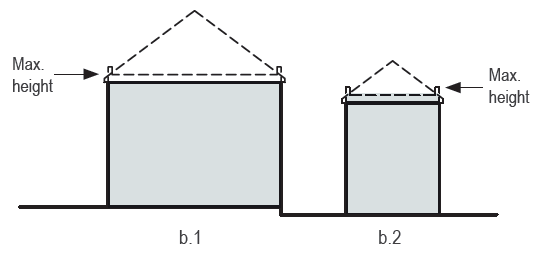
c. SETBACKS PRINCIPAL BUILDING
Principal buildings shall be distanced from the lot lines as shaded.
c.1 Front Setback, 30 ft. min.** c.2 Side (Street) Setback, Same as Front Setback. c.3 Side (Interior) Setback, 20 ft. min. c.4 Rear Setback, 40 ft. min.
** Principal front setback, adjacent to collector street or higher classification: 75 feet.
Attached front porches, uncovered steps or stoops shall be allowed to encroach 10 feet maximum within front yard setback. Overhangs may encroach 2 feet within front yard setbacks.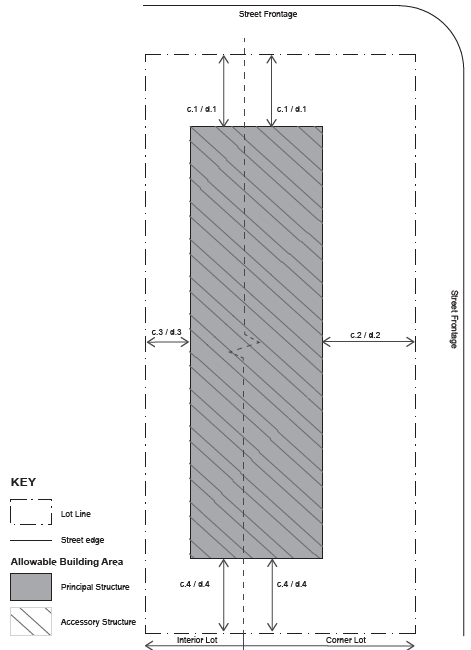
d. SETBACKS ACCESSORY***
Accessory buildings or structures such as sheds or garages, off-street parking and trash/refuse containers shall be distanced from the lot lines as shown by diagonal hatching.
d.1 Setback, 30 ft. min.*** d.2 Side (Street) Setback, 30 ft. min. d.3 Side (Interior) Setback, 20 ft. min. d.4 Rear Setback, 20 ft. min.
***All accessory farm structures shall require a 75 foot minimum setback for all required setbacks and shall be a minimum of 50 feet from any principal structure.Agricultural District lots must be served by septic and well: Lot area shall be adequate for primary and alternate treatment system, and well system.
- Purpose. The purpose of the AG Agricultural District is to provide areas for existing agricultural uses and land currently enrolled in the Metropolitan Agricultural Preserve Program. Areas zoned as Agricultural shall maintain this zoning designation until a landowner chooses to develop the land or exits the Metropolitan Agricultural Preserve Program at which time the City may rezone the affected property consistent with its designation in the Comprehensive Plan, provided that the development does not result in the premature extension of public utilities, facilities, and services.
Sec 125-55 - Residential Districts
- Rural Residential (R1)
- Purpose. The purpose of the R1 Rural Residential District is to provide areas for agricultural uses as well as providing for residential development while affording the enjoyment of the rural life style. The Rural Residential District applies to those properties classified as Rural Residential on the 2040 Future Land Use Plan. Development within this district is required at a minimum density of 0.10 units per net acre up to a maximum of 2.0 units per net acre, developed in a manner to allow densities up to 3.0 units per net acre in the future.
The standards set forth in the R1 Rural Residential District allow lands to remain in their natural state or as agricultural or large lot rural residential uses. Development is enabled to occur without compromising the City’s ability to accommodate growth and future extension of sanitary sewer, water, streets and other public infrastructure through additional subdivision procedure.
Any subdivision of land in the R1 Rural Residential District for development purposes shall require either:- A ghost plat, as outlined in Sec. 125-35. Ghost Plat, to be attached to an approved plat, to permit development in a configuration that does not cause unnecessary barriers to future development and provision of public services, future subdivision, or redevelopment; or
- A PUD - Rural Cluster, as outlined in Sec. 125-30. Planned Unit Development - Rural Cluster.
- Other Standards. All development shall comply with all other applicable regulations in this Chapter, including without limitation the permitted use regulations in Table 4. Permitted Uses and Performance Standards in Article V. Performance Standards and Regulations. II.
Table 6. R1 - RURAL RESIDENTIAL DISTRICT
a. LOT STANDARDS
a.1 Lot Size - 1 acre minimum.
a.2 Lot Size, for future development in a ghost plat - 10,000 sq. ft. min.
a.3 Lot Coverage - 75% max.
a.4 Lot Width - 100 feet min.b. BUILDING HEIGHT*
b.1 Principal Building - 35 ft. max.
b.2 Accessory Building - 30 ft. max.*
Maximum heights for various roof types are detailed in Sec. 125-85. Lot and Building Standards: Design Elements.
* This height limitation shall not apply to grain elevators, silos, windmills, elevator lags, cooling towers, water towers, chimneys and smokestacks, church spires, or electric transmission lines. Accessory buildings shall not contain dwelling units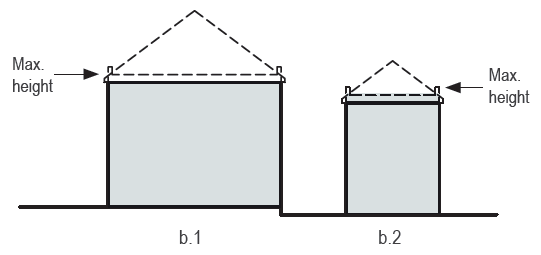
c. SETBACKS PRINCIPAL BUILDING
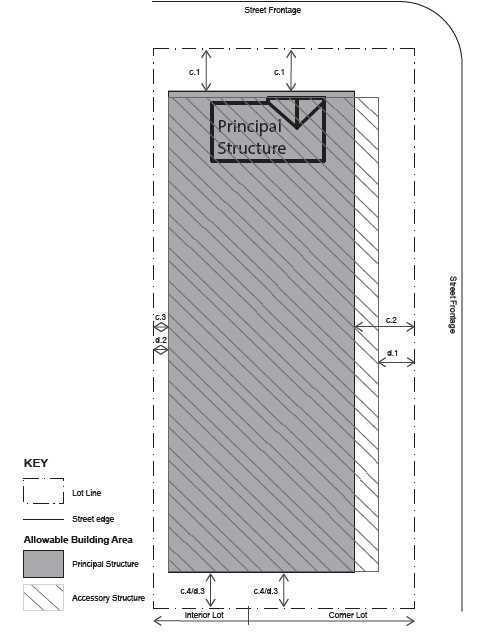
Principal buildings shall be distanced from the lot lines as shaded.
c.1 Principal Front Setback, 30 ft. min.**
c.2 Side (Street) Setback, Same as Front Setback.
c.3 Side (Interior), 10 ft. min.
c.4 Rear Setback, 20 ft. min**Principal front setback, adjacent to collector street or higher classification: 75 feet.
Attached front porches, uncovered steps or stoops shall be allowed to encroach 10 feet maximum within front yard setback. Overhangs may encroach 2 feet within front yard setbacks.
d. SETBACKS ACCESSORY***
d.1 Side (Street) Setback, 20 ft. min.****
d.2 Side (Interior), 10 ft. min.
d.3 Rear Setback, 20 ft. min.
***Lots five acres or larger may have detached accessory structures in the front yard or side yard with street frontage, provided the accessory is setback at least 200 feet from the road right-of-way.
****In no instance shall an accessory structure on a corner lot be located closer to the road right-of-way than an adjacent primary structure fronting the same road right-of-way.
Rural Residential District lots must be served by septic and well: Lot area shall be adequate for primary and alternate treatment system, and well system.
- Purpose. The purpose of the R1 Rural Residential District is to provide areas for agricultural uses as well as providing for residential development while affording the enjoyment of the rural life style. The Rural Residential District applies to those properties classified as Rural Residential on the 2040 Future Land Use Plan. Development within this district is required at a minimum density of 0.10 units per net acre up to a maximum of 2.0 units per net acre, developed in a manner to allow densities up to 3.0 units per net acre in the future.
- Single Family Residential (R2)
- Purpose. The purpose of the R2 Single Family Residential District is to allow the continuation of existing residential development and infilling of existing lots in the older residential area of the City. The district also allows for smaller lots in areas that are not developed but are guided single family residential to development in a manner that will not be disruptive to the character of the existing neighborhoods.
The Single Family Residential District applies to those properties classified as Low Density Residential on the 2040 Future Land Use Plan. Development within this district is required at a minimum density of 2.0 units per net acre up to a maximum of 5.0 units per net acre. - Other Standards. All development shall comply with all other applicable regulations in this Chapter, including without limitation the permitted use regulations in Table 4. Permitted Uses and Performance Standards in Article V. Performance Standards and Regulations.

Recommended meeting with Staff
Table 7. R2 - SINGLE FAMILY RESIDENTIAL
a. LOT STANDARDS
a.1 Lot Size - 10,000 sq. ft. min.
a.2 Lot Coverage - 75% max
a.3 Lot Width - 65 ft. min.b. BUILDING HEIGHT and CONFIGURATION
b.1 Principal Building - 35 ft. max.
b.2 Accessory Building - 15 ft. max.
Maximum heights for various roof types are detailed in Sec. 125-85. Lot and Building Standards: Design Elements.
Attached accessory structures shall be limited in size to 100% of the principal structure.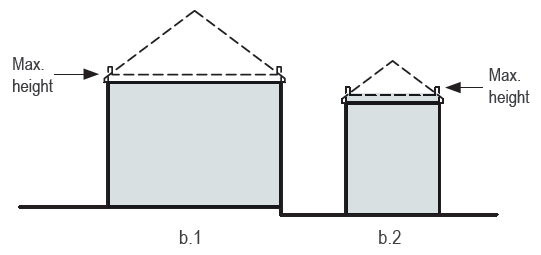
c. SETBACKS PRINCIPAL BUILDING*
Principal buildings shall be distanced from the lot lines as shaded.
c.1 Principal Front Setback, 25 ft. min.
c.2 Side (Street) Setback, Same as Front Setback.
c.3 Side (Interior), 10 ft. min.
c.4 Rear Setback, 20 ft. min.
*Principal front setback, adjacent to City collector street or higher classification: 35 feet. For setbacks adjacent to County, State, and Federal roadways, see City Code Sec. 125-83C.8
Attached front porches, uncovered steps or stoops shall be allowed to encroach 10 feet maximum within front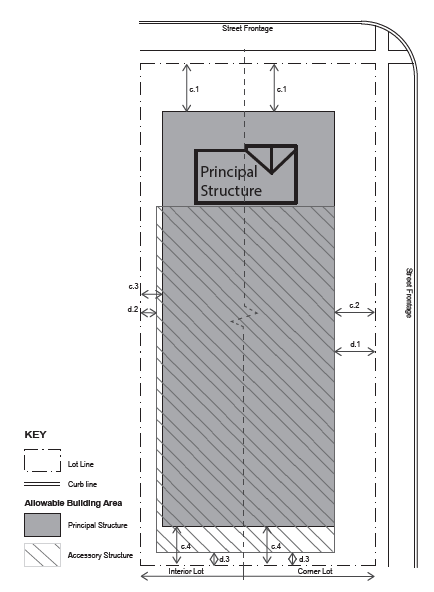
d. SETBACKS ACCESSORY
d.1 Side (Street) Setback, 25 ft. min.*
d.2 Side (Interior) 5 ft. min.
d.3 Rear Setback, 10 ft. min.
* In no instance shall an accessory structure on a corner lot be located closer to the road right-of-way than an adjacent primary structure fronting the same road right-of-way.
Minimum separation between all structures on adjacent parcels shall be 15 feet.
Detached accessory structures such as garages shall be placed in the rear yard.
- Purpose. The purpose of the R2 Single Family Residential District is to allow the continuation of existing residential development and infilling of existing lots in the older residential area of the City. The district also allows for smaller lots in areas that are not developed but are guided single family residential to development in a manner that will not be disruptive to the character of the existing neighborhoods.
- Mid-Density Residential (R3)
- Purpose. The purpose of the R3 Mid-Density Residential District is to provide a district that will allow alternative forms of housing development opportunity and a mixture of housing types. Residential units in this district include a range of housing types from rowhouses and townhomes to duplexes and smaller lot detached single-family homes. The Mid-Density Residential district is located in areas that will provide residents with access to transportation corridors and nearby amenities and services. The district transitions the City between low density single-family residential areas and higher intensity residential and commercial areas.
The Mid-Density Residential District applies to those properties classified as Medium Density Residential and Mixed Density Residential on the 2040 Future Land Use Plan. The Medium Density Residential land use category provides for residential development at a density of 5.0 to 11.0 units per net acre. - Other Standards. All development shall comply with all other applicable regulations in this Chapter, including without limitation the permitted use regulations in Table 4. Permitted Uses and Performance Standards in Article V. Performance Standards and Regulations.
Table 8. R3 - MID-DENSITY RESIDENTIAL DISTRICT
a. LOT STANDARDS
a.1 Lot Size per unit - single-family detached - 7,200 sq. ft. min.
a.2 Lot Size per unit- twin home, detached townhome - 7,000 sq. ft. min.
a.3 Lot Size per unit - attached townhome, duplex, triplex, quad - 5,000 sq. ft. min.
a.4 Lot Coverage - 75% max.
a.5 Lot Width - single-family detached - 65 ft. max.
a.6 Lot Width - twin home - 100 ft. min. base lot
a.7 Lot Width - duplex, triplex, quad - 110 ft. min.
a.8 Lot Width - attached townhome - 110 ft. min. base lotb. BUILDING HEIGHT
b.1 Principal Building - 35 ft. max.
b.2 Accessory Building - 15 ft. max.
Maximum heights for various roof types are detailed in Sec. 125-85. Lot and Building Standards: Design Elements.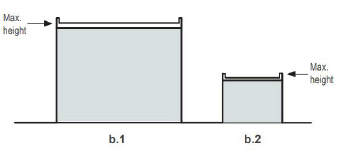
c. SETBACKS PRINCIPAL BUILDING
Principal buildings shall be distanced from the lot lines as shaded.*
c.1 Principal Front Setback, 25 ft. min.
c.2 Side (Street) Setback, Same as Front Setback.
c.3 Side (Interior), 10 ft. min.
c.4 Rear Setback, 20 ft. min.
Attached front porches, uncovered steps or stoops shall be allowed to encroach 10 feet maximum within front yard setback. Overhangs may encroach 2 feet within front yard setbacks.
*For setbacks adjacent to County, State, and Federal roadways, see City Code Sec. 125-83C.8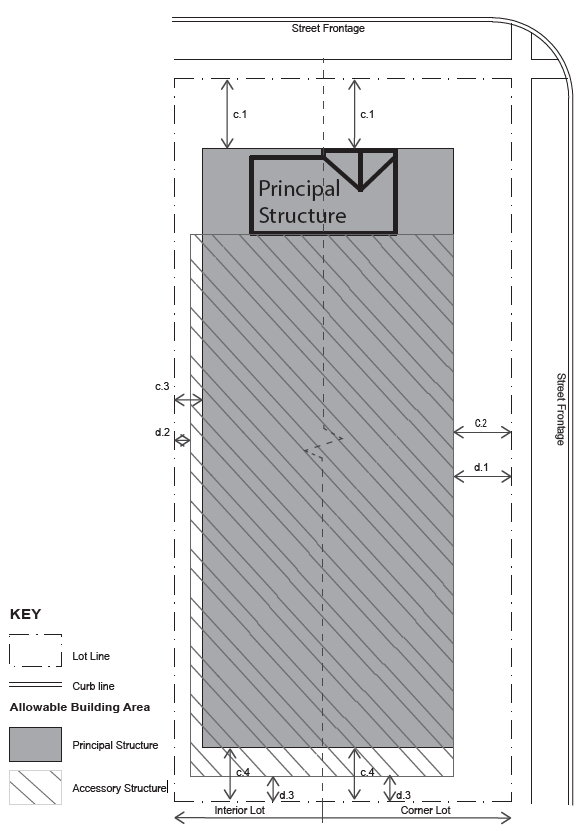
d. SETBACKS ACCESSORY
d.1 Side (Street) Setback, 25 ft. min*
d.2 Side (Interior), 5 ft. min
d.3 Rear Setback, 10 ft. min.
* In no instance shall an accessory structure on a corner lot be located closer to the road right-of-way than an adjacent primary structure fronting the same road right-of-way.
Detached accessory structures such as garages shall be placed in the rear yard.
- Purpose. The purpose of the R3 Mid-Density Residential District is to provide a district that will allow alternative forms of housing development opportunity and a mixture of housing types. Residential units in this district include a range of housing types from rowhouses and townhomes to duplexes and smaller lot detached single-family homes. The Mid-Density Residential district is located in areas that will provide residents with access to transportation corridors and nearby amenities and services. The district transitions the City between low density single-family residential areas and higher intensity residential and commercial areas.
- Mixed Density Residential (R4)
- Purpose. The purpose of the R4 Mixed Density Residential District is to provide a diverse range of housing types, including multiple-family dwellings, that cater to housing preferences during different lifecycle stages. This includes such housing types as smaller single-family dwellings, twin homes, stacked townhomes, lofts and flats, and apartments. This district aims to locate that mix of housing options in areas connected to local transportation networks and with convenient access to local shops and services, parks, trails, and schools. The R4 district creates development flexibility by making available opportunities to increase density within the urbanized area.
The R4 Mixed Density Residential District applies to those properties classified as Mixed Residential on the 2040 Future Land Use Plan. The Mixed Residential land use category allows for a density of 4.0 to 15.0 units per net acre. The City encourages the use of a Planned Unit Development (PUD) for lands zoned as Mixed Density Residential to achieve a diverse development that includes a range of residential uses. The City may consider allowing a higher maximum density per net acre if a development satisfies development policy, community vision and specific housing goals (i.e. lifecycle housing). - Other Standards. All development shall comply with all other applicable regulations in this Chapter, including without limitation the permitted use regulations in Table 4. Permitted Uses and Performance Standards in Article V. Performance Standards and Regulations.
Table 9. R4 - MIXED DENSITY RESIDENTIAL DISTRICT
a. LOT STANDARDS
a.1 Lot Size - Lot size varies and may be flexible provided Land Use density minimums are met
a.2 Lot Coverage - 75% max.
a.3 Lot Width - twin homes - 40 ft. per unit min. / all other residential – 50 ft. min.b. BUILDING HEIGHT
b.1 Principal Building - NA
b.2 Accessory Building - 15 ft. max.
Maximum heights for various roof types are detailed in Sec. 125-85. Lot and Building Standards: Design Elements.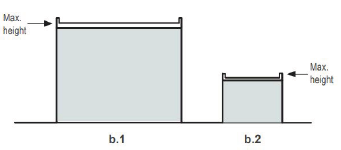
c. SETBACKS PRINCIPAL BUILDING
Principal buildings shall be distanced from the lot lines as shaded.*
c.1 Principal Front Setback, 25 ft. min.
c.2 Side (Street) Setback, Same as Front Setback.
c.3 Side (Interior), 5 ft. min.
c.4 Rear Setback, 20 ft. min. or 30 ft. min multi-family residential.
*For setbacks adjacent to County, State, and Federal roadways, see City Code Sec. 125-83C.8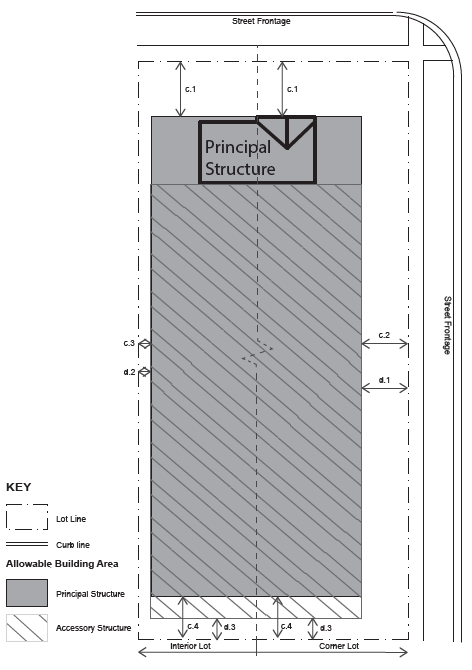
d. SETBACKS - ACCESSORY
d.1 Side (Street) Setback, 25 ft. min.*
d.2 Side (Interior), 5 ft. min.
d.3 Rear Setback, 10 ft. min.
* In no instance shall an accessory structure on a corner lot be located closer to the road right-of-way than an adjacent primary structure fronting the same road right-of-way.
Accessory buildings for multi-family developments, including any structure not attached directly or via an enclosed, covered walkway to the principal structure, must be approved as part of the initial site plan.
Detached accessory structures such as garages shall be placed in the rear yard.
- Purpose. The purpose of the R4 Mixed Density Residential District is to provide a diverse range of housing types, including multiple-family dwellings, that cater to housing preferences during different lifecycle stages. This includes such housing types as smaller single-family dwellings, twin homes, stacked townhomes, lofts and flats, and apartments. This district aims to locate that mix of housing options in areas connected to local transportation networks and with convenient access to local shops and services, parks, trails, and schools. The R4 district creates development flexibility by making available opportunities to increase density within the urbanized area.
- High Density Residential (R5)
- Purpose. The purpose of the R5 High Density Residential District is to allow for high density dwellings. This includes housing types such as apartments. This district aims to locate high density housing options near desirable community amenities and supported by convenient access to amenities such as transit, local shops and services, parks, trails and schools. The R5 district also provides opportunities to increase density within the existing urbanized area, while serving as a transition between commercial and employment centers and existing residential development.
The High Density Residential District applies to those properties classified as High Density Residential on the 2040 Future Land Use Plan. The density range for this district is 11.0 to 60.0 dwelling units per net acre. The City may consider allowing a higher maximum density per net acre if a development satisfies development policy, community vision and specific housing goals (i.e. lifecycle housing). - Other Standards. All development shall comply with all other applicable regulations in this Chapter, including without limitation the permitted use regulations in Table 4. Permitted Uses and Performance Standards in Article V. Performance Standards and Regulations.
Table 10. R5 - HIGH DENSITY RESIDENTIAL DISTRICT
a. LOT STANDARDS
a.1 Lot Size - 1 acre
a.2 Lot Coverage - 75% max.
a.3 Lot Width - 150 ft. min.b. BUILDING HEIGHT
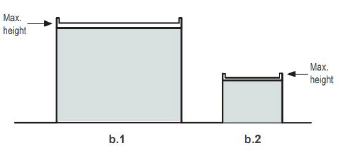
b.1 Principal Building - No max.
b.2 Accessory Building - 15 ft. max.Maximum heights for various roof types are detailed in Sec. 125-85. Lot and Building Standards: Design Elements.
c. SETBACKS PRINCIPAL BUILDING & ACCESSORY
Principal buildings shall be distanced from the lot lines as shaded.*
c.1 Principal Front Setback, 25 ft. min.
c.2 Side (Street) Setback, Same as Front Setback.
c.3 Side (Interior), 15 ft. min.
c.4 Rear Setback, 25 ft. min.
Attached uncovered steps or stoops shall be allowed to encroach 10 feet maximum within front yard setback. Overhangs may encroach 2 feet within front yard setbacks. Encroachment into the side yard setback shall require a varianceAccessory structures may only be located behind the principal structure.
*For setbacks adjacent to County, State, and Federal roadways, see City Code Sec. 125-83C.8
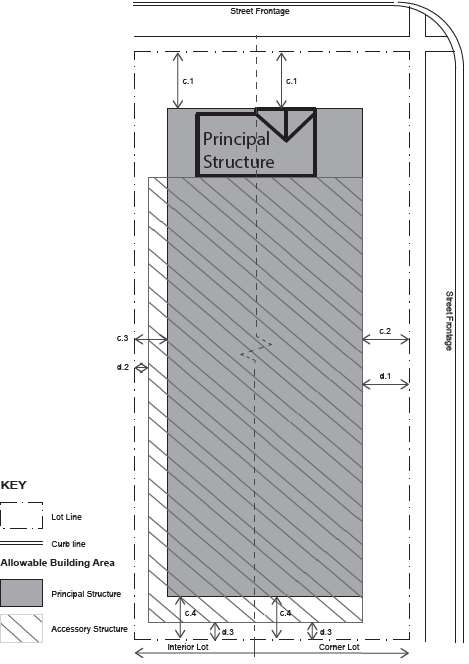
d. SETBACKS - PARKING
d.1 Side (Street), 25 ft. min.
d.2 Side (Interior), 5 ft. min.
d.3 Rear Setback, 10 ft. min.Off-street parking and trash/refuse containers shall be distanced from the lot lines as shown by diagonal hatching.
Accessory buildings for multi-family developments, including pool houses, common rooms and other shared amenity spaces, must be approved as part of the initial site plan.
- Purpose. The purpose of the R5 High Density Residential District is to allow for high density dwellings. This includes housing types such as apartments. This district aims to locate high density housing options near desirable community amenities and supported by convenient access to amenities such as transit, local shops and services, parks, trails and schools. The R5 district also provides opportunities to increase density within the existing urbanized area, while serving as a transition between commercial and employment centers and existing residential development.
Sec 125-56 - Public Districts
- Parks and Open Space District (OP)
- Purpose. The purpose of the OP Parks and Open Space District is to provide areas for parks and open space throughout the City of Rogers. The Parks and Open Space District applies to those properties classified as Parks and Open Space on the 2040 Future Land Use Plan.

Recommended meeting with Staff - Other Standards. All development shall comply with all other applicable regulations in this Chapter, including without limitation the permitted use regulations in Table 4. Permitted Uses and Performance Standards in Article V. Performance Standards and Regulations.

Subdivision Procedure required
Table 11. OP - PARKS AND OPEN SPACE DISTRICT
a. LOT STANDARDS
a.1 Lot Size - NA a.2 Lot Coverage - NA a.3 Lot Width - NAb. BUILDING HEIGHT
b.1 Principal Building - 35 ft. max.
Maximum heights for various roof types are detailed in Sec. 125-85. Lot and Building Standards: Design Elements.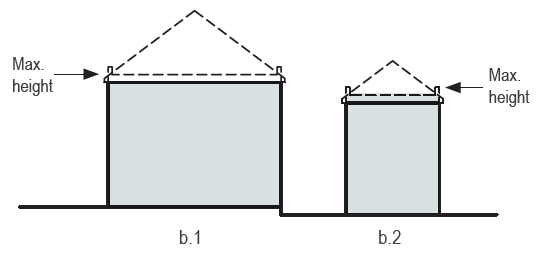
c. SETBACKS PRINCIPAL BUILDING*
Principal buildings shall be distanced from the lot lines as shaded.*
c.1 Principal Front Setback, 20 ft. min. c.2 Side (Street) Setback, Same as Front Setback. c.3 Side (Interior), 10 ft. min. c.4 Rear Setback, 10 ft. min.
Overhangs may encroach 2 feet within front yard setbacks. Encroachment into the side yard setback or easements shall require a variance.
*For setbacks adjacent to County, State, and Federal roadways, see City Code Sec. 125-83C.8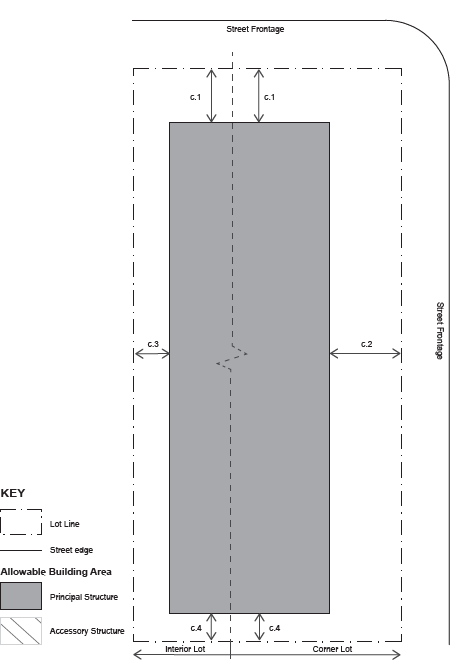
- Purpose. The purpose of the OP Parks and Open Space District is to provide areas for parks and open space throughout the City of Rogers. The Parks and Open Space District applies to those properties classified as Parks and Open Space on the 2040 Future Land Use Plan.
Sec 125-57 - Live-Work Districts
- Local Employment Center (LC)
- Purpose. The purpose of the LC Local Employment Center District is to provide the opportunity for general retail, commercial, limit mid- and high-density residential and mixed-use development in existing commercial areas and commercial and high density residential guided areas served by community sewer and water. Residential uses within the area create opportunities for a accessible and amenity rich environment. Accessibility and visibility from the regional highway system are enforced through form standards.
Development may be either vertically or horizontally designed in order to offer flexibility within the marketplace and to encourage land use efficiency. Horizontal mixed use is only effective when designed as part of a cohesive site plan that considers both vehicular and active modes of transportation, well connected both internally and externally from the entire site.
The Local Employment Center District applies to those properties classified as Commercial, Industrial, Mixed Use Regional, and High Density Residential on the 2040 Future Land Use Plan and are between County Road 81 and Interstate 94 and Industrial Boulevard and Interstate 94. The district shall allow for continuation, expansion or redevelopment of commercial and light industrial uses in specific areas of the City where they will have less conflict with other functions.
Uses may include commercial, office, light industry, institutional, limited mid and high-density residential at densities from 8.0 to 60.0 units per net acre, and park uses. Residential uses should generally not exceed 40 percent of the Mixed Use Regional area. The City may consider allowing a higher maximum density per net acre if a development satisfies development policy, community vision and specific housing goals (i.e. lifecycle housing). - Other Standards. All development shall comply with all other applicable regulations in this Chapter, including without limitation the permitted use regulations in Table 4. Permitted Uses and Performance Standards in Article V. Performance Standards and Regulations.
Table 12. LC - LOCAL EMPLOYMENT CENTER DISTRICT
a. LOT STANDARDS
a.1 Lot Size - commercial - 10,000 sq. ft. min / NA Corridor
a.2 Lot Size - residential - NA
a.3 Lot Coverage - 85% max. / 75% Corridor*
a.4 Lot Width - NAb. BUILDING HEIGHT
b.1 Principal Building - 45 ft max., 55 ft. Corridor*
b.2 Accessory Building - 15 ft. max.
Maximum heights for various roof types are detailed in Sec. 125-85. Lot and Building Standards: Design Elements.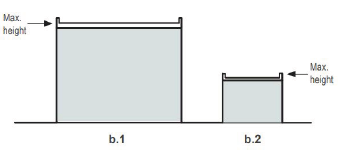
c. SETBACKS PRINCIPAL AND ACCESSORY BUILDING
Principal and accessory buildings shall be distanced from the lot lines as shaded.*
c.1 Principal Front Setback, 20 ft. min. or 30 ft. min. if Corridor.
c.2 Side (Street) Setback, Same as Front Setback.
c.3 Side (Interior), 20 ft. min. / 40 ft. min. abutting low density residential**
c.4 Rear Setback, 20 ft. min. / 40 ft. min. abutting low density residential*
Accessory structures may only be located behind the principal structure.
*For setbacks adjacent to County, State, and Federal roadways, see City Code Sec. 125-83C.8
**If residential is abutting residential, 50 ft. min. setback shall not apply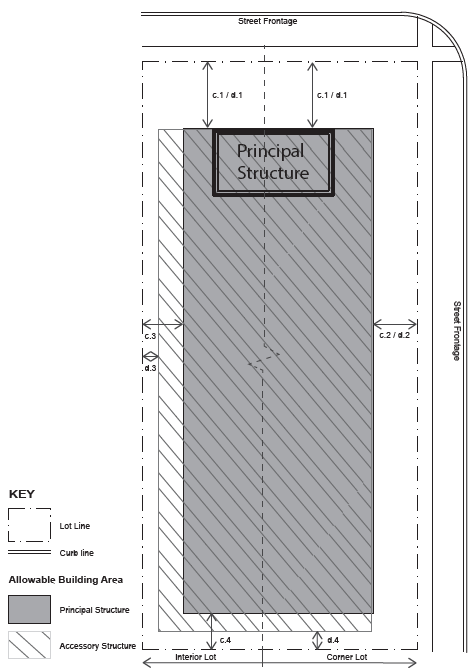
d. SETBACKS PARKING
Off-street parking and trash/refuse containers shall be distanced from the lot lines as shown by diagonal hatching.
d.1 Principal Front Setback, 20 ft. min. or 30 ft. min. if Corridor.
d.2 Side (Street) Setback, Same as Front Setback.
d.3 Side (Interior), 5 ft. min. / 40 ft. min. abutting low density residential*
d.4 Rear Setback, 10 ft. min. / 40 ft. min. abutting low density residential*e. CORRIDOR STANDARDS
Corridor standards are intended to provide additional beautification for sites fronting certain arterial and collector streets. This should be achieved by reducing building setbacks, locating parking to the rear of buildings, and increasing landscaping along these frontages. In addition to compliance with all other applicable regulations in this chapter, development in the LC District subject to the Corridor standards must meet the following requirement
e.1 The property must be located adjacent to one of the arterial/collector streets identified as part of the corridor overlay area.
- Purpose. The purpose of the LC Local Employment Center District is to provide the opportunity for general retail, commercial, limit mid- and high-density residential and mixed-use development in existing commercial areas and commercial and high density residential guided areas served by community sewer and water. Residential uses within the area create opportunities for a accessible and amenity rich environment. Accessibility and visibility from the regional highway system are enforced through form standards.
- Regional Employment Center (RC)
- Purpose. The purpose of the Regional Employment Center District is intended to promote the redevelopment of the corridor into areas suited for commercial and office-oriented land use patterns tailored to the larger metropolitan region, interspersed with high density residential units within the area to create opportunities for a walkable and amenity rich environment.
Development may be either vertically or horizontally designed in order to offer flexibility within the marketplace and to encourage land use efficiency. Horizontal mixed use is only effective when designed as part of a cohesive site plan that considers both vehicular and active modes of transportation, well connected both internally and externally from the entire site.
The Regional Employment Center District encompasses properties classified as High Density Residential, Mixed Use Regional, Commercial and Industry on the 2040 Future Land Use Plan. Uses may include commercial, office, industry, institutional, limited mid and high-density residential at densities from 8.0 to 60.0 units per net acre, and park uses. Residential uses should generally not exceed 40 percent of the Mixed Use Regional area. The City may consider allowing a higher maximum density per net acre if a development satisfies development policy, community vision and specific housing goals (i.e. lifecycle housing). - Other Standards. All development shall comply with all other applicable regulations in this Chapter, including without limitation the permitted use regulations in Table 4. Permitted Uses and Performance Standards in Article V. Performance Standards and Regulations.
Table 13. RC - REGIONAL EMPLOYMENT CENTER DISTRICT
a. LOT STANDARDS
a.1 Lot Size - commercial - 20,000 sq. ft. min / NA Corridor a.2 Lot Size - multi-family - 1 acre base lot a.3 Lot Coverage - 75% max. / 65% max. Corridor* a.4 Lot Width - NAb. BUILDING HEIGHT
b.1 Principal Building - 45 ft max. or 60 ft. max Corridor. b.2 Principal Building - multi-family - N/A b.3 Accessory Building - 15 ft. max.
Maximum heights for various roof types are detailed in Sec. 125-85. Lot and Building Standards: Design Elements.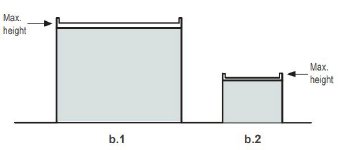
c. SETBACKS PRINCIPAL AND ACCESSORY
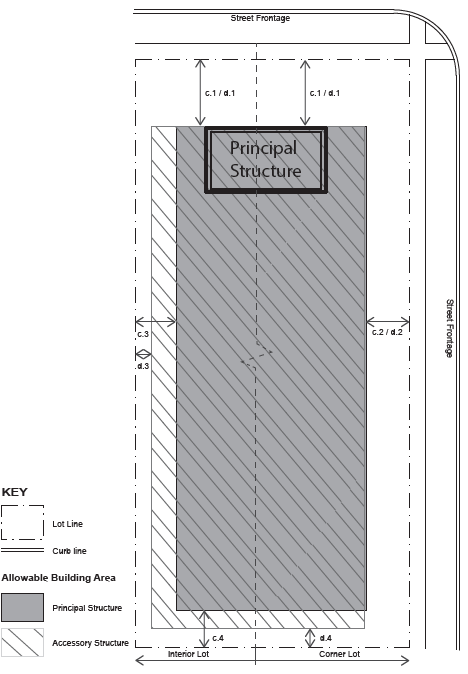
Principal and accessory buildings shall be distanced from the lot lines as shaded.*
c.1 Principal Front Setback, 20 ft. min. or 30 ft. min. if Corridor. c.2 Side (Street) Setback, Same as Front Setback. c.3 Side (Interior), nonresidential 10 ft., multi-family residential 15 ft., abutting residential 50 ft. min.** c.4 Rear Setback, nonresidential 20 ft., multi-family residential 25 ft., abutting residential 50 ft. min.*
*For setbacks adjacent to County, State, and Federal roadways, see City Code Sec. 125-83C.8
**If residential is abutting residential, 50 ft. min. setback shall not applyAccessory structures may only be located behind the principal structure.
d. SETBACKS PARKING
Off-street parking and trash/refuse containers shall be distanced from the lot lines as and shown by diagonal hatching.
d.1 Principal Front Setback, 20 ft. min. or 30 ft. min. if Corridor. d.2 Side (Street) Setback, Same as Front Setback. d.3 Side (Interior), 5 ft. min. d.4 Rear Setback, 10 ft. min.e. CORRIDOR STANDARDS
Corridor standards are intended to provide additional beautification for sites fronting certain arterial and collector streets. This should be achieved by reducing building setbacks, locating parking to the rear of buildings, and increasing landscaping along these frontages. In addition to compliance with all other applicable regulations in this chapter, development in the RC District subject to the Corridor standards must meet the following requirement
e.1 The property must be located adjacent to one of the arterial/collector streets identified as part of the corridor overlay area.
- Purpose. The purpose of the Regional Employment Center District is intended to promote the redevelopment of the corridor into areas suited for commercial and office-oriented land use patterns tailored to the larger metropolitan region, interspersed with high density residential units within the area to create opportunities for a walkable and amenity rich environment.
Sec 125-58 - Mixed Use Districts
- Neighborhood District (ND)
- Purpose. The purpose of the ND Neighborhood District is to provide a flexible land use category that would accommodate mixed-use, residential or a node of service commercial where market forces might present such an opportunity.
A neighborhood node is envisioned as an area of retail and service commercial that is scaled to serve locally. Neighborhood nodes should not exceed 10 to 15 acres. Residential uses shall consist of small lot single family and limited attached housing. Mixed-use nodes of residential and retail should be considered in mixed use neighborhood nodes. Proximity of mixed-use neighborhood nodes should generally be at key roadway intersections that would support good roadway access. The nodes should also be connected by the regional trail system to support pedestrian access to services from nearby neighborhoods.
The Neighborhood district applies to those properties classified as Mixed Use Neighborhood on the 2040 Future Land Use Plan. Residential uses shall have a density of 3.0 to 6.0 units per net acre. - Other Standards. All development shall comply with all other applicable regulations in this Chapter, including without limitation the permitted use regulations in Table 4. Permitted Uses and Performance Standards in Article V. Performance Standards and Regulations.
Table 14. ND - NEIGHBORHOOD DISTRICT
a. LOT STANDARDS
a.1 Lot Size per unit - commercial - 15,000 sq. ft. / residential - 6,500 sq. ft.
a.2 Lot Coverage - 75% max.
a.3 Lot Width - commercial - 80 ft. min. / residential - 40 ft. min.b. BUILDING HEIGHT
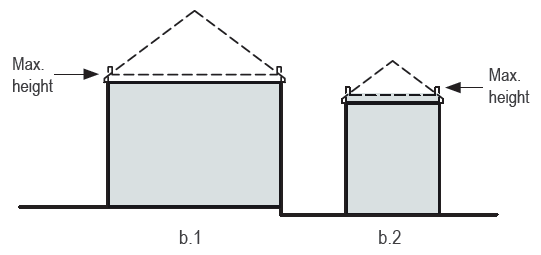
b.1 Principal Building - 35 ft. max.
b.2 Accessory Building - 15 ft. max.Maximum heights for various roof types are detailed in Sec. 125-85. Lot and Building Standards: Design Elements.
Accessory buildings shall not contain dwelling units.
c. SETBACKS PRINCIPAL BUILDING*
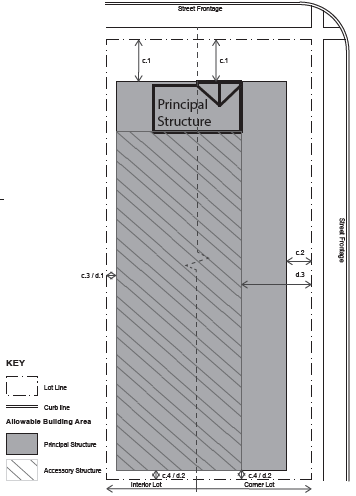
Principal buildings shall be distanced from the lot lines as shaded.*
c.1 Principal Front Setback, 20 ft. min.**
c.2 Side (Street) Setback, Same as Front Setback.
c.3 Side (Interior), 5 ft. min.
c.4 Rear Setback, 10 ft. min.*For setbacks adjacent to County, State, and Federal roadways, see City Code Sec. 125-83C.8
**Principal front setback for residential use, adjacent to collector street or higher classification: 35 feet.
Attached front porches, uncovered steps or stoops shall be allowed to encroach 5 ft. maximum within front yard setback. Overhangs may encroach 2 ft. within front yard setbacks.
d. SETBACKS ACCESSORY
d.1 Side (Interior), 5 ft. min.
d.2 Rear Setback, 10 ft. min.
d.3 Detached accessory structures such as garages shall be placed in the rear yard. Such structures may not be closer to the secondary street frontage than the nearest edge of the principle structure, and in no case shall be closer than the principle structure secondary street setback.
Refer to Sec. 125-84. Accessory Use Standards for additional information on allowable number of accessory structures.
- Purpose. The purpose of the ND Neighborhood District is to provide a flexible land use category that would accommodate mixed-use, residential or a node of service commercial where market forces might present such an opportunity.
- Downtown District (DT)
- Purpose. The purpose of the DT Downtown District is to encourage a mix of uses that are typically found in traditional downtowns, including retail, services, entertainment, civic, institutional, offices, and mid- and high-density housing. Along Main Street, between John Deere Lane and the railroad tracks, the goal is to maintain the commercial fronts and building heights by reusing the existing historic buildings, where possible, and seek opportunities for mixed use buildings, whether multi-story or of horizontal orientation, as infill development opportunities on vacant, blighted and/or underutilized properties. The mix of uses may include retail and services at street level with residential or office uses beside or office above the commercial use. Mixing uses in downtown supports economic activity and helps create a walkable downtown environment by maximizing the square footage of commercial space that is directly accessible from the street.
The Downtown District encompasses properties classified as Medium Density Residential, Institutional, Park and Open Space, Mixed Use Downtown and High Density Residential on the 2040 Future Land Use Plan. The properties surrounding the core downtown area are guided as High Density Residential, and land uses that support civic, office and institutional uses. The density range for residential uses in this mixed-use category is 8.0 to 40.0 dwelling units per net acre. Residential uses should generally not exceed 40 percent of the Mixed-Use Downtown area. The City may consider allowing a higher maximum density per net acre if a development satisfies development policy, community vision and specific housing goals (i.e. lifecycle housing). Potential development in the downtown should adhere to the Future Land Use Plan and the recommendations within the Downtown Focus Area. - Other Standards. All development shall comply with all other applicable regulations in this Chapter, including without limitation the permitted use regulations in Table 4. Permitted Uses and Performance Standards in Article V. Performance Standards and Regulations.
- The Downtown Rogers Plan and Streetscape Plan, shall be adopted by reference as standards within the DT Downtown District. Any and all standards regulated by the Downtown Rogers Plan and Streetscape Plan, shall supersede the DT Downtown District. When the DT Downtown District and the Downtown Rogers Plan and Streetscape Plan conflict, the Downtown Rogers Plan and Streetscape Plan regulations apply absent explicit language to the contrary.
Table 15. DT - DOWNTOWN DISTRICT
a. LOT STANDARDS
a.1 Lot Size per unit - commercial - 8,000 sq. ft. / residential - NA / corridor - NA
a.2 Lot Coverage - 100% max. / corridor - 85% max.
a.3 Lot Width - NAb. BUILDING HEIGHT
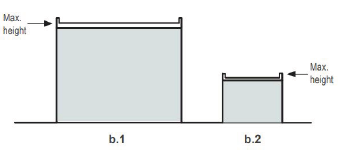
b.1 Principal Building - 60 ft. max.
b.2 Accessory Building - 15 ft. max.Maximum heights for various roof types are detailed in Sec. 125-85. Lot and Building Standards: Design Elements.
c. SETBACKS PRINCIPAL BUILDING AND ACCESSORY
Principal and accessory buildings shall be distanced from the lot lines as shaded.*
c.1 Principal Front Setback, mid-density residential - 15 ft. max. / all other uses - 0 ft. min, 5 ft. max. from pedestrian and amenity zones / corridor - 30ft. min.
c.2 Side (Street) Setback, Same as Front Setback.
c.3 Side (Interior), 0 ft. min. from pedestrian and amenity zones.
c.4 Rear Setback, 0 ft. min. from pedestrian and amenity zones.*For setbacks adjacent to County, State, and Federal roadways, see City Code Sec. 125-83C.8
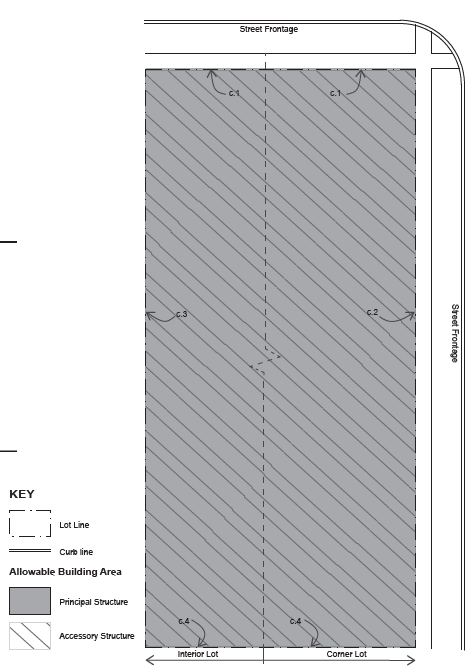
d. SETBACKS, PARKING
Off-street parking and trash/refuse containers shall be distanced from the lot lines as shown by diagonal hatching.
d.1 Principal Front Setback, 0 ft. min, 5 ft. max. / corridor - 30 ft. min.
d.2 Side (Street) Setback, Same as Front Setback.
d.3 Side (Interior), 5 ft. min.
d.4 Rear Setback, 10 ft. min.* Garages and off-street parking must be located to the rear of all new residential buildings.
e. CORRIDOR STANDARDS
Corridor standards are intended to provide additional beautification for sites fronting certain arterial and collector streets. This should be achieved by reducing building setbacks, locating parking to the rear of buildings, and increasing landscaping along these frontages. In addition to compliance with all other applicable regulations in this chapter, development in the DT District subject to the Corridor standards must meet the following requirement
e.1 The property must be located adjacent to one of the arterial/collector streets identified as part of the corridor overlay area.
- Purpose. The purpose of the DT Downtown District is to encourage a mix of uses that are typically found in traditional downtowns, including retail, services, entertainment, civic, institutional, offices, and mid- and high-density housing. Along Main Street, between John Deere Lane and the railroad tracks, the goal is to maintain the commercial fronts and building heights by reusing the existing historic buildings, where possible, and seek opportunities for mixed use buildings, whether multi-story or of horizontal orientation, as infill development opportunities on vacant, blighted and/or underutilized properties. The mix of uses may include retail and services at street level with residential or office uses beside or office above the commercial use. Mixing uses in downtown supports economic activity and helps create a walkable downtown environment by maximizing the square footage of commercial space that is directly accessible from the street.
Sec 125-59 - Industrial Districts
- General Industrial (GI)
- Purpose. Industrial uses include manufacturing, assembly, processing, warehousing and distribution uses. Industrial districts should be located to take advantage of good access to the regional roadway system with limited traffic circulation through residential and pedestrian-oriented areas. Properties within the GI district provide a range of lot sizes to support industrial operations of various intensity. Industries or uses that benefit from good vehicular access or exposure, or entail temporary land usage until served by extension of public utilities to the site are also appropriate in this district.
The GI General Industrial District applies to those properties classified as Industry on the 2040 Future Land Use Plan. The district shall allow for continuation, expansion or redevelopment of industrial uses in specific areas of the City where they will have less conflict with other functions. - Other Standards. All development shall comply with all other applicable regulations in this Chapter, including without limitation the permitted use regulations in Table 4. Permitted Uses and Performance Standards in Article V. Performance Standards and Regulations.
Table 16. GI - GENERAL INDUSTRIAL DISTRICT
a. LOT STANDARDS
a.1 Lot Size - 20,000 sq. ft. min.
a.2 Lot Coverage - 75% max.
a.3 Lot Width - NAb. BUILDING HEIGHT
b.1 Principal Building - 45 ft. max.*
* This height limitation shall not apply to essential service uses and water towers.
Maximum heights for various roof types are detailed in Sec. 125-85. Lot and Building Standards: Design Elements.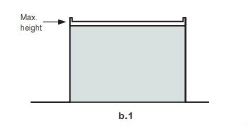
c. SETBACKS PRINCIPAL BUILDING
Principal buildings shall be distanced from the lot lines as shaded.*
c.1 Principal Front Setback, 30 ft. min / Corridor, 30 ft. min*.
c.2 Side (Street) Setback, Same as Front Setback.
c.3 Side (Interior), 20 ft. min. / 50 ft. min. abutting residential
c.4 Rear Setback, 20 ft. min. / 50 ft. min. abutting residential.
*For setbacks adjacent to County, State, and Federal roadways, see City Code Sec. 125-83C.8
**Any parking in the corridor district must be set back at least 30 ft from the road right-of-way.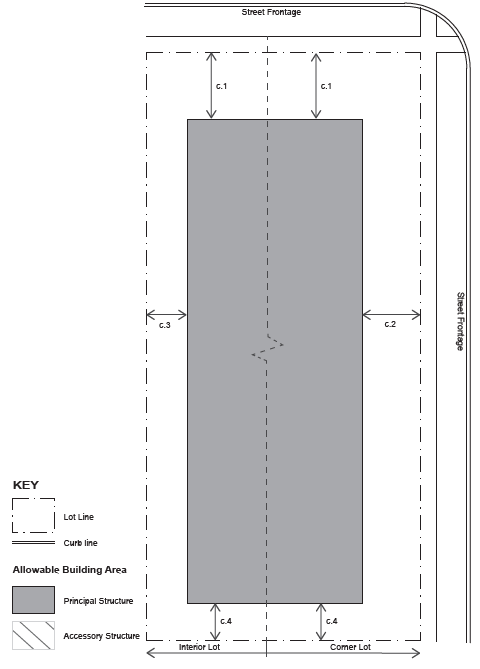
d. SETBACKS ACCESSORY
Accessory Structures shall not be permitted within the GI district with the exception of security guard structures/ sheds.
Refer to Sec. 125-84. Accessory Use Standards E. Outdoor storage; Applicability for outdoor storage purposes.e. CORRIDOR STANDARDS
Corridor standards are intended to provide additional beautification for sites fronting certain arterial and collector streets. This should be achieved by reducing building setbacks, locating parking to the rear of buildings, and increasing landscaping along these frontages. In addition to compliance with all other applicable regulations in this chapter, development in the GI District subject to the Corridor standards must meet the following requirement
e.1 The property must be located adjacent to one of the arterial/collector streets identified as part of the corridor overlay area.
- Purpose. Industrial uses include manufacturing, assembly, processing, warehousing and distribution uses. Industrial districts should be located to take advantage of good access to the regional roadway system with limited traffic circulation through residential and pedestrian-oriented areas. Properties within the GI district provide a range of lot sizes to support industrial operations of various intensity. Industries or uses that benefit from good vehicular access or exposure, or entail temporary land usage until served by extension of public utilities to the site are also appropriate in this district.
- Service Business District (SB)
- Purpose. The Special Business District includes industrial uses which by the nature of their use may require more intense screening, buffering from adjacent uses. Uses may include manufacturing, assembly, processing, warehousing and distribution uses and uses with accessory outdoor storage. Service Business districts should be located to take advantage of good access to the regional roadway system with limited traffic circulation through residential and pedestrian-oriented areas. Properties within the SB district provide a range of lot sizes to support industrial operations of various intensity. Industries or uses that benefit from good vehicular access or exposure, or entail temporary land usage until served by extension of public utilities to the site are also appropriate in this district. Additionally, this is the district where contractors operations with contractor yards must be located.
The SB Service Business District applies to those properties classified as Industry on the 2040 Future Land Use Plan. The district shall allow for continuation, expansion or redevelopment of industrial uses in specific areas of the City where they will have less conflict with other functions. - Other Standards. All development shall comply with all other applicable regulations in this Chapter, including without limitation the permitted use regulations in Table 4. Permitted Uses and Performance Standards in Article V. Performance Standards and Regulations.
Table 17. SB - SERVICE BUSINESS DISTRICT
a. LOT STANDARDS*
a.1 Lot Size -10,000 sq. ft. min. a.2 Lot Coverage - 75% max. a.3 Lot Width - NAb. BUILDING HEIGHT
b.1 Principal Building - 45 ft. max.*
* This height limitation shall not apply to essential service uses and water towers.
Maximum heights for various roof types are detailed in Sec. 125-85. Lot and Building Standards: Design Elements.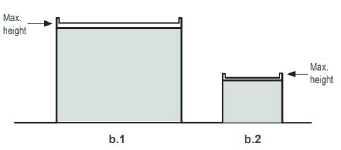
c. SETBACKS PRINCIPAL BUILDING
Principal and accessory buildings shall be distanced from the lot lines as shaded.*
c.1 Principal Front Setback, 30 ft. min. c.2 Side (Street) Setback, Same as Front Setback. c.3 Side (Interior), 20 ft. min. / 50 ft. min. abutting residential c.4 Rear Setback, 20 ft. min. / 50 ft. min. abutting residential.
*For setbacks adjacent to County, State, and Federal roadways, see City Code Sec. 125-83C.8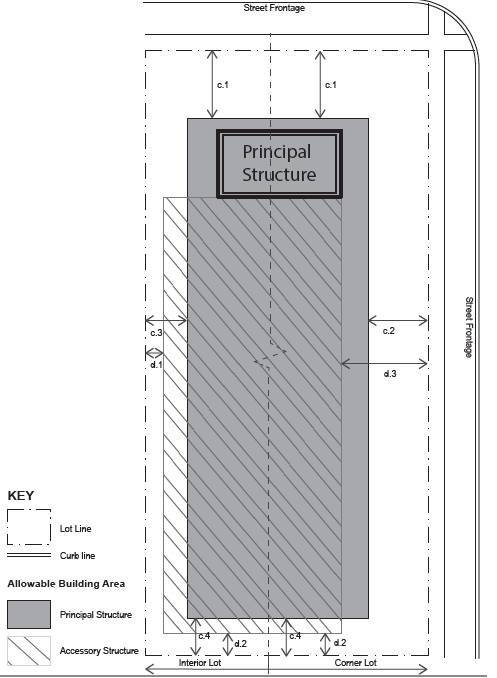
d. SETBACKS ACCESSORY
d.1 Side (Interior), 10 ft. min. d.2 Rear Setback, 10 ft. min. d.3 Detached accessory structures such as garages shall be placed in the rear yard. Such structures may not be closer to the secondary street frontage than the nearest edge of the principle structure, and in no case shall be closer than the principle structure secondary street setback.
One accessory structure per site shall be permitted within the SB district, subject to all applicable accessory structure setbacks and standards.
Where any use in the SB district abuts any non-industrial zoning district, screening shall be required.
- Purpose. The Special Business District includes industrial uses which by the nature of their use may require more intense screening, buffering from adjacent uses. Uses may include manufacturing, assembly, processing, warehousing and distribution uses and uses with accessory outdoor storage. Service Business districts should be located to take advantage of good access to the regional roadway system with limited traffic circulation through residential and pedestrian-oriented areas. Properties within the SB district provide a range of lot sizes to support industrial operations of various intensity. Industries or uses that benefit from good vehicular access or exposure, or entail temporary land usage until served by extension of public utilities to the site are also appropriate in this district. Additionally, this is the district where contractors operations with contractor yards must be located.
Sec 125-60 - District Specific Standards: AG Agricultural
- Lot Sizes. Lot size shall be adequate to provide all expected improvements and for the installation of two on-site sewage treatment systems and a well system.
Sec 125-61 - District Specific Standards: R1 Rural Residential
- Lot Sizes. Lot size shall be adequate to provide all expected improvements and for the installation of two on-site sewage treatment systems, but in no case shall lot size be less than two acres and shall have a buildable land of not less than one acre, unless allowed by a PUD.
- Buffers. When a rural subdivision adjoins an agricultural district (AG, R1) or is separated only by road right-of-way, a buffer will be required on the property the length of all property lines under question. The design of the buffer will be based on careful consideration given to any and all requirements appropriate to mitigate negative impacts of the agricultural property. Negative impacts could include visual, sound, odors, crowding, vibration, traffic, air quality, lighting or negative aesthetics which may result from any aspect of the agricultural use or operation. At a minimum, the buffer will be 50 feet in width. Within the buffer, only planting, screening, berming and wells shall be permitted. Septic systems may be permitted, as long as they do not impede the ability to screen or buffer the negative effects of the agricultural use.
- Bed and Breakfast. Bed and breakfast facilities must comply with all of the following requirements:
- Bed and breakfast facilities shall be a converted or a renovated singlefamily residence, and that this principal function be maintained. No structure shall be constructed for the sole purpose of being utilized as a bed and breakfast facility. The exterior appearance of the structure shall not be altered from its single-family character.
- The primary entrance to the guest rooms shall be from within the dwelling unit.
- Guests are limited to a length of stay of no more than 30 consecutive days.
- No food preparation or cooking shall be conducted within any of the guest rooms. The only meal to be provided to guests shall be morning breakfast, and it shall only be served to guests taking lodging in the facility.
- Activities including luncheons, banquets, parties, weddings, meetings, charitable fundraising, commercial or advertising activities, or other gatherings for direct or indirect compensation, are prohibited at a bed and breakfast facility.
- On-site parking, sufficient to handle all guest and owner vehicles, shall be provided.
- A maximum of five bedrooms for rent be available to the public.
- The applicant must furnish evidence that licenses required by the State of Minnesota and Hennepin County either have been issued or will be issued before commencing operation.
- Establishment must be owner-occupied.
Sec 125-62 - District Specific Standards: R2 Single Family Residential
- Permitted Uses. Pursuant to the Planned Unit Development (PUD) zoning of the Subject Properties legally described in Exhibit A, the permitted uses shall be as follows:
Permitted Uses Single-Family Detached Residential Dwellings - PUD District Standards. Pursuant to the Planned Unit Development (PUD), as depicted in Exhibit B, the zoning of the Subject Properties, legally described in Exhibit A, shall follow the applicable standards as stated herein.
45' Single Family Residential Lot Standards Housing Type: Single-Family Residential Preliminary Plat Lots: 1-53 Setbacks (Min) Front Yard Rear Yard Side Yard Corner Yard Height (Max) 45' Minimum 25 ft 20 ft 7.5 ft 20 ft 35 ft Lot Dimensions Housing Type: Single-Family Residential Preliminary Plat Lots: 1-53 Lot Width (Min) Depth (Min) Area (Min) 45 ' Minimum 45 ft 120 ft 6,525 sf 55' Single-Family Residential Lot Standards Housing Type: Single-Family Residential Preliminary Plat Lots: 54-81 Setbacks (Min) Front Yard Rear Yard Side Yard Comer Yard Height (Max) 55' Minimum 25 ft 20 ft 7.5 ft 20 ft 35 ft Lot Dimensions Housing Type: Single-Family Residential Preliminary Plat Lots: 54-81 Lot Width (Min) Depth (Min) Area (Min) 55' Minimum 55 ft 145 ft 7,975 sf 70' Single-Family Residential Lot Standards Housing Type: Single-Family Residential Preliminary Plat Lots: 82-129 Setbacks (Min) Front Yard Rear Yard Side Yard Corner Yard Height (Max) 70' Minimum 25 ft 20 ft 10 ft 20 ft 35 ft Lot Dimensions Housing Type: Single-Family Residential Preliminary Plat Lots: 82-129 Lot Width (Min) Depth (Min) Area (Min) 70' Minimum 70 ft 145 ft 10.150 sf
Adopted by Ord. 2022-01 on 4/26/2022
Sec 125-63 - District Specific Standards: R3 Mid-Density Residential (Reserved)
Sec 125-64 - District Specific Standards: R4 Mixed Density Residential (Reserved)
Sec 125-65 - District Specific Standards: R5 Multi-Family Residential (Reserved)
Sec 125-66 - District Specific Standards: LC Local Employment Center
- Purpose. Development in the Local Employment Center District must be designed with greater sensitivity to the environment and generally higher quality. The purpose of the performance standards within the district are to:
- Create a unified, harmonious, and high quality visual environment throughout the corridor, thereby identifying it as a special place with a unique identity within both the City and the Twin Cities region as a whole
- Promote high quality architectural and site design through improvement development standards within the corridor. Those standards governing site planning, placement of building masses, use of materials, and the like enable the City to enhance what otherwise might result in low quality strip development.
- Foster a distinctive and positive community image, for the City as a whole and especially for the Interstate 94 and Highway 101 corridors, which function as the City’s main entrances.
- Protect wetlands and significant stands of mature trees through use of careful site design, protective easements, sensitive alignment and design of roadways and utilities, incorporation of natural features, landscaping and massing of trees that enhance existing natural features and views, and the practices delineated in the City’s best management practices handbook.
- Applicability. In addition to compliance with all other applicable regulations in this Chapter, including without limitation the permitted use regulations and form and development regulations in Article IV. Zoning District Standards, development in the Local Employment Center District shall comply with the following when the applicant requests that the “Corridor” standards apply:
- All property frontages must have sidewalks constructed to city standards
- The primary building must have at least one operable pedestrian door leading directly from the primary building onto a sidewalk. For primary buildings located on corner lots, the required pedestrian entrance may be located on the primary street façade or at the corner where the two streets intersect.
- At least 65% of the primary building frontage must be built no further than 30 feet from the front lot line.
- At the applicant’s option, minimum on-site parking requirements may be reduced up to 30% as described in Sec. 125-86. Parking.
- Site Development Regulations Within All Sections of the Local Employment Center District
- Landscaping Adjacent to Any Roadway. A 30-foot wide, irrigated, landscaped area must be installed adjacent to all street rights-of-way. A plan for the design and materials used in this area shall be prepared and approved as part of the site review process. The sole permitted use of the area between this landscaped area and the building shall be parking for automobiles, except outdoor (exterior) patio or platform display areas are allowed within the area between the building and the 30-foot landscape area not to exceed the amount of indoor (interior) display area. No sales, material offered for sale or rent, or storage is permitted in this area, all storage or open sales lots must be located behind the principal building on the site.
- Architectural Design Standards. Standards governing architectural design shall apply to all new and renovated buildings within the district.
- Architectural style shall not be restricted. Evaluation of the appearance of a project shall be based on the quality of its design and on its relationship to its surroundings, guided by the provisions of this Section. Site characteristics to be evaluated for this purpose include building and plant materials, colors, textures, shapes, massing, rhythms of building components and details, height, roof-line and setback. Designs that are incompatible with their surroundings or intentionally bizarre or exotic are prohibited.
- Site Development Regulations Within Lots Guided for Industrial Use within the Local Employment Center District.
- The maximum amount of non-building hard surface coverage shall not exceed a three to one ratio of the gross floor area of the building of any lot which is guided industrial.
- Industrial Uses
- Setback
- Unless within a PUD the following minimum and maximum lot area, width and building setback requirements shall apply:
- Minimum lot size: 20,000 square feet.
- Minimum lot width: 60 feet.
- Unless within a PUD the following minimum and maximum lot area, width and building setback requirements shall apply:
- Setback
- Buffering. When a property in the LC district adjoins a residentially zoned parcel or agricultural district, or is separated from such parcel or district only by a road right-of-way, a buffer will be required on the LC District property the full length of all property lines abutting the residential or agricultural districts (AG, R1, R2, R3, R4, R5, ND).
The design of the buffer will be based on careful consideration given to any and all requirements appropriate to screen the residential or agricultural properties from negative impacts of the commercial uses, which may include visual, sound, odors, crowding, vibration, traffic, air quality, lighting or negative aesthetics which may result from any aspect of the LC site use or operation. - Display. Outdoor display may occupy no more than 50% of any individual parcel.
Sec 125-67 - District Specific Standards: RC Regional Employment Center
- Purpose. Development in the Regional Employment Center District must be designed with greater sensitivity to the environment and generally higher quality than might have occurred in the absence of specific standards. The purpose of the performance standards within the district are to:
- Create a unified, harmonious, and high quality visual environment throughout the corridor, thereby identifying it as a special place with a unique identity within both the City and the Twin Cities region as a whole
- Promote high quality architectural and site design through improvement development standards within the corridor. Those standards governing site planning, placement of building masses, use of materials, and the like enable the City to enhance what otherwise might result in low quality strip development.
- Foster a distinctive and positive community image, for the City as a whole and especially for the Interstate 94 and Highway 101 corridors, which function as the City’s main entrances.
- Protect wetlands and significant stands of mature trees through use of careful site design, protective easements, sensitive alignment and design of roadways and utilities, incorporation of natural features, landscaping and massing of trees that enhance existing natural features and views, and the practices delineated in the City’s best management practices handbook.
- Applicability. In addition to compliance with all other applicable regulations in this Chapter, including without limitation the permitted use regulations and form and development regulations in Article IV. Zoning District Standards development in the Regional Employment Center District shall comply with the following when the “Corridor” standards apply:
- The property shall be located at an arterial street or an arterial street/collector street intersection.
- All property frontages must have sidewalks constructed to city standards
- The primary building must have at least one operable pedestrian door leading directly from the primary building onto a sidewalk. For primary buildings located on corner lots, the required pedestrian entrance may be located on the primary street façade or at the corner where the two streets intersect.
- At least 65% of the primary building frontage must be built no further than 30 feet from the front lot line.
- At the applicant’s option, minimum on-site parking requirements may be reduced up to 30% as described in Sec. 125-86. Parking.
- Site Development Regulations of the Regional Employment Center District
- Landscaping Adjacent to Any Roadway. A 30-foot wide, irrigated, landscaped area must be installed adjacent to all street rights-of-way. A plan for the design and materials used in this area shall be prepared and approved as part of the site review process. The sole permitted use of the area between this landscaped area and the building shall be parking for automobiles, except outdoor (exterior) patio or platform display areas are allowed within the area between the building and the 30-foot landscape area not to exceed the amount of indoor (interior) display area. No sales, material offered for sale or rent, or storage is permitted in this area, all storage or open sales lots must be located behind the principal building on the site.
- Architectural Design Standards. Standards governing architectural design shall apply to all new and renovated buildings within the district.
- Architectural style shall not be restricted. Evaluation of the appearance of a project shall be based on the quality of its design and on its relationship to its surroundings, guided by the provisions of this Section. Site characteristics to be evaluated for this purpose include building and plant materials, colors, textures, shapes, massing, rhythms of building components and details, height, roof-line and setback. Designs that are incompatible with their surroundings or intentionally bizarre or exotic are prohibited.
- Site Development Regulations Within Subsections of the Regional Employment Center District
- The maximum amount of non-building hard surface coverage shall not exceed a three to one ratio of the gross floor area of the building of any lot which is zoned industrial and shall not exceed a five to one ratio for any lot zoned as either a business district or commercial district.
- Industrial subdistrict.
- Setback.
- Unless within a PUD the following minimum and maximum lot area, width and building setback requirements shall apply:
- Minimum lot size: five acres.
- Minimum lot width: 330 feet.
- Unless within a PUD the following minimum and maximum lot area, width and building setback requirements shall apply:
- Setback.
- Buffering. When a property in the RC district adjoins a residentially zoned parcel or agricultural district, or is separated from such parcel or district only by a road right-of-way, a buffer will be required on the RC District property the full length of all property lines abutting the residential or agricultural districts.
The design of the buffer will be based on careful consideration given to any and all requirements appropriate to screen the residential or agricultural properties from negative impacts of the commercial uses, which may include visual, sound, odors, crowding, vibration, traffic, air quality, lighting or negative aesthetics which may result from any aspect of the RC site use or operation. - Display. Outdoor display may occupy no more than 50% of any individual parcel.
Sec 125-68 - District Specific Standards: ND Neighborhood District (Reserved)
Sec 125-69 - District Specific Standards: DT Downtown District
- Reference. For lots located in the Downtown District, the standards and requirements set forth in the Downtown Design Guidelines and Architectural Standards shall supercede regulations established in this Ordinance.
- Bed and Breakfast. Bed and Breakfast uses will be subject to the same standards as established in Sec. 125-63. District Specific Standards: R1 Rural Residential, C. Bed and Breakfast
Sec 125-70 - District Specific Standards: GI General Industrial (Reserved)
Sec 125-71 - District Specific Standards: SB Service Business
- Outdoor storage of materials:
- Storage area is limited to the rear yard.
- Storage area is limited to up to 20 percent of the building area.
- Storage areas shall be fenced.
- Storage and screening shall not exceed eight feet in height.
- The use does not take up parking space as required for conformity to this ordinance.
- All lighting shall be hooded and so directed that the light source shall not be visible from the public right-of-way or from neighboring properties.
- All exterior storage areas must be paved and include storm drainage management facilities as required by the city.
- Outdoor storage of vehicles/trailers
- Parking/storage is limited to the rear yard.
- Parking/storage of vehicles/trailers does not take up parking spaces as required for conformity to this ordinance.
- All vehicles./trailers must be stored on a paved area which includes storm drainage management facilities as required by the city.
Sec 125-72 - Specific Standards: PUD - Rural Cluster
- General Standards
- The Rural Cluster PUD allowed in the R1 zoning district to implement the Rural Residential Flexible Development Standards described in the 2040 Comprehensive Plan.
- Residential lot requirements. The minimum lot size, setbacks and other development standards shall be negotiated as part of the PUD to ensure compliance with the Comprehensive Plan goals. The application shall be processed according to the PUD standards in Sec. 125-30. Planned Unit Development - Rural Cluster.
- The Rural Cluster PUD Ghost Plat standards and conditions will be incorporated as part of the Development Agreement.
- Neighborhood Siting Standards
- Neighborhoods should be sited to achieve the following goals, to the extent practical. In cases where impact on one or more of the following resources areas is unavoidable, the impact should be minimized through use of landscaping, topography, or other features:
- Minimize disturbance to woodlands, hedgerows, mature trees or other significant vegetation;
- Protect scenic views of open land from adjacent roads;
- Protect existing historical buildings or incorporate them through adaptive reuse.
- Neighborhoods should be sited to achieve the following goals, to the extent practical. In cases where impact on one or more of the following resources areas is unavoidable, the impact should be minimized through use of landscaping, topography, or other features:
- Sewage and water facilities. Water for an Rural Cluster development shall be provided by individual on-site wells meeting the permit requirements of the Minnesota Department of Health.
- All rural cluster developments shall be provided with adequate sewage treatment facilities meeting the standards of the City and county SSTS regulations and the permit requirements of the Minnesota Pollution Control Agency.
- One primary and one alternative septic site must be identified on the site plan and preliminary plat for each building site.
- Community Septic systems may be permitted at the discretion of city staff.
Sec 125-73 - Wireless Overlay District
- Purpose
- The purpose of the Wireless Overlay District is to regulate the following.
- The siting and construction of any new wireless support structure and facilities;
- The substantial modification of an existing wireless support structure or facility;
- The collocation on an existing support structure which does not require the substantial modification of an existing support structure and wireless facility.
- To encourage the construction and location of wireless facilities and wireless support structures in areas where the adverse impact on the environment, the community, and the citizens of Rogers is minimized
- To maintain and ensure that a non-discriminatory, competitive and broad range of wireless service and high-quality wireless service infrastructure are provided to serve the community effectively and efficiently
- To provide a process of obtaining the necessary permits for wireless facilities and support structures while at the same time protecting the legitimate interests of the citizens of Rogers
- To encourage the collocation of new antennas on existing support structures, and construction of support structures with the ability to locate three (3) or more providers.
- To promote the public health, safety and general welfare of the Citizens of Rogers.
- The purpose of the Wireless Overlay District is to regulate the following.
- Approval Requirements
- Permitting Requirements
- Site plan approal and a special use agreement shall be required for new wireless support structures and new wireless facilities, including antennas.
- Application Process
- All site plan applications for new wireless service support structures and facilities shall be submitted to the Zoning Administrator on forms provided by the City.
- Applications must include all elements required for a full site Plan submittal, as detailed in Section 125-27 of City Code and including any other items requested by Staff.
- Permitting Requirements
- General Standards
- Wireless structures and facilities must conform to the standards detailed in Chapter 105 - Buildings and Building Regulations. Article V. Wireless Communication Facilities.
- On parcels not located within the Wireless Overlay District, any wireless tower or facility requires an Interim Use Permit. Refer to City Code Chapter 125, Article IV, Table 4 (Permitted Use Table) for zoning districts where wireless towers and facilities are allowed with an Interim Use Permit.
Sec 125-74 - Planned Unit Development District (PUD)
- Permitted Uses. Pursuant to the Planned Unit Development (PUD) zoning of the Subject Properties legally described in Exhibit A, the permitted uses shall be as follows:
Permitted Uses Single-Family Detached Residential Dwellings and Two-Family Residential Dwellings - PUD District Standards. Pursuant to the Planned Unit Development (PUD), as depicted in Exhibit B, the zoning of the Subject Properties, legally described in Exhibit A, shall follow the applicable standards as stated herein.
Single Family Home Lot Standards Housing Type: Single Family Residential Preliminary Plat Lots: Lots 1-6, Block 5 Setbacks (Min) Front Yard Rear Yard Side Yard Corner Yard Height (Max) 55' Minimum 25 ft 25 ft 7.5 ft 15 ft 35 ft Lot Dimensions Housing Type: Single-Family Residential Preliminary Plat Lots: Lots 1-6, Block 5 Lot Width (Min) Depth (Min) Area (Min) 55' Minimum 55 ft 120 ft 7,000 sf Two-Family Home (Twin Home) Lot Standards Housing Type: Two-Family Residential (Twin Home) Preliminary Plat Lots: Lots 1-20, Block 1; Lots 1-10, Block 2; Lots 1-10, Block 3; Lots 1-48, Block 4; and Lots 1-32, Block 6 Setbacks (Min) Front Yard Rear Yard Side Yard Corner Yard Height (Max) 35' Minimum
(70' Base Lot)25 ft 25 ft 7.5 ft 15 ft 35 ft Lot Dimensions Housing Type: Two-Family Residential (Twin Home) Preliminmy Plat Lots: Lots 1-20, Block 1; Lots 1-10, Block 2; Lots 1-10, Block 3; Lots 1-48, Block 4; and Lots 1-32, Block 6 Lot Width (Min) Depth (Min) Area (Min) 35' Minimum
(70' Base Lot)35 ft 100 ft 4,100 sf
(8,200 sf base lot)
Adopted by Ord. 2022-05 on 6/28/2022

