
Rogers City Zoning Code
ARTICLE 125
VII - DEFINITIONS
Sec 125-102 - Definitions
For the purpose of this Development Code, certain words and phrases are defined as follows:
Accessory building: A detached building greater than 200 square feet in size used or intended to be used for the storage of personal property or for agricultural purposes.
Accessory use: A use incidental or subordinate to the principal use of the same land.
Active Gravel Pit or Active Excavation: Active gravel pit or active excavation shall mean any artificial excavation of the earth dug, excavated or made by the removal of the natural surface of the earth, whether sod, soil, sand, gravel, stone, or other matter, creating a depression or depressions exceeding in any one place 1,000 square feet of surface area, the bottom or lowest point of which shall be one foot or more below or lower than the level of adjoining unexcavated land.
- Active gravel pit or active excavation shall also mean any area where the topsoil or overburden has been removed for the purpose of mining earthly deposits or minerals, yet the area has remained idle since the topsoil removal.
- Active gravel pit or active excavation shall also mean any area that is being used for stockpiling, storage, or processing or recycling of sand, gravel, soils, or other materials or products derived from gravel mining, even if such materials did not originate or were not produced on the premises, except that storage of the above materials as part of a permitted landscaping operation.
- Depressions, pits, excavations made for the purpose of a foundation, cellar, or basement of some immediately pending structure to be created, built or place thereon contemporaneously with or immediately following such, excavating and covering or to cover such excavated pit or depression when completed, are excluded from the definition of active gravel pit or active excavation if a building permit has been issued.
Administrator: The City Administrator or that person’s designee.
Adult oriented business: A business that may be any of the following, including but not limited to, adult bookstores, adult motion picture theaters, adult motion picture sales and rental, adult mini-motion picture theaters, adult massage parlors, adult steam room/bathhouse/sauna facilities, adult companionship establishments, adult rap/conversation parlors, adult health/sport clubs, adult cabarets, adult novelty businesses, adult motion pictures arcades, adult modeling studios, adult hotels/motels, adult body painting studios, and other premises, enterprises, establishments, businesses or places open to some or all members of the public, at or in which there is an emphasis on the presentation, display, depiction or description of specified sexual activities or specified anatomical areas which are capable of being seen by members of the public. Activities classified as obscene as defined by Minnesota Statutes §617.241 are not included.
- Adult uses or adult oriented businesses, accessory: The offering of goods and/or services which are classified as adult uses on a limited scale and which are incidental to the primary activity and goods and/or services offered by the establishment. Examples of such items include the sale of adult magazines, the sale or rental of adult motion pictures, the sale of novelties, and the like.
- Adult uses or adult oriented businesses, principal: The offering of goods and/or services which are classified as adult uses as a primary or sole activity of a business or establishment and include, but are not limited to, the following:
- Body painting studio: An establishment or business which provides the service of applying paint or other substance, whether transparent or nontransparent, to or on the body of a patron when such body is wholly or partially nude in terms of specified anatomical areas.
- Bookstore: A building or portion of a building uses for the barter, rental or sale of items consisting of printed matter, pictures, slides, records, audio tape, videotape, or motion picture film if such building or portion of a building is not open to the public generally but only to one or more classes of the public excluding any minor reason by age or if a substantial or significant portion of such items are distinguished or characterized by an emphasis on the depiction or description of specified sexual activities or specified anatomical areas.
- Cabaret: A building or portion of a building used for providing dancing or other live entertainment, if such building or portion of a building excludes minors by reason of age or if such dancing or other live entertainment is distinguished or characterized by an emphasis on the presentation, display, depiction or description of specified sexual activities or specified anatomical areas.
- Companionship establishment: An establishment which excludes minors by reason of age, or which provides the services of engaging in or listening to conversation, talk or discussion between an employee of the establishment and a customer, if such service is distinguished or characterized by an emphasis on specified sexual activities or specified anatomical areas.
- Conversation/rap parlor: An establishment which excludes minors by reason of age, or which provide the service of engaging in or listening to conversation, talk, or discussion, if such service is distinguished or characterized by an emphasis on specified sexual activities or specified anatomical areas.
- Health/sport club: An establishment which excludes minors by reason of age, or if such club is distinguished or characterized by an emphasis on specified sexual activities or specified anatomical areas.
- Hotel or motel, adult: A hotel or motel from which minors are specifically excluded from patronage and wherein material is presented which is distinguished or characterized by an emphasis on matter depicting, describing or relating to specified sexual activities or specified anatomical areas.
- Massage parlor, health club: A massage parlor or health club which restricts minors by reason of age, and which provides the services of massage, if such service is distinguished or characterized by an emphasis on specified sexual activities or specified anatomical areas.
- Mini-motion picture theatre: A building or portion of a building with a capacity for less than 50 persons used for presenting material if such building or portion of a building as a prevailing practice excludes minors by reason of age, or if such material is distinguished or characterized by an emphasis on specified sexual activities or specified anatomical areas for observation by patrons therein.
- Modelling studio: An establishment whose major business is the provision, to customers, of figure models who are so provided with the intent of providing sexual stimulation or sexual gratification to such customers and who engage in specified sexual activities or display specified anatomical areas while being observed, painted, painted upon, sketched, drawn, sculptured, photographed, or otherwise depicted by such customers.
- Motion picture arcade: Any place to which the public is permitted or invited wherein coin or slug-operated or electronically, electrically or mechanically controlled or operated still or motor picture machines, projectors or other image-producing devices are maintained to show images to five or fewer persons per machine at any one time, and where the images so displayed are distinguished or characterized by an emphasis on depicting or describing specified sexual activities or specified anatomical areas.
- Motion picture theatre: A building or portion of a building with a capacity of 50 or more persons used for presenting material is such building or portion of a building as a prevailing practice excludes minors by reason of age or if such material is distinguished or characterized by an emphasis on specified sexual activities or specified anatomical areas for observation by patrons thereon.
- Novelty business: A business which has as a principal activity the sale of devices which stimulate human genitals or devices which are designed for sexual stimulation.
- Sauna: A sauna which excludes minors by reason of age, or which provides a steam bath or heat bathing room used for the purpose of bathing, relaxation, or reducing, utilizing steam or hot air as a cleaning, relaxing or reducing agent, if the service provided by the sauna is distinguished or characterized by an emphasis on specified sexual activities or specified anatomical areas.
- Specified anatomical areas:
- Less than completely and opaquely covered human genitals, pubic region, buttock, anus, or female breast(s) below a point immediately above the top of the areola; and
- Human male genitals in a discernibly turgid state, even if completely and opaquely covered.
- Specified sexual activities:
- Actual or simulated sexual intercourse, oral copulation, anal intercourse, oral-anal copulation, bestiality, direct physical stimulation of unclothed genitals, flagellation or torture in the context of a sexual relationship, or the use of excretory functions in the context of a sexual relationship, and any of the following sexually-oriented acts or conduct, anilingus, buggery, coprophagy, coprophilia, cunnilingus, fellatio, necrophilia, pederasty, pedophilia, piquerism, sapphism, zooerasty;
- Clearly depicted human genitals in the state of sexual stimulation, arousal or tumescence;
- Use of human or animal ejaculation, sodomy, oral copulation, coitus, or masturbation;
- Fondling or touching of nude human genital, pubic region, buttocks, or female breast;
- Situations involving a person or persons, any of whom are nude, clad in undergarments or in sexually revealing costumes, and who are engaged in activities involving the flagellation, torture, fettering, binding or other physical restraint of any such person;
- Erotic or lewd touching, fondling or other sexually-oriented contact with an animal by a human being; or
- Human excretion, urination, menstruation, vaginal or anal irrigation.
- Steam room/bathhouse facility: A building or portion of a building used for providing a steam bath or heat bathing room used for the purpose of pleasure, bathing, relaxation, or reducing, utilizing steam or hot air as a cleaning, relaxing or reducing agent if such building or portion of a building restricts minors by reason of age or if the service provided by the steam room/bathhouse facility is distinguished or characterized by an emphasis on specified sexual activities or specified sexual anatomical areas.
Agriculture:
- Agricultural building: A structure on agricultural land designed, constructed, and used to house farm implements, livestock or agricultural produce or products used by the owner, lessee or sublessee of the building and members of their immediate families, their employees and persons engaged in the pickup or delivery of agricultural produce or products.
- Agricultural-business, seasonal: A seasonal business not exceeding six months in any calendar year operated on a rural farm as defined offering for sale to the general public, produce or any derivative thereof, grown or raised on the property.
- Agricultural use: Land whose use is devoted to the production of horticulture and nursery stock, fruit of all kinds, vegetables, forage, grains, bees and apiary products, horses, horse stables, horse training facilities and raising domestic farm animals. This activity does not need to be the principal source of income.
Animals:
- Animal unit: A unit of measure used to regulate the number of animals allowed by acreage as identified in D. Livestock and Livestock Operations.
- Animals, domestic pets: Dogs, cats, birds and similar animals commonly kept in a residence.
Antenna:
- Antenna—commercial: A device used for communications by private business enterprises exclusively for internal business use, as opposed to communications services which are made available to members of the public for a fee.
- Antenna—private: A device used for communications by private parties under short-wave, ham, or similarly licensed private use.
- Antenna support structure: A structure, such as a tower, constructed primarily for the purpose of supporting wireless telecommunications and/or radio antennae and related equipment.
- Antenna—wireless: A device used for transmitting or receiving wireless telecommunications and/or radio messages, which may be mounted on an Antenna Support Structure.
Applicant: The owner, or representative of the owner, of the land proposed to be subdivided, platted or is otherwise the subject of a zoning or land use application and who is the contact person for the subject application.
As-built plan: The amended final site plans specifying the locations, dimensions, finished grades, capacities, and capabilities of structures or facilities as they have been constructed.
Attorney: The attorney employed by the City.
Automobile or Automotive:
- Automotive, dealership: Any place where automobiles are sold to the general public. Business activities accessory to this retail use include motor vehicle repair, fuel dispensing, and the rental of vehicles.
- Automotive, body shop: General repair, rebuilding or reconditioning of engines, motor vehicles or trailers; collision service including body, frame or fender straightening or repair; overall painting and upholstering; vehicle steam cleaning.
- Automotive, repair: Repairs, incidental body and fender work, replacement of parts and motor services to passenger automobiles and trucks not exceeding 12,000 pounds gross weight, but not to include any operation specified under “Automotive, body shop.”
- Automotive, service or fuel station: A place for the dispensing, sale or offering for sale of motor fuel directly to users of motor vehicles, including the sale of motor vehicle accessories, and which may or may not include facilities for lubrication, washing, or making minor repairs to motor vehicles. May include accessory convenience use.
Base flood elevation: The elevation of the “regional flood.” The term “base flood elevation” is used in the flood insurance survey.
Basement: Any floor level below the first story in a building, except that a floor level in a building having only one floor level shall be classified as a basement unless such floor level qualifies as a first story as defined in the building code.
Bed and breakfast establishment: A single family dwelling in which four or fewer transient guest rooms are rented on a nightly basis and where at least one meal is offered in connection with the provision of sleeping accommodations only. Sleeping accommodations for employees or owners are permitted and not counted toward the maximum allowable guest rooms.
Block: An area of land within a subdivision that is entirely bounded by a combination or combinations of streets, exterior boundary lines of the subdivision and streams or water bodies.
Body art, piercing and tattooing: A physical body adornment using, but not limited to, tattooing and body piercing. Body art does not include practices and procedures that are performed by a licensed medical or dental professional if the procedure is within the professional’s scope of practice.
Brew on premises: A facility that provides the ingredients and equipment for a customer to use to brew malt liquor at the store. Alcoholic beverages may not be sold or otherwise provided to customers of a brew on premises store, unless the owner of the brew on premises store holds the appropriate liquor license. Customers using the brew on premises store must be of the minimum age required to purchase intoxicating liquor. Malt liquor brewed by a customer in the store must not be sold and must be used by the customer solely for personal or family use.
Brewery: A facility that produces for sale beer, ale, or other beverages made from malt by fermentation and containing not less than one-half of one percent alcohol by volume.
Brewery, small: A brewery that produces no more than 20,000 barrels of malt liquor in a calendar year.
Brewpub: A small brewery that operates a restaurant on the same premises as the brewery, whose malt liquor production per calendar year may be limited by Minnesota State Statute.
Buffer: A strip of land intended to create physical separation between potentially incompatible uses of land.
Buildable land-rural: The amount of area on a site that is suitable for the construction of permitted structures, including primary and secondary septic systems as regulated by Minnesota Rule 7080. Buildable land does not include:
- Setbacks from property lines for septic systems as defined in Minnesota Rule 7080.0170 (10 feet);
- Easements intended for drainage swales, storm water, sanitary sewer and water main;
- Wetlands, public water bodies and floodways;
- Shoreland setbacks from the ordinary high water level as defined in Minnesota Rule 6120.3400;
- Slopes over 25 percent.
- Soils which do not meet the minimum bearing capacity for structures and/ or soils unsuitable for septic systems as identified using the Hennepin County Soil Survey in combination with site specific soil boring and drainfield data.
- Other easements including gas, electric, telephone or cable shall be evaluated for inclusion of buildable land on a site-by-site basis.
Buildable land, urban: The amount of land area used to calculate urban density. Buildable land does not include:
- Land within the shoreland and required buffers from ordinary high water.
- Delineated wet lands and required buffers.
- Areas with slopes greater than 18 percent.
- Areas dedicated to the public for parks, trails and open space.
- Arterial roadways.
Building: Any structure, either temporary or permanent, having a roof and used or built for the shelter or enclosure of any person, animal or property of any kind. When any portion thereof is completely separated from every other part thereof by area separation, each portion of such building shall be deemed as a separate building.
Building code: The Minnesota State Building Code.
Building height: The distance measured from the mean ground level for all of that portion of the building having frontage on a public right-of-way or approved private road , to the top of a cornice of a flat roof, or to the deck line of a mansard roof, to a point on the roof directly above the highest wall of a shed roof, or to the uppermost point on a round or other arched type roof or to the midpoint of the highest gable on a gable, pitched, or hip roof.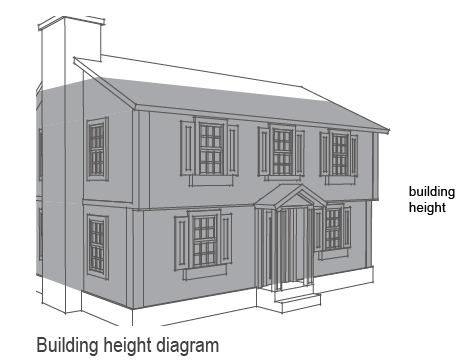
Building-integrated solar energy system: A solar energy system that is an integral part of a principal or accessory building, rather than a separate mechanical device, replacing or substituting for an architectural or structural component of the building. Building-integrated systems include, but are not limited to, active photovoltaic or hot water systems that are contained within roofing materials, windows, walls, skylights, and awnings, or passive systems that are designed to capture direct solar heat.
Building-mounted solar energy system: A solar energy system affixed to a principal or accessory building.
Building official: The designated authority charged with the administration and enforcement of the state building code.
Building permit: A permit required from the responsible governmental agency before any site work, construction or alteration to structures can be started.
Building line: A line within a lot parallel to a public right-of-way line, a side or rear lot line, a bluff line or a high water mark or line, behind which buildings or structures are placed.
Building setback: The minimum horizontal distance between the building and the lot line, a bluff line or a high water mark or line, behind which buildings or structures are placed.
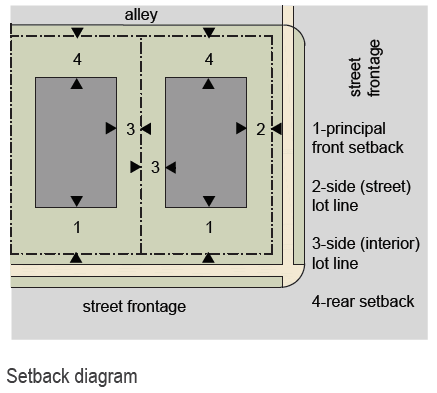
Building setback line: The minimum horizontal distance between the building and the lot line.
Business: Any occupation, employment or enterprise wherein merchandise is exhibited or sold, or where services are offered for compensation.
Carport: An automobile shelter having one or more open sides.
Car Wash, Self-Service: A building, structure or portion thereof containing an automatic washing facility with a single vehicle capacity, or a hand-operated facility with a maximum of four (4) washing stalls for washing automobiles. Car Wash, Tunnel and Full-Service: A building, structure or portion thereof containing an automatic tunnel or conveyorized wash system with a multiple vehicle capacity that provides complete vehicle washing and drying and self-service detailing areas, or full-service automobile detailing center where vehicles are washed mechanically or by hand and attendants are available to dry the vehicle manually, clean the interior and perform other detailing services. May include automated or attendant pay stations.
Cemetery: Land used or intended to be used for the burial of the dead and dedicated for cemetery purposes and including, but not limited to, columbariums, mausoleums and chapels when operated in conjunction with and within the boundaries of such cemetery.
Certified Survey: A certified survey map is a minor subdivision of land used to create no more than four new parcels in a five year period
City: The City of Rogers
Club or lodge: An association of persons who are members paying annual dues, use of premises being restricted to members and their guests. It shall be permissible to serve food and meals on such premises providing there is adequate dining room for the purpose of serving food and meals and providing further that such serving of alcoholic beverages is in compliance with the applicable federal, state and local laws.
Commercial recreation: All uses such as tennis, racquetball clubs, amusement centers, bowling alleys, golf driving ranges, miniature golf, movie theaters that are privately owned and operated with the intention of earning a profit by providing entertainment to the public.
Community garden: Land which is cultivated by residents for the production of trees, vegetables, fruits, flowers, herbs and grasses for the residents’ use or to be sold directly to consumers through membership in the garden.
Community septic: On-site means for disposing and treating human and domestic waste such as a septic tank and soil absorption system or other system allowed by state and city regulations that is shared by multiple dwellings; used where authorized by the City when access to the municipal sewer system is not required or feasible.
Comprehensive plan: The policies, statements, goals and interrelated plans for private and public land and water use, transportation and community facilities, including recommendations for plan execution which constitute the guide for the future development and includes any unit or part of such plan separately adopted and any amendment to such plan or parts thereof.
Concept plan: A preliminary drawing, made to approximate scale, of a proposed land division for discussion purposes.
Conditional use: A use classified as conditional generally appropriate or desirable in a specified zone, but which requires special approval and conditions to mitigate excessive height or bulk or abnormal traffic congestion, or other negative impacts on the public or nearby private property.
Condominium: A building, or group of buildings, in which units are owned individually, and the structure, common areas, and facilities are owned by all owners on a proportional, undivided basis. It is a legal form of ownership of real estate and not a specific building type or style.
Conservation easement: A nonpossessory interest of a holder in real property imposing limitations or affirmative obligations the purposes of which include retaining or protecting natural, scenic, or open-space values of real property, assuring its availability for agricultural, forest, recreational, or open-space use, protecting natural resources, maintaining or enhancing air or water quality, or preserving the historical, architectural, archaeological, or cultural aspects of real property.
Contiguous: Parcels of land that share a common lot line or boundary. Parcels that are separated by a road right-of-way, easement, or railroad right-of-way are considered contiguous for the purposes of this Development Code.
Contour (topographic) map overlay, preliminary plat: A map on which irregularities of land surface are shown by lines connecting points of equal elevations. Contour interval is the vertical height between contour lines.
Copies: A print or reproduction made from a tracing.
Council: Council shall mean the City Council of the City of Rogers.
County board: The county board of commissioners.
Critical facilities: Facilities necessary to a community’s public health and safety, those that store or produce highly volatile, toxic or water-reactive materials, and those that house occupants that may be insufficiently mobile to avoid loss of life or injury. Examples of critical facilities include hospitals, correctional facilities, schools, daycare facilities, nursing homes, fire and police stations, wastewater treatment facilities, public electric utilities, water plants, fuel storage facilities, and waste handling and storage facilities.
Cul-de-sac: A short street having but 1 end open to traffic and the other end being terminated in a vehicular turnaround.
Cultural resource: The historic and archaeological characteristics of the land, including buildings and landscapes, which provide information regarding the history of Hennepin County and its people.
Day care facility: Any facility, public or private, which for gain or otherwise regularly provides one or more persons with care, training, supervision, habilitation, rehabilitation or developmental guidance on a regular basis, for periods of less than 24 hours per day, in a place other than the person’s own home. Day care facilities include, but are not limited to, family day care homes, group family day care homes, day care centers, day nurseries, nursery schools, developmental achievement centers, day treatment programs, adult day care centers and day services. Adult day care, adult day services, and family adult day services do not include programs where adults gather or congregate primarily for purposes of socialization, education, supervision, caregiver respite, religious expression, exercise, or nutritious meals.
Decibel: The unit of sound measured on the “A” weighing scale of a sound level meter, set on slow response, the weighing characteristics of which are specified in the a “Standards on Sound Level Meters of the USA Standards Institute”.
Deck: Horizontal, unenclosed platform with or without attached railings, seats, trellises, or other features, attached or functionally related to a principal use or site and at any point extending above grade (also “Open porch”).
Depth of lot: The horizontal distance between the frontage right-of-way line and rear lot line. On a corner lot, the side with the largest frontage is its depth, and the side with the lesser frontage is its width.
Depth of rear yard: The horizontal distance between the rear building line and the rear lot line.
Developer: A person or entity that constructs or creates a land development.
Developer’s agreement: A contract with the City in which the applicant or their assigns agrees to take certain specified actions in consideration of the approval for a development.
Development: Any manmade change to improved or unimproved real estate, including buildings or other structures, mining, dredging, filling, grading, paving, excavation or drilling operations, or storage of equipment or materials.
Director of Public Works: The person designated by the City Administrator/ Utility Manager as the enforcement officer for this ordinance. References to Director of Public Works also include their designee.
Distillery: A facility that produces ethyl alcohol, hydrated oxide of ethyl, spirits of wine, whiskey, rum, brandy, gin, or other distilled spirits, including all dilutions and mixtures thereof, for nonindustrial use.
Division of land: Where the title or any part thereof is transferred by the execution of a land contract, an option to purchase, an offer to purchase and acceptance, a deed, or a certified survey.
Double frontage lots: Lots which have a front line abutting on one street and a back or rear line abutting on another street.
Drainage course: A watercourse or indenture for the drainage of surface water.
Drainageway: An open area of land, either in an easement or dedicated right-of-way, the primary purpose of which is to carry stormwater on the ground surface in lieu of an enclosed storm sewer. Drainageways may serve multiple purposes in addition to their principal use including, but not limited to, maintenance, bicycle and pedestrian traffic, sanitary sewers, water mains, storm sewers, stormwater detention, park development, and other related uses. Drainageways may also be referred to as “greenways.”
Drive-thru: Any use where products and/or services are provided to the customer under conditions where the customer does not have to leave the car or where service to the automobile occupants is offered regardless of whether service is also provided within a building.
Duplex: A residence designed for or occupied by two families only, with separate housekeeping and cooking facilities for each.
Dwelling: A building or one or more portions thereof occupied exclusively for human habitation, but not including rooms in hotels, motels or nursing homes. (Also see “Dwelling unit.”)
Dwelling, duplex: A building designed as a single structure on a single lot, containing two separate living units, each of which is designed to be occupied as a separate residence for one family.
Dwelling, multi-family: A residential building, or portion of a building, containing three or more dwelling units.
Dwelling, single: A residential building containing one detached dwelling unit.
Dwelling, triplex: A building designed as a single structure on a single lot, containing three separate living units, each of which is designed to be occupied as a separate residence for one family.
Dwelling, twin home: Two dwelling units, each owned in fee and located on individual lots but joined along a single lot line, each of which is totally separated from the other by an unpierced wall extending from the ground to the roof.
Dwelling unit: A residential accommodation including complete kitchen and bathroom facilities permanently installed, which is arranged, designed, used or intended for use exclusively as living quarters for one family.
Easement: A grant by a property owner for the use of a portion of land by the public or any other person for any specific purpose.
Engineer: The City Engineer.
Environmental analysis: A detailed analysis that evaluates a proposed action or project’s effect on the human environment and studies, develops and describes alternatives to the proposed action or project.
Environmental assessment worksheet or environmental impact statement: That document that might be required under Minnesota Statutes §ch. 116C. and D.
Equal degree of encroachment: A method of determining the location of floodway boundaries so that floodplain lands on both sides of a stream are capable of conveying a proportionate share of flood flows.
Equestrian uses: Those uses commonly associated with the raising, maintaining and training of horses for riding, racing or breeding.
Essential services: The erection, construction, alteration, or maintenance by public utilities or municipal departments of underground or overhead telephone, gas, electrical, communication, water or sewer transmission, distribution, collection, supply or disposal systems including poles, wires, mains, drains, sewers, pipes, conduits, cables, fire alarm boxes, police call boxes, traffic signals, hydrants and other similar equipment and accessories in connection therewith for the furnishing of adequate service by such private or public utilities or municipal departments. Personal wireless service and commercial broadcasting antennas and towers shall not be considered an essential service.
Extraction area: Any nonagricultural artificial excavation of earth exceeding 50 square feet of surface area or two feet in depth, excavated or made by the removal from the natural surface of the earth, or sod, soil, sand, gravel, stone or other natural matter, or made by turning, braking or undermining the surface of the earth.
Extraterritorial Plat Approval Jurisdiction: The unincorporated area within one and one-half miles of a fourth-class city or a village and within three miles of all other cities. Wherever such statutory extraterritorial powers overlap with those of another city or village, the jurisdiction over the overlapping area shall be divided on a line all points of which are equidistant from the boundaries of each community so that not more than one community exercises extraterritorial powers over any area.
Family: A person living alone or any of the following groups, provided that the members of the group live together as a single housekeeping unit and do not exceed the maximum occupancy limits defined in City Code:
- An individual plus one or more persons related by blood, marriage, adoption, guardianship or other duly-authorized custodial relationship, including foster children and bona fide domestic servants employed on a full-time basis by the family in the dwelling unit; or
- Two unrelated people and any children related to either of them; or
- One or more persons occupying a premises, subject to a limit of not more than three unrelated persons 18 years of age or older. The definition of family is established for the purpose of preserving the character of residential neighborhoods by controlling population density, noise, disturbance and traffic congestion and shall not be applied so as to prevent the City from making reasonable accommodation where the City determines it necessary under applicable federal fair housing laws.
Farm: Land whose use is devoted to agricultural uses or the raising and/or breeding of livestock.
Farm fence: A fence as defined by Minnesota Statutes §344.02, Subd. 1(a)— (d). An open type fence of posts and wire is not considered to be a structure under this ordinance. Fences that have the potential to obstruct flood flows, such as chainlink fences and rigid walls, are regulated as structures under this Article.
Farm winery: A winery operated by the owner of a Minnesota farm and producing table, sparkling, or fortified wines from grapes, grape juice, other fruit bases, or honey with a majority of the ingredients grown or produced in Minnesota. A farm winery may include a tasting room.
Fee simple: A form of land ownership that includes all property rights, including the right to develop land.
Feedlot: A lot or building or combination of lots and buildings intended for the confined breeding, raising or holding of animals and specifically designed as a confinement area in which manure may accumulate or where concentration of animals is such that a vegetative cover cannot be maintained with the enclosure of open lots used for feeding and rearing of poultry shall be considered feedlots Pastures are not considered feedlots.
Fence: A partition, structure, wall or gate erected as a dividing marker, visual or physical barrier, or enclosure.
Final plat: The final map, drawing or chart on which the subdivider’s plan of subdivision is presented for approval and which, if approved, will be submitted to the County Register of Deeds.
Flood: A temporary increase in the flow or stage of a stream or in the stage of a wetland or lake that results in the inundation of normally dry areas.
Flood frequency: The frequency for which it is expected that a specific flood stage or discharge may be equaled or exceeded.
Flood fringe: The portion of the special flood hazard area (one percent annual chance flood) located outside of the floodway. Flood fringe is synonymous with the term “floodway fringe” used in the flood insurance study for Hennepin County, Minnesota.
Flood insurance rate map: An official map on which the Federal Insurance Administrator has delineated both the special hazard areas and the risk premium zones applicable to the community. A FIRM that has been made available digitally is called a digital flood insurance rate map (DFIRM).
Flood prone area: Any land susceptible to being inundated by water from any source (see “flood”).
Floodplain: The beds proper and the areas adjoining a wetland, lake or watercourse which have been or hereafter may be covered by the regional flood.
Floodproofing: A combination of structural provisions, changes, or adjustments to properties and structures subject to flooding, primarily for the reduction or elimination of flood damages.
Floodway: The bed of a wetland or lake and the channel of a watercourse and those portions of the adjoining floodplain which are reasonably required to carry or store the regional flood discharge.
Floor area: The gross area of the main floor of a residential building measured in square feet and not an attached garage, breezeway or similar attachment.
Floor area, gross: The sum or the gross area of the various floors of a building measured in square feet. The basement floor area shall not be included unless such area constitutes a story.
Floor area ratio: The numerical value obtained through dividing the gross floor area of a building or buildings by the net area of the lot or parcel of land on which such building or buildings are located.
Floor plan, general: A graphic representation of the anticipated use of the floor area within a building or structure.
Foot print: The length and width of the building’s foundation.
Foot-candle: A unit of illumination produced on a surface, all points of which are one foot from a uniform point source of one candle.
Frontage, primary: That boundary of a lot that abuts a public street or private road. For a lot that has more than one frontage, the primary frontage is defined as the lot boundary that abuts the street on which the property is addressed.
Frontage, secondary: A frontage that is not the primary frontage.
Funeral home: A building or part thereof used for funeral services. Such buildings may contain space and facilities for a) embalming and the performance of other services used in preparation of the dead for burial; b) the storage of caskets, urns, and other related funeral supplies; and c) the storage of funeral vehicles. Where a funeral home is permitted, a funeral chapel shall also be permitted. This definition shall not include facilities for cremation.
Gas & Convenience Store: A commercial use orientated towards fueling automobiles as well as limited retail. The site must be served by pump islands.
Ghost plat: A conceptual sketch that describes in detail how a parcel could be redeveloped or further subdivided in the future at a greater density than is currently permitted.
Golf course: An area of land laid out for golf with a minimum series of nine holes each including a tee, fairway, and putting green and often one or more natural or artificial hazards.
Governing body: The City Council of the City of Rogers.
Grazable acres: Open, non-wetland, non-treed acreage currently providing enough pasture or other agricultural crops capable of supporting summer grazing at the density required in the ordinance.
Half street: A street that is partially constructed within a full platted right-of-way in order to allow for a phased development to be expanded in the future at which time the street will be fully constructed to meet city standards.
Hard surface: any impermeable surface, permeable pavement, or a vegetated roof.
Health/recreation facility: An indoor facility including uses such as game courts, exercise equipment, locker rooms, Jacuzzi, and/or sauna and pro shop.
Historic building or structure: A structure which has been identified by a historic resource survey or the state historic preservation office.
Home Occupation, Type I: Use of a property with a residential use for gainful employment which is:
- Clearly incidental and subordinate to the use of the property as residential;
- Carried on solely within the main dwelling or an accessory building;
- Does not alter or change the exterior character or appearance of the property; and
- Is created and operated by the occupant of the dwelling.
Home Occupation, Type II: A business at a residential property that does not conform with the standards for a Type 1 Home Occupation established in H. Home Occupations. This type of business is allowed only if all the conditions outlined in Sec. 125-84. Accessory Use Standards and all other applicable zoning ordinances can be met, and requires the issuance of an Administrative Permit.
Home Occupation, Type III: A business at a residential property, within the R1 Zoning District, with the potential for more impact to surrounding property owners than a home occupation. This type of business is allowed only if all the conditions outlined in Sec. 125-84. Accessory Use Standards and all other applicable zoning ordinances can be met, and requires the issuance of an Interim Use Permit. The council may require compliance with any reasonable conditions, restrictions or limitations necessary to protect the character of the area.
Homesteaded dwelling: A dwelling that is occupied and used for the purposes of a homestead by its owner pursuant to Minnesota Statutes §273.124.
Horse training facility, commercial: A use in which horses not owned by the property owner are kept for commercial use including boarding, breeding, hire, sale, show, and training.
Horse training facility, private: A use accessory and incidental to the existing residential principal use in which horse owned by the property owner are kept for private use and training.
Hotel: A building which provides a common entrance, lobby, halls and stairway and in which 20 or more people are, for compensation, lodged with or without meals.
Impact fee: Cash contributions, contributions of land or interests in land or any other items of value that are imposed on a developer by the City of Rogers.
Impounded waters: Impounded waters shall mean any and all liquid substances kept on public or private property in such a manner that more than 500 gallons are above the natural surface of the surrounding ground.
Inactive gravel pit or inactive excavation: Inactive gravel pit or inactive excavation shall mean all that area for which an Interim Use Permit has been obtained for gravel pit or excavation purposes from the City and has not had the topsoil or overburden removed. No actual excavations or mining take place and no stockpiling, storage, or processing of materials is allowed in an inactive gravel pit or inactive excavation area. The land has the potential to be changed to an active classification at any future date.
Institutional use: A facility providing educational, governmental, religious, or community services to the general public such as libraries, schools, churches, municipal buildings, museums, and historic buildings and sites. Institutional facilities may be owned and operated by either public or private entities.
Interim use: A temporary use of property until a particular date, until the occurrence of a particular event, or until zoning regulations no longer allow it.
Interim Use Permit: A permit issued and recorded with the property in accordance with the Rogers Zoning Ordinance. Such permit shall have a specified termination date or occurrence of a particular event, after which the use allowed by the Interim Use Permit shall cease and be removed from the property.
Junkyard: An open area where waste, used or second hand materials are bought, sold, exchanged, stored, baled, packed, disassembled, or handled, including, but not limited to, scrap iron or other metals, paper, rags, rubber, tires and bottles. A junkyard includes an auto wrecking yard but does not include uses established entirely within enclosed buildings. This definition does not include sanitary landfills.
Kennel, commercial: Any place where more than three dogs or three cats over six months of age, are kept, and where the business of selling, boarding, breeding, showing, treating or grooming dogs or cats or both is conducted.
Kennel, private: Any place where more than three dogs or three cats over six months of age are kept on premises which are zoned and occupied for residential purposes, and where the keeping of such dogs or cats is incidental to the occupancy of the premises for residential purposes.
Key map: A map drawn to comparatively small scale which definitely shows the area proposed to be platted and the areas surrounding it to a given distance.
Land alteration: The reclaiming of land by depositing or moving material so as to alter the grade or topography.
Land development: The construction or modification of improvements to real property that creates additional residential dwelling units within the City or that results in nonresidential uses that create a need for new, expanded or improved public facilities within the City.
Landscaping: Planting trees, shrubs and turf covers such as grasses and shrubs.
Land division: A division of a parcel of land where the act of division, including by certified survey, creates less than 5 lots, parcels or building sites of 35 acres each or less in area.
Light manufacturing: A use engaged in the manufacture, predominantly from previously prepared materials, of finished products or parts, including processing, fabrication, assembly, treatment, packaging, incidental storage, sales, and distribution of such products. Such uses include, but are not limited to, the following: lumber yard, machine shops, products assembly, sheet metal shops, plastics, electronics, motor vehicle repair, body work and painting, contractor shops and storage yards, food and nonalcoholic beverages, signs and displays, printing, clothing, textiles and used auto parts.
Liquor establishments, Off-sale: Establishments that allow the sale of liquor or beer in original packages in drugstores, general food stores and exclusive liquor stores, for consumption off or away from the premises where sold. The package shall contain not less than seven ounces for malt beverages; not less than eight ounces for non-malt beverages, except that wines with an alcoholic content of less than 14% by volume may also be sold in six and two-fifths ounce packages; or the metric equivalent of any of the above.
Liquor establishments, On-Sale: Establishments that allow the sale of liquor or beer by the glass (or by the bottle or can in the case of malt beverages) or by the drink for consumption on the premises where sold, only pursuant to such regulations as the state liquor control commissioner may prescribe.
Livestock: Domestic farm animals including, but not limited to, cattle, hogs, horses, bees, sheep, goats, chickens and other animals commonly kept for commercial food production purposes.
Livestock operations: A lot or structure or combination of lots and structures intended for the breeding, raising or holding of 11 or more animal units.
Loading space: A space, accessible from a street, alley or way, in or outside of a building, for the use of trucks while loading and unloading merchandise or materials.
Lodging room: A room rented as sleeping and living quarters, but without cooking facilities. In a suite of rooms without cooking facilities, each room that provides sleeping accommodations shall be counted as one lodging room.
Lot: A parcel of land designated by metes and bounds, registered land survey, plat or other means, and which description is either recorded in the office of the Hennepin County Office of Taxpayer Services or used by the county treasurer or county assessor to separate such parcel from other lands for tax purposes.
- Lot area means the area of the horizontal plane bounded by the lot lines.
- Lot, base means a lot meeting all specifications in the zoning district prior to being subdivided into a two-family dwelling, townhouse, or manor home subdivision.
- Lot, corner means a lot bordered on at least two adjacent sides by streets.
- Lot coverage means the portion of the total lot area of a lot covered by buildings, structures, and other impervious surfaces such as patios and driveways.
- Lot depth means the average horizontal distance between the front lot line and the rear lot line.
- Lot line means a line defining the horizontal plane of a lot.
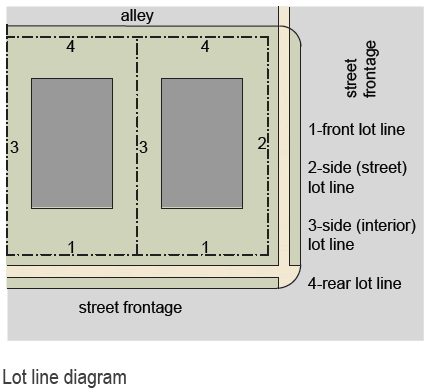
- Lot line, front means the line connecting the side lot lines of a lot measured along the boundary of the right-of-way designated by the City Council to serve the lot.
- Lot line, rear means that lot line which is opposite the front lot line. If the rear lot line is less than ten feet in length, or if the lot forms a point at the rear, the rear lot line shall be a line ten feet in length within the lot, parallel to, and at the maximum distance from the front lot line.
- Lot line, side means any lot line which is not a front lot line or a rear lot line.
- Lot line, side (interior) means any lot line which is shared with another lot and does not abut a right-of-way
- Lot line, side (street) means any lot line which abuts a right-of-way.
- Lot, through means a lot which has a pair of opposite lot lines abutting two substantially parallel streets, and which is not a corner lot.
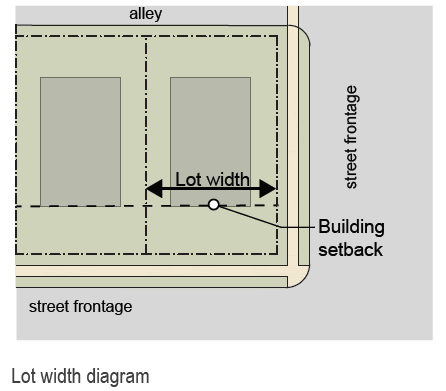
- Lot width means a lot width distance measured as the maximum horizontal distance between the side lot lines measured at the front building setback line.
Lot of record: Any lot which is one unit of a plat heretofore approved and filed or a registered land survey that has been recorded in the office of the county recorder prior to the effective date of the ordinance from which this Chapter is derived.
Lot, reversed corner: A corner lot which is oriented so that it has its rear lot line coincident with or parallel to the side lot line of the interior lot immediately to its rear.
Lot, reverse-frontage: A through lot for which the boundary along one of the streets is established as the front lot line and the boundary along the other street is established as the rear lot line. The rear lot line of the lot shall be that boundary abutting a traffic artery or other disadvantageous use.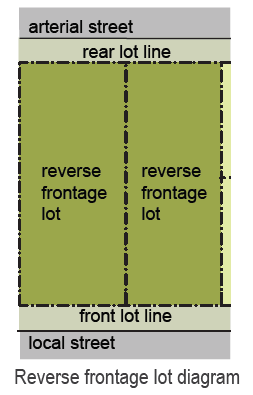
Lot, substandard: A lot or parcel of land for which a deed has been recorded in the office of the county recorder upon or prior to the effective date of the ordinance from which this Chapter is derived which does not meet the minimum lot area structure setbacks or other dimensional standards of this Chapter.
Lot, through: Any lot other than a corner lot that abuts more than one street. On a through lot, all property lines abutting the road right-of-way shall be considered the front lines.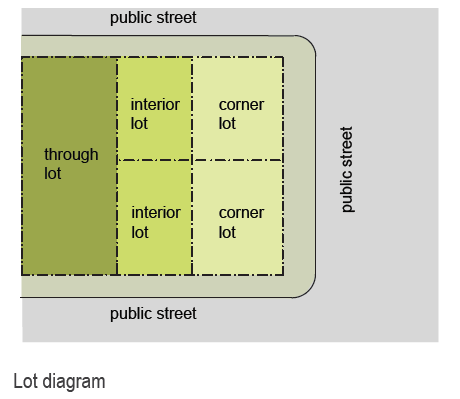
Lot width: The horizontal distance between the side lot lines at the building setback line.
Lowest floor: The lowest floor of the lowest enclosed area (including basement). An unfinished or flood resistant enclosure, used solely for parking of vehicles, building access, or storage in an area other than a basement area, is not considered a building’s lowest floor; provided, that such enclosure is not built so as to render the structure in violation of the applicable non-elevation design requirements of 44 Code of Federal Regulations, Part 60.3.
Major thoroughfare: A street used or intended to be used primarily for fast or heavy through traffic. Major thoroughfares shall include freeways, expressways and other highways and parkways, as well as arterial streets.
Malt liquor: Any beer, ale, or other beverage made from malt by fermentation and containing not less than one-half of one percent alcohol by volume.
Manufactured home: A structure transportable in one or more sections, which in the traveling mode, is eight body feet or more in width or 40 body feet or more in length, or, when erected on site, is 320 or more square feet, and which is built on a permanent chassis and designed to be used as a dwelling with or without a permanent foundation when connected to the required utilities, and includes the plumbing, heating, air conditioning, and electrical systems contained therein; except that the term includes any structure which meets all the requirements and with respect to which the manufacturer voluntarily files a certification required by the secretary and complies with the standards established under the Minnesota Statutes §ch. 327. 31, subd. 3. No manufactured dwelling shall be moved into the City that does not meet the manufactured home building code as defined in Minnesota Statutes §ch. 327.31, subd. 3. The term “manufactured home” does not include the term “recreational vehicle.”
Manure: Any solid or liquid containing animal excreta.
Massage: Any method of pressure on, or friction against, or the rubbing, stroking, kneading, tapping, pounding, vibrating, stimulating, or rolling of the external parts of the human body with the hands or arms with the aid of any mechanical or electrical apparatus, or other appliances or devices, with or without such supplementary aids as rubbing alcohol, liniment, antiseptic, oil, powder, cream, lotion, ointment, or other similar preparations.
Massage therapist: An individual who practices or administers massage to the public who can demonstrate to the issuing authority that he or she:
- Has current insurance coverage of $1,000,000.00 for professional liability in the practice of massage;
- Is affiliated with, employed by, or owns a therapeutic massage enterprise licensed by the City; and
- Has completed 500 hours of certified therapeutic massage training with content that includes the subjects of anatomy, physiology, hygiene, ethics, massage theory and research, and massage practice from an accredited program or accredited institution that has been approved by the issuing authority. These training hours must be authenticated by a single provider through a certified copy of the transcript of academic record from the school issuing the training, degree or diploma.
Mausoleum: A structure for the entombment of the dead in crypts or vaults in a placed used, or intended to be used, for cemetery purposes.
Master plan: An extensively developed plan, map, or other document pertaining to planning and adopted by the Common Council or other City agency which may pertain to the division of lands, including the Comprehensive Plan, the official map, comprehensive utility plans, and other planning documents including proposals for future land use, transportation, urban redevelopment and public facilities. Devices for the implementation of these plans, such as ordinances pertaining to zoning, official map, land division, and building development and capital improvement plans shall be considered as planning documents within this definition.
Medical uses: Those uses concerned with the diagnosis, treatment and care of human beings. These include hospitals, dental services, medical services or clinics, nursing or convalescent home, orphan’s home, rest home and sanitarium.
Metes and bounds description: A description of real property which is not described by reference to a lot or block shown on a map, but is described by starting at a known point and describing the bearings and distances of the lines forming the boundaries of the property.
Minerals and/or earthly deposits: Soil, clay, stone, sand and gravel and any other similar solid material or substance to be excavated from natural deposits.
Minimum subdivision design standards: The guides, principles and specifications for the preparation of subdivision plans indicating among other things, the minimum and maximum dimensions of the various elements set forth in the plan.
Mining: The excavation, removal, storage or processing of sand, gravel, rock, soil, clay, or other deposits. For the purposes of this Development Code, mining shall not include the excavation, removal, or storage of rock, sand, dirt, gravel, clay, or other material for the following purposes:
- Excavation for the foundation, cellar, or basement of some pending structure for which a permit has been issued and which is to be erected immediately following the excavation, removal or storage.
- On-site construction of approved roads, sewer lines, storm sewers, water mains, surface water drainage approved by the local unit of government, agriculture or conservation purposes, sod removal, or other public utilities.
- Landscaping purposes on a lot used or to be used as a building site.
- Grading/excavation of less than one acre of land in conjunction with improvement of a site for lot development, providing activities will be completed in one year.
- The removal of excess materials in accordance with approved plats or highway construction.
Modular home: A non-mobile housing unit that is basically fabricated at a central factory and transported to a building site where final installations are made, permanently affixing the module to the site. A modular home shall be congruous to a one-family dwelling.
Mobile Food Vendor: A seller of foods from a mobile food preparation van, cart or other conveyance, whether upon the public streets, alleys or public property or on private property.
Motor freight terminal: A building or area in which freight brought by motor truck is transferred and/or stored for movement by motor truck.
Natural drainageway: Depressions in the earth’s surface, such as ravines, draws and hollows, that have definable beds and banks capable or conducting surface water runoff from adjacent lands.
Natural resource inventory: A ground cover study following the Minnesota Land Cover Classification System (MLCCS) developed by the Department of Natural Resources.
Natural waterway: A natural passageway in the surface of the earth so situated and having such a topographical nature that surface water flows through it from other areas before reaching a final ponding area.
New construction: Structures, including additions and improvements, and placement of manufactured homes, for which the start of construction commenced on or after the effective date of this ordinance.
Nursing home: A building with facilities for the care of children, the aged, infirm, or place of rest for those suffering bodily disorder. A nursing home shall be licensed by the state board of health as provided in Minnesota Statutes §144.50.
Obstruction: Any dam, wall, wharf, embankment, levee, dike, pile, abutment, projection, excavation, channel modification, culvert, building, wire, fence, stockpile, refuse, fill, structure, or matter in, along, across, or projecting into any channel, watercourse, or regulatory floodplain which may impede, retard, or change the direction of the flow of water, either in itself or by catching or collecting debris carried by such water.
Office, general: Those commercial activities that take place in office buildings, where goods are not produced sold or repaired. Such activities include, but are not limited to banks, professional offices, governmental offices, insurance offices, real estate offices, telephone exchanges, utility offices, radio broadcasting and similar uses.
Off-street loading space: A space accessible from a street, alley, or driveway for the use of trucks or other vehicles while loading or unloading merchandise or materials. Such space shall be of size to accommodate one vehicle of the type typically used in the particular business.
One-hundred-year floodplain: Lands inundated by the “regional flood.”
Open space development: A pattern of subdivision development which places residential dwelling units in such a way to protect natural resources and provide conservation over natural resource areas as defined by the natural resource inventory and required by the comprehensive plan.
Operator: Any person or persons, any partnership, limited partnership, or corporation, or any association of persons, including every public or governmental agency, engaged in active or inactive excavation or the processing of sand, gravel, rock, other soils or derived products.
Ordinary high water mark: A mark delineating the highest water level which has been maintained for a sufficient period of time to leave evidence upon the landscape. The ordinary high water mark is commonly that point where the natural vegetation changes from predominantly aquatic to predominantly terrestrial. In areas where the ordinary high water mark is not evident, setbacks shall be measured from the stream bank of the following water bodies that have permanent flow or open water: the main channel, adjoining side channels, backwaters and sloughs.
Outdoor display: A class of storage outside the principal building where merchandise is visible and may involve active sales as well as passive sales (where items can be taken inside for actual purchase). Outside display of merchandise may be temporary or permanent depending upon the conditions of the permit issued pursuant to this Chapter.
Outdoor seating: A permitted outdoor seating area for patrons of restaurants, cafes, supper clubs, coffee shops, and on-sale licensed establishments.
Outdoor storage: The storage of goods, materials, equipment, manufactured products and similar items not fully enclosed by a building.
Outlot: A parcel of land, other than a lot, so designated on a plat or certified survey and which is not intended for building or structure development, in the proposed land division.
Overburden: The earth, rock and other materials that lie above a natural deposit of mineral.
Overlay district: A zoning district shown as an overlay on the zoning map.
Owner: Includes all persons interested in a property as fee simple owner, life estate holder, or encumbrancer.
Owner, mine: An individual, firm, association, syndicate, co-partnership, corporation, trust, estate, lessee, or any other legal entity having sufficient proprietary interest in the land sought to be mined to commence and maintain proceedings to mine the same under these regulations.
Parcel: Contiguous lands under the control of a subdivider whether or not separated by a combination of streets, exterior subdivision boundary lines, streams, or other water bodies.
Parking space: A suitably surfaced and permanently maintained area on property either within or outside of a building of sufficient size to store one standard automobile.
Pasture: Areas where grass or other growing plants are used for grazing and where the concentration of animals is such that a vegetation cover is maintained during the growing season.
Pawnbroker: Any natural person, partnership or corporation, either as principal, or agent or employee thereof, who loans money on deposit or pledge of personal property, or other valuable thing, or who deals in the purchasing of personal property, or other valuable thing on condition of selling the same back again at a stipulated price, or who loans money secured by chattel mortgage on personal property, taking possession of the property or any part thereof so mortgaged. To the extent that a pawnbroker’s business includes buying personal property previously used, rented or leased, or selling it on consignment, the provisions of this chapter shall be applicable.
Pedestrian buffer: A public way located between the throughway of a sidewalk and the back of curb. The pedestrian buffer may contain street trees in a planting bed, street trees in tree grates, planting beds without trees, and if space allows street furnishings.
Pedestrian pathway: A public way which is intended for the convenience of pedestrians only; it may also provide public right-of-way for utilities.
Pedestrian way: A public right-of-way or easement across or within a block, lot or property, to be used by pedestrians.
Performance standards: The minimum development standards as adopted by the governing body and on file in the office of the Zoning Administrator.
Person: Includes the plural as well as the singular and may mean any individual, firm, association, syndicate, partnership, corporation, trust, or any other legal entity.
Place of assembly: A location where a nonprofit group or association of persons gathers together for common reason and at regular intervals for civic, cultural, fraternal, political, religious or social purposes. The group or association may own or lease a building or portion thereof, the use of such premises being restricted to bona fide members paying dues and their guests. It shall be permissible to serve food, meals and alcoholic beverages on such premises providing that such service is secondary and incidental to the promotion of some other common objective of the organization and adequate dining room space and kitchen facilities for the purpose of serving food and meals are available. The sale of alcoholic beverages to members and their guests may be allowed in compliance with the applicable federal, state and municipal laws.
Planned unit development: A unified development project that may include multiples buildings or uses within a single development scheme, on one of more parcels of land, and which provides development design, style, amenities, uses, or other elements which exceed the City’s normally applicable zoning standards, and which, following the prescribed process, may vary from those standards to achieve said design, style, amenities, uses, or other elements.
Planning Commission: The duly appointed planning and zoning commission of the City.
Plat: The map, drawing or chart on which the subdivider’s plat of subdivision is presented to the City for approval and recorded with Hennepin County.
Pole Building/Pole Barn: A structure, the basic support and framework of which is provided by wooden poles inserted vertically into the ground similar to telephone poles.
Preliminary plat: The preliminary map, drawing or chart indicating the proposed layout of the subdivision to be submitted to the Planning Commission and City Council for its consideration.
Principal structure or use: One that determines the predominant use as contrasted to accessory use or structure.
Property line: The legal boundaries of a parcel of property which may also coincide with a right-of-way line of a road, cartway, and the like.
Protective covenants: Contracts entered into between private parties and constituting a restriction on the use of all private property within a subdivision for the benefit of the property owners, and to provide mutual protection against undesirable aspects of development which would tend to impair stability of values.
Public improvement: Any sanitary sewer, storm sewer, open channel, water main, roadway, park, parkway, public access, sidewalk, pedestrian way, pedestrian buffer or other facility for which the City may ultimately assume the responsibility for maintenance and operation.
Public land: Land owned or operated by municipal, school district, county, state or other governmental units.
Public recreation complex: An indoor or outdoor recreation facility owned or operated by a non-profit organization, or public use approved by the City or in partnership with the City in which athletic activities are permitted to be played by the general public. Examples of such a facility would be a softball complex, soccer fields, etc.
Public waters: All lakes, ponds, swamps, streams, drainageways, floodplains, floodways, natural water courses, underground water resources, and similar features involving, directly or indirectly, the use of water within the community.
Reach: A hydraulic engineering term to describe a longitudinal segment of a stream or river influenced by a natural or manmade obstruction. In an urban area, the segment of a stream or river between two consecutive bridge crossings would most typically constitute a reach.
Reclamation, restoration or rehabilitation: To renew land to a self-sustaining, long-term use which is compatible with contiguous land uses and the Rogers Comprehensive Land Use Plan. Reclamation, restoration or rehabilitation is to be in accordance with the standards set forth in this ordinance, including the re-establishment of vegetative cover, soil stability and the establishment of safe conditions appropriate to the intended use of the land.
Restoration area: Restoration area shall mean all land areas wherein Interim Use Permits have been granted by the City in the past and for which permits are no longer requested or issued. Once a land area is classified as a restoration area, it cannot be classified or converted back to an active area unless a new Interim Use Permit is obtained.
Recreation:
- Recreation, commercial: Includes all uses such as bowling alleys, driving ranges, miniature golf, indoor tennis, amusement centers indoor shooting ranges and movie theaters that are privately owned and operated with the intention of earning a profit by providing entertainment for the public.
- Recreation, equipment: Recreational equipment shall include: snowmobiles; boats and canoes; all-terrain vehicles; campers; trailers for the transportation of boats, canoes, all-terrain vehicles, snowmobiles, and automobiles; all travel trailers or motor vehicles designed, constructed, or used to provide temporary, movable living quarters for recreational use, or similar transportation devices.
- Recreation use, active: All uses, such as tennis, racquetball clubs, amusement centers, bowling alleys, golf driving ranges, miniature golf, movie theaters, and similar activities that are used as a commercial enterprise.
- Recreation use, passive: A recreation use particularly oriented to utilizing the outdoor character of an area for passive forms of recreation such as employee recreation areas, nature centers, conservancy, and interpretive centers.
Recyclable materials: Materials that are separated from mixed municipal solid waste for the purpose of recycling. For the purpose of this development code, these materials are limited to paper, glass, plastics and metals. Refuse derived fuel (RDF) is not a recyclable material under the provisions of this development code.
Recycling center: A facility where recyclable materials are collected, stored, flattened, crushed, or bundled prior to shipment to others who will use those materials to manufacture new products. Excludes explosives.
Regional flood: A flood which is representative of large floods known to have occurred generally in Minnesota and reasonably characteristic of what can be expected to occur on an average frequency in the magnitude of the one-percent chance or 100-year recurrence interval. Regional flood is synonymous with the term “base flood” used in a flood insurance study.
Register of deeds: The register of deeds of the county.
Regulatory flood protection elevation (RFPE): An elevation not less than one foot above the elevation of the regional flood plus any increases in flood elevation caused by encroachments on the floodplain that result from designation of a floodway.
Religious Assembly: A building, together with its accessory buildings and uses, where persons regularly assemble for religious worship and which building, together with its accessory buildings and uses, is maintained and controlled by a religious body organized to sustain public worship.
Repetitive loss: Flood related damages sustained by a structure on two separate occasions during a ten-year period for which the cost of repairs at the time of each such flood event on the average equals or exceeds 25% of the market value of the structure before the damage occurred.
Replat: The process of changing, or a map or plat which changes, the boundaries of a recorded subdivision plat or part thereof. The legal dividing of a large block, lot or outlot within a recorded subdivision plat without changing exterior boundaries of said block, lot or outlot is not a replat.
Research facility: Medical, chemical, electrical, metallurgical or other scientific research and quality control, conducted in accordance with the provisions of this development code.
Residential dwelling unit or dwelling unit: A single-family dwelling or part of a duplex, apartment, or other multiple-family dwelling occupied by one family or one distinct set of inhabitants or occupants.
Residential equivalent unit (REU): A unit of measure for impact fees equivalent to one residential dwelling unit. The residential equivalent unit is used as a single unit of measurement for all residential, nonresidential, commercial, industrial, and institutional land developments.
Resort: Any structure or group of structures containing more than two dwelling units or separate living quarters designed or intended to serve as seasonal or temporary dwellings on a rental or lease basis for profit with the primary purpose of said structure or structures being recreational in nature. Uses may include a grocery for guests only, fish cleaning house, marine service, boat landing and rental, recreational area and equipment and similar uses normally associated with a resort operation.
Restaurant: A business establishment whose principal business is the preparing and selling of unpackaged food to the customer in a ready-to-consume state.
Ridgeline: A line formed along the highest points of an area separating two adjacent streams or water bodies.
Right-of-way: A public way dedicated to the public for its intended use.
Road, public: A road owned and maintained by a government jurisdiction.
Roadside sales stand: A structure used only for the display and sale of products with no space for customers within the structure, on a seasonal basis.
Roadway, dual: A street that is divided by a median.
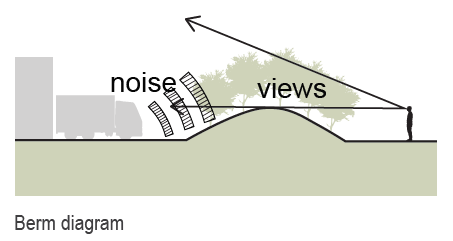
Screening: Earth mounds, berms or ground forms; fences and walls; landscaping (plant materials) or landscaped fixtures (such as timbers); used in combination or singularly, so as to block direct visual access to an object throughout the year. See also “Buffer”.
Self-storage facility, indoor/climate controlled: A facility for the storage of personal property where individual renters control and access individual storage spaces located within a fully enclosed building that is climate controlled. All self-storage activities shall be contained within a single building and conducted exclusively indoors. Individual storage units may be accessed from inside the building only. Loading areas must be located to the interior, or rear of the building and in designated parking areas adjacent to the building. Outdoor storage and/or other commercial transactions are not permitted.
Self-storage, mini: A structure or structures containing separate storage spaces of varying sizes that are leased or rented individually. No commercial transactions are permitted other than the rental of the storage units.
Septic permit: A permit required from the responsible governmental agency for the installation of any new or replacement on-site sewage disposal system.
Service area: A geographical area delineated by the Common Council within which there are public facilities.
Service establishment: A place of business were acts of service are exchanged for money.
Service standard: A certain quantity or quality of public facilities relative to a certain number of persons, parcels or land or other appropriate measure, as specified by the Common Council.
Setback: The minimum horizontal distance between a structure and street right-of-way, lot line or other reference point as provided by this Development Code. Distances are to be measured perpendicularly from the property line to the most outwardly extended portion of the structure.
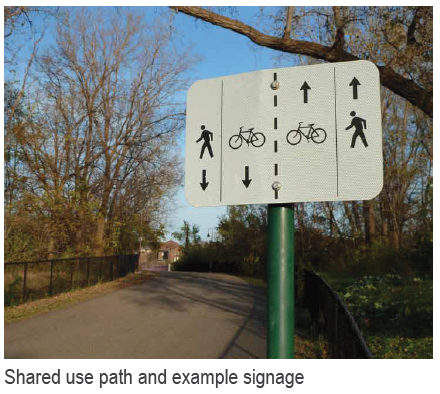
Shared use path: A pedestrian pathway physically separated from motorized vehicular traffic by an open space or barrier and either within the highway right-of-way or within an independent right-of-way. Shared use paths may also be used by bicyclists, skaters, wheelchair users, joggers and other non-motorized users.
Sport Studio: A room or space where sport or other activities are taught or performed. Including but not limited to yoga, dance, martial arts.
Shorelands: Those lands within the following distances: 1,000 feet from the high-water elevation of navigable lakes, ponds and flowages or 300 feet from the high-water elevation of navigable streams or to the landward side of the floodplain, whichever is greater.
Sidewalk: The portion of a street or highway right-of-way designed for preferential or exclusive use by pedestrians.
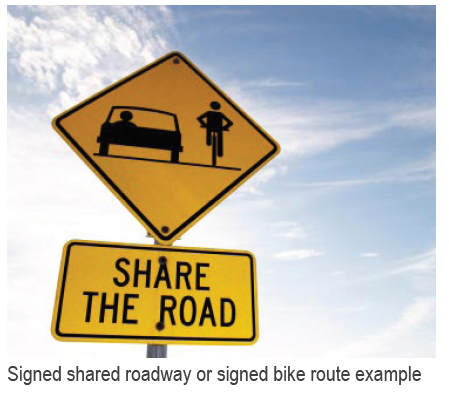
Signed shared roadway (signed bike route): A shared roadway which has been designated by signing as a preferred route for bicycle use.
Significant tree: A tree that measures at least six caliper inches in diameter for deciduous trees and at least six feet tall for coniferous trees. Significant trees are not those that are diseased or invasive as defined by the department of natural resources, and as updated from time to time.
Soils map overlay, preliminary plat: The reproduction of soil series boundaries drawn to the scale of the preliminary plat as delineated in the Hennepin County Soil Survey, 1974.
Solar energy: Radiant energy received from the sun that can be collected in the form of heat or light by a solar collector.
Solar energy system: A device or structural design feature intended to provide for collection, storage, and distribution of solar energy for heating or cooling, electricity generating, or water heating.
Solar energy system. Free Standing: A solar energy system with a supporting framework that is placed on, or anchored in, the ground and that is independent of any building or other structure. Garages, carports or similar structures that incorporate building-integrated or building-mounted solar energy systems shall not be classified as freestanding solar energy systems and shall instead be subject to regulations governing accessory structures.
Special flood hazard area: A term used for flood insurance purposes synonymous with “one-hundred-year floodplain.”
Start of construction: Includes substantial improvement, and means the actual start of construction, repair, reconstruction, rehabilitation, addition, placement or other improvement that occurred before the permit’s expiration date. The actual start is either the first placement of permanent construction of a structure on a site, such as the pouring of slab or footings, the installation of piles, the construction of columns, or any work beyond the stage of excavation; or the placement of a manufactured home on a foundation. Permanent construction does not include land preparation, such as clearing, grading and filling; nor does it include the installation of streets and/or walkways; nor does it include excavation for a basement, footings, piers, foundations, or the erection of temporary forms; nor does it include the installation on the property of accessory buildings, such as garages or sheds not occupied as dwelling units or not part of the main structure. For a substantial improvement, the actual start of construction means the first alteration of any wall, ceiling, floor, or other structural part of a building, whether or not that alteration affects the external dimensions of the building.
Story: That portion of a building as defined in the building code as adopted by the City of Rogers.
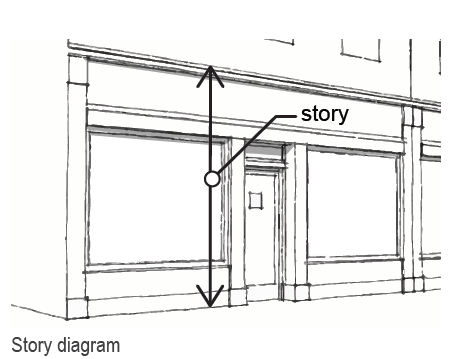
Streets and Alleys:
- Alley means a minor way that is used primarily for secondary vehicular service access to the back or the side of properties abutting on a street.
- Arterial street means a street or highway with access restrictions designed to carry large volumes of traffic between various sectors of the City and beyond.
- Collector street means a street that carries traffic from local streets to arterials.
- Cul-de-sac means a minor street with only one outlet and having a turnaround.
- Local street means a street of limited continuity used primarily for access to the abutting properties and the local need of a neighborhood.
- Service street means marginal access street, or otherwise designated, is a minor street, which is parallel and adjacent to a thoroughfare and which provided access to abutting properties and protection from through traffic.
- Street means a public way for vehicular traffic, whether designated as a street, highway, thoroughfare, arterial parkway, throughway road, avenue, lane, or however otherwise designated.
- Street, rural means a public way without curb and gutter having either paved or gravel shoulders.
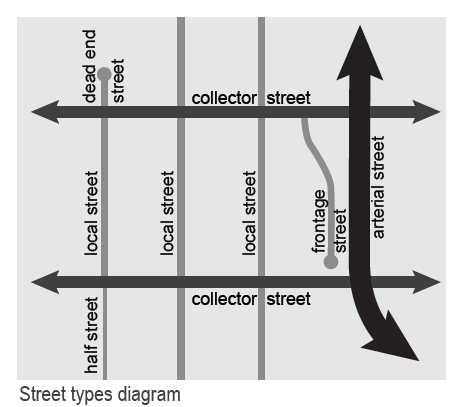
Street width: The shortest distance of the improved area between the lines delineating the right-of-way of a street
Structural alteration: Any change, other than incidental repairs, which would affect the supporting members of a building, such as bearing walls, columns, beams, girders or foundations.
Structure: Something built or constructed; used interchangeably with “building” for purposes of this development code.
Structure, nonconforming: Any structure lawfully or legally existing on the effective date of this development code, or any amendment thereto, which does not conform to the regulations, including the dimensional standards, for the district in which it is located. after the effective date of this development code or amendments thereto.
Subdivider: Any person, firm, corporation, agent, partnership, or entity of any sort, which divides or proposes to divide or replat land in any manner, including such heirs and assigns as may be responsible for the obligations of the subdivider under the provisions of this Ordinance.
Subdivision: The separation of an area, parcel, or tract of land under single ownership into two or more parcels, tracts, lots, or long-term leasehold interests.
Substantial damage: Damage of any origin sustained by a structure where the cost of restoring the structure to its before damaged condition would equal or exceed 50% of the market value of the structure before the damage occurred.
Substantial improvement: Within any consecutive 365-day period, any reconstruction, rehabilitation (including normal maintenance and repair), repair after damage, addition, or other improvement of a structure, the cost of which equals or exceeds 50% of the market value of the structure before the “start of construction” of the improvement. This term includes structures that have incurred “substantial damage,” regardless of the actual repair work performed. The term does not, however, include either:
- Any project for improvement of a structure to correct existing violations of state or local health, sanitary, or safety code specifications which have been identified by the local code enforcement official and which are the minimum necessary to assure safe living conditions.
- Any alteration of a “historic structure,” provided that the alteration will not preclude the structure’s continued designation as a “historic structure.” For the purpose of this ordinance, “historic structure” is as defined in 44 Code of Federal Regulations, Part 59.1.
Subsurface sewage treatment system: A sewage treatment system that treats and disperses wastewater from a residential or commercial building consisting of a septic tank followed by a leaching field, any necessary pumps or siphons, and any ground water control system or advanced treatment followed by soil treatment and disposal, or a community or common subsurface sewage treatment and disposal system consisting of one system serving two or more residential or commercial buildings, regardless of system size.
Surveyor: The City surveyor or engineer.
Taproom: An area for the on-sale consumption of malt liquor produced by the brewer for consumption on the premises of or adjacent to one brewery location owned by the brewer. A taproom may also include sales for off-premises consumption of malt liquor produced at the brewery location or adjacent to the taproom and owned by the brewer for off-premises consumption, packaged subject to Minnesota Statutes §340A.301, subd. 7(b), or its successor.
Tasting room, winery/distillery: An area for the on-sale consumption of distilled spirits or wine produced on the premises of, or adjacent to one winery or one distillery and in common ownership to the producer of the wine or distilled spirits. The tasting room area may include sales for off premises consumption of products produced by the owner of the winery or distillery location if permissible by state law.
Tattooing: Any method of placing indelible ink or other pigments into or under the skin or mucosa with needles or any other instruments used to puncture the skin, resulting in permanent coloration of the skin or mucosa. Tattooing also includes micropigmentation and cosmetic tattooing.
Telecommunication: Communication between parties at a distance from one another. Modern telecommunication systems—capable of transmitting telephone, fax, data, radio, cellular or television signals—can transmit large volumes of information over long distances. Digital transmission is employed in order to achieve high reliability with minimal noise, or interference, and because it can transmit any signal type, digital or analog.
Temporary dwelling, during construction: A mobile home that temporarily serves as a residence for the present or potential occupant of the primary single-family residence being constructed, reconstructed, or altered.
Temporary dwelling, farm: A mobile home located in an agricultural district which is an accessory dwelling unit occupied by members of the family engaged in farming on the premises and meeting other criteria specified in the development code.
Throughway: The ADA accessible portion of a pedestrian pathway.
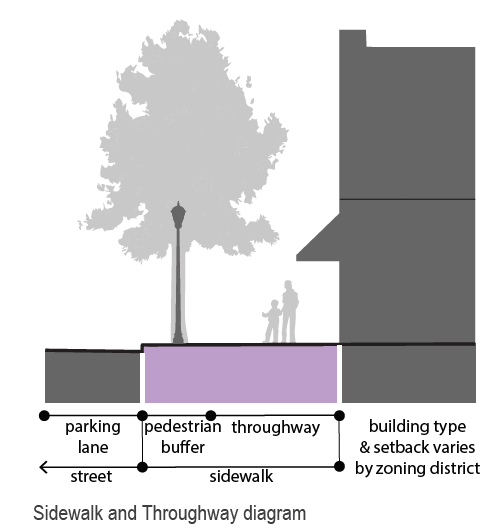
Tower: Any pole, spire, structure, or combination thereof, including supporting lines, cables, wires, braces, and masts, intended primarily for the purpose of mounting an antenna, or to serve as an antenna.
Tower accessory structure: A structure located at the base of the tower housing base receiving/transmitting equipment.
Townhouse: A single structure consisting of at least three dwelling units having the first story at or near the ground level with no other dwelling units or portions thereof directly above or below, and each unit having direct exterior access with no sharing of a common hallway for entry.
Tracing: A plat or map drawn on transparent paper or cloth that can be reproduced by using regular reproduction procedure.
Transportation/motor freight terminal: A building or area in which freight brought by truck is assembled and/or stored for routing or reshipment, or in which semi-trailers, including tractor or trailer units and other trucks are parked or stored.
Transportation terminal: Truck, taxi, air, bus, train and mass transit terminal and storage area, including motor freight (solid and liquid) terminal.
Travel trailer/RV campground: An area or premises operated as commercial enterprise on a seasonal basis and generally providing space for seasonal accommodations for transient occupancy or use by transients occupying camping trailers, self-propelled campers and tents.
Tree: Any of the following type of trees, as each is defined herein:
- Coniferous tree. A woody plant which, at maturity, is at least 12 feet or more in height, having foliage on the outermost portion of the branches year round.
- Deciduous tree. A woody plant which, at maturity, is at least 15 feet or more in height, having a defined crown, and which sheds leaves annually.
- Significant tree. A healthy tree measuring a minimum of six inches in diameter for deciduous trees, or a minimum of 12 feet in height for coniferous trees.
- Significant tree stand. A grouping or cluster of coniferous and/or deciduous trees with contiguous crown cover, occupying 500 or more square feet of property, which are comprised of deciduous trees six inches or larger in diameter or coniferous trees 12 feet or higher in height.
- Specimen tree. A healthy hardwood tree measuring equal to or greater than 30 inches in diameter and/or a coniferous tree measuring 50 feet or greater in height.
Tree Inventory: An inventory of trees by location, species, condition and size. The tree inventory shall include all trees with a caliper of 8-inches or more when measured at a point 4 feet above the ground level. The boundaries of significant woodland areas shall also be identified and shall be defined as a clustering of at least three trees, of 2-1/2 inches of caliper or greater in size and trunks spaced at no greater than 10-foot intervals. Individual trees are not required to be inventoried if they are within a woodland area as described above.
Truck stop: A motor fuel station devoted principally to the needs of tractor-trailer units and trucks, and which may include eating and/or sleeping facilities.
Twinhome: Two (2) single family dwellings with a zero lot line on one side and sharing a common wall, with the common wall and all jointly owned or jointly utilized facilities including, but not limited to, decks, utility lines, and driveways being governed under a declaration of covenants and restrictions.
Urban service area: That portion of the City and the area within its extraterritorial jurisdiction which has been designated by the Common Council as the area to which services required in urban areas shall be provided in a planned and orderly process, particularly those facilities which are placed on or in the land as part of the urban development process. Such services include, but are not limited to, public sanitary and storm sewers, water supply and distribution system, streets and highways.
Use: The purpose or activity for which the land or building thereon is designated, arranged, or intended or for which it is occupied, utilized or maintained, and shall include the performance of such activity as defined by the performance standards of this Chapter. Uses are classified as principal or accessory and as permitted, conditional, interim, and prohibited.
Use, accessory: A use subordinate to and serving the principal use or structure on the same lot and customarily incidental to such principal use.
Use, nonconforming: Use of land, buildings or structures legally existing at the time of adoption of the ordinance from which this Chapter is derived which does not comply with all the regulations of this Chapter or any amendments hereto governing the zoning district in which such use is located.
Use, permitted: A use which may be lawfully established in a particular district or districts, provided it conforms with all requirements, regulations, and performance standards (if any) of such districts.
Use, principal: That use which is the normal use for property within a district. Principal uses do not require a certificate of compliance or a Conditional Use Permit.
Utility substation: A utility use whose function is to reduce the strength, amount, volume, or configuration of utility flow from a bulk wholesale quantity in large size, long distance transmission lines to small retail quantities in neighborhood distribution system. These uses include electric substations, telephone switching and relay facilities, water and sewage pumps and lift stations. Business offices associated with these uses are not included as part of this definition.
Variance: A modification of or variation from the provisions of this Section consistent with the state enabling statute for municipalities, as applied to a specific property and granted pursuant to the standards and procedures of this Section, except that a variance shall not be used for modification of the allowable uses within a district and shall not allow uses that are prohibited. Variances are regulated in Sec. 125-42. Variances of this Chapter.
Vehicle, recreation: Any vehicle designed and used for temporary, seasonal human living quarters which meets all of the following qualifications:
- is not used as the permanent residence of the owner or occupant;
- is used for temporary living quarters by the owner or occupant while engaged in recreation or vacation activities;
- is towed or self-propelled on public streets or highways incidental to such recreation or vacation activities;
- examples of such vehicles include van campers, tent camping trailers, self-contained travel trailers, pick-up campers, camping buses, and self-contained self-propelled truck chassis mounted vehicles providing living accommodations.
Veterinary clinic: A clinic operated by a licensed veterinarian exclusively for the diagnosis, treatment, correction, relief or prevention of animal disease, deformity, defect, injury or other physical or mental conditions; the performance of obstetrical procedures for animals, including determination of pregnancy and correction of sterility or infertility; and the rendering of advice or recommendations with regard to any of the above.
Warehousing: The storage, packing and crating of materials or equipment within an enclosed building or structure.
Warehousing and distribution: A use engaged in storage, wholesale, and distribution of manufactured products, supplies, and equipment, but excluding bulk storage of materials that are flammable or explosive or that create hazardous or commonly recognized offensive conditions.
Waterfront uses, residential: Boat docks and storage, fish house, fish cleaning, water recreation equipment and other uses normally incidental to a lakeshore residence, provided such uses are for the exclusive use of the occupants and nonpaying guests.
Wetlands: An area where water stands near, or above the soil surface during a significant portion of most years, saturating the soil and supporting a predominantly aquatic form of vegetation, and which may vegetation belonging to the marsh (emergent aquatic), bog, fen, sedge meadow, shrub land, southern lowland forest (lowland hardwood), and northern lowland forest (conifer swamp) communities. (These communities correspond roughly to wetland types 1, 2, 3, 4, 6, 7, and 8 described by the United States Fish and Wildlife Service, Circular 39, “Wetlands of the U.S. 1956”.) The term “Wetlands” shall include any areas qualifying under the State of Minnesota Wetlands Conservation Act, as may be amended.
Wholesaling: The selling of goods, equipment and materials by bulk to another person who in turn sells the same to customers.
Wind energy conversion system (WECS): Any device which converts wind energy to a form of usable energy, including wind chargers, windmills and wind turbines.
Yard: The open space on an occupied lot that is not covered by any structure.
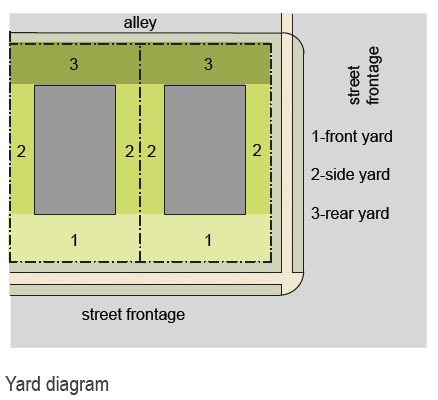
Yard, front: A yard extending across the portion of the lot between the front lot line of the lot and the nearest building line, except for buildings on recreational or natural environment lakes where the front yard faces the water.
Yard, rear: A yard extending across the rear of the lot lying between the rear lot line and the nearest building line.
Yard, required: A yard area that may not be built on or covered by structures because of the dimensional setbacks for said structures within the zoning district.
Yard, side: A yard between the side lot line of the lot and the nearest building line.
Yard waste facility: Any site used for the composting of garden waste, leaves, lawn cuttings, weeds, shrub and tree waste and prunings generated off site. Yard wastes generated on site and used on the same site are not included in this definition.
Yield plan: A subdivision plan drawn to scale, containing sufficient information showing the maximum number of lots that could be permitted using the performance standards for lots in a conventional subdivision in accordance with the development code.
Zoning Administrator: The person designated by the City Administrator as the enforcement officer for this Ordinance.
Zoning district: An area or areas within the City in which the regulations and requirements of this development code are applied.
Zoning ordinance: A zoning ordinance controlling the use of land as adopted by the City.
Amended by Ord. 2021-08 on 6/22/2021

