
Rogers City Zoning Code
ARTICLE 125
V - PERFORMANCE STANDARDS AND REGULATIONS
Sec 125-81 - General Zoning Standards
- Purpose. The performance standards established in this chapter are designed to encourage a high standard of development by providing assurance that neighboring land uses will be compatible. The performance standards are designed to prevent and eliminate those conditions that cause blight. All future development in all districts shall be required to meet these standards. The standards shall also apply to existing development where so stated. The City shall be responsible for enforcing the standards.
Before any building permit is approved, the Zoning Administrator shall determine whether the proposed use will conform to the performance standards. The developer or landowners shall supply data necessary to demonstrate such conformance. Such data may include description of equipment to be used, hours of operation, method of refuse disposal and type and location of outdoor storage. - Signs. Performance standards and regulations are outlined in Chapter 113 of the City of Rogers Code.
- Telecommunications. Telecommunication standards are outlined in Chapter 105 of the City Code.
Sec 125-82 - General Subdivision Standards
- General Requirement. All subdivisions shall be engineered to meet the design standards provided in City of Rogers Land Developer Requirements and Procedures. A copy of the manual shall be on file with the City and made available at time of preliminary plat submittal.
- The Planning Commission, in its review of the preliminary plat as described in Sec. 125-33. Preliminary Plat, will take into consideration the requirements of the City policies as outlined in the comprehensive plan and official implementation documents. The subdivision shall conform to the comprehensive plan, zoning ordinance, and subsurface sewage treatment system code. County, metropolitan, state, and special district plans shall also be considered.
- The arrangement, character, extent, width and location of all streets shall be considered in their relation to existing and planned streets, to reasonable circulation of traffic, to topographic conditions, to runoff of stormwater, to public convenience and safety, and in their appropriate relation to the proposed uses of the land to be served by such streets. Wherever possible and necessary, the arrangement of streets in new subdivisions shall provide for the continuation of existing streets in adjoining areas. Where adjoining unsubdivided areas may be subdivided, the arrangement of streets in a new subdivision shall make provision for the proper projection of streets into adjoining areas by carrying the new streets to the boundaries of the new subdivision at appropriate locations.
- No land may be subdivided into building lots when it is unsuitable for reasons of flooding, inadequate drainage, soil and rock formations with severe limitation on development, severe erosion potential, unfavorable topography, inadequate water supply or sewage treatment capabilities or any other feature likely to be harmful to the health, safety or welfare of residents of the City or future residents of the subdivision.
- The City reserves the right to decline approval of a subdivision if due regard is not shown for the preservation of all natural features such as significant trees, water courses, scenic points, historical spots and similar city assets which, if preserved, will add attractiveness and stability to the proposed development of the property.

Note limitations in Code - Subdivision review shall be coordinated with the requirements and procedures for local and state environmental review. The City acts as the local government unit for approval process.
- The proposed subdivision shall conform to the comprehensive plan and policies as adopted by the City.
- Where a subdivision abuts or impacts a right-of-way, additional review may be required and land may be required for dedication to the public.
- Proposed subdivisions shall be coordinated with existing nearby municipalities or neighborhoods so that the area as a whole may develop harmoniously.
- The following guidelines for the design of rural subdivisions and building sites shall be followed to promote the preservation of the City’s rural character:
- Locate roads and building sites to maintain existing contours and vegetation and minimize grading and disruption of natural landforms.
- Avoid placing structures in open fields and on top of exposed ridgelines.
- Maintain vegetation along ridgelines.
- Locate homes on the edge of tree lines and woodlands.
- Provide for adequate buffers between active agricultural and residential uses pursuant to the zoning district regulations.
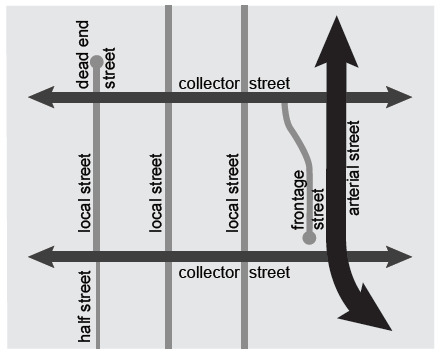
Sec 125-83 - Design Standards And Required Improvements
- Driveways and Driveway Aprons
- Driveways constructed shall comply to requirements found in City of Rogers Land Developer Requirements and Procedures and to the following:
- Driveways may not be placed closer than five feet to any side or rear lot line.
- No driveway shall be closer than three feet to any single-family or two-family residences and no closer than five feet to any multiple-family building or commercial building.
- The number and types of driveways onto major streets may be controlled and limited in the interests of public safety and efficient traffic flow.
- Driveways onto county roads shall require a review by the county engineer. The county engineer shall determine the appropriate location, size, and design of such driveways and may limit the number of driveways in the interest of public safety and efficient traffic flow.
- Driveways to principal structures which traverse wooded, steep, or open field areas shall be constructed and maintained to a width and base material depth sufficient to support access by emergency vehicles. The Zoning Administrator shall review all driveways for compliance with accepted community driveway standards.
- Driveways must be constructed of either asphalt or concrete in all but the A and R1 districts, with the exception of R1 properties with a recorded plat.
- All driveways shall have a minimum width of 10 feet with a pavement strength capable of supporting emergency and fire vehicles.
- All lots or parcels shall have direct adequate physical access for emergency vehicles along the frontage of the lot or parcel from either an existing dedicated public roadway, or an existing private roadway approved by the City Council.
- The number of access points to a residential lot shall be restricted to the following:
- One driveway to serve the principal residence on corner lots and double fronted lots.
- Corner lots of 1.3 acres or larger shall be permitted one additional access point at the discretion of the Zoning Administrator. The secondary access point shall not be located on a collector or arterial street.
- A concrete driveway apron shall be installed extending from the edge of the curb to the property line and shall adhere to requirements found in City of Rogers Land Developer Requirements and Procedures and as follows:
- On a straight or curvilinear street:
- 12 feet minimum width at the curb cut
- 32 feet maximum width at the curb cut
- Shall not be located within the drainage and utility easement, or
- Shall not be located closer than five feet from the property line;
- On a cul-de-sac street:
- 12 feet minimum width at the curb cut
- 32 feet maximum width at the curb cut
- Special approval by the City Engineer may be sought for aprons beyond the maximum allowed by code.
- At the property line:
- Shall not be located within the drainage and utility easement
- Shall not be closer than five feet from the corner of the interior side lot or property line of the lot or parcel fronting on the street
- Shall not be closer than thirty feet from the corner of the corner side lot or property line of the lot or parcel fronting on the street.
- Shall not be located within the drainage and utility easement
- Driveway aprons in areas with pedestrian ways shall be constructed of concrete material from the back of curb to the pedestrian way for all driveway types.
- On a straight or curvilinear street:
- Driveways constructed shall comply to requirements found in City of Rogers Land Developer Requirements and Procedures and to the following:
- Screening. In all districts, all structures requiring landscaping and fences shall be maintained so as not to be unsightly or present harmful health or safety conditions.
- Where any nonresidential use (i.e., structure, parking or storage) abuts property zoned for residential use, the nonresidential use shall provide screening along its boundary with the residential property. Screening shall also be provided where the nonresidential use is across the street from a residential use, but not on the side of a nonresidential use considered to be the front (as determined by the Zoning Administrator). All the fencing and screening specifically required by this subdivision shall be subject to the provisions of this subdivision, and shall consist of either a fence or a landscaped strip. A landscaped strip shall consist evergreen trees and/or deciduous trees and plants and shall be of sufficient width and density to provide an effective visual buffer.
The design of the buffer will be based on careful consideration given to any and all requirements appropriate to screen the residential or agricultural properties from negative impacts of the commercial uses, which may include visual, sound, odors, crowding, vibration, traffic, air quality, lighting or negative aesthetics which may result from any aspect of site use or operation. - The City may require the screening of commercial uses, to prevent visual blight, especially on side yard and rear yards which face residential or agricultural districts (AG, R1, R2, R3, R4, R5).
Service yards, refuse and waste removal areas, loading docks and truck parking areas, and mechanical equipment, satellite dishes and other equipment shall be screened from view from any public way by a fence or screen of an identical or complementary material to the material used on the principal building. - All nonstructural storage shall be screened. The exceptions are as follows:
- Merchandise being displayed for sale;
- Materials and equipment presently being used for construction on the premises; and
- Merchandise located on service station pump islands.
- Screening may be required in cases where commercial or industrial uses are adjacent to or across the street from property zoned or developed for residential or public use. Screening may also be required in residential districts (R1, R2, R3, R4, R5) for any off-street parking area containing more than six parking spaces.
- Except where fencing is specifically required or erected, screening required in this Section may consist of a fence or a greenbelt planting strip not less than 5 feet high but shall not extend within 15 feet of any street or driveway. Alternatively, earth mounding or berms may be used to achieve all or a part of the buffer.
- The screening shall be placed along the property lines, or in case of screening along a street, 15 feet from the street right-of-way with landscaping between the screening and pavement. The screening shall be designed to provide complete visual screening. The City Council may also require plantings or shrubs or trees in association with required fencing provided for in this division.
- There shall be no restrictions on natural hedges or plantings utilized as fences in any residential zoning district (R1, R2, R3, R4, R5), except that no such hedges or plantings shall be located within the sight visibility triangle and the species planted shall not be an invasive species.
- Where any nonresidential use (i.e., structure, parking or storage) abuts property zoned for residential use, the nonresidential use shall provide screening along its boundary with the residential property. Screening shall also be provided where the nonresidential use is across the street from a residential use, but not on the side of a nonresidential use considered to be the front (as determined by the Zoning Administrator). All the fencing and screening specifically required by this subdivision shall be subject to the provisions of this subdivision, and shall consist of either a fence or a landscaped strip. A landscaped strip shall consist evergreen trees and/or deciduous trees and plants and shall be of sufficient width and density to provide an effective visual buffer.
- Streets. All streets and other public improvements design must meet requirements found in Rogers Land Developer Requirements and Procedures, and as follows:
- Widths. Street right-of-way and roadway widths and design shall be as determined by ordinance and the policies plan of the City, and where applicable shall conform to the county and state standards for trunk highways. If there is no such plan or standard, right-of-way widths or roadway widths shall conform to the following minimum dimensions found in Table 18. Roadway Standards.
TABLE 18. ROADWAY STANDARDSUrban Design Guidelines Street Right-of-Way Width (feet) Roadway Principal Arterial 250 See footnote Minor Arterial 150 See footnote Major Collector 80-150 See footnote Minor Collector 70-100 See footnote Industrial/commercial street (9 tons) 80 See footnote Urban Residential (local Street) 60 See footnote Cul-de-sac turnaround radius 60 45 feet Rural Design Guidelines Minor arterial 120 See footnote Collector 100 See footnote Local 60 See footnote The actual width and design of the roadway surface and right-of way width shall be as approved by the City Engineer and shall comply with both the Council approved Rogers Land Developer Requirements and Procedures file in the office of the City clerk/administrator and Table 16: Types of Roadway (Transportation Element to the City’s 2040 comprehensive plan) on file in said office.
TABLE 19. ACCESS SPACING GUIDELINESAccess Spacing Guidelines (Subject to MN/DOT and Hennepin County Standards)
Type of AccessFunctional Classification of Highway Principal Arterial Minor Arterial Collector Local >7,500 ADT <7,500 ADT Private Residential driveways
No direct access No direct access (1) (1) (1) Commercial driveways or noncontinuous commercial streets No direct access No direct access 1/8 mile 1/8 mile (1) Noncontinuous residential streets No direct access 1/8 mile with no median opening 1/8 mile 1/8 mile (1) Continuous local streets and collector streets 1/2 mile 1/4 mile 1/4 mile 1/8 mile 1/8 mile Minor Arterials 1/2 mile 1/2 mile 1/2 mile 1/2 mile 1/2 mile (1) Determination based on other criteria (sight distance, speed, traffic volume, etc.). - Lay-Out and Access. Streets other than collectors shall be laid out so that their use by through traffic is discouraged. Direct vehicular access from individual lots to collectors is discouraged. Hennepin County and Minnesota Department of Transportation standards shall apply for applicable improvements. See Table 19. Access Spacing Guidelines.
- Access to Arterial Streets. In the case where a proposed plat is adjacent to a limited access highway (arterial), there shall be no direct vehicular or pedestrian access from individual lots to such highways. As a general requirement, access arterials shall be at intervals of not less than one-quarter mile and through existing and established crossroads where possible.
- Platting of Small Tracts. In the platting of small tracts of land fronting on arterial streets where there is no convenient access to existing entrances and where access from such plat would be closer than one-quarter mile from an existing access point, a temporary entrance permit may be granted. Provisions shall be made in such plats for the connection of roads to neighboring land. As the major land is platted and developed, and access becomes possible at a preferred location, such temporary entrance permits shall become void.
- Half Streets. Half streets shall be prohibited except where it will be practical to require the dedication of the other half when the adjoining property is subdivided, in which case the dedication of a half street may be permitted. The probable length of time elapsing before dedication of the remainder shall be considered in this decision.
- Street Arrangements. The street arrangements shall not be designed or constructed in such a way as to cause a difficulty in platting adjoining property and providing convenient access to it. Where such difficulty exists, the applicant must provide a ghost plat with the submission of the preliminary plat showing how such difficulties can be corrected or avoided. Roads shall be designed to avoid access to local residential roads such that business-oriented traffic is not routed on nor directed to local residential roads.
- Traffic Control. The traffic control generated by any use shall be channelized and controlled in a manner that will avoid congestion on the public streets, traffic hazards, and excessive traffic through residential areas, particularly truck traffic. Internal traffic shall be so regulated as to ensure the safe and orderly flow. Traffic into and out of business areas shall in all cases flow. Traffic into and out of business areas shall in all cases be forward moving with no backing into street. On corner lots, (including rural areas) nothing shall be placed or allowed to grow in such a manner as materially to impede vision between a height of 2.5 feet and 10 feet above the centerline grades of the intersecting streets to a distance such that a clear line of vision is possible of the intersecting streets from a distance of 50 feet from the intersection of the right-of-way lines.
- Setbacks along County, State and Federal roadways.
- Along all “controlled access highways” as defined in subsection (c) of this section and having a right-of-way width of 120 feet or greater, the setback shall be 30 feet.
- Along all other county, state and federal roadways, the following setbacks shall apply:
- State and federal highway: 70 feet.
- County road: 50 feet.
- The term “controlled access highway” means every county, state or federal highway, street or roadway in respect to which the right of access of the owners or occupants of abutting lands and other persons has been acquired and to which the owners or occupants of abutting lands and other persons have no legal right of access to or from the same except as such points only and in such a manner as may be determined by the public authority having jurisdiction over such highway, street or roadway.
- Widths. Street right-of-way and roadway widths and design shall be as determined by ordinance and the policies plan of the City, and where applicable shall conform to the county and state standards for trunk highways. If there is no such plan or standard, right-of-way widths or roadway widths shall conform to the following minimum dimensions found in Table 18. Roadway Standards.
- Blocks. The length, width and acreage of blocks shall be sufficient to provide for convenient access, circulation, control and safety of street design.
- Drainage. The natural drainage system shall be used as far as is feasible for the storage and flow of runoff. The following requirements shall also apply:
- Stormwater drainage shall be discharged to marshlands, swamps, retention basins or other treatment facilities. Diversion of stormwater to marshlands or swamps shall be considered for existing or planned surface drainage. Marshlands and swamps used for stormwater shall provide for natural or artificial water level control.
- No existing ditch, stream, drain or drainage canal shall be deepened, widened, rerouted or filled without written permission from the City Council.
- Where artificial channels must designed in accordance with the adopted comprehensive stormwater and water resources management plans and be constructed to augment the natural drainage system, such channels as well as the natural drainageways may be planned as part of a recreation system. Channels shall be designed to be esthetically compatible for recreational trail use.
- The drainage system shall be constructed and operational as quickly as possible during construction.
- Alternative best management practices including low impact design may be considered for rural and open space planned unit developments as appropriate.
- Easements. All easements shall be dedicated by appropriate language on the plat as required by Minnesota Statutes §505.021.
- Drainage and Utilities. A 10-foot wide drainage and utility easements shall be provided along the front property or lot line, and five-foot wide easements shall be provided along the side and rear property or lot lines for utilities on all new lots within the City of Rogers. If the property or lot in which the easements are being considered are adjacent to a property or lot that does not have utility easements, the property or lot shall be required to have a 10-foot easement along the side and rear property or lot lines for utilities. They shall have continuity of alignment from block to block.
The City may deem a need for larger easements. - Waterways and Shoreland. Easements shall be provided along each side of the centerline of any watercourse of drainage channel, whether or not shown in the comprehensive plan, to a width sufficient to provide proper maintenance and protection and to provide for stormwater runoff from a 10-year storm of one hour duration.
Where necessary, drainage easements corresponding with lot lines shall be provided. Such easements for drainage purposes shall not be less than 12 feet in width and in compliance with the Shoreland Ordinance in Chapter 109. - All easements required for public purposes shall be provided at locations approved by the City Council. Said easements may be for utilities, drainage, ditch buffers, floodplain protection, lakeshore access, walking trails, etc. However, all easements other than utility and drainage easements must be conveyed to and recorded by the county recorder prior to plat approval. No plat shall be approved that may for any reason be detrimental to local, county or regional utility plans.
- Oversizing of utilities to provide future service for more intense development of the land or to provide future service to other areas may be required.
- Drainage and Utilities. A 10-foot wide drainage and utility easements shall be provided along the front property or lot line, and five-foot wide easements shall be provided along the side and rear property or lot lines for utilities on all new lots within the City of Rogers. If the property or lot in which the easements are being considered are adjacent to a property or lot that does not have utility easements, the property or lot shall be required to have a 10-foot easement along the side and rear property or lot lines for utilities. They shall have continuity of alignment from block to block.
- Steep Slopes. Subdivision design shall be consistent with limitations presented by steep slopes. Subdivisions shall be designed so that no construction or grading will be conducted on slopes steeper than 25% in grade.
Sec 125-84 - Accessory Use Standards
- Accessory Structures
- AG district standards.
- Accessory structures associated with active agricultural activities on properties greater than ten acres in size shall not be limited in size or number allowed but must follow all other provisions herein.
- In agriculture zoning districts, an administrative site plan shall accompany all requests for accessory structures but construction shall be exempt from building permit fees for all structures for the use of legitimate farming operations, including sheltering animals, agricultural machinery and storage of agricultural products, but this exemption is not intended to include horse barns, commercial stables, or other activities not qualifying as active farming. Administrative review of the application and site plan is required.
- Maximum size of detached accessory structures: Table 20. AG - Detached Structure Size Allowed.
TABLE 20. AG - DETACHED STRUCTURE SIZE ALLOWEDAcreage Square Feet 1.00 - 1.99 800 2.00 - 3.99 1,300 4.00 - 4.99 1,700 5.00 - 6.99 1,900 7.00 - 7.99 3,100 8.00 - 8.99 3,600 9.00 - 9.99 3,900 10.00 + 4,200
- R1 Districts standards
- One private garage or accessory structure on parcels of three acres or less.
- Up to two private garages or accessory structures on parcels greater than three acres.
- An accessory structure shall be considered attached to the principal building if it is within 6 ft. or less from the principal building.
- No portion of the accessory structure shall be closer than six ft. to another structure or building on the same property.
- The following criteria shall be used to determine the maximum square footage for accessory structures:
- When determining lot size, wetlands and lakes shall not be included in the lot area.
- Attached garages shall not be considered as part of the maximum accessory building square footage.
- Lean-tos, carports and open wall structures are to be included in the calculation of total square footage, except gazebos.
- Accessory structures may exceed the height of the principal building, with the approval of a variance.
- All detached accessory structures are to be used for personal use only. No commercial use or commercial related storage is allowed in residential zoning without a conditional or interim use permit.
- Maximum size of accessory structures in R1 zoning district: See Table 21. R1 - Detached Structure Size Allowed.
TABLE 21. R1 - DETACHED STRUCTURE SIZE ALLOWEDAcreage Square Feet 1.00 - 1.99 800 2.00 - 3.99 1,300 4.00 - 4.99 1,700 5.00 - 6.99 1,900 7.00 - 7.99 3,150 8.00 - 8.99 3,600 9.00 - 9.99 3,900 10.00 + 4,200
- Urban Residential District standards
- One detached accessory structure is allowed per lot residential lot. Commercial uses shall not be permitted accessory buildings.
- No detached accessory storage type building shall be located in any yard other than a rear yard except by conditional use permit.
- In the event the accessory structure is movable, the structure may be placed in the side or rear yard but not closer than five feet to the lot line.
- No accessory structure shall exceed 10% of the available rear yard measured from the rear of the residence (extending in straight lines) to the side lot lines.
- No accessory structure shall exceed the height of the principal building.
- An accessory structure shall be considered an integral part of the principal building if it is connected to the principal building by a covered, enclosed passageway built on a slab or other suitable foundation.
- No detached accessory structure shall be located closer than six ft. from the principal structure.
- No private garage used or intended for the storage of passenger automobiles shall exceed 1,150 sq. ft. of gross area. One-family and two-family dwellings are required to have two enclosed spaces per unit attached to the dwelling.
- When a private garage is oriented so as to face onto a public street, it shall not be less than 20 ft. from the front lot line.
- No detached accessory structure, excluding decks not enclosed and covered shall be greater than 528 sq. ft.
- In no case shall a detached accessory structure be located in a required front yard or a required side yard paralleling the depth of the principal structure.
- An accessory structure shall not be a pole barn nor of pole barn type construction, except in the R1 zoning district. On residential lots outside of the R1 district, a permitted accessory structure exceeding 200 sq. ft. in size shall be an on-site custom-made stick-built structure, and is to mean a structure which is wholly constructed on the lot. A structure shall be deemed constructed on the lot if 90% of the value of the structure is constructed on the lot from individual block, board, plywood, siding, roofing, finishing and other individual construction materials. Value shall be measured on the basis of the cost of the materials used in the construction of the structure.
- On any property in the Single Family Residential (R2) zoning district that is over 2 acres in area (not including wetlands), the Rural Residential (R1) district standards in §125-84A.2. shall apply to accessory structures, and the R2 district standards detailed in §125-84A.3. shall not apply. All other applicable standards not specifically mentioned in this ordinance shall still apply to such a property.
- In commercial and industrial districts
- No accessory structure shall exceed the height of the principal building except by conditional use permit.
- Accessory structures may be located any place in the rear yard of the principal building subject to the building code and the fire zone regulations.
- Accessory structures shall not exceed ten percent of the gross floor area of the principal structure except after obtaining a conditional use permit authorizing the same.
- In all districts
- No accessory structure or use shall be constructed or developed on a lot prior to construction of the principal building, except as approved by the City Council.
- Where the natural grade of a lot at the building line is eight feet or more above the established curb level, a private garage may be erected within any yard provided one-half or more of its height is below grade level and it is not located less than 10 ft. from any street line.
- Accessory structures located on lake or stream frontage lots may be located between the public road and the principal structure provided it is clearly demonstrated that physical conditions require such a location. In no event, however, shall the structure be located closer than 20 ft. to the public road right-of-way. The more restrictive of requirements shall apply for all properties located in the shoreland overlay district.
- A site plan shall be submitted with all requests for detached accessory structures. Accessory structures in excess of 200 sq. ft., or on a permanent foundation, shall require the issuance of a building permit and be subject to all requirements in this section. Less than 200 sq ft shall require zoning review. Site plans must include the following information (and other information required by zoning officials):
- Existing buildings and their relationship to property lines.
- Indication of location for well, septic system and driveways.
- Any easements.
- Property lines and setback requirements.
- Rural or agricultural lots requiring an on-site septic system area by the building inspector, shall include the location of a certified alternate septic system area in accordance with the applicable codes for on-site sewage treatment.
- All detached accessory structures shall be both designed and constructed to meet minimum standards as required for residential accessory structures under the state building code, compatible with the principal building and general neighborhood environments, including, but not limited to, exterior finish, materials, overhangs, soffets and fascia.
- All accessory structures shall be constructed to comply with the following side wall height, eaves and overhang restrictions:
TABLE 22. SIDE WALL HEIGHT RESTRICTIONHeight (ft) Eaves (in) Overhang (in) 10 or less 12 12 12 or less 12 18 - Accessory structures shall not be placed within the setback or buffer areas of delineated wetlands.
- Interpretation; abrogation and greater restrictions. It is not the intention of this section to interfere with, advocate or annul any covenant or any other agreement between any parties; provided, however, where this section imposes a greater restriction upon the use of the premises for detached accessory structures than are imposed or required by other ordinances, rules or regulations or permits, or by covenants or agreements, the provisions of this ordinance shall govern.
- AG district standards.
- Guesthouses. Reserved.
- Animal and Farming Operations, Except Livestock. All farms in existence upon the effective date of the ordinance from which this Chapter is derived shall be a permitted use where the operator can conduct a farming operation. However, all regulations contained herein shall apply to all changes of the farming operation which will cause all or part of the area to become more intensively used or more urban in character. Setback and other regulations shall apply to farming operations just as they do to urban development. The governing body may require any farm operation to secure a Conditional Use Permit (CUP) to expand or intensify said operations in the event of the following:
- Agriculture
- The following shall apply to all lots used for agricultural purposes
- Lots must be larger than 10 acres to be used for agricultural purposes.
- Farming operations shall not be so intensive as to constitute an industrial type use, consisting of the compounding, processing, and packaging of products for wholesale or retail trade as such operations may tend to become a permanent industrial type operation that cannot be terminated as can a normal farming operation.
- The following shall apply to all lots used for agricultural purposes
- Kennels, Commercial. Commercial kennels must comply with all of the following standards
- The person who operates the kennel must be licensed by the State of Minnesota.
- the minimum lot area required for commercial kennels is 2 acres.
- The confinement, or care of animals shall be within an enclosed structure and shall be setback a minimum of 100 feet from any property line and 50 feet from any water supply well.
- Breeding shall be prohibited.
- Every commercial kennel facility, or portion thereof, where the public is served shall be provided sanitary facilities in accordance with the regulations of the Uniform Building Code of Minnesota and Hennepin County SSTS regulations.
- Kennels may contain retail, services, and boarding.
- Kennels, Residential. A residential kennel license shall be required by the City for a residential kennel in all districts where permitted. The City Council shall take into consideration the kind and number of animals kept or to be kept on the premises, the facilities being maintained for the care and keeping of the animals, the effect of the animals on neighboring properties, and the general health and welfare of the City.
- Agriculture
- Livestock and Livestock Operations
- Permitted Areas
- Livestock and Livestock Operations shall be permitted in the AG and R1 zoning districts.
- Discontinuance
- Active agriculture and livestock uses that exist at the time of adoption of this chapter shall be allowed to continue.
- In zoning districts where livestock and livestock operations are not a permitted use, the use will be considered discontinued after a cessation lasting 1 year or longer. After such time, the City may prevent and prohibit resumption of a livestock use, regardless of intent.
- Required Setbacks.
- The following shall be the minimum setback requirements for feedlots.
- County parks: 300 feet.
- DNR protected water course or lake: 300 feet.
- Wetlands: 75 feet.
- Private well: 100 feet.
- The following shall be the minimum setback requirements for feedlots.
- Livestock at a maximum density of three acres for the first animal unit and one additional acre for each additional animal unit
- The equivalents in Table 23. Livestock Units shall apply when determining animal units.
TABLE 24. LIVESTOCK UNITSFor animals not listed above, the number of animal units shall be defined as the average weight of the animal divided by 1,000 pounds.Animal Type Animal Units Animal Type Animal Units one mature dairy cow 1.4 one goat or sheep 0.1 one slaughter steer or heifer 1.0 one swine under 55 pounds 0.05 one horse 1.0 one turkey 0.018 one swine over 55 pounds 0.4 one chicken 0.01 one goose or duck 0.02 one llama 0.5 - Livestock shall be kept only in densities as allowed in the zoning district in which a parcel is located. The keeping of livestock in greater density than allowed as stated above and/or as allowed in the zoning district shall require a IUP. To obtain such permit, the applicant must demonstrate that facilities are present and appropriate practices are being employed to preclude surface or groundwater contamination, excessive manure accumulation, odor, noise and other nuisances.
- The construction of an earthen waste storage basin is permitted provided:
- The structure shall not be used for the storage of animal manure for a period in excess of 12 months or the time period for which it was designed.
- The design of the structure shall be prepared and designed by a registered professional engineer or staff from the Hennepin County Soil and Water Conservation District qualified in the design of earthen structures or prepared by other professionals specializing in the design of such structures and with the proper training for such design and signed by a registered professional engineer.
- Pastures. Livestock may graze within shoreland and bluff impact zones provided permanent vegetation is maintained or a conservation plan has been submitted to the Zoning Administrator that is consistent with the technical guides of the Hennepin County Soil and Water Conservation District.
- Permitted Areas
- Outdoor storage; Applicability
- All service, repair, or processing shall be conducted wholly within an enclosed building. All outside storage requires a IUP.
- Storage must be accessory and related to principal use.
- Storage is limited to up to 20% of building area.
- Storage areas shall be fenced and screened.
- Storage and screening shall not exceed eight feet in height.
- The use does not take up parking spaces as required for conformity to this ordinance.
- All lighting shall be hooded and so directed that the light source shall not be visible from the public right-of-way or from neighboring properties.
- All outdoor storage areas must be paved and include storm drainage management facilities as required by the City.
- The following standards are applicable to all property within the City:
- Personal Property. Except as provided in Sec. 125-84. Accessory Use Standards, in all agricultural and residential districts (AG, R1, R2, R3, R4, R5), all personal property shall be stored within a building or fully screened so as not to be visible from adjoining properties and public streets, except for the following: construction and landscaping materials and equipment being currently used (within a period of six months) on the premises on which they are located (if under construction), off-street parking of licensed passenger automobiles and pickup trucks and the parking of such other vehicles as may be permitted by Sec. 125-85. Lot and Building Standards: Design Elements, pertaining to parking.
- Personal Property. Except as provided in Sec. 125-84. Accessory Use Standards, in all agricultural and residential districts (AG, R1, R2, R3, R4, R5), all personal property shall be stored within a building or fully screened so as not to be visible from adjoining properties and public streets, except for the following: construction and landscaping materials and equipment being currently used (within a period of six months) on the premises on which they are located (if under construction), off-street parking of licensed passenger automobiles and pickup trucks and the parking of such other vehicles as may be permitted by Sec. 125-85. Lot and Building Standards: Design Elements, pertaining to parking.
- Storage on Lot with No Permanent Dwelling
- No personal property, vehicles, campers, travel trailers, recreational vehicles, equipment, lumber or building materials (except during the process of construction of a structure) shall be kept or maintained on any lot or property on which a permanent dwelling is not located.
- No accessory building or storage is allowed without a permanent dwelling.
- Recreational Equipment
- The outside storage of no more than three items of recreational equipment is permitted, provided that any such side yard storage shall not be adjacent to a street and all setbacks are met. Additional recreational equipment must be stored inside a building.
- The maximum length of recreational equipment to be stored in the front yard shall be limited to the back half of the front yard. Recreational equipment shall not be located in the front half of the front yard; or that half of the front yard closest to the street.
- All recreational equipment shall be located on a paved or dustless surface and shall not be located on a drainage or utility easement. Paved surfaces will be bituminous, concrete or concrete pavers. A dustless surface must consist of compacted bituminous millings, or in the AG or R1 districts, crushed rock. The crushed rock must all be similar in size with no fines. Aggregate material similar state DOT class 5 is not permitted. All other recreational equipment shall be stored off-site or within a completely enclosed building or garage that meets all other city codes.
- Use of Camper, Travel Trailer, etc. as a Dwelling
- Campers, travel trailers and motor vehicles designed or used to provide temporary, movable living quarters for recreational use shall not, while parked, be used as a human dwelling place, living abode or living quarters, except that such a vehicle owned by a nonresident guest or visitor may be parked or occupied by said guest or visitor on property on which a permanent dwelling is located, for a period not to exceed 30 days per year while visiting the resident of said property.
- The recreational vehicle or trailer shall have self-contained sanitary facilities or standard on-site facilities as required by the building official. The self-contained sanitary facilities must be properly disposed of and is not allowed to be disposed of into sewers or on to the site the dwelling is located.
- Campers, travel trailers and motor vehicles designed or used to provide temporary living quarters shall not be permanently stored on commercial or industrial properties, except for those properties whose intended purpose is the storage of these types of vehicles.
- Waste, Refuse, or Garbage. In all districts waste, refuse and garbage shall be kept in an enclosed building or properly contained in a closed container designed for such purposes. The owner of vacant land shall be responsible for keeping such land free of refuse and weeds.
- Outdoor Storage of Materials
- Permitted by IUP if storage is accessory and related to principal use.
- Storage area is limited to the rear and side yard.
- Storage area is limited to up to 20% of the building area.
- Storage areas shall be fenced.
- Storage and screening shall not exceed 8 feet in height.
- The use does not take up parking space as required for conformity to this ordinance.
- All lighting shall be hooded and so directed that the light source shall not be visible from the public right-of-way or from neighboring properties.
- All outdoor storage areas must be paved and include storm drainage management facilities as required by the City.
- Outdoor Storage of Vehicles/Trailers
- Permitted by IUP if storage is accessory and related to principal use.
- Must comply with the standards for outdoor storage as detailed in this chapter.
- All service, repair, or processing shall be conducted wholly within an enclosed building. All outside storage requires a IUP.
- Fences
- Intent of Fence Regulations. The purpose of this Section is to enact minimum restrictions on fencing necessary to ensure orderly and attractive development, to enhance “curb appeal” from city streets, to protect the health and welfare of the citizens, to allow free flow of air, and to prohibit unreasonable restrictions while allowing each property owner to protect their property in privacy.
- Fence Permit Required
- Permit required. Except as otherwise provided herein, no person shall erect, alter or relocate any fence within the city without first having been issued a permit therefor.
- Permit fee. A fee as set forth by the City Fee Schedule shall be charged for a permit under this subdivision for new fences, as well as the replacement of fences in the same location.
- Application procedures. Each application for a permit under this subdivision shall be submitted to the Zoning Administrator or his designee on forms provided for by the city. Each application shall include a site plan drawn to scale showing the location of the houses, garages and other structures on the lot and location of the fencing to be erected, altered or relocated.
- General requirements.
- New construction, maintenance, and design requirements.
- Fencing shall be constructed and maintained so as not to endanger life or property. Any fence which through lack of repair, type of construction, or which otherwise imperils health, life, property, or the aesthetic quality of a neighborhood shall be deemed a public nuisance.
- The side of the fence considered to be the face shall face abutting property. The face shall be defined as the finished side of the fence rather than the side with structural supports.
- If fencing is built away from a property line, property on both sides of the fence must be maintained so as not to create a public nuisance.
- New construction, maintenance, and design requirements.
- Requirements for residential areas.
- General design requirements.
- The use of barbed wire, or of any electrical current is prohibited.
- If a chainlink fence is constructed, it shall have a minimum gauge of 11.
- Rear yard boundary fence.
- Height restrictions. A rear yard boundary fence shall not exceed six feet in height.
- Required yard location.
- A rear yard boundary fence shall be permitted only within the rear yard, except where rear yard access from the principal building is achieved from an entrance/exit to a side yard. In such instances, a rear yard boundary fence is permitted in the side yard to a distance not greater than three feet closer to the front lot line than the entrance/exit.
- Should a corner lot have a rear lot line in common with the side lot line of an abutting lot, the boundary fence shall meet the principal structure’s required side yard setback for corner lots.
- Traffic visibility requirements. On any corner lot, no fence shall be erected in the triangle formed by the front lot line, side street lot line, and a third straight line joining points on such property lines 30 feet from their intersection at the corner of the lot when such action would impede vision above a height of 2½ feet above the centerline grades of the adjacent streets.
- Fences for the separation of Residential land uses
- Explanation. Fences used for screening may be required where a property zoned R-4 or R-5 abuts a property zoned AG, R-1, R-2, or R-3.
- Height restrictions. The screening required shall consist of a continuous fence or wall at least six but not more than eight feet in height.
- Construction and design requirements.
- The screening fence required shall have an opacity of at least 75 percent.
- A louvered fence shall be considered adequate if it blocks vision from a 90-degree angle to the fence.
- Plant materials of a type approved by the community development department may also be required in addition to, or in lieu of, fencing.
- Decorative fences.
- Height restrictions. A decorative fence, shall not exceed four feet in height within the limits of the front and side yards.
- Required yard location.
- A decorative fence may not be located within the drainage and utility easement or any other easement.
- A decorative fence is the only type of fence allowed within the limits of the front yard or side yards, except where permitted by subsection (b)(ii)1 of this section.
- Traffic visibility requirements. On any corner lot, no fence shall be erected in the triangle formed by the front lot line, side street lot line, and a third straight line joining points on such property lines 30 feet from their intersection at the corner of the lot when such action would impede vision above a height of 2½ feet above the centerline grades of the adjacent streets.
- Design requirements. A decorative fence shall have an opacity of no greater than 50 percent.
- General design requirements.
- Requirements for commercial and industrial areas.
- Fences for screening outdoor storage areas.
- Height restrictions. All fences required for the screening of outdoor storage areas shall be at least six but not more than eight feet in height.
- Construction and design requirements.
- All fences required for screening open storage areas shall have an opacity of at least 90 percent.
- Screening fences shall be architecturally harmonious with the principal building and shall be compatible with the natural surroundings.
- Fences for the separation of incompatible land uses.
- Explanation. Fences used for screening may be required at locations where commercial or industrial uses are adjacent to or across the street
from property zoned or developed for residential or public use, as described in Sec. 125-83. Design Standards and Required Improvements B. Screening. - Height restrictions. The screening required shall consist of a continuous fence or wall at least six but not more than eight feet in height.
- Construction and design requirements.
- The screening fence required shall have an opacity of at least 75 percent.
- A louvered fence shall be considered adequate if it blocks vision from a 90-degree angle to the fence.
- Plant materials of a type approved by the community development department may also be required in addition to, or in lieu of, fencing.
- Required location on property.
- The screening fence shall not extend to within 15 feet of any street or driveway opening onto a street.
- The fence shall be placed along property lines or, in case of screening along a street, five feet off the property line with landscaping (trees, shrubs, grass, and other plant materials) between the screening fence and the property line.
- Explanation. Fences used for screening may be required at locations where commercial or industrial uses are adjacent to or across the street
- Fences for protection from danger and of valuable private property. It may be necessary for a commercial or industrial use to construct fences specifically to protect people from danger or to guard valuable private property. Such uses may be enclosed with an industrial chainlink fence of at least six feet but not more than eight feet in height topped with three strands of barbed wire, provided they project over the property on the interior side of the fence.
- Fences for screening outdoor storage areas.
- Intent of Fence Regulations. The purpose of this Section is to enact minimum restrictions on fencing necessary to ensure orderly and attractive development, to enhance “curb appeal” from city streets, to protect the health and welfare of the citizens, to allow free flow of air, and to prohibit unreasonable restrictions while allowing each property owner to protect their property in privacy.
- Outdoor Displays. The display of merchandise for sale or lease on the same lot as the principal structure requires a IUP, provided it meets the following standards, as well as those additional standards imposed as a part of the IUP as approved by the City Council:
- Outdoor displays are limited to 10% of structure floor area, unless noted otherwise for specific districts.
- Outdoor display may occupy the front yard, but must be set back from all property lines at least 10 feet.
- Outdoor display must consist only of products offered for sale or rent by the principal use of the property. Such display areas shall not be utilized for the storage of equipment or materials that are utilized in the normal course of business.
- Outdoor display areas shall be paved with materials which control dust and drainage, such as masonry pavers, concrete or asphalt surfacing.
- Outdoor display areas shall be maintained to prohibit the growth of weeds, accumulation of trash or other debris, or other unsightly conditions.
- When outdoor display areas are no longer utilized for such display, they may be converted to parking or landscaped space in accordance with the standards of this Section, through an administrative site plan review.
- Home Occupations
- Purpose. The purpose and intent of allowing home occupations and extended home businesses is to provide a means through the establishment of specific standards and procedures by which home occupations can be conducted at residential and agricultural properties without jeopardizing the health, safety and general welfare of the surrounding neighborhood. In addition, the intent is to further provide a mechanism enabling the distinction, between and separate process for permitted home occupations and extended home businesses.
- Criteria and Procedure for Home Occupations
- A Type I home occupation shall be an allowed accessory use in any residential dwelling, regardless of zoning district. No permit shall be required for Type I home occupations, provided they meet the following conditions:
- The business activity is enclosed fully within the principal residential dwelling and is not conducted in any attached or detached garage or other accessory building, nor on any outdoor portion of the property.
- The business activity can be conducted in such a way as to preserve, in all ways, the residential character of the neighborhood in which the property is located.
- The business activity can be conducted with the existing residential building, and shall not require modifications or equipment, including equipment that which would create electrical interference of any sort, that is uncharacteristic of single-family dwellings.
- Any traffic generated by such business activity shall be no more than that commonly expected by single-family residential uses.
- No noise, lights, odors, or other physical manifestations resulting from the business activity shall be evident beyond the boundaries of the property on which the home occupation is being conducted.
- Exterior signage may be displayed identifying the presence of a permitted home occupation on the property, provided it is in compliance with the requirements of the City of Rogers Sign Ordinance, Chapter 113, and is designed to be compatible with the materials and colors of the principal residence.
- Any parking required to accommodate guests related to the home occupation shall be confined to the driveway, off of the street.
- No employees shall conduct the business other than residents of the property on which the home occupation is located.
- In the event that visual or other impacts of the business are brought to the attention of the City, the operator of the business shall, upon notification by the City, be required to apply for a special home occupation permit or extended home business permit, depending on the nature of the business activity.
- A home occupation at a dwelling with a sub-surface sewage treatment system shall not generate waste other than that typical of normal domestic uses.
- Any home occupation not meeting the terms of this Chapter shall require a “Type II home occupation permit”. Such permits shall be issued subject to the conditions of this Section.
- The Type II home occupation permit may be issued by the Zoning Administrator or his agent based upon proof of compliance with the provisions of this Section and all other applicable zoning ordinances and state statute. Application for the Type II home occupation permit shall be accompanied by a fee adopted by the City Council, a detailed narrative and site plan if necessary.
- If the administrator denies a permitted home occupation permit to an applicant, the applicant may appeal the decision to the Board of Adjustment and Appeals, which shall make the final decision.
- The City shall conduct an administrative review of Type II home occupation permits every five years. No reapplication shall be required of the permittee, however, the permittee may be required to verify compliance with the original terms of the permit through submission of written materials. The permit shall otherwise remain in force and effect until such time as there has been a change in conditions or until such time as the provisions of this Section have been breached. At such time as the City has reason to believe that either event has taken place, a public hearing shall be held before the Planning Commission. The Planning Commission shall make a recommendation to the City Council, and the Council shall make a final decision on whether or not the permit holder is entitled to retain the permit.
- Required conditions for Type II home occupations.
- Type II home occupations shall be conducted only in single-family detached dwellings.
- All requirements applicable to permitted home occupations in H. Home Occupations unless specifically modified by the terms of this Section.
- A scaled site plan and description of the home occupation shall be reviewed by the Zoning Administrator;
- The occupation or occupations shall not use more than 20% of the floor area of the home (excluding the garage area);
- No part of any detached garage or accessory building can be used for the occupation;
- The home occupation is conducted entirely by the occupants of the home and up to one nonresident employee;
- No direct sale of goods to the consumer are allowed to occur at the home occupation site, except for stock-in-trade items related to a business service;
- Up to one vehicle associated with the home occupation with a gross vehicle weight under four tons may be parked on the home property. Home occupations shall not create a parking demand in excess of that which can be accommodated in an existing driveway or guest parking area, and shall meet all parking requirements pursuant to Sec. 125-85. Lot and Building Standards: Design Elements.
- One on-premise sign advertising the business which shall meet area, height, setbacks and other performance standards pursuant to Chapter 113 of the zoning ordinance shall be allowed; and
- Any Type II home occupation which may be expected to generate waste atypical of domestic residential uses shall prepare a waste disposal plan for approval by the City.
- Any home occupation not meeting the standards for Type I or Type II shall be considered a Type III. Criteria for granting Type III home business permits. All Type III home businesses shall meet the following standards:
- Procedure for home Type III businesses.
- A Type III home business permit shall be a license for use of the property. Type III home business licenses shall be reviewed by the Planning Commission at a public hearing, and approved or denied by the City Council. Application, notice, and processing shall be as that required for an Interim Use Permit (IUP) in Sec. 125-25. Interim Use Permit. Type III home businesses must comply with all the provisions in this Chapter, and all conditions associated with the process and procedures regarding the issuance of a license and other applicable zoning ordinances. An application shall be accompanied by a fee for a Type III home business permit, as adopted by the City Council, along with a detailed scaled site plan and description of the home Type III business with all performance standards described herein.
- Type III home businesses shall be allowed only on residential properties in the R1 zoning districts in the City.
- Any Type III home business shall be clearly incidental and secondary to the residential or agricultural use of the property. The use should not change the residential character thereof, and shall result in no incompatibility or disturbance to the surrounding residential uses;
- Business use of the home shall not exceed 50% of the floor area of the principal dwelling (excluding the garage area);
- The permittee must live in the home associated with the Type III home business. Multiple Type III home businesses may be permitted as long as the cumulative totals of all occupations meet the provisions;
- In addition to the occupant(s) of the property, no more than two persons who are not occupants shall be employed in the home extended business. The number of employees allowed may be altered by the City Council based on the characteristics of the business or the site;
- There shall be hours of operation for the Type III home business;
- There can be no outside storage of materials, goods, or equipment on or near the site, other than deliveries which are staged in a specific location on the property and moved inside the home or accessory structure within one day of delivery. The City may approve limited outdoor storage of materials for extended home businesses in AG zoning districts;
- All parking associated with the Type III home business shall occur on-site and shall meet all conditions pursuant to Sec. 125-85. Lot and Building Standards: Design Elements;
- The garage or accessory building may be used for the business, provided there is still garage space to park two vehicles;
- The Type III home business cannot generate traffic to and from the home that is not characteristic of the neighborhood;
- The Type III home business shall not be visible from the outside other than a sign conforming to City Code requirements (Section 113).
- The Type III home business cannot cause septic waste flow to exceed the design capacity of the septic system;
- No Type III home business shall produce light, glare, noise, odor or vibration that will in any way have an objectionable effect upon adjacent or nearby property;
- No equipment shall be used in the Type III home business which will create electrical interference to surrounding properties;
- The Type III home business shall meet all applicable fire and building codes;
- No more than one commercial vehicle under four tons gross vehicle weight associated with the business can be parked overnight outside or near the home;
- No vehicles over four tons gross vehicle weight associated with the business can be parked at an outside location;
- Dust control measures may be required; and
- Any other reasonable standard deemed necessary by the City Council.
- Procedure for home Type III businesses.
- A Type I home occupation shall be an allowed accessory use in any residential dwelling, regardless of zoning district. No permit shall be required for Type I home occupations, provided they meet the following conditions:
- The City shall notify the City’s property tax assessor when any home Type III business license is issued and provide of a copy of such license to the assessor.
- Swimming Pools
- Required Permits; Application
- A building permit shall be required for any swimming pool with a capacity of over 5,000 gallons or with a depth of over two feet of water, whichever is less.
- An application for a building permit shall include a site plan showing the type and size of pool, location of pool, location of house, garage, fencing and other improvements on the lot, location of structures on all adjacent lots, location of filter unit, pump and writing indicating the type of such units, location of back-flush and drainage outlets, grading plan, finished elevations and final treatment (decking, landscaping, etc.) around the pool, location of existing overhead and underground wiring, utility easements, trees and similar features, and location of any water heating units.
- Performance Standards
- Pools shall not be located within 20 feet of any septic tank/drainfield nor within six feet of any principal structure or frost footing.
- Pools shall be located 5 feet at minimum from any required front- side- or rear-yard setbacks, wetland buffer or drainage and utility easement.
- Pools shall not be located beneath overhead utility lines nor over underground utility lines of any types.
- Pools shall not be located within any private or public utility, walkway or other easement.
- In the case of in-ground pools, necessary precautions shall be taken during the construction to avoid damage, hazards or inconvenience to adjacent or nearby property and assure that proper care shall be taken in stockpiling excavated material to avoid erosion, dust or other infringements upon adjacent property.
- All access for construction shall be over the owner’s land and due care shall be taken to avoid damage to public streets and adjacent private or public property.
- To the extent feasible, back-flush water or water from pool drainage shall be directed onto the owner’s property or into approved public drainageways. Water shall not drain onto adjacent or nearby private land.
- The filter unit, pump, heating unit and any other noise-making mechanical equipment shall be located at least 35 feet from any adjacent or nearby and not closer than 10 feet to any lot line.
- Lighting for the pool shall be directed toward the pool and not toward adjacent property. Any lighting on poles shall be downward facing and full cut off. There shall be no light spillage onto adjacent properties.
- A structure or safety fence at least four feet in height, but not greater than eight feet in height shall completely enclose the pool. As an alternative to a safety fence, an automatic pool cover may be utilized if it meets the standards of F1346- 91 (Reapproved 1996) of the American Society of Testing and Materials (ASTM), as such standards may be modified, superseded or replaced by ASTM.
- If the pool is temporary in nature, no fence is needed if the pool sides are greater than 4 feet and the pool has a removable ladder.
- Water in the pool shall be maintained in a suitable manner to avoid health hazards of any type. Such water shall be subject to periodic inspection by the local health officer.
- All wiring, installation of heating units, grading, installation of pipes and all other installations and construction shall be subject to inspection.
- All access gates for pool enclosures shall contain self-closing and self-latching hardware in accordance with the adopted building code. Spacing between the bottom of the access gate and the ground shall not exceed 2.5 inches.
- Pools shall have safety fences installed prior to filling with water.
- Any proposed deviation from these standards and requirements shall require a variance.
- Should a property have a fence in the backyard that meets the height provisions as stated above, then an additional fence shall not be required around the pool. Such a fence shall be required to have a self-latching mechanism on the interior side of the fence.
- All requirements of the state building code shall be met. A building permit shall be issued by the building inspector that verifies state code requirements have been met.
- All swimming pools with removable ladders shall have the ladder removed when the pool is not in use.
- Required Permits; Application
HISTORY
Amended by Ord. 2022-02 on 5/10/2022
Amended by Ord. 2022-02 on 5/10/2022
Sec 125-85 - Lot And Building Standards: Design Elements
- Housing Performance Standards
- Intent. Housing performance standards are hereby established for the purpose of promoting residential energy conservation, preserving and protecting desired architectural and aesthetic characteristics of housing in the community, and protecting the health, safety and welfare of residents of the community.
- Residential structures
- All residential structures in the community shall be firmly anchored to a concrete foundation.
- All residential structures shall possess a minimum width of 17 feet, and a minimum length of 30 feet.
- All residential structures shall possess wall and ceiling joist construction consisting of framing materials of at least 1¾-inch by 3½-inch dimensions, and shall be of sufficient weight to properly withstand damage from high winds and storms.
- All residential structures, except earth sheltered homes, shall possess pitched roofs, with at least a five percent slope.
- All residential structures, except earth-sheltered homes, shall possess a minimum height of 14 feet, measured form the top of the foundation to the peak of the roof, excluding any heights attributed to chimneys.
- All residential structures shall be composed of materials that minimize the risk of hazards to the occupants of the structure.
- Building Material Standards
- The following zoning districts have specific building material standards in this Section:
- Local Employment Center
- Regional Employment Center
- Industrial
- Downtown
- The zoning districts referenced in subsection A(1) of this Section require 75% of the exterior building finish to consist of the following materials:
- Face brick;
- Natural stone;
- Glass;
- Cast stone;
- Cultured stone;
- EIFS;
- Precast concrete units and concrete block provided surfaces are molded, serrated or treated with a textured material to create a three-dimensional character or approved equivalent as determined by the City.
- Other materials may be considered at the discretion of the City Council.
- In the zoning districts referenced in B. Building Material Standards the following materials are allowed so that no more than one-third of the areas of any wall may consist of these materials on an exterior finish:
- Wood, provided surfaces are finished for exterior uses and curtain wall panels of steel, plastic, fiberglass or aluminum provided the wood or panels are factory fabricated
- Buildings in the DT zoning district will follow the Downtown Design Guidelines.
- The following zoning districts have specific building material standards in this Section:
- Prohibited Materials
- Tin, specifically for roofs and siding
- Unadorned plain concrete block
- Tilt-up concrete panels
- Pre-fabricated steel or sheet metal panels
- Reflective glass
- Prohibited Building Types
- Hoop house, except for public use.
- Pole Buildings, except on single-family residential lots in the R1 zoning district.
- Shipping containers as storage or primary buildings.
- Architectural Standards
- Buildings are to be harmonious with existing neighboring developments and future developments including color and architectural features.
- In order to reduce the scale of longer facades and to eliminate the long horizontal expressions of buildings, divisions or breaks in materials shall be included and at least three of the following design strategies shall be incorporated into the design:
- Window bays.
- Special treatment at entrances.
- Variations in roof lines or parapet detailing.
- Building setbacks or articulation of the facade.
- For structures between 10,000 square feet and 20,000 square feet in gross building area on the ground floor, no uninterrupted horizontal length or uninterrupted horizontal curve of a building facade shall exceed 50 linear feet.
- For structures greater than 20,000 square feet in gross building area on the ground floor, no uninterrupted horizontal length or uninterrupted.
- Curve of a building facade shall exceed 100 linear feet.
- Buildings are to be harmonious with existing neighboring developments and future developments including color and architectural features.
- Roofs. The figure below illustrates the methods to measure building heights for buildings with flat roofs, mansard roof, and pitch or hip roofs. Building height shall be measured from finished grade at the center of the front building plane, except as provided under this Section.
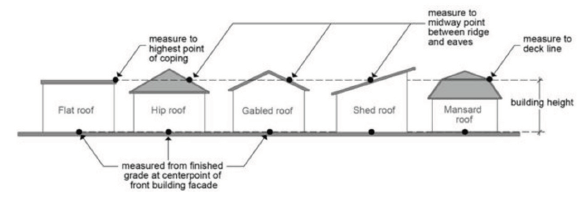
- If a difference of 6 feet or more exists between the elevations at finished grade of the front and rear building planes, building height shall be measured from the center of the side walls between the front and rear building planes.
- Height Limitations Exceptions. Height limitations shall not apply to barns, silos, and other structures on farms; to church spires, belfries, cupolas and domes; monuments; chimneys and smoke stacks; flag poles, public utility facilities; commercial communications, radio and television supporting towers; television or radio antennas not exceeding 8 feet above the roof of buildings to which it is attached and accessory nor exceeding 36 feet in total height (antenna and pole/structure) above grade (lowest adjacent ground elevation); and parapet walls extending not more than four feet above the limiting height of the building except as herein provided.
- Permitted Encroachments. The following shall be considered as permitted encroachments on setback and height requirements except as herein after provided:
- In Any Yard
- Posts, off-street open parking spaces, flues, belt, course, leaders, sills, pilasters, lintels, cornices, eaves, gutters, awnings, open terraces, service station pump islands, open canopies steps, chimneys, flag poles, ornamental features, open fire escapes, sidewalks, and fences, and all other similar devices incidental and appurtenant to the principal structure except as hereinafter amended.
- Communication towers shall be allowed with no height requirements per Chapter 105 - Buildings and Building Regulations. Article V. Wireless Communication Facilities.
- In Side and Rear Yards. In side and rear yards, encroachments may not exceed:
- A depth of 3 feet or contain an area of more than 30 square feet,
- Fire escape not to exceed a width of 3 feet.
- Balconies 8 feet above grade may extend into yards to within 5 feet of a lot line provided said balconies do not extend over driveways, breezeways.
- Detached outdoor picnic shelters, open arbors, trellises, and detached outdoor living rooms may extend to within five feet of a side or rear lot line except that no such structure shall exceed 500 square feet.
- Covered porches may extend 20 feet into the rear yard but not closer than 10 feet from the rear lot line.
- In Any Yard
Sec 125-86 - Parking
TABLE 25. OFF-STREET PARKING REQUIREMENTS
| Use | Required amount of parking |
| Single-family detached and duplex dwellings | Two spaces per dwelling unit. The first two spaces of a home shall be fully enclosed; either detached or attached to the principal structure. Additional parking spaces are not required to be enclosed. |
| Multiple-dwelling units | Two spaces per dwelling unit. At least one-half of the required spaces shall be enclosed. |
| Place of worship and other places of assembly | One space for each three seats or for each five feet of pew length. Based on maximum design capacity. |
| Offices | One space for each 200 square feet of gross floor space. |
| Hotel, motel | One space per unit, plus one space per employee. |
| Schools, preschool or daycare centers | One space for each 450 square feet of floor area. |
| Schools, elementary and junior high | Three spaces for each classroom. |
| Schools, high school through college | One space for each four students based on design capacity plus three additional spaces for each classroom. |
| Community residence/assisted living center | One space for each bed plus one space for each three employees other than doctors. |
| Health and/or fitness club | One space for each 200 square feet of floor area. |
| Bowling alley | Six spaces for each alley, plus additional spaces as may be required for related uses such as a restaurant. |
| Motor vehicle service station | Two spaces plus three spaces for each service stall. |
| Motor vehicle sales | One space for each 450 square feet of floor area. |
| Convenience store | One space for each 200 square feet of gross floor area. |
| Retail store | Five spaces for each 1,000 square feet of gross floor area. |
| Small animal hospital or clinic | One space for each 300 square feet of floor area. |
| Medical or dental clinic | Six spaces per doctor or dentist at maximum build out of the facility; but limited to the maximum number of doctors or dentists able to work on a single shift. |
| Restaurant—Sit down (commonly, service at customer tables) | One parking space for each 40 square feet of dining room floor area, plus one parking space for each 80 square feet of kitchen and food prep floor area |
| Restaurant—Drive-thru (service at a counter or drive-thru window, for example) | One parking space for each 15 square feet of lobby, counter, or waiting area, in addition to dining and kitchen requirements for sit down restaurants |
| Bar, tavern, lounge, nightclub (in a separate room with a bar and/or bar seating) | One parking space for each 30 square feet of floor area, where such space is located in a separate room or rooms from restaurant dining area, in addition to dining and kitchen requirements for sit down restaurants |
| Funeral homes | Eight spaces for each chapel plus one space for each funeral vehicle maintained on the premises. Aisle space shall also be provided off the street for making funeral procession. |
| Furniture store, wholesale, auto sales, repair shops | Three spaces for each 1,000 square feet of gross floor area. Open sales lots shall provide two spaces for each 5,000 square feet of lot area, but not less than three spaces. |
| Manufacturing | One space for each 1,000 square feet of floor area for buildings under or equal to 10,000 square feet of floor area, One space per 1,500 square feet of floor area for those buildings larger than 10,000 square feet. |
| Industrial, warehouse, storage, handling of bulk goods | One space for each two employees on maximum shift or one for each 2,000 square feet of gross floor area, whichever is greater. |
| Uses not specifically noted | As determined by the Zoning Administrator. |
- Location. All accessory off-street parking facilities required herein shall be located as follows:
- Spaces accessory to one-family and two-family dwellings shall be on the same lot as the principal use served.
- Spaces accessory to multiple-family dwellings shall be on the same lot as the principal use served and within 200 feet of the main entrance to the principal building served. Parking as required by the Americans with Disabilities Act (ADA) for the disabled shall be provided.
- Spaces accessory to uses located in business districts (LC, RC, GI, DT) shall be on the same lot as the principal building. Parking as required by the Americans with Disabilities Act (ADA) for the handicapped shall be provided.
- Spaces accessory to multi-family, commercial or industrial use shall be set back 10 feet from any street right-of-way or any property line. A total of 20 feet shall be required adjacent to Interstate 94 right-of-way. Encroachments for items other than landscaping shall not be permitted within the 20 feet adjacent to the Interstate 94 right-of-way.
- General Provisions
- Existing off-street parking spaces and loading spaces upon the effective date of the ordinance from which this development code is derived shall not be reduced in number unless said number exceeds the requirements set forth herein for a similar use.
- Unless otherwise noted in this ordinance, parking shall comply with the standards in Table 25. Parking Space Standards and Table 24. Off-Street Parking Requirements:
Table 26. PARKING SPACE STANDARDSAngle of Parking Stall Width Parallel to Aisle Stall Length of Line Aisle Width Stall Depth 45 degrees 9 ft. 19 ft. 12 ft. 17 ft. 6 in. 90 degrees 9 ft. 18 ft. 26 ft. 18 ft. Parallel 8 ft. 20 ft. 26 ft. 18 ft. - Parking spaces for the handicapped shall be in accordance with the Americans with Disabilities Act (ADA)
- Parking spaces for the handicapped shall be in accordance with the Americans with Disabilities Act (ADA)
- Required off-street parking space in any district shall not be utilized for open storage of goods or for the storage of vehicles that are inoperable, for sale or for rent.
- In the Downtown Zoning District, on-street parking stalls within 500 feet of the proposed use may be counted towards required parking minimums at a rate of 40%.
- Landscaping
- For every 17 parking spaces in a row, a landscape island shall be provided, except where the lot is 2 acres or less.
- Each required landscape island is to contain at least one tree; and is required to be a minimum size of 9 feet by 18 feet. Additional landscaping may be provided in the form of shrubs, grasses and other ornamental plants.
- No interference between on-site utilities and landscaping is permitted, including, but not be limited to, fire equipment or onsite lighting.
- The number of landscape islands may only be reduced at the discretion of the Planning Commission, and may not exceed a reduction of greater than 50%.
- Shared Parking
- Off-street parking facilities for a combination of mixed buildings, structures or uses may be provided collectively in any district (except residential districts (R1, R2, R3, R4) in which separate parking facilities for each separate building, structure or use would be required, provided that the total number of spaces provided shall equal the sum of the separate requirements of each use during any peak hour parking period.
- The total number of shared parking stalls may not equal less than 60% of the total parking facilities required for each separate building, structure, or use.
- The applicant shall submit credible evidence to the satisfaction of the City that the peak parking demand of the uses will not coincide and that the accumulated parking demand at any one time shall not exceed the total capacity of the facility.
- Shared parking for multi-tenant buildings shall be reviewed at the time of site plan review.
- Shared spaces must be located within 500 feet of the principal building entrances of all sharing uses. However, up to 20% of the spaces may be located greater than 500 feet but less than 1,000 feet from the principal entrances.
- Deferment of Required Parking. A reduction in the number of required parking spaces may be permitted by conditional use permit provided that:
- Evidence is provided demonstrating that the parking requirements of the proposed use will be less than the parking required under Table 24. Off- Street Parking Requirements, during the peak demand period. Factors to be considered when reviewing the proposed parking demand shall include, but not be limited to:
- Size, type and use of building.
- Number of employees.
- Projected volume and turnover of employee and/or customer traffic.
- Projected frequency and volume of delivery or service vehicles.
- Number of company owned vehicles.
- Storage of vehicles on site.
- In no case shall the amount of parking provided be less than 60% of the amount of parking required by Ordinance.
- The property owner can demonstrate that the site has sufficient property under the same ownership to accommodate the expansion of the parking facilities to meet the minimum requirements of Table 24. Off-Street Parking Requirements, if the parking demand exceeds on-site supply.
- On-site parking shall only occur in areas designed and constructed for parking. The area reserved as “proof of parking” shall be sodded or seeded and maintained as green space or a recreational area. No permanent buildings shall be permitted in the “proof of parking” area.
- The property owner shall record a restrictive covenant against the title to the property providing that additional parking shall be constructed in accordance with Table 24. Off-Street Parking Requirements if the site parking demand exceeds the actual on-site parking supply in the sole opinion of the City. The form of the restrictive covenant shall be approved by the City Attorney before the issuance of the conditional use permit.
- To qualify for a parking deferment, the site plan must comply with all current zoning standards.
- Application for and approval of a conditional use permit for deferment of required parking shall also be subject to the provisions of Sec. 125-24. Conditional Use Permits of this Ordinance.
- Evidence is provided demonstrating that the parking requirements of the proposed use will be less than the parking required under Table 24. Off- Street Parking Requirements, during the peak demand period. Factors to be considered when reviewing the proposed parking demand shall include, but not be limited to:
- Design and Maintenance of Off-Street Parking areas in All Business Districts (LC, RC, GI, SD, DT)
- Parking areas shall be designed so as to provide adequate means of access to a public street. Such driveway access widths shall be in accordance with the state highway department standards, but in no case shall they exceed 32 feet in width or less than 24 feet in width. Driveway access shall be so located as to cause the least interference with traffic movement.
- When the calculation of the number of off-street parking spaces required results in a fraction, such fraction shall require a full space.
- All parking lot lighting shall be full cut off and downward facing. All light poles shall be of a dark color. Lighting plans shall be submitted showing a light loss factor of 1.0, and shall have no light spillage onto adjacent properties.
- All open off-street parking areas designed to have head-in parking along the property line shall provide a bumper curb not less than 10 feet from the property line except for spaces accessory to multi-family or industrial per Sec. 125-86. Parking.
- When a required off-street parking space for six or more cars is located adjacent to a residential district (R1, R2, R3, R4, R5) a fence or screening not less than four feet in height shall be erected along the residential district (R1, R2, R3, R4, R5) property line.
- All off-street parking spaces shall have access from driveways and not directly from the public street.
- No parking space shall be closer than 10 feet to any building.
- Fire access lanes shall be provided as required by the building or fire code.
- Maintenance of off-street parking space. It shall be the joint and several responsibility of the operator and owner of the principal use, uses and/or building to maintain, in a neat and adequate manner, the parking space, access ways, landscaping and required fences.
- No vehicles for display or sale shall be located in a parking lot where the intended purpose of the lot is not vehicle sales.
- Campers, trailers and similar recreational living quarters shall not be permitted as residences within business zoning districts (LC, RC, GI, SI, DT, ND) unless these areas are depicted on the approved site plan submitted for a project.
- Design and Maintenance of Off-Street Parking Areas in All Residential Districts (R1, R2, R3, R4, R5)
- Parking in residential areas (off-street and on-street) shall be limited to the use of the residents of those homes. Except for short term parking (six hours or less) and guest parking, the number of vehicles parked on or in front of a residential lot shall not exceed double the number of persons residing on the premises and having automobile driver’s licenses.
- Spaces accessory to one-family and two-family dwellings on the same lot as the principal use served. Two fully enclosed spaces per unit either attached to, or fully enclosed and detached from the dwelling are required.
- Motor vehicles over one ton capacity bearing a commercial license and commercially licensed trailers shall not be parked or stored on residential or agricultural properties (with the exception of trucks/tractors directly associated with the agricultural use) except when loading, unloading, or rendering service and except that one such truck and/or trailer may be stored or parked on agricultural properties by the property owner while in regular use.
- Except as may be provided elsewhere in this Chapter, off-street parking facilities accessory to residential uses shall be utilized solely for the parking of passenger automobiles and/or one truck not to exceed 12,000 gross capacity for each dwelling unit. Automobiles and pick up truck style vehicles are permitted to be a maximum of 23 feet in length for parking on a residential driveway. Parking of vehicles shall be limited to those persons who reside on the property. Parking of vehicles for persons or businesses that do not occupy or reside at the residence shall not be permitted.
- Surface and Drainage. Off-street parking areas shall be improved with a durable and dustless surface. Such areas shall be so graded and drained as to dispose of all surface water accumulation within the parking area. Durable and dustless surfaces shall utilize asphalt, concrete or a reasonable substitute surface as approved by the City Engineer. All surfacing must be completed prior to occupancy of the structure unless other arrangements have been made with the City.
- Easements. Easements shall be required if the ingress and egress to a parking lot passes through another property.
Sec 125-87 - Drive-Thru Business Development Standards
- General requirements.
- A fence or screen of acceptable design not over six ft. in height or less than four ft. shall be constructed along the property line abutting a residential district and such fence or screen shall be adequately maintained. The fence shall not be required in front of the setback line.
- Any drive-thru business serving food or beverages may also provide, in addition to vehicular service areas, indoor food and beverage service seating area.
- The hours of operation shall be set forth as a condition of any building permit for drive-thru business.
- Each drive-thru business serving food may have outside seating.
- Each food or beverage drive-thru business shall place refuse receptacles at all exits, as well as one refuse receptacles per ten vehicle parking spaces within the parking area.
- Locations
- No drive-thru business shall be located within 400 ft. of a public or parochial school, church, public recreation area or any residential district.
- No drive-thru business shall be located on any street other than one designated as a thoroughfare or business service road in the policies plan.
- Site Plan
- The site plan shall clearly indicate suitable storage containers for all waste material. All commercial refuse containers shall be screened.
- A landscaping plan shall be included and shall set forth complete specifications for plant materials and other features.
- Adequate area shall be designated for snow storage such that clear visibility shall be maintained from the property to any public street.
- The design of any structure shall be compatible with other structures in the surrounding area.
- Electronic devices such as loudspeakers, automobile service order devices, drive-in theater car speakers and similar instruments shall not be located within 400 ft. of any residentially zoned or used property, nor within 200 ft. of any adjacent lot regardless of use or zoning district.
- No service shall be rendered, deliveries made, or sales conducted within the required front yard; customers served in vehicles shall be parked to the sides and/or rear of the principal structures.
- No plan shall be approved which will in any way constitute a hazard to vehicular or pedestrian circulation. No access drive shall be within 50 ft. of intersecting street curblines.
- Drive-in Theaters. In the case of a drive-in theater, a solid fence not less than eight feet in height and extending at least to within two feet of the ground shall be constructed around the property.
- Lighting. The lighting shall be designed so as to have no direct source of light visible from the public right-of-way or adjacent land in residential use.
Sec 125-88 - Automobile Service Stations
- General Requirements. The following shall be applicable to auto and truck service stations in all districts:
- No vehicles shall be parked on the premises other than those utilized by employees or waiting service. No vehicle shall be parked or be waiting service longer than 15 days. Existing service stations shall comply with this requirement within 45 days of the effective date of the ordinance from which this chapter is derived.
- Exterior storage besides vehicles shall be limited to service equipment and items offered for sale on pump island; exterior storage of items offered for sale shall be within yard setback requirements and shall be located in containers such as racks, metal trays, and similar structures designed to display merchandise. Existing service stations shall comply with the requirement within three months of the effective date of the ordinance from which this chapter is derived.
- All areas utilized for the storage, disposal, or burning of trash, debris, discarded parts, and similar items shall be fully screened. All structures and grounds shall be maintained in an orderly, clean, and safe manner. Existing service stations shall comply with this requirement within nine months of the effective date of the ordinance from which this chapter is derived.
- Business activities not listed in the definition of service stations in the ordinance from which this chapter is derived are not permitted on the premises of a service station unless a conditional use permit is obtained specifically for such business. Such activities include, but are not limited to, the following:
- Self-service car wash;
- Rental of vehicles, equipment, or trailers; and
- General retail sales.
- Self-Service and Full Service Car Wash. The following shall be applicable to all uses fitting the definition of a self-service car wash or full service car wash as defined in Section §125-102 of the City Code:
- General Requirements
- Excessive Burden: The use shall not create an excessive burden on existing parks, schools, streets and other public facilities and utilities which serve or are proposed to serve the area.
- Compatibility: The use shall be compatible with adjacent land uses.
- Appearance: The use shall have an appearance that will not have an adverse effect upon adjacent properties.
- Overall Needs: The use, in the opinion of the Planning Commission, shall be reasonably related to the overall needs of the city and to the existing land use.
- Consistent with Purpose: The use shall be consistent with the purposes of this title and purposes of the zoning district in which the applicant intends to locate the proposed use.
- Comprehensive Plan: The use shall not be in conflict with the comprehensive plan of the city.
- Traffic: The use will not cause traffic hazard or congestion.
- Facilities: The use shall have adequate utilities, access roads, drainage and necessary facilities.
- Approval Requirements
- Conditional Use Permit and Site Plan approval shall be required for all self-service and full service car wash uses.
- Applications for a Conditional Use Permit and Site Plan shall follow procedures for those applications, per Sections §125-24 and §125-27 respectively, and must include all required materials.
- Self-service car washes are permitted as accessory uses by Conditional Use Permit only on parcels zoned LC – Local Employment Center, RC – Regional Employment Center, and ND – Neighborhood District.
- Full service car washes are permitted by Conditional Use Permit only on parcels zoned RC – Regional Employment Center and located within a quarter mile of the intersection of Interstate 94 and U.S. Route 101.
- If determined necessary by the Zoning Administrator, a Traffic Study must be conducted at the cost of the applicant to determine that the use will not cause traffic hazards or congestion.
- Location:
- Self-service car washes are permitted as accessory uses by Conditional Use Permit only on parcels within the Local Employment Center (LC), Regional Employment Center (RC), and Neighborhood District (ND) zoning districts.
- Full service car washes are restricted to parcels located within the Regional Employment Center (RC) zoning district, and within a quarter mile of the intersection of Interstate 94 and U.S. Route 101.
- No full service car wash may be located adjacent to or within 300 feet of any residential use or residentially zoned or guided property, unless completely screened by an intervening building or located across an arterial or major collector roadway from residentially zoned or guided property.
- Self-service and full service car washes that were existing uses on June 22nd, 2021, and have been in continuous operation since that date are not subject to the above location requirements.
- Stacking:
- Stacking and exiting areas shall be screened from the public right-of-way by the building. If that cannot occur, walls, berms, or trees should be used to screen stacking and exiting areas.
- The drive-thru stacking lane shall be situated so that overflow from the stacking lane shall not spill out into public or private streets. Ingress or egress points for the drive-thru uses shall not conflict with turning movements of street intersections.
- A bypass lane shall be provided to allow cars to leave the drive-thru lane from the stacking area, and to allow vehicles a way to enter and exit the site without having to turn around on the site or travel through a car wash tunnel or bay.
- A full service car wash must have a minimum of six (6) stacking spaces on site per wash stall.
- Stacking lanes must not interfere with circulation in parking, loading, maneuvering, or pedestrian areas.
- Wastewater and Drainage:
- The exit from the car wash shall have a drainage system which is subject to the approval of the City and gives special consideration to the prevention of ice buildup during the winter months.
- Water dripping onto the public streets at the exit of car washes shall be minimized through automatic drying systems or hand drying in connection with full-service car wash facilities or through on-site grading and drainage patterns or other design features.
- Untreated waste water shall not be discharged into the storm sewer, landscaped areas, or public right-of-way.
- Hours of Operation
- Hours of operation shall be limited to between 7:00 A.M. and 10:00 P.M. daily.
- Other Standards
- Drive lanes and parking spaces shall be clearly delineated.
- Vacuum stations and related equipment shall comply with the setbacks for the principal structure.
- All overhead doors shall remain closed during off-peak hours unless a vehicle is entering or exiting.
- All car wash bays and tunnels and all car wash equipment shall be designed to minimize the creation and release from the premises of airborne particles of water, chemicals, and dust.
- General Requirements
HISTORY
Amended by Ord. 2021-08 on 6/22/2021
Amended by Ord. 2021-08 on 6/22/2021
Sec 125-89 - Lot And Building Standards: Restrictions
- Dwelling Units Prohibited
- No basement, garage, tent, trailer, or accessory building shall at any time be used as a dwelling. The basement portion of finished home or apartment may be used for normal eating and sleeping purposes provided it is properly damp-proofed, has suitable fire protection and exits, and is otherwise approved by the building inspector.
- Opt-out of Minnesota Statutes §462.3593:
- Pursuant to authority granted by Minnesota Statutes §462.3593, subd. 9, the City of Rogers opts-out of the requirements of Minnesota Statutes §462.3593, which defines and regulates temporary family health care dwellings.
- Pursuant to authority granted by Minnesota Statutes §462.3593, subd. 9, the City of Rogers opts-out of the requirements of Minnesota Statutes §462.3593, which defines and regulates temporary family health care dwellings.
Sec 125-90 - Landscaping And Tree Preservation
- Landscaping
- Landscaping
- All properties within the City subject to subdivision, development or redevelopment, or renovation shall be subject to the requirements of this Section.
- The front, side and rear yards of each site not utilized for building, parking (where permitted) or other improvements shall be landscaped utilizing an effective combination of street trees, grass, ground cover and shrubbery. Undeveloped areas in the interior of the site shall be seeded with appropriate grasses and maintained neat and orderly so as to control dust on sites. All tree trimmings, stumps, and construction debris shall be promptly removed and not be accumulated or stored on-site.
- Open Areas
- All open areas of developed lots which are not devoted to buildings, patios, off-street parking, loading and driving areas shall be irrigated and landscaped with grass ground cover, trees, shrubs or other ornamental landscape material except that natural grasses and vegetation for undeveloped portions of the lot reserved for future expansion is allowed providing the portions of lot are kept free of litter, debris, and noxious or unsightly weeds. All areas used for parking, circulation, display, storage or open sales shall be paved with asphalt or concrete. Concrete curbing shall be used in the collection of stormwater runoff and protection of all landscaped areas. Crushed rock is not a permitted material in any zoning district other than AG or R1 for areas used for circulation, open sales display or storage.
- All open areas of developed lots which are not devoted to buildings, patios, off-street parking, loading and driving areas shall be irrigated and landscaped with grass ground cover, trees, shrubs or other ornamental landscape material except that natural grasses and vegetation for undeveloped portions of the lot reserved for future expansion is allowed providing the portions of lot are kept free of litter, debris, and noxious or unsightly weeds. All areas used for parking, circulation, display, storage or open sales shall be paved with asphalt or concrete. Concrete curbing shall be used in the collection of stormwater runoff and protection of all landscaped areas. Crushed rock is not a permitted material in any zoning district other than AG or R1 for areas used for circulation, open sales display or storage.
- Planting Plan
- A planting plan shall be submitted with development and redevelopment applications. The planting plan shall be prepared on the proposed site grading plan and shall indicate the location, quantity and common name of all proposed plantings as well as other pertinent landscape features such as retaining walls, berms, swales, lighting, irrigation extents etc. Plantings specified in this Section represent minimum requirements.
- Planting Requirements, Minimum Size
- The landscape plan shall be reviewed by City staff to ensure that appropriate plant materials are used to accomplish the intent of the landscaping, including screening where required. Size requirements are presented in Table 26. Planting Size Requirements.
- The landscape plan shall be reviewed by City staff to ensure that appropriate plant materials are used to accomplish the intent of the landscaping, including screening where required. Size requirements are presented in Table 26. Planting Size Requirements.
Tree Type Minimum Size Shade Trees (overstory) 2.5-inch caliper Ornamental Trees (understory) 1.5-inch caliper Evergreen Trees (overstory) 4-6 feet Tall Shrubs and Hedge Material (deciduous or coniferous) 3-4 feet Low Shrubs (deciduous) 5 gallon - Landscaping
- Tree and woodland preservation. The following restrictions shall apply to all residential development occurring in wooded areas:
- Structures shall be located in such a manner that the maximum number of trees shall be preserved.
- Prior to the granting of a building permit, it shall be the duty of the person seeking the permit to demonstrate that there are no feasible or prudent alternatives to the clear-cutting of trees on the site and that if trees are cut, the person will restore the density of trees to that which existed before development but in no case shall the person be compelled to raise the density above 10 trees per acre.
- Forestation, reforestation or landscaping shall utilize a variety of tree species and shall not utilize any species presently under disease epidemic. Species planted shall be hardy under local conditions and compatible with the local landscape.
- A tree inventory will be prepared.
Sec 125-91 - Land Disturbances
- Mining
- Purpose. Commercial mining, stripping excavating and extracting activities are now being and from some time have been conducted in certain places within the boundaries of the City of Rogers in order to remove from the ground black dirt, sand, gravel and other minerals or substances existing on, in or under such place.
The City of Rogers finds that the extraction of minerals by surface mining is a basic and essential activity making an important contribution to the economic well being of the City. The character of mining may create undesirable land and water conditions, which can be detrimental to the health, safety and welfare and property rights of the citizens of the City of Rogers. If properly regulated and if reclamation of surface mined lands is required, mining can take place within the City of Rogers. The purposes of this ordinance are:- To provide for the economical availability of sand, gravel, rock, soil and other materials vital to the continued growth of the region and the City of Rogers;
- To establish reasonable and uniform limitation, safeguards and controls in the City for future production of said minerals; and
- To control and minimize pollution caused by erosion or sedimentation; all in furtherance of the health, safety and general welfare of the citizens of the City of Rogers.
- IUP Required. No person shall open any form of excavation or process any sand, gravel, rock, other soils, or derived products unless such person shall first have obtained from the City an IUP as required under this ordinance, and any other permit required by applicable state, county or local regulation. The following data shall be submitted as a part of any application for an IUP under this Section:
- A mandatory environmental assessment worksheet shall be required for development of a facility for the extraction or mining of sand, gravel, stone or other nonmetallic minerals, which will excavate 40 or more acres of land to a mean depth of 10 feet or more during its existence. The City of Rogers or its designee will be the responsible governmental unit for the preparation of the environmental assessment worksheet. Costs associated with the preparation of an environmental assessment worksheet shall be borne by the applicant.
- A mandatory environmental impact statement shall be required for the development of a facility for the extraction or mining of sand, gravel, stone or other nonmetallic minerals, which will excavate 160 acres of land or more to a mean depth of 10 feet or more during its existence. The City of Rogers or its designee will be the responsible governmental unit for the preparation of the environmental impact statement. Costs associated with the preparation of an environmental impact statement shall be borne by the applicant.
- Protection of water tables. The maximum depth of excavation shall be established so that groundwater quality is protected. This depth of excavation shall be established by the City Council or its designee and will be based, in part, upon soil characteristics, depth to water table, nature of mining proposed, and local use of the aquifer. Mining shall not occur in confined aquifers. Excavation into unconfined aquifers must be closely monitored and conducted according to the conditions of the permit.
- No extraction operations shall be conducted in such a manner as to permanently lower the water table of surrounding properties or any other water body. An environmental assessment worksheet shall be required for any operation in which mining is proposed below the groundwater level.
- All provisions of the Minnesota Environmental Quality Board Environmental Review Program must be complied with.
- Any mining operation having access from a state or county highway must obtain an access permit from the respective agency. A turn lane and/or bypass lane may be required by the respective agency to reduce the risk of traffic safety hazards. The cost of construction of a turn or bypass lane shall be the sole expense of the operator.
- As part of the original application for a mining permit and any subsequent renewals, the applicant shall submit grading plans and phased reclamation plans to the Elm Creek Watershed Management Commission.
- As a part of the application for an IUP, an applicant shall indicate proposed haul routes, including any road proposed to be used from the mine to an all weather roadway of at least nine ton rated capacity or higher, extending to the City limits. The City may impose a requirement for financial securities intended to provide for road repair and maintenance on such roads due to expected or actual wear and tear.
- Application. Application shall be made in writing to the City on such form as the City Council may from time to time designate and shall include the following information:
- The correct legal description of the premises where the excavation, removal, processing, recycling, storage or other handling of rock, sand, dirt, gravel, clay or derived products does or shall occur.
- Names and addresses of the applicant, operator and owner of the land.
- The primary highways, streets or other public ways within one mile of the boundaries of the pit within the City upon and along which the material excavated or removed shall be transported in normal operation.
- Names of the adjacent landowners including all those within a 500 feet radius of the property.
- A map of the proposed pit or excavation to a scale of one inch equals 200 feet showing the presently excavated area, the area proposed to be excavated during the permit period, the minimum and maximum elevations of the area, and showing a minimum of 100 feet of the adjacent land on all sides of the proposed excavation area. Watercourses, marshes, wooded areas, rock outcrops, power transmission poles and lines, and other significant features shall be shown. U.S.G.S. datum shall be used for all topographic mapping.
- Location of screening berms shall be shown to scale, and notes shall be provided indicating when they will be used as reclamation material. In the same manner overburden storage areas shall be identified and noted.
- Fences and gates shall be shown on the site map, and their type or construction shall be described.
- Proposed location of principal service or processing buildings or enclosures shall be shown, as well as location of settling basins and process water ponds.
- Site drainage features shall also be shown and flow directions indicated.
- Lighting. Set forth the planned lighting of the area and any other equipment or structures that will be installed or built.
- A reclamation or restoration plan providing for the orderly and continuing reclamation of all excavated land. Such plan shall illustrate, using appropriate photographs, maps, and surveys drawn to scale of one inch equals 200 feet and with a two-foot contour interval satisfactory to the engineer, with following:
- Intent of reclamation.
- Methods and processes of reclamation.
- Initial condition of mining site.
- Limits of various operational areas.
- Final condition of site, including proposed contours and potential development plan.
- Relation of final site condition to adjoining landforms and drainage features.
- Relation of reclaimed site to planned or established uses of surrounding land.
- A plan for maintenance of reclaimed area.
- A detailed cost estimated of reclamation.
- The planned contours of the land when the mineral removal operations are completed.
- Estimated period of time that the pit will be operated and a schedule setting forth the timetable for excavation and reclamation of land lying within the active, inactive and restoration areas.
- Those areas of the site currently used for storage of topsoil and overburden.
- The depth of all water bodies, the slopes of all slopes after reclamation and a description of the type and quantity of plantings where re-vegetation is to be established.
- Such plan shall also provide for a hydrogeological study when restoration activities will or may involve the filling of any groundwater excavation. No groundwater excavation shall be filled, in whole or in part, without prior City approval. Said hydrogeological study shall include the following:
- Description of each groundwater excavation (size, shape and location).
- Description of the proposed fill activity (grain size distribution, quantity, and placement procedures).
- Description of the aquifer characteristics in the area of each groundwater excavation to be affected by proposed fill activity on groundwater flow regimes.
- Description of the impacts of the proposed fill activity on groundwater flow regimes.
- Location of any and all existing wells and the size and depth thereof.
- Such other information as the City may from time to time require including, but not limited to, the location or anticipated location of all stockpiles of aggregate-based construction debris material on the land for which the permit is desired.
- Crushing operations. A proposed time and duration of any crushing operations on the property.
- Fees. A schedule of fees for the examination and approval of applications for permits under this Chapter and the inspection of operations for compliance with the conditions of this Chapter and the permit shall be determined by ordinance of the City Council, which may, from time to time, change such schedule. Prior to the approval and issuance or renewal of any permit under this Chapter, such fees shall be paid to the City.
- Bond. The applicant for the IUP shall post a bond, cash deposit or instrument of credit approved by the City attorney in such form and amount acceptable to the City but not to exceed $10,000.00 per acre or any portion thereof for active areas for which a permit is granted, conditioned upon full performance of the terms and conditions of this ordinance by the applicant and/or the owner of the premises described in said application, said financial guarantee to remain in full force and effect for a minimum period of time of one year after expiration of said IUP or license, which shall guarantee the required restoration as well as other requirements of this ordinance including road maintenance.
- Neither the issuance for a permit under this Chapter, nor compliance with the conditions thereof or with the provisions of this Chapter shall relieve any person from any responsibility otherwise imposed by law for damage to persons or property; nor shall the issuance of any permit under this Chapter serve to impose any liability on the City, its officers or employees for any injury or damage to persons or property. A permit issued pursuant to this Chapter does not relieve the permittee of the responsibility of securing and complying with any other permit which may be required.
- City Review of Overall Plan. Upon receiving a complete application for an IUP, the proposal shall be processed in accordance with Sec. 125-25. Interim Use Permit. The Council may attach conditions to the permit approval to promote safety and prevent nuisance conditions. The reclamation plan shall only be approved if it is consistent with the uses allowed in the City’s comprehensive plan and zoning ordinance.
- Termination of Permit
- The material extraction permit may be terminated for violation of this Chapter or any conditions of the permit. No permit may be terminated until the City Council has held a public hearing to determine whether the permit shall be terminated, at which time the operator shall be afforded an opportunity to contest the termination. The City Council may establish certain conditions, which if not complied with, will result in immediate suspension of operations until the public hearing to consider termination of the permit can be held.
- It shall be unlawful to conduct mineral extraction or excavation after a permit has been terminated.
- Regulations and Requirements. The City, as a prerequisite to the granting of said IUP or after such IUP has been granted, may impose such further restrictions and requirements as may be reasonable and necessary to protect the public health, safety, and welfare under the particular circumstances of each application.
- Additional Requirements and Regulations. Every person to whom an IUP is issued shall comply with the regulations and requirements set forth below:
- During the entire period of operations, all excavations other than the working face shall be sloped on all sides at a minimum ratio of one foot horizontal to one foot vertical, unless a steeper slope is approved by the engineer. Where excavations are adjacent to a public roadway or other right-of-way, the excavation shall have a minimum four to one slope. Slopes adjacent to or contiguous to bodies of water shall be sloped at a maximum of six to one.
- Appearance and Screening
- Abandoned machinery and rubbish shall be removed from the site regularly;
- The permittee shall, within six months of termination of the IUP, or within 12 months of abandonment of mining activity within the permitted area, initiate reclamation of the property in accordance with an approved reclamation plan. All equipment and temporary structures shall be removed and dismantled not later than six months after termination of mining operation or expiration of the permit;
- Where practical, stockpiles of overburden and materials shall be used to screen the mining site;
- Where practical, the perimeter of the mining site shall be planted or otherwise screened;
- If required by the City the screen shall have a total height of not less than six feet. A screen shall consist of one or more of the following types:
- Berms. A berm shall be constructed of earthen materials, and it shall be landscaped.
- Fences, solid. A solid fence shall be constructed of wood and shall form an opaque screen.
- Fences, open. An open weave or mesh-type fence, when not used in combination with a berm, shall be combined with plant materials to form an opaque screen.
- Planting. Plant materials, when used as a screen, shall consist of dense evergreen plants. They shall be of a kind or used in such a manner so as to provide a continuous opaque screen within 24 months after commencement of operations in the area to be screened. Plant materials shall not be limited to a maximum height. Said design shall be prepared by a licensed landscape architect.
- Existing tree and ground cover shall be preserved to the extent feasible, maintained and supplemented by selective cutting, transplanting and replanting of trees, shrubs and other ground cover along all set back areas.
- Operating Standards. The following operating conditions and standards must be met for all mining operations:
- Setbacks. No mining, stockpiling or land disturbance shall take place within:
- Fifty feet of adjoining property lines;
- Two hundred feet of any existing occupied structures not owned by the operator or owner;
- One hundred feet of any contiguous property subdivided into residential lots;
- No excavation or digging shall be made beyond the limits for which the particular permit is granted and in no case shall any excavation or digging be made within 30 feet of any adjoining road right-of-way or structure as may be in the area without obtaining specific approval by the City.
- If two or more mining operations are contiguous to one another, the common boundary may be mined if the City Council approves the respective restoration.
- The maximum noise level at the perimeter of the site shall be within the limits set by the Minnesota Pollution Control Agency and the Environmental Protection Agency of the United States.
- Those portions of the mining operation consisting of excavating, stockpiling, processing, or hauling shall be conducted only between the hours of 7:00 a.m. and 7:00 p.m., Monday through Thursday, and 7:00 a.m. and 4:30 p.m. on Friday and between the hours of 7:00 a.m. and 3:00 p.m., Saturdays unless other hours or days of operation are specifically authorized by the City Council or its designee. No such operations shall be allowed on holidays unless approved by the City Council or its designee.
- The use and handling of explosives shall be prohibited.
- Operators shall utilize all practical means to reduce the amount of dust caused by the operation. In no case shall the amount of dust or other particulate matter exceed the standards established by the Minnesota Pollution Control Agency.
- Water pollution operators shall comply with all applicable Minnesota Pollution Control Agency regulations and Federal and Environmental Protection Agency regulations and Federal and Environmental Protection Agency regulations for the protection of water quality. No waste products or process residue, including untreated wastewater, shall be deposited in any lake, or natural drainage system, except that lakes or ponds wholly contained within the extraction site may be so utilized.
- Haul roads to be used by the operator shall be approved by the City Council as part of the license issued pursuant to this ordinance. The City Council may impose additional conditions, restrictions or other requirements to insure that city roads will not be damaged by operations, not that operations will create nuisance condition. Such restrictions may include, but are not limited to:
- Operator shall be responsible for damage to gravel or blacktop roads during hauling periods.
- Operator shall be responsible for any maintenance cost of roads during hauling above normal maintenance, including grading, gravel replacement, etc.
- Operator shall control dust, dirt and mud at all times during hauling. Material for control of dust shall meet Minnesota Pollution Control Agency regulations.
- Operator shall abide by any restrictions or conditions other cities have on roads that are jointly maintained.
- The City may suspend trucking operations if the above requirements are not met.
- The applicant shall notify the City of any approvals required by any state or federal pollution control agency for any of the applicant’s operations and shall provide the City with copies of any such agency’s permission that is granted with regard to the handling of materials involved in processing or recycling operations as referred to in this ordinance.
- Abandoned wells must be sealed in accordance with state and county requirements.
- Applicant shall dispose of all wastewater used on the site in a manner which will not adversely affect adjoining property and shall use stilling ponds or other methods satisfactory to the City for disposing of the suspended solids in the waste water.
- Applicants shall provide adequate access roads to and from the site, which shall have proper site distances for traffic safety at each point of access. Stop signs shall be installed requiring a full stop before any truck can enter the public right-of-way from a permit site.
- Applicants shall obey all county and municipal road limits in hauling to and from the site.
- In the event operations cease, completely or substantially so, on said site for a period of more than one year, or in the event substantially all gravel or other earthly deposits thereon have been removed and no further operations shall be conducted thereon, then the City Council may terminate the IUP to operate said pit and declare the site a restoration area subject to all requirements of the site’s restoration plan and bonding requirements.
- Applicant shall not permit any other person to operate said pit, other than hauling to or from the pit, without first obtaining the written consent of the City Council or its designee and a written acknowledgment of such others that they will be bound by an agreement in effect and covered by bond.
- Stockpiles of active operations defined in this ordinance shall be regulated by the City Council. Stockpiles may consist of granular (aggregate) and non-granular soils; unprocessed aggregate-based construction debris materials including, but not limited to, concrete, reinforced concrete, cement/concrete block products, and bituminous pavement; processed materials produced from the recycling or crushing of aggregate-based construction debris materials common borrow; topsoil and pulverized topsoil; and petroleum contaminated soil being managed pursuant to state (MPCA) and county approval.
- The size of stockpiles shall be limited based upon site conditions subject to approval by the City Council or its designee.
- Location
- All aggregate-based construction debris material stockpiles shall be located in accordance with the IUP application. The location of all other stockpiles shall be as stated below, or as otherwise approved by the City Council.
- Stockpiles of granular soils, sorted by-products and processed aggregate-based construction debris materials may be located to screen the processing or recycling operations from other incompatible land uses, unless such location is not safe or not feasible because of specific stockpile area conditions. For purposes of this subparagraph, incompatible uses shall include, but not be limited to, residential and park areas, non-mining and non-industrial uses, and uses not involving outdoor storage.
- stockpiling must be done in a manner that minimizes dust and other windblown material, vermin population due to improper storage, and other nuisance conditions. All non-earth residual waste shall be removed.
- No structures shall be permitted on the property subject to the IUP, with the exception of approved buildings related to the mining activity, and in no case shall any residential uses occur on the subject property;
- Setbacks. No mining, stockpiling or land disturbance shall take place within:
- Purpose. Commercial mining, stripping excavating and extracting activities are now being and from some time have been conducted in certain places within the boundaries of the City of Rogers in order to remove from the ground black dirt, sand, gravel and other minerals or substances existing on, in or under such place.
- Erosion & Sediment Control. The following general standards shall apply to all development and activity that necessitates the grading, stripping, cutting, filling or exposure of soils:
- The development shall conform to the natural limitations presented by topography and soil so as to create the least potential for soil erosion.
- Erosion and siltation control measures shall be coordinated with the different stages of development. Appropriate control measures shall be installed prior to the development when necessary to control erosion.
- Land shall be developed in increments of workable size such that adequate erosion and siltation controls can be provided as construction progresses. The smallest practical area of land shall be exposed at any one period of time.
- The drainage system shall be constructed and operational as quickly as possible during construction.
- Whenever possible, natural vegetations shall be retained and protected.
- On-site storm ponding. A storm drainage design plan shall accompany the site plan and preliminary plat application. On-site ponding, where required, shall provide water retention and runoff water quality enhancement pursuant to City, Watershed, DNR, and MPCA standards.
- Land Reclamation. Land reclamation may be required by IUP in all districts. The permit shall include, as a condition thereof, a finished grade plan which will not adversely affect the adjacent land. The permit shall state the type of fill allowed. Application for a permit shall include a plan for a fire control and general maintenance of the site. A plan for controls of vehicle ingress shall include provisions that will be taken to minimize erosion and excessive dust conditions.
- Reclamation and Restoration Guidelines:
- Reclamation and restoration shall be a continuing operation occurring as quickly as possible after the mining operation has moved sufficiently into another part of the extraction site and must be subject to review and approval at the end of the permit period.
- All banks and slopes shall be left in accordance with the reclamation plan submitted with the permit application. No rehabilitated slopes shall be steeper than four feet horizontal to one foot vertical, except that steeper slopes may be permitted in accordance with the reclamation plan when said slopes are planned for slope related usages, such as ski and sliding hills.
- Materials including, but not limited to, organic soils and debris (peat, muskeg, muck, stumps, roots, logs, brush, etc.), demolition debris (broken concrete or bituminous fragments, brick, lumber, metal, etc.) and any other solid or hazardous wastes shall not be used as fill in reclamation and restoration.
- Imported materials used as fill in rehabilitation and restoration shall consist of mineral soils, which typically demonstrate a minimum soil bearing capacity of 1,500 psf, and are suitable for building foundations;
- Prior to reclamation or restoration, the operator shall submit an engineering analysis of the proposed fill and compaction method to the City Engineer;
- The top 10 feet of all fill areas shall be compacted by mechanical equipment as the fill is placed, unless otherwise approved by the City Engineer, to a minimum of 95% of maximum density for a particular soil as determined by the Standard Proctor method;
- The graded or backfilled area shall not collect or permit stagnant water to remain therein;
- The peaks and depressions of the area shall be reduced to a gently rolling topography in substantial conformity to the land area immediately surrounding and which will minimize erosion due to rainfall;
- All reclamation areas planned for building purposes shall have a final elevation at least three feet above the normal ordinary groundwater level. If the area is backfilled or compacted, it shall be subsequently tested by a registered soils engineer and approved.
- Slopes, graded and backfilled area shall be surfaced with at least three inches of topsoil and planted with trees, shrubs, legumes or grasses, sufficient to hold the soil. Such ground cover shall be tended as necessary until it is self-sustained. The reclamation area shall be planted with grass, trees, shrubs, or other vegetation to prevent erosion and provide for screening and natural beauty. Technical assistance and soils data should be obtained from the appropriate city department, and from county, state and federal officials, when applicable.
- No slope descending to a water body shall exceed one foot vertical to six feet horizontal, except that steeper slopes may be permitted in accordance with the reclamation plan when human or property safety is not endangered.
- Excavations resulting in the accumulation of substantial water areas after reclamation must meet the following requirements:
- The water depth must not be less than three feet measured from the low water mark, unless a plan for creation of a wetland or marsh has been approved.
- All banks shall be surfaced with soil of a quality at least equal to the topsoil of land areas immediately surrounding and to a depth of at least three inches; sodding or seeding and mulching is also required. Mulch must be properly anchored.
- In man made groundwater lakes, the bottom contour shall be gradually sloping from the shoreline to the deepest portion of the water body a maximum slope of six feet horizontal to one foot vertical for at least 100 feet from the proposed shoreline toward the center of the water body. Beyond 100 feet in horizontal distance, the slope of the bottom contours may be no steeper than three to one.
- All groundwater lakes or wetlands created as part of the end use plan for a mined area shall be subject to the shoreland management ordinance. Such lakes and wetlands shall be classified as Natural Environment shoreland areas. Department of Natural Resources guidelines for surface water creation shall be closely followed.
- To assure the restoration plan approved by the City Council is being followed, the City Engineer may make those field measurements deemed necessary by the City Council to assure that the approved restoration plan is being followed.
- Upon ceasing operation or leaving any particular excavation area in an excavation or pit site, applicants shall regrade and restore the said area as required in this ordinance and in accordance with the approved restoration or reclamation plan previously agreed upon by the City Council and operator or owner of the pit or to such other usable condition which is agreed upon by the permittee and the City Council at the time of the required restoration.
- Restoration and reclamation are mandatory and must take place according to the approved restoration and reclamation plan and schedule and each day’s violation shall be deemed a separate offense.
- The City may require adherence to a soil monitoring program approved by the City Council with regard to soils imported for use in reclamation or restoration. Fill soil shall be inspected and certified as being clean (free of volatile organic compounds and heavy metals) before being used for reclamation. Organic soil shall be used only for topsoil.
- Reclamation and Restoration Guidelines:
- Drainage. Reclamation shall proceed in such a way that natural and storm drainage, where it enters and leaves the premises, shall be altered only to the least degree necessary to carry out excavation and related activities. Any alteration of natural and storm drainage shall not adversely affect public roads or neighboring uses.
Sec 125-92 - Adult-Oriented Business
- Purpose. The nature of adult-oriented businesses is such that they are recognized as having adverse secondary characteristics, particularly when they are accessible to minors and located near residential property or related residential uses such as schools, day care centers, libraries or parks. Furthermore, the concentration of adult-oriented businesses has an adverse effect upon the use and enjoyment of adjacent areas. The nature of adult-oriented businesses requires that they not be allowed within certain zoning districts, or within minimum distances from each other or residential uses. Special regulation of adult-oriented businesses is necessary to ensure that the adverse secondary effects would not contribute or enhance criminal activity in the area of such businesses nor will it contribute to the blighting or downgrading of the surrounding property and lessening of its value. Nothing in this section is intended to imply or confer legality of any act or business use, and is only intended to regulate otherwise legal activities under local, state and federal laws.
- General provisions. Adult-Oriented Businesses as defined in this chapter shall be subject to the following general provisions:
- Activities classified as obscene as defined by M.S.A. §617.241 are not permitted and are prohibited.
- Adult-oriented businesses, either principal or accessory, shall be prohibited from locating in any building which is also utilized for residential purposes.
- An adult-oriented business which does not qualify as an accessory use shall be classified as an adult-oriented business, principal.
- Adult-oriented business, principal.
- Adult oriented business, principal, shall be located at least 1,320 radial feet, as measured in a straight line from the closest point of the property line of the building upon which the adult-oriented business principal is located to the property line of:
- Residentially zoned property.
- A licensed day care center.
- A public or private educational facility licensed to serve preschool through 12th grade students.
- A public library.
- An on-sale liquor establishment.
- Places of religious worship, such as churches, synagogues, temples, etc.
- Public parks.
- Adult-oriented business, principal, shall be located at least 1,320 radial feet as measured from one another.
- Adult-oriented business, principal, activities, as defined by this chapter, shall be classified as one use. No two adult-oriented businesses, principal, shall be located in the same building or upon the same property and each use shall be subject to the provisions of subsections (2) and (3) of this Section.
- Adult-oriented business, principal, shall adhere to the following signing regulations:
- Sign messages shall be generic in nature and shall only identify the type of business which is being conducted.
- Sign messages shall not contain material classified as advertising.
- Sign messages shall comply with the requirements of size and number for the district in which they are located.
- Adult-oriented business, principal, activities shall be prohibited at any public show, movie, caravan, circus, carnival, theatrical, or other performance or exhibition presented to the general public where minors are permitted.
- Adult oriented business, principal, shall be located at least 1,320 radial feet, as measured in a straight line from the closest point of the property line of the building upon which the adult-oriented business principal is located to the property line of:
- Adult-oriented business, accessory.
- Adult-oriented business, accessory, shall:
- Comprise no more than 10% of the floor area of the establishment in which it is located.
- Comprise no more than 20% of the gross receipts of the entire business operation.
- Not involve or include any activity except the sale or rental of merchandise.
- Adult-oriented business, accessory, shall be restricted from and prohibit access to minors by the physical separation of such items from areas of general public access:
- Movie rentals. Display areas shall be restricted from general view and shall be located within a separate room, the access of which is in clear view and under the control of the persons responsible for the operation.
- Magazines. Publications classified or qualifying as adult uses shall not be accessible to minors and shall be covered with a wrapper or other means to prevent display of any material other than the publication title.
- Other adult-oriented business, accessory, not specifically cited shall comply with the intent of this section subject to the approval of the Zoning Administrator.
- Adult-oriented business, accessory, shall be prohibited from both internal and external advertising and signing of adult materials and products.
- Adult-oriented business, accessory, shall:
Sec 125-93 - Alternative Energy Systems Performance Standards
- Solar
- In general. Solar energy systems shall be permitted in all zoning districts, subject to the standards of this Article. Solar collector surfaces and all mounting devices shall comply with the minimum yard requirements of the district in which they are located. Screening of solar collector surfaces shall not be required.
- Building-Mounted Solar Energy Systems
- Notwithstanding the height limitations of the zoning district, building mounted solar energy systems shall not extend higher than three feet above the ridge level of a roof on a structure with a gable, hip, or gambrel roof and shall not extend higher than 10 feet above the surface of the roof when installed on flat or shed roof.
- The solar collector surface and mounting devices for building-mounted solar energy systems shall be set back not less than one foot from the exterior perimeter of a roof for every one foot that the system extends above the parapet wall or roof surface, if no parapet wall exists, on which the system is mounted. Solar energy systems that extend less than three feet above the roof surface shall be exempt from this provision.
- All solar energy systems using a reflector to enhance solar production shall minimize glare from the reflector that affects adjacent or nearby properties. Measures to minimize nuisance glare include selective placement of the system, screening on the north side of the solar array, modifying the orientation of the system, reducing use of the reflector system, or other remedies that limit glare.
- Freestanding Solar Energy Systems
- Freestanding solar energy systems, measured to the highest point of the system, shall not exceed the height of the principal structure or 20 feet, whichever is less. Freestanding solar energy systems up to 16 feet in height shall be subject to the minimum yard requirements of an accessory structure. Freestanding solar energy systems greater than 16 feet in height shall be subject to the minimum yard requirements of a principal structure. The required yard shall be measured from the property line to the closest part of the structure at minimum design tilt.
- In all the districts except A, the area of the solar collector surface of freestanding solar energy systems shall not exceed five of the lot area. Notwithstanding any other provision to the contrary, the maximum area of solar energy systems shall be calculated independently of the floor area of all other accessory structures on the zoning lot.
- The supporting framework for freestanding solar energy systems shall not include unfinished lumber.
- All abandoned or unused freestanding solar energy systems shall be removed within 12 months of the cessation of operations.
- All solar energy systems using a reflector to enhance solar production shall minimize glare from the reflector that affects adjacent or nearby properties. Measures to minimize nuisance glare include selective placement of the system, screening on the north side of the solar array, modifying the orientation of the system, reducing use of the reflector system, or other remedies that limit glare.
- Administrative Review Process
- In General. The Zoning Administrator shall have up to 15 working days following the submittal of a complete application to approve or deny such application. The Zoning Administrator may impose such conditions and require such guarantees deemed reasonable and necessary to protect the public interest and to ensure compliance with the standards and purposes of this zoning ordinance and policies of the comprehensive plan in addition to building permit review.
- Submittal Requirements. An application for a solar energy system shall be filed on a form approved by the Zoning Administrator. In addition, the applicant shall submit the following:(1)Writ10evidence that the electric utility service provider that serves the proposed site has been informed of the applicant’s intent to install a solar energy system,

