
Rohnert Park City Zoning Code
CHAPTER 17
16 - OFF-STREET PARKING REQUIREMENTS
17.16.010 - Purpose.
The off-street parking regulations contained in this chapter are intended to achieve the following objectives:
A.
To ensure that off-street parking facilities are provided for new land uses and for enlargements of existing uses in proportion to each use's need for such facilities;
B.
To establish standards for uses that are consistent with the parking needs of each use and with the feasibility of providing required parking areas on specific sites; and
C.
To ensure that off-street parking facilities are designed in a manner that will ensure their efficiency and will protect surrounding land uses from adverse impacts related to improperly designed parking arrangements.
(Ord. 695 § 3, 2003)
17.16.020 - Basic requirements for off-street parking.
A.
At the time of initial occupancy of a site, construction of a structure, alteration or enlargement of a site or structure, or moving of a structure from one lot to another, off-street parking facilities shall be provided in accordance with the regulations prescribed in this chapter and as prescribed in the California Administrative Code, Title 24, Part 2.
B.
The number of additional parking spaces required for an alteration or enlargement of an existing use or structure, or for a change of occupancy, shall be provided before the alteration, enlargement, or change of occupancy receives final approval for occupancy.
C.
The number of off-street parking spaces required for combined uses on one property and/or within one project shall be equal to the sum of the required spaces prescribed for each use, except as provided for in Section 17.16.040 of this chapter.
D.
Off-street parking facilities required by this chapter for any use shall not be considered as providing parking spaces for any other use, except where a shared parking arrangement applies pursuant to Section 17.16.080 of this chapter.
E.
Any off-street parking specifically required for a given use shall be provided to users without charge, unless otherwise approved by the city.
(Ord. 695 § 3, 2003)
17.16.030 - Specific requirements.
Parking spaces shall be provided for land uses and activities in accord with the following tables. If, in the application of the requirements of this table to a given land use or activity a fractional number is obtained, one parking space shall be required for a fraction of one-half or more, and no space or berth shall be required for a fraction of less than one-half.
A.
Residential Uses.
B.
Public and Semipublic Uses.
C.
Commercial/Retail/Office Uses.
D.
Industrial Uses.
E.
Properties within the Central Rohnert Park, Priority Development Area (see Figure 4.1 Priority Development Area Subareas and District in the document to identify appropriate subarea)
(Ord. 804 § 4, 2008; Ord. 695 § 3, 2003)
(Ord. No. 844, § 2(Exh. A), 3-13-2012; Ord. No. 897, (Exh. B), 4-12-2016; Ord. No. 920, § 5, 3-13-2018; Ord. No. 991, § 4(Exh. A, § 31), 1-27-2026)
17.16.035 - Unspecified uses.
Where a given use is not specified in the above table, the planning and community development director shall determine the equivalent use and the number of parking spaces required. In order to make this determination, the planning and community development director may require the submission of survey data from the applicant or direct a parking study to be conducted at the applicant's expense.
(Ord. 695 § 3, 2003)
17.16.040 - Parking exemptions.
A.
A reduction of up to twenty-five percent of the spaces required for a combination of uses may be allowed where findings are made indicating that the uses share a common parking area and the demand for parking occurs over different time periods, thereby making the full requirement unnecessary.
B.
Parking space reductions of up to ten percent may be permitted by the planning manager or designee, if a rideshare, transit incentive program, or other transportation system management program is provided. Further parking space reductions up to a maximum of twenty-five percent may be permitted if approved by the planning commission through issuance of a conditional use permit.
C.
Garage Conversions to Create Additional Room in a Single-Family Property. The planning manager may grant exemptions to the off-street covered parking requirements for a single-family residential property subject to the granting of an administrative permit, in accord with the provisions of Section 17.25 Article V if the following findings can be made:
1.
The principal use of the lot is an existing single-family residence;
2.
The garage conversion shall require that the resulting eliminated off-street covered parking be replaced with one non-tandem parking space per lot, other than those existing in the driveway;
3.
Such replacement space may be located in the required front yard or street side yard if the planning manager finds that in so doing there is neither an appreciable impairment of pedestrian safety nor any reduction in the attractiveness of the neighborhood. In no case shall the replacement space cause more than fifty percent of the lot's front yard to be devoted to parking;
4.
Such replacement space shall not be rented;
5.
Such replacement space shall be paved with an approved, all-weather surface;
6.
The provision and maintenance of such replacement space shall be the continuing obligation of the property owner;
7.
No more than one additional room, exclusive of closets and similar appurtenant spaces, shall be created by a garage conversion;
8.
The garage door shall remain in place and look functional; and
9.
The lot must be a minimum width of fifty feet and there must be room for at least one on-street parking space on the curb in front of the lot.
D.
If an existing parking lot does not provide adequate parking spaces for the disabled and cannot otherwise be reconfigured to achieve the city's required inventory of parking spaces, the planning and community development director may approve a reduction in the number of parking spaces by up to a maximum of three parking spaces or a total of ten percent, whichever is less, in order to accommodate required disabled parking.
E.
Parking reductions are allowed, at the discretion of the director of development services, if the parking reductions are consistent with a parking study. The study must be prepared by a professional traffic engineer and demonstrate that the parking reduction would be sufficient for the uses it serves and would not cause a negative impact on circulation or safety.
(Ord. 767 § 2, 2006; Ord. 735 § 2, 2005; Ord. 695 § 3, 2003)
(Ord. No. 906, § 9, 4-11-2017; Ord. No. 920, § 7, 3-13-2018; Ord. No. 950, § 4(Exh. A), 8-25-2020; Ord. No. 991, § 4(Exh. A, § 32), 1-27-2026)
17.16.050 - Space dimensions.
A.
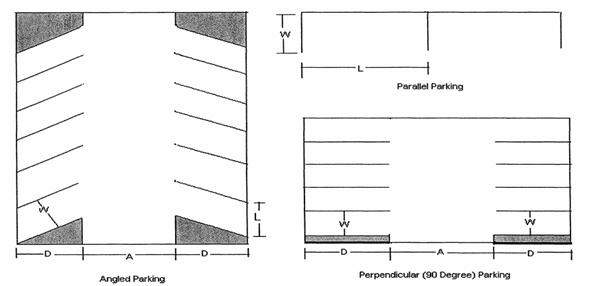
Except as otherwise specified in subsections B, C, and D below, required dimensions for parking stalls within commercial, industrial and multi-family residential parking lots are indicated in the following table and depicted in the following parking diagram.
Minimum Parking Dimensions for Standard-Sized Parking Spaces for Commercial,
Industrial and Multi-Family Residential Parking Lots (in feet)
Parking Diagram
B.
Compact Spaces. In office and industrial developments up to twenty-five percent of the required parking may be made up of compact spaces. In commercial retail uses up to ten percent of the required parking may be made up of compact spaces. Compact spaces shall be a minimum of eight feet in width and sixteen feet in length ninety degree configuration and shall be clearly marked and located throughout the site so as to not be clustered in one area. For parking located in a garage, see subsection D below.
C.
For shopping center uses, the majority of the required parking spaces shall be situated within easy access of the entrances of the buildings they are intended to serve.
D.
Each parking space adjoining and parallel to a wall, column, or other obstruction greater than six inches in height shall be increased by three feet on the obstructed door side.
(Ord. 695 § 3, 2003; Ord. No. 920, § 6, 3-13-2018)
(Ord. No. 991, § 4(Exh. A, § 33), 1-27-2026)
17.16.060 - Parking spaces for the handicapped.
All parking facilities shall comply with the requirements of the California Administrative Code (Title 24, Part 2, Chapter 2-71) and with the sign requirements of the California Vehicle Code, Section 22507.8.
(Ord. 695 § 3, 2003)
17.16.070 - Shared parking.
A shared parking arrangement may be allowed that allows parking on a nearby site to help meet the parking need of that user, provided the following requirements can be satisfied (see also Section 17.16.040):
A.
The total number of parking spaces provided off-site would allow for a surplus that may be allocated to the on-site user; and
B.
The off-site parking spaces are no farther than three hundred feet from the use(s) they are intended to serve; and
C.
A written agreement between the landowner(s) and the city, in a form satisfactory to the city attorney, shall be approved by the planning and community development director. This agreement shall be in the form capable of and subject to being recorded to constitute a covenant running with the land and shall include:
1.
A guarantee among the landowner(s) for continued access to and use of the shared parking facilities; and
2.
A provision stating that the city, acting through the planning and community development director, may for due cause and upon notice and hearing, unilaterally modify, amend, or terminate the agreement at any time.
(Ord. 695 § 3, 2003)
17.16.080 - Standards for residential parking.
A.
The following parking standards apply to multi-family and mixed-use development.
1.
Parking spaces must comply with the dimensions in Section 17.16.050(A).
2.
The exterior design of a garage or carport must be architecturally compatible with the main building.
3.
Tandem parking arrangements for required parking spaces may be allowed in the Mixed Use Residential (M-U) District as approved by the development services/community development director with a finding that the tandem spaces result in a more efficient site plan or are necessary to accommodate affordable housing.
4.
All parking areas shall be of a durable surface approved by the city engineer.
5.
Residential front yard paving reserved for parking shall not exceed fifty percent of the total front yard area.
6.
Vehicles shall not be parked on any sidewalk, parkway, driveway aisles, or planting area.
B.
The following parking standards apply to single-family development.
1.
Stalls located within a garage shall be a minimum of ten feet in width and twenty feet in length, with a vertical floor to ceiling clearance of seventy-six inches.
2.
Parking spaces not located within a garage shall be a minimum of eight feet in width and eighteen feet in length. Parking spaces must be paved with a solid surface such as concrete, asphalt, or pavers or other similar surface.
3.
Tandem parking arrangements for required parking spaces may be allowed on a single-family parcel approved by the development services/community development director with a finding that the tandem spaces result in a more efficient site plan or are necessary to accommodate accessory dwelling units, affordable housing or other state-mandated housing type.
4.
All parking areas shall be of a durable surface approved by the city engineer.
5.
Residential front yard paving reserved for parking shall not exceed fifty percent of the total front yard area.
6.
Vehicles shall not be parked on any sidewalk, parkway, or planting area.
(Ord. 695 § 3, 2003)
(Ord. No. 991, § 4(Exh. A, § 34), 1-27-2026)
Editor's note— Ord. No. Ord. No. 991, § 4(Exh. A, § 34), adopted Jan. 27, 2026, amended the title of § 17.16.080 to read as herein set out. The former § 17.16.080 title pertained to design standards for residential garages and carports.
17.16.090 - Design standards for parking lots and structures.
A.
A parking area may not be used for the vehicle sales, renting, leasing, storage, repair work, dismantling, or outdoor open sales displays. Exceptions may be granted for special outdoor events as provided for in Chapter 17.06 of this title.
B.
Surface water shall be discharged to natural or engineered off-site drainage facilities and may not drain off or across public or private sidewalks, pedestrian walkways, or areas not designed as drainage facilities.
C.
Markings.
1.
Each parking space shall be marked with solid six-inch wide stripes painted white.
2.
One-way and two-way access points into parking facilities shall be identified by directional arrows.
3.
Compact spaces shall be clearly identified by the word "compact" painted on the paved surface of the space in white block letters.
4.
Where the exit may not be clearly recognizable, directional signage must be provided.
5.
All parking area surface markings shall be maintained in a manner so as to be readily visible at all times. Such markings shall be arranged to provide for orderly and safe loading, unloading, parking and storage of vehicles.
D.
Walkways shall be provided within parking lots to connect parking areas with the uses they are intended to serve, as well as with the public right-of-way. Walkways shall also connect with adjacent uses where appropriate. These walkways shall be designated by colored pavement, striping, or other method as approved by the planning and community development director.
E.
All weather surfacing is required for all off-street vehicle parking, loading, storage, sales, rental or service areas that are open to the public. Other areas (e.g., rear yard storage areas for an operation's vehicles) may have alternate all-weather surfacing as permitted by the city engineer.
F.
Vehicles shall not be allowed to park on any sidewalk, parkway, driveway, or planting area.
(Ord. 695 § 3, 2003)
17.16.100 - Parking lot landscaping.
A.
Parking lots for non-residential uses shall have perimeter planting areas with a minimum ten feet width adjacent to a residential district and five feet adjacent to other districts.
B.
A parking lot in any district having parking adjoining a street shall have a frontage planting area reflecting the required yard setbacks from the street. Parking areas shall be screened from adjacent streets with berming and/or landscaping to achieve an average height of three feet above the adjacent grade of the parking area.
C.
The end of each row of parking stalls shall be separated from driveways by a landscaped planter with a preferred width of five feet.
D.
Parking lot trees shall be provided at a minimum ratio of one tree for every four parking spaces. No more than six consecutive parking spaces should be allowed in any row of parking without a tree well or tree well finger from a landscape strip.
E.
Where standard spaces are adjacent and perpendicular to landscaping or a walkway, the planting area or walkway may be increased by two feet in depth and the length of the adjacent parking stall decreased by two feet to allow for a two-foot overhang. Where autos will overhang into both sides of an interior landscaped strip or well, the minimum curb-to-curb interior planter dimension shall be six feet. Compact spaces are not eligible for this provision.
(Ord. 695 § 3, 2003)
17.16.110 - Parking access from street.
A.
All spaces in a parking facility shall be accessible without re-entering a public right-of-way; however an alley may be used as maneuvering space for access to off-street parking.
B.
Where an area used for off-street parking does not abut a public street, there shall be provided a paved access drive not less than twenty feet in width for two-way traffic, connecting the off-street parking area with a public street.
C.
Parking lot entrance and exit locations and widths are subject to the approval of the city engineer.
(Ord. 695 § 3, 2003)
17.16.120 - Lighting.
Outdoor parking area lighting shall comply with the provisions of Section 17.12.050 of this title.
(Ord. 695 § 3, 2003)
17.16.130 - Shopping cart storage.
Commercial uses that utilize shopping carts shall designate areas for on-site shopping cart storage. Storage areas in the parking lot shall not decrease the required number of vehicle parking spaces, remove required landscaping, or impede the flow of pedestrian and/or vehicular traffic. Shopping cart storage areas adjacent to buildings shall be screened by a wall, with the design to be approved by the planning and community development director or by the planning commission or city council at the time of project review.
(Ord. 695 § 3, 2003)
17.16.140 - Bicycle parking.
A.
Bicycle parking spaces shall be provided in all districts as required by this section. Bicycle parking facilities shall be provided for any new building, addition or enlargement of an existing building, or for any change in the occupancy of any existing building that results in the need for additional auto parking facilities consistent with the parking standards required by Chapter 17.16.
B.
Bike Spaces Required. Bicycle parking facilities shall be provided in accordance with the following schedule, with fractional requirements for bike parking over one-half to be rounded up:
1.
Office Uses. One bicycle parking space for every ten off-street vehicle parking spaces required, but no less than two spaces shall be provided.
2.
Commercial, Retail, Wholesale, and Industrial Uses. One bicycle parking space for every fifteen off-street vehicle parking spaces required, but no less than two spaces shall be provided.
3.
Restaurant. One bicycle parking space for every twenty-five off-street vehicle parking spaces required, but no less than two spaces shall be provided.
4.
Fast Food Restaurant. Five bicycle parking spaces per establishment.
5.
Residential. One bicycle parking space per dwelling unit.
C.
Location and Design of Facilities.
1.
Each bicycle parking space shall be no less than six feet long by two feet wide and shall have a bicycle rack or other device constructed so as to enable the user to secure by locking the frame and one wheel of each bicycle parked therein.
2.
Bicycle racks shall not be placed close enough to a wall or other obstruction so as to make use difficult. There must be a sufficient space (at least twenty-four inches) beside each parked bike that allows access; adjacent bicycles may share this access.
3.
An aisle or other space shall be provided for bicycles to enter and leave the facility. This aisle shall have a width of at least six feet to the front or rear of a bike parked in the facility.
4.
Racks must be easily useable with both U-locks and cable locks. Racks should support the bikes in a stable upright position so that a bike, if bumped, will not fall or roll down. Racks that support a bike primarily by a wheel such as standard wire racks are damaging to wheels and thus are not acceptable.
5.
Bicycle parking facilities shall be securely anchored to the lot surface so they cannot be easily removed and shall be of sufficient strength to resist vandalism and theft.
6.
Bicycle parking spaces shall be located near the entrances to major tenants but shall be out of the traffic lanes and shall not impede walkways.
7.
Bicycle parking facilities shall be incorporated whenever possible into the building design and street furniture so as to be harmonious with their environment in both design and color.
8.
Bicycle parking shall be located in highly visible, well lighted areas to minimize theft and vandalism.
9.
Bicycle parking facilities within auto parking areas shall be separated by a physical barrier (e.g., curbs, wheel stops, poles or similar features) to protect bicycles from damage by cars.
D.
Variations to Requirements.
1.
Where the provisions of bicycle parking is physically not feasible the requirements may be waived or reduced to a feasible level by the planning and community development director.
2.
Residential bicycle parking spaces may be provided within a lockable garage or bicycle storage room reserved for use by residents of a single dwelling unit. In this case, no bicycle rack or similar device shall be required.
(Ord. 695 § 3, 2003)
(Ord. No. 991, § 4(Exh. A, § 35), 1-27-2026)

