
Rohnert Park City Zoning Code
CHAPTER 17
10 - DEVELOPMENT STANDARDS5
Editor's note—Ord. No. 901, § 4, adopted Nov. 22, 2016, repealed the former Ch. 17.10, §§ 17.10.010—17.10.080, and enacted a new Ch. 17.10 as set out herein. The former Ch. 17.10 pertained to similar subject matter and derived from Ord. 695 § 3, adopted in 2003; and Ord. No. 844, § 2(Exh. A), adopted Mar. 13, 2012.
17.10.010 - Purpose.
The purpose of this chapter is to establish the development standards for the zoning districts within the city of Rohnert Park. The development standards table gives the required site area and dimensional requirements for lots within each district, including maximum building heights, minimum building setbacks, minimum open space requirements, floor area ratios, and maximum lot coverages. Following the table are additional standards, dimensional requirements and exceptions.
(Ord. No. 901, § 4(Exh. A), 11-22-2016)
17.10.020 - Development standards table.
The following table and text are adopted as the city's basic development standards for the zoning districts within the city of Rohnert Park. To use the chart, find the appropriate zoning district on the left-hand side of the table. Read across the row for the zone in question and the development standards for that zone will appear in the corresponding columns. If a number appears in parentheses in the table, a further qualifier, requirement, or exception is listed by that number in the following listing of footnotes.
DEVELOPMENT STANDARDS FOR ZONING DISTRICTS
(1) The lot minimums listed do not apply to the condominium parcelization of a project where land is being divided for individual building envelopes. Further, for lots within subdivisions approved prior to January 2003, the minimum lot size shall be that shown on the approved subdivision map.
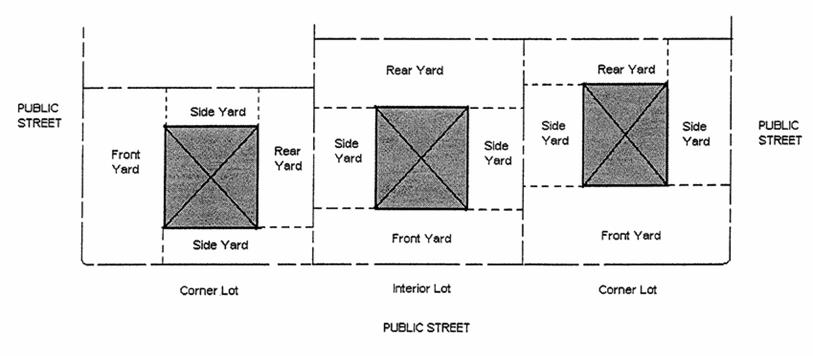
(2) ;hg;The minimum width of a residential corner lot shall be ten percent greater than the minimum lot width for a given district.
(3) ;hg;Towers, spires, cupolas, chimneys, elevator penthouses, water tanks, monuments, and similar structures and necessary mechanical appurtenances covering not more than twenty percent of the top floor roof area may exceed by eight feet the maximum permitted height in the underlying zoning district by conditional use permit.
(4) ;hg;See Section 17.10.060 for additional requirements for accessory structures.
(5) ;hg;Front porches may project up to five feet into the front yard setback. Front yard and street side setbacks shall be reserved for landscaping only, excluding driveways for ingress and egress and front porch projections. For lots within subdivisions approved prior to January 2003, front yard setbacks shall be as shown on the approved subdivision map.
(6) ;hg;A minimum lot size of four thousand five hundred square feet may be allowed in the R-L District for projects that utilize design features such as clustering and common open space areas.
(7) ;hg;Maximum density within the M-U District shall be dependent on the dimensional requirements of the property (e.g. setbacks, FAR, parking).
(8) ;hg;Applies only to the developable portion of any property within the OS-ARC District.
(9) ;hg;In the M-U District, front, rear, and/or side yard setbacks may be reduced or eliminated if approved by the planning commission and if structures remain outside of an easement and comply with city approved design guidelines.
(10) ;hg;The interior side yard setback may be eliminated for attached dwelling units in the R-M and R-H Districts, provided the applicable building code requirements can be met.
(11) ;hg;In the R-H and C-O Districts, interior side yards shall be increased by one foot for every foot of building over thirty-five feet.
(12) ;hg;The interior side yard setback may be eliminated for attached commercial units in the C-N and C-R Districts, provided the applicable building code requirements can be met.
(13) ;hg;The rear yard setbacks may be reduced to ten feet for one-story building additions that are no wider than fifty percent of the buildable width of the lot.
(14) ;hg;This shall include private open space of a minimum area of one hundred square feet when on ground level and/or sixty square feet if equal to or greater than six feet above ground.
(15) ;hg;F.A.R. of 1.5 is allowed for hotel and motel projects in the C-R District.
(16) ;hg;F.A.R. of 1.0 is allowed for industrial projects that are approved by the planning commission and meet criteria set forth in city approved design guidelines.
(17) ;hg;F.A.R. of 1.5 is the maximum for non-residential projects; an F.A.R. of 2.0 is allowed for mixed residential/residential projects.
(18) ;hg;The maximum sizes for housing units shall be as provided for in Section 17.10.070 of this chapter.
(19) ;hg;Residential units are only permitted in the DTM-U if 50% or more of the total building square footage is non-residential or if 75% or more of the ground floor is designed for an active retail or service use (e.g. restaurant, shop, beauty salon, etc.)
(20) ;hg;The corner sideyard setback may be reduced to five feet for buildings that address the street with units accessible from the public sidewalk.
Yard Diagram
(Ord. No. 901, § 4(Exh. A), 11-22-2016)
17.10.030 - Legally established yard setbacks.
On any property line where there is a legally established side or rear yard building setback line less than that required by the standards established by this ordinance, that setback may be continued when expanding a structure for a use permitted by the zoning district in which the property is located, provided maximum lot coverage is not exceeded and all other required setbacks apply. This provision does not apply to expansions into front yard setbacks.
(Ord. No. 901, § 4(Exh. A), 11-22-2016)
17.10.040 - Projections into yards.
Projections into required yard setbacks shall be permitted as follows, provided that no projection shall extend into a public utility easement:
A.
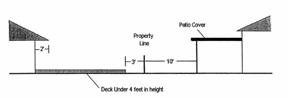
Projecting features such as balconies, sills, chimneys, fireplaces, bay windows, covered porches, awnings, cornices, eaves, and ornamental features may extend into a required side yard or a space between structures that is five feet or more in width not more than two feet and may extend into a required front or rear yard not more than four feet.
B.
Open, unenclosed, uncovered balconies, landings, platforms, patios, decks, porches, stairways, terraces, and vehicular access drives and parking and loading areas, no part of which is more than four feet above the grade of the ground, may extend into a required rear or side yard to within three feet of the property line or the required space between buildings.
C.
Attached patio covers may feature supporting members that encroach to within ten feet of a rear property line and to within five feet of a side property line, with eaves allowed to extend an additional two feet into these setbacks.
Yard Projections
(Ord. No. 901, § 4(Exh. A), 11-22-2016)
17.10.050 - Required separations between structures.
A.
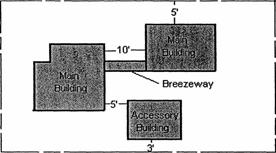
The minimum separation between main structures or between main structures connected by a breezeway shall be ten feet, with an additional one foot of separation required for every foot that a structure exceeds a height of thirty-five feet.
B.
The minimum distance between any main structure and any detached accessory structure shall be five feet. Any structure that is set back five feet or less from a main structure shall be considered an attached structure for setback purposes and must comply with all dimensional requirements that pertain to the main structure.
Separations between Buildings/Accessory Building Setbacks
(Ord. No. 901, § 4(Exh. A), 11-22-2016)
17.10.060 - Accessory structures.
A.
For the purposes of this section, an accessory structure does not include an accessory dwelling unit or junior accessory dwelling unit.
B.
Detached/Attached. Detached accessory structures (i.e. structures separated from the main structure by five feet or more) shall be located behind the front elevation of the main structure and shall cover no more than ten percent of the rear yard area (unless an accessory dwelling unit), with total lot coverage for all structures on-site not to exceed that listed in Section 17.10.020 for the applicable zoning district. In the event an accessory building is attached to the main building or less than five feet from the main structure, it shall be considered structurally a part of the main building and shall comply in all respects with the development standards applicable to the main building.
C.
Setbacks for Accessory Structures. The minimum side and rear yard setback for carports is five feet and for all other accessory structures the setback is three feet.
D.
Building Permits Requirements. Building permits are not required for detached accessory structures that are one hundred twenty-eight square feet or less in size, that are no greater than twelve feet in height, that are not habitable, and that do not require utilities. Accessory structures shall not include kitchens.
(Ord. No. 901, § 4(Exh. A), 11-22-2016; Ord. No. 906, § 8, 4-11-2017; Ord. No. 950, § 4(Exh. A), 8-25-2020; Ord. No. 991, § 4(Exh. A, § 28), 1-27-2026)
17.10.070 - Maximum size of housing units.
A.
The maximum square footage of housing units (including garages and accessory structures) shall be determined by the following formulas for the respective zoning districts. (Note: These maximums do not apply to units allowed through a density bonus arrangement.):
B.
Floor Area Ratio Increase. The planning commission may allow an increase in the floor area ratio factor (FAR) for a residential property within an R-L or R-M district, subject to the granting of a use permit, in accordance with the provisions of Section 17.25.050, Administrative Permit, if the following findings can be made:
1.
The maximum lot coverage for the property would not exceed that permitted for the zoning district;
2.
The required setbacks and height limitations of the zoning district can be met for all structures;
3.
A usable outdoor area (at least one minimum dimension of fifteen feet) for residents would be maintained on the lot;
4.
The issuance of the use permit would not infringe on the privacy or light and air easements of adjacent properties;
5.
The total FAR for the lot would not exceed 0.55.
(Ord. No. 901, § 4(Exh. A), 11-22-2016; Ord. No. 920, § 4, 3-13-2018; Ord. No. 991, § 4(Exh. A, § 29), 1-27-2026)
17.10.080 - Reasonable accommodation.
A.
Purpose. It is the purpose of this section to provide reasonable accommodations in the city's zoning and land use regulations, policies, and practices when needed to provide an individual with a disability an equal opportunity to use and enjoy a dwelling.
This section provides a procedure to request reasonable accommodation for persons with disabilities seeking equal access to housing under the Federal Fair Housing Act and the California Fair Employment and Housing Act (the Acts) in the application of zoning laws and other land use regulations, policies and procedures.
B.
Reasonable Accommodation. A request for reasonable accommodation may be made by any person with a disability, their representative or any entity, when the application of a zoning law or other land use regulation, policy or practice acts as a barrier to fair housing opportunities. A person with a qualifying disability under the Acts. Generally, a person with a disability is a person who has a physical or mental impairment that limits or substantially limits one or more major live activities, anyone who is regarded as having such impairment or anyone who has a record of such impairment. The proceeding definition of a person with a disability and this section are intended to apply to those persons who are defined as disabled under the Acts as they may be amended from time to time.
A request for reasonable accommodation may include a modification or exception to the rules, standards and practices for the siting, development and use of housing or housing- related facilities that would eliminate regulatory barriers and provide a person with a disability equal opportunity to housing of their choice. Requests for reasonable accommodation shall be made in the manner prescribed by Section 17.10.080.C, Process.
C.
Process.
(1)
Applicant. A request for a reasonable accommodation may be made by any person with a disability, his or her representative, or a developer or provider of housing for individuals with a disability.
(2)
Application. An application for a reasonable accommodation shall be made on an application form provided by the planning division. If an individual needs assistance in making the request for reasonable accommodation, the city will provide assistance to ensure that the process is accessible.
(3)
Review With Other Land Use Applications or Discretionary Permits. If the project for which the request for reasonable accommodation is made requires another discretionary permit or approval (including but not limited to; conditional use permit, design review, general plan amendment, zone change, etc.), the applicant may file the request for reasonable accommodation together with the application for the other discretionary permit or approval. The processing procedures of the discretionary permit shall govern the joint processing of both the reasonable accommodation and the discretionary permit.
(4)
Required Submittals. An application for a reasonable accommodation shall include the following:
a.
Documentation that the applicant is: (i) a person with a disability; (ii) applying on behalf of one or more persons with a disability; or (iii) a developer or provider of housing for one or more persons with a disability.
b.
The name and address of the individual(s) requesting the reasonable accommodation.
c.
The name and address of the property owner(s).
d.
The address of the property for which accommodation is requested.
e.
The current use of the property.
f.
A description of the reasonable accommodation requested by the applicant and why the reasonable accommodation is necessary to make the specific property accessible to the individual.
g.
Where applicable, documentation that the requested accommodation is designed and constructed pursuant to Title 24 of the California Code of Regulations to allow access, circulation and full use of the building and facilities by persons with disabilities.
(5)
The planning director may request additional information from the applicant if the application does not provide sufficient information for the city to make the findings required in subsection E.
D.
Review Authority.
(1)
Development Services Director. Requests for reasonable accommodation shall be reviewed by the development services director (director), or his designee if the request for reasonable accommodation is not filed concurrently with another discretionary permit or approval.
(2)
Other Review Authority. Requests for reasonable accommodation submitted for concurrent review with another discretionary land use application shall be reviewed by the authority reviewing the discretionary land use application.
E.
Review Procedure.
(1)
Director Review. The director, or his designee, shall make a written determination within forty-five days and either grant, grant with modifications, or deny a request for reasonable accommodation in accordance with Section 17.10.080.F., Findings and Decision.
(2)
Other Reviewing Authority. The written determination on whether to grant or deny the request for reasonable accommodation shall be made by the authority responsible for reviewing the discretionary land use application in compliance with the applicable review procedure for the discretionary review. The written determination to grant or deny the request for reasonable accommodation shall be made in accordance with Section 17.10.080.F, Findings and Decision.
F.
Findings and Decision.
(1)
Findings. The written decision to grant or deny a request for reasonable accommodation will be consistent with the Acts and shall be based on the following findings, all of which are required for approval:
a.
The housing that is the subject of the request will be used by an individual with a disability under the Acts.
b.
The request for reasonable accommodation is necessary to make specific housing available to an individual with a disability under the Acts.
c.
The requested reasonable accommodation would not impose an undue financial or administrative burden on the city as "undue financial or administrative burden" is defined in the Acts.
d.
The requested reasonable accommodation would not result in a fundamental alteration in the nature of a city program or law, including but not limited to land use and zoning, as "fundamental alteration" is defined in the Acts.
e.
The requested reasonable accommodation will not, under the specific facts of the case, result in a direct threat to the health or safety of other individuals or substantial physical damage to the property of others.
(2)
Conditions of Approval. In granting a request for reasonable accommodation, the reviewing authority may impose any conditions of approval deemed reasonable and necessary to ensure that the reasonable accommodation would comply with the findings required by subsection F(1) above. In making the findings in subsection F(1) above, the reviewing authority may approve alternative reasonable accommodations which provide an equivalent level of benefit to the applicant.
G.
Appeal of Determination. A determination by the reviewing authority to grant or deny a request for reasonable accommodation may be appealed to the planning commission. However, if the reviewing authority was the planning commission, a decision to grant or deny a request for a reasonable accommodation may be appealed to the city council.
(Ord. No. 901, § 4(Exh. A), 11-22-2016)

