
Rohnert Park City Zoning Code
CHAPTER 17
04 - DEFINITIONS
17.04.010 - Purpose.
The purpose of this chapter is to ensure precision and consistency in interpretation of this title. The meaning and construction of words and phrases defined in this chapter applies throughout this title, except where the context of such words or phrases clearly indicates a different meaning or construction. Refer to Title 24, California Building Standards Code, Parts II, III, IV, and V, and any ordinance of the city of Rohnert Park's Municipal Code, Title 15, for more complete definitions. If any of these definitions are in conflict with the provisions of Title 24 of the State of California Building Code, then the provisions of Title 24 shall govern. (Ord. 695 § 3, 2003)
(Ord. No. 854, § 2(Exh. A), 7-9-2013)
17.04.020 - Rules for construction of language.
The following rules of construction shall apply:
A.
The specific shall control the general.
B.
The word "shall" is mandatory and not discretionary. The word "may" is permissive and discretionary.
C.
In the case of difference of meaning or implication between the text of any provision and any caption or illustration, the text shall control.
D.
Unless the context clearly indicates to the contrary, words in the present and the future tense are interchangeable, and words in the singular and plural are interchangeable.
E.
Unless the context clearly indicates to the contrary, the following conjunctions shall be interpreted as follows:
1.
"And" indicates that all connected items or provisions shall apply.
2.
"Or" indicates that all connected items or provisions may apply singly or in any combination.
3.
"Either … or" indicates that the connected items or provisions shall apply singly but not in combination.
F.
The word "used" shall include arranged, designed, constructed, altered, converted, rented, leased, occupied, or intended to be utilized.
G.
All references to departments, commissions, boards or other public agencies pertain to those of the city of Rohnert Park, unless otherwise indicated.
H.
All references to public officials pertain to those of the city of Rohnert Park and include designated deputies of such officials, unless otherwise indicated.
I.
All references to days pertain to calendar days unless otherwise indicated. If a deadline falls on a weekend or holiday, it shall be extended to the next working day.
J.
Chapter and section headings contained herein shall not be deemed to govern, limit, modify or in any manner affect the scope, meaning or intent of any section hereof. (Ord. 695 § 3, 2003)
(Ord. No. 854, § 2(Exh. A), 7-9-2013)
17.04.030 - Definitions of words and terms.
Where terms, phrases and words are not defined below, they shall have their ordinary accepted meanings within the context which they are used. Random House Webster's College Dictionary, copyright 2000 by Random House Inc. shall be considered as providing ordinarily accepted meanings.
"Abutting (Adjacent) lots or parcels" means two or more lots or parcels of land having a common border or being separated from such a common border by a right-of-way, alley or easement. Parcels having no common boundary other than a corner shall not be considered abutting.
"Access driveway" means a driveway that provides access into and through a parking area from a street access point, provides access to the parking aisles, or provides interior circulation among parking areas.
"Accessory building or use" means a building or use which is clearly incidental or subordinate to and serves the principal building or use located on the same lot. Portable storage sheds less than six feet in height and twelve square feet in floor area and prefabricated open play structures are excluded.
"Accessory dwelling unit (ADU)" means an attached or a detached residential dwelling unit which provides complete independent living facilities for one or more persons. It shall include permanent provisions for living, sleeping, cooking, and sanitation on the same parcel as the single-family dwelling is situated. An ADU also includes the following:
1.
An efficiency unit, as defined in Section 17958.1 of the Health and Safety Code.
2.
A manufactured home, as defined in Section 18007 of the Health and Safety Code.
"Accessory dwelling unit, junior (JADU)" or "junior accessory dwelling unit (JADU)" means a residential unit that is no more than five hundred feet in area contained entirely within a single-family residence, which includes either separate or shared sanitation facilities with the residence.
"Acre, gross" means the total land area within the legal lines of a property (that is, including all existing streets and other rights-of-way, but excluding areas subject to physical or environmental constraints, as well as areas dedicated for creekside/greenway or habitat protection except as may be provided for the Rohnert Park general plan. All new public or private rights-of-way created as part of a given development are not excluded in determining the gross acreage of that development.
"Addition" means an extension or increase in floor area or height of a building or structure.
"Administrative office": See "Professional office."
"Administrative review" means permit/project review, approval or disapproval by the planning and community development director or his/her designee.
"Adult business": See Chapter 8.37.
"Alley" means a public or private permanently reserved thoroughfare less than sixteen feet but not less than ten feet in width, other than side street, which has been dedicated or deeded to the public for public use as a secondary means of access to abutting properties.
"Alteration" means any change, addition or modification in construction or occupancy of an existing structure or use.
"Alteration, structural": See "Structural alteration."
"Amendment" means a change in the wording, context or substance of the zoning ordinance, or a change in the district boundaries on the zoning map.
"Amusement center" means any commercial activity, whether conducted intermittently or full-time, which is primarily used for physical recreation or entertainment. The phrase "amusement center" includes any bowling alley, dance hall, arcade, shooting gallery, miniature golf, golf driving ranges, cyber cafes, and any similar commercial activity.
"Animal, domestic": See "Domestic animals."
"Animal hospital" means a place where animals or pets are given medical or surgical treatment and are cared for during the time of such treatment; may include the ancillary use of the premises as a kennel or a place where animals or pets are boarded for remuneration.
"Arcade" means an area with coin-operated games. See also "Amusement center."
"Attached structure" means any structure that has an interior wall or roof in common with another structure.
"Automobile" means any self-propelled, motorized vehicle used, intended to be used, or (originally) designed to be used for the transportation of people upon a street or highway, but not including any vehicle designed for travel on stationary rails or tracks. As used in this chapter, "automobile" includes motorcycles and light trucks with a capacity rating not exceeding one ton, and any (travel) trailer (designed to) which can be towed by any of the above-described vehicles.
"Automobile body repair" means a business operated in a building or part thereof where repairs, alterations or replacements are made to automobile and truck bodies and related components. Typically, these activities include welding, frame straightening or painting, as well as minimal trim work (e.g., installation or replacement of mirrors, upholstery, decorative trim or striping).
"Automobile parts sales" means a business operated in a building where parts for automobiles from sources off-site are sold.
"Automobile repair" means a business operated in a building or part thereof where automobiles are repaired or reconditioned. Such repair shall be limited to mechanical and electronic systems only. Painting (which requires a spray booth), repair or alterations to automobile body parts or frame shall not be allowed. Minimal trim work (e.g., installation or replacement of mirrors, upholstery, decorative trim or striping) is allowed. Vehicles being repaired may be retained for more than twenty-four hours but not longer than thirty days.
"Automobile sales" means a business engaged in the sale of used or new automobiles. Automobile repair may be permitted on the premises as an ancillary activity.
"Automobile service station" means any business or premises engaged in the sale of gasoline and other fuels and/or light maintenance activities such as engine tune-up, lubrication and minor repairs. Service stations shall not include premises where heavy automobile maintenance activities such as engine overhauls, automobile painting, body fender work or storage for more than a twenty-four-hour period are conducted.
"Automobile storage" means the storage of a motor vehicle for a period in excess of twenty-four hours without repairs or maintenance being required.
"Automobile wrecking/salvage" means the removal of part(s) from an automobile and/or retention of said automobile from which part(s) have been removed for the purpose of reuse, sale or disposal; and/or the dumping of dismantled or wrecked automobiles or their parts. This business is normally conducted in the non-building space of the premises and there are present at least two or more automobiles or parts that have been retained for a period longer than twenty-four hours.
"Awning" means a roof-like cover that is attached to and projects from the wall of building for the purpose of shielding from the elements.
"Balcony" means a platform that projects from the wall of a building, typically above the first level, and is surrounded by a rail, balustrade or parapet.
"Banks/savings and loan/credit unions" means financial institutions, including federally-chartered banks, savings associations, industrial loan companies, and credit unions that provide retail banking services to individuals and businesses. "Banks/savings and loan/credit unions" includes only those institutions engaged in the on-site circulation of money, and whose deposits are insured by the state or federal government and/or a state or federal sponsored entity, including credit unions. "Banks/savings and loan/credit unions" specifically excludes pawn shops, check cashing stores, payday loan establishments, and car title loan establishments.
"Bar" means any business wherein alcoholic beverages are sold at retail for consumption on the premises and minors are excluded therefrom by law. It shall not mean a business wherein such beverages are sold in conjunction with the sale of food for consumption on the premises and the sale of said beverages comprises less than twenty-five percent of the gross receipts.
"Base density" means the number of dwelling units permitted before any density bonus credit is applied.
"Basement" means any floor level below the first story in a building and at least four feet below grade, as defined in the building code, for at least fifty percent of the total perimeter.
"Bath house/spa" means a business which engages in providing sauna baths, water baths, showers, steam rooms or steam baths, or any other body cleansing and toning arrangement wherein an attendant accompanies the customer into the room or facility.
"Bed and breakfast inn" means a transient lodging establishment with no more than five rooms, unless more approved in accordance with Section 17.07.040, Bed and breakfast inn, for rent primarily engaged in providing overnight or otherwise temporary lodging for the general public and may provide meals to the extent otherwise permitted by law.
"Boarding house" means a structure where lodging and meals for seven or more boarders is provided for compensation. Definition includes fraternities, sororities, and rooming houses, etc.
"Building" means any structure having a roof supported by columns or walls.
"Building Code" means California Building Standards Code, Parts II, III, IV and V, and any ordinance of the city of Rohnert Park's Municipal Code, Title 15, governing the type and method of construction of buildings, signs, and sign structures and including adopted model codes and any amendments to the California Building Standards Code.
"Building coverage": See "Lot coverage."
"Building envelope" means the area of a lot or parcel of real property within which main structures must be confined, except fencing, driveways, and accessory buildings.
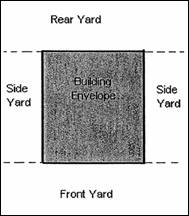
"Building frontage" means the linear dimension, parallel to the ground, of that side of a building facing on a public street.
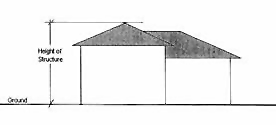
"Building height" means the vertical distance from the finished grade to the highest point of the structure, excluding chimneys and vents.
"Building site" means a legally created parcel or several contiguous parcels of land in single or joint ownership, which provide the area and the open spaces required by this title, exclusive of all vehicular and pedestrian public rights-of-way.
"By-right use" means a use that does not require a conditional use permit, planned unit development permit, or other discretionary local government review or approval that would constitute a "project" for purposes of Division 13 (commencing with Section 21000) of the Public Resources Code, excepting (a) any subdivision, which shall be subject to all laws, including, but not limited to, the local government ordinance implementing the Subdivision Map Act, and (b) design review, provided that design review shall not constitute a "project" for purposes of Division 13 (commencing with Section 21000) of the Public Resources Code.
"Car title loan establishment" means any business that engages in providing short-term loans in which the borrower's car title is used as collateral. The borrower must be the lien holder (i.e., own the car outright).
"Carport" means a permanent roofed structure completely open on two or more sides to be used for vehicle parking.
"CC&Rs" means covenants, conditions, and restrictions as recorded as a deed restriction running with the land and binding upon subsequent owners of the property.
"Cemetery" means land used or intended to be used primarily for the burial of deceased persons or animals and dedicated for cemetery purposes, including columbariums, crematories, mausoleums and mortuaries when operated in conjunction with and within the boundary of the cemetery.
"Check cashing store" means any business, company, corporation, establishment, organization, private enterprise, shop, or store whose primary service is that of a check casher, as defined by Section 1789.31 of the California Civil Code, as may be amended from time to time.
"Clubs and lodges" means permanent headquarters and meeting facilities for organizations operating on a membership basis for the promotion of the interests of the members, including facilities for: business associations, political organizations, civic, social, and fraternal organizations, professional membership organizations, labor unions and similar organizations, or other membership organizations.
"Commercial filming studio" means an enterprise engaged in the production, distribution or exchange of motion picture photography at the same location more than six days per quarter of a calendar year.
"Commission/planning commission" means the planning commission of the city of Rohnert Park.
"Common area" means a parcel or parcels of land, together with the improvements thereon, which are shared by several owners in common.
"Common open space": See "Open space, common."
"Community center" means an area developed, or to be developed separately or with any of the following public buildings or uses: offices, libraries, playgrounds, parks, assembly halls, police stations, swimming pools and fire stations.
"Conditional use" means a use that is generally compatible with other uses permitted in a zoning district, but that requires individual review of its location, unusual site development features or operating characteristics, and/or intensity and density of use and structures, and may require the imposition of conditions pertinent thereto to ensure that the use is designed, located, and operated compatibly with uses on adjoining properties and in the surrounding area. The planning commission shall have responsibility for the review of conditional uses.
"Condominium" means an estate in real property consisting of an undivided interest in common in a portion of a parcel of real property, together with a separate interest in space in a commercial or residential building, such as an apartment. A condominium may include, in addition, a separate interest in other portions of such project.
"Condo conversion" means the change in a development's status from existing multifamily rental housing units to private ownership of lot or air space. This term applies to commercial and industrial properties as well as where ownership of ground or airspace rights are involved.
"Congregate care/assisted living facility" means a facility providing full-time care, either permanently or temporarily, for those persons unable to live independently, due to age, physical or developmental disability or medical disability. Congregate care facilities include the following state-authorized or licensed operations:
"Congregate care/assisted living facility, small" means facilities providing care for six or fewer children or adults housed in a single-family residential unit; and
"Congregate care/assisted living facility, large" means facilities providing care for seven or more children or adults.
"Contractor yard": See "Equipment rental yard/contractor yard."
"Convenience store" means a retail establishment with a sales area of five thousand square feet or less which sells primarily food, household, and personal convenience items.
"Council/city council" means the city council of Rohnert Park.
"Court" means a space, open and unobstructed to the sky, located at or above grade level on a lot and bounded on three or more sides by walls of a building and/or buildings.
"Coverage, lot or site": See "Lot coverage."
"Credit union": See "Banks/savings and loans/credit unions."
"Cultural institutions" means institutions with an acknowledged mission to engage in the conservation, interpretation and dissemination of cultural, scientific, and environmental knowledge. These uses promote activities meant to inform and educate about culture, history, science, wildlife, and the environment and could include museums, science and exploration and wildlife demonstrations.
"Cyber cafe" means an establishment that provides four or more computers and/or other electronic devices for access to the internet, e-mail, video games or computer software programs which are networked or which function as a client/server program, and which seeks compensation in any form from users. Also referred to as a PC cafe, internet cafe, or cyber center, but does not include a cyber learning center.
"Day care center" means any child day care facility other than a family day care home. Includes infant care centers, preschools, and extended day care facilities.
"Day care facility" means a facility which provides non-medical care to children under eighteen years of age in need of personal services, supervision, or assistance essential for sustaining the activities of daily living or for the protection of the individual on less than a twenty-four-hour basis. Child day care facilities includes day care centers and day care homes. Refer to definitions for both.
"Day care home" means a licensed home which is authorized, certified or licensed by the state of California which regularly provides care, protection and supervision of twelve or fewer children in the provider's own home, for periods of less than twenty-four hours per day. The number of children shall include children under the age of ten who reside at the provider's home.
"Day care home, small" means a licensed facility that provides day care to eight or fewer children.
"Day care home, large" means a licensed facility that provides day care for nine to fourteen children.
"Deck" means a platform less than thirty inches above grade, either free standing or attached to a building.
"Density" means the number of dwelling units per gross acre. See also "Dwelling unit."
"Density bonus" means a provision to allow additional units above the maximum allowable within a district as an incentive to provide dwelling units for low and very low income households.
"Depth": See "Lot depth."
"Domestic animals" means small animals of the type generally accepted as pets that are customarily kept for personal use or enjoyment within the home or yard, such as dogs, cats, rabbits, canaries or parrots.
"Dwelling, multiple-family" means a structure containing two or more dwelling units.
"Dwelling, single-family, attached (duplex, townhouse, zero lot line developments)" means one of two or more dwelling units situated on separate lots and having a common or party wall separating the dwelling units.
"Dwelling, single-family, detached" means a detached building containing a single dwelling unit and surrounded by open space on the same lot.
"Dwelling unit" means any building or portion thereof which contains living facilities, including provisions for sleeping, eating, cooking and sanitation, as required by the California Building Standards Code, Rohnert Park amendments thereto, and model codes adopted under municipal code Title 15, for not more than one family. For the purposes of calculating density, duplex studio units whose total square footage does not exceed eight hundred fifty square feet shall be considered a single multifamily, one-bedroom unit.
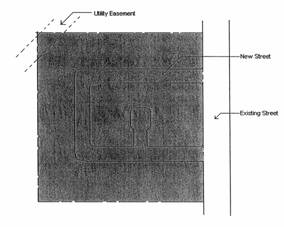
"Easement" means a grant of one or more property rights by the property owner for the use by the public, a corporation or another person or entity.
"Educational institution" means an institution giving general academic instruction equivalent to the standards prescribed by the state board of education.
"Elevation" means:
(A)
A vertical distance above or below a fixed reference level; or
(B)
A flat scale drawing of the front, rear, or side of a building or structure.
"Emergency shelter" means housing with minimal supportive services for homeless persons that is limited to occupancy of six months or less by a homeless person. May also be referred to as "homeless shelter."
"Employee housing" housing that serves employees, and includes farmworker housing. Employee housing shall be considered a residential use and only subject to those restrictions that apply to other residential uses of the same type in the same zone, as required by California Health and Safety Code Sections 17021.5 and 17021.6.
"Equipment rental yard/contractor yard" means a use providing for maintenance, servicing, or storage of motor vehicles, equipment, or supplies; or for the dispatching of service vehicles; or distribution of supplies or construction materials required in connection with a business activity, public utility service, transportation service, or similar activity. The term "contractor yard" shall include a construction materials yard, vehicular service center, or similar use.
"Erect" means to build, construct, attach, place, suspend or affix to or upon any surface. Such term shall also include the painting of wall signs.
"Family" means an individual or two or more persons, living as a single housekeeping unit.
"Family care home" means a state-authorized, certified or licensed family care home, foster home, or group home serving six or fewer mentally disordered or otherwise handicapped persons or dependent and neglected children providing care on a twenty-four-hour-a-day basis. Includes elderly group homes and adult group homes as defined by the state of California.
"Fire code" means California Building Standards Code, Part IX and local amendments as contained in the city of Rohnert Park's Municipal Code, Title 15, Chapter 15.28.
"Floor area, gross" means the area included within the surrounding exterior walls of a building or portion thereof, exclusive of HVAC, elevator shafts, courts and loading docks. The floor area of a building, or portion thereof, not provided with surrounding exterior walls shall be the useable area under the horizontal projection of the roof or floor above.
"Floor area ratio (FAR)" means the gross floor area of all buildings on a lot divided by the building site area.
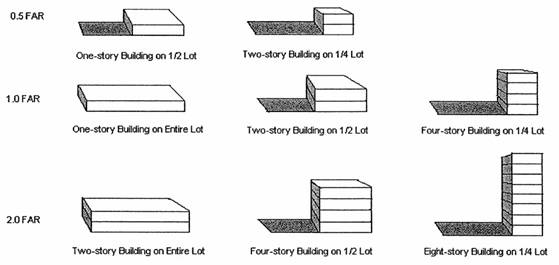
"Fraternity/sorority house" means a housing unit owned by and/or rented exclusively to university students who are members of an official fraternity or sorority organization recognized by the university and used for one or more fraternity or sorority functions.
"Frontage" means the side of a lot abutting a street (the front property line), except the side of a corner lot. For purposes of determining frontage on a corner lot, the narrowest street property line shall be considered the front of the lot. See also "Building frontage."
"Furniture store" means a commercial establishment engaged primarily in the selling of furniture, mattresses, and household appliances, including incidental repair services. Illustrative examples of these establishments include establishments that sell home furnishings, office furniture, outdoor furniture, or movable spas and hot tubs.
"Garage" means a building, or a portion of a building, enclosed on two or more sides and used for the parking of vehicles.
"General plan" means the city of Rohnert Park general plan as adopted by the city council, who may amend the plan from time to time, hereafter referred to as the general plan.
"Grade, existing" means the surface of the ground or pavement at a stated location as it exists before disturbance in preparation for a project regulated by this chapter.
"Grade, finished" means the lowest point of elevation of the finished surface of the ground, paving, or sidewalk within the area between the building and the property line. When the property line is more than five feet from the building, the finished grade shall be the lowest point between the building and a line five feet from the building.
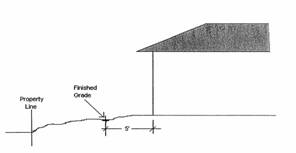
"Gross acreage" means the total area within the lot lines of a lot or parcel of land before public streets, easements or other areas to be dedicated or reserved for public use are deducted from such lot or parcel, and does not include adjacent lands already dedicated for such purposes.
"Group home": See "Family care home."
"Group, residential" means shared living quarters without separate kitchen or bathroom.
"Height of building": See "Building height."
"Home occupation" means a business enterprise conducted entirely within a dwelling unit, garage or accessory building by the occupant(s) of the primary dwelling, which occupation is clearly incidental and secondary to the use of the dwelling for residential purposes.
"Hospital" means an institution providing physical or mental health services, in-patient or overnight accommodations, and medical or surgical care of the sick or injured including full-time medical supervision which is approved by the American Hospital Association and licensed by the state.
"Hotel" means any building containing six or more guest rooms, primarily accessible from interior hallways, intended or designed to be used, or which are used, rented or hired out to be occupied or which are occupied for transient sleeping purposes by guests. No in-room food preparation unless applied for and approved with project or separately. (Also see "Motel.")
"Incidental": See "Accessory building or use."
"Intersection, controlled" means an intersection controlled by the use of traffic signals or signs, such as stop or yield signs.
"Intersection, uncontrolled" means an intersection not controlled by traffic signals or signs.
"Junk yard" means an outdoor space used exclusively for the storage or sale of secondhand and used machinery and scrap iron, including automobiles, tools, implements or parts or portions thereof, and any and all secondhand used furniture or other personal property, or part or portions thereof.
"Kennel (commercial)" shall be as defined in Rohnert Park Municipal Code Section 6.02.070.F.
"Kiosk" means an ancillary, freestanding structure designed for retail sales or public/informational notices.
"Kitchen" means a room or area within a room used for cooking and/or preparation of foods.
"Landscaping" means an area devoted to or developed and maintained predominantly with native or exotic plant materials, including lawn, ground cover, trees, shrubs, and other plant materials; and also including accessory decorative outdoor landscape elements such as pools, fountains, paved or decorated surfaces (excluding driveways, parking, loading, or storage areas), and sculptural elements.
"Live/work" means an occupancy by an individual or a family maintaining a common household consisting of one or more rooms or floors in a building originally designed for industrial or commercial occupancy or in a new building specifically designed for live/work and which includes the following:
A.
Cooking and sanitary facilities in accordance with applicable building standards adopted by the city of Rohnert Park; and
B.
Adequate working space reserved for and used by one or more persons residing therein.
"Loading space" means an off-street space or berth on the same lot with a building or contiguous group of buildings, for the temporary parking of vehicles while loading or unloading merchandise or materials.
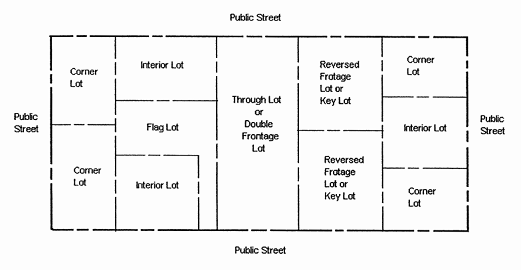
"Lot" means a parcel of land occupied, or intended to be occupied, by a building, group of buildings or uses, and accessory buildings, together with such open space, yard and setbacks as are required. The parcel must have the minimum area required for a lot in the zone in which such lot is located and having its principal frontage on public street or public right-of-way. The classification of lots are as follows:
A.
"Corner lot" means a lot abutting on and at the intersection of two or more streets.
B.
"Flag lot" means a lot having access or an easement to a public or private street by a narrow, private right-of-way.
C.
"Interior lot" means a lot abutting only one street.
D.
"Reversed frontage lot or key lot" means a lot with a side line that abuts the rear line of any one or more adjoining lots.
E.
"Through lot or double-frontage lot" means an interior lot having frontage on more than one street. Each frontage from which access is permitted shall be deemed a front lot line.
"Lot area" means the total horizontal area included within the lot lines of a lot.
"Lot coverage" means the percent of the lot area which may be covered by all buildings and structures, excluding allowed projecting eaves, balconies and similar features and by a deck(s) more than thirty inches in height.
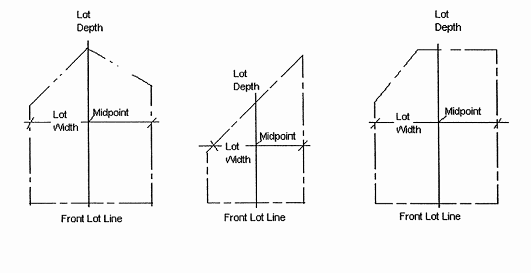
"Lot depth" means the linear distance between the front and rear property lines of a site measured along a line midway between the side property lines.
"Lot or property line" means a line dividing one lot from another lot, street or alley.
A.
"Front." See "Frontage."
B.
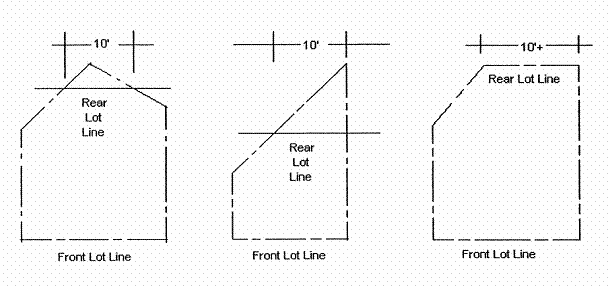
"Rear" means a lot line, not intersecting a front line, which is most distant from and most closely parallel to the front lot line. In the case of an irregularly shaped lot or a lot bounded by only three lot lines, a line within the lot having a length of ten feet or more, parallel to and most distant from the front lot line shall be interpreted as the rear lot line for the purpose of determining required yards, setbacks, and other provisions of this title.
C.
"Interior" means any lot line not abutting a street.
D.
"Side" means any lot line that is not a front lot line or a rear lot line.
"Lot width" means the horizontal distance between the side lot lines, measured at right angles to the lot depth at a point midway between the front and rear lot lines.
"Low barrier navigation center" means a housing-first, low-barrier, service-enriched shelter as defined in California Government Code Section 65660(a) as most currently in effect, or in any successor statute.
"Manufactured home" means a complete single-family home deliverable in one or more transportable sections, certified under the National Manufactured Housing Construction and Safety Standards established by the U.S. Department of Housing and Urban Development, and that is attached to a permanent foundation. A manufactured home is also commonly referred to as a "mobile home" or "modular home." A manufactured home is not the same as a recreational vehicle, commercial coach, or factory-built home, which may look similar from the exterior.
"Massage establishment": See Chapter 8.36.
"Medical marijuana dispensary" means any facility where medical marijuana is made available to and/or distributed to one or more of the following: a "primary caregiver," a "qualified patient," or a "person with an identification card." Each of these terms is defined in California Health and Safety Code Section 11362.7 and shall be interpreted in strict accordance with Health and Safety Code Sections 11362.5 and 11362.7 et seq. A medical marijuana dispensary shall not include the following uses, so long as the location of such uses is otherwise regulated by the city's municipal code or other applicable law and such uses strictly comply with the city's municipal code or other applicable law, including but not limited to, Health and Safety Code Sections 11362.5 and 11362.7 et seq.: a clinic licensed pursuant to Chapter 1 of Division 2 of the Health and Safety Code; a healthcare facility licensed pursuant to Chapter 2 of Divisions 2 of the Health and Safety Code; a residential care facility for persons with chronic life-threatening illness licensed pursuant to Chapter 3.01 of Division 2 of the Health and Safety Code; a residential care facility for the elderly licensed pursuant to Chapter 3.2 of Division 2 of the Health and Safety Code; a residential hospice, or a home health agency licensed pursuant to Chapter 8 of Division 2 of the Health and Safety Code.
"Medical office/clinic" means a facility, other than a hospital, where medical, dental, mental health, surgical, and/or other personal health care services are provided on an outpatient basis. A medical office use would provide consultation, diagnosis, therapeutic, preventative or corrective treatment services by doctors, dentists, medical and dental laboratories, chiropractors, counselors, physical therapists, respiratory therapists, acupuncturists and psychiatrists, and similar practitioners of medical and healing arts for humans licensed for such practice by the State of California. This does not include a massage therapist, except as an ancillary use to another medical office/clinic use.
"Microbrewery" means any brewery that produces fewer than half a million gallons of beer per year.
"Motel" means a building or group of buildings containing six or more guest rooms which are rented or hired out to be occupied or which are occupied for transient sleeping purposes, typically where a majority of such rooms open directly to the outside, and parking is located adjacent to the room. No in-room food preparation is allowed unless applied for and approved as part of project approval or separately.
"Multifamily residential": See "Dwelling, multifamily."
"Natural state" means all land and water that remains undeveloped and undisturbed. The grading, excavating or filling of land, and/or the construction of roadways, driveways, parking areas, and structure shall be prohibited in areas so designated. Incidental minor grading for such purposes as equestrian, bicycling, or pedestrian trails, picnic areas, flood control, and planting and landscaping which is in addition to and enhances the natural environment may be permitted.
"Natural waterway" means any natural stream of water flowing in a definite course or channel and possessing a bed and banks. It is not necessary that the flow of water be continuous throughout the year. Natural waterways do not include artificially created channels for storm waters, such as street gutters and drain and drainage facilities installed in connection with the development of property.
"Nonconforming lot" means a lot which was lawfully subdivided or established, but which does not conform with prescribed regulations for the district in which the lot is located by reason of adoption or amendment of this title or by reason of annexation of territory to the city. The lot shall be shown on a duly approved and recorded tract or parcel map or has been issued or is eligible for a certificate of compliance or conditional certificate of compliance.
"Nonconforming structure" means any structure legally constructed or established which fails to conform to the regulations of this ordinance, within the district in which it is located by reason of the adoption of this ordinance or any amendment hereto or by reason of annexation of territory to the city. Structures not legally established, which fail to conform to the provisions of this ordinance, shall be deemed to be illegal structures.
"Nonconforming use" means a use of a structure or land which is lawfully established and maintained prior to the adoption of this ordinance but which does not conform with the use regulations of the district in which it is located. Uses not legally established, which fail to conform to the provisions of this ordinance, shall be deemed to be illegal uses.
"Occupancy" means the purpose for which a building, or part thereof, is used or intended to be used.
"Off-campus student housing" means a living arrangement for student tenants within an off-campus dwelling unit or portion thereof, except if all the student tenants are family of the owner of the dwelling or the dwelling is leased and used only by a family as the family's primary residence. Off-campus student housing shall not include dormitories owned and operated by a university, college or trade school.
"Office": See "Professional office."
"Open space" means the area of a project (exclusive of the required setback from a public street) which is to be used exclusively for leisure, recreational, and/or aesthetic or visual relief purposes. Open space areas may include those reserved for active and passive recreational uses and park facilities.
"Open space, common" means an open area within a residential or commercial development reserved for the exclusive use of the residents or employees of the development and guests.
"Open space, private" means a usable open space adjoining and directly accessible to a dwelling unit, reserved for the exclusive use of residents of the dwelling unit and their guests.
"Parking lot" means an off-street parking area, not within a building, where motor vehicles may be stored for the purposes of temporary, daily or overnight parking.
"Parking space" means an unobstructed, permanently reserved and clearly delineated area or space other than a street or alley maintained for the parking of one motor vehicle.
"Patio, covered" means a covered area without walls, screens, or windows on two or more sides or when walls, screens, or windows are incorporated meeting the requirements of the Uniform Building Code, Appendix Chapter 31, Division III, Section 3116.
"Pawn shop" means an establishment in which any business is engaged in, carried on, or conducted that involves the receipt of personal property in pledge as security for a loan pursuant to California Financial Code Section 21000 et seq., as may be amended from time to time. "Pawn shop" does not include banks, savings and loan institutions, credit unions, or other banking organizations regulated by state or federal law.
"Payday loan establishment" means any establishment whose business includes the making of deferred deposit transactions, commonly referred to as "payday loans." "Payday loan establishment" includes any business operating as a "licensee" under California Financial Code Section 23001(d).
"Personal services" means services of a personal convenience nature, as opposed to products, sold to individual consumers and include the provision of information, individual instruction, beauty and body art, barber shops, laundry and cleaning services, and similar services.
"Pre-existing" means in existence prior to the effective date of this ordinance or applicable amendments thereto.
"Principal or primary use" means the predominant use of any lot, building or structure.
"Processing facility" means a building or enclosed space used for the collection and processing of recyclable materials. Processing means the preparation of material for efficient shipment, or to an end-users specification, by such means as baling, briquetting, compacting, flattening, grinding, crushing, mechanical sorting, shredding, cleaning, and remanufacturing. Processing facilities include the following:
A.
"Light processing facility": Occupies an area of under forty-five thousand square feet of gross collection, processing and storage area and has up to an average of two outbound truck shipments per day. Light processing facilities are limited to baling, briquetting, crushing, compacting, grinding, shredding and sorting of source-separated recyclable materials and repairing of reusable materials sufficient to qualify as a certified processing facility. A light processing facility shall not shred, compact, or bale ferrous metals other than food and beverage containers.
B.
"Heavy processing facility" means any processing facility other than a light processing facility.
"Professional office" means an office or studio of professional or service occupations or agencies which benefit from and contribute to an environment generally characterized by low traffic and pedestrian volumes, lack of distracting, irritating or sustained noise, and low density building developments, including occupations or agencies such as accountants, administrative offices, appraisers, architects, engineers, lawyers, secretarial agencies, and real estate.
"Public assembly" means facilities in which people assemble for civic, educational, religious, or cultural purposes, such as event facilities, auditoriums, community centers, conference and convention facilities, and places of worship (e.g., churches, temples, synagogues, mosques).
"Public hearing" means a noticed meeting where the public is provided an opportunity to comment and file testimony on a matter under consideration prior to official action being taken.
"Recovery facility" means any facility, place or building which provides twenty-four-hour residential non-medical services to adults who are recovering from problems related to alcohol, drug, or alcohol and drug misuse or abuse, and who need alcohol, drug, or alcohol and drug recovery treatment or detoxification services. "Adults" may include, but need not be limited to, parents over eighteen years of age and their children, and emancipated minors, which may include, but need not be limited to, parents under eighteen years of age and their children who are recovering from alcohol, drug or drug and alcohol misuse and are currently capable of meeting their life support needs independently, but who temporarily need guidance, counseling, or other alcohol or drug recovery services. Recovery facilities that offer drug or alcohol abuse counseling must require counselors to be licensed by the state.
A.
"Recovery facilities, small" means facilities providing care for six or fewer adults (as defined above) and housed in a single-family residential unit; and
B.
"Recovery facilities, large" means facilities providing care for seven or more adults.
"Recreation facility, commercial" means recreation facilities operated as a business and open to the general public for a fee.
"Recreation facility, private" means clubs or recreation facilities for which a membership charge may be made and which are open only to bona fide members and their guests. A private recreational facility may not be open or available to members of the general public.
"Recreation facility, public" means publicly owned or operated recreation facilities.
"Recreational vehicle" means any vehicle or trailer designed or modified for use as a camp car, camper, motor home, house car, trailer, trailer coach, boat, boat trailer, snowmobile, snowmobile trailer, camping trailer or for any similar purpose.
"Recyclable material" means reusable material including, but not limited to, metals, glass, plastic and paper, which are intended for reuse, remanufacture or reconstitution for the purpose of using the altered form. "Recyclable material" does not include refuse or hazardous material as defined in Section 15.04.820.020. Recyclable material may include used motor oil collected and transported in accordance with Sections 25250.11 and 25143.2(b)(4) of the California Health and Safety Code.
"Recycling facility" means a center for the collection and/or processing of recyclable materials. A certified recycling facility or certified processor means a recycling facility certified by the California Department of Conservation as meeting the requirements of the California Beverage Container Recycling and Litter Reduction Act of 1986. A recycling facility does not include storage containers or processing activity located on the premises of a residential, commercial, or manufacturing use and used solely for the recycling of materials generated by that residential property, business or manufacturer. Recycling facilities may include the following:
A.
"Recycling collection facility" means a collection facility for the acceptance by donation, redemption, or purchase of recyclable material from the public. Such a facility does not use power-driven processing equipment except as provided for in particular zoning districts. Collection facilities may include the following:
1.
"Small recycling collection facility": Occupies an area of not more than five hundred square feet and may include a mobile unit; bulk reverse vending machines or a grouping of reverse vending machines occupying more than fifty square feet, kiosk type units which may include permanent structures; unattended containers placed for the donation of recyclable materials.
2.
"Large recycling collection facility": Occupies an area of more than five hundred square feet, or is on a separate property not appurtenant to a host use, and which may include permanent structures.
B.
"Reverse vending machine" means an automated mechanical device which accepts at least one or more types of empty beverage containers including, but not limited to, aluminum cans, glass and plastic bottles, and issues a cash refund or a redeemable credit slip with a value not less than the container's redemption value as determined by the state. A reverse vending machine may sort and process containers mechanically provided that the entire process is enclosed within the machine.
"Religious assembly uses" means the operation of nonsecular facilities, such as churches, temples, synagogues, and related playgrounds, centers and halls for social, educational, religious and recreational activities.
"Research and development" means uses engaged in the research, analysis, design, development and/or testing of a product.
"Rooming house": See "Boarding house."
"Rounding of quantities" means the consideration of distances, unit density, density bonus calculations, or other aspects of development or the physical environment expressed in numerical quantities which are fractions of whole numbers; the numbers are to be rounded to the nearest highest whole number when the fraction is 0.5 or more, and to the next lowest whole number when the fraction is less than 0.5, except as otherwise provided in this title.
"Savings and loan": See "Banks/savings and loans/credit unions."
"School" means an institution for the teaching of children or adults including primary and secondary schools, colleges, professional schools, business schools, trade schools, art schools, large studios (greater than or equal to two thousand five hundred square feet) for specialized education and training, and similar facilities.
"Second dwelling or residential unit" - See "Accessory dwelling unit".
"Senior housing" means residential development designed for households occupied by senior citizens, with age restrictions consistent with federal and state requirements. Such development may include central recreation areas and accessory medical facilities.
"Setback" means a required, specified distance between a building or structure and a lot line or lines, measured perpendicularly from the lot line or lines in a horizontal plan extending across the complete length of such lot line or lines.
"Short-term rental" means a dwelling unit, part of a dwelling unit, or an accessory dwelling unit, that is a type of transient lodging establishment engaged in providing overnight or otherwise temporary lodging for a period of less than thirty days. Does not include "bed and breakfast inns", "boarding house", "hotel", or "motel", each of which are separately defined.
"Sign" means a device, display, figure, message, placard or structure, including its component parts, situated indoors or outdoors, which is constructed, designed, intended or used to advertise or otherwise attract or direct attention, provide information, to a business, event or location, institution, person, product or service, or promotes the interests of any person, by any means including, but not limited to, color, design, figures, illumination, letters, projected images or words, and is visible from any public street, road, highway, right-of-way, or parking area. Signage terminology used in this code includes the following:
1.
"Abandoned" means any sign that advertises a business, lessor, owner, product, service or activity that is no longer located on premises where the sign is displayed.
2.
"Address" means a sign identifying the position of a land use in relationship to a public or private street.
3.
"Alteration" means any change of copy, sign face, color, size, shape, illumination, position, location, construction, or supporting structure of any sign.
4.
Area. See "Sign area."
5.
"Attention attracting device" means animated or moving signs, including signs held by mechanical mannequin or other devices, balloons, banners, beacons, blinking or traveling lights, flashing messages, inflatable signs (and figures), pennants, search lights, spinners and streamers, but excluding approved temporary banners, time/temperature devices, and electronic message boards.
6.
"Awning" means a sign attached to a roof-like projection from the wall of a building that serves to shield a doorway or window from the weather and is often constructed of weather resistant fabric.
7.
Banner. See "Flags, banners or pennants."
8.
"Campaign" means a temporary sign that is designed to support the passage or defeat of any measure on a ballot or to influence voters with respect to the nomination, election, defeat, or removal of a candidate from public office at any national, state, or local election.
9.
"City entry" means a public sign located at specific entry points to the city of Rohnert Park.
10.
"Commemorative" means a sign which commemorates the historical status and/or date of erection.
11.
"Commercial" means any sign with a commercial message.
12.
"Commercial message" means any wording, logo or other representations that, directly or indirectly, names, advertises or calls attention to a business, product, service or other commercial activity.
13.
"Construction" means a sign that identifies the architects, engineers, owners, lenders, contractors, future tenants and others associated with a construction project, but which contains no other advertising matter.
14.
"Copy" means words, letters, numbers, figures, designs or other symbolic representations incorporated into a sign.
15.
"Directional" means a sign that has been designed and erected for the sole purpose of directing vehicular and/or pedestrian traffic within a project, e.g., restroom, security office, entrance/exit.
16.
"Directory" means a sign that lists tenants of a multiple tenant building or center.
17.
"Double-faced" means a sign which has back to back sign copy where the angle between the two faces does not exceed thirty degrees.
18.
"Edge of roof" means on a pitched roof, the lowest portion of the fascia board covering the roof rafters, or, if no fascia board exists, the lowest point of the roof rafters. On a flat roof, the top of the parapet wall or three feet above the roof deck, whichever is less.
19.
"Electronic message center" means a sign with a fixed or changing display composed of a series of lights, but not including time/temperature displays.
20.
"External illumination" means the lighting of an object from a light source located at a distance from the object.
21.
"Flags, banners or pennants" means cloth, plastic, paper or similar material used for advertising purposes attached to framing, line, pole, structure, staff or vehicle.
22.
"Flashing" means a sign that includes an intermittent or sequential flashing light source.
23.
"Freestanding monument" means a sign that is supported by a base structure that rests on the ground and is not supported or attached to a building.
24.
"Freeway oriented" means a freestanding sign located on a nonresidential property and directly adjacent to Highway 101.
25.
"Hand-held" means a sign that is held by or otherwise mounted on a person. For the purposes of this title, "hand-held sign" does not include a noncommercial sign.
26.
Height, sign. See "Sign height."
27.
"Illegal sign" means:
a.
Any sign originally erected or installed without first complying with all structural, locational, design, building, and electrical regulations in effect at the time of its construction or installation;
b.
Any commercial sign that is not maintained, or is not used to identify or advertise an ongoing business, occupancy, product, good or service available on the site of the sign for more than ninety days;
c.
Any unsafe sign;
d.
Any legal nonconforming sign that has not been removed following the expiration of any applicable amortization period provided in this code; and
e.
Any sign that is in violation of the provisions of Chapter 17.27 (Signs).
28.
"Inflatable device" means an object that is filled with a gas, including CO2.
29.
"Internal illumination" means the lighting of an object from within the interior so that light rays go through the face of the sign. This does not include a sign with a light source that is attached to the face of the sign and is perceived as a design element of the sign.
30.
"Live/work" means a sign that identifies the location of a live/work unit within a mixed-use or similar type development.
31.
"Maintenance, normal" means the painting and cleaning of signs and/or the replacement of like parts of a nonstructural nature, e.g., lights, panels, trim pieces and other similar items.
32.
Marquee. See "Theatre, marquee."
33.
"Mural" means a two-dimensional piece of art which is applied to the flat surface or wall of a building.
34.
"Neon" means a light source that is generated by inserting electrical energy into a chemically inert gas.
35.
"Noncommercial message" means any wording, logo or other representation that does not directly or indirectly, name, advertise or calls attention to a commercial or industrial business, product, good, service or other commercial or industrial activity.
36.
"Noncommercial sign" means a sign that does not name, advertise or call attention to a commercial or industrial business, commodity, product, good, service or other commercial or industrial activity for a commercial or industrial purpose.
37.
"Nonconforming" means an advertising structure or sign which was lawfully erected and maintained in conformance with the requirements in effect at the time, and which has subsequently come under new amended requirements and no longer complies with the requirements.
38.
"Obscene" means a sign that includes materials that appeal predominantly to a prurient interest in sexual conduct, depict or describe sexual conduct in a patently offensive way, and lack serious literary, artistic, political, or scientific value.
39.
"Off-site billboard" means a sign identifying a use, facility, service or product that is not located, sold or manufactured on the same premises as the sign.
40.
"On-site sign" means any sign which directs attention to an occupancy, business, commodity, good, product, service or other activity conducted, sold or offered upon the site where the sign is maintained. For the purposes of this title, all signs with noncommercial messages are deemed to be "on-site," regardless of location.
41.
Pennants. See "Flags, banners or pennants."
42.
"Permanent" means a sign constructed of durable materials and intended to exist for the duration of time that the use or occupant is located on the premises.
43.
"Primary street frontage" means the primary street frontage is the most prominent public right-of-way as related to a lot of record.
44.
"Private information" means signs that are required or permitted by law to be posted, or signs displayed on private property that are intended to preserve and protect public health, safety and general welfare. Examples include, but are not limited to: beware of dog signs, no soliciting signs, and no trespassing signs.
45.
"Portable" means an "A" frame sign or other sign attached to a devise used to allow the sign to be rolled or moved around.
46.
"Projecting" or "suspended" means a sign, other than a wall sign, that is suspended from or supported by a structure attached to a building and projecting outward from the building.
47.
"Public information" means a sign that has been displayed by a federal, state or local agency for the purpose of protecting public health, safety and general welfare.
48.
"Real estate" means a sign indicating that a property or any portion thereof is available for inspection, sale, lease, rent or directing people to a property, and does not include temporary subdivision signs.
49.
"Roof" means a sign mounted on the roof of a building or supported entirely by the building and which projects above the highest point of a building with a flat roof, the eave line of a building with a gambrel, gable or hip roof or the deck line of a building with a mansard roof.
50.
"Sign area" means the surface of a sign.
51.
"Sign face" means that portion of a sign intended to be viewed from one direction at a time.
52.
"Sign height" means the vertical distance from the lowest point of the base of the sign to the highest point of the structure, where the lowest point of the base of the sign structure does not include fill, planters or other materials that artificially increase the sign height.
53.
"Sign program" means a process for reviewing and approving nonresidential or mixed use signage for larger sites and buildings, and for properties with multiple tenants for the purpose of ensuring aesthetic compatibility and equitable signage area.
54.
"Sign structure" means the supporting framework or bracing of a sign and incidental to the sign display.
55.
"Subdivision" means a sign that identifies a subdivision project with units for sale.
56.
"Temporary" means a sign intended to be displayed for a limited period of time and capable of being viewed at a building frontage, including but not limited to: construction and subdivision signs, campaign signs, real estate signs, and special event signs.
57.
"Theatre marquee" means a sign that is attached to or otherwise made part of a permanent roof-like structure and projects beyond the building wall in the form of a large canopy to provide protection from the weather.
58.
"Three-dimensional" means a sign that has a relief image on its surface that exceeds six inches.
59.
"Time/temperature" means the area of any time and/or temperature device incorporated into a sign shall not be included in the calculation of total sign area.
60.
"Unsafe sign" means a sign posing an immediate peril or reasonably foreseeable threat of injury or damage to persons or property on account of the condition of the sign structure or its mounting mechanism.
61.
"Vehicle" means a sign that is used or intended for use as a portable sign and is towed or affixed to a vehicle and used to display commercial or noncommercial messages primarily for advertising purposes unrelated to the principal use of the vehicle.
62.
"Wall" means a sign that is attached or painted on the exterior wall of a structure with the display surface of the sign approximately parallel to the building wall.
63.
"Window" means a sign posted, painted, placed, or affixed on the interior or exterior of a window exposed to public view, and includes an interior sign that faces a window exposed to public view and is located within two feet of the window. This definition does not include window displays of merchandise offered for sale, so long as such displays are located more than two feet from the window on the interior.
"Single-family residential": See "Dwelling, single-family, attached or detached."
"Single-room occupancy (SRO) living unit facility" means a residential development or commercial facility containing secure rooms, of a smaller size than normally found in multiple dwellings, which are rented to a one- or two-person household. SRO living units are provided for a weekly or monthly period of time, although commercial facilities may be a daily basis, in exchange for an agreed payment or a fixed amount of money or other compensation.
"Site": See "Lot."
"Site area": See "Lot area."
"Slope" means the vertical distance divided by the horizontal distance.
"Spa": See "Bath house/spa."
"Specific plan" means a plan consisting of text, maps, and other documents and exhibits regulating development within a defined area of the city, consistent with the Rohnert Park general plan and the provisions of Chapter 17.06, Article VIII of this title and Government Code Section 65450 et seq.
"Stable, commercial" means housing for horses owned and used by someone other than the occupant or owner of the residence and including related shows, lessons, clinics, and similar activities.
"Stable, private" means housing for horses owned by the occupant or owner of the residence. Raising, feeding, maintaining and breeding of not more than one horse per twenty thousand square feet of site area.
"Story" means that portion of a building included between the surface of any floor and the surface of the floor next above except that the topmost story shall be that portion of a building included between the upper surface of the topmost floor and the ceiling or roof above. If there is no floor above it, then the space between such floor and the ceiling next above it shall be considered a story.
"Street" means any thoroughfare, alley, way, boulevard, or road, either public or private, which is used or is to be used for access to abutting land.
"Structural alteration" means any change in the supporting members of a building, such as bearing walls, columns, beams or girders.
"Structure" means anything constructed or erected, the use of which requires location on the ground or attachment to something having location on the ground.
"Structure, accessory": See "Accessory building or use."
"Structure, attached": See "Attached structure."
"Student tenant" means an individual who is enrolled or has made application to and been accepted at a university, college, or trade school and who is residing in a dwelling unit governed by this ordinance.
"Studio—Arts and educational" means small-scale commercial facilities (less than two thousand five hundred square feet) for specialized education and/or training, typically accommodating one group of students at a time, in no more than one instructional space. Larger facilities are included under the definition of "Schools." Does not include preschools and child day care facilities.
"Supermarket" means a retail business where the majority of the floor area that is open and accessible to the public is occupied by produce, food, beverage products, and household items that are packaged for preparation and consumption for daily living needs. Supermarkets are distinguished from "convenience stores" in that they typically contain a retail floor area greater than five thousand gross square feet.
"Supportive housing" means housing with no limit on length of stay, that is occupied by the target population, as defined in Health and Safety Code Section 50675.14, that is linked to on-site or off-site services that assist the tenants with the retention of the housing, improving health status, and maximizing ability to live and, when possible, to work in the community, and which may include nonresidential uses and administrative office spaces as provided in Government Code Section 65651(a)(5). Supportive housing shall be considered a residential use and only subject to those restrictions that apply to other residential uses of the same type in the same zone.
"Telecom center" means facilities made to house equipment instead of people.
"Temporary use/event/building" means a use, event, or building which will be in existence either seasonally or for a period of two years or less.
"Tobacco store" shall be as defined in Chapter 8.32.
"Townhouse": See "Dwelling, single-family, attached."
"Trailer" means a vehicle without motor power, designed so that it can be drawn by a motor vehicle, to be used for human habitation or for the transporting of personal property.
"Transitional housing" means temporary housing provided for a longer term (generally up to twenty-four months) with varying degrees of support services (e.g., life skills training, financial management, job hunting skills, as well as case management and counseling) to enable homeless persons to successfully transition to and maintain permanent housing. Transitional housing shall be considered a residential use and only subject to those restrictions that apply to other residential uses of the same type in the same zone.
"Tree" means any living, woody plant having a single trunk diameter of four inches or more, or a combination of multiple trunks with a total diameter of eight inches or more. The diameter shall be measured at a point four and one-half vertical feet above the undisturbed, natural grade. The diameter is the circumference divided by 3.14. The following six definitions shall apply when implementing Chapter 17.15 (Tree Preservation and Protection):
1.
"Alter" means to take an action that could foreseeably diminish the health or vigor of a tree, including, but not limited to, excessive or improper pruning of a tree, grade changes around or near a tree, excessive irrigation of a tree, and trenching within the root zone of a tree. "Alter" does not include periodic trimming, shaping, thinning, or pruning of a tree to preserve or protect its health, growth, or appearance in accordance with accepted arboricultural standards and practices.
2.
"Dripline" means a line drawn on the ground around a tree directly under its outermost branches which locates where rainwater tends to drip from the tree. When depicted on a map, the dripline will appear as an irregular shaped circle that follows the contour of the tree's branches as seen from overhead.
3.
"Protected" means and includes any tree which is not exempt pursuant to Section 17.15.030.B (Exemptions), any tree which was required to be planted as environmental mitigation, or any tree identified by council resolution as having protected tree status.
4.
"Relocate" means to move a tree from the place where it is growing and replant it in another location in accordance with accepted arboricultural standards and practices and with the intent and a reasonable expectation that the tree will survive and grow in the new location.
5.
"Remove" means the cutting down of a tree or the relocation of a tree in a manner that is not in accordance with accepted arboricultural standards and practices.
6.
Value. The value of a tree shall be determined using the latest edition of the "Guide for Plant Appraisal," published by the Council of Tree and Landscape Appraisers. The appraisals shall be completed on the most recent "Form for Northern California," published by the International Society of Arboriculture (ISA).
"Truck terminal" means an area or building where cargo is stored and where trucks load and unload cargo on a regular basis.
"Use" means the purpose for which land or premises, or a building thereon, is designed, arranged, intended, occupied or maintained.
"Use, accessory": See "Accessory building or use."
"Utilities, major" means generating plants, electrical substations, switching buildings, refuse collection processing, recycling or disposal facilities, water or waste treatment plants, and similar facilities of public agencies, public utilities, or private companies.
"Utilities, minor" means utility facilities that are necessary to support legally established uses and involve only minor structures such as switching boxes, electrical distribution lines and underground water and sewer lines.
"Vocational/trade school" means a private academic educational institution, providing specialized education/training for a specific vocation or trade. Examples include the following: business, secretarial, or professional schools (law, medicine, etc.), seminaries/religious ministry training facilities, or other institution providing technical training and education in specific trades or vocations.
"Warehousing" means the use of building or buildings for the storage of goods of any type, when such building or buildings contain more than five hundred square feet of storage space and where no or minimal retail is conducted.
"Watercourses": See "Natural watercourses."
"Yard" means open, unoccupied space, other than a court, and unobstructed from the ground to the sky, except where specifically provided by this code, in the lot on which a building is situated. The classifications of yards are:
1.
"Front yard" means an area extending across the full width of the lot and lying between the front lot line and the required front yard setback. Front yards shall be measured by a line at right angles to the front lot line, or by the radial line in the case of a curved front lot line. For corner lots, the front yard shall be established as the area extending across the narrowest width of the lot except where an existing front building setback has clearly been established by prior property development.
2.
"Interior yard" means a rear yard or side yard open, surrounded full or in part by structure, effectively separated from vehicular circulation and parking.
3.
"Rear yard" means a yard extending across the full width of the lot between the rear lot line and the required rear yard setback.
4.
"Side yard" means a yard between the side or street side line of the lot and the required side yard setback, extending from the front yard of the lot to the rear yard.
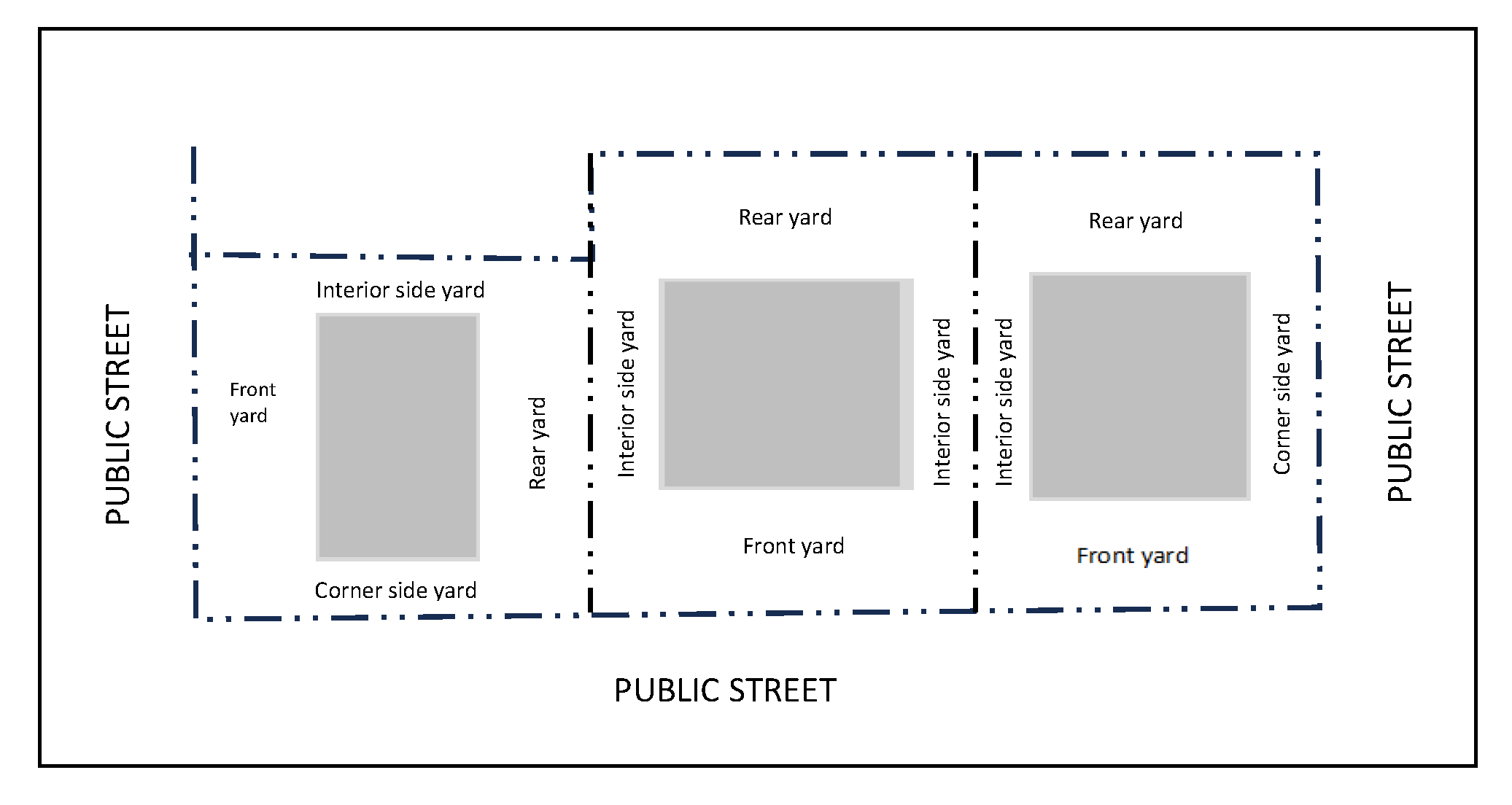
"Zero lot line" means the location of a structure on a lot in such a manner that one or more of the structure's sides rest directly on a lot line.
"Zoning map" means a map or maps that are a part of the zoning ordinance and delineate the boundaries of zone districts.
(Ord. 781 § 4, 2007; Ord. 769 § 3 (part), 2007; Ord. 765 § 2 (part), 2006; Ord. 739 § 2 (part), 2005; Ord. 695 § 3, 2003)
(Ord. No. 844, § 2(Exh. A), 3-13-2012; Ord. No. 854, § 2(Exh. A), 7-9-2013; Ord. No. 876, § 3(Exh. A), 4-8-2014; Ord. No. 887, § 4(Exh. A), 5-26-2015; Ord. No. 896, § 4(Exh. A), 2-9-2016; Ord. No. 906, §§ 4, 5, 4-11-2017; Ord. No. 908, § 4, 8-8-2017; Ord. No. 950, § 4(Exh. A), 8-25-2020; Ord. No. 991, § 4(Exh. A, §§ 10—12), 1-27-2026)

