Rolling Hills Estates
City Zoning Code
City Zoning Code
CHAPTER 17
06 - RESIDENTIAL DISTRICTS GENERALLY
17.06.010 - Designated.
The R-A-E, R-A-20, R-A-15, R-A-10 and A (Agricultural) districts, (hereinafter referred to as "districts") are intended to be single-family residential districts which include single-family homes on lots with not more than one dwelling unit and customary accessory structure(s) upon one lot.
(Prior code § 1820)
17.06.020 - Permitted uses.
The following uses are the only uses permitted in the districts, subject to the property development standards in Sections 17.06.060 through 17.06.330:
A.
A one-family dwelling of a permanent character placed in permanent locations. This includes a manufactured home, provided that no more than ten years have elapsed between the date of manufacture of the manufactured home and the date of the application for a permit to install the manufactured home in the applicable zone;
B.
Accessory structures and uses, including a private garage, one guesthouse; provided, however, that nothing herein shall be deemed to permit multiple-family use or rental of accessory buildings. Carports are expressly prohibited. Permitted accessory structures include satellite antennae, as defined in Section 17.02.520 and regulated in Sections 17.06.460 through 17.06.490, except that satellite antennae subject to the Federal Communications Commission (FCC) Over-The-Air-Receiving Devices Rule (47 CFR. 1.4000), including a satellite dish antenna less than one meter (39.37") in diameter, are not subject to Sections 17.06.480 and 17.06.490;
C.
Informational entrance signs designating the name of neighborhood or owner associations, provided the city council approves such signs by minute order;
D.
Keeping of animals, as provided in Chapter 17.46 of this code;
E.
Customary uses incidental to any of the above uses including, but not limited to, home occupations as described in Chapter 17.48 of this code.
(Prior code § 1821)
(Ord. No. 684, § 3, 4-10-2012)
17.06.030 - Conditional uses.
The following uses shall be permitted in the districts; provided, that in each instance a conditional use permit is first obtained in accordance with the procedure stated in Chapter 17.68 of this code.
A.
Public parks and playgrounds, golf courses and other municipal recreation areas;
B.
Police and fire stations and such other public buildings as are determined by the city council to be essential to the health, safety and general welfare of the community;
C.
Public utilities such as electric distribution substations, water wells, water plumbing plants, water storage tanks and similar facilities.
(Prior code § 1822)
17.06.040 - Prohibited uses.
The following uses are expressly prohibited in the districts described in Section 17.06.010:
A.
Multiple-family residential uses;
B.
Commercial uses, including home occupations as defined in Section 17.02.295, unless such home occupations meet the criteria set forth in Chapter 17.48 of this code;
C.
All industrial uses.
(Prior code § 1823)
17.06.050 - Density.
There shall be no more than one dwelling unit per lot, except for accessory living quarters or guesthouses which conform to the definition stated in Section 17.02.275.
(Prior code § 1824)
17.06.060 - Property development standards—Applicability.
The property development standards set out in Sections 17.06.070 through 17.06.330 shall apply to all lots in the districts; provided, however, that when a lot has an area or width less than that required in the districts, commonly referred to as a substandard lot, which was held under separate ownership, or was of record on March 15, 1960, such lot may be devoted to the uses permitted pursuant to Section 17.06.020, the uses conditionally permitted pursuant to Section 17.06.030, and use(s) specific to each district.
(Prior code § 1825 (part))
17.06.070 - Lot coverage.
The lot coverage standards set out in this section apply to all lots and premises in the R-A-E, R-A-20, R-A-15, R-A-10 and "A" agriculture districts (thereinafter referred to as "districts").
A.
Purpose. The purpose of this section is to preserve and promote the city's rural residential character by creating and maintaining residential open space. This purpose shall be accomplished by establishing and enforcing standards for coverage of a lot by structures, buildings, ground structures and satellite antennae; recognizing the development needs of the residential community; ensuring that development is consistent with the goals of the city's general plan; and promoting a uniformity of regulations and conditions to protect and maintain the health, safety and welfare of residential properties.
B.
Included in Legally Established Lot Coverage. The following items (as defined in Chapter 17.02) shall be included in lot coverage calculations:
1.
One hundred percent of the surface area of the lot covered by building(s) including, but not limited to, residences, barns, accessory buildings and garages;
2.
One hundred percent of the surface area of the lot covered by structure(s) including, but not limited to, breezeways, carports, porte cocheres, trellises, patio covers, pilasters and accessory structures;
3.
Seventy-five percent of the surface area of the lot covered by ground structure(s) below one foot in height measured from grade level including, but not limited to, patios, decking, pools, gravel, ponds, spas, sports courts, hardscape, tennis courts, and that portion of walkways and driveways which are not excluded from lot coverage. Fifty percent of the surface area of the lot covered by ground structures such as "Turf Block," "Grass Crete" or similar material;
4.
Satellite antenna (as defined in Section 17.02.520) shall be calculated as follows: at C (Coverage) = Area of the antenna × a variable factor. The variable factor shall be as follows:
a.
If the maximum height of the antenna is below five feet, the variable factor shall equal two,
b.
If the maximum height of the antenna is five feet to ten feet in height, the variable factor shall equal four;
C.
Excluded from Lot Coverage. The following types of development shall be excluded from lot coverage calculation:
1.
Walls;
2.
Fences;
3.
Walkways built on grade (the portion of the walkway in excess of four feet in width shall be counted as seventy-five percent lot coverage);
4.
Building eaves (the portion of the eave which projects more than four feet from the building face shall be counted as one-hundred percent lot coverage);
5.
Bay windows (located a minimum of twelve inches above grade);
6.
Driveways (with the exception that if two or more are situated on the lot, the shortest driveway to the garage that is located closest to the street shall be excluded, all others, including circular driveways, shall be included in lot coverage calculations. However, the shortest portion of a circular driveway which provides direct access to the garage shall be excluded from lot coverage calculation);
7.
Streets, sidewalks, or roads located within a private roadway easement which provide access to other legally subdivided properties;
8.
One temporary structure without footings, located in the rear or side yard, which does not cover more than sixty-four square feet of the surface area of a lot, such as a utility shed, playhouse, or dog house;
9.
Horse corrals and dressage arenas;
10.
Grass tennis courts.
D.
Maximum Lot Coverage. The maximum coverage of a lot by structures, buildings, ground structures and satellite antennae shall be as follows:
1.
In the R-P-D, R-A-20 and R-A-15 districts the maximum coverage of a lot by structures, buildings, ground structures and satellite antennae shall not exceed thirty percent;
2.
In the R-A-E and "A" district the maximum coverage of a lot by structures, buildings, ground structures and satellite antennae shall not exceed twenty-five percent;
3.
In the R-A-10 district the maximum coverage of a lot by structures, buildings, ground structures and satellite antennae shall not exceed thirty-five percent.
E.
Front Yard Coverage. Notwithstanding any other provision of this section, front yard coverage shall include all buildings, structures, and ground structures, including but not limited to hardscape such as walkways and driveways and all such structures, walkways and hardscape, shall be calculated as one hundred percent. Front yards as defined in Section 17.02.655 shall be limited to coverage by the following percentage requirements based on the subject property's street frontage width:
F.
Enforcement of Lot Coverage Standards and Requirements. Compliance with the lot coverage standards and requirements as provided herein shall be addressed on a case-by-case basis as part of the city's neighborhood compatibility review process, pursuant to Section 17.62.010, et. seq. Moreover, the standards and requirements set forth in this section may be enforced in any manner provided in this title for the enforcement of the laws and regulations provided in this title.
G.
Conflict. If any portion of this section is found to be in conflict with any other city ordinance, the provision which establishes the higher standard shall prevail.
(Ord. 549 § 1, 1993: prior code § 1825 (a))
17.06.080 - Building height.
No building or structure erected in the districts shall be greater than twenty-seven feet in height except those with flat, parapet or mansard type roofs, which shall not be greater than twenty-one feet in height.
(Prior code § 1825 (b))
17.06.090 - Accessory building size limitations.
In all districts, accessory buildings shall be no greater, either singly or collectively, than five hundred square feet, except as specified below:
A.
Lots within the "H" overlay district, as prescribed in Chapter 17.36 of this code, shall be permitted a one thousand square foot, four-horse stable and/or barn, in addition to the five hundred square foot size limitation stated in this section, if all lot coverage, setbacks, building height, and neighborhood compatibility requirements as set forth in this code are met.
B.
(Deleted by Ord. No. 682).
C.
Detached garages providing minimum code required off-street parking facilities, as prescribed in Section 17.06.440, shall be exempt from accessory building size limitations.
D.
An accessory building shall be compatible with the main residence and shall be limited to a maximum of sixteen feet in height.
E.
Accessory Building Limitations on Landfill Properties.
1.
All enclosed structures as determined by the building code, shall require a methane barrier.
2.
Structures greater than four hundred square feet in size shall be permitted only if:
a.
A report has been filed by a civil engineer certifying that the structure has been designed so as to prevent damage to the surrounding areas (including, but not limited to hydrology patterns, earth settlement, and surface cracking resulting from the construction), structure, floors, underground piping, and utilities, due to uneven settlement of the fill.
b.
A civil engineer shall provide to the building official a signed statement attesting that the construction has taken place in accordance with the civil engineer's report.
3.
Structures less than four hundred square feet in size shall comply with all applicable code requirements, including, but not limited to methane barrier, and shall comply with the "hold harmless" form requirements, as prescribed in subsection (E)(4) of this section.
4.
Property owners shall record and file with the city a hold harmless form as provided by the city for all structures located on a landfill and acknowledge receipt of the city's advisory sheet for landfill properties. Each existing recorded hold harmless agreement regarding structures located on landfill properties shall constitute a hold harmless form, as such term is used in this section.
5.
No dwelling units shall be permitted on landfill areas.
6.
All construction shall comply with the applicable building code requirements.
7.
In addition to the requirements herein, parcels may be subject to other applicable requirements of the state, county, city, other governmental entities, and applicable agreements.
(Ord. 590 § 1, 1997; prior code § 1825 (c))
(Ord. No. 682, § 1, 10-11-2011)
17.06.100 - Yard standards.
The standards set out in Sections 17.06.110 through 17.06.310 shall constitute minimum yard requirements.
(Prior code § 1825 (d)(part))
17.06.110 - Front yard—Width.
Each lot shall have a front yard, as defined in Section 17.02.655, which extends across the full width of the lot; the yard to have a depth of not less than twenty-five feet.
(Prior code § 1825 (d)(1)(part))
17.06.120 - Front yard—Developed lots.
On developed lots, the front yard shall constitute that area between the front property line and the entire front face of the main building and any accessory structures.
(Prior code § 1825 (d)(1)(i))
17.06.130 - Front yard—Undeveloped lots.
On undeveloped lots in a developed neighborhood, in which developed lots comprise forty percent or more of the frontage of one side of the street located between intersecting or intercepting streets, the required front yard setback shall be an average of the existing setbacks of these development lots. The average shall include the depth of front yards remaining in the block frontage, as described in Section 17.06.110.
When an existing setback distance is over fifty feet from the property line, the distance shall be calculated in the average as fifty feet. In no case shall the front yard be less than twenty-five feet.
(Prior code § 1825 (d)(1) (ii))
17.06.140 - Front yard—Key lots.
On key lots, the minimum front yard shall be the same as the front yard on interior lots in the same block. When buildings on the adjoining interior lots are closer to the property line than the distance prescribed above for such front yard, the front yard on the interior lots shall be measured from the existing building, but in no case may the yard be less than fifteen feet.
(Prior code § 1825 (d) (1)(iii))
17.06.150 - Front yard—Construction of structures.
No structure shall be constructed in a front yard, unless expressly permitted by this title.
(Prior code § 1825 (d)(1)(iv))
17.06.160 - Side yard—Width.
There shall be a side yard on each side of the lot extending from the front yard to the rear yard, which shall not be less than ten feet in width, with the exceptions set out in Sections 17.06.170 through 17.06.240.
(Prior code § 1825 (d)(2)(part))
17.06.170 - Side yard—Common party walls.
For the purpose of side yard regulation, dwellings with common party walls shall be considered as one building occupying one lot.
(Prior code § 1825 (d)(2)(i))
17.06.180 - Side yard—Structures in excess of fourteen feet in height.
Where the height of a structure is in excess of fourteen feet above the finished local grade, areas in excess of the height shall be set back an additional foot of distance for every foot of height in excess of fourteen feet.
(Prior code § 1825 (d)(2)(ii))
17.06.190 - Side yard—Accessory structure setbacks.
Accessory structures shall be set back ten feet from the side property line with the following exceptions:
A.
With the exception of street side property lines, a detached accessory structure may extend to within three feet of side property lines when the entire accessory structure is at least eighty-five feet from the front property line, and the structure is at least thirty-five feet from an off-site residence.
B.
When a garage or accessory structure (except those with dwelling occupancy) abuts and has garage doors opening onto an existing or proposed alley, the garage or accessory building shall be located not less than twenty-five feet from the closest portion of the alley.
(Prior code § 1825 (d)(2)(iii))
17.06.200 - Side yard—Accessory living quarters/guesthouses.
Where accessory living quarters/guesthouses are detached, or part of, or are over an accessory building or garage, the entire structure shall be subject to the setback provisions for the main building as required in Section 17.06.160.
(Prior code § 1825 (d)(2)(iv))
17.06.210 - Side yard—Residence abutting an alley.
When a main building abuts an existing or proposed alley, the building shall be located not less than thirty feet from the closest portion of the alley.
(Prior code § 1825 (d)(2)(v))
17.06.220 - Side yard—Facing a street.
On corner lots, a required side yard abutting a street shall be twenty percent of the width of the lot. The side yard is not required to be greater than fifteen feet in width, but in no case shall it be less than ten feet in width.
(Prior code § 1825 (d)(2)(vi))
17.06.230 - Side yard—Reverse corner lot.
On a reverse corner lot, the side yard abutting the street shall not be less than seventy-five percent of the front yard on the key lot or interior lot to its rear; provided, however, that this side yard shall not be less than fifteen feet in width. Private garages located in the side yard shall not be less than eighteen feet from the side street property line.
(Prior code § 1825 (d)(2)(vii))
17.06.240 - Side yard—Swimming pool setback.
The substructure of a swimming pool shall be located not less than five feet from any side property line.
(Prior code § 1825 (d)(2)(viii))
17.06.250 - Rear yard—Width.
There shall be a rear yard on each lot extending across the full width of the lot, the depth of which shall not be less than thirty-five feet, with the exceptions set out in Sections 17.06.260 through 17.06.290.
(Prior code § 1825 (d)(3)(part))
17.06.260 - Rear yard—Accessory structures.
A detached garage or accessory structure (except those with a dwelling occupancy) shall be set back a minimum of five feet from the rear property line.
(Prior code § 1825 (d)(3)(i))
17.06.270 - Rear yard—Accessory structure abutting an alley.
When a garage or accessory structure (except those with dwelling occupancy) abuts and has garage doors opening onto an existing or proposed alley, the garage or accessory building shall be located not less than twenty-five feet from the closest portion of the alley.
(Prior code § 1825 (d)(3)(ii))
17.06.280 - Rear yard—Accessory living quarters/guesthouses.
Where accessory living quarters/guesthouses are detached, or part of, or are over an accessory structure or garage, the entire structure shall be considered a main building and no portion of the building shall be subject to the setback provisions for the main building as required in Section 17.06.250.
(Prior code § 1825 (d)(3)(iii))
17.06.290 - Rear yard—Residence abutting an alley.
When a main building abuts an existing or proposed alley, the building shall be located not less than thirty feet from the closest portion of the alley.
(Prior code § 1825 (d)(3)(iv))
17.06.300 - Decorative architectural features—Projection into yards.
In all districts, decorative architectural features, including cornices, eaves, belt courses, sills or other decorative features shall be permitted to project a maximum distance of three feet into any required yard or required distance between buildings. In no case shall any such decorative feature project closer than three feet to any property line.
(Prior code § 1825 (d)(4))
17.06.310 - Landings in side and rear yards.
In all districts, uncovered landings, porches, platforms which do not extend above the level of the ground floor and are not in excess of eighteen inches in height above the local, adjacent and finished grade shall be permitted to extend a maximum of three feet into a side or rear yard. The structures shall not include any open work, railings, fences or walls unless expressly permitted by this title. In no case shall the structures extend closer than three feet to any property line.
(Prior code § 1825 (d)(5))
17.06.320 - Distance between buildings.
The minimum required distance between buildings is as follows:
A.
Accessory buildings (except guesthouses and accessory living quarters) shall be located not less than eight feet from any main building.
B.
Where accessory buildings are used for garage purposes, any portion of the accessory building which provides openings for vehicular access shall be located a minimum of twenty-five feet from any structure or building on the site to provide adequate vehicular access and turnaround.
C.
Where accessory buildings (except guesthouses and accessory living quarters) are attached to a main building by a breezeway roof, and where the conditions described in subsection A of this section exist, the minimum distances in subsection A of this section shall apply.
D.
The minimum distance between accessory buildings (except guesthouses and accessory living quarters) shall not be less than six feet.
E.
Where an accessory living quarters/guesthouse is detached or attached by a breezeway roof, the accessory living quarters or guesthouse shall be no closer than fifteen feet from a main building or any other accessory living quarters/guesthouse.
(Prior code § 1825 (e))
17.06.330 - Bridle trails setback.
If a lot is subject to an easement along any boundary for bridle trail purpose, the yard shall not be less than seven feet in width measured from the eave of the nearest building to the closest boundary of the easement. The provisions of this section shall be applicable only to construction completed after August 1, 1974.
(Prior code § 1825 (f))
17.06.331 - Detached decks in residential zones.
The following standards shall apply to all detached decks in residential zones:
A.
Ground-Level Detached Decks. A ground-level deck, located no higher than twelve inches above natural/local grade, shall be permitted to extend to the property lines and count as lot coverage in accordance with Section 17.06.070.
B.
Above-Ground Detached/Hillside Decks. A deck, any portion of which exceeds twelve inches in height from natural/local grade, shall count as lot coverage in accordance with Section 17.06.070 and be subject to the following standards:
1.
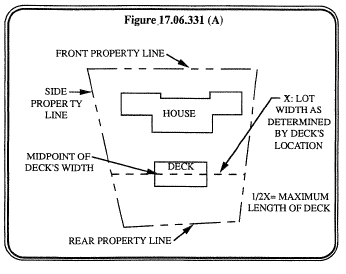
The overall length of the deck shall not exceed fifty percent of the width of the lot. For the purpose of this section, the width of the lot and deck shall be measured as shown below:
2.
In no case shall the deck have a side yard setback of less than ten feet or a rear yard setback of less than ten feet;
3.
No decks or any portion of which exceeds twelve inches in height from natural/local grade shall be permitted within the front yard setback area;
4.
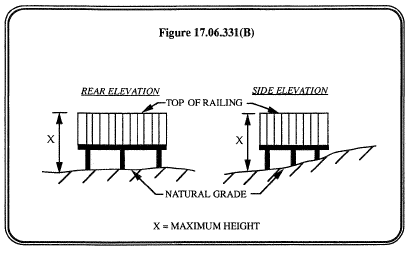
The overall height of the deck, including the safety railing (limited to four feet in height from the surface of the deck), lights or any other architectural features, when measured at its highest point from natural grade, shall not exceed sixteen feet in height. The planning director may administratively approve a deck up to twelve feet in height. Decks between twelve feet and sixteen feet in height shall require planning commission approval;
5.
Deck lighting shall be subject to the approval of the planning director. In no case shall deck lighting exceed the height of the safety railing or be more than twelve feet in height from natural/local grade, and all approved lights shall be shielded and directed onto the subject property in conformance with Section 17.42.030 (Lighting—Residential Districts);
6.
The deck shall be subject to neighborhood compatibility review as provided for in Chapter 17.62. All deck proposals submitted for such review must be accompanied by a plot plan and elevations. All adjacent property owners shall be notified of such deck proposals prior to any decision. The planning director may require additional information on the plans and/or additional notification to surrounding properties as deemed necessary;
7.
The deck shall be adequately screened from adjacent properties through the use of landscaping or other features as deemed appropriate by the planning director. The city may require submission of a landscaping and/or irrigation plan as a condition of approval of any deck in order to insure adequate screening.
C.
Decks Requiring Building Permits. A deck or any portion thereof equal to or greater than thirty inches in height from natural/local grade shall require a building permit duly issued by the department of building and safety.
(Ord. 558 § 1, 1993)
17.06.340 - Fences, hedges and walls—Standards—Applicability.
The standards set out in Sections 17.06.350 through 17.06.430 shall apply to all fences, hedges and walls in all districts unless specified in Sections 17.06.350 through 17.06.430.
(Prior code § 1826 (part))
17.06.350 - Fences, hedges and walls—"H" overlay district.
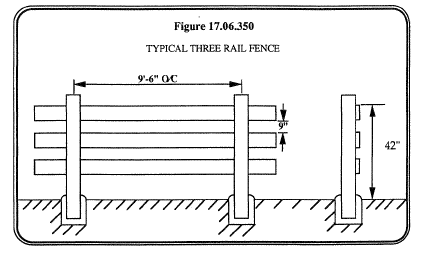
When lots are located in the "H" overlay districts, as described in Chapter 17.36 of this code, a three-rail white fence shall be permitted in the front yard of the lots. The fence shall be forty-two inches in height measured at the top of the rail and shall consist of three white wooden rails which are vertically spaced nine inches apart and which are supported by white wooden posts, horizontally spaced nine feet six inches on center. (See Figure 17.06.350.)
(Prior code § 1826 (a))
17.06.360 - Fences, walls, hedges, structures and similar landscape features in front yards and side yards abutting a street.
In the districts, fences, walls, hedges, structures and similar landscape features exceeding twenty-four inches in height shall not be permitted within private street easements, front yards or side yards abutting a street. Chain-link and fiberglass are specifically prohibited as building materials.
(Ord. 565 § 1 (part), 1993: Ord. 548 § 1 (part), 1992: prior code § 1826(b) (part))
17.06.365 - Pilasters, outdoor lighting fixtures and similar features in front yards and side yards abutting a street.
A.
For the purpose of this section, a pilaster shall mean a freestanding structure with or without a mailbox or light fixture consisting of wood, masonry, stone or other compatible materials with a base exceeding one square foot.
B.
Pilasters, outdoor lighting fixtures and similar features may be permitted within private street easements, front yards and side yards abutting a street subject to approval of a neighborhood compatibility determination pursuant to Chapter 17.62. The proposed number, location, height and material of each structure shall be compatible with the surrounding neighborhood. In no case shall any structure be permitted to be located upon a paved private street that is used as a means of vehicular access.
(Ord. 565 § 1 (part), 1993: Ord. 548 § 1 (part), 1992: prior code § 1826(b) (part))
17.06.370 - Fences, hedges and walls—Side and rear setbacks, developable areas.
Except as provided in this section, a maximum seventy-two inch high fence, hedge or wall shall be permitted in all rear setbacks, side setbacks and interior developable areas, except as follows:
A.
Any fencing in the side yard facing a street must maintain the same required setback from the street side property line as required of the main building. If such fencing is open (permitting ninety percent light and air to pass through it) such fencing can be placed on the side property line.
B.
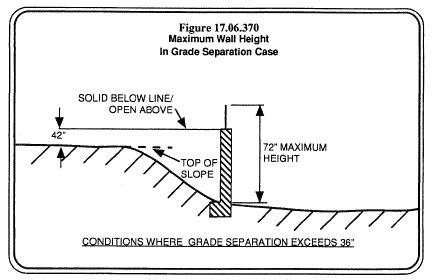
In rear and side setbacks, if there is a grade difference greater than thirty-six inches between two adjoining lots, then no solid fencing or wall shall extend more than forty-two inches above the height of the upper building pad. Any fencing which is over forty-two inches above the height of the building pad shall be open (capable of admitting at least ninety percent light and air). (See Figure 17.06.370.)
(Prior code § 1826 (c))
17.06.380 - Retaining walls.
A maximum sixty inch high retaining wall shall be permitted up to the rear of the front setbacks. The following retaining walls shall be permitted, subject to a specified criteria:
A.
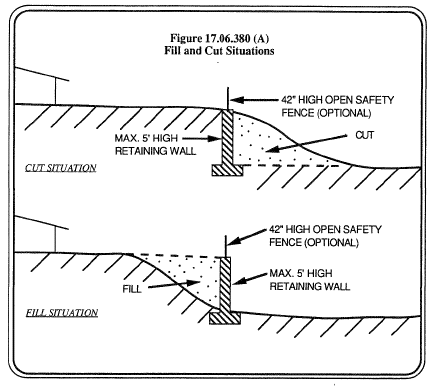
In a cut or fill situation, a maximum forty-two inch open safety fence (capable of admitting at least ninety percent light and air) shall be permitted at the top of the retaining wall. (See Figures 17.06.380(A), fill and cut situations.)
B.
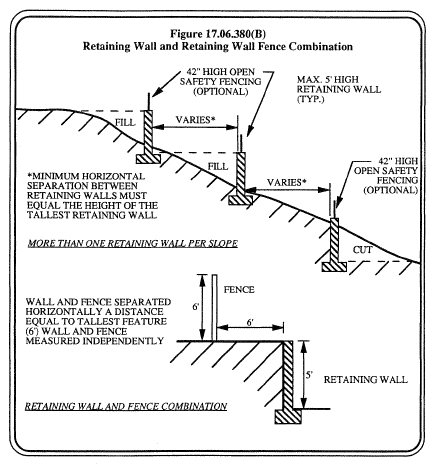
Where more than one retaining wall and/or fence is used on a slope, the minimum horizontal separation between retaining walls shall be equal to the height of the tallest wall and/or fence. (See Figures 17.06.380(B), retaining wall and retaining wall and fence combination.)
(Prior code § 1826 (d))
17.06.390 - Fenced recreational enclosures.
If fencing is necessary for incidental recreational uses, such as tennis and paddle ball, which is higher than permitted under Sections 17.06.340 through 17.06.430, a special use permit must be obtained. A maximum twelve foot high fence enclosure for recreational uses may be permitted by special use permit; provided, that the fence does not extend into the front yard or a street side yard and does not extend closer than ten feet to any other property line. The planning commission shall make the following findings in granting the permits:
A.
That the proposed use, enclosure and appurtenant structures will not adversely affect the neighboring properties, block any view or constitute a nuisance;
B.
That the granting of the permit meets the criteria for the issuance of a special use permit, as defined in Chapter 17.70 of this code;
C.
That the fencing is capable of admitting at least ninety percent light and air to pass through the fencing.
(Prior code § 1826 (e))
17.06.400 - Safety fencing requirements.
A six foot high fence or wall shall be constructed along the perimeter of all areas or districts designated by the council to be dangerous to the public health, safety and welfare.
(Prior code § 1826 (f))
17.06.410 - Swimming pool fencing.
Swimming pool fencing must conform to Section 8.36.050.
(Prior code § 1826 (g))
17.06.420 - Fences, hedges and walls—Corner visibility.
To protect visibility at corners and provide for the safety of persons using the streets and sidewalks, all fences, hedges and walls shall conform to the visibility requirements specified in Title 12 of this code.
(Prior code § 1826 (h))
17.06.430 - Solid fencing—Landscaping required.
In addition to the requirements of Sections 17.06.350 through 17.06.420, any plans for solid fencing or walls constructed in a front yard, side yard abutting a street, or in the rear yard of a through lot, shall be accompanied by a landscaping plan which includes the following information:
A.
The size, type and location of existing and additional landscaping provided;
B.
The method of irrigation;
C.
The method of planting (i.e., basins, trellis, etc.). Landscape plans submitted need not be prepared by a licensed architect or other professional, but should be accurate as far as location, species and size of plant at the time of installation;
D.
All landscaping associated with fences or walls, as required in this section, shall be subject to review under the provisions of Chapter 17.62 of this code (Neighborhood Compatibility) and shall be installed prior to final inspection of the city's building official.
(Prior code § 1826 (i))
17.06.440 - Off-street parking requirements (residential districts).
The requirements for off-street parking in the districts are as follows:
A.
There shall be at least two parking spaces enclosed entirely by permanent walls in a garage for every dwelling unit with the minimum interior dimensions of at least twenty feet by twenty feet, and each additional parking space shall have a minimum dimension of ten feet by twenty feet. These spaces shall be on the same lot with the structures which they are intended to serve.
B.
All parking spaces located outside of the required enclosed parking spaces as stated in section 17.06.440 (A) above, shall be located on a suitable parking surface, i.e., a driveway leading to the garage and not within a landscaped area(s) or unimproved area(s) (i.e., dirt or wood chips) in compliance with front yard coverage and overall lot coverage standards where applicable, and located within all private property lines, such that no parking is permitted within sidewalks or driveway aprons.
C.
Over-sized vehicles. For purposes of this section, an over-sized vehicle is defined as any motorized vehicle, non-motorized vehicle, trailer or combination thereof that exceeds any one of the following size dimensions (inclusive of any projecting racks and/or vehicle appurtenances): Twenty-two feet long, seven feet high, or eight feet wide.
1.
Parking of over-sized vehicles in front yards or yards contiguous to streets. In addition to the requirements set forth under Municipal Code Section 8.12.060(F), which prohibits the storage of trailers, campers, boats and other mobile equipment in yard areas contiguous to streets, no over-sized vehicle shall be permitted to park in a front yard or yard contiguous to a street. A variance to park an over-sized vehicle in a front yard or yard contiguous to a street may be granted by the planning commission (application filing fee of one thousand one hundred dollars applies, unless superseded by city council resolution), if the following hardship finding can be made. In no instance shall said vehicle that may be permitted by a variance to be located in a front yard or yard contiguous to a street, be resided within at any time, nor shall a variance be approved in which to reside within said vehicle. Only one variance for one over-sized vehicle per property may be granted. The issuance of a variance is subject to the following limitations:
a)
A variance may only be granted if the planning commission makes a finding that a medical condition exists, which creates a hardship that requires the use of an over-sized vehicle which must be parked in a front yard or yard contiguous to the street for convenient access purposes, to and from a dwelling, and due to the frequency of use necessitated by that medical condition (i.e., not for recreational purposes that could otherwise be stored off-site or elsewhere on the property).
b)
All variances shall be subject to annual review of the continued existence of the necessary medical condition finding by the planning commission. All variances shall terminate when the identified medical condition ceases to exist at the property.
2.
Parking of over-sized vehicles in side and/or rear yards. Parking of an over-sized vehicle is permitted within a side yard or rear yard of a property, subject to the vehicle being set back a minimum of ten feet from the property line, inclusive of any vehicle appurtenances. For properties located within the Horse (H) District, an over-sized horse trailer (not to exceed a height of eight feet measured from the ground or a length of fourteen feet [excluding the towing tongue], and specifically prohibiting gooseneck trailers from this ten foot setback exemption), may be located closer than ten feet from a side or rear property line and is not subject to the provisions of neighborhood compatibility (Chapter 17.62 of the Municipal Code). All other over-sized vehicles shall be subject to the ten feet side yard and/or rear yard setback and the requirements of neighborhood compatibility, such that the over-sized vehicle's location respects neighboring views, privacy, and minimizes its appearance from both public and private view through the use of landscaping. In the case where an over-sized vehicle is parked in a side yard, which abuts a front yard, a six-foot high solid fence shall be installed separating the side yard from the front yard. No over-sized commercially-registered vehicle(s) with the DMV shall be stored in a side or rear yard. No more than two over-sized vehicles may be stored within the side and/or rear yards on a property and said vehicle(s) shall not be maintained on a slope steeper than fifteen percent and shall be operational at all times, with wheels in place on the ground and registered with the DMV. No person(s) shall reside within said over-sized vehicle(s) while stored in any side or rear yard.
3.
Registering over-sized vehicles with the city. Any over-sized vehicle(s) that is stored on a property in the city shall be registered with the city, by submission of a completed application form supplied by the city and payment of the required permit fee of thirty dollars, paid annually (unless superseded by city council resolution).
4.
Loading and unloading of an over-sized vehicle in a front yard or yard contiguous to a street. An over-sized vehicle, such as a recreational vehicle, may be parked in a front yard or yard contiguous to a street for purposes of loading for or unloading from (including related preparation and cleaning) any trip or excursion as may from time to time be necessary, but any such loading or unloading event shall not exceed forty-eight hours. In no case shall any person(s) reside within said vehicle during loading and unloading event periods. There shall be a minimum period of time between loading and unloading events of forty-eight hours during which period the over-sized vehicle shall not be located on the subject property. There shall also be a minimum period of time between loading and unloading events of forty-eight hours during which the over-sized vehicle must not be located in a front yard or yard contiguous to the street. An over-sized vehicle that is a recreational vehicle shall be prohibited from parking on any street at any time, with the following exception: in instances where an over-sized vehicle is too large for a driveway or the driveway is too steep for safe or practical access, the city manager may grant a waiver to allow the vehicle to park on the street for loading and unloading periods as permitted and otherwise in accordance with the limitations above, assuming that there is adequate street width and visibility as determined by the city's traffic engineer.
D.
Any vehicle parked in a front yard or yard contiguous to a street shall be limited to a total sign area of nine square feet. No single sign (i.e., a magnetically or permanently applied sign to a door panel) shall exceed three square feet. Projecting signs from a vehicle are prohibited as well as any added or projecting moldings to a vehicle for advertising purposes. Screening advertising, such as a vehicle "wrap" that covers an entire vehicle, is also prohibited for vehicles parked in a front yard or yard contiguous to a street.
(Ord. No. 681, § 1, 9-27-2011)
Editor's note— Ord. No. 681, § 1, adopted Sept. 27, 2011, repealed former § 17.06.440, and enacted a new § 17.06.440 as set out herein. Former § 17.06.440 pertained to the same subject matter and derived from Prior code § 1827 and Ord. No. 670, § 1, adopted Jan. 25, 2011.
17.06.450 - Access to lots.
Access to lots within the districts from dedicated or improved streets or alleys shall be subject to the following standards:
A.
Vehicular. There shall be vehicular access from a dedicated or improved street or alley to off-street parking facilities.
B.
Pedestrian. There shall be pedestrian access to the main residence from a dedicated or improved street (public or private) or alley which may incorporate a driveway.
(Prior code § 1828)
17.06.460 - Satellite antennae—Legislative declarations.
A.
The general plan of the city recognizes the contribution of views to the character and beauty of the city. Scenic vistas of the Los Angeles Basin, the Pacific Ocean, the Los Angeles Harbor, canyons and other natural landforms increase the enjoyment and value of property in the city. The city has found that views of these areas are being diminished or directly impacted by antennae structures. Sections 17.06.460 through 17.06.490 will assist private property owners in their efforts to protect existing views from antennae structures.
B.
The provisions of Sections 17.06.460 through 17.06.490 set forth a comprehensive means to regulate the height, bulk, setbacks and size of antennae structures. They will also enhance the general aesthetics of each neighborhood for the benefit of surrounding properties, In addition, height and location limitations on such antennae are required for safety reasons in the event they are toppled by wind, seismic activity or other means.
(Ord. 537 § 1 (part), 1992: prior code § 1829)
17.06.470 - Satellite antennae—Defined.
"Satellite antenna" (plural "antennae") means a structure or device designed and used for the receipt of television or other signals from earth-orbiting satellites.
(Ord. 537 § 1 (part), 1992: prior code § 1829.1)
17.06.480 - Standards—Designated.
No satellite antennae shall be constructed or placed in any residential zone unless the following requirements have been met:
A.
Excluded from front and side yards;
B.
Ground-mounted and all cables shall be installed underground;
C.
Maximum height limited to ten feet measured from the local finished grade;
D.
No part of an antenna shall be closer than fifteen feet to any property line, and no closer than seven feet to any bridle trail easement;
E.
The size of an antenna shall not exceed twelve feet in diameter;
F.
The maximum lot coverage standards for satellite antennae as specified in Section 17.06.070;
G.
Antennae shall be screened from view of surrounding properties and public rights-of-way;
H.
No antennae, nor any screening landscaping, shall be installed so as to create a view impairment for any surrounding property;
I.
Only one antenna structure is permitted per residential property;
J.
If more than one lot is served by one residential antenna, a conditional use permit shall be obtained;
K.
Use of the antenna shall be limited to personal and recreational use only, and not for commercial purposes;
L.
The color of the antennae shall be limited to black or earth tones (dull finish).
(Ord. 549 § 2, 1993; Ord. 537 § 1 (part), 1992: prior code § 1829.2)
17.06.490 - Standards—Noncompliance.
A.
If the applicant cannot comply with any one or more of the standards set out in Section 17.06.480, then an antenna will be allowed pursuant to a special use permit utilizing procedures set forth in Chapter 17.68 of this code.
B.
In addition to showing the required findings to grant a special use permit, the applicant must demonstrate that strict compliance with the development standards specified in Section 17.06.460 would unreasonably interfere with the applicant's ability to receive or transmit signals, would impose unreasonable costs on the operation when viewed in light of the cost of the equipment, or that strict compliance with the development standards is not, under the circumstances of the particular case, necessary to achieve goals and objectives of Section 17.06.460. In granting the permit, the planning commission may impose conditions reasonably necessary to accomplish the purposes of Section 17.06.460, provided those conditions do not unreasonably interfere with the ability of the applicant to receive or transmit signals or result in extensive cost or expense.
(Ord. 537 § 1 (part), 1992: prior code § 1829.3)