
Rolling Hills Estates
City Zoning Code
City Zoning Code
CHAPTER 17
55 - VIEW PRESERVATION
17.55.010 - Findings and declarations.
The city council finds and declares as follows:
(1)
Both views and trees/vegetation contribute to the aesthetic value, quality of life, ambiance and economic value of properties within the city. Similarly, access to sunlight across property lines contributes to the health and well-being of community members, enhances property values and provides an opportunity to utilize solar energy. Utilization of passive solar energy reduces air pollution, visual blight and ill health.
(2)
Views, whether of the Pacific Ocean, the surrounding hillsides and canyons or other natural and manmade landmarks produce a variety of significant and tangible benefits for both residents and visitors. Views contribute to the aesthetic visual environment of the community by providing scenic vistas and inspiring distinctive architectural design. Views contribute to property values.
(3)
Residents and property owners cherish their outward views from the Palos Verdes Peninsula. Outward views contribute greatly to the quality of life in the city and promote the general welfare of the entire community.
(4)
Trees and vegetation produce a wide variety of significant psychological and tangible benefits for both residents and visitors to the community. Trees and vegetation provide privacy, modify temperatures, screen winds, replenish oxygen to the atmosphere, maintain soil moisture, mitigate soil erosion and provide wildlife habitat. Trees and vegetation contribute to the visual environment and aesthetics by blending, buffering and reducing the scale and mass of architecture. Trees and vegetation within the city provide botanical variety and a sense of history. Trees and vegetation also create shade and visual screens and provide a buffer between different land uses. Trees contribute to property values. Absent an unreasonable obstruction of the view of a neighboring property, the city encourages and supports the growth and maintenance of trees and vegetation.
(5)
Owners and residents should maintain trees on their property in a healthy condition for both safety reasons and for preservation of outward views. Before planting trees, owners and residents should consider view blockage potential, both currently and at tree maturity, and should not plant, maintain or permit to grow any tree or vegetation which unreasonably obstructs the view from a neighboring property.
(6)
The benefits derived from views and trees/vegetation may come into conflict. The planting of trees and other vegetation and their subsequent growth, particularly when such trees are not properly maintained, can produce unintended harmful effects both on the property on which they are planted and/or on neighboring properties. It is, therefore, in the interest of the public health, safety and welfare to:
(a)
Establish the right of real property owners in the city to preserve and/or restore views which existed from unreasonable obstruction by the growth of trees and other vegetation. Property owners shall have the right to preserve views that existed on the date the property was acquired or fifteen years prior to the effective date of the ordinance codified in this chapter, whichever is later;
(b)
Recognize that every real property owner in the city is entitled to a process to resolve conflicts that negatively impact view equity, in order to preserve a reasonable amount of the view benefiting such real property; and
(c)
Establish a process and evaluation criteria by which property owners may seek restoration of views when unreasonably obstructed by the growth of trees or other vegetation.
(7)
When a dispute arises concerning the impairment or obstruction of a view, the parties should act reasonably to resolve the dispute through friendly communication, thoughtful negotiation, compromise, and other traditional means, such as discussions with the appropriate neighborhood or homeowner association. Those disputes which are not resolved through such means shall follow the procedure established herein.
(Ord. No. 661, § 1, 10-12-2010)
17.55.020 - Intent and purpose.
The intent and purpose of this chapter is to:
(1)
Recognize and establish a process by which real property owners may preserve or restore view equity within the immediate vicinity of their property as set forth in Section 17.55.040;
(2)
Establish procedures and evaluation criteria by which real property owners may seek resolution of view equity disputes;
(3)
Discourage duplicative, repetitive or serial claims for view equity; and
(4)
Discourage ill-considered damage to trees/vegetation and promote proper landscaping establishment and maintenance.
It is not the intent of the city to encourage clear-cutting or substantial denuding of any property of its trees by overzealous application of provisions of this chapter. It is also not the intent or purpose of this chapter for the city to create either a covenant running with the land (for example, CC&Rs or deed restriction) or an equitable servitude (for example, easement or license). However, the city will keep a record of agreements and decisions reached pursuant to Sections 17.55.070, 17.55.080, 17.55.090 and 17.55.110 of which it is notified, and provide those agreements and/or decisions as part of the pre-purchase inspection report it provides to prospective purchasers of property in the city who request such a report.
(Ord. No. 661, § 1, 10-12-2010)
17.55.030 - Definitions.
For the purpose of this chapter, the meaning and construction of words and phrases hereinafter set forth shall apply:
"Alter" means to take action that changes the tree or vegetation, including but not limited to, extensive pruning of the canopy area, cutting, girdling, interfering with the water supply, applying chemicals or re-grading around the feeder root zone of the tree or vegetation.
"Arbitration" means a voluntary legal procedure for settling disputes and leading to a final and binding determination of rights of parties, usually consisting of a hearing before an arbitrator where all relevant evidence may be freely admitted as set forth in California Code of Civil Procedure Section 1280 et seq.
"Arbitrator" means a mutually agreed upon neutral third party professional intermediary who conducts a hearing process, and who hears testimony, considers evidence and makes binding decisions for the disputing parties. The arbitrator of a view equity dispute shall be chosen from a list available from the city of qualified and professionally trained arbitrators/mediators, including but not limited to, members of the American Arbitration Association.
"Arborist, certified" means a person who has passed a series of tests by the International Society of Arboriculture (ISA), is governed by ISA's professional code of ethics and possesses the technical competence through experience and related training to provide for or supervise the management of trees and other woody plants. The arborist utilized in mediation of a view equity dispute shall be the city's certified arborist.
"Authorized agent" means a person, as defined herein, who has been designated and approved in writing by the property owner of record to act on his/her behalf in matters pertaining to the processing of a view equity claim as outlined in this chapter.
"Canopy" means the umbrella-like structure created by the over-head leaves and branches of a tree which create a sheltered area below.
"City" means the city of Rolling Hills Estates.
"City maintained trees" means trees which are specifically designated for maintenance by the city council. "City maintained trees" include heritage trees which are located in the unimproved portion of a dedicated and accepted street right-of-way easement and for which the real property owner has requested and given the city written permission to maintain.
"City property" means any real property of which the city is the fee simple owner of record.
"Claim, view equity" means documentation, as set forth in Section 17.55.050, that outlines the basis of view equity diminishment and the specific preservation action that is being sought.
"Crown" means the rounded top of the tree.
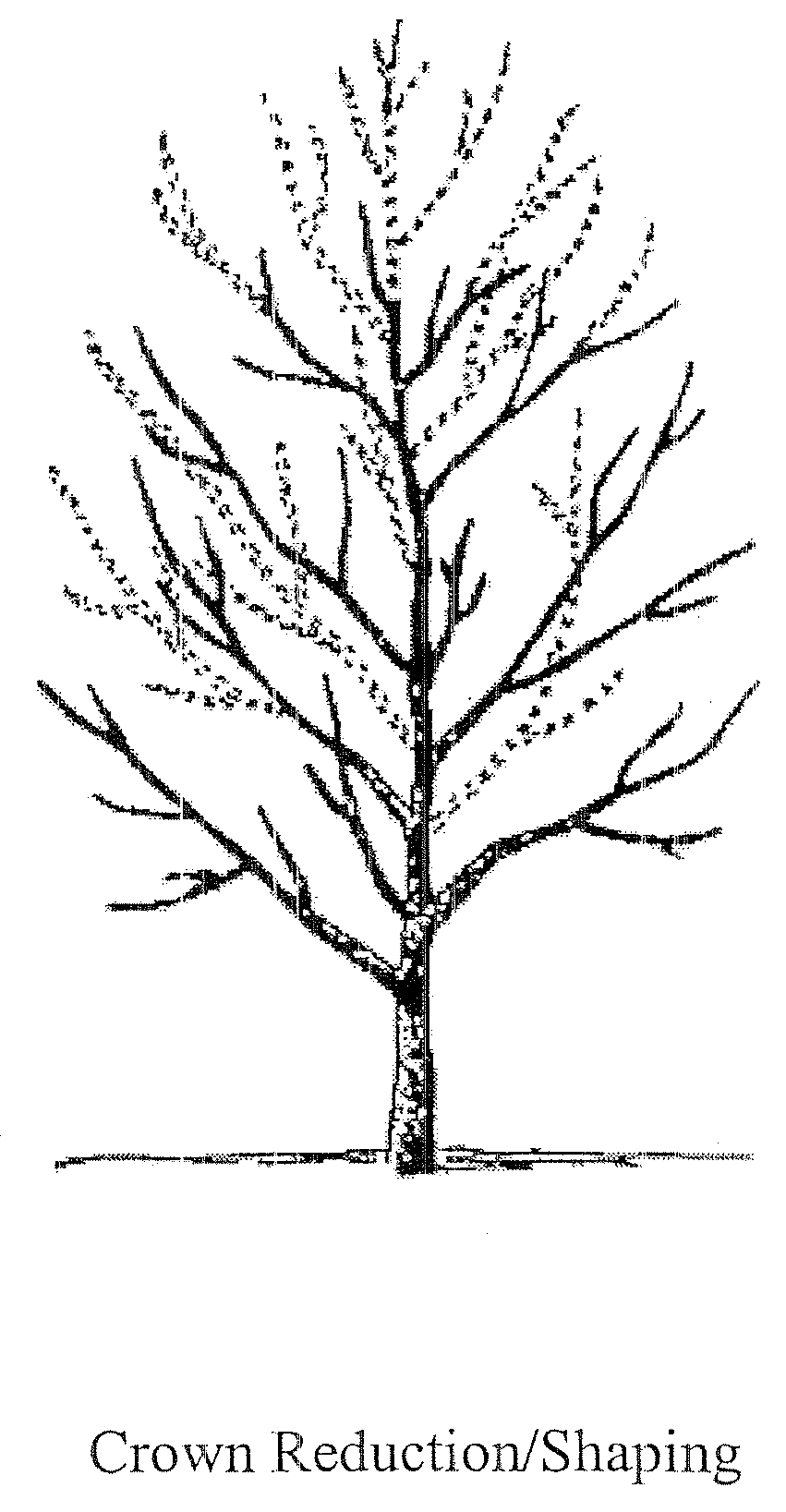
"Crown reduction/shaping" means a method of comprehensive pruning that reduces a tree's height and/or spread. Crown reduction entails the reduction of the top, sides or individual limbs by means of removal of leaders or the longest portion of limbs to a lateral large enough to assume the terminal. The diagram that follows is illustrative of "crown reduction/shaping" within the meaning of this chapter.
"Destroy" means to kill or take action that endangers the health or vigor of a tree or vegetation, including, but not limited to, cutting, girdling, interfering with the water supply, applying chemicals or re-grading around the base of the trunk.
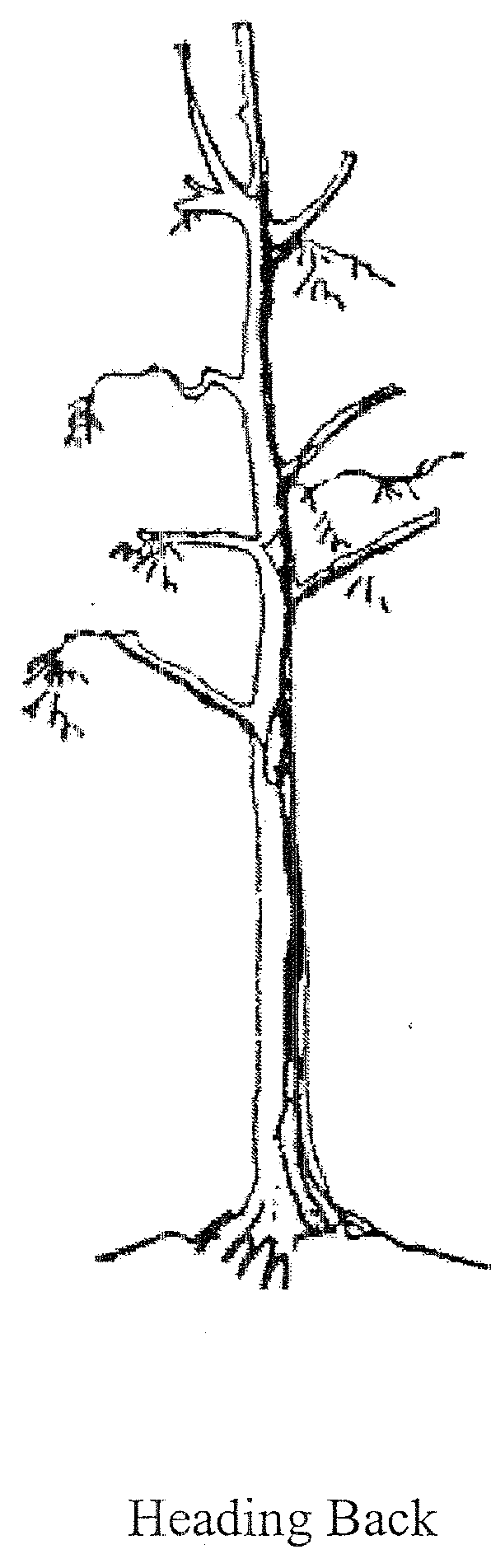
"Heading back" means the overall reduction of the mass of a tree by modification to major limbs. The diagram that follows is illustrative of "heading back" within the meaning of this chapter.
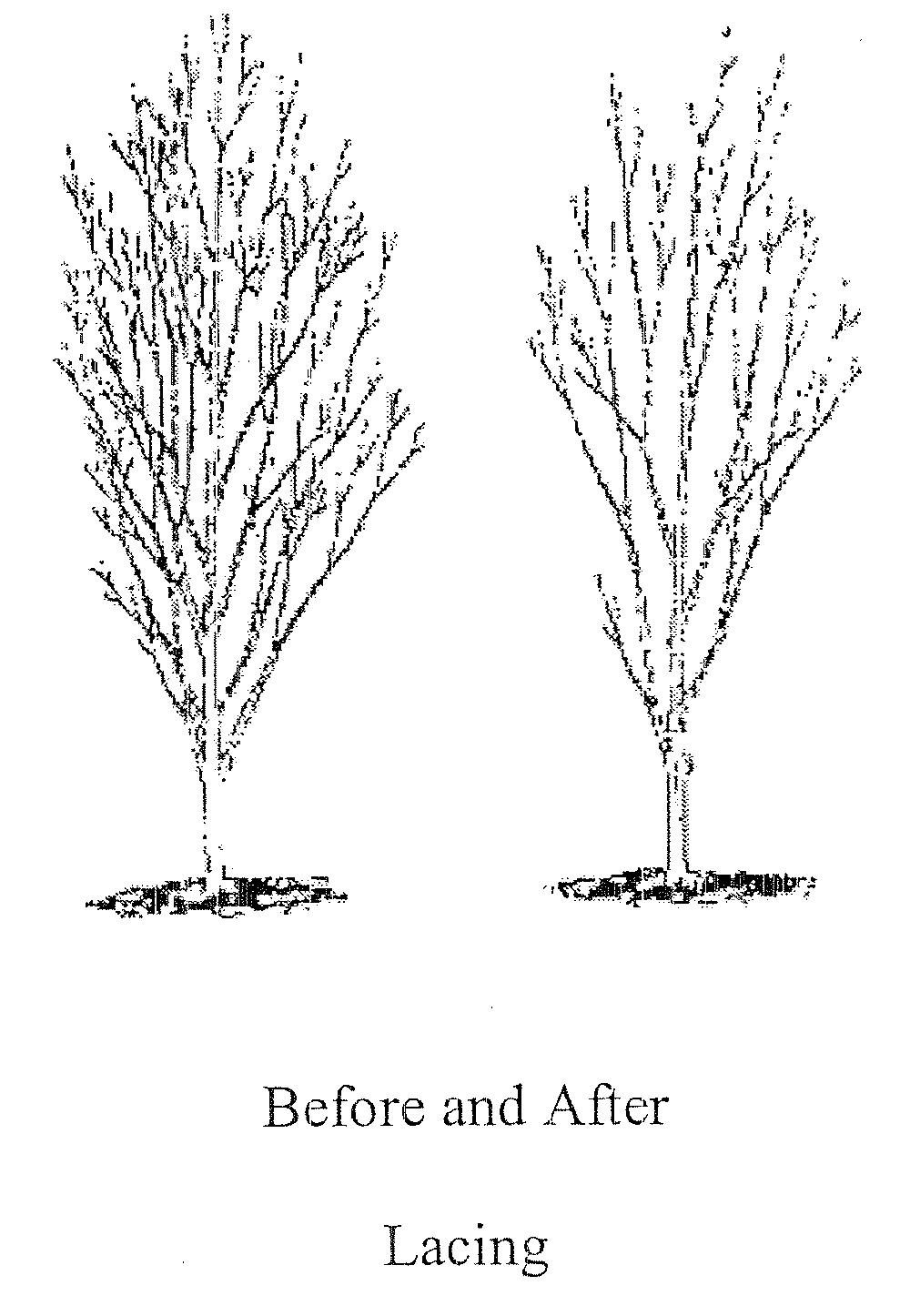
"Lacing" means a comprehensive method of pruning that systematically and sensitively removes excess foliage and improves the structure of the tree. The diagram that follows is illustrative of "lacing" within the meaning of this chapter.
"Maintenance pruning" means pruning with the primary objective of maintaining or improving tree health and structure; includes "crown reduction/shaping" or "lacing," but not ordinarily "heading back."
"Mediator" means a neutral, objective third party professional negotiator/facilitator to help disputing parties reach a mutually satisfactory solution regarding a view equity claim. The mediator shall be chosen from a list available from the city of qualified and professionally trained arbitrators/mediators, including but not limited to, members of the American Arbitration Association.
"Obstruction" means the blocking or diminishment of a view attributable to growth, improper maintenance or location of trees and/or vegetation.
"Person" means any individual, individuals, corporation, partnership, firm or other legal entity.
"Preservation action" means any specific steps taken affecting trees or vegetation that would result in the preservation or restoration of view equity across property lines.
"Pruning" means the removal of plant material from a tree/vegetation.
"Real property" means rights or interests of ownership of land and all appurtenances to the land including buildings, fixtures, vegetation and improvements erected upon, planted or affixed to the land.
"Severe pruning" means the cutting of branches and/or trunk of a tree in a manner which substantially reduces the overall size of the tree or destroys the existing symmetrical appearance or natural shape of the tree and which results in the removal of main lateral branches leaving the trunk and branches of the tree in a stub appearance. "Heading back" as defined herein is considered to be severe pruning.
"Stand thinning" means the selective removal of a portion of trees from a grove of trees.
"Street" means the portion of a right-of-way easement used for public purposes, such as roadway improvements, curbs, gutters and sidewalks, dedicated to the city, and formally accepted by the city into the city public street system for maintenance purposes.
"Sunlight" means the availability or access to light from the sun across property lines.
"Tree" means any woody perennial vegetation that generally has a single trunk and reaches a height of at least eight feet at maturity.
"Tree/vegetation owner" means any person who owns real property in the city on which tree(s) and/or vegetation is located.
"Vegetation" means all types of plants, bushes, hedges and shrubs, including trees.
"View" means a vista of features, including but not limited to, bodies of water, beaches, coastline, islands, skylines, mountains, city lights, ridges, hillside terrain, canyons, geologic features and landmarks. The term "view" does not mean an unobstructed panorama of these features.
"View equity" means achievement of a fair, reasonable, and balanced accommodation of views and competing obstructions (such as structures, trees and/or vegetation), privacy and the use and enjoyment of property. Development, including its landscaping, shall be designed to preserve views from neighboring properties. No person shall plant, maintain, or permit to grow any trees or vegetation which unreasonably obstructs the view from a neighboring property.
"View seeker" means any real property owner in the city or authorized agent of such property owner who alleges that tree(s)/vegetation located within the immediate vicinity of the property as set forth in Section 17.55.040 is causing unreasonable obstruction of the view benefiting such real property.
"Vista pruning" means the selective thinning of framework limbs or specific areas of the crown of a tree to allow a view from a specific point.
(Ord. No. 661, § 1, 10-12-2010)
17.55.040 - View equity claim limitations.
Subject to the other provisions of this chapter, a real property owner in the city may initiate the claim resolution process as outlined in Section 17.55.060. However, a claim for preserving or restoring view equity may only be made i) regarding any tree/vegetation located on real property, as defined herein, which is within five hundred feet from the view seeker's real property boundary, and ii) if a claim has not been initiated against that real property by the view seeker or any other real property owner in the city within the last two years, unless the subsequent claim is made within forty-five days of notice of the original claim as provided in Section 17.55.080 of this chapter. In addition, a view seeker may only seek to preserve or restore a view from one common interior or exterior space used by the view seeker, including but not limited to, the living, family, and dining rooms, rooms that have features such as picture windows, sliding glass doors, and French doors, and common exterior areas such as patios, balconies, decks, pool areas, and gazebos designed to take advantage of views. Properties which have more than one unique or different view shall be permitted to apply for preservation or restoration of one additional view.
Requests for view equity with regard to any tree and/or vegetation located on city property or in city parks, or with respect to city maintained trees, may only be initiated as outlined in Section 17.55.070 of this code.
(Ord. No. 661, § 1, 10-12-2010)
17.55.050 - View equity claim.
A claim to preserve or restore view equity shall consist of all of the following:
(1)
A description of the nature and extent of the alleged obstruction, including pertinent and corroborating evidence. Evidence may include, but is not limited to, documented and dated photographic prints, negatives, slides and written testimony from residents living in the area. Such evidence must show the extent to which the view has been diminished by trees and/or vegetation;
(2)
The location of all trees and/or vegetation alleged to cause the obstruction, the address of the property upon which the trees and/or vegetation are located, and the present tree/vegetation owner's name and address;
(3)
Specific view equity preservation actions proposed by the view seeker to resolve the allegedly unreasonable obstruction;
(4)
Evidence that initial discussion as described in Section 17.55.070 has been made and has failed. Evidence may include, but is not limited to, copies of receipts for certified or registered mail correspondence; and
(5)
Evidence confirming the ownership and the date of acquisition of the view seeker's property.
(Ord. No. 661, § 1, 10-12-2010)
17.55.060 - View equity claim resolution process.
The view seeker shall follow the process established by this chapter in seeking preservation or restoration of view equity. First, the view seeker must complete the "initial discussion" process described in Section 17.55.070. Second, if that process does not yield a result mutually satisfactory to the view seeker and the tree/vegetation owner, then the view seeker may file a view equity claim with the city and request mediation, as described in Section 17.55.080. Third, if the tree/vegetation owner does not participate in mediation or if mediation is unsuccessful in resolving the claim, the view seeker may next pursue resolution by arbitration, as set forth in Section 17.55.090. Fourth, if arbitration is not accepted by the tree/vegetation owner, the view seeker may next request that the city's planning director issue an advisory opinion on the view equity claim pursuant to Section 17.55.100. If all of these steps are taken and processes are exhausted by the view seeker but no resolution is reached, the view seeker may then initiate litigation as described in Section 17.55.110.
(Ord. No. 661, § 1, 10-12-2010)
17.55.070 - Initial discussion.
A view seeker who believes that one or more trees or vegetation which has grown on another person's property in the city has caused unreasonable obstruction of view equity from the view seeker's property, shall first notify the tree/vegetation owner of such concerns. The notification shall request personal discussions to enable the view seeker and tree/vegetation owner to attempt to reach a mutually agreeable solution, and shall be followed-up in writing. The notification shall include a copy of the view preservation ordinance (Chapter 17.55 of this code), available from the city. The view seeker shall invite the tree/vegetation owner to view the alleged obstruction from the view seeker's property, and the tree/vegetation owner is urged to invite the view seeker to view the situation from his/her property. Failure of the tree/vegetation owner to respond to the written request for initial discussion within forty-five days from the date of delivery shall be deemed formal refusal by the tree/vegetation owner to participate in the initial discussion.
If the initial discussion is refused, or if the parties do not agree as to the existence and nature of the view seeker's obstruction and the appropriate preservation action, the view seeker may proceed with the subsequent claim resolution process outlined in Section 17.55.060.
(Ord. No. 661, § 1, 10-12-2010)
17.55.080 - Mediation.
If the initial discussion outlined in Section 17.55.070 does not result in an agreement between the tree/vegetation owner and the view seeker, the view seeker may file a written view equity claim with the city requesting mediation. Upon receiving the written claim and processing fee, in the amount established by resolution of the city council, city staff shall prepare and send by certified mail to the tree/vegetation owner, a copy of the written claim and a notice requesting that the tree/vegetation owner agree to participate in a mediation process to attempt to resolve the view equity claim. In addition, city staff shall notify all property owners within five hundred feet of the tree/vegetation owner's property of the pending view equity claim, their right to file a view equity claim on their own behalves within forty-five days of city staff's mailing of notice of the original view equity claim, and the fact that their view equity claim will be subject to the two-year time limit set forth in Section 17.55.040 if it is not filed within forty-five days of staff's mailing of notice of the original claim. Any view equity claim(s) submitted by surrounding property owners after being advised by staff of the pending view equity claim shall, to the extent possible, be combined with the existing view equity claim for purposes of mediation and arbitration.
The tree/vegetation owner shall have forty-five days from delivery of the request for mediation to either accept or decline mediation. The notice sent to the tree/vegetation owner shall inform the tree/vegetation owner that a failure to respond to the request for mediation within forty-five days from the date of delivery of the notice shall be deemed formal refusal of the mediation process by the tree/vegetation owner.
If the tree/vegetation owner agrees to participate in a mediation process, the view seeker shall then pay the fee established by resolution of the city council for the mediation process, including review by the city's certified arborist. The mediator shall be chosen by the parties from the list of professional mediators maintained by the city. In the event the parties are unable to choose a mediator from the approved list, city staff shall randomly select a mediator from the list. City staff, in consultation with the mediator, shall establish a date for mediation, and a written notice of the mediation hearing date shall be sent to each party by certified mail.
The mediator shall be guided by the provisions of this chapter, including the evaluation criteria set forth in Sections 17.55.130 and 17.55.140, and the hierarchy of preservation actions set forth in Section 17.55.150, respectively, in attempting to resolve the view equity claim. The mediator shall also consider recommendations of the certified arborist regarding landscape techniques and/or maintenance procedures.
The role of the mediator shall be advisory in nature and shall not be binding in establishing the preservation or restoration of view equity. Any agreement reached between the two parties as a result of the mediation process described herein shall be reduced to writing and signed by the mediator and all of the parties, and two copies shall be submitted to the city clerk. The cost of mediation, including review by a certified arborist, shall be paid initially by the view seeker, provided, however, that the ultimate responsibility for such cost may subsequently be modified by mutual agreement of the parties. The mediator is encouraged to suggest a just and reasonable allocation of responsibility for the cost of mediation as part of the mediation process.
(Ord. No. 661, § 1, 10-12-2010)
17.55.090 - Arbitration.
If the initial discussion under Section 17.55.070 and mediation under Section 17.55.080 fail to achieve agreement between the tree/vegetation owner and the view seeker, the view seeker may send to the tree/vegetation owner a request to participate in a binding arbitration process. The tree/vegetation owner shall have forty-five days from delivery of the request for arbitration to either accept or decline arbitration. Failure to respond within forty-five days shall be deemed formal refusal of arbitration. If arbitration is accepted, the parties shall agree in writing to the selection of an individual arbitrator, who shall be chosen from a list of professional arbitrators available from the city within thirty days of such acceptance. If the parties are unable to agree on a specific arbitrator within thirty days, they may jointly request that city staff randomly select an arbitrator from the list maintained by the city. In addition, either party may petition a court of competent jurisdiction to appoint an arbitrator from the list maintained by the city.
The arbitrator shall be guided by the provisions of this chapter, including the evaluation criteria set forth in Sections 17.55.130 and 17.55.140, and the hierarchy of preservation actions set forth in Section 17.55.150, respectively, in attempting to resolve the view equity claim, and shall submit a complete written decision to the view seeker and the tree/vegetation owner. Any decision of the arbitrator shall be enforceable pursuant to the provisions of California Code of Civil Procedure Section 1285 et seq., and two copies of the decision shall be submitted to the city clerk.
The costs of arbitration shall be paid initially by the view seeker, provided, however, that the ultimate responsibility for such costs may subsequently be modified either by mutual agreement of the parties or by a determination of the arbitrator as to a just and reasonable allocation of responsibility.
(Ord. No. 661, § 1, 10-12-2010)
17.55.100 - Advisory opinion.
If the initial discussion and mediation processes fail to result in a resolution or agreement, and if the view seeker requests but the tree/vegetation owner declines to participate in arbitration, the view seeker may request that the city's planning director assess and issue an advisory opinion on the view equity claim. Such requests must be made to the planning director in writing within thirty days after arbitration is refused or deemed refused pursuant to Section 17.55.090. The planning director may, but is not required to, assist the parties in resolving the view equity dispute. It is the intention of this section that the advisory opinion be admissible as evidence in any civil action brought pursuant to Section 17.55.110 of this chapter.
(Ord. No. 661, § 1, 10-12-2010)
17.55.110 - Litigation.
If a view seeker has attempted to obtain but has been unsuccessful in attaining agreement or resolution under Sections 17.55.070, 17.55.080, and 17.55.090, the view seeker may initiate civil action in a court of competent jurisdiction for resolution of his/her view equity claim under the provisions of this chapter. It is the intent of this chapter that the evaluation criteria set forth herein be utilized in adjudicating view equity claims in civil litigation. In the event of civil litigation, the view seeker shall provide two copies of the filed complaint to the city clerk.
The prevailing party in any civil action brought pursuant to this chapter shall be entitled to recover its reasonable costs and attorneys' fees incurred in the litigation, subject to the following exception: a tree/vegetation owner who prevails in litigation shall not be entitled to recover attorneys' fees and costs if the tree/vegetation owner has declined to participate in the initial discussion, mediation, or arbitration processes set forth in Sections 17.55.070, 17.55.080 and 17.55.090, respectively. The notice of the view equity claim and request for mediation provided by the city in accordance with Section 17.55.080 shall inform the tree/vegetation owner of this provision and the consequences of non-participation in the initial discussion, mediation, and/or arbitration processes.
(Ord. No. 661, § 1, 10-12-2010)
17.55.120 - Preservation action limitations.
Except as otherwise authorized by law, no tree and/or vegetation on real property owned or controlled by another person may be removed, destroyed or altered unless the view seeker either enters into a written agreement with the tree/vegetation owner or obtains an arbitration award or judicial decision specifying, in detail, the nature and timing of the preservation action and the parties responsible for performing such action.
(Ord. No. 661, § 1, 10-12-2010)
17.55.130 - Criteria for determining unreasonable obstruction.
The following criteria are to be considered (but are not exclusive) in determining whether unreasonable obstruction of a view has occurred:
(1)
The vantage point(s) from which the view is observed;
(2)
The extent of the view obstruction, both currently and at tree/vegetation maturity;
(3)
The quality of the view, including the existence of landmarks, vistas, or other unique view features;
(4)
The extent to which the tree(s) and/or vegetation have grown to obscure the enjoyment of the view from the view seeker's property since the view seeker's acquisition of his or her property;
(5)
The extent to which the view has been or is diminished by factors other than tree(s) and/or vegetation.
(Ord. No. 661, § 1, 10-12-2010)
17.55.140 - Criteria for determining appropriate preservation action.
When it has been determined that unreasonable obstruction has occurred, then the following unweighed factors shall be considered in determining appropriate preservation action:
(1)
The number of existing trees or amount of vegetation in the area and the current effects of the tree(s) and their removal on the neighboring vegetation;
(2)
The extent to which the tree(s) and/or vegetation provide:
(a)
Screening or privacy,
(b)
Energy conservation and/or climate control,
(c)
Soil stability, as measured by soil structure, degree of slope and extent of the tree's root system when a tree is proposed to be removed,
(d)
Aesthetics,
(e)
Community/neighborhood quality, value or significance,
(f)
Shade,
(g)
Historical context due to the age of the tree/vegetation,
(h)
Rare and interesting botanical species,
(i)
Habitat value for wildlife,
(j)
Blending, buffering or reduction in the scale and mass of architecture.
(3)
Any hazards posed by the tree(s) or vegetation including, but not limited to, fire danger or the danger of falling limbs or trees;
(4)
The age, projected rate of growth, and maintenance requirements of the tree(s) or vegetation;
(5)
The date the view seeker purchased his/her property; and
(6)
The date the tree/vegetation owner purchased his/her property.
(Ord. No. 661, § 1, 10-12-2010)
17.55.150 - Hierarchy of preservation actions.
View equity actions must be consistent with all other provisions of this Title. Severe pruning should be avoided due to the damage such practice causes to the tree's form and health. Preservation actions may include, but are not limited to the following, in order of preference, assuming no countervailing health or safety interest(s) exist:
(1)
Lacing. Lacing is the most preferable pruning technique that removes excess foliage and can improve the structure of the tree.
(2)
Vista Pruning. Vista pruning of branches may be utilized where possible, if it does not adversely affect the tree's growth pattern or health.
(3)
Crown Reduction. Crown reduction is preferable to tree removal, if it is determined that the impact of crown reduction does not destroy the visual proportions of the tree, adversely affect the tree's growth pattern or health, or otherwise constitute a detriment to the tree(s) in question.
(4)
Stand Thinning. The removal of a portion of the total number of trees from a grove of trees, without any replacement plantings.
(5)
Heading Back. Eliminating the outer extent of the major branches throughout the tree. Heading back is only to be permitted for trees specifically planted and maintained as a hedge, espalier, bonsai or in pollard form and if restoration actions (1) through (4) of this section will not accomplish the determined preservation action and the subsequent growth characteristics will not create a future obstruction of greater proportions.
(6)
Tree/Vegetation Removal. Tree and/or vegetation removal, which may be considered when the above-mentioned preservation actions are judged to be ineffective and may be accompanied by replacement plantings or appropriate plant materials to restore the maximum level of benefits lost due to tree removal.
(Ord. No. 661, § 1, 10-12-2010)
17.55.160 - Responsibility for preservation action and subsequent maintenance.
The view seeker shall be responsible for paying the cost of any determined preservation action unless the parties agree to share the costs in some other manner. Subsequent maintenance shall be the responsibility of the tree/vegetation owner, unless otherwise agreed to by the parties or required pursuant to any final arbitration decision or court order. It is the intent of this chapter that a tree/vegetation owner who sells his or her property notify the purchaser of any agreement, decision, or court order requiring subsequent maintenance of trees or vegetation.
(Ord. No. 661, § 1, 10-12-2010)
17.55.170 - Liability.
(1)
The city shall not be liable for any damages, injuries, costs or expenses which are the result of an advisory opinion issued by a city employee or official or any agreements or determinations resulting from mediation, arbitration or litigation concerning view equity claims or a view seeker's assertions pertaining to views granted or conferred herein. Nor shall the city have any liability because a particular neighborhood is granted or denied an exemption pursuant to Section 17.55.180 of this chapter.
(2)
Under no circumstances shall the city have any responsibility or liability to enforce or seek any legal redress, civil or criminal, for any decision that any other person or entity makes concerning a view equity claim.
(3)
A failure to comply with the provisions of this chapter is not a misdemeanor, and the enforcement of this chapter shall be only by the affected and interested private parties.
(Ord. No. 661, § 1, 10-12-2010)
17.55.180 - Petition for exemption.
A recognized and established neighborhood in the city may petition the city council for an exemption from this chapter. The factors the city council will consider in determining whether such an exemption should be granted shall include, but not be limited to, whether the neighborhood has unique or historic trees or trees that provide shade or otherwise add to the character of the neighborhood, and whether the properties in the neighborhood have views of unique scenic vistas. A petition for exemption may be submitted by the authorized homeowners' association in the petitioning neighborhood or by a majority of the homeowners in the neighborhood. The procedures governing exemption petitions shall be established by resolution of the city council.
(Ord. No. 661, § 1, 10-12-2010)
17.55.190 - Severability.
If any section, subsection, sentence, clause, phrase or portion of this chapter is for any reason held invalid or unconstitutional, such decision shall not affect the validity of the remaining portions of this chapter.
The city council hereby declares that it would have adopted this and each section, subsection, phrase or clause of this chapter irrespective of the fact that any one or more sections, subsections, phrases or clauses be declared invalid or unconstitutional on their face or as applied.
(Ord. No. 661, § 1, 10-12-2010)

