
Roy City Zoning Code
10-13 MIXED
USE
10-13-1 PURPOSE
1) Purpose of this Chapter provides guidance for how Roy City should grow in the future and sets forth the opportunities and actions needed to address the challenges. The purposes of this Chapter are to:
a) Assist in the fulfillment of the goals, objectives and policies of the Roy City General Plan and any amendments thereto.
b) Stimulate the economy and City revenue by attracting, encouraging and incentivizing, new and existing business, investments, and redevelopment.
c) Provide a maximum choice in the types of environments for commercial, employment, and residential uses and facilities.
d) Recognize the existence of areas with unusual development needs or opportunities requiring unique development standards;
2) Graphics. The graphics, tables, and text utilized throughout this chapter are regulatory. In case of a conflict, text shall control over tables and graphics and tables shall control over graphics.
10-13-2 USES
1) General Requirements.
a) General Provisions. The following general provisions apply to the uses outlined in this section.
i) A lot may contain more than one use.
ii) Each of the uses may function as either a principal use or accessory use on a lot, unless otherwise specified.
iii) Uses are either permitted by-right in a district, permitted by-right with specific development or design parameters, or require a Conditional Use Permit (refer to 10-15) in order to be developed.
iv) Each use shall be located within a permitted Building Type (Refer to 10-13-3 Building Types), unless otherwise specified.
v) Each use may have both indoor and outdoor facilities, unless otherwise specified.
b) Organization. The uses are grouped into general categories, which may contain lists of additional uses or clusters of uses.
i) Unlisted Similar Use. If a use is not listed but is similar in nature and impact to a use permitted within a zoning district, the Zoning Administrator may interpret the use as permitted. (see 10-3-5)
(1) The unlisted use will be subject to any development standards applicable to the similar permitted use.
(2) If the unlisted use is similar in nature and impact to a use requiring a Conditional Use Permit, the Zoning Administrator may interpret the use as also requiring a Conditional Use Permit.
ii) Unlisted Dissimilar Use. If a use is not listed and cannot be interpreted as similar in nature and impact to a use within a zoning district that is either permitted or requires a Conditional Use Permit, the use is not permitted and may only be approved through an amendment of this article.
c) Use Table. Table 2.1 (1). Uses by District outlines the permitted uses in each zoning district. Each use is given one of the following designations for each zoning district in which that use is permitted.
i) Permitted (“P”). These uses are permitted by-right in the districts in which they are listed.
ii) Permitted in Upper Stories Only (“U”). These uses are permitted by-right in the districts in which they are listed, provided that the uses are located in the upper stories of a structure. These uses may also be located in the ground story provided that they are located beyond a depth of at least 30 feet from the front façade.
iii) Permitted with Development Standards (“D”). These uses are permitted by-right in the districts in which they are listed, provided that they are developed utilizing the listed development standards. These standards are intended to alleviate any negative impacts associated with the use, making it appropriate in a district where it otherwise might not have been appropriate.
iv) Requires a Conditional Use Permit (“C”). These uses require administrative review and approval (refer to 10-15) in order to occur in the districts in which they are listed and must follow any applicable development standards associated with the use as well as meet the requirements of the Conditional Use.
v) Listed uses that are not permitted in the district are indicated by a blank space.
d) Building Types. The uses permitted within the district may be further limited by the building types permitted. Refer to 10-13-3 Building Types.
| USES | DISTRICTS | |||||||
| DT-E | DT-W | DT-G | S-C | S-N | S-S | BP | UC | |
| RESIDENTIAL & LODGING | ||||||||
| Residential | P | P | P | P | P | P | U | U |
| Hotel & Inn | P | P | P | P | P | P | ||
| Residential Care | P | P | P | P | U | P | ||
| CIVIC | ||||||||
| Assembly | P | P | P | P | P | P | ||
| Transit Station | P | P | P | P | P | P | ||
| Hospital & Clinic | P | P | P | P | P | P | ||
| Library/Museum/Post Office (no distribution) | P | P | P | P | P | P | ||
| Police & Fire | C | C | C | C | C | C | ||
| School | P | P | P | P | P | P | ||
| RETAIL | ||||||||
| Neighborhood Retail | P | P | P | P | P | P | ||
| General Retail | P | P | P | P | ||||
| Outdoor Sales Lot | C | C | ||||||
| SERVICE | ||||||||
| Neighborhood Service | P | P | P | P | P | P | ||
| General Service | P | P | P | P | ||||
| Vehicle Service | C | C | ||||||
| OFFICE & INDUSTRIAL | ||||||||
| Office | P | P | P | P | P | P | ||
| Craftsman Industrial | P | P | P | |||||
| INFRASTRUCTURE | ||||||||
| Parking Lot | D | D | D | D | D | |||
| Parking Structure | D | D | D | D | D | |||
| Utility & Infrastructure | C | C | C | C | C | C | C | C |
| Open Space | D | D | D | D | D | D | D | D |
| ACCESSORY USES | ||||||||
| Home Occupation | P | P | P | P | P | P | P | P |
| Outdoor Storage of Goods | D | D | ||||||
| Parking Lot | P | P | P | D | D | D | D | P |
| Parking Structure | D | D | D | D | D | D | D | D |
| Storage Structures | D | D | ||||||
| Key | ||||||||
| P = Permitted | U = Permitted in Upper Stories Only | |||||||
| D = Permitted with Development Standards | C = Requires Conditional Use Approval | |||||||
| Table 2.1 (1). Uses by District | ||||||||
2) Definition of Uses.
a) Residential and Lodging Uses. A category of uses that include several residence types.
i) Residential. One or more dwelling units located within the principal structure of a lot, in which the units may or may not share a common wall with the adjacent (horizontally or vertically) unit or have individual entrances from the outside.
ii) Hotel & Inn. A facility offering temporary or permanent lodging to the general public consisting of sleeping rooms with or without in-room kitchen facilities. Secondary service uses may also be provided, such as restaurants and meeting rooms. Rooms shall be accessed from the interior of the building. In the districts where a Hotel or Inn is permitted with development standards (“D“), the following applies:
(1) Bed and Breakfasts are permitted.
iii) Residential Care. A facility offering temporary or permanent lodging to the general public consisting of an unlimited number of sleeping rooms with or without in-room kitchen facilities. Residential care includes such uses as independent and assisted living facilities, nursing homes, residential care homes, and transitional treatment facilities. Assistance with daily activities may be provided for residents. Secondary service uses may also be provided, such as restaurants and meeting rooms. Rooms shall be accessed from the interior of the building. In the districts where a residential care facility is permitted with development standards (“D“),
b) Civic Uses. A category of uses related to fulfilling the needs of day-to-day community life including assembly, public services, educational facilities, and hospitals.
i) Assembly. A facility that has organized services, meetings, or programs to benefit, educate, entertain, or promote discourse amongst the residents of the community in a public or private setting. Assembly includes such uses as a community center, house of worship, and private clubs and lodges. In the districts where an outdoor sales lot is permitted with development standards (“D”), the following applies:
(1) Parking shall be limited to an area less than the total building footprint area.
(2) The facility shall primarily serve the adjacent neighborhood.
ii) Hospital & Clinic. A licensed institution providing medical care and health services to the community. These services may be located in one building or clustered in several buildings and may include laboratories, in- and out-patient facilities, training facilities, medical offices, staff residences, food service, pharmacies, and gift shop.
iii) Library/Museum. A structure open to the general public housing educational, cultural, artistic, or historic information, resources, and exhibits. May also include food service and a gift shop.
iv) Police and Fire. A facility providing public safety and emergency services; training facilities, locker rooms, and limited overnight accommodations may also be included. Police and fire facilities require a Special Use approval. The facilities shall be housed in a permitted building, but shall have the following additional allowances:
(1) Garage doors are permitted on the front façade.
(2) Exempt from maximum driveway widths.
v) Post Office. A publicly accessed facility for the selling of supplies and mail related products and the small scale collection and distribution of mail and packages. Large-scale postal sorting and distribution is not permitted.
vi) School. An education facility with classrooms and offices, that may also include associated indoor facilities such as ball courts, gymnasium, theater, and food service.
c) Retail Uses. A category of uses involving the sale of goods or merchandise to the general public for personal or household consumption.
i) Neighborhood Retail. A use in this category occupies a space of less than 12,000 square feet. Neighborhood retail includes such uses as those listed in Table 2.2 (1). Typical Retail Uses.
ii) General Retail. A use in this category includes all Neighborhood Retail uses occupying a space of greater than 12,000 square feet and such uses as those listed in Table 2.2 (1). Typical Retail Uses.
iii) Outdoor Sales Lot. A use involving the sale of goods or merchandise to businesses and/or the general public, where the majority of the goods are stored or displayed outdoors. Outdoor sales lots include such uses as the sale and rental of automobiles, trucks, trailers, boats, and recreational vehicles; and the sale of building materials, landscape materials, and garden supplies. In the districts where an outdoor sales lot is permitted by Special Use (“C”), the following applies:
(1) Not permitted on corner parcels.
(2) Includes permanent construction of a building utilizing one of the permitted Building Types in the district.
d) Service. A category of uses that provide patrons services and limited retail products related to those services. Visibility and accessibility are important to these uses, as most patrons do not utilize
scheduled appointments.
i) Neighborhood Service. A use in this category occupies a space of less than 12,000 square feet. Neighborhood service includes such uses as those listed in Table 2.2 (2).
ii) General Service. A use in this category includes all Neighborhood Service uses occupying a space of greater than 12,000 square feet and such uses as those listed in Table 2.2 (2).
iii) Convenience store. A use that stocks a range of everyday items such as coffee, groceries, snack foods, confectionery, soft drinks, tobacco products, over-the-counter drugs, toiletries, newspapers, and magazines. If Gasoline is also sold the use can only be within the “Gateway” district
e) Vehicle Service. A business involving the servicing of vehicles and/or the distribution of fuel to residents of the community and region. A convenience store may also be included as a secondary use, as well as the sale of propane and kerosene. Vehicle service includes such uses as automotive filling stations, vehicle repair, and tire sales and mounting. In the districts where vehicle service is permitted with development standards (“D”), the following apply:
i) Use Limitation. Repair and wash facilities for semi-trucks, recreational vehicles, boats, and other oversized vehicles are not permitted.
ii) Service Bays. Vehicular service bays, including garages and car wash bays, shall not be located on the front façade, unless otherwise permitted by the Building Type.
iii) Outdoor Storage. Disabled or inoperable vehicles and those awaiting pick-up may be stored outdoors if:
(1) The vehicles that are being repaired or are in queue for repairs longer than 72 hours must be screened.
(2) The storage area is located in the rear yard screened from view of the front lot line.
(3) The storage area is screened using the Side & Rear yard buffer outlined in 7.0 Landscape, regardless of the adjacent land uses.
iv) Outdoor Activities
(1) All repairs must occur inside a structure.
(2) Vacuuming or washing activities may occur in open air, but must be located in the side or rear yards, screened from the front lot line.
(3) Temporary outdoor display of seasonal items, such as windshield wiper fluid or salt, is permitted during business hours under the canopy and adjacent to the principal structure.
f) Office Uses. A category of uses for businesses that involve the transaction of affairs of a profession, service, industry, or government. Patrons of these businesses usually have set appointments or meeting times; the businesses do not typically rely on walk-in customers. Office uses include those listed in Table 2.2 (3). In the districts where an office use is permitted with development standards (“D”), the use is considered a home occupation and shall meet the following standards:
i) In a live/work building, the use is exempt from the following standards.
(1) Hour of Operation. Permitted hours of operations are 6:00 AM to 9:00 PM.
(2) Residence. The operator of the business shall reside in the dwelling unit.
(3) Vehicles. Parking of a vehicle associated with the business must be accommodated on site.
g) Craftsman Industrial. A use involving small scale manufacturing, production, assembly, and/ or repair with little to no noxious by-products that includes a showroom or small retail outlet. Craftsman industrial includes such uses as those found in Table 2.2 (4). This use may also include associated facilities such as offices and small scale warehousing, but distribution is limited. The maximum overall gross floor area is limited to 20,000 square feet, unless otherwise noted. In the districts where a craftsman industrial use is permitted with development standards (“D”), the following apply:
i) A minimum 20% of gross floor area shall be dedicated to a showroom located at the front of the space.
ii) Outdoor activities are not permitted.
iii) Outdoor Storage to follow requirements found within 10-17-2 2.
h) Parking Lot. A lot that does not contain a permitted building or Open Space Type and is solely used for the parking of vehicles. In the districts where a parking lot is permitted with development standards (“D”), the following apply:
i) Corner Lots. A corner lot shall not be used as a parking lot.
ii) Adjacent Parking Lots. Two parking lots cannot be located directly adjacent to one another, unless associated with a building.
iii) Single Family. Parking lot cannot be associated with a single family use.
iv) Distance. Parking lot must be within 660 feet of the principal entrance to the associated use unless:
(1) At least 75% of the spaces are dedicated for public use.
(2) An approved parking agreement is in place (refer to 10-13-6 Parking).
v) Pedestrian Access. Must be connected to associated use by a dedicated, public pedestrian pathway.
vi) Commercial Vehicles. Parking lots for the sole purpose to park commercial vehicles that are not associated with a building are not permitted in these districts.
i) Parking Structure. A parking structure on a lot that does not contain a permitted Building Type and is solely used for the parking of vehicles. In the districts where a parking structure is permitted with development standards (“D”), the following apply:
i) Corner Lots. A corner lot shall not be used for a parking structure.
ii) Adjacent Parking Lots. Two parking facilities (lots or structures) cannot be located directly adjacent to one another.
iii) No façade of the Parking Structure shall be located on, 5600 South, 1900 West or Riverdale Road unless the ground floor of the parking structure contains an active use or the structure is Architecturally
treated.
iv) Distance. Parking lot must be within 660 feet of the principal entrance to the associated use unless:
(1) At least 75% of the spaces are dedicated for public use.
(2) An approved parking agreement is in place (refer to 10-13-6 Parking).
v) Pedestrian Access. Must be connected to associated use by a dedicated, public pedestrian pathway.
vi) Commercial Vehicles. Parking structures for commercial vehicles are not permitted in these districts.
j) Utility and Infrastructure. A lot that is primarily utilized for the City’s infrastructure needs. Utility and infrastructure includes such uses as electric or gas services, sewage treatment, water treatment and storage, and energy conversion systems. In all districts, utilities and infrastructure require a Conditional Use Permit (“C”).
k) Open Space. A use of land for active or passive, public or private, outdoor space, including such uses as parks, plazas, greens, playgrounds, or community gardens. Refer to 10-13-4 Open Space Types for permitted forms of open space. Open space uses may also be utilized to host temporary private or community events, such as a farmer’s market or art fair. In the districts where open space is permitted with development standards (“D”), the following apply:
i) Parking. Parking lots are not permitted in open space in any district unless otherwise specified by the Open Space Type.
ii) Stormwater Accommodations. Open space that incorporates stormwater management on a site or district scale is encouraged.
(1) Stormwater facilities shall be designed to accommodate additional uses, such as an amphitheater or a sports field.
(2) Stormwater facilities shall be designed not to be fenced and shall not impede public use of the land they occupy.
iii) This use may involve small scale food and beverage service, no more than 200 square feet in space, located in a kiosk,
iv) Buildings located directly adjacent to an open space use shall treat facades facing this use with street façade requirements.
l) Accessory Uses. A category of uses that are not permitted to serve as the principal use on a zoning lot.
i) Home Occupation. An occupational use that is clearly subordinate to the principal use as a residence and does not require any alteration to the exterior of a building.
ii) Parking Lot. An uncovered paved surface used solely for the parking of vehicles, intended for use by the occupants in an adjacent building on the lot. Parking lot locations are regulated by Building Type. Refer to 10-13-3 Building Types.
iii) Parking Structure. A structure used solely for the parking of vehicles, intended for use by the occupants in an adjacent building on the lot. Parking Structures within the buildings are regulated per Building Type. Refer to 10-13-3 Building Type. Separate structure locations are also regulated by Building Type, but shall also meet all of the requirements of 10-13-2 (i) Parking Structure.
iv) Outdoor Storage of Goods. Permanent outdoor storage of goods not typically housed or sold indoors, such as large scale materials and building and landscape supplies. In the districts where outdoor storage of goods is permitted with development standards (“D”), the following development standards apply:
(1) Outdoor storage areas shall be located in the rear or side yard of the lot.
(2) Loose materials shall not be stacked higher than the screening fence.
(3) Loose materials shall at a minimum be stored in a three-sided shelter
(4) Materials shall be set back a minimum of five feet from any lot line.
(5) All outdoor storage areas shall be screened from view of adjacent parcels and vehicular rights-of-way using the heavy side or rear buffer, refer to 10-13-5 Landscape Requirements for Side and Rear Buffer.
v) Storage Structure. Permanent structure for the storage of goods, vehicles and equipment associated with the business. In the districts where Storage Structures is permitted with development standards (“D”), the following development standards apply:
(2) Minimum Side and Rear setbacks are ten (10) feet. Except if adjacent to a residential zone, then see 10-13-3 2) b) iv).
(3) The maximum height is twenty-five (25) feet. If the primary structure is less than twenty-five (25) feet, the maximum height is the same height as the primary structure.
(4) Building Facade Materials shall keep with the Aerospace theme.
(a) Must be of similar materials and colors as one of the primary structures “Primary Façade Materials. and can be 100% of any primary material used by the primary structure.
(c) Roof Types are parapet, pitched or flat.
| RETAIL | |
| Neighborhood Retail | General Retail |
| Antique Shop | All Neighborhood Retail Uses |
| Apparel & Accessory Store | |
| Art & Education Supplies | Appliance & Electronic Sales & Services |
| Bakery Retail | Automotive Supply (no service) |
| Bicycle Sales & Repair | Cabinet Supply (display only) |
| Book, Magazine & Newspaper Store | Computer Software Sales & Services |
| Building Materials, Hardware and Garden Supply | Department Store |
| Camera & Photo Supply Store | Electrical Supplies |
| China & Glassware Shop | Gun Shop |
| Medical Cannabis Pharmacy* | Home Furnishings & Accessories Sales & Rental |
| Fabric & Craft Store | Liquor Store - State Owned ** |
| Florist | Medical Supply Store, Sales & Rental |
| Gift, Novelty & Souvenir Shop | Merchandise Vending Machine Operators |
| Grocery Store | Motorcycle & Scooter Sales & Rental |
| Hardware Store | |
| Hobby Shop | |
| Jewelry Sales & Repair | |
| Luggage & Leather Goods | |
| Music Store | |
| Musical Instrument Sales & Repair | |
| Office Supply | |
| Optical Goods | |
| Paint & Wallpaper | |
| Party Supply Shop | |
| Pet & Pet Supply | |
| Specialty food Market (Butcher, Candy, Fish Market, Produce, etc..) | |
| Sporting Good Sales & Rental | |
| Stationary & Paper Store | |
| Toy Shop | |
| Video/Game Sales & Rental | |
| * - refer to chapter 17 of this Tile for regulations | |
| ** - refer to Title 3 CH 2 in the Roy City Code for Alcoholic Beverage Regulations | |
| Table 2.2 (1) - Typical Retail Uses | |
| SERVICES | |
| Neighborhood Service | General Service |
| Arcade | All Neighborhood Service Uses |
| Bank or other Financial Service | |
| Barber shop, Beauty Salon & Spa | Animal Boarding (Interior Only) |
| Ballard Hall | Aquatic Facilities |
| Catering | Batting Cages |
| Convenience Store | Bowling Alley |
| Day Care, Adult & Children | Concert Hall |
| Dry Cleaning & Laundry | Exterminating & Disinfecting Service |
| Emergency Care Clinics | Funeral Home |
| Fitness, Dance Studio & Gym | Miniature Golf Course |
| Framing | Recreation, Commercial Indoor |
| Locksmith | Repair of Small Goods & Electronics |
| Mailing Services | Shooting & Archery Ranges (Indoor Only) |
| Mobile Food Trucks * | Skating Rinks |
| Pet Grooming | Microbrewery** |
| Photocopying & Printing | Tavern** |
| Photography Studio & Supplies (on-site processing permitted) | Nightclub** |
| Restaurants ** | |
| Shoe Repair | |
| Tailor & Seamstress | |
| Tanning Salon | |
| Theater | |
| Training Center | |
| Travel Agency & Tour Operator | |
| Veterinarian | |
| * - refer to chapter 17 of this Tile for regulations | |
| ** - refer to Title 3 CH 2 in the Roy City Code for Alcoholic Beverage Regulations | |
| Table 2.2 (2) - Typical Service Uses | |
| OFFICE | |
| Architecture/Engineering/Design | Management Services |
| Building Contractor (office only) | Physical Therapy / Physical Rehabilitation |
| Business Consulting | Medical & Dental with Laboratory |
| Charitable Institutions | PR & Advertising |
| Computer Programming & Support | Property Development |
| Detective Services | Radio & TV Studio |
| Educational Services (tutor & testing) | Real Estate |
| Employment Agency | Recording & Sound Studio |
| Government Offices | Research & Development |
| Legal Service | Surveying |
| Table 2.2 (3) - Typical Office Uses | |
| CRAFTSMAN INDUSTRIAL | |
| Agriculture Equipment & Supply | Ice |
| Apparel & Finished Fabric Products | Jewelry, Watches, Clocks & Silverware |
| Beverage, including Beer, Wine, Liquor, Soft Drinks & Coffee | Leather Products |
| Botanical Products | Machine Sales & Rental |
| Brooms & Brushes | Meat & Fish Products (no processing) |
| Canning & Preserving Food | Musical Instruments & Parts |
| Check Cashing (Pay Day Loans)* | Pasta |
| Commercial Scale Copying & Printing | Pawn shop* |
| Construction Special Trade Contractor | Pottery, Ceramics & Related Products |
| Cut Stone & Cast Stone | Printing, Publishing & Allied Industries |
| Dairy Products | Shoes & Boots |
| Electronic Assembly | Sings & Advertising |
| Engraving | Small Goods Manufacturing |
| Electrical Fixtures | Smithing |
| Fabricated Metal Products | Smoke Shops* |
| Film Making | Tattoo/Piercing Parlor* |
| Furniture & Fixtures | Taxidermy |
| Glass | Textile, Fabric, Cloth |
| Heating, Air Conditioning & Plumbing Supplies, Sales & Service | Toys & Athletic Goods |
| Home Furniture & Equipment Repair | Upholstery |
| Household Textiles | Woodworking |
| * - refer to chapter 17 of this Tile for regulations | |
| Table 2.2 (4) - Typical Craftsman Uses | |
10-13-3 BUILDING TYPES
1) Introduction to Building Type Standards.
a) Introduction. The Building Types detailed in 10-13-3 Building Types outline the required building forms for new construction and renovated structures within the Districts
b) General Requirements. All Building Types must meet the following requirements.
i) Zoning Districts. Each Building Type shall be constructed only within its designated districts. Refer to Table 3.1 (1) Permitted Building Types by Districts.
ii) Uses. Each Building Type can house a variety of uses depending on the district in which it is located. Refer to 10-13-2 Uses for uses permitted per district. Some Building Types have additional limitations on permitted uses.
iii) No Other Building Types. All buildings constructed must meet the requirements of one of the Building Types permitted within the zoning district of the lot.
iv) Permanent Structures. All buildings constructed shall be permanent construction without a chassis, hitch, or wheels, or other features that would make the structure mobile, unless otherwise noted.
v) Accessory Structures.
(1) Attached accessory structures are considered part of the principal structure.
(2) Detached accessory structures are permitted per each Building Type and shall comply with all setbacks except the following:
(a) Are not permitted in the front yard.
(b) Shall be located behind the principal structure in the rear yard.
(c) Shall not exceed the height of the principal structure
| BUILDING TYPES by DISTRICTS | |||||||||
| DISTRICTS | |||||||||
| DT-E | DT-W | DT-G | S-C | S-N | S-S | BP | UC | ||
| Building Types | Storefront | P | P | P | P | P | P | ||
| General Stoop | P | P | P | P | P | P | P | ||
| Limited Bay | P | P | P | ||||||
| Large Format | P | P | P | P | P | ||||
| Civic Building | P | P | P | P | P | P | |||
| Row Building | P | P | P | P | P | ||||
| P - Permitted | |||||||||
| Table 3.1 (1). Permitted Building Types by District | |||||||||
2) Explanation of Building Type Table Standards. The following explains and further defines the standards outlined on the tables for each Building Type, refer to 10-13-3 3) through 10-13-3 7).
a) Building Siting. The following explains the line item requirements within the first section of each Building Type Table entitled “Building Siting”.
i) Multiple Principal Structures. The allowance of more than one principal structure on a lot.
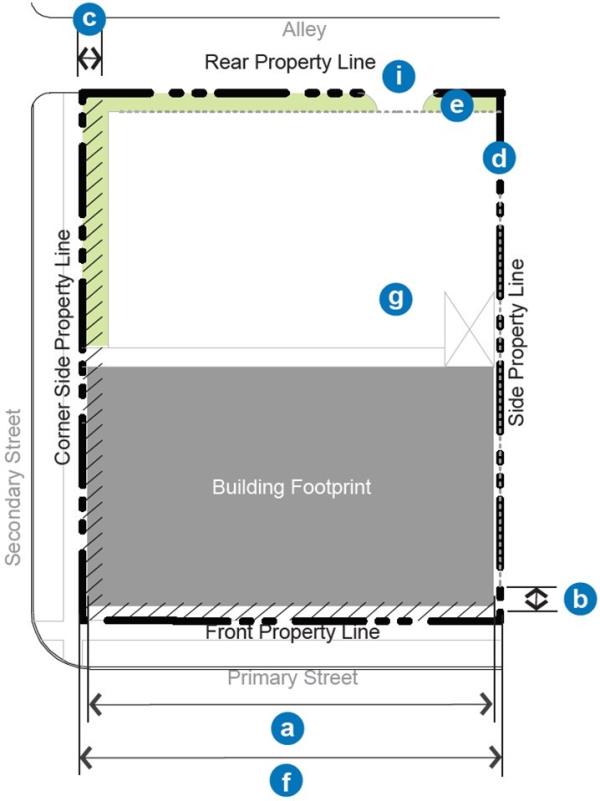
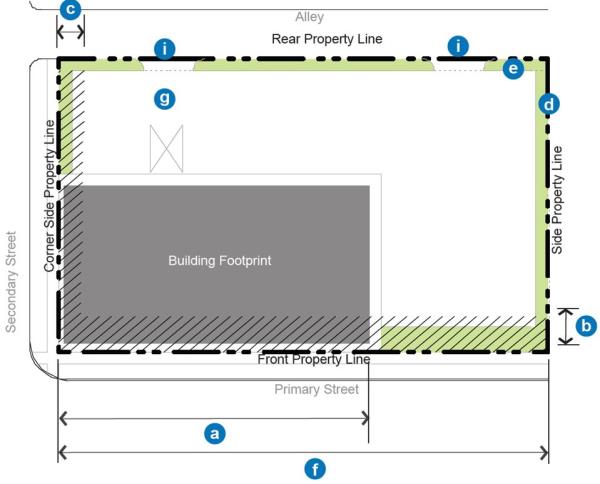
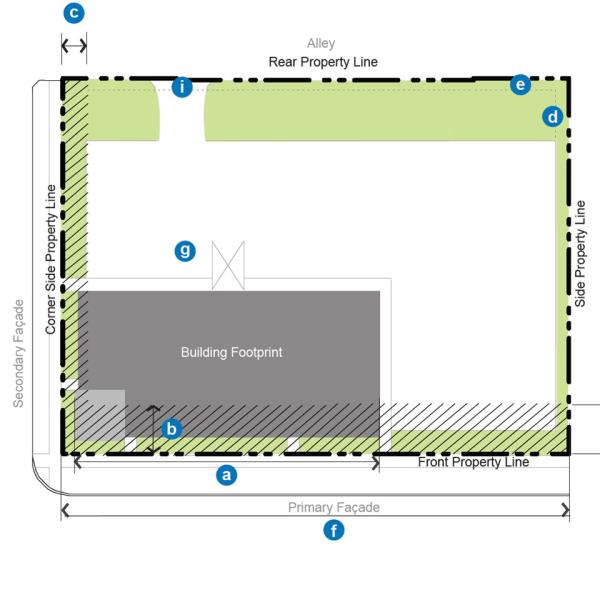
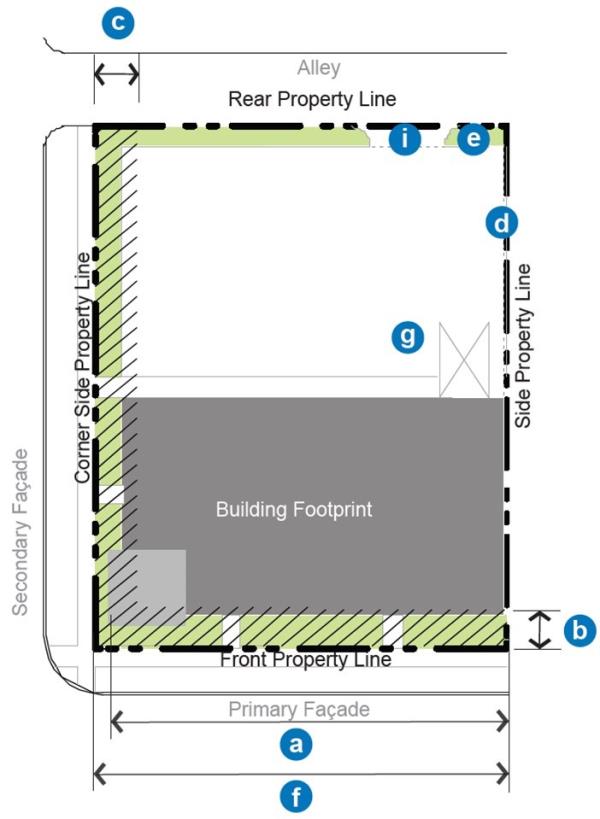
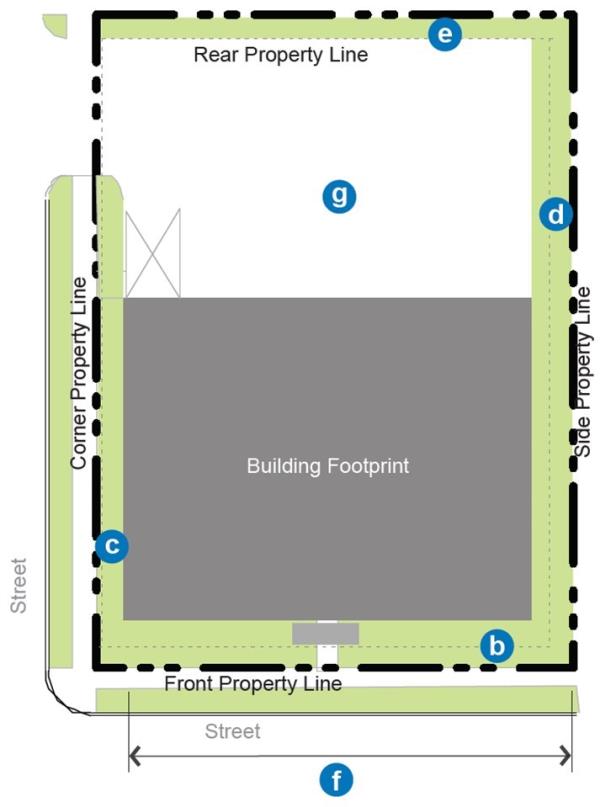
ii) Front Property Line Coverage. Refer to Figure 3.2 (1). Measuring Front Property Line Coverage. Measurement defining the minimum percentage of street wall or building façade required along the street. The width of the principal structure(s) (as measured within the front build-to zone) shall be divided by the maximum width of the front build-to zone (BTZ).
(1) Certain buildings have this number set to also allow the development of a courtyard along the front property line.
(2) Some frontage types allow side yard parking to be exempted from the front lot line coverage calculation. If such an exemption is permitted, the width of up to one double loaded aisle of parking, located with the drive perpendicular to the street and including adjacent sidewalks and landscaping, may be exempted, to a maximum of 72 feet.
iii) Occupation of Corner. Occupying the intersection of the front and corner build-to zones with a principal structure.
iv) Front Build-to Zone. The build-to zone or setback parallel to the front property line. Building components, such as awnings or signage, are permitted to encroach into the build-to zone
(1) All build-to zone and setback areas not covered by building must contain either landscape, patio space, or sidewalk space.
v) Corner Build-to Zone. The build-to zone or setback parallel to the corner property line.
(1) All build-to zone and setback areas not covered by building must contain either landscape, patio space, or sidewalk space.
vi) Minimum Side Yard Setback. The minimum required setback along a side property line.
vii) Minimum Rear Yard Setback. The minimum required setback along a rear property line.
viii) Minimum & Maximum Lot or Building Width. Depending on the Building Type, either the minimum or maximum building or unit width will be noted or the minimum and maximum width of a lot, all measured at or parallel to the front property line.
ix) Parking & Loading Location. The yard in which a surface parking lot, detached garage, attached garage door access, loading and unloading, and associated drive is permitted.
x) Vehicular Access. The permitted means of vehicular ingress and egress to the lot.
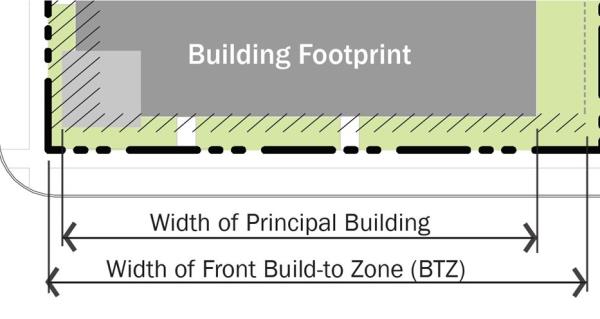 |
| Figure 3.2 (1). Measuring Front Property Line Coverage |
b) Height. The following explains the line item requirements for each Building Type Table within the second section entitled “Height”.
i) Minimum Overall Height. The minimum overall height for the building shall be located within the build-to zone; stories above the required minimum height may be stepped back from the façade.
ii) Maximum Overall Height. The sum of a building’s total number of stories.
(1) Half stories are located either completely within the roof structure with street-facing windows or in a visible basement exposed a maximum of one half story above grade.
(2) A building incorporating both a half story within the roof and a visible basement shall count the height of the two half stories as one full story.
(3) Some Building Types require a building façade to step back as its height increases. If required, the upper stories of any building façade with street frontage shall be setback a designated amount beyond the building façade of the lower stories.
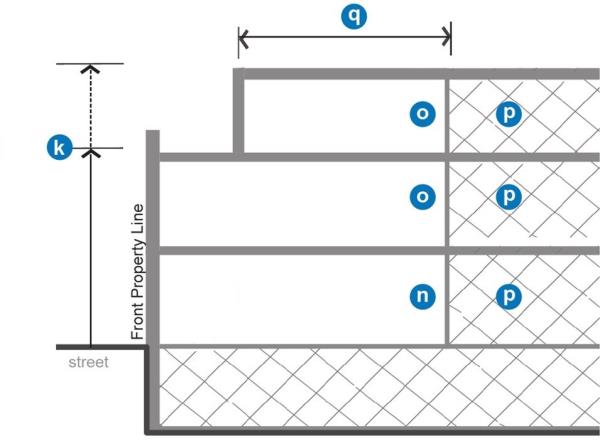
iii) Ground Story and Upper Story, Minimum and Maximum Height. (Refer to Figure 3.2 (2). Measuring Height). Each frontage type includes a permitted range of height in feet for each story. Additional information is as follows:
(1) Floor height is measured in feet between the floors of a story to the floor of the story above it.
(2) Floor height requirements apply only to street facing façades.
(3) For single story buildings and the uppermost story of a multiple story building, floor to floor height shall be measured from the floor of the story to the tallest point of the ceiling.
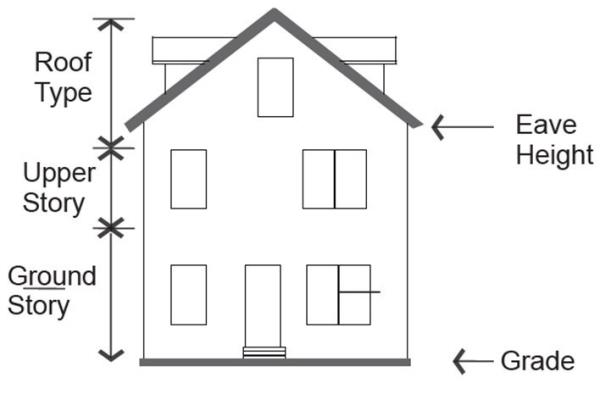 | 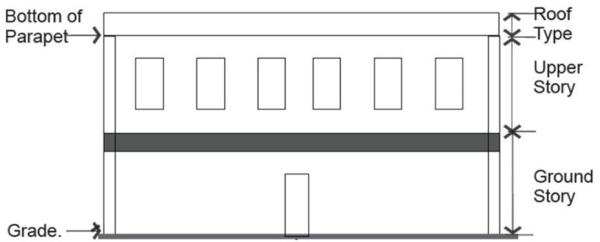 |
| Figure 3.2 (2). Measuring Height | |
iv) Existing Single Family Residential Buffer. In order to assure compatibility of new construction with adjacent single family neighborhoods.
(1) Transitions for Single Family Homes Sharing a Property Line. A 20-foot setback is required from the property line adjacent to a single family detached home. At 20 feet, 25-foot building height is permitted in between the property line and 30 feet. After 30 feet, every 1 foot in additional horizontal distance from the property line permits 1 foot of additional vertical building height. After 40’, building heights, as permitted in 10-13-3 Building Types, is allowed. See Figure 3.2 (3).
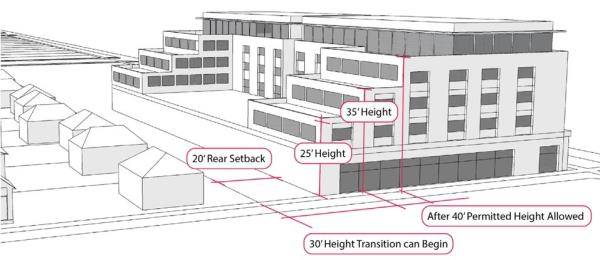 |
| Figure 3.2 (3). Transition for Single-Family Homes Sharing a Property Line |
(2) Transitions for Single Family Homes Across a Public Street. A 10-foot setback is required from the right-of-way line for any building directly across the street from an existing single-family or two-family zoned parcel. At 10 feet, a 35-foot building height is permitted in between the property line and 30 feet. After 30 feet, building heights, as permitted in 10-13-3 Building Types, is allowed. See Figure 3.2 (4).
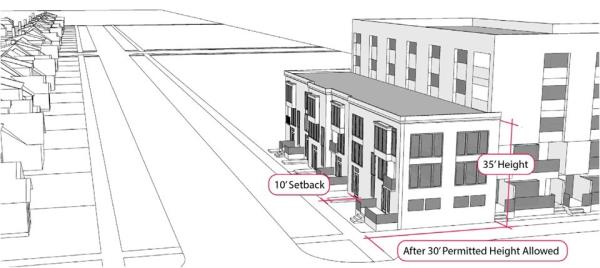 |
| Figure 3.2 (4). Transitions for Single-Family Homes Across a Public Road |
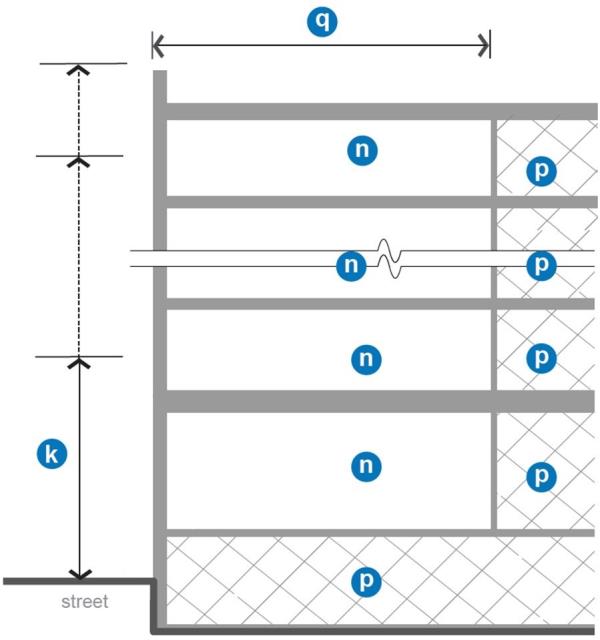
c) Uses. The following explains the line item requirements for each Building Type Table within the third section entitled “Uses” Refer to Section 10-13-2. Uses for uses permitted within each Zoning District. The requirements in this section of the Building Type Tables may limit those uses within a specific Building Type. Table 3.2 (3), illustrates an example of the Uses table from a typical Building Type.
i) Ground and Upper Story. The uses or category of uses which may occupy the ground and/or upper story of a building.
ii) Parking Within Building. The area(s) of a building in which parking is permitted within the structure.
iii) Required Occupied Space. The area(s) of a building that shall be designed as occupied space, defined as interior building space regularly occupied by the building users. It does not include storage areas, utility space, or parking.
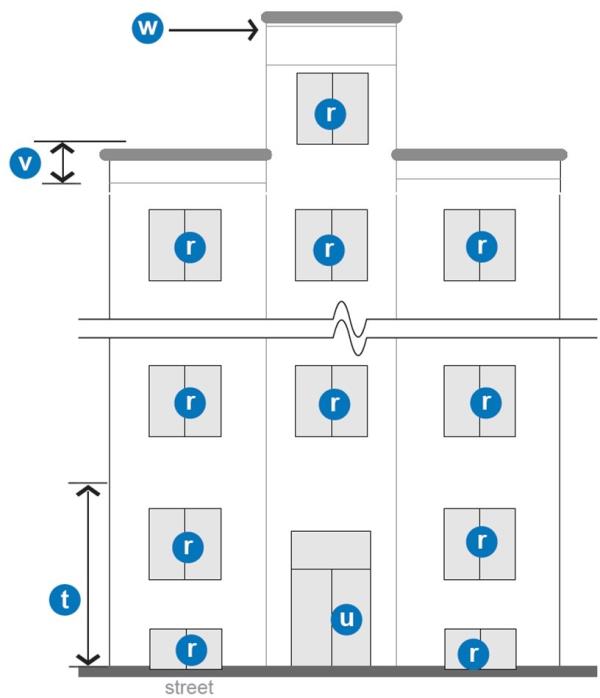
d) Street Façade Requirements. The following explains the line item requirements for each Building Type Table 3.3 through 3.7, within the fourth section entitled “Street Façade Requirements.” Street Façade Requirements apply only to façades facing a public or private right-of-way. The rear or interior side yard façades are not required to meet these standards unless otherwise stated.
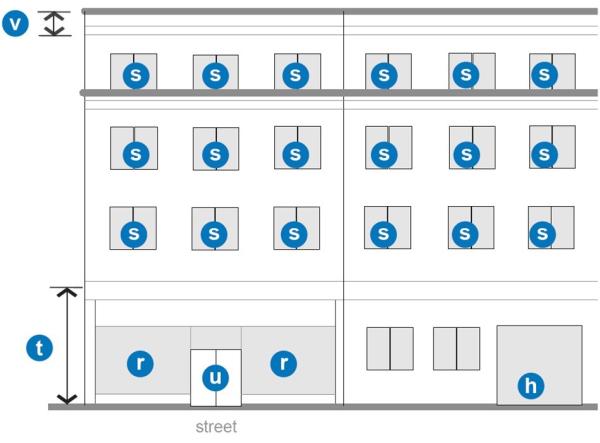
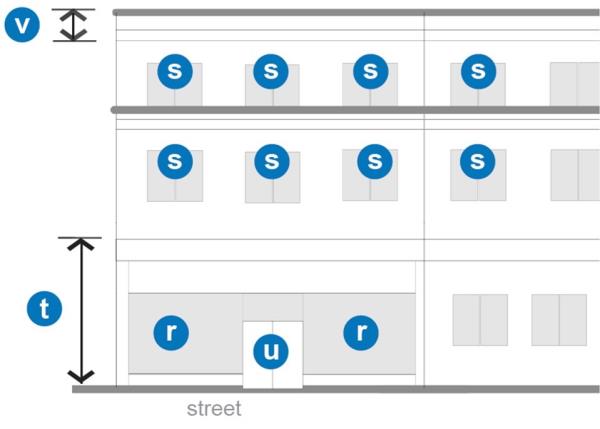
i) Minimum Ground Story and Upper Floor Transparency. (Refer to Figure 3.2 (5), Measuring Transparency per Façade). The minimum amount of transparency required on street façades with street frontage.
(1) Transparency is any glass in windows and/or doors, including any mullions that is highly transparent with low reflectance.
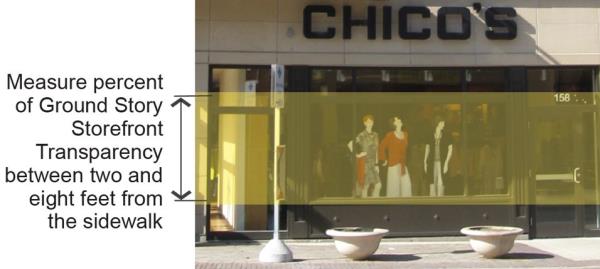
(2) Ground Story Transparency, when defined separately from the overall minimum transparency, shall be measured between two feet and eight feet from the average grade at the base of the front façade.
(3) A general Minimum Transparency requirement shall be measured from floor to floor of each story.
ii) Blank Wall Limitations. A restriction of the amount of windowless area permitted on a façade with street frontage. If required, the following shall both be met for each story:
(1) No rectangular area greater than 30% of a story’s façade, as measured from floor to floor, may be windowless; and
(2) No horizontal segment of a story’s façade greater than 15 feet in width may be windowless.
iii) Entrance Type. The Entrance Type(s) permitted for the entrance(s) of a given Building Type. A mix of permitted Entrance Types may be utilized. Refer to 10-13-3 i Entrance Types for definition of and additional requirements for each Entrance Type.
iv) Principal Entrance Location. The façade on which the primary building entrance is to be located.
v) Required Number of Street Entrances. The minimum number of and maximum spacing between entrances on the ground floor building façade with street frontage.
vi) Vertical Façade Divisions. The use of a vertically oriented expression line or form to divide the façade into increments no greater than the dimension shown, as measured along the base of the façade. Elements may include a column, pilaster, or other continuous vertical ornamentation a minimum of one and a half inch depth.
vii) Horizontal Façade Divisions. The use of a horizontally oriented expression line or form to divide portions of the façade into horizontal divisions. Elements may include a cornice, belt course, molding, string courses, or other continuous horizontal ornamentation a minimum of one and a half inch depth
e) Roof Type. The following explains the line item requirements for each Building Type Table in Sections 10-13-2 3) through 10-13-2 7), within the fifth section entitled “Roof Types”.
i) Permitted Roof Type. The roof type(s) permitted for a given Building Type. Refer to 10-13-2 9. Roof Types for more specific requirements.
ii) Tower. A vertical building extension that may be permitted in conjunction with another roof type on certain Building Types. Refer to 10-13-2 9 Roof Types.
| 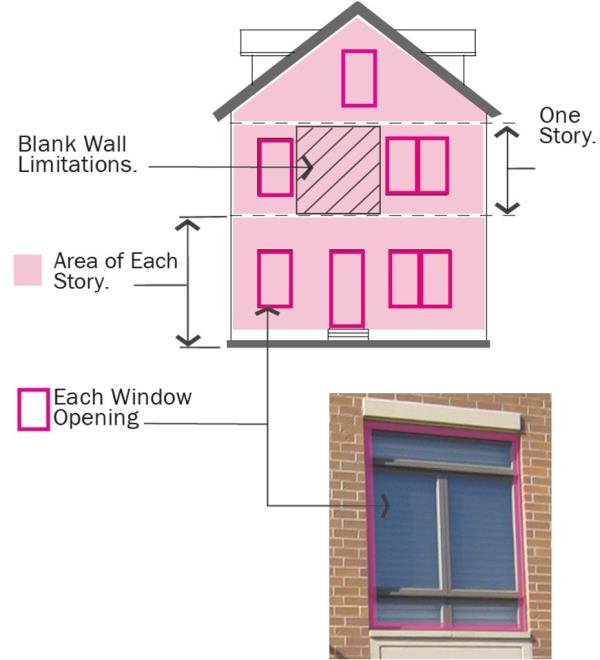 |
| Figure 3.2 (5). Measuring Transparency | |
3) Storefront Building.
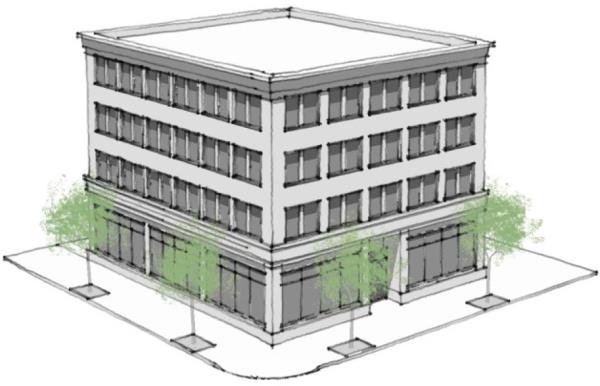
a) Description & Intent. The Storefront Building is intended for use as a mixed use building located close to the front property line with parking typically in the rear or side of the lot.
The key façade element of this Building Type is the storefront required on the ground floor front façade, with large amounts of glass and regularly spaced entrances.
This building type is adaptable to be used in a variety of intensities and heights, depending on the district within which it is located.
b) Regulations. Regulations for the Storefront Building Type are defined in the adjacent table.
 |  |  |
| Typical Site Plan | Site Plan with Side Yard Parking | |
| Figure 3.3 (1). Building Siting | ||
| 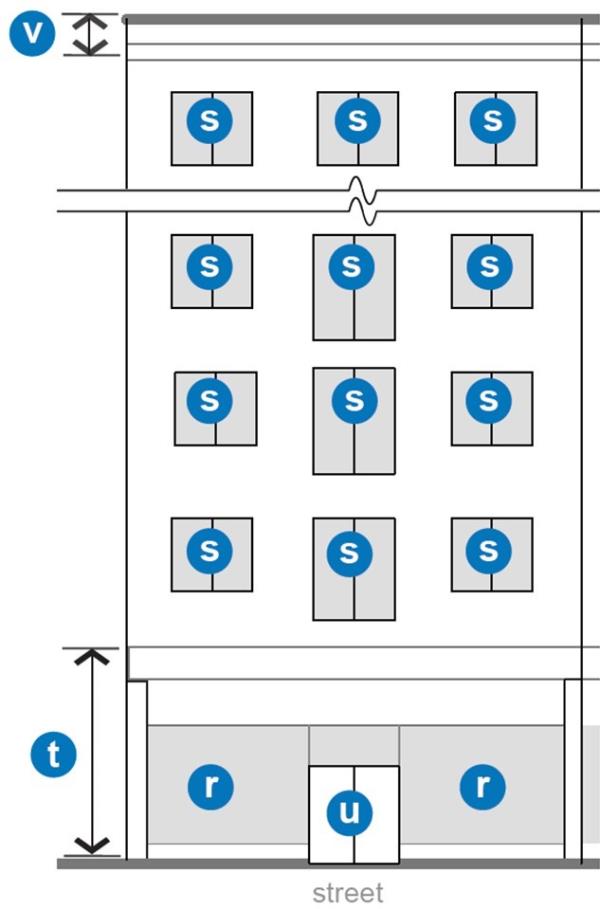 | |
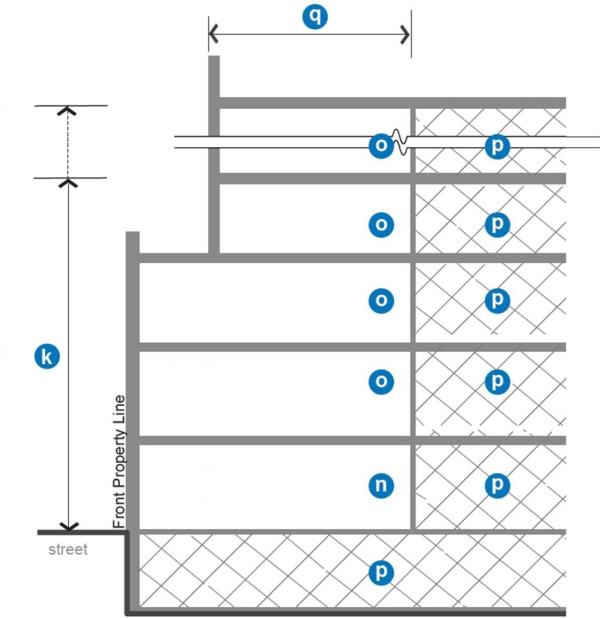
| Figure 3.3 (2). Height & Use Requirements | Figure 3.3 (3). Street Façade Requirements | |
| STORE FRONT | PERMITTED DISTRICTS | ||||||
| DT-E | DT-W | DT-G | S-C | BP | UC | ||
| (1) Building Siting (refer to figure 3.3 (1) | |||||||
| Multiple Principal Buildings | permitted | permitted | permitted | permitted | permitted | permitted | |
| a | Front Property Line Coverage | 80% 1 | 80% 1 | 80% 1 | 80% 1 | 80% 1 | 80% 1 |
| Occupation of Corner | required | required | required | required | required | required | |
| b | Front build-to-Zone | 0' to 15' 2 | 0' to 15' 2 | 0' to 15' 2 | 10' min | 0' to 15' 2,9 | 0' to 15' 2,9 |
| c | Corner Build-to-Zone | 0' to 15' 2 | 0' to 15' 2 | 0' to 15' 2 | 10' min | 0' to 15' 2,9 | 0' to 15' 2,9 |
| d | Minimum Side Yard Setback | 0' 3 | 0' 3 | 0' 3 | 5' 3 | 5' 3 | 5' 3 |
| e | Minimum Rear Yard Setback | 0' 3 | 0' 3 | 0' 3 | 5' 3 | 5' 3 | 5' 3 |
| f | Minimum Lot Width | none | |||||
| Maximum Lot Width | none | ||||||
| g | Parking & Loading Location | rear & side yard 1 | |||||
| (2) Height (refer to figure 3.3 (2) | |||||||
| j | Minimum Overall Height | 1 story | |||||
| k | Maximum Overall Height | 10 stories 4 | 6 stories | 4 stories | 60' 5,6 | 80' 5,7,8 | 40' |
| Ground Story: Minimum Height Maximum Height | 14' 24' 11 | 14' 24' 11 | 14' 24' 11 | NA | NA | NA | |
| Upper Stories: Minimum Height Maximum Height | 9' 14' | 9' 14' | 9' 14' | NA | NA | NA | |
| (3) Uses (refer to figure 3.3 (2) refer to 10-13-2 Uses for permitted uses | |||||||
| n | Ground Story | retail, service, office | retail, service, office, residential 10 | ||||
| o | Upper Story | any permitted use | |||||
| p | Parking within Building | permitted fully in any basement and in rear of upper floors | |||||
| q | Required Occupied Space | 30’ deep on all full floors from the front façade | |||||
| (4) Street Façade Requirements (refer to figure 3.3 (3) | |||||||
| r | Minimum Ground Story Transparency (measured between 2' & 8' above grade) | 60% front only | |||||
| s | Minimum Transparency (per each story) | 15% | |||||
| Blank Wall Limitations | required per floor (refer to 10-13-3 2 d ii) | ||||||
| t | Front Façade Entrance Type | storefront, arcade | |||||
| u | Principal Entrance Location | front or corner façade | |||||
| Required Number of Street Entrances | 1 per each 100’ of front façade | ||||||
| Vertical Façade Divisions | every 40’ of façade width | ||||||
| Horizontal Façade Divisions | required within 3’ of the top of the ground story, and every third story above the ground floor | ||||||
| (5) Roof Type Requirements (refer to figure 3.3 (3) | |||||||
| v | Permitted Roof Types | parapet, pitched, flat | |||||
| Tower | permitted | ||||||
| Notes | |||||||
| 1 - Lots wider than 140’ are permitted one double-loaded aisle of parking (maximum width of 72’), located perpendicular to the front property line, which is exempt from front property line coverage. | |||||||
2 - Building along Riverdale Road, 1900 West, 5600 South, 3500 West and Midland Drive are exempt from Front Build-to Zone requirements, and shall follow setback requirements: a. A 15 foot setback is required on all new development along these streets b. All setbacks areas must contain either landscape, trees, patio space or sidewalk space C. Trees, landscaping and other improvements should be used to mitigate the negative impacts from the heavy fast moving traffic. | |||||||
| 3 - As required for Site Plan approval, also reference 10-13-3 2 b iv | |||||||
| 4 - Building heights on Riverdale Road, 1900 West, and 5600 South, shall not exceed 8 stories in the area beginning at the back of the curb and extending 100 feet therefrom. In areas beyond 100 feet building height may be increased up to 10 stories. | |||||||
| 5 - Above the third story, the upper stories of any building façade with street frontage shall have a step back from the lower stories that is a minimum of 6' | |||||||
| 6 - Maximum density is 25 units per acre | |||||||
| 7 - Building type not allowed along 4200 South | |||||||
| 8 - West side of 1900 West, building Height is 60' maximum | |||||||
| 9 - 20' setback off of 4000 South | |||||||
| 10 - UC ZONE - Residential Only allowed if the building is 125’ from back of curb. | |||||||
| 11 - If the ground floor is more than 18 feet in height, it shall count as two stories towards maximum building height | |||||||
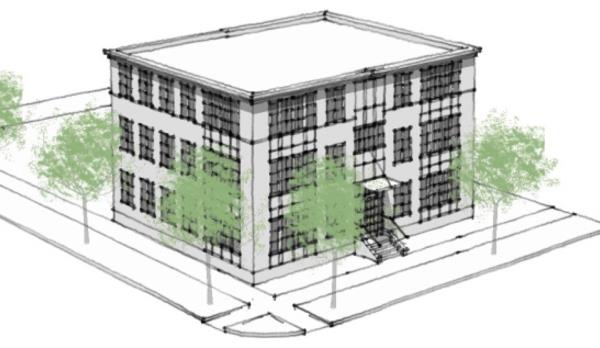
4) General Stoop Building.
a) Description & Intent. The General Stoop Building Type is limited in terms of uses by the district within which it is located, generally housing office and/or residential uses. The General Stoop building is intended to be built close to the front and passing pedestrians and transit riders. Parking may be provided in the rear of the lot, internally in the building, or, in some cases, one double loaded aisle of parking is permitted in the interior or the side yard at the front property line.
This building is available in a variety of intensities and heights, depending on the district within which it is located.
b) Regulations for the General Stoop Building Type are defined in the adjacent table.
 | 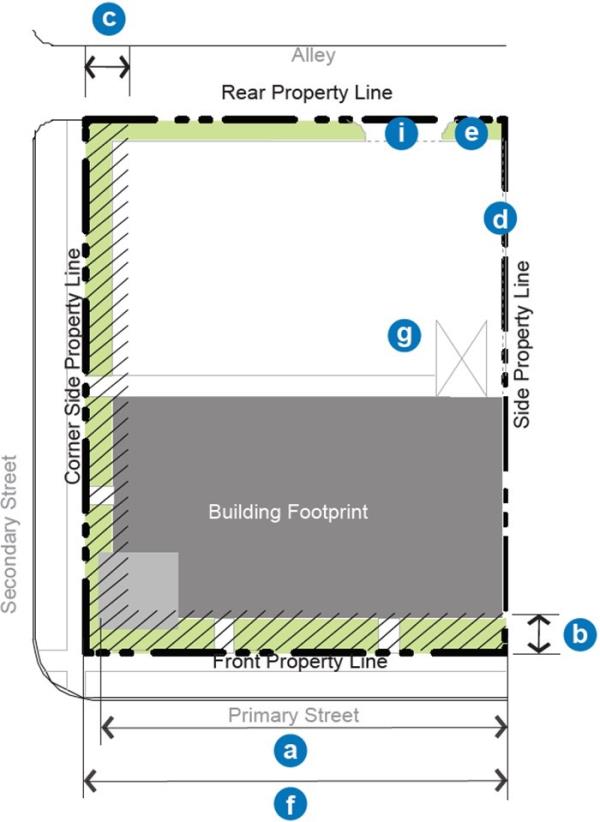 | 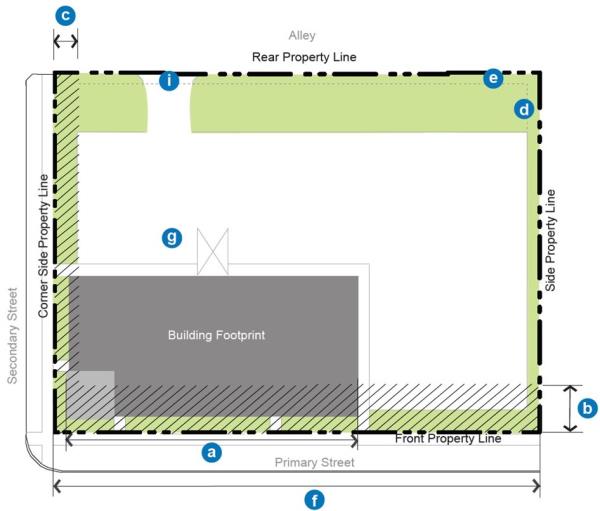 |
| Typical Site Plan | Site Plan with Side Yard Parking | |
| Figure 3.4 (1). Building Siting | ||
| 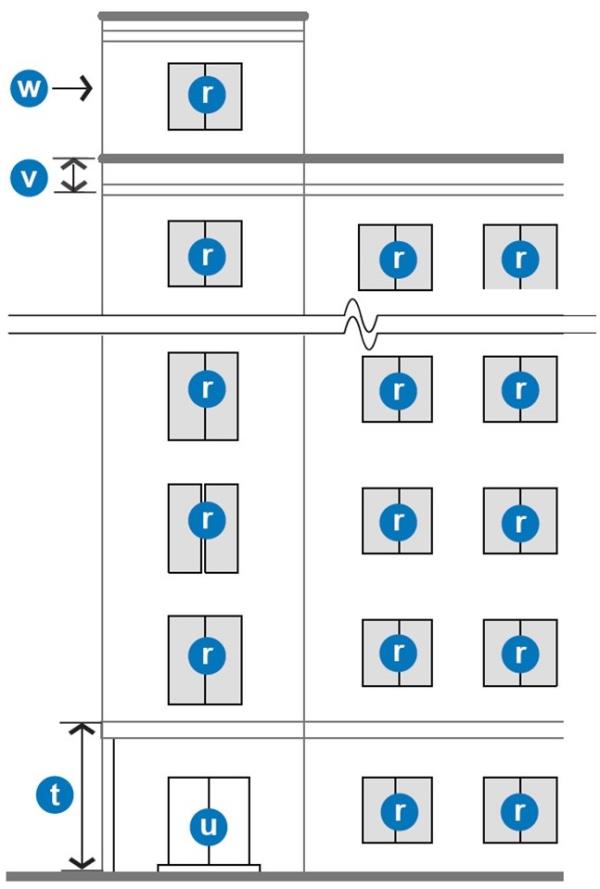 | |
| Figure 3.4 (2). Height & Use Requirements | Figure 3.4 (3). Street Façade Requirements | |
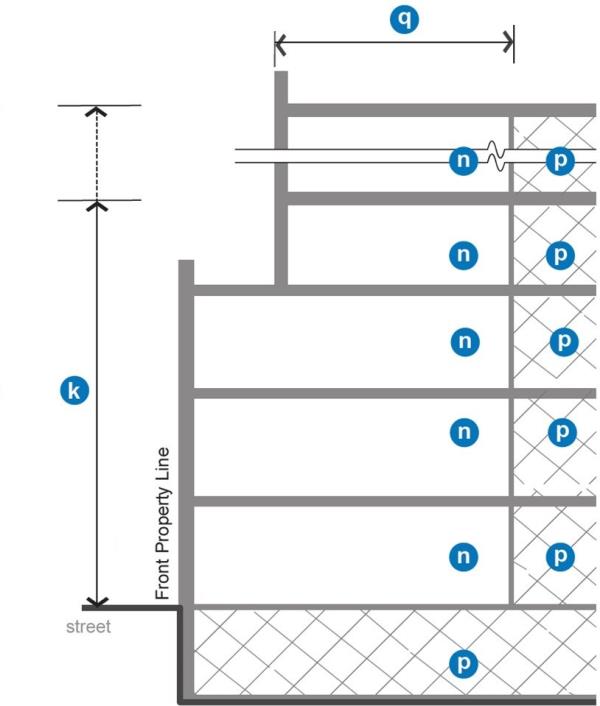
| GENERAL STOOP | PERMITTED DISTRICTS | |||||||
| DT-E | DT-W | DT-G | S-C | S-N | BP | UC | ||
| (1) Building Siting (refer to figure 3.4 (1) | ||||||||
| Multiple Principal Buildings | permitted | permitted | permitted | permitted | permitted | permitted | permitted | |
| a | Front Property Line Coverage | 80% 1,2 | 80% 1,2 | 70% 1,2 | 80% 1,2 | 70% 1,2 | 80% 1,2 | 80% 1,2 |
| Occupation of Corner | required | required | required | required | required | required | required | |
| b | Front build-to-Zone | 0' to 15' 3 | 0' to 15' 3 | 0' to 15' 3 | 10' minimum | 10' minimum | 0' to 15' 3,11 | 0' to 15' 3,11 |
| c | Corner Build-to-Zone | 0' to 15' 3 | 0' to 15' 3 | 0' to 15' 3 | 10' minimum | 10' minimum | 0' to 15' 3,11 | 0' to 15' 3,11 |
| d | Minimum Side Yard Setback | 0' 4 | 0' 4 | 0' 4 | 5' 4 | 5' 4 | 5' 4 | 5' 4 |
| e | Minimum Rear Yard Setback | 0' 4 | 0' 4 | 0' 4 | 5' 4 | 5' 4 | 5' 4 | 5' 4 |
| f | Minimum Lot Width | none | ||||||
| Maximum Lot Width | none | |||||||
| g | Parking & Loading Location | rear & side yard 2 | ||||||
| (2) Height (refer to figure 3.4 (2) | ||||||||
| j | Minimum Overall Height | 1 story | ||||||
| k | Maximum Overall Height | 10 stories 5 | 6 stories | 4 stories | 60' 6,7 | 60' 6,8 | 80' 6,9,10 | 40' |
| Ground Story: Minimum Height Maximum Height | 9' 14' | 9' 18' | 9' 18' | NA | NA | NA | NA | |
| Upper Stories: Minimum Height Maximum Height | 9' 14' | 9' 14' | 9' 14' | NA | NA | NA | NA | |
| (3) Uses (refer to figure 3.4 (2) refer to 10-13-2 Uses for permitted uses | ||||||||
| n | Ground Story | retail, service, office | any permitted use 12 | |||||
| o | All Upper Story | any permitted use | ||||||
| p | Parking within Building | permitted fully in any basement and in rear of upper floors | ||||||
| q | Required Occupied Space | 30’ deep on all full floors from the front façade | ||||||
| (4) Street Façade Requirements (refer to figure 3.4 (3) | ||||||||
| s | Minimum Transparency (per each story) | 15% | ||||||
| Blank Wall Limitations | required per floor (refer to 10-13-3 2 d ii) | |||||||
| t | Front Façade Entrance Type | stoop, porch, storefront | ||||||
| u | Principal Entrance Location | front or corner façade | ||||||
| Required Number of Street Entrances | 1 per each 100’ of front façade | |||||||
| every 40’ of façade width | every 50’ of façade width | every 40’ of façade width | ||||||
| Horizontal Façade Divisions | required within 3’ of the top of the ground story, and every third story above the ground floor | |||||||
| (5) Roof Type Requirements (refer to figure 3.4 (3) | ||||||||
| v | Permitted Roof Types | parapet, pitched, flat | ||||||
| w | Tower | permitted | ||||||
| Notes | ||||||||
| 1 - A courtyard covering up to 35% of the front façade is permitted and may contribute to the Front Live Coverage | ||||||||
| 2 - Lots wider than 140’ are permitted one double-loaded aisle of parking (maximum width of 72’), located perpendicular to the front property line, which is exempt from front property line coverage. | ||||||||
3 - Building along Riverdale Road, 1900 West, 5600 South, 3500 West and Midland Drive are exempt from Front Build-to Zone requirements, and shall follow setback requirements: a. A 15 foot setback is required on all new development along these streets b. All setbacks areas must contain either landscape, trees, patio space or sidewalk space C. Trees, landscaping and other improvements should be used to mitigate the negative impacts from the heavy fast moving traffic. | ||||||||
| 4 - As required for Site Plan approval, also reference 10-13-3 2 b iv | ||||||||
| 5 - Building heights on Riverdale Road, 1900 West and 5600 South shall not exceed 8 stories in the area beginning at the back of the curb and extending 100 feet therefrom. In areas beyond 100 feet building height may be increased up to 10 stories. | ||||||||
| 6 - Above the third story, the upper stories of any building façade with street frontage shall have a step back from the lower stories that is a minimum of 6' | ||||||||
| 7 - Maximum density is 25 units per acre | ||||||||
| 8 - 1100' south of Hinckley Drive the Maximum Height is 50' | ||||||||
| 9 - Building Type not allowed along 4200 South | ||||||||
| 10 - West of 1900 West, building height is 60' maximum | ||||||||
| 11 - 20' setback off of 4000 South | ||||||||
| 12 - UC ZONE - Residential Only allowed if the building is 125’ from back of curb. | ||||||||
5) Limited Bay Building.
a) Description & Intent. The Limited Bay Building Type permits a lower level of ground floor storefront façade and a single vehicle bay with garage door access on the Primary Street. A wider range of uses can also be accommodated within this Building Type, including craftsman industrial uses. This Building Type is still intended to be built close to the front and corner property lines allowing easy access to passing pedestrians and transit riders, and continuing the fabric of the Storefront Building Type. Parking may be provided in the rear of the lot, internally in the building, or one double loaded aisle of parking is permitted in the interior or the side yard at the front property line.
b) Regulations. Regulations for the Limited Bay Building Type are defined in the adjacent table.
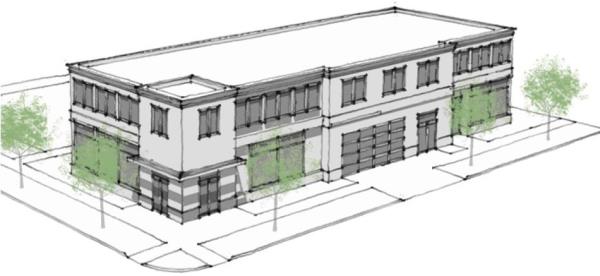 |
| |
| Figure 3.5 (1). Building Siting | ||
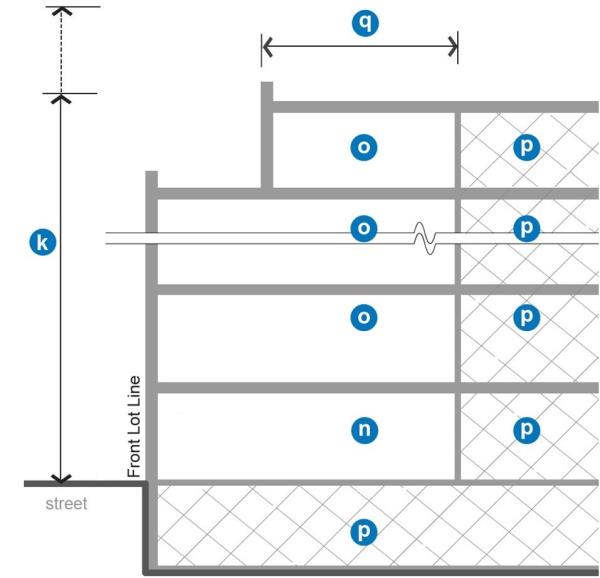 |
| |
| Figure 3.5 (2). Height & Use Requirements | Figure 3.5 (3). Street Façade Requirements | |
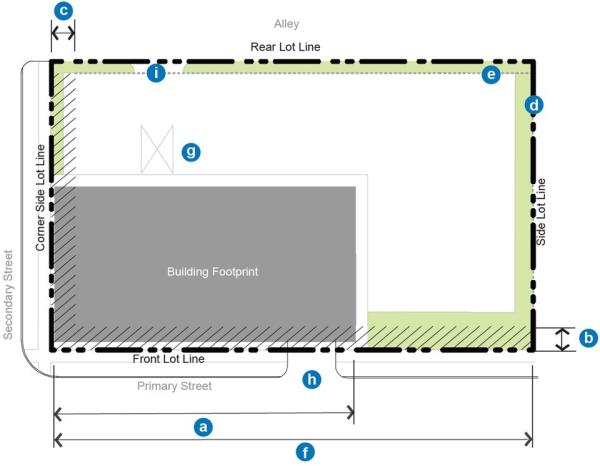
| LIMITED BAY | PERMITTED DISTRICTS | |||
| DT-G | BP | UC | ||
| (1) Building Siting (refer to figure 3.3 (1) | ||||
| Multiple Principal Buildings | permitted | permitted | permitted | |
| a | Front Property Line Coverage | 70% 1 | 70% 1 | 70% 1 |
| Occupation of Corner | required | required | required | |
| b | Front build-to-Zone | 0' to 15' 2 | 0' to 15' 2,6 | 0' to 15' 2,6 |
| c | Corner Build-to-Zone | 0' to 15' 2 | 0' to 15' 2,6 | 0' to 15' 2,6 |
| d | Minimum Side Yard Setback | 5' | 5' | 5' |
| e | Minimum Rear Yard Setback | 5' | 5' | 5' |
| f | Minimum Lot Width | 50' | ||
| Maximum Lot Width | none | |||
| g | Parking & Loading Location | rear & side yard | ||
| Street Façade Service bay Entrance | Limited to one per street façade, maximum width 18' | |||
| (2) Height (refer to figure 3.3 (2) | ||||
| j | Minimum Overall Height | 1 story | 1 story | 1 story |
| k | Maximum Overall Height | 4 stories | 80 4,5 | 40' |
| Ground Story: Minimum Height Maximum Height | 14' 24' 7 | NA | NA | |
| Upper Stories: Minimum Height Maximum Height | 9' 14' | NA | NA | |
| (3) Uses (refer to figure 3.3 (2) refer to 10-13-2 Uses for permitted uses | ||||
| n | Ground Story | retail, service, office, craftsman industrial | ||
| o | Upper Story | any permitted use | ||
| p | Parking within Building | permitted fully in basement and in rear of upper floors plus one service bay width at ground floor | ||
| q | Required Occupied Space | 30’ deep on all full floors from the front façade | ||
| (4) Street Façade Requirements (refer to figure 3.3 (3) | ||||
| r | Minimum Ground Story Transparency (measured between 2' & 8' above grade) | 40%, minimum 50% of Service Bay door shall be transparent | ||
| s | Minimum Transparency (per each story) | 15% | ||
| Blank Wall Limitations | required per floor (refer to 10-13-3 2 d ii) | |||
| t | Front Façade Entrance Type | stoop, storefront | ||
| u | Principal Entrance Location | front or corner façade | ||
| Required Number of Street Entrances | 1 per each 100’ of front façade; service bay door not included; 1 per 150' of façade | |||
| Vertical Façade Divisions | every 40’ of façade width | |||
| Horizontal Façade Divisions | required within 3’ of the top of the ground story for all buildings over 2 stories | |||
| (5) Roof Type Requirements (refer to figure 3.3 (3) | ||||
| v | Permitted Roof Types | parapet, pitched, flat | ||
| w | Tower | permitted | ||
| Notes | ||||
| 1 - Lots wider than 140’ are permitted one double-loaded aisle of parking (maximum width of 72’), located perpendicular to the front property line, which is exempt from front property line coverage. | ||||
2 - Building along Riverdale Road, 1900 West, 5600 South, 3500 West and Midland Drive are exempt from Front Build-to Zone requirements, and shall follow setback requirements: a. A 15 foot setback is required on all new development along these streets b. All setbacks areas must contain either landscape, trees, patio space or sidewalk space C. Trees, landscaping and other improvements should be used to mitigate the negative impacts from the heavy fast moving traffic. | ||||
| 3 - As required for Site Plan approval, also reference 10-13-3 2 b iv | ||||
| 4 - Building Type not allowed along 4200 South | ||||
| 5 - West of 1900 West, Building Height is 60' maximum | ||||
| 6 - 20' setback off of 4200 South | ||||
| 7 - if the ground floor is more than 18 feet in height, it shall count as two stories towards maximum building height | ||||
6) Large Format Building
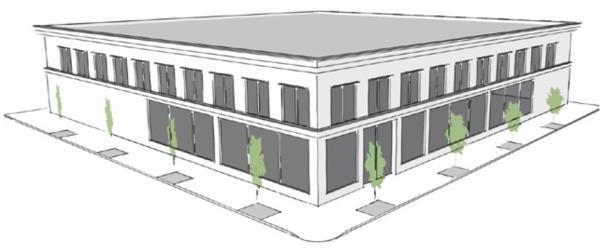
a) Description & Intent. The Large Format Building Type permits a large building footprint with a ground floor storefront façade. The minimum sized building footprint of the Large Format Building Type is 35,000 total square feet. If a building is to have a smaller footprint than the minimum 35,000 sf requirement than it will not be considered or approved as a Large Format Building.
This building type is usually provided only single certificate of occupancy, and is commonly referred to as a “big-box” or “mid-box” structure.
This Building Type is still intended to be built close to the front and corner property lines allowing easy access to passing pedestrians and transit riders, and continuing the fabric of the Storefront Building Type. Parking may be provided in the rear of the lot, internally in the building, or one double loaded aisle of parking is permitted in the interior or the side yard at the front property line.
b) Regulations. Regulations for the Large Format Building Type are defined in the adjacent table.
 |
|  |
| Typical Site Plan | Site Plan with Side Yard Parking | |
| Figure 3.6 (1). Building Siting | ||
 |
| |
| Figure 3.6 (2). Height & Use Requirements | Figure 3.6 (3). Street Façade Requirements | |
| LARGE FORMAT | PERMITTED DISTRICTS | |||||
| DT-E | DT-W | DT-G | BP | UC | ||
| (1) Building Siting (refer to figure 3.3 (1) | ||||||
| Multiple Principal Buildings | not permitted | not permitted | not permitted | not permitted | not permitted | |
| a | Front Property Line Coverage | 80% 1 | 80% 1 | 70% 1 | 70% 1 | 70% 1 |
| Occupation of Corner | required | required | required | required | required | |
| b | Front build-to-Zone | 0' to 15' 2 | 0' to 15' 2 | 0' to 15' 2 | 0' to 15' 2,6 | 0' to 15' 2,6 |
| c | Corner Build-to-Zone | 0' to 15' 2 | 0' to 15' 2 | 0' to 15' 2 | 0' to 15' 2,6 | 0' to 15' 2,6 |
| d | Minimum Side Yard Setback | 0' 3 | 0' 3 | 0' 3 | 0' 3 | 0' 3 |
| e | Minimum Rear Yard Setback | 0' 3 | 0' 3 | 0' 3 | 0' 3 | 0' 3 |
| f | Minimum Lot Width | 150' | ||||
| Maximum Lot Width | 400' | |||||
| g | Parking & Loading Location | rear & side yard | ||||
| (2) Height (refer to figure 3.3 (2) | ||||||
| j | Minimum Overall Height | 1 story | 1 story | 1 story | 1 story | 1 story |
| k | Maximum Overall Height | 3 stories | 3 stories | 3 stories | 60' 4,5 | 40' |
| Ground Story: Minimum Height Maximum Height | 18' 24' | 18' 24' | 18' 24' | NA | NA | |
| Upper Stories: Minimum Height Maximum Height | 9' 14' | 9' 14' | 9' 14' | NA | NA | |
| (3) Uses (refer to figure 3.3 (2) refer to 10-13-2 Uses for permitted uses | ||||||
| n | Ground Story | retail, service, office | ||||
| o | Upper Story | any permitted use | ||||
| p | Parking within Building | permitted fully in any basement and in rear of upper floors. permitted on upper floor | ||||
| q | Required Occupied Space | 50’ deep on all full floors from the front façade | ||||
| (4) Street Façade Requirements (refer to figure 3.3 (3) | ||||||
| r | Minimum Ground Story Transparency (measured between 2' & 8' above grade) | 50% front only | ||||
| s | Minimum Transparency (per each story) | 15% | ||||
| Blank Wall Limitations | required per floor (refer to 10-13-3 2 d ii) | |||||
| t | Front Façade Entrance Type | storefront | ||||
| u | Principal Entrance Location | front or corner façade | ||||
| Required Number of Street Entrances | 1 per each 150’ of front façade | |||||
| Vertical Façade Divisions | every 40’ of façade width | |||||
| Horizontal Façade Divisions | required within 3’ of the top of the ground story, and every third story above the ground floor | |||||
| (5) Roof Type Requirements (refer to figure 3.3 (3) | ||||||
| v | Permitted Roof Types | parapet, flat | ||||
| Tower | permitted | |||||
| Notes | ||||||
| 1 - Lots wider than 140’ are permitted one double-loaded aisle of parking (maximum width of 72’), located perpendicular to the front property line, which is exempt from front property line coverage. | ||||||
2 - Building along Riverdale Road, 1900 West, 5600 South, 3500 West and Midland Drive are exempt from Front Build-to Zone requirements, and shall follow setback requirements: a. A 15 foot setback is required on all new development along these streets b. All setbacks areas must contain either landscape, trees, patio space or sidewalk space C. Trees, landscaping and other improvements should be used to mitigate the negative impacts from the heavy fast moving traffic. | ||||||
| 3 - As required for Site Plan approval, also reference 10-13-3 2 b iv | ||||||
| 4 - Building Type no allowed along 4200 South | ||||||
| 5 - West of 1900 West, Building Height is 60' maximum | ||||||
| 6 - 20' setback off of 4000 South | ||||||
7) Civic Building.
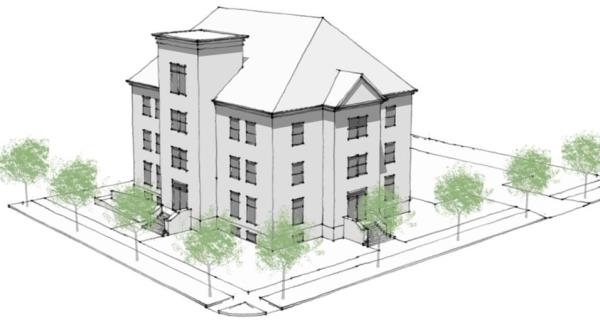
a) Description & Intent. The Civic Building is the most flexible Building Type intended only for civic and institutional types of uses. These buildings are distinctive within the urban fabric created by the other Building Types and could be designed as iconic structures. In contrast to most of the other Building Types, a minimum setback line is required instead of a build to zone, though this setback is required to be landscaped. Parking is limited to the rear in most cases.
The minimum and maximum heights of this Building Type depend on the district within which it is located.
b) Regulations. Regulations for the Civic Building type are defined in the adjacent table.
 |
| |
| Figure 3.7 (1). Building Siting | ||
 |  | |
| Figure 3.7 (2). Height & Use Requirements | Figure 3.7 (3). Street Façade Requirements | |
| CIVIC | PERMITTED DISTRICTS | ||||||
| DT-E | DT-W | DT-G | S-C | BP | UC | ||
| (1) Building Siting (refer to figure 3.3 (1) | |||||||
| Multiple Principal Buildings | permitted | permitted | permitted | permitted | permitted | permitted | |
| Front Property Line Coverage | not required | not required | not required | not required | not required | not required | |
| Occupation of Corner | not required | not required | not required | not required | not required | not required | |
| b | Front build-to-Zone | 15' 1 | 15' 1 | 15' 1 | 10' minimum | 15' 1,7 | 15' 1,7 |
| c | Corner Build-to-Zone | 15' 1 | 15' 1 | 15' 1 | 10' minimum | 15' 1,7 | 15' 1,7 |
| d | Minimum Side Yard Setback | 5' 2 | 5' 2 | 5' 2 | 5' 2 | 5' 2 | 5' 2 |
| e | Minimum Rear Yard Setback | 5' 2 | 5' 2 | 5' 2 | 5' 2 | 5' 2 | 5' 2 |
| f | Minimum Lot Width | 50' | |||||
| Maximum Lot Width | none | ||||||
| g | Parking & Loading Location | rear | rear & interior side yard 3 | ||||
| (2) Height (refer to figure 3.3 (2) | |||||||
| j | Minimum Overall Height | 1 story | 1 story | 1 story | 1 story | 1 story | 1 story |
| k | Maximum Overall Height | 10 stories 4 | 6 stories | 4 stories | 60' | 60' 5,6 | 40' |
| Ground Story: Minimum Height Maximum Height | 9' 20' 8 | 9' 20' 8 | 9' 20' 8 | NA | NA | NA | |
| Upper Stories: Minimum Height Maximum Height | 9' 14' | 9' 14' | 9' 14' | NA | NA | NA | |
| (3) Uses (refer to figure 3.3 (2) refer to 10-13-2 Uses for permitted uses | |||||||
| n | All Stories | limited to civic & institutional uses only | |||||
| p | Parking within Building | permitted fully in any basement and in rear of upper floors | |||||
| q | Required Occupied Space | 30’ deep on all full floors from the front façade | |||||
| (4) Street Façade Requirements (refer to figure 3.3 (3) | |||||||
| s | Minimum Transparency (per each story) | 10% | |||||
| Blank Wall Limitations | not required | ||||||
| t | Front Façade Entrance Type | storefront, arcade | |||||
| u | Principal Entrance Location | front or corner façade | |||||
| Required Number of Street Entrances | 1 per each 100’ of front façade | 1 per each 150’ of front façade | |||||
| Vertical Façade Divisions | not required | ||||||
| Horizontal Façade Divisions | not required | ||||||
| (5) Roof Type Requirements (refer to figure 3.3 (3) | |||||||
| v | Permitted Roof Types | parapet, pitched, flat; other roof types are permitted by conditional use | |||||
| w | Tower | permitted | |||||
| Notes | |||||||
1 - Building along Riverdale Road, 1900 West, 5600 South, 3500 West and Midland Drive are exempt from Front Build-to Zone requirements, and shall follow setback requirements: a. A 15 foot setback is required on all new development along these streets b. All setbacks areas must contain either landscape, trees, patio space or sidewalk space C. Trees, landscaping and other improvements should be used to mitigate the negative impacts from the heavy fast moving traffic. | |||||||
| 2 - As required for Site Plan approval, also reference 10-13-3 2 b iv | |||||||
| 3 - Lots wider than 140’ are permitted one double-loaded aisle of parking (maximum width of 72’), located perpendicular to the property line, which is exempt from front property line coverage. | |||||||
| 5 - Building heights on Riverdale Road, 1900 West and 5600 South shall not exceed 60 feet high in the area beginning at the back of the curb and extending 100 feet therefrom. In areas beyond 100 feet building height may be increased up to 80 feet. | |||||||
| 5 - Maximum Building height along 4200 South is 35' | |||||||
| 6 - West of 1900 West, Building Height is 60' maximum | |||||||
| 7 - 20' setback off of 4000 South | |||||||
| 8 - if the ground floor is more than 18 feet in height, it shall count as two stories towards maximum building height | |||||||
8) Row Building
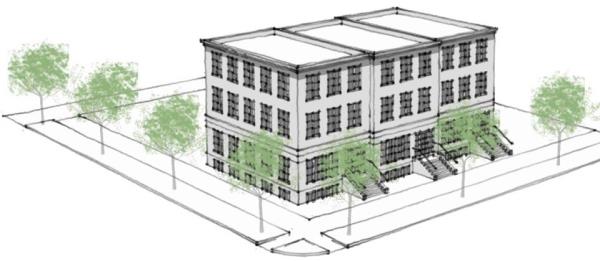
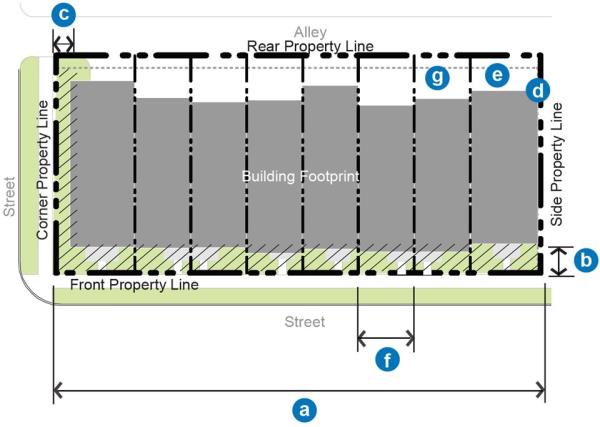
a) Description & Intent. The Row Building is a building typically composed of multiple vertical units, each with its own entrance to the street. This Building Type may be organized as townhomes or rowhomes, or it could also incorporate live/work units where uses are permitted
Parking may be incorporated either into a detached or in an attached garage accessed from the rear of the building. However, when the garage is located within the building, a minimum level of occupied space is required on the front façade to ensure that street façade is active
b) Regulations. Regulations for the Row Building type are defined in the adjacent table.
 |  | 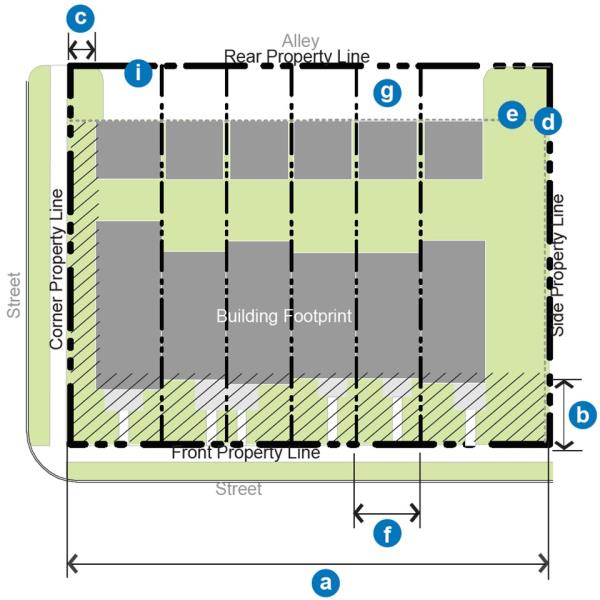 |
| Site Plan with Rear Access Attached Garages | Site Plan with Rear Access Detached Garage | |
| Figure 3.8 (1). Building Siting | ||
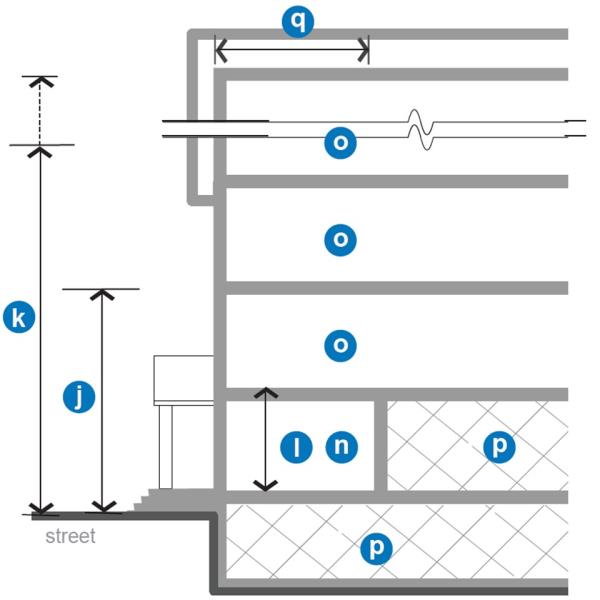 | 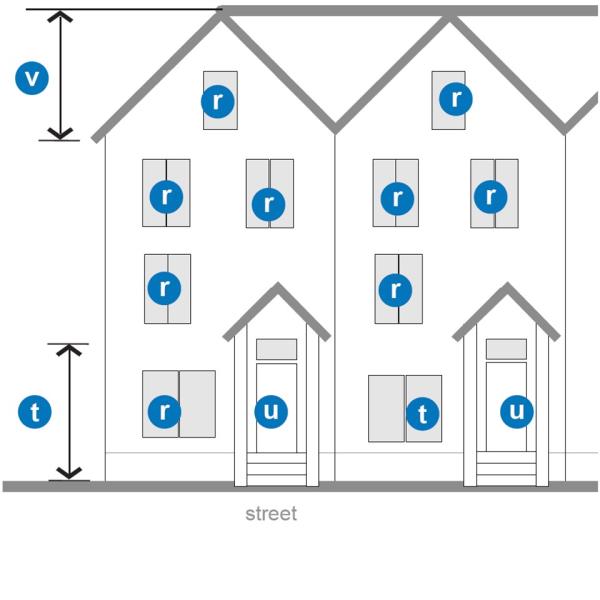 | |
| Figure 3.8 (2). Building Height & Use Requirement | Figure 3.8 (3). Street Façade Requirements | |
| ROW BUILDING | PERMITTED DISTRICTS | |||||
| S-C | S-S | S-N | BP | UC | ||
| (1) Building Sitting (refer to Figure 3.8 (1) | ||||||
| Multiple Principal Buildings | permitted 1 | permitted 1 | permitted 1 | permitted 1 | permitted 1 | |
| a | Front Property Line Coverage | 65% 2 | 65% 2 | 65% 2 | 65% 2 | 65% 2 |
| Occupation of Corner | required | required | required | required | required | |
| b | Front Build-to Zone | 10' minimum | 10' minimum | 10' minimum | 0' to 15' 9 | 0' to 15' 9,10 |
| c | Corner Build-to Zone | 10' minimum | 10' minimum | 10' minimum | 0' to 15' 9 | 0' to 15' 9,10 |
| d | Minimum Side Yard Setback | 0' per unit; 15' between buildings | ||||
| e | Minimum Rear Yard Setback | 10' 3 | 10' 3 | 10' 3 | 10' 3 | 10' 3 |
| f | Minimum Unit Width | 22' per unit | ||||
| Maximum Building Width | maximum of 8 units per building | |||||
| g | Parking & Loading Location | front, rear and side yard | ||||
| (2) Height (Refer to Figure 3.8 (2) | ||||||
| j | Minimum Overall Height | 1 story | 1 story | 1 story | 1 story | 1 story |
| k | Maximum Overall Height | 60' 4 | 35' 5 | 60' 6 | 80' 7,8 | 40' |
| (3) Uses (Refer to Figure 3.8 (2) | ||||||
| n | Ground Stories | residential only | ||||
| o | Upper Stories | residential only | ||||
| p | Parking within Building | permitted fully in basement | ||||
| (4) Street Façade Requirements (Refer to Figure 3.8 (3) | ||||||
| r | Minimum Transparency (per each story) | 15% | ||||
| Blank Wall Limitations | required per floor (refer to 10-13-3 2 d ii) | |||||
| t | Front Façade Permitted Entrance Type | stoop, porch, limited storefront | stoop, porch | |||
| u | Principal Entrance Location per Unit | front or corner side façade | ||||
| Vertical Façade Divisions | not required | |||||
| Horizontal Façade Divisions | for buildings over 3 stories, required within 3' of the top of any visible basement or ground story | |||||
| (5) Roof Type Requirements (Refer to Figure 3.8 (3) | ||||||
| v | Permitted Roof Types | parapet, pitched, flat | ||||
| Towers | not permitted | |||||
| Notes | ||||||
| 1 - For the purpose of the Row Building, a building consists of a series of unites. Then permitted, multiple buildings may be located on a lot with the minimum required space between them. However, each building shall meet all requirements of the Building Type unless otherwise noted. | ||||||
| 2 - Each building shall meet the front property line coverage requirement, except one of every five units may front a courtyard with a minimum width of 30'. The courtyard shall be defined on three sides by units. | ||||||
| 3 - As required for Site Plan approval, also reference 10-13-3 2 b iv | ||||||
| 4 - Maximum density is 25 units per acre | ||||||
| 5 - Maximum density is 18 units per acre | ||||||
| 6 - 1100' South of Hinckley Drive the maximum height is 50' | ||||||
| 7 - Maximum building height along 4200 South is 35' | ||||||
| 8 - West of 1900 West, building height is 60' maximum | ||||||
| 9 - 20' setback off of 4000 South | ||||||
| 10 – Cannot be within 125’ back of curb | ||||||
9) Entrance Types. Entrance type standards apply to the ground story and visible basement of front façades of all Building Types as defined in this Section. Refer to the Building Type Table Requirements, Sections 10-13-3 3) through 10-13-3 8).
a) General. The following provisions apply to all entrance types.
i) Intent. To guide the design of the ground story of all buildings to relate appropriately to pedestrians on the street. Treatment of other portions of the building façades is detailed in each Building Type standard (refer to Building Types 10-13-3 3) through 10-13-3 8)).
ii) Applicability. The entire ground story street-facing façade(s) of all buildings shall meet the requirements of at least one of the permitted entrance types, unless otherwise stated.
iii) Measuring Transparency. Refer to 10-13-3 2 Explanation of Building Type Table Standards, for information on measuring building transparency.
iv) Visible Basements. Visible basements, permitted by entrance type, are optional. The visible basement shall be a maximum of one-half the height of the tallest story.
b) Storefront Entrance Type. The Storefront entrance type is a highly transparent ground story treatment designed to serve primarily as the display area and primary entrance for retail or service uses (Refer to Figure 3.9 (1)).
i) Transparency. Minimum transparency is required per Building Type.
ii) Elevation. Storefront elevation shall be between zero and one foot above sidewalk.
iii) Visible Basement. A visible basement is not permitted.
iv) Horizontal Façade Division. Horizontally define the ground story façade from the upper stories.
v) Entrance. All entries shall be recessed from the front façade closest to the street.
(1) Recess shall be a minimum of three feet and a maximum of eight feet deep, measured from the portion of the front façade closest to the street.
(2) When the recess falls behind the front build-to zone, the recess shall be no wider than eight feet.
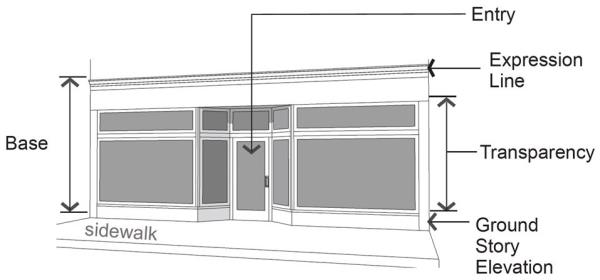 |
| Figure 3.9 (1). Storefront Entrance Types |
c) Standard Entrance Type. The standard entrance type uses architectural elements to create a highly visible building entrance that is well integrated into the building’s overall design (Refer to Figure 3.9 (2)).
i) Transparency. Minimum transparency is required per Building Type.
ii) Elevation. Entrance elevation shall be between zero and one foot above sidewalk.
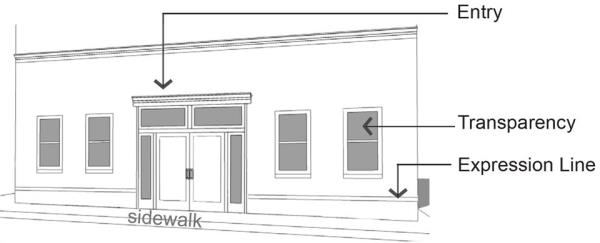 |
| Figure 3.9 (2). Standard Entrance Type |
d) Arcade Entrance Type. An Arcade entrance type is a covered pedestrian walkway within the recess of a ground story (Refer to Figure 3.9 (3)).
i) Arcade. An open-air public walkway is required from the face of the building recessed into the building a minimum of eight and a maximum of 15 feet.
ii) Build-to Zone. When the Arcade is utilized, the outside face of the Arcade shall be considered the front façade, located within the required build-to zone.
iii) Recessed or Interior Façade. Storefront entrance type is required on the recessed ground story façade.
iv) Column Spacing. Columns shall be spaced between ten feet and 12 feet on center.
v) Column Width. Columns shall be a minimum of 1’-8” and a maximum 2’-4” in width.
vi) Arcade Opening. Opening shall not be flush with interior arcade ceiling and may be arched or straight.
vii) Horizontal Façade Division. Horizontally define the ground story façade from the upper stories.
viii) Visible Basement. A visible basement is not permitted.
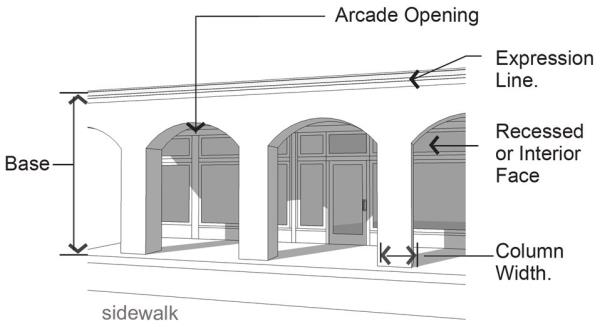 |
| Figure 3.9 (3). Arcade Entrance Type |
e) Stoop Entrance Type. A stoop is an unroofed, open platform (Refer to Figure 3.9 (4)).
i) Transparency. Minimum transparency is required per Building Type.
ii) Stoop Size. Stoops shall be a minimum of three feet deep and six feet wide.
iii) Elevation. Stoop elevation shall be located a maximum of 2’-6” above the sidewalk without visible basement and a maximum of 4’-6” above the sidewalk with a visible basement.
iv) Visible Basement. A visible basement is permitted and shall be separated from the ground story by an expression line.
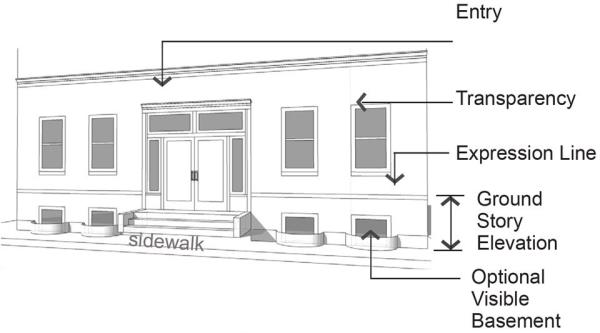 |
| Figure 3.9 (4). Stoop Entrance Type |
f) Porch Entrance Type. A porch is a raised, roofed platform that may or may not be enclosed on all sides (Refer to Figure 3.9 (5)).
i) Transparency.
(1) Minimum transparency per Building Type is required.
(2) If enclosed, a minimum of 40% of the enclosed porch shall be comprised of highly transparent, low reflectance windows.
ii) Porch Size. The porch shall be a minimum of five feet deep and eight feet wide.
iii) Elevation. Porch elevation shall be located a maximum of 2’-6” above the sidewalk without a visible basement and a maximum of 4’-6” above the sidewalk with a visible basement.
iv) Visible Basement. A visible basement is permitted.
v) Height. Porch may be two stories to provide a balcony on the second floor.
vi) Entrance. All entries shall be located off a porch.
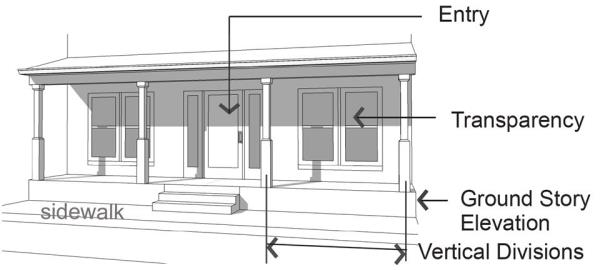 |
| Figure 3.9 (5). Porch Entrance Type |
10) Roof Types. Roof type standards apply to the roof and cap of all Building Types as defined in this Section. Refer to the Building Type Table Requirements, Sections 10-13-3 3) through 10-13-3 8).
a) General Provisions. The following provisions apply to all roof types.
i) Intent. To guide the design of the cap of all buildings.
ii) Applicability. All buildings shall meet the requirements of one of the roof types permitted for the Building Type.
iii) Measuring Height. Refer to Section 10-13-3 2 b for information on measuring building height.
iv) Other Roof Types. Other building caps not listed as a specific type may be made by a request to the Zoning Administrator with the following requirements:
(1) The roof type shall not create additional occupiable space beyond that permitted by the Building Type.
(2) The shape of the Roof Type shall be significantly different from those defined in this section 10-13-2 10 Roof Types, i.e. a dome, spire, vault.
(3) The building shall warrant a separate status within the community from the fabric of surrounding buildings, with a correspondence between the form of the roof type and the meaning of the building use.
b) Parapet Roof Type. A parapet is a low wall projecting above a building’s roof along the perimeter of the building. It can be utilized with a flat or low pitched roof and also serves to limit the view of roof-top mechanical systems from the street (Refer to Figure 3.9 (1), Parapet Roof Type).
i) Parapet Height. Height is measured from the top of the upper story to the top of the parapet.
(1) Minimum height is two feet with a maximum height of six feet.
(2) The parapet shall be high enough to screen the roof and any roof appurtenances from view of the street(s).
ii) Horizontal Expression Lines. An expression line shall define the parapet from the upper stories of the building and shall also define the top of the cap.
iii) Occupied Space. Occupied space shall not be incorporated behind this roof type.
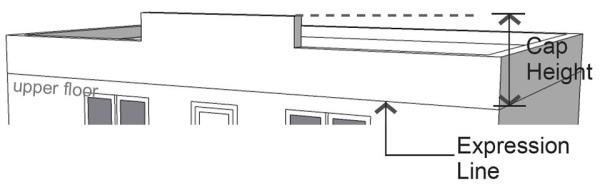 |
| Figure 3.10 (1). Parapet Roof Type |
i) Pitch Measure. The roof may not be sloped less than a 4:12 (rise:run) or more than 16:12.
(1) Slopes less than 4:12 are permitted to occur on second story or higher roofs. (Refer to Figure 3.10 (2) Low Pitched Roof).
ii) Configurations.
(1) Hipped, gabled, and combination of hips and gables with or without dormers are permitted.
(2) Butterfly roofs (inverted gable roof) are permitted with a maximum height of eight feet, inclusive of overhang.
(3) Gambrel and mansard roofs are not permitted.
iii) Parallel Ridge Line. A gabled end or perpendicular ridge line shall occur at least every 100 feet of roof when the ridge line runs parallel to the front lot line. (Refer to Figure 3.10 (3). Parallel Ridge Line).
iv) Roof Height. Roofs without occupied space and/or dormers shall have a maximum height on street-facing façades equal to the maximum height permitted for the Building Type.
v) Occupied Space. Occupied space may be incorporated behind this roof type.
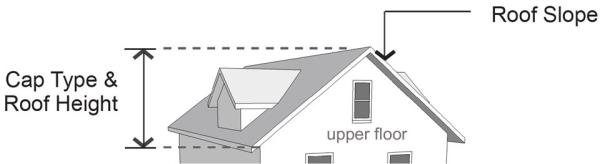 | 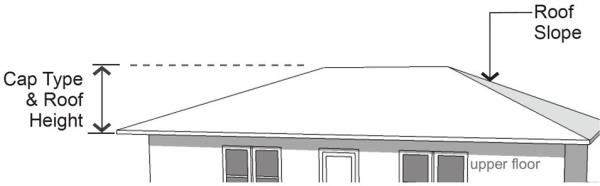 |
| Pitched Roof Type (Gable Roof) | Low Pitched Roof Type (Hip Roof) |
| Figure 3.10 (2). Pitched Roof Types | |
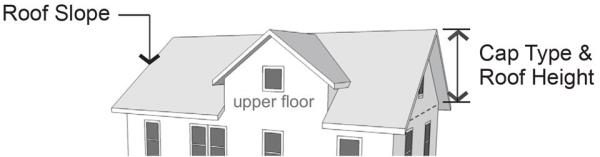 |
| Parallel Ridge Line with Gable |
| Figure 3.10 (3). Parallel Roof Type |
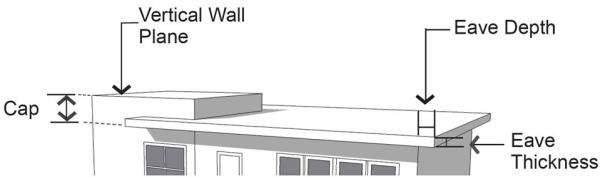
d) Flat Roof Type. This roof type has a flat roof with overhanging eaves (Refer to Figure 3.10 (4). Flat Roof Type).
i) Configuration. Roofs with no visible slope are acceptable. Eaves are required on all street facing façades.
ii) Eave Depth. Eave depth is measured from the building façade to the outside edge of the eave. Eaves shall have a depth of at least 14 inches.
iii) Eave Thickness. Eave thickness is measured at the outside edge of the eave, from the bottom of the eave to the top of the eave. Eaves shall be a minimum of eight inches thick.
iv) Interrupting Vertical Walls. Vertical walls may interrupt the eave and extend above the top of the eave with no discernible cap.
(1) No more than one-half of the front façade can consist of an interrupting vertical wall.
(2) Vertical walls shall extend no more than four feet above the top of the eave.
 |
| Figure 3.10 (4). Flat Roof Type |
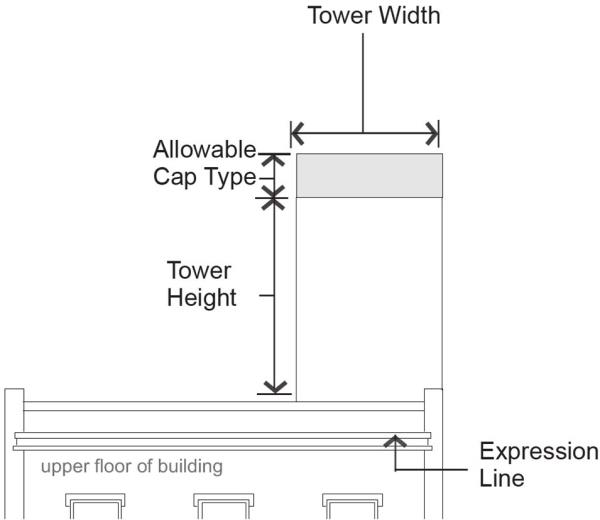
e) Towers. A tower is a rectilinear or cylindrical, vertical element, that must be used with other roof types (Refer to Figure 3.10 (5). Tower).
i) Quantity. All Building Types, with the exception of the Civic Building, are limited to one tower per building.
ii) Tower Height. Maximum height, is the same as the maximum allowance within building type
iii) Tower Width. Maximum width along all façades is one-third the width of the front façade or 30 feet, whichever is less.
iv) Horizontal Expression Lines. An expression line shall define the tower from the upper stories, except on single family or attached house residential Building Types.
v) Occupied Space. Towers may be occupied by the same uses allowed in upper stories of the Building Type to which it is applied.
vi) Application. May be combined with all other roof types.
vii) Tower Cap. The tower may be capped by the parapet, pitched, low pitched, or flat roof types, or the spire may cap the tower.
 |
| Figure 3.10 (5). Tower |
11) Aerospace Design Theme Requirements. The following requirements apply to all of the Downtown Districts. The design theme and aesthetic for new buildings in the Downtown Core Districts should build off of the City’s proximity and relationship to Hill Air Force Base and the Ogden-Hinckley Airport, and utilize materials and colors that reflect a modern, aerospace aesthetic. This theme should primarily be expressed through materials used and the articulation of the building mass and roof.
a) Materials and Color.
i) Primary Façade Materials. 80% of each façade shall be constructed of primary materials. For façades over 100 square feet, more than one material shall be used to meet the 80% requirement.
(1) The primary materials that will result in the intended visual aesthetic are metal, including architectural metal panels and cladding, glass, brick, and natural stone. These materials should be prominently featured. Other permitted primary building materials include high quality, durable materials, such as stone, brick; fiber cement board, shingled, or panel siding; glass. Other high quality synthetic materials may be approved during the site plan process with an approved sample and examples of successful, high quality local installations. Refer to Figures 3.11 (1) - 3.11 (4).
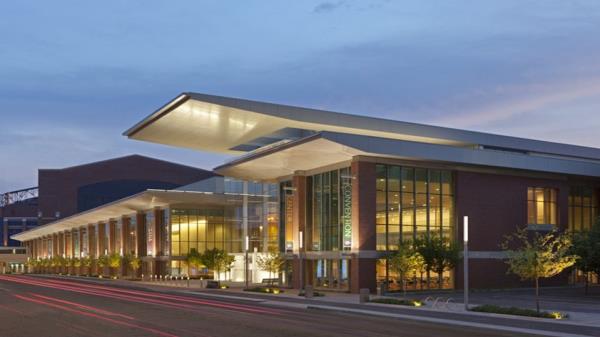 | 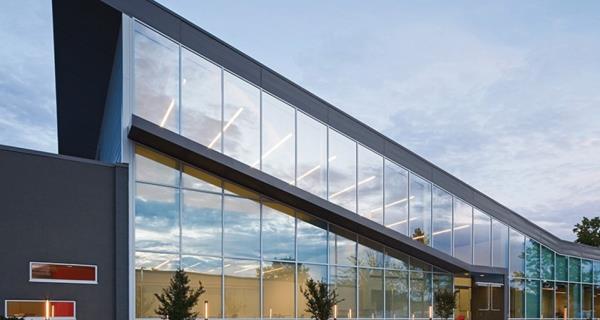 |
| Figure 3.11 (1). Aerospace Design Theme | Figure 3.11 (2). Aerospace Design Theme |
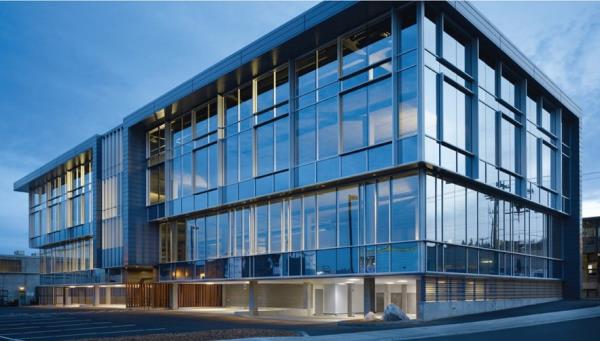 | 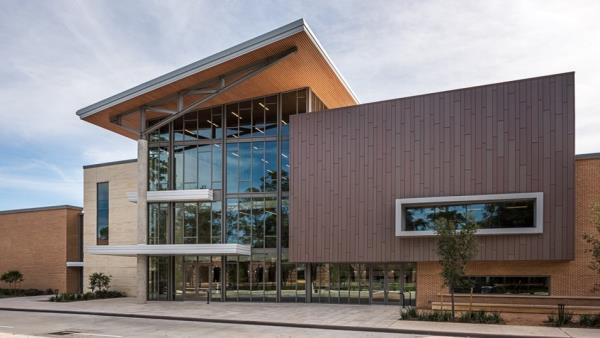 |
| Figure 3.11 (3). Aerospace Design Theme | Figure 3.11 (4). Aerospace Design Theme |
i) Secondary Façade Materials. Secondary materials are limited to details and accents and include concrete, wood, and EIFS.
(1) Exterior Insulation and Finishing Systems (EIFS) is permitted for trim only or on upper floor façades only.
ii) Roofs. Roofs should be flat, or sloped, as demonstrated in Figures 3.10 (1) - 3.10 (4). If appropriate to the building type, architects should utilize roof features and projections to evoke the aerospace theme.
iii) Appropriate Grade of Materials. Commercial quality doors, windows, and hardware shall be used on all Building Types with these districts
a) Windows, Awnings, and Shutters.
i) Windows. Percent of transparency is required per Building Type.
iii) Shutters. If installed, shutters, whether functional or not, shall be sized for the windows. If closed, the shutters shall not be too small for complete coverage of the window. Shutters shall be of high quality materials.
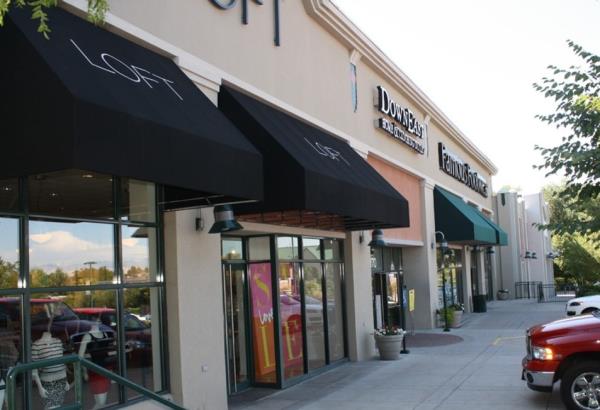 | 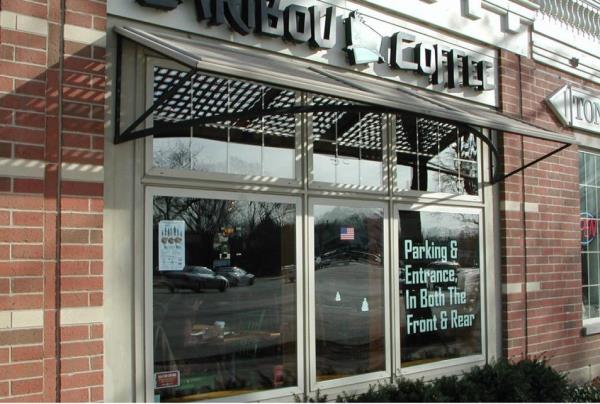 | 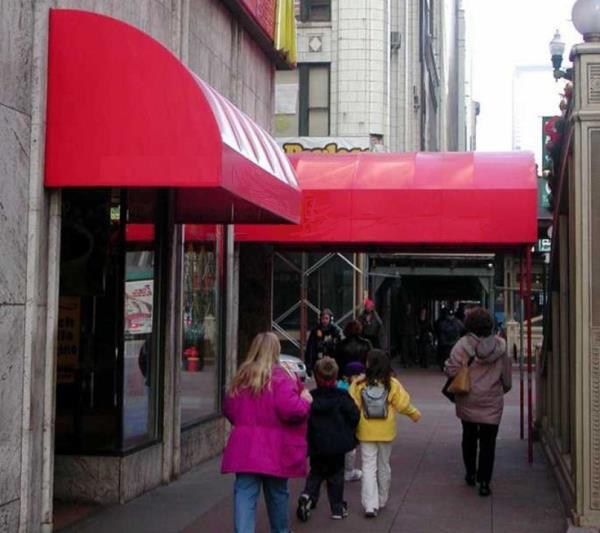 |
| Permitted Awnings: Canvas | Permitted Awnings: Metal | Prohibited Awnings: Plastic |
| Figure 3.11 (5). Awnings | ||
b) Balconies. The following applies in all locations where balconies are incorporated into the façade design facing any street or parking lot.
i) Connection to Building. Balconies that are not integral to the façade shall be independently secured and unconnected to other balconies.
12) The following requirements apply to the Urban Corridor District. These design guidelines affect a building’s appearance and the overall district cohesiveness. They improve the physical quality of buildings, enhance the pedestrian experience, and protect the character of the neighborhood.
a) Materials and Color.
i) Primary Facade Materials. 80% of each facade shall be constructed of primary materials. For facades over 100 square feet, more than one material shall be used to meet the 80% requirement.
(1) Permitted primary building materials include high quality, durable, natural materials, such as stone, brick; wood lap siding; fiber cement board lapped, shingled, or panel siding; glass. Other high quality synthetic materials may be approved during the site plan process with an approved sample and examples of successful, high quality local installations. Refer to Figure 5.12 (1).
ii) Secondary Facade Materials. Secondary materials are limited to details and accents and include gypsum reinforced fiber concrete for trim and cornice elements; metal for beams, lintels, trim, and ornamentation, and exterior architectural metal panels and cladding.
(1) Exterior Insulation and Finishing Systems (EIFS) is permitted for trim only or on upper floor facades only.
iii) Roof Materials. Acceptable roof materials include 300 pound or better, dimensional asphalt composite shingles, wood shingles and shakes, metal tiles or standing seam, slate, and ceramic tile. “Engineered” wood or slate may be approved during the site plan process with an approved sample and examples of successful, high quality local installations. Refer to Figure 5.12 (1).
iv) Color. Main building colors shall utilize any historic palettes from any major paint manufacturer. Other colors may be utilized or details and accents, not to exceed a total area larger than 10% of the facade surface area.
v) Appropriate Grade of Materials. Commercial quality doors, windows, and hardware shall be used on all Building Types with the exception of the Row Building and the Yard Building. Refer to Figure 5.12 (1).
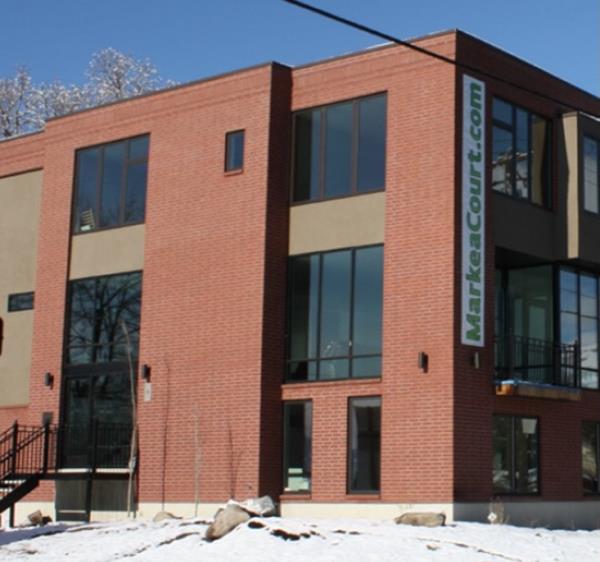 | 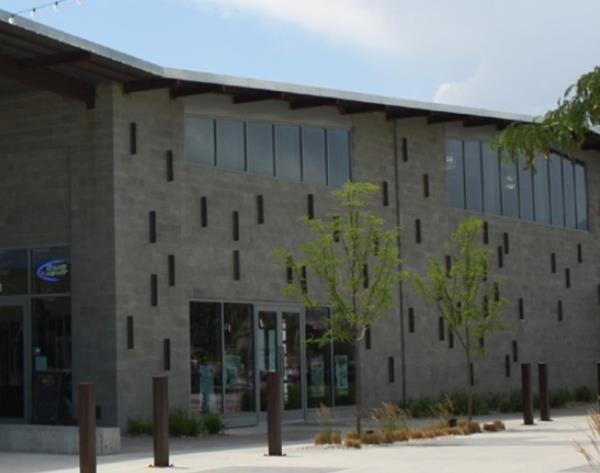 | 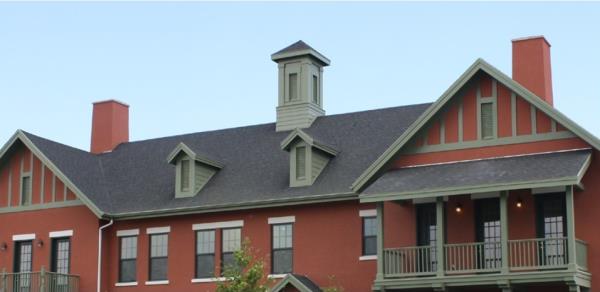 |
| Primary Materials: Bricks | Primary Materials: Stone | Roof Materials: Asphalt Compositie Shingles |
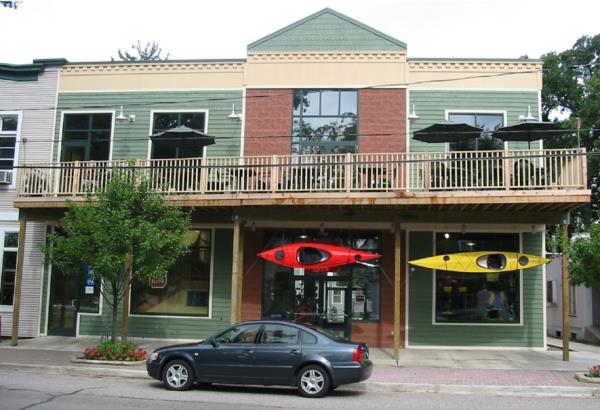 | 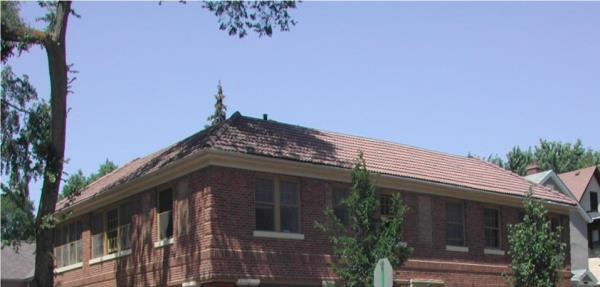 | |
| Primary Materials: Painted Wood | Primary Materials: Ceramic Tile | |
| 5.12 (1) | ||
13) Additional Design Requirements. The following outlines the district design guidelines that affect a building’s appearance and district cohesiveness. They improve the physical quality of buildings, enhance the pedestrian experience, and protect the character of the neighborhood.
a) Building Variety. Building design shall vary between vertical façade divisions, where required per the Building Types, and from adjacent buildings by the type of dominant material or color, scale, or orientation of that material and at least two of the following. Refer to Figure 3.12 (1) for one illustration of this requirement.
i) The proportion of recesses and projections.
ii) The location of the entrance and window placement, unless storefronts are utilized.
iii) Roof type, plane, or material, unless otherwise stated in the Building Type requirements.
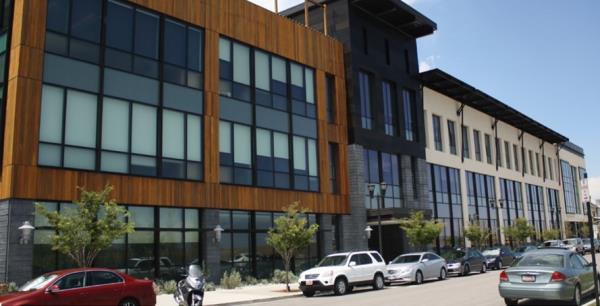 |
| Figure 3.12 (1). Building Variety |
10-13-4 OPEN SPACE TYPES
1) General Requirements
a) Intent. To provide open space as an amenity that promotes physical and environmental health within the community and to provide each household with access to a variety of active and passive open space types.
b) General Requirements. Development of parcels over 5 acres are required to provide 5% of total lot size as civic open space. Developer shall work with the City to determine the appropriate location of open space. For parcels under 5 acres, impact fees and other funding will be used as mechanisms to ensure adequate open space will be provided within each district. All open space shall meet the following requirements.
i) All open space provided within any Place Type shall comply with one of the Open Space Types defined by 10-13-4 2 through 10-13-4 6. However, alternate designs can be reviewed and approved by the Planning Commission. Continuous pedestrian walkways and trails may be a component of the Open Space.
ii) Access. All Public Open Space types shall provide public access from a vehicular right-of-way.
iii) Location. Open Space Types shall be platted as a lot or, with permission of the City, may be located within the right-of-way. Open Space Types shall be zoned with an open space zoning designation or an adjacent zoning designation.
iv) Ownership. Open Space Types may either be publicly or privately owned. Certain private open space types not addressed in this section, such as rooftop gardens or internal courtyards may be private, though they do not count toward required open space total.
v) Parking Requirements. Parking shall not be required for any Open Space Type, unless a use other than open space is determined by the Zoning Administrator.
vi) Continuity. Connections to existing or planned trails or open space types shall be made when the open Space abuts an existing or planned trail right-of-way or other civic open space type.
c) Definition of Requirements. The following further explains or defines the requirements included in Tables 4.2 (1) through 4.6 (1) for each Open Space Type. Refer to each table for the specific requirements of each Open Space Type.
i) Size.
(1) Minimum Size. The minimum size of the Open Space Type is measured within the parcel lines of the property.
(2) Maximum Size. The maximum size of the Open Space Type is measured within the parcel lines of the property.
(3) Minimum Dimension. The minimum length or width of the Open Space Type, as measured along the longest two straight lines intersecting at a right angle defining the maximum length and width of the lot. Refer to Figure 4.1 (1).
ii) Site Access. The location and number of access points to the site, the interior circulation pattern, and the separation between pedestrians and vehicles shall be designed to maximize safety and convenience, and should be harmonious with proposed and neighboring buildings. Appropriate vehicular and pedestrian cross access agreements and easements shall be provided.
iii) Improvements. The following types of development and improvements may be permitted on an Open Space Type.
(1) Designated Sports Fields Permitted. Sports fields, ball courts, or structures designated for one or more particular sports including, but not limited to, baseball fields, softball fields, soccer fields, basketball courts, football fields, tennis courts, climbing walls, and skate parks are permitted.
(2) Playgrounds Permitted. Playgrounds include a defined area with play structures and equipment.
(3) Fully Enclosed Structures Permitted. Fully enclosed structures may include such uses as park offices, maintenance sheds, community centers, and restrooms.
(a) Maximum Area. For some civic open space types, fully enclosed structures are permitted, but limited to a maximum building coverage as a percentage of the open space area.
(b) Semi-Enclosed Structures. Open-air structures, such as gazebos, are permitted in all open space types.
(4) Maximum Percentage of Open Water Body. The maximum amount of area within an Open Space Type that may be covered by an open water body, including, but not limited to, ponds, lakes, and pools.
d) Stormwater in Open Space Types. Stormwater management practices, such as storage and retention facilities, may be integrated into Open Space Types and utilized to meet stormwater requirements for surrounding parcels.
i) Stormwater Features. Stormwater features in civic open space may be designed as formal or natural amenities with additional uses other than stormwater management, such as an amphitheater, sports field,
or a pond or pool as part of the landscape design. Stormwater features shall not be fenced and shall not impede public use of the land they occupy.
ii) Qualified Professional. A qualified landscape design professional, such as a landscape architect or certified landscape designer, shall be utilized to incorporate stormwater features into the design of the civic open spaces.
|
| Figure 4.1 (1). Examples of Measuring the Minimum Dimension of Open Space Types |
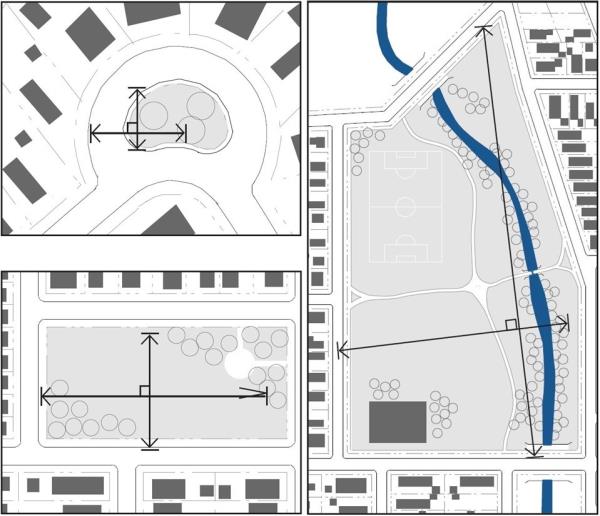
2) Plaza.
a) Intent. To provide a formal Open Space of medium scale to serve as a gathering place for civic, social, and commercial purposes. Special features, such as fountains and public art installations, are encouraged.
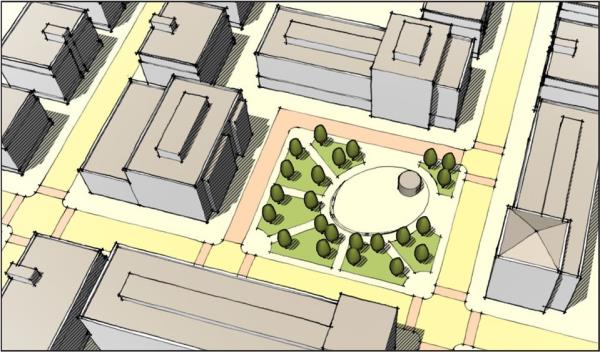 |
| Figure 4.2 (1). Typical Plaza Layout |
| PLAZA REQUIREMENTS | |
| i) DIMENSIONS | |
| Minimum Size (acres) | 0.25 |
| Maximum Size (acres) | 2 |
| Minimum Dimensions (feet) | 80' |
| Minimum % of Vehicular ROW Frontage Required | 50%; 80% building frontage required on non-street frontage |
| ii) ADJACENT PARCELS | |
| Permitted Districts | all |
| Frontage Orientation of Adjacent Parcels | front or corner side |
| iii) IMPROVEMENTS | |
| Designed Sports Fields Permitted | not permitted |
| Playground Permitted | permitted |
| Fully Enclosed Structures Permitted | permitted; maximum 5% of area |
| Maximum % Open Water | 50% |
| iv) ADDITIONAL DESIGN REQUIREMENTS | |
| (1) Minimum Building Frontage. At least 80% of the Plaza’s perimeter that does not front on vehicular right-of-way shall be lined by building frontages. | |
| (2) Fully Enclosed Structures Permitted. Fully enclosed structures are permitted, and are allowed to cover a maximum of 5% of the total area of the Plaza | |
| Table 4.2 | |
3) Square.
a) Intent. To provide a formal Open Space of medium scale to serve as a gathering place for civic, social, and commercial purposes. Squares are rectilinear in shape and are typically bordered on all sides by a
vehicular right-of-way, which together with building facades creates its definition.
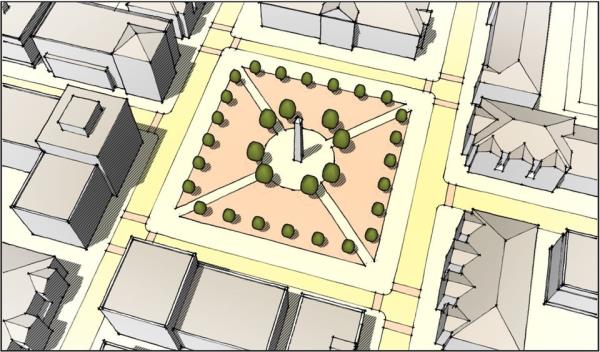 |
| Figure 4.3 (1). Typical Square Layout |
| SQUARE REQUIREMENTS | |
| i) DIMENSIONS | |
| Minimum Size (acres) | 0.25 |
| Maximum Size (acres) | 3 |
| Minimum Dimensions (feet) | 80' |
| Minimum % of Vehicular ROW Frontage Required | 75% |
| ii) ADJACENT PARCELS | |
| Permitted Districts | all |
| Frontage Orientation of Adjacent Parcels | front or corner side |
| iii) IMPROVEMENTS | |
| Designed Sports Fields Permitted | not permitted |
| Playground Permitted | not permitted |
| Fully Enclosed Structures Permitted | permitted; maximum 5% of area |
| Maximum % Open Water | 30% |
| iv) ADDITIONAL DESIGN REQUIREMENTS | |
| (1) Fully Enclosed Structures Permitted. Fully enclosed structures are permitted, and are allowed to cover a maximum of 5% of the total area of the Plaza | |
| Table 4.3 | |
4) Green.
a) Intent. To provide informal, medium scale active or passive recreation for neighborhood residents within walking distance, mainly fronted by streets.
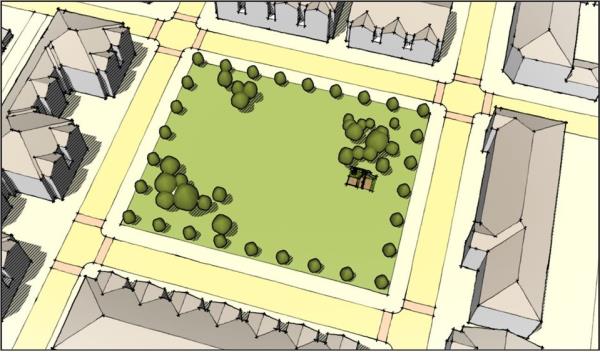 |
| Figure 4.4 (1). Typical Green Layout |
| GREEN REQUIREMENTS | |
| i) DIMENSIONS | |
| Minimum Size (acres) | 0.50 |
| Maximum Size (acres) | 2 |
| Minimum Dimensions (feet) | 45' |
| Minimum % of Vehicular ROW Frontage Required | 75%; 50% for over 1.25 acres |
| ii) ADJACENT PARCELS | |
| Permitted Districts | all |
| Frontage Orientation of Adjacent Parcels | front or corner side |
| iii) IMPROVEMENTS | |
| Designed Sports Fields Permitted | not permitted |
| Playground Permitted | permitted |
| Fully Enclosed Structures Permitted | not permitted |
| Maximum % Open Water | 30% |
| iv) ADDITIONAL DESIGN REQUIREMENTS | |
| Table 4.4 | |
5) Commons.
a) Intent. To provide an informal, small to medium scale space for active or passive recreation for a limited neighborhood area. Commons are typically internal to a block and tend to serve adjacent residents.
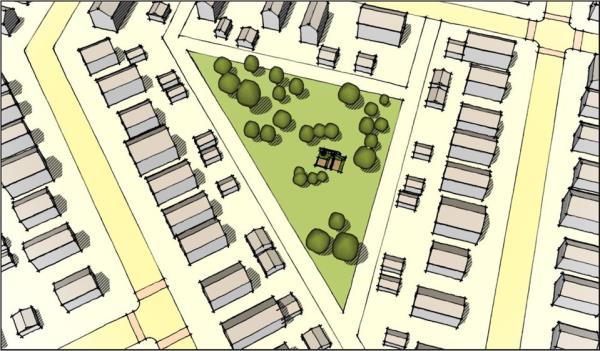 |
| Figure 4.5 (1). Typical Common Layout |
| COMMONS REQUIREMENTS | |
| i) DIMENSIONS | |
| Minimum Size (acres) | 0.20 |
| Maximum Size (acres) | 1.5 |
| Minimum Dimensions (feet) | 45' |
| Minimum % of Vehicular ROW Frontage Required | 0%; 2 access points required, minimum width each of 20' |
| ii) ADJACENT PARCELS | |
| Permitted Districts | all |
| Frontage Orientation of Adjacent Parcels | side or rear |
| iii) IMPROVEMENTS | |
| Designed Sports Fields Permitted | not permitted |
| Playground Permitted | permitted |
| Fully Enclosed Structures Permitted | not permitted |
| Maximum % Open Water | 30% |
| iv) ADDITIONAL DESIGN REQUIREMENTS | |
| (1) Access Points. Commons shall have a minimum of two access points from a vehicular right-of-way. Each access point shall have a minimum width of 20’. | |
| Table 4.5 | |
6) Pocket Park Open Space Type.
a) Intent. To provide small scale, primarily landscaped active or passive recreation and gathering space for neighborhood residents within walking distance.
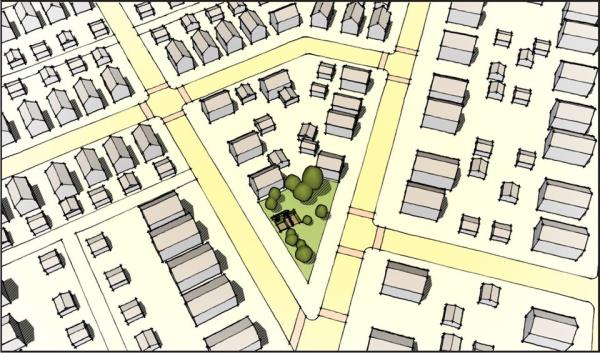 |
| Figure 4.6 (1). Typical Pocket Park Layout |
| POCKET PARK REQUIREMENTS | |
| i) DIMENSIONS | |
| Minimum Size (acres) | 0.10 |
| Maximum Size (acres) | 1 |
| Minimum Dimensions (feet) | none |
| Minimum % of Vehicular ROW Frontage Required | 30% |
| ii) ADJACENT PARCELS | |
| Permitted Districts | all |
| Frontage Orientation of Adjacent Parcels | any |
| iii) IMPROVEMENTS | |
| Designed Sports Fields Permitted | not permitted |
| Playground Permitted | permitted |
| Fully Enclosed Structures Permitted | not permitted |
| Maximum % Open Water | 30% |
| iv) ADDITIONAL DESIGN REQUIREMENTS | |
| Table 4.6 | |
10-13-5 LANDSCAPING
1) General Requirements.
a) Intent. The landscape standards outlined in this section are designed to meet the following set of goals.
i) To provide for healthy, long-lived street trees within all public ways to improve the appearance of streets and to create a buffer between pedestrian and vehicular travel lanes.
ii) To increase the compatibility of adjacent uses and minimize the adverse impacts created by adjoining or neighboring uses.
iii) To promote the prudent use of water and energy resources by achieving and maintaining sustainable, functional landscapes.
iv) To shade large expanses of pavement and reduce the urban heat island effect.
b) Applicability. Landscaping, trees, and buffers shall be installed as detailed in this section.
i) General Compliance. Application of this section to existing uses shall occur with the following developments.
(1) Any development of new or significant improvements to existing parking lots, loading facilities, and driveways. Significant improvements include new driveways, new spaces, new medians, new loading facilities, or complete reorganization of the parking and aisles.
(2) Alteration to an existing principal or accessory structure that results in a change of 30% or more in the structure’s gross floor area.
ii) Landscape plans shall comply with the following
(1) Turf grass not to exceed 15% of the total landscaped area (designated recreational areas excluded)
(2) No turf grass in parking lot landscape islands, park-strips, buffer areas or any area less then eight (8) feet wide.
(3) An Irrigation System Design should be used for all areas to conserve water
iii) Buffers. Landscape buffers are required according to the provisions in this section with the following exceptions.
(1) Shared Driveways. Buffers shall not be required along a property line where a curb cut or aisle is shared between two adjoining lots.
(2) Points of Access. Buffering is not required at driveways or other points of access to a lot.
iii) Temporary Uses. These provisions do not apply to temporary uses, unless determined otherwise by the Zoning Administrator.
2) Installation of Landscape.
a) Intent. The following provisions aid in ensuring that all required landscaping is installed and maintained properly.
b) Applicability. These provisions apply to landscape installation as required by this section.
c) General Installation Requirements. The installation of landscaping shall adhere to the following standards.
i) National Standards. Best management practices and procedures according to the nationally accepted standards shall be practiced.
(1) Installation. All landscaping and trees shall be installed in conformance with the practices and procedures established by the most recent edition of the American Standard for Nursery Stock (ANSI Z60.1) as
published by the American Association of Nurserymen.
(2) Maintenance and Protection. All landscaping and trees shall be maintained according to the most recent edition of the American National Standards Institute, including its provisions on pruning, fertilizing,
support systems, lighting protection, and safety.
ii) Installation. Landscaping shall be fully installed prior to the issuance of a certificate of completeness.
(1) If seasonal conditions preclude the complete installation, a cash escrow or irrevocable letter of credit, equal to 1.5 times the installation costs as estimated by a qualified professional.
(2) Complete installation is required within nine months of the issuance of the temporary certificate of completeness or occupancy permit or the cash escrow or letter of credit may be forfeited.
d) Ground Plane Vegetation. All unpaved areas shall be covered by one of the following.
i) Planting Beds.
(1) Planting beds may include shrubs, ornamental grasses, ground cover, vines, annuals, or perennials.
(2) Nonliving materials, such as pine straw, colored gravel, or mulch, are permitted for up to 50% of a bed area.
(3) Annual beds must be maintained seasonally, replanting as necessary.
ii) Grass. Seeded, plugged, or sodded grass may be planted throughout landscaped areas.
(1) Grass shall be established within 90 days of planting or the area must be reseeded, replugged, or resodded.
e) Tree Installations. Trees planted in the public right-of-way, such as street trees, must be selected from the list of permitted tree types, available from Roy City Parks and Recreation Department.
f) Irrigation Systems. Permanent irrigation, beyond establishment, is required and shall adhere to the following standards.
i) All irrigation systems shall be designed to minimize the use of water.
ii) Non-residential landscape irrigation shall have an automatic clock-activated permanent system.
iii) The irrigation system shall provide sufficient coverage to all landscape areas.
iv) The irrigation system should not spray or irrigate impervious surfaces, including sidewalks, driveways, streets, and parking and loading areas.
v) All systems shall be equipped with a back-flow prevention device.
vi) All mechanical systems including controllers and back-flow prevention devices shall be properly screened from public view
g) Maintenance of Landscape. All landscaping shall be maintained in good condition at all times to ensure a healthy and orderly appearance.
i) All required landscape shall be maintained to adhere to all requirements of this ordinance.
ii) Replacing Unhealthy Landscaping. Unhealthy landscaping shall be replaced with healthy, live plants by the end of the next applicable growing season. This includes all plant material that shows dead
branches over a minimum of 25% of the normal branching pattern.
iii) Maintenance Responsibility. The owner is responsible for the maintenance, repair, and replacement of all landscaping, screening, and curbing required herein.
iv) Maintain Quality and Quantity. Maintenance shall preserve at least the same quantity, quality, and screening effectiveness as initially installed.
v) Fences and Other Barriers. Fences, walls, and other barriers shall be maintained in good repair and free of rust, flaking paint, graffiti, and broken or damaged parts.
vi) Tree Topping. Tree topping is not permitted. When necessary, crown reduction thinning or pruning is permitted.
vii) City Inspection. All landscaped areas regulated by this ordinance may be inspected by the City.
a) Intent & Applicability.
i) Intent. To lessen the visual impact of vehicular areas visible from the street.
ii) General Applicability. Applies to properties in all Districts where a vehicular area is located adjacent to a right-of-way.
(1) Exceptions. Vehicular areas along alleys, except when a residential district is located across the alley; Single and two family residences.
| FRONTAGE BUFFER REQUIREMENTS | ||
| i) Buffer Depth & Location1 | ||
| Depth | 7' | a |
| Location on Site | Between street facing property line and parking area2 | b |
| ii) Buffer Landscape Requirements | ||
| Uses & Materials | Uses and materials other than those indicated | |
| Shade Trees | Medium or large shade tree required at least every 40’; Locate on the street side of the fence; Spacing should alternate with street trees | c |
| Hedge | Required continuous hedge on street side of fence, between shade trees & in front of vehicular areas. | d |
| Hedge Composition | Individual shrubs with a minimum width of 24”, spaced no more than 36” on center, height maintained no more than 42” | |
| Existing Vegetation | May be credited towards buffer area | |
| iii) Fence e | ||
| Location | 2’ from back of curb of vehicular area | |
| Materials | Steel or colored PVC; Masonry columns (maximum width 2’6”) and base (maximum 18” height) permitted | |
| Minimum Height | 3' | |
| Maximum Height | 4' | |
| Colors | Black, gray, or dark green | |
| Opacity | Minimum 30%; Maximum 60% | |
| Gate/Opening | One gate permitted per street frontage; Opening width maximum 6’ | |
| Notes | ||
| 1 - This screening requirement does not prohibit the installation of or provision for openings necessary for allowable access drives and walkways connecting to the public sidewalk. | ||
| 2 - In front, corner, and rear yards (on a through lot), when the parking area is located adjacent to any building on the lot, the buffer must be located so that it aligns with or is behind the face of the adjacent building back to the vehicular area. The area between the buffer and the property line must be landscaped. | ||
| Table 5.2 | ||
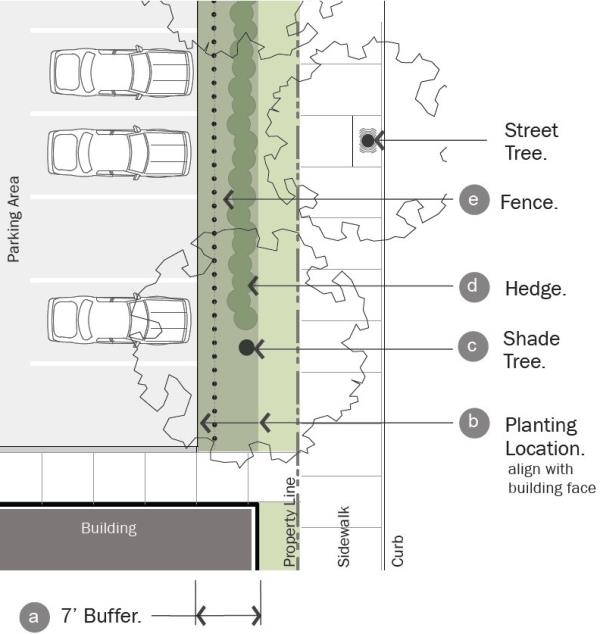 |
| Front Buffer Plan |
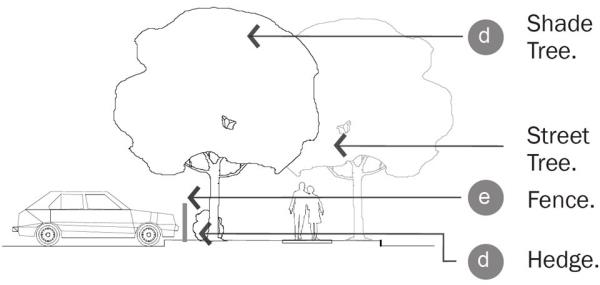 |
| Front Buffer Section |
| Figures 5.2 (1). Frontage Buffer Plan and Section |
4) Side & Rear Buffer.
a) Intent & Applicability.
i) Intent. To minimize the impact of new development on existing single family residential neighborhoods.
ii) General Applicability. Any parcel that abuts a parcel containing an existing single family residence.
| SIDE & REAR BUFFER REQUIREMENTS | ||
| i) Buffer Depth & Location | ||
| Depth | 10' | a |
| Location on Site | Buffer is measured from side and rear properties lines | |
| ii) Required Landscape Screen | ||
| Width | 5’ landscape screen in
addition to any other buffer landscaping | b |
| Location | Directly adjacent to the rear or side property line | |
| Hedge | Continuous double row shrubs required between shade trees | |
| Hedge Composition | Double row of individual shrubs with a minimum width of 24”, spaced no more than 36” on center, Mature height in one year of 24” | c |
| Hedge Frequency | Minimum of 15 shrubs per 100’ of property line is required | |
| Shade Trees | At least 1 medium or large shad tree per every 40’ within the buffer | d |
| iii) Fence | ||
| Uses and Materials | Uses and materials other than those indicated in table 4.2 are prohibited with the buffer | |
| Tree Canopy Coverage | 1 medium or large shade tree required per 2,000 sq.-ft. of buffer, excluding the area within the required landscape screen | |
| Existing Vegetation | May be credited towards buffer area | |
| Notes | ||
| 1 - Planning Commission may reduce width of buffer, width of landscape screen, or location of landscape screen based on existing landscaping and topography | ||
| Table 5.3 | ||
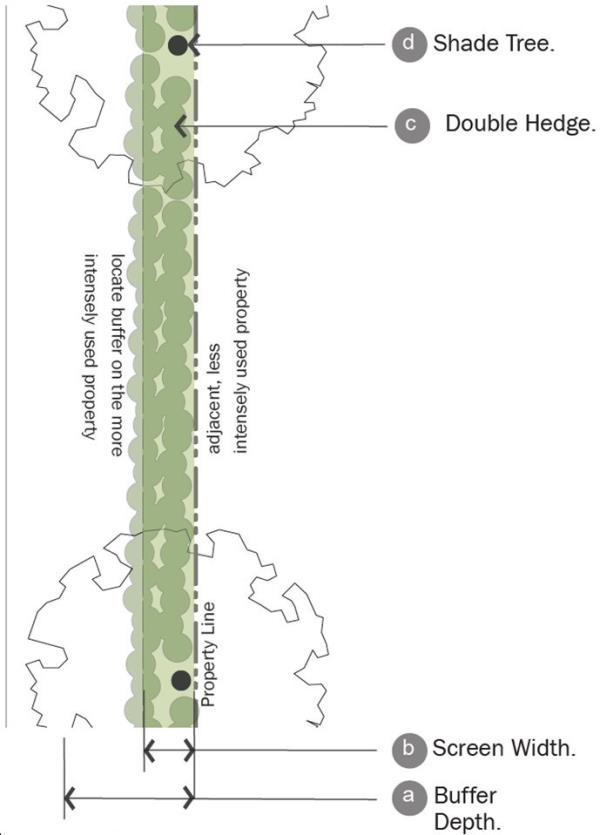 |
| Landscape Screen Plan |
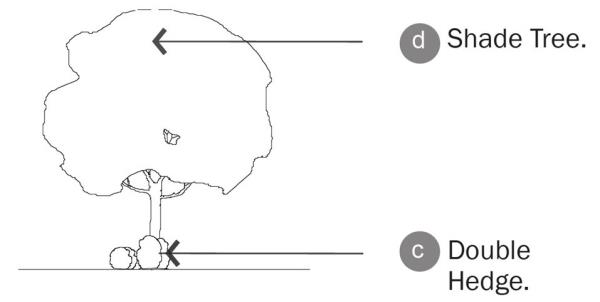 |
| Landscape Screen Section |
| Figure 5.3 (1). Landscape Screen Plan and Section |
5) Interior Parking Lot Landscape
a) Intent & Applicability.
i) Intent. To provide shade, minimize paving & associated stormwater runoff, & improve the aesthetic look of parking lots.
ii) General Applicability. All open-air, off-street parking lots in all Districts.
iii) Other Internal Parking Lot Areas. Internal areas not dedicated to parking or drives shall be landscaped with a minimum of one medium or large shade tree for the first 150 square feet and one medium or large shade tree for every 650’ thereafter.
iv) Existing Vegetation. Existing vegetation may be credited toward these requirements.
| INTERIOR PARKING LOT LANDSCAPING REQUIREMENTS | ||
| i) Landscape Island Requirements | ||
| Required Island Locations | Terminal ends3 of free standing rows or bays of parking; After every nine parking space for
rows of parking greater than 8 spaces in length2 | a |
| Minimum Width | 5’; Islands less than 15’ must utilize structural soil under any paved surface within a tree’s critical root zone; Islands under 9’ must install an aeration system and utilize permeable pavement | b |
| Requires Trees within Islands | Minimum of 1 medium or large shad tree per island | c |
| ii) Buffer Landscape Requirements | ||
| Required Median Location | Required in each free-standing bay of parking along the length of the bay | d |
| Minimum Width | 5' Medians less than 15’ must utilize structural soil under any paved surface within a tree’s critical root zone; Islands under 9’ must install an aeration system an utilize permeable pavement | |
| iii) Tree Requirements | ||
| Requirement per Parking Space4 | Each parking space must be located within 50’ of a tree planted within parking lot interior | |
| Minimum of 1 shade tree must be planted within parking lot interior of within 4’ of parking lot’s edge for every 3 parking spaces | ||
| Tree Shade Goal | Within 20 years of tree installation, 30% of the interior of the parking lot should be shaded by tree canopy. Refer to Table 4.6 (1) for calculations | |
| Notes | ||
| 1 - Parking lot interior is defined as the area dedicated to parking on a given parcel as measured from edge of pavement to edge of pavement | ||
| 2 - Freestanding row or bays of parking are those not abutting the parking lot perimeter or building face, and may have a single or double row of parking. | ||
| 3 - There shall be no more than 8 continuous parking spaces in a row without a landscape island | ||
| 4 - Trees within a designed buffer area may not be utilized to meet these requirements. | ||
| Table 5.4 | ||
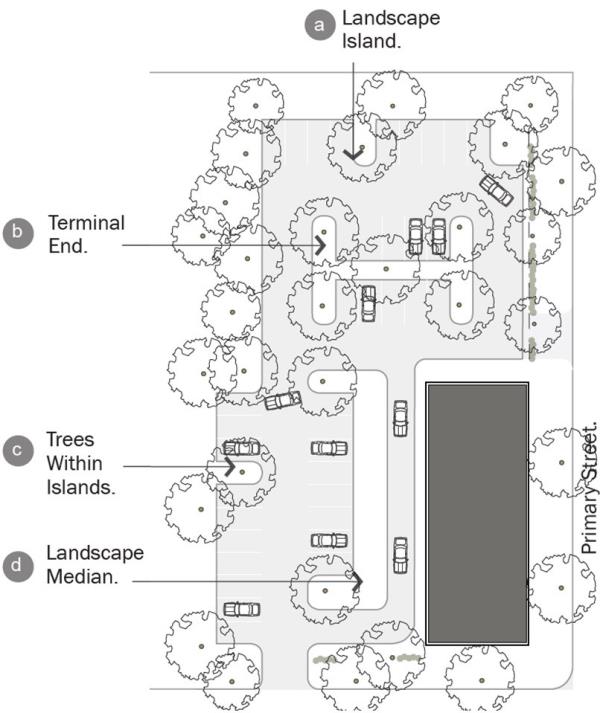 |
| Figure 5.4 (1). Interior Parking Lot Landscaping |
| Tree Size | Estimated Canopy at Maturity (sq.-ft.) | Estimated Height at Maturity (ft.) |
| Very Small | 150 | under 15' |
| Small | 400 | 15' - 25' |
| Medium | 900 | 25' - 40' |
| Large | 1,600 | 40' + |
| Table 5.4 (21). Estimated Canopy ad Height at Maturity | ||
6) Screening of Open Storage, Refuse Areas, and Utility Appurtenances.
a) Intent & Applicability.
i) Intent. To reduce the visibility of open storage, refuse areas, and utility appurtenances from public areas and adjacent properties.
ii) General Applicability. All dumpsters, open storage, refuse areas, and utility appurtenances in all Districts.
| SCREENING OF OPEN STORAGE, REFUSE AREAS & UTILITY APPURTENANCES REQUIREMENTS | ||
| i) Open Storage & Refuse Area Screening Requirements | ||
| Location on the Site | Not permitted in front or corner side yards | |
| Opaque Screen Wall1 | Required around 3 sides of the dumpster and trash bin area | a |
| Screen Wall Height | Height shall be the higher of the following: 1. 6' 2. Height of use to be screened 3. Height as determined by City to accomplish objective of the screen | |
| Visible Openings | Openings visible from the public way or adjacent properties must be furnished with opaque gates. | b |
| Landscape Requirements | If refuse area Is located within larger paved area, such as parking lot, landscape islands must be located on 3 sides of the area, with at least 1 medium or large shade tree in a least 1 of the landscape areas2 | c |
| ii) Utility Appurtenance Screening Requirements | ||
| Large Private Mechanical Equipment3 | Shall be fenced with opaque wood or brick-faced masonry on all sides facing right-of-way | |
| Small Private Mechanical Equipment4 | Shall have landscape screening and a shrub bed containing shrubs spaced no more than 36” on center | |
| Notes | ||
| 1 - Vertical structured barrier to visibility at all times such as a fence of wall | ||
| 2 - This tree, if located within 50’ of a parking space, may be utilized to meet the minimum shade requirements | ||
| 3 - Large private mechanical equipment is equal to or greater than 4’ in height | ||
| 4 - Small private mechanical equipment is equal to or smaller than 4’ in height | ||
| Table 5.5 | ||
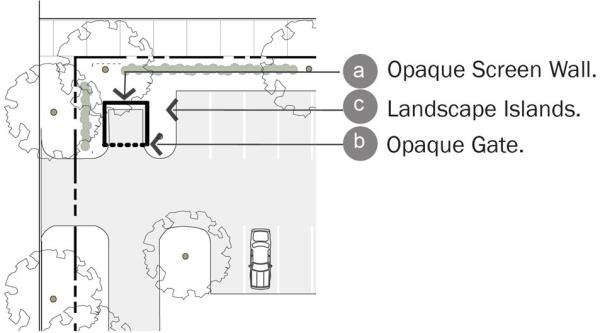 |
| Figure 5.5 (1). Screening of Open Storage & Refuse Areas |
10-13-6 PARKING
1) General Requirements
a) Intent. The following provisions are established to accomplish the following:
i) Ensure an appropriate level of vehicle parking, loading, and storage to support a variety of land uses.
ii) Provide appropriate site design standards to mitigate the impacts of parking lots on adjacent land uses and zoning districts.
iii) Provide specifications for vehicular site access.
2) Parking Requirements.
a) General Requirements for Parking. Off-street parking spaces shall be provided in conformance with Tables 6.2 (1) Required Vehicular Parking and 6.2 (2) Bicycle Parking.
i) Required Accessible Parking. Parking facilities accessible for persons with disabilities shall be in compliance with or better than the standards detailed in the state Accessibility Code, including quantity, size, location, and accessibility.
ii) Requirements for Unlisted Uses. Upon receiving a site plan approval, occupancy certificate, or other permit application for a use not specifically addressed in this section, the Zoning Administrator is authorized to apply off-street parking standards specified for the Use deemed most similar to the proposed Use. In instances where an equivalent may not be clearly determined, the Zoning Administrator may require the applicant to submit a parking study or other evidence that will help determine the appropriate requirements.
iii) Private Off-Premises Parking. Where private off-site parking facilities are approved, such facilities shall be in the same possession as the zoning lot occupied by the building or use to which the parking facilities are accessory
(1) Such possession may be either by deed or lease, guaranteeing availability of the parking commensurate with the use served by the parking.
(2) The agreement providing for the use of off-site parking, executed by the parties involved, shall be in a form approved by the City Attorney and filed with the Zoning Administrator.
(3) The deed or lease shall require the owner to maintain the required number of parking facilities for the duration of the use served or of the deed or lease, whichever shall terminate sooner.
(4) Location Parking. Any off-premise parking must be within 660 feet from the entrance of the use to the closest parking space measured along a dedicated pedestrian path.
b) Required Vehicular and Bicycle Parking. Tables 6.2 (1) and (2) outline the required vehicular and bicycle parking requirements.
i) Organized by Use. The parking requirements are organized by use, in a similar fashion to Table 1.1 (1) Use Table in 10-13-2 Uses.
(1) Parking rates are provided for general use categories; these numbers are applicable for all of the uses within these categories.
(2) If a specific use requires a different parking rate than its use category, it is also listed in Tables 6.2 (1) and 6.2 (2) Required Vehicular and Bicycle Parking.
ii) Vehicular Spaces Required. The vehicular spaces required column indicates the required off-street parking ratio, which may be subject to credits and other reductions and a maximum number, as are detailed in this section.
iii) Maximum Allowable Vehicular Spaces. When a use requires more than 20 spaces, it is not permitted to provide greater than 25% over the minimum parking requirement.
(1) For those uses with no requirements, the maximum number of spaces required should be no more than the next level up of that use. For example, for Neighborhood Retail, the number of spaces should be no more than the requirements for General Retail.
| Use | Required Vehicle Space |
| RESIDENTIAL | |
| Single-Family, all sizes or Multi-Family 1 bedroom | 1 / dwelling unit |
| Multi-Family, 2 bedrooms | 1.5 / dwelling unit |
| Multi-Family, 3 or 3+ bedrooms | 2 / dwelling unit |
| Hotel & Inn | 1 / room & 1 /200 sq.-ft. Office & Dining Room |
| Residential care | .33 / unit & .66 / employee |
| CIVIC INSTITUTIONAL | |
| Assembly | 1 / 5 seats |
| Transit Station | per Zoning Administrator |
| Hospital | .20 / bed & .66 / employee |
| Library / Museum | 1 / 600 sq.-ft. |
| Police & Fire | per Zoning Administrator |
| Post Office (distribution) | 1 / 400 sq.-ft. |
| Post Office (no distribution) | 1 / 600 sq.-ft. |
| EDUCATION | |
| School: pre K to Jr. High | 1 / classroom & 1/ 200 sq.-ft. Office |
| School: High School / Higher Education | 1 / classroom, 1/ 200 sq.-ft. Office & .17 / student |
| RETAIL | |
| Neighborhood Retail | 1 / 300 sq.-ft. |
| General Retail | 1 / 300 sq.-ft. |
| Outdoor Sales Lot | 1 / 250 sq.-ft. of sales area, with 1 / 10 vehicle display |
| SERVICE | |
| Neighborhood Service | 1 / 250 sq.-ft. |
| General Service | 1 / 250 sq.-ft. |
| Eating & Drinking Establishments | 1 / 3 seats & 1 / 3 employees |
| Vehicle Services | 2 / service bay & 1 / 200 sq.-ft. of retail |
| OFFICE & INDUSTRIAL | |
| Neighborhood & General Office | 1 / 200 sq.-ft. |
| Craftsman Industrial | 1 / 1,000 sq.-ft. of production space & 1 / 500 sq.-ft. of Retail space |
| OPEN SPACE & RECREATION | |
| Open Space & Recreation | per Zoning Administrator |
| Table 6.2 (1). Required Off-Street Vehicular Parking | |
iv) Required Bicycle Parking. The Required Bicycle Parking Table 6.2 (2) indicates the minimum bicycle parking ratio for a given use.
| Use | Bicycle Spaces |
| Multi-family | Minimum 2 spaces or .05 spaces / bedroom, whichever is greater |
| Civic / Institutional | Minimum 2 spaces, 1 / additional 10,000 sq.-ft. |
| Retail | Minimum 2 spaces, 1 / additional 5,000 sq.-ft. |
| Services | Minimum 2 spaces, 1 / additional 10,000 sq.-ft. |
| Office | Minimum 2 spaces, 1 / additional 5,000 sq.-ft. |
| Open Space | per Zoning Administrator |
| Table 6.2 (2). Required Bicycle Parking | |
v) Computation. Off-street parking spaces shall be calculated using the following information.
(1) Area Measurements. The following units of measurements shall be utilized to calculate parking requirements.
(a) Dwelling Unit. Parking standards for residential buildings shall be computed using dwelling unit as the unit of measure, unless otherwise stated.
(b) Gross Square Footage. Unless otherwise expressly stated, parking standards for non-residential Uses shall be computed on the basis of gross floor area in square feet.
(c) Occupancy- or Capacity-Based Measurements. Parking spaces required per available seat or per employee, student, or occupant shall be based on the greatest number of persons on the largest shift, the maximum number of students enrolled, or the maximum fire-rated capacity, whichever measurement is applicable.
(d) Bench Seating. For uses in which users occupy benches, pews, or other similar seating facilities, each 24 inches of such seating shall be counted as one seat.
(2) Fractions. When computation of the number of required off-street parking spaces results in a fractional number, any result of 0.5 or more shall be rounded up to the next consecutive whole number. Any fractional result of less than 0.5 may be rounded down to the previous consecutive whole number.
(3) Multiple Uses on a Lot. When there are multiple uses on a lot, required spaces shall be calculated as an amount equal to the total requirements for all uses on the lot, unless the uses qualify for shared, cooperative, or other credits to reduce parking. Refer to 5.2 (3).
| Use Category | Weekdays | Weekends | ||||
| Midnight to 7:00 am | 7:00 am to 6:00 pm | 6:00 pm to Midnight | Midnight to 7:00 am | 7:00 am to 6:00 pm | 6:00 pm to Midnight | |
| Residential | 100% | 50% | 80% | 100% | 80% | 80% |
| Retail & Services | 5% | 100% | 80% | 5% | 100% | 60% |
| Hotel & Inn | 100% | 65% | 100% | 100% | 65% | 100% |
| Place of Worship | 0% | 30% | 50% | 5% | 100% | 75% |
| Eating & Drinking Establishment | 50% | 0% | 100% | 70% | 60% | 100% |
| Office | 5% | 100% | 5% | 5% | 5% | 5% |
| Theater / Entertainment | 5% | 30% | 100% | 5% | 80% | 100% |
| Table 6.2 (3). Cooperative or Shared Vehicular Parking Spaces | ||||||
c) Multiple Use Reductions. The following reductions may be taken for multiple non-residential uses.
i) Shared Vehicular Parking. An arrangement in which two or more non-residential uses with different peak parking demands use the same off-street parking spaces to meet their off-street parking requirements.
(1) General Provisions. Through review of the site plan the Zoning Administrator may permit up to 100% of the parking required for a daytime use to be supplied by the off-street parking spaces provided for a nighttime or Sunday use and vice versa.
(2) Approval. In order to approve a shared parking arrangement, the Zoning Administrator must find, based on competent evidence provided by the applicant, that there is no substantial conflict in the principal operating hours of the uses for which the sharing of parking is proposed.
(3) Description of Uses with Weekday, Nighttime, and Sunday Peak Parking.
(a) The following uses are considered predominantly weekday uses: office and industrial uses and other similar uses as authorized by the Zoning Administrator.
(b) The following uses are typically considered predominantly nighttime or Sunday uses: eating and drinking establishments, assembly uses, and other similar uses with peak activity at night or on Sundays, as authorized by the Zoning Administrator.
ii) Cooperative Vehicular Parking. When two or more categories of non-single family residential uses share a parking lot and are located on the same lot or adjacent lots, the following applies:
(1) General Provisions. Cooperative parking will be approved in accordance with the following. Refer to Table 6.2 (3).
(2) For each applicable land use category, calculate the number of spaces required as if it were the only use. Refer to Table 6.2 (1).
(3) Use the figures for each individual land use to calculate the number of spaces required for that use for each time period specified in Table 6.2 (3). This table establishes six time periods per use.
(4) For each time period, add the number of spaces required for all applicable land uses to obtain a grand total for each of the six time periods.
(5) Select the time period with the highest total parking requirement and use that as the total number of parking spaces required and use that as the total number of parking spaces required for the site on a share parking basis.
iii) Uses in Different Buildings. Through review of the site plan the Zoning Administrator may approve the cooperative agreement if any of the uses are not located in the same structure or building.
iv) Location of Cooperative Parking. Any cooperative parking must be within 660 feet for Commercial and 220’ for Residential from the entrance of the use to the closest parking space within the cooperative parking lot, measured along a dedicated pedestrian path.
v) Off-Site Cooperative Parking Agreement. An agreement approved by the City Attorney providing for cooperative use of off-site parking spaces, executed by the parties involved, shall be reviewed by the Zoning Administrator during review of the site plan.
(1) Off-site cooperative parking arrangements shall continue in effect only as long as the agreement remains in force.
(2) If the agreement is no longer in force, then parking must be provided as otherwise required in this section.
3) Parking Design Standards.
a) Vehicular Off-Street Parking Lots. The design or redesign of all off-street parking facilities shall be subject to the site plan approval procedure.
i) Vehicular Parking Space Dimensions. The appropriate dimensions for parking spaces are outlined in Table 6.3 (1) Parking Space Dimensions and Figure 6.3 (1) Parking Lot Layout.
(1) The width of a parking space shall be measured from the center of a stripe.
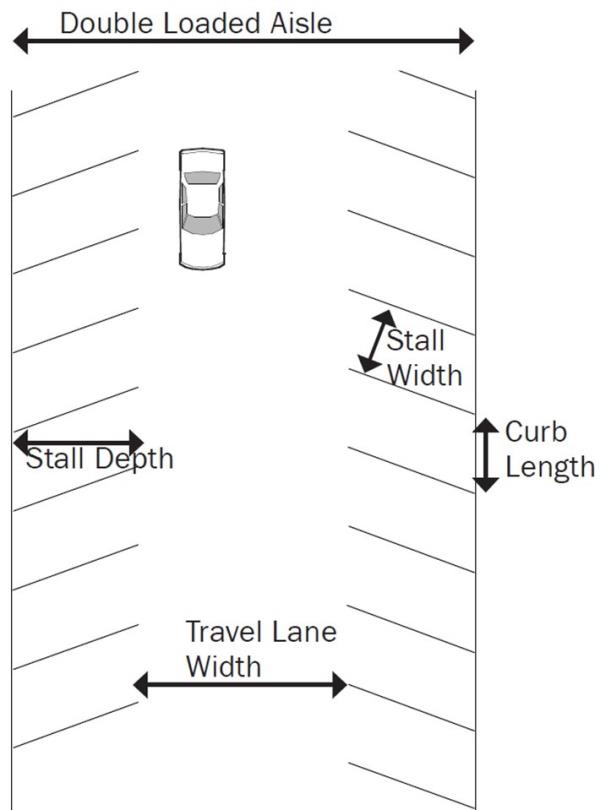 |
| Figure 6.3 (1). Parking Lot Layout |
| Angle (degrees) | Curb Length (Feet) | Stall Width (feet) | Stall Depth (feet) | Travel Lane Width One-Way (feet) | Travel Lane Width Two-Way (feet) |
| 0 | 24 | 8.5 | - | 12 | 20 |
| 45 | 12.75 | 9 | 13.5 | 13 | 20 |
| 60 | 10.5 | 9 | 18.25 | 18 | 20 |
| 90 | 9 | 9 | 20 | 24 | 22 |
| Note | |||||
| 1 - Stall depth may be reduced 2’ when a stall directly abuts an interior parking lot median that includes an additional area beyond the minimum width, permitting the overhang of the adjacent parked vehicle’s front bumper | |||||
| Table 6.3 (1). Parking Space Dimensions | |||||
ii) Wheel Stops. Install wheel stops or bumper guards when parking is adjacent to a pedestrian pathway to limit vehicle overhang that reduces the sidewalk width. Such stops or guards shall be properly anchored or secured.
iii) Location of Parking. Refer to 10-13-3 Building Type Standards for information on the location of parking facilities.
iv) Access. All off-street parking and loading facilities shall open directly onto an aisle, alley, or driveway designed to provide safe access to such facilities. Exceptions include:
(1) Parking Lifts. The lift exit shall meet the access requirement.
v) Edge of Lot and Drives. All curb and gutter shall be located a minimum of 3 feet from any adjacent property line or right-of-way.
vi) Slopes. All parking and driveway or sidewalk access shall meet the requirements of the Utah Accessibility Code.
vii) Landscape Screening. All parking areas shall meet the requirements of in 10-13-5 Landscape Standards.
viii) Landscape Areas. Areas not used specifically for sidewalks, parking spaces, driving aisles, loading, or refuse shall not be paved. Areas striped with diagonal striped islands are not permitted.
ix) Pavement Construction. All parking and driveways shall be constructed using asphalt, concrete, pavers, or other semi- pervious material approved by the Zoning Administrator.
x) Illumination. All off-street parking lots or parking structures shall provide a level of illumination at any point in the parking lot or structure not less than one foot-candle measured at the pavement. All lighting shall be shielded or otherwise optically controlled to provide glare-less illumination and limit trespass on adjacent properties.
b) Pedestrian Access. All parking lots with two or more double-loaded aisles shall provide internal pedestrian pathway(s) within the parking area and outside of the parking drive aisle.
i) Dimension. The pathway shall be a minimum of six feet in width.
ii) Quantity. One pathway is required for every three double loaded aisles.
iii) Location. The pathway shall be centrally located within the parking area to serve a maximum number of parking stalls.
(1) Pathways shall provide direct connections to the principal structure(s) entrances from the spaces furthest from the entrance.
(2) At least one pathway shall provide a direct connection between adjacent vehicular rights-of-way and/or trails and the principal structure’s entrance.
iv) Pathway Delineation. Pedestrian pathways should be clearly marked with striping or through the use of alternative materials, such as pavers. Refer to Figure 6.3 (2).
|
| Figure 6.3 (2). Parking Lot Pedestrian Walkway |
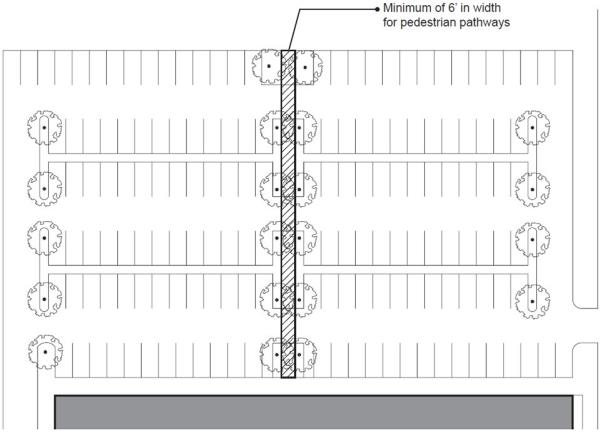
c) Bicycle Parking Design. Bicycle parking (refer to Table 6.2 (2) Required Bicycle Parking for quantity required) shall be designed and located as follows.
i) Dimensions.
(1) Required bicycle parking spaces shall have minimum dimensions of two feet in width and six feet in length.
(2) An aisle a minimum of five feet wide shall be provided behind bicycle parking facilities to allow for maneuvering.
(3) A minimum of two feet shall be provided beside each parked bicycle to allows access. This access may be shared by adjacent bicycles.
(4) Racks shall be installed a minimum of two feet from any wall or other obstruction.
ii) Location. Bicycle parking should be located within 50 feet of the entrance of the use.
(1) Indoor or outdoor spaces are permitted, provided they are located on the lot with which they are associated.
(2) Spaces located within individual dwelling units may not be counted toward bicycle parking requirements.
iii) Bicycle parking facilities shall be separated from vehicular parking areas to protect parked bicycles from damage. The separation may be accomplished through grade separation, distance or physical barrier, such as curbs, wheel stops, poles or other similar features.
iv) Racks and Structures. Racks and structures shall be provided for each unprotected parking space, and shall be designed to accommodate both chain and U-shaped locking devices supporting the bicycle frame at two points.
v) Signage. If required bicycle parking for public use is not visible from the street, signs must be posted indicating their location.
vi) Long Term Parking. For multifamily residential uses, half of the bicycle parking spaces should be provided as long term parking, and protected from the elements.
4) Loading Requirements.
a) General Requirements. All loading facilities shall adhere to the following requirements, unless otherwise approved during Site Plan Approval
i) Use of Off-Street Loading Areas. Space allocated to any off-street loading use shall not be used to satisfy the space requirements for any off-street parking facilities or portions thereof.
ii) Location. Unless otherwise specified, all required loading facilities shall be located on the same lot as the use to be served. No loading space shall block or project into a street, alley, access drive, or parking area.
iii) Building Frontage. Loading facilities shall be located per 10-13-3 Building Type requirements.
iv) Access. Loading facilities shall have clear access onto an alley or be connected to an alley or street via a driveway.
(1) Each required off-street loading space shall be designed with appropriate means of vehicular access to a street or alley in a manner which will least interfere with traffic movement.
b) Loading Requirements. All uses except in the residential & lodging, open space, and civic & institutional categories shall provide off-street loading spaces in compliance with Table 6.4 (1) Required Loading Facilities.
| Gross Floor Area (sq.-ft.) | Loading Spaces Required |
| Under 5,000 | 0 |
| 5,000 to 20,000 | 1 |
| 20,001 to 40,000 | 2 |
| 40,001 to 70,000 | 3 |
| 70,001 to 100,000 | 4 |
| 100,001 above | 4 + 1 for each 100,000 over 100,001 |
| Table 6.4 (1). Required Loading Facilities | |
c) Computation. Loading facilities shall be calculated using the following information.
i) Gross Square Footage. Unless otherwise expressly stated, loading standards for non-residential buildings shall be computed on the basis of gross floor area in square feet.
ii) Fractions. When computation of the number of required off-street loading spaces results in a fractional number, any result of 0.5 or more shall be rounded up to the next consecutive whole number. Any fractional result of less than 0.5 may be rounded down to the previous consecutive whole number.
iii) Shared or Central Loading Facilities. Shared or central loading facilities are permitted if the following conditions are met.
(1) Each zoning lot served shall have direct access to the central loading area without crossing streets or alleys.
(2) Total off-street loading spaces provided shall meet the minimum requirements herein specified, based on the sum of the several types of uses served unless reviewed and approved by the Zoning Administrator through site plan review.
(3) No zoning lot served shall be more than 500 feet from the central loading area.
d) Dimensions. A standard off-street loading space shall be a minimum of ten feet in width by 26 feet in length and an oversized loading space shall be a minimum of 12 feet in width and 40 feet in length, exclusive of aisle and maneuvering space and shall have a minimum vertical clearance of 15 feet.
5) Site Access and Driveways.
a) General Requirements. These standards shall supplement the provisions for access provided in 5.0 Building Type Standards. Each driveway providing site access from a street, alley, or other vehicular right-of-way shall be designed, constructed, and permanently maintained as follows.
b) Quantity of Driveways. The number of driveways permitted for each Building Type is located in 10-13-3 Building Type Standards.
c) Dimensions and Design.
i) Driveway Width at Property Line. All driveways shall have a maximum width of 24 feet as measured at the property line (Figure 6.5 (1) Driveway Width) except as stated below.
(1) Maximum width for one-way driveways is 12 feet at the property line.
ii) Maximum Width. When a garage door is located on the front façade of the structure, the driveway shall be no more than two feet wider than the garage door at any location.
iii) Shared Access. When possible, adjacent developments should share points of access to minimize impervious surface.
(1) Shared Driveway Width. When access is shared between three or more non-residential users, a dedicated turn lane may be constructed, allowing an increase in the maximum driveway width from 24 feet to 32 feet provided that a traffic impact study states its necessity.
iv) Sidewalk Pavement. Sidewalk pavement elevation, width, design, scoring, material, and design shall extend continuously over the driveway pavement with the intent of prioritizing the sidewalk path over the driveway. If the driveway and sidewalk are of the same material, the sidewalk path shall be scored or designated linearly over the driveway.
i) Driveways accessing rear yard garages are permitted within the side or rear yard setback, no closer than two feet from a side or rear property line, unless the driveway is shared.
ii) Driveways shall not be within the 40’ sight triangle of an intersection of two streets (corner), unless otherwise stated in 10-13-3 Building Type Standards.
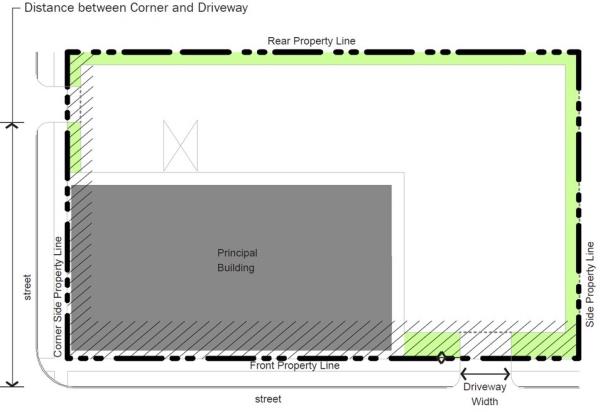 |
| Figure 6.5 (1). Driveway Width and Location |

