
Saint Louis County Unincorporated
City Zoning Code
City Zoning Code
1003.158
Form Based Development.
—1. Scope of provisions. This section contains the regulations for the Form Based Development Standards. These regulations are supplemented and qualified by additional regulations appearing elsewhere in this Chapter which are incorporated, as part of this section by reference.
2.
Statement of intent. The intent of this section is to establish both an overlay district to establish place types and add new form based code zoning districts applicable within specified place types that are intended to include a mix of uses to increase density around transit stops and in select areas; establish a range of zoning districts within the place types, varying in use mix and intensity, with specific development standards; improve mobility by increasing connectivity between developments for vehicles and other modes of travel; and increase pedestrian and bike opportunities that integrate with transit. These provisions are designed to guide new development and redevelopment to create the mixed use patterns that enhance and support transit as well as provide safe, connected routes for non-motorized travel.
Form based codes primarily focus on the ultimate physical form of a building and how it relates to the street and adjacent buildings. They also consider other context elements like transit access and architectural and character integrity of a neighborhood.
3.
Place type overlay districts. The overarching organizing feature of the form based regulations is a series of place type overlay districts that are based on the context of the different kinds of mixed use areas throughout the county. Form based codes are written for specific places, so that different sets of appropriate building forms and uses are defined for each place type. A major feature of the place type overlay district is their illustration of neighborhood development regulations with walkable block configurations. The uses allowed in the place type overlay district shall include all uses within the underlying zoning district or form based code zoning district-
Place type overlay districts established by these standards are:
(1)
Traditional neighborhood (1003.158A);
(2)
Community center (1003.158B);
(3)
Transit oriented development (1003.158C);
(4)
Neighborhood node (1003.158D).
The following summarizes the intent for each place type:
(1)
Traditional neighborhood (TN). The traditional neighborhood place type district is best used on larger parcels of land, forty (40) acres or more, designated for redevelopment. The mix of districts permitted in this place type district allows for the development of small to medium nodes of main street-style mixed use districts with ground floor shopping and some service uses, along with a mix of residential. Residential units consist mainly of row houses, apartments, condominiums, and small lot residences. The goal of this place type district is to establish a highly walkable neighborhood where many daily needs can be met on foot, bicycle, or via transit. Therefore, the place type district requires subdivision to establish walkable block sizes and new streets with a range of transportation choices embedded. Additionally, provision of a minimum level of usable, accessible open space and allowance for civic uses completes the neighborhood.
(2)
Community center (CC). The community center place type District is meant for use in areas that exist as a horizontal mix of single uses, including auto-accessible commercial shopping centers and scattered site apartment complexes. These areas typically serve the larger community or even the region; therefore, auto-accessibility should be maintained, while transforming the areas into more walkable, complete places by bringing buildings to street and moving most of the parking to the rear. The mix of districts permitted in this location includes a more flexible main street-style building that allows for more visible parking and some multiple buildings on one (1) site, along with a mix of office buildings and residential. This place type district also requires subdivision to establish some open space, blocks, and new streets; however, the block sizes are larger to permit more significant amounts of interior parking.
(3)
Transit oriented development (TOD). TOD place type districts is used when an area is adjacent to a transit station or stop, such as multimodal hub or a light rail station. Development is more intense, and people are expected to arrive to the area on many modes, not just by car. Taller buildings with fewer setback requirements are permitted in the TOD areas, along with a wide mix of retail, office, and residential districts. Subdivision is required to establish walkable blocks, similar to the traditional neighborhood, but allowances are made to accommodate the increase in parking for the higher densities permitted. Open space is more civic-oriented (such as plaza) and should be focused on the station area as a gathering point. Greener, softer open space located on the periphery of the place type district, along with lower density residential, serve as buffers between the place type district and surrounding areas, as required.
(4)
Neighborhood node (NN). The neighborhood node place is intended for use on smaller existing parcels (approximately three (3) to ten (10) acres) adjacent to existing neighborhoods. The neighborhood node requires a limited amount of subdivision to establish access to the existing neighborhoods and walkable blocks sizes. A smaller scaled, main street-style mixed use district is required adjacent to the existing larger, border streets, but oriented inward to create a neighborhood feel. Lower density residential serves as a buffer between the existing neighborhoods and the new commercial node. Neighborhood nodes encourage walkable mixed use ringed by mainly low density residential areas.
Note: General regulations for all place types are located in section 9.
4.
Procedure to establish the place type overlay districts.
(1)
Application. Place type district designation shall be allowed in specific geographic areas that have undergone detailed study for utilization of form based code regulations. The owner or owner of record or owners under contract of a lot or tract of land, or their authorized representatives, shall petition the county council on forms prescribed for this purpose by the planning commission. Said petition may be initiated by the county council or planning commission. These forms shall be submitted to the department of planning and accompanied by the following:
(a)
Filing fee per requirements of section 1003.210 fees.
(b)
Legal description of the property.
(c)
Outboundary plat of the property.
(d)
Preliminary concept plan, including but not limited to the following:
(i)
The form based code zoning districts that are applicable.
(ii)
Existing and proposed contours at vertical intervals of not more than five (5) feet referred to sea level datum. Flood plain areas are to be delineated.
(iii)
Preliminary lot, block configuration and street formation (see 1003.158E)
(e)
A written statement noting in what manner the proposed development is consistent with the St. Louis County general plan policies and the intent of the form based code regulations.
(2)
Public hearing. A public hearing on the petition shall be held by the planning commission in accordance with the provisions of section 1003.300 procedure for amending the zoning ordinance, provided, however, a public hearing shall be set within forty-five (45) days of acceptance of the petition, fee, and related plan and documents by the department of planning.
(3)
Planning commission recommendation. No action shall be taken by the county council with respect to the petition until it has received the recommendation of the planning commission. Said recommendation shall address general planning considerations, including consistency with good planning practice, and compatibility with adjoining permitted developments and uses. A recommendation of approval shall include recommended conditions to be included in the ordinance authorizing the establishment of the place type overlay district. Such conditions shall include but not be limited to the following:
(a)
Road requirements;
(b)
Stormwater quality measures;
(c)
Stormwater drainage controls;
(d)
Phasing requirements.
5.
Form based code zoning districts. Once the place type overlay district is in place, the form based code zoning districts may be established. The form based code zoning districts have been developed for use with the place type districts. The following summarizes the intent for each form based code zoning district:
(1)
Main street mixed use district (MSMX). The main street mixed Use District establishes a low- to medium-scale main street-style form that permits a mix of uses serving adjacent neighborhoods and portions of the surrounding community. The form of this district establishes a street wall of building façades along the sidewalk, while focusing pedestrian-friendly retail and service uses on the ground story and residential and/or office uses in upper stories.
(2)
Transitional mixed use district (TMX). The transitional mixed use district permits a range of low- to mid-scale building forms to transition from a heavily commercial area into a mixed use center or neighborhood. The form of this district allows development of a traditional main street building as well as the transitioning of existing strip centers towards the street and a more pedestrian friendly streetscape. Ground story uses include pedestrian-friendly retail uses, service uses, office uses, and potentially live-work units, serving the greater community.
(3)
TOD (transit oriented development) mixed use district (TODX). The TOD mixed use district is a medium- to high-scale district designed to serve adjacent neighborhoods as well as transit users visiting the associated station or stop(s). The form is a slightly more intensive version of a main street-style district establishing a street wall of building façades along the sidewalk, and focusing pedestrian-friendly retail and service uses on the ground story with residential and/or office in upper stories.
(4)
General transit oriented development district (GTOD). The general TOD district is a medium- to high-scale district that permits residential and office buildings, allowing residents to walk to a transit station or stop for a regular commute. The form of the district requires buildings to be oriented to the public space of the street, with courtyards and open space permitted.
(5)
General employment district (GED). The general employment district is a low- to medium-scale district that permits office and craftsman industrial uses, along with residential uses. The form of this district requires buildings to be oriented to the street, while still permitting landscape spaces and courtyards.
(6)
General residential district (GRD). The general residential district is a low- to medium-scale residential district that permits a range of residential building types, including apartment or condominium buildings, rowhouses or townhouses, and small lot houses. Small scale commercial may be included in the permitted building forms to serve the general neighborhood only. The form of this district requires buildings to be oriented to the street, while still permitting landscape spaces and courtyards.
(7)
Edge district (ED). The edge district is a low-scale residential district that can serve as a buffer between more intensive districts and existing or proposed very low density surrounding residential developments. This district may be used in conjunction with the traditional neighborhood place type.
4,
Procedure to establish the form based zoning districts. In order to establish a form based code zoning district through a change of zoning, the procedure shall be as follows:
(1)
Application. The owner or owner of record or owners under contract of a lot or tract of land, or their authorized representatives, shall petition the county council on forms prescribed for this purpose by the planning commission. Said petition may be initiated by the county council or planning commission. These forms shall be submitted to the department of planning and accompanied by the following:
(a)
Filing fee per requirements of section 1003.210 fees.
(b)
Legal description of the property.
(c)
Outboundary plat of the property.
(d)
Preliminary concept plan, including but not limited to the following:
(i)
The place type district;
(ii)
Building types proposed;
(iii)
Preliminary lot, block configuration and street formation, (see 1003.158E);
(iv)
Parking requirements;
(v)
Building siting standards;
(vi)
Architectural standards.
(e)
A written statement noting in what manner the proposed development is consistent with the county general plan policies and the intent of the form based code regulations.
(2)
Public hearing. A public hearing on the petition shall be held by the planning commission in accordance with the provisions of section 1003.300 procedure for amending the zoning ordinance, provided, however, a public hearing shall be set within forty-five (45) days of acceptance of petition, fee, and related plan and documents by the department of planning.
(3)
Planning commission recommendation. No action shall be taken by the county council with respect to the petition until it has received the recommendation of the planning commission. Said recommendation shall address general planning considerations, including consistency with good planning practice, and compatibility with adjoining permitted developments and uses.
7.
Site plan review.
(1)
Site plan review. Form-based development site plan applications shall be reviewed pursuant to section 1003.179, site plan review.
(a)
Pre-application meeting. An applicant for form based development is encouraged to attend a pre-application meeting with the department of planning to discuss the use and interpretation of the form-based regulations.
(b)
Compliance with form based regulations. The director shall review the form-based site plan for compliance with the form-based regulations and take one (1) of the following actions:
(i)
If the plan complies with the form based regulations, the director shall approve the application.
(ii)
If the plan has minor modifications from the form based regulations that may be justified by the stated intent of the plan, the director shall notify the applicant. The applicant may request a minor modification.
(c)
Minor modifications. Following notification from the director of the need for a minor modification, an applicant may make an application for review. Application for minor modification may also be made simultaneously with a form-based site plan review application.
(i)
Standards subject to modification. The following standards may be subject to modifications of up to a maximum of ten (10) percent from the form-based development standards, provided that the applicable approval criteria below are met.
(A)
Minimum building siting standards, and
(B)
Quantitative development standards (e.g., percentage of site landscaping, number of parking spaces, etc.).
The modification is calculated by applying the ten (10) percent modification to the required development standard or measurement, rounded to the nearest whole number. For example, a required 10-foot side yard setback may be modified by ten (10) percent or one (1) foot, allowing a nine-foot setback.
(ii)
Approval criteria. Minor modifications may be approved only upon a finding that all of the following criteria have been met:
(A)
The requested modification is consistent with the stated purposes of the form-based development standards.
(B)
The modification will not substantially interfere with the convenient and enjoyable use of adjacent lands, and will not pose a danger to the public health or safety.
(C)
Any adverse impacts resulting from the modification will be mitigated to the maximum practical extent.
(D)
The modification is to a dimensional or design standard and is either:
(1)
Required to compensate for some unusual aspect of the site or the proposed development that is not shared by landowners in general;
(2)
Supporting an objective or goal from the purpose and intent statements of the form-based district where located; or
(3)
Proposed to protect sensitive natural resources or better integrate development with the surrounding environment.
(d)
Major modification. If the application has major modifications to the form based regulations, the director shall notify the applicant. The applicant may request a waiver of specific standards from the planning commission. The planning commission is prohibited from waiving the following standards beyond the minor modification permitted below:
(i)
Building siting standards;
(ii)
Maximum block size;
(iii)
Minimum height requirement;
(iv)
Parking location standards;
(v)
Prohibited buildings or functions; or
(vi)
Architectural standards.
(2)
Decision. The director shall issue a written decision on a minor modification.
(3)
Review of decision or appeals. The director's determination regarding a minor modification may be reviewed by the planning commission at the request of the applicant.
8.
Place type overlay requirements.
(1)
Traditional neighborhood place type district. The traditional neighborhood place type district is best used on larger parcels of land, forty (40) acres or more, designated for redevelopment. The mix of districts permitted in this place type district allows for the development of small to medium nodes of main street-style mixed use districts with ground floor shopping and, some service uses, along with a mix of residential. Residential units consist mainly of row houses, apartments, condominiums, and small lot residences. The goal of this place type district is to establish a highly walkable neighborhood where many daily needs can be met on foot, bicycle, or via transit. Therefore, the place type district requires subdivision to establish walkable block sizes and new streets with a range of transportation choices embedded. Additionally, provision of a minimum level of usable, accessible open space and allowance for civic uses completes the neighborhood.
(2)
Community center place type district. The community center place type district is meant for use in areas that exist as a horizontal mix of single uses, including auto-accessible commercial shopping centers and scattered site apartment complexes. These areas typically serve the larger community or even the region; therefore, auto-accessibility should be maintained, while transforming the areas into more walkable, complete places by bringing buildings to street and moving most of the parking to the rear. The mix of districts permitted in this location includes a flexible main street-style building that allows for more visible parking and some multiple buildings on one (1) site, along with a mix of office buildings and residential. This place type district also requires subdivision to establish some open space, blocks, and new streets; however, the block sizes are larger to permit more significant amounts of interior parking.
| 2. Community Center Place Type Requirements | |||
Form Based Zoning Districts
| Main Street MU | • | A minimum of 600 linear feet of consecutive block faces, both sides of the street, is required to be zoned with either the Main Street MU or the MU transition district. |
| MU transition | • | ||
| MU TOD | |||
| General TOD | |||
| General employment | • | No minimum requirements. | |
| General residential | • | ||
| Edge |  | Edge district permitted when used as buffer only. | |
Minimum
Acreage | Minimum required acreage for application of place type | 3 acres | |
Blocks
| Maximum block length | 900'; preferred block length is 400'. | |
| Maximum block width | 600'; preferred maximum block width is 400'. | ||
Open Space
| General residential & edge open space requirements | One open space type is required within one-quarter (¼) of a mile of each of the residential dwelling units. | |
| MU district & general employment open space requirements | One open space type is recommended central to these districts. Recommended open space types for this location are the plaza or square. | ||
(3)
Transit oriented development (TOD) place type district. TOD place type districts is used when an area is adjacent to a transit station or stop, such as multimodal hub or a light rail station. Development is more dense and people are expected to arrive to the area on many modes, not just by car. Taller buildings with fewer setback requirements are permitted in the TOD areas, along with a wide mix of retail, office, and residential districts. Subdivision is required to establish walkable blocks, similar to the traditional neighborhood, but allowances are made to accommodate the increase in parking for the higher densities permitted. Open space is more civic-oriented (such as plaza) and should be focused on the station area as a gathering point. Greener, softer open space located on the periphery of the place type district, along with lower density residential, serve as buffers between the place type district and surrounding areas, as required.
| 3. TOD Place Type Requirements | |||
Form Based Zoning Districts
| Main Street MU | ||
| MU Transition | |||
| MU TOD | • | A minimum of 600 linear feet of consecutive block faces, both sides of the street, is required to be zoned with either the Main Street MU or the MU transition district. | |
| General TOD | • | No minimum requirements. | |
| General employment | |||
| General residential | |||
| Edge | | Edge district permitted when used as buffer only. | |
Minimum
Acreage | Minimum required acreage for application of place type | 5 acres | |
Blocks
| Maximum block length | 600'; preferred block length is 400'. | |
| Maximum block width | 600'; preferred maximum block width is 400'. | ||
Open Space
| General TOD open space requirements | None. | |
| MU TOD open space requirements | One open space type is required within 500' from the station or stop area. Recommended open space types for this location are the plaza or square. | ||
(4)
Neighborhood node place type district. The neighborhood node place is intended for use on smaller existing parcels (approximately 3 to 10 acres) adjacent to existing neighborhoods. The neighborhood node requires a limited amount of subdivision to establish access to the existing neighborhoods and walkable blocks sizes. A smaller scaled, main street-style mixed use district is required adjacent to the existing larger, border streets, but oriented inward to create a neighborhood feel. Lower density residential serves as a buffer between the existing neighborhoods and the new commercial node. Neighborhood nodes encourage walkable mixed use ringed by mainly low density residential areas.
9.
General block, lot, and street design regulations for place type overlays.
(1)
Applicability. The following are general block, lot, and street design requirements are applicable to all place type districts.
(2)
Interconnected street pattern. The network of streets within all place types district shall form an interconnected pattern with multiple intersections and resulting block sizes as designated in the requirements for each place type district.
(a)
The arrangement of streets shall provide for the continuation of existing streets from adjoining areas into new developments.
(b)
Cul-de-sac and dead end streets are not permitted, except when dictated by topographic features of environmental areas.
(c)
Streets shall follow natural features rather than interrupting or dead-ending at the feature.
(d)
Where streets terminate, such termination shall be at an open space or a building façade.
(3)
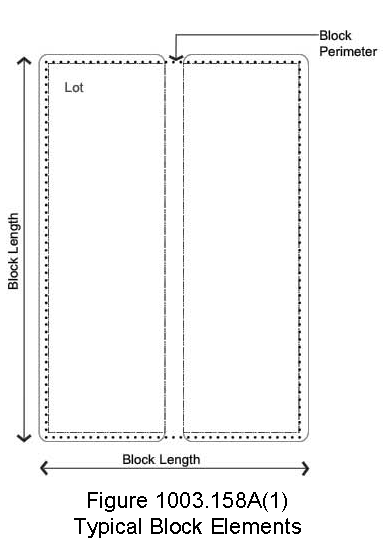
Block configuration. Refer to figure 1003.158A(1) for an illustration of typical block elements.
(a)
The shape of a block shall be generally rectangular, but may vary due to natural features or site constraints.
(b)
Blocks shall typically be two (2) lots deep with the exception of blocks containing open space. Blocks may also include an alley. Blocks may include existing lots within an existing zoning district outside the place type district.
(c)
Blocks shall typically be fronted with lots on at least two (2) faces, preferably on the longest street faces.
(d)
For increased energy efficiency, block orientation shall be along an east-west longitudinal axis to the maximum extent feasible. For long, central corridor buildings, this block orientation will encourage development of buildings oriented along an east-west axis, with smaller east and west facing façades, able to take advantage of passive solar technology.
(4)
Maximum block size. Block sizes for residential and commercial development and redevelopment are designated within each place type district. A network of streets is required to meet the maximum block size requirement. Where parcels in the place type district boundary back up to parcels outside the place type district, those blocks are exempted from the maximum block size.
(5)
Minimum number of access points. This requirement is intended to provide a minimum level of connectivity via vehicular rights-of-way between adjacent developments and to surrounding streets.
(a)
Requirement. A minimum of two (2) access points is required for each place type district.
(b)
Recommendation. A minimum of one (1) access point per every one thousand five hundred (1,500) feet of boundary is recommended.
(6)
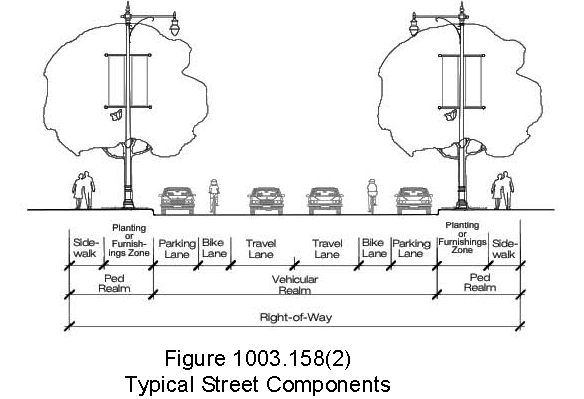
Typical street type. New streets within the place type district shall establish some level of access and accommodations for all modes of travel: walking, biking, driving, or riding transit. The applicant shall coordinate with the county's department of highways and traffic for required street sections. Refer to figure 1003.158A(2) for typical street section components. Street sections shall include the following minimum requirements:
(a)
Sidewalk. Minimum clear sidewalk width of eight (8) feet in shopping and office areas and six (6) feet in residential areas. The sidewalk shall extend to the street in all shopping areas. Special paving is preferred.
(b)
Street trees. All streets shall include street trees between the sidewalk and the curb with a minimum of six (6) feet to accommodate tree roots. Nine (9) feet is preferred. Street trees shall be located in tree wells with grates or planters in shopping and office areas and in parkways in residential areas.
(c)
On-street parking. On-street parking shall be provided along all streets where possible, especially adjacent to all mixed use (MU) zoning districts. On-street parking should generally be parallel to the street; however, adjacent to mixed use (MU) districts, angled head in or back in parking may be appropriate.
(d)
Pedestrian crossings. To encourage pedestrian activity, typical crosswalks shall not extend over thirty-eight (38) feet without a landscape median, bulb-outs, and/or other pedestrian refuge to mitigate the effects of vehicular traffic on crossing and increase pedestrian safety and comfort.
(e)
Bulb-outs. To shorten pedestrian crossing distances, bulb-outs should be utilized at all intersections. The depth of the bulb-out shall match the utilized on- street parking, either the width of the parallel space or the depth of the diagonal space.
(f)
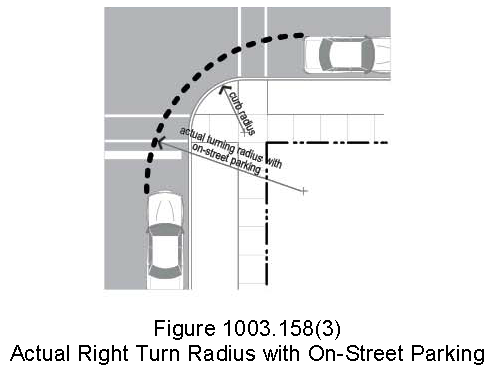
Curb radii. Intersections should be designed for actual turning radius of the typical design vehicle as opposed to the maximum design vehicle. Small curb radii at intersections shorten pedestrian crossing distances and reduce vehicle turning speeds, thereby balancing the ease of travel of the vehicles and pedestrians. Refer to figure 1003.158A(3). Recommended curb radii for streets adjacent to mixed use (MU) districts are ten (10) feet or less when on street parking is provided, and less than thirty (30) feet when no on street parking is provided. Curb radii at the intersections of alleys and other streets shall be limited to five (5) feet.
(g)
Bicycle ways. Bicycle ways should be accommodated on all streets; however, a designated route should be determined to and through the place type district. Most neighborhood local streets should include shared bicycle accommodations as opposed to designated routes.
(h)
Typical street sections. The following street types define the typical configurations for new streets within the place type districts.
(i)
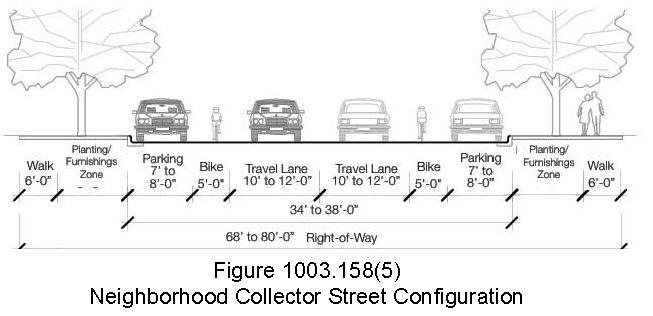
Neighborhood collector street. Each place type district may include a network of neighborhood collector streets where heavier vehicular and bicycle traffic is expected from those traveling through the neighborhood as well as those traveling to destinations within the place type district such as transit stations, shops and stores, and service uses. Refer to figure 1003.158A(5) for a street section that outlines the typical configuration for the neighborhood collector street.
(ii)
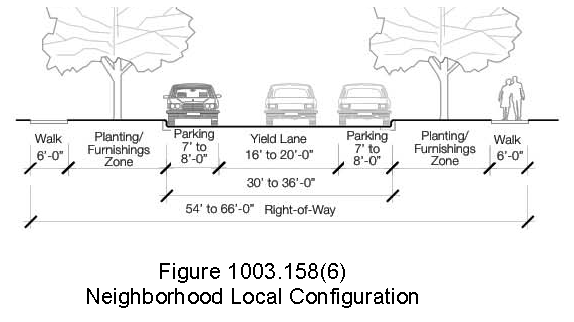
Neighborhood local street. The neighborhood local street shall be utilized for the majority of new streets within a place type district, allowing for small-scale, slow-moving local traffic. The neighborhood local street should be utilized for all residential streets, especially those within the edge districts. Refer to figure 1003.158A(6) for a street section that outlines the typical configuration for the neighborhood local street.
(iii)
Alley. Where alleys are utilized, a minimum eighteen-foot private right-of-way or easement shall be provided with a minimum sixteen-foot pavement width. Pavement may be concrete, asphalt, permeable concrete or asphalt, with no curb, rolled curb, slotted vertical, or standard vertical curb and gutter.
(7)
Designate primary streets. The intent of the primary street designation is to develop a network of streets with continuous building frontage and no vehicular access to limit conflicts between pedestrians and vehicular traffic.
(a)
Designate primary streets along all blocks faced and fronted with a shopping district.
(b)
All lots shall front at least one (1) primary street, and that street frontage shall serve as the front of the lot, as referred to in the building type standards.
(c)
Where lots have two (2) primary street frontages, the applicant shall consult with county staff to determine which street frontage warrants primary designation and the front of the lot.
(8)
Block access configurations.
(a)
Vehicular access shall not be located off a primary street, unless the parcel is fronted by more than two (2) primary streets, in which case, the county shall determine which is the appropriate street for vehicular access. The determination shall be based on locations of existing and proposed vehicular access points of other developments along the primary streets.
(b)
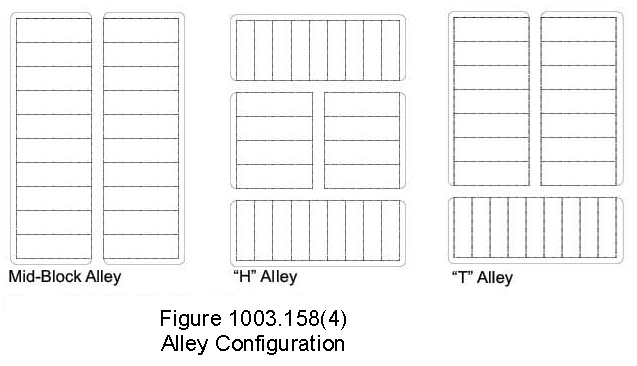
Blocks may include alleys, drives, or driveway entrances with the following recommended configurations. See figure 1003.158A(4).
(i)
Mid-block access. This configuration includes an alley or drive running through the center of the block.
(ii)
"T" configuration. This configuration includes two (2) alleys within a block that are perpendicular to each other, forming a "T, " allowing development to front on three (3) block faces.
(iii)
"H" configuration. Similar to the "T" configuration, this configuration-allows development to front on all four (4) block faces.
(c)
Access to blocks shall be aligned across the street from access to other blocks.
(d)
Mid-block pedestrian ways. Mid-block pedestrian ways are required on blocks longer than eight hundred (800) feet.
(i)
When combined with mid-block street crossings, these pathways should align to facilitate easy pedestrian movements.
(ii)
Mid-block pedestrian ways should be located in the middle third of a block face.
(9)
Lots.
(a)
Typical lot dimensions. All lots of record shall be developed to meet the requirements outlined in 1003.158-11, building type standards.
(b)
Typical lot configuration. All lots shall have frontage along a public street unless otherwise specified in 1003.158-11, building type standards.
(i)
Lot shape. To create regular, rectangular lots, side property lines shall be perpendicular to the vehicular right-of-way to the maximum extent practicable, that the costs of compliance clearly outweigh the potential benefits to the public or would unreasonably burden the proposed project, and reasonable steps have been undertaken to minimize any potential harm or adverse impacts resulting from noncompliance with the regulation.
(ii)
Through-lots. Through-lots fronting on two (2) parallel streets are not permitted with the exception of a lot covering fifty (50) percent or more of a block. The two (2) longest parallel street faces are treated as front property lines per building type requirements (refer to 1003.158-11).
(iii)
Corner lots. Corner lots have a front yard along one (1) street and a corner side yard along the other street. The front yard of a corner lot should be consistent with the front yard of one (1) adjacent parcel.
(A)
The rear yard of a corner lot is the yard against an alley or another lot's rear yard.
(B)
The side yard of a corner lot is adjacent to another lot.
(iv)
Flag lots. Flag lots are prohibited.
(c)
Lot orientation. For increased energy efficiency, the recommended lot orientation is along an east-west longitudinal axis. For single buildings, this lot orientation will encourage development of buildings with smaller east and west façades.
(10)
General open space requirements. For all place type districts larger than fifteen (15) acres, the following are requirements for provision of open space.
(a)
Types of open space. The following types of open space are permitted within the place type districts:
(i)
Plaza. A plaza is the hardscaped area between a quarter (¼) and two (2) acres in size with either street right-of-way or building frontage on all sides and at least one (1) side the equivalent of one-quarter (¼) of the perimeter open to the street.
(ii)
Square. A square is a combination of hardscape and landscape between a quarter (¼) and three (3) acres in size and surrounded by street frontage on all sides.
(iii)
Green. A green is a landscaped space between half (½) and two (2) acres with street right-of-way on at least seventy-five (75) percent of the perimeter.
(iv)
Park. A park is a larger landscaped space, a minimum of two acres in size, with a quarter of the perimeter on street right-of-way.
(b)
Open space requirements. Refer to each place type district for specific open space requirements.
(c)
Mix open space types. For developments with more than three (3) open space areas, at least two (2) different types shall be provided.
(11)
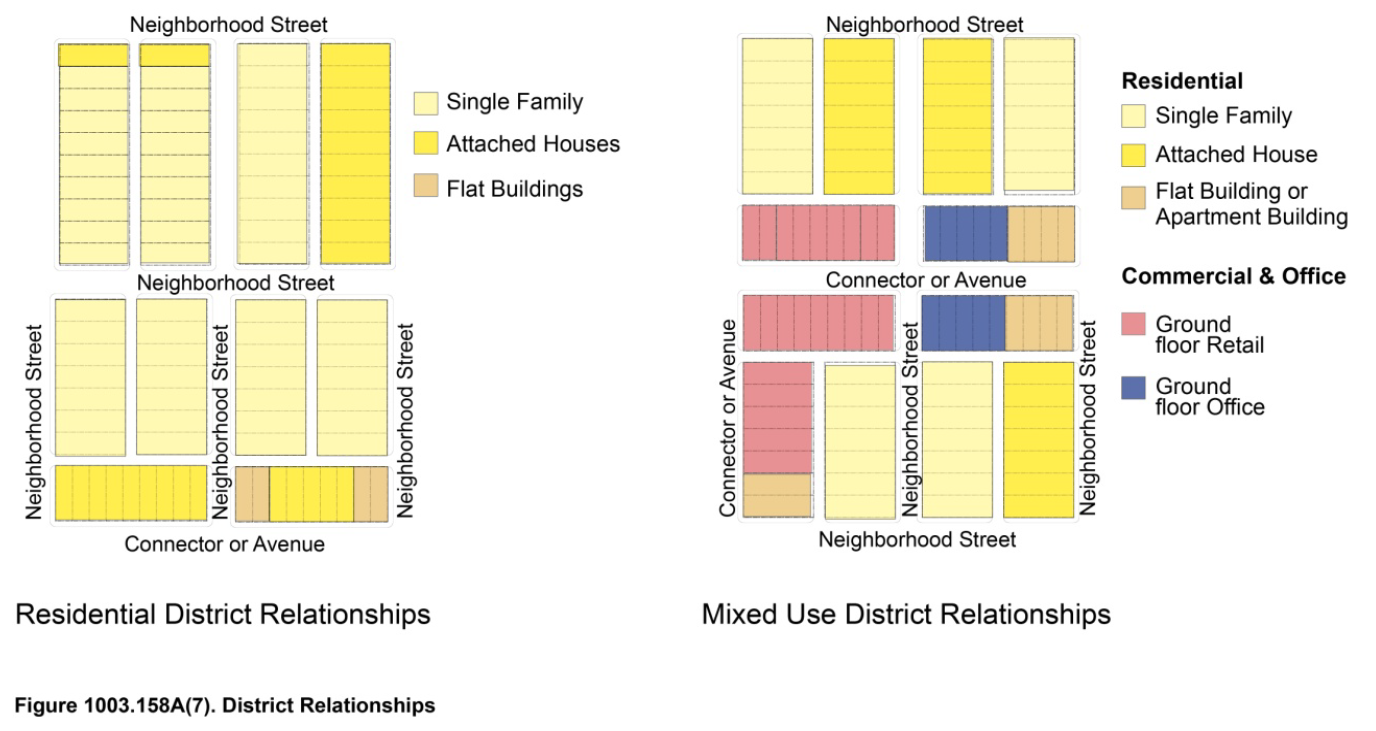
General zoning district layout. For all place type districts, the following outlines how the zoning districts should relate to one another.
(a)
All districts. The following apply to all zoning districts.
(i)
Similar intensities of uses should face each other across the street.
(ii)
More intense uses that share blocks with less intense uses should be located on block ends. For example, the general residential district should be located on corner parcels when on the same block as less intensive edge district.
(iii)
Blocks may contain multiple zoning districts; however, changes in districts should occur along an alley, the rear property line, or at a corner parcel.
(b)
Shopping and employment districts. The following apply to all shopping and employment zoning districts. Shopping districts include all mixed use districts: Main Street (MSMX), transitional mixed use (TMX), transit oriented development (TODX). Employment districts include: general transit oriented development (GTOD), general employment (GED).
(i)
Shopping districts are clustered into nodes of at least ten thousand (10,000) square feet of gross building area. Minimum requirements for shopping district areas are noted on each place type and apply to development parcels five (5) acres or greater.
(ii)
Nodes of shopping districts are uninterrupted and continuous. Employment districts may be located between shopping districts and residential districts.
(iii)
Walkable shopping districts are located on a street perpendicular to any larger arterial or highway on the boundary of the place type district. The edge of the shopping district should be located within one (1) block of the periphery of the place type district.
(c)
Buffers. When place type districts back up to the rear of existing single-family residential neighborhoods, one (1) of the following shall be utilized:
(i)
Open space. A linear buffer of open space shall be provided along those lot lines, with a minimum depth of fifty (50) feet.
(ii)
Edge district. A street fronted on both sides by an edge district shall be established parallel to the existing rear lot lines of the existing neighborhood. This establishes one (1) row of edge district lots that buffers the rear lots of the existing neighborhood. Edge districts are permitted in all place type districts as buffers.
10.
Form based code zoning districts. Once the place type overlay district is in place, the form based code zoning districts may be established.
The form based code zoning districts have been developed for use with the place type districts.
The following summarizes the intent for each form based code zoning district:
(1)
Main street mixed use district (MSMX). The main street mixed use district establishes a low- to medium-scale main street-style form that permits a mix of uses serving adjacent neighborhoods and portions of the surrounding community. The form of this district establishes a street wall of building façades along the sidewalk, while focusing pedestrian-friendly retail and service uses on the ground story and residential and/or office uses in upper stories.
(2)
Transitional mixed use district (TMX). The transitional mixed use district permits a range of low- to mid-scale building forms to transition from, a heavily commercial area into a mixed use center or neighborhood. The form of this district allows development of a traditional main street building as well as the transitioning of existing strip centers towards the street and a more pedestrian friendly streetscape. Ground story uses include pedestrian-friendly retail uses, service uses, office uses, and potentially live-work units, serving the greater community.
(3)
TODX (transit oriented development) mixed use district. The TOD mixed use district is a medium- to high-scale district designed to serve adjacent neighborhoods as well as transit users visiting the associated station or stop(s). The form is a slightly more intensive version of a main street-style district establishing a street wall of building façades along the sidewalk, and focusing pedestrian-friendly retail and service uses on .the ground story with residential and/or office in upper stories.
(4)
General TOD (transit oriented development) district (GTOD). The general TOD district is a medium- to high-scale district that permits residential and office buildings, allowing residents to walk to a transit station or stop for a regular commute. The form of the district requires buildings to be oriented to the public space of the street, with courtyards and open space permitted.
(5)
General employment district (GED). The general employment district is a low- to medium-scale district that permits office and craftsman industrial uses, along with residential uses. The form of this district requires buildings to be oriented to the street, while still permitting landscape spaces and courtyards.
(6)
General residential district (GRD). The general residential district is a low- to medium-scale residential district that permits a range of residential building types, including apartment or condominium buildings, rowhouses or townhouses, and small lot houses. Small scale commercial may be included in the permitted building forms to serve the general neighborhood only. The form of this district requires buildings to be oriented to the street, while still permitting landscape spaces and courtyards.
(7)
Edge district (ED). The edge district is a low-scale residential district that can serve as a buffer between more intensive districts and existing or proposed very low density surrounding residential developments. This district may be used in conjunction with the traditional neighborhood place type.
11.
Uses in the form based zoning districts.
(1)
General provisions.
(a)
Permitted and conditional uses available in each form based code district are shown in table 1003.158(8), permitted uses.
(b)
Uses listed in table 1003.158(8) are defined in section 12, glossary of terms.
(c)
Permitted ("
 ").
").
These uses are permitted by-right in the form base districts in which they are listed.
(d)
Permitted in upper stories only ("
 ").
").
These uses are permitted by-right in the form base zoning districts in which they are listed, provided that the uses are located in the upper stories of a structure. These uses may also be located in the ground story provided that they are located beyond a depth of at least thirty (30) feet from the front façade.
(e)
Permitted with use specific standards
("
 ").
").
These uses are permitted by-right in the form base districts in which they are listed, provided that they are developed utilizing the listed use specific standards. These standards are intended to alleviate any negative impacts associated with the use, making it appropriate in a district where it otherwise, might not have been appropriate.
(f)
Requires a conditional use permit ("
").
These uses require a conditional use permit (refer to section 1003.181, conditional use permits) in order to occur in the districts in which they are listed and must follow any applicable development standards associated with the use as well as meet the requirements of the conditional use.
(g)
A blank cell in the use table indicates that the land use is prohibited in that district.
(h)
When a proposed land use is not explicitly listed in table 1003.158(8), permitted uses, the director shall determine whether or not it is included in the definition of a listed use or is so consistent with the size, scale, operating characteristics and external impacts of a listed use that it should be treated as the same use. Any such determination shall be made available to the public, and may be appealed to the board of zoning adjustment.
(2)
Use specific standards. The following standards apply to those uses listed in the permitted use table, table
1003.158(8)), that are designated in a particular form base code district as permitted
with use specific standards ("
").
(a)
Stores and shops. In the form based code districts where stores and shops are permitted with use specific
standards ("
"),
the following applies:
(i)
Permitted in the general stoop building only.
(ii)
Limited to corner lots, located generally on the corner of the building, and limited to a maximum of twenty-five (25) percent of the ground floor of the building or one thousand five hundred (1,500) square feet, whichever is greater.
(b)
Arts and craft studios. In the form based code districts where arts and craft studios are permitted with
use specific standards ("
"),
the following applies:
(i)
Permitted in the ground floor only of the row building, associated with a live-work unit.
(ii)
Permitted in any floor of the general stoop building provided over fifty (50) percent of the floor on which it is located is occupied by non-residential uses.
(c)
General service. Refer to table 1003.158(8), list of typical uses in general service use category,
for a list of services permitted in this category. In the form based code districts
where general service is permitted with use specific standards ("
"),
the following applies:
(i)
Permitted in the general stoop building only.
(ii)
Limited to corner lots, located generally on the corner of the building, and limited to a maximum of twenty-five (25) percent of the ground floor of the building or 1,500 square feet, whichever is greater.
(d)
Recreational facilities. In the form based code districts where recreational facilities are permitted with
use specific standards ("
"),
the following applies:
(i)
Gyms and associated uses, such as swimming pool, indoor courts, restaurant/cafe, are the only permitted uses.
(ii)
The entire gym is limited in size to occupying a maximum of fifty (50) percent of the block face. Any associated restaurant/cafe use is exempt from this requirement. Other uses that occupy the block face as frontage uses (with gym uses in rear) shall be a minimum of thirty (30) feet deep from the sidewalk inwards.
(e)
Office. In the form based code districts where office is permitted with use specific standards
("
"),
the following applies:
(i)
Permitted in the ground floor only of the row building, associated with a live-work unit.
(ii)
Permitted in any floor of the general stoop building provided over fifty (50) percent of the floor on which it is located is occupied by non-residential uses.
Table 1003.158(8). Permitted and Conditional Use Table
| Permitted Use Table | ||||||||||
|---|---|---|---|---|---|---|---|---|---|---|
| Uses | Form Base Zoning Districts | |||||||||
| Permitted |
Main Street MSMX
|
TMX Transition
|
TODX
|
General GTOD
|
General
Employment |
General
Residential |
Edge
| ||
| Permitted in upper stories only | |||||||||
| Permitted with use specific standards | |||||||||
| Requires a conditional use permit | |||||||||
| Residential & Lodging | ||||||||||
| Single-family residential | | | | | | | ||||
| Multifamily residential | | | | | | | ||||
| Hotels | | | | | | |||||
| Residential care | | | | | | | | |||
| Civic & Institutional | ||||||||||
| Auditoriums and public assembly | | | | | | |||||
| Churches | | | | | | | | |||
| Clubs, lodges, meeting rooms | | | | | | | ||||
| Library/museum | | | | | | | | |||
| Police, fire, and postal station | | | | | | | | |||
| Retail & Craft | ||||||||||
| Stores and shops | | | | | | |||||
| Package liquor stores | | | | |||||||
| Arts and craft studios | | | | | | | ||||
| Service | ||||||||||
| General service | | | | | ||||||
| Restaurants (free standing fast food) | | | | | ||||||
| Large scale entertainment | | | | | ||||||
| Night club | | |||||||||
| Recreational facilities | | | | | | |||||
| Schools for business | | | | | ||||||
| Office | ||||||||||
| Office | | | | | | | ||||
| Infrastructure | ||||||||||
| Parking lots or garages | | | | | | | ||||
| Public utilities | | | | | ||||||
| Telecommunication tower (over 200') | | | | | | |||||
| Telecommunication tower (under 200') | | | | | | |||||
Table 1003.158(9). List of Typical Uses in General Service Use Category
(3)
Parking lot. A lot that does not contain a permitted building type and is solely used for the
parking of vehicles. In the form based code districts where a parking lot is permitted
with development standards ("
"),
the following apply:
(a)
Corner lots. A corner lot shall not be used as a parking lot.
(b)
Adjacent parking lots. Two (2) parking lots cannot be located directly adjacent to one another.
(c)
Single-family. Parking lot cannot be associated with a single-family use.
(d)
Distance. Parking lot must be within three hundred (300) feet of the associated use unless:
(i)
At least seventy-five (75) percent of the spaces are dedicated for public use.
(ii)
An approved parking agreement is in place.
(e)
Pedestrian access. Must be connected to associated use by a dedicated, public pedestrian pathway, usually a sidewalk.
(f)
Commercial vehicles. Parking lots specifically designated for only commercial vehicles are not permitted in any form based code district.
12.
Building type standards.
(1)
Introduction. The building types detailed in section 1003.158-11(A-E)) form based zoning districts, outline the required building forms for new construction and renovated structures. All building types must meet the following requirements:
(a)
Form based zoning districts. Each building type shall be constructed only within its designated districts (refer to table 1003.158(11), permitted building types by districts).
(b)
Uses. Each building type can house a variety of uses depending on the district in which it is located. Refer to 1003.158A(8), Uses for form based code districts for uses permitted. Some building types have additional limitations on permitted uses.
(c)
No other building types. All buildings constructed must meet the requirements of one (1) of the building types permitted within the zoning district of the lot.
(d)
Permanent structures. All buildings constructed shall be permanent construction without a chassis, hitch, or wheels, or other features that would make the structure mobile, unless otherwise noted.
(e)
Accessory structures.
(i)
Attached accessory structures are considered part of the principal structure.
(ii)
Detached accessory structures are permitted per each building type and shall comply with all setbacks except the following:
(A)
Detached accessory structures are not permitted in the front yard.
(B)
Detached accessory structures shall be located behind the principal structure in the rear yard.
(C)
Detached accessory structures shall not exceed the height of the principal structure and in no case shall be taller than two and a half (2½) stories.
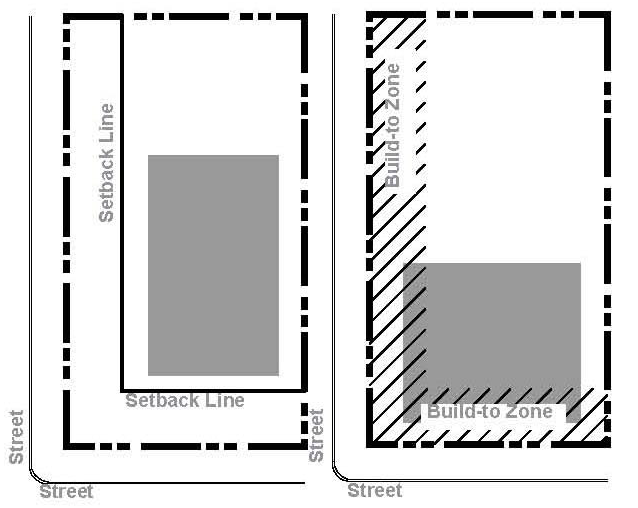
Figure 1003.158(10)
Build-to Zone vs. Setback Line
A setback line indicates the closest a building may be placed to a property line, but is silent on where behind that line a building may be placed. A build-to zone indicates a zone or area in which the façade of a building must be located. The use of a build-to zone allows some control over building placement, while the range provides some flexibility. This method also provides an element of predictability that is absent when the only requirement is to locate a building beyond a certain line.
(2)
Building types allowed in the form based zoning districts.
Table 1003.158(11). List of Building Types Allowed in Form-Based Districts
| Form Based Zoning Districts | ||||||||
|---|---|---|---|---|---|---|---|---|
Main Street MU
|
MU Transition
|
TOD MU
|
General TOD
|
General
Employment |
General Residential
|
Edge
| ||
Building Types
| Main street building | | | | ||||
| General stoop | | | | |||||
| Civic building | | | | | | | ||
| Row building | | | ||||||
| Small lot residence | | | ||||||
(A)
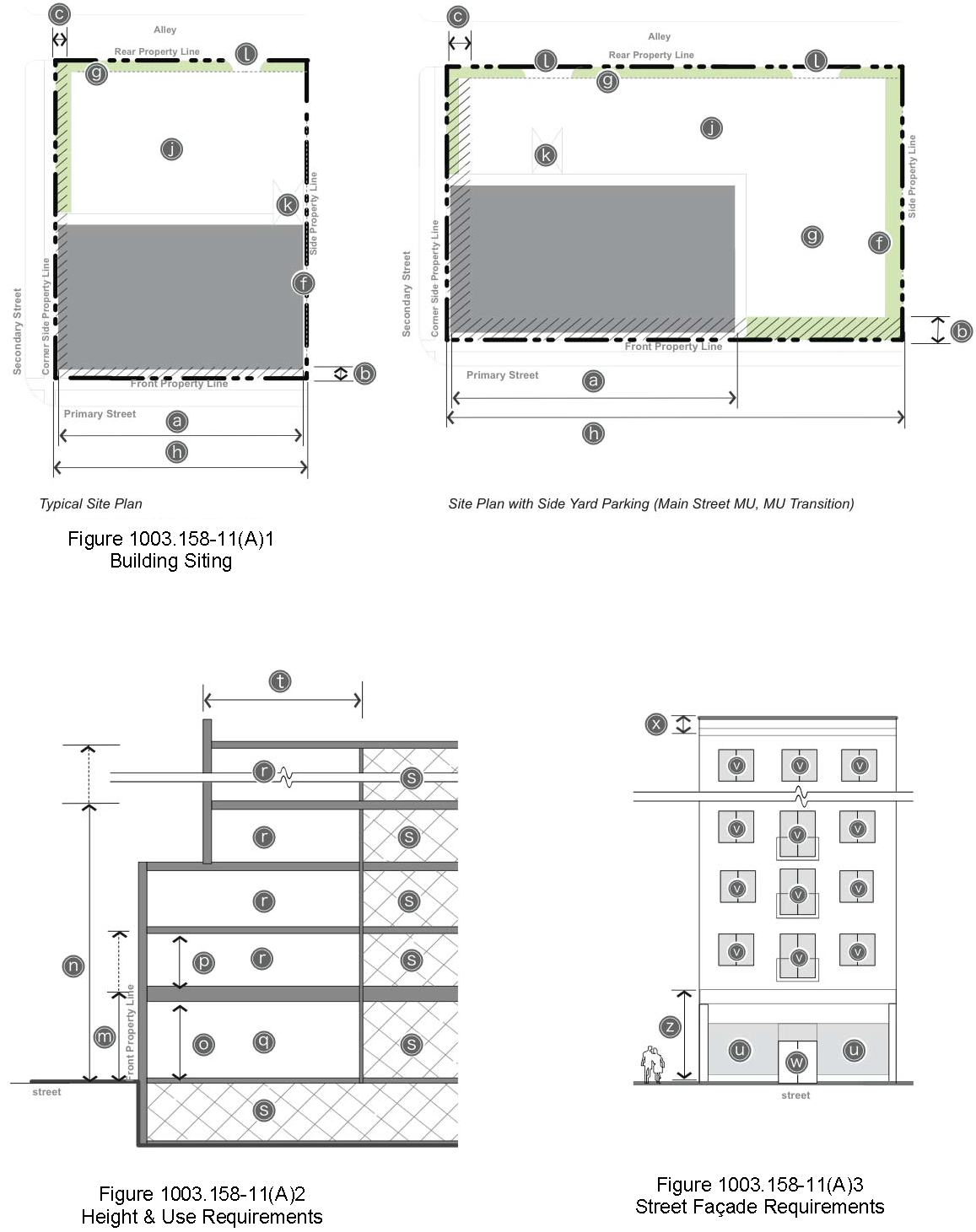
Main street building. The main street building is a mixed use building located at the front and corner property lines allowing easy access to passing pedestrians and transit riders. Parking may be provided in the rear of the lot, internally in the building, or, in some cases, one (1) double-loaded aisle of parking is permitted in the interior or the side yard at the front property line. The minimum and maximum heights of this building type depend on the district within which it is located: taller heights are permitted in the TODX, with lower heights in the other MU S districts.
Ground floor uses should be limited to those with some level pedestrian activity, such as retail and service uses, with additional commercial, office, and/or residential uses in the upper stories. Additionally, storefronts with large amounts of transparency and regularly space entrances off the street are required on the ground floor front façade of this building type.
Regulations. Regulations for the main street building type are defined in the following table.
(B)
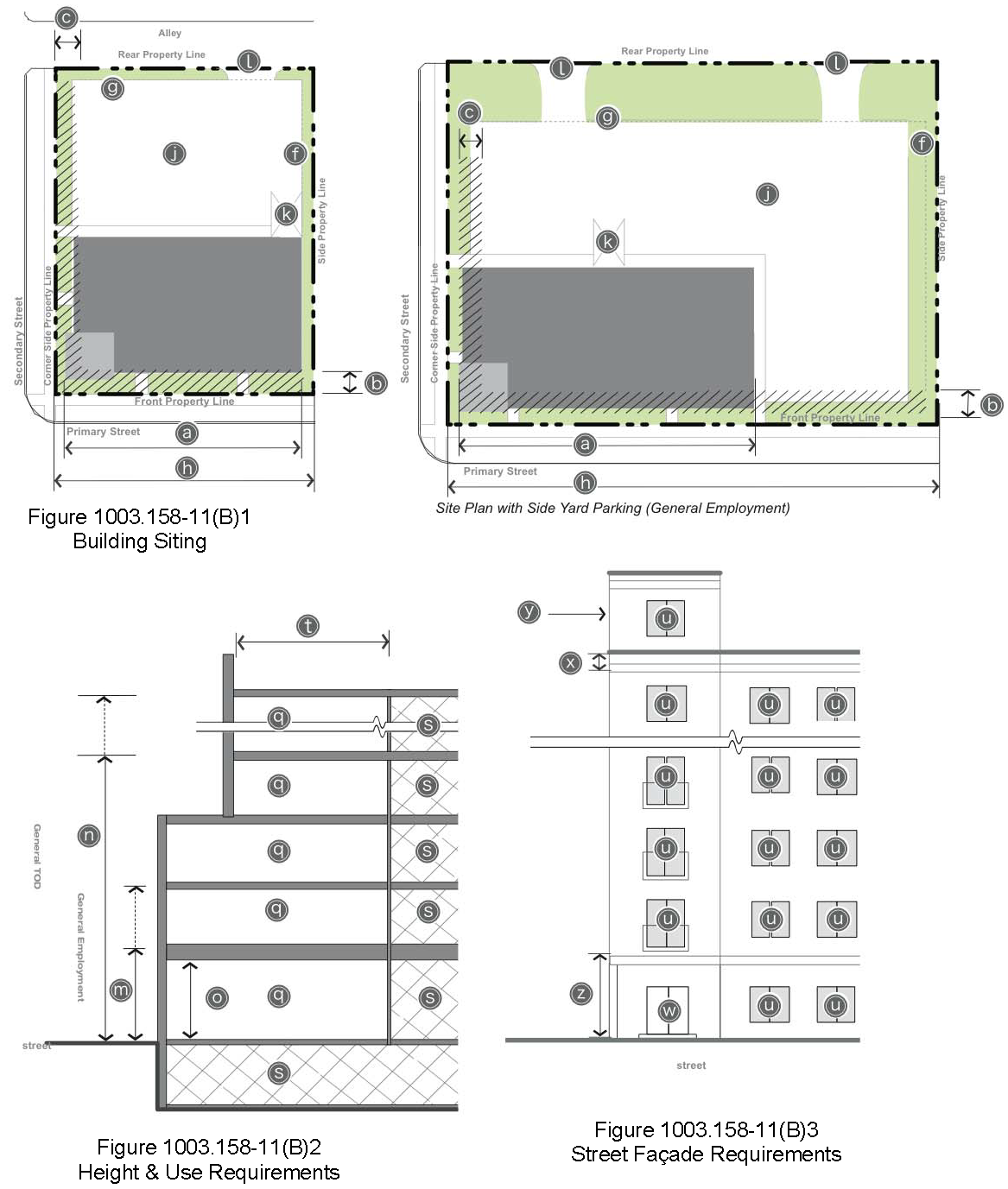
General stoop building. The general stoop building type is limited in terms of uses by the district within which it is located, generally housing office and/or residential uses. Similar to the main street building, the general stoop building is intended to be built close to the front and corner property lines allowing easy access to passing pedestrians and transit riders. Parking may be provided in the rear of the lot, internally in the building, or, in some cases, one (1) double loaded aisle of parking is permitted, in the interior or the side yard at the front, property line. The minimum and maximum heights of this building type depend on the district within which it is located: taller heights are permitted in the TODX, with lower heights in the other MU districts.
Regulations. Regulations for the general stoop building type are defined in the following table.
(C)
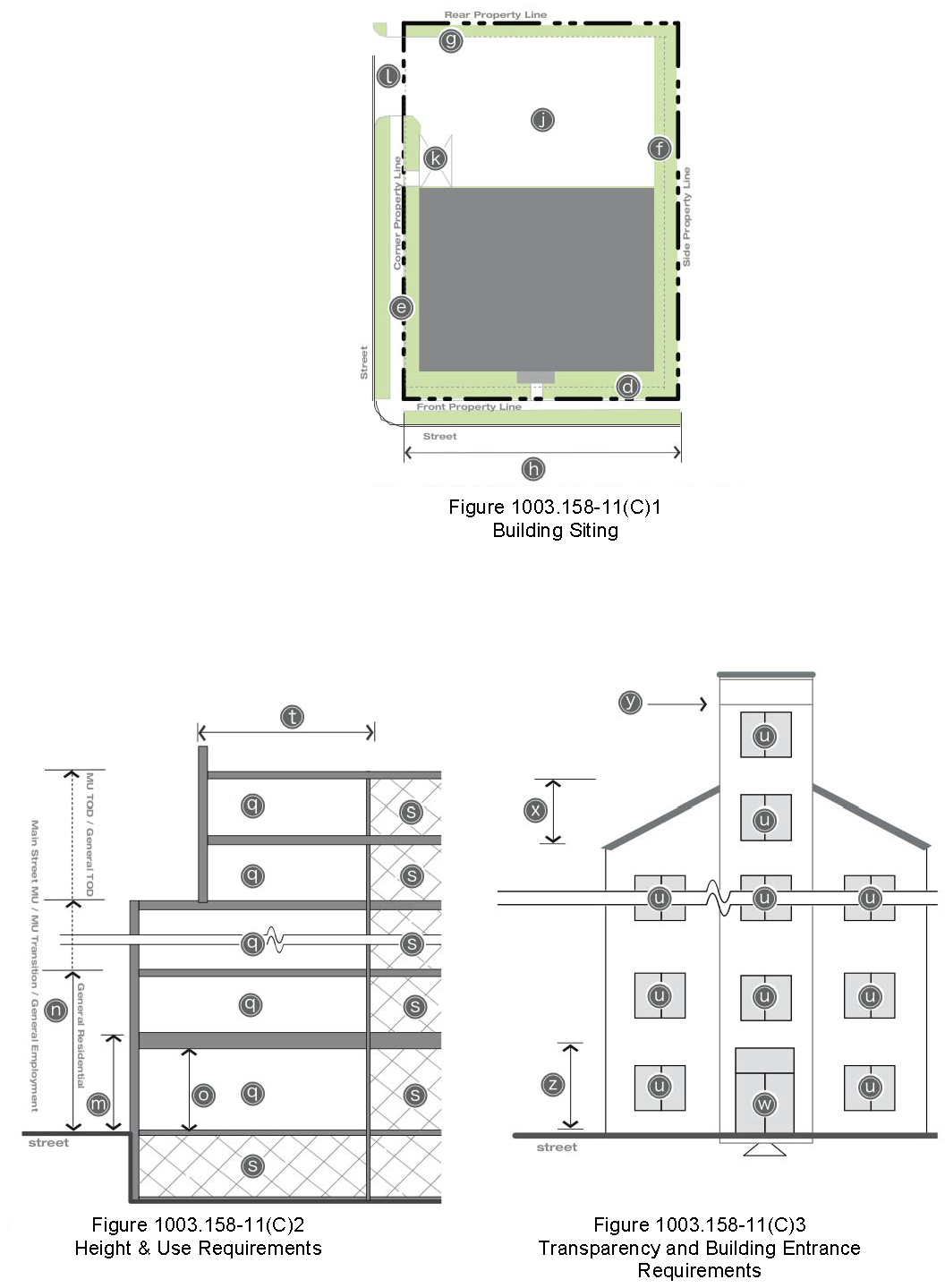
Civic building. The civic building type is a more flexible building type intended only for civic and institutional types of uses. These buildings are distinctive within the urban fabric created by the other building types. In contrast to most of the other building types, a minimum setback line is required instead of a build-to zone. Parking is limited to the rear in most cases. The minimum and maximum heights of this building type depend on the district within which it is located: taller heights are permitted in the TOD zoning districts, with lower heights in the other districts.
Regulations. Regulations for the civic building type are defined in the following table.
(D)
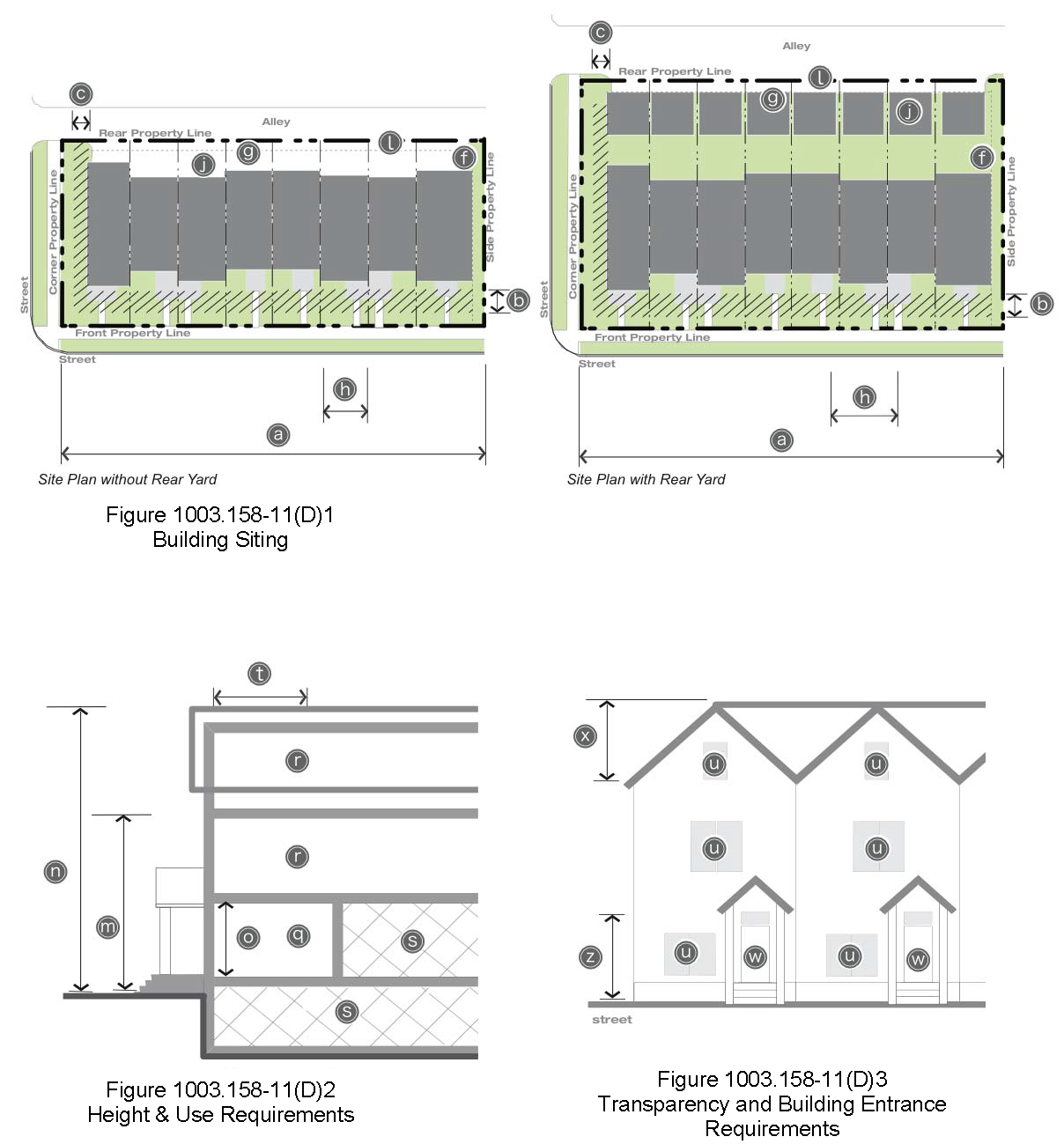
Row building. The row building is a building typically comprised of multiple vertical units, each with its own entrance to the street. This building type may be organized as townhouses or rowhouses, or it could also incorporate live/work, units where such use is permitted.
Parking is required to be located in the rear yard and may be incorporated either into a detached. garage or in an attached garaged, accessed from the rear of the building. However, when the garage is located within the building, a minimum level of occupied space is required on the front façade to ensure that the street façade is active.
Regulations. Regulations for the row building type are defined in the adjacent table.
(E)
Small lot house. The small lot house is a residential only building, intended to incorporate yard surrounding all, sides of the building. Parking and garages are limited to the rear only with preferred access from an alley.
The small lot house will likely be mainly utilized in newly developing locations to create somewhat denser traditional neighborhoods, as with the traditional neighborhood place type, or as a buffer to existing neighborhoods with the neighborhood node place type. It is also permitted (within the general residential district) within the community center place type.
Regulations. Regulations for the main street building type are defined in the adjacent table.
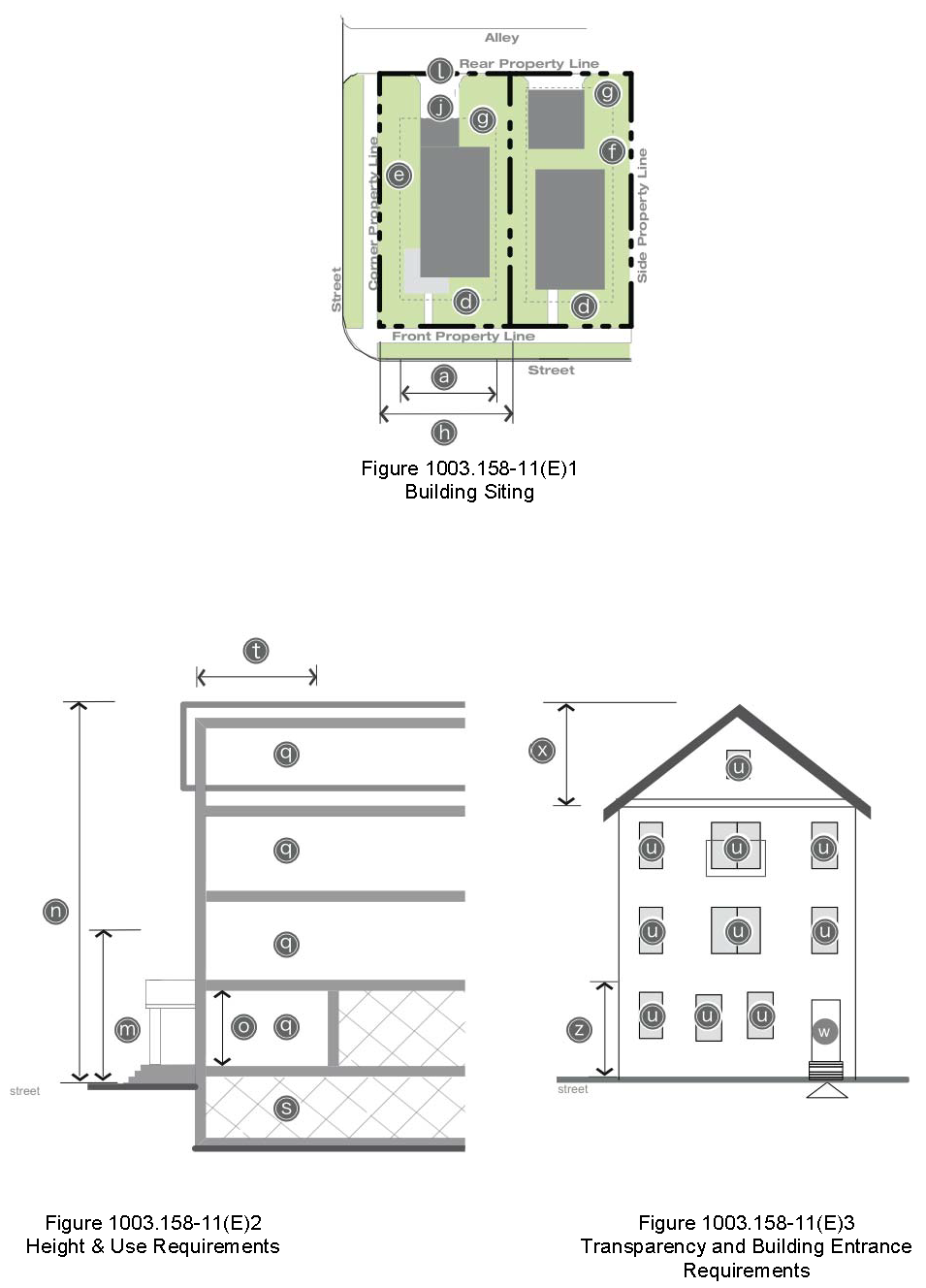
13.
Building type table standards. The following explains and further defines the standards defined for each building type, refer to 1003.158-11(A)—(E).
(1)
Building siting.
(a)
Multiple principal structures. The presence of more than one (1) principal structure on a lot.
(b)
Front property line coverage. Refer to figure 1003.158(12), measuring front property line coverage. Measurement defining the minimum percentage of street wall or building façade required along the street. The width of the principal structure(s) (as measured within the front build-to zone) shall be divided by the maximum width of the front build-to zone (BTZ).
(i)
Certain buildings have this number set to also allow the development of a courtyard along the front property line.
(ii)
Some frontage types allow side yard parking to be exempted from the front lot line coverage calculation. If such an exemption is permitted, the width of up to one (1) double-loaded aisle of parking, located with the drive perpendicular to the street and including adjacent sidewalks and landscaping, may be exempted, to a maximum of sixty-five (65) feet.
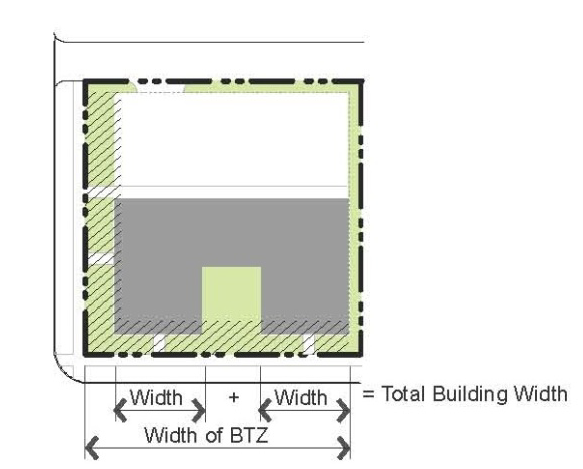
Figure 1003.158A(12)
Measuring Front Property Line Coverage
(c)
Occupation of corner. Occupying the intersection of the front and corner build-to zones with a principal structure.
(d)
Front BTZ or setback. The build-to zone or setback parallel to the front property line. Building components, such as awnings or signage, are permitted to encroach into the build-to zone.
(i)
All build-to zone and setback areas not covered by building must contain either landscape, patio space, or sidewalk space.
(e)
Corner BTZ or setback. The build-to zone or setback parallel to the corner property line.
(i)
All build-to zone and setback areas not covered by building must contain either landscape, patio space, or sidewalk space.
(f)
Side yard setback. The minimum required setback along a side property line.
(g)
Rear yard setback. The minimum required setback along a rear property line.
(h)
Minimum and maximum lot width. The minimum and maximum width of a lot, measured at the front property line.
(i)
Maximum impervious coverage. (Refer to figure 1003.158(13), maximum impervious and semi-impervious coverage). The maximum percentage of a lot permitted to be covered by principal structures, accessory structures pavement, and other impervious surfaces.
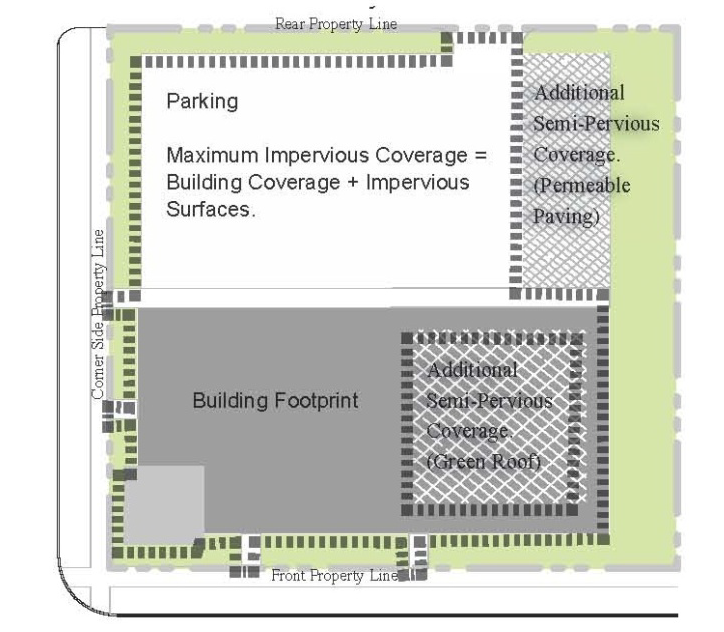
Figure 1003.158A(13)
Maximum Impervious and Semi-Impervious Coverage
(j)
Additional semi-pervious coverage. The additional percentage of a lot which may be surfaced in a semi-pervious material, including a green roof or pavers.
(k)
Parking and loading location. The yard in which a surface parking lot, detached garage, attached garage door access, loading and unloading, and associated drive is permitted.
(l)
Vehicular access. The permitted means of vehicular ingress and egress to the lot.
(i)
Alleys, when present, shall always be the primary means of access.
(ii)
When alleys are not present, a driveway may be permitted per building type and, if an alternative is available, shall not located off a primary street.
(2)
Height.
(a)
Minimum overall height. The measurement point for the minimum overall height for the building shall be located within the build-to zone; stories above the required minimum height may be stepped back from the façade.
(b)
Maximum overall height. The sum of a building's stories.
(i)
Half stories are located either completely within the roof structure with street-facing windows or in a visible basement exposed a maximum of one (1) half story above grade.
(ii)
A building incorporating both a half story within the roof and a visible basement, when permitted, shall count the height of the two (2) half stories as one (1) full story.
(iii)
Some building types require a building façade to step back as its height increases. If required, the upper stories of any building façade with street frontage shall be setback a designated amount beyond the building façade of the lower stories.
(c)
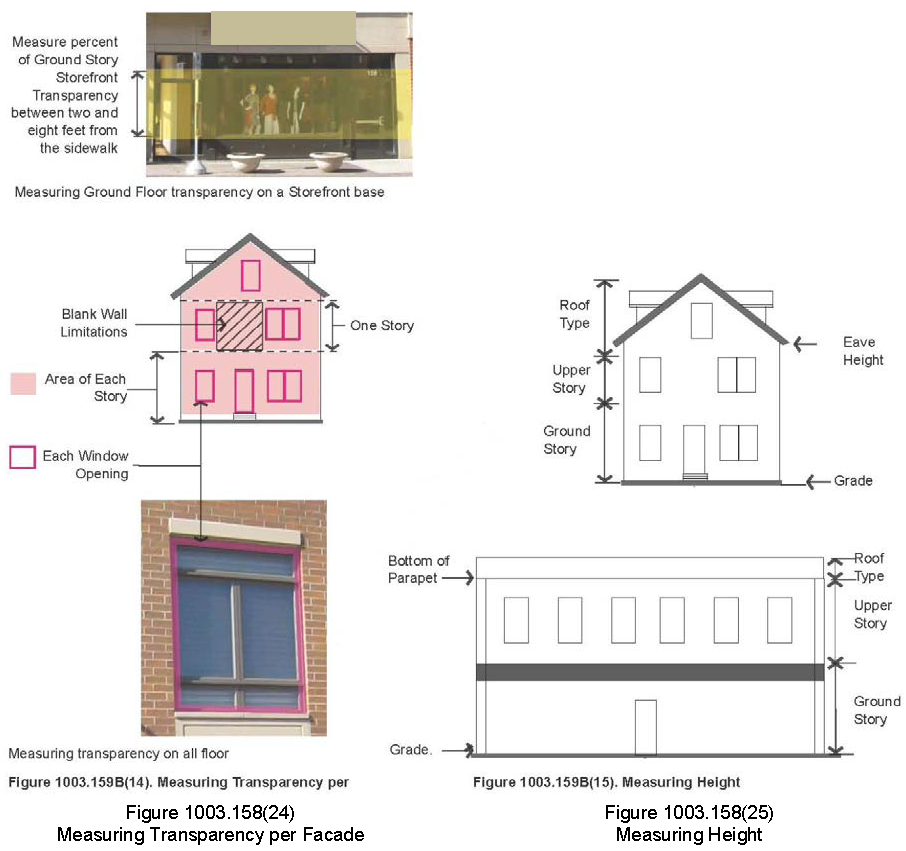
Ground story and upper story, minimum and maximum height. Refer to figure 1003.158(15), measuring height. Each frontage type includes a permitted range of height in feet for each story. Additional information is as follows:
(i)
Floor height is measured in feet between the floor of a story to the floor of the story above it.
(ii)
Floor height requirements apply only to street-facing façades.
(iii)
For single story buildings and the uppermost story of a multiple story building, floor-to-floor height shall be measured from the floor of the story to the tallest point of the ceiling.
(3)
Uses.
(a)
Ground and upper story. The uses or category of uses which may occupy the ground and upper story of a building. Refer to section 1003.158-10, uses in form based zoning districts.
(b)
Parking within building. The area(s) of a building in which parking is permitted within the structure.
(c)
Occupied space. The area(s) of a building that shall be designed as occupied space.
(4)
Façade requirements.
(a)
Minimum ground story and upper floor transparency. Refer to figure 1003.158(24), measuring transparency per façade. The minimum amount of transparency permitted on façades with street frontage, measured per story or per façade, depending on the building type.
(i)
Ground story transparency shall be measured between two (2) feet and eight (8) feet from the grade at the base of the front façade.
(ii)
Upper story transparency shall be measured from floor-to-floor of each story, including any visible basement story.
(b)
Blank wall limitations. A restriction of the amount of windowless area permitted on a façade with street frontage. If required, the following shall be met:
(i)
No rectangular area greater than thirty (30) percent of a story's façade, as measured from floor-to-floor, may be windowless; and
(ii)
No horizontal distance greater than fifteen (15) feet of a story's façade may be windowless.
(c)
Principal entrance location. The façade on which the primary building entrance is to be located.
(d)
Street façades: Number of entrances. The maximum spacing between entrances on a building façade with street frontage.
(e)
Vertical increments. The use of a vertically oriented expression line or form to divide the façade into increments no greater than the dimension shown, as measured along the base of the façade. Elements may include a column, pilaster, or other continuous vertical ornamentation a minimum of one and one-half-inch depth.
(f)
Horizontal façade divisions. The use of a horizontally oriented expression line or form to divide portions of the façade into horizontal divisions. Elements may include a cornice, belt course, molding, string courses, or other continuous horizontal ornamentation a minimum of one and one-half-inch depth
(5)
Entrance types. Entrance type standards apply to the ground story and visible basement of front façades of all building types as defined in this section.
(a)
General provisions. The following provisions apply to all entrance types.
(i)
Intent. To guide the design of the ground story of all buildings to relate appropriately to pedestrians on the street. Treatment of other portions of the building façades is detailed in each building type standard.
(ii)
Applicability. The entire ground story street-facing façade(s) of all buildings shall meet the requirements of at least one (1) of the permitted entrance types, unless otherwise stated.
(iii)
Measuring transparency. Refer to façade requirements, definition of building type table standards, for information on measuring building transparency.
(iv)
Visible basements. Visible basements, permitted by entrance type, are optional. The visible basement shall be a maximum of one-half (½) the height of the tallest story.
(b)
Storefront entrance type. The storefront entrance type is a highly transparent ground story treatment designed to serve primarily as the display area and primary entrance for retail or service uses.
(i)
Transparency. Minimum transparency is required per building type.
(ii)
Elevation. Storefront elevation shall be between zero and one (1) foot above sidewalk.
(iii)
Visible basement. A visible basement is not permitted in this entrance type.
(iv)
Horizontal façade division. Horizontally define the ground story façade from the upper stories.
(v)
Entrance. Ail entries shall be recessed from the front façade closest to the street.
(A)
Recess shall be a minimum of three (3) feet and a maximum of eight (8) feet deep, measured from the portion of the front façade closest to the street.
(B)
When the recess falls behind the front build-to zone, the recess shall be no wider than eight (8) feet.
(c)
Arcade entrance type. An arcade entrance type is a covered pedestrian walkway within the recess of a ground story.
(i)
Arcade. An open-air public walkway is required from the face of the building recessed into the building a minimum of eight (8) and a maximum of fifteen (15) feet.
(ii)
Recessed or interior façade. Storefront entrance type is required on the recessed ground story façade.
(iii)
Column spacing. Columns shall be spaced between ten (10) feet and twelve (12) feet on center.
(iv)
Column width. Columns shall be a minimum of one (1) foot eight (8) inches and a maximum two (2) feet four (4) inches in width.
(v)
Arcade opening. Opening shall not be flush with interior arcade ceiling and may be arched or straight.
(vi)
Horizontal façade division. Horizontally define the ground story façade from the upper stories.
(vii)
Visible basement. A visible basement is not permitted.

(d)
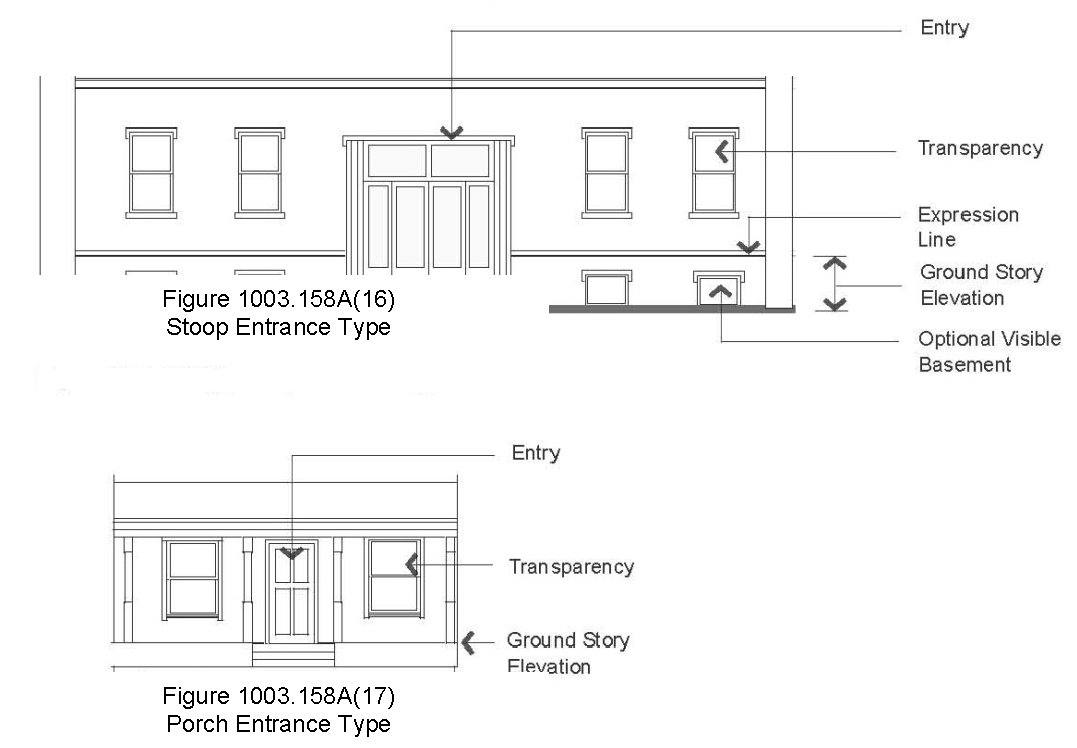
Stoop entrance type. Refer to figure 1003.158(16), stoop entrance type. A stoop is an unroofed, open platform.
(i)
Transparency. Minimum transparency is required per building type.
(ii)
Stoop size. Stoops shall be a minimum of three (3) feet deep and six (6) feet wide.
(iii)
Elevation. Stoop elevation shall be located a maximum of two (2) feet six (6) inches above the sidewalk without visible basement and a maximum of four (4) feet six (6) inches above the sidewalk with a visible basement.
(iv)
Visible basement. A visible basement is permitted and shall be separated from the ground story by an expression line.
(v)
Entrance. All entries shall be located off a stoop.
(e)
Porch entrance type. Refer to figure 1003.158(17), porch entrance type. A porch is a raised, roofed platform that may or may not be enclosed on all sides.
(i)
Transparency.
(A)
Minimum transparency per building type is required.
(B)
If enclosed, a minimum of forty (40) percent of the enclosed porch shall be comprised of highly transparent, low reflectance windows.
(ii)
Porch size. The porch shall be a minimum of five (5) feet deep and eight (8) feet wide.
(iii)
Elevation. Porch elevation shall be located a maximum of two (2) feet six (6) inches above the sidewalk without a visible basement and a maximum of four (4) feet six (6) inches above the sidewalk with a visible basement.
(iv)
Visible basement. A visible basement is permitted.
(v)
Height. Porch may be two (2) stories to provide a balcony on the second floor.
(vi)
Entrance. All entries shall be located off a porch.
(6)
Roof types. Roof type standards apply to the roof and top of all building types.
(a)
General provisions. The following provisions apply to all roof types
(i)
Intent. To guide the design of the cap of all buildings.
(ii)
Applicability. All buildings shall meet the requirements of one (1) of the roof types permitted for the building type.
(iii)
Measuring height. Refer to subsections 1003.158(18)—(21) introducing building type standards for information on measuring building height.
(iv)
Other roof types. Other building caps not listed as a specific type may be requested with the following requirements:
(A)
The height shall not exceed any of the roof types permitted for the Building Type.
(B)
The cap would not be disruptive to the surrounding area.
(C)
The design of the cap shall be reviewed by the staff.
(b)
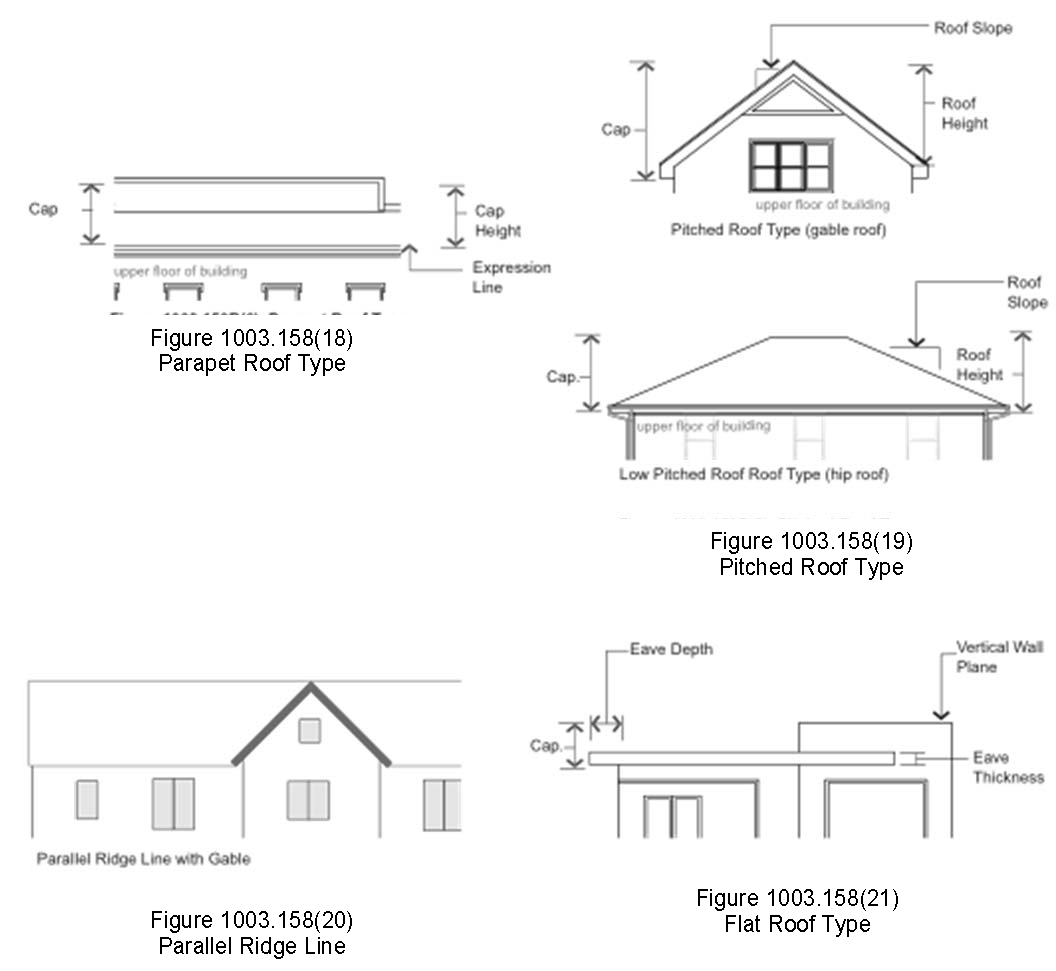
Parapet roof type. Refer to figure 1003.158(18), parapet roof type. A parapet is a low wall projecting above a building's roof along the perimeter of the building. It can be utilized with a flat or low pitched roof and also serves to limit the view of roof-top mechanical systems from the street.
(i)
Parapet height. Height is measured from the top of the upper story to the top of the parapet.
(A)
Minimum height is two (2) feet with a maximum height of six (6) feet.
(B)
Cap shall screen the roof and any roof appurtenances from the sidewalk across the street, but not to exceed maximum allowed height.
(ii)
Horizontal expression lines. An expression line shall define the cap from the upper stories of the building and shall also define the top of the cap.
(iii)
Occupied space. Occupied space shall not be incorporated behind this roof type.
(c)
Pitched roof type. Refer to figure 1003.158(19), pitched roof type. This roof type has a sloped or pitched roof. Slope is measured with the vertical rise divided by the horizontal span or run.
(i)
Pitch measure. The roof may not be sloped less than a 4:12 (rise:run) or more than 16:12.
(A)
Slopes less than 4:12 are permitted to occur on second story or higher roofs.
(ii)
Configurations.
(A)
Hipped, gabled, and combination of hips and gables with or without dormers are permitted.
(B)
Butterfly roofs (inverted gable roof) are permitted with a maximum height of eight (8) feet, inclusive of overhang.
(C)
Gambrel and mansard roofs are not permitted.
(iii)
Parallel ridge line. A gabled end or perpendicular ridge line shall occur at least every one hundred (100) feet of roof when the ridge line runs parallel to the front lot line. Refer to figure 1003.158 (20), parallel ridge line.
(iv)
Roof height. Roofs without occupied space and/or dormers shall have a maximum height on street-facing façades equal to the maximum floor height permitted for the building type.
(v)
Occupied space. Occupied space may be incorporated behind this roof type.
(d)
Flat roof type. Refer to figure 1003.158(21), flat roof type. This roof type has no pitch and overhanging eaves.
(i)
Configuration. Roofs with no visible slope are acceptable. Eaves are required on all street facing façades.
(ii)
Eave depth. Eave depth is measured from the building façade to the outside edge of the eave. Eaves shall have a depth of at least fourteen (14) inches.
(iii)
Eave thickness. Eave thickness is measured at the outside edge of the eave, from the bottom of the eave to the top of the eave. Eaves shall be a minimum of eight (8) inches thick.
(iv)
Interrupting vertical walls. Vertical walls may interrupt the eave and extend above the top of the eave with no discernible cap.
(v)
No more than one-half of the front façade can consist of an interrupting vertical wall.
(vi)
Vertical walls shall extend no more than four (4) feet above the top of the eave.
(vii)
Occupied space. Occupied space shall not be incorporated behind this roof type.
(e)
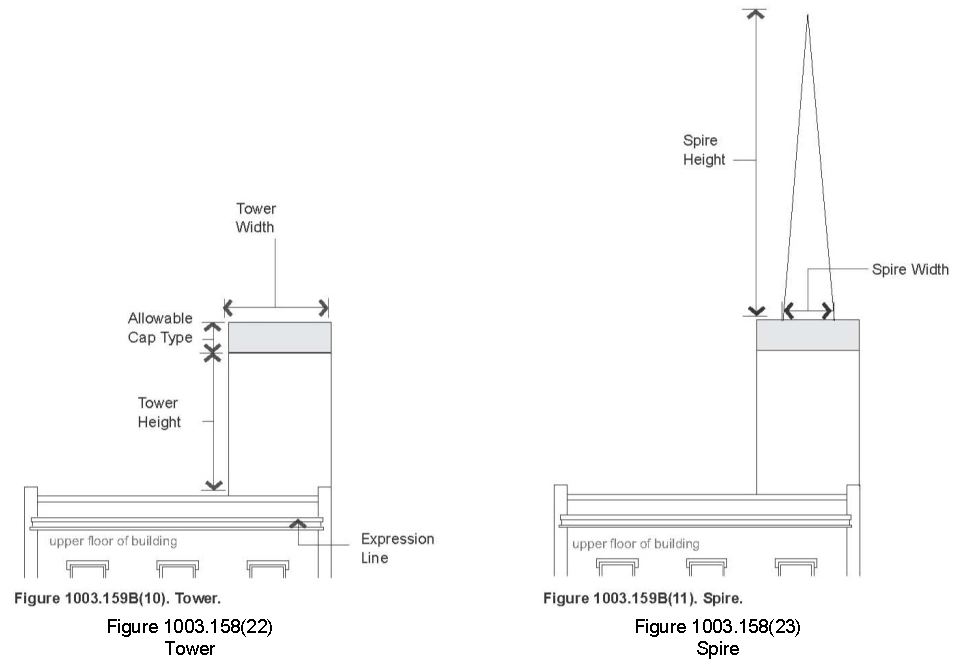
Towers. Refer to figure 1003.158(22). A tower is a rectilinear or cylindrical, vertical element, that must be used with other roof types.
(i)
Quantity. All building types, with the exception of the civic building, are limited to one (1) tower per building.
(ii)
Tower height. Maximum height, measured from the top of the parapet or eave to the top of the tower, is the equivalent of the height of one (1) upper floor of the building to which the tower is applied.
(iii)
Tower width. Maximum width along all façades is one-third (⅓) the width of the front façade or thirty (30) feet, whichever is less.
(iv)
Horizontal expression lines. An expression line shall define the tower from the upper stories, except on single-family or attached house residential building types.
(v)
Occupied space. Towers may be occupied by the same uses allowed in upper stories of the building type to which it is applied.
(vi)
Application. May be combined with all other roof types.
(vii)
Tower cap. The tower may be capped by the parapet, pitched, low pitched, or flat roof types, or the spire may cap the tower.
(6)
Spire. Refer to figure 1003.158(23). A spire is a long, tapering, cylindrical design element that can be attached to a tower or other roof type.
(i)
Permitted location. Spires are permitted only on the civic building type.
(ii)
Spire height. Measured from the base of the spire to the top, including any decorative elements atop the apex of the spire, maximum height is 30 feet. Spire height is not limited.
(iii)
Spire width. Maximum width, measured at the spire base is one-sixth (⅙) the width of the front façade or fifteen (15) feet, whichever is less. A wider spire base, proportionate in height, is subject to the approval the zoning coordinator.
(iv)
Occupied space. Occupied space is not permitted within the spire.
(v)
Application. May be combined with any other roof type.
(O. No. 26111, 6-30-15)
_____

