
Salida City Zoning Code
ARTICLE IV
- DEVELOPMENT AND DESIGN STANDARDS
Sec. 16-4-10. - Purpose and applicability.
(a)
Purpose. This Article establishes standards that regulate the physical layout and design of development within the City to ensure the protection of the health, welfare, safety, and quality of life of Salida.
(b)
Applicability. Unless otherwise exempted by this Code, this Article shall apply to all development activities as authorized and required by Section 16-1-30, Applicability.
(Ord. No. 2025-17, § 2(Exh. A), 10-7-2025)
Sec. 16-4-20. - Natural resource protection.
(a)
Purpose. This Section is intended to protect and enhance the natural resources that contribute to Salida's community character and quality of life, including, but not limited to, the Arkansas River, varying topography and hillsides, floodplains, wetlands, and other significant features.
(b)
River and Wetland Protection.
(1)
Purpose.
a.
The purpose of this Section is to protect the Arkansas River, South Arkansas River, streams, wetlands, buffer areas, and their water sources from encroachment that would adversely affect water quality or wildlife habitat, impede flood protection, or impair other critical environmental functions or the public enjoyment of such areas within the public realm.
b.
These standards are intended to protect water quality in the Arkansas River and to protect and preserve existing riparian buffers. Vegetative buffers adjacent to surface waters provide multiple environmental protection and resource management benefits. Vegetated buffers enhance and protect the natural ecology of stream systems, as well as water quality through bank stabilization, shading, and nutrient removal. They also help minimize flood damage in flood prone areas. Well-vegetated riparian buffers help remove nitrogen and prevent sediment and sediment-bound pollutants such as phosphorus from reaching the waters. The riparian buffer standards in this Article are intended to achieve these important benefits.
c.
When encroachment cannot be avoided, this Section provides for mitigation of the impacts resulting from the encroachment.
(2)
Applicability.
a.
Except as otherwise provided in this Section, this Section shall apply to all development, land disturbance, or vegetation removal within one hundred (100) feet of the ordinary high-water mark of the Arkansas River, one hundred fifty (150) feet of the South Arkansas River, and fifteen (15) feet of any other stream, creek, or wetland.
b.
This Section does not apply to the activities listed below. However, conducting any of the following activities without any required local, state, or federal permits will result in fines and enforcement.
1.
Agricultural activities, such as soil preparation, irrigation, planting, harvesting, grazing, and agricultural operation ponds (not including private gardens or water features accessory to residential uses);
2.
City-approved stormwater drainage systems;
3.
Construction of or maintenance and repair of a ditch or of an existing public road, utility, or other public facility within an existing right-of-way or easement;
4.
Maintenance and repair of flood control structures and activities in response to a flood emergency as determined by the Public Works Director;
5.
Buildings and site improvements for public facilities that are specifically related to the use of the water including, but not limited to, piers, docks, trails, fish hatcheries, and habitat restoration facilities, where the impacts of the construction are mitigated;
6.
Wetland and wildlife habitat restoration, creation and/or enhancement that improves the wetland's function if the activity proposed is approved by the appropriate agency, such as the Army Corps of Engineers or Colorado Parks and Wildlife;
7.
Areas where a wetlands permit has been issued under a national wetlands permitting program or otherwise issued by the authority having jurisdiction; or
8.
A site-specific development plan where natural resource setbacks have already been defined prior to adoption of this Code.
9.
Areas within the MD district are exempted from Subsections 16-4-20(b)(3)(a) and 3(b) below.
(3)
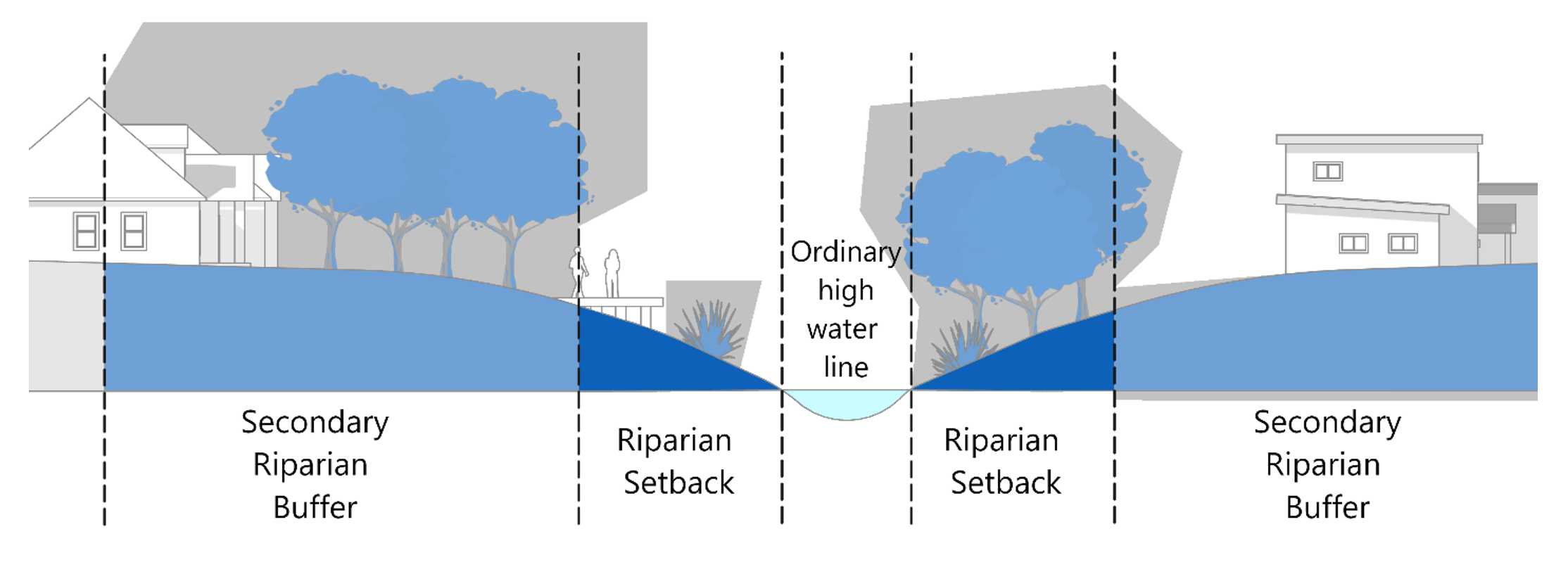
River Protection Standards. There are two (2) levels of River Protection Standards: a riparian setback and a secondary riparian buffer. The riparian setback is closest to the subject riparian corridor and is more restrictive. The secondary buffer is landward of the riparian setback and allows development but with a focus on protecting additional vegetation close to the river. See Figure 4-1.
Figure 4-1: Riparian Setbacks and Secondary Buffers
a.
Riparian Setbacks.
1.
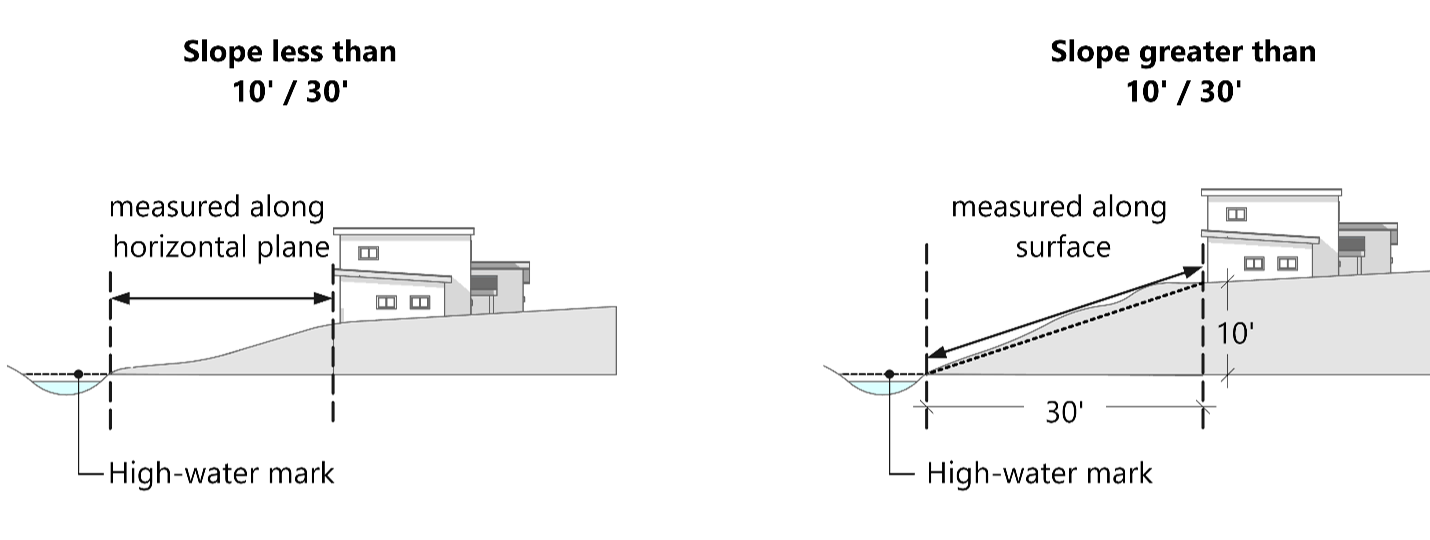
Unless otherwise established through plat rules established prior to the effective date of this Code (or other exemptions), riparian setbacks shall be provided as set forth below. Riparian setbacks shall extend landward of the ordinary high-water mark, as measured along a horizontal plane; except for areas adjacent to the resource to be protected where there is a grade change of more than ten (10) feet vertically over a distance of thirty (30) feet horizontally, in which case the setback may be measured in a straight line over the surface of the slope (see Figure 4-2 below). All measurements shall be conducted by a licensed surveyor. Riparian setback widths are as follows:
a)
Arkansas River: forty (40) feet.
b)
South Arkansas River west of Highway 50: seventy-five (75) feet (areas of the South Arkansas River east of Highway 50 are not subject to this requirement).
c)
All other creeks, ditches, and wetlands: fifteen (15) feet.
2.
No building, structure, or land use may be established, expanded, or enlarged within the riparian setback, unless exempted by Subsection 4(b) or 6 below.
Figure 4-2:
a)
Within the riparian setback, a maximum of four hundred (400) square feet may be disturbed as follows:
1)
Patios or fire pits are allowed provided they do not exceed two hundred (200) square feet or ten percent (10%) of the total area of the riparian setback, whichever is less.
2)
Up to an additional two hundred (200) square feet of engineered stairs or pathways (not including allowed privacy fencing or patios/fire pits) for access to such accessory uses and/or the river shall also be allowed.
b)
All such uses shall go through permit review, including floodplain development permit review, grading/tree disturbance permit review, and/or building permit review, as applicable. Such accessory uses, including privacy fencing, shall be sited to limit the impacts to existing riparian vegetation to the maximum extent practicable and such development shall include approved tree protection fencing.
3.
The applicant shall identify wetlands and riparian vegetation on the development site. Staff will evaluate the application against the National Wetlands Inventory and Colorado Natural Heritage Program Wetlands GIS. A wetlands determination may be required.
4.
Unless otherwise allowed by this Section, wetlands and riparian vegetation shall not be disturbed during development. Careful site planning shall consider site erosion, riverbank stability, soil types, discharge, and the preservation of riparian vegetation to the maximum extent practicable.
a)
Where vegetation required to be protected is disturbed during construction, identical or similar vegetation shall be replanted within one (1) month of disturbance, or as approved in a replanting plan by the Director. Non-native or invasive vegetation shall be replaced with native species.
b)
Where opportunities exist to enhance riparian vegetation, including removal of non-native or invasive species, new plantings are encouraged.
c)
Disturbance of wetlands may be subject to review by other jurisdictions, such as the Army Corps of Engineers.
5.
Any removal or pruning of ten percent (10%) or four hundred (400) square feet of riparian vegetation, whichever is less, shall require a grading/tree disturbance permit. Such permit shall either allow an approved restoration project to remove invasive species/introduce native species or establish defensible space (wildfire mitigation). Such requests shall be reviewed and approved by the Salida Tree Board or other designee of the Director. Restoration projects within the riparian setback and secondary riparian buffer are highly encouraged.
6.
Where the riparian setbacks for river protection create a buildable envelope of less than two thousand (2,000) square feet (including accessory buildings), a two thousand-square-foot building envelope (including accessory buildings) shall be allowed and located to have the least impact on the riparian setback, first by the Director considering a reduction of the front yard setback, if possible, then by the Director considering a reduction of the riparian setback if necessary. At no point, however, shall the riparian setback be less than thirty (30) feet along the Arkansas River or sixty (60) feet along the South Arkansas River.
7.
Disturbance of wetlands and riparian vegetation shall be minimized as follows:
a)
Areas that will be disturbed during construction activities and areas that will be protected from construction impacts shall be delineated on a site plan.
b)
Prior to removal or alteration of riparian vegetation, impacts of such removal or alteration shall be documented, and any other required permits (e.g., Army Corps of Engineers, Floodplain Development Permit, grading/tree disturbance permit) shall be obtained. Impacts shall be mitigated as described in this Section.
b.
Secondary Riparian Buffer Area.
1.
In addition to the riparian setback protections, an additional riparian buffer area shall be provided as set forth below. The secondary riparian buffer area shall extend landward of the riparian setback as measured along a horizontal plane by a licensed surveyor.
a)
Arkansas River: sixty (60) feet.
b)
South Arkansas River west of Highway 50: seventy-five (75) feet.
1)
Areas east of Highway 50 are not subject to this requirement.
c)
All other creeks, ditches, and wetlands: no additional buffer.
2.
A grading/tree disturbance permit is required for any tree removal or site disturbance within the secondary riparian buffer.
a)
A maximum of fifty percent (50%) of native trees over four (4) inches in diameter at breast height within the secondary riparian buffer area may be removed, subject to review and approval by the Salida Tree Board or other designee of the Director. However, the number of trees required to be protected can be removed and replaced with new native trees in other areas of either the riparian setback or the secondary buffer, provided such new trees are maintained for a minimum of two (2) years.
b)
The permit application shall detail the location of all trees and those proposed for removal. Erosion control measures and tree protection fencing may be required as a condition of permit approval.
3.
The applicant shall submit a grading plan for approval per the requirements of Subsection 16-4-40(c), Grading/Tree Disturbance Plan.
c.
Riverbank Protection.
1.
There shall be no alteration of a riverbank except as allowed by this Code or as necessary to eliminate an existing hazard or to clean up or restore the riverbank. Prior to any such alteration, a permit shall be obtained from the City and any other agency having jurisdiction (e.g., Army Corps of Engineers).
2.
The dumping of any debris, dirt, fill, vegetation, street snow, or other material is prohibited. Stormwater runoff and snow melt are not considered dumping but may be subject to other standards of this Code, as well as State and Federal law.
(c)
Floodplain.
(1)
Purpose.
a.
Flood hazard areas are subject to periodic inundation that can result in loss of life and property, health and safety hazards, disruption of commerce and governmental services, and extraordinary public expenditures for flood protection and relief, all of which adversely affect the health, safety and general welfare of the public.
b.
Flood losses are created by the cumulative effect of obstructions in floodplains which cause an increase in flood heights and velocities, and by the occupancy of flood hazard areas by uses vulnerable to floods and hazardous to other lands because they are inadequately elevated, flood proofed, or otherwise protected from flood damage.
c.
As a result, this Section is intended to promote public health, safety, and general welfare and to minimize public and private losses due to flood conditions in specific areas as authorized by the State of Colorado (CRS § 29.20) by provisions designed to:
1.
Protect human life and health;
2.
Minimize expenditure of public money for costly flood control projects;
3.
Minimize the need for rescue and relief efforts associated with flooding and generally undertaken at the expense of the general public;
4.
Minimize prolonged business interruptions;
5.
Minimize damage to critical facilities, infrastructure and other public facilities such as water, sewer and gas mains; electric and communications stations; and streets and bridges located in floodplains;
6.
Help maintain a stable tax base by providing for the sound use and development of flood-prone areas in such a manner as to minimize future flood blight areas; and
7.
Ensure that potential buyers are notified that property is located in a flood hazard area.
(2)
Applicability.
a.
This Section shall apply to all Special Flood Hazard Areas and areas removed from the floodplain by the issuance of a FEMA Letter of Map Revision Based on Fill (LOMR-F) within the City of Salida.
b.
Special Flood Hazard Areas are identified by the Federal Emergency Management Agency in a scientific and engineering report entitled, "The Flood Insurance Study for Salida, Colorado," dated March 30, 1982, with accompanying Flood Insurance Rate Maps and/or Flood Boundary-Floodway Maps (FIRM and/or FBFM) and any revisions thereto are hereby adopted by reference and declared to be a part of this Section. These Special Flood Hazard Areas identified by the FIS and attendant mapping are the minimum area of applicability of this Section and may be supplemented by studies designated and approved by the City Council. The Floodplain Administrator shall keep a copy of the Flood Insurance Study (FIS), DFIRMs, FIRMs and/or FBFMs on file and available for public inspection.
c.
No building, structure, or lot shall hereafter be constructed, located, extended, or altered without full compliance with this Section.
d.
This Section is not intended to repeal, abrogate, or impair any existing easements, covenants, or deed restrictions. However, where this Section and another ordinance, easement, covenant, or deed restriction conflict or overlap, whichever imposes the more stringent restrictions shall prevail.
(3)
Warning and Disclaimer of Liability. The degree of flood protection required by this Section is considered reasonable for regulatory purposes and is based on scientific and engineering considerations. Larger floods can and will occur on rare occasions. Flood heights may be increased by manmade or natural causes. This Section does not imply that land outside the Special Flood Hazard Areas or uses permitted within such areas will be free from flooding or flood damages. This Section shall not create liability on the part of the City, any officer or employee thereof, or the Federal Emergency Management Agency (FEMA), for any flood damages that result from reliance on this Section or any administrative decision lawfully made thereunder.
(4)
Definitions. Unless specifically defined in Section 16-10-30, Floodplain-Related Definitions, words or phrases used in this Section shall be interpreted to give them the meaning they have in common usage and to give this Section its most reasonable application.
(5)
Review of Floodplain Development. A Floodplain Development Permit shall be required to ensure conformance with the provisions of this Section.
a.
Floodplain Administrator.
1.
The City Administrator or designee is hereby appointed as Floodplain Administrator to administer, implement, and enforce the provisions of this Section and other appropriate sections of 44 CFR (National Flood Insurance Program Regulations) pertaining to floodplain management.
2.
Duties and responsibilities of the Floodplain Administrator shall include, but not be limited to, the following:
a)
Maintain and hold open for public inspection all records pertaining to the provisions of this Section, including the actual elevation (in relation to mean sea level) of the lowest floor (including basement) of all new or substantially improved structures and any flood proofing certificate required by this Section.
b)
Review, approve, or deny all applications for Floodplain Development Permits required by adoption of this Section.
c)
Review Floodplain Development Permit applications to determine whether a proposed building site, including the placement of manufactured homes, will be reasonably safe from flooding.
d)
Review permits for proposed development to assure that all necessary permits have been obtained from those Federal, State, or local governmental agencies (including Section 404 of the Federal Water Pollution Control Act Amendments of 1972, 33 U.S.C. § 1334) from which prior approval is required.
e)
Inspect all development at appropriate times during the period of construction to ensure compliance with all provisions of this Section, including proper elevation of the structure.
f)
Where interpretation is needed as to the exact location of the boundaries of the Special Flood Hazard Area (for example, where there appears to be a conflict between a mapped boundary and actual field conditions) the Floodplain Administrator shall make the necessary interpretation.
g)
When Base Flood Elevation data has not been provided in accordance with Subsection 16-4-20(c)(2)b, the Floodplain Administrator shall obtain, review, and reasonably utilize any base flood elevation data and floodway data available from a Federal, State, or other source, to administer the provisions for flood hazard reduction.
h)
For waterways with base flood elevations for which a regulatory floodway has not been designated, no new construction, substantial improvements, or other development (including fill) shall be permitted within Zones A1-30 and AE on the community's FIRM, unless it is demonstrated that the cumulative effect of the proposed development, when combined with all other existing and anticipated development, will not increase the water surface elevation of the base flood more than one-half (½) foot at any point within the community.
i)
Under the provisions of 44 CFR Chapter 1, Section 65.12, of the National Flood Insurance Program regulations, a community may approve certain development in Zones A1-30, AE, AH, on the community's FIRM which increases the water surface elevation of the base flood by more than one-half (½) foot, provided that the community first applies for a conditional FIRM revision through FEMA (Conditional Letter of Map Revision), fulfills the requirements for such revisions as established under the provisions of Section 65.12 and receives FEMA approval.
j)
Notify, in riverine situations, adjacent communities and the State Coordinating Agency, which is the Colorado Water Conservation Board, prior to any alteration or relocation of a watercourse, and submit evidence of such notification to FEMA.
k)
Ensure that the flood carrying capacity within the altered or relocated portion of any watercourse is maintained.
b.
Floodplain Development Permit.
1.
Application for a Floodplain Development Permit shall be presented to the Floodplain Administrator on forms furnished by them and may include, but not be limited to, plans in duplicate drawn to scale showing the location, dimensions, and elevation of proposed landscape alterations, existing and proposed structures, including the placement of manufactured homes, and the location of the foregoing in relation to the Special Flood Hazard Area. Additionally, the following information is required:
a)
Elevation (in relation to mean sea level), of the lowest floor (including basement) of all new and "substantially improved" (as defined in this Code) structures;
b)
Elevation in relation to mean sea level to which any nonresidential structure shall be flood proofed;
c)
A certificate from a registered Colorado Professional Engineer or architect that the nonresidential flood proofed structure shall meet the flood proofing criteria of Subsection 16-4-20(c)(6)d., Standards for Flood Hazard Reduction.
d)
Description of the extent to which any watercourse or natural drainage will be altered or relocated as a result of proposed development.
e)
Maintain a record of all such information in accordance with Subsection 16-4-20(c)(5)a.
2.
Approval or denial of a Floodplain Development Permit by the Floodplain Administrator shall be based on the provisions of this Section and the following relevant factors:
a)
The danger to life and property due to flooding or erosion damage;
b)
The susceptibility of the proposed facility and its contents to flood damage and the effect of such damage on the individual owner;
c)
The danger that materials may be swept onto other lands to the injury of others;
d)
The compatibility of the proposed use with existing and anticipated development;
e)
The safety of access to the property in times of flood for ordinary and emergency vehicles;
f)
The costs of providing governmental services during and after flood conditions including maintenance and repair of streets and bridges, and public utilities and facilities such as sewer, gas, electrical and water systems;
g)
The expected heights, velocity, duration, rate of rise and sediment transport of the flood waters and the effects of wave action, if applicable, expected at the site;
h)
The necessity to the facility of a waterfront location, where applicable;
i)
The availability of alternative locations, not subject to flooding or erosion damage, for the proposed use;
j)
The relationship of the proposed use to the comprehensive plan for that area.
c.
Variance.
1.
The Board of Adjustment, as established by the City Council, shall hear and render judgment on requests for variances from the requirements of this Section.
2.
The Board of Adjustment shall hear and render judgment on an appeal only when it is alleged there is an error in any requirement, decision, or determination made by the Floodplain Administrator in the enforcement or administration of this Section.
3.
Any person or persons aggrieved by the decision of the Board of Adjustment may appeal such decision in the courts of competent jurisdiction.
4.
The Floodplain Administrator shall maintain a record of all actions involving an appeal and shall report variances to the Federal Emergency Management Agency upon request.
5.
Variances may be issued for the reconstruction, rehabilitation or restoration of structures listed on the National Register of Historic Places or the State Inventory of Historic Places, without regard to the procedures set forth in the remainder of this Section.
6.
Variances may be issued for new construction and substantial improvements to be erected on a lot of one-half (½) acre or less in size contiguous to and surrounded by lots with existing structures constructed below the base flood level, providing the relevant factors in Subsection 10 below have been fully considered. As the lot size increases beyond the one-half (½) acre, the technical justification required for issuing the variance increases.
7.
Upon consideration of the factors noted above and the intent of this Section, the Board of Adjustment may attach such conditions to the granting of variances as it deems necessary to further the purpose and objectives of this Section.
8.
Variances shall not be issued within any designated floodway if any increase in flood levels during the base flood discharge would result.
9.
Variances may be issued for the repair or rehabilitation of historic structures upon a determination that the proposed repair or rehabilitation will not preclude the structure's continued designation as a historic structure, and the variance is the minimum necessary to preserve the historic character and design of the structure.
10.
Prerequisites for granting variances:
a)
Variances shall only be issued upon a determination that the variance is the minimum necessary, considering the flood hazard, to afford relief.
b)
Variances shall only be issued upon:
1)
Showing a good and sufficient cause;
2)
A determination that failure to grant the variance would result in exceptional hardship to the applicant; and
3)
A determination that the granting of a variance will not result in increased flood heights, additional threats to public safety, extraordinary public expense, create nuisances, cause fraud on or victimization of the public, or conflict with existing local laws or ordinances.
c)
Any applicant to whom a variance is granted shall be given written notice that the structure will be permitted to be built with the lowest floor elevation below the base flood elevation, and that the cost of flood insurance will be commensurate with the increased risk resulting from the reduced lowest floor elevation.
d)
Variances may be issued by a community for new construction and substantial improvements and for other development necessary for the conduct of a functionally dependent use provided that:
1)
The criteria outlined in standards 1) through 9), above, are met; and
2)
The structure or other development is protected by methods that minimize flood damages during the base flood and create no additional threats to public safety.
(6)
Standards for Floodplain Development.
a.
Interpretation. In the interpretation and application of this Section, all provisions shall be:
1.
Considered as minimum requirements;
2.
Liberally construed in favor of the governing body; and
3.
Deemed neither to limit nor repeal any other powers granted under State statutes.
b.
Methods. To accomplish its purposes, this Section uses the following methods:
1.
Restrict or prohibit uses that are dangerous to health, safety, or property in times of flood, or cause excessive increases in flood heights or velocities;
2.
Require that uses vulnerable to floods, including facilities which serve such uses, be protected against flood damage at the time of initial construction;
3.
Control the alteration of natural floodplains, stream channels, and natural protective barriers, which are involved in the accommodation of flood waters;
4.
Control filling, grading, dredging, and other development which may increase flood damage; and
5.
Prevent or regulate the construction of flood barriers which will unnaturally divert flood waters or which may increase flood hazards to other lands.
c.
General Standards. The following standards apply to new construction and substantial improvements in all Special Flood Hazard Areas:
1.
All new construction or substantial improvements shall be designed (or modified) and adequately anchored to prevent flotation, collapse or lateral movement of the structure resulting from hydrodynamic and hydrostatic loads, including the effects of buoyancy;
2.
All new construction or substantial improvements shall be constructed by methods and practices that minimize flood damage;
3.
All new construction or substantial improvements shall be constructed with materials resistant to flood damage;
4.
All new construction or substantial improvements shall be constructed with electrical, heating, ventilation, plumbing, and air conditioning equipment and other service facilities that are designed and/or located so as to prevent water from entering or accumulating within the components during conditions of flooding;
5.
All manufactured homes shall be installed using methods and practices which minimize flood damage. For the purposes of this requirement, manufactured homes must be elevated and anchored to resist flotation, collapse, or lateral movement. Methods of anchoring may include, but are not limited to, use of over-the-top or frame ties to ground anchors. This requirement is in addition to applicable State and local anchoring requirements for resisting wind forces.
6.
All new and replacement water supply systems shall be designed to minimize or eliminate infiltration of flood waters into the system;
7.
New and replacement sanitary sewage systems shall be designed to minimize or eliminate infiltration of flood waters into the system and discharge from the systems into flood waters; and
8.
On-site waste disposal systems shall be located to avoid impairment to them or contamination from them during flooding.
9.
Fencing shall be designed to minimize obstruction to floodwaters and shall be of split rail or minimal wire construction so as not to obstruct flows. Such fencing may require additional permitting.
d.
Standards for Flood Hazard Reduction. The following standards apply in all Special Flood Hazard Areas where base flood elevation data has been provided as set forth in Subsections 16-4-20(c)(2)b., 16-4-20(c)(2)b., and 16-4-20(c)(6)h., the following provisions are required:
1.
Residential Development. New construction and substantial Improvement of any residential structure shall have the lowest floor (including basement), electrical, heating, ventilation, plumbing, and air conditioning equipment and other service facilities (including ductwork), elevated to one (1) foot above the base flood elevation. Upon completion of the structure, the elevation of the lowest floor, including basement, shall be certified by a registered Colorado Professional Engineer, architect, or land surveyor. Such certification shall be submitted to the Floodplain Administrator.
2.
Nonresidential Development.
a)
With the exception of Critical Facilities, per Subsection 16-4-20(c)(6)i, Standards for Critical Facilities, new construction and substantial improvements of any commercial, industrial, or other nonresidential structure shall either have the lowest floor (including basement) elevated to one (1) foot above the base flood elevation or, together with attendant utility and sanitary facilities, be designed so that at one (1) foot above the base flood elevation the structure is watertight with walls substantially impermeable to the passage of water and with structural components having the capability of resisting hydrostatic and hydrodynamic loads and effects of buoyancy.
b)
A registered Colorado Professional Engineer or architect shall develop and/or review structural design, specifications, and plans for the construction, and shall certify that the design and methods of construction are in accordance with accepted standards of practice as outlined in this Section. Such certification shall be maintained by the Floodplain Administrator, as proposed in Subsection 16-4-20(c)(5)a.
3.
Fencing/Enclosures. New fence/enclosure construction and substantial improvements to fences/enclosures are allowed with a floodplain permit and subject to the following standards:
a)
A cut sheet shall be provided showing the fence material and technical specifications.
b)
Fully enclosed areas below the lowest floor that are usable solely for parking of vehicles, building access, or storage in an area other than a basement and that are subject to flooding shall be designed to automatically equalize hydrostatic flood forces on exterior walls by allowing for the entry and exit of floodwaters. Designs for meeting this requirement must either be certified by a registered Colorado Professional Engineer or architect or meet or exceed the following minimum criteria:
1)
A minimum of two (2) openings having a total net area of not less than one (1) square inch for every square foot of enclosed area subject to flooding shall be provided.
2)
The bottom of all openings shall be no higher than one (1) foot above grade.
3)
Openings may be equipped with screens, louvers, valves, or other coverings or devices provided that they permit the automatic entry and exit of floodwaters.
4)
Chain-link and wire-frame fences with minimum four-inch by four-inch openings are generally acceptable.
4.
Manufactured/Mobile Homes.
a)
All manufactured homes that are placed or substantially improved within Zones A1-30, AH, and AE on the community's FIRM on sites: (i) outside of a manufactured home park or subdivision, (ii) in a new manufactured home park or subdivision, (iii) in an expansion to an existing manufactured home park or subdivision, or (iv) in an existing manufactured home park or subdivision on which manufactured home has incurred "substantial damage" as a result of a flood, be elevated on a permanent foundation such that the lowest floor of the manufactured home is elevated to one (1) foot above the base flood elevation and be securely anchored to an adequately anchored foundation system to resist flotation, collapse, and lateral movement. For purposes of this Section "expansion to an existing manufactured home park or subdivision means the preparation of additional sites by the construction of facilities for servicing the lots on which the manufactured homes are to be affixed (including the installation of utilities, the construction of streets, and either final site grading or the pouring of concrete pads).
b)
All manufactured homes placed or substantially improved on sites in an existing manufactured home park or subdivision within Zones A1-30, AH and AE on the community's FIRM that are not subject to the provisions of the above paragraph, shall be elevated so that either:
1)
The lowest floor of the manufactured home is one (1) foot above the base flood elevation; or
2)
The manufactured home chassis is supported by reinforced piers or other foundation elements of at least equivalent strength that are no less than thirty-six (36) inches in height above grade and be securely anchored to an adequately anchored foundation system to resist flotation, collapse, and lateral movement.
5.
Recreational Vehicles. In addition to complying with the general use-specific standards in Section 16-3-30, Use-Specific Standards:
a)
All recreational vehicles placed on sites within Zones A1-30, AH, and AE on the community's FIRM either:
1)
Be on the site for fewer than one hundred eighty (180) consecutive days;
2)
Be fully licensed and ready for highway use; or
3)
Meet the permit requirements of Subsection 16-4-20(c)(5)b., Floodplain Development Permit, and the elevation and anchoring requirements for manufactured homes, above.
b)
A recreational vehicle is ready for highway use if it is on its wheels or jacking system, is attached to the site only by quick disconnect type utilities and security devices and has no permanently attached additions.
6.
Prior Approved Activities. Any activity for which a Floodplain Development Permit was issued by the City or a CLOMR was issued by FEMA prior to the effective date of this Code may be completed according to the standards in place at the time of the permit or CLOMR issuance and will not be considered in violation of this ordinance if it meets such standards.
e.
Standards for Floodways. Floodways are administrative limits and tools used to regulate existing and future floodplain development. The State of Colorado has adopted floodway standards that are more stringent than the FEMA minimum standard. Located within Special Flood Hazard Area established in Subsection 16-4-20(c)(6)c. are areas designated as floodways. Since the floodway is an extremely hazardous area due to the velocity of floodwaters which carry debris, potential projectiles and erosion potential, the following provisions shall apply:
1.
Encroachments are prohibited, including fill, new construction, substantial improvements and other development within the adopted regulatory floodway unless it has been demonstrated through hydrologic and hydraulic analyses performed by a licensed Colorado Professional Engineer and in accordance with standard engineering practice that the proposed encroachment would not result in any increase (requires a No-Rise Certification) in flood levels within the community during the occurrence of the base flood discharge.
2.
If standard 1., above, is satisfied, all new construction and substantial improvements shall comply with all applicable flood hazard reduction provisions of this Section.
3.
Under the provisions of 44 CFR Chapter 1, Section 65.12, of the National Flood Insurance Regulations, a community may permit encroachments within the adopted regulatory floodway that would result in an increase in Base Flood Elevations, provided that the community first applies for a CLOMR and floodway revision through FEMA.
f.
Standards for Alteration of a Watercourse. For all proposed developments that alter a watercourse within a Special Flood Hazard Area, the following standards apply:
1.
Channelization and flow diversion projects shall appropriately consider issues of sediment transport, erosion, deposition, and channel migration and properly mitigate potential problems through the project as well as upstream and downstream of any improvement activity. A detailed analysis of sediment transport and overall channel stability should be considered, when appropriate, to assist in determining the most appropriate design.
2.
Channelization and flow diversion projects shall evaluate the residual one hundred-year floodplain.
3.
Any channelization or other stream alteration activity proposed by a project proponent must be evaluated for its impact on the regulatory floodplain and be in compliance with all applicable Federal, State, and local floodplain rules, regulations and ordinances.
4.
Any stream alteration activity shall be designed and sealed by a registered Colorado Professional Engineer or Certified Professional Hydrologist.
5.
All activities within the regulatory floodplain shall meet all applicable Federal, State, and City floodplain requirements and regulations.
6.
Within the regulatory floodway, stream alteration activities shall not be constructed unless the project proponent demonstrates through a floodway analysis and report, sealed by a registered Colorado Professional Engineer, that there is not more than a zero-foot rise in the proposed conditions compared to existing conditions floodway resulting from the project, otherwise known as a No-Rise Certification, unless the community first applies for a CLOMR and floodway revision in accordance with Subsection 16-4-20(c)(6)e., Standards for Floodways.
7.
Maintenance shall be required for any altered or relocated portions of watercourses so that the flood-carrying capacity is not diminished.
g.
Standards for Properties Removed from the Floodplain by Fill. A Floodplain Development Permit shall not be issued for the construction of a new structure or addition to an existing structure on a property removed from the floodplain by the issuance of a FEMA Letter of Map Revision Based on Fill (LOMR-F), with a lowest floor elevation placed below the base flood elevation with one (1) foot of freeboard that existed prior to the placement of fill.
h.
Standards for Subdivisions.
1.
All subdivision proposals including the placement of manufactured home parks and subdivisions shall be reasonably safe from flooding. If a subdivision or other development proposal is in a flood-prone area, the proposal shall minimize flood damage.
2.
All proposals for the development of subdivisions including the placement of manufactured home parks and subdivisions shall meet [the] Floodplain Development Permit requirements of Subsection 16-4-20(c)(5)b.
3.
Base flood elevation data shall be generated for subdivision proposals and other proposed development including the placement of manufactured home parks and subdivisions which is greater than fifty (50) lots or five (5) acres, whichever is lesser, if not otherwise provided pursuant to Subsections 16-4-20(c)(2)b. and 16-4-20(c)(6)h.
4.
All subdivision proposals including the placement of manufactured home parks and subdivisions shall have adequate drainage provided to reduce exposure to flood hazards.
5.
All subdivision proposals including the placement of manufactured home parks and subdivisions shall have public utilities and facilities such as sewer, gas, electrical and water systems located and constructed to minimize or eliminate flood damage.
i.
Standards for Critical Facilities. A critical facility is a structure or related infrastructure, but not the land on which it is situated, as specified in Rule 6 of the Rules and Regulations for Regulatory Floodplains in Colorado, that if flooded may result in significant hazards to public health and safety or interrupt essential services and operations for the community at any time before, during and after a flood. Critical facilities are classified under the following categories: (1) essential services; (2) hazardous materials; (3) at-risk populations; and (4) vital to restoring normal services. It is the responsibility of City Council to identify and confirm that specific structures in their community meet the following criteria:
1.
Essential Services.
a)
Essential services facilities include public safety, emergency response, emergency medical, designated emergency shelters, communications, public utility plant facilities, and transportation lifelines. These facilities consist of:
1)
Public safety (police stations, fire and rescue stations, emergency vehicle and equipment storage, and emergency operation centers);
2)
Emergency medical (hospitals, ambulance service centers, urgent care centers having emergency treatment functions, and non-ambulatory surgical structures but excluding clinics, doctors' offices, and non-urgent care medical structures that do not provide these functions);
3)
Designated emergency shelters;
4)
Communications (main hubs for telephone, broadcasting equipment for cable systems, satellite dish systems, cellular systems, television, radio, and other emergency warning systems, but excluding towers, poles, lines, cables, and conduits);
5)
Public utility plant facilities for generation and distribution (hubs, treatment plants, substations and pumping stations for water, power and gas, but not including towers, poles, power lines, buried pipelines, transmission lines, distribution lines, and service lines); and
6)
Air transportation lifelines (municipal airports and larger), helicopter pads and structures serving emergency functions, and associated infrastructure (aviation control towers, air traffic control centers, and emergency equipment aircraft hangars).
b)
Specific exemptions to this category include wastewater treatment plants, non-potable water treatment and distribution systems, and hydroelectric power generating plants and related appurtenances.
c)
Public utility plant facilities may be exempted if it can be demonstrated to the satisfaction of the City Council that the facility is an element of a redundant system for which service will not be interrupted during a flood. At a minimum, it shall be demonstrated that redundant facilities are available (either owned by the same utility or available through an intergovernmental agreement or other contract) and connected, the alternative facilities are either located outside of the one hundred-year floodplain or are compliant with the provisions of this Section, and an operations plan is in effect that states how redundant systems will provide service to the affected area in the event of a flood. Evidence of ongoing redundancy shall be provided to the City Council on an as-needed basis upon request.
2.
Hazardous Materials.
a)
Hazardous materials facilities include facilities that produce or store highly volatile, flammable, explosive, toxic and/or water-reactive materials. These facilities may include:
1)
Chemical and pharmaceutical plants (chemical plant, pharmaceutical manufacturing);
2)
Laboratories containing highly volatile, flammable, explosive, toxic and/or water-reactive materials;
3)
Refineries;
4)
Hazardous waste storage and disposal sites; and
5)
Above ground gasoline or propane storage or sales centers.
b)
Facilities shall be determined to be critical facilities if they produce or store materials in excess of threshold limits. If the owner of a facility is required by the Occupational Safety and Health Administration (OSHA) to keep a Material Safety Data Sheet (MSDS) on file for any chemicals stored or used in the workplace, and the chemical(s) is stored in quantities equal to or greater than the Threshold Planning Quantity (TPQ) for that chemical, then that facility shall be considered to be a critical facility. The TPQ for these chemicals is: either five hundred (500) pounds or the TPQ listed (whichever is lower) for the three hundred fifty-six (356) chemicals listed under 40 C.F.R. § 302 (2010), also known as Extremely Hazardous Substances (EHS); or ten thousand (10,000) pounds for any other chemical. This threshold is consistent with the requirements for reportable chemicals established by the Colorado Department of Health and Environment. OSHA requirements for MSDS can be found in 29 C.F.R. § 1910 (2010). The Environmental Protection Agency (EPA) regulation "Designation, Reportable Quantities, and Notification," 40 C.F.R. § 302 (2010) and OSHA regulation "Occupational Safety and Health Standards," 29 C.F.R. § 1910 (2010) are incorporated herein by reference and include the regulations in existence at the time of the promulgation this ordinance, but exclude later amendments to or editions of the regulations.
c)
Specific exemptions to this category include:
1)
Finished consumer products within retail centers and households containing hazardous materials intended for household use, and agricultural products intended for agricultural use.
2)
Buildings and other structures containing hazardous materials for which it can be demonstrated to the satisfaction of the local authority having jurisdiction by hazard assessment and certification by a qualified professional (as determined by the local jurisdiction having land use authority) that a release of the subject hazardous material does not pose a major threat to the public.
3)
Pharmaceutical sales, use, storage, and distribution centers that do not manufacture pharmaceutical products.
d)
These exemptions shall not apply to buildings or other structures that also function as critical facilities under another category outlined in this Section.
3.
At-risk Populations. At-risk population facilities include medical care, congregate care, and schools. These facilities consist of:
a)
Adult day care;
b)
Continuing care retirement facility;
c)
Day care center;
d)
Hospital; and
e)
School (including before-school and after-school care serving twelve (12) or more children).
4.
Facilities Vital to Restoring Normal Services.
a)
Facilities vital to restoring normal services including government operations. These facilities consist of:
1)
Essential government operations (public records, courts, jails, building permitting and inspection services, community administration and management, and maintenance and equipment centers);
2)
Essential structures for public colleges and universities (dormitories, offices, and classrooms only).
b)
These facilities may be exempted if it is demonstrated to the City Council that the facility is an element of a redundant system for which service will not be interrupted during a flood. At a minimum, it shall be demonstrated that redundant facilities are available (either owned by the same entity or available through an intergovernmental agreement or other contract), the alternative facilities are either located outside of the one hundred-year floodplain or are compliant with this Section, and an operations plan is in effect that states how redundant facilities will provide service to the affected area in the event of a flood. Evidence of ongoing redundancy shall be provided to the City Council on an as-needed basis upon request.
5.
Critical Facilities Standards.
a)
All new and substantially improved critical facilities and new additions to critical facilities located within the Special Flood Hazard Area shall be regulated to a higher standard than buildings or structures not determined to be critical facilities. For the purposes of this Section, protection shall include one (1) of the following:
1)
Location outside the Special Flood Hazard Area; or
2)
Elevation or flood proofing of the structure to at least two (2) feet above the base flood elevation.
b)
New critical facilities shall, when practicable as determined by the City Council, have continuous non-inundated access (ingress and egress for evacuation and emergency services) during a one hundred-year flood event.
(Ord. No. 2025-17, § 2(Exh. A), 10-7-2025)
Sec. 16-4-30. - Stormwater management.
(a)
Purpose. This Section establishes standards that regulate drainage and stormwater management on properties located within the City, to reduce siltation into the Arkansas River and South Arkansas River and to protect, preserve, and enhance the natural environment, including natural landforms and vegetation.
(b)
Applicability. Except as otherwise provided for in Subsection 16-4-40(d)(2), this Section shall apply to all development covered by Subsection 16-4-10(b), Applicability, plus:
(1)
As requested by the Public Works Director due to potential direct impacts to adjacent stormwater infrastructure or drainage ways or any lot determined to have an impact on the Special Flood Hazard Areas.
(c)
Drainage Study. A drainage study for a site which is to be developed shall be prepared and the site's drainage system shall be designed by a registered professional engineer, according to the City of Salida Design Criteria Manual for Water, Sewer, Stormwater, and Streets, Section 8, Stormwater Criteria. The plan shall be reviewed and approved by the Public Works Director. The Public Works review is limited to conformance with City drainage criteria and will not relieve the professional engineer of responsibility for their design of the site.
(d)
Drainage Control Facilities. The developer shall provide storm sewers, culverts, bridges and other flood and runoff control structures, as determined necessary by the drainage study, which comply with the City of Salida Construction Standards and Specifications; and the City of Salida Design Criteria Manual for Water, Sewer, Stormwater, and Streets. All facilities shall be maintained to preserve their function, and all costs associated with handling drainage generated by a development shall be paid by the developer. The City shall have no obligation to the property owner to inspect, maintain, or reconstruct the detention and water quality facilities.
(1)
Detention and water quality facilities located within subdivisions shall be located within an outlot, designated tract, or within the common elements of a condominium plat with a public drainage easement, or within an approved dedicated open space provided it meets the requirements of Section 16-4-110, Parks, Trails, and Open Space Dedication.
(2)
Drainage easements shall be dedicated at the time of platting. Drainage easements shall encompass drainage control facilities and connect to public access easement/right-of-way and shall grant to the City at no charge a permanent right to inspect, maintain, and reconstruct the detention and water quality facilities. Additional utility or drainage easements or modification of platted easements may be required at time of final permitting as determined by the Public Works Director and a professional engineer's final design of the site.
(3)
A maintenance agreement, acceptable to the Public Works Director, shall be required and recorded for ensuring maintenance of any privately owned drainage control facilities.
(4)
Point discharges offsite are not acceptable unless approved by Public Works Director. A concentrated point discharge is defined as the location at which concentrated stormwater runoff is released. Point discharges shall be adequately armored with velocity dissipation and appropriate outlet protection.
(e)
Illicit Discharges Prohibited. No user or other person shall discharge any illicit discharge into or upon the stormwater utility system, any public highway, street, sidewalk, alley, land, public place, stream, ditch, or other watercourse or into any cesspool, storm or private sewer or natural water outlet, except as specifically provided in the City of Salida Design Criteria Manual for Water, Sewer, Stormwater, and Streets, Section 8, Stormwater Criteria.
(f)
Floodplain. Land located within a Special Flood Hazard Area shall adhere to the provisions set forth in Subsection 16-4-20(c), Floodplain.
(Ord. No. 2025-17, § 2(Exh. A), 10-7-2025)
Sec. 16-4-40. - Grading and erosion control.
(a)
Purpose. The section establishes standards that regulate earthwork construction (including clearing, grading, grubbing, stockpiling, excavation, demolitions, and embankments) on property located within the City, in order to:
(1)
Preserve and enhance the City of Salida's natural character by preventing untimely and indiscriminate removal or destruction of trees, understory, and ground cover;
(2)
Protect and preserve the ecological functions of environmentally sensitive areas by regulating land disturbances and removal of vegetation within such areas;
(3)
Protect the City from sediment entering streets, storm sewers, ditches and streams, which may result in additional taxes for city maintenance costs, increased flooding, impaired water quality, and damage to property;
(4)
Promote soil conservation by minimizing land disturbances, thereby reducing sedimentation, air, and surface water pollution; and
(5)
Comply with State and Federal stormwater regulations.
(b)
Grading/Tree Disturbance Permit. A grading/tree permit shall be required pursuant to Subsection 16-8-50(e), Grading/Tree Disturbance Permit, for the following:
(1)
Any site grading of one-quarter (¼) acre [or] more;
(2)
Any removal or pruning of ten percent (10%) or four hundred (400) square feet of riparian vegetation, whichever is less; and/or
(3)
As requested by Public Works Director due to potential direct impacts to adjacent stormwater infrastructure or drainage ways, or any lot determined to have an impact on the Special Flood Hazard Areas; and/or
(4)
All development within the riparian setback and secondary riparian buffer.
(c)
Grading/Tree Disturbance Plan. As part of the requirements for a grading/tree disturbance permit, the applicant shall submit a plan that illustrates the extent of the land disturbance which is to occur on the property. The grading plan shall be comprised of:
(1)
Contents.
a.
An existing conditions survey, prepared by a licensed surveyor, identifying all site features, trees four (4) inches caliper or greater, existing contours at one-foot intervals, all structures, paving, utilities, drainageways, watercourses, and any other improvements;
b.
A Demolition Plan, indicating the extent of removal of any existing site elements on the existing conditions survey;
c.
A Proposed Grading Plan, indicating the proposed contours at one-foot intervals and the footprint all proposed structures, paving, utilities, stormwater management facilities, and any other proposed site improvements; and
d.
A Tree Protection/Removal Plan that details the location of all trees to protected and those proposed for removal. Erosion control measures and tree protection fencing may be required as a condition of permit approval.
(2)
Plan Preparation. Preparation of an effective grading plan and execution of proper grading involve certain basic steps pertaining to street layout, block grading and lot grading. The objective is to establish the street grades, floor elevations and lot grades in proper relation to each other and to existing topography, considering property protection, appeal and use. The basic steps are as follows:
a.
Fit to Topography. If the street layout is still subject to design or adjustment, fit it to the topography to obtain the most favorable types of block and lot grading which are compatible with other objectives.
b.
Block and Lot Grading. Determine type of block grading for each block or portion of a block and, if possible, indicate the general lot grading for each lot by drainage arrows and indicate any existing public drainage that passes through the site.
c.
Easements. Determine any easements and other provisions needed for adequate block drainage and erosion control.
d.
General Limitations. Determine general lot grading limitations for local conditions, such as minimum gradients for grass swales and slopes and maximum for walks and drives.
e.
Specific Limitations. For each type of house and lot, determine the specific lot grading limitations along a typical lot grading control line from the street to the house and determine the minimum street-to-floor rise.
f.
Street Profiles. If the street profiles are to be designed or adjusted, establish them so as to facilitate the provision of good drainage for both the lots and the streets, giving due consideration to existing topography and lot limitations.
g.
Elevations. For each property, determine proposed elevations for key points on the lot and for the building floor, giving due consideration to street elevations, existing topography and lot grading limitations.
(d)
Erosion Control Plan. The applicant shall submit an Erosion Control Plan that complies with the City of Salida Construction Standards and Specifications; and the City of Salida Design Criteria Manual for Water, Sewer, Stormwater, and Streets.
(1)
The Erosion Control Plan shall comply with all requirements of the Administrative Manual at a minimum shall consist of:
a.
The Proposed Grading Plan:
b.
Details and specifications providing for the control of soil erosion and sedimentation, dust control, and mud tracking to fully mitigate the effects of land disturbance and construction activities.
(2)
If the construction activities result in a land disturbance of greater than or equal to one (1) acre, or if less than one (1) acre are part of a larger common plan of development or sale that would disturb or has disturbed one (1) acre or more:
a.
A copy of a Colorado Discharge Permit System General Permit for Stormwater Discharges Associated with Construction Activities issued by the Colorado Department of Public Health and Environment.
b.
A stormwater management plan consistent with the requirements of the City of Salida Design Criteria Manual for Water, Sewer, Stormwater, and Streets, Section 8, Stormwater Criteria.
(3)
Control Measures for Erosion and Sediment Control Required. Control measures for erosion and sediment control shall be selected, designed, installed and maintained in conformity with the approved erosion control plan(s) and the City of Salida Construction Standards and Specifications; and the City of Salida Design Criteria Manual for Water, Sewer, Stormwater, and Streets. No person shall violate the inspection and maintenance requirements established in the Standards for such control measures approved in the erosion control plan.
(Ord. No. 2025-17, § 2(Exh. A), 10-7-2025)
Sec. 16-4-50. - Streets, utilities, and services.
(a)
Purpose. This Section sets forth requirements for the dedication of rights-of-way, provision of utilities, street improvements, and drainage improvements within public rights-of-way or private streets whenever land is subdivided or developed within the various zoning districts, and defines the responsibility for planning, constructing, and financing such improvements. These requirements are intended to ensure that off-site improvements meet proper standards, do not unnecessarily obstruct streets and other rights-of-way, and promote the general health, safety, convenience, and welfare.
(b)
Applicability.
(1)
Unless otherwise exempted by this Code, the standards of this Section apply to all subdivisions, development, and land uses established after the effective date of this Code.
(2)
All improvements required by this Section shall be the responsibility of the developer, subdivider, or applicant.
(3)
No improvements shall be commenced until the schedule of improvements has been approved by the City and the performance guarantee has been provided the applicable improvement agreement.
(4)
All improvements shall be constructed in accordance with the applicable provisions of the City of Salida Design Criteria Manual for Water, Sewer, Stormwater, and Streets and the City of Salida Standards for Construction, unless otherwise provided on approved plans and specifications.
(5)
A design variance from the City of Salida Design Criteria Manual for Water, Sewer, Stormwater, and Streets and the City of Salida Standards for Construction may be granted by the Public Works Director when an alternative approach can be determined to be more consistent with the development's projected traffic generation, functional street classification, provisions for pedestrian safety and emergency vehicle access, and the design of off-street parking and public improvements. Variances for public improvements shall not be used for a reduction from the minimum standards and shall be submitted with supporting documentation signed and stamped by a Licensed Professional Engineer.
(6)
Installation of improvements within Colorado Department of Transportation (CDOT) right-of-way requires approval from CDOT.
(c)
Development Improvement Agreement.
(1)
Development Improvement Agreement Required. To ensure compliance with this Section and other applicable requirements, the City Council may require an applicant for a site plan or building permit to enter into a development improvement agreement that meets the requirements of Section 16-5-30, Improvement Agreements. Such agreement shall include a financial performance guarantee and schedule of improvements that shall require approval by the City.
(2)
Lot Sales Restriction. No subdivider or an agent of a subdivider may cause, suffer, allow, or permit a lot to be sold in a subdivision prior to either acceptance of the public improvements or entering into a development agreement that meets the requirements of Section 16-5-30, Improvement Agreements.
(d)
Streets.
(1)
Street Design.
a.
All public streets shall be paved, engineered, and constructed to comply with the City of Salida Design Criteria Manual for Water, Sewer, Stormwater, and Streets and the City of Salida Standards for Construction.
b.
Public and private alleys shall be a minimum of twenty (20) feet in width. Alleys serving exclusively single-family detached and attached development need not be paved. Alleys that service commercial uses or multi-family residential uses, either exclusively or in addition to single-family residential, shall be paved, unless otherwise exempted by the Public Works Director.
c.
The City may require greater widths of roads when needed for movement of emergency and utility vehicles. Such streets shall be clearly identified and shall be constructed and maintained to allow free movement of emergency and service vehicles at all times.
(2)
Maintenance. Upon acceptance by the City, all public roadways shall be maintained by the City.
(3)
Street Naming.
a.
All street naming is subject to approval by the City.
b.
No street name shall be used that will duplicate or be confused with the name of any existing street or development in the City or Chaffee County.
c.
Streets that are extensions of, or obviously in alignment with, existing streets shall bear the same names as the existing streets.
d.
Street name signs which comply with City specifications shall be furnished and installed at the applicant or developer's cost.
(4)
Streetlights.
a.
Streetlights shall be provided at all intersections of public rights-of-way and at a minimum of one (1) light every three hundred (300) feet of street length. Exact streetlight locations are subject to approval of the Public Works Director.
b.
Streetlights for developments adjacent to U.S. Highway 50 shall be located and meet the model and specifications identified in the Highway Corridor Improvement Plan.
c.
Streetlights shall comply with City standards for lighting.
(5)
Street Trees.
a.
Street trees shall be planted a minimum of one (1) tree per lot for all lots with at least thirty-five (35) feet of street frontage, and at regular intervals of approximately thirty-five (35) feet, but may be located at alternative distances where necessary, with approval of the Director and Public Works Director. Lots with less than thirty-five (35) feet of frontage shall be evaluated on a case-by-case basis.
b.
Guidance on tree species can be found on the City of Salida website.
c.
Add minimum caliper requirements per landscaping section at Subsection 16-4-80(2)(a).
(6)
Parkways.
a.
Where detached sidewalks are required, the parkway shall be landscaped and maintained by the adjacent property owner(s).
b.
Parkway widths shall conform to the Public Works Design Standards or to street cross-sections, either planned or constructed, as determined by the Public Works Director.
c.
Landscaping shall meet the standards of Section 16-4-80, Landscaping, Screening, and Fencing.
d.
Adjacent to Highway 50, parkways shall be finished with stamped concrete in accordance with the color and pattern detailed in the Highway Corridor Improvement Plan or as approved by the Administrator.
(e)
Survey Monuments.
(1)
Two (2) concrete survey monuments, at three (3) feet in length and four (4) inches square, with a suitable center point, shall be set into the ground at each street intersection on the street right-of-way line.
(2)
Iron pin survey monuments five-eighths (⅝) inch in diameter and two (2) feet in length shall be placed in the ground at all points on a property boundary line where there is a change in direction, and at all lot corners, before a permit is issued for development.
(3)
Survey monuments shall be set by a professional land surveyor.
(f)
Utilities.
(1)
Design and Construction of Public Infrastructure.
a.
Water and sewer utilities shall be designed per the Design Criteria Manual for Water, Sewer, Stormwater, and Streets and constructed in accordance with the City of Salida Standards for Construction. Utility plans shall include all wet and dry utilities.
b.
For utility service provision criteria, see the Design Criteria Manual for Water, Sewer, Stormwater, and Streets.
c.
When an alley is present, natural gas and sanitary sewer lines, at minimum, shall be located within the alley for service to the adjacent properties unless it is determined that alley service is not feasible per Public Works Director approval.
d.
Dry utility designs shall include three-foot horizontal separation from other dry utilities and five-foot horizontal separation from wet utilities. All wet and dry utility designs shall be submitted with application for development plans.
(2)
Undergrounding. The developer shall install service lines for local utilities underground to the maximum extent feasible, including those for telephone, electricity, natural gas, and cable television. If such lines are placed in a street or alley, they shall be in place prior to surfacing. Such utility placement also shall comply with all applicable requirements of Section 11-3-135 of this Code, Underground Construction and Use of Poles.
(3)
Full Extent of Property. Utilities provided pursuant to this Section shall cover the full frontage of right-of-way adjacent to the property to allow connection to adjacent properties.
(4)
Easements.
a.
Utility easements shall be dedicated at the time of development approval as a condition of obtaining service.
b.
Access easements shall also be utility easements.
c.
When easements are necessary, public water or sewer individually shall require a minimum easement of twenty (20) feet, and combined shall require a minimum easement of thirty (30) feet. Additional width may be required for certain situations at the direction of the Director of Public Works. Widths of utility easements on private property shall be determined by the utility provider.
(Ord. No. 2025-17, § 2(Exh. A), 10-7-2025)
Sec. 16-4-60. - Access, connectivity, and circulation.
(a)
Purpose. This Section is intended to support the creation of a highly connected transportation system within the City in order to:
(1)
Promote multimodal travel through the creation of networks for automobiles, transit, bicycles, and pedestrians;
(2)
Connect neighborhoods to each other and to local destinations such as employment, schools, parks, and commercial services;
(3)
Allow for a healthier lifestyle by providing safe and convenient bicycle and pedestrian connectivity:
a.
Reduce vehicle miles of travel and travel times;
b.
Mitigate the traffic impacts of new development;
c.
Reduce storm water runoff, lessen heat island effect from large expanses of pavement, and improve water quality;
d.
Improve air quality;
e.
Reduce emergency response times;
f.
Increase effectiveness of local service delivery; and
g.
Avoid the creation of large, isolated tracts without routes for through traffic or pedestrian and bicycle connections.
(b)
Applicability. Unless otherwise exempted by this Code, the standards of this Section shall apply to all development and land uses established after the effective date of this Code.
(c)
Circulation Plan.
(1)
Except for single-family residential uses within previously platted subdivisions, a circulation plan shall be prepared that meets the requirements of this Section and the Administrative Manual, including:
a.
Street connectivity;
b.
Emergency and service vehicle access;
c.
Transit stops and circulation;
d.
Parking movements;
e.
Loading operations;
f.
Turning radii;
g.
Traffic calming measures where future "cut-through" traffic is likely; and
h.
Other similar issues identified by the Director.
(2)
The Director may waive the requirement for a circulation plan on a case-by-case basis if a development is expected to have no impact upon circulation or proposes no change in existing circulation patterns. This provision shall not be construed to exempt development that includes additional parking, driveways, or substantial modifications to the existing pedestrian network.
(3)
A circulation plan shall be submitted with the respective site plan, planned development, or subdivision application, as appropriate.
(4)
Installation of improvements within Colorado Department of Transportation (CDOT) right-of-way requires approval from CDOT.
(d)
Vehicular Access.
(1)
Street Access.
a.
All lots and developments shall have direct access to a public street or alley. In no case shall the primary access point into or out of a development be gated or otherwise access-controlled.
b.
Access from a private road in-lieu of access from a public street may be allowed by the Public Works Director on a case-by-case basis where the following requirements are met:
1.
The private road shall not service an area greater than two (2) acres, and it shall be an infill parcel in an area where connectivity to public roads is not anticipated or desired.
2.
Sign-off of all utility providers is required prior to preliminary plat or development plan approval.
3.
Engineering drawings meeting the City's Design Criteria Manual shall be provided.
4.
The Public Works Director shall determine the minimum required width of the private road on a case-by-case basis.
5.
Private roads that also serve as fire access shall be marked and signed when required by the Fire Department.
6.
In instances where a private road is requested that does not meet the above criteria, the applicant can apply for a Planned Development Overlay to request approval.
(2)
Driveways.
a.
Access Points.
1.
Driveway access shall be located from the alley where alley access is available.
2.
Corner lots with frontage on two (2) public streets may have one (1) access point from the side street (the street perpendicular to the alley regardless of the orientation of the home) if there is not already access from the front.
3.
For multi-family development sites of five (5) or more units, a minimum of two (2) access points shall be provided. An exception may be considered on a case-by-case basis by the Public Works Director where a site is landlocked by existing development or other physical or legal constraints, or where existing natural features on the site require protection that would otherwise make a second access drive infeasible, or where the small size of the site makes dual access unnecessary or impractical.
4.
Access onto any State highway shall meet the Colorado Department of Transportation (CDOT) Highway Access Code and shall require approval from the CDOT.
b.
Width.
1.
When driveway access is not from an alley but rather from a public street or private road, driveway width shall not exceed the following standards as measured from edge of pavement to edge of pavement at the right-of-way line or access easement line. Exceptions may be approved by the Public Works Director on a case-by-case basis.
Table 4-A: Driveway Width
2.
Driveway width shall not include angled or radial tapers that are less than three (3) feet in width.
c.
Spacing.
1.
Where access via an alley is not possible, no two (2) driveways connecting to a public street shall be within thirty (30) feet of one another as measured from the edge of each driveway within the City right-of-way. Where thirty (30) feet of separation is not possible due to lot frontage constraints, individual driveways shall be separated to the maximum extent practicable, and in no case shall be closer than ten (10) feet.
2.
Driveways shall be located a minimum of thirty (30) feet from any road intersection.
d.
Angle of Intersection. All driveways shall intersect the access street at a ninety-degree angle to the maximum extent practicable.
e.
Grade. No driveway shall exceed an eight percent (8%) average grade.
f.
Conformity.
1.
Existing paved driveways that do not meet the standards of this Section may be repaved.
2.
Existing unpaved (e.g., gravel) driveways shall conform to the standards of this Section when paving is proposed but may be excepted on a case-by-case basis by the Public Works Director.
(3)
Access to Adjacent Land.
a.
When a development abuts and controls access to public lands or existing streets, access shall be provided in the manner requested by the City.
b.
When a development abuts private lands, the City may require the developer to provide access when access is in conformance with the City's streets plan or is the only reasonable and logical access to the private property.
(4)
Cross-Access between Adjacent Uses.
a.
All nonresidential and mixed-use development shall be designed to allow for cross-access to adjacent properties to encourage shared parking and shared access points from streets, even if no current connection exists (to enable future connections). This may be established by one (1) or more of the following:
1.
Connecting streets and drives;
2.
Coordinating parking lot entrances;
3.
Common service/delivery areas;
4.
Legally shared parking lots;
5.
Linkages between parking lots; or
6.
Providing shared driveways for two (2) adjacent lots from public rights-of-way to minimize curb cuts. Shared driveways shall meet the minimum and maximum widths of Table 4-A.
b.
When cross-access is deemed impractical by the Director and/or Public Works Director on the basis of topography, the presence of natural features or other impediments, or due to vehicular or pedestrian safety factors, this requirement may be waived provided that appropriate bicycle and pedestrian connections are provided between adjacent developments or land uses.
c.
Cross-access and maintenance agreements associated with such interconnections shall be provided, if necessary, with the associated subdivision or development application.
(e)
Street Connectivity.
(1)
Purpose. Street and block patterns should contribute to a system of well-connected streets that distribute traffic over multiple streets and avoid traffic congestion on principal routes. Within each development, the access and circulation system should accommodate the safe, efficient, and convenient movement of vehicles, bicycles, and pedestrians, and provide ample opportunities for linking adjacent neighborhoods, properties, and land uses. Local neighborhood street systems are intended to provide multiple direct connections to and between local destinations such as parks, schools, employment, and commercial services.
(2)
Connectivity Standards.
a.
Block Layout. Blocks shall be laid out to respect the existing grid pattern of Salida to the extent possible. Residential blocks shall not be less than three hundred (300) feet nor more than six hundred (600) feet in length. The City may approve a shorter or longer block length when necessary to accommodate natural features such as steep slopes, environmentally sensitive lands, and pedestrian linkages.
b.
Continuation and Connection to Public Roadways. Vehicular access and circulation for a development shall incorporate the continuation and connection of public streets and associated rights-of-way that have been extended or connected to the boundary of the development site from existing or approved adjacent developments.
c.
Extension of Circulation System to Site Boundaries. Vehicular access and circulation for a development shall provide for the extension or connection of proposed internal streets and associated rights-of-way to those boundaries of the development site whenever such extensions or connections are or may be necessary to ensure that the development site or the adjacent property will have:
1.
At least two (2) vehicular access points to and from an external through street system; alley access may be considered as one (1) of these access points;
2.
Convenient and efficient access by vehicles needed to provide police, fire, and emergency services; and
3.
Convenient and efficient access by vehicles needed to provide other public services.
d.
Connection to Existing Bike Lanes, Shared-Use Paths, and Sidewalks. An extension or connection of a street and right-of-way to an adjacent property, street, or right-of-way shall include the extension or connection of associated bike lanes, shared-use paths, and sidewalks.
e.
Temporary Turnaround. Where a street will eventually be extended beyond the development boundary, but is temporarily dead ended, a temporary turnaround shall be provided on-site that is suitable in size for the movement of emergency vehicles and other anticipated vehicles such as trash services or delivery trucks.
f.
Waiver or Modification of Connection Requirements. The Director may waive or modify the requirements or standards for extension or connection of a street from or to an adjacent property if such extension is impractical or undesirable because it would:
1.
Require crossing a significant physical barrier or environmentally sensitive area (e.g., rivers, streams, floodplains, riparian areas, steep slopes, wildfire hazard areas);
2.
Require the extension or connection of a proposed internal public street to an adjacent property owned by a government or public utility to which vehicular access is restricted, or other property to which vehicular access is restricted by easement or deed; or
3.
Require the extension or connection of a proposed internal public street to an adjacent property that is developed for a use whose level and type of generated traffic would be incompatible with the proposed development.
g.
Cul-de-Sacs and Dead-End Streets.
1.
Where residential developments have culs-de-sac or dead-end streets, such streets shall be connected to the closest street or to culs-de-sac in adjoining subdivisions via a sidewalk or shared-use path, except where deemed impractical by the Director.
2.
All stub streets and temporary dead-end streets greater than one hundred fifty (150) feet in length shall have a turnaround approved by the fire department.
h.
Gates and Restrictions on Access to Streets, Driveways, or Alleys. The following standards do not apply to individual detached houses with gated private driveways. For the purpose of this provision and this Section, the term "gate" means any barrier or similar device that would allow access or passage to a certain person, group of people, or type of traffic and not to the general public or to transient traffic.
1.
Gating of Public Streets. Public streets, sidewalks, bicycle and pedestrian pathways, and public alleys shall not be gated.
2.
Approval Required. No other street (including private streets), driveway, sidewalk, bicycle or pedestrian pathway, or alley may be gated and no vehicular or pedestrian/bicycle access may be otherwise restricted along any street without the Administrator's express written approval, in accordance with the standards of this Section.
(f)
Pedestrian and Bicycle Circulation.
(1)
Sidewalks.
a.
Within major subdivisions, planned developments, commercial and mixed-use development, and multi-family development of five (5) units or more, sidewalks shall conform to the Public Works Design Standards or to street cross-sections, either planned or constructed, as determined by the Public Works Director. Along "Priority Routes" as designated on the City of Salida Pedestrian and Bicycle Circulation Plan, the Public Works Director shall determine whether a fee shall be required in-lieu of construction.
b.
Minor subdivisions, single-family residential, multi-family residential development under five (5) units, and any other development not required to construct a sidewalk per Subsection (a) above shall provide a fee in-lieu of constructing sidewalk improvements. The fee shall be assessed at the rate provided in the current fee schedule for the entire distance of the property abutting a public street. The fee shall be set at the time of building permit application, with fifty percent (50%) payable prior to issuance of a building permit and the remaining fifty percent (50%) payable prior to issuance of the certificate of occupancy. For any lot within a minor subdivision with a primary structure that has already received a certificate of occupancy, the entire fee for that lot shall be payable prior to recording the subdivision plat.
(2)
On-Site Pedestrian Walkways. An on-site system of pedestrian walkways shall be provided in subdivisions with multi-family and commercial development, and planned developments that meets the following standards:
a.
Areas to Connect. On-site pedestrian walkways shall provide direct access and connections to and between:
1.
The primary entrance or entrances to each building, including pad site buildings;
2.
Any sidewalks, walkways, or shared-use paths on adjacent properties that extend to the boundaries shared with the development;
3.
Any parking areas intended to serve the development;
4.
Any sidewalk system along the perimeter streets adjacent to the development;
5.
Any public transit stops;
6.
Any adjacent residential neighborhoods (planned or existing); and
7.
Any adjacent or on-site public park, trail system, open space, greenway, or other public or civic use or amenity.
b.
Walkway Design.
1.
Pedestrian walkways shall be provided for every three (3) driving aisles or at a distance of not more than one hundred fifty-foot intervals, whichever is less.
2.
Required on-site pedestrian walkways shall provide a minimum of four (4) feet of clearance, and per PROWAG standards, exclusive of impediments such as overhanging vehicles, planned or future EV charging equipment, or bicycle racks; however, the Director and/or Public Works Director may require a wider walkway based on site characteristics such as, but not limited to, anticipated pedestrian volume, street classification, zoning of adjacent properties, and location. All required walkways shall:
a)
Be distinguishable from areas used by vehicles using one (1) or more of the following techniques:
1)
Changing surfacing material, patterns, and/or paving color, but not including the painting of the paving material;
2)
Changing paving height;
3)
Decorative bollards; and
4)
Raised median walkways with landscaped buffers.
b)
Be designed with similar and/or complementary details, colors, and finishes as other interconnected walkways;
c)
Have adequate lighting for security and safety;
d)
Be conveniently and centrally located on the subject property;
e)
Be ADA accessible; and
f)
Not include barriers that limit pedestrian access between the subject property and adjacent properties.
c.
Pedestrian Access through Parking Garages. Pedestrian walkways shall be provided through parking garages from the parking area to the adjacent public right-of-way and sidewalk and/or to the primary entrance of the building served. Pedestrian walkways shall not use vehicle entrance or exit driveways from the parking area to a public right-of-way.
(3)
Alternative Sidewalk Design. Sidewalk design may be modified, with approval from the Public Works Director, to the least extent possible under the following scenarios:
a.
Where an existing sidewalk on an adjacent property does not meet the standards of this Section, the required sidewalk may be modified to align with the existing sidewalk at the point of connection.
b.
Where an existing structure prevents compliance with the standards of this Section, the required parkway width may be reduced followed by the width of the required sidewalk.
c.
Where the preservation of existing trees prevents compliance with the standards of this Section, the required sidewalk location may be adjusted to a reasonable extent, followed by the width of the required sidewalk.
(4)
Bicycle Circulation. Bicycle lanes are required where provided for on the Pedestrian and Bike Lane Planning Document on the City of Salida website, or as directed by the Public Works Director.
(5)
Transit Stops. Transit stops are required where provided for on the Pedestrian and Bike Lane Planning Document on the City of Salida website, or as directed by the Public Works Director, and shall be designed in accordance with the City of Salida Design Criteria Manual.
(g)
Visibility Triangle.
(1)
To limit obstructions that could obscure the view of motor vehicle drivers at street, alley, and driveway intersections a visibility triangle shall be observed. A visibility triangle shall be the triangular area formed by joining points measured thirty (30) feet along the property line from the intersection of two (2) streets, or by joining points measured ten (10) feet along a driveway or property line along an alley. See Figure 4-3.
Figure 4-3: Visibility Triangle
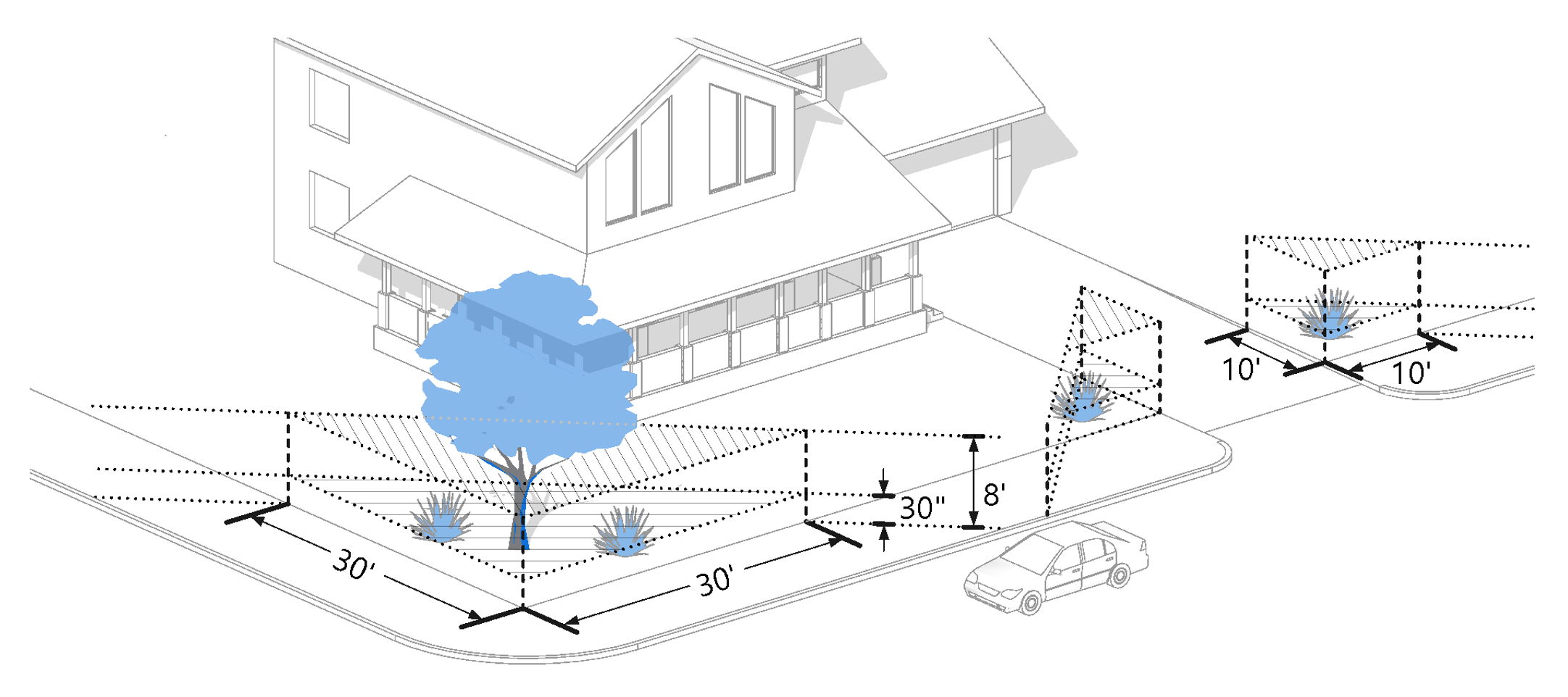
(2)
Within the visibility triangle there shall be no wall, fence, sign, or foliage with an opacity of more than twenty-five percent (25%) between thirty (30) inches and eight (8) feet above grade.
(3)
Vertical measurement shall be made from finished grade at the corner of the property line adjacent to the visibility triangle or where the driveway intersects the property line.
(4)
As an alternative, the Public Works Director may apply AASHTO or other alternative standards based on a site-specific evaluation of intersection visibility.
(Ord. No. 2025-17, § 2(Exh. A), 10-7-2025)
Sec. 16-4-70. - Off-street parking.
(a)
Purpose. This Section is intended to provide off-street parking spaces in proportion to the generalized parking, loading, and transportation demands of different land uses. This Section is also intended to help protect the public health, safety, and general welfare by:
(1)
Avoiding and mitigating traffic congestion;
(2)
Avoiding and mitigating the adverse visual impact of large concentrations of exposed parking;
(3)
Reducing storm water runoff and heat island effect from large expanses of pavement and improving water and air quality;
(4)
Providing necessary access for service and emergency vehicles;
(5)
Providing for safe and convenient interaction between vehicles and pedestrians; and
(6)
Providing flexible methods of responding to the transportation and access demands of various land uses in different areas of the City.
(b)
Applicability.
(1)
New Development. Unless otherwise exempted by this Code, the standards of this Section shall apply to all development and land uses established after the effective date of this Code.
(2)
Additions or Modifications.
a.
Expansions and Enlargements. Off-street parking standards required by this Section 16-4-70, Table 4-B, shall apply to any expansion or enlargement of an existing structure or use by more than twenty-five percent (25%), or two thousand five hundred (2,500) square feet, whichever is less. Parking for the expansion or enlargement area shall meet the minimum standards for the use(s) as required by Table 4-B.
b.
Change in Use. Off-street parking shall be provided for any change of use that would result in a requirement for more parking spaces than the existing use as defined in this Section. If the site is fully developed and it is not possible to provide additional parking for a change of use, the Director may waive this requirement on a case-by-case basis. Generally, this waiver shall not be for more than twenty percent (20%) of the total spaces required, or five (5) spaces, whichever is greater. Options for parking alternatives in Subsection 16-4-70(e), Parking Alternatives, also apply when there is a change in use.
(3)
Exemptions. Existing nonconforming off-street parking shall be allowed to continue and be credited towards required off-street parking when the spaces are located within the subject property. Modification of the existing parking shall require compliance with Subsection 16-4-70(f), Parking Area Design.
(c)
Calculation of Parking Requirements.
(1)
Area Measurements. All parking requirements that are based on square footage shall be calculated based on gross floor areas of the subject use. Gross floor area shall include all floor area within a building, exclusive of mechanical rooms, closets, storage areas, or kitchen spaces, unless specifically stated otherwise.
(2)
Fractions. When the calculation of off-street parking spaces results in a required fractional space, the required parking shall be rounded to the next highest whole number if five-tenths (0.5) or greater. Rounding of fractions may be calculated at the total parking count for all uses.
(3)
Mixed-Use Development. Lots containing more than one (1) use shall provide parking in an amount equal to the total of the requirement for all uses.
(4)
Unlisted Uses. For uses not listed in Table 4-B, Off-Street Parking Spaces Required, the Director may determine the minimum off-street parking requirements based upon the parking requirements of a listed land use that the Director determines to be most similar to the proposed use (based on operating characteristics, occupancy, or other factors determined by the Director).
(d)
Minimum and Maximum Off-Street Vehicle and Bicycle Parking Requirements.
(1)
Minimum Required Off-Street Parking. Unless otherwise provided in this Code, off-street parking spaces shall be provided in accordance with Table 4-B, Off-Street Parking Spaces Required.
Table 4-B: Off-Street Parking Spaces Required
(2)
Maximum Off-Street Parking. No nonresidential use shall provide off-street parking spaces in an amount more than one hundred twenty-five percent (125%) of the minimum parking spaces required by Table 4-B, Off-Street Parking Spaces Required, unless:
a.
The proposed development has unique or unusual characteristics such as high occupant volume per floor area or low parking turnover, that create a demand exceeding the maximum ratio and that typically does not apply to comparable uses, which is demonstrated by a parking demand study per Subsection 16-4-70(e)(6), Parking Demand Study, that is provided by the applicant with authorization from the Director;
b.
The request is the minimum necessary variation from the maximum standard;
c.
Parking spaces in excess of the maximum allowed shall use pervious pavement; and
d.
Additional landscaping is provided in an amount equal to the percentage above the maximum parking allowed.
e.
Exception: Any nonresidential use requiring eight (8) or fewer spaces may have up to ten (10) spaces.
(3)
Minimum Required Accessible Parking. The number and design of accessible parking spaces shall be pursuant to the International Building Code (IBC) as adopted in the Municipal Code and the Americans with Disabilities Act (ADA), as amended.
(4)
Minimum Required Bicycle Parking.
a.
Unless exempted by this Section, all residential development with more than four (4) units and all nonresidential development shall provide off-street bicycle parking spaces at a ratio of one (1) bicycle parking space per ten (10) provided vehicle parking spaces, with no qualifying development providing less than two (2) bicycle parking spaces. Bicycle racks shall conform with Public Works standards.
b.
For schools, off-street bicycle parking shall be provided at a ratio of one (1) space per ten (10) students enrolled.
c.
The Director may reduce the number of bicycle parking spaces required due to building site characteristics.
(e)
Parking Alternatives. The Director may approve parking alternatives to the minimum spaces required by Table 4-B, Off-Street Parking Spaces Required, in accordance with this Section.
(1)
Maximum Reduction. The maximum reduction of required off-street parking spaces by any single parking alternative or combination of parking alternatives in this Section shall be fifty percent (50%).
(2)
Tandem Parking. Tandem parking is allowed for any single-family residential parking area, and for automobile sales and leasing uses.
(3)
Fee-in-lieu for Parking within the MD District.
a.
With approval of the Director, a fee-in-lieu of providing required on-site parking for all development within the MD District may be paid by the applicant in an amount established and periodically amended by the City's fee schedule as the Business Occupier Fee.
b.
Fees accepted by the City in lieu of required parking shall be designated for the purposes of providing additional public parking in and around Downtown Salida or for the enforcement of parking regulations.
c.
Any off-street parking satisfied through this Section shall run with the land and any subsequent change of use that requires more parking shall require subsequent action to satisfy the additional parking requirement. No refund of such payment shall be made when there is a change to a use requiring less parking.
d.
The number of parking spaces required and used to calculate the fee in-lieu shall be determined according to the provisions of this Section and any other applicable provisions of this Code.
e.
A change of ownership or the dividing or merging of properties shall not affect an obligation for parking fees in-lieu or a determination that parking requirements have been met according to fees paid for a particular use.
(4)
Shared or Off-Site Parking (for non-MD Districts). The Director may approve shared parking and/or off-site parking for developments and/or uses with different operating hours or different peak business periods, if the shared and/or off-site parking complies with the following:
a.
Applicability. Shared or off-site parking agreements are allowed in all zone districts except for MD (unless where provided for otherwise in this Code).
b.
Location. Every shared and/or off-site parking space for nonresidential uses shall be located within five hundred (500) feet (measured along a legal pedestrian route) of the property on which the shared parking is provided. The Director may authorize farther distances for shared parking facilities where shuttle services are available.
c.
Parking Demand Study Required.
1.
Shared and/or off-site parking shall only be approved if the applicant clearly demonstrates the feasibility of shared and/or off-site parking through a parking demand study. Such study shall estimate parking demand for the proposed use(s) based on the recommendations of the Institute of Traffic Engineers (ITE), Urban Land Institute, the International Council of Shopping Centers, the American Planning Association, or other acceptable source of parking demand data for uses and/or combinations of uses of comparable activities, scale, bulk, area, and location.
2.
For shared parking, separate uses located on the same or adjacent properties which are not operated simultaneously, a shared parking arrangement may be allowed if it is in accordance with the Institute of Transportation Engineers (ITE) Standards for shared parking (current edition) and the Urban Land Institute publication Shared Parking Third Edition (2020, Mary S. Smith et al.), or more current edition if available, and approved by the Director.
d.
Parking Agreement Required.
1.
Written Agreement.
a)
The parties involved in the joint use of shared parking facilities and/or the use of off-site parking facilities shall submit a written agreement to the Director with the following:
1)
A legal written and recorded agreement;
2)
Proof of continuing use and maintenance.
b)
The City shall be party to the agreement and any subsequent amendments to such agreement.
2.
Approval.
a)
Such agreement shall be approved by the Director prior to issuance of a building permit or change of use permit for any use to be served by the shared and/or off-site parking facility.
b)
Subsequent revocation of such agreement may render any parking facilities that do not comply with this Code nonconforming.
(5)
Structured Parking. The height of a parking structure shall not exceed the height of the primary building it is intended to serve. Where no primary building exists, the maximum height of the parking structure shall be limited to the maximum building height allowed in the zoning district in which the structure is located.
(6)
Parking Demand Study. An applicant may submit a parking demand study to demonstrate that the general minimum requirements in Table 4-B should be varied for a specific project due to varying parking demand characteristics. Upon approving such a study, the Director may reduce off-street parking standards for the project. Such a study shall estimate parking demand for the proposed use based on the recommendations of the Institute of Traffic Engineers (ITE), Urban Land Institute, the International Council of Shopping Centers, the American Planning Association, or other acceptable source of parking demand data for uses and/or combinations of uses of comparable activities, scale, bulk, area, and location.
(f)
Parking Area Design.
(1)
Use of Parking and Loading Areas. Unless otherwise permitted by this Section, required off-street parking, loading, and vehicle stacking spaces shall be available for the parking of operable automobiles of the residents, customers, and employees of the use that the spaces are intended to serve. Prohibited uses of required spaces include:
a.
Storage of inoperable vehicles or materials, including repair work that renders a vehicle inoperable for more than twenty-four (24) hours in a parking area required for a nonresidential use;
b.
Parking of delivery vehicles for the business; and
c.
Display of vehicles for sale in nonresidential parking areas.
(2)
Location of Parking and Loading Areas. Unless otherwise permitted by this Section, required off-street parking, loading, and vehicle stacking spaces shall be located:
a.
On the same lot as the primary use the spaces are intended to serve, or within a parking area commonly owned by individuals who also own residential or commercial units adjacent to the area that the parking spaces are intended to serve.
b.
For single-family and duplex dwellings in all districts, off-street parking areas for operable motor vehicles shall be located in a garage or on a driveway. Designated outdoor parking areas shall have a curb block located at the end of a driveway that does not terminate at a fence, structure, or similar obstruction.
c.
For all multi-family and nonresidential uses in any zone districts except for HC, off-street parking areas shall not be located between the front building facade and the adjacent primary street frontage.
(3)
Minimize Vehicular and Pedestrian Conflicts.
a.
Traffic control signs, curbs, and/or striping shall be provided within all parking areas as necessary to minimize vehicular and pedestrian conflicts.
b.
If vehicular and pedestrian conflicts are apparent, the Director may require an alternative design of parking areas to resolve potential conflicts.
(4)
Dimensions. The minimum dimensions for parking spaces, rows and aisles are:
a.
Angled Parking. Angled parking between thirty (30) and ninety (90) degrees shall accommodate an eighteen and one-half-foot by nine-foot rectangle within the stall.
b.
Parallel Parking. Parallel parking spaces shall be twenty-two (22) feet as measured along the street and eight (8) feet wide.
c.
Aisle Widths. Aisles shall be no less than ten (10) feet for each direction of traffic.
(5)
Access.
a.
All parking areas, except those associated with a one- or two-family dwelling, shall be designed so that vehicles exiting from a parking space shall not back on to the right-of-way of public streets. Vehicles may, however, back on to the right-of-way of alleys adjacent to the property.
b.
Each required parking space shall have unobstructed access from a road or alley, or from an aisle or drive connecting with a road or alley, except for approved tandem parking.
(6)
Parking Surface.
a.
Paved Parking Surface Improvements.
1.
Paved parking surface improvements shall be required for the following:
a)
Commercial and mixed-use when five (5) or more parking spaces are provided; and
b)
Multi-family residential when nine (9) or more parking spaces are provided.
2.
If paved improvements are required, off-street parking areas, aisles, turn-arounds, and access drives shall be paved with concrete, asphalt, paving blocks, pavers, or other durable all-weather surface, and shall be striped to the standards of this Section and the standards of the Public Works Department. The Public Works Director shall determine the extent of alley paving that may be required for access to the lot.
b.
Gravel Parking Surfaces. Parking areas and access drives not required to be paved by Subsection (a) above may have a gravel surface. Unpaved parking shall provide some form of curb stop to identify each parking space.
(7)
Landscaping. Standards for landscaping of parking areas are in Subsection 16-4-80(c)(3), Parking Lot Landscaping Standards.
(8)
Lighting. Standards for lighting and illumination of parking areas are in Section 16-4-100, Outdoor Lighting.
(9)
Drainage. Standards for grading and drainage retention are in Section 16-4-40, Grading and Erosion Control.
(Ord. No. 2025-17, § 2(Exh. A), 10-7-2025)
Sec. 16-4-80. - Landscaping, screening, and fencing.
(a)
Purpose. This Section is intended to provide standards for landscaping, screening, and fencing to help protect the public health, safety, and general welfare by:
(1)
Creating a visually attractive physical environment to increase the public's enjoyment and patronage of Salida businesses;
(2)
Buffering potentially incompatible neighboring land uses;
(3)
Conserving water resources by using sustainable design and maintenance techniques and native and/or adapted plant species that are low water-use and regionally appropriate;
(4)
Providing pollinator-friendly habitats that are connected and abundant enough to have a positive impact on pollinator populations;
(5)
Realizing additional environmental benefits of landscaping such as: storm water retention and infiltration, recharging groundwater, retaining soil moisture, preventing erosion, and mitigating air quality, water pollution, dust, noise, heat island effects, and glare; and
(6)
Improving the quality of development to protect public and private investments and community values.
(b)
Applicability.
(1)
New Development. Unless otherwise exempted by this Code, the standards of this Section shall apply to all development and land uses established after the effective date of this Code.
(2)
Additions or Modifications. All landscaping, screening, and fencing for existing development and established land uses shall be installed in conformance with this Section if:
a.
The gross floor area of an existing structure is expanded or enlarged by more than twenty-five percent (25%) or two thousand five hundred (2,500) square feet, whichever is less;
b.
There is a change of use of the existing building that requires an increase of off-street parking by more than twenty-five percent (25%) or ten (10) spaces, whichever is less; or
c.
A land use that requires conditional use permit approval if determined by the Director.
d.
Redevelopment and Nonfunctional Turf. Any redevelopment subject to subsection (b)(2) that includes installation, planting, placement, expansion, replacement, or reinstallation of turf, artificial turf, or landscape materials shall comply with Subsection 16-4-80(c)(1)c. (Restrictions on Nonfunctional Turf).
(3)
Exemptions.
a.
Mixed-Use Downtown (MD) District. Development in the MD zoning district shall be exempt from the landscaping standards of this Section if the primary structure on the lot has a zero-foot setback from the property line. If a property does not utilize the zero-foot setback allowance, the minimum landscape area shall be ten percent (10%) of the non-built area.
b.
Open Space (OS) District. Development in the OS zoning district shall be exempt from the landscaping standards of this Section.
c.
Certain Residential Structures. Single-family detached, two (2) attached dwelling units, duplex structures, two (2) or fewer multiple principal structures on a lot, manufactured/mobile homes, and accessory dwelling units are only required to meet the tree requirements of this Section.
d.
Agricultural (AG) District. Development in the AG zoning district shall be exempt from the landscaping standards of this Section.
(4)
Overlapping Requirements. In the event two (2) or more landscaping standards overlap, the same landscape treatment may be counted toward meeting both standards. (For example, a shrub may count toward both a landscaped area planting requirement and a screening requirement.)
(c)
Landscaping Standards.
(1)
General Landscaping Standards.
a.
Minimum Landscaped Area.
1.
General.
a)
The minimum percent of site area required to be landscaped is established for each zoning district per Section 16-2-20, Summary of Dimensional Standards.
b)
A minimum of fifty percent (50%) of the required landscape area shall be live cover, including expected mature shrub coverage but not tree canopy coverage. For purposes of this provision, actively planted and maintained vegetable and/or flower gardens may count toward the required landscape area.
c)
The total amount of high water-use turf grass may not exceed forty percent (40%) of the total landscaped area. Sod alternatives such as xeric ground cover plants, including native grasses, ornamental ground covers, buffalo grass, and fescue, are encouraged to be used in place of sod.
d)
Any required landscape area shall not be used for parking or storage.
2.
Planting Requirements for Landscaped Area. The following table lists the minimum number of trees and shrubs/perennials that shall be provided per required landscaped area in various zoning districts. Where a fractional number results, the number of trees or shrubs/perennials required shall be rounded up when one-half (0.5) or higher.
Table 4-C: Minimum Landscaping in Required Landscaped Areas
b.
Landscape Materials.
1.
Appropriate Plantings. No plants on the most recent Chaffee County noxious weed list shall be depicted on the landscape plan. For guidance, a recommended plan list can be found in the Administrative Manual.
2.
Minimum Plant Specifications. Trees and shrubs depicted on the landscape plan shall be of the following minimum size at the time of their planting:
Table 4-D: Minimum Plant Specifications
3.
Landscape Variety. Vegetation shown on the landscape plan shall meet the following standards:
a)
When four (4) or more trees are required, no more than one (1) tree species shall comprise more than fifty percent (50%) of the quantity of required trees, unless such trees are preexisting on site. When six (6) or more shrubs/perennials/ornamental grasses are required, no one (1) shrub/perennial/ornamental grass species shall comprise more than fifty percent (50%) of the quantity of required landscape materials. Ground cover shall be exempt from this requirement.
b)
Where five thousand (5,000) square feet or more of landscaping is required, a minimum of five (5) different plant species shall be used in the overall development site landscape plan.
c)
Guidance on tree species and deer protection requirements for trees can be found in the Administrative Manual in the "City of Salida Tree List and Planting Standards." Deer protection for young trees is required.
d)
Coniferous trees shall not exceed fifty percent (50%) of total required trees, unless such trees are preexisting on site. When planting coniferous trees, dwarf varieties are encouraged on lots smaller than fifteen thousand (15,000) square feet. Coniferous trees shall not be planted in rows or groupings that will create issues with icing of sidewalks and streets.
4.
Landscape Preservation.
a)
The landscape plan shall be designed to save all existing healthy trees and shrubs (except for those identified as undesirable species in the Administrative Manual) whenever possible. Existing trees that meet the standards of this Section, and are preserved, shall count toward the minimum landscaping standards of this Section.
b)
All existing vegetation preserved and used for credit against the requirements of this Section shall be protected during construction by a four-foot or taller fence erected one (1) foot beyond the drip line of the vegetation.
c)
Preserved vegetation may be credited only one (1) time toward any one (1) buffer, screen, or other landscape requirement.
c.
Restrictions on Nonfunctional Turf. Beginning January 1, 2026, the installation, planting, or placement of nonfunctional turf, artificial turf, or invasive plant species as part of a new development project or redevelopment project is prohibited on all applicable property, as defined in C.R.S. § 37-99-102, and consistent with C.R.S. § 37-99-101 et seq. For purposes of this section:
1.
Applicable property has the meaning set forth in C.R.S. § 37-99-102(1) and includes:
a)
Commercial, institutional, or industrial uses;
b)
Common interest community uses; or
c)
A street right-of-way, parking lot, median, or transportation corridor.
Applicable property does not include residential property and uses.
2.
Artificial turf means an installation of synthetic materials developed to resemble natural grass, consistent with C.R.S. § 37-99-102(2).
3.
Functional turf means turf that is located in a recreational use area or other space that is regularly used for civic, community, or recreational purposes, which may include playgrounds, sports fields, picnic grounds, amphitheaters, portions of parks, and golf course play areas, as described in C.R.S. § 37-99-102(7).
4.
Nonfunctional turf means turf that is not functional turf and includes turf located in a street right-of-way, parking lot, median, or transportation corridor, as defined in C.R.S. § 37-99-102(13).
5.
Maintenance of turf or artificial turf installed prior to January 1, 2026, is permitted; however, expansion, replacement, or reinstallation must comply with this subsection.
(2)
Streetscape Landscaping Standards.
a.
Streetscape Design.
1.
Street trees shall be located within the designated planting strip unless otherwise exempted by this Section or by the Director, or unless the site is unable to meet the geometry standards as defined.
2.
Where no planting strip is present or where utilities prevent trees from being planted in the designated planting strip, trees may be planted on the lot no more than seven (7) feet behind the property line nearest to the public right-of-way.
3.
Street trees shall be centered in the parkway to avoid impacts from overhanging parked vehicles.
4.
Street trees in the parkway as part of a development may count towards required landscaping.
b.
Landscaping in a Public Right-of-Way.
1.
Installation of irrigation for street trees shall be required for a minimum of five (5) years after planting. Single-family detached, two (2) attached dwelling units, duplex structures, and two (2) or fewer multiple principal structures on the same lot are exempt from installing irrigation but are responsible for the care and watering of street trees adjacent to their lot and may hand water street trees.
2.
Approval from the Public Works Department shall be obtained prior to the installation of landscaping within the public right-of-way.
3.
Landscaping shall be located so as not to obstruct fire hydrants or utility boxes to avoid growing into any overhead or underground utility lines.
4.
No plant material between thirty (30) inches and eight (8) feet in height, with an opacity greater than twenty-five percent (25%), shall be located within the visibility triangle defined in Subsection 16-4-60(g), Visibility Triangle.
5.
Maintenance, including weed control, of landscaping installed within the public right-of-way shall be the responsibility of the property owner and shall be maintained per an applicant-provided maintenance program approved by the Public Works Department.
(3)
Parking Lot Landscaping Standards. Landscaping is required for parking areas in multifamily residential, mixed-use, commercial, and industrial development projects to reduce stormwater runoff, protect water quality, minimize the heat island effect, and reduce visual impacts.
a.
Buffer Strips.
1.
A five-foot-wide landscaped buffer strip composed of trees, shrubs, berms, hedges and/or planters shall be provided within any front setback area and between any off-street parking area or drive aisle and any adjoining public or private street right-of-way.
2.
Off-street parking areas or drive aisles adjacent to a residential zone district shall provide a five-foot-wide landscaped buffer strip composed of trees, shrubs, berms, hedges and/or planters, or a six-foot-tall opaque fence or solid wall where allowed by this Code.
3.
A ten-foot-wide landscaped buffer strip composed of trees, shrubs, berms, hedges and/or planters shall be provided along all lot lines for properties with sales lots for mobile home, recreational vehicles, heavy equipment, and automobiles.
4.
A ten-foot-wide landscaped buffer strip composed of trees, shrubs, berms, hedges and/or planters shall be provided along all lot lines adjacent to any residential development for properties with drive-through facilities.
5.
Portions of the buffer strips that contain live cover shall be credited toward the required landscaping.
6.
If planter boxes are utilized within buffer strips, the planter box shall be a minimum of twenty-four (24) inches in height and contain enough landscape material to provide full seasonal coverage within the planter at plant maturity.
b.
Landscaping Islands within Parking Lots.
1.
Applicability.
a)
Generally. Any parking area containing ten (10) or more parking spaces shall include landscaped islands or rain gardens.
b)
Exemption. Parking areas that contain fifteen (15) or fewer spaces and that are located within the rear portion of the lot and behind or otherwise screened by a building from view from the public right-of-way shall be exempt from the landscape island requirements of this Section.
2.
Landscaped Island Size and Location.
a)
Landscaped islands or rain gardens shall be of sufficient size to accommodate required landscaping. No landscaped island or rain garden shall be less than six (6) feet in length or width or less than seventy-five (75) square feet.
b)
Landscaped islands or rain gardens shall be provided in parking areas along the ends of parking rows, to define the location and pattern of primary internal access drives, and/or to separate rows of fifteen (15) or more parking spaces (including ADA accommodations).
c)
There shall be no more than fifteen (15) parking spaces in a row without an interior landscape island or rain garden.
d)
A minimum of ten percent (10%) of the parking area (including drive aisles) shall consist of landscape islands or rain gardens.
3.
Landscaped Island Design.
a)
Landscaped islands shall be dispersed throughout the parking area to provide visual relief, define parking aisles and parking lot entrances, and to provide shading by using seasonal shade trees.
b)
Minimum one (1) tree and five (5) shrubs or perennials shall be provided for every fifteen (15) parking spaces.
c)
All landscape island trees shall be deciduous, and a minimum of seventy-five percent (75%) of required landscaped island trees shall be deciduous canopy-type shade trees with a mature height of at least thirty (30) feet.
d)
Sod is not permitted in landscape islands. Sod alternatives such as xeric ground cover plants including native grasses, ornamental ground covers, buffalo grass, and fescue may be used.
e)
Nonliving ground cover shall not exceed fifty percent (50%) of any landscaped island or rain garden.
f)
Landscaped islands and rain gardens shall be credited toward the overall required landscaping.
4.
Incentives that Allow for a Reduction of Landscaped Islands. If permeable paving is used in all parking spaces, the required number of landscaped islands or rain gardens may be reduced by up to half (½). If permeable paving is used for the entire parking area, including drive lanes, the required landscaped islands or rain gardens may be reduced by up to three-quarters (¾).
(d)
Landscape Plan Requirements. A landscape plan shall be submitted for review as part of an application for any development proposal, unless specifically exempted per Subsection 16-4-80(b)(3), Exemptions. The landscape plan shall contain the following materials and information:
(1)
Drawing. A drawing shall be provided, to scale and containing a legend, identifying:
a.
All existing deciduous trees and coniferous trees of four (4) inches in caliper or greater at breast height;
b.
The location, size, and type of all proposed landscape materials, living and non-living;
c.
All existing vegetation that is to be preserved; and
d.
How irrigation is to be provided and the gallons per minute (gpm) required for the proposed landscaping.
(2)
Calculations. A written summary of all calculations used to determine the landscaping required and provided for the site.
(3)
Cost Estimate. An estimate of the cost of supplying and installing the materials depicted in the landscape plan, including all labor and supplies for the irrigation system.
(4)
Erosion Control. A description of how erosion will be controlled on-site during construction and following completion of development.
(5)
Root Zone Protection of Preserved Vegetation. A description of how the root zones of preserved vegetation will be protected during construction or installation of structures, pavement, or other site features, and during the installation of landscaping and irrigation.
(6)
Maintenance Program. A description of the proposed program to maintain the landscaping after it has been installed.
(e)
Installation and Maintenance.
(1)
Installation Required Prior to Certificate of Occupancy.
a.
If an applicant requests a Certificate of Occupancy during the months of May through October, the landscaping and irrigation shall be fully installed in conformance with the approved landscape plan prior to City sign-off on the Certificate of Occupancy authorization. During the months of May and June, at the Director's discretion, a security deposit may be accepted that requires complete landscape installation during the following planting season.
b.
If an applicant requests a Certificate of Occupancy during the months of November through April, a security deposit will be accepted that requires complete landscape installation during the following planting season.
(2)
Security.
a.
When a security deposit is required due to the timing of the Certificate of Occupancy as noted above, the applicant shall submit to the City a surety or cash bond, letter of credit, or other collateral found to be suitable by the City Attorney to guarantee the installation of the required landscaping. The security shall be in an amount equal to one hundred twenty-five percent (125%) of the cost of supplying and installing the materials depicted in the approved landscape plan, based on estimates provided by the applicant and approved by the Director.
b.
Following installation of the required landscaping, the applicant shall certify that the landscaping has been installed in conformance with the approved plan. Following receipt of the certification and an inspection by City staff, the Director shall release one hundred percent (100%) of the provided cost of supplying and installing the materials within seven (7) calendar days. The remaining twenty-five percent (25%) shall be released after two (2) growing seasons if the Director determines that required landscaping is installed and successfully maintained.
c.
If landscaping is not installed or is installed in a manner which does not conform with the approved plan, the City may draw upon the security to bring the landscaping into conformance with the approved plan or, if development was initiated but never carried through to completion, to return the site to its predevelopment condition.
(3)
Irrigation for Live Cover. Trees and live cover shall be provided with an adequate means of irrigation for the type of plants installed.
(4)
Maintenance. All vegetation shall be healthy at the time of its installation and shall remain healthy or shall be replaced.
a.
Landowner Responsible. Maintenance of landscaped areas shall be the responsibility of the landowner.
b.
Replacement. Landscaping that does not survive a minimum of three (3) years shall be replaced within three (3) months, or during the next planting season (May through October). The replacement vegetation shall be similar in size and type to the vegetation which did not survive, so the integrity of the approved landscape plan is preserved.
(f)
Screening and Fencing Standards.
(1)
Screening. Screening is required for all multi-family, mixed-use, and nonresidential development in the following situations and shall be accomplished by the specific methods indicated in the respective subsections below:
a.
Roof-Mounted Mechanical Equipment.
1.
Roof-mounted mechanical equipment, including, but not limited to, heating and soft water tanks, television antennas, satellite dishes, security apparatus, air conditioners, and heating, cooling, and ventilating equipment, shall be set back no less than ten (10) feet from any property line. Facilities for the operation of active or passive solar energy systems and other alternate energy systems shall be exempt from this standard.
2.
The color of roof-mounted equipment and vents shall have a matte finish and be compatible with the roof or adjacent wall color, screened, or integrated into the design of the structure. Facilities for the operation of active or passive solar energy systems and other alternate energy systems shall be exempt from this standard.
b.
Ground-Mounted Mechanical Equipment.
1.
Outdoor ground-mounted mechanical equipment, including, but not limited to, subpanels, air conditioners, kitchen hoods and vents, swimming pool equipment, pumps and heaters, propane tanks, and heating, cooling and ventilating equipment shall be located where not visible from public open space, public trails, public streets, or from adjacent properties to the maximum extent practicable.
2.
Screening of ground-mounted solar energy equipment or other alternate energy equipment shall be exempt from the screening requirements when it can be demonstrated that required screening would reduce the effectiveness or efficiency of the equipment.
c.
Loading and Refuse Areas (Nonresidential Development).
1.
Outdoor loading and refuse areas shall be integrated into the building design if possible or shall be located where they are not visible from public open space, public trails, public streets, or from adjacent properties to the maximum extent practicable.
2.
In cases when loading and refuse areas are visible from a public open space, public trail, public street, or adjacent property, the loading and refuse areas shall be screened from view by a solid wall or opaque fence a minimum of six (6) feet in height. If a solid wall is proposed, it shall incorporate at least one (1) of the primary materials and colors of the nearest wall of the primary building.
d.
Refuse Areas (Mixed-use and Multi-family Residential Development). Areas for trash collection shall be integrated into the building design if possible. When not located within the building, trash collection areas shall:
1.
Not be located within a landscape island of the parking lot;
2.
Provide adequate space for the trash and recycling needs for the number of households, and any commercial space within a mixed-use building, that the space is intended to serve; and
3.
Be screened from view by a solid wall or opaque fence a minimum of six (6) feet in height. If a solid wall is proposed, it shall incorporate at least one (1) of the primary materials and colors of the nearest wall of the primary building (excluding unfinished CMU block).
4.
May not be located in an ally or other public area or easement.
e.
Outdoor Storage Areas.
1.
Outdoor storage areas that are adjacent to a residential zoning district, a lot containing a residential use in a mixed-use zoning district, public open space, public trail, or public street, shall be screened from view by an opaque fence or solid wall (excluding unfinished CMU block).
2.
Fences or walls shall be a minimum of six (6) feet in height and opaque.
3.
Fences or walls may be more than six (6) feet in height if the Director determines it is necessary to effectively screen the outdoor storage.
f.
Drive-Through Facilities. In addition to the buffer strip standards in Subsection 16-4-80(c)(3)a., Buffer Strips, drive-through lanes and stacking lanes adjacent to any residential use or zone shall be screened by a six-foot tall opaque fence or solid wall.
(2)
Fences and Walls.
a.
Purpose. In addition to the overall purpose of this Code and section, these standards are intended to ensure that walls, fences, retaining walls, and vertical combinations of those items:
1.
Enhance the visual appearance of the streetscape and built environment;
2.
Ensure visual compatibility with public spaces;
3.
Promote street and neighborhood character; and
4.
Retain a sense of community and neighborliness.
b.
Applicability. Any fence, wall, or any similar type of screen, including hedges, may be erected subject to the standards of this Section.
c.
Height and Location.
1.
Front. Fences or walls between the face of any building and the front property line shall be no more than four (4) feet in height unless required by the standards of Subsection 16-4-70(f). Posts may be a maximum of six (6) feet if necessary for deer fencing. Space between the posts must remain transparent and only wire or similar material may be utilized.
2.
Side and Rear. Fences or walls that are not subject to the front height limitation shall have no portion that exceeds six (6) feet in height.
3.
Corner Lots. Fences or walls on a corner lot shall not impair visibility of intersecting traffic and/or pedestrians in compliance with Subsection 16-4-60(g), Visibility Triangle.
4.
Measurement.
a)
Fence and wall height shall be measured from the existing natural grade at the base to the highest point of fence or wall. No fence or wall may be artificially elevated by means of a berm or other method for purposes of height calculation.
b)
Walls and fences up to eight (8) feet in height may be approved by the Director through the minor modification process subject to the requirements in Subsection 16-8-70(a), and shall require building permit approval and compliance with the Building Code, if:
1)
They are temporary fences on construction sites erected for protection purposes during the period of construction only; or
2)
They enclose loading, service, refuse areas, public works facilities, utilities, or other similar uses outside the front or exterior side setback area; or
3)
They enclose outdoor storage areas in nonresidential zoning districts outside the front or exterior side setback area; or
4)
They are demonstrated to be necessary for a unique security purpose outside the front or exterior side setback area.
d.
Design. Fences along alleys, when on the property line, shall contain an offset section or some provision for trash containers to be located on the property to be convenient for trash collection.
e.
Retaining Walls.
1.
Height.
a)
The height of retaining walls supporting either cut or fill conditions shall not exceed six (6) feet in height.
b)
Retaining walls that are over four (4) feet in height shall be designed by a State of Colorado licensed structural engineer and are subject to building permit approval and compliance with the Building Code.
2.
Measurement.
a)
Retaining walls shall be measured vertically from the lowest point at natural grade to the highest point of the wall.
b)
Retaining walls in excess of six (6) feet in height may be approved by the Director if the applicant demonstrates that unique conditions exist that necessitate a different arrangement and if the design standards of Subsection 3. below are met.
3.
Design.
a)
Terracing. Retaining walls greater than six (6) feet in height shall be terraced to minimize visual impacts on residents, neighboring properties, and the public realm by:
1)
Limiting terracing to three (3) tiers, with each tier no greater than six (6) feet in height;
2)
Providing a minimum terrace width of five (5) feet between any two (2) retaining walls with a maximum slope of 3:1 and planted with a minimum of four (4) shrubs per one hundred (100) square feet of terrace area;
3)
The Director may approve reduced terrace depths and alternative landscaping treatments where site constraints limit the amount of space available to accommodate the minimum width and planting densities.
b)
Recessions and/or Projections.
1)
Retaining walls that exceed four (4) feet in height and are over thirty (30) feet in length shall incorporate recessions and/or projections that have a minimum wall plane change of two (2) feet.
2)
A direction change of more than thirty (30) degrees in plan view shall also constitute a recession or projection.
3)
Retaining wall recession and projection areas shall be landscaped with trees, shrubs, ornamental grasses, and/or and perennials to add visual interest and minimize the impact of the wall from neighboring properties or the public right-of-way.
c)
Fence or Wall on Top of Retaining Wall.
1)
A solid freestanding fence or wall on top of a retaining wall shall be no more than four (4) feet in height (measure from the top of the retaining wall).
2)
If greater height is required as permitted per a minor modification request, then the freestanding fence or wall shall be set back from the top of the retaining wall a minimum of five (5) feet and planted with a minimum of four (4) shrubs per one hundred (100) square feet between the retaining wall and the fence or wall.
(Ord. No. 2025-17, § 2(Exh. A), 10-7-2025; Ord. No. 2026-08, §§ 2, 3, 3-3-2026)
Sec. 16-4-90. - Site and building design.
(a)
Purpose. This Section establishes site and building design standards that foster high-quality, attractive, and sustainable development. The standards are further intended to:
(1)
Protect and enhance the character and quality of Salida's neighborhoods;
(2)
Enhance the human and pedestrian scale of new developments and ensure compatibility between residential neighborhoods and adjacent nonresidential uses;
(3)
Promote building designs and construction practices that are adaptable to multiple uses for extended building lifecycles;
(4)
Mitigate negative visual impacts arising from the scale, bulk, and mass of large buildings; and
(5)
Balance the community's economic and aesthetic concerns.
(b)
Applicability.
(1)
New Development. Unless otherwise exempted by this Code, the standards of this Section shall apply to all development and land uses established after the effective date of this Code.
(2)
Additions or Site Modifications. Site and building design standards shall be installed in conformance with this Section if:
a.
An existing primary structure is relocated on the lot;
b.
The gross floor area of an existing structure is expanded or enlarged by more than twenty-five percent (25%) or two thousand five hundred (2,500) square feet, whichever is less;
c.
There is any expansion or enlargement of a structure or land use that requires conditional use permit approval, as determined by the Director; or
d.
If the renovation is proposed for only a portion of a building, the Director may waive compliance with the site and building design standards if compliance would make that renovation inconsistent with the overall design of the existing structure.
(c)
Site Design.
(1)
Trees and Vegetation. Mature trees and vegetation shall be maintained to the extent possible to provide slope stability and prevent visual scarring, and to protect riparian areas. Revegetation with native plant materials is encouraged following development.
(2)
Relationship to Adjacent Developments. Elements that shall be coordinated between adjacent future or existing sites to the maximum extent practicable include:
a.
Shared driveways for accessing adjoining streets (Subsection 16-4-60(d));
b.
Linkages of internal vehicular circulation systems (Subsection 16-4-60(d)(4));
c.
Linkages of interior pedestrian systems (Subsection 16-4-60(f));
d.
Linkages/continuation of open space systems (Subsection 16-4-110(c));
e.
Perimeter open space and landscape buffer zones (Subsection 16-4-80(c));
f.
Areas and access for refuse collection (Subsection 16-4-80(f)(1)d);
g.
Drainage and detention facilities (Subsection 16-4-30(d)); and
h.
Linkages of any other networks and/or functional areas where a coordinated site design approach will benefit the cohesiveness of a larger area, such as shared utility easements.
(3)
Common Recreation Facilities. Any proposed development or subdivision that contains common recreation facilities shall locate such facilities within the development to be easily accessible to residents and minimize impacts on neighboring developments.
(4)
Residential Building Orientation. All residential dwellings that front a street shall have an entry that faces the street. Units on corner lots need an entry on only the street from which they are addressed.
(d)
Residential Subdivision Architectural Standards.
(1)
Single-family Detached and Duplex Structures. These standards are intended to prevent monotonous streetscapes and offer consumers a wider choice of housing styles.
a.
Variety in Facade Elevation.
1.
No residential facade elevation shall be utilized more than twice every five (5) lots on the same side of the street.
2.
No residential elevation shall be repeated directly across the street from the same facade elevation.
3.
Mirror images of the same residential facade shall not count as two (2) distinctly different facades.
4.
A minimum of two (2) substantial changes shall be necessary to be considered distinctly different facades, such as single story versus two-story, varied roof style (see Subsection b. below), significantly varied window design or placement, or a material change of more than two-thirds (⅔) of the front facade. Varying paint colors or varying colors of the same material shall not count as a substantial change.
b.
Variety of Roof Styles. A variety of roof styles shall be utilized within a subdivision. Two (2) or more of the following roof types shall be used: gable, shed, hip and flat. Roof types shall be evenly and proportionally distributed throughout the subdivision. Rotations of shed roofs shall count as two (2) distinct roof types if a slope of 3:12 or greater is utilized to ensure a visible variation. If lower shed roof slopes are utilized, they will count as one (1) roof type regardless of orientation.
c.
Waiver. The Director may grant a petition seeking waiver of this requirement. Such a waiver may be granted if the petitioner demonstrates that the proposed plan uses repetition for an architectural purpose, such as allusion to historical repetition that would not create a monotonous streetscape of the type this standard seeks to prevent.
(2)
Residential Structures with Three (3) Units or More. When residential structures with three (3) or more units (attached or multifamily) are proposed, the above criteria shall apply when five (5) or more separate buildings are proposed on the same lot or on adjacent lots.
(e)
Large-scale Development.
(1)
Purpose. This Section is intended to advance Salida's image as a desirable and attractive community through the thoughtful design and development of large retail stores and commercial centers that reflect the character and identity of Salida. This Section is further intended to provide for the reuse of large retail, mixed-use, and multi-family developments in support of a resilient local economy and sustainable community.
(2)
Applicability.
a.
New Development. Unless otherwise exempted by this Code, the standards of this Section shall apply to any commercial, mixed-use, or multifamily structure of ten thousand (10,000) square feet or greater established after the effective date of this Code, except for structures in the Agricultural, Industrial, Community Facilities, and Parks and Open Space zone districts. This includes any such development with a combined square footage of ten thousand (10,000) square feet or greater.
b.
Additions or Modifications. Large-scale commercial development standards for existing development and established land uses shall be installed in conformance with this Section to the extent practicable if:
1.
The gross floor area of an existing structure is expanded or enlarged by more than twenty-five percent (25%) or two thousand five hundred (2,500) square feet, whichever is less;
2.
The exterior of the primary building or structure exterior is to be renovated, which, for purposes of this provision, means the replacement in kind, strengthening, or upgrading of building elements, materials, equipment, or fixtures, that does not result in a reconfiguration of interior spaces. If the renovation is proposed for only a portion of a building, the Director may waive compliance with the site and building design standards if that renovation would be inconsistent with the overall design of the existing structure;
3.
There is a change of use of the existing building that requires an increase of off-street parking by more than twenty-five percent (25%) or ten (10) spaces, whichever is less; or
4.
There is any expansion or enlargement of a structure or land use that requires conditional use approval, as determined by the Director.
c.
Exemption. Development in the Agricultural, Industrial, Community Facilities, and Parks and Open Space zone districts.
(3)
Cohesive Design. Each building and structure within a development shall be designed to maintain a consistent architectural theme. Building materials and colors, building forms, roof style, and detailing shall contribute to a harmonious and consistent structure without yielding monotony of design. This shall include all pads sites within a large commercial development, gasoline pump canopies, and other accessory structures.
(4)
"360 Degree" Architecture.
a.
All sides of all buildings are to be treated with similar architectural style, use of materials, and details as the front elevation of the building.
b.
Any facades not facing a public right-of-way may reduce the level of articulation required in Subsection (6), Horizontal Articulation, and (7), Vertical Articulation, below by fifty percent (50%). A six-foot tall fence or wall constructed of natural materials such as wood, stone, or river rock may be installed along the entire rear lot line, finished side out, to screen the rear elevation in lieu of articulation on that elevation.
(5)
Fenestration. Facades facing and within one hundred (100) feet of a public right-of-way shall have fifty percent (50%) minimum fenestration on the ground floor. Facades facing, but further than one hundred (100) feet from, a public right-of-way shall have twenty percent (20%) minimum fenestration on the ground floor. Facades not adjacent to a public right-of-way shall have a ten percent (10%) minimum fenestration on the ground floor. Exemptions shall be allowed when openings are restricted by the building code.
(6)
Horizontal Articulation.
a.
Buildings shall be designed to reduce unrelieved planes by dividing facades into a series of smaller components. Each building elevation shall incorporate two (2) or more of the following elements for every fifty (50) feet of length:
1.
Projections, recessions, or reveals such as, but not limited to, columns, pilasters, cornices, and bays, and having a change of wall plane that is a minimum of twelve (12) inches in depth and that has the effect of casting shadows;
2.
Glazed windows and doors, if used to comply with this standard, shall comprise not less than thirty percent (30%) of the elevation of which they are a part;
3.
Change in texture and/or masonry pattern or change in material, with a transition element between materials; and/or
4.
Awnings or canopies extending at least four (4) feet beyond the building face.
b.
The Director shall have the authority to waive this requirement when the building is not visible from adjacent properties or the public right-of-way.
(7)
Vertical Articulation.
a.
Buildings shall be designed to clearly identify the base, body, and top of the structure with horizontal elements separating these components.
b.
The building base shall appear visually grounded through the use of any of the following design techniques:
1.
Incorporation of low planters and/or walls;
2.
Use of base architectural veneer banding or a wainscot, and treatments defined by different materials, textures, or colors. Base colors should typically be darker than upper-level colors; and/or
3.
Carefully integrated covered walkways, trellises, or architectural awnings that provide deep shadow at ground level. This has the added advantage of achieving a more articulated building mass.
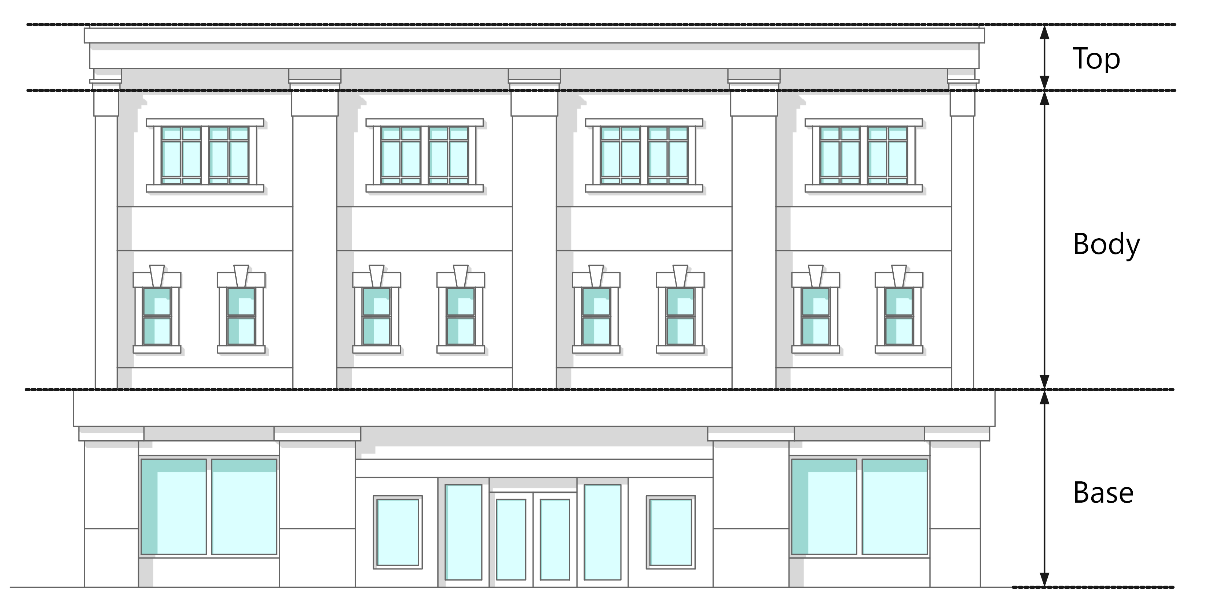
(8)
Roofline Variation. The roofline silhouette of buildings shall be varied in order to reduce the visual impact of line and form contrast with the natural environment. To reduce the visual impact of roof mass, no roofline along any building elevation shall exceed fifty (50) feet in length without a visual variation that incorporates ornamental architectural features such as projections, recessions, dormers that alter the vertical or horizontal plane of the roof by at least two (2) feet. See Table 2-D for Authorized Exceptions to Height Standards.
(9)
Outdoor Display. Large-scale retail developments may offer for direct sale to the public merchandise that is displayed outdoors, but the area occupied by such outdoor sales and storage, exclusive of warehouses, shall not exceed the total square footage of the retail buildings. Sales of recreational vehicles, autos, agricultural implements (e.g., tractors, cultivators, balers) and plant nurseries are excluded from limitations of outdoor display and storage. Outdoor displays may not occupy required parking spaces.
(f)
Residential Adjacency.
(1)
Purpose. This Section establishes standards that promote compatible transitions between land use areas of differing intensities and to reduce potential negative impacts that may occur when mixed-use and nonresidential development is located next to residential zoning districts.
(2)
Applicability. This Section applies to new nonresidential and mixed-use development in the MN, MC, MH, MD, or IN districts that adjoins a residential zone district. "Adjoining" means directly contiguous; properties separated by right-of-way (including alleys) are not considered adjoining.
a.
For mixed-use developments, this Section applies to portions of a development that are nonresidential.
b.
The Director may reduce or eliminate any standards required by this Section with written consent of the adjoining property owner(s).
(3)
Use and Activity Limitations. Outdoor speakers and public address systems shall be oriented to direct music and other sounds away from residential properties to the greatest extent possible. Additional screening for such devices may be described.
(4)
Site Design.
a.
To the extent feasible, nonresidential developments shall be designed with higher activity areas, such as parking, circulation, loading, and delivery areas, oriented away from adjoining lots in residential districts.
b.
Where site limitations necessitate higher activity levels next to lots in residential districts, additional landscaping and/or screening may be required.
c.
Off-street loading areas shall not be located within thirty (30) feet of adjoining lots in residential districts unless no other feasible options are available, and the project is designed to mitigate impacts on adjoining properties.
(5)
Building Orientation and Setbacks.
a.
Horizontally integrated mixed-use developments shall locate nonresidential uses away from the adjoining lots in residential districts.
b.
Any building or structure adjoining lots in residential districts shall comply with the minimum side and rear building setbacks of the adjoining residential zoning district along the common property line, unless the relevant setback of the subject property is already greater.
(g)
Fair Contributions for Public School Sites.
(1)
Generally. All development shall comply with the requirements of the Intergovernmental Agreement Concerning Fair Contributions for Public School Sites for the Salida School District R-32-J, effective February 8, 2022, and as amended thereafter. Fees-in-lieu of land dedication are listed in the City's effective fee schedule.
(2)
Exemptions. The following uses shall be excepted from Fair Contribution for Public School Sites:
a.
Construction of any nonresidential building or structure;
b.
Alteration, replacement or expansion of any legally existing building or structure with a comparable new building or structure which does not increase the number of residential dwelling units;
c.
Construction of any building or structure for limited term stay or for long term assisted living, including, but not limited to, bed and breakfast establishments, boarding or rooming houses, family-care homes, group-care homes, halfway houses, nursing homes, or hospices, except where such building or structure will be used primarily to house school aged children;
d.
Construction of any residential building or structure classified as housing for older persons, pursuant to the Federal Fair Housing Act in effect;
e.
The construction of accessory buildings or structures; and
f.
Construction of any low-income housing unit, on lots designated as such by the City.
(Ord. No. 2025-17, § 2(Exh. A), 10-7-2025)
Sec. 16-4-100. - Outdoor lighting.
(a)
Purpose. This Section is intended to regulate exterior lighting to:
(1)
Permit the use of exterior lighting at the minimum levels necessary for nighttime safety, utility, security, productivity, enjoyment, and commerce;
(2)
Ensure exterior lighting does not adversely impact land uses on adjacent lands by minimizing light trespass, obtrusive light, and glare;
(3)
Ensure the safety of motorists by minimizing light spillage and glare onto adjacent streets;
(4)
Curtail light pollution and preserve the nighttime environment for the enjoyment of residents and visitors;
(5)
Protect the natural environment from adverse impacts of night lighting from gas or electric sources; and
(6)
Encourage the use of high-efficacy light sources to conserve energy and resources to the greatest extent possible.
(b)
Applicability.
(1)
All exterior lighting for any type of residential or nonresidential development shall comply with the standards of this Section unless stated elsewhere in this Code, stated in an approval of a development permit, required by Federal or State law, or exempted below.
(2)
All exterior lighting shall be installed in conformance with the provisions of this Code, applicable Electrical and Energy Codes, and applicable sections of the Building Code.
(c)
Required Lighting. With the exception of subdivision lighting, lighting is not required. Unless otherwise approved through a planned development, this regulation shall apply to all lighting for subdivisions, land uses, developments, buildings and new or replaced fixtures. In addition, any site modification that requires a reuse application will necessitate compliance for all existing and proposed lighting on the site.
(d)
General Requirements.
(1)
All non-exempt outdoor light fixtures and illuminating devices permanently or temporarily installed outdoors, including, but not limited to, devices to illuminate signs, shall meet the following requirements:
a.
They shall be fully shielded so no light rays are emitted at angles that will allow the light to pass directly off of the premises appurtenant to the fixture. See Figure 4-4.
Figure 4-4: Example of No Light Trespass
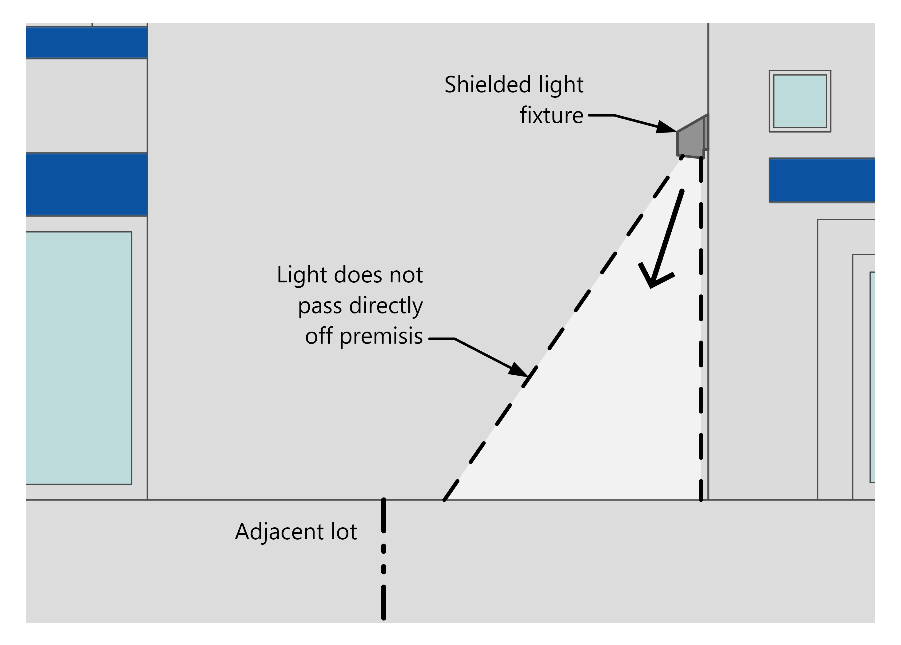
b.
They shall be shielded so that no light rays are emitted by the installed fixture at angles above the horizontal plane.
Figure 4-5: Example of Fully Shielded Light Fixture
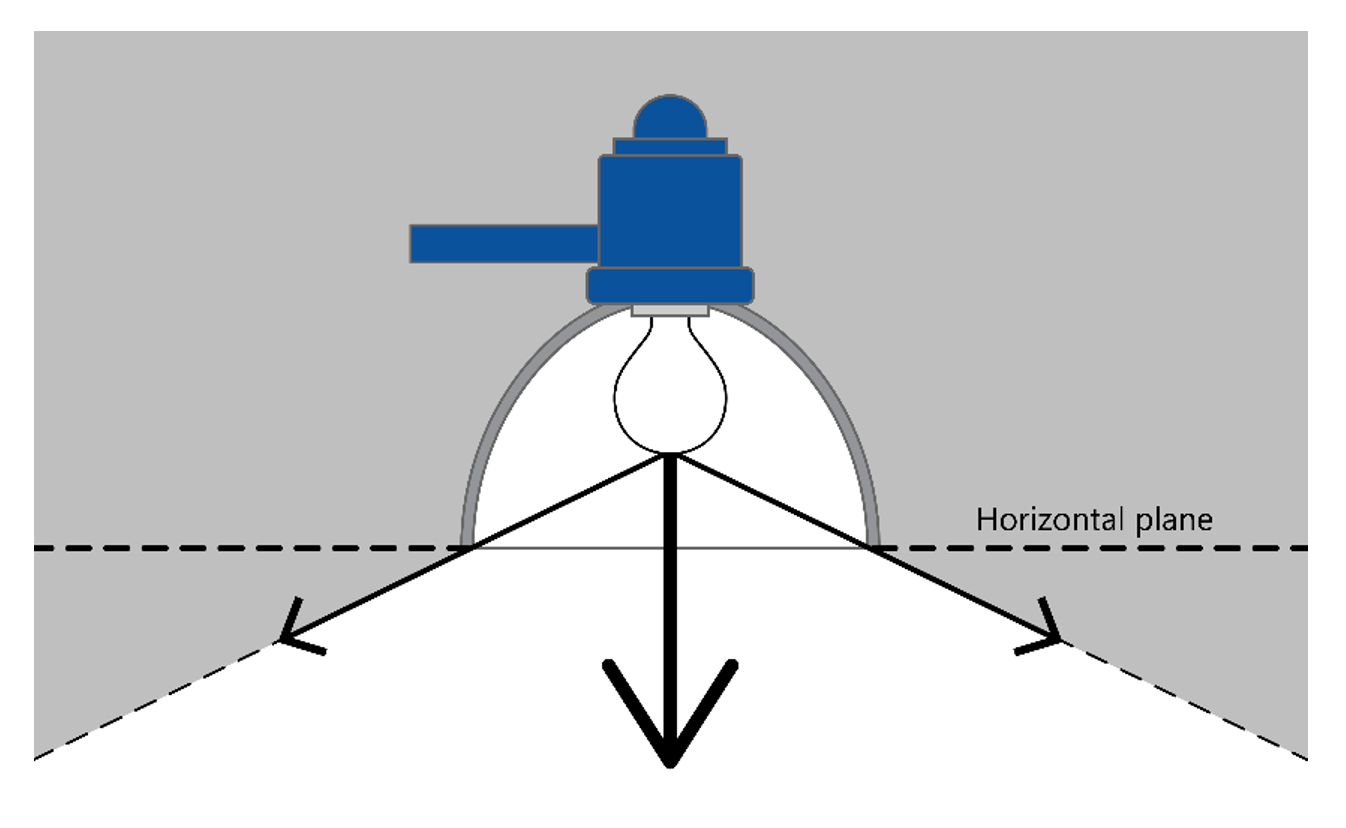
c.
All fixtures designed to illuminate signs or structures shall be mounted above the area of the sign or structure to be illuminated.
d.
Blinking, flashing, rotating, or moving lights are prohibited, unless allowed under the digital sign standards of this Code.
e.
Correlated color temperature (CCT) is limited to three thousand (3,000) kelvin per fixture.
f.
The following maximum lumen limits are established to prevent over-lighting and are not intended to be exceeded. Each site should use the lowest number of lumens needed for the site to provide safety and functionality.
1.
Single-family residential sites shall be limited to five thousand (5,000) lumens combined.
2.
Single-family residential sites that include an accessory dwelling unit shall be limited to six thousand five hundred (6,500) lumens combined. Each individual lighting fixture shall be limited to an absolute maximum of eight hundred fifty (850) lumens.
3.
Multifamily residential sites, mixed use sites and nonresidential sites shall be limited to a total of fifty thousand (50,000) lumens per net acre. Each lighting fixture shall be limited to a maximum of ten thousand (10,000) lumens.
g.
Lighting for all nonresidential uses shall be extinguished one (1) hour after close of business unless there is a public safety hazard that is best mitigated by the use of lighting. Lighting intended for security purposes shall use adaptive controls.
h.
Floodlights, spotlights or any other similar lighting shall not be used to illuminate buildings or other site features. However, targeted directional spot fixtures may be used to illuminate flagpoles (State, United States); such fixtures shall be kept to a minimum brightness and the poles should be lit from the top down, instead of from the ground.
i.
If any of the above are in conflict with the adopted City building codes, the regulations of the adopted building code shall apply.
(e)
Exempt Lighting. The following are exempt from the provisions of Subsection (1).
(1)
Lights used to illuminate athletic fields or other community special event areas. Such lights shall be turned off no more than one (1) hour after the conclusion of the event and should be designed or placed to minimize light falling beyond the area in use.
(2)
Signs that are illuminated by interior light sources, such as neon signs, provided such signs are lit only during the property owner's business hours. Maximum number of lumens still apply.
(3)
Official traffic control devices and lights owned and/or operated by or pursuant to proper authority of the United States of America, the State of Colorado or any of their agencies, public utilities, and such other lights as are specifically required by Federal or State law.
(4)
Official traffic control lights owned and operated by the City of Salida or public utilities.
(5)
Lawful vehicle lights.
(6)
Holiday Lights. Holiday lights should only be in use from November 1 to March 1.
(7)
Public Outdoor Lighting.
a.
New public lighting owned and operated by the City of Salida, including street lights, walkway lights, external building lights, holiday lights and other lights to ensure safety, shall be allowed as recommended by the Administrator or designee in situations where a public health hazard exists which can only be mitigated by artificial light at night and shall be in compliance with the general requirements in Subsection (d) above.
b.
The maximum height of any light pole (excluding road lights and traffic safety lights) shall be twenty-five (25) feet; however, poles of a lower height which are more compatible in scale with pedestrians are encouraged.
c.
Adaptive controls or curfews shall be employed in all new public outdoor lighting installations.
d.
All City-owned lighting shall comply with the requirements of this Section within five (5) years from the effective date of this Section.
(f)
Nonconforming Lights.
(1)
Lights that were lawfully existing and in use at the time they became nonconforming with the requirements of this Section by virtue of the initial adoption of this Section, subsequent amendment to this Section or by annexation into the City, may continue to be used and operated subject to the limitations of this Section.
(2)
The right to operate a lawful nonconforming light shall terminate upon any of the following:
a.
Replacement of the light fixture.
b.
Non-use of the light fixture for a period of six (6) months.
c.
Damage to the light fixture so that the cost of repair is fifty percent (50%) or more of the cost to replace it with a conforming fixture.
(3)
The right to exceed the lumen limits established in Subsection 16-4-100(d)(1)f as a lawful nonconforming site shall terminate upon any of the following:
a.
Replacement of fifty percent (50%) or more of the light fixtures on the site.
b.
Damage to the light fixtures so that the cost of repair is fifty percent (50%) or more of the cost to replace them with conforming fixtures.
(4)
No alteration may be made to lighting on a site that would increase the amount or degree of the nonconformity.
(Ord. No. 2025-17, § 2(Exh. A), 10-7-2025)
Sec. 16-4-110. - Parks, trails, and open space dedication.
(a)
Purpose. This Section is intended to ensure that a comprehensive, integrated network of parks, trails, and open spaces is developed in accordance with the Parks, Recreation, Open Space and Trails Master Plan and the Comprehensive Plan and that such network is preserved as Salida grows.
(b)
Applicability.
(1)
This Section applies to any residential or mixed-use development, including:
a.
Planned developments;
b.
Major subdivisions;
c.
Minor subdivisions;
d.
Condominium plats of any size; and
e.
Major and Minor Site Plan Reviews that include a minimum of five (5) residential units:
(2)
As of the effective date of this Code, any applicable development shall dedicate and develop land or, in some cases, shall pay a fee-in-lieu for the purpose of providing and maintaining publicly accessible parks, open spaces, recreation facilities, and/or trails or other public purposes as determined by the City for the benefit of both the residents of the development and the City in general.
(c)
Dedication and Development Requirements.
(1)
Quantity. The owner of any applicable development shall dedicate and develop a minimum of twelve and one-half percent (12.5%) of the gross land area for parks, open space, and/or trails unless this requirement is otherwise satisfied by the alternatives or fee-in-lieu of dedication as specified in this Section.
(2)
Location. The location and configuration of the site or sites to be dedicated and developed shall be determined by the City in consultation with the developer and City staff.
a.
Such location and configuration shall take into account: the Parks, Recreation, Open Space and Trails Master Plan; the Comprehensive Plan; the Park Development Manual; and other relevant City planning documents; as well as the suitability of the site for park, open space, or recreational purposes; its relationship to population concentrations (including visibility and ease of access to such sites); and its proximity to other park or recreational lands.
b.
The City may require that the area be located at a suitable place, such as on the edge of the development so additional land may be added at such time as the adjacent land is developed. Land so reserved shall be of a character and location suitable for public purposes and, if consistent with the needs of the City in that particular area and if proposed for a playground or other similar recreational purposes, shall be relatively level and dry.
(3)
Minimum Size. The minimum size of any land to be dedicated for park, open space and recreational purposes generally shall be not less than one-half (0.5) acres for parks or open space, one (1) dimension of which should not be less than one hundred (100) feet, except that the City may approve dedications of a smaller size when required by the specific plans of the development and when the usefulness of the smaller area for park or recreational purposes is demonstrated (such as for a required trail).
(4)
Use of Detention Areas for Required Dedications. Detention areas for stormwater control shall not qualify as land for park, open space, trails, or recreational purposes, unless the use of the property for active recreational purposes is clearly demonstrated and feasible, and such dedication is agreed to by both the Public Works Director and the Parks Director.
(5)
Platting. All areas dedicated for parks, trails, and open space shall be shown on the plat. All dedications of land as required under this Section shall be dedicated in fee simple to the City as a condition of approval unless the City determines that the specific situation warrants consideration of an easement or designation rather than dedication.
(6)
Improvements. All parks, open spaces, trails, and other recreational facilities shall be developed by the developer according to the standards set forth in the Park Development Manual for the City of Salida and the Standard Specifications for Construction in Parks document, as they may be amended from time to time. Such improvements shall be approved and conveyed per a subdivision improvements agreement and/or development improvements agreement. Completion and conveyance of such facilities shall occur prior to certificate of occupancy for any residential units within the overall development, unless specifically excepted by the Director. Such exceptions may not be for more than ten percent (10%) of the overall units proposed without approval by City Council. For developments where individual lots will be sold separately, the facilities shall be completed and approved prior to any certificates of occupancy. A timeline for completion and conveyance shall be specified in such agreements in relation to construction of any other elements of the overall development.
(7)
Additional Land. The City may accept additional land in excess of the dedication requirement in exchange for a reduced amount of (or phased) development as determined by the Parks and Recreation Director and approved by City Council via the relevant review process.
(8)
Other Requirements.
a.
Dedicated park land may include floodplain lands, waterways and wetlands, national and state historical or natural features, and proposed public areas set aside in state, regional, county, or City comprehensive plans.
b.
Land dedicated shall not include sites for technical, private, or public schools or public agencies; sites for service organizations that are not open to the general public; and sites unsuitable for public use due to steep slopes, rock formations, adverse topography, utility easements, or other features that may be harmful to health and safety, unless accepted by the Parks and Recreation Director and approved by City Council.
c.
Lands dedicated for parks, trails, or open space shall not be counted towards the landscape area required for each lot in the subdivision.
(d)
Alternatives.
(1)
Extraordinary Contributions. Staff or the Planning Commission may recommend a reduction of the overall dedication requirement if it is determined that the land proposed for dedication is an extraordinary contribution that meets a unique or highly desired purpose of the community. Examples of extraordinary contributions may include public access to a waterway or highly important trail connections.
(2)
Alternate Site. The City Council may accept a dedication of an alternate parcel of land to the City in-lieu of dedicating land within the development if the alternate parcel meets the following standards:
a.
The parcel exceeds the required quantity of land required for dedication by a minimum of twenty-five percent (25%) and land dedication for parks, open space or trails would not otherwise be anticipated on the alternate parcel;
b.
The parcel meets or exceeds the quality and functionality of land that would otherwise be provided within the development; and
c.
The parcel reasonably serves the recreational needs of the proposed development and community at-large, as determined by the Parks and Recreation Director and approved by City Council.
(e)
Fee-in-lieu of Dedication and Development.
(1)
Applicability. In the event parks, trails, and open space are not needed within the area of development due to the size of the development, the close proximity of other parkland to the development, or other factors as determined by the Parks and Recreation Director, the City Council shall require the applicant to pay the City a fee-in-lieu of land dedication and development.
(2)
Cash Contribution in Lieu of Park, Trails, and Open Space Dedication and Development.
a.
A cash contribution equal to twelve and one-half percent (12.5%) of the value of the land shall be provided in lieu of park, open space and trails dedication and development and shall be held by the City solely for the acquisition and improvement of parks, open space, trails and other recreational facilities within the community. Because of the small size of the community, the provision of a park, open space, or other recreational land or facilities anywhere within the City of Salida comprehensive plan boundary shall be deemed to meet the needs of the proposed development.
b.
In some circumstances, the City may require a smaller percentage of the gross land area to be dedicated and developed (e.g. for a trail). In such cases, the remainder of the twelve and one-half percent (12.5%) requirement shall be met via fees-in-lieu of dedication. The amount of cash payment required shall be based on the number of acres of parkland dedication that otherwise would be required, less any reductions for public parks, open space, trails, or other recreation facilities as provided above.
(3)
Calculation.
a.
For development applications submitted after the effective date of this Code, a fee-in-lieu of dedication shall be determined by:
1.
Fair Market Value. The cash contribution in lieu of a land dedication shall be based on the fair market value of the undeveloped land that otherwise would have been dedicated as a park, open space, trail, or recreational site. The fee shall be based on the value of the land as determined by utilizing the most recent Chaffee County assessor's "actual value." In the event of any objection to the fair market value, including an objection by the City, an appraisal prepared by a qualified appraiser showing the fair market value of said undeveloped land, based upon the proposed use and similar properties in the vicinity and no more than six (6) months old, shall be provided and paid for by the objecting body. The final determination of the fair market value of said undeveloped land shall be made by the City based upon such information, along with any responses thereto by the developer or City staff.
2.
Contract Purchase Price. A contract purchase price on the subject property at the determination of the City Council.
3.
Subdivisions with Previously Existing Unit. For minor or major subdivisions where a previously existing unit exists and is proposed to remain as part of the development, the fee-in-lieu shall be reduced by the percentage of land (the area of the lot) that is occupied by the existing unit.
(4)
Payment.
a.
All dedications or fees in lieu of dedication and development shall be made prior to or concurrent with filing and recording of the final plat. In cases where there is no final plat yet and fees in lieu are required, fee in lieu payments shall be made in conjunction with submission of the first building permit application.
b.
Fee-in-lieu payments shall be placed in a recreation fund established and maintained by the City for the acquisition and improvement of land for parks, trails, playgrounds, and recreation areas in the City that may benefit the residents of the City in general, as well as those of the proposed development.
c.
For major and minor subdivisions and condominium plats of five (5) or fewer units, at the authorization of the Director and due to a demonstrated financial hardship, the developer may enter into a lot or condominium sales restriction agreement (to be noted upon the plat) for payment of the required fees-in-lieu. No such sales may happen, nor shall any building permit applications be processed until the entirety of the fee-in-lieu is paid.
(Ord. No. 2025-17, § 2(Exh. A), 10-7-2025)

