
Salida City Zoning Code
ARTICLE VIII
- ADMINISTRATION AND PROCEDURES
Sec. 16-8-10. - Purpose and organization of this Article.
(a)
The purpose of this Article is to provide consistent, equitable procedures for the review of development applications to ensure that development will be in accordance with the standards of this Article.
(b)
This Article describes the review and approval procedures for application for land use and development within the City, and is divided into the following sections:
(1)
Section 16-8-30, Common Review Procedures, describes the standard procedures that apply to most development application types.
(2)
Sections 16-8-40 through 16-8-70 contain information specific to each application type, including approval criteria and any additions or modification to the common review procedures.
(3)
Section 16-8-80 describes the review and decision-making authorities, including the City Council, the Planning Commission, the Director, and other City officials.
(Ord. No. 2025-17, § 2(Exh. A), 10-7-2025)
Sec. 16-8-20. - Summary table of development review procedures.
Table 8-A lists the development applications authorized in this Article. For each type of application, the table indicates whether a pre-application conference is required, and the review and approval role of decision-makers.
Table 8-A: Summary of Development Review Procedures
(Ord. No. 2025-17, § 2(Exh. A), 10-7-2025)
Sec. 16-8-30. - Common review procedures.
(a)
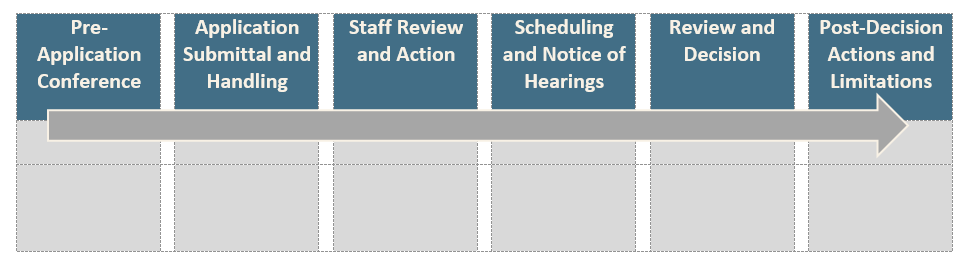
Purpose. This Section describes the standard procedures and rules application to all development applications unless otherwise stated in this Article. Common review procedures include six (6) steps, as shown below in Figure 8-1, not all of which are applicable to every development application. Application-specific procedures in Sections 16-8-40 through 16-8-70 identify additional procedures and rules beyond those in this Section.
Figure 8-1: Common Review Procedures
(b)
Pre-Application Staff Conference.
(1)
Purpose. The pre-application conference is intended to provide an opportunity for the applicant to meet with City staff to review submittal requirements, review procedures, and applicable Code standards associated with the proposed development.
(2)
When Required. A pre-application conference is required for certain applications as listed in Table 8-A and is optional for all other applications. Fees apply.
(3)
Procedure.
a.
Request. The applicant shall submit a request for a pre-application conference to the Community Development Department in a form prescribed by the Director.
b.
Required Information. Prior to scheduling the pre-application conference, the applicant shall submit the following:
1.
A written description of the proposed project;
2.
Conceptual drawings showing the location, layout, and key elements of the proposed development;
3.
Specific uses, location of uses, and densities proposed;
4.
Proposed construction phasing if applicable; and
5.
Anticipated location(s) of required public improvements if applicable.
c.
Scheduling. When required or requested by the applicant, the Director shall schedule pre-application conferences and notify appropriate staff and the applicant of the time and location of the meeting.
d.
Conference Determinations. City staff attending the pre-application conference shall identify initial concerns or issues the applicant should address related to the scope, features, and potential impacts of the project as they relate to this Code. City staff shall also indicate the approval procedures required for the proposed project. The Director shall issue to the applicant a written summary of the issues and the approval procedures within ten (10) business days following the pre-application conference.
e.
Pre-Application Joint Meeting. In addition to the pre-application conference with staff, the applicant may request a joint work session with the Planning Commission and Council for major projects, including, but not limited to, subdivisions and planned developments.
(4)
Effect. Any information or discussions held as part of the pre-application conference or pre-application joint meeting shall not be binding on the City or the applicant. Discussions of potential conditions to mitigate impacts do not reflect actions by the decision-making body until and unless a decision-making body takes formal action to attach that condition to a development approval.
(c)
Application Submittal and Handling.
(1)
Authority to Submit Application.
a.
A development application shall be submitted by:
1.
The owner, contract purchaser, or any other person having a recognized property interest in the land on which the development or activity is proposed; or
2.
A person authorized to submit the application on behalf of the owner, contract purchaser, or other persons having a recognized property interest in the land, as evidenced by a letter or document signed by the owner, contract purchaser, or another person.
b.
If there are multiple owners, contract purchasers, or other persons authorized to submit the application, all such persons shall sign the application or a letter consenting to the application.
c.
No application shall be submitted prior to attending a pre-application conference, if required pursuant to Table 8-A, Summary of Development Review Procedures.
(2)
Concurrent Review. When a proposed development involves multiple application types, the applications may be reviewed concurrently at the option of the applicant.
(3)
Application Content. The application shall be submitted to the Director on a form established by the Director. The applicant bears the burden of demonstrating compliance with application requirements. Application requirements are specified in the Administrative Manual.
(4)
Application Fees.
a.
General. Every land use and development application shall be submitted with the appropriate fees and charges for the type of application being submitted along with a cost reimbursement agreement, when applicable per the adopted fee schedule, on a form approved by City Council. For purposes of this Section, "land use and development application" shall include any and all applications filed pursuant to this Article, requests for pre-annexation agreements, and can-and-will-serve letters from developments in unincorporated Chaffee County, and Title 32 special district service plan reviews pursuant to C.R.S. § 32-1-201 et seq. The amount of such fees and charges shall be established by resolution of the City Council, as may be amended from time to time, and available for review by the public at City Hall during normal business hours.
b.
Additional Fees for Outside Consultation.
1.
In addition to the minimum application fees, if additional review by an outside professional is necessary to make a determination, the applicant shall also be charged the actual review costs and fees for outside professional services for review of the application. The minimum application fees shall be due and payable upon submission of the application. In addition, when applicable per the adopted fee schedule, at the time of submittal of the application, the applicant shall deposit funds equal to two (2) times the minimum application fee to be used as the initial payment to offset the costs of outside professional services for review of the application.
2.
After exhaustion of the initial deposit, statements for professional review services shall be mailed to the applicant, and payment of such amounts is due within thirty (30) days of receipt of the statement. Interest shall be imposed at a rate of one and one-half percent (1.5%) per month on all balances not paid within thirty (30) days of the date of the statement.
3.
All costs of providing notice, including publication, mailing, and posting, shall be borne by the applicant. Recording and filing fees imposed by the Chaffee County Clerk and Recorder, and others, as a result of the application, shall be advanced by the applicant prior to the documents being recorded.
c.
Land use approval documents shall not be deemed effective until recorded in the real property records of Chaffee County (if required pursuant to the specific application type) and all fees and charges owed to the City are paid in full.
d.
In the event the City is forced to pursue collection of any amounts due and unpaid, the City shall be entitled to collect attorney's fees and costs incurred in such collection efforts in addition to the amount due and unpaid. The City reserves the right to suspend review of an application, withhold approval, or postpone public hearings if an applicant fails to pay outstanding review fees as required. Delinquent charges may be certified to the County Treasurer and collected in the same manner as municipal taxes according to the procedure established in Chapter 4, Article VII (Municipal Liens) of the Salida Municipal Code.
(5)
Application Review Timeline. The Director shall establish an advisory review timeline for development applications and shall include that information in the Administrative Manual. The Director may amend the timeline to ensure effective and efficient review under this Article.
(6)
Determination of Application Completeness.
a.
Upon receipt of the submittal, the Director shall review the application for completeness in accordance with the application checklist and the applicable requirements of this Article. Within ten (10) days of the submittal, the Director shall determine if the application is complete and entitled to proceed.
b.
In the event the Director determines that an application is incomplete, the Director shall notify the applicant in writing by stating the deficiencies.
(7)
Abandoned Applications. If an application has not been resubmitted to address noted deficiencies within six (6) months, then such application shall be deemed abandoned. Abandoned applications may require a new pre-application conference and may be subject to additional fees. Prior to the six-month deadline, an applicant may request, in writing, a one-time extension of sixty (60) days from the Director.
(8)
Minor Application Revisions. An applicant may revise an application after receiving notice of compliance deficiencies following staff review or on requesting and receiving permission from an advisory or decision-making body after that body has reviewed, but not yet acted on, the application. Revisions shall be limited to changes that directly respond to specific requests or suggestions made by staff or the advisory or decision-making body, as long as they constitute only minor additions, deletions, or corrections and do not include significant substantive changes to the development proposed in the application, as determined by the Director. All other application revisions shall be processed as a new application.
(9)
Application Withdrawal.
a.
After an application has been accepted for review, the applicant may withdraw the application at any time by submitting a letter of withdrawal to the Director.
b.
An applicant is not entitled to a refund of application fees for withdrawn applications. However, the Director may refund fees not expended during the first round of staff review if the application is withdrawn within ten (10) days of acceptance and prior to preparation or distribution of any official written comments.
(d)
Staff Review and Action.
(1)
Department and Agency Referral Review.
a.
The Director shall distribute the complete application to the appropriate staff and other internal and external review agencies per the Administrative Manual.
b.
Such review agencies shall provide comments to the Director within fourteen (14) days following the distribution.
(2)
Staff Review and Application Revisions.
a.
Staff shall review the application and submit recommendations and comments to the applicant in a form established by the Director. The Director shall compile the comments from other reviewers and agencies and shall consider and incorporate such comments as necessary into the written summary of issues provided to the applicant.
b.
Following receipt of staff comments, the applicant may request at their discretion a meeting with the Director to discuss staff recommendations and comments.
c.
An application shall not move forward for further review until the Director determines that the applicant has modified the application to comply with the City Code and has either implemented the City/review agency recommended changes or has provided written justification as to why the recommended changes were not implemented.
(3)
Applications Subject to Staff Recommendation.
a.
Staff Report. For applications subject to staff recommendation per Table 8-A, staff shall prepare a written staff report. Such report shall state whether the application meets the requirements of this Code and other applicable standards of the City and shall include a recommendation for consideration by the appropriate decision-making body.
b.
Distribution and Availability of Application and Staff Report. The Director shall submit a copy of the staff report to the applicant and the advisory or decision-making body and shall make the report and related materials available for public review within a reasonable timeframe to review prior to any public meeting, public hearing, or decision.
(4)
Applications Subject to Staff Approval.
a.
Decision.
1.
If an application is subject to staff review and final decision by the Director, the Director shall make the decision based on review standards applicable to the application type. The decision shall be in writing and if denied or approved with conditions, shall clearly state the reasons for denial or any conditions of approval.
2.
If the Director requests changes or additional information during its review, the applicant shall submit copies of the required changes or information to the Director. The Director shall review the additional submittal with appropriate City departments and other agencies.
b.
Effect of Decision. For administrative approvals, the Director's decision is final.
c.
Conditions of Approval. Any conditions of approval shall be limited to the minimum conditions necessary to ensure compliance with the requirements of this Article and shall relate directly to the anticipated impacts of the proposed development or activity.
(e)
Scheduling and Notice of Public Hearings.
(1)
Scheduling Public Hearings.
a.
If an application is subject to a public hearing pursuant to Table 8-A, the Director shall schedule the public hearing for either a regularly scheduled meeting or special meeting of the decision-making body.
b.
The public hearing shall be scheduled to allow sufficient time to prepare a staff report pursuant to Subsection 16-8-30(d)(3)a.
(2)
Notice of Public Hearings.
a.
General Requirements. Unless otherwise stated in this Article, for all actions requiring a public hearing pursuant to Table 8-A, the applicant shall provide public notice and shall demonstrate that such public notice conforms to the requirements of this Section and the Administrative Manual.
b.
Responsibility of Party Seeking Hearing.
1.
The applicant or person seeking the public hearing shall be responsible for the accuracy and proper publication, mailing, and posting of notice, and shall bear the costs incurred by such notice. The City shall handle preparation of the notices, publication in the newspaper, inserting notices into pre-addressed and stamped envelopes provided by the applicant, and printing the posted notice.
2.
The applicant shall provide certification that proper notice has been provided, including photographic evidence (for posted notices). The format of such certification shall be established by the Director. The applicant shall submit the certification to the Director prior to the scheduled public hearing.
c.
Notice Format and Content.
1.
Content of All Public Notice. All public notice types shall:
a)
Identify the application type;
b)
Describe the nature and scope of the proposal;
c)
Identify the location subject to the application, including address and legal description if available;
d)
Identify the date, time, and location of the hearing;
e)
Identify when and where the application may be inspected, including a phone number or email address of the appropriate City agency; and
f)
Indicate if there will be an opportunity to appear and provide feedback during the hearing.
2.
Published Notice. Except as otherwise required by law, notice of the hearing shall be published in a newspaper of general circulation within the City at least fifteen (15) days in advance of the hearing.
3.
Mailed Notice. Except as otherwise required by law, notice shall be sent by first class mail to all property owners within one hundred seventy-five (175) feet of the property in question at least fifteen (15) days in advance of the hearing.
4.
Posted Notice.
a)
The City shall provide any required sign(s).
b)
At least one (1) notice sign shall be posted by the applicant on the subject property at least fifteen (15) days in advance of the hearing. The dimensions of the sign shall be at least eleven (11) by seventeen (17) inches, and the materials to which the notice is affixed shall be upright, sturdy, and waterproof.
c)
The Director may require additional signs based on the access and configuration of the subject property.
(3)
Notice to Mineral Estate Owners and Lessees. The applicant shall provide notice by certified mail, return receipt requested, to all mineral owners and lessees on the subject property for development applications in accordance with C.R.S. § 24-65.5-103. Such notice shall be provided not less than thirty (30) days prior to the initial public hearing, or not less than thirty (30) days prior to the final decision if the application does not require a public hearing. The burden of determining mineral estate owners and lessees shall be on the applicant.
(4)
Constructive Notice.
a.
Minor Defects in Notice Shall Not Invalidate Proceedings. Minor defects in any notice shall not impair the notice or invalidate proceedings pursuant to the notice if a bona fide attempt has been made to comply with applicable notice requirements. Minor defects in notice shall be limited to errors in a legal description or typographical or grammatical errors that do not impede communication of the notice to affected parties. In all cases, however, the requirements for the timing of the notice and for specifying the time, date, and place of a hearing shall be strictly construed.
b.
Failure to Receive Notice Shall Not Invalidate Action. Failure of a party to receive written notice shall not invalidate subsequent action. If questions arise at the public hearing regarding the adequacy of notice, the decision-making body shall make a formal finding as to whether there was substantial compliance with the notice requirements of this Article.
(f)
Review and Decision.
(1)
Review and Decision by the Director. Applications subject to administrative review and approval shall be decided by the Director in accordance with Subsection 16-8-30(d)(4), Applications Subject to Staff Approval.
(2)
Review and Recommendations or Decisions by Planning Commission or City Council.
a.
Applications shall be subject to review, hearings, recommendations, and decisions in accordance with Table 8-A, Summary of Development Review Procedures.
b.
If an application requires a public hearing, the decision-making body shall hold a public hearing in accordance with Subsection 16-8-30(e), Scheduling and Notice of Public Hearings, and Section 16-8-80, Review and Decision-Making Bodies.
c.
The decision-making body shall consider the application, supporting materials, staff report, and any evidence presented during the public hearing (if required).
d.
The advisory body shall recommend, and the decision-making body shall approve, approve with conditions, or deny the application based on the applicable approval criteria relevant to the application type. In making its recommendation, the body may continue the hearing to a date certain because additional information or changes are necessary to determine whether the application complies with this Code. The applicant may also request to continue the hearing to a date certain, but any subsequent requests for a continuance shall be at the discretion of the governing body. If the hearing is continued, the requested information shall be provided to the Director at least ten (10) calendar days prior to the date of the continued hearing. Nothing shall prohibit the advisory or decision-making body from continuing a hearing more than once.
e.
If the application requires a quasi-judicial hearing, the recommendation or decision shall be based only on the record of the public hearing and shall be in writing, shall include findings of fact based on quality, material, and substantial evidence, shall reflect the determination of any contested facts, and shall state how the findings support compliance with the approval criteria.
f.
The decision-making body shall clearly state the factors considered in making its recommendation or decision, as well as the rationale for such recommendation or decision.
g.
Any recommendation or decision to deny an application shall specify the specific reasons, citing specific Code provisions and adopted policies of the City with respect to the proposed development.
(3)
Conditions of Approval.
a.
Where this Article authorizes a decision-making body to approve or deny an application subject to applicable criteria, the decision-making body may approve the application with conditions necessary to bring the proposed development into compliance with this Article or other regulations, or to mitigate the impacts of that development on surrounding properties and streets.
b.
Conditions of approval shall be reasonably related to the anticipated impacts of the proposed use or development or shall be based upon standards duly adopted by the City. Such conditions may include those necessary to carry out the purpose and intent of the Comprehensive Plan, other adopted City policies, and this Code. No conditions of approval shall be less restrictive than the requirements of this Code, except where the Code expressly allows deviations.
c.
Any condition of approval that requires an applicant to dedicate land or pay money to a public entity in an amount that is not calculated according to a formula applicable to a broad class of applicants shall be roughly proportional both in nature and extent to the anticipated impacts of the proposed development, as shown through an individualized determination of impacts. The City shall bear the burden of determining such impacts.
d.
During its consideration, the decision-making body may consider alternative potential conditions, and no discussion of potential conditions shall be deemed an attempt or intent to impose any condition that would violate the federal or state constitutions, statutes, or regulations. Discussions of potential conditions to mitigate impacts do not reflect actions by the decision-making body unless and until the decision-making body takes formal action to attach that condition to a development approval.
e.
The approving body may modify conditions recommended by the reviewing body prior to making a final decision on an application.
f.
Unless otherwise provided in this Article, any representations of the applicant in submittal materials or during public hearings shall be binding as conditions of approval.
(4)
General Approval Criteria. The following general criteria shall apply to the various application types submitted to the City for review and approval. If there is a conflict between these general criteria and the specific review criteria listed for a particular application type, then the specific review criteria shall control.
a.
Compliance with this Code. The proposed use and development shall comply with the applicable standards in this Code, including, but not limited to, zoning districts, use regulations, and development standards, unless the standard is lawfully modified.
b.
Compliance with Other Applicable Regulations. The proposed use and development shall comply with all other City regulations and with all applicable standards or requirements of federal, state, or other local government control of the property or the current or proposed use of the property.
c.
Compliance with Prior Approvals. The proposed use and development shall be consistent with the terms and conditions of any prior land use approval, plan, or plat approval for all or part of the property that is in effect and not proposed to be changed. This criterion includes consistency with approved development phasing plans and the installation of public improvements.
d.
Consistency with Adopted Plans. The proposed use and development are consistent with applicable City policies of the Comprehensive Plan and other adopted City plans and policies.
(5)
Reasonable Accommodations Under the Fair Housing Amendments Act (FHAA).
a.
The City may approve any modification to accommodate requirements under the FHAA provided:
1.
The modification is the minimum change from the provisions of this Article necessary to comply with the FHAA; and
2.
The modification will not cause adverse impacts on the surrounding area.
b.
The City may approve a type of accommodation that is different than the applicant's request if the City deems such accommodation would satisfy the requirements of the FHAA and would result in fewer impacts on the surrounding area.
c.
The City may be required to approve requests for reasonable accommodations under the FHAA regardless of whether the request qualifies as a minor modification under Subsection 16-8-70(b).
(6)
Accommodations Under Religious Land Use and Institutionalized Persons Act (RLUIPA).
a.
The City may allow modifications to eliminate a substantial burden on religious exercise as guaranteed by RLUIPA, as amended.
b.
Under no circumstance may the City approve a modification that allows a use, structure, or activity in a zoning district where such use, structure, or activity is prohibited.
c.
The City may grant a waiver or partial waiver of the provisions of this Code to accommodate a person's free exercise of religion pursuant to Federal or State law.
(g)
Post-Decision Actions and Limitations.
(1)
Notice of Decision.
a.
Within ten (10) days after a final decision is made on an application, the Director shall provide written notification of the decision by personal delivery, electronic mail, or first-class mail to the applicant.
b.
If the decision was subject to a quasi-judicial hearing, the Director shall also provide written notification of the decision to the owners of the subject property and any other person that requested a copy of the decision prior to its effective date.
(2)
Appeal. A party aggrieved by final decisions may appeal the decision in accordance with the appeal procedures in Subsection 16-8-70(c).
(3)
Expiration of Approval.
a.
An application approval shall be valid as authorization for the approved activity unless it expires in accordance with expiration time periods provided in this Article.
b.
A change in ownership shall not affect the established expiration time period of an approval unless otherwise stated in this Article.
c.
Unless otherwise provided in this Article, the Director may grant extensions of the expiration time period for up to one (1) year following a written request that explains reasonable cause for such extension, prior to the expiration date. The Director shall determine whether there is reasonable cause for the extension. Further extensions shall be subject to the approval by the decision-making body for the original application.
(4)
Format of Final Submissions. All final subdivision plats, development plans, record drawings, and annexation maps shall be submitted to the City on a method of data transfer acceptable to the City as detailed in the Administrative Manual. This requirement may be waived at the discretion of the Director.
(5)
Modification or Amendment of Approval. Unless otherwise provided in this Article, any substantial modifications to approved plans, permits, or conditions shall require a new application submitted and reviewed in accordance with the full procedure requirements applicable to the original application. The Director shall determine whether proposed modifications or amendments to an approval are considered substantial and may require further determination by the decision-making body of the original application.
(6)
Limitation on Subsequent Similar Applications. Following denial of an application, the decision-making body shall not decide on applications that are the same or substantially similar within one (1) year of the denial. This waiting period may be waived by the decision-making body provided that there is substantial change to circumstances or new information is available related to the issues or facts considered during the previous review.
(h)
Vested Property Rights.
(1)
Purpose. The vested rights procedure provides the mechanism for approval of vested real property rights pursuant to State statutes C.R.S. Article 68 of Title 24, as amended. Nothing in this Section is intended to create a vested property right, but only to implement State law.
(2)
Applicability.
a.
For all site-specific development plans, a vested property right shall be deemed established upon the approval of the plan in accordance with this Section and the applicable requirements of this Article. The following shall be considered site-specific development plans:
1.
Minor site plan.
2.
Major site plan.
3.
Final plat.
4.
Planned Development.
b.
All other approval types authorized by this Article and not listed in Paragraph a. above shall not constitute a site-specific development plan.
c.
Establishment of a vested property right pursuant to law shall not preclude the application of ordinances or regulations that are general in nature and are applicable to all property subject to land use regulation by the City, including, but not limited to, building, fire, plumbing, electrical, housing, mechanical, and dangerous building codes. Approval of a site-specific development plan shall not constitute an exemption from or waiver of any other provisions of this Article pertaining to the development and use of property.
(3)
Vested Rights Procedure.
a.
A vested property right shall be deemed established with respect to any property upon the approval, or conditional approval, of a site-specific development plan, following notice and public hearing by the City. A vested property right shall attach to and run with the applicable property and shall provide the landowner the right to undertake and complete the development and use of said property under the terms and conditions of the site-specific development plan in accordance with the zoning and development ordinances in effect at the time of approval.
b.
A site-specific development plan shall be deemed approved upon the effective date of the City's approval action. In the event amendments to an approved site-specific development plan are proposed and approved, the effective dates of such amendments, for purposes of the duration of a vested property right, shall be the effective date of the approval of the original site-specific development plan, unless the City specifically finds to the contrary and incorporates such finding in its approval of the amendment.
c.
The City may approve a site-specific development plan upon such terms and conditions as may reasonably be necessary to protect the public health, safety and welfare, and failure to abide by such terms and conditions may, at the option of the City Council, after public hearing, result in the forfeiture of vested property rights. This shall be strictly construed.
(4)
Duration and Termination of Vested Property Rights.
a.
A property right that has been vested pursuant to this Section and C.R.S. Article 68 of Title 24 shall remain vested for a period of three (3) years, at which time the vesting period shall expire. This vesting period shall not be extended by any amendments to a site-specific development plan unless expressly authorized by the City.
b.
The City is authorized to enter into development agreements with landowners providing that property rights shall be vested for a period exceeding three (3) years where warranted in the light of all relevant circumstances including, but not limited to, the size and phasing of the development, economic cycles, and market conditions.
c.
Following approval or conditional approval of a site-specific development plan, nothing contained in this Section or Article 68 of C.R.S. Title 24 shall exempt such a plan from subsequent reviews and approvals by the City to ensure compliance with the terms and conditions of the original approval.
(5)
Waiver of Vested Property Rights. An applicant may waive a vested property right by separate agreement, which shall be recorded in the office of the Chaffee County Clerk and Recorder. Unless otherwise agreed to by the City, any landowner requesting annexation to the City shall waive in writing any preexisting vested property rights as a condition of such annexation.
(6)
Effect of Vested Property Rights Precludes Some Land Use Limitations. A vested property right, once established as provided in this Section and C.R.S. Article 68 of Title 24, as may be amended, precludes any zoning or land use action by the City or pursuant to an initiated measure which would alter, impair, prevent, diminish, impose a moratorium on development, or otherwise delay the development or use of the property as set forth in an approved site-specific development plan, except:
a.
With the consent of the affected landowner;
b.
Upon the discovery of natural or manmade hazards on or in the immediate vicinity of the subject property, which hazards could not reasonably have been discovered at the time of site-specific development plan approval, and which hazards, if uncorrected, would pose a serious threat to the public health, safety, and welfare; or
c.
To the extent that the affected landowner receives just compensation for all costs, expenses, and liabilities incurred by the landowner after approval by the City, including, but not limited to, costs incurred in preparing the site for development consistent with the site-specific development plan, all fees paid in consideration of financing, and all architectural, planning, marketing, legal, and other consultants' fees, together with interest at the legal rate until paid. Just compensation shall not include any diminution in the value of the property caused by such action.
(Ord. No. 2025-17, § 2(Exh. A), 10-7-2025)
Sec. 16-8-40. - Ordinance amendments.
(a)
Rezoning.
(1)
Purpose. The rezoning procedure is intended to allow the City to amend the Official Zoning Map for the City of Salida to reflect changes in policy, changed conditions, or to advance the public welfare of the City. The rezoning procedure should not be used when a conditional use, variance, or minor modification could be used to achieve a similar result. Changes to dimensional standards within a zoning district such as setbacks or building height should be processed as Code text amendments in accordance with Subsection 16-8-40(c).
(2)
Applicability. A rezoning may be approved by the City Council following review and recommendation by the Planning Commission. A rezoning to a Planned Development shall be processed in accordance with Subsection 16-8-40(b).
(3)
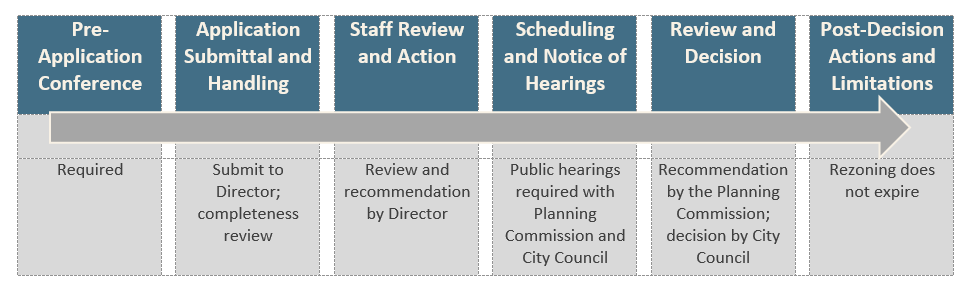
Rezoning Procedure. Figure 8-2 identifies the applicable steps from the common review procedures that apply to the review of rezonings. Additions or modifications to the common review procedures are noted below.
Figure 8-2: Summary of Rezoning Procedure
a.
Pre-Application Conference. A pre-application conference shall be held in accordance with Subsection 16-8-30(b).
b.
Application Submittal and Handling.
1.
General.
a)
The rezoning application shall be submitted, accepted, and may be revised or withdrawn, in accordance with Subsection 16-8-30(c).
b)
A rezoning application may be initiated by the City Council, the Planning Commission, the Director, or the owner of the real property subject to the proposed rezoning.
c)
When multiple parcels are proposed for rezoning, the Director may require a separate application for each property.
2.
Concurrent Review. An applicant may request concurrent review of a development permit and/or subdivision approval with a rezoning application. The Director shall provide guidance on concurrent review during the pre-application conference.
c.
Staff Review and Action. The Director shall review the application and prepare a staff report and recommendation in accordance with Subsection 16-8-30(d).
d.
Scheduling and Notice of Hearings. The rezoning application shall be scheduled for public hearings before the Planning Commission and the City Council and noticed in accordance with Subsection 16-8-30(e).
e.
Review and Decision.
1.
Planning Commission Review and Recommendation. The Planning Commission shall review the rezoning application and recommend approval or denial in accordance with Subsection 16-8-30(f) and the approval criteria below.
2.
City Council Review and Decision. The City Council shall review the rezoning application and act to approve or deny the rezoning in accordance with Subsection 16-8-30(f) and the approval criteria below. Conditions may not be attached to a rezoning decision.
a)
Rezoning Approval Criteria.
1)
In reviewing a proposed rezoning, the Planning Commission and City Council shall consider whether:
i.
The proposed amendment is generally consistent with the Comprehensive Plan;
ii.
The proposed amendment is consistent with the purpose of the zoning district to which the property is proposed to be designated; and
iii.
The development allowed by the proposed zoning would be compatible with surrounding zoning districts, land uses, and neighborhood character of properties within City limits; or compatible with future anticipated zoning districts, land uses, and neighborhood character of properties within City limits;
OR
2)
The applicant shall demonstrate that conditions affecting the subject parcel or the surrounding neighborhood have changed, or that due to incorrect assumptions or conclusions about the property, one (1) or more errors in the Official Zoning Map boundaries have occurred.
f.
Post-Decision Actions and Limitations. Post-decision actions and limitations in Subsection 16-8-30(g) shall apply with the following modifications:
1.
Following approval of a rezoning, the Director shall prepare an appropriate revision to the Official Zoning Map.
2.
An owner of any property affected by a proposed rezoning may protest the rezoning pursuant to statutory requirements of C.R.S. § 31-23-305.
(b)
Rezoning to Planned Development Overlay.
(1)
Purpose. The zoning classification of any parcel may be changed to apply the planned development overlay district (PD) pursuant to this Subsection. The purpose of a rezoning to apply a PD overlay is to encourage innovation and achieve greater flexibility than allowed by the strict application of the Code while providing greater benefit to the City and to ensure efficient provision of services and utilities through a negotiated process. The PD procedure should not be used when a conditional use approval, variance, minor modification, or rezoning to a base zoning district could achieve a similar result. Examples of how a PD overlay may provide greater benefit to the City include:
a.
Greater mix of uses and building types;
b.
Higher level of environmental protection;
c.
Improved design quality;
d.
Innovative and diverse housing types;
e.
Historic preservation;
f.
Promotion of multi-modal travel; and
g.
Higher level of public amenities such as open spaces, parks, recreational areas, trails, and schools.
(2)
Applicability.
a.
An application to rezone to PD may be submitted for any contiguous area of two (2) acres or more within any combination of zoning districts.
b.
The PD zoning classification is established by overlaying the designation on land within an existing or newly created zoning district.
c.
Where a PD permits single-unit detached dwellings, one (1) accessory dwelling unit is permitted by right on any feel simple lot occupied by a primary unit(s), subject to Subsection 16-3-30(f)(1), Accessory Dwelling Unit.
(3)
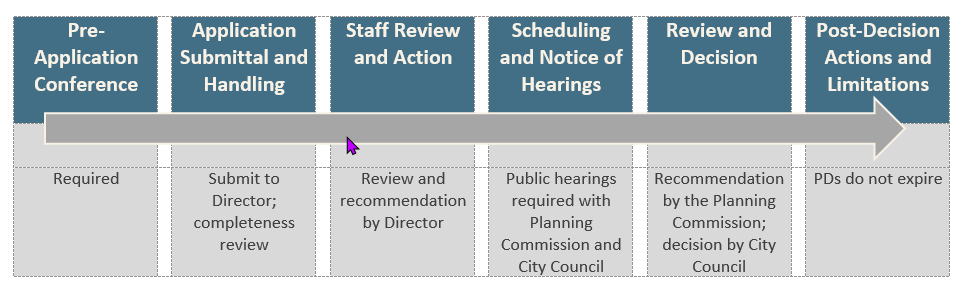
Rezoning to PD Procedure. Figure 8-3 identifies the applicable steps from the common review procedures that apply to the review of rezonings to PD. Additions or modifications to the common review procedures are noted below.
Figure 8-3: Summary of Rezoning to Planned Development Procedure
a.
Pre-Application Conference. A pre-application conference shall be held in accordance with Subsection 16-8-30(b).
b.
Application Submittal and Handling.
1.
General. The rezoning application shall be submitted, accepted, and may be revised or withdrawn, in accordance with Subsection 16-8-30(c).
2.
PD Plan Required. An application for rezoning to PD shall include a PD plan. Approval of a PD plan is required prior to approval of a development permit in a PD district.
3.
Concurrent Review.
a)
Development permit applications may be submitted concurrently with a PD application.
b)
A subdivision application submitted under Subsection 16-8-50(c)(3)a may be reviewed concurrently with an application for rezoning to PD. A preliminary subdivision plat on a site covered by a proposed PD shall not be approved until after the rezoning to PD is approved.
c)
A vested rights application submitted under Subsection 16-8-30(h) may be reviewed concurrently with an application for rezoning to PD.
4.
Phased Development. Development within a PD may be proposed to be phased. In such instance, the phasing shall be planned so that neither the initial phase nor subsequent phases will have an adverse impact on the PD or its surroundings.
c.
Staff Review and Action. The Director shall review the application and prepare a staff report and recommendation in accordance with Subsection 16-8-30(d).
d.
Scheduling and Notice of Hearings. The rezoning to PD application shall be scheduled for public hearings before the Planning Commission and the City Council and noticed in accordance with Subsection 16-8-30(e).
e.
Review and Decision.
1.
Planning Commission Review and Recommendation. The Planning Commission shall review the rezoning to PD application and recommend approval or denial in accordance with Subsection 16-8-30(f) and the approval criteria below.
2.
City Council Review and Decision. The City Council shall review the rezoning to PD application and act to approve or deny the rezoning to PD in accordance with Subsection 16-8-30(f) and the following approval criteria:
a)
Rezoning to PD Approval Criteria. In reviewing a proposed PD, the Planning Commission and City Council shall consider whether and to what extent the PD:
1)
Meets the general approval criteria in Subsection 16-8-30(f)(4) and the approval criteria for rezonings in Subsection 16-8-40(a)(3)e.2.a);
2)
Addresses a unique situation, provides substantial benefit to the City, or incorporates innovative design that achieves a higher quality standard than could otherwise be achieved through strict application of a base zoning district;
3)
Meets all applicable standards of this Code not expressly modified by the PD application, including, but limited to, standards in Article 16-4, Development and Design Standards, and Article 16-9, Inclusionary Housing; and
4)
Provides a variety of housing types and densities, if residential is proposed as part of the PD.
3.
Approval of PD Plan. The approved PD zoning and the approved PD plan along with associated exhibits are inseparable. A PD zoning shall not be established without the approval of a final PD plan.
f.
Post-Decision Actions and Limitations. Post-decision actions and limitations in Subsection 16-8-30(g) shall apply with the following modifications:
1.
Effect of Approval. The regulations of this Code remain applicable to areas within a PD district unless expressly modified by the approved PD.
2.
Recording and Map Revision.
a)
Following approval of a rezoning to PD, the Director shall prepare an appropriate revision to the Official Zoning Map to demarcate the PD overlay.
b)
The PD plan and zoning amendment shall be recorded with the Chaffee County Clerk and Recorder.
3.
Protest. An owner of any property affected by a proposed rezoning may protest the rezoning pursuant to statutory requirements of C.R.S. § 31-23-305.
4.
Amendment.
a)
Except as provided below for minor amendments, an approved PD plan may only be amended pursuant to Subsection 16-8-30(g)(5).
b)
Minor amendments to an approved PD plan may be approved by the Director if the proposed amendment complies with all of the following criteria:
1)
The amendment shall not change the ratio of residential units to square feet of nonresidential building square footage by more than ten percent (10%).
2)
The number of residential units shall not be increased or decreased by more than ten percent (10%).
3)
The gross square footage of nonresidential building area shall not be increased or decreased by more than ten percent (10%).
4)
The amendment shall not change the allowed uses listed in the approved PD plan.
5)
The number or location of vehicular access points shall not be changed in a way that negatively impacts public safety or the flow of traffic onto public streets.
6)
The numeric standards in the PD plan shall not be revised by more than would be allowed through Subsection 16-8-70(b), Minor Modification.
(c)
Code Text Amendment.
(1)
Purpose. The code text amendment procedure is provided to revise the text of this Code to respond to changed conditions or changes in public policy, or to advance the general welfare of the City.
(2)
Applicability. An amendment to the text of this Code may be initiated by the City Council, the Planning Commission, the Administrator, the Director, a resident of the City, or an owner of a business within the City.
(3)
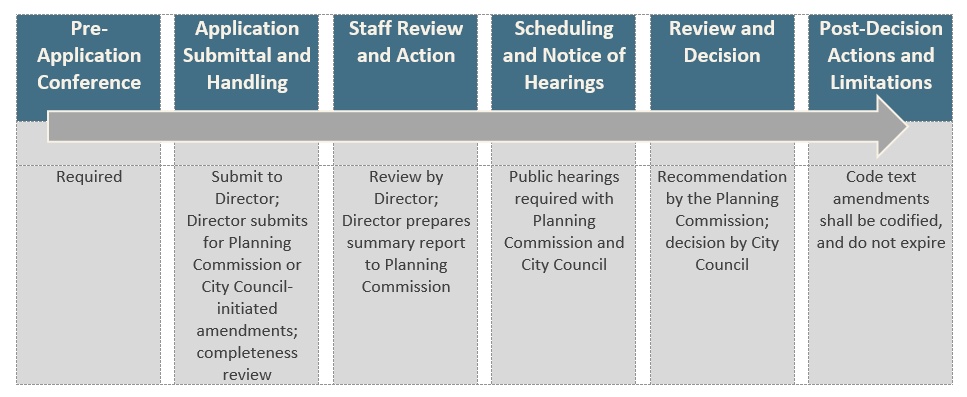
Code Text Amendment Procedure. Figure 8-4 identifies the applicable steps from the common review procedures that apply to the review of code text amendments. Additions or modifications to the common review procedures are noted below.
Figure 8-4: Summary of Code Text Amendment Procedure
a.
Pre-Application Conference. A pre-application conference shall be held in accordance with Subsection 16-8-30(b) if initiated by a private citizen.
b.
Application Submittal and Handling.
1.
The code text amendment application shall be submitted, accepted, and may be revised or withdrawn, in accordance with Subsection 16-8-30(c).
2.
The applicant shall submit a complete text amendment application to the Director containing the precise amended wording. The Director shall be responsible for submitting the application materials for an amendment initiated by the City Council, Planning Commission, or City Administrator.
c.
Staff Review and Action. The Director shall forward a report to the Planning Commission that summarizes the application's compliance with the applicable approval criteria in Subsection 16-8-40(c)(4), below, and other applicable provisions of this Code. Technical comments and professional recommendations of other agencies and organizations may be solicited in preparing the summary report.
d.
Scheduling and Notice of Public Hearings. The code text amendment application shall be scheduled for public hearings before the Planning Commission and the City Council and noticed in accordance with Subsection 16-8-30(e).
e.
Review and Decision.
1.
Review and Recommendation by the Planning Commission. The Planning Commission shall hold a public hearing to review the conformance of the application with the approval criteria in Subsection 16-8-40(c)(4), below, and all applicable provisions of this Code. The Commission shall recommend that the City Council approve, approve with conditions, or deny the application, or shall remand the application to the applicant with instructions for modification or additional information or action.
2.
Review and Decision by the City Council. The City Council shall consider the approval criteria in Subsection 16-8-40(c)(4), below, and the recommendations of the Planning Commission at a public hearing. The City Council shall, by ordinance, approve or deny the proposed amendment or shall remand it to the applicant with instructions for modification or additional information or action.
f.
Post-Decision Actions and Limitations. Upon approval of the amendment and the filing, the Director shall cause the amended text of this Code to be officially codified.
(4)
Code Text Amendment Approval Criteria. In reviewing a proposed Code text amendment, the Planning Commission and City Council shall determine that the following criteria are met:
a.
The proposed amendment is consistent with the general purpose and intent of this Code;
b.
The proposed amendment shall not conflict with any other applicable provisions of this Code, or the City shall repeal or amend provisions of this Code that are inconsistent, unreasonable, or out-of-date;
c.
The proposed amendment shall be consistent with the Comprehensive Plan; and
d.
The proposed amendment shall preserve the public health, safety, general welfare, and environment and shall contribute to the orderly development of the City.
(d)
Annexation.
(1)
Purpose. The following subsections establish the procedure for annexation:
(2)
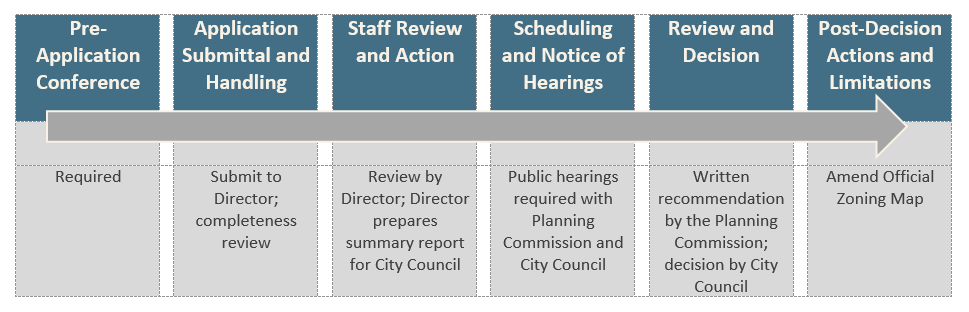
Annexation Procedure. Figure 8-5 summarizes the steps of the annexation procedure. An applicant requesting annexation shall follow the following steps in addition to the procedure set forth at C.R.S. § 31-12-101 et seq.
Figure 8-5: Summary of Annexation Procedure
a.
Pre-Application Conference. A pre-application conference shall be held in accordance with Subsection 16-8-30(b).
b.
Application Submittal and Handling.
1.
Application Contents. The annexation application shall include:
a)
Letter of Intent. The applicant shall provide a letter of intent addressed to the City Council to serve as a cover letter to the formal petition, introducing the applicant(s) to the City Council, requesting annexation of the petitioner's property and describing the development plans for the property, if it is annexed.
b)
Annexation Application Form. The City's Annexation Application Form shall be completed, signed, and dated.
c)
Cost Reimbursement Agreement. The application shall be accompanied a signed standard form Cost Reimbursement Agreement for the payment of development review expenses incurred by the City.
d)
Petition for Annexation. The applicant shall submit a petition for annexation complying with the requirements of C.R.S. § 31-12-107. The City's standard form petition shall be utilized. Any deviation from the standard form petition will require review and approval by the City Attorney before the City accepts the petition for processing. The petition shall include statements required by State law and in accordance with the Administrative Manual.
e)
Annexation Map. All annexation petitions shall provide an annexation map. Such map shall be prepared in accordance with State law and the Administrative Manual.
f)
Waiver of Vested Property Rights. Per Subsection 16-8-30(h), unless otherwise agreed to by the City, any landowner requesting annexation to the City shall provide record of waiver of any preexisting vested property rights.
g)
Water Rights. The Municipal Services Area shall be considered for all applications. The dedication of sufficient water rights for any proposed development outside of the Municipal Services Area shall be referred to the Director of Public Works for review and subsequent approval by City Council. In these circumstances, the applicant may be required to complete a Historical Consumptive Use analysis for existing water rights related to the subject property and provide sufficient water rights to support development. Additionally, the City reserves a first right of refusal for obtaining the water rights for the subject property as part of the annexation process.
2.
Annexation Fees.
a)
Each petition for annexation shall be accompanied by a fee intended to reimburse the City for the costs associated with the review of the annexation. In addition, the petitioner shall be required to pay the actual City review costs including, but not limited to, the costs of outside City consultants and City legal fees. All costs related to recording the annexation documents shall also be paid by the petitioner.
b)
In addition to the review fees, additional fees are charged for park land dedication and water rights acquisition fees (or water dedications, if applicable). Some of the fees may be deferred pending the zoning and development of the annexed property. The City Council will make the final determination on required fees.
c.
Staff Review and Action.
1.
The Director shall forward the complete application along with a report to the City Council that summarizes the application's compliance with the applicable review standards contained in the petition for Annexation, the Colorado Municipal Annexation Act of 1965, and other applicable provisions of this Code.
2.
For annexations of more than ten (10) acres, the City shall prepare an impact report concerning the proposed annexation at least twenty-five (25) days before the date of the public hearing, unless the Chaffee County Board of County Commissioners waives this requirement. The report and procedures shall meet the standards established in CRS § 31-12-108.
3.
The technical comments and professional recommendations of other agencies and organizations may be solicited in drafting the report.
d.
Scheduling and Notice of Public Hearings.
1.
Setting Hearing Date. Upon receipt of the staff report from the Director, the City Council shall by resolution establish a date for a public hearing. The City Council shall also direct the Planning Commission to review the annexation map and all required supportive information and submit a written recommendation to the City Council.
2.
Public Notice. Upon the establishment of a public hearing date, the City Clerk shall give appropriate notice in accordance with the Colorado Municipal Annexation Act of 1965. In addition, notice shall be provided as specified in Subsection 16-8-30(e)(2).
e.
Review and Decision.
1.
Review and Recommendation by the Planning Commission. The Planning Commission shall hold a public hearing to review the conformance of the application with the Colorado Municipal Annexation Act of 1965, and all applicable provisions of this Code. The Commission shall recommend that the City Council approve, approve with conditions, or deny the application, or shall remand the application to the applicant with instructions for modification or additional information or action.
2.
Review and Decision by the City Council. Upon the submission of documentation in accordance with this Section and upon compliance with the notice and hearing requirements as set forth in the Colorado Municipal Annexation Act of 1965, the City Council may consider the approval of an ordinance annexing the subject property to the City.
f.
Post-Decision Actions and Limitations. Upon approval of the annexation ordinance and the filing and, if applicable, recordation of any documents required by the approval, the Director shall place the annexation on the Official Zoning Map.
g.
Concurrent Review. Annexations may be considered concurrently with zoning and development permits; however, no development permit for land proposed for annexation into the City shall become effective until the related annexation is approved by the City Council.
(Ord. No. 2025-17, § 2(Exh. A), 10-7-2025)
Sec. 16-8-50. - Development permits and approvals.
(a)
Minor Site Plan Review.
(1)
Purpose. The minor site plan process allows the City to administratively evaluate smaller developments for compliance with the development and design standards of this Code. The minor site plan review procedure ensures that potential impacts are considered prior to an applicant submitting engineered construction plans or issuance of a building permit and certificate of occupancy.
(2)
Applicability. See Table 3-A, Table of Allowed Uses, for designation of uses that require minor site plan approval.
(3)
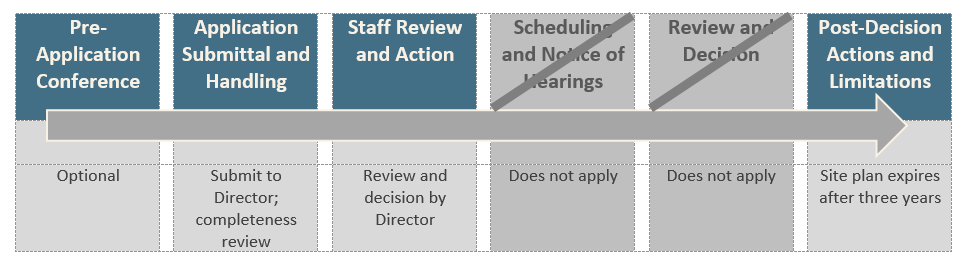
Minor Site Plan Review Procedure. Figure 8-6 identifies the applicable steps from the common review procedures that apply to the review of minor site plans. Additions or modifications to the common review procedures are noted below.
Figure 8-6: Summary of Minor Site Plan Review Procedure
a.
Pre-Application Conference. A pre-application conference shall be optional in accordance with Subsection 16-8-30(b).
b.
Application Submittal and Handling.
1.
General. The minor site plan application shall be submitted, accepted, and may be revised or withdrawn, in accordance with Subsection 16-8-30(c).
2.
Concurrent Review. A site plan application may be submitted and reviewed concurrently with a conditional use approval, a minor modification, variance, or subdivision plat.
c.
Staff Review and Action. The Director shall review the minor site plan application and approve, approve with conditions, or deny the minor site plan in accordance with Subsection 16-8-30(f)(4) and the following approval criteria:
1.
Site Plan Approval Criteria. In reviewing a proposed site plan application, the Director (for minor site plans) and Planning Commission (for major site plans) shall consider whether:
a)
The site plan is consistent with the general purpose and intent of this Code;
b)
The site plan is consistent with the standards of this Code; and
c)
The site plat is consistent with any previously approved plat, PD plan, or other previous land use approval applicable to the site.
d.
Post-Decision Actions and Limitations.
1.
Filing of Site Plan Approval. An approved site plan shall be officially filed with the Community Development Department within sixty (60) days of its approval.
2.
No Building Permit or Certificate of Occupancy without Approval.
a)
No building permit shall be issued without approval of the site plan, unless exempted from site plan review under Subsection 16-8-50(a)(2)a.
b)
The building permit shall incorporate any conditions of approval associated with the site plan.
c)
If the development includes construction of significant public improvements, a development agreement may be required to define the standards for construction, inspection, acceptance, and dedication of said public improvements prior to issuance of a building permit.
3.
Expiration of Approval. Unless vested rights are established, site plans shall expire if the applicant fails to submit a complete application for a building permit within three (3) years after the approval date of the site plan, unless an extension is granted in accordance with Subsection 16-8-30(g)(3)c. If the applicant makes timely application for a building permit, then the site plan shall remain in effect for as long as the building permit remains in effect after the three-year period has passed.
4.
Minor Changes Allowed. Development authorized by an approved site plan may incorporate minimal changes from the approved site plan without a new application provided the Director finds that the proposed changes:
a)
Comply with the standards of this Code;
b)
Are necessary to meet conditions of approval; and
c)
Would not alter the function, form, use, or intensity of the property or result in additional demands on public infrastructure or impacts on adjacent properties more than the originally approved site plan.
(b)
Major Site Plan Review.
(1)
Purpose. The major site plan process allows the City to evaluate larger and more complex or unique developments for compliance with the development and design standards of this Code. The major site plan review procedure ensures that potential impacts are considered prior to an applicant submitting engineered construction plans or issuance of a building permit and certificate of occupancy.
(2)
Applicability. See Table 3-A, Table of Allowed Uses, for designation of uses that require major site plan approval.
(3)
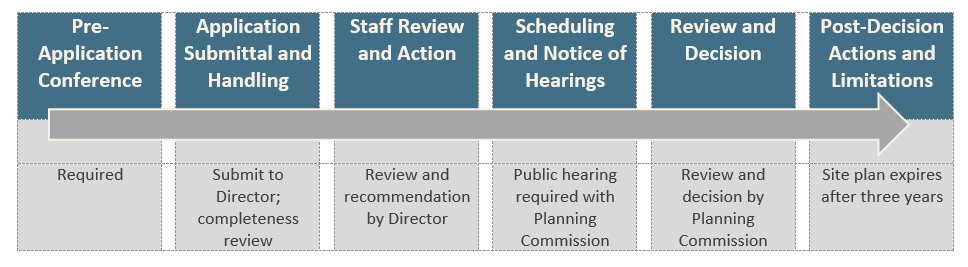
Major Site Plan Review Procedure. Figure 8-7 identifies the applicable steps from the common review procedures that apply to the review of major site plans. Additions or modifications to the common review procedures are noted below.
Figure 8-7: Summary of Major Site Plan Review Procedure
a.
Pre-Application Conference. A pre-application conference shall be held in accordance with Subsection 16-8-30(b).
b.
Application Submittal and Handling.
1.
General. The major site plan application shall be submitted, accepted, and may be revised or withdrawn, in accordance with Subsection 16-8-30(c).
2.
Concurrent Review. A site plan may be submitted concurrently with those plans and applications listed for minor site plans in Subsection 16-8-50(a)(3)b.2.
c.
Staff Review and Action. The Director shall review the application and prepare a staff report and recommendation in accordance with Subsection 16-8-30(d).
d.
Scheduling and Notice of Hearings. The major site plan application shall be scheduled for a public hearing before the Planning Commission and noticed in accordance with Subsection 16-8-30(e).
e.
Review and Decision. The Planning Commission shall review the major site plan application and approve, approve with conditions, or deny the major site plan in accordance with Subsection 16-8-30(f) and the approval criteria listed for minor site plans in Subsection 16-8-50(a)3(c)1.
f.
Post-Decision Actions and Limitations. A major site plan is subject to the post-decision actions and limitations applicable to minor site plans in accordance with Subsection 16-8-50(a)(3)d.
(c)
Conditional Use Approval.
(1)
Purpose. The conditional use approval procedure provides a mechanism for the City to evaluate proposed land uses that are generally compatible with the permitted uses in a zoning district, but that require site-specific review of their location, design, intensity, density, and configuration because they have unique or varied operating characteristics or unusual impacts. This procedure is intended to ensure that the proposed development adequately mitigates anticipated impacts to ensure compatibility with surrounding areas.
(2)
Applicability. A conditional use approval is required for land uses as specified in Table 3-A, Table of Allowed Uses.
(3)
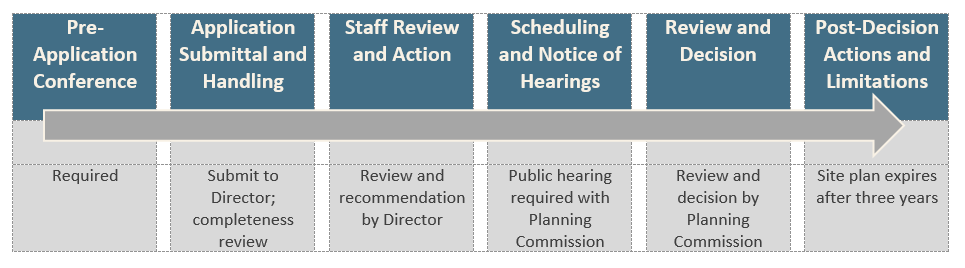
Conditional Use Approval Procedure. Figure 8-8 identifies the applicable steps from the common review procedures that apply to the review of conditional use approvals. Additions or modifications to the common review procedures are noted below.
Figure 8-8: Summary of Conditional Use Approval Procedure
a.
Pre-Application Conference. A pre-application conference shall be held in accordance with Subsection 16-8-30(b). The Director shall determine whether site plan review is required.
b.
Application Submittal and Handling.
1.
General. The conditional use approval application shall be submitted, accepted, and may be revised or withdrawn, in accordance with Subsection 16-8-30(c).
2.
Concurrent Review. A conditional use approval may be submitted concurrently with a site plan, minor modification, variance, or subdivision plat.
c.
Staff Review and Action. The Director shall review the application and prepare a staff report and recommendation in accordance with Subsection 16-8-30(d).
d.
Scheduling and Notice of Hearings. The conditional use approval application shall be scheduled for a public hearing before the Planning Commission and noticed in accordance with Subsection 16-8-30(e).
e.
Review and Decision. The Planning Commission shall review the conditional use approval application and approve, approve with conditions, or deny the conditional use approval in accordance with Subsection 16-8-30(f) and the following approval criteria:
1.
Conditional Use Approval Criteria. In addition to any use-specific standards applicable to the use that is subject to the conditional use approval, and in addition to the general approval criteria in Subsection 16-8-30(f)(4), the application must comply with the following:
a)
The use shall be appropriate to its proposed location and not disrupt or harm the prevailing uses and activities in the immediate vicinity;
b)
The use shall not cause undue traffic congestion, dangerous traffic conditions, or incompatible service delivery, parking, or loading problems. Necessary mitigating measures shall be proposed by the applicant;
c)
The operating characteristics of the use shall not create a nuisance, and the impacts of the use on surrounding properties shall be minimized with respect to noise, odors or other emissions, vibrations, glare, and similar conditions;
d)
There shall be adequate public facilities in place to serve the proposed use, or the applicant shall propose necessary improvements to address service deficiencies that the use may cause; and
e)
The use shall not cause significant deterioration to water resources, wetlands, wildlife habitat, scenic characteristics, or other natural features. As applicable, the proposed use shall mitigate its adverse impacts on the environment.
f.
Post-Decision Actions and Limitations. Post-decision actions and limitations in Subsection 16-8-30(g) shall apply with the following modifications:
1.
Expiration of a Conditional Use Approval.
a)
The conditional use approval may contain conditions as deemed appropriate by the Director or Planning Commission in approving the permit. Within the one-year period, or other approved period, the permit holder must either obtain a site plan approval, begin construction, or establish the land use authorized by the conditional use approval, including any conditions attached to the conditional use approval.
b)
Failure to obtain a site plan approval, start construction, or establish such use within the one-year or other applicable time period shall result in automatic expiration of the conditional use approval. Once a conditional use is established, the conditional use approval shall not expire. However, any discontinuance of the use for a period of one (1) year, for any reason, shall result in automatic expiration of the conditional use approval, unless otherwise provided in the permit or an extension is granted pursuant to Subsection 16-8-30(g)(3).
c)
The approval of a conditional use may or may not identify an initial term for the conditional use. Upon expiration of the term, if the permit is so limited, the conditional use approval shall automatically expire, unless an extension is granted pursuant to Subsection 16-8-30(g)(3).
2.
Expansion or Enlargement. Expansion or enlargement of a conditional use approval shall require a new application, unless the Director determines that the expansion or enlargement:
a)
Is not expected to increase adverse impacts to the surrounding area or the City; and
b)
Will not require adjustments or modification of any standards greater than those allowed under the minor modification procedure in Subsection 16-8-70(b).
3.
Revocation of a Conditional Use Approval.
a)
All stipulations submitted as part of a conditional use approval and all conditions imposed by the Director or Planning Commission shall be maintained in perpetuity with the conditional use. If at any time the stipulations or conditions are not met or have been found to have been altered in scope, application, or design, the use shall be in violation of the conditional use approval.
b)
If and when any conditional use is determined to be in violation of the terms and conditions of approval, the Administrator shall notify the permit holder in writing and shall provide the permit holder with a thirty-day period in which to abate the violation.
c)
If the violation of the conditional use continues after the thirty-day period specified in the written request for abatement of the violation, the Director shall schedule a hearing before the Planning Commission. Notice of the hearing shall be provided to the approval holder in accordance with Section 16-2-30. Following a proper hearing, the Planning Commission shall issue a decision either revoking or sustaining the conditional use approval.
d)
Appeals of the Planning Commission decision regarding revocation of the conditional use approval may be brought by the approval holder according to the procedure established at Section 16-8-70.
4.
Transfer of Conditional Use Approval. Unless otherwise specified in conditions of approval, a conditional use approval may be transferred to another person to operate the same use, in the same buildings, on the same property, and under the same terms of the original conditional use approval.
(d)
Change of Use Approval.
(1)
Purpose. The change of use approval procedure provides a mechanism for the City to evaluate new uses of properties and buildings and change in occupancy due to change of ownership or tenancy to ensure compliance with this Code.
(2)
Applicability. A change of use approval is required prior to:
a.
Changing the use of a vacant or occupied property or building; and/or
b.
Changing occupancy of a vacant or occupied property or building.
(3)
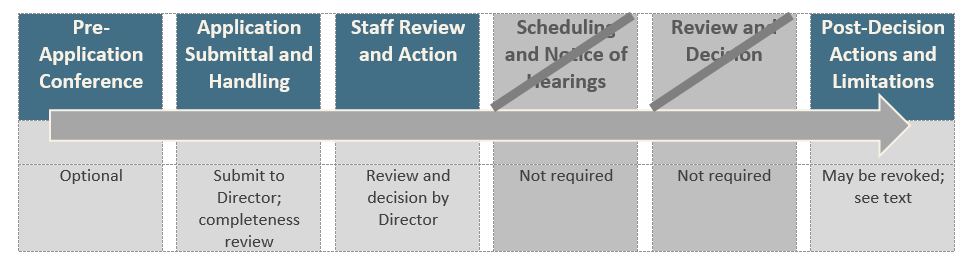
Change of Use Approval Procedure. Figure 8-9 identifies the applicable steps from the common review procedures that apply to the review of change in use approvals. Additions or modifications to the common review procedures are noted below.
Figure 8-9: Summary of Change in Use Approval Procedure
a.
Pre-Application Conference. A pre-application conference in accordance with Subsection 16-8-30(b) is optional.
b.
Application Submittal and Handling. The application shall be submitted, accepted, and may be revised or withdrawn, in accordance with Subsection 16-8-30(c).
c.
Staff Review and Action.
1.
Review and Decision. The Director shall review the change of use approval application according to the criteria below and the Director shall approve, approve with conditions, or deny the approval.
2.
Change of Use Approval Criteria. In reviewing a change of use approval, the Director shall consider the general approval criteria in Subsection 16-8-30(f)(4) and also whether the proposed change of use or occupancy adequately mitigates associated impacts with access, traffic, emergency services, utilities, parking, refuse areas, noise, glare, and odor.
d.
Post-Decision Actions and Limitations.
1.
Effect of Approval. A change in use approval authorizes a new use or change in occupancy of an existing property or building with any additional terms and conditions specified in the approval. The change of use approval shall clearly state that the proposed use complies with the provisions of this Code. For any change of use that requires a building permit, the change of use approval shall be issued prior to obtaining a certificate of occupancy.
2.
Revocation of a Change of Use Approval. A change of use approval may be revoked by the Director if the use of the property or building is inconsistent with the authorized use specified in the change of use approval. In such case, the Director shall notify the approval holder in writing and provide thirty (30) days from the date of the letter for the approval holder to bring the use into compliance with the change of use approval, and otherwise the approval shall be revoked.
(e)
Grading/Tree Disturbance Permit.
(1)
Purpose. The grading/tree disturbance permit approval procedure provides a mechanism for the City to evaluate land clearing and grading, removal of existing trees and vegetation, and similar activities prior to development activity, to ensure compliance with this Code.
(2)
Applicability. A grading/tree disturbance permit is required prior to:
a.
Any site grading of one-quarter (¼) acre more; and/or
b.
Any removal or pruning of ten percent (10%) or four hundred (400) square feet of riparian vegetation, whichever is less.
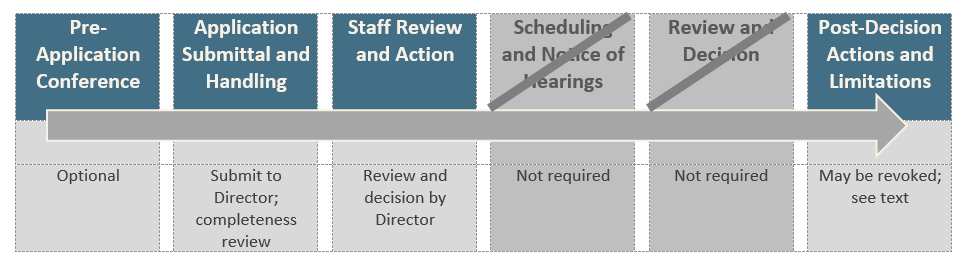
(3)
Grading/Tree Disturbance Permit Procedure. Figure 8-10 identifies the applicable steps from the common review procedures that apply to the review of grading/tree disturbance permit applications. Additions or modifications to the common review procedures are noted below.
Figure 8-10: Summary of Grading/Tree Disturbance Permit Procedure
a.
Pre-Application Conference. A pre-application conference in accordance with Subsection 16-8-30(b) is optional.
b.
Application Submittal and Handling. The application shall be submitted, accepted, and may be revised or withdrawn, in accordance with Subsection 16-8-30(c).
c.
Staff Review and Action.
1.
Review and Decision. The Director shall review the application according to the criteria below and the Director shall approve, approve with conditions, or deny the approval.
2.
Grading/Tree Disturbance Criteria. In reviewing a grading/tree disturbance permit, the Director shall consider the general approval criteria in Subsection 16-8-30(f)(4) and also whether the proposed activity specifically complies with the requirements of Subsection 16-4-20(b), River and Wetland Protection; and generally with all other applicable requirements of this Code.
d.
Post-Decision Actions and Limitations.
1.
Effect of Approval. A grading/tree disturbance permit approval authorizes only the specific grading, land clearing, and/or vegetation/tree removal described in the permit. The permit approval shall clearly state that the proposed activity complies with the provisions of this Code.
2.
Revocation of a Grading/Tree Disturbance Permit. A grading/tree disturbance permit may be revoked by the Director if the use of the property is inconsistent with the authorized activity specified in the permit. In such case, the Director shall notify the approval holder in writing and provide thirty (30) days from the date of the letter for the approval holder to bring the use into compliance with the permit, and otherwise the approval shall be revoked.
(Ord. No. 2025-17, § 2(Exh. A), 10-7-2025)
Sec. 16-8-60. - Subdivision approvals.
(a)
Minor Subdivision.
(1)
Purpose. The minor subdivision procedure is used to evaluate proposed subdivisions that create few lots or involve minimal adjustments or corrections to previously recorded final plats.
(2)
Applicability.
a.
The minor subdivision procedure shall apply when all the following are met:
1.
The proposed subdivision would create five (5) or fewer lots within a single plat; and
2.
The proposed subdivision would not require land dedication or dedication of public improvements, which would require City Council approval.
b.
The following are eligible to be processed as a minor subdivision provided Paragraph a., above, is met:
1.
Boundary or lot line adjustment to an approved final plat;
2.
Lot line elimination;
3.
Duplex conversion;
4.
Plat amendment affecting fewer than ten (10) lots;
5.
An insubstantial change to an approved plat to address engineering or technical constraints with no material effect on the plat and no relocations of streets or rights-of-way; or
6.
Correction of errors on an approved final plat.
c.
Any subdivision that requires dedication of right-of-way, public tracts, or public improvements to the City shall be submitted to the City Council for acceptance or denial of the dedication.
d.
Resubdivision of properties that have already been platted shall be processed as either a minor subdivision in accordance with this procedure or shall require a new application for a preliminary plat in accordance with Subsection 16-8-60(b).
(3)
Minor Subdivision Procedure. Figure 8-11 identifies the applicable steps from the common review procedures that apply to the review of minor subdivisions. Additions or modifications to the common review procedures are noted below.
Figure 8-11: Summary of Minor Subdivision Procedure
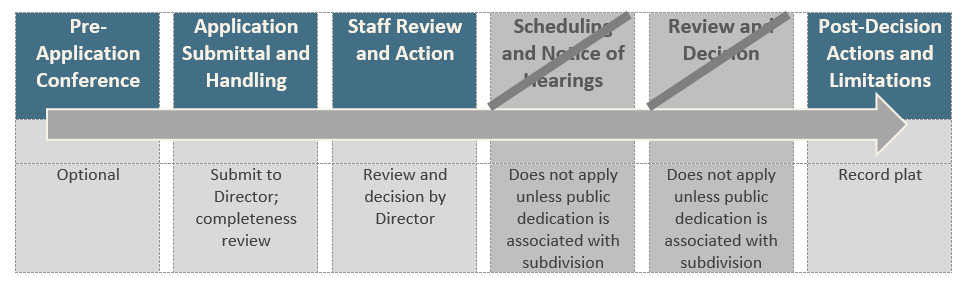
a.
Pre-Application Conference. A pre-application conference in accordance with Subsection 16-8-30(b) is optional.
b.
Application Submittal and Handling.
1.
The minor subdivision application shall be submitted, accepted, and may be revised or withdrawn, in accordance with Subsection 16-8-30(c).
2.
For lot line adjustments and lot eliminations, the owners of all affected properties whose lot lines are being amended shall provide written consent to the application.
3.
To the extent that submittal information was submitted as part of a previous subdivision plat and is adequate by current standards, the Director may waive submittal requirements at the request of the applicant.
c.
Staff Review and Action. The Director shall review the minor subdivision application and shall approve, approve with conditions, or deny the minor subdivision in accordance with Subsection 16-8-30(f)(4) and the approval criteria in Subsection 16-8-60(a)(4) below.
d.
Post-Decision Actions and Limitations. Post-decision actions and limitations in Subsection 16-8-30(g) shall apply. In addition, the Director shall record the minor subdivision plat with the Chaffee County Clerk and Recorder as soon as practicable.
(4)
Minor Subdivision Approval Criteria. In reviewing a minor subdivision application, the Director shall consider the general approval criteria in Subsection 16-8-30(f)(4) and also whether the minor subdivision:
a.
General.
1.
Is consistent with the underlying zoning district(s);
2.
Does not result in the creation of more than five (5) lots;
3.
Does not result in the creation of lots that cannot be built upon under this Code;
4.
Does not affect a recorded easement without approval from the easement holder;
5.
Complies with the requirements of Article 16-5, Subdivisions;
6.
Will not limit the City's ability to effectively provide facilities or services to all lots involved; and
7.
Complies with Article 9, Inclusionary Housing.
b.
For Attached Dwellings. In addition to the criteria above, the following shall be met for all minor subdivisions proposed for single-family attached dwellings and duplex dwellings:
1.
Common Wall. The building shall be divided only along code-compliant fire-resistant common walls into separate dwellings on separate lots.
2.
Separate Utilities. Each of the dwelling units shall be served by separate utility service lines and meters, including water, sewer, electricity, and natural gas.
3.
Maintenance Agreement. A common wall maintenance agreement shall be established and recorded to run with the land comprising the proposed attached dwelling lots.
(b)
Major Subdivision—Preliminary Plat.
(1)
Purpose. The preliminary plat procedure provides a mechanism for the City to review an overall plan for a proposed subdivision to ensure compliance with this Code, the Comprehensive Plan, and the adequate provision of facilities and services in the City.
(2)
Applicability.
a.
A preliminary plat is required if the proposed subdivision:
1.
Will result in more than five (5) lots;
2.
Will include the dedication of public right-of-way, other public tracts, or public improvements for any subdivision not determined to be eligible to be processed as a minor subdivision; or
3.
Is not eligible to be processed as a minor subdivision.
b.
Subsequent resubdivision of properties that have already been platted shall be processed as either a minor subdivision in accordance with Subsection 16-8-60(a) or shall require a new application for a preliminary plat in accordance with this procedure.
(3)
Preliminary Plat Procedure. Figure 8-12 identifies the applicable steps from the common review procedures that apply to the review of preliminary plats. Additions or modifications to the common review procedures are noted below.
Figure 8-12: Summary of Preliminary Plat Procedure
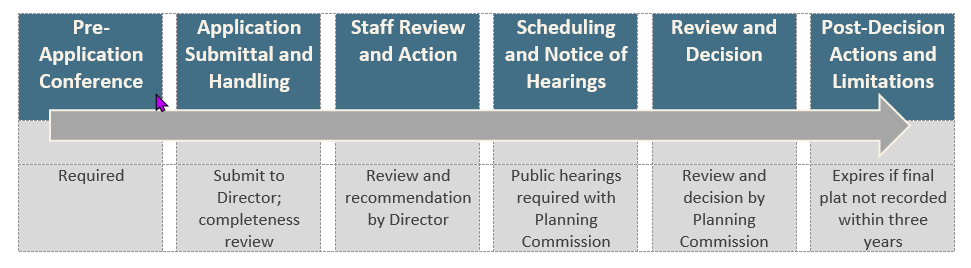
a.
Pre-Application Conference. A pre-application conference shall be held in accordance with Subsection 16-8-30(b).
b.
Application Submittal and Handling.
1.
General. The preliminary plat application shall be submitted, accepted, and may be revised or withdrawn, in accordance with Subsection 16-8-30(c).
2.
Concurrent Review. A preliminary plat may be submitted concurrently with a site plan, conditional use approval, minor modification, or variance. PD?
3.
Resubdivisions. To the extent that submittal information was submitted as part of the original subdivision proposal and is adequate by current standards, the Director may waive submittal requirements at the request of the applicant.
c.
Staff Review and Action. The Director shall review the application and prepare a staff report and recommendation in accordance with Subsection 16-8-30(d).
d.
Scheduling and Notice of Public Hearings. The preliminary plat application shall be scheduled for public hearings before the Planning Commission and City Council, noticed in accordance with Subsection 16-8-30(e).
e.
Review and Decision.
1.
Planning Commission Review and Recommendation. The Planning Commission shall review the preliminary plat application and approve, approve with conditions, or deny the plat in accordance with Subsection 16-8-30(f) and the following approval criteria:
a)
Preliminary Plat Approval Criteria. In reviewing the preliminary plat application, the Planning Commission shall consider the general approval criteria in Subsection 16-8-30(f)(4) and also whether the plat:
1)
General.
i.
Is consistent with the underlying zoning district(s);
ii.
Does not result in the creation of lots that cannot be built upon under this Code;
iii.
Does not affect a recorded easement without approval from the easement holder;
iv.
Complies with the requirements of Article 16-5, Subdivisions;
v.
Will not limit the City's ability to effectively provide facilities or services to all lots involved; and
vi.
Complies with Article 16-9, Inclusionary Housing.
2)
Major Subdivisions with Single-Family Attached and/or Duplex Dwellings.
i.
Common wall: The building shall be divided only along code-compliant, fire-resistant common walls into separate dwellings on separate lots.
ii.
Separate utilities: Each of the dwelling units shall be served by separate utility service lines and meters, including water, sewer, electricity, and natural gas.
iii.
Maintenance agreement: A common wall maintenance agreement shall be established and recorded to run with the land comprising the proposed attached dwelling units.
2.
Conditions of Approval. If the preliminary plat is approved with conditions, those conditions and the standards of this Code shall be met prior to approval of a final plat.
f.
Post-Decision Actions and Limitations.
1.
Expiration of Approval. Preliminary plat approval shall automatically expire if a final plat has not been recorded within one (1) year after the date of the preliminary plat approval, or an extension is granted in accordance with Subsection 16-8-30(g)(3).
2.
Phased Final Platting. Whenever a preliminary plat is approved for development of a subdivision in phases, the City Council may allow alternative timing for final plats for each phase following the first.
(c)
Major Subdivision—Final Plat.
(1)
Purpose. The final plat procedure completes the major subdivision process and provides a mechanism for the City to ensure compliance with the approved preliminary plat and applicable standards of this Code.
(2)
Applicability.
a.
The final plat procedure applies to all major subdivisions in the City unless otherwise stated in this Code.
b.
Any major subdivision that requires dedication of right-of-way, public tracts, or public improvements to the City shall be submitted to the City Council for acceptance or denial of the dedication. The Council shall decide the acceptance or denial of the dedication only.
(3)
Final Plat Procedure. Figure 8-13 identifies the applicable steps from the common review procedures that apply to the review of final plats. Additions or modifications to the common review procedures are noted below.
Figure 8-13: Summary of Final Plat Procedure
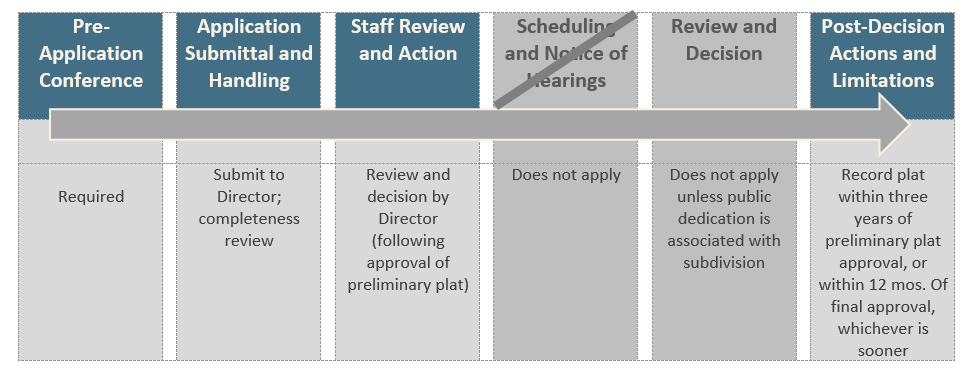
a.
Pre-Application Conference. A pre-application conference shall be held in accordance with Subsection 16-8-30(b).
b.
Application Submittal and Handling.
1.
General. The final plat application shall be submitted, accepted, and may be revised or withdrawn, in accordance with Subsection 16-8-30(c).
2.
Concurrent Review.
a)
A final plat may be submitted concurrently with a site plan, conditional use approval, minor modification, or variance. In such cases, the final plat shall be decided prior to the final decision on the concurrently submitted application.
b)
If the applicant is seeking vested rights, such rights may be reviewed concurrently with the final plat and in accordance with Subsection 16-8-30(h).
c.
Staff Review and Action. The Director shall review the final plat application and shall approve, approve with conditions, or deny the final plat in accordance with Subsection 16-8-30(f) and the following approval criteria:
1.
Final Plat Approval Criteria. In reviewing a final plat application, the Director shall consider the general approval criteria in Subsection 16-8-30(f)(4) and also whether:
a)
The final plat complies with the approved preliminary plat, including any conditions of approval; and
b)
The proposed development will comply with the City's Standard Specifications for Construction and Design Criteria Manual and any other applicable technical standards and specifications adopted by the City.
d.
Post-Decision Actions and Limitations.
a)
Post-decision actions and limitations in Subsection 16-8-30(g) shall apply. In addition, the Director shall record the final plat with the Chaffee County Clerk and Recorder as soon as practicable.
b)
A final plat and subdivision improvement agreement shall be recorded within twelve (12) months of the date of approval. This twelve (12) months does not extend the required timeline in Subsection 16-8-60(b)(3)f., Post-Decision Actions and Limitations.
(d)
Condominiumization.
(1)
Purpose. The condominiumization procedure provides a mechanism for the City to ensure that condominium subdivisions comply with this Code and State law.
(2)
Applicability.
a.
The creation of new condominium units and the conversion of existing buildings into condominium units shall follow this procedure.
b.
Any condominiumization requiring dedication of right-of-way, public tracts, or public improvements to the City shall be submitted to the City Council for acceptance or denial of the dedication.
c.
Condominium plats shall comply with the requirements of C.R.S. § 38-33.3-209, as may be amended, and may be approved and amended by the Director.
(3)
Condominiumization Procedure. Figure 8-14 identifies the applicable steps from the common review procedures that apply to the review of condominiumizations. Additions or modifications to the common review procedures are noted below.
Figure 8-14: Summary of Condominiumization Procedure
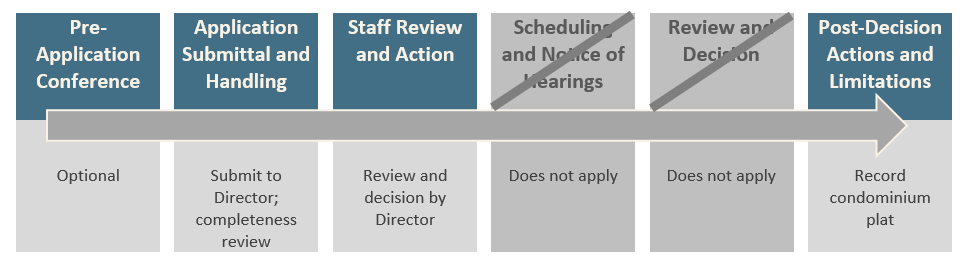
a.
Pre-Application Conference. A pre-application conference in accordance with Subsection 16-8-30(b) is optional.
b.
Application Submittal and Handling.
1.
General. The preliminary plat application shall be submitted, accepted, and may be revised or withdrawn, in accordance with Subsection 16-8-30(c).
2.
Additional Submittal Requirements. In addition to the subdivision submittal requirements listed in the Administrative Manual, an application for a condominium plat approval shall contain the following:
a)
Required parking spaces and joint trash collection areas;
b)
Floor plans, elevations, and site plan as required to show separate ownership of all separate units, common elements, and limited common elements;
c)
Number, type, and floor area of units, common elements, and other amenities delineated in square feet; proposed use for each unit; land area;
d)
Statement of the total number of units shown on the proposed plat; and
e)
Documentation showing compliance with the standards and terms of the Colorado Common Interest Ownership Act, C.R.S. § 38-33.3-201 et seq. as may be amended.
3.
Concurrent Review. A condominiumization application may be submitted concurrently with a site plan, conditional use approval, minor modification, or variance.
c.
Staff Review and Action. The Director shall review the application and approve, approve with conditions, or deny the condominiumization in accordance with Subsection 16-8-30(d) and the following approval criteria:
1.
Condominiumization Approval Criteria. In reviewing the condominiumization application, the Director shall consider the general approval criteria in Subsection 16-8-30(f)(4) and also the following:
a)
If applicable, the condominiumization complies with the requirements of Article 16-9, Inclusionary Housing; Subsection 16-4-90(g), Fair Contributions for Public School Sites; and Section 16-4-110, Parks, Trails, and Open Space Dedication.
d.
Post-Decision Actions and Limitations.
1.
After buildings have been constructed and final "as-built" surveys have been completed, the applicant shall submit an amended condominium plat showing graphically and dimensionally the subdivision of buildings into volumetric spaces and the relationship of these spaces with the boundaries of the site and other appurtenances on the site.
2.
No individual condominium unit shall be sold into separate ownership until and unless a condominium plat has been approved by the City based upon an "as-built" survey of the unit boundaries and such plat has been recorded with the Chaffee County Clerk and Recorder. A plat note on the final condominium plat for each condominium development shall be included to this effect.
3.
Condominiumization may not be used for creating parking spaces not associated with commercial or residential units on-site.
4.
Eligible condominiums will require licenses to engage in short-term rental use per [Chapter 6, Article VI of this Code].
(e)
Vacation of Plat, Right-of-Way, or Public Easement.
(1)
Purpose. The vacation procedure provides a mechanism for vacating rights, interests, or title of the City in and to any subdivision plat, right-of-way, or easement located in the City.
(2)
Applicability. This procedure applies to any request to vacate any rights, interests, or title of any plat, right-of-way, or public easement within the City, which may be initiated by any owner of such.
(3)
Vacation Procedure. Figure 8-15 identifies the applicable steps from the common review procedures that apply to the review of vacations of plats, rights-of-way, or easements. Additions or modifications to the common review procedures are noted below.
Figure 8-15: Summary of Vacation of Plat, Rights-of-Way, or Easement Procedure
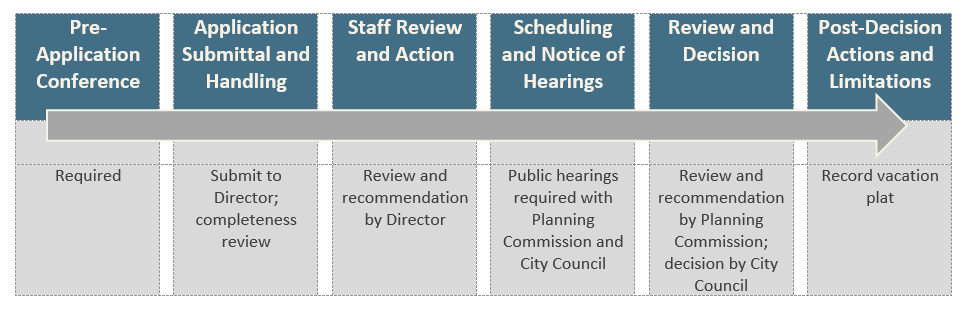
a.
Pre-Application Conference. A pre-application conference shall be held in accordance with Subsection 16-8-30(b).
b.
Application Submittal and Handling.
1.
General. The vacation application shall be submitted, accepted, and may be revised or withdrawn, in accordance with Subsection 16-8-30(c).
2.
Additional Submittal Requirements. Applications shall include a scaled survey from a Colorado registered surveyor or engineer that indicates the rights-of-way and adjacent properties subject to the vacation.
c.
Staff Review and Action. The Director shall review the application and prepare a staff report and recommendation in accordance with Subsection 16-8-30(d).
d.
Scheduling and Notice of Hearings. The vacation application shall be scheduled for public hearings before the Planning Commission and City Council and noticed in accordance with Subsection 16-8-30(e).
e.
Review and Decision.
1.
Planning Commission Review and Recommendation. The Planning Commission shall review the vacation application and recommend approval or denial in accordance with Subsection 16-8-30(f) and the approval criteria below.
2.
City Council Review and Decision. The City Council shall review the vacation application and approve, approve with conditions, or deny the plat in accordance with Subsection 16-8-30(f) and the approval criteria below.
a)
Vacation Approval Criteria. The Planning Commission and City Council shall consider the following in evaluating the vacation of a recorded plat, right-of-way, or easement:
1)
No roadway shall be vacated if doing so would leave any adjoining land without a means of access to another public road.
2)
In granting a vacation, the City may reserve easements for the installation or maintenance of utilities, ditches, and similar improvements.
3)
A subdivision plat, public right-of-way, or dedicated easement may be vacated if the vacation would be consistent with or implements the applicable intent statements, specific directions, and recommended actions of the Comprehensive Plan.
4)
A subdivision plat may be vacated if none of its lots have been sold or transferred; or, if there have been sales or transfers, no development on any lots in the subdivision and all of the owners agree to the vacation of the plat.
f.
Post-Approval Actions and Limitations.
1.
Record Vacation Plat. The Director shall record the vacation plat indicating the vacated plat, right-of-way, or easement with the Chaffee County Clerk and Recorder as soon as practicable.
2.
Quitclaim Deed. Whenever the City approves an application vacating a public right-of-way, the City shall provide abutting landowners with a quitclaim deed for the vacated lands. Each abutting landowner shall be deeded that portion of the vacated right-of-way to which the owner's land is nearest in proximity.
(Ord. No. 2025-17, § 2(Exh. A), 10-7-2025)
Sec. 16-8-70. - Flexibility and relief.
(a)
Minor Modification.
(1)
Purpose. The purpose of the minor modification procedure is to allow adjustments, modifications, or deviations from the dimensional or numeric standards of this Code to provide greater flexibility without requiring a variance or a formal zoning amendment. The minor modification procedure is not a waiver, but rather a modification up to a specified threshold when warranted according to review standards at Subsection 16-8-70(b)4. Use of minor modifications should be rare and only in unique circumstances.
(2)
Applicability.
a.
Other Incentives are Prerequisite. All available incentives and allowances in this Code shall be used before a minor modification may be considered.
b.
Table of Allowed Modifications. Applications for minor modifications may only be considered for the standards listed in Table 8-C.
Table 8-B: Allowed Minor Modifications
c.
Limitations on Minor Modifications. The minor modification procedure shall not be used to:
1.
Modify standards outside this Code;
2.
Modify uses or activities allowed on a property;
3.
Modify standards where such modification is required by the FFHA or RLUIPA pursuant to Subsections 16-8-30(f)(5) and (6);
4.
Modify the standards that apply to a specific use or activity, including any dimensional and numerical standards established as a use-specific standard;
5.
Modify a standard that is already modified through a separate modification, variance, or other deviation (i.e., no "double-dipping").
(3)
Minor Modification Procedure. Figure 8-16 identifies the applicable steps from the common review procedures that apply to the review of minor modification applications. Additions or modifications to the common review procedures are noted below.
Figure 8-16: Summary of Minor Modification Procedure
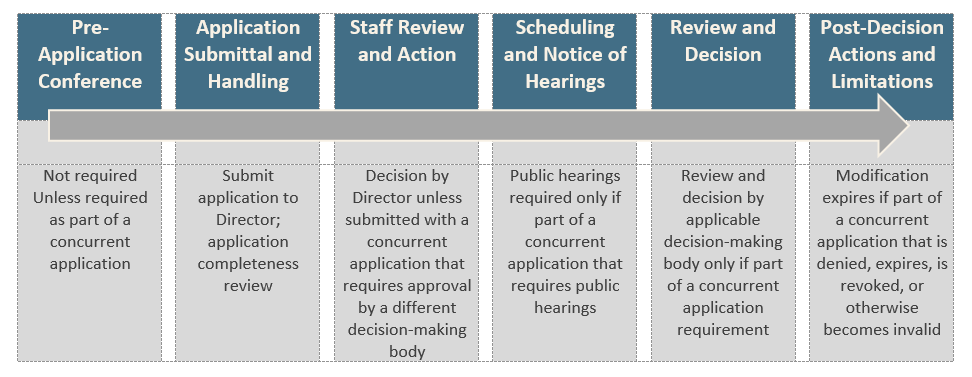
a.
Pre-Application Conference. A pre-application conference shall be held in accordance with Subsection 16-8-30(b) only if the concurrent application associated with the minor modification application requires such conference.
b.
Application Submittal and Handling.
1.
An application for a minor modification may be submitted and reviewed concurrently with an application for a conditional use approval, site plan, or subdivision plat.
2.
Each standard from Table 8-C shall be considered a separate request as it relates to the approval criteria in Subsection 16-8-70(b)(4), but multiple modifications should only be requested in the rarest of circumstances.
c.
Staff Review and Action. Where the concurrently reviewed application requires review and approval by the Planning Commission or City Council, the Director shall review the application and include a recommendation related to the minor modification in the staff report for the associated concurrent application.
d.
Scheduling and Notice of Hearings. Where the concurrently reviewed application requires a public hearing, then the application shall be scheduled for a public hearing before the applicable decision-making body and noticed in accordance with Subsection 16-8-30(e).
e.
Review and Decision.
1.
Where the concurrently reviewed application requires review and approval by the Director, the Director shall review the application and shall approve, approve with conditions, or deny the minor modification based on the criteria in Subsection 16-8-70(b)(4).
2.
Where the concurrently reviewed application requires review and approval by the Planning Commission or City Council, the Planning Commission or City Council, as applicable, shall review and decide the minor modification based on the criteria in Subsection 16-8-70(b)(4).
3.
Decision shall be documented and sent to the applicant and stored on file at Community Development Department.
f.
Post-Decision Actions and Limitations.
1.
Effect of Approval. Approval of a minor modification authorizes only the specific modification of standards approved, and only to the subject property of the application.
2.
Expiration of Modification. A minor modification shall automatically expire if the associated application is denied or if approval of the associated application expires, is revoked, or is otherwise deemed invalid.
(4)
Minor Modification Approval Criteria. In reviewing the minor modification request, the decision-making body shall consider whether and to what extent the modification:
a.
Will not result in incompatible development;
b.
Will not result in adverse impacts unless adequately mitigated; and
c.
Is of a technical nature and is required to:
1.
Compensate for an unusual site condition;
2.
Eliminate a minor inadvertent failure to comply with a Code standard; or
3.
Protect a sensitive resource, natural feature, or community asset.
(b)
Variances.
(1)
Purpose. The variance procedure provides authorization to deviate from the literal terms of this Code where strict application and enforcement of this Code would result in exceptional practical difficulty or undue hardship preventing the use of the land as otherwise allowed by this Code. A variance shall not be granted solely because of the presence of nonconformities in the zoning district or adjoining districts.
(2)
Applicability.
a.
Any property owner seeking relief from this Code may request a variance when the strict application of the Code would result in an undue hardship.
b.
Variances from the standards of the underlying zoning district shall be authorized only for height, lot coverage, lot size, minimum density, setbacks, parking requirements, and landscaping requirements.
c.
Establishment or expansion of a use otherwise prohibited in a zoning district shall not be allowed by variance.
(3)
Variance Procedure. Figure 8-17 identifies the applicable steps from the common review procedures that apply to the review of variance applications. Additions or modifications to the common review procedures are noted below.
Figure 8-17: Summary of Variance Procedure
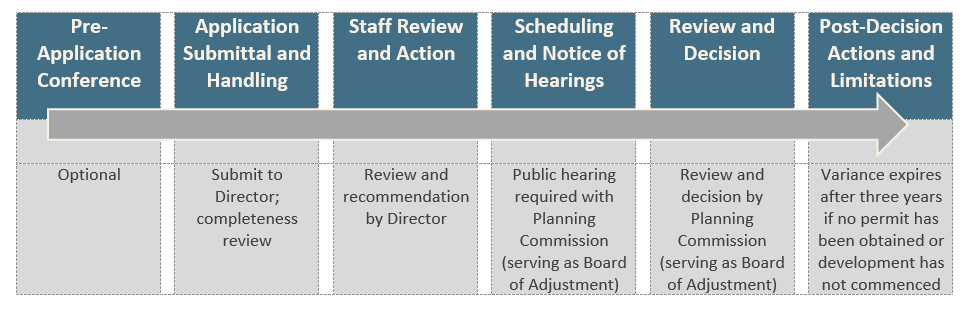
a.
Pre-Application Conference. A pre-application conference in accordance with Subsection 16-8-30(b) is optional.
b.
Application Submittal and Handling.
1.
General. The variance application shall be submitted, accepted, and may be revised or withdrawn, in accordance with Subsection 16-8-30(c).
2.
Concurrent Review. A variance application may be submitted as a standalone application or submitted concurrently with a site plan, conditional use approval, or subdivision plat.
c.
Staff Review and Action. The Director shall review the application and prepare a staff report and recommendation in accordance with Subsection 16-8-30(d).
d.
Scheduling and Notice of Hearings. The variance application shall be scheduled for a public hearing before the Planning Commission, serving in their role as the Board of Adjustment, and noticed in accordance with Subsection 16-8-30(e).
e.
Review and Decision.
1.
The Planning Commission, serving in their role as the Board of Adjustment, shall review the variance application and approve, approve with conditions, or deny the variance in accordance with Subsection 16-8-30(f) and the approval criteria listed in Subsection 16-8-70(a)(4) below.
2.
The Planning Commission, serving in their role as the Board of Adjustment, shall make a decision based on the staff report and the record of the public hearing and shall be reduced to writing to include findings of fact based on competent, material, and substantial evidence presented, and shall state how the findings support compliance with the review criteria.
3.
The Planning Commission, serving in their role as the Board of Adjustment, in approving the variance, may impose such restrictions and conditions on such approval, and the premises to be developed or used pursuant to such approval, as it determines are required to prevent or minimize adverse effects from the proposed variance on other land in the neighborhood and on the general health, safety, and welfare of the City. All conditions imposed upon any variance shall be set forth in the granting of such variance.
f.
Post-Decision Actions and Limitations.
1.
Expiration of a Variance. If the property owner has not commenced development or obtained the required permits to carry out the development for which the variance was required within three (3) years of the variance approval, then the variance shall automatically expire. The Planning Commission, serving in their role as the Board of Adjustment, may grant an extension of up to one (1) additional year upon request.
2.
Non-Transferable. The variance shall apply only to the structure or property subject to the variance approval and shall not be transferable to any other property or structure.
(4)
Variance Approval Criteria. Variances from requirements of this Chapter shall be considered an extraordinary remedy. When considering, reviewing and deciding on whether to approve a variance application, the Board of Adjustment must find that all of the following criteria have been met:
a.
Special circumstances exist such that strict application of the standards adopted in this Chapter would result in undue hardship or practical difficulties for the owner of such property. Special circumstances include, but are not limited to, exceptional or peculiar limitations to the dimension, shape or topography of the property, such as slope, standing or moving water, wetlands, floodplain, rock features, narrowness, shallowness or irregular shape of a lot.
b.
The requested variance would not create a substantial detriment to the public good and would not substantially impair the intent and purpose of this Code or the City's Comprehensive Plan.
c.
The requested variance would not result in significantly adverse impacts to the natural environment or to the surrounding properties and neighborhoods.
d.
The granting of the request is the minimum variance necessary for reasonable use of the property or building and the least deviation required from the applicable zoning standard to afford relief.
(c)
Appeals.
(1)
Purpose. The purpose of the appeals procedure is to define the circumstances by which persons may appeal a decision made by the Director or any Board or Commission other than the Board of Adjustment, Board of Appeals, and City Council.
(2)
Applicability.
a.
Appeals shall be as indicated in Table 8-A: Summary of Development Review Procedures, and Table 8-D: Summary of Appeal Procedures.
b.
Appeals of decisions made by the Board of Adjustment, Board of Appeals, and City Council shall be final and may not be appealed except to the courts in accordance with state law.
Table 8-C: Summary of Appeal Procedures
(3)
Appeals Procedure. Figure 8-18 identifies the applicable steps from the common review procedures that apply to the review of appeals. Additions or modifications to the common review procedures are noted below.
Figure 8-18: Summary of Appeals Procedure
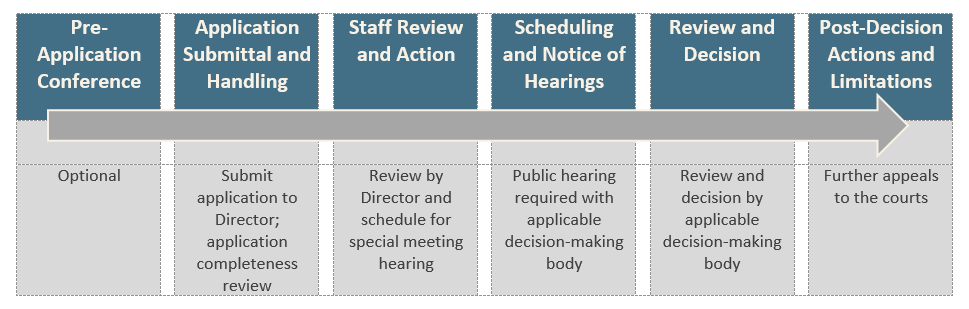
a.
Pre-Application Conference. The appellant may opt to attend a pre-application conference. In such case, the pre-application conference shall be held in accordance with Subsection 16-8-30(b).
b.
Application Submittal and Handling. The appeal application shall be submitted, accepted, and may be revised or withdrawn, in accordance with Subsection 16-8-30(c), with the following modifications:
1.
Application Contents. The appeal shall be in the form of a written letter of appeal delivered or postmarked to the Director within fifteen (15) days of the date the interpretation or decision was made. Such notice shall identify the date and nature of the order, decision, or interpretation at issue, and set forth in plain and concise language:
a)
The facts and reasons for the appeal, including any relevant citation to any rule, regulation, or Code section relied upon; and
b)
A copy of the order, decision, or interpretation being appealed if the same was issued in writing.
2.
Burden of Proof on Appellant. The burden of proof on appeal shall rest with the appellant. Such proof shall include applicable specific section references within this Article and shall be provided at the time of application.
(4)
Staff Review and Action. Upon receipt of the appeal, the Director shall schedule the appeal for a regular or special meeting of the appropriate body within thirty-one (31) days of the filing of the notice to appeal.
(5)
Scheduling and Notice of Public Hearings.
a.
Written notice of the time, date, and location of the hearing shall be sent by regular mail to the appellant not less than fifteen (15) days prior to the hearing. In cases where a decision rendered during a public hearing is being appealed, notice shall be provided in accordance with Subsection 16-8-30(e).
b.
An appeal stays all proceedings from further action on the subject decision unless the City Council determines that a stay would create adverse impacts to the health, safety, or welfare of the City or would cause imminent peril to life and property. Such determination shall be made only after written request to the Director and a public hearing with the City Council. The public hearing shall be held within thirty-one (31) days of receipt of the request. Notice for such hearing shall be provided on the City's website.
(6)
Review and Decision. The applicable review and decision-making body shall consider the appeal during the scheduled hearing and consider the following:
a.
Evidence. Formal Rules of Evidence shall not be followed during hearings. The chairman shall have the power to decide what evidence is material to the appeal. Written documents presented at the hearing shall be made part of the record, and public testimony shall be taken if the appeal required public notice.
b.
Basis of a Decision. Review of the decision being appealed shall be limited to the record established before and relied upon by the designated decision-making body. An appealing body shall not have the authority to override the provisions of this Code. Any decision shall include a basis for the decision and cite specific sections of this Code.
c.
Decision. The appropriate appealing body shall hear all relevant evidence, and within a reasonable time and in no event more than fifteen (15) days thereafter, shall render its decision. The appealing body may reverse, modify, or confirm the order, decision, or interpretation.
(7)
Post-Decision Actions and Limitations.
a.
Recording. Audio recordings of the hearing shall be necessary. Whenever a written verbatim transcript of such recording is requested by the appellant or when a transcript is furnished by the City pursuant to court order, the cost of preparing the transcript shall be borne in full by the appellant.
b.
Notice of Decision. All decisions on appeal shall be reduced to writing, contain a concise listing of facts and reasons supporting the same, and shall be promptly mailed by regular mail to the appellant.
c.
Further Appeals. Any further appeals from the appropriate appeal decision-making authority shall be made to the courts in accordance with State law.
(Ord. No. 2025-17, § 2(Exh. A), 10-7-2025)
Sec. 16-8-80. - Expedited review for exemplary affordable housing.
(a)
Purpose. This Section is established to implement the "fast track approval process" for qualified and substantial affordable housing projects as determined by C.R.S. § 29-32-105(2) (Proposition 123). It is the intent of the City to implement the affordable housing development objectives of Proposition 123 and to maximize State funding that may be available under its terms.
(b)
Applicability.
(1)
This procedure may be requested by an applicant for the following procedures:
a.
Minor site plan.
b.
Major site plan.
c.
Building permits.
d.
Variances.
(2)
In order to qualify for expedited review, at least fifty percent (50%) of all the residential units in the development, including mixed-use developments, must qualify as affordable housing, as defined by CRS § 29-32-101 and CRS § 29-32-105(2). (Rentals at less than or equal to sixty percent (60%) AMI and for-sale at less than or equal to one hundred percent (100%) AMI.)
(3)
All applications under expedited review shall request a pre-application conference per Subsection 16-8-30(b). The purpose of this pre-application meeting with the Department is to initiate dialogue between the City staff and the applicant regarding the proposed development plan prior to application process(es), and to highlight potential requirements based on the proposed plan.
(c)
Application.
(1)
The application must specifically request expedited review.
(2)
Applicability for expedited review shall be determined by the Director at the time of complete application.
(3)
Once a complete application for a building permit has been received, the City shall notify the Building Department that the application is in the queue.
(d)
Participation. Participation in the expedited review program is optional, and an applicant may withdraw from the program at any time.
(e)
Review and Decision.
(1)
Upon determination of a complete application by the Director, a final decision on the application shall occur not more than ninety (90) days after the determination. This shall include all required public hearings, as appropriate.
a.
Applications which are subject only to review under this Code shall receive a final decision within the ninety-day period.
b.
Applications which are subject to multi-jurisdictional review (such as building permits) shall be subject to the following schedule:
1.
Review by the City shall be complete not more than thirty (30) days after the complete application.
2.
Review by the secondary jurisdiction shall be complete not more than ninety (90) days after the complete application.
c.
Qualified affordable housing expedited review projects will be given first priority for scheduling of all meetings, as applicable, including, but not limited to, preapplication meetings and public hearings. Applications that are proceeding under the expedited review program shall receive consideration regarding special meetings to ensure timely processing and decision.
d.
The ninety-day review timeframe may be extended in one (1) or more of the following circumstances:
1.
Once for an additional ninety (90) days at the request of the applicant;
2.
To allow time to comply with a State law or court order, the length of which is determined by the law or court order;
3.
To allow for a review period by an agency that requires review and approval of the project; and/or
4.
To allow for the submission of additional information or revisions to an application in response to requests from the City or secondary jurisdiction, plus thirty (30) days after submittal of the information for the City or secondary jurisdiction to evaluate it. The requesting party shall notify the applicant of the extended process. Applicants shall provide such additional information or responses promptly and shall, whenever practicable, provide a response within five (5) business days.
e.
The requirements of this Section do not preclude the City or secondary jurisdiction from processing an application in less than ninety (90) days.
(f)
Revocation. If at any time during the permitting process, the affordable housing requirements for the development do not meet the minimum defined by CRS § 29-32-101 and CRS § 29-32-105(2), the applicant shall re-apply for the application under the standard review procedure for the application.
(Ord. No. 2025-17, § 2(Exh. A), 10-7-2025)
Sec. 16-8-90. - Review and decision-making bodies.
The review and decision-making bodies shall be established and shall have the power and authority according to Chapter 2 of this Code, Administration and Personnel. Decision-making bodies for applications in this Article shall be as indicated in Table 8-A: Summary of Development Review Procedures.
(Ord. No. 2025-17, § 2(Exh. A), 10-7-2025)

