
Salt Lake County Unincorporated
City Zoning Code
City Zoning Code
CHAPTER 19
78 - PLANNED UNIT DEVELOPMENTS2
Editor's note— Ord. No. 1797, § I, adopted May 24, 2016, repealed former ch. 19.78, §§ 19.78.010—19.78.170, and enacted a new ch. 19.78, §§ 19.78.010—19.78.130. Former ch. 19.78 pertained to similar subject matter and derived from Prior code § 22-31-3; Ordinance of February 1, 1984; Ord. No. 982, adopted in 1986; Ord. No. 1473, adopted in 2001; Ord. No. 1609, adopted in 2007; Ord. No. 1627, adopted in 2008; Ord. No. 1741, adopted December 4, 2012; and Ord. No. 1758, adopted September 24, 2013.
19.78.010 - Purpose.
The purpose of a planned unit development (PUD) is:
1.
To provide a high quality living environment, and to utilize and incorporate natural features in the land development design.
2.
To provide a more efficient use of the land and the preservation of greater proportions of open space for recreation and visual use than is otherwise provided for in the zoning regulations.
3.
To provide good and compatible neighborhood and housing design by utilizing a variety of dwelling types and site arrangement plans to allow for greater flexibility and diversity in the physical pattern of the development.
4.
To provide developments compatible with existing residential uses while maintaining a harmonious environment within the community.
5.
To create mixed use areas designed to be beneficial to the neighborhood.
6.
To ensure substantial compliance with the intent of this chapter related to the public health, safety and general welfare, while securing the efficient use of the land for residential, or a combination of commercial and residential development.
It is the intent of this chapter that the development plan for a planned unit development shall be prepared by a designer(s) having professional competence in urban planning.
(Ord. No. 1797, § I, 5-24-2016)
19.78.020 - Applicability and area requirements.
A planned unit development is a conditional use that is only allowed for residential uses, except as provided in Section 19.78.040, and in zones that allow residential uses. The provisions in this chapter shall govern over the chapters relating to these other zones and other chapters in this title, with the exception of the FCOZ ordinance, Chapters 19.72 and 19.73, and the RCOZ ordinance, Chapter 19.71. A planned unit development in these zones shall have a minimum area of three acres, with the following exceptions:
1.
Existing condominium developments that cannot be sold or refinanced without the common area adjoining the homes in the development being divided up into individual lots that include the adjoining homes, and where these newly created lots would not qualify as traditional subdivision lots under county ordinance. In such cases, the newly created lots may qualify as a planned unit development if the development is at least one acre in size. Such a development shall be exempt from the provisions of this chapter, except Sections 19.78.090—19.78.130 relating to review of the development.
2.
Developments abutting or contiguous to a corridor as defined in the general plan shall have a minimum area of one acre. To qualify as a development that is abutting or contiguous to a corridor, said development shall have a minimum frontage of the sum of the required minimum lot width of two lots as determined by the current zoning designation.
(Ord. No. 1797, § I, 5-24-2016)
19.78.030 - Development requirements.
The following are required for all developments:
1.
Ownership. The property shall be in single or corporate ownership at the time of application, or the subject of an application filed jointly by all owners of the property.
2.
Open Space. Common and private open space shall be provided and shall cover no less than forty percent of the gross site area. Common open space shall be provided in the amount of at least twenty percent of the gross site area. For purposes of this chapter, gross site area is defined as the total area of a planned unit development excluding anything in the public right-of-way.
The required common open space shall be land areas that are not occupied by buildings, dwellings, structures, parking areas, streets, public park strips, curb-gutter-sidewalk, driveways, or alleys and shall be accessible by all residents of the development. Buildings erected for the purpose of providing an amenity may be included as open space. Said open space may be an area of land or water set aside, or reserved for use by residents of the development, including an expanse of lawn, trees, plants, fully accessible landscaped roof areas, or other natural areas. Common open space also includes common walkways (but not curb-gutter-sidewalk), formal picnic areas, and recreational areas. Common open space may be distributed throughout the development and need not be in a single large area. Common open space may include sensitive areas, such as areas with thirty percent or greater slope, fault zones, flood plains, high water tables, and wetlands, if they have been designed as an integral element of the project.
Private open space is that space which is provided for each dwelling unit for personal use. Private open space is typically located immediately adjacent to or attached to the dwelling unit it is designed to serve and is for the exclusive use of the residents of the dwelling unit. Landscaped roof areas, balconies, or decks attached to individual units are considered private open space and are not to be calculated as part of required common open space.
The planning commission may reduce the open space requirements of this section in order to accommodate a density bonus provided for in this chapter.
3.
Interior Streets. The design of public and private streets within a development shall follow county standards for roadway development as defined by the county transportation engineer. Private streets shall be subject to the same inspections and construction standards as required for public streets. The county shall be granted a utility easement of the entire interior street system in a development project. All private streets shall be conveyed to a private association.
4.
Garbage and Recycling. The development shall be designed to accommodate and efficiently manage the collection, storage, and removal of garbage in harmony with the neighborhood so as to minimize detrimental effects of the collection, storage, and removal on any residence within the development or abutting neighborhoods. If dumpster enclosures are provided for the development, no refuse dumpster or dumpster enclosure structure shall be located closer than ten feet to any perimeter property line. Enclosure structures must have a minimum of three sides that reflect or emulate the materials, design, and quality of the overall development. All developments shall provide recycling services.
5.
Parking. The following minimum parking shall be provided for all multi-family projects under this chapter:
a.
Table of Parking Ratios.
b.
The parking requirements identified in this section supersede other parking requirements in this title.
c.
All parking areas, covered or open, except garages, shall have a landscaped buffer in accordance with Chapter 19.77, Water Efficient Landscape Design and Development Standards.
d.
Developments offering the amenities listed below are entitled to the applicable parking reductions. These reductions are not mandatory, but if they are chosen, are cumulative. The planning commission may further modify the required parking with support of a traffic study.
Eligible Unit Parking Reductions
e.
Parking is prohibited within approved fire access and turn-around facilities.
f.
Garages are encouraged.
(1)
Garage parking, if used, shall have a minimum unobstructed size of twenty-two feet wide by twenty feet in length, or twenty feet wide by twenty-two feet in length. Single-car garages are also permitted and shall have a minimum unobstructed size of ten feet wide by twenty-two feet in length, or eleven feet wide by twenty feet in length.
(2)
Covered parking, if used, shall be placed in locations adjacent or convenient to the buildings that they are intended to serve.
(3)
Tandem spaces may be allowed with a minimum size requirement of twenty feet long by nine feet wide per parking space, up to a maximum of two contiguous spaces per unit.
(4)
Tandem spaces may be allowed with a minimum size requirement of twenty feet long by nine feet wide per parking space, up to a maximum of two contiguous spaces per unit.
g.
Underground parking. Installation of underground parking adequate to meet fifty percent of the parking requirements of this section excluding guest parking, shall receive a twenty percent density bonus for the planned unit development.
6.
Building Materials. Exterior materials of a durable or resilient nature such as brick, stone, stucco, prefinished panel, composite materials, or other materials of similar quality, hardiness, and low maintenance characteristics shall be used. No single material is allowed to exceed fifty percent on street-facing facades. Other materials may be considered for soffits, or as an accent or architectural feature. Twenty-five year guarantee, architectural shingles and/or other longer lasting roof materials are required.
7.
Landscaping on Public Right-of-Way. With the exception of Forestry Zones, where a development is adjacent to a public right-of-way, a permanent open space shall be required along any front, side, or rear yard adjacent to said right-of-way. This area shall be kept free of buildings and structures (except fences, as per Chapter 19.77.050, and approved by the planning commission), and permanently maintained with street trees and other landscaping, screened or protected by natural features, as per Chapter 19.77. If such areas are the result of double frontage lot designs with inadequate access to the street, such areas shall be landscaped as per Chapter 19.77 with a five-foot landscaped area. Aesthetic entrance features are encouraged. Additional landscape treatments or buffers may also be required with width and landscaping specifications as per Chapter 19.77.
8.
Perimeter Fencing. With the exception of Forestry Zones, fencing around the perimeter of all developments shall be provided. Acceptable fencing materials include architecturally designed brick, stone, or block, or pre-cast concrete. Fencing with materials using composite products, wrought iron, wood, or vinyl may be allowed with a minimum two-foot wide, six-foot tall brick or stone pillar spaced every ten feet on center. Unless otherwise allowed by the planning commission, exterior fencing along a public right-of-way shall be limited to brick, stone, or block, or pre-cast concrete and be setback a minimum of five feet from the property line to allow for a landscaping buffer designed in accordance with Chapter 19.77 to soften long expanses of walls. Interior fencing shall comply with Section 19.78.030(11)(f).
9.
Interior Street Lights. With the exception of Forestry Zones, street and pedestrian lighting for streets on the interior of the PUD is required. All lighting fixtures shall be directed downward with mechanisms to prevent dark sky illumination. The applicant shall submit a plan which indicates the type and location of lights in relation to the development and designed for pedestrian safety. Minimum average foot-candles for local residential roads (thirty-five feet maximum) shall be 0.3, and shall be 0.5 for residential collector roads (thirty-six feet—forty-five feet).
10.
Signage. Only low profile signs with a maximum size of fifty square feet, and five feet in height are allowed. No temporary signs are allowed other than for sale or rent signs with a maximum of six square feet in area per side. Only three such signs are allowed per three hundred feet of frontage. The size, location, design and nature of signs, if any, and the intensity and direction of any associated lighting shall be detailed in the application, and, except as provided in this chapter, shall be consistent with the characteristics of the community and Chapter 19.82, Signs.
11.
Site Plan. All developments shall be guided by a total design plan in which the following development standards may be varied to allow density bonuses, and flexibility and creativity in site design and building location. The planning commission may require such arrangements of structures, open spaces, landscaping, buffering, and access within the site development plan so that adjacent properties will not be adversely affected. The following criteria shall be used by the planning commission principally to assure the design objectives of this section are met.
a.
Density. Subject to the following density bonuses, the density allowed for a development shall be no greater than that allowed in the zone in which it is located. Density shall be calculated using only net developable acreage. A density bonus in the following amounts is allowed if either or both of the following conditions exist:
(1)
For developments with underground parking that is adequate to meet the parking requirements of this chapter excluding guest parking, a density bonus of twenty percent is allowed pursuant to 19.78.030(5)(g); and/or
(2)
For developments within one-quarter mile (improved walking distance) of a rail or Bus Rapid Transit (BRT) station, a density bonus of twenty percent is allowed. For developments within one-half mile (improved walking distance) of a rail or BRT station, but greater than one-quarter mile, a density bonus of ten percent is allowed.
b.
Maximum Height. For the purpose of this chapter, building height is to be measured from the lowest point of original grade to the highest ridge.
(1)
For any PUD adjacent to an R-1, R-2, R-4, A-1, or A-2 zone ("residential zone"), the maximum height for structures on the perimeter of the PUD adjoining said zones shall be twenty-eight feet. The maximum height of all other structures in such a PUD shall be thirty-five feet. PUDs with one building only, are allowed a rooftop garden or patio provided the rooftop garden or patio has a minimum setback of seventy-five feet from the property line. For purposes of this chapter, a structure on the perimeter is defined as any structure within fifty feet of the property line of the PUD.
(a)
The height of buildings along the perimeter of a planned unit development adjoining a residential zone may be increased to the maximum height allowed in the underlying zone by one foot increments, with each additional one foot height increment requiring an additional one foot in setback from the perimeter (see figure 1 below for graphical rendering).
(2)
The height of structures in all other planned unit developments shall conform to the otherwise applicable ordinances.
(3)
At the discretion of the planning commission, height for dwelling structures along corridors as defined in the general plan and not adjoining a residential zone, may be increased by an additional five feet to accommodate a density bonus provided for in this chapter.
(4)
Notwithstanding the above, the planning commission may at its discretion reduce or increase the otherwise stated maximum heights if mitigation is warranted, but only in cases where unusual topographical or other exceptional conditions or circumstances exist, such as the height of surrounding buildings.
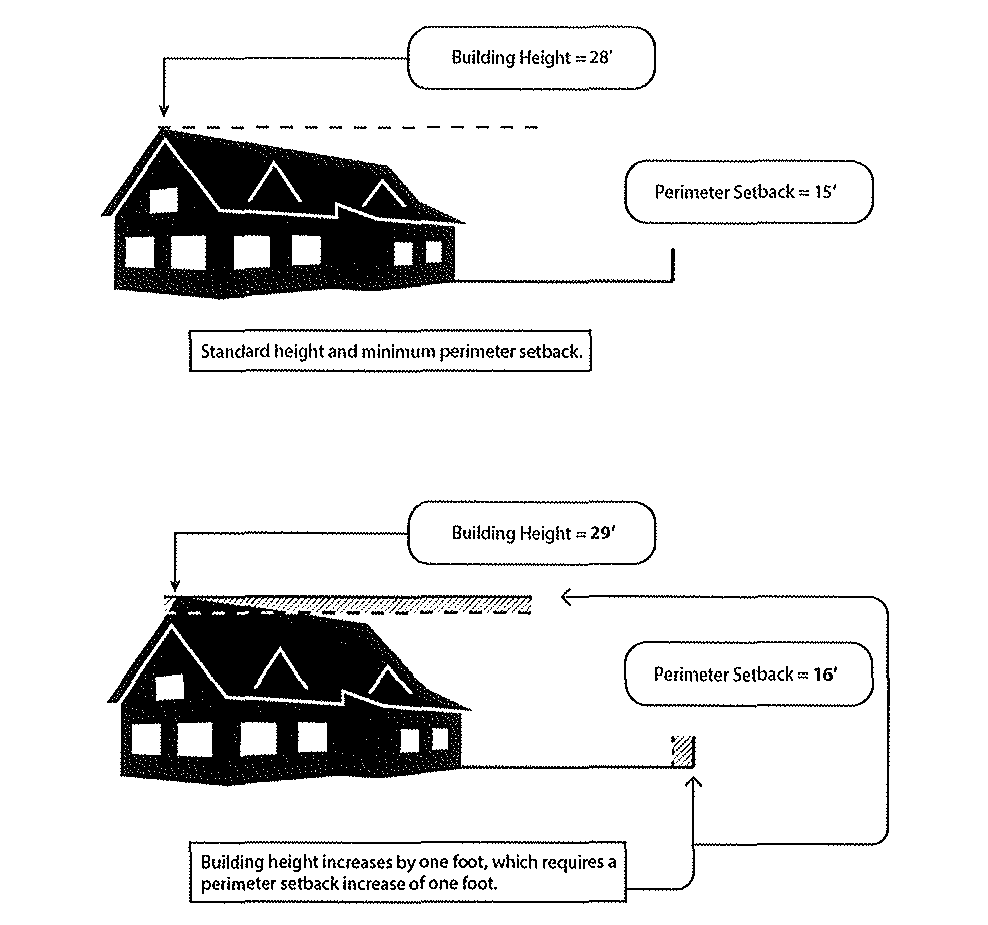
Figure 1. An illustration of height allowance as described in 11.b.1.a. above when approved by the planning commission, where for every foot increase in height requires a foot increase in minimum setback. This provision is designed to soften the impact to adjacent properties while allowing for increases in height where appropriate.
c.
Perimeter Setbacks. Buildings (including covered decks or covered patios, or decks or patios in excess of eighteen inches above existing grade) located on lots on the perimeter (excluding the public frontage defined in Chapter 19.78.040 of the development), shall have not less than a fifteen-foot setback from the perimeter lot line, and shall have a setback from a right-of-way as prescribed by the underlying zone and Chapter 19.77. Otherwise, no specific yard, setback, or lot size requirement is imposed by this chapter. However, the purpose and design objectives of this chapter must be complied with in the final development plan, and the planning commission may require specific setbacks within all or a portion of the development to maintain harmony with the existing character of the neighborhood.
d.
Site Calculations. Specific calculations which address the percentage of open space, impervious versus pervious surfaces, and site improvements shall be submitted by the applicant with all project applications.
e.
Traffic Circulation. Points of primary vehicular access to the development shall be designed to provide smooth traffic flow with controlled turning movements and minimum hazards to vehicular, pedestrian, and bicycle traffic. Adequate emergency vehicle access shall be provided. Internal circulation systems shall include pedestrian paths, and may include bicycle paths, preferably separated from vehicular traffic. Where recreational facilities exist or are planned adjacent to the proposed development, such pedestrian and bicycle paths shall connect to these facilities.
f.
Privacy. Each development shall provide reasonable visual and acoustical privacy for dwelling units. Fences, walks, barriers, landscaping, and sound reducing construction techniques shall be used as appropriate to enhance the privacy of its occupants, the screening of objectionable views or uses, and the reduction of noise.
g.
Sidewalks. With the exception of forestry zones, as required elements of a development, interior sidewalks shall be installed to serve the units and connect to the public street.
h.
Utilities. All utilities shall be located underground, except as may be provided for in state law. Utility equipment shall be screened from view and preferably, not fronting on a public street.
i.
Private outdoor spaces. Each residential unit shall be required to have an outdoor patio/rear yard space with a minimum of one hundred square feet, or a balcony with a fifty square foot minimum.
12.
Desirable Amenities. Amenities that are identified in the Salt Lake County Recreation and Open Space Standards Policy shall be installed in accordance with that policy. Where conflicts exist with this chapter and the Salt Lake County Recreation and Open Space Standards Policy, requirements identified in this chapter shall supersede.
13.
Miscellaneous. Installation of xeriscaping is encouraged as an alternative to excessive lawn areas or other landscaping treatments that excessively consume water. Low impact/water retention development techniques are encouraged to manage stormwater onsite including but not limited to planter boxes, rain gardens, and bioswales in the open spaces.
Parking areas, service areas, buffers, entrances, exits, yards, courts, landscaping, graphics, and lighting for both residential and non-residential development shall be designed as integrated portions of the total development and shall project the residential character.
(Ord. No. 1797, § I, 5-24-2016)
19.78.040 - Planned unit development mixed-use.
In a planned unit development, vertical mixed-use is allowed in zones that allow both residential and commercial and/or office uses, provided it meets the following requirements, in addition to the other requirements in this chapter. For purposes of this section, vertical mixed-use means commercial or office uses sharing the same building as residential uses.
1.
The property is abutting or contiguous to a corridor as defined in the general plan, or major or minor arterial ("street").
2.
Commercial uses shall only be allowed on the first floor of buildings fronting on the street. Office uses shall only be allowed on the first and second floor of buildings fronting on the street. Entrances to the first floor of these buildings shall front on the street. Windows shall make up at least fifty percent of street-facing facades of these floors. These floors shall have architectural differentiation from the other floors in the building.
3.
Parking is not allowed between the building(s) and the street.
4.
The front yard setback shall be fifteen feet, except as provided in subsection (E), and the side and rear yards shall be twenty feet minimum. Corner lots are deemed to have two front yards.
5.
The front yard setback is the build-to-line. At least fifty percent of the front elevation of the building(s) must be built within ten feet of the build-to-line or as approved by the planning commission. A build-to-line is defined as the line at which construction of a building façade is to occur on a lot, running parallel to the front property line, and ensuring a uniform (or more or less even) building façade line on the street.
6.
Landscaping along the street shall comply with this chapter and Chapter 19.77.
7.
Signage for commercial or office uses shall be limited to signs on the building(s) that comply with Chapter 19.82.
(Ord. No. 1797, § I, 5-24-2016)
19.78.050 - Maintenance of common facilities.
1.
A development shall be approved subject to the submission and recordation of legal instruments setting forth a plan or manner of permanent care and maintenance of all common open space and other facilities provided in the final development plan.
2.
Terms in the final development plan governing maintenance of common open space and other facilities shall comply with applicable provisions of the Utah Condominium Ownership Act, Title 57-8-101, et seq., or the Utah Community Association Act, Title 57-8a-101, et seq.
(Ord. No. 1797, § I, 5-24-2016)
19.78.060 - Review process.
1.
Pre-Submittal Development Review. To help expedite review of a development proposal, prior to submitting a complete application for development, persons interested in undertaking development shall meet with a member(s) of the planning staff for a planner/applicant meeting, to become acquainted with the substantive and procedural requirements of this chapter.
2.
Standard Operating Procedure (SOP). Staff creates, revises, and adheres to a development review standard operating procedure, to assist in the management and processing of applications. Applicants are encouraged to obtain a copy of the current SOP from planning and development services staff, and to seek guidance with respect to the review and understanding of the development review SOP from staff.
3.
Application. An application for a development must be submitted to planning and development services. As each development application is different and unique, application documents may vary with respect to content and need for specific reports and/or studies. Consultation with staff and examination of the development review SOP will guide the applicant through the review process and identify all submittal documents that will be required to formalize a complete application.
a.
Site plan that satisfies the requirements of Section 19.78.030(11).
b.
Landscaping plan. A landscape plan is to be prepared in accordance with Chapter 19.77 of this title. Staff can ask for justification of elements included in the landscape plan.
c.
Architectural building elevations. The location and floor area of all existing and proposed buildings, structures, and other improvements including heights, types of dwelling units, non-residential structures including commercial facilities, preliminary elevations and architectural renderings of typical structures and improvements, shall be prepared by a licensed architect or other qualified professional.
d.
Lighting plan.
e.
Subdivision plat.
(Ord. No. 1797, § I, 5-24-2016)
19.78.070 - Preliminary review.
When a complete application has been accepted by staff, reviews completed by staff and related agencies, and subsequent comments identified by staff and substantially addressed by the applicant, the application is scheduled for a community council meeting and a public hearing before the appropriate planning commission for their review and decision. Additional adjustments, revisions, or re-submittals may be required during this process to identify all concerns related to conformance with the intent of this chapter. Failure to submit complete and consistent information will result in written notification to the applicant that the review cannot proceed further until all required, necessary, and requested information is submitted.
(Ord. No. 1797, § I, 5-24-2016)
19.78.080 - Planning commission review.
When preliminary review of the application has been determined to be complete and in compliance with all requirements, the plans and preliminary plat together with all supporting information will be forwarded to the planning commission for review. If the property is to be subdivided, all requirements set forth in Title 18, Subdivisions, must be met.
In accordance with Chapter 19.05.040 and Utah Code § 17-27a-506, the planning commission shall review the proposed development plan to hear and receive public input and to determine if all reasonably anticipated detrimental effects have been substantially mitigated. The planning commission may require additional studies or analyses to enable it to determine how impacts should be addressed and may establish reasonable conditions of approval to address those anticipated impacts, as per Chapter 19.84.060.
(Ord. No. 1797, § I, 5-24-2016)
19.78.090 - Validity of preliminary review.
1.
Once the planning commission determines that preliminary review is complete, the preliminary plat or approved site plan is valid (twelve months for the preliminary plat and twelve months for the site plan). The division director may grant a one-year extension of the preliminary plat or approved site plan, provided the plat still complies with all applicable ordinances.
2.
If a PUD subdivision will be recorded in phases, a final plat for the first phase must be recorded within one year of the initial planning commission approval or one-year extension thereof, the validity of the unrecorded portions of the approved preliminary plat will extend for one year from the recording date of the plat for the previous phase. Extensions of time beyond three years from the date of initial approval require review and approval of the planning commission prior to the then current expiration of the preliminary plat.
(Ord. No. 1797, § I, 5-24-2016)
19.78.100 - Post-planning commission approval.
After completing the preliminary review by the departments, agencies, and planning commission, the applicant shall submit a final site plan and preliminary and final subdivision plats together with all supporting documents which comply with all requirements, corrections, additions, etc. required by the departments, agencies, and planning commission to the planning and development services division (hereinafter known as the "development plan").
1.
The planning and development services division, along with the other reviewing departments and agencies, shall review the proposed development plan to verify compliance with all requirements, corrections, additions, etc.
2.
After such review, the item may be scheduled for review by the planning commission upon referral by the division director or at the request of the planning commission. The final development plan shall include all of the information required in the preliminary development plan in its finalized detailed form.
(Ord. No. 1797, § I, 5-24-2016)
19.78.110 - Amendments to the development plan.
The division director or designee may authorize minor changes in the location, siting, or character of buildings and structures if required to resolve an engineering or other technical issue, or other circumstances not identified at the time the final development plan was approved. No change authorized under this section may cause any of the following ("major changes"):
1.
A change in the use and/or character of the development.
2.
An increase in the overall density and/or intensity of use.
3.
An increase of more than five percent in overall coverage of structures.
4.
A reduction or change in character of approved open space.
5.
A reduction of required off-street parking by more than five percent.
6.
A detrimental alteration to the pedestrian, vehicular, bicycle, circulation, or utility networks.
7.
A reduction in required street pavement widths.
8.
An increase in building height.
9.
A decrease in building setback.
Any major changes must be proposed to the planning commission after receipt of a recommendation by planning staff. Proposals under numbers 1. through 9. above require the filing of a new application. Generally speaking, any major changes must be recorded as amendments in accordance with the procedure established for adopting the final development plan.
(Ord. No. 1797, § I, 5-24-2016)
19.78.120 - Failure to begin development.
If no substantial construction has occurred in the development pursuant to the final development plan within twelve months from final approval, the approved plan shall become null and void and a new development plan and application shall be required for any development on the subject property. The division director, upon a determination of good cause based on evidence submitted by the applicant, may extend the time for beginning construction a maximum period of twelve months for one time only.
(Ord. No. 1797, § I, 5-24-2016)
19.78.130 - Phased planned unit development.
If the sequence of construction of various portions of the final development plan is to occur in stages, then the open space and/or recreational facilities shall be developed in proportion to the number of dwelling units intended to be developed during any given stage of construction. A phasing plan, including size and order of phases, shall be approved by staff to ensure that individual phases of the development comply with all requirements, including that the open space and/or recreational facilities are installed proportionately with the approved phasing plan.
(Ord. No. 1797, § I, 5-24-2016)

