San Antonio City Zoning Code
Sec. 82-15
Regulation of parking.
(a)
Short title and authority. This section shall be known as the San Antonio Regulation of Parking Space and Access Ordinance, and is adopted under the authority of F.S. ch. 166.
(b)
Purpose. The purpose and intent of this section is to promote, protect and improve the public health, safety, comfort, order, convenience and general welfare by establishing land use regulations governing the provision of parking space and access and minimum standards to provide for the harmonious, orderly and planned development of the community.
The benefits to be derived from the use and application of this section will be the attainment of a logical, convenient, workable land use pattern coordinated for the prevention of vehicular congestion.
(c)
General regulations for vehicles.
(1)
Off-street parking space and access.
a.
Required provision of off-street parking. Off-street parking shall be provided for all buildings and uses and located on the premises it is designed to serve.
1.
Such off-street parking shall not be separated from the use it serves by a utilized street or road right-of-way or other similar physical barriers to convenient access.
2.
Off-street parking spaces designed to serve nonresidential buildings and uses located in nonresidential zoning districts shall not be permitted to be located in residential zoning districts.
3.
Off-street parking facilities and other vehicular facilities both required and provided shall:
(a)
Be identified as to purpose and location when not clearly evident.
(b)
Be drained to city drainage standards as stated in section 78-10 of this Code and approved by the city commission.
4.
Required off-street and/or off-site parking shall not be used for sales or displays, dead storage, repair, dismantling, or servicing of any kind, nor shall areas devoted to such activities count as meeting off-street parking requirements.
b.
Paving requirements. Except for single and two family residential and agricultural uses, all off-street parking areas shall be surfaced with asphaltic or portland cement binder pavement or an equivalent improvement, so as to provide a dustless and durable surface provided that:
1.
Houses of worship, public and private schools offering academic courses, noncommercial amusement facilities, community centers, and public meeting halls may have up to 50 percent of the parking spaces (including aisles) surfaced with grass, lawn or other similar materials, for permanent, reserve parking; however, if parking demand is such that said grass, lawn or other material is caused to be damaged or destroyed to the extent that said grass or lawn ceases to grow, or the other material otherwise causes a nuisance to the neighborhood, then paving of such an area in accordance with this section may be required by the city commission.
2.
Single-family detached residential dwellings shall be required to provide paved aprons accessing paved streets.
3.
Uses requiring less than six parking spaces shall be permitted to provide parking and drive surfaces consisting of crushed gravel or other similar material acceptable to the city commission, designed to provide a durable, pervious surface.
4.
Each off-street parking space shall consist of a minimum net area of 144 square feet, the width of which shall not be less than nine feet and the length of which shall not be less than 18 feet, exclusive of access drive or aisles thereto, with the exception that handicapped parking shall have a minimum width of 12 feet and a minimum length of 18 feet.
c.
Off-street parking space access. All off-street parking spaces shall have direct access to a public right-of-way and be identified as to purpose and location when not clearly evident. Access points onto adjacent rights-of-way:
1.
Shall not exceed 40 feet in width for a two-lane driveway with one vehicular access;
2.
Shall not exceed 60 feet in width for a four-lane driveway with one vehicular access; or
3.
Shall be limited to one access point per individual property or site. Additional access points may be permitted by the city commission when such points are justified and necessary due to the length of street frontage servicing the premises and provided that the additional access points will substantially reduce traffic hazards or congestion on adjacent streets serving the property.
4.
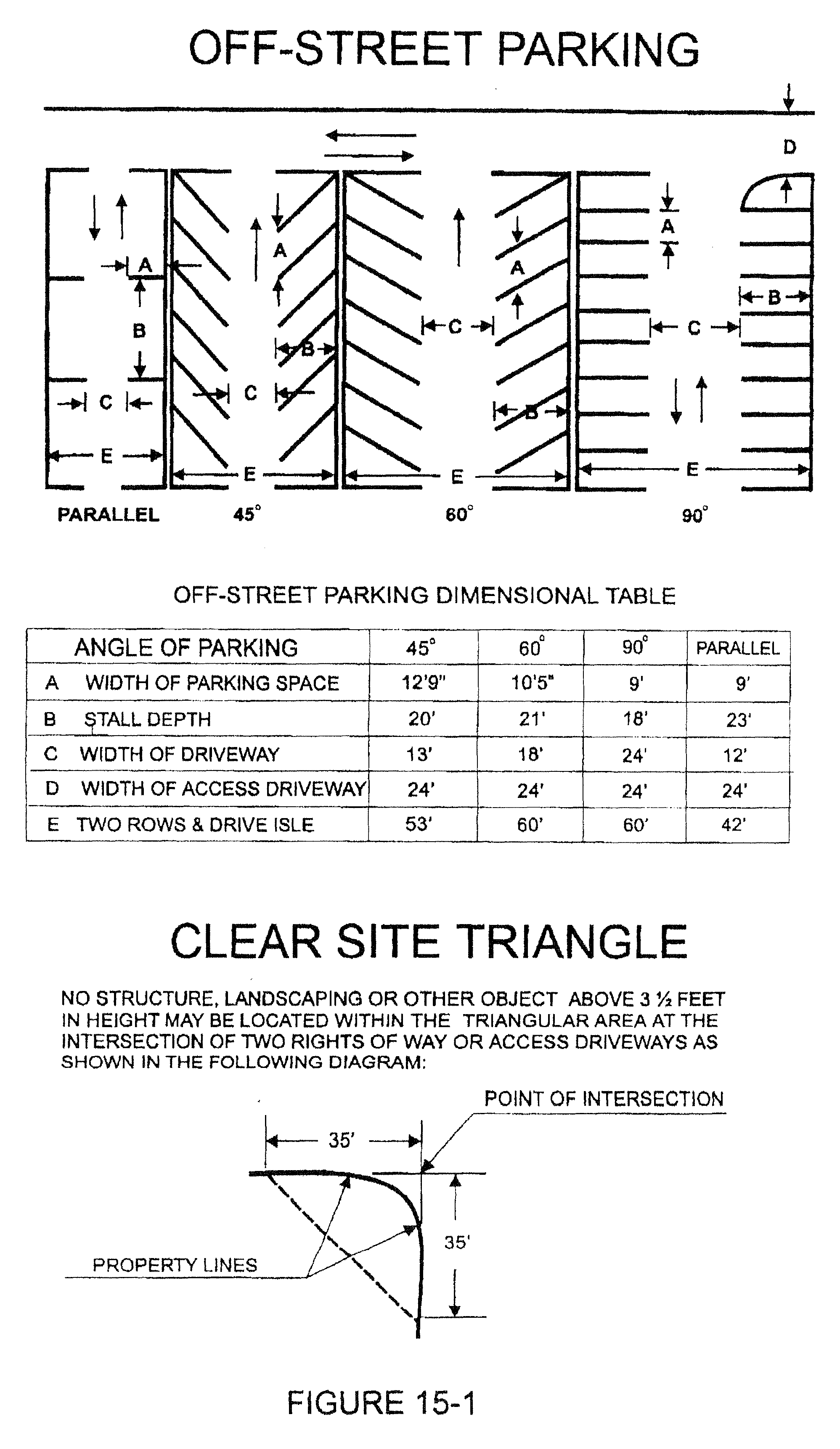
Minimum access drives shall be 24 feet in width for two way drives or 13 feet in width for one-way drives as reflected in Figure 15-1.
All vehicular access points shall be located at least 150 feet, or two-thirds the distance of the lot frontage, whichever is less, from the intersection of any right-of-way lines of streets or a street and railroad and at least 15 feet from all side or rear property lines.
d.
Number of required parking spaces. Minimum off-street parking space requirements shall be as follows:
1.
Single-family detached dwelling: One space per dwelling unit.
2.
Two or more family dwelling and single-family attached: One and five-tenths spaces per dwelling unit.
3.
Lodging house, boarding or rooming house: One space per sleeping room plus one space per resident manager.
4.
Dormitory, fraternity or sorority house: One and five-tenths spaces per every two students based on maximum capacity plus one space for every resident manager.
5.
Comparison goods stores, convenience goods stores, antique stores, second-hand stores and personal service establishments:
(a)
General: Four spaces per 1,000 square feet of building floor area.
(b)
Flea market: Ten spaces per 1,000 square feet of area devoted to sales.
(c)
Furniture, major appliance: Two spaces per 1,000 square feet of building area.
6.
Retail service establishments, including shopping centers, not specifically described elsewhere in this section: One space per 300 square feet of building area.
7.
Business, professional and non-profit organization offices, public offices, and research development and testing laboratories: Four spaces per 1,000 square feet of building area plus three spaces per doctor/dentist.
8.
Business training schools: Two spaces per 1,000 square feet of building area plus eight-tenths of a space per student enrolled on the premises.
9.
Restaurant: Four-tenths of a space per seat based on maximum customer capacity plus one space per drive-through customer service window.
10.
Drive-in restaurant: One space per drive-through customer service window plus one space per employee of the largest shift.
11.
Commercial amusement establishments, noncommercial amusement facilities and motion picture theaters:
(a)
General: Three-tenths of a space per seat based on maximum capacity of auditorium, stadium, arena, theater or similar place of assembly, or three-tenths of a space per person based on maximum capacity, or 15 spaces per 1,000 square feet of building and/or land area devoted to assembly or recreation use on the premises.
(b)
Bowling: Four spaces per lane.
(c)
Golf: Three spaces per green plus one space for driving range position.
(d)
Gun/archery range: Three spaces per target position plus one space per employee.
(e)
Miniature golf: Two spaces per green plus one space per employee.
(f)
Racquet court: Two spaces per court.
(g)
Skating: Five spaces per 1,000 square feet of building area.
12.
Motel and hotel: One and one-tenths spaces per sleeping unit plus one space per resident manager plus two-tenths of a space per restaurant seat based on maximum customer capacity.
13.
Automobile dealer establishments, tire and automotive accessory establishments, automobile specialty establishments, automobile equipment rental establishments, gasoline service stations, automobile and truck repair establishments, public transportation terminals, motor freight transportation establishments and aircraft establishments: One and five-tenths spaces per person regularly employed on the premises plus five spaces per 1,000 square feet of building area devoted to retail selling of merchandise, goods and products.
14.
Farm equipment and supply establishments and building material establishments: One and five-tenths spaces per person regularly employed on the premises plus five spaces per 1,000 square feet of building area devoted to retail selling of merchandise, goods and products.
15.
Heating fuel and ice establishments, construction service establishments and landscaping service establishments: One and five-tenths spaces per person regularly employed on the premises.
16.
Veterinarian and animal hospital service establishments: One and eight-tenths spaces per person regularly employed on the premises plus three spaces per veterinarian.
17.
Mortuaries, funeral homes and crematories: 20 spaces per 1,000 square feet of building area devoted to slumber rooms, parlors or individual mortuary rooms plus three-tenths of a space per seat based on maximum capacity of funeral service chambers or chapel.
18.
Manufacturing, wholesale and storage establishments, outdoor advertising service establishments, and laundry and dry cleaning plants: Seven-tenths of a space per person regularly employed on the premises based on the largest single employment shift.
19.
Primary and secondary educational facilities: The greater of:
(a)
One space per staff member plus three spaces for visitor parking.
(b)
Two-tenths of a space per student above the ninth grade level.
(c)
Three-tenths of a space per seat in public assembly areas.
20.
Cultural facilities: Three-tenths of a space per seat or ten spaces per 1,000 square feet of building and/or land area devoted to assembly or visitor use on the premises.
21.
Religious facilities: Three-tenths of a space per seat on basis of maximum capacity of auditorium or principal place of assembly.
22.
Hospitals: One and six-tenths spaces per bed based on maximum patient capacity.
23.
Mini-warehouse/self-storage:
(a)
Admin/office area. One space per each 400 square feet of area designated for admin/office area (Minimum of three spaces).
(b)
One space per 20,000 square feet of gross floor area of storage buildings.
(c)
One space per every 50 vehicle/watercraft storage area spaces.
24.
Car wash and auto detailing uses:
(a)
Automated or self-service facilities. One space per each automated or self-service facility, including a minimum of two additional spaces for management.
(b)
Hand car wash and detailing facilities. A minimum of four parking/stacking spaces shall be provided in addition to any spaces used for operations. Such spaces may be utilized as stacking spaces, separate parking spaces or a combination of the two. Any stacking shall be located as to avoid traffic circulation conflicts and provide safe turning movements. If operated as an accessory use, the required car wash parking/stacking spaces shall be provided separate from the parking spaces required by the primary use.
25.
Nursing care homes: Three-tenths of a space per bed based on maximum capacity.
26.
Adult congregate living facilities (ACLF):
(a)
Five-tenths of a space per bed based on maximum capacity.
(b)
A single-family residential structure that has been modified to operate as an adult congregate living facility (ACLF) and is operating under a special exception to the zoning code shall provide both the required off-street single-family and ACLF parking. The ACLF parking may be surfaced with grass or lawn; however, if parking demand is such that said grass or lawn is caused to be damaged or destroyed to the extent that said grass or lawn ceases to grow, then paving of such an area in accordance with this section shall be required.
27.
Marine establishments: One space per person regularly employed on the premises PLUS four spaces per 1,000 square feet of building area devoted to retail selling of merchandise, goods and products plus two spaces per five wet or dry boat slips.
e.
Fractions. When units or measurements determining the number of required off-street parking spaces result in the requirement of a fractional space, then a fraction having a value less than five-tenths shall be construed to be the next lower number of parking spaces, and fractions having a value equal to or greater than five-tenths shall be construed to be the next higher number of parking spaces.
f.
Required handicapped parking spaces. Required off-street parking areas shall have a number of level parking spaces, as set forth in the following table, identified by above grade signs as being reserved for physically handicapped persons. Each space so reserved shall be not less than 12 feet in width and 18 feet in length. Design and construction of all spaces and signage shall be as per the Florida Accessibility Code for Building Construction. Spaces for physically handicapped shall be located as close as possible to elevators, ramps, walkways and entrances. These parking spaces should be located so that handicapped persons are not compelled to wheel or walk between parked vehicles to reach entrances, ramps, walkways, and elevators.
g.
Off-street parking dimensions. Required off-street parking areas for three or more vehicles shall be designed, maintained, and regulated so that no parking or maneuvering incidental to parking shall be on a public street or walk, and so that a vehicle may be parked and unparked without moving another vehicle. The minimum dimensions for required off-street parking spaces shall be as provided in Figure 15-1.
h.
Reduction. Existing off-street parking space for any premises shall not be reduced unless it exceeds the requirements of this section.
i.
Standards. Off-street parking facilities and other vehicular facilities both required and provided shall:
1.
Be identified as to purpose and location when not clearly evident.
2.
Provide that access to parking, including access and aisles providing access to parking spaces, be constructed to city standards as reflected in chapter 78 of this Code.
3.
Be drained to city drainage standards as provided in chapter 78 of this Code and approved by the city commission.
j.
[On-street parking allowed in certain defined area.] No off-street parking spaces shall be required in the area specifically bounded as follows: commencing at the northeast corner of Curley Road and Pennsylvania Avenue; thence run easterly along the northern right-of-way line of Pennsylvania Avenue to the northwest corner of Pennsylvania Avenue and Joe Herrmann Drive, then southerly along the west right-of-way line of Joe Herrmann Drive to the southwest corner of Joe Herrmann Drive and Saint Anthony Way, thence westerly along the southern boundary line of Saint Anthony Way to the southwest corner of Massachusetts Avenue and Main Street, thence northerly along the west right-of-way line of Main Street to the southwest corner of Main Street and Pennsylvania Avenue, thence westerly along the southern boundary line of Pennsylvania Avenue to the southeast corner of Pennslyvania [Pennsylvania] Avenue and Curley Road, thence northerly to the point of beginning.
(2)
Off-street loading and unloading space. Off-street loading spaces shall be provided and maintained as follows:
a.
Each retail commercial store, service establishment, storage or wholesale establishment restaurant, dry cleaning establishment, or similar use shall provide loading spaces on site according to the following table:
b.
For each multiple dwelling unit facility having at least 20 dwelling units but not over 50 dwelling units: Two spaces. For each multiple dwelling unit facility over 50 units in size: Two spaces, plus two spaces for each additional 50 units or fraction thereof.
c.
For each auditorium, hall, motel or hotel, bank or financial institution, office building, or similar use, with an aggregate floor area of 10,000 to 40,000 square feet, one space is required. One additional space for every additional 40,000 square feet of aggregate floor area is required.
d.
Spaces shall be provided on the premises so that no loading or unloading activity will be generated on any street or impede the flow of traffic through parking or access areas.
e.
Spaces shall be provided with vehicular access to a street or alley as well as with appropriate maneuvering areas.
f.
Loading and unloading bays shall be at least 40 feet in depth, 12 feet in width, with an overhead clearance of not less than 14 feet.
g.
Spaces shall be constructed to parking lot standards of the city as reflected in chapter 78 of this Code and approved by the city commission.
h.
Space for the servicing of building by refuse collection, fuel and other service vehicles shall also be provided on the premises.
i.
The city commission shall interpret the amount of loading and unloading space required for any building or use.
(3)
Parking, storage, or use of major recreational equipment. Major recreational equipment is hereby defined as including boats and boat trailers, travel trailers, pickup campers or coaches (designed to be mounted on vehicles, motorized dwellings, tent trailers, house boats, and the like, as well as cases or boxes used for transporting the equipment, whether occupied by the equipment or not. No major recreational equipment shall be used for living, sleeping, or housekeeping purposes when parked or stored on a lot in a residential district, or in any district not approved for such use. In residential districts, major recreational equipment may be parked or stored in a rear or side yard, but not in a required front yard; provided, however, that such equipment may be parked anywhere on residential purposes for a period not to exceed 24 hours during loading and unloading.
(4)
Parking and storage of certain vehicles. In residential districts, vehicles or trailers of any time which require but do not possess current license plates shall not be parked or stored other than in completely enclosed buildings.
(5)
Landscaping requirements. Wherever in any zoning district off-street parking facilities are required, such off-street parking facilities shall conform and comply with minimum landscaping requirements as set forth in section 82-14, and as illustrated in Figure 14-1.
(6)
Off-street parking plans. A plan shall be submitted with every application for a building permit for any building or use that is required to provide off-street parking. The plan shall accurately designate the required parking spaces, access aisles, and driveways, and the relation of off-street parking facilities to the uses and structures they are designed to serve. The plan shall be reviewed by city staff and shall be approved or disapproved based on the criteria provided herein by the sanitation/building commissioner.
(7)
General requirements:
a.
Pedestrian circulation facilities, roadways, driveways and off-street parking and loading areas shall be designed to be safe and convenient.
b.
Parking and loading areas, aisles, pedestrian walks, landscaping and open space shall be designed as integral parts of an overall development plan and shall be properly related to existing and proposed building.
c.
Buildings, parking and loading areas, landscaping and open spaces shall be designed so that pedestrians moving from parking areas to buildings and between buildings are not unreasonably exposed to vehicular traffic.
d.
Landscaped, paved and gradually inclined or flat pedestrian walks shall be provided along the lines of the most intense use, particularly from building entrances to streets, parking areas and adjacent buildings. Pedestrian walks should be designed to discourage incursions into landscaped areas except at designed crossings.
e.
Aisles and driveways shall not be used for parking vehicles, except that the driveway of a single-family or two-family residence shall be counted as a parking space for the dwelling unit or as a number of parking spaces as determined by the sanitation/building commissioner based on the size and accessibility of the driveway.
f.
The design shall be based on a definite and logical system of drive lanes to serve the parking and loading spaces. A physical separation or barrier, such as vertical curbs, may be required to separate parking spaces from travel lanes.
g.
All off-street parking and loading areas shall be well maintained; free of potholes, debris, weeds, broken curbs, and broken wheel stops; clearly striped; and with all lighting in working condition.
h.
Any existing use without conforming off-street parking space shall not be required to conform with the requirements of this section at the time of any alteration, change of use or expansion of the use unless there is a resulting increase in parking space demand. If an increase results, then the total required parking must conform to all conditions and standards of this section.
i.
Where a facility is combined for multiple use, the total amount of required parking shall be calculated on a combined basis.
j.
Approved and existing off-street parking spaces for any premises shall not be reduced for any reason unless proposed parking exceeds the requirements of this section.
(Ord. No. 91-8, §§ 1—3, 1-7-92; Ord. No. 99-02, §§ 1, 2, 5-4-99; Ord. No. 2000-05, § 1, 5-2-00; Ord. No. 2015-05, § 1, 8-18-15 ; Ord. No. 05-2022 , § 1(Exh. A), 11-15-22)