
San Antonio City Zoning Code
DIVISION 7
SUPPLEMENTAL USE REGULATIONS
Sec. 35-370.- Accessory Use and Structure Regulations.
(a)
Accessory Uses.
(1)
An accessory use shall not be larger than twenty-five (25) percent of the gross floor area of the principal use.
(2)
Notwithstanding specific limitations in Table 311-2, an accessory use shall only be allowed in a zoning district where it is permitted as a principal/primary use, and in a district of lesser intensity (as further depicted in Table 311-2), pursuant to the following table:
(3)
Uses that are only allowed by approval of a specific use authorization ("S") and not permitted by right ("P") in any zoning district shall not be allowed as an accessory use.
(4)
Uses that are only allowed by-right in the "I-2" heavy industrial district or "MI-2" mixed heavy industrial district shall not be allowed as accessory uses in a less intense zoning district, unless they occupy no more than ten (10) percent of the gross floor area of the principal use and are fully enclosed within the principal structure.
(5)
Residentially zoned property shall not have accessory uses [save home occupations (see section 35-378); ADDUs (see section 35-371); or typical residential accessory structures, e.g. garages (attached or detached); carports; fences; storage sheds; swimming pools; greenhouses/gazebos; sport courts; etc.].
(6)
A use specifically prohibited by an overlay district, such as the "RIO" or "ERZD" shall not be permitted as an accessory use when located within such an overlay district.
(7)
Sales of alcoholic beverages for on- or off-premises consumption may not be an accessory use within the respective "NA" or "R" classifications.
(8)
Where accessory uses are permitted, the standards of the applicable base zoning district, as well as any overlay district on the property, shall apply including but not limited to setbacks, building heights, landscaping and other requirements outlined in this chapter except where otherwise provided in section 35-370.
(9)
Temporary uses may be permitted pursuant to section 35-391.
(b)
Accessory Structures.
(1)
Accessory structures exceeding thirty (30) inches in height shall be located a minimum distance of five (5) feet from any side or rear property line. In residential districts, however, if an accessory structure has no sills, belt courses, cornices, buttresses, eaves, or similar projecting architectural features, then the minimum distance from any side or rear property line may be reduced to three (3) feet.
(2)
Accessory structures on reverse corner lots shall maintain a minimum distance from the side street lot line equal to the depth of the front setback required on the lot to the rear.
(3)
The maximum lot coverage of all accessory structures shall not exceed fifty (50) percent of the total area of the side and rear yards, provided that in residential districts the total floor area does not exceed a maximum of two thousand five hundred (2,500) square feet.
(4)
Within nonresidential districts, accessory structures, except for carports, are prohibited within the side and rear setback areas of lots adjacent to residential district. The total floor area of all accessory structures shall not exceed two thousand five hundred (2,500) square feet.
(5)
Accessory structures intended for use as accessory dwelling units shall also conform to the provisions of section 35-371.
(6)
Accessory structures shall only be permitted within the side or rear yard area within all single-family and mixed residential districts, as identified in section 35-303, with the exception of carports and garages permitted pursuant to section 35-516(g). Subsection (6) shall not apply to residentially zoned property when the primary use is a church, school or other permitted nonresidential use.
(Ord. No. 2010-11-18-0985, § 2, 11-18-10) (Ord. No. 2012-10-18-0829, § 2, 10-18-12)
Sec. 35-371. - Accessory Dwellings.
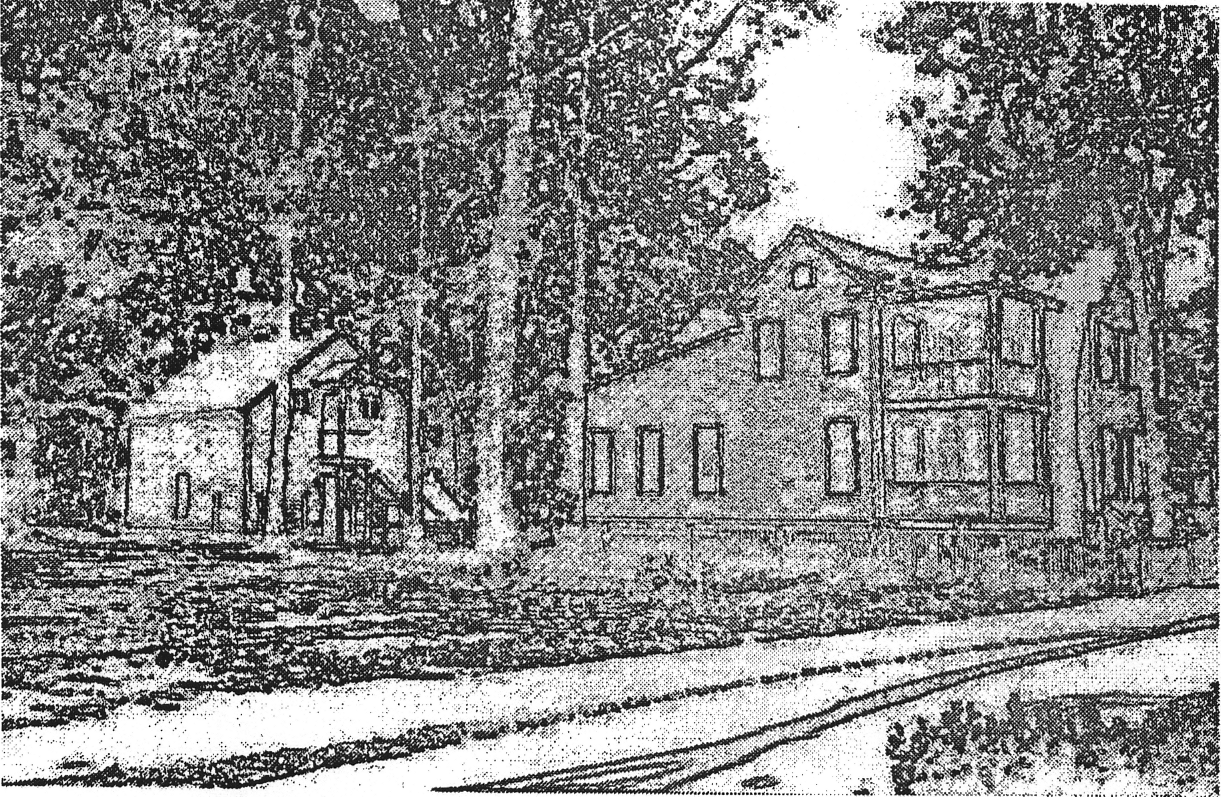
Accessory and Principal Dwellings
STATEMENT OF PURPOSE
Affordable housing and neighborhood stability are important public objectives in the City of San Antonio. In recent years, accessory dwellings have become an important method to permit families to remain in their homes by securing rental income, while at the same time providing affordable housing for the elderly, single-person households, students, and other needy populations. Accessory dwellings are also known as "carriage houses," "granny flats," or "echo homes" (an acronym for "elder cottage housing opportunities").
The provisions of this section implement Policy 4i (Neighborhoods) of the master plan, which requires the city to permit carefully controlled accessory housing in single-family residential zoning districts.
(a)
Generally.
(1)
The property owner, which shall include title holders and contract purchasers, must occupy either the principal unit or the accessory dwelling as their permanent residence, and shall at no time receive rent for the owner-occupied unit. "Owner occupancy" means a property owner, as reflected in title records, makes his or her legal residence at the site, as evidenced by voter registration, vehicle registration, or similar means. The property owner shall sign an affidavit before a notary public affirming that the owner occupies either the main building or the accessory dwelling. The applicant shall provide a covenant suitable for recording with the county recorder, providing notice to future owners or long term leases of the subject lot that the occupancy of the accessory dwelling unit is predicated upon the occupancy of either the accessory dwelling or the principal dwelling by the owner of the property.
(2)
No accessory dwelling shall be constructed, used or occupied unless and until an accessory dwelling permit is issued.
(3)
The accessory dwelling shall not exceed eight hundred (800) square feet or fifty (50) percent of the gross floor area (excluding covered porches) of the primary structure up to a maximum of sixteen hundred (1,600) square feet, in any single-family residential zoning district other than the "FR" zoning district, or one thousand two hundred (1,200) square feet in the "RE" zoning district (excluding covered porches). This restriction applies only to that portion of a structure that constitutes living area for an accessory dwelling.
(4)
Accessory dwelling units used as short-term rentals must comply with Section 35-374.01.
(b)
Accessory Detached Dwelling Units. Where permitted pursuant to section 35-311 of this chapter, an accessory detached dwelling unit (ADDU) shall not be established except in accordance with the following criteria:
(1)
Only one (1) accessory unit shall be permitted per lot and it shall be located in the rear yard.
(2)
An ADDU that exceeds eight hundred (800) square feet gross floor area shall provide one (1) parking space.
(3)
An ADDU shall require a minimum setback from the rear and side property lines of five (5) feet. If the structure has no overhang the accessory unit may be three (3) feet from the rear and side property lines.
(4)
An ADDU may not exceed twenty-five (25) feet or two (2) stories in height.
(c)
Attached Accessory Dwelling Units.
(1)
Attached accessory dwelling units shall be in compliance with the required setbacks of the primary structure required by the underlying zoning district.
(Ord. No. 96564 § 3) (Ord. No. 97568 § 2) (Ord. No. 100126; Ord. No. 2022-11-03-0831, § 2, 11-3-22, eff. 1-1-23)
Sec. 35-372. - Affordable Dwelling Units.
STATEMENT OF PURPOSE
• To provide affordable shelter for all residents of the city.
• To address housing needs.
• To promote a full range of housing choices.
• To encourage the construction and continued existence of moderately priced housing by providing for optional increases in density in order to reduce land costs for such affordable housing.
This section implements the following provisions of the master plan:
• Neighborhoods, Policy 4a: Require affordable housing providers to complement the architectural design and character of the neighborhood in which new housing is being constructed.
• Neighborhoods, Policy 4e: Facilitate the provision of affordable housing by the private sector.
• Neighborhoods, Policy 4e: Provide incentives for private housing providers who provide affordable housing designed to meet the goals set forth in the five-year housing master policy.
• Neighborhoods, Policy 4e: Review zoning, subdivision ordinances, building codes, and related development-control ordinances and administrative procedures, to identify and overcome barriers to affordable housing.
• Urban Design, Policy 1c: Support and promote mixed-use residential development that will include a mix of multi-family units and single-family homes in varying sizes, types and price ranges.
(a)
Applicability.
(1)
Generally. The provisions of this section shall apply to any application for development approval, as set forth in subsection (2) below, which include affordable dwelling units with the maximum ratio specified in column (B) of Table 372-1, below. For purposes of this section, an "affordable dwelling unit" means any dwelling unit restricted as affordable housing or deeply affordable housing.
(2)
Qualifying Applications. The provisions of this section apply to a site, or a portion thereof, which is the subject of an application for a rezoning, master development plan, or subdivision plat.
(b)
Architectural Design and Character. Affordable dwelling units shall comply with the residential urban design criteria (section 35-372) of this chapter.
(c)
Density Bonus and Set-Aside Requirements.
(1)
A qualifying application (as defined in subsection (a) of this section) may be approved with an increase in the density of the site as set forth in Table 372-1. The applicant shall consent to a voluntary and enforceable condition in which the specified percentage of the developable density of the site, as specified in column (B) of Table 372-1, is reserved as affordable dwelling units as defined in subsection (a) of this section.
(2)
Table 372-1 shall be construed as follows:
A.
Determine the category of housing as set forth in column (A).
B.
Determine the required set-aside for the application category by referring to column (B). For purposes of this subsection, the number of affordable dwelling units required is determined by multiplying the total number of dwelling units permissible on the site as set forth in Table 310-1 by the percentage prescribed in column (B) of Table 372-1, below.
C.
Determine the density increase that may be awarded by referring to column (C). For purposes of this subsection, the additional density that may be awarded is determined by multiplying the total number of dwelling units permissible for the site as set forth in Table 310-1 by the percentage prescribed in column (C) of Table 372-1, below. The city shall not require the additional dwelling units to be restricted as to income.
Example: A twenty-acre parcel is zoned "R-6" (seven (7) dwelling units per acre in Table 310-1). Thirty (30) percent of the parcel is devoted to right-of-way and open space, leaving fourteen (14) acres developable for lots. The developer can subdivide the tract into one hundred one (101) lots as a conventional subdivision (fourteen (14) acres (six thousand (6,000) square feet per lot). The applicant agrees to restrict ten (10) percent of the units, or ten (10) units (one hundred one (101) units by ten (10) percent (column (B) of Table 372-1, below), as low income housing. The developer may construct an additional twenty (20) dwelling units (one hundred one (101) by twenty (20) percent (column (C)), or a total of one hundred twenty-one (121) dwelling units.
(3)
In some instances, developers will not be able to provide the number of dwelling units permissible after applying Table 372-1. In such cases, the applicant may reduce the number of affordable dwelling units. However, the number of affordable dwelling units provided in such cases must at least equal the ratio. To the additional units which result from dividing column (B) by column (C) and multiplying the dividend by the number of affordable dwelling units required under subsection (2), above.
Example: In the twenty-acre parcel discussed in the example under subsection (2), above, the developer is able to construct only ten (10) additional dwelling units because of floodplain restrictions. In Table 372-1, column (B) (ten (10) percent) (column (C) (twenty (20) percent) is fifty (50) percent. Ten (10) affordable dwelling units were required by subsection (2), above. The applicant may reduce the number of affordable dwelling units provided by fifty (50) percent, or by five (5) units.
TABLE 372-1
(d)
Project Phasing. No qualifying application shall be approved unless the applicant consents to a condition that building permits for the dwelling units that are not affordable dwelling units (hereinafter "market rate units") shall be issued as follows:
(1)
Building permits may be issued for the first fifty (50) percent of the market rate units prior to the construction and offering for sale or rental of any affordable dwelling unit.
(2)
No building permits may be issued for the next twenty-five (25) percent of the market rate units (i.e., from fifty-one (51) percent up to seventy-five (75) percent of the approved market rate units) prior to the construction and offering for sale or rental of at least twenty-five (25) percent of the approved affordable dwelling units.
(3)
No building permits may be issued for the next fifteen (15) percent of the market rate units (i.e., from seventy-six (76) percent up to ninety (90) percent of the approved market rate units) prior to the construction and offering for sale or rental of at least seventy-five (75) percent of the approved affordable dwelling units.
(4)
No building permits may be issued for the remainder of the market rate units (i.e., from ninety-one (91) percent to one hundred (100) percent of the approved market rate units) prior to the construction and offering for sale or rental of one hundred (100) percent of the approved affordable dwelling units.
(e)
Enforcement. The city council or its designee may enforce compliance with the standards of this section and may impose penalties for noncompliance as set forth in article IV of this chapter.
(f)
Administration.
(1)
Affordable dwelling units shall be offered for sale or rent exclusively to persons, households or families who meet the income criteria for "Affordable housing" or "Deeply Affordable income housing," as defined in Appendix "A" of this chapter, hereinafter target households.
(2)
The provisions of this section may be administered by the City of San Antonio Neighborhood & Housing Services Department. The City of San Antonio or a community housing development organization (CHDO) shall have an exclusive right to purchase any units be offered for sale to target households but not purchased or rented within a time period mutually agreed upon between the applicant and the City of San Antonio or a CHDO.
(3)
Affordable dwelling unit sales prices throughout the city shall be established by the City of San Antonio initially and shall be adjusted semiannually, based on a determination of all ordinary, necessary and reasonable costs required to construct the affordable dwelling unit prototype dwellings by private industry, and other information such as the area's current general market and economic conditions, provided that sales prices not include the cost of land, on-site sales commissions and marketing expenses, but may include, among other costs, builder-paid permanent mortgage placement costs and buy-down fees and closing costs except prepaid expenses required at settlement.
(4)
Affordable dwelling unit rental prices shall be established by the City of San Antonio initially and shall be adjusted semiannually, based on a determination of all ordinary, necessary and reasonable costs required to construct and market the required number of affordable dwelling rental units by private industry in the area, and other information such as the area's current general market and economic conditions.
(5)
Prices for re-sales and re-rentals shall be controlled by the City of San Antonio or a CHDO designated by the applicant for a period of fifty (50) years after the initial sale or rental transaction for each affordable dwelling unit.
(6)
The sales and rental price for affordable dwelling units within a development shall be established such that the owner/applicant shall not suffer economic loss as a result of providing the required affordable dwelling units. "Economic loss" for sales units means that result when the owner or applicant of a development fails to recoup the cost of construction and certain allowances as may be determined by the City of San Antonio for the affordable dwelling units, exclusive of the cost of land acquisition and costs voluntarily incurred but not authorized by this section, upon the sale of an affordable dwelling unit.
(Ord. No. 2010-11-18-0985, § 2, 11-18-10; Ord. No. 2022-11-03-0831, § 2, 11-3-22, eff. 1-1-23)
Sec. 35-373. - Attached Dwellings.
(a)
Applicability. The provisions of this section apply to any single-family attached dwelling, duplex, townhouse, zero-lot line house, cottage, or housing facility for older persons.
(b)
Townhouse Development.
(1)
No front yard or side yard is required.
(2)
A rear setback shall not be required when the townhouse lot abuts an alley or driveway having a minimum right-of-way width of twenty-four (24) feet which is used to provide ingress and egress to such townhouse development. On townhouses and lots that do not abut at the rear, an alley or driveway having a minimum width of twenty-four (24) feet, a twelve-foot rear setback shall be required.
(3)
One hundred (100) square feet of contiguous open area shall be provided on each individual lot. The one hundred (100) square feet of open area may be used for children's play area and/or patio and may be located in front or to the rear of the townhouse. On corner lots or where side yards are present, the one hundred (100) square feet of contiguous area may include the side yard as long as it is not separated by a fence from the remaining portion of the one hundred (100) square feet of space. The "contiguous open area" may consist of lawns, landscaped areas and/or walkways, but shall not include parking or driveways.
(4)
The minimum lot area shall be one thousand two hundred (1,200) square feet.
(5)
Townhouses shall not be subject to the minimum lot size for RM districts in Table 310-1.
(6)
Except in the "TOD" district, no townhouse development shall exceed a density of more than forty (40) units per gross acre.
(7)
The minimum lot width shall be fifteen (15) feet.
(8)
Each townhouse shall have either an attached garage, a detached garage, or there shall be a common non-commercial parking lot for the townhouse development. Parking shall not be required in an approved IDZ zoning district.
(9)
A townhouse shall have a maximum of three (3) floors in any zoning district and shall have a maximum of four (4) floors where in an approved IDZ zoning district, or the downtown (D) zoning district.
(10)
Subsection 35-343(m) Urban Design does not apply to townhomes.
(c)
Zero Lot Line Development.
Purpose. The purpose of the zero lot line regulations is to provide for single-family attached or detached residential structures with one (1) zero side setback area. The intent is to allow a single-family structure to be placed on a side lot line in order to provide a more usable side yard on the other side.
(1)
Zero lot line development shall comply with 310-1 of this article with the exception of the minimum side setbacks in Column (J).
(2)
A zero lot line may only be located on an interior side property line.
(3)
The zero lot line for each lot shall be denoted on the subdivision plat.
(4)
For zero lot line subdivisions, a minimum five-foot wide maintenance easement shall be provided through deed restrictions on the lot adjacent to the zero lot line. This easement shall be kept free of permanent obstructions such as tool sheds or fences without a gate. When filing an application for a building permit for a zero lot line development, the subdivider shall provide the city with two (2) copies of deed restrictions establishing the maintenance easements. One (1) copy of these deed restrictions shall be recorded by the applicant prior to issuance of the building permit. Along with the required building permit filing fees, an additional fee shall be provided by the subdivider to cover the recording costs of these deed restrictions.
The following notation shall appear on the plat:
"Foot wide maintenance easements are established within the lots adjacent to all nonattached zero lot lines. Such easements shall extend for the depth of the lot and are included in the deed restrictions for all affected properties."
(5)
Dwelling units shall be constructed on the zero lot line on one (1) side of the lot and a side setback shall be provided on the other side of the said lot subject to the following conditions:
A.
The minimum width of the side setback opposite the zero lot line shall be ten (10) feet.
B.
A zero setback shall not be permitted when the zero lot line abuts a non-zero lot line development, in which case, a minimum side setback of five (5) feet shall be required.
C.
There shall be no openings in any exterior wall located upon or oriented towards the zero side yard of the subject property. Exception: an alcove or atrium with doors or windows may be recessed into the dwelling structure if such recessed area is separated from the zero side yard by means of a solid wall not less than eight (8) feet in height. Said wall shall be constructed of the same material as exterior walls of the unit.
(6)
The zero-lot line for an existing legally permitted zero-lot line residence may be maintained on any addition to the residence, so long as the maintenance easement requirement indicated above is maintained.
(d)
Cottage Housing Developments. The following regulations apply to cottages and cottage housing developments (CHDs). For purposes of this subsection (d), a "cottage" means a single-family detached dwelling which meets the requirements of this section, and a "cottage housing development" means a lot, parcel, or contiguous development site on which one (1) or more cottages are located.
(1)
Density and Minimum Lot Area.
A.
In CHDs the permitted density shall be as follows:
B.
The minimum lot area for a CHD shall be eleven thousand six hundred (11,600) square feet.
C.
On a lot to be used for a CHD, an existing detached single-family residential or duplex, which may be nonconforming with respect to the standards of this section, shall be permitted to remain, but the extent of the nonconformity may not be increased.
(2)
Height Limit and Roof Pitch.
A.
Cottages shall not exceed eighteen (18) feet or one and one-half (1½) stories in height
B.
The ridge of pitched roofs with a minimum slope of six (6) to twelve (12) may extend up to twenty-five (25) feet. All parts of the roof above eighteen (18) feet shall be pitched.
(3)
Lot Coverage and Floor Area.
A.
The maximum lot coverage permitted for principal and accessory structures in a CHD shall not exceed forty (40) percent.
B.
The maximum first floor or principal floor area for an individual principal structure in a CHD shall not exceed eight hundred (800) square feet.
C.
The total floor area of each cottage shall not exceed either 1.5 times the area of the principal floor area, or nine hundred seventy-five (975) square feet, whichever is less.
(4)
Yards.
A.
Front yards. The front yard shall be an average of ten (10) feet and at no point shall be less than five (5) feet.
B.
Rear yards. The minimum rear yard shall be ten (10) feet.
C.
Side yards. The minimum required side yard shall be five (5) feet.
(5)
Required Open Space.
A.
In lieu of the requirements of subsection 35-503(b) of this chapter, a minimum of four hundred (400) square feet per unit of common open space is required. A fee pursuant to subsection 35-503(c) shall not be paid in lieu of this open space.
B.
At least fifty (50) percent of the cottages shall abut the common open space.
C.
All of the cottage units shall be within sixty (60) feet walking distance of the common open space.
D.
The common open space shall have cottages abutting at least two (2) sides.
E.
The open space shall in all other respects conform to the parks and open space standards (section 35-503) of this chapter.
(6)
Parking.
A.
The amount of parking spaces shall be as provided in subsection 35-526(b).
B.
Parking may be in or under a structure or outside a structure, provided that:
1.
The parking is screened from direct street view by one (1) or more street facades, by garage doors, or by a fence and landscaping.
2.
Parking between structures is only allowed when it is located to the rear of the principal structure and is served by an alley or private driveway.
3.
Parking may not be located in the front yard.
Parking may be located between any structure and the rear lot line of the lot or between any structure and a side lot line, which is not a street side lot line.
(e)
Housing Facilities for Older Persons.
(1)
For purposes of this subsection (e), a "housing facility for older persons" (hereinafter "HFOP") means any apartment which complies with the provisions of 24 C.F.R. §§ 100.3 04—100.307.
(2)
An HFOP shall be permitted as of right:
A.
In any "RM-4," "RM-5," or "RM-6" zoning district subject to the requirements of this section, or
B.
In any "MF-18," "MF-25," "MF-33," "MF-40," or "MF-50" subject to the standards generally applicable to other uses within such districts.
(3)
Prior to issuance of an application for development approval authorizing construction or establishment of an HFOP, the applicant shall provide to the director of planning and development services:
A.
A copy of the policies and procedures required by 24 C.F.R. § 100.306, and
B.
A copy of the verification of occupancy required by 24 C.F.R. § 100.307.
(4)
An HFOP permitted within the "RM-4," "RM-5," or "RM-6" zoning districts shall comply with the following:
A.
The building shall not exceed two (2) stories in height; and
B.
The building shall conform to the setback standards generally applicable within the zoning district; and
C.
The building shall comply with the minimum and maximum parking standards applicable to multi-family dwellings; and
D.
The proposed development shall comply with all applicable standards of article V of this chapter.
(Ord. No. 98697 § 4) (Ord. No. 101816, § 2, 12-15-05) (Ord. No. 2006-11-30-1333, § 2, 11-30-06) (Ord. No. 2009-01-15-0001, § 2, 1-15-09) (Ord. No. 2010-11-18-0985, § 2, 11-18-10; Ord. No. 2015-12-17-1077, § 2, 12-17-15; Ord. No. 2022-11-03-0831, § 2, 11-3-22, eff. 1-1-23)
Sec. 35-374. - Bed and Breakfast.
STATEMENT OF PURPOSE
The purpose of this section is to regulate bed and breakfast establishments within the city. Such establishments as specified by zoning district are subject to the conditions of this section.
(a)
Applicability. The provisions of this section shall apply to the establishment of any bed and breakfast in the city.
(b)
Definitions. Definitions which appear below apply only to this section and shall prevail if in conflict with definitions found elsewhere within this chapter.
(1)
Distressed structure means a structure which has been certified by the historic preservation officer as being more than fifty-one (51) percent uninhabitable or vacant, and/or in disrepair for more than two (2) years.
(2)
Owner of the property means a natural person directly owning at least fifty (50) percent fee simple interest in the property and who shall also occupy the premises as his place of residence.
(c)
Number of Guest Rooms per Structure. The maximum number of permitted guest rooms per bed and breakfast establishment within each zoning district shall be as indicated in the following table. Any bed and breakfast establishment with more than twelve (12) guest rooms shall be considered a hotel and shall be required to comply with the zoning provisions for such uses.
(d)
Certificate of Occupancy. A certificate of occupancy shall be required for all bed and breakfast establishments.
(e)
Guest Register Required. The owner/operator shall maintain a current guest register to include names, addresses, fees collected and dates of occupancy of all guests.
(f)
Signage Requirements. No signs shall be permitted within residential districts except for a nameplate not exceeding one (1) square foot in size and consisting of the name of the establishment only. This nameplate may be attached to the building, gatepost, gate, or other permanent fixture to allow visibility from the street.
(g)
Parking Space Requirements. One (1) off-street parking space per guest room shall be provided in addition to the required off-street parking for the owner/operator. Tandem parking is allowed; however, except for the driveway, the front yard shall not be used for parking.
(h)
Reserved.
(i)
Regulations Pertaining to Bed and Breakfast Establishments Within Any Zoning District. Except as provided below, no bed and breakfast establishments within these zoning districts may be permitted within three hundred (300) feet laterally and one hundred fifty (150) feet perpendicularly (as below) of any other property authorized for a bed and breakfast use within any zoning district. Such measurements shall be made from the property line of the proposed bed and breakfast to the nearest property line of the existing bed and breakfast. (See Figure 374-1)
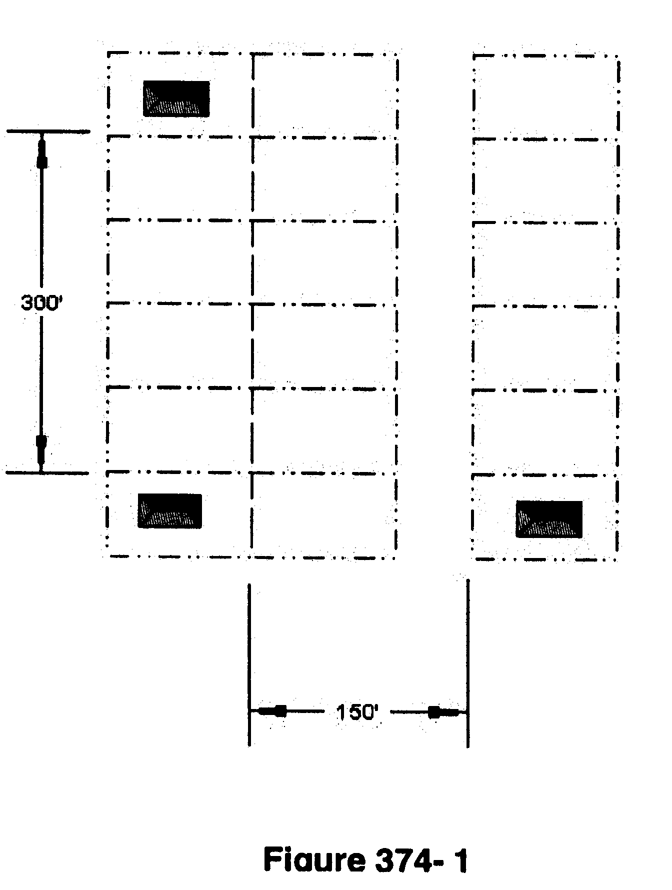
Measurement for the location of a proposed bed and breakfast establishment shall be in a straight line (without regard to intervening structures or objects) in three (3) directions. The first measurement shall be from the nearest front property line of the proposed bed and breakfast establishment one hundred fifty (150) feet outward towards the street. The second and third measurements shall be from the two (2) side property lines of the proposed bed and breakfast three hundred (300) feet laterally to the side lot line(s) of adjacent properties.
Specific use authorization approval to operate a bed and breakfast establishment within the above measurement formula of one hundred fifty (150) feet and three hundred (300) feet of another bed and breakfast establishment as defined in subsection (b) above may be granted for the following structures:
(1)
Distressed Structure. The applicant must demonstrate, and the city council must find:
• The restoration of a historic landmark or structure is a valuable addition to the quality and the character of the city; or
• There is proof that a bed and breakfast use is the only economically feasible way to finance the preservation of the structure; and
• The granting of a special city council approval will not adversely impact the residential quality of the neighborhood in which the structure is located.
(2)
Non-Distressed Structure. The applicant must demonstrate, and the city council must find:
• The public welfare and convenience will be served, as demonstrated by subsections (1) and (2), below.
(3)
That nearby streets will not be substantially impacted by the proposed bed and breakfast. To make this determination, the city council shall consider input from the city traffic engineer.
(4)
The residential character of the neighborhood will not be disrupted in a manner to prevent the adjacent owners from the quiet enjoyment of their property.
• The neighboring property will not be substantially injured by such proposed use.
(j)
Regulations Pertaining to Bed and Breakfast Establishments Within the Residential Zoning districts. Bed and breakfast establishments within residential zoning districts shall be managed and occupied by the owner of the property. Permission shall be granted by the director of planning and development services for an on-site manager to be employed by the owner for a time not to exceed one hundred twenty days (120) of a calendar year. If circumstances require the absence of the owner for a period exceeding one hundred twenty (120) days, the director of planning and development services may grant an extension for good cause.
(k)
Nonconforming Rights. Properties which are used as bed and breakfast establishments as of May 6, 1999, as well as properties properly zoned for use as bed and breakfast establishments, may be registered as nonconforming uses at the department of planning and development services and upon such registration shall continue as long as the establishment remains in operation as per article VII of this chapter. Any property currently zoned for use as a bed and breakfast, but not used as such, shall within one (1) year from the May 6, 1999 begin to be used as a bed and breakfast for this subsection to apply.
(Ord. No. 95573 § 6, Amendment "F") (Ord. No. 98697 § 4 and 5) (Ord. No. 2009-01-15-0001, § 2, 1-15-09) (Ord. No. 2010-11-18-0985, § 2, 11-18-10; Ord. No. 2015-12-17-1077, § 2, 12-17-15)
Sec. 35-374.01. - Short Term Rentals.
A short term rental is a property that rents out all or a portion of a residential dwelling unit, apartment, condominium, or accessory dwelling (as each of the preceding is defined by this chapter), for a period of less than thirty (30) consecutive days, and not less than twelve (12) hours, to a particular occupant. A short term rental shall not be considered as a hotel, extended stay hotel, motel, corporate apartment, or bed and breakfast, as defined in this chapter.
(a)
[Short Term Rentals.] Short term rentals are divided into two (2) types:
(1)
Short Term Rental (Type 1). A short term rental (type 1) is a residential dwelling unit, or a portion thereof, which is either occupied by the owner, as reflected in title records, or an operator as reflected in a valid lease agreement, and with the express permission of the property owner. The owner or operator shall make his or her legal residence on the same property, as evidenced by homestead exemption, voter registration, vehicle registration, or similar means.
i.
On residential properties which are not multi-family buildings (e.g., duplex, four-plex), a single individual unit, which is not owner occupied, but which is located on the same land parcel as an owner-occupied unit of common ownership as the non-owner occupied units shall be considered a (type 1) short term rental unit. Additional non-owner occupied units in excess of this allowance on the same land parcel shall be considered (type 2) short term rental units.
ii.
In a multi-family building, a single individual unit, which is not owner occupied, but which is located on the same land parcel as an owner-occupied unit of common ownership as the non-owner occupied units shall be considered a (type 1) short term rental unit. Additional non-owner occupied units in excess of this allowance on the same land parcel shall be considered (type 2) short term rental units and shall be subject to the density limitations in table 374.01-1.
(2)
Short Term Rental (Type 2). A short term rental (type 2) is a residential dwelling unit, or a portion thereof, which is either not occupied by the owner or operator, or the owner or operator does not occupy another dwelling unit, or portion thereof, on the same property, as reflected in title records.
(b)
Limitations on Other Activities at Short Term Rentals. The following activities or uses may not occur as part of the operation of a short term rental, either (type 1) or (type 2):
(1)
The operator shall not provide prepared food or beverage, directly or indirectly (e.g., using caterer), for consumption for a fee. This subsection shall not prohibit an operator from providing prepackaged food or beverages either as a gift or for a fee.
(2)
Short term rentals in residential zoning districts shall not include venues for weddings, events, restaurants, meeting halls, or any other uses otherwise described in the tables of permitted uses (table 311-1 and table 311-2) either as an accessory use or a primary use.
(c)
Density Limitations for Short Term Rentals (Type 2) in Residential Areas. In order to preserve the essential character of residential areas, the following density limitations are established. The permitted number of STR's in any block face, or within any multi-family structure, shall not round up.
Example: 14 dwelling units on a residential block face x 12.5% = 1.75 STR's (1 Short Term Rental is permitted).
(1)
Short term rentals (type 2) shall be limited to no more than one-eighth (12.5 percent) of the total number of single-family, duplex, triplex, or quadraplex units on the block face, as defined in Appendix A of this chapter, in residential zoning districts. At least one (type 2) short term rental shall be permitted per block face, regardless of density. Authorized bed and breakfast establishments shall be considered in the calculation of these density requirements.
On or after January 1, 2023, renewal applications formerly administratively approved by means of rounding will be eligible for renewal without acquiring a special exception from the Board of Adjustment. New applications will be required to obtain a special exception, in accordance with Section 35-399.03, if the density exceeds twelve and one-half (12.5) percent of the units on the block face.
(2)
Short term rentals (type 2) within multi-family (e.g. five (5) or more units) buildings or groups of buildings on the same land, lot or parcel, regardless of zoning district, shall be limited to the density requirements in table 374.01-1. Authorized bed and breakfast establishments shall be considered in the calculation of these density requirements.
Table 374.01-1
In order to establish and operate a short term rental (type 2) which exceeds the density limitations of this section, approval of a special exception from the board of adjustment shall be required in addition to the requirements of article XXII of chapter 16 of the City Code. See section 35-399.03 of this chapter.
(d)
Nonconforming Rights for Short Term Rentals (Type 2) Lawfully in Existence as of the Effective Date of Ordinance. Short term rental (type 2) establishments shall be considered lawfully in existence for the purposes of deriving non-conforming rights from section 35-702 of this chapter if all of the following criteria are met:
(1)
The owner shall provide written confirmation from the City of San Antonio Finance Department showing proof of registration for the specific location for the short term rental establishment for payment of the hotel occupancy tax required by chapter 31 of the City Code of San Antonio, Texas.
(2)
The owner shall provide written confirmation from the City of San Antonio Finance Department showing proof that their hotel occupancy tax account with the City of San Antonio is not in arrears.
(3)
The hotel occupancy tax confirmation from the City of San Antonio finance department indicates that the that the registration occurred prior to the effective date of this ordinance for the specific location for which the short term rental establishment seeking nonconforming rights indicates.
(Ord. No. 2018-11-01-0858, § 4, 11-1-18; Ord. No. 2022-11-03-0831, § 2, 11-3-22, eff. 1-1-23)
Sec. 35-375. - Day Care Facilities.
The following requirements apply to registered family homes, group day care homes, nursery schools, and day care centers:
(a)
License and Registration. All group day care homes, nursery schools, and day care centers shall have a current license issued by the Texas Department of Family and Protective Services. Registered family homes shall maintain a current registration with the Texas Department of Family and Protective Services.
(b)
Standards Within Residential Districts. Day care facilities shall comply with the following conditions within residential zoning districts:
(1)
Outdoor play space shall not be permitted within the front yard area.
(2)
No signs shall be permitted except for a name plate not exceeding one (1) square foot in size and attached flat to the main structure.
(c)
Outdoor Play Areas. The outdoor play space for day care centers, group day care homes, and nurseries which abut or are located within a residential zoning district shall be enclosed by a six-foot solid (opaque) fence. If the adjacent property is zoned residential but is in use as a private/public school, church or park a fence shall be required. At the option of the applicant it may be predominantly open or a solid fence.
(d)
Required Residency. The provision of day care in a single-family home which may be permitted by a specific use permit shall require that the owner of the property in question occupy as their primary residence the home providing said day care services.
(Ord. No. 100126) (Ord. No. 101816, § 2, 12-15-05) (Ord. No. 2009-01-15-0001, § 2, 1-15-09) (Ord. No. 2010-11-18-0985, § 2, 11-18-10)
Sec. 35-376. - Assisted Living Facilities, Boarding Homes and Community Homes.
(a)
Permitted Use. Assisted living facilities, boarding homes and community homes shall be a permitted use pursuant to sections 35-311 and 35-358. In single-family districts the maximum number of residents, by right, shall be six (6). A request for reasonable accommodation to accomplish the goals and policies of the Fair Housing Act (42 U.S.C. 3601) may be authorized as a conditional use ("CD") pursuant to Section 35-422 to allow from seven (7) to no more than sixteen (16) residents. Reasonable accommodation is encouraged where such accommodation may be necessary to afford persons or groups of persons with disabilities an equal opportunity to use and enjoy housing.
(b)
Compatibility Standards in Single-Family Zoning Districts and Mixed Residential Districts:
(1)
There shall be no exterior display or sign with the exception that a nameplate, not exceeding one (1) square feet in area, may be permitted when attached to the front of the main structure provided the nameplate is not illuminated and attached flat to the dwelling unit or visible through a window.
(2)
No exterior construction features shall be permitted which would place the structure out of character with the surrounding residential neighborhood.
(3)
Front yard impervious cover shall comply with maximum percentages indicated in section; 35-515, table 515-1.
(c)
Permits and licenses required:
(1)
Current and valid state licenses.
(2)
A current and valid certificate of occupancy issued by the City of San Antonio.
(d)
Residential Conversion. Any residential structure converted into any of the uses in this section will be required to comply with all additional city code standards including but not limited to the building code, electric code or fire code, as applicable, based on the nature of the proposed use and occupancy classification.
(Ord. No. 101816, § 2, 12-15-05) (Ord. No. 2006-11-30-1333, § 2, 11-30-06) (Ord. No. 2010-11-18-0985, § 2, 11-18-10; Ord. No. 2012-12-13-0972, § 2, 12-13-12)
Sec. 35-377. - Head Shops.
(a)
Spacing. Notwithstanding any other provisions of this chapter, no head shop shall be established or maintained within one thousand (1,000) feet of any of the following uses:
(1)
Property which is temporarily or permanently zoned residential.
(2)
Churches.
(3)
Hospitals.
(4)
Community centers.
(5)
Museums.
(6)
Parks.
(7)
Schools.
(b)
Measurement of Spacing. Measurement shall be made in a straight line from the nearest boundary of property so zoned to the nearest part of the building in which such use is made, if the same commercial activity occupies an entire building; provided, that the case of a building which is divided into separate rental or ownership spaces devoted to different uses or enterprises, measurement shall be made to such space or unit of the building in which such use is made.
(c)
Registration and Amortization of Nonconforming Uses. Any properties devoted to such use which are so located due to zoning, rezoning, or annexation may be registered as nonconforming uses at the department of planning and development services within sixty (60) days from the date of becoming nonconforming with this chapter, by the owners or any other interested party and upon such registration, such use may thereafter be continued for a period not to exceed three (3) years. After termination of the three-year period, such operation and use must cease.
(Ord. No. 98697 § 5) (Ord. No. 101816, § 2, 12-15-05)
Sec. 35-378. - Home Occupations.
(a)
General Requirements. Home occupations are permitted on a residential property subject to the following provisions:
(1)
The outer appearance of the dwelling unit and/or property shall not be altered nor shall the home occupation be conducted in a manner which would cause the premises to differ from its residential character either by the use of colors, materials, construction, lighting, signs, increased traffic or the emission of odors, sounds, or vibrations. The city's noise, nuisance, and short-term rental regulations are also applicable.
(2)
No outdoor display of goods or outdoor storage of equipment or materials used in the home occupation shall be permitted.
(3)
The home occupation shall not involve the use of advertising signs on the premises or any other advertising media which calls attention to the fact that the dwelling unit is being used for a home occupation, with the exception of a telephone number listing. One (1) nameplate not exceeding one (1) square foot in area shall be allowed provided the nameplate is nonilluminated and attached flat to the dwelling unit or visible through a window.
(4)
The number of employees working at a home business shall not exceed the number, in combination with the residents of the dwelling and customers of the home based business, the permitted occupancy of the dwelling unit.
(5)
The home occupation shall be conducted entirely within the residential property. Activities must not be visible from the street.
(6)
The use of electrical or mechanical equipment that would change the fire rating of the dwelling or create visible or audible interference in radio or television receivers or cause fluctuations in line voltage outside the dwelling unit is prohibited.
(7)
The home occupation shall not involve the use of commercial vehicles for delivery of materials to and from the premises.
(8)
No certificate of occupancy is required for a home occupation.
(b)
Prohibited Uses. No home occupation(s) shall be allowed that generate on-street parking, substantially increase traffic in the area, or violate the city's noise ordinance. Additionally, the following uses are prohibited as home occupations:
(1)
Vehicle painting, service, or repair.
(2)
Animal hospitals, kennels, stables, hospitals, or obedience/training schools.
(3)
Restaurants or catering. The preparation of food for resale, except for cottage foods and whole, non-cut produce as defined in this chapter.
(4)
Sexual oriented businesses, the selling of alcohol or drugs, or a structured sober living home.
(Ord. No. 98697 § 6) (Ord. No. 101816, § 2, 12-15-05; Ord. No. 2015-12-17-1077, § 2, 12-17-15; Ord. No. 2022-11-03-0831, § 2, 11-3-22, eff. 1-1-23; Ord. No. 2025-09-04-0580, § 2, 9-4-25)
Sec. 35-379. - Manufactured Home and Recreational Vehicle Parks.
(a)
Purpose. The purpose of this division is to achieve orderly development of manufactured home and recreational vehicle parks, to promote and develop the use of land to assure the best possible community environment in accordance with the master plan of the city, and to protect and promote the health, safety and general welfare. Adequate protection shall be provided against any undesirable off-site conditions or any adverse influence from adjoining streets or areas. Throughout this division references and provisions relating to manufactured home parks shall also apply to recreational vehicle parks unless specifically noted.
(b)
Procedures. See subsection 35-424(g) of this chapter.
(c)
Arrangement of Building and Facilities.
(1)
The site including manufactured home stands, patios, buildings and all site improvements shall be harmoniously and efficiently organized in relation to topography, the shape of the parcel, the shape, size and position of buildings and common facilities and with full regard to use and appearance.
(2)
Stand Requirements. The objective of the manufactured home stand requirements set forth in this division is to provide for the following:
A.
Practical placement of a manufactured home on its stand by means of a car or conveyor truck.
B.
Retention of the manufactured home on the stand in a stable condition and a satisfactory relationship to its surroundings.
C.
Practical removal of the manufactured from the lot by means of a car, conveyor truck, or other customary moving equipment.
(d)
Density.
(1)
A manufactured home park shall be designed with a maximum density of ten (10) units per acre.
(2)
Recreational vehicle parks may be designed with a maximum density of twenty (20) units per acre.
(e)
Required Recreation Areas.
(1)
In all recreational vehicle parks there shall be one (1) or more recreation areas which shall be accessible to all park residents. The size of the recreation areas shall be based upon a minimum of one hundred (100) square feet for each lot. No recreational area shall contain less than two thousand five hundred (2,500) square feet.
(2)
Manufactured home parks shall provide parks and/or open space consistent with the requirements of section 35-504 of this chapter.
(f)
Yards and Distances Between Stands and Buildings. The objectives of yard requirements are:
• To obtain sufficient distances between the manufactured home stand on its lot and obstructions on adjoining land to assure privacy, adequate natural light and air, and convenient access to the unit.
• To provide for circulation around the unit for such uses of the yard spaces as are considered essential to the manufactured home.
(1)
Determination of Yards. Yard width shall be measured from the required manufactured home stand to the individual manufactured home lot line. At every point it shall be at least equal to the required minimum. Patios, carports and individual storage lockers shall be disregarded in determining yard widths.
(2)
Yard Requirements. Manufactured home stands shall be separated from each manufactured home site line a distance of not less than ten (10) feet on the entry side and five (5) feet on all other sides. Detached accessory structures shall be located no nearer than three (3) feet from any required site line. In no case, however, shall the accessory structure occupy more than thirty (30) percent of the required yard area of the entry side. Accessory structures attached to a manufactured home shall be construed to be a part of that structure and shall adhere to the yard requirements of same.
(3)
Yards Abutting Common Areas. The distance from any manufactured home stand to a street right-of-way shall be eight (8) feet minimum.
(4)
Distance to Park Boundaries. The distance from the line or corner of any manufactured home stand to a boundary line of the manufactured home park shall be as specified for the zoning district.
(g)
Streets.
(1)
Generally. Streets shall be provided within manufactured home parks to provide convenient circulation by means of local streets and properly located collector streets. Streets within a manufactured home park shall be private streets and shall be maintained by the manufactured home park owner or licensee.
(2)
Design Standards and Construction Specifications. The street system shall comply with the standards for private streets as specified in the transportation standards of this chapter.
(h)
Driveways. The minimum width of driveways to manufactured home stands and other facilities shall be twelve (12) feet, plus any extra width necessary for maneuvering a manufactured home on a curve.
(i)
Drainage Structures. Provision for the collection and disposal of surface and subsurface water to protect buildings and manufactured home stands, and to provide safe and convenient use of streets, lot areas and other improvements shall be required in all manufactured home parks in accordance with the stormwater management standards of this chapter.
(j)
Water Supply. Every manufactured home park shall be provided by the park licensee with an ample supply of water under pressure and approved by the director of health. Individual water lines from service outlets to manufactured homes shall comply with the utilities standards of this chapter.
(k)
Sewage Disposal. All the sewer lines shall be connected to the public sewage system or a private sewage disposal system approved by the director of health. Individual sewage drains from manufactured homes to the park service connections shall comply with the utilities standards of this chapter.
(l)
Electrical Power Lines. Electrical facilities shall comply with the rules and regulations regarding placement, installation, operation, and maintenance of electrical facilities as included in, but not limited to, the National Electrical Code and the National Electrical Safety Code.
(m)
Fire Hydrants. Standard fire hydrants, in workable condition, shall be located within five hundred (500) feet of each manufactured home. All such fire hydrants shall be connected to not less than a six-inch diameter water line.
(n)
Floodplains. Every manufactured home park shall comply with the provisions of the floodplain standards of this chapter, as applicable.
(o)
Recreational Vehicles. Any area provided for the use of recreational vehicles shall comply with all provisions of this chapter except as follows:
(1)
Density. Being consistent with good planning practice, the area so designated shall be designed within a maximum density of twenty (20) units per acre.
(2)
Distance to Park Boundaries. The distance from the line or corner of any recreational vehicle stand to a boundary line of the recreational vehicle park shall be adequate to protect the residential use in the park and shall not be less than twenty-five (25) feet where abutting a public street. Yard requirements along other property lines shall be ten (10) feet. However, where the side lot line property abuts a residence district, a minimum side yard of fifteen (15) feet shall be provided. Where the rear lot line abuts a residence district, a minimum rear yard of twenty (20) feet shall be provided.
(Ord. No. 98697 § 6) (Ord. No. 101816, § 2, 12-15-05)
Sec. 35-380. - Miniwarehouses/Self-Service Storage.
Miniwarehouses/Self-service storage facilities may be permitted in the zoning districts designated in the Use Matrix (Table 311-2), subject to the following limitations, conditions, and restrictions:
(a)
A plan of development shall be submitted to the director of planning and development services indicating location of buildings, lot area, number of storage units, type and size of signs, height of buildings, parking layout with points of ingress and egress, and location and type of visual screening and landscaping being proposed.
(b)
The development shall be exclusively limited to storage and those activities necessary for the operation, safety and maintenance of the development, in addition to those uses authorized in the applicable districts.
(c)
Miniwarehouses/self-service storage facilities may include one (1) building or a group of buildings with or without climate-controlled storage, and either exterior access to individual units or access via interior corridors.
(d)
Screening shall be provided adequate to protect adjacent properties in a more restrictive district (all residential districts, "NC," "C-1," "O-1" or "O-2" districts) from the environmental impacts of the miniwarehouses such as visual blight, parking or roadway illumination, headlights, noise, blowing papers and dust, and service areas.
(e)
No advertising signs will be permitted on the property other than identifying signage of the miniwarehouses facility itself.
(f)
All building elevations shall be of finished quality.
(Ord. No. 98697 § 4) (Ord. No. 101816, § 2, 12-15-05) (Ord. No. 2009-01-15-0001, § 2, 1-15-09)
Sec. 35-381. - Mixed-Use Buildings and Live-Work Units.
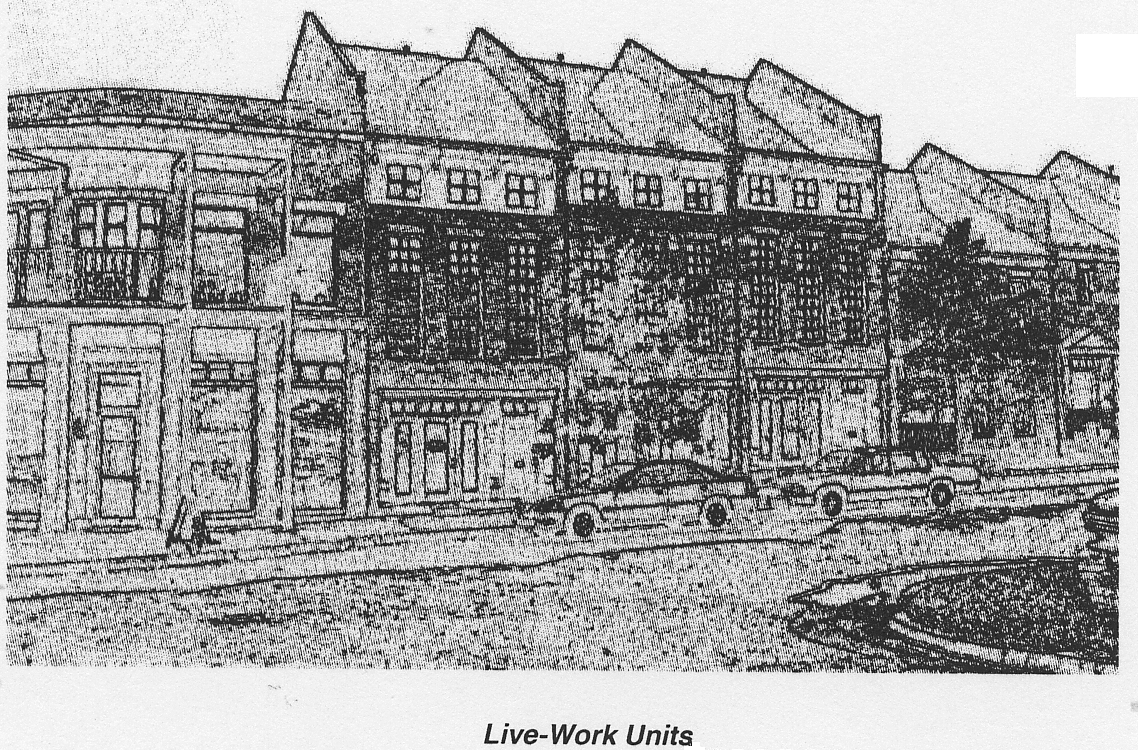
(a)
Mixed-use buildings or live-work units shall be subject to the following criteria:
(b)
The density of mixed-use buildings or live-work units shall not exceed the following, at locations where the building is listed as a permitted use in the Nonresidential Use Matrix (Table 311-2 - see listing under category "dwelling" and permitted use "dwelling - attached apartments"):
(Ord. No. 101816, § 2, 12-15-05) (Ord. No. 2012-10-18-0829, § 2, 10-18-12; Ord. No. 2022-11-03-0831, § 2, 11-3-22, eff. 1-1-23)
Sec. 35-382. - Residential Greenhouses.
Residential greenhouses are permitted provided that:
(a)
Any on-premises sales comply with home occupation standards of section 35-378;
(b)
Any signage complies with this chapter and chapter 28;
(c)
Accessory structures do not exceed a total of six hundred (600) square feet in size,
(d)
The accessory structure or greenhouse shall meet the requirements in section 35-370, and
(e)
There is no outdoor storage of equipment or other materials.
(Ord. No. 101816, § 2, 12-15-05) (Ord. No. 2010-11-18-0985, § 2, 11-18-10; Ord. No. 2015-12-17-1077, § 2, 12-17-15)
Editor's note— Ord. No. 2015-12-17-1077, § 2, adopted Dec. 17, 2015, changed the title of § 35-382 from "Greenhouses" to "Residential Greenhouses." This historical notation has been preserved for reference purposes.
Sec. 35-383. - Oversized Vehicles.
(a)
License and Inspection Requirement. All oversized vehicles must have a current license and inspection sticker if required by the state in which the vehicle is registered.
(b)
Vehicle Use. Oversized vehicles shall not be used for dwelling, sleeping, or business purposes upon any street, alley, or other public place, or upon any private property except as otherwise specifically allowed in this chapter or as follows:
(1)
Within a lawfully established recreational vehicle or manufactured home park, a campground, or other like facility which is designed and equipped to provide temporary or permanent accommodations for such vehicles.
(2)
An oversized vehicle owned by and registered to a person residing outside Bexar County who is visiting San Antonio may be parked behind the restricted parking area of a property owned by or leased to the host. If the oversized vehicle is designed for occupancy, it may be occupied by the guest, provided, however, such occupancy may not exceed ten (10) days per visit, with a limit of three (3) visits per year for each vehicle. Oversized vehicles shall not discharge any litter, sewage effluent, or other matter except into sanitary facilities designed to dispose of such materials.
(c)
Parking of Oversized Vehicles in Residential Districts. Oversized Vehicles, as defined in this Chapter, shall not be allowed in restricted parking areas. For lots or parcels one-half (½) acre or less in area, the restricted parking area includes the entire area of the lot. For lots or parcels greater than one-half (½) acre in area, the restricted parking area includes the entire front yard, and areas of the side yard and back yard within fifteen (15) feet of the property line.
The following regulations apply to the parking of oversized vehicles in residential lots:
(1)
The parking of an oversized vehicle within the restricted parking area or the parking so that any portion of the vehicle extends into the restricted parking area is prohibited in any residential district, and in "RD" and "UD" districts.
(2)
For those residential lots over one-half (½) of an acre in area, where parking of oversized vehicles is allowed on a portion of the lot, all oversized vehicles must be screened from adjacent residential properties with a solid screen fence at least six (6) feet in height.
(d)
Residential Recreational Vehicle Parking. Recreational Vehicles may be parked in the restricted parking area provided that:
(1)
No Recreational Vehicle may be parked within fifteen (15) feet from the front curb or the front yard;
(2)
Recreational vehicles parked within fifteen (15) feet of a side or rear property line must be screened from view with a solid screen fence at least six (6) feet in height; and
(3)
Recreational Vehicles shall under no circumstances be utilized for habitation;
(4)
Recreational Vehicles may not be connected to water, sewer, or power service, except for trip preparation as defined in subsection (e) below.
(e)
Residential Oversized Vehicle and Recreational Vehicle Parking Exceptions. Oversized vehicles may be parked in a driveway or other permanently maintained parking area as specified by section 19-194 of the City Code within the restricted parking area in the residential districts specified in subsection (c) above under the following conditions:
(1)
Loading. An oversized vehicle of any type may be temporarily parked in the restricted parking areas for such time as is actually necessary to load or unload passengers, freight, or merchandise.
(2)
Trip Preparation. An oversized vehicle, other than one that is also defined as a truck-tractor, road-tractor, semi-trailer, trailer or commercial motor vehicle with three (3) or more axles, may be parked within the restricted parking area for such time as is actually necessary for trip preparation. Trip preparation time shall be limited to a maximum of forty-eight (48) hours prior to use and twenty-four (24) after use twice within any calendar month.
(3)
Accessible Areas. An oversized vehicle of any type may be parked in the restricted parking area at any time if it bears a special parking permit issued by the Disability Access Office Manager or designee of the City of San Antonio.
A.
A person with a disability who owns an oversized vehicle may apply to the city's Disability Access Office Manager or designee for such a permit if the person has a mobility impairment, uses the vehicle as a primary means of transportation or livelihood, and the vehicle is specially equipped or modified to accommodate the disability.
B.
The Disability Access Office Manager or designee may issue such a permit after inquiring into the facts and giving the applicant an opportunity to be heard, if the officer finds that (1) without the vehicle the applicant would be substantially limited in life's activities, (2) the physical handicap is permanent or long term in duration, (3) use of the oversized vehicle is necessary to provide reasonable mobility, (4) parking within the restricted parking area facilitates mobility, and (5) the vehicle has a disabled license plate issued by the state.
C.
A permit issued by the Disability Access Office Manager or designee shall be valid for a period of two (2) years. Renewal of the permit shall require re-examination of the facts.
D.
If a permit is denied by the Disability Access Office Manager or designee, the applicant may appeal to the board of adjustment in accordance with section 35-482 of this chapter. The board shall have the authority to reverse or affirm, in whole or in part, the decision of the Disability Access Office Manager.
E.
It shall be a violation hereof for the holder of a permit issued hereunder to transfer title to the oversized vehicle without contacting the Disability Access Office Manager or designee for cancellation and removing the permit from the vehicle.
(f)
Definitions. In this section, the terms truck-tractor, semi-trailer, and commercial motor vehicle shall have the same definitions as set out in V.T.C.A. Transportation Code § 502.001). However, such terms shall not mean "recreational vehicle" as that term is defined in Texas Transportation Code § 522.004(b).
(g)
Penalties. The penalty for violation of any portion of this section is hereby established so that the minimum fine shall be one hundred dollars ($100.00) and the maximum fine shall be two thousand dollars ($2,000.00), provided, however, in the event a defendant has once previously been convicted under this Ordinance No. 84874, the defendant, upon conviction, shall be fined an amount no less than two hundred dollars ($200.00) and not more than two thousand dollars ($2,000.00) and upon third and subsequent convictions, the penalty shall be a fine of not less than three hundred dollars ($300.00) nor more than two thousand dollars ($2,000.00) (Sec. 35-491 Enforcement - Zoning Violations).
(Ord. No. 98697 § 6) (Ord. No. 101816, § 2, 12-15-05) (Ord. No. 2009-01-15-0001, § 2, 1-15-09; Ord. No. 2022-11-03-0831, § 2, 11-3-22, eff. 1-1-23)
Sec. 35-384. - Parking Lots as a Primary Use.
STATEMENT OF PURPOSE
Parking structures require unique design considerations due to the fact that they can significantly contribute to the building bulk on a site. The provisions of this section implement the following provisions of the master plan:
• Neighborhoods, Policy 1f: Amend zoning regulations to require special city council approval for parking facilities that displace residences.
• Neighborhoods, Policy 5i: Encourage the construction of parking facilities in the downtown area to promote mixed-use and commercial activity centers and to be compatible in use, scale and material with the surrounding natural and built environment.
• Neighborhoods, Policy 5i: Encourage placement of parking facilities in locations which will support residential development downtown.
• Neighborhoods, Policy 5i: Discourage development of parking garages adjacent to the Riverwalk, and the city's plazas and parks.
• Neighborhoods, Policy 5i: Focus on preserving the housing stock and integrity of neighborhoods when selecting sites for parking facilities.
• Neighborhoods, Policy 5i: Analyze downtown's existing and potential growth and activity centers, and strategically construct parking facilities to accommodate maximum parking availability and efficiency.
(a)
Where Permitted. All parking lots shall be permitted as designated in the Use Matrix (section 35-311, Tables 311-1 and 311-2), except as provided in subsection (b), below.
(b)
Parking Lots Requiring Demolition of Dwelling Units. Notwithstanding any provision of this chapter to the contrary, the construction of any parking lot which involves the replacement, demolition, or destruction of a dwelling unit shall not be undertaken unless and until a specific use authorization is approved. The specific use authorization shall be approved only if the following standards are met:
(1)
The proposed conversion is located within an area classified as commercial, office, industrial, or similar classification in a land use plan adopted pursuant to section 35-420 of this chapter; or
(2)
The structure proposed to be removed cannot reasonably be used or restored to habitable condition; or
(3)
The proposed parking is needed and there are no reasonable alternatives for the proposed parking lot for which the demolition is required; or
(4)
The proposed parking area will not promote residential disinvestment or promote further conversions of residences to nonresidential purposes.
(c)
Parking Structure Design Standards.
(1)
Buffer. A type C bufferyard as required in the landscaping standards shall be provided in yards adjacent to a residential zoning district.
(2)
Frontage. The maximum frontage of any parking facility shall be restricted to the following unless ground floor retail uses are provided as set forth below:
"D," "NC," "TND": 35 feet
"O-1," "C-1": 50 feet
Parking structures which exceed the frontage requirements as set forth above shall be designed so that a minimum of fifty (50) percent of the length of the exterior ground floor frontages, excluding vehicle entrances and exits, includes ground floor area either built out as, or convertible to, retail, commercial, or service uses. The applicable ground floor area shall extend in depth a minimum of twenty (20) feet from the exterior parking structure facade, provided that the minimum required may be averaged, with no depth less than fifteen (15) feet. The clear interior ceiling height standard for the retail/commercial or service use portion of parking structures shall be a minimum of ten (10) feet. Parking structures with frontages exceeding one hundred fifty (150) feet in length shall incorporate vertical and/or horizontal variation in setback, material or fenestration design along the length of the applicable facade, in at least one (1) of the following ways:
A.
Vertical facades shall be designed to incorporate intervals of architectural variation at least every sixty (60) feet over the length of the applicable facade including one (1) or more of the following:
(1)
Varying the arrangement, proportioning and/or design of garage floor openings;
(2)
Incorporating changes in architectural materials, including texture and color; and/or
(3)
Projecting forward or recessing back portions or elements of the parking structure facade.
B.
Horizontal facades shall be designed to differentiate the ground floor from upper floors including one (1) or more of the following:
(1)
Stepping back the upper floors from the ground floor parking structure facade;
(2)
Changing materials between the parking structure base and upper floors; and/or
(3)
Including a continuous cornice line or pedestrian weather protection element between the ground floor and upper floors.
(3)
Slopes. Parking decks shall be flat. At a minimum, a majority of both the ground floor and top parking decks shall be required to be flat, as opposed to continuously ramping.
(4)
Top Floor Wall. Parking structure top floor wall designs must conform to one (1) or more of the following options:
A.
Architectural Focal Point: A prominent edge feature such as a glazed elevator and/or stair tower, or top floor line trellis structure.
B.
Projecting Cornice: Top floor wall line articulated through a variation or step in cornice height or detail. Cornices must be located at or near the top of the wall or parapet.
C.
Articulated Parapet: Top floor wall line parapets shall incorporate angled, curved or stepped detail elements.
(d)
Surface Parking Design Standards.
(1)
Commercial surface parking areas which are the primary use and which exceed the frontage standards set forth above shall comply with one (1) of the following:
A.
Retail uses which comply with the commercial design standards (subsection 35-204(o) of this chapter) shall be provided on at least sixty (60) percent of their frontage.
B.
A class C buffer shall be installed and maintained on at least eighty (80) percent of the frontage.
(2)
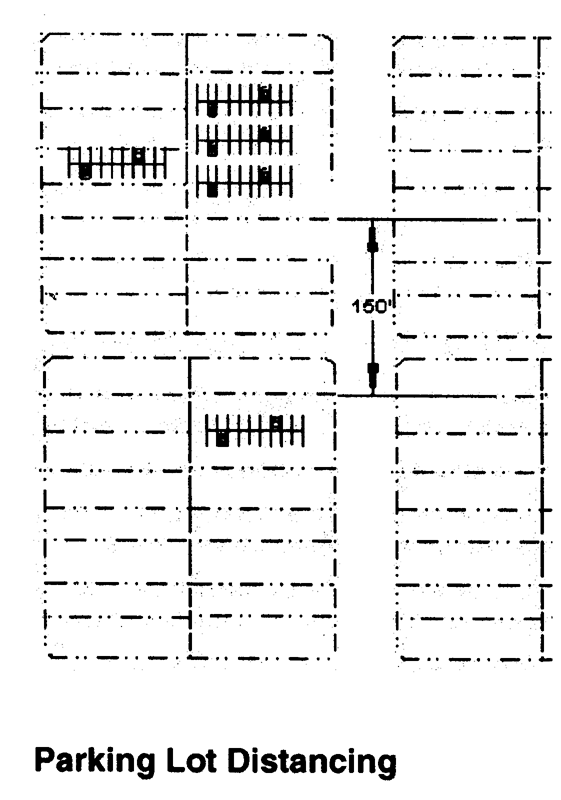
In order to disperse parking facilities throughout commercial areas and to maintain easy walking distances between pedestrian destinations, no parking facility shall be located closer than one hundred (100) feet to another parking facility. This distance shall be measured along the street frontage on the same side of the street.
(3)
Article V, division 6 regulations for vehicle barriers, curbs, and wheel stops shall pertain to primary use parking lots and driveways leading to and from primary use parking lots.
(Ord. No. 2010-11-18-0985, § 2, 11-18-10)
Sec. 35-385. - Radio, Television Antennas, and Wireless Communication Systems.
(a)
Applicability. The provisions established in this section shall be applied in the manner described below:
(1)
The installation of antenna support structures in nonresidential zones shall be a use permitted by right provided the following requirements are met:
A.
Radio and television antennas must comply with subsection 35-385(b).
B.
Wireless communications systems must comply with subsection 35-385(e).
(2)
The installation of antenna support structures in residential zones shall be a used allowed by specific use authorization provided the following requirements are met:
A.
Radio and television antennas must comply with subsection 35-385(c).
B.
Wireless communications systems must comply with subsection 35-385(d).
(3)
Access to public property in all zoning districts for the purpose of installing wireless communications systems shall be allowed by complying with the requirements of subsection 35-385(f).
(4)
Wireless communications systems, regardless of the zoning district in which they are installed, must comply with the additional requirements found in subsection 35-385(g).
(b)
Radio and Television Antennas. Radio and television antennas, limited to those used by the federal licensed amateur radio operators, unlicensed citizens band radio operators, and private citizens receiving television signals, including satellite dish antennas, shall be considered as permissible accessory uses in all zoning districts.
(1)
Height. The height of an antenna shall be the total maximum to which it is capable of being raised and shall be measured from the finished grade adjacent to the antenna or antenna support structure if ground-mounted or from the peak of the roof if roof-mounted. Antennas within nonresidential districts shall comply with the height and setback requirements for the particular district. Further, all antennas and antenna support structures shall comply with the height restrictions of the joint airport and airport hazard zoning regulations, of this article. All antennas and antenna support structures shall comply with the height restrictions of the joint airport and airport hazard zoning regulations, division 4 this chapter, (35-331 Airport Hazard Overlay District (AHOD)).
(2)
Building Permit. A building permit from the department of planning and development services shall be required for the installation of any roof-mounted antennas or antenna support structure over twelve (12) feet above the peak of the roof and any ground-mounted antennas or antenna support structure over twenty-five (25) feet in height. A permit shall be issued only when there is full compliance with this section and the applicable provisions of the International Building Code. Applications for a permit shall be accompanied by the following in duplicate:
A.
Construction drawings showing the proposed method of installation.
B.
The manufacturer's recommended installations, if any.
C.
A diagram to scale showing the location of the antennas, property and setbacks, easements, power lines, and all structures.
D.
Certification by a structural or civil engineer registered by the State of Texas that the proposed installation complies with the structural requirements of the International Building Code.
(3)
Maintenance. All antennas shall be maintained in good condition and in accordance with the requirements of this section. No additions or modifications shall be made to an antenna, unless it is in conformity with the International Building Code and this section.
(4)
Historic Landmarks or Historic Districts. The installation of any antenna or antenna support structure within the property of a historic landmark or in a historic district shall require the approval of the historic review board.
(5)
Uses Not Permitted. Antennas not otherwise permitted under these regulations may be permitted as a specific use permit if the applicant is able to present clear and convincing evidence to the board that the effect of the regulations on the applicant precludes effective communication.
(c)
Radio and Television Antennas in Residential Zoning Districts. In addition to the regulations in subsection (b), the following shall apply to radio and television antennas in residential districts:
Antennas in residential zoning districts shall be located, designed, constructed and maintained in accordance with the following standards:
(1)
Categories Permitted. Antennas may be roof or ground-mounted, freestanding or supported by guy wires, buildings or other structures in compliance with the manufacturer's structural specifications. A ground-mounted antenna shall be any antenna with its base mounted directly in the ground even if such an antenna is supported or attached to the wall of a building.
(2)
Roof Mounted Antennas.
A.
The antenna, including support structure, shall not extend higher than fifteen (15) feet above the peak of the roof, except a single vertical pole antenna may extend up to twenty (20) feet above the peak of the roof.
B.
The antennas or antenna support structure shall be located on the roof portion sloping away from the front of the lot if possible. Otherwise the antennas or antenna support structure shall be located on the rear half of the roof.
(3)
Ground-Mounted Antennas.
A.
The antennas, including support structure, shall not exceed seventy (70) feet in height
B.
The antennas or antenna support structure shall not be located in any required front setback or anywhere in the front yard between the principal building and the front setback.
(d)
Wireless Communication Systems Authorized by Specific Use Authorization. Wireless communication systems shall require specific use authorization in residential zones. Prior to filing a request for a zone change with the zoning commission the following requirements must be met:
(1)
Building Permit. A building permit from the department of development services shall be required for the installation of any antenna support structure or unmanned equipment shelter developed for a wireless communication system. A permit shall be issued only when there is full compliance with this section and the applicable provisions of the International Building Code. Applications for a permit shall be accompanied by the following in duplicate:
A.
Construction drawings showing the proposed method of installation.
B.
The manufacturer's recommended installations, if any.
C.
A diagram to scale showing the location of the antenna, property and setbacks, easements, power lines, and all structures.
D.
Certification by a structural or civil engineer registered by the State of Texas that the proposed installation complies with the structural requirements of the International Building Code.
E.
All antennas shall be maintained in good condition and in accordance with the requirements of this section. No additions or modifications shall be made to an antenna, unless it is in conformity with the International Building Code and this section.
F.
All antennas and antenna support structures shall comply with the height restrictions of the joint airport and airport hazard zoning regulations, and the City Code, as applicable.
No provision within this part exempts requirements for compliance with the landscape ordinance.
(2)
Spacing of Antenna Support Structures from Residential Zoning Districts. Antenna support structures in nonresidential districts shall be spaced two hundred (200) feet from all residential zoning districts, measured from the base of the antenna support structure to the nearest residential zoning district boundary. Antenna support structures in residential districts shall be spaced at least two hundred (200) feet from a residential structure. Spacing requirements for antenna support structures on property zoned residential shall not apply if the property is vacant, undeveloped, and or unplatted and is located at least two hundred (200) feet, measured from the base of the antenna support structure to the nearest residential land use. The graphic below illustrates how the two hundred-foot distance rule is applicable. In each graphic, the shaded area shows the setback or safety zone around the protected residential property where the placement of an antenna support structure is prohibited.
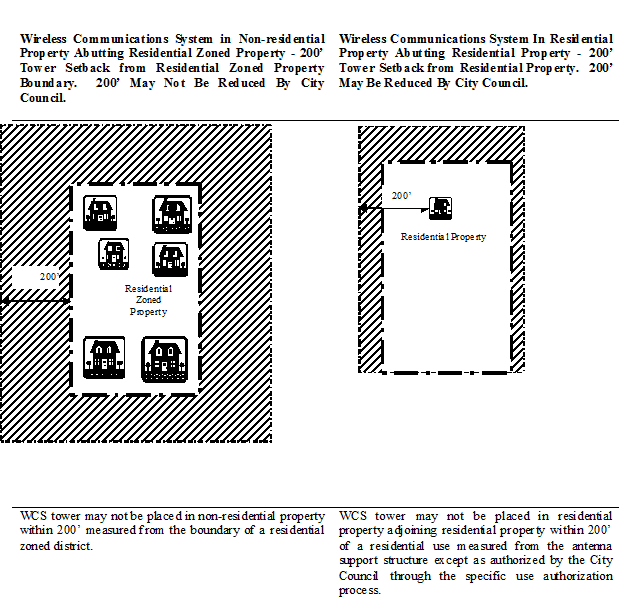
(3)
Equipment Buildings. The wireless communication system unmanned equipment buildings shall not have more than seven hundred fifty (750) square feet of gross floor area and shall not be more than twelve (12) feet in height.
(4)
Design in Residential Zoning Districts. Antenna support structures developed after the adoption of these regulations located in residential zoning districts must be monopole design. The height of antenna support structures in all districts may not exceed one hundred ninety-nine (199) feet. If the city council approves a height of an antenna support structure which exceeds one hundred ninety-nine (199) feet, the spacing of the antenna support structure to the nearest residential district must be at a minimum equal to one hundred ten (110) percent of the height of the antenna support structure.
(5)
HDRC Review. Antenna support structure towers are prohibited if they are: within two hundred (200) feet of the San Antonio River; or within two hundred (200) feet of a historic landmark; or within two hundred (200) feet of a historic district or river overlay district; or within a historic district or river overlay district; or in excess of the height specifications of a Mission Protection Overlay District. In conjunction with consideration by the zoning commission the application for city council approval may be presented to the Historic Design and Review Commission (HDRC) if the antenna support structure is located within two hundred (200) feet of the river improvement overlay district or within a historic district.
(6)
Submittal of the site plan and other required materials to support a request for specific use authorization will be used by the staff of development services department to determine the appropriateness of the request and to make a recommendation to the zoning commission and city council. Pursuant to UDC subsection 35-423(d)(4), the specific use authorization process allows the city council to modify the performance standards found in subsection 35-385(d) if necessary to protect the public interest. By way of illustration, the specific use authorization process allows the city to impose additional standards to protect neighborhood integrity such as special setbacks, screening, lighting and camouflage measures consistent with subsection 35-423(d)(4).
(e)
Wireless Communications Systems Permitted by Right. Wireless communication systems shall be a use permitted by right in nonresidential zoning districts, if:
(1)
The requirements set forth in subsections (d)(1) through (d)(5) of this section are met; and,
(2)
The antenna support structures must be constructed to support a minimum of two (2) antenna arrays from two (2) separate wireless communication system providers or users.
(3)
No provision within this part exempts requirements for compliance with the landscaping standards of this chapter.
(4)
The historic preservation officer shall review the permit request if the proposed wireless communication system is located within two hundred feet (200) of a river improvement overlay district or within a historic district. The permit request may be presented to the Historic Design and Review Commission (HDRC) for a recommendation if the antenna support structure is located within two hundred (200) feet of a river improvement overlay district or a historic landmark or within a historic district.
(5)
The wireless communication system is not located in the Edwards Recharge Zone District (ERZD).
(6)
Notwithstanding subsections (e)(1) through (e)(5), a wireless communication system is prohibited in nonresidential zoning districts that overlap with a Mission Protection Overlay District (MPOD) if the antennae support structure exceeds the height specifications in the MPOD.
(f)
Wireless Communication Systems in Public Right-of-Way. Wireless communication systems shall be a use permitted by right in all zoning classifications if the land, structures, rights-of-way or easements are owned, leased or used by the City of San Antonio, San Antonio Water System, or CPS Energy; if:
(1)
Generally.
A.
CPS Energy electrical substations and power generation plants shall be reviewed by the historic and design review commission if they are within two hundred (200) feet of the river overlay district, or if they are two hundred (200) feet of a historic landmark, if they are within two hundred (200) feet of a historic district, or if they are within a historic district.
B.
The requirements set forth in subsections (d)(1), (d)(3), and (d)(5) of this part are met, subsection (d)(6) shall not apply to CPS Energy electrical substations and power generation plants.
(2)
Spacing of Antenna Support Structures From Residential Structures. Subject to provisions set forth in subsection (5), antenna support structures shall be spaced from all residential structures, at a minimum equal to one hundred fifteen (115) percent of the height of the antenna support structure, measured from the base of the antenna support structure to the nearest residential structure. Spacing requirements for antenna support structures on property zoned residential shall not apply if the property is vacant, undeveloped, and or unplatted and is located at least two hundred (200) feet, measured from the base of the antenna support structure to the nearest residential structure. Spacing requirements for antenna support structures shall not apply to existing CPS Energy electrical substations and power generation plants.
(3)
Co-Location. All antenna support structures must be constructed to support a minimum of two (2) wireless communication system antenna arrays from two (2) separate wireless communication system providers or users. Antenna support structures erected on CPS Energy electrical substations shall not be subject to construction standards that require design and construction to support two (2) or more antenna array.
(4)
Prohibitions Regarding the Riverwalk, Historic Landmarks, Historic Districts and Mission Protection Overlay Districts. Wireless communication towers shall be prohibited in all zoning classifications if the land, structures, rights-of-way or easements are owned, leased or used by the City of San Antonio, San Antonio Water System, or CPS Energy and are within two hundred (200) feet of the river overlay district, or are within two hundred (200) feet of a historic landmark, or are within two hundred (200) feet of a historic district, or are in a historic district, or are in a Mission Protection Overlay District (MPOD) and the antennae support structure exceeds the height limitation for the MPOD. The historic preservation officer shall review the permit request and if the proposed wireless communication system is located within two hundred (200) feet of the Riverwalk or within a historic district.
(5)
Spacing Exemptions. Antenna array may be attached to existing antenna support structures, transmission towers, existing poles and water tanks and towers in all zoning districts, without spacing requirements; if,
• The pole replaced or modified is a functioning utility pole or light standard within a utility easement or public right-of-way, recreation facility light pole, or antenna support structure; and,
• The replaced or modified antenna support structure, including antenna array, does not exceed the height of the original utility, light standard, or recreation facility pole by more than twelve (12) feet, or the height of the original telecommunication tower and antenna array; and,
• The pole replaced with an antenna support structure does not obstruct a public sidewalk, public alley, or other public right-of-way; and, pole appearance and function, except for antennas, are not significantly altered.
(6)
Building Permit Exemptions. No building permit shall be required for wireless communication systems developed on CPS Energy electrical substations and power generation plants.
(7)
Landscaping Standards. No provision within this part exempts requirements for compliance with the landscaping standards of this chapter.
(g)
Additional Requirements Applicable to Wireless Communications Systems. A wireless communication system must comply with the following requirements regardless of the zoning district in which it is located:
(1)
Any request to install a wireless communications system over the ERZD in any zoning district must comply with the Edwards Aquifer Recharge Zone District Overlay Regulations (ERZD Regulations) found in section 35-332. Nothing in section 35-385 exempts a wireless communication system from complying with the ERZD Regulations.
(2)
Industrial uses are entitled to maximum fence heights of eight (8) feet at the front, side and rear yards consistent with the "Table of Heights" found in subsection 35-514(d). For the purpose of section 35-385, the installation of a wireless communication system shall be considered an industrial use affording the installation of eight-foot fencing around the perimeter of the wireless communication system site.
(3)
The installation of a wireless communication system utilizing a stealth tower to camouflage an antenna support structure, such as a clock tower, flagpole or tree shall be subject to the same regulations under section 35-385 as a wireless communication system that does not make use of such stealth or camouflage measures.
(4)
A wireless communication system that utilizes a stadium light pole, building roof top, or other tall structure for the installation of an antenna array shall be subject to the same regulations under section 35-385 as a wireless communication system that does not make use of such facilities.
(5)
A request for collocation of an antenna array on an existing antenna support structure will be subject to the specific use authorization provisions of subsection 35-385(d), unless all of the following requirements are met, in which case the provisions of subsection 35-385(e) shall apply:
A.
The antenna support structure to be modified for collocation was originally authorized by the city.
B.
The antenna support structure to be modified, including the installation of the new antenna array, does not exceed the maximum height permitted in the zoning district in which the antenna support structure is located.
C.
The addition of any ground level equipment does not reduce the required setback distance to less than the setback permitted in the zoning district where the antenna support structure is located.
D.
The antenna support structure to be modified for collocation is not located in the Edwards Recharge Zone District (ERZD).
(Ord. No. 98697 § 5 and 6) (Ord. No. 101816, § 2, 12-15-05) (Ord. No. 2010-11-18-0985, § 2, 11-18-10) (Ord. No. 2014-10-02-0742, § 2, 10-2-14)
Sec. 35-386. - Sanitary Landfills, Solid Waste Facilities.
Sanitary landfills and solid waste facilities are permitted in the "I-2" heavy industry district, subject to special approval by the city council and the following conditions:
(a)
Separation Distance. A minimum separating distance of one hundred (100) feet shall be maintained between disposal operations and the perimeter of the site.
(b)
Fencing. A chain-link fence with a minimum height of six (6) feet, shall be installed along the perimeter of the site.
(c)
Buffering. A thirty-foot greenbelt shall be established and maintained adjacent to the fence along the site perimeter. The greenbelt shall be established prior to issuance of a certificate of occupancy and shall include, as a minimum, the following number of plants per one hundred (100) linear feet of greenbelt: Five (5) canopy trees, and fifteen (15) shrubs.
Existing trees and shrubs may be counted toward satisfying the greenbelt requirement. Newly planted vegetation shall meet the minimum size standards required by section 35-3168, "buffering techniques," and shall consist of native or naturalized low maintenance species. Once the zoning is approved by the city council, the applicant shall submit three (3) copies of a greenbelt plan, drawn to scale, to the solid waste management director for approval. The plan shall be prepared and signed by a registered landscape architect and shall include the following information:
(1)
Location and type of existing vegetation, if any.
(2)
General location and species of proposed canopy understory trees and shrubs.
(3)
Description of how the greenbelt will be maintained to include provision for adequate irrigation.
(4)
Property lines.
The solid waste management director shall approve or disapprove the plan within twenty (20) working days of submittal. If approved, a copy of the plan shall be forwarded to the director of planning and development services for use in issuing the certificate of occupancy.
(d)
Land Use Plan. The zoning application shall be accompanied by a land use plan indicating the following information:
• Character of the surrounding land uses within one (1) mile of the proposed facility.
• Proximity to residences and other uses (schools, churches, cemeteries, historic structures and sites, archaeologically significant sites, sites having exceptional aesthetic quality, etc.). Give the approximate number of residences and business establishments within one (1) mile of the proposed facility including the distances and directions to the nearest residences and businesses.
• Availability and adequacy of access roadways, to include types of surfacing, pavement widths, complete details of upgrading required, any significant roadway limitations (structures, surfacing, sight distances, alignment, dust hazards, weight limits, etc.), and estimate the number, size, and maximum weight of vehicle expected to use the site daily.
• Volume of vehicular traffic on access roads, both existing and expected, during the life of the proposed facility.
• Existing and proposed elevations of the landfill and the area within one (1) mile of the proposed facility.
(e)
Monitoring System. A monitoring system approved by the solid waste management director shall be installed to detect any lateral migration of methane and other decomposition gases.
(Ord. No. 98697 § 1, 4 and 6) (Ord. No. 101816, § 2, 12-15-05) (Ord. No. 2010-11-18-0985, § 2, 11-18-10)
Sec. 35-387. - Schools, Public.
Consistent with Texas law, the provisions of this chapter shall not be construed to regulate the location of public schools. However, public schools shall be required to comply with the dimensional standards (section 35-310) and the provisions of article V of this chapter to the extent not preempted by state law.
(Ord. No. 101816, § 2, 12-15-05)
Sec. 35-388. - Sexually Oriented Business Regulations.
These regulations are authorized by V.T.C.A. Local Government Code Ch. 243.
(a)
Applicability. These regulations shall apply to all sexually oriented businesses operating on or after the effective date of this chapter. Further, any sexually oriented business annexed by the city after the effective date of this chapter shall be subject to all the requirements of this section. Existing sexually oriented businesses shall refer to this section and to nonconforming use regulations (article VII, division 1 of this chapter) to determine their appropriate classification.
(b)
Property Uses Requiring Separation. Notwithstanding any provision of this chapter to the contrary, it shall be a violation to use or occupy land or a building for the purpose of operating or maintaining a sexually oriented business within one thousand (1,000) feet from property (referenced within this section as "protected property," "protected use," or "protected zone") that is described as follows:
(1)
Another sexually oriented business;
(2)
Any property located within an "RP" or a residential zoning district boundary, whether temporary or permanent, or devoted to a residential use, including any land zoned for one (1) of the aforementioned residential uses which is also described as a planned unit development or traditional neighborhood development, but excluding airports;
(3)
Any place of regular religious worship, including property used as a church, synagogue, mosque, or other religious worship facility;
(4)
Any public or private elementary, secondary or high school;
(5)
Any public park; or
(6)
Any licensed child care facility.
(c)
Method of Measurement and Survey Requirements.
(1)
Sole Tenant. Measurements shall be in a straight line, without regard to intervening structures or objects, from the nearest property line of the lot on which the sexually oriented business is located, to the nearest property line of the protected properties described in the above subsection (a), which requires separation. This method of measurement shall apply to a sexually oriented business that is the sole tenant within one (1) building located on one (1) platted lot.
(2)
Multiple Tenants. Measurements shall be in a straight line, without regard to intervening structures or objects, from the nearest point of the occupied space of the sexually oriented business to the nearest property line of the protected property described in the above subsection (a) which requires separation. This method of measurement shall apply to a sexually oriented business that is a tenant within a multiple tenant building.
(3)
Easements Excluded. In calculating the distances described in subsections (b)(1) and (b)(2) above easements (such as right-of-way, drainage and utility easements) that are zoned as, or abut, a protected property classification, shall not be considered as part of the protected property.
(4)
Surveyor. A certified survey prepared by a licensed surveyor or licensed engineer showing distance measurements in accordance with (1) and (2) of this subsection shall be submitted to the director for all sexually oriented businesses as part of the application for the certificate of occupancy for the use. Any certificate of occupancy issued for a building or facility used to conduct a sexually oriented business without submission of the required survey shall be null and void.
(d)
Downtown District Prohibition. In addition to the location restrictions of subsection (a), it shall be a violation to operate, own, manage, or maintain a sexually oriented business within the "D" Downtown zoning district boundary.
(e)
Nonconforming Rights. See section 35-708 of this chapter.
(f)
Annexation. Any sexually oriented business annexed by the city after the effective date of this chapter shall be subject to all the requirements of this section.
(g)
Certificate of Occupancy. See subsection 35-424(c) for procedures for issuance of a certificate of occupancy for a sexually oriented business use.
(h)
Violations Subject to Criminal and Civil Penalties. See section 35-497 of this chapter.
(Ord. No. 98697 § 4 and 6) (Ord. No. 101816, § 2, 12-15-05) (Ord. No. 2012-12-06-0934, § 2, 12-6-12)
Sec. 35-389. - Subdivision Sales Offices.
(a)
Permitted. Subdivision sales offices shall be permitted in any district on a temporary basis for a two-year period or until sales of ninety-five (95) percent of the houses in the subdivision have been consummated, whichever is greater.
(b)
Definition of Service Area. An official map of the addition to be served, along with the proposed office location, shall be furnished the director of planning and development services at the time the permit for such office is requested.
(c)
Occupancy Permit Required. Occupancy permits shall be reviewed at six-month intervals by application with the director of planning and development services.
(d)
Signs. Advertising signs, limited to four (4) in number, and restricted to identification of the land developer and to advertising of residences for sale will be permitted. The signs are allowed to be installed on any lot within the defined subdivision. The signs are permitted on a temporary basis for a two-year period or until sales of ninety-five (95) percent of the houses in the subdivision have been consummated, whichever is greater. Such signs shall be limited to two hundred eighty-eight (288) square feet in area and shall not be of neon or flashing type. Also, temporary signs advertising individual homes for sale will be permitted when limited to a maximum of twelve (12) square feet.
(e)
Removal of Improvements. Any lighting, paved area, curb cuts, or signs erected or constructed for use of such office shall be removed and the property returned to complete residential character upon expiration of occupancy permit.
(f)
Construction and Location. This operation shall be conducted for sales within the subdivision. The office shall be used for sale of houses within the applicable addition only and shall be used for no purpose other than that of conducting sales of residences or for residential use.
(Ord. No. 98697 § 4) (Ord. No. 101816, § 2, 12-15-05; Ord. No. 2015-12-17-1077, § 2, 12-17-15)
Sec. 35-390. - Transitional Homes.
A transitional home established after November 17, 1997, shall not be located within one thousand (1,000) feet of any public/private elementary, middle or high school, public/private children's day care facility requiring a certificate of occupancy and/or public park.
(a)
Method of Measurement and Survey Requirements.
(1)
Measurements shall be in a straight line, without regard to intervening structures or objects, from the nearest point of the platted property line of the lot on which the transitional home is situated to the nearest point on the property line of a public/private elementary, middle or high school, a public/private children's day care facility requiring a certificate of occupancy, and/or public park.
(2)
A certified survey prepared by a licensed surveyor or licensed engineer showing distance measurements in accordance with this subsection shall be submitted to the director of planning and development services for all transitional homes as part of the application for the certificate of occupancy. Any certificate of occupancy issued for a building or facility used to conduct a transitional home without submission of the required survey shall be null and void.
(b)
Signage. (See sign regulations under chapter 28 of the Municipal Code.)
(c)
Building Standards.
(1)
Separate beds must be available twenty-four (24) hours a day for each resident housed within the facility.
(2)
Bedrooms shall have a minimum of twenty-five (25) contiguous square feet of unencumbered space per occupant. This square footage may not be obstructed by beds, other furniture, or fixed building structures.
(3)
Bathroom facilities consisting of a tub and/or shower and one (1) toilet, and one (1) lavatory shall be provided for each ten (10) residents housed.
(4)
Areas for leisure activities shall be provided at the rate of twenty (20) square feet for each resident.
(5)
If food is prepared on-site a full kitchen must be maintained and will be subject to compliance with applicable codes and inspection by the San Antonio Metropolitan Health District.
(d)
Lot Standards. A yard area of fifty (50) square feet per resident housed shall be provided for the occupants.
(e)
Staffing. The transitional home shall have an overall client to program staff ratio of not less than eight (8) to one (1) and not less than one (1) attendant to thirty (30) residents on any given shift.
(f)
Parking.
(1)
All required parking shall be provided off-street.
(2)
One (1) space per attendant and one (1) space per fifteen (15) residents shall be provided.
(g)
Outdoor Activities. Outdoor leisure activities shall be limited to the hours of 6:00 a.m. until 9:30 p.m. seven (7) days a week.
(h)
Nuisance. The transitional home may be considered a public nuisance if any of the following occurs:
(1)
More than two (2) police disturbance calls are recorded within a thirty-day period involving residents housed at any single transitional facility.
(2)
A code violation that is not brought into compliance within thirty (30) days of receiving notice; or
(3)
More than five (5) nuisance complaints from adjoining property owners are received and validated by the police department within a six-month period. If the code enforcement services director determines that any of the three (3) provisions occur, he shall request that the city attorney take court action to abate the nuisance where appropriate under law.
(i)
Permissible Tenants.
(1)
No tenant or resident may occupy a transitional home in any capacity if previously convicted of a sex oriented crime, child molestation, and/or murder in any degree.
(2)
No tenant or resident may occupy a transitional home without first being screened for tuberculosis. The operator of the transitional home must demonstrate that any tenant or resident testing positive for tuberculosis is of no danger to other tenants or residents relative to possible transference or infection of said residents.
(j)
Violations. Violation of any provision of this chapter is a Class C misdemeanor and upon conviction violators are subject to the provisions of Article IV, Division 11 "Enforcement, Violations and Penalties" of this chapter. If the provisions herein are in conflict with preemptive state or federal law then the transitional home shall be required to comply with the applicable state or federal law rather than those provisions of this section to the extent of such conflict.
(Ord. No. 98697 § 4 and 6) (Ord. No. 101816, § 2, 12-15-05) (Ord. No. 2009-01-15-0001, § 2, 1-15-09) (Ord. No. 2010-11-18-0985, § 2, 11-18-10)
Sec. 35-391. - Temporary Uses.
(a)
General. The director of development services may authorize the temporary use of a structure or property for a purpose that is not specifically permitted by the regulations prescribed for the zoning district in which the property is located, provided that such use does not involve the erection of a substantial structure or substantial alteration of the premises and is in accordance with the regulations specified below. The director may require that traffic control and/or security be approved by the police department as a prerequisite for approving any temporary use. A temporary use permit may be granted for the period of time indicated, subject to such conditions as will safeguard the public
health, safety, convenience, and welfare of the general public and surrounding uses. All temporary uses shall comply with the noise limitations set out in chapter 21 of the City Code. Except where otherwise provided in subsections (b) through (h) a temporary use permit shall not exceed thirty (30) days. Establishment of a temporary use shall not confer any subsequent nonconforming rights on a property.
(b)
Circuses and Carnivals. These uses may be permitted in nonresidential districts in accordance with the following criteria:
(1)
No structure, tent, equipment, or mechanical ride shall be located within five hundred (500) feet of property used for residential purposes.
(2)
The site shall be a minimum of one (1) acre in size.
(3)
The maximum permitted time period shall be two (2) weeks.
(4)
The hours of operation shall be limited from 9:00 a.m. to 10:00 p.m.
(5)
An improved surface shall be provided in accordance with the definition of "all weather surface (temporary access)" in Appendix A.
(6)
Public restroom facilities shall be provided.
(c)
Christmas Tree Sales. This use is permitted within nonresidential zoning districts for a period not to exceed forty-five (45) days. A site plan shall be submitted to the director of development services to ensure that setbacks and clear vision area requirements are met.
(d)
Construction Offices and Equipment Sheds. These uses may be permitted in any zoning district incidental to a construction project. The office or shed shall not contain sleeping or cooking accommodations and shall be removed within ten (10) days after completion of the construction project.
(e)
Religious Meetings. Tent and open air church revivals or meetings may be permitted in nonresidential districts for a maximum period of thirty (30) days between the hours of 8:00 a.m. and 10:00 p.m.
(f)
Tents. Tents used for special events may be permitted for a period not to exceed one (1) week.
(g)
Oversized Vehicles. The parking of oversized vehicles within nonresidential districts may be permitted for a maximum of fifteen (15) days in conjunction with conventions, trade shows, or other similar events sponsored by organized groups with the prior written approval of the director of development services. If the police chief, director of public works, and director of health determine that no health, safety, or traffic hazard or other potential nuisance will be created, approval by the director shall be granted. Oversized vehicles shall not discharge any litter, sewage effluent, or other matter except into sanitary facilities designed to dispose of such materials.
(h)
Cellular on Wheels (COW). A temporary permit may be issued to a wireless telecommunications provider for the use of a COW or similar temporary wireless communication system in accordance with the following regulations:
(1)
Declared Emergencies. In the event of an emergency declared by a local, state or federal authority, a COW may be deployed in any zoning district for a period of thirty (30) days. The temporary permit may be renewed for as long as the declared emergency continues, but in no event beyond ninety (90) days.
(2)
Special Events. The use of a COW to cover a special event that requires expanded network capacity is permitted in nonresidential zoning districts for a period not to exceed twenty (20) days.
(3)
Expanded Network Capacity. In nonresidential zoning districts, a COW may be deployed to provide temporary expanded network capacity for a period not to exceed forty-five (45) days. The temporary permit may be renewed for one (1) additional forty-five-day period. In no event shall a COW remain on the property or location for more than ninety (90) calendar days. The following additional requirements apply to a temporary permit issued under this subsection 35-391(h)(3):
A.
Any temporary placement of a COW over the ERZD must comply with the Edwards Aquifer Recharge Zone District Overlay Regulations found in section 35-332.
B.
A COW shall not be temporarily located within five hundred (500) feet of property used for residential purposes.
C.
A six-foot fence shall secure the perimeter area of the site where a COW is temporarily located.
D.
A COW deployed under this section, shall not be placed on city right-of-way, but may be located on other city owned property provided the applicant pays the fee prescribed by subsection 35-391(h)(5).
(4)
Compliance with Right-of-Way Regulations. If a COW is placed on city right-of-way due to a declared emergency or to cover a special event, the applicant must comply with the city's right-of-way management ordinance, Ordinance No. 93319 (January 25, 2001), as administered by the right-of-way management office. In the event of a declared emergency, this requirement may be waived in order to protect the public health and safety.
(5)
Compensation for Use of City Property. A COW may be placed on a temporary basis on City property, provided the applicant pays a per day parking fee in accordance with section 35-C115, payable at the time the temporary permit is requested for the number of days the permit is issued. This fee will be waived when the deployment of the COW is due to a declared emergency.
(6)
Permitting Fee. A temporary permit issued pursuant to this section 35-391 shall be subject to the fee schedule in section 35-C115.
(i)
Stand-alone Personal Hygiene Facilities (Temporary). Temporary Stand-alone Personal Hygiene Facilities are Facilities for personal hygiene such as public showers or public restrooms which are independent of any other use and constitute the primary use of the property. These facilities are usually temporarily attached to utility services.
The director may permit temporary Stand-alone Personal Hygiene Facilities in any zoning district provided that these facilities have a 100-foot separation distance requirement from Single-Family Structures as measured from structure to structure.
(j)
Event Parking. The director may permit temporary event surface parking in nonresidential zoning districts and special zoning districts in accordance with the following criteria:
(1)
No structure, tent, or equipment shall be located within two hundred (200) feet of property used for residential purposes.
(2)
The site shall be a minimum of twenty thousand (20,000) square feet in size.
(3)
The maximum permitted time period of event parking shall be ten (10) days. No more than thirty (30) total days per calendar year may be permitted at the same location.
(4)
The hours of operation shall be limited from 8:00 a.m. to 10:00 p.m. where abutting single-family land uses.
(5)
An improved surface shall be provided in accordance with the definition of "all weather surface (temporary access)" in Appendix A.
(6)
The parking shall comply with "EP" facility parking district, if applicable, and any other overlay zoning district requirements that exist on the property, as applicable.
(7)
Any lighting facilities shall comply with section 35-392.
(8)
Any signage shall comply with chapters 28 and 35 of the City Code.
(Ord. No. 97568 § 2) (Ord. No. 98697 § 4 and 6) (Ord. No. 101816, § 2, 12-15-05) (Ord. No. 2010-11-18-0985, § 2, 11-18-10) (Ord. No. 2012-10-18-0829, § 2, 10-18-12; Ord. No. 2022-11-03-0831, § 2, 11-3-22, eff. 1-1-23)
Sec. 35-392. - Illumination of Uses.
(a)
Lighting facilities used to light signs, parking areas, or for other purposes, including high intensity residential lighting and light from residentially used properties, shall be so arranged that the source if light is concealed from adjacent residential properties. It shall be arranged so that it does not interfere with traffic.
1.
All lighting fixtures installed on any residential property and which include or exceed zero (0) foot-candles, measured at the property line, shall be fitted to render them full cutoff (no light output emitted above ninety (90) degrees at any lateral angle around the fixture).
(b)
Lights illuminating off-street parking or loading areas shall comply with the following standards as a protection against excessive glare and light spilling over to adjacent properties.
(1)
When a light source has elements such as shields, reflectors, or refractor panels which direct and cut off the light at a cutoff angle that is less than ninety (90) degrees, the maximum permitted height shall be thirty (30) feet.
(2)
When a light source has a cutoff angle of ninety (90) degrees or greater, the maximum permitted height shall be fifteen (15) feet.
(c)
When a light source has elements such as shields, reflectors, or refractor panels which direct and cut off the light at a cutoff angle that is less than ninety (90) degrees, the maximum permitted height shall be thirty (30) feet.
(d)
When a light source has a cutoff angle of ninety (90) degrees or greater, the maximum permitted height shall be fifteen (15) feet.
(Ord. No. 101816, § 2, 12-15-05; Ord. No. 2015-12-17-1077, § 2, 12-17-15; Ord. No. 2022-11-03-0831, § 2, 11-3-22, eff. 1-1-23)
Sec. 35-393. - Temporary Common Worker Employer.
Temporary common worker employer shall comply with the following requirements:
(a)
Hours of operation shall be limited to the period between 6:00 a.m. and 10:00 p.m.
(b)
A sign shall be prominently displayed on the front of the establishment identifying the hours when workers may apply for jobs.
(c)
The establishment shall provide an indoor waiting area large enough to accommodate the maximum number of workers congregating on the premises at any one time.
(d)
The establishment shall provide indoor restroom facilities for the workers.
(e)
The establishment shall not permit any loitering on the premises and shall maintain the outside yard area free of trash, litter, and graffiti.
(Ord. No. 101816, § 2, 12-15-05)
Sec. 35-394. - Specified financial institution.
Specified financial institutions, as defined in 35-A101, shall comply with the following requirements:
(a)
Hours of operation shall be established by city council as part of a specific use authorization.
(b)
There shall be no outdoor queuing; an indoor waiting area large enough to accommodate six (6) net square feet per occupant shall be provided.
(Ord. No. 2008-04-03-0265, § 2, 4-3-08) (Ord. No. 2010-11-18-0985, § 2, 11-18-10)
Sec. 35-395. - Carwashes.
Vacuums, carpet/steam cleaning machines and blowers shall not be situated within the required setbacks.
(Ord. No. 2008-12-11-1178, § 2, 12-11-08)
Sec. 35-396. - Funeral Homes.
(a)
Purpose: The purpose of this section is to regulate funeral home establishments within the city. Such establishments are permitted as designated in the Use Matrix (section 3-311, Tables 311-1 and 311-2.)
(b)
License and Registration. All funeral homes must be properly licensed as determined by the Texas Funeral Service Commission.
(Ord. No. 2009-01-15-0001, § 2, 1-15-09; Ord. No. 2022-11-03-0831, § 2, 11-3-22, eff. 1-1-23)
Editor's note— Ord. No. 2009-01-15-0001, § 2, adopted Jan. 15, 2009, set out provisions intended for use as § 35-395. Inasmuch as § 35-395 currently exists in the Code, and at the editor's discretion, these provisions have been included as § 35-396.
Sec. 35-397. - Auto and Light Truck Repair and Motor Vehicle Sales.
Auto and light truck repair or motor vehicle sales uses shall not store junked or inoperable vehicles on site for more than five (5) working days.
(Ord. No. 2009-01-15-0001, § 2, 1-15-09)
Sec. 35-397.01. - Gasoline Stations.
(a)
Spacing. Notwithstanding any other provisions of this chapter, any use in Table 397.01-1 listed as permitted in Table 311-2 and 311-2a shall require Specific Use Authorization Zoning approval within the distances in Table 397.01-1 from any of the following uses:
(1)
Single family or multi-family residences.
(2)
Schools.
(3)
Day Care Facilities.
(4)
Assisted Living Facilities, Boarding Homes and Community Homes.
Table 397.01-1
*The distance shall be inclusive of setbacks, buffers, and intervening property.
(b)
The installation of gasoline stations within the required distance shall require specific use authorization in accordance with Sec. 35-423.
(Ord. No. 2022-11-03-0831, § 2, 11-3-22, eff. 1-1-23)
Sec. 35-398. - Renewable Energy Systems.
STATEMENT OF PURPOSE
Renewable energy systems provide regulations for wind and solar energy generation uses and operations. The regulations codified herein are intended to provide an efficient way of producing renewable energy sources and balancing those against appropriate regulations for safety.
Wherever possible, renewable energy installations, including solar installations, should consider the placement, height, and design of solar panels, solar arrays, and solar farms to ensure that the systems do not reasonably interfere with other activities and uses.
(a)
Small Wind Energy Systems.
1.
Applicability. The purpose of this section is to provide standards for small wind energy systems consisting of a wind turbine, a tower, and associated control or conversion electronics, which has a rated capacity of not more than 100kW and which is intended to primarily reduce on-site consumption of utility power.
2.
Site Development Standards:
a.
Setbacks. A fall zone setback shall be established at a distance of one and one-fourth (1.25) times the height of the tower from any property line, right-of-way, access easement, fire lane, sign, overhead utility or from another tower used for a small wind energy system. For example, a 100-foot tall tower shall be set back one hundred twenty-five (125) feet from the property line or any overhead utility lines. No part of the wind system structure, including guy wire anchors, may extend closer than ten (10) feet to the property boundaries of the installation site. In lieu of the minimum setback distance, a no-build easement may be acquired from adjacent properties to fulfill the distance requirement.
b.
Minimum Lot Size. A minimum of one-half (½) acre is required for use as a small wind energy system.
c.
Heights. Minimum ground clearance of twelve (12) feet for rotor blades or airfoils. For properties less than two (2) acres, total height shall be limited to eighty (80) feet. For properties greater than two (2) acres, there is no limitation on tower height except as imposed by the Federal Aviation Administration (FAA) or City of San Antonio Aviation Department.
d.
Lighting, including lighting intensity and frequency of strobe, shall adhere to, but not exceed requirements established by the FAA.
e.
Signage shall be limited to appropriate warnings and turbine manufacturer and owner on nacelle. Additional signage is prohibited.
f.
On-site power lines shall be buried.
g.
Noise. Small wind energy systems shall not exceed fifty (50) dBA, as measured at the closest neighboring inhabited dwelling. The level, however, may be exceeded during short-term events such as utility outages and/or severe wind storms.
h.
All Municipal Code provisions not specified in this subsection are required, including, but not limited, to tree preservation, traffic impact analysis and historic preservation.
3.
Permitted Use. Small wind energy systems shall be permitted ("P") by right in the following zoning districts C-3, L, I-1, I-2, MI-1, MI-2, O-2, ED, FR, QD and SGD. Small wind energy systems shall require specific use authorization ("S") in all residential base zoning districts and neighborhood preservation districts as well as the following districts: NC, C-1, C-2, O-1, D, RD, UD, MH, MXD, FBZD and TOD.
4.
Submittal Requirements. A building permit is required. Plans shall contain the following:
a.
A plot plan, drawn to scale, of the property indicating the location of all structures, the proposed location of the tower, the distances of the tower to structures on the property as well as distances to the property lines as well as any roads, electric lines and/or overhead utility lines.
b.
A description of the number, type, name plate generating capacity, tower height, rotor diameter and total height of all wind turbines and means of interconnecting with the electrical grid.
c.
Drawings or blueprints of the tower and the tower footings in conjunction with the application for building permit for a wind system.
d.
Structural engineering analysis of a tower and its foundation.
e.
Manufacturer's recommended installations, if any.
f.
Documentation of land ownership and/or legal authority to construct on the property.
g.
All permits for wind generation facilities shall be routed to the City of San Antonio Aviation Department for review and approval.
5.
Compliance With Other Regulations:
a.
Coordination with the City of San Antonio Aviation Department is required if within the boundaries of the AHOD. In addition, coordination with the Federal Aviation Administration (FAA) required if a tower is taller than two hundred (200) feet or within three and three-quarter (3¾) miles of a commercial runway regardless of height. In such cases, all required forms shall be submitted to the FAA, from which they will make a determination as to whether there will be any restrictions placed on the tower or its location.
b.
Building permit applications for small wind energy systems shall be accompanied by a line drawing of electrical components in sufficient detail to allow for a determination that the manner of installation conforms to the city's adopted electric code. An electrical inspector will inspect and approve of the system before it is allowed to generate.
c.
Interconnection with CPS Energy is required. No small wind energy system shall be installed until evidence has been given that CPS Energy has been informed of the customer's intent to install an interconnected customer-owned generator.
d.
An engineer shall certify that the wind turbine does not interfere with any electromagnetic telecommunications such as radio, telephone, microwaves or television signals.
e.
The City of San Antonio shall not enforce any deed covenants or restrictions regarding wind turbines or generators.
f.
Compliance with City of San Antonio codes not addressed in this subsection is required including but not limited to the building code and electric code.
6.
Discontinuation. A wind turbine shall be considered abandoned after one (1) year without energy production. The property owner shall remove the wind turbine within ninety (90) days of abandonment.
(b)
Solar Farms:
1.
Applicability. The purpose of this subsection is to provide standards for fixed-panel photovoltaic solar farms consisting of ground-mounted solar panels that capture energy from the sun and convert it to electricity. This includes, but is not limited to, solar farms sited on closed landfills and other brownfield sites (also known as "brightfields"), pollinator-friendly solar, and solar farms co-located with productive agricultural land (also known as "agrivoltaics"). The provisions of this section are based on a ground-mounted photovoltaic facility using a rammed post construction technique and panels that support the flow of rainwater between each module and the growth of vegetation beneath the arrays and limiting the impacts of stormwater runoff. The rammed post construction technique allows for minimal disturbance to the existing ground and grading of the site. Based on the assumed solar farm design, the City of San Antonio finds the use to be low intensity with minimal trip generation, low amounts of impervious cover, and low emission thus the use is compatible in non-urbanized, low-density areas with other agricultural and scattered industrial uses.
2.
Site Development Standards:
a.
Lot coverage: No more than one (1) percent of the gross site area shall be occupied by enclosed buildings and structures.
b.
Setbacks: A 30-foot side and rear setback shall apply only to the setback area measured from a lot line that abuts a residential use or residential zoning district. The side or rear setback shall be eliminated where the use does not abut a residential use or residential zoning district or the two districts are separated by a public right-of-way.
c.
Landscaping Buffer: The primary use of the property shall determine the buffer requirement. Where a ground-mounted photovoltaic solar farm is the primary use the property shall be considered agricultural for the purposes of buffer requirements. There is no requirement for screening from public streets.
d.
Stormwater Management: Fixed panel solar arrays shall be considered pervious and any fee in lieu of detention shall be considered based on impervious cover. The impervious cover calculation shall include the support posts of the panels, any roads or impervious driveway surfaces, parking areas and buildings on the site.
e.
Subdivision: A property developed pursuant to this subsection shall be required to plat however water and sewer connections shall not be required. Suitable fire department access shall be required. Outside of the city limits the county fire marshal shall make the determination of required fire access.
f.
Signage: Signage shall conform to Chapter 28 of the Municipal Code as well as any sign limitations of the zoning district.
g.
On-site power lines shall be buried except when connecting to existing overhead utility lines and solar infrastructure, including, but not limited to, panels, inverters, and distribution boards, or any other infrastructure at utility voltage. This requirement shall not apply to fiber optic connections.
h.
Fencing: Due the unique security requirements of this land use, and to facilitate the educational value of seeing this land use, fencing up to eight (8) feet in height is permitted provided the fencing material is predominantly open as defined in Appendix A.
i.
All Municipal Code provisions not specified in this subsection are required including but not limited to tree preservation, traffic impact analysis and historic preservation.
3.
Permitted Use. Ground-mounted fixed-panel photovoltaic solar farms shall be permitted ("P") by right in the following zoning districts: L, I-1, I-2, MI-1, MI-2, ED, RD, FR, QD and SGD. Ground-mounted fixed-panel photovoltaic solar farms shall require a specific use authorization ("S") in the following zoning districts: NC, C-1, C-2, C-3, O-1, O-1.5, O-2, UD, MH, MXD, FBZD and TOD. Ground-mounted fixed-panel photovoltaic solar farms are prohibited in all other residential base zoning districts, neighborhood preservation districts and the D Downtown District.
4.
Submittal Requirements: Building permits are required for solar farms. Plans shall contain the following:
a.
A plot plan, drawn to scale, of the property indicating the total site acreage, landscape and buffer areas, tree preservation, location of all structures, the proposed location of the solar panels, the distances of the solar panels to structures on the property as well as distances to the property lines. The plot plan shall include any roads, electric lines and/or overhead utility lines.
b.
A description of the electrical generating capacity means of interconnecting with the electrical grid, and energy storage capabilities, if applicable, as coordinated and pre-approved with CPS Energy.
c.
Drawings or blueprints of solar panels and arrays in conjunction with the application for a building permit for a solar farm/solar power plant.
d.
Structural engineering analysis for a solar panel, array and its foundation, as applicable.
e.
Manufacturer's recommended installations, if any.
f.
Documentation of land ownership and/or legal authority to construct on the property.
g.
Plan for systems performance monitoring, either physically on-site or virtually online, including the controls, monitors, and instrument to be used.
5.
Compliance With Other Regulations:
a.
Building permit applications for solar farms shall be accompanied by a line drawing of electrical components in sufficient detail to allow for a determination that the manner of installation conforms to the city's adopted electrical code and that has been pre-approved by CPS Energy as meeting their Distribution Generation Requirements and Guidelines.
b.
Within the city limits, an executed interconnection agreement with CPS Energy is required prior to certificate of occupancy. In the ETJ the interconnection agreement shall be provided prior to utility connection.
This subsection does not waive any requirements of the city's building code, electrical code or other technical codes as applicable.
6.
Discontinuation. A solar farm shall be considered abandoned after three (3) years without energy production. The solar facility owner shall remove all solar farm equipment and appurtenances within ninety (90) days of abandonment. Decommissioning must comply with Texas SB 760.
7.
Design Exceptions for Solar Farms on Closed Landfills and Other Brownfield Sites. A solar farm located on a closed landfill that is properly capped in accordance with local and state law or on other brownfield sites shall not be required to adhere to the rammed post construction technique. Solar farms on these sites shall be permitted to be designed and built with structures that are ballasted and do not penetrate the surface.
(c)
Rooftop Solar Arrays.
1.
Applicability. The purpose of this subsection is to provide standards for photovoltaic solar arrays consisting of rooftop-mounted panels that capture energy from the sun and convert it to electricity.
2.
Site Development Standards:
a.
All solar installations shall be in compliance with Texas Local Government Code Sec. 229.101.
b.
All Municipal Code provisions not specified in this subsection are required including but not limited to tree preservation, traffic impact analysis and historic preservation.
3.
Permitted Use. Rooftop solar arrays shall be permitted ("P") by right on any viable structure, pending approval from CPS Energy.
4.
Submittal Requirements. Building permits are required for rooftop solar arrays. Plans shall contain the following:
a.
A plot plan, drawn to scale, of the property indicating the total site acreage, tree preservation, location of all structures, the proposed location of the solar panels, the distances of the solar panels to structures and equipment on the building rooftop as well as distances to the property lines, as applicable. The plot plan shall include any electric lines and/or overhead utility lines.
b.
A description of the electrical generating capacity means of interconnecting with the electrical grid, and energy storage capabilities, if applicable, as coordinated and pre-approved with CPS Energy.
c.
Drawings or blueprints of solar panels and arrays in conjunction with the application for a building permit for a rooftop solar array.
d.
Structural engineering analysis for a solar panel, array and its foundation, as applicable.
e.
Manufacturer's recommended installations, if any.
f.
Documentation of land ownership and/or legal authority to construct on the property.
g.
Plan for system performance monitoring, either physically on-site or virtually online, including the controls, monitors, and instrumentation to be used.
5.
Compliance With Other Regulations:
1.
Building permit applications for rooftop solar arrays shall be accompanied by a line drawing of electrical components in sufficient detail to allow for a determination that the manner of installation conforms to the city's adopted electrical code and that has been pre-approved by CPS Energy as meeting their Distribution Generation Requirements and Guidelines.
2.
Within the city limits, an executed interconnection agreement with CPS Energy is required prior to certificate of occupancy. In the ETJ the interconnection agreement shall be provided prior to utility connection. This subsection does not waive any requirements of the city's building code, electrical code or other technical codes as applicable.
6.
Discontinuation. A rooftop solar array shall be considered abandoned after three (3) years without energy production. The property owner shall remove all solar equipment and appurtenances within ninety (90) days of abandonment. Decommissioning must comply with Texas SB 760.
(d)
Solar Canopies.
1.
Applicability. The purpose of this subsection is to provide standards for photovoltaic solar arrays consisting of raised or lofted panels that capture energy from the sun and convert it to electricity. A raised or lofted "canopy" system may be deployed over parking facilities, grounds, and surfaces. Such systems should not substantially impact or interfere with operations and activities beneath the canopies once the solar canopy system is operational.
2.
Site Development Standards:
a.
All solar installations shall be in compliance with Texas Local Government Code Sec. 229.101.
b.
All Municipal Code provisions not specified in this subsection are required including but not limited to tree preservation, traffic impact analysis and historic preservation.
3.
Permitted Use. Solar canopies shall be permitted ("P") by right on any viable facilities, grounds, and surfaces, pending approval from CPS Energy.
4.
Submittal Requirements: Building permits are required for solar canopies. Plans shall contain the following:
a.
A plot plan, drawn to scale, of the property indicating the total site acreage, landscape and buffer areas, tree preservation, location of all structures, the proposed location of the solar panels, the distances of the solar panels to structures on the property as well as distances to the property lines, as applicable. The plot plan shall include any roads, electric lines and/or overhead utility lines.
b.
A description of the electrical generating capacity means of interconnecting with the electrical grid, and energy storage capabilities, if applicable, as coordinated and pre-approved with CPS Energy.
c.
Drawings or blueprints of solar panels and arrays in conjunction with the application for a building permit for a solar canopy.
d.
Structural engineering analysis for a solar panel, array and its foundation, as applicable.
e.
Manufacturer's recommended installations, if any.
f.
Documentation of land ownership and/or legal authority to construct on the property.
g.
Plan for system performance monitoring, either physically on-site or virtually online, including the controls, monitors, and instrumentation to be used.
5.
Compliance With Other Regulations:
a.
Building permit applications for solar canopies shall be accompanied by a line drawing of electrical components in sufficient detail to allow for a determination that the manner of installation conforms to the city's adopted electrical code and that has been pre-approved by CPS Energy as meeting their Distribution Generation Requirements and Guidelines.
b.
Within the city limits, a submitted interconnection agreement with CPS Energy is required prior to certificate of occupancy. In the ETJ the interconnection agreement shall be provided prior to utility connection. This subsection does not waive any requirements of the city's building code, electrical code or other technical codes as applicable.
6.
Discontinuation. A solar canopy shall be considered abandoned after three (3) years without energy production. The property owner shall remove all solar canopy equipment and appurtenances within ninety (90) days of abandonment. Decommissioning must comply with Texas SB 760.
(Ord. No. 2010-11-18-0985, § 2, 11-18-10; Ord. No. 2022-11-03-0831, § 2, 11-3-22, eff. 1-1-23)
Sec. 35-398.01. - Ice Machines Over 120 Square Feet.
(a)
Applicability. These supplemental use regulations shall be required for both accessory and stand-alone ice machines over one hundred twenty (120) square feet.
(b)
Platting or Plat Exception Required. The property upon which an ice machine over one hundred twenty (120) square feet is located shall be platted or meet one of the plat exceptions listed in subsection 35-430(c).
(c)
Permit and Applicable Building Codes. All ice machines over one hundred twenty (120) square feet shall require commercial building permits, and shall meet all applicable building and building-related code, as applicable.
(d)
Site Design Requirements.
1.
The placement of the ice machine shall not impede traffic, nor visually impair any motor vehicle operation entering or leaving the parking lot from a street.
2.
The ice machine shall not be located within any required building setback, buffer yard, access easement, drainage easement, floodplain, driveway, utility easement, and/or fire lane.
3.
A minimum of one (1) stacking or parking space per ice machine shall be required. Such parking or stacking space shall be of sufficient size to accommodate an oversized vehicle as defined in this chapter.
4.
Where the ice machine is an accessory use, the location of the ice machine shall not reduce existing parking to an amount below the required minimum parking spaces for the principal use on the lot.
5.
All signage shall comply with Chapter 28, signs and billboards.
6.
Permanently located (those with traditional permanent foundations), non-accessory ice machines, where platting is required, shall meet site work related UDC requirements for traffic, sidewalk, tree canopy, landscaping, and irrigation if the size of the ice machine is over one hundred fifty (150) square feet in size.
7.
Non-permanently located (those with tie downs) and/or accessory ice machines are not required to comply with traffic, sidewalk, and landscaping/irrigation requirements. All ice machine projects are required to comply with the city tree ordinance for tree preservation.
(Ord. No. 2015-12-17-1077, § 2, 12-17-15)
Sec. 35-398.02. - Prohibition of Tobacco and/or Vape Shops From Certain Uses.
(a)
Applicability. No tobacco store or vape shop shall be allowed to operate within one thousand (1,000) feet of a public or private school, daycare, or institution of higher learning unless granted an "S" specific use authorization by city council, in accordance with section 35-423.
(b)
Method of Measurement. Distance shall be measured in a direct line from the property line of the retail outlet whose primary purpose is the sale of tobacco or vaping products and the property line of a public or private school, daycare, or institution of higher learning.
(Ord. No. 2025-05-08-0344, § 2, 5-8-25)
Sec. 35-398.02.5. - Prohibition of Detention Facilities from Certain Uses.
(a)
Applicability. No detention facility shall be allowed to operate within one thousand (1,000) feet of a residential area, a primary or secondary school, property designated as a public park or public recreation area, or a church, synagogue, or other place of worship. Facilities operated by a school district, hospital, medical clinic, or municipal law enforcement shall not be subject to this prohibition.
(b)
Method of Measurement. Distance shall be measured in a direct line from property line to property line.
(Ord. No. 2026-04-16-0257, § 2, 4-16-26)
Editor's note— Ord. No. 2026-04-16-0257, § 2, adopted April 16, 2026, enacted provisions intended for use as section 35-398.03. Inasmuch as there are already provisions so designated, and at the discretion of the editor, said provisions have been redeisngated as section 35-298.02.5.
Sec. 35-398.03. - Small Lot Single-Family Development.
(a)
Definitions. For purposes of this section, "small lot" means a residential lot that is four thousand (4,000) square feet or less.
(b)
Applicability.
(1)
To qualify for development under this section, a property:
(a)
Will be platted for small lots as defined in this section and located in an area zoned for single-family homes;
(b)
Must be five (5) acres in size or more; and
(c)
Must not have a recorded plat.
(2)
This section does not affect any requirements related to:
(a)
The use and occupancy of residential units leased for a term of less than thirty (30) days;
(b)
Flooding, sewer facilities, or well water located on an individual residential lot and serving only that lot;
(c)
Setbacks related to environmental features, erosion, or waterways, to the extent authorized by federal or other state law;
(d)
Ordinances, rules or other measures related to aquifer recharge zones or the protection of an aquifer; or
(e)
Restrictions that are applicable to all similarly situated lots or subdivisions, including requiring all subdivisions or all small lots to fully mitigate stormwater runoff.
(3)
The owner may be required to:
(a)
Share a driveway with another lot;
(b)
Pay permitting fees equivalent to the permitting fees charged for the development of a lot the use of which is restricted to a single family residence; and
(c)
Pay impact fees, to the extent authorized by Chapter 395 of the Local Government Code.
(c)
Development Standards.
(1)
If the conditions in subsection (b) are met, and subject to any applicable restrictions in subsections (b) and (d), a development under this section is not required to have platted residential lots: (A) larger than three thousand (3,000) square feet in area; (B) wider than 30 feet; (C) deeper than seventy-five (75) feet; or, if regulating the density of dwelling units in a residential development, a ratio of dwelling units per acre that prevents a single family home from being built on a residential lot that is at least three thousand (3,000) square feet.
(2)
If the conditions in subsection (b) are met, and subject to any applicable restrictions in subsections (b) and (d), a small lot under this section is not required to:
(A)
provide a setback greater than a:
(i)
Fifteen (15) foot front setback;
(ii)
Ten (10) foot rear setback; or
(iii)
Five (5) foot side setbacks.
(B)
Provide more than one (1) parking space per unit;
(C)
Provide more than thirty (30) percent open space or permeable surface;
(D)
Contain less than three (3) full stories not exceeding ten (10) feet in height, measured from the interior floor to ceiling;
(E)
Be limited by a maximum building bulk;
(F)
Adhere to any wall articulation requirement; or
(G)
Comply with any zoning restriction that imposes restrictions inconsistent with this subsection, including any such restriction as applied by a zoning overlay district;
(H)
Provide covered parking;
(I)
Provide off-site parking.
(d)
Land that meets any of the criteria below are not eligible for small lot development under this section:
(1)
Within three thousand (3,000) feet of an airport or military base; or
(2)
Within fifteen thousand (15,000) of the boundary of a military base (including Lackland Air Force Base or Randolph Air Force Base) if the area is designated by a municipality or joint airport zoning board, as applicable, as a military airport overlay zone with a clear zone and accident potential zone designation, as described by the military base's air installation compatible use zone report.
(Ord. No. 2025-09-04-0580, § 2, 9-4-25)
Sec. 35-399. - Mobile Food Courts.
(a)
Generally. Where permitted pursuant to section 35-311, mobile food courts shall comply with the following:
(1)
Location and Placement.
A.
Mobile food courts shall comply with dimensional standards of 35-310, Table 310-1.
B.
All activity must occur on private property outside of the public right-of-way unless the City of San Antonio has executed a license agreement authorizing such activity.
C.
Each mobile food court shall be located at least two hundred (200) feet away from any single-family residential use or single-family zoning district identified in section 35-303(a) including R-20, NP-15, NP-10, NP-8, R-6, R-5, R-4, and R-3. The two-hundred-foot minimum distance shall be measured from property line to property line.
D.
Vehicular drive-through service of food and/or beverages shall not be permitted except upon a specific use authorization of the city council for that portion of the property with the drive through.
E.
No more than ten (10) individual mobile food establishment units are permitted per mobile food court site, provided however that additional mobile food establishment units may be permitted by specific use authorization of the city council.
F.
No mobile food establishment or vending unit, structures associated with the mobile food court use, nor any seating areas shall be located in a required zoning setback, buffer yard, access easement, drainage easement, floodplain, driveway, utility easement and/or fire lane.
(2)
Site Development Standards.
A.
The provisions of article V shall apply to mobile food courts.
B.
The placement of the mobile food establishment unit shall not impede traffic nor visually impair any motor vehicle operation within a parking lot, driveway or street.
C.
A minimum twenty-foot wide fire apparatus access route shall be provided around the periphery of any mobile food court.
D.
Mobile food courts shall require an all weather surface as defined in section 35-A101.
E.
Mobile food courts shall provide parking in accordance with section 35-526, Table 526-3b. Occupation of any parking spaces by a mobile food establishment unit shall not reduce any required parking spaces for the principal use on a lot.
F.
Electrical service may be provided by a permitted temporary electrical connection (or other permitted connection provided by an electric utility) or on-board generators.
G.
Permanent restroom facilities shall be provided in accordance with Section 403.1 of the 2012 International Plumbing Code and any subsequent amendments to said code, as applicable.
(3)
Performance Standards.
A.
The visual and structural integrity of the mobile food establishment unit must be maintained continuously.
B.
No outside sound amplifying equipment, or noisemakers, such as bells, horns, or whistles shall be permitted except where city council has approved a specific use authorization for live entertainment and such outside sound is limited to those activities described in the definition of live entertainment in section 35-A101.
C.
Lighting shall comply with section 35-392, and if applicable the military lighting overlay district requirements.
D.
All signage shall comply with Chapter 28, Signs and Billboards. Signage for each mobile food establishment shall be affixed only to the unit. The following sign types are prohibited:
1.
Freestanding signs with the exception of one (1) single-tenant sign per street frontage to identify the name of the mobile food court and one (1) incidental sign per driveway where the sign complies with section 28-241(e)(6).
2.
Temporary signs.
3.
Off-premises signs.
4.
Digital display signs.
E.
Maximum permitted noise levels shall be in accordance with Chapter 21 of the City Code.
The provisions of subsection (a) shall not apply to mobile food courts established in the "ED" entertainment district operated or managed or otherwise maintained by an amusement park.
(b)
Lot Requirements. A mobile food court shall be platted in accordance with the subdivision procedures of article IV of this chapter.
(c)
License and Permit Requirements. All plans for site work, installation, construction, utility connection, signs and operation must be approved by development services and other departments as applicable, including but not limited to the office of historic preservation, health, fire and public works. The requirements of any special zoning district, including overlay districts, shall supersede the requirements of this section.
(Ord. No. 2012-05-17-0355, § 3, 5-17-12)

