
San Antonio City Zoning Code
DIVISION 8
AUTHORIZED SPECIAL EXCEPTIONS
A special exception may be granted for the following uses subject to the conditions specified. The granting of any special exception may be revoked if the conditions specified for each special exception are not maintained at all times.
Sec. 35-399.01.- Reserved.
Editor's note— Ord. No. 2022-11-03-0831, § 2, adopted November 3, 2022, repealed the former section 35-399.01 in its entirety, which pertained to one operator beauty shops and barber shops, and derived from Ord. No. 101816, § 2, adopted December 15, 2005, and Ord. No. 2010-11-18-0985, § 2, adopted November 18, 2010.
Sec. 35-399.02. - Parking Lots (Noncommercial).
Surface parking lots for nonresidential uses may be permitted in residential zoning districts subject to the conditions listed below:
(a)
Special Exception Required. Notwithstanding any provision of this chapter to the contrary, the construction of any parking lot which involves the replacement, demolition, or destruction of a dwelling unit shall not be undertaken unless and until a special exception is approved by the board of adjustment. All other parking lots shall be permitted as designated in the Use Matrix.
(b)
General Requirements. The following provisions are required regardless of whether a special exception is required pursuant to subsection (a) or the Use Matrix (Tables 311-1 and 311-2):
(1)
The parking lot shall be used only for the noncommercial parking of private motor vehicles of customers and employees. All other uses, including but not limited to the following, are prohibited: (1) the sale, display, storage, repair, servicing, or dismantling of any vehicles, equipment, or merchandise; (2) the parking of vehicles awaiting repair or service; and (3) the parking of trucks over three-fourths (¾) ton capacity.
(2)
Within the single-family residential districts, noncommercial parking lots may be authorized by the board of adjustment for only those uses permitted by right or which have received special approval of the city council within these districts.
(3)
The property on which the proposed parking lot is to be located shall be platted in accordance with article IV, division 4 of this chapter.
(4)
The parking lot shall be properly graded for drainage; surfaced with concrete, asphaltic concrete, or asphalt; and maintained in good condition. The parking lot shall be kept free of weeds, litter, and debris.
(5)
Individual parking spaces shall meet the minimum size requirements of the parking standards of this chapter.
(6)
No advertising signs shall be permitted on the parking lot other than signs indicating the owner or lessee of the lot and providing parking instructions. Sign lettering shall be limited to a maximum height of six (6) inches.
(7)
With the exception of required buffers, landscaping and primary egress and ingress entry devices, no parking spaces or drives of the parking lot shall encroach within the front setback. The parking lot shall maintain a minimum setback of ten (10) feet along all other perimeters adjacent to public streets or residential zones. The board of adjustment may vary the setback as necessary to protect the residential neighborhood. Barriers shall be installed to prevent parking within the required setback areas.
(8)
Parking lot driveways shall be located so as to minimize interference with residential traffic. If a parking lot abuts two (2) streets of different classifications (e.g., collector versus local street), access shall be restricted to the street with the higher classification.
(9)
Unless specifically authorized by the board of adjustment, the parking lot shall not be used between 7:00 p.m. and 7:00 a.m. If authorized to be used at night, the lot shall be properly and adequately lighted. The standards to which the lights are affixed shall not exceed fifteen (15) feet in height and the lighting shall be confined within the boundary lines of the parking lot. The parking lot shall be provided with a gate or other sufficient barrier against vehicle entry during the hours the facility served is closed.
(10)
Landscaping. All required front, side, and rear setback areas shall be landscaped and attractively maintained. The minimum plant requirements per one hundred (100) linear feet of setback area shall include two (2) canopy trees, four (4) understory trees, and twenty (20) shrubs. In addition the setback areas shall be planted with lawn or evergreen ground cover. Plant requirements shall be applied proportionally to setback areas of less than one hundred (100) feet in length. Existing plants which meet the plant criteria may be counted toward satisfying the landscape requirement. In addition to the setback areas, an additional ten (10) square feet of landscaped area shall be provided and maintained for each parking space over twenty-five (25) spaces. This additional landscaped area shall be distributed in islands and medians throughout the interior of the parking lot and shall be protected with barriers to prevent damage from vehicles. Required landscaped areas shall be provided with either an underground irrigation system or a water connection within one hundred fifty (150) feet of all landscaping. Should the landscaping provisions of this paragraph conflict with any other landscape provisions of the UDC, the more restrictive of the regulations shall apply.
(11)
In addition to required landscaping and buffers, the parking lot shall be provided with a masonry wall ("masonry" for the purpose of this section is defined as brick, rock, stucco, concrete block, poured concrete wall, precast concrete wall, precast masonry units or combination of the foregoing) or other adequate screening not less than three (3) feet nor more than six (6) feet in height at all lot lines fronting upon or adjoining a residential district. However, the board of adjustment may require such masonry wall or other adequate screening at points other than the property line if it determines such location provides more protection to the neighborhood. The screening or masonry wall shall in all cases surround the parking lot. On a corner lot, the wall or screening shall be erected in back of the area designated by this chapter for corner visibility. Wheel guards shall be installed and maintained above ground at all such walls or screening to prevent vehicles from making contact with the walls or screening.
(12)
Application for a noncommercial parking lot shall be filed by the owner, lessee, or authorized agent with the department of planning and development services. The application shall be accompanied by a site plan drawn to scale depicting the parking lot layout, proposed driveways, and all construction materials and landscaping.
(13)
Granting of a special exception for a noncommercial parking lot shall be for a definite period of time not to exceed four (4) years, and only after notice and a public hearing as provided in this article for appeals to the board of adjustment. In granting a special exception, the board of adjustment may require the noncommercial parking lot to conform to such other conditions as the board may deem necessary to protect the character of the zoning district in which the lot is located.
(14)
Prior to actual use of a noncommercial parking lot, the owner or lessee shall obtain a certificate of occupancy from the department of planning and development services to verify compliance with the conditions of the special exception. If a certificate of occupancy is not secured within six (6) months of the date of approval, the special exception shall be null and void and have no force or effect.
(15)
Noncommercial parking lots located in a historic district or landmark site shall conform to the regulations of division 10 of this article and shall require approval of the parking lot plan from the board of review for historic districts and landmarks prior to construction.
(16)
Article V, division 6 regulations for vehicle barriers, curbs, and wheel stops shall pertain to noncommercial parking lots and driveways leading to and from noncommercial parking lots.
(Ord. No. 98697 § 4, 5 and 6) (Ord. No. 101816, § 2, 12-15-05) (Ord. No. 2010-11-18-0985, § 2, 11-18-10)
Sec. 35-399.03. - Short Term Rentals (Type 2) Establishments.
Short term rentals (type 2) establishments may be permitted to exceed the density limitations described in subsection 35-374.01(c) subject to the following limitations, conditions and restrictions:
(a)
Short Term Rental Permit. A short term rental permit shall be required for all short term rental (type 2) establishments.
(b)
Parking Space Requirements. Parking requirements must comply with the parking tables described in section 35-526.
(c)
A site plan shall be submitted indicating the size and location of all structures on the property. In addition, photographs of the structure in which the short term rental (type 2) is to be located shall be submitted.
(d)
The residential architectural appearance of the structure shall not be changed to that of commercial, although a separate entry for the short term rental (type 2) may be permitted.
(e)
Signs advertising the short term rental (type 2) are not permitted, except that a name plate not exceeding one (1) square foot is permitted when attached flat to the main structure. All applicable sign regulations and/or design review provisions in chapter 28 and chapter 35 shall be adhered to.
(f)
Granting of the permit for a short term rental (type 2) is to be for a definite period of time not to exceed three (3) years and only after notice and hearings as provided in this chapter to the board of adjustment. Applications for subsequent permits must be submitted prior to the expiration of the previous permit. Granting of the permit is non-transferable to another owner, operator, or location.
(g)
The board of adjustment, after all required notices have been made as required by this chapter and the Texas Local Government Code, makes an affirmative finding of fact for the conditions in this section and subsection 35-482(i) of this chapter.
(h)
A special exception approval to operate a short term rental (type 2) on a block face which exceeds the density limitations described in subsection 35-374.01(c) may be granted for the following structures:
(1)
Distressed Structure. The applicant must demonstrate, and the board of adjustment must find:
• The restoration of a historic landmark or structure is a valuable addition to the quality and the character of the city; or
• There is proof that a short term rental (type 2) is the only economically feasible way to finance the preservation of the structure; and
• The granting of a board of adjustment approval will not adversely impact the residential quality of the neighborhood in which the structure is located.
(2)
Non-Distressed Structure. The applicant must demonstrate, and the board of adjustment must find the public welfare and convenience will be served, as demonstrated by subsections (a) (b) and (c) below.
(a)
That nearby streets will not be substantially impacted by the proposed short term rental (type 2). To make this determination, the board of adjustment shall consider input from the city traffic engineer.
(b)
The residential character of the neighborhood will not be disrupted in a manner to prevent the adjacent owners from the quiet enjoyment of their property.
(c)
The neighboring property will not be substantially injured by such proposed use.
(Ord. No. 2018-11-01-0858, § 4, 11-1-18)
Editor's note— Prior to the reenactment of section 35-399.03 by Ord. No. 2018-11-01-0858, § 4, adopted November 1, 2018, Ord. No. 2015-12-17-1077, § 2, adopted December 17, 2015, repealed the former section 35-399.03 in its entirety, which pertained to relocation of buildings and structures, and derived from Ord. No. 95573 § 2, Amendment "B", and Ord. No. 101816, § 2, adopted December 15, 2005.
Sec. 35-399.04. - Fence Height Modifications.
Section 35-514 of the Unified Development Code limits the height of fences. Fence heights higher than those prescribed in section 35-514 may be allowed, but only after consideration and approval of a special exception by the board of adjustment. In no case shall the board of adjustment grant a special exception on a residentially zoned property for a fence higher than eight (8) feet, nor shall the board of adjustment grant a special exception on a commercially or industrially zoned property for a fence higher than nine (9) feet. Requests for fences higher than these allowances shall require a variance.
(a)
General Requirements. Any fence approved by the board of adjustment for a height modification as a special exception must adhere to the following conditions:
1.
Application for a special exception for height shall be filed by the owner or authorized agent with the department of development services.
2.
A site plan drawn to scale shall be submitted with the application indicating the size, design, construction materials and location of the fence on the property.
3.
The fence shall not be erected within the fence clear vision area designated by subsection 35-514(a)(2).
4.
The tallest element of the fence shall not exceed eight (8) feet in height on residentially zoned properties or nine (9) feet in height for commercially and industrially zoned properties, as measured from the grade on the outside of the fence. For the purposes of this condition, the tallest element shall include the top of any column, pillar or post, but shall not include any fixtures or other decorative features attached to the top of any columns, pillars or posts.
5.
If the property is zoned historic, is located within a historic district, or is designated as a historic landmark, the design of the fence must be approved by the historic preservation officer (or their designee) prior to the granting of the requested special exception.
6.
If the property is located within a neighborhood conservation district or corridor overlay district, the design of the fence must meet all requirements of that district in order to be considered for a special exception.
7.
The applicant shall comply with all other applicable codes and ordinances, including engineering requirements, as applicable.
(b)
In granting a special exception for height, the board of adjustment may require the fence conform to such other conditions as the board may deem necessary to protect the character of the zoning district and neighborhood in which the lot is located, including limitations on building materials, design, and open space requirements.
(c)
In granting a special exception for height, the board of adjustment shall take into account the size and scale of the fence as it would relate to the scale of the neighborhood, as well as abutting roadways and land uses.
(d)
To be granted a request for a special exception, the request must meet the conditions set forth in subsection 35-482(h) of this chapter.
(e)
If a special exception for height is approved by the board of adjustment, the applicant/property owner shall secure all necessary permits prior to erecting the fence.
(Ord. No. 2015-12-17-1077, § 2, 12-17-15)
Editor's note— Ord. No. 2015-12-17-1077, § 2, adopted Dec. 17, 2015, amended § 35-399.04 in its entirety to read as set out herein. Former § 35-399.04 pertained to ornamental-iron front yard fences and derived from Ord. No. 2006-11-09-1297, § 2, adopted Nov. 9, 2006.
Sec. 35-399.05. - Front Yard Fence Height for General Commercial (C-3) and Industrial (L, I-1, I-2) Districts.
Section 35-514 of the Unified Development Code limits the height of predominantly open fences within front yards to four (4) feet. Fences between four (4) feet and six (6) feet in height may be allowed on commercial "C-3" and industrial lots "L," "I-1" and "I-2," but only after consideration and approval of a special exception by the board of adjustment subject to the following:
• If, however, the subject property is zoned historic, within a historic district or designated as a historic landmark, a request for a front yard fence taller than four (4) feet in height shall be considered by the board of adjustment as a variance, rather than as a special exception, but only after review and consideration by the historic and design review commission pursuant to Chapter 35, Article IV, Division 5.
• If the subject property is within an overlay district which includes design standards that limit the height and/or design of front yard fences, a request for a front yard fence taller than four (4) feet in height shall be considered by the board of adjustment as a variance, rather than as a special exception.
(a)
General Fencing Requirements for Commercial "C-3" and Industrial Lots "L," "I-1" and "I-2." Any front yard fence approved by the board of adjustment as a special exception must adhere to the following conditions:
Application for a special exception for a front yard fence over four (4) feet in height shall be filed by the owner or authorized agent with the department of planning and development services.
A site plan drawn to scale shall be submitted with the application indicating the size, design, construction materials and location of the fence on the property.
On a corner lot, or near a drive-way junction with a street, the fence shall be erected in back of the area designated by this chapter for clear vision area/intersection sight distance.
The tallest element of the fence shall not exceed six (6) feet in height, as measured from the grade on the outside of the fence. In addition to the allowance for additional height, barbed wire may be added to said fence in accordance with Chapter 6, Article I, Section 6-2.
The applicant shall comply with all other applicable codes and ordinances.
(b)
In granting a special exception for a front yard fence over four (4) feet in height, the board of adjustment may require the fence conform to such other conditions as the board may deem necessary to protect the character of the zoning district and neighborhood in which the lot is located.
(c)
In granting a special exception for a front yard fence over four (4) feet in height, the board of adjustment shall take into account the size and scale of the fence as it would relate to the scale of the neighborhood.
(d)
To be granted a request for a special exception, the request must meet the conditions set forth in subsection 35-482(h) of this chapter.
(e)
If a special exception for a front yard fence over four (4) feet in height is approved by the board of adjustment, the applicant/property owner shall secure all necessary permits prior to erecting the fence.
(Ord. No. 2009-01-15-0001, § 2, 1-15-09)
Sec. 35-399.06. - West Side Creeks Water Quality Protection Area.
(a)
Abrogation and Greater Restrictions. This division is not intended to repeal, abrogate, or impair any existing easements, covenants, or deed restrictions. However, where the language of this division conflicts with language used elsewhere in this chapter, that which imposes the more stringent restrictions shall prevail.
(b)
Purpose. The West Side Creeks Water Quality (WSC WQ) Protection Area has been established for locations along the Martinez Creek, Zarzamora Creek, Alazan Creek, San Pedro Creek and Apache Creek, collectively, the "West Side Creeks" as identified in the maps below:
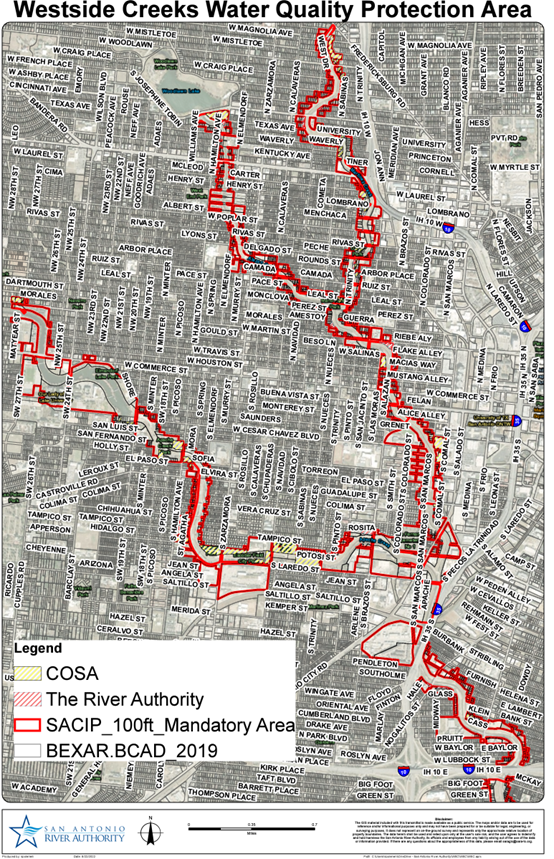
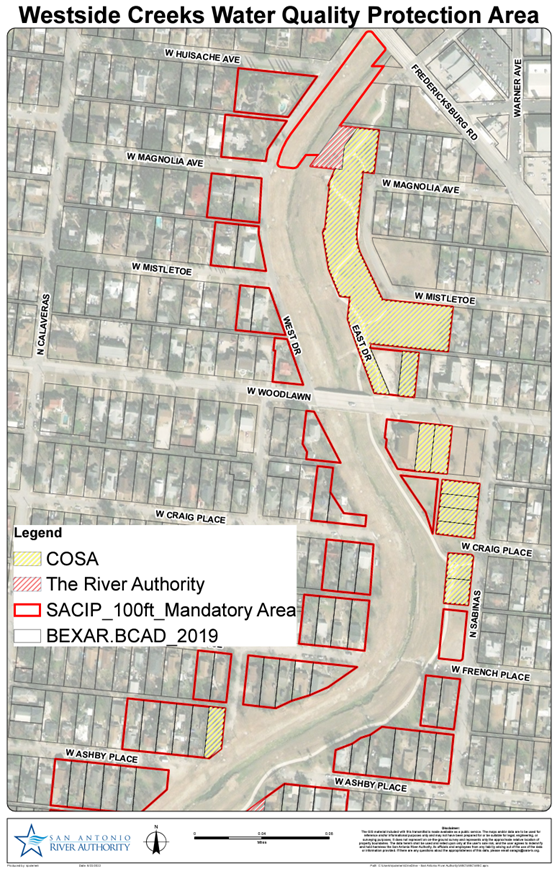
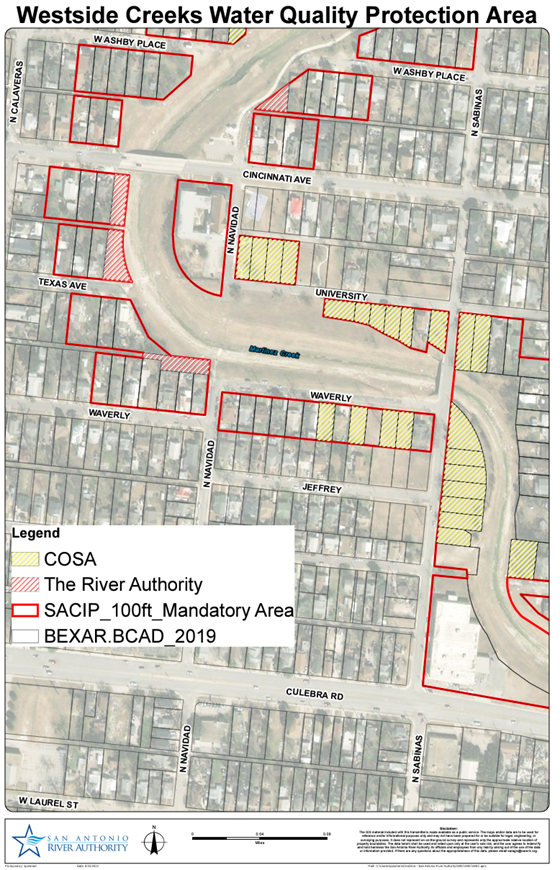
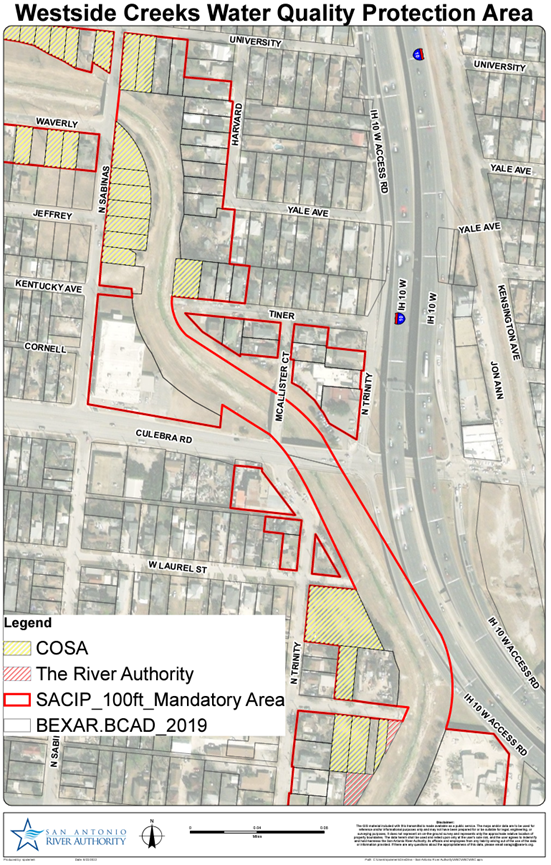
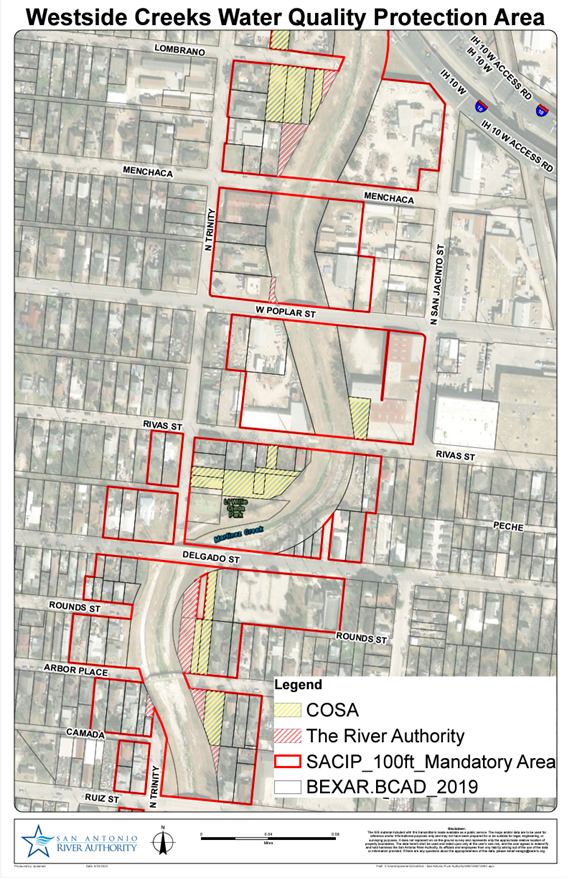
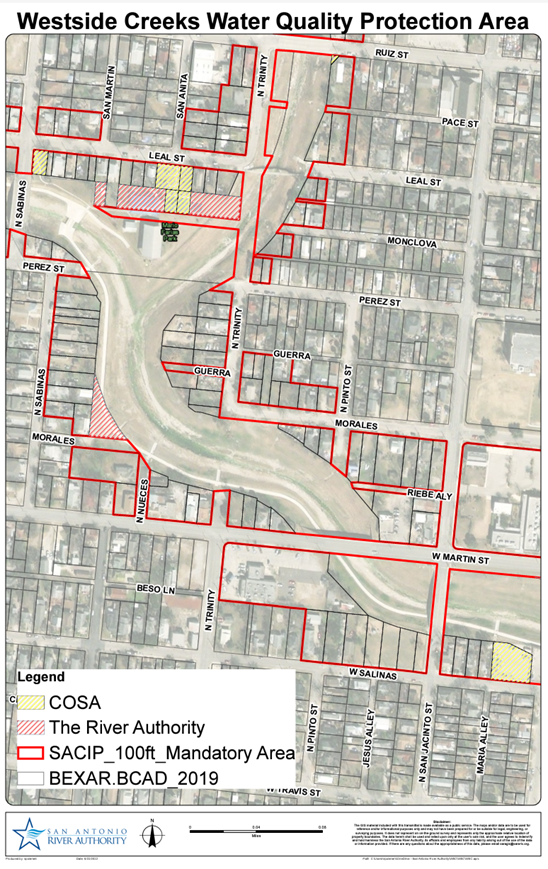
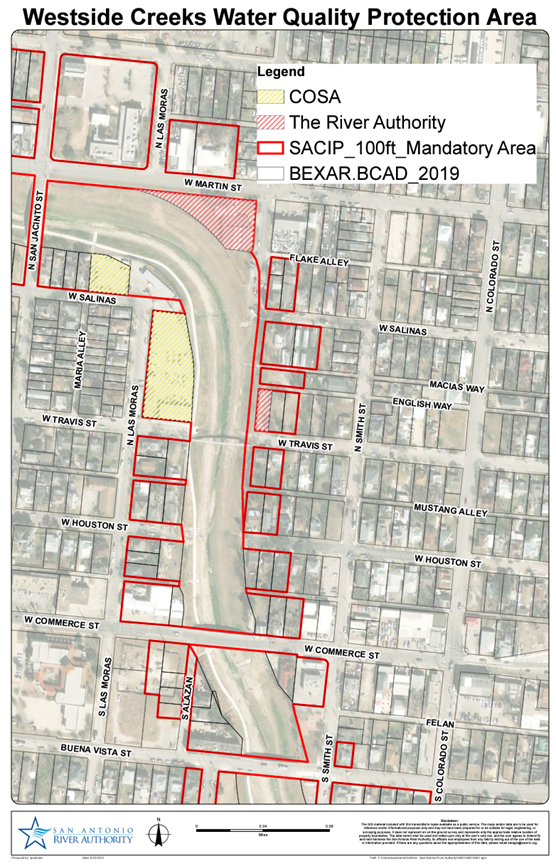
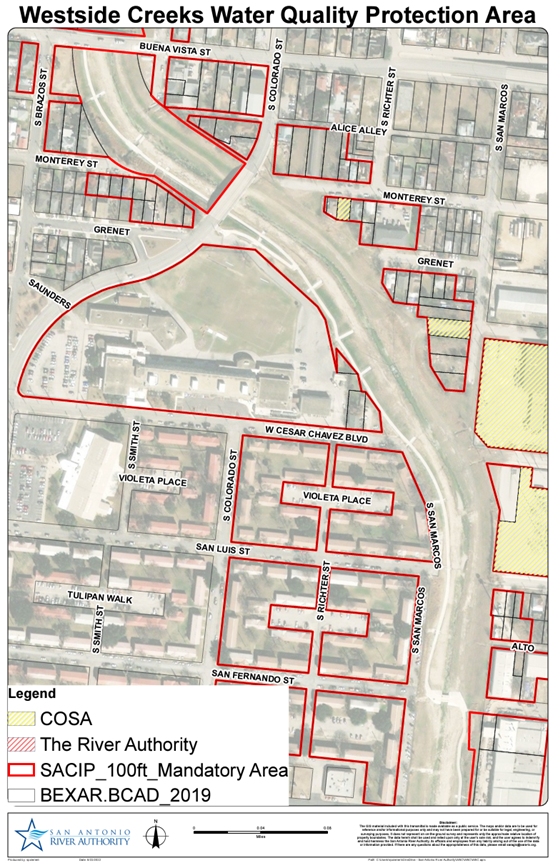
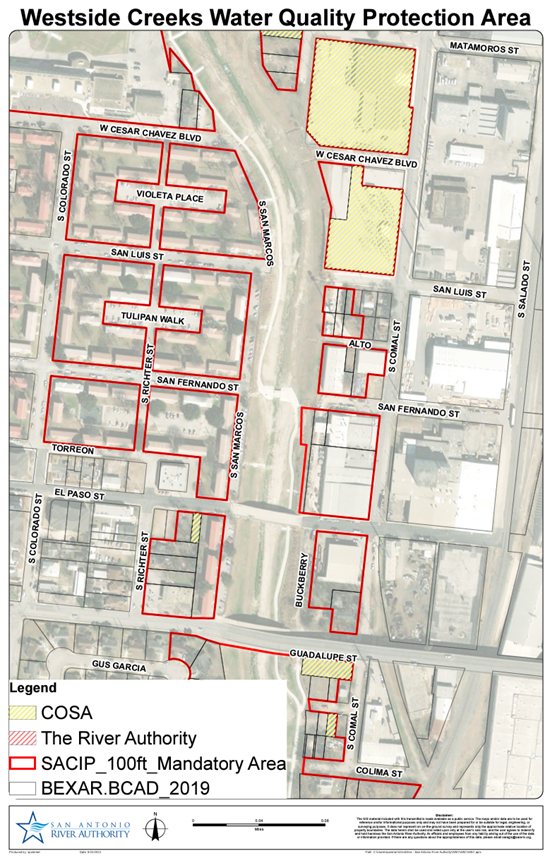
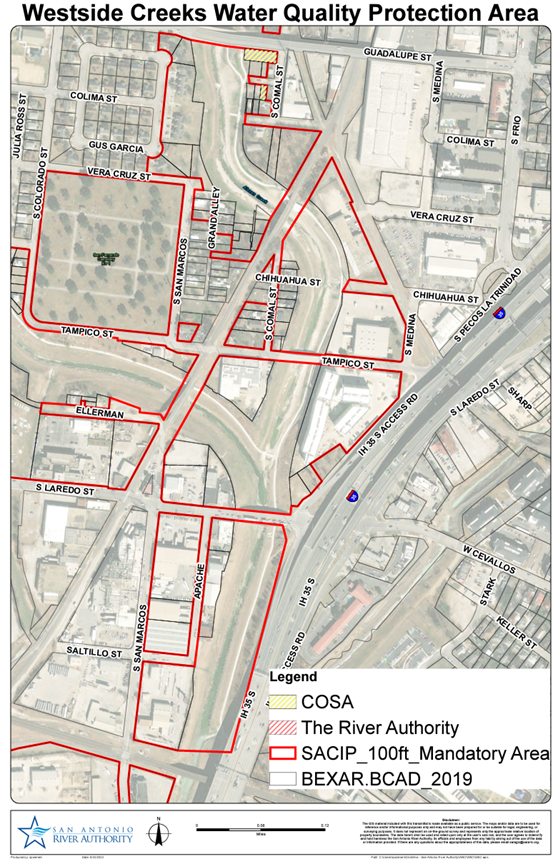
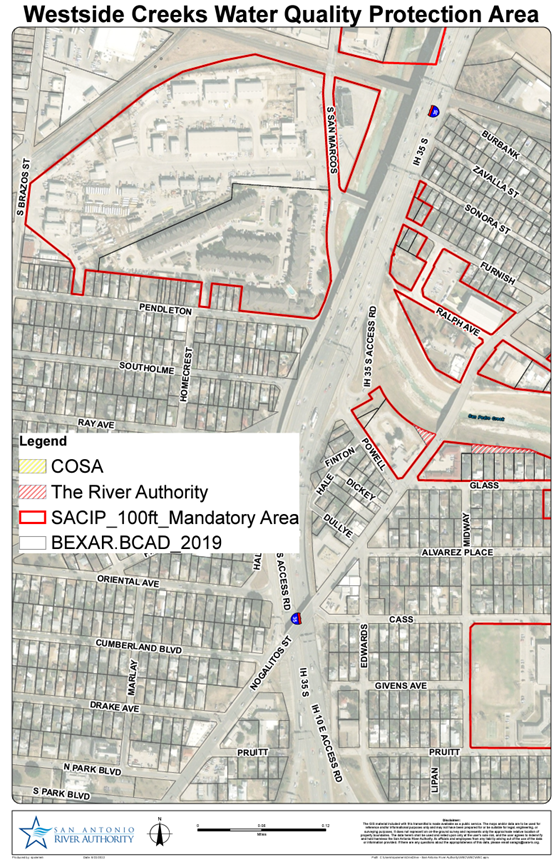
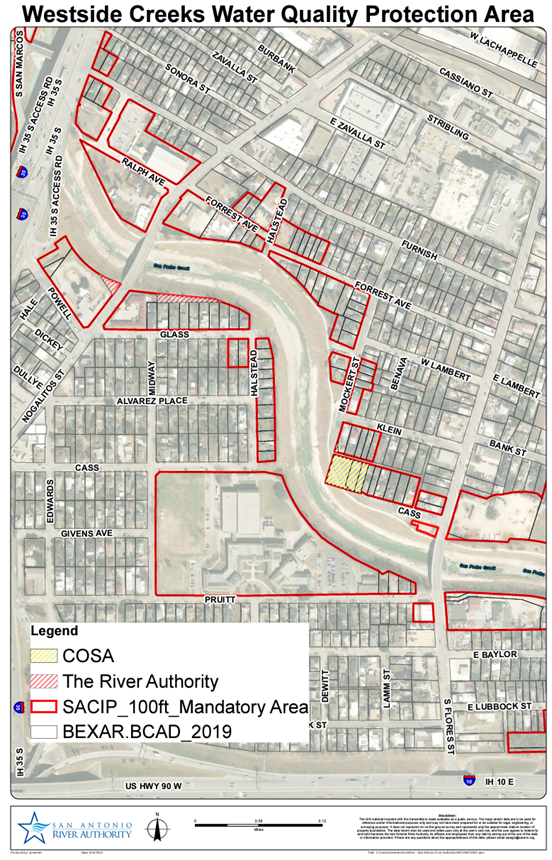
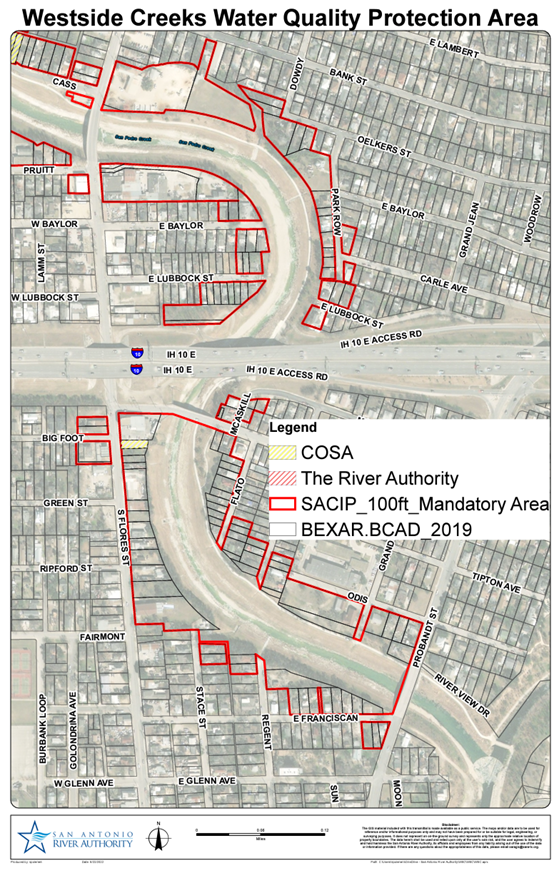
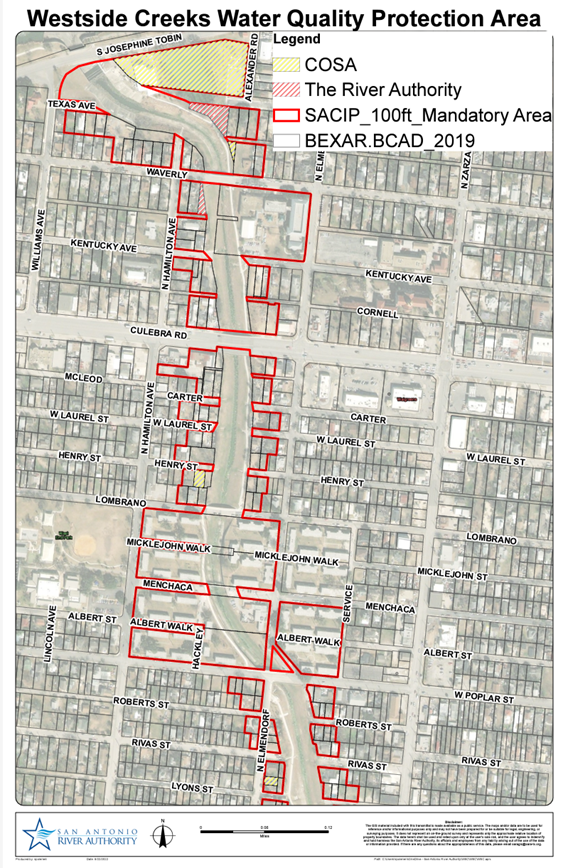
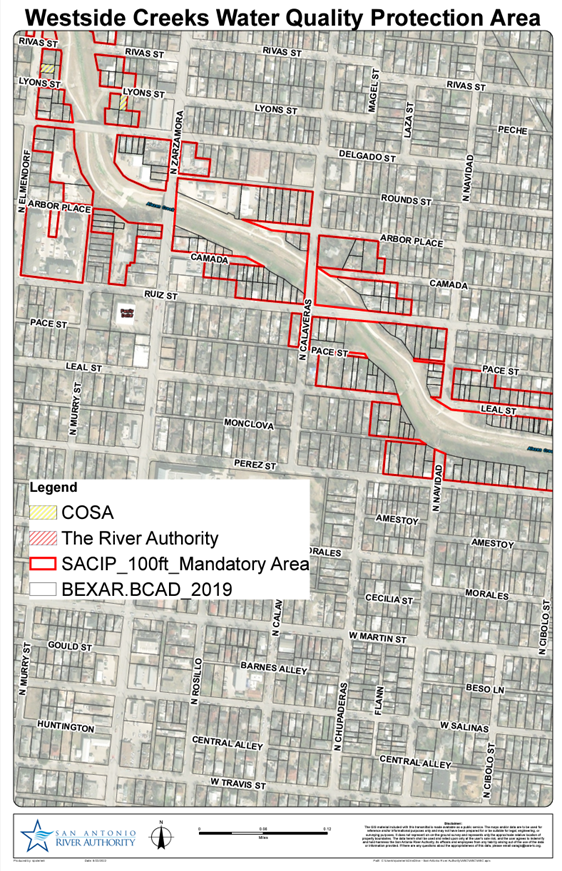
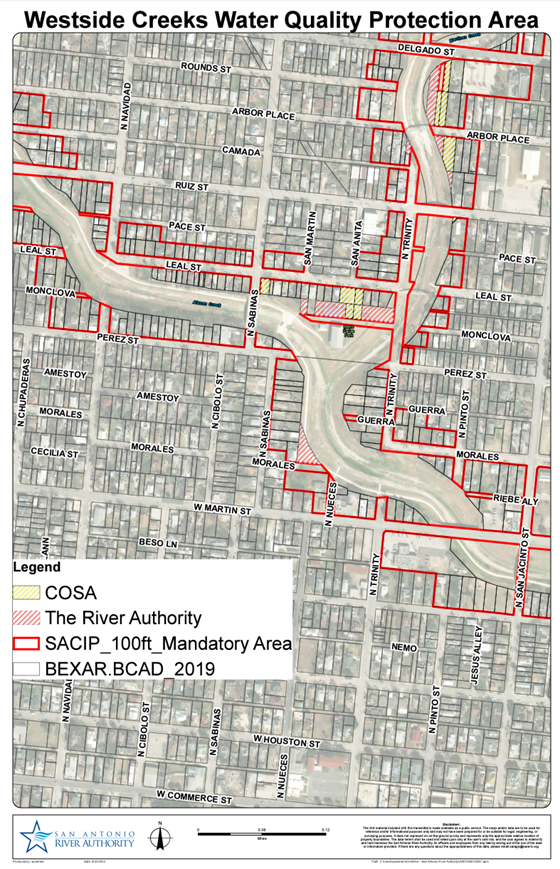
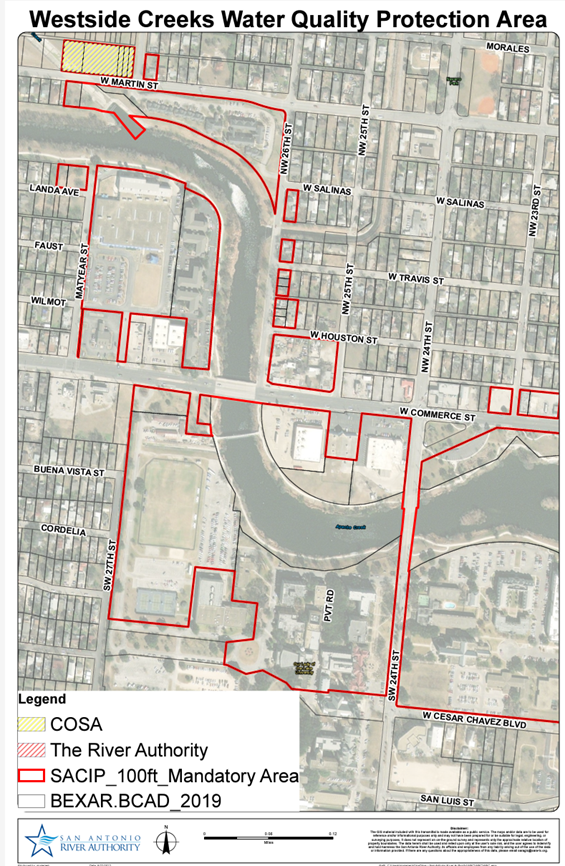
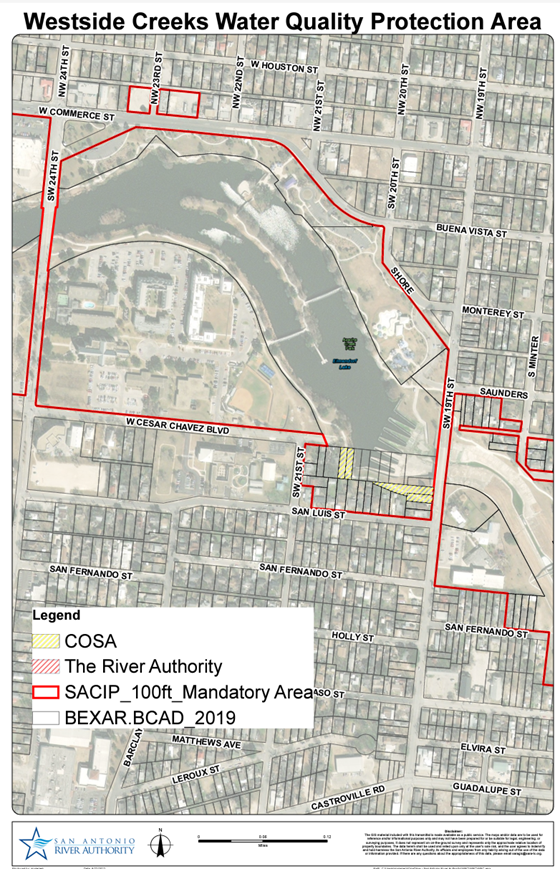
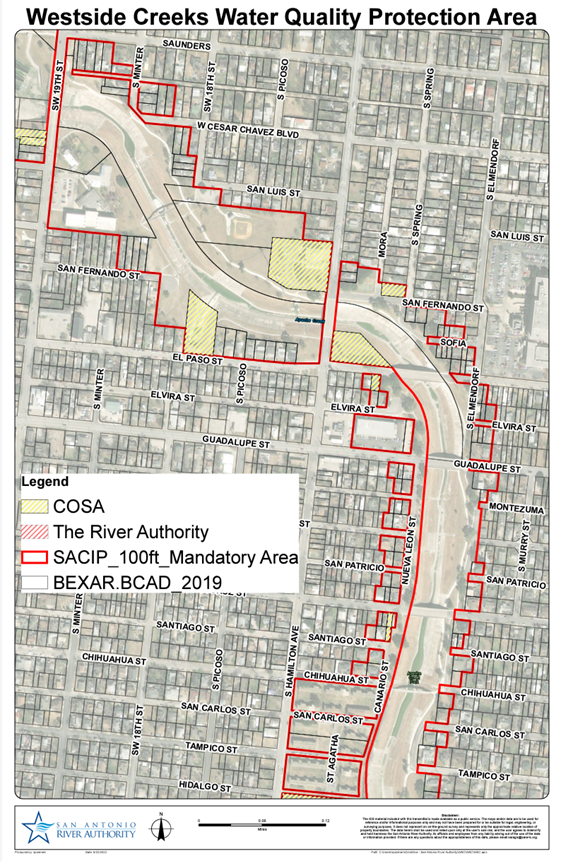
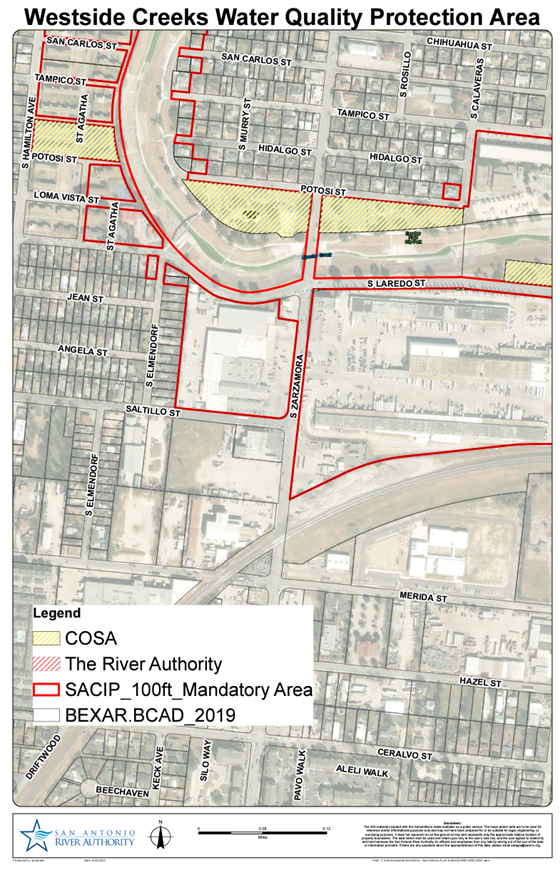
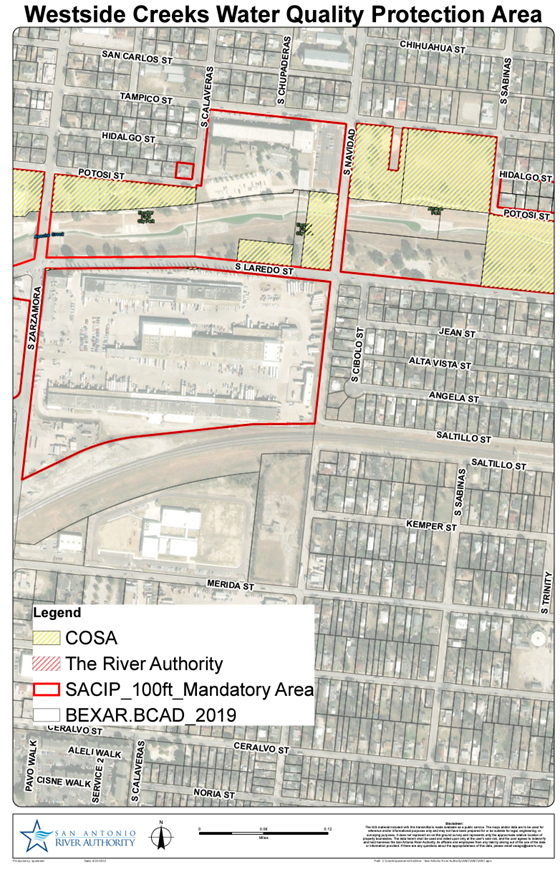
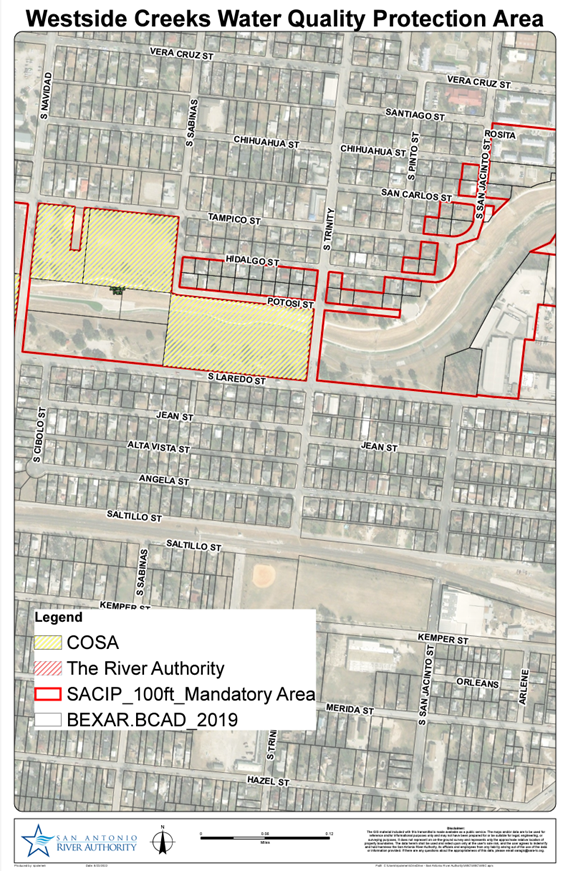
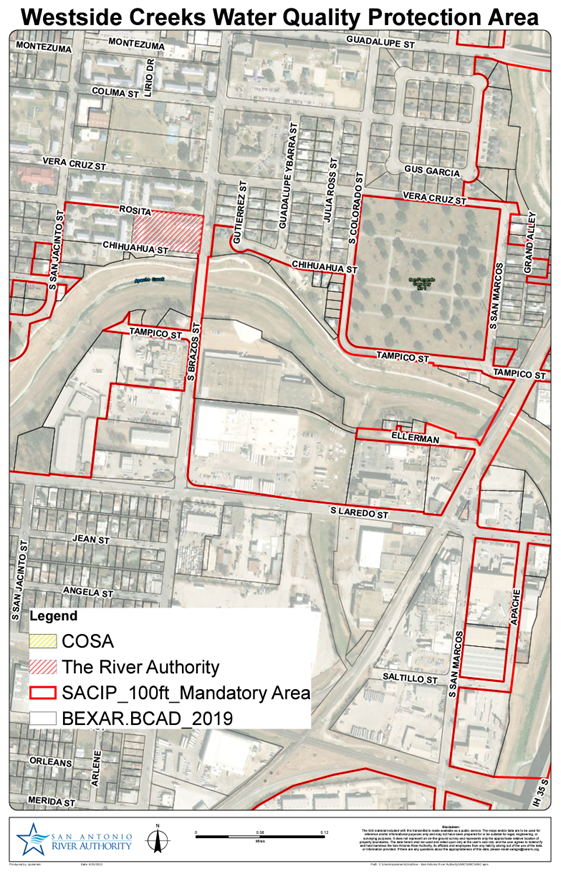
In the mandatory WSC WQ Protection Area, water run-off from some land uses may be hazardous to the water quality of the West Side Creeks and its ecosystem. Thus, the Protection Area is designed to ensure adequate treatment of storm water runoff that may potentially produce toxic, corrosive, polluted, poisonous, radioactive, unpalatable, or otherwise dangerous substances injurious to the public health or which could otherwise adversely affect the water quality or supply, and thereby minimizing the risk of potential occurrences wherein such substances could enter the water of the West Side Creeks.
The WSC WQ Protection Area further seeks to:
(i)
Prevent the negative impacts caused by incompatible and insensitive development and promote new compatible development;
(ii)
Maintain the natural habitat of the West Side Creeks, access to its trails and provide safety for its users; and
(iii)
Ensure that development near the creek is compatible with a future vision of a series of mixed-use neighborhoods with commercial and residential nodes that orient to the West Side Creeks and/or stimulate redevelopment of existing commercial corridors.
(c)
Boundaries. The limits of the West Side Creeks Water Quality Protection Area are shown on the City of San Antonio's Official Zoning Map. The boundaries of the Protection Area are determined to be the legal parcel boundaries of any parcel of land that is wholly or partially within one hundred (100) feet from the boundary of the San Antonio Capital Improvement Projects Boundary of the West Side Creeks.
Any parcel that is wholly or partially within the boundaries of the Protection Area shall not be removed from the WSC WQ Protection Area through replatting.
(d)
Protection Area. The WSC WQ Protection Area is designated as an overlay to all zoning districts. Property located within this area must also be designated as being within the regular zoning districts. Authorized uses must be permitted in both the base zoning district and the Protection Area.
(e)
Uses.
A.
Prohibited Uses. To protect the water quality of the WSC from operations, production, or storage of hazardous materials that could contribute contaminants to water supply and the West Side Creeks, the following uses are prohibited within the WSC WQ Protection Area:
1.
Truck and heavy equipment - auction.
2.
Auto - manufacture.
3.
Auto and light truck auction.
4.
Storage - outside.
5.
Batching plant.
6.
Stockyard.
7.
Used automotive parts recycler.
8.
Abrasive manufacturing.
9.
Acetylene gas - manufacturing and storage.
10.
Hazardous materials hauling or storage.
11.
Petro chemicals bulk storage.
12.
Metal forging or rolling mill.
13.
Packing plant.
14.
Petroleum - manufacturing or processing.
15.
Poultry processing.
16.
Rendering plant.
17.
Sand or gravel - storage or sales.
18.
Vulcanizing, recapping.
19.
Wood processing by creosoting or other preservation treatment.
20.
Commercial surface parking lots as primary use.
21.
Construction staging area.
22.
Gas stations
23.
Parking and transient vehicle storage - related to delivery.
24.
Parking and/or storage - long term.
25.
Tire repair - auto and small truck.
26.
Truck repair and maintenance.
27.
Truck stop.
28.
Dry cleaner, laundry, or laundromat.
29.
Can recycle collection station.
B.
Nonconforming Uses. Any use prohibited by section A which is designated as non-conforming shall be subject to the same rules and conditions found in Article VII, Division 1 (Nonconforming Uses) of this code. Redevelopment is defined in Appendix H of the UDC. All single-family residential lots are exempt from the LID requirements.
(f)
San Antonio River Authority Consultation. Consultation with the San Antonio River Authority is required regarding direct access, landscaping, and maintenance boundaries; and storm water control measures prior to storm water permit approvals or plat approval, to allow for review and comment by the River Authority for properties that fall within the WSC WQ Protection Area. This section shall apply to newly developed and redeveloped properties.
A.
Coordination with the River Authority shall include a binding commitment letter signed by the property owner and the River Authority specifying the property owner's commitment to coordinate regarding access to the West Side Creeks, landscape and maintenance boundaries, and storm water control matters when applying for stormwater and drainage permit.
B.
Access to the West Side Creeks within the WSC WQ Protection Area shall comply with the following:
(i)
Property owners shall provide plans for review by the River Authority when proposing to construct any tie-in points to the West Side Creeks project trail, and such plans shall show materials and grading for review.
(ii)
Removal of existing park trail hardscape shall require the River Authority approval.
(iii)
Development shall make it clear for users of the park to discern public access points from private access points.
(iv)
If during construction the park trail must be temporarily closed, an alternative engineered route shall be identified and temporary signage in accordance with the Manual on Uniform Traffic Control Devices (MUTCD) provided and maintained for the duration of the project.
(v)
Acceptance of park trail access point(s) shall be the responsibility of the River Authority.
C.
Landscaping and maintenance boundaries shall be recorded under the notice to the title and are defined in accordance with a final maintenance agreement (the "Maintenance Agreement") entered between the developer/property owner and the City of San Antonio. The maintenance agreement will set out the respective rights and responsibilities of the parties and an executed copy will be provided to the River Authority upon request. The purpose of the maintenance agreement is to protect the public investment that has been made in the WSC WQ Protection Area. The maintenance agreement will be designed to maintain the function of the hydrology, ecological restoration and storm water run-off mitigation in keeping with this chapter and shall generally conform to best management practices as documented in Appendix E Recommended Plant List and section 35-210 of this chapter.
D.
In the WSC WQ Protection Area, developments shall be processed in accordance with LID/NCDP use patterns, requiring an LID/NCDP plan, as specified in UDC 35-210. Developments shall manage site storm water through LID components consistent with section 35-210 of this chapter and shall also comply with the following:
(i)
Storm water runoff shall pass to the creek through discharge pipes or outfalls that are below water level or normal depth or through an approved LID feature. Overland flow onto public land is discouraged and shall be reviewed on a case-by-case basis. Overland flow onto public land requires approval of the public land property owner. Existing concrete chutes are considered as overland flow and consultation and concurrence of the River Authority is required where a USACE 408 permit is needed. Modification of this subsection shall require approval by the River Authority and the director of public works, or their designee.
(ii)
Open concrete chutes shall be prohibited.
(iii)
Installations and/or modifications of drainage outfalls require consultation with the River Authority.
(iv)
Runoff from swimming pools or other non-storm water producing sources shall be treated prior to discharging into the creek.
(v)
The Stormwater Pollution Prevention Plan (SWP3) on development/redevelopments within the WSC WQ Protection Area must be maintained onsite in accordance with Sec. 34-853 and made readily available for review by SAWS upon request, a copy of which must be provided to the River Authority.
(vi)
New and replacement storm drain inlets that tie directly into the WSC require storm water mitigation practices and consultation with the River Authority.
(vii)
Runoff from potentially acute sources of pollutants, such as dog parks, dumpster pads, and oil/grease containers shall be treated for total suspended solids (TSS), pathogens, oil/grease, and heavy metals appropriate for the pollutant source prior to discharging into the river or creek, or prior to discharging into a storm drainage system.
(viii)
Where the project ties into the WSC access, slopes shall be graded at a stable angle not to exceed four to one (4:1) and plant material that will stabilize the soil shall be used such as vigorous ground covers, vines or turf planting that are native and noninvasive species as found in San Antonio River Basin Low Impact Development Technical Design Guidance Manual Plant List. Terraced walls shall be installed when there is a slope of more than four to one (4:1).
(ix)
To enhance on-site storm water mitigation through use of open space, saw-tooth curbs and gutter shall be used along the street edge of open space at the time of improving a parcel.
(x)
LID components for managing site stormwater may be constructed in the adjacent public street ROW in accordance with 35-399.07(i) Off-Site Treatment below.
(g)
Creekside Setbacks. Creekside setbacks from top of bank for both buildings and accessory structures are established to reinforce storm water control within the WSC WQ Protection Area. Refer to Sec. 35-210(i) on stream network buffering. For developments where setback requirements exceed ten (10) percent of the total area of the individual lot, a reduced setback of minimum twenty-five (25) feet from top of bank is required. Stormwater BMP footprints are allowed within the setback areas.
(h)
Landscape Best Management Practices for Water Quality. Ecological restoration is essential to the water quality mitigation of storm water runoff in the WSC WQ Protection Area. These standards apply to landscaping within an individual site. Additional standards follow that provide more specific standards for the public pathway along the creek and street edges.
A.
Provide Variety of Plant Species in Landscape. To enhance mitigation of storm water runoff, provide ecological variety in the landscape plantings along the creek by including a variety of species compatible with site conditions for long-term resiliency and stability.
B.
Planting Requirements in Open Space Abutting the Creek. On publicly owned land leased by the adjoining property owner, if applicable, and/or within privately owned setbacks adjacent to the creek, a minimum sixty (60) percentage of the open space, excluding building footprint, lease space under bridges and parking requirements is required.
(i)
Planting requirements in WSC WQ Protection Area should continue the restoration landscape efforts along the creek banks.
C.
Plant Materials. Several soil conditions converge along the West Side Creeks area to create unique vegetation ecosystems that mitigate storm water runoff. Soil conditions vary greatly along these waterways and therefore native and indigenous plants will vary accordingly. Landscaping should reflect the unique soil characteristics of the specific site.
(i)
Incorporate Existing Native Vegetation. Extend the use of native landscape materials, including plants, shrubs and trees that are used in the public areas of the creek onto adjacent private areas to extend ecological mitigation of storm water runoff.
(ii)
Use indigenous and noninvasive species characteristic of the specific site as found on the permissible plant list maintained by the parks and recreation department or the Unified Development Code Plant List found in San Antonio River Basin Low Impact Development Technical Design Guidance Manual Plant List
(iii)
Install Trees to Provide Shade. To mitigate storm water thermal pollution, install street trees along the property line or in the ROW abutting all streets according to minimum requirement standards established in subsection 35-512(b), and consider incorporating storm water bump-outs where feasible.
(i)
Offsite Treatment. The director of the Public Works Department or his designee may, on a case-by-case basis, approve treatment of offsite runoff instead of or in combination with onsite runoff. In this case, the design rainfall depth is increased by ten (10) percent for all offsite runoff. Public Works may require that some onsite runoff is treated, especially if there are potentially acute sources of pollutants (dog parks, dumpster pads, etc.). Concurrence of the River Authority is required for neighborhood scale water quality mitigation projects through developer agreements.
(j)
Top of bank. "The "top of bank" is defined in Appendix A of the UDC. Contact the COSA PWD for a verification of the "top of bank."
(Ord. No. 2022-11-03-0831, § 2, 11-3-22, eff. 1-1-23)

