
San Fernando City Zoning Code
ARTICLE IV
- STANDARDS FOR SPECIFIC LAND USES AND ACTIVITIES
Sec. 106-520.- Accessory dwelling units.
Subsections (1) through (12) establish the standards for the development of an accessory dwelling unit and subsection (13) establishes the standards for the development of a junior accessory dwelling unit through a ministerial process, in compliance with section 106-42 (Use regulations) and California Government Code §§ 66310 to 66342. If any provision of this chapter or the underlying zoning district standards conflict with state law, the latter shall govern per Government Code § 66316.
(1)
Minimum lot size. No minimum lot size shall be required for an accessory dwelling unit.
(2)
Statewide exemption accessory dwelling unit. As established by Government Code § 66313, development standards in this section shall apply to the extent they do not prohibit the construction of an accessory dwelling unit of up to 800 square feet that is up to 18 feet in height if detached or 25 feet in height if attached, with four-foot side and rear yard setbacks.
(3)
Maximum unit size.
a.
The maximum permitted unit size of an attached accessory dwelling unit, or an accessory dwelling unit located entirely within a proposed or existing primary dwelling unit, shall not exceed 850 square feet for a one-bedroom unit or 1,200 for a two or more-bedroom unit, or 50 percent of the gross square footage of the primary dwelling unit on the lot, whichever is less, except as noted in section (2) above.
b.
The maximum permitted size of a detached accessory dwelling unit shall not exceed 850 square feet for a one-bedroom unit or 1,200 square feet for a two or more-bedroom unit.
c.
Maximum permitted unit size shall include any living area as defined in the California building code confined from exterior wall to exterior wall.
(4)
Minimum unit size. The minimum unit size of an attached or detached accessory dwelling unit shall be at least 150 square feet, including a kitchen and at least one three-quarter bathroom.
(5)
Zones in which accessory dwelling units may be constructed. The construction, use, and maintenance of accessory dwelling units shall be permitted in areas zoned to allow single-family or multiple-family dwelling residential use, or mixed-use. For purposes of this division, a multiple-family dwelling unit is two or more attached dwelling units on a single property.
(6)
Accessory dwelling unit density and development standards.
a.
Single-family dwellings. Accessory dwelling units are allowed on a property containing existing or proposed single family dwellings under the following circumstances:
1.
No more than one accessory dwelling unit per lot within the proposed or existing square footage of a single-family dwelling or existing square footage of an accessory structure that meets specific requirements such as exterior access and setbacks for fire and safety.
2.
No more than one detached new construction accessory dwelling unit. A new construction-attached accessory dwelling unit may be constructed in lieu of the new construction detached accessory dwelling units.
3.
No more than one junior accessory dwelling unit per lot within the proposed or existing space of a single-family dwelling that meets specific requirements such as exterior access and setbacks for fire and safety as described in subsection (9).
4.
The maximum height for accessory dwelling units shall be 18 feet in height and an additional two feet for roof pitch to align with the roof pitch of the primary dwelling unit if detached or 25 feet in height if attached. For accessory dwelling units proposed above a garage, the maximum height of the accessory dwelling unit shall not exceed one story from floor to ceiling height.
b.
Multiple-family dwellings. Accessory dwelling units are allowed on a property containing multiple-family dwellings or mixed-use structures on a lot containing multiple-family dwelling units under the following conditions:
1.
The number of accessory dwelling units shall not exceed 25 percent of the number of existing units, minimum one unit.
2.
The accessory dwelling units shall only be located within areas that are not used as livable space, including, but not limited to, storage rooms, boiler rooms, passageways, attics, basements, or garages which are attached or detached. Non-livable space used to create accessory dwelling units must be limited to residential areas within a mixed-use development and not the areas used for commercial or other activities.
3.
The maximum height shall be 18 feet for a detached accessory dwelling unit on a lot with an existing or proposed multiple-family, multistory dwelling.
4.
Each accessory dwelling unit must comply with state building standards for dwellings.
5.
A maximum of eight detached, accessory dwelling units shall be allowed on a property with existing multiple-family dwelling units, not to exceed the number of existing units on the lot.
6.
A maximum of two detached accessory dwelling units shall be allowed on a property with a proposed multiple-family dwelling.
(7)
Minimum room dimensions. Minimum room dimensions, including ceiling heights, floor area and width, shall meet the Uniform Building Code regulations in effect at the time of construction.
(8)
Location.
a.
Accessory dwelling units may be within, attached to, or detached from and on the same lot as, a proposed or existing single-family dwelling, or within or detached from a multiple-family dwelling, and subject to compliance with front, side, and rear yard setback standards of the underlying zone except as allowed in subsection (2) above.
b.
Accessory dwelling units may be located entirely within a proposed or existing primary dwelling unit or existing accessory structure; provided, the accessory dwelling unit has independent exterior access from the existing primary dwelling or accessory structure.
c.
An ADU created within an existing accessory structure may be expanded up to 150 square feet without application of local development standards, but this expansion shall be limited to accommodating ingress and egress.
(9)
Parking. Parking for an accessory dwelling unit and replacement parking is not required.
(10)
Habitability. Accessory dwelling units are fully habitable and shall include independent kitchen and bathroom facilities. Accessory dwelling units shall be independent from the main dwelling without internal access.
(11)
Occupancy, sale, and rental restrictions. Owner occupancy is not required for accessory dwelling units. Accessory dwelling units shall not be sold or conveyed separately from the primary residence, except when sold by a qualified nonprofit corporation to a qualified buyer in accordance with Government Code §§ 66340 and 66341. Accessory dwelling units shall not be used for rentals of terms of 30 days or less unless
(12)
Setbacks.
a.
An accessory dwelling unit shall have side and rear yard setbacks of at least four feet from lot lines. An accessory dwelling unit shall abide by the front yard setback requirements of the zone in which it is located.
b.
An accessory dwelling unit constructed entirely within a proposed or existing primary dwelling unit or accessory structure, which has side and rear setbacks that are sufficient for fire safety, as determined by the City of Los Angeles Fire Department, shall not be subject to setback standards for new development.
c.
An accessory dwelling unit constructed above, or as a second story to, a garage or other accessory structure shall be setback a minimum of four feet from side and rear lot lines. An accessory dwelling unit constructed above, or as a second story to, a garage or other accessory structure shall abide by the front yard setback requirements of the zone in which it is located.
(13)
Junior accessory dwelling units. In addition to an accessory dwelling unit as provided in this section, junior accessory dwelling units are permitted within an existing or proposed single family residence, including attached garages, consistent with state law. The following establishes standards for junior accessory dwelling units.
a.
Maximum unit size. A junior accessory dwelling unit may be up to 500 square feet.
1.
Maximum permitted unit size shall include any livable space from exterior wall to exterior wall.
b.
Density. No more than one junior accessory dwelling unit is allowed on a property.
c.
Location. A junior accessory dwelling unit shall be located entirely within a proposed or existing primary dwelling unit, subject to the following:
1.
A junior accessory dwelling may be in an attached garage but may not be in a detached accessory structure.
2.
A junior accessory dwelling unit shall have separate exterior access independent from the proposed or existing primary dwelling unit.
3.
A junior accessory dwelling unit may share significant interior connection to the primary dwelling if they are sharing a bathroom facility.
d.
Parking. Parking for a junior accessory dwelling unit and replacement parking is not required.
e.
Habitability. Junior accessory dwelling units shall include an efficiency kitchen which shall include a cooking facility with appliances, a food preparation counter, and storage cabinets that are of reasonable size in relation to the size of the junior accessory dwelling unit.
f.
Occupancy, sale, and rental restrictions. Owner occupancy is required in either the remaining portion of the primary residence, another dwelling unit on the same lot, or the newly created junior accessory dwelling unit. Owner-occupancy shall not be required if the owner is another governmental agency, land trust, or housing organization. These occupancy restrictions shall be enforced through recordation of deed restrictions or covenant agreement recorded against the property per Government Code § 66333. The form of the deed restriction will be provided by the city and shall provide that: The junior accessory dwelling units shall not be sold separately from the primary dwelling, except as may otherwise be permitted by state law; the JADU is restricted to the approved size and other attributes allowed by this section.
g.
Conveyance. Junior accessory dwelling units shall not be sold separately from the primary dwelling unit and shall not be used for rentals of terms of 30 days or less.
(14)
Other development standards and requirements.
a.
Unless stated in this section, all other development standards for accessory dwelling units and junior accessory dwelling units shall apply according to the zone in which the subject property is located; including, but not limited to, setbacks, building height, and distance between structures.
b.
Conversion of existing structures. For the purpose of converting an existing structure into an accessory dwelling unit or junior accessory dwelling unit, an existing structure is defined as one of the following:
1.
A structure that has been erected prior to the date of adoption of the appropriate building code that does not present a threat to public health and safety or one for which a legal building permit has been issued
c.
When a garage is converted into an ADU or JADU, the garage door must be removed and replaced with windows or entry doors.
d.
Architectural requirements. Accessory dwelling units shall be subject to the following architectural requirements.
1.
The materials and colors of the exterior walks, roof, windows, and doors shall be the same as the materials and colors of the primary dwelling.
2.
The roof slope shall match the dominant roof slope of the primary dwelling, whereby the dominant roof slope means the slope shared by the largest portion of the roof.
3.
Exterior lighting shall be limited to down-lights or as otherwise required by the building or fire code.
e.
Entrances. Entrances for accessory dwelling units constructed above garages shall not face adjacent properties.
1.
An exterior entrance to the second story of an accessory dwelling unit shall not project into any required minimum setback and shall be located to either face the primary dwelling unit and/or the side and/or rear property line that it is furthest away from.
f.
Pedestrian walkways. ADUs shall provide pedestrian access to the sidewalk that is at least four feet wide.
g.
Landscape requirements. Landscape screening must be planted and maintained between the accessory dwelling unit and the side and rear lot lines of the property in accordance with division 4 of article III.
h.
Fire sprinklers. Fire sprinklers are required in an accessory dwelling unit if sprinklers are required in the primary residence. The construction of an accessory dwelling unit does not trigger the requirement for fire sprinklers to be installed in the existing primary dwelling.
i.
Solar panels. New construction accessory dwelling units are subject to the California Energy Code requirement (excluding manufactured homes) to provide solar systems if the unit(s) is a newly constructed, non-manufactured, detached accessory dwelling unit (though some exceptions apply). Per the California Energy Commission (CEC), the solar systems can be installed on the accessory dwelling unit or on the primary dwelling unit. Accessory dwelling units that are constructed within existing space, or as an addition to existing homes, including detached additions where an existing detached building is converted from non-residential to residential space, are not subject to the energy code requirement to provide solar systems.
(15)
Application process. The following is the ministerial application process for accessory dwelling units and junior accessory dwelling units.
a.
A building permit is required for accessory dwelling units and junior accessory dwelling units. The completed building permit application shall be submitted to the building safety division on an application form prepared by the building official and shall include the submittal requirements. In order to be deemed complete, plans shall comply with all current applicable development standards, any applicable department handouts, and any additional information required by the building official in order to conduct a thorough review.
b.
The building division shall approve or deny the application within 60 days of acceptance of a complete application if there is an existing single-family or multifamily dwelling on the lot, as established for accessory dwelling units in Government Code §§ 66314—66332 and for junior accessory dwelling units in Government Code §§ 66333—66339. If the permit application to create or serve an accessory dwelling unit or a junior accessory dwelling unit is submitted concurrently with a permit application to create a new single-family or multifamily dwelling on the lot, no permit for the accessory dwelling unit or the junior accessory dwelling unit shall be issued until the permit application to create the new single-family or multifamily dwelling has been adjudicated, but the application to create or serve the accessory dwelling unit or junior accessory dwelling unit shall be considered without discretionary review or hearing. If the project is denied, the applicant will receive a full list of comments with remedies to correct any Code deficiencies.
c.
Prior to building permit issuance, applicant for an accessory dwelling unit shall submit an address assignment request fee and application to the public works department.
d.
Prior to building permit issuance, projects resulting in the addition of 750 square feet or more for an accessory dwelling unit located at the subject property shall pay all impact fees of this Code, except that any impact fees charged for an accessory dwelling unit of 750 square feet or more shall be charged proportionately in relation to the square footage of the primary dwelling unit (e.g. the floor area of the primary dwelling, divided by the floor area of the ADU, times the typical fee amount charged for a new dwelling). For the purposes of this paragraph, impact fees do not include any connection fee or capacity charge for water or sewer service.
e.
Prior to the building permit issuance, projects resulting in 500 square feet or more for an accessory dwelling unit located at the subject property shall pay all school impact fees.
(Ord. No. 1732, § 3(Exh. A), 5-5-2025)
Sec. 106-524.- Purpose.
The purpose of this division is to establish a comprehensive set of regulations applicable to adult businesses and similar and related uses.
(Ord. No. 1732, § 3(Exh. A), 5-5-2025)
Sec. 106-525. - Special regulations
All uses subject to this division shall comply with all of the regulations contained in this chapter and the following:
(1)
Prior to the establishing or conducting of any adult business, a conditional use permit therefor shall be obtained pursuant to division 4 of article II of this chapter; and
(2)
No adult business shall be granted a conditional use permit unless that lot upon which such business is proposed to be located is:
a.
Classified in a C-2 or SC Zone;
b.
Not within 500 feet of any lot classified in any of the R Zones;
c.
Not within 1,000 feet of any lot upon which there is located a church or educational institution, park or other public facility which is utilized by minors;
d.
Not within 1,000 feet of any lot on which there is located another adult business; and
e.
Not within 500 feet of any lot upon which is located a business with an on-sale alcoholic beverage license.
(Ord. No. 1732, § 3(Exh. A), 5-5-2025)
Sec. 106-537.- Restrictions.
(a)
A maximum of four amusement devices may be allowed at any one site; provided, however, that amusement devices shall be further limited in number based upon the square footage of the buildings in which they are to be located, as follows:
In no event shall square footage alone entitle an applicant to the maximum number of amusement devices allowed under this section.
(b)
Amusement devices shall be allowed only as an accessory use to the primary business at the location, and the monthly gross revenues of the amusement devices shall not exceed the monthly gross revenues of the primary business. The revenue records of the business conducted at the site shall be available for inspection by the business license inspector.
(c)
If the primary business conducted at the site is a fraternal or veteran organization or is restricted to persons 21 years of age or older, the revenue restriction in subsection (b) of this section shall not apply.
(d)
Unless located in a structure into which entrance is normally restricted to persons 21 years of age or older, amusement devices shall not be located at a business that derives 50 percent or more of its primary business revenues from the sale of distilled spirits.
(e)
Amusement devices shall not be located within 100 feet of any display for the sale of adult magazines.
(f)
School-age children 16 years of age or younger shall not be permitted to operate the video game machines during the daily hours in which public schools are open and conducting classroom activities.
(g)
The applicant shall comply with all of the mandatory requirements of section 22-102 of this Code.
(h)
All applicable fees shall be paid.
(i)
The site shall be limited to a maximum number of machines allowed per this Code.
(Ord. No. 1732, § 3(Exh. A), 5-5-2025)
Sec. 106-567.- Purpose.
This section provides operational standards for kennels, pet day care facilities, veterinary clinics and animal hospitals in compliance with the development standards within the underlying zone district.
(Ord. No. 1732, § 3(Exh. A), 5-5-2025)
Sec. 106-568. - Operational standards.
(a)
All operations must be conducted within a completely enclosed building.
(b)
Outdoor dog runs and training activities are permitted only within the M-1 and M-2 Zone, and when the facility is located at least 200 feet from a residential zone.
(c)
The areas within the building where animals are boarded shall be sufficiently soundproofed to prevent a disturbance or become a nuisance to surrounding properties, as determined by the director.
(d)
The areas of the building where animals are boarded shall have a minimum of 10 air changes per hour.
(e)
Animal isolation areas shall have 100 percent fresh air, with all air exhausted and none returned to the ventilation system.
(f)
Public access areas shall be provided with a separate ventilation system from the animal boarding and treatment areas.
(g)
The areas used for animal boarding, isolation, and treatment shall be constructed of easily-cleaned materials.
(h)
All areas where animals are present shall be cleaned a minimum of twice daily in order to provide appropriate odor control and sanitation.
(Ord. No. 1732, § 3(Exh. A), 5-5-2025)
Sec. 106-569.- Purpose.
This section provides location, development, and operating standards for automatic teller machines (ATMs) in compliance with the development standards within the underlying zone district.
(Ord. No. 1732, § 3(Exh. A), 5-5-2025)
Sec. 106-570. - Development standards.
(a)
Location requirements.
(1)
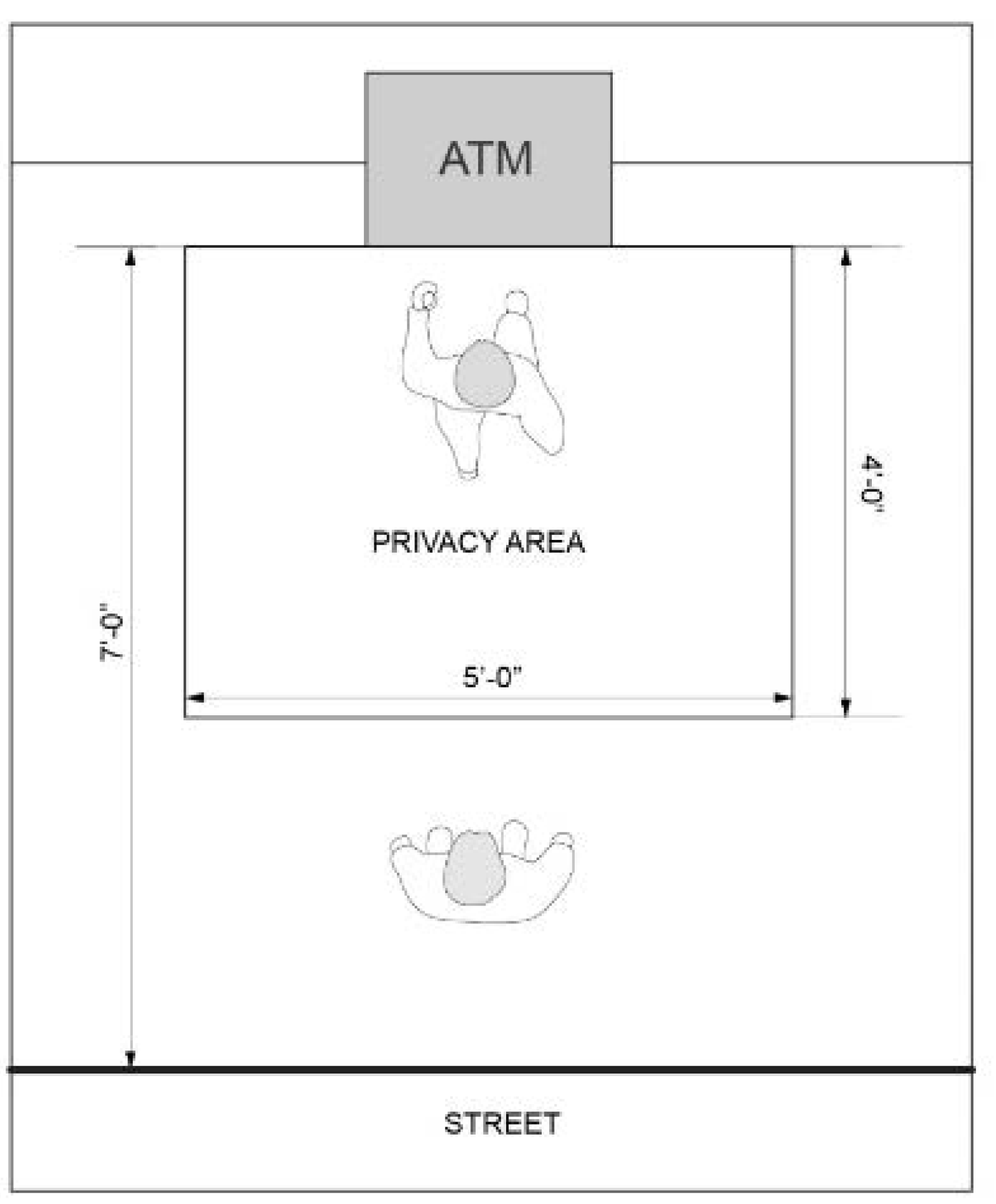
Setback from an adjacent street curb or alley by a minimum of seven feet.
(2)
A privacy area immediately in front of each ATM, measuring at least five feet wide by four feet deep, shall be provided. Methods for defining the privacy area shall be approved by the director.
(3)
Located to not eliminate or substantially reduce any landscaped areas.
(4)
Located to ensure the safety and security of patrons.
(b)
Design. All construction and modifications to the exterior of the structure pertaining to the installation of the ATMs shall be completed in a manner consistent with the architectural design of the structure, and in conformance with all applicable city architectural standards and guidelines.
(c)
Lighting. Each exterior ATM shall be provided with security lighting in compliance with division 5 of article III or state law, whichever is more restrictive.
(d)
Maintenance. Each ATM shall be provided with receptacles sufficient in size and number to accommodate trash and smoking materials generated by users of the ATM.
(Ord. No. 1732, § 3(Exh. A), 5-5-2025)
Sec. 106-571.- Intent and purpose.
The purpose of this division is to establish regulations and standards that enhance compatibility of automotive repair use with other commercial activity in the same zone and afford protection to abutting residential property where the two zones converge.
(Ord. No. 1732, § 3(Exh. A), 5-5-2025)
Sec. 106-572. - Regulations and standards.
(a)
The regulations and standards for automotive repair in this section shall supplement development standards enumerated in this chapter for commercial and industrial zoned property. The standards imposing the more stringent requirement shall prevail. These supplemental development standards shall apply not only to new development or conversions subsequent to the effective date of the ordinance from which this chapter derives, but to an existing development that may wish to expand or modify its operations.
(b)
Repair work shall be conducted entirely within an enclosed building, and dismantled vehicles and tow trucks shall be stored inside a building or, if permitted, inside a screened area where the vehicles shall not be visible from off the site when the business is closed on weekends and overnight.
(c)
Surfaced transitional parking areas shall be provided on site where vehicles awaiting service shall be stored. Except for cursory examination, no actual repair work shall be conducted on vehicles parked in the transition area.
(d)
Major repair and refinishing shops will be permitted as accessory to automobile sales dealerships when located not less than 200 feet from residentially zoned property.
(e)
Accessory automobile repair facilities shall not exceed one-third the total square foot area devoted to the entire principal use.
(f)
Automobile repair facilities falling under the category of an accessory use for a permitted retail or service use in the commercial zone shall be subject to the applicable requirements of this section.
(g)
Major or minor automobile repair facility structures shall not be closer than 40 feet to any street right-of-way or closer than 60 feet to any lot in a residential district. Buildings used for repair shall position garage doors away from residential property.
(h)
Parking standards for automobile repair facilities shall be two spaces for each service stall, pit, or rack plus parking and loading spaces required per division 3 of article III of this chapter. Transitional parking areas shall be exclusively designated for vehicles requiring repair service.
(i)
The minimum lot area for an automobile repair facility shall be predicated on the amount of land area required to satisfy property development standards for the zone where the automobile repair use is permitted and applicable standards specified in this section.
(Ord. No. 1732, § 3(Exh. A), 5-5-2025)
Sec. 106-601.- Purpose.
This section provides standards for the location, development, and operation of drive-in and drive-through facilities in compliance with the development standards within the underlying zone district, which shall be designed and operated to effectively mitigate problems of congestion, excessive pavement, litter, noise, traffic, and unsightliness.
(Ord. No. 1732, § 3(Exh. A), 5-5-2025)
Sec. 106-602. - Development standards.
(a)
Drive aisle length. The drive-through aisle shall provide a minimum of 140 feet of queuing length, of which at least 60 feet shall be provided before an on-site menu board. The drive aisle shall be measured along the centerline, from the entry or beginning of a drive-aisle to the center of the farthest service window area.
(b)
Drive aisle width. Drive aisles shall have a minimum ten-foot interior radius at curves, and a minimum 12-foot width.
(c)
Drive aisle separation. Each drive aisle shall be separated by curbing and landscaping from the circulation routes necessary for ingress or egress from the property, or access to any off-street parking spaces.
(d)
Drive aisle entrance. Each entrance to a drive aisle and the direction of traffic flow shall be clearly designated by signs and/or pavement markings, as deemed necessary by the director.
(e)
Walkways. To the extent possible, pedestrian walkways should not intersect the drive aisles. Where they do, they shall have clear visibility and be emphasized by enhanced paving or markings, as deemed necessary by the director.
(f)
Circulation plan. A parking and vehicle circulation plan encompassing adjoining streets and alleys shall be submitted for review and approval. Such plan shall provide for safe pedestrian access from parking lots to the main door and shall comply with applicable requirements of the American with Disabilities Act.
(g)
Trash receptacle provision. A minimum of one outdoor trash receptacle shall be provided onsite.
(h)
Noise generating equipment. No noise-generating compressors or other such equipment shall be placed on or near any property line adjoining any residential zoned property.
(i)
Speaker system noise. Drive-through speaker systems shall emit no more than 50 decibels four feet from the vehicle and the speaker, and shall not be audible above the daytime ambient noise levels beyond the property boundaries. The system shall be designed to compensate for ambient noise levels in the immediate area and shall not be located within 30 feet of any residentially zoned property.
(j)
Screening. Each drive aisle shall be appropriately screened with a combination of landscaping, low walls, and/or berms to prevent headlight glare from impacting adjoining land uses, public rights-of-way, and parking lots, as deemed necessary by the director.
(k)
Decorative wall. A six-foot-high, solid decorative masonry wall shall be constructed on each property line that adjoins a residential developed parcel. The design of the wall and the proposed construction materials shall be subject to the approval of the director.
(Ord. No. 1732, § 3(Exh. A), 5-5-2025)
Sec. 106-603. - Operational standards.
(a)
Hours of operation. When located on a site adjacent to or separated by an alley from any residentially zoned property, a drive-through establishment shall not operate between the hours of 10:00 p.m. and 7:00 a.m.
(b)
Litter. Employees shall collect on-site and off-site litter generated by customers at least once per business day.
(Ord. No. 1732, § 3(Exh. A), 5-5-2025)
Sec. 106-604.- Purpose.
The language of this division shall apply to all establishments selling alcohol, including bars, breweries, distilleries, tap rooms, tasting rooms, clubs, restaurants, and wine bars. The purpose of the language codified within this article is to set forth regulations and enforcement procedures that:
(1)
Address community problems associated with the on-site consumption of alcoholic beverages, such as litter, loitering, graffiti, misconduct, and escalated noise levels;
(2)
Ensure that there is no degradation of the deemed approved activities;
(3)
Prevent such prohibited activities and activities contrary to deemed approved activities from becoming public nuisances; and
(4)
Ensure such adverse impacts are monitored, mitigated and/or controlled such that they do not negatively contribute to the change in character of the areas in which they are located.
(Ord. No. 1732, § 3(Exh. A), 5-5-2025)
Sec. 106-605. - Application procedure.
The applicant shall be required to submit to the planning division the following:
(1)
A floor plan shall be reviewed and approved to identify the areas in which all on-site sale and consumption of alcoholic beverages shall occur. This shall be limited to the confines of the building and approved outdoor patio or dining area.
(2)
A plan to encourage use of ride share programs, designated drivers, and other methods to discourage intoxicated driving shall be established, and documentation of such a program shall be provided.
(3)
A security plan shall be submitted for review and approval prior to the opening of the business.
a.
Security personnel shall be required by the city for establishments with occupancy load of over 100 people.
b.
The doors to the establishment shall remain closed except upon entering and exiting the business.
c.
The security plan shall include a video surveillance system and exterior lighting plan, satisfactory to the community development director or designee, shall be submitted and approved prior to issuing a certificate of occupancy. The video surveillance system shall be installed to assist with monitoring of both the interior and exterior the property. A digital video recorder (DVR) or similar video recording device, capable of exporting images in TIFF, BMP, or JPG format shall be used. Recording shall be retained for no less than 30 days. Exterior lighting shall clearly illuminate the common areas surrounding the building including, but not limited to, the entrance and exit doors and the business address.
(Ord. No. 1732, § 3(Exh. A), 5-5-2025)
Sec. 106-606. - Operational requirements.
(a)
Prior to the service of alcohol within the establishment, the operator shall obtain a valid license from the ABC and provide a copy of the license to the planning division.
(b)
The city reserves the right to request of the ABC additional conditions, such as hours of operation restrictions, restriction of the type of alcohol sold, or other conditions that the city may deem necessary in order to reduce potential impacts.
(c)
Should the ABC issue a license suspension or citation, the operator shall provide a copy of said suspension or citation to the planning division.
(d)
The operating business shall comply with all applicable noise regulations.
(e)
The operator shall be responsible for requiring that there be no loitering on the site, on the public right-of-way and or/ in front of adjacent properties at any time and that all customers shall leave the site no later than 30 minutes after closing, after which, only employees shall be allowed on the premises.
(f)
Litter and trash receptacles shall be located at convenient locations, both inside and outside establishment, and trash and debris shall be removed on a daily basis.
(g)
The property shall be maintained in a clean and neat manner at all times and shall comply with property maintenance standards as set forth in the San Fernando Municipal Code.
(h)
Exterior public telephones shall not be located on the premises.
(i)
Graffiti shall be removed within 48 hours of its application.
(j)
No person shall appear in a state of nudity in any bar, club, or similar business establishment.
(1)
For the purposes of this section, "nudity" means the showing of the human male or female genitals, pubic area, or buttocks with less than a fully opaque covering, or the showing of the female breast with less than a fully opaque covering of any part of the nipple or below the nipple.
(k)
Bona fide eating establishments (restaurants) shall only sell alcoholic beverages during hours that meals are being served and gross receipts from alcohol sales shall not exceed 50 percent of the total revenue of the business.
(l)
Special events are permitted with the approval of a special event permit in compliance with San Fernando Municipal Code section 106-1112 (Temporary Uses and Structures: Religious and entertainment assembly).
(m)
No establishment may sell alcoholic beverages for on-premises or off-premises consumption unless a conditional use permit for alcoholic beverages has been approved for such establishment or unless exempted by this Code section or another operative plan.
(n)
No new establishment selling alcohol shall be permitted within 200 feet of either a residence, family day care home, schools for minors, child day care facility, convalescent home, a residential care home-retirement home, or any residentially zoned lot or parcel.
(o)
Tasting rooms for breweries, wine blending facilities, wineries, or distilleries shall be allowed to be open to the public during from 11:00 a.m. to 12:00 a.m. daily.
(p)
Bars and bona fide eating establishments (restaurants) are prohibited from selling any spirits for consumption off of the premises. The consumption of spirits shall be limited to the restaurant or drinking area as defined per applicable licenses from the ABC. However, beer and wine may be purchased for off-site consumption, provided that the beer and wine may not be consumed within any public common area near the establishment, within any public right-of-way, or outside of any nearby property.
(Ord. No. 1732, § 3(Exh. A), 5-5-2025)
Sec. 106-607.- Purpose.
The purpose of this division is to provide comprehensive criteria, regulations, and standards for the siting and maintenance of hazardous waste management facilities within the city.
(Ord. No. 1732, § 3(Exh. A), 5-5-2025)
Sec. 106-608. - Criteria and standards.
Those hazardous waste management facilities permitted with a conditional use permit shall comply with the applicable criteria and standards listed in this section and/or criteria and standards listed in the CoHWMP. Whenever there is conflict between the criteria and standards listed in this section and the CoHWMP, the most restrictive shall apply. The criteria and standard for hazardous waste management facilities are as follows:
(1)
Off-site hazardous waste management facilities.
a.
Off-site hazardous waste management facilities shall not be within 1,000 feet of any residentially zoned property.
b.
Off-site hazardous waste management facilities shall not be located within 1,000 feet of any area designated by the state geologist as a special studies zone.
c.
Off-site hazardous waste management facilities shall not be located within 1,000 feet of any existing hospital for humans, school, day care center, convalescent home or group care quarters, or any permanently occupied human habitation, other than those used for industrial/purposes.
d.
Off-site hazardous waste management facilities shall be located so as to avoid transportation routes through residential areas and high density traffic areas.
e.
An environmental impact report, traffic study, transportation plan, emergency contingency plan, area excavation plan, environmental site assessment and geotechnical report shall accompany all applications for new hazardous waste facilities. In addition, risk assessments, hazard footprints, acoustical studies or other technical reports may be required if deemed by the community development director necessary for review of the application.
f.
Setbacks, height, and landscaping requirements shall be those provided for in the zoning district in which the facility is located.
g.
Space shall be provided for the anticipated peak load of delivery trucks, employees and customers, to circulate, park, queue and load or unload materials. Such facilities shall be adequate in size and configuration to ensure public safety and compatibility with surrounding operations and properties.
h.
No dust, fumes, smoke, vibration or odor above ambient level as a result of the operations of the facility may be detected on neighboring properties. Measurements of ambient conditions shall be made part of the environmental impact report.
i.
All facilities shall be fully paved and provided with secondary containment and storage facilities. Loading areas shall be equipped with fire suppression and vapor recovery system.
j.
An environmental site assessment prepared and certified by a state-certified soils or environmental engineer shall accompany all applications for new off-site hazardous waste management facilities. If the environmental assessment reveals that hazardous substances, hazardous waste or hazardous materials have been released in, on, under, within or about the property, the material and any and all contamination resulting therefrom shall be fully assessed and remediated in accordance with all applicable federal, state, regional and local authorities.
(2)
On-site hazardous waste management facility. On-site hazardous waste management facilities shall be subject to the criteria and standards set forth in subsections (1)f through (1)j of this section.
(3)
Transfer facility/station.
a.
A transfer facility/station shall not be located within 1,000 feet of any residentially zoned property.
b.
A transfer facility/station shall not be located within 1,000 feet of any area designated by the state geologist as a special studies zone.
c.
A transfer facility/station shall not be located within 1,000 feet of any existing hospital, public school, convalescent care or group quarters facility.
d.
A transfer facility/station shall be subject to the criteria and standards set forth in subsections (1)f through (1)j of this section.
(4)
Treatment facility. Treatment facilities shall be subject to the criteria and standards set forth in subsection (a) of this section.
(5)
Transportable treatment units. Transportable treatment units shall be considered temporary uses subject to the provisions and time limitations given as part of the conditional use permit process pursuant to division 4 of article V of this chapter.
(Ord. No. 1732, § 3(Exh. A), 5-5-2025)
Sec. 106-609. - Conditional use permit.
All applicants for facilities under this division shall be subject to the approval of a conditional use permit as provided for in division 4 of article V of this chapter. If the conditional use permit is approved, the applicant shall be required to sign a statement indicating that the facility is in compliance with the conditions of this chapter and the Los Angeles County Hazardous Waste Management Plan. This affidavit shall be submitted on a yearly basis for as long as the conditional use permit remains effective.
(Ord. No. 1732, § 3(Exh. A), 5-5-2025)
Sec. 106-610. - Existing facilities.
Legally existing hazardous waste management facilities shall be considered existing nonconforming land uses.
(Ord. No. 1732, § 3(Exh. A), 5-5-2025)
Sec. 106-611. - Fees.
All owners and/or operators of a hazardous waste management facility shall pay any and all reasonable costs and fees incurred or to be incurred by the city for the following:
(1)
Any and all environmental monitoring of the hazardous waste management facility;
(2)
Any and all costs incurred in providing emergency response services; and
(3)
Costs incurred as a result of an area evacuation if there is any release or threatened release of any hazardous material, hazardous substance or hazardous waste.
(Ord. No. 1732, § 3(Exh. A), 5-5-2025)
Sec. 106-612. - License taxes.
All owners and/or operators of a hazardous waste management facility shall pay a license tax to the city in an amount equal to ten percent of the annual gross receipts of each facility.
(Ord. No. 1732, § 3(Exh. A), 5-5-2025)
Sec. 106-613. - Monitoring and periodic review.
(a)
All owners and/or operators of a hazardous waste management facility shall adopt a monitoring plan which has been approved by the city community development director for the purpose of monitoring any release or threatened release of any hazardous material, hazardous substance or hazardous waste in, on, under, beneath or from the property of the facility, and for the purpose of measuring the ambient air of property in and around the facility.
(b)
All owners and/or operators of hazardous waste management facilities shall submit annual reports by December 31 of each year, whereby such reports shall include the following:
(1)
Results from the tests conducted pursuant to the monitoring plan.
(2)
Information on the occurrence of any release or threatened release occurring at the facility within the preceding 12-month period, including information on any removal, remediation or mitigation measures implemented as a result of such.
(3)
The total type, quantity and origin of any hazardous material, hazardous substance or hazardous waste disposed of, stored or treated at the facility within the preceding 12 months.
(c)
In order to carry out and ensure compliance with the obligations of this division, any authorized city representative may, at any reasonable hour of the day, enter and inspect a hazardous waste management facility, whereby such inspection may include, but is not limited to, the following:
(1)
A physical on-site inspection of the premises including a survey to determine the topography and geology of the property.
(2)
Conduct any and all sampling activities necessary to carry out this division, including sampling of the soil, vegetation, air, water and biota on or beneath the premises, or from any vehicle on the premises or storage area within the premises, provided such samples are made available to the person from whom or from whose property or vehicle the samples are obtained.
(3)
Set up and maintain monitoring equipment for the purpose of assessing or measuring the actual or potential migration of any hazardous material, hazardous substance or hazardous waste or the release or any threatened release on, beneath toward or from the property of the facility.
(4)
Stop and inspect any vehicle reasonably suspected of transporting any hazardous material, hazardous substance or hazardous waste, when accompanied by a uniformed peace officer in a clearly marked vehicle.
(5)
Inspect and copy any and all records, reports, test results, or other information regarding the operations on the facility, which concern or in any way relate to a release or threatened release of any hazardous material, hazardous substance or hazardous waste.
(6)
Photograph any condition or operation on the property, including any hazardous material, hazardous substance or hazardous waste container, label, vehicle, or disposal area, and including any condition or operation constituting a violation of any law. Whenever photographs have been taken, the owner or operator of the facility shall be notified prior to public disclosure of the photograph and, upon request of that person, shall be provided a copy of any photograph for the purpose of determining whether trade secrets or information for facility securing will be revealed by the photograph. Public disclosure as used in this subsection does not include review of photographs by a court of competent jurisdiction or by any administrative law judge.
(Ord. No. 1732, § 3(Exh. A), 5-5-2025)
Sec. 106-614.- Statement of intent.
Recognizing that unrestricted use of residential properties for purposes of an occupational nature other than that normally associated with home living has a detrimental effect on both the residential area in which the occupations are conducted and the areas properly designated for such uses, and further recognizing that this detrimental effect results in the depreciations of value, welfare, happiness, and morale of the entire community, it is the purpose of this division to eliminate this detrimental effect by creating criteria for the establishment and conditions for the continuance of home occupations.
(Ord. No. 1732, § 3(Exh. A), 5-5-2025)
Sec. 106-615. - Classification.
(a)
Home occupations may include the following:
(1)
Secondary business offices when a business has its principal office, staff, and equipment located elsewhere.
(2)
The home office of a salesman when all sales are consummated by telephone and/or written orders with no commodities or displays on the premises.
(3)
A self-employed person or an independent contractor, but not including a garment worker, a pieceworker or any other person engaged in the manufacturing, assembly, or fabrication of products.
(b)
The applicant shall be required to pay appropriate fees as determined by city council resolution for processing applications for home occupations.
(c)
It shall be the duty of the planning Director or his designee to ascertain all pertinent facts concerning such proposed use and to approve or disapprove. Written approval of a proposed use as a proper home occupation shall be considered a home occupation permit and shall remain in effect until revoked as provided in section 106-617.
(Ord. No. 1732, § 3(Exh. A), 5-5-2025)
Sec. 106-616. - Requirements.
The establishment and conduct of home occupations shall comply with the following criteria:
(1)
There shall be no exterior evidence of the conduct of a home occupation, including, but not limited to, noise or odor caused thereby.
(2)
A home occupation shall be conducted only within the enclosed living area of the dwelling unit.
(3)
Electrical or mechanical equipment which creates visible or audible interference in radio or television receivers or causes fluctuations in line voltage outside the dwelling unit or which creates noise not normally associated with residential uses shall be prohibited.
(4)
Only the residents of the dwelling unit may be engaged in the home occupation.
(5)
To the extent that there is any sale of any item related to a home occupation by the permittee as seller, no delivery of that item to the buyer shall occur on or adjacent to the premises.
(6)
The establishment and conduct of a home occupation shall not change the principal character of use of the dwelling unit involved.
(7)
There shall be no signs other than those permitted by the zone regulations.
(8)
The conduct of any home occupation, including, but not limited to, the storage of goods and equipment, shall not reduce or render unusable the areas provided for required off-street parking.
(9)
No vehicular or pedestrian traffic related to this home occupation shall be allowed.
(10)
No storage or display of materials, goods, supplies or equipment related to the operation of a home occupation shall be visible from the outside of any structure located on the premises.
(11)
There shall be no advertising in connection with the home occupation which gives the address of the property from which the home occupation is conducted.
(Ord. No. 1732, § 3(Exh. A), 5-5-2025)
Sec. 106-617. - Revocation of permit.
A home occupation permit granted in accordance with this division may be terminated if it is determined by the director that:
(1)
Any requirement set forth in section 106-660 of this division is being violated;
(2)
The use has become detrimental to the public health or safety or is deemed to constitute a nuisance;
(3)
The permit was obtained by misrepresentation or fraud;
(4)
The use for which the permit was granted has ceased or has been suspended for six consecutive months or more; and
(5)
The conditions of the premises, or of the district of which it is a part, has changed so that the use may no longer be justified under the meaning and intent of this division.
(Ord. No. 1732, § 3(Exh. A), 5-5-2025)
Sec. 106-618.- Intent and purpose.
The large family day care home permit is applicable to all large family day care homes in a one-family zone within the city. The large family day care home permit considers the compatibility of large family day care homes to coordinate land planning, aesthetics, and economic cohesiveness within residentially zoned properties in the city.
(Ord. No. 1732, § 3(Exh. A), 5-5-2025)
Sec. 106-619. - Required.
A large family day care home permit shall be obtained prior to the establishment of such a facility in an R-1 (one-family) zoned property.
(Ord. No. 1732, § 3(Exh. A), 5-5-2025)
Sec. 106-620. - Application.
(a)
All large family day care home permit applications shall contain the following information:
(1)
A detailed plot plan (to scale) showing the following:
a.
Dimensions and location of all structures on the parcel.
b.
Location of play areas and relationship to adjacent residences.
(2)
A detailed floor plan of the facility showing the following:
a.
Proposed location of use.
b.
Restroom facilities.
c.
Location of fire detection devices.
(3)
The number of children, including the applicant's own, and the hours of operation.
(4)
Method of drop off and pickup of children.
(5)
Delineation of traffic patterns.
(6)
Proximity to any other such use.
(7)
Radius map and names and addresses of all property owners within 100 feet of the subject property.
(b)
The applicant shall provide proof of having a minimum of one year's experience as a small family day care home.
(c)
The applicant shall sign a statement agreeing to comply with all state requirements for large family day care homes.
(d)
The applicant shall provide evidence of fire department clearance.
(Ord. No. 1732, § 3(Exh. A), 5-5-2025)
Sec. 106-621. - Commission findings.
The commission, in approving a large family day care home permit, shall find as follows:
(1)
The proposed use is properly designed and complies with the requirements of the zone in which it is proposed.
(2)
The proposed use, with any conditions to be imposed, is in harmony with the various elements or objectives of the general plan and is not economically or aesthetically detrimental to existing or previously approved uses or structures within the surrounding area.
(3)
The proposed use is compatible with other uses and structures in the surrounding area.
(4)
The proposed use shall be conducted only by the residents of the proposed location.
(5)
There are no other such operations within 500 feet of the proposed structure.
(Ord. No. 1732, § 3(Exh. A), 5-5-2025)
Sec. 106-622. - Commission hearing procedure.
(a)
Notice of the application for a large family day care home permit shall be mailed, not less than ten calendar days prior to the hearing, to all owners of property within a radius of 100 feet of the exterior boundaries of the property under consideration, using for this purpose the names and addresses of such owners as shown on the latest available assessment roll of the county assessor.
(b)
Application for a large family day care home permit shall be filed by the owner of the property for which the permit is being sought or his duly authorized agent. Application shall be made to the planning commission on forms furnished by the planning department. The application shall be accompanied by those materials required in section 106-620 at the time of application, and a filing fee shall be paid for the purpose of defraying costs incidental to the proceedings. Appropriate fees shall be determined by city council resolution.
(c)
If there is no response by those notified requesting a public hearing within ten days of the notification, there shall be no public hearing.
(Ord. No. 1732, § 3(Exh. A), 5-5-2025)
Sec. 106-623. - Commission action and appeal procedures.
(a)
The planning commission may approve or conditionally approve the application for a large family day care home permit and shall announce and record its decision within 21 days following the conclusion of the public hearing. The decision shall set forth the findings by formal resolution of the planning commission. A copy of the resolution shall be mailed to the applicant.
(b)
The decision of the planning commission shall be final and shall become effective ten days after the adoption of the resolution by the commission. However, if within such ten-day period an appeal of the decision is filed by an aggrieved person, the applicant or the city council, the filing of such appeal within such time limit shall suspend the decision of the planning commission until the determination of the appeal by the city council or its dismissal by the appellant. Such appeal shall be filed, in writing, with the city clerk on forms furnished by the clerk.
(Ord. No. 1732, § 3(Exh. A), 5-5-2025)
Sec. 106-624. - Appeal to city council.
(a)
The hearing date for the appeal of the planning commission's decision made under this division shall be set by the city clerk after the filing of the appeal on the forms provided.
(b)
Notice of the hearing shall be given as provided in division 2 of article V of this chapter.
(c)
The commission shall transmit to the council the original application, records, written reports, and commission resolution disclosing in what respect the application and facts offered in support thereof met or failed to meet the requirements set forth in this division.
(d)
The council may by resolution affirm, reverse, or modify in whole or in part any appealed decision, determination or requirement of the commission. However, before granting any appealed petition which was denied by the commission or before changing any of the conditions imposed by the commission, the council shall make a written finding of facts setting forth wherein the commission's findings were in error and wherein the property or particular use involved meets or does not meet the requirements set forth in this division.
(Ord. No. 1732, § 3(Exh. A), 5-5-2025)
Sec. 106-625. - Revocation.
(a)
Any permit granted pursuant to this division shall be revoked upon a finding that one or more of the following conditions exist:
(1)
The large family day care home permit was obtained by misrepresentation or fraud.
(2)
The use for which the permit was granted has ceased, or has been suspended for one year or more.
(3)
The applicant has not complied with one or more of the conditions of approval of the permit.
(b)
Any such finding shall be by the planning commission after public hearing of which the initial applicant shall be given ten days' advance written notice by first class mail directed to the applicant's address of record, as per the files of the planning commission. The finding of the commission and its determination pursuant thereto shall be subject to appeal by any interested person, including any councilmember, in the same manner and within the same time as provided in this division to the council, which shall, upon the same written notice, conduct a hearing, notice of which shall have, however, been given at such corrected address as the original certificate holder or his successor may have furnished in writing. The decision of the planning commission or of the council, as the case may be, shall be final and conclusive. Action of the planning commission or of the council shall be by resolution, shall contain specific findings, and shall contain specific action relative to revocation.
(c)
Notwithstanding anything in this section contained, the commission or the council, as the case may be, with respect to any ground of revocation coming within subsection (a)(2) or (3) of this section, may grant a period of time within which the case may be reactivated or within which noncompliance with conditions may be remedied. In such event, the resolution shall be considered interlocutory to the first regular meeting of the body adopting the resolution following such extended date set for full compliance. Thereupon by further resolution, the body therefore otherwise finally acting shall take final action with respect thereto.
(Ord. No. 1732, § 3(Exh. A), 5-5-2025)
Sec. 106-652.- Purpose.
This section provides location, development, and performance standards for live/work developments in compliance with the development standards within the underlying zone district.
(Ord. No. 1732, § 3(Exh. A), 5-5-2025)
Sec. 106-653. - Applicability.
(a)
The provisions in this section shall regulate the conversion and new construction of live/work uses, where allowed by the applicable zoning districts.
(b)
Except as specifically provided in this section, live/work projects shall be in compliance with the development standards within the underlying zone district.
(c)
Where an owner-participation agreement, disposition and development agreement, or development agreement with the city applies to a land parcel, and the provisions of such agreement differ from the live/work development standards, the provisions of the agreement shall prevail.
(Ord. No. 1732, § 3(Exh. A), 5-5-2025)
Sec. 106-654. - Use regulations.
(a)
Permitted uses/occupations. The following uses/occupations are permitted in live/work units:
(1)
Accountant;
(2)
Architect;
(3)
Artist and artisan;
(4)
Attorney;
(5)
Computer software- and multimedia-related professional;
(6)
Engineer;
(7)
Fashion, graphic, interior and other designer;
(8)
Insurance, real estate and travel agent;
(9)
Photographer;
(10)
Psychologist/psychiatrist;
(11)
Other similar uses/occupations, as determined by the director, may be permitted, provided that the allowed uses/occupations are permitted by the underlying zone.
(b)
Occupancy and employees.
(1)
At least one of the full-time employees of the live/work unit must be a full-time resident of the live/work unit and shall possess a valid business license certificate.
(2)
Only one residential component per live/work unit shall be allowed.
(3)
The residential component shall not be rented separately from the working space.
(4)
No more than one employee, other than the resident(s) of the live/work unit, shall be permitted on site at any given time in units that are less than or equal to 1,499 square feet.
(5)
No more than two employees, other than the resident(s) of the live/work unit, shall be permitted on site at any given time in units that are greater than or equal to 1,500 square feet.
(c)
Business activity. None of the uses permitted shall be operated in an objectionable manner, due to fumes, odor, dust, smoke, gas, noise, or vibrations that are or may be detrimental to properties and occupants in the neighborhood and/or to any other uses and occupants on the same property.
(d)
Special and/or temporary events. Special and/or temporary events in live/work units shall be required to follow the permit process for special and/or temporary events contained in division 5 of article V, Temporary Use Permit and Special Event Permit.
(e)
Covenant. A city-approved covenant shall be executed by the owner of each live/work unit and shall include statements that the occupant(s) understand(s) and accept(s) he/she is living in a live/work unit and must operate a business from said unit. The covenant shall also set forth the required use conditions as described in this section.
(1)
The residential component shall be contiguous with, and integral to, the working space, with direct access between the two areas, and not as a separate stand-alone dwelling unit.
(2)
Only one residential component per live/work unit shall be allowed. The residential component space and the business component space shall only be used as one contiguous habitable space and, if rented, shall only be rented together as one tenant space.
(3)
Any lease between the owner and a tenant, or between a tenant and a subtenant, shall refer to the fact that the live/work unit is subject to the above-referenced covenant.
(4)
A resident in any live/work unit shall operate a business from the unit and shall possess a San Fernando Business License Certificate in good standing for business activities conducted within the unit.
(Ord. No. 1732, § 3(Exh. A), 5-5-2025)
Sec. 106-655. - Development standards.
(a)
Unit size and dimension. The minimum square footage of a live/work unit shall be 700 square feet.
(b)
Floor plans. A live/work unit may include a single level floor plan or a multiple-level floor plan.
(Ord. No. 1732, § 3(Exh. A), 5-5-2025)
Sec. 106-656.- Intent and purpose.
The purpose of this division is to establish requirements for outdoor dining area that is accessory to a restaurant, café, specialty food establishment or other eating establishments, bars, taverns, cocktail lounge, craft breweries/distilleries, tap rooms, tasting rooms or wine bars on when located on private property.
(Ord. No. 1732, § 3(Exh. A), 5-5-2025)
Sec. 106-657. - Requirements.
(a)
The outdoor dining area shall require approval of a planning review. See also section 74-196 of the San Fernando Municipal Code, "Temporary use of sidewalk or roadway."
(b)
Prior to the installation of any structural, mechanical, electrical or plumbing improvements associated with the outdoor dining or sitting area, a building permit shall be obtained.
(c)
Prior to occupancy of an outdoor dining or seating area an inspection is required.
(Ord. No. 1732, § 3(Exh. A), 5-5-2025)
Sec. 106-658. - Development standards.
(a)
Base zone regulations for setbacks, and maximum lot coverage, and emergency access in accordance with the California Fire Code, shall apply.
(b)
Dining areas shall maintain building egress as defined by the Uniform Building Code.
(c)
Tables and chairs shall be placed only in the locations shown on the approved site plan.
(d)
Barriers to delineate the outdoor dining area are recommended, but not required unless alcohol will be served in the outdoor dining area. The barrier may be either permanently installed or moveable.
(e)
When located immediately adjacent to a residential use, or other sensitive uses, provisions shall be made to minimize noise, light, and odor impacts on the residential use.
(f)
Outdoor dining may be covered or uncovered. Awnings or umbrellas may be used in conjunction with outdoor dining, but shall not be used as a permanent roof or shelter over the outdoor dining.
(g)
Outdoor dining shall be designed and operated so that it may be used by people of all abilities by complying with all of the following:
(1)
The surface of the outdoor dining area shall be level and have a running slope and a cross slope that do not exceed two percent (one unit vertical in 50 units' horizontal).
(2)
The outdoor dining area shall not be located on a raised platform or in a sunken area, unless an accessible ramp is provided in accordance with the California Building Code, or the American Disabilities Act, whichever provides greater accessibility.
(3)
Access openings should be placed in a location that will not create confusion for visually impaired pedestrians.
(4)
At least one wheelchair accessible seating space shall be provided for every 20 seats, or as required by the California Building Code, or the American Disabilities Act, whichever is greater.
(5)
When multiple wheelchair accessible seating spaces are provided, they shall be distributed and integrated within the outdoor dining area.
(6)
Wheelchair accessible seating spaces shall have a minimum unobstructed maneuverability dimension of 30 inches in width by 48 inches in depth.
(7)
Access to designated wheelchair seating spaces shall be provided through an accessible path with not less than 48 inches unobstructed width.
(h)
Parking for the outdoor dining portion of an eating establishment shall only be required if and only for the area over the thresholds identified below:
(1)
The area of the outdoor dining area is greater than 200 square feet; or
(2)
The area of an outdoor dining area exceeds 25 percent of the combined total of the gross floor area of the associated eating establishment and the area of the outdoor dining area.
(i)
When outdoor dining is proposed on the parking area for the establishment, the required parking can be provided as described in the San Fernando Municipal Code section 106-284.
(Ord. No. 1732, § 3(Exh. A), 5-5-2025)
Sec. 106-659. - Design standards.
(a)
A colors and materials sheet shall be included in the site plan application to provide the colors, materials of all furniture, barriers, lighting and landscaping that is to be in the outdoor dining area. Exact dimensions and specifications shall be included.
(b)
Dining/seating area barriers (fences, gates, ropes, etc.) shall be visually appealing, and help to separate the dining/seating area from the sidewalk.
(c)
Fabric inserts (natural or synthetic) of any size are not permitted to be used as a part of a barrier.
(d)
The use of chain-link, cyclone fencing, chicken wire or similar material is prohibited.
(e)
Materials not specifically manufactured for fencing or pedestrian control are prohibited unless they are expressly allowed elsewhere in these guidelines.
(f)
Materials such as buckets, food containers, tires, tree stumps, vehicle parts, pallets, etc. are not permitted and shall not be used as components of a barrier.
(g)
All furniture and fixtures must be of sufficiently sturdy construction so as not to blow over with normal winds.
(h)
Furniture and fixtures must not be secured to trees, lampposts, street signs, hydrants, or any other public street infrastructure by any means, whether during restaurant operating hours or when the restaurant is closed.
(i)
Outdoor dining furniture shall be made of high-quality, durable materials that provide an attractive design and are appropriate use for outdoor use. Folding chairs, lightweight, plastic, deteriorated, U.V. damages, splintered or similar furniture will not be approved or placed in the outdoor dining area. Sealed or painted metal or wood tables are recommended.
(j)
All materials shall be well maintained without stains, rust, tears, or discoloration. Materials that show signs of significant wear/age shall be replaced.
(k)
Umbrellas shall be constructed of a canvas-type, durable, and fade and fire-resistant material suitable for outdoor use. No plastic fabrics, plastic or vinyl-laminated fabrics, or any type of rigid materials are permitted.
(l)
Umbrellas shall be installed and maintained so as to provide pedestrian clearance by maintaining seven feet of clearance from the ground to the lowest edge of the umbrella.
(1)
The seven-foot minimum height includes not only the umbrella frame and panels, but also any decorative borders such as fringes, tassels, or other such ornamentation.
(2)
No part of an umbrella may exceed a height of nine feet above the surface of the outdoor dining area to avoid an undue visual obstruction of other businesses.
(m)
Umbrellas shall be set back a minimum of three feet from the neighboring property measured from the outer most edge of the umbrella to the property line.
(n)
Umbrellas must be free of advertisements or product names.
(1)
Umbrellas must not contain signage for the restaurant or for any other entity in the form of wording, logos, drawings, pictorial or photographic representations, or any other similar identifying characteristics.
(o)
All parts of any umbrella (including the fabric and supporting ribs) must be contained entirely within the outdoor seating area.
(p)
Umbrellas must blend appropriately with the surrounding built environment.
(q)
Umbrella fabric must be one solid color, and is not permitted to be a fluorescent or other strikingly bright or vivid color.
(r)
Barriers made of walls, railings, fences, planter boxes, solid wood fences or concrete walls or a combination thereof are acceptable.
(s)
Barriers shall be no taller than four feet in height, unless the barrier is preexisting and exceeds four feet in height or a barrier greater than four feet in height is required pursuant to another section of the Municipal Code or other codes. Railing and fencing must be constructed of metal, (aluminum, steel, iron, or similar) or wood and must be of a dark color (either painted or stained).
(t)
To ensure their effectiveness as pedestrian control devices and their ability to be detected by persons with vision impairments, barriers must meet the following measurements:
(1)
Planters may not exceed a height of 36 inches above the level of the sidewalk. Plants may not exceed a height of 108 inches (eight feet) above the level of the sidewalk.
(2)
In the case of a rope or chain enclosure, the rope or chain must not exceed 27 inches above the sidewalk surface.
(3)
All barriers must be detectable to visually impaired pedestrians who employ a cane for guidance. Therefore, the bottom of the barriers must be no greater than 27 inches above the sidewalk surface.
(4)
Fences or other perimeter enclosures with a height of between 36 inches and 48 inches must be at least 50 percent open (see-through) in order to maintain visibility of street level activity. Any enclosure with a height over 48 inches must be at least 80 percent open (see-through).
(5)
Any access opening within the barrier must measure no less than 44 inches in width.
(u)
When abutting public property, a barrier may be in the form of open fencing, railing and/or landscape planters that must be a minimum of three feet, but not taller than four feet in height.
(v)
If a barrier is moveable, it shall be affixed while the establishment is open for business. Rope or chain barriers are permitted. The rope or chain must have a minimum diameter of one inch. Vertical support posts must be constructed of metal or wood. A stanchion base shall not be domed, and shall not be more than one-half of an inch above the surface of the floor.
(w)
A stanchion or other vertical supporting member that has a base must not be a tripping hazard.
(x)
No banners or signage shall be displayed on the barrier of an outdoor dining area or within the outdoor dining area other than the name of the establishment that may be placed on umbrellas or on the valance of an awning with on overhang not lower than 84 inches from the finished grade of the ground of the outdoor dining area.
(y)
Portable heaters, if provided, shall be located a minimum of four feet away from the exterior face of the building and from any combustible materials, including architectural projections, or in accordance with manufacturer recommendations, whichever is most restrictive.
(z)
Planters may be made out of wood, ceramics, stone, or high quality thick plastic planter boxes.
(aa)
Planters shall contain live plant materials in healthy condition. Seasonal, thematic planter displays are encouraged. Stressed, dead, or dying landscape must be promptly replaced. Artificial plants; empty planters; or planters with only bare dirt, mulch, straw, woodchips or similar material are not permitted.
(bb)
Planters shall have a self-contained watering reservoir system that prevents any leakage.
(cc)
Illuminated outdoor dining areas shall incorporate lighting which shall be installed to prevent glare onto, or direct illumination of any public space or property or use.
(dd)
Lighting shall be mounted so that all wiring is concealed. Rope or string lights are allowed provided they are installed to the requirements of the building code and manufacturer's specifications. Spotlights and illumination for adverting are prohibited.
(Ord. No. 1732, § 3(Exh. A), 5-5-2025)
Sec. 106-660. - Operating standards.
(a)
Outdoor dining shall be operated in a manner that meets all requirements of the Health Department of Los Angeles County and any other applicable regulations.
(b)
Exclusive of the Downtown District of the SP-5 Zone, the hours of operation of outdoor dining areas city-wide shall be limited to the hours between 7:00 a.m. and 11:00 p.m., daily.
(1)
Within the Downtown District of the SP-5 Zone, the hours of operation of outdoor dining areas shall be limited to the hours between 7:00 a.m. and 12:00 a.m., daily.
(2)
When the primary use requires a conditional use permit, the hours and days of operation of the outdoor dining area shall be identified in the approved conditional use permit.
(c)
An outdoor dining area may provide either waiter/waitress service or self-service.
(d)
The outdoor dining area shall be clean and free of litter at all times. Waste receptacles are encouraged.
(e)
Dining equipment (including, but not limited to, tables, chairs, space heaters, barriers) may remain in place when not in use if located on private property; dining equipment, if stored, may not be stored in an area visible from the public right-of-way or from any plaza area.
(f)
Live entertainment, television monitors, screens, dancing, pool tables, billiard tables, adult entertainment uses, and cover charges are prohibited in the outdoor dining area.
(g)
Food trucks are permitted with an approved conditional use permit pursuant to division 7 of article V.
(h)
Outdoor dining shall comply with the sound level limits of the associated eating establishment in accordance with San Fernando Municipal Code chapter 34 article II.
(i)
All forms of vaping, smoking and the use of tobacco products in the outdoor dining area shall comply with San Fernando Municipal Code chapter 23.
(j)
Outdoor cooking is permitted in an outdoor dining area in compliance with the LA County Health Department, CA Building Code and City of LA Fire Code.
(k)
Establishments which propose to serve alcoholic beverages in the outdoor dining area shall comply with the standards established by the California Department of Alcoholic Beverage Control and shall update their approvals from said department to include the new outdoor dining area if necessary. The outdoor dining area shall be:
(1)
Physically defined and clearly part of the establishment it serves as an accessory use to; and
(2)
Supervised by a restaurant employee to ensure compliance with laws regarding the on-site consumption of alcoholic beverages.
(Ord. No. 1732, § 3(Exh. A), 5-5-2025)
Sec. 106-661. - Denial, revocation, or suspension of permit.
(a)
Violations of the outdoor dining area standards may result in enforcement actions up to and including revocation of said permit and termination of use.
(b)
A violation of this division is subject to the administrative citation provisions subject to chapter 1 article III of this Code.
(Ord. No. 1732, § 3(Exh. A), 5-5-2025)
Sec. 106-662.- Single-family dwellings.
(a)
Any person seeking to install a solar energy system shall file an application for the appropriate permits with the planning director, which shall include supplemental information as may be required by the planning department and this chapter so as to ensure the fullest practicable presentation of facts for evaluation of the application and for the permanent record.
(b)
In approving any solar energy system, the planning department may impose conditions which are necessary to carry out the purposes of this Code, and which do not significantly increase the cost or decrease the efficiency of the systems. The conditions shall include, but not be limited to, the following:
(1)
Any system visible from an existing or future public right-of-way shall present a finished appearance. Installation of a boxed and glazed array of collector panels or boxing of the system with a decorative wood or metal frame or other finishing element as approved by the planning director may be required. For systems not visible from public rights-of-way, no boxing shall be required.
(2)
The system, if installed at an angle to the roof, or such that any part projects more than ten inches above the surface of the roof, shall be mounted on the rear roof elevation, and any visible structural members shall be treated with a decorative screen as approved by the planning director, which is architecturally compatible with the existing structure and roofline. Exception: Should the orientation of a particular lot or structure necessitate the mounting of the solar energy system on an alternative elevation in order to achieve an efficient system, measures shall be taken to blend the system into the architecture and roofline of the existing structure. Any such screening or architectural treatment is subject to approval by the planning director.
(3)
All supply, return, connecting and other associated pipes and hardware are to be comparable in color with the surface on which they are mounted. Additionally, all supply and return pipes shall be installed such that a minimum amount of linear feet of pipe is on the surface of the roof.
(c)
All solar energy systems shall be installed only after approval by the planning director and only after issuance of the necessary building permits and any and all other permits required by the city relating to the plumbing, electrical, and mechanical characteristics of the system.
(Ord. No. 1732, § 3(Exh. A), 5-5-2025)
Sec. 106-663. - Multifamily dwellings, commercial buildings, and industrial buildings.
(a)
Conditions for the installation of solar energy systems on multifamily dwellings, commercial buildings and industrial buildings shall be as follows:
(1)
Any person seeking to install a solar energy system on any multifamily, commercial or industrial building shall include plans and location of the system as part of an application for approval by the planning director.
(2)
In approving any solar energy system, the planning director may impose conditions which are necessary to carry out the purposes of this Code, and which do not significantly increase the cost or decrease the efficiency of the systems. The conditions shall require that any system visible from any existing or future public right-of-way or any on-site open space area shall be architecturally integrated into the design of the existing structure.
(3)
All solar energy systems shall be installed only after approval by the planning director and only after issuance of the necessary building permit and any and all other permits required by the city relating to the plumbing, electrical and mechanical characteristics of the system.
(b)
For the installation of mechanical equipment, no heating or cooling equipment, excepting solar collectors and necessary supply and return lines, shall be mounted on the roof.
Exception: Should the installation of any mechanical equipment require that it be mounted on the roof, it shall be mounted on the rear roof elevation and it shall be decoratively screened. The screening shall be architecturally compatible with the existing structure and roofline and shall be approved by the planning director as may be required by this chapter.
(Ord. No. 1732, § 3(Exh. A), 5-5-2025)
Sec. 106-692.- R zones.
In any R Zone, satellite receiving antennas shall be permitted subject to the following:
(1)
No satellite receiving antenna shall be mounted on the top or side of any building. All satellite antennas shall be placed at ground level.
(2)
No satellite receiving antenna shall be placed in the front yard, or the street side, side yard.
(3)
All satellite receiving antennas shall be completely surrounded by a solid five-foot minimum fence or block wall.
(4)
The surface of the antenna shall not be painted white, silver or bright colors and shall be treated so as to not reflect glare from the sunlight.
(5)
No satellite antenna shall be constructed on a slope in such a manner that more than 50 percent of the antenna shall be visible to surrounding streets and residential properties.
(6)
The maximum diameter of a satellite antenna permitted in a residential zone shall be 13 feet.
(7)
All installations of satellite receiving antennas deviating from subsections (1) through (6) of this section shall require the prior approval of a conditional use permit.
(Ord. No. 1732, § 3(Exh. A), 5-5-2025)
Sec. 106-693. - C zones.
In any C Zone satellite receiving antennas may be installed subject to the following:
(1)
All installations of satellite receiving antennas shall require the prior approval of a conditional use permit.
(2)
All satellite receiving antennas shall be screened from view from any collector or arterial street and from any residentially zoned property.
(3)
All satellite receiving antennas shall not be painted white, silver or bright colors and shall be treated so as to not reflect glare from the sunlight.
(4)
The maximum diameter of a satellite antenna permitted in a C Zone shall be 13 feet.
(Ord. No. 1732, § 3(Exh. A), 5-5-2025)
Sec. 106-694. - M zones.
In all M Zones satellite receiving antennas may be installed subject to the following:
(1)
All installations of satellite receiving antennas shall require the prior approval of a conditional use permit.
(2)
All satellite receiving antennas shall be screened from view from any collector or arterial street and from any residential property.
(3)
All satellite receiving antennas shall not be painted white, silver or bright colors and shall be treated so as to not reflect glare from the sunlight.
(4)
The maximum diameter of a satellite antenna permitted in an industrial zone shall be 13 feet.
(Ord. No. 1732, § 3(Exh. A), 5-5-2025)
Sec. 106-722.- Prohibitions.
(a)
All adult-use and medicinal commercial cannabis activity is prohibited anywhere within the city. Such activities include, but are not limited to:
(1)
Cultivation;
(2)
Nursery;
(3)
Testing laboratory;
(4)
Manufacture;
(5)
Non-storefront retailer and storefront retailer;
(6)
Distribution;
(7)
Microbusiness;
(8)
Cannabis events.
(b)
Notwithstanding subdivision (a) of this section, the prohibitions set forth in this section shall apply to all activities for which a commercial cannabis activity license is required by the State of California under MAUCRSA so that no local approval shall be given to any proposed state license issuance of any license listed under California Business and Professions Code § 26050, as may be amended from time to time.
(c)
If any provision of this division conflicts with state law, such state law shall supersede the conflicting provision of this division until such state law is either repealed or no conflict exists.
(Ord. No. 1732, § 3(Exh. A), 5-5-2025)
Sec. 106-723. - Limited medicinal-only cannabis deliveries permitted to qualified patients or primary caregivers.
(a)
Notwithstanding the prohibitions set forth in section 106-722, medicinal-only cannabis deliveries may be permitted only to a qualified patient or primary caregiver in possession of a valid physician's recommendation or county-issued identification card, issued pursuant to Health and Safety Code § 11362.712, by a legally operating, retailer possessing a valid state-issued M-Type 10 license that is located outside of the City of San Fernando. Such retailers must possess a current and valid city permit issued in accordance with this section, as specified below.
(b)
Deliveries of adult-use cannabis is strictly prohibited.
(c)
Application. The form and content of the application for a permit shall be approved by the chief of police. The application shall be signed under penalty of perjury, and the following standards constitute the minimum application standards to qualify for a permit to deliver medicinal cannabis pursuant to this section:
(1)
Name, address, and contact information of the applicant; if the applicant is a corporation, the names and addresses of its directors;
(2)
Name, address, and contact information of the applicant's business;
(3)
Current and valid proof of their license(s) or permit(s) to conduct medicinal commercial cannabis deliveries from the outside licensing city and/or county in which such dispensary is located;
(4)
Upon commencement of the State of California's issuance of licenses under the California Medicinal and Adult-Use Cannabis Regulation and Safety Act, current and valid state-issued M-Type 10 license;
(5)
Acord insurance forms indicating applicant's ability to comply with the insurance requirements set forth in this section;
(6)
Listing of all vehicles, devices, and platforms used by the applicant for delivery of medicinal cannabis, pursuant to this section, including the vehicle's make, model, year, license plate number and vehicle identification number;
(7)
Proof of current and valid California Department of Vehicle registration for all vehicles applicant shall use for delivery of medicinal cannabis, pursuant to this section;
(8)
Copies of a valid physician's recommendation or county-issued identification card, issued pursuant to Health and Safety Code § 11362.712, for all persons that the applicant will use to delivery medicinal cannabis pursuant to this section. All such persons much be at least 21 years of age at the time of submittal of the application for medicinal cannabis delivery.
(d)
Review of the application. The chief of police shall consider the application, as well as the criminal records, if any, and personal references, if demanded by the chief of police, of individuals identified in the application, and any other results from investigation into the application, as deemed necessary by the chief of police.
(e)
Disapproval of the application. If the chief of police disapproves of an application sought under this section, he or she shall notify the applicant in writing, stating the reasons for the disapproval. Notification of the disapproval shall be delivered by first class mail to the applicant.
(f)
Appeal of disapproval.
(1)
Within 15 calendar days of transmittal of the chief of police's notice of disapproval of an application, the applicant denied approval may appeal the disapproval by notifying the city clerk in writing of the appeal, the reasons for the appeal, and payment of any accompanying fees.
(2)
The city clerk shall set a hearing on the appeal and shall fix a date and time certain, within 30 calendar days after the receipt of the applicant's appeal, unless the city and the applicant agree to a longer period of time to consider the appeal. The city clerk shall provide notice of the date, time, and place of the hearing, at least seven calendar days prior to the date of the hearing.
(3)
The city manager shall appoint a hearing officer to hear the appeal and determine the order of procedure, and rule on objections to the admissibility of evidence. The applicant and the chief of police shall each have the right to submit documents, call and examine witnesses, cross-examine witnesses, and argue their respective positions. The proceedings shall be informal, free of application of the strict rules of evidence. All evidence shall be admissible if it is of the type that a reasonably prudent person would rely upon in making a determination on the matter.
(4)
The hearing officer shall issue a written decision within 15 days after the close of the hearing. The decision of the hearing officer shall be final.
(g)
Grounds for denial, revocation, or suspension of permit. The granting of a permit or a renewal thereof may be denied and an existing permit revoked or suspended if the applicant, permittee, or any individual employed or acting as an agent for an applicant or permittee to deliver cannabis in the city does any of the following:
(1)
Knowingly makes a false statement in the application or in any other reports or other documentation furnished to the city;
(2)
Engages vehicles for delivery that are not maintained or operated in a manner and in a condition required by law and applicable regulations;
(3)
Has been convicted of any offense relating to the use, sale, possession, or transportation of a controlled substance;
(4)
Has been convicted of any felony, convicted of any offense involving moral turpitude, convicted of driving under the influence of alcohol or drugs, or does not possess a driver's license;
(5)
Has been involved in three or more motor vehicle collisions within the year preceding the application;
(6)
Utilizes vehicles or delivery personnel for deliveries, which are not identified to the city in its application;
(7)
Fails to pay required city fees and taxes; or
(8)
Violates any provision of this section.
(h)
Suspension and revocation.
(1)
If the chief of police determines that the activities of a holder of a permit issued under this section are constituting a significant threat to the public health, safety, and/or welfare, the chief of police may suspend such permit and the rights and privileges thereunder until a hearing officer renders a written decision on the revocation of such permit.
(2)
The chief of police shall give notice of his or her intent to revoke a permit in the same manner as a notice of disapproval and provide the city clerk with a copy of such notice.
(3)
The hearing for the revocation of the permit shall be set and conducted in the same manner as an appeal of disapproval. The decision of the hearing officer shall be final.
(i)
Permittee obligations. Individuals issued permits under this section shall have all of the following duties and obligations:
(1)
Comply with all applicable federal, state, and local laws;
(2)
Obtain and maintain a business license from the city;
(3)
Maintain, at all times, all licenses and permits required by state and local laws and provide immediate notification to the chief of police if any such state and/or local license and/or permit is revoked or suspended;
(4)
All deliveries must be packaged in compliance with state law;
(5)
Any person who delivers cannabis pursuant to a permit issued under this section shall keep a copy of such permit in his or her possession while effectuating any and all deliveries pursuant to such permit and shall make such permit copy available to law enforcement, upon request;
(6)
Deliveries shall not advertise cannabis, the name of the permittee, nor any other commercial cannabis activities;
(7)
Deliveries shall be made directly to the residence or business address of the qualified patient or the qualified patient's primary caregiver, upon proof of a valid physician's recommendation or county-issued identification card, issued pursuant to Health and Safety Code § 11362.712. All other deliveries are prohibited;
(8)
Deliveries shall occur only between the hours of 6:00 a.m. and 6:00 p.m.;
(9)
No permittee shall transport or cause to be transported cannabis in excess of the limits established by the state. Until such limits are established, the limit shall be two pounds of dried marijuana or its cannabis product equivalent;
(10)
All orders to be delivered shall be packaged by the name of the qualified patient or qualified patient if the delivery is made directly to him or her or by the name of both the qualified patient and primary caregiver if the delivery is made to the primary caregiver. All orders shall include a copy of the request for delivery with each package;
(11)
Maintain at all times comprehensive automobile liability (owned, non-owned, hired) providing coverage at least as broad as ISO Form CA 00 01 on an occurrence basis for bodily injury, including death, of one or more persons, property damage, and personal injury, with limits of not less than $1,000,000.00. Failure to maintain such insurance shall be a ground for denial of an application, suspension of a permit, and or revocation of a permit; and
(12)
By accepting a permit issued under this section, each permittee agrees to indemnify, defend and hold harmless to the fullest extent permitted by law, the city, its officers, agents and employees from and against any all actual and alleged damages, claims, liabilities, costs (including attorney's fees), suits or other expenses resulting from and arising out of or in connection with permittee's operations, except such liability causes by the active negligence, sole negligence of willful misconduct of city, its officers, agents and employees.
(j)
Fees. Applicants and permittees shall pay all applicable fees as set forth by resolution of the city council. Applicants and permittees shall also pay the amount as prescribed by the Department of Justice of the State of California for the processing of fingerprinting. None of the above fees shall be prorated or refunded in the event of a denial, suspension, or revocation of the application or permit.
(k)
Term. All permits issued pursuant to this section shall only be valid from the date of issuance through December 31 of the calendar year in which they are issued. The renewal process for the permit shall be processed in the same manner as the initial application.
(l)
Chief of police or designee. Any action required by the chief of police under this section may be fulfilled by the chief of police's specified designee.
(Ord. No. 1732, § 3(Exh. A), 5-5-2025)
Sec. 106-724. - Nuisance.
Any use or condition caused, or permitted to exist, in violation of any provision of this division shall be, and is hereby declared to be, a public nuisance and may be summarily abated by the city pursuant to California Code of Civil Procedure § 731, article V (Nuisances) of chapter 1 (General Provisions and Penalties) of the San Fernando City Code, and/or any other remedy available at law.
(Ord. No. 1732, § 3(Exh. A), 5-5-2025)
Sec. 106-725. - Civil penalties.
In addition to any other enforcement remedies available under the San Fernando Municipal Code, the city attorney may bring a civil action for injunctive relief and civil penalties against any person who violates any provision of this division. In any civil action that is brought pursuant to this division, a court of competent jurisdiction may award civil penalties and costs to the prevailing party.
(Ord. No. 1732, § 3(Exh. A), 5-5-2025)
Sec. 106-726.- Intent and purpose.
The intent and purpose of this division is to establish criteria for the conversion of existing multiple-family rental housing to condominiums.
(Ord. No. 1732, § 3(Exh. A), 5-5-2025)
Sec. 106-727. - Notification and permit required.
(a)
Residential condominiums and residential condominium conversions shall be permitted in appropriately zoned districts within the city subject to the issuance of a site plan review permit.
(b)
Those occupying the proposed conversion site shall be notified in writing of the condominium conversion. A complete list of tenants shall be supplied by the applicant.
(Ord. No. 1732, § 3(Exh. A), 5-5-2025)
Sec. 106-728. - Development standards.
(a)
All units constructed prior to the effective date of the ordinance from which this chapter derives shall be in substantial accordance with development standards as set forth in this chapter, and all units constructed subsequent to effective date of the ordinance from which this chapter derives shall be in full compliance with the development standards.
(b)
Off-street parking requirements shall be as specified in the applicable zoning district and division 3 of article III of this chapter.
(c)
A single area having a minimum of 100 cubic feet of private and secure dead storage space shall be provided for each unit. The storage area may be located within the garage, provided it does not interfere with garage use for automobile parking. Customary closets and cupboards within the dwelling unit shall not count toward meeting this requirement.
(d)
No living units shall be permitted over garages unless one of the following conditions exist: the garage serves the unit above, or the garage is an underground type parking garage.
(e)
An adjoining private patio or deck shall be provided for each unit. No dimension shall be less than eight feet, or have a minimum area of less than 100 square feet.
(f)
One hundred fifty square feet of developed common recreation space shall be provided per unit, but in no event less than 1,000 square feet for the condominium project.
(g)
Separate laundry facilities of sufficient size to allow for the installation of a clothes washer and dryer shall be provided for each condominium unit. If provided for in the garage, the facility shall not encroach into the required parking space.
(h)
The consumption of gas, water and electricity within each dwelling unit shall have a separate shutoff device to disconnect each unit's utilities, unless utilities are provided by the homeowner's association.
(i)
All permanent mechanical equipment, including domestic appliances, which is determined by the building official to be a source or potential source of vibration or noise, shall be shock-mounted, isolated from the floor and ceiling, or otherwise installed in a manner approved by the building official to lessen the transmission of vibration and noise.
(j)
The city shall require the developer to upgrade the project's water delivery system to comply with the city's current fire flow requirements.
(k)
All structures and buildings included as a part of a condominium project shall conform to the building and zoning requirements applicable to the zone wherein the project is proposed to be located. Designation of individual condominium units shall not be deemed to reduce or eliminate any of the building and zoning requirements applicable to any such buildings or structures.
(l)
Television and radio antennas. Individual television and radio antennas shall be prohibited outside of any owner's unit. The declaration shall provide either for a central antenna with connections to each unit via underground or internal wall wiring, or each unit shall be served by a cable antenna service provided by a company licensed to provide such service within the city.
(m)
Approval shall not be granted for a residential condominium development unless the obligation for care, upkeep and management of the common element is imposed on a nonprofit corporation (the association).
(Ord. No. 1732, § 3(Exh. A), 5-5-2025)
Sec. 106-729. - Application procedures.
Under this division, a site plan review permit application signed by the property owner or the authorized agent shall be submitted to the planning department. The application shall be accompanied by 20 copies of a precise development plan showing the following details:
(1)
The estimated square footage of each unit and number of rooms in each unit.
(2)
The layout of all common areas.
(3)
The layout and location of all storage space outside of each unit.
(4)
The layout and location of all facilities and amenities provided within the common area for the enjoyment and use of the unit owners.
(5)
The layout of all parking spaces to be used in conjunction with each condominium unit.
(6)
Proposed landscaping and irrigation.
(7)
Building elevations.
(8)
Location, height and type of all walls and fences.
(9)
Location and type of surfacing of all driveways, pedestrian walkways, vehicular parking areas and curb cuts.
(10)
Trash enclosure details.
(11)
Defining maintenance responsibility of all buildings and common areas.
(12)
Covenants, conditions and restrictions (CC&Rs).
(Ord. No. 1732, § 3(Exh. A), 5-5-2025)
Sec. 106-730. - Fees; approval criteria.
(a)
Payment of all development fees currently assessed for new condominium projects shall be required for condominium conversions as well, except any such fees which were paid upon construction of the project. Required development fees shall include, where applicable, but not be limited to drainage assessment, parkway trees and park dedication in-lieu fees.
(b)
A proposed condominium or condominium conversion project may be approved, disapproved or conditionally approved by the planning director in accordance with criteria as set forth in division 6 of article V of this chapter.
(Ord. No. 1732, § 3(Exh. A), 5-5-2025)
Sec. 106-756.- Single room occupancy (SRO).
In the city's C-1 (limited commercial) and C-2 (commercial) Zones, a single room occupancy unit (SRO) shall be subject to the applicable regulations of this division, including the following standards:
(1)
Unit size. The minimum size of a unit shall be 150 square feet and the maximum size shall be 400 square feet. A single room occupancy facility is not required to meet density standards of the general plan.
(2)
Bathroom facilities. An SRO unit is not required to but may contain partial or full bathroom facilities. A partial bathroom facility shall have at least a toilet and sink; a full facility shall have a toilet, sink, and bathtub, shower, or bathtub/shower combination. If a full bathroom facility is not provided, common bathroom facilities shall be provided in accordance with California Building Code for congregate residences with at least one full bathroom per every three units on a floor. The shared shower or bathtub facility shall be accessible from a common area or hallway. Each shared shower or bathtub facility shall be provided with an interior lockable door.
(3)
Kitchen. An SRO unit is not required to but may contain partial or full kitchen facilities. A full kitchen includes a sink, a refrigerator, and a stove, range top, or oven. A partial kitchen is missing at least one of these appliances. If a full kitchen is not provided, common kitchen facilities shall be provided with at least one full kitchen per floor.
(4)
Closet. Each SRO shall have a separate closet.
(5)
Common area. Four square feet of interior common space per unit shall be provided, with at least 200 square feet in area of interior common space, excluding janitorial storage, laundry facilities, and common hallways. All common areas shall comply with all applicable ADA accessibility and adaptability requirements.
(6)
Laundry facilities. Laundry facilities shall be provided in a separate room at the ratio of one washer and dryer for every ten units, with at least one washer and dryer per floor.
(7)
Cleaning supply room. A cleaning supply room or utility closet with a wash tub with hot and cold running water shall be provided on each floor of the SRO facility.
(8)
Management plan. A management plan shall be submitted with the development application for an SRO facility and shall be approved by the chief planning official. The management plan must address management and operation of the facility, rental procedures, safety and security of the residents and building maintenance.
(9)
Facility management. An SRO facility with ten or more units shall have an on-site manager. An SRO facility with less than ten units shall provide a management office on-site.
(10)
Parking. Parking shall be provided for an SRO facility at a rate of one standard-size parking space per unit as defined in subsection 106-286(1) of this chapter, plus an additional standard-size parking space for the on-site manager.
(11)
Accessibility. All SRO facilities shall comply with all applicable ADA accessibility and adaptability requirements.
(12)
Existing structures. An existing structure may be converted to an SRO facility, consistent with the provisions of this section.
(Ord. No. 1732, § 3(Exh. A), 5-5-2025)
Sec. 106-757. - Emergency homeless shelters.
In the city's M-2 (light industrial) Zone, an emergency homeless shelter shall be subject to the applicable regulations of this division, including the following standards:
(1)
Maximum number of persons/beds. The shelter for the homeless shall contain a maximum of 30 beds and shall serve no more than 30 homeless persons.
(2)
Lighting. Adequate external lighting shall be provided for security purposes. The lighting shall be stationary, directed away from adjacent properties and public rights-of-way, and of an intensity compatible with the neighborhood.
(3)
Laundry facilities. The development shall provide laundry facilities adequate for the number of residents.
(4)
Common facilities. The development may provide supportive services for homeless residents, including but not limited to: central cooking and dining room(s), recreation room, counseling center, child care facilities, and other support services.
(5)
Security. Parking facilities shall be designed to provide security for residents, visitors, and employees.
(6)
Landscaping. On-site landscaping shall be installed and maintained pursuant to the standards outlined in section 106-345.
(7)
On-site parking. On-site parking for homeless shelters shall be subject to requirements for similarly zoned industrial uses as set forth in subsection 106-278(d)(1).
(8)
Outdoor activity. For the purposes of noise abatement in surrounding residential zoning districts, outdoor activities may only be conducted between the hours of 8:00 a.m. to 10:00 p.m.
(9)
Concentration of uses. No more than one shelter for the homeless shall be permitted within a radius of 300 feet from another such shelter.
(10)
Refuse. Homeless shelters shall provide a trash storage area as required pursuant to subsection 106-384(1) through subsection 106-384(3).
(11)
Health and safety standards. The shelter for the homeless must comply with all standards set forth in Title 25 of the California Administrative Code (Part 1, Chapter F, Subchapter 12, Section 7972).
(12)
Shelter provider. The agency or organization operating the shelter shall comply with the following requirements:
a.
Temporary shelter shall be available to residents for no more than six months if no alternative housing is available.
b.
Staff and services shall be provided to assist residents to obtain permanent shelter and income. Such services shall be available at no cost to all residents of a provider's shelter or shelters.
c.
The provider shall not discriminate in any services provided.
d.
The provider shall not require participation by residents in any religious or philosophical ritual, service, meeting or rite as a condition of eligibility.
e.
The provider shall have a written management plan including, as applicable, provisions for staff training, neighborhood outreach, security, screening of residents to ensure compatibility with services provided at the facility, and for training, counseling, and treatment programs for residents.
(Ord. No. 1732, § 3(Exh. A), 5-5-2025)
Sec. 106-758.- Purpose.
This section provides location, development, and operating standards for temporary storage containers in compliance with the development standards within the underlying zone district.
(Ord. No. 1732, § 3(Exh. A), 5-5-2025)
Sec. 106-759. - Approval by the director.
Temporary storage containers shall be allowed, subject to approval of a zoning clearance application as required in section 106-1023.
(Ord. No. 1732, § 3(Exh. A), 5-5-2025)
Sec. 106-760. - Applicability.
Temporary storage containers may be allowed if unusual circumstances exist that require the use of a temporary storage container, as determined by the director. Unusual circumstances include, but are not limited to, construction, business relocation, natural disasters, and residential rehabilitation activities.
(Ord. No. 1732, § 3(Exh. A), 5-5-2025)
Sec. 106-761. - Development standards.
(a)
A temporary storage container shall:
(1)
Not be located in a parking area unless a zoning clearance is obtained;
(2)
Not be located in a landscaped area; unless a zoning clearance is obtained;
(3)
Be located on-site not more than 180 days during any consecutive 12-month period;
(4)
Require the submittal of a zoning clearance with the planning division, in accordance with section 106-849 if proposed for more than 180 days during any consecutive 12-month period.
(b)
Fences, walls, and/or landscaping, or other methods approved by the director shall be required to properly screen the temporary storage container from a public street, right-of-way, or adjacent residential zoning districts.
(c)
No signs, other than the operating company identification, shall be allowed on a temporary storage container.
(d)
The use of a temporary storage container for seasonal storage shall be prohibited.
(Ord. No. 1732, § 3(Exh. A), 5-5-2025)
Sec. 106-762.- Two-unit urban residential development.
(a)
Purpose. This section is adopted in accordance with California Government Code §§ 65852.21 and 66411.7, also known as Senate Bill 9 (SB 9). The purpose of this section is to establish development standards for two unit residential development pursuant to SB 9.
(b)
Term of effect. This section is applicable only while California Government Code § 65852.21 created by SB 9 remains in effect.
(c)
Applicable zones and projects. The provisions of this section apply to all lots in the R-1 (Single Family Residential) zoning district.
(d)
Ministerial approval and findings. The following apply to two-unit urban residential development as defined in this section:
(1)
Two-unit urban residential development is subject to staff review and approval only, subject to the objective criteria and standards of this section.
(2)
Two-unit urban residential development which meets all the criteria listed in section 106-762(e) shall be approved unless the building official makes a written finding, based upon a preponderance off the evidence, that:
a.
The proposed two-unit urban residential development would have a specific adverse impact, as defined and determined in Government Code § 65589.5(d)(2), upon public health and safety or the physical environment and that there no feasible method to satisfactorily mitigate or avoid the impact; or
b.
The proposed development would not comply with all the criteria for approval per this section.
(e)
Criteria for approval. A proposed two-unit urban residential development shall be approved if it meets all the following criteria:
(1)
The parcel proposed for two-unit urban residential development is located in the R-1 (Single Family Residential) Zone.
(2)
The two-unit urban residential development would not require the demolition or alteration of housing that:
a.
Is subject to a recorded covenant, ordinance, or law that restricts rents to levels affordable to persons and families of moderate, low, or very low income; or that is subject to any form of rent or price control; or
b.
Has been occupied by a tenant in the last three years.
(3)
If any existing dwelling unit(s) is proposed to be demolished, the proposed two-unit urban residential development would comply with the replacement housing provisions of Government Code § 66300(d).
(4)
The parcel proposed for the two-unit urban residential development is not a parcel on which an owner of residential real property exercised rights under California Government Code § 7060 et seq. to withdraw accommodations from rent or lease within 15 years before the date the application is submitted.
(5)
The parcel proposed for the two-unit urban residential development is not located:
a.
Within a historic district, is not included on the State Historic Resources Inventory, and is not within a site that is designated or listed as a city landmark or historic property or district pursuant to a city ordinance;
b.
On prime farmland or farmland of statewide importance as further defined in Government Code § 65913.4(a)(6)(B);
c.
On wetlands as defined in the United States Fish and Wildlife Service Manual, Part 660 FW 2 (June 21, 1993); or
d.
On a hazardous waste site that is listed pursuant to [Government Code] § 65962.5 or a hazardous waste site designated by the Department of Toxic pursuant to Health and Safety Code § 25356, unless the State Department of Public Health, State Water Resources Control Board, or Department of Toxic Substances Control has cleared the site for residential use or residential mixed uses; or
e.
In a special flood hazard area subject to induction by the one-percent annual chance flood (100-year flood) or regulatory floodway as determined by FEMA. This criteria shall not apply if either of the following are met:
1.
The site has been subject to a letter of map revision prepared by FEMA and issued to the city; or
2.
The site meets FEMA requirements necessary to meet minimum flood plain management criteria of the Nation Flood Insurance Program as further spelled out in Government Code § 65913.4(a)(6)(G)(ii).
(6)
The proposed two-unit urban residential development would not create a nonconforming condition related to the placement of buildings or to any other development standard of this zoning code, except as specified in this section.
(7)
A signed affidavit has been provided in accordance with section 106-762(f).
(8)
The application complies with all provisions of Government Code §§ 65852.21 and 66411.7, if the proposed development includes a concurrent application for an urban lot split.
(f)
Covenant and affidavits required. A property owner seeking to develop a two-unit urban residential development on a parcel located in the R-1 Zone pursuant to the regulations set forth in Government Code § 65852.21 and the standards in this section, shall be subject to the following general requirements, which shall be accepted and acknowledged by the property owner by signing and recording a covenant against the property. The covenant shall be supplied by the city and provide as follows:
(1)
The short term rental defined as rentals of any duration less than 31 consecutive calendar days of any dwelling unit(s) on the site created pursuant to Government Code § 65852.21 shall be prohibited.
(2)
An affidavit shall be filed to verify information regarding the rental or ownership history of any pre-existing dwelling units, accessory dwelling units and junior ADUs.
(g)
Development standards.
(1)
The following development standards shall apply to all two-unit urban residential developments, except to the extent that the development standards would preclude the construction of two dwelling units of at least 800 square feet each. Any modifications of development standards shall be the minimum modification necessary to avoid physically precluding the construction of two dwelling units of 800 square feet each on the parcel proposed for the two-unit urban residential development.
(2)
Except as otherwise prescribed in this section, the standards for residential development set forth in chapter 106, article II, division 2 of this Code shall apply.
(3)
Except as otherwise prescribed in this section, the standards for accessory dwelling units set forth in division 1 of article IV of this chapter shall apply to any accessory dwelling units.
(4)
Number of residential units allowed.
a.
Lot split. A maximum of two residential units, including units which existed at the time of the lot split, may be built on each lot created using the urban lot split provisions set forth in chapter 78, article II, division 6 of this Code. Dwelling units, accessory dwelling units and junior ADUs count toward the maximum number of residential units on lots subdivided using the urban lot split provisions set forth in chapter 78, article II, division 6 of this Code.
b.
No lot split. A maximum of four dwelling units may be built on a single lot which is not subdivided using the urban lot split provisions set forth in chapter 78, article II, Division 6 of this Code. Any combination of dwelling units, accessory dwelling units and junior ADUs count toward the four residential unit maximum.
(5)
Number of accessory dwelling units allowed.
a.
Accessory dwelling units and junior ADUs may be built pursuant to division 1 of article IV of this chapter and applicable state law and in conformance with the maximum number of residential units specified in this section.
(6)
Maximum floor area.
a.
No maximum floor area is specified by this section.
(7)
Height.
a.
Maximum height shall be 14 feet and one story, except that the height limit for dwellings units in the R-1 zoning district shall apply if there are no windows oriented toward any adjacent rear yards.
(8)
Setbacks and separations between buildings.
a.
Front yard setback: Per the zoning district setback requirements for a primary dwelling unit, except for flag lot.
1.
Flag lot front yard setback shall be a minimum of ten feet as measured from the shared property line with the front lot as illustrated in section 78-182.
b.
Side and rear yard: Four feet, except for an existing structure or structure constructed at the same location and to the same dimensions as an existing structure.
c.
Building separation: No detached dwelling unit shall be closer than six feet to any other accessory building or dwelling unit, accessory dwelling unit or junior ADU, on the same lot or parcel. The six-foot distance shall be measured from the closet points of the building walls or structure walls. A minimum of four feet shall be maintained between eave overhangs, chimneys, bay windows or any other architectural feature.
(9)
Site coverage.
a.
Site coverage and maximum coverage in a front yard area shall be per the standards for the R-1 zoning district. Coverage calculations shall include all structures, including all dwelling units, accessory dwelling units, and junior ADUs and all non-habitable accessory structures.
(10)
Open space.
a.
Common open space: Ten percent of the lot or a minimum of 400 square feet, whichever is greater, shall be dedicated for common open space and shall provide amenities such as, but not limited to, gardening, outdoor seating or furniture, playground equipment, patio, and/or outdoor grill appliance.
b.
Private open space: An adjoining private open space of 150 square feet minimum shall be provided for each unit. No dimension shall be less than eight feet. The required setback area may not be used to meet this requirement.
(11)
Landscaping.
a.
Landscaping shall be provided as required by the R-1 zoning district.
(12)
Design.
a.
Additions or new dwelling units added to a parcel or lot where an existing structure will be retained must match the architectural style of the existing dwelling unit including, but not limited to, the roof pitch, window size, window type, exterior building materials, lighting fixtures, and paint colors.
b.
All dwelling units built on a vacant parcel shall use the same architectural style, materials, and colors.
c.
Accessory dwelling units and junior ADUs shall be designed in conformance with the requirements in division 1 of this article.
d.
Each dwelling unit built shall have a separate exterior entrance.
e.
To preserve the single-family appearance of the neighborhood, any dwelling unit other than the front most dwelling unit, or the front most dwelling unit on the front lot, shall be completely screened by other dwelling unit(s) on the lot, landscaping, fencing, or a combination of these.
(13)
Parking.
a.
A minimum of one off-street parking space shall be provided for each dwelling unit, unless the following apply, in which case no off-street parking is required:
1.
The parcel is located within one-half mile walking distance of either a high-quality transit corridor, as defined in Public Resources Code § 21155(b), or a major transit stop, as defined in Public Resources Code § 21064.3.
2.
There is a car share vehicle facility located within one block of the parcel.
b.
Parking location restrictions.
1.
Parking shall be in a covered garage or carport, or in a driveway located within a front setback. A driveway is the paved area that is equal to the width of the garage or carport opening plus up to one foot on either side and extending from the garage or carport to the street.
2.
Rear lot parking shall be accessed via an alley if the site has legal access to an alley.
(14)
Non-habitable accessory structures.
a.
Development of non-habitable accessory structures as dwelling units shall be per the standards for accessory structures in the R-1 zoning district.
(h)
Short-term rentals prohibited. Any dwelling unit constructed per this section, if offered for rental, shall be rented for a minimum term of 31 consecutive days and shall not be used for short-term rentals.
(i)
Owner-occupancy requirement. Each applicant for a two-unit residential development shall provide a signed affidavit stating that they intend to occupy one of the dwelling units as their principal residence for a minimum of three years from the date of the approval of the two-unit residential development, unless the applicant is a "community land trust," as defined in Revenue and Taxation Code § 402.1(a)(11)(C)(ii), or is a "qualified nonprofit corporation" as described in Revenue and Taxation Code § 214.15.
(j)
Adverse impact findings for denial of application.
(1)
The city may deny the construction of dwelling units per this section if the building official makes a written finding, based upon a preponderance of the evidence, that the proposed dwelling unit(s) would have a specific, adverse impact, as defined and determined in Government Code § 65589.5(d)(2), upon public health and safety or the physical environment and that there is no feasible method to satisfactorily mitigate or avoid the impact.
(2)
An application for a two-unit urban residential development shall not be rejected solely because it proposes adjacent or connected structures, provided that the structures meet applicable building code standards and are sufficient to allow separate conveyance.
(k)
Utility connections. Utility connections shall be provided per city standards.
(l)
Application requirements. Applications for two-unit residential development shall include all information required by the planning department, as shown on official city application forms.
(Ord. No. 1732, § 3(Exh. A), 5-5-2025)
Sec. 106-763.- Purpose.
This section provides location, development, and operating standards for vehicle fueling and/or EV charging stations in compliance with section 106-766.
(Ord. No. 1732, § 3(Exh. A), 5-5-2025)
Sec. 106-764. - Permitted uses.
Vehicle fueling or EV charging stations shall be limited to selling vehicle fuels, other fuels and other supplying goods necessary for electric vehicles or zero emission vehicles, and supplying goods and services required in the operation and maintenance of motor and/or electric vehicles. These shall include the following.
(1)
Automotive retail sales. The retail sale of batteries, motor fuels, tires, lubricants, and oils.
(2)
Repairs. Incidental minor repairs, including brake, lubrication, tire, and tune up service, shall be conducted entirely within an enclosed structure, in compliance with the standards in division 6 of article IV and where allowed by the zone, subject to the standards of the underlying zone.
(3)
Convenience store. A new or existing vehicle fueling or EV charging station may include an onsite convenience store as an accessory use, where allowed by the zone.
(Ord. No. 1732, § 3(Exh. A), 5-5-2025)
Sec. 106-765. - Prohibited uses.
The following uses and services are prohibited at vehicle fueling or EV charging stations.
(1)
Autobody and fender repair, painting, upholstery work, and dismantling.
(2)
Tire recapping, machine work or welding.
(3)
Overhauling, replacement, or repairing of differentials, engines, front suspension, and transmissions.
(Ord. No. 1732, § 3(Exh. A), 5-5-2025)
Sec. 106-766. - Operational standards.
All vehicle fueling or EV charging stations shall comply with the following operational standards.
(1)
Location and display of accessories, batteries, and tires for sale shall be on or within three feet of the pump island or the main structure's exterior;
(2)
No vehicle rental activities shall be conducted on the vehicle fueling or EV charging station site; and
(3)
All outdoor/open storage of materials shall be limited to a maximum area of 150 square feet, and shall be enclosed by a six-foot-high, solid decorative masonry wall, subject to the approval of the director.
(4)
All EV charging systems shall meet the requirements of the California Electrical Code, the California Building Code, the California Green Building Standards Code, the Society of Automotive Engineers, the National Electrical Manufacturers Association, accredited testing laboratories, and rules of the Public Utilities Commission regarding safety and reliability.
(Ord. No. 1732, § 3(Exh. A), 5-5-2025)
Sec. 106-767. - Development standards.
All vehicle fueling or EV charging stations shall comply with the following development standards.
(1)
If a vehicle fueling or EV charging station adjoins a zone or overlay that allows residential uses, a six-foot-high, solid decorative masonry wall, in compliance with division 7 of article III (Walls and Fences), shall be installed along the property line that adjoins the property that is zoned to allow residential.
(2)
A three-foot-wide planting strip shall be located on the station site along the entire length of the wall separating the vehicle fueling or EV charging station from adjacent property that allows residential uses and public street rights-of-way, except for driveway openings. All unpaved areas shall be landscaped in compliance with division 4 of article III (Landscaping Standards for Private Property).
(3)
A planter area of not less than 100 square feet shall be provided at the corner of two intersecting streets, in compliance with division 4 of article III (Landscaping Standards for Private Property).
(4)
Additional landscaping may be required by the director to screen the vehicle fueling or EV charging station from adjacent residential properties.
(5)
All exterior light sources, including canopy, flood, and perimeter, shall be energy efficient, stationary, and shielded or recessed within the roof canopy, to ensure that all light, including glare or reflections, is directed away from adjoining properties and public rights-of-way, in compliance with section 106-353 (Outdoor Lighting).
(Ord. No. 1732, § 3(Exh. A), 5-5-2025)
Sec. 106-768. - Site maintenance.
All vehicle fueling or EV charging stations shall comply with the following maintenance standards.
(1)
Used or discarded automotive parts or equipment, or permanently disabled, junked, or wrecked vehicles, shall not be located outside of the main structure.
(2)
A refuse storage area, completely enclosed with a masonry wall not less than five feet high, with a solid gated opening, and large enough to accommodate standard-sized commercial trash bins, shall be located to be accessible to refuse collection vehicles.
(3)
Driveways and service areas shall be maintained and kept free of oil, grease, and other petroleum products, in addition to litter. These areas shall be periodically cleaned with equipment that dissolves spilled oil, grease, and other petroleum products without washing them into the drainage, gutter, and sewer system.
(4)
Additional conditions. Additional conditions (e.g., hours of operation, sign regulations, structure materials and design) may be imposed by the applicable review authority as deemed reasonable and necessary to protect the public health, safety, and general welfare of the community.
(Ord. No. 1732, § 3(Exh. A), 5-5-2025)
Sec. 106-769. - Intent and purpose.
(a)
This division establishes standards for the development and placement of wireless telecommunications facilities. This division is not intended to regulate health impacts associated with telecommunications projects.
(b)
The purpose of this division is to:
(1)
Ensure access to reliable wireless communication services throughout all areas of the city;
(2)
Encourage the location of new monopoles and telecommunication facilities in non-residential areas;
(3)
Encourage the use of existing monopoles for the co-location of telecommunications facilities;
(4)
Encourage the location of monopoles and other telecommunications facilities in areas where the adverse visual and aesthetic impacts on the community will be minimal;
(5)
Minimize the potential adverse visual and aesthetic effects associated with the construction of monopoles and towers through the utilization of best quality design, landscaping and construction practices;
(6)
Ensure public health, safety, welfare, and convenience;
(7)
Conform to federal and state laws that limit certain aspects of local regulation of personal wireless telecommunications facilities; and
(8)
Establish clear local guidelines and standards for the regulation of wireless telecommunications facilities.
(Ord. No. 1732, § 3(Exh. A), 5-5-2025)
Sec. 106-770. - Conditional use permit and site plan review required.
Unless listed in section 106-771 as exempt, no wireless telecommunications facility shall be constructed, replaced, or modified without first undergoing the site plan review process per sections 106-857 to 106-861 and obtaining a new conditional use permit and/or modifying an existing applicable conditional use permit pursuant to application and review procedures contained in sections 106-868 to 106-875. Facilities determined to have minimal impacts or which are exempt from local review by state or federal statutes have been classified as exempt under this division and are not subject to discretionary review so long as they meet the requirements for such exempt facilities as set forth in this division.
(Ord. No. 1732, § 3(Exh. A), 5-5-2025)
Sec. 106-771. - Exempt facilities.
The following wireless telecommunications facilities are exempt from conditional use permit requirements and site plan review requirements under this division, provided they meet the requirements set forth in this section:
(1)
Interior and exterior antennas accessory to a permitted use of a site, limited to television reception antennas, satellite reception dishes, and amateur radio facilities meeting all the requirements set forth below:
a.
Direct broadcast satellite ("DBS") antennas and television broadcast services ("TBS") antennas or other similarly scaled telecommunications device may not exceed 36 inches in diameter. DBS and TBS antennas, satellite dishes and similar devices may not extend above the roof peak or parapet of the supporting structure unless otherwise approved by the chief planning official.
b.
Antennas, including support structures, may not be located within any required building setback area, and must be screened from public view. No portion of the antenna, support structure, and/or accessory equipment may overhang or extend beyond any property line.
c.
Antenna height may not exceed the maximum allowable building height for the zoning district in which it is located. The antenna support structure may not exceed a width or diameter of 24 inches.
(1)
Public safety facilities, used only for public safety functions, including transmitters, repeaters, and remote cameras so long as the facilities are designed to match the supporting structure.
(2)
Wireless telecommunications facilities accessory to other publicly owned or operated equipment for data acquisition such as irrigation controls, well monitoring, and traffic signal controls.
(3)
Wireless telecommunications facilities erected and operated for emergency situations, as designated by the chief administrative officer, so long as the facility is removed at the conclusion of the emergency.
(4)
Multi-point distribution services (MDS) antennas and other temporary mobile wireless services including mobile wireless communication facilities and services providing public information coverage of news events for a duration of no more than 14 days.
(5)
Mobile facilities, including "cell on wheels" (COW) equipment, when placed at a location for no more than seven consecutives days, subject to prior authorization by the chief planning official and when the mobile facility is located within a zoning district that permits wireless telecommunications facilities.
(6)
Wireless telecommunications equipment that replaces or alters an existing facility such as replacement of a pre-existing antenna with a smaller antenna, installation of quieter equipment, or modifications that decrease capacity, subject to prior review and approval by the chief planning official and issuance of a building permit.
(7)
Any antenna or wireless telecommunications facility, for which a permit or certification has been issued by the California Public Utilities Commission (CPUC) or the Federal Communications Commission (FCC) specifically stating that the antenna or wireless telecommunications facility is exempt from municipal regulation.
(Ord. No. 1732, § 3(Exh. A), 5-5-2025)
Sec. 106-772. - Legal nonconforming uses.
All existing wireless telecommunications facilities approved and in operation prior to adoption of this division shall be exempt from the provisions of this division, subject to division 9 of article V, with the following exceptions:
(1)
Any expansion or alteration to existing equipment, structure, site and/or facility, including any new co-locations, shall comply with the standards and procedures for the development of new wireless telecommunications facilities as in this division. If the existing facility is in a location where development of new wireless telecommunications facilities is prohibited, no increase in height shall be permitted.
(2)
All existing wireless telecommunications facilities are subject to provisions set forth in this division as they relate to the public safety impacts, periodic review, and monitoring requirements.
(3)
All maintenance work on existing wireless telecommunications facilities and accessory equipment shall comply with the noise regulations in section 34-27.
(Ord. No. 1732, § 3(Exh. A), 5-5-2025)
Sec. 106-776. - Location standards.
(a)
Wireless telecommunications facilities shall be prohibited on all properties adjacent to residentially zoned properties and/or within 250 feet of any property line of a residentially zoned parcel, whichever provides the greater distance from residentially zoned properties.
(b)
Subject to the requirements for conditional use permits per section 106-770, wireless telecommunications facilities are permissible only in the following areas:
(1)
Properties within the Workplace Flex District of the SP-5 (San Fernando Corridors Specific Plan) Zone.
(2)
Properties within the M-1 (Limited Industrial) Zone.
(3)
Properties within the M-2 (Light Industrial) Zone.
(4)
Properties owned and utilized by the City of San Fernando for municipal purposes.
(Ord. No. 1732, § 3(Exh. A), 5-5-2025)
Sec. 106-777. - Facilities permissible with a conditional use permit.
The following types of wireless telecommunications facilities shall be permissible if approved pursuant to a conditional use permit in accordance with sections 106-905 through 106-913, provided the site plan review application procedures set forth in sections 106-872 through 106-879 are satisfied and provided the facilities meet the location and design standards set forth in this division. Any application for a wireless telecommunications facility may be denied based on aesthetic or land use impacts.
(1)
Mobile antenna when placed on a site for more than seven consecutive days, subject to the following standards:
a.
An antenna vehicle or an antenna trailer shall be located only on a paved surface.
b.
Any vehicular access and parking for support personnel shall be provided on a paved surface.
c.
Operational safety signage shall be provided.
d.
An antenna vehicle or an antenna trailer and support parking shall not be located within a public right-of-way without first obtaining an encroachment permit.
(2)
Additional antennas and/or modifications to an existing monopole or tower, subject to the following standards:
a.
The existing monopole or tower was constructed and is operating in accordance with the requirements of a conditional use permit.
b.
The type and size of additional antenna(s) is consistent with the provisions of this division.
c.
The additional antenna array does not exceed the height of the existing tower.
d.
The additional antenna array is the second or third grouping of antenna panels on the tower.
e.
The additional antenna array fits within the three-dimensional envelope of the existing monopole or tower and arrays.
f.
The additional antenna array does not include a microwave dish greater than one meter in diameter.
g.
The combined electromagnetic radiation for all antenna arrays does not exceed applicable standards.
h.
The additional antenna array does not require substantial modifications to the existing tower.
(3)
Building mounted antennas, subject to the following standards:
a.
The lowest part of the antenna shall be a minimum of 15 feet above grade.
b.
The antenna and mountings shall not project more than 18 inches from the building surface to which it is mounted.
c.
Antennas, connections, and supports shall be treated to match the color scheme of the building, or as approved by the planning commission.
d.
Antennas and connections shall not project above the building façade.
e.
Accessory equipment shall be fully screened from public view if mounted on the ground, or shall otherwise be located underground.
f.
Exterior electrical lines serving the equipment cabinet or building shall be located underground.
g.
If panel type antennas are proposed, then the total square footage of all panels shall not exceed 25 square feet on any façade.
(4)
Roof-mounted antennas, subject to the following standards:
a.
The antenna(s) and related equipment shall be fully screened from view or architecturally integrated into the building design.
b.
Antenna(s) shall match the color scheme of the building façade to which they are attached.
c.
Accessory equipment shall be fully screened from public view if mounted on the ground, or shall otherwise be located underground.
d.
Antenna(s) and support structures shall not exceed the allowable height limit for the zoning district in which it is located by more than ten feet or exceed the parapet by more than six feet, whichever is less.
(5)
Wireless telecommunications antennas on city facilities, subject to the following standards:
a.
Antenna(s) may be ground mounted or mounted on existing buildings or structures.
b.
The antenna(s) shall be integrated into the site and/or structure design.
c.
Accessory equipment shall be fully screened from public view if mounted on the ground, or shall otherwise be located underground.
d.
Any vehicular access and parking for support personnel shall be provided on a paved surface.
(6)
Modifications to existing antennas, including any modification to equipment or accessories of existing wireless telecommunications facilities whether conforming or legally nonconforming to the provisions of this division, with the exception of reducing the height, reducing the number of panels and/or antennas, and/or reducing the radio frequency radiation and/or noise emissions.
(7)
"Emergency 911" wireless telecommunications facilities, including any alteration, upgrade or addition of equipment or accessories to allow for "Emergency 911" uses.
(8)
Antenna arrays mounted on existing signs, water towers, sport field light towers, subject to the following standards:
a.
Antenna(s) shall be designed to match the supporting structure.
b.
Accessory equipment shall be fully screened from public view if mounted on the ground, or shall otherwise be located underground.
(9)
Monopole or towers, subject to the following standards:
a.
Monopoles and towers shall be located and designed to minimize visual impacts. Towers located in high visibility locations shall incorporate "stealth" design techniques to camouflage the tower to the maximum extent feasible as art, sculpture, clock tower, flag pole, tree or any other appropriate and compatible visual form.
b.
Monopoles and towers shall be located on the rear half of the parcel, unless the planning commission determines that aesthetic benefit is achieved through an alternative location.
c.
New private monopoles and towers shall not be located on any land developed or zoned for any residential and/or school use, unless otherwise specified in this division.
d.
Monopoles and towers shall not be permitted within 400 feet of an existing tower, except that the planning commission may modify this standard in cases where it finds, in conjunction with approval of a conditional use permit, that cumulative visual impacts are not significant and that the tower is necessary to provide services not possible with co-location on an existing tower or structure in the service area. The chief planning official may require an independent study, at the applicant's expense, of the basis for making such findings.
e.
Monopoles and towers shall be designed at the minimum functional height pursuant to the requirements of section 106-774. This standard may be modified to allow for an increase not to exceed 15 feet above the maximum permitted height within any zone upon a finding by the planning commission that the cumulative visual impacts are not significant and that the height is necessary to provide for co-location opportunities not possible with a tower meeting the required height standard. Independent review of the request, at the expense of the applicant, may be required by the chief planning official.
f.
As a condition of approval for all monopoles and towers, the applicant shall provide a written commitment that it will allow co-location of antennas on towers where technically and economically feasible.
g.
Accessory equipment shall be fully screened from public view if mounted on the ground, or shall otherwise be located underground.
h.
Any vehicular access and parking for support personnel shall be provided on a paved surface.
(10)
Other wireless telecommunications facilities not listed as exempt in this division.
(Ord. No. 1732, § 3(Exh. A), 5-5-2025)
Sec. 106-778. - General standards.
The standards in this section are applicable to any wireless telecommunications facility not exempt under section 106-777.
(1)
If technological improvements or developments occur that allow the use of materially smaller or less visually obtrusive equipment, the wireless telecommunications service provider may be required to replace or upgrade an approved wireless telecommunications facility upon application for a new permit in order to minimize the facility's adverse impact on land use compatibility and aesthetics. This provision applies only to the specific site for which the application for a modification is requested.
(2)
Each telecommunications service provider with a wireless telecommunications facility shall obtain a business license prior to initiation of service.
(3)
The chief planning official may hire a third party independent engineer to evaluate any technical aspect of the application. The applicant will be responsible to pay for all costs of this analysis.
(4)
Failure to comply with any of the conditions of the permit may result in the revocation of the permit after a duly noticed public hearing pursuant to the procedures in section 106-814.
(Ord. No. 1732, § 3(Exh. A), 5-5-2025)
Sec. 106-779. - Height.
(a)
All wireless telecommunications facilities shall be designed to the minimum functional height required.
(b)
Unless this division imposes a more restrictive height limitation on a specific type of facility, the wireless telecommunications facility's height shall not extend beyond the maximum allowable height for the zone in which it is located, except when additional height is permitted by the planning commission when necessary to accommodate co-location.
(c)
Wireless telecommunications facilities providing for co-location may be permitted to extend up to ten feet beyond the maximum allowable height for the zoning district in which it is being proposed.
(d)
The height of a monopole, tower or other support structure shall be measured from the natural undisturbed ground surface below the center of the base of the structure to the top of the structure itself or, if higher, the tip of the highest antenna or piece of equipment attached thereto.
(Ord. No. 1732, § 3(Exh. A), 5-5-2025)
Sec. 106-780. - Setback.
(a)
All wireless telecommunications facilities and accessory equipment and structures shall comply with the required building setbacks for the zoning district in which they are located. However, in no instance shall the facility (including antennas and equipment) be located closer than five feet to any property line. Additional setback requirements shall be established in conjunction with a conditional use permit for those antennas exceeding the height limit for the zoning district.
(b)
Wireless telecommunications facilities shall not be located within the required front-yard area of any parcel, or within a designated parking area, unless the planning commission determines that aesthetic benefit is achieved through such location.
(c)
The planning commission may reduce required setbacks from property lines for wireless telecommunications facilities upon determination that aesthetic impacts would be reduced or open space improved.
(Ord. No. 1732, § 3(Exh. A), 5-5-2025)
Sec. 106-781. - Landscaping.
(a)
Landscaping, wherever appropriate, shall be used as screening to reduce visual impacts of a wireless telecommunications facility. Any such landscaping shall be visually compatible with existing vegetation in the vicinity.
(b)
Existing landscaping in the vicinity of a wireless telecommunications facility shall be protected from damage during and after the facility's construction. Where applicable, the applicant for a new wireless telecommunications facility shall submit a tree protection plan to ensure compliance with this requirement.
(c)
Off-site landscaping may be required to mitigate off-site impacts. Additional landscaping may also be required in public rights-of-way to obscure visibility of wireless telecommunications facilities from passing motorists, bicyclists, and pedestrians.
(d)
An automatic irrigation system shall be provided for all existing and proposed on-site and off-site landscaping.
(e)
All existing and proposed on-site and off-site landscaping shall be maintained in a healthy condition.
(Ord. No. 1732, § 3(Exh. A), 5-5-2025)
Sec. 106-782. - Design standards.
(a)
All wireless telecommunications facilities and accessory equipment structures shall utilize state of the art stealth technology as appropriate to the site and type of facility. Where no stealth technology is proposed in an application for a new wireless telecommunications facility, a detailed analysis as to why stealth technology is physically and/or technically infeasible for the project shall be submitted with the application.
(b)
Monopole support structures shall not exceed four feet in diameter unless technical evidence is provided showing that a larger diameter is necessary to attain the proposed height and that the proposed height is necessary.
(c)
Any wireless telecommunications facility mounted on a building shall be located in a manner so as to minimize visual impacts on surrounding properties and rights-of-way.
(d)
Any building-mounted antenna and support structure shall be painted to be architecturally compatible with the building, and to minimize visual impacts on surrounding properties. The specific color is subject to approval based on a visual analysis of the particular site.
(e)
Accessory equipment must be screened from public view.
(f)
Wireless telecommunications facility support structures shall be sized and designed to allow at least one additional wireless telecommunications service provider to co-locate on the support structure.
(g)
All fencing shall be decorative and compatible with the adjacent buildings and properties within the surrounding area; and shall be designed to resist graffiti vandalism and to facilitate the removal of graffiti. Chain link, barbed wire, and concertina wire are prohibited.
(h)
Lighting shall not be permitted on wireless telecommunications facilities unless required as a public safety measure. If lighting is required, it must be provided in a manner designed to minimize glare and light overflow onto neighboring properties. Security lighting installed at wireless telecommunications facility sites shall only be operational when support personnel are present.
(Ord. No. 1732, § 3(Exh. A), 5-5-2025)
Sec. 106-783. - Signage.
A permanent, weather-proof identification sign, approximately 16 inches by 32 inches in size, must be placed on the gate of the fence surrounding a wireless telecommunications facility or, if there is no fence, on the facility itself. The sign must identify the facility operator's name and address, and specify a telephone number at which a representative of the service provider can be reached at any time in the event of an emergency.
(Ord. No. 1732, § 3(Exh. A), 5-5-2025)
Sec. 106-784. - Public health and safety.
(a)
All wireless telecommunications facilities in combination shall comply with all public health and safety rules, regulations and standards, including compliance with non-ionizing electromagnetic radiation standards set by the FCC and/or any other agency with the authority to regulate such facilities. If such rules, standards and/or regulations are changed, the service provider(s) and/or property owner(s) shall bring such facilities into compliance with such revised rules, standards and/or regulations within six months of the effective date of such rule, standard and/or regulation, unless a more stringent compliance schedule is mandated by the controlling agency. Any violation of this section is hereby deemed a public nuisance and shall constitute grounds for revocation of any permits and/or approvals granted under this division.
(b)
If it is found that any wireless telecommunications facilities are or will be detrimental to the health, safety, or welfare of persons working or residing near such facilities, then the service provider(s) and/or property owner(s) shall be entirely responsible for the removal, adjustment, or replacement of the facilities. In no case shall a facility remain in operation if found to create a hazard to public health, safety, and welfare. A wireless telecommunications facility shall not be found to create a hazard to public health, safety, or welfare as a result of non-ionizing electromagnetic radiation emissions from the facility so long as it meets all then current standards established by the FCC or other federal agency having jurisdiction.
(c)
For the protection of emergency response personnel, each wireless telecommunications facility shall have a main breaker switch to disconnect electrical power at the site. For co-location sites, a single main switch shall be installed to disconnect electrical power for all carriers at the site in the event of an emergency.
(d)
Wireless telecommunications facilities shall not be operated in a manner that would cause any interference with any public emergency telecommunications system. If such interference occurs, the wireless telecommunications service provider shall remedy the problem.
(e)
Fencing, barriers, or other appropriate measures to restrict public access to wireless telecommunications facilities shall be maintained in a functional condition at all times.
(f)
A violation of subsections (a), (b), (c), (d), or (e) of this section shall constitute grounds for abatement and removal of the wireless telecommunications facility at the expense of the service provider and/or the property owner.
(Ord. No. 1732, § 3(Exh. A), 5-5-2025)
Sec. 106-785. - Noise.
(a)
All wireless telecommunications facilities, including their power sources, ventilation, air conditioning units and any other cooling equipment, and all other accessory equipment shall operate in compliance with the noise regulations in section 34-27.
(b)
Back-up generators shall only be operated during power outages and/or for testing and maintenance purposes on weekdays between the hours of 9:00 a.m. and 4:00 p.m.
(Ord. No. 1732, § 3(Exh. A), 5-5-2025)
Sec. 106-786. - Compliance with radiation exposure standards.
(a)
Subsequent to construction of a new wireless telecommunications facility or modification of an existing wireless telecommunications facility, the facility shall not be operated prior to final inspection and authorization to operate by the chief building official or designee. Within ten days after authorized operation of the facility begins, the wireless telecommunications service provider shall submit a report prepared by a qualified licensed engineer acceptable to the chief planning official certifying that at full power operation the facility is operating in compliance with all applicable standards regulating non-ionizing electromagnetic radiation emissions, and that the measured cumulative level of all such emissions at the site and in the vicinity of the facility do not exceed allowable levels. The report certifying such compliance shall document the basis for such certification pursuant to the monitoring protocol as defined in this division. These provisions shall be met through submission of a report documenting field measurements of non-ionizing electromagnetic radiation measurements. All reports shall consider cumulative effects of co-located facilities and shall be written in plain English.
(b)
Post-construction testing of new and/or modified wireless telecommunications sites and facilities with respect to non-ionizing electromagnetic radiation emissions is required for all new and modified wireless telecommunications facilities to ensure that they operate in compliance with the applicable radiation exposure standards. Monitoring of non-ionizing electromagnetic radiation is to be conducted consistent with the monitoring protocol as defined in this division. If such testing indicates that the site or facility is not in compliance with the applicable standards and requirements contained in this division, the non-compliant site shall cease all operation causing the emission in excess of the applicable standards. The service provider shall have 30 days to bring the site or facility into compliance. If this is not completed by that time, the chief planning official may initiate the process as necessary to modify or revoke all permits, turn off power and other services to the site and/or facility and begin procedures to demolish the facility at the expense of the service provider and/or the property owner.
(Ord. No. 1732, § 3(Exh. A), 5-5-2025)
Sec. 106-791. - Pre-application.
Two pre-application meetings are recommended for applicants proposing development of new wireless telecommunications facilities. The first meeting should take place at the earliest stage of site location research and subsequent to voluntary submittal of a service area map and description of the type of antenna and facility proposed. The second meeting is recommended after the site is selected and subsequent to voluntary submittal of a preliminary site plan and visual impact graphics. These meetings are voluntary, and no fees shall be required for the review of material submitted at this stage.
(Ord. No. 1732, § 3(Exh. A), 5-5-2025)
Sec. 106-792. - Submittal requirements.
Except for facilities specifically identified as exempt under this division, all applications for development of new wireless telecommunications facilities require: (i) a conditional use permit application to be submitted pursuant to sections 106-868 through 106-874; and (ii) a site plan to be submitted pursuant to sections 106-856 through 106-860. The number, size, and content of the plans shall be determined by the chief planning official. The chief planning official may require additional information, besides the information specified in this division, in order to properly assess a particular application. All applications for wireless telecommunications projects shall include the following:
(1)
All application materials generally required for a conditional use permit, as provided for in sections 106-868 through 106-874.
(2)
Vicinity map, including topographic areas, designation of properties within a 1,000 feet radius from the proposed facility, residential and school zones, and major roads/highways. The distance of the proposed wireless telecommunications facility from existing residentially zoned areas, existing residences, schools, major roads and highways, and all other existing or approved but unbuilt or otherwise inoperative wireless telecommunications facilities within a 1,000 feet radius from the proposed location of a proposed wireless telecommunications facility shall be shown on the vicinity map.
(3)
Site plan including and identifying:
a.
All facility related support and protection equipment.
b.
A description of general project information, including the type of facility, number of antennas, maximum height including the top antenna panels and arrays, radio frequency range, wattage output of equipment, and a statement of compliance with the current requirements of the FCC and of any other agency with authority to regulate such facilities.
(4)
Elevations of all proposed facility structures, accessory equipment and appurtenances, and composite elevations from the street(s) showing the proposed project and all buildings on the site.
(5)
Photo simulations, photo-montage, story height poles, elevations and/or other visual or graphic illustrations necessary to determine potential visual impact of the proposed project. Visual impact demonstrations shall include accurate scale and coloration of the proposed facility. The visual simulation shall show the proposed facility as it would be seen from surrounding properties from perspective points to be determined in consultation with the chief planning official prior to preparation. The chief planning official may also require a simulation analyzing proposed stealth designs, and/or on-site demonstration mock-ups before the public hearing.
(6)
Landscape plan that shows existing vegetation, vegetation to be removed, and proposed plantings by type, size, and location. If deemed necessary, the chief planning official may require a report by a licensed landscape architect to verify project impacts on existing vegetation. This report may recommend protective measures to be implemented during and after construction. Where deemed appropriate by the chief planning official, a landscape plan may be required for the entire parcel and leased area to be occupied by the proposed facility.
(7)
A written statement and supporting information regarding alternative site selection and co-location opportunities in the service area. The application shall describe why the proposed location is preferred, and shall include a list of alternative sites considered in the site selection process along with an indication as to why such alternative sites were rejected. An assessment of the potential for co-location opportunities shall be provided when applicable, including a statement and evidence of any refusal by other wireless telecommunications service providers regarding co-location.
(8)
Noise and acoustical information for the base transceiver station(s), equipment buildings, and associated equipment such as air conditioning units and back-up generators. Such information shall be provided by a qualified firm or individual approved by the chief planning official, and paid for by the project applicant.
(9)
A radio frequency radiation emissions analysis conducted and certified by a State of California licensed radio frequency engineer to determine probable emissions from the proposed wireless telecommunications facility and comparison of those outputs with the maximum allowable non-ionizing electromagnetic radiation emissions allowed by the FCC or other agency with authority to regulate such emissions. A report with evidence of estimated compliance with the FCC's non-ionizing electromagnetic radiation standards, and with the standards of any other agency with the authority to regulate such emissions shall be submitted by the engineer. Such information shall be provided by a qualified firm or individual, approved by the chief planning official, and paid for by the project applicant.
(10)
A cumulative impact analysis of development and operation of the proposed facility in conjunction with any other existing or approved but unbuilt or otherwise inoperative wireless telecommunications facilities within a distance of 1,000 feet from the proposed facility, or as otherwise determined by the chief planning official. The analysis shall address the height, dimensions and power rating of all antennas and support equipment within this designated study area, as well as the existing ambient and estimated future cumulative level of non-ionizing electromagnetic radiation exposures within the designated study area due to operation of the proposed facility in conjunction with operation of all existing and all approved but unbuilt or inoperative wireless telecommunications facilities that could measurably contribute to such exposure levels within this designated study area.
(11)
A written statement by the applicant conveying willingness to allow other wireless telecommunications service providers to co-locate on the proposed facility wherever technically and economically feasible and aesthetically desirable.
(12)
A signed copy of the proposed property lease agreement or license agreement, exclusive of the financial terms of the lease, including provisions for removal of the facility and appurtenant equipment within six months of its abandonment. The final agreement shall be submitted prior to issuance of a building permit for any such facility.
(13)
An "Evidence and Needs Report" detailing operational and capacity needs of the applicant's system within the vicinity of the proposed wireless telecommunications facility. The report shall detail how the proposed site or facility is technically necessary to address the current demand for service and to address technical limitations of the applicant's current system. Such report shall be evaluated by a qualified firm or individual, chosen by the chief planning official, and paid for by the project applicant. The chosen firm or individual may request additional information from the project applicant as necessary to sufficiently evaluate the proposed project.
(14)
A security plan which includes emergency contact information, main breaker switch, emergency procedures to follow, and any other information as required by this division and/or the chief planning official.
(15)
A description of the anticipated maintenance program and back-up generator power testing schedule.
(Ord. No. 1732, § 3(Exh. A), 5-5-2025)
Sec. 106-793. - Use of outside consultants.
From time to time the chief planning official may contract for the services of a qualified outside consultant to supplement staff in the review of a proposed wireless telecommunications facility. The use of outside consultants shall be at the applicant's expense. The costs of these services shall be in addition to all other applicable fees associated with the project.
(Ord. No. 1732, § 3(Exh. A), 5-5-2025)
Sec. 106-794. - Public hearing and notices.
Notices of a public hearing on any proposed wireless telecommunications facility shall be provided in accordance with sections 106-832 through 106-842.
(Ord. No. 1732, § 3(Exh. A), 5-5-2025)
Sec. 106-795. - Findings for approval.
In addition to the findings required for approval of any conditional use permit, all of the following findings must be made prior to approval of a conditional use permit for any wireless telecommunications facility:
(1)
The proposed wireless telecommunications facility has been designed to minimize its visual and environmental impacts, including utilization of stealth technology as warranted.
(2)
The site of the proposed wireless telecommunications facility has the appropriate zoning, dimension, slope, design, and configuration for the development of the proposed facility.
(3)
The proposed wireless telecommunications facility will provide landscaping in a manner so as to partially screen the facility's structure(s) and antenna(s), and to provide an attractive environment and preserve natural features and elements.
(4)
The proposed wireless telecommunications facility is in compliance with all requirements of the FCC and the California Public Utilities Commission, and any other agency with authority to regulate such facilities.
(5)
The proposed wireless telecommunications facility is necessary to address current demand capacity or other technical limitations of the system in order to maintain service levels.
(Ord. No. 1732, § 3(Exh. A), 5-5-2025)
Sec. 106-796. - Appeals.
Any person dissatisfied by the decision to either approve or deny a conditional use permit for the construction or modification of a wireless telecommunications facility, excluding exempt facilities, may file an appeal in accordance with section 106-817.
(Ord. No. 1732, § 3(Exh. A), 5-5-2025)
Sec. 106-800. - Periodic review.
(a)
The chief planning official may conduct a periodic review of any wireless telecommunications facility to consider whether or not the facility is operating in conformance with the conditions of its discretionary approval or appropriate permits. In addition, the wireless telecommunications facility operator shall provide on a yearly basis a compliance letter outlining the continued compliance with all applicable FCC regulations regarding non-ionizing electromagnetic radiation.
(b)
The city shall consider whether or not the wireless telecommunications facility conflicts with emerging land uses approved under the San Fernando General Plan or any applicable specific plan. If the city council determines that adverse impacts to emerging land uses can be reduced through the use of new technology, or through the retirement of the current facility, the chief planning official shall work with the telecommunications facility service provider or the property owner to develop a mutually acceptable plan for achieving these mitigations.
(c)
The city may conduct spot-check monitoring of wireless telecommunications facility operations at any time for compliance with the requirements of this division and the conditions of approval for a particular facility.
(Ord. No. 1732, § 3(Exh. A), 5-5-2025)
Sec. 106-801. - Implementation and monitoring costs.
The wireless telecommunications service provider and/or the property owner shall be responsible for the payment to the city of all reasonable costs associated with monitoring the conditions of approval contained in any discretionary approval issued pursuant to this division, including costs incurred by the city or any other affected agency.
(Ord. No. 1732, § 3(Exh. A), 5-5-2025)
Sec. 106-802. - Transfer of operation.
Any telecommunications service provider authorized to operate a wireless telecommunications facility may assign the operation of the facility to another service provider licensed by the FCC provided that advance notice of the transfer is given to the chief planning official within 30 days of said change of operator and all conditions of approval for the subject facility are carried out by the new service provider. Notwithstanding the above, a service provider may transfer, without advance notice, operation of a wireless telecommunications facility to its general partner or any party controlling or controlled by the existing service provider.
(Ord. No. 1732, § 3(Exh. A), 5-5-2025)
Sec. 106-803. - Abandonment.
(a)
If the service provider plans on abandoning an antenna or a wireless telecommunications facility, the service provider shall notify the chief planning official at least 30 days prior to such planned abandonment. Failure to comply with any section of this division shall result in issuance of a compliance order and/or administrative penalties pursuant to article III and IV of chapter 1 of this Code.
(b)
If any wireless telecommunications facility is not operated for a continuous period of six months, or falls into disrepair, it shall be considered abandoned. A wireless telecommunications facility considered abandoned shall be removed by the service provider and/or the property owner within three months and the site shall be restored to its original setting. If the abandoned facility is not removed within six months, the city may remove it at the property owner's expense. In the event of a transfer of ownership, the seller shall be responsible for notifying the buyer of this requirement and for notifying the city of the transfer. For co-location facilities, the facility shall not be deemed abandoned until all users cease operation of the facility.
(Ord. No. 1732, § 3(Exh. A), 5-5-2025)
Sec. 106-804. - Revocation of permit.
Wireless telecommunications service providers shall fully comply with all provisions of this division and with all conditions of approval related to any permit or approval granted under this division. Failure to comply with all such provisions of this division and with any such conditions of approval shall constitute grounds for revocation of such permit or approval. If a violation of a condition of approval is not remedied within a reasonable period, the chief planning official may schedule a public hearing before the planning commission to consider revocation of the conditional use permit and/or other permit(s) or approval granted under this division.
(Ord. No. 1732, § 3(Exh. A), 5-5-2025)
Sec. 106-805. - Permit.
(a)
All small wireless facilities, as defined by the FCC in 47 C.F.R. § 1.6002(l), as may be amended or superseded, are subject to a permit, as specified in a city council policy to be adopted by city council resolution. All small wireless facilities shall comply with the city council's policy.
(b)
The provisions in this subdivision V shall supersede any conflicting provisions of this Code, including, but not limited to, subdivisions I through IV set forth in division 22 of article IV of chapter 106 (Zoning). All other regulations in this Code not in conflict with this subdivision V shall continue to apply to small wireless facilities subject to this subdivision V. The provisions in this subdivision V are not intended to conflict with, supersede, or limit any applicable federal or California state law.
(Ord. No. 1732, § 3(Exh. A), 5-5-2025)

