
San Fernando City Zoning Code
ARTICLE VI
DEFINITIONS
Sec. 106-1168.- "A" definitions.
Abandoned structure means real property, or any building or structure thereon, that is vacant and is maintained in an uninhabitable condition or a condition of disrepair or deterioration as evidenced by the existence of public nuisances therein, or that is vacant and under a current notice of default and/or notice of trustee's sale, pending tax assessor's lien sale, or that is vacant and has been the subject of a foreclosure sale where title was retained by the beneficiary of a deed of trust involved in the foreclosure. Factors that may also be considered in a determination of an abandoned structure include, without limitation: present operability and functional utility; the presence of nonfunctional, broken or missing doors or windows, such that entry therein by unauthorized persons is not deterred; the existence of real property tax delinquencies for the land upon which the structure is located; age and degree of physical deterioration of the structure, and the cost of rehabilitation or repair versus its market value.
Abandoned personal property means and refers to any item, object, thing, material or substance that, by its condition of damage, deterioration, disrepair, nonuse, or location on public real property or on private real property, causes a reasonable person to conclude that the owner has permanently relinquished all right, title, claim and possession thereto, or that the object, thing, material or substance cannot be used for its intended or designed purpose. Abandoned personal property may include junk and vehicles.
Abut or abutting means two or more lots or parcels of land sharing a common boundary line or two or more objects in contact with one another.
Access means a place or way by which pedestrians or vehicles are physically and legally permitted to have ingress to and/or egress from a property or use.
Accessory means a use, building or facility incidental, related, and clearly subordinate to a principal use, building or facility established on the same lot.
Accessory dwelling unit or ADU means an attached or a detached residential dwelling unit which provides complete independent living facilities for one or more persons and is located on a lot with a proposed or existing primary residence. It shall include permanent provisions for living, sleeping, eating, cooking, and sanitation on the same parcel as an existing or proposed single-family dwelling or multi-family dwelling is or will be situated.
Accessory dwelling unit, junior or JADU means a residential dwelling unit within a proposed or existing single-family dwelling that is no more than 500 square feet in size. A junior accessory dwelling unit may share sanitary facilities with the primary dwelling unit but shall include a kitchen or efficiency unit, consistent with applicable state and building code statues.
Accessory food service means a use accessory to a primary retail use, occupying no more than 20 percent of the gross floor area of the primary use, where customers are served prepared food/and or beverages from a walk-up ordering counter for either on-or off-premises consumption.
Accessory retail use means the retail sales of various products (including food) in a store or a similar facility that is located within a health care, hotel, office, industrial, or studio complex for the purpose of serving employees or customers of the primary use and is not visible from public streets. These uses include pharmacies, gift shops, and food service establishments within hospitals, as well as convenience stores and food service establishments within hotel, office, and industrial complexes.
Accessory structure means a structure that is physically detached from, secondary, and incidental to, and commonly associated with, the primary structure.
Accessory use means a use customarily incidental to, related and clearly subordinate to a principal use established on the same parcel, which does not alter the principal use, nor serve property other than the parcel where the principal use is located.
Accessory uses and structures, residential means any use and/or structure that is customarily a part of or clearly incidental to a residence, which does not change the character of the residential use and/or household. These uses include the following detached accessory structures, and other similar structures normally associated with a residential use of property:
(1)
Garages;
(2)
Spas and hot tubs;
(3)
Gazebos;
(4)
Storage sheds;
(5)
Greenhouses;
(6)
Swimming pools;
(7)
Outdoor recreational amenities, such as tennis and other on-side sport courts;
(8)
Workshops.
Also includes the indoor storage of automobiles (including their incidental restoration and repair), personal recreational vehicles and other personal property, accessory to residential use. Does not include home satellite dish and other receiving antennas for earth-based TV and radio broadcasts; see Wireless telecommunication facilities."
Adult business means any business which is conducted exclusively for the patronage of adults, and as to which minors are specifically excluded from patronage thereat, either by law or by the operators of such business. The term "adult business" also means and includes adult bookstores, adult theaters, massage parlors and modeling studios, adult motels or hotels, not including those uses or activities, the regulation of which is preempted by state law.
Adult bookstore means an establishment having as a substantial or significant portion of its stock in trade material which is distinguished or characterized by its emphasis on matter depicting, describing or related to specified sexual activity or specified anatomical areas, or an establishment which a has segment or section thereof devoted to the sale or display of such material.
Adult hotel/motel means a hotel or motel which provides, through closed circuit television or other media, material which is distinguished or characterized by the emphasis on matter depicting or describing or related to specified sexual activities or specified anatomical areas.
Adult theater means a theater which presents live entertainment or motion pictures or slide photographs, which are distinguished or characterized by their emphasis on matter depicting, describing or relating to specified sexual activity or specified anatomical areas.
Massage parlor means any establishment required to be licensed pursuant to section 22-141 of this Code.
Material, relative to adult businesses, means and includes, but is not limited to, accessories, books, magazines, photographs, prints, drawings, paintings, motion pictures and pamphlets, or any combination thereof.
Modeling studio means any establishment or business which provides, for members of the public, the services of a live human model for the purpose of reproducing the human body, wholly or partially in the nude, by means of photography, painting, sketching, drawing or other pictorial form.
Specified anatomical areas means:
(1)
Less than completely and opaquely covered:
a.
Human genitals, pubic region;
b.
Buttock; and
c.
Female breast below a point immediately above the top of the areola; and
(2)
Human male genitals in a discernibly turgid state, even if completely and opaquely covered.
Specified sexual activities means:
(1)
Human genitals in a state of sexual stimulation or arousal;
(2)
Acts of human masturbation, sexual stimulation or arousal; and/or
(3)
Fondling or other erotic touching of human genitals, pubic region, buttock or female breast.
Alcohol advertising:
Advertising means printed matter that calls the public's attention to things for sale.
Advertising display means any sign, billboard, signboard, poster, placard, pennant, flag, banner, marquee, graphic display, mural, or similar device that is used to advertise or promote a product.
Alcoholic beverage means alcohol, spirits, liquor, wine, beer, or any liquid or solid containing alcohol, spirits, wine, or beer, which contains one-half of one percent or more of alcohol by volume and which is fit for beverage purposes either alone or when diluted mixed or combined with other substances.
Area which minors frequent means any school, child-care center, youth center, or park.
Child-care center means a facility, other than a family day care home, in which less than 24-hour per-day non-medical care and supervision is provided for children in a group setting as defined and licensed under the regulations of the State of California.
Park means any park, playground, or area of land set aside for public recreational and/or ornamental purposes, which is under the control, operation, or management of a governmental agency and wherein there may be an area containing, but not limited to, equipment such as swings and seesaws, athletic fields, baseball diamonds, basketball courts, tennis courts, or swimming pools.
Person means any individual, firm, partnership, cooperative association, private corporation, personal representative, receiver, trustee, assignee, or other legal entity.
Promotion means a display of any logo, brand name, character, graphic, artwork, colors, scenes, or designs that are a recognized image of a particular product brand that calls the public's attention to the product brand.
Publicly visible location means any outdoor location that is visible from any street, sidewalk, or other public thoroughfare, or any location inside a commercial establishment that is in or adjacent to a window or doorway and is visible from any street, sidewalk, or other public thoroughfare.
School means any institution of learning for minors, whether public or private, which offers instruction in those courses of study required by the California Education Code or which is maintained pursuant to standards set by the State Board of Education. This definition includes kindergarten, elementary, junior high, senior high or any special institution of learning under the jurisdiction of the State Department of Education, but it does not include a vocational or professional institution or an institution of higher education, including a community or junior college, college or university.
Youth center means any designated indoor public, private or parochial facility, other than a private residence or a multiple dwelling unit, which contains programs which provide, on a regular basis, activities or services for persons who have not yet reached the age of 18 years, including, but not limited to, community-based programs, after-school programs, weekend programs, violence prevention programs, leadership development programs, vocational programs, substance abuse prevention programs, individual or group counseling, case management, remedial, tutorial or other educational assistance or enrichment, music, art, dance and other recreational or cultural activities, physical fitness activities and sports programs.
Alcoholic beverage sales:
Alcohol sales establishment means a business or operator subject to this article that requires a license from the California Department of Alcoholic Beverage Control (ABC) for onsite consumption of alcoholic beverages.
Alcoholic beverage means alcohol, spirits, liquor, wine, beer, and every liquid or solid containing alcohol, spirits, wine, or beer, which contains one-half of one percent or more of alcohol by volume and which is prepared for consumption either alone or when diluted, mixed, or combined with other substances, and sales of which require a State Department of Alcoholic Beverage Control (ABC) license.
Alcoholic license means that license granted by the state which authorizes the licensee to sell alcoholic beverages.
Bar means an establishment: (A) that sells or offers for sale alcoholic beverages pursuant to a Type 48 license from the ABC; (B) that limits entry to persons of a certain age during some or all operating hours; and (C) where food service, if any, is subordinate to the sale of alcoholic beverages. This does not include a bar area that is an integrated part of a restaurant.
Brewery means a facility that produces beer, other malt beverages, or other alcoholic beverages other than spirits which require distillation.
Bona fide public eating place means a place which is regularly and in a bona fide manner used and kept open for the serving of meals to guests for compensation and which has suitable kitchen facilities connected therewith, containing conveniences for cooking an assortment of foods which may be required for ordinary meals, the kitchen of which must be kept in a sanitary condition with the proper amount of refrigeration for keeping food on the premises and must comply with all the regulations of the local department of health. Bona fide public eating places shall maintain incidental sale of alcoholic beverages only, and at least one full time cook engaged by the business enterprise to prepare meals for guests on the premises during all permitted hours of operation.
"Meals" means the usual assortment of foods commonly ordered at various hours of the day; the service of such food and victuals only as sandwiches or salads shall not be deemed a compliance with this requirement "Guests" shall mean persons who, during the hours when meals are regularly served therein, come to a bona fide public eating place for the purpose of obtaining, and actually ordering and obtaining at such time, in good faith, a meal therein.
Club means a place of entertainment open at night that may serve food and liquor, and which may provide music and space for dancing.
Club license means that alcoholic license issued to a bona fide club which authorizes the sale of alcoholic beverages to club members and their guests only for consumption on club premises.
"Club" means any chapter, lodge, or other local unit of an American National Fraternal Organization which has as the owner, lessee, or occupant thereof operated an establishment for fraternal purposes. An American National Fraternal Organization as used in this chapter shall actively operate in not less than 20 states of the union and have not less than 175 local units in those 20 states, and shall have been in active continuous existence for not less than 20 years.
Department of alcoholic beverage control or ABC means the California State Department of Alcoholic Beverage Control.
Distillery means a facility where alcoholic beverages are produced through the process of distillation.
Drug store means any business establishment that is characterized primarily by the filing of prescription drugs and the sale of drugs, medical devices and supplies and non-prescriptive medicine, but where non-medical products such as cards, candy and cosmetics are also sold, with no more than ten percent of the gross floor area devoted to the display and storage of alcoholic beverages.
Fast food restaurant means a restaurant that specializes in food that can be prepared and served quickly and that is designed for ready availability, use, or consumption, with guests ordering food from a menu board, and without the serving of food to tables by restaurant employees. A fast food restaurant may also have a walk-up or drive-through window. A fast food restaurant is not considered a "bona fid public eating place" for the purposes of this chapter.
Grocery store or supermarket means any business establishment primarily selling food products, including meats, produce, and dairy products for home preparation and consumption, household merchandise, and/or prescription drugs to the public, with no more than ten percent of the gross floor area devoted to the display and storage of alcoholic beverages.
Incidental sale of alcoholic beverages means the sale of non-alcoholic beverages and other products make up no less than 51 percent of the total sales on an annual basis, measured by gross receipts.
Liquor store means any business establishment selling alcoholic beverages including beer, wine, liquor, and distilled spirits, for offsite consumption, which is regulated by the California Department of Alcoholic Beverage Control (ABC), and which is not a grocery store, specialty food store, supermarket or drug store.
Off-sale general license means that alcoholic license which authorizes the sale of beer, wine, and distilled spirits for consumption off the premises where sold.
Off-sale beer and wine license means that alcoholic license which authorizes the sale of beer and wine for consumption off the premises where sold.
Off-sale CUP means a conditional use permit issued to allow a use which operates under an off-sale general or off-sale beer and wine license.
Off-sale outlet means a retail business operating under an off-sale alcoholic license including, but not limited to, grocery stores, specialty food stores, supermarkets, drugstores, and liquor stores.
On-sale general license means that alcoholic license which authorizes the sale of beer, wine, and distilled spirits for consumption on the premises where sold.
On-sale beer and wine license means that alcoholic license which authorizes the sale of beer or wine for consumption on the premises where sold.
On-sale beer license means that alcoholic license which authorizes the sale of beer for consumption on the premises where sold.
On-sale CUP means a conditional use permit issued to allow a use which operates under an on-sale general license, an on-sale beer and wine license, or an on-sale beer license; it shall not include operations under club licenses.
On-sale outlet means a retail business operating under an on-sale alcoholic license including, but not limited to, restaurants (excluding fast food restaurants), banquet halls, ballrooms, piano bars, billiard and/or game parlors, night clubs, and clubs, including veteran clubs or other clubs from a nationally recognized fraternal order.
Self-service checkout system means a point-of-sale system with limited or no assistance from an employee or agent of the establishment. A "point of sale" system means any computer or electronic system used by a retail establishment such as, but not limited to, universal product code scanners, price lookup codes, or an electronic price lookup system as a means for determining the price of the item being purchased by a consumer.
Specialty food store means any business establishment selling ethnic, imported, and/or gourmet food products including such things as cheese, meats, baked goods, condiments, seasoning and novelty food and beverages, with no more than ten percent of the gross floor area devoted to the display and storage of alcoholic beverages.
Alley means a public or private roadway, generally not more than 30 feet wide, that provides vehicle access to the rear or side of parcel having other public street frontage, and that is not intended for general traffic circulation.
Allowed use means a use of land identified by article II (Base and Overlay Zones) as a permitted or conditional use that may be established with a land use permit and, where applicable, site plan review and/or building permit approval, subject to compliance with all applicable provisions of this chapter.
Alteration means any construction or physical change in the internal arrangement of rooms or the supporting members of a structure, or a change in the external appearance of any structure, not including painting.
Amusement device means a mechanical or electrical device simulating the playing of basketball, boxing, soccer or other games; video games; pinball machines; skee-ball or shooting gallery; or other similar devices and equipment.
Attractive nuisance means any condition, device, equipment, instrument, item or machine that is unsafe, unprotected and may prove detrimental to minors whether in a structure or in outdoor areas of developed or undeveloped real property. This includes, without limitation, any abandoned or open and accessible wells, shafts, basements or excavations; any abandoned refrigerators and abandoned or inoperable motor vehicles; any structurally unsound fences or structures; or, any lumber, trash, fences, debris or vegetation which may prove hazardous or dangerous to inquisitive minors. An attractive nuisance shall also include pools, standing water or excavations containing water, that are unfenced or otherwise lack an adequate barrier thereby creating a risk of drowning, or which are hazardous or unsafe due to the existence of any condition rendering such water to be clouded, unclear or injurious to health due to, without limitation, any of the following: bacterial growth, infectious or toxic agents, algae, insect remains, animal remains, rubbish, refuse, debris, or waste of any kind.
Authorized agent or representative of the owner means anyone who has authority to make a request or applications, speak for or make presentations on behalf of the owner of any property.
Automated teller machine (ATM) means computerized, self-service machines used by banking customers for financial transactions, including deposits, withdrawals and fund transfers, without contact with financial institution personnel. The machine may be located at or within banks, or in other locations, in compliance with article IV, division 5 (Automatic Teller Machine).
Automobile means a self-propelled free-moving vehicle primarily for conveyance on a street or roadway. The term also encompasses other types of motor vehicles such as trucks, tractors, farm machines, motorcycles, scooters, mopeds, all-terrain vehicles, boats, boat motors, aircraft, RVs, and go-cart vehicles.
Automobile repair, major means activity consisting of general repair requiring the removal of cylinder heads and crankcase pans or radiators from the vehicle to make the repair; engine rebuilding, rebuilding or reconditioning of the automobile; collision services, such as body frame or fender straightening and repair; and overall painting and undercoating of automobiles. It excludes auto wrecking and "parting out" autos.
Automobile repair, minor means activity generally consisting of routine periodic preventive maintenance to operable vehicles, and simple repair and replacement of parts on disabled vehicles. Activity includes items such as servicing of sparkplugs, batteries, distributors and distributor parts; replacing mufflers, tailpipes, generators and/or alternators, water hoses, fan belts, brakes, brake fluids, lightbulbs, fuses, windshield wipers, wiper blades, grease retainers, wheel bearings, mirrors and the like; tire servicing and repair, but not recapping or regrooving; radiator cleaning and flushing; fuel pump, fuel injection, oil pump and line repairs and minor servicing and repair of carburetors; emergency wiring repairs; minor motor adjustment. It excludes engine rebuilding, rebuilding or reconditioning of motor vehicles and collision service, such as body, frame or fender straightening and repair.
Automobile sales means the use of any building, land area or other premises for the display and sale of new or used automobiles and including any warranty repair work and other repair service conducted as an accessory use.
Automobile service station means any building, land area, or other premises, or portion thereof, used or intended to be used for the retail dispensing or sale of vehicular fuels, including, as an accessory use, the sale and installation of lubricants, tires, batteries and similar accessories, but excluding minor repair.
Awning. A permanent or temporary structure attached to, and wholly supported by, a wall or a building, installed over and partially in front of doors, windows or other openings in a building, and consisting of a frame and a top of canvas or other similar material covering the entire space enclosed between the frame.
(Ord. No. 1732, § 3(Exh. A), 5-5-2025)
Sec. 106-1169. - "B" definitions.
Balcony means an accessible platform structure that projects from a building façade or wall without ground mounted structures or supports and s surrounded by a railing or parapet.
Banks and financial services means financial institutions including:
(1)
Banks and trust companies;
(2)
Credit agencies;
(3)
Credit unions;
(4)
Holding (but not primarily operating) companies;
(5)
Lending and thrift institutions;
(6)
Other investment companies;
(7)
Securities/commodity contract brokers and dealers;
(8)
Security and commodity exchanges;
(9)
Vehicle finance (equity) leasing agencies.
Does not include check-cashing or payday-loan facilities.
Basement means that portion of a building or an area enclosed by walls located below finished grade and beneath and not exceeding the first-floor footprint above, where the vertical distance from finished grade to the bottom of the finished floor above is no more than three vertical feet at all points around the perimeter of all exterior walls. A basement does not constitute a story. All basements shall be limited to one floor level and not to exceed 12 feet in height.
Bay window means a window formed as the exterior expression of a bay within a structure, a bay in this context being an interior recess made by the outward projection of the exterior finish of the exterior wall of a building with exterior bottom portion no less than six inches above grade. The purpose of a bay window is to admit more light than would a window flush with the wall line. A bay window may be rectangular, polygonal, or arc-shaped. A bay window is also called an oriel, or oriel window, when it projects from an upper story and which may be supported by corbels. Bay windows may be multi-level.
Bedroom means any room in a dwelling except a living room, bathroom, dining room or kitchen, but including a den, family room, game room, library, office, play room, sewing room, study, or other room that could, under the building code of the city, be used for sleeping purposes without structural modification, and also including an alcove, loft or similar feature within a room other than a bedroom.
Blank wall means any wall that is not enhanced by architectural detailing, artwork, landscaping, windows, doors, or similar features. Solid and mechanical doors and glass with less than 80 percent transparency are considered blank wall areas.
Boardinghouse means a building where lodging and meals are provided for compensation for five or more persons, not including a retirement home.
Building means any structure having, or originally designed to have, a roof supported by columns or walls used or maintained for the shelter or enclosure of persons, animals or property, and shall also include structures wherein things may be grown, made, produced, kept, handled, stored, or disposed of, and all appendages, accessories, apparatus, appliances, and equipment installed as a part thereof. For purposes of this chapter, this definition shall supersede any other definition of this term in the city code.
Building means any structure having a roof supported by columns or walls and intended for the shelter, housing or enclosure or persons, animals, chattel or property of any kind.
Building coverage means the percentage of the lot area which may be covered by all buildings and structures on the lot.
Building height means the vertical distance measured from the average elevation of the finished grade of the structure to the highest point of the roof or to the average height of the highest gable of a pitch or hip roof.
Building, main means a building in which is conducted a principal use of the lot upon which it is situated as provided by this chapter.
Business frontage means the portion of a building occupied by a single business tenant, which fronts on a public street, faces a courtyard, pedestrian corridor or walkway, parking lot or alley.
(Ord. No. 1732, § 3(Exh. A), 5-5-2025)
Sec. 106-1170. - "C" definitions.
Canopy depth means the maximum perpendicular distance that a canopy projects away from the building wall to which it is attached.
Canopy, nonstructural. See "awning."
Canopy, structural means an architectural feature that projects from, and is totally supported by the exterior wall of a building; provides protection from the elements to pedestrians below, or to occupants within the building; is usually positioned above a window or a door; and is permanent, in that it is not retractable and cannot be removed from the building within the building.
Canopy width means the maximum parallel distance that a canopy extends across the building wall to which it is attached.
Carport means a roofed structure over a driveway, the purpose of which is to shelter a vehicle. It may having none, one, two or three walls, but without a vehicle entrance door.
Commercial cannabis:
Cannabis shall have the same meaning as set forth in California Business and Professions Code § 26001(f), as amended from time to time, and which states that "cannabis" means all parts of the plant Cannabis sativa Linnaeus, Cannabis indica, or Cannabis ruderalis, whether growing or not; the seeds thereof; the resin, whether crude or purified, extracted from any part of the plant; and every compound, manufacture, salt, derivative, mixture, or preparation of the plant, its seeds, or resin. "Cannabis" also means the separated resin, whether crude or purified, obtained from cannabis. "Cannabis" does not include the mature stalks of the plant, fiber produced from the stalks, oil or cake made from the seeds of the plant, any other compound, manufacture, salt, derivative, mixture, or preparation of the mature stalks (except the resin extracted therefrom), fiber, oil, or cake, or the sterilized seed of the plant which is incapable of germination. "Cannabis" does not mean "industrial hemp" as defined by California Health and Safety Code § 11018.5.
Cannabis accessories shall have the same meaning as set forth in California Health and Safety Code § 11018.2, as amended from time to time, and which states that "cannabis accessories" means any equipment, products or materials of any kind which are used, intended for use, or designed for use in planting, propagating, cultivating, growing, harvesting, manufacturing, compounding, converting, producing, processing, preparing, testing, analyzing, packaging, repackaging, storing, smoking, vaporizing, or containing cannabis, or for ingesting, inhaling, or otherwise introducing cannabis or cannabis products into the human body.
Cannabis concentrate shall have the same meaning as set forth in California Business and Professions Code § 26001(h), as amended from time to time, and which states that "cannabis concentrate" means cannabis that has undergone a process to concentrate one or more active cannabinoids, thereby increasing the product's potency. Resin from granular trichomes from a cannabis plant is a concentrate for purposes of this division.
Cannabis events means any planned public or social occasion which is advertised, designed to have the effect of or having the effect of gathering people, in or on any public property for any purpose where the use, purchase, exchange, display, or advertisement of cannabis, cannabis accessories, cannabis concentrate, or cannabis products occur.
Cannabis products shall have the same meaning as set forth in California Health and Safety Code § 11018.1, as amended from time to time, and which states that "cannabis products" means cannabis that has undergone a process whereby the plant material has been transformed into a concentrate, including, but not limited to, concentrated cannabis, or an edible or topical product containing cannabis or concentrated cannabis and other ingredients.
Caregiver or primary caregiver shall have the same meaning as set forth in California Health and Safety Code § 11362.7(d), as amended from time to time, and which states that "primary caregiver" means the individual, designated by a qualified patient, who has consistently assumed responsibility for the housing, health, or safety of that patient, and may include any of the following:
(1)
In a case in which a qualified patient or individual with an identification card receives medical care or supportive services, or both, from a clinic licensed pursuant to chapter 1 (commencing with section 1200) of division 2, a health care facility licensed pursuant to chapter 2 (commencing with section 1250) of division 2, a residential care facility for individuals with chronic life-threatening illness licensed pursuant to chapter 3.01 (commencing with section 1568.01) of division 2, a residential care facility for the elderly licensed pursuant to chapter 3.2 (commencing with section 1569) of division 2, a hospice, or a home health agency licensed pursuant to chapter 8 (commencing with section 1725) of division 2, the owner or operator, or no more than three employees who are designated by the owner or operator, of the clinic, facility, hospice, or home health agency, if designated as a primary caregiver by that qualified patient or individual with an identification card.
(2)
An individual who has been designated as a primary caregiver by more than one qualified patient or individual with an identification card, if every qualified patient or individual with an identification card who has designated that individual as a primary caregiver resides in the same city or county as the primary caregiver.
(3)
An individual who has been designated as a primary caregiver by a qualified patient or individual with an identification card who resides in a city or county other than that of the primary caregiver, if the individual has not been designated as a primary caregiver by any other qualified patient or individual with an identification card.
City shall mean the City of San Fernando.
Commercial cannabis activity shall have the same meaning as set forth in California Business and Professions Code § 26001(k), as amended from time to time, and which states that "commercial cannabis activity" includes the cultivation, possession, manufacture, distribution, processing, storing, laboratory testing, packaging, labeling, transportation, delivery, or sale of cannabis and cannabis products.
Cultivation or cultivate shall have the same meaning as set forth in California Business and Professions Code § 26001(l), as amended from time to time, and which states that "cultivation" means any activity involving the planting, growing, harvesting, drying, curing, grading, or trimming of cannabis.
Delivery shall have the same meaning as set forth in California Business and Professions Code § 26001(p), as amended from time to time, and which states that "delivery" means the commercial transfer of cannabis or cannabis products to a customer. "Delivery" also includes the use by a retailer of any advertising platform or technology platform.
Distribution shall have the same meaning as set forth in California Business and Professions Code § 26001(r), as the same may be amended from time to time, and which states that "distribution" means the procurement, sale, and transport of cannabis and cannabis products between licensees.
Manufacture shall mean and refer to the activities as set forth in California Business and Professions Code § 26001(ag), as the same may be amended from time to time, and which states that "manufacture" means to compound, blend, extract, infuse, or otherwise make or prepare a cannabis product.
Medicinal cannabis or medicinal cannabis product shall have the same meaning as set forth in California Business and Professions Code § 26001(ai), as the same may be amended from time to time, and which states that "medicinal cannabis" or "medicinal cannabis product" means cannabis or a cannabis product, respectively, intended to be sold for use pursuant to the Compassionate Use Act of 1996 (Proposition 215), found at California Health and Safety Code § 11362.5, by a medicinal cannabis patient in California who possesses a physician's recommendation.
Medicinal and Adult-Use Cannabis Regulation and Safety Act or MAUCRSA shall mean and refer to California Senate Bill 94, as may be amended from time to time.
Microbusiness means a person holding a license issued under California Business and Professions Code § 26070(a)(3), which allows a person to engage in the cultivation of cannabis on an area less than 10,000 square feet and to act as a licensed distributor, Level 1 manufacturer (Type 6), and retailer, as specified in an application.
Non-storefront retailer means a person that sells cannabis, cannabis accessories, cannabis concentrate, or cannabis products, to customers exclusively through delivery.
Nursery shall have the same meaning as set forth in California Business and Professions Code § 26001(a), as amended from time to time, and which states that a "nursery" means a person that produces only clones, immature plants, seeds, and other agricultural products used specifically for the propagation and cultivation of cannabis.
Person shall have the same meaning as set forth in California Business and Professions Code § 26001(an), as amended from time to time, and which states that a "person" includes an individual, firm, partnership, joint venture, cooperative, association, corporation, limited liability company, estate, trust, business trust, receiver, syndicate, or any other group or combination acting as a unit, and the plural as well as the singular.
Qualifying patient or qualified patient shall have the same meaning as set forth in California Health and Safety Code § 11362.7(f), as amended from time to time, and which states that "qualified patient" means an individual who is entitled to the protections of California Health and Safety Code § 11362.5, but who does not have an identification card issued pursuant to California Health and Safety Code § 11362.7 et seq.
Sell, sale, and to sell is defined under California Business and Professions Code § 26001(as) to include any transaction whereby, for any consideration, title to cannabis or cannabis products is transferred from one person to another, and includes the delivery of cannabis or cannabis products pursuant to an order placed for the purchase of the same and soliciting or receiving an order for the same, but does not include the return of cannabis or cannabis products by a licensee to the licensee from whom the cannabis or cannabis product was purchased.
Storefront retailer means a person that sells cannabis, cannabis accessories, cannabis concentrate, or cannabis products to customers at its premises or by delivery.
Testing laboratory shall have the same meaning as set forth in California Business and Professions Code § 26001(at), as amended from time to time, and which states that a "testing laboratory" means a laboratory, facility, or entity in the state that offers or performs tests of cannabis or cannabis products and that is both of the following:
(1)
Accredited by an accrediting body that is independent from all other persons involved in commercial cannabis activity in the state; and
(2)
Licensed by the Bureau of Cannabis Control within the Department of Consumer Affairs.
(3)
In a case in which a qualified patient or individual with an identification card receives medical care or supportive services, or both, from a clinic licensed pursuant to chapter 1 (commencing with section 1200) of division 2, a health care facility licensed pursuant to chapter 2 (commencing with section 1250) of division 2, a residential care facility for individuals with chronic life-threatening illness licensed pursuant to chapter 3.01 (commencing with section 1568.01) of division 2, a residential care facility for the elderly licensed pursuant to chapter 3.2 (commencing with section 1569) of division 2, a hospice, or a home health agency licensed pursuant to chapter 8 (commencing with section 1725) of division 2, the owner or operator, or no more than three employees who are designated by the owner or operator, of the clinic, facility, hospice, or home health agency, if designated as a primary caregiver by that qualified patient or individual with an identification card.
(4)
An individual who has been designated as a primary caregiver by more than one qualified patient or individual with an identification card, if every qualified patient or individual with an identification card who has designated that individual as a primary caregiver resides in the same city or county as the primary caregiver.
(5)
An individual who has been designated as a primary caregiver by a qualified patient or individual with an identification card who resides in a city or county other than that of the primary caregiver, if the individual has not been designated as a primary caregiver by any other qualified patient or individual with an identification card.
Commercial recreation means any business which is operated as a recreational enterprise, either publicly or privately owner, for profit.
Cellar. See "basement."
Chief planning official means the community development director which includes his or her authorized representative.
Child means a person under 18 years of age.
Child day care means the part-time care of children who are not residents of the premises. Community day care facilities are not included in this definition.
Child day care facility means facilities that provide non-medical care and supervision of minor children for periods of less than 24 hours. These facilities include the following, all of which are also required to be licensed by the California State Department of Social Services.
(1)
Child day care center. Commercial or non-profit child day care facilities designed, approved, and licensed as a child care center with no permanent resident. Includes infant centers, preschools, sick-child centers, and school-age day care facilities. These may be operated in conjunction with another related facility, or as an independent land use.
(2)
Large family day care home. A day care facility located in a residence where a full-time resident provides care and supervision for seven to 14 children. Children under the age of ten years who reside in the home count as children served by the day care facility.
(3)
Small family day care home. A day care facility located in a residence where a full-time resident provides care and supervision for up to eight children. Children under the age of ten years who reside in the home count as children served by the day care facility.
Church means a building, including a temple or other place of religious worship, together with its accessory building and uses, where persons regularly assemble for religious worship and which building, together with its accessory buildings and uses, is maintained and controlled by an organized religious body. Rescue missions, tent revivals and other temporary assemblies are not included in this definition.
City administrator means the city administrator or his or her duly authorized representative(s).
City engineer means the city engineer or his duly authorized representative.
Clinic, dental or medical means a health facility providing diagnosis, treatment or care to patients not confined to the facility as inpatients. Care may include, but is not limited to, the provision of medical, surgical, dental, mental health, rehabilitation, podiatric, optometric or chiropractic services.
Club, private means any building or premises used by an association of persons, whether incorporated or unincorporated, organized for some common purpose such as the promotion of literature, science, politics or good fellowship, but not including a group organized solely or primarily to render service customarily carried on as a commercial enterprise.
Commission means the city planning and preservation commission.
Code or Codes refers to the San Fernando City Code and laws incorporated therein by reference and any adopted and uncodified ordinances.
Code enforcement actions shall mean and include, but not be limited to, the time and other resources of city personnel expended by them in identifying, inspecting, investigating, seeking or causing the abatement of a violation at real property or in a building or structure thereon. These include, but are not limited to, site inspections; drafting reports; taking photographs; procuring other evidence; engaging in meetings, conferences and communications with responsible persons, their agents or representatives, concerning a violation, as well as with attorneys for the city at any time; and appearances before judicial officers or reviewing authorities during the pendency of a judicial or administrative proceeding and other appearances at such judicial or administrative hearings. The time and resources that city personnel further expend to confirm that a property or structure remains free of a violation while a responsible person is on probation to a court or when a matter concerning a residential structure remains pending before a reviewing authority in an administrative action, shall also constitute code enforcement actions.
Code enforcement officer means any individual employed by the city with primary enforcement authority for city codes, or his or her duly authorized representative(s). For purposes of this chapter, a "community preservation officer" is a "code enforcement officer" as defined herein.
Common area means an entire project area excepting all lots or units granted to or reserved for individual owners or tenants.
Common interest development means any residential condominium, community apartment house, or stock cooperative.
Community center means a noncommercial facility established primarily for the benefit and enjoyment of the population of the community.
Community care facility/large means any facility as defined in the Health and Safety Code § 1502(a), which provides nonmedical care on a 24-hour a day basis to seven or more persons including, but not limited to, persons with substance abuse illnesses, physically handicapped, mentally impaired, incompetent persons, and abused or neglected children. Large community care facility shall be considered a conditionally permitted use within all residential zoned districts.
Community care facility/small means any facility as defined in the Health and Safety Code § 1502(a), which provides nonmedical care on a 24-hour a day basis to six or less persons including, but not limited to, persons with substance abuse illnesses, physically handicapped, mentally impaired, incompetent persons, and abused or neglected children. Small community care facility shall be considered a permitted use within all residential zoned districts.
Condominium as defined by California Civil Code § 1351, a development where undivided interest in common in a portion of real property is coupled with a separate interest in space called a unit, the boundaries of which are described on a recorded final map or parcel map. The area within the boundaries may be filled with air, earth, or water, or any combination thereof, and need not be physically attached to any land except by easements for access and, if necessary, support.
Condominium, residential means property condominium.
Condominium unit means the elements of a condominium project which are not owned in common with the owners of other condominiums in the project.
Covered means any enclosed, semi-enclosed, or unenclosed building area that is covered by a solid roof.
(Ord. No. 1732, § 3(Exh. A), 5-5-2025)
Sec. 106-1171. - "D" definitions.
Density means the number of housing units per gross acre, unless otherwise stated, for residential uses.
Density bonus means, for the purposes of division 8 of article III of this chapter, an increase in density over the otherwise maximum allowable residential density of a housing development as of the date of application by applicant to the community development director or their designee.
Affordable housing agreement means an agreement between the applicant and the city guaranteeing the affordability of rental or ownership units in accordance with the provision of division 8 of article III of this chapter.
Affordable housing costs means the amounts set forth in the Health and Safety Code §§ 50052.5 and 50053, as may be amended.
Childcare facility means a child day care facility other than a family day care home that includes, but is not limited to: infant centers, preschools, extended day care facilities, and school-age child care centers.
Common interest development means a condominium project as defined by Civil Code § 1351(f), or a planned development as defined by Civil Code § 1351(k) as may be amended.
Concession or incentives shall mean a benefit offered by the city to facilitate construction of eligible projects as defined by the provisions of division 8 of article III of this chapter.
Density bonus units means the residential units granted pursuant to the provisions of division 8 of article III of this chapter, that exceed the maximum allowable residential density for the development site.
Development standard includes site or construction requirements that apply to a residential development pursuant to any applicable city ordinance, general plan element, specific plan, or any other locally adopted condition, law, policy, resolution, or regulation.
Housing development means one or more groups of projects for residential units with a minimum of five residential units, including a subdivision or common interest development approved by the city and consists of residential units or unimproved lots and either: (1) a substantial rehabilitation of an existing commercial building to residential use, or (2) a substantial rehabilitation of an existing multifamily dwelling, as defined in subdivision (d) of the Government Code § 65863.4, as may be amended, where the result of the rehabilitation would be a net increase in available residential units.
Lower income households means households defined in Health and Safety Code § 50079.5, as may be amended.
Maximum allowable residential density means the density allowed under the city's zoning ordinance and land use element of the general plan applicable to the project. Where the density allowed under the zoning ordinance is inconsistent with density allowed under the land use element of the general plan, the general plan density shall prevail.
Moderate income households means households defined in Health and Safety Code § 50093, as may be amended.
Total units or total dwelling units means the maximum number of units that can be developed on a project site under its applicable zoning designation, not including those units added by a density bonus.
Senior citizen housing development means a project as defined by Civil Code §§ 51.3 and 51.12, or mobile home park that limits residency based on age requirements for housing for older persons pursuant to Civil Code § 798.76 or § 799.5.
Very low income households means households defined in Health and Safety Code § 50105, as may be amended.
Department means the city's community development department.
Developer, when used in accordance with division 12 of article V of this chapter, means a person who has a legal or equitable interest in the real property which is the subject of a development agreement.
Development means the activity of preparing land and constructing facilities in order to establish a land use. A development also means a lot or project area together with the completed facilities and improvements thereon.
Development agreement means a development agreement enacted by legislation between the city and a qualified applicant pursuant to Government Code §§ 65864 through 65869.5.
Detached means any structure that does not have a wall or roof in common with another structure.
Director means the planning director or their duly authorized representative.
Director of public works means the public works director or his duly authorized representative.
Disability. The definition of disability shall be consistent with California Government Code §§ 12900 through 12996 and the regulations promulgated thereunder.
Drive-in and drive-thru facilities means retail or service facilities where products or services are provided to motorists who remain in their vehicles. These facilities include drive-thru fast-food restaurants, and drive-up bank teller windows, dry cleaners, pharmacies, and the like.
Distillery means a facility where alcoholic beverages are produced through the process of distillation.
Driveway means a private roadway, which provides vehicular access from a street to a parking space, parking lot, garage or other parking area.
Duplex means an apartment building containing two dwelling units.
Dwelling any structure designed or used for the shelter or housing that contains permanent provisions for sleeping, eating, cooking and sanitation, occupied by or intended for one or more persons on a long-term basis.
Dwelling, multiple-family means a dwelling consisting of three or more dwelling units per lot, including townhouses, condominiums, apartments.
Dwelling, single-family means a dwelling consisting of one dwelling unit.
Dwelling unit means one or more habitable rooms constituting a permanent, self-contained unit with a separate entrance and used or intended to be used continuously for living and sleeping purposes for not more than one family and containing one, but not more than one, kitchen or kitchenette.
(Ord. No. 1732, § 3(Exh. A), 5-5-2025)
Sec. 106-1172. - "E" definitions.
Easement means an area on a lot, and so indicated on a subdivision map or in a deed restriction or other recorded document, reserved for or used for utilities, access or public purposes.
Emergency homeless shelter means housing with minimal supportive services for homeless persons that is limited to occupancy of 180 days or less by a homeless person, persons, household, or family operated by a public or non-profit agency. No individual or household may be denied emergency shelter because of an inability to pay. (Health and Safety Code § 50801(e)). Supportive services may include, but are not limited to, temporary lodging, meals, laundry facilities, bathing; counseling; and other basic support services such as an activities center, day care for homeless person's children, vocational rehabilitation and other similar activities.
Employee housing means housing provided for employees by the employer and are maintained in connection with any work or place where the work is performed. (Health and Safety Code § 17008(a)). Employee housing providing accommodations for six or fewer employees shall for the purpose of this chapter be treated as a single-family structure with a residential land use designation and permitted in zoning districts permitting single-family. (Health and Safety Code § 17021.5(b)).
(Ord. No. 1732, § 3(Exh. A), 5-5-2025)
Sec. 106-1173. - "F" definitions.
False mansard means a sloped wall segment that is above or projects down and away from a vertical wall of a building, and that is not a building roof, as defined by the Uniform Building Code.
Family day care home (large) means a home which provides family day care to seven to 14 children, inclusive, including children under the age often years who reside at the home, as set forth in Health and Safety Code § 1597.465, as defined in departmental regulations.
Family day care home (small) means a home which provides family day care to eight or fewer children, including children under the age often years who reside at the home, as set forth in Health and Safety Code § 1597.44, as defined in departmental regulations.
Finished grade means the elevation of the ground surface at any point after completion of development.
Finished grade, average means the average of the finished grades at the midpoints of each wall of a building or side of a structure. If a building wall is parallel to and within five feet of a sidewalk, the finished grade for that wall shall be measured at the sidewalk and opposite the midpoint of the wall.
Floor means any structure which divides a building horizontally and includes the horizontal members, floor coverings and ceiling.
Floor area, is considered the same as gross floor area or gross square footage. Floor area shall include all area within each level or floor of a structure, measured from exterior wall finish, except as otherwise defined in this chapter. All space within each floor shall be counted towards the area for that floor and shall include, but not be limited to hallways; lobbies; stairways and elevators; mechanical or utility rooms; storage rooms; and restrooms; but shall not include basements or subterranean parking. The following specific features and structures shall also be counted towards floor area:
(1)
Bay windows. Bay window protrusions with flooring that is less than 12 inches above the top surface of the interior finished floor, and which are unobstructed with permanent structures, shall be counted as floor area.
(2)
Residential staircases. For residential structures, a staircase shall be counted only once if the area underneath the stairs is not accessible and not visible by way of solid walls encasing the area under the stairs.
Fortunetelling means the act of fortunetelling or prophesying future events or happenings affecting the personal life of another by resorting to any occult or psychic power, faculty or force; clairvoyance, clairaudience, cartomancy, psychometry, phrenology, spirits, mediumship, seership, prophecy, augury, astrology, palmistry, necromancy, mind reading, telepathy or other similar activity; cards, talisman, charm, potion; spirit photography, spirit writing, spirit voices, spirit materialization, etherealization; crystal gazing, oriental mysteries or magic of any kind or nature; when such fortunetelling is carried on as a business activity for compensation or consideration of any kind or nature.
Frontage means the line along which a lot abuts a public street.
(Ord. No. 1732, § 3(Exh. A), 5-5-2025)
Sec. 106-1174. - "G" definitions.
Garage means a building, or portion of a building, enclosed on four sides, designed or used for the shelter or storage of vehicles.
General plan means the long-range, comprehensive general plan adopted by the city in accordance with the provisions of the state planning and zoning law.
Grade means the ground surface immediately adjacent to the exterior base of a structure, typically used as the basis for measurement of the height of the structure.
(Ord. No. 1732, § 3(Exh. A), 5-5-2025)
Sec. 106-1175. - "H" definitions.
Health care facility means a facility which maintains and operates 24-hour skilled nursing services for the care and treatment of chronically ill or convalescent patients, or provides supportive, restorative and preventive health services in conjunction with a socially oriented program for its residents and which maintains and operates 24-hour services including board, room, personal care and intermittent nursing care.
Hearing officer means the city employee or representative appointed by the city administrator, or a designee thereof, to hear all timely appeals from a notice of public nuisance and intent to abate with city personnel.
Health/fitness facilities means fitness centers, gymnasiums, health and athletic clubs, including any of the following: indoor sauna, spa, tanning or hot tub facilities; indoor tennis, handball, racquetball, archery and shooting ranges and other indoor activities
Helistop means any helicopter landing area used, designed or intended to be used for the receiving and discharging of passengers or cargo on an occasional or intermittent basis, but not including appurtenant facilities permitted at a heliport other than a shelter for passengers.
Historic preservation:
Adaptive reuse means the act of rehabilitating a building or site to include elements that allow a particular use or uses to occupy a space that originally was intended for a different use.
Adverse effect means an activity or action that has the potential to diminish the significance of a historic resource.
Alteration (also alter) means any physical modification or change to a building, structure, site, object or designated interior that may have a significant adverse effect on character-defining features of a historic resources.
California Environmental Quality Act (also CEQA) means the California Public Resources Code § 21000 et seq., as it may be amended from time to time.
Certificate of appropriateness means a certificate issued by the commission approving such plans, specifications, design, statements of work, and any other information which is reasonably required by the commission to make a decision on any proposed alteration, restoration, construction, removal, relocation or demolition, in whole or in part, of or to a historic resource.
Certificate of no effect means a certificate issued by the director stating that proposed work on the property is minor in nature and will have no detrimental effect on the historic character of the property and therefore can proceed with the issuance of necessary permits for the proposed work.
Certified local government (also CLG) means a local government that has been certified by the National Park Service to carry out the purposes of the National Historic Preservation Act of 1966 (16 U.S.C. Sec. 470 et seq.), as amended, pursuant to Section 101(c) of that Act and the regulations adopted under the Act, which are set forth in Part 61 (commencing with Section 61.1) of Title 36 of the Code of Federal Regulations.
Commission means the City of San Fernando Planning and Preservation Commission established pursuant to the provisions of article II of chapter 62 of this Code.
Contributing structure (also contributing site) means a structure or site within a historic district as designated by the city council or as listed in the state or national register that has a special character, special historic or aesthetic interest or value, and is incorporated into the district for that reason.
Demolition means an act or process that destroys or razes in whole or in part a building, structure or site, or permanently impairs its structural integrity and/or may have an adverse effect on the significance of a historic resource.
Demolition by neglect means the failure to provide ordinary maintenance and repair to a historic resource, contributing structure, or structure of merit, whether such neglect is willful or unintentional, by the owner or any party in possession of such property, which results in one or both of the following:
(1)
The severe deterioration of exterior features so as to create or permit a dangerous or unsafe condition to exist.
(2)
The deterioration of a structure or its components, including, but not limited to, exterior walls, roof, chimneys, doors, windows, porches, structural or ornamental architectural elements, or foundations, which would result in permanent damage and loss of an historic resource's architectural and/or historic significance.
Designation means the act of recognizing, labeling, and listing an historic resource into the San Fernando Register of Historic Resources by the city council. A designation formally establishes that an historic resource has historic significance.
Exterior features means the architectural style, design, general arrangement, components and natural features or all of the outer surfaces of an improvement, including, but not limited to, the type, color and texture of the building material, the type and style of all windows, doors, lights, signs, walls, fences and other fixtures appurtenant to such improvement, and the natural form and appearance of, but not limited to, any grade, rock, tree, plant, shrub, road, path, walkway, plaza, fountain, sculpture or other form of natural or artificial landscaping.
Fixture means a decorative or functional device permanently affixed to the site or the interior or exterior of a structure and contributing to its ability to meet historic resource criteria.
Historic American Buildings Survey (HABS) is intended to be used as a comprehensive guide for producing existing-condition measured drawings of buildings and other structures, as well as natural and man-made sites, pursuant to the National Historic Preservation Act of 1966 (16 U.S.C. Sec. 470 et seq.) and the Historic Sites Act of 1935 (16 U.S.C. Sec 461-467), as amended.
Historic American Engineering Record (also HAER) is intended to be used as a companion program to Historic American Buildings Survey, to document structures representing technological and engineering significance.
Historic district means a geographic area or noncontiguous grouping of thematically related properties which the city council has designated as and determined to be appropriate for historical preservation pursuant to the provisions of division 7 of article III of this chapter.
Historic resource means those improvements, sites, natural features or areas designated by the city council having a special character or special historical, cultural, archaeological, architectural, community or aesthetic value as part of the heritage of the city, region, state or nation and which has been designated, pursuant to the provisions of division 7 of article III of this chapter.
Historic resources survey means the most recent comprehensive reconnaissance survey that is endorsed by the commission as listing sites and structures that are considered to have potential for designation as historic resources.
Improvement means any manmade physical object or structure, or manmade alteration of terrain or plantings, constituting a physical feature of real property.
Integrity means the ability of an historic resource to convey its significance, with consideration of the following aspects of integrity: location, design, setting, materials, workmanship, feeling and association.
Mills Act Contract (also contract) means the historical property contract between the city and property owner that provides the potential for reduced property taxes in return for the rehabilitation, restoration and preservation of an historical resource, pursuant to California Government Code § 50280 et seq. and California Revenue and Taxation Code § 439 et seq. In effect, the Mills Act contract serves as an economic incentive to owners to preserve their historic resource for the benefit of the entire community.
Nomination means a nomination for placement of an historic resource on the San Fernando Register of Historic Resources pursuant to this division.
Noncontributing structure (also noncontributing site) means a structure or site within an historic district that does not possess the qualifications or characteristics of a contributing structure due to such factors as age or alteration, but which has been included within the district because of its impact on the geographic integrity and overall character of the district.
Ordinary maintenance and repair means any cleaning, painting, or similar work that does not result in the alteration of an improvement.
Permanently affixed means, but is not limited to, attachment by screws, bolts, pegs, nails or glue, and may include such attachment as rope, glass or leather if such material is integral to the design of the device. Fixtures include, but are not limited to, lighting devices, murals, built-in furniture and cabinetry, paneling and molding, leaded glass or other decorative windows and decorative hardware.
Preservation means the act or process of applying measures to sustain the existing form, integrity, and materials of a building or structure, and the existing form and vegetative cover of a site.
Reconstruction means the act or process of reproducing by new construction the exact form and detail of a previously existing building, structure, or object, or a part thereof, as it appeared at a specific period of time.
Register means the San Fernando Register of Historic Resources, as defined herein.
Relocation means the displacement of any improvement within the same site or to a different site.
Removal means the displacement from the site of a historical resource of any device, feature, fixture, hardware, structural or decorative material contributing to the cultural, historic or architectural character of the historic resource.
Resource means any building, structure, site, area, district, place, feature, characteristic, appurtenance, landscape, landscape plan, or improvement.
Restoration means the act or process of accurately recovering the form and details of a resource and its setting as it appeared at a particular period of time by means of the removal of later work or by the replacement of missing earlier work.
San Fernando Register of Historic Resources (also register) means the official list of historic resources and historic districts in the city and any properties specified in the historic preservation element of the general plan.
Secretary of the Interior's Standards for the Treatment of Historic Properties (also secretary's standards) means the Secretary of the Interior's Standards and guidelines for rehabilitation, preservation, restoration, or reconstruction of an historic resource. These standards and guidelines delineate accepted treatments for the protection and rehabilitation of materials pursuant to 36 CFR Part 68.
Site means any parcel or portion of real property which has a special character or special historical, cultural, archaeological, architectural, community or aesthetic value.
State historical building code, as defined in the California Health and Safety Code §§ 18950 through 18961, as it may be amended from time to time, allows reasonably equivalent alternatives to the adopted California Building Code to facilitate the preservation and continuing use of designated historical resources while providing reasonable safety for the building occupants and access for people with disabilities.
Structure means anything constructed or erected which requires location on the ground or which is attached to something having a location on the ground, except areas such as walks, paved areas, tennis courts, and similar open recreation areas. This definition includes buildings.
Structure of merit means any improvement which has not been designated as a historic resource but is determined to be appropriate for official recognition by the commission pursuant to the provisions of this division.
Home occupation means any occupation, hobby or profession conducted or carried on entirely within a dwelling which does not change the character thereof and does not adversely affect other uses in the zone of which it is a part. See division 9 of article VI of this chapter. In addition, the conduct of a home occupation business shall be the business owner's primary residence, with the business activity being subordinate to the residential use of the property.
Hospital means a facility having a duly constituted governing body with overall administrative and professional responsibility and an organized medical staff which provides 24-hour, inpatient care. This definition includes general acute care hospital and acute psychiatric hospital.
Hotel or motel means a facility with guest rooms or suites, provided with or without kitchen facilities, rented to the general public for transient lodging (less than 30 days). Hotels provide access to most guest rooms from an interior walkway, and typically include a variety of services in addition to lodging; for example, restaurants, meeting facilities, personal services, and the like. Motels provide access to most guest rooms from an exterior walkway. Also includes accessory guest facilities, such as swimming pools, tennis courts, indoor athletic/fitness facilities, and accessory retail uses. This use includes bed and breakfasts.
Housing development project means a housing development project that meets the following definition per Government Code § 65589.5(h)(2), as may be amended from time to time:
(1)
Residential units only.
(2)
Mixed-use developments consisting of residential and nonresidential uses with at least two-thirds of the square footage designated for residential use.
(3)
Transitional housing or supportive housing.
(Ord. No. 1732, § 3(Exh. A), 5-5-2025)
Sec. 106-1176. - "I" definitions.
Individual with a disability shall be defined such that an individual with a disability shall be consistent with California Government Code §§ 12900 through 12996 and the regulations promulgated thereunder
Inoperable vehicle means and includes, without limitation, any vehicle that is incapable of being lawfully driven on a highway. Factors that may be used to determine this condition include, without limitation, vehicles lacking a current registration, vehicles that have a "planned nonoperational" status with the California Department of Motor Vehicles, a working engine, transmission, wheels, inflated tires, doors, windshield or any other part or equipment necessary for its legal and safe operation on a highway or any other public right-of-way.
(Ord. No. 1732, § 3(Exh. A), 5-5-2025)
Sec. 106-1177. - "J" definitions.
Junk includes, but is not limited to, any cast-off, damaged, discarded, junked, obsolete, salvaged, scrapped, unusable, worn-out or wrecked appliance, device, equipment, furniture, fixture, furnishing, object, material, substance, tire, or thing of any kind or composition. Junk may include abandoned personal property, as well as any form of debris, refuse, rubbish, trash or waste. Factors that may be considered in a determination that personal property is junk include, without limitation, its:
(1)
Condition of damage, deterioration, disrepair or nonuse.
(2)
Approximate age and degree of physical deterioration.
(3)
Location.
(4)
Present operability, functional utility and status of registration or licensing, where applicable.
(5)
Cost of rehabilitation or repair versus its market value.
Junkyard means real property of any zoning classification on which junk is kept, maintained, placed or stored to such a degree that it constitutes a principal use or condition on said premises. The existence of a junkyard is not a nuisance when it is an expressly permitted use in the applicable zone and the premises are in full compliance with all provisions of this chapter and all other applicable provisions of this Code, as well as all future amendments and additions.
(Ord. No. 1732, § 3(Exh. A), 5-5-2025)
Sec. 106-1178. - "K" definitions.
Kennel means a place where four or more dogs or cats, aged four months or more, are kept, boarded or trained, whether by the owners of the dogs or cats or by persons providing facilities and care, with or without compensation.
Kitchen room or space within a structure containing a combination of the following facilities that are capable of being used for the cooking or preparation of food: oven/microwave oven, stove, refrigerator exceeding six cubic feet, and sink.
(Ord. No. 1732, § 3(Exh. A), 5-5-2025)
Sec. 106-1179. - "L" definitions.
Landscape standards:
Canopy tree means a tree that has a protected canopy size of at least 20 feet [in] diameter and is drought tolerant. Palm trees do not fulfill this requirement.
Drought-tolerant landscape means landscaping with plants that can grow or thrice with minimal water or rainfall.
Hardscape means areas of private yard or open space that include textured pervious concrete pavers, paved walkways, paved patios and decks, masonry planters, wood planter boxes, walls, fences, and all impervious paved areas such as driveways, parking areas, and access roadways.
Heritage tree (see section 98-38) means specifically designated by city council upon recommendation by the city's tree commission as a heritage tree which meets one or more of the following set of criteria:
(1)
The tree's age and association with a historic building or district gives the tree historical significance;
(2)
The tree represents a specimen that is particularly rare in the Los Angeles basin and is of considerable size and age;
(3)
The tree possesses unique characteristics or special horticultural significance;
(4)
The tree is of a significant size and/or makes a significant and outstanding aesthetic impact to its setting and is an exceptional specimen in good condition and health; or
Landscaping or landscaped area means all the planting areas, turf areas, and decorative features in a landscape design plan such as boulders river and lava rock, fountains, ponds, rock riverbeds, pedestrian bridges or other features, as determined by the director, that are consistent with this section. The landscape area does not include footprints of buildings or structures, paved areas for pedestrian or vehicular access such as walkways sidewalks, driveways, or parking lots, nor decks, patios, gravel, or stone walls.
Living wall means a vertical garden, green wall, or plant wall that grows in containers or attached to the wall of a commercial building with a smaller setback area than required for landscaping.
Low impact development means a stormwater runoff management strategy that mimics natural hydrologic conditions.
Model Water Efficient Landscape Ordinance (MWELO) means the statewide water efficiency law regulated by the State of California which aims to prevent water waste on irrigated landscapes by setting limits on high water use plants and irrigation equipment, and promoting drought tolerant landscaping practices that incorporate healthy soils, adapted plants, and alternative water supplies.
Native tree means any tree with a trunk more than eight inches in diameter at a height of four and one-half feet above natural grade that is one of the following species:
(1)
Quercus agrifolia (Coast live oak),
(2)
Quercus lobata (Valley oak),
(3)
Umbellularia californica (California bay),
(4)
Cercis accidentalis (Western redbud),
(5)
Lyonothamnus floribundus, ssp. Asplenifolius (Santa Cruz island ironwood, Catalina),
(6)
Parkinsonia "Desert Museum" (Desert Museum palo verde),
(7)
Prunus ilicifolia ssp. Lyonii (Catalina cherry)
(8)
Chilopsis linearis (Desert willow),
(9)
Calocedrus decurrens (incense cedar), and
(10)
Pinus torreyana (Torrey pine).
Private property means residential, commercial, or industrial property with a legal designation for the ownership by non-governmental legal entities.
Private tree means any tree on privately owned property.
Protected tree means a protected tree meeting the criteria established by resolution of the city council by species and size of tree which is thereby presumed to possess distinctive form, size or age, and to be an outstanding specimen of a desirable species and to warrant the protections of this chapter
Tree removal means the uprooting, cutting or severing of the main trunk, or major branches, of a tree or any act which causes, or may be reasonably expected to cause a tree to die, including, but not limited to, the following:
(1)
Inflicting damage upon the root system of a tree by root pruning, machinery, storage of materials, or soil compaction;
(2)
Substantially changing the grade above the root system or trunk of a tree; and
(3)
Excessively or improperly pruning a tree.
(4)
Damage to trunk, where the tree would not likely survive.
Trees means any woody perennial plant, usually having a single main axis or trunk, but including specimens of such plants having multiple trunks.
Tree trimming means the removal of dead, dying, diseased, life interfering, objectionable and weak branches in accordance with the most current and best practices of the National Arborist Association (NAA) and International Society of Arboriculture (ISA).
Live entertainment, accessory means live entertainment activities related, and clearly subordinate to a principal use of a commercial business or establishment. Examples of accessory live entertainment include live performance, performed by one or more persons, whether or not done for compensation and whether or not admission is charged, such as a musical act; theatrical play or act, including stand-up comedy, magic, dance clubs, and disc jockey performances using vinyl records, compact discs, computers, or digital music players when the disc jockey is in verbal communication with the clientele of the establishment.
Live entertainment, incidental means live entertainment activities incidental to the primary use of the commercial business or establishment. Examples of incidental live entertainment include book or poetry readings; parlor games or party games; stand-up performances, such as by comedians or actors; speeches, lectures, or panels; live, unamplified background music; and live, unamplified open mic events. Incidental live entertainment may include other activities as determined by the director to be of the same general character as those listed above, and deemed to not be objectionable or detrimental to surrounding properties and the neighborhood or have a negative impact related to traffic, noise, parking, or public safety.
Livestock means any large, live domestic animal, including, but not limited to, horses, cows, sheep, goats, pigs, hogs and fowl such as chickens, turkeys, peacocks, guineas, geese or ducks.
Live/work unit means an integrated housing unit and working space occupied and utilized by a single household, in a structure that has been designed or structurally modified to accommodate joint residential occupancy and work activity.
Loading area means an off-street space or berth on the same lot with a building, or group of buildings, designed or used for temporary parking of a commercial vehicle while loading or unloading merchandise or materials.
Low barrier navigation centers means a low barrier, temporary living facility providing temporary living facilities for homeless individuals and families while offering health services, shelter, and housing.
Lot or parcel means a recorded lot or parcel of real property under single ownership, lawfully created as required by the subdivision map act and city ordinances, including this title. Portions of a lot or parcel that are within the public right-of-way and restricted by easement, or similar instrument, to sidewalk, alley, or street uses shall not be considered a part of the lot or parcel.
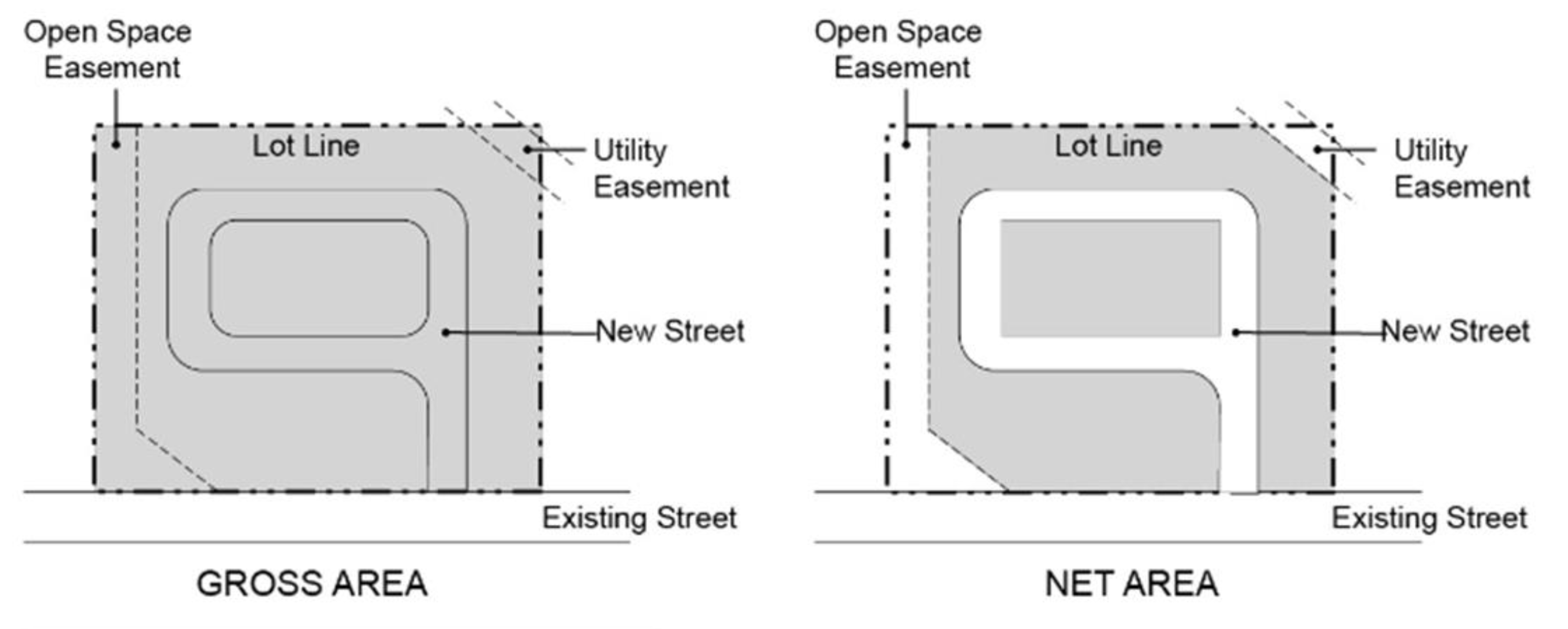
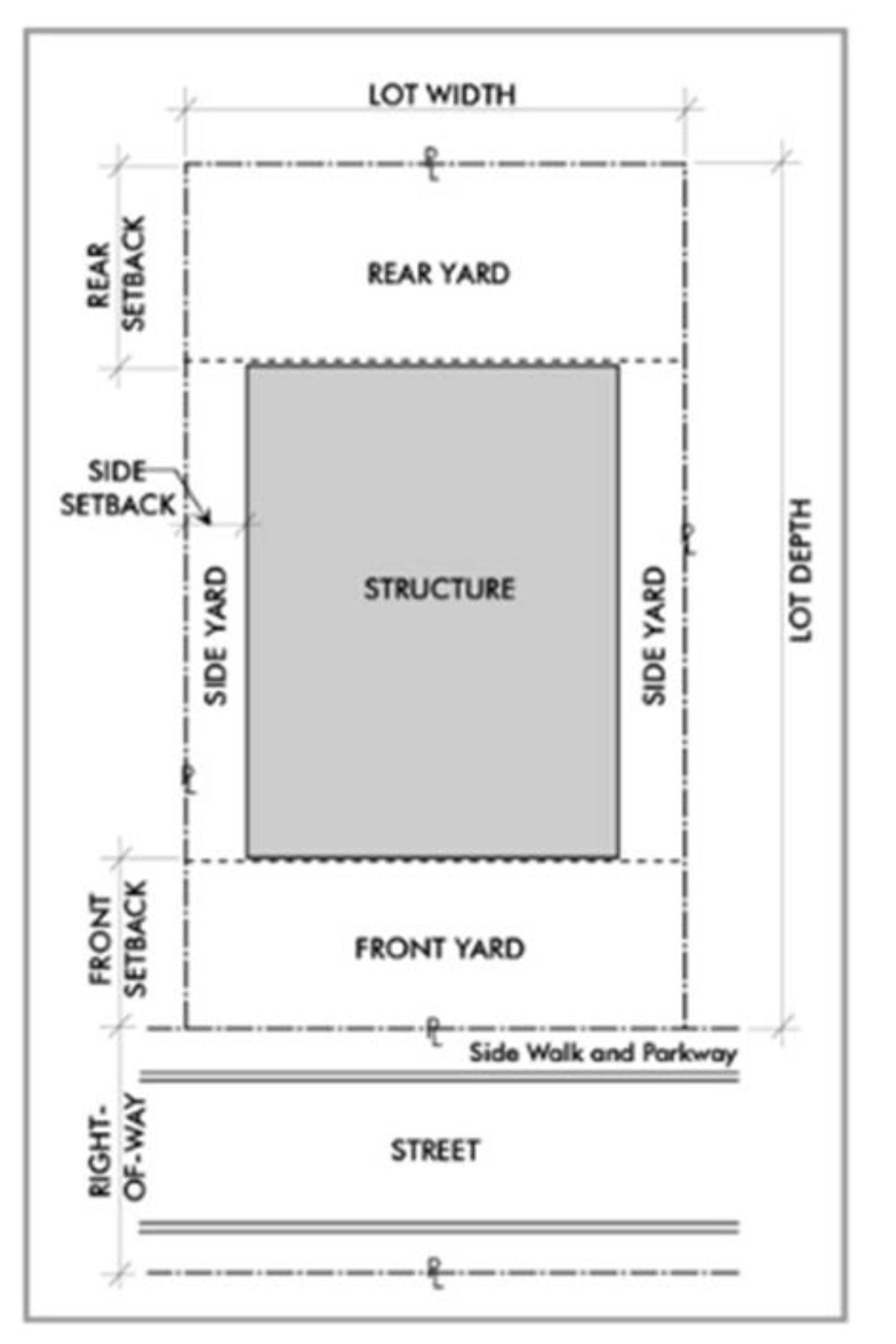
Lot area means the total area within the lot lines of a lot excluding any existing or proposed street, highway, alley right-of-way or other public or private easements where the owner of the property does not have the right to use the entire surface of the land. For density calculations involving State Density Bonus Law projects, see Government Code § 65915.
Lot coverage means the percentage of the total lot area covered by enclosed structures, and/or carports, but excluding steps, driveways, walks, terraces and swimming pools.
Lot, corner means a lot situated at the intersection of two or more streets having an angle of intersections of not more than 135 degrees.
Lot, flag means a lot with access to a street by means of a private driveway access easement or parcel of land with a minimum width of 15 feet.
Lot depth means the horizontal distance measured from the midpoint of the front lot line to the midpoint of the rear lot line.
Lot, interior is defined as a lot that shares both rear and side lot lines and is bounded on one side by a street or easement that has been determined is adequate for access and with adjoining lots and is not defined as a corner, reverse corner or through lot.
Lot, key is defined as a lot that has a side lot line that abuts the rear lot line of a reverse corner lot.
Lot line means any line bounding a lot as defined in this section.
Lot line, front means the lot line separating a lot from a public right-of-way. If a lot has more than one street frontage, the front lot line shall extend across the narrowest portion of the lot.
Lot line, interior means a lot line which is common to two abutting lots.
Lot line, rear means a lot line which is opposite and most distant from the front lot line. For an irregular or a triangular shaped lot, the rear lot line shall be an assumed line parallel to and passing through the point of the lot which is at the greatest distance from the front lot line.
Lot line, side means any lot line which is not a front lot line or a rear lot line.
Lot, reverse corner is defined as a corner lot with a side lot line that is substantially a continuation of the front lot line of the key lot that abuts the reversed corner lot.
Lot, through means a lot having frontage on two parallel or approximately parallel streets.
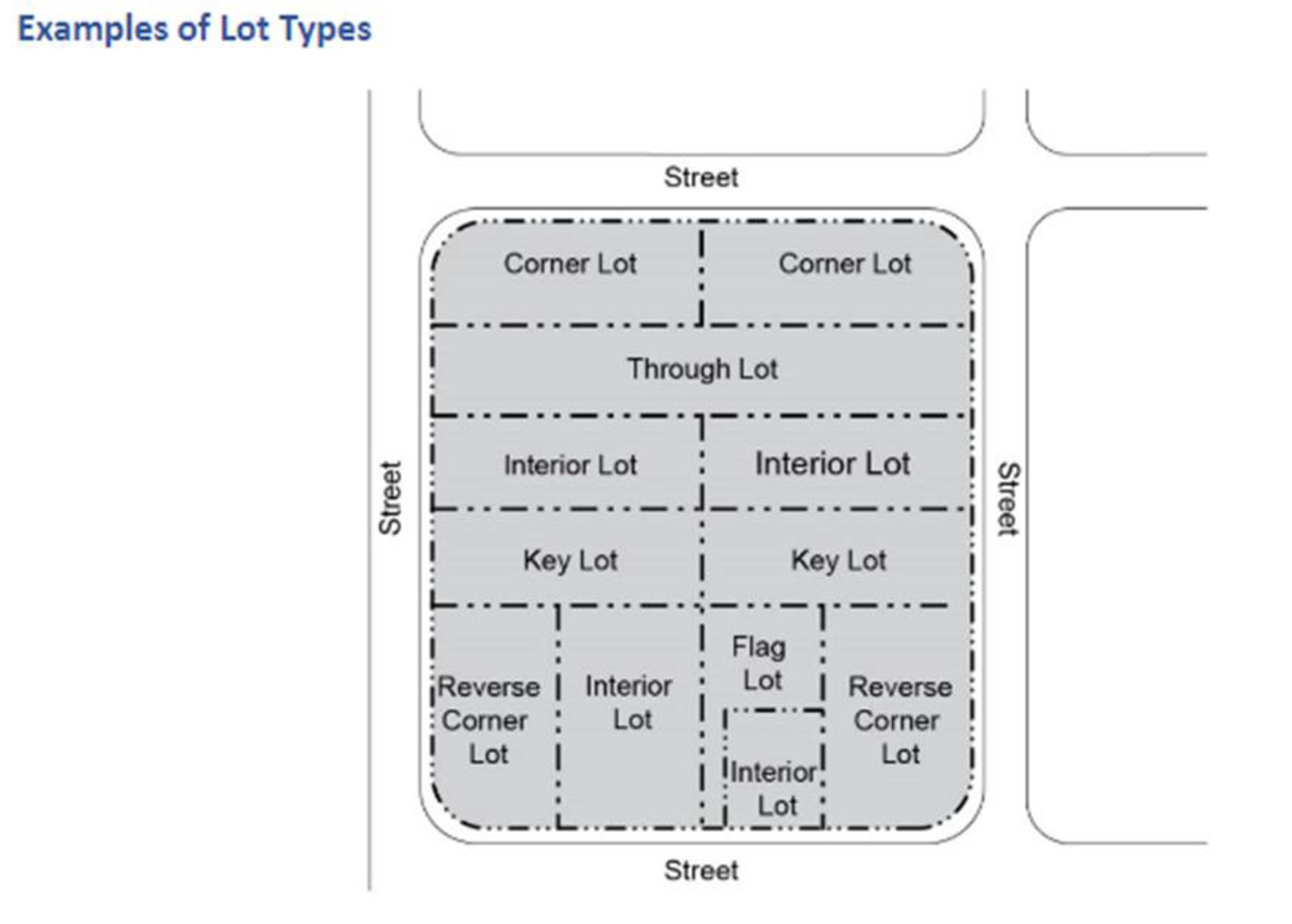
Examples of Lot Types
Lot width means the horizontal distance measured at right angles to the lot depth line at a distance midway between the front and rear lot lines.
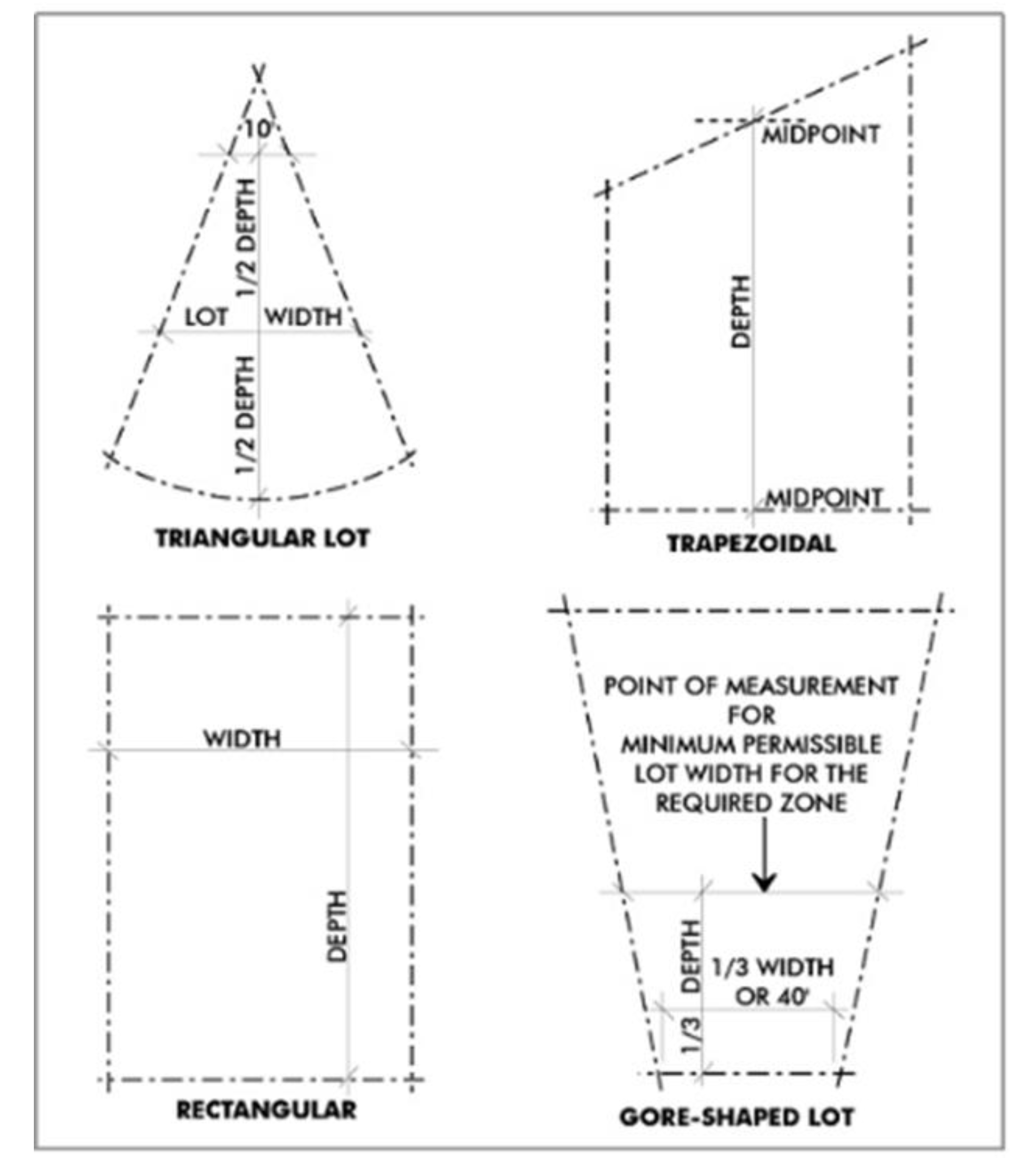
(Ord. No. 1732, § 3(Exh. A), 5-5-2025)
Sec. 106-1180. - "M" definitions.
Mobile home means a structure, transportable in one or more sections, designed or used for human habitation by one family.
Mobile home park means any area or tract of land intended, maintained or designed for the purpose of supplying a location or accommodation for two or more mobile homes including all buildings used or intended to be used as part of the equipment of such facility regardless of whether a charge is made for such use. Not included in this definition are trailer camp, trailer park and similar terms.
Mobile home site means that portion of a mobile home park designated for use or occupancy of one mobile home, including all appurtenant facilities thereon, for the exclusive use of the occupants of the mobile home.
Motel means a building or group of buildings containing rooming units or dwelling units with automobile parking space provided in conjunction therewith, and designed, intended to be used or used primarily for the accommodation of transient automobile travelers.
(Ord. No. 1732, § 3(Exh. A), 5-5-2025)
Sec. 106-1181. - "N" definitions.
Nonconforming structure means a structure that was legally constructed and which does not conform to current code provisions/standards prescribed for the zoning district in which the structure is located.
Nonconforming use means a use of a structure (either conforming or nonconforming) or land that was legally established and maintained prior to the adoption of this title, and which does not conform to current code provisions governing allowable land uses for the zoning district in which the use is located
(Ord. No. 1732, § 3(Exh. A), 5-5-2025)
Sec. 106-1182. - "O" definitions.
Occupancy means the purpose for which land or a structure is used or intended to be used. Change of occupancy does not include a mere change of owners, tenants or proprietors.
Offices include administrative/business, government, media production/post-production, broadcasting and professional offices such as real estate offices, travel agencies, advertising agencies, graphic design, architecture and engineering services, attorneys, accounting services, counseling services, and computer software production and programming, among others. These do not include: medical or dental offices (see "clinic, dental or medical"); or offices that are incidental and accessory to another business or sales activity that is the primary use.
Open space, usable means open space, excluding required yards, which has an average gradient of not more than five percent. Usable open space may include such features as balconies, terraces and roof gardens, which are not ground areas included in the definition of open space.
Open space, common means areas of a developed site that are available for active and/or passive recreational use by residents of a multiple-family residential project.
Open space, private means an area of a developed site that directly accessible from an individual dwelling unit, which is available for active and/or passive recreational uses by the inhabitants of the dwelling unit, and which is open on top or on at least one side.
Ornamental feature means a statue, fountain, sculpture or any other similar freestanding decorative element that does not provide shelter and is not a sign, and which serves an aesthetic purpose.
Outdoor retail sales and display means the long-term placement of goods or merchandise not located within an entirely enclosed building and without screening or fencing. Ancillary to a primary.
Outdoor festival means any music festival, dance festival, rock festival or similar musical activity to which both of the following apply:
(1)
Attendance by more than 500 persons is desired or may reasonably be expected; and
(2)
The festival will be held at any place other than in a permanent building or permanent installation which has been constructed for the purpose of or is so constructed that it can be used for conducting such activities.
Owner means and includes any person having legal title to, or who leases, rents, occupies or has charge, control or possession of, any real property in the city, including all persons shown as owners on the last equalized assessment roll of the county assessor's office. Owners include persons with powers of attorney, executors of estates, trustees, or who are court appointed administrators, conservators, guardians or receivers. An owner of personal property shall be any person who has legal title, charge, control, or possession of, such property.
(Ord. No. 1732, § 3(Exh. A), 5-5-2025)
Sec. 106-1183. - "P" definitions.
Park or playground, public means a publicly owned recreation area and appurtenant facilities.
Parking area means an area, other than a street or alley, available for temporary storage of vehicles in active use regardless of whether such vehicle storage is for remuneration.
Parking space means a readily accessible usable off-street area, not including aisles, driveways, walkways, ramps, loading, maneuvering or work areas, maintained exclusively for the parking of one motor vehicle.
Parking structure means a structure, or portion thereof, within or upon which parking area is located.
Person as used in this chapter, means and includes any individual, partnership of any kind, corporation, limited liability company, association, joint venture or other organization or entity, however formed, as well as trustees, heirs, executors, administrators, or assigns, or any combination of such persons. "Person" also includes any public entity or agency that acts as an owner in the city.
Personal property means property that is not real property, and includes, without limitation, any appliance, article, device, equipment, item, material, product, substance or vehicle.
Planned development means the planning, construction or implementation and operation of any use or structure, or combination of uses and structures, based upon a comprehensive and complete design or plan treating the entire complex of land, structures and uses as a single project.
Planning department means the city planning division.
Porte cochere means a roofed structure extending from the entrance of a building over an adjacent driveway, the purpose of which is to shelter a person entering or exiting a vehicle.
Primary structure means a structure that accommodates the primary use of the site.
Primary use shall be main purpose for which a site is permitted, developed and occupied, including the activities that are conducted on the site during most of the hours when activities occur.
Premises means the actual space within a building or any area on site, either directly or indirectly supporting alcoholic beverage sales.
Primary single-family dwelling unit means a detached residential dwelling unit constructed on a permanent foundation on a lot zoned for residential uses, which is designed for occupancy as the primary living quarters by one person or one family with independent living facilities that provide for living, sleeping, eating, cooking, and sanitation. The lot on which the primary single-family dwelling unit is located may or may not include a accessory dwelling unit.
Project area means a lot or combination of contiguous lots, whether or not held in the same ownership, which are used or intended to be used for a planned development.
Project grading means any excavation or fill, or combination thereof, necessary and incidental to building construction or other lawful development of the premises.
Public nuisance means anything which is, or likely to become, injurious or detrimental to health, safety or welfare, or is offensive to the senses, or an obstruction to the free use of property, so as to interfere with the comfortable enjoyment of life or property, or unlawfully obstructs the free passage or use, in the customary manner, of any sidewalk, public park, square, building, structure, street or highway. All conditions hereafter enumerated in this chapter, or that otherwise violate or are contrary to any provision of the city code, are public nuisances by definition and declaration, and said enumerated conditions shall not, in any manner, be construed to be exclusive or exhaustive. A public nuisance shall also exist when a person fails to comply with any condition of a city approval, entitlement, license or permit or when an activity on, or use of, real property violates, or is contrary to, any provision or requirement of the city code.
Public utility distribution substation means a facility whereby a public utility company distributes the utility for consumer use.
(Ord. No. 1732, § 3(Exh. A), 5-5-2025)
Sec. 106-1184. - "Q" definitions.
Qualified applicant is a person who has a legal or equitable interest in the real property which is the subject of a proposed development agreement.
Quasipublic use means a use operated by a private nonprofit educational, religious, recreational, charitable or medical institution, the use having the purpose primarily of serving the general public, and including uses such as churches, private schools, universities, private hospitals and youth centers.
(Ord. No. 1732, § 3(Exh. A), 5-5-2025)
Sec. 106-1185. - "R" definitions.
Real property or premises means any real property owned by any person and/or any building, structure, or other improvement thereon, or portions thereof. "Real property" or "premises" includes any parkway or unimproved public easement abutting or adjacent to such real property, whether or not owned by the City of San Fernando.
Reasonable accommodation means any deviation or waiver requested and/or granted from the strict application of various land use, zoning, or building laws, development standards, rules, policies, practices and/or procedures of the city, to individuals with a disability, or developers of housing for people with disabilities, when it is necessary to eliminate barriers to housing opportunities and provide an equal opportunity to use and enjoy a dwelling. Deviations may include, but shall not be limited to, requirements for special yards, open spaces, buffers, fences, walls, and screening; requirements for installation and maintenance of landscaping and erosion control measures; regulation of vehicular ingress and egress, and traffic circulation; regulation of signs; regulation of hours or other characteristics of operation; requirements for maintenance of landscaping and other improvements; establishment of development schedules or time limits for performance or completion; requirements for periodical review by the director; and such other conditions as the director may deem necessary to ensure compatibility with surrounding uses, to preserve the public health, safety, and welfare.
Applicant means a person, business, or organization making a written request to the city for reasonable accommodation in the strict application of land use or zoning provisions of this division.
Individual with a disability means an individual who has a physical or mental impairment that limits one or more of that person's major life activities; anyone who is regarded as having such impairment; or anyone who has a record of having such impairment; but not including an individual's current, illegal use of a controlled substance, unless an individual has a separate disability.
Fair housing laws mean the "Fair Housing Amendments Act of 1988" (42 U.S.C. § 3601, et seq.), including reasonable accommodation required by 42 U.S.C. § 3604 (f)(3)(B), and the "California Fair Employment and Housing Act" (California Government Code § 12900, et seq.), including reasonable accommodation required specifically by California Government Code §§ 12927(c)(1) and 12955(l), as any of these statutory provisions now exist or may be amended from time to time.
Recreational vehicle means a camp car, camper, motor home, travel trailer or similar vehicles, with or without motive power, but not a mobile home.
Replacement means removing an existing support structure and constructing a new support structure of equal height and proportions to the preexisting support structure in order to accommodate co-location.
Residence or residential means a dwelling, group quarters, mobile home or other permanent living accommodations, or features pertaining thereto.
Residential structures shall mean and include all structures and premises that are regulated by the California State Housing Law [California Health and Safety Code, Div. 13, Pt. 1.5, § 17910 et seq.], and any future amendments thereto. These include, but are not limited to, apartment houses, hotels, motels, and dwellings, and residential buildings and structures accessory thereto.
Responsible person means any person, whether as an owner as defined in this chapter, or otherwise, that allows, causes, creates, maintains, suffers or permits a public nuisance, or any violation of the city code or county or state law, or regulation thereof, to exist or continue, by any act or the omission of any act or duty. A responsible person shall also include employees, principals, joint venturers, officers, agents, and/or other persons acting in concert with, or at the direction of, and/or with the knowledge and/or consent of the owner and/or occupant of the real property or building or structure thereon in which a public nuisance or violation exists or existed. The actions or inactions of a responsible person's agent, employee, representative or contractor may be attributed to that responsible person.
Restaurant or bona fide public eating place means an establishment engages in the sale of food and beverages for consumption on or off the premises which is regularly and in a bona fide manner used and kept open for the serving of meals to guests for compensation and which has suitable kitchen facilities connected therewith, containing conveniences for cooking an assortment of foods which may be required for ordinary meals, the kitchen of which must be kept in a sanitary condition with the proper amount of refrigeration for keeping of food on the premises and must comply with all the regulations of the local department of health. Restaurants shall maintain incidental sale of alcoholic beverages only, and at least one full time cook engaged by the business enterprise to prepare meals for guests on the premises during all permitted hours of operation. "Meals" means the usual assortment of foods commonly ordered at various hours of the day; the service of such food and victuals only as sandwiches or salads shall not be deemed a compliance with this requirement. "Guests" shall mean persons who, during the hours when meals are regularly served therein, come to a bona fide public eating place for the purpose of obtaining, and actually ordering and obtaining at such time, in good faith, a meal therein.
Retail means the purchase, sale, distribution, delivery or other transaction involving the handling or disposition of any article, substance, commodity or service, for profit or livelihood, direct to the ultimate consumer, including the following:
(1)
Artisan shops. Retail stores selling art glass, ceramics, jewelry, and other handcrafted items, where the facility includes an area for the crafting of the items being sold.
(2)
Building material stores. Retail establishments selling lumber and other large building materials, where most display and sales occur indoors. Includes paint, wallpaper, glass, tile, fixtures, nursery stock, lawn and garden supplies. Includes all these stores selling to the general public, even if contractor sales account for a major proportion of total sales. Includes incidental retail ready-mix concrete operations, except where excluded by a specific zoning district. Establishments primarily selling electrical, plumbing, heating, and air conditioning equipment and supplies to the trade are classified in "wholesaling and distribution." Hardware stores are listed in the definition of "general retail stores," even if they sell some building materials.
(3)
Construction equipment sales. Retail establishments selling or renting heavy construction equipment, including cranes, earth-moving equipment, heavy trucks, and the like.
(4)
Convenience stores. Retail stores of 3,500 square feet or less in gross floor area, which carry a range of merchandise oriented to convenience and travelers' shopping needs. These stores may be part of a service station or an independent facility.
(5)
General retail stores. Stores and shops selling lines of merchandise not specifically listed under another use classification. Such types of stores and lines of merchandise include:
a.
Appliances;
b.
Florists and houseplant stores (indoor);
c.
Antiques;
d.
Furniture and home furnishing;
e.
Grocery stores;
f.
Artists' supplies;
g.
Hardware;
h.
Auto parts (not including repair);
i.
Bakeries (retail only);
j.
Hobby materials;
k.
Bicycles;
l.
Jewelry;
m.
Books;
n.
Luggage and leather goods;
o.
Cameras and photographic supplies;
p.
Musical instruments, parts and accessories;
q.
Clothing and accessories;
r.
Newsstands;
s.
Collectable items sales;
t.
Orthopedic supplies;
u.
Computer and computer equipment;
v.
Religious goods;
w.
Consumer electronics;
x.
Small wares;
y.
Curio, gift and souvenir shops;
z.
Specialty shops;
aa.
Department stores;
bb.
Sporting goods and equipment;
cc.
Stationery;
dd.
Drugstores and pharmacies;
ee.
Dry goods;
ff.
Toys and games;
gg.
Fabrics and sewing supplies;
hh.
Variety stores.
(6)
Pawn shops. Retail establishments that accept personal property as collateral for loans, and offer the property for sale to the public.
(7)
Secondhand stores. Indoor retail establishments that buy and/or sell used products, including books, clothing, furniture, and household goods. The sale of cars and other used vehicles is included under "vehicle sales."
(8)
Shopping center. A site occupied by a mix of commercial uses that are primarily retail stores, but may also include personal service uses, eating and drinking establishments, or other uses where the businesses share common pedestrian and parking areas.
(9)
Warehouse retail. A retail store emphasizing product lines other than groceries, with a sales floor of 40,000 square feet or larger, that typically package and sell products in large quantities or volumes, where products are typically displayed in their original shipping containers. Sites and buildings are usually large and industrial in character. Patrons may be required to pay membership fees.
Retirement home means a facility, which offers or provides lodging, with or without meals, primarily for aged persons but does not include any facility defined as a community care facility.
Rummage sale means a sale of donated articles by a church, synagogue, charitable, fraternal or patriotic organization, or public or parochial school.
(Ord. No. 1732, § 3(Exh. A), 5-5-2025)
Sec. 106-1186. - "S" definitions.
Satellite receiving antenna means any dish-shaped antenna designed to receive direct satellite signals.
Satellite receiving antenna diameter means the diameter of a satellite receiving antenna which shall be measured by the line bisecting the dish-shaped antenna extending from the outer edge on one side to the outer edge on the opposite side.
School, private means a private institution of learning which is generally supported by tuition, fee, or donation and which offers instruction in areas of academic, vocational and avocational pursuits, but not including a trade school.
School, public means a publicly owned institution of learning supported primarily by public funds.
School, trade means a school primarily offering instruction in the technical and/or trade skills such as electronic schools, automotive and aircraft technician's schools and similar establishments.
(1)
An efficiency dwelling unit, as defined in California Health and Safety Code § 17958.1.
(2)
A new manufactured home, as defined in California Health and Safety Code § 18007.
Service means an act or any result of useful labor which does not in itself produce a tangible product.
Setback means the shortest horizontal distance, measured at ground level and above, between a building or structure and a lot line or other specified line. (For requirements, see the building lines chart in article IV of this chapter.)
Setback, front yard is defined as the area extending across the full width of the lot between its front lot line and a parallel line 20 feet away from the front lot line.
Sign means any device used for visual communication or attraction including any announcement, declaration, demonstration, illustration, insignia, symbol, name, figure, painting, character, outline, spectacle, delineation, advertising, billboard, signboard, device, appliance or any other thing of similar nature to advertise or promote the interest of any person or thing, either outdoors or on the face, wall or window of any building, and includes all parts, portions, units and materials composing such, together with the frame, background, support and anchorage therefor.
Sign, business means any structure, housing, sign, device, figure, statuary, painting, display, message placard, or other contrivance or any part thereof which has been designed, constructed, created, intended or engineered to have a useful life of 15 years or more, and intended or used to advertise, or to provide data or information in the nature of advertising for any purpose to:
(1)
Designate, identify or indicate the name or business of the owner or occupant of the premises upon which the advertising display is located.
(2)
Advertise the business conducted, services available or rendered or the goods produced, sold, or available for sale, upon the property where the advertising display has been lawfully erected.
Sign, canopy means a sign attached to the underside of an awning or canopy.
Sign, electronic message center means any sign which is controlled by electronic process or remote control in such a manner that different copy changes are instantaneously displayed on the same lamp bank.
Sign face area means the total surface area computed by drawing intersecting straight lines which form the boundary of the area within which words, letters, figures, symbols or pictures could be placed.
Sign, flashing or scintillating means any sign which by any method or manner of illumination either flashes on or off, winks or blinks with varying light intensity; shows motion or creates the illusion of motion; or revolves in a manner to create the illusion of being on or off. Automatic changing signs such as public service time and temperature signs or electronic message center signs shall not be considered a flashing or scintillating sign.
Sign, freestanding means any sign supported directly on the ground. This definition includes pole signs, ground signs and other signs detached from a building.
Sign, identification means a sign in a residential zone, directing attention to the principal use located upon the premises where the sign is displayed.
Sign, illuminated means any sign designed to emit or brightly reflect artificial light.
Sign, outdoor advertising (billboard) means any sign directing public attention to a business, profession, product or service that is not a principal business, profession, product or service which is sold, manufactured, conducted or offered on the premises where such a sign is erected or maintained.
Sign, painted means a sign painted directly on a building and does not include those signs which are painted onto a piece of wood or other material which is then attached to a building.
Sign, political means a sign stating the name and/or picture of an individual seeking election or appointment of a public office, or pertaining to a forthcoming public election or referendum, or pertaining to or advocating political views or policies.
Sign, real estate advertising means an on-site sign offering property for sale, lease or rent which may contain the name, address and/or telephone number of a real estate broker or property owner.
Sign, roof means any sign erected, constructed or placed upon or over a roof of a building and which is wholly or partly supported by any structure located on the roof of such building.
Sign, revolving means a sign or portion thereof which rotates, moves or appears to move in some manner by mechanical, electrical, natural or other means.
Sign, seasonal or special event means a sign used for the purpose of promoting a national or state holiday, Fiesta Days, or county fair. Other special events may be defined by resolution of the city council.
Sign, supergraphics means a painted design which covers an area greater than ten percent of a wall, building façade, or other structure. A supergraphics is a sign only if it displays or suggests information which identifies or advertises by name or symbol. Otherwise, supergraphics shall be considered an architectural embellishment subject to approval of the planning commission.
Sign, structure means a structure existing, erected or maintained to serve as a stand, frame or other background for the support or display of signs. This definition is limited to freestanding structures which have the primary purpose of supporting a sign, except that a building or other structure upon which a sign is mounted shall be counted as a sign structure for the purpose of regulating the number of sign structures permitted.
Sign, subdivision directional means an off-site sign used for the purpose of providing travel directions to a subdivision development.
Sign, temporary advertising means a sign displayed for a period not exceeding 45 days directing attention to a business, profession, product or service that is a principal business, profession, product or service on the premises where such sign is erected or maintained.
Sign, wall means any sign posted, painted on, suspended from or otherwise affixed to the wall, parapet wall or roof fascia of any building or structure in an essentially flat position or with the exposed face of the sign in a plane approximately parallel to the plane of such wall, parapet wall or roof fascia, provided that the sign shall not extend more than three feet above the roofline or parapet wall of the building.
Sign, window means a sign, exposed to public view, that is attached to or is intended to be seen in, on or through a window. The display of merchandise shall not be considered a sign.
Single room occupancy unit (SRO) means any building containing five or more guestrooms or units each with a minimum floor area of 200 square feet and a maximum floor area of 350 square feet intended or designed to be used, or which are used, rented, or hired out, to be occupied, or which are occupied, for sleeping purposes by residents, which is also the primary residence of those residents. These dwelling units shall have kitchen and bathroom facilities. Each dwelling unit is restricted to occupancy by no more than two persons and is offered on a monthly rental basis or longer.
Site means a parcel or adjoining parcels under single ownership or single control, considered a unit for the purposes of development or other use. Portions of a site that are within the public right-of-way and restricted by easement, or similar instrument, to sidewalk, alley, or street uses shall not be considered a part of the site (except for calculations of gross lot area and density).
Site plan means a rendition of a plan to scale, showing all the uses, yard areas, parking, landscaping, structures and other features existing or proposed on a site. A site plan shall comply with the any applicable city checklist.
Special use permit means an approval of a land use granted and referred to as a special use permit under previous zoning regulations.
Specified anatomical area shall have the meaning as set out in section 106-1022.
Specified sexual activities shall have the meaning as set out in section 106-1022.
Storage means the use of land or structures for the accumulation or holding of goods, merchandise, equipment or material.
Storage, outdoor means the storage outside of an enclosed building for any purpose other than display.
Street means a right-of-way open to or intended to be opened to the public primarily for the movement of vehicles and access to adjacent property. This definition does not include an alley or walkway.
Street, arterial means a street designated as a major or secondary highway on the master plan of highways of the city's general plan.
Street, collector means a street designated as a collector street on the master plan of highways of the city's general plan.
Street, primary means a street designated as a primary street on the master plan of highways of the city's general plan.
Street, private means a street not dedicated for public use.
Street, public means a street dedicated for public use.
Structure means anything constructed or erected which requires location on the ground or which is attached to something having a location on the ground, except outdoor areas such as walks, paved areas, tennis courts, and similar open recreation areas. This definition includes buildings.
Structure height means the vertical distance from the average finished grade to the highest part of the structure.
Support structure means a structure designed to primarily support wireless telecommunications facilities including, but not limited to, monopoles, towers and other freestanding self-supporting structures.
Supportive housing means housing with no limit on the length of stay and that is occupied by a target population as defined by Health and Safety Code § 53260(d), as the same may be amended from time to time, and that provides a significant level of onsite and offsite services that assist the supportive housing residents in retaining the housing, improving their health status, maximizing their ability to live, and when possible, work in the community. Supportive housing shall be treated under this chapter as a residential use and shall be allowed as a permitted use in zoning districts permitting multiple-family and mixed-use development.
Swap meet means the use, rental, or lease of stalls or areas inside or outside of an enclosed building by vendors offering goods or materials for sale or exchange, not including public fairs, or art exhibits.
(Ord. No. 1732, § 3(Exh. A), 5-5-2025)
Sec. 106-1187. - "T" definitions.
Tap room means a use associated with, or on the same premises as, a brewery, at which guests may consume and purchase, for on- or off-premises consumption, the manufacturer's products and other nonalcoholic beverages or food. Food service is not required.
Tasting room means a use associated with, or on the same premises as, a winery or distillery, at which guests may consume and purchase, for on- or off-premises consumption, the manufacturer's products and other nonalcoholic beverages or food. Food service is not required.
Tobacco advertising and promotion:
Advertising. See "alcohol advertising."
Advertising display. See "alcohol advertising."
Area which minors frequent means any school, child-care center, youth center, or park.
Child-care center. See "alcohol advertising."
Cigar lounge means a private smokers' lounge of an enclosed area in or attached to a retail or wholesale tobacco shop that is dedicated to the use of tobacco products, including, but not limited to, cigars and pipes.
Park. See "alcohol advertising."
Person. See "alcohol advertising."
Promotion. See "alcohol advertising."
Publicly visible location. See "alcohol advertising."
School. See "alcohol advertising."
Tobacco product means any substance containing any tobacco leaf, including, but not limited to, cigarettes, cigars, pipe tobacco, snuff, chewing tobacco, smokeless tobacco, and products prepared from tobacco and designed for smoking or ingestion.
Tobacco shop means a business establishment whose main purpose is the sale of tobacco products, including, but not limited to, cigars, pipe tobacco, and smoking accessories.
Vendor-assisted sale means a purchase requiring a direct, face-to-face exchange between the retailer and the customer, in which the vendor has access to the tobacco product, and assists the customer by supplying the product. The customer does not take possession of the product until it is purchased.
Youth center. See "alcohol advertising."
Townhouse means attached or semidetached buildings, each containing a single dwelling unit and each located or capable of being located on a separate lot.
Trailer means a vehicle without motive power which is designed to be drawn by an automotive vehicle to be used for human habitation or for the transporting of personal property.
Transient means a person who receives lodging at a given location, with or without meals, for a period of not more than 180 days.
Transitional housing means housing operated under program requirements that call for 1) the termination of any assistance to an existing program recipient and 2) the subsequent recirculation of the assisted residential unit to another eligible program recipient at some predetermined future point in time, which point in time shall be no less than six months into the future (Health and Safety Code § 50675.2(h)). Transitional housing may provide, but not be limited to, meals, counseling, and other services as well as common areas for residents. Transitional housing may be provided under all residential housing types. In all cases, transitional housing shall be treated as a residential use under this chapter and shall be allowed as a permitted use in zoning districts permitting multiple-family and mixed-use development. Transitional housing shall be subject only to those restrictions that apply to other residential and mixed uses of the same development type located in the same zoning district.
Truck terminal or truck yard means a principal use of land for parking, servicing, repairing or storage of trucks in active use.
Two-unit development:
Car share means a service through which vehicles are made available for hourly or daily use. Vehicles are typically picked up and dropped off at designated parking locations within the community and are made available to provide flexible access to a vehicle.
Dwelling unit. As used in this section, "dwelling unit" refers to any primary residential unit which is not an accessory dwelling unit as defined in article VI of this Code or a junior accessory dwelling unit ("junior ADU") as defined in Government Code § 56852.22.
Residential unit or unit. As used in this section, "residential unit" or "unit" refers to a dwelling unit, accessory dwelling unit and junior ADU.
Tenant means a person who occupies land or property rented from a landlord.
Two-unit urban residential development means development of no more than two primary dwelling units pursuant to this section 106-762.
Urban lot split. As used in this section, refers to an urban lot split as defined in section 78-182 of the Code.
(Ord. No. 1732, § 3(Exh. A), 5-5-2025)
Sec. 106-1188. - "U" definitions.
Use means the type of activity, occupancy or purpose for which land, buildings, or facilities are arranged, designed or intended to be occupied or maintained.
Use, principal means a use which is not subordinate, incidental or accessory to some other use on the same lot or project area.
(Ord. No. 1732, § 3(Exh. A), 5-5-2025)
Sec. 106-1189. - "V" definitions.
Vacant shall mean real property or any building or structure thereon that is not legally occupied. Factors that may be used to determine whether real property, or building or structures thereon, is vacant include, but shall not be limited to, overgrown and/or dead vegetation; accumulation of newspapers, circulars, flyers, and/or mail; past due utility notices and/or disconnected utilities; accumulation of trash, junk, and/or other debris; the absence of window coverings such as curtains, blinds, and/or shutters; the absence of furnishings and/or personal items consistent with residential and/or commercial furnishings consistent with the permitted uses within the zone of the real property; statements by neighbors, passersby, delivery agents, government employees that the property is vacant.
Variance means a waiver or conditional waiver of specific regulations of this chapter as applied to a specific case and granted by the city in accordance with the provisions set forth in this chapter for variances (see division 7 of article II of this chapter).
Vehicle means any device, by which any person or property may be propelled, moved, or drawn upon a highway or other public right-of-way, and includes all vehicles as defined by the California Vehicle Code, and all future amendments thereto. "Vehicle" does not include devices (i) that are propelled exclusively by human power such as bicycles and wheelchairs, or (ii) those that are used exclusively upon stationary rails or tracks.
Veterinary clinic means any facility providing medical or surgical treatment, clipping, bathing and similar services to dogs, cats and other small animals, but excluding a kennel, animal hospital or other overnight care on a regular basis.
Veterinary hospital means a place where animals or pets are given medical or surgical treatment and are cared for during the time of such treatment. The use of the premises as a kennel or a place where animals or pets are boarded for remuneration may be permitted only when incidental to the principal use.
Violation shall mean and include a public nuisance as described or referred to in this chapter, or any condition, activity or use that is caused, allowed to exist, or maintained (whether due to an affirmative act, or inaction) by a responsible person in violation of any other provision, regulation, or requirement of the city code, or any applicable county, state or federal laws or regulations.
(Ord. No. 1732, § 3(Exh. A), 5-5-2025)
Sec. 106-1190. - "W" definitions.
Walls and fences:
Existing finish grade is defined as the natural or existing grade of the property prior to excavation, construction or grading of undisturbed soil.
Non-view obscuring fence is defined as a fence with view obscuring element between posts or pilasters not exceeding 50 percent of the total surface area of a fence. The area of the pilasters is exempt from the 50 percent calculation.
Warehouse means a building or portion of a building used primarily for the deposit, storage or safekeeping of goods, regardless of whether the goods are offered for sale.
Wine bar means a bar that specializes in serving wine rather than beer or liquor.
Wireless telecommunications facility means any unmanned facility established for the purpose of providing wireless transmission of voice, data, images or other information including, but not limited to, cellular telephone service, personal communication service (PCS), and paging service. A wireless telecommunications facility consists of one or more antennas on a support structure and any accessory equipment, fences, lighting or other appurtenances. A wireless telecommunications facility does not include any facility that is not used for wireless telecommunication, or radio frequency machines which have an effective radiated power of 100 watts or less.
Accessory equipment means any equipment building, shelter, or cabinet serving or being used in conjunction with a wireless telecommunications facility or support structure. This equipment includes, but is not limited to, utility or transmission equipment, power supplies, generators, batteries, cables, equipment buildings, cabinets and storage sheds, and shelters or other structures associated with the operation of a wireless telecommunications facility or support structure.
Antenna means any structure or device used to collect or radiate electromagnetic waves for the provision of cellular, paging, personal communication services (PCS) and microwave communications. Such structures and devices include, but are not limited to, directional antennas, such as any system of wires, poles, rods, discs, reflecting discs, panels, flat panels, dishes, whip antennae, or other similar devices used for the transmission or reception of radio frequency electromagnetic waves. Antennas include devices having active elements extending in any direction, and directional beam-type arrays having elements carried by and disposed from a generally horizontal boom that may be mounted upon and rotated through a vertical mast or tower interconnecting the boom and antenna support, all of which elements are deemed to be a part of the antenna. The height of all antennas shall include the highest point of all array structures.
Co-location means the placement of more than a single antenna on a telecommunications site or facility, including antennas operated by different wireless telecommunications service providers.
Cell on wheels (COW) means a portable self-contained site that can be moved to a location and set up to provide personal wireless telecommunications services on a temporary or emergency basis. A COW is normally vehicle-mounted and contains a telescoping boom as the antenna support structure.
Federal Communications Commission (FCC) means the governmental agency responsible for regulating wireless telecommunications in the United States.
Monitoring protocol means an industry accepted radio-frequency radiation measurement protocol used to determine compliance with FCC radio frequency radiation exposure standards in accordance with the National Council on Radiation Protection and Measurements Reports 86 and 119 and consistent with the radio frequency radiation modeling specifications of the most recent edition of the FCC Office of Engineering and Technology's "OET Bulletin 65" (or any superseding reports/standards) which is to be used to measure the emissions and determine radio frequency radiation exposure levels from existing and new telecommunications facilities.
Monopole means a single, freestanding poly-type structure supporting one or more antennas. These structures are sometimes camouflaged to look like palm trees or pine trees. For purposes of this chapter, a monopole is not a tower.
Non-ionizing electromagnetic radiation (NEIR) means radiation from the portion of the electromagnetic spectrum with frequencies of insufficient energy to break chemical bonds, including all frequencies below the ultraviolet range such as visible light and radio frequency radiation.
Replacement means the removing of an existing support structure and constructing a new support structure of equal height and proportions to the preexisting support structure in order to accommodate co-location.
Stealth technology/techniques means camouflaging methods applied to any wireless telecommunications facility such that the wireless telecommunication towers, antennas, and/or other components of the facility in such a manner so as to render it "minimally visible", and so that the purpose of the facility for providing wireless services is not readily apparent to a casual observer. Stealthing may utilize, but does not require, concealment of all components of the wireless facility.
Tower means a mast, guyed tower, lattice tower, free-standing tower, or other structure designed and primarily used to support antennas. A lattice-type structure, guyed or freestanding, that supports one or more antennas.
Wholesale means sale for resale and not for direct consumption.
(Ord. No. 1732, § 3(Exh. A), 5-5-2025)
Sec. 106-1191. - "Y" definitions.
Yard means any open space on the same lot with a building, provided that the open space is unoccupied and unobstructed from the ground upward, except for encroachments permitted by this chapter.
Yard, front means the space extending the full width of the lot between the front lot line and a line parallel thereto, and having a distance between them equal to the required front yard depth as prescribed in each zone.
Yard, rear means a yard extending across the full width of the lot between a building and the rear lot line.
Yard, required means that portion of a yard which meets the minimum requirements of the zone in which located, and which is in compliance with all other sections of this chapter.
Yard sale means a yard, garage, patio or similar type sale for the purpose of disposing of used personal property.
Yard, side means a yard between a building and the nearest side lot line, extending from the rear of the required front yard to the front of the required rear yard.
(Ord. No. 1732, § 3(Exh. A), 5-5-2025)
Sec. 106-1192. - "Z" definitions.
Zone means a designation or classification of land as shown on the zoning map within which uniform regulations as provided in this chapter shall apply to the use and development of land.
Zoning map means that map specifically referred to in this chapter as the zoning map, which shows the locations of all zones.
(Ord. No. 1732, § 3(Exh. A), 5-5-2025)

