
San Joaquin County Unincorporated
City Zoning Code
City Zoning Code
Series 900
- General Terms
Chapter 9-901 - Use Type Classifications[2]
Editor's note— These updated use type classifications reflect current uses in the County and respond to recently adopted ordinances, such as for veterans' housing, as well as use types established in State law that are protected and must be regulated separately.
9-900.010 - KEY TERMS
A-Frame Sign
A-Weighted Sound Level
Abandoned Sign
Abatement
Involuntary Abatement
Subsequent Abatement
Voluntary Abatement
Abutting
Access
Approved Access
Restricted Access
Accessory Use
Accessory
Accessory Building
Accessory Dwelling Unit (ADU)
Attached ADU
Converted ADU
Detached ADU
Interior ADU
Junior ADU (JADU)
Accessory Structure
Accessory Short-Term Rentals
ADU/JADU Application
Adjacent
Administrative Review
Adult Book Store
Advertising Display, Outdoor
Affordable Housing
Agency
Agent
Aggregate Base
Agri-Tourism
Agricultural Building
Agricultural Drainage
Agricultural Equipment Storage
Agricultural Experience
Agricultural Grading
Agricultural Homestay
Agricultural Land or Farmland
Agricultural Land, Nonprime
Agricultural Land, Prime
Agricultural Mitigation Land
Agricultural Operation
Agricultural Products
Agricultural Sign
Agriculture
Aircraft
Airport Hazard
Airport Imaginary Surface
Airport Reference Point
Airport
All-Weather Surfacing
Alley
Allowed Use
Alteration
Alternative Surfacing Materials
Ambient Noise Level
Animals, Domestic (Household Pets)
Animated Sign
Annual State License
Annular Space
Antenna
Antenna, Radio/TV Dish
Antiquated Subdivision
Apartment
Applicant
Approval
Approval Authority
Aquifer
Arcade
Archaeological Resource
Architectural Feature
Area Facilities Plan
Area Median Income
Area of Benefit
Area of Special Flood Hazard
Arterial Road
As-Built Plans
Asphalt Concrete
Attached Sign
Auction, Livestock
Auction, Agricultural Machinery
Awning
Awning Sign
Balloon
Banner
Banner Sign
Barn
Basement
Bay Window
Bay
Bedrock
Bedroom
Bench
Bikeway
Bikeway Classes
Class I Bikeway (Shared Use Path)
Class II Bikeway (Bicycle Lane)
Class IIB Bikeway (Buffered Bicycle Lane)
Class III Bikeway (Bike Route)
Class IIIB Bikeway (Bicycle Boulevard)
Class IV Bikeway (Separated Bikeway)
Billboard
Bioenergy
Biomass Energy Production
Block Face
Block
Board of Supervisors or Board
Boarding School
Boardinghouse
Boathouse, Private
Boutique Sale
Buffer Zone
Buffer
Build-to Line
Building Code
Building Coverage
Building Height
Building Official
Building Site
Building
Accessory Building
Main or Principal Building
Public Building
Quasi-public Building
California Building Code
Cannabis Business Park
Car Share Vehicle
Caretaker Residence
Carport
Car Wash
Car Wash, Private
Casing
Cathodic Protection Well
Cemetery
Cesspool
Changeable Copy
Change of Business Sign
Chip Seal
Civil Engineer
Clearance
Clearance of Sign
Club
Collocation or Colocation
Combination Truck
Commercial Cannabis Activity
Commercial Cannabis Development Agreement
Commercial Cannabis License
Commercial Cannabis Licensee
Commercial Coach
Commercial Filming
Commercial Mascot
Commercial Message
Commercial Project
Commemorative Sign
Common Interest Development
Community Land Trust
Compaction
Condition of Approval
Conditional Use
Conditions of Overcrowding
Condominium
Consistency
Construction
Construction/Development Sign
Construction Drainage
Construction Grading
Construction Installations
Contamination
Contiguous
Contour
Convalescent Home
Coop
Copy Area of Sign
Corporation Yard
Corral
Cottage Food Employee
Cottage Food Operation
Cottage Food Operator
Cottage Food Products
County Maintained Road
County Procedures
County Standards
County Surveyor
County
Court
Creamery
Cul-de-sac Street
Cultivator License
Custom Slaughtering
Cut
Cutoff Angle
Cutoff
Dairy
Dangerous Building
Day/Night Average Sound Level (Ldn)
Days
Deck
Decibel (Db)
Decision-making Body
Deferred Infrastructure Charge Agreement
Demolition
Density Bonus
Department
Depth of Excavation (cut)
Depth of Fill
Design
Design Standards
Design Storm Runoff
Designated Fund
Detached Structure
Detention Basin
Developer
Development
Development Agreement
Digital Display
Direct Benefit
Director
Director of Environmental Health
Director of Public Works
Discretionary Permit
Disposal
Distilled Spirits
Distilled Spirits Storage
Distributor License
District
Dock, Private
Dock, Public
Drainage Facility
Drainage
Drip Line
Drive-Through Facilities
Dwelling Cluster
Dwelling Unit
Dwelling, Second Unit
Dwelling
Easement
Eave
Educational Animal Project
Effective Date
Efficiency Kitchen
Efficiency Unit
Electrified Security Fence
Electronic Message Center Sign
Electronic Sign
Embankment
Emergency Work
Encroachment Permit
Encroachment
Enforcement Official
Engineering Geologist
Engineering News Record
Construction Cost Index
Environmental Constraints
Environmental Health Department
Environmental Impact Report (EIR)
Environmental Impact
Equivalent Sound Level (Leq)
Erosion
Establishment
Evacuation Plan
Exaction
Excavation (Cut)
Exempt Sign
Existing Manufactured Home Park or Subdivision
Existing Structure
Exotic Animals
Expansive Soil
Expert Professional
Exterior Storage
Externally Illuminated Sign
Extraction Well
Family Food Production
Family
Farm Cooperative
Farmers' Market
Farm Office
Farmland Conservation Easement
Farmstay
Feasible
Feedlot
Fence
Fence, Closed
Fence, Open
Fill
Final Grade
Final Map
Findings
Fireworks
Flag
Flea Market
Flood Control Engineer
Flood Control Facilities
Flood Elevation
Flood Fringe
Flood Hazard
Flood Height
Flood Insurance Maps
Flood Insurance Rate Map or FIRM
FIRM Zone AH
FIRM Zone AO
Flood Insurance Study
Flood or Flooding
Base Flood
Fifty-Year Flood
100-Year Flood
Flood Variance
Floodplain Administrator
Floodplain Encroachment Permit
Floodplain Management
Floodproofing
Floodway
Floor Area
Food Establishment
Food Preparation
Freestanding Sign
Freestanding Structure
Front Wall
Frontage
Frontage, Primary
Frontage, Secondary
Frontage Road or Service Road
Fueling Sales Sign
Garage, Private
Garage, Public
Garage/Yard Sale
Garage/Yard Sale Sign
General Advertising for Hire General Plan
Geotechnical Engineer
Glare
Government Code
Government Signs
Grade
Adjacent Grade
Average Grade
Existing Grade
Finished Grade
Grading
Grading Excavation
Grading Plan
Grease Trap
Greenhouse, Private
Ground Disturbance
Ground Water
Grout
Guesthouse
Habitable Room
Hazardous Materials
Hazardous Waste
Hazardous Waste Facility
Health and Safety Code
Heliport
Heritage Oak Tree
Highest Adjacent Grade
Historic Preservation Terms
California Register of Historical Resources
Character Defining Feature
Certified Local Government
Contributing Structure
Exempt Alteration(s)
Exterior Architectural Feature
Historic Preservation District
Historic Landmark
Historic Resource
Integrity
Major Alteration
Minor Alteration
National Register of Historic Places
Preservation
Qualified Historic Property
Reconstruction
Rehabilitation
Restoration
Secretary of the Interior's Standards for the Treatment of Historic Properties
Substantial Deterioration or Decay
Historical Tree
Hog Farm, Hog Farming
Home Occupation
Homeowner's Association
Homesite Parcel
Horse Raising
Hospital, Animal
Hours of Operation
Household, Low Income
Household, Moderate Income
Household, Very Low Income
Household Pets
Illegal Sign
Improvement Plan
Improvement Standards
Improvements
Impulsive Noise
Indirectly Illuminated Sign
Industry Event
Industry, Extractive
Industrial Project
Infill
Inflatable Sign
Informational Sign
Infrastructure
Infrastructure Reimbursement Charge
Inoperative Vehicle
Institutional/Public Sign
Interested Person
Internally Illuminated Sign
ITE Trip Generation Manual
Junk
Junkyard
Kennel
Keyway
Kitchen
L1 - L90
Land Area, Net
Land Leveling Operation
Landscape-Related Terms
Applied Water
Automatic Irrigation Controller
Backflow Prevention Device
Compost
Drip Irrigation
Estimated Total Water Use (ETWU)
Flow Rate
Graywater
Hydrozone
Invasive Plant Species
Landscape Area
Landscaping
Maximum Applied Water Allowance
Mulch
Pervious
Plant Factor or Plant Water Use Factor
Recycled Water
Runoff
Station
Turf
Valve
Water Conserving Plant Species
Water Feature
Large-scale Accessory Winery Event
Limited Retail Sales
Living Area
Loading Space
Lot
Corner Lot
Flag Lot
Interior Lot
Reverse Corner Lot
Substandard Lot
Through Lot
Lot Area
Gross Lot Area
Net Lot Area
Lot Depth
Lot Equivalent
Lot Line
Front Lot Line
Rear Lot Line
Side Lot Line
Lot Line Adjustment
Lot Width
Low Income
Lower Income
Lower Income Student
Lowest Floor
Luminaire
Major Intersection
Major Subdivision
Major Transit Stop
Mansard Sign
Manufactured Home
Manufactured Home Park or Subdivision
Manufacturer's Marks
Manufacturing License
Marina
Marketing Calendar
Marketing Event
Marquee Sign
Master Sign
Master Sign Program
Maximum Demand
Maximum Sound Level (Lmax)
Median
Medical Marijuana Dispensary
Merger
Merger, Voluntary
Micro-business
Mined Lands
Mineral Resources
Minimum Parcel Size
Ministerial Permit or Approval
Ministerial permit application
Minor Subdivision
Mitigation Fee Act
Mixed Use Development
Mobile Billboard
Mobile Home, Caretaker
Mobile Home, Temporary
Mobile Home Park
Mobile Home Site or Space
Mobile Vending Unit
Monumentation
Monument Sign
Movable Sign
Native Oak Tree
Natural Bank
Noise Contour
Noise-Sensitive Land Uses
Non-Commercial Message
Nonconforming Lot
Nonconforming Sign
Nonconforming Structure
Nonconforming Use
Nuisance
Nursing Home
Object
Objective Standards
Off-Premises Sign
Off-Site Use
On-Premises Sign
Ordinary Maintenance
Official Notices
Open Space, Common
Open Space, Private
Open Space, Public
Outdoor Goods Display
Outdoor Storage
Overburden
Overflow Parking
Owner
Owner-Operator
Owner-Operator Truck Parking
Packing Shed
Parcel
Parcel Map
Parking Attendant
Parking Lot
Parking Space or Stall
Parkway
Pasture
Pathway
Pedestrian Way
Peak Hour
Pen
Pennant
Permanent Residency
Permitted Use
Person
Pet Grooming and Training
Planning Commission
Planting Strip
Pole Sign
Political Sign
Pollution, Water
Portable Sign
Portland Cement Concrete
Poultry Ranch or Farm
Pre-existing
Premises
Prepackaged Food
Private Rights-of-Way
Process Equipment
Produce
Produce Sign
Produce Stand
Project
Projecting Sign
Protective Barrier
Protected Zone
Public
Public Building
Public Display of Fireworks
Public Facilities
Public Improvement Plan
Public Sanitary Sewer
Public Transit
Public Water System
Pump/Pumphouse
Pylon Sign
Qualifying Entity
Qualifying Nonprofit Corporation
Quarry Excavation
Quarry, Idle
Rainy Season
Rare and Endangered Species
Readerboard Sign
Real Estate Sales
Real Estate Sign
Reasonable Accommodation
Record Title Ownership
Recreation
Recreation Area
Recreation Facility
Recreation, Commercial
Recreation, Private
Recreation, Public
Recreational Vehicle
Recreational Vehicle Park
Recreational Vehicle Site or Space
Recycling
Regional Directional Sign
Residence, Primary
Residential
Residential Development
Residential Identification Sign
Residential Solar Energy System, Small
Residual Repository
Resource Recovery
Retailer License
Retention Basin
Review Authority
Ridge Line
Right-of-Way
Riparian Corridor
Riparian Habitat
Riparian Woodland Road
Part-Width Road
Private Road
Public Road
Road System
Rural Road
Rural Residential Road
Local Residential Road
Local Commercial/Industrial Road
Collector Road
Minor Arterial
Principal Arterial
Expressway
Freeway
Roadbed
Roof Sign
RWQCB
Salute Fireworks
Sanitary Disposal of Process Water
Sanitary Landfill
School Districts
Screening
Seal, Sanitary
Seasonal Sales
Second Unit Dwelling
Sediment
Seepage Pit or Vertical Drain
Semi-truck
Senior Citizen
Septic System
Septic Tank
Servants' Quarters
Setback Line
Sign
Sign Area
Sign Copy
Sign Exclusions
Sign Face
Sign Maintenance
Sign Panel
Sign Structure
Silo
Single Tone Noise
Site
Site, Excavation or Grading
Slope
Slope Stability
Small-scale Accessory Winery Event
Small Lot Single-Unit Development
Snipe
Soil
Soils Report
Solar Energy System
Solid Waste
Solid Waste Facility
Source Capacity
Special Events and Sales
Special Indoor Event
Special Outdoor Event
Special Event Sign
Specific Plan
Stable, Boarding
Stable, Private
Stacking Distance
Start of Construction
State
Statement of Expense
Stationary Noise Source
Stock Cooperative
Storage Building, Private
Storage Building, Public
Storage Structure
Stormwater Runoff
Story
Story, Half
Streets and Highways Code
Street Frontage
Stub Street
Structural Alteration
Structure
Accessory Structure
Primary Structure (Main Structure)
Temporary Structure
Subdivider
Subdivision
Subdivision Map Act
Subdivision Sales Office
Subsequent Permit
Substantial Damage
Substantial Deposits
Substantial Improvement
Subsurface Boring
Supplemental Tenant Sign
Supportive Housing
Surface Water
Swimming Pool & Equipment
Swine
Tandem Parking
Target Population
Temporary Real Estate Sales
Temporary Sign
Temporary Structure
Temporary Work Trailer
Tentative Map
Tentative Parcel Map
Terminal Drainage or Terminal Drain
Terminal Waterway
Terrace
Testing Laboratory License
Topsoil
Towing Service
Townhouse Development
Traffic Sign
Transfer Station
Transfer/Processing Station
Transit Corridor
Transitional Housing
Transportation Noise Source
Traveled-Way
Treatment
Treatment Facility
Tributary Watershed
Truck, Heavy
Truck, Light
Truck, Medium
Truck Parking
Truck Terminal
Truck Trailer
Urban Area
Urban Cluster
Urban Use
Use
Accessory Use
Incidental Use
Primary Use
Use Permit
Use Type
Utility Sign
Variance
Vegetation removal
Vehicle
Vehicle, Heavy Duty
Vendee
Vernal Pool
Very Low Income
Vesting Tentative Map
Veteran
Vineyard
Visible
Wall
Wall Sign
Warning or No Trespassing Sign
Waste
Waste Disposal Facilities
Wastewater
Wastewater Disposal, On-Site
Wastewater Disposal System
Wastewater Treatment Plant
Water Main or Water Line
Water Quality
Water Source
Water Storage Facility
Water System
Watercourse
Welfare and Institutions Code
Well
Abandoned Well
Destroyed Well
Dewatering Well
Domestic Water Well
Extraction Well
Geophysical Well
Injection Well
Monitoring Well
Recharge Water Well
Sewer Well
Well Pit
Well Pit
Windfarm
Wind Energy System, Commercial
Wind Energy Machine, Private
Windmill
Wind Sign
Window Sign
Wine Cellar, Off-Site
Wine Cellar, On-Site
Wine Premises, Bonded
Wine-Related Production Operation
Wine Release Event
Wine Tasting Room
Winery
Large Winery
Medium Winery
Small Winery
Winery Tours
Wireless Communications-Related Terms
Accessory Equipment
Antenna
Antenna, Amateur Radio
Antenna, Ground Mounted
Antenna, Panel
Antenna, Satellite Earth Station
Antenna Array
Antenna Structure
Base Station
Camouflaged Facility
Collocation
Co-Location
Concealment
Eligible Facilities Request
Eligible Support Structure
Equipment Shelter
Mast
Microcell Facility
Monopole
Personal Wireless Service Facility
Readily Visible
Radio Frequency
Related Equipment
Satellite Dish
Shot Clock
Stealth Facility
Substantial Change
Tolling
Tower
Wireless Communications Facility
Wireless Communications Facility, Small Cell
Workshop/Hobby Shop
Work Trailer
Writing
Yard
Front Yard
Rear Yard
Side Yard
Street Side Yard
Zone
(Ord. No. 4663, § 3, 12-10-2024; Ord. No. 4683, § 36, 12-9-2025)
9-900.020 - DEFINITIONS
A-Frame Sign. A temporary freestanding sign that is composed of two panels hinged at the top and capable of standing on its own frame without external support or attachment. Sandwich board sign, sidewalk sign, and A-Board sign all have the same meaning as A-Frame sign.
A-Weighted Sound Level. The sound pressure level in decibels as measured on a sound level meter using the A-weighted filter network. Sounds measured with an A-weighted filter are abbreviated dBA or dB(A).
Abandoned Sign. A sign that:
(1)
Has not been used for a period of 12 months; or
(2)
Was erected for an occupant or business unrelated to the present occupant or business; or
(3)
Relates to an event or purpose which no longer exists.
Abatement. The correction or elimination of a violation of this Title.
Involuntary. The correction or elimination of a use or condition of land constituting a violation of this Title by, under the direction of, or at the initial expense of the County.
Emergency. The correction or elimination of a use or condition of land constituting a violation of this Title that poses an immediate threat of life, limb, health, property, safety, or welfare of anyone. Correction or elimination may be undertaken by the County if the owner of the real property and/or the person in possession or control of the land or their designee, cannot be notified or act within a reasonable period of time.
Subsequent. A second or subsequent determination of a violation of this Title within two years from notification of violation of this Title on the same property.
Voluntary. The correction or elimination of a use or condition of land constituting a violation of this Title by the owner, other person in possession or control of the property, or designee after notification by the County that a violation of this Title exists and must be abated.
Abutting. Having a common boundary.
Access. The right of an owner of land to go and return from his own land to a public road.
Approved Access. A way or means of approach for a pedestrian or vehicle to a property or use from either an abutting public road or from a private road, street, or right-of-way approved by the County.
Restricted Access. A right of access to a parcel that has been dedicated to the County and that, as a consequence, a property owner no longer has a right to go to and from his property over that right-of-way line.
Accessory. A building or a use that is compatible with, and incidental or subordinate to, the main structure or the main use of the land and is located on the same lot.
Accessory Building. A subordinate structure on the same lot as the main structure or main use of the land, of which the use is incidental to that of the main structure or main use of the land and is used exclusively by the occupants or owners of the main structure. Accessory structures may contain kitchen facilities but are not designed for sleeping except for guesthouses, and Accessory Dwelling Units.
Accessory Dwelling Unit (ADU). An attached or a detached dwelling unit that provides living facilities for one or more persons and is located on a lot with a proposed or existing primary single-family dwelling. It includes permanent provisions for living, sleeping, eating, cooking, and sanitation. An accessory dwelling unit also may be an efficiency unit, as provided for in Section 65852.22 of the Government Code, and a manufactured home, as defined in Section 18007 of the Health and Safety Code, so long as the standards of this Title are met.
Attached ADU. A new ADU is constructed as a physical expansion or addition and is attached to a Single Unit Dwelling by one or more common walls.
Converted ADU. An ADU constructed within the interior of an Existing Structure that occupies part of the floor area of the Existing Structure. A Converted ADU does not include an ADU that would increase the height of an Existing Structure; require removal of more than 50 cubic yards of earth as part of the excavation of an Existing Structure; or increase the floor area of the Existing Structure by more than 150 square feet beyond its existing physical dimensions for the purpose of accommodating ingress and egress.
Detached ADU. A new ADU that is located on the same lot as a Single Unit Dwelling but does not share any walls with that dwelling.
Interior ADU. An ADU that is contained entirely within an existing Single Unit Dwelling.
Junior ADU (JADU). An Interior ADU that does not exceed 500 square feet in size. A JADU A JADU may include separate sanitation facilities or may share sanitation facilities with the existing structure.
Accessory Short-Term Rentals. A dwelling that is rented for lodging for a period of thirty consecutive days or less, in whole or in part, with or without the presence of the owner or an owner's representative and with no meal service. This use is also known as a "home-share" business.
Accessory Structure. A structure that is accessory and incidental to a dwelling unit located on the same lot.
Accessory Use. A use that is incidental and subordinate to the principal use of the parcel of land on which it is located.
ADU/JADU Application. A form created by the Community Development Department that shows all of the information that must be provided on plans submitted with building permit applications for ADUs and JADUs in order to have these plans accepted for a plan check.
Adjacent. Having a boundary or lot property line(s) in common or bordering directly, or separated by a natural barrier, street, or other public right-of-way.
Administrative Review. The process for permit/project review with a formal decision by the Zoning Administrator or designated County Staff with approval authority.
Adult Book Store. A retail establishment selling publications and other materials of a sexual nature. Such establishments exclude minors by reason of age.
Advertising Display, Outdoor. A sign that directs attention to a business, profession, commodity, service or entertainment that is conducted, sold, or offered elsewhere than the lot where the sign is located. Also known as an Outdoor Advertising Sign or a Billboard.
Affordable Housing. Housing that can be rented or purchased by those of moderate, low, and very low incomes as specified in the California Code of Regulations (Title 25, Sections 6922 and 6924).
Agency. A public entity empowered to provide those services necessary to support a particular development.
Agent. A person who has been given written authorization by the property owner to represent and act for a property owner in contacts with the County.
Aggregate Base. A mixture of sand and crushed rocks up to three-quarters inch in size. Also known as "AB" or "Road Base."
Agri-Tourism. Also known as agricultural tourism, the act of visiting a working farm or ranch of other commercial agricultural enterprise for the purpose of enjoyment, education, or active involvement in the activities of the farm, range, or agricultural operation.
Agricultural Building. A building used for storing agricultural equipment, supplies, stock, or tools or housing equipment or machinery used for farming, animal raising, or maintenance of the parcel.
Agricultural Drainage. Any drainage alteration to prepare new cropland or maintain existing cropland. Agricultural drainage does not include drainage alteration for roads, dams, reservoirs, lakes, ponds, or structures.
Agricultural Equipment Storage. The outdoor storage of agricultural equipment for farming, animal raising, or maintenance of the parcel.
Agricultural Experience. Activities offered to visitors of a working ranch or farm that may include hikes, walks, picnics, tours, u-pick programs, agricultural demonstrations, classes, or educational forums, and other similar activities, but not events, which are conducted in support of the General Plan Policy to promote agri-tourism.
Agricultural Grading. Any grading to prepare new cropland or maintain existing cropland. Agricultural grading does not include grading for roads, dams, reservoirs, lakes, ponds, or structures.
Agricultural Homestay. A type of working farm or ranch operation that is partially oriented towards visitors or agri-tourism by providing guest accommodations. The agricultural homestay may include interactive activities where guests participate in farm or ranch operations, such as collecting eggs and feeding animals, or a work exchange agreement where the guest works a set number of hours in exchange for free or reduced rate accommodation.
Agricultural Land or Farmland. Land designated in the General Plan for agricultural uses unless a final approval for a non-agricultural use has been granted by the County.
Agricultural Land, Nonprime. Land classified as "farmland of local importance, (sub-type grazing land)" by the California Department of Conservation Farmland Mapping and Monitoring Program.
Agricultural Land, Prime. Land classified as either "prime farmland," "farmland of statewide importance, (sub-type non-grazing land)," "unique farmland," or "farmland of local importance" by the California Department of Conservation Farmland Mapping and Monitoring Program.
Agricultural Mitigation Land. Land encumbered by a farmland conservation easement or other farmland conservation mechanism acceptable to the County.
Agricultural Operation. Any land-related activity on agriculturally zoned lands whose purpose is cultivating or raising plants or animals or conserving or protecting lands for such purposes and is not a surface mining or burrow pit operation.
Agricultural Products. The product that results from any operation or process that changes the form, flavor, or consistency of produce. Agricultural products include, but are not limited to, condiments, pies, candied or flavored nuts, wine, and pickled peppers.
Agricultural Sign. A sign providing identification information related to agricultural operations including crop identification, right to farm information, or information relating to youth agricultural organizations. Agricultural signs may not exceed six feet in height. The maximum sign area is 16 square feet on parcels less than five acres and 24 square feet on parcels five acres or more.
Agriculture. The growing of crops for food or fiber and/or the raising of animals for commercial purposes.
Aircraft. Aircraft includes helicopters, fixed-wing airplanes, and gliders, but not hang-gliders.
Airport Hazard. Any structure, tree, or use of land which obstructs the required air space or is otherwise hazardous to the flight of aircraft in landing or taking off at an airport.
Airport Imaginary Surface. A surface defined in Title 14, Subsection C of Part 77, of the Code of Federal Regulations, as amended.
Airport Reference Point. The point established and designated as the approximate geographic center of the airport landing area.
Airport. Any landing area, runway, airstrip, or other facility designed, used, or intended to be used for the landing and taking off of aircraft, helicopters, and balloons, including all necessary taxiways, aircraft storage and tiedown areas, hangars, and other necessary buildings and open spaces.
All-Weather Surfacing. The hard surfacing of a road, driveway, loading area, or parking area with materials, such as asphalt or Portland concrete cement, that create a durable pavement suitable for year-round use.
Alley. A public way permanently reserved primarily for secondary vehicular service access to the rear or side of properties otherwise abutting on a street.
Allowed Use. A use of land as a permitted or conditional use that may be established with zoning compliance review (for an "as-of-right" or permitted use) or a use permit for a conditionally permitted use and, where applicable, building permit approval, subject to compliance with all applicable provisions of this Title
Alteration. Any change, addition, or modification that changes the exterior architectural appearance or materials of a structure or object. Alteration includes changes in exterior surfaces, changes in materials, additions, remodels, demolitions, and relocation of buildings or structures, but excludes ordinary maintenance and repairs.
Alternative Surfacing Materials. Materials other than asphalt concrete or Portland cement concrete including, but not limited to, brick or cut (cobble) stone, treated or untreated aggregate base, treated or untreated gravel, or spraying the existing surface with water or dust palliatives.
Ambient Noise Level. The all-encompassing noise level associated with a given environment, being a composite of sounds from all sources, excluding the alleged offensive noise, at the location and approximate time at which a comparison with the alleged offensive noise is to be made.
Animals, Domestic (Household Pets). Small animals ordinarily permitted in the house such as cats, dogs, chickens, and other birds. This definition excludes large animals, such as horses, goats, swine and similar size animals.
Animated Sign. A sign with messages that visually change, or images that move or appear to move, flash on or off, wink or blink with varying light intensity, show motion or create the illusion of motion, or revolve to create an illusion of being on or off. Animated signs excludes exterior building light changes that cycles through a spectrum of colors. This definition does not include traditional barber poles or scoreboards, nor does it include commercial mascots, digital displays, and electronic signs, which are defined separately.
Annual State License. An annual commercial cannabis business license issued by the California Bureau of Cannabis Control, California Department of Food and Agriculture, or California Department of Public Health.
Annular Space. The space between two concentric well casings or between the casing and the wall of the drilled hole.
Antenna. Any system of poles, panels, rods, reflecting discs or similar devices that transmits or receives radio frequency signals for commercial, wireless telecommunication establishments.
Antennae, Radio/TV Dish. An antenna and supporting structure that is designed specifically for receiving radio frequency and television frequency signals.
Antiquated Subdivision. A subdivision that (1) was approved prior to October 1961, (2) is underdeveloped or only partially developed, and (3) could not be approved as a subdivision now because of more stringent or different requirements.
Apartment. A room or suite of rooms in a Multi-Unit Dwelling, designed for, intended for, and/or occupied by one household.
Applicant. Any entity or person who applies for a discretionary permit, certificate of compliance, zoning approval, or other entitlement.
Approval. A favorable action on a map or development project, with or without conditions by a Review Authority.
Approval Authority. The decision-making body or official responsible for approving, approving with conditions, or denying an application. For example, the Planning Commission is the Approval Authority for a Conditional Use Permit, and the Zoning Administrator is the Approval Authority for an Administrative Use Permit.
Aquifer. A geologic formation, group of formations, or part of a formation that is water bearing and which transmits water in sufficient quantity to supply springs and pumping wells.
Arcade. Any establishment operating or exhibiting more than five amusement devices. An amusement device is a machine operated for the purpose of gaming as a contest of skill, or for amusement, and for which a fee is charged to play.
Archaeological Resource. Any material remains of past human life or activities which are of archaeological interest, as determined under uniform regulations promulgated pursuant to the Archaeological Resources Protection Act of 1979.
Architectural Feature. An exterior building feature, including a roof, walls, windows, doors, porches, posts, pillars, recesses or projections, and exterior articulation or walls, and other building surfaces.
Area Facilities Plan. A plan adopted by the Board of Supervisors that shows the infrastructure facilities to be constructed and the geographical area that will benefit from such facilities.
Area Median Income (AMI). The median household income of a geographic area of the state, as determined annually by the California Department of Housing and Community Development within the state income limits.
Area of Benefit. A geographical area created to spread the cost of a service or improvement to properties benefiting from the service or improvement.
Area of Special Flood Hazard. An area having special flood hazards as identified by the Federal Emergency Management Agency (FEMA), the Federal Insurance Administration, or the Floodplain Administrator.
Identified by FEMA. The areas of special flood hazard identified by the Federal Emergency Management Agency or the Federal Insurance Administrator are those areas indicated in a scientific and engineering report entitled "Flood Insurance Study for County of San Joaquin, November 1979," as amended, and shown on the accompanying Flood Insurance Rate Maps as Zones A, A0, A1-30, AE, A99, or AH, or on the Floodway Maps as floodways;
Identified by Floodplain Administrator. The areas of special flood hazard identified by the Floodplain Administrator include those areas, not identified by the Federal Emergency Management Agency or the Federal Insurance Administration in Subsection (a), that the Floodplain Administrator considers a risk from flooding.
Arterial Road. A road classified as an Arterial in the General Plan.
As-Built Plans. Plans or drawings that depict the final installed configuration of construction grading or drainage (whether physical or functional). The plans or drawings shall indicate any construction deviations and show all features as actually built. The plans or drawings are intended to provide a permanent record of as-built conditions and aid as key references for future maintenance processes.
Asphalt Concrete. A commercially premixed surfacing material using a black, bituminous tar like binding agent that is placed on top of a base material such as aggregate base, sand, or concrete. It is also known as AC, blacktop, paving or asphalt.
Attached Sign. A sign supported by a building. This term includes awning signs, roof signs, mansard signs, wall signs, marquee signs, blade signs, and projecting signs.
Auction, Agricultural Machinery. The sale of agricultural equipment by auction to the general public in an open or enclosed space.
Auction, Livestock. The sale of large farm animals, including beef cattle, cows, goats, heifers, and pigs, by auction to the general public in an open or enclosed space.
Awning. An architectural projection that provides weather protection, identity, or decoration, and is wholly supported by the building to which it is attached. An awning is typically constructed of non-rigid materials on a supporting framework which projects from and is supported by the exterior wall of a building.
Awning Sign. A sign painted, printed, stenciled, sewn, or stained into the surface of an awning or canopy.
Balloon. A large airtight bag that rises into the air when filled with a gas that is lighter than air.
Banner. A sign constructed of light weight, non-rigid materials with no enclosing framework.
Banner Sign. A sign that is painted or printed on lightweight flexible material and hung from a staff or other device by ropes, wires or similar means in a manner to minimize movement. A banner sign may be temporary or permanent. This definition includes feather banners.
Barn. A large farm building primarily used for storing farm products or feed, vehicles, and equipment or for housing livestock, including cattle and horses.
Basement. A non-habitable space beneath the first or ground floor of a building, the ceiling of which does not extend more than four feet above finished grade.
Bay Window. A window or a series of windows forming a bay in a room and projecting outward from the exterior wall.
Bay. A paved area where one trailer truck can back up to a loading dock.
Bedrock. The solid undisturbed rock in place either exposed at the ground surface or beneath surface deposits of loose rock or soil.
Bedroom. Any room having the potential of being a bedroom and meeting the standards of the Building Code as a sleeping room.
Bench. A relatively level step excavated into sloping natural ground on which engineered fill or embankment fill is to be placed.
Bikeway. A right-of-way, either of or off the street, where bicycle travel is the designated use. Bikeway includes bike paths and bike lanes.
Bikeway Classes.
Class I Bikeway (Shared Use Path). Provides a path completely separated from motor vehicle traffic for the exclusive use of bicycles and pedestrians.
Class II Bikeway (Bicycle Lane). Provides a dedicated striped lane for bicycle travel adjacent to traffic on a street or highway.
Class IIB Bikeway (Buffered Bicycle Lane). Provides a dedicated lane for bicycle travel separated from vehicular traffic on a street or highway by a painted or raised buffer.
Class III Bikeway (Bike Route). Provides a route designated by signs and/or pavement markings for shared use with motor vehicles. Recommended when space for a Class II/IIB facility may not be feasible, and is often located on roadway shoulders in rural areas with high traffic volumes or speeds.
Class IIIB Bikeway (Bicycle Boulevard). Recommended for calm, low speed local streets where bicyclists have priority but share roadway space with motor vehicles. Bicycle boulevards can have a variety of traffic calming elements to improve safety and comfort for bicyclists, including speed humps and traffic diverters.
Class IV Bikeway (Separated Bikeway). On-street bikeway separated from vehicular traffic. The separation may include, but is not limited to, curbs, medians, planters, on-street parking, or other physical barriers.
Billboard. See Off-Premises Sign under Sign-Related Terms.
Bioenergy. Renewable energy made available from materials derived from feedstocks that consist of recently living organisms or their metabolic by-products from sources such as farming, forestry, and biodegradable industrial and municipal waste.
Biomass Energy Production. The conversion of plant material or plant or animal waste to a useable source of energy for on-site use.
Block Face. One side of a street located between two intersections.
Block. Property bounded on all sides by a public right-of-way.
Board of Supervisors or Board. The Board of Supervisors of San Joaquin County.
Boarding School. A school providing both lodging and meals for its pupils.
Boardinghouse. A dwelling with not more than five guestrooms where, for compensation, meals are provided.
Boathouse, Private. A structure with a dock located on a waterway that is used to store boats and other watercraft.
Boutique Sale. The sale of handcrafted items from residential property.
Buffer Zone. An area of land surrounding a hazardous waste facility and on which certain land uses and activities are restricted to protect the public health and safety and the environment from existing or potential hazards caused by the migration of hazardous waste.
Buffer. An open area or barrier used to separate potentially incompatible activities and/or development features; for example, a required setback to separate an area of development from environmentally sensitive habitat, to reduce or eliminate the effects of the development on the habitat.
Build-to Line. A line parallel to the lot line where the façade of the building is required to be located.
Building Code. The regulations adopted by the County governing the type and method of construction of buildings and structures.
Building Coverage. The amount of land covered or permitted to be covered by a building, usually measured in terms of percentage of a lot.
Building Frontage. An exterior wall of a building that faces a public street (not including a freeway). If no exterior wall of a building faces a public street, the exterior wall of the building containing the main entry is the building frontage. The length of frontage shall be measured at the base of the building wall.
Building Height. The vertical measure of a building from the average finished ground level of the building pad to the highest point of the roof.
Building Official. The Director of Building Inspection of San Joaquin County, acting either directly or through authorized deputies.
Building Site. The ground area occupied or to be occupied by a building or a group of buildings together with all open spaces required by this Title.
Building. Any structure having a roof and supported by columns or walls that is used for or intended for the shelter, housing, or enclosure of any individual, animal, process, equipment, goods, or materials of any kind.
Accessory Building. A subordinate building that is an incidental and related use to that of the main building or main use of the land on the same lot.
Main or Principal Building. A building in which the principal use of the parcel on which it is located is conducted.
Public Building. A building owned and operated by a public agency of the United States of America, the State of California, or any of their political subdivisions, districts, or municipal corporations.
Quasi-public Building. Any structure or building, other than a public building or a residence but including a public utility building or structure, which is exempt from property tax.
California Building Code. The current edition of the Building Code published by the California Building Standards Commission and adopted by the County.
Cannabis Business Park. A contiguous area that is specially designated, designed, and landscaped to safely allow and accommodate Commercial Cannabis Licensees in compliance with this Title and State law.
Car Share Vehicle. An automobile that can be rented on a short-term basis for round-trip or one-way use from a carsharing network, or an exclusive car provided by a development project. These vehicles typically are located in a designated area where vehicles are returned to a dedicated or reserved parking location.
Caretaker Residence. A residence used only by an individual whose presence on the property is necessary to prevent vandalism, pilferage, damage, or destruction to property, structures, or equipment located on the same parcel. A caretaker residence may be a permanent residence or a temporary mobile home.
Carport. An accessible and usable covered space enclosed on not more than two sides, designed, constructed, and maintained for the parking or storage of one or more vehicles.
Car Wash, Public. An open or enclosed facility or open area with hoses and equipment used for washing, cleaning and drying cars or other vehicles.
Car Wash, Private. An event, typically a fundraiser, in which cars or other vehicles are washed by hand.
Casing. A tubular retaining structure installed in a bore hole to maintain the well opening.
Cathodic Protection Well. Any artificial excavation constructed by any means for the purposes of installing equipment or facilities for the electrical protection of metallic equipment in contact with the ground.
Cemetery. Land used or intended to be used for the burial of animal or human dead and associated structures dedicated for cemetery purposes, including columbaria, crematoriums, mausoleums, and mortuaries.
Cesspool. An excavation into the earth used for the reception of sewage or drainage from plumbing fixtures, effluent from septic tanks, together with the water used in carriage of said sewage or drainage, but which does not have watertight walls and bottom.
Changeable Copy. A sign that is constructed or designed to allow for periodic changes of copy. Examples include signs for an auditorium, theater, school, church, meeting hall, or similar uses characterized by public assembly and changing programs or events, or gas station prices. This definition does not include animated signs, digital displays, or electronic signs.
Change of Business Signs. A temporary attachment or covering over a permitted sign indicating a change of ownership or activity may be displayed for no longer than 60 days following the change of ownership or activity for which the sign is intended.
Chip Seal. A layer of aggregate base covered by a layer of liquid asphalt topped with a layer of pea size gravel.
Civil Engineer. A professional engineer registered and licensed as a civil engineer by the State of California.
Clearance. The smallest vertical distance between grade and the lowest point of any sign, structure, framework, or architectural feature extending over the grade.
Clearance of Sign. The smallest vertical distance between grade and the lowest point of any sign, including any structure or framework extending over the grade.
Club. An association, whether incorporated or unincorporated, of persons organized for some common nonprofit purpose, not including a group organized solely or primarily to render a service customarily carried on as a business.
Collocation or Colocation. The sharing of a wireless telecommunications support structure between two or more service providers.
Combination Truck. A commercial vehicle that includes a tractor and semi-trailer. Also known as a Semi-truck.
Commemorative Sign. A sign designed to recognize or observe a significant historical or memorial event.
Commercial Cannabis Activity. The cultivation, possession, manufacture, distribution, processing, storing, laboratory testing, packaging, labeling, transportation, delivery or sale of cannabis and cannabis products or any other activity provided for in the Medicinal and Adult Use Cannabis Safety and Regulation Act.
Commercial Cannabis Development Agreement. A development agreement for commercial cannabis activity adopted by the Board pursuant to the Government Code.
Commercial Cannabis License. A Cultivator License, Distributor License, Manufacturer License, Retailer License, or Testing Facility License issued by the County.
Commercial Cannabis Licensee. Any Person holding a valid Commercial Cannabis License.
Commercial Coach. A structure transportable in one or more sections, designed and equipped for human occupancy for industrial, professional, or commercial purposes; required to be moved under permit; and not intended to be used as a residence.
Commercial Mascot. A person or animal, whether or not costumed or decorated, intended to serve or function as a commercial advertising device. Includes sign twirlers, sign clowns, human sandwich boards, and persons or animals holding or supporting any sign or advertising device displaying commercial speech or conveying a commercial message. This definition also applies to robotic devices intended to simulate a live person and/or animal.
Commercial Message. A message on a sign, or portion of a sign, that promotes, informs, or proposes an economic transaction, primarily concerns the economic interests of the sign sponsor and/or audience, or is intended to further discussion in the marketplace of goods and services.
Commercial Project. A development project that involves the distribution and sale or rental of goods and/or the provision of services.
Common Interest Development. A community apartment project (apartment), a condominium project, a planned development, or a stock cooperative.
Community Land Trust. A nonprofit corporation that: 1) has, as its primary purpose, the creation and maintenance of permanently affordable single-family or multifamily residence; sells dwellings or units to qualified owners as a primary residence or rents to persons and families of low or moderate income; and 3) leases land from a qualified nonprofit corporation for a renewable term of 99 years.
Compaction. The increase of density of a soil or rock fill by mechanical means.
Condition of Approval. A performance standard, required change in a project, environmental mitigation measure, or other requirement imposed by the decision-making body to alter or modify a project in any manner from the description in the application originally submitted for County approval.
Conditional Use. A use that is generally compatible with other uses permitted in a zoning district, but that requires individual review of its location, design, configuration, and intensity and density of use and structures, and may require the imposition of conditions pertinent thereto to ensure the appropriateness of the use at that location.
Conditions of Overcrowding. When the total enrollment of a school, including enrollment from proposed development, exceeds the capacity of such school as determined by the governing body of the district.
Condominium. A subdivision as defined in Civil Code Section 1350.
Consistency. Conformity to a plan or regulation.
Construction. The erection, enlargement, alteration, conversion, or movement of any building, structure, or land.
Construction/Development Sign. A sign announcing a future use of the site and identifying businesses affiliated with the project, such as architectural, engineering, or construction firms.
Construction Drainage. Any drainage alteration except drainage alteration undertaken as part of agricultural drainage.
Construction Grading. Any grading except agricultural grading.
Construction Installations. Materials installed temporarily to facilitate the construction of permanent structures and includes but is not limited to scaffolding, shoring, caissons, cribbing, diversion dams and formwork with an intended period of use, not exceeding three years.
Contamination. An impairment of the quality of waters to a degree which creates a hazard to the public health through poisoning or the spread of disease. Contamination includes any equivalent effect resulting from the disposal of waste, whether or not water of the County is affected.
Contiguous. To be in actual contact, touching, bounded or traversed by, even though separated by roads, streets, easements, or railroad rights-of-way. Parcels or units of land sharing a common boundary.
Contour. A line representing the configuration of the ground at a certain elevation.
Convalescent Home. See Nursing Home.
Coop. A cage or pen for poultry or other fowl.
Copy Area of Sign. The area of the sign in which copy appears.
Corporation Yard. A service yard or contractor's storage yard that includes but is not limited to temporary buildings used for offices and the temporary storage of equipment, materials, and other items involved in construction or maintenance of permanent physical facilities
Corral. A space, other than a building, that is unless than one acre in area and used for the confinement of animals.
Cottage Food Employee. An individual, paid or volunteer, who is involved in the preparation, packaging, handling, and storage of a cottage food product, or otherwise works for the cottage food operation. An employee does not include an immediate family member or household member of the cottage food operator.
Cottage Food Operation. An enterprise engaged in the production of cottage food products within a private home where the cottage food operator resides and where the products are prepared or packed for direct or indirect sales to consumers.
Cottage Food Operator. An individual who owns and operates a cottage food operation.
Cottage Food Products. Foods on a list of food products as established by the California Department of Health that are prepared for sale in the kitchen of a cottage food operation.
County Maintained Road. A road for which the County has accepted rights-of-way and maintenance responsibilities.
County Procedures. Any procedures adopted by the Board.
County Standards. Any infrastructure or building improvement standards or design standards set forth in this Title or adopted by the Board
County Surveyor. The Surveyor of San Joaquin County.
County. San Joaquin County.
Court. An open, unoccupied space, other than a yard, located on the same lot with a building or buildings and bounded on two or more sides by such building or buildings.
Creamery. A commercial establishment for the manufacture or processing of dairy products.
Cul-de-sac. A road open at one end only, with provisions for turning around at the opposite end.
Cultivator License. A license issued by the County to plant, grow, harvest, dry, cure, grade, or trim cannabis.
Custom Slaughtering. An operation in which livestock is slaughtered and prepared for the owners of the livestock, for a fee, either at the site on which the livestock is raised or at an off-site facility for that purpose.
Cut. See Excavation.
Cutoff Angle. The angle formed by a line drawn from the direction of light rays at the light source and a line perpendicular to the ground from the light source, above which no light is emitted.
Cutoff. The point at which all light rays emitted by a lamp, light source, or luminaire are eliminated (cutoff) at a specific angle above the ground.
Dairy. Any premises where milk is produced from cows or goats for sale or distribution.
Dangerous Building. As defined in Section 302 of the Uniform Code for the Abatement of Dangerous Buildings or the California Building Code.
Day/Night Average Sound Level (Ldn). The average sound level (also referred to as DNL) over a 24-hour period. The noise between 10pm and 7am is artificially increased by 10 dB to take into account the decrease in community background noise of 10 dB during this time period.
Days. Calendar days, unless indicated otherwise.
Deck. A platform, either freestanding or attached to a building that is supported by pillars or posts. See also Balcony.
Decibel (Db). A unit for describing the amplitude of sound, equal to 20 times the logarithm to the base of ten of the ratio of the pressure of the sound measured to the reference pressure, which is 20 micronewtons per square meter.
Decision-making Body. See Approval Authority.
Deferred Infrastructure Charge Agreement. An agreement between the County and the owner of property that establishes the conditions allowing an Infrastructure Reimbursement Charge to be deferred to a future time when a direct benefit is established.
Demolition. The intentional destruction and removal of 50 percent or more of the enclosing exterior walls and 50 percent of the roof of any structure.
Density Bonus. An increase in residential units over the maximum number of normally allowed units within a General Plan or zoning designation.
Department. The San Joaquin County Community Development Department.
Depth of Excavation (cut). The vertical dimension from the exposed cut surface to the original ground surface.
Depth of Fill. The vertical dimension from the exposed fill surface to the original ground surface.
Design. Design means:
(a)
Street alignments, grades, and widths;
(b)
Drainage and sanitary facilities, utilities, and flood control projects, including sizes, alignments, and grades thereof;
(c)
Location and size of all required easements and rights-of-way (existing or future);
(d)
Fire roads and firebreaks;
(e)
Lot size and configuration;
(f)
Access;
(g)
Grading;
(h)
Land to be dedicated for park or recreational purposes;
(i)
Land to be dedicated for public access to public resources; and
(j)
Such other specific physical requirements as may be necessary to ensure consistency with, or implementation of, the General Plan or an applicable Specific Plan or Master Plan.
Design Standards. The design requirements established by this Title or by the Board by resolution and applicable at the time of approval of a project.
Design Storm Runoff. The runoff produced by a theoretical design storm of a specified duration and a specified return frequency. The type of drainage facility being designed determines what return frequency storm applies.
Designated Fund. The named fund established for a specific Area Facilities Plan.
Detached Structure. A structure, no part of which is attached by any means to any other structure.
Detention Basin. A drainage basin that has the capacity to store storm water runoff temporarily and has outlet facilities capable of emptying the basin into a terminal drain.
Developer. Any person or persons, partnership, firm, corporation, or other business entity financially responsible for the work involved on a given project, either directly or through the services of any employee, agent, or independent contractor.
Development. The placement or erection of any solid material or structure on land, in, or under water; discharge or disposal of any materials; grading, removing, dredging, mining, or extraction of any materials; change in the density or intensity of use of land, including, without limitation, subdivision of land, including lot splits; the change in the intensity of use of water, or of access thereto; construction, reconstruction, or alteration of the size of any structure, including any facility of any private, public, or municipal utility; and the removal or harvesting of major vegetation.
Development Agreement. An agreement between the County and a person having a legal or equitable interest in real property for the development that complies with the applicable provisions of the Government Code for such agreements.
Development Project. Any project for which a discretionary permit is required excluding General Plan Amendments, Development Title Text Amendments, Zone Reclassifications, Williamson Act Contract Cancellations, Master Plans, Specific Purpose Plans, Planned Development, and amendments thereof.
Digital Display. A method of displaying a visual image that uses liquid crystal cells, other types of light emitting diodes (LEDs), or their functional equivalent to allow for the message or image to be easily changed. This definition applies to signs displaying a series of still images and to laser-projected signs.
Direct Benefit. The condition that exists when public facilities are in place and available for a service connection or the facilities are in place and provide storm drainage for an area.
Director. The Director of the Community Development Department of San Joaquin County or the Director's designee.
Director of Environmental Health. The Director of the Environmental Health Department of San Joaquin County or the Director's designee.
Director of Public Works. The Director of the Department of Public Works of San Joaquin County or the Director's designee.
Discretionary Permit. Any permit required before the development or use of real property can proceed, which the Review Authority may approve, deny, or approve subject to conditions the permit applications. Discretionary permits include, but are not limited to, Major and Minor Subdivisions, Administrative Use Permits, Conditional Use Permits, Temporary Use Permits, Variances, Waivers, and Zone Reclassifications.
Disposal. The discharge, deposit, injection, dumping, spilling, leaking, or placing of any waste into or on any land or water so that the waste or any constituent of the waste may enter the ground, be emitted into the air, or be discharged into any waters, including groundwater.
Distilled Spirits. An alcoholic beverage obtained by the distillation of fermented agricultural products, and includes alcohol for beverage use and includes, but is not limited to, vodka, tequila, whisky, rum, brandy, and gin, including all dilutions and mixtures thereof.
Distilled Spirits Storage. A building used to store alcoholic beverages, such as brandy, gin, or rum, for commercial distribution or eventual sale.
Distributor License. A license issued by the County to procure, sell, and transport cannabis and cannabis products.
District. Any special district empowered to operate and maintain water or wastewater infrastructure or other public services and facilities.
Dock, Private. A dock or basin providing water dockage for small craft for use by only the property owner, adjacent property owners or club members.
Dock, Public. A boat launching facility, such as dock, basin, piers or launching pad designed for loading and unloading recreational watercraft, that is open to the public.
Drainage Facility. Any structure or feature, either natural or artificial, that causes or allows water to flow intermittently or continuously from one place to another and lies partly or wholly along, within, or across any County highway or affects any County highway.
Drainage. The collection, conveyance, containment, and/or discharge of stormwater runoff.
Drip Line. An area delineated by projection of the periphery of the crown area of a tree down to the ground surface.
Drive-Through Facilities. Facilities designed to enable persons to receive a service or purchase or consume goods while remaining within a motor vehicle, typically associated with banks, eating and drinking establishments, pharmacies, and other commercial uses.
Dwelling Cluster. Two or more dwelling structures on a site in single ownership, with frontage on a public street.
Dwelling Unit. Any building or portion thereof containing living facilities, including provisions for sleeping, eating, cooking, and sanitation for no more than one family.
Dwelling, Second Unit. A detached or attached dwelling unit, located on the same parcel as another primary dwelling.
Dwelling. Any building or portion thereof that contains one or more dwelling units.
Easement. The right to use another's property. Easements are usually over a defined area and for a specific use, such as public utilities, drainage facilities, roads, sewers, or access.
Eave. The projecting lower edges of a roof overhanging the wall of a building.
Educational Animal Project. An animal husbandry activity supervised by an educationally oriented youth program or organization connected to a school or nonprofit organization.
Effective Date. The date on which a permit or other approval becomes enforceable or otherwise takes effect, rather than the date it was signed or circulated.
Efficiency Kitchen. An area with a kitchen sink, cooking appliance and refrigeration facilities and a clear working space of not less than 30 inches in depth, also known as a kitchenette or partial kitchen.
Efficiency Unit. A dwelling unit with a minimum floor area of 220 square feet and a kitchen or efficiency kitchen, living and sleeping areas, a separate bathroom, and a separate closet.
Electrified Security Fence.A permanent fence with a battery powered, low voltage, pulsed current.
Electronic Message Center Sign. A sign capable of displaying words, symbols, figures or images that can be electronically or mechanically changed.
Electronic Sign. A sign that is capable of presenting variable message displays by projecting an electronically controlled pattern. See also Digital Display.
Embankment. See Fill.
Emergency Work. The use of any machinery, equipment, vehicle, manpower or other activity in a short-term effort to protect, or restore safe conditions in the community, or work by private or public utilities when restoring utility service.
Encroachment Permit. A permit issued by the Department of Public Works authorizing certain work within a publicly maintained right-of-way.
Encroachment. The act of constructing, excavating, improving, or installing improvements within a County right-of-way. Encroachment also means the improvement, excavation, or facility constructed or installed within a County right-of-way.
Enforcement Official. The Director of the Community Development Department, the Director of the Environmental Health Department, the Agricultural Commissioner, and/or their deputy or designee, or any person authorized by law or ordinance.
Engineering Geologist. A registered geologist certified as an Engineering Geologist by the State of California.
Engineering News Record Construction Cost Index. The twenty-city average cost index for materials and labor published in the Engineering News Record.
Environmental Constraints. Environmental factors that limit or inhibit the potential for development such as flood hazards, seismic hazards, air quality, and water supply.
Environmental Health Department. The San Joaquin County Environmental Health Department.
Environmental Impact Report (EIR). A report that may be required under the California Environmental Quality Act to analyze the significant environmental effects of a proposed project, to identify alternatives, and to disclose possible ways to reduce or avoid the possible environmental damage.
Environmental Impact. The projected long-term or short-term effects (adverse or beneficial) which a development project or plan may have on the natural and built environment if the project or plan is carried out.
Equivalent Sound Level (Leq). "Equivalent sound level" or "Leq" means the sound level containing the same total energy as a time-varying sound level over a given sample period, typically computed for a one-hour sample period.
Erosion. The wearing away and transportation of earth material as a result of the movement of wind, water, or ice.
Establishment. A single, physical location at which economic activity occurs, such as a store, a factory, or a farm.
Evacuation Plan. A plan for the evacuation of mobile homes and recreational vehicles in a mobile home or recreational vehicle parks or for the evacuation of recreational vehicle parks during time of flood hazards.
Exaction. A requirement that a development dedicate parkland or pay an in lieu fee or pay a tax levied on new housing units pursuant to the Mello-Roos Community Facilities Act of 1982. An exaction does not include fees or charges associated with approving a permit for development or as a condition of approval of a proposed development.
Excavation or Cut. The removal or recovery by any means whatsoever of soil, rock, minerals, mineral substances, or organic substances other than vegetation from water or land on or beneath the surface thereof, or beneath the land surface, whether exposed or submerged.
Exempt Sign. A sign which may be legally displayed, erected, or maintained, but is not subject to review and approval pursuant to this Title.
Externally Illuminated Sign. Any sign that is lit by a light source that is external to the sign directed towards and shining on the face of the sign.
Existing Manufactured Home Park or Subdivision. A manufactured home park or subdivision for which the construction of facilities for servicing the lots on which the manufactured homes are to be affixed was completed before October 3, 1980.
Existing Structure. An existing Single Unit Dwelling (including all fully enclosed areas such as a partial basement, attic, or an attached garage) or other accessory structure that can be converted into habitable space under the County's Building and Fire codes.
Exotic Animals. Animals considered wild or not normally domesticated, including, but not necessarily limited to, chinchillas, foxes, wolves and wolf-dog hybrids, and game animals.
Expansive Soil. Any soil that exhibits significant expansive properties as determined by a Geotechnical Engineer or the Building Inspector.
Expert Professional. A person who meets federal or State standards for professional qualification standards, including experience required to perform identification, evaluation, analysis, design, and related activities.
Exterior Storage. The outdoor placement or keeping of materials in an area not fully enclosed by a storage structure.
Extraction Well. A boring or a well that is constructed for the purpose of extracting contaminants from the soil or ground water.
Family Food Production. The raising or keeping of small animals or fowl on the same lot as the primary residence of the family.
Family. One or more persons, related or unrelated, living together as a single housekeeping unit.
Farm Cooperative. A group of two or more growers or producers who associate for the purpose of selling farm produce for the mutual benefit of its members.
Farmers' Market. A temporary or short-term outdoor market without permanent structures for direct retail sales by farms to the public, which is certified by the State or County Agricultural Commissioner. The market may include sale of handmade and craft items.
Farm Office. A building or a portion of building used as the administrative or business center of an agricultural enterprise.
Farmland Conservation Easement. An easement over agricultural land for the purpose of restricting its use to primarily agricultural and agricultural-compatible uses.
Farmstay. See Agricultural Homestay.
Feasible. Capable of being accomplished in a successful manner within a reasonable time, taking into account economic, environmental, social and technological factors.
Feedlot. A pen, corral, shelter, or other similar confinement used exclusively to fatten animals for market and in which supplemental feeding is provided.
Fence. A wall or barrier constructed of boards, masonry, wire, or any other material for the purpose of enclosing space or separating parcels of land. This term excludes retaining walls but does include fence gates and gateposts.
Fence, Closed. A fence constructed of materials that create a solid barrier and do not allow a clear view between the property that is fenced and a road or adjoining properties.
Fence, Open. A fence constructed of materials that have separations at a 2:1 ratio of open to closed that allows a clear view between the property that is fenced and a road or adjoining property.
Fill. The deposit of soil, rock, or other materials placed by man.
Final Grade. See Finished Grade.
Final Map. A map showing a subdivision for which a tentative and final map are required by the Subdivision Map Act or this Title, prepared in accordance with the provisions of this Title and the Subdivision Map Act and designed to be recorded in the San Joaquin County Clerk-Recorder's Office, County Recorder Division.
Findings. A set of conclusions required before specified permits or other entitlements may be granted by the Review Authority.
Fireworks. Any combustible or explosive composition or any substance or combination of substances or articles prepared for the purpose of producing a visible or an audible effect by combustion, explosion, deflagration, or detonation. This term does not include ammunition used for target shooting or hunting or cap pistol caps.
Flag. A piece of fabric or other flexible material, usually rectangular and often attached to a staff or pole, of distinctive design, used as a symbol, which is capable of movement, or fluttering in moving air or wind.
Flea Market. A building or portion of a building where individual market stalls or spaces are provided for persons to display, buy, sell, exchange, or deal in new or used goods.
Flood Control Engineer. The engineer appointed by the Board of Supervisors to supervise and administer the County Flood Control and Water Conservation District.
Flood Control Facilities. Levees, dredger cuts, retention basins, dams, and flood channels.
Flood Elevation. The elevation of the water surface of the 100-year flood shown on the Flood Insurance Maps or the elevation of flood water in an area having a one percent or greater probability of flood in any given year, as determined by the Floodplain Administrator.
Flood Fringe. The area of the 100-year flood, exclusive of the floodway, as shown on the Flood Insurance Maps and any area determined by the Floodplain Administrator to have a one percent or greater probability of flood in any given year.
Flood Hazard. The danger of damage to persons or property from overflow water resulting from a 100-year flood or from the accumulation or flow of water determined to be hazardous by the Floodplain Administrator.
Flood Height. The depth of the floodwater during the 100-year flood, computed as the difference between the elevation of the 100-year floodwater surface and the elevation ground surface at a given point in the flooded area.
Flood Insurance Maps. Maps prepared by the Federal Emergency Management Agency as part of a report entitled "Flood Insurance Study for County of San Joaquin, November 1979," as amended. These include Flood Insurance Rate Maps.
Flood Insurance Rate Map or FIRM. The map on which the Federal Insurance Administration has delineated both the areas of special flood hazards and the risk premium zones applicable to the County. (e.g., AO, AH, etc.)
FIRM Zone AH. Areas of 100-year shallow flooding where depths are between one and three feet; base flood elevations are shown, but no flood hazards are determined.
FIRM Zone AO. Areas of 100-year shallow flooding where depths are between and three feet; average depths of inundation are shown, but no flood hazards are determined.
Flood Insurance Study. An examination, evaluation, and determination of flood hazards and, if appropriate, corresponding water surface elevations prepared by the Federal Emergency Management Agency as part of a report entitled "Flood Insurance Study for County of San Joaquin, November 1979," as amended.
Flood or Flooding. A general and temporary condition of partial or complete inundation of normally dry land areas.
Flood, Base. The flood having a one percent chance of being equaled or exceeded in any given year.
Flood, Fifty Year. The flood having a two percent chance of being equaled or exceeded in any given year.
Flood, 100-Year. See Flood, Base.
Flood Variance. A grant of relief from the requirements of this Title that permits construction in a manner that would otherwise be prohibited.
Floodplain Administrator. The person appointed by the Board of Supervisors to administer and implement the flood prevention provisions of this Title.
Floodplain Encroachment Permit. A permit issued by the Department of Public Works for any project that would alter a watercourse.
Floodplain Management. The operation of an overall program of corrective and preventive measures for reducing flood damage.
Floodproofing. Any combination of structural and nonstructural additions, changes, or adjustments that reduce or eliminate flood damage to properties, utilities, structures, and their contents.
Floodway. Floodway means:
(a)
The channel of a river or other watercourse and the adjacent land areas that must be reserved in order to discharge the 100-year flood without cumulatively increasing the water surface elevation more than one foot;
(b)
The floodway shown on the Flood Insurance Maps;
(c)
The designated floodway of the State Reclamation Board, if the Flood Insurance Maps do not indicate the floodway;
(d)
The river or other watercourse itself, between its levees or banks, to the elevation of the 100-year flood, if the Flood Insurance Maps do not indicate the floodway and the State Reclamation Board has not established a designated floodway; or
(e)
The channel necessary to carry a flood with a one percent or greater probability of occurring in any given year established by the Floodplain Administrator if the above criteria do not determine the floodway.
Floor Area. The total horizontal enclosed area of all the floors below the roof and within the outer surface of the walls of a building or structure, including basements, mezzanines, interior balconies, and upper stories or levels in a multistory building unless otherwise stipulated.
Food Establishment. Any location or portion thereof, any room or any building that is maintained, used, or operated for the purpose of storing, preparing, packaging or otherwise handling food that is engaged in retail trade.
Food Preparation. Packaging, processing, assembling, portioning or any operation that changes the form, flavor, or consistency of food, excluding the trimming of produce.
Freestanding Sign. A sign that is self-supporting on the ground and is in no part supported by a building. This term includes pole signs, pylon signs, and monument signs.
Freestanding Structure. A monopole, lattice tower, or other vertical support that is not a building and is used for wireless telecommunication or radio or television broadcasting.
Front Wall. The nearest wall of a building or other structure to the street which the building faces.
Frontage. That side of a lot abutting a public road or waterway.
Frontage, Primary. That side of a lot abutting a street where the main building entrance is located and in the general direction in which the principal building faces.
Frontage, Secondary. That side of a lot abutting a street which is to the side or in the opposite direction from which the principal building faces.
Frontage Road or Service Road. A road immediately adjacent to a freeway, expressway, or arterial. The frontage road provides access to lots that would otherwise front on the freeways, expressways, or arterials.
Fueling Sales Sign. A freestanding sign displaying the price of gasoline. Fueling sales signs cannot exceed 150 square feet and may be erected on the site of a service station.
Garage, Private. A building or portion of a building in which motor vehicles or pleasure type vehicles used by the owners or tenants of the building or buildings are stored or kept.
Garage, Public. A building or portion thereof, other than a private garage, available for public use in which one or more vehicles are stored, repaired, or kept.
Garage/Yard Sale. The sale of household articles or personal possessions incidentally accumulated during normal and conforming residential use of the property on which the sale is held.
Garage/Yard Sale Sign. A temporary sign advertising a garage or yard sale. One sign, not exceeding two square feet may be posted on the property where the sale is being held during the duration of the sale only.
General Advertising for Hire. The advertising or promoting of other businesses, establishments, or causes using methods of advertising, typically for a fee or other consideration but not always, in contrast to self-promotion or on-site advertising.
General Plan. The San Joaquin County General Plan as adopted by the Board.
Geotechnical Engineer. A civil engineer registered by the State of California who is qualified in the field of soil mechanics and soil engineering and uses the title "soil engineer."
Glare. The effect produced by a light source within the visual field that is sufficiently brighter than the level to which the eyes are adapted, such as to cause annoyance, discomfort, or loss of visual performance and ability.
Government Code. The Government Code of the State of California.
Government Signs. Official notices issued by the County or a county, city, other public agency, or a special district or posted in the performance of a public duty; notices posted by a utility or other quasi-public agency; signs erected by a governmental body to direct or regulate pedestrian or vehicular traffic; bus stop signs erected by a public transit agency; or signs required or authorized by law. Government signs may also include temporary signs and banners for special events and public nonfictions sponsored by the County, including Electronic Message Center signs, which may be displayed in public rights of way.
Grade. The location of the ground surface.
Adjacent Grade. The lowest elevation of ground surface within five feet of the building exterior wall.
Average Grade. A horizontal line approximating the ground elevation through each building on a site used for calculating the exterior volume of a building. Average grade is calculated separately for each building.
Existing Grade. On vacant parcels before any land development activities are undertaken, the elevation of the ground at any point on a lot as shown on the required survey submitted in conjunction with an application for a building permit or grading permit. Existing grade also may be referred to as natural grade.
Finished Grade. The lowest point of elevation of the finished surface of the ground, paving, or sidewalk within the area between the building and the lot line, or when the lot line is more than five feet from the building, between the building and a line five feet from the building.
Grading. Any stripping, cutting, filling, or stockpiling of earth or land, including the land in its cut or filled condition.
Grading Excavation. The levelling or excavating of property where the finished grade has an average elevation equal to or greater than the natural grade or the existing grade, if the natural grade cannot be determined.
Grading Plan. A plan prepared that shows excavation and reclamation work.
Grease Trap. A watertight receptacle which separates grease or oils from sewage prior to being discharged into a septic tank or other treatment facility.
Greenhouse, Private. A glass building in which plants are grown for personal use. It may range in size from a small shed to a large structure with internal equipment for climate control.
Ground Disturbance. Any work, operation, or activity that results in the penetration or compaction of the ground, including land clearing, vegetation removal, grading, storage of supplies and equipment, use of hand tools, heavy equipment, and heavy trucks, and any other similar activities.
Ground Water. That part of subsurface water that is in the zone of saturation.
Grout. A fluid mixture of cement or other approved material and water of a consistency that can be forced through a pipe and placed as required to form a watertight seal. Various additives, such as sand, bentonite, and hydrated lime, are used to meet certain requirements.
Guesthouse. A separate dwelling structure, not exceeding 400 square feet, located on a lot with one or more dwellings, used for housing guests, relatives, caregivers, or servants, not containing kitchen facilities, and not rented, leased, or sold separately from the main dwelling. This definition excludes Accessory Dwelling Units, which are separately defined and regulated.
Habitable Room. A space intended for living, sleeping, eating, or cooking, including living rooms, dining rooms, bedrooms, kitchens, dens, family rooms, recreation rooms, and enclosed porches. Specifically excluded are balconies, bathrooms, foyers, garages, hallways, laundries, open porches, pantries, storage closets, utility rooms, unfinished attics and basements, other unfinished spaces used for storage, and water closets.
Hazardous Materials. Any substance, waste, or material defined as an "extremely hazardous waste" or "hazardous waste" by the Health and Safety Code, and any material listed or cited in Title 22 of the California Code of Regulations. This term also includes any substance, waste or material meeting any of the following criteria:
Toxic—Capable of producing injury, illness, or damage to humans, livestock, or wildlife through ingestion, inhalation, or absorption through any body surface;
Corrosive—Capable of destroying by chemical action living tissue through contact;
Irritants—Capable of causing a local inflammatory reaction;
Strong sensitizers—Capable of causing allergic or hypersensitive reactions; or
Flammable—Capable of burning during normal handling and which may produce harmful gas or particles.
Hazardous Waste. Any waste, or combination of wastes, as specified in Title 22 of the California Code of Regulations, which because of its quantity, concentration, physical, chemical, or infectious characteristics may either:
(a)
Cause, or significantly contribute to, an increase in mortality or an increase in serious, irreversible, or incapacitating, reversible illness; or
Pose a substantial present or potential hazard to human health or environment when improperly treated, stored, transported, disposed of, or otherwise managed.
This term includes extremely hazardous waste and acutely hazardous waste.
Hazardous Waste Facility. Any structure, other appurtenance, improvements on the land, and all contiguous land used for the treatment, storage, disposal, resource recovery, transfer, or recycling of hazardous wastes. It may consist of treatment, transfer, storage, resource recovery, disposal, or recycling waste management units, or combination of these units.
Health and Safety Code. The Health and Safety Code of the State of California.
Heliport. An area of land or water or a structural surface which is used, or intended for use, for the landing and takeoff of helicopters, and any appurtenant areas used, or intended for use, for heliport buildings and other heliport facilities.
Heritage Oak Tree. A native oak tree that has a single trunk diameter of 32 inches or greater measured at four and one-half feet above the average ground elevation of the tree.
Highest Adjacent Grade. The highest natural elevation of the ground surface prior to construction next to the proposed wall of a structure.
Historic Preservation Terms.
California Register of Historical Resources. The official listing of California's historical resources, including those of local, state, and national significance.
Character Defining Feature. The architectural, street and landscape features of a building, structure, object, or historic preservation district that convey historical significance.
Certified Local Government. A city or town that has met specific standards enabling its participation in certain National Historic Preservation Act programs administered by the National Park Service and the State Office of Historic Preservation.
Contributing Structure. A structure in an historic district that by its age, historical integrity, or historical significance is an essential part of the historic fabric of a designated historic district or would reduce the integrity of the district by its inappropriate alteration or removal. A building not contributing to the historic significance of a historic district is one that does not add to the district's sense of time and place and historical development; or one where the location, design, setting, materials, workmanship, feeling and association have been so altered or have so deteriorated that the overall integrity of the building has been irretrievably lost. Ordinarily, buildings that have been built within the past 50 years shall not be considered to contribute to the significance of a district unless a strong justification concerning their historical or architectural merit is given or the historical attributes of the district are considered to be less than 50 years old.
Exempt Alteration(s). Activities that do not require a County building permit and/or work that requires a building permit but that does not have potential to impair the historic significance of the historical resource, including plumbing, electrical, and mechanical improvements or repairs, and interior improvements (unless such improvements are contributing elements of the historic resource's historic significance).
Exterior Architectural Feature. The architectural elements embodying style, design, general arrangement, and components of the outer surfaces of an improvement, including but not limited to, the kind, color, and texture of the building materials and the type and style of windows, doors, lights, signs, and other fixtures.
Historic Preservation District. A geographically definable area within the County possessing a significant concentration, linkage, or continuity of sites, buildings, structures, or objects united by past events or aesthetically by plan or physical development. A district may also comprise individual elements separated geographically but linked by association or history. Buildings, structures, objects, and sites within a historic district are normally divided into two categories, contributing and non-contributing. Included in this designation are County-designated districts and districts on the National Register of Historic Places or the California Register.
Historic Landmark. One or more historic resources having significant scientific, aesthetic, educational, cultural, archaeological, architectural, or historical value to the citizens of the County and designated as such by the Board of Supervisors. Historic landmarks include individual historic resources that are listed in or eligible for the National Register of Historic Places or the California Register of Historic Resources or listed as Registered California State Historic Landmarks.
Historic Resource. Any building, structure, sign, feature, site, place, area, or other improvement of scientific, aesthetic, educational, cultural, archaeological, architectural, or historical value to citizens of the County.
Integrity. The authenticity of a property's historic identity evidenced by the survival of physical characteristics that existed during the property's historic period.
Major Alteration. Those alterations that are not exempt or do not qualify as minor alterations, including: a) demolition; b) installation or alteration of windows, doors, or other historic features where the original opening is proposed to be enlarged, reduced or altered; c) additions to a structure or site that exceed 499 square feet; d) new construction within a designated historic district; e) additions that exceed 499 square feet within a designated historic district; f) relocation; and g) reconstruction.
Minor Alteration. Alterations that require a building permit but do not affect the historic significance of the historic resource. Minor alterations include: a) the installation of exterior features such as awnings and garage doors; b) installation or alteration of windows, doors or other historic features where the original opening will not be enlarged, reduced or altered; and c) additions that are less than 499 square feet.
National Register of Historic Places. The official listing of the United States' historic resources maintained by the Secretary of the Interior under the authority of the Historic Sites Act of 1935 and the National Historic Preservation Act of 1966.
Preservation. The act or process of applying measures necessary to sustain the existing form, integrity, and materials of an historic property. Work, including preliminary measures to protect and stabilize the property, generally focuses upon the ongoing maintenance and repair of historic materials and features rather than extensive replacement and new construction. New exterior additions are not within the scope of this treatment; however, limited upgrading of mechanical, electrical, and plumbing systems and other code-required work to make properties functional may occur within a preservation project.
Qualified Historic Property. A privately-owned property that is on the National Register of Historic Places or the California Register of Historical Resources. A qualified historic property may also be a property designated by the County as a Landmark or by the State of California as a Historic Landmark or a Point of Historic Interest.
Reconstruction. The act or process of depicting, by means of new construction, the form, features, and detailing of a non-surviving site, landscape, building, structure, or object for the purpose of replicating its appearance at a specific time.
Rehabilitation. The act or process of making possible a compatible use for a property through repair, alterations, and additions while preserving those portions or features which convey its historical, cultural, or architectural values.
Restoration. The act or process of accurately depicting the form, features, and character of a property as it appeared at a particular time by means of the removal of features from other periods in its history and reconstruction of missing features from the restoration period. Upgrading of mechanical, electrical, and plumbing systems and other code-required work to make properties functional may occur within a restoration project.
Secretary of the Interior's Standards for the Treatment of Historic Properties. The latest edition of the standards and guidelines provided by the National Park Service for preservation, rehabilitation, restoration, and reconstruction of historic properties.
Substantial Deterioration or Decay. Those conditions of the structure or property that are not so serious as to constitute demolition by neglect but nevertheless threaten the structural or historical integrity of the resource, concentration, linkage, or continuity of sites, buildings, structures, or objects united by past events or aesthetically by plan or physical development.
Historical Tree. Any tree or group of trees given special recognition by the Planning Commission because of the size, age, location, or history.
Hog Farm. The keeping or raising of six or more swine.
Home Occupation. Any occupation conducted within a dwelling or an accessory building that is incidental and secondary to the principal residential use of the dwelling for dwelling purposes.
Homeowner's Association. A community association, composed of individual owners of a development, created for the purpose of holding title to common property, managing and maintaining the common property, and/or enforcing certain covenants and restrictions for the overall benefit of its members.
Homesite Parcel. A parcel between two and five acres in size that has been split from a parcel designated General Agriculture on the General Plan to serve as a building site for a home.
Horse Raising. Stables, yards, pastures, equipment sheds, and other facilities for keeping, exercising, and raising horses for personal use or for hire or sale.
Hospital, Animal. Any structure or facility used for treating, boarding, or otherwise caring for domesticated animals or birds commonly accepted as household pets.
Hours of Operation. The time from when a business opens and serves customers or patrons to the time when it closes, and the last customer or patron departs.
Household, Low Income. A household that meets the qualifications for Low Income Household as defined in Section 50079.5 of the Health and Safety Code.
Household, Moderate Income. A household that meets the qualifications for Moderate Income Household as defined in Section 50093 of the Health and Safety Code.
Household, Very Low Income. A household that meets the qualifications for Very Low Income Household as defined in Section 50105 of the Health and Safety Code.
Household Pets. See Animals, Domestic.
Illegal Sign. A sign that was installed contrary to the laws and ordinances in effect at the time of its installation or that is unsafe, poses a danger to the public, or is a traffic hazard.
Improvement Plan. See Public Improvement Plan.
Improvement Standards. The current San Joaquin County Department of Public Works Improvement Standards.
Improvements. Improvements means additional roadway, drainage, water, flood control and wastewater facilities required to adequately serve development projects. More specifically, this term refers to:
(a)
Any street work and utilities to be installed, or agreed to be installed, by the subdivider on the land to be used for public or private streets, highways, bridges, ways, and easements, as are necessary for the general use of the lot owners in the subdivision and local neighborhood traffic, flood control, and drainage needs as a condition precedent to the approval and acceptance of the final map; and
(b)
Any other specific infrastructure, such as streets and sidewalks, driveways, curbs and gutters, trails, drainage and flood control, landscaping, pipelines, utilities, water and wastewater disposal systems, or other types of physical improvements, including parks and recreation facilities, the installation of which, either by the subdivider, public agencies, private utilities, any other entity approved by the County, or a combination thereof, is necessary to ensure consistency with or implementation of the General Plan or any applicable specific plan.
Impulsive Noise. Noise of short duration, usually less than one second, with an abrupt onset and rapid decay, such as the discharge of firearms.
Indirectly Illuminated Sign. A sign with an external light source that is separate from the sign face or cabinet and is directed to shine solely on the sign.
Industry Event. A regional event where the wineries and/or off-site wine cellars in the area are participating and includes the congregation of persons for the purpose of promoting and marketing wine, the wine industry, winery, or off-site wine cellar. Industry events always include wine tasting and the sale of wine.
Industry, Extractive. An industry that exploits mineral resources through the operation of facilities including, but not limited to, mines, quarries, and pits.
Industrial Project. A development project that involves the on-site production of goods or commodities and/or the processing of raw materials.
Infill. Development on a site where at least 75 percent of the perimeter adjoins parcels that are developed for urban uses. Parcels that are only separated by a street or highway are considered adjoining for purposes of this definition.
Inflatable Sign. A form of inflatable device that includes a commercial or non-commercial message or commercial mascot displayed, printed, or painted on the surface of an inflatable background, and is primarily installed outside of a building. This sign type includes balloon signs.
Informational Sign. Directional and other explanatory signs that are necessary for public safety or are intended for the convenience of the public, including address signs, menu boards time or temperature displays, the identification of restrooms and other facilities, directional signs, or other incidental business signs such as credit cards accepted.
Infrastructure. Facilities and services needed to sustain industrial, residential, and commercial activities, including water, drainage, and sewer lines; streets and roads; communications; and public facilities.
Infrastructure Reimbursement Charge. The dollar amount set by the County for properties within tan Area Facilities Plan service area as an apportioned share of the cost of Area Facilities Plan facilities.
Inoperative Vehicle. A vehicle that mechanically is incapable of being driven, including a vehicle which is missing any part essential for movement or where such essential parts are broken or defective; or a vehicle prohibited from being operated on a public street or highway pursuant to the California Vehicle Code.
Institutional/Public Sign. A sign erected and maintained for municipal and regulatory purposes or to identify schools, hospitals, historical sites, public services, or other public institutions, or to identify public service events, such as festivals and spectacles.
Interested Person. Interested person means the approving authority, any person who testified or offered evidence at a hearing or other proceeding at which a discretionary permit or appeal is being considered, and any member of the public.
Internally Illuminated Sign. A sign with an internally concealed light source within the sign or sign structure.
ITE Trip Generation Manual. A manual of multimodal trip generation data based on land use for urban, suburban, and rural applications, published by the Institute of Transportation Engineers (ITE).
Junk. Any cast-off, damaged, discarded, junked, salvaged, scrapped, worn out or wrecked thing or material, including magazines, books, cardboard boxes, wood boxes, scrap lumber, trash, litter, refuse, paper, glass, cans, bottles, rags, ashes, trimmings from lawns, trimmings from plants, trimmings from trees, discarded furniture, scrap metal, used tires, materials from demolition or alteration or construction of buildings or structures, or solid waste.
Junkyard. The use of any lot, or portion of a lot, for the sale, storage, keeping, or abandonment of junk, including scrap metals or salvageable material, or for the dismantling, wrecking, or abandonment of automobiles or other vehicles.
Kennel. A place where four or more dogs or four or more cats are kept for commercial or noncommercial purposes, excluding animal control shelters operated by governmental agencies or veterinary hospitals.
Keyway. A backfilled excavation constructed beneath the toe area of a planned fill slope on sloping ground to improve the stability of the slope.
Kitchen. Any habitable room, all or any part of which is designed or used for cooking and preparation of food.
L1 - L90. Designations that refer to statistical descriptors of noise: the noise level exceeded one percent to ninety percent (1% - 90%) of the time.
Land Area, Net. See Lot Area, Net.
Land Leveling Operation. The physical movement of rock or soil which results in a change in the topography of the land.
Landscape-Related Terms
Applied Water. The portion of water supplied by the irrigation system to the landscape.
Automatic Irrigation Controller. An automatic timing device used to remotely control valves that operate an irrigation system. Automatic irrigation controllers schedule irrigation events using either evapotranspiration (weather-based) or soil moisture data.
Backflow Prevention Device. A safety device used to prevent pollution or contamination of the water supply due to the reverse flow of water from the irrigation system.
Compost. The safe and stable product of controlled biologic decomposition of organic materials that is beneficial to plant growth.
Drip Irrigation. Any non-spray low volume irrigation system utilizing emission devices with a flow rate measured in gallons per hour. Drip irrigation systems are specifically designed to apply small volumes of water slowly at or near the root zone of plants.
Estimated Total Water Use (ETWU). The total water used for the landscape.
Flow Rate. The rate at which water flows through pipes, valves, and emission devices, measured in gallons per minute, gallons per hour, or cubic feet per second.
Graywater. Untreated wastewater that has not been contaminated by any toilet discharge, has not been affected by infectious, contaminated, or unhealthy bodily wastes, and does not present a threat from contamination by unhealthful processing, manufacturing, or operating wasters. Graywater includes, but is not limited to, wastewater from bathtubs, showers, bathroom washbasins, clothes washing machines, and laundry tubs but does not include wastewater from kitchen sinks or dishwashers.
Hydrozone. A portion of the landscaped area having plants with similar water needs. A hydrozone may be irrigated or non-irrigated.
Invasive Plant Species. Species of plants not historically found in California that spread outside cultivated areas and can damage environmental or economic resources.
Landscape Area. All the planting areas, turf areas, and water features in a landscape design plan. The landscape area does not include footprints of buildings or structures, sidewalks, driveways, parking lots, decks, patios, gravel, or stone walks, other pervious or non-pervious hardscapes, and other non-irrigated areas designated for non-development (e.g., open spaces and existing native vegetation).
Landscaping. The planting, configuration and maintenance of trees, ground cover, shrubbery and other plant material, decorative natural and structural features (walls, fences, and hedges), earth patterning and bedding materials, and other like site improvements, for an aesthetic or functional purpose.
Maximum Applied Water Allowance. The upper limit of annual applied water for the established landscaped area.
Mulch. Any organic material, such as leaves, bark, straw, compost, or inorganic mineral materials, such as rocks, gravel, and decomposed granite left loose and applied to the soil surface for the beneficial purposes of reducing evaporation, suppressing weeds, moderating soil temperature, and preventing soil erosion.
Pervious. Any surface or material that allows the passage of water through the material and into the underlying soil.
Plant Factor or Plant Water Use Factor. A factor that estimates the amount of water needed by plants. Plant factors are derived from the University of California publication "Water Use Classification of Landscape Species" known as WUCOLS. Plant factors may also be obtained from horticultural researchers from academic institutions or professional associations.
Recycled Water. Treated or recycled wastewater of a quality suitable for nonpotable uses such as landscape irrigation and water features.
Runoff. Water which is not absorbed by the soil or landscape to which it is applied and flows from the landscape area. Runoff may result from water applied at too great a rate to be absorbed on-site or when there is a slope.
Station. An area served by one valve or a set of valves that operate simultaneously.
Turf. A ground cover surface of mowed grass.
Valve. A device used to control the flow of water in the irrigation system.
Water Conserving Plant Species. A plant species having a very low or low plant water use factor.
Water Feature. A design element where open water performs an aesthetic or recreational function. Water features include ponds, fountains, artificial streams, spas, and swimming pools. Constructed wetlands used for on-site wastewater treatment or stormwater retention that are not irrigated are not water features.
Large-scale Accessory Winery Event. An event hosted by the on-site winery or off-site wine cellar and that includes the congregation of persons for the purpose of promoting and marketing wine, the wine industry, winery, or off-site wine cellar. Large-scale accessory winery events may include, but are not limited to, wine club activities and wine education seminars and always include wine tasting and the sale of wine. Large-scale accessory winery events do not include events where the facility is rented (or otherwise made available) to a second party. Marketing of wine as a large-scale accessory winery event may include food service and/or food and wine pairings provided all such food service is provided on a fixed cost basis.
Limited Retail Sales. The sale of items other than fresh produce and shell eggs in an area that may be limited in size.
Living Area. The interior area of a dwelling unit that is used for living, sleeping, eating, cooking, bathing, washing, and sanitation purposes, but does not include a garage, accessory structure, storage or utility spaces, or similar area that is not considered a habitable space.
Loading Space. An off-street space or berth used for loading or unloading commercial vehicles.
Lot. A designated parcel, tract, or area of land established by plat, subdivision, or as otherwise permitted by law, to be used, developed, or built upon as a unit.
Corner Lot. A lot abutting on two intersecting or intercepting streets, where the interior angle of intersection or interception does not exceed 135 degrees.
Flag Lot. An "L"-shaped or "T"-shaped lot in which one arm of the lot fronts on a public road and is used solely as a driveway.
Interior Lot. A lot other than a corner lot.
Reverse Corner Lot. A corner lot in which the rear yard abuts the side yard of an interior lot.
Substandard Lot. A lot that does not meet the minimum area, width, or depth required by this Title for the zone in which the lot is located.
Through Lot. A lot having frontage on two parallel or approximately parallel streets.
Lot Area. The total horizontal area included within the property lines of a lot.
Gross Lot Area. The lot area, including existing and/or proposed rights-of-way.
Net Lot Area. The lot area, excluding the land area required for public rights-of-way and public easements.
Lot Depth. The horizontal distance between the front and rear lot lines measured in the mean direction of the side lot lines.
Lot Equivalent. An area within a parcel or development site that has the dimensions of a standard lot for the zone related to lot width and depth. Lot equivalents are used for unsubdivided land to assess compliance with dimensional standards that otherwise would apply to a building, a sign or other structure on a lot
Lot Line. A line of record bounding a lot that divides that lot from another lot or from a public or private street or any other public space.
Lot Line Adjustment. A minor relocation of a property line between the existing parcels that would create no new parcels.
Front Lot Line. The lot line separating an interior lot from a street. For flag lots, the front lot line is defined as follows:
(1)
Where a lot's driveway will not be needed to serve more than one parcel, the front lot line is the lot line closest to the public street, excluding the lot lines defining the driveway;
(2)
Where a lot's driveway may be needed as part of a future public road, the front lot line is a line extended from the end of the driveway straight through the parcel which will be parallel to the rear lot line and nearest to the location of the proposed dwelling.
Rear Lot Line. The lot line opposite and most distant from the front lot line or, in the case of triangular or otherwise irregularly shaped lots, a line of no less than ten feet in length within the lot, parallel to and at a maximum distance from, the front lot line.
Side Lot Line. Any lot line other than a front or rear lot line.
Lot Width. The distance between the side lot lines, measured at such distance back from the front lot line as is required for the depth of the front yard.
Low Income. Households earning 50 to 80 percent of the Area Median Income (AMI).
Lower Income. Households earning 80 percent or less of the Area Median Income (AMI).
Lower Income Student. A student who has a household income and asset level that does not exceed the level for Cal Grant A or Cal Grant B award recipients set in the Education Code.
Lowest Floor. The lowest floor of the lowest enclosed area, including basement. An unfinished or flood resistant enclosure below the lowest floor that is useable solely for parking of vehicles, building access, or storage in an area other than a basement area is not considered a building's lowest floor.
Luminaire. A complete lighting unit consisting of a light source and all necessary mechanical, electrical, and decorative parts.
Major Intersection. An intersection where an arterial road intersects with either a minor arterial or arterial road.
Major Subdivision. A subdivision of land creating five or more parcels, five or more condominiums, or a community apartment project containing five or more units.
Major Transit Stop. A site containing a rail transit station or the intersection of two or more public transit bus routes with a frequency of service interval of 15 minutes or less during the morning and afternoon peak commute periods
Mansard Sign. A sign attached below the deck line or principal roofline of a mansard roof or similar roof-like façade.
Manufactured Home. A structure transportable in one or more sections that is built on a permanent chassis and is designed to be used as a dwelling, with or without a permanent foundation, when connected to utilities.
Manufactured Home Park or Subdivision. A parcel (or contiguous parcels) of land divided into two or more manufactured home lots for rent or sale.
Manufacturing License. A license to conduct the production, preparation, propagation, or compounding of cannabis or cannabis products either directly or indirectly or by extraction methods, or independently by means of chemical synthesis, or by a combination of extraction and chemical synthesis at a fixed location that packages or repackages cannabis or cannabis products or labels or relabels its container.
Manufacturer's Marks. Marks on building materials, consumer products, or industrial products, which are integral to the product and identify the make, seller, provide, or product and which customarily remain on the product after sale.
Marina. A facility for storing, servicing, fueling, berthing, and securing pleasure boats and which may include eating, sleeping, and retail facilities for owners, crews, and guests.
Marketing Calendar. A document that identifies all events a winery or off-site wine cellar may have on-site, including dates of events, numbers of attendees, hours of events and whether outdoor amplified sound will be used.
Marketing Event. The congregation of persons for the purpose of promoting the wine industry and marketing wine, including wine tasting and the sale of wine and, as appropriate, the selling and serving of beer. Promotional activities or events may include but are not limited to non-profit community fund raising, weddings, concerts, and/or any other event where the winery or off-site wine cellar facility is rented or otherwise made available to a second party and wine is served. Marketing events may include food service.
Marquee Sign. A sign attached in any manner to, made part of, or painted on a hood or permanent construction that projects more than 18 inches from the wall of the building to which it is attached, usually above the entrance.
Master Sign. A sign that identifies a multi-tenant development project.
Master Sign Program. A comprehensive plan for signage for a commercial, mixed use, office, or industrial project to establish a coordinated theme of design elements, such as color, lettering style, and placement that creates an identity for the project. Signage may vary from the standards in this Title pertaining to maximum height, area, setbacks, placement on buildings and other locational requirements.
Maximum Demand. The maximum momentary load placed on a water source, pump station, or distribution system. This demand is usually the maximum average load in one day (maximum day demand) or one hour (peak hour demand).
Maximum Sound Level (Lmax). The maximum sound level during a noise event.
Median. That portion of a divided highway separating the traveled way for traffic in opposite directions. A median may be raised, landscaped, or painted.
Medical Marijuana Dispensary. A dispensing facility where medical marijuana is made available pursuant to Health and Safety Code Sections 11362.5 (The Compassionate Use Act of 1996) and Sections 11362.7 through 11362.83 (Medical Marijuana Program).
Merger. The process by which contiguous parcels or units of land under the same ownership. The process may be initiated by the County or property owner.
Micro-business. A business licensed to cultivate cannabis on an area less than 10,000 square feet and to act as a licensed distributor, Level 1 manufacturer, and retailer under this Title..
Mined Lands. The surface and subsurface of land and groundwater of an area in which surface mining operations will be, are being, or have been conducted, including private roads appurtenant to any such area; land excavations; soil, rock, liquid, vegetation, equipment, or other materials or property resulting from or displaced by surface mining operations; and areas in which structures, facilities, equipment, or other materials that are used in surface mining operations are located.
Mineral Resources. Any naturally occurring chemical element or compound, or group of elements and compounds, formed from inorganic processes and from organic and inorganic substances and present in sufficient quantities to permit commercial extraction. Included in this definition are peat, bituminous rock and aggregate minerals; excluded are geothermal resources, natural gas, and petroleum.
Minimum Parcel Size. The smallest unit of land permitted through the subdivision process within a zoning designation, as established in this Title.
Ministerial Permit or Approval. Any permit or approval required before the development or use of real property can proceed, in which the Review Authority is required to approve the permit if specified standards or requirements will be or have been met. Ministerial permits and ministerial approvals include, but are not limited to, Lot Line Adjustments, Encroachment Permits, Grading Permits, Zoning Compliance Reviews, and Building Permits.
Ministerial permit application. A permit application that does not include a request for discretionary review and relief from the standards in this Title.
Minor Subdivision. A subdivision of land where:
(a)
The land before division contains less than five acres, each parcel created by the division abuts upon a maintained public street or highway, and no dedications or improvements are required by the legislative body; or
(b)
Each parcel created by the division has a gross area of 20 acres or more and has an approved access to a County maintained road, street, or highway; or
(c)
The land consists of a parcel or parcels of land that have approved access to a public road, street, or highway and which compose part of a tract of land zoned for industrial or commercial development and which have the approval of the governing body as to street alignments and widths; or
(d)
The subdivision would create four parcels or less, or condominiums or community apartments containing four units or less; or
(e)
Each parcel created by the division has a gross area of not less than 40 acres or is not less than a quarter of a quarter-section.
Mitigation Fee Act. Regulations established in Chapters 5,6,7,8, and 9 of the Government Code, commencing with Section 66000.
Mixed Use Development. Two or more uses that are integrated and developed under a coherent plan.
Mobile Billboard. Any vehicle, or wheeled conveyance which carries, conveys, pulls, displays, or transports any sign or billboard for the primary purpose of advertising a commercial or noncommercial message, or other general advertising for hire.
Mobile Home, Caretaker. A mobile home used to provide complete living facilities for an individual whose presence on the property is necessary to prevent vandalism, pilferage, damage, or destruction to property, structures, or equipment located on the same parcel.
Mobile Home, Temporary. A mobile home used as a residence during the construction of a permanent dwelling on the same property.
Mobile Home Park. Any parcel of land composed of a lot or contiguous lots used, designed, or intended to accommodate more than four mobile homes.
Mobile Home Site or Space. A portion of a mobile home park designated or used for the occupancy of one mobile home.
Mobile Vending Unit. A vehicle (e.g., truck, trailer, wagon) or structure not permanently fixed to a permanent foundation that may be moved under its own power, moved by hand, towed by a motor vehicle or carried upon or in a motor vehicle or trailer. A mobile vending unit does This does not include news racks or vending machines but does include mobile vending food preparation units and vehicles, such as "taco trucks".
Monumentation. A stone shaft or other object set in the earth to mark a boundary.
Monument Sign. A type of freestanding sign not elevated on a pole or other support structure and anchored to or attached at grade.
Movable Sign. A sign that any visible portion of which rotates or moves in any way.
Native Oak Tree. A valley oak (Quercus lobata) or an interior live oak (Quercus wislizenii), California live oak (Quercus agrifolia), or blue oak (Quercus douglasii) tree.
Natural Bank. The bank of a waterway that does not have a levee or that has a levee that does not provide protection from a 50-year flood.
Noise Contour. A line passing through points where the same sound intensity level prevails. Contours form bands of varying width emanating from a noise source.
Noise-Sensitive Land Uses. Uses that may be adversely affected by high noise levels, including residential dwelling units, day care centers and family day care homes, assembly, group residential, mobile home parks, colleges and schools, cultural institutions, offices, recreational facilities, social service centers, and transient lodging,
Noncommercial Message. A message or image on a sign, or portion of a sign that is not a commercial message. See Commercial Message.
Nonconforming Lot. A legally-created parcel of land having less area, frontage, or dimensions than the zoning regulations require for the zone in which it is located.
Nonconforming Sign. A sign that was legally installed under the ordinances and law in effect at the time, but is now in conflict with the provisions of this Title.
Nonconforming Structure. A building or structure that was legal when brought into existence but does not conform to the current height, setback, density, or building intensity requirements of the zone where it is located.
Nonconforming Use. A use that was legal when brought into existence but does not conform to the current uses allowed in the zone where it is located.
Nuisance. Anything resulting from unreasonable or unlawful practices or from neglect that is, or tends to be, injurious to health, safety, or public welfare, including an ac-cumulation of junk, or is so unsightly or offensive to the senses as to interfere with the comfortable enjoyment of life or property.
Nursing Home. A facility for the accommodation of convalescents or other persons who are not acutely ill or in need of hospital care, but who require skilled nursing care and related medical services, which is operated in conjunction with a hospital or in which such nursing care and medical services are prescribed by, or are performed under the general direction of, persons licensed to practice medicine in California.
Object. A construction that is primarily artistic in nature of relatively small scale and simple construction. Although it may be, by nature or design, movable, an object is typically associated with a specific setting or environment, such as a boundary marker, fountain, sculpture, or statuary.
Objective standards. Standards that involve no personal or subjective judgment by a public official and are uniformly verifiable by reference to an external and uniform benchmark or criterion available and knowable by both the development applicant or proponent and the public official prior to submittal. Objective standards may be established in regulations for individual zones, regulations for overlay zones, master plans, and specific plans, regulations for subdivisions and improvements, and additional and supplemental development regulations applicable countywide.
Off-premises Sign. A sign that directs attention to a business, commodity, service, or entertainment conducted, sold, or offered at a location other than the premises on which the sign is located.
On-premises Sign. A sign that directs attention to a business, community, service, or entertainment conducted, sold, or offered on the premises.
Off-Site Use. An activity or accessory use that is related to a primary use but is not located on the same lot as the primary use.
Ordinary Maintenance. Repair and maintenance activities that are periodic and do not involve a change to the architectural or historic value, style or design of the building, structure, or object. This definition includes in-kind replacement or repair.
Official Notices. Public notices and signs posted by County officials in performance of their duties.
Open Space, Common. Areas for outdoor living or recreation, not individually owned or dedicated for public use, that are designed and intended for common use or enjoyment of residents or guests. Common open space includes swimming pools, putting greens, and other recreational facilities and hiking, riding, or off-street bicycle trails.
Open Space, Private. Outdoor living area directly adjoining a dwelling unit that is intended for the private enjoyment of the residents of the unit and their guests.
Open Space, Public. Areas of open space that are readily accessible to the public and specifically designed for the use and enjoyment of the public.
Outdoor Goods Display. An outdoor display of the goods or merchandise of a commercial establishment.
Outdoor Storage. The keeping in an unroofed area of any goods, junk, material, merchandise, or vehicles in the same place for more than 24 hours.
Overburden. All materials lying on top of mineral resources which must be removed in order to extract those resources.
Overflow Parking. An area that is temporarily used for additional parking or maneuvering purposes for an event or activity to supplement permanent parking spaces.
Owner. The real party in interest in a property or the holder of record title to the property.
Owner-Operator. An individual, firm, association, syndicate, partnership, or corporation having sufficient proprietary interest in a site to exert direct control over its use, development, and day-to-day operations.
Owner-Operator Truck Parking. Parking or keeping of trucks, semi-trucks, truck trailers, or trailers by the owner or operator. Excluded is the parking or keeping of trucks and trailers for third parties.
Packing Shed. A structure used for preparing harvested fruits, vegetables, and/or nuts from the farming site for private or commercial use. Operations typically associated with a packing shed include removal of unmarketable materials, storage, sorting by maturity and/or size, grading and packaging. Packing sheds that exceed 5,000 square feet are classified as a facility for Agricultural Industry and regulated as that use type.
Parcel. See Lot.
Parcel Map. The map and recording instrument for minor subdivisions of land and other subdivisions described in the Subdivision Map Act.
Parking Attendant. A person who is dedicated to managing and directing traffic during a marketing event, industry event, wine release event, or accessory winery event at a winery or off-site wine cellar, to ensure there is no parking on highways, public or private streets, or neighboring properties.
Parking Lot. An open area, other than a street, used for the parking and available for public use, whether free, for compensation, or as an accommodation for clients or customers.
Parking Space or Stall. A space within a building, lot, or parking facility for the parking or storage of one automobile.
Parkway. The area adjoining the outer edge of the roadbed, extending to the right-of-way line in which sidewalks, plantings, utilities, bank slopes, and related facilities may be located.
Pasture. A lot, or portion of a lot, used for the grazing and confinement of animals.
Pathway. A pathway is a public facility designed for use by pedestrians, animals, and bicyclists and that is not for use by motor vehicles.
Pedestrian Way. A right-of-way designed for use by pedestrians and not intended for use by motor vehicles.
Peak Hour. The hour when the greatest daily traffic volume occurs; this generally happens during morning and afternoon commute times.
Pen. A small enclosure for animals.
Pennant. Any lightweight plastic, fabric, or other material designed to move in the wind and attract attention. Flags and banners are not included in this definition.
Permanent Residency. A residence that is occupied for at least 90 days a year.
Permitted Use. Any use that is allowed in a zone without a requirement for approval of a use permit, but subject to any restrictions applicable to that zone or use.
Person. An individual, firm, partnership, joint venture, association, concern, corporation, estate, trust, business trust, receiver, syndicate, group, or combination acting as a unit.
Pet Grooming and Training. Facilities used for occasional grooming and training of cats and dogs.
Planning Commission. The Planning Commission of San Joaquin County.
Planting Strip. The area between the curb, or in the case where there is no curb the edge of the roadway and the abutting property line, that is not improved by surfacing intended for the use of pedestrians, is designed to separate the sidewalk from the roadway or to prevent access to abutting properties and is planted with trees or other landscape materials.
Pole Sign. A type of freestanding sign mounted on a pole or other support so that the bottom edge of the sign face is at least five feet above grade.
Political Sign. A sign used in connection with local, state, or national elections, campaigns, or referendums.
Pollution, Water. An alteration of the quality of the waters by waste to a degree that affects:
(a)
The value of such water for beneficial uses; or
(b)
Facilities that serve such beneficial uses.
Portable Sign. A sign designed to be moved easily and not permanently affixed to the ground or to a structure or building.
Portland Cement Concrete. A commercially premixed surfacing material using a cement powder and water binding agent poured on top of a base material such as aggregate or sand.
Poultry Ranch or Farm. A facility for the keeping or raising of game fowl or poultry, ostriches, and other ratites.
Pre-existing. In existence before the effective date of the ordinance updating this Title
Premises. A structure or structures and land that is owned, leased, or otherwise controlled and used for a specific purpose or activity.
Prepackaged Food. Any properly labeled food, prepackaged by the manufacturer to prevent any direct human contact with the food product.
Process Equipment. Equipment used in the research, development, or production of manufactured products such as heaters, furnaces, reactors, incinerators, vaporizers, steam generators, boilers, pipes, ducts, pumps, pressure vessels, heat exchangers, compressors, and boilers.
Produce. Shell eggs and any fruit or vegetable in its raw or natural state.
Produce Sign. A sign associated with farm produce stands.
Produce Stand. A food establishment that sells only produce, cut flowers, or shell eggs directly to the consumer.
Project. Any proposal for a new or changed use or for new construction, alteration, or enlargement of any structure, that is subject to the provisions of this Title. This term includes, but is not limited to, any action that qualifies as a "project" under the California Environmental Quality Act.
Projecting Sign. A sign attached to and projecting from a building wall.
Protective Barrier. An exterior fence or wall, restricting direct access to an electrified security fence.
Protected Zone. An area commencing at a point outside the drip line of a native oak tree or heritage tree and extending inward to the trunk of the tree.
Public. A use or facility that is operated and/or maintained by governmental agency or by public utility.
Public Building. See Public Facilities.
Public Display of Fireworks. An entertainment feature where the public or a private group is admitted or permitted to view the display or discharge of fireworks. Examples include fireworks displays at public venues, private venues, wineries, ballparks and schools.
Public Facilities. Any facility operated by a public entity, including but not limited to:
(a)
Public buildings, including schools and related facilities;
(b)
Sewage collection, treatment, and disposal facilities;
(c)
Facilities for the supply, storage, treatment, and distribution of nonagricultural water for municipal and industrial uses;
(d)
Facilities for the collection and disposal of storm waters for drainage and/or flood control purposes;
(e)
Facilities for the generation of electricity and the distribution of gas and electricity;
(f)
Transportation and transit facilities including, but not limited to, streets, roads, ports, airports, and related facilities;
(g)
Parks and recreation facilities;
(h)
Police stations and fire stations; and
(i)
Hospitals and medical centers.
Public Improvement Plan. A plan that includes descriptions, dimensions, profiles, specifications, and engineering estimates of improvement costs for on-site and off-site public improvements and all necessary details of the improvements proposed for installation or modification consistent with the County's Improvement Standards. Also known as an Improvement Plan.
Public Sanitary Sewer. Any sewage disposal system operated and maintained by any municipality, district, or public corporation.
Public Transit. A location, including but not limited to, a bus stop or train station where the public may access buses, trains, and other forms of transportation that charge a set fare and run on fixed routes
Public Water System. Any potable water supply system owned, operated, and maintained by a public agency, and approved by, or under the supervision of, a public health agency of the State of California or the County.
Pump/Pumphouse. A structure where one or more pumps for water supply or irrigation and their appurtenances are located, operated, and stored.
Pylon Sign. A type of freestanding sign that is supported and in direct contact with the ground, monumental structures, or pylons, and that typically has a sign face with a vertical dimension that is greater than its horizontal dimension.
Qualifying Entity. A nonprofit public benefit (501(c)(3)) corporation or other appropriate legal entity operating in the County for the purpose of conserving and protecting land in agriculture. The County may be designated as a Qualifying Entity.
Qualified Nonprofit Corporation. A nonprofit corporation, qualifying for a federal tax exemption, that is organized and operated for the specific and primary purpose of building and rehabilitating single or multifamily residences for sale at cost to low-income families, with financing in the form of a zero-interest rate loan and without regard to religion, race, national origin, or the sex of the head of household.
Quarry Excavation. All, or part, of the process involved in the surface mining of minerals on mined lands by removing overburden and mining directly from the mineral deposits, open-pit mining of minerals naturally exposed, mining by the auger method, dredging and quarrying, or surface work incident to an underground mine. Surface mining operations includes, but are not limited to:
(a)
In place distillation or retorting or leaching; and
(b)
The production and disposal of mining waste.
Quarry, Idle. A quarry whose excavation operations have been curtailed for a period of one year or more by more than 90 percent of the operation's previous maximum annual mineral production, with the intent to resume those operations at a future date.
Rainy Season. The period of the year during which there is a substantial risk of rainfall, typically from November 1 to April 15.
Rare and Endangered Species. A plant or animal species designated as rare, endangered, or threatened by the California Fish and Game Commission or the US Department of Interior Fish and Wildlife Service.
Readerboard Sign. A sign structure or mounting device on which at least a portion of the face may be used for changeable copy.
Real Estate Sales. The sale, purchase, or exchange of real estate, including leasing or renting, by an individual, association, or corporation.
Real Estate Sign. A sign advertising the real estate upon which the sign is located as being for rent, lease, or sale.
Reasonable Accommodation. Any deviation requested and/or granted from the strict application of the regulations and standards in this Title and/or procedures under provisions of federal or California law to make housing or other facilities readily accessible to and usable by persons with disabilities and thus enjoy equal employment or housing opportunities or other benefits guaranteed by law. This term also includes accommodations for religious institutions.
Record Title Ownership. Either the fee title of record or, when a leasehold interest is to be divided, the ownership of record of the leasehold interest.
Recreation. Any activity, voluntarily engaged in, that contributes to the physical, mental, or moral development of an individual or group, including any activity in the fields of music, drama, art, handicraft, science, literature, nature study, nature contacting, aquatic sports, athletics, or informal play.
Recreation Area. Any land, water, or combination thereof used for recreation.
Recreation Facility. Any building, structure, development, or improvement constructed or used for recreational purposes, whether or not located in a recreation area.
Recreation, Commercial. Any recreation area or facility under the control of an individual, group, association, corporation, club, or fraternal organization and open to the public.
Recreation, Private. Any recreation area or facility operated and controlled by an association, corporation, or nonprofit group and limited to members or owners and their guests.
Recreation, Public. Any recreation area or facility controlled by a public authority.
Recreational Vehicle. A motorhome, travel trailer, truck camper, camping trailer, boat, or boat trailer with or without motive power, designed for human recreational use only, that:
(a)
Contains less than 320 square feet of internal living room area, excluding built-in wardrobes, closets, cabinets, kitchen units or fixtures, and bath or toilet rooms;
(b)
Contains no more than 400 square feet when measured at the largest horizontal projection;
(c)
Is built on a single chassis and designed to be either self-propelled, truck-mounted or permanently towable by a light-duty truck; and
(d)
Is designed primarily as a temporary living quarters for recreational, camping, travel, or seasonal use and not for use as a permanent dwelling.
Recreational Vehicle Park. Any parcel of land composed of a lot or contiguous lots used, designed, or intended as a campground to accommodate recreational vehicles.
Recreational Vehicle Site or Space. Any portion of a recreational vehicle park designated or used for the occupancy of one recreational vehicle.
Recycling. The process by which waste products are reduced to raw materials and transformed into new and often different products. Recycling may include redirecting or utilizing a hazardous waste and recovery of resources from a hazardous waste.
Regional Directional Signs. A type of off-site residential subdivision sign that provides directional information from arterial roads, freeways, and highways to a residential development.
Residence, Primary. A dwelling unit intended for occupancy by a family, excluding accessory dwelling units, guest houses, and farm employee housing.
Residential. Places where people live and sleep, including single-unit dwellings, duplexes, multi-unit dwellings, group quarters, hotels and motels, residential care facilities, convalescent hospitals, and rest homes.
Residential Development. A project containing residential dwellings, including mobile homes, or a subdivision for residential dwelling units.
Residential Identification Sign. A sign identifying a subdivision, condominium complex, or other residential development.
Residential Solar Energy System, Small. A solar energy system that is installed on the rooftop of a single unit dwelling or duplex dwelling and is no larger than 10 kilowatts alternating current nameplate rating or 30 kilowatts thermal.
Residual Repository. A hazardous waste disposal facility for collection of residuals from hazardous waste treatment facilities and other irreducible, stabilized, or detoxified hazardous wastes.
Resource Recovery. The reclamation or salvage of wastes for reuse, conversion to energy, or recycling. Resource recovery does not include automotive wrecking yards or junkyards.
Retailer License. A license issued by the County to sell cannabis to qualified individuals.
Retention Basin. A drainage pond with no outlet facilities for terminal drainage that is capable of storing stormwater runoff volume for a specified time.
Review Authority. The decision-making body or official responsible for approving, approving with conditions or denying an application for a subdivision or map approval or a development project or interpreting, implementing, and enforcing this Title. The Review Authority includes:
(a)
Board of Supervisors;
(b)
Planning Commission;
(c)
Director of the Community Development Department;
(d)
Zoning Administrator; and
(e)
Community Development Department.
Ridge Line. The intersection of two roof surfaces forming the highest horizontal line of the roof.
Right-of-Way, Private. Any of the following:
(a)
Any right-of-way offered for dedication that has not been accepted by the County.
(b)
A legally established private easement for access.
(c)
A navigable waterway.
(d)
Public roads for which there are not legally established rights-of-way or easements.
Right-of-Way, Public. An easement for the use of roads, water and wastewater facilities, flood and drainage works, overhead and underground utilities, or any related improvements. Also includes right-of-way owned in fee by the County.
Riparian Corridor. A strip or generally contiguous area of riparian habitat.
Riparian Habitat. The banks and other terrestrial environs of freshwater bodies, watercourses, estuaries, and surface waters where mesic vegetation grows.
Riparian Woodland. A riparian habitat characterized by trees 20 feet or taller that compose the dominant vegetation element of the plant community.
Road. A street or highway along with all slopes, shoulders, side ditches, curbs, gutters, sidewalks, and all other related facilities within the right-of-way. The terms streets, roads, roadways, and highways are used interchangeably.
Road, Part-Width. Any street in which the improved width is less than the width necessary for a normal full-width street.
Road, Private. A roadway within a private development or planned development where the street improvements remain in private ownership.
Road, Public. Any road that is open for unrestricted travel by the general public. A public road may or may not be dedicated to or maintained by the County.
Road System. The classification in the General Plan of streets and highways by their diverse functions and design. The following is a hierarchy of roads in the County.
Rural Road. A two-lane undivided road providing access to agricultural properties and connecting rural communities with each other and the urban communities.
Rural Residential Road. A two-lane undivided road providing access to rural residential lots.
Local Residential Road. A two-lane undivided road providing direct access to abutting residential lots.
Local Commercial/Industrial Road. A two-lane undivided road providing direct access to commercial and industrial properties.
Collector. A two-lane undivided road that funnels traffic from local residential, commercial, and industrial roads to arterial roads.
Minor Arterial. A four-lane undivided road with access limited to abutting commercial, industrial, and multi-family properties only.
Principal Arterial. A multi-lane divided road with major access to abutting property limited to major commercial and industrial developments.
Expressway. A multi-lane divided roadway providing no direct access to abutting properties that is designed to carry through traffic with minimum interference with adjacent development. Intersections are limited to freeways, arterials, and rural roads.
Freeway. A multi-lane divided highway providing no access to adjoining property that is designed to accommodate high speed, high volume, through traffic and traffic between urban areas. Freeways connect to the local road system at interchanges with arterial roads and with some rural roads in rural county areas.
Roadbed. That portion of the road between curb-faces or between the outside line of improved shoulders.
Roof Sign. A mounted or painted on a building roof or parapet, or which is wholly dependent on a building for support and projects above the roof eave.
RWQCB. The Regional Water Quality Control Board created by the Porter-Cologne Water Quality Control Act.
Salute Fireworks. Fireworks designed to produce an explosive sound as their primary effect, such as "aerial salutes" and " ground salutes" as defined in the California Fire Code.
Sanitary Disposal of Process Water. An approved and permitted method of disposal for wastewater generated from onsite operations or processes.
School Districts. School districts located in whole or in part within the unincorporated areas of the County.
Screening. A wall, fence, hedge, informal planting, or berm provided to buffer a building or activity from neighboring areas or from the street.
Seal, Sanitary. A grout, mastic, or mechanical device used to make a watertight joint between the pump and casing or the concrete base.
Second Unit Dwelling. See Accessory Dwelling Unit.
Sediment. Any material transported or deposited by water, including soil debris or other foreign matter.
Seepage Pit or Vertical Drain. A pit extending into porous stratum, other than a subterranean water bearing stratum, that is filled with rock for the purpose of receiving wastewater.
Semi-truck. See Combination Truck.
Senior Citizen. A person at least 62 years of age, or a person at least 55 years of age who meets the qualifications in Section 51.3 of the California Civil Code.
Septic System. An on-site wastewater disposal system utilizing a septic tank for wastewater processing and a subsurface drainage system for the disposal of treated effluent.
Septic Tank. A watertight receptacle that receives the discharge of a building drainage system and is designed and constructed to retain solids, digest organic matter through a period of detention, and allow the liquids to discharge into the soil outside the tank through a sub-surface drainage system.
Servants' Quarters. A dwelling unit intended for occupancy by a person employed as a household servant that is attached to the primary residence and does not exceed 25 percent of the floor area of the primary residence.
Setback Line. A line representing the required minimum distance from the street right-of-way line or any other lot line that establishes the area within which a principal structure or accessory structure must be erected or placed.
Short-Term Rentals. See Accessory Short-Term Rentals.
Sign. Any type of device, structure, or fixture that is affixed to a lot or improvements thereon that incorporates graphics, symbols, or written copy that is visible to the public and is intended to communicate information. A device, structure, or fixture is "visible to the public" if it is visible from a public street, park, walkway, or other public space. Graphics, artwork, and seasonal decorations that do not relate to the use of a site or structure are not considered signs.
Sign Area. The entire area within a single, continuous, rectangular perimeter enclosing the extreme limits of writing, representation, emblem, or figure of similar character, together with any frame or other material or color forming an integral part of the display or used to differentiate such sign from its surroundings.
Sign Copy. Words and symbols found on the sign surface, either in permanent, removable, or electronically changeable form.
Sign Exclusions. "Sign exclusions" are items that are not signs and are excluded from the definition of sign:
(1)
Architectural Features. Decorative or architectural features of buildings (not including lettering, trademarks, or moving parts), that do not perform a communicative function, such as foundation stones, cornerstones, architectural lighting;
(2)
Cemetery Markers. Grave markers, gravestones, headstones, mausoleums, shrines, and other markers of the deceased;
(3)
Certain Insignia on Vehicles, Boats, and Vessels. On vehicles, boats, and vessels defined in the Code Title 4, Division 4, Chapter 1: license plates, license plate frames, registration insignia, non-commercial messages, and messages relating to the business of which the vehicle, boat, or vessel is an instrument or tool; also, messages relating to the proposed sale, lease, or exchange of the vehicle, boat, or vessel;
(4)
Fireworks. The legal use of fireworks otherwise regulated by this Code; and
(5)
Symbols Embedded in Architecture. Non-commercial messages permanently integrated into the structure of a permanent building, including windows, doors, or walls.
Sign Face. That portion of a sign upon which the copy is mounted or displayed.
Sign Maintenance. The normal care needed to keep a sign functional, such as cleaning, painting, replacing, or repairing parts or portions of a sign made unusable by ordinary wear, tear, or damage, or the reprinting of existing copy without altering the basic copy, design, or structure of the sign.
Sign Panel. See Sign Face.
Silo. A tower or pit on a farm used to store grain or silage.
Single Tone Noise. Noise that is distinctly audible as a single pitch (frequency) or set of pitches.
Site. A lot, or group of contiguous lots, that is proposed for development and is in a single ownership or under unified control.
Slope. An inclined ground surface, the inclination of which may be expressed as the ratio of horizontal distance to vertical distance.
Slope Stability. The maximum stable inclination of an unsupported slope under the most adverse conditions that it will likely experience.
Small-scale Accessory Winery Event. An event hosted by the on-site winery or off-site wine cellar and that includes the congregation of persons for the purpose of promoting and marketing wine, the wine industry, the winery, or an off-site wine cellar. Small-scale accessory winery events may include, but are not limited to, wine club activities and wine education seminars and include wine tasting and the sale of wine. They do not include events where the facility is rented (or otherwise made available) to a second party.
Small Lot Single-Unit Development. Detached single-unit dwellings located on lots less than 5,000 square feet in area.
Snipe. The triangular area formed at the intersection of either a) the projection of the right-of-way lines of two streets or b) the projection of the right-0f-way of a street and a driveway whose sides are approximately equal distance from the intersection of the street lines or street and driveway lines.
Soil. All earth material of any origin that overlies bedrock and may include the decomposed zone of bedrock which can be excavated readily by mechanical equipment.
Soils report. A soils report prepared by a soils engineer, which identifies the nature and distribution of existing soils; conclusions and recommendations for grading procedures; soil design criteria for any structures or embankments required to accomplish the proposed grading; and, where necessary, slope stability studies, and recommendations and conclusions regarding site geology.
Solar energy system. A system of photo-voltaic cells, panels or arrays and accessory structures designed to collect and convert solar power into energy for on-site or off-site use
Solid Waste. Any unwanted or discarded material, including garbage, with insufficient liquid content to be free flowing.
Solid Waste Facility. A disposal facility, disposal site, or solid waste transfer/processing station.
Source Capacity. The maximum amount of water that can be reliably provided by a water source. In most cases, the source capacity must be at least equal to the maximum day demand.
Special Events and Sales. A temporary - event that may include activities, exhibits, and sales.
Seasonal Sales. The retail sale of seasonal products, such as food during or after the growing season, Christmas trees, pumpkins, and live plants, for a limited time period.
Special Indoor Event. Any temporary event or activity generally attracting large numbers of people, that is conducted within a structure, is subject to compliance with specific Uniform Building and Fire Code requirements and is not separately defined as an allowable temporary use in the zoning regulations.
Special Outdoor Event. Any temporary event or activity generally attracting large numbers of people, requiring the importation of temporary facilities, such as portable bleachers, food stands, and portable toilet facilities, conducted out-of-doors and not separately defined as an allowable temporary use in the zoning regulations.
Special Event Sign. A temporary sign announcing a special event associated with the premises, community, or holiday.
Specific Plan. A plan for all or part of the area covered by the General Plan that is prepared to implement the General Plan pursuant to the provisions of Government Code, Section 65450 et seq.
Stable, Boarding. A structure for the feeding, housing, and exercising of horses not owned by the owner of the premises.
Stable, Private. A structure for the keeping of horses owned by the occupants of the premises and operated other than for remuneration, hire, or sale.
Stacking Distance. The private driveway distance from the right-of-way edge of pavement to the first point of cross traffic (intersection or parking stall).
Start of Construction. The date the building permit was issued, provided the actual start of construction, repair, reconstruction, rehabilitation, addition placement, or other improvement was within 180 days of the permit date. The actual start means either the first placement of permanent construction of a structure on a site, such as the pouring of slabs or footings, the installation of piles, the construction of columns, or any work beyond the stage of excavation or the placement of a manufactured home on a foundation. For an improvement to an existing structure, the actual start of construction means the first alteration of any wall, ceiling, floor, or other structural part of a building, whether or not that alteration affects the external dimensions of the building.
State. The State of California.
Statement of Expense. An itemized statement explaining all enforcement costs incurred by the Enforcement Official and any other County Department in abating any violation of this Title that the Enforcement Official seeks to recover.
Stationary Noise Source. Any fixed or mobile noise source not preempted from local control by existing Federal or State regulations, including, but not necessarily limited to, industrial and commercial facilities, and vehicle movements on private property.
Stock Cooperative. A development in which a corporation is formed or availed of, primarily for the purpose of holding title to, either in fee simple or for a term of years, improved real property, and all or substantially all of the shareholders of the corporation receive a right of exclusive occupancy in a portion of the real property, title to which is held by the corporation.
Storage Structure. An open or enclosed structure used to store equipment, feed, grain, supplies, tools, or vehicles used in a commercial, industrial, or agricultural activity or for personal use.
Private Storage Structure. An accessory structure designed to permit the storage of personal goods and materials for private use.
Public Storage Structure. A commercial facility open to the public that is designed to permit the storage of personal goods and materials, boats and recreational vehicles.
Stormwater Runoff. Water that results from precipitation that is not absorbed by the soil, evaporated into the atmosphere, or entrapped by ground surface depressions and vegetation, and flows over the ground surface.
Story. That portion of a building included between the upper surface of any floor and the upper surface of the floor next above, except that the topmost story is that portion of a building included between the upper surface of the topmost floor and the upper surface of the roof above.
Story, Half. A story with at least two of its opposite sides situated in a sloping roof, the floor area of which does not exceed two-thirds of the floor immediately below it.
Street Frontage. That portion of a lot that faces an abutting street, road, path or public right-of-way (but not freeway).
Streets and Highways Code. The Streets and Highways Code of the State of California.
Stub Street. A street open at one end only, without permanent provisions for turning around.
Structural Alteration. Any change in supporting members of a building or structure, such as bearing walls, columns, beams, or girders.
Structure. Anything constructed or erected, the use of which requires location on the ground or attachment to something having location on the ground.
Accessory Structure. A detached subordinate structure used only as incidental to the main structure on the same lot.
Primary or Main Structure. A structure housing the principal use of a site or functioning as the principal use.
Temporary Structure. A structure without any foundation or footings, and which is intended to be removed when the designated time, activity, or use for which the temporary structure was erected has ceased.
Subdivider. A person, firm, corporation, partnership or association who proposes to divide, divides, or causes to be divided real property into a subdivision for himself or herself or for others, except that employees and consultants of such persons or entities, acting in such capacity, are not "subdividers."
Subdivision. The division by any subdivider of any unit or units of improved or unimproved land, or any portion thereof for the purpose of sale, lease or financing, whether immediate or future, except for leases of agricultural land for agricultural purposes. Subdivision includes a condominium project, a community apartment project, or the conversion of five or more existing dwelling units to a stock cooperative.
Subdivision Map Act. Title 7, Division 2 of the Government Code of the State of California, as amended.
Subdivision Sales Office. An office, which may be freestanding or within a building with other uses, where lots and buildings in subdivisions are offered for immediate or future sale or rent.
Subsequent Permit. Any permit required subsequent to receiving a ministerial approval or a qualifying housing development through a Zoning Compliance Review, including a grading permit, building permit, or encroachment permit.
Substantial Damage. A damage of any origin sustained by a structure whereby the cost of restoring the structure to its before damaged condition would equal or exceed 50 percent of the replacement value of the structure before the damage occurred.
Substantial Deposits. A deposit at the site of mineral resources with a minimum gross selling price value of at $5,000,000.
Substantial Improvement. A reconstruction, or improvement of a structure, the cost of which equals or exceeds 50 percent of the replacement value of the structure either before the improvement or repair is started or, if the structure has been damaged and is being restored, before the damage occurred.
Subsurface Boring. Any subsurface soil boring that is drilled or driven for testing or logging strata or to obtain data from the underground.
Supplemental Tenant Sign. A sign that identifies an individual tenant space in a development project.
Supportive Housing. Dwelling units with no limit on length of stay that are occupied by the target population as defined in subdivision (d) of Section 53260 of the California Health and Safety Code or individuals eligible for services provided pursuant to the Lanterman Development Disabilities Act (Division 4.5 of the Welfare and Institutions Code) and that are linked to onsite or offsite services that assist supportive housing residents in retaining the housing, improving their health status, and maximizing their ability to live and, where possible, work in the community and where no onsite medical care is provided. Supportive housing may be provided in a multi-unit dwelling or a group residential facility. Facilities may operate as licensed or unlicensed facilities.
Surface Water. Rivers, creeks, sloughs, irrigation ditches, irrigation conduits, drainage ditches, and natural or unnatural impoundments.
Swimming Pool & Equipment. A structure built into the ground or above ground that is designed to hold water for swimming or other leisure activities. Ancillary facilities may include a diving board and storage area.
Swine. A pig or a hog eight weeks of age or older.
Tandem Parking. A type of parking where two or more automobiles are parked on a driveway or in any other location on a lot, lined up behind one another.
Target Population. Persons with low incomes who have one or more disabilities, including mental illness, HIV or AIDS, substance abuse, or other chronic health condition, or individuals eligible for services provided pursuant to the Lanterman Developmental Disabilities Services Act (Division 4.5 of the Welfare and Institutions Code) and may include, among other populations, adults, emancipated minors, elderly persons, young adults aging out of the foster care system, individuals exiting from institutional settings, veterans, and homeless people.
Temporary Building Permit. A building permit for a temporary structure approved for a maximum of 180 days. Temporary building permits may be extended beyond 180 days at the discretion of the Building Official.
Temporary Real Estate Sales. Offering buildings or land or individual dwelling units for sale, lease, or rent by real estate brokers or salespersons or by the property owner or leaseholder.
Temporary Sign. Any sign, banner, pennant, valance, or display constructed of cloth, canvas, light fabric, cardboard, wallboard, or other like materials, with or without a frame, and any other type of sign not permanently attached to the ground or a structure, that is intended to be displayed for a limited period of time only.
Temporary Structure. A structure or building without any foundation or footing, such as a portable office, shed, trailer, tent, or enclosure, erected for commercial or business purposes or for personal us, which is intended for temporary occupancy for a limited period of time after which it will be removed.
Temporary Use. A use that is seasonal in nature and approved for a limited period of time after which it will be removed.
Temporary Work Trailer. A trailer transported to a worksite for use as an on-site mobile office or for storage of construction materials and equipment for a limited period of time.
Tentative Map. A map made for the purpose of showing the design and improvement of a proposed subdivision and the existing conditions in and around it.
Tentative Parcel Map. A map made for the purpose of showing the design and improvements of a proposed division of land into four or fewer parcels and the existing conditions in and around it.
Terminal Drainage or Terminal Drain. A storm drainage system or a portion thereof which conveys storm runoff into a terminal waterway.
Terminal Waterway. A natural or man-made channel which has the capacity to contain a 50-year storm and which, by gravity, carries storm water ultimately to the ocean.
Terrace. A relatively level step constructed in the face of a graded slope surface for drainage, maintenance, or other purposes.
Testing Laboratory License. A license issued to a laboratory, facility, or entity in the state that offers or performs tests of cannabis or cannabis products.
Topsoil. The upper part of the soil profile that is relatively rich in humus, known in agronomy as the A-horizon.
Towing Service. A commercial service in which a truck is used to tow or transport another vehicle.
Townhouse Development. A group of two or more attached units where each unit has its own front access and individual garage, and no unit is located over another unit.
Traffic Sign. A sign pertaining to official traffic control and safety.
Transfer Station. Any waste facility where hazardous wastes are loaded, unloaded, pumped, or packaged.
Transfer/Processing Station. A facility utilized to receive solid wastes; to temporarily store, separate, convert, or otherwise process the materials in the solid wastes; or to transfer the solid wastes directly from smaller to larger vehicles for transport. Transfer/processing station does not include any facility whose principal function is to receive, store, separate, convert, or otherwise process manure or wastes that have already been separated for reuse and are not intended for disposal.
Transit Corridor. A transportation corridor with fixed route bus service with service intervals no longer than 15 minutes during peak commute hours.
Transitional Housing. Dwelling units configured as rental housing but operated under program requirements that require the termination of assistance and recirculating of the assisted unit to another eligible program recipient at a predetermined future point in time. Transitional housing may be designated for homeless or recently homeless individuals or families transitioning to permanent housing as defined in Section 50675.2 of the California Health and Safety Code. Facilities may be linked to on-site or off-site supportive services designed to help residents gain skills needed to live independently.
Transportation Noise Source. Noise from traffic on public roadways, railroad line operations and aircraft in flight.
Traveled-Way. That portion of the road for the movement of vehicles, exclusive of shoulders and auxiliary lanes.
Treatment. Any method, technique, or process, including neutralization, designed to change the physical, chemical, or biological character or composition of any hazardous waste in order to neutralize such waste, to recover energy or material resources from the waste, or to render such waste nonhazardous or less hazardous; to make it safer to transport, store, or dispose of; or to make it amenable for recovery, amenable for storage, or reduced in volume.
Treatment Facility. Any facility at which hazardous waste is subjected to treatment or where a resource is recovered from a hazardous waste.
Tributary Watershed. The area that contributes storm water runoff to a given point.
Truck. A commercial vehicle.
Truck, Light. A commercial truck with a gross vehicle weight of 10,000 pounds or less.
Truck, Medium. A commercial truck with a gross vehicle weight of 10,001 to 26,000 pounds.
Truck, Heavy. A commercial truck with a gross vehicle weight over 26,000 pounds.
Truck Parking. The parking, storing, or keeping of trucks, semi-trucks, truck trailers, or trailers, excluding the transferring, storing, assembling, or sorting of cargo.
Truck Terminal. An area and buildings used by motor freight vehicles or trucks of common carriers for purposes of transferring, storing, assembling, and sorting cargo or for purposes of storing and maintaining the trucks used for such purposes on a regular basis.
Truck Trailer. A vehicle designed for carrying persons or property, used in conjunction with a motor vehicle, and constructed so that some part of its weight and that of its load rests upon, or is carried by, another vehicle, or a vehicle designed to carry persons or property on its own structure and to be drawn by a motor vehicle constructed so that no part of its weight rest upon any other vehicle.
Urban Area. An area that meets minimum population density requirements established by the U.S Census Bureau, along with adjacent land containing non-residential urban land uses. An urban area must encompass at least 50,000 people.
Urban Cluster. An area established by the U.S. census Bureau with residential, commercial, and other non-residential uses with at least 2,500 and less than 50,000 people.
Urban Use. A residential, commercial, industrial, institutional, public or civic use in an urban area.
Use. The purpose for which land or a building is arranged, designed, or intended, or for which either land or a building is or may be occupied or maintained.
Accessory Use. A use that is customarily associated with, and is incidental and subordinate to, the primary use, is located on the same lot as the primary use and occupies no more than 30 percent of the gross floor area.
Incidental Use. A secondary use of a lot and/or building that is located on the same lot but is not customarily associated with the primary use.
Primary Use. A primary, principal or dominant use established, or proposed to be established, on a lot and that occupies at least 70 percent of the gross floor area of the tenant space or building.
Use Permit. A discretionary permit, such as an Administrative Use Permit or a Conditional Use Permit, that provides for the accommodation of land uses with special site or design requirements, operating characteristics, or potential adverse effects on surroundings, that are not permitted "by-right" but may be approved upon completion of a review process and, where necessary, the imposition of conditions of approval.
Use Type. A category that classifies similar uses based on common functional, product, or compatibility characteristics.
Utility Sign. A sign identifying conduits, cables, danger, and/or providing service or safety information.
Variance. A discretionary permit allowing a departure from specific provisions of a zoning ordinance such as setbacks, side yards, frontage requirements, and lot size, but not involving the actual use or structure, thus relieving a property owner from strict adherence to development standards when some special circumstances exist which deprive the property owner from developing the property in a manner enjoyed by similar properties.
Vegetation removal. The cutting, breaking, burning, or uprooting of vegetation, the application of herbicide to vegetation, the covering over of vegetation with earth, or the compacting of the soil under and around vegetation. Vegetation removal does not include removal of invasive plant species.
Vehicle. A device by which any person or property may be propelled, moved, or drawn, not including a device drawn by human power or used exclusively upon stationary rails or tracks.
Vehicle, Heavy Duty. A vehicle with a gross vehicle weight that is over 8,500 pounds.
Vendee. A person, corporation, or other legal entity to whom real property is sold. The buyer of real property.
Vernal Pool. A shallow depression in poorly drained soil that fills with water during rain, gradually shrinks in the spring, usually dries out in the summer, and often supports a unique population of organisms.
Very Low Income. A household earning less than 50 percent of the area median income (AMI).
Vesting Tentative Map. Any tentative map that, when filed with the County, has conspicuously printed on its face the words "Vesting Tentative Map."
Veteran. A person who served in the active military, naval, or air service and who was discharged or released under conditions other than dishonorable or who graduated from one of the military service academies.
Vineyard. Land that contains grapevines producing a wine grape crop capable of being harvested and then sold for processing.
Visible. Capable of being seen (whether or not legible) by a person of normal height and visual acuity walking or driving on a public road or in a public place.
Wall. Any vertical exterior surface of building or any part thereof, including windows.
Wall Sign. A type of attached sign painted on, or attached parallel to, a building wall.
Warning or No Trespassing Signs. Signs erected to warn people about hazards or state that no trespassing allowed on a property. Warning or no trespassing signs may not exceed two square feet.
Waste. Sewage and all other waste substances, liquid, solid, gaseous, or radioactive, associated with human habitation, or of human or animal origin, or from any producing, manufacturing, or processing operation of whatever nature, including such waste placed within containers of whatever nature prior to and for purposes of disposal.
Waste Disposal Facilities. Facilities used or intended to be used for the transport, treatment, or disposal of wastewater.
Wastewater. Water that includes waste substances, liquid or solid, associated with human habitation, or contains or may be contaminated with human or animal excreta or excrement, offal, or any feculent matter.
Wastewater Disposal, On-Site. The treatment and disposal of wastewater within the confines of the same parcel of land as the development. This may include a septic system or other acceptable treatment method.
Wastewater Disposal System. A facility used or intended to be used for the collection, transport, treatment, and disposal of wastewater.
Wastewater Treatment Plant. Those lands, structures, and equipment necessary for the processing and disposal of wastewater. A septic tank is not a wastewater treatment plant.
Water Main or Water Line. A water supply pipe conveying potable water for public use.
Water Quality. The chemical, physical, radiological, and biological characteristics of water with respect to its suitability for a particular purpose. The same water may be of good quality for one purpose or use, and bad or poor for another, depending upon its characteristics and the requirements for the particular use.
Water Source. Either groundwater or surface water used to supply water.
Water Storage Facility. A natural or constructed facility for holding water in a contained area for a period of time. The facility may be sued for storing portable water for consumption or non-potable water for use in agriculture.
Water System. Wells, pumps, tanks, filters, water treatment equipment, valves, water mains, water service lines, fire hydrants, fire hydrant piping, and all appurtenances to the system.
Watercourse. Any natural or manmade channel flowing continuously or intermittently in a definite direction and course or used for the holding, delay, or storage of waters, and which functions at any time to convey or store stormwater runoff.
Welfare and Institutions Code. The Welfare and Institutions Code of the State of California.
Well. A deep hole or shaft, dug or drilled.
Abandoned Well. A well whose use has been permanently discontinued or which is in such a state of disrepair that no water can be produced.
Destroyed Well. A well that has been properly filled so that it cannot produce water nor act as a vertical conduit for the movement of ground water.
Dewatering Well. A well installed for the purpose of dewatering an excavation during construction or any other purpose to lower the water table.
Domestic Water Well. A water well that is used or intended to be used for domestic needs.
Extraction Well. A boring or well constructed for the purpose of extracting contaminants from the soil or ground water.
Geophysical Well. A well used for testing or logging strata or to obtain data from the underground.
Injection Well. Any bored, drilled, or driven shaft, dug pit, or hole in the ground into which waste or fluid is discharged, the depth of which is greater than the circumference of the shaft, pit, or hole, and any associated subsurface appurtenances.
Monitoring Well. A well constructed to monitor the ground water quality.
Pit Well. An excavation in which the well head or top of well casing is installed below the ground surface.
Recharge Water Well. A well constructed to introduce water into the underground as a means of replenishing ground water basins.
Sewer Well. This term includes:
(1)
Any hole dug or drilled into the ground and intended for use as a water supply and which has been abandoned and is being used for the disposal of sewage; and
(2)
Any hole dug or drilled into the ground and used or intended to be used for the disposal of sewage or wastewater and extending to or into a subterranean water bearing stratum that is used, may be used, or is suitable for a source of water supply for domestic purposes.
Windfarm. A facility which cultivates wind for the purposes of energy production.
Wind Energy System, Commercial. A wind driven machine that converts the kinetic energy in the wind into electrical energy for sale for off-site use.
Wind Energy Generator, Private. A wind driven machine that converts the kinetic energy in the wind into electrical energy for the primary purpose of on-site use and incidental sale to an electric utility for off-site use.
Windmill. A wind driven machine which converts the kinetic energy in the wind into mechanical energy for the purpose of on-site use.
Wind Sign. A display of streamers, pennants, whirligigs, windsocks, or similar devices designed to move in response to air pressure. Banner signs and flags are not wind signs.
Window Sign. A sign painted on or attached to a window and intended to be viewed principally from outside the business.
Wine Cellar, Off-Site. A type of bonded premises that is located on a parcel or parcels of land under the same ownership with a vineyard, and where wine made from the grapes of the vineyard(s) is stored.
Wine Cellar, On-Site. A type of bonded wine premises that is located on the same parcel or parcels of land as a boutique, small, medium, or large winery. Wine produced at the winery may be stored in the wine cellar.
Wine Premises, Bonded. A place that is bonded by the Bureau of Alcohol, Tobacco and Firearms where wine related production operations occur.
Wine-Related Production Operation. Any of the component activities and structures that are needed to produce a bottle of wine, such as crushing, pressing, fermenting, clarifying, aging, bottling, labeling, storing and distribution.
Wine Release Event. An event hosted by the winery or off-site wine cellar that includes the congregation of persons for the purpose of releasing wines produced by the permitted facility and providing an opportunity for wine club members to pick up their wine. Wine release events may be open to the public. Excluded are events where the facility is rented (or otherwise made available to) a second party.
Wine Tasting Room. An individual structure dedicated for the tasting of wine or an area within a multipurpose structure that is used for tasting wine and for retail sales of wine related products.
Winery. A bonded wine premises that is composed of an agricultural processing facility where the primary purpose is to produce wine on-site by fermenting grape juice that results in an alcoholic beverage ready for consumption. A winery includes crushing, fermenting, bottling, blending, and aging of wine and may include shipping, receiving, tasting room(s), laboratory equipment, maintenance facilities, conference rooms, and sales and administrative offices.
Large Winery. A winery that has a minimum annual production capacity of more than 555 tons of grapes or 100,000 gallons of wine.
Medium Winery. A winery that has an annual production capacity of 201 to 555 tons of grapes or approximately 36,001 to 99,999 gallons of wine.
Small Winery. A winery that has a maximum annual production capacity of 200 tons of grapes or approximately 36,000 gallons of wine.
Winery Tours. Any supervised visit at a winery facility for educational purposes. It may be held for private individuals, for employees, for members of the trade or for members of the public.
Wireless Communications-Related Terms.
Accessory Equipment. Any equipment installed, mounted, operated, or maintained in close proximity to a personal wireless telecommunication facility to provide power to the personal wireless telecommunication facility or to receive, transmit or store signals or information received by or sent from a personal wireless communication facility.
Antenna. Any system of poles, panels, rods, reflecting discs, wires or similar devices used for the transmission or reception of electromagnetic signals, including, but not limited to, radio waves and microwaves. An antenna does not include the support structure the antenna(s) is mounted upon.
Antenna, Amateur Radio. An antenna operated by a federally-licensed amateur radio operator.
Antenna, Ground-Mounted. An antenna that is not mounted on a pole, a structure, or the roof or wall of a building.
Antenna, Panel. An antenna shaped like a panel that is usually one-directional and is attached to a mounting bracket, which may then be affixed to a building or other structure such as a pole.
Antenna, Satellite Earth Station. An antenna designed and used to receive and/or transmit radio frequency signals directly to and/or from orbiting communications satellites.
Antenna Array. A group of antennas with dimensions, spacing, and illumination sequence arranged and interconnected so that the fields for the individual elements combine to produce a maximum intensity in a particular direction and minimum field intensities in other directions.
Antenna Structure. An antenna array and its associated support structure, such as a pole, mast, or tower, but not including a suspended wire antenna.
Base Station. A structure or equipment at a fixed location that enables FCC-licensed or authorized wireless communications between user equipment and a communications network. [1] This definition does not encompass a tower, or any equipment associated with a tower. A base station includes, without limitation:
(i)
Equipment associated with wireless communications services such as private, broadcast, and public safety services, as well as unlicensed wireless services and fixed wireless services such as microwave backhaul.
(ii)
Radio transceivers, antennas, coaxial or fiber-optic cable, regular and backup power supplies, and comparable equipment, regardless of technological configuration (including Distributed Antenna Systems and small-cell networks).
(iii)
Any structure other than a tower that supports or houses wireless communications equipment.
Camouflaged Facility. A wireless communications facility located and designed so as to be of minimal visibility, such as being incorporated within an architectural feature such as a steeple or parapet, or in the open but disguised as a tree or other natural feature so that the antenna and supporting antenna equipment are either not readily visible beyond the property on which they are located, or, if visible, appear to be part of the existing landscape or environment rather than identifiable as a wireless communication facility.
Collocation or Colocation. The sharing of a wireless telecommunications support structure between two or more service providers, including the mounting or installation of transmission equipment on an eligible support structure for the purpose of transmitting and/or receiving radio frequency signals for communications purposes.
Co-Location. The mounting or installation of transmission equipment on an eligible support structure for the purpose of transmitting and/or receiving radio frequency signals for communications purposes, including the location of two or more wireless communications facilities on a single support structure or otherwise sharing a common location. Co-location also includes the location of wireless communications facilities with other facilities such as buildings, water tanks, light standards, and other utility facilities and structures.
Concealment. The act of making wireless communications facilities be least visible by integrating them into a structure to which they are attached or making them indistinguishable from the build or natural environment of the surrounding area. This may be done by camouflaging methods, by integrating a facility into a structure, by covering or painting antennas or equipment, or screening the facility so it's not readily visible from the street or surrounding land uses.
Eligible Facilities Request. Any request for modification of an existing tower or base station that does not substantially change the physical dimensions of such tower or base station, involving: (i) collocation of new transmission equipment; (ii) removal of transmission equipment; or (iii) replacement of transmission equipment.
Eligible Support Structure. Any tower or base station that it is existing at the time an application for a wireless communications facilities permit is filed with the County.
Equipment Shelter. A cabinet or structure designed to enclose equipment used in connection with a wireless communications facility.
Mast. A pole of wood or metal or a tower fabricated of metal that is used to support an antenna and maintain it at the proper elevation.
Microcell Facility. A wireless communication facility serving a single carrier and consisting of a small antenna, or a networked set of antennas connected with each other and to a wireless service source.
Monopole. An antenna structure, often tubular in shape, usually made of metal, reinforced concrete, or wood. A monopole may also be an alternative antenna structure designed to replicate a tree or other natural feature.
Personal wireless service facility. A facility that transmits and/or receives electromagnetic signals for cellular radio telephone service, personal communications services, enhanced specialized mobile services, paging systems, and related technologies. Such facilities include antennas, microwave dishes, parabolic antennas, and equipment used in the transmission or reception of such signals; telecommunication towers; associated equipment cabinets; and accessory structures used for provision of personal wireless services.
Readily Visible. An object that can be identified as a wireless telecommunications facility when viewed with the naked eye from a public right-of-way or neighboring property.
Radio Frequency. Electromagnetic emission in the frequency range of 300 kHz—300 gigahertz.
Related Equipment. All equipment ancillary to the transmission and reception of voice and data via radio frequencies. Such equipment may include, but is not limited to, cable, conduit, and connectors.
Satellite Dish. Any device incorporating a reflective surface that is solid, open or mesh or bar configured and is in the shape of a shallow dish, cone, horn cornucopia or flat plate used to receive or transmit radio or electromagnetic waves. This term includes satellite earth stations, satellite receivers, satellite discs, direct broadcast systems, television reception only systems and satellite microwave antennas.
Shot Clock. The time period in which the County must approve or deny a proposed wireless communications facilities as required by Section 6409(a) of the Middle Class Tax Relief and Job Creation Act of 2012 (Spectrum Act) and prescribed by 47 C.F.R. § 1.6100(c) (2) and related federal regulations.
Stealth Facility. A facility that is not immediately recognizable as a wireless communications facilities and concealed from view either by being integrated into another physical feature or designed as a structure, improvement, or facility that is consistent with the surrounding environment, such as a flagpole, barn, silo, or windmill, chimney, parapet, or art feature or a natural feature, such as a boulder.
Substantial Change. A collocation or modification that:
(1)
Increases the overall height more than either (i) 10 percent or the height of one additional antenna array not to exceed 20 feet (whichever is greater) for towers on private property, or (ii) 10 percent or 10 feet (whichever is greater) for towers in the public rights-of-way and base stations;
(2)
Increases the width more than either (i) 20 feet or the width of the tower at the level of the appurtenance (whichever is greater) for towers on private property, or (ii) 6 feet from the edge of the support structure for towers in the public rights-of-way and base stations;
(3)
For towers on private property, involves the installation of more than the standard number of equipment cabinets for the technology involved, not to exceed four;
(4)
For towers in the public rights-of-way and base stations, involves the installation of (i) any new equipment cabinets on the ground when there are no existing ground-mounted equipment cabinets, or (ii) any new ground-mounted equipment cabinets that are 10 percent larger in height or volume than any existing ground-mounted equipment cabinets;
(5)
For towers on private property, involves excavation outside the current boundaries of the leased or owned property surrounding the wireless tower, including any access or utility easements currently related to the site;
(6)
For towers in the public rights-of-way and base stations, involves excavation or deployment of equipment outside the area in proximity to the structure and other transmission equipment already deployed on the ground;
(7)
Would defeat the existing concealment elements of the support structure as determined by the Approval Authority; or
(8)
Violates a prior condition of approval, provided however that the collocation need not comply with any prior condition of approval related to height, width, equipment cabinets or excavation that is inconsistent with the thresholds for a substantial change.
The thresholds for a substantial change outlined above are disjunctive. The failure to meet any one or more of the applicable thresholds means that a substantial change would occur. The thresholds for height increases are cumulative limits. For sites with horizontally separated deployments, the cumulative limit is measured from the originally-permitted support structure without regard to any increases in size due to wireless equipment not included in the original design. For sites with vertically separated deployments, the cumulative limit is measured from the permitted site dimensions as they existed on February 22, 2012—the date that Congress passed the Middle Class Tax Relief and Job Creation Act.
Tolling. Pausing the shot clock or adding a time period that does not contribute to the finite shot clock as required by Section 6409(a) of the Middle Class Tax Relief and Job Creation Act of 2012 (Spectrum Act) and related federal regulations.
Tower. Any structure built for the sole or primary purpose of supporting any [FCC]-licensed or authorized antennas and their associated facilities, including structures that are constructed for wireless communications services including, but not limited to, private, broadcast, and public safety services, as well as unlicensed wireless services and fixed wireless services such as microwave backhaul, and the associated site. Examples include, but are not limited to, monopoles, mono-trees and lattice towers, microwave towers, common-carrier towers, cellular telephone towers, alternative tower structures and the like.
Wireless Communications Facility. Any unstaffed facility which is commercially licensed by the Federal Communications Commission and/or the California Public Utilities Commission for the transmission and/or reception of microwave/radio signals. Included in this definition are facilities such as commercial radio-telephone towers, personal communication service towers, and commercial satellite and receiving dishes. Excluded from this definition are radio and television broadcasting towers.
Wireless Communications Facility, Small Cell. Small cell antennas and other wireless communications equipment, including facilities that operate on unlicensed frequencies and FCC-approved frequencies in the bands authorized for commercial wireless communication services by the FCC, and all associated equipment, meeting the following size criteria: a) the total volume of all small cell antennas on a single facility or property shall not exceed six cubic feet; b) any individual piece of associated equipment on a single facility or property shall not exceed nine cubic feet in volume; and c) the cumulative total of all associated equipment from all wireless communications providers, including antennas, for a single facility or property shall not exceed 28 cubic feet in volume.
Workshop/Hobby Shop. A space, ether freestanding or within a building, used for woodworking, home repair, hobbies, or similar activities but not for commercial purposes.
Work Trailer. A portable structure, such as a mobile home, that can be transported to a construction site for use as a temporary office. A work trailer may be installed on a foundation system.
Writing. A recorded message capable of comprehension by ordinary visual means.
Yard. An open space, other than a court, on a lot also occupied by a building. A yard is unoccupied and unobstructed from the ground upward and does not include any portion of a road, alley, or road right-of-way.
Front Yard. A yard extending across the front of the lot between the side lot lines, measured from the front lot line to a depth required by the zone in which the lot is situated.
Rear Yard. A yard extending along the back of the lot between the side lot lines, measured from the rear lot line to a depth required by the zone in which the lot is situated.
Side Yard. A yard extending from the front yard to the rear yard, measured from the side lot line to a width required by the zone in which the lot is situated.
Street Side Yard. A yard along a side street extending from the front yard to the rear yard, measured from the side lot line to a width required by the zone in which the lot is situated.
Zone. A portion of the unincorporated area of San Joaquin County which is specifically designated in this Title and delineated on the Zoning Map where.
(Ord. No.4623, § 30, 5-2-2023; Ord. No. 4632, § 28, 6-26-2023; Ord. No. 4663, § 4, 12-10-2024; Ord. No. 4671, § 32, 5-13-2025; Ord. No. 4683, § 37, 12-9-2025)
Note— As an illustration and not a limitation, this definition refers to any structure that supports wireless equipment even though it was not originally intended for that purpose. Examples include, but are not limited to, wireless facilities mounted on buildings, utility poles and transmission towers, light standards, or traffic signals. A structure without wireless equipment replaced with a new structure designed to bear the additional weight from wireless equipment constitutes a base station.
9-901.010 - PURPOSE
The intent of this Chapter is to classify uses according to a limited number of use types on the basis of common functional, product, or compatibility characteristics, thereby providing a basis for regulation of uses in accordance with criteria which are directly relevant to the public health, safety, and general welfare. These classifications shall apply throughout this Title.
9-901.020 - CLASSIFICATION RULES
All uses shall be classified according to the use types described in this Chapter. The classifications shall comply with the provisions of this Section.
(a)
Types of Uses Regulated. Only principal uses are included within the Use Type Classification System. Accessory uses and temporary uses are separately defined in Chapter 9-900, Terms and Definitions.
(b)
Typical Uses Within Use Types. The description of use types often contain typical uses classified within that use type. These typical uses are examples and are not meant to include all uses that may properly be classified within the use type.
(c)
Classifying New Uses. New uses shall be classified into use types based upon the description of the use types and upon characteristics similarly classified.
(d)
Classifying Several Uses on the Same Parcel. Each principal use conducted on a single parcel shall be classified separately.
(e)
Capitalization of Use Types. The names of use types are capitalized throughout this Title.
(f)
Relation to Land Use Regulations Tables. These classifications are organized into residential and non-residential groupings and presented alphabetically. In the tables of land use regulations in the 200 Series.
9-901.030 - AUTHORITY AND RESPONSIBILITY
The Zoning Administrator and the Director shall have the following authority and responsibilities with respect to the Use Type Classification System:
(a)
Classifying Uses. The Zoning Administrator and the Director shall have the authority to classify uses according to use types or to determine that a use does not fit under any use type and, therefore, is not permitted.
(b)
List of Uses. The Zoning Administrator and the Director shall develop and maintain an administrative list of common uses and the use types into which they are classified.
(c)
Procedure. The classification of a use for purposes of reviewing an application is an administrative decision without notice and hearing, except that an applicant can appeal the Zoning Administrator's decision pursuant to Section 9-802.150, Time Limit on Approvals.
9-901.040 - RESIDENTIAL USE TYPES
Day Care. The following are the categories of this use type.
Day Care Centers. An establishment licensed by the State of California that provides non-medical care for persons on a less than 24-hour basis other than Family Day Care. This classification includes nursery schools, preschools, and day care facilities for children or adults.
Large Family Day Care. A day-care facility licensed by the State of California that is in the provider's own home and provides care, protection, and supervision for 9 to 14 children for periods of less than 24 hours a day, including children who reside at the home and are under the age of 10. The facility may be in a single unit dwelling, a dwelling unit within a dwelling, a townhouse, or a dwelling unit within a multi-unit residential building.
Small Family Day Care. A day-care facility licensed by the State of California that is in the provider's own home and provides care, protection, and supervision for up to 8 children for periods of less than 24 hours a day, including children who reside at the home and are under the age of 10. The facility may be in a Single Unit Dwelling, a Duplex, or a Multi-Unit Residential building.
Emergency Shelter. A temporary, short-term residence providing housing with minimal supportive services for homeless families or individual persons where occupancy is limited to six months or less. Medical assistance, counseling, and meals may be provided.
Farm Employee Housing. The following are the categories of this use type.
Large. Farm employee housing consisting of more than 36 beds in group quarters used exclusively for farm employees, or more than 12 units or spaces designed for use by a single family or household with one or more farm employees.
Small. Farm employee housing consisting of no more than 36 beds in group quarters used exclusively for farm employees, or 12 units or spaces designed for use by a single family or household with one or more farm employees.
Group Residential. Shared living quarters with shared bathroom facilities for each room or unit, offered for rent for permanent or semi-transient residents on a weekly or longer basis. This classification includes rooming and boarding houses, dormitories and other types of organizational housing, private residential clubs, and extended stay hotels intended for long-term occupancy (30 days or more) but excludes Hotels and Motels, and Residential Care Facilities.
Congregate Housing. A residential facility with shared kitchen facilities, which may be restricted for occupancy by low- or moderate-income households, designed for occupancy for periods of six months or longer, and providing services that may include meals, housekeeping, and personal care assistance as well as common areas for residents of the facility.
Senior Group Residential. A residential facility that provides residence for a group of senior citizens with a central kitchen and dining facilities and a separate bedroom or private living quarters.
Mobile Home Park. An area or tract of land where two or more lots are rented or leased to accommodate manufactured homes or mobile homes that is not used to provide employee housing or housing for the landowner.
Residential Care Facility. Facilities licensed by the State of California that provide 24-hour primarily non-medical care permanent living accommodations for persons in need of personal services, supervision, protection, or assistance for sustaining the activities of daily living. Living accommodations are shared living quarters with or without separate kitchen or bathroom facilities for each room or unit. This classification includes facilities that are operated for profit as well as those operated by public or not-for-profit institutions, including convalescent facilities, group homes for minors, persons with disabilities, people in recovery from alcohol or drug additions, rehabilitation facilities, and hospice facilities.
Large. A State-licensed Residential Care Facility licensed by the State of California providing care for seven or more persons or a hospice that provides residential living quarters for more than six dependent persons.
Small. A State-licensed Residential Care Facility licensed by the State of California providing care for six or fewer persons or a hospice that provides residential living quarters for up to six dependent persons.
Senior. A State-licensed facility that provides housing chosen voluntarily by senior citizens, the citizen's guardian, conservator or other responsible person, where varying levels of care and supervision are provided as agreed to at the time of admission or as determined necessary at subsequent times of reappraisal. This classification includes continuing care retirement communities and life care communities licensed for residential care.
Residential Housing. The following are the categories of this use type.
Bungalow Court. Single-Unit Dwellings on individual lots arranged around a common, shared courtyard that is wholly open to the street.
Duplex. A single building on a lot that contains two dwelling units. This use is distinguished from a Second Dwelling Unit, an Accessory Dwelling Unit, or a Junior Accessory Dwelling Unit.
Multi-Unit Residential. Three or more attached dwelling units on a site or lot. Types of multiple unit dwellings include townhouses, garden apartments, senior housing developments, and multi-story apartment buildings.
Single-Unit Dwelling. One dwelling unit located on a single lot and that is not attached to any other primary dwelling unit (see Duplex). This classification includes individual manufactured housing units installed on a foundation and classified as real property.
Single Room Occupancy. A residential facility where living accommodations are individual secure rooms, with or without separate kitchen or bathroom facilities for each room and a maximum floor area of 350 square feet, that are rented to one or two-person households on a weekly or monthly basis. This use classification is distinct from a Transient Lodging, which is a commercial use type, and Supportive Housing, which offers services for residents.
Supportive Housing. Dwelling units with no limit on length of stay, that are occupied by the target population as defined in the California Health and Safety Code, and that are linked to onsite or offsite services that assist the supportive housing resident in retaining the housing, improving his or her health status, and maximizing his or her ability to live and, where possible, work in the community.
Transitional Housing. Dwelling units configured as rental housing developments but operated under program requirements that call for the termination of assistance and recirculation of the assisted unit to another eligible program recipient.
Veterans Supportive Housing. Dwelling units designed and operated specifically for occupancy by veterans.
9-901.050 - NON-RESIDENTIAL USE TYPES
Adult Business. Any commercial activity, whether conducted intermittently or full time, which primarily involves the sale, display, exhibition or viewing of books, magazines, films, videos, photographs, or other materials, distinguished or characterized by an emphasis on matter depicting, describing or relating to human sex acts, or by an emphasis on genitals, buttocks or breasts. Such activity includes adult bookstores, adult arcades, adult entertainment, adult movie theaters, sexual encounter establishments, adult cabarets, and adult theaters, which exclude minors.
Aerial Facility. Public or private facilities for commercial aviation, general aviation, or specialty services. The following are the categories of this use type.
Agricultural. A landing strip or heliport for agricultural crop dusting that is not available for public use and has no commercial service operations for general aviation.
Airfield. A privately-owned landing strip or heliport which may be for personal use or reserved for the owners or tenants of units within a specific development, industrial area, or institution.
Commercial Airport. A public facility for commercial and general aviation aircraft take-off and landings and helicopter take-off and landings, including appurtenant areas for airport buildings, aircraft operations, and related facilities (aprons and taxiways, control towers, passenger terminals, storage hangers, safety lights, and structures). Public airports may include aircraft sales and dealerships, retail sales, professional and personal services, hotels and motels, restaurants and bars, and other similar commercial uses serving the air-traveling public and airport employees.
Agricultural Excavation. The removal or recovery by any means of soil, rock, or organic substances for farming activities. This classification is distinct from Quarry Operations. The following are the categories of this use type.
Small. Excavation of less than 100,000 cubic yards.
Large. Excavation of 100,000 cubic yards or more.
Agricultural Sales. Establishments engaged in the sale of agricultural supplies such as feed, grain, and fertilizers, but excludes uses classified under the Produce Sales and Nursery Sales use types. The following are the categories of this use type.
Agricultural Chemical Sales. The sale and on-site storage of agricultural chemicals and pesticides for farm production purposes. Typical uses include establishments engaged in the sale of fertilizers and pesticides.
Feed and Grain Sales. The sale of feed and grain and the accessory sale of garden fertilizers and other chemicals sold in small quantities which are classified for home garden use. Typical uses include feed and grain stores.
Agricultural Warehousing. The storage of raw and bulk farm products and processed food products on a fee or contract basis, including refrigerated storage. Typical uses include storage of grains, beans, meats, milk products, cheese, and wine.
Animal Care, Sales, and Services. Retail sales and services related to the boarding, grooming, and care of animals. The following are the categories of this use type.
Boarding and Breeding. The provision of shelter and care of animals on a commercial basis, including keeping, feeding, exercising, grooming, training, breeding, and incidental medical care. This classification includes animal rescues, kennels, pet motels, and shelters, but excludes Stables, which are separately classified.
Large. Facilities for 10 or more dogs, cats, and other domesticated animals.
Small. Facilities for less than 10 dogs, cats, and other small, domesticated animals.
Grooming and Sales. Retail sales and services of dogs, cats, birds, and similar domestic animals, including grooming, on a commercial basis. Typical uses include dog bathing and clipping salons, pet grooming shops, pet supply stores, and temporary boarding of domestic animals for a maximum period of 48 hours completely within a structure. This classification excludes dog walking and similar pet care services not performed at a fixed location.
Stable. A boarding and training facility for horses. A horse stable may include, but is not limited to, a feed room, a dressing room, a tack room, a staff area, watering place, and may permit ancillary horse shows.
Veterinary.Medical and health services for animals. Grooming and temporary boarding of domestic animals may be included if incidental to the hospital use. This use type excludes Animal Boarding.
Large Animal. Establishments providing services for large animals such as cattle and sheep, or horses. Typical uses include cattle spraying operations, sheep dipping and sheering services, and veterinary offices for livestock.
Small Animal. Establishments providing services for household pets, such as dogs and cats. Typical uses include veterinary offices, pet clinics, and animal hospitals.
Animal Feeding and Sales. Temporary holding of livestock on a fee or contract basis preparation for slaughter, market, shipping, or sales. Typical uses include livestock auction yards, stockyards, animal sales yards, and feedlots for cattle, hogs, or sheep.
Animal Raising. Any establishment engaged in the raising of animals but excludes animals commonly raised as pets. The following are the categories of this use type.
Exotic. Raising animals generally considered as wild or not normally domesticated for commercial purposes or personal use This category includes chinchilla farms, fox farms, and game farms.
Family Food Production/Education. Raising animals for family food production or education. Typical uses include 4H or FFA.
General. Raising animals for personal use, for animal products, or for commercial purposes, but excluding uses classified under other Animal Raising use types. Typical uses include farms or ranches raising cattle, horses, sheep, goats, chickens, and fowl.
Hogs. Raising hogs for breeding purposes or meat production in numbers large enough to constitute a hog farm.
Other. Raising animals not elsewhere classified. Including small animal farm or poultry farm, or raising aquatic animals, for either breeding purposes or for meat, fish, or egg production. Typical uses include chicken farms, turkey farms, duck farms, pigeon farms, fish and frog farms, fish hatcheries, and rabbit farms.
Artist's Studio. Workspace for an artist or artisan, including individuals practicing arts or crafts. It does not include joint living and working units (see Live-Work).
Large. The workspace may include use of large tools and equipment, such as for custom metal fabrication and woodworking and incidental display and retail sales of items produced on the premises and instructional space for small groups of students
Small. Small-scale, custom art production that is generally done by hand and of a low impact. Typical uses include painting, photography, jewelry, textile, and pottery studios.
Assembly. Facilities for public or private events, including meetings and related activities. The following are the categories of this use type.
Community. Facilities for public and private events and community meetings, including functionally-related space, such as kitchens, multi-purpose rooms, and storage.
Veteran and Service Organizations. Facilities for members and their guests but not open to the public at large. These facilities may serve food, meals, and alcoholic beverages. This classification includes Veterans of Foreign Wars, The American Legion, Disabled Veterans, Am Vets, Rotary, and Masonic Lodges.
Religious. Facilities for religious services and activities involving public assembly. Typical uses include churches, synagogues, and temples.
Auction Sales. The sale of merchandise by auction but excludes the sale of food products and animals. Typical uses include antique, automotive, equipment, and art auction houses.
Indoor. Typical uses include antique and art auctions contained within a structure.
Outdoor. Typical uses include open air auto and equipment auctions.
Automotive Sales and Services. Establishments or places of business primarily engaged in automotive-related sales or services. The following are the categories of this use type.
Rentals. Rental of automobiles and light trucks. Typical uses include car rental agencies and truck rental leasing without drivers.
Repairs, Limited. Repair services for automobiles and light trucks conducted within an enclosed building, and the sale, installation, and servicing of automobile equipment and parts. Typical uses include muffler shops, automobile repair garages, wheel and brake shops, automobile glass shops, car alarm, navigation, and vehicle radio installation and repair, tire sales and installation, and minor tire repairs. Excluded are uses included under the Automobile Repairs, Major category.
Repairs, Major. Repair of automobiles, trucks, motorcycles, and recreational vehicles including incidental sale, installation, and servicing of related equipment and parts. This classification includes auto repair shops, body and fender shops, transmission repair, and vehicle painting, but excludes vehicle dismantling or salvaging.
Sales. The sale or leasing of automobiles and light and medium trucks, including storage and incidental maintenance and repair.
Washing/Detailing. Washing and polishing of automobiles and light trucks. Typical uses include car washes and auto detailers.
Towing and Impound. Parking or storage of operable vehicles by a towing or impound service. This use type includes storage of parking towaways, impound yards, and storage lots for buses and recreational vehicles, but does not include vehicle dismantling (see Salvage and Wrecking) and Vehicle Storage under Warehouse, Storage and Distribution).
Carbon Capture and Sequestration. The process of capturing and storing atmospheric carbon dioxide.
Hauling and Transfer. Facilities operated by private companies doing hauling and transfer of carbon emissions, including temporary storage of atmospheric carbon dioxide.
Storage and Processing. Long-term storage and processing of atmospheric carbon dioxide.
Catering and Delivery.A business that prepares and delivers food for off-site consumption. Typical uses include catering services and commercial kitchens with on-call and delivery services. This classification does not include businesses involved in the processing or manufacturing of wholesale food products or restaurants (See Agricultural Industry, Limited Industry, and Eating and Drinking Establishments).
Cinema/Theater. Facilities for indoor display of films and motion pictures and theatrical spaces designed and used for entertainment, including plays, comedy, and music.
Commercial Cannabis. Any commercial cannabis activity for which a commercial cannabis license is required. The following are the categories of the Commercial Cannabis use type:
Cultivation. The Cannabis Cultivation use type refers to any activity allowed pursuant to a Cultivator License. Such activities may only be performed by a person with a valid Cultivator License issued by the County pursuant to Title 4, Division 10, Chapter 1. No outdoor cannabis cultivation shall be permitted.
Distribution. The Cannabis Distribution use type refers to any activity allowed pursuant to a Distributor License. Such activities may only be performed by a person with a valid Distributor License issued by the County pursuant to Title 4, Division 10, Chapter 1.
Manufacturing. The Cannabis Manufacturing use type refers to any activity allowed pursuant to a Manufacturer License. Such activities may only be performed by a person with a valid Manufacturer License issued by the County pursuant to Title 4, Division 10, Chapter 1.
Non-storefront Retail Sales. The Cannabis Retail Sales use type refers to any activity allowed pursuant to a Retailer License, including a delivery service. Such activities may only be performed by a person with a valid Retailer License issued by the County pursuant to Title 4, Division 10, Chapter 1.
Laboratory Testing. The Cannabis Laboratory Testing use type refers to any activity allowed pursuant to a Testing Laboratory License. Such activities may only be performed by a person with a valid Testing Laboratory License issued by the County pursuant to Title 4, Division 10, Chapter 1.
Communication Facility. Facilities for the provision of broadcasting, wireless communications, and other information relay services using electronic and telephonic mechanisms.
Tower. Broadcasting and other communication services accomplished through electronic or telephonic mechanisms, as well as structures and equipment cabinets designed to support one or more reception/transmission systems. Typical uses include wireless telecommunication towers and facilities, radio towers, television towers, telephone exchange/microwave relay towers, and associated equipment cabinets and enclosures.
Building-Related. Includes telephone switching centers, internet server facilities, and building solely devoted to wireless communications facilities. Radio and television studies are classified as Offices.
Co-Location. Wireless communications facilities that integrated into or are attached to buildings (co-locations) but excludes uses classified as Towers.
Community Garden. An area of land managed and maintained by a public or non-profit organization or a group of individuals to grow and harvest food, flowers, or herbs and related medicinal crops, excluding cannabis. Community gardens may be farmed as separate plots collectively by members of the group and may include common areas maintained and used by group members. This use type includes the accessory sale of produce and flowers produced on-site.
Construction Services. The following are the categories of this use type.
General. A business engaged in construction of buildings, public facilities, or infrastructure. This use types includes general and trade contractors, building contractors, landscape contractors, sign contractors, and indoor storage services, including contracting for plumbing, heating, electrical, and air conditioning.
Heavy Infrastructure. Includes general and trade contractors engaged in heavy construction other than buildings, such as highway and street construction; water, sewer, and pipeline construction; and bridge and tunnel construction
Outdoor Storage. Includes storage of construction and landscaping materials and construction equipment on a site other than a construction site, including scrap materials used for repair and maintenance of contractor's own equipment; and buildings or structures for uses such as repair facilities. This use type does not include lumber yards (see Building Materials and Services under Retail Sales).
Correctional or Detention Facility. Institutions for the confinement and correction of offenders sentenced by a court. This use type includes county jails, federal and state prisons, and secure re-entry facilities, but does not include facilities at a police department or sheriff's office for temporarily holding persons taken into custody prior to release or transfer to another confinement facility. The use does not include halfway houses or residential drug rehabilitation facilities.
Crop Production. The Crop Production use type refers to growing plant crops for private or commercial purposes in fields or orchards. Typical uses include growing field crops, fruit or nut trees, and vineyards. The use also includes greenhouses and containerized crop production and associated crop preparation services and harvesting activities. This classification does not include Produce Sales, Commercial Cannabis Cultivation, or Industrial Hemp Production.
Cultural Institution. A facility for the preservation and exhibition of objects of permanent interest in the arts and sciences, and library collections of books, manuscripts, and similar materials for study and reading. This use type includes museums and museum-like buildings; buildings for cultural institutions of a charitable or philanthropic nature; and accessory uses, such as art galleries, zoos, and botanical gardens.
Dairies and Creameries. Facilities for collecting and processing milk from animals, which may include making cheese and other dairy products, and temporarily storing the milk and dairy products prior to sale. Typical uses include cow dairy farms, goat dairy farms and creameries associated with a dairy.
Eating and Drinking Establishment. Businesses primarily engaged in the selling and serving of prepared food and beverages for consumption on or off premises. Typical uses include restaurants, bars, brewpubs, and tasting rooms, but excludes adult entertainment. The following are the categories of this use type.
Bar.Licensed establishment that sells beer, wine, and distilled spirits for consumption on the premises but does not necessarily sell food. This use type includes licensed bars, brewpubs and tasting rooms. This classification does not include Wine Facilities.
Restaurant, Full Service. A licensed establishment providing food and beverage services to patrons who order and are served while seated. Take-out service may also be provided. Full-service restaurants include eating places that may be authorized to sell beer, wine, and distilled spirits for consumption on-site.
Restaurant, Limited Service. An establishment where food and beverages is consumed on the premises, taken out, or delivered, and where limited table service is provided. This classification includes cafes, cafeterias, coffee shops, delicatessens, drive-in and fast-food restaurants, ice cream parlors, sandwich shops, limited-service pizza parlors, self-service restaurants, and snack bars with indoor or outdoor seating for customers. Limited-service restaurants include eating places that may be authorized with a State license to sell, beer, wine, and distilled spirits for consumption on-site.
Educational Services. Institutions providing educational services.
College. Accredited institutions of higher education, including public and private colleges providing curricula of a general, religious, or professional nature, including conference centers and academic retreats associated with such institutions. This classification includes junior college. These facilities typically offer classrooms, laboratories, and staff offices within a shared office building, often containing typical business and professional office suites. This classification may include student housing (e.g., dormitories, fraternities, multi-family housing, or sororities), administrative centers, student unions, libraries, and cafeteria facilities. It does not include Trade Schools, which are separately classified.
School. Facilities for primary or secondary education, including public schools, charter schools, and private and parochial schools. This classification is distinguished from Colleges, Instructional Services, and Trade Schools, which are listed separately.
Trade School. Public or private institutions teaching specific skills or trades. This classification includes business and computer schools, management training, technical and trade schools, but excludes personal instructional services such as music lessons. These facilities typically offer classrooms, laboratories, and staff offices within a shared office building, often containing typical business and professional office suites and conference centers and academic retreats associated with such institutions. This classification may include ancillary uses such as an administrative center, library, and cafeteria.
Equipment Sales, Repair, and Storage. Establishments that sell, rent, service, repair, or store equipment. The following are the categories of this use type.
Aircraft. The sale, rental, servicing, and repair of aircraft. Typical uses include aircraft dealers.
Farm Machinery, Sales. The sale, rental, and minor, incidental repair of farm machinery. Typical uses include tractor sales yard.
Farm Machinery, Repair. The repair of farm implements and equipment. Typical uses include welding shops and tractor repair shops.
Heavy Equipment, Sales. Sale of heavy construction equipment or major facility equipment such as large-scale furnaces or boilers. Typical uses include bulldozer or crane sales yards.
Heavy Equipment, Repair. Repair of heavy construction equipment or major facility equipment like large-scale furnaces or boilers. Typical uses include bulldozer or crane repair shops.
Leisure, Sales and Repair. Sale/rental, servicing, and repair of boats, trailers, recreational vehicles, and mobile homes. Typical uses include recreational vehicle dealers, boat dealers, and mobile home dealers.
Leisure, Storage. Storage of boats, trailers, recreational vehicles, and mobile homes. Typical uses include storage lots for recreational vehicle dealers, boat dealers, and mobile home dealers.
Small Equipment Rental. Establishment engaged in rental of equipment, such as medical devices and party equipment to individuals and businesses, and whose activities may include storage and delivery of items to customers.
Farm Services. Services provided to farming operations on a fee or contract basis. Typical services include administrative or farm headquarters offices, contract harvesting done primarily by machine, soil preparation, planting crops, and the storage of semi-trucks exclusively used for contract harvesting, farm equipment, and material for said services. This use type excludes uses classified as Equipment Sales, Repair, and Storage - Farm Machinery, Sales or Repair.
Freight and Truck Terminals. Facilities for freight, courier, and postal services. This classification does not include local messenger and local delivery services (see Light Fleet-Based Services) and Liquefied Natural Gas (LNG) Truck Fueling Stations.
Fuel Sales. An establishment selling gasoline or alternative fuels, which may include the sale of related items and services. The following are the categories of this use type.
Automotive. Diesel and gasoline sales for automotives.
Automotive, Alternative. A facility offering motor vehicle fuels not customarily offered by commercial refueling stations. Typical uses include Liquefied Natural Gas fueling stations.
Recharging Facility. A facility offering equipment to recharge electric-powered vehicles. Trucks. Diesel and gasoline sales for trucks.
Trucks, Alternative. A facility offering truck fuels not customarily offered by commercial refueling stations. Typical uses include Liquefied Natural Gas fueling stations.
Funeral/Interment Services. An establishment providing services involving the care, preparation, or disposition of human remains for burial including arranging and managing funerals. This use type includes cemeteries and crematories.
Cemetery. Establishments engaged in operating sites or structures reserved for the interment of human or animal remains, including columbariums, mausoleums, burial places, crematories, and memorial gardens. A cemetery may be publicor private.
Crematory. A State-licensed establishment offering services for the cremation of a human body.
Mortuary. A State-licensed funeral establishment offering services for the preparation and arrangement of funerals, transportation, burial, and other disposition of human remains.
Government Building. Administrative, clerical, or public offices of a government agency, including postal facilities and courts, along with incidental storage and maintenance of vehicles. This classification excludes corporation yards, equipment service centers, and similar facilities that primarily provide maintenance and repair services and storage facilities for vehicles and equipment (see Utilities, Major).
Industrial Hemp Production. The Industrial Hemp Production use type refers to a County-licensed facility for the cultivation of industrial hemp, which may be indoors or outdoors.
Industry. The following are the categories of this use type:
Agricultural, Light. Facilities used for processing agricultural crops, with the intent of preparing them for market or further processing. Typical uses include: alfalfa cubing; bean cleaning; corn shelling and sorting; canning of fruits and vegetables; custom milling of flour, feed, and grain; sorting, grading and packing of fruit and vegetables; tree nut hulling and shelling; and support services related to these activities.
Agricultural, Heavy. Facilities used for manufacturing agricultural crops and products. Typical uses include: breweries; canning of fruits and vegetables; cheese manufacturing; manufacturing of food oil; slaughter houses; manufacturing of food and prepared meat products; and support services related to these activities
Limited. Establishments engaged in light industrial activities taking place primarily within enclosed buildings and producing minimal impacts on nearby properties. This classification includes manufacturing finished parts or products primarily from previously prepared materials; commercial laundries and dry cleaning plants; monument works; printing, engraving and publishing; computer and electronic product manufacturing; furniture; and related product manufacturing; visual arts and communications media production facilities; and support services related to these activities. For more intensive or extensive industrial uses, see General Industry.
General. Manufacturing of products from extracted or raw materials or recycled or secondary materials, or bulk storage and handling of such products and materials. This classification includes the manufacturing of apparel; leather and allied products; wood products; paper; chemicals; plastics and rubber products metal; fabricated metal products; automotive and heavy equipment; bulk concrete; prefabricated concrete products; ready-mix concrete; lime products; and gypsum products, such as plasterboard. This classification excludes Biomass Conversion Facilities, which are separately classified under Renewable Energy.
Instructional Services. Services for the purpose of personal enrichment. Typical uses include classes or instruction in dance, music, health, athletics, art, or academic tutoring. Instructional Services includes rehearsal studios as an accessory use. This use type excludes traditional educational services (see Colleges, Trade Schools and Schools, Public or Private).
Landfill. A disposal site employing an engineered method of disposal of solid wastes that minimizes environmental hazards by spreading, compacting to the smallest volume practical, and applying cover material over all exposed wastes. Typical uses include sanitary landfills and land disposal facilities for hazardous wastes.
Light Fleet-Based Services. Passenger transportation services, local delivery services, medical transport, and other businesses that rely on fleets of vehicles. This classification includes parking, dispatching, and offices for taxicab and limousine operations, bus services, ambulance services, non-emergency medical transport, local messenger and document delivery services, home cleaning services, and similar businesses. This classification does not include towing operations (see Automobile Sales and Service, Towing and Impound) or taxi or delivery services with two or fewer fleet vehicles on-site (see Retail Sales and Services - Business Services).
Live-Work Unit. A unit that combines a workspace and residential occupancy in a structure that has been constructed for residential use or converted from commercial or industrial use and structurally modified to accommodate residential occupancy and work activity in compliance with the Building Code. The working space is reserved for and regularly used by the resident occupants.
Major Impact Services. Land intensive activities that must be located away from residences or concentrations of people due to the magnitude or nature of the operation's impacts on the surrounding environment.
Marina. Facilities for the docking of boats and related accessory uses, including boat rentals, boat repairs, boat fueling facilities, retail sales with alcoholic beverage sales and rentals of marine supplies and equipment, full service or limited restaurants, and a harbor master's office. Typical uses include recreational boat marinas, boat rental establishments, and boat launch pads.
Medical Services. State-licensed facilities providing medical, surgical, mental health, or emergency medical services. This classification includes facilities for inpatient or outpatient treatment, including substance-abuse programs, as well as training, research, and administrative services for patients and employees. The following are the categories of this use type.
Hospital. An in-patient facility providing medical, surgical, mental health, or related services including ancillary facilities for outpatient and emergency treatment, clinics, diagnostic services, training, research, administration, and services to patients, employees, or visitors.
Clinic. A facility providing medical, mental health, or surgical services exclusively on an out-patient basis, including emergency treatment, diagnostic services, administration, and related services to patients who are not lodged overnight. Services may be available without a prior appointment. This classification includes licensed facilities offering substance abuse treatment, blood banks, plasma, dialysis centers, and emergency medical services offered exclusively on an out-patient basis.
Skilled Nursing Facility. A State-licensed facility or a distinct part of a hospital that provides continuous skilled nursing care and supportive care to patients whose primary need is for the availability of skilled nursing care on an extended basis. These facilities provide 24-hour inpatient care and include physician and nursing services with ancillary dietary, pharmaceutical, and activity program services. This classification includes intermediate care programs that provide skilled nursing and supportive care for patients.
Nursery Sales and Landscaping Services. Establishments primarily engaged in selling nursery and garden products including trees, shrubs, plants, seeds, bulbs, and sod that are predominantly grown elsewhere, or offering landscaping services. Fertilizer and soil products are stored and sold in packaged form. This classification includes wholesale and retail nurseries and landscape service contractors.
Offices. Offices of firms, organizations, or public agencies providing professional, executive, management, administrative or design services, such as accounting, architectural, computer software design, engineering, graphic design, interior design, investment, and legal offices. This classification also includes banks, check cashing facilities, employment agencies, insurance agent offices, real estate offices, travel agencies, utility company offices, and offices for elected officials, and offices in a mixed use building for medical and dental services provided by physicians, dentists, chiropractors, acupuncturists, optometrists, and similar medical professionals but excludes Laboratories and Medical Services.
Parks and Open Space. The following are the categories of this use type.
Park. Outdoor areas used for recreational activities that involve large amounts of open space with minimal development and specialized facilities, such as picnic areas, boat docks, boat ramps, and fishing piers. Typical uses include neighborhood, community, regional parks, and regional sports complexes with softball and soccer fields. See Recreation Facilities for commercial recreation uses.
Wildlife Preserve. Outdoor areas used for limited impact recreational activities such as hiking, picnicking, and fishing, which involve large amounts of land in its agricultural or natural state. A preserve may include wildlife habitat and wetlands areas.
Parking Facility. A publicly or privately owned lot or structure where parking for passenger vehicles is offered to the public when such use is not incidental to another activity.
Personal Services. Establishments offering a variety of services to individuals. The following are the categories of this use type.
General. Provision of recurrently needed services of a personal nature. This classification includes barber shops and beauty salons, seamstresses, tailors, dry cleaning agents (excluding large-scale bulk cleaning plants), shoe repair shops, self-service laundries, photocopying and photo finishing services, tattoo or body modification parlors, and travel agencies mainly intended for the consumer. This use type excludes gyms and similar types of training and instruction facilities.
Massage Establishment. Any establishment that provides massages and health treatments involving therapeutic massages as regular functions.
Health and Fitness Facility. A commercial fitness center, gym, exercise club, health and athletic club, or studio offering martial arts, physical exercise, yoga training and similar types of instruction to classes, small groups, or individuals. The facility may include exercise machines, weight training equipment, group exercise rooms, sauna, spa or hot tub facilities, indoor tennis, handball, racquetball, other indoor sports activities, and indoor or outdoor pools.
Petroleum and Gas Extraction. Facilities for the extraction of oil and natural gas from the ground and the temporary storage of oil at the well site. Typical uses include oil and gas wells.
Produce Sales. The sale of produce and agricultural products, including shell eggs, as the primary economic activity of produce stands, agricultural stores, and farmers' markets. The following are the categories of this use type.
Agricultural Store, Small. An establishment that sells produce, agricultural food products in a space within a building that does not exceed 1,500 square feet where a maximum of 25 percent of the store's floor area or 250 square feet, whichever is greater, may be used for retail sales of packaged foods, alcoholic and non-alcoholic beverages, crafts, prepared food, and merchandise.
Agricultural Store, Large. An establishment that sells produce, agricultural products, prepared food and limited retail merchandise in a space that exceeds 1,500 square feet in size with a maximum of a maximum of 25 percent of the store's floor area or 500 square feet, whichever is greater, for retail sales of packaged foods, non-alcoholic beverages, crafts, prepared food, and merchandise. Food preparation areas are not counted as part of the retail sales area.
Farmers' Market, Certified. An outdoor market without permanent structures for direct retail sales by farms to the public, which is certified by the State or County Agricultural Commissioner. This use type may include sale of handmade and craft items.
Produce Stand. A small agricultural stand for the sale of produce, cut flowers, or shell eggs that are grown or raised in the County in a space that does not exceed 750 square feet.
Public Safety Facility. A facility for public safety and emergency services, including police and fire protection, with incidental storage, training, and maintenance facilities. This use includes facilities used by the armed services, law enforcement and fire departments.
Quarry Operations. The extraction and processing of rocks and minerals from the ground, excluding uses classified under the Petroleum and Gas Extraction use type. Typical uses include sand and gravel pits, metal mining, and coal mining.
Recreation Facility. Establishment engaged in the provision of participant or spectator entertainment or recreation to the public or reserved for members of an organization. The following are the categories of this use type.
Campground. Areas and services for campsites, accommodating either tents or camping vehicles, which are used by the public as temporary living quarters for recreational purposes. Typical uses include recreational vehicle campgrounds and group tent campgrounds.
Large-Scale Outdoor Facility. This classification includes large outdoor recreation and entertainment facilities, such as amusement and theme parks, sports stadiums and arenas, racetracks, amphitheaters, drive-in theaters, driving ranges, large tennis club facilities, miniature golf courses.
Large-Scale Indoor Facility. This classification includes large indoor facilities on two acres or more, such as multi-purpose fitness centers, gymnasiums, handball, racquetball, or indoor tennis club facilities; ice- or roller-skating rinks; swimming or wave pools; bowling alleys; and indoor archery or shooting ranges.
Outdoor Sports. Sports using open space or agricultural land. Typical uses include duck clubs, hunting clubs, skeet clubs, gun and rifle ranges, fishing, golf courses, equestrian show facilities, off-highway motor vehicle recreation, paintball facilities, and outdoor archery ranges.
Resort. A facility for transient guests where the primary attraction is generally recreational features or activities. Typical uses include summer camps, dude ranches, and health spas.
Small-Scale Facility. This classification includes small, generally indoor facilities that occupy less than two acres, such as billiard parlors, card rooms, game arcades, small tennis club facilities, poolrooms, and amusement arcades. It also includes small outdoor playing or practice areas for individual sports operated on a commercial basis.
Recycling Facility. Collection, recycling, or processing of materials or items. The following are the categories of this use type.
Agricultural. Facilities used exclusively for the recycling of materials generated from production of agricultural activities, including plastic sheeting used for soil fumigation or covering of silage, plastic pipe used for irrigation systems, or similar products used in agriculture.
Sorting. A sorting point for recyclable materials such as paper, metal, plastic, and glass that are dropped off or collected.
Processing. An industrial facility where recycled materials are processed into new materials or products.
Renewable Energy. The following are the categories of this use type.
Biomass Conversion. Bioenergy facilities to produce heat, fuels, or electricity by the controlled combustion of, or the use of other non-combustion thermal conversion technologies on specific materials when separated from other solid waste. Materials used for biomass conversion include agricultural crop residues, bark, yard, lawn and garden clippings, leaves, silviculture residue, tree and brush pruning, wood, wood chips, wood waste, nonrecyclable pulp, and nonrecyclable paper materials.
Small-Scale Solar Energy System. A device or devices with accessory equipment or structures that converts solar energy into electrical or thermal energy primarily for on-site use. A small-scale solar energy system may be affixed either to the ground or to a structure. Energy generated by a small-scale solar energy system that exceeds the on-site energy demand may be used off-site. This use types excludes Residential Solar Energy Systems, Small, which are classified as an accessory use to a single unit dwelling or duplex dwelling.
Small-Scale Wind Energy System. A tower-mounted wind turbine with accessory equipment or structures that converts wind energy into electrical energy primarily for on-site use. A small-scale wind energy system may be affixed either to the ground or to a structure. Such system has a rated capacity of no more than 50 kilowatts. Any excess energy not used on-site may be used offsite.
Utility-Scale Solar Energy Facility. An array of solar modules or panels affixed to the ground or mounted on structures with accessory equipment that converts solar energy into electrical or thermal energy primarily for off-site use.
Utility-Scale Wind Energy Facility. A tower or towers with one or more wind turbines and any accessory equipment or structures that converts wind energy into electrical energy primarily for off-site use or exceeds a rated capacity of 50 kilowatts.
Repair Service. Establishments engaged in the maintenance or repair of small appliances and furniture such as computers, office machines, household appliances, tables and chairs, and similar small items.
Research and Development. Establishments engaged in basic or applied research or the development of high technology products and related services. The following are the categories of this use type.
High Technology. An establishment for scientific research and the design, development, testing, and production testing of digital, electrical, electronic, magnetic, and chemical materials and products, including visible and infrared optical components and biotechnology.
Laboratory. An establishment providing commercial laboratory facilities for contract research or dental or medical services or an establishment providing analytical, photographic, optical, pharmaceutical, or testing services. This classification includes soils and materials testing laboratories.
Retail Sales and Services. The following are the categories of this use type.
Alcoholic Beverage Sales, Off-Premises. A retail establishment licensed by the State Department of Alcoholic Beverage Control to sell alcoholic beverages for off-site consumption. This use type includes stores operating under a license authorizing sale of distilled spirits, beer, wine, and other alcoholic beverages for consumption off the premises and stores operating under a license authorizing sale of beer and wine for consumption off the premises. This classification does not include Wine Facilities.
Building Materials and Supplies. Sales or rental of building supplies or equipment, paint, fixtures, hardware, or other materials and equipment used in the construction of buildings. This classification generally involves large outdoor storage areas and includes incidental sales of plants and garden supplies, lumberyards, and tool and equipment sales or rental establishments. This definition does not include Construction Services, Yards, small hardware and garden supply stores classified as General Retail Sales, and freestanding Nursery Sales and Garden Centers.
Business Services.The business services use type refers to establishments primarily engaged in the provisions of goods and services to other businesses, including clerical, employment, equipment rental, custodial, and janitorial services. Typical uses include secretarial services, quick-printing services, blueprint services, and taxi or delivery services with two or fewer vehicles on-site.
Convenience Store. A retail store that carries a range of merchandise oriented to daily convenience and travelers' shopping needs, including a limited line of groceries, prepackaged food items, tobacco, magazines, and other household goods, primarily for off-premises consumption. Alcohol may also be permitted for sale if Retail Sales and Services - Alcoholic Beverage Sales, Off-Premises is permitted in the same zone or if operated in conjunction with Fuel Sales.
Market. A retail store selling food and beverages for off-site preparation or consumption. This use may also include bakeries and the provision of other services (e.g., banks, copy services, dry cleaners, film processing, food take-outs, pharmacies, etc.) under one roof. The use includes neighborhood grocery stores selling fresh fruits, vegetables, and other items for off-site preparation and consumption. Including alcoholic beverages.
General.A retail store offering a broad range of merchandise, which may include goods not specifically listed under another use classification. This classification includes department stores, clothing stores, furniture stores, small hardware and garden supply stores, pawn shops, secondhand stores, and businesses retailing goods. Retail sales may be combined with repair services.
Mobile Food Vendor, On-Premises. Commercial vending of food and beverages from vehicles parked on-premises that provide outdoor seating and restrooms.
Salvage and Wrecking. Storage and dismantling of scrap metal products and vehicles and equipment for sale of parts, as well as their collection, storage, exchange or sale of goods including, but not limited to, any used building materials, used containers or steel drums, used tires, and similar or related articles or property.
Signs, Off-Premises. The Off-Premises Signs use type refers to signs which direct attention to businesses, commodities, services, or entertainment which are conducted, sold, or offered at a location different from that of the sign. Typical uses include billboards.
Social Service Center. Facilities providing a variety of supportive services for disabled and homeless individuals and other targeted groups on a less-than-24-hour basis. Examples of services provided are counseling, meal programs, personal storage lockers, showers, instructional programs, television rooms, and meeting spaces. This classification is distinguished from licensed day care centers (See Day Care Center), clinics (see Medical Services, Clinic), and emergency shelters providing 24-hour or overnight care (See Emergency Shelter).
Soil Replacement and Stockpiling. Replacement or stockpiling of clean fill brought on-site from off-site sources in excess of 250,000 cubic yards. Excludes quarry operations and reclamation plans.
Transient Lodging. Transient lodging refers to establishments primarily engaged in the provision of lodging services with incidental food, drink and other sales and services intended for the convenience of guests. The following are the categories of this use type.
Bed and Breakfast. A dwelling containing a single living unit that serves as the residence for the owner or manager and not more than six guest rooms that, for compensation, provide temporary night to night lodging with or without meals.
Hotel and Motel. An establishment providing temporary lodging to transient patrons. These establishments may provide additional services, such as conference and meeting rooms, restaurants, bars, or recreation facilities available to guests or to the general public. This use classification includes motels, apartment hotels, extended stay hotels, hostels, and tourist courts, but does not include rooming houses, boarding houses, or private residential clubs, or single-room occupancy housing.
Recreational Vehicle Park. A facility that provides short-term rental spaces for recreational vehicles for overnight use with support facilities. Recreational vehicle (RV) parks may include public restrooms, water, sewer, and electric hookups to each lot and are intended as a higher density, more intensively developed use than campgrounds. This use type may include accessory retail uses where they are clearly incidental and intended to serve RV Park patrons only.
Truck Services. Establishments that provide services for the trucking industry, including sales and repair of heavy trucks, trailers, and related equipment. The following are the categories of this use type.
Parking. A commercial operation for the parking or storage of heavy trucks and trailers. Typical uses include truck storage yards.
Repairs. Repair of heavy trucks, including incidental sale, installation, and servicing of related equipment and parts. This classification includes truck repair shops, body repair and painting, transmission repair, wheel and brake services, auto glass services, and installation of alarms, radios, and navigation systems.
Sales and Rentals. The sale or rental of heavy trucks, tractors, trailers, and similar equipment, including storage and incidental maintenance and repair. Typical uses include trucker dealerships, truck rental agencies, and truck rental leasing without drivers. For sales of boats, motor homes, and recreation vehicles, see Equipment Sales and Repair, Leisure.
Stop. Truck facilities containing two or more services for the traveling public on the same parcel. Truck stops may include minor servicing and repair of trucks, the direct dispensing of motor fuel, sale of truck accessories, and provision of overnight accommodations and restaurant facilities.
Washing. A commercial operation for cleaning and detailing of trucks and trailers.
Utility. The following are the categories of this use type.
Major. Large-scale operations for public and quasi-public agencies and utilities. Typical uses include electric substations, cogeneration facilities, battery storage facilities, water or wastewater treatment plants, and similar facilities.
Minor. Small-scale operations necessary to support established uses involving only minor structures, such as electrical distribution lines, and underground water and sewer lines. This use type includes small residential rooftop solar energy systems, as defined and regulated by Government Code Section 65850.5.
Warehouse, Storage, and Distribution. Storage and distribution facilities with incidental onsite sales to the public or public storage in small individual spaces exclusively and directly accessible to a specific tenant. Small showrooms may be included as an accessory use. The following are the categories of this use type.
Chemical, Mineral, and Explosives. Storage of hazardous materials including but not limited to bottled gas, chemicals, minerals and ores, petroleum or petroleum-based fuels, fireworks, and explosives.
Indoor. Storage of products within an enclosed building of commercial goods prior to their distribution to wholesale and retail outlets and the storage of commercial and industrial equipment, products, and materials, including but not limited to farm equipment, feed, and lumber and janitorial and restaurant supplies.
Outdoor. Storage of products in an open lot prior to their distribution to wholesale and retail outlets and the storage of commercial and industrial equipment, products, and materials, including but not limited to automobiles, farm equipment, feed, and lumber.
Personal. Facilities offering enclosed storage with individual access for personal effects and household goods including mini-warehouses and mini-storage. This use excludes workshops, hobby shops, manufacturing, or commercial activity.
Vehicle. Indoor or outdoor storage of operable or inoperable vehicles, including automobiles, and trucks. This classification is distinguished from Automobile Sales and Services, Towing and Impound, because it is limited to storage on a voluntary basis.
Waste Facility. Collection, disposal, or processing of materials or items. The following are the categories of this use type.
Agricultural. The storage, stockpiling, sacking, and sale of waste products and by-products from plant crops and animals, and organic materials, including composting operations, but excludes tallow rendering and similar uses requiring additional processing. Typical uses include establishments selling chicken manure, cattle manure, compost from urban yard refuse, or removed grapevines.
Hauling and Transfer. Facilities operated by private companies doing waste hauling and transfer, including storing, sorting and/or processing of solid and liquid waste and recyclable materials.
Water Storage. The intentional collection of water in a tank or reservoir for more than 30 days for later use. This use type excludes the containment by a levee of an island adjacent to tidal waters in the Sacramento-San Joaquin Delta.
Wine Facility. Facilities used for the production or storage of wine, which may also be used for marketing events. The following are the categories of this use type:
Large Winery. A winery that has a minimum production capacity of more than 555 tons of grapes or approximately 100,000 gallons of wine per year.
Medium Winery. A winery that has a minimum production capacity of 201 tons of grapes or approximately 36,000 gallons of wine and a maximum production capacity of 555 tons of grapes or approximately 99,999 gallons of wine per year.
Small Winery. A winery that has a minimum production capacity of 1.1 tons of grapes or approximately 201 gallons of wine and a maximum production capacity of 200 tons of grapes or approximately 36,000 gallons of wine per year.
Off-Site Wine Cellar. A wine cellar involving a structure or area used for the storage of wine. No wine is produced on-site, but these facilities are always associated with a vineyard.
(Ord. No. 4623, § 31, 5-2-2023; Ord. No. 4632, § 29, 6-26-2023; Ord. No. 4671, § 33, 5-13-2025; Ord. No. 4683, § 38, 12-9-2025)
CHAPTER 9-305M - RESIDENTIAL ZONE USE REGULATIONS
Tables:
CHAPTER 9-310M - RESIDENTIAL ZONE LOT AND STRUCTURE REGULATIONS
Tables:
CHAPTER 9-405M - COMMERCIAL ZONE USE REGULATIONS
Tables:
CHAPTER 9-410M - COMMERCIAL ZONE LOT AND STRUCTURE REGULATIONS
Tables:
CHAPTER 9-505M - INDUSTRIAL ZONE USE REGULATIONS
Tables:
CHAPTER 9-510M - INDUSTRIAL ZONE LOT AND STRUCTURE REGULATIONS
Tables:
CHAPTER 9-605M - AGRICULTURAL ZONE USE REGULATIONS
Tables:
CHAPTER 9-705M - OTHER ZONES USE REGULATIONS
Tables:
CHAPTER 9-710M - OTHER ZONE LOT AND STRUCTURE REGULATIONS
Tables:
CHAPTER 9-1015M - PARKING AND LOADING
Tables:
CHAPTER 9-1025M - PERFORMANCE STANDARDS
Tables:
9-107.1M - TITLE—REFERENCE.
Appendix 1, Mountain House Development Title, consisting of this chapter plus the following chapters, shall be known collectively and referred to as the Mountain House Development Title (MHDT).
(Ord. 3813 (part), 1994)
9-107.2M - INTENT.
The intent of the Mountain House Development Title is to add provisions to, or amend provisions of, the development title of San Joaquin County in order to implement the Master Plan, Specific Plans and Special Purpose Plans of the Mountain House Community. In this context, the Mountain House Development Title shall be viewed as an addendum to the development title of San Joaquin County but only with respect to Mountain House.
(Ord. 3813 (part), 1994)
9-107.3M - CONSISTENCY WITH GENERAL PLAN AND MASTER PLAN.
All actions, approvals and procedures taken with respect to, or in accordance with, this Mountain House Development Title shall be consistent with the San Joaquin General Plan and the Master Plan of the Mountain House Community. In the event this Mountain House Development Title becomes inconsistent with the San Joaquin General Plan or any of its elements, or with the Mountain House Master Plan, by reason of adoption of a new General Plan or Master Plan, or by reason of amendment of the existing General Plan or Master Plan, this Mountain House Development Title shall be amended within a reasonable time so as to achieve consistency with said documents.
(Ord. 3813 (part), 1994)
9-107.4M - INTERPRETATION, CONSTITUTIONALITY, AND SEVERABILITY.
(a)
Ambiguities. Unless otherwise provided, any ambiguity concerning the content or application of this Mountain House Development Title shall be resolved by the Director.
(b)
Invalidity. If any section, subsection, sentence, clause or phrase of this Mountain House Development Title is for any reason held to be unconstitutional or invalid, such decision shall not affect the validity of the remaining portions of the Mountain House Development Title. The Board declares that it would have passed this Mountain House Development Title and every section, subsection, clause and phrase thereof, notwithstanding that one or more sections, subsections, sentences, clauses or phrases declared unconstitutional.
(Ord. 3813 (part), 1994)
9-107.5M - RESTRICTIONS.
It is not intended by the Mountain House Development Title to interfere with, abrogate or annul any easement, covenant, or other agreement between parties. Where the Mountain House Development Title imposes a greater restriction upon the use of buildings or land than are imposed by other ordinances, rules or regulations, or by easements, covenants or agreements, the provisions of the Mountain House Development Title shall prevail, excluding development agreements and any vested provisions in agreements.
(Ord. 3813 (part), 1994)
9-107.6M - NO RELIEF FROM OTHER PROVISIONS.
Except as otherwise specifically provided, no provision of this Mountain House Development Title shall be construed as relieving any party to whom a development approval has been issued from any other provision of State or Federal law or from any provision, ordinance, rule or regulation of the County requiring a license, franchise or permit to accomplish, engage in, carry on or maintain a particular business, enterprise, occupation, transaction, or use.
(Ord. 3813 (part), 1994)
9-107.7M - STRUCTURE AND USE.
The following rules concerning the structure and use of the Mountain House Development Title shall apply:
(a)
Chapters and sections of the Mountain House Development Title which amend specific chapters, sections or tables of the San Joaquin Development Title shall carry the same numbering as said chapters, sections or tables of the San Joaquin Development Title. For the Mountain House Development Title, the letter "M" shall appear at the end of chapter numbers, section numbers or table numbers to distinguish between Mountain House Development Title chapters, sections, and tables and San Joaquin Development Title chapters, sections and tables.
(b)
Chapters and sections of the Mountain House Development Title that do not amend specific chapters or sections of the San Joaquin Development Title, or have no antecedents in the San Joaquin Development Title, shall be regarded as new or as additional provisions applicable only to the Mountain House Community. Said chapters and sections shall be numbered similarly with other Mountain House chapters and sections.
(c)
Only those chapters, sections and tables of the Mountain House Development Title which represent amendments to specific chapters, sections, and tables of the San Joaquin Development Title or which represent new or additional provisions shall be contained in the Mountain House Development Title.
(d)
Unless otherwise changed by the Mountain House Development Title, the provisions of the development title of San Joaquin County shall be applicable to all development within the Mountain House Community.
(Ord. 3813 (part), 1994)
9-110.4M - DEFINITIONS.
The following additional definitions or changes to existing definitions in the development title shall be used:
Additional Town Center Unit. "Additional Town Center Unit" means a dwelling unit which provides affordable housing opportunities for low income and medium income persons in the Town Center of the Mountain House Community and which is not included in the calculations of residential densities as specified by the Mountain House Master Plan or by any of the various Specific Plans for the Mountain House Community.
Applicable Public Agency. "Applicable Public Agency" means a public agency or its successor that is the recipient of Public Land within the Mountain House Community and that is authorized to provide the infrastructure and services on said Public Land.
Average FAR. "Average FAR" means the floor area ratio calculated by dividing the total Livable Area plus attached garage interior floor area by the total lot area for all lots subject to and included within a Model Home Master Plan.
Bicycle Commuter Route. "Bicycle commuter route" means a Class I bike path or Class II bike lane which is designated as the most efficient path of travel for the dedicated bike commuter.
Bikeway. "Bikeway" means a Class I bike path, a Class II bike lane, a Class III bike route, or a bicycle commuter route.
Biologist, Qualified. "Qualified biologist" means any person who has completed at least four (4) years of training in wildlife biology or a related science and has demonstrated field experience in the identification and life history of the animal that is the subject of the survey.
Class I Bike Path. "Class I bike path" means a path where bicycle travel is the designated use and which is separated from the vehicular network to provide the greatest degree of physical safety for the cyclist.
Class II Bike Lane. "Class II bike lane" means a path where bicycle travel is the designated use and which consists of a separate marked lane within a roadway, with guide signs and pavement markings along the way.
Class III Bike Route. "Class III bike route" means a path where bicycle travel is the designated use and which is signed only, with the cyclist sharing the right-of-way with motorists.
Dedicate, Dedicated, and Dedication. "Dedicate, dedicated, and dedication" means the legal process of transferring, whether by grant deed, certification on a subdivision map, or otherwise, Public Land to an Applicable Public Agency.
Density Bonus Unit. "Density Bonus Unit" means an additional residential dwelling unit which is not included in the calculations of residential densities specified by the Mountain House Master Plan or by any of the various Specific Plans for the Mountain House Community and which is permitted to be constructed as part of a residential development in the Mountain House Community, provided said development satisfies the conditions specified in Chapter 9-315.
Developer. "Developer" means, for purposes of the Mountain House Development Title, the legal or beneficial owner or owners of any land included in a proposed development, including the holder of an option or contract to purchase or other persons having enforceable proprietary interests in such land, and any successor in interest thereto.
Development Permit. "Development Permit" means any discretionary or ministerial permit required for a project, excluding General Plans, Master Plans, Specific Plans, Special Purpose Plans, or amendments thereto, ordinance text changes, and rezonings.
Dwelling, Second Unit. "Second unit dwelling" means a detached or attached dwelling unit, not including a mobile home, that is located on the same parcel as a primary single-family dwelling, is clearly subordinate in size to said primary single-family dwelling, and is subject to the requirements specified in Chapter 9-830M.
Fee Per Lot Square Foot. "Fee per lot square foot" means that fee component of the Affordable Housing Impact Fee that is applied to the net parcel area of a residential parcel.
Forty-Five Degree (45°) Clear. "Forty-five degree (45°) clear" means that all points on a structure must not touch an imaginary line drawn at a forty-five degree (45°) angle from the nearest right-of-way line or property line, as applicable.
Landowner. "Landowner" means any individual, partnership, corporation, or other legal entity owning or developing land within the Mountain House Community and/or contemplating development within the Mountain House Community.
Land Voucher. "Land Voucher" means a document given in exchange for acreage in fulfillment of the requirements of the Public Land Equity Program.
Livable Area. "Livable area" means the area within the outside walls of a residential unit, whether attached or unattached, but not including unfinished garages, unfinished basements, porches, or storage facilities not accessible from the interior of the residential unit.
Master Developer. "Master Developer" means Trimark Communities, a California general partnership, and any successor in interest thereto, in the case of Mountain House lands outside the Specific Plan III planning area. Otherwise, "Master Developer" means Gerry N. Kamilos, LLC, and any successor in interest thereto.
Master Specific Plan. "Master Specific Plan" or "Mountain House Master Specific Plan" or "Master Plan" means the policy document which presents policies, requirements and standards for the entire Mountain House Community and guides the preparation of subsequent Specific Plans, Tentative Maps, and other approvals required to implement the building of the Mountain House Community.
Mountain House Community Services District. "Mountain House Community Services District" or "MHCSD" means the community services district established to administer and to provide certain services and infrastructure for the inhabitants of Mountain House.
Multi-Use Path. "Multi-use path" means a pedestrian path that safely accommodates both pedestrians and bicycles.
Nontransportation Noise Sources. "Nontransportation noise sources" means equipment, utilities or processes associated with industrial, commercial or public facilities that create a constant or periodic noise in a fixed location.
Noise-Sensitive Uses. "Noise-sensitive uses" means residential, educational, hospital, and group care uses.
Pedestrian Path or Way. "Pedestrian path or way" means a right-of-way designed for use by pedestrians and not intended for use by motor vehicles of any kind. Said pedestrian path or way may be located within or outside of a street right-of-way, at grade, or grade separated from vehicular traffic.
Pre-Existing Residential Areas. "Pre-existing residential areas" means the three distinct residential areas that were in place before the Mountain House New Town was established, described and labeled as "Grant Line Village," "Homesite Parcels," and "Old River Homesites" by the Master Plan.
Preliminary Map. "Preliminary Map" means any lot line adjustment, merger or tentative map application that is submitted to the County, prior to the completion of all Mountain House Master Plan subsequent plans and programs, only for the purpose of financing, land sale or exchange, or planning area segregation, after which a more definitive Development Title application is required to be submitted to the County before construction permits can be obtained for the affected area.
Private Land. "Private Land" means any land within the Mountain House Community that can be developed for private use and profit.
Public Land. "Public Land" means acreage required by an Applicable Public Agency to provide public services and infrastructure to or on behalf of the residents of the Mountain House Community, as specified in the Public Land Equity Program Technical Report as of November 28, 1997.
Public Land Acreage Requirement. "Public Land Acreage Requirement" means the amount of land that a Landowner is required to provide in order to fulfill the requirements of the Public Land Equity Program, calculated by multiplying the gross acres of a subject property by the Public Land Percentage.
Public Land Deficit. "Public Land Deficit" means the additional amount of land needed to meet the Public Land Acreage Requirement for a subject parcel, calculated by subtracting the number of acres actually shown for public use on said parcel from the parcel's Public Land Acreage Requirement.
Public Land Equity Program. "Public Land Equity Program" means the program as set forth in Chapter 9-1245M of this Title.
Public Land Equity Program Technical Report. "Public Land Equity Program Technical Report" means the report which provides the methodology for calculating the Public Land Acreage Requirement on a subject property and the Public Land Percentage.
Public Land Percentage. "Public Land Percentage" means the percentage of land within the Mountain House Community that is Public Lands, calculated by dividing the total Public Lands within the Mountain House Community by the gross acres within the Mountain House Community held in private ownership, as specified in the Public Land Equity Program Technical Report, and multiplying the result by one hundred (100).
Public Land Surplus. "Public Land Surplus" means the amount of land that exceeds the Public Land Acreage Requirement for a subject property, calculated by subtracting the Public Land Acreage Requirement from the number of acres actually designated for public use by the Master Plan or Specific Plan or any applicable Special Purpose Plan.
Specific Plan. "Specific Plan" means, for the purposes of the Mountain House Development Title, a plan which is prepared pursuant to Government Code Section 65450 for the systematic implementation of the Mountain House Master Specific Plan and which provides detailed information and instruction regarding the types, locations and densities of land uses; development phasing; zoning regulations; public infrastructure and services; development; and design guidelines. "Specific Plan" shall include Mountain House Specific Plan I and other Specific Plans.
Specific Plan Reimbursement Program. "Specific Plan Reimbursement Program" means the program as provided for in the Mountain House Public Financing Plan that has been developed to reimburse the Master Developer and other Developers for the costs which they have incurred or will incur in the preparation and adoption of the Mountain House Master Specific Plan and subsequent Specific Plans, and the Supporting Documents.
Story. "Story" means that portion of a building included between the upper surface of any floor and the upper surface of the floor next above, except that the topmost story is defined as that portion of a building included between the upper surface of the topmost floor and the ceiling or roof above. "Story" also means that portion of a building between the upper surface of a floor and the upper surface of the floor next above, where the finished floor level directly above is more than six (6) feet above grade for more than fifty percent (50%) of the total perimeter or more than twelve (12) feet above grade at any point.
Subsequent Plans and Programs. "Subsequent plans and programs" means the plans and programs required by the Mountain House Master Plan for development to proceed, as set forth in the Master Plan Development Agreement between the County of San Joaquin and Trimark Communities, or plans and programs as set forth in the Development Agreement between the County of San Joaquin and Gerry N. Kamilos, LLC.
Supporting Documents. "Supporting Documents" means those plans and programs prepared to provide the background and technical bases for the Mountain House Master Specific Plan and subsequent Specific Plans, or developed to implement the Mountain House Master Specific Plan and subsequent Specific Plans.
(Ord. 3813 (part), 1994; Ord. 3951, § 2, 1997; Ord. 3953, § 1, 1997; Ord. 3974, § 1, 1998; Ord. 3975, § 2, 1998; Ord. 4033, § 2, 1999; Ord. 4066, § 1, 2000; Ord. 4242, § 1, 2005; Ord. 4276, § 1, 2005)
9-115.535M - RECREATION.
The following sub-use types shall replace the Recreation: Nature Preserve sub-use type:
Recreation: Nature Preserve. Outdoor areas used for limited impact recreational activities which involve large amounts of land in its agricultural, or its improved semi-natural appearing state. The Nature Preserve may also include wildlife habitat or wetland areas. Typical uses conducted within a Nature Preserve may include the following: hiking, picnicking, fishing, bird watching. Activities and uses under the Recreation: Parks; Recreation: Outdoor Entertainment, Large Scale; Recreation: Outdoor Entertainment, Small Scale; Recreation: Marinas; sub-use types are excluded.
(Ord. 3974, § 2, 1998; Ord. No. 4541, § 1, 11-5-2019)
9-205.2M - PLANNING AGENCY.
In addition to the Review Authorities listed in Section 9-205.2 of the Development Title, the Mountain House Design Consistency Review Committee shall be recognized as a component part of the Planning Agency for San Joaquin County.
(Ord. 4066, § 2 (part), 2000)
9-205.8M - DESIGN CONSISTENCY REVIEW COMMITTEE.
The Design Consistency Review Committee's role as part of the Planning Agency shall be as provided in this Section.
(a)
Membership. The Design Consistency Review Committee shall consist of a representative of the Master Developer, the Mountain House Community Services District (MHCSD), and the Community Development Department. Each corresponding organization or agency shall select one (1) representative. The representatives should be design and planning professionals.
(b)
Functions. The Design Consistency Review Committee shall review all Development Permit applications (as defined in Section 9-110.4) for consistency with the design policies and requirements of County adopted plans and ordinances for Mountain House. In addition, the Design Consistency Review Committee shall make design consistency recommendations for Mountain House plan and program documents related to community design that are submitted to the Community Development Department for review. The design consistency recommendations of the Design Consistency Review Committee shall be submitted to the Director.
(Ord. 4066, § 2 (part), 2000)
9-240.5M - PREAPPLICATION CONFERENCES.
The fee required for a Preapplication Conference for Mountain House development applications shall be a separate fee, paid in addition to the fee required for the parent application.
(Ord. 4154, § 1, 2002)
9-305.2M - PERMITTED USE TYPES.
Permitted, not permitted and conditionally permitted use types shall be as provided in Table 9-305.2M.
(Ord. 3813 (part), 1994)
9-305.3M - ACCESSORY USES AND STRUCTURES.
Permitted, not permitted, and conditionally permitted accessory uses and structures shall be as provided in Table 9-305.3M. Accessory uses or structures not specifically listed in Table 9-305.3M may be permitted with an Improvement Plan, provided:
(a)
The proposed accessory use or structure involves less than a twenty-five percent (25%) increase in floor area covered by the existing principal use type; and
(b)
The proposed accessory use or structure involves less than a ten percent (10%) increase in the overall site area covered by the existing use type; and
(c)
The proposed accessory use or structure, in the opinion of the Director, will not have a substantial, adverse effect on adjacent property; and
(d)
The proposed accessory use or structure will comply with existing requirements of agencies having jurisdiction and any other appropriate regulatory agency; or
(e)
Where conditions in Subsections (a) through (d) of this Section are not met, the level of review for the accessory use or structure shall be the same as the level of review required for the primary use or structure.
(Ord. 3813 (part), 1994)
9-305.4M - TEMPORARY USES AND STRUCTURES.
Permitted, not permitted and conditionally permitted temporary uses and structures shall be as provided in Table 9-305.4M. Temporary uses or structures not specifically listed in Table 9-305.4M may be allowed, subject to approval of an Improvement Plan.
(Ord. 3813 (part), 1994)
9-305.7M - DESIGN GUIDELINES.
Design Guidelines shall be submitted for consistency review prior to approval of the final map or parcel map or other Development Permit.
(Ord. 4066, § 6, 2000)
TABLE 9-305.2M - RESIDENTIAL USE TYPES
1 Applies within Specific Plan III area of Mountain House.
(Ord. 3813 (part), 1994; Ord. 3974, § 3, 1998; Ord. 4066, § 3, 2000; Ord. 4276, § 2, 2005; Ord. No. 4385, § 18, 1-12-2010; Ord. No. 4541, § 2, 11-5-2019)
TABLE 9-305.3M
ACCESSORY USES AND STRUCTURES IN RESIDENTIAL ZONES
1 Second Unit Dwelling Permit not required if the second unit dwelling is designated on an approved tentative map.
2 Applies within Specific Plan III area of Mountain House.
(Ord. 3813 (part), 1994; Ord. 4066, § 4, 2000; Ord. 4276, § 3, 2005; Ord. 4333, § 1, 2007)
TABLE 9-305.4M
TEMPORARY USES AND STRUCTURES IN RESIDENTIAL ZONES
1 Applies within Specific Plan III area of Mountain House.
(Ord. 3813 (part), 1994; Ord. 4276, § 4, 2005)
9-310.3M - LOT SIZE.
Minimum lot size by residential zone shall be as set forth in Table 9-310.3MCP, as modified by Table 9-310.5MCP, for the Specific Plan III area and as set forth in Table 9-310.3M unless otherwise specified for other areas of Mountain House.
(a)
Major or Minor Subdivisions. For Major and Minor Subdivision applications, the size of individual lots may be reduced to ninety percent (90%) of the minimum lot size required by Table 9-310.3MCP for the Specific Plan III area and by Table 9-310.3M for other areas, provided Master Plan density requirements are met.
(b)
Affordable Housing. Lot size exceptions for projects providing affordable housing shall be as specified in the Development Title.
(Ord. 3813 (part), 1994; Ord. 4066, § 5, 2000; Ord. 4276, § 6 (part), 2005)
9-310.4M - LOT WIDTH.
Unless otherwise specified, lots within residential zones shall have a width as specified in Table 9-310.3MCP for the Specific Plan III area and in Table 9-310.3M for other areas.
(a)
Major or Minor Subdivision. Minimum lot width for individual lots may be reduced five (5) feet from the required minimum, provided the average lot width in the proposed subdivision is at least equal to the minimum lot width required.
(b)
Affordable Housing. Lot width exceptions for projects providing affordable housing shall be as specified in the Development Title.
(Ord. 3813 (part), 1994; Ord. 4276, § 6 (part), 2005)
9-310.5M - SETBACKS.
Buildings and structures within the Specific Plan III area of Mountain House shall meet the setback requirements specified in Table 9-310.3MCP, except as noted in Table 9-310.5MCP. For other areas of Mountain House, unless otherwise specified, buildings and structures shall meet the setback requirements specified in Table 9-310.3M. For lots located within the R-M zone and within a tract for which a Model Home Master Plan has been approved, the setback and structure standards specified in Table 9-310.3MCP for lots within the Specific Plan III area and in Table 9-310.3M for other areas for lots with an area of less than thirty-six hundred (3,600) square feet shall be applicable to all lots in the tract if at least one (1) of the residential lots has an area of less than thirty-six hundred (3,600) square feet. The setback requirements and exceptions specified in Table 9-310.3MCP and Table 9-310.5MCP for the Specific Plan III area and in Table 9-310.3M and this Section for other areas of Mountain House shall replace the chapter concerning yards and the general provisions concerning yard dimensions in the Development Title (Chapter 9-1010 and Section 9-310.5, respectively). For court lots, autocourt lots and greencourt lots, see Table 9-310.5M for the location of front, side and rear property lines.
(a)
Front, Side, and Rear Setback Exceptions.
(1)
Structures on lots zoned R-MH or R-H, or designated R/MH or R/H on the Master Plan, shall increase the minimum setback by five (5) feet for each story over the first story when adjacent to arterial roads or lots designated R/VL, R/L or R/M on the Master Plan.
(2)
For side yards, the following setbacks shall be applicable, provided coverage requirements and FAR requirements as specified in Table 9-310.3M are met:
(A)
The side setback in the R-L, R-M and R-MH zones may be reduced to zero (0) feet along the common wall in a zero lot-line residential project or where the distance between the building on the subject lot and the building on the adjacent lot is at least the minimum building separation as specified in Table 9-310.3M.
(B)
For lots less than fifty-one (51) feet in width, that are located within a tract for which a Model Home Master Plan has been approved, the side setback shall equal ten percent (10%) of the smallest lot width within said Tract, but in no case shall the side setback be less than three (3) feet.
(3)
For single story accessory buildings located in the rear third of the parcel, the rear setback may be reduced to zero (0) feet where the distance between the accessory structure on the subject lot and the structure on the adjacent lot is at least the minimum building separation as specified in Table 9-310.3M.
(4)
For corner lots, the following setbacks shall be applicable, provided coverage requirements and FAR requirements as specified in Table 9-310.3M are met:
(A)
For corner lots zoned R-L the minimum streetside side setback shall be ten (10) feet.
(B)
For corner lots zoned R-M less than fifty-one (51) feet in width, that are located within a tract for which a Model Home Master Plan has been approved, the minimum streetside side setback shall be five (5) feet, plus an additional ten percent (10%) of the smallest lot width within said Tract, but in no case shall be less than nine (9) feet.
(C)
For corner lots zoned R-M, greater than or equal to fifty-one (51) feet in width, the minimum streetside setback shall be ten (10) feet.
(D)
For reverse corner lots, the side setback requirement shall be applied to the rear setback.
(E)
For corner lots within Tract 3202, the rear setback shall be ten (10) feet.
(5)
For buildings with common automobile or pedestrian access, except where a building is adjacent to a public street, front and rear setbacks may be reduced to zero (0) feet, provided that minimum building separations per Table 9-310.3M are maintained.
(6)
For single family homes with common automobile or pedestrian access in the R-MH zone, the rear setback for lots backing onto a public street may be reduced to five (5) feet, provided that minimum building separations as specified in Table 9-310.3M are maintained.
(7)
For lots located within the R-M zone and within a tract for which a Model Home Master Plan has been approved the minimum building separation for all lots shall be twenty percent (20%) of smallest lot width within the tract, but in no case shall be less than six (6) feet.
(8)
For lots zoned R-L less than one hundred (100) feet in depth, the minimum front and rear setback shall be fifteen (15) feet.
(b)
Setback Exceptions for Specified Streets.
(1)
Marina Boulevard. Dwellings shall maintain a minimum setback of two hundred and ten (210) feet from the Community Boundary.
(2)
I-205. Dwellings shall maintain a minimum setback from I-205 as specified in the Master Plan.
(c)
Setback Exceptions for Garages.
(1)
The minimum front setback for garages with doors facing the local, collector or arterial streets shall be five (5) feet behind the building façade of the main structure.
(2)
The minimum setback for side entry garages, including a side entry garage with a second unit dwelling located over said garage, shall be twenty-five (25) feet in the R-VL zone and ten (10) feet for all other residential zones.
(3)
For garages served by common driveways, auto courts or alleys, garage setbacks may be reduced to zero (0) feet provided that a minimum building separation of twenty (20) feet is maintained between the subject garage and the building across the common driveway, and consistency with Subsection (c)(1) is maintained.
(4)
For single story garages located in the rear third of the parcel that includes either one (1) space of a total three (3) car garage or both spaces of a two (2) car garage, the rear setback may be reduced to zero (0) feet where the distance between said garage on the subject lot and the structure on the adjacent lot is at least the minimum building separation as specified in Table 9-310.3M.
(5)
On corner lots less than fifty (50) feet in width, garages that are accessed from side streets and that have automatic garage door openers with remote controls may project toward the street up to five (5) feet into the streetside side setback, but must maintain a minimum four (4) feet from the streetside side property line. Second level habitable space above said garage may project two (2) feet into the street side yard setback.
(d)
Setback Exceptions for Off-Street Parking Areas.
(1)
The minimum setback for off-street parking areas for nonresidential use types in the R-VL, R-L and R-M zones shall be ten (10) feet from any adjacent street, and five (5) feet from any side or rear property line not abutting a street.
(2)
The minimum setback for off-street parking areas in the R-MH and R-H zones shall be fifteen (15) feet from any adjacent street; ten (10) feet from any adjacent lot zoned R-VL, R-L or R-M; and five (5) feet from any side or rear property line not abutting a street or lot zoned R-VL, R-L or R-M.
(e)
Setback Exceptions for Other Specified Structures.
(1)
Fire Escapes. Fire escapes shall not extend or project more than four (4) feet beyond the setback line.
(2)
Stairways and Balconies. Open, unenclosed stairways, or balconies not covered by a roof or canopy, shall not extend or project more than four (4) feet beyond the side or rear setback line, and shall not extend or project more than thirty (30) inches beyond the front setback line.
(3)
Porches. Porches, platforms or landing places which do not extend above the level of the first floor of the building may extend six (6) feet in the R-M zone or eight (8) feet in the R-L and R-VL zones into any setback adjacent to a public street, but must maintain a minimum four (4) feet setback from the property line. Any open work railing, no more than thirty (30) inches in height, may be installed or constructed on any such porch, platform or landing place.
(4)
Patio Covers. Patio covers, as defined by Chapter 49 of the Uniform Building Code, may be located within three (3) feet of the rear or side property line.
(5)
Eaves, Roof Overhangs and Similar Features. Eaves, roof overhangs and other similar architectural features may extend or project up to:
(A)
Thirty (30) inches beyond the setback line, provided said architectural feature is no closer than thirty (30) inches to the property line where the setback requirement is ten (10) feet or less;
(B)
Four (4) feet beyond the setback line, where the setback requirement is more than ten (10) feet.
(6)
Fireplaces, Air Conditioning Equipment, Water Softener Units. Fireplaces, air conditioning units and water softening units may extend or project up to thirty (30) inches beyond the setback line, provided said structure is no closer than thirty (30) inches to the property line.
(7)
Pools. Pools shall not be located closer than three (3) feet from any side or rear property line. On corner lots, pools shall be located no closer to the street than the setback specified for that residential zone.
(8)
Non-Habitable Architectural Features. Non-habitable architectural features may project up to thirty (30) inches into any setback or setback exception, but must maintain a minimum of four (4) feet from the property line when fronting on a public street.
(9)
Fences.
(A)
For corner lots that are not reverse corner lots in the Low Density (R-L) and Medium Density (R-M) residential zones: a fence up to six (6) feet in height may be located five (5) feet from the streetside side property line, provided the fence tie-in to the house along said streetside side yard occurs at a point that is approximately one-half the length of the house, or less, as measured from the rear of the house.
(B)
For reverse corner lots in the Low Density (R-L) and Medium Density (R-M) Residential Zones: a fence up to seven (7) feet in height may be permitted in the streetside side yard, provided it is located a minimum of ten (10) feet from the streetside side property line.
(C)
For side yards that are adjacent to the knuckle of a cul-de-sac in the Low Density (R-L) and Medium Density (R-M) residential zones: a fence up to six (6) feet in height may be permitted, provided it is located a minimum of five (5) feet from said side yard property line.
(D)
For front yards in all residential zones except the Very Low Density (R-VL) zone: a fence up to seven (7) feet in height may be permitted, provided it is located a minimum of ten (10) feet from the property line.
(E)
For front yards and streetside side yards in the Medium-High Density (R-MH) and High Density (R-H) residential zones: a fence up to seven (7) feet in height may be permitted, provided it is located a minimum of ten (10) feet from the property line.
(F)
For any required yard in the Very Low Density (R-VL) residential zone: an open fence up to seven (7) feet in height may be permitted.
(G)
For corner lots in which the rear yard is adjacent to a street or an alley, a fence up to six (6) feet in height may be located five (5) feet from the streetside side property line.
(f)
Setback Exceptions for Specified Land Uses or Features.
(1)
County Line. Dwellings shall maintain a minimum setback from the Alameda County Line as specified in the Master Plan.
(2)
Power Line Easements.
(A)
Dwelling units shall maintain a minimum setback of twenty-five (25) feet from the Rio Oso-Tesla powerline easement.
(B)
School sites shall maintain a minimum setback of one hundred (100) feet from a fifty (50) to one hundred thirty-three (133) kV line existing or proposed powerline easement; one hundred fifty (150) feet from a two hundred twenty (220) kV line existing or proposed powerline easement; and three hundred fifty (350) feet from a five hundred (500) to five hundred fifty (550) kV line existing or proposed powerline easement.
(C)
Other nonresidential structures shall maintain a minimum of ten (10) feet from the Rio Oso-Tesla powerline easement.
(3)
Mountain House Creek Corridor. Buildings shall maintain a minimum setback of fifty (50) feet from the Mountain House Creek Corridor.
(4)
Wetlands. Buildings and structures shall maintain a minimum setback from wetlands in accordance with the setback requirements for wetlands specified in the Wetlands Management Plan.
(5)
Delta-Mendota Canal. Dwellings, excluding garages, shall maintain a minimum setback from the Delta-Mendota Canal as specified in the Master Plan.
(g)
Affordable Housing. Setback exceptions for projects providing affordable housing shall be those specified in the Development Title.
(h)
Setback Exceptions for Property Surrounding a Neighborhood Center. The front yard setback for structures on lots zoned R-L may be reduced to fifteen (15) feet, provided said lots surround, or are across from, a Neighborhood Center.
(i)
Setback Exceptions for Residential Lots on Central Parkway. For residential lots in the R-L zone that front on Central Parkway, the front yard setback may be reduced to fifteen (15) feet and the rear yard setback may be reduced to fifteen (15) feet.
(Ord. 3813 (part), 1994; Ord. 3974, § 4, 1998; Ord. 4242, § 2, 2005; Ord. 4276, § 6 (part), 2005; Ord. No. 4419, § 1, 12-13-2011; Ord. No. 4439, §§ 1, 2, 7-23-2013; Ord. No. 4529, § 1, 4-9-2019)
9-310.6M - HEIGHT.
Buildings and structures in residential zones within Specific Plan III shall not exceed the maximum building heights specified in Table 9-310.3MCP, except as provided below. Buildings and structures in other Mountain House residential zones shall not exceed the maximum building heights specified in Table 9-310.3M, except as provided below. Said exceptions shall be limited by any ordinance relating to airports, and shall serve to replace Chapter 9-1005 on height limits for special structures and Section 9-310.6 concerning building height of the San Joaquin Development Title.
(a)
Parking facilities located below the main structure in the R-H zone. Within the R-H zone, one-half (½) additional story may be permitted for parking facilities located below the main structure;
(b)
Penthouse or roof structures for the housing of elevators, stairways, tanks, ventilating fans or similar equipment required to operate and maintain the building;
(c)
Skylights and chimneys;
(d)
Flagpoles;
(e)
Church towers/steeples;
(f)
Watertanks; and
(g)
Homes may have a 3rd level if it is contained within the 2nd level roof and 2nd level roof eave line. Dormers are permitted through the roof envelope for egress and light.
(Ord. 3813, (part), 1994; Ord. 4333, § 4, 2007; Ord. No. 4419, § 2, 12-13-2011)
9-310.7M - BUILDING COVERAGE.
Buildings and structures in residential zones within Specific Plan III shall not exceed the maximum building coverage regulations specified in Table 9-310.3MCP, except in the following instances, as applicable. Buildings and structures in other Mountain House residential zones shall not exceed the maximum building coverage regulations specified in Table 9-310.3M, except in the following instances:
(a)
Single-story porches which wrap from the front to the side of the house in the R-L and R-M zoning districts: an area up to twenty percent (20%) of the total building coverage (excluding garages) shall not be included in the calculation of maximum building coverage.
(b)
Total of all porch coverage exceptions shall not exceed twenty percent (20%) of the total building coverage.
(c)
Single story front porches in the R-L and R-M zoning districts: an area up to ten percent (10%) of the total building coverage (excluding garages) shall not be included in the calculation of maximum building coverage.
(d)
Single story rear and side porches in the R-L and R-M zoning districts: for each, an area up to five percent (5%) of the total building coverage (excluding garages) shall not be included in the calculation of maximum building coverage.
(e)
Homes that front on Central Parkway in the R-L zone are allowed a maximum building coverage of fifty percent (50%).
(f)
Residential developments providing housing affordable to persons of low and very low incomes may be permitted to increase building coverage over that specified in Table 9-310.3M as one of several possible bonus incentives permitted by the Development Title.
(Ord. 3813 (part), 1994; Ord. 4173, § 1, 2002; Ord. 4242, § 5, 2005; Ord. 4333, § 5, 2007)
9-310.8M - MINIMUM DIMENSIONS OF CORNER LOTS.
For corner lots in the Specific Plan III planning area, corner lot dimensions and setbacks shall be as per Table 9-310.3MCP. For corner lots in other areas of Mountain House, the following provisions shall be applicable:
(a)
For corner lots in the R-L zone, the minimum lot width shall be fifty-five (55) feet.
(b)
For corner lots in the R-M zone, the minimum lot width shall be forty-five (45) feet.
(c)
For corner lots in the R-MH zone, the minimum lot width shall be forty-five (45) feet.
(d)
For corner lots in the R-H zone, the minimum lot widths shall be sixty-five (65) feet.
(Ord. 3813 (part), 1994; Ord. 4242, § 6, 2005; Ord. 4333, § 6, 2007)
9-310.9M - Floor Area Ratio.
All Tracts which contain lots which utilize the FAR standards must apply for a Model Home Master Plan with a minimum of three (3) floor plans. One (1) such plan may not exceed sixty percent (60%) FAR, or one thousand four hundred (1,400) square feet Livable Area, whichever is more. On Model Home Master Plans which have three (3) floor plans, any one (1) plan shall not be used on less than thirty percent (30%) or more than forty percent (40%) of the total lots. On Model Home Master Plans which have four (4) floor plans, any one (1) plan shall not be used on less than twenty percent (20%) or more than thirty-five percent (35%) of the total lots. On Model Home Master Plans which have five (5) or more floor plans, any one (1) plan shall not be used on less than fifteen percent (15%) or more than thirty percent (30%) of total lots. Average FAR is calculated by dividing total Livable Area plus attached garage interior floor area by the total lot area for all lots within a Model Home Master Plan.
(Ord. No. 4419, § 3, 12-13-2011)
TABLE 9-310.3M
LOT AND STRUCTURE STANDARDS1
Minimum Setback Requirements2, 3
1 See Sections 9-310.3M through 9-310.8M for exceptions and modifications.
2 Unless otherwise specified, setbacks shall be measured from the planned ultimate right-of-way width of the roadway, as shown on the Master Plan or on any applicable Specific Plan.
3 Table 9-310.3 concerning lot depth to width ratio shall not apply to lots addressed by Table 9-310.3M.
(Ord. 3813 (part), 1994; Ord. 3953, § 2, 1997; Ord. 4242, § 3, 2005; Ord. No. 4419, § 4, 12-13-2011)
TABLE 9-310.3MCP
LOT AND STRUCTURE STANDARDS FOR SPECIFIC PLAN III AREA
Key to Land Use Regulations
1 Small lot — lots within subdivision tracts that have a standard lot size of less than 3,600 square feet.
2 Unless otherwise specified, standards are minimums and setbacks shall be measured from the planned ultimate right-of-way width of the roadway as shown on the Master Plan or on any applicable Specific Plan. Setbacks and other Table 9-310.3MCP criteria shall apply to all new residential lots within the Specific Plan Ill planning area, except where specific lot type/product design criteria have been approved and adopted as part of the College Park Specific Plan Area Design Manual or as part of a Special Purpose Plan.
3 A 15-foot front setback is allowed for single-story homes.
4 A minimum 10-foot front setback is allowed on arterial streets, but the minimum front setback shall be increased by five feet for each story over the first story for structures zoned R-MH and R-H adjacent to arterial roads or adjacent to lots designated R/VL, R/L or R/M in the Master Plan.
5 A 50% maximum building coverage is allowed for single-story homes.
6 Building coverage is not limited, buildings must meet all setbacks. At least one (1) plan of the model home master plan may not exceed the square feet of Livable Area set forth in the table below. Where "Standard Lot Size" may not be applicable, average lot size may be substituted for the purposes of calculating the Maximum Livable Area. The mix of plans on a Model Home Master Plan shall conform to plotting criteria set forth in the table below, but in no case shall the plan(s) required to have a Maximum Livable Area as set forth in the table above be plotted on less than 15% of lots within the Model Home Master Plan.
7 A third level is allowed if contained within 2nd level roof and 2nd level eave line. Dormers are permitted through the roof envelope for light and egress.
8 A residential subdivision or development may be approved at a density which exceeds or falls below the density range specified by the Master Plan, provided the subdivision is within the General Plan density range; and that the Master Plan density range for each land use district will be maintained for the neighborhood, or the developer's aggregate subdivisions for a land use district within Specific Plan III.
9 Table 9-310.3 concerning lot depth to width ratio shall not apply to lots addressed by Table 9-3l0.3MCP.
10 For projects permitted through a Model Home Master Plan, side setback equals ten percent (10%) of lot width for those lots with a lot width less than fifty (50) feet wide, but in no case shall be less than three (3) feet.
11 For projects permitted through a Model Home Master Plan, building separation equals twenty percent (20%) of lot width for those lots with a lot width less than fifty (50) feet wide, but in no case shall be less than six (6) feet.
12 Lots siding on pedestrian paseos, Homeowners' Association (HOA) landscape parcels or street rights-of-way that include a minimum of five (5) feet of landscaping adjacent to the parcel in question shall not be considered corner lots.
(Ord. 4276, § 7 (part), 2005; Ord. 4333, § 2, 2007)
TABLE 9-310.5M
LOCATION OF FRONT, REAR AND SIDES OF COURT-TYPE LOTS
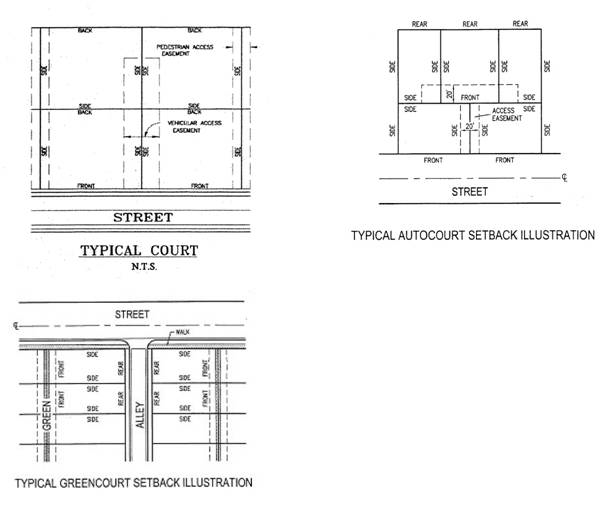
(Ord. 4242, § 4, 2005; Ord. 4276, § 8, 2005)
TABLE 9-310.5MCP
SETBACK EXCEPTIONS FOR SPECIFIC PLAN III AREA
Lot Size and Width Exceptions
For Major and Minor subdivisions the size of individual lots may be reduced to ninety percent (90%) of the minimum lot size provided Master Plan density requirements are met; and minimum lot width for individual lots may be reduced five (5) feet from the required minimum, provided the average lot width in the proposed subdivision is at least equal to the required minimum lot width.
Side and Rear Setbacks Exceptions
The side setback in the R-L, R-M and R-MH zones may be reduced to zero (0) feet along the common wall in a zero lot-line residential project or where the distance between the building on the subject lot and the building on the adjacent lot is at least ten (10) feet in the R-L zone and eight (8) feet in the R-M and R-MH zones.
For reverse corner lots, the rear setback shall be the same as the side setback.
For single story garages and accessory buildings located in the rear third of the parcel, the rear setback may be reduced to zero (0) feet where the distance between the garage or accessory structure on the subject lot and the structure on the adjacent lot is at least eight (8) feet.
Rear setbacks on alleys may be reduced to four (4) feet.
Specific Situation Setback Exceptions
Garage Setback Exceptions
The minimum setback for garages with doors facing the street shall be five (5) feet behind the building facade of the main structure. The minimum setback for side entry garages shall be twenty-five (25) feet in the R-VL zone and ten (10) feet for all other residential zones.
Off-Street Parking Area Setback Exceptions
The minimum setback for off-street parking areas for nonresidential use types in the R-VL, R-L and R-M zones shall be ten (10) feet from any adjacent street, and five (5) feet from any side or rear property line not abutting a street. The minimum setback for off-street parking areas in the R-MH and R-H zones shall be fifteen (15) feet from any adjacent street; ten (10) feet from any adjacent lot zoned R-VL, R-L or R-M; and five (5) feet from any side or rear property line not abutting a street or lot zoned R-VL, R-L or R-M.
Structural Feature & Equipment Setback Exceptions
Height Limit Exceptions
Parking facilities located below the main structure in the R-H zone. Within the R-H zone, one-half (½) additional story may be permitted for parking facilities located below the main structure; penthouse or roof structures for the housing of elevators, stairways, tanks, ventilating fans or similar equipment required to operate and maintain the building; and skylights and chimneys; flagpoles; church towers/steeples; and watertanks may exceed maximum building heights.
(Ord. 4276, § 7 (part), 2005; Ord. 4333, § 3, 2007)
9-405.2M - PERMITTED USE TYPES.
Permitted, not permitted and conditionally permitted use types shall be as provided in Table 9-405.2M.
(Ord. 3813 (part), 1994)
9-405.4M - TEMPORARY USES AND STRUCTURES.
Permitted, not permitted and conditionally permitted temporary uses and structures shall be as provided in Table 9-405.4M. Temporary uses or structures not specifically listed in Table 9-405.4M may be allowed, subject to approval of an Improvement Plan.
(Ord. 3813 (part), 1994)
9-405.5M - SPECIAL USE REGULATIONS.
In addition to the provisions specified in the development title, the following provisions shall be applicable:
(a)
Medical Services Use Type.
(1)
Medical offices shall be designed and configured to appear as office type uses in those commercial zones where they are allowed.
(2)
Urgent care centers, and other facilities included under the medical services use type that provides emergency medical care, shall be situated on and accessed from arterial roadways. Said facilities shall be separated from residential and other sensitive land uses by means of an arterial roadway, landscape easement or other effective buffer.
(b)
Public Services: Essential, Use Type.
(1)
Hospitals shall not be allowed in the C-FS zone.
(2)
Hospitals shall be situated on and accessed from arterial roadways. Said facilities shall be separated from residential and other sensitive land uses by means of an arterial roadway, landscape easement or other effective buffer.
(c)
Commercial Buildings in Neighborhood Commercial (C-N) Zones. If the Director determines that the uses and architectural, siting, and other issues associated with a commercial building of a proposed application have been addressed by an existing Special Purpose Plan or Specific Plan, an Improvement Plan may be allowed for said commercial building in lieu of the permit type specified in Table 9-405.2M.
(1)
New commercial buildings not included in an existing Special Purpose Plan or Specific Plan shall be subject to the permit type specified in Table 9-405.2M.
(2)
A building expansion of an existing commercial building which has been included in an existing Special Purpose Plan or Specific Plan may be allowed subject to an Improvement Plan, provided the building expansion involves less than a twenty-five percent (25%) increase in floor area covered by the existing commercial building. If said expansion is twenty-five percent (25%) or more of the floor area covered by the existing commercial building, the expansion shall be subject to Site Approval.
(Ord. 3813 (part), 1994; Ord. 3974, § 5, 1998)
9-405.7M - DESIGN GUIDELINES.
Design Guidelines shall be submitted for consistency review prior to approval of the final map or parcel map or other Development Permit.
(Ord. 4066, § 7, 2000)
TABLE - 9-405.2M USES IN COMMERCIAL ZONES
1 Applies within Specific Plan III area of Mountain House.
(Ord. 3813 (part), 1994; Ord. 3974, § 6, 1998; Ord. 4276, § 9 (part), 2005; Ord. 4301, § 3, 2006; Ord. No. 4385, § 19, 1-12-2010; Ord. No. 4541, § 3, 11-5-2019)
TABLE 9-405.4M
TEMPORARY USES AND STRUCTURES IN COMMERCIAL ZONES
(Ord. 3813 (part), 1994; Ord. 4276, § 9 (part), 2005)
9-410.3M - LOT AREA.
The minimum lot area by commercial zone shall be the same as that specified in the development title. For purposes of referral, minimum lot area requirements are included in Table 9-410.3M.
(Ord. 3813 (part), 1994)
9-410.4M - LOT WIDTH.
The minimum lot width by commercial zone shall be the same as that specified in the development title. For purposes of referral, minimum lot area requirements are included in Table 9-410.3M.
(Ord. 3813 (part), 1994)
9-410.5M - SETBACKS.
Unless otherwise specified, buildings and structures shall meet the setback requirements specified in Table 9-410.3M. Said setback requirements and the following exceptions shall replace the chapter concerning yards and the general provisions concerning yard dimensions in the development title (Chapter 9-1010 and Section 9-410.5, respectively).
(a)
Side and Rear Setback Exceptions.
Buildings on lots zoned or designated on the Master Plan for commercial use shall maintain a forty-five degree (45°) clear setback when adjacent to lots zoned or designated on the Master Plan for residential use.
(b)
Setback Exceptions For Specified Streets and Street Types.
(1)
The minimum setback from I-205 and from Patterson Pass Road shall be as specified in the Master Plan.
(2)
The minimum setback from an adjacent arterial street in the C-N and C-C zones shall be twenty (20) feet for building facades without entries for the general public, and for service and loading areas.
(3)
The minimum setback from an adjacent collector street shall be ten (10) feet in the C-N zone, and twenty (20) feet in the C-C zone, for building facades without entries for the general public, and for service and loading areas.
(c)
Setback Exceptions for Off-Street Parking Areas.
(1)
The minimum setback for off-street parking areas adjacent to streets shall be twenty (20) feet, except in the following instances:
(A)
In the C-N zone, the minimum setback shall be ten (10) feet;
(B)
Along Patterson Pass Road, the minimum setback shall be thirty (30) feet.
(2)
The minimum setback for off-street parking areas adjacent to lots zoned or designated on the Master Plan for residential use shall be ten (10) feet.
(3)
The minimum side and rear setback for off-street parking areas in the C-O and C-FS zones shall be five (5) feet.
(d)
Setback Exceptions for Other Specified Structures.
(1)
Fire Escapes. Fire escapes shall not extend or project more than four (4) feet beyond the setback line.
(2)
Stairways and Balconies. Open, unenclosed stairways, or balconies not covered by a roof or canopy, shall not extend or project more than four (4) feet beyond the side or rear setback line, and shall not extend or project more than thirty (30) inches beyond the front setback line.
(3)
Porches. Porches, platforms or landing places which do not extend above the level of the first floor of the building shall not extend or project more than five (5) feet beyond the setback line; however, any open work railing, no more than thirty (30) inches in height, may be installed or constructed on any such porch, platform or landing place.
(4)
Patio Covers. Patio covers, as defined by Chapter 49 of the Uniform Building Code, may be located within three (3) feet of the rear or side property line.
(5)
Eaves, Roof Overhangs and Similar Features. Eaves, roof overhangs and other similar architectural features may extend or project up to:
(A)
Thirty (30) inches beyond the setback line, provided said architectural feature is no closer than thirty (30) inches to the property line where the setback requirement is ten (10) feet or less;
(B)
Ten (10) feet beyond the setback line, where the setback requirement is more than ten (10) feet.
(6)
Fireplaces, Air Conditioning Equipment, Water Softener Units. Fireplaces, air conditioning units and water softening units may extend or project up to thirty (30) inches beyond the setback line, provided said structure is no closer than thirty (30) inches to the property line.
(7)
Pools. Pools shall not be located closer than three (3) feet from any side or rear property line.
(e)
Setback Exceptions for Specified Land Uses or Features.
(1)
County Line. Dwellings and nonresidential buildings shall maintain a minimum setback from the Alameda County Line as specified in the Master Plan.
(2)
Power Line Easements. Dwelling units shall maintain a minimum setback of twenty-five (25) feet from the Rio Oso-Tesla powerline easement. Non-residential structures shall maintain a minimum setback of ten (10) feet from the Rio Oso-Tesla powerline easement.
(3)
Mountain House Creek Corridor. Buildings shall maintain a minimum setback of fifty (50) feet from the Mountain House Creek Corridor.
(4)
Wetlands. Buildings and structures shall maintain a minimum setback from wetlands in accordance with the setback requirements for wetlands specified in the Wetlands Management Plan.
(Ord. 3813 (part), 1994)
9-410.6M - HEIGHT.
Buildings and structures in commercial zones shall not exceed the maximum building heights specified in Table 9-410.3M, except as provided below. Said exceptions shall be limited by any ordinance relating to airports, and shall serve to replace the chapter on height limits for special structures and the general provisions on building height in the development title (Chapter 9-1005 and Section 9-410.6, respectively).
(a)
Penthouse or roof structures for the housing of elevators, stairways, tanks, ventilating fans, or similar equipment required to operate and maintain the building;
(b)
Skylights and chimneys;
(c)
Flagpoles; and
(d)
Church towers/steeples.
(Ord. 3813 (part), 1994)
9-410.7M - BUILDING COVERAGE.
The maximum building coverage by zone for buildings and structures shall be the same as that specified in the development title. For purposes of referral, maximum building coverage regulations are included in Table 9-410.3.
(Ord. 3813 (part), 1994)
TABLE 9-410.3M
LOT AND STRUCTURE STANDARDS*
Setback Requirements**
* See Sections 9-410.3M through 9-410.7M for exceptions and modifications.
** Unless otherwise specified, setbacks shall be measured from the planned ultimate right-of-way width of the roadway, as shown on the Master Plan or on any applicable Specific Plan.
Notes: Refer to Table 9-410.3 for depth to width ratio. Table 9-410.3 does not apply within Specific Plan III area of Mountain House.
1 Applies within Specific Plan III area of Mountain House.
2 Side setback for C-O is 20′ for the streetside side of corner lots in Specific Plan III area.
(Ord. 3813 (part), 1994; Ord. 4276, § 10, 2005; Ord. 4280, § 1, 2005)
9-505.2M - PERMITTED USE TYPES.
Permitted, not permitted and conditionally permitted use types shall be as provided in Table 9-505.2M.
(Ord. 3813 (part), 1994)
9-505.4M - TEMPORARY USES AND STRUCTURES.
Permitted, not permitted and conditionally permitted temporary uses and structures shall be as provided in Table 9-505.4M. Temporary uses or structures not specifically listed in Table 9-505.4M may be allowed, subject to approval of an Improvement Plan.
(Ord. 3813 (part), 1994)
9-505.5M - SPECIAL USE REGULATIONS IN INDUSTRIAL ZONES.
In addition to the requirements specified in the development title, the following provisions shall be applicable:
(a)
Automotive Sales and Services: Automotive Sales, Use Type. Uses classified under the Automotive Sales and Services: "Automotive Sales, Use Type" shall be adjacent to a freeway.
(b)
Medical Services Use Type.
(1)
Medical offices shall be designed and configured to appear as office type uses in those commercial zones where they are allowed.
(2)
Urgent care centers, and other facilities included under the medical services use type that provides emergency medical care, shall be situated on and accessed from arterial roadways. Said facilities shall be separated from residential and other sensitive land uses by means of an arterial roadway, landscape easement, or other effective buffer.
(c)
Public Services: Essential, Use Type.
Hospitals shall be situated on and accessed from arterial roadways. Said facilities shall be separated from residential and other sensitive land uses by means of an arterial roadway, landscape easement, or other effective buffer.
(Ord. 3813 (part), 1994)
9-505.10M - DESIGN GUIDELINES.
Design Guidelines shall be submitted for consistency review prior to approval of the final map or parcel map or other Development Permit.
(Ord. 4066, § 8, 2000)
TABLE - 9-505.2M USES IN INDUSTRIAL ZONES
1 Applies within Specific Plan III area of Mountain House.
(Ord. 3813 (part), 1994; Ord. 3974, § 7, 1998; Ord. 4276, § 11 (part), 2005; Ord. No. 4385, § 20, 1-12-2010; Ord. No. 4541, § 4, 11-5-2019)
TABLE - 9-505.4M TEMPORARY USES AND STRUCTURES IN INDUSTRIAL ZONES
1 Applies within Specific Plan III area of Mountain House.
(Ord. 3813 (part), 1994; Ord. 4276, § 11 (part), 2005)
9-510.3M - LOT AREA.
The minimum lot area by industrial zone shall be the same as that specified in the development title. For purposes of referral, minimum lot area requirements are included in Table 9-510.3M.
(Ord. 3813 (part), 1994)
9-510.4M - LOT WIDTH.
The minimum lot width by industrial zone shall be the same as that specified in the development title. For purposes of referral, minimum lot area requirements are included in Table 9-510.3M.
(Ord. 3813 (part), 1994)
9-510.5M - SETBACKS.
Unless otherwise specified, buildings and structures shall meet the setback requirements specified in Table 9-510.3M. (See Table 4.1 of the Master Plan.) Said setback requirements and the following exceptions shall replace the chapter concerning yards and the provisions concerning yard dimensions in the development title (Chapter 9-1010 and Section 9-510.5, respectively).
(a)
Side and Rear Setback Exceptions.
Buildings on lots zoned or designated on the Master Plan for industrial use shall maintain a forty-five degree (45°) clear setback when adjacent to lots zoned or designated on the Master Plan for residential use.
(b)
Setback Exceptions for Specified Streets.
The minimum setback from I-205 and Patterson Pass Road shall be as specified in the Master Plan.
(c)
Setback Exceptions for Off-Street Parking Areas.
(1)
The minimum setback for off-street parking areas adjacent to streets shall be ten (10) feet, except that in the I-P zone the minimum setback shall be twenty (20) feet.
(2)
The minimum setback for off-street parking areas adjacent to lots zoned or designated on the Master Plan for residential use shall be ten (10) feet.
(3)
The minimum side and rear setback for off-street parking areas in the I-P zone shall be five (5) feet.
(d)
Setback Exceptions for Other Specified Structures.
(1)
Fire Escapes. Fire escapes shall not extend or project more than four (4) feet beyond the setback line.
(2)
Stairways and Balconies. Open, unenclosed stairways, or balconies not covered by a roof or canopy, shall not extend or project more than four (4) feet beyond the side or rear setback line, and shall not extend or project more than thirty (30) inches beyond the front setback line.
(3)
Porches. Porches, platforms or landing places which do not extend above the level of the first floor of the building shall not extend or project more than five (5) feet beyond the setback line; however, any open work railing, no more than thirty (30) inches in height, may be installed or constructed on any such porch, platform or landing place.
(4)
Patio Covers. Patio covers, as defined by Chapter 49 of the Uniform Building Code, may be located within three (3) feet of the rear or side property line.
(5)
Eaves, Roof Overhangs and Similar Features. Eaves, roof overhangs and other similar architectural features may extend or project up to:
(A)
Thirty (30) inches beyond the setback line, provided said architectural feature is no closer than thirty (30) inches to the property line where the setback requirement is ten (10) feet or less;
(B)
Ten (10) feet beyond the setback line, where the setback requirement is more than ten (10) feet.
(6)
Fireplaces, Air Conditioning Equipment, Water Softener Units. Fireplaces, air conditioning units and water softening units may extend or project up to thirty (30) inches beyond the setback line, provided said structure is no closer than thirty (30) inches to the property line.
(7)
Pools. Pools shall not be located closer than three (3) feet from any side or rear property line.
(e)
Setback Exceptions for Specified Land Uses or Features.
(1)
Power Line Easements. Dwelling units shall maintain a minimum setback of twenty-five (25) feet from the Rio Oso-Tesla powerline easement. Commercial or industrial structures shall maintain a minimum setback of ten (10) feet from the Rio Oso-Tesla powerline easement.
(2)
Wetlands. Buildings and structures shall maintain a minimum setback from wetlands in accordance with the setback requirements for wetlands specified in the Wetlands Management Plan.
(Ord. 3813 (part), 1994)
9-510.6M - HEIGHT.
Buildings and structures in industrial zones shall not exceed the maximum building heights specified in Table 9-510.3M, except as provided below. Said exceptions shall be limited by any ordinance relating to airports, and shall serve to replace the chapter on height limits for special structures and the general provisions on building height in the development title (Chapter 9-1005 and Section 9-510.6, respectively).
(a)
Penthouse or roof structures for the housing of elevators, stairways, tanks, ventilating fans, or similar equipment required to operate and maintain the building;
(b)
Skylights and chimneys;
(c)
Flagpoles; and
(d)
Church towers/steeples.
(Ord. 3813 (part), 1994)
9-510.7M - BUILDING COVERAGE.
The maximum building coverage by zone for buildings and structures shall be the same as that specified in the development title. For purposes of referral, maximum building coverage regulations are included in Table 9-510.3.
(Ord. 3813 (part), 1994)
9-510.8M - ACCESS.
All principal uses within the industrial zones of Specific Plan III shall have access to a County maintained road, a road maintained by the Mountain House Community Services District, or a privately maintained road with public access. Within other areas of Mountain House, all principle uses in the industrial zones shall have access to a County maintained road. Flag lots are not permitted in the industrial zones.
(Ord. 4276, § 12, 2005)
9-510.9M - CORNER LOTS.
Corner lots shall have minimum widths of one hundred (100) feet, except within the Specific Plan III area, where there shall be no required minimum lot width.
(Ord. 3813 (part), 1994; Ord. 4276, § 13, 2005)
TABLE 9-510.3M
LOT AND STRUCTURE STANDARDS*
Setback Requirements**
* See Sections 9-510.3M through 9-510.9M for exceptions and modifications.
** Unless otherwise specified, setbacks shall be measured from the planned ultimate right-of-way width of the roadway, as shown on the Master Plan or on any applicable Specific Plan.
Notes: Refer to Table 9-510.3 for depth to width ratio, except within the Specific Plan III area, where there is no required depth to width ratio.
1 Applies within Specific Plan III area of Mountain House.
2 Structures in Mountain House Business Park area are 5 stories.
3 Applies to side and rear setback within Specific Plan III area only; front setback within Specific Plan III area is 10′.
4 Streetside sides of corner lots within Specific Plan III area of Mountain House shall be set back 15′.
(Ord. 3813 (part), 1994; Ord. 4276, § 14, 2005; Ord. 4280, § 2, 2005)
9-605.2M - PERMITTED USE TYPES.
Permitted, not permitted and conditionally permitted use types in the AU zone shall be as provided in Table 9-605.2M.
(Ord. 3813 (part), 1994)
9-605.3M - ACCESSORY USES AND STRUCTURES.
Permitted, not permitted and conditionally permitted accessory uses and structures in the AU zone shall be as provided in Table 9-605.3M. Accessory uses or structures not specifically listed in Table 9-605.3M may be permitted with an improvement plan, provided:
(a)
The proposed accessory use or structure involves less than a twenty-five percent (25%) increase in floor area covered by the existing principal use type; and
(b)
The proposed accessory use or structure involves less than a ten percent (10%) increase in the overall site area covered by the existing use type; and
(c)
The proposed accessory use or structure, in the opinion of the Director, will not have a substantial, adverse effect on adjacent property; and
(d)
The proposed accessory use or structure will comply with existing requirements of agencies having jurisdiction and any other appropriate regulatory agency; or
(e)
Where conditions in Subsections (a) through (d) of this section are not met, the level of review for the accessory use or structure shall be the same as the level of review required for the primary use or structure.
(Ord. 3813 (part), 1994)
9-605.4M - TEMPORARY USES AND STRUCTURES.
Permitted, not permitted and conditionally permitted temporary uses and structures in the AU zone shall be as provided in Table 9-605.4M. Temporary uses or structures not specifically listed in Table 9-605.4M may be allowed, subject to an Improvement Plan.
(Ord. 3813 (part), 1994)
TABLE 9-605.2M - USES IN AGRICULTURAL ZONES
(Ord. 3813 (part), 1994; Ord. 3953, § 3, 1997; Ord. 3974, § 8, 1998; Ord. No. 4385, § 21, 1-12-2010; Ord. No. 4541, § 5, 11-5-2019)
TABLE 9-605.3M
ACCESSORY USES AND STRUCTURES IN AGRICULTURAL ZONES
(Ord. 3813 (part), 1994; Ord. No. 4385, § 22, 1-12-2010)
TABLE 9-605.4M
TEMPORARY USES AND STRUCTURES IN AGRICULTURAL ZONES
(Ord. 3813 (part), 1994; Ord. No. 4385, § 23, 1-12-2010)
9-700.1M - TITLE AND INTENT.
The intents of the other zones are amended as follows:
(a)
P-F Zone. The public facilities (P-F) zone in Mountain House is intended to provide for the establishment of schools meeting State requirements for primary, secondary and higher education; medical facilities; infrastructure facilities, such as the wastewater treatment plant and water treatment plant; police and fire protection facilities and other public buildings; the Transit Center; and places of religious assembly. This zone is intended to implement the public facilities land use category of the General Plan.
(b)
M-X Zone. The mixed-use (M-X) zone is intended to provide an integration of land use types, including office, retail, recreation, public and residential uses, under a coherent plan; provide a central location for community activities, such as parades, exhibits, shows and other civic functions that serve to give identity and interest to the lifestyle of a community; and otherwise create a focal point of activity within the community. The M-X zone allows for more urban densities, innovative design, and a more efficient land and infrastructure utilization than would be permitted under other traditional designations. The concurrent filing of a Specific Plan shall be required of areas to be zoned Mixed-Use. This zone is intended to implement the mixed-use land use category of the General Plan.
(Ord. 3813 (part), 1994)
9-705.2M - PERMITTED USE TYPES.
Permitted, not permitted and conditionally permitted use types shall be as provided in Table 9-705.2M.
(Ord. 3813 (part), 1994)
9-705.4M - TEMPORARY USES AND STRUCTURES.
Permitted, not permitted and conditionally permitted temporary uses and structures shall be as provided in Table 9-705.4M. Temporary uses or structures not specifically listed in Table 9-705.4M may be allowed, subject to an Improvement Plan.
(Ord. 3813 (part), 1994)
9-705.5M - SPECIAL USE REGULATIONS IN THE M-X ZONE.
In addition to the provisions specified in Section 9-705.5 of the Development Title, the following additional provisions shall be applicable:
(a)
Single-family residential units which are not, in the opinion of the Review Authority, accessory dwellings shall be located in back of, or above, other uses permitted or conditionally permitted in the M-X zone.
(b)
Two-family residential units which are not, in the opinion of the Review Authority, accessory dwellings shall be located in back of, or above, other uses permitted or conditionally permitted in the M-X zone.
(Ord. 3813 (part), 1994)
9-705.6M - SPECIAL USE REGULATIONS IN THE P-F ZONE.
In addition to the provisions specified in Section 9-705.6 of the Development Title, the following additional provisions shall be applicable:
(a)
Communications Services Type II may be permitted only on land owned by the Mountain House Community Services District.
(Ord. 4365, § 2, 2008)
9-705.9M - DESIGN GUIDELINES.
Design Guidelines shall be submitted for consistency review prior to approval of the final map or parcel map or other Development Permit.
(Ord. 4066, § 9, 2000)
TABLE 9-705.2M - USES IN OTHER ZONES
(Ord. 3813 (part), 1994; Ord. 3974, § 9, 1998; Ord. No. 4385, § 24, 1-12-2010; Ord. No. 4541, § 6, 11-5-2019)
TABLE 9-705.4M
TEMPORARY USES AND STRUCTURES IN OTHER ZONES
1 Applies within Specific Plan III area of Mountain House.
(Ord. 3813 (part), 1994; Ord. 4276, § 15, 2005)
9-710.2M - LOT AREA.
The minimum lot area by industrial zone shall be the same as that specified in the development title. For purposes of referral, minimum lot area requirements are included in Table 9-710.2M.
(Ord. 3813 (part), 1994)
9-710.3M - LOT WIDTH.
The minimum lot width in the M-X and P-F zones shall be as provided in Table 9-710.2M.
(Ord. 3813 (part), 1994)
9-710.4M - SETBACKS.
Unless otherwise specified, buildings and structures shall meet the setback requirements specified in Table 9-710.2M. Said setback requirements and the following exceptions shall replace the chapter concerning yards and the provisions concerning yard dimensions in the development title (Chapter 9-1010 and Section 9-710.4, respectively).
(a)
Side and Rear Setback Exceptions. Buildings on lots zoned P-F, or designated P on the Master Plan, shall maintain a forty-five degree (45°) clear setback when adjacent to lots zoned or designated on the Master Plan for residential use.
(b)
Setback Exceptions for Off-Street Parking Areas.
(1)
The minimum setback for off-street parking areas adjacent to streets shall be ten (10) feet in the P-F zone.
(2)
The minimum setback for off-street parking areas adjacent to lots zoned or designated on the Master Plan for residential use shall be ten (10) feet.
(c)
Setback Exceptions for Other Specified Structures.
(1)
Fire Escapes. Fire escapes shall not extend or project more than four (4) feet beyond the setback line.
(2)
Stairways and Balconies. Open, unenclosed stairways or balconies not covered by a roof or canopy, shall not extend or project more than four (4) feet beyond the side or rear setback line, and shall not extend or project more than thirty (30) inches beyond the front setback line.
(3)
Porches. Porches, platforms or landing places which do not extend above the level of the first floor of the building shall not extend or project more than five (5) feet beyond the setback line; however, any open work railing, no more than thirty (30) inches in height, may be installed or constructed on any such porch, platform or landing place.
(4)
Patio Covers. Patio covers, as defined by Chapter 49 of the Uniform Building Code, may be located within three (3) feet of the rear or side property line.
(5)
Eaves, Roof Overhangs and Similar Features. Eaves, roof overhangs and other similar architectural features may extend or project up to:
(A)
Thirty (30) inches beyond the setback line, provided said architectural feature is no closer than thirty (30) inches to the property line where the setback requirement is ten (10) feet or less;
(B)
Ten (10) feet beyond the setback line, where the setback requirement is more than ten (10) feet.
(6)
Fireplaces, Air Conditioning Equipment, Water Softener Units. Fireplaces, air conditioning units and water softening units may extend or project up to thirty (30) inches beyond the setback line, provided said structure is no closer than thirty (30) inches to the property line.
(7)
Pools. Pools shall not be located closer than three (3) feet from any side or rear property line.
(d)
Setback Exceptions for Specified Land Uses or Features.
(1)
Power Line Easements. Buildings shall maintain a minimum setback of ten (10) feet from the Rio Oso-Tesla powerline easement.
(2)
Mountain House Creek Corridor. Buildings shall maintain a minimum setback of fifty (50) feet from the Mountain House Creek Corridor.
(3)
Wetlands. Buildings and structures shall maintain a minimum setback from wetlands in accordance with the setback requirements for wetlands specified in the Wetlands Management Plan.
(4)
Wastewater Storage Ponds and Sludge Basins. Wastewater storage ponds and sludge basins shall be setback from property lines a minimum of twenty (20) feet.
(Ord. 3813 (part), 1994)
9-710.5M - HEIGHT.
Buildings and structures in the P-F and M-X zones shall not exceed the maximum building heights specified in Table 9-710.2M, except as provided below. (See Table 4.1 of the Master Plan.) Said exceptions shall be limited by any ordinance relating to airports, and shall serve to replace the chapter on height limits for special structures and the general provisions on building height in the development title (Chapter 9-1005 and Section 9-710.5, respectively).
(a)
Penthouse or roof structures for the housing of elevators, stairways, tanks, ventilating fans, or similar equipment required to operate and maintain the building;
(b)
Skylights and chimneys;
(c)
Flagpoles; and
(d)
Church towers/steeples.
(Ord. 3813 (part), 1994)
9-710.6M - BUILDING COVERAGE.
The maximum building coverage for the P-F and M-X zones shall be as provided in Table 9-710.2M.
(Ord. 3813 (part), 1994)
9-710.7M - CORNER LOTS.
In the M-X zone, corner lots shall have a minimum width and depth of sixty-five (65) feet.
(Ord. 3813 (part), 1994)
TABLE 9-710.2M
LOT AND STRUCTURE STANDARDS*
Setback Requirements**
* See Sections 9-710.3M through 9-710.7M for exceptions and modifications.
** Unless otherwise specified, setbacks shall be measured from the planned ultimate right-of-way width of the roadway, as shown on the Master Plan or on any applicable Specific Plan.
1 Applies within Specific Plan III area of Mountain House.
(Ord. 3813 (part), 1994; Ord. 4276, § 16, 2005)
9-803.3.1M - REQUIRED STUDIES.
Prior to taking action on an application for a General Plan Amendment, the impact of the proposed General Plan Amendment on the jobs/housing program and on housing affordability shall be determined. In addition, the consistency with the policies of the Public Financing Plan shall be analyzed and the potential impact of the General Plan Amendment on the financial and fiscal resources of the community and the County shall be determined.
(a)
If the Director decides that private consulting services are required, the Director shall select a consultant.
(b)
The applicant shall be responsible for the cost of any consultant services plus an administrative fee as set by resolution of the Board of Supervisors.
(Ord. 3813 (part), 1994)
9-803.4M - APPROVAL.
Prior to approving an application for a General Plan Amendment, the Planning Commission and the Board of Supervisors shall determine that all the following are true:
(a)
The internal consistency of the General Plan is maintained in the adoption of the General Plan Amendment;
(b)
The General Plan Amendment shall not adversely affect the jobs/housing program and housing affordability;
(c)
The General Plan Amendment shall not adversely affect the Public Financing Plan; and
(d)
All applicable provisions of the Mountain House Development Agreement have been met.
(Ord. 3813 (part), 1994)
9-804.3.1M - REQUIRED STUDIES.
Prior to taking action on an application for a Master Plan Amendment, the impact of the proposed Master Plan Amendment on the jobs/housing program and on housing affordability shall be determined. In addition, the consistency with the policies of the Public Financing Plan shall be analyzed and the potential impact of the Master Plan Amendment on the financial and fiscal resources of the community and the County shall be determined.
(a)
If the Director decides that private consulting services are required, the Director shall select a consultant.
(b)
The applicant shall be responsible for the cost of any consultant services plus an administrative fee as set by resolution of the Board of Supervisors.
(Ord. 3813 (part), 1994)
9-804.4M - APPROVAL.
Prior to approving an application for a Master Plan Amendment, the Planning Commission and the Board of Supervisors shall determine that the following are true:
(a)
The Master Plan Amendment is consistent with the General Plan and the Public Financing Plan;
(b)
The Master Plan Amendment shall not adversely affect the jobs/housing program and housing affordability; and
(c)
All applicable provisions of the Mountain House Development Agreement have been met.
(Ord. 3813 (part), 1994)
9-805.3.1M - REQUIRED STUDIES.
Prior to taking action on an application for a Public Financing Plan Amendment, the impact of the proposed Public Financing Plan Amendment on the jobs/housing program and on housing affordability shall be determined. In addition, the potential impact of the Public Financing Plan Amendment on the financial and fiscal resources of the community and the County shall be determined.
(a)
If the Director decides that private consulting services are required, the Director shall select a consultant.
(b)
The applicant shall be responsible for the cost of any consultant services plus an administrative fee as set by resolution of the Board of Supervisors.
(Ord. 3813 (part), 1994)
9-805.4M - APPROVAL.
Prior to approving an application for a Public Financing Plan Amendment, the Planning Commission and the Board of Supervisors shall determine that the following are true:
(a)
The Public Financing Plan Amendment is consistent with the General Plan and the Master Plan;
(b)
The Public Financing Plan Amendment shall not adversely affect the jobs/housing program and housing affordability; and
(c)
All applicable provisions of the Mountain House Development Agreement have been met.
(Ord. 3813 (part), 1994)
9-806.3.1M - REQUIRED STUDIES.
Prior to taking action on an application for a Specific Plan or Specific Plan Amendment, the impact of the proposed Specific Plan or Specific Plan Amendment on the jobs/housing program and on housing affordability shall be determined. In addition, the consistency with the policies of the Public Financing Plan shall be analyzed and the potential impact of the Specific Plan or Specific Plan Amendment on the financial and fiscal resources of the community and the County shall be determined.
(a)
If the Director decides that private consulting services are required, the Director shall select a consultant.
(b)
The applicant shall be responsible for the cost of any consultant services plus an administrative fee as set by resolution of the Board of Supervisors.
(Ord. 3813 (part), 1994)
9-806.4M - APPROVAL.
Prior to approving an application for a Specific Plan or Specific Plan Amendment, the Planning Commission and the Board of Supervisors shall determine that the following are true:
(a)
The Specific Plan or Specific Plan Amendment is consistent with the General Plan the Master Plan and the Public Financing Plan;
(b)
The Specific Plan or Specific Plan Amendment shall not adversely affect the jobs/housing program and housing affordability; and
(c)
All applicable provisions of the Mountain House Development Agreement have been met.
(Ord. 3813 (part), 1994)
9-809.3.1M - REQUIRED STUDIES.
Prior to taking action on an application for a Mountain House Development Title Text Amendment (MHDTA), the impact of the proposed MHDTA on the jobs/housing program and on housing affordability shall be determined. In addition, the consistency with the policies of the Public Financing Plan shall be analyzed and the potential impact of the MHDTA on the financial and fiscal resources of the community and the County shall be determined.
(a)
If the Director decides that private consulting services are required, the Director shall select a consultant.
(b)
The applicant shall be responsible for the cost of any consultant services plus an administrative fee as set by resolution of the Board of Supervisors.
(Ord. 3813 (part), 1994)
9-809.4M - APPROVAL.
Prior to approving an application for a MHDTA, the Planning Commission and the Board of Supervisors shall determine that the following are true:
(a)
The MHDTA is consistent with the General Plan, the Master Plan and the Public Financing Plan;
(b)
The MHDTA shall not adversely affect the jobs/housing program and housing affordability; and
(c)
All applicable provisions of the Mountain House Development Agreement have been met.
(Ord. 3813 (part), 1994)
9-812.3.1M - REQUIRED STUDIES.
Prior to taking action on an application for a Zone Reclassification, the impact of the proposed Zone Reclassification on the jobs/housing program and on housing affordability shall be determined. In addition, the consistency with the policies of the Public Financing Plan shall be analyzed and the potential impact of the Zone Reclassification on the financial and fiscal resources of the community and the County shall be determined.
(a)
If the Director decides that private consulting services are required, the Director shall select a consultant.
(b)
The applicant shall be responsible for the cost of any consultant services plus an administrative fee as set by resolution of the Board of Supervisors.
(Ord. 3813 (part), 1994)
9-812.4M - APPROVAL.
Prior to approving an application for a Zone Reclassification, the Planning Commission and the Board of Supervisors shall determine that all of the following are true:
(a)
The zone district is consistent with the General Plan, the Master Plan, any applicable Specific Plan and the Public Financing Plan;
(b)
The zone district is reasonable and beneficial at the time;
(c)
The zone district shall not adversely affect the jobs/housing program and housing affordability; and
(d)
All applicable provisions of the Mountain House Development Agreement have been met.
(Ord. 3813 (part), 1994)
9-815.5.1M - REQUIRED STUDIES.
Prior to taking action on an application for a Special Purpose Plan, the impact of the proposed Special Purpose Plan on the jobs/housing program and on housing affordability shall be determined. In addition, the consistency with the policies of the Public Financing Plan shall be analyzed and the potential impact of the Special Purpose Plan on the financial and fiscal resources of the community and the County shall be determined.
(a)
If the Director decides that private consulting services are required, the Director shall select a consultant.
(b)
The applicant shall be responsible for the cost of any consultant services plus an administrative fee as set by resolution of the Board of Supervisors.
(Ord. 3813 (part), 1994)
9-815.6M - APPROVAL.
Prior to approving an application for a Special Purpose Plan, the Planning Commission and the Board of Supervisors shall determine that the following are true:
(a)
The Special Purpose Plan is consistent with the General Plan, the Master Plan, any applicable Specific Plan, and the Public Financing Plan;
(b)
The Special Purpose Plan shall not adversely affect the jobs/housing program and housing affordability; and
(c)
All applicable provisions of the Mountain House Development Agreement have been met.
(Ord. 3813 (part), 1994)
9-818.6M - FINDINGS.
Prior to approving an application for a Site Approval, the Review Authority shall find that all of the following are true:
(a)
Consistency. The proposed use is consistent with the goals, policies, standards and maps of the General Plan, the Master Plan, any applicable Specific Plan, any applicable Special Purpose Plan, the Public Financing Plan and any other applicable plan adopted by the County;
(b)
Improvements. Adequate utilities, roadway improvements, sanitation, water supply, drainage and other necessary facilities have been provided, and the proposed improvements are properly related to existing and proposed roadways;
(c)
Site Suitability. The site is physically suitable for the type of development and for the intensity of development;
(d)
Issuance Not Detrimental. Issuance of the permit will not be significantly detrimental to the public health, safety or welfare, or be injurious to the property or improvements of adjacent properties;
(e)
Compatibility. The use is compatible with adjoining land uses; and
(f)
Development Agreement. All applicable provisions of the Mountain House Development Agreement have been met.
(Ord. 3813 (part), 1994)
9-821.7M - FINDINGS.
Prior to approving an application for a Use Permit, the Review Authority shall find that all of the following are true:
(a)
Consistency. The proposed use is consistent with the goals, policies, standards and maps of the General Plan, the Master Plan, any applicable Specific Plan, any applicable Special Purpose Plan, the Public Financing Plan and any other applicable plan adopted by the County;
(b)
Improvements. Adequate utilities, roadway improvements, sanitation, water supply, drainage and other necessary facilities have been provided, and the proposed improvements are properly related to existing and proposed roadways;
(c)
Site Suitability. The site is physically suitable for the type of development and for the intensity of development;
(d)
Issuance Not Detrimental. Issuance of the permit will not be significantly detrimental to the public health, safety or welfare, or be injurious to the property or improvements of adjacent properties;
(e)
Compatibility. The use is compatible with adjoining land uses; and
(f)
Development Agreement. All applicable provisions of the Mountain House Development Agreement have been met.
(Ord. 3813 (part), 1994)
9-824.5M - FINDINGS.
Prior to approving an application for a deviation, the Review Authority shall find that all of the following are true:
(a)
Not Detrimental. The granting of the deviation will not be materially detrimental to other properties or land uses in the area;
(b)
Exceptional Circumstances. There are exceptional or extraordinary circumstances or conditions applicable to the property or to the intended uses that do not apply to other properties in the same zoning district in the vicinity;
(c)
Denial of Privileges. The strict application of the regulation deprives the property of privileges enjoyed by other properties in the vicinity;
(d)
Consistency. The proposed use is consistent with the goals, policies, standards and maps of the General Plan, the Master Plan, any applicable Specific Plan, any applicable Special Purpose Plan, the Public Financing Plan and any other applicable plan adopted by the County; and
(e)
Development Agreement. All applicable provisions of the Mountain House Development Agreement have been met.
(Ord. 3813 (part), 1994)
9-827.5M - FINDINGS.
Prior to approving an application for a variance, the Review Authority shall find that all of the following are true:
(a)
Special Circumstances. Because of the special circumstances applicable to the property, including size, shape, topography, location or surroundings, the strict application of the regulation deprives the property of privileges enjoyed by other property in the vicinity and under identical zoning classification;
(b)
No Special Privileges. The granting of the variance will not constitute a grant of special privileges inconsistent with the limitations upon other properties in the vicinity and zone in which the property is situated;
(c)
Use Authorized. The variance will not authorize a use or activity which is not otherwise expressly authorized by the regulation governing the parcel of property; and
(d)
Development Agreement. All applicable provisions of the Mountain House Development Agreement have been met.
(Ord. 3813 (part), 1994)
9-830.1M - INTENT.
The intent of this Chapter is to provide methods for approving accessory dwelling units (ADUs) and junior accessory dwelling units (JADUs) in the Mountain Home Development on lots with primary single family dwellings in order to increase housing opportunities.
(Ord. 3974, § 10 (part), 1998; Ord. No. 4568, § 8, 1-26-2021)
9-830.1.1M - PERMIT REQUIREMENTS.
An Accessory Dwelling Unit (ADU) Permit shall be required as follows for an ADU proposed on a lot that has not been designated on a parcel map or a final map to contain a second unit dwelling. For an ADU proposed on a lot that has been previously designated on a parcel map or a final map to contain a second unit dwelling, an ADU Permit shall not be required.
(a)
Detached and Attached ADUs. An ADU permit is required for the creation of an attached or detached ADU unless:
(1)
The ADU is a detached structure no more than sixteen (16) feet high that has a floor area no greater than eight hundred (800) square feet and maintains a minimum four-foot side and rear yard setback; or
(2)
The ADU is on a lot with an existing legal multi-family residential use.
(3)
Detached and attached ADUs that do not require an ADU permit must submit a building permit application and an ADU Checklist to the Community Development Department to ensure that the standards of this Chapter are met. The Department shall not issue a building permit without an approved ADU Checklist.
(b)
Interior ADUs and JADUs. An ADU permit is not required for an interior ADU JADU if the proposed unit meets the following requirements and the property owner obtains a building permit:
(1)
The interior ADU and JADU will be contained within an existing Single Family Dwelling Unit.
(2)
The JADU is not more than five hundred (500) square feet in size.
(3)
The interior ADU and JADU will have exterior access from a public right-of-way that is independent from the existing residence. This access may be provided through a front yard, side yard, or rear yard.
(4)
A kitchen or efficiency kitchen is provided.
(5)
Access to a bathroom is required, which in the case of a JADU may be part of the JADU or located in the existing primary dwelling. If provided as part of the primary dwelling, the JADU shall have direct access to the main living area of the primary dwelling so as not to need to go outside to access bathroom.
(6)
No additional parking is required for a JADU, but one (1) space must be provided for an interior ADU.
(7)
The owner of the JADU must occupy either the JADU or the remaining portion of the single-family residence.
(c)
Other Required Permits and Approvals. Projects that are exempt from obtaining an ADU Permit are still subject to applicable permit requirements and approvals including but not limited to building permits, grading permits, encroachment permits, home occupation permits, flood variances, if required, sanitation permits, well permits, and other construction-related permits and approvals. The County shall not issue final building permits for an ADU or JADU before it finals building permits for the primary dwelling.
(Ord. 3974, § 10 (part), 1998; Ord. No. 4568, § 8, 1-26-2021)
9-830.2M - PERMITTED ZONES; GENERAL REQUIREMENTS AND RESTRICTIONS.
ADUs and JADUs shall be permitted in the R-VL, R L, R-M and R-MH zones. ADUs and JADUs may be permitted in the AU-20 zone, provided the underlying Master Plan designation is R/VL, R/L, R/M or R/MH.
(a)
Types of ADUs Allowed. An ADU may be either attached to, or located within, the proposed or existing primary dwelling, including attached garages, storage areas or similar uses, or an accessory structure or detached from the proposed or existing primary dwelling and located on the same lot as the proposed or existing primary dwelling.
(b)
Relation to Main Dwelling Unit. The accessory dwelling unit shall be clearly subordinate to the primary dwelling unit on the lot with regard to size, location and appearance. Detached or attached accessory dwelling units shall have exterior walls and roofs that are consistent with the primary dwelling unit and incorporate the same or similar building materials, colors, and exterior surfaces and finishes as those on the primary dwelling unit.
(c)
Relation to General Plan and Zoning Density Limits. An ADU that conforms to the standards of this Chapter shall be deemed to be an accessory use or an accessory building and shall not be considered to exceed the allowable density for the lot upon which it is located, and shall be deemed to be a residential use that is consistent with the General Plan and zoning designations for the lot. The ADU shall not be considered in the application of any County ordinance, policy, or program to limit residential growth.
(d)
Permanent Address. The property owner shall obtain an approved permanent address is for an ADU and JADU.
(e)
Water and Wastewater Disposal Service Availability. Prior to issuance of a building permit for an ADU, the property owner must provide confirmation that adequate water and wastewater disposal service is available, either from a service provider or from a well and on-site septic system, to the Zoning Administrator.
(f)
Fees. The property owner of an ADU or JADU shall be subject to the payment of all sewer, water, and other applicable fees, except as specifically provided in Government Code Section 65852.2 and 65852.22. No impact fee shall be charged for development of an ADU less than seven hundred fifty (750) square feet in size. In this context, the term "impact fee" does not include any connection fee or capacity charge established by the County or other local agency, special district or water corporation.
(g)
ADUs Subject to Flood Hazards. All ADUs located in a floodplain designated pursuant to Chapter 9-1605, Flood Hazards, shall comply with the provisions of that chapter.
(h)
Sprinklers. Fire sprinklers are not required for ADUs and JADUs if sprinklers are not required for the primary residence.
(i)
Restrictions. All ADUs and JADUs are subject to the following restrictions:
(1)
The development and use of the ADU or JADU shall only be valid and permitted based on the terms established in this Chapter.
(2)
Prior to issuance of a building permit for an ADU or JADU, the property owner shall record a deed restriction with the County Recorder's Office and provide a copy of the stamped deed restriction to the Community Development Department including the following restrictive covenants:
(A)
The ADU or JADU shall not be sold separately from the primary residence;
(B)
The ADU or JADU is restricted to the maximum size allowed by Chapter 9-832, Residential Accessory Dwelling Units, of this Title or as approved by an ADU Permit;
(C)
The property owner and all successors in interest in the property shall respond to the County's periodic surveys of owners of ADU and JADUs for reporting purposes to the State Department of Housing and Community Development; and
(3)
If the ADU or JADU is rented, it shall not be rented for a period of less than thirty (30) consecutive days.
(Ord. 3813 (part), 1994; Ord. 3974, § 10 (part), 1998; Ord. 4066, § 10, 2000; Ord. 4333, § 7, 2007; Ord. No. 4568, § 8, 1-26-2021)
9-830.3M - REQUIREMENTS FOR ADU PERMIT APPLICATION.
An application for an ADU Permit may be initiated by the property owner or the property owner's authorized agent. Applications shall be filed with the Community Development Department. A fee, as specified by resolution of the Board of Supervisors, shall be required. The following minimum requirements shall be met when filing an application for an ADU Permit and shall replace those specified in the Development Title:
(a)
Existing Residence. There shall be no more than one (1) existing single-family dwelling on the property.
(b)
Number of Units. There shall be no more than one (1) ADU and one (1) JADU per parcel.
(Ord. 3974, § 10 (part), 1998; Ord. No. 4568, § 8, 1-26-2021)
9-830.5M - DEVELOPMENT REQUIREMENTS.
The development requirements provided by this Chapter shall be applicable to all ADUs and JADUs, including those designated on a Second Unit Dwelling Plan submitted with the subdivision map application. The following development requirements shall replace those specified in the Development Title.
(a)
Size of Unit.
(1)
In R-VL, R-L, R-M and R-MH zones an ADU shall not exceed eight hundred and fifty (850) square feet or one thousand (1,000) square feet of floor area if it provides more than one (1) bedroom.
(2)
If there is an existing primary dwelling, an attached ADU shall not exceed fifty percent (50%) of the gross floor area of the primary dwelling.
(3)
Within the AU-20 zone, ADUs are allowed if the underlying Master Plan designation is R/VL, R/L, R/M or R/MH and the ADU does not exceed five hundred (500) square feet of floor area.
(b)
Height. An attached ADU or detached ADU shall not exceed sixteen (16) feet in height, or when more than fifty percent (50%) of the floor area of an ADU is located above an existing or proposed garage, the entire combined structure (the garage plus the ADU) shall not exceed twenty-five (25) feet in height.
(c)
Location. Detached ADUs shall be separated from the primary dwelling and any accessory structures on the lot by a minimum of three (3) feet.
(d)
Off-Street Parking. The minimum parking requirement for an ADU shall be one (1) parking space. This space may be provided as tandem parking on an existing driveway or in a setback area. No parking shall be required for a JADU, and no additional parking shall be required if the ADU is located: (1) within one-half (½) mile of public transit; (2) in an historic district designated by the County; (3) in part of an existing primary residence or an existing accessory structure; (4) in an area requiring on-street parking permits but they are not offered to the occupant of the accessory dwelling unit; or (5) within one (1) block of a car-share pick up/drop-off location. When a garage, carport, or covered parking structure is demolished in conjunction with the construction of an ADU or converted to an ADU, the off-street parking provided by the garage, carport or covered parking structure does not have to be replaced.
(e)
Access. An ADU may be accessed by a common driveway serving both the ADU and the primary single-family dwelling, a second driveway when the ADU is located on a corner lot, or a rear alley, providing such access is in keeping with the character of the neighborhood.
(f)
Compatibility. The ADU shall be of the same architectural style and constructed of the same materials as the garage and the primary single- family dwelling. If attached to the primary single- family dwelling or to the garage, the second unit dwelling shall be visually and physically integrated into said primary single-family dwelling or garage.
(g)
Entries. The entry into an ADU shall be visually subordinate or secondary to the entry into the primary single-family dwelling.
(h)
Lot Characteristics. The lot upon which an ADU is located shall be appropriately located and sized to accommodate the ADU.
(i)
Lot Coverage. An ADU will not be required to conform to the lot coverage standard of the zone where the ADU will be located if application of the coverage standard would violate Government Code Section 65852.2 (c)(2)(C) and not allow an 800-square foot ADU that is 16 feet in height with four-foot side and rear yard setbacks.
(j)
Building Plans.
(1)
An ADU shall include provisions for living, eating, cooking, sleeping, and sanitation, including a closet or other reasonable storage.
(2)
All exterior lighting, including landscape lighting, shall be shielded or directed so that it does not create glare off-site or illuminate the primary dwelling or adjacent property.
(3)
For privacy and security, windows in ADUs that are within fifteen (15) feet of a side or rear lot line shall be located to avoid line of sight to windows of habitable rooms on adjacent properties. Obscured glass and other techniques may be used to avoid line of sight.
(4)
An ADU shall have separate exterior access. The exterior access shall be a standard exterior door that is located where it preserves, to the greatest extent feasible, the privacy of the primary dwelling and adjoining residences.
(5)
A permanent foundation is required for all ADUs.
(k)
Building Permits. If an ADU is to be constructed on a lot that has been designated on a Second Unit Dwelling Plan to serve as a site for the ADU, or the ADU is integral to the structure of the primary residential unit, the building permit for said ADU shall be issued concurrently with the building permit for the primary dwelling on the lot. In such instances, the final inspection for the ADU shall take place concurrently with the final inspection for the primary dwelling.
(l)
Required Number of Lots. For a Second Unit Dwelling Plan, the number of lots upon which second unit dwellings will be located shall be at least six and one-half percent (6.5%) of the total number of residential lots depicted on the relevant tentative map, rounded to the nearest whole number, unless the required number of lots for second unit dwellings has been provided elsewhere in the neighborhood on previously approved tentative maps.
(m)
Setbacks. No setback shall be required for an interior ADU or converted ADU, and a setback of no more than four (4) feet from the side and rear lot lines shall be required for an ADU that is not converted from an existing structure or a new structure. The ADU shall comply with all of the other yard requirements for a primary single-family dwelling in the zone as well as the following requirements:
(1)
Except as provided in Subsections (m)(2) and (m)(3), the ADU shall not extend beyond the front of the primary single-family dwelling.
(2)
In areas zoned AU, the ADU , if not a manufactured home, may extend beyond the front of the primary single-family dwelling, provided it does not extend into the front yard setback.
(3)
In areas zoned R-L or R-M, an ADU may extend beyond the front of the primary single-family dwelling.
(4)
For the purpose of this Section, the front of the primary single-family dwelling is defined as that part of the primary single-family dwelling that is nearest to the front yard setback.
(n)
Supplemental Standards for Attached ADUs.
(1)
An attached accessory dwelling unit must share at least one (1) common wall or roofline with the living area of the principal dwelling.
(2)
An attached accessory dwelling unit shall have a separate entrance, located on the side or the rear of the ADU; provided, however, that in no event shall any external stairwell be placed within the side yard setback.
(o)
Supplemental Standards for JADUs.
(1)
A JADU shall not contain more than five hundred (500) square feet of floor space and shall be contained entirely within an existing single-family or duplex dwelling. An efficiency unit (a single room that includes sleeping and kitchen function) shall not contain less than one hundred fifty (150) square feet of floor space, exclusive of a bathroom.
(2)
A junior accessory dwelling unit (JADU) must be created within the existing walls of an existing primary dwelling, which may be a single family dwelling or a duplex and must include conversion of an existing bedroom or other space within the dwelling to habitable space.
(3)
A separate exterior entry shall be provided to serve a JADU.
(4)
A JADU shall include an efficiency kitchen with a sink, a cooking appliance and refrigeration facilities, a food preparation counter, and storage cabinets.
(5)
Access to a bathroom is required, which may be part of the JADU or located in the existing primary dwelling. If provided as part of the primary dwelling, the JADU shall have direct access to the main living area of the primary dwelling so as not to need to go outside to access bathroom.
(6)
No additional parking is required for a JADU.
(p)
Supplemental Standards for Detached ADUs.
(1)
The distance between the principal dwelling and a detached ADU must be at least ten (10) feet.
(2)
A detached accessory structure legally in existence prior to the effective date of this Section and located outside of the front yard setback, may be converted into an accessory dwelling unit, regardless of any existing nonconformity as to side setback, rear setback, or height if:
(A)
The existing structure is not modified or added to in any way that increases the level of nonconformity with all applicable regulations in Title 9;
(B)
The floor area of the resulting ADU does not exceed one thousand two hundred (1,200) square feet; and
(C)
The minimum parking requirements are met on site.
(Ord. 3813 (part), 1994; Ord. 3974, § 10 (part), 1998; Ord. 4066, § 11, 2000; Ord. 4242, §§ 7, 8, 2005; Ord. 4333, § 8, 2007; Ord. No. O-15-4460, 3-10-2015; Ord. No. 4568, § 8, 1-26-2021)
9-836.1M - GENERAL.
Chapter 9-836 in the development title concerning dwelling clusters shall not be applicable to the Mountain House New Town. Dwelling clusters as defined in the Development Title shall not be allowed in Mountain House.
(Ord. 3813 (part), 1994)
9-839.5M - DEVELOPMENT REQUIREMENTS.
The Development Requirements concerning Home Occupation Permits shall be as specified in the Development Title with the following modifications:
(a)
Permitted Home Occupations. Only home occupations subject to the Staff Review Procedure shall be permitted.
(b)
Size Limits. Up to four hundred (400) square feet and no more than one-third (⅓) of any residence, including a second unit dwelling, may be used for the home occupation.
(c)
Commercial Vehicle. Any commercial vehicle used in a home occupation business shall be parked within a garage or carport of the residence.
(d)
Objectionable Impacts. Work that produces noise, vibration, glare, fumes, odors, dust or electrical interference outside of the residence or structure is prohibited.
(Ord. 3813 (part), 1994; Ord. 3953, § 4, 1997)
9-851.5M - FINDINGS.
Prior to approving an application for an Agricultural Excavation Permit, the Review Authority shall find that all of the following are true:
(a)
The amount of the material being removed is the least amount required to enhance the agricultural suitability of the property;
(b)
The excavation will not have a detrimental effect on any surrounding agricultural lands;
(c)
Issuance of the permit shall not be significantly detrimental to the public health, safety or welfare, or be injurious to the property or improvements in the vicinity; and
(d)
All applicable provisions of the Mountain House Development Agreement have been met.
(Ord. 3813 (part), 1994 ; Ord. 4241, § 8, 2005)
9-854M - GENERAL.
Chapter 9-854 in the development title concerning quarry excavation permits, shall not be applicable to the Mountain House New Town. Quarry Excavations as defined in the Development Title shall not be allowed in Mountain House.
(Ord. 3813 (part), 1994)
9-857.2M - REQUIREMENTS FOR APPLICATION.
In addition to the application requirements specified in Section 9-857.2 and Chapters 9-905 and 9-905M of the Development Title, the application requirements listed below shall be applicable. The Community Development Director may waive one or more of the application requirements if inapplicable to the project, or valid information has been previously submitted.
(a)
Reports. The following reports/documents shall be submitted with the Major Subdivision Application:
(1)
Cultural Resources Report, specifying the method of preserving significant architectural and/or historic cultural resources within the boundaries of the proposed subdivision;
(2)
Canal Report, evaluating the safety of open canals within one-half (½) mile of the boundaries of the proposed subdivision, and specifying the means to be taken to reduce the attractive nuisance of such canals to the future residents of the proposed subdivision;
(3)
Special Status Species Survey, consisting of a survey conducted by a qualified biologist of special status species within the boundaries of the proposed subdivision;
(4)
Tree Survey, specifying the location, species, and condition of all mature trees within the proposed subdivision;
(5)
Nesting Site Survey, consisting of a survey conducted by a qualified biologist of occupied raptor nests in trees and of burrowing owl nesting sites within the boundaries of the proposed subdivision;
(6)
Noise Study, conducted pursuant to Section 9-1025.9M, consisting of an assessment of existing and proposed noise contours, and proposed measures to control noise;
(7)
Farm Irrigation Drainage Report, consisting of a map of existing farm drains that traverse the proposed subdivision, identified by type, location and function; an analysis of the impacts of the proposed subdivision on the existing farm irrigation drainage system; a determination of the planned dispossession of the system, including the abandonment of specific pipes and drains; a determination of whether the farm irrigation drainage system could be integrated into the storm system for the proposed subdivision; and an estimate of the costs associated with reconstructing or rerouting irrigation waters caused by the proposed subdivision.
(b)
Attachments. The following attachments shall be submitted with the Major Subdivision Application.
(1)
Will Serve Letters for all public services and utilities from the CSD and other service providers;
(2)
If a Development Agreement has been executed for the subject area, letter acknowledging completion of all required plans and programs as specified in said Development Agreement;
(3)
Vehicle Circulation Plan and Roadway Improvement Plan;
(4)
Typical sections, including standards, for streets, alleys, bicycle paths/lanes, and pedestrian sidewalks/paths;
(5)
Pedestrian, Bicycle, and Transit Connections Plan;
(6)
Fencing and Edge Treatment Plan, showing community walls and community edge treatments and including community edge buffers;
(7)
Soundwall Plan;
(8)
Street Landscaping Plan, including neighborhood and community entries, showing implementation of CSD Roadway Landscaping Plan;
(9)
Street Lighting Plan;
(10)
Second Unit Dwelling Plan, showing the location of all required second unit dwellings on a lot by lot basis, in accordance with Section 9-830.5M;
(11)
Open Space, Recreation, and Trails Plan;
(12)
Sensitive Habitats Map, showing sensitive habitats, waterways, wetlands, and riparian areas;
(13)
Conceptual Site Design Plan, showing sidewalks, driveways, pathways, off-street parking, building footprints, setbacks and building coverage, landscaping, and internal circulation (for nonresidential uses), for each specific land use type; and
(14)
Neighborhood Center Special Purpose Plan, if applicable, with illustrative drawings and map of the Neighborhood Center showing land use and building types (including child care centers), sidewalks, driveways, pathways, internal circulation, off-street parking, building footprints, setbacks, building coverage, landscaping, recreational uses, activity areas, and transit stops; and including related documents, specifically, the School Facilities Plan, the Neighborhood Park Plan, and Joint Powers Agreement for joint use of school and park facilities.
(c)
Project Description. A project description shall be submitted with the Major Subdivision Application. The project description shall provide sufficiently detailed information, as identified on the application form, to provide for comprehensive consistency findings with the Master Plan, Specific Plan, Development Title, EIR mitigations and monitoring program, and any applicable Special Purpose Plans or CSD Plans.
(Ord. 4066, § 12, 2000)
9-857.4M - FINDINGS.
Prior to approving an application for a major subdivision, the Review Authority shall find that all of the following are true:
(a)
Plan Consistency. The proposed subdivision is consistent with the General Plan, the Master Plan, any applicable Specific Plan, any applicable Special Purpose Plan, the Public Financing Plan, and any other applicable plan adopted by the County;
(b)
Design or Improvement. The design or improvement of the proposed subdivision is consistent with the General Plan, the Master Plan, any applicable Specific Plan and any applicable Special Purpose Plan;
(c)
Type of Improvement. The site is physically suitable for the type of development proposed;
(d)
Density of Development. The site is physically suitable for the proposed density of development;
(e)
Fish or Wildlife. Neither the design of the subdivision nor any proposed improvements are likely to cause substantial environmental damage or substantially and unavoidably injure fish or wildlife or their habitat;
(f)
Public Health. The design of the subdivision or type of improvement is not likely to cause significant public health problems;
(g)
Access. The design of the subdivision or the type of improvements will not conflict with easements acquired by the public at large for access through or use of property within the proposed subdivision;
(h)
Dedications. Any land or improvement to be dedicated to a public agency is consistent with the General Plan, the Master Plan, any applicable Specific Plan, any applicable Special Purpose Plan, and any other applicable plan adopted by the County;
(i)
Energy. The design of the subdivision provides, to the extent feasible, for future passive or natural heating or cooling opportunities in the subdivision, as required by Government Code Section 66473.1; and
(j)
Development Agreement. All applicable provisions of the Mountain House Development Agreement have been met.
(Ord. 3813 (part), 1994; Ord. 3974, § 11, 1998; Ord. 4066, § 13, 2000)
9-857.7M - PRELIMINARY MAPS.
A Preliminary Map that is a Major Subdivision application may, at the discretion of the Director, be required to meet all or some of the requirements for tentative maps specified by the Mountain House Master Plan and the Development Title.
(Ord. 3953, § 5 (part), 1997)
9-857.8M - MAJOR SUBDIVISIONS NOT WITHIN MASTER PLAN DENSITY RANGE.
A Major Subdivision Application in which the subdivision exceeds or falls below the density range for any given land use designation specified by the Mountain House Master Plan may be approved, provided the density of development for said land use designation is within the General Plan density range and the Mountain House Master Plan density range for that land use district will be maintained for the neighborhood.
(Ord. 3953, § 5 (part), 1997; Ord. 4066, § 14, 2000)
9-857.9M - APPROVAL OF SPECIFIED MAJOR SUBDIVISION PLAN ATTACHMENTS.
The following attachments to a Major Subdivision Application shall be approved using the Staff Review procedure specified in Chapter 9-210 of the Development Title:
(a)
Vehicle Circulation Plan and Roadway Improvement Plan;
(b)
Pedestrian, Bicycle, and Transit Connections Plan;
(c)
Fencing and Edge Treatment Plan;
(d)
Soundwall Plan;
(e)
Street Landscaping Plan;
(f)
Street Lighting Plan;
(g)
Second Unit Dwelling Plan; and
(h)
Open Space, Recreation and Trails Plan.
The Director shall approve or deny these attachments, based upon consistency with the Master Plan, and other applicable community plans and development standards.
(Ord. 4066, § 15, 2000)
9-857.10M - AMENDMENT OF SECOND UNIT DWELLING PLAN.
An approved Second Unit Dwelling Plan may be amended using the Staff Review procedure specified in Chapter 9-210 of the Development Title, provided the following conditions are met:
(a)
For each second unit dwelling that is to be relocated from an original designated parcel on the Second Unit Dwelling Plan, a replacement parcel shall be designated to provide a site for said second unit dwelling;
(b)
All replacement parcels noted in Subsection (a) shall be clearly indicated on the revised Second Unit Dwelling Plan; and
(c)
The replacement parcels specified in Subsection (a) shall be within the same neighborhood.
(Ord. 4066, § 16, 2000)
9-860.2M - REQUIREMENTS FOR APPLICATION.
In addition to the application requirements specified in Section 9-860.2 and Chapters 9-905 and 9-905M of the Development Title, the additional application requirements specified in Section 9-857.2M for Major Subdivision Applications shall be required for Minor Subdivision Applications.
(Ord. 4066, § 17, 2000)
9-860.4M - FINDINGS.
Prior to approving an application for a Minor Subdivision, the Review Authority shall find that all of the following are true:
(a)
Plan Consistency. The proposed subdivision is consistent with the General Plan, the Master Plan, any applicable Specific Plan, any applicable Special Purpose Plan, the Public Financing Plan and any other applicable plan adopted by the County;
(b)
Design or Improvement. The design or improvement of the proposed subdivision is consistent with the General Plan, the Master Plan, any applicable Specific Plan and any applicable Special Purpose Plan;
(c)
Type of Improvement. The site is physically suitable for the type of development proposed;
(d)
Density of Development. The site is physically suitable for the proposed density of development;
(e)
Fish or Wildlife. Neither the design of the subdivision nor any proposed improvements are likely to cause substantial environmental damage or substantially and unavoidably injure fish or wildlife or their habitat;
(f)
Public Health. The design of the subdivision or type of improvement is not likely to cause significant public health problems;
(g)
Access. The design of the subdivision or the type of improvements will not conflict with easements acquired by the public at large for access through or use of property within the proposed subdivision;
(h)
Dedications. Any land or improvement to be dedicated to a public agency is consistent with the General Plan, the Master Plan, any applicable Specific Plan, any applicable Special Purpose Plan and any other applicable plan adopted by the County;
(i)
Energy. The design of the subdivision provides, to the extent feasible, for future passive or natural heating or cooling opportunities in the subdivision, as required by Government Code Section 66473.1; and
(j)
Development Agreement. All applicable provisions of the Mountain House Development Agreement have been met.
(Ord. 3813 (part), 1994; Ord. 3974, § 12, 1998; Ord. 4066, § 18, 2000)
9-860.7M - PRELIMINARY MAPS.
A Preliminary Map that is a Minor Subdivision application may, at the discretion of the Director, be required to meet all or some of the requirements for tentative maps specified by the Mountain House Master Plan and the Development Title.
(Ord. 3953, § 6 (part), 1997)
9-860.8M - MINOR SUBDIVISIONS NOT WITHIN MASTER PLAN DENSITY RANGE.
A Minor Subdivision Application in which the subdivision exceeds or falls below the density range for any given land use designation specified by the Mountain House Master Plan may be approved, provided the density of development for said land use designation is within the General Plan density range and the Mountain House Master Plan density range for that land use district will be maintained for the neighborhood.
(Ord. 3953, § 6 (part), 1997; Ord. 4066, § 19, 2000)
9-860.9M - APPROVAL OF SPECIFIED MINOR SUBDIVISION PLAN ATTACHMENTS.
The following attachments to a Minor Subdivision Application shall be approved using the Staff Review procedure specified in Chapter 9-210 of the Development Title:
(a)
Vehicle Circulation Plan and Roadway Improvement Plan;
(b)
Pedestrian, Bicycle, and Transit Connections Plan;
(c)
Fencing and Edge Treatment Plan;
(d)
Soundwall Plan;
(e)
Street Landscaping Plan;
(f)
Street Lighting Plan;
(g)
Second Unit Dwelling Plan; and
(h)
Open Space, Recreation, and Trails Plan.
The Director shall approve or deny these attachments, based upon consistency with the Master Plan, and other applicable community plans and development standards.
(Ord. 4066, § 20, 2000)
9-860.10M - AMENDMENT OF SECOND UNIT DWELLING PLAN.
An approved Second Unit Dwelling Plan may be amended using the Staff Review procedure specified in Chapter 9-210 of the Development Title, provided the following conditions are met:
(a)
For each second unit dwelling that is to be relocated from an original designated parcel on the Second Unit Dwelling Plan, a replacement parcel shall be designated to provide a site for said second unit dwelling;
(b)
All replacement parcels noted in Subsection (a) shall be clearly indicated on the revised Second Unit Dwelling Plan; and
(c)
The replacement parcels specified in Subsection (a) shall be within the same neighborhood.
(Ord. 4066, § 21, 2000)
9-878.4M - FINDINGS.
The following modification or amendment to the findings required for revisions of approved actions for major or minor subdivisions shall be applicable:
(a)
Major or Minor Subdivisions. For amendments to conditions of a tentative map or a vesting tentative map of an approved Major or Minor Subdivision application, the Review Authority shall find the following are true:
(1)
There are changes in circumstances which make any or all of the conditions of the tentative map or the vesting tentative map no longer appropriate or necessary; and
(2)
The conditions of the tentative map or the vesting tentative map shall conform to the findings of Chapter 9-857M, if a major subdivision, or to the findings of Chapter 9-860M, if a minor subdivision.
(Ord. 3813 (part), 1994)
9-890.4M - FINDINGS.
Prior to approving an application for a Parcel Map Waiver, the Review Authority shall find that all of the following are true:
(a)
Conformity with Laws. The proposed minor subdivision conforms with the Subdivision Map Act, the San Joaquin Development Title and the Mountain House Development Title;
(b)
Conformity with Regulations. The proposed minor subdivision:
(1)
Conforms to State and County requirements as to area, improvement and design, and flood water drainage control,
(2)
Has appropriate improved public roads available,
(3)
Has adequate sanitary disposal facilities available, and
(4)
Has adequate water supply available;
(c)
Environmental Effects. The proposed minor subdivision will not have an adverse effect on the environment;
(d)
Conformity with Plans. The proposed minor subdivision conforms to the General Plan, the Master Plan, any applicable Specific Plan, any applicable Special Purpose Plan and any other plans adopted by the County;
(e)
Conformity with Other Ordinances. The proposed minor subdivision conforms with all other County ordinances;
(f)
Lack of Need. A parcel map is not necessary to insure proper legal description of property, location of property lines and monumenting of property lines;
(g)
Size. The proposed minor subdivision shall result in all parcels being not less than forty (40) acres gross or a quarter of a quarter section;
(h)
Certificate of Compliance. A Certificate of Compliance has been obtained, or assurances have been given by the applicant that a Certificate of Compliance will be obtained;
(i)
Facilities. Appropriate improved public roads, adequate sanitary disposal facilities, and adequate water supplies are available; and
(j)
Development Agreement. All applicable provisions of the Mountain House Development Agreement have been met.
(Ord. 3813 (part), 1994)
9-905.9M - LOT REQUIREMENTS.
The following shall amend the provisions concerning Section 9-905 lot requirements of the Development Title:
(a)
Angle of Lot Side Line. Lot or parcel side lines shall be approximately normal to the street right-of-way lines to the extent practical.
(Ord. 4276, § 17, 2005)
9-905.12M - SURFACE AND SUBSURFACE CONTAMINATION REPORT.
In addition to the provisions concerning the Surface and Subsurface Contamination Report specified in the Development Title, the following provisions shall be applicable:
(a)
Site Assessment. The Surface and Subsurface Contamination Report shall include a site assessment prepared in accordance with ASTM standards to assess the presence of any fuel, pesticide, herbicide or chemical residue on or under the soil that is listed on the State or Federal list of toxic materials.
(1)
A component of the required site assessment shall be an investigation of the location and condition of currently used and abandoned water wells and gas wells.
(2)
If the Surface and Subsurface Contamination Report indicates the presence of residues in excess of allowable limits within the affected area, corrective actions shall be undertaken, as recommended in the report and concurred with by the County. Said corrective actions shall be conducted in accordance with the requirements of the County and the applicable State agency.
(3)
Corrective actions shall be completed prior to approval of the final map or parcel map.
(Ord. 3813 (part), 1994; Ord. 3953, § 7, 1997)
9-905.13M - DESIGN GUIDELINES.
Design Guidelines with development standards shall be submitted for review by the Community Development Department Director and Mountain House Design Consistency Review Committee. Said Design Guidelines shall be found by the Community Development Director to be consistent with the Mountain House Master Plan, Mountain House CSD Design Manual and other applicable, adopted community plans prior to approval of the final map or parcel map. Design Guidelines shall not be required for preliminary maps.
(Ord. 3813 (part), 1994; Ord. 4066, § 22, 2000)
9-1015.3M - REQUIRED PARKING SPACES.
The following provisions shall replace the requirements specified in the Development Title concerning required parking spaces:
(a)
Applicability. All development in the Mountain House New Town shall conform to the parking requirements specified in Table 9-1015.3M.
(b)
Requirements Cumulative.
(1)
Whenever more than one (1) use type is proposed for a given project, the parking spaces calculated for each use type shall be summed to determine total minimum and maximum spaces needed for said project.
(2)
Where more than one (1) parking requirement is specified for a given use type, the parking spaces calculated and corresponding to each requirement shall be summed to determine total minimum and maximum spaces for that use type.
(c)
Spaces Based on Square Footage. The square footage requirements used in Table 9-1015.3M to calculate parking spaces refer to the total enclosed areas of all buildings on the lot, but excludes the area of spaces having a height of less than seven (7) feet and the area used exclusively for parking and loading.
(d)
Spaces Based on Employees. The employee requirements used in Table 9-1015.3M to calculate parking spaces refer to the maximum number of employees who could be working at one time when the facility is operating at full capacity.
(e)
Spaces Required When Use Type Not Specified. Whenever the use type for a proposed project is not specified or is unknown, the Director shall determine which use type parking standard to apply in calculating the required parking spaces for said project.
(Ord. 3813 (part), 1994)
9-1015.5M - DESIGN OF PARKING AREAS.
The design of off-street parking facilities shall be as provided in the Development Title, with the following modifications:
(a)
Parking Lot Design. Parking lot design and dimensions shall be in accordance with the Mountain House Design Manual.
(b)
Parking Space Size. The Director may approve a reduction in standard parking stall dimensions for all parking spaces to serve both full-sized and compact cars. Said parking stalls shall not be less than eight and one-half (8½) feet by eighteen (18) feet.
(c)
Compact Spaces. If parking stalls are not designed to accommodate both full-sized and compact cars, as specified in (b), compact spaces shall comprise a minimum of twenty-five percent (25%) of the total parking spaces required.
(d)
Parking Spaces for Carpools. In areas zoned for Public, Office Commercial (C-O) or Industrial uses, a minimum of ten percent (10%) of all parking areas with more than ten (10) spaces shall be allocated to carpool vehicles and cleaner fuel vehicles. Said spaces shall be located close to building entrances.
(e)
Passenger Loading Areas for Rideshare Vehicles. In areas zoned for Public, Office Commercial (C-O) or Industrial uses, passenger-loading areas for ridesharing vehicles shall be located near the main employee entrances to buildings.
(1)
For every two hundred (200) parking spaces provided, one (1) ridesharing vehicle space, measuring nine (9) feet by twenty (20) feet, shall be provided.
(2)
The area set aside for the ridesharing vehicle shall be covered and signed.
(3)
Carpool vehicles may use the ridesharing vehicle space, but said use shall be limited to passenger drop-off and pickup only.
(f)
Lighting. All off-street parking areas within commercially-zoned projects, and projects where the parking area is used at night, shall be provided with exterior lighting which meets the following minimum standards:
(1)
Parking lot luminaries shall be metal halide with ninety (90) degree cut-off and flat lenses, unless specified differently in the applicable Mountain House Design Manual.
(g)
Access. Access to parking areas shall be provided as follows:
(1)
Access driveways shall have a width of no less than twenty-four (24) feet for two-way aisles and sixteen (16) feet for one-way aisles, except that in no case shall driveways designated as fire department access be less than twenty (20) feet wide.
(Ord. 3813 (part), 1994; Ord. 3953, § 8, 1997; Ord. 4242, §§ 9, 10, 2005)
9-1015.6M - TRUCK PARKING AND LOADING.
The requirements for truck parking and loading shall be as provided in the Development Title, with the following modification:
Areas for receiving and loading of materials on the premises of commercial and industrial uses shall be located away from the public street to which the use is oriented.
(Ord. 3813 (part), 1994)
9-1015.7M - BICYCLE PARKING.
The following provisions shall replace the section in the Development Title concerning bicycle parking:
(a)
Each industrial and commercial site shall provide secure bicycle facilities, consisting of bicycle lockers or racks as appropriate, free of charge to all employees.
(b)
Bicycle storage for commercial, industrial, office and public uses shall be provided at a rate of five (5) spaces per building complex plus one (1) space for every fifteen (15) automobile parking spaces.
(c)
Office buildings or office complexes that are fifty thousand (50,000) net rentable square feet or larger or that contain one hundred (100) or more employees shall provide at least one (1) shower and seven (7) lockers each for men and women. For every fifteen (15) additional employees over one hundred (100), one (1) additional locker shall be provided. For every one hundred (100) additional employees over one hundred (100) one (1) additional shower shall be provided.
(d)
Secure bicycle storage facilities shall be provided at all park-and-ride lots and the Transit Center.
(Ord. 3813 (part), 1994; Ord. 3953, § 9, 1997)
9-1015.9M - MODIFICATION OF REQUIREMENTS.
In addition to the provisions specified in the Development Title, the following additional provision relative to the modification of parking requirements shall be applicable:
(a)
Mixed-Use District. Within the Mixed-Use Zone, the most recent shared parking guidelines published by the Urban Land Institute may be used as an option to Table 9-1015.3M to reduce total parking supply.
(b)
Reduction in Specified Minimums. Up to twenty-five percent (25%) reduction in specified minimums for required parking spaces may be approved by the Director.
(c)
Increase in Specified Maximums. Up to ten percent (10%) increase in specified maximums for required parking may be approved by the Planning Commission.
(d)
Deferred Parking. Where the expected need for off-site parking is uncertain, where future phases of a project are yet to be completed, or where there is no available data to establish parking space need, the Director may authorize that construction and provision of not more than fifty percent (50%) of the minimum required spaces specified by this Chapter be deferred, provided the following conditions are met:
(1)
The area where the deferred parking spaces are to be located shall be maintained in reserve and clearly identified on the Site Plan.
(2)
The area where the deferred parking spaces are to be located shall be landscaped, but said landscaping shall not prevent the ultimate provision of the parking spaces which have been deferred.
(Ord. 3813 (part), 1994; Ord. 3953, § 10, 1997)
TABLE 9-1015.3M
MINIMUM AND MAXIMUM PARKING REQUIREMENTS
(Ord. 3813 (part), 1994; Ord. 4066, § 24, 2000)
9-1020.3M - LANDSCAPING STANDARDS.
The following regulations concerning landscaping standards shall supplement those specified in the Development Title:
(a)
Irrigation. All landscaped areas shall be irrigated with automatic irrigation systems. Low volume spray heads and drip irrigation systems shall be used, and systems shall be compatible with any reclaimed water systems.
(b)
Timing of Installation. All required landscaping and irrigation shall be installed prior to the issuance of the Certificate of Occupancy or final inspection, unless a delay is granted by the Director.
(c)
Plant Selection. Plant selection for non-residential development shall be in accordance with the plant list maintained by the Mountain House Community Services District.
(Ord. 3974, § 14 (part), 1998)
9-1020.4M - STREET TREES.
The following regulations concerning the planting of trees along streets shall supplement or amend, as appropriate, those specified in the Development Title:
(a)
Developer Responsibility. Developers shall be responsible for the landscaping of local streets and those collector streets that are not in the Public Land Equity Program, in accordance with the Master Plan, the Specific Plan and the Mountain House CSD Design Manual.
(b)
Requirements in Industrial and Commercial Areas. In industrial and commercial areas, along collector streets, two (2) rows of large canopy shade trees shall be planted on each side of the roadway, flanking the sidewalks.
(1)
Said trees shall be spaced an average of thirty (30) feet or less on center and shall be placed no closer than eight (8) feet to street light standards.
(2)
One (1) row of trees shall be planted within the parkway strip and one (1) row shall be planted within the front or side yard, five (5) feet from the edge of the sidewalk.
(3)
The Director may modify the requirement for plantings in the front or side yard to permit clustering of planting, or the Director may eliminate the requirement for plantings in commercial areas where the structures have minimal setbacks.
(c)
Tree List. Tree selection shall be in accordance with the tree list maintained by the Mountain House Community Services District.
(Ord. 3974, § 14 (part), 1998)
9-1020.5M - REQUIREMENTS FOR PARKING AREAS.
The following regulations concerning landscaping requirements for parking areas shall supplement or amend, as appropriate, those specified in the Development Title:
(a)
Parking lots shall be surrounded by hedges, shrubs and/or berms to mitigate the visual impacts on adjacent streets or uses. Hedges and shrubs shall be mature. The height of hedges or shrubs shall be maintained to provide visibility for safety.
(b)
Planting islands within parking areas shall be adequately sized to allow parking lot trees and shrubs to thrive, and to allow adequate clearance for car doors, bumper overhangs and visibility.
(Ord. 3974, § 14 (part), 1998)
9-1022.2M - GENERAL STANDARDS.
(a)
Height Limits in Required Yards. Unless otherwise specified, fencing and screening shall not exceed the height limits in required yards specified below:
(1)
In any required front or street side yards, fencing and screening shall not exceed three (3) feet in height.
(2)
In any required rear or nonstreet side yard, fencing and screening shall not exceed seven (7) feet in height.
(b)
Height Measurements. Unless otherwise specified, heights of fences and screens shall be measured as follows:
(1)
Prescribed heights shall be measured above the actual adjoining level of finished grade.
(2)
When there is a difference in the ground level between two (2) adjoining lots, the height of any fence or screen installed or constructed along any property line shall be determined by using the higher elevation.
(3)
Where a fence is located along an arterial street or a collector street or along a streetside side yard, the height of the fence shall be determined by measurement from the adjoining level of finished grade at the lowest side of said fence.
(4)
Any baffle, louver, or wind deflector incorporated into a fence or wall construction shall be included within the measurement of its total height.
(Ord. 4242, § 11, 2005)
9-1022.4M - SCREENING STANDARDS.
The following regulations concerning screening standards shall supplement those specified in the Development Title:
(a)
Screening in Community Commercial Zones. Service, mechanical, trash storage and loading areas in areas zoned Community Commercial (C-C) shall be located away from public streets or use areas, and screened from view to the extent feasible.
(b)
Screening in Residential Areas. Trash receptacles for single-family residential dwellings shall be screened by enclosures or landscaping and concealed from view. Trash receptacles for multiple-family dwellings shall be fully enclosed, and screened from view.
(1)
Enclosures shall be compatible with the building architecture and shall be constructed of masonry or other permanent materials.
(2)
Gates shall be of solid construction, and entirely block the view of the trash receptacle.
(3)
All enclosures shall be landscaped with a combination of trees, shrubs and/or vines.
(Ord. 3974, § 15, 1998)
9-1025.6M - LIGHT AND GLARE.
The regulations concerning light and glare shall be as specified in the development title with the following modifications:
(a)
Shielding or Recessing. Exterior lighting shall be shielded or recessed to minimize direct glare and reflections.
(b)
Prohibitions. Lighting of unusually high intensity or brightness is prohibited.
(Ord. 3813 (part), 1994)
9-1025.9M - NOISE.
The regulations concerning noise shall be as specified in the development title with the following modifications:
(a)
Standards for Commercial and Industrial Uses. For new commercial uses, industrial uses or utilities, the exterior, non-transportation noise level performance standards specified in Table 9-1025.9M shall be applicable.
(b)
Standards for Residential Uses.
(1)
New residential development shall not be allowed where noise levels due to stationary noise sources would exceed the exterior noise level standards set forth in Table 9-1025.9M.
(2)
Noise levels from mobile noise sources in primary outdoor use areas of new residential development shall not exceed an Ldn of sixty (60) dB unless the project design includes mitigation measures to reduce noise in outdoor activity areas to sixty (60) dB, or as reasonably close to sixty (60) dB as is possible. Where it is not possible to reduce noise in outdoor activity areas to an Ldn of sixty (60) dB or less, an exterior noise level of up to, but not exceeding, an Ldn of sixty-five (65) dB may be allowed by the Review Authority.
(3)
Exterior noise levels shall not create an interior noise level exceeding forty-five (45) dB.
(4)
Noise studies for specific residential projects proposed in areas with noise levels from mobile sources above Ldn sixty (60) dB shall address how noise levels in outdoor areas could be maintained at or below an Ldn of sixty-five (65) dB.
(c)
Standards for Other Specified Uses.
(1)
Noise-sensitive land uses other than residential uses shall not be allowed where noise levels due to stationary noise sources would exceed the exterior noise level standards set forth in Table 1025.9M.
(2)
On school sites and other noise-sensitive land uses, any outdoor instructional areas or areas which require speech audibility shall be located outside the sixty (60) dB Ldn noise contour from mobile sources or shielded from mobile noise in excess of sixty (60) dB Ldn.
(3)
Exterior noise levels shall not create an interior noise level exceeding forty-five (45) dB.
(4)
Noise studies prepared for noise-sensitive land uses shall address how noise levels in outdoor areas from mobile sources shall be maintained at or below an Ldn of sixty (60) dB.
(d)
Noise-Attenuation Measures. In addition to the noise-attenuation measures specified in the development title, the following additional measures shall be applicable:
(1)
Until such time as residential, school or other noise-sensitive development is proposed within one thousand (1000) feet of the railroad tracks in Mountain House, or until such time as rail use is initiated within the community, noise mitigation shall be limited to a sound wall along the tracks between the proposed transit station and Marina Boulevard.
(2)
Residential development shall be set back from the centerline of 1-205 a sufficient distance to satisfy Master Plan noise policies after the inclusion of sound mitigation improvements such as berms and soundwalls.
(Ord. 3813 (part), 1994; Ord. 3939, § 4, 1997)
TABLE 9-1025.9M
EXTERIOR NONTRANSPORTATION NOISE LEVEL STANDARDS
(Ord. 3813 (part), 1994)
9-1053.8M - SUBSURFACE FEATURES.
If, during the course of construction, including any grading activity associated with said construction, subsurface archaeological features are uncovered anywhere within the project site, work shall be immediately halted in the vicinity of the finding and a qualified archaeologist consulted for an on-site evaluation.
(Ord. 3953, § 11 (part), 1997)
9-1053.9M - BURIED PREHISTORIC RESOURCES.
If artifacts or evidence of materials such as bone, shell or nonnative stone are uncovered during construction activities, work shall immediately be halted in the vicinity of the finding and a qualified archaeologist consulted for an on-site evaluation. Said evaluation may entail archaeological test excavation and/or mitigative data recovery.
(Ord. 3953, § 11 (part), 1997)
9-1100.4M - SERVICE BY AN EXISTING AGENCY.
Prior to the submittal of an application for a Development Permit, the following requirements shall be met:
(a)
Unless otherwise specified, land that is subject of the Development Permit shall have been approved by the San Joaquin County Local Agency Formation Commission (LAFCO) for annexation into the Mountain House Community Services District (MHCSD), if said land is not currently within the boundaries of the MHCSD. Any required annexation shall be completed prior to establishment of the use, issuance of a building permit for said use, or recording of the map for said use, whichever occurs first.
(1)
Land improved with existing structures shall not be obligated to annex to the MHCSD unless the owner(s) of said land elects to annex to the MHCSD to obtain MHCSD provided services.
(2)
Land that is the subject of a Preliminary Map application shall not be required to annex to the MHCSD.
(3)
Land zoned Agriculture-Urban Reserve may or may not be required to annex to the MHCSD, at the discretion of the MHCSD.
(b)
Unless otherwise specified, a Will Serve Letter shall be obtained from the MHCSD indicating that the MHCSD can and will provide the services required under the Master Plan and appropriate Specific Plan. A Will Serve Letter shall not be required for Preliminary Map applications or for Development Permit applications on land zoned Agriculture-Urban Reserve.
(Ord. 3813 (part), 1994; Ord. 3953, § 12, 1997)
9-1120.2M - GENERAL REQUIREMENTS.
The general requirements for water systems shall be as specified in the Development Title, with the following modifications:
(a)
Annexation to BBID. Prior to map recordation, annexation to Byron Bethany Irrigation District (BBID) shall be required for any area outside the boundaries of BBID that will require delivery of BBID water for urban use. Annexation into BBID shall be completed prior to the required annexation of the subject land to the Mountain House Community Services District (CSD).
(b)
BBID Agreement with CSD. Prior to map recordation, for a major or minor subdivision that proposes the use of riparian or other water sources, an agreement between BBID and the CSD shall be executed. Said agreement shall indicate that the parties have agreed to the terms under which BBID will wheel riparian water through their pumping and conveyance facilities to the Mountain House Community.
(c)
Annexation to CSD Prior to BBID Water Delivery. All lands requiring urban BBID water must be annexed to the CSD before any BBID water can be delivered.
(Ord. 3813 (part), 1994)
9-1150.3M - ROADWAY FUNCTIONAL CLASSIFICATION.
The roadway functional classifications and characteristics shall be as provided in the Development Title, with the following modifications:
(a)
Major Arterials.
(1)
Major arterials shall have a minimum right-of-way width of ninety-eight (98) feet and a maximum right-of-way width of one hundred fifty-two (152) feet.
(2)
Excluding pre-existing residential areas within the Mountain House New Town, access to residential lots from major arterials shall be prohibited.
(3)
On-street parking shall be prohibited.
(4)
Major arterials shall be planned to accommodate approximately thirty-five thousand (35,000) to forty-five thousand (45,000) vehicles per day.
(b)
Minor Arterials.
(1)
Except for Main Street, minor arterials shall have a minimum right-of-way width of one hundred four (104) feet and a maximum right-of-way width of one hundred thirty-four (134) feet. Main Street, from De Anza Boulevard to Central Parkway and at Village Green, shall have a maximum right-of-way width of two hundred fifty-eight (258) feet.
(2)
Access to residential lots fronting on Central Parkway shall be from local streets, common driveways, or alleys.
(3)
On-street parking shall be prohibited, except for Main Street within the Town Center area.
(4)
Minor arterials shall be planned to accommodate approximately twenty-five thousand (25,000) vehicles per day.
(c)
Collectors.
(1)
Residential Collectors.
(A)
A residential collector shall have a minimum right-of-way width of sixty-two (62) feet.
(B)
Access to adjacent lots from residential collectors is permitted.
(C)
On-street parking on both sides of a residential collector shall be allowed.
(D)
Residential collectors shall be planned to accommodate approximately seven thousand (7,000) vehicles per day.
(2)
Commercial/Industrial Collectors.
(A)
Commercial/industrial collectors shall have a minimum right-of-way width of sixty-four (64) feet and a maximum right-of-way width of eighty-four (84) feet.
(B)
On-street parking shall be limited to automobile and light truck use only.
(C)
Commercial/industrial collectors shall be planned to accommodate between seven thousand (7,000) and ten thousand (10,000) vehicles per day.
(d)
Local Residential Roads.
(1)
Local Residential Type I Roads.
(A)
Local residential Type I roads shall have a minimum right-of-way width of forty-five (45) feet and a maximum right-of-way width of fifty (50) feet.
(B)
Local residential Type I roads shall be planned to accommodate approximately three hundred (300) vehicles per day.
(C)
On-street parking may be allowed on one (1) or both side(s) of the street as determined by the CSD.
(2)
Local Residential Type II Roads.
(A)
Local residential Type II roads shall have a minimum right-of-way width of forty-nine (49) feet and a maximum right-of-way width of fifty-four (54) feet.
(B)
Local residential Type II roads shall be planned to accommodate approximately six hundred (600) vehicles per day.
(C)
On-street parking on both sides of the street shall be allowed.
(3)
Local Residential Type III Roads.
(A)
Local residential Type III roads shall have a minimum right-of-way width of fifty-three (53) feet and a maximum right-of-way width of fifty-eight (58) feet.
(B)
Local residential Type III roads shall be planned to accommodate approximately one thousand five hundred (1,500) vehicles per day.
(C)
On-street parking on both sides of the street shall be allowed.
(e)
Local Commercial and Industrial Roads.
(1)
Local commercial and industrial roads shall have a minimum right-of-way width of sixty (60) feet and a maximum right-of-way width of eighty-four (84) feet.
(2)
On-street parking shall be limited to automobile and light truck use only and shall be prohibited near intersections and driveways.
(f)
Conformance with Roadway Section. All roadways shall conform to the applicable roadway section specified in the Master Plan.
(Ord. 3813 (part), 1994; Ord. 4066, § 25, 2000)
9-1150.7M - ALLEYS.
Alleys serving individual or group residential units may be permitted.
(a)
Alleys shall be designed, constructed and maintained in accordance with the standards developed for Mountain House and approved by the County.
(b)
All alleys shall be designed to meet or exceed the minimum standards for pavement design, drainage and lighting appropriate for the type of development being served.
(Ord. 3813 (part), 1994)
9-1150.8M - BIKEWAYS.
(a)
Conformance with Bicycle Path Section. Bikeways, including Class I paths, Class II lanes, and Class III routes, shall conform to the applicable bicycle path cross-section specified in the Master Plan.
(b)
Timing. All bikeways shall be constructed concurrent with the roadway.
(1)
All bikeways shall be part of the roadway development/design when said bikeways are within the road right-of-way.
(2)
All multipurpose Class I paths shall have curb ramps and crosswalk striping for crossing streets.
(3)
Where bikeways intersect signalized roadways, the traffic signals at such locations shall include equipment to permit cyclist actuation.
(c)
Required Dedication. A developer may be required to dedicate land for bicycle paths for use by the residents of a subdivision in accordance with Section 66475.1 of the Subdivision Map Act.
(Ord. 3813 (part), 1994; Ord. 3939, § 5, 1997)
9-1150.9M - PEDESTRIAN PATHS.
(a)
Conformance with Pedestrian Path Section. Pedestrian paths, consisting of multiuse paths and walks, shall conform to applicable pedestrian walk/path cross-section specified in the Master Plan.
(b)
Multi-use Paths.
(1)
Excluding the Old River multi-use path, multi-use paths shall be at least eight (8) feet in width, except it shall be ten (10) feet in width where constructed on only one side of the road where no Class II bike lanes are planned. The Old River multi-use path shall be at least twelve (12) feet in width.
(2)
Multi-use paths may be constructed of decomposed granite, asphalt or concrete.
(c)
Walks.
(1)
Walks along collector streets shall be a minimum of five (5) feet in width, except where adjacent to rolled curbs where they shall be a minimum of six (6) feet in width, excluding the curb. Walks along local streets shall be a minimum of four (4) feet in width.
(2)
Commercial and industrial collector streets shall have walks on at least one (1) side of the street, and on both sides of the street where the street supports commercial frontage.
(3)
Unless otherwise specified, residential collector and local streets shall have a walk on each side of the street. Cul-de-sacs that are five hundred (500) feet or shorter in length may have walks on one (1) side of the street. Where special conditions apply, walks may be permitted on one (1) side of the street.
(d)
Pedestrian Crossings. At each signalized intersection where pedestrians are expected to cross, pedestrian-actuated traffic signals shall be provided.
(Ord. 3813 (part), 1994; Ord. 3974, § 16, 1998; Ord. 4066, § 26, 2000)
9-1150.19M - DECELERATION/TURNING LANES.
Deceleration or turning lanes shall be required along existing and proposed streets, as determined by a traffic study.
(Ord. 3813 (part), 1994)
9-1150.20M - RAIL CROSSINGS.
The following provisions concerning rail crossings at public roadways shall be applicable to the Mountain House New Town:
(a)
All at-grade rail crossings shall include a pull-out lane for specially designated vehicles that are required to stop at crossings.
(b)
All at-grade rail crossings shall include crossing gates, flashing lights and available signals.
(Ord. 3813 (part), 1994)
9-1230.1M - GENERAL.
Chapter 9-1230 in the development title, concerning local park and recreation facilities financing, is not applicable to the Mountain House New Town. Financing requirements for local parks and recreation facilities are included in Chapter 9-1245M, Public Land Equity Program, of this Mountain House Development Title (to be written).
(Ord. 3813 (part), 1994)
9-1240.1M - GENERAL.
Chapter 9-1240 in the development title, concerning land reservation for public facilities, shall not be applicable to the Mountain House New Town. Land reservation for public facilities is included in Chapter 9-1245M, Public Land Equity Program, of this Mountain House Development Title (to be written).
(Ord. 3813 (part), 1994)
9-1245.1M - INTENT.
Development within the Mountain House Community will necessitate the acquisition of Public Land for public facilities and improvements. The Mountain House Public Land Equity Program was conceived to ensure that lands required for public purposes are available to public agencies in a timely and cost-effective manner, that Landowners who wish to develop land within the Community share equitably in the provision of Public Lands, that Landowners receive fair compensation for the land which they provide for public purposes in excess of their proportional share requirement, and that wide swings in Public Land values over time and across locations are minimized or avoided. In accordance with these objectives, it is the intent of this Chapter to establish the procedures, requirements and other measures necessary to implement the Mountain House Public Land Equity Program.
(Ord. 3951, § 3 (part), 1997)
9-1245.2M - FINDINGS.
In implementing the Public Land Equity Program by means of this Chapter, the Board of Supervisors finds as follows:
(a)
Following extensive planning, environmental impact analysis, and public review, the Board of Supervisors adopted the Mountain House Master Plan as an implementing measure of the San Joaquin County General Plan. The Master Plan sets forth a comprehensive plan for the Mountain House Community.
(b)
The Master Plan includes a Land Use Plan which designates and will guide the location and amount of land for various uses including residential, commercial, industrial, institutional, and recreational land uses. The Master Plan also shows the general location and size of major public facilities required to serve the Mountain House Community including arterial roads, community parks and open spaces, drainage ways, schools, and other public buildings and facilities. As a result, Mountain House will be a well-planned community with each land use dependent on the other land uses, balanced and timed to correspond with the orderly construction of the public facilities.
(c)
The adoption of this Chapter is necessary to implement the Mountain House Public Financing Plan, which was previously approved by the Board of Supervisors.
(d)
The type, scale and location of land uses and the type, size and location of public facilities shown in the Mountain House Master Plan is the result of the extensive planning and environmental mitigation, as reflected in the Mountain House Master Plan Environmental Impact Report. These public facilities are required to meet Federal, State, and local statutes, ordinances, and regulations.
(e)
The public facilities planned for the Mountain House Community are part of an integrated infrastructure and service system essential to assure the public health, safety and welfare of all Landowners, residents, businesses, and employees within the Mountain House Community.
(f)
A substantial portion of land is required upon which to build public facilities required by the Mountain House Master Plan. The amount and locations of these lands are entirely based upon the need for public facilities for the Mountain House Community with respect to other planned land uses, without regard for parcel or ownership patterns within the Mountain House Community.
(g)
In order to assure equity in the distribution of costs associated with the provision of land for public facilities, it is necessary to create and implement a mechanism for equalizing the differential amounts of land required for public uses from each parcel or ownership located within the Mountain House Community.
(Ord. 3951, § 3 (part), 1997)
9-1245.3M - PUBLIC LAND PERCENTAGE.
The Public Land Percentage for the Public Land Equity Program is twenty-one and two-tenths percent (21.2%), as calculated in the Public Land Equity Program Technical Report. Said Public Land Percentage shall remain fixed for the life of the Public Land Equity Program and shall be used to determine the Public Land Acreage Requirement for each parcel in the Mountain House Community.
(Ord. 3951, § 3 (part), 1997)
9-1245.4M - DETERMINATIONS FOR DISCRETIONARY PERMIT APPLICATION.
Upon submission of a discretionary Development Permit application to develop a parcel in the Mountain House Community, the County shall do the following:
(a)
Determine whether the amount and location of Public Lands on the subject parcel are consistent with the Mountain House Master Plan, a Specific Plan, or a Special Purpose Plan and acceptable to the public agency(s) that is(are) to receive said lands.
(b)
Determine the Public Land Acreage Requirement for the subject parcel.
(c)
Determine whether the subject parcel has a Public Land Deficit or a Public Land Surplus.
(Ord. 3951, § 3 (part), 1997)
9-1245.5M - GENERAL REQUIREMENTS FOR DEVELOPMENT.
(a)
Parcels Subject to Chapter. All parcels within the Mountain House Community for which a discretionary Development Permit application has been made, or, at the discretion of the County, for which a Preliminary Map application has been made, shall be subject to the provisions of this Chapter, unless said parcel has previously fully met the requirements of this Chapter.
(b)
Dedication of Public Land. As a condition of final approval for a discretionary Development Permit application for a parcel in the Mountain House Community, a Landowner shall dedicate any Public Land on said parcel, including Public Land Surplus lands, to the Applicable Public Agency.
(c)
Fulfillment of Public Land Acreage Requirement. As a condition of final approval for a discretionary Development Permit application for a parcel in the Mountain House Community, a Landowner shall meet the Public Land Acreage Requirement for said parcel. If the parcel has a Public Land Deficit, the Landowner shall correct such Public Land Deficit by:
(1)
Dedicating Public Land which is not on the subject parcel but which is within the Mountain House Community to the Applicable Public Agency, sufficient in acreage to meet said Public Land Deficit; and/or
(2)
Transferring fee title ownership of Private Land which is not needed for public facilities or services but which is within the Mountain House Community to the Mountain House Community Services District (hereinafter referred to as the MHCSD), sufficient in acreage to meet said Public Land Deficit; and/or
(3)
Submitting land vouchers to the MHCSD, sufficient in acreage to meet said Public Land Deficit; and or
(4)
Using any combination of the actions specified in (c)(1) through (c)(3).
(Ord. 3951, § 3 (part), 1997)
9-1245.6M - SPECIAL DEVELOPMENT REGULATIONS.
In addition to the provisions of Section 9-1245.5M, the following Special Development Regulations shall be applicable for the development of property in the Mountain House Community.
(a)
Irrevocable Offers of Dedication. If required by an Applicable Public Agency, a Landowner shall execute an irrevocable offer of dedication with respect to Public Land.
(1)
The MHCSD shall acknowledge that the irrevocable offer of dedication satisfies on an acre-per-acre basis the Public Land Acreage Requirement on the subject parcel by noting said fact either on the irrevocable offer of dedication or on a separate instrument which is to be recorded.
(2)
The MHCSD shall issue a Land Voucher to the Landowner equivalent in acreage to the acreage specified in the irrevocable offer of dedication, if agreed to by the Landowner and if an application for a discretionary Development Permit has not been submitted for the subject parcel.
(b)
Special Calculation of Public Land Acreage Requirement. In instances in which fee title ownership of Public Land on a parcel within the Mountain House Community has been acquired from a Landowner for cash payment prior to the submission of a discretionary Development Permit application on said parcel, the following special regulations shall be applicable concerning the Public Land Acreage Requirement of the resulting parcel:
(1)
The Public Land Acreage Requirement of the resulting parcel shall be calculated by multiplying the sum of the gross acreage of the resulting parcel and the Public Land acquired from the Landowner by the Public Land Percentage.
(2)
The Public Land Acreage Requirement for the resulting parcel shall be indicated on the subdivision map at the time the Public Land is acquired from the Landowner. If a subdivision map is not utilized, the Public Land Acreage Requirement for the resulting parcel shall be indicated by a separate instrument which is to be recorded.
(c)
Land Vouchers for Advances. A Landowner who has provided cash advances to the MHCSD for the purpose of purchasing Public Land shall be issued a Land Voucher by the MHCSD equivalent in acreage to the land being acquired.
(Ord. 3951, § 3 (part), 1997)
9-1245.7M - EARLY DEDICATION OF LAND BY LANDOWNER.
A Landowner within the Mountain House Community may, prior to submitting an application for a discretionary Development Permit for a parcel, dedicate Public Land on said parcel to the MHCSD, provided the conditions for dedication specified in Section 9-1245.9M are met.
(Ord. 3951, § 3 (part), 1997)
9-1245.8M - SELECTION OF COMPENSATION OPTION BY LANDOWNER.
A Landowner who is to receive compensation from the MHCSD for Public Land Surplus land, and/or other Public Land that is required before an application for a discretionary Development Permit has been made with respect to the parcel containing such land, may choose any of the following compensation options:
(a)
The exchange of said land for available Private Land held by the MHCSD, provided the Private Land is equivalent in acreage to said land;
(b)
The exchange of said land for a Land Voucher provided by the MHCSD, provided the Land Voucher is equivalent in acreage to said land;
(c)
The exchange of said land for both available Private Land held by the MHCSD and a Land Voucher provided by the MHCSD, provided the Private Land and the Land Voucher together are equivalent in acreage to said land;
(d)
The sale of said land to the MHCSD for a price which is mutually agreed to or which is determined as a result of eminent domain proceedings.
(Ord. 3951, § 3 (part), 1997)
9-1245.9M - REQUIREMENTS FOR LAND DEDICATIONS AND TRANSFERS.
In dedicating Public Land in the Mountain House Community to an Applicable Public Agency, or in transferring fee title ownership of Private Land in the Mountain House Community to the MHCSD, the Landowner shall pay all transaction costs. The MHCSD may accept or refuse proposed transfers of Private Lands which are within the boundaries of the Mountain House Community but not within the boundaries of the MHCSD. The MHCSD shall accept proposed transfers of Private Lands which are within the boundaries of the MHCSD, provided said Private Lands meet the conditions for transfer specified in subsections (a) through (c) of this Section. The MHCSD or the Applicable Public Agency may accept or refuse proposed dedications of Public Lands which are within the Mountain House Community but not within the boundaries of the MHCSD. For Public Lands which are within the boundaries of the MHCSD, the MHCSD or the Applicable Public Agency shall accept such proposed dedications, provided the Public Lands to be dedicated meet the conditions for dedication specified in subsections (a) through (c) of this Section.
All lands to be transferred or dedicated within the boundaries of the MHCSD shall be:
(a)
Free of liens and encumbrances, excluding any of the following:
(1)
Liens and encumbrances waived by the MHCSD or the Applicable Public Agency;
(2)
A development agreement between one or more private parties and the County;
(3)
The Mountain House Master Covenants, Conditions, and Restrictions;
(4)
Oil, gas, and other mineral interests which do not encumber the surface, or the first one hundred (100) feet below the surface; and
(5)
Public utility easements that do not negatively affect the use of said land, for either the public use which is planned for said land or any use permitted in the zone in which said land is located.
(b)
Used exclusively for the purposes of the Public Land Equity Program; and
(c)
Part of a recorded subdivision map filed after November 28, 1997, or meets the minimum requirements of the zone in which said land is located at the time of dedication or transfer.
(Ord. 3951, § 3 (part), 1997)
9-1245.10M - LAND VOUCHER REGULATIONS.
The following regulations shall be applicable to Land Vouchers issued by the MHCSD:
(a)
Assignability. A Land Voucher may be assigned from one Landowner to another Landowner, subject to the approval of the MHCSD.
(b)
Redemption by MHCSD. The MHCSD may redeem a Land Voucher, or portion thereof, by exchanging an equivalent amount of Private Land, held in fee title by the MHCSD, for said Land Voucher. At its sole discretion, the MHCSD may redeem any outstanding Land Voucher with a cash payment to the holder of the Land Voucher.
(1)
Land Vouchers shall be redeemed in the order in which they were issued. If the holder of a Land Voucher does not desire to have said Land Voucher redeemed, the MHCSD shall redeem the Land Voucher next in the order issued.
(2)
Land Vouchers may be redeemed by the MHCSD at any time prior to the expiration of the mandatory retirement period, as specified in this Section, provided both the holder of the Land Voucher and the MHCSD agree to said redemption.
(3)
All Land Vouchers shall be retired by the MHCSD within fifteen (15) years from the first day of March succeeding its date of issuance. Said period of time shall hereinafter be referred to as the mandatory retirement period. On each succeeding March 1st, one (1) year shall automatically be added to the mandatory retirement period unless written notification is received from the holder of the Land Voucher at least ninety (90) days prior to March 1st, requesting redemption of the Land Voucher by the MHCSD by the end of the mandatory retirement period. Any further extension of the mandatory retirement period shall be provided by mutual agreement between the holder of the Land Voucher and the MHCSD.
(4)
If the MHCSD elects to redeem a Land Voucher by means of a cash payment, the amount of the cash payment shall be determined by multiplying the number of acres represented by the Land Voucher by the average value per acre of undeveloped land within the Mountain House Community, as established by fair market appraisal. The MHCSD may use the latest fair market appraisal of undeveloped land within the Mountain House Community to establish said average value per acre, provided the fair market appraisal has been computed no more than two (2) years prior to the date of the cash redemption of said Land Voucher.
(d)
Content of Land Vouchers. A Land Voucher shall specify the number of acres for which it was issued, the reason for its issuance, the conditions for acceptance of said Land Voucher including the requirement that the holder of the Land Voucher agree to the method for determining its cash payment value, and any other information deemed essential by the MHCSD.
(Ord. 3951, § 3 (part), 1997)
9-1245.11M - MOUNTAIN HOUSE PUBLIC LAND ACQUISITION FUND.
A Mountain House Public Land Acquisition Fund shall be established by the MHCSD for the purposes of this Chapter. Money generated as a consequence of the provisions of this Chapter shall be deposited within said fund. Money within said fund, and any interest generated therein, may be used solely for the following purposes:
(a)
Acquiring Public Land;
(b)
Redeeming Land Vouchers;
(c)
Providing reimbursements for the administrative costs accrued in administering the Mountain House Public Land Equity Program; and
(d)
Providing reimbursements for any inter-fund transfers and advances that may be necessary to assure adequate cash flow and for timely accomplishment of the necessary land acquisitions.
(Ord. 3951, § 3 (part), 1997)
9-1245.12M - ANNUAL REPORT.
The disposition of unexpended Public Land Acquisition Fund money and lands acquired by the MHCSD shall be included in the Mountain House Annual Report to the Board of Supervisors. The section of the Mountain House Annual Report concerning the Public Land Acquisition Program shall set forth the total amount of all money deposited in the Public Land Acquisition Fund in the year prior to the date of said report, a summary of the use of such revenues including the use of such revenues to redeem or retire Land Vouchers, and the funds which remain unexpended. The lands acquired by the MHCSD shall be enumerated, and a summary of the exchange of said lands for Land Vouchers, if any, shall be provided.
(Ord. 3951, § 3 (part), 1997)
9-1245.13M - USE OF SURPLUS PRIVATE LANDS OR FUNDS.
In the event that the MHCSD acquires more Private Lands, or funds generated from the sale of Private Lands held in fee title by the MHCSD and designated specifically for the redemption of Land Vouchers, than is actually determined to be needed for Public Lands identified in the Public Land Equity Program Technical Report, the MHCSD shall use said surplus Private Lands or funds only for projects or activities that provide a community-wide benefit.
(Ord. 3951, § 3 (part), 1997)
9-1245.14M - INAPPLICABILITY.
This Chapter shall not be applicable to lands required for a public use which are not included in the Public Land Equity Program Technical Report.
(Ord. 3951, § 3 (part), 1997)
9-1260.1M - INTENT.
It is the intent of this chapter to establish Specific Plan reimbursement fees, in accordance with Section 65456 of the Government Code, and to set forth the responsibilities of the parties involved in implementing the Specific Plan Reimbursement Program as provided in the Mountain House Public Financing Plan.
(Ord. 4033, § 3 (part), 1999)
9-1260.2M - FINDINGS.
In establishing Specific Plan reimbursement fees, the Board of Supervisors finds as follows:
(a)
Following extensive planning, environmental impact analysis, and public review, the Board of Supervisors adopted the Mountain House Master Specific Plan as an implementation measure to the San Joaquin County General Plan.
(b)
The Master Specific Plan sets forth a comprehensive plan for the Mountain House Community, including a Land Use Plan which designates and guides the location and amount of land for residential, commercial, industrial, institutional, and recreational uses. As a result of this Land Use Plan, Mountain House will be a well-planned community with each land use dependent on the other.
(c)
The Board of Supervisors has also adopted Specific Plan I and will adopt subsequent Specific Plans, as the primary implementation documents for the Master Specific Plan.
(d)
Specific Plans are both policy and regulatory documents, providing detailed information and instruction regarding the types, locations and densities of land uses; development phasing; zoning regulations; public infrastructure and services; development standards; and design guidelines. Adopted Specific Plans are critical precursors to actual physical on-site development, making possible the granting of land use entitlements.
(e)
Those developing property in the Mountain House Community will derive benefit from the adopted Master Specific Plan and subsequent Specific Plans, including the Supporting Documents, whose preparation and adoption has been paid for by the Master Developer and/or other Developers.
(f)
The Board of Supervisors has adopted the Mountain House Public Financing Plan which includes policies for reimbursing Developers, including the Master Developer, for the cost of preparing and adopting the Mountain House Master Specific Plan and subsequent Specific Plans, including the Supporting Documents.
(g)
In order to establish equity among Developers who benefit from the adopted Master Specific Plan and subsequent Specific Plans, including the Supporting Documents, it is necessary to create and implement a mechanism whereby the Master Developer and other Developers who have paid for the cost of said documents can recover their costs, in accordance with Section 65456 of the Government Code.
(Ord. 4033, § 3 (part), 1999)
9-1260.3M - REIMBURSEMENT FEES.
Two types of reimbursement fees are authorized in the Mountain House Community: the Master Specific Plan Reimbursement Fee, and a Specific Plan Reimbursement Fee.
(a)
Each reimbursement fee shall be established by a resolution adopted by the County, pursuant to this Chapter and to the Mountain House Public Financing Plan. The resolution shall describe the area of coverage for the respective reimbursement fee.
(b)
Reimbursement fees shall be based on the amended Specific Plan Reimbursement Program Technical Report which specifies the methodology and serves as the basis of the fee computation. The Specific Plan Reimbursement Program Technical Report is incorporated herein, as part of this Chapter, by this reference, and is on file with the San Joaquin County Community Development Department.
(c)
The amount owed on property subject to reimbursement fees shall be determined by multiplying the gross acreage of said property by each applicable reimbursement fee. The sum of the products from this calculation shall equal the total amount owed from reimbursement fees for said property.
(d)
A Developer who has paid for the cost of preparing and adopting a Specific Plan may request that the County establish a Specific Plan Reimbursement Fee for the area covered by said Specific Plan.
(e)
Reimbursement fees shall be automatically adjusted, commencing on July 1st of each succeeding year following adoption of said fees, by the change, if any, in the Consumer Price Index (CPI), San Francisco-Oakland-San Jose Index for Urban Wage Earners and Clerical Workers—All items, published by the Bureau of Labor Statistics, U.S. Department of Labor (1967=100). The adjustment in reimbursement fees shall be calculated by multiplying each applicable reimbursement fee by a fraction having a numerator equal to the most recent June CPI and having a denominator equal to the June 2001 CPI.
(Ord. 4033, § 3 (part), 1999; Ord. 4126, § 1, 2001)
9-1260.4M - APPLICABILITY AND TIMING OF FEES.
Unless otherwise specified, all property within the Mountain House Community shall be subject to the Master Specific Plan Reimbursement Fee and any applicable Specific Plan Reimbursement Fee. The applicable reimbursement fee or fees shall be payable as a condition of, and upon the issuance of, any Development Permit, or any zoning or rezoning, affecting real property within the area covered by the Mountain House Master Specific Plan that (i) subdivides land under the California Subdivision Map Act or applicable local ordinance, or creates a new parcel of real property, or (ii) creates, authorizes, permits or allows any use that affords the beneficial owner of any such real property access to, or use of, development entitlements provided by or pursuant to the Mountain House Master Specific Plan, or any Specific Plan, including Specific Plan I. For the purposes of this section, "development entitlements" means the ability to develop or use real property in a manner created by, or allowed pursuant to, the Mountain House Master Specific Plan, or any Specific Plan, including Specific Plan I, which did not exist prior to the adoption of such plan(s).
(Ord. 4033, § 3 (part), 1999)
9-1260.5M - EXEMPTIONS FROM FEES.
Property shall be exempt from the Master Specific Plan Reimbursement Fee or the applicable Specific Plan Reimbursement Fee or both said fees under any of the following circumstances:
(a)
If the subject property has previously fully met the fee requirements of this Chapter, the property shall be exempt from said fees;
(b)
If the Development Permit to develop the subject property is for a public facility, and the applicant for the Development Permit is a public entity, and the subject property is owned by the public entity the Development Permit shall not result in the imposition of said fees on the property, except in cases where the public entity obtains land through condemnation;
(c)
If the Master Developer or the Master Developer's assignee submits a Development Permit application to the County to develop property within the area covered by the Mountain House Master Specific Plan, the property shall be exempt from the Master Specific Plan Reimbursement Fee;
(d)
If a Developer, or the Developer's assignee, who has paid for the cost of preparing and adopting a Specific Plan submits a Development Permit application to the County to develop property in said Specific Plan area, the property shall be exempt from the applicable Specific Plan Reimbursement Fee.
(Ord. 4033, § 3 (part), 1999)
9-1260.6M - CREATION OF FEE FUNDS.
Reimbursement fees shall be deposited in either the Master Specific Plan Reimbursement Fee Fund or the relevant Specific Plan Reimbursement Fee Fund, whichever is applicable, that is established by the County to hold the revenue generated by the fees. Revenue within such funds, and any interest generated therein, shall be used solely for the purposes set forth in Section 9-1260.7M.
(Ord. 4033, § 3 (part), 1999; Ord. 4126, § 2, 2001)
9-1260.7M - USE OF FEES.
(a)
Revenues generated from the Master Specific Plan Reimbursement Fee shall be used for the following purposes:
(1)
To reimburse the Master Developer for the casts incurred by the Master Developer in the preparation and adoption of the Mountain House Master Specific Plan and the Supporting Documents, as specified in the Specific Plan Reimbursement Program Technical Report; and
(2)
To reimburse the County for the costs incurred in the administration of the Master Specific Plan Reimbursement Fee.
(b)
Revenues generated from a Specific Plan Reimbursement Fee shall be used for the following purposes:
(1)
To reimburse a Developer for the costs incurred by the Developer in the preparation and adoption of the applicable Specific Plan and the Supporting Documents, as specified in the Specific Plan Reimbursement Program Technical Report; and
(2)
To reimburse the County for the costs incurred in the administration of the applicable Specific Plan Reimbursement Fee.
(Ord. 4033, § 3 (part), 1999; Ord. 4126, § 3, 2001)
9-1260.8M - TERMINATION OF FEES.
Once the Master Developer or any other Developer has been fully reimbursed for all cost incurred by the Master Developer or any other Developer in preparing and adopting the Mountain House Master Specific Plan or the applicable Specific Plan, and the Supporting Documents, the applicable reimbursement fees shall cease to be collected and this Chapter shall be repealed. Any monies remaining in the Master Specific Plan Fee Fund or in the applicable Specific Plan Fee Fund shall be paid into the General Fund of the County.
(Ord. 4033, § 3 (part), 1999)
9-1260.9M - REFUND OF FEES PAID.
There shall be no refund of monies generated from the imposition of any reimbursement fees on property.
(Ord. 4033, § 3 (part), 1999)
9-1270.1M - INTENT.
It is the intent of this Chapter to establish an Affordable Housing Impact Fee in order to promote the development of housing that is affordable to low income households within the Mountain House Community through the use or application of fee revenues, as specified in the Mountain House Master Plan.
(Ord. 3975, § 3 (part), 1998)
9-1270.2M - FINDINGS.
In establishing the Affordable Housing Impact Fee, the Board of Supervisors finds as follows:
(a)
Following extensive planning, environmental impact analysis, and public review, the Board of Supervisors adopted the Mountain House Master Plan as an implementation measure to the San Joaquin County General Plan.
(b)
One of the principal objectives of the Mountain House Master Plan is to ensure that those who work in the community are able to afford to live in the community. By providing housing for all income groups who work within the community, certain benefits to the environment and residents will occur: reduced traffic congestion, improved air quality, increased opportunity for transit and bicycle use, and increased opportunity for pedestrian use throughout the community.
(c)
The presence of a housing supply affordable to all income groups also means that the community will be more likely to attract the employment base needed to achieve the jobs/housing balance required by the Mountain House Master Plan. This is critical to the success of the community. Prospective employers consider the availability of affordable housing for their employees as a highly desirable attribute in deciding where to locate their business. Consequently, the availability of a diverse and affordable housing stock will facilitate the development of employment opportunities, thereby helping to implement the concept of a balanced community as provided in the Mountain House Master Plan.
(d)
Although the market alone is anticipated to provide housing that is both available and affordable to all income groups, it is anticipated that there will be low income and medium income persons working in the community who will be unable to live in the community without some form of housing assistance.
(e)
Since residential development in the Mountain House Community will be dependent to some extent on the services provided by low income and medium income persons, it is essential that such residential development assume a reasonable share of the responsibility for providing a sufficient number of units which are affordable to these individuals.
(f)
In order to ensure the development of residential units which are affordable to low income and medium income persons who work in the Mountain House Community, it is necessary to assess an Affordable Housing Impact Fee against residential development, and to create and implement a mechanism whereby revenues generated from said fee can be utilized to fill affordability gaps for such income groups.
(g)
For certain categories of residential development, it is inappropriate to assess an Affordable Housing Impact Fee and therefore these categories are excluded from paying said Affordable Housing Impact Fee. These categories include second unit dwellings, Density Bonus Units, and Additional Town Center Units, that are specifically meant to provide affordable housing opportunities for low income and medium income persons; residential units in Pre-Existing Residential Areas that do not receive municipal utility services provided by the Mountain House Community Services District; and remodeling projects and projects involving the replacement of existing residential structures up to the total livable area of said structures.
(Ord. 3975, § 3 (part), 1998)
9-1270.3M - AFFORDABLE HOUSING IMPACT FEE.
An Affordable Housing Impact Fee is hereby authorized in the Mountain House Community.
(a)
The Affordable Housing Impact Fee shall be established by a Resolution adopted by the County pursuant to this Chapter and to the Mountain House Public Financing Plan.
(1)
The Affordable Housing Impact Fee and any revisions thereto shall be based on the Affordable Housing Impact Fee Technical Report (AHFTR) which specifies the methodology and serves as the basis for the fee computation.
(2)
The Affordable Housing Impact Fee shall consist of two (2) components: a fee per dwelling unit square foot and a fee per lot square foot. Said fees shall be revised in accordance with the provisions of Subsections (c) of this Section.
(b)
The total amount owed on property subject to the Affordable Housing Fee shall be determined as follows:
(1)
For new construction, the total amount owed shall be determined by multiplying the livable area of the residential unit and the square footage of the subject property by the applicable fee components of the Affordable Housing Impact Fee and summing the results.
(2)
For additions to an existing residence, the total amount owed shall be determined by multiplying the liable area of the addition by the applicable fee component of the Affordable Housing Impact Fee.
(3)
For projects involved the replacement of an existing residential structure, the total amount owed shall be determined by multiplying the livable area exceeding the livable area of the prior structure by the applicable fee component of the Affordable Housing Impact Fee.
(c)
The components of the Affordable Housing Impact Fee shall automatically be adjusted on July 1st of each year based on the percentage change in the Mountain House Housing Index, as set forth in the Resolution pertaining to the Fee adopted by the County, for (MH Housing Index) the preceding fiscal year.
(Ord. 3975, § 3 (part), 1998; Ord. No. 4427, § 1, 12-11-2012)
9-1270.4M - APPLICABILITY OF FEE.
Unless otherwise specified, all residential construction within the Mountain House Community shall be subject to the Affordable Housing Impact Fee. Non-residential development shall not be subject to said fee.
(Ord. 3975, § 3 (part), 1998)
9-1270.5M - AFFORDABLE HOUSING IMPACT FEE EXEMPTIONS.
The following categories of residential development shall be exempted from the Affordable Housing Impact Fee:
(a)
Additional Town Center Units;
(b)
Density Bonus Units;
(c)
Projects involving the replacement of an existing residential structure but only up to the total livable area of the prior residential structure;
(d)
Remodeling projects;
(e)
Residential developments in Pre-Existing Residential Areas in which the zoning is AU-20; and
(f)
Second unit dwellings.
(Ord. 3975, § 3 (part), 1998)
9-1270.6M - TIMING OF FEE.
The total amount owed on property subject to the Affordable Housing Impact Fee shall be payable prior to the issuance of a building permit. The Director shall determine the total amount which is owed.
(Ord. 3975, § 3 (part), 1998)
9-1270.7M - MOUNTAIN HOUSE HOUSING TRUST FUND.
A Mountain House Housing Trust Fund (MHHTF) shall be established by the County for the purposes of this Chapter. Money generated as a consequence of the provisions of this Chapter shall be deposited within said fund. Money within said fund, and any interest generated therein, shall be used solely for the implementation and administration of the Affordable Housing Program for the Mountain House Community.
(Ord. 3975, § 3 (part), 1998)
9-1270.8M - MOUNTAIN HOUSE HOUSING ADVISORY BOARD.
A Mountain House Housing Advisory Board (MHHAB) shall be established by the County.
(a)
The MHHAB shall be responsible for preparing and updating a Five Year Strategic Plan for Housing within the Mountain House Community that describes the programs to be funded with MHHTF moneys, forecasts the MHHTF cash flow, and sets forth the anticipated costs of managing the MHHTF and administering the housing programs recommended for funding. The Five Year Strategic Plan for Housing shall be a component of the San Joaquin County Consolidated Plan that is reviewed and approved by the Board of Supervisors.
(b)
The MHHAB shall consist of five (5) members, as follows:
(1)
The Director of the San Joaquin County Housing Authority;
(2)
One (1) member of the Mountain House Community Services District Board; and
(3)
Three (3) members, appointed by the San Joaquin County Board of Supervisors, who have demonstrated expertise in the field of housing and/or a commitment to ensuring that housing within Mountain House is affordable.
(Ord. 3975, § 3 (part), 1998; Ord. No. 4399, § 11, 9-14-2010)
9-1270.9M - REFUND OF FEES PAID.
If a building permit lapses and becomes void, then the payer of the Affordable Housing Impact Fee amount shall be entitled to a refund, without interest, of said fee amount; provided that the portion of any fee amount received by the County as reimbursement of its costs in administering the provisions of this Chapter shall not be refunded.
(a)
The fee payer shall submit an application for a refund of the Affordable Housing Impact Fee amount paid to the County within ninety (90) calendar days of the expiration of the building permit.
(b)
Failure of the fee payer to submit a timely application for refund of the Affordable Housing Impact Fee amount shall constitute an absolute waiver of any right to a refund.
(Ord. 3975, § 3 (part), 1998)
9-1270.10M - ANNUAL REPORT.
The disposition of Mountain House Housing Trust Fund money shall be included in the Mountain House Annual Community Report to the Board of Supervisors. The section of the Mountain House Annual Report concerning the Affordable Housing Program shall set forth the total amount of all money deposited in the Mountain House Housing Trust Fund in the year prior to the date of said report, an itemized summary of the use of such revenues, including the amount and involvement of other public or private funds that have been leveraged with MHHTF money, and the funds which remain unexpended.
(Ord. 3975, § 3 (part), 1998)
9-1405.4M - GENERAL REQUIREMENTS.
The following exceptions to Section 9-1405.4 of the development title shall be applicable:
(a)
Sites developed adjacent to undeveloped property shall establish perimeter grades no lower than the adjacent land, and no more than one (1) foot higher, unless accommodated within a landscaped area. Slopes within these areas shall not exceed three to one (3:1) horizontal to vertical.
(b)
Perimeter grades adjacent to developed properties shall match the adjacent grade, plus or minus one-half (½) foot, unless occurring within a landscaped area.
(c)
Residential lots shall be graded so that the finished floor elevation is at least twelve (12) inches above the street curb.
(d)
Grading associated with arterial streets shall comply with the following standards:
(1)
Curb grades shall be established six (6) to twelve (12) inches below the finished grade at the right-of-way line;
(2)
Roadway median strips shall be graded with a crown height six (6) to twelve (12) inches above the curb, for a typical fourteen (14) foot wide median.
(Ord. 3813 (part), 1994)
9-1405.9M - GRADING ADJACENT TO WATERCOURSES.
The following grading requirements shall be applicable to grading operations along the watercourses and watercourse types identified below:
(a)
Old River.
(1)
Prior to any grading operations adjacent to Old River, all habitats to be either preserved or salvaged shall be delineated by an ecologist and staked with easily observable flagging.
(2)
Grading operations shall be conducted so that soil does not spill into Old River.
(b)
Marshes and Wetlands.
(1)
Grading operations shall be conducted so that soil does not spill into existing marshes, fill existing wetlands, restrict flooding of the habitat or reduce water quality.
(2)
During grading, a berm may be left between the existing marsh and the construction area. Said berm shall be removed in the last stages of construction. Alternatively, the overburden may be removed from the wetland edge backwards towards the uplands to create the marsh.
(Ord. 3813 (part), 1994)

