
San Joaquin County Unincorporated
City Zoning Code
City Zoning Code
Series 200
- Base Zones
Chapter 9-200 - Residential Zones
Sections:
Chapter 9-201 - Commercial Zones
Sections:
Chapter 9-202 - Industrial Zones
Sections:
Chapter 9-203 - Agricultural Zones
Sections:
Chapter 9-204 - Airport, Mixed Use, and Public Facilities Zones
Sections:
9-200.010 - PURPOSE
The purpose of this Chapter is to prescribe use, lot, and structure regulations and development standards for Residential Zones, consistent with the General Plan. The specific purposes of the Residential Zones are to:
(a)
Designate adequate land, consistent with the General Plan, for residential uses;
(b)
Preserve, protect, and enhance the character of the County's residential neighborhoods and its urban and rural communities;
(c)
Ensure adequate light, air, and open space for each dwelling;
(d)
Ensure that the scale and design of new development and alterations to existing structures are compatible with surrounding homes and other residential uses and appropriate to the physical characteristics of the site and the area where the project is proposed;
(e)
Promote opportunities for a variety of housing for all income groups and for those with special housing needs; and
(f)
Provide sites for public and semi-public land uses, such as day care centers, parks, community facilities, religious assemblies, schools, and public safety facilities that will serve County residents.
The following zones implement the General Plan residential land use designations.
R-R Zone. The Rural Residential (R-R) Zone provides for large-lot rural homesites within existing rural communities where full urban services are not available or expected and in urban communities where rural residential densities already exist. Lots will generally have sufficient area to allow for individual water supply, sewage disposal, and storm water drainage. Typically, areas in this zone will contain parcels too small to support significant commercial agriculture, yet are suitable for residential use without undue detriment to the agricultural productivity of San Joaquin County. This zone implements the Rural Residential land use designation of the General Plan.
R-VL Zone. The Very Low Density Residential (R-VL) Zone provides a transition from agricultural and rural to urban areas by allowing for detached, single-unit dwellings and bungalow courts on large lots located in areas with existing large-lot development, within communities around sensitive natural resources, or on the urban fringes around cities. This zone implements the Very Low Density Residential land use designation of the General Plan.
R-L Zone. The Low Density Residential (R-L) Zone provides for neighborhoods consisting of detached single-unit dwellings and bungalow courts, generally located within urban communities and city fringe areas that are served by a public water supply, sanitary sewer system, and similar facilities and services. Limited neighborhood-serving commercial uses and compatible public and quasi-public uses, including parks and schools, are permitted, subject to standards to ensure land use compatibility. This zone implements the Low Density Residential land use designation of the General Plan.
R-M Zone. The Medium Density Residential (R-M) Zone accommodates attached and detached single- unit dwellings, including duplexes, bungalow courts, and multi-unit residential development in neighborhoods most appropriately situated as buffers between less and more intensively developed residential areas or as transitions from residential to commercial areas. In addition to residential uses, this zone allows for small-scale neighborhood commercial and office uses at appropriate locations and a limited number of public and quasi-public uses, such as day care centers, parks, schools, public safety facilities, and residential care facilities, all of which are appropriate in a medium density residential environment. The zone implements the Medium Density Residential land use designation of the General Plan.
R-MH Zone. The Medium-High Density Residential (R-MH) Zone allows for detached and attached single-unit dwellings, bungalow courts, and multi-unit residential development in central portions of urban communities, along major transportation routes, and around major commercial areas. In addition to residential uses, this zone allows for limited neighborhood-serving commercial and office uses, compatible public and semi-public uses including day care centers, public safety facilities, community assembly, parks, schools, and residential care facilities and transitional and supportive housing, all of which are appropriate in a medium-high density residential environment. This zone implements the Medium-High Density Residential land use designation of the General Plan.
R-H Zone. The High Density Residential (R-H) Zone provides for a broad variety of housing, including single-unit dwellings, duplexes, bungalow courts and multi-unit residential development, located near central business districts, major commercial areas, and major transportation routes. It also accommodates hotels and motels, neighborhood-scale commercial and mixed use development, offices, and compatible public and quasi-public uses, including day care centers, public safety facilities, community assembly, parks, schools, and residential care facilities and transitional and supportive housing. This zone is intended to implement the High Density Residential land use designation of the General Plan.
9-200.020 - LAND USE REGULATIONS
Table 9-200.020-1 prescribes the land use regulations for the Residential zones. Use types are defined in Chapter 9-901, Updated Use Type Classifications; key terms used in the classifications are defined in Chapter 9-900, Terms and Definitions. In cases where a specific land use is not defined, the Zoning Administrator shall assign the land use a classification that is substantially similar in character. Use classifications and sub classifications not listed in the table or not found to be substantially similar to the uses listed in the table are prohibited. Numbered limitations for a specific use in an individual zone ("L1, L2, etc.") refer to limitations listed at the end of the table. The right-hand column in the table includes specific section references for other regulations in this Title, in Chapter 9-409, Standards for Specific Uses and Activities, and in other chapters. Zoning Compliance Review and permitting procedures are in the 800 Series.
(a)
Expansion of Uses and Structures. Uses or structures that require discretionary review may be expanded with a Zoning Compliance Review, provided the following conditions are met:
(1)
The proposed expansion or construction of a structure involves less than a 25 percent increase in the approved floor area as shown on the most recent land use permit or Zoning Compliance Review on file, but no more than 10,000 square feet;
(2)
The proposed expansion involves less than a 25 percent increase in the developed area of the site; and
(3)
The proposed expansion will not have a substantial, adverse effect on adjacent property and on the traffic-carrying capacity of local streets.
(4)
The expansion complies with existing requirements of agencies having jurisdiction and any other appropriate regulatory agency.
Where conditions in Subsections (1) through (4) of this Section are not met, the level of review for the expansion shall be the same as the level of review required in Table 9-202.020-1 for a new use.
(b)
Change in Use. Any change in an existing use to a new use that requires a land use permit shall be permitted without a land use permit, provided the Zoning Administrator finds that the proposed use:
(1)
will have no greater impact than the existing use; and
(2)
occupies the same floor area as the existing use.
The Zoning Administrator reserves the right to require a Zoning Compliance Review in lieu of the land use permit or to allow a minor expansion, as needed.
(c)
Accessory Uses and Structures. Accessory uses and structures permitted, not permitted, and conditionally permitted are set forth in Table 9-200.020-2. Accessory uses and structures not specifically listed in Table 9-200.020-2 are allowed with a Zoning Compliance Review if the primary use is permitted; they require an Administrative Use Permit if the primary use requires either an Administrative Use Permit or a Conditional Use Permit. All accessory uses are subject to the requirements of Section 9-409.040, Accessory Uses.
(d)
Temporary Uses and Structures. Permitted, not permitted, and conditionally permitted temporary uses and structures are set forth in Table 9-200.020-3 and Section 9-409.450, Temporary Uses. Temporary uses or structures not specifically listed in Table 9-200.020-3 may be allowed, subject to approval of a Temporary Use Permit pursuant to Section 9-804.080, Temporary Use Permits.
(e)
Additional Use Regulations. The following additional regulations shall apply to those uses or use types specified below:
(1)
Development in General Plan-Designated Open Space/Conservation Areas. See Section 9-706.050, Open Space/Resource Conservation Areas.
(2)
Protection of the Delta Primary Zone. See Section 9-706.060. Protection of the Delta Primary Zone.
(3)
Trucks in Residential Zones. No semi-trucks, truck tractors, or semi-trailers shall be parked or stored on private property in any area zoned for residential use. Non-passenger trucks or vans that do not exceed the gross vehicle weight rating for vehicles parked in residential zones may be permitted as accessory to properties containing a primary dwelling unit.
(Ord. No. 4623, §§ 1—3, 5-23-2023; Ord. No. 4632, §§ 2, 3, 9-26-2023; Ord. No. 4671, §§ 1—3, 5-13-2025)
9-200.030 - DEVELOPMENT STANDARDS
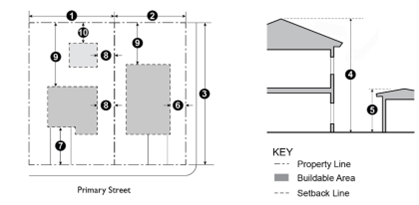
Table 9-200.030-1 prescribes the development standards for the Residential zones. The numbers in the illustration refer to corresponding regulations in the "#" column.
| TABLE 9-200.030-1: DEVELOPMENT STANDARDS—RESIDENTIAL ZONES | |||||||
|---|---|---|---|---|---|---|---|
 | |||||||
| District | R-R | R-VL | R-L | R-M | R-MH | R-H | # |
| Lot and Density Standards | |||||||
| Maximum Density (units/net area) | 1.25 | 2.5 | 7.5 | 12.5 | 18.75 | 50 | |
| Minimum Lot Size (sq. ft.) | 1 acre | 17,500 | 5,000 | 5,000 | 3,000 | 3,000 | |
| Minimum Lot Width (ft.) 5 | 150 | 100 | 50 | 50 | 40 | 40 | ① |
| Corner Lots | 150 | 100 | 60 | 60 | 50 | 50 | ② |
| Minimum Lot Depth (ft.) | 65 | 65 | 65 | 65 | 60 | 60 | ③ |
| Building Form and Location | |||||||
| Maximum Height (ft.) | |||||||
| Dwellings | 40 | 40 | 40 | 40 | 40 | 40 | ④ |
| Accessory Dwelling Unit | 40 | 40 | 40 | 40 | 40 | 40 | |
| Buildings Accessory to Dwellings | 22 2 | 22 2 | 22 2 | 22 2 | 22 2 | 22 2 | ⑤ |
| Other Buildings not Accessory to a Dwelling | 40 | 40 | 40 | 40 | 40 | 40 | |
| Minimum Setbacks (ft.) | |||||||
| Front & Street Side—Regular; Right-of-Way less than 50′ | 30; 55 3 | 30; 55 3 | 20; 45 3 | 20; 45 3 | 15; 40 3 | 15; 40 3 | ⑥, ⑦ |
| Interior Side - Main Structure; Accessory Structures | 15; 10 | 15; 10 | 5; 5 | 5; 5 | 5; 5 | 5; 5 | ⑧ |
|
Rear - Main Structure;
Accessory Structures; Reverse Corner Lots | 30; 15; 15 | 30; 15; 15 | 10; 5; 5 | 10; 5; 5 | 10; 5; 5 | 10; 5; 5 | ⑨, ⑩ |
|
Notes:
1 See Section 9-400.030, Exceptions to Height Limits. 2 If an accessory building includes habitable space on the second floor, the maximum height may be increased up to 40 feet. Additions to existing accessory building with nonconforming setbacks that include an Accessory Dwelling Unit must meet the minimum Accessory Dwelling Unit setbacks. For Accessory Dwelling Unit standards, see Section 9-409.020. 3 Increased setback measured from the centerline of the right-of-way of the road. 4 Minimum lot widths for yards shall be measured at the minimum front setback. | |||||||
(a)
Lot Area and Width.
(1)
Lot Area. The minimum lot area within Residential zones shall be as set forth in Table 9-200.030-1 with the following modifications.
(A)
Major or Minor Subdivisions. For Major or Minor Subdivision applications, the size of individual lots may be reduced to 75 percent of the minimum lot size required by Table 9-200.030-1 and the average lot size for all lots in the proposed subdivision shall be equal to or greater than the minimum lot size required.
(B)
Affordable Housing. Lot sizes for developments providing housing affordable to persons of extremely low, very low, and low income may receive a bonus incentive which provides a reduction in lot size pursuant to Chapter 9-401, Affordable Housing Density Bonus.
(2)
Lot Width. The minimum lot width within Residential zones be as set forth in Table 9-200.030-1 with the following modifications.
(A)
Major or Minor Subdivision. The lot width of individual lots in a Major or Minor Subdivision may be reduced to 70 percent of the minimum lot width required by Table 9-200.030-1, provided the following conditions are met:
(i)
The average lot width for all lots in the proposed subdivision shall be equal to or greater than the minimum lot width required; and
(ii)
Individual corner lots shall not have a width of less than 50 feet.
(B)
Affordable Housing. The lot width for developments providing housing affordable for persons of extremely low, very low, and low incomes may receive a density bonus which provides a reduction in lot width pursuant to Chapter 9-401, Affordable Housing Density Bonus.
(b)
Yards. Yards on lots within Residential zones shall have the minimum dimensions set forth in Table 9-200.030-1, except as modified below:
(1)
Reduction of Required Yards, Developed Areas. Required yards may be reduced in developed areas as follows:
(A)
If more than 50 percent of the block on which the lot sits is developed, the required yard may be reduced to the average of the existing yard dimensions for permitted structures on the block. In no case, however, shall a street side yard be less than 10 feet in width.
(B)
If the lot has less width than the required width specified in Table 9-200.030-1, the side yards may be reduced to 10 percent of the width of the lot, provided the interior side yard is not less than five feet in width and the street side yard is not less than 10 feet in width.
(C)
If a corner lot is less than 50 feet in width, the street side yard may be reduced to 10 feet in width.
(2)
Reduction of Required Yards, Major or Minor Subdivisions. For Major or Minor Subdivision applications, the minimum dimensions for one or more required yards may be reduced or waived for individual lots, provided the following conditions are met:
(A)
The maximum General Plan density is not exceeded;
(B)
The street side yard is not less than 10 feet in width;
(C)
The sum of the dimensions of the side yards shall be equal to or greater than the sum of the dimensions of the side yards required by Table 9-200.030-1; and
(D)
The sum of the dimensions of the front and rear yards shall be equal to or greater than the respective sum of the dimensions of the front and rear yards required by Table 9-200.030-1.
(3)
Development Within Required Yards. The following structures may be located in or extend into required yards, subject to the provisions specified:
(A)
Architectural features, subject to the provisions of Chapter 9-400, General Site Regulations;
(B)
Screening, fencing, and gates, subject to the provisions of Sections 9-400.040, Fencing and Screening, and 9-400.050, Screening of Equipment; and
(C)
Additions to nonconforming single-family dwellings, subject to the provisions of Chapter 9-405, Nonconformity Provisions.
(c)
Affordable Housing. In projects providing housing affordable for persons of extremely low, very low, and low incomes, a density bonus may provide for reductions in the lot and yard dimensions pursuant to Chapter 9-401, Affordable Housing Density Bonus. A streamlined ministerial approval process also is available on request for qualifying affordable housing projects on infill sites; see Section 9-401.110.
(d)
Height. Buildings and structures in the Residential zones shall not exceed the heights set forth in Table 9-200.030-1, except as provided by Chapter 9-400, General Site Regulations; screening devices, including fences, gates, and gate posts, shall comply with the height requirements specified in Section 9-400.040, Fencing and Screening.
(e)
Additional Development Standards - R-M, R-MH, and R-H Zones.
(1)
Transitional Standards. Where an R-M, R-MH, or R-H zone abuts an R-L or R-VL zone and a structure greater than two stories is proposed, the following standards apply:
(A)
The building setback from the R-M, R-MH, and R-H zone boundary shall be 10 feet for side yards and 20 feet for rear yards.
(B)
A landscaped planting area, a minimum of five feet in width, shall be provided along all R-L or R-VL zone boundaries. A tree screen shall be planted in this area with trees planted at a maximum interval of 15 feet.
(2)
Upper Story Stepback. Upper stories of a street facing building with three or more stories shall be stepped back a minimum of 10 feet from the story below. Exceptions may be granted by the Zoning Administrator, provided that an entry courtyard with a minimum depth of 25 feet, landscaping, and seating amenities are provided on the ground level at grade; or other comparable public amenities are provided.
(3)
Parking Setback. Parking for Multi-Unit Residential may be located within the required front setback if the parking area is well screened with a wall, hedge, and/or landscaping.
(4)
Usable Open Space. Private and common open space for outdoor living shall be provided in accordance with the following attributes.
(A)
Private open space shall consist of balconies, decks, patios, fenced yards, and other similar areas directly accessible from a residential unit. Private open space located on the ground level (e.g., yards, decks, and patios) shall have no horizontal dimension less than 10 feet. Private open space located above ground level (e.g., balconies) shall have no dimension less than six feet.
(B)
Common open space shall consist of courtyard entries, landscaped areas, walks, patios, swimming pools, barbeque areas, playgrounds, turf, or other such improvements available to all residents. Common open space shall have no horizontal dimension less than 15 feet.
(C)
All private and common open space shall be designed to be usable, with a surface provided that allows convenient use for outdoor living and/or recreation. Such surface may be any practicable combination of lawn, garden, flagstone, wood planking, concrete, or other serviceable, dust-free surfacing. The slope of these areas shall not exceed 10 percent.
(f)
Residential Development Types. This section provides supplemental standards for small lot single unit, bungalow court, and townhouse development types. The first subsection below establishes the development standards for these residential development types, and the second subsection establishes the procedures for small lot subdivisions where these types of housing can be built. Small lot single units are allowed wherever single-unit dwelling are allowed, and bungalow courts are allowed in zones as shown in Table 9-200.020-1. The townhouse development types are allowed on lots in any zone where multi-unit residential development is allowed pursuant to Table 9-200.020-1.
(1)
Small Lot Single Unit, Bungalow Court, and Townhouse Development Types. Small lot single unit, bungalow court, and townhouse development types are subject to the development standards and supplemental regulations of the base zone unless modified by Table 9-200.030-2.
FIGURE 9-200.030-1: RESIDENTIAL DEVELOPMENT TYPE ILLUSTRATION: SMALL LOT SINGLE UNIT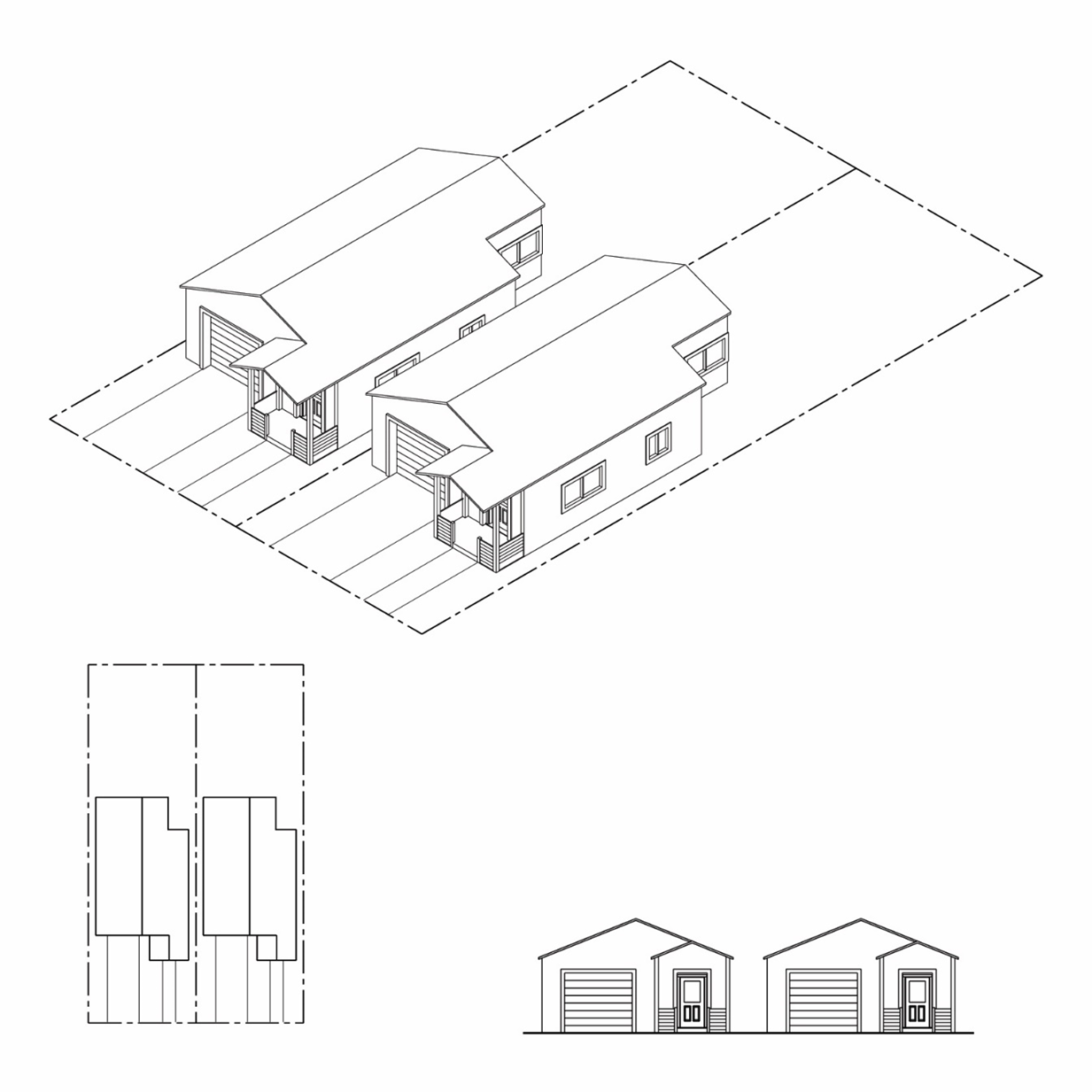
FIGURE 9-200.030-2: RESIDENTIAL DEVELOPMENT TYPE ILLUSTRATION: BUNGALOW COURT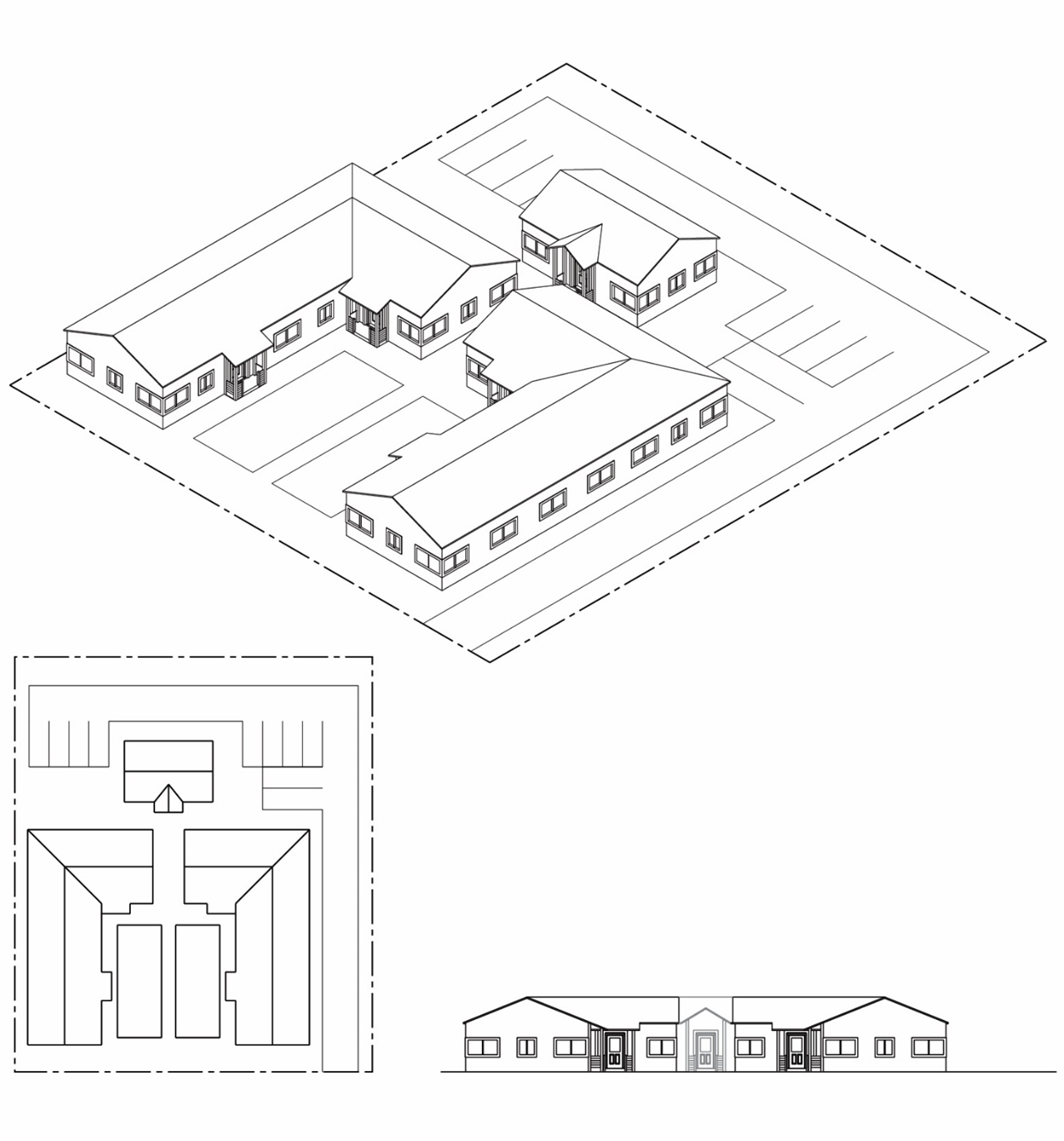
FIGURE 9-200.030-3: RESIDENTIAL DEVELOPMENT TYPE ILLUSTRATION: TOWNHOUSE DEVELOPMENT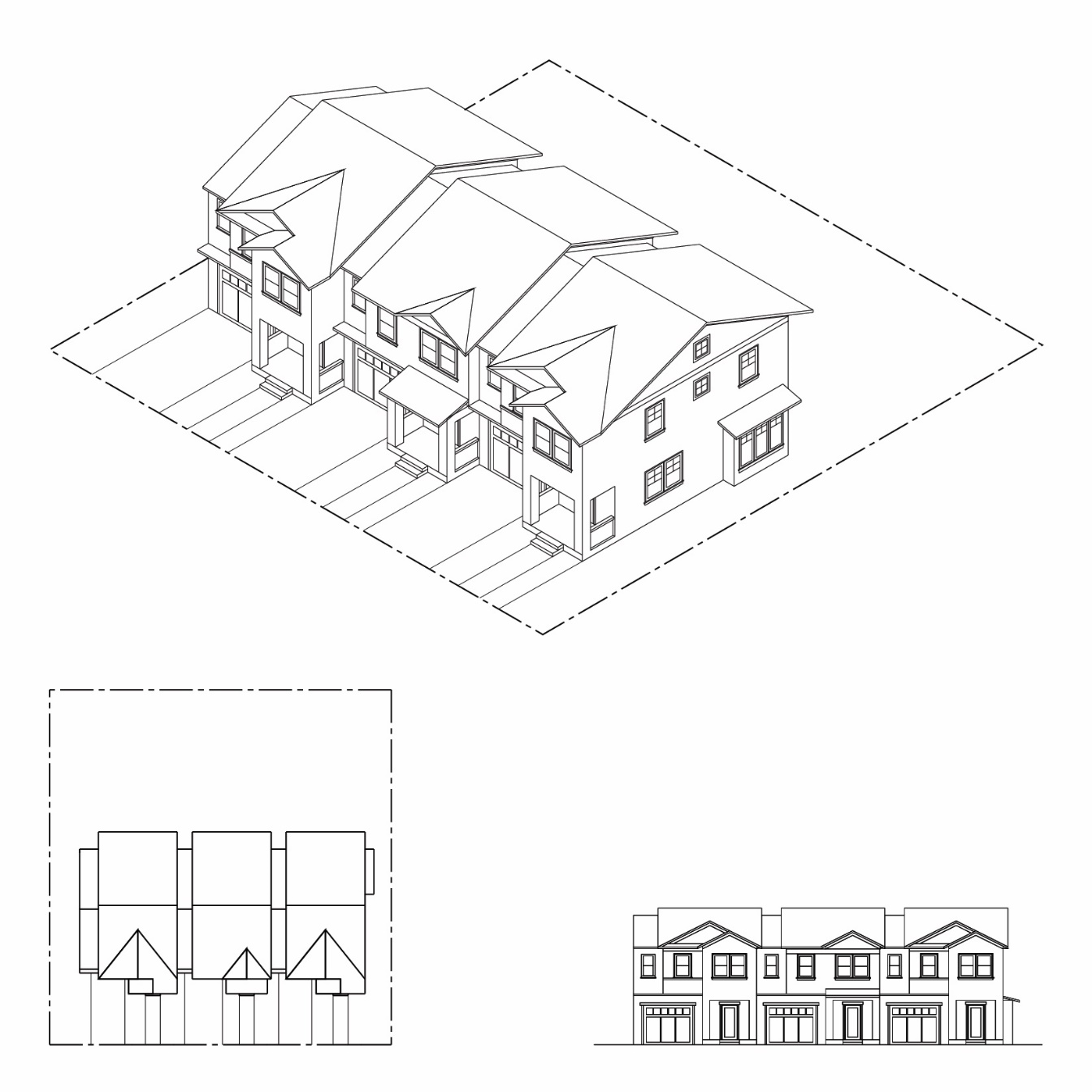
(2)
Small Lot Subdivisions—R-L and R-M Zones. The purpose of this subsection is to provide opportunities to increase the supply of smaller dwelling units and affordable rental housing units in the County by allowing the creation of subdivisions with smaller lots and dwellings. It also is intended to establish development standards for these projects to ensure that they are compatible with the surrounding neighborhood. All of the requirements of the Series 500, Subdivision Regulations, also must be met.
(A)
Location. A small lot subdivision may be proposed and approved on any site within the R-L Zone where such development would be compatible with adjacent uses and the character of the area, and the overall density will not exceed the General Plan maximum unless additional density has been approved under Chapter 9-401, Affordable Housing Density Bonus. A small lot subdivision shall not be allowed where the Planning Commission determines that such compatibility will not occur, public utilities and services are inadequate, or the landform is inappropriate for such development because of grading or impacts on views from adjacent lots.
(B)
Development Types. Small lot subdivisions may be proposed and approved for small lot single unit, bungalow court, and townhouse development developed according to the standards in Section 9-200.030(f), Residential Development Types.
(C)
Lot Standards. The Planning Commission may approve smaller lots than required for the base zone, but no less than 2,400 square feet in area and 30 feet in width, upon finding that the development will be compatible with neighboring uses and will contribute to underserved segments of the County's housing market.
(Ord. No. 4623, §§ 4—6, 5-2-2023; Ord. No. 4632, § 1, 9-26-2023; Ord. No. 4671, § 4, 5-13-2025)
9-200.040 - TWO-UNIT PROJECTS IN THE R-L ZONE
(a)
Purpose and Relationship to Government Code. The purpose of this section is to provide opportunities for two units on one legal parcel in the R-L Zone and on urban lot split lots, created under Section 9-501.040, consistent with State law. In the event of an inconsistency between this section and Government Code Section 65852.21, Government Code Section 65852.21 shall prevail.
(b)
Where Not Permitted. A two-unit residential development project shall not be permitted in any of the following circumstances:
(1)
Parcels located in:
(A)
Wetlands;
(B)
Very high fire severity zones, unless fire hazard mitigation measures have been approved for the parcel pursuant to County building standards or State fire mitigation measures;
(C)
A hazardous waste site, unless the site has been cleared by the State for residential use;
(D)
Delineated earthquake fault zones, unless the development complies with applicable seismic protection standards in the Building Code adopted by the County;
(E)
Special flood hazard areas (100-year flood zones), unless the site has been subject to a FEMA Letter of Map Revision issued to the Floodplain Administrator or Floodplain Administrator determines that the site meets FEMA requirements and minimum flood plain management criteria of the National Flood Insurance Program;
(F)
A regulatory floodway identified in a FEMA map, unless the development has received a "no-rise" certification from the Floodplain Administrator;
(G)
Land identified for conservation in an adopted natural resource protection plan or an adopted habitat conservation plan for protected species or that are subject to a conservation easement; and
(H)
A historic district designated pursuant to Chapter 9-704, Historic Districts and Landmarks, or included in the State Historic Resources Inventory.
(2)
The proposed development would require demolition or alteration of any of the following types of housing:
(A)
Housing that is subject to a recorded covenant, ordinance, or law that restricts rents to moderate, low, or very low incomes;
(B)
A rent-controlled unit;
(C)
A unit that has been occupied by a tenant within the past three years; or
(D)
Housing removed from the rental market within the past 15 years under the Ellis Act.
(3)
The proposed development would result in the demolition of more than 25 percent of the existing exterior structural walls.
(4)
The Zoning Administrator finds that the proposed development would have a specific, adverse impact on public health and safety or the physical environment that cannot be feasibly mitigated or avoided.
(c)
General Requirements. A proposed two-unit project shall comply with the following requirements:
(1)
A two-unit project located in a floodplain shall comply with Chapter 9-702, Flood Hazards.
(2)
A permanent address is required for each Dwelling Unit.
(3)
Applications for building permit, must include written confirmation that the requirements of Chapter 90602, Water Systems, and Chapter 9-604, Wastewater Treatment and Disposal, have been met.
(4)
Any two-unit project legally created under this section shall be governed by the Zoning regulations in effect at the time of approval.
(5)
Two-unit projects on urban lot split lots are subject to the requirements of Section 9-501.040.
(d)
Restrictions. A two-unit project qualifying for development under this section shall be subject to the following restrictions:
(1)
The development and use of the dwelling units shall only be valid and permitted based on the terms established in the Chapter.
(2)
No dwelling unit shall be rented for a period of less than 30 consecutive days.
(3)
On urban lot split lots approved under Section 9-501.040, no accessory dwelling units or junior accessory dwelling units are allowed.
(4)
The owner and all successors in interest in the subject property shall agree to respond to any County survey of owners of residential dwelling units to determine the current use and conformity to the requirements of this Title for purposes of reporting to the State Department of Housing and Community Development (HCD) on implementation of State housing law.
(5)
The owner and all successors in interest in the subject property shall maintain the dwelling units in accordance with all applicable regulations established in this Title. Violations and lack of compliance with any provisions of this Section may result in legal action against the property owner, including revocation of any right to maintain the Dwelling Units on the property, and shall be subject to administrative fines and penalties as established in Chapter 9-815, Enforcement.
(e)
The Ministerial Approval Process.
(1)
The Zoning Administrator shall ministerially review and approve a two-unit application and shall not require a public hearing, provided that the submitted application is complete and demonstrates that the two-unit project complies with the requirements contained in this Title and qualifies for ministerial approval under Government Code Section 65852.21(a).
(2)
Where a qualified two-unit application is submitted with an application for other development work that is subject to discretionary review, the application will be considered separately without discretionary review or a public hearing, following action on the portion of the project subject to discretionary review.
(3)
In addition to obtaining a Zoning Compliance Review for the two-unit project, the applicant shall be required to obtain a building permit, an Administrative Use Permit for tree removal if required by Section 9-400.100, and other applicable construction permits prior to the construction of the dwelling units.
(f)
Development Standards.
(1)
A two-unit project shall conform to all development standards applicable to the R-L Zone, except as expressly provided in this section. If the application of a development standard would require one or both units to be less than 800 square feet, such standard shall be waived to the extent necessary to allow construction of a unit(s) of at least 800 square feet.
(2)
The maximum height of a two-unit project is 25 feet above finished grade to the highest point of the roof. Buildings may be built up to 40 feet if the two-units are consolidated within one structure and comply with the allowable setbacks established for the R-L Zone.
(3)
A two-unit project is considered to be two primary dwelling units where either:
(A)
Both units are greater than 1,000 square feet; or
(B)
The square footage ratio between the two units are no greater than 2:3 (for example, if one unit were 1,200 square feet, the other would need to be at least 800 square feet).
(4)
One-bedroom dwelling units shall not exceed 850 square feet of gross floor area, and the combined square footage of dwelling units in a two-unit project shall not exceed 2,400 or 2,000 square feet on urban lot split lots.
(5)
Useable open space shall be provided as required by Table 9-200.030-2 for Small Lot Single Unit Development and must meet the standards of Section 9-200.030(c)(5), Usable Open Space.
(6)
Minimum required setbacks shall be as follows:
(A)
Front and street side setbacks: 15 feet.
(B)
Interior side and rear setbacks: 4 feet, except in the case of existing structures or structures constructed in the same location and to the same dimensions as an existing structure.
(C)
Double frontage, through lots shall maintain a front setback for the primary frontage containing either the driveway or in association with the orientation of the home. The opposite frontage shall be considered the rear yard.
(D)
Corner lots with frontage on two streets shall maintain a 15-foot front setback for the primary frontage. The setback for the street side yard shall be at least 10 feet.
(7)
Garage doors shall be setback at least 18 feet from a front or street side property line.
(8)
The dwelling units shall include permanent provisions for living, eating, and sleeping, including a kitchen and bedroom closet or other storage.
(9)
Each unit shall have an exterior entry facing the street; an internal connection between the units is not allowed.
(10)
A permanent foundation shall be required.
(g)
Off-Street Parking.
(1)
One off-street parking space is required for each unit, unless the lot is located within one-half mile of a high-quality transit corridor or major transit stop or there is a car share vehicle located within one block of the parcel.
(2)
Each parking space shall be independently accessible and not obstruct access to the other parking space.
(3)
Parking spaces shall be a minimum of 18 feet in length and 9 feet in width.
(4)
Tandem parking is prohibited between units.
(5)
The required parking spaces may be uncovered and provided within the front setback between an existing driveway and the lot line.
(h)
Termination of Use.
(1)
No building permit shall be issued to remove permanent features of the two-unit project, including the provisions for eating, cooking and sanitation, and separate exterior entrance until written approval to terminate the use of living space is granted by the Zoning Administrator.
(2)
At its discretion, the Zoning Administrator may grant an owner's written request to terminate the use of a dwelling unit. The Zoning Administrator shall consider the length of time the unit has been in use, the original conditions of approval, any variances or waivers granted for the unit, and the impact on the County's affordable housing supply.
(3)
As a condition of termination, the Zoning Administrator shall require the owner to make modifications to the property to comply with: 1) current Building Code requirements and 2) current development standards in effect at the time the request is made to terminate use, including but not limited to, setbacks, heights, parking, and landscaping. The owner shall apply for a building permit to make such modifications as required by the County's Building Codes.
9-201.010 - PURPOSE
The specific purposes of the Commercial Zones are to:
(a)
Designate adequate land, consistent with the General Plan, for general commercial uses, including auto service uses, freeway services, rural services, offices, business and personal services, commercial recreation, and entertainment;
(b)
Maintain and strengthen the County's economic and fiscal resources, and provide employment opportunities for residents of the County;
(c)
Establish appropriate development standards and buffering requirements to protect adjacent uses and ensure land use compatibility; and
(d)
Minimize the impacts of commercial development on adjacent residential uses.
The following Commercial zones implement the General Plan's commercial land use classifications.
C-L Zone. The Limited Commercial (C-L) Zone is intended to provide for very small commercial areas that offer a limited selection of convenience goods and services and that serve a portion of an urban neighborhood. This zone provides land for limited commercial uses in residential and industrial land use designations of the General Plan, in accordance with Plan policies.
C-N Zone. The Neighborhood Commercial (C-N) Zone is intended to provide for the development of small retail and service businesses and office uses serving the surrounding residential neighborhood. This zone implements the Neighborhood Commercial land use designation of the General Plan.
C-C Zone. The Community Commercial (C-C) Zone is intended to provide for the development of community-scale shopping centers with a full range of retail and service establishments, allowing comparison shopping and providing goods and services necessary to supply the general or commercial needs of urban communities or regional markets. This zone implements the Community Commercial land use designation of the General Plan.
C-O Zone. The Office Commercial (C-O) Zone is intended to accommodate professional and other offices located adjacent to Medium High and High Density Residential Zones or Commercial zones within Mountain House where offices are appropriate and needed. This zone implements the Office Commercial land use designation of the General Plan.
C-G Zone. The General Commercial (C-G) Zone is intended to provide for commercial areas that offer a wide variety of specialized retail and service uses and offices that are normally developed as separate individual entities rather than as part of a shopping center or business complex, serve urban communities or regional markets, and require relatively large amounts of land. This zone implements the General Commercial land use designation of the General Plan.
C-FS Zone. The Freeway Service Commercial (C-FS) Zone is intended to provide for commercial uses adjacent to freeway interchanges that are oriented almost exclusively to serve the needs of the highway traveler. This zone implements the Freeway Service land use designation of the General Plan.
C-RS Zone. The Rural Service Commercial (C-RS) Zone is intended to provide for retail and service uses within rural communities that are frequently required by rural residents and the surrounding agricultural community. The zone provides for a mix of retail uses, professional offices, and commercial services. This zone implements the Rural Service Commercial land use designation of the General Plan.
C-R Zone. The Commercial Recreation (C-R) Zone is intended to provide areas for major recreation-oriented commercial activities and associated facilities. This zone implements the Commercial Recreation land use designation of the General Plan.
C-X Zone. The Crossroads Commercial (C-X) Zone is intended to provide for a limited variety of retail and service uses and agriculturally related uses at specific intersections to serve rural residents living outside of designated urban and rural communities. This zone is appropriate for small commercial areas within an Agricultural land use designation of the General Plan, in accordance with General Plan policies.
9-201.020 - LAND USE REGULATIONS
TABLE 9-201.020-1 prescribes the land use regulations for the Commercial zones. Use types are defined in Chapter 9-901, Updated Use Type Classifications; key terms used in the classifications are defined in Chapter 9-900, Terms and Definitions. In cases where a specific land use is not defined, the Zoning Administrator shall assign the land use a classification that is substantially similar in character. Use classifications and sub-classifications not listed in the table or not found to be substantially similar to the uses listed in the table are prohibited. Numbered limitations for a specific use in an individual zone ("L1, L2, etc.") refer to limitations listed at the end of the table. The right-hand column in the table includes specific section references for other regulations in this Title, in Chapter 9-409, Standards for Specific Uses and Activities. :hc; TABLE 9-201.020-1: USES IN COMMERCIAL ZONES
(a)
Expansion of Uses and Structures. Uses or structures that require discretionary review may be expanded with a Zoning Compliance Review, provided the following conditions are met:
(1)
The proposed expansion or construction of a structure involves less than a 25 percent increase in the existing, approved floor area, as shown on the most recent land use permit or Zoning Compliance Review on file, but no more than 10,000 square feet;
(2)
The proposed expansion involves less than a 25 percent increase in the developed area of the site; and
(3)
The proposed expansion will not have a substantial, adverse effect on the environment.
(4)
The expansion complies with existing requirements of agencies having jurisdiction and any other appropriate regulatory agency.
Where conditions in Subsections (a)(1) through (a)(4) of this Section are not met, the level of review for the expansion shall be the same as the level of review required in Table 9-202.020-1 for a new use.
(b)
Change in Use. Any change in an existing use to a new use that requires a land use permit shall be permitted without a land use permit, provided the Zoning Administrator finds that the proposed use:
(A)
will have no greater impact than the existing use; and
(B)
occupies the same floor area as the existing use.
(c)
Accessory Uses and Structures. Accessory uses and structures permitted, not permitted, and conditionally permitted are set forth in Table 9-201.020-2 and Section 9-409.040, Accessory Uses. Accessory uses and structures not specifically listed in Table 9-201.020-2 are allowed with a Zoning Compliance Review if the primary use is permitted or with an Administrative Use Permit if the primary use requires an Administrative Use Permit or a Conditional Use Permit. All accessory uses are subject to Section 9-409.040, Accessory Uses.
(d)
Temporary Uses and Structures. Temporary uses and structures permitted, not permitted, and conditionally permitted with a Temporary Use Permit are set forth in Table 9-201.020-3 and Section 9-409.450, Temporary Uses. Temporary uses and structures not specifically listed in Table 9-201.020-3 may be allowed by the Zoning Administrator, subject to the requirements of Section 9-804.080, Temporary Use Permits.
(e)
Additional Use Regulations. In addition to the provisions of Sections 9-201.020 (a) through 9-201.020(b), the following regulations shall apply to Commercial zones:
(1)
Development in General Plan-Designated Open Space/Conservation Areas. See Section 9-706.050, Open Space/Resource Conservation Areas.
(2)
Large Projects. Unless a Conditional Use Permit is required in Table 9-201.020-1, an Administrative Use Permit is required for construction of more than 20,000 square feet of ground floor space for any permitted commercial use.
(3)
Outdoor Sales. See Section 9-409.340.
(4)
Protection of the Delta Primary Zone. See Section 9-706.060. Protection of the Delta Primary Zone.
(5)
Residential Development. In all Commercial zones, Multi-Unit Residential is allowed above the ground level with a Zoning Compliance Review.
(6)
Truck Services in the C-FS Zone. Truck Services - Sales may be permitted in the C-FS zone subject to the following standards:
(1)
Projects sites must be located near legally established truck fuel sales and significant ancillary truck services.
(2)
Trucks are limited to commercial trucks five tons or larger.
(3)
A maximum of ten commercial trucks shall be in inventory and/or displayed at any given time.
(Ord. No. 4623, 7, 8, 5-2-2023; Ord. No. 4632, § 4, 9-26-2023; Ord. No. 4671, §§ 5—8, 5-13-2025)
9-201.030 - DEVELOPMENT STANDARDS
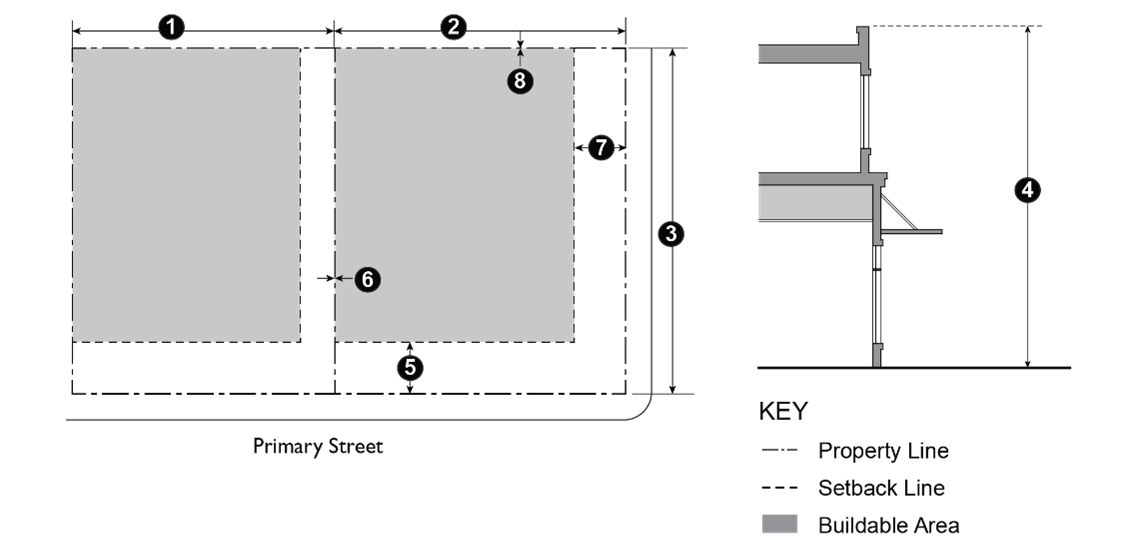
Table 9-201.030 prescribes the development standards for Commercial zones. The numbers in each illustration refer to corresponding regulations in the "#" column in the associated table.
| TABLE 9-201.030: DEVELOPMENT STANDARDS—COMMERCIAL ZONES 1 | ||||||||||
|---|---|---|---|---|---|---|---|---|---|---|
 | ||||||||||
| District | C-L | C-N | C-C | C-O | C-G | C-FS | C-RS | C-R | C-X | # |
| Lot and Density Standards | ||||||||||
| Minimum Lot Size (sq. ft.) | 5,000 | 5,000 | 5,000 | 5,000 | 10,000 | 10,000 | 1 acre | 2 acres | 1 acre | |
| Minimum Lot Width (ft.) | 50 | 50 | 50 | 50 | 100 | 100 | 150 | 150 | 150 | ① |
| Corner Lots | 65 | 65 | 65 | 65 | 125 | 125 | 185 | 185 | 185 | ② |
| Minimum Lot Depth (ft.) | 150 | 150 | 150 | 150 | 150 | 150 | 150 | 150 | 150 | |
| Maximum Floor Area Ratio | 0.6 | 0.6 | 0.6 | 0.6 | 0.6 | 0.6 | 0.6 | 0.5 | 0.6 | ③ |
| Building Form and Location | ||||||||||
| Maximum Height (ft.) | 40 | 40 | 50 | 50 | 50 | 50 | 50 | 50 | 50 | ④ |
| Minimum Setbacks (ft.) | ||||||||||
| Front - Regular; Right-of-Way less than 50' | 20; 45 3 | 20; 45 3 | 20 2 ; 45 3 | 15; 45 3 | 20; 45 3 | 20; 45 3 | 30; 55 3 | 30; 55 3 | 30; 55 3 | ⑤ |
| Interior Side | None | None | None 2 | None | None | None | None | None | None | ⑥ |
| Street Side - Regular; Right-of-Way less than 50' | 20; 45 3 | 20; 45 3 | 20 2 ; 45 3 | 10; 35 3 | 20; 45 3 | 20; 45 3 | 30; 55 3 | 30; 55 3 | 30; 55 3 | ⑦ |
| Rear | None | None | None 2 | None | None | None | None | None | None | ⑧ |
|
Notes:
1 See Sections 9-400.050, Exceptions to Height Limits. 2 Setbacks for yards within the C-C Zone in the unincorporated urban community of Woodbridge shall be as specified in the Woodbridge Design Guidelines. 3 Increased setback measured from the centerline of the right-of-way of the road. | ||||||||||
(a)
Yards. Yards shall have the minimum dimensions set forth in Table 9-201.030, except as modified below.
(1)
Reduction of Required Yards.
(A)
If more than 50 percent of the block on which the lot sits is developed, the required yard may be reduced to the average of the existing yard dimensions of permitted structures on the block. In no case, however, shall a street side yard be less than 10 feet in width.
(B)
If the lot is less than 75 feet in width, the street side yard may be reduced to 10 feet in width.
(C)
If the lot abuts a public or deed-restricted road or private open space, the side and rear yard setbacks may be reduced to five feet.
(2)
Increase in Required Yards. If a side or rear yard abuts a lot developed with conforming residential uses, a lot that is zoned residentially, or a lot shown on the General Plan Map for residential development, the side or rear yard shall be 20 feet in width.
(3)
Development within Required Yards. The following structures may be located in or extend into required yards, subject to the provisions specified:
(A)
Architectural features, subject to the provisions of Chapter 9-400, General Site Regulations;
(B)
Screening, including fences and gates, subject to the provisions of Sections 9-400.040, Fences and Screening, and 9-400.050, Screening of Equipment; and
(C)
Additions to nonconforming single-family dwellings, subject to the provisions of Chapter 9-405, Nonconformity Provisions.
(b)
Height. Buildings within the Commercial zones shall not exceed the heights set forth in Table 9-201.030, except as provided in Chapter 9-400, General Site Regulations; screening devices, including fences, gates, and gateposts, shall comply with the requirements specified in Section 9-400.040, Fences and Screening, and Chapter 9-402, Landscaping.
(c)
Access. All principal uses in the Commercial zones shall have direct access to a publicly maintained road unless alternative access is approved by the Zoning Administrator.
(Ord. No. 4671, § 9, 5-13-2025)
9-202.010 - PURPOSE
The specific purposes of the Industrial zones are to:
(a)
Designate adequate land, consistent with the General Plan, for business use, manufacturing and industrial operations, agricultural industry, oil and gas facilities, research and technology, wholesaling, distribution and related storage, and services supporting industrial growth and agricultural activity;
(b)
Maintain and strengthen the County's economic and fiscal resources, and provide employment opportunities for residents of the County;
(c)
Establish appropriate development standards and buffering requirements to protect adjacent uses and ensure land use compatibility; and
(d)
Minimize the impacts of industrial development on adjacent residents.
The following Industrial zones implement the General Plan Industrial land use classification.
I-W Zone. The Warehouse Industrial (I-W) Zone is intended to accommodate wholesale distribution and warehouses and service establishments catering to those uses whose primary distinguishing features are independence from public sewage disposal systems using septic tanks and the minimal production of industrial wastes. This zone implements the Warehouse Industrial land use designation of the General Plan.
I-P Zone. The Industrial Park (I-P) Zone is intended to allow for the development of a combination of corporate and technology service offices, warehousing, light manufacturing, wholesaling, and professional offices, as well as the services necessary to support those uses. Development standards may be established for this zone to allow for locations near existing and planned residential areas with a minimum of environmental conflict and adverse land use impacts. This zone implements the Limited Industrial land use designation of the General Plan.
I-L Zone. The Limited Industrial (I-L) Zone is intended to provide for light impact manufacturing, warehousing, wholesaling, construction contracting, and distribution uses. Activities within this zone have external physical effects that are generally restricted to the immediate area, are compatible with surrounding uses, are conducted entirely within enclosed buildings. Business and professional offices are permitted within this zone as a secondary use. This zone implements the Limited Industrial land use designation of the General Plan.
I-G Zone. The General Industrial (I-G) Zone provides for a wide range of manufacturing, distribution, and storage uses. Uses within this zone tend to have moderate to high nuisance characteristics, such as noise, heat, glare, odor, and vibration, requiring segregation from other land uses, and/or may require extensive outside storage areas. This zone implements the General Industrial land use designation of the General Plan.
I-T Zone. The Truck Terminals (I-T) Zone is intended to provide locations within one mile of a freeway interchange for the transfer of goods from large freight trucks and trains to smaller local distribution trucks or to consolidate small loads to large freight trucks and trains for delivery to distant locations, and for the storage and transfer of uncontainerized materials. The Truck Terminals zone is limited to areas outside urban and rural communities. It also may not be applied land adjacent to residential, commercial (other than Freeway Service), or Resource Conservation areas designated in the General Plan. This zone implements the Trucking Terminals land use designation of the General Plan.
9-202.020 - LAND USE REGULATIONS
TABLE 9-202.020-1 prescribes the land use regulations for the Industrial zones. Use types are defined in Chapter 9-901, Use Classifications; key terms used in the classifications are defined in Chapter 9-900, Terms and Definitions. In cases where a specific land use or activity is not defined, the Zoning Administrator shall assign the land use or activity a classification that is substantially similar in character. Use classifications and sub classifications not listed in the table or not found to be substantially similar to the uses listed in the table are prohibited. Numbered limitations for a specific use in an individual zone ("L1, L2, etc.") refer to limitations listed at the end of the table. The right-hand column in the table includes specific section references for other regulations in this Title, in Chapter 9-409, Standards for Specific Uses and Activities.
(a)
Expansion of Uses and Structures. Uses or structures that require discretionary review may be expanded with a Zoning Compliance Review, provided the following conditions are met:
(1)
The proposed expansion or construction of a structure involves less than a 25-percent increase in the existing, approved floor area as shown on the most recent land use permit or Zoning Compliance Review on file, but no more than 10,000 square feet;
(2)
The proposed expansion involves less than a 25-percent increase in the developed area of the site; and
(3)
The proposed expansion will not have a substantial, adverse effect on the environment.
(4)
The expansion complies with existing requirements of agencies having jurisdiction and any other appropriate regulatory agency.
Where conditions in Subsections (a)(1) through (a)(4) of this Section are not met, the level of review for the expansion shall be the same as the level of review required in Table 9-202.020-1 for a new use.
(b)
Change in Use. Any change in an existing use to a new use that requires a land use permit shall be permitted without a land use permit, provided the Zoning Administrator finds that the proposed use:
(A)
will have no greater impact than the existing use; and
(B)
occupies the same floor area as the existing use.
The Zoning Administrator reserves the right to require a Zoning Compliance Review in lieu of the land use permit or to allow a minor expansion, as needed.
(c)
Accessory Uses and Structures. Accessory uses and structures permitted, not permitted, and conditionally permitted are set forth in Table 9-202.020-2. Accessory uses and structures not specifically listed in Table 9-202.020-2 are allowed with a Zoning Compliance Review if the primary use is permitted or with an Administrative Use Permit if the primary use requires either an Administrative Use Permit or a Conditional Use Permit. All accessory uses are subject to the requirements of Section 9-409.040, Accessory Uses.
(d)
Temporary Uses and Structures. Temporary uses and structures permitted, not permitted, and conditionally permitted with a Temporary Use Permit are set forth in Table 9-202.020-3 and Section 9-409.450, Temporary Uses. Temporary uses and structures not specifically listed in Table 9-202.020-3 may be allowed by the Zoning Administrator, subject to the requirements of Section 9-804.080, Temporary Use Permits.
(e)
Additional Use Regulations.
(1)
Permits Required. Unless a Conditional Use Permit is required in Table 9-201.020-1, an Administrative Use Permit is required for construction of more than 10,000 square feet of floor area for any permitted commercial use.
(2)
Development in General Plan-Designated Open Space/Conservation Areas. See Section 9-706.050, Open Space/Resource Conservation Areas.
(3)
Outdoor Sales. See Section 9-409.340.
(4)
Outdoor Storage. Outdoor storage of heavy equipment used for agricultural activities on-site is permitted in the I-W and I-G Zones.
(5)
Protection of the Delta Primary Zone. See Section 9-706.060. Protection of the Delta Primary Zone.
(Ord. No. 4623, §§ 9, 10, 5-2-2023; Ord. No. 4632, § 5, 9-26-2023; Ord. No. 4671, §§ 10—12, 5-13-2025; Ord. No. 4683, § 6, 12-9-2025)
9-202.030 - DEVELOPMENT STANDARDS
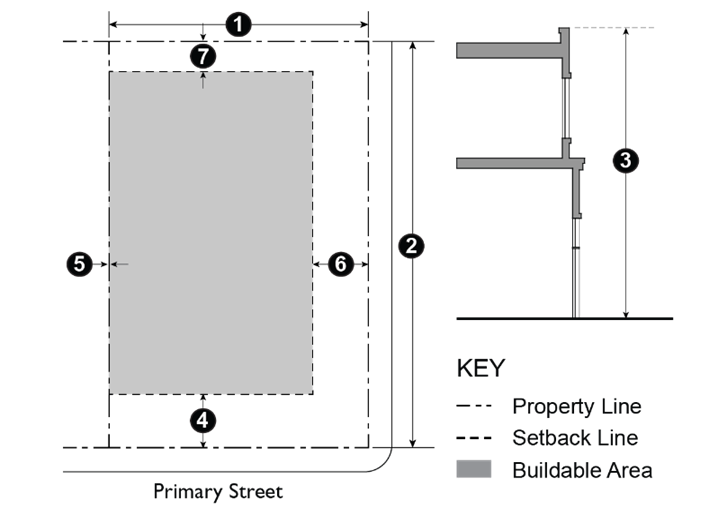
Table 9-202.030 prescribes the development standards for Industrial Zones. The numbers in each illustration refer to corresponding regulations in the "#" column in the associated table.
| TABLE 9-202.030: DEVELOPMENT STANDARDS & INDUSTRIAL ZONES 1 | ||||||
|---|---|---|---|---|---|---|
 | ||||||
| District | I-W | I-P | I-L | I-G | I-T | # |
| Lot and Density Standards | ||||||
| Minimum Lot Size (sq. ft.) | 2 acres | 10,000 | 10,000 | 10,000 | 2 acres | |
| Minimum Lot Width (ft.) | 150 | 100 | 100 | 100 | 150 | ① |
| Corner Lots | 185 | 125 | 125 | 125 | 185 | |
| Minimum Lot Depth (ft.) | 300 | 100 | 100 | 100 | 300 | |
| Maximum Floor Area Ratio | 0.6 | 0.6 | 0.6 | 0.6 | 0.6 | ② |
| Building Form and Location | ||||||
| Maximum Height (ft.) 1 | ||||||
| All Buildings | 100 | 75 | 100 | 100 | 75 | ③ |
| Minimum Setbacks (ft.) | ||||||
| Front - Regular; Right-of-Way less than 50' |
30;
55 2 |
30;
55 2 |
30;
55 2 |
30;
55 2 |
30;
55 2 | ④ |
| Interior Side | None | None | None | None | 10 | ⑤ |
| Street Side | 20 | 20 | 20 | 20 | 20 | ⑥ |
| Rear | None | None | None | None | 10 | ⑦ |
|
Notes:
1 See Sections 9-400.050, Exceptions to Height Limits. | ||||||
(a)
Lot Area and Width. Lots shall have the minimum lot area and minimum width set forth in Table 9-202.030.
(b)
Yards. Yards shall have the minimum dimensions set forth in Table 9-202.030, except as modified below.
(1)
Reduction of Required Yard. Required yards may be reduced as follows:
(A)
If more than 50 percent of the block on which the lot sits is developed, the required yard may be reduced to the average of the existing yard dimensions of the block. In no case, however, shall a street side yard be less than 10 feet in width.
(B)
If the lot is less than 75 feet in width, the street side yard may be reduced to 10 feet in width.
(2)
Increase in Required Yards. If a side or rear yard abuts land developed with conforming residential uses, land zoned residentially, or land shown on the General Plan Map for residential development, the required yard shall be 20 feet in width. The minimum building setback from a Residential zone boundary shall be 15 feet for interior side yards and 20 feet for rear yards.
(3)
Development Within Required Yards. The following structures may be located in or extend within required yards, subject to the provisions specified:
(A)
Architectural features, subject to the provisions of Chapter 9-400, General Site Regulations;
(B)
Screening, including fences and gates, subject to the provisions of Sections 9-400.040, Fencing and Screening, and 9-400.050, Screening of Equipment;
(C)
Additions to nonconforming single-unit dwellings, subject to the provisions of Chapter 9-405, Nonconformity Provisions; and
(D)
Structures adjacent to and associated with railroad spurs.
(c)
Height. Buildings and structures in the Industrial zones shall not exceed the heights set forth in Table 9-202.030-2, except as provided in Section 9-400.020, Building Projections into Required Yards; screening devices, including fences, gates, and gateposts, shall comply with the requirements specified in Chapter 9-402, Landscaping Regulations.
(1)
Where an Industrial zone adjoins a Residential zone, the maximum height shall be 50 feet within 50 feet of the Residential zone boundary.
(d)
Additional Development Standards.
(1)
Access. All principal uses in the Industrial zones shall have access to a publicly-maintained road.
(2)
Landscaping. Where an Industrial zone adjoins a Residential zone, a landscaped planting area, a minimum of 10 feet in width, shall be provided along all Residential zone boundaries. A tree screen shall be planted in this area with trees planted at a minimum interval of 15 feet.
(3)
Drive-In and Drive Through Facilities. See Section 9-409.080.
(4)
Parking Location. Parking shall be located at the side or rear of buildings wherever possible.
(Ord. No. 4671, § 13, 5-13-2025)
9-203.010 - PURPOSE
The specific purposes of the Agricultural zones are to:
(a)
Designate adequate land, consistent with the General Plan, for animal raising, crop production, and related agricultural services supporting the agricultural economy in the County;
(b)
Maintain and strengthen the County's economic and fiscal resources and provide employment and housing opportunities for residents of the County;
(c)
Establish appropriate development standards and buffering requirements to protect adjacent uses and ensure land use compatibility; and
(d)
Minimize the impacts of agricultural development on adjacent residents, while also ensuring the Right-to-Farm.
The following Agricultural zones implement the General Plan classification for agricultural land use:
AG Zone. The General Agriculture (AG) Zone is established to preserve agricultural lands for the continuation of commercial agricultural enterprises. This zone implements the General Agriculture land use designation of the General Plan.
AI Zone. The Agricultural Industry (AI) Zone is established to provide limited dry uses that complement both agricultural and industrial businesses on parcels not considered ideal locations for farming due to size, location, irregular shape, or classification of farmland. This zone implements the Agriculture-Industrial land use designation of the General Plan.
AL Zone. The Limited Agriculture (AL) Zone is intended to recognize and preserve areas for small-scale agricultural operations and dwellings. This zone implements the Limited Agriculture land use designation of the General Plan.
AU Zone. The Agriculture-Urban Reserve (AU) Zone is intended to retain in agriculture those areas planned for future urban development in order to facilitate compact, orderly urban development and appropriate timing and economical provision of services and utilities. This zone implements the Agriculture-Urban Reserve land use designation of the General Plan.
A number included after an agricultural zoning designation annotates the minimum lot size in acres. For example, AU-20 means a 20-acre minimum lot size in that AU zone.
(Ord. No. 4671, § 14, 5-13-2025)
9-203.020 - LAND USE REGULATIONS
Table 9-203.020-1 prescribes the land use regulations for the Agricultural zones. Use types are defined in Chapter 9-901, Use Classifications; key terms used in the classifications are defined in Chapter 9-900, Terms and Definitions. In cases where a specific land use or activity is not defined, the Zoning Administrator shall assign the land use or activity a classification that is substantially similar in character. Use classifications and sub classifications not listed in the table or not found to be substantially similar to the uses listed in the table are prohibited. The right-hand column in the table includes specific section references for other regulations in this Title, in Chapter 9-409, Standards for Specific Uses and Activities.
(a)
Expansion of Uses and Structures. Uses or structures that require discretionary review may be expanded with a Zoning Compliance Review, provided the following conditions are met:
(1)
The proposed expansion or construction of a structure involves less than a 25-percent increase in the approved floor area, as shown on the most recent land use permit or Zoning Compliance Review on file, but no more than 10,000 square feet;
(2)
The proposed expansion involves less than a 25-percent increase in the developed area of the site;
(3)
The proposed expansion will not have a substantial, adverse effect; and
(4)
The expansion complies with existing requirements of agencies having jurisdiction and any other appropriate regulatory agency.
Where conditions in Subsections (1) through (4) of this Section are not met, the level of review for the expansion shall be the same as the review required in Table 9-203.020-1 for a new use.
(b)
Change in Use. Any change in an existing use to a new use that requires land use permit shall be permitted without a land use permit, provided the Zoning Administrator finds that the proposed use:
(A)
will have no greater impact than the existing use; and
(B)
occupies the same floor area as the existing use.
The Zoning Administrator reserves the right to require a Zoning Compliance Review in lieu of the Use Permit or to allow a minor expansion, as needed.
(c)
Accessory Uses and Structures. Accessory uses and structures permitted, not permitted, and conditionally permitted are set forth in Table 9-203.2 Accessory uses and structures not specifically listed in Table 9-203.2 are allowed with a Zoning Compliance Review if the primary use is permitted or with an Administrative Use Permit if the primary use requires an Administrative Use Permit or a Conditional Use Permit. All accessory uses are subject to Section 9-409.040, Accessory Uses.
(1)
Continuation of an Accessory Use. A Revision of Approved Actions to allow the continuation of an accessory use to an existing excavation subject to a Quarry Excavation Permit when the Quarry Excavation Permit is about to lapse shall be subject to the following minimum requirements:
(A)
Application for Revision of Approved Actions. When the Quarry Excavation Permit is about to lapse solely because the mineral resource at an existing excavation subject to a Quarry Excavation Permit is nearly exhausted or has been exhausted, the Permittee may apply to the Community Development Department for a Revision of Approved Actions for the purpose of allowing the continuation of an accessory use if all of the following criteria are satisfied:
(i)
The lapsing of the Quarry Excavation Permit is due to lack of production at the permitted area resulting solely from the exhaustion of the mineral resource being excavated;
(ii)
The Applicant desires the Revision of Approved Actions to continue an authorized accessory use under the lapsing Quarry Excavation Permit;
(iii)
The continuation of the accessory use does not preclude replacement and modification from time to time of obsolete, inefficient, and/or nonfunctional equipment and modernization, including, but not limited to, an increase in hourly production, provided the annual production is not increased;
(iv)
Reclamation of the excavation site subject to the Quarry Excavation Permit, less the area occupied by the accessory use, shall be completed or shall be initiated prior to or simultaneously with the approval of the application for Revision of Approved Actions and shall be completed within two (2) years of the commencement of the reclamation process;
(v)
The area occupied by the accessory use shall be reclaimed within the time permit required by the Revision of Approved Actions, and if there is no such time period requirement in the Revision of Approved Actions, the reclamation process shall be completed within two (2) years of the expiration of the Revision of Approved Actions or within two (2) years of the time that the accessory use ceases to be operated or utilized, whichever comes first;
(vi)
The term of the Revision of Approved Actions allowing continuation of the accessory use shall be determined by an amortization schedule based upon the projected useful life of the accessory use. The term of the Revision of Approved Actions shall not exceed thirty (30) years from the date the Revision of Approved Actions is approved;
(vii)
The continuation of the accessory use will not significantly affect the condition of the site; and
(viii)
The continuation of the accessory use complies with existing requirements of agencies having jurisdiction and any other appropriate regulatory agency as determined by the Director of the Community Development Department.
(B)
Review. If a Revision of Approved Actions is approved pursuant to Subsection (1)(A) of this Section, the site and the accessory use shall continue to be subject to any and all reviews required by the Surface Mining and Reclamation Act. Additionally, should the Revision of Approved Actions require, the Director of the Community Development Department shall review the Revision of Approved Actions, the site, and the accessory use annually or in accordance with any time period specified in the Revision of Approved Actions to determine if the criteria, as set forth in Subsection (1)(A), are being met.
(2)
Owner-Operator Truck Parking as an Accessory Use. Truck parking as an accessory use in an Agricultural zone is permitted with an Administrative Use Permit subject to the following conditions:
(A)
The proposed site for the truck parking is at least three acres in size for one truck and one or two trailers or at least five acres for two trucks and up to four trailers.
(B)
The site fronts on a County-maintained road with a minimum 20-foot width of pavement.
(C)
The owner-operator of the truck(s) must live on the site.
(D)
A minimum 10-foot wide setback shall be maintained between the project site and adjacent properties. If a residence is located on an adjacent parcel within 100 feet of the project site, the setback distance shall be increased to 20 feet.
(E)
All truck parking spaces and major circulation drive lanes shall be surfaced and permanently maintained with all-weather surfacing.
(F)
Only one accessory structure may be permitted for maintenance and repair of the permitted trucks and trailers.
(d)
Temporary Uses and Structures. Temporary uses and structures permitted, not permitted, and allowed with a Temporary Use Permit are set forth in Table 9-203.020-3 and Section 9-409.450, Temporary Uses. Accessory uses and structures not specifically listed in Table 9-203.020-3 may be allowed by the Zoning Administrator, subject to the requirements of Section 9-804.080, Temporary Use Permits.
(e)
Additional Use Regulations. In addition to the provisions of Sections 9-203.020(a) through 9-203.020(c), the following Special Use Regulations shall apply to the uses or use types specified below:
(1)
Commercial Cannabis Uses. The following special use regulations shall apply:
(A)
Cultivation-Locational Criteria. Parcels located in the General Agriculture (AG) Zone shall be located no more than 2,000 feet from a major intersection or arterial road as measured from the closest edge of the parcel to the closest edge of the major intersection or arterial road. A parcel may be located more than 2,000 feet from a major intersection or arterial road if the following are found to be true:
(i)
There is sufficient ease of access from the proposed parcel to an arterial road;
(ii)
There is sufficient access for emergency vehicles; and
(iii)
The Cultivator License applicant demonstrates that the premises can be secured to the satisfaction of the County.
(B)
Distribution. For any operation allowed pursuant to a Distributor License in the AG Zone, a Distributor License and Cultivator License shall be required pursuant to Title 4 for the same lot.
(C)
Manufacturing. For any operation allowed pursuant to a Manufacturer License in the AG Zone, a Manufacturer License and Cultivator License shall be required pursuant to Title 4 for the same lot.
(2)
Development in General Plan-Designated Open Space/Conservation Areas. See Section 9-706.050, Open Space/Resource Conservation Areas.
(3)
Equipment Sales, Repair, and Storage—Leisure, Storage. The following special use regulations shall apply to projects in the AG, AL, AU zones:
(A)
Cannot be located on land designated as prime farmland or under a Williamson Act contract.
(B)
The site fronts a public maintained highway or highway frontage road with a minimum 20-foot width of pavement, or within 500 feet of an approved Recreation facility site along a road with a minimum 20-foot width of pavement.
(C)
Only one accessory structure may be permitted.
(D)
A minimum 10-foot-wide setback shall be maintained between the project site and adjacent properties. If a conforming residence is located on an adjacent parcel within 100 feet of the project site, the setback distance shall be increased to 20 feet.
(4)
Expansion of Existing Uses in the Agricultural Urban Reserve Zones. Existing uses in the Agricultural Urban Reserve (AU) Zone that are consistent with the General Plan may be expanded or changed to other uses that are consistent with the General Plan. If the use is inconsistent with the General Plan, the expansion requires an Administrative Use Permit.
(5)
Explosives Handling. A Conditional Use Permit may be approved for Explosives Handling provided the standards of Section 9-409.210, Explosives Handling, are met and the following findings are made in addition to the required findings in Section 9-804.050, Required Findings:
(A)
The nature of the materials processed and the operational characteristics of the use require a location outside of an urban area as designated on the General Plan.
(6)
Industrial Hemp Production. The following standards shall apply to the cultivation of industrial hemp for commercial and research purposes in the zones where this use type is allowed; see Table 9-203.020-1.
(A)
A person cultivating industrial hemp shall design and construct improvements on the parcel to be used for cultivation in a manner that minimizes impacts, which may include, but are not limited to odor and pollen drift to surrounding areas.
(B)
The minimum size parcel upon which a person cultivating industrial hemp for commercial purposes may cultivate is 20 acres (five acres in the AL Zone).
(C)
Outdoor industrial hemp cultivation in the County shall meet the following setback requirements:
(i)
100 feet from the lot line, unless the hemp cultivation area is adjacent to a hemp cultivation area that is under the legal control of the same owner;
(ii)
1,000 feet from any lot containing a sensitive receptor;
(iii)
200 feet from any residential dwelling unit on an adjacent lot; and
(iv)
200 feet from the lot line of any residentially-zoned land.
(D)
In the AG and AI Zones, indoor cultivation of industrial hemp is limited to the cultivation of hemp transplants, or seed production in a structure dedicated solely to the cultivation of nursery stock. All other indoor cultivation of industrial hemp is prohibited.
(E)
In the AL Zone, indoor cultivation of Industrial Hemp transplants is allowed if:
(i)
There is a pre-existing wholes nursery sales facility on the site;
(ii)
There are no flowering hemp plants of any kind; and.
(iii)
Any mother plant used for the production of hemp transplants that reaches the flowering stage is destroyed in a manner approved by the Agricultural Commissioner.
(F)
In the AG and AI Zones, structures used for indoor cultivation of hemp must meet the following setback requirements:
(i)
50 feet from front, side, and rear lot lines unless the adjacent parcel is under the same ownership in which case the standard setback for the AG Zone is required;
(ii)
1,000 feet from any parcel containing a sensitive receptor; and
(iii)
100 feet from any residential dwelling.
(G)
In the AL Zone, a 30-foot setback from side and rear lot lines must be provided for transplant production unless the adjacent parcel is under the same ownership or control, in which case the standard setbacks for the AL Zone are required.
(7)
Outdoor Sales. See Section 9-409.340.
(8)
Outdoor Storage. Outdoor storage of heavy equipment used for agricultural activities on-site is permitted in the I-W and I-G Zones.
(9)
Protection of the Delta Primary Zone. See Section 9-706.060. Protection of the Delta Primary Zone.
(10)
Truck Services in the AI Zone. Truck Services, Parking and Truck Services, Sales and Repairs may be permitted in the AI zone subject to the following standards:
(A)
Truck Parking may be permitted with a Zoning Compliance Review provided the number of combined truck and trailers is 25 or less and any proposed office space is less than 1,000 square feet in size. For projects exceeding either of these limits, Administrative Use Permit shall be required.
(B)
Truck Sales may be permitted with a Zoning Compliance Review provided the maximum building space proposed with the facility is 12,500 square feet or less. For projects exceeding this limit, an Administrative Use Permit shall be required.
(C)
When both Truck Parking and Truck Sales and Repair uses are proposed on the same site, the level of review shall be determined by the Zoning Administrator and the Director of Public Works.
(D)
A minimum ten-foot-wide setback shall be maintained between the project site and adjacent properties. If a residence is located on an adjacent parcel within 100 feet of the project site property line, the setback distance shall be increased to 20 feet from the property line.
(E)
A minimum six- to eight-foot-tall screen shall be installed along the property line adjacent to truck or trailer parking. Screening may consist of a masonry wall or any solid fencing approved by the Zoning Administrator.
(F)
All maneuvering areas shall be surfaced with all- weather material, as defined and approved by the San Joaquin County Fire Chief's Association. Storage areas for trucks and trailers may be surfaced with gravel or a higher classification surfacing material.
(G)
The first 20 feet of any project driveway shall be surfaced with asphalt concrete or Portland cement concrete to ensure public roadways will be free from debris.
(H)
Traffic Impact Mitigation Fees and Regional Transportation Fees shall be required. These fees are due and payable prior to issuance of a grading or building permit and prior to operation.
(I)
Water Supply Facilities Impact Mitigation Fees shall be required if the project is located within an established Area of Benefit. This fee is due and payable prior to issuance of a grading or building permit and prior to operation.
(J)
An encroachment permit shall be required for all work within the County, City, or Caltrans right of way. The driveway approach shall be improved in accordance with the requirements of the County, City or Caltrans standards prior to operating.
(K)
Storm drainage facilities shall be in accordance with this Title and the County's Improvement Standards.
(L)
If the project site falls within a National Pollutant Discharge Elimination System (NPDES) Phase 1 or Phase 2 regulated area, the project shall comply with the NPDEDS requirements. Calculations shall be submitted and approved by the Department of Public Works—Water Resources Division prior to issuance of a building permit, grading permit, and improvements shall be completed prior to operating.
(11)
Truck Parking in the AL Zone. The Truck Services, Parking Use Type may be conditionally permitted in the AL Zone with an approved Administrative Use Permit subject to the following conditions:
(A)
The trucks are limited in use to hauling agricultural products for the owner and/or third party(s);
(B)
Service of trucks and trailers at the site is limited to routine maintenance;
(C)
The site is located no more than one-half (½) mile from an existing frontage road and no more than one (1) mile from a highway interchange at State Route 99; and
(D)
The parcel size shall be a minimum of five (5) acres.
(Ord. No. 4623, §§ 11—13, 5-2-2023; Ord. No. 4632, § 6, 9-26-2023; Ord. No. 4671, §§ 15—18, 5-13-2025; Ord. No. 4683, § 7, 12-9-2025)
9-203.030 - DEVELOPMENT STANDARDS
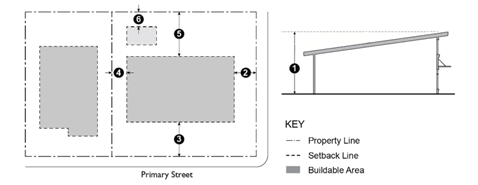
Table 9-203.030 prescribes the development standards for Agricultural zones. The numbers in each illustration refer to corresponding regulations in the "#" column in the associated table.
| TABLE 9-203.030: DEVELOPMENT STANDARDS & AGRICULTURAL ZONES 1 | |||||
|---|---|---|---|---|---|
 | |||||
| AG | AI | AL | AU | ||
| Lot and Density Standards | |||||
| Minimum Lot Size (acres) | 20; 40; 80; 160 | 1 | 5; 10 | 20 | |
| Maximum Lot Site (acres) | None | 20 | None | None | |
| Minimum Lot Width (ft.) 1 | 330 1 | 150 | 200 1 | 330 1 | |
| Maximum Density (units/acre) | - | 0.05 | - | - | |
| Building Form and Location | |||||
| Maximum Height (ft.) 2 | ① | ||||
| Dwellings | 40 3 | 40 3 | 40 3 | 40 | |
| Accessory Dwelling Units | 40 4 | 40 4 | 40 4 | 40 4 | |
| Buildings accessory to dwellings | 40 5 | 40 5 | 40 5 | 22 5 | |
| Other structures | None | None | None | ||
| Minimum Setbacks (ft.) 6, 7, 8 | |||||
|
Front and Street Side Regular;
Right-of-Way less than 50 ft. | 30; 55 8 | 30; 55 8 | 30; 55 8 | 30; 55 8 | ②, ③ |
|
Interior Side—Main Structure;
Accessory Structures | 10 | 10 | 10 | 10 | ④ |
|
Rear—Main Structure; Accessory
Structures; Reverse Corner Lots | 30; 15; 10 | 20; 10; 10 | 30; 15; 10 | 30; 15; 10 | ⑤, ⑥ |
| Interior Side & Rear—Non-residential Accessory Structures | 10 | 10 | 10 | 10 | ⑥ |
|
Notes:
1. For homesite parcels, the minimum lot width shall be 150 feet. 2. See Section 9-400.050, Exceptions to Height Limits. 3. For parcels containing 20 or more acres, there shall be no maximum height for dwellings, and the minimum setback from all lot lines for dwellings over 40 feet in height shall be a minimum of 50 feet. 4. If an accessory building includes habitable space on the second floor, the maximum height maybe increased not to exceed 40 feet. Additions to existing accessory buildings with nonconforming setbacks that include an Accessory Dwelling Unit must meet the minimum Accessory Dwelling Unit setbacks. For Accessory Dwelling Unit standards, see Section 9-409.020 5. The minimum setback from all property lines for dwellings over 40 feet in height with an approved variance or waiver shall be twice the maximum height of the dwelling. 6. Setbacks for yards shall be measured from the planned ultimate right-of-way width of the roadway, as shown on the General Plan or applicable Specific Plan or Master Plan. 7. If a setback reduction is applied for and granted, screening may be required pursuant to Section 9-400.040. | |||||
(a)
Lot Area and Width; Exceptions.
(1)
Lot Area. Lots and homesite parcels in the Agricultural zones shall have the minimum areas set forth in Table 9-203.030 with the following exceptions:
(A)
Homesite Parcels. Homesite parcels may be approved in any agricultural zone, provided that:
(i)
Not more than one homesite parcel may be created from an existing parcel; however, under no circumstances shall the number of parcels resulting from the division exceed the maximum number of parcels permissible under the General Plan density. Lots must meet the minimum lot sizes prior to application for a homesite parcel:
1.
AG Zone: 40 acres;
2.
AL Zone: 10 acres; and
3.
AU Zone: 40 acres with an underlying AU/R General Plan designation and 20 acres for all other General Plan designations.
(ii)
The homesite parcel shall contain two to five acres, and at least one of the property owners shall have owned the property for a minimum of 10 years prior to filing an application to create a homesite parcel. A homesite parcel created from property under Williamson Act contract shall also comply with Section 66474.4 of the Government Code, including that homesite parcel must have contained a residence for a minimum of five years prior to the filing of the application.
(iii)
A Minor Subdivision application proposing the creation of a homesite parcel from an existing parcel shall not be approved if it would adversely affect agricultural operations, as determined by the Zoning Administrator.
(iv)
If a Minor Subdivision application is approved, the homesite parcel which is created shall not be transferred for a period of 10 years following the date of approval or upon the death of an owner unless the homesite parcel and the remainder parcel are merged.
1.
For applications converting a financing homesite parcel to a standard homesite parcel, the 10-year period shall be counted from the date of approval of the financing homesite parcel.
2.
In determining how many homesite parcels have been created from an existing parcel, all homesite parcels shall be counted that were created from an existing parcel as of December 13, 2016, the date of the adoption of the General Plan.
3.
On properties under a Williamson Act contract, there must be at least 10 years between the creation of a homesite parcel prior to December 13, 2016, and a homesite parcel created after this date.
(v)
After the creation of a homesite parcel under this subsection, no further homesite parcels may be created on the remainder parcel except for financing purposes as set forth below, or when the remainder parcel has first been further divided into parcels meeting the zone minimum.
(vi)
Required Notice. Approved homesite parcels and remainder parcels shall have a notice recorded by separate instrument concurrently with the parcel map to indicate the restrictions specified in that subsection. A note shall also be placed on the parcel map indicating these restrictions with a reference to the instrument number of the recorded notice. The restrictions specified in this subsection shall terminate if the subject property is reclassified to a Non-agricultural zone or to an Agricultural zone with a five-acre minimum lot size.
(B)
Financing Homesite Parcels. Homesite parcels created for financing purposes only may be approved in all agricultural Zones, provided that:
(i)
Neither the homesite parcel nor the remainder parcel may be voluntarily transferred separately from the other parcel; however, if an institutional lender forecloses on either parcel, then either parcel may be transferred separately in accordance with the power of sale provisions contained in the deed of trust;
(ii)
Upon repayment of the loan, the owner of the homesite parcel shall merge the homesite parcel with the remainder parcel, as provided for in this Title. Exceptions apply if the owner of the homesite parcel acquired the homesite parcel through a foreclosure action, the owner refinances the loan, of the owner applies for a homesite parcel;
(iii)
The remainder parcel shall remain a non-buildable site for a primary dwelling unit; and
(iv)
All homesite parcels created for financing purposes shall contain two to five acres.
(v)
Required Notice. Approved financing homesite parcels and remainder parcels shall have a notice recorded by separate instrument concurrently with the parcel map to indicate the restrictions specified in that subsection. A note shall also be placed on the parcel map indicating these restrictions with a reference to the instrument number of the recorded notice. The restrictions specified in this subsection shall terminate if the subject property is reclassified to a non-agricultural zone or to an agricultural zone with a five-acre minimum lot size.
(C)
Lots for Certain Specified Uses. Lots containing less area than the minimum required in Table 9-203.030 may be created for the purpose of providing a separate lot for an existing use or a use granted by an Administrative Use Permit or a Conditional Use Permit in the AG Zone, subject to the following conditions:
(i)
The existing use, or a use granted by a permit, is classified under one or more of the following use types:
1.
Agricultural Aerial Services;
2.
Agricultural Industry;
3.
Agricultural Recycling Facilities; Agricultural Sales;
4.
Agricultural Warehousing;
5.
Animal Feeding and Sales;
6.
Animal Care, Sales, and Services - Large Animal;
7.
Assembly;
8.
Farm Machinery Sales or Repair:
9.
Marinas;
10.
Nursery Sales and Landscaping Services;
11.
Park;
12.
Public Safety Facility;
13.
Recreation Facilities;
14.
Stables; or
15.
Utilities.
(ii)
The lot to be created will be reduced to the least area required to conduct the operation;
(iii)
The remainder parcel shall meet the minimum lot area requirements specified in Table 9-203.030;
(iv)
An Accessory Dwelling Unit may be allowed on such resulting parcels only as an accessory use; and
(v)
The proposed subdivision of property complies with Sections 51230.1 and 66474.4 of the Government Code if the property to be divided is under a Williamson Act Contract.
(D)
Dwellings on Same Parcel. Two lots, each containing one Single-Unit Dwelling and each consisting of less area and/or width than required in Table 9-203.030, may be created from an original parcel for the purpose of providing a separate lot for each dwelling, subject to the following conditions:
(i)
The Single-Unit Dwellings were erected prior to February 9, 1961; and
(ii)
The proposed subdivision of property complies with Sections 51230.1 and 66474.4 of the Government Code if the property to be divided is under a Williamson Act Contract.
(E)
Lot-Size Averaging. Lots containing up to 10 percent less area than the minimum area required in Table 9-203.030 may be created from an original parcel, subject to the following conditions:
(i)
The overall average lot area of the proposed subdivision is equal to or greater than the minimum area required in Table 9-203.4; and
(ii)
The proposed subdivision complies with Sections 51230.1 and 66474.4 of the Government Code if the property to be divided is under a Williamson Act Contract.
(2)
Lot Width Exceptions. Lots within Agricultural zones shall not have a width less than that set forth in Table 9-203.030, except that:
(A)
Homesite Parcels and Financing Homesite Parcels. Homesite parcels may have a minimum width of 150 feet, measured at the front yard setback, and not including the portion of a flag lot used solely for a driveway.
(3)
Major or Minor Subdivision. The lot width of individual lots in a Major or Minor Subdivision may be reduced to 90 percent of the minimum lot width required by Table 9-203.030, provided the average lot width for all lots in the proposed subdivision shall be equal to or greater than the minimum lot width required.
(b)
Yard Exceptions. Yards within Agricultural zones shall have the minimum depths set forth in Table 9-203.030 except as modified below:
(1)
Reduction of Required Yards. Required yards may be reduced as follows:
(A)
If a lot has less width than the required width specified in Table 9-203.030, the side yard or street side yard may be reduced to 10 percent of the width of the lot, provided the side yard is not less than four feet in width and the street side yard is not less than 10 feet in width.
(B)
If a lot is less than 75 feet in width, the street side yard may be reduced to 10 feet in width.
(2)
Structures within Required Yards. The following structures may be located in or extend within required yards, subject to the provisions specified:
(A)
Architectural features, subject to the provisions of Chapter 9-400, General Site Regulations;
(B)
Screening, including fences and gates, subject to the provisions of Sections 9-400.040, Fencing and Screening, and 9-400.050, Screening of Equipment;
(C)
Structures adjacent to and associated with railroad spurs.
(c)
Height. Buildings and structures within Agricultural zones shall not exceed the heights set forth in Table 9-203.030 except as provided by Chapter 9-400, General Site Regulations; screening devices, including fences, gates, and gateposts, shall comply with the height requirements specified in Sections 9-400.040, Fences and Screening.
(Ord. No. 4623, § 14, 5-2-2023; Ord. No. 4632, § 7, 9-26-2023)
9-204.010 - PURPOSE
The purpose of this Chapter is to prescribe land use regulations and development standards for the following zones.
P-F Zone. The Public Facilities (P-F) Zone is intended to provide for the establishment of major correctional, medical, and infrastructure facilities; publicly owned recreation facilities and similar facilities and areas; educational facilities for primary, secondary, and higher education; police and fire protection facilities; public facilities and supporting uses in areas where they are most likely to benefit County residents. This zone is intended to implement the Public Facilities land use designation of the General Plan.
M-X Zone. The Mixed-Use (M-X) Zone is intended to provide for activity centers containing a variety of compatible and integrated land uses under a coherent plan. This zone is intended to implement the Mixed-Use land use designation of the General Plan.
AP-X Zone. The Airport Multi-Use (AP-X) Zone is intended to provide for the establishment of a variety of commercial and industrial land uses that are compatible with and supportive of airport operations on or adjacent to the Stockton Metropolitan Airport property. This zone is intended to implement the Airport Multi-Use land use designation of the General Plan.
9-204.020 - LAND USE REGULATIONS
Table 9-204.020-1 prescribes the land use regulations for the P-F, M-X, and AP-X zones. Use types are defined in Chapter 9-901, Updated Use Type Classifications; key terms used in the classifications are defined in Chapter 9-900, Terms and Definitions. In cases where a specific land use or activity is not defined, the Zoning Administrator shall assign the land use or activity a classification that is substantially similar in character. Use classifications and sub classifications not listed in the table or not found to be substantially similar to the uses listed in the table are prohibited. The right-hand column in the table includes specific section references for other regulations in this Title, in Chapter 9-409, Standards for Specific Uses and Activities.
(a)
Expansion of Uses and Structures. Uses or structures that require discretionary review may be expanded with a Zoning Compliance Review, provided the following conditions are met:
(1)
The proposed expansion or construction of a structure involves less than a 25 percent increase in the approved floor area, as shown on the most recent land use permit or Zoning Compliance Review on file. but no more than 10,000 square feet;
(2)
The proposed expansion involves less than a 25 percent increase in the developed area of the site;
(3)
The proposed expansion will not have a substantial, adverse effect; and
(4)
The expansion complies with existing requirements of agencies having jurisdiction and any other appropriate regulatory agency.
Where conditions in Subsections (1) through (4) of this Section are not met, the level of review for the expansion shall be the same as the review required in Table 9-203.020-1 for a new use.
(b)
Change in Use. Any change in an existing use to a new use that requires a land use permit shall be permitted without a land use permit, provided the Zoning Administrator finds that the proposed use:
(1)
will have no greater impact than the existing use; and
(2)
occupies the same floor area as the existing use.
The Zoning Administrator reserves the right to require a Zoning Compliance Review in lieu of the Use Permit or to allow a minor expansion, as needed.
(c)
Accessory Uses and Structures. Accessory uses and structures permitted, not permitted, and conditionally permitted are set forth in Table 9-204.020-2 and Section 9-409.040, Accessory Uses. Accessory uses and structures not specifically listed in Table 9-204.020-2 are allowed with a Zoning Compliance Review if the primary use is permitted or with an Administrative Use Permit if the primary use requires an Administrative Use Permit or a Conditional Use Permit. All accessory uses are subject to Section 9-409.040, Accessory Uses.
(d)
Temporary Uses and Structures. Accessory uses and structures permitted, not permitted, and conditionally permitted with a Temporary Use Permit are set forth in Table 9-204.020-3. Temporary uses and structures not specifically listed in Table 9-204.020-3 may be allowed by the Zoning Administrator, subject to the requirements of Section 9-804.080, Temporary Use Permits.
(e)
Additional Use Regulations.
(1)
Additional Regulations for PF, M-X and AP-X Zones.
(A)
Commercial and Industrial Uses. Unless the permit type is more restrictive, an Administrative Use Permit is required for any commercial or industrial use that:
(i)
Will occupy 10,000 square feet or more in floor area;
(ii)
Has a site area of 10 or more acres; or
(B)
Use of a Zoning Compliance Review—When Allowed. A Zoning Compliance Review shall replace the permit type specified in Table 9-204.020-2 for a given use if a Special Purpose Plan was adopted for the site on which the use is to be located and the use is consistent with that Special Purpose Plan.
(2)
Special Use Regulations in the Mixed-Use Zone.
(A)
Building Use Mix.
(i)
At least 20 percent of the total square footage in a project shall be devoted to residential uses.
(ii)
In at least one main retail block, at least 75 percent of the ground floor frontage shall be retail, restaurants, personal services, or offices for walk-in clientele.
(iii)
Blocks adjacent to the main retail block(s) shall contain round floor frontages with at least 50 percent of the block devoted to:
1.
Retail uses;
2.
Commercial recreation and entertainment services, except radio and television studios;
3.
Eating and drinking establishments; or
4.
Public open space.
(iv)
No surface parking is allowed on the perimeter of the main retail block. All parking shall be in the interior of the block, underground, or in parking structures.
(B)
Public Spaces. There shall be at least one central public space with at least one linear foot of seating capacity per 30 square feet of public space.
(3)
Special Use Regulations in the Public Facilities Zone. In addition to the provisions of Sections 9-204.020(a) through 9-204.020(c), the following Special Use Regulations shall apply in the Public Facilities (P-F) Zone:
(A)
Accessory Uses and Structures. Only accessory residential structures for the owner-operator and/or employees who work on the site shall be permitted.
(B)
Stockton Metropolitan Airport. In addition to the uses permitted in Table 9-204.020-1 for the P-F Zone, additional uses may be permitted with a Special Purpose Plan if the Zoning Administrator finds that the use is an aviation related and consistent with FAA Grant Assurances.
(C)
Veterans Supportive Housing. Veterans Supportive Housing may be permitted in the P-F Zone subject to the following requirements:
(i)
A Zoning Compliance Review shall be required for projects where the total number of cumulative units for Veterans Supportive Housing is equal to or less than 49.
(ii)
An Administrative Use Permit shall be required for projects where the total number of units for Veterans Supportive Housing is equal or greater than 50.
(iii)
The housing shall be located on a site that is within one-half mile of a State or Federal Interstate Highway and one-half mile of a County-owned hospital.
(iv)
The project shall comply with multi-unit residential project landscaping requirements in Chapter 9-402, Landscaping, and parking landscaping requirements in Chapter 9-406, Parking and Loading.
(v)
Signs shall comply with Chapter 9-408, Signs.
(vi)
Veterans Supportive Housing shall be served by public water, sewer, and storm drainage.
(vii)
If, during the course of construction or any grading activity associated with the construction, subsurface cultural resources are uncovered anywhere within the project site, work shall be immediately halted in the vicinity of the finding, and a qualified cultural resources specialist consulted for an on-site evaluation.
(viii)
If artifacts or evidence of materials such as bone, shell, or nonnative stone are uncovered during construction activities, work shall immediately be halted in the vicinity of the finding, and a qualified archaeologist consulted for an on-site evaluation. This evaluation may entail an archaeological test excavation and/or mitigative data recovery.
(Ord. No. 4623, §§ 15, 16, 5-2-2023; Ord. No. 4632, § 8, 9-26-2023; Ord. No. 4671, §§ 19—21, 5-13-2025; Ord. No. 4683, § 7, 12-9-2025)
9-204.030 - DEVELOPMENT STANDARDS
Table 9-204.030 prescribes the development standards for the P-F, M-X, and AP-X Zones. The numbers in each illustration refer to corresponding regulations in the "#" column in the associated table.
| TABLE 9-204.030: DEVELOPMENT STANDARDS—P-F, M-X, AND AP-X ZONES | ||||
|---|---|---|---|---|
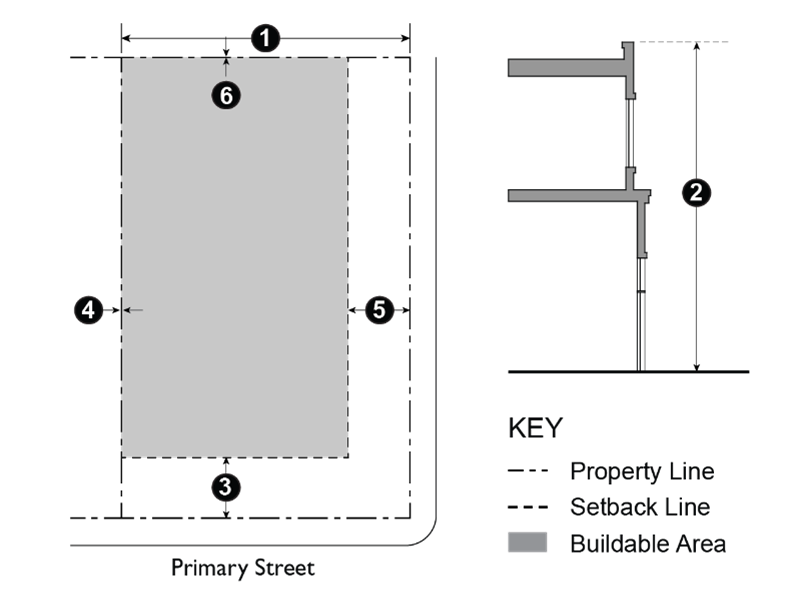 | ||||
| District | P-F | M-X | AP-X | # |
| Lot and Density Standards | ||||
| Minimum Lot Size (sq. ft.) | None | None | None | |
| Minimum Lot Width (ft.) | 100 | None | 100 | ① |
| Building Form and Location | ||||
| Maximum Height (ft.) 1 | 90 | 60 5 | N/A 2 | ② |
| Minimum Setbacks (ft.) 3 | ||||
| Front | 20 | None | N/A 4 | ③ |
| Interior Side | None | None | N/A 4 | ④ |
| Street Side | 20 | None | N/A 4 | ⑤ |
| Rear | None | None | N/A 4 | ⑥ |
| Notes: 1. See Section 9-400.050 or any applicable Special Purpose Plan, for exceptions to height limits. 2. The maximum height within the AP-X Zone shall be as specified in the Stockton Metropolitan Airport Special Purpose Plan. 3. Setbacks for yards shall be measured from the planned ultimate right-of-way width of the roadway, as shown on the General Plan or applicable Specific Plan or Special Purpose Plan. 4. The setbacks for yards within the AP-X Zone shall be as specified in the Stockton Metropolitan Airport Special Purpose Plan. 5. Public buildings may be up to 90 feet in height. | ||||
(a)
Lot Area and Width. Lots shall have the minimum areas and minimum widths set forth in Table 9-204.030.
(b)
Yard Dimensions. Yards shall have the minimum dimensions set forth in Table 9-204.030, except as modified for the Public Facilities Zone as follows:
(1)
Reduction of Required Yards. Required yards may be reduced as follows:
(A)
If more than 50 percent of the block on which the lot sits is developed, the required yard shall be the average of the existing yard dimensions of permitted structures on the block. In no case, however, shall a street side yard be less than 10 feet in width.
(B)
If the lot is less than 75 feet in width, the street side yard may be reduced to 10 feet in width.
(2)
Increase in Required Yards. If a side or rear yard abuts a lot developed with a conforming residential use, a lot zoned residentially, or a lot shown on the General Plan Map for residential development, such side yard shall be increased to 20 feet in width.
(3)
Development within Required Yards. The following structures may be located in or extend within required yards, subject to the provisions specified:
(A)
Architectural features, subject to the provisions of Chapter 9-400, General Site Regulations;
(B)
Screening, including fences and gates, subject to the provisions of Sections 9-400.040, Fences and Screening, and 9-400.050, Screening of Equipment;
(C)
Additions to nonconforming single-family dwellings, subject to the provisions of Chapter 9-405, Nonconformity Provisions; and
(D)
Structures adjacent to and associated with railroad spurs.
(c)
Height. Buildings and structures within the P-F, M-X, and AP-X Zones shall not exceed the heights set forth in Table 9-204.030, except as permitted by Section 9-400.020, Building Projections into Required Yards. Buildings and structures in these zones shall also be subject to the following limitations on height:
(1)
Within airport imaginary surface zones, buildings and structures shall comply with the height restrictions specified by the FAA or by the Stockton Metropolitan Airport regulatory documents.
(2)
In the Airport Multi-Use Zone, buildings and structures shall comply with the height requirements specified in the Stockton Metropolitan Airport Special Purpose Plan.
(3)
Screening devices, including fences, gates, and gateposts, shall comply with the requirements specified in Chapter 9-402, Landscaping.

