
San Rafael City Zoning Code
Division I
GENERAL PROVISIONS
14.01.010 - Title.
This title, Title 14 of the San Rafael Municipal Code, shall be known and cited as "the San Rafael Zoning Ordinance," or, "the zoning ordinance."
(Ord. 1625 § 1 (part), 1992).
14.01.020 - Components.
A.
The zoning ordinance shall consist of the following components:
1.
A map, or set of maps, known as the zoning map, delineating the boundaries of zoning districts within the city of San Rafael;
2.
Regulations, known as zoning regulations, governing the use of land, and placement of buildings and improvements within the various classes of districts. Such regulations shall include, but not be limited to, property development standards for each district, parking standards, performance standards, and procedural rules for administering the ordinance.
B.
A copy of the zoning regulations and the zoning map, together with a record of all amendments, shall be kept on file with the city clerk and shall constitute the original record. A copy of the zoning regulations and zoning map currently in effect shall also be kept on file in the planning department.
3.
The Downtown San Rafael Precise Plan, Form-Based Code and downtown zoning map adopted by separate ordinance and incorporated herein by reference. The Downtown San Rafael Precise Plan and Form-Based Code include certain zoning regulations, governing the land use and placement of building and improvements for those properties within the boundaries of the downtown area, defined by the downtown mixed use district. Where the Downtown San Rafael Form-Based Code is silent on regulations and provisions, the regulations and provisions presented in this Title 14 shall apply.
B.
A copy of the zoning regulations and the zoning map, Downtown San Rafael Precise Plan Form-Based code and downtown zoning map, together with a record of all amendments, shall be kept on file with the city clerk and shall constitute the original record. A copy of the zoning regulations and zoning map currently in effect shall also be kept on file in the community development department and office of the city clerk
(Ord. 1625 § 1 (part), 1992).
(Ord. No. 1996, div. 2(Exh. A, 1.1), 8-16-2021)
14.01.030 - Purposes.
The San Rafael Zoning Ordinance is adopted to promote and protect the public health, safety, peace, comfort and general welfare. The zoning ordinance is also intended to promote the following more specific purposes:
A.
To implement and promote the goals and policies of the San Rafael general plan, so as to guide and manage future development in the city in accordance with such plan;
B.
To foster harmonious and workable relationships among land uses;
C.
To reduce or remove negative impacts caused by inappropriate location, use or design of buildings and improvements;
D.
To protect, strengthen and diversify the economic base of the city;
E.
To promote viable commercial and industrial enterprises that provide diverse employment opportunities for city residents;
F.
To ensure the adequate provision of light, air, space, fire safety and privacy between buildings;
G.
To provide adequate, safe and effective off-street parking and loading facilities;
H.
To promote a safe, effective traffic circulation system, and maintain acceptable local circulation system operating conditions;
I.
To promote design quality in all development and to preserve and enhance the city's existing historic, architectural, and cultural resources;
J.
To preserve and enhance natural resources and key visual features in the community, including the bay shoreline, canal, wetlands, and hillsides;
K.
To protect and conserve the city's existing housing stock;
L.
To promote housing development to meet housing needs, including affordable housing and special housing needs;
M.
To coordinate the service demands of new development with the capacities of existing streets, utilities and public services;
N.
To provide for effective citizen participation in decision-making.
(Ord. 1625 § 1 (part), 1992).
14.02.010 - Organization.
A.
The Zoning Ordinance is divided into five divisions:
I.
General Provisions
II.
Base District Regulations
III.
Overlay District Regulations
IV.
Regulations Applying in All or Several Districts
V.
Administrative Regulations
B.
Three types of zoning regulations control use and development of property:
1.
Land use regulations specify land uses permitted or conditionally permitted in each zoning district, and include special requirements, if any, applicable to specific uses. Land use regulations for base zoning districts are contained in Division II of the zoning ordinance. Land use regulations for overlay districts are contained in Division III of the zoning ordinance. Certain regulations applicable in all or several districts are included in Division IV.
2.
Development regulations control the height, bulk, and location of structures on development sites and establish other development standards. Development regulations for each base zoning district are in Division II of the zoning ordinance; development regulations for overlay districts are contained in Division III. Certain development regulations, applicable in more than one base or overlay district, are contained in Division IV. These include site and use regulations, performance standards for certain uses, and parking and sign regulations.
3.
Administrative regulations contain detailed procedures for the administration of zoning regulations, including requirements for administrative permits, use permits, variances, exceptions, design review permits, zoning ordinance amendments, appeals and enforcement. Administrative regulations are contained in Division V of the zoning ordinance.
(Ord. 1625 § 1 (part), 1992).
14.02.020 - General rules for applicability of zoning regulations.
A.
Applicability to Property. Zoning regulations shall apply to all land within the city of San Rafael, including land owned by the city of San Rafael and other local, state or federal agencies, where applicable. Application of regulations to specific lots shall be governed by the zoning map.
B.
Applicability to Streets and Rights-of-Way. Public streets, utility and other right-of-ways are the boundaries of the zoning districts. In cases where right-of-ways are abandoned, the centerline shall be used as the district boundary.
C.
Compliance with Regulations. No land shall be used, and no structure shall be constructed, occupied, enlarged, altered, or moved in any zoning district except in accord with the provisions of this title.
D.
Public Nuisance. Neither the provisions of this title nor the approval of any permit authorized by this title shall authorize the maintenance of any public nuisance, as defined in Chapter 1.16, Nuisance Abatement, and Chapter 1.20, Nuisances.
E.
Compliance with Public Notice Requirements. Compliance with public notice requirements prescribed by this title shall be deemed sufficient notice to allow the city to proceed with a public hearing and take action on an application, regardless of actual receipt of mailed or delivered notice.
F.
Conflict with Other Regulations. Where conflict occurs between the provisions of this title and any other city code, ordinance, resolution, guideline, or regulation, the more restrictive provision shall control unless otherwise specified in this title.
G.
Relation to Private Agreements. This title shall not interfere with or annul any easement, covenant, or other agreement now in effect, provided that where this title imposes greater restriction than imposed by an easement, covenant, or agreement, this title shall control.
H.
Application During Local Emergency. The city council may authorize deviations from any provision of this title during a local emergency. Such deviations shall be authorized by resolution of the city council, without notice or public hearing.
I.
Severability. If any section, subsection, sentence or phrase of this title is for any reason held to be invalid or unconstitutional by a court of competent jurisdiction, the remaining portions of this title shall not be affected. It is expressly declared that this title and each section, subsection, sentence, and phrase would have been adopted regardless of the fact that one (1) or more other portions of this title would be declared invalid or unconstitutional.
J.
Multiple Development Permit Applications. Where a single development project seeks multiple development permit approvals, some of which require planning commission approval and others of which may only be approved by the city council, the following procedure shall obtain. The planning commission shall conduct a public hearing(s) on all such multiple permit applications, together with appropriate environmental documents and shall recommend action to the city council, which shall have exclusive and final approval authority over such multiple permit applications, and which shall pass on the sufficiency of the appropriate environmental documents related to the applications. The provisions of this section shall supersede any zoning ordinance, subdivision ordinance, development application policy and/or provision of the city's environmental assessment procedures manual to the contrary; provided, however, that nothing contained in this section shall modify or affect in any way the public notice and public hearing requirements related to processing of general plan amendments, environmental and design review permit applications, trip permit applications, use permit applications, subdivision applications, zoning ordinance amendment applications, and/or any other discretionary development application, and any findings requirements applicable to the planning commission in connection with such matters shall be requirements of the city council and not the planning commission.
(Ord. 1647 § 1 (part), 1993; Ord. 1625 § 1 (part), 1992).
14.02.030 - Applicability of land use and development regulations.
A.
Zoning Designation System. Land use and development regulations applicable to specific sites shall be shown on the zoning map by zoning designations consisting of initial letters from the name of each zoning district.
B.
Establishment of Base Zoning Districts. Base zoning districts into which the city is divided are established as follows:
C.
Establishment of Overlay Zoning Districts. Overlay zoning districts, one or more of which may be combined with a base district, are established as follows:
(Ord. 1838 § 15, 2005; Ord. 1625 § 1 (part), 1992).
(Ord. No. 1882, Exh. A, § 2, 6-21-2010; Ord. No. 1996, div. 2(Exh. A, 2.1), 8-16-2021)
14.02.040 - Rules for interpretation—Recordkeeping.
A.
Zoning Map. Where uncertainty exists regarding the boundary of a zoning district, the following rules shall apply:
1.
District boundaries shown as approximately following the property line of a lot shall be construed to follow such property line.
2.
On unsubdivided land, or where a district boundary divides a lot, the location of the district boundary shall be determined by using the scale appearing on the zoning map, unless the boundary location is indicated by dimensions printed on the map.
3.
Any parcels inadvertently not zoned shall be rezoned consistent with the general plan land use designation and surrounding zoning classifications.
B.
Land Use Categories. Land use categories include uses having similar characteristics, but do not specify every use or activity that may appropriately be within the category. The planning director shall determine whether a specific use shall be deemed to be within one or more use category or not within any use in this title. The planning director may determine that a specific use shall not be deemed to be within a use category, whether or not named within the classification, if its characteristics are substantially incompatible with those typical of a specific use. Any new use, or any use that cannot be clearly determined to be in an existing use classification, may be incorporated into the zoning regulations by a zoning ordinance text amendment, as provided in Chapter 14.27, Amendments.
C.
Zoning Regulations. Where uncertainty exists regarding the interpretation of any provision of this title or its application to a specific site, the planning director shall determine the intent of the provision. Where general plan policy indicates a site-specific use not otherwise allowed by the zoning district, that use may be allowed with a use permit, subject to the approval of the planning commission.
D.
Appeals. An interpretation of the zoning map, use classifications, or zoning regulations by the planning director may be appealed to the planning commission, as provided in Chapter 14.28, Appeals.
(Ord. 1663 § 1 (part), 1994; Ord. 1625 § 1 (part), 1992).
14.02.050 - Effect of this title on approved projects and projects in process.
A.
Use permits, variances, design permits, and tentative subdivision maps which are valid on the effective date of the ordinance codified in this title shall remain valid until their expiration date. These projects can be built in accord with the development standards in effect at the time of approval, provided that the use permit or design approval is valid at the time building permits are issued and that such permit is subject to any time limits imposed pursuant to Title 12, Building Regulations.
B.
No provision of this title shall require any change in the plans, construction or designated use of any structure for which a building permit has been issued prior to the effective date of the ordinance codified in this title, or any subsequent amendment of this title.
C.
Any reapplication for an expired permit must meet the standards in effect at the time of reapplication.
D.
Any modification of a use permit or variance, or any major modification of an environmental and design review permit or building permit issued prior to the date of the ordinance codified in this title must conform to the standards in effect at the time of the revised application.
E.
Any minor modification of an environmental and design review permit or building permit issued prior to the date of the ordinance codified in this title may be subject to the standards in effect at the time of the revised application, as determined by the planning director.
F.
Any extension of a use permit must meet the standards in effect at the time of reapplication.
G.
An environmental and design review permit, or of a variance which has been approved as part of an environmental and design review permit, may be extended under the standards in effect at the time of approval up to two (2) years after the effective date of the ordinance codified in this title. Extensions of such permits after two (2) years of the effective date must meet the standards in effect at the time of reapplication.
H.
Projects for which public hearings are not complete prior to the effective date of the ordinance codified in this title shall be subject to the use regulations, development standards, and all other requirements of this title.
(Ord. 1625 § 1 (part), 1992).
14.03.010 - Purpose and applicability.
The purpose of this chapter is to promote consistency and precision in the application and interpretation of zoning regulations. The meaning and construction of words and phrases defined in this chapter shall apply throughout Title 14, except where the context or use of such words or phrases clearly indicates a different meaning or construction intended in that particular case.
(Ord. 1625 § 1 (part), 1992).
14.03.020 - Rules for construction of language.
A.
The particular shall control the general.
B.
Unless the context clearly indicates the contrary, the following conjunctions shall be interpreted as follows:
1.
"And" indicates that all connected words or provisions shall apply.
2.
"Or" indicates that the connected words or provisions may apply singly or in any combination.
3.
"Either...or" indicates that the connected words or provisions shall apply singly but not in combination.
C.
In case of conflict between the text and any illustration, the text shall control.
D.
The word "shall" is mandatory and not discretionary. The words "may" and "should" are permissive and discretionary.
E.
Whenever a personal pronoun is used in the neutral gender, it shall be deemed to include the feminine and masculine also. "They/them" shall indicate a singular individual, unless the context indicates the contrary.
F.
"Including, but not limited to" means that the definition is applicable to the examples that are cited, and to other examples that are not cited, which are deemed to be similar in purpose and consistent with the intent of the definition.
Unless the context clearly indicates the contrary, words in the present and the future tense are interchangeable, and words in the singular and plural are interchangeable.
(Ord. 1625 § 1 (part), 1992).
(Ord. No. 1882, Exh. A, § 3, 6-21-2010; Ord. No. 2033, § 4, 2-20-2024)
14.03.030 - Definitions.
"A.M. peak hour" means the number of vehicular traffic movements entering and exiting a site during the highest volume consecutive sixty (60) minutes in the a.m. peak period from seven a.m. (7:00 a.m.) to nine a.m. (9:00 a.m.) on the local street system.
"Accessory dwelling unit" ("ADU") means an attached or a detached residential dwelling unit that provides complete independent living facilities for one or more persons and is located on a lot with a proposed or existing primary residence. The ADU shall include permanent provisions for living, sleeping, eating, cooking, and sanitation on the same parcel as the single-family or multifamily dwelling is or will be situated. An ADU also includes the following: an efficiency unit, a manufactured home, as defined in Section 18007 of the Health and Safety Code. A junior accessory dwelling unit is considered an ADU subject to additional defined standards. An ADU is not considered to exceed the allowable density for the lot upon which it is located. An ADU is considered a residential use consistent with the general plan and zoning designation for the lot.
"Accessory structure" means a structure detached from a principal building on the same lot and customarily incidental and subordinate to the principal building and use that requires a foundation or structural support on the ground. Accessory structures include, but are not limited to, garages/carports, gazebos, greenhouses, storage sheds, freestanding solar panel arrays, small wind energy systems, cabanas, studios, sport courts, spas, hot tubs and pools. Accessory structure would not include a "tree house" that does not have a foundation support on the ground or require a building permit. See also "Accessory dwelling unit".
"Accessory use" means a use clearly subordinate or incidental and directly related to a permitted use or conditionally permitted use. The general thresholds for considering whether a use is an accessory use include whether the: a) floor area dedicated to the use is less than twenty-five percent (25%) of the total area; b) amount of business, revenue or activity generated by the use is less than twenty-five percent (25%) of the main use; c) hours of operation and intensity of operation are similar to the primary use; and d) uses are composed in separate and demised tenant spaces.
"Addition" means a structure added to the original structure at some time after the completion of the original.
"ADU" see definition for "Accessory Dwelling Unit."
"Affordable housing unit(s)" means those dwelling units as described herein which are required to be rented at affordable monthly rents to very-low, low, and moderate-income households, or purchased at an affordable sales price to low and moderate-income households.
"Affordable monthly housing cost" for ownership units means that no more than thirty-three percent (33%) of household income is required for total housing cost including principal and interest payment on the mortgage, private mortgage insurance payments, property taxes, property insurance and homeowners' association dues.
"Affordable monthly rent" means the monthly rental rate plus a utility allowance for tenant-paid utilities as determined by the Marin Housing Authority that together does not exceed thirty percent (30%) of the monthly income of the specified income level.
"Affordable sales price" means the sales price for an affordable ownership unit as set forth in the below market rate housing agreement between the city and the developer.
"Alteration" means any change or modification in construction.
"Animal care facility" means a use providing grooming, housing, medical care, or other services to animals, including veterinary services, animal hospitals, overnight or short-term boarding ancillary to veterinary care, indoor or outdoor kennels, and similar services.
"Animal keeping" or "keeping of animals" means the ownership, possession, custody, control or sheltering of an animal for fourteen (14) or more consecutive days, by any person on private property for noncommercial purposes.
"Antenna" means any system of poles, panels, rods, reflecting dishes, wires or similar devices used for the transmission or reception of electromagnetic waves or signals.
"Antenna structure" means an antenna array and its associated support structure, such as a monopole or tower.
"Antenna, building-mounted" (also known as facade-mounted) means any antenna mounted to a building or rooftop equipment screen that transmits or receives electromagnetic signals.
"Antenna, ground-mounted" means any antenna which is attached or affixed to a freestanding support structure which has its base placed directly on the ground, specifically including, but not limited to, monopoles or towers.
"Atrium" means a covered entryway or central courtyard, typically open through two (2) or more floor levels, which is nonleasable space and which does not include enclosed stairways, elevators, hallways or similar area.
"Awning sign" means a sign placed on the face or surface of an awning.
"Banks and financial services" means financial institutions including uses such as banks and trust companies, check cashing, credit unions, foreign currency, holding (but not primarily operating) companies, home loan services, lending and thrift institutions, money wiring, mortgage brokers, other investment companies, securities/commodity brokers, contract brokers and dealers, security and commodity exchanges, and vehicle finance (equity) leasing.
"Banner" means a sign not made of rigid material and not enclosed in a rigid frame, and which is secured or mounted so as to allow movement.
"Bed and breakfast inn" means establishments offering lodging on a less than weekly basis, typically in a converted single-family dwelling, with incidental eating and drinking service for lodgers only provided from a single kitchen.
Billiards. See "Poolhall."
"Boarding house" means a structure or portion thereof where rooms and/or meals for three (3) or more nontransient guests are provided for compensation. Such rooms do not include complete cooking and sanitary facilities. Includes single-room occupancy development. Excludes the bona fide sharing of the rent or ownership costs of housing and/or the sharing of expenses for meals.
"Boat docking facility" means a fixed structure, typically made of wood or concrete, connected to land which is used to secure boats and provide dry pedestrian access to land.
"Bonus trip allocation" means nonparcel-specific "extra" trips that are reserved for developments providing significant amounts of affordable housing or needed neighborhood, serving commercial or other specified uses for public benefit.
"Brew pub" means an establishment where beer, ale or malt liquors are produced and served to customers. May also include restaurant services.
"Buffer" means a land area used to separate and/or protect one use from another, or to shield or block noise, lights, or other nuisances.
"Building" means any structure used or intended for supporting or sheltering any use or occupancy.
"Building stepback" means a limitation on the height of structures within the building envelope which is required to avoid excessive building bulk viewed from downhill lots and front and street side elevations.
"Cannabis" means all parts of the plant Cannabis sativa Linnaeus, Cannabis indica, or Cannabis ruderalis, whether growing or not; the seeds thereof; the resin, whether crude or purified, extracted from any part of the plant; and every compound, manufacture, salt, derivative, mixture, or preparation of the plant, its seeds, or resin. "Cannabis" also means the separated resin, whether crude or purified, obtained from cannabis. "Cannabis" does not include the mature stalks of the plant, fiber produced from the stalks, oil or cake made from the seeds of the plant, any other compound, manufacture, salt, derivative, mixture, or preparation of the mature stalks (except the resin extracted therefrom), fiber, oil, or cake, or the sterilized seed of the plant which is incapable of germination. For the purpose of this division, "cannabis" does not mean "industrial hemp" as defined by Section 11018.5 of the Health and Safety Code.
"Cannabis delivery" means the commercial transfer of medicinal cannabis or cannabis products to a customer. "Delivery" also includes the use by a retailer of any technology platform. This sort of use is regulated by the State of California as a Type 9 Cannabis license.
"Cannabis distribution distributor" purchases, sells, arranges for testing, conducts quality assurance review of packaging and labeling, stores/warehouses and transports cannabis goods between medicinal licensees.
"Cannabis manufacturing" means to compound, blend, extract, infuse, or otherwise make or prepare a cannabis product. Manufacturing includes the processes of extraction, infusion, packaging or repackaging, and labeling or relabeling of cannabis products.
"Cannabis testing/lab" means a laboratory, facility, or entity in the state that offers or performs tests of cannabis or cannabis products (either medicinal and adult use) as further defined in SRMC 10.96.040. This sort of use is regulated by the State of California as a Type 8 Cannabis license.
"Caretaker's residence" means a dwelling unit on the site of a commercial, industrial, public or semi-public use, occupied by a guard or caretaker.
"Carport" means a roofed structure providing space for the parking or storage of motor vehicles and enclosed on not more than two (2) sides.
"Changeable copy sign" means a sign which, in part or whole, provides for periodic changes in the sign copy. Examples include signs for an auditorium, theater, church, meeting hall or similar use having changing programs or events, but do not include electronic reader board signs. Signs on which the only change is a periodic price change for the product or products customarily sold on premises and on which the location, size and color of the numbers remain constant are not considered changeable copy signs.
"City" means the City of San Rafael.
"Clinic" means a place where patients are studied or treated by physicians specializing in various ailments and practicing as a group; the dispensary or outpatient department of a hospital or medical school, where patients are treated free or for a small fee; a place where a group of physicians are available for extended hours, on a drop-in basis with no regular patients.
"Club" means a nonprofit association of persons, whether incorporated or unincorporated, organized to pursue common goals, interests or activities, but not including a group organized solely or primarily to render a service customarily carried on as a business.
"Cluster" means a development technique that concentrates buildings in specific areas on the site to allow the remaining land to be used for recreation, common open space and/or preservation of environmentally sensitive features.
"Cocktail lounge" means a use providing preparation and retail sale of alcoholic beverages, on a licensed "on-sale" basis, for consumption on the premises, including taverns, bars and similar establishments where food service is subordinate or accessory to the sale of alcoholic beverages. Cocktail lounge does not include a full service alcohol or beer and wine bar that is established and operated as an accessory use within a full-service restaurant, provided that the bar is integrated within and open to the main dining area, and operating during the same hours as the primary food service use.
"Coin-operated amusement device" means a machine which, upon the insertion of a coin or similar, operates or may be operated for use as a game, contest or amusement of any description, or which may be used for any such game, contest or amusement, and which contains no automatic payoff device for the return of money, coins, tokens or merchandise.
"Co-location" means the location of two (2) or more wireless communication facilities on a single support structure or otherwise sharing a common location. Co-location shall also include the location of wireless communication facilities with other types of preexisting structures, including, but not limited to, water tanks, light standards, outbuildings and other utility facilities and structures.
"Community development director" means the head of the community development department and is synonymous with "planning director," as used in this code.
"Community garden" means any piece of land gardened by a group of people, utilizing either individual or shared plots on private or public land. The land may produce fruit, vegetables, and/or ornamentals. Community gardens may be found in neighborhoods, schools, connected to institutions such as hospitals, and on residential housing grounds subject to defined standards, as specified in Section 14.16.286 of this title. A community garden shall be operated by a public entity or non-profit organization.
"Contractor's yard" means a use providing storage of equipment, materials and vehicles for contractors who are in trades involving construction activities which include, but are not limited to, plumbing, painting, electrical, roofing and carpentry, including incidental services and offices. Contractor's storage yards may include the maintenance and outdoor storage of large construction equipment such as earthmoving equipment, cranes and outdoor storage of building materials.
"Convenience store" means a sales establishment occupying a public retail sales area of generally up to five thousand (5,000) gross square feet, for purpose of selling prepackaged food and beverage products and other retail merchandise oriented to convenience and travelers' shopping needs. Convenience stores are distinguishable from "grocery stores and supermarkets" in that they carry a limited range of items and are typically contained in a smaller retail space (generally, less than five thousand (5,000) gross square feet). See "mini-market" definition for a retail store operated in conjunction with a gasoline station with a retail sales area that is less than one thousand (1,000) gross square feet in size.
"Creek" means a perennial, intermittent or ephemeral open watercourse, which has a defined bed and bank and connect to other water bodies, as shown on the San Rafael General Plan watershed and creeks map. Creek also includes unmapped tributaries to the bay to the point at which they have a defined bed and bank. Creek is distinguishable from a "drainageway."
"Cut" means a portion of land surface or area from which earth has been removed or will be removed by excavation; the depth below the original ground surface or excavated.
"Day care facility" means an existing or proposed building, equipment and any accessory structures in which there are programs and personnel licensed by the state for direct child or adult care services, including, but not limited to, shelter, food, education and play opportunities, for fewer than twenty-four (24) hours per day. There are three (3) basic types or designations of child or adult care facilities:
1.
Family day care home, small (a dwelling unit licensed for the care of eight (8) or fewer children or adults), or as otherwise defined by state law;
2.
Family day care home, large (a dwelling unit licensed for the care of nine (9) to fourteen (14) children or adults), or as otherwise defined by state law;
3.
Day care center (a facility licensed for the care of more than fourteen (14) children or adults).
"Day services center" means a program which provides a wide variety of counseling, referrals, and other nonmedical, nonresidential services daily to more than twelve (12) persons.
"Deck" means a platform requiring ground supports which is roofless and not enclosed, and which is commonly used for recreation purposes.
"Density bonus" means concessions or incentives for additional housing density beyond such regulations contained for residential development within the San Rafael Municipal Code or the San Rafael general plan, for projects that are consistent with the requirements of Government Code Section 65915 and/or Section 14.16.030(H)(1) of the San Rafael Municipal Code.
"Design professional" see definition in San Rafael Municipal Code Section 2.16.040.
"Development" or "development project" means any subdivision, other division of land or condominium conversion; the construction, reconstruction, conversion, structural alteration, relocation or enlargement of any structure; any mining, excavation, landfill or land disturbance; and any change in use or extension of the use of land.
"Directional sign" means any sign, which is designed and erected solely for the purpose of traffic or pedestrian direction and which is placed on the property to provide direction to the public. Such a sign contains no advertising copy.
"Directory sign" means an identification sign listing the tenants of a building, or the bulletin board of a public, charitable, religious, or fraternal institution used to display announcements relative to meetings and activities to be held on the premises and/or displaying the names of the officers of the organization.
"Discount store" means a building or group of buildings typically providing regional market-base discount sales of retail items.
"Dispensary" means a storefront or facility where cannabis, cannabis products, or devices for the use of cannabis or cannabis products are offered, either individually or in any combination, for retail sale.
"Displaced person" means any person: (1) who lawfully occupies rental property as a primary place of residence; (2) whose continued occupancy of the rental property would be inconsistent with a proposed development project; and (3) whose tenancy is terminated by the owner, whether by the owner's termination of the lease or tenancy or the owner's refusal to renew the lease or tenancy, unless the tenancy is terminated because of a default under the lease by the tenant.
"Distribution" means a use engaged primarily in delivery of manufactured products, supplies and equipment, including incidental storage and sales activities.
"Double-faced sign" means a sign consisting of two (2) sign faces, which are placed back-to-back, so that only one sign face is visible from any one location.
"Downtown" encompasses those properties and parcels within the boundaries of the downtown mixed use (DMU) district. The downtown mixed use district encompasses the geographic area presented on the following map:
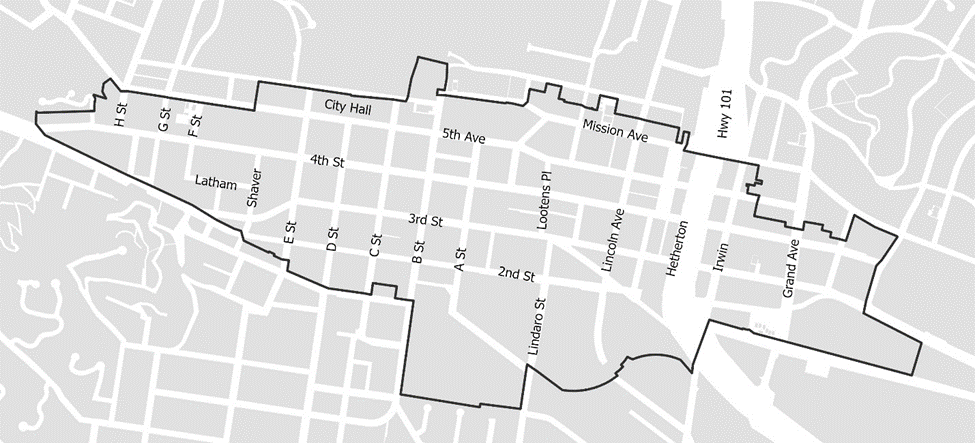
"Downtown parking district" means the area which encompasses the boundary generally between Hetherton and E Streets, and Second Street and Fifth Avenue, as shown on map contain in the Downtown San Rafael Precise Plan adopted by separate ordinance.
"Drainageway" means:
(1)
An open swale or localized depression that lacks defined banks, which transports stormwater to creeks, wetlands or water bodies such as the bay; and
(2)
Man-made open ditches or channels (typically with low habitat value) which drain developed properties. Drainageway is distinguishable from a "creek."
"Driveway" means a private roadway providing vehicular access to dwelling(s), structure(s) or parking spaces.
"Dwelling unit" means one or more rooms designed, occupied or intended for occupancy as separate living quarters for the exclusive use of one household, with a kitchen, sleeping facilities, and sanitary facilities.
Dwelling unit, second. "Second dwelling unit" means an additional, separate dwelling unit meeting defined standards, as specified in Section 14.16.285 of this title, and located on the same lot as a single-family dwelling within a residential district.
"Egress" means an exit.
Emergency shelter for the homeless, permanent. "Permanent emergency shelter for the homeless" means a permanent residential facility operated by a provider which provides emergency housing or temporary accommodations year-round to homeless persons and/or families on a nonprofit basis, and which meets the standards for shelters contained in this title. A facility under this section does not include temporary shelter provided by general relief in the wake of a disaster where assistance by the American Red Cross and/or federal disaster relief is provided.
Emergency shelter for the homeless, temporary or rotating. "Temporary or rotating emergency shelter for the homeless" means a nonprofit temporary or emergency housing facility for individuals and families authorized to operate up to six (6) consecutive months. A facility under this definition does not include temporary shelter provided by general relief in the wake of a disaster where assistance by the American Red Cross and/or federal disaster relief is provided.
"Emergency shelters" means housing as defined under the State Health and Safety Code Section 50801(e); i.e., with minimal supportive services for homeless person(s) that is limited to occupancy of six (6) months or less by a homeless person. No individual or household may be denied emergency shelter because of inability to pay.
Entertainment, live. See "Live entertainment."
"Equipment cabinet" means a cabinet, structure, or building used to house equipment associated with a wireless communication facility.
"Equivalent alternative action" means actions performed by a developer that the city council, in its sole discretion, determines will further the affordable housing goals of the city to an equal or greater extent than compliance with the requirements herein.
"Excavation" means removal or recovery by any means whatsoever of soil, rock, minerals, mineral substances or organic substances other than vegetation, from water or land on or beneath the surface thereof, or beneath the land surface, whether exposed or submerged.
Family day care, large. See "Day care facility."
Family day care, small. See "Day care facility."
"Fast food restaurant" means a facility which specializes in rapidly prepared foods and beverages, served with dispensable (such as paper or plastic) plates and utensils for on- or off-site consumption. Table service is generally limited to delivery of counter-ordered meals and busing. Service to persons in vehicles may be a function of fast food restaurants. Fast food restaurants have high customer volume and high traffic generation, plus one or more of the following elements:
1.
Drive-through service;
2.
Late/early hours of operation (open after eleven p.m. (11:00 p.m.) or before six a.m. (6:00 a.m.));
3.
Potential litter problems;
4.
Noise (for example, from drive-through intercoms);
5.
Potential outdoor gathering places.
"Federal Communication Commission (FCC)" is an independent United States government agency responsible for the regulation of interstate and international communications by radio, television, wire, satellite and cable.
"Fence" means an artificially constructed barrier of any material or combination of materials serving to enclose or screen areas of land.
"Fill" means earth or any other substance or material, including pilings, placed or deposited by humans.
"Financial services" see "Banks and financial services"
"Firearms dealer" means any person licensed to sell, lease or transfer firearms pursuant to California Penal Code Section 12071(a)(1).
"Fitness/recreation facility" means facilities providing equipment and areas for exercise, training, recreation and classes for individuals, groups or both. Examples of these facilities include, but are not limited to: health clubs, gymnasiums, indoor sports facilities, rock climbing facilities, etc. These facilities are primarily drop-in facilities, and may include accessory instructional uses. See "School, specialized education and training" definition for uses primarily involving instructional or educational training.
"Flashing sign" means any sign which is perceived as an intermittent or flashing light. Time and temperature signs are excluded from the category of flashing signs.
"Floor area ratio (FAR)" means the total building square footage (gross floor area) divided by the land area, as further defined in Section 14.16.150, Floor area ratios applicable to nonresidential development.
"Food service establishment" means a business serving food and/or beverages such as a restaurant, café, coffee shop, cocktail lounge or brew pub. Food service establishment is distinguishable from a "food service establishment, high volume" and "fast food restaurant" by volume, food type and/or service.
Food service establishment, high volume. "High volume food service establishment" means a food service establishment over one thousand (1,000) square feet in size which serves more than two hundred (200) lunches daily or equivalent volume at other mealtimes.
"Fortunetelling" means the telling of fortunes, forecasting of future events or furnishing of any information not otherwise obtainable by the ordinary process of knowledge, by means of any occult or psychic power, faculty or force.
"Fractional unit" occurs when the required percentage of affordable housing units results in less than one unit or a combination of affordable housing units and less than one full unit. For example: total number of new units twelve (12) multiplied by the required affordable housing units fifteen percent (15%) results in one full unit and a .80 fractional unit or eighty percent (80%) of a full unit.
"Freestanding sign" means any sign that is designed and constructed as a stand alone structure, which is self-supporting on the ground, not affixed to or attached to a building. Types of freestanding signs include pole or pylon signs and monument signs.
"Frontage, business or use" means the front face or front elevation of a building containing a single business or use that is most parallel to and fronts on a public street, public right-of-way, public parking lot or public parking garage. Frontage width is measured in linear feet.
"Game arcade" means a use with five (5) or more coin-operated amusement devices.
"Garage" means a building or structure, or part thereof, used or intended to be used for the parking and storage of vehicles. Includes public and commercial parking facilities. See also "Carport."
"Gasoline station" means a facility which dispenses automotive fuel to the general public.
"Grade" means the point of elevation as determined by the methods prescribed in the latest edition of the Uniform Building Code adopted by the city.
"Grading" means any cutting or excavation, filling or combination thereof.
"Grocery store and supermarket" means a retail business where the majority of the floor area that is open and accessible to the public is occupied by produce, food and beverage products, and household items that are packaged for preparation and consumption for daily living needs. Grocery stores and supermarkets are distinguished from "convenience stores" in that they typically contain a retail floor area greater than ten thousand (10,000) gross square feet. Smaller grocery stores may occupy a retail floor area between five thousand (5,000) and ten thousand (10,000) gross square feet. Supermarkets generally offer a greater variety of products and household items, and may also include accessory uses within the retail sales area including, but not limited to, a pharmacy, café, or financial services.
Gross building square footage, hillside areas. "Hillside areas gross building square footage" means the sum of all enclosed or covered areas of each floor or all structures on the site, measured to the exterior of the enclosing walls, columns or posts including basement areas, unfinished attic or loft spaces and other areas capable of being finished into habitable space as determined by the California Building Code; garages and carport areas six feet (6') or more above the natural grade, measured to the exterior face of surrounding walls, column, or posts; other roofs or covered areas supported by walls, columns or posts and capable of being enclosed, measured to the exterior face of surrounding walls, columns or posts; roof penthouses; and accessory structures greater than one hundred twenty (120) square feet in floor area. Excluded are areas permanently open to the sky; exterior areas under roof eaves, trellises or cantilevered overhangs and attic spaces and underfloor spaces that are not capable of being finished into habitable space.
"Gun shop" means an establishment or person engaged in the sale, lease or transfer of firearms pursuant to California Penal Code Section 12071(a)(1).
"Handicapped" means a person with a physical or mental impairment which substantially limits one or more of such person's major life activities, a record of having such an impairment or being regarded as having such an impairment, but such term does not include current illegal use of or addiction to a controlled substance (as defined in Section 102 of the Controlled Substances Act (21 U.S.C. 802) as defined in Title VIII of the Civil Rights Act of 1968, as amended by the Fair Housing Amendments Act of 1988).
"Height, downtown mixed use district" means the height of all structures, fences and walls located within the downtown mixed use district measured in accordance with the methodology presented in the Downtown San Rafael Precise Plan Form-Based Code, which is adopted by separate ordinance.
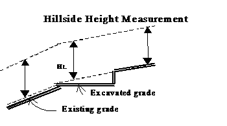
"Height, hillside" means the height of all structures, fences and walls measured vertically from the existing (e.g., natural) grade to the uppermost point of the roof edge, wall parapet, mansard or other feature above the existing grade at any given point. See illustration below.
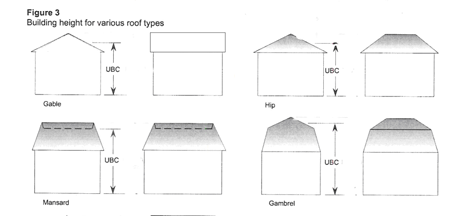
"Height, non-hillside " means the vertical distance above a reference datum measured to
1)
The highest point of the coping of a flat roof or to the deck line of a mansard roof or
2)
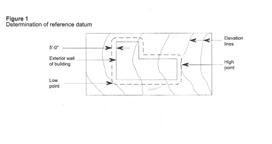
To the average height of the highest pitched roof (see Figure 3 for various roof types.) The reference datum shall be selected by either of the following, whichever yields a greater height of building:
1.
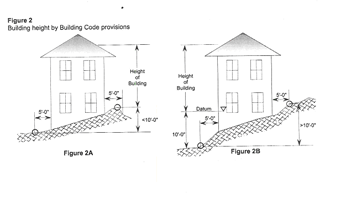
The elevation of the highest adjoining sidewalk or ground surface within a 5-foot horizontal distance of the exterior wall (Figure 1) of the building when such sidewalk or ground surface is not more than ten (10) feet above the lowest adjoining sidewalk or ground surface within a 5-foot horizontal distance of the exterior of the building (see Figure 2A).
2.
An elevation ten (10) feet higher than the lowest grade when the highest adjoining sidewalk or ground surface described in Item 1 above is more than ten (10) feet above lowest grade (see Figure 2B).
The height of a stepped or terraced building may be determined based on the existing grade condition at each distinctive building segment, as determined by the community development director.
"High top of creek bank" means the side of a creek, the top of which shall be the topographic line roughly parallel to the creek centerline, where the side slopes intersect the plane of the ground traversed by the creek. Where the banks do not distinguishably end, the surrounding country being an extension of the banks, the top of such banks shall be determined by the planning director.
"Home occupation" means an accessory use of a dwelling unit, conducted entirely within the dwelling unit, carried on by one (1) or more persons, all of whom reside within the dwelling unit, as further defined in Section 14.16.220, Home occupations, but not including those facilities defined as short-term rentals in Section 14.03.030 of this Code.
"Hospital" means a facility providing medical, psychiatric or surgical services for sick or injured persons primarily on an in-patient basis, including facilities for out-patient and emergency treatment, diagnostic services, training, research and administration, and services to patients, employees or visitors.
"Hotel" means any building or portion thereof designed for compensation, primarily for the accommodation of transient travelers, with eating, drinking, banquet and recreational facilities related to the hotel use, but not including those facilities defined as residential care facilities.
"Household" means one or more persons, whether or not related by blood, marriage or adoption, jointly occupying a dwelling unit in a living arrangement characterized by the sharing of common living areas, including area and facilities for food preparation. Indicia of a separate household include, but are not limited to, one (1) or more of the following: a separate exterior entrance, a separate address, a separate mail box designation, a separate utility service or meter, a separate cable television line, and the existence of a rental advertisement for the separate living quarters immediately preceding their occupancy.
"Identification sign" means a sign which serves to identify only the name, address and lawful use of the occupant, business or use upon which the sign is located, and which may include the emblem or insignia when used by an organization.
"Improvement" means the construction, alteration and repair of all buildings, structures and facilities permanently affixed to real property and appurtenances thereto.
"Informational sign" means a sign which is designed and erected solely for the purpose of communicating information for the safety or convenience of the public. Examples of such signs include no smoking, restrooms or telephone.
"Ingress" means access or entry.
"JADU" see definition for "Junior Accessory Dwelling Unit."
"Junior accessory dwelling unit" ("JADU") means an accessory dwelling unit that is no more than five hundred (500) square feet in size and contained entirely within the walls of a proposed or existing single-family residential space and meets the additional standards provided in section 14.16.285 C.2.
"Kiosk" means a small, freestanding accessory structure used for retail or service uses (see also Section 14.16.225).
"Kitchen" means any portion of a structure equipped, used or intended to be used for the storage, preparation, and cooking of foods with proximal arrangement of two (2) or more of the following: (a) sink (other than that associated with a bathroom), (b) food storage and preparation areas, (c) refrigerator, or (d) cooking appliances including a stove, microwave oven, convection oven, cooking burners or similar appliances. The storage of food in a pantry, freezer or refrigerator located in any area of the structure shall not, by itself, classify such area of the structure as a kitchen.
"Laboratories" means establishments providing medical or dental laboratory services or establishments providing photographic, analytical, or testing services.
"Landscaping" means an area devoted to or developed and maintained with native or exotic plantings including lawn, ground cover, gardens, trees, shrubs or other plant materials; as well as entry areas, courtyards and similar with decorative outdoor landscape elements such as pools, fountains, sculpture, seating and paved or decorated surfaces (excluding driveways, parking, loading, storage areas and sidewalks outside of the entry, courtyard or large planted areas).
"Level of service (LOS)" means a standard qualitative circulation measure describing traffic-operating conditions in terms of speed and travel time, freedom to maneuver, traffic interruptions, comfort and convenience, and safety. Six (6) levels of service are defined, from LOS A, representing the best operating conditions, to LOS F, representing the worst.
"Live entertainment" includes the following activities where they occur as part of a commercial use three (3) or more times during a calendar year:
1.
Bands, dance bands or disc jockeys;
2.
Performances (comedy, music, theatrical, dance) by one or more persons, regardless of whether performers are compensated.
A single performer, such as a singer or pianist providing background music (without billing or advertisement) at a restaurant or bar is exempt from this definition.
"Live/work quarters" means an area comprised of one or more rooms that accommodates joint work activity and residential occupancy, and which includes residential occupancy and work activity, and which includes: (1) working space reserved for and regularly used by one or more of the persons residing therein, and (2) cooking, sleeping and sanitary facilities. All living spaces shall be contiguous with and made an integral part of the working space with direct access between living and working areas.
"Loading space" means an off-street space or berth used for the loading or unloading of commercial vehicles.
Lodges. See "Clubs."
"Lot" means a specific area of land, the boundaries of which have been established according to the legal requirements in effect at the time the lot was created or which has been issued a certificate of compliance.
"Lot area" means the area of the property within the property boundaries as described in the recorded grant deed including any easements, and unaccepted offers and dedications of rights-of-way. Consistent with Section 15.06.030 (subdivision design standards), the panhandle portion of a flag lot that is primarily used and intended for access shall not be included in lot area for purposes of development and application of development standards.
"Lot coverage" means that portion of the lot covered by buildings, including stairways; covered walkways; covered patios; covered parking structures; covered decks or uncovered decks over thirty inches (30") in height; and detached recreational and storage structures that are greater than one hundred (120) square feet in size. Lot coverage excludes residential fences, ground level landscaped areas, walkways and paved areas, uncovered patios and decks thirty inches (30") or less in height, uncovered recreational and uncovered parking and driveway areas, detached garden sheds, tool sheds, playhouses and similar detached accessory structures that do not require a building permit and are not greater than one hundred twenty (120) square feet in size and no taller than eight feet (8') in height, and portions of structures that are located below grade.
"Lot depth" means the horizontal distance from the midpoint of the front lot line to the midpoint of the rear lot line, or to the most distant point on any other lot line where there is no rear lot line.
"Lot line", see "Property line."
"Lot width" means lot area divided by lot depth.
Lot, corner. "Corner lot" means a lot bounded on two (2) or adjacent sides by street lines, providing that the angle of intersection does not exceed one hundred thirty-five degrees (135º).
"Lot, panhandle/flag" means a lot that is served by a narrow strip of land that is primarily intended and used for gaining access to a major portion of the lot or parcel. See Title 15, subdivisions, for regulations addressing the formation of a flag or panhandle lot.
Lot, reverse corner. "Reverse corner lot" means a corner lot, where the rear yard of a lot is adjacent to the side yard of an adjoining lot.
Lounge, cocktail. See "Cocktail lounge."
Low income. See "Affordable housing."
"Low income household" means households earning less than eighty percent (80%) of county median income according to the latest Federal Housing and Urban Development Department income limits table (or similar table provided by the Marin Housing Authority), or as otherwise defined by resolution of the city council.
"Mansard sign" means any sign attached to or supported by a sloped roof element such as a mansard or gable.
"Manufactured home" means a single-family detached structure that is manufactured under the authority of 42 U.S.C. Section 5401, the National Manufactured Home Construction and Safety Standards Act of 1974, and shall include structures known as manufactured homes or mobile homes.
"Marina" means a facility for storing, servicing, fueling, berthing and securing and launching of private pleasure craft or commercial boats, and which may include the sale of fuel and incidental supplies for the boat owners, crews and guests.
"Market rate housing units" means dwelling units in a residential or mixed-use project that are not affordable housing units.
"Marquee sign" means any sign that is on top, attached to the face of or suspended below a marquee, canopy, cantilevered covered walkway, or arcade, whether parallel to or at right angles with the face of the building.
"Massage" and/or "bodywork" means the skillful application of touch, including, but not limited to, pressure, stroking, kneading, compression on, or movement of the external surfaces of the body by a practitioner to produce increased awareness, relaxation, pain relief, injury rehabilitation, or neuromuscular reeducation.
"Massage and/or bodywork office or establishment" means any establishment having a fixed place of business, vehicle or vessel, where any person engages in, conducts, carries on, or permits to be engaged in, conducted, or carried on as regular functions any massage and/or bodywork activities as defined above. Any establishment engaging in or carrying on, or permitting any combination of massage and/or bodywork shall be deemed a massage and/or bodywork office or establishment.
"Massage and/or bodywork practitioner" means any individual who, for any consideration whatsoever, engages in the practice of massage and/or bodywork, whether or not employed on the premises of a massage and/or bodywork office or establishment or acting as an independent contractor or as an owner.
"Median income" means the median household income for the San Francisco Primary Metropolitan Statistical Area (PMSA)—comprised of San Francisco County, San Mateo County and Marin County—as published by the United States Department of Housing and Urban Development (HUD), Office of Economic Affairs, Economic and Market Analysis Division, with adjustments for smaller or larger households made according to HUD's standard adjustment factors for household size, or as otherwise defined by resolution of the city council.
"Medical cannabis" or "medicinal cannabis" means cannabis or a cannabis product, respectively, intended to be sold for use pursuant to the Compassionate Use Act of 1996 (Proposition 215), as further defined by SRMC 10.96.040.
Medical office. See "Office, medical."
"Mini-market" means a retail sales establishment operated in conjunction with a gasoline station, occupying a retail sales area open to the public between one hundred (100) square feet and one thousand (1,000) square feet, for the purpose of selling prepackaged food, beverages and similar small convenience items to gasoline station customers.
"Mixed-use project" means a development in which more than one use is combined in a single building or on a single site.
"Mobile home" means a structure, transportable in one or more sections, with or without a permanent foundation, designed to be used as a dwelling unit and connected to the required utilities. A mobile home does not include a recreational vehicle, motor coach, trailer coach or travel trailer.
"Mobile home lot" means a plot of land for placement of a single mobile home within a mobile home park; a mobile home pad.
"Mobile home park" means a residential facility with two (2) or more mobile home lots available for rent, lease or purchase, and providing services and facilities for the residents.
"Moderate income household" means a household with total gross annual earnings of less than one hundred twenty percent (120%) of median income as defined in this section.
"Monument sign" means a freestanding sign that is supported by a solid base or foundation rather than a pole or post.
"Motel." See "Hotel."
"Motor vehicle repairs and maintenance" means the repair, alteration, restoration, towing, painting, cleaning or finishing of vehicles as a primary use including the incidental wholesale and retail sale of vehicle parts as an accessory use. This use is distinguished by two (2) categories: major repair of vehicles, which includes, but is not limited to, facilities providing major engine work, body work, and vehicle painting; and facilities providing minor repair and maintenance, which includes, but is not limited to, tune-ups, replacement and repair of brakes, batteries, tires, mufflers, and upholstery.
"Multiple copy sign" means a sign which advertises more than one business or use and the principal product or service.
"Multi-tenant sign" means a sign, which displays a list of multiple tenants, businesses or uses in one or more buildings located on one site.
"Mural" means a large painting that is executed directly on or permanently affixed to the surface of a wall depicting, among others, a scene or art.
"Mural sign" means a mural that depicts or includes written script, logo or art that is intended to display or advertise the sale of goods or services shall be considered a sign, subject to the provisions of Chapter 14.19, Signs.
"Nameplate" means a sign containing either or both the name of the occupant or building and the address of the site.
"Natural state" means all portions of lots that remain undeveloped and undisturbed. Grading, excavating, filling and/or the construction roadways, driveways, parking areas and structures are prohibited. Incidental minor grading for hiking trails, bicycle paths, equestrian trails, picnic areas and planting and landscaping which enhances the natural environment are permitted when approved through an environmental and design review permit.
Needed neighborhood-serving use. For the purposes of bonus trip allocations, "needed neighborhood-serving uses" consist of those needed service uses identified in a neighborhood plan, the general plan or as determined by resolution of the planning commission and/or city council.
"Nonconforming structure" means a structure or building, the size, dimensions or location of which was lawful prior to the adoption of this title or any subsequent revision or amendment, but which fails by reason of such adoption, revision or amendment to conform to the present requirements of the zoning district.
"Nonconforming use" means a use or activity which was lawful prior to the adoption of this title, or any subsequent revision or amendment of this zoning ordinance, but which fails by reason of such adoption, revision or amendment to conform to the present requirements of the zoning district.
"Office, administrative" means an office-type facility used for administrative purposes, and/or occupied by a business engaged in the production of intellectual property. Examples of these uses include, but are not limited to, advertising agencies, commercial art and design services, construction contractors (office facilities only), design services including architecture, engineering, landscape architecture, urban planning, educational, scientific and research organizations, media postproduction services, news services, photography studios, and writers' and artists' offices.
"Office, business" means an establishment providing direct services to consumers. Examples of these uses include, but are not limited to, employment agencies, insurance agent offices (small-scale customer service offices, not administrative), real estate offices, travel agencies, utility company payment offices (not administrative). This use does not include banks and financial services, which are separately defined.
Office, general. "General office" means a use providing administrative, professional or business services.
Office, medical. "Medical office" means a facility, other than a hospital, where medical, dental, mental health, surgical, and/or other personal health care services are provided on an outpatient basis. A medical office use would provide consultation, diagnosis, therapeutic, preventative or corrective treatment services by doctors, dentists, medical and dental laboratories, chiropractors, counselors, physical therapists, respiratory therapists, acupuncturists and psychiatrists, and similar practitioners of medical and healing arts for humans licensed for such practice by the state of California. Medical office uses typically require use of specialized medical equipment and medical training to evaluate, diagnose and administer treatments, medication or therapies which require a prescription (including administering oxygen or performing dialysis, and sleep diagnostics facilities); increased support staff needs; multiple patient treatment rooms; and patient waiting areas. Counseling services and other services provided by nonmedical professionals may also be included under "offices, general."
"Office, professional" means an office-type facility occupied by a business providing professional services. Examples of these uses include, but are not limited to, accounting, auditing and bookkeeping services, attorneys, counseling services, court reporting services, detective agencies and similar services, financial management and investment counseling, literary and talent agencies, management and public relations services, psychologists, secretarial, stenographic, word processing and temporary clerical employee services.
"Official sign" means a sign required by a governmental body that is to discharge its legally required functions.
"On-site" means located on the lot that is the subject of an application for development.
"Open space" means any lot or area of land or water essentially unimproved and set aside, dedicated, designated or reserved for public or private use or enjoyment, or for the use and enjoyment of owners and occupants of land adjoining or neighboring such open space.
"Open water" means submerged lands lying below 4.5 NGVD (mean sea level datum) and/or as shown on the San Rafael zoning map.
"Outdoor eating area" means any outdoor eating area used in conjunction with a food service establishment.
"Outdoor storage" means the keeping in an unroofed area of any goods, junk, material, merchandise or vehicles in the same place for more than twenty-four (24) hours.
"Overhang" means the part of a roof or wall which extends beyond the facade of a lower wall.
"Owner or operator" (also "provider or service provider") means the person, entity or agency primarily responsible for installation and maintenance of a wireless communication facility, which may or may not be the same person or entity which is the owner of the property on which the facility is located.
"P.M. peak hour trip" means the number of vehicular traffic movements entering and exiting a site during the highest volume consecutive sixty (60) minutes in the p.m. peak period from four p.m. (4:00 p.m.) to six p.m. (6:00 p.m.) on the local street system.
Parcel. See "Lot."
"Parking access" means the area of a parking lot that allows motor vehicles ingress and egress from the street.
"Parking area" means any public or private land area designed and used for parking motor vehicles, including, but not limited to, parking lots and garages.
Parking facility. See "Parking area."
"Parking lot" means an off-street, ground level area, usually surfaced and improved, for the temporary storage of motor vehicles.
"Parking space" means a space for the parking of a motor vehicle within a public or private parking area.
"Pedestrian-oriented design" means design qualities and elements that contribute to an active, inviting street-level environment, making the area a safe and attractive place for pedestrians.
"Performance standards" mean a set of criteria or limits relating to nuisance elements which a particular use or process may not exceed.
"Personal service" means provision of service of a personal nature. This classification includes, but is not limited to, barber and beauty shops, nail/manicure shops, dry cleaners, tailors, shoe repair shops, cosmetologist, skin-care consultant, esthetician, massage/bodywork and acupressure.
"Planning director" is synonymous with "community development director," as used in this Code.
"Pole or pylon sign" means a freestanding sign that is supported by a pole or post.
"Poolhall" means any use with two (2) or more billiard tables.
"Portable sign" means a sign that is constructed or designed to roll, slide or be moved from one location to another. Examples of portable signs include, but are not limited to, an A-frame sign and an I-frame sign.
"Private yard area" means a usable outdoor area adjoining a unit and intended for the private enjoyment of the occupants of the unit. Private yard area shall be defined such that its boundaries are evident. Private yard area may include balconies, decks, patios or porches.
Project. See "Development."
"Projecting or blade sign" means any sign, which projects from the face of a building and is supported by brackets, a projecting post or frame that is anchored to the building face. A blade sign is a small projecting sign.
"Property line" means the recorded boundary of a lot or parcel of land. When two (2) property lines meet or join at an angle that is greater than one hundred thirty (130) degrees, they are considered the same property line for the purpose of defining one (1) yard area and determining required yard setbacks.
"Public access" means permanent pedestrian, bicycle and/or vehicular access in or adjacent to natural amenities for study or enjoyment.
"Public improvement" means any improvement, facility or service together with its associated public site or right-of-way necessary to provide transportation, drainage, public or private utilities, energy or similar essential services.
Recreation facility. "Recreational facilities" may include, but are not limited to, community centers, swimming or wading pools, spas, court facilities (such as tennis, basketball, or volleyball), picnic or barbecue areas and enclosed tot lot facilities with play equipment.
"Related equipment" means all equipment ancillary to the transmission and reception of any signal via radio frequencies. Such equipment may include, but is not limited to, cable, guy wires, conduit, conductors and power lines and their supporting poles associated with a wireless communication facility.
"Religious institution" means a use located in a permanent building and providing regular or organized religious worship and religious education incidental thereto, but excluding a private educational facility. A property tax exemption obtained, pursuant to the Constitution of the State of California and of the Revenue of Taxation Code of the State of California, shall constitute prima facie evidence that such use is a religious institution as defined herein. Religious institution includes a seminary, retreat, monastery and conference center of similar use for the conduct of religious activities, including accessory housing incidental thereto, but excluding a private educational facility.
"Relocation assistance" means the provision of rental assistance to low-income residential unit tenants that are: a) required to vacate a dwelling unit due to unit renovation, conversion or demolition proposed in conjunction with a development project or property improvements; and b) permanently displaced from the premises by a landlord or property owner, where the tenant is required to seek and secure new housing. A permanently displaced resident qualifying for relocation assistance shall be a tenant of record listed either on a current lease or rental agreement that meets the County of Marin criteria as a low-income household. Relocation assistance is administered under Section 14.16.279 of this Title.
"Research and development facility" means a use engaged in study, testing, design and analysis, and experimental development of products, processes or services, including incidental manufacturing of products or provision of service to others.
"Research and development industry" means establishments primarily engaged in the research, development and controlled production of high-technology electronic, industrial or scientific products or commodities for sale, but prohibits uses that may be objectionable in the opinion of the hearing body, by reason of production of offensive odor, dust, noise, vibration, or storage of hazardous materials. This classification includes biotechnology firms, and manufacturing of nontoxic computer components.
"Research and development services" mean establishments primarily engaged in industrial or scientific research, including limited product testing. Includes electron research firms or pharmaceutical research laboratories, but excludes manufacturing, except of prototypes, or medical testing and analysis.
Residential care facility, large. "Large residential care facility" means a dwelling unit licensed by the state to serve seven (7) or more clients, which provides twenty-four (24) hour nonmedical care of persons in need of personal services, supervision or assistance essential for sustaining the activities of daily living or for the protection of the individual.
Residential care facility, small. "Small residential care facility" means a dwelling unit licensed by the state to serve six (6) or fewer clients which provides twenty-four (24) hour nonmedical care of persons in need of personal services, supervision, or assistance essential for sustaining the activities of daily living or for the protection of the individual.
"Residential development project" means a project for the construction or placement of a dwelling unit or an accessory dwelling unit, manufactured home, or a mixed-use development as defined in this section or the subdivision of land for a residential development project or a mixed use project.
"Residential, duplex" means one (1) structure on a single lot containing two (2) dwelling units, each of which is functionally separate from the other. This definition includes use of a duplex unit(s) as a household for "transitional housing" and "supportive housing" as defined under the State Health and Safety Code.
"Residential, multifamily" means medium and high density residential development, including a "transitional housing development" or "supportive housing" as defined under State Health and Safety Code Section 50675.2 (and subsequent amendments), containing three (3) or more attached dwelling units in one (1) or more structures located on a single parcel or common lot.
"Residential nameplate" means a plate of metal, glass, wood, etc., bearing a person's name, such as is often placed on or near the door of a dwelling or mailbox.
"Residential, single-family" means low density residential development containing one (1) primary residential "dwelling unit" for use by a single household on a single parcel. This definition includes use of a single-family dwelling and/or accessory dwelling unit as a household for "transitional housing" or "supportive housing" as defined under the California Health and Safety Code.
"Retaining wall" means a wall that is constructed to hold back or support an earthen bank, slope or hillside.
Reverse corner lot. See "Lot, reverse corner."
"Ridgeline" means a line following the long axis of a ridge (e.g., a long, narrow, conspicuous elevation of land) or knoll, comprised of the points of the highest ground elevation in locations that have been identified on the ridgeline map (aka, "City of San Rafael Ridgeline Map" on file with the planning division). For purposes of review under the -H hillside overlay zoning regulations, a "visually significant ridgeline" shall include the area within one hundred (100) vertical feet of a ridgeline as identified on the San Rafael Ridgeline Map and located within "visually significant hillside, ridges and landforms areas" as designated on the community design map exhibit of the general plan.
"Riparian" means vegetation which is located adjacent to a watercourse or drainageway.
"Roof signs" mean any sign erected upon or above a roof or parapet wall of a building or placed above the apparent flat roof or eaves of a building or the top of a mansard roof.
Rooming house. See "Boarding house."
School, parochial or private. "Parochial or private school" means any building or group of buildings, the use of which meets state requirements of primary, secondary or higher education and which does not secure the major part of its funding from any governmental agency.
"SB 9 housing development" means a development in compliance with the provisions of SB 9 HOME Act of SRMC Section 14.16.282 that contains no more than two (2) primary dwelling units.
School, parochial or private. "Parochial or private school" means any building or group of buildings, the use of which meets state requirements of primary, secondary or higher education and which does not secure the major part of its funding from any governmental agency.
"School, specialized education and training" means private school uses offering instruction in areas such as, but not limited to, art, business trade, dance, computers and electronics, drama, driver's education, language, music, performing arts, sports (e.g., individual or group golf or baseball, etc.) or vocational trades. Does not include preschools and child day care facilities (see "day care centers").
"Seasonal outdoor eating area" means any outdoor eating area used in conjunction with a food service establishment which is operated only during the months of March through November. Seasonal outdoor eating areas shall have only temporary, movable perimeter barriers, fixtures and sunshades.
"Senior housing" means residential development designed for households occupied by senior citizens. Any age restrictions must be consistent with federal and state requirements. Such development may include central recreation areas and accessory medical facilities.
"Service provider" means any authorized provider or carrier of wireless communications services.
"Setback" means the distance between the property line and the exterior wall of a structure, excluding architectural features and other structures referenced in Section 14.16.130 of this title. Building setbacks are measured from established lot lines, irrespective of location of easements. See also definition for "yard".
"Shopping center" means a group of commercial establishments, planned, developed, owned or managed as a unit, with off-street parking provided on the site.
"Shopping mall" means an enclosed group of commercial establishments, planned, owned or managed as a unit, with covered, common-gathering areas and off-street parking provided on the site.
"Short-term rental" means the rental of all or a portion of a dwelling unit for less than thirty (30) days consecutive tenancy.
"Sign" means any medium for visual communication, which is used or intended to be used to attract attention to a location, use, or subject matter for advertising, instruction, information or identification purposes. Seasonal decorations, such as holiday greetings and displays that do not include advertising, are not defined as a sign and are not subject to the provisions of this chapter.
"Sign program" means a program providing a coordinated signing plan for one (1) or more businesses or uses located on one (1) site or several contiguous sites, which utilizes one (1) or more common elements such as color, materials, lettering, illumination, sign type and sign shape.
Single-room occupancy development. See "boarding house."
"Site" means a lot or lots used as a unit for the development of a project which may consist of one (1) or more buildings.
Slope, average. The average slope of a parcel shall be calculated using the following formula:
S= .00229 IL / A
Where S is the average percent of slope; .00229 is the conversion factor for square feet; I is the interval in feet; L is the summation of length of the contour lines in scale feet; and, A is the area of the parcel in acres.
"Small lot" means a legally subdivided lot in a given zone which is smaller in width and/or area than minimum requirements now required in the given zone.
"Small wind energy system" means a wind energy conversion system consisting of a freestanding or roof mounted wind turbine and associated control or conversion electronics which is intended to produce energy for use primarily on site.
"Small wireless facility" means a small wireless facility as defined by the FCC and that meets the following requirements:
A.
Meet one (1) of the following mounting requirements:
1.
Are mounted on structures fifty feet (50′) or less in height including their antennas as defined in Section 1.1320(d), or
2.
Are mounted on structures no more than ten percent (10%) taller than other adjacent structures, or
3.
Do not extend existing structures on which they are located to a height of more than fifty feet (50′) or by more than ten percent (10%), whichever is greater;
B.
Each antenna associated with the deployment, excluding associated antenna equipment (as defined in the definition of antenna in Section 1.1320(d)), is no more than three (3) cubic feet in volume;
C.
All other wireless equipment associated with the structure, including the wireless equipment associated with the antenna and any pre-existing associated equipment on the structure, is no more than twenty-eight (28) cubic feet in volume.
Antenna equipment, means equipment, switches, wiring, cabling, power sources, shelters or cabinets associated with an antenna, located at the same fixed location as the antenna, and, when collocated on a structure, is mounted or installed at the same time as such antenna.
"Specialty retail" means stores which sell nonconvenience goods needed on an infrequent basis. Specialty retail may have a more limited focus in specific zoning districts, consistent with the purposes of each district.
Specialty retail, bulk. "Bulk specialty retail" means the sale of large, major purchase, nonconvenience items. Examples of specialty retail involving bulk retail goods include, but are not limited to, the following: appliance stores; motor vehicle sales, new or used; furniture stores; spa/hot tub sales.
"Specialty retail, consistent with industrial uses" mean the retail sales of items which are related, supportive or complimentary to industrial uses. Examples include, but are not limited to, sales of the following: auto parts and supplies; building materials and supplies; motor vehicles, new or used.
"Specialty retail, consistent with office uses" mean the retail sales of items which are related, supportive or complimentary to office uses. Examples include, but are not limited to, sales of the following: computers; office furniture (sales or rentals); office supply and business machine shops.
Specialty retail, region-serving. "Region-serving specialty retail" means those retail uses which have a regional, rather than local or neighborhood, market base. These types of uses are generally high tax revenue generators and more than fifty thousand (50,000) square feet in size. Examples include, but are not limited to, the following: discount stores, large scale; furniture stores; home improvement stores; motor vehicle sales, new.
"Stealth design" means a wireless communication facility design that blends in with the surrounding environment by means of screening, concealment or camouflage.
"Story" means any floor having its finished floor surface entirely above grade and at least six (6) feet in height; or any floor that is partially below grade and where the finished surface of the floor above it is at least six (6) feet above the lowest grade:
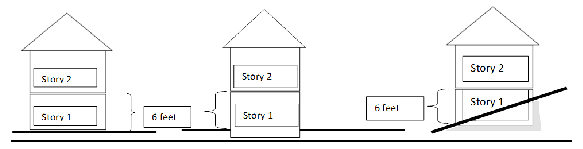
"Structure" means anything constructed or erected that requires a foundation or a structural support on the ground, including a building or public utility, but not including: a fence or a wall used as a fence if the height does not exceed seven feet (7′); retaining walls four feet (4′) or less in height; in-ground swimming pools; and improvements built at-grade such as parking lots and access drives or walks.
Structure, accessory. See "Accessory structure."
"Subdivision or neighborhood identification sign" means a sign containing the name of a subdivision, development or neighborhood.
"Subterranean" means a structure, improvement or building floor level that is constructed entirely below ground with all points to the top of the structure or floor level being situated entirely below natural and finished grade; exclusive of any excavations made to provide required ingress or egress.
"Supportive housing" means housing with no limit on length of stay, that is occupied by the target population (i.e., adults with low-income having one (1) or more disabilities including mental illness, HIV or AIDS, substance abuse or other chronic health conditions, or individuals eligible for services provided under the Lanterman Development Disabilities Services Act Division 4.5, commencing with Section 4500 of the Welfare and Institutions Code and may include, among other populations, families with children, elderly persons, young adults aging out of the foster care system, individuals exiting institutional settings, veterans, or homeless people) and that is linked to on- or off-site services that assist the supportive housing residents in retaining the housing, improving his or her health status, and maximizing his or her ability to live and, when possible, work in the community.
"Taxi station" means taxi headquarters with administrative and/or dispatch offices and taxicab parking and storage.
"Temporary window sign" means any temporary sign painted on a window or constructed of paper, cloth or other light material and attached to the window, or located within three feet (3′) of the interior side of the window, and displayed so as to call attention of persons outside of the building to a sale of merchandise or change in the status of a business or use.
"Tobacco retailer, significant" means a retail establishment that devotes twenty percent (20%) or more of its sales or display area to, or derives seventy-five percent (75%) or more of its gross sales receipts from, the sale of tobacco products and/or tobacco paraphernalia.
"Transitional housing" and "transitional housing development" means buildings configured as rental housing developments, but operated under program requirements that call for the termination of assistance and recirculation of the assisted units to another eligible program recipient at some predetermined future point in time, which shall be no less than six (6) months.
"Transportation System Management (TSM)" means the use of incentives and/or disincentives by local employers to assist in reducing the number of single-passenger auto commute trips and peak-hour trips by increasing the use of carpools, vanpools, public transit, bicycles and walking, and through the use of flex-time.
"Usable outdoor area" means an area open to the sky with a slope less than ten percent (10%). The usable outdoor area shall be a well-defined coherent space that is an integral component of the project design. Usable outdoor area includes private yard areas and common areas suitable for passive and active recreation use. Such areas may be located on the ground, roof, balcony, patio or terrace; and excludes minor decorative landscaping, driveway areas, parking facilities, and utility or service area. Common usable outdoor area shall have a minimum dimension of twelve feet (12′).
Diagram B for Section 14.03.030
USABLE OUTDOOR AREA
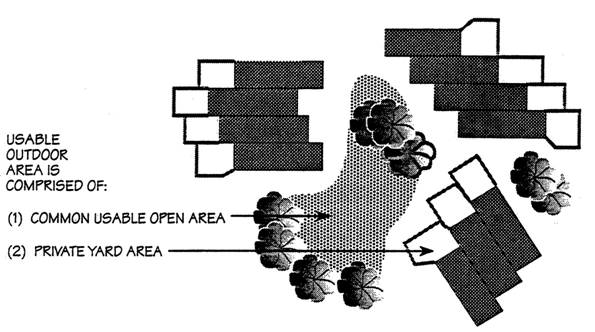
Vehicle, recreational. "Recreational vehicle" means a vehicle towed or self-propelled on its own chassis or attached to the chassis of another vehicle and designed or used for temporary dwelling, recreational or sporting purposes. The term recreational vehicle shall include, but shall not be limited to, travel trailers, pick-up campers, camping trailers, motor coach homes, converted trucks and buses, boats, and boat trailers.
"Very-low income household" means a household with total gross annual earnings of less than fifty percent (50%) of median income as defined in this section.
"Wall sign" means any sign painted on or attached parallel to the wall of a building and projecting not more than twelve inches (12″) from the building face.
"Warehousing" means the commercial or industrial use of a building or buildings primarily for the storage of goods or materials.
"Water-efficient landscape" means landscaping and irrigation that has been designed and installed to comply with Marin Municipal Water District (MMWD) Ordinance No. 414, as adopted by reference in Section 14.16.370 of this Title. A water-efficient landscape is designed to conserve water usage by establishing and applying a "maximum applied water allowance," which is the upper limit of annual applied water for a landscape area based on the local evaporation factor, and site-specific factors such as soil, slope and planting conditions. The requirements for a water-efficient landscape are administered under Section 14.16.370 of this Title.
"Water-oriented" means uses which are either water frontage dependent, or which attract people to the waterfront.
"Wetland creation" means a human activity bringing a wetland into existence at a site in which it did not formerly exist.
"Wetland restoration" means a human activity that returns a former wetland from an altered condition, in which all or virtually all wetland functions and values have been lost, to a condition with full wetland functions and values. Restoration does not mean enhancement of wetlands which, though degraded, nonetheless provide significant biological wetland functions or values.
"Wetlands" means those areas that are inundated or saturated by surface or groundwater at a frequency and duration sufficient to support, and that under normal circumstances do support, a prevalence of vegetation typically adapted for life in saturated soil conditions (same as U.S. Army Corps of Engineers). (See Section 14.13.050(A), Determination of Wetland Boundaries).
"Wholesale" means a use engaged primarily in the selling of any type of goods for purpose of resale, including related storage and distribution.
"Wildlife" means animals, including fish and fowl, and/or plants existing in their natural habitat.
"Wind-blown device" means any man-made device which visibly moves when blown in the wind.
"Window sign" means a sign painted on or attached to a window or located inside within a distance equal to the greatest dimension of the window (either width or height) and designed to be viewed from the outside of the building in which the window is located.
"Wind turbine" means a rotating machine which converts kinetic energy in wind into mechanical energy, which it then converts into electricity.
"Wireless communication facilities" means facilities regulated by the FCC that transmit and/or receive electromagnetic signals for cellular technology, personal communication services, enhanced specialized mobile services, paging systems, and radio and television broadcast transmission facilities. Facilities include antennas, microwave dishes, parabolic antennas, and all other types of equipment (but does not include small wireless facility, which is defined separately under "small wireless facility") used in the transmission or reception of such signals; telecommunication towers or similar structures supporting said equipment; associated equipment cabinets and/or buildings; and all other accessory development. These facilities include amateur radio antenna structures that exceed thirty feet (30′) in height but do not include government-operated public safety networks.
Wrecking yard, motor vehicle. "Motor vehicle wrecking yard" means any use of premises for the conduct of a business whereon two (2) or more vehicles not in operating condition are standing and/or on which used motor vehicles, or parts thereof, are dismantled and/or stored.
"Yacht club" means a private social club which may include a club house, private berthing for club members, tie-up visitor docking, on-site parking for automobiles and boat trailers; and which may include dry storage for members' boats. The berthing or storage of boats for commercial purposes, party boats, and rental boats are specifically excluded.
Yard, front. "Front yard" means an open area extending along the full width of a lot between side lot lines and from the front lot line to a parallel line at a distance equal to the depth of the required yard (i.e., required setback area), within which no structure shall be located except as provided and/or permitted in this title. The front yard should be consistent with the orientation of the other lots and improvements on the same side of the street or consistent with any prior determination that was made to define the front yard. The front yard is usually the side where the main building entrance is located and in the general direction in which the main building faces. Front yards shall be determined for lots as follows:
1.
For a corner lot with two (2) street frontages, the front yard is typically the narrower of the two (2) frontages, except where an existing front building setback has clearly been established by prior property development.
2.
For an interior lot with an irregular-shaped frontage, the front yard is defined as all portions of the lot that are parallel to and immediately front the road right-of-way or easement that provides access to the lot.
3.
For a triangular shaped lot with fewer than four (4) lot lines, the director may determine the front yard location based on orientation of the building entrance and surrounding development pattern.
4.
For a flag or panhandle lot, the front yard is defined as all portions of the lot within the required front setback measured from the longest property line that is most parallel and nearest to the public street. The panhandle portion of the lot shall not be used in determining the required setbacks. See Title 15, Section 15.06.030(d).
Yard, rear. "Rear yard" means an open area extending across the full width of the lot between side lot lines and from the rear lot line to a line at a distance equal to the depth of the required yard, within which no structure shall be located except as provided in this title.
Yard, side. "Side yard" means an open area extending between the front yard and the rear yard and between the side lot line and a line at a distance equal to the depth of the required yard, within which no structure shall be located except as provided in this title.
(Ord. 1853 § 1, 2007; Ord. 1838 §§ 16, 17, 2005; Ord. 1831 § 1 (part), 2004; Ord. 1825 § 2 (Exh. A) (part), 2004; Ord. 1823 § 1 (Exh. A) (part), 2004; Ord. 1797 § 1, 2003; Ord. 1765 § 1 (part) (Exh. A), 2001; Ord. 1756 § 1, 2000; Ord. 1751 § 1, 2000; Ord. 1748 § 1, 2000; Ord. 1742 § 1, 1999; Ord. 1740 § 1, 1999: Ord. 1731 § 1, 1998: Ord. 1713 § 1, 1997; Ord. 1694 § 1 (Exh. A) (part), 1996; Ord. 1663 § 1 (part), 1994; Ord. 1625 § 1 (part), 1992).
(Ord. No. 1879, § 9, 2-1-10; Ord. No. 1882, Exh. A, §§ 4—6, 6-21-2010; Ord. No. 1923, § 2(Exh. A), 6-16-2014; Ord. No. 1937, § 2, 1-19-2016; Ord. No. 1955, (Exh. A, §§ 1, 2), 3-19-2018; Ord. No. 1964, § 2(Exh. B) § 1, 11-19-2018; Ord. No. 1967, §§ 1, 2, 12-17-2018; Ord. No. 1976, div. 2, 11-18-2019; Ord. No. 1996, div. 2(Exh. A, 3.1), div. 2(Exh. C, 1.1), 8-16-2021; Ord. No. 2002, div. 4, 12-6-2021; Ord. No. 2013, § 4, 8-1-2022; Ord. No. 2039, § 3(Exh. B), 7-15-2024)

