
San Rafael City Zoning Code
Division IV
REGULATIONS APPLYING IN ALL OR SEVERAL DISTRICTS
14.16.010 - Specific purposes and applicability.
Site and use regulations are development standards that are applicable to sites in all or several districts. The site and use regulations listed in this section are intended to ensure that new uses and development will contribute to and be harmonious with existing development, will reduce hazards to the public resulting from the inappropriate location, use or design of buildings and other improvements, and will be consistent with the policies of the general plan. These regulations shall be applied as specified in the district regulations, and as presented in this chapter.
(Ord. 1625 § 1 (part), 1992).
(Ord. No. 1923, § 2(Exh. A), 6-16-2014)
14.16.020 - Accessory structures.
An accessory structure (i.e., a customarily incidental structure detached from a principal building on the same lot) shall comply with all requirements for principal buildings, with the following exceptions and additional requirements:
A.
Applicability. These standards shall apply to all zoning districts that permit accessory structures (i.e. a structure detached from a principal building on the same lot, as defined in Section 14.03.030), and shall be in addition to all other standards regulating development of the site. Where any conflict is found to exist, the more restrictive standard shall be applied.
B.
Timing of Installation. An accessory structure shall be constructed concurrent with or subsequent to the construction of a principal building on the property.
C.
Building code compliance. Additional setbacks from property lines or adjacent structures shall be provided where required to comply with applicable building codes, as determined by the building official.
D.
Small Wind Energy Systems. Small wind energy systems shall be permitted as regulated under Section 14.16.305.
E.
Residential Accessory Structures. The following standards shall apply to accessory structures in residential districts:
1.
Front and Street Side Yard Setbacks.
a.
Fountains, trellises, statues and similar decorative yard improvements up to four feet (4′) in height, fences, small retaining walls and minor decorative entryway treatments as permitted pursuant to Section 14.16.140.A.1, decks less than twelve inches (12″) above grade, and access driveways and walkways may be located within the required front yard setback and/or street side yard setback; provided that such accessory structure shall not conflict with the sight distance triangle of an intersections or driveway required pursuant to Section 14.16.295.
b.
No other structures or improvements shall be placed within a required front yard or street side yard.
c.
No swimming pool, hot tub, air conditioning unit or mechanical equipment shall encroach into any front yard or street side yard setback.
d.
Accessory structures shall meet the setback requirements for reverse corner lots, contained in Section 14.04.030(D).
e.
Detached accessory structures may only be placed between the front-facing wall of the primary structure and the front setback with administrative design review, except as allowed by Section 14.16.020.E.1.a. This requirement does not apply to garage or carport structures which must comply with the setbacks established by the applicable zoning district.
2.
Interior Side and Rear Yard Setbacks.
a.
Zero-foot (0′) Setback. The following accessory structures may be located within the required interior side and rear yard setbacks, and up to the property line, subject to conformance with any applicable building code limitations and provision of an unobstructed walkway clearance of at least three feet (3′) between above-grade accessory structures and adjacent buildings or the property line in order to provide access around the primary building:
i.
Accessory structures, unconditioned (e.g., not intended for human occupancy) with a maximum floor area of one hundred twenty (120) square feet and up to eight feet (8′) in height measured from grade to roof peak;
ii.
Fountains, trellises, statues and decorative yard improvements no taller than six feet (6′) in height;
iii.
Retaining walls up to four feet (4′) in height above grade (e.g., exposed wall height above finished grade, as determined by the community development director);
iv.
At-grade walkways and decks less than twelve inches (12″) above grade.
b.
Three-foot (3′) Minimum Setback. The following accessory structures may be located within three feet (3′) of the rear and interior side yard property line:
i.
Accessory structures greater than one hundred twenty (120) square feet in floor area and up to fifteen feet (15′) in height measured from grade to roof peak;
ii.
Fireplaces, barbecues, self-contained portable spas, spa/pool equipment (additional setbacks and limitations on the placement of spa/pool pump and filtration systems shall be as specified in Section 14.16.320);
iii.
Uncovered decks twelve inches (12″) or more above grade.
c.
Pools/in-ground spas. A setback of at least three feet (3′) or a distance equal to one-half (½) the depth of the pool, whichever is greater, shall be provided from the property line.
d.
Easements and Property Lines. No structure or portion thereof, including overhangs and foundations, shall obstruct an easement or cross a property line.
e.
Mechanical equipment shall subject to additional screening and setback requirements, as specified in Section 14.16.320.
3.
Alley Setback. An accessory structure shall be located a minimum of five feet (5′) from an alley.
4.
Coverage. In addition to counting toward the total lot coverage limit that applies to all structures on a parcel, residential accessory structures shall not exceed a maximum of thirty percent (30%) of the required side or rear yard areas. Required front yard areas shall maintain at least forty-percent (40%) pervious landscape area.
5.
Height. The height of an accessory structure shall not exceed a height of fifteen feet (15′) except as permitted through design review.
F.
Nonresidential Accessory Structures. The following standards shall apply to accessory structures where permitted in a non-residential zoning district.
1.
In a nonresidential district, above ground accessory structures are permitted when such structures do not alter the character of the premises, and when constructed in conformity with all applicable requirements of this title; including floor area ratio requirements of this Chapter 14.16, Chapter 14.18 (Parking Standards) and Chapter 14.25 (Design Review).
2.
Shipping and Storage Containers. Shipping and storage containers (e.g., "cargo" containers), or similar all-weather storage containers, may be allowed within an outdoor storage yard that has been approved consistent with the provisions of the underlying commercial and industrial district land use tables, and Section 14.17.120 (Outdoor storage). In all other instances, a storage container shall only be considered as a permanent structure that shall be subject to all of the underlying zoning district development standards, design criteria and provisions of this title (including floor area ratio requirements, parking standards, and Chapter 14.25 (Design Review)). See Section 14.17.130 (Temporary uses) for regulation of a storage container proposed for a temporary use.
(Ord. 1802 § 4, 2003: Ord. 1731 § 2, 1998; Ord. 1625 § 1 (part), 1992).
(Ord. No. 1923, § 2(Exh. A), 6-16-2014; Ord. No. 1964, § 2(Exh. B) § 11, 11-19-2018; Ord. No. 2002, div. 9, 12-6-2021)
14.16.025 - Refuse enclosure requirement.
Suitable area shall be provided on-site for collection of trash and recyclable materials for all multi-family, mixed-use and non-residential development projects. Refuse storage areas shall be adequately screened from view. The refuse area enclosure shall be designed to meet the minimum recommended dimensional standards of the local refuse collection agency, as well as any requirements of other agencies responsible for review and permitting of the facility; such as building, fire, public works or county health. See Section 14.16.020 for Accessory Structure standards and Chapter 14.25 for design review requirements.
(Ord. No. 1923, § 2(Exh. A), 6-16-2014)
14.16.030 - Affordable housing requirement.
A.
Purpose and Intent. The purpose of this section is to enhance the public welfare and ensure that further residential and nonresidential development projects within the city contribute to the attainment of affordable housing goals and requirements by promoting and increasing, through actual construction and/or alternative equivalent actions as provided for in this section, the development of rental and ownership housing units for very low, low and moderate income households.
B.
General Requirements—Residential Development Projects. Any new residential development project with dwelling units intended or designed for permanent occupancy shall be developed to provide affordable housing units to very low, low and moderate income households in perpetuity unless, in its sole discretion and upon a finding of need pursuant to the Guidelines for the Administration of the Affordable Housing Trust Fund, as adopted and amended from time to time by the city council, the city council reduces the time frame to not less than forty (40) years.
1.
Exemptions. This provision shall be imposed on all residential development projects except that the following shall be exempt from the provisions of this section:
a.
Projects that are the subject of development agreements in effect with the city and approved prior to the effective date of the city council ordinance;
b.
Projects where a building permit application has been accepted as complete by the city prior to the effective date of this section; however, any extension or modification of such approval or permit after such date shall not be exempt;
c.
Any building that is damaged or destroyed by fire or other natural catastrophe if the rebuilt square footage of the residential portion of the building does not increase upon reconstruction;
d.
Any residential development project of one (1) single family structure; and
e.
Second units approved by the city of San Rafael pursuant to Section 14.16.285 of the San Rafael Municipal Code.
2.
Modification of Certain Approved Projects. Notwithstanding anything to the contrary in this section, for any project that, as of the effective date of this section, has received final city approval but has not yet commenced construction, the project applicant may apply to the city for a modification of the affordable housing requirements of the approved project where the modified affordable housing components of the project would be consistent with the requirements of this section and with the Guidelines for the Administration of the Affordable Housing Trust Fund, as adopted and amended from time to time by city council resolution. The request for modification shall be approved the decision-making body that approved the project.
3.
Affordable Housing Units—Percentage Required. Residential development projects shall provide affordable housing units as described in the policies and procedures specified in the San Rafael City Council's Guidelines for the Administration of the Affordable Housing Trust Fund, as adopted, and amended from time to time by city council resolution, and any new residential development project shall comply with such policy.
C.
Density Bonus and Incentives. Upon a separate application by an applicant for a residential development project of five (5) or more units that includes an eligible affordable housing project, including such residential development projects that include housing for transitional foster youth, qualified student housing, land donation, construction of a child care facility, or a qualified senior citizen housing development, shall be eligible for a density bonus, as well as an additional concession or incentive or waiver/reductions of development standards, consistent with the requirements of California Government Code Section 65915 and as set forth by resolution adopted by the city council from time to time.
D.
General Requirements—Nonresidential Development Projects.
1.
Application. An affordable housing requirement is hereby imposed on all developers of nonresidential development projects, including all construction of additional square footage to existing nonresidential developments and conversion of residential square footage to nonresidential use, subject to the following exceptions:
a.
Any project involving new construction under two thousand five hundred (2,500 square feet);
b.
Residential components of a mixed-use project, which shall be subject to the requirements of subsection B of this section;
c.
A mixed-use project where the number of affordable units equals or exceeds the housing required by subsection (I)(2) of this section for the gross square footage of nonresidential uses;
d.
Projects where a building permit application has been accepted as complete by the city prior to January 5, 2005; however, any extension or modification of such approval or permit after such date shall not be exempt;
e.
Projects that are the subject of development agreements in effect prior to January 5, 2005 where such agreements specifically preclude the city from requiring compliance with this type of affordable housing program;
f.
Any nonresidential building that is damaged or destroyed by fire or other natural catastrophe if the rebuilt square footage of the nonresidential portion of the building does not increase upon reconstruction;
g.
Project for which no nexus can be established between the proposed nonresidential development and an increase in the demand for affordable housing.
2.
Affordable Units or Linkage Fee Required. Proposed nonresidential development projects shall pay a commercial linkage fee, prior to building permit issuance, on a per square footage basis at the rates adopted by the City Council by ordinance or resolution. Alternative to the linkage fee, a proposed nonresidential development project may provide an equivalent number of units for low-income households, based on the following calculation: Total fee obligation / Affordable housing in-lieu fee established by ordinance or resolution of the City Council = Number of low-income units required. Any decimal fraction greater than 0.50 shall be interpreted as requiring one additional dwelling unit.
3.
Provision of Units or Commercial Linkage Fee. Required affordable housing units shall be provided on the same site as the proposed nonresidential development, at an off-site location within the city, through dedication of suitable real property for the required housing to the city, or through payment of a commercial linkage fee, at the discretion of the planning commission or the city council. The planning commission or city council may accept off-site units if it is determined that inclusion of the required housing units within the proposed nonresidential development is not reasonable or appropriate, taking into consideration factors including, but not limited to, overall project character, density, location, size, accessibility to public transportation, and proximity to retail and service establishments; or where the nature of the surrounding land uses is incompatible with residential uses in terms of noise or other nuisances, health or safety hazards or concerns. Affordable housing units provided as part of the proposed nonresidential development or at an off-site location shall meet the requirements of Section 14.16.030.B and shall be completed prior to or concurrent with the completion of construction of the proposed nonresidential development, as the conditions of project approval shall specify.
Payment of Commercial Linkage Fee.Unless otherwise preempted by law, or otherwise approved by the planning commission, city council, or community development director, the commercial linkage fee shall be paid prior to the issuance of a building permit for the proposed project.
E.
Housing In-Lieu Fee Fund. The residential housing in-lieu fees and the commercial linkage fees shall be placed in a segregated citywide housing in-lieu fee account. The funds in the housing in-lieu fee account, along with any interest earnings accumulated thereon, shall be used solely to increase and expand the supply of housing affordable to very low-, low- and moderate-income households, including, but not limited to, the following:
1.
Design and construction of housing affordable to households of very low, low- and moderate-income households, including costs associated with planning, administration and design;
2.
Acquisition of property and property rights, including acquisition of existing housing units and the provision of long-term affordability covenants on those units;
3.
Other actions that would increase the supply of housing affordable to very low, low- and moderate-income households;
4.
Costs of program development and ongoing administration of the housing fund program;
5.
Expenditures from the housing in-lieu fee fund shall be authorized solely by the city council and controlled and paid in accordance with general city budgetary policies.
F.
Enforcement. The city attorney is authorized to abate violations and to enforce the provisions of this section and all implementing regulatory agreements and resale controls placed on affordable housing units, by civil action, injunctive relief, and/or other proceeding or method permitted by law. The remedies provided for herein shall be cumulative and not exclusive and shall not preclude the city from other remedy or relief to which it otherwise would be entitled under law or equity.
(Ord. 1838 § 31, 2005; Ord. 1831 § 1 (part), 2004: Ord. 1749, 2000: Ord. 1625 § 1 (part), 1992).
(Ord. No. 1882, Exh. A, §§ 41, 42, 6-21-2010; Ord. No. 1990, div. 1.3, 3-1-2021; Ord. No. 2032, § 2, 12-18-2023)
14.16.040 - Buildings over three stories.
Existing buildings with more than three (3) stories in height located outside the downtown mixed use (DMU) district, which were constructed or approved as of January 1, 1987 shall be considered conforming. These buildings include, but are not limited to, the following:
Table 14.16.040
BUILDINGS OVER THREE (3) STORIES
(Ord. 1625 § 1 (part), 1992).
(Ord. No. 1882, Exh. A, § 43, 6-21-2010; Ord. No. 1996, div. 2(Exh. A, 6.1), 8-16-2021)
14.16.045 - Cannabis uses.
Specific medical cannabis uses are allowed by the Zoning Ordinance, as specified in the land use tables and as defined by the definition chapter, including and limited to cannabis testing/lab (both medicinal and recreational adult use), cannabis infused products (medicinal only), cannabis delivery (medicinal only) and cannabis distribution (medicinal only). All other medicinal or recreational medical cannabis uses, such as dispensaries, cultivation, and processing are prohibited.
The land use regulations contained pertaining to cannabis in this title do not apply to personal cultivation or use of cannabis. Personal cultivation and use of cannabis shall be subject to state law and any limitation imposed by state law.
(Ord. No. 1955, (Exh. A, § 9), 3-19-2018; Ord. No. 1964, § 2(Exh. B) § 12, 11-19-2018)
14.16.050 - Conservation areas—Development potential.
Open space/conservation areas identified on the general plan land use plan map shall be preserved through the development review process and have no development potential. Mapped boundaries of conservation areas are schematic and may be adjusted to a limited extent during development review.
(Ord. 1625 § 1 (part), 1992).
14.16.060 - Conservation of dwelling units.
A.
Legal dwelling units, existing or approved as of January 1, 1991, shall be considered conforming uses, except for such units in the marine, marine commercial, light industrial/office districts, and industrial districts, and for single-family units in downtown mixed-use districts. Notwithstanding any land use regulations or property development standards to the contrary contained in this title, such dwelling units may be replaced or rebuilt in their existing location, provided that the number of units and building size shall be no greater than that which existed on January 1, 1991, and the design is similar. An administrative design permit (Section 14.25.040(C)) is required for any design changes. Such design changes should improve the architectural design of the structure or site design of the development.
B.
Nonconforming structures are subject to Section 14.16.270(C), Regulations Pertaining to a Nonconforming Structure.
C.
As commercial space, live/work quarters are exempt from this section.
(Ord. 1694 § 1 (Exh. A) (part), 1996; Ord. 1625 § 1 (part), 1992).
14.16.080 - Creeks and other watercourses.
Improvements on a lot which is adjacent to, or contains, a creek, drainageway, or the San Rafael Canal shall be subject to the following provisions:
A.
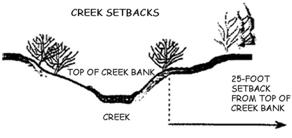
Setback, Creek. Creek setbacks shall be determined based on the setback criteria in subsection C below. These setbacks should include a twenty-five foot (25′) or greater setback between any structure and the high top of the creek bank. On lots two (2) or more acres in size, a twenty-five foot (25′) to one hundred foot (100′) setback between any structure and the high top of the creek bank shall be provided.
Illustration 14.16.080
B.
Setback, Drainageway. Adequate setback from a drainageway shall be determined at the time of project review based on the setback criteria in subsection C below.
C.
Setback Criteria. Adequate setback between creeks and/or drainageways and a structure shall be determined based on the following criteria:
1.
The setback provides for adequate maintenance, emergency vehicle access, adequate debris flow avalanche corridors, flood control and protection from damage due to stream bank undercutting;
2.
The setback adequately protects and preserves native riparian and wildlife habitat;
3.
The setback protects major view corridors and provides for recreation opportunities where appropriate;
4.
The setback permits provision of adequate and attractive natural landscaping.
D.
Setback, San Rafael Canal. No new building or substantial reconstruction of an existing building should be located within twenty-five feet (25′) of the top of the bank or bulkhead along both sides of the San Rafael Canal between Highway 101 and the mouth of the canal. Upon adoption of a design plan for the San Rafael Canal, the design plan provisions shall control.
E.
Development Guidelines. Pedestrian and bicycle access is encouraged along creek and drainageway corridors where feasible. However, they should be designed and located so as not to adversely affect important habitat areas. Creeks and drainageways should also be enhanced where feasible to serve as wildlife habitat as well as drainage facilities.
F.
Fill. Any proposed fill in a creek, drainageway or in the San Rafael Canal shall be subject to the requirements of Section 14.13.040(G), Fill. A use per mit for fill shall be required consistent with Sections 14.13.050 through 14.13.070.
(Ord. 1625 § 1 (part), 1992).
14.16.100 - Development agreements.
Development agreements shall be governed by Resolution No. 6089, adopted April 20, 1981 by the city council, or as it may be subsequently amended, establishing procedures and requirements for the consideration of development agreements as provided for by state law.
(Ord. 1625 § 1 (part), 1992).
14.16.110 - Drive-through facilities.
Drive-through facilities shall comply with the following standards:
A.
Traffic and Circulation.
1.
The drive-through stacking lanes shall be separated physically (i.e., by raised curb or landscape planter) from the parking lot, and shall comply with the following capacity standards:
* Provide 20 feet per car length.
2.
The drive-through stacking lane shall be situated so that any overflow parking from the stacking lane shall not spill out onto public streets or major circulation aisles of any parking lot. If the overflow is directed to the street, additional overflow capacity shall be eighty percent (80%) of required stacking.
3.
Pedestrian crossings of the drive-through lane are discouraged.
4.
Entrances and exits to drive-through facilities near high volume intersections shall be located so as to maximize the distances to the intersection.
5.
Confusing on-site circulation shall be avoided. Entrances to and exits from drive-through facilities should be at least twenty feet (20′) from the property line.
6.
Parking spaces for drive-through special orders may be required.
B.
Noise. Speakers at drive-through facilities shall not be audible from adjacent residential uses or disturbing to adjacent nonresidential uses. Sound attenuation walls or other mitigation measures shall be required as necessary.
C.
Hours of Operation. Limited hours of operation shall be required where a drive-through facility could affect nearby residential uses.
D.
Emission Control. Drive-through stacking lanes shall not be located adjacent to patios and other pedestrian use areas, other than walkways, and should be discouraged where adjacent nonresidential buildings are within thirty feet (30′) of the proposed lane. Drive-through stacking lanes shall not be located within fifty feet (50′) of any residential uses.
E.
Design Review. All drive-through facilities are a minor physical improvement subject to the provisions of Chapter 14.25, Environmental and Design Review Permits. Generally, the drive-through facility shall be architecturally compatible with nearby structures, provide landscaping to buffer adjacent uses and provide adequate lighting which is shielded from adjacent properties. Trash receptacles adequate to control litter will also be required.
(Ord. 1625 § 1 (part), 1992).
14.16.115 - Emergency shelters—Permanent.
A.
Purpose. This section establishes standards for location and operation of a permanent emergency shelter for homeless populations in compliance with California Government Code Section 65583, including allowing shelters as a permitted use in some commercial and industrial district locations. This section is not applicable to temporary emergency shelters established by the city in response to an emergency event.
B.
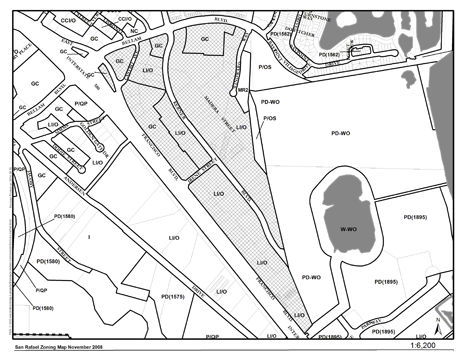
Applicability. Emergency shelters to provide temporary housing and assistance for families and individuals who are homeless shall be permitted as of right in the GC and LI/O districts generally bounded by Bellam Boulevard and I-580, consisting of those shaded parcels within this area, as shown on Map 14.16.115, and at other locations where conditionally permitted by the land use tables of this title. However, the total number of beds provided within the area shown on Map 14.16.115 shall only be permitted by right as necessary to meet the local housing need established by the General Plan 2020 Housing Element (reflecting regional housing needs assessment (RHNA) projections prepared by the Association of Bay Area Governments and based on the state housing and community development department needs assessment at the time of adoption of the most current housing element). A conditional use permit shall be required to provide additional facilities within this area in excess of the RHNA needs assessment identified in the General Plan 2020 Housing Element. All facilities shall be operated in compliance with the provisions herein.
Map 14.16.115
C.
Findings Required. Where a conditional use permit must be obtained to establish an emergency shelter pursuant to the land use tables of this title, findings shall be made with regard to the performance standards required herein in addition to the use permit findings required pursuant to Chapter 14.22.
D.
Performance Standards. An emergency shelter shall meet the following development and performance standards:
1.
On-site management and on-site security shall be provided during hours when the emergency shelter is in operation.
2.
Adequate external lighting shall be provided for security purposes (i.e., one (1) foot-candle at all doors and entryways and one-half (½) foot-candle at walkways and parking lots). The lighting shall be stationary, directed away from adjacent properties and public right-of-ways, and of intensity compatible with the surrounding area.
3.
The development may provide one (1) or more of the following specific common facilities for the exclusive use of the residents and staff:
a.
Central cooking and dining room(s).
b.
Recreation room.
c.
Counseling center.
d.
Child care facilities.
e.
Other support services.
4.
Parking and outdoor facilities shall be designed to provide security for residents, visitors, employees and the surrounding area, and consistent with the requirements of Section 14.18.040 (Parking Requirements).
5.
A refuse storage area shall be provided that is completely enclosed with masonry walls not less than five feet (5') high with a solid-gated opening and that is large enough to accommodate a standard-sized trash bin adequate for use on the parcel, or other enclosures as approved by the review authority. The refuse enclosure shall be accessible to refuse collection vehicles.
6.
The agency or organization operating the shelter shall comply with the following requirements:
a.
Shelter shall be available to residents for no more than six (6) months. No individual or household may be denied emergency shelter because of an inability to pay.
b.
Staff and services shall be provided to assist residents to obtain permanent shelter and income.
c.
The provider shall have a written management plan including, as applicable, provisions for staff training, neighborhood outreach, security, screening of residents to ensure compatibility with services provided at the facility, and for training, counseling, and treatment programs for residents.
7.
No emergency shelter shall be located within three hundred feet (300') of another emergency homeless shelter site; unless permitted through review and approval of a conditional use permit where it is determined the additional shelter location is appropriate and necessary to serve the intended population and would not result in an over-concentration in the community.
8.
The facility shall be in, and shall maintain at all times, good standing with city and/or state licenses, if required by these agencies for the owner(s), operator(s), and/or staff on the proposed facility.
9.
The maximum number of beds or clients permitted to be served (eating, showering and/or spending the night) nightly shall comply with the occupancy limit established by the building code. Additionally, the number of beds or clients permitted to be served may be further limited as required by conditional use permit.
(Ord. No. 1923, § 2(Exh. A), 6-16-2014)
14.16.120 - Exclusions to the maximum height requirement.
Flagpoles not exceeding a height of twenty-four feet (24′), aboveground utility distribution facilities including communications towers and public water tanks, windmills, monuments, mechanical appurtenances, satellite dishes in multifamily and nonresidential districts and architectural features such as screening for mechanical equipment, chimneys, steeples and cupolas are not included in height calculations. However, structures and architectural features which extend above the established building height limit may require an environmental and design review permit, pursuant to Chapter 14.25, Environmental and design review permits.
(Ord. 1625 § 1 (part), 1992).
(Ord. No. 1882, Exh. A, § 44, 6-21-2010; Ord. No. 1964, § 2(Exh. B) § 13, 11-19-2018)
14.16.130 - Exclusions to the required minimum yards.
A.
Architectural features projecting from a structure such as fireplaces, cornices, eaves and canopies may extend no more than two feet (2') into any required yard. Open and uncovered decks, landings and/or stairways may project up to three feet (3') into any required side or rear yard and up to six feet (6') into any required front yard.
B.
These exclusions to required minimum yards may be combined with a setback exception granted pursuant to Section 14.24.020.B, provided that a minimum yard area is maintained in keeping with the character of the residential neighborhood.
C.
Retaining walls four feet (4') or less in height measured from the top of the footing to the top of the wall and subterranean structures which are located entirely below both existing and finished grade are allowed anywhere within the required yards; except as otherwise regulated under Section 14.16.020 (Accessory Structures).
D.
Elevated parking decks that are proposed to provided necessary driveway access, required guest parking, and/or access to necessary walkways serving a single-family residence on a steeply downsloping hillside lot (i.e., twenty-five percent (25%) or greater downslope from the street) may be permitted within the required front yard setback. See 14.25 for design review requirements.
(Ord. 1838 § 34, 2005: Ord. 1663 § 1 (part), 1994: Ord. 1625 § 1 (part), 1992).
(Ord. No. 1882, Exh. A, § 45, 6-21-2010; Ord. No. 1923, § 2(Exh. A), 6-16-2014)
14.16.132 - Exclusions to maximum lot coverage.
The following improvements are not counted as part of lot coverage: ground level landscaped areas, at grade walkways, at grade including steps, and paved areas, uncovered patios and decks thirty inches (30") or less in height, uncovered recreational and uncovered parking and driveway areas, paved parking areas covered by solar panel installations pursuant to Section 14.16.307, play and storage structures not requiring a building permit that are one hundred twenty (120) square feet or less in size and eight feet (8') or less in height, and structures that are located entirely below both existing and finished grade.
(Ord. No. 1882, Exh. A, § 46, 6-21-2010; Ord. No. 1923, § 2(Exh. A), 6-16-2014)
14.16.140 - Fences and walls.
This section establishes regulations for the height, location and materials of fences, retaining walls and privacy walls. The regulations are intended to prevent fences or walls which are a detriment to the appearance and character of the community and to protect the public health, safety and welfare by assuring adequate sight distance is provided and maintained at street intersections and driveways. The provisions of this section do not apply to properties within the downtown mixed use district. For fence and wall regulations within the downtown mixed use district, refer to the Downtown San Rafael Precise Plan Form-Based Code, which is adopted by separate ordinance and incorporated herein by reference.
A.
Residential Districts. The following height limitations shall apply to the height of fences and walls in residential districts:
1.
Permitted.
a.
Front and Street Side Yard Areas. The following may be located within the required front and street side yard:
i.
Fences and retaining walls not exceeding four feet (4′) in height, may be located within the front or street side yard setback, provided that the fence or wall shall not conflict with the sight distance requirements of Section 14.16.295;
ii.
Minor decorative entryway treatments no taller than eight and one-half feet (8.5′) in height, such as a trellis arch or a lattice arch, are permitted within the front or street side yard, provided that there is no vehicular view obstruction (i.e., adequate sight distance shall be provided and maintained, pursuant to the provisions of Section 14.16.295).
b.
Rear Yard and Interior Side Yard. The following may be located within the required rear yard and interior side yard:
i.
Fences not exceeding seven feet (7′) in height may be located within the required rear yard or interior side yard;
ii.
Retaining walls not exceeding a height of four feet (4′) in height may be located within the required rear yard and interior side yard.
2.
With Required Planning Permits. The following may be permitted in residential districts with prior approval of design review (pursuant to Section 14.25.040.C.) and/or exception (pursuant to Chapter 14.24) as noted:
a.
Retaining walls over four feet (4′) in height on hillside parcels (i.e., property that contains a slope of twenty-five percent (25%) or greater or designated -H Overlay) may be permitted with environmental and design review if the community development director finds it necessary to minimize grading and/or tree removal impacts. Retaining walls located outside of required setbacks shall otherwise be reviewed subject to the regulations that apply to an accessory structure, in Section 14.16.020.
b.
Fences exceeding seven feet (7′) in height up to nine feet (9′) in height may be located in the required interior side or rear yard where topography or difference in grade between adjoining sites warrants such increase, subject to administrative design review and exception.
c.
Fences in the front yard or street side yard may be increased by a maximum of two feet (2′) to prevent access to natural or physical hazardous conditions either on the lot or on an adjacent lot, subject to administrative design review and exception.
d.
Exception. An exception to the residential fence and walls height standards may be allowed as noted above, subject to the provisions of Chapter 14.24, Exceptions; Exceptions for height should include a landscape setback buffer between the fence or wall and the public right of way, in order to mitigate the impact of a taller fence or wall along the streetscape. A minimum setback buffer of six inches (6″) should be provided for each one-foot (1′) of increased height.
e.
Note: A building permit may be required for fences over seven feet (7′) in height and retaining walls over four feet (4′) or walls that support the adjacent hillside or property improvements, as determined by the building code.
B.
Non-Residential Districts. An administrative environmental and design review permit shall be required for all non-residential fences over seven feet (7′) in height to ensure the fence conforms to the design and development standards of the underlying district, and is compatible with the immediate surrounding properties in the neighborhood. Where a property is located in a non-residential zoning district and is developed with, abutting, or surrounded by, a residential use, fence heights shall be the same as required for residential districts unless an alternate fence height can be justified through the administrative design review process.
C.
All Districts. The following standards shall apply to all districts:
1.
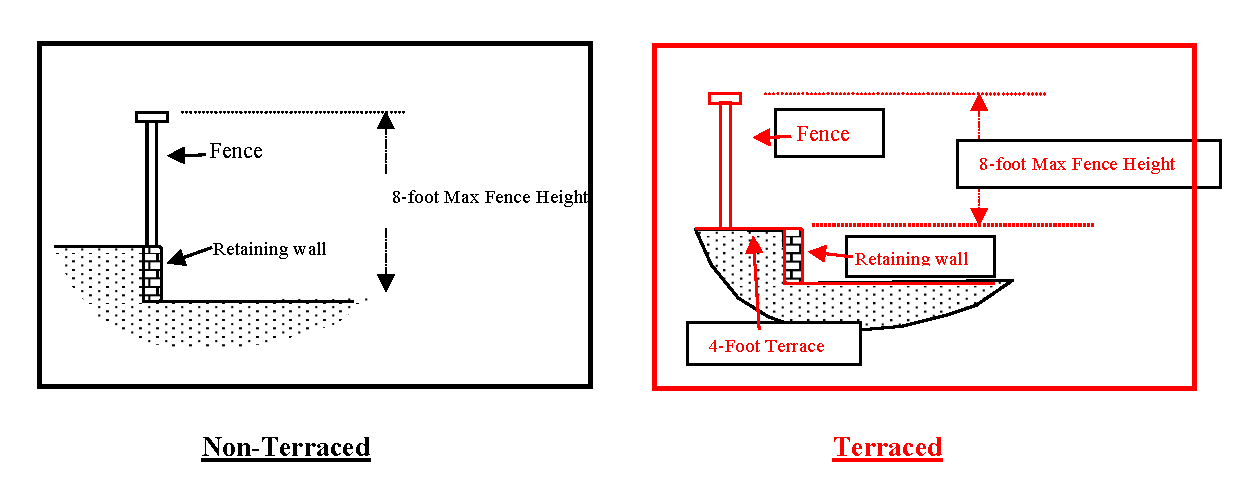
Measurement of Height. The height of a fence and/or or retaining wall and associated structural and/or decorative elements shall be the combined height measured vertically from finished ground level, as determined by the building or planning official, to the top of the structure at any given point (see illustration "Maximum Allowed Fence Height Measurement"). Except as follows:
a.
Minor decorative entryway treatments are permitted in the setback as noted above (Section 14.16.140 A.1.ii).
b.
Terraced fences and/or retaining walls that provide a landscaped horizontal separation of at least four feet (4′) may be measured separately at the base of each terrace.
Maximum Allowed Fence Height Measurement
2.
Recreation Fences.
a.
Fences for swimming pools are subject to the requirements of the building code.
b.
Fences for tennis courts shall not exceed maximum height limits established for accessory structures and shall in no case exceed a height of twelve feet (12′).
3.
Sight Distance. Fencing, vegetation and retaining walls located near a driveway or street intersection shall not conflict with the vision triangle requirements established to assure adequate sight distance is maintained for vehicles and pedestrians, pursuant to the provisions of Section 14.16.295.
4.
Prohibited Materials. In all districts, concertina wire, razor wire, broken glass on top of a fence, and electrified fences are prohibited. Barbed wire shall not be permitted where abutting residential uses. In residential districts, wire mesh, chain link and similar fences are prohibited within any yard which fronts a public street, right-of-way or waterway, except as may be required as an environmental mitigation measure.
5.
Temporary Fences. Temporary security fences may be erected around construction sites during the time a valid building permit is in effect for construction on the premises. Temporary security fences need not comply with the above regulations and must be immediately removed upon completion of the construction authorized by the building permit.
D.
Replacement of Fences and Walls. An existing, nonconforming fence or wall in any district is subject to the following regulations:
1.
Ordinary maintenance and repairs may be made to a nonconforming fence as required to keep the fence or wall in sound condition.
2.
Alterations and additions may be made to a nonconforming fence or wall, provided that such addition or alteration is consistent with these fence and wall provisions.
3.
No nonconforming fence or landscape retaining wall shall be moved or replaced unless it conforms to these fence and wall provisions, except for certain residential fences as provided below.
4.
An existing nonconforming residential fence or wall that is located in a front yard or street side yard may be replaced in the same location provided that:
a.
The fence was previously permitted or authorized by the city, or existed on or before January 1, 1992. The property owner shall provide sufficient documentation including photographs, written testimony, etc. to verify the pre-existing condition.
b.
The replacement fence or wall may be rebuilt to its previously existing and documented height, subject to request and issuance of a zoning verification review letter by the planning division. However, in no case shall any replacement fence exceed a height of six feet (6′) within the required front or street side yard setback and shall be no taller than three feet (3′) within a required vision triangle (Section 14.16.140.B);
c.
The replacement fence or wall is consistent with the prevailing character of both sides of the street for the length of the block; and
d.
All necessary permits shall be secured from the city (e.g., approval of a license agreement or encroachment permit if fence is located within the public right-of-way).
(Ord. 1838 § 35, 2005; Ord. 1663 § 1 (part), 1994; Ord. 1625 § 1 (part), 1992).
(Ord. No. 1923, § 2(Exh. A), 6-16-2014; Ord. No. 1964, § 2(Exh. B) § 14, 11-19-2018; Ord. No. 1996, div. 2(Exh. A, 6.2), 8-16-2021; Ord. No. 2039, § 3(Exh. B), 7-15-2024)
14.16.150 - Floor area ratios and densities applicable to nonresidential and mixed-use development.
A.
1.
The intensity and density of development in nonresidential and mixed-use districts is identified by floor area ratio (FAR) and by the number of units allowed per one thousand (1,000) square feet of lot area for the location and zoning district in which a site is located. The FAR is the total building square footage (gross floor area) divided by the lot area excluding public streets. Total building square footage excludes parking areas or garages (covered and uncovered), residential components of a mixed use project, hotels, and non-leasable covered atriums. Floor area for permanent child care facilities in nonresidential structures may be excluded in the FAR, subject to the provisions of Chapter 14.22, Use Permits.
2.
FAR limits in non-residential zoning districts are provided in the general plan land use element, except that for the downtown mixed use (DMU) district, intensity and development limitations are governed by the Downtown San Rafael Precise Plan Form-Based Code, which is adopted by separate ordinance and incorporated herein by reference. The maximum allowable FAR is not guaranteed and shall be determined by the following factors: site constraints, infrastructure capacity, hazardous conditions and design policies.
B.
Mixed-Use Development.
1.
Commercial or Office with Residential. FAR limits apply only to the non-residential component of a development. The number of residential units allowed on a lot is based on the minimum lot area required per dwelling unit standard for the zoning district. For example, a ten thousand (10,000) square foot lot in the ⅔ MUW District (Max. FAR is 0.7 and density is one thousand (1,000) square feet of lot area per dwelling unit) could develop with up to the following mixed-use amount, subject to meeting other zoning standards related to height, parking and design:
2.
Industrial/Office. In East San Rafael and Francisco Blvd. West, to equalize traffic generation, a sliding scale of 0.26—0.38 FAR is applied to construction of new industrial/office structures. For example, the industrial 0.38 FAR allows up to twenty-five percent (25%) office use; a higher percentage of office use requires a lower FAR, (see FAR maps below for more information).
C.
Public and Quasi-Public Use FAR. Public and quasi-public structures have a 1.0 FAR. Except for public and quasi-public structures in residential districts where the 1.0 FAR may not be exceeded, public and quasi-public structures intended for a specific purpose which requires a FAR greater than 1.0 may be built to a higher FAR if the higher FAR is necessary for health or safety purposes, subject to the provisions of Chapter 14.22, Use Permits.
D.
Transportation Use FAR. Transportation structures as part of a public or quasi-public use have a FAR of 1.0. Transportation structures as part of a commercial use have a FAR of 0.32.
E.
Water District. The FAR for the water district, consistent with the parks/open space zoning district, is 0.1. Docks, piers and launching ramps are not included in FAR in the water district.
F.
Commercial and Industrial Redevelopment. Any commercial or industrial building larger than the FAR limit may be redeveloped consistent with Section 14.16.270(C)(6), Regulations pertaining to a nonconforming structure.
G.
Floor Area Ratio Limit Standards.
1.
For properties within the Downtown Mixed Use (DMU) district, refer to the Downtown San Rafael Precise Plan Form-Based Code, which is adopted by separate ordinance and incorporated herein by reference.
a.
FARs may be transferred from one portion to another of a parcel split by FAR designations if the transfer results in a scale compatible with surrounding development, as permitted in Section 14.16.340, Transfer of density on-site.
b.
A one-time increase in FAR up to ten percent (10%) of the building or seven hundred fifty (750) square feet, whichever is larger, shall be allowed for expansion of commercial and office structures if consistent with the provisions of this title, consistent with the provisions of Chapter 14.22, Use Permits. A traffic study may be required for a FAR increase for buildings on Fifth or Mission Avenues.
2.
A higher FAR may be permitted at the intersection of Andersen Drive, Highway 101 and Francisco Blvd. West, if the proposed development would substantially upgrade the area and include bulk and region-serving specialty retail and/or hotel uses, subject to a use permit (Chapter 14.22).
3.
Mini-storage projects may be permitted up to 1.0 FAR by use permit if the planning commission finds:
a.
The facility is needed in the community;
b.
The design of the project is compatible with surrounding uses;
c.
The project is designed so that it cannot be converted to other, more intensive uses; and
d.
The location is appropriate for this type of use.
(Ord. 1831 § 1 (part), 2004: Ord. 1694 § 1 (Exh. A) (part), 1996; Ord. 1625 § 1 (part), 1992).
(Ord. No. 1882, Exh. A, §§ 47, 48, 6-21-2010; Ord. No. 1996, div. 2(Exh. A, 6.3, 6.4), 8-16-2021)
14.16.160 - Fuel and service stations.
The regulations are intended to assure the compatibility of such uses with existing and planned uses in the surrounding area and to protect the public health, safety and welfare by assuring adequate numbers of fuel and service stations which afford equal access to the public, including the elderly, the handicapped and visitors in need of minor automobile repair through the provision of attended fuel pumps and mechanic's bays.
A.
A use permit shall be required for any fuel service station permitted under the regulations of the zoning district in which it is located, including those which are to be:
1.
Newly constructed;
2.
Reopened after operations, including any required cleanup operations, have ceased for a period greater than nine (9) months;
3.
Remodeled to include any of the following: nonautomotive retail sales other than those of an incidental nature not occupying an area open to the public greater than one hundred (100) square feet; a car wash; or, additional service islands or mechanic's bays; or
4.
Converted from one (1) type of station to another so as to delete either or both of the following: pump(s) labeled "full-service," "mini-service" or otherwise marked so as to indicate the availability of attendant assistance in pumping fuel; or mechanic's bay(s) in which emergency repairs by a mechanic are available.
B.
Conditions of Approval. In approving a use permit for a fuel service station, the planning commission may impose reasonable conditions. Such conditions may include the required posting of signs informing motorists of the location of the nearest facility offering the services listed.
C.
Findings. The planning commission may issue a use permit for a fuel service station if the following finding can be made: that the proposed fuel service station will not significantly adversely affect the public health, safety or welfare in terms of discrimination against individuals needing refueling assistance and the availability of minor emergency automobile repair services and public restrooms.
(Ord. 1625 § 1 (part), 1992).
(Ord. No. 1882, Exh. A, § 49, 6-21-2010)
14.16.170 - Geotechnical review.
Development applications require geotechnical reports consistent with the geotechnical matrix in the general plan appendices to assess such hazards as potential seismic hazards, liquefaction, landsliding, mudsliding, erosion, sedimentation and settlement and hazardous soils conditions to determine the optimum location for structures, to advise of special structural requirements and to evaluate the feasibility and desirability of a proposed facility in a specific location.
(Ord. 1625 § 1 (part), 1992).
14.16.180 - Hazardous soils conditions.
New development on lots filled prior to 1974 or on lots which were used for auto service uses, industrial uses or other land uses which may have involved hazardous materials shall be evaluated for the presence of toxic or hazardous materials prior to development approvals. The requirements for review are set forth in the geotechnical review matrix in the general plan.
(Ord. 1625 § 1 (part), 1992).
14.16.190 - Height bonus.
A.
Downtown Mixed Use District Height Bonuses. In the downtown mixed use district an applicant may request a height bonus as set forth below, instead of a request for a density bonus allowed by Section 14.16.030 and by city council resolution establishing density bonus regulations (resolution 14891). A height bonus requested under this section shall be granted by the planning commission through an environmental and design review in the following downtown zoning districts. No more than one height bonus may be granted for a project and these height bonuses shall not be in addition to waivers/concessions allowed by the city's density bonus regulations and policies. A height bonus specified by the Downtown San Rafael Precise Plan Form-Based Code shall be allowed for any of the following:
1.
Affordable housing projects where all units are located on-site. The allowable height bonus shall be as follows:
a.
Housing projects that restrict ten (10) percent of units to low income households are allowed a 10-foot height bonus for all areas in the downtown precise plan;
b.
Housing projects that restrict more than ten (10) percent of units to low income households are allowed a 20-foot height bonus in those areas identified as "Tier 2" areas in Figure 4.8 of the downtown precise plan.
2.
Public courtyards, plazas and/or passageways that exceed the minimum requirements in the downtown form-based code that are consistent with Downtown San Rafael Precise Plan Form-Based Code
3.
Public parking, providing it is not facing Fourth Street and it is consistent with the Downtown San Rafael Precise Plan Form-Based Code.
4.
Mid-block passageways between Fourth Street and parking lots on Third Street that are attractive and safe.
5.
Public passageways in the West End area that serves an important public purpose and is attractive and safe
B.
Lincoln Avenue Height Bonus. A twelve-foot (12′) height bonus may be granted for affordable housing on Lincoln Avenue outside of the Downtown Mixed Use zoning district, between Mission Avenue and Hammondale Ct., on lots greater than one hundred fifty (150′) in width and twenty thousand (20,000) square feet in size, consistent with Section 14.16.030 (Affordable housing).
C.
Marin Square Height Bonus. A twenty-four-foot (24′) height bonus may be granted for affordable housing at the Marin Square and Gary Place properties, consistent with Section 14.16.030 (Affordable housing).
D.
North San Rafael Town Center Height Bonus. A twenty-four-foot (24′) height bonus may be granted for affordable housing in the North San Rafael Town Center, consistent with Section 14.16.030 (Affordable housing).
E.
Hotel Height Bonus. A height bonus of twelve feet (12′) may be granted for a hotel provided the planning commission finds that the hotel will be a significant community benefit.
F.
Residential Development Height Bonus. A residential development project with one hundred (100) percent of the total units available to lower income households, and located within one-half (½) mile of a major transit stop, as defined in subdivision (b) of Section 21155 of the Public Resources Code, shall be eligible for a height increase of up to thirty-three (33) feet. This bonus shall not be combined with any other height bonus listed above.
(Ord. 1831 § 1 (part), 2004: Ord. 1780 Exh. A, 2002; Ord. 1694 § 1 (Exh. A) (part), 1996; Ord. 1625 § 1 (part), 1992).
(Ord. No. 1980, § 2(Exh. A), 4-6-2020; Ord. No. 1990, div. 4, 3-1-2021 Ord. No. 1996, div. 2(Exh. A, 6.5), 8-16-2021; Ord. No. 2039, § 3(Exh. B), 7-15-2024)
14.16.200 - Hillside residential development standards.
On new residential structures, accessory structures, additions over five hundred (500) square feet in size and any modification that increases the height of the roofline on such structures which are located on lots with an average slope greater than twenty-five percent (25%) or which are in the hillside resource residential or hillside residential general plan land use districts, the standards of Chapter 14.12, Hillside Development Overlay District, apply.
(Ord. 1625 § 1 (part), 1992).
14.16.210 - Historic preservation.
Alteration of a structure on a landmark site or in a historic district may be subject to a certificate of appropriateness and review by the planning commission, consistent with the requirements of Chapter 2.18, Historic Preservation, of the municipal code.
(Ord. 1838 § 36, 2005: Ord. 1625 § 1 (part), 1992).
14.16.220 - Home occupations.
A.
Purpose. This section establishes standards for home occupation businesses. In general, a home occupation is an accessory business use in a residence, so located and conducted that the average neighbor, under normal circumstances, would not be aware of its existence other than for a nameplate as permitted elsewhere in this section. The standards for home occupations in this section are intended to ensure compatibility with the residential character of the neighborhood, plus assure that home occupations are clearly secondary or incidental in relation to the primary residential use.
B.
Definition. A home occupation is defined as follows: A home occupation is an accessory use of a dwelling unit, conducted entirely within the dwelling unit, carried on by one (1) or more persons, all of whom reside within the dwelling unit. The use is clearly incidental and secondary to the use of the dwelling for residential purposes and does not change the character thereof or adversely affect the neighboring residences. When a use is a home occupation, it means the owner, lessee or other persons who have a legal right to the use of the dwelling unit also have the vested right to conduct the home occupation without securing special permission to do so.
C.
Standards. Home occupations are permitted residential accessory uses in any zoning district which allows single-family, duplex or multiple-family residential uses provided that all of the following standards are met:
1.
Such occupation(s) shall be conducted solely by resident occupants in their residence, except that a cottage food operation (as defined in the State of California, Health and Safety Code (HSC) 113758) shall be permitted to have no more than one (1) full-time equivalent employee, not including members of the household.
2.
No more than twenty-five percent (25%) of the gross area of said residence shall be used for such purpose. An accessory structure shall not be used for home occupation purposes. Use of a recreational vehicle or garage for a home occupation is prohibited.
3.
No use shall require internal or external alterations or involve construction features or the use of electrical or mechanical equipment that would change the fire rating of the structure or the fire district in which the structure is located.
4.
There shall be no outside storage of any kind related to the home occupation(s).
5.
The home occupation(s) shall be operated to allow no more than one (1) client at a time on-site. Appointments shall be scheduled at reasonable intervals to maintain a low-intensity use and avoid client waits. The home occupation(s) may increase vehicular traffic flow and parking by no more than one (1) additional vehicle at a time. One (1) vehicle, associated with the home occupation(s), may be kept on-site, within a designated parking area, and shall not exceed two and one-half (2½) gross tons in unladen vehicle weight provided that the business vehicle license number shall be indicated on the certificate of use and occupancy permit—home occupation or similar.
6.
No use shall create noise, dust, vibration, smell, smoke, glare, electrical interference, fire hazard or any other hazard or nuisance to any greater or more frequent extent than that usually experienced in an average residential occupancy in the district in question under normal circumstances wherein no home occupation exists.
7.
All home occupations shall be subject to all conditions which are applied in this Title 14 generally, such as off-street parking; and to all other permits required under the city code, such as building permits and business licenses.
D.
Nameplate Allowed. Up to one (1) nameplate shall be allowed. It may display the name of the occupant and/or the name of the home occupation (e.g., John Jones—Realtor). It shall not exceed one (1) square foot in area, shall be nonilluminated, and attached flat to the main structure or visible through a window. The limitation to one (1) nameplate applies to all lots, including corner lots.
E.
Examples of Uses that Frequently Qualify as Home Occupations. The following are typical examples of uses which often can be conducted within the limits of the restrictions established in this chapter and thereby qualify as home occupations. Uses which qualify as "home occupations" are not limited to those named in this paragraph (nor does the listing of a use in this paragraph automatically qualify it as a home occupation): accountant, architect, artist, attorney-at-law, author, beautician/barber, computer repair, consultant, individual musical instrument instruction, individual swim lessons (no groups), tutoring, insurance, radio repair, realtor, seamstress/tailor, small appliance repair, television repair, and a cottage food operation, as defined in Section 113758 of the State of California Health and Safety Code, ( e.g., producing non-potentially hazardous foods in the kitchen of the residence for retail sale at or below sales limits established by the State of California, in compliance with all required environmental health permits and clearances, and with no more than one (1) full-time equivalent employee not including members of the household.).
F.
Uses that are Prohibited. The following uses by the nature of the business or operation have a pronounced tendency once started to rapidly increase beyond the limits permitted for home occupations or cannot operate in compliance with applicable licensing requirements or the home occupation performance standards and thereby substantially impair the use and value of a residential area for residence purposes (e.g., the use would generate impacts on the surrounding neighborhood that are more frequent than that usually experienced in an average residential occupancy in the district under normal circumstances wherein no home occupation exists. This may include but not be limited to a home occupation that would generate traffic associated with the business outside of normal daytime business hours or on Sundays, or other impacts not typically associated with a home occupation use such as excess vehicle parking or storage of materials or equipment). Therefore the uses specified below, and any use determined by the community development director to be similar in its operations or potential impacts, shall not be permitted as home occupations:
a.
Animal keeping for commercial purposes (such as commercial pet sitting, boarding or animal training);
b.
Auto repair, minor or major;
c.
Auto sales;
d.
Carpentry;
e.
Dance instruction;
f.
Dental or medical offices;
g.
Painting of vehicles, trailers or boats;
h.
Photo-developing or photo studios;
i.
Private schools with organized classes;
j.
Upholstering;
k.
Fortunetelling.
l.
Any cannabis related business (personal use and cultivation are permitted subject to limitations of state law);
m.
Firearms dealer;
n.
Taxi service, dispatch, or vehicle tow service.
(Ord. 1748 § 2, 2000; Ord. 1713 § 3, 1997; Ord. 1663 § 1 (part), 1994; Ord. 1625 § 1 (part), 1992).
(Ord. No. 1882, Exh. A, § 50, 6-21-2010; Ord. No. 1923, § 2(Exh. A), 6-16-2014; Ord. No. 1955, (Exh. A, § 10), 3-19-2018)
14.16.225 - Kiosks—Temporary or permanent.
A.
Applicability. Operation and establishment of a commercial kiosk at a fixed location on private property shall require submittal of an administrative use permit application, where such use may be conditionally permitted under the land use tables of this title. These provisions do not apply to a commercial peddler, vendor or itinerant merchant activity that is not proposing to operate from a fixed location on a commercial site; which are not permitted to operate on private property. See Chapter 10.48 for the regulations applying to a commercial peddler, vendor and itinerant merchant.
B.
Standards.
1.
A permanent retail kiosk structure shall be subject to compliance with all site and use, parking and design review requirements of this title.
2.
Food and beverage kiosks shall include a Marin County Health Department letter of approval.
3.
A movable food and beverage small trailer or cart may be permitted to operate on a commercially developed site, where a kiosk use may be conditionally permitted by the land use tables of the underlying district, subject to the recommendation of the department of public works and a determination that the activity would comply with the following standards:
a.
The use would primarily serve existing customers, employees and commuters already traveling to or in the area (e.g., pass-by and shared vehicular trips).
b.
The use shall not obstruct required walkways, driveways or create traffic congestion in the area.
c.
Adequate parking shall be available for the primary uses on the property with the addition of the proposed kiosk use (temporary and permanent). The use shall not impact parking demand for the primary use(s) of the site or obstruct access to required parking spaces, or have a negative impact on site circulation.
d.
A maximum of two (2) employees including the owner shall be permitted to operate the facility; except that an additional employee may be allowed, as needed, to provide traffic control.
e.
The food and beverage equipment shall be approved by the Marin County Health Department.
f.
The trailer or cart associated with the use shall be moved and stored in a permitted screened location on-site or at an approved off-site commissary location when the business is not in operation.
g.
The use may be permitted to operate between the hours of 6 a.m. to 9 p.m. weekdays and 7 a.m. to 9 p.m. weekends, and subject to further restrictions on the hours of operation as deemed necessary to mitigate potential traffic or circulation impacts in the area.
(Ord. No. 1923, § 2(Exh. A), 6-16-2014)
14.16.227 - Light and glare.
Colors, materials and lighting shall be designed to avoid creating undue off-site light and glare impacts. New or amended building or site colors, materials and lighting shall comply with the following standards, subject to review and recommendation by the police department, public works department, and community development department:
A.
Glossy finishes and reflective glass such as glazed or mirrored surfaces are discouraged, and prohibited where it would create an adverse impact on
pedestrian or automotive traffic or on adjacent structures; particularly within the downtown environs and in commercial, industrial and hillside areas.
B.
Lighting fixtures shall be appropriately designed and/or shielded to conceal light sources from view off-site and avoid spillover onto adjacent properties.
C.
The foot-candle intensity of lighting should be the minimum amount necessary to provide a sense of security at building entryways, walkways and parking lots. In general terms, acceptable lighting levels would provide one (1) foot-candle ground level overlap at doorways, one-half (½) foot-candle overlap at walkways and parking lots, and fall below one (1) foot-candle at the property line.
D.
Lighting shall be reviewed for compatibility with on-site and off-sight light sources. This shall include review of lighting intensity, overlap and type of illumination (e.g., high-pressure sodium, LED, etc.). This may include a review by the city to assure that lighting installed on private property would not cause conflicts with public street lighting.
E.
Installation of new lighting fixtures or changes in lighting intensity on mixed use and non-residential properties shall be subject to environmental and design review permit review as required by Chapter 14.25 (Design Review).
F.
Maximum wattage of lamps shall be specified on the plans submitted for electrical permits.
G.
All new lighting shall be subject to a 90-day post installation inspection to allow for adjustment and assure compliance with this section.
(Ord. No. 1923, § 2(Exh. A), 6-16-2014)
14.16.230 - Lot consolidation when development occurs.
Where a development project is constructed on more than one adjoining lot, the owner or owners of such lots must merge such lots into a single lot when the building is proposed to cross the property line of the adjoining lots. The lots shall be merged prior to issuance of a building permit.
(Ord. 1663 § 1 (part), 1994: Ord. 1625 § 1 (part), 1992).
14.16.240 - Manufactured homes.
A.
Purpose. In order to increase the supply of housing and variety of housing types available to the public, manufactured homes are permitted within all zoning districts which allow single-family dwellings, consistent with meeting certain standards.
B.
Compatibility Standards. A manufactured home may be used for residential purposes in an R district if the planning director determines, prior to issuance of any building permit that the following standards are met:
1.
The lot and structure meet all the property development standards and requirements of the district;
2.
The home is to be used as the principal or accessory dwelling unit;
3.
The home is attached to a permanent foundation system which conforms to state and local code requirements;
4.
The home meets the standards set forth in the National Manufactured Home Construction and Safety Standards Act of 1974 (42 U.S.C. 5401 et seq.);
5.
The roof and exterior siding and trim are of materials and treatment compatible with adjacent residential structures;
6.
The roof overhang shall not be less than twelve inches (12"). This requirement may be modified where eaves of surrounding homes are less than twelve inches (12").
C.
Other Requirements.
1.
A manufactured home is also subject to any design requirements which would be required of a single-family home on the same lot.
2.
A manufactured home in a nonresidential zoning district is subject to Section 14.17.130, Temporary uses.
(Ord. 1802 § 5, 2003: Ord. 1625 § 1 (part), 1992).
(Ord. No. 2002, div. 10, 12-6-2021)
14.16.243 - Mechanical equipment screening.
Equipment placed on the rooftop of a building or in an exterior yard area shall be adequately screened from public view. See Chapter 14.16 for exclusions to maximum height requirements and Chapter 14.25 for design review requirements. For mechanical equipment screening requirements and standards applicable to properties within the downtown mixed use (DMU) district, refer to the Downtown San Rafael Precise Plan Form-Based Code, which is adopted by separate ordinance and incorporated herein by reference.
(Ord. No. 1923, § 2(Exh. A), 6-16-2014; Ord. No. 1996, div. 2(Exh. A, 6.6), 8-16-2021)
14.16.245 - Ministerial "by-right" process for multi-family housing projects.
A residential housing development project that contains two (2) or more residential units located on one or more contiguous parcels may qualify for the state-mandated ministerial, "by-right" approval process. Pursuant to California Government Code Section 65913.4, the "by -right," ministerial process is applicable to qualifying residential development projects that are located near major transit. The availability of the "by-right" approval process is determined by the city's annual housing progress report to the state department of housing and community development. Qualifying residential projects must: a) comply with a list of objective planning standards; b) meet specific levels of affordable housing; and c) be subject to a commitment to specific hiring (skilled and trained workforce) and prevailing wage requirements. The applicability of and requirements for the "by-right" process shall be adopted by resolution of the city council.
(Ord. No. 1964, § 2(Exh. B) § 15, 11-19-2018)
14.16.250 - Motor vehicle maintenance and storage in residential districts.
In any residential district, a person residing on a lot may service, repair or restore motor vehicles and store such vehicles, related equipment and parts, consistent with the following requirements:
A.
The vehicle, part or item is owned by a person who resides on the same lot.
B.
No more than two (2) vehicles may be worked on at one time.
C.
Motor vehicle work shall be permitted only between the hours of nine a.m. (9:00 a.m.) and ten p.m. (10:00 p.m.).
D.
Waste oils and other materials shall be disposed of properly and not discharged into the storm drain or sewer system.
E.
Motor vehicle work and storage of cars being worked on shall be located within a garage or other paved parking area, provided that when the vehicle is not being worked on the vehicle and all parts and equipment shall be screened from off-site view.
F.
Emergency motor vehicle work may be performed where otherwise prohibited by this section provided such activity shall not be conducted more than two (2) consecutive days.
G.
Notwithstanding anything to the contrary herein, no such work shall be permitted which creates a nuisance as defined in Section 415 of the state Penal Code.
H.
A person may store a vehicle(s) which cannot be legally, safely and mechanically operated upon a public highway provided that:
1.
It is located within a garage or on a paved parking area and the vehicle is screened from off-site view; and
2.
On a single-family or duplex lot, the front yard paved parking area is a one (1) to two (2) car driveway plus a paved area no greater than twelve feet (12′) wide between the driveway and the nearest side property line. Paved parking areas may also be located in the rear or side yards; or
3.
On a multifamily lot, the vehicle is located on a paved designated parking space(s).
(Ord. 1663 § 1 (part), 1994; Ord. 1625 § 1 (part), 1992).
14.16.260 - Noise standards.
Any new development located in a "conditionally acceptable" or "normally unacceptable" noise exposure area, based on the land use compatibility chart standards in the general plan, shall require an acoustical analysis. Noise mitigation features shall be incorporated where needed to assure consistency with general plan standards. New construction is prohibited in noise exposure areas where the land use compatibility chart indicates the noise exposure is "clearly unacceptable."
A.
Residential Development. The following standards apply to residential development:
1.
Acoustical studies shall be required for all new residential development within projected sixty (60) dBA (Ldn) noise contours so that noise mitigation measures can be incorporated into project designs.
2.
Usable outdoor area in low and medium density districts shall be sixty (60) dBA (Ldn) or less.
3.
In high density and mixed use districts, residential interior standards shall be met and common, usable outdoor areas shall be designed to minimize noise impacts. Where possible, a sixty (60) dBA (Ldn) standard shall be applied to usable outdoor areas.
4.
Interior noise standards for new single-family residential and residential health care development shall be forty (40) dBA (Ldn) for bedrooms and forty-five (45) dBA (Ldn) for other rooms. New hotels and motels shall meet a forty-five (45) dBA (Ldn) standard. For new multifamily development, hotels and motels, interior noise standards shall be described by State Administrative Code standards, Title 25, Part 2.
5.
Noise standards shall be applied to multifamily remodeling requiring major environmental design review permits.
6.
Post-construction monitoring and approval by an acoustical engineer shall be required in residential development near high noise sources to insure that city standards have been met.
B.
Development Adjacent to Residential Areas. New nonresidential construction adjacent to residential areas shall not increase noise levels in a residential area by more than three (3) dBA (Ldn), or create noise impacts which would increase noise levels to more than sixty (60) dBA (Ldn) at the boundary of a residential area, whichever is the more restrictive standard. This standard may be waived by the planning director if, as determined by a noise analysis, there are mitigating circumstances (such as higher existing noise levels), and no uses would be adversely affected.
C.
Development Adjacent to Commercial, Downtown Mixed Use, Mixed Use and Industrial Districts. New nonresidential development shall not increase noise levels in a commercial area by more than five (5) dBA (Ldn), or create noise impacts which would increase noise levels to more than sixty-five (65) dBA (Ldn) for office, retail or mixed use districts, or seventy (70) dBA (Ldn) for industrial districts, at the property line of the noise receiving use, whichever is the more restrictive standard. This standard may be waived by the planning director if, as determined by a noise analysis, there are mitigating circumstances (such as higher existing noise levels), and no uses would be adversely affected.
D.
Traffic Noise Mitigation. A sixty-five (65) dBA (Ldn) level is considered an acceptable upper limit for existing residences constructed before July, 1988. Where exterior levels are sixty-five (65) dBA (Ldn) or greater at the face of a residential building, and traffic noise level increases of more than three (3) dBA (Ldn) affecting residential areas will be created by a program or development, reasonable noise mitigation measures shall be included in the program or development which is creating the increase.
(Ord. 1625 § 1 (part), 1992).
(Ord. No. 1882, Exh. A, § 51, 6-21-2010; Ord. No. 1996, div. 2(Exh. A, 6.7), 8-16-2021)
14.16.270 - Nonconforming structures and uses.
A.
Purpose. Within the districts established by this title or amendments thereto, there exist structures, uses of land, and characteristics of use which were lawful prior to the adoption of or amendment to this title, but which fail, by reason of such adoption or amendment, to conform to the present requirements of the zoning district. It is the purpose of this title to:
1.
Permit nonconforming structures to remain and to allow for their regular maintenance and repair, under the regulations herein contained;
2.
Limit the number and extent of nonconforming structures by prohibiting their being moved, altered or enlarged in a manner that would increase the discrepancy between existing conditions and the standards prescribed in this title, and by regulating their restoration after major damage;
3.
Limit the number and extent of nonconforming uses by regulating their enlargement, their re-establishment after abandonment and their restoration after major damage of the structures they occupy.
B.
Continuation of a Nonconforming Structure or Use. The lawful use of a structure or land, in existence and lawfully operating, although such structure or use does not conform to the regulations for the district in which it is located, may be continued provided that:
1.
Such structure or use was legally in existence at the time of the passage of the ordinance codified in this title; or,
2.
Such structure or use was legally in existence at the time of the adoption of any amendment to this title, but by such amendment such structure or use is not otherwise permitted; or,
3.
Such structure or use was legally in existence at the time of annexation to the city, and has since been in regular and continuous use.
Change of ownership, tenancy or management of a nonconforming structure use shall not affect its status as a legal, nonconforming structure or use.
C.
Regulations Pertaining to a Nonconforming Structure.
1.
Ordinary maintenance and repairs may be made to a nonconforming structure as required to keep the structure in sound condition.
2.
Alterations and additions may be made to a nonconforming structure provided that there shall be no increase in the discrepancy between existing conditions and the standards for the district.
3.
No nonconforming structure shall be moved unless at its new location it conforms to the standards for the district.
4.
A nonconforming structure damaged or destroyed to the extent of seventy-five percent (75%) or less of the current market value may be repaired or replaced in its existing location, provided such restoration is started within a period of one (1) year and is diligently prosecuted to completion.
5.
A nonconforming single-family residential structure damaged or destroyed to the extent of more than seventy-five percent (75%) of the current market value may be repaired or replaced provided a building permit is obtained for such restoration within a period of one (1) year, the restoration is diligently prosecuted to completion and the structure is made to conform to all regulations of the district in which it is located; or, to the original condition provided that the building size is no greater than that which existed and the design is similar. An administrative design permit is required for any design changes. Such design changes should improve the architectural design of the structure or site design of the development.
6.
All other nonconforming structures damaged or destroyed to the extent of more than seventy-five percent (75%) of the current market value may be repaired or replaced provided a use permit is obtained for such restoration within a period of one (1) year, restoration is diligently prosecuted to completion and the structure is made to conform to all regulations of the district in which it is located; or, to the original condition provided that a use permit is issued by the planning commission after finding that:
a.
The parking is consistent with Chapter 14.18, Parking Standards, and the design is compatible with the neighborhood in which it is located.
b.
In the commercial, office, mixed-use or industrial districts, no intensification of use is proposed.
D.
Regulations Pertaining to a Nonconforming Use.
1.
All use permits which were valid at the time the ordinance codified in this title went into effect shall be valid and remain in force and effect for the terms and subject to the conditions contained therein.
2.
A nonconforming use shall not be permitted to increase in intensity of operation. An increase in intensity shall include, but not be limited to, extended hours of operation, substantial remodeling or an increase in number of seats or service area for bars and restaurants.
3.
The nonconforming use of a structure or portion of a structure shall not be expanded into any other portion of the structure. The nonconforming use of land shall not be expanded or extended in area nor changed except to a conforming use. Nonconforming uses inherently consumptive of land (e.g., quarries) may be expanded, to the extent permitted by permits and other regulations in effect at the time of use approval.
4.
The nonconforming use of a structure may be changed to a use of the same or more restricted nature; provided, that a use permit shall first be obtained.
5.
If the nonconforming use of a structure ceases for a continuous period of twelve (12) months, it shall be considered abandoned and shall thereafter be used only in accordance with the regulations for the district in which it is located. Abandonment or discontinuance shall include cessation of a use for any reason, regardless of intent to resume the use.
6.
If any structure which is occupied by a nonconforming use is hereafter removed, the subsequent use of land on which such structure was located and the subsequent location and use of any structure thereon shall be in conformity with the regulation specified by this title for the zoning district in which such land is located.
7.
No use which is accessory to a principal nonconforming use shall continue after such principal use shall cease or terminate.
8.
A structure occupied by a nonconforming use which is damaged or destroyed to the extent of less than fifty percent (50%) of the current market value may be restored and the nonconforming use may be resumed; provided, that a diligent effort to rebuild has been demonstrated within six (6) months and restoration is diligently pursued to completion.
9.
A structure occupied by a nonconforming use which is damaged or destroyed to the extent of fifty percent (50%) or more of the current market value may be restored (subject to the limitations of subsection C above) and the subsequent use of land on which the structure was located shall be in conformity with the regulations specified by this title for the zoning district in which such land is located.
10.
Legal dwelling units, existing or approved as of January 1, 1991, shall be considered conforming uses, except for such units in the marine, light industrial/office districts, and industrial districts, and for single-family units in downtown mixed-use districts. These units are subject to the provisions of Section 14.16.060.
E.
Determination of Value. Estimates for the purpose of determining the extent of damage or partial destruction shall be made by or shall be reviewed and approved by the planning director.
(Ord. 1694 § 1 (Exh. A) (part), 1996; Ord. 1625 § 1 (part), 1992).
(Ord. No. 1882, Exh. A, § 52, 6-21-2010)
14.16.275 - Amortization of nonconforming dwelling units.
A.
With the exception of the dwelling units described in Section 14.16.060 (Conservation of dwelling units), any dwelling unit which becomes a nonconforming use on the effective date of Ordinance No. 1731, the ordinance codified in this section, shall be subject to an amortization period expiring one year from the effective date of such ordinance. At the end of such amortization period, any such dwelling unit shall become illegal, unless the owner has applied for and obtained any required land use permit in conformance with this title, or has applied for an extension of the amortization period as provided hereafter.
B.
The community development department shall publish and post a written notice at least one hundred twenty (120) days prior to the expiration of the amortization period, advising any owners of such nonconforming dwelling units shall become illegal at the end of such amortization period unless the owners have applied for and not been denied any required land use permit for such units, or applied for an extension of the amortization period as provided hereafter.
C.
The owner of any such nonconforming dwelling unit may file an application with the community development department for an extension of the amortization period. The application shall be made in writing in a form approved by the community development director, and shall be accompanied by the required processing fee. Any application shall be made prior to the expiration of the amortization period, unless the planning commission determines that good cause exists for the late filing of the application.
D.
Within forty-five (45) days following receipt of a completed application for an extension of the amortization period, the planning commission shall hold a public hearing on the application, after giving notice to all property owners within three hundred feet (300′) of the property. The planning commission shall consider the evidence and testimony presented at the public hearing, and shall thereafter grant or deny an extension. In rendering its decision, the planning commission shall determine whether the nonconforming dwelling unit has been provided with a reasonable amortization period commensurate with the investment involved. If the planning commission determines that the amortization period is not reasonable, it shall prescribe an amortization period that is commensurate with the investment involved. The burden shall be on the applicant for the extension to establish that the extension should be granted.
E.
In making its determination on the application for an extension, the planning commission shall consider the following factors:
1.
The owner's investment in the dwelling unit improvements;
2.
The present actual and depreciated value of the dwelling unit improvements;
3.
The applicable Internal Revenue Service depreciation schedules;
4.
The remaining useful life of the dwelling unit improvements;
5.
Any remaining lease term for the dwelling unit;
6.
The ability of the owner to make the dwelling unit a conforming use by permit under this title;
7.
The secondary effects of the dwelling unit on the health, safety, and welfare of surrounding residential uses if the amortization period is extended;
8.
Any other competent evidence relevant to the determination of a reasonable amortization period commensurate with the investment involved.
F.
A copy of the planning commission's decision shall be sent by regular mail to the applicant.
G.
Any interested person may appeal the planning commission's decision to the city council, within five (5) work days after the planning commission's decision, in conformance with the provisions of Chapter 14.28 of the Municipal Code.
H.
The city council declares to be a public nuisance any lot where the nonconforming dwelling unit is operating and where the amortization period as a nonconforming use has expired, and (a) no permit required by this title has been obtained or (b) no application for an extension of the amortization period is on file or been granted.
(Ord. 1731 § 3, 1998).
14.16.277 - Use of city sidewalks and rights-of-way for outdoor eating areas.
A.
Notwithstanding any other provisions of this title, the use of city sidewalks or other city rights-of-way for outdoor eating areas is prohibited without a license agreement between the adjacent food service establishment and the city, which license agreement shall be in lieu of any environmental design review permit, use permit, administrative use permit, encroachment permit or other permit required for use of the city sidewalk or right-of-way for such purpose.
B.
Such license agreements shall be in a form approved by the city attorney, and shall include the applicable standards provided in Section 14.17.110(C), indemnification of the city, and liability insurance naming the city as an additional insured in an amount not less than one million dollars ($1,000,000.00) and in a form as approved by the city's risk manager.
C.
Such license agreement also shall be subject to such regulations hereafter deemed necessary by the community development director to protect the public health, safety, and welfare, and as approved by resolution of the city council.
D.
Such license agreements may be approved by the community development director and may be revoked at the pleasure of the city council.
E.
The placement of outdoor seating area barriers shall allow a minimum six-foot (6′) wide clear pathway for sidewalks located within the public rights-of-way.
F.
In lieu of the aforementioned license agreement, the city council may enter into a lease agreement between the adjacent food service establishment at a rate and term to be determined by the city council, and as approved by resolution of the city council.
(Ord. 1751 § 6, 2000).
14.16.279 - Relocation assistance for displaced residential rental unit tenants.
A.
Purpose. The purpose of this chapter is to mitigate the impact of a development project or property improvement such as a renovation or rehabilitation, which results in the displacement of low-income household tenants of record from their residences, by requiring applicants or property owners to provide certain, limited relocation assistance to such tenants.
B.
Applicability. The provisions of this section shall apply to any development project or property improvement that is subject to a planning permit or approval required by this title and a building or a demolition permit that will result in the displacement of low-income, residential unit tenants of record. A tenant of record is a tenant that appears on a valid lease or rental agreement for the residential unit being vacated. This section is not applicable to:
1.
Any development project that is subject to a legal requirement for the provision of relocation assistance under any provision of federal or state law;
2.
Tenant displacement from a dwelling unit that the city has determined to be illegal and which is ordered abated by action of the city; and
3.
A tenant of record that is displaced for unit renovation and is temporarily relocated by the property owner to another residential unit that is located either on the subject property or off-site, with the intent and goal of returning to the renovated apartment unit, or to another unit on-site, which has a comparable bedroom count.
The provisions of this section may be imposed as a condition of any planning permit or required prior to the issuance of a building permit or demolition permit.
C.
Required Notice to Tenant of Record. The property owner proposing the development project or property improvement that will result in displacement of a tenant from a residential unit shall give any tenant of record proposed to be displaced a written notice at least sixty (60) days in advance of the date the tenant of record shall be required to vacate the real property. The notice shall comply with the following:
1.
The notice shall be delivered to the tenant of record in person or by first class certified mail. The notice shall specify the date on which the real property is to be vacated, and shall include the following statement:
"The City of San Rafael requires property owners to provide certain assistance to low-income tenants of record who are forced to permanently move or relocate because of planned property development, property improvements and/or residential unit renovation. You are eligible to receive this assistance if you can demonstrate that your household qualifies as low-income, as defined in the attached income schedule published by the Marin County Housing Authority. To qualify for relocation assistance you must complete, sign and return the attached income verification form confirming that you meet the income limits for a low-income household. You must return this income verification form to the property owner no later than two weeks following the date you receive this notice."
2.
The notice shall include the most current Marin County median family income schedule published by the Marin County Housing Authority, specifying the range of household size and the maximum, annual household income for each household size to qualify as low-income.
3.
The notice shall include an income certification form or affidavit to be completed and submitted by the tenant of record. To verify annual household income, the property owner may request that the tenant of record submit additional supporting documentation such as a copy of the latest, filed, income tax return.
4.
Simultaneous to tenant notification, a copy of the notice and list of tenants of record receiving the notice shall be filed with or delivered, via certified mail, to the community development department.
D.
Relocation Payment to Tenant of Record. No later than thirty (30) days prior to the date the tenant of record is displaced, the property owner shall provide the following to each displaced tenant of record who demonstrates that his or her household qualifies as a low-income household:
1.
A referral to the Marin Housing Assist Line to obtain a list of low-income rental housing units available in the area; and
2.
Cash in a sum equal to two (2) times the then current monthly rental of the residential unit being vacated. In lieu of cash, the tenant of record can request an in-kind payment to the provider(s) of the alternative housing for the tenant of record. The property owner is required to make one (1) relocation assistant payment only to the tenant of record for every residential unit that is vacated on the real property. If the residential unit being vacated is occupied by more than one (1) tenant of record that qualifies as a low-income household, the payment shall be prorated based on the number of qualified tenants of record in the household.
Following relocation payment, the property owner shall file or deliver, via certified mail, to the community development department, a list of tenants of record receiving relocation payment.
E.
Additional Requirements for Development Projects or Property Improvements involving Multiple Buildings, Phased Construction and/or Phased Vacation of Residential Units for Renovation. For projects involving residential unit renovation that results in phased improvements and/or phased tenant displacement, the following shall be prepared and submitted to the community development department in conjunction with the review and processing of a planning permit, or prior to the issuance of a building permit or grading permit:
1.
A resident relocation plan. The resident relocation plan shall include:
a.
A projected construction schedule and expected dates for unit vacation and tenant displacement;
b.
Information regarding projected rents, timing and availability for renovated apartments;
c.
Information regarding on-site, temporary relocation options for tenants, if applicable; and
d.
A list of property addresses for apartment complexes in the general area of the site that may have available rental units.
2.
Verification that an escrow account has been opened and is active for payment of relocation assistance pursuant to Section 14.16.279D, above.
F.
Revocation of Permits. Failure to comply with any provision of this section shall be grounds for revocation of any permit or other approval issued by the city in relation to the development project, subject to the procedures established by this code for revocation of the permit or other approval in question.
(Ord. 1838 § 37, 2005).
(Ord. No. 1882, Exh. A, § 53, 6-21-2010)
14.16.280 - Satellite dishes in residential districts.
The intent of these regulations is to locate satellite dishes where they are least visible from public rights-of-way in the vicinity, while not burdening adjacent property owners with adverse visual impacts. The intent is not to impose unreasonable limitations on reception, although the city recognizes that to ensure aesthetic values, perfect and/or unlimited reception may not be possible. To ensure that satellite dishes do not have an adverse impact on the public safety and aesthetic values in the city's residential neighborhoods, installation of satellite dishes in excess of forty inches (40") in diameter shall meet the following standards.
A.
Only one satellite dish is permitted on a lot.
B.
Location in any required yard adjacent to a street is prohibited unless the dish is not visible from the street.
C.
The satellite dish shall meet the setback and height requirements for accessory structures, except that any satellite dish which is higher than eight feet (8′) shall meet the setback requirements for the district.
D.
The satellite dish shall be mounted on the ground.
E.
The satellite dish shall be screened from view from a public or private street.
F.
The satellite dish shall be finished in a color to blend in with the immediate surroundings.
Requests for modifications from the above standards will be referred to the planning commission for review and determination.
(Ord. 1838 § 38, 2005: Ord. 1625 § 1 (part), 1992).
14.16.282 - SB 9 Housing Developments.
A.
Purpose. The purpose of this section is to provide procedures and development standards for the establishment of SB 9 Housing Developments pursuant to Government Code Section 65852.21. To accomplish this purpose, the regulations outlined herein are determined to be necessary for the preservation of the public health, safety and general welfare, and for the promotion of orderly growth and development.
B.
Filing, Processing and Action.
1.
Ministerial Review. An SB 9 Housing Development shall be ministerially approved, without discretionary review or hearing, if the proposed housing development meets all provisions of this chapter. Review shall be done through submittal of a building permit application.
2.
The city shall act on an application for an SB 9 Housing Development within sixty (60) days of receipt of a complete application. If the applicant requests a delay in writing, the sixty-day time period shall be tolled for the period of the delay. The city has acted on the application if it:
a.
Approves or denies the building permit for the SB 9 Development; or
b.
Informs the applicant in writing that changes to the proposed project are necessary to comply with this chapter or other applicable laws and regulations.
3.
Adverse Impact Upon Health and Safety. A proposed SB 9 Housing Development shall be denied if the building official makes a written finding, based upon a preponderance of the evidence, that the proposed SB 9 Housing Development would have a specific, adverse impact, as defined and determined in paragraph (2) of subdivision (d) of Section 65589.5 of the Government Code, upon public health and safety or the physical environment and for which there is no feasible method to satisfactorily mitigate or avoid the specific, adverse impact.
4.
Limitations on Approval. A proposed SB 9 Housing Development shall not be eligible for approval pursuant to this chapter if any of the following circumstances apply:
a.
The SB 9 Housing Development would require demolition or alteration of "protected housing." Protected housing includes:
Housing that is subject to a recorded covenant, ordinance or law that restricts rents to levels affordable to persons and families of moderate, low, or very low income.
Housing that is subject to rent control through valid local rent control provisions.
Housing that has been occupied by a tenant in the last three (3) years.
b.
The SB 9 Housing Development would be located on a parcel on which the owner has withdrawn it from renting or leasing under Section 7060 of the Government Code within fifteen (15) years preceding the development application (i.e., an exit of the rental housing business pursuant to the Ellis Act).
c.
The SB 9 Housing Development would be located within a historic district, would be included on the State Historic Resources Inventory, or would be within a site that is legally designated or listed as a city or county landmark or historic property or district.
d.
The SB 9 Housing Development would be located in any of the specified designated areas set forth in subparagraphs (B) to (K), inclusive, of paragraph (6) of subdivision (a) of Section 65913.4 of the California Government Code, unless requirements therein are met.
C.
Development Standards. The following objective development standards shall apply to SB 9 Housing Developments. In addition to these standards, all provisions of the California Building Code shall apply to SB 9 Housing Developments.
1.
General Standards.
a.
SB 9 Housing Developments may either be detached or attached, as long as attached structures meet building code safety standards and are sufficient to allow separate conveyance.
b.
SB 9 Housing Developments shall be permitted in all single-family residential zones including R2a, R1a, R20, R10, R7.5, and R5.
c.
Short Term Rentals Prohibited. The rental of any unit in an SB 9 Housing Development shall be for a term of longer than thirty (30) days.
d.
Utility Connections. Each primary unit in an SB 9 Housing Development shall be served by separate water, sewer and electrical utility connections which connect each unit directly to the utility.
e.
Accessory Dwelling Units (ADUs) and Junior Accessory Dwelling Units (JADUs) shall be permitted as set forth in Section 14.16.285—Accessory Dwelling Units on parcels not created through an urban lot split (Chapter 15.155).
f.
On parcels created through an urban lot split (Chapter 15.155) that also contain an SB 9 Housing Development, accessory dwelling units (ADUs) shall be permitted as set forth below:
i.
An SB 9 Housing Development proposing one (1) primary dwelling unit shall be permitted either one (1) ADU or one (1) JADU as set forth in Section 14.16.285—Accessory Dwelling Units on the parcel. All other provisions and development standards of Section 14.16.285 shall apply.
ii.
An SB 9 Housing Development proposing a total of two (2) primary dwelling units (where either of the two (2) primary dwelling units are existing or proposed) shall not be permitted any ADU/JADU on the same parcel.
iii.
A single-family home with an ADU and JADU that was issued a building permit prior to July 18, 2022, shall not otherwise preclude an applicant from developing two (2) dwelling units pursuant to the provisions of this section on a vacant lot created through an urban lot split (Chapter 15.155).
iv.
The rental of any ADU/JADU shall be for a term of longer than thirty (30) days. This applies retroactively to any existing ADU/JADU on a parcel that subsequently utilizes the provisions of an SB 9 Development or an urban lot split (Chapter 15.155).
2.
Objective Development Standards. All applicable objective development standards set forth in Title 14—Zoning of the San Rafael Municipal Code apply to an SB 9 Housing Development. However, where the following standards conflict or are inconsistent with objective development standards in Title 14, the following standards shall prevail:
a.
Four-foot rear and side yard setbacks are required.
b.
Sixteen-foot height limit for portions of new development located outside the minimum rear and side yard setbacks of the parcel's zoning district. This height limit shall not be imposed for an SB 9 Housing Development constructed in the same location and to the same dimensions as an existing structure.
c.
One (1) off-street parking space is required per dwelling. No parking shall be required if:
i.
The parcel is located within one-half mile walking distance of either a high-quality transit corridor as defined in subdivision (b) of Section 21155 of the Public Resources Code, or a major transit stop as defined in Section 21064.3 of the Public Resources Code; or
ii.
There is a designated area where a car share vehicle may be accessed within one (1) block of the parcel.
3.
Exceptions to Development Standards.
a.
Notwithstanding subsection 2 of this section, all development standards shall be subject to the following exceptions:
i.
Any standards that would have the effect of physically precluding the construction of two (2) units of at least eight hundred (800) square feet shall not be imposed.
ii.
Election of development standards. If necessary, objective zoning, subdivision, or design standards will be set aside in the following order until the site can contain two (2), eight hundred-square-foot units:
a)
Natural state (where applicable) or lot coverage, whichever is more restrictive on the subject parcel;
b)
Natural state (where applicable) or lot coverage, whichever is less restrictive on the subject parcel;
c)
Front setbacks;
d)
Second floor area limitations;
iii.
No setback shall be imposed for an SB 9 Housing Development constructed in the same location and to the same dimensions as an existing structure.
b.
SB 9 Housing Developments are not eligible for any additional exceptions, variances, or other deviations from the objective development standards.
(Ord. No. 2013, § 2, 8-1-2022)
14.16.285 - Accessory dwelling units (ADUs).
A.
Purpose. The purposes of the ADU regulations are to:
1.
Implement policies of the housing element of the San Rafael general plan encouraging the provision of accessory dwelling units as a source of affordable housing;
2.
Establish a streamlined process for reviewing applications for ADUs;
3.
Establish a list of development standards for ADUs; and
4.
Comply with provisions of state law as they relate to the development of ADUs;
B.
Applicability. An ADU as defined in Chapter 14.03 is permitted in any zoning district that allows the development of single-family or multifamily dwelling residential uses. ADUs may be permitted on any lot with a legal nonconforming residential structure. See exceptions in Section 14.16.282.C.1.f for limitations on parcels created by an urban lot split (Chapter 15.155). The following are the four (4) types of accessory dwelling units permitted within the city:
1.
Attached ADU. An accessory dwelling unit that shares at least one (1) common wall with an existing primary dwelling and is not fully contained within the existing space of the primary dwelling or an accessory structure. An attached ADU also includes an ADU which is proposed to be constructed concurrently with a proposed primary dwelling unit and which is attached to or constructed within said primary dwelling unit.
2.
Detached ADU. An accessory dwelling unit that does not share a common wall with the existing or proposed primary dwelling and is not fully contained within the existing space of an accessory structure.
3.
Internal ADU. An accessory dwelling unit that is fully contained within the existing space of an existing primary dwelling or contained within the existing space of an existing accessory structure.
4.
Junior accessory dwelling unit ("JADU"). As defined in section 14.03.030 "definitions."
C.
Ministerial Review. A proposed ADU or JADU that complies with the following development standards (subsections C.1 and C.2.), objective design standards (subsection C.3) and general standards (subsection C.1.d), shall be approved ministerially within the time frames established by subsection D of this section, and shall only be subject to issuance of a building permit. No discretionary review or public hearing shall be required.
1.
Except as permitted by subsection E of this section, development standards applicable to all accessory dwelling units shall be as set forth in Table 14.16.285:
;note; * See subsection C.2 for additional requirements for junior accessory dwelling units
(A) Decks, balconies and platforms greater than twelve (12″) attached to or associated with a detached or attached accessory dwelling unit shall be located at least four feet (4′)from a rear or side property line.
(B) Height measurement shall be as defined by SRMC Section 14.03.030 except as follows:
1. Height measurement shall exclude flagpoles not exceeding a height of twenty-four feet (24′), aboveground utility distribution facilities including communications towers and public water tanks, windmills, monuments, mechanical appurtenances, satellite dishes in multifamily and nonresidential districts and architectural features such as screening for mechanical equipment, chimneys, steeples and cupolas.
(C) EA-overlay district exception to height standard: See Section 14.16.285.C.3.b. for exception to height standard in Eichler-Alliance Overlay District.
(D) Parking see parking subsection C.5. for exclusions to the parking requirements.
(E) A JADU may include separate sanitary facilities or share sanitary facilities with the primary residence.
(F) A JADU shall include a kitchen as defined in SRMC Chapter 12.255 "California Residential Code Amendments".
2.
JADU Additional Standards. In addition to the development standards in Table 14.16.285 and objective design standards in section C.3, a JADU shall comply with all provisions of this subsection unless expressly indicated otherwise:
a.
Maximum Number per Lot. Not more than one (1) JADU shall be permitted per legal lot.
b.
Rental. A JADU may be rented but shall not be sold or otherwise conveyed separately from the primary dwelling.
c.
Owner-occupancy shall be required in the single-family residence in which the JADU will be permitted. The owner may reside in either the remaining portion of the structure or the newly created JADU. Owner-occupancy shall not be required if the owner is another governmental agency, land trust, or housing organization.
d.
A deed restriction shall be recorded, which shall run with the land, shall be filed with the permitting agency, and shall include both of the following:
(1)
A prohibition on the sale of the JADU separate from the sale of the single-family residence, including a provision that the deed restriction may be enforced against future purchasers.
(2)
A restriction on the size and attributes of the JADU that conforms with this subsection.
3.
Objective Design Standards. Except as provided in subsection E of this section (units subject to limited standards), an ADU shall comply with the following design standards:
a.
Foundation. An accessory dwelling unit shall be constructed on a permanent foundation.
b.
In Eichler Alliance (EA) district, an ADU shall not exceed the height of the existing residence or a maximum height of seventeen (17) feet, whichever is less.
4.
General Standards. Except as provided in subsection E of this section (units subject to limited standards), an ADU shall comply with the following general standards:
a.
Maximum Number per Lot. Not more than one (1) ADU shall be permitted per legal lot.
b.
Rental. An ADU may be rented but shall not be sold or otherwise conveyed separately from the primary dwelling, except as provided in California Government Code Section 65852.26, as that section may be amended.
5.
Parking.
a.
One (1) parking space shall be provided per ADU except where the proposed ADU meets any criteria of subsection b. of this subsection. This parking space may be permitted anywhere on the lot, may be tandem parking on a driveway, and may be covered or uncovered.
b.
No parking shall be required for the following:
(1)
The ADU is located within one-half (½) mile walking distance of public transit as defined in Government Code 65852.2(j)(9), as that section may be amended, at the time the application is filed with the community development department.
(2)
The ADU is located within an architecturally and historically significant historic district.
(3)
The ADU is part of the proposed or existing primary residence or an existing accessory structure.
(4)
When on-street parking permits are required but not offered to the occupant of the ADU.
(5)
When there is a car share vehicle located within one (1) block of the ADU at the time the application is filed with the department.
c.
When a garage, carport, or covered parking structure is demolished in conjunction with the constructions of an ADU or converted to an ADU, those off-street parking spaces need not be replaced.
6.
Nonconforming Conditions. The city shall not require, as a condition for approval of an ADU application, the correction of nonconforming zoning conditions.
7.
Building Code and Housing Code. A new or expanded ADU shall comply with the Uniform Building Code and Uniform Housing Code in addition to the requirements of this section.
D.
Timeline for Review
1.
The city shall act on the ADU application within sixty (60) days from the date the city receives a completed application if there is an existing single-family or multifamily dwelling on the lot.
2.
If the ADU application is submitted together with a permit application to create a new single-family dwelling on the lot, the city may delay acting on the ADU permit application until the city acts on the permit application to create the new single-family dwelling.
3.
When Dependent on Separate Construction. When a proposed attached ADU or detached ADU is dependent on the construction of a new building or new portion of a building that is not a part of the ADU ("separate construction"), the city shall either:
a.
Accept and begin processing the ADU application only after acting on an application for the proposed separate construction; or
b.
Upon written request from the applicant, review and act on the ADU together with the separate construction as part of a single application. In this case the ADU is subject to the same review procedures and requirements as the separate construction.
4.
If the applicant requests a delay in the processing of an ADU application, the 60-day time period set forth in subsection D.1 of this section shall be tolled for the period of the delay.
5.
The city shall be deemed to have acted on the application if the city:
a.
Approves a building permit for the ADU; or
b.
Denies a building permit for the ADU; or
c.
Determines that the ADU does not qualify for ministerial approval.
E.
Units Subject to Limited Standards. Without regard to subsections C.1 and C.2 (Development Standards), subsection C.3 (Objective Design Standards) and subsection C.4 (General Standards) of this section, the city shall ministerially approve an application for a building permit within a residential or mixed-use district to create any of the four (4) types of ADUs described below. The below categories of ADUs shall not be combined (only one (1) of the four (4) categories of ADUs shall be approved pursuant to this section, per lot). For each type of ADU, the city shall require compliance only with the standards in this subsection:
1.
Internal ADU. One (1) ADU and one (1) JADU as follows:
a.
The ADU and JADU are within the proposed space of a single-family dwelling or existing space of a single-family dwelling or existing accessory structure and may include an expansion of not more than one hundred fifty (150) square feet beyond the same physical dimensions as the existing accessory structure. An expansion beyond the physical dimensions of the existing accessory structure shall be limited to accommodating ingress and egress.
b.
The space has exterior access from the proposed or existing single-family dwelling.
c.
The side and rear setbacks are sufficient for fire and safety.
d.
The JADU complies with the definition in section 14.03.030 of this code and the requirements of subsection C of this section.
2.
New Construction. One (1) detached or one (1) attached, new construction ADU per lot with an existing single-family dwelling. The ADU may be combined with a JADU as defined in section 14.03.030 (Junior accessory dwelling units) and described in subsection C of this section (JADU). The ADU must comply with the following:
a.
Maximum floor area: Eight hundred (800) square feet.
b.
Maximum height: Sixteen (16) feet.
c.
Minimum rear and side setbacks: Four (4) feet.
3.
Conversion of Non-Livable Multifamily Space. Multiple ADUs within the portions of existing multifamily dwelling structures that are not used as livable space, including, but not limited to, storage rooms, boiler rooms, passageways, attics, basements, or garages, subject to the following:
a.
At least one (1) ADU is allowed within an existing multifamily dwelling up to a maximum of twenty-five percent (25%) of the existing multifamily dwelling units; and
b.
Each ADU shall comply with building code standards for dwellings.
4.
Detached ADUs on a Multifamily Lot. Not more than two (2) ADUs that are located on a lot that has an existing multifamily dwelling, but are detached from that multifamily dwelling and are subject to the following:
a.
Maximum height: Sixteen (16) feet
b.
Minimum rear and side setbacks: Four (4) feet.
5.
An ADU permitted under this subsection E shall not be rented for less than thirty (30) days.
(Ord. 1838 § 39, 2005; Ord. 1802 § 1, 2003).
(Ord. No. 1882, Exh. A, §§ 54—56, 6-21-2010; Ord. No. 2002, div. 11, 12-6-2021; Ord. No. 2013, § 4, 8-1-2022)
14.16.286 - Reserved.
Editor's note— Ord. No. 2002, div. 12, adopted December 6, 2021, repealed § 14.16.286, which pertained to junior second units and derived from Ord. No. 1937, § 2, January 19, 2016.
14.16.290 - Shoreline embankments.
Rock rip rap, or clean, sized concrete with rock rip rap facing shall be used on the outside face of levees facing the bay whenever levee improvements are required.
(Ord. 1625 § 1 (part), 1992).
14.16.295 - Sight distance.
A.
Fencing, vegetation and improvements shall be established and maintained only in a manner that does not reduce visibility for the safe ingress and egress of vehicles or pedestrians within a required vision triangle, e.g., fifteen feet (15′) from the curb return at any intersection or driveway, or as determined by the director of public works. In general, fencing and improvements or vegetation located within the established vision triangle (as determined below) shall not exceed a height of three feet (3′) as measured above the adjacent street pavement. The vision triangle shall be kept free of any visual obstruction between a height of three feet (3′) to eight feet (8′ ) above the street grade elevation.
The typical vision triangle area shall be determined as follows:
Illustration 14.16.295
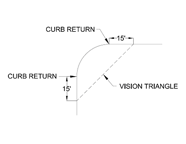
B.
For locations that have obstructions due to unique site constraints or topography, the vision triangle shall be determined by the director of public works.
C.
The provisions of this section are not applicable to properties within the downtown mixed use (DMU) district. For sight distance provisions and standards in the downtown mixed use district, see the Downtown San Rafael Precise Plan Form-Based Code which is adopted by separate ordinance and incorporated herein by reference.
(Ord. No. 1923, § 2(Exh. A), 6-16-2014; Ord. No. 1996, div. 2(Exh. A, 6.7), 8-16-2021)
14.16.300 - Small lots.
Development of small lots shall be permitted in accordance with all the requirements of the district. Such development shall be considered conforming with the following additional limits in residential districts:
A.
No small lot shall be further reduced in area or width, except as required for public improvements.
B.
Small lots which are contiguously owned are subject to the merger provisions of the State Subdivision Map Act.
C.
This section does not apply to the PD district.
(Ord. 1694 § 1 (Exh. A) (part), 1996: Ord. 1625 § 1 (part), 1992).
(Ord. No. 1990, div. 1.5, 3-1-2021)
14.16.305 - Small wind energy systems.
A.
Purpose. This section establishes standards to regulate the design and placement of small wind energy systems on public and private property to minimize the potential safety and aesthetic impacts on neighboring property owners and the community.
B.
Applicability. Standards for small wind energy systems shall apply in all residential, commercial & office, industrial, planned development, marine, and public/quasi-public zoning districts. Small wind energy systems shall not be permitted in the parks/open space and water zoning districts.
C.
Development Standards.
1.
Height. Tower height of freestanding small wind energy system shall not exceed the maximum height limit above grade established for principal structures in the applicable zoning district, except as may be allowed through design review and consistent with the provisions of Section 14.16.120. The tower height shall not include the wind turbine itself, except as noted in Section 14.16.305,C.2. below to determine appropriate setbacks.
2.
Setbacks. Small wind energy systems shall be located a minimum distance from all property lines equal to one-half (½) of the total extended height of the unit above grade or the roof mounting point. The total extended height shall include the distance above grade to a blade tip of a wind turbine at its highest point of travel. Small wind energy systems may not be located in a front or side yard setback area.
3.
Noise. Small wind energy systems shall operate within the noise limitations established in Section 14.16.320 and Chapter 8.13 of the Municipal Code, except that these limits may be exceeded during severe wind storms.
4.
Access. If a climbing apparatus is present on the tower within twelve feet (12') of grade, access to the tower shall be controlled by one (1) of the following means:
a.
Removal of climbing pegs or rungs within twelve feet (12') of grade,
b.
Installation of a locked anti-climb device on the tower,
c.
Installation of a locked, protective fence at least six feet (6') in height that encloses the tower; or
d.
Other means of security deemed comparable by the building official.
5.
Minimum Clearance. A minimum clearance of at least twelve feet (12') shall be maintained from the ground level surface elevation to the blade tip of a wind turbine at its lowest point of travel.
6.
Lighting. No illumination of the turbine or the tower shall be allowed, except where required by the Federal Aviation Administration.
7.
Signage. No signs, other than the manufacturer's or installer's identification, appropriate warning signs, or owner identification shall be allowed on a small wind energy system.
8.
Reserved.
9.
Requirement for Engineered Drawings. Building permit applications for small wind energy systems shall be accompanied by standard drawings of the wind turbine structure and stamped engineered drawings of the tower, base, footings, and/or foundation as provided by the manufacturer.
D.
Abandonment. A wind turbine which is inoperable for six (6) consecutive months or deemed unsafe by the building official shall be removed by the owner.
(Ord. No. 1923, § 2(Exh. A), 6-16-2014; Ord. No. 1964, § 2(Exh. B) § 16, 11-19-2018)
14.16.307 - Solar installations.
A.
Solar installations on developed properties. As provided under federal law, installation of solar panels on the roof of permitted structures and paved parking areas or on the grounds of developed property that are intended to offset the energy demand of the use of the property and in compliance with all applicable zoning district development standards shall be permitted by right, subject to issuance of a building permit and ministerial review for compliance with the following standards:
1.
An environmental and design permit shall not be required for a solar installation proposed on a developed property, consistent with these provisions and Section 14.25.040.D.4.
2.
A solar installation shall include all associated equipment, such as an inverter required to convert power from direct current "DC" to alternating current "AC" and connections made between the site and power grid equipment. Associated equipment does not include a substation.
3.
The solar installation shall not be placed within any required front or exterior side yard setback or within a required landscape area. Further, the solar installation shall not require removal of any required landscaping improvements or native vegetation that is within a required natural state area established pursuant to the Hillside Overlay District regulations of Chapter 14.12. Landscaping modifications may require design review approval, pursuant to Chapter 14.25.
4.
Consistent with state law (Ca Civil Code Section 714.1 - Solar Rights Act, amended 2004), private covenants, conditions and restrictions (CC&R's) cannot prohibit installation of solar equipment on buildings.
5.
The city may impose reasonable restrictions that do not significantly increase cost of systems for solar heating more than twenty percent (20%) or photo-voltaic more than two thousand dollars ($2,000.00), or decrease efficiency more than twenty percent (20%).
6.
The city may require that panels be designed with low-reflectivity or glare-resistant surfaces to the extent necessary to protect public health, safety and welfare, be placed as close to roof or grade surface as feasible, and provide screening of the structural supports, as deemed necessary and feasible; subject to limitations imposed by state law regarding impact upon the cost and efficiency of the solar energy system. The facility may not be denied solely for aesthetic reasons.
7.
Consistent with the provisions of state law, shade control protections, private parties can resolve any disputes with respect to the Solar Shade Control Act (Ca Public Resources Code Div. 15, Section 25980 et. seq., Solar Shade Control Act) through a civil action.
B.
Solar energy production facilities for off-site power distribution. A conditional use permit approval shall be required to establish a solar energy production facility that is intended to produce energy for distribution to the power grid, that is proposed other than on existing buildings or paved parking lots (e.g., solar power plant or "energy farm", as regulated under Ca Codes Public Utilities Code Section 2868-2869, as it may be amended from time to time). Solar energy production facility(s) shall only be established where "utility facilities" are listed as a conditionally permitted quasi-public use in the underlying zoning district land use table(s).
(Ord. No. 1923, § 2(Exh. A), 6-16-2014)
14.16.310 - State lands commission title claims (Allardt's Canal).
Where development is proposed within Allardt's San Rafael Canal (see Map 14.16.310), public trust title claims shall be resolved consistent with state law, subject to approval of the State Lands Commission.
Map 14.16.310
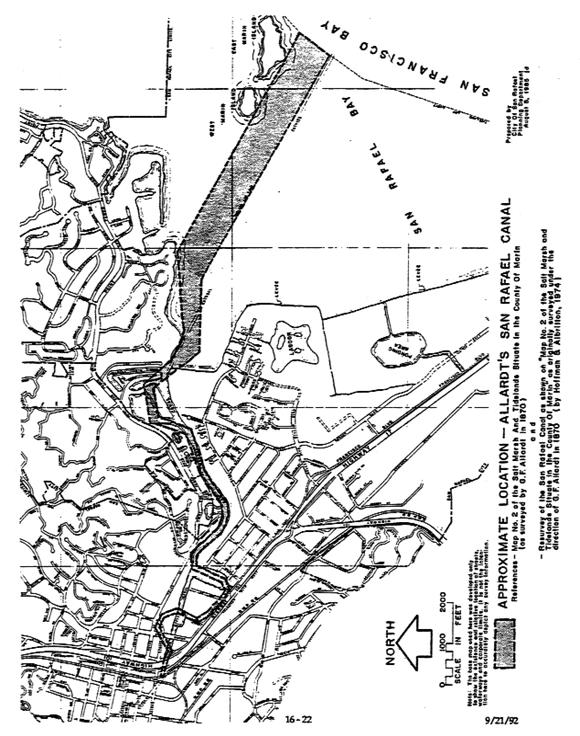
(Ord. 1625 § 1 (part), 1992).
14.16.320 - Swimming pools, hot tubs, and other mechanical equipment.
No swimming pool, hot tub, air conditioning unit or mechanical equipment shall encroach into any front yard or street side yard setback. No pump or filter installation, air conditioning unit or similar mechanical equipment, including new but not limited to transformers for electric vehicle charging stations and wind energy systems, shall be less than five feet (5') from any property line. If a pump or filter or any similar mechanical equipment, including new but not limited to transformers for electric vehicle charging stations and wind energy systems, is located within fifteen feet (15') of any bedroom window on an adjacent lot, a three (3) sided solid enclosure with baffles to screen the equipment from the bedroom, or equally effective measure(s), shall be provided to reduce noise impact. Sound attenuation shall be provided around mechanical equipment to ensure that any mechanical noise that is perceptible at the property line (and generally measured in direct line of sight of the equipment) is attenuated to the maximum extent practicable and that daytime/nighttime thresholds established under SRMC Table 8.13-1 for the applicable zoning district are not exceeded.
(Ord. 1625 § 1 (part), 1992).
(Ord. No. 1923, § 2(Exh. A), 6-16-2014)
14.16.330 - Transfer of density among properties.
A.
Unique or Special Circumstances. Transfer of density among properties shall not be permitted except in cases where there are unique or special circumstances (such as preservation of wetlands, or historic buildings identified in the San Rafael Historic Building Inventory) which would cause severe environmental impacts if the transfer were not allowed.
B.
Use Permit Required. Transfer of density among properties shall be reviewed by the planning commission through the use permit process.
C.
Application. Applications for use permits for transfer of density among properties shall include but not be limited to the following information:
1.
Affidavits of consent from owners of all donor and receiving properties;
2.
A calculation of the floor area ratio and/or density to be transferred;
3.
A description of the proposed dedication, easement or covenant.
D.
Findings. In order to approve a transfer of density among properties, the following findings shall be made:
1.
All of the findings required for a use permit listed in Chapter 14.22, Use Permits;
2.
There are unique or special circumstances (e.g., significant wetland, or historic building identified in the historic building overlay district) which exist on the subject property which would cause severe environmental impacts or degradation of historic value of a building or property if the transfer were not allowed;
3.
Proposed development for the receiving property shall be compatible in scale and design with surrounding properties.
E.
Conditions of Approval. A use permit approving transfer of density among properties shall contain as condition(s) of approval the requirement of adequate mechanisms such as a recorded restrictive covenant which runs with the donor and receiving tracts, or equally effective mechanisms, to ensure permanent accountability of the density transfer. The mechanism shall affect all properties involved in the transfer of density.
(Ord. 1625 § 1 (part), 1992).
14.16.335 - Transfer of floor area ratio (FAR) between or among properties.
A.
Transfer of floor area ratio (FAR) between or among properties shall not be permitted except under special circumstances as specified below.
B.
Use Permit Required. Transfer of FAR among properties shall be reviewed by the city council, with recommendation by the planning commission, through the use permit process.
C.
Application. Applications for use permits for transfer of FAR among properties shall include but not be limited to the following information:
1.
Affidavits of consent from owners of all donor and receiving properties;
2.
A calculation of the floor area ratio and/or density to be transferred;
3.
A description of the proposed dedication, easement or covenant;
4.
Any other information deemed necessary by the community development director.
D.
Findings. In order to approve a transfer of floor area ratio (FAR) among properties, the following findings shall be made:
1.
The development of the beneficiary parcel is consistent with the general plan, except that FARs or maximum densities may be exceeded, and
2.
The proposed development will comply with all applicable zoning and design parameters and criteria as well as traffic requirements; and one or both of the following:
a.
A unique or special circumstances are found to exist (e.g. preservation of wetlands or historic buildings) that would cause significant environmental impacts if the transfer is not allowed, and/or
b.
A significant public benefit, such as securing a new public facility site (e.g. park, school, library, fire station, police station), will be provided.
(Ord. No. 1964, § 2(Exh. B) § 17, 11-19-2018)
14.16.340 - Transfer of density on-site.
A.
Unique or Special Circumstances. Density permitted on a portion of a lot may be transferred and built on another portion of the same lot only in the following unique or special circumstances:
1.
To preserve sensitive site resources on a lot in a residential district, provided that there is adequate infrastructure to serve the development and that the development is consistent with design policies and with prevailing densities of adjacent development.
2.
To secure public recreation facilities on surplus Dominican College land to serve the Dominican and Montecito neighborhoods.
3.
To retain school site public recreation and child care facilities in accordance with priorities in the general plan.
4.
To achieve development on downtown lots split by floor area ratio designations which is compatible in scale with surrounding development.
B.
Environmental and Design Review Permit Required. Transfer of density on-site shall be reviewed and approved by the planning commission through the environmental and design review permit process.
(Ord. 1625 § 1 (part), 1992).
14.16.350 - Reserved.
Editor's note— Exh. A, § 57, of Ord. No. 1882, adopted June 21, 2010, deleted § 14.16.350 which pertained to trip allocations, and derived from Ord. 1663, 1994; and Ord. 1625, 1992.
14.16.360 - Wireless communication facilities.
A.
Purpose. This section establishes standards to regulate the design and placement of towers, antennas, and other wireless communication transmission and/or reception facilities (hereinafter called wireless communication facilities) on public and private property, including facilities within the public right-of-way to minimize the potential safety and aesthetic impacts on neighboring property owners and the community, and to comply with applicable state and federal laws, including the Federal Telecommunications Act of 1996. This section does not apply to small wireless facilities as defined under Section 14.03.030, which are regulated by Section 14.16.361. To fulfill its purpose, this section is intended to:
1.
Establish review and approval requirements, application submittal requirements, and development standards to regulate the design and placement of wireless communication facilities so as to preserve the visual character of the city and to ensure public health and safety, consistent with federal law and Federal Communications Commission (FCC) regulations.
2.
Acknowledge the community benefit associated with the provision of wireless communication services within the city.
3.
Encourage the joint use of new and existing ground mounted facility monopole/tower sites as a primary option rather than construction of additional single-use towers.
4.
Allow the community development director, or delegated staff, to make certain determinations under the provisions of this section.
B.
Zoning Review Required.
1.
Ministerial Review. A staff level ministerial review shall be required and obtained from the community development director, and no discretionary use permit or environmental design review planning permits shall be required, for the following types of wireless communications facilities to assure compliance with the requirements of subsections G, H, I, J, K, L and M of this section:
a.
Co-located facilities on an existing approved monopole or tower structure (i.e., ground mounted facility) that utilizes or improves stealth design characteristics of the facility, and/or does not substantially increase the visible height or overall dimensions of the structure and/or ground lease area. The alteration or addition shall not significantly change the appearance of the existing facility or its stealth design features, or increase visual height, overall dimensions, or ground lease area by more than ten percent (10%).
b.
Building-mounted facilities, including modification to existing permitted facilities that are architecturally compatible with and entirely integrated into the existing building façade (i.e., stealth design). In general, to be deemed architecturally compatible and entirely integrated with the building façade, the modification shall utilize or improve existing roof-top screening solutions, shall not increase the building height, and shall be flush with and designed to blend into the existing building walls or facades.
c.
Ministerial review shall not apply to modifications of monopoles or towers, new building additions, extensions, projections, etc. made to existing facilities which the community development director determines would increase the visual impacts of the facility. This shall include extensions to height of a facility that exceeds the height limits of the base zoning district. In such instances, an environmental and design review permit shall be required for the stealth design modifications pursuant to the provisions of Chapter 14.25.
2.
Discretionary Review. A zoning administrator level use permit and an environmental and design review permit shall be required for the following wireless communication facilities pursuant to the requirements of Chapter 14.22, Use Permits, and Chapter 14.25, Environmental and Design Review Permits, consistent with the provisions of this section:
a.
New ground-mounted facilities (towers and monopoles) or significant additions proposed to existing facilities that would increase its visual height, overall dimensions and/or lease area (e.g., more than ten-percent increase in the existing permitted height, overall dimension, lease area); and
b.
Any facility which in conjunction with existing facilities in the area, exceeds the Federal Communications Commission (FCC) standards for public exposure for radio frequency radiation (RFR) emissions.
c.
The community development director may determine that minor modifications to an existing facility shall be subject to an administrative level design review. In general, to be deemed a minor modification, the alteration or addition shall not significantly change the appearance of the existing facility or its stealth design, or increase visual height, overall dimensions, or ground lease area by more than ten percent (10%).
d.
The community development director may elevate the project for review and action by the planning commission, as determined necessary to assure that appropriate stealth designs are being proposed to the maximum extent practicable, that the facility location is suitable, that development appropriately responds to its setting, and that the requirements of this section are substantially addressed.
C.
Appeals. All discretionary decisions of the community development director, zoning administrator, or the planning commission may be appealed in accordance with the provisions of Chapter 14.28, Appeals.
D.
Application Requirements. Applications for a use permit and/or an environmental and design review permit shall be initiated by submitting all of the following information and any revised application materials in the manner prescribed:
1.
A completed application form, signed by the property owner or accompanied by a letter of authorization that states the property owner has read and agrees to the filing of the application as well as the specific conditions of application cited on the application form, and accompanied by the required fee. Application procedures and processing timeframes shall be in accordance with state law requirements and the procedural guidelines established by the community development director.
2.
Peer Review. Prior to accepting an application as complete, the city may require at its sole discretion that a peer review of the project be conducted by a qualified RF engineering consultant, as deemed necessary to confirm the adequacy of the RFR study and/or the technical design requirements of the facility. The consultant shall be selected by the city and paid for by the project applicant. Peer review is typically required for new ground-mounted monopole or tower facilities, building mounted facilities lacking stealth design, facilities proposed within the less-preferred residential and open space areas, or RFR studies that are deemed to warrant further review.
3.
Submittal/Re-submittal Meeting Required. Applications for a wireless antenna facility must be made in person during the community development department, planning division public counter hours. A pre-submittal meeting is encouraged and a re-submittal meeting shall be required. Applications and any subsequent resubmittals that are not made in person and during scheduled times shall not be deemed accepted for filing and will be returned.
4.
Pre-application or Conceptual Review. A pre-application and/or conceptual review are strongly recommended prior to submitting formal applications for new ground-mounted monopoles or towers, new building mounted facilities or projects in less-preferred residential and open space areas.
5.
Revised applications. Unless waived by the community development director, resubmitted applications that result in a substantially revised facility design, size, height or location such that a new round of completeness review is warranted, shall be required to be withdrawn and a new application shall be filed for the substantially revised project.
6.
Extensions of time. Applications deemed incomplete must be resubmitted within 30 days or they shall be deemed automatically withdrawn, unless the applicant has requested a one-time extension in processing time to resubmit, not to exceed 90 days. If the application is deemed automatically withdrawn, a new application shall be required in order to proceed with the project.
7.
Six (6) initial sets of materials and plans showing the following information:
a.
Project Description. A complete project description, including the following information on the proposed wireless communication facility:
i.
Number and sizes of antennas and approximate orientation,
ii.
Other technical information regarding transmission equipment such as maximum power output and frequencies,
iii.
Copy of FCC license,
iv.
Heights of proposed facilities,
v.
Equipment enclosure type and size,
vi.
Materials and colors of antennas and any equipment enclosure,
vii.
Description of towers or other structures necessary to support the proposed facilities, and
viii.
Description of lighting, signage and landscaping proposed.
b.
Site Plan(s). A site plan, showing the overall property on which the facility will be placed, and a detail site plan for the project area, as needed for large sites, provided on a twenty-four-inch-by-thirty-six-inch (24″ x 36″) sheet of paper and an eleven-inch-by-seventeen-inch (11″ x 17″) reduction, and including the following information:
i.
Vicinity map,
ii.
Parcel lines of the subject parcel,
iii.
Contextual map showing structures on adjacent properties,
iv.
Location and names of adjacent streets and drives proposed to serve as access to the facility,
v.
Topography of the subject parcel and location of any drainages within or adjacent to the site,
vi.
Location of all existing buildings, structures, utilities, parking areas, significant trees and other natural forms, or other features which might affect the proposed use of the property,
vii.
Setbacks of proposed structures and improvements from the property lines,
viii.
Location and height of required cuts and fills for the grading of land and any retaining walls proposed,
ix.
Location of proposed development including all towers, structures, buildings, utility line extensions, driveways or roads, and parking areas,
x.
Schematic drainage and grading plan, and
xi.
North arrow, graphic scale, the applicant's name, assessor's parcel number and date prepared.
c.
Elevations. Elevations showing all sides of the proposed facility set forth on a twenty-four-inch-by-thirty-six-inch (24″ x 36″) sheet of paper, and an eleven-inch-by-seventeen-inch (11″ x 17″) reduction, including the following information:
i.
Elevations and sections of the site displaying site topography, proposed facilities including towers, equipment shelter and existing buildings,
ii.
Wall, roof, tower and antenna materials,
iii.
Fencing, air conditioning units and outdoor lighting, if any,
iv.
Rooftop or building features such as vents, chimneys and antennas, and
v.
Building or tower height as measured from natural grade.
d.
Photo-Simulations. Photo-simulations of the proposed facility from key public viewpoints based upon consultation with city staff. Photo-simulations shall display existing and proposed views in an eleven-inch-by-seventeen-inch (11″ x 17″), or larger, format, with the dates shown when the base photo was taken.
e.
Landscape Plan. A landscape and irrigation plan, showing all existing and proposed improvements, location of proposed plantings and type of landscape material, for proposed ground-mounted facilities including equipment cabinets.
8.
Alternative Site Analysis. An alternative site analysis is required if the proposed facility is:
a.
Located within any district other than a commercial or industrial district;
b.
Located within fifty feet (50′) of a "Less Preferred Location," as defined in subsection (G)(2) of this section (i.e., parks, open space or residential zoning district);
c.
Lacking stealth design; or
d.
Not co-located with an existing approved facility.
The alternative site analysis shall be presented in a narrative form with supporting maps and other graphics that identify the other site locations considered and rejected in favor of the proposed site. The applicant shall provide supporting reasons why the alternate sites were infeasible and rejected, why co-location or building-mounted location has not been pursued (if applicable), and why the proposed site is superior from a technical or other standpoint to the others considered.
9.
Future Co-Location. For new ground-mounted towers or monopoles, a signed statement that the carrier, or its future successors, will cooperate with the city to allow future co-location of antennas at the proposed site if it is approved and that the carrier has reviewed and agrees to comply with all post-approval requirements of this section.
10.
Story Poles. Story poles or mock-ups may be required if deemed necessary by the community development director.
11.
Radio Frequency Radiation (RFR) Study and FCC Compliance Details. For the sole purpose of verifying compliance with the FCC radio frequency emission standards, an emissions report which measures the predicted and actual levels of electromagnetic field radiation emitted by the proposed facility operating alone and in combination with radiation emitted from other existing or approved facilities that can be detected at the proposed facility site. Radiation measurements shall be based on all proposed (applications filed and pending), approved, and existing facilities operating at maximum power densities and frequencies. The study shall identify the existing and predicted electromagnetic field radiation in table form, identify any measures required to comply with the FCC standards for predicted exposure levels, provide a summary of the conclusions of the report and provide details for any signage, barriers or similar mitigation that is recommended or required. If mitigation is required, the details for signage, barriers or other physical improvements shall also be included on the project plans prepared for the facility. It is the responsibility of the applicant to determine the location and power of existing facilities.
12.
Noise Analysis. A noise analysis for emergency generators or other noise-producing facilities.
Applications accepted as complete. Once an application has been accepted as complete, it shall be promptly scheduled for hearings, and a decision shall be made based upon the quality of the information presented by the applicant.
E.
Exemptions. The following types of facilities are exempt from the provisions of this section:
1.
Facilities for which zoning permit applications were approved by the city and/or building permits were issued on or prior to the effective date of this section and which remain valid (i.e., not expired) shall be exempt from the review and approval requirements of this section, except for the requirements for validation of proper operation, monitoring, and removal of abandoned facilities, and for proposed modifications to existing facilities which shall remain applicable;
2.
Facilities owned and operated by public agencies; and
3.
Proposed facilities that would be located entirely within a building and only serve that building.
F.
Public Notice. Notice of a public meeting or hearing for a wireless communication facility subject to a use permit and/or environmental and design review permit shall be given in accordance with Chapter 14.29, Public Notice, except that a public notice shall be mailed to all property owners within one thousand feet (1,000′) of any proposed facility that includes a tower or monopole. Public hearing and notice shall not be required for minor modifications made to existing facilities that the community development director determines, pursuant to the provisions of Section 14.16.360.B.3, would require only an administrative level environmental and design review permit.
G.
General Location Standards. The most desirable location for new wireless communication facilities is co-location on existing facilities or buildings. All wireless communication facilities shall be sited to avoid or minimize land use conflicts in compliance with the following standards:
1.
Preferred Locations. The following list of preferred locations for wireless communication facilities is in order of preference from most to least preferred: Industrial, public or quasi-public, commercial and office zoning districts are the preferred locations.
2.
Less Preferred Locations. The following less preferred locations are listed in order of preference from most to least preferred: Parks or open space and residential zoning districts.
3.
Avoid Residential and Open Space Areas. New monopoles or towers shall not be located within residential, designated open space or conservation areas unless sufficient technical and other information is provided to demonstrate to the satisfaction of the planning commission or zoning administrator that location in such areas is appropriate, subject to the following findings:
a.
The location of the proposed facility site is essential to meet the service demands of the carrier and no other alternative co-location, existing development or utility facility site, or type of antenna support structure is feasible. This shall be documented by the applicant providing a list of the locations of preferred technically feasible sites, the good faith efforts and measures taken by the applicant to secure these preferred sites, and the specific reasons why these efforts and measures were unsuccessful.
b.
The use of a monopole for the proposed facility by itself or in combination with other existing, approved, and proposed facilities will avoid or minimize adverse effects related to land use compatibility, visual resources and public safety.
4.
Avoid Significant Buildings and View Sheds. Wireless communication facilities shall not be located on historically or architecturally significant structures unless visually and architecturally integrated with the structure, and shall not interfere with prominent vistas or significant public view corridors.
H.
Design Requirements.
1.
Co-Location. All new wireless communication facilities service providers shall co-locate with other existing and/or planned new wireless communication facilities whenever feasible. Service providers are encouraged to co-locate with other existing facilities such as water tanks, and other utility structures where the co-location is found to minimize the overall visual impact of the new facility. Co-location of small wireless facilities on light standards/poles, traffic lights, or other structures located within the public right-of-way shall be subject to requirements of Section 14.16.361.
2.
Stealth Design. All wireless communication facilities shall have a stealth design to screen or reduce visual impacts and blend the facility into the existing environment. Examples of stealth design are facade-mounted antennas located within architectural features so they are screened from view, or an antenna design that mimics architectural features so they appear to be architecturally integrated as a part of the building design, or facilities with colors and materials to minimize visibility such as a non-reflective finish in a color compatible with the surrounding area. Stealth tower, monopole or building design should seamlessly integrate with its setting and/or building façade. A seamless integration would include façade mounted facilities that are flush with the existing building wall or window plane and that are finished to match the existing textures and finishes, or a high-quality faux tree or similar monopole/tower design that would match existing surrounding vegetation or site characteristics.
3.
Ground-Mounted Facilities. All new ground-mounted wireless communication equipment, antennas, poles, dishes, cabinet structures, towers or other appurtenances shall be:
a.
Co-located on existing structures to the extent feasible. Co-location is preferred over new monopoles or other towers erected specifically to support wireless communication facilities unless technical evidence demonstrates that there are no other alternative sites or feasible support structures or the use of a monopole or tower would avoid or minimize adverse effects related to the view shed, land use compatibility, visual resources and public safety.
b.
Sited to be screened by existing development, topography or vegetation to the extent consistent with proper operation of the wireless communication facility. Additional new, irrigated vegetation, or other screening, may be required as a condition of approval.
c.
Designed using high-quality techniques to minimum surrounding vegetation or features in order to blend into the site to the maximum extent practicable.
4.
Roof and Building-Mounted Facilities. Roof and building-mounted antennas and equipment shall be:
a.
Sited and designed to appear as an integral part of the structure or otherwise minimize their appearance. Placing roof-mounted antennas in direct line with significant view corridors shall be avoided. Where appropriate, construction of a rooftop parapet wall to hide the facility may be required.
b.
Integrated architecturally with the design, color, materials and character of the structure or otherwise made as unobtrusive as possible. If possible, antennas shall be located entirely within an existing or newly-created architectural feature (e.g., cupolas, dormers, chimneys or steeples) so as to be completely screened from view. To the extent feasible, building-mounted antennas shall not be located on the front, or most prominent facade of a structure, and shall be located above the pedestrian line-of-sight.
c.
Whenever possible, base stations, equipment cabinets, back-up generators, and other equipment associated with building-mounted antennas shall be installed within the existing building or underground. If this is not feasible, the equipment shall be painted, screened, fenced, landscaped or otherwise treated architecturally to minimize its appearance from off-site locations and to visually blend with the surrounding natural and built environment.
5.
Signage. No advertising signage or identifying logos shall be displayed on any wireless communication facility except for small identification plates used for emergency notification and legally required hazard warnings.
6.
Waiver Request. A waiver from these requirements may be requested if the applicant can show, by substantial evidence, that compliance with a particular requirement is technologically infeasible or would result in an unreasonable interference with signal quality. The applicant will be required to prove that there are no feasible alternatives to the waiver request. A waiver request may be subject to peer review conducted by a qualified RF engineering consultant selected by the city and paid for by the project applicant.
I.
Development Standards.
1.
Height. The maximum height of building-mounted antennas shall be in compliance with the height limitations for the zoning district in which they are located. An exception to antenna height may be granted by the planning commission or zoning administrator if the RFR exposures and aesthetic quality of the proposed facility are found to be acceptable. Antenna structures, including towers and monopoles, and mechanical screening features related to wireless communication facilities, shall be regulated subject to Section 14.16.120 of this chapter.
2.
Setbacks.
a.
Towers, guy wires, and accessory structures, including equipment cabinets, shall comply with the setback requirements of the applicable zoning district. Towers and support structures shall be located a minimum of two hundred feet (200′) or at least three (3) times the height of the tower, whichever is greater, from existing residential units or vacant residentially zoned property.
b.
Building-mounted facilities may be permitted to extend up to two feet (2′) horizontally beyond the edge of the structure regardless of setback requirements through the application review process, provided that the antenna does not encroach over an adjoining parcel or public right-of-way or otherwise create a safety hazard.
J.
Lighting. Any exterior lighting shall be manually operated, low wattage, and used only during night maintenance or emergencies, unless otherwise required by applicable federal law or FCC rules. The lighting shall be constructed or located so that only the intended area is illuminated and off-site glare is fully controlled.
K.
Landscaping. Wireless communication facilities shall be installed in a manner that maintains and enhances existing vegetation and provides new landscape material to screen proposed facilities through the following measures:
1.
The emphasis of the landscape design shall be to visually screen the proposed facility and stabilize soils on sloping sites. Introduced vegetation shall be native, drought tolerant species compatible with the predominant natural setting of the adjacent area.
2.
Existing trees and other screening vegetation in the vicinity of the proposed facility shall be protected from damage both during and after construction. Submission of a tree protection plan prepared by a certified arborist may be required.
3.
All vegetation disturbed during project construction shall be replanted with compatible vegetation and soils disturbed by development shall be reseeded to control erosion.
4.
Appropriate provisions for irrigation and maintenance shall be identified in the landscape plan. The city may impose a requirement for a landscape maintenance agreement as a condition of approval.
L.
Noise. Wireless communication facilities shall be constructed and operated in a manner that minimizes noise. Noise reduction shall be accomplished through the following measures:
1.
Wireless communication facilities shall operate in compliance with the noise exposure standards in San Rafael Municipal Code Chapter 8.13, Noise.
2.
Normal testing and maintenance activities shall occur between eight a.m. (8:00 a.m.) and six p.m. (6:00 p.m.), Monday through Friday, excluding emergency repairs.
3.
Backup generators shall comply with the same noise standards referenced in subsection (L)(1) of this section and shall only be operated during power outages, emergency occurrences, or for testing and maintenance.
M.
Radio Frequency Radiation (RFR).
1.
RFR Standards. Wireless communication facilities operating alone and in conjunction with other telecommunication facilities shall not produce RFR in excess of the standards for permissible human exposure as adopted by the FCC.
2.
RFR Report. Applications for wireless communication facilities shall include a RFR report, prepared by a qualified expert, which identifies the predicted and actual (if available) levels of RFR emitted by the proposed facility operating by itself and in combination with other existing or approved facilities which can be measured at the proposed facility site. Measurements for RFR shall be based on all proposed, approved, and existing facilities operating at maximum power densities and frequencies.
N.
Post-Approval Requirements.
1.
Validation of Proper Operation. Within forty-five (45) days of commencement of operations, the applicant for the wireless communication facility shall provide the community development department with a report, prepared by a qualified expert, indicating that the actual RFR levels of the operating facility, measured at the property line or nearest point of public access and in the direction of maximum radiation from each antenna, is in compliance with the standards established by the FCC for RFR.
2.
Five-Year Review. The owner or operator of a wireless communications facility shall participate in the measurement by the city of the RFR of the facility, which shall be conducted on a five (5) year cycle. The requirement for a five-year review shall be made a condition of approval for all wireless communication facilities. The city will contract to perform the testing with a qualified expert and the owners or operators shall bear the proportionate cost of testing for its facility. The city will establish procedures for:
a.
Scheduling the five-year review period;
b.
Hiring an expert to perform RFR testing;
c.
Collecting reasonable fees; and
d.
Enforcement actions for nonpayment of fees.
3.
Notification of Abandonment of Use. The owner or operator of an approved wireless communication facility shall remove any abandoned facilities or restore the existing approved use of a facility within ninety (90) days of termination of use.
4.
Changes Affecting RFR. Any operational or technological changes to an approved wireless communication facility affecting RFR exposures shall be reported promptly to the city, including any change of ownership. The city may require new RFR testing within forty-five (45) days of notification.
5.
Changes to FCC Standards. Owner or operators of all approved wireless communication facilities shall make necessary changes or upgrades to their facilities in order to comply with any newly adopted FCC standards for RFR. Upgrades to facilities shall be made no later than ninety (90) days after notification of the changed FCC standards and the owner or operator shall notify the city in writing that the upgrades have been completed.
6.
Co-Location and Facility Upgrade Agreement. Owners or operators of all approved wireless communications facilities shall agree to make their facility available for co-location with other carriers. Modifications to the facility design shall be allowed to accommodate additional carriers on a site, as well as to restore, replace, or upgrade any screening that is deemed obsolete and removed as a result of modifications made to the primary site structure, or concurrent with any upgrades proposed to the subject facility.
7.
Owners or operators of all approved wireless communications facilities shall be responsible for maintaining the effectiveness of screening of its facilities, in compliance with project approvals. This shall include pursuing modifications of existing approvals, as necessary, should changes be made to the site or primary structure that would reduce the effectiveness of screening provided for the facility.
O.
Definitions.
1.
"Ground mounted facility" means a monopole, tower or any structure built for the sole or primary purpose of supporting FCC-licensed wireless communications facility antenna and their associated facilities. Wireless antenna facilities and equipment that are mounted onto an existing structure, including existing utility poles, on private property shall be considered building mounted co-located on an existing structure. Mounting of wireless facilities on light standards/poles, traffic lights, or utility poles within the public right-of-way shall be governed by Section 14.16.361.
2.
"Base station" consists of "radio transceivers, antennas, coaxial cable, a regular and backup power supply, and other associated electronics.
3.
"Lease area" means the defined area on the ground or on a building in which wireless facility equipment is placed and/or enclosed.
(Ord. 1823 § 1 (Exh. A) (part), 2004).
(Ord. No. 1923, § 2(Exh. A), 6-16-2014; Ord. No. 1967, §§ 3—5, 12-17-2018; Ord. No. 2039, § 3(Exh. B), 7-15-2024)
14.16.361 - Small wireless facilities.
Notwithstanding any other provision of this title as provided herein, all small wireless facilities as defined by the FCC in 47 C.F.R. § 1.6002(l), as may be amended or superseded, are subject to a permit as specified in the San Rafael city council's "Policies, procedures, standards and limitations for submittal and review of small wireless facilities within the public right-of-way as set forth in the San Rafael Municipal Code Section 14.16.361" ("policy"), as adopted and amended from time to time by city council resolution, and all small wireless facilities shall comply with such policy. If the city council policy is repealed, an application for a small wireless facility shall be processed pursuant to Section 14.16.360.
(Ord. No. 1967, § 6, 12-17-2018)
14.16.370 - Water-efficient landscape.
A.
Purpose and Authority. Effective January 1, 2011, certain new construction and rehabilitation projects that include landscape and irrigation improvements are required to comply with water-efficient landscape requirements and to monitor water usage for irrigation, as mandated under California Government Code Section 65595(c). For the purpose of administering this state mandate, the City of San Rafael hereby adopts by reference, the Marin Municipal Water District (MMWD) Ordinance (Water Conservation), as adopted and periodically amended, and designates MMWD, the local water provider, to implement, enforce, and monitor the requirements of this ordinance. For projects that are subject to the water-efficient landscape requirements, the city defers to MMWD to administer the provisions of this chapter, which include:
1.
The application and monitoring of a "maximum applied water allowance," that is established for applicable projects.
2.
The review of required landscape and irrigation plans, specifications and supportive documents prepared for applicable projects for compliance with water-efficient landscape restrictions, including limitations on the type and amount of landscape materials and plant species.
3.
The review, inspection and approval of landscape and irrigation that is installed for applicable projects to ensure compliance with the approved landscape and irrigation plans and specifications.
4.
The post-installation monitoring of water usage for irrigation by applicable projects.
B.
Applicability. The provisions of this section and the MMWD Ordinance as adopted and periodically amended are applicable to the following projects:
1.
Any project that proposes new or rehabilitated landscapes which are developer-installed in single-family residential and all other residential developments, regardless of size, where the proposed landscape area is equal to or greater than two thousand five hundred (2,500) square feet;
2.
Any project that proposes new or rehabilitated landscapes which are homeowner provided and/or homeowner-hired in single-family residential, two-family residential and multiple-family residential developments, where the proposed landscape area is equal to or greater than five thousand (5,000) square feet;
3.
Any new nonresidential construction projects exceeding one thousand (1,000) square feet of landscaped area;
4.
Any project that proposes new or rehabilitated landscapes which are developer-installed in nonresidential developments where the proposed landscape area is equal to or greater than two thousand five hundred (2,500) square feet.
C.
City Review of Applicable Projects. City review of applicable projects shall be processed as follows:
1.
Projects Requiring Approval of an Environmental and Design Review Permit. When an applicable project is subject to an environmental and design review permit pursuant to chapter 14.25 of this title, the landscape and irrigation plans required by and submitted with this permit application shall be designed and prepared to comply with the provisions and requirements of MMWD Ordinance as adopted and periodically amended. The approval of an environmental and design review permit shall be conditioned to require the applicant to provide written verification of plan approval from MMWD prior to the issuance of a building permit and/or grading permit.
2.
Projects Requiring a Building Permit and/or Grading Permit only. When an applicable project is not subject to an environmental and design review permit but is required to secure a building permit and/or grading permit, such permits shall not be issued until the applicant has secured, in writing, MMWD approval of the landscape and irrigation plans confirming compliance with MMWD Ordinance as adopted and periodically amended.
D.
Inspections and Post-Installation Monitoring and Enforcement. MMWD shall be responsible for:
1.
Inspecting and approving all landscape and irrigation installed for applicable projects prior to project completion and/or occupancy; and
2.
Monitoring water usage for installed landscapes to ensure compliance with MMWD Ordinance as adopted with amendments. All enforcement actions for ordinance noncompliance or violations shall be administered by MMWD.
(Ord. No. 1882, Exh. A, § 58, 6-21-2010; Ord. No. 1892, § 1, 2-22-2011; Ord. No. 1923, § 2(Exh. A), 6-16-2014)
14.17.010 - Specific purposes.
Performance standards provide criteria for issuing administrative use permits and certain other use permits that require minimal discretion and review. (See Chapter 14.21 for additional information on the administrative use permit process.) The performance standards listed in this section are intended to explicitly describe the required location, configuration, design, amenities and operation of specified uses. The performance standards also mitigate potential adverse impacts on the neighborhood and maintain harmonious uses in the area. The performance standards are consistent with the goals and policies of the general plan.
(Ord. 1625 § 1 (part), 1992).
(Ord. No. 1923, § 2(Exh. A), 6-16-2014)
14.17.020 - Animal keeping.
A.
Purposes. Performance standards related to noncommercial animal keeping protect the public health, safety and general welfare by limiting numbers of animals which may be kept, maintaining sanitary and humane conditions for animals, and limiting potential nuisance factors which may result from the keeping of animals.
B.
Applicability. Performance standards for the noncommercial keeping of animals, including mammals, birds, reptiles and bees unless specifically ex empted by this subsection shall apply throughout the City of San Rafael. (See list of exemptions below.) An administrative use permit shall be required for the keeping of animals within the City of San Rafael. The following animals are exempt from these regulations:
1.
Fish;
2.
Three (3) or fewer domestic dogs, not including wolf-hybrids, over the age of four (4) months per dwelling unit;
3.
Ten (10) or fewer domestic cats over the age of four (4) months per dwelling unit;
4.
Any number of domestic dogs, cats or potbellied pigs under the age of four (4) months;
5.
Three (3) or fewer potbellied pigs (not including hybrids over seventy (70) pounds);
6.
Four (4) or fewer hens (i.e., female domesticated chicken);
7.
Ten (10) or fewer of the following:
a.
Soft-billed birds (myna, toucan, toucanettes, not including ducks or geese), birds of the Psittacinae family (parrots, parakeets, love birds), doves, pigeons, quail, finches and canaries,
b.
Hamsters, guinea pigs, pet mice, pet rats, and pet rabbits, and
c.
Nonnative, nonpoisonous snakes, chameleons and iguanas.
8.
Beekeeping.
C.
Other nonexempt animals are subject to individual case review, and may be subject to the following types of standards:
1.
Requirements for identification of animal guardianship, such as tagging or microchipping;
2.
Requirements for spaying or neutering of animals;
3.
Requirements for fences or fenced stockade areas;
4.
Requirements regarding provision of food and water supply, such as supply locations, requirement for closed, rodent-proof containers, etc.;
5.
Requirements to secure or sequester animals in shelters during specified hours of the day or night to minimize possible noise impacts;
6.
Requirements to maintain sanitary conditions by regular cleanup and disposal of animal feces and urine;
7.
Requirement that all places and premises where the animal is to be kept shall be open at all reasonable times and places to the inspection of the code enforcement manager or code enforcement officer, or other code enforcement officials, and the county health officer;
8.
Verification of receipt of appropriate California Department of Fish and Game permits;
9.
Verification of required vaccinations.
In approving the application for an administrative use permit for the keeping of animals, the community development director may impose additional conditions that are deemed necessary to ensure the permit will be in accordance with the findings required by Section 14.21.080.
D.
Findings. In order to grant an administrative permit for the keeping of animals the following findings shall be made:
1.
Compliance with Applicable Laws. The keeping of the animal(s) will not violate any provision of the San Rafael Municipal Code or any other applicable provision of law.
2.
Humane Treatment of Animals. The keeping of the animal as proposed will not result in an animal receiving inhumane treatment.
3.
Odors. The keeping of the animal will not result in obnoxious odors at nearby properties adversely affecting the enjoyment of such property.
4.
Flies. The keeping of the animal(s) will not cause or result in flies or other insects adversely affecting the enjoyment of nearby property.
5.
Noise. The keeping of the animal(s) will not result in noises which adversely affect the enjoyment of nearby property.
6.
Nuisances. The keeping of the animal(s) will not result in other public or private nuisances.
7.
Public Health, Sanitation, Safety, Welfare. The keeping of the animal(s) will not result in an adverse effect on the health, sanitation, safety or welfare of an occupant of the premises or other nearby residents.
8.
Procreation. The keeping of the animal(s) will not result in procreation which adversely affects nearby properties or the natural habitat.
E.
Nonconforming Animal Keeping, Declaration of Public Nuisance. The city council declares to be a public nuisance any lot where animal keeping is operating in a manner that is not in conformance with this section.
(Ord. 1740 §§ 2—5, 1999; Ord. 1625 § 1 (part), 1992).
(Ord. No. 1923, § 2(Exh. A), 6-16-2014)
14.17.030 - Community gardens.
A.
Purpose. The purpose of the community gardens regulations is to implement specific policies of the neighborhood design, community design, sustainability, and parks and recreation elements of the San Rafael general plan, which:
1.
Support social interaction and create a greater sense of community, encourage gathering places and events in appropriate locations, such as community gardens;
2.
Promote efforts to provide places where neighbors can meet each other;
3.
In multifamily development, require private outdoor areas and on-site common outdoor spaces. Common spaces may include recreation facilities, gathering spaces, and site amenities;
B.
Applicability. Performance standards for community gardens shall apply in the residential, commercial, industrial, public and quasi-public uses, and parks/open space zoning districts with the exception of the downtown zoning districts.
C.
Ministerial review required. Except where a use permit is required by the land use tables, a ministerial review is required to determine that the community garden is in compliance with the provisions of this section. If it is determined that the community garden is in full compliance with the provisions of this section, the community garden shall be approved.
D.
Standards.
1.
Operating Rules. The applicant shall submit a list of operating rules for the proposed community garden. Hours of operation shall be limited from sunrise to sunset.
2.
Americans with Disabilities Act (ADA). The project shall be designed to provide access to the general public and be ADA-compliant in accordance with the requirements of Title 24, California Code of Regulations.
3.
Parking. On-site parking is required and shall including an area for one van accessible parking space located on site nine feet (9′) × eighteen feet (18′) with an eight-foot (8′) wide accessible aisle meeting ADA standards and a space to accommodate vehicular delivery and removal of materials.
4.
Trash and Recycling. Trash and recycling shall be adequately provided on site and the project sponsor is responsible for implementing a trash recycling program, which shall also include the installation of recycling receptacles for garden users on the project site.
5.
Green Waste. Green waste facilities shall be provided on site.
6.
Material Storage. Identify on the site plan storage for all garden tools, supplies and compost in a secure manner and screened from view from off-site. Compost and other odorous materials shall be stored in a location and manner that does not affect adjacent property owners.
7.
Landscaping. Provide a landscape and irrigation plan for review and approval of the planning division and the department of public works which provides trees within the landscape setback along the property frontage with the following detail.
a.
The project landscape architect/designer shall select a tree species that is appropriate to the site and soil conditions. Trees shall be planted at a twenty-four inch (24″) box size and spaced at twenty-foot (20′) intervals.
b.
All landscaping shall be maintained in good health through the life of the project. Any dying or dead landscaping shall be replaced in a timely fashion and all landscaping shall be maintained in a healthy and thriving condition, free of weeds and debris.
c.
The landscape and irrigation plan must be designed to comply with Marin Municipal Water District (MMWD) Water Conservation Ordinance No. 421.
8.
Fences. Fences are allowed subject to the regulations in Chapter 14.16 of the city of San Rafael Municipal Code, Zoning.
9.
Lighting. Exterior lighting shall be limited to security lighting as required and approved by the city police department.
10.
Signage. A sign plan shall be submitted and shall demonstrate location of the following required signage:
a.
Two signs shall be posted on the subject property.
b.
One sign shall be posted in the common area of the garden noting the name and contact information for the garden management; and
c.
One monument-type address sign, not exceed twenty (20) square feet in area and six (6) feet in height, shall be posted at the garden entrance. The property address numbers shall be posted prominently on the monument sign.
11.
MCSTOPP/Drainage and Clean Site Water. The site must be designed and maintained so that runoff of surface water will not drain onto adjacent property. The project engineer shall incorporate features that would provide for clean site waters in accordance with RWQCB and Marin County Stormwater Pollution Prevention Program (MCSTOPPP) standards before they enter the city storm water drainage system. Features can include the installation of grassy swales to connect and filter surface water runoff.
12.
The project shall comply with the MMWD backflow prevention requirements. If, upon the district's review of the final plans backflow protection is warranted, compliance shall include installation, testing and maintenance. Questions regarding backflow requirements should be directed to the MMWD backflow prevention program coordinator at (415) 945-1559.
13.
Pest Management. The operation of the community garden shall comply with the city's Integrated Pest Management (IPM) program. Signs shall be posted and maintained within the garden area notifying garden users of the rules and consequences for using pesticides and herbicides that are not allowed on the IPM.
(Ord. No. 1964, § 2(Exh. B) § 18, 11-19-2018)
14.17.040 - Animal care facilities.
A.
Purpose. Performance standards related to animal care facilities protect the public health, safety and general welfare by minimizing potential nuisance factors that may result from the caring of animals.
B.
Applicability. Performance standards for animal care facilities, unless specifically exempted by this subsection shall apply throughout the City of San Rafael. A use permit approved by the zoning administrator, issued pursuant to Chapter 14.22 of this division, shall be required for animal care facilities within the City of San Rafael.
C.
Findings. In order to grant a use permit for animal care facilities in an office/commercial district, the following findings shall be made:
1.
Compliance with Applicable Laws. The animal care facility will not violate any provision of the San Rafael Municipal Code or any other applicable provision of law. The animal care facility shall maintain an employee handbook outlining best management practices for handling of animals, handling medical waste and disposal of animal waste.
2.
Sound Attenuation. The animal care facility shall not result in sound levels that exceed the noise levels established under Chapter 8.13 for any adjacent tenant spaces or properties.
3.
Waste. The animal care facility shall include and maintain adequate waste and hazardous waste facilities at all times.
4.
Nuisances. The animal care facility will not result in other public or private nuisances.
(Ord. No. 2015, § 4, 9-6-2022)
14.17.050 - Reserved.
Editor's note— Ord. No. 1996, div. 2(Exh. A, 7.1), adopted August 16, 2021, repealed § 14.17.050, which pertained to offices and financial institutions in the Fourth Street retail core and the West End Village and derived from Ord. 1694 § 1 (Exh. A) (part), 1996: Ord. 1663 § 1 (part), 1994: Ord. 1625 § 1 (part), 1992.
14.17.060 - Fortunetelling.
A.
Purpose. Performance standards for fortunetelling ensure police department review and background investigations of prospective fortunetelling businesses, consistent with Municipal Code Chapter 8.12. Police department review is required in the interest of public health, safety and welfare due to potential criminal activities, including theft by fraud, deceit, false pretenses, trick or device which may be associated with such businesses.
B.
Applicability. Performance standards for fortunetelling shall apply in any district in which fortunetelling is a conditional use. Compliance with performance standards shall be reviewed through the administrative use permit process.
C.
Standards.
1.
Police Department Permit. Review and approval by the police department is required for any proposed fortunetelling use.
2.
Operation. The proposed fortunetelling operation shall conform with all of the provisions of the municipal code pertaining to such uses (Municipal Code Sections 8.12.050 through 8.12.060, inclusive) to the satisfaction of the San Rafael police department.
3.
Parking. Fortunetelling uses shall provide parking consistent with Chapter 14.18, Parking Standards. Fortunetelling uses shall be considered equivalent to a personal service use for the purposes of determining parking requirements.
4.
Signs. Signs for fortunetelling businesses shall conform with Chapter 14.19, Signs.
(Ord. 1625 § 1 (part), 1992).
14.17.070 - Game arcades.
A.
Purpose. Standards for game arcades with coin-operated amusement devices ensure that such facilities coexist harmoniously with other uses in the neighborhood in which they are located. Performance standards for game arcades are intended to prevent the occurrence or increase in the incidence of loitering, vandalism, pedestrian obstruction, excessive noise or any other activity that may have an adverse effect on adjacent or nearby properties, residences or businesses.
B.
Applicability. Performance standards for game arcades with coin-operated amusement devices shall apply in any district in which game arcades are a conditional use. Compliance with performance standards shall be required and reviewed through the use permit process. Initial use permits shall be granted by the planning commission for periods of no more than six (6) months. The zoning administrator may approve time extensions to the initial use permit.
C.
Findings. In approving initial use permits and time extensions for game arcades with coin-operated amusement devices, findings must be made that the use will not or has not created or increased the incidence of loitering, vandalism, pedestrian obstruction, excessive noise or any other activity that may have an adverse effect on adjacent or vicinity properties, residences or businesses.
D.
Standards.
1.
Proximity to Schools. Game arcades shall not be located within three hundred feet (300′) of a public or private grammar, middle or high school.
2.
Parking. One vehicular parking space shall be provided for each five (5) coin-operated amusement devices.
3.
Bicycle Parking. One (1) on-site bicycle parking space shall be provided for each two (2) coin-operated amusement devices. Bicycle parking shall be in bicycle racks or stands and shall not obstruct required exits. Bicycle parking may be required inside buildings if no acceptable outside area exists on-site. Bicycle parking may be waived for "adults only" establishments.
4.
Hours of Operation. Hours of operation shall be established on a case-by-case basis; however, the maximum closing time that may be granted shall be eleven p.m. (11:00 p.m.). The planning commission may grant exceptions to this limitation for "adult only" establishments or when it is demonstrated that the use is clearly ancillary to another use.
5.
Initial use permit; Six (6) Month Review Period. Use permits shall be granted for periods of no more than six (6) months initially. The zoning administrator may approve extensions upon demonstration of compliance with these standards.
6.
Police Department Review. Police department review and approval is required for any proposed game arcade with coin-operated amusement devices consistent with Chapter 10.40.
(Ord. 1625 § 1 (part), 1992).
14.17.075 - Gun shops.
A.
Purposes. Performance standards related to gun shops are intended to ensure the public safety by requiring such shops to provide adequate security as well as appropriate hazardous materials storage.
B.
Applicability. Performance standards for gun shops apply in all districts where gun shops are allowed. Compliance with performance standards shall be reviewed through the administrative use permit process.
C.
Standards.
1.
Police Department Review. Security and public safety measures shall be provided to the satisfaction of the police department.
2.
Fire Department Review. Appropriate hazardous materials storage measures shall be provided to the satisfaction of the fire department.
3.
Compliance with Other Laws. Approval of the requested permit is contingent upon demonstration of compliance with applicable provisions of state and federal laws. All gun shops shall be operated according to state and federal regulations.
4.
Location. No gun shop shall be located within three hundred (300) feet of a day care facility, church, or school. The three hundred (300) feet measurement shall be from lot line to lot line.
(Ord. 1748 § 3, 2000; (Ord. 1694 § 1 (Exh. A) (part), 1996).
14.17.080 - Mobilehome parks.
A.
Purpose. These provisions will promote diverse housing opportunities by encouraging the creation of stable and attractive residential environments within mobilehome parks, and provide for a desirable transition to the surrounding residential areas.
B.
Applicability. Standards for mobilehome parks apply in any district in which mobilehome parks are a conditional use, and shall be applied through the use permit process.
C.
Standards.
1.
Density and Development Standards. Mobilehome parks shall conform with all density and development standards of the general plan and zoning district in which it is located, as well as with applicable provisions of the California Health and Safety Code and the regulations set forth in Title 25, Chapter 5 of the California Administrative Code. The yard and setback standards of the district shall apply to the perimeter property line of the lot or lots of record, taken as a whole, on which a mobilehome park is proposed.
2.
Mobilehome Lot Identification. Each lot line shall be permanently marked consistent with the Title 25, Chapter 2 of the Mobilehome Parks Act. Consistent with the requirements of Title 25, adjustment of a lot line may be permitted after obtaining written authorization of the occupant(s) of the affected mobilehome lot(s) and upon approval of a minor environmental and design review permit.
3.
Setbacks. A manufactured home and all accessory structures shall be located in compliance with the Mobilehome Parks Act setback and separation requirements.
4.
Storage. In order to provide adequate storage for large items, such as boats, campers, and park maintenance vehicles, a minimum of one hundred (100) square feet of screened parking area shall be provided.
5.
Usable Outdoor Area. A usable outdoor area shall be provided consistent with the requirement of the zoning district in which it is located.
6.
Parking. Parking shall be provided as required in Chapter 14.18, Parking Standards.
7.
Environmental and Design Review. A mobilehome park is a major physical improvement subject to Chapter 14.25, Environmental and Design Review Permits).
8.
Landscaping. Landscaping shall be provided consistent with the requirement of the zoning district in which it is located.
9.
Lighting. Park lighting shall be provided consistent with the requirements of the Mobilehome Parks Act.
10.
Utilities. All utilities shall be underground.
(Ord. 1625 § 1 (part), 1992).
14.17.090 - Motor vehicle repair uses (major or minor).
A.
Purpose. Standards for motor vehicle repair uses mitigate potential noise, fumes, litter and parking problems associated with motor vehicle repair facilities. The standards ensure that motor vehicle repair uses operate harmoniously and are compatible with adjacent and surrounding uses. In addition to these standards, motor vehicle repair uses must meet applicable federal, state and local regulations regarding storage, recycling and disposal of hazardous wastes.
B.
Applicability. Performance standards for major or minor motor vehicle repair uses shall apply in any district in which a motor vehicle repair use is a conditional use. Performance standards for motor vehicle repair uses shall be administered through a use permit or an administrative use permit process as specified in the land use regulations for commercial districts (Chapter 14.05) and for industrial districts (Chapter 14.06).
C.
Standards.
1.
Spraying. All spraying operations are to be conducted within a spray booth which has been approved by the city fire marshall.
2.
Location of Repair Work. All repair work shall take place entirely within the building.
3.
Vehicle Storage.
a.
All vehicles which are visually damaged, disabled or visually in the process of repair shall be stored and/or worked upon in a location on-site that is not visible from off-site. Vehicles not visually damaged, waiting to be repaired or waiting to be picked up after repair, shall be stored on-site but may be visible from off-site; or, in lieu of said on-site parking, alternate parking of appropriate size and within five hundred feet (500′) may be substituted provided that at the time a business license is issued or renewed, a lease for said parking concurrent with the term of the business license is submitted.
b.
Where non-administrative use permits are required, parking lot screening and landscape standards (Section 14.18.160) shall be used as guidelines in project review.
4.
Outside Storage. There shall be no outside storage of materials or equipment unless screened from view in a manner approved by the planning director.
5.
Parking. Parking for motor vehicle repair uses shall be consistent with Chapter 14.18, Parking Standards.
6.
Waste Disposal. Waste oils and other materials shall be disposed of properly and not discharged into the storm drain or sewer system.
(Ord. 1625 § 1 (part), 1992).
14.17.100 - Residential uses in commercial districts.
A.
Purpose. The purpose of this section is to ensure that residential uses in commercial districts are not adversely impacted by adjacent uses. Residential uses are encouraged in commercial zoning districts, including the downtown mixed use (DMU) district, and in mixed-use development to meet local housing needs and because of the environment they create. However, potential traffic noise and safety impacts related to commercial uses may impact nearby residential uses. The proximity of residential and commercial uses require that special regulations be imposed in the interest of businesses and the residents of the housing units.
B.
Applicability. Performance standards for residential uses in commercial districts shall be applied through an administrative use permit in the GC, FBWC, C/O, M and NC districts.
C.
Standards.
1.
Location. Location of residential units in the GC, FBWC, HO, C/O, M and NC districts shall be determined through project review.
2.
Access. Residential units shall have a separate and secured entrance and exit.
3.
Parking. Residential parking shall comply with Chapter 14.18, Parking Standards, of this title.
4.
Noise. Residential units shall meet the residential noise standards in Section 14.16.260, Noise standards, of this title.
5.
Lighting. All exterior lighting shall be sufficient to establish a sense of well-being to the pedestrian and one (1) that is sufficient to facilitate recognition of persons at a reasonable distance. Type and placement of lighting shall be to the satisfaction of the police department. The minimum of one (1) foot-candle at ground level shall be provided in all exterior doorways and vehicle parking areas.
6.
Refuse Storage and Location. An adequate refuse storage area shall be provided for the residential use.
7.
Location of new residential units shall consider existing surrounding uses in order to minimize impacts from existing uses.
8.
Boarding House. A boarding house shall comply with the following requirements:
a.
Provision of a management plan to ensure twenty-four (24) hour on-site management, security and any necessary social services;
b.
Provision of usable outdoor area consistent with the requirements of the district in which it is located.
9.
Live/Work Quarters. The purpose of live/work quarters is to allow residential use in a commercial district with the intent of permitting people to live in a work environment. Live/work quarters are subject to the following requirements:
a.
Residents of live/work quarters are required to acknowledge, as part of their lease agreement, the commercial nature of the surrounding area.
b.
The FAR standards for the district shall establish the permitted intensity.
c.
The parking requirement shall be based on the number of spaces required for the nonresidential square footage, or as determined by parking study.
d.
All living areas must be suitable for residential purposes, as determined by the building inspector.
e.
At least one of the residents of a live/work quarters shall be required to have a city business license.
f.
The site is free of hazardous materials, as determined by the fire department.
(Ord. 1838 § 40, 2005; Ord. 1831 § 1 (part), 2004; Ord. 1694 § 1 (Exh. A) (part), 1996; Ord. 1625 § 1 (part), 1992).
(Ord. No. 1882, Exh. A, §§ 59, 60, 6-21-2010; Ord. No. 1964, § 2(Exh. B) § 19, 11-19-2018; Ord. No. 1996, div. 2(Exh. A, 7.2), 8-16-2021)
14.17.110 - Outdoor eating areas proposed in conjunction with food service establishments.
A.
Purpose. The purpose of this section is to promote outdoor seating in conjunction with food service establishments to enhance the pedestrian ambiance of the city. Performance standards ensure that outdoor seating for restaurants and cafes does not adversely impact adjacent properties and surrounding neighborhoods.
B.
Applicability. Performance standards for outdoor eating areas proposed in conjunction with restaurants or other food service establishments shall apply in any zoning district where food service establishments are permitted uses (as of right or by conditional use permit). Compliance with performance standards for outdoor eating areas shall be reviewed through an administrative use permit and administrative environmental and design review permit process for any existing food service establishment. In cases where the restaurant or food service establishment is being proposed as a new use and is subject to a conditional use permit in the zoning district is which it is located, the performance standards shall be incorporated into the required use permit. Notwithstanding the foregoing, any outdoor eating area located on city sidewalks or rights-of-way shall not be subject to the administrative use permit or use permit process, but shall be regulated as provided in Section 14.16.277.
C.
Standards.
1.
Property Development Standards. The outdoor eating area shall comply with the property development standards for the zoning district in which it is to be located.
2.
Accessory Use. The outdoor eating area shall be conducted as an accessory use to a legally established restaurant or food service establishment.
3.
Intensification of Use. The proposed area for outdoor eating shall not exceed twenty-five percent (25%) of the indoor seating area.
4.
Parking. Parking shall be provided for all permanently covered outdoor seating areas located outside of the downtown parking assessment district in accordance with parking standards in Section 14.18.040 (Parking requirements).
5.
Barriers. If perimeter barriers are proposed around the outdoor eating area, approvals from the community development and public works departments shall be required. Perimeter barriers shall be temporary/movable fixtures unless the sidewalk has been expanded to accommodate an outdoor eating area. In areas where the sidewalk has been expanded, a permanent barrier and/or structure can be considered subject to terms and conditions of a license or lease agreement. If a barrier is bolted to a public sidewalk and is subsequently removed, the sidewalk shall be repaired subject to the review and approval of the public works director.
6.
Sunshades. Retractable awnings and umbrellas may be used in conjunction with an outdoor eating area, but there shall be no permanent roof, or shelter over the sidewalk cafe area unless the sidewalk has been previously expanded to accommodate an outdoor eating area. Any awning, umbrella, permanent roof or shelter shall be adequately secured, and shall comply with the provisions of the Uniform Building Code.
7.
Fixtures. The furnishings of the interior of the outdoor eating area shall consist only of movable tables, chairs and umbrellas. Movable plant pots or planter boxes are also permitted. Lighting fixtures may be permanently affixed onto the exterior of the principal building, but shall be shielded from adjacent uses.
8.
Refuse Storage Area. No refuse structure enclosure or receptacle shall be erected or placed on a public sidewalk or right-of-way.
9.
Maintenance. The sidewalk inside the outdoor eating area, the adjacent areas outside of the eating area, and all appurtenances related thereto, shall be steam cleaned or pressure washed on a quarterly basis, and shall be otherwise maintained at all times in good repair and in a clean and attractive condition as determined by the community development director.
10.
Hours of Operation. The hours of operation of the outdoor eating area may be limited depending on surrounding uses.
(Ord. 1751 §§ 4, 5, 2000: Ord. 1663 § 1 (part), 1994; Ord. 1625 § 1 (part), 1992).
(Ord. No. 1882, Exh. A, § 61, 6-21-2010)
14.17.120 - Outdoor storage.
Outdoor storage may be permitted where the incidental storage of equipment and materials would be appropriate and related to a primary use or ongoing business operation. Such activities would typically be associated with industrial and light industrial storage yards or utility yard uses, and commercial contractor or commercial building supply uses.
A.
The following standards shall apply to the establishment of outdoor storage uses on non-residential properties, where such activities are listed as a conditionally permitted use in the land use tables of the underlying district.
1.
Outdoor storage uses shall be screened from public view with fencing, enclosure, structure and/or landscaping as appropriate and necessary for the underlying zoning district, to provide a buffer between adjacent uses, and to screen the use from public view.
2.
Outdoor storage shall not be placed within required yard setbacks, landscape or parking areas required for the use or site.
3.
Outdoor storage may also be subject to design review, as required by Chapter 14.25.
B.
An "outdoor storage" land use is not permitted within a residential district. Temporary placement of moving or storage containers or debris boxes on a residential property, within a driveway or required yard area, may be allowed for a limited duration, generally not to exceed ninety (90) days, or as otherwise provided under the terms of a building permit issued for the site.
(Ord. No. 1923, § 2(Exh. A), 6-16-2014)
14.17.130 - Temporary uses.
A.
Purpose. Standards for temporary uses allow the short term placement (generally one (1) year or less) of activities on privately or publicly owned property with appropriate regulations so that such activities will be compatible with surrounding areas.
B.
Applicability. Performance standards for specified temporary uses shall apply in any district where a temporary use is a conditional use. Performance standards for temporary uses shall be administered through an administrative use permit in all commercial, office and industrial zoning districts, or a use permit (zoning administrator) in the R/O and 5/M R/O districts or any PD district (with or without an approved or valid development plan). The following temporary uses are subject to performance standards:
1.
Outdoor seasonal product sales, including Christmas tree lots and pumpkin sales lots, for periods not exceeding thirty (30) consecutive calendar days;
2.
Trailers/mobilehomes that provide residences for security personnel associated with any construction site;
3.
Trailers/mobilehomes that provide offices for the following temporary uses:
a.
Temporary or seasonal businesses such as carnivals or Christmas tree sales,
b.
Business offices or sales facilities where construction of a permanent facility is being diligently completed,
c.
Construction offices where construction is being diligently completed,
d.
Real estate offices on-site of a proposed subdivision until such time as the notice of completion is filed with the building inspection division,
e.
Financial or public utilities that are required to maintain a place of business at a location at which no permanent structure suitable for the purpose is available;
4.
Fairs, festivals, concerts, farmer's markets, swap meets or other special events when not held within premises designed to accommodate such events, such as auditoriums, stadiums or other public assembly facilities;
5.
Similar temporary uses which, in the opinion of the community development director, are compatible with the district and surrounding land uses.
Temporary uses may be subject to additional permits, other city department approvals, licenses and inspections as required by applicable laws or regulations. Temporary uses which may have specific regulations specified in the municipal code include such uses as: meetings, assemblies and parades in public places (Chapter 5.70) and Carnivals, Circuses (Chapter 10.44).
C.
Exemptions.
1.
Events which occur in theaters, meeting halls or other permanent public assembly facilities;
2.
Carnivals, fairs, bazaars or special events held on school premises or at religious institutions;
3.
Special events less than seventy-two (72) hours and sponsored by the San Rafael business improvement district;
4.
Events which receive street closure approval from the city council.
5.
Recycling or "e-waste" collection events conducted or sponsored by a public agency for the purpose of collecting non-recyclable items such as electronics, paint or other materials and preclude deposit of such items into the sanitary landfill, when located on a developed non-residential property for a maximum duration of three (3) consecutive days and no more than two (2) times annually (calendar year).
D.
Findings.
1.
The operation of the requested use at the location proposed and within the time period specified will not jeopardize, endanger or otherwise constitute a menace to the public health, safety or general welfare.
2.
The proposed site is adequate in size and shape to accommodate the temporary use without material detriment to the use and enjoyment of other properties located adjacent to and in the vicinity of the site.
3.
The proposed site is adequately served by streets having sufficient width and improvements to accommodate the kind and quantity of traffic that the temporary use will or could reasonably generate.
4.
Adequate temporary parking to accommodate vehicular traffic to be generated by the use will be available either on-site or at alternate locations acceptable to the community development director.
In approving the application for an administrative permit for a temporary use, the community development director may impose conditions that are deemed necessary to ensure the permit will be in accordance with the required findings and standards.
E.
Standards. The applicant shall provide information to show that the following standards have been satisfactorily addressed:
1.
Temporary Parking Facilities. Appropriate traffic control measures and adequate temporary parking facilities, including vehicular ingress and egress, shall be provided to the satisfaction of the city public works department and the police department.
2.
Nuisance Factors. Measures to control or mitigate potential nuisance factors such as glare or direct illumination of adjacent properties, noise, vibration, smoke, dust, dirt, odors, gases and heat shall be provided to the satisfaction of the community development department, planning division.
3.
Site Issues. The placement, height and size of temporary buildings, structures and equipment shall be reviewed by the community development department, planning division for consistency with base district regulations and other zoning ordinance requirements.
4.
Sanitary/Medical Facilities. Sanitary and medical facilities shall be provided to the satisfaction of the county health department.
5.
Trash/Litter Control. Adequate measures shall be taken for the collection, storage and removal of garbage, litter or debris from the site to the satisfaction of the community development department, planning division.
6.
Signs. Any proposed signage for the temporary use shall comply with Chapter 14.19, Signs, to the satisfaction of the community development department, planning division.
7.
Hours of Operation. The use shall be limited in terms of operating hours and days to ensure compatibility with surrounding uses and neighborhood to the satisfaction of the community development department, planning division.
8.
Performance Bonds. A performance bond or other security deposit shall be submitted to the city finance department to assure that any temporary facilities are removed from the site within a reasonable timeframe following the event and that the property is cleaned up and restored to its former condition.
9.
Public Safety. Security and public safety measures shall be provided, including traffic control measures if needed, to the satisfaction of the police department.
10.
Compliance With Other Laws. Approval of the requested temporary permit is contingent upon compliance with applicable provisions of other laws. Any event which includes the preparation, sale or serving of food shall comply with Marin County Health Department standards and permit requirements.
11.
Other. Other conditions may be required as needed to ensure the proposed temporary use is managed and operated in an orderly and efficient manner and in accordance with the intent and purpose of this section.
(Ord. 1694 § 1 (Exh. A) (part), 1996; Ord. 1663 § 1 (part), 1994; Ord. 1625 § 1 (part), 1992).
(Ord. No. 1882, Exh. A, § 62, 6-21-2010; Ord. No. 1923, § 2(Exh. A), 6-16-2014)
14.18.010 - Specific purposes.
In addition to the general purposes listed in Section 14.01.030, the specific purposes of parking regulations are to:
A.
Promote the safety and convenience of all land use and circulation systems within the city by providing standards and policies for the creation and maintenance of vehicular off-street parking and loading;
B.
Promote more efficient street systems by reducing to a minimum the congestion which may be created by uncontrolled parking;
C.
Promote the continued health and vitality of all land uses by providing reasonable satisfaction for normal parking demands;
D.
Promote compatibility among adjacent land uses and enhance the appearance of the city through appropriate design and aesthetic standards related to parking;
E.
Ensure that off-street parking and loading facilities are provided for new land uses and for major alterations and enlargements of existing uses in proportion to the need for such facilities created by each use;
F.
Establish parking standards for commercial and industrial uses consistent with need and with the feasibility of providing parking on specific commercial and industrial sites;
G.
Ensure that off-street parking and loading facilities are designed in a manner that will ensure efficiency, protect the public safety and, where appropriate, insulate surrounding land uses from adverse impacts;
H.
Acknowledge the unique conditions in the downtown mixed use district, where there are a variety of land uses and parking facilities, including a downtown parking district.
(Ord. 1694 § 1 (Exh. A) (part), 1996; Ord. 1625 § 1 (part), 1992).
(Ord. No. 1964, § 2(Exh. B) § 20, 11-19-2018; Ord. No. 1996, div. 2(Exh. A, 8.1), 8-16-2021)
14.18.020 - Applicability.
A.
Off-street parking, loading and bicycle facilities shall be provided for any new building constructed and for any new use established, for any addition or enlargement of an existing building or use, and for any change in the occupancy of a building or the manner in which the use is conducted that would result in additional spaces being required, subject to the provisions of this chapter.
B.
Provisions of this chapter shall apply uniformly throughout the city according to specific land usage and shall be without regard to zoning district classification.
C.
Parking areas may be reconfigured in compliance with the provisions of this chapter only.
D.
The provisions of this chapter are applicable to properties with the downtown mixed use district except for provisions specific to: 1) parking requirements; 2) the downtown parking district; and 3) parking lot screening and landscape standards. For these parking provisions, refer to the Downtown San Rafael Precise Plan Form-Based Code, which adopted by separate ordinance and incorporated herein by reference.
(Ord. 1625 § 1 (part), 1992).
(Ord. No. 1882, § 64, 6-21-2010; Ord. No. 1996, div. 2(Exh. A, 8.2), 8-16-2021)
14.18.030 - Computation.
If, in the application of the requirements of this chapter, a fractional number is obtained, one (1) parking space or loading berth shall be required for a fraction of one-half (½) or more, and no space or berth shall be required for a fraction of less than one-half (½).
(Ord. 1625 § 1 (part), 1992).
14.18.040 - Parking requirements.
A.
Off-street parking shall be provided in accord with the following chart. Where the specific use in question is not listed, the community development director shall determine if another similar use exists which may be used to select an appropriate parking standard. In order to make this determination, the community development director may require the submission of survey data from the applicant or collected by the community development department, planning division at the applicant's expense. Parking surveys conducted for this purpose shall be subject to the review and recommendation by the department of public works.
B.
Parking Modification. The parking requirement for any specific use listed may be modified so as to provide adequate parking which is fair, equitable, logical and consistent with the intent of this chapter. Such modification may also include reduction in parking ratios for businesses in the downtown zoning districts that allow the use of private parking facilities to be used for public parking during evening or weekend hours. Parking modifications shall require an application for a use permit and shall be subject to review by the community development director and public works director, and approval by the zoning administrator.
C.
For properties located within the downtown mixed use district and Downtown parking district, refer to the Downtown San Rafael Precise Plan Form-Based Code for off-street parking standards, which is adopted by separate ordinance and incorporated herein by reference.
D.
In addition to the off-street parking requirements listed below, off-street loading and unloading shall be provided for certain uses in accord with Section 14.18.050, Off-street loading and unloading.
E.
Off-street parking is not required for FAR increases up to ten percent (10%) of the building or seven hundred fifty (750) square feet, whichever is larger, as granted under Section 14.16.150(G)(1)(b).
F.
Operation. As specified in the Downtown San Rafael Precise Plan Form-Based Code adopted by separate ordinance, parking in the downtown mixed use district may be operated to serve the uses for which the parking was approved, or may be shared with other uses in the downtown mixed use zoning district, and/or be made available to the public, subject to a use permit for parking modifications.
(Ord. 1694 § 1 (Exh. A) (part), 1996; Ord. 1625 § 1 (part), 1992).
(Ord. No. 1882, Exh. A, §§ 65, 66, 6-21-2010; Ord. No. 1923, § 2(Exh. A), 6-16-2014; Ord. No. 1955, (Exh. A, § 11), 3-19-2018; Ord. No. 1964, § 2(Exh. B) §§ 21—23, 11-19-2018; Ord. No. 1996, div. 2(Exh. A, 8.3), 8-16-2021; Ord. No. 2002, div. 13, 12-6-2021; Ord. No. 2013, § 4, 8-1-2022)
14.18.045 - Designated parking for clean air vehicles.
A.
Applicability. Parking spaces serving new nonresidential buildings shall be designated for any combination of low-emitting, fuel-efficient, and carpool/van pool vehicles, as defined by Section 5.102 of the California Green Building Standards Code, California Code of Regulations, Part 11 of Title 24.
B.
Number of Short-Term Spaces Required. Parking spaces for clean air vehicles shall be provided in accord with the following chart:
C.
Parking Stall Marking. The following characters shall be painted, using the same paint for stall striping, such that the lower edge of the last word aligns with the end of the stall striping and is visible beneath a parked vehicle: "CLEAN AIR VEHICLE".
D.
Prewiring for Electric Vehicle Charging Stations. In new or substantially renovated parking facilities of twenty-five (25) or more spaces electrical conduit capable of supporting suitable wiring for an electric vehicle charging station shall be installed between an electrical service panel and an area of clean air vehicle parking spaces as required by this section. The conduit shall be capped and labeled for potential future use.
(Ord. No. 1892, § 2, 2-22-2011; Ord. No. 1923, § 2(Exh. A), 6-16-2014)
14.18.050 - Off-street loading and unloading.
The minimum off-street loading and unloading space required for specific uses shall be as follows:
A.
Retail and service establishments: one off-street loading and unloading space with minimum dimensions of ten feet (10′) in width by thirty-five feet (35′) in length, with a fourteen-foot (14′) height clearance.
B.
Light industrial or mixed-use light industrial/office buildings: one off-street loading and unloading space for each twenty thousand (20,000) square feet of gross building area. Each loading space shall have minimum dimensions of twelve feet (12′) in width by sixty-five feet (65′) in length, with a fourteen-foot (14′) height clearance.
C.
Each loading area shall have adequate driveways, turning and maneuvering areas for access and usability, and shall at all times have access to a public street or alley.
D.
In the office and industrial/office districts, loading areas shall not be located in required front or street side yards.
E.
Off-street loading and unloading spaces shall be adequately screened from view from public rights-of-way to the satisfaction of the planning director.
F.
In the downtown mixed use district, on lots less than ten thousand (10,000) square feet, and where a parking lot is provided, the loading area may be incorporated into an aisle or backup area; provided, that there is adequate backup space for required parking spaces as determined by the traffic engineer.
(Ord. 1694 § 1 (Exh. A) (part), 1996; Ord. 1625 § 1 (part), 1992).
(Ord. No. 1996, div. 2(Exh. A, 8.4), 8-16-2021)
14.18.060 - Downtown parking district.
The downtown parking district boundaries shall be as defined by the Downtown San Rafael Precise Plan Form-Based Code, which is adopted by separate ordinance and incorporated herein by reference. Parking for nonresidential uses in the downtown parking district shall be provided consistent with the following:
A.
The off-street parking requirement is waived for up to 1.0 FAR of the total square footage of buildings located within the downtown parking district.
B.
Off-street parking for building square footage above 1.0 FAR and for all residential uses shall be provided consistent with the parking requirements the Downtown San Rafael Precise Plan Form-Based Code.
(Ord. 1694 § 1 (Exh. A) (part), 1996: Ord. 1625 § 1 (part), 1992).
(Ord. No. 1964, § 2(Exh. B) § 24, 11-19-2018; Ord. No. 1996, div. 2(Exh. A, 8.5), 8-16-2021)
Editor's note— Ord. No. 1964, § 2(Exh. B) § 24, adopted November 19, 2018, amended § 14.18.060 and in so doing changed the title of said section from "Downtown parking assessment district" to "Downtown parking district," as set out herein.
14.18.061 - Reserved.
Editor's note— Ord. No. 1996, div. 2(Exh. A, 8.6), adopted August 16, 2021, repealed § 14.18.061, which pertained to Downtown's West End and environs and derived from Ord. No. 1882, Exh. A, § 67, June 21, 2010.
14.18.070 - Parking requirements for multiple uses.
A.
Multiple Uses—Basis for Calculation. Where there is more than one use in a single structure or on a site, or two (2) or more separate instances of the same use, off-street parking requirements shall be the sum of the requirements for the various uses. Off-street parking required for one occupant of a structure shall not be considered as satisfying the required parking facilities for another occupant of the structure, unless otherwise provided in this chapter.
B.
Changes in Occupancy in Multi-Tenant Buildings. Master use permits filed in accordance with Section 14.22.040, Master use permits, for multi-tenant buildings or sites with multiple uses shall specify the types and allowable amounts of various uses. The total parking provided for the site shall be consistent with subsection A above. When occupants of a multi-tenant building or a multiple-use site change, the approved mix and amount of land use shall be consistent with the master plan approval to ensure the provision of adequate parking facilities.
(Ord. 1625 § 1 (part), 1992).
14.18.080 - Parking requirements for reciprocal uses with shared parking facilities.
When two (2) or more uses share a common parking area and when a significant and complementing variation in period of daily demands occurs (i.e., exclusive day and night uses), the zoning administrator may grant reductions in the total parking required through a use permit; provided, that in no instance shall the total parking required be less than would be required for any one of the independent uses. The zoning administrator shall base a decision to approve or deny a parking reduction on a shared parking demand study prepared by a qualified transportation engineer or other qualified parking professional.
(Ord. 1694 § 1 (Exh. A) (part), 1996: Ord. 1625 § 1 (part), 1992).
(Ord. No. 1882, Exh. A, § 68, 6-21-2010; Ord. No. 1964, § 2(Exh. B) § 25, 11-19-2018)
14.18.090 - Bicycle parking.
A.
Applicability. Bicycle parking shall be required for all new nonresidential buildings and in major renovations of nonresidential buildings having thirty (30) or more parking spaces, and for all public/quasi-public uses.
B.
Number of Short-Term Spaces Required.
1.
Commercial, office, industrial, and multi-family residential uses: five percent (5%) of the requirement for automobile parking spaces, with a minimum of one two-bike capacity rack.
2.
Public/quasi-public uses: as determined by parking study, or as specified by use permit.
3.
Exempt uses: animal sales and service; motor vehicle sales and services; building materials and supplies (large-item); catering establishments; funeral and interment services; temporary uses; recycling facilities; other uses as determined by the planning director.
C.
Number of Long-Term Spaces Required.
1.
For nonresidential buildings with over ten (10) tenant-occupants: Five percent (5%) of the requirement for automobile parking spaces, with a minimum of one space.
D.
Reduction of Vehicle Parking. Properties that provide bicycle parking in excess of the bicycle parking spaces identified in Section 14.18.090.B. and/or C. may qualify for a reduction to the overall vehicle parking requirements subject to the approval of a use permit for parking modification.
E.
Design.
1.
Short-Term Parking: Bike racks shall be provided with each bicycle parking space. The rack shall consist of a stationary object to which the user can lock the bike.
2.
Long-Term Parking: Acceptable parking facilities include:
a.
Covered, lockable enclosures with permanently anchored racks for bicycles,
b.
Lockable bicycle room with permanently anchored racks, or
c.
Lockable, permanently anchored bicycle lockers.
3.
Parking facilities shall support bicycles in a stable position.
4.
The facilities shall provide at least an eighteen inch (18″) clearance from the centerline of adjacent bicycles on the left and right, and at least ten inches (10″) to walls or other obstructions.
5.
An aisle or other space shall be provided to bicycles to enter and leave the facility. This aisle shall have a width of at least five feet (5′) to the front or rear of a standard six-foot (6′) bicycle parked in a facility.
6.
Bicycle parking should be situated at least as conveniently to building entrances as the most convenient car parking area, but a minimum distance of one hundred feet (100′) of a visitors' entrance. Bicycle and auto parking areas shall be separated by a physical barrier or sufficient distance to protect parked bicycles from damage by cars.
7.
Bicycle parking facilities should be located in highly visible, well-lit areas to minimize theft and vandalism.
8.
Overhead coverage or rain shelters for bicycle parking facilities are encouraged.
9.
The planning director (or the planning director's designated appointee) shall have the authority to review the design of all bicycle parking facilities required by this title with respect to safety, security and convenience.
(Ord. 1625 § 1 (part), 1992).
(Ord. No. 1892, § 3, 2-22-2011; Ord. No. 1964, § 2(Exh. B) § 26, 11-19-2018)
14.18.100 - Parking space dimensions.
A.
Standard size parking spaces shall be nine feet (9') by nineteen feet (19') in dimension, except that in downtown, the standard size parking space shall be eight and one-half feet (8.5') by eighteen feet (18') in dimension.
B.
Compact parking spaces shall be eight feet (8′) by sixteen feet (16′) in dimension.
(Ord. 1625 § 1 (part), 1992).
(Ord. No. 1882, Exh. A, § 69, 6-21-2010)
14.18.110 - Compact spaces—Allowable percentage.
A.
Allowable Percentage. A maximum thirty percent (30%) of the required parking spaces may be compact spaces for facilities exceeding five (5) spaces.
B.
Spaces Labeled. Compact spaces shall be labeled in parking facilities as compact spaces to the satisfaction of the city traffic engineer.
C.
Distribution. Compact spaces should be distributed throughout the parking lot to the extent feasible.
(Ord. 1625 § 1 (part), 1992).
14.18.120 - Tandem parking prohibition.
Tandem parking is prohibited, unless approved under this section:
A.
Under Section 14.18.150, Alternate parking locations for uses with insufficient parking;
B.
With an environmental and design review permit under the Hillside Residential Design Guidelines Manual;
C.
For an accessory dwelling unit, as provided for in Section 14.16.285 of this title; or
D.
As a concession granted for residential projects which include sufficient affordable housing units, as provided for in Section 14.16.030(H)(3)(a)(i) of this title.
E.
Within the downtown mixed use district, when the tandem parking spaces are assigned to a single residential unit or where the tandem spaces are assigned to a single tenant subject to exception permit as outlined under Section 14.24.020.G.3.
F.
As part of a mechanical or automated parking system.
(Ord. 1838 § 41, 2005; Ord. 1625 § 1 (part), 1992).
(Ord. No. 1964, § 2(Exh. B) § 27, 11-19-2018; Ord. No. 1996, div. 2(Exh. A, 8.7), 8-16-2021)
14.18.130 - Parking facility dimensions and design.
A.
Minimum Standards.
1.
The following shows the minimum dimensions for aisle widths and parking spaces for parking facilities. Where the configuration and/or layout angle for proposed parking differs from those shown, the dimensions shall be prorated and adjusted accordingly, as approved by the city traffic engineer.
2.
Aisle widths and parking space dimensions in excess of the minimum standards may be required on the recommendation from the city traffic engineer, city engineer or fire department where indicated by traffic, grade or site conditions. An exception to the minimum aisle widths may be granted, subject to Section 14.24.020(F), Parking.
Illustration A for Section 14.18.130
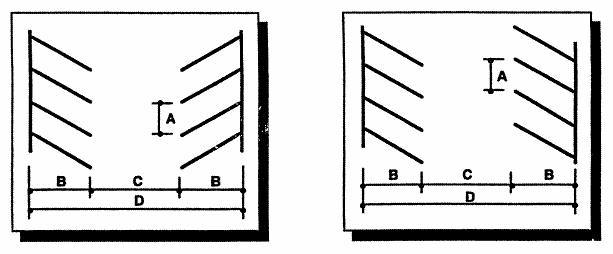
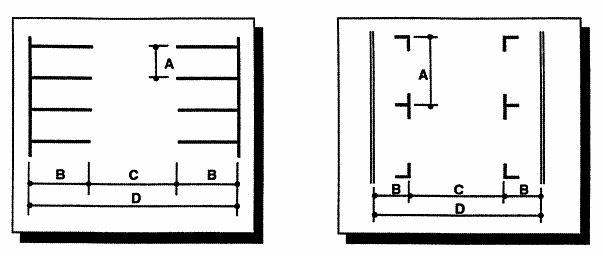
* As approved by the Traffic Engineer.
B.
Parking Spaces for the Handicapped. All parking facilities shall comply with state requirements regarding parking for the disabled, as per state Chapter 71 of the Uniform Building Code, Site Development Requirements for Handicapped Accessibility.
C.
Double Line Striping. Delineation of parking stalls by double line striping is encouraged, and may be required by the city traffic engineer based on site conditions, such as "high turnover" utilization or restricted maneuvering space.
D.
Tree Wells. Tree wells shall have a minimum area of thirty-six (36) square feet and a minimum interior width of six feet (6'), exclusive of curbs. See Section 14.18.160, Parking lot screening and landscaping for additional landscape design standards.
E.
Curb Overhang. A minimum of two feet (2′) shall be allowed for overhang at curblines. Where overhangs are provided, the minimum stall depth (dimension "B") may be reduced by two feet (2′). Wherever "parking overhang" encroaches into sidewalk areas, the sidewalks shall be a minimum of six feet (6′) in width. In landscaped areas, ground cover and irrigation systems should not be placed within the overhang areas.
F.
Parking Stall Access. Use of a required parking space shall not require more than two (2) vehicle maneuvers. At the end of a parking facility with four (4) or more parking spaces, an aisle or driveway providing access to the end parking space shall extend at least two feet (2′) beyond the required width of the parking space in order to provide adequate on-site area for turnaround purposes.
Illustration B for Section 14.18.130
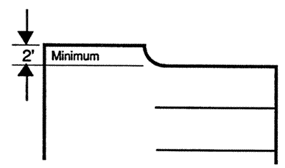
TYPICAL END STALL TREATMENT
(Ord. 1694 § 1 (Exh. A) (part), 1996; Ord. 1625 § 1 (part), 1992).
(Ord. No. 1882, Exh. A, § 70, 6-21-2010; Ord. No. 1923, § 2(Exh. A), 6-16-2014)
14.18.140 - Access to public right-of-way.
A.
Driveway Widths. The minimum curb cut for driveways at the face of the curb shall have the following minimum inside depressed width.
The zoning administrator, planning commission or city council may, on the basis of a recommendation from the city traffic engineer, city engineer or fire department, require driveways in excess of the above widths where needed by traffic, grade or site conditions. They may also require driveways to be constructed with full curb returns and handicapped ramps as opposed to simple curb depression.
B.
Separation Distance of Driveways Serving the Same Parking Facility. Driveways serving the same parking facility shall be located at least twenty-five feet (25′) apart.
C.
Driveway Grades. Driveway grades shall be subject to review and determination by the city engineer. Maximum driveway grade typically allowed is eighteen percent (18%).
D.
Encroachment Permit Required. An encroachment permit is required from the public works department for work done in the public right-of-way. (Note: See Chapter 11.04 of the municipal code).
(Ord. 1663 § 1 (part), 1994; Ord. 1625 § 1 (part), 1992).
14.18.150 - Alternate parking locations for uses with insufficient parking.
To reduce existing on-street parking congestion where dwelling units were legally built with fewer than the currently required number of parking spaces, additional on-site parking for vehicles belonging to the residents of such developments shall be permitted as follows.
A.
The zoning administrator, by environmental and design review permit, may approve, for single-family or duplex units, the location, including tandem parking, of additional parking spaces in the front or street side yards, providing that the following findings can be made:
1.
Additional on-site parking is not used as the basis for increasing the number of residential units;
2.
Such parking will not create hazards by obstructing views to or from adjoining sidewalks and streets;
3.
Fifty percent (50%) of the front and street side yards are landscaped.
B.
The zoning administrator, by environmental and design review permit, may approve, for multifamily development, additional on-site parking in patterns or locations that do not meet current standards, providing that the following findings can be made:
1.
Such parking will not create a hazard or nuisance to the neighborhood or adjoining neighbors;
2.
Such parking is likely to be used;
3.
Such parking will reduce existing on-street parking congestion;
4.
Needed on-site recreation facilities are not adversely affected.
(Ord. 1625 § 1 (part), 1992).
14.18.160 - Parking lot screening and landscaping.
New or substantially renovated parking lots with more than five (5) spaces shall provide landscaping in accordance with the following standards. Substantially renovated parking lots shall be those for which paving material and curbing is removed and the resulting lot is reconfigured. With the exception of sub-sections F, G, H, I, and J below, the provisions of this section do not apply to properties within the downtown mixed use district. The Downtown San Rafael Precise Plan Form-Based Code, which is adopted by separate ordinance includes provisions and requirements for parking lot screening and landscaping.
The following provisions shall also be used as guidelines for parking lot improvements on remodel projects.
A.
Screening. Parking areas visible from the public right-of-way shall be screened to headlight height through the use of landscaped earth berms, low walls, fences, hedges, or combination thereof, with trees and plantings, or similar means. Fences, walls, and hedges need not be solid.
B.
Minimum Trees. A minimum of one (1) canopy tree shall be provided for every four (4) parking spaces. Trees shall be distributed throughout the parking area to shade cars and paved areas. Clustering of trees may be considered subject to approval of the decision-making body, where it is demonstrated that the intent will be met to provide ample shading and screening of parking areas and enhance the visual appearance of parking lots. In downtown, this section does not apply to parking lots for twenty (20) or fewer cars, and the standards in this section may be reduced for parking lots for twenty-one (21) to forty (40) cars, with the approval of a minor design review permit.
C.
Tree Selection and Distribution. Parking lot trees shall be selected and located to achieve maximum shading of paved surfaces, through utilization of the following techniques:
1.
Distribute trees uniformly throughout parking areas, incorporating use of regularly spaced finger islands (see illustration below) and landscape medians between parking rows to the extent practicable.
2.
Cluster trees on southerly and westerly perimeters of parking lots.
3.
Provide minimum tree canopy diameters of fifteen feet (15') and include tree species with large canopy diameters, e.g., greater than thirty feet (30').
4.
Increase tree planting ratios as necessary to provide equivalent canopy coverage of the site where less than half of the required trees are proposed as large canopy tree species.
D.
Minimum Size of Planting Areas and Tree Wells. Planting areas containing trees and tree wells shall have a minimum area of thirty-six (36) square feet and a minimum interior width of six feet (6'), exclusive of curbs. For large canopy tree species, tree wells shall have a minimum area of sixty-four (64) square feet and a minimum width of eight feet (8') exclusive of curbs, to the extent this larger planting area is practicable and can be accommodated on-site.
E.
Curbs and Wheel Stops. A maximum overhang of two feet (2') shall be allowed for overhang of vehicles into planting areas. All planters and sidewalks located adjacent to driveways, loading areas, or parking lots shall be protected along the parking lot side with concrete curbs or wheel stops. Alternative treatments may be considered, subject to the approval of the community development director (or the director's designated appointee) or the appropriate hearing review body.
F.
Irrigation. Permanent, automatic irrigation systems shall be provided for all planted areas, in compliance with Section 14.16.370 Water-Efficient Landscape.
G.
Soil Preparation and Verification. Planting areas and tree wells shall be prepared by excavation to a minimum depth of three feet (3'), scarifying sides of tree wells (to promote soils integration, water absorption and healthy root growth), amendment of soil (as recommended based on soils analysis), and compaction to no more than seventy-five percent (75%) within twelve inches (12") of a curb or sidewalk. For parking lots containing twenty-five (25) spaces or more a licensed landscape architect shall monitor tree well excavation, soil preparation and tree planting and provide written verification to the community development director that excavation, soil preparation and tree planting have complied with the standards established by this subsection to promote normal healthy tree growth. Such written verification shall be received by the community development director prior to use of the parking facility and/or occupancy of the use.
H.
Maintenance. Landscaped areas associated with parking lots shall at all times be maintained in a healthy and clean condition, with replanting as necessary to maintain compliance with the previously approved landscape plan. For parking lots containing twenty-five (25) spaces or more the property owner shall obtain a minimum one (1) year maintenance contract and warranty for tree growth and provide documentation of such to the community development director prior to use of the parking facility and/or building or site occupancy.
I.
Parking Structures. The top level of parking structures shall utilize light-colored/high albedo paving material (reflectance of at least 0.3), or utilize shade structures, photovoltaic carports, landscaped trellises, or trees to achieve at least fifty percent (50%) daytime shading.
J.
Bio-filtration. Persons owning or operating a parking lot, gas station, area of pavement or similar facility developed with hardscape surfaces shall undertake all practicable measures to minimize discharge of pollutants to the city storm drain, in compliance with city standards, including utilization of all best management practices and the requirements of San Rafael Municipal Code Title 9.30 (Urban Runoff) enforced by the department of public works. To facilitate compliance with city storm drain pollution discharge requirements, innovative landscape design concepts may be substituted for the above standards subject to the approval of the appropriate review body, including use of permeable pavers, bio-swales, at grade curbs and openings in curbs to allow filtration of runoff through landscape areas. Landscape plans and alternative measures shall subject to compliance with any recommendations of the department of public works.
Illustration 14.18.160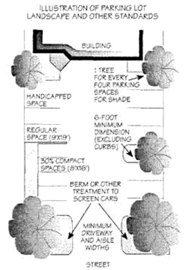
(Ord. 1694 § 1 (Exh. A) (part), 1996; Ord. 1625 § 1 (part), 1992).
(Ord. No. 1923, § 2(Exh. A), 6-16-2014; Ord. No. 1996, div. 2(Exh. A, 8.8), 8-16-2021; Ord. No. 2039, § 3(Exh. B), 7-15-2024)
14.18.170 - Lighting.
Lights provided to illuminate any parking facility or paved area shall be designed to reflect away from residential use and motorists. It is the intent to maintain light standards in a low profile design, as well as to be compatible to the architectural design and landscape plan. Light fixtures (e.g., pole and wall-mount) should be selected and spaced to minimize conflicts with tree placement and growth. (See Section 14.16.227 for additional standards on foot-candle intensity).
(Ord. 1625 § 1 (part), 1992).
(Ord. No. 1923, § 2(Exh. A), 6-16-2014)
14.18.180 - Residential districts—Garage and carport standards.
A.
Single-Car Garages. The minimum interior dimensions of single-car garages shall be ten feet (10′) by twenty feet (20′).
B.
Double-car Garages. The minimum interior dimensions of double-car garages shall be twenty feet (20′) by twenty feet (20′).
C.
Single-car Carports. The minimum interior dimensions of single-car carports shall be nine feet (9′) by nineteen feet (19′).
D.
Double-car Carports. The minimum interior dimensions of double-car carports shall be eighteen feet (18′) by nineteen feet (19′).
(Ord. 1625 § 1 (part), 1992).
14.18.190 - Recreational vehicle parking in residential districts.
In any of the following locations, parking of recreational vehicles, camper shells, trailers, boats and other similar equipment, when parked or stored incidental to the basic residential use of the property, is permitted for loading, unloading and storage purposes providing it does not obstruct the view of pedestrians and vehicles on the adjacent sidewalk and/or street and does not otherwise constitute a nuisance.
A.
For Single-Family and Duplex Residential Units. Recreational vehicle parking is permitted:
1.
Within the garage, carport or parking space required by the zone in which the use is located; or
2.
In the front yard setback when on the driveway to the garage, carport or parking spaces required by the zone; or
3.
In the front yard setback between the existing driveway and the side property line when the distance between the two is no greater than twelve feet (12′) at any point; or
4.
In rear yards, interior side yards or other areas not defined as "yards," providing the unit is partially or fully screened as viewed from off-street by a solid fence that conforms to the permitted height limits, vegetation, structures or topography;
5.
Recreational vehicles shall be parked in an orderly manner, generally perpendicular to the street. Parking parallel to the front property line is prohibited;
6.
No part of the recreational vehicle shall extend over the public sidewalk or right-of-way;
7.
The parking space and connecting driveway shall be surfaced with gravel, concrete, asphalt or similar materials.
B.
For Multifamily Residential Units (Three (3) or More Units Whether Constructed as Apartments, Townhouses or Condominiums) and Mobilehome Parks. Recreational vehicle parking is permitted in areas that are designed and constructed for such purposes under permits approved by the planning commission.
(Ord. 1163 § 1 (part), 1994; Ord. 1625 § 1 (part), 1992).
14.18.200 - Location of parking and maneuvering areas.
Parking or maneuvering areas, excluding access driveways, shall be prohibited in all required yard areas in the medium- and high-density residential districts.
(Ord. 1663 § 1 (part), 1994; Ord. 1625 § 1 (part), 1992).
14.18.210 - Commercial parking in MR and HR districts.
Public or private parking lots for automobiles may be permitted in a medium-density or high-density residential district adjacent to any nonresidential district, providing a use permit and environmental and design review permit are first obtained in each case.
(Ord. 1625 § 1 (part), 1992).
14.18.220 - On-site and remote parking.
A.
All off-street parking and loading areas required herein shall be located on the same lot and readily accessible to the specified use, provided that if the strict application of this requirement creates undue hardship and in the opinion of the planning director creates conditions contrary to desirable development practices but all other areas of intent for this chapter are complied with, remote parking areas which satisfy all or part of specific parking requirements may be approved.
B.
Remote parking areas shall be located within thirteen hundred feet (1,300′) of the specified use and shall possess direct and convenient pedestrian access. Remote areas may serve more than one use, provided that the gross number of spaces available shall not be less than the combined requirements for all uses served.
C.
Requests for remote, off-site parking shall require an application for a use permit and shall be subject to a review and recommendations by the community development director and traffic engineer, and approval by the zoning administrator. Upon zoning administrator approval of any remote, off-site parking area, and prior to occupancy of the proposed use, which parking satisfies the parking requirements, the owner of the lot (proposed for remote parking site) shall execute and record a declaration of restriction, legally binding or similar instrument satisfactory to the community development director, to restrict the use of the lot to public and private parking of vehicles so long as the use conducted by applicant, or the applicant's successors in interest, on the original site shall require the furnishing of parking facilities under the terms of the use permit.
(Ord. 1625 § 1 (part), 1992).
(Ord. No. 1882, Exh. A, § 71, 6-21-2010; Ord. No. 1964, § 2(Exh. B) § 28, 11-19-2018)
14.18.230 - Parking spaces—In lieu payments.
Where practical difficulty is involved in meeting the off-street parking requirements for a building hereafter constructed, the requirement may be met wholly or in part by in-lieu payments where the owner of the building site offers (in writing) to make, and the city council agrees to accept, such payments. When such an offer is made, the planning commission shall investigate and report to the city council its findings as to the reasons which are alleged to make such substitution necessary. The city council may accept or reject the proposal for substitution, and if it finds the substitution necessary, shall determine the amount of payment to be made. The payment shall equal the fair market value of the land which would otherwise have been devoted to off-street parking, plus the cost of paving and other improvements as determined by the city engineer. All moneys collected shall be used for the purchase and improvement of off-street parking facilities. Each of such facilities shall be so located as to serve primarily the general area and class of zoning district from which the respective in-lieu payments are derived.
(Ord. 1625 § 1 (part), 1992).
14.18.240 - Grandfathered parking.
A.
No use of land lawfully existing on the effective date of the ordinance codified in this title shall be considered nonconforming solely because of the lack of off-street parking, loading or bicycle facilities prescribed in this chapter.
B.
The number of existing required parking spaces may be reduced to achieve compliance with state or federal disabled access requirements. In such instances, properties shall not be considered nonconforming solely because of the lack of off-street parking prescribed by this chapter.
C.
The number of required spaces within an existing parking lot approved or established prior to adoption of this section (i.e., June 16, 2012) may be reduced in order to achieve greater conformity with the city urban runoff pollution prevention standards contained in San Rafael Municipal Chapter 9.30, as required by the department of public works, and/or the parking lot landscape regulations contained in Section 14.18.160, provided that the property owner can demonstrate to the satisfaction of the public works department and/or community development director that sufficient parking and vehicle maneuvering will remain to support the intended use(s) of the subject property. In such instances, properties shall not be considered nonconforming solely because of the lack of off-street parking prescribed by this chapter.
D.
For additions or enlargements of any existing building or use, or any change of occupancy or manner of operation that would increase the number of parking, loading or bicycle spaces required, additional parking shall be required for such addition, enlargement or change. Where parking for an existing use is substandard, improvements to improve or upgrade the parking may also be required where feasible.
E.
A nonconforming structure which has been damaged or destroyed more than seventy-five percent (75%) and which is rebuilt to its original condition must provide parking equivalent to prior existing parking. Where parking was substandard, improvements to improve or upgrade the parking may also be required where feasible.
F.
Determination of the amount of parking improvements required to upgrade or improve existing substandard parking conditions shall be made by the community development director or the appropriate hearing review body. Such determination shall consider the size of the proposed addition in relation to the existing development, off-site parking conditions and site constraints.
(Ord. 1838 § 42, 2005: Ord. 1625 § 1 (part), 1992).
(Ord. No. 1923, § 2(Exh. A), 6-16-2014)
14.18.250 - Permanence of off-street parking.
A.
Once any off-street parking or loading space has been provided, which wholly or partially meets the requirements of this title, such off-street parking or loading space shall not thereafter be reduced, eliminated or made unusable in any manner which renders the on-site parking inadequate for the building and/or uses in existence on or created after the adoption of the ordinance codified in this title. Covered parking shall not be converted to uncovered parking.
B.
Accessory off-street parking or loading facilities which are located on the same lot as the building or use served, and which were in existence on the effective date of the ordinance codified in this title, or were provided voluntarily after such effective date, shall not hereafter be reduced below, or if already less than, shall not further be reduced below, the requirements of this title for a similar building or use.
(Ord. 1625 § 1 (part), 1992).
14.19.010 - Purpose.
The provisions of this chapter shall regulate the location, size, type and number of signs permitted within the city of San Rafael. The purpose of this chapter shall be:
A.
To safeguard and enhance property values;
B.
To protect the public and private investment in buildings, improvements and open spaces;
C.
To preserve and improve the visual appearance of the city as a place to live and work;
D.
To encourage sound signage practices as a means to aid existing and new businesses and provide information to the public;
E.
To ensure the preservation of freedom of speech;
F.
To preserve and promote traffic safety;
G.
To protect the public health, safety and general welfare of the community at large.
(Ord. 1825 §§ 1, 2 (Exh. A) (part), 2004).
14.19.020 - Applicability and interpretation.
(Ord. 1825 §§ 1, 2 (Exh. A) (part), 2004).
14.19.021 - Compliance as of effective date of this chapter.
The provisions of this chapter shall apply to all signs posted, installed, erected, constructed, or a change of sign copy on or following the effective date of this chapter.
(Ord. 1825 §§ 1, 2 (Exh. A) (part), 2004).
14.19.022 - Applicability to sign content.
The provisions of this chapter do not regulate the message content of signs or sign copy, regardless of whether the message content is commercial or noncommercial. In each instance and under the same conditions to which this chapter permits any sign, a sign containing an ideological, political, or other noncommercial message and constructed to the same physical dimensions and character shall be permitted. For purposes of this chapter, a "commercial" message or sign is any message or sign which directs attention to commercial activity including a business, commodity, service, attraction or entertainment; and a "noncommercial" message or sign is one, which is determined not to be a commercial message or sign as defined herein.
(Ord. 1825 §§ 1, 2 (Exh. A) (part), 2004).
14.19.023 - Compliance with applicable ordinances, regulations and laws.
All signs posted, erected or constructed on or following the effective date of this chapter shall comply with all other applicable laws, regulations, provisions and conditions required by the other titles of the San Rafael Municipal Code and any applicable county, state or federal approval required for such sign.
(Ord. 1825 §§ 1, 2 (Exh. A) (part), 2004).
14.19.024 - Requirements for associated city permits and approvals.
Any associated city permit or approval required for a sign, including but not limited to a building permit, electrical permit, encroachment permit, or planning permit (e.g., use permit or environmental and design review permit) that is required shall be approved prior to the posting, installation, erection or construction of the sign.
(Ord. 1825 §§ 1, 2 (Exh. A) (part), 2004).
14.19.025 - Interpretation of provisions of this chapter.
The community development department staff shall have the authority to interpret the provisions of this chapter. Should there be a question or disagreement regarding the interpretation of the department staff, the community development director shall review the dispute and render a determination as to the intent of the chapter provision. Sign terms and definitions used to interpret the provisions of this chapter are found in Chapter 14.03, Definitions.
(Ord. 1825 §§ 1, 2 (Exh. A) (part), 2004).
14.19.026 - Severability.
In the event that any part of this chapter is held to be invalid or inapplicable to any sign or signs, it is intended that the invalid section or sections be severed from the remaining provisions in order to continue in force and effect the remaining sections of this chapter.
(Ord. 1825 §§ 1, 2 (Exh. A) (part), 2004).
14.19.030 - Exempt signs.
The city has a compelling public health, safety and welfare interest in the clear, accurate and effective identification of governmental and private buildings, public streets and public facilities and amenities, the safe and efficient control of traffic and parking within the city, and the expeditious notification to the public of information affecting essential public services. Therefore, the following signs are exempt from the provisions and regulations of this chapter:
A.
Building and Street Address Signs. Each sign shall not exceed five (5) square feet in size and one per building for each street frontage.
B.
Official Flags. Official flags of any nation, state or local government. Official flags may be placed on a pole not exceeding the height limit established by the applicable zoning district. Flags over the height limit are subject to environmental and design review pursuant to Section 14.16.120 and Section 14.25.040. The height of the flag shall be no more than one-fourth (¼) the height of the pole.
C.
Weather flags, nautical flags and pennants when displayed on boats, in marinas, or on any land area within fifty feet (50′) of water frontage, where primarily intended to be viewed from the water and void of any commercial messages.
D.
On-Site Directional or Informational Signs. Directional or informational signs placed on-site, which are intended to provide public safety or convenience, not exceeding five (5) square feet in area per sign. Examples of such signs include, but are not limited to, parking lot directional signs, posting of business hours and location of restrooms, telephones, "parking in rear," "drive-through service window," and "no-smoking." Premises addressing signs that are larger than five (5) square feet in size shall be exempt if the larger addressing sign is required by the Fire Code.
E.
Signs Essential for Public Purposes. Signs installed by the city, a state or federal governmental agency, and public utility or service, which are essential for public purposes. Public purpose signs include, but are not limited to official signs for traffic control (e.g., street signs), fire and police signs, signs for other regulatory purposes, such as for public information and safety, public notices, emblems and other forms of official identification.
F.
Interior Signs. Signs located within the interior of a building, lobby, mall or court, when such sign is intended for interior viewing. This provision does not apply to interior signs placed within ten feet (10′) of a window, where such sign is visible from a public street.
G.
Nonstructural Modifications and Maintenance of Conforming Signs. Modifications and maintenance of a conforming sign that are nonstructural. Modifications do not include a change in sign face or copy, which requires the approval of a sign permit under Section 14.19.041 of this chapter.
H.
Signs Regulated by State or Federal Laws. Signs that are regulated by state or federal laws, or other applicable local laws, provided that such signs are sized and located to be consistent with the state, federal, or local applicable laws. Examples of such signs include the posting of gasoline and fueling station price signs.
I.
Community Gardens Signs. Informational signage required for community gardens as outlined in Section 14.17.030, provided that such signs do not exceed the maximum allowable size contained in said section.
J.
Community Service Signs. Signs installed on city owned property by the city of San Rafael for the purpose of providing multi-lingual information of: upcoming events, classes, meetings and/or update on neighborhood/community issues. These signs may be electronic face and contain moving messages for the purpose of allowing dissemination of information in multiple languages and shall be subject to the following standards:
1.
Number of Signs: One electronic message signs shall be permitted per site.
2.
Size of Signs: Signs shall be a maximum size of forty-eight (48) square feet.
3.
Height of Signs: Free-standing electronic message signs shall not exceed a height of six feet (6′).
4.
Sight Distance: Free-standing electronic message signs shall provide an adequate line of sight distance pursuant to Section 14.16.295.
5.
Hours of Use: Electronic message signs shall be equipped with a timer to assure the signs are not used between the hours of 10 p.m. and 7 a.m.
6.
Length of time for display of each message: Electronic message signs may display changing messages provided that each message is displayed for no less than four (4) seconds.
7.
Brightness Sensors: Electronic message signs shall be equipped with a sensor or other device that automatically determines the ambient illumination and programmed to automatically dim according to ambient light conditions (e.g., photocell technology), or that can be adjusted to comply with the 0.3-foot candle requirement.
8.
The signs shall not include neon lights.
9.
The signs shall be subject to a ninety (90) day post installation review.
(Ord. 1825 §§ 1, 2 (Exh. A) (part), 2004).
(Ord. No. 1882, Exh. A, § 72, 6-21-2010; Ord. No. 1964, § 2(Exh. B) § 29, 11-19-2018)
14.19.040 - Sign application and permit procedures.
Except for those signs that are exempt under Section 14.19.030, all signs shall require the approval of a sign permit and shall follow the permit procedures set forth in Sections 14.19.041 through 14.19.049.
(Ord. 1825 §§ 1, 2 (Exh. A) (part), 2004).
14.19.041 - Sign permit required.
A sign permit shall be required for all signs that are posted, installed, erected or constructed, and for changes in sign copy or face of existing signs.
(Ord. 1825 §§ 1, 2 (Exh. A) (part), 2004).
14.19.042 - Application.
All sign permit applications shall be filed with the community development department, planning division and shall include the following information:
A.
A completed application form containing a written description of the sign size and location. The form shall be signed by the property owner or an authorized representative such as a licensed sign contractor, or purchaser under a contract of sale or lessee.
B.
The application fee, as amended from time to time by resolution of the city council.
C.
Graphic materials, drawn to scale and dimensioned, describing the sign location and design. Application materials shall include elevations, drawings, plot and site plans, profiles, photographs, proposed illumination, color and material samples, an inventory of all existing signs on the subject property and other pertinent information which may be deemed necessary to review and render a decision on the application.
(Ord. 1825 §§ 1, 2 (Exh. A) (part), 2004).
14.19.043 - Review authority.
Application, administration and authority over the provisions and requirements of this chapter shall lie with the following official bodies or officials:
A.
Community Development Director. The community development director or his or her designee has the authority to:
1.
Approve, conditionally approve or deny a sign permit, as set forth in Section 14.19.048(A) and signs requiring a minor exception, as set forth in Section 14.19.048(B).
2.
Approve, conditionally approve or deny a request for an extension to an approved sign permit and requests to extend, modify or revise an approved sign program.
B.
Planning Commission. The planning commission has the authority to approve, conditionally approve or deny:
1.
A sign program, as set forth in Section 14.19.046;
2.
Signs requiring a major exception, as set forth in Section 14.19.045;
3.
Signs incorporated into the design of new buildings or major design improvements proposed to existing buildings and properties, and mural signs subject to an environmental and design review permit, as set forth in Chapter 14.25;
4.
Appeal of sign permit actions of the community development director.
C.
Appeals. All decisions of the community development director or the planning commission can be appealed in accordance with the provisions of Chapter 14.28, Appeals.
(Ord. 1825 §§ 1, 2 (Exh. A) (part), 2004).
(Ord. No. 2039, § 3(Exh. B), 7-15-2024)
14.19.044 - Criteria for approval of signs.
All signs requiring sign permit approval shall comply with the provisions of this chapter, unless an exception has been granted or a sign program has been approved, which authorize deviations from these provisions.
(Ord. 1825 §§ 1, 2 (Exh. A) (part), 2004).
14.19.045 - Exceptions (major and minor).
When a proposed sign(s) deviates from the provisions and standards of this chapter pertaining to sign size, placement, type, number, design and type of illumination, an exception request may be filed with a sign permit application, subject to the following:
A.
Minor Exceptions. A minor exception applies to requests which do not deviate from the sign provisions for size and height by more than twenty percent (20%), or when the community development director determines that alternative placement, number, type, design or illumination of a proposed sign(s) would be minor and appropriate for the site, business or use.
B.
Major Exceptions. A major exception applies to requests, which deviate from the standard or provisions for sign size and height by more than twenty percent (20%), or when the community development director determines that alternative placement, number, type, design or illumination of a proposed sign(s) would be major.
C.
Findings for Approval of an Exception. The following findings shall be made in rendering a decision on a request for exception:
1.
The exception is necessary to overcome special or unusual site conditions such as exceptional building setbacks, and lack of or limited visibility due to orientation, shape or width of the property and building improvements;
2.
The exception is appropriate in that it would allow signage that would be in proper scale with the building and site improvements, would be compatible with other conforming signs in the immediate vicinity, and would promote a good design solution; and
3.
The exception would permit an improvement that would not be detrimental or disruptive to the safety or flow of vehicular or pedestrian traffic either on-site or off-site.
D.
Not Applicable. The exceptions process shall not apply or be used to permit a prohibited sign, as set forth under Section 14.19.080 of this chapter.
(Ord. 1825 §§ 1, 2 (Exh. A) (part), 2004).
14.19.046 - Sign programs.
The establishment of a sign program shall be an alternate to the sign standards and provisions contained in this chapter under certain circumstances, as follows:
A.
Purpose. Sign programs are specifically intended for unique use and property circumstances with the purpose of addressing multiple uses on one site or multiple signs for uses with special sign needs. Sign programs shall be used to achieve aesthetic compatibility between the signs within a project, and may allow some flexibility in the number, size, type and placement of signs.
B.
Applicability. Sign programs are permitted specifically for shopping centers, a single building or multiple buildings containing multiple tenants on one or more contiguous sites, signs proposed in a planned development (PD) district, gasoline or fueling stations and automobile or vehicle dealerships and movie theaters only. Sign programs shall not be used for other uses or conditions with the intent to deviate from the provisions of this chapter.
C.
Design Continuity. Sign programs shall be designed so that all signage has a consistent and common design theme and placement, utilizing common materials, colors and illumination.
D.
Findings Required for Approval of a Sign Program. The planning commission shall make the following findings in rendering a decision on a sign program:
1.
All of the signs contained in the program have one or more common design elements such as placement, colors, architecture, materials, illumination, sign type, sign shape, letter size and letter type;
2.
All of the signs contained in the program are in harmony and scale with the materials, architecture, and other design features of the buildings and property improvements they identify, and the program is consistent with the general design standards specified in Section 14.19.054; and
3.
The amount and placement of signage contained in the program is in scale with the subject property and improvements, as well as the immediately surrounding area.
(Ord. 1825 §§ 1, 2 (Exh. A) (part), 2004).
14.19.047 - Environmental and design review permit.
When new buildings are proposed for development or exterior design modifications are proposed to existing buildings subject to an environmental and design review permit (as set forth in Chapter 14.25), signage shall be incorporated into the design improvements of the project. Under these circumstances and unless approved as part of a sign program, signage shall be considered and processed with the required environmental and design review permit, as set forth in Chapter 14.25. When signage is reviewed and approved with an environmental and design review permit, no separate sign permit shall be required provided that:
A.
The signage complies with the provisions of this chapter; and
B.
The size, placement, design, number and illumination parameters of the permitted signage are adequately documented in the approved plans or conditions of approval for the environmental and design review permit.
(Ord. 1825 §§ 1, 2 (Exh. A) (part), 2004).
14.19.048 - Processing and noticing requirements.
The following processing and noticing procedures shall be followed prior to rendering a decision on a sign permit, an exception or a sign program:
A.
Sign Permit, Administrative Approval. Following review of a sign permit application for compliance with the provisions of this chapter and other applicable approvals, the community development director, or his or her designee, shall render a decision on the application. A decision on a sign permit application may be rendered without notice to surrounding property owners.
B.
Minor Exceptions and Modifications to an Approved Sign Program. Following review of an application for and prior to rendering a decision on a minor exception or a modification or revision to an approved sign program, property owners contiguous to the subject property shall be mailed a public notice informing them of the director's intent to act on the application. The notice shall indicate that the director will take action on the application, on or after the date, which is fifteen (15) calendar days following the date of the notice.
C.
Major Exceptions, Sign Programs, Mural Signs and Appeals. Major exceptions, sign programs, mural signs, appeals and other sign-related applications requiring planning commission action shall be noticed consistent with the requirements of Chapter 14.29, Public Notice.
D.
Prompt Review and Action. Review and action on any sign permit, exception or sign program applications or on any administrative appeal of any action taken by the city on these applications shall be prompt and expeditious, according to the provisions of law and the city's municipal code and procedures. Judicial review shall be in accordance with the provisions of Code of Civil Procedure Sections 1094.8 et seq.
(Ord. 1825 §§ 1, 2 (Exh. A) (part), 2004).
14.19.049 - Time limits for sign permit and related sign approvals.
A.
Initial Time Limits. All sign permit, sign program and exception approvals shall expire six (6) months from the action date, unless the approved sign(s) has been installed, erected or posted, or unless another time limit is specified as a condition of approval.
B.
Time Limits for Extensions. Prior to expiration of a sign permit, sign program or exception, the applicant may apply to the community development department for an extension from the date of expiration.
C.
Automatic Extension when Subsequent Permits are Approved. The expiration date of the sign permit, sign program or extension shall be automatically extended when a building permit, electrical permit, encroachment permit or similar subsequent permit is granted. The approval shall be automatically extended to concur with the expiration date of the subsequent permit.
(Ord. 1825 §§ 1, 2 (Exh. A) (part), 2004).
14.19.050 - General sign provisions.
All signs subject to the provisions of this chapter shall comply with the following general sign provisions.
(Ord. 1825 §§ 1, 2 (Exh. A) (part), 2004).
14.19.051 - Types of signs.
Examples of sign types are presented in Figure 14.19-1. A definition for these sign types is provided in Chapter 14.03, Definitions. The type of sign that is permitted for a business or use shall be regulated by zoning district, as specified in Section 14.19.060 and Table 14.19-2 of this chapter.
Figure 14.19-1
Types of Signs
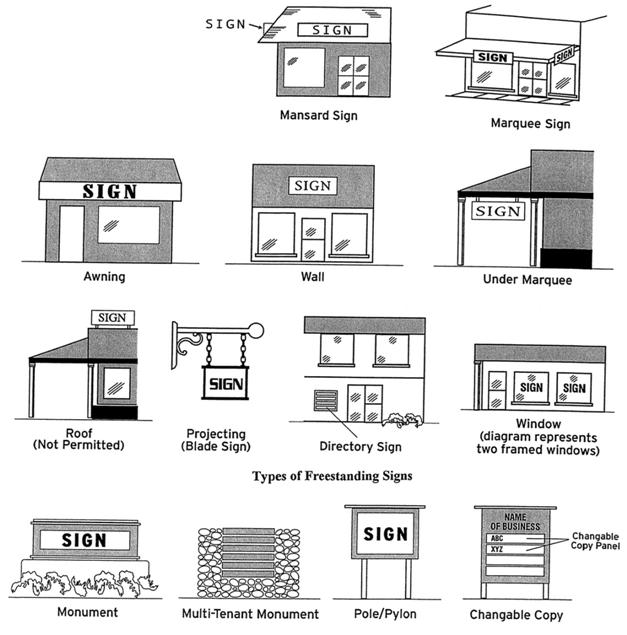
(Ord. 1825 §§ 1, 2 (Exh. A) (part), 2004).
14.19.052 - Computation or determination of permitted sign area.
To determine sign compliance with sign area limitations of this chapter, sign area shall be measured as follows:
A.
Measuring Surface Sign Area. Surface area of a sign shall be calculated as follows:
1.
By enclosing the extreme limits of all framing, writing, logo, representation, emblem and other display including, among others, telephone numbers and internet web site addresses within a single, continuous perimeter composed of squares or rectangles. This method of sign measurement is depicted in Figure 14.19-2.
2.
When a sign is comprised of individual letters, which appear as an unframed surface, the script and logo for each line shall be calculated separately. When distance between two (2) lines of script is more than twice the height of the script, each line shall be counted as one sign. This method of sign measurement is depicted in Figure 14.19-2.
3.
The area of the sign shall be taken as the area of one face.
B.
Measuring Three-Dimensional Objects. Signs that are spherical, conical, cylindrical, and non-geometric three-dimensional shapes shall be measured as the area of their maximum projection upon a vertical plane. This method of sign measurement is depicted in Figure 14.19-3.
Figure 14.19-2
Measuring Surface Sign Area
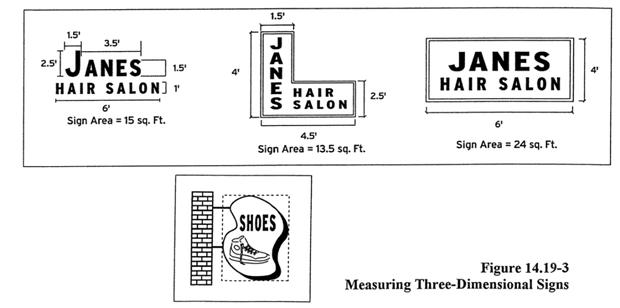
C.
Measuring Double-Faced (back-to-back) Signs. The area of a double-faced sign where the sign faces are placed back-to-back shall be calculated as a single sign face.
D.
Measuring Double-Faced or Multiple-Faced Signs where More than One Sign Face is Visible from Any One Location. The area of all faces that can be viewed from any one direction at one time shall be counted in determining the permitted sign area.
E.
Tubing or Strings of Lights. Exclusive of seasonal decorations and lighting, illuminated tubing and strings of lights used to outline portions of a building or windows shall be included in the calculation of permitted sign area. The tubing or strings of lights shall be deemed to have a minimum width of six inches (6″) in the calculation of the sign area. When illuminated tubing and strings of lights border an area that forms a substantially closed geometric shape, which contains signage within this shape, all area within the closed shape shall be considered the sign area.
F.
Clocks and Temperature Display. Elements of a sign displaying time of day and temperature shall be included in measuring the surface sign area, when such elements are clearly a part of or integral to a sign or sign structure displaying the business or use. Clocks and architectural elements and structures solely displaying time of day or temperature in analog or digital format are considered signs and are subject to the provisions of this chapter.
G.
Supporting Framework, Bracing, Pedestals or Foundations. Supporting framework, bracing, pedestals or foundations that are clearly incidental to or separate from the sign display shall not be computed as sign area. Examples of this condition would be a solid foundation or pedestal base on a monument-type sign. When such members are designed or illuminated so as to contribute to the advertising qualities of the sign display, the area of such members shall be computed as sign area.
H.
Sign Frames. Signs, which are framed or have distinguishing color background shall be measured by the entire area of the sign and background, including the framing surfaces.
(Ord. 1825 §§ 1, 2 (Exh. A) (part), 2004).
14.19.053 - Location, placement and design of signs.
The location and placement of a sign shall be subject to the following:
A.
On-Site Location Only. All signs shall be located on the same site or building as the subject business or use, except as otherwise permitted by the provisions of this chapter.
B.
No Obstruction of Exits, Windows and Safety Equipment. No sign shall be built, placed, posted or affixed in any manner where a portion of the sign or its supports would interfere with the free use of any fire escape, exit or standpipe, or obstruct any required stairway, door, ventilator or window.
C.
Maintenance of Adequate Sight Distance. No sign shall be built, placed, posted or affixed in any manner or location where it will physically impede or cause hazardous obstruction to the visibility of vehicles or persons entering or exiting doorways or driveways that are proposed or are in use.
D.
General Placement of Signs. The permitted sign(s) for a business or use shall be placed on the street front face or front elevation of the building where the business or use is located (see definition for frontage, business or use in Chapter 14.03) with the following exceptions:
1.
Where a building is located on a one-way street, or where public visibility of the front face or front entrance of the building is limited or impaired, the permitted sign may be placed on the side or rear face or elevation of the building to improve visibility, provided that the provisions for sign size and number are not exceeded.
2.
Where a business or use is within a multi-tenant building and has no frontage, or is located on a floor above or below the ground floor level, identification for the business or use shall be limited to a building directory sign placed at the building entrance, or on a multi-tenant, monument sign, when such sign is permitted under the provisions of this chapter.
E.
Frontage on Corner Lots. On corner lots where a business or use has frontage on two (2) streets, signs may be placed on both street frontages, but the permitted square footage for each building front may not be transferred from one street frontage to another.
F.
Frontage on a Public Parking Lot or Public Parking Structure. Where a business or use has frontage on and an entrance access to a public parking lot or public parking structure, this frontage shall be considered the same as frontage on a public street when determining permitted sign area.
G.
Placement of Window Signs. No more than twenty-five percent (25%) of the area of a framed window or a continuous window area shall be used for a sign. When a window contains multiple panes, the framed area of the whole window, inclusive of the individual paned areas, shall be used in calculating the permissible sign area. Except in the downtown districts where second floor business signs are permitted, window signs shall be permitted only in windows located on the ground floor of a structure. Permanent window signs shall be counted against the overall, permitted sign area and number and shall be subject to the same provisions and limitations as for wall signs.
H.
Placement and Design of Marquee Signs. The location and placement of marquee signs shall be subject to the following provisions:
1.
A minimum vertical clearance of eight feet (8′) above the sidewalk, path, public property, public right-of-way or easement shall be maintained.
2.
Signs shall not project beyond the ends or sides of the marquee.
3.
Signs placed on the face of a marquee may extend above the top of the marquee provided that this extension is not more than one-half (½) the height of the marquee face and is below the building roofline.
I.
Placement and Design of Projecting and Blade Signs. The location and placement of projecting and blade signs shall be subject to the following provisions:
1.
The maximum permitted sign area for a projecting sign shall be thirty-six (36) square feet, except in the downtown mixed use district. In the downtown mixed use district, a projecting sign shall not exceed five (5) square feet in area.
2.
A minimum vertical clearance of eight feet (8′) above the sidewalk, path, public property, public right-of-way or easement shall be maintained.
3.
Signs shall be placed at or below the sill of the second floor windows in a multi-story building or below the eave line of a single-story building. Projecting signs shall be permitted for a ground floor business or use only.
4.
Signs shall not project more than a distance of six feet (6′) from the building face, including all structural members. In no case shall the sign project closer than two feet (2′) from the street curb.
5.
Signs shall be placed to maintain appropriate sight distance.
6.
When projecting and blade signs are illuminated, the conduit and wiring that provides the source of illumination shall be concealed or screened, to the extent feasible.
7.
To avoid visual clutter, a minimum distance of fifteen feet (15′) shall be maintained between projecting and blade signs that are located on the same property. This provision does not apply in the downtown mixed use district.
J.
Placement and Design of Mansard Signs. Mansard signs shall be located on the lower two-thirds (2/3) of the roof slope and shall not project more than three feet (3′) from the sloped roof face at any point. The sign ends of a mansard sign shall be designed to return and be flush with the roof surface, so that the rear of the sign and the sign bracing is not visible.
K.
Placement and Design of Awning Signs. The location and placement of awning signs shall be subject to the following provisions:
1.
Signs may be placed on the sides or ends of the awning. However, each sign placed at this location shall be counted as one of the permitted signs for the business or use.
2.
The sign shall cover no more than fifty percent (50%) of the front face area of the awning and fifty percent (50%) of the awning sides or ends.
3.
When awning signs are illuminated, the illumination shall be limited to the sign script and logo only. Illumination designed to light the entire awning is not permitted.
L.
Placement and Design of Freestanding Signs. The location and placement of freestanding signs shall be subject to the following provisions:
1.
Signs shall be placed so that the sign face is perpendicular to the public street or right-of-way, to the extent possible.
2.
A minimum distance of seventy-five feet (75′) shall be maintained between any two (2) freestanding, pole or pylon-type sign. Where there is less than seventy-five feet (75′) between two (2) such signs, a freestanding sign may be permitted provided that it is limited to a monument-type sign, as specified in Table 14.19-1.
3.
A freestanding sign shall not exceed the height of the building on the site where the sign is located.
4.
Freestanding signs are permitted on sites, which have a minimum frontage width of fifty feet (50′) and minimum building setback of fifteen feet (15′). Freestanding signs are regulated by zoning district, as specified in Section 14.19.060 and Table 14.19-2 of this chapter. The general sign area and height limits for all freestanding signs are as follows (Table 14.19-1):
Table 14.19-1
Requirements and Limitations for Freestanding Signs
* "Freeway-Oriented" means those businesses and uses directly facing a frontage road, which is both parallel to and generally level with US Highway 101 or Interstate 580.
** Height bonus permitted: one (1) foot of sign height for every five (5) feet of sign setback measured from the property line, up to a maximum sign height of 25 feet.
+ Minimum building setback measured from property line.
++ Freestanding sign height shall be measured from the ground level or grade at which the sign is placed to the highest elevation point of the sign.
Note: See Table 14.19-2 (Sign regulations for zoning districts) and Section 14.19.060 (Commercial office, industrial marine districts) for additional requirements.
M.
Placement and Design of Changeable Copy Signs. Changeable copy signs shall be permitted in conjunction with the approval of a sign program. In the event the signage is not part of a sign program, a changeable copy sign may be proposed with a request for a sign permit in any zoning district subject but the changeable copy face shall be no more than fifty percent (50%) of the sign face area.
N.
Placement of Signs on Public Bus Shelters. Signs placed on public bus shelters under contract with the city are permitted subject to the approval of an environmental and design review permit.
O.
Placement and Design of Mural Signs. Murals that are defined as a sign in Chapter 14.03 are permitted subject to the approval of an environmental and design review permit by the planning director.
P.
Placement and Design of Directory Signs. Directory signs shall be placed at the building entrance that provides primary access to the businesses or uses contained within the building. Directory signs shall not exceed ten (10) square feet in area, and shall be affixed to the wall of the building (wall sign).
(Ord. 1825 §§ 1, 2 (Exh. A) (part), 2004).
(Ord. No. 1882, Exh. A, §§ 73, 74, 6-21-2010; Ord. No. 1996, div. 2(Exh. A, 9.1), 8-16-2021; Ord. No. 2039, § 3(Exh. B), 7-15-2024)
14.19.054 - General design standards.
All signs subject to the approval of a sign permit shall comply with the following design and performance standards:
A.
Sign Design. The design of the sign, including the shape shall be:
1.
An integral part of, compatible with, and complement the design of the buildings and improvements on the site where the sign is to be located and shall be compatible with the character and design of signs in the immediate neighborhood of the site. Creative and unique design is encouraged provided that the design is appropriate for the site and improvements and compatible with the character of the surrounding area.
2.
The sign message, including the use of graphic symbols shall be simple. Lettering shall be legible, uncomplicated, and appropriate to the image of the building.
B.
Sign Type. The type of sign shall be appropriate for the building and improvements on the site where the sign is to be located. The following sign types are encouraged:
1.
The use of individual letters incorporated into the building design is encouraged and preferred over signs contained in a canister or frame, or signs directly painted on the surface of a building.
2.
Monument-type freestanding signs are encouraged and preferred over pylon or pole-type signs.
Upon request, a bonus sign area of ten percent (10%) above the maximum permitted sign area will be granted as an incentive to select one of the encouraged sign types. A request for bonus sign area must be included in the application for a sign permit.
C.
Sign Colors and Materials. The colors and materials for the sign shall be compatible with and complement the colors and materials of the buildings and improvements on the site where the sign is to be located. The following standards are required:
1.
Sign colors shall be subtle. Bright and reflective colors shall be avoided, unless such colors are proposed to promote a creative or unique sign design. The use of contrasting colors between sign background and the sign script or logo is encouraged to maximize legibility.
2.
Sign materials shall be compatible with the materials used on the buildings and improvements found on the site.
3.
Sign materials that are metal or have reflective qualities shall have a matte or non-glare surface.
(Ord. 1825 §§ 1, 2 (Exh. A) (part), 2004).
14.19.055 - Illumination standards.
The illumination of signs from an artificial source shall be minimized to avoid a nuisance, hazard, light and glare on the property where the sign is to be located and on the surrounding neighborhood. The following sign illumination standards shall be required:
A.
Sign Illumination Regulated by Zoning District. The type of sign illumination that is permitted shall be regulated by zoning district, as specified in Section 14.19.060 and Table 14.19-2 of this chapter.
B.
Illumination that is Permitted. All lighting shall comply with current electrical code requirements. The following types of illumination are permitted:
1.
Internal illumination. The light source is internally located or concealed behind an opaque face of individuals letters or a framed canister. The rays of illumination go through the face of the sign or are projected outwards toward the edge of the sign forming a halo around the sign frame.
2.
External, indirect illumination. The light source is exposed and directed toward the sign face but is shielded or concealed from view with proper shields or glass lenses to avoid glare. Examples of external illumination include gooseneck light fixtures and ground mounted light fixtures.
3.
Reflective illumination. Illumination that is not electrically charged, but responds to light, such as from passing vehicle headlights, by shining or glowing.
4.
Neon. Exposed neon or other gas-filled tubing is permitted with limited use.
C.
Illumination Intensity. No sign shall be illuminated so that the primary source of the light is visible beyond the property line or in any way will cause excessive glare or brightness. The city shall reserve the right to require and/or complete a post-installation inspection of the sign illumination. If, as a result of this inspection it is determined that the illumination is too bright and adversely impacts adjacent properties and uses, the city can require a reduction and/or adjustment in the intensity of the sign illumination, so that it is in keeping with the general level of illumination on surrounding properties.
D.
Illumination that is Prohibited. Except as permitted by Section 14.19.030.I.,the following types of illumination are prohibited:
1.
Blinking, flashing or fluttering lights or illumination that has a changing light intensity, brightness or color;
2.
Animation or moving messages;
3.
Searchlights.
(Ord. 1825 §§ 1, 2 (Exh. A) (part), 2004).
(Ord. No. 1923, § 2(Exh. A), 6-16-2014; Ord. No. 1964, § 2(Exh. B) § 30, 11-19-2018; Ord. No. 2039, § 3(Exh. B), 7-15-2024)
14.19.060 - Zoning district sign standards.
The size, type, number and illumination of signs shall be regulated by zoning district. Except for those signs not subject to a sign permit under Sections 14.19.030 and 14.19.070 of this chapter, or signs authorized through approval of a sign program under Section 14.19.046 of this chapter, all signs approved and erected on and following the date this chapter is enacted shall comply with the standards and limitations set forth in this section and in Table 14.19-2 for each zoning district.
(Ord. 1825 §§ 1, 2 (Exh. A) (part), 2004).
14.19.061 - Allowance—Number of signs permitted.
The maximum number of signs that are permitted for a business or use shall be regulated by zoning district, as specified below and in Table 14.19-2 of this chapter. Where more than one sign is permitted for a business or use, the combined area of the signs shall not exceed the sign square footage limit that is allotted.
(Ord. 1825 §§ 1, 2 (Exh. A) (part), 2004).
14.19.062 - Single-family residential and duplex residential districts.
In order to protect and preserve the character and quality of life in the single-family residential and duplex residential districts, signs located in these districts shall be limited in number, type, size and illumination, so as to minimize signage, while allowing necessary identification of the subject uses. Permitted signs include the following, and as specified in Table 14.19-2:
A.
Permitted uses in the single-family and duplex residential districts shall be allowed one wall sign per residential unit, not exceeding five (5) square feet in area. No sign permit is required. Examples of signs for permitted uses would be, among others, signs displaying a residential nameplate, or a small residential care, family care home or day care facility for six (6) or fewer residents. Home occupation signs are regulated under Section 14.16.220(D) of this title.
B.
Conditional uses in the single-family and duplex residential districts that are subject to the approval of a use permit shall be allowed one wall or monument-type sign, not exceeding twenty (20) square feet in area. Examples of signs for conditional uses would be, among others, signs displaying a school, a religious institution, or a large residential care, day care or family care facilities for seven (7) or more residents, children or adults.
C.
Monument-type signs sited at the entrance of a neighborhood or subdivision, placed on private property, not exceeding twenty (20) square feet per sign and two (2) per entrance.
(Ord. 1825 §§ 1, 2 (Exh. A) (part), 2004).
14.19.063 - Multiple-family residential and residential or office districts.
Signs located in all multiple-family residential and residential or office districts shall be limited in size and illumination, as these districts provide a transition between the single-family and duplex residential districts and the non-residential districts. Permitted signs include those signs permitted in the single-family and duplex residential districts, except that a greater number and amount of sign area, and a broader range of sign types are permitted, as specified in Table 14.19-2.
(Ord. 1825 §§ 1, 2 (Exh. A) (part), 2004).
14.19.064 - Commercial, office, industrial, marine related districts.
Signs located in all commercial, office, industrial, and marine related districts shall be permitted sign area based on the linear width of business or use frontage (see definition for frontage, business or use in Chapter 14.03), as follows:
A.
Single-Tenant Buildings. All non-residential uses except for office uses, shall be permitted one square foot of sign area for each linear foot of business or use frontage, up to a maximum of two hundred (200) square feet. For buildings with more than two hundred feet (200′) in linear frontage width, a maximum sign area of two hundred (200) square feet shall be permitted. Office uses shall be permitted one-half (½) square feet of sign area for each linear foot of building frontage, up to a maximum sign area of one hundred (100) square feet of sign area, regardless of building frontage width.
B.
Multiple-Tenant Buildings. For all non-residential uses, except for office uses, each ground floor occupant shall be entitled to one square foot of sign area for each linear foot of business or use frontage, with each occupant entitled to a minimum sign area of twenty-five (25) square feet. For office uses, each ground floor occupant shall be entitled to one-half (½) square feet of sign area for each linear foot of office tenant frontage, with each office use entitled to a minimum sign area of fifteen (15) square feet.
C.
Where a business or use is located in a multiple-tenant building, and where such business or use has no frontage or is located on a floor above or below the ground floor level, identification shall be limited to a building directory sign or multi-tenant monument sign, as provided in Sections 14.19.053(D)(2) and 14.19.053(P) of this chapter.
D.
For buildings with less than twenty-five feet (25′) in linear frontage width, a minimum sign area of twenty-five (25) square feet shall be permitted for all non-residential uses except for office uses. For such buildings containing office uses, a minimum sign area of fifteen (15) square feet shall be permitted.
E.
For a single business or use with more than one frontage or where a business or use is contained in more than one building, each frontage shall be considered and calculated separately in determining permitted sign area. However, in no case shall one business or use be permitted more than an aggregate sign area of two hundred (200) square feet. For office uses, the maximum permitted, aggregate sign area shall be one hundred (100) square feet.
F.
For all non-residential uses except for office uses, a maximum of two (2) permanent signs shall be permitted per frontage for each business or use except as follows:
1.
There shall be no more than one freestanding sign per lot or parcel.
2.
There shall be no more than one projecting sign per business or use.
3.
Office uses shall be permitted a maximum of one permanent sign per frontage for each office tenant.
G.
Small, ancillary, informational signs are not included in the calculation of the allowable sign area or number, if such signs, in aggregate, do not exceed five (5) square feet in area. Examples of such signs include, among others, signs displaying hours of operation, business and association memberships, credit cards that are accepted, "now hiring" signs and restaurant menus.
(Ord. 1825 §§ 1, 2 (Exh. A) (part), 2004).
14.19.065 - Downtown mixed use district.
Size, placement and design of signs in the downtown mixed use district are intended for view primarily by pedestrians and persons in vehicles nearby at the street level, not from long distances. The unique characteristics found in the downtown mixed use district include a higher density of business uses, and multiple ground floor business uses, which substantiate special sign provisions. Signs located in the downtown mixed use district shall be subject to the following provisions:
A.
Permitted sign area shall be based on frontage width of a business or use, per the provisions of Sections 14.19.064(A) through (E) and 14.19.064(G).
B.
For all non-residential uses except office use, a maximum of three (3) signs shall be permitted per frontage for each business or use, which may be a combination of sign types. For office uses in the downtown mixed use district, a maximum of one sign shall be permitted per frontage for each business or use.
;note; + ;hg;Exception: Internally illuminated and backlit illumination permitted for property and building address signs.
* Freeway-oriented signs are permitted for businesses and properties, which directly face a frontage road that is both parallel to and generally level with Highways US 101 or I-580 (Table 14.19-1).
** Unless, as noted, where more than one (1) sign is permitted for a business or use, the combined area of the signs shall not exceed the maximum permitted sign area (see Section 14.19.061).
Note: See Table 14.19-1 (Requirements and limitations for freestanding signs) and Section 14.19.053.L (Placement and design of freestanding signs) for additional requirements.
C.
Projecting and marquee signs placed under a roof eave or awning are encouraged to provide pedestrian-oriented signage. Projecting signs shall not exceed five (5) square feet in area.
D.
Second floor tenant window signs are permitted and shall not exceed one (1) per business or use and five (5) square feet in area.
(Ord. 1825 §§ 1, 2 (Exh. A) (part), 2004).
(Ord. No. 1882, Exh. A, § 75, 6-21-2010; Ord. No. 1996, div. 2(Exh. A, 9.2, 9.3), 8-16-2021)
14.19.066 - Other districts.
Signs located in zoning districts other than those referenced in Sections 14.19.062 through 14.19.065 of this chapter shall comply with the standards and provisions of the zoning district that is most similar to the subject district.
(Ord. 1825 §§ 1, 2 (Exh. A) (part), 2004).
14.19.070 - Temporary signs.
The city recognizes that temporary signs are often used as a means of communicating messages, whether commercial or noncommercial, as to certain temporary or short term matters or events such as commercial promotions, special events or activities, elections and current events. The regulations in this section are intended to allow the expression of such communications while minimizing the adverse aesthetic or public safety impacts that may be caused by the uncontrolled proliferation and abandonment of such signs, such as visual clutter, traffic obstruction and accumulation of debris. The following signs are considered temporary and may be posted on site for a limited period of time in accordance with the provisions of this chapter. Unless noted below as not requiring sign permit approval, temporary signs require the approval of a sign permit prior to being installed or erected:
A.
City-Installed Banners. Banners, signs, and associated supporting structures installed by the city for events and announcements, which are placed across or over a public street, or affixed to street light poles. The location, placement and provisions for such banners, signs and supporting structures shall be established by standards and subject to fees, as set forth by resolution of the city council from time to time. No sign permit is required.
B.
Noncommercial Signs. Temporary signs bearing ideological, political or other noncommercial message, including, but not limited to, political and election signs may be located on a site or place of business. The total sign area permitted per site or place of business shall not exceed thirty-two (32) square feet. Noncommercial signs may be displayed for a maximum of ninety (90) days per calendar year. Signs relating to an election shall be removed no later than ten (10) days following the election. No sign permit is required.
C.
Real Estate Sale and Leasing Signs. Temporary real estate sale and leasing signs shall be subject to the following:
1.
On-Site Display. Ground-mounted or placed on the building, not exceeding five (5) square feet and one (1) in number per building for single-family, duplex residential and multiple-family residential uses. On-site display signs shall not exceed twenty (20) square feet and two (2) in number for all nonresidential uses.
2.
Off-Site Display. A-frame or ground-mounted, placed off-site such as for announcement of an open house, not exceeding five (5) square feet in size. Open house signs shall be permitted between the hours of ten a.m. (10:00 a.m.) and seven p.m. (7:00 p.m.) on Saturdays, Sundays, Thursdays (brokers open) and holidays, and shall be limited to five (5) in number.
3.
No real estate sign shall be placed in the public right-of-way, which includes the sidewalk, travel or parking lane and center median of a street.
4.
No sign permit is required.
D.
Special Function and One-Time Event Signs. Signs, posters and notices for special functions and one-time events are permitted subject to the following:
1.
A maximum of two (2) signs, not exceeding ten (10) square feet in area for each sign;
2.
Signs shall be posted on-site or off-site on private property. Such signs shall not be placed on utility poles, streetlights or fences located on public property;
3.
Signs shall not be displayed for more than seven (7) days prior to or more than four (4) days after the function or event;
4.
In no instance shall a sign for a special function or one-time event be displayed for more than thirty (30) days;
5.
Signs displayed or placed in a window shall not exceed twenty-five percent (25%) of the window area;
6.
No sign permit is required.
Examples of special function and one-time event signs include, among others, signs dis playing a special sale, grand opening, business closing, garage, yard or estate sale, meetings, or fundraisers.
E.
Temporary Banners. Banners may be displayed by businesses and uses on a temporary basis in all zoning districts, except in the single-family residential, duplex residential and multiple-family residential districts, subject to the following permit requirements and criteria:
1.
A sign permit is required and must be obtained prior to the display of a temporary banner. The submittal requirements for a sign permit for temporary banners are as follows:
a.
A complete application form;
b.
A photograph of the site showing the proposed location of the banner(s);
c.
Three (3) sets of drawings denoting the banner, the location of the banner as it would appear on the building or property, the total banner area (length and width), the linear street frontage of the business or use for multiple-tenant buildings, proposed illumination and method of banner attachment. These drawings need not be prepared by a professional architect or draftsperson, but shall include all appropriate dimensions and/or scale;
d.
A completed and signed (by the business owner) pre-citation form noting the term or duration of time for display of the banner;
e.
The required application fee for an administrative level sign permit.
2.
All temporary banners shall comply with the following criteria:
a.
One banner, up to a maximum size of thirty-two (32) square feet is permitted per business or use frontage. Businesses or uses with two (2) frontages are permitted two (2) banners authorized under one (1) sign permit, provided that both banners have the same beginning and expiration dates, are each placed on separate frontages, and neither banner exceeds thirty-two (32) square feet. Temporary banners shall be excluded from the calculations of the maximum, total permanent sign area for a business or use permitted by the sign ordinance (San Rafael Municipal Code Title 14, Chapter 19).
b.
No banner, in whole or in part, shall include, via attachment or any other means, windblown devices intended to attract attention such as posters, pennants, ribbons, streamers, strings of light bulbs, spinners, balloons, or other inflatable objects.
c.
Temporary banners may be displayed for a maximum of sixty (60) days per calendar year, which can occur all at once or in increments. A separate sign permit shall be required for each increment. Extensions of an approved sign permit for a temporary banner may be granted, provided that the banner does not change, the extension request is received in writing no less than two (2) working days prior to expiration, and the maximum sixty (60) day time limit for display is not exceeded.
d.
Banners shall be attached to the building. However, where a business or use is set back from the street, or where public visibility of the entrance of a business or use is limited or impaired, a freestanding banner, supported by a temporary frame, may be placed on-site, between the property line and the building entrance, in a landscaped or paved area.
e.
No banner shall project above the eave line of the building.
f.
If any part of the banner projects over public property, public right-of-way, or public easement, a minimum vertical clearance of eight feet (8′), measured from grade shall be maintained, provided that an encroachment permit or license agreement has been obtained for said projection.
g.
A banner may project a maximum of four feet (4′) from the outer surface of the building (e.g., a banner placed on an awning), provided that it does not project to within two feet (2′) of the curbline of the street or vehicular roadway.
h.
If a banner is illuminated, the illumination shall be located and directed so that it does not create glare, or be capable of reflecting light or directing such light onto or into any adjoining or nearby lot, structure or public right-of-way. When spotlights or floodlights are used to illuminate a banner, a reflector shall be provided with proper shields or glass lenses concentrating illumination upon the area of the banner, so as to prevent glare upon the street, sidewalk or adjacent property. Flashing lights that change color or intensity are prohibited. All lighting shall comply with National Electric Code (NEC) requirements.
i.
Banners shall be permitted for announcement or advertisement associated with the on-site business or use only. This requirement shall be tenant-specific for multiple-tenant buildings.
j.
Banners shall comply with the sign location and placement provisions of the sign ordinance (San Rafael Municipal Code Sections 14.19.053(B) and (C)), which prohibits signs from obstructing exits, windows and safety equipment, and requires that signs maintain adequate sight distance.
k.
As regulated by Sections 14.19.080(F), (H) and (L) of this chapter, banners are prohibited from displaying statements, words or pictures that are obscene or offensive to morals, are imitative of official signs, or are likely to cause traffic confusion or traffic hazard.
F.
Temporary Construction Signs. Maximum of two (2) in number per site and no more than thirty-six (36) square feet per sign. No illumination is permitted. Examples of such signs include, among others, signs displaying the construction project, the parties involved in the construction, and subdivision or development sales. Such signs are subject to the approval of a sign permit and shall be permitted through the duration of construction and sales and shall be removed no later than one (1) month following completion of construction, or following the last sale. This temporary sign provision does not apply to the required posting of a sign giving notice of the city of San Rafael noise restrictions (Section 8.13.050).
G.
Temporary, Portable A-Frame Signs in the Downtown Mixed Use District. The location, placement and provisions for temporary, portable A-frame signs permitted in the downtown mixed use district shall be established by standards and subject to fees, as set forth by resolution of the city council from time to time.
H.
Temporary Use Signs. Signs for temporary uses such as but not limited to outdoor, temporary or seasonal sales lots, Christmas tree or pumpkin sales lots. The maximum number of signs, the location and size shall be established with the use permit required for the temporary use, as required by Chapter 14.22. Temporary use signs shall be displayed for the period of time established by the use permit.
I.
Temporary Construction or Vacant Storefront Signs. Window film or similar covering that contains an artistic graphic or message may be installed in storefront windows for the purpose of obscuring view into a vacant or under construction tenant space within a building. Temporary window display signs may include a non-commercial display such as artwork or commercial message announcing "under construction", "coming soon", or similar information related to a project under construction. This signage shall be subject to prior review and approval of a temporary sign permit by the community development director to assure that sign content, message size or proposed artwork design, materials, colors, type and duration are appropriate and would enhance the appearance of the streetscape during the period of construction or temporary vacancy. In general, any message content should not exceed twenty-five percent (25%) of available storefront glazing and should not be installed for more than six (6) months (or for the duration of a valid building permit).
(Ord. 1838 § 43, 2005; Ord. 1825 §§ 1, 2 (Exh. A) (part), 2004).
(Ord. No. 1923, § 2(Exh. A), 6-16-2014; Ord. No. 1996, div. 2(Exh. A, 9.4), 8-16-2021)
14.19.080 - Prohibited signs.
A prohibited sign is a sign that is not permitted under the provisions of this chapter. The city may require the removal or abatement of a prohibited sign. Failure of a property owner to remove or abate a prohibited sign after service by the city of written notification/order to do so shall be deemed a violation of this chapter. The compliance date for prohibited signs shall be set by the community development director or designee, based upon a reasonable amount of time to correct the violation. Notices required to be given in this chapter shall be served on the sign owner or permittee in accordance with the provisions of Section 1.08.060 of this code. The failure of any person to receive any notice required under this chapter shall not affect the validity of any proceedings concerning violation of this chapter. The following types of signs and devices are prohibited:
A.
A-Frame and I-Frame Portable Ground Signs. Except as permitted by city council resolution in the downtown districts, or as permitted for real estate sale and leasing (on-site or off-site display for open house), as set forth in Section 14.19.070;
B.
Abandoned Signs. Signs that have been abandoned for a period of six (6) months or more following the closing of a business or use on the site where the sign is located;
C.
Animated and Moving Signs. Animated and moving signs include:
1.
Electronic message display, blinking, flashing, change in light intensity, or moving signs, except time and temperature signs and community service signs as permitted by Section 14.19.030.I.,
2.
Windblown devices such as balloons, inflatable objects, pennants, ribbons, streamers,
3.
Signs producing smoke, sound and other substances;
D.
Billboards and Similar Off-Site Advertising. Billboards and similar off-site advertising including temporary signs that are placed on or suspended from a vehicle but not including signs painted on or permanently affixed to the body of the vehicle;
E.
Dilapidated Signs. Where elements of the sign surface, structural support, frame members, panels or other sign elements are clearly dilapidated, have cause to compromise the ability of the sign to identify a business or use, or are in a condition to cause a hazard;
F.
Imitative of Official Signs. Signs (other than those used for traffic direction) which contain or are an imitation of an official traffic sign or signal, or contain the words stop, go, slow, caution, danger, warning or similar words; or signs which imitate or may be construed as other public notices, such as a zoning violation, building permit, business license, etc.;
G.
Natural Despoliation. No sign shall be cut, burnt, limed, painted or otherwise marked on a cliff, hillside, field or tree;
H.
Obscene or Offensive to Morals. Signs containing statements, words, or pictures of an obscene, indecent or immoral character, which taken as a whole appeals to prurient interest in sex, and which sign is patently offensive and when taken as a whole, does not have serious literary, artistic, political or scientific value;
I.
Portable Signs. Signs that are constructed to roll, slide or be moved from one location to another, except for certain A-frame signs permitted under the provisions of this chapter;
J.
Privilege Signs. Standardized signs supplied to a retailer by a manufacturer wherein the manufacturer's name and/or logo or emblem on the sign exceeds one-third of a face of a sign;
K.
Roof Signs. Except where permitted as a mansard sign under the provisions of this chapter, signs placed on the roof of a building or structure;
L.
Signs Likely to Cause Traffic Confusion or Traffic Hazard. Signs or lighting which are of a size, location, movement, coloring or manner of illumination which:
1.
May be confused with or construed as a traffic control device,
2.
Will hide from view any traffic or street sign or signal,
3.
May not be effectively shielded to prevent glare or where the lighting is of an intensity, which causes glare or impairs the vision of a driver;
M.
Signs surfaced with or made of fluorescent paint or material;
N.
Signs affixed to public structures and/or signs located in the public right-of-way, including, but not limited to telephone poles, light standards and utility fixtures, posts and fences. Posters, signs, temporary handbills and similar advertising notices are permitted on public kiosks established for such purpose.
(Ord. 1838 § 44, 2005; Ord. 1825 §§ 1, 2 (Exh. A) (part), 2004).
(Ord. No. 1964, § 2(Exh. B) § 31, 11-19-2018)
14.19.090 - Nonconforming signs.
A.
A nonconforming sign is a sign that was legally established and maintained in compliance with the provisions and requirements of all applicable laws in effect at the time of the original installation but does not now comply with the provisions of this chapter.
B.
Changes to sign copy and face, nonstructural modifications and nonstructural maintenance are permitted subject to the approval of a sign permit.
C.
The following provisions shall apply to nonconforming signs:
1.
Any structural modification to or alteration of any nonconforming sign or elements thereof shall require immediate compliance with this chapter.
2.
A nonconforming sign may not be changed to another nonconforming sign or structurally modified or altered to extend its useful life.
3.
Use of a nonconforming sign may not be re-established or continued after a business or use for which the sign identified is discontinued for more than six (6) months.
4.
Any nonconforming sign shall be removed or made to conform to the provisions of this chapter if the sign has been more than fifty percent (50%) destroyed and the destruction requires replacement of more than the face of the sign.
5.
The city may require the removal of a nonconforming sign maintained, continued, or altered contrary to subsection C of this section. Failure of a property owner to remove or abate such a nonconforming sign within ninety (90) days after service by the city of written notification or order to do so shall be deemed a violation of this chapter. Notices required to be given in this chapter shall be served on the sign owner or permittee in accordance with the provisions of Section 1.08.060 of this code. The failure of any person to receive any notice required under this chapter shall not affect the validity of any proceedings concerning violation of this chapter.
(Ord. 1825 §§ 1, 2 (Exh. A) (part), 2004).
14.19.100 - Violations and enforcement.
It is unlawful for any person to violate any of the provisions of this chapter or to violate any of the terms and conditions of a permit or program issued pursuant to this chapter. Such violations are punishable as provided in Chapters 1.40, 1.42, 1.44 and 1.46
(Code Enforcement and Authority Powers) of the San Rafael Municipal Code, or by any applicable provision of state law.
(Ord. 1825 §§ 1, 2 (Exh. A) (part), 2004).

