
Sandpoint City Zoning Code
CHAPTER 4
RESIDENTIAL ZONING DISTRICTS
9-4-1-1: - Purpose:
The Single-Family Zone is intended to preserve land for housing and to provide housing opportunities for individual households. The zones implement the comprehensive plan policies and designations for single-family housing in the CA-2 areas identified in the 2009 comprehensive plan.
(Ord. 1263, 12-29-2011)
9-4-1-2: - Use Regulations:
The use regulations are intended to create, maintain and promote single dwelling neighborhoods. They allow for some nonhousehold living uses but not to such an extent as to sacrifice the overall image and character of the single dwelling neighborhood.
The following regulations shall apply:
Notes:
1. Any use legally established as a permitted use now subject to conditional use approval
shall be subject to conditional use approval to expand such use.
2. Subject to standards set forth for the standards for development of residential
original substandard lots of record.
3. Subject to standards set forth for cottage housing development.
4. Development of attached housing units or cottage housing in the RS Zone shall not
be restricted by this provision.
(Ord. 1263, 12-29-2011; amd. Ord. 1281, 5-15-2013; Ord. 1336, 11-2-2016; Ord. 1353, 6-6-2018)
9-4-1-3: - Development Standards:
The development standards for the Residential Single-Family Zone preserve the character of single-family neighborhoods and provide flexibility to allow different densities and development standards. The development standards work together to promote desirable residential areas by addressing aesthetically pleasing environments, safety, privacy, energy conservation, and recreational opportunities. The site development standards allow for flexibility of development while maintaining compatibility within the city's various single-family neighborhoods. In addition, the regulations provide certainty to property owners, developers, and neighbors about the limits of what is allowed.
A.
Lot Areas: No building or structure nor the enlargement of any building or structure shall be hereafter erected or maintained unless the following described yards and lot areas are provided and maintained in connection with said building, structure or enlargement:
Every building erected shall be on a lot having an area of not less than five thousand (5,000) square feet with a frontage on public streets of not less than fifty feet (50') and shall have a width of not less than fifty feet (50') at the front building line. Lots with frontage on a cul-de-sac shall have a minimum frontage on a public road of not less than fifty feet (50').
B.
Setbacks:
1.
Purpose: The setback regulations for buildings and garage entrances serve several purposes:
a.
They maintain light, air, separation for fire protection, and access for firefighting;
b.
They reflect the general building scale and placement of houses in the city's single-family neighborhoods;
c.
They promote a reasonable physical relationship between residences;
d.
They promote options for privacy for neighboring properties;
e.
They require larger front setbacks than side and rear setbacks to promote open, visually pleasing front yards;
f.
They provide adequate flexibility to site a building so that it may be compatible with the neighborhood, fit the topography of the site, allow for required outdoor areas, and allow for architectural diversity; and
g.
They provide room for a car to park in front of a garage door without overhanging the street or sidewalk, and they enhance driver visibility when backing onto the street.
2.
Front Yard Limits: Each lot shall have a front yard of not less than twenty feet (20') in depth from front lot line unless provided for elsewhere in this code.
3.
Side Yard:
a.
On interior lots there shall be a side yard on each side of the outer walls of any building constructed thereon of not less than five feet (5').
b.
Buildings erected upon corner lots need only comply with the front yard requirement with regard to their primary facade, which is designated as having the primary entrance. A side yard setback is required for flanking streets on corner lots. Flanking street setbacks may be reduced from twenty feet (20') to ten feet (10') but shall include design features such as projections, recessions, windows or other architectural treatment to prevent a blank wall appearance.
4.
Rear Yard: Each lot upon which a dwelling is constructed shall have a rear yard of not less than fifteen feet (15').
5.
Garage and Parking Entrance Setback: To avoid vehicles parking on the sidewalk, no front entry garage shall be constructed within twenty-five feet (25') of a property line having frontage along a public street. Any uncovered off-street parking developed within the front yard setback shall have a minimum depth of twenty-five feet (25').
6.
Riparian and Shoreline Setback:
a.
Purpose: The purpose of this subsection B.6. is to protect scenic and recreational resources, water quality and natural shoreline habitat. In addition, shoreline setbacks and buffers help avoid damage to development from erosion and flooding.
The waterfront building setback for new development and redevelopment (tear downs) along waterfront properties within the city of Sandpoint shall be a minimum of forty feet (40') from the artificial high water mark. For purposes of this subsection B.6., the artificial high water mark shall be considered according to the North American vertical datum of 1988 (NAVD88) as 2,066.4 or 2,062.5 feet using the national geodetic vertical datum of 1929 (NGVD29).
New development adhering to the forty foot (40') setback and/or reconstruction that involves issuance of a building permit for greater than twenty-five thousand dollars ($25,000.00) of improvements, shall be required to plant fifty percent (50%) of the area in the minimum twenty-five foot (25') building setback with native vegetation comprised of a mixture of grasses and shrubs. For the purpose of this subsection B6, building permit valuation shall be a cumulative aggregate from the date of the adoption hereof forward.
The city shall assist the applicant in determining appropriate native vegetation required, and will coordinate with the applicant on the planting success the following year.
The building setback can be reduced to twenty-five feet (25') if the setback area is revegetated with primarily native vegetation. Establishment of a tree canopy is encouraged. No constructed structures other than those required for waterfront access/docks are allowed within the twenty-five foot (25') setback. The applicant shall record on the title documentation from the city of Sandpoint confirming that the structure has been built under the flexible setback option and as such, the structure is conforming and the area within the twenty-five foot (25') lakefront setback is to remain planted primarily with native vegetation (as described above).
A variance may be sought for those projects or activities for which it can be demonstrated that strict compliance would result in a practical difficulty. City owned property shall be exempt from the required standards.
b.
Shoreline Setback Exceptions: Placement of constructed trams, rails, uncovered steps, stairs or walkways, any of which shall be five feet (5') or less in width and installed to provide access to the shoreline, are permitted within the shoreline setback. Such structures shall not be constructed in a manner that is parallel to the shoreline that would create a boardwalk along the waterfront (except where steep slopes require switchback designs).
7.
Exceptions To The Required Setbacks: Certain parts of structures may be allowed to encroach into the required setbacks as described herein. Setbacks are modified further for attached housing, cottage housing and substandard lots.
a.
Maximum Encroachment: No part of any structure shall encroach within fifteen feet (15') of the front property line, three feet (3') of the side property line(s) and ten feet (10') of the rear property line.
b.
General Exceptions: The following shall be permitted to encroach up to the maximum encroachment:
(1)
Established Building Lines: Sites with legally existing nonconforming development in a required setback are eligible for a onetime reduction to the required setbacks. The building line created by the nonconforming wall serves as the reduced setback line. At a maximum, the nonconforming wall may be doubled in length, e.g., a two foot (2') long wall within the side yard setback may be lengthened to four feet (4') total. The vertical height of the wall shall not be increased, e.g., a second story cannot be placed up to the reduced setback line if the existing nonconforming wall is only one story high.
(2)
Minor Features: Minor features of a building such as eaves, chimneys, water collection cisterns and planters, bay windows, and uncovered balconies, may extend into the required setback. Bays and bay windows encroaching into the setback also must meet the following requirements: a) each bay and bay window may be up to twelve feet (12') long, but the total area of all bays and bay windows on a building facade cannot be more than thirty percent (30%) of the linear total of the facade; b) bays and bay windows must cantilever beyond the foundation of the building; and c) the bay may not include any doors.
8.
Specific Exceptions: The following shall be permitted to encroach up to the maximum encroachment. Any structure shall be limited to fifteen feet (15') in height above grade for that portion within the setback area.
a.
Adjacent Structures: Where both adjacent lots on the primary frontage are developed with structures and both adjacent structures have front yard setbacks less than the minimum, the subject lot may build within the front setback to the maximum encroachment.
b.
Porches: Unenclosed front porches may encroach into the front yard setback up to ten feet (10') from the front property line.
c.
Garages: Garages shall not be permitted to encroach on the front yard setback but may be used in calculating adjacent structure setbacks as described above. Detached garages may encroach on side and rear setbacks up to the maximum encroachment. Detached garages are subject to additional requirements.
C.
Lot Coverage:
1.
Purpose: The building coverage standards, together with the height and setback standards control the overall bulk of structures. They are intended to assure that taller buildings will not have such a large footprint that their total bulk will overwhelm adjacent houses. Additionally, the standards help define the character of the different zones by limiting the amount of buildings allowed on a site.
2.
Building Footprint: Each lot upon which a dwelling, private garage or other outbuilding is constructed shall have a maximum thirty-five percent (35%) building footprint and a maximum thirty percent (30%) impervious surface.
D.
Building Height: No structure shall exceed a building height of thirty-five feet (35') above the average elevation of the finished grade at the front of the building.
1.
Exceptions To The Maximum Height:
a.
Chimneys, flagpoles, satellite receiving dishes, roof mounted solar panels and other similar items may extend above the height limit, as long as they do not exceed five feet (5') above the top of the highest point of the roof.
b.
Utility power poles, and public safety facilities are exempt from the height limit.
E.
Garages:
1.
Purpose: Together with the main entrance and street facing facade standards, these standards ensure that there is a physical and visual connection between the living area of the residence and the street. Additionally these standards:
a.
Ensure that the location and amount of the living area of the residence, as seen from the street, is more prominent than the garage;
b.
Prevent garages from obscuring the main entrance from the street and ensure that the main entrance for pedestrians, rather than automobiles, is the prominent entrance;
c.
Provide for a more pleasant pedestrian environment by preventing garages and vehicle areas from dominating the views of the neighborhood from the sidewalk; and
d.
Enhance public safety by discouraging garages from blocking views of the street from inside the residence.
2.
Where These Standards Apply: The regulations of this subsection E apply to all attached or detached garages in the residential single-family zone. On corner lots, only one street facing garage wall must meet the standards of this subsection E.
3.
The Standard:
a.
Dimensions:
(1)
The length of the garage wall facing the street may be up to fifty percent (50%) of the length of the street facing unit facade (see figure 1 of this section). For attached houses on corner lots, garage walls are limited to twenty-five feet (25') in length.
Figure 1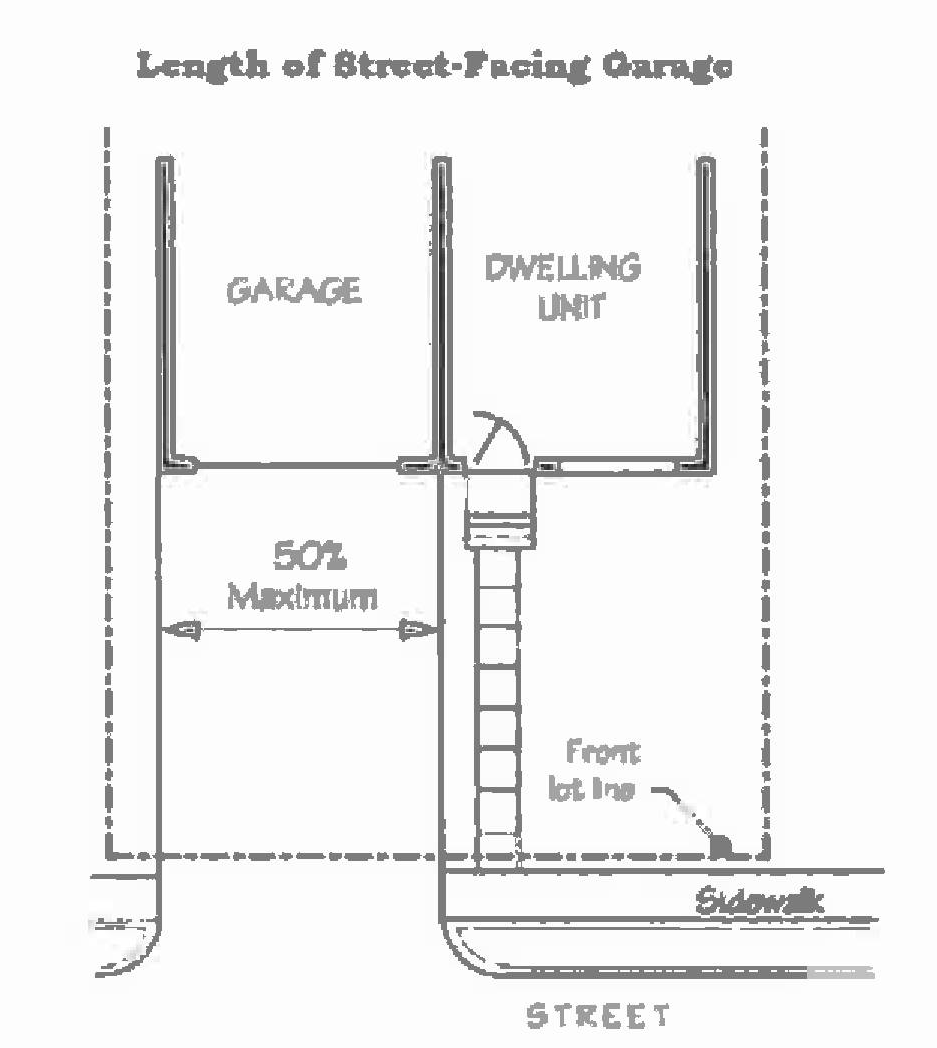
(2)
Garages shall be recessed, or may be flush to the primary facade when the primary facade contains an unenclosed porch having a depth of seven feet (7') or greater and occupying a minimum of twenty-five percent (25%) of the linear primary structure facade.
(3)
Garages facing the street having building walls greater than twelve feet (12') in height or facade walls greater than twenty-four feet (24') in length shall include architectural detail to break up and limit the massive appearance of the wall. Doing so requires utilizing at least two (2) of the following architectural features on street facade:
(A)
Dormers;
(B)
Gables;
(C)
Covered porch entries;
(D)
Pillars or posts;
(E)
Eaves;
(F)
Offsets in building face or roof (minimum of sixteen inches (16"));
(G)
Window trim;
(H)
Bay windows;
(I)
Balconies;
(J)
An alternative feature providing for visual relief, similar to subsections E.3.a.(3)(A) through E.3.a.(3)(I) of this section.
b.
Side and Rear Setbacks: In the residential single-family zone, detached garages are allowed in the side and rear building setbacks if all of the following are met:
(1)
The garage is set back at least twenty-five feet (25') from a front lot line, and if on a corner or alley accessible lot, it may be constructed one foot (1') from a flanking street or alley lot line;
(2)
Dormers are set back at least five feet (5') from the side and rear lot lines.
(3)
Second floor windows facing abutting lots utilize appropriate material (glass block or opaque glass) to maintain privacy of adjacent property.
(4)
Maintenance easements are provided by adjacent property owner when utilizing less than a two foot (2') setback from adjacent property line.
(5)
Snow drop and stormwater runoff from the structure are contained on site.
4.
Existing Detached Garages:
a.
Change of Use: In the residential single-family zone, a detached garage that is in the side or rear setback may be converted to another type of detached covered accessory structure so long as it is compliant with regulations specified in section 9-1-8 or 9-1-5 of this title. Second floor windows facing abutting lots utilize appropriate material (glass block or opaque glass) to maintain privacy of adjacent property.
b.
Rebuilding: A detached garage that is nonconforming due to its location in a setback, may be rebuilt on the footprint of the existing foundation, if the garage was originally constructed legally. Where the structure facade faces a street, garages utilizing this provision shall be designed and reconstructed in a manner to prevent a blank wall appearance through the utilization of projections, recessions, windows or other architectural treatment.
c.
Additions: An addition may be made to a detached garage that is nonconforming due to its location in a setback as follows:
(1)
The expanded garage complies with all other standards of this section.
F.
Main Entrances:
1.
Purpose: These standards:
a.
Together with the street facing facade and garage standards, ensure that there is a physical and visual connection between the living area of the residence and the street;
b.
Enhance public safety for residents and visitors and provide opportunities for community interaction;
c.
Ensure that the pedestrian entrance is visible or clearly identifiable from the street by its orientation or articulation; and
d.
Ensure that pedestrians can easily find the main entrance, and so establish how to enter the residence.
e.
Ensure a connection to the public realm for development on lots fronting both private and public streets by making the pedestrian entrance visible or clearly identifiable from the public street.
2.
Where These Standards Apply:
a.
The standards of this subsection F apply to houses, attached houses, and manufactured homes, in the residential single-family zone;
b.
Where a proposal is for an alteration or addition to existing development, the standards of this subsection F apply only to the portion being altered or added;
c.
On sites with frontage on both a private street and a public street, the standards apply to the site frontage on the public street. On all other sites with more than one street frontage, the applicant may choose on which frontage to meet the standards.
3.
The Standard:
a.
Location: At least one main entrance for each structure must:
(1)
Either:
(A)
Face the street;
(B)
Be at an angle of up to forty-five degrees (45°) from the street; or
(C)
Open onto a porch. See figure 2 of this section. The porch must be a covered unenclosed porch with a minimum of twenty-five (25) square feet in area.
Figure 2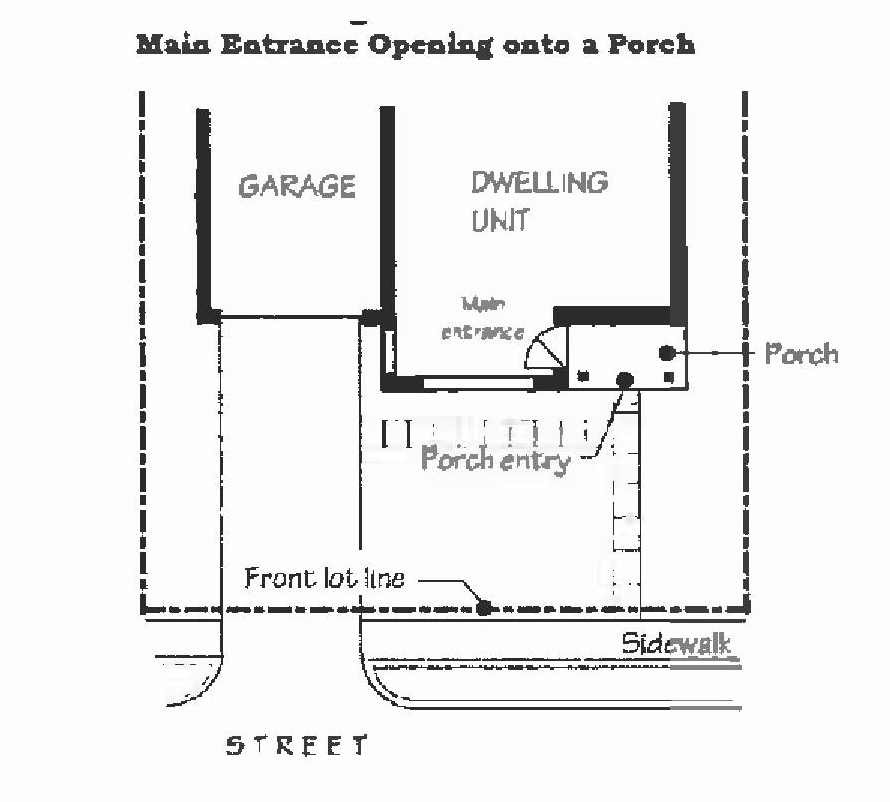
G.
Street Facing Facades:
1.
Purpose: This standard:
a.
Together with the main entrance and garage standards, ensures that there is a visual connection between the living area of the residence and the street;
b.
Enhances public safety by allowing people to survey their neighborhood from inside their residences; and
c.
Provides a more pleasant pedestrian environment by preventing large expanses of blank facades along streets.
2.
Where This Standard Applies: The standard of this subsection G applies to houses, attached homes, and manufactured homes in the residential single-family zone. Where a proposal is for an alteration or addition to existing development, the applicant may choose to apply the standard either to the portion being altered or added, or to the entire street facing facade.
3.
The Standard: At least fifteen percent (15%) of the square footage area of each facade that faces a street lot line must be windows or main entrance doors. Windows used to meet this standard must allow views from the building to the street. Glass block does not meet this standard. Windows in garage doors do not count toward meeting this standard, but windows in garage walls do count toward meeting this standard. To count toward meeting this standard, a door must be at the main entrance and facing a street lot line.
H.
Attached Housing Options:
1.
Purpose: The alternative development options allow for variety in development standards while maintaining the overall character of a single dwelling neighborhood. These options have several public benefits:
a.
They allow for development which is more sensitive to the environment, especially in hilly areas and areas with water features and natural drainageways;
b.
They allow for the preservation of open and natural areas;
c.
They promote better site layout and opportunities for private recreational areas;
d.
They promote opportunities for affordable housing;
e.
They promote energy efficient development; and
f.
They allow for the provision of alternative structure types where density standards are met.
g.
They reduce the impact that new development may have on surrounding residential development.
h.
Attached housing allows for more efficient use of land and for energy conserving housing.
2.
Where This Standard Applies: The regulations of this subsection apply to all attached housing in the residential single-family zone. The alternative development options listed in this subsection H are allowed by right unless specifically stated otherwise. The project must comply with all of the applicable development standards of this subsection H. The project must also conform to all other development standards of the base zone unless those standards are superseded by the standards in this subsection H.
3.
The Standard:
a.
Area Requirements:
(1)
Lot Dimensions: Attached housing must be on a lot that has a minimum area of ten thousand (10,000) square feet unless otherwise stated by this code.
(2)
Building Setbacks:
(A)
Interior (Noncorner) Lots: On interior lots the side building setback on the side containing the common wall is reduced to zero. The reduced setback applies to all buildings on the lot and extends along the full length of the lot line that contains the common or abutting wall. The side building setback on the side opposite the common wall must be ten feet (10').
(B)
Corner Lots: On corner lots either the rear setback or nonstreet side setback may be reduced to five feet (5'). However, the remaining nonstreet setback must comply with the requirements for a standard rear setback.
b.
Number of Units: A maximum of two (2) units are allowed per structure. Attached houses may have a common wall. Accessory dwelling units are prohibited on lots developed with attached housing.
c.
Single-Family Character: Attached housing shall contribute to the single-family character of the neighborhood by utilizing exemplary design and architecture to seamlessly integrate with other structures in the vicinity. (See figure 3 of this section.)
Figure 3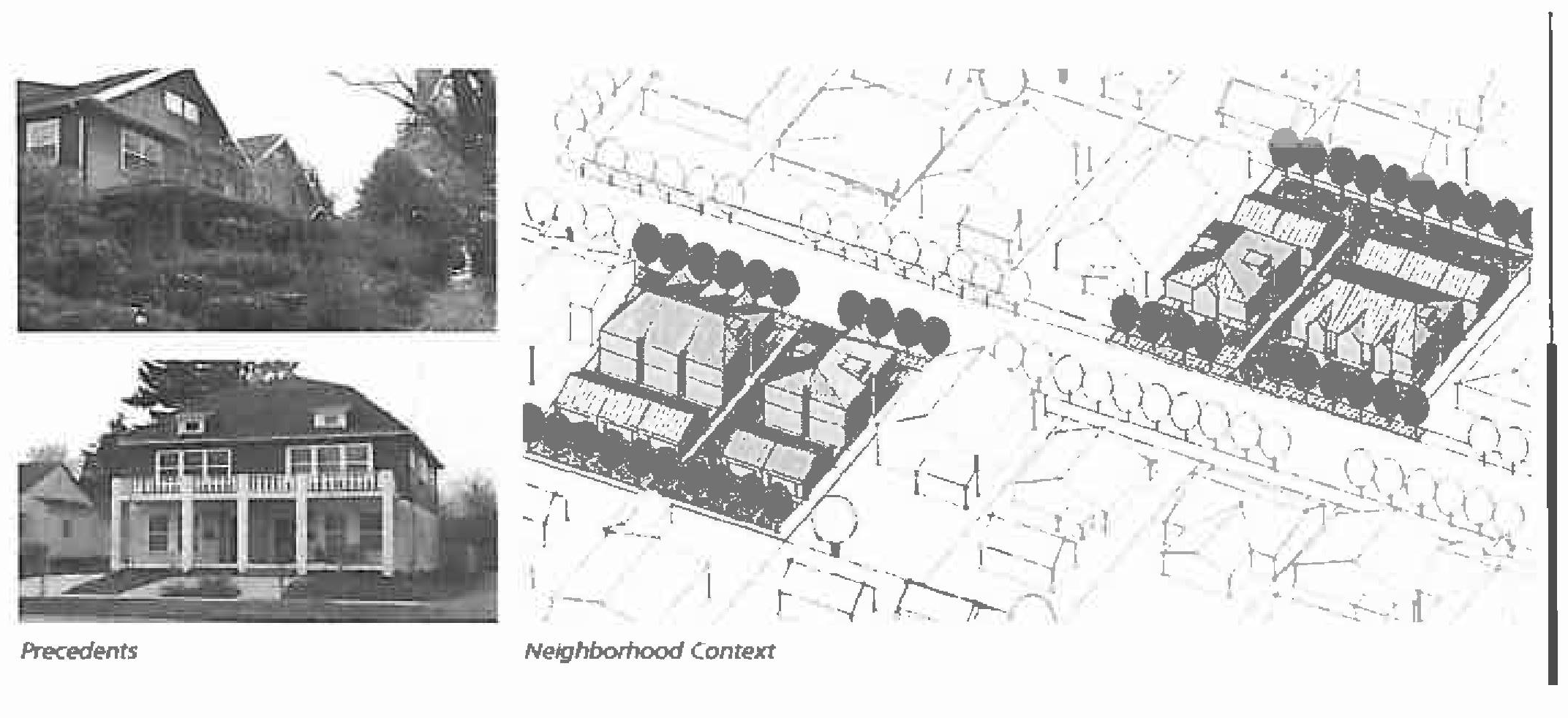
d.
Second Story Design: A second story of any attached housing unit requires additional design standards. Along the street facing facade, the building shall incorporate features such as offsets, balconies, projections, window reveals, or similar elements to preclude large expanses of uninterrupted building surfaces. Such features shall occur at a minimum of every twelve feet (12') along the vertical face of the facade, and each floor shall contain a minimum of offsets or breaks in facade of two feet (2') or greater in depth.
e.
Landscape Standards: The following landscape standards must be met on lots in the residential single-family zone to qualify for attached housing development:
(1)
A minimum of three (3) front yard trees with a minimum dbh of two inches (2") shall be planted per unit.
(Ord. 1263, 12-29-2011; Ord. 1336, 11-2-2016)
9-4-2-1: - Purpose:
Areas zoned as Residential Multi-Family (RM) are intended to preserve land for housing and to provide diversity in housing options. This zone implements the comprehensive plan policies for those areas identified as CA-3 in the 2009 comprehensive plan.
(Ord. 1263, 12-29-2011)
9-4-2-2: - Use Regulations:
These use regulations are intended to create opportunities for new types of housing that seamlessly integrate with existing neighborhoods in the area. The regulations allow for a wider range of housing types compared to Residential Single-Family (RS) in order to create a denser neighborhood form.
The following regulations shall apply:
Notes:
1. Any use legally established as a permitted use now subject to conditional use approval
shall be subject to conditional use approval to expand such use.
2. Subject to standards set forth for the standards for development of residential
original substandard lots of record.
3. Subject to standards set forth for cottage housing development.
4. The recognized, existing communities within the RM Zone at the time of adoption
hereof include the 6-unit Lines Mobile Home Park located at the southeast corner of
Division Avenue and Church Street and the 16-unit Wikiup Mobile Home Park located
on the east side of Florence Avenue between Fir and Larch Streets.
(Ord. 1263, 12-29-2011; amd. Ord. 1281, 5-15-2013; Ord. 1336, 11-2-2016; Ord. 1353, 6-6-2018)
9-4-2-3: - Development Standards:
A.
Lot Areas: Every dwelling erected shall be on a lot having an area of not less than five thousand (5,000) square feet and frontage on a public street of not less than thirty-seven and one-half feet (37.5') and shall have a width of not less than thirty-seven and one-half feet (37.5') at the front building line. Lots with frontage on a cul-de-sac shall have a minimum frontage on a public road of not less than thirty feet (30').
Additional units may be developed as follows:
AREA INCREASES PER UNIT
B.
Setbacks:
1.
Purpose: The setback regulations for buildings and garage entrances serve several purposes:
a.
They maintain light, air, separation for fire protection, and access for firefighting;
b.
They reflect the general building scale and placement of houses;
c.
They promote a reasonable physical relationship between residences;
d.
They promote options for privacy for neighboring properties;
e.
They require larger front setbacks than side and rear setbacks to promote open, visually pleasing front yards;
f.
They provide adequate flexibility to site a building so that it may be compatible with the neighborhood, fit the topography of the site, allow for required outdoor areas, and allow for architectural diversity; and
g.
They provide room for a car to park in front of a garage door without overhanging the street or sidewalk, and they enhance driver visibility when backing onto the street.
2.
Front Yard Limits: Each lot shall have a front yard of not less than fifteen feet (15') in depth from front lot line unless provided for elsewhere in this code.
3.
Side Yard:
a.
On interior lots there shall be a side yard on each side of the outer walls of any building constructed thereon of not less than five feet (5').
b.
Buildings erected upon corner lots need only comply with the front yard requirement with regard to their primary facade, which is designated as having the primary entrance. A side yard setback is required for secondary frontages on corner lots. Flanking street setbacks may be reduced from fifteen feet (15') to ten feet (10') but shall include design features such as projections, recessions, windows or other architectural treatment to prevent a blank wall appearance.
4.
Rear Yard: Each lot upon which a dwelling is constructed shall have a rear yard of not less than fifteen feet (15').
5.
Garage and Parking Entrance Setback: To avoid vehicles parking on the sidewalk, no street facing garage shall be constructed within twenty-five feet (25') of a property line having frontage along a public street. Any uncovered off-street parking developed within the front yard setback shall have a minimum depth of twenty-five feet (25').
6.
Riparian and Shoreline Setback:
a.
Purpose: The purpose of this subsection B.6. is to protect scenic and recreational resources, water quality and natural shoreline habitat. In addition, shoreline setbacks and buffers help avoid damage to development from erosion and flooding.
The waterfront building setback for new development and redevelopment (tear downs) along waterfront properties within the city of Sandpoint shall be a minimum of forty feet (40') from the artificial high water mark. For purposes of this subsection B.6., artificial high water marks shall be considered according to the North American vertical datum of 1988 (NAVD88).
New development adhering to the forty foot (40') setback and/or reconstruction that involves issuance of a building permit for greater than twenty-five thousand dollars ($25,000.00) of improvements, shall be required to plant fifty percent (50%) of the area in the minimum twenty-five foot (25') building setback with native vegetation comprised of a mixture of grasses and shrubs. For the purpose of this subsection B.6., building permit valuation shall be a cumulative aggregate from the date of the adoption hereof forward.
The city shall assist the applicant in determining appropriate native vegetation required, and will coordinate with the applicant on the planting success the following year.
The building setback can be reduced to twenty-five feet (25') if the setback area is revegetated with primarily native vegetation. Establishment of a tree canopy is encouraged. No constructed structures other than those required for waterfront access/docks are allowed within the twenty-five foot (25') setback. The applicant shall record on the title documentation from the City of Sandpoint confirming that the structure has been built under the flexible setback option and as such, the structure is conforming and the area within the twenty-five foot (25') lakefront setback is to remain planted primarily with native vegetation (as described above).
A variance may be sought for those projects or activities for which it can be demonstrated that strict compliance would result in a practical difficulty. City owned property shall be exempt from the required standards.
b.
Shoreline Setback Exceptions: Placement of constructed trams, rails, uncovered steps, stairs or walkways, any of which shall be five feet (5') or less in width and installed to provide access to the shoreline, are permitted within the shoreline setback. Such structures shall not be constructed in a manner that is parallel to the shoreline that would create a boardwalk along the waterfront (except where steep slopes require switchback designs).
7.
Exceptions To The Required Setbacks: Certain parts of structures may be allowed to encroach into the required setbacks as described herein. Setbacks are modified further for attached housing, cottage housing and substandard lots.
8.
Maximum Encroachment: No part of any structure shall encroach within ten feet (10') of the front property line, three feet (3') of the side property line(s) and five feet (5') of the rear property line.
9.
General Exceptions: The following shall be permitted to encroach up to the maximum encroachment:
a.
Established Building Lines: Sites with legally existing nonconforming development in a required setback are eligible for a onetime reduction to the required setbacks. The building line created by the nonconforming wall serves as the reduced setback line. At a maximum, the nonconforming wall may be doubled in length, e.g., a two foot (2') long wall within the side yard setback may be lengthened to four feet (4') total. The vertical height of the wall shall not be increased, e.g., a second story cannot be placed up to the reduced setback line if the existing nonconforming wall is only one story high.
b.
Minor Features: Minor features of a building such as eaves, chimneys, water collection cisterns and planters, bay windows, and uncovered balconies, may extend into the required setback. Bays and bay windows encroaching into the setback also must meet the following requirements: 1) each bay and bay window may be up to twelve feet (12') long, but the total area of all bays and bay windows on a building facade cannot be more than thirty percent (30%) of the linear total of the facade; 2) bays and bay windows must cantilever beyond the foundation of the building; and 3) the bay may not include any doors.
10.
Specific Exceptions: The following shall be permitted to encroach up to the maximum encroachment and any structure shall be limited to fifteen feet (15') in height above grade for that portion encroaching into the setback area:
a.
Adjacent Structures: Where both adjacent lots on the primary frontage are developed with structures and both adjacent structures have front yard setbacks less than the minimum, the subject lot may build within the front setback to the maximum encroachment.
b.
Porches: Unenclosed front porches may encroach into the front yard setback up to the maximum encroachment.
c.
Garages: Garages shall not be permitted to encroach on the front yard setback but may be used in calculating adjacent structure setbacks as described above. Detached garages may encroach on side and rear setbacks up to the maximum encroachment. Detached garages are subject to additional requirements.
C.
Lot Coverage:
1.
Purpose: The building coverage standards, together with the height and setback standards control the overall bulk of structures. They are intended to assure that taller buildings will not have such a large footprint that their total bulk will overwhelm adjacent houses. Additionally, the standards help define the character of the different zones by limiting the amount of buildings allowed on a site.
2.
Building Footprint: Each lot upon which a dwelling, private garage or other outbuilding is constructed shall have a maximum forty percent (40%) building footprint and a maximum forty percent (40%) impervious surface.
D.
Building Height: No structure shall exceed a building height of forty feet (40') above the average elevation of the finished grade at the front of the building.
1.
Exceptions To The Maximum Height:
a.
Chimneys, flagpoles, satellite receiving dishes, roof mounted solar panels and other similar items may extend above the height limit, as long as they do not exceed five feet (5') above the top of the highest point of the roof.
b.
Utility power poles, and public safety facilities are exempt from the height limit.
E.
Garages:
1.
Purpose: Together with the main entrance and street facing facade standards, these standards ensure that there is a physical and visual connection between the living area of the residence and the street. Additionally these standards:
a.
Ensure that the location and amount of the living area of the residence, as seen from the street, is more prominent than the garage;
b.
Prevent garages from obscuring the main entrance from the street and ensure that the main entrance for pedestrians, rather than automobiles, is the prominent entrance;
c.
Provide for a more pleasant pedestrian environment by preventing garages and vehicle areas from dominating the views of the neighborhood from the sidewalk; and
d.
Enhance public safety by discouraging garages from blocking views of the street from inside the residence.
2.
Where These Standards Apply: The regulations of this subsection E apply to all attached or detached garages in the residential multi-family zone. On corner lots, only one street facing garage wall must meet the standards of this subsection E.
3.
The Standard:
a.
Dimensions:
(1)
The length of the garage wall facing the street may be up to fifty percent (50%) of the length of the street facing unit facade (see figure 1 of this section). Garage walls with a depth of not more than fifty feet (50') in length shall include architectural detail to break up and limit the massive appearance.
Figure 1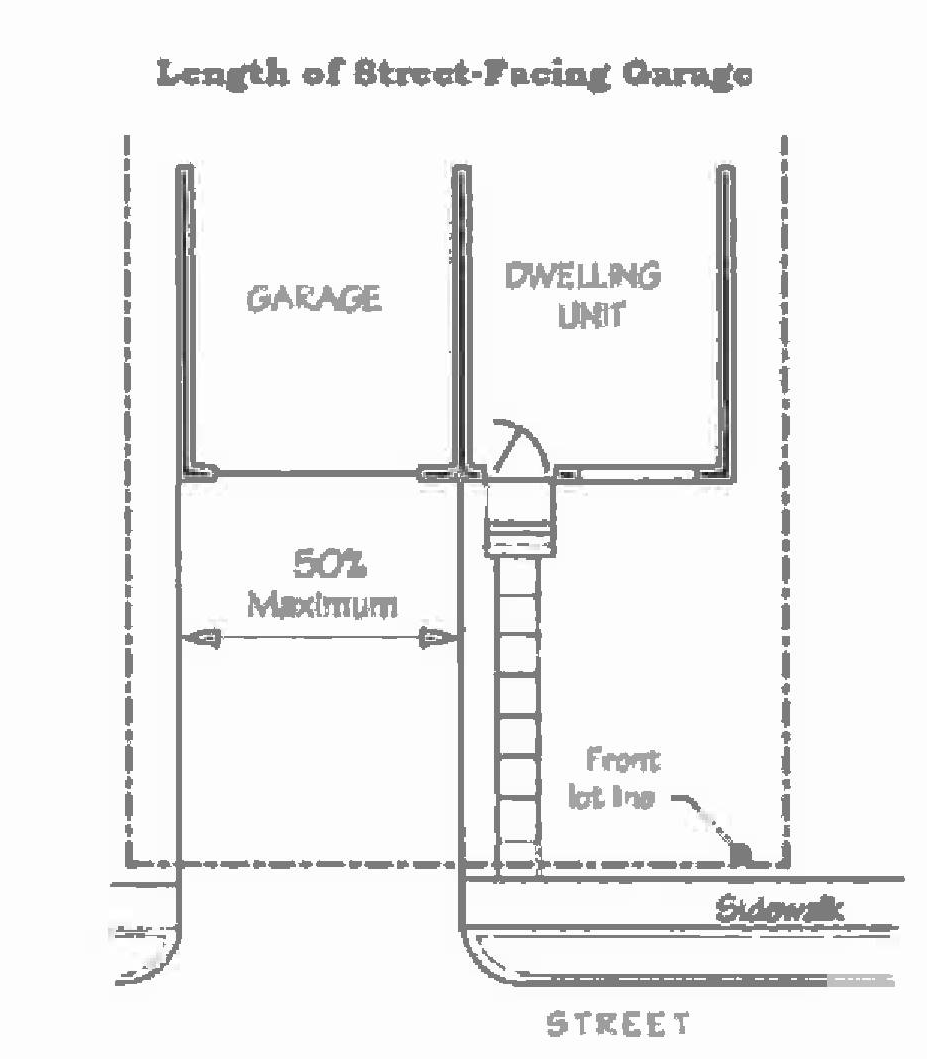
(2)
Garages shall be recessed, or may be flush to the primary facade when the primary facade contains an unenclosed porch having a depth of seven feet (7') or greater and occupying a minimum of twenty-five percent (25%) of the linear primary structure facade.
(3)
Garages facing the street having building walls greater than twelve feet (12') in height or facade walls greater than twenty-four feet (24') in length shall include architectural detail to break up and limit the massive appearance of the wall. Doing so requires utilizing at least two (2) of the following architectural features on street facade:
(A)
Dormers;
(B)
Gables;
(C)
Covered porch entries;
(D)
Pillars or posts;
(E)
Eaves;
(F)
Offsets in building face or roof (minimum of sixteen inches (16"));
(G)
Window trim;
(H)
Bay windows;
(I)
Balconies;
(J)
An alternative feature providing for visual relief, similar to subsections E3a(3)(A) through E3a(3)(I) of this section.
b.
Side and Rear Setbacks: In the residential multi-family zone, detached garages are allowed in the side and rear building setbacks if all of the following are met:
(1)
The garage is set back at least twenty-five feet (25') from a front lot line, and if on a corner or alley accessible lot, it may be constructed one foot from a flanking street or alley lot line;
(2)
Dormers are set back at least five feet (5') from the side and rear lot lines.
(3)
Second floor windows facing abutting lots utilize appropriate material (glass block or opaque glass) to maintain privacy of adjacent property.
(4)
Maintenance easements are provided by adjacent property owner when utilizing less than a two foot (2') setback from adjacent property line.
(5)
Snow drop and stormwater runoff from the structure are contained on site.
c.
Existing Detached Garages:
(1)
Change of Use: In the residential multi-family zone, a detached garage that is in the side or rear setback may be converted to another type of detached covered accessory structure so long as it is compliant with regulations specified in section 9-1-8 or 9-1-5 of this title. Second floor windows facing abutting lots utilize appropriate material (glass block or opaque glass) to maintain privacy of adjacent property.
(2)
Rebuilding: A detached garage that is nonconforming due to its location in a setback, may be rebuilt on the footprint of the existing foundation, if the garage was originally constructed legally. Where the structure facade faces a street, garages utilizing this provision shall be designed and reconstructed in a manner to prevent a blank wall appearance through the utilization of projections, recessions, windows or other architectural treatment.
(3)
Additions: An addition may be made to a detached garage that is nonconforming due to its location in a setback as follows:
(A)
The expanded garage complies with all other standards of this section.
F.
Main Entrances:
1.
Purpose: These standards:
a.
Together with the street facing facade and garage standards, ensure that there is a physical and visual connection between the living area of the residence and the street;
b.
Enhance public safety for residents and visitors and provide opportunities for community interaction;
c.
Ensure that the pedestrian entrance is visible or clearly identifiable from the street by its orientation or articulation; and
d.
Ensure that pedestrians can easily find the main entrance, and so establish how to enter the residence.
e.
Ensure a connection to the public realm for development on lots fronting both private and public streets by making the pedestrian entrance visible or clearly identifiable from the public street.
2.
Where These Standards Apply:
a.
The standards of this subsection F apply to houses, attached houses, and manufactured homes, in the residential multi-family zone;
b.
Where a proposal is for an alteration or addition to existing development, the standards of this subsection F apply only to the portion being altered or added;
c.
On sites with frontage on both a private street and a public street, the standards apply to the site frontage on the public street. On all other sites with more than one street frontage, the applicant may choose on which frontage to meet the standards.
3.
The Standard:
a.
Location: At least one main entrance for each structure must:
(1)
Either:
(A)
Face the street. Be at an angle of up to forty-five degrees (45°) from the street; or
(B)
Open onto a porch. See figure 2 of this section. The porch must be a covered unenclosed porch with a minimum of twenty-five (25) square feet in area.
Figure 2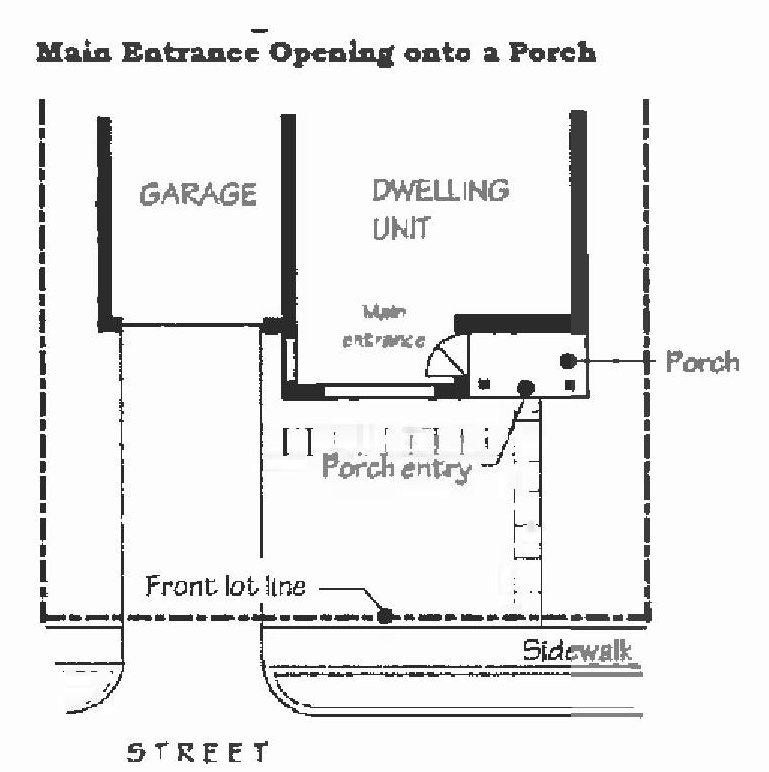
G.
Street Facing Facades:
1.
Purpose: This standard:
a.
Together with the main entrance and garage standards, ensures that there is a visual connection between the living area of the residence and the street;
b.
Enhances public safety by allowing people to survey their neighborhood from inside their residences; and
c.
Provides a more pleasant pedestrian environment by preventing large expanses of blank facades along streets.
2.
Where This Standard Applies: The standard of this subsection G applies to houses, attached homes, and manufactured homes in the residential multi-family zone. Where a proposal is for an alteration or addition to existing development, the applicant may choose to apply the standard either to the portion being altered or added, or to the entire street facing facade. PUDs that received preliminary plan approval prior to the adoption of this section are exempt from this standard.
3.
The Standard: At least fifteen percent (15%) of the square footage area of each facade that faces a street lot line must be windows or main entrance doors. Windows used to meet this standard must allow views from the building to the street. Glass block does not meet this standard. Windows in garage doors do not count toward meeting this standard, but windows in garage walls do count toward meeting this standard. To count toward meeting this standard, a door must be at the main entrance and facing a street lot line.
H.
Additional Standards Applicable To Multi-Family Development:
1.
Purpose and Intent: The following design standards were established to improve the appearance, quality, and functions of multi-family housing. The standards herein apply to the development of multi-family housing in the "RM" zone of four (4) or more units including, but not limited to, apartments and condominiums.
2.
Conflicting Standards: In the event that other standards of this title conflict with standards in this provision, the standards within this provision shall prevail.
3.
Building Mechanicals, Service Elements, and Resident Amenities:
a.
Service areas, utility meters, and building mechanicals shall not be located on the street side of the building, nor on a side wall closer than ten feet (10') to the street side of the building. Screening of meters and mechanicals is required, regardless of location. Mailboxes are permitted within ten feet (10') of the front of the building if not visible from the street.
b.
Trash and recycling containers, including cans and dumpsters, shall be screened so as not to be visible from the street or from neighboring properties. Screening shall be one foot higher than the container but not higher than six feet (6'), however roofed enclosures may exceed this limit.
c.
Bike racks shall be provided and shall include space for at least two (2) bikes per unit.
d.
Bike racks shall be located near building entries, shall not interfere with pedestrian circulation, and shall be well lit.
4.
Pedestrian Circulation:
a.
There shall be a hard surfaced (e.g., pavement, pavers, concrete) pedestrian route from the sidewalk or street to the main building entrance and from the parking area to the nearest building entrance. Buildings with more than one entrance shall provide a designated pedestrian route between those entrances (e.g., from front to back).
5.
Landscaping, Open Space, and Plantings:
a.
All portions of the site not covered by buildings, paving material, or other planned approved surfaces shall be considered "landscaped area" and shall be planted with living plant materials and/or mulches. Overall site landscaping shall include not less than:
(1)
One front yard shade tree with a caliper no smaller than two inches (2") dbh per twenty-five (25) linear feet of lot frontage.
(2)
One tree with a caliper no smaller than two inches (2") and ten (10) shrubs per six hundred (600) square feet of landscaped area.
b.
Existing healthy trees shall be preserved to the greatest extent practicable; however, invasive or nuisance trees shall be removed. Existing damaged, decayed, or diseased trees should be removed to protect remaining trees. Construction near existing trees should follow best management practices to ensure their survival.
c.
Landscaping should reinforce pedestrian circulation routes and obstruct undesired routes of convenience. Bushes, trees, rocks, and other landscape features should be used to indicate where pedestrians should and should not travel. Native and low water demand plantings are encouraged.
d.
Outdoor seating including elements such as a bench or chair shall be provided at the ratio of one seating area per three (3) units which are to be incorporated into or adjacent to usable open space.
e.
One functional outdoor open space with a minimum dimension of five hundred (500) square feet shall be provided per five (5) units.
6.
Neighborhood Scale: The scale of those buildings developed within an existing neighborhood shall conform to the established scale. Appropriate scale multi-family development shall be achieved through the adherence of the following:
a.
The overall height of the multi-family structure shall relate to that of adjacent structures by avoiding construction that varies greatly in height from adjacent buildings. New multi- family structures shall graduate their maximum height based on adjacent structures using stepped roofs and/or partial stories. For example, the portion of a multi-family structure constructed adjacent to a single story structure is limited to one and a half (1 ½)stories, and if constructed adjacent to a one and one-half (1½) story structure, the adjacent facade would be limited to two (2) stories.
b.
Multi-family structures shall utilize a variety of building forms and roof shapes rather than boxlike forms with large, unvaried roofs. The building design shall provide manipulations to create clusters of units and variations of height, setback and roof shape.
7.
Building Entrances:
a.
The primary entrance to the building shall be on the front elevation and shall face the street.
b.
Building entrances shall be emphasized through projecting or recessing forms, detail, color, or materials.
c.
A covering over the main entrance shall extend at least four feet (4') from the main door. Entrance features may encroach into the front yard setback a maximum of four feet (4').
8.
Facade and Articulation:
a.
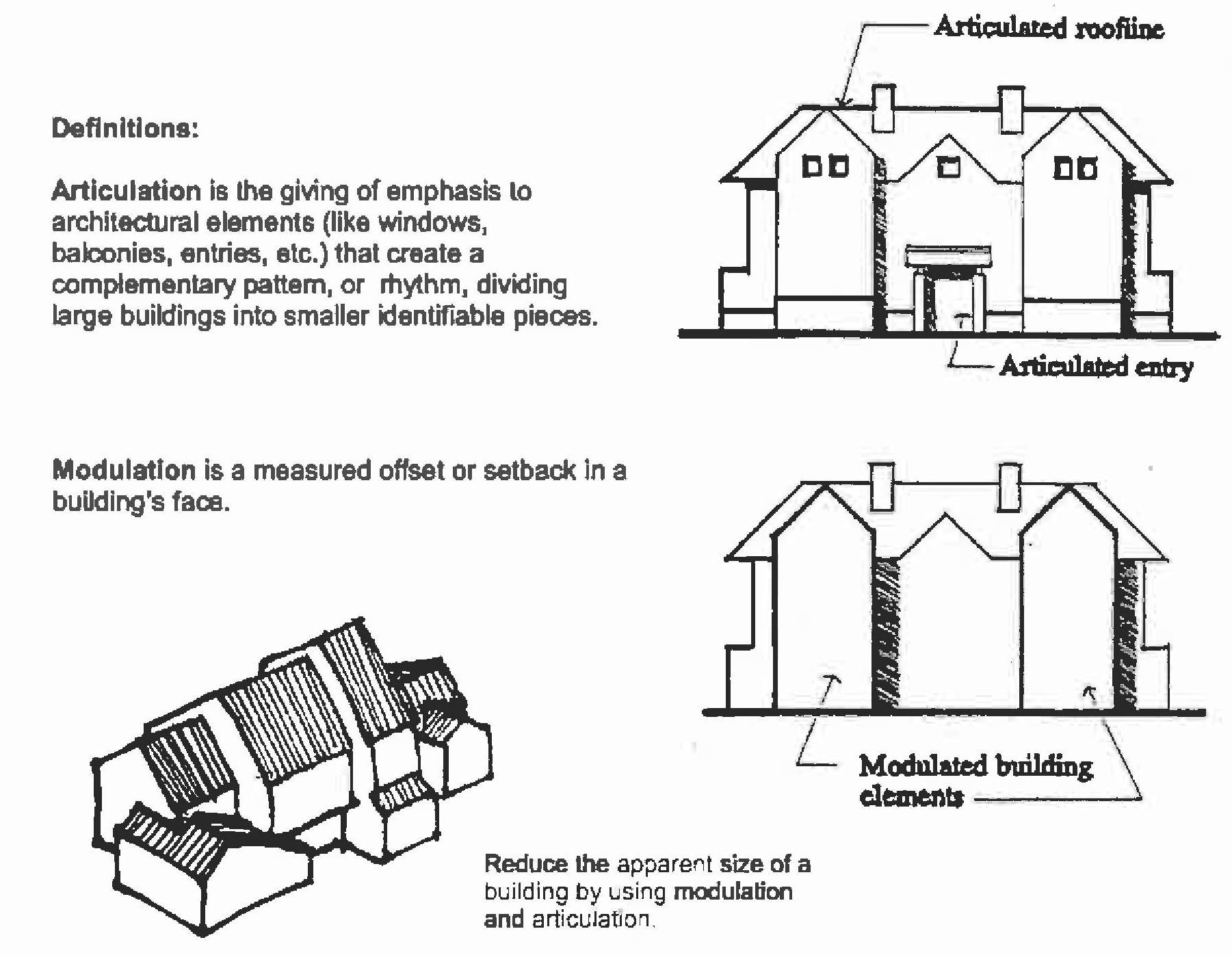
Buildings shall be divided into modules by using articulation or modulation at least every thirty (30) linear feet. Buildings shall use a common, unifying design theme throughout the project but not repeat the same pattern of architectural elements for more than four (4) consecutive modules. The use of at least one of the following techniques is required:
(1)
Step the front facade building wall back or forward at least four feet (4') and change the roof shape or step the ridgeline to correspond to the wall change.
(2)
Change several of the architectural elements for the width of the module, such as primary siding material, decks, windows, and entry designs.
(3)
Break up the roofline and wall heights by use of dormers, gables, and similar variations. When flat roofs are used, add architectural detail such as cornice or fascia and modulation to reduce the perceived mass of the walls.
b.
Buildings shall incorporate architectural details that will provide visual interest at a human scale. At least three (3) of the following shall be utilized:
(1)
A one-story porch at entrances.
(2)
Decorative details such as columns, bay windows, dormers, multi-lite windows, trim, or moldings to articulate the building facade.
(3)
Roof details like brackets, wide (twelve inches (12") or more) cornices and wide (sixteen inches (16") or more) overhangs.
(4)
Materials and/or color variations that coordinate with changes in the building modules and differentiate ground floors from upper floors.
c.
Architectural treatment, similar to that provided to the front facade shall be provided to the sides and rear of the building to mitigate any negative view from any location off site and any public area (e.g., parking lots, walkways, etc.) on site.
d.
The total area of windows and doors on the street facing facade, including trim, shall not be less than twenty percent (20%) of the total area of the facade, excluding gables. The first floor facade shall include windows to provide visual interest and visual connection to the street.
9.
Parking: All parking areas shall be compliant with chapter 5 of this title. In addition, parking areas shall be designed to avoid their dominance of the streetscape. Parking shall be provided at the rear or side of the site to allow a majority of the dwelling units to "front on" the street.
a.
Parking areas shall be separated from primary buildings by a landscaped buffer of at least fifteen feet (15') in width.
10.
Walls and Fences:
a.
Walls and fences exceeding fifty feet (50') in length shall provide variety and articulation at intervals not exceeding twenty-five feet (25') through at least one of the following methods:
(1)
Expression of structure, such as post, column, or pilaster.
(2)
Variation of material.
b.
Chainlink fencing is prohibited except in circumstances where fencing is provided for recreational courts (basketball, etc.).
11.
Design Standard Waivers: An applicant may request a waiver from one or more of the standards listed above. All requests for waivers shall be heard and decided by the planning commission or such design review subcommittee as may be created for such purpose. A waiver shall not be considered a right or special privilege but may be granted to an applicant that can meet the following findings:
a.
That the granting of the waiver will not be in conflict with the intent of the multi-family design standards, shall not negatively impact the existing neighborhood and shall enhance the overall design quality of the project;
b.
That there is an exceptional circumstance relating to the design or configuration of the property, which is not generally applicable to other properties or otherwise anticipated by the standards in the district.
c.
The granting of such relief will not be materially detrimental to the public health, safety or welfare, or injurious to the property, improvements or the quiet enjoyment of the surrounding properties and neighborhood.
d.
The granting of such relief will not be in conflict with the goals and policies of the comprehensive plan.
(Ord. 1263, 12-29-2011)
9-4-3: - Reserved:
Editor's note— Ord. No. 1383, adopted December 16, 2020, repealed § 9-4-3 which pertained to the watershed protection zone. Similar provisions can now be found in Title 7, Chapter 16, Watershed Protection and Access.
9-4-4: - Rural Residential RR-1 Zone:
A.
Permitted Use Regulations: Permitted uses are single-family dwellings, horticultural uses for personal use only and not for profit with the exception of tree farms, home occupations, a dwelling unit with an attached or detached accessory dwelling unit as provided for in section 9-1-8 of this title, short term rentals subject to the licensing requirements set forth in title 3, chapter 12 of this code and parks.
Also permitted are fairground facilities, related events and activities lawfully established prior to the effective date of this section. (A list dated January 13, 1998, of the qualifying facilities, related events and activities which were lawfully established prior to the effective date of this section was provided by the Fair Association and shall be filed with the Sandpoint City Clerk by Bonner County.)
B.
Conditional Uses: Churches, police and fire stations, public utility facilities, schools public or private, except those schools of vocational nature which operate similarly to a retail business where a product or products may be purchased on the premises, expansion of existing or addition of new fairground facilities, barns, exhibit buildings, food facilities, storage buildings, indoor or outdoor arenas, similarly classified facilities and accessory buildings, and events related to the fairgrounds. Provided that a conditional use permit shall not be required to expand an existing event or add a new one that falls below the following thresholds for both event length and maximum attendance:
Temporary expansions, structures or parking areas which will be in place for less than thirty (30) days and are directly related to an existing or new event that falls below the thresholds noted above do not require a conditional use permit.
C.
Prohibited Uses: The raising of poultry and animal kennels for commercial purposes.
D.
Areas: No building or structure, nor the enlargement of any building or structure shall be hereafter erected or maintained unless the following described yards and lot areas are provided and maintained in connection with said building, structure or enlargement:
1.
Yard Limits: Each lot upon which a dwelling, private garage or other outbuilding is constructed shall have a front yard of not less than twenty-five feet (25') in depth from the front lot line. Where lots comprising forty percent (40%) or more of the frontage between two (2) intersecting streets are developed with buildings having front yards, the average of such front yards shall establish the minimum front yard depth for the entire frontage; provided, however, that in no case shall said front yard be less than said twenty-five feet (25').
2.
Side Yard: On interior lots there shall be a side yard on each side of the outer walls of any building constructed thereon of not less than fifteen feet (15'). Buildings erected upon corner lots shall comply with the front yard requirement with regard to both streets; provided, however, that in the event it is impractical or would work great or unusual hardship upon any owner of a corner lot to require him to conform to such front yard requirements regarding both streets, then the commission may in its discretion permit such property owner to locate such building so that the front thereof conforms to the front yard requirement on the street upon which said building fronts and the side of such building may be such distance from the street right- of-way line as the commission may deem desirable; however, no nearer to the street right-of-way line than fifteen feet (15').
3.
Rear Yard: Each lot upon which a dwelling is constructed shall have a rear yard of not less than fifteen feet (15').
4.
Lot Areas: Every building erected shall be on a lot having an area of not less than one-half (½) acre.
5.
Lot Coverage: Each lot upon which a dwelling, private garage or other outbuilding is constructed shall have not more than thirty-five percent (35%) of the lot occupied by such structures.
6.
Building Height: No structure shall exceed a building height of thirty-five feet (35') or two and one-half (2 ½) stories above the average elevation of the finished grade at the front of the building. Antennas are excluded from the requirements.
(Ord. 1236, 6-23-2010; amd. Ord. 1263, 12-29-2011; Ord. 1281, 5-15-2013; Ord. 1353, 6-6-2018)
9-4-5: - Rural Residential RR-2 Zone:
A.
Permitted Use Regulations: Permitted uses are single-family dwellings, a dwelling unit with an attached accessory apartment occupying not more than thirty-three percent (33%) of the total floor area of the structure, tree farms, greenhouses and horticultural uses where no retail sales take place on the premises, bed and breakfast establishments providing not more than three (3) rooms are rented plus one family has a live in tenant, the raising of livestock for noncommercial purposes providing the livestock density does not exceed one animal for parcels of land totaling one acre or three (3) animals per two (2) acres and one additional animal per acre thereafter, home occupations, tourist homes and parks.
B.
Conditional Uses: Family daycare center, churches, police and fire stations, public utility facilities, schools public or private, except those schools of vocational nature which operate similarly to a retail business where a product or products may be purchased on the premises.
C.
Prohibited Uses: The raising of livestock for commercial purposes, kennels for commercial purposes.
D.
Areas: No building or structure, nor the enlargement of any building or structure shall be hereafter erected or maintained unless the following described yards and lot areas are provided and maintained in connection with said building, structure or enlargement:
1.
Yard Limits: Each lot upon which a dwelling, private garage or other outbuilding is constructed shall have a front yard of not less than twenty-five feet (25') in depth from the front lot line. Where lots comprising forty percent (40%) or more of the frontage between two (2) intersecting streets are developed with buildings having front yards, the average of such front yards shall establish the minimum front yard depth for the entire frontage; provided, however, that in no case shall said front yard be less than said twenty-five feet (25').
2.
Side Yard: On interior lots there shall be a side yard on each side of the outer walls of any building constructed thereon of not less than twenty-five feet (25'). Buildings erected upon corner lots shall comply with the front yard requirement with regard to both streets; provided, however, that in the event it is impractical or would work great or unusual hardship upon any owner of a corner lot to require him to conform to such front yard requirements regarding both streets, then the commission may in its discretion permit such property owner to locate such building so that the front thereof conforms to the front yard requirement on the street upon which said building fronts and the side of such building may be such distance from the street right of way line as the commission may deem desirable; however, no nearer to the street right of way line than twenty-five feet (25').
3.
Rear Yard: Each lot upon which a dwelling is constructed shall have a rear yard of not less than twenty-five feet (25').
4.
Lot Areas: Minimum lot size required shall be not less than two (2) acres.
5.
Lot Coverage: Each lot upon which a dwelling, private garage or other outbuilding is constructed shall have not more than twenty-five percent (25%) of the lot occupied by such structures.
6.
Building Height: No structure shall exceed a building height of thirty-five feet (35') or two and one-half (2 ½) stories above the average elevation of the finished grade at the front of the building. Antennas are excluded from the requirements.
(Ord. 1236, 6-23-2010; amd. Ord. 1263, 12-29-2011; Ord. 1281, 5-15-2013)
9-4-6-1: - Purpose and Intent:
The purpose of these provisions is to guide residential development on substandard lots, ensuring that the developments are compatible with the character and the scale of established housing.
A.
Applicability and General Provisions: The following standards and procedures apply to residential development of substandard lots as defined in section 9-1-3 of this title, and apply to:
1.
Substandard lots in the residential single-family zone having a lot area of less than five thousand (5,000) square feet and/or a lot width of less than fifty feet (50'), and
2.
Substandard lots in the residential multi-family zone having a lot area of less than five thousand (5,000) square feet.
3.
Development of single substandard corner lots with a width of less than thirty feet (30') shall not be allowed. Reconfiguration of two (2) contiguous substandard lots where one is a corner lot may be accomplished as provided for in title 10, chapter 2 of this code so long as their lot area is not reduced.
4.
These standards do not apply to lots that are part of a planned unit development and they do not take precedence over any note recorded on a subdivision plat.
5.
These standards do not apply to remodels of or expansions to legally established dwellings previously constructed on such lots, so long as other area requirements of the district are met.
(Ord. 1263, 12-29-2011)
9-4-6-2: - Use Regulations:
Permitted land uses and building types shall be as set forth in this chapter.
(Ord. 1263, 12-29-2011)
9-4-6-3: - Development Standards:
A.
Design Review Required For Development of Substandard Lots: Development of three (3) or fewer dwelling units on three (3) contiguous substandard lots shall be subject to staff level review in conjunction with their building permit application.
Except as otherwise provided herein, design review for the development of four (4) or more dwelling units, as well as the development of units with front loading garages, shall include referral to the planning commission or such design review subcommittee as may be created for such purpose, in conjunction with site plan review as provided for in subsection 9-1-4C of this title. Additional design review standards and guidelines are contained herein.
Adjoining property owners shall be notified of any development proposed under these provisions that is subject to review by the commission as noted above. Said notice shall inform such owners they may comment on the application during a period of not less than fifteen (15) days after mailing of the notice and prior to final action on said application.
B.
Setbacks:
1.
Front Setbacks: The front yard setback for livable space and porches shall be allowed as provided in the property's underlying zone. Adjoining lots developed at the same time shall contain different setbacks.
2.
Side Setbacks: Interior side setbacks shall be in accordance with the applicable zone; street side yard setbacks shall be ten feet (10') for livable space and porches and twenty-five feet (25') for parking, unless one of the following is applied:
a.
Common Lot Line Attached Units: Up to three (3) units may be attached at the common lot lines, provided that the exterior setbacks (unattached side setbacks) adhere to those required by the zone.
b.
Detached Units On Contiguous Lots: When two (2) or more single-family units are proposed on contiguous lots, the interior side yard setbacks may be reduced to three feet (3') provided that the exterior setbacks to the development adhere to the setbacks that are required by the zone.
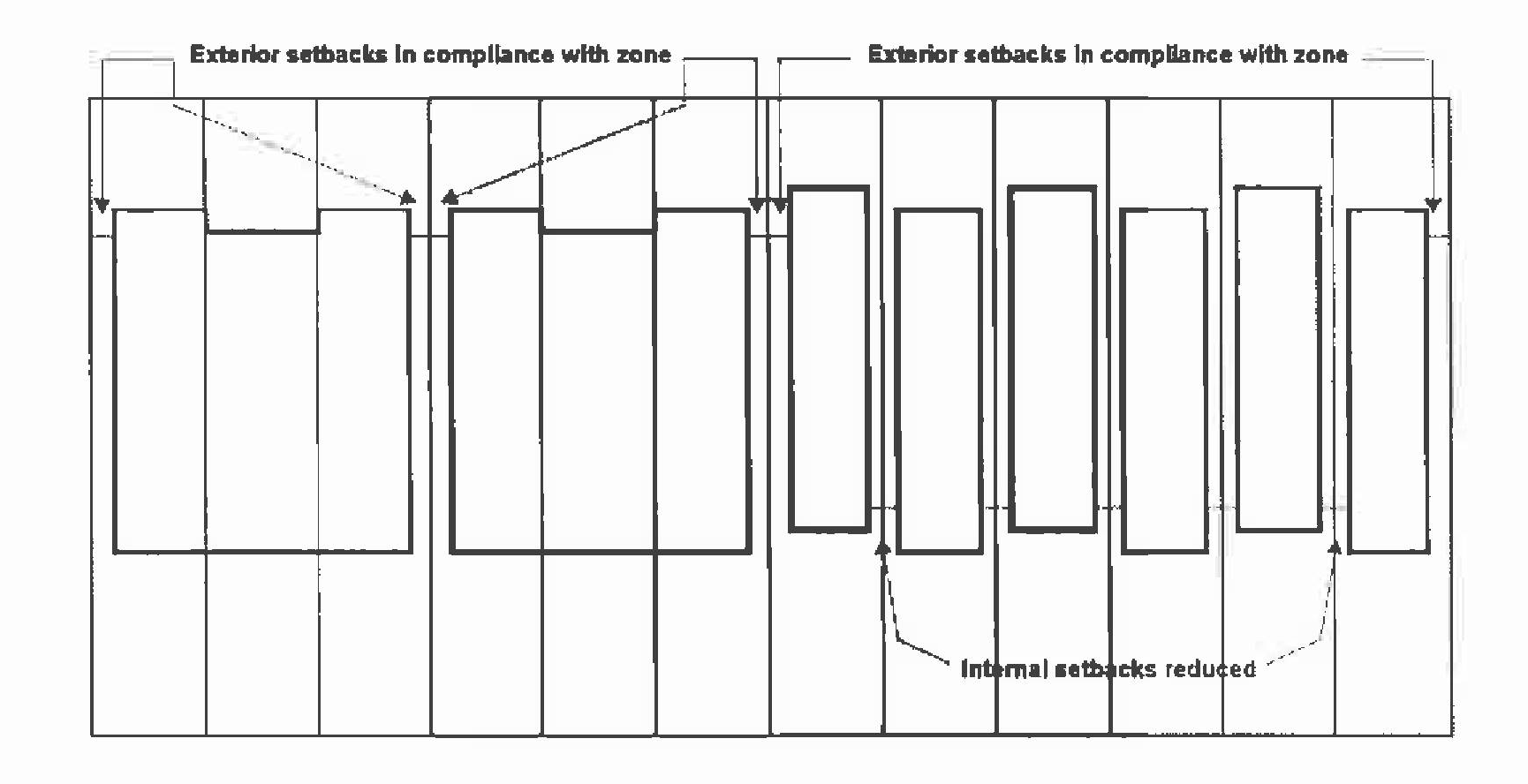
Such reduced interior side yard setback shall be measured from property line to eave rather than building wall as may otherwise be allowed and may require compliance with additional building and fire code provisions (i.e., roof designed for higher snow load and provision of snow stops, installation of residential sprinkler system).
3.
Rear Setbacks: Rear yard setbacks shall be as required by the zoning district in which the substandard lot is located.
4.
Garage: A single-story, detached garage, a maximum of five hundred (500) square feet, accessed off of an alley may have a three foot (3') side setback.
(Ord. 1263, 12-29-2011)
9-4-6-4: - Building Height:
A.
In the RM zone, substandard lot structures shall not exceed two (2) stories or thirty feet (30'), whichever is lower.
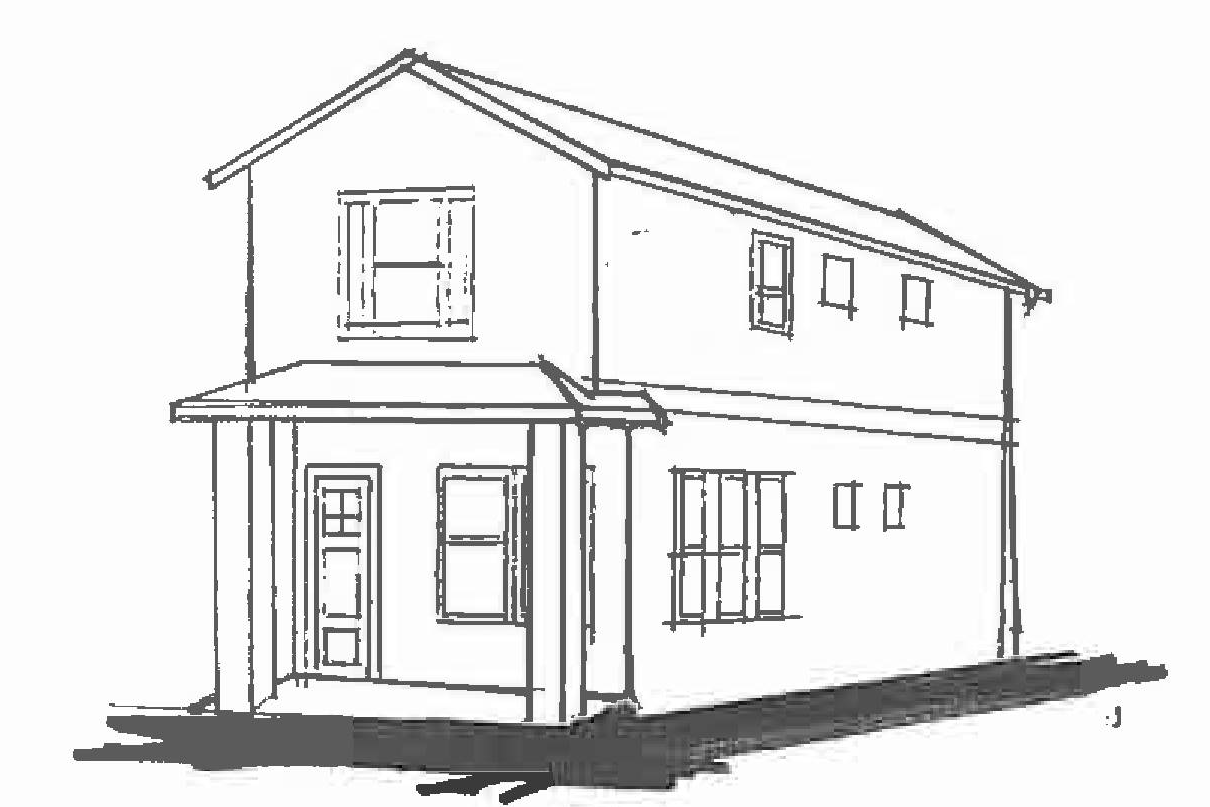
B.
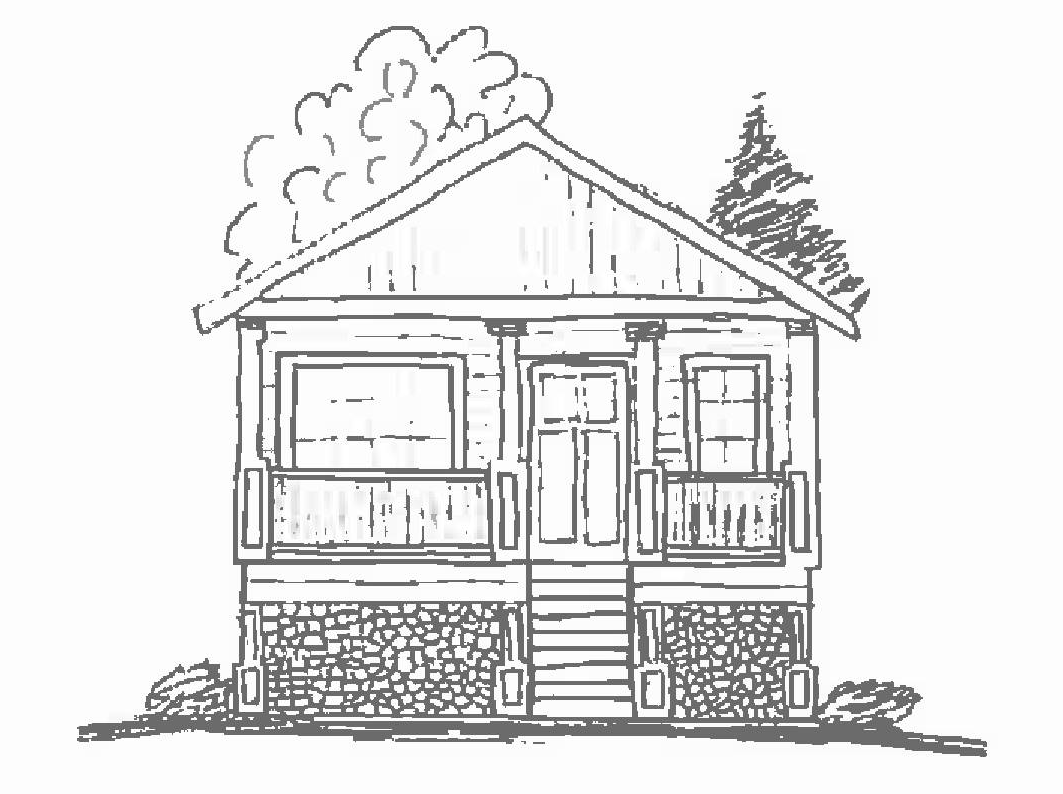
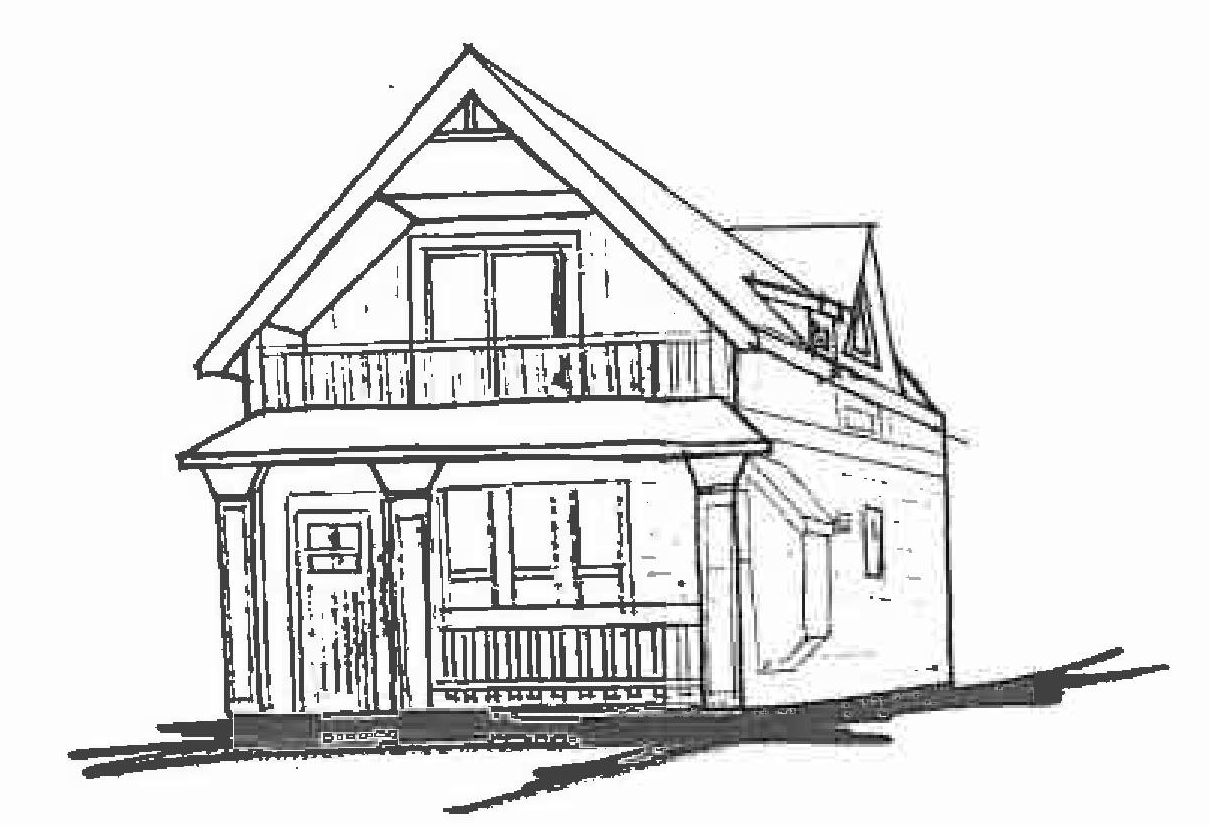
In the RS zone, substandard lot structures shall not exceed twenty feet (20') or one and a half stories, whichever is lower. A one and a half story structure can be defined as:
1.
A structure that includes a daylight basement that is sunk into the ground a minimum of four feet (4').
2.
A structure that contains the second story within the pitched roofline.
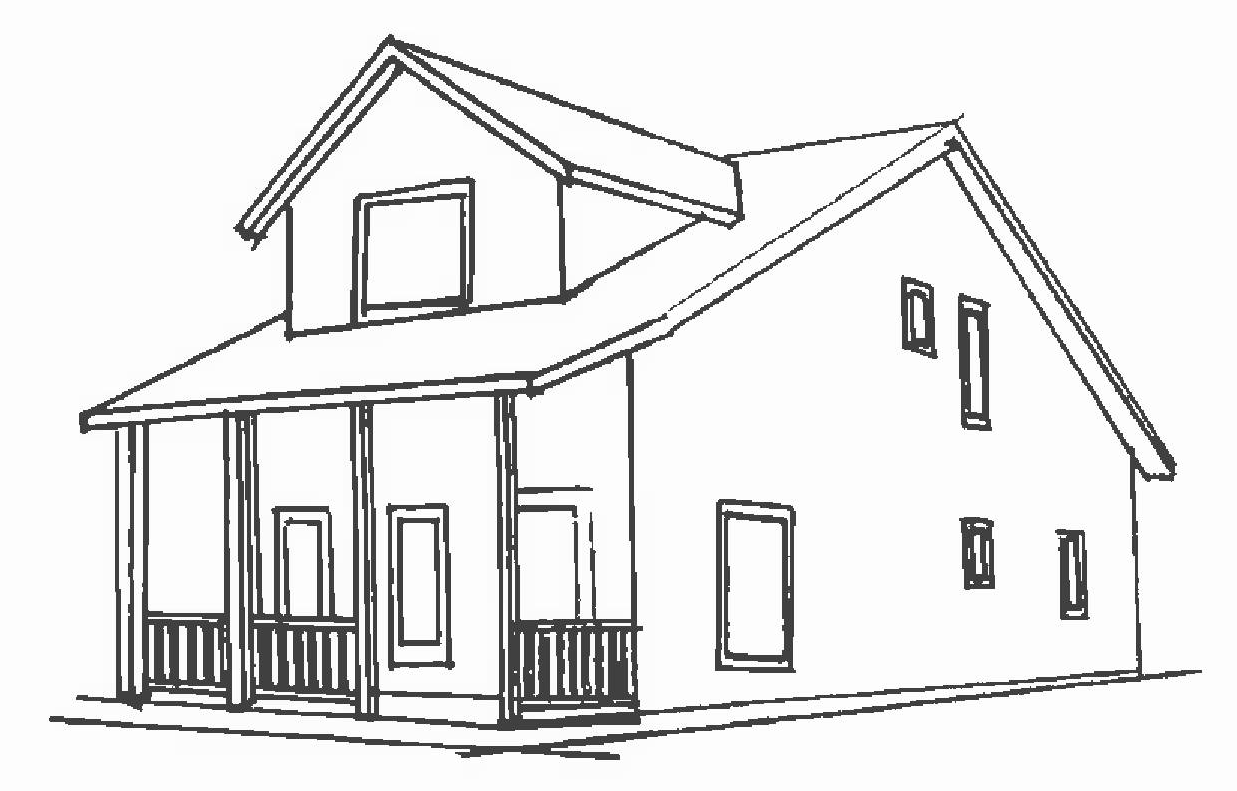
C.
In the RS zone, a two-story structure less than twenty-five feet (25') may be permitted where:
1.
Both adjacent properties are developed with two-story structures; or
2.
The development has been designed to minimize impacts to adjoining properties, as determined by the planning director. The factors to consider shall include: the size and height of the adjacent dwelling units; privacy impacts on adjacent properties; the height, mass, window placement and roofline pitch of the proposed structure; and the overall design of the upper story of the proposed structure. Upper story limitations or setbacks on the new building may be an acceptable means of ensuring compatibility with adjacent structures of smaller size.
(Ord. 1263, 12-29-2011)
9-4-6-5: - Private Open Space:
All substandard lots must provide a minimum of three hundred seventy-five (375) square feet of private open space in the rear yard. This open space must be configured as a fifteen by twenty-five foot (15 × 25') open space (which includes the required setbacks) of that required space a minimum dimension of ten by fifteen feet (10 × 15') shall be open to the sky. Covered unenclosed rear porches are allowed to be calculated as part of the private open space area.
(Ord. 1263, 12-29-2011)
9-4-6-6: - Landscaping:
At a minimum, landscaping for each nonconforming lot of record shall include the planting of one tree of not less than two inches (2") dbh within the front yard setback.
(Ord. 1263, 12-29-2011)
9-4-6-7: - Parking:
A.
Each dwelling shall be provided with off-street parking in accordance with chapter 5 of this title.
B.
Vehicular access and parking shall be provided according to the following standards:
1.
Parking accessed via alleys is encouraged.
2.
Units with front loading garages (where access to alley is not available or practical):
a.
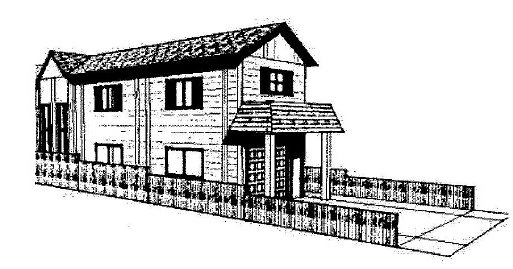
Any attached, front loading garage shall include design elements that will provide varied rooflines, dormers within the roofline or other architectural treatments that will avoid the appearance of garage domination. The setback of the garage face shall be twenty-five feet (25').
b.
Porches, living space, or other projecting features above such front loading garages are required. Structures incorporating such features above a front loading garage shall not be subject to review by the commission.
c.
Attached, front loading garages shall be limited to single car width; two (2) car garages must be designed for tandem parking.
d.
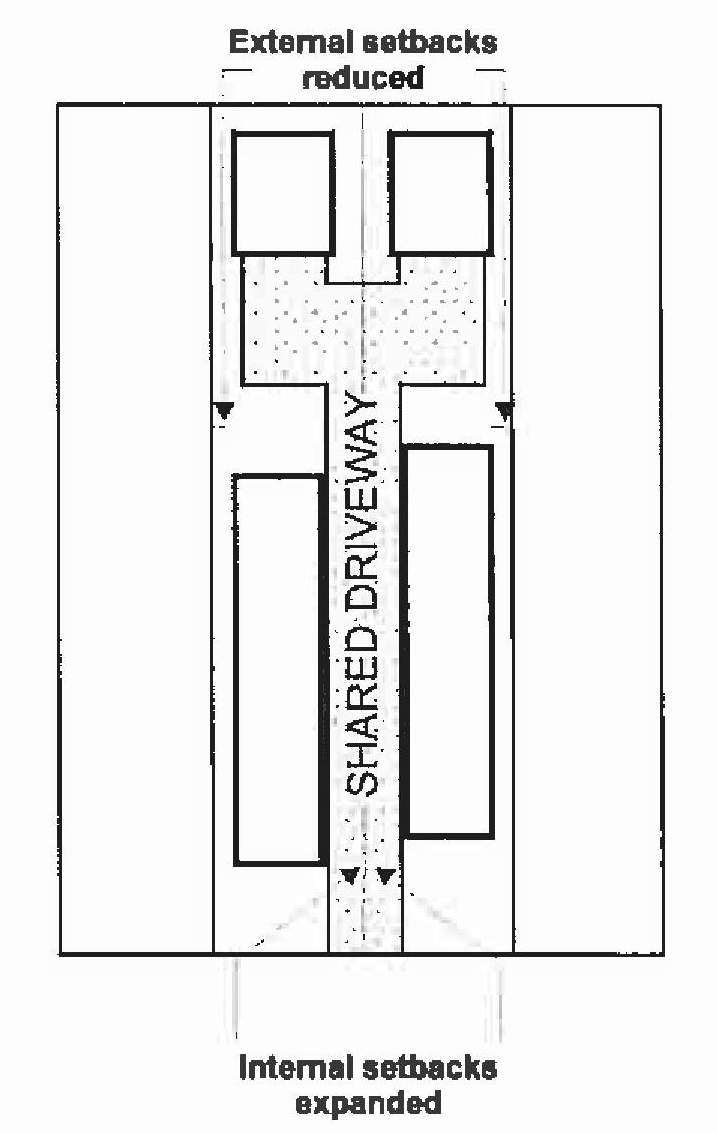
The use of a ten foot (10') wide shared driveway providing access to rear yard garages that are attached with a common wall on the property line is allowed.
e.
Where a shared driveway is proposed between two (2) units, each unit may be allowed to reduce the outside side yard setback from five feet (5') to three feet (3') to provide for a driveway width greater than ten feet (10').
Such reduction is contingent upon approval of a stormwater plan. In addition, the reduced setback shall be measured from property line to eave rather than building wall as may otherwise be allowed and may require compliance with additional building and fire code provisions (i.e., roof designed for higher snow load and provision of snow stops, installation of residential sprinkler system).
3.
The driveway may be designed with concrete wheel strips or grass pavers that are separated by vegetation.
(Ord. 1263, 12-29-2011)
9-4-6-8: - Attached Housing Arrangements:
A.
Attached Units Encouraged: Attaching single-family units in multiples of two (2) or three (3) on common lot lines is encouraged as a means of creating more substantial structures that will be imitative of standard width single-family homes. Such units remain subject to the general design criteria stated in this chapter and do not require a planned unit development application.
1.
In the RS zone, no greater than three (3) attached dwelling units shall be permitted. In the RS zone, attached housing shall contribute to the single-family character of the neighborhood by utilizing exemplary design and architecture to seamlessly integrate with other structures in the vicinity.
B.
Additional Requirements for Attached Buildings:
1.
Attached buildings shall be constructed to comply with townhouse construction standards in accordance with the building code adopted by the city of Sandpoint.
2.
The city attorney shall review and approve all easement agreements an applicant or builder seeks to obtain for the use and maintenance of common facilities such as driveways, parking sites and common party walls. All such easements shall be recorded in the records of Bonner County prior to an applicant or builder seeking a building permit under this chapter.
3.
Adjustments to lot lines and reduction in the number of lots within the same parcel are subject to review and approval pursuant to all applicable city of Sandpoint subdivision and zoning regulations. The applicant shall obtain approval from the city of Sandpoint and record any lot line adjustments or reduction in lots with the Bonner County recorder prior to submission for a building permit.
4.
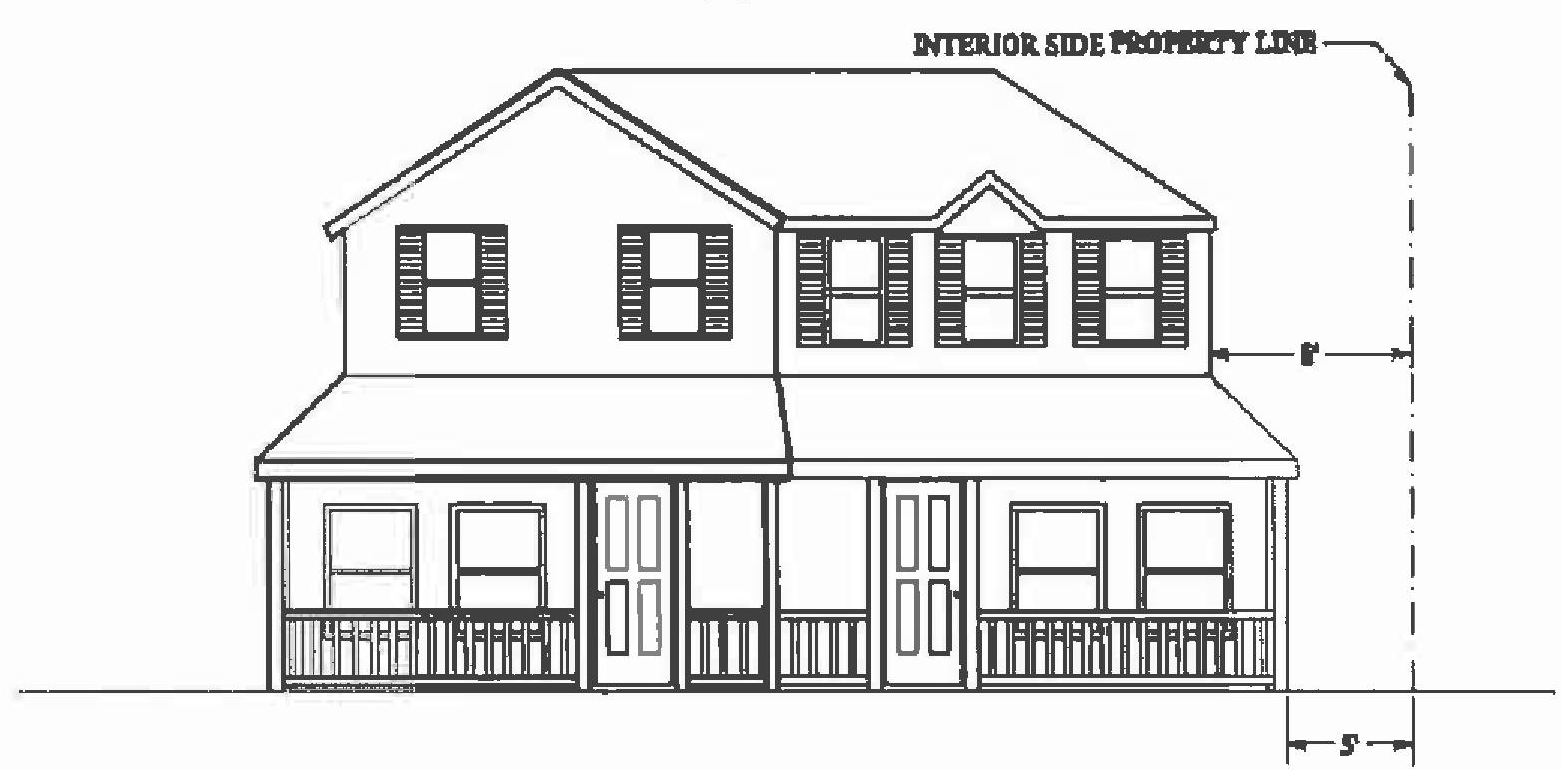
The first story of a two-story attached building shall be set back a minimum of five feet (5') from the side property line. The second story of a two-story attached building shall be set back a minimum of eight feet (8') from the side property line; provided, bay windows, pop outs or other architectural appurtenances may be allowed at the five foot (5') setback line in the residential multi-family zone.
(Ord. 1263, 12-29-2011)
9-4-6-9: - Design Guidelines for Substandard Lots:
Development on substandard lots requires site plan review approval. As applicable to their required review process, city staff and the planning commission or such design review subcommittee as may be created for such purpose shall take into account the location and design of adjacent buildings, landscaping and right-of-way improvements, and shall apply the following criteria as appropriate:
A.
Front Facade Design Requirements:
1.
Homes shall have a front door that faces the street. When a unit is built on a corner lot, the door shall face the dominant street.
2.
In lieu of a street facing front door, the applicant may construct a prominent front porch that is a minimum of six feet (6') in depth and the dwelling shall have a minimum of twenty-five percent (25%) of the front facade comprised of windows and/or door openings. For homes with front loaded garages, the garage door shall not count toward the window opening requirements. The garage door shall include design elements such as: panels, windows, trim features, cross members, or other architectural features as determined by the commission or staff.
3.
Detached dwelling units shall provide a facade that substantially differs from the facade of adjacent structures. Variations in materials alone will not be considered sufficient. The unique facade may be obtained through the use of structural changes or through the use of substantial design elements. In addition to complying with the preceding design guidelines, the front facade shall include multiple design elements such as: multipaned windows, varied rooflines, dormers, bay windows, wainscoting, a covered front door, a usable front porch or other elements as approved by the commission or staff that create a unique facade. Articulated designs may repeat on noncontiguous lots.
4.
Attached units shall provide modulation and architectural design features to prevent flat facade wall planes.
B.
Orientation of Buildings: All buildings shall be oriented toward a public street. When buildings cannot be oriented toward a public street due to inadequate street frontage or similar circumstances, the buildings shall be oriented toward a private street or lane that conforms to city standards.
C.
Stormwater Runoff: Stormwater runoff shall be directed to the front or rear yard and shall be treated in accordance with standards of the Sandpoint stormwater ordinance.
(Ord. 1263, 12-29-2011)
9-4-6-10: - Design Guideline and Development Standards Waivers for Substandard Lots:
A.
The applicant may request a waiver from one or more of the standards listed in section 9-4-6-9 of this chapter or from the height and parking requirements of sections 9-4-6-4 and 9-4-6-7 of this chapter. All requests for waivers shall be heard and decided by the planning commission or such design review subcommittee as may be created for such purpose. A waiver shall not be considered a right or special privilege but may be granted to an applicant that can meet the following findings:
1.
That the granting of the waiver will not be in conflict with the intent of the substandard lot ordinance, shall not negatively impact the existing neighborhood and shall enhance the overall design quality of the project;
2.
That there is an exceptional circumstance relating to the design or configuration of the property, which is not generally applicable to other properties or otherwise anticipated by the standards in the district.
3.
The granting of such relief will not be materially detrimental to the public health, safety or welfare, or injurious to the property, improvements or the quiet enjoyment of the surrounding properties and neighborhood.
4.
The granting of such relief will not be in conflict with the goals and policies of the comprehensive plan.
(Ord. 1263, 12-29-2011)
9-4-7-1: - Purpose and Intent:
This provision provides standards for cottage housing within residential zones. These standards are intended to provide opportunities for a variety of housing choices including the need for more smaller, more diverse, and often, more affordable housing choices. Providing for a variety of housing types also encourages innovation and diversity in housing design and site development, while ensuring compatibility with surrounding single-family residential development.
(Ord. 1263, 12-29-2011)
9-4-7-2: - Conflicting Standards:
In the event that other standards of this title conflict with standards in this provision, the standards within this provision shall prevail.
(Ord. 1263, 12-29-2011)
9-4-7-3: - Existing Dwellings:
An existing detached single-family dwelling that is incorporated into a cottage housing development as a residence and is nonconforming with respect to the standards of this section shall be permitted to remain on a site used for a cottage housing development and shall count as one of the allowed units. However, the extent of the noncompliance may not be increased unless the proposed change is determined by the planning director to be consistent in character, scale and design with the cottage housing development. An existing dwelling may be replaced with cottage units consistent with this section.
(Ord. 1263, 12-29-2011)
9-4-7-4: - Housing Types Defined:
CARRIAGE UNIT: A dwelling unit, not to exceed eight hundred (800) square feet in gross floor area, located above a garage structure in a cottage housing development.
COTTAGE HOUSING: A tract of land under single ownership or unified control developed with four (4) to twenty-four (24) detached dwelling units (each unit no larger than one thousand (1,000) square feet) arranged on at least two (2) sides of a commonly owned courtyard/common area. Parking space is also commonly owned. Cottage housing development may or may not be condominiums.
(Ord. 1263, 12-29-2011; amd. Ord. 1345, 7-19-2017)
9-4-7-5: - Area Allowances:
A.
Cottage housing meeting the requirements of this section is allowed in zoning areas RS and RM.
(Ord. 1263, 12-29-2011)
9-4-7-6: - Density Standards:
The following density standards shall apply to cottage housing developments:
A.
Cottages (including carriage units) may be built at up to two (2) units per single-family home allowed in the underlying zone. For example, if the minimum lot size for a single-family home in a zone is five thousand (5,000) square feet, a cottage development of four (4) units could be constructed on a ten thousand (10,000) square foot lot (5,000/2)* 4 = 10,000.
B.
Existing single-family dwellings will count toward total units.
C.
Minimum units: Four (4).
D.
Maximum units: Twenty four (24).
E.
Carriage house units may be built on top of a common garage, when the garage is located adjacent to the common open area. No more than twenty-five percent (25%) of the total number of units may be located above a common garage.
(Ord. 1263, 12-29-2011; Ord. 1345, 7-19-2017)
9-4-7-7: - Cottage Housing Dispersion Requirement:
The dispersion requirement is designed to disallow cottage developments from clustering in any one area so that housing diversity is retained.
A.
In the RS Zone, developments containing cottage/carriage homes may not be located closer than seven hundred fifty feet (750') to another development approved under the provisions of this section.
(Ord. 1263, 12-29-2011)
9-4-7-8: - Community Buildings and Community Space in Cottage Developments:
Community buildings and community space are encouraged in cottage developments.
A.
Community buildings or space shall be clearly incidental in use and size to the dwelling units.
B.
Building height for community buildings shall be no taller than the height restrictions for the underlying zone. Building heights and roof standards for cottage units shall apply per section 9-4-7-10 of this chapter.
C.
Where the community space is located above another common structure, such as a detached garage or storage building, buildings heights and roof standards for carriage units shall apply (see section 9-4-7-10 of this chapter).
D.
Community buildings must be located on the same site as the cottage housing development, and be commonly owned by the residents.
(Ord. 1263, 12-29-2011)
9-4-7-9: - Access and Parking:
The intent of these access and parking standards is to minimize the visual impact of vehicles and parking areas for residents of the cottage housing development and adjacent properties and to provide for adequate off-street parking for cottage housing developments.
A.
Minimum Number of Off-Street Parking Spaces:
1.
The minimum number of parking spaces shall be one per dwelling unit.
B.
Parking Design: The intent of these parking design standards is to create unobtrusive parking, by screening and disguising parking structures and spaces from surrounding properties, including screening by architectural design and/or vegetation, and by minimizing the number of contiguous spaces.
1.
Parking areas or common garages shall be limited to no more than five (5) contiguous spaces separated by a minimum of five feet (5') of sidewalk, landscaping, or open space.
2.
Shared detached garage structures may not exceed five (5) garage doors per building and a total of one thousand six hundred (1,600) square feet. Carriage units located above these parking structures shall not be factored into this square footage.
3.
Parking shall be separated from the common open area, adjacent properties, and public streets by landscaping and/or architectural screening. Solid board fencing shall not be allowed as an architectural screen. Exception: One parking structure may be adjacent to the common open area, if carriage house units are placed on top and the garage includes architectural features to make it look consistent with the units and community assets.
4.
Parking shall be set back a minimum of twenty-five feet (25') from a public street.
5.
The design of garages and carports, including rooflines, shall be similar to and compatible with that of the dwelling units within the cottage housing development.
6.
Parking located between or adjacent to structures, shall be located to the rear of the structure and served by an alley or driveway.
(Ord. 1263, 12-29-2011)
9-4-7-10: - Cottage Housing Design Standards and Guidelines:
A.
Cottage Size: Setting a unit size helps ensure that the overall size of cottages remains small and causes less visual impact than standard sized single-family dwellings, particularly given the increased density of cottage dwellings, and to provide variety in cottage housing developments through a mixture of building sizes and footprints.
1.
The total floor area of each cottage shall not exceed one thousand (1,000) square feet. The total square foot area of a cottage dwelling unit may not be increased. A note shall be placed on the title to the property for the purpose of notifying future property owners that any increase in the total square footage of a cottage is prohibited for the life of the cottage or duration of city cottage regulations.
2.
The footprint of each cottage shall not exceed eight hundred (800) square feet.
3.
There shall be no minimum size requirements for the individual units.
4.
The second floor area cannot exceed seventy-five percent (75%) of the first floor area.
5.
Cottage areas that do not count toward the gross floor area or footprint calculations are:
a.
Interior spaces with a ceiling height of six feet (6') or less, such as in a second floor area under the slope of the roof;
b.
Unheated storage space located under the main floor of the cottage;
c.
Basements;
d.
Attached unenclosed porches;
e.
The first two hundred (200) square feet of an attached enclosed porch (square footage utilized for attached porches beyond two hundred (200) square feet shall be counted toward total square footage allowance for each cottage);
f.
Garages or carports; or
g.
Architectural projections (i.e., bay windows, fireplaces or utility closets) no greater than twenty-four inches (24") in depth and six feet (6') in width.
h.
The planning director may approve other exemptions similar in nature provided the intent of this section is met.
B.
Cottage Height and Roof Standards:
1.
A cottage shall have a gable roof or a hipped roof. Dormers are allowed.
2.
Maximum height of cottage units with a minimum roof slope of six to twelve (6:12) shall be twenty-five feet (25'), subject to all parts of the roof above fourteen feet (14') shall be pitched.
3.
Maximum height shall be eighteen feet (18') for cottages without a roof slope of six to twelve (6:12) and for all accessory structures.
4.
Deviation from the roof standards may be considered through the CUP process.
C.
Orientation of Dwelling Units: Dwellings within a cottage housing development should be oriented to promote a sense of community, both within the development, and with respect to the larger community, outside of the cottage project. A cottage development should not be designed to "turn its back" on the surrounding neighborhood.
1.
Each dwelling unit shall be oriented toward a common open area, and sixty-five percent (65%) of the units shall abut the common open area.
2.
Lots in a cottage housing development are not required to abut a public street.
3.
Each facade facing a public street (not including alleys) shall have at least two (2) of the following enhancements: secondary entrance, porch, bay window, or other architectural enhancement approved by the planning director that is oriented to the public street in order to prevent a blank, monotonous wall facing the street and surrounding neighborhood.
D.
Cottage Setbacks:
1.
The minimum setbacks between all structures and exterior property lines (including cottages, parking structures and community buildings) in a cottage housing development shall be ten feet (10'). Eaves may project into the required setback up to eighteen inches (18").
2.
Cottage units abutting an external street shall use the front yard setback requirements for the zone they are within in order to determine how far the unit must be set back from the public right-of-way.
3.
No part of any structure in a cottage housing development (including, but not limited to, cottages, parking structures, and community buildings) shall be more than one hundred fifty feet (150'), as measured by the shortest clear and open route, from legally compliant fire department vehicle access.
E.
Fencing and Screening: The intent of internal decorative fencing and screening is to delineate private yards and screen parking structures, community assets and unit walls. A cottage housing development shall internally be an open community sharing common areas.
1.
Decorative fencing may be used for delineating private yards.
2.
Fencing or shrubbery may be used to screen parking areas, community assets, and unit walls.
3.
Fencing and shrubbery used for fencing may not exceed thirty-six inches (36") in height, except directly adjacent to a parking structure or as allowed in subsection E.5. of this section.
4.
Chainlink fencing shall not be allowed. Solid fencing is allowed on the exterior boundary, except bordering an external street.
5.
Rear yards not bordering an external street may be delineated using solid fencing and may not exceed four feet (4') in height.
F.
Required Common Open Space: Common open space should provide a sense of openness, visual relief, and community for cottage developments. The space must be outside of wetlands, streams and their buffers, and developed and maintained to provide for passive and/or active recreational activities for the residents of the development.
1.
There shall be a minimum of four hundred (400) square feet of common open space per cottage.
2.
Each area of common open space shall be in one contiguous and usable piece with a minimum dimension of twenty feet (20') on all sides.
3.
Land located between dwelling units and an abutting right-of-way or access easement greater than twenty-one feet (21') in width may not serve as required common open space, unless the area is reserved as a separate tract, and does not contain pathways leading to individual units or other elements that detract from its appearance and function as a shared space for all residents.
4.
Required common open space may be divided into no more than two (2) separate areas per development.
5.
Common open space shall be located in a centrally located area and be easily accessible to all dwellings within the development.
6.
Landscaping located in common open space areas shall be designed to allow for easy access and use of the space by all residents, and to facilitate maintenance needs. Where feasible, existing mature trees should be retained.
7.
Unless the shape or topography of the site precludes the ability to locate units adjacent to the common open space, the following standards must be met:
a.
The open space shall be located so that it will be surrounded by cottages or two/three-unit homes on at least two (2) sides;
b.
At least fifty percent (50%) of the units in the development shall abut a common open space. A cottage is considered to "abut" an area of open space if there is no structure between the unit and the open space.
(1)
Surface water management facilities shall be limited within common open space areas. Conventional stormwater collection and conveyance tools, such as flow control and/or water quality vaults are permitted if located underground.
G.
Carriage Units Within Cottage Projects: Carriage units may be included within a cottage housing development. Design of these units should be compatible with that of the cottages included in the project.
1.
The maximum size of a carriage unit shall be eight hundred (800) square feet.
2.
Carriage units, including roof, shall be no taller than thirty-feet (30').
3.
Carriage units shall not have roofs less steep than four to twelve (4:12).
H.
Variation In Unit Sizes, Building and Site Design: Cottage projects should establish building and site design that promotes variety and visual interest that is compatible with the character of the surrounding neighborhood.
1.
Projects should include a mix of unit sizes within a single development.
2.
Proposals are encouraged to provide a variety of building styles, features and site design elements within cottage housing communities. Dwellings with the same combination of features and treatments should not be located adjacent to each other.
I.
Private Open Space:
1.
Each cottage shall have a minimum of three hundred (300) square feet of private, contiguous usable open space adjacent to each dwelling unit, for the exclusive use of the cottage resident.
J.
Pedestrian Flow Through Development: Pedestrian connections shall link all buildings to the public right-of-way, common open space and parking areas.
K.
Exterior Design Standards for Cottages: This subsection K is intended to ensure cottage design is based on a coherent architectural concept, to ensure cottages possess architectural finish, to ensure they contribute positively to the architectural character of the neighborhood, and to provide flexibility in design and contrast among individual cottages while assuring attention to design amenities.
1.
Character Compatibility: Cottage housing developments shall utilize building and site design that promotes variety and visual interest and that is compatible with the character of the surrounding neighborhood.
2.
Variety In Building and Site Design: Cottage housing developments shall avoid the repetitive use of the same combination of building size, styles, features, and site design elements within the entire residential development and between adjacent dwellings. Dwellings with the same combination of features and treatments shall not be located adjacent to each other.
3.
Site Design Requirements: The overall site design for all common areas must include a minimum of five (5) points from the following table:
SITE DESIGN OF COMMON AREAS
(Minimum of 5 Points)
4.
Exterior Design Requirements: No blank walls are allowed, and each cottage in a cottage housing development must be designed to include a minimum of thirty-four (34) points from the following table, including the specified minimum number of points from each category:
(Ord. 1263, 12-29-2011)

