
Sandpoint City Zoning Code
CHAPTER 5
OFF-STREET PARKING AND LOADING FACILITIES1
Editor's note— (Ord. No. 1432, § 2, adopted Sept. 17, 2025, amended ch. 5 in its entirety to read as herein set out. Former ch. 5, §§ 9-5-1—9-5-18, pertained to similar subject matter, and derived from Ord. 1360, adopted Dec. 5, 2018.
9-5-1: - General Provisions:
A.
Off-Street Parking and Loading Spaces Provided: No building or structure shall be erected, substantially altered (requiring a building permit), or its use changed unless permanently maintained off-street parking and loading spaces have been provided in accordance with the provisions of this chapter.
B.
Additional Parking After Enlargement up to Fifty Percent (50%) in Floor Area: Whenever a building or structure is enlarged up to fifty percent (50%) in floor area, number of employees, seating capacity, number of dwelling units, or otherwise, to create a need for an increase in the number of parking and loading spaces, additional parking and loading spaces shall be provided on the basis of the enlargement or change.
C.
Additional Parking After Enlargement Greater than Fifty Percent (50%) in Floor Area: Whenever a building or structure is enlarged greater than fifty percent (50%) in floor area, number of employees, seating capacity, number of dwelling units, or otherwise, to create the need for an increase in the number of parking and loading spaces, such additional spaces must be provided on the basis of the enlargement or change and shall be developed in accordance with the screening and landscaping provisions of this chapter.
D.
Additional Parking After Change in Use or Occupancy: Whenever a building or structure has a change in use or occupancy that would increase the number of spaces being required, such additional spaces shall be provided on the basis of the change.
E.
Parking Demand Analysis: Minimum or maximum parking space requirements may be reduced or expanded by the relevant permit approval authority, either the planning director, planning and zoning commission, or city council upon completion of a parking demand analysis demonstrating the actual demands of the project are less than the minimum or more than the maximum requirements of this code. A parking demand analysis must be prepared by a registered professional traffic engineer licensed in the State of Idaho and must include analysis of multimodal transportation and proximity to transit.
F.
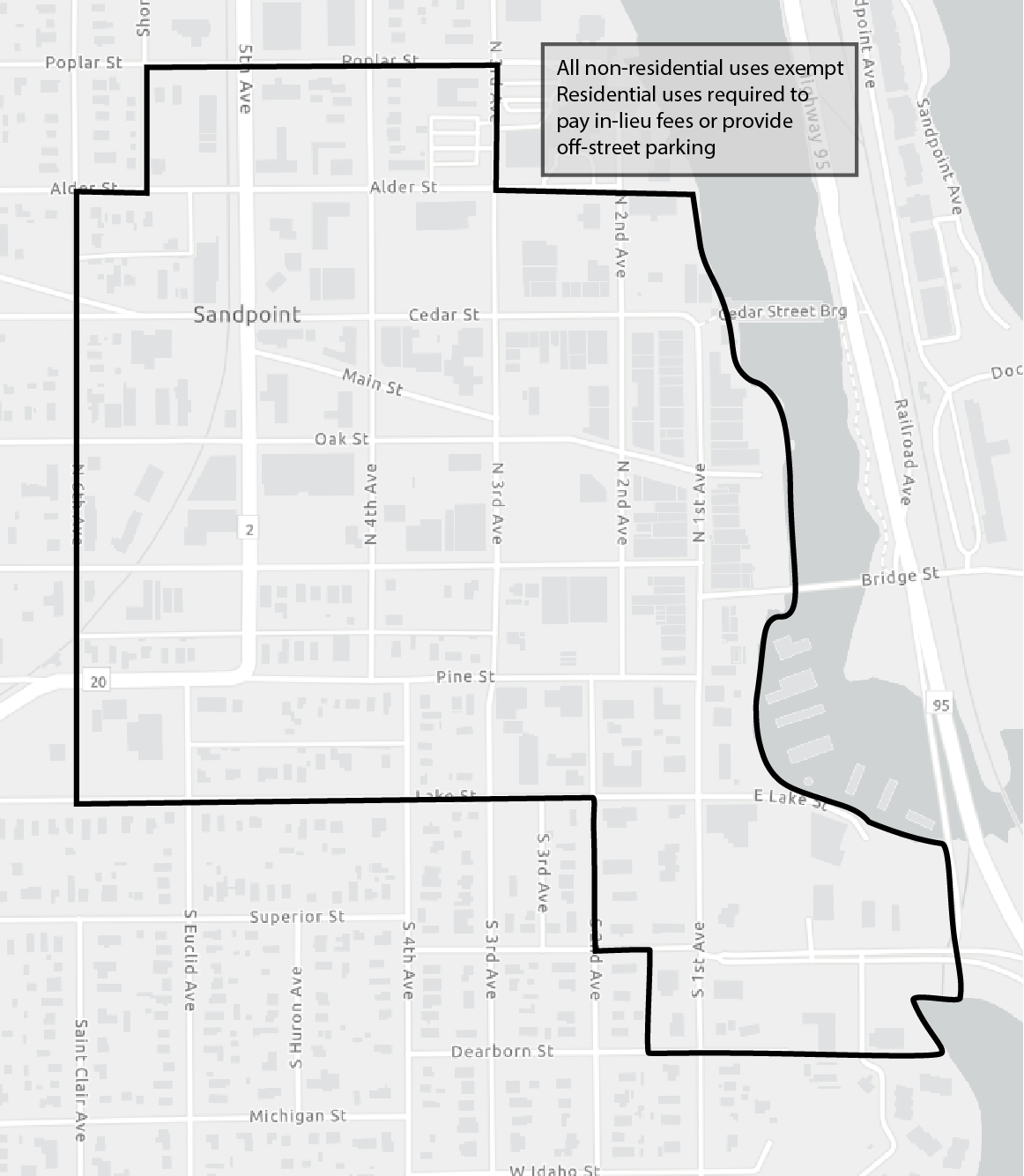
Exemptions: Non-residential development within the boundary depicted on the map in subsection G below is exempt from the parking minimum and location requirements of this chapter. Residential development within the boundary as shown in subsection G below is exempt from the parking minimum and location requirements of this chapter, provided in-lieu payments are made pursuant to City Code 9-5-18, In Lieu Parking Fees.
G.
Map of Exempted Area: Map of exempted minimum parking space requirements per subsection F of this section:
H.
For the purposes of this chapter, an alley is not a public street.
(Ord. No. 1432, § 2, 9-17-2025)
9-5-2: - Location of Parking Spaces:
The following regulations shall govern the location of off-street parking spaces and areas:
A.
Parking spaces for all residential dwelling units with a density of less than ten (10) units per acre must be located on the same site as the use which they are intended to serve.
B.
Parking spaces for apartments, dormitories, or similar residential uses with a density of greater than ten (10) units per acre must be located not more than three hundred feet (300') from the principal use.
C.
Parking spaces for commercial, industrial or institutional uses must be located not more than one thousand feet (1,000') from the principal use.
(Ord. No. 1432, § 2, 9-17-2025)
9-5-3: - Shared Parking Reduction:
A.
Shared Parking or Parking Facilities Approval: Subject to compliance with other applicable requirements of City Code, relevant permit approval authority, either the planning director, planning and zoning commission, or city council, may approve shared development or use of parking facilities for two (2) or more uses if:
1.
A convenient pedestrian connection between the properties or uses exists; and
2.
The properties are within one thousand feet (1,000') of each other.
B.
Parking Requirements; Hours: Where the uses to be served by shared parking do not overlap their hours of operation, the property owner or owners must provide parking stalls equal to the greater of the applicable individual parking requirements. Where a use change occurs within the development causing an overlapping of use hours, parking requirements must be reassessed. For the purposes of this provision, residential parking use hours shall be from five o'clock (5:00) p.m. to sixty thirty-o'clock (6:30) a.m. daily.
C.
Parking Space Reduction: Where the uses to be served by shared parking have overlapping hours of operation, the relevant permit approval authority, either the planning director, planning and zoning commission, or city council, may approve a reduction of the total required parking spaces if the reduction is supported by a parking demand analysis performed by a registered professional traffic engineer licensed in the State of Idaho.
D.
Documentation Required: Prior to establishing shared parking or any use to be served thereby, the property owner or owners must file with the county recorder's office or its successor agency, a written agreement approved by the planning director providing for the shared parking use. A copy of the written agreement must be retained by the planning director in the project file. The agreement must be recorded on the title records of each affected property.
(Ord. No. 1432, § 2, 9-17-2025)
9-5-4: - Access and Maneuvering Area:
A.
Any parking area must be designed in such a manner that any vehicle entering or leaving the parking area from or onto a public or private street must be traveling in a forward motion. Development of six (6) or fewer units on a site, including single-family, duplexes, multi-family dwellings, and accessory dwelling units, are exempt from this requirement.
B.
Driveways shall be located so that any obstructions do not prevent adequate sight distance between a vehicle stopped at the edge of the right of way and any approaching vehicle or pedestrian on the adjacent street. The required sight triangle shall be determined using the guidance of "A Policy on Geometric Design of Highways and Streets" (Green Book), published by the American Association of State Highway and Transportation Officials (latest edition), or another method approved by the city engineer or public works director.
C.
All maneuvering areas, ramps, access drives, etc., must be provided on the property on which the parking facility is located; however, if such facility adjoins an alley, such alley may be used as a maneuvering area.
(Ord. No. 1432, § 2, 9-17-2025)
9-5-5: - Minimum Distance and Setbacks:
No portion of any parking facility shall obstruct the sight triangle of an adjacent street or driveway access, as determined by an analysis using the guidance of "A Policy on Geometric Design of Highways and Streets" (Green Book) published by the American Association of State Highway and Transportation Officials (latest edition), or another method approved by the city engineer or public works director.
(Ord. No. 1432, § 2, 9-17-2025)
9-5-6: - Surfacing:
A.
Hard surfacing of all parking facilities shall be required. All hard surfacing must comply with all other applicable provisions of City Codes, including the Stormwater Management Code.
B.
Hard surfacing, for the purposes of this chapter, shall be defined as asphalt pavement, concrete pavement, or as otherwise determined by the city engineer or public works director.
C.
All hard surfacing must be completed before a certificate of occupancy is issued. In the event that hard surfacing cannot be timely completed due to inclement weather, the city may issue a temporary certificate of occupancy if an agreement secured by a bond or other security acceptable to the city in an amount of one hundred fifty percent (150%) of the costs of the hard surfacing is provided to the city. In the event a cash security is provided, no interest shall accrue to the party providing the cash. All agreements must include such terms as may be reasonable under the circumstances, including a requirement that the paving be completed within six (6) months of the agreement and, if not, that the city, in the city's sole discretion, use the security to complete the hard surfacing.
D.
Driveways and parking facilities abutting a public right of way shall include hard surfacing from the edge of right of way to the parking facility. Driveway approaches within the public right of way shall be constructed pursuant to City Code 7-3-9, New Construction of Curbs, Gutters and Drainage Appurtenances, and city standard details.
E.
If a parking facility is accessed from a public alley, a minimum of twelve (12) feet in width of the alley shall be constructed with hard surfacing for the entire length of the alley between the adjacent public streets at either end of the alley. The driveway approaches accessing either end of the alley on the adjacent public streets shall be constructed pursuant to City Code 7-3-9, New Construction of Curbs, Gutters and Drainage Appurtenances, and city standard details. Hard surfacing of alleys shall be included, as needed, in an approved stormwater management plan that meets the requirements of City Code Title 11, Chapter 3, Stormwater Management Ordinance, as determined by the public works director.
F.
Exceptions to hard surfacing requirement of parking facilities:
1.
Within the Industrial General (IG) Zone, the hard-surfacing requirement may be waived, with the exception that, for the first twenty-five (25) feet on private property from the right-of-way, the width of the driveway shall be hard surfaced.
2.
A detached single-family home, with or without an ADU, or a duplex, with or without an ADU, that is not accessed from a street or is accessed from an alley shall be exempted from the hard-surfacing requirement. Any residential development of greater intensity shall be required to adhere to the hard surfacing requirements.
G.
Construction and the repaving of parking facilities must be in accordance with the Stormwater Management Ordinance, Title 11, Chapter 3, of this code.
(Ord. No. 1432, § 2, 9-17-2025)
9-5-7: - Maintenance:
A.
The owner of property used for parking and/or loading shall maintain the facility in accordance with good practice without holes and free of all snow, dust, trash and other debris.
B.
Failure to keep the parking facility surfaces reasonably clean of snow and debris, failure to keep storm catch basins properly clean and functioning, and failure to remove and replace dead plant material or to remove noxious weeds shall be specifically included in the term "failure to maintain the facility in accordance with good practice" and shall be deemed a violation of this title and therefore subject to the penalties as established.
C.
The city shall not be responsible for maintenance, repair, upkeep, or reconstruction of any parking facility located on private property or any hard surfacing of alleys required by City Code 9-5-6, Surfacing.
(Ord. No. 1432, § 2, 9-17-2025)
9-5-8: - Lighting:
A.
Any parking area which is intended to be used during non-daylight hours shall be properly illuminated in accordance with the regulations set forth below and in the Outdoor Lighting provisions of Title 8, City Code.
B.
Any lights used to illuminate a parking lot must be so arranged as to reflect the light away from the adjoining property.
C.
Parking area lighting must be designed to provide the minimum lighting necessary to ensure adequate vision in parking areas while avoiding glare and direct illumination of adjacent properties or streets. All parking area lighting requirements must also apply to interior drives and other areas on the property used by vehicles.
1.
Lighting Fixtures: All lighting fixtures providing illumination for parking lots must direct light downward (in keeping with Illuminating Engineering Society of North America, IESNA, standards).
2.
Maximum Mounting Height: The maximum mounting height for all parking lot illuminating light fixtures shall be twenty feet (20').
3.
Timers Required: Lighting must be on a timer or utilize photocells which turns off all unnecessary lights when the lot is not in use to reduce glare in the surrounding neighborhoods and to save energy.
(Ord. No. 1432, § 2, 9-17-2025)
9-5-9: - Wheel Blocks:
A.
Whenever a parking space extends to a property line, wheel blocks or other suitable devices must be installed to prevent any part of a parked vehicle from extending beyond the property line, assuming a 24-inch vehicle overhang from the vehicle-side face of the wheel block.
B.
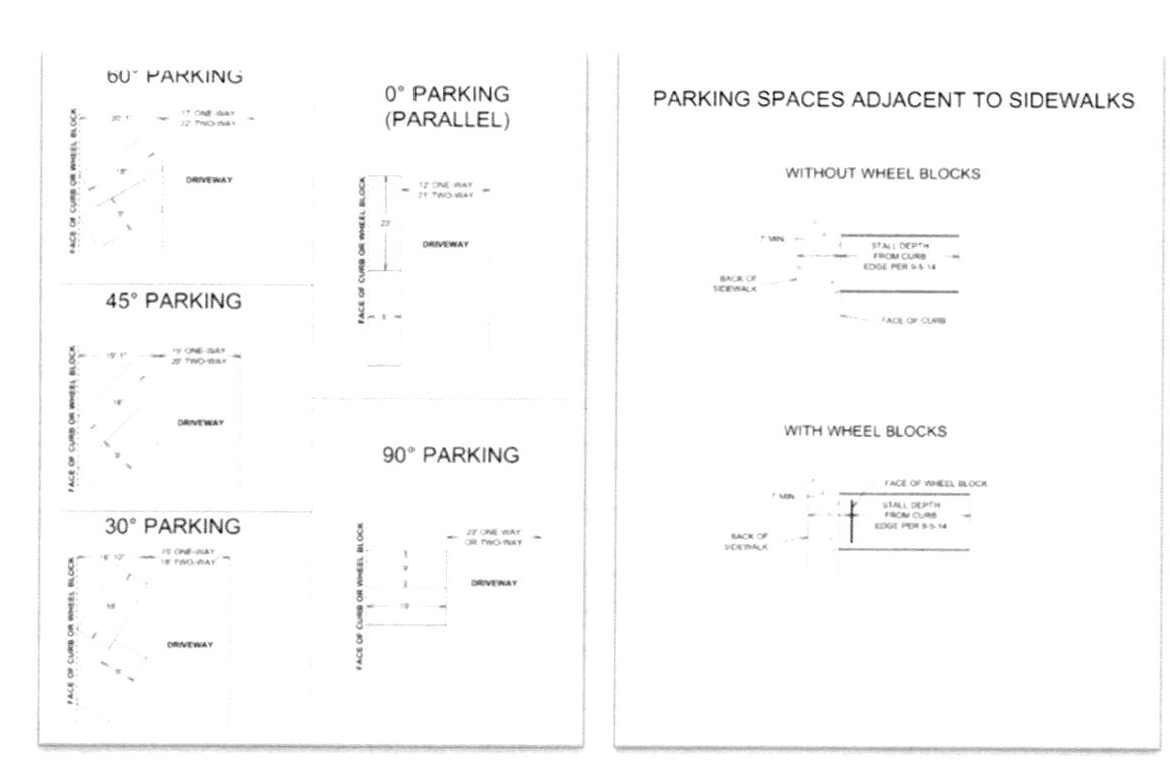
Where parking spaces abut sidewalks or walkways, wheel blocks shall be provided to prevent vehicle overhang on the sidewalk or walkway. Wheel blocks shall be placed so that the distance between vehicle-side face of the wheel block and the opposite side of the sidewalk or walkway is at least seven (7) feet.
C.
Whenever wheel blocks are used, the parking space depth, as specified under Design and Dimensional Standards, section 5 of this chapter, shall be measured from the vehicle-side face of the wheel block.
D.
Whenever any obstruction greater than eight (8) inches in height, including walls or fences, is located directly adjacent to a parking space, wheel blocks shall be provided at least two (2) feet from the obstruction, and the "stall depth from curb edge", as shown under column D in the chart provided in section 5 of this chapter, shall be measured from the vehicle-side face of the wheel block.
(Ord. No. 1432, § 2, 9-17-2025)
9-5-10: - Signs:
A.
The entrances and exits to the parking area must be clearly marked.
B.
Parking areas having more than one aisle or driveway must have directional signs or markings in each driveway or aisle.
C.
Parking area directional signs must have a maximum size of four (4) square feet.
(Ord. No. 1432, § 2, 9-17-2025)
9-5-11: - Striping:
All parking areas shall be striped with minimum four inches (4") wide white striping, meeting the dimensional standards of City Code 9-5-14, Design and Dimensional Standards.
(Ord. No. 1432, § 2, 9-17-2025)
9-5-12: - Screening and/or Landscaping:
A.
Parking Area Minimum Landscaping: A minimum of ten percent (10%) of paved parking area must be landscaped.
B.
Slopes and other areas between a parking area and sidewalks, street rights-of-way or property lines must be landscaped with a minimum five foot (5') buffer containing grass, hardy shrubs, trees or evergreen ground cover and must be maintained in a consistent condition acceptable to the city. A minimum of fifty percent (50%) of the required buffer yard must be made up of hardy shrubs, fifty percent (50%) of which shall be evergreen and shall reach a height of four feet (4') within five (5) years. The five foot (5') buffer may be reduced when at least five feet (5') of landscaped area exists between the sidewalk and curb. Dead landscaping must be replaced. It shall be a violation of this chapter if an owner fails to replace dead landscaping with the same or other landscaping approved by the city within one month of notification by the city or as is seasonably acceptable.
C.
Proximity Standards: Whenever a parking area providing more than ten (10) vehicle spaces is located in or adjacent to a residential district, dwelling unit, school, hospital, church or other institution for human care, it must be effectively screened on all sides abutting any such property by a five foot (5') buffer area with an acceptably designed wall, fence or planting screen. Alternatively, the buffer area may be reduced to three feet (3') if a decorative screen fence is erected with evergreen shrubs of at least two (2) gallon size planted at the base. Such fence, wall or planting screen must not be less than four feet (4') nor more than six feet (6') in height and maintained in good condition. The space between such fence, wall or planting screen, and the lot line of the adjoining premises in any residential district must be landscaped with grass, hardy shrubs, or evergreen ground cover and maintained in good condition. In the event that terrain or other natural features are such that the erection of such fence, walls or planting screen will not serve the intended purpose, the planning director may waive specifically this requirement.
D.
Parking Facilities Abutting Street Right-of-Way: Parking facilities which abut a street right-of-way must provide one street tree for every twenty-five feet (25') of property abutting such right-of-way. Should the planting of such a street tree be physically unfeasible, the public works director may require suitable landscaping abutting the street right-of-way.
E.
Material and Planting Requirements: Parking area landscaping must consist of, but not be limited to, a mix of deciduous trees, evergreen shrubs, and ground cover. Tree species must be of the types listed on the "City of Sandpoint approved street tree list" (as adopted by resolution), or approved by the urban forester. All trees must be planted with a minimum 1.5-inch caliper. All interior planting beds must have a minimum dimension of six feet (6') at the narrowest point with a soil depth appropriate for the trees selected.
F.
Parking Area Between Twenty (20) and Thirty (30) Spaces: One tree for every ten (10) parking spaces or the larger fraction thereof must be provided.
G.
Parking Areas Exceeding Thirty (30) Spaces: The following additional regulations apply:
1.
Parking areas must include a minimum fifteen foot (15') landscaped buffer from residential zones and be divided into smaller areas interconnected by landscaped aisles to reduce vehicle speed and protect pedestrians. No parking space shall be more than sixty feet (60') from a landscaped area, and there must be at least one tree for each three hundred (300) square feet of required landscape area.
2.
Required shade trees must be of such species and canopy to provide a minimum of thirty percent (30%) canopy cover of the parking area at maturity. Eligible tree canopy must be directly over parking area.
3.
A timed and automated irrigation system shall be provided for all required landscaping and maintained in a workmanlike manner.
H.
Parking Area Directional Signs: Parking area not visible from streets must have clearly visible directional signs approved during the site plan review process.
I.
Screening Equipment; Noise: Mechanical equipment, utility facilities, and garbage containers must be screened in such a manner so as not to be visible from abutting residential property owners. A fence may be used to provide this screening. Mechanical equipment creating noise must be placed as far from residential uses as practical and in keeping with access and maintenance requirements, and must have noise buffering if placed in the vicinity of residential uses.
J.
Snow Storage: Areas for snow storage must be designated in site plans and provided for in development or redevelopment of property.
K.
Pedestrian Access: Parking areas must be designed so that pedestrian and automobile patrons have a clearly marked path from each business entrance to the nearest sidewalk to each adjacent street. This pedestrian path shall meet the requirements for an accessible route as described in the latest edition of the ADA Standards for Accessible Design of the Americans with Disabilities Act.
L.
Exemptions:
1.
Single-Family Residential: Single-family and duplex residential off-street parking areas are exempt from this subsection.
2.
Auto and Vehicle Dealers: Auto and vehicle dealers are exempt from providing landscaping within the interior of the sales and display area.
3.
Landscaping Requirement Modifications: Landscaping requirements may be modified by the planning director for a specific site when soil or slope limitations make strict adherence impractical, when safety considerations are involved, especially in the clear vision triangle.
4.
Industrial General Zone: Parking areas within the Industrial General Zone shall only be required to adhere to the requirements of subsection A of this section, "Parking Area Minimum Landscaping."
5.
Existing Parking Areas: Expansions of existing parking areas shall not be exempt.
(Ord. No. 1432, § 2, 9-17-2025)
9-5-13: - Accessible Parking Spaces:
All parking facilities must provide accessible parking spaces as required by the ADA Standards for Accessible Design of the Americans With Disabilities Act.
(Ord. No. 1432, § 2, 9-17-2025)
9-5-14: - Design and Dimensional Standards:
A.
All parking facilities must be designed to city standards. Plans for parking facilities are required prior to construction and shall indicate ingress, egress, grade, drainage facilities, location of all plantings, base and surface materials.
B.
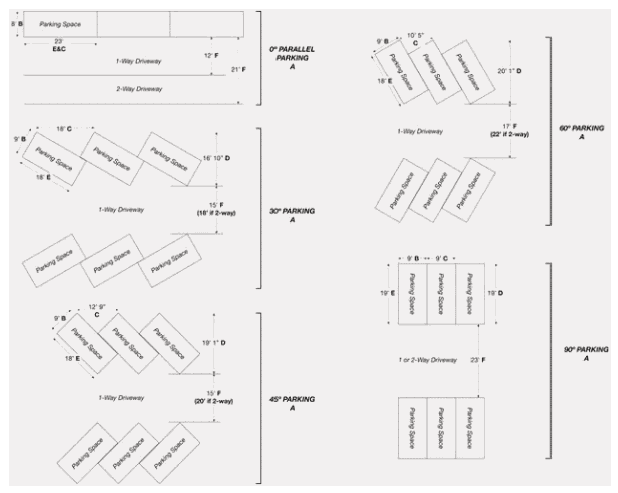
Minimum Standards: Letters in the following chart are referenced in subsection C of this section, Diagram, Parking Space Minimum Design and Dimensions (For Standard Vehicles). Off-street parking spaces must be provided in accordance with the following minimum standards:
C.
Diagram, Parking Space Minimum Design and Dimensions (For Standard Vehicles):
D.
Additional Standards for Compact Car Parking:
1.
If the total number of required parking spaces is less than ten (10), no compact car spaces shall be provided.
2.
If the total number of required parking spaces equals ten (10), then one parking space may be for compact cars. For each four (4) spaces in excess of ten (10), one space for compact cars may be provided.
3.
Each compact car parking space shall be marked for such use.
(Ord. No. 1432, § 2, 9-17-2025)
9-5-15: - Minimum and Maximum Surface Parking Space Requirements:
A:
Table 1: Required Parking by Land Use
Parking spaces for other permitted or conditional uses not listed in this section shall be determined by the planning director.
B.
Bicycle Spaces: All nonresident parking facilities with more than twenty (20) parking spaces shall provide the equivalent of one (1) bicycle space for every five (5) parking spaces included in the facility for the temporary storage of bicycles. Space for bicycle storage shall be designed in accordance with the bicycle parking standards adopted by city council resolution.
(Ord. No. 1432, § 2, 9-17-2025)
9-5-16: - Parking Credits:
A.
Bicycle Parking: For every six (6) nonrequired bicycle parking spaces created within any Commercial or Industrial Zone which adhere to the standards set forth in this chapter, motor vehicle parking space requirements may be reduced by one space; up to a maximum of two (2) off-street parking spaces.
B.
Motorcycle Parking: For every two (2) motorcycle parking spaces provided for any multifamily, commercial or industrial project, the number of standard vehicle spaces may be reduced by one space up to a maximum of two (2) spaces. Motorcycle parking spaces must be at least four feet (4') wide and ten feet (10') deep with a minimum of ten feet (10') of backup space provided. Backup space shall be on private property within an access aisle or other area not otherwise designated as a parking space.
C.
Affordable Housing Deed Restrictions: The minimum parking space requirements for developments that contain a deed restriction for affordable housing shall be reduced by twenty percent (20%). Such development must adhere to the following standards:
1.
At least fifty percent (50%) of the units must be deed restricted to provide for affordable rental housing.
2.
At a minimum, the deed restriction must accommodate households making less than eighty percent (80%) of area median income according to the Department of Housing and Urban Development (HUD). Such accommodation must provide affordable units such that no more than forty percent (40%) of tenant household income shall go towards the payment of rent. The deed restriction must remain in effect for a minimum of ten (10) years.
3.
Applicants awarded this credit must submit annual reports verifying the standards above to remain in good standing of this provision.
(Ord. No. 1432, § 2, 9-17-2025)
9-5-17: - Loading Areas:
A.
The required number of loading spaces are as follows:
B.
The size of off-street loading spaces shall not be less than the following, exclusive of access platform and loading area:
C.
Convenient access to loading spaces shall be provided and shall not be less than twelve feet (12') in width.
D.
Loading spaces may be located in required yards, providing such space is not roofed.
E.
Loading spaces shall be located entirely on the property they are intended to serve.
(Ord. No. 1432, § 2, 9-17-2025)
9-5-18: - In Lieu Parking Fees:
A.
Purpose: The purpose of these provisions is to allow development to satisfy the off-street parking requirements by making in lieu payments into a special dedicated fund the city will use to develop parking.
B.
Goals: The in-lieu program is voluntary and has the following goals:
1.
To creatively reduce parking requirements;
2.
To reduce the cost of development by reducing the funds required for building and maintenance of parking lots;
3.
To facilitate the construction and improvement of public parking;
4.
To improve urban design;
5.
To encourage shared parking; and
6.
To support historic preservation.
C.
Definitions:
IN LIEU PAYMENT: A onetime optional payment made to the city Parking Improvement Fund fulfilling all or part of the parking requirements for development.
PARKING IMPROVEMENT FUND: A special dedicated fund to collect revenue from in lieu parking payments. Revenue collected is used to improve general public parking in the city, to purchase or lease land for public parking, to improve, create, or expand city parking facilities, and to offset administrative expenses.
D.
Applicability: These provisions may be utilized in lieu of providing parking in the following situations:
1.
New residential development within the parking exempt area as defined in City Code 9-5-1-F, Exemptions.
2.
Non-residential development and residential development outside the exempt area as defined in City Code 9-5-1-F, Exemptions.
3.
Non-residential development within the exempt area shall be exempt from this section.
4.
A Parking Demand Analysis, as established in City Code 9-5-1-E, Parking Demand Analysis, shall not be eligible to determine the required number of parking spaces for the purposes of establishing an in lieu payment.
E.
Payment Calculation: The parking requirements set forth in the Parking Code may be satisfied in whole or in part by the payment of a nonrefundable parking in lieu fee of an amount set by city council resolution, which may be amended from time to time to approximate changes in costs of implementing the Parking Improvement Fund.
F.
Parking Fund Use: The "Parking Improvement Fund", a dedicated fund, is hereby created to receive revenue from in lieu payments. The fund shall be used to provide and enhance public parking facilities, including buying or leasing land, constructing parking facilities, offsetting administrative expenses directly related to managing the account and the construction of facilities, coordinating parking planning, and erecting signage.
G.
Limitations: In the event an application for development outside of the parking exempt area that requires a site plan review permit or a conditional use permit, as established in Title 9, City Code, intends to satisfy more than fifty percent (50%) of the parking requirement by payment of parking in lieu fees, such application shall require review and approval of the planning commission as part of the development application review. Public notice of the development application shall reference the parking reduction sought. Any such request for parking may be denied or reduced if the planning commission finds that permitting such request would have an adverse impact on the surrounding area or neighborhood.
(Ord. No. 1432, § 2, 9-17-2025)

