
Sandpoint City Zoning Code
CHAPTER 6
SIGN CODE
9-6-1: - Purpose and Authority:
The purpose of this chapter is to establish standards for the fabrication, erection and use of signs, symbols, markings and advertising devices within the city. These standards are desired to protect and promote the public welfare, health and safety of persons within the community and to aid in the development and promotion of business and industry by providing sign regulations which encourage aesthetic creativity, effectiveness and flexibility in the design and use of such devices without creating detriment to the general public and are adopted in accordance with that authority granted in Idaho Code section 67-6518 (1980) and the general police powers of the city. As used herein, the term "building inspector" shall refer to the city's building official or their designee; the term "planning administrator" shall refer to the city's planning director or their designee.
Notwithstanding anything herein to the contrary, noncommercial copy may be substituted for commercial copy on any lawful sign structure.
(Ord. 1300, 6-4-2014; amd. Ord. 1381, 12-2-2020)
9-6-2: - Short Title; Citation:
This chapter shall be known as the SIGN CODE of the city of Sandpoint and may be so cited and shall be referred to herein as the sign code.
(Ord. 1300, 6-4-2014; amd. Ord. 1381, 12-2-2020)
9-6-3: - Permit Required:
It is unlawful to erect, construct, reconstruct, or alter, any "sign" as defined in this chapter without first obtaining a sign permit from the building inspector. All applications for sign permits shall be accompanied by plans, designs, specifications or drawings stating specifically all dimensions, animations, if any, lighting, colors and plan of installation stating clearances and setbacks. The city building inspector or planning administrator shall have the authority to refuse a sign permit for any sign which does not comply with the requirements of this chapter.
(Ord. 1300, 6-4-2014; amd. Ord. 1381, 12-2-2020)
9-6-4: - Definitions:
ABANDONED SIGN, ON PREMISES: A sign which no longer advertises a bona fide business, lessor, owner, product or activity conducted or product available on the premises where such sign is displayed.
ARCHITECTURAL BLADE: A roof sign or projecting sign with no visible legs or braces designed to look as though it could have been part of the building structure, rather than something suspended from or standing on the building.
ARCHITECTURAL PROJECTION: Any projection not intended for occupancy, which includes signs, canopies, or marquees.
AREA OF SIGN: The area of all faces of the sign within a perimeter which forms the outside shape including any frame, forms an integral part of the display, but excluding the necessary supports or uprights on which the sign may be placed. If the sign consists of more than one section or module, all areas will be totaled. Where poster panels or bulletins are installed back to back, both faces are considered as area.
BACKGROUND AREA: The entire area of a sign on which copy could be placed, as opposed to the copy area, where copy is in fact posted or painted.
BANNER: A long, narrow flag or pennant hung over a street or entrance with no advertising copy.
BANNER SIGN: A sign composed of flexible material and securely attached at all four (4) corners to the primary structure of the business.
BUILDING CODE: The building code in effect for the city of Sandpoint.
BUILDING COMPLEX: A building or group of buildings within a single architectural plan and/or parcel of property housing two (2) or more commercial units of operation and providing common facilities or utilities, such as shopping centers, professional office buildings, etc.
BUILDING FACE OR WALL: All window and wall area of a building in one plane or elevation.
BUILDING FRONTAGE: The linear width of a building facing the right-of-way or the linear length of the right-of-way facing the building, whichever is smaller.
CANOPY, MARQUEE OR AWNING: A permanent rooflike shelter extending from part or all of a building face over a public right-of-way and constructed of any suitable weather resistant material.
CANOPY, MARQUEE OR AWNING SIGN: Any such sign attached to or constructed in or on a canopy, marquee or awning. For the purpose of this sign code, the square footage of a canopy sign shall be determined by the smallest square or rectangle that will enclose the copy area so long as any lighting below the canopy is shielded and down directed so the canopy does not appear illuminated. The amount of signage on an awning shall be limited to the lesser of thirty-five (35) square feet per individual tenant space or twenty-five percent (25%) of the total area of the awning. Awning signs shall not be allowed above the first story of a building.
CHANGEABLE COPY SIGN (Manual): A sign on which copy or sign panels may be changed manually in the field, such as boards with changeable letters or changeable pictorial panels.
CHANGING SIGN (Automatic): An electronically or electrically controlled sign, message center or reader board, where different copy changes are shown on the same location.
COMMERCIAL/INDUSTRIAL PARK: A planned, coordinated development of a tract of land with two (2) or more separate industrial or commercial buildings. Such development is planned, designed, constructed, and managed on an integrated and coordinated basis.
CONSTRUCTION SIGN: A temporary sign identifying a building or construction site and the architects, engineers, financial institutions, contractors and suppliers involved.
COPY: The wording on a sign surface.
ELECTRONIC SIGN: Includes those displaying time and temperature and also refers to digital or video displays or any sign that contains dynamically generated digital content.
FEATHER FLAG: A temporary, freestanding sign attached on one side to a pole or staff driven into the ground for support, or having a crossbar base suitable for standing or weighting the sign securely on a hard surface. The sign face may be vertical or vertically tapered and consist of a loose polyknit or semirigid membrane. This definition includes, but is not limited to, those advertising mechanisms referred to as blade, feather, feather sail, message, sun blade, swooper, teardrop, wind flag, banner, or sign.
FLASHING SIGN: Any sign which contains an intermittent or flashing light source, or which includes the illusion of intermittent or flashing light by means of animation, or an externally mounted intermittent light source.
FREESTANDING SIGN: A sign erected on a freestanding frame, mast or pole and not attached to any building.
HEIGHT OF SIGN: The vertical distance measured from the adjacent street grade or upper surface of the street curb to the highest point of said sign. Elevated roadways shall not be used to measure height.
INTERNALLY LIGHTED SIGN: A sign which is wholly or partially illuminated by an internal light source from which source light passes through the display surface to the exterior of the sign.
MURAL: A pictorial display without advertising copy on the exterior wall of a building.
MURAL SIGN: A wall painting or design that may include graphics, illustrations or symbols that represent the on site business use or name but shall be limited in its allowed sign area to only such numbers, letters, logos or trademarks that represent or identify the business or use occupying the building on which the mural sign appears.
NEON SIGN: Any sign or portion of a building illuminated or outlined by tubes using electrically stimulated neon or other gas.
NONCONFORMING SIGN: Any advertising structure or sign which was lawfully erected and maintained prior to the effective date hereof, or is located in newly annexed territory, and which does not conform to all applicable provisions of this chapter as it may be amended from time to time.
OFF PREMISES SIGN OR OFF SITE SIGN: Any sign that relates to or advertises products, services or uses at, or directs persons to, a different premises from where the sign is installed.
ON PREMISES SIGN: A sign calling attention to any business, product or activity conducted or produced on the property where such sign is located, or identifying the premises upon which such sign is located.
PERMANENT SIGN: Any sign other than a temporary sign.
PORTABLE SIGN: Any sign not permanently attached to the ground or building, including sandwich type signs, sidewalk or curb signs.
PREMISES: An area of land with its appurtenances and building which, because of its unity of use, is one unit of real estate.
PROJECTING SIGN: A sign, other than a wall sign, which is attached to and projects from a structure or building face.
ROOF SIGN: Any sign erected upon, against or directly above a roof or on top of or above the parapet of a building.
SIGN: Any identification, description, illustration, symbol, statue or device, illuminated or nonilluminated, which is visible from any public place designed to advertise, identify or convey information, including any landscape where letters or numbers are used for the purpose of directing the public's attention to a product or location, with the exception of window displays and flags of any state or nation. For the purpose of removal, sign shall also include all sign structures.
TEMPORARY SIGN: A sign which is not permanently affixed and is in place for thirty (30) days or less.
WALL SIGN: A sign painted on, attached to or erected against a wall of a building with the face parallel to the building wall and extending not more than one foot therefrom.
(Ord. 1300, 6-4-2014; amd. Ord. 1381, 12-2-2020)
9-6-5: - Impairment of Traffic and Rights-of-Way:
In addition to other requirements of the zoning code and sign code, all signs, including signs inside windows, shall comply with the following conditions:
A.
No sign shall be erected at the intersection of any street(s) in such a manner as to obstruct the free and clear vision of pedestrians and vehicular traffic or at any location where, by reason of the position, shape, color, words, phrases or symbols, it may interfere with, obstruct the view of, or be confused with any authorized traffic sign, signal or device.
B.
No sign shall be erected or maintained which, by use of lights, illumination, or sound, creates an unduly distracting or hazardous condition to a motorist, pedestrian or the general public.
(Ord. 1300, 6-4-2014; amd. Ord. 1381, 12-2-2020)
9-6-6: - Sign Districts:
For the purpose of determining allowable sizes, numbers, materials, placement and other requirements for restrictions on signs as set forth in this chapter, the city shall be divided into sign districts as follows:
A.
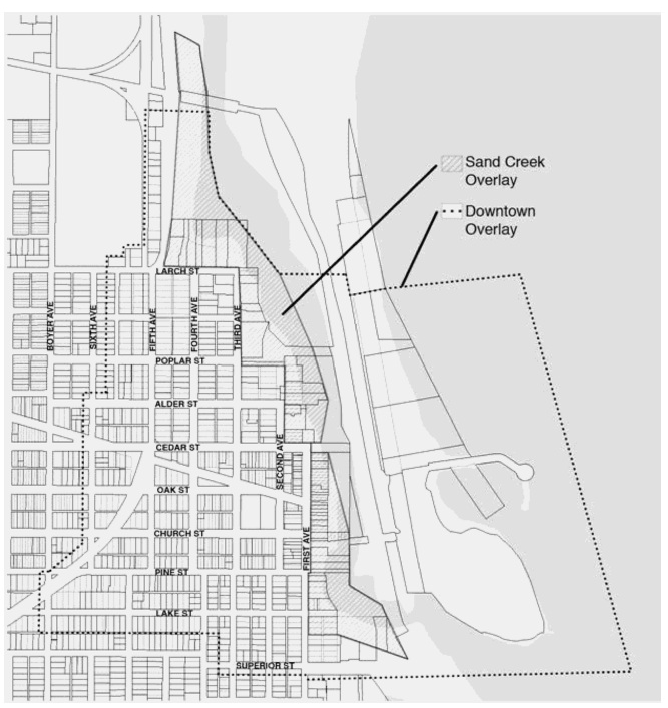
Downtown Overlay District: Businesses included within the downtown overlay district are those which front upon any street that is part of the boundary and all businesses located within the area encompassed by the boundaries, which shall be defined as:
Starting at Superior Street and First Avenue, then west to Third Avenue, north to Lake Street, then west to Boyer Avenue, north to Highway 2, then east to Sixth Avenue, north to Alder Street, east to Short Avenue, north to Larch Street, east to Fifth Avenue, north one thousand four hundred and ten feet (1,410') then east to the city border and returning south along the city border, then east across Sand Creek along the southern border of the water treatment facility, south along Lake Pend Oreille around city beach to Highway 95 as it enters Sandpoint, then west to the point of beginning.
B.
Sand Creek Sign Overlay District: Any business within the downtown overlay district set forth above that has frontage on both Sand Creek and one of the following streets: Lake Street, First Avenue, Cedar Street, Second Avenue, Poplar Street, Third Avenue, Larch Street, and Fifth Avenue, including those parcels south of the trestle bridge that crosses Fifth Avenue.
1.
Standards: The downtown overlay district shall apply. In addition, those businesses within the Sand Creek overlay district that have dual building frontage shall be allowed one additional wall sign facing Sand Creek as provided below:
a.
Prohibited Signs: Signs prohibited in this chapter as listed in section 9-6-13 of this chapter retain prohibition.
b.
Sign Size: Buildings utilizing the additional signage allowance are limited to twenty percent (20%) of the building's Sand Creek facing facade or four hundred (400) square feet, whichever is less. In the case of a mural sign, only the letters and numbers making up the business name shall be counted as sign area.
c.
Illumination: Signs may be illuminated through downlit illumination, halo illumination, or may utilize internal illumination when not composed of a single flat panel display.
C.
Special Standards For Buildings That Span The Width of Sand Creek: Given the distinct visual prominence of enclosed buildings that span the width of Sand Creek, the following special standards for signage shall apply to ensure that signage is presented in such a way that will limit "visual noise" and will preserve the historical nature of town as stated in the comprehensive plan:
1.
Prohibited Signs: Signs prohibited in this chapter as listed in section 9-6-13 of this chapter retain prohibition. A single banner may be allowed west of the thread of Sand Creek and within one hundred feet (100') of the nearest street curb, subject to the provisions set forth in the "portable signs" section. Banners are otherwise prohibited. A-frame signs are allowed subject to section 9-6-12 of this chapter.
2.
Sign Sizes: A maximum of two hundred (200) square feet of total sign area is allowed west of the thread of Sand Creek and within one hundred feet (100') of the nearest street curb. Directory signage totaling no more than two hundred (200) square feet, which may be double sided, is allowed within seventy feet (70') of the southbound shoulder lane of Highway 95.
3.
Window Signs: Window signs are limited as follows:
a.
Lettering or symbols to be no greater than one-half (½) of window height.
b.
Lettering or symbols to be spaced uniformly and allowed only in ground floor windows.
c.
Lettering or symbols to be of one color.
d.
Lettering to be uniform font size.
e.
Signage to be categorical in content, as examples: coffee, food, drink, gallery, restaurants, artisans, shopping, dining, gelato, burgers, barbecue, jewelry, furniture, etc.
f.
Lettering or symbols to be made of permanent durable vinyl or other such product that will withstand UV rays, and to be removed when faded and not legible.
4.
Signage Representing Use of Building: Signage representing the use of the building is allowed, subject to other provisions in this chapter, sign size notwithstanding.
D.
General Sign District: All the area within the corporate limits of the city where signs are a permitted use pursuant to the zoning ordinances of the city, excepting the downtown and Sand Creek overlay districts.
E.
Sign District Map:
(Ord. 1300, 6-4-2014; amd. Ord. 1381, 12-2-2020)
9-6-7: - Materials and Construction:
A.
Materials: Signs may be constructed of durable materials such as painted, stained or carved wood, brick or stone, plastics or polymers, glass or metal, provided metal signs shall not be pointed on their edges creating a safety hazard and shall be treated to prevent reflective glare.
B.
Support Structures: Exposed metal support structures for signs, including, but not limited to, posts, poles and sign sides or edges, must be faced or covered with wood, brick or stone, or painted. The planning administrator must approve the color and material.
C.
Exposed Neon: Exposed neon may be used only in one of the following ways: inside a building window, provided the total area of all signs does not exceed ten (10) square feet and which shall be included in the total sign area; as an accent on exterior wall signs, provided the total square footage of the neon may not exceed ten percent (10%) of the total area of the sign (neon square footage shall be determined by the smallest square or rectangle that will enclose the area of the neon); or not more than two (2) vacancy/no vacancy signs for each motel or hotel, not to exceed ten (10) square feet and which shall be included in the total sign area.
D.
Banner Frame: Businesses wishing to utilize banner material for permanent signage will be required to install a frame around the outside edge of the banner. The frame may be of metal, wood, or other material in order to provide an attractive and durable border to such sign. Any existing permanent signs using banner material shall be required to install such frame within one year of the adoption of this section. If not used for permanent signage, the provisions of section 9-6-12 of this chapter shall apply to number, size, and location of any banner sign.
E.
Compliance With Certain Regulations Required: All signs shall be Underwriters Laboratory (UL) approved, except for signs typically not requiring UL approval, such as wood signs that are indirectly lighted. All other signs shall comply with the most current printing of the national electrical code/international building code. Drawings of all signs showing size, location, color and other information as deemed necessary by the city building inspector or planning administrator must be submitted prior to receiving a sign permit. All plans for freestanding or roof signs as allowed by this chapter shall be submitted with the signature and stamp of a licensed engineer unless otherwise waived by the city building inspector. The engineer's review of a sign structure, if required, shall include, but not be limited to, the effects of wind, seismic forces, allowable stresses, combined loads, overturning movement from lateral forces, and the stresses of wire or rope and their fastenings.
F.
Bracing Systems: Signs and sign structures shall be designed and constructed to resist wind and seismic forces as specified in this section. All bracing systems shall be designed and constructed to transfer lateral forces to the foundations. For signs on buildings, the dead and lateral loads shall be transmitted through the structural frame of the building to the ground in such a manner as not to overstress any of the elements thereof.
G.
Supports: The supports for all signs or sign structures shall be placed in and upon private property and shall be securely built, constructed and erected in conformance with the requirements of this chapter.
H.
Setbacks: No projecting sign, canopy, or marquee shall extend from a building to a point beyond eighteen inches (18") from the back of the adjacent street curb, nor shall it be lower than eight feet (8') above the sidewalk from which they overhang. For freestanding sign standards, see section 9-6-11 of this chapter.
(Ord. 1300, 6-4-2014; amd. Ord. 1381, 12-2-2020)
9-6-8: - Sign Sizes:
All signs shall be proportioned in size to the building on which they are to be mounted or which contains the business they are advertising, and the total square footage for all signs shall be limited based on primary entrance frontage as follows:
A.
General Sign District: Two and one-half (2½) square feet of sign area for each linear foot of building frontage up to a maximum of one hundred fifty (150) square feet of total sign area, unless adjusted as hereinafter provided.
B.
Downtown Overlay District: Two (2) square feet of sign area for each linear foot of building frontage up to a maximum of one hundred twenty-five (125) square feet of total sign area, unless adjusted as hereinafter provided.
C.
Sand Creek Overlay District: See subsection 9-6-6B of this chapter.
D.
Square Footage Penalty: A square footage penalty equal to fifty percent (50%) shall be imposed and deducted from the total square footage allowable for each internally lighted wall, projecting or freestanding sign, that utilizes white, off white, light gray, yellow, or cream for the background or noncopy portions of a sign, except when used as the background for reader board or changeable copy signs as permitted by subsection 9-6-13I and where the area utilized for internally lit changeable copy cannot exceed fifty percent (50%) of the business's allowed sign area.
E.
Nonconforming Business Use: Any business use located within a residential zone of the city that is considered legally nonconforming or is approved through a conditional use permit process shall be subject to the sign areas as set forth in subsection B of this section for the downtown overlay district.
(Ord. 1300, 6-4-2014; amd. Ord. 1381, 12-2-2020)
9-6-9: - Master Sign Program:
A.
Approval of a master sign program will allow flexibility with regard to sign area, number, location, or height of permitted signage to the extent that the master sign program will enhance the overall development. Approval of a master sign program will allow for an increase of up to twenty-five percent (25%) in overall sign area.
1.
Applicability: The approval of a master sign program shall be required whenever any of the following circumstances exist or whenever an applicant requests the approval of a master sign program:
a.
Three (3) or more separate tenant spaces are to be created on the same parcel; or
b.
A single building has multiple tenant spaces where each tenant space does not have a clearly defined street facing business presence (tenant spaces may be located behind or above other businesses); and
c.
The planning administrator determines that a master sign program is needed because of special project characteristics (e.g., the size of proposed signs, limited site visibility, a business within a business, the location of the site relative to major transportation routes).
2.
Approval Authority: The planning administrator may approve a master sign program through the granting of a sign permit for a master sign program.
3.
Application Requirements: A sign permit application for a master sign program shall include all information and materials required by the department. Information to be submitted should include:
a.
Proposed signage types.
b.
Proposed signage locations.
c.
Breakdown of sign area allowed each tenant.
4.
Standards: A master sign program shall comply with the following standards:
a.
The program shall comply with the purpose of this chapter and underlying standards for the sign district.
b.
The program shall accommodate future revisions that may be required because of changes in use or tenants.
5.
Revisions To Master Sign Programs: Revisions to a master sign program may be approved by the planning administrator with a standard sign permit if the intent of the original approval is not affected. Revisions that would substantially deviate from the original approval shall require the approval of a new master sign program.
(Ord. 1300, 6-4-2014; amd. Ord. 1381, 12-2-2020)
9-6-10: - Number of Signs:
A.
The maximum number of signs for each business shall be two (2) for each street frontage. In no case shall a business be allowed more than two (2) permanent signs on one side of a building. Those businesses that fall within the Sand Creek overlay district may also be allowed one additional wall sign facing Sand Creek, subject to the standards set forth in subsection 9-6-6B of this chapter.
(Ord. 1300, 6-4-2014; amd. Ord. 1381, 12-2-2020)
9-6-11: - Freestanding Signs:
A.
Number Allowed; General Regulations: Only one freestanding sign may be allowed for each single- or multi-tenant building, which shall be constructed of durable materials, shall not exceed ten feet (10') in height from grade to the top of the sign or supporting structure, whichever is higher, shall not encroach on any public right-of-way, and shall comply with all other applicable design and construction standards as set forth in this chapter; and further provided that single or double tenant signs shall not exceed twenty-five (25) square feet.
B.
Setback: All freestanding signs located within the city limits shall be set back in accordance with the proposed height of the sign (e.g., a 6 foot tall sign requires a 6 foot setback) provided that signs which are less than five feet (5') in height shall observe a setback of no less than five feet (5'), measured from the property line to the nearest point of the support structure or sign face. Freestanding signs may encroach within the setback up to eighteen inches (18") from the property line when:
1.
Not illuminated with the exception of downlighting;
2.
No more than five feet (5') in height; and
3.
Plans are submitted with the signature and stamp of a licensed engineer. The engineer's review shall include, but not be limited to, the effects of wind, seismic forces, allowable stresses, combined loads, overturning movement from lateral forces, and the stresses of wire or rope and their fastenings.
C.
Height: Freestanding signs may extend to a height of no more than ten feet (10') from grade to the top of the sign or supporting structure, whichever is higher. Other signs, including wall signs, shall not extend above the roofline of the building containing the business it advertises, exclusive of false fronts.
D.
Landscaping: The ground area around the base of all freestanding signs shall be landscaped, providing that the building inspector and planning administrator may exempt freestanding signs from this requirement where it is demonstrated by the applicant that the landscaping would unduly interfere with pedestrian or vehicle traffic.
E.
Commercial/Industrial Park Entrance Signs: For separate buildings in close proximity or on individual lots within a commercial/industrial park, this provision allows one freestanding entrance sign, not to exceed fifty (50) square feet for the complex or park. Signs must be located at the entry of the commercial/industrial park or primary access and shall abide by clear vision triangle specifications set by state law. One double sided sign per street abutting the perimeter of the park is allowed. Signs may not exceed the maximum height established for freestanding signs within the same zoning district and may not be internally lighted. External lighting that is concealed and focused downward onto the sign is permitted. Space may be made available on the entry sign for each tenant and/or lot in the park. Applications for entrance signs shall stipulate who will be responsible for installation and maintenance.
(Ord. 1300, 6-4-2014; amd. Ord. 1381, 12-2-2020)
9-6-12: - Portable Signs (A-Frames and Banners):
In addition to the number of signs allowed according to street frontage, all businesses shall be allowed one A-frame or banner, subject to the following requirements:
A.
General Requirements:
1.
Placement of portable signs shall only be allowed following issuance of a portable sign permit. Such permits will be exclusive to the permittee's location and business name. Transfer of the portable sign to another location or change in the business name will require amendment of the sign permit.
2.
All portable signs shall be constructed of solid and durable materials, and no lighting or reflective materials shall be used.
3.
All signs permitted herein are subject to the maintenance, repair, and removal provisions set forth in sections 9-6-17 and 9-6-18 of this chapter.
4.
The planning administrator, building inspector, fire chief, police chief and/or public safety officer of the city of Sandpoint may cause the immediate and permanent removal, without notice, of any portable sign found to be in violation of any provision of this code, including, but not limited to, permitting requirements or placement in the public right-of-way in a manner that encroaches into the pedestrian travel zone, is unsafe, or blocks or impedes access.
B.
A-Frame Signs:
1.
Businesses within the same building may share the use of a single A-frame, but in no case shall a single business be allowed to advertise on more than one A-frame sign. Minimum spacing between A-frame signs for multi-tenant buildings shall be one hundred feet (100'); this spacing may be reduced to fifty feet (50') upon approval by the planning administrator.
2.
For those A-frame signs placed in the right-of-way, each face of the A-frame shall be no wider than two feet (2'), and no taller than three feet (3'), including any sign frame. An A-frame placed on private property may differ in dimensions, but in no case shall each face be greater than six (6) square feet.
3.
Any person or business placing an A-frame upon the public right-of-way in conformance with this section shall execute a hold harmless agreement by which the person or business placing such A-frame sign accepts any and all liability for damages of any nature suffered by anyone as a result of the placement or maintaining of such sign and further shall agree to hold the city harmless from and indemnify the city for any such claims for damages.
4.
All A-frame signs shall be suitably anchored, weighted or designed to be resistant to the weather conditions; shall not begin more than four inches (4") above the sidewalk; shall be required to be removed at the end of each business day; and shall not be displayed during the nonbusiness hours of the commercial use such signs advertise. Signs with wheels which can be rolled into place are prohibited.
5.
All A-frame signs placed within the right-of-way shall be located immediately abutting the building containing the business advertised thereon, and may not encroach into the pedestrian travel zone as defined in subsection 7-2-2C of this code. Should the width of the existing sidewalk not allow for the placement of a sign that would not encroach into this zone, the business owner may request an exception from the planning administrator and building inspector to allow a single face A-frame sign, not to exceed six (6) square feet in size, to be placed so as to securely lean against the building.
If not located within the right-of-way, the A-frame sign shall be located so as to not interfere with pedestrian movement on any private pedestrian path or sidewalk and shall not be placed so as to prevent the use of any required parking spaces, interfere with persons exiting their vehicles, or restrict the turning movements of vehicles within a parking area.
C.
Banners:
1.
Standards: All businesses will be allowed the option of utilizing a twelve (12) square foot banner as a portable sign set forth above. Such banner must be securely attached at all four (4) corners to the primary structure of the business and maintained in good repair in accordance with the provisions set forth in section 9-6-17 of this chapter.
2.
Special Event Banners: A special event banner permit may be obtained for a single event for businesses that are set back from a street fifty feet (50) or more and subject to the size restrictions set forth below. Special event banners may not be used concurrently with another banner and are only allowed for a seventy-two (72) hour period. Additionally, special event banner permits shall not be issued to a business more than once per month. The size of banners shall be restricted by linear business frontage as follows:
(Ord. 1300, 6-4-2014; amd. Ord. 1381, 12-2-2020)
9-6-13: - Permitted and Prohibited Signs:
A.
Permitted Signs:
1.
House Numbers: Signs not exceeding one square foot in area illuminated only by the reflector method and bearing only the house number and the name of the occupant shall be allowed within any residential zone.
2.
Advertising Signs: Such signs shall be a permitted use only in the commercial or industrial zones or for any business use located within a residential zone that is considered legally nonconforming or is approved through the conditional use permit process.
B.
The following shall be prohibited in all districts:
1.
Moving Appurtenances: Moving mechanical or electrical appurtenances attached to a sign or otherwise intended to attract attention to a sign.
2.
Interference With Visibility of Traffic Device: Any sign located so as to conflict with the clear and obvious appearance of public devices controlling public traffic.
3.
Rotating Beacon Lights: Rotating beacon lights used above or attached to any sign structure, sign or building.
4.
Flashing, Moving Signs: Animated, rotating, flashing signs or signs which have moving parts.
5.
Portable Signs With Wheels: Portable signs with wheels which can be rolled onto the sidewalk or street right-of-way and signs which are supported by a heavy weight at the base which can be rolled into place. Design standards for allowed portable signs are set forth in section 9-6-12 of this chapter.
6.
Off Premises Signs: "Off premises signs", defined as signs for advertising or identification of a business which is not located on the same premises as the business, excepting directional and informational signs placed by governmental agencies.
7.
Neon Signs: Neon signs or valances, unless otherwise allowed in this chapter.
8.
Feather Flags: Feather flags.
9.
Reader Board; Changeable Copy Signs: Reader board or changeable copy signs, provided that one such nonelectronic sign shall be allowed for:
a.
Businesses where the primary business function is as a venue for changing entertainment or events.
b.
Movie theaters.
c.
Businesses with convention facilities that qualify for liquor licenses under the statutes of the state.
d.
Schools or churches, provided that those located within or abutting a residential district may not be internally lit.
Not more than two (2) such nonelectronic signs shall be allowed for gasoline service stations, provided that the only changeable copy shall be fuel prices.
10.
Electronic Signs: Any existing electronic signs that are legally nonconforming at the time of passage hereof, except those signs that have been granted historic status as set forth herein, shall have until March 31, 2022, to come into compliance with the provisions of this sign code.
11.
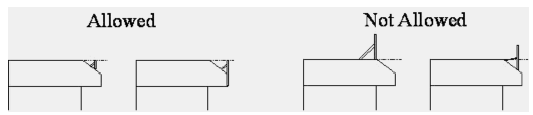
Roof Signs: Roof signs erected at the peak or that extend above the highest point of a building.
(Ord. 1300, 6-4-2014; amd. Ord. 1381, 12-2-2020)
9-6-14: - Vehicle Mounted Commercial Signs:
A.
All vehicle mounted commercial signs shall be permanently affixed, painted, magnetically applied or otherwise mounted upon a vehicle and shall not project more than eighteen inches (18") above the surface to which they are attached; and any sign which is mounted upon the roof, hood or trunk of a vehicle and which projects above such surface upon which it is mounted shall not exceed two (2) square feet in area per face.
B.
The primary purpose of any vehicle upon which a vehicle mounted commercial sign is affixed must be to serve a useful function in the transportation or conveyance of persons or commodities from one place to another, including transportation to and from work, and such intermittent delays and stops as are customary in the routine conduct of the business or activity for which the transportation or conveyance occurs.
C.
No vehicle upon which a vehicle mounted commercial sign is affixed may be parked on any lot or public right-of-way for the primary purpose of directing or attracting the attention of the public to a building, institution, product, organization, event or location offered or existing elsewhere except as provided for below.
D.
Banner signs displayed on vehicles shall be subject to the regulations contained in subsection 9-6-7D of this chapter.
E.
Vehicle mounted signs used in connection with a special event are exempted from the requirements of this section for only the twenty-four (24) hour period just preceding and during the term of the special event. Upon the conclusion of the special event, such signs must either be dismantled, moved to a location where the sign is not visible from public rights of way or made to comply with the provisions of this section. For the purposes of this subsection, the term "special event" shall mean a parade, circus, fair, carnival, festival or other similar event that is intended to or likely to attract substantial numbers of persons and is different in character from the customary or usual activities generally associated with the property upon which the special event is to occur.
F.
Vehicle mounted political signs pertaining to a specific election are exempted from the requirements of this section.
G.
This section shall not apply to signs that are being transported for installation.
(Ord. 1300, 6-4-2014; amd. Ord. 1381, 12-2-2020)
9-6-15: - Exempted Signs:
The following signs shall be exempted from the provisions of this sign code, providing that they meet the requirements set forth in this section. Signs that exceed the stated area allowances shall be subject to the same permit requirements as otherwise set forth in this title.
A.
All signs erected in a public right-of-way by a public agency controlling or directing traffic shall be exempt from the provisions of this chapter.
B.
Political signs pertaining to a specific election which must be removed within five (5) days after the election by the candidate or property owner who placed the sign.
C.
Real estate signs of less than four (4) square feet of sign area located within the building setback areas not occupying any portion of the public right-of-way.
D.
Construction signs announcing the construction of a building or project naming owners, contractors, subcontractors, lending institutions, and architects, not to exceed one sign of thirty-five (35) square feet for each street frontage of the building frontage. Said sign shall be removed upon occupancy of the building for which the sign was intended.
E.
Flags, either official or historical, of any state or nation.
F.
Any sign inside a building, window, or on a door, except flashing, animated or rotating signs visible from outside the building. The total percentage of coverage for signs on or within windows and doors shall not exceed thirty-five percent (35%).
G.
Owner identification or occupant identification signs for residential structures, private warning signs and "For Sale" or "For Rent" signs, none of which may exceed two (2) square feet.
H.
Murals, as defined in this chapter. All requests for murals shall be reviewed by the arts commission and the planning administrator, with their recommendation forwarded to city council for approval on consent calendar. The responsibility for review shall fall to the planning and zoning commission in the event there is no active arts commission appointed.
I.
Kiosks provided by the chamber of commerce, downtown business association and other nonprofit organizations that typically list local community events. A kiosk with space to list community events, locations of community buildings and a list of local businesses keyed to a location map may be permitted at the discretion of the planning commission. Business and property owners adjoining the parcel under consideration shall be notified of such request. Said notice shall inform such owners that they may comment on the application during a period of not less than fifteen (15) days after mailing of the notice and prior to final action on said application. Said permit approval shall be based on compliance with the following:
1.
Safe and adequate vehicular and nonvehicular access to the kiosk;
2.
Kiosk layout and design which reflects an intent to notify visitors and residents of community events; and
3.
Use of durable materials on the kiosk.
The combined total for all signs within any one kiosk shall not be more than one hundred (100) square feet. Kiosks shall be placed within a landscaped area. Each entrance to the city shall have a designated area for these signs. Locations throughout the downtown core may also be selected for smaller kiosks (up to fifty (50) square feet each) serving the same purposes as above. All signs advertising a specific event shall be immediately removed at the conclusion of the event unless extended in writing by the planning administrator.
J.
Signs stating the name of a housing complex of ten or more dwelling units, provided that the sign does not exceed twenty-five (25) square feet. Freestanding signs shall be placed within a landscaped area and shall be approved by the planning administrator.
K.
Signs which are exclusively intended to direct pedestrian and vehicular traffic to entrances, exits, drive-up lanes, etc., smaller than three (3) square feet, with no advertising.
L.
One directory sign per entrance for multi-tenant buildings that does not exceed three (3) square feet. A larger directory sign size, with a maximum area of six (6) square feet may be allowed upon approval by the city planning and zoning commission.
M.
Portable signs or banners, when used by churches, charities, and other similar nonprofit institutions or governmental entities for the purpose of announcing benefit or emergency programs occurring within the church or institution, such as weekly free meals or cold weather shelters. Such signs must adhere to the standards set forth in section 9-6-12 of this chapter and may only be in place on the same premises and on the days such programs are taking place.
N.
Integral decorative or architectural features of buildings, including building names and dedication dates, or works of art, so long as such features or works do not contain letters or numbers (except in case of building names and dedication dates). Signs for building names shall be in harmony with the architecture of the building and are not to exceed twelve feet (12') in letter height.
O.
Public works of art that contain letters/numbers if approved by the Sandpoint arts commission.
(Ord. 1300, 6-4-2014; amd. Ord. 1381, 12-2-2020)
9-6-16: - Nonconforming Signs:
A.
A "nonconforming sign" is any advertising structure or sign which was lawfully erected and maintained prior to the effective date hereof, or is located in newly annexed territory, and which does not conform to all applicable provisions of this chapter as it may be amended from time to time.
B.
All nonconforming signs which are nonconforming due to exposed metal support poles, structures or edges, background color, or material, or because of design or construction standards, are allowed to remain as long as they advertise a bona fide business. However, in the event there is a change in the type of business, a request is made for a land use permit to change the use of the property, or a building permit is obtained for work involving any exterior building changes or building replacement or modifications to a site(s) upon which nonconforming signs exist, then all nonconforming signs on the subject site shall be removed or modified to comply with all the provisions of this chapter. A sign which does not conform to the provisions of this chapter shall not be structurally altered, relocated, or replaced unless it is immediately brought into compliance. In addition, all temporary and/or A-frame signs not meeting the provisions of this chapter shall be removed within thirty (30) days of the passage of this chapter. Flashing or rotating signs shall comply with the provisions of this chapter within sixty (60) days of its passage. In cases where removal of a nonconforming sign is required and would create an extreme hardship or substantial loss to the owner, as demonstrated by the owner, the owner then agrees to a reasonable time frame for the eventual removal of the nonconforming sign. This provision shall not apply to nonconforming signs illegally erected, those which pose a public safety hazard, or temporary, portable or off premises sign.
C.
In certain cases nonconforming signs may be given a historic status. All requests for historic sign status shall be reviewed by the historic commission and the planning administrator, with their recommendation forwarded to city council for approval on consent calendar. The responsibility for review shall fall to the planning and zoning commission in the event there is no active historic commission appointed. Independent consideration of each request will be given, and the applicant shall address each of the criteria below:
1.
At least fifty (50) years old or attached to a building which is on the national register of historic places.
2.
On premises sign.
3.
Unique in design and enhances the cultural, historical, nostalgic, or aesthetic quality of the city.
4.
Structurally safe.
Once designated, historic signs are deemed in compliance with this chapter regardless of their size, material, colors or location. Decisions to grant historic status to a sign shall be made on a case by case basis, according to the criteria above. The granting of historic status for a sign shall not be considered as establishing a binding precedent to grant other historic status designations.
D.
Notwithstanding the provisions of subsection B of this section, all signs that are nonconforming only because of the setback requirements set forth in subsection 9-6-11B of this chapter are hereby not required to move, provided they are not located on public right-of-way, in which case they are required to move in compliance with subsection 9-6-11B of this chapter.
(Ord. 1300, 6-4-2014; amd. Ord. 1381, 12-2-2020)
9-6-17: - Maintenance and Repair:
Every sign, including, but not limited to, those signs for which permits are required or for which no permits or permit fees are required, shall be maintained in a safe, presentable and good structural material condition at all times, including the repair or replacement of defective parts, painting, repairing, cleaning and other acts required for the maintenance of said sign. The building inspector shall require compliance with all standards of this provision. If the sign is not made to comply with adequate safety and maintenance standards, the planning administrator shall require its removal in accordance with this provision.
(Ord. 1300, 6-4-2014; amd. Ord. 1381, 12-2-2020)
9-6-18: - Removal and Disposition of Signs:
A.
Abandoned Signs: Except as otherwise provided in this chapter, any sign which is located on property which becomes vacant and unoccupied for a period of two (2) months or more, or any sign which pertains to a time, event or purpose which no longer applies, shall be deemed to have been abandoned. Permanent signs applicable to a business temporarily suspended because of a change of ownership or management of such business, shall not be deemed abandoned unless the property remains vacant for a period of six (6) months or more. Any sign which no longer, for a period of three (3) consecutive months, advertises goods, products, services or facilities available to the public, shall be deemed to have been abandoned. Abandoned signs shall be removed by the owner of the premises on which the sign is located. Signs that are conforming under the provisions of this chapter as to location, size, etc., but no longer advertise a bona fide business may, with the approval of the property owner/tenant and the planning administrator of the city, have the message or sign copy covered with paint or other material as approved by the planning administrator. In the event the property owner refuses to cover a conforming sign that no longer advertises a bona fide business and is deemed to be abandoned, the remaining provisions of this section shall be enforced.
B.
Dangerous or Defective Signs: No persons shall maintain or permit to be maintained on any premises owned or controlled by him, any sign which is in a dangerous or defective condition. Any such sign shall be removed or repaired by the owner of the premises or the owner of the sign. Upon failure of the owners to remove or repair a dangerous or defective sign, the building inspector shall proceed as described in subsection C of this section.
C.
Removal of Signs: The building inspector shall cause to be removed any sign that endangers the public safety such as an abandoned, dangerous or materially, electrically or structurally defective sign. The building inspector shall prepare a notice which shall describe the sign and specify the violation involved and which shall state if the sign is not removed or the violation is not corrected within twenty (20) days, the sign shall be removed in accordance with the provisions of this section.
All notices mailed by the building inspector shall be sent by certified mail. Any time periods provided in this section shall be deemed to commence on the date of the mailing of the certified mail. The notice shall be mailed to the owner of the property on which the sign is located, the owner of the sign and the occupant of the property. If any such person is unknown or cannot be found, notice shall be mailed to such person's last known address, if any, and posted on the sign or on the premises.
Any person having an interest in the sign or the property may appeal the determination of the building inspector ordering removal or compliance by filing a written notice of appeal with the city planning and zoning commission within ten (10) days after receipt of the notice. Notwithstanding the above, in cases of emergency, the planning administrator and/or building inspector may cause the immediate removal of a dangerous or defective sign without notice.
D.
Disposal of Signs; Costs: Any sign removed by the building inspector pursuant to the provisions of this section, shall become the property of the city and may be disposed of in any manner deemed appropriate. The cost of removal of the sign by the city shall be considered a debt owed to the city by the owner of the sign and the owner of the property, and may be recovered in an appropriate court action by the city. The costs of removal shall include any and all incidental expenses incurred by the city in connection with the sign's removal.
When it is determined by the building inspector that said sign would cause an imminent danger to the public safety, and contact cannot be made with a sign owner or building owner, no written notice shall have to be served. In this emergency situation, the building inspector may correct the danger, all costs being charged to the sign owner and property owner.
If it shall be necessary for the building inspector to remove a sign pursuant to the provisions hereof, and it should be practicable to sell or salvage any material derived in the aforesaid removal, he may sell the same at private or public sale at the best price obtainable and shall keep an account of the proceeds thereof. Such proceeds, if any, shall be used to offset the costs of removal to be charged to the sign owner or property owner. Any excess cost over and above such costs and the cost of the removal shall be levied as an assessment against the property on which the sign is located, by the city council, certified to the auditor and collected as any other assessment by the city. Should the proceeds exceed the costs, the excess shall be paid to the owner of the premises from which said sign was removed or to the owner of said sign, whenever claim thereof is established.
(Ord. 1300, 6-4-2014; amd. Ord. 1381, 12-2-2020)
9-6-19: - Appeals:
Appeals from decisions made by the planning administrator shall be made to the city planning and zoning commission. Appeals from the provisions or enforcement of this chapter shall be made as provided in title 9, chapter 9 of this code.
(Ord. 1300, 6-4-2014; amd. Ord. 1381, 12-2-2020)
9-6-20: - Penalty:
Any person violating any provision of this chapter shall be guilty of an infraction and shall be punished in accordance with the provisions of section 1-4-1 of this code, and a separate offense shall be deemed to be committed for each day during or which a violation occurs or continues.
(Ord. 1300, 6-4-2014; amd. Ord. 1381, 12-2-2020)

