
Sanibel City Zoning Code
ARTICLE XIV
- SUPPLEMENTARY DISTRICT REGULATIONS
DIVISION 5. - COMMERCIAL AND INSTITUTIONAL USES GENERALLY[8]
Editor's note— Ord. No. 16-001, § 6, adopted Apr. 5, 2016 amended the title of Div. 5 as set out herein. Division 5 was formerly entitled "Commercial Uses Generally."
Cross reference— Businesses, ch. 18.
DIVISION 7. - DWELLING RENTAL[9]
Editor's note— Section 2 of Ord. No. 19-007 renamed div. 7 from Resort Housing to Dwelling Rental, as herein set out.
DIVISION 11. - RESERVED[10]
Editor's note— Ord. No. 22-005, § 4, adopted July 19, 2022, deleted Div. 11, § 126-1196 entitled "Garage Sales," which derived from: Ord. No. 85-26, § 1(I.E.22(l)), adopted Nov. 27-1985; Ord. No. 87-20, § 2, adopted July 21, 1987; and Ord. No. 93-15, § 2, adopted Aug. 3, 1993.
DIVISION 16. - ELECTRICAL POWER GENERATORS AND HVAC[11]
Editor's note— Ord. No. 22-004, § 2, adopted June 7, 2022, amended Div. 16 in its entirety to read as herein set out. Former Div. 16, §§ 126-1305—126-1307 was entitled "Emergency Electrical Power Generators," and derived from: Ord. No. 06-019, §§ 2, 3, adopted Dec. 5, 2006; and Ord. No. 08-066, §§ 2—4, adopted April 15, 2008.
Sec. 126-831.- Disabled and nonregistered vehicles.
Disabled or nonregistered vehicles may not be stored in any zone for more than ten days, except in or under a building.
(Ord. No. 85-26, § 1(I.E.24), 11-27-1985)
Sec. 126-996.- Definitions.
The following words, terms and phrases when used in this division, shall have the meanings ascribed to them in this section, except where the context clearly indicates a different meaning:
Ambient light means light not originating from the site, such as moonlight.
Artificial light or artificial lighting means the light emanating from any manmade device.
"Bug" type bulb means any yellow light bulb specifically designed to reduce the attraction of insects to the light.
Cumulatively illuminated means illuminated by numerous artificial light sources.
Direct light means light emitted directly from the lamp, off of the reflector or reflector diffuser, or through the refractor or diffuser lens, of a luminaire.
Fixture means the assembly that houses the lamp or lamps and can include all or some of the following parts: A housing, a mounting bracket or pole socket, a lamp holder, a ballast, a reflector or mirror, and/or a refractor or lens.
Flood or spot light means any light fixture or lamp that incorporates a reflector or a refractor to concentrate the light output into a directed beam.
Full cutoff fixture means a luminaire that does not emit any light, either directly or by reflection or diffusion, above a horizontal plane running through the lowest part of the luminaire's feature containing the lamp or lamps that produces the actual light, including any attached reflectors or diffusers.
Glare means light emitting from a luminaire that interferes with visibility.
Ground-level barrier means any vegetation, natural feature or artificial structure rising from the ground which prevents beachfront lighting from shining directly onto the beach-dune system.
Hatchling means any species of marine turtle, within or outside of a nest, that has recently hatched from an egg.
Indirect light means direct light that has been reflected or has scattered off of other surfaces.
Lamp means the component of a luminaire that produces the actual light.
Landscaping lighting means lighting used to emphasize or draw attention to a landscape feature.
Light trespass means light from an artificial light source that is intruding into an area where it does not belong, such as an adjoining or nearby property, or the beach or dune.
Luminaire means a complete lighting system, including a lamp or lamps and a fixture.
Marine turtle means any marine-dwelling reptile of the families Cheloniidae or Dermochelyidae found in state waters or using the beach as nesting habitat, including the species: Caretta caretta (loggerhead), Chelonia mydas (green), Dermochelys coriacea (leatherback), Eretmochelys imbricata (hawksbill), and Lepidochelys kempi (Kemp's ridley).
Marine turtle nesting season means the period from May 1 through October 31 of each year.
Nest means an area where marine turtle eggs have been naturally deposited or subsequently relocated.
Outdoor lighting means the nighttime illumination of an outside area or object by any fixed luminaire. Vehicle lights and flashlights are not included in this definition.
Pathway lighting means lighting used to illuminate a walkway or pathway.
Point source of light means any artificial light or lighting that directly radiates visible light.
Pole-mounted lighting means any luminaire set on a base or a pole which raises the source of light off of the ground.
Recessed luminaire means a luminaire recessed into an outdoor ceiling or canopy so that its bottom is flush with the underside of the structure.
Skyglow means illumination of the sky from artificial sources.
Tinted glass means any glass treated to achieve an industry-approved, inside-to-outside light transmittance value of 45 percent or less. Such transmittance is limited to the visible spectrum (400 to 700 nanometers) and is measured as the percentage of light that is transmitted through the glass.
Unshielded lighting means any artificial light emitted, either directly or by reflection or diffusion, above a horizontal plane running through the lowest part of the luminaire's full cutoff feature. See Appendix B (end of § 126-997).
Uplighting means any luminaire that directly or indirectly projects light above the horizontal plane of a 90-degree angle passing through the lowest point of the luminaire's full cutoff feature. See Appendix C (end of § 126-997).
Wallpacks means luminaires placed along the outer walls of buildings. See illustrations.
(Ord. No. 97-08, § 3, 5-6-1997; Ord. No. 00-10, § 1, 6-6-2000; Ord. No. 15-004, § 1, 3-3-2015)
Cross reference— Definitions generally, § 1-2.
Sec. 126-997. - Outdoor lighting generally.
(a)
Purpose and intent. The purpose of this section is to set outdoor lighting standards that will minimize glare, light trespass, and skyglow; conserve energy while maintaining nighttime safety, security and productivity; protect the privacy of residents; minimize disturbance of wildlife; enhance the ambiance of the community; and ensure optimal viewing of spectacular night skies above Sanibel.
It is the intent of this section that all luminaires in the city be brought into compliance with the standards of this section in accordance with the timetable established in subsection (e).
To encourage the replacement of nonconforming outdoor lights, the issuance of a development permit, solely for outdoor lights, does not trigger compliance with code requirements unrelated to outdoor lighting.
Further, the issuance of a development permit for any purpose other than outdoor lighting will not require the replacement or removal of existing nonconforming outdoor lighting as a condition of authorizing such development permit, except in accordance with the timetable in subsection (e).
(b)
Applicability. New or replacement luminaires and new construction must comply with the standards of subsection 126-997(c). Existing luminaires shall comply with the timetable in subsection 126-997(e).
(1)
All land uses. A development permit is required to add or replace outdoor lights in the Gulf Beach, Gulf Beach Ridge or Bay Beach zones.
(2)
Single-family and duplex dwelling units located on an individual lot, except those located in the zones identified in subsection 126-997(b)(1). No development permit is required to reposition, replace or add outdoor lights in accordance with the standards of this section; however, an electrical permit may be required depending on the extent of the work.
(3)
Other residential uses, including motels, cottages and other resort housing (regardless of structure type) and nonresidential land uses, except those located in the zones identified in subsection 126-997(b)(1). A development permit is required to add, reposition, or replace outdoor lights mounted on poles higher than ten feet above the ground. In all other cases, no permit is required to add, reposition, or replace outdoor lights in accordance with the standards of this section.
(c)
New or replacement luminaires and new construction standards. In addition to the standards for outdoor lights established in this subsection, there are standards for dock lighting in sections 126-888 et seq. and 126-96.
Minimum setback standards and height limitations for outdoor lights are provided in sections 126-852 and 126-853.
(1)
All exterior lighting shall be designed and installed to prevent glare and light trespass. Light shall not be allowed to cause glare affecting motorists, bicyclists, or other users of roads, driveways and bicycle paths. Light shall not trespass over property lines.
Only outdoor lights compliant with the standards of sections 126-999 and 126-1000 and with the standards of sections 126-96 (for docks in the Bay Beach zone) and 126-152 (for replacement lighting fixtures seaward of the 1974 Coastal Construction Control Line) are permitted in the Gulf Beach and Bay Beach zones.
(2)
Full cutoff fixtures must be used. All outdoor lighting, including display, sign, building, parking lot, and aesthetic lighting, must use full cutoff fixtures, which shine light downward.
(3)
Functional equivalents allowed. Lights that are properly installed within or under an architectural space or feature (such as under a porch roof or a roof overhang) shall be considered a functional equivalant to a full cutoff fixture and need not use full cutoff fixtures.
(4)
The illustrations contained in Appendix A to this section are intended to provide examples of fixtures and fixture positioning that comply (and that do not comply) with these standards, and are part of these regulations.
(5)
Mercury vapor lighting is prohibited. High or low pressure sodium lighting or other energy efficient and less environmentally-hazardous types of lighting are permitted and encouraged. City council may approve, by resolution, new lighting technologies as they become available.
(6)
Street lighting is, in general, inconsistent with Sanibel's rural character. No street lights shall be installed or maintained on private streets, roads and rights-of-way.
(7)
In residential settings, motion-detecting security lighting is permitted and encouraged in order to maximize safety, minimize overall illumination, and conserve energy.
(8)
Parking lot lights for nonresidential land uses shall, individually and in aggregation with other outdoor lights, not exceed a maximum site illumination of ten foot-candles, measured at two feet above ground level.
(9)
Unshielded pole-mounted lighting is prohibited.
(10)
Uplighting is prohibited.
(d)
Exemptions. The following are exempt from the requirements of this section:
(1)
All temporary emergency lighting needed by the police or fire departments or other emergency services, as well as all vehicular luminaires.
(2)
Lighting for public streets, roads, and rights-of-way, except that such lighting shall be reviewed in accordance with section 78-7, applying the policies set forth in Ordinance No. 00-10, as well as General Policy 9 in the Plan for Scenic Preservation of the Sanibel Plan: "In order to maintain the dark sky of this nonurban community, minimize outdoor lighting."
(3)
All hazard warning luminaires required by federal or state regulatory agencies are exempt from the requirements of this subsection. Unless otherwise mandated, all luminaires used must be yellow/amber and must be shown to be as close as possible to the federally or state required minimum lumen output requirement for the specific task.
(4)
Holiday lighting, as specified in subsection 106-3(13).
(5)
The Sanibel Lighthouse light.
(6)
Swimming pool lights located below the water surface within the pool shell. For properties within the Bay Beach, Gulf Beach, and Gulf Beach Ridge zones, swimming pool lighting directly or indirectly visible from the beach must also comply with marine turtle lighting standards in sections 126-1000 and 126-1001.
(7)
Landscaping and pathway lighting, three feet or less in height. Solar or other low wattage landscape and pathway lighting shall not project light skyward; full cutoff fixtures are encouraged, but not required. Landscaping and pathway lighting for properties lying within the Bay Beach, Gulf Beach, and Gulf Beach Ridge zones must also comply with marine turtle lighting standards in sections 126-1000 and 126-1001.
(e)
Existing nonconforming luminaires.
(1)
Any lawfully existing luminaire, with the exception of unshielded pole lighting (except as described in subsection 4 below) and uplighting, that currently exists at the time of this division that is not in conformance with the standards set forth in subsection 126-997(c) shall be permitted to remain after January 1, 2018 until such time as they are either replaced or relocated. Lights that are properly installed within or under an architectural space or feature (such as a porch roof, roof overhang, eave or similar architectural feature) shall be permitted to remain after January 1, 2018 until such time as they are either replaced or relocated (and such lights shall not be considered uplighting even where such architectural feature is not the functional equivalent of a full cutoff feature).
(2)
Any luminaire that replaces a lawfully existing luminaire, or any lawfully existing luminaire that is moved, must meet the standards of subsection 126-997(c) at the time of its replacement or relocation.
(3)
All lawfully existing unshielded pole-mounted lighting (except as described in subsection (e)(4) below), and uplighting shall be strictly prohibited as of January 1, 2018.
(4)
Notwithstanding the above provisions of this section, a pole light where the fixture has an opaque cover, cap or top constructed as part of the fixture assembly shall be permitted to remain after January 1, 2018 until such time as it is replaced or relocated.
(f)
Prohibition on luminaires causing glare to motorists, cyclists and adjacent properties. Notwithstanding any other provision of this division of the Code, all luminaires that direct light toward streets, shared use paths or parking lots that cause glare to motorists or cyclists, or that direct light towards adjacent properties that cause glare to the occupants of such properties, shall be either shielded or redirected so that the luminaires do not continue to cause a potential hazard.
(Ord. No. 85-26, § 1(I.E.14), 11-27-1985; Ord. No. 97-08, § 3, 5-6-1997; Ord. No. 00-10, § 2, 6-6-2000; Ord. No. 14-004, § 1, 6-17-2014; Ord. No. 14-004 (Revised), § 1, 6-17-2014; Ord. No. 15-004, § 2, 3-3-2015)
APPENDIX A
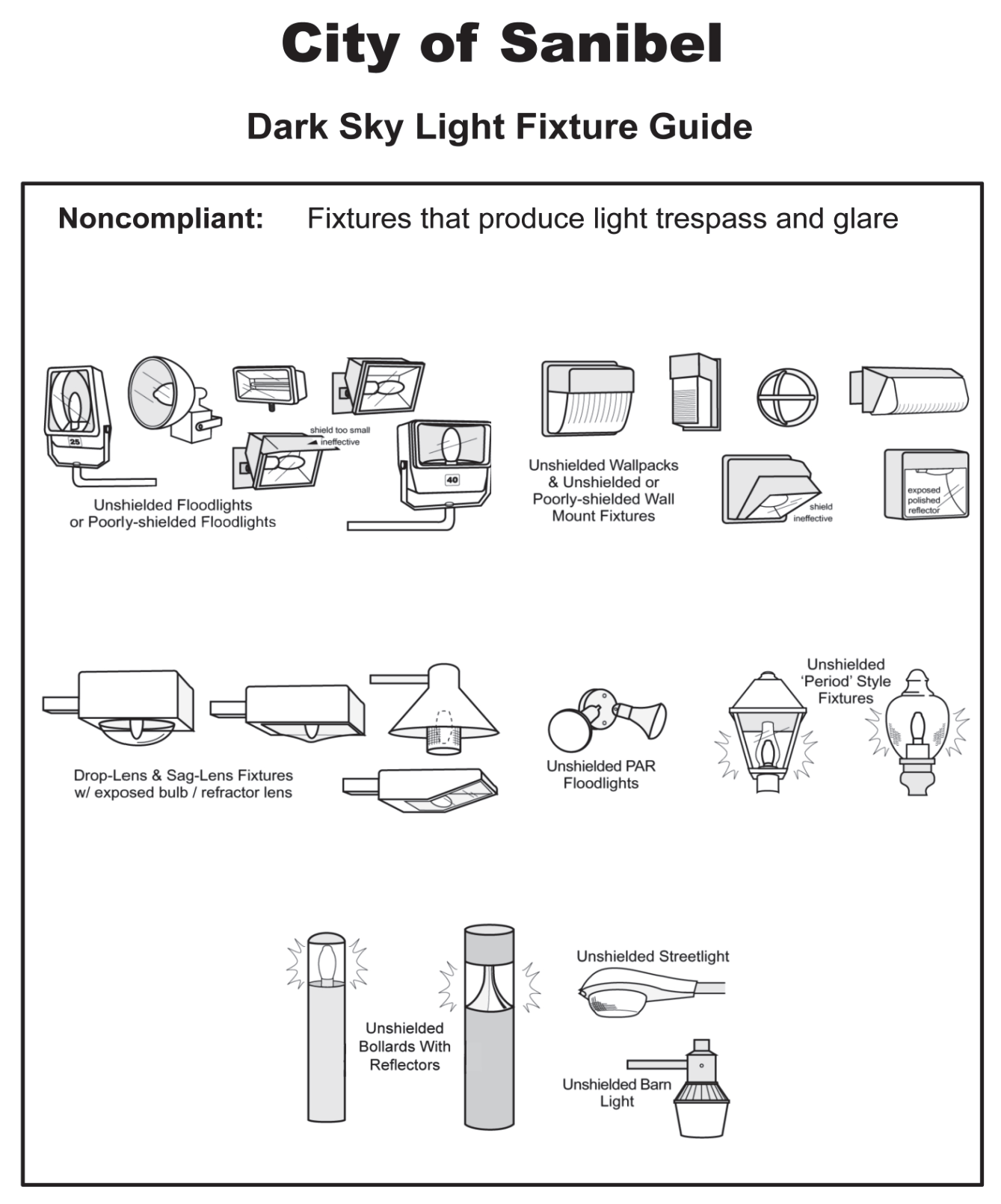
(Ord. No. 15-004, §§ 3, 4, 3-3-2015)
APPENDIX A (Continued)
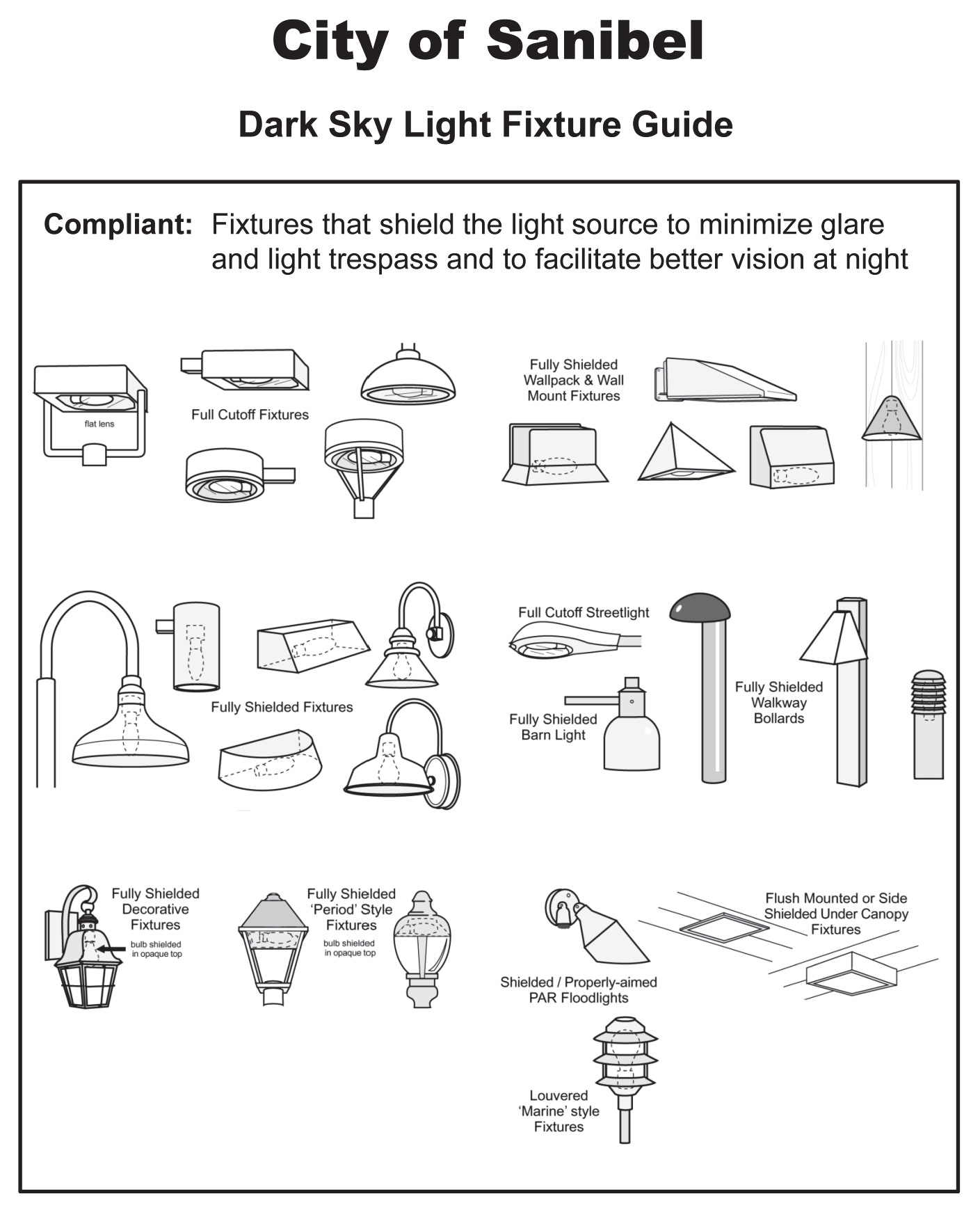
(Ord. No. 15-004, §§ 3, 4, 3-3-2015)
APPENDIX B
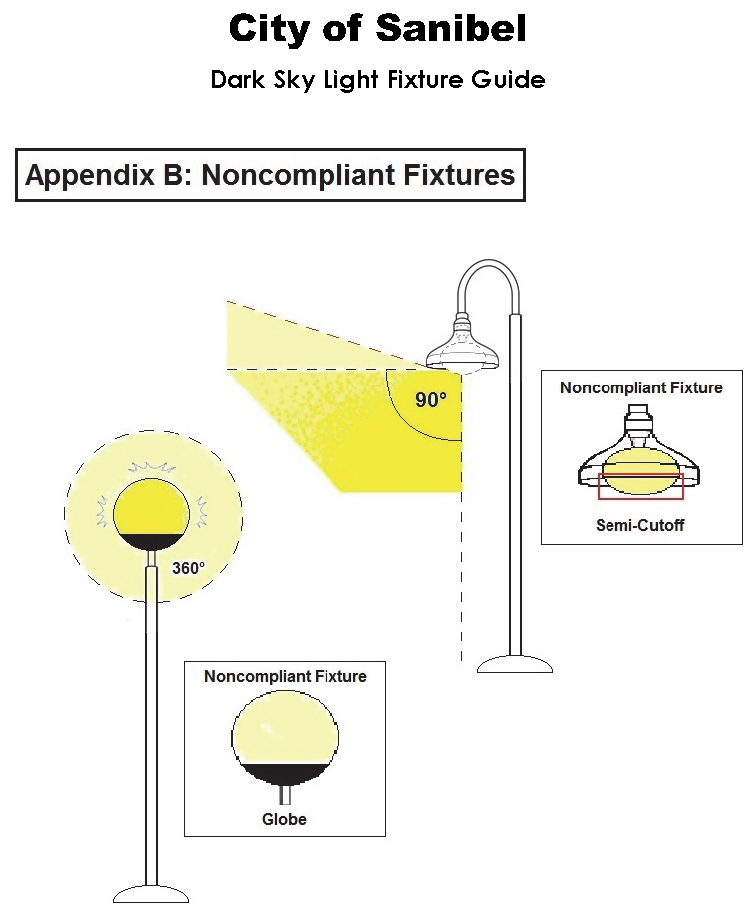
(Ord. No. 15-004, §§ 3, 4, 3-3-2015)
APPENDIX C
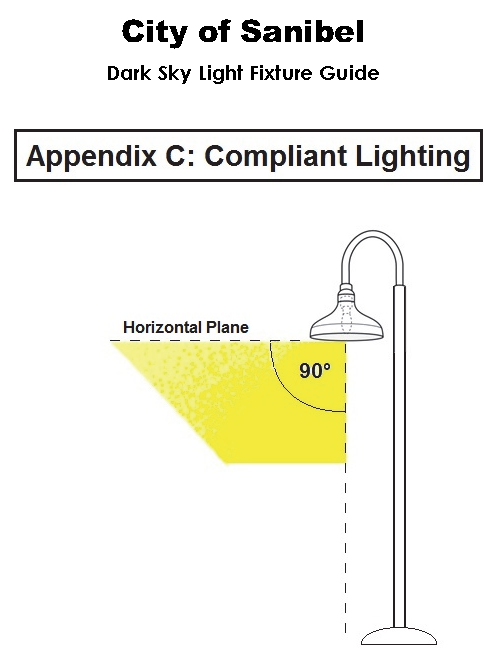
(Ord. No. 15-004, §§ 3, 4, 3-3-2015)
Sec. 126-998. - Certificate of luminaire compliance.
(a)
Purpose and intent. The purpose of this section is to provide documentation for the owner and to establish a city database of properties indicating their status with regard to luminaire compliance with the provisions of this chapter.
(b)
Applicability. Any Sanibel property owner (or owner representative) may apply for a certificate of luminaire compliance. However, obtaining a certificate of compliance is not mandatory.
(c)
Standards. The process for applying and receiving a certificate of luminaire compliance is as follows:
(1)
An application for certificate of luminaire compliance shall be submitted to the Sanibel Planning Department.
(2)
The city shall conduct an inspection of luminaires located on the applicant's property. The product of that inspection shall be a report to be kept on record with the Sanibel Planning Department, and provided to the applicant, and which includes the following:
a.
General information such as the date of the inspection and the property address and photographs of all existing fixtures; and
b.
A determination of either compliance or noncompliance; and
c.
In the case determination of noncompliance, notations regarding the type and approximate location of noncompliant fixtures.
(3)
Upon completion of a report indicating full compliance, the city shall issue a certificate of luminaire compliance which will be provided to the applicant and held on record at the Sanibel Planning Department.
(4)
Certificates of luminaire compliance shall become void upon the issuance of a building permit for work that could alter on-site luminaires or the effects of light emissions of on-site luminaires.
(Ord. No. 15-004, § 5, 3-3-2015)
Editor's note— With the inclusion of new provisions codified as § 126-998 by Ord. No. 15-004, the remaining existing §§ 126-998—126-1002 have been renumbered as §§ 126-999—126-1003 as set out herein.
Sec. 126-999. - Beach walkover lighting.
The lighting of beach walkovers is permitted seaward of the coastal construction control line but only mushroom-type light fixtures, which direct the light downward, shall be permitted. Such lighting shall also meet the following requirements:
(1)
Such fixtures shall be installed at least 25 feet apart and not more than one foot above the surface of the walkover.
(2)
Illumination shall be limited to long wavelength light sources greater than 560 nanometers in accordance with Florida Fish and Wildlife Conservation Commission (FWC) Approved Sea Turtle Lighting, as identified at http://myfwc.com/wildlifehabitats/managed/sea-turtles/turtles-lights/. Yellow "bug" type incandescent bulbs not exceeding 25 watts and yellow compact fluorescent bulbs not exceeding 480 lumens may also be used.
(Ord. No. 85-26, § 1(I.E.14), 11-27-1985; Ord. No. 15-004, § 6, 3-3-2015)
Sec. 126-1000. - Beachfront lighting for marine turtle protection—Newly installed artificial lighting sources.
Newly installed artificial light sources shall comply with the following conditions:
(1)
Artificial light fixtures shall be designed and positioned so that:
a.
The point source of light or any reflective surface of the light fixture is not directly visible from the beach;
b.
Areas seaward of a frontal or primary dune are not directly, indirectly, or cumulatively illuminated.
(2)
Exterior artificial light fixtures within direct line of sight of the beach shall be completely shielded, full cutoff, downward directed fixtures or recessed fixtures. Other fixtures that have appropriate shields, louvers, or cutoff features may also be used if they are in compliance with subsections (1)a and b of this section. Fixtures shall be equipped with long wavelength lamps greater than 560 nanometers in accordance with Florida Fish and Wildlife Conservation Commission (FWC) "FWC Approved Sea Turtle Lighting", as identified at http://myfwc.com/wildlifehabitats/managed/sea-turtles/turtles-lights/.
(3)
Floodlights, uplights, or spotlights that are directly visible from the beach, or which indirectly or cumulatively illuminate the beach, shall not be used.
(4)
Only low-intensity lighting shall be used in parking areas within line of sight of the beach. Such lighting shall be:
a.
Set on a base which raises the source of light no higher than 48 inches off the ground; and
b.
Positioned or shielded so that the light is cast downward and the source of light or any reflective surface of the light fixture is not visible from the beach and does not directly, indirectly, or cumulatively illuminate the beach.
(5)
Parking areas and roadways, including any paved or unpaved areas upon which motorized vehicles will park or operate, shall be designed and located to prevent vehicular headlights from directly or indirectly illuminating the beach.
(6)
Vehicular lighting, parking area lighting, and roadway lighting shall be shielded from, the beach through the use of ground-level barriers. Ground-level barriers must not interfere with marine turtle nesting or hatchling emergence, or cause short-term or long-term damage to the beach/dune system.
(7)
Tinted glass shall be installed on all windows and glass doors of single-story or multistory structures within line of sight of the beach.
(Ord. No. 97-08, § 3, 5-6-1997; Ord. No. 15-004, § 7, 3-3-2015)
Sec. 126-1001. - Same—Existing artificial lighting sources.
Existing artificial lighting sources shall, within 60 days after adoption of the ordinance from which this division is derived, comply with all of the following standards:
(1)
Existing artificial light fixtures shall be repositioned, modified, or removed so that:
a.
The point source of light or any reflective surface of the light fixture is not directly visible from the beach; and
b.
Areas seaward of a frontal or primary dune are not directly, indirectly, or cumulatively illuminated.
(2)
The negative effects of existing exterior artificial lighting shall be eliminated by taking such of the following measures as may be applicable:
a.
Repositioning fixtures so that the point source of light or any reflective surface of the light fixture is no longer visible from the beach;
b.
Replacing fixtures having an exposed light source with full cutoff fixtures containing recessed light sources or shields;
c.
Replacing white light sources with long wavelength light sources greater than 560 nanometers in accordance with Florida Fish and Wildlife Conservation Commission (FWC) "FWC Approved Sea Turtle Lighting", as identified at http://myfwc.com/wildlifehabitats/managed/sea-turtles/turtles-lights/. Yellow "bug" type incandescent bulbs not exceeding 25 watts and yellow compact fluorescent bulbs not exceeding 480 lumens may also be used;
d.
Replacing nondirectional fixtures with directional fixtures that point down and away from the beach;
e.
Replacing fixtures having transparent or translucent coverings with fixtures having opaque shields covering an arc of at least 180 degrees and extending an appropriate distance below the bottom edge of the fixture on the seaward side so that the light source or any reflective surface of the light fixture is not visible from the beach;
f.
Replacing pole lamps with low-profile, low-level luminaries so that the light source or any reflective surface of the light fixture is not visible from the beach;
g.
Replacing incandescent, fluorescent, and high intensity lighting with the lowest wattage low-pressure sodium vapor lighting possible for the specific application;
h.
Planting or improving vegetation buffers between the light source and the beach to screen light from the beach;
i.
Permanently removing or temporarily disabling any fixture which cannot be brought into compliance with the provisions of this division during the nesting season.
(3)
The negative effects of existing interior lighting emanating from doors and windows within line of sight of the beach shall be eliminated by taking such of the following measures as may be applicable:
a.
Applying window tint or film which meets the transmittance values for tinted glass;
b.
Rearranging lamps and other moveable fixtures away from windows;
c.
Using window treatments, such as blinds and curtains, to shield interior lights from the beach; and
d.
Turning off unnecessary lights.
(4)
For purposes of this division replacement or alteration of a nonconforming, artificial lighting structure, for the purpose of bringing such a structure into compliance with this division, shall be deemed a repair for purposes of article V of this chapter.
(Ord. No. 97-08, § 3, 5-6-1997; Ord. No. 15-004, § 8, 3-3-2015)
Sec. 126-1002. - Alternative lighting plan.
Any person may submit an alternative lighting plan as long as it demonstrates that the point source of light or any reflective surface is not directly visible from the beach and that areas seaward of the frontal, or primary, dune are not directly, indirectly or cumulatively-illuminated.
(Ord. No. 97-08, § 3, 5-6-1997; Ord. No. 15-004, § 9, 3-3-2015)
Sec. 126-1003. - Interpretation.
(a)
Where any of the provisions of this section appear to be in conflict with state laws preempting local authority, they shall not take effect until such time as the preemption is withdrawn.
(b)
Where any of the provisions of section 126-997 appear to be in conflict with another provision of this division or another provision of this Land Development Code, the provision providing the greatest protection against glare, light trespass and sky glow shall apply.
(Ord. No. 00-10, § 3, 6-6-2000; Ord. No. 15-004, § 10, 3-3-2015)
Sec. 126-1021.- Minimum size for commercial unit.
Except for resort housing accessory commercial uses approved as conditional uses in accordance with the requirements of articles II and IV of this chapter, no commercial use may be established without a minimum enclosed floor area of 300 square feet. "Enclosed floor area" means enclosed by floor-to-ceiling outside or party walls, constructed in accordance with the building code.
(Ord. No. 85-26, § 1(I.G.1), 11-27-1985; Ord. No. 86-08, § 1, 4-1-1986)
Sec. 126-1022. - Use within completely enclosed building.
(a)
Except for permitted street graphics, the location of accessory structures approved by development permit, activities conducted pursuant to special event permit issued in accordance with chapter 110, and those commercial activities designated in subsection (b) of this section, all commercial use of any parcel of land located in a commercial district, any parcel of land designated as a special use district, and any parcel of land used for a nonconforming commercial use shall be conducted within completely enclosed buildings. For purposes of this section, "commercial use" shall include any associated sales and service activity, storage, and display of merchandise, whether such merchandise is for rent or sale, is representative of merchandise for rent or sale, or is used to attract attention to the commercial use or to indicate the type of merchandise for rent or sale.
(b)
Notwithstanding the limitation of subsection (a) of this section, the following commercial activities need not be conducted within a completely enclosed building:
(1)
The use of commercial recreation facilities approved as a conditional use.
(2)
Outdoor uses approved as part of a rezoning to special use district.
(3)
Outdoor storage in conjunction with a permitted commercial use, when approved as a conditional use.
(4)
The on-site parking of motor vehicles used in conjunction with a commercial use in compliance with all regulations relating thereto. The types of vehicles permitted to be parked outside of a completely enclosed building include such things as service, delivery, and maintenance vehicles; they do not include vehicles which are for rent or sale or are representative of vehicles which are for rent or sale on the premises. The parking of vehicles which are for rent or sale, or which are representative of vehicles for rent or sale, outside of a completely enclosed building shall be permitted only as specified in subsection (b)(5) of this section, or as part of an approved conditional use.
(5)
The following uses:
a.
Retail nurseries.
b.
Lawn and garden supply stores.
c.
Gasoline service stations.
d.
Automobile dealers, new and used.
e.
Boat dealers.
f.
Recreational and utility trailer dealers.
g.
Boat and canoe rentals.
h.
Parking lots.
i.
Taxicab and public transit facilities.
j.
Automobile rentals.
(6)
Accessory gasoline pumps in compliance with the requirements and limitations of article XIV, division 14, of this chapter.
(7)
Live bait tanks.
(8)
Newspaper vending racks or machines, located in accordance with section 126-1236.
(9)
Accessory ice, water, or soft drink vending machines, limited to a total of three per principal structure, provided such vending machines do not interfere with pedestrian or vehicular circulation or obstruct entranceways or required parking or loading areas.
(10)
Outdoor seating for a restaurant.
(c)
The activities permitted to be conducted outside of a completely enclosed building, pursuant to subsection (b) of this section, shall be limited to those necessarily incidental to the conduct of the primary intended use and which reasonably require an out-of-doors storage, display, or activity. Furthermore, all areas of a lot or parcel on which such activities are permitted to be conducted outside of a completely enclosed building shall be included in the determination of the maximum permitted floor area for such lot or parcel except as specified in this subsection and shall comply with required minimum setbacks. For lawn and garden supply stores and retail nurseries, those outdoor storage areas which are not impermeable, and which are used for the storage or display of plants, trees, and other vegetation, whether or not located in shade house structures, shall not be included in the determination of maximum permitted floor area. However, those outdoor storage areas used for the sale or display of materials other than plants, trees, and vegetation shall be included in the determination of the maximum permitted floor area.
(d)
Any commercial sales or service activity, storage, or display of merchandise, which is not in compliance with the requirements and limitations of this section on the effective date of the ordinance from which the Land Development Code is derived, shall be terminated and abated within three months after such effective date, unless or until an approval is obtained under this Land Development Code for outdoor storage as a conditional use. When any application for such conditional use approval is made within three months after the effective date of the ordinance from which this Land Development Code is derived and is denied, the commercial sales or service activity, storage, or display of merchandise for which such approval was requested need not be terminated and abated until one month after such denial.
(e)
Notwithstanding anything in the subsection (d) of this section to the contrary, any outdoor display of food or clothing items shall be terminated and abated within one week after adoption of the ordinance from which this Land Development Code is derived unless and until conditional use approval is obtained.
(Ord. No. 85-26, § 1(I.G.2), 11-27-1985; Ord. No. 86-22, §§ 1, 2, 6-3-1986; Ord. No. 91-42, § 1, 10-1-1991; Ord. No. 92-10, § 1, 6-2-1992)
Sec. 126-1023. - Reserved.
Editor's note— Ord. No. 24-019, § 2, adopted Sept. 9, 2024, deleted § 126-1023 entitled "Economic and traffic impacts," which derived from: Ord. No. 85-26, § 1(I.G.3), adopted Nov. 27, 1985; and Ord. No. 86-25, § 7, adopted June 17, 1986.
Sec. 126-1024. - Maximum percentage of commercial floor area (balance and mix of businesses) occupied by formula retail stores.
In order to maintain Sanibel's economic viability and diversity, community character and unique composition of island serving commercial land uses, the total floor area of all permitted formula retail stores, as defined in section 78-1, Rules of construction and definitions, shall not exceed 60,000 square feet, unless a conditional use permit is issued by city council pursuant to section 126-102, Formula retail stores.
The city manager or the manager's designee shall maintain an inventory of commercial land uses, including formula retail stores, within the GC general commercial district, the TCG town center general commercial district and the TCL town center limited commercial district. The commercial land use inventory shall be updated on an annual basis or at the request of city council.
City council shall consult the commercial land use inventory and the Sanibel Plan, including the economic assumptions of the plan, other relevant information and a report from the planning commission when considering an application for a conditional use permit seeking an expansion of the total number of square feet devoted to formula retail uses.
(Ord. No. 06-022, § 14, 2-20-2007; Ord. No. 17-005, § 3, 11-7-2017)
Sec. 126-1025. - Maximum size for a commercial building.
The size of a commercial building shall not exceed 6,000 square feet of commercial floor area, unless conditional use approval is obtained from city council for the building, pursuant to section 126-103.
For the purposes of this regulation, the commercial floor area of a building is based on the total floor surface under roof in a structure.
For buildings occupied by both commercial and residential uses, the limitation on building size applies only to the commercial floor area and does not include residential floor area.
This limitation on maximum building size does not apply to commercial buildings occupied by the following commercial uses: grocery stores, hardware stores, restaurants, and furniture and home furnishings stores.
(Ord. No. 06-022, § 15, 2-20-2007)
Sec. 126-1026. - Maximum size for a retail commercial unit.
The size of a commercial retail unit shall not exceed 2,000 square feet of commercial floor area, unless conditional use approval is obtained from city council for the retail unit, pursuant to section 126-104.
This limitation on maximum unit size does not apply to grocery stores and food markets, hardware stores, restaurants, and furniture and home furnishings stores. This limitation does not apply to office and service commercial uses.
(Ord. No. 06-022, § 16, 2-20-2007)
Sec. 126-1027. - Maximum street frontage for a commercial unit.
The width of a commercial unit that fronts (faces) on an arterial or collector road and that is within 200 feet of that street right-of-way shall not exceed 50 linear feet, unless conditional use approval is obtained from city council for the commercial unit, pursuant to section 126-105.
The following uses that are exempt from this limitation: grocery stores, hardware stores, restaurants, and furniture and home furnishings stores.
(Ord. No. 06-022, § 17, 2-20-2007)
Sec. 126-1028. - Architectural design standards and examples.
(a)
Intent. It is the intent of these architectural standards and examples to ensure that all structures devoted to commercial and institutional uses are designed, constructed, maintained and improved in a manner that enhances the environment, visual and physical character of Sanibel consistent with the Sanibel Plan and its vision statement. (See also § 86-43(b) applicable to the appearance, size and mass of all buildings and structures.)
(b)
Application. The architectural standards and examples in this section shall apply to all new commercial and institutional buildings, whether the buildings are new development or redevelopment of existing commercial or institutional floor area within or outside of the commercial district and to nonconforming commercial uses located outside of the commercial district. These architectural standards shall also apply to an existing commercial or institutional building that is adding, or redeveloping, more than 25 percent of the commercial or institutional floor area of that building. To the extent practicable, these standards will apply to major improvements to the exterior of existing commercial or institutional use buildings that involve replacement or relocation of windows, entryways, walkways and elements of the building's facade, provided that, the improvement exceeds normal repair and maintenance. These standards do not apply to interior renovations that do not affect the external appearance of the building.
(c)
Recognition of Sanibel's "Island Style". While there is a diversity of building styles represented among the structures within City of Sanibel, some building styles more successfully represent the "community aesthetic" or what could be thought of as Sanibel's "Island Style". Four subcategories, or sub-styles, together contribute to Sanibel's "Island Style". These have been identified as Old Florida, Island Eclectic, Island Contemporary and Island Leisure.
The four subcategories are illustrative of the overall characteristics that are considered compatible with the term "Island Style". Illustrations of the architectural standards and examples are included in section 86-170. In keeping with the island's "rural" character, the buildings are typically smaller in stature and understated in design.
Old Florida. Florida "cracker" style, a vernacular architecture typified by a wood-frame house, lap siding, metal seam or shake roofs with exposed trusses, large overhangs and porches incorporated into the design.
Island Eclectic. Similar to "Old Florida" architecture, in form and materials, with design embellishments that contribute to a casual or off-beat aesthetic, often incorporating coastal themes in its design motif.
Island Contemporary. Also, similar to "Old Florida" architecture in its execution of form, using overhangs, porches, and balconies to establish functional intermediate spaces. However, this substyle is distinguished by its use of contemporary materials such as "board and batten", concrete or stucco siding, tile or metal (including copper) roof material.
Island Leisure. Style that is typified by A-frame construction and steep peaks, or use of skillion and lean-to style roofs, with wood shake or thatched roof material. Building scale is residential in nature and incorporates porches and balconies.
An attribute of all of these styles is their compatibility with issues of "sustainability" or "green architecture". For example, pronounced roof overhangs shade walls and the open spaces below, providing natural cooling; sloped roofs can accommodate a natural ventilation space between the hot sun and living spaces below; and light colored roofs reflect the sun's heat. When these building elements are combined with native plant species for landscaping, buildings and nature co-exist in harmony.
Except for reconstruction pursuant to post-disaster build-back (chapter 126, article V, division 5), all new construction or redevelopment shall demonstrate features consistent with one of the four substyles of "Island Style" architecture, including green building features.
(d)
Architectural design standards. Compliance with the following standards is mandatory:
(1)
Commercial or institutional buildings shall be designed to appear as a group of buildings that vary in scale and size.
(2)
Commercial or institutional buildings shall not appear monolithic, (unadorned walls and roof planes lacking articulation).
(3)
Commercial or institutional buildings shall have architectural features and patterns that provide: Visual interest from the perspective of the pedestrian, bicyclist, and motorist; appear to reduce building mass; and recognize and respect local character and site conditions.
(4)
Facades, horizontal and vertical. Large facades shall be broken up to present a more human scale, particularly to the public's right-of-way and beach views and the view of nearby residential uses.
Where it can be clearly demonstrated that both the horizontal and vertical screen and wall planes of a building's facade cannot be viewed from adjacent public rights-of-way, roadways, or beaches, compliance with the articulation standards of this section is not required.
Articulation of facades shall be used to vary a building's mass, in height and width, so that it appears to be divided into distinct elements and details. To achieve this standard each:
a.
Horizontal wall or screen planes in excess of 60 feet shall have an off-set with a minimum depth of six feet and a minimum to maximum length of 15 feet and 30 feet, respectively;
b.
Vertical wall or screen plane for buildings with two or more floors shall provide for the projection of architectural features such as balconies, porches, walkways, sunshades, trellises, roof overhangs, canopies or protruding or recessed openings for every vertical floor with a minimum depth of 3-½ feet and a minimum length equal to 50 percent of the width of the horizontal wall plane from which they project;
c.
Facades shall provide, through the use of detail and scale, visual interest that is consistent with the character of the community.
(5)
Building entryways and windows. Such shall be located so as not to permit noise, light and other impacts on the quiet and private enjoyment of adjacent residential uses.
(6)
Roofs and rooftop equipment.
a.
No portion of a roofs perimeter visible from public or common space (including parking areas) shall be devoted to a flat roof. Examples of roof types that achieve compliance to this standard include hip, gable, and mansard.
b.
All rooftop mechanical equipment protruding from the roof must be screened from adjacent roadways, residential use, public space, parking and common areas (not including service areas) by integrating it into a building and roof design.
(7)
Interior parking.
a.
Visual buffer/screen. All interior parking shall be visually screened from public or common space (including parking areas). Native vegetation and living walls are a preferred method consistent with sanctuary values of the Sanibel Plan.
b.
Enclosures. Any wall, panel, or structure used to enclose interior parking areas shall provide visible articulation in design, fenestration, or otherwise provide visual interest by incorporating public art, including murals or statuary.
c.
Accessibility. All interior parking areas shall:
1.
Be accessible for persons with disabilities; and
2.
Incorporate covered entry at all points of pedestrian access to the structure, including use of roof overhangs, porches or awnings; and
3.
Provide an interconnectivity path between the structure and shared use path, in cases when the subject property is directly adjacent to the shared use path.
(e)
Architectural design examples. The graphic examples provided in section 86-170 are intended only as examples to assist property owners and developers in complying with the preceding mandatory standards. None of the individual architectural features described herein are required to be incorporated into new development or redevelopment within or outside of the commercial districts.
(Ord. No. 06-022, § 18, 2-20-2007; Ord. No. 16-001, § 6, 4-5-2016; Ord. No. 16-012, § 4, 9-10-2016; Ord. No. 23-007, § 2, 3-7-2023)
Sec. 126-1029. - Site planning.
The site planning standards in this section shall apply to all new commercial developments or redevelopment. These site planning standards also apply to commercial developments that are adding, or redeveloping, more than ten percent of the commercial floor area of that development, or more than 3,000 square feet of commercial floor area.
(a)
Setbacks. Required setbacks are applicable to all portions of any structure, unless otherwise specified in the Land Development Code.
(1)
General commercial. Refer to required conditions in section 126-494.
(2)
Town Center general. Refer to required conditions in section 126-514.
(3)
Town Center limited. Refer to required conditions in section 126-534.
(4)
Special setbacks. Refer to chapter 126, article xiv, division 3, subdivision II.
(b)
Location of off-street parking, loading and service areas.
(1)
Generally, off-street parking spaces, and loading and service areas, shall be primarily located behind or at the side of commercial or institutional buildings, or under an elevated commercial structure.
(2)
At multiple frontage lots, where the front yard exists at two or more sides of the principal structure (as defined by section 78-1), the primary location of off-street parking may be permitted within one of the front yards.
(3)
The location and design of off-street parking, loading and service areas shall not impact adjacent residential uses outside the commercial district, conservation land, or wildlife habitat.
(c)
Design of off-street parking, loading and service areas. See article XV, division 4, Design Standards, for dimensional requirements and illustrations.
(d)
Site access and internal circulation.
(1)
Multiple and independent points of ingress and egress on a single arterial and collector road, or roads are not permitted, unless otherwise allowed by planning commission (i.e., conditional use, variance).
(2)
Unobstructed sight lines at points of ingress and egress shall be provided to ensure pedestrian, bicyclist, and motorist safety.
(3)
Bicycle and pedestrian access between commercial development and the shared use path (inter-connectivity) shall be established at parcels directly adjacent to a path, pursuant to administrative waiver standards in section 126-855, if necessary.
(4)
Access between commercial development sites (intra-connectivity) is encouraged, pursuant to administrative waiver standards in section 126-855, if necessary.
(5)
Functional and integrated access and internal circulation for people with disabilities shall be provided.
(6)
Safe and efficient internal pedestrian circulation to and from on-site parking spaces shall be provided.
(7)
Conveniently located on-site storage areas for bicycles shall be provided.
(e)
On-site utilities, equipment, lighting, trash containers, dumpsters and service areas, and activities. All above ground utilities, equipment, and related service facilities and operations shall be designed, located, and maintained to ensure compatibility with adjacent residential areas and other environmentally sensitive land.
(f)
Landscaping, buffering, and screening.
(1)
Vegetation buffers are required pursuant to chapter 122, article II, division 2.
(2)
Parking lot interior landscaping is required pursuant to section 126-1405.
(3)
Courtyards and lands around buildings are to be landscaped.
(4)
Service areas, HVAC, generators, trash containers, dumpsters, and other commercial equipment shall be screened from view from adjacent residential uses and environmentally sensitive spaces, off-street parking and common public space, pursuant to section 126-854, subsection 126-1029(b), and section 126-1307.
(Ord. No. 06-022, § 19, 2-20-2007; Ord. No. 23-018, § 2, 8-15-2023)
Sec. 126-1030. - Standards for compatibility with wildlife habitat, conservation land and residential areas.
It is imperative that commercial land uses, in terms of site, architectural and environmental design, blend in with the natural and residential character of the community and mitigate potential negative impacts. All plans for commercial development or redevelopment shall fully comply with the following conditions, standards, and requirements to ensure compatibility with wildlife habitat, conservation and environmentally sensitive land, and residential areas:
(a)
The required conditions established for each commercial district (sections 126-494, 126-514 and 126-534);
(b)
Limitations on amount of coverage with impermeable surfaces, vegetation removal and developed area (sections 126-494, 126-514 and 126-534);
(c)
Architectural standards (section 126-1028);
(d)
Site planning standards (section 126-1029);
(e)
Environmental performance standards (chapter 126 zoning, article XIII);
(f)
Landscaping and buffering (chapter 122 vegetation);
(g)
Outdoor lighting standards (section 126-997);
(h)
Litter (chapter 30 environment, article II); and
(i)
Noise (chapter 30 environment, article III).
(Ord. No. 06-022, § 20, 2-20-2007)
Sec. 126-1031. - Bonus outdoor seats for dining.
The purpose of this section is to establish procedures and regulations that will enable restaurants and carry-out food stores to provide portable seating, tables, and other accommodations for bonus outdoor seats for dining in addition to the number of permitted indoor seats.
(1)
Definitions.
Bonus outdoor seating means outdoor dining areas which, for the purpose of compliance, are not considered commercial floor area and are not counted in conjunction with calculation of required off-street parking spaces.
Bonus outdoor seating, incidental dining means bonus outdoor seating at a restaurant or carry-out food store comprised of 16 seats or less.
Outdoor dining means providing portable seating and tables, intended solely for the consumption of food and beverages presented by the standard menu of the restaurant, outside the exterior walls of a restaurant. Outdoor dining provided in accordance with the procedures and standards of this section shall be considered bonus outdoor seats for dining.
(2)
Applicability. Bonus outdoor seating for dining is permitted at restaurants and carry-out food stores located within a commercial zoning district where a restaurant or carry-out food store use is permitted as a conditional use. Bonus outdoor seating for dining, pursuant to this section, is also permitted where a restaurant is located outside a commercial zoning district as an existing nonconforming use or permitted use in a special use district.
Bonus outdoor seats for dining shall be associated with a permitted restaurant or carry-out food store that holds a current and valid occupational license that authorizes seating for the on-premises consumption of food.
(3)
Procedures (for initial and continued use development permits). The initial development permit required for bonus outdoor seats will expire after 24 months and the use shall be abated. To continue use of outdoor bonus seats, the applicant must apply for and obtain a subsequent development permit for bonus outdoor seats that renews, or approves with modified conditions, use of bonus outdoor seats as long as the restaurant or carry-out food service use remains active.
Reapplication for continued use of bonus outdoor seats is required to ensure that the prior use of bonus outdoor seats complied with all requirements of this section for bonus outdoor dining and all applicable requirements of the Code of Ordinances, associated with the outdoor activity.
a.
Short-form application. Short-form applications may be available to amend an approved floor plan to relocate indoor seats to outdoor dining areas; and for bonus outdoor seats for dining at commercial developments that provide, at least, the minimum number of on-site parking spaces required by this Code for the restaurant or carry-out food store, and the other uses on the site.
b.
Long-form application. Long-form applications are required for bonus outdoor seats for dining at commercial developments where the minimum number of on-site parking spaces required by this Code, for the restaurant or carry-out food store, and the other uses on the site, is not available.
c.
Applications shall be made to the city manager, or the manager's designee, in a form prescribed by the city manager. The application shall be accompanied by:
1.
A survey of the subject property;
2.
Authorization of the real property owner to make such application;
3.
A site plan delineating, at a minimum, the location, dimensions, access and number of seats and tables for outdoor dining and showing the location of landscaping for the outdoor dining area required for appropriate screening from adjoining properties; and
4.
A description of how the design and functional operation of the outdoor dining area will complement the existing restaurant or carry-out food store building and be compatible with the existing commercial center, if applicable.
d.
If the bonus outdoor seats for dining application is approved:
1.
The applicant shall obtain an amended occupational license that includes the number of permitted outdoor seats.
2.
The applicant shall obtain approval of the seating plan for outdoor dining from the Sanibel Fire and Rescue District.
3.
The applicant shall purchase additional sewer connection charges for the number of permitted outdoor seats.
4.
The city manager shall annually review occupational licenses involving outdoor dining to ensure compliance with this section and other city regulations prior to renewal.
The amended occupational license must be obtained, sewer connection fees must be paid, and approval from the fire district must be obtained prior to operation of the outdoor dining use.
(4)
Standards.
a.
The maximum number of bonus outdoor seats permitted at a carry-out food store is 16 seats.
The maximum number of bonus outdoor seats at a restaurant is 15 percent of the total permitted seats associated with the restaurant, not to exceed 32 seats, but not less than 16 seats.
b.
No food preparation shall occur within the designated outdoor dining area or anywhere outside the restaurant. All food shall be served from the kitchen of the permitted restaurant or carry-out food service. No separate bar service shall be provided as part of the outdoor dining area, except in conjunction with meal service. No disposable containers, plates, flatware, wrappers or other forms of disposable items shall be used, unless identical to the permitted indoor food and beverage service.
c.
Artificial waste products shall be properly collected, stored, and disposed of in accordance with duties of the property owner identified in section 54-33 of the Code of Ordinances. Littering is prohibited, pursuant to section 30-34 of the Code of Ordinances. Additionally, food waste shall be properly collected, stored, and disposed of to eliminate food attractants for native and nuisance wildlife.
d.
The bonus outdoor seating and tables shall be under a roof, awning or portable umbrellas.
e.
Seating and tables shall not be dispersed and shall be grouped in a defined area immediately accessible to the permitted restaurant or carry-out food service operation and located on the site of the permitted restaurant or carry-out food service use. Bonus outdoor dining shall not be located in areas that coincide with patron waiting areas or where bar service occurs.
f.
Bonus outdoor dining seats and tables shall not be moved indoors to increase the number of permitted indoor seats.
g.
Indoor seating, approved by valid conditional use permit, may be moved outdoors, provided that the total dining seat count does not increase, pursuant to short-form application review.
h.
Bonus outdoor dining seats and tables shall:
1.
Comply with special setback for outdoor dining (LDC § 126-961);
2.
Not interfere with on-site vehicular and pedestrian circulation, parking and loading areas; and
3.
Not block or restrict doors or other means of required egress for emergency purposes.
i.
Accessory structures and hardscape devoted to outdoor dining, including decking, pavers, shell or stone, and screen or lattice walls, may be permitted subject to compliance with applicable developed area and vegetation removal, coverage standards, and special setback for outdoor dining (LDC §. 126-961).
Expansion of principal structures for the purpose of providing outdoor dining may be permitted subject to compliance with applicable developed area and vegetation removal, coverage, and setback standards.
j.
Bonus outdoor seating shall be adequately buffered from off-street parking and traveled ways with use of landscaping, screen wall, fence, or other means.
k.
Provision or expansion of bonus outdoor seating greater than 16 seats shall require compliance with chapter 122 Vegetation, article II Landscaping, division 2 Commercial and Institutional Uses.
Bonus outdoor seating, incidental dining shall not require compliance with commercial landscape buffer standards.
l.
Additional signage or outdoor advertising shall not be permitted, unless otherwise exempt (LDC § 106-3), including, but not limited to, signs that are not visible from off-site.
m.
Microphones, loudspeakers or amplifiers shall not be permitted. Noise disturbances are prohibited, pursuant to section 30-64 of the Code of Ordinances and section 126-652 of the Land Development Code.
n.
Producing odors at a level which unreasonably disturbs the peaceful and healthful enjoyment of any adjoining lands is prohibited, pursuant to section 125-652 of the Land Development Code.
o.
Outdoor entertainment shall not be permitted, except as otherwise licensed by the city.
p.
All outdoor lighting shall be consistent with chapter 126 Zoning, article XIV Supplementary District Regulations, division 4, Outdoor Lighting.
q.
All tables, chairs, and umbrellas used for outdoor dining must be brought inside for storage whenever the city is under a hurricane warning.
(Ord. No. 06-009, § 1, 8-15-2006; Ord. No. 10-005, § 1, 5-4-2010; Ord. No. 21-007, § 4, 10-5-2021)
Sec. 126-1032. - Mixed-use development.
(a)
Mixed-uses development shall be designed to minimize, to the extent practical, the potential detrimental influence of commercial or institutional uses on residential uses, including the location of entranceways and the use of soundproofing materials.
(b)
Dwellings units may be located above commercial or institutional uses in the same structure, upon conditions that dwelling units are designed and separated to limit conflicts with commercial and institutional use activity on-site, such as providing independent points of building ingress-egress.
(c)
Dwelling units may be permitted up to the maximum number of dwelling units permitted by the development intensity map, provided the maximum permitted commercial floor area is reduced by 1,000 square feet for each dwelling unit. A condition to reduce maximum permitted commercial floor area by 1,000 square feet is not applicable if dwellings units are committed to the below market rate housing rental program.
(d)
To incentivize affordable housing in the TCG town center general and TCL town center limited commercial districts, development of the maximum number of dwelling units permitted by the development intensity map and placement of all units in the below market rate housing rental program shall allow for bonus (commercial) floor area ratio to a maximum 25 percent (overall).
(Ord. No. 24-005, § 2, 3-5-2024)
Sec. 126-1075.- Definitions.
The following terms and phrases, whether or not in capitalized text, when used in this division will have the following meanings:
Dwelling rental means a dwelling unit that is rented or advertised for rent, including limited rentals and unlimited rentals, but does not include hotel or motel rooms.
Dwelling rental use means a use of a dwelling unit that is rented, leased or exchanged.
Dwelling unit has the same meaning as provided in F.S. § 83.43 (as may be amended).
Limited rental means a dwelling unit that has a limit to the frequency of change or length of stay of occupants or tenants.
Occupant means any lessee, tenant or other person who, for consideration, occupies a dwelling unit.
Owner means the fee simple owner of any dwelling unit as reflected by the public records of Lee County, Florida.
Property manager means any person other than an owner who is responsible for the leasing, advertising for leasing, or day-to-day maintenance and operation of a dwelling rental.
Unlimited rental means a dwelling unit that is a permitted resort housing use in compliance with this Code and has no limit to the frequency of change or length of stay of occupants or tenants.
(Ord. No. 19-007, § 2, 10-2-2019)
Sec. 126-1076. - Availability of resort housing use; evidence of use.
(a)
Each unit of resort housing is a dwelling unit, whether denominated a hotel or motel room, apartment, condominium unit, cooperative unit, timeshare unit, single-family unit, or otherwise, including each room rented in a dwelling unit, e.g., "bed and breakfast" arrangements.
(b)
Where resort housing is a permitted use in compliance with this Code, including the requirements of article XII of this chapter, there is no limit to the frequency of change or length of stay of occupants or tenants. Where resort housing is not a permitted use or is not in compliance with this Code, including the requirements of article XII of this chapter, dwelling units may not be made available for rental for periods of less than four consecutive weeks.
(c)
The following shall be prima facie evidence that a unit is being used as resort housing:
(1)
Advertising a unit as being available for rental for periods of less than four consecutive weeks.
(2)
Recording or filing land use covenants, condominium declarations, cooperative documents, public offering statements, or other legal documents which sanction authorize, or approve rental of a unit for periods of less than four consecutive weeks.
(3)
Creation of timeshare estates for periods of less than four consecutive weeks.
(d)
A violation of this section shall be punishable as a second degree misdemeanor and by a fine of up to $500.00 per day, per unit, per violation. Code enforcement may also enforce the terms of this section by bringing the case to a special master or by citation under F.S. § 162.21 (as may be amended), and 76-435 Laws of Florida (as may be amended) or by any other means allowable by law. If a code enforcement notice of violation is issued, the fine shall be $250.00 per day for a first offense and $500.00 per day for a second offense. In the case of arranging of, contracting or advertising for, or the making available of, the use of a dwelling unit in violation of this section, the fines shall be computed on the basis of the number of days of rental which would have been in violation of this section.
(e)
In addition to any other remedy available to the city (including code enforcement pursuant to F.S. ch. 162). The city or any other adversely affected party may enforce the terms of this section in law or equity. Any citizen of the city may seek injunctive relief in a court of competent jurisdiction to prevent a violation of this section. Attorney's fees and costs incurred in an action to enforce these regulations concerning resort housing use(s) may be awarded to a substantially prevailing party in the discretion of the court.
(Ord. No. 85-26, § 1(I.B.2), 11-27-1985; Ord. No. 01-09, § 2, 6-19-2001)
Sec. 126-1077. - Initial registration of dwelling rentals.
(a)
Generally. Every owner of a dwelling rental within the city shall initially register the use with the city to obtain a dwelling rental license. No dwelling rental use may continue unless it has been registered in accordance with this section.
(b)
Registration. The form of the registration shall be determined by the director of the community services department and shall require the following:
(1)
The name and contact information of the owner.
(2)
The name and contact information of the owner's property manager, if any.
(3)
The physical address and parcel identification number of the dwelling rental.
(4)
A copy of the city's active business tax receipt for the dwelling rental.
(5)
A copy of all necessary county licenses or taxes, including, if applicable, evidence of the dwelling rental's active account with the Lee County Tax Collector for the purposes of collecting and remitting tourist development taxes and any other taxes required by law to be remitted to the Lee County Tax Collector.
(6)
A copy of all necessary state licenses or taxes, including the following, if applicable:
a.
A copy of the dwelling rental's active certificate of registration with the Florida Department of Revenue for purposes of collecting and remitting sales surtaxes, transient rental taxes, and any other taxes required by law to be remitted to the Florida Department of Revenue; and
b.
A copy of the dwelling rental's active license as a transient public lodging establishment with the Florida Department of Business and Professional Regulation.
(7)
A signed and notarized acknowledgment that the owner has read and fully understands the city's rental use regulations.
(c)
Fees. Registration fees for dwelling rentals shall be established by resolution of the city council and are not required to be in equal amounts for limited rentals and unlimited rentals. The registration fee shall be paid upon submission of the registration form and documents required by this section. Funds collected from the registration fee shall be used for code compliance related to dwelling rental uses. For purposes of this section, code compliance shall also include all activities required to process the applications, inspections, and prosecutions.
(Ord. No. 19-007, § 2, 10-2-2019)
Sec. 126-1078. - Dwelling rental license.
(a)
Generally. Every owner operating a dwelling rental use within the city must obtain a rental license and maintain the license during all terms of rental.
(b)
Initial license. Upon the city's processing and approval of a properly completed initial registration and registration fee in accordance with section 126-1077, a dwelling rental license shall be issued in the name of the owner.
(c)
Term of license. Each dwelling rental license shall have a term of one calendar year, from January 1—December 31, and must be renewed by the owner prior to the expiration in order to avoid interruption of permitted dwelling rental activity.
(d)
Renewal. The form of the application to renew a dwelling rental license shall be determined by the director of the community services department and shall be substantially similar to the initial registration application required in this section 126-1077.
(e)
Fees. Renewal dwelling rental license fees shall be established by resolution of the city council and are not required to be in equal amounts for limited rentals and unlimited rentals. The renewal license fee shall be paid upon application for each rental license renewal. Funds collected by the renewal license fee shall be used for code compliance related to dwelling rental uses. For purposes of this section, code compliance shall also include all activities required to process the applications, inspections, and prosecutions.
(f)
Delinquent license. Dwelling rental licenses not renewed when due and payable are delinquent and subject to a delinquency penalty of ten percent for the first month of delinquency, plus a four percent penalty for each subsequent month of delinquency until paid. However, the total delinquency penalty may not exceed 18 percent of the license fee. During the period of delinquency, the dwelling rental license is deemed inactive and no rental activity may occur. A dwelling rental that does not have its license renewed within a year of its term will be ineligible for renewal and must re-register.
(g)
License advertisement. All advertising of dwelling rentals shall require identification of city license number.
(h)
Transferability. Dwelling rental licenses are not transferrable. Upon transfer of ownership of a dwelling rental (in whole or in part), such transfer shall result in termination of the license.
(i)
Enforcement. A violation of this section shall be punishable in the same manner as described in section 126-1076.
(j)
Construction. This section shall be liberally construed to accomplish its purpose of protecting the residential character of Sanibel, the health, safety, and general welfare of its residents and visitors, and the quiet enjoyment by Sanibel's residents of their residential property.
(Ord. No. 19-007, § 2, 10-2-2019)
Sec. 126-1096.- Criteria.
Development involving the creation of a timeshare unit is permitted only upon compliance with the following:
(1)
If the dwelling unit is or will be located in a building wherein such unit is owned in connection with a condominium regime, the developer must establish that the condominium declaration and sales prospectus contains a statement, in conspicuous type, declaring that the timeshare estates will or may be created with respect to such units in the condominium regime.
(2)
If the development involves the conversion of an existing dwelling unit which is subject to a condominium regime, the developer must establish that there has been an amendment to the condominium declaration that permits timeshare estates to be created, which amendment has been executed by each record owner of each unit subject to the condominium regime and by each record owner of each lien affecting each such unit.
(3)
A timeshare estate can only be established in a dwelling unit, if all dwelling units in the building in which that timeshare unit is to be located are also timeshare units. However, if the residential development includes units that are in single family dwellings, duplexes and multi-family buildings of four dwelling units or less, all units in the development, except for one on-site management unit, shall be timeshare units.
(4)
If timeshare estates are created, the dwelling unit must be located in the resort housing district and the requirements of article XII of this chapter must be met.
(Ord. No. 85-26, § 1(I.E.15), 11-27-1985; Ord. No. 87-02, § 8, 1-6-1987; Ord. No. 06-001, § 1, 3-21-2006)
Sec. 126-1176.- Generally.
Home occupations shall be permitted in all lawful dwelling units. Home occupations including any lawful activity, provided that nothing shall be visible or otherwise detectable from outside the structure to indicate that the residential dwelling is being used for other than residential purposes, except that a one-foot square nameplate graphic may be attached to the residence structure at or near the appropriate entrance. No mechanical equipment which constitutes a nuisance or otherwise interferes with the normal and comfortable use of adjacent residential uses, other than customary mechanical equipment used in connection with normal residential purposes, shall be installed or used. Home occupation shall not be allowed more than one parking space in addition to the parking required for the residential use.
(Ord. No. 85-26, § 1(I.I.11), 11-27-1985; Ord. No. 24-019, § 2, 9-9-2024)
Sec. 126-1216.- Generally.
Notwithstanding any limitation of this Land Development Code on the location of structures, the regulations in this division shall apply to the placement and maintenance of mailboxes.
(Ord. No. 85-26, § 1(I.E.30), 11-27-1985)
Sec. 126-1217. - Along local streets.
Along all local streets, each dwelling unit and each commercial unit occupying any parcel or lot is granted a revocable license to locate in the right-of-way, for one street upon which such lot or parcel has street frontage, a mail receptacle in compliance with the following regulations and conditions:
(1)
The mail receptacle must be of a type approved by the United States Postal Service in the domestic mail manual.
(2)
The receptacle and any post or mounting to which it is affixed must be located so as to provide the minimum possible obstruction to traffic visibility and safety.
(3)
The mail receptacle may be mounted upon a post or other structure no larger than the minimum size necessary to safely and securely support the mail receptacle, but may contain or include minor decorative or design features which are in harmony with the character and ambiance of the neighborhood in which the mail receptacle is located and which do not pose a threat to traffic safety and visibility.
(4)
No part of any mail receptacle or mounting structure may protrude over the paved or traveled part of a street.
(5)
All multifamily developments and all commercial developments containing more than two commercial units must have all mail receptacles mounted on one post or structure.
(Ord. No. 85-26, § 1(I.E.30(a)), 11-27-1985)
Sec. 126-1218. - Along Periwinkle Way and Causeway Road.
Because of the high volume of traffic along Periwinkle Way and Causeway Road, and because of the hazard to traffic safety created by the stopping and starting of mail delivery vehicles and the interference by such vehicles with the use of bike paths, no mail receptacles may be located or maintained in the public right-of-way of Periwinkle Way or Causeway Road. All mail receptacles for properties fronting such streets shall be located in such fashion that mail delivery vehicles shall have safe and convenient access to such receptacles and sufficient turnaround area off the public right-of-way. Such receptacles may be located within front yard setbacks. This subsection shall not, however, be applicable to single-family dwelling units on individual lots, the mailboxes for which shall be located in accordance with section 126-1219.
(Ord. No. 85-26, § 1(I.E.30(b)), 11-27-1985)
Sec. 126-1219. - All other streets.
Along any street other than those provided for in sections 126-1217 and 26-1218, mail receptacles may be located off the right-of-way in accordance with the limitations of section 126-1218. However, each dwelling unit and each commercial unit on any lot or parcel located along such streets is granted a revocable license to locate and maintain a mail receptacle in the public right-of-way of one street, upon which such lot or parcel has street frontage, in conformance with the following regulations and conditions:
(1)
All conditions and limitations specified in section 126-1217 must be met.
(2)
Mail receptacles must be located in such a fashion that, between the mail receptacles and the paved or traveled portion of any street or bikepath, there is sufficient room for a mail delivery vehicle to park.
(Ord. No. 85-26, § 1(I.E.30(c)), 11-27-1985)
Sec. 126-1220. - Removal or relocation.
The city manager is authorized and directed to require the removal, relocation or reconfiguration of all or any part of any mail receptacle or supporting structure which does not meet the requirements of this division. Any decision of the city manager under this section may be appealed to the city council within 15 days thereafter.
(Ord. No. 85-26, § 1(I.E.30(d)), 11-27-1985; Ord. No. 03-014, § 6, 9-16-2003)
Sec. 126-1236.- Placement generally.
Small, standard-sized newspaper vending racks or machines may be located and maintained on any privately-owned property within the city, provided they are not placed so as to interfere with the safe and convenient traffic circulation and provided they contain no street graphic other than identification of the newspaper being circulated thereby.
(Ord. No. 85-26, § 1(I.E.31(a)), 11-27-1985)
Sec. 126-1237. - Requirements and conditions.
Newspaper vending racks and machines may be placed in public rights-of-way and publicly-owned areas only in compliance with the following requirements and conditions:
(1)
Such racks and machines may not be placed in public rights-of-way unless there is sufficient cleared area between them and the paved or traveled portion of any street or bikepath for an automobile to safely park.
(2)
Such racks and machines may not pose any threat to traffic visibility or safety or impede vehicular movements.
(3)
Such racks and machines may not contain any street graphic other than an identification of the newspaper being circulated thereby.
(4)
Such racks and machines may not be placed in any public beach area.
(5)
Such racks and may not be placed in or around any publicly-owned building, except where designated by the city manager. The city manager is hereby authorized and directed to require such machines in or around public buildings to be located in such fashion as provides convenient access thereto but which does not interfere with vehicular or pedestrian circulation, does not impede access to any public facility, and does not detract from the aesthetic appearance of the building and its associated vegetation and grounds.
(Ord. No. 85-26, § 1(I.E.31(b)), 11-27-1985)
Sec. 126-1291.- Generally.
No commercial use may include accessory gasoline pumps, including pumps for the sale of any type of motor vehicle fuel, except in compliance with the requirements and limitations in this division.
(Ord. No. 85-26, § 1(I.G.6), 11-27-1985)
Sec. 126-1292. - Location of access driveway.
No access driveway to the parcel upon which the accessory gasoline pumps are located shall be any closer than 200 feet to the intersection of Periwinkle Way with Causeway Road, Beach Road, Donax Street, Dixie Beach Boulevard, Casa Ybel Road, Palm Ridge Road, or Tarpon Bay Road, or the intersection of Tarpon Bay Road with Palm Ridge Road.
(Ord. No. 85-26, § 1(I.G.6(a)), 11-27-1985)
Sec. 126-1293. - Location of fuel pumps and islands.
All fuel pumps and pump islands, as well as adequate area for the parking of vehicles next to such pumps, shall be located within minimum required setbacks and shall be counted toward the maximum permitted commercial floor area for the parcel.
(Ord. No. 85-26, § 1(I.G.6(b)), 11-27-1985; Ord. No. 86-25, § 10, 6-17-1986)
Sec. 126-1294. - Parking and driveway areas.
Parking and driveway areas shall be designed so that one automobile can wait at each pump or pump island, behind a vehicle being refueled, without interfering with on-site or off-site traffic circulation.
(Ord. No. 85-26, § 1(I.G.6(c)), 11-27-1985; Ord. No. 86-25, § 10, 6-17-1986)
Sec. 126-1301.- Generally.
Where swimming pools are permitted as a principal or accessory structure, the swimming pool may be elevated above the predevelopment grade of the parcel on which it is to be located, in accordance with the requirements and procedures of this division.
The procedures and requirements of this division apply to swimming pools that have a pool basin larger than 125 sq. ft.
Swimming pools, including swimming pools that are elevated above the ground, are required to comply with section 86-43, appearance of structures; size and mass of structures and the specific design and landscape requirements of section 126-1302, requirements and procedures.
(Ord. No. 06-003, § 1, 5-16-2006)
Sec. 126-1302. - Requirements and procedures.
(a)
Procedures.
(1)
Short-form application. After acceptance of the development permit application for an elevated pool that is higher than three feet, six inches above predevelopment grade of the parcel, notice of the filing of the application will be mailed to: adjacent property owners; and any applicable homeowners association, if the elected official of the homeowners association has been registered with the city; not less than 14 days prior to approval of the development permit.
(2)
Findings detailing compliance or any non-compliance of the application with the requirements in this section shall be included as part of the development permit review.
(b)
Requirements. All elevated swimming pools shall comply with the following requirements:
(1)
Height. Any swimming pool elevated higher than three feet, six inches above the ground cannot be higher than the lowest floor of the associated structure. For the purpose of this height limit, a mid-level entry, or other area devoted only to building access, shall not be considered the lowest floor, even if constructed above the base flood elevation.
(2)
Interpretive design guidelines. To ensure that the appearance, size, and mass of elevated swimming pools do not "interrupt the rhythm of existing structures" and will be in harmony "with the general atmosphere and character of the established neighborhood", the following interpretive design guidelines have been established. These interpretive guidelines have been established to ensure conformity with section 86-43 of this [Land Development] Code and the Sanibel Plan and consistency during design review for compliance.
a.
The exterior architectural detailing and materials used for the elevated swimming pool provide continuity of design between the attached, or detached, swimming pool and the existing or proposed residential structure.
b.
The plans, including the site plan, construction plans, and landscaping plan, fully integrate the design for the principal and accessory structures in a manner that responds to and reinforces the characteristics of the site and surrounding neighborhood.
c.
The location, scale, and orientation of the swimming pool respects the lot area, configuration, and other existing conditions of the parcel on which it is to be located, as well as the relationship of the swimming pool to adjoining and nearby properties, in terms of building dimensions and proportions, roof lines, access to light and air, and overall visual and physical continuity.
d.
Where the parcel on which the swimming pool is to be located is partially in a preservation district (the Gulf Beach Ecological Zone or Bay Beach Ecological Zone), the architectural and landscape plans shall maintain, restore, or reinforce the environmental functions of these preservation districts, as well as respond to the existing conditions of the site and surrounding neighborhood.
(3)
Landscape requirements. A landscape plan that effectively screens all exposed sides of the swimming is required. The landscape plan shall be reviewed for consistency with the above interpretive design guidelines. The landscape plan, through the preservation, and planting, of appropriate native trees and plants shall provide a vegetative screen around the perimeter of the proposed structure. The vegetative screen shall:
a.
Reduce the visual impact of the attached, or detached, accessory swimming pool;
b.
Compliment the architectural design of the principal structure; and
c.
Provide continuity with existing vegetation and proposed landscape elements of the parcel on which the swimming pool is to be located.
(Ord. No. 06-003, § 1, 5-16-2006; Ord. No. 18-004, § 1, 5-1-2018; Ord. No. 23-010, § 2, 8-15-2023)
Sec. 126-1305.- Purpose.
The purpose of this division is to establish application requirements and procedures for the installation of heating, ventilation, and air conditioning (HVAC) units and electrical power generators.
In the interest of public safety and the general welfare, providing air conditioning and emergency electrical power is encouraged and shall be accommodated. To that end, the city manager or the manager's designee is authorized to approve deviations from limits on: (1) impermeable coverage; and (2) developed area and vegetation removal to facilitate the issuance of a development permit for such air conditioning or emergency electrical power service. Such deviations may be issued only upon a finding by the city manager, or the manager's designee, that the standards of section 126-1307 have been met.
In considering applications that include an administrative waiver under this section, no administrative waiver shall be approved that frustrates the underlying purpose and intent or policies of the city, including the Sanibel Code and Sanibel Plan. The city manager or the manager's designee is authorized to attach conditions to the approval, as necessary, to verify compliance with required setbacks via as-built survey and to address unlawful noncompliance to limitations on (impermeable) coverage and vegetation removal and developed area.
This division establishes standards for the operation, placement, screening and sound attenuation of emergency electric power generators to minimize their visual and noise impact upon abutting properties.
(Ord. No. 22-004, § 2, 6-7-2022)
Sec. 126-1306. - Application and procedure.
(a)
Procedure.
(1)
No development permit is required for the operation of a portable electrical power generator.
(2)
A development permit and building/electrical permits are required for the installation of a permanently installed electrical power generator.
(3)
A short form development permit application may be available for a permanently installed emergency electrical power generator that complies with the standards set out in section 126-1307 standards.
(4)
A long form development permit application is required for an electrical power generator intended for unrestricted use.
(b)
Application. In addition to the requirements found in sections 82-381 and 82-382, an application for a permanently installed electrical power generator shall include the following:
(1)
Site development plan. Site development plan shall include:
a.
A plan to visually buffer the equipment from view off-site.
b.
The sound barrier wall, if needed to meet the allowable maximum permissible sound pressure levels established in section 126-1307, and is to:
c.
Demonstrate compliance with all required setbacks from property lines and indicate the relationship of the generator's location to any dwelling unit or structure within 20 feet of the generator.
(2)
Identification of the generator's manufacturer, model name and number, and load capacity or running watts.
(3)
The manufacturer's certification of sound pressure (noise) level expressed in dB(A) at seven meters (23 feet), with the generator operating under normal or average load.
(4)
Generator or HVAC stand type, including, but not limited to, aluminum stand, wooden platform, hurricane/concrete pad.
(5)
Documentation of compliance with Florida Building Code (F.B.C.) and National Electric Code (N.E.C.).
(6)
Equation for calculation of sound pressure levels for electrical power generators.
The sound pressure level shall be computed using the following equation for calculating the "Generator's Sound Pressure Level [dB(A)] at the Property Line":
Generator's corrected dB(A) = Gen + A + B + C
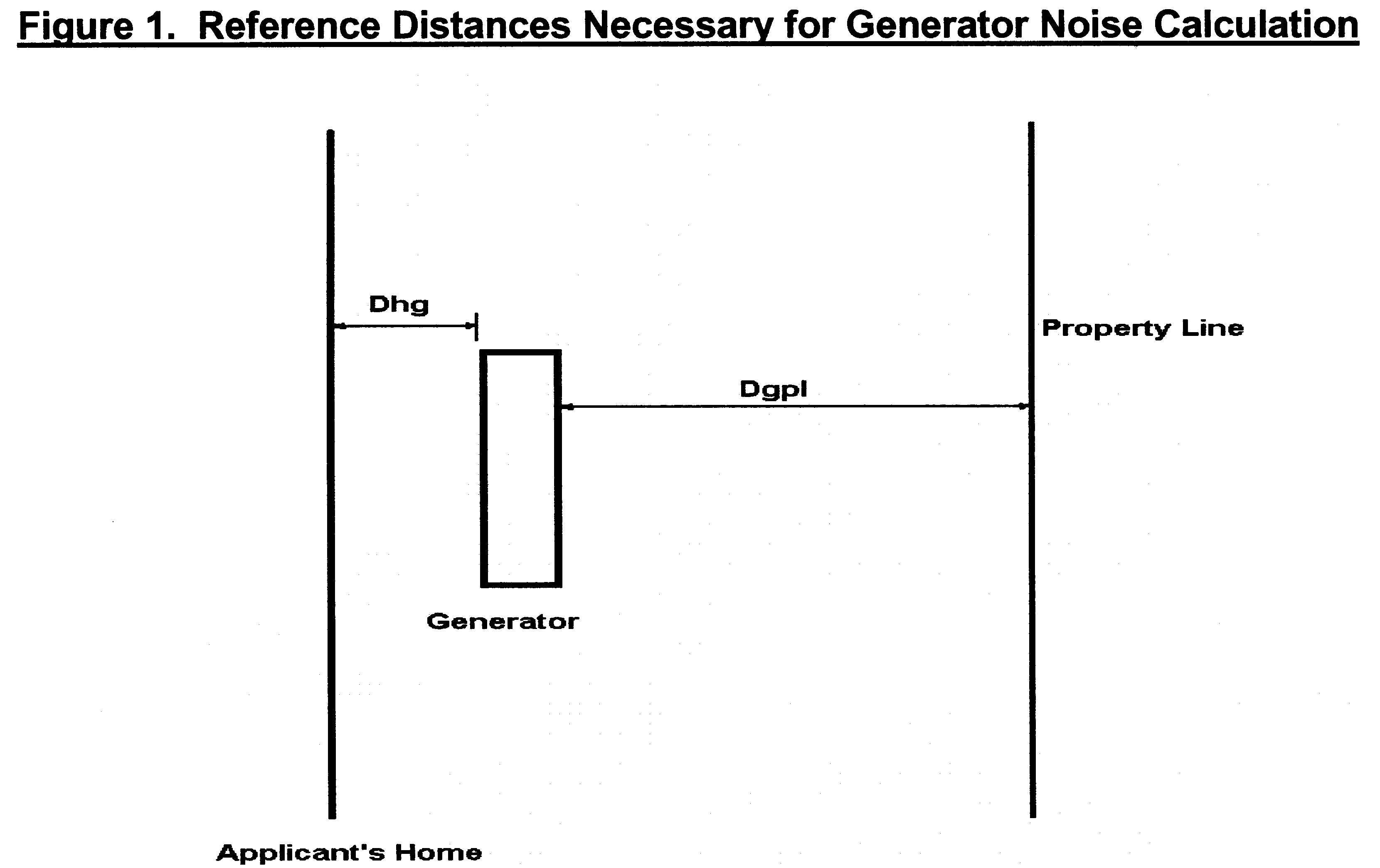
Four major components are necessary for estimating the generator's sound level at the applicant's property line:
"Gen" = The generator manufacturer's sound level data. These data must be in the form of A-weighted sound level, or dB(A), at seven meters (23 feet) from the generator in a free-field environment.
"A" = A correction for the closest actual distance from the generator's surface to the applicant's property line
"B" = A correction for reflective sound based on the distance the generator is located relative to the wall of a structure or the applicant's home
"C" = A correction for a sound barrier constructed such that it fully blocks the line of sight to the generator when viewed from the applicant's property line (if applicable).
The input for the terms "A", "B" and "C" in the Generator Sound Pressure Level [dB(A)] at the Property Line Equation are provided in Tables 1 through 3, respectively.
Table 1. Correction ("A") for Distance
from Generator to Property Line
* Select distance equal to or just less than the actual distance the generator is located from the closest point to the nearest property line. For example, if the generator's closest surface is located at an actual distance of 45 feet from the property line, a value corresponding to the 43 feet correction [minus -5dB(A)] from Table 1 must be used.
Table 2. Correction ("B") for Reflected
Sound from Applicant's Home
Table 3. Correction ("C") for Presence
of a Sound Barrier Wall
* A sound barrier wall can only be used for input in the calculation of the "Generator's Sound Pressure Level [dB(A)] at the Property Line Equation" for an emergency electrical power generator that is located so that the bottom of the generator is no higher than four feet above the finished grade of the ground. The sound barrier wall must extend from the ground to a minimum of two feet higher than the top of the generator and extend a minimum of two feet past the sides of the generator. A sound barrier wall must have no gaps, holes or penetrations. Walls of masonry, concrete block or wood construction meeting the above requirements are considered adequate. Foliage is not an adequate sound barrier.
(Ord. No. 22-004, § 2, 6-7-2022)
Sec. 126-1307. - Standards.
(a)
Noise.
(1)
An emergency electrical power generator operating when the primary electric service (Lee County Electric Cooperative) is disrupted, or during the generator's performance testing cycle, shall not exceed a maximum sound pressure level of 78 dB(A), when measured at any point of any property line.
(2)
Electrical power generators for general, unrestricted use are subject to the maximum permissible sound levels established in chapter 30, article III, section 30-64 of the city's Code of Ordinances. Unrestricted use means that there are no restrictions on the operation of an electrical power generator which limit its use to times when the primary electrical service is out or for the performance testing cycle of the generator.
(b)
Use. The exercise cycle of the generator shall occur only between the hours of 10:00 a.m. and 5:00 p.m., Monday through Saturday.
(c)
Required setbacks.
(1)
Front yard. There shall be a front yard setback for generator and air conditioning machinery and associated structure of no less than 75 feet from the centerline of minor arterial or collector roads and 50 feet from the centerline of any other street, except where a special setback is imposed, as set forth in article XIV, division 3, subdivision II, of this chapter.
(2)
Side and rear yard. There shall be side and rear yard setbacks for generator and air conditioning machinery and associated structure of no less than ten feet from any such property line.
(3)
Open body of water. The accessory structure shall not be located within 20 feet of any open body of water.
(d)
Coverage; vegetation removal and developed area.
(1)
Administrative waiver of applicable limitations of (impermeable) coverage, vegetation removal and developed area may be issued specifically for HVAC and emergency electrical power generators up to 30 square feet for each respective improvement.
Such waiver is applicable to proposed emergency electrical power generator improvements at developed properties, subject to the following criteria:
a.
Properties developed after the effective date of this section are not eligible for an administrative waiver but may request approval of a variance subject to the process and criteria pursuant to chapter 82, article III, division 3, subdivision 11, and approval by the planning commission.
b.
The applicant's request must be able to identify the specific hardship or practical reason for not being able to meet the regulation as a result of the particular shape, size, location or topography of a lot or parcel, or of a structure thereon, which would cause practical difficulties that would deprive the owner of reasonable use and enjoyment of such lot or parcel in the same manner as other properties similarly situated;
c.
The applicant's request must be able to identify any special conditions related to unusual constraints peculiar to the specific lot or parcel or relate to special conditions of the structure involved, and that are not generally applicable to other lands or structures similarly situated;
d.
The proposed waiver shall not be adverse to the developed neighborhood scheme and will not adversely affect the plan and scheme set forth in this Land Development Code, and will not cause the proposed development to be inconsistent with the Sanibel Plan nor adverse to the health, safety and general welfare of the community; and
e.
The waiver granted must be the minimum necessary to mitigate the hardship demonstrated.
(e)
Visual buffer. The generator shall be effectively screened from views from off the subject property by a sound barrier wall, a fence, vegetation or other means.
(1)
Sound barrier walls that are higher than six feet above the ground shall comply with the setbacks required for the principal structure.
(2)
Sound barrier walls shall be architecturally compatible with the principal building and effectively screened from the adjacent property by use of native vegetation.
(Ord. No. 22-004, § 2, 6-7-2022)
Sec. 126-1308. - Administration and enforcement.
The city manager, or the city manager's designee, is expressly authorized and directed to make use of Code of Ordinances, section 14-91 outside professional review of licenses and permits, to assure the procedures and standards of this division 16 emergency electrical power generators are properly applied.
No completion certificate or other final city approval shall be issued by the city manager, or city manager's designee, for a permanently installed electrical power generator until the city has measured the sound pressure level of the permitted generator and determined that it complies with the permit and the standards in section 126-1307. A permanently installed electrical power generator must remain in compliance with the permit and the standards in section 126-1307.
The measurement of sound pressure levels shall be performed in conformance with Code of Ordinances, section 30-67 measurement of sound pressure levels.
(Ord. No. 22-004, § 2, 6-7-2022)
Sec. 126-1311.- Intent and purpose.
It is the intent and purpose of this division to protect the health, safety and welfare of the citizens of the city, reduce the potential for economic decline as a result of public nuisances on improved parcels, protect the aesthetic standards deemed essential by the Sanibel community, and to preserve and protect property values within the City of Sanibel.
(Ord. No. 13-003, § 1, 8-6-2013)
Sec. 126-1312. - Definitions.
The following terms, whether or not in capitalized text, when used in this division will have the following meanings, except where the context clearly indicates and requires a different meaning:
Building means a structure which is designed, built or occupied as a shelter or roofed enclosure for persons, animals or property; or a shelter located on a foundation or other support and used for residential, business, mercantile, storage, commercial, professional, industrial, institutional, assembly, educational or recreational purposes.
Enforcing official means the city manager, or designee.
Improved property means property which has located upon it a building, structure or other physical improvements.
Inspection means a close viewing of the property and the exterior of any structures located thereon from any legal vantage point and includes viewing of any interior portions of the structure which are visible from the outside of the structure.
Nuisance means any item, thing, manner, or condition whatsoever that is injurious to health, indecent, offensive to the senses, or an obstruction to the free use of property, so as to interfere with the comfortable enjoyment of life or property or could otherwise be a hazard to the public health, safety or general welfare.
Owner means every person or entity which, alone or jointly with others, has legal or equitable title to any property, dwelling, dwelling unit, mobile dwelling unit, building, or structure.
Person in charge: Unless otherwise required by the context, shall mean and be deemed to include a property owner, agent, occupant, lessee, contract purchaser, or other person having possession or control of property.
Property means any real property, or portion thereof, located in the City of Sanibel.
Structure means anything constructed, installed or portable, the use of which requires a location on land. It includes a movable structure while on land which can be used for housing, business, commercial, agricultural, or office purposes, whether temporarily or permanently. Structure also includes, but is not limited to, fences, tiki or chikee huts and the like, swimming pools, poles, pipelines, transmission lines, game courts and tracks.
Vacant building means a building that appears to be partially or substantially empty of furnishings or appliances or not otherwise legally occupied, or exists with any condition that, on its own or combined with other conditions present, would lead a reasonable person to believe that there is no intent or actions by the current owner or person in charge to occupy in the immediate future a property or building. Such conditions include, but are not limited to: overgrown and/or dead vegetation; accumulations of newspapers, circulars and/or flyers; disconnected utilities; accumulation of trash, junk and/or debris; broken or boarded up windows and/or doors; the absence of merchandise consistent with retail sale; and statements by neighbors or service providers (e.g., utility company, post office, etc.) that the property or building is unoccupied. This definition is not intended to include and does not include the temporary or seasonal absence of an owner from a residential dwelling or a commercial building for which a tenant is being actively sought.
(Ord. No. 13-003, § 1, 8-6-2013)
Sec. 126-1313. - Declaration of distressed property.
(a)
Any improved property within the City of Sanibel upon which is located an occupied or vacant building, as defined in this division, and which has located upon or within such improved property a nuisance condition which constitutes, or may constitute, a threat to the health, safety or welfare of any person, as determined by the city's enforcing official pursuant to this Code of Ordinances, is hereby declared a distressed property and is in violation of this Code.
(b)
Any improved property within the City of Sanibel that is in a condition which fails to meet the minimum maintenance requirements and security standards set forth in section 126-1314 of this division, based upon the inspection of the enforcement official from any public right-of-way or adjacent property (where legally authorized) is hereby declared to be a distressed property and is in violation of this Code.
(Ord. No. 13-003, § 1, 8-6-2013)
Sec. 126-1314. - Maintenance and security standards.
(a)
Maintenance requirements.
(1)
Improved property shall be maintained in accordance with the terms and conditions set forth herein, all applicable city codes and ordinances, state laws, relevant sanitary codes, and the Florida Building Code concerning external or visible maintenance.
(2)
All front, side, and rear year areas shall be free of litter, refuse, and debris as defined in sections 30-31, 30-34, and 30-36 of the Sanibel Code including overgrown and/or dead vegetation, except temporary storage or placement of refuse and debris for appropriate disposal.
(3)
Pools, fountains, hot tubs and spas shall be maintained so the water contained within them remains free and clear of hazards, pollutants, debris, fungal or plant growth and shall not produce noxious odors nor act as a breeding ground for mosquitos. Pools, fountains, hot tubs and spas shall comply with the requirements of city codes and ordinances and the Florida Building Code.
(4)
The exterior of a structure shall be kept and maintained in good repair, structurally sound and sanitary without excessive mold, mildew, or peeling and chipped paint to the degree that it detracts from the overall appearance of the property when viewed from any adjacent property (where authorized) or any public right-of-way or becomes a hazard to the public health, safety or general welfare. Walls shall be free of holes, loose or rotten wood, be weatherproofed and coated with paint, siding or similar protection to prevent deterioration.
(5)
The roof and flashing shall be sound, tight and not have defects that admit leaks. Roof drains, gutters and downspouts shall be maintained in good repair and properly affixed. Roof water shall not be discharged in a manner that creates a public nuisance.
(6)
Every exterior stair, ramp, landing, balcony, porch, deck or other walking surface shall be maintained and kept in sound condition and minimally safe repair.
(7)
The roof, siding, awnings, chimneys, sheds, and other exterior structural elements of a property shall be kept and maintained in good repair and anchored in such a manner as not to become flying projectile in high winds.
(b)
Security requirements.
(1)
Improved property that is determined to have a vacant building upon inspection shall be kept in a secure manner so as to be kept inaccessible to wildlife or unauthorized persons. A secure manner shall include, but not be limited to, the closure and locking of all windows, doors, gates and other building or structure openings of such size that may allow access to the interior of a building or structure. Broken doors and windows shall be secured and repaired or completely replaced within ten days of being damaged to the point that such door or window does not secure the building.
(2)
Any excavations, swimming pools, hot tubs, spas, at grade fountains or other attractive nuisances shall be properly secured and comply with the requirements of the City Code of Ordinances and the Florida Building Code.
(Ord. No. 13-003, § 1, 8-6-2013; Ord. No. 25-004, § 2, 4-1-2025)
Sec. 126-1315. - Joint responsibility.
If more than one person or entity is a person in charge of property, then all such persons or entities shall be jointly and severally liable for abating the distressed property violation.
(Ord. No. 13-003, § 1, 8-6-2013)
Sec. 126-1316. - Abatement by the person in charge.
Within ten days after receipt of the mailing or service of a notice of violation, the person in charge shall remove or correct the nuisance or violation, or shall apply for an abatement plan as provided in section 126-1317 of this division. In the event that: (1) the nuisance or violation is not cured or corrected within the period of time specified; or (2) an abatement plan is not applied for, as required; or (3) in the event the abatement plan is denied by the city and a date for abatement is specified but not complied with; or (4) if an approved abatement plan is not complied with as to timeframes or requirements, the violation shall be enforced as authorized in this division.
(Ord. No. 13-003, § 1, 8-6-2013)
Sec. 126-1317. - Abatement plan.
(a)
Should the violation to be remedied be costly or extensive, the person in charge or their designee may apply for an abatement plan with the city manager or designee. The application shall include the following:
(1)
Justification for the need of an abatement plan including, but not limited to, excessive costs or extensive work to remedy; and
(2)
A detailed plan describing each violation to be remedied; and
(3)
A timeline for completing each violation to be remedied.
(b)
The planning department shall review the application and either approve, deny, or modify the abatement plan within five business days of receipt of the abatement plan. Written notice of the planning department's decision shall be provided to the person in charge or their designee, and the owner, if identifiable and different from the person in charge.
(c)
The person in charge or their designee shall apply for any and all of the requisite building and development permits, if any, within 14 days of the issuance of an approved abatement plan and follow all requirements and timeframes of the approved abatement plan. Failure to do so shall render the approved abatement plan null and void, unless an extension or amendment is approved, in writing, by the planning department.
(Ord. No. 13-003, § 1, 8-6-2013; Ord. No. 25-004, § 2, 4-1-2025)
Sec. 126-1318. - Exceptions.
This division shall not apply to a building and/or property that is actively undergoing construction or repair as evidenced by a valid building permit and the person in charge is progressing diligently to complete the repair or construction. This exception does not apply to requirements relevant to public safety and health concerns.
(Ord. No. 13-003, § 1, 8-6-2013)
Sec. 126-1319. - Enforcement.
(a)
A violation of this division shall be enforced pursuant to any of the alternative means of enforcement authorized in section 1-15 of the Sanibel Code of Ordinances.
(b)
Additionally, if the owner or person in charge fails to correct or abate violations in accordance with section 126-1316, for violations described in section 126-1314, subsections (a)(2), (a)(3), or (b) of this division, then the city may abate such violations as frequently as may be required, to make and keep the property compliant with the requirements described therein. Expenses incurred by the city to abate such violations shall be subject to the assessment of liens and potential levy, in the same manner as described in section 14-272.
(Ord. No. 13-003, § 1, 8-6-2013; Ord. No. 25-004, § 2, 4-1-2025)
Sec. 126-1320. - Appeals.
The person in charge shall have the right to contest the abatement notice by filing a written appeal of that decision to the city council, addressed to the office of the city manager, within ten days after any hand delivered or mailed notice of violation is received or otherwise legally served upon the person in charge. Any person aggrieved by the requirements of this division may seek an appeal in accordance with procedures set forth in section 14-270 of the Sanibel Code.
(Ord. No. 13-003, § 1, 8-6-2013)
Sec. 126-1321. - Supplemental code provisions.
This chapter is supplemental to all other provisions and requirements of the Sanibel Code of Ordinances and nothing herein shall be construed to limit, in any way, the enforcement of any condition or violation through any other provision of the Code of Ordinances, the Florida Building Code or any other applicable state or local law.
(Ord. No. 13-003, § 1, 8-6-2013)
Sec. 126-851. - Generally.
No accessory building or structure, and no building or structure designed or intended for use as an accessory to a permitted principal use, may be built or located on any lot or parcel of land upon which there is no principal building or structure, except for docks, boat davits, boat lifts and revetments; and except for accessory seawalls and erosion control structures which have been approved as conditional uses. Nothing in this division shall be construed to permit any building or structure in any zone where accessory uses are not permitted; where such accessory uses are otherwise prohibited by this Land Development Code; or, in the case of docks, boat davits or boat lifts, upon any lot or parcel which is unbuildable under this Land Development Code.
(Ord. No. 85-26, § 1(I.E.7(a)), 11-27-1985; Ord. No. 88-02, § 1, 1-19-1988)
Sec. 126-852. - Requirements.
All accessory buildings and structures shall comply with the following requirements:
(a)
Height. Accessory structures shall comply with the height limitations for principal structures, but in no event shall an accessory structure exceed the height of a principal structure located on the same lot.
(b)
Separation. Accessory buildings or structures shall be at least ten feet from any principal building located on the same lot, unless attached to and an integral part of such principal building, and shall be at least six feet from any other accessory building or structure located on the same lot.
(c)
Side and rear yard setbacks. Accessory buildings and structures shall comply with the side and rear yard setback requirements for a principal structure, except as follows:
(1)
Side and rear yard setback requirements shall not apply to accessory revetments, seawalls, or erosion control structures.
(2)
Side yard setback requirements shall not apply to docks, boat davits, or boat lifts located along a side lot line.
(3)
Rear yard setback requirements shall not apply to docks, boat davits, or boat lifts located along a rear lot line.
(4)
Side and rear yard setback requirements shall not apply to docks, boat davits, or boat lifts located on lots A through Q of Sanibel Harbors Subdivision.
(d)
Open body of water setback. Accessory buildings and structures shall comply with the open body of water setback requirements for a principal structure, except as the open body of water setback shall not apply to the following:
(1)
Docks, boat davits, or boat lifts, and access walkways or paths to docks.
(2)
Accessory revetments, seawalls, or alternative shoreline stabilization projects.
(3)
Within conservation lands, boardwalks, dune walkovers, trails, or observation platforms/towers.
(4)
Driveways proposed to cross an open body of water where the crossing is the minimum necessary to provide access to the principal use of the lot and where the hydrological connection will not be disrupted.
(5)
De minimis impacts pursuant to section 86-45(c).
(Ord. No. 85-26, §§ 1(I.E.7(b)(1)—(3)), 11-27-1985; Ord. No. 88-02, § 1, 1-19-1988; Ord. No. 25-001, § 2, 3-18-2025)
Sec. 126-853. - Front yards.
Accessory buildings are prohibited in actual front yard areas, (between principal structure and front lot line), unless the accessory building is located more than 150 feet from the front lot line. All accessory structures are prohibited within required front yard setbacks (including all street-side setbacks for multiple-frontage lots), except for:
(1)
Ground-level walkways, driveways, bike paths, and parking areas (but not including those parking areas subject to article XIV, division 3, subdivision II of this chapter;
(2)
Utility facilities;
(3)
Lamp posts and mailboxes;
(4)
Planters and statuary up to three feet in height; and
(5)
Street graphics in accordance with chapter 106.
(Ord. No. 85-26, § 1(I.E.7(b)(4)), 11-27-1985; Ord. No. 88-02, § 1, 1-19-1988)
Sec. 126-854. - Recycling and trash disposal facilities.
(a)
The city manager or the manager's designee, is authorized to approve a deviation from the coverage, vegetation clearance, developed area and setback standards found in this Land Development Code in order to facilitate the issuance of a development permit (short-form) for accessory structures and facilities necessary for the collection and disposal of refuse, garbage, junk and rubbish and for the collection and recycling of waste materials generated at multifamily housing, commercial and institutional developments. Such deviations for these accessory structures may be issued only upon a finding by the city manager, or the manager's designee that all of the following nine standards have been met:
(1)
The facilities are effectively screened from view from off the site by use of existing structures, or through the use of fencing and vegetation, or combination of these.
(2)
The facilities are located and constructed and can be operated in a manner that confines spillage and offensive odors to the site of the development providing the facilities without being disruptive to the owners, occupants, residents and guests of adjoining properties.
(3)
The facilities can be serviced by the appropriate servicing entity without unduly interfering with on or off-site traffic and pedestrian circulation and parking.
(4)
The facilities are located, designed, constructed and can be operated in a manner that is safe for those using and servicing the facilities.
(5)
The facilities are designed, constructed and can be operated in such a manner so as to exclude animals from getting into garbage, refuse, junk and rubbish or the recycled materials.
(6)
The facilities are designed, constructed, located and can be operated in such a manner that the servicing entity can access and service the facilities with their equipment and personnel in a manner that is not disruptive to the owners, occupants, residents and guests of adjoining properties.
(7)
That the deviation from Land Development Code required setbacks, coverage, vegetation removal and developed area standards is the minimum necessary to provide the facilities in a manner such that the public interest is served, and that alternatives involving a modification of the site plan or removing existing structures to avoid having to grant a deviation have been explored and found to be unworkable.
(8)
No such accessory facilities shall be located in any zone where they are not a permitted use.
(9)
No such accessory facilities shall be located in any area that would require the unnecessary removal of native vegetation.
(b)
Where side or rear yard setback relief is sought, the application for a deviation must be accompanied by a statement from the adjoining property owners expressing said property owners' views on the deviation application. If the application for deviation does not contain a statement from the adjoining property owners, the applicant shall demonstrate that a good faith attempt, e.g., by sending a certified letter to the owner of the adjoining property at the address of record and allowing a minimum of 30 days for a response, was made to contact the adjoining property owners and give them an opportunity to express their views on the application.
(c)
The city manager or the manager's designee is authorized to attach conditions to the approval as necessary to assure compliance with the standards.
(d)
In addition to the standards set out above, in considering applications for deviations under this section, no deviation approved under this section shall frustrate the underlying purpose and intent or policies of the city, including the Sanibel Code and Sanibel Plan.
(Ord. No. 04-004, § 1, 4-20-2004)
Sec. 126-855. - Inter- and intra-connectivity.
(a)
In the interest of public safety and the general welfare, providing inter-connectivity and intra-connectivity is encouraged and shall be accommodated. To that end, the city manager or the manager's designee is authorized to approve deviations from limits on coverage with impermeable surfaces and developed area to facilitate the issuance of a development permit for inter-connectivity and intra-connectivity. Such deviations may be issued only upon a finding by the city manager, or the manager's designee, that the following standards have been met:
(1)
The deviation is the minimum necessary to provide inter-connectivity and intra-connectivity.
(2)
The inter-connection or intra-connection path is located, designed, and constructed in a safe, practical, and convenient manner such that the public interest is served.
(3)
The inter-connection or intra-connection path meets all requirements of article XV, division 4 of chapter 126 of the Sanibel Code.
(4)
The inter-connection or intra-connection path meets all drainage standards of article IV of chapter 118 of the Sanibel Code.
(5)
The inter-connection or intra-connection path meets all signage standards of chapter 126 of the Sanibel Code.
(6)
The vegetation impacted by an inter-connection or intra-connection path has been included in a mitigation plan that identifies the treatment, relocation, replacement, or removal of any such plants.
(b)
The city manager or the manager's designee is authorized to attach conditions to the approval, as necessary, to assure compliance with the standards set out above.
(c)
In addition to the standards set out above, in considering applications for deviations under this section, no deviation approved under this section shall frustrate the underlying purpose and intent of this section or policies of the city, including the Sanibel Code and Sanibel Plan.
(d)
Definitions: The following words, terms and phrases when used in this section, shall have the meanings ascribed to them in this subsection:
(1)
Inter-connectivity means a pedestrian and bicycle connection to the shared use path system.
(2)
Intra-connectivity means a pedestrian, bicycle, or vehicular connection between adjacent properties.
(Ord. No. 14-001, § 1, 6-17-2014; Ord. No. 24-019, § 2, 9-9-2024)
Sec. 126-871. - Generally.
All accessory docks, boat davits, and boat lifts, and all docks, boat davits, and boat lifts designed or intended for use as accessory structures, where these accessory structures are otherwise permitted, shall comply with the conditions, limitations, and requirements in this division.
(Ord. No. 85-26, § 1(I.E.7(c)), 11-27-1985; Ord. No. 86-33, § 3, 9-2-1986; Ord. No. 88-02, § 1, 1-19-1988; Ord. No. 95-13, § 1, 9-5-1995)
Sec. 126-872. - Construction of docks.
Docks may be constructed or developed on or as an appurtenance to any land having navigable access to state waters (including Clam Bayou and Old Blind Pass) or on open bodies of water not having navigable access to state waters (including the Sanibel River). Boat davits and boat lifts may be constructed or developed on or as an appurtenance to any land having navigable access to state waters (including Clam Bayou and Old Blind Pass). Docks, boat davits and boat lifts may only be constructed providing that the standards contained in this division and in section 74-1 can be met.
(Ord. No. 85-26, § 1(I.E.7(c)(1)), 11-27-1985; Ord. No. 86-33, § 3, 9-2-1986; Ord. No. 88-02, § 1, 1-19-1988; Ord. No. 95-13, § 1, 9-5-1995)
Sec. 126-873. - Permanent double berthing.
For all docks, boat davits and boat lifts, for all types of residential uses, permanent double berthing, i.e., shore to waterward, is permitted only when such docking system is specifically identified in an application, clearly demonstrating compliance with all the standards of this subdivision, and specifically approved on the development permit.
(Ord. No. 85-26, § 1(I.E.7(c)(2)), 11-27-1985; Ord. No. 86-33, § 3, 9-2-1986; Ord. No. 88-02, § 1, 1-19-1988; Ord. No. 95-13, § 1, 9-5-1995)
Sec. 126-874. - Limitation on number of docks.
No lot or parcel used for single-family or duplex dwelling units, or zoned only for such residential uses, may have more than one dock, with facilities for no more than two boats, except for residential cluster developments.
(Ord. No. 85-26, § 1(I.E.7(c)(3)), 11-27-1985; Ord. No. 86-33, § 3, 9-2-1986; Ord. No. 88-02, § 1, 1-19-1988; Ord. No. 91-10, § 1, 4-16-1991; Ord. No. 95-13, § 1, 9-5-1995)
Sec. 126-875. - Waterward extension.
Docks, boat davits, and boat lifts shall not be extended waterward (from the approximate mean high water line) to a distance greater than is necessary to provide reasonable use of the facility based upon the following standards:
(1)
For properties located on natural bodies of water:
a.
For properties with lawfully existing, nonconforming seawalls, or alternative shoreline stabilization, no such structure (including mooring pilings) on land having navigable access to state waters (including Clam Bayou and Old Blind Pass) shall be extended waterward more than 30 feet or 20 percent of the width of the waterway, whichever is less, provided such structures can be located where the water depth is greater than three feet above the bottom surface at mean low water.
b.
For shorelines with extensive mangrove vegetation, such structures may extend up to 15 feet waterward past the roots of the mangroves from which the structure projects; provided such structures can be located where the water depth is greater than three feet above the bottom surface at mean low water and the dock with a moored boat or a boat lift does not encroach into the existing navigable channel.
(2)
For properties located on humanmade canals:
a.
For properties with seawalls, no such structure (including mooring pilings) on land having navigable access to state waters (including Clam Bayou and Old Blind Pass) shall be extended waterward more than 30 feet or 20 percent of the width of the waterway, whichever is less.
b.
For shorelines with extensive mangrove vegetation on land having navigable access to state waters (including Clam Bayou and Old Blind Pass), such structures may extend up to 15 feet waterward past the roots of the mangroves from which the structure projects, provided the extension is no more than 33 percent of the width of the waterway inclusive of the dock and boat lift, and provided a minimum 20-foot-wide navigable channel is maintained. The width of the navigable channel will be measured based upon applying the same maximum waterward extension to the property on the opposite side of the canal if that property has a mangrove vegetated shoreline, or the standard from subsection (2)a if the property has a seawall shoreline.
c.
When the proposed navigable channel is less than 25 feet wide based upon applying the subsection standards of (2)a, or (2)b, only piling supported boat lifts with reflectors placed on the outer pilings to assist with navigation may be approved.
(3)
Docks (including their mooring pilings) located on land adjacent to open bodies of water (including the Sanibel River) not having navigable access to state waters shall in no event be extended waterward more than 15 feet or 20 percent of the width of the waterway, whichever is less.
(4)
On properties where a seawall has been permitted waterward of the existing seawall per section 126-106, the distance of the waterward extension must be measured from the original seawall as depicted in the as-built survey for the replacement seawall.
(5)
A minimum of 14 days prior to issuance of a permit under this subsection (2) for accessory marine structures that exceed 30 feet or 20 percent of the canal width, notice of proposed construction will be sent to all property owners on the same canal as the applicant whose navigation to the nearest exit to open water may be affected by the construction authorized by the proposed permit.
(Ord. No. 85-26, § 1(I.E.7(c)(4)), 11-27-1985; Ord. No. 86-33, § 3, 9-2-1986; Ord. No. 88-02, § 1, 1-19-1988; Ord. No. 95-13, § 1, 9-5-1995; Ord. No. 22-001, § 2, 4-5-2022; Ord. No. 24-002, § 2, 2-6-2024)
Sec. 126-876. - Relation to mean low water level.
Docks, boat davits and boat lifts, except for such structures located on or adjacent to manmade canals, shall be located so as to provide boat docking or mooring where the appropriate mean low water level is at least three feet above the bottom surface.
(Ord. No. 85-26, § 1(I.E.7(c)(5)), 11-27-1985; Ord. No. 86-33, § 3, 9-2-1986; Ord. No. 88-02, § 1, 1-19-1988; Ord. No. 95-13, § 1, 9-5-1995)
Sec. 126-877. - Size standards.
Docks, including their access walkways, shall be limited in size according to the following standards:
(1)
Dock width, all locations. Docks shall be no more than eight feet wide, regardless of where located.
(2)
Walkway width, all locations. Walkway portions of docks shall be no less than three feet nor more than five feet wide, regardless of where located.
(3)
Dock surface area. The size of docks, in terms of total surface area, shall be in accordance with the following additional standards:
a.
Dock size for docks located on natural bodies of water having navigable access to state waters (including Clam Bayou and Old Blind Pass). Docks, excluding their access walkways, located on natural bodies of water having navigable access to state waters (including Clam Bayou and Old Blind Pass) shall be no more than 160 square feet in surface area waterward of the approximate mean high water line. However, docks serving more than one dwelling unit may have a surface area up to an additional 160 square feet for each dwelling unit in addition to the first one, to a maximum area of 500 square feet.
b.
Dock size for docks located on manmade canals having navigable access to state waters. Docks, including their access walkways, located on manmade canals having navigable access to state waters shall be no more than 320 square feet in surface area waterward of the approximate mean high water line. However, docks serving more than one dwelling unit may have a surface area up to an additional 160 square feet for each dwelling unit in addition to the first one, to a maximum of 1,000 square feet.
c.
Dock size for docks located on bodies of water not having navigable access to state waters (including the Sanibel River). Docks, including their access walkways, located on bodies of water not having navigable access to state waters, (including the Sanibel River) shall be no more than 80 square feet in surface area waterward from the mean high water line. However, docks, serving more than one dwelling unit may have a surface area up to an additional 40 square feet for each dwelling unit in addition to the first one, to a maximum area of 250 square feet.
d.
Use of moorings in lieu of dock size. In any case, it shall be the policy of the city to encourage the use of mooring pilings in lieu of additional dock size.
(Ord. No. 85-26, § 1(I.E.7(c)(6)), 11-27-1985; Ord. No. 86-33, § 3, 9-2-1986; Ord. No. 88-02, § 1, 1-19-1988; Ord. No. 95-13, § 1, 9-5-1995)
Sec. 126-878. - Obstruction of navigation prohibited.
Notwithstanding any provision to the contrary, no dock, boat davit or boat lift shall be developed or constructed in any place or in any manner which will intrude into a navigation channel, which will obstruct navigation, or which will allow a docked or moored vessel to intrude into a navigation channel or obstruct navigation.
(Ord. No. 85-26, § 1(I.E.7(c)(7)), 11-27-1985; Ord. No. 86-33, § 3, 9-2-1986; Ord. No. 88-02, § 1, 1-19-1988; Ord. No. 95-13, §§ 1, 2, 9-5-1995)
Sec. 126-879. - Variances.
Whenever any application is submitted for a variance to the requirements of section 126-874 or section 126-876, for construction on bodies of water having navigable access to state waters (including Clam Bayou and Old Blind Pass), such application shall be accompanied by the application for development permit, supplemented by the following:
(1)
A certified topographic survey, by a registered professional surveyor, of the waterway bottom along the full width of the property, indicating approximate mean high and low water depths, the width of the waterway, and the location of navigation channels;
(2)
A cross section of the bank; and
(3)
The location and identification of existing conditions such as, but not limited to, vegetation (both marine and upland species), marine wildlife, shoals, depressions and holes, and any structures.
(Ord. No. 85-26, § 1(I.E.7(c)(8)), 11-27-1985; Ord. No. 86-33, § 3, 9-2-1986; Ord. No. 88-02, § 1, 1-19-1988; Ord. No. 95-13, §§ 1, 2, 9-5-1995)
Sec. 126-880. - Pilings—Number and width.
Pilings shall be no greater in number and size than necessary to support the structure, given the anticipated use and soil conditions.
(Ord. No. 85-26, § 1(I.E.7(c)(9)), 11-27-1985; Ord. No. 86-33, § 3, 9-2-1986; Ord. No. 88-02, § 1, 1-19-1988; Ord. No. 95-13, §§ 1, 2, 9-5-1995)
Sec. 126-881. - Same—Depth.
Piling depth penetration, below the waterway bottom, shall be adequate to ensure continued structural integrity of the facility in the event of future maintenance dredging of the waterway.
(Ord. No. 85-26, § 1(I.E.7(c)(10)), 11-27-1985; Ord. No. 86-33, § 3, 9-2-1986; Ord. No. 88-02, § 1, 1-19-1988; Ord. No. 95-13, §§ 1, 2, 9-5-1995)
Sec. 126-882. - Deck planking.
Deck planking shall be no wider than six inches. Spacing of no less than one-quarter inch shall be provided between deck planking to provide for light penetration and air movement. Alternative materials may be utilized for decking where it provides an equivalent or greater amount of light penetration as the deck planking standards.
(Ord. No. 85-26, § 1(I.E.7(c)(11)), 11-27-1985; Ord. No. 86-33, § 3, 9-2-1986; Ord. No. 88-02, § 1, 1-19-1988; Ord. No. 95-13, §§ 1, 3, 9-5-1995; Ord. No. 24-002, § 2, 2-6-2024)
Sec. 126-883. - Applications for development permits—Waters with navigable access to state waters.
An application for a development permit for a dock, boat davit, or boat lift on bodies of water having navigable access to state waters (including Clam Bayou and Old Blind Pass), shall include the following:
(1)
Certified survey of the parcel accurately reflecting currently existing conditions and, except as to structures located adjacent to manmade canals, the approximate mean high water line and mangrove prop root line and depicting approximate mean high and mean low water depths, at the location of the proposed structure. If the boat davit or boat lift is to be installed at the location of an existing dock or seawall, the survey need not show the approximate mean high water line; if the boat dock is to be installed at the location of an existing seawall, the survey need not show the approximate mean high water line. A valid and current permit from the state department of environmental protection may be substituted for this survey's requirement for establishing water depths unless the proposed structure is either exempt from the state department of environmental protection permit requirements or is authorized by general permit (see F.A.C. ch. 17-4). Docks, boat davits and boat lifts located on land adjacent to manmade canals are exempt from the requirement to establish water depths under this subsection;
(2)
Width of waterway at the subject property; and
(3)
Location of navigation channels, as applicable.
(Ord. No. 85-26, § 1(I.E.7(c)(12)), 11-27-1985; Ord. No. 86-33, § 3, 9-2-1986; Ord. No. 88-02, § 1, 1-19-1988; Ord. No. 95-13, §§ 1, 3, 9-5-1995)
Sec. 126-884. - Same—Waters not having navigable access to state waters.
An application for a development permit for a boat dock on bodies of water without navigable access to state waters (including the Sanibel River), shall include the following:
(1)
A drawing of the parcel showing the location of the approximate high water line and depicting the approximate depth of water under average water conditions at the end of the proposed dock;
(2)
Width of the body of water at the subject property; and
(3)
The city manager may require this information be furnished on a certified survey if information available is conflicting.
(Ord. No. 85-26, § 1(I.E.7(c)(13)), 11-27-1985; Ord. No. 86-33, § 3, 9-2-1986; Ord. No. 88-02, § 1, 1-19-1988; Ord. No. 95-13, §§ 1, 4, 9-5-1995)
Sec. 126-885. - Materials.
Materials utilized in marine construction shall not be treated with chemicals which may have a detrimental effect on water quality, including, but not limited to, creosote, tri-butyl tin and all asbestos treatments. Wood treated with copper chromium arsenate (CCA) standards may only be used for pilings and/or framing in marine accessory structures when the following are included in the project design and construction specifications:
(1)
CCA treated wood shall be labeled as American Wood Preservers Association (AWPA) category UC5C or equivalent (i.e., 2.5 pounds per cubic foot CCA); and
(2)
A description of best management practices to be employed to reduce the amount of CCA treated wood sawdust and scraps from entering the waterbody; and
(3)
Any saw dust and unused CCA treated wood shall be removed from the site and properly disposed of following FDEP requirements.
(Ord. No. 85-26, § 1(I.E.7(c)(14)), 11-27-1985; Ord. No. 86-33, § 3, 9-2-1986; Ord. No. 88-02, § 1, 1-19-1988; Ord. No. 95-13, §§ 1, 4, 9-5-1995; Ord. No. 22-001, § 2, 4-5-2022)
Sec. 126-886. - Height.
The height of dock structures and mooring pilings shall be limited to a maximum of three feet and ten feet, respectively, above mean high water.
(Ord. No. 85-26, § 1(I.E.7(c)(15)), 11-27-1985; Ord. No. 86-33, § 3, 9-2-1986; Ord. No. 88-02, § 1, 1-19-1988; Ord. No. 95-13, §§ 1, 4, 9-5-1995)
Sec. 126-887. - Roofing and enclosures prohibited.
Roofing and enclosures shall not be permitted on dock, boat davit, or boat lift structures, including moorings pilings.
(Ord. No. 85-26, § 1(I.E.7(c)(16)), 11-27-1985; Ord. No. 86-33, § 3, 9-2-1986; Ord. No. 88-02, § 1, 1-19-1988; Ord. No. 95-13, §§ 1, 4, 9-5-1995)
Sec. 126-888. - Lights.
Lights on docks, boat davits, boat lifts, and mooring pilings shall be no more than the minimum number necessary as an aid to navigation and to illuminate the surface of the dock and access walkway as a safety measure for those walking on these surfaces at night. A light installed as an aid to navigation shall be in conformance with the United States Coast Guard standards. Lights installed to illuminate the surface of a dock or walkway shall be a minimum of 11 feet apart, shall be so shielded and directed that the light falls only on the surface of the dock or walkway, shall use a bulb equivalent to a maximum of 25 incandescent watts or four LED watts, shall be installed so that no part of the light fixture is more than 30 inches above the surface of the dock or walkway, and shall otherwise comply with subsection 126-652(9) and article XIV, division 5, of this chapter. Docks located within the Bay Beach zone must also comply with the lighting standards set forth in section 126-96 under conditional use permits.
(Ord. No. 85-26, § 1(I.E.7(c)(17)), 11-27-1985; Ord. No. 86-33, § 3, 9-2-1986; Ord. No. 88-02, § 1, 1-19-1988; Ord. No. 95-13, §§ 1, 4, 9-5-1995; Ord. No. 24-002, § 2, 2-6-2024)
Sec. 126-889. - Fill or dredging activity.
No fill or dredging activity is authorized by a permit for dock, boat davit or boat lift construction issued pursuant to the standards of this division. A separate permit is required for fill and dredge activities.
(Ord. No. 85-26, § 1(I.E.7(c)(18)), 11-27-1985; Ord. No. 86-33, § 3, 9-2-1986; Ord. No. 88-02, § 1, 1-19-1988; Ord. No. 95-13, §§ 1, 4, 9-5-1995)
Sec. 126-890. - Turbidity screening.
In all cases, turbidity screening shall be employed during subsurface construction, to remain in place a minimum of 24 hours to ensure protection of water quality in the area.
(Ord. No. 85-26, § 1(I.E.7(c)(19)), 11-27-1985; Ord. No. 86-33, § 3, 9-2-1986; Ord. No. 88-02, § 1, 1-19-1988; Ord. No. 95-13, §§ 1, 4, 9-5-1995)
Sec. 126-891. - Compliance with state and federal requirements.
As a condition of a development permit for a dock, an applicant shall be required to establish compliance with all federal or state permitting requirements.
(Ord. No. 85-26, § 1(I.E.7(c)(20)), 11-27-1985; Ord. No. 86-33, § 3, 9-2-1986; Ord. No. 88-02, § 1, 1-19-1988; Ord. No. 95-13, §§ 1, 4, 9-5-1995)
Sec. 126-892. - License to obstruct waterway.
All structures to be developed within public (city) waterways shall require a revocable license to obstruct such public waterway, granted by the city manager pursuant to section 58-176 prior to the issuance of a building permit.
(Ord. No. 85-26, § 1(I.E.7(c)(21)), 11-27-1985; Ord. No. 86-33, § 3, 9-2-1986; Ord. No. 88-02, § 1, 1-19-1988; Ord. No. 95-13, §§ 1, 4, 9-5-1995)
Sec. 126-893. - Driveway, parking and walking accessway on parcels with no existing primary residential use.
Development of any dock, boat davit, or boat lift, on, or as an appurtenance to, any parcel of land upon which there is no existing primary residential use must include, and shall require a development permit for, a driveway, at least one vehicle parking space, and a walking accessway to such facility.
(Ord. No. 85-26, § 1(I.E.7(c)(22)), 11-27-1985; Ord. No. 86-33, § 3, 9-2-1986; Ord. No. 88-02, § 1, 1-19-1988; Ord. No. 95-13, §§ 1, 4, 9-5-1995)
Sec. 126-894. - Location from lot lines.
Docks, boat davits, boat lifts, and mooring pilings shall be located to the extent possible, equidistant from the lot lines, as extended into the water, of the lot served by these structures to minimize their visual impact upon adjacent waterfront properties. For docks, boat davits, boat lifts and mooring pilings that are not located equidistant from lots lines, the structures shall be set back a minimum of 1½ feet from the property lines (as extended into the water) for every one foot that the docks, boat davits, boat lifts and mooring pilings extend beyond mean high water into the waterway. In all cases, whether the structure is located equal distance or meets the setbacks in this section, no dock, boat davits, boat lifts and mooring pilings shall be located closer than 15 feet to any property line as extended into the water.
(Ord. No. 85-26, § 1(I.E.7(c)(23)), 11-27-1985; Ord. No. 86-33, § 3, 9-2-1986; Ord. No. 88-02, § 1, 1-19-1988; Ord. No. 95-13, §§ 1, 5, 9-5-1995)
Sec. 126-895. - Floating docks, floating vessel platforms and floating boat lifts.
(a)
The construction, installation, operation or maintenance of floating docks, floating vessel platforms or floating boat lifts may be permitted only in locations where boat mooring is specifically allowed, provided such structures comply with all requirements contained within this article for accessory marine structures, except for the deck planking requirements of section 126-882.
(b)
Floating docks, floating vessel platforms and floating boat lifts shall be considered as facilities for boats under section 126-874. The permitted number of such structures shall be limited in combination with any other facilities, such as boat lifts or davits, that may be present on or accessory to a single-family or duplex parcel.
(c)
Such structures shall be constructed, installed, operated, used and maintained so that they:
(1)
Float at all times in the water for the sole purpose of supporting a vessel so that the vessel is out of the water when not in use;
(2)
Are not used for any commercial purpose or for mooring vessels that remain in the water when not in use, and do not substantially impede the flow of water, create a navigational hazard, or unreasonably infringe upon the riparian rights of adjacent property owners.
(3)
Are adequately secured to a new or existing dock, seawall or mooring piling(s).
(4)
Are constructed and used so as to minimize adverse impacts to submerged lands, wetlands, shellfish areas, aquatic plant and animal species, and other biological communities.
(5)
Use flotation materials that are either fully encapsulated or suitable for marine use, resistant to puncture and loss of internal components, resistant to fire, cracking and peeling, and generally impervious to water or fuel damage.
(6)
Are located and maintained in accordance with plans, conditions and limitations approved by a development permit issued by the city manager or designee.
(7)
Do not allow for double-berthing of vessels that is, berthing of boats or vessels two deep or greater across or into waterways.
(8)
Do not allow any vessel to be berthed beyond a projection of a side property line unless the irrevocable consent of the adjoining property owner is provided.
(9)
Are removed or replaced if they are abandoned, damaged, destroyed or if they become submerged (in part or entirely).
(d)
In addition to obtaining a revocable license to obstruct a public waterway required in this division, the property owner shall assume all liability for any personal injury or property damage caused by the condition or location of said structures, regardless of whether they are located in a public or private waterway.
(Ord. No. 14-009, § 1, 8-5-2014)
Sec. 126-911. - When permitted.
Revetments as accessory structures are permitted in manmade canals and lakes if least one of the following four circumstances exist:
(1)
The revetment is proposed at the entrance to a manmade canal system from a natural body of water;
(2)
A revetment or seawall is in place on both sides of the subject lot, and there is no more than 150 feet between these existing structures;
(3)
There is evidence of active, on-going and progressive bank erosion on the subject lot, which is not caused by runoff from the uplands over the bank into the manmade canal or lake; or
(4)
The revetment is proposed around an outfall structure to prevent washout of the bank and to stabilize the outfall structure.
(Ord. No. 85-26, § 1(I.E.39(a)), 11-27-1985; Ord. No. 88-02, § 10, 1-19-1988)
Sec. 126-912. - Conditions.
Revetments as accessory structures shall only be permitted subject to the following conditions:
(1)
The bank shall not be altered or shaped prior to the placement of the revetment except in those instances where the slope of the bank is steeper than two horizontal: one vertical, in which case the bank may be altered to achieve a slope no steeper than two horizontal: one vertical. The revetment shall be installed on a slope no steeper than two horizontal: one vertical; a more gentle slope shall be required if indicated by existing conditions.
(2)
Existing vegetation which contributes to bank stabilization, wildlife habitat and water quality shall not be destroyed during or following installation of the revetment.
(3)
Polyfilter "X" cloth, or equivalent, shall be installed, where practicable, between the entire revetment and both the uplands and underwater portion of the bank. The cloth may be cut or spliced to work around existing vegetation or to permit planting of additional vegetation.
(4)
The preferred rip-rap material is native limerock or clean natural boulders. Clean concrete rubble, six inches to 18 inches in diameter or in average dimensions, free of any protruding metal or other foreign materials may be used.
(5)
The rip-rap shall be installed to achieve a stable slope with a minimum number of voids between the individual pieces. The rip-rap material shall be put in place by hand. The individual pieces shall be large enough to prevent their being dislodged by attacking waves. The size of the stones needed increases roughly with the cube of the wave height. The individual pieces should be approximately six inches to 18 inches in diameter or in average dimension, except for a pebble or gravel layer that may be placed over the filter cloth to act as a bed for the rip-rap. The rip-rap shall be layed up to achieve a good fit that will remain in place and stable when walked on.
(6)
The toe (bottom) of the revetment shall be far enough underwater to prevent the soil below the toe from being washed out by wave attack. The top of the revetment shall be high enough to prevent waves from overtopping it and washing out and eroding the soil behind the revetment. The revetment shall extend above and below the normal tide range. Placing the toe at one to two feet below the lowest anticipated water level and the top of the revetment one to two feet above the highest anticipated water level would typically satisfy this standard.
(7)
There shall be no filling or dredging below mean high water associated with the installation of the revetment other than the revetment material itself.
(8)
Turbidity curtains or similar devices shall be required during installation of the revetment to prevent siltation of the waterbody.
(9)
There shall be no filling or backfilling to reclaim land lost to erosion or to straighten an otherwise sinuous shoreline, except as may be needed to assure a stable revetment. A separate permit is required for fill and backfill activities.
(10)
The revetment shall not interfere with navigation or infringe upon the riparian rights of the adjacent property owners.
(11)
The uplands shall be sloped such that rainfall will not discharge directly over the bank into the waterbody.
(12)
Red mangroves (18 inches minimum height nursery grown seedlings, or equivalent) shall be planted among the stones of the revetment on three-foot staggered centers in areas where no native vegetation exists. If native vegetation other than red mangroves would be more appropriate for the subject waterbody, such vegetation may be approved by the city manager after an inspection by a member of the vegetation committee. Additional vegetation suitable for erosion control, provision of wildlife habitat and water quality improvement shall be planted on the slope within the revetment in sufficient density to create a natural appearing bank at maturity.
(13)
Seawalls, bulkheads, and rigid, nonflexible structures which resist or redirect wave action are expressly prohibited.
(14)
The city manager may place conditions on the timing and sequence of construction in order to protect existing habitats or nesting, feeding or reproductive areas.
(15)
The ends of the revetment shall be tied into any existing structures on adjoining lots in a manner which contributes to the stability of each structure; where no existing structure adjoins the proposed revetment the ends of the proposed revetment shall be tied into the subject parcel in a manner which minimizes the potential for flank erosion.
(16)
If there is an existing revetment, seawall or bulkhead on the subject parcel, that existing structure shall be removed and replaced with a structure in conformance with the standards of this section, except for any portion of the structure which is structurally sound, was lawfully installed and permitted, is not causing erosion on other lots, and is properly functioning. Any portion of any existing seawall which is not required to be replaced by this section shall be protected against scouring by installation of rip-rap or other acceptable materials at the toe of the structure.
(Ord. No. 85-26, § 1(I.E.39(b)), 11-27-1985; Ord. No. 88-02, § 10, 1-19-1988; Ord. No. 90-08, § 6, 5-15-1990)
Sec. 126-913. - Applicability.
The provisions of this section shall apply to the installation of solar energy systems and electric vehicle (EV) charging infrastructure. A development permit is required for ground-mounted solar installations and solar-covered parking canopies, generally. A development permit is required for EV charging stations for all land uses, except for single-family and duplex residential uses.
(Ord. No. 25-011, § 2, 7-15-2025)
Sec. 126-914. - Development standards.
(a)
Roof-mounted solar panels. Roof-mounted solar photovoltaic (PV) panels may extend above the maximum building height as defined in the land development code, including any supporting structures or mounts, provided they are installed in accordance with the manufacturer's specifications to the minimum required installation height.
(b)
Ground-mounted solar energy systems. Standalone (ground-mounted) solar photovoltaic (PV) systems must comply with:
(1)
Setback and separation requirements for accessory structures; and
(2)
Limitations on vegetation removal, developed area, and impermeable surface coverage applicable to the zoning district in which the property is located.
(c)
Solar-covered parking canopy. Solar-covered parking canopy may be permitted in multi-family residential or non-residential developments when located above a lawfully established parking area, provided:
(1)
Required vegetation buffers and landscape islands are not disturbed;
(2)
Compliance with all setbacks applicable to a parking area or parking space;
(3)
Compliance with impermeable coverage and developed area limitations of the applicable zoning district; and
(4)
No portion of the structure may be located within the A-Gulf Beach Zone (seaward of the 1974 Coastal Construction Control Line) or the B-Bay Beach Zone.
(d)
Electric vehicle (EV) charging stations. EV charging stations may be permitted at multi-family residential, non-residential, and public facility developments within a lawfully established parking area, provided:
(1)
Required vegetation buffers and parking landscape islands are not disturbed;
(2)
Compliance with all setbacks applicable to a parking area or parking space;
(3)
No portion of the structure may be located within the A-Gulf Beach (seaward of the 1974 Coastal Construction Control Line) or B-Bay Beach zones; and
(4)
The EV charging station area is counted toward minimum required parking spaces.
(Ord. No. 25-011, § 2, 7-15-2025)
Sec. 126-931. - Encroachment upon open areas.
No open area, contiguous to any building, shall be encroached upon or reduced in any manner except in conformance with the yard setback, lot, area, building location, percentage of developed area, off-street parking space and such other regulations designated elsewhere in sections 78-1 through 78-11; chapter 86; chapter 94; chapter 98; chapter 106; chapter 110; chapter 118; chapter 122; and articles II through XV of this chapter for the zone in which the building or space is located. In the event of any such unlawful encroachment or reduction, such building shall be deemed in violation of this chapter and is hereby declared a public nuisance and the certificate of occupancy for such building shall become null and void. The city may proceed to abate such violation and public nuisance in accordance with sections 78-12 through 78-15; chapter 82; and sections 90-3 through 90-5.
(Ord. No. 85-26, § 1(I.E.8), 11-27-1985)
Sec. 126-932. - Height exceptions.
(a)
The height limitations of this of sections 78-1 through 78-11; chapter 86, chapter 94, chapter 98, chapter 106, chapter 110, chapter 118, chapter 122; and articles II through XV of this chapter shall not apply to detached water towers, bird nesting platforms, public utility structures, anti-bird nesting devices of a type approved by the building official and installed a maximum of 16 inches above the top of a chimney or chimney vent cap, or lightning protection devices installed according to National Fire Protection Association Standard No. 78, Lightning Protection Code. Height restrictions for telecommunications devices are provided in section 126-1256 et seq.
(b)
In the Resort Housing District, elevator enclosures necessary to allow ADA compliant access to rooftop resort recreational open space may exceed the height limitation by eight feet.
(Ord. No. 85-26, § 1(I.E.10), 11-27-1985; Ord. No. 93-24, § 1, 11-2-1993; Ord. No. 99-07, § 3, 11-2-1999; Ord. No. 24-020, § 3, 9-9-2024)
Cross reference— Existing regulations concerning telecommunications devices, § 126-1534.
Sec. 126-933. - Multiple-frontage lots.
Where a lot is bounded by more than one street, the front yard setback requirement shall be met on each abutting street; provided, however, that on lots qualifying under the "existing parcels" provision (section 86-92) which are of insufficient, width or depth to meet this requirement, the principal structure may project as close to the abutting side or rear street as one-half the setback requirement.
(Ord. No. 85-26, § 1(I.E.12(a)), 11-27-1985)
Sec. 126-934. - Traffic visibility across corner lots.
On a corner lot, when both abutting streets are traveled roadways, no structure, including a street graphic, and no part of any vegetation or any other obstruction to vision, may intrude at a height between 30 inches and 60 inches above ground level into a triangular area formed by the point of the intersection of the lines established by the edge of the pavement or the traveled roadway and the points on each of such lines 25 feet from the point of intersection.
(Ord. No. 85-26, § 1(I.E.12(b)), 11-27-1985)
Sec. 126-935. - Traffic visibility at driveway intersections.
At the intersection of any driveway with a bike path or with a collector or arterial street, no structure, including a street graphic, and no part of any vegetation or any other obstruction to vision, may intrude at a height of between 30 inches and 60 inches above ground level into a triangular area formed by the point of intersection of the lines established by the edge of the driveway and the edge of the bike path, pavement or traveled roadway and the points on each of such lines 15 feet from the point of intersection.
(Ord. No. 85-26, § 1(I.E.12(c)), 11-27-1985)
Sec. 126-936. - Subdivision or resubdivision of lots.
When a new lot or lots are formed from a parcel of land or where two or more lots or parcels are combined into a single lot or parcel of land, the separation or combination must be effected in such a manner as not to impair any of the provisions of sections 78-1 through 78-11; chapter 86; chapter 94; chapter 98; chapter 106; chapter 110; chapter 118; chapter 122; and articles II through XV of this chapter and in accordance with provisions of chapter 114.
(Ord. No. 85-26, § 1(I.E.12(d)), 11-27-1985)
Sec. 126-937. - Required yards.
Every lot must provide a front, rear and side yards equivalent to at least the yard setbacks required for the zone in which it is located. All front yards must face upon a public or private street.
(Ord. No. 85-26, § 1(I.E.12(e)), 11-27-1985)
Sec. 126-938. - Building identification.
All principal buildings in all zones shall be clearly identified as to building number, house number, or street number, by means of a small, unobstructed sign clearly visible and readable from the main abutting street, with numbers at least three inches but no more than six inches in height. Such sign shall be attached either to the outermost door or some portion of the outermost structure or affixed to a lamppost, approved street graphic, mailbox, or other structure located on the same lot, in such a fashion that the numbers are clearly visible and readable when approaching in any direction from the main abutting street. If the number is affixed to a lamppost, approved street graphic, mailbox, or other structure on the same lot, it should be located as close as possible to the access drive to the building which it identifies, so that it is indisputable as to which building the number is assigned. Any sign or legend other than a building number, house number, or street number shall comply with the requirements for street graphics as set forth in this Land Development Code, except that the number required hereby shall not count as an item of information if included within an approved street graphic. The house number, street number, or building number shall be assigned by the city manager upon approval of a development permit.
(Ord. No. 85-26, § 1(I.E.9), 11-27-1985; Ord. No. 87-18, § 1, 7-7-1987)
Sec. 126-939. - Standard minimum distance between buildings.
(a)
In all zoning districts, except for the reconstruction of buildings in the Resort Housing District, the minimum distance between any two buildings on the same lot (referred to as building A and building B) shall vary according to the length, height and orientation of such buildings. Such minimum distance shall be either 20 feet or the distance required under the following formula, whichever is greater:
Where:
(b)
For the purpose of this section, natural grade level shall be the mean level of the ground immediately adjoining the portion or portions of the wall or walls along the total length of the building.
(c)
If "1 a + 1;sub .....sub;" is equal to zero, the formula set forth in subsection (a) of this section shall not apply, and the minimum distance shall be 20 feet. In no event shall "S" be in excess of 50 feet.
(d)
Notwithstanding the provisions of subsection (c) of this section, the minimum distance between mobile homes or recreational vehicles shall be ten feet.
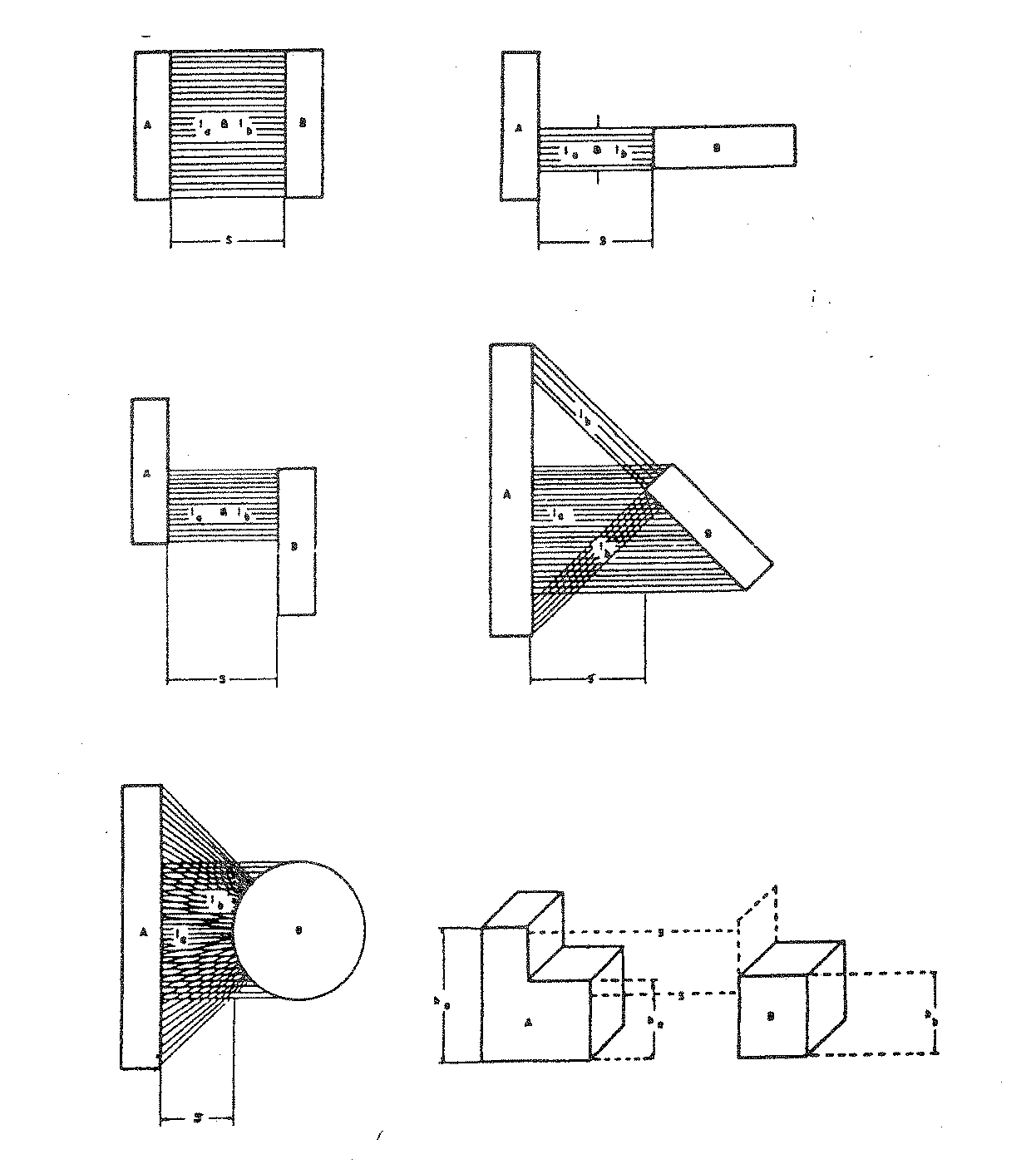
S is the required minimum distance between a wall of building A and a wall of building B.
1 a is the length of building A, as defined.
1 b is the length of building B, as defined.
h a is the height of building A, as defined.
h b is the height of building B, as defined.
(Ord. No. 85-26, § 1(I.E.29), 11-27-1985; Ord. No. 89-13, § 1, 3-21-1989; Ord. No. 11-003, § 10, 6-7-2011)
Sec. 126-940. - Building access for people with disabilities.
(a)
In the interest of public safety and the general welfare, providing access to buildings for people who are elderly or who have disabilities is encouraged and shall be accommodated. To that end, the city manager or the manager's designee is authorized to approve deviations from limits on height, coverage with impermeable surfaces, vegetation clearance, developed area and commercial floor area and from setback requirements to facilitate the issuance of a development permit for such building access. Such deviations may be issued only upon a finding by the city manager, or the manager's designee, that the following standards have been met.
(1)
Alternatives, such as removing existing structures, to avoid the need for the deviation have been explored and found to be impracticable.
(2)
The deviation is the minimum necessary to provide building access for people who are elderly or who have disabilities.
(b)
Where side or rear yard setback relief is sought, the application for a deviation must be accompanied by a statement from the adjoining property owners expressing said property owners' views on the deviation application. If the application for deviation does not contain a statement from the adjoining property owners, the applicant shall demonstrate that a good faith attempt was made to contact the adjoining property owners and give them an opportunity to express their views on the application, e.g., by sending a certified letter to the owner of the adjoining property at the address of record and allowing a minimum of 30 days for a response.
(c)
The city manager or the manager's designee is authorized to attach conditions to the approval, as necessary, to assure compliance with the standards set out above.
(d)
In addition to the standards set out above, in considering applications for deviations under this section, no deviation approved under this section shall frustrate the underlying purpose and intent or policies of the city, including the Sanibel Code and Sanibel Plan.
(Ord. No. 05-002, § 1, 2-15-2005)
Sec. 126-956. - Generally.
Notwithstanding the specific setback requirements set forth for each zone, the setbacks for principal structures in this subdivision shall apply where applicable.
(Ord. No. 85-26, § 1(I.E.13), 11-27-1985)
Sec. 126-957. - Front and side yard setbacks for certain streets.
(a)
Along the west side of Lindgren Boulevard, from the canal south to Gulf the setback shall be a minimum of 55 feet from the centerline of Lindgren Boulevard.
(b)
The setback from the centerline of Rabbit Road shall be a minimum of 65 feet.
(c)
The setback from the centerline of Beach Road shall be a minimum of 62.5 feet.
(d)
The setback along Causeway Road shall be a minimum of 100 feet from the edge of the right-of-way.
(Ord. No. 85-26, § 1(I.E.13(a)), 11-27-1985)
Sec. 126-958. - Commercial parking setbacks.
Regardless of any other provision of sections 78-1 through 78-11; chapter 86; chapter 94; chapter 98; chapter 106; chapter 110; chapter 118; chapter 122; and articles II through XV of this chapter, no commercial parking area or parking space shall be located:
(1)
Within 15 feet of any side or rear property line;
(2)
Within 70 feet of the centerline of Periwinkle Way; or
(3)
Within 20 feet of the right-of-way line of any other street.
(Ord. No. 85-26, § 1(I.E.13(b)), 11-27-1985)
Sec. 126-959. - Setback from cul-de-sac.
Whenever a lot or parcel abuts a street cul-de-sac, the setback from the cul-de-sac shall be at least 25 feet.
(Ord. No. 85-26, § 1(I.E.13(c)), 11-27-1985)
Sec. 126-960. - Setbacks for manufactured homes and recreation vehicles from stormwater management canals and other open bodies of water in lawfully existing mobile home parks.
In lawfully existing mobile home parks, the minimum setback for manufactured homes and recreation vehicles from stormwater management canals and open bodies of water shall be at least ten feet from the average high water line of the water body. The minimum setback from the Sanibel River shall be at least 20 feet.
(Ord. No. 98-11, § 1, 6-16-1998)
Sec. 126-961. - Outdoor seating setbacks.
(a)
Generally, outdoor dining approved by conditional use permit and/or bonus outdoor seating approved by development permit shall be located no less than:
(1)
Fifteen feet from any side or rear property line; or
(2)
Twenty feet measured from the right-of-way line of any street.
(b)
TCL town center limited and TCG town center general commercial districts. Outdoor dining approved by conditional use permit and/or bonus outdoor seating approved by development permit may be located no less than ten feet from the front property line in accordance with section 126-962(c).
(Ord. No. 21-007, § 3, 10-5-2021; Ord. No. 23-018, § 2, 8-15-2023; Ord. No. 25-012, § 3, 7-15-2025)
Sec. 126-962. - Front yard setbacks for front porches in the TCL and TCG districts.
(a)
Applicability. This section applies exclusively to properties located within the TCL town center limited and TCG town center general commercial districts, as defined by the Sanibel Plan and regulated under chapter 126, article VIII, divisions 2 and 3.
(b)
Purpose. The purpose of this section is to encourage pedestrian-friendly development and promote the incorporation of front porches as an integral architectural feature consistent with Sanibel's "Island Style" character, as identified in the architectural design standards of the land development code.
(c)
Special front yard setback. Notwithstanding the minimum front setback requirements established in sections 126-514(c) and 126-534(c), open-air or screen-enclosed porches may be constructed to a minimum setback of ten feet from the front property line, subject to the following design requirements:
(1)
The porch must be attached to the principal structure and open on at least three sides (excluding structural columns or railings).
(2)
The porch shall not be enclosed by wall(s) or glass and shall not be designed or subsequently converted to air-conditioned space.
(Ord. No. 25-012, § 3, 7-15-2025)
Sec. 126-976. - Applicability of regulations to parcels in more than one district or with varying residential densities.
For lots or parcels located in more than one zone, or having varying residential density limitations, the applicable use limitations and development regulations shall apply as follows:
(1)
Coverage, vegetation removal, and developed area. For a lot or parcel of less than two acres, the limitations for the predominant zone shall apply, provided that neither the gulf beach zone nor the bay beach zone shall ever be considered as the predominant zone. For lots or parcels two acres or larger, the limitations for each zone shall apply to that area of the lot or parcel located in such zone.
(2)
Residential density. The maximum number of dwelling units permitted on a lot or parcel which consists of areas having different residential densities, as shown on the development intensity map adopted as part of the Sanibel Plan, shall be the total of the dwelling units permitted in each such area (including fractions).
(3)
Minimum lot area. In the subdivision of any parcel, and for purposes of section 86-92, the required minimum lot area for parcels located in more than one zone shall be determined as follows:
a.
For any such parcel, other than those located partly in the bay beach, gulf beach, or mangrove forest zones, the required minimum lot area shall be determined by adding the numbers arrived at by multiplying the minimum required lot area for each zone by the percentage of the total parcel located in such zone.
b.
For any such parcel located partly in the gulf beach or bay beach zone, but not in the mangrove forest zone, the minimum required lot area shall be determined as provided in subsection (3)a of this section, except that for the purpose of applying the formula the total parcel shall be deemed to include only that portion lying outside of the gulf beach and bay beach zones. However, those portions of the parcel lying in the gulf beach or bay beach zone may be counted toward the required minimum lot area.
c.
For any such parcel located partly in the mangrove forest zone, the minimum required lot area shall be as required for the mangrove forest zone if any part of the principal structure is to be developed in the mangrove forest zone. If no part of a principal structure is to be developed in the mangrove forest zone, the minimum required lot area shall be determined as provided in subsection (3)a of this section, except that for the purpose of applying the formula the total parcel shall be deemed to include only that portion lying outside of the gulf beach, bay beach, and mangrove forest zones. However, portions of the parcel lying in the mangrove forest, gulf beach, or bay beach zones may be counted toward the required minimum lot area.
(4)
Permitted uses, other development regulations. As to permitted uses and as to development regulations not specified in subsections (1) and (3) of this section, development and use of each area of a lot shall be in compliance with the limitations of the zone in which such area is located.
(5)
Gulf beach and bay beach zones. For a lot or parcel lying partly in the gulf beach or bay beach zones, the permitted coverage with impermeable surfaces, developed area, and vegetation clearance for that portion of the lot or parcel which is not in the gulf beach or bay beach zone, and which is landward of the coastal construction control line, may be determined based on the area of the entire lot or parcel above mean high water, including that portion in the gulf beach or bay beach zone. However, any area containing a structure authorized by variance in the bay beach zone, shall be counted as developed area and as impermeable surface coverage.
(Ord. No. 85-26, § 1(I.E.33), 11-27-1985)
Sec. 126-977. - Lots with open bodies of water.
For lots or parcels containing, or being developed with, an open body of water, the following regulations shall apply in determining the maximum permitted coverage with impermeable surfaces, developed area, and vegetation removal:
(a)
If a parcel is being developed with an open body of water which is to be excavated to, or below, the average groundwater level, the surface area of that open body of water which is represented by the contour of the average groundwater level shall be considered as being cleared of vegetation and as part of the developed area.
(b)
If a parcel is being developed that contains an open body of water which has been excavated to, or below, the average groundwater level, the surface area of that open body of water which is represented by the contour of the average groundwater level shall be excluded from the land area against which is applied the percentage limitations on coverage with impermeable surfaces, vegetation removal and developed areas.
(Ord. No. 85-26, § 1(I.E.34), 11-27-1985; Ord. No. 25-001, § 2, 3-18-2025)
Sec. 126-1056. - Generally.
Fences are permitted throughout the city in accordance with the conditions, limitations and restrictions in this subdivision.
(Ord. No. 85-26, § 1(I.E.16), 11-27-1985)
Sec. 126-1057. - Requirements.
All fences, except for those required to be constructed in accordance with federal, state, or county laws or regulations, shall meet the following requirements:
(1)
No fence shall be constructed seaward of the 1974 Coastal Construction Control Line or in the gulf beach or bay beach zones.
(2)
Fences which are electrified, contain barbed wire, or are constructed of sharp or garish materials are prohibited, unless specifically permitted in this subdivision. No fences may be constructed of corrugated metal or metal plates.
(3)
The finished, good, or attractive side of the fence shall face adjoining property, street, or open body of water, if the appearance of the structure is not the same on both sides.
(4)
If a fence is to be constructed on a side or rear lot line, as a common fence, a notarized statement from the abutting owner, authorizing and consenting to the fence to be constructed on such common property line, shall be submitted.
(Ord. No. 85-26, § 1(I.E.16(a)), 11-27-1985; Ord. No. 98-04, § 1, 3-17-1998)
Sec. 126-1058. - Minimum setbacks.
Fences need not comply with side and rear yard setback requirements otherwise established in this Land Development Code, provided the following requirements are met:
(1)
Except as provided in subsection (3) of this section, no fence shall be located closer than 20 feet to any open body of water.
(2)
In order to provide a contiguous wildlife corridor for access to open bodies of water from adjoining uplands, the following requirements shall be met on parcels abutting an open body of water:
a.
If the parcel abuts an open body of water on the rear lot line, a fence may not be constructed along both side property lines. A clear corridor of at least three feet must be provided between a side property line and any fence on at least one side of the property.
b.
On parcels abutting an open body of water along a side lot line, no fence may be constructed within three feet of the rear lot line.
(3)
Fences designed and intended to deter alligators may be constructed closer than 20 feet to an open body of water, provided the following requirements are met:
a.
The height of the fence may not exceed three feet, measured from the average grade of the surrounding land.
b.
The fence must be located a minimum distance of six feet from the open body of water, so as to maintain a sufficient area for wildlife to gain access to such open body of water.
c.
The fence must be no longer or higher than the minimum necessary to accomplish its intended purpose, as determined by an alligator handler licensed by the state fish and wildlife conservation commission.
(Ord. No. 85-26, § 1(I.E.16(b)), 11-27-1985; Ord. No. 88-25, § 1, 9-20-1988)
Sec. 126-1059. - Maximum height.
Fences shall comply with the following height limitations:
(1)
The maximum height for fences located in an actual front yard area (between principal structure and front yard setback line) shall be 42 inches, measured from the average grade of the surrounding land.
(2)
The maximum height for all other fences shall be six feet, measured from the average grade of the surrounding land, except as otherwise provided in this section and except for fences around tennis courts. Fences around tennis courts which are located within 21 feet of the playing court boundaries may be up to ten feet in height, measured from the surface of the playing court, provided such fences comply with all required setbacks for structures.
(Ord. No. 85-26, § 1(I.E.16(c)), 11-27-1985; Ord. No. 88-25, §§ 2, 3, 9-20-1988)
Sec. 126-1060. - Fences for commercial uses.
Fences needed to enclose and protect commercial uses may contain barbed wire upon a finding, by the planning commission, that the use of barbed wire is reasonably necessary to effectuate the purpose of the fence, but only in accordance with the following standards:
(1)
The barbed wire shall be installed along the top of the proposed fence.
(2)
No more than four strands of barbed wire shall be permitted.
(3)
The barbed wire shall be installed at an angle of no less than 120 degrees, but shall not be perpendicular and shall slant inward, into the enclosed area.
(4)
The lowest strand of barbed wire shall be at least six feet above the grade level at the base of the fence.
(Ord. No. 85-26, § 1(I.E.16(d)), 11-27-1985; Ord. No. 88-25, § 4, 9-20-1988)
Sec. 126-1116. - Uses generally; when permitted; parking facilities in mobile home park.
For the purpose of this Land Development Code, the new use of a mobile home or recreational vehicle for residential or commercial purposes shall be considered to be development. The new use of a recreational vehicle is when the new unit results in an increase in the number of units on the site. The replacement of an existing unit with a different unit does not constitute the new use of a recreational vehicle. However, the replacement of a mobile home with a different mobile home is development and a development permit is required. Except as provided elsewhere in this Land Development Code, such development shall be permitted only in an area designated by the city council, in an amendment to the zoning map of the city, as a mobile home park. Any land designated as a mobile home park shall have no more pads or parking spaces for mobile homes or recreational vehicles than the number of dwelling units permitted on such land pursuant to the development intensity map.
(Ord. No. 85-26, § 1(I.E.27(a)), 11-27-1985; Ord. No. 89-11, § 1, 3-21-1989)
Sec. 126-1117. - Temporary construction offices.
Mobile homes, recreational vehicles, and construction trailers may be used for temporary construction offices at construction sites, but not for residential purposes, provided such use is shown on the approved development permit and provided that the mobile home, recreation vehicle, or construction trailer does not contain kitchen, sanitary or sleeping facilities, unless the mobile home is also approved as a temporary sales office with a temporary use permit, in which event kitchen and sanitary facilities may be included. Such use shall be limited to the period of construction permitted under the development permit. Further, such mobile homes, recreational vehicles, and construction trailers shall be tied down in the manner prescribed under state law for residential use of mobile homes.
(Ord. No. 85-26, § 1(I.E.27(d)), 11-27-1985)
Sec. 126-1136. - Construction standards.
A development permit for the use of a mobile home for residential or commercial purposes in the city shall be granted only if the applicant demonstrates that the proposed mobile home:
(1)
Will comply with all other standards and requirements of this Land Development Code and of the National Mobile Home Construction and Safety Standards, 24 CFR 280; and
(2)
Will comply with all requirements of chapter 94.
(Ord. No. 85-26, § 1(I.E.27(b)), 11-27-1985)
Sec. 126-1137. - Temporary sales offices.
Mobile homes may be used as temporary sales offices at multifamily construction-sites, but the use shall be limited to the period of development permitted under the development permit and must be removed from the site prior to the issuance of a final certificate of occupancy for the project. Notwithstanding the provisions previous sentence, however, such use may be continued for up to one year after the final certificate of occupancy for the project is issued if a $5,000.00 bond is provided, secured by deposit with the city of such amount in cash, to be placed in an interest-bearing account for the benefit of the owner, conditioned upon the termination of such use and the restoration of the site within 13 months after the date of the final certificate of occupancy. Mobile homes used as temporary sales offices shall comply with the following standards:
(1)
The requirements of subsection 126-63(1), for a temporary use permit for a sales office in a model home, shall be complied with, insofar as such requirements relate to limitations on use, limitations on hours of use, and provision of parking spaces.
(2)
The mobile home must be located on the site in an area which is least vulnerable to flooding.
(3)
The area under the mobile home must be screened from view on all sides by means of vegetation or another method approved by the city manager.
(4)
The placement and continued use of the mobile home on the site must comply with all requirements of the Sanibel Plan and this Land Development Code, with the exception that the development may exceed limitations on vegetation clearance and coverage with impermeable surfaces and may have less than any minimum required recreational open space, in order to develop and operate the mobile home as a temporary sales office, as long as the placement of the mobile home will not require the clearing of native vegetation. At the time the mobile home use as a temporary sales office is terminated, it shall be removed from the site and the site shall be restored in full compliance with the Sanibel Plan and this Land Development Code.
(5)
The mobile home must be placed on the site in conformance with the requirements of chapter 94, except for the requirement to elevate at or above the base flood elevation.
(6)
The mobile home must be tied down in the manner prescribed under state law for residential uses of mobile homes.
(7)
Use of a mobile home as a temporary sales office must terminate upon commencement of use, within the same project, of a sales office in a model home pursuant to a temporary use permit issued under article III of this chapter.
(Ord. No. 85-26, § 1(I.E.27(e)), 11-27-1985)
Sec. 126-1156. - Use and location.
Recreation vehicles may be used for residential purposes or temporary basis only in a mobile home park.
(Ord. No. 85-26, § 1(I.E.27(c)), 11-27-1985)
Sec. 126-1157. - Storage and tie down.
During the time the recreational vehicle is not occupied as temporary or seasonal quarters it may be stored and tied down on the recreational vehicle site. The affixing of a recreational vehicle to the ground by way of tiedowns or other removable fasteners, and the attachment of carports, porches, screen rooms, and similar appurtenances by way of removable attaching devices, shall not render the recreational vehicle a permanent part of the recreational vehicle site.
(Ord. No. 85-26, § 1(I.B.2), 11-27-1985)

