
Sanibel City Zoning Code
ARTICLE XVII
TELECOMMUNICATIONS DEVICES
Sec. 126-1511. - Definitions.
The following words, terms and phrases, when used in this article, shall have the meanings ascribed to them in this section, except where the context clearly indicates a different meaning:
AGL means above ground level.
Amateur radio services includes the amateur service, the amateur satellite service, and the radio amateur civil emergency service.
Amateur satellite service means a radiocommunications service using stations on earth satellites for the same purpose as of the amateur service.
Amateur service means a radiocommunications service for the purpose of self-training, intercommunication and technical investigations carried out by amateurs, that is, duly authorized persons interested in radio technique solely with a personal aim and without pecuniary interest.
AMSL means above mean sea level.
Antenna means any system of wires, poles, rods, reflecting disks, parabolic dishes, grids, whips, panels or similar devices used for the transmission or reception of electromagnetic waves.
Antenna mount and mount means any supporting structure used to hold an antenna at a desired height.
Base transceiver station means a fixed device equipped to engage in radio communication or radio frequency transmission of energy.
Collocation means the use of a single structure or mount to support the antennas of more than one provider.
Commercial mobile radio services means a mobile service, or its functional equivalent, that is:
(1)
Provided for profit, i.e., with the intent of receiving compensation or monetary gain;
(2)
Interconnected with the public switched telephone network; and
(3)
Available to the public, or to such classes of eligible users as to be effectively available to a substantial portion of the public.
Direct-to-home satellite services means distribution or broadcasting of programming or services by satellite directly to the subscriber's premises without the use of ground receiving or distribution equipment, except at the subscriber's premises or in the uplink process to the satellite.
Earth station means a station located either on the earth's surface or within the major portion of the earth's atmosphere and intended for communication with one or more space stations; or one or more stations of the same kind by means of one or more reflecting satellites or other objects in space. See also satellite earth station, antenna.
Equipment shelter means any support building or cabinet which houses the electronics, backup power and other equipment associated with the operation of an antenna.
Fall zone means the area on the ground within a prescribed radius from the base of a telecommunications device. The fall zone is the area within which there is a potential hazard from falling debris or collapsing material.
FCC means the Federal Communications Commission.
Ground-mounted facility means a freestanding antenna mount constructed upon the ground. Utility pole-mounted facilities shall not be considered ground-mounted facilities. The facility shall include any associated equipment shelters regardless of where they are located with respect to the mount.
Guyed tower means an openwork structure of crossed strips or bars of metal erected and steadied with steel guy wires anchored in the ground or to other fixed structures, used to support antennas, surmounting appurtenances or other devices.
Lawful structure means a building or other structure, including a utility pole, that is lawfully existing, or for which a valid city permit exists on the effective date of the application for construction or placement of the telecommunications device.
Location means the geographic location of a telecommunications facility within the city.
Microwave system means point-to-point digital or analog facilities equipped with transmitters, receivers, antennas and other relevant apparatus that transceive electromagnetic waves in the frequency ranges above 890 MHz all the way up to the lower limit of the infrared band. Microwave radio systems provide a portion of the long-haul message circuits (including long-distance telephone, wide band data, television transmission) and short-haul message circuits (including intrastate and feeder services) via multiple repeater sites across the country and throughout the world; also referred to as point-to-point radio systems.
Monopole means a generally round, tapering, stand-alone single shaft of wood, steel or concrete, or similar material, used to support antennas, surmounting appurtenances or other devices.
Mount. See: Antenna mount.
NGVD means the National Geodetic Vertical Datum of 1929.
Other large communications devices means any communications device, antenna, transmitter, receiver, repeater, etc., not covered by any other definition in this section that is mounted external to a residence, building or other structure and is greater than one meter in diameter or diagonal.
Other small communications devices means any communications device, antenna, transmitter, receiver, repeater, etc., not covered by any other definition listed in this section that is mounted external to a residence or building or other structure and is no more than one meter in diameter or diagonal.
Over-the-air reception devices means an antenna that is designed to receive direct broadcast satellite service, including direct-to-home satellite services, or an antenna that is designed to receive video programming services via multipoint distribution services, including multichannel multipoint distribution services, instructional television fixed services, and local multipoint distribution services, or an antenna that is designed to receive television broadcast signals.
Personal wireless services (PWS) means commercial mobile services unlicensed wireless services, and common carrier wireless exchange access services.
Personal wireless services (PWS) facilities means facilities for the provision of personal wireless services.
Personal wireless services (PWS) provider means a company authorized by the FCC to operate a personal wireless services system; a PWS carrier.
Private mobile radio service means any mobile radio service that is not commercial mobile radio service or its functional equivalent.
Public view means:
(1)
At ground level from a public street;
(2)
From a place where the public is admitted for general use; or
(3)
From an adjacent residential use.
Radio amateur civil emergency service means a radio service using amateur stations for civil defense communications during periods of local, regional or national civil emergencies.
Receiver means an apparatus or device that converts incoming electromagnetic waves or electrical signals into audible, visual, analogue, digital or otherwise intelligible information.
Repeater means a fixed system of receivers and transmitters that retransmit the signals of other stations.
Satellite earth station, antenna means the same meaning as the language contained in 47 CFR 25.104.
Search ring means a geographical area in which a service provider's telecommunications device is intended to be located to serve the service provider's intended coverage area.
Sectored antenna array means system of multiple sets of antennas utilized by a single carrier at a given antenna site to increase capacity for subscriber demand or to otherwise directionalize radio coverage within the coverage area of any given antenna site.
Self-supporting tower means an openwork structure of crossed strips or bars of metal standing alone without the use of guy wires, used to support antennas, surmounting appurtenances or other devices.
Siting means the positioning of a telecommunications facility on a particular lot or parcel of land.
Structure-mounted facility means an antenna mount attached to or upon any nontemporary structure at a location where such use is permitted. This shall include buildings, water tanks, private light poles or other structures not originally designed as antenna mounts. The facility shall include any associated equipment shelters regardless of where they are located with respect to the mount.
Support structure means any monopole, tower, building, shaft, chimney or other structure to which a mount, an antenna, surmounting appurtenance or other device is attached for purposes of elevating that device above ground level.
Surmounting appurtenance means any antenna, obstruction lighting system, support pipe, lightning rod or other device that protrudes above a support structure or mount.
Telecommunications device as a principal use means a telecommunications device, including personal wireless service facilities, designated and used to provide service to the public rather than to provide service solely to the site on which it is located; not an accessory use.
Telecommunications device as an accessory use means a telecommunications device that is solely an accessory use to a principal use of a property; that is designed and operated solely to provide service to the site on which it is located, and that is located on property within the exclusive use or control of the device user, where the user has a direct or indirect ownership or leasehold interest in the property.
Telecommunications device (facility) means facilities used for the provision of any of several wireless technologies, including wireless telephones, microwave services, traditional noncable television, AM/FM radio, paging and dispatch services, earth stations, over-the-air reception devices and personal wireless service facilities, including equipment shelters.
Temporary telecommunications device means a device that is designed and constructed to serve, on a temporary basis, as a means of providing service on an emergency basis or for a special event.
Transmitter means an apparatus that generates radio waves, modulates their amplitude or frequency, and transmits them by means of an antenna.
Unlicensed wireless services means the offering of telecommunications services using duly authorized devices which do not require individual licenses from the Federal Communications Commission, but exclusive of direct-to-home satellite services.
Utility pole-mounted facility means an antenna mount attached to or upon an electric transmission or distribution pole, street light, athletic field light pole or similar facility located where such use is permitted. The facility shall include any associated equipment shelters regardless of where they are located with respect to the mount.
Visually obtrusive structures means physical structures which, due to their height, shape, siting, location, design, reflectivity, color, or lighting, are noticeably undesirable and tend to detract from the character, scale or attractiveness of surrounding land uses.
(Ord. No. 99-07, § 4(I.E.32.c), 11-2-1999)
Cross reference— Definitions generally, § 1-2.
Sec. 126-1512. - Purpose and intent.
(a)
This article is intended to bring the city's Land Development Code into compliance with the Telecommunications Act of 1996, which was codified as Public Law 104-104, and any other lawful regulation passed pursuant to and in compliance with the act. It is intended to provide city residents, businesses, visitors and public service agencies with access to the latest telecommunications services and technology within the context of and in a manner consistent with the Sanibel Plan.
(b)
The city has an unpreempted duty and right to protect the safety and welfare of its citizens, and all the regulations contained in this article are to advance those objectives. In addition, the regulations are designed to promote the unique aesthetic quality that can be found in the city. Unless specifically preempted, aesthetics will be considered in any decision involving telecommunications devices.
(c)
Specifically, the standards and requirements of this article are intended to protect the public safety and welfare by requiring adherence to development and construction standards which:
(1)
Minimize the threat to public safety;
(2)
Protect public park, conservation and environmentally sensitive lands from both the physical and visual intrusion of telecommunications devices;
(3)
Minimize the adverse visual effects of telecommunications devices from residential areas, from scenic roadways, from public view, and from the waters and beaches surrounding Sanibel Island;
(4)
Protect the island's wildlife, including birds, from the threats posed by antennas and support structures; and
(5)
Ensure compliance with the city's dark sky policy consistent with the provision of telecommunications services.
(Ord. No. 99-07, § 4(I.E.32.b), 11-2-1999)
Sec. 126-1513. - Applicability.
(a)
All telecommunications devices, including existing devices, and their antennas, mounts, support structures, surmounting appurtenances and equipment shelters, located anywhere in the city shall be subject to the standards and requirements of this article and all other applicable sections of this Land Development Code, unless expressly exempt. Telecommunications devices are not considered public utility uses within the meaning of this Land Development Code.
(b)
Telecommunications devices as accessory uses, including their antennas, mounts, support structures, surmounting appurtenances and equipment shelters, located on lands owned by and controlled by the federal government or the school district of the county, shall be exempt from both the permitting requirements and the standards of this article.
(c)
In the event of any conflict with other regulations contained in this Land Development Code, the provisions of this article shall supersede, with respect to the regulation of telecommunications devices.
(Ord. No. 99-07, § 4(I.E.32.d), 11-2-1999)
Sec. 126-1514. - Existing and new devices.
(a)
Existing telecommunications devices, including mounts, support structures, surmounting appurtenances and equipment shelters.
(1)
All existing telecommunications devices which were lawfully installed or constructed prior to the effective date of the ordinance from which this article is derived, but which do not conform to the standards and requirements of this article, shall be treated as nonconforming structures.
(2)
Any telecommunications device that has received a development permit, but for which construction or installation has not yet been completed, shall be considered an existing telecommunications device so long as the development permit is valid on the effective date of the ordinance from which this article is derived.
(3)
Routine maintenance shall be permitted on the devices.
(4)
Any new construction, or alteration, modification, change in appearance, or addition to existing telecommunications devices shall comply with the standards and requirements of this article as for new telecommunications devices. An existing support structure located in a telecommunications tolerant area may be structurally modified and have antennas repositioned or added to it provided:
a.
The new antennas meet the requirements for new construction;
b.
The structural modifications are as unobtrusive as possible; and
c.
There is no increase in height of the existing structures.
(b)
New telecommunications devices All new telecommunications devices shall comply with the standards and requirements of this article.
(Ord. No. 99-07, §§ 4(I.E.32.d(1), (2)), 11-2-1999)
Sec. 126-1531. - Purpose of master plan.
(a)
The purpose of the wireless telecommunications master plan is to establish guidelines for the placement and operation of wireless telecommunications facilities both as primary and accessory uses. Particular attention will be given to those wireless services specifically protected by the Telecommunications Act of 1996 (the Act).
(b)
Wireless facilities will be considered a primary use when the services provided by those facilities are intended for use by the general public or persons other than those in control of the site on which the facilities are located. Wireless facilities will be considered an accessory use when the services provided by the facilities are intended for use solely by the person in control of the site on which the facilities are located.
(Ord. No. 99-07, § 4(I.E.32.a(1)), 11-2-1999)
Sec. 126-1532. - Primary use facilities.
(a)
The placement of commercial wireless telecommunications facilities on the island will serve the needs of the city's yearround residents and businesses, and the city's 3,000,000 annual visitors, yet can allow the city to maintain its character as expressed in its vision statement. These are cooperative goals, which can be achieved with adequate planning and careful and innovative siting, design, landscape and camouflage techniques arrived at through discussions between the commercial service providers and the city. For the purposes of this article, these commercial wireless telecommunications systems will be referred to as cellular-type systems since they have similar design characteristics to existing cellular telephone systems, and the act suggests that they are functional equivalents. [13]
(b)
All cellular-type systems utilize four main components: fixed antenna structures, base transceiver stations, backhaul facilities, and a mobile telephone switching office. The antennas are set out in a grid with each cell slightly overlapping the next to allow calls to be moved seamlessly from cell to cell. Where cells do not overlap, coverage holes exist and a call will be dropped if the phone moves into one of the holes during a conversation. Figure 1 shows the simplified design of a typical cellular-type telephone system.
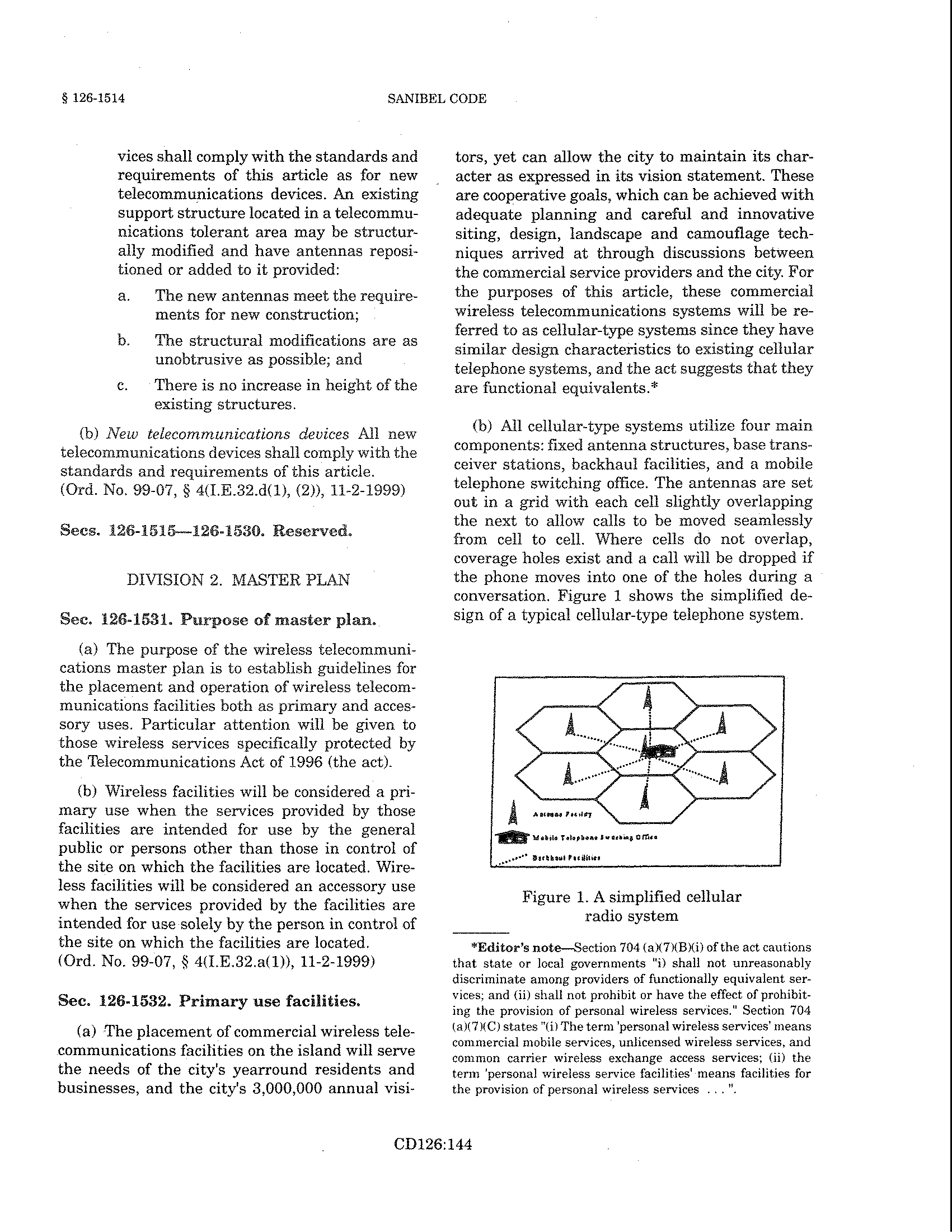
Figure 1. A simplified cellular
radio system
(c)
All of the antenna facility sites (cell sites) have certain characteristics common to all other such facilities. Each site has a base transceiver station (BTS), antennas, cables connecting the BTS to the antennas, and an antenna support structure (see figure 2). Each has a small building (shelter) or equipment enclosure (cabinet) which houses the BTS and may have batteries and/or an auxiliary generator to keep the site operational in the event of a power outage. In some instances, multiple service providers will share a facility (collocate) and may share the antenna support structure and shelter; each provider will still have its own BTS, antennas, and cables.
(d)
The BTS converts the signals between the antenna and the cellular network. Backhaul facilities are the electronic equipment, cabling, and/or microwave devices necessary to connect the fixed antennas to the mobile telephone switching office (the point at which mobile calls are connected). Wireless service providers typically utilize landline telephone facilities for backhaul, but may use point-to-point microwave when there are no existing landline facilities, or the cost of landline exceeds the cost of microwave. The mobile telephone switching office is where calls are routed among the cells and to and from the landline telephone network.
Figure 2. Wireless, communications facility
components (not to scale)
(e)
By far, the public's greatest concern is with the fixed antenna structures, as these tend to be the most visually prominent components of the systems. These support structures generally consist of poles, towers or other vertical elements onto which the cellular antennas, microwave dishes, cabling, and/or other ancillary devices are mounted.
(f)
Unfortunately, while all cellular-type systems are similar in design, few are the same in their real-world layout. Differences in operating frequencies, system componentry, subscribership, user traffic patterns, and system use characteristics all drive the service providers' choice of cell sizes, antenna heights, and antenna locations. This allows for some collocation opportunities among service providers, but does not allow all providers to build identically laid-out systems. Thus there will be a need for multiple antenna sites on the island.
(g)
When collocating, service providers operating on similar frequencies need some physical separation between their antennas to avoid interference. This can be accomplished by mounting their antennas on different support structures at the same height (i.e., two antennas mounted at 90 feet above ground level on separate monopoles) or mounting their antennas on a shared structure at different heights (i.e., a 110-foot monopole with antennas mounted at 85 feet and at 110 feet). Providers operating on dissimilar frequencies may be able to locate their antennas in closer proximity to each other.
(h)
One of the primary concerns of the residents of the city is maintaining the ambience and character of the island as a place where humans live in harmony with the island's wildlife and natural habitat. Extraordinarily tall towers, monopoles, or other similar manmade structures are viewed as intruders which should be prohibited, or if already in place, removed. In the area of wireless telecommunications, there seems to be no other issue which can galvanize people as quickly as a discussion of towers. Unfortunately, the laws of physics favor high antennas for broad coverage, enabling service providers to meet the desires of the widest possible number of customers at the lowest possible cost. Conversely, lowering antenna heights requires more facilities to serve the same area, raising installation and maintenance costs. Figure 3 suggests how the height of the antenna on a structure affects the distance the radio signal can travel, assuming all other factors are held constant.
Figure 3. Area of coverage based on antenna height (all else held constant not to scale)
(i)
Some antennas, such as microwave dishes, require a direct line-of-sight connection with their distant counterpart to facilitate the wireless connection. These antennas must be mounted in such a fashion that the line-of-sight remains open at all times. Shooting the signal through trees or other potential obstructions is not feasible, which is why the antennas are mounted above treetops and rooftops.
(j)
Sanibel Island is a migration stopover or home to at least 280 species of birds. Towers extending above the tree line pose a hazard to birds, particularly birds that fly at night. Of great concern are guyed towers because of the difficulty birds have in seeing the guy wires; even when birds can avoid the tower elements, they cannot always avoid the guy lines. Birds that hit the guy lines can be seriously injured or killed by the initial impact or by subsequent impact with the ground.
(Ord. No. 99-07, § 4(I.E.32.a(2)), 11-2-1999)
Editor's note— Section 704 (a)(7)(B)(i) of the act cautions that state or local governments "i) shall not unreasonably discriminate among providers of functionally equivalent services; and (ii) shall not prohibit or have the effect of prohibiting the provision of personal wireless services." Section 704 (a)(7)(C) states "(i) The term `personal wireless services' means commercial mobile services, unlicensed wireless services, and common carrier wireless exchange access services; (ii) the term `personal wireless service facilities' means facilities for the provision of personal wireless services …".
Sec. 126-1533. - Existing antenna support structures.
(a)
In August 1999, there were four antenna support structures over 100 feet tall in the city:
The Wireless One, Sprint Telephone and city towers were multiuser structures. The school district tower was a single-user structure.
(b)
Other, smaller single-user towers also existed:
(Ord. No. 99-07, § 4(I.E.32.a(3)), 11-2-1999)
Sec. 126-1534. - Regulations.
(a)
The act bars state and local governments from prohibiting the placement of wireless facilities, if that prohibition would prevent, or have the effect of preventing, the provider from offering service. Section 704 of the act further forbids the prohibition of facilities based on the environmental effects of radio frequency (RF) emissions. The act invested solely in the FCC the power to regulate RF emission standards. In January 1997, the FCC adopted RF emission safety guidelines developed by the Institute of Electrical and Electronics Engineers and adopted by the American National Standards Institute. All cellular-type antennas are required to meet these standards. [14]
(b)
The FCC has adopted rules to ensure that communications sites comply with Federal environmental laws, including the National Environmental Policy Act of 1969 (NEPA). If, after consulting the NEPA rules, a service provider determines that its proposed site qualifies for an FCC review, it is required to notify the FCC's wireless telecommunications bureau's enforcement division and attach an environmental assessment (EA) to its filing. The bureau's review of the filing consists of these stages:
(1)
Initial review. The initial review is to determine if the proposed facility has any nonenvironmental concerns.
(2)
Acceptance public notice. The licensing office places the filing on the FCC's public notice for 30 days.
(3)
Review. The EA is then reviewed by the bureau's enforcement division, along with any comments, petitions or opposition filed against the EA during the 30-day public notice period.
(4)
Finding of impact. After consulting with all relevant expert federal and state agencies, the enforcement division determines whether or not the proposed project will have a significant impact on the environment. If no significant impact is determined, the enforcement division issues a finding of no significant impact (FONSI). If a significant impact is expected, the service provider is given the opportunity to amend its proposal to reduce, minimize or eliminate environmental problems.
(c)
An antenna support structure 200 feet or taller may require a Federal Aviation Administration (FAA) review to determine whether or not it will require safety lighting. In addition, the county mosquito control district has requested that all structures 150 feet or taller be lighted for safety purposes.
(d)
The Land Development Code in effect in August 1999 generally limits the height of all structures to 45 feet above sea level. However, exceptions include water towers, microwave relays, cable transmission and radio towers, and public utility structures.
(Ord. No. 99-07, § 4(I.E.32.a(4)), 11-2-1999)
Cross reference— Public utility uses, § 126-32; height exceptions, § 126-932.
Editor's note— Section 704(b)(iv) states. "No state or local government or instrumentality thereof may regulate the placement, construction, and modification of personal wireless service facilities on the basis of the environmental effects of radio frequency emissions to the extent that such facilities comply with the commission's regulations concerning such emissions."
Sec. 126-1535. - Planning for wireless telecommunications facilities.
(a)
Wireless communication services continue to expand; new companies enter the market and existing services are augmented or replaced by new ones. The cellular-type service providers are not only interested in serving city residents, but have a stake in serving their existing customers who visit the island for work or recreation. Consequently, although the island population may not be large enough to support multiple service providers, the providers wish to serve the island.
(b)
Antenna support structures in use on Sanibel Island today consist of lattice towers and guyed towers. In the future, when antennas are mounted on self-supporting towers, it is intended that these new towers be of the monopole type (see figure 4). A monopole is a unitary structure made of wood, metal or concrete, and mounted to a base secured firmly in the ground so that it does not require legs or guy wires for support. Cables connecting the antennas to the BTS are typically run down the inside of the monopole.
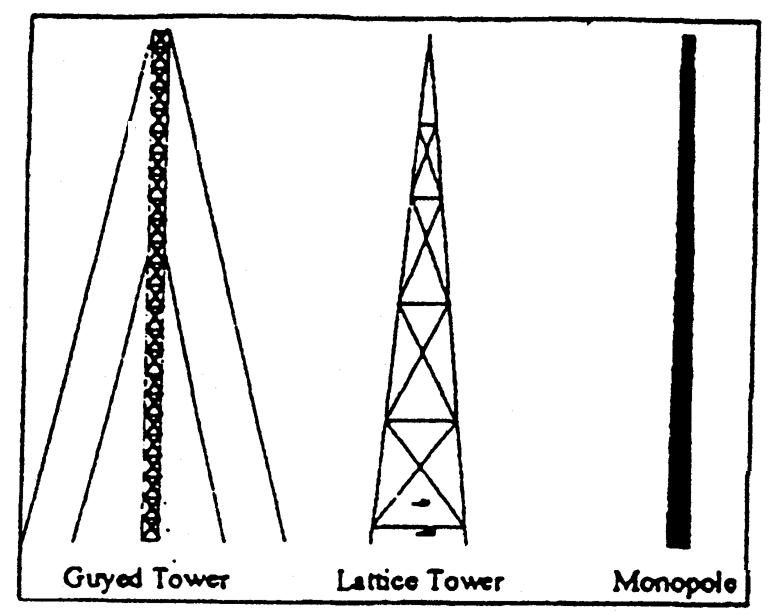
Figure 4. Antenna Tower Types
(c)
Monopoles have a narrower profile than lattice towers and do not require guy wires, which can be hazardous to birds. Monopoles also lend themselves to use as support structures for other facilities, such as athletic field lights or utility wires.
(d)
Even with an antenna support structure of great height, no service provider can offer quality service to the entire island with just one cell site. Service providers on the air in August 1999 had only one site each, and none were able to reach all areas of the island. One of the main factors affecting RF signal propagation is the island's dense vegetation. Signals from both the cell site antenna and the handheld telephones are absorbed by vegetation, reducing the efficiency of the system overall.
(e)
As a result, service providers wishing to provide quality coverage to the entire island may need multiple sites. The need for multiple sites has the side effect of reducing the height of the antennas necessary to serve the island. As the number of antenna sites operated by a single service provider increases within a given geographic area, the antenna mounting height decreases as a means of reducing the individual cell size. Thus, as shown in figure 5, subdividing the original cell results in smaller cells, which will typically have lower antennas.
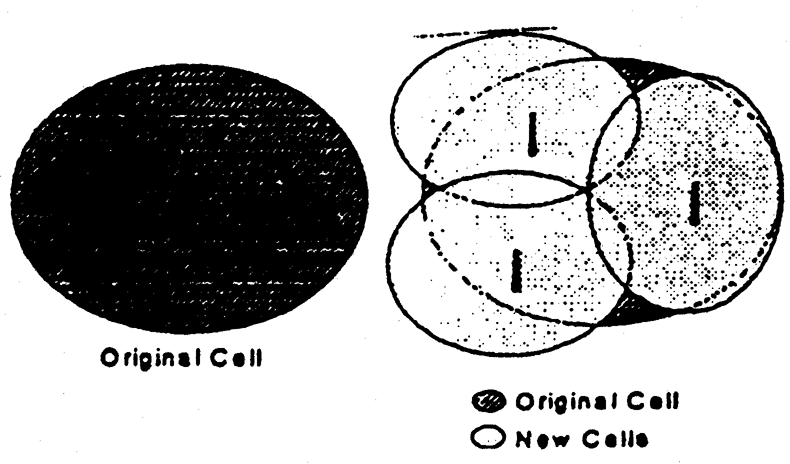
Figure 5. Effect of cell subdivision on antenna mounting heights
(f)
It is the desire of the city to minimize the number of man-made vertical elements extending above 45 feet above sea level. Where it is necessary to exceed that height for the placement of wireless telecommunications facilities, those facilities should be as visually unobtrusive as possible. When it is necessary to build a new antenna support structure, it is preferred that an existing structure be replaced by one capable of supporting the antenna in addition to providing the utility of the original structure.
(Ord. No. 99-07, § 4(I.E.32.a(5)), 11-2-1999)
Sec. 126-1536. - Telecommunications tolerant areas.
(a)
To assist the providers in establishing their service, certain areas of the city have been designated as telecommunications tolerant areas. These areas are usually buffered from residential views by vegetation and/or distance. They may already have an existing antenna support structure located on the premises, which will either support additional antennas or can be rebuilt or replaced to support additional antennas.
(b)
The areas considered telecommunications tolerant are:
(1)
City public works maintenance yard (750 Dunlop Road).
(2)
Donax Street wastewater reclamation facility (930 Donax Street).
(3)
Wulfert Road advanced wastewater reclamation facility (2222 Wulfert Road).
(4)
The site of the existing AT&T tower (701 Opre Ave.)
(5)
Sprint Florida telephone switching office (3445 Sanibel-Captiva Road).
(6)
The Sanibel School (3840 Sanibel-Captiva Road).
(7)
Recreation field next to the Sanibel School.
(8)
J. N. "Ding" Darling National Wildlife Refuge maintenance yard (3900 Sanibel-Captiva Road).
(9)
Lee County Electric Cooperative Electrical Substation (5050 Sanibel-Captiva Road).
(10)
Lee County Electrical Cooperative Pine Island to Sanibel power transmission line support poles.
(11)
Island Water Association (IWA) reverse osmosis plant (3651 Sanibel-Captiva Road).
(12)
Sanibel Fire and Rescue District station (5171 Sanibel-Captiva Road).
(13)
IWA water tank (5566 Sanibel-Captiva Road).
(c)
It is the city's policy to encourage any new, tall (up to 149 feet above ground level) antenna support structures to locate on the city-owned parcels identified as areas (1) to (4) in subsection (b) of this section. In order to encourage providers to look first to these city-owned areas, the city will establish an expedited permitting process and make the areas available at rates consistent with prevailing market conditions. If, for technological reasons, the telecommunications tolerant areas of the city are unacceptable to a service provider, then an alternate permitting process should be followed.
(d)
In any of the areas listed in subsection (b) of this section, no public hearing will be necessary to obtain a permit to attach an antenna onto an existing structure if no reconstruction or strengthening of the existing structure is required. When an existing support structure is rebuilt or replaced it must meet the existing guidelines for construction. Replacement structures constructed for the primary purpose of supporting wireless communications antennas must be of the monopole type.
(e)
In areas (1) to (5) in subsection (b) of this section, new antenna support structures up to a maximum height of 149 feet may be permitted, following the permitting procedures outlined in the Land Development Code.
(f)
In areas (6) to (11) in subsection (b) of this section, antenna support structures no taller than 120 feet above the ground are allowed.
(g)
In areas (12) and (13) in subsection (b) of this section, antenna support structures no taller than 85 feet above ground level are allowed.
(h)
For all the telecommunications tolerant areas listed in subsection (b) of this section, these recommendations should remain in place so long as the land is zoned and used for the purposes for which it was zoned and used in August 1999. Should the zoning or usage change, the designation of telecommunications tolerant area should be reviewed to ensure that this is still a correct designation.
(i)
In all areas of the city not listed in subsection (b) of this section, placement of an antenna at or below a height of 45 feet above sea level may be permitted. Support structures greater than 45 feet above sea level may be permitted after obtaining a permit following the guidelines contained in the Land Development Code.
(Ord. No. 99-07, § 4(I.E.32.a(5)), 11-2-1999; Ord. No. 03-014, § 8, 9-16-2003)
Sec. 126-1537. - New structures to be monopole type.
In all cases, new support structures constructed for the primary purpose of supporting antennas must be of the monopole type.
(Ord. No. 99-07, § 4(I.E.32.a(5)), 11-2-1999)
Sec. 126-1538. - Permit criteria.
(a)
Before a permit for a wireless telecommunications facility is issued, each proposed facility will be reviewed to ensure that it meets the following criteria:
(1)
Need. In order to obtain a permit for a new antenna support structure, an applicant must show that:
a.
No existing support structure will meet the technical requirements of the service provider;
b.
If an existing support structure does meet the technical requirements of the service provider, it is not available at commercially reasonable terms;
c.
The proposed height of the structure is the lowest maximum height that will meet the technical requirements of the service provider;
d.
The new structure will be of the monopole type and will be suitable for collocation by another service provider, or may be modified to allow collocation;
e.
The new structure will be made available to other service providers at terms that would be considered commercially reasonable considering all of the factors a reasonable tower leasing company would deem relevant in entering into such an agreement.
(2)
Location. In order to obtain a permit for a new antenna support structure, an applicant must show that:
a.
The proposed structure will be located in one of the telecommunications tolerant areas of the city; or
b.
Technological reasons dictate the placement of the structure outside one of the telecommunications tolerant areas of the city; or
c.
No technically acceptable telecommunications tolerant site is available at commercially reasonable rates.
(3)
Appearance.
a.
The appearance of all new antenna support structures must be as unobtrusive as possible. Strongest support will be given to structures which do not appear on their face to be antenna support structures. In all cases, newly constructed or reconstructed structures must be designed, built, and colored or painted so as to reduce visual obtrusiveness. The use of materials, colors, textures, screening and landscaping should be employed to blend the structures into the natural and surrounding setting. All antennas and related communications equipment mounted on the support structure should be mounted as close to the structure as possible.
b.
No signage may be attached to the support structure. Unless required by law, the structure may not be lighted. All equipment buildings, shelters and cabinets must meet all applicable building safety codes and must be designed, constructed, and colored or painted to be architecturally compatible with adjacent buildings.
c.
Wireless communication facilities that cannot be readily observed from adjacent streets and/or the beaches are preferred.
(b)
In all cases, new and reconstructed wireless telecommunications facilities and antenna support structures must meet all conditions as outlined in all applicable sections of the Land Development Code.
(c)
In issuing permits for the siting of wireless telecommunications facilities, the city may impose additional restrictions, which may be necessary to carry out the purposes of this plan.
(Ord. No. 99-07, § 4(I.E.32.a(5)), 11-2-1999)
Sec. 126-1539. - Accessory use facilities.
(a)
Wireless telecommunications facilities used to provide services to the owner or inhabitant of the structure to which they are attached are considered an accessory use and may be commercial or noncommercial in their nature. Examples of commercial use would be the operator of an automotive garage using a two-way radio to communicate with a tow truck driver, or a utility company using radio telemetry to read meters at its customers' locations. Noncommercial services would include satellite and over-the-air television reception, fixed wireless telephone service, and citizen band and licensed amateur (ham) radio usage.
(b)
Wireless telecommunications facilities that meet the following criteria shall be exempt from permitting by the city: antennas which are mounted on or attached to an occupied structure and do not extend more than 18 inches in any direction from the mounting or attachment point of the antenna; are used exclusively by the occupant of the structure; and are blended into the design of the structure to which they are attached by the use of materials, paint, colors, and/or textures.
(c)
The FCC has established rules providing a great deal of latitude in the placement of the following video reception antennas (47 CFR 1.4000, in effect since October 14, 1996):
(1)
Direct-to-home satellite dishes that are less than one meter (39.37 inches) in diameter.
(2)
TV antennas.
(3)
Wireless cable antennas.
These antennas may be placed on property that is owned by, or within the exclusive use or control of, the person using the antenna to view video programming. Local regulations [15] that prevent viewers from receiving acceptable quality signals, cause the user to incur unreasonable installation expense, or cause unreasonable delays are prohibited. Regulations may be imposed on the placement of antennas (they may require that the antenna be placed out of view from the street, for instance) if the regulation does not prevent reception of an acceptable quality signal or impose an unreasonable expense or delay associated with installation.
(d)
Safety and historic preservation restrictions may be permitted even if they impair the installation, maintenance and/or use of the antenna. To qualify, safety regulations must be clearly defined and cover legitimate safety public concerns. Sites that are included in, or eligible for inclusion on, the National Register of Historic Places may also be restricted.
(e)
If an antenna mounting mast will place the antenna at a height exceeding 12 feet above the roofline of a structure, the permitting procedures contained in the Land Development Code must be followed.
(f)
The placement of accessory use facilities should conform to all applicable sections of the Land Development Code, except that antenna support structures used to support a two-way antenna may exceed the height of the primary structure within these guidelines:
(1)
A permit has been obtained from the city;
(2)
For uses other than licensed amateur radio, the total height of the support structure, radiating elements, and all appurtenances, when fully extended, is at or below the maximum height permitted for that location;
(3)
For licensed amateur radio users, the total height of the support structure, radiating elements, and all appurtenances, when fully extended, is below the height set forth in federal law.
(g)
For structures not conforming to these guidelines in subsection (b) of this section, the permitting procedures contained in the Land Development Code must be followed. In determining whether a permit will be issued, the following design criteria will be considered:
(1)
To the extent possible, guyed structures should be avoided;
(2)
To the extent possible, the antennas and supporting structures should be designed, constructed, and colored or painted so as to reduce visual obtrusiveness. The use of materials, colors, textures, screening and landscaping should be employed to blend the structures into the natural and surrounding settings;
(3)
Unless required by law, the structure may not be lighted.
(h)
In all cases, no signage may be attached to accessory use antenna structures and all such structures must meet all applicable safety codes.
(Ord. No. 99-07, § 4(I.E.32.a(6)), 11-2-1999)
Editor's note— "Local regulations" refers to any state or municipal law or regulation, "including zoning, land-use or building regulations, private covenants, homeowners' association rules, condominium or cooperative association restrictions, lease restrictions, or similar restrictions" per the FCC's Fact Sheet on Over-the-Air Reception Devices Rule, dated June 1999.
Sec. 126-1556. - Violations of this article.
(a)
Any use of a telecommunications device which is established, operated, erected, moved, altered or maintained contrary to this article is unlawful and a public nuisance subject to the penalties in section 78-14.
(b)
Enforcement of this action will be carried out pursuant to chapter 82, article VII.
(Ord. No. 99-07, § 4(I.E.32.g(8)), 11-2-1999)
Sec. 126-1557. - Exemptions.
The following telecommunications devices as accessory uses are exempt from the requirement to obtain a development permit before installing the device, provided the device is installed in accordance with the standards listed. Compliance with the following listed standards is necessary to protect public safety, to prevent the devices from becoming airborne missiles in high winds, to prevent devices from falling and injuring persons or property, and to prevent accidental electrical shock. Exceptions apply only to property not included in, or not eligible for inclusion on, the National Register of Historic Places.
(1)
A dish video antenna that is one meter (39.37 inches) or less in diameter and is designed to receive direct broadcast satellite service, including direct-to-home satellite service, and which meets the following standards:
a.
Setbacks. The same as for any accessory structure on the lot or parcel.
b.
Height. A maximum of 12 feet above the roofline of the principal building served by the antenna.
c.
Siting. Not in the actual front yard. Maintain clearance from any electricity lines and equipment as required by the National Electrical Safety Code (NESC).
(2)
A video antenna that is one meter or less in diameter or diagonal measurement and is designed to receive video programming services via MMDS (wireless cable), and which meets the following standards:
a.
Setbacks. The same as for any accessory structure on the lot or parcel.
b.
Height. A maximum of 12 feet above the roofline of the principal building served by the antenna.
c.
Siting. Not in the actual front yard. Maintain clearance from any electricity lines and equipment as required by the National Electrical Safety Code (NESC).
(3)
An antenna that is designed to receive local television broadcast signals and which meets the following standards:
a.
Setbacks. The same as for any accessory structure on the lot or parcel.
b.
Height. A maximum of 12 feet above the roofline of the principal building served by the antenna.
c.
Siting. Not in the actual front yard. Maintain clearance from any electricity lines and equipment as required by the National Electrical Safety Code (NESC).
(4)
Satellite earth station antennas which are ground-mounted and either (i) two meters or less in diameter and are located on a lot or parcel zoned for commercial or industrial use, or (ii) one meter or less in diameter in any area, regardless of land use or zoning category, and which meet the following standards:
a.
Setbacks. The same as for any structure on the lot or parcel.
b.
Height. A maximum of 12 feet AGL, when positioned for use.
c.
Siting. Not in the actual front yard. Maintain clearance from any electricity lines and equipment as required by the National Electrical Safety Code (NESC).
(5)
Licensed amateur radio service antennas.
a.
Setbacks. The same as for any structure on the lot or parcel.
b.
Height. The minimum necessary for operation.
c.
Siting. Not in the actual front yard. Maintain clearance from any electricity lines and equipment as required by the National Electrical Safety Code (NESC).
(6)
Other accessory antennas which are mounted on or attached to an occupied structure and do not extend more than 18 inches in any direction from the mounting or attachment point of the antenna, and are blended into the design of the structure to which they are attached by the use of materials, paint, colors and/or textures, and which maintain clearance from any electricity lines and equipment as required by the National Electrical Safety Code (NESC).
(Ord. No. 99-07, § 4(I.E.32.g(1)(a)), 11-2-1999)
Sec. 126-1558. - Short-form development permit.
The short-form development permit is available for:
(1)
Telecommunications devices as accessory uses up to the maximum permitted height and devices for which the city manager authorized a deviation.
(2)
Telecommunications devices as principal uses up to a maximum height of 85 feet, zero inches, AGL where the device is located in one of the following areas identified as telecommunications tolerant.
a.
The site of the existing Wireless One tower (701 Opre Avenue).
b.
Sprint Florida telephone switching office (3445 Sanibel-Captiva Road).
c.
The Sanibel School (3840 Sanibel-Captiva Road).
d.
Recreation field next to the Sanibel School.
e.
J. N. "Ding" Darling National Wildlife Refuge maintenance yard (3900 Sanibel-Captiva Road).
f.
Lee County electric cooperative electrical substation (5050 Sanibel-Captiva Road).
g.
Lee County electric cooperative Pine Island to Sanibel power transmission line support poles.
h.
Island Water Association (IWA) reverse osmosis plant (3651 Sanibel-Captiva Road).
(3)
Telecommunications devices as principal uses up to a maximum height of 60 feet, zero inches AGL where the device is located in the following areas identified as telecommunications tolerant.
a.
Sanibel Fire Control District station (5171 Sanibel-Captiva Road).
b.
IWA water tank (5566 Sanibel-Captiva Road).
(4)
Telecommunications devices as principal uses mounted on an existing antenna support structure where there is no increase in height of the existing structure.
(5)
Telecommunications devices as principal uses up to a maximum height of plus 45 feet, NGVD, in one of the areas described in section 126-1587(f).
(Ord. No. 99-07, § 4(I.E.32.g(1)(b)), 11-2-1999)
Sec. 126-1559. - Long-form development permit.
The long-form development permit is available for:
(1)
Telecommunications devices higher than 85 feet AGL, but no higher than 149 feet AGL, where the device is located in the following areas identified as telecommunications tolerant.
a.
The site of the existing Wireless One tower (701 Opre Avenue).
b.
Sprint Florida telephone switching office (3445 Sanibel-Captiva Road).
(2)
Telecommunications devices higher than 85 feet AGL, but no higher than 120 feet AGL, where the device is located in the following areas identified as telecommunications tolerant.
a.
The Sanibel School (3840 Sanibel-Captiva Road).
b.
Recreation field next to the Sanibel School.
c.
J. N. "Ding" Darling National Wildlife Refuge maintenance yard (3900 Sanibel-Captiva Road).
d.
Lee County electric cooperative electrical substation (5050 Sanibel-Captiva Road).
e.
Lee County electric cooperative Pine Island to Sanibel power transmission line support poles.
f.
Island Water Association (IWA) reverse osmosis plant (3651 Sanibel-Captiva Road).
(3)
Telecommunications devices higher than 60 feet AGL, but no higher than 85 feet AGL, where the device is located in the following areas identified as telecommunications tolerant.
a.
Sanibel Fire Control District station (5171 Sanibel-Captiva Road).
b.
IWA water tank (5566 Sanibel-Captiva Road).
(Ord. No. 99-07, § 4(I.E.32.g(1)(c)), 11-2-1999)
Sec. 126-1560. - Additional requirements.
(a)
Conditional use approval is required for all telecommunications facilities as principal uses over 45 feet zero inches NGVD, and up to a maximum height of plus 85 feet zero inches AGL, where the device is located in an area described in section 126-1587(f).
(b)
A building permit is required for the construction, alteration, relocation or placement of any telecommunications facility, except for those specifically exempted.
(c)
Utility pole-mounted facilities located in public rights-of-way also require authorization of the city manager by issuance of a license to obstruct the right-of-way.
(d)
An application to construct a telecommunications device on city-owned parcels shall be processed under the provisions of section 78-7, pertaining to the city's exemption from specific requirements of the Land Development Code.
(Ord. No. 99-07, § 4(I.E.32.g(1)(d)—(g)), 11-2-1999)
Sec. 126-1561. - Application requirements.
Each application for a development permit to erect a telecommunications device, including a new or replacement support structure, an increase in the height of an existing support structure, and addition of an antenna to an existing support structure (collocate), shall be accompanied by the following data and submittals, unless a specific application requirement is waived by the city manager as being inappropriate or unnecessary for a determination on the application due to the nature of the telecommunications facilities proposed:
(1)
The materials required by section 82-382 for the submittal of an application for a development permit.
(2)
A site plan showing existing development and the type, location, height and setbacks of the proposed device, including foundations, mounts, equipment shelters, cable runs, security barriers, access points, parking areas, lighting, and buffers and landscaping, and any other equipment or structures to be placed at the site.
(3)
A site plan showing adjacent properties, public views and all features which screen public views and views from adjacent property.
(4)
An inventory showing the location of all water bodies, wastewater and stormwater facilities and electric power lines impacting the site of the proposed device.
(5)
Front, side and rear elevations of the telecommunications device indicating the color and finish, visual screens and enclosures, buffer treatments and lighting, including:
a.
Specifications for support structure and mount height and design and including a plan or drawing of cross sections of the structure.
b.
Specifications for the design for any antennas, devices and accessory buildings.
c.
Construction plans showing the method of construction and installation and the manufacturer's specifications.
d.
Description of the mount's maximum capacity, including the number of antennas and their mounting configurations and positions that it can accommodate for collocation, and taking into consideration radio frequency interference, mast height, and other characteristics, as well as options to overcome any problems that these considerations may pose to service delivery.
e.
Information sufficient to evaluate the visual impact of the proposed device. This may include, but shall not necessarily be limited to, photo simulations, photo montage or other techniques to illustrate how the telecommunications device will appear from public view.
(6)
Certification by a registered professional engineer, licensed by or permitted to provide certifications in the state, that the device is designed and constructed:
a.
To meet the construction standards found in this article;
b.
So that where any device is attached to, or supported by, a building or separate structure, no part of the device shall impose any undue stress on the building or structure.
(7)
A location map of the applicant's existing telecommunications devices within the city and within five miles of the boundaries of the city, including specific information about the location, height and design of each device.
(8)
A report inventorying the availability of existing structures, including utility poles, within the applicant's search ring which may serve as alternatives to the proposed mount. The report shall evaluate why the proposed device cannot reasonably be accommodated on such existing structures.
(9)
A map or maps prepared by a radio frequency (RF) engineer providing current radio frequency coverage predictions showing the area to be served before the addition of the new device and a radio frequency coverage prediction map that shows coverage after the new site is operational. The coverage predictions maps shall show the radio propagation from all surrounding transmitting sites which provide coverage to any portion of the city. Technical detail shall be sufficient for an engineer to determine signal levels from the maps and underlying engineering parameters for the proposed devices used to generate the coverage depicted on the map.
(10)
A statement of intent that collocators will be permitted in cases where devices are required or proposed to accommodate more than one provider. The positions of anticipated collocator antennas on the mount and the space provided for collocator equipment shelters shall be shown on all site plans and elevations.
(11)
Certification by the applicant that, as proposed, the device complies with Federal Communications Commission guidelines for radio frequency emissions. The city reserves the right to require a radio frequency emissions analysis of the proposed device which may include measurement of existing ambient emissions and projected project and cumulative emissions to demonstrate compliance on a cumulative basis with applicable Federal Communications Commission guidelines.
(12)
Certification that, as proposed, the device should not cause harmful electrical interference with any city-operated radio frequency devices in existence at the time of the application, and certification that the applicant acknowledges their obligation to take all steps necessary to resolve any interference that actually occurs.
(13)
Certification as to compliance with or exemption from any federal or state regulations applicable to the siting.
(14)
Certification that the proposed mount complies with regulations administered by the FAA, FCC and any state reviewing authority, or that the mount is exempt from those regulations.
(15)
Description of security measures to be taken in the operation of the device.
(16)
Description of liability insurance or binding for the device.
(17)
Identification all existing users (including the applicant) on the support structure to be replaced. This listing shall include existing antennas, types and mounting positions for each such user and shall identify the FCC radio service for each such facility. Applicant shall also identify the proposed location for each such antenna as well as any additional facilities which such user intends to place upon the proposed replacement structure.
(18)
For each such existing user, the applicant shall identify any future loading for which it has been requested to reserve capacity for future use. For any such users for which applicant is not reserving future space, it should affirmatively state that applicant has contacted each such user and has been advised that such user does not anticipate requiring any additional support structure capacity at that site in the future.
(19)
Applicant shall identify all prospective users of the support structure, not identified above, for which it has either entered into negotiations or agreed to provide space on the support structure. Applicant shall identify the proposed mounting location for each antenna to be utilized by each such prospective user and identify any future capacity for which applicant has been requested to reserve future loading capacity.
(20)
Applicant shall identify all additional capacity which would be available for future collocation use at the proposed structure beyond the collocation users identified in subsections (17)—(19) of this section.
(21)
Applicant shall submit a full set of engineering drawings, which drawings shall be stamped by a professional engineer licensed in the state, specifying the dimensions of all structural members and mounting facilities to be incorporated into the support structure for all loading identified subsections (17)—(20) of this section, and shall expressly identify each such antenna as having been incorporated into the support structure design. These drawings shall also include the foundation design for the proposed structure. In addition, the PE shall certify compliance with both the then-current EIA/TIA 222 standard as well as the applicable provisions of the city's building code, which includes a 120-mph wind load, as defined by the American Society of Civil Engineers, Publication No. 7 of 1993 (ASCE 7-93), and the 1997 Standard Building Code, or its then-current replacement. Where conflicting standards are set forth in those documents, the more stringent standard shall be utilized in the design.
(22)
Applicant shall identify any party or parties which have requested collocation on the facilities but for whom capacity is not designed into the structure as set forth in this section, and shall include a brief explanation as to why that collocation has been disallowed or is not being further considered.
(23)
Applicant shall submit a visual simulation of the proposed structure. The representation of the proposed structure shall be to scale and shall include therein all initial and future collocation antennas, including proposed coaxial cable runs for each proposed antenna. The visual simulation can consist of a physical mock-up of the facility, balloon simulation, computer simulation, photo simulation or other means which accurately depict the proposed structure as it would be seen from the public view.
(24)
Applicant shall include elevation drawings for all equipment shelters and cabinets proposed for the site. Applicant shall set forth the environmental ratings for all equipment cabinets and specify whether the cabinets meet or exceed Bellcore Specification TR-TSY-000487. For equipment buildings, applicant shall identify all materials used for the shell of the building and set forth the wind loading specifications. Applicant shall specify the exterior finishes and materials for all proposed equipment cabinets and shelters.
(25)
Applicant shall include its proposal for fencing the compound and shall set forth all proposed screening to be employed around the compound so as to minimize the visual impact of the facilities.
(26)
Applicant shall identify whether back-up power will be utilized.
(27)
If back-up battery power is used, proponent shall certify that only sealed type batteries will be utilized.
(28)
If a generator will be used at this site, provide manufacturer, model, specifications, type of fuel, type of fuel storage, and storage tank location and size, and set forth the length of time for which the generation facilities, as proposed, will be capable of providing backup power for all initial and future proposed collocation users at the site. Any collocation users not to be powered by the back-up generation facilities shall be expressly identified as such in the filing. The applicant shall provide documentation sufficient to demonstrate projected noise levels will comply with the requirements set forth in section 30-61 et seq.
(29)
Applicant shall include any other information or materials which it wishes the city to consider in acting upon its proposal.
(30)
Provide a vertical profile sketch (or other to-scale rendering) of the existing structure both with and without the proposed addition to that structure.
(31)
Provide a copy of the FCC authorization under which the proposed facilities, would be operated and provide a brief description of the services to be offered by the proposed facilities including a listing of the specific frequencies which are currently operating and which the proponent proposes to add to this facility.
(32)
Provide construction drawings, certified by a professional engineer licensed in the state, showing all details of the existing structure as well as all proposed construction or alteration to the existing structure, and shall include a written certification as to the structural integrity of the existing structure. The certification shall set forth the basis upon which the professional engineer determined the structural integrity of the existing structure and shall attest to that structure's ability to accommodate the proposed additional loading while maintaining compliance with all applicable wind loading requirements. This analysis shall identify all existing and proposed additions to the supporting structure considered in the analysis.
(33)
Provide site plat certified by a surveyor licensed in the state showing all existing and proposed details of the site including all buildings, equipment cabinets, buried and overhead cabling associated with the existing and proposed equipment at the site, electric power, telephone interconnection, gas, cable, grounding, back up power equipment and fuel storage, as applicable.
(34)
Provide a copy of the FAA clearance for the structure. The FAA clearance shall include clearance for both the height of the structure as well as the frequencies which are proposed to be added to the structure.
(35)
If FAA marking or lighting are required due to the proposed modification of the existing structure, applicant must propose the use of an FAA-approved dual lighting system or include a copy of the FAA's denial of applicant's request for approval of such dual-lighting.
(36)
Identify any surmounting appurtenance which will increase the height of the existing structure. The proponent shall include a detailed engineering analysis establishing why the proponent would be unable to utilize the existing structure for its proposed facilities without increasing the height of the structure.
(37)
Identify whether any portion of the proposal would be an action requiring an environmental impact statement pursuant to 47 CFR 1.1305, or requiring an environmental assessment pursuant to 47 CFR 1.1307, and, if so, include a copy of the application for FCC approval.
(38)
The proponent shall include a certification by a radio frequency engineer, technically qualified and competent to address the issues, that the proposed facilities would be in compliance with all RF exposure requirements as required by the FCC. This certification shall identify all existing and proposed operations at the radio site (by frequency, antenna mounting location and effective radiated power). The proponent shall submit a certification by the owner of the structure certifying that all of the facilities in operation and proposed for the site are specifically identified in the foregoing engineer's certification.
(39)
Provide FCC type-acceptance number for each proposed transmitter.
(40)
The applicant shall include a certification of a radio frequency engineer, qualified to practice before the FCC, that the proposed facilities are not expected to pose any potential interference problem to over-the-air reception devices or other common consumer electronic devices of local residents in proximity to the structure. The proponent shall include a certification by a principal of the proponent that any such actual interference resulting from the operation of the proposed facilities will be resolved by the proponent and, if it cannot be resolved, that the proponent will promptly cease operation of the interfering facilities until such interference can be resolved.
(41)
For wireless communication services, provide a clear, concise map at a scale sufficiently large to accurately depict the expected coverage area and levels of service for the proposed facility.
(42)
Include all relevant market boundaries, city boundaries, interstates, highways, streets and roadways.
(43)
Include predicted received signal levels (in dBm) in 5dB increments with the lowest predicted level no less than the proposed system's portable threshold values and identify what each of these service levels mean in laymen's terms (i.e., indoor portable coverage, in-car portable coverage, outdoor portable coverage).
(44)
Identify on the map the proposed site, and all facilities within or providing service within the city limits.
(45)
The application shall provide a detailed listing of all equipment to be placed at the site or on the existing structure. The application shall include an acknowledgment by a principal of the proponent that any permit issued as a result of the subject filing is expressly limited to the equipment specifically identified therein and that, other than for the maintenance, repair or replacement of such equipment with the same manufacturer and model number, no other equipment shall be added to the site without the receipt of an additional permit for the addition of any such equipment. Such additional permit shall only be issued in response to an additional filing which contains all information required in this section.
(46)
If the proposed facility is intended to provide communications to the public or to emergency personnel, the filing shall include information regarding the ability of the proposed facilities to maintain operation during times of emergency. Specific reference shall be made to any emergency 911 or E 911 call routing capabilities.
(47)
Provide manufacturer, model and specifications (mechanical and electrical) of each building or cabinet being proposed herein and describe the purpose of each.
(48)
If HVAC is to be used, then information shall be provided with respect to the noise level during operation (specified in decibels) which will be heard at the nearest property boundary.
(49)
In addition to the proposed facility, the proponent shall identify how many additional sites it foresees needing in one, three, five and ten years. With respect to any facilities which are envisioned within the next 24 months, the proponent shall set forth whether the construction of the facilities as proposed in this filing will increase or decrease the likelihood that those additional facilities can also be accommodated on other existing structures. With respect to any facilities which the proponent intends to seek a permit for within 12 months of the filing of the instant application, the proponent shall specifically identify the location of such additional structure and shall identify whether that additional site is an existing structure or, if not an existing structure, how the proposed collocation was designed so as to minimize the number and size of any new structures to be proposed.
(50)
Due to the abundance of valuable wildlife and vegetation and migratory birds that inhabit the city, applicants shall submit to the city environmental information concerning the impact a telecommunications device could have at a proposed site. An environmental assessment report pursuant to section 82-363 may be required.
(51)
Where required by the National Environmental Policy Act of 1969 (NEPA), or 47 CFR 1.1305 or 47 CFR 1.1307, applicants shall submit a copy of the environmental impact statement or environmental assessment, as appropriate, prepared for the Federal Communications Commission, including a demonstration of compliance with FCC RF exposure guidelines.
(52)
All applications shall be accompanied by all information required to establish the need for local services, establish an inability to provide service from available sites in neighboring jurisdictions, the methods of design or construction of devices to be used to provide local service, and coverage studies demonstrating the design and ability of the proposed device to provide local services, as well as the neighboring or regional facilities with which the proposed devices will or can communicate.
(53)
As part of its application, the carrier shall submit its design criteria, in terms of received signal strength (stated in dBm), for providing coverage from the proposed site. Carrier shall also include a map depicting the predicted coverage (in terms of received signal strength) for the facilities as proposed.
(54)
Where a carrier presently operates one or more transmitting sites in the city, as part of any application for additional transmitting sites, the carrier shall submit a map showing how the proposed cell site is expected to enhance coverage in the city. If the proposed transmitting facility is being proposed to enhance coverage within an area previously depicted by carrier (in conjunction with an earlier application) as receiving adequate signal strength, based upon carrier's previously submitted design criteria, as part of any such application for an additional transmitting site, carrier shall include actual field measurements depicting all areas where actual coverage is below that which was previously predicted. Carrier shall also include a showing as to what steps it has taken in an effort to enhance coverage from any existing sites and why the addition of another transmitting facility is the only feasible way to provide the requisite coverage. Carrier shall include an explanation for the variance between the previously predicted coverage and the measured signal strength, as well as an affirmative demonstration as to way the same variance between predicted and actual coverage from the proposed facilities is not expected to be repeated.
(55)
As part of any showing for a new or additional transmitting site, the proponent shall include a demonstration of why it cannot, through the use of antenna combiners or other filters, utilize any existing antennas on an existing transmitting site to provide substantially the same coverage.
(Ord. No. 99-07, § 4(I.E.32.g(2)), 11-2-1999)
Sec. 126-1562. - Deviations.
(a)
The city manager is authorized to approve a deviation from the coverage, clearance, developed area and setback standards found in this Land Development Code for telecommunications devices as accessory uses at all locations, and as principal uses for devices located in telecommunications tolerant areas only. The city manager is also authorized to approve a deviation to height standards for telecommunications devices as accessory uses which are exempt from the requirement to obtain a development permit under section 126-1557(1)—(4), pertaining to exemptions.
(b)
In considering applications for deviations under this section, the city manager shall use the standards found in sections 82-140 through 82-143. No deviation approved under this section shall frustrate the underlying purpose and intent or policies of this article.
(Ord. No. 99-07, § 4(I.E.32.g(3)), 11-2-1999)
Sec. 126-1563. - Applicant certifications.
Prior to the issuance of the completion certificate required by section 82-362, or a certificate of occupancy, the applicant for a telecommunications device, as a principal use, shall furnish the city with the following certifications:
(1)
Radio frequency (RF) emissions. Each applicant shall certify that it is in compliance with the Federal Communications Commission's RF emissions rules as they relate to human exposure. Such certificate shall be furnished with respect to both new devices and each proposed addition to a radio site. The certification shall be furnished by an individual with demonstrated competence in the field of RF emissions.
(2)
Environmental rules. Each applicant shall certify that it is in compliance with the FCC's environmental rules, as well as the Florida Department of Environmental Protection Agency requirements. The certification shall be furnished by an individual with demonstrated competence in the field of FCC's environmental rules.
(3)
FCC/FAA marking and lighting requirements. Each applicant shall certify that the construction and operation of its proposed device is, and will remain, in compliance with part 17 of the FCC's rules and satisfies the FAA's rules and regulations. The certification shall be furnished by an individual with demonstrated competence in the field of FCC/FAA marking and lighting requirements.
(4)
Certification of compliance with all applicable standards and codes. The applicant shall certify that the proposed use, engineering design, manufacture, construction and safety are in accordance with the latest revision of industry codes, design guides, and applicable standards in effect at the time of issuance of the permit. In addition, the applicant shall certify that all applicable federal, state, and local codes and standards have been observed, and that the devices have been installed in accordance with the approved plans.
(Ord. No. 99-07, § 4(I.E.32.g(4)), 11-2-1999)
Sec. 126-1564. - Assignment and subleasing of telecommunications devices as principal uses.
(a)
Telecommunications devices, sites or permits may not be sold, transferred or assigned until the assignee obtains approval from the city, except in conjunction with the sale or transfer of the underlying FCC license, provided written notice is given to the city within 30 days of consummating such transaction. When prior city approval is required, such city approval shall be granted upon determination by the assignee that it has the capability of complying with the ongoing obligations of this Land Development Code.
(b)
Sublease of a telecommunications device shall not be entered into by any provider until the sublessee has obtained a development permit from the city for the telecommunications device, or the sublease is conditioned on sublessees receipt of a development permit, prior to commencing any construction.
(c)
Potential providers may not claim that a permit should be issued by the city for an assigned or subleased telecommunications device on the basis of any expense incurred in relation to the device.
(Ord. No. 99-07, § 4(I.E.32.g(5)), 11-2-1999)
Sec. 126-1565. - Inspection.
The city may inspect any telecommunications device that is a principal use to ensure that the mount and its antennas and equipment shelters are being maintained in compliance with the standards of this section. Upon a determination that a telecommunication device does not comply with the standards of this section, or constitutes a danger to persons or property, the owner of the device shall have 30 days to bring the device into compliance.
(Ord. No. 99-07, § 4(I.E.32.g(6)), 11-2-1999)
Sec. 126-1566. - Abandonment.
(a)
If the use of any telecommunication device, or any portion of a telecommunication device, has been discontinued for a period of 180 consecutive days, the telecommunication device shall be deemed to be abandoned.
(b)
Upon a determination of abandonment, the owner or operator of the telecommunications device shall have 90 days within which to:
(1)
Reactivate the use of the telecommunications device;
(2)
After submitting an application to the city to do so, transfer the telecommunications device to another owner or operator who makes actual use of the device within 45 days following the completion of the transfer; or
(3)
Dismantle and remove the telecommunication device, or any unused portion thereof. All costs associated with dismantling and removal of the device shall be borne by the owner or operator of the telecommunications device.
(c)
The owner of the abandoned telecommunications device and the owner of the property where the device is located shall be under the duty to remove the device and restore the property to its preexisting condition. If it is not removed within 60 days after notice from the city requiring removal, the City may remove it and restore the property to its preexisting condition. The cost of removal and site restoration shall constitute a lien upon the property.
(d)
Delay by the city in taking action shall not in any way waive the city's right to take action.
(Ord. No. 99-07, § 4(I.E.32.g(7)), 11-2-1999)
Sec. 126-1586. - Telecommunications devices as accessory uses.
Telecommunications devices as accessory uses are permitted throughout the city, except that, ground-mounted and utility pole-mounted facilities and devices are not permitted in the Gulf Beach zone, the Bay Beach zone, or in the environmentally sensitive lands conservation district. No more than three accessory telecommunications devices are permitted for any dwelling unit or commercial unit, or other individual land use.
(Ord. No. 99-07, § 4(I.E.32.e(1)), 11-2-1999)
Sec. 126-1587. - Same—Principal uses.
(a)
It is the city's policy to encourage use of designated city-owned land and facilities for the siting and location of telecommunications facilities as principal uses, especially when the height exceeds plus 45 feet zero inches NGVD. To effectuate this policy, the city will assure a reasonable pro rata charge is made for shared use of city-owned facilities, or rental rates consistent with prevailing market conditions are charged, consistent with an appropriate sharing of construction, financing, and maintenance costs. Fees may also be charged for any structural or radio frequency changes necessitated by shared use.
(b)
Telecommunications tolerant areas are generally depicted on map A (on file in the city manager's office), and specifically identified below:
(1)
City public works maintenance yard (750 Dunlop Road).
(2)
Donax Street wastewater treatment plant (930 Donax Street).
(3)
Wulfert Road wastewater treatment plant (2222 Wulfert Road).
(4)
The site of the existing Wireless One tower (701 Opre Avenue).
(5)
Sprint Florida telephone switching office (3445 Sanibel-Captiva Road).
(6)
The Sanibel School (3840 Sanibel-Captiva Road).
(7)
Recreation field next to the Sanibel School.
(8)
J. N. "Ding" Darling National Wildlife Refuge maintenance yard (3900 Sanibel-Captiva Road).
(9)
Lee County electric cooperative electrical substation (5050 Sanibel-Captiva Road).
(10)
Lee County electric cooperative Pine Island to Sanibel power transmission line support poles.
(11)
Island Water Association (IWA) reverse osmosis plant (3651 Sanibel-Captiva Road).
(12)
Sanibel Fire Control District station (5171 Sanibel-Captiva Road).
(13)
IWA water tank (5566 Sanibel-Captiva Road).
(c)
In areas numbered (1) to (5) in subsection (b) of this section, antenna support structures, including surmounting appurtenances, are permitted as primary intended uses to a maximum height of 149 feet AGL.
(d)
In areas numbered (6) to (11) in subsection (b) of this section, antenna support structures, including surmounting appurtenances, are permitted as primary intended uses to a maximum height of 120 feet AGL.
(e)
In areas numbered (12) and (13) in subsection (b) of this section, antenna support structures, including surmounting appurtenances, are permitted as primary intended uses to a maximum height of 85 feet AGL.
(f)
Antennas mounted on a lawful or lawfully existing structure, whether a ground-mounted, structure-mounted or utility pole-mounted facility, at a maximum height of 45 feet NGVD, including surmounting appurtenances, are permitted as primary intended uses at the locations specifically named below:
(1)
Common areas within residential developments, such as areas under the ownership and control of a homeowner's association or a condominium association.
(2)
Parcels in commercial districts.
(3)
Parcels approved for institutional uses.
(4)
Parcels in the resort housing district.
(5)
Parcels developed with public utility uses.
(6)
Public rights-of-way.
(7)
Private rights-of-way under the control of a homeowner's association, or similar body, but not including any land which is part of an individual lot.
(8)
Parcels approved as a special use district.
(9)
Multifamily buildings of three or more stories.
(10)
Golf courses.
(11)
Designated city-owned lands.
(12)
Public facilities.
(g)
Antennas mounted on a support structure, including surmounting appurtenances, whether structure-mounted, ground-mounted, or utility pole-mounted, at a height greater than 45 feet NGVD, but no higher than 85 feet AGL, are permitted as conditional uses at the locations named in subsection (b) of this section.
(Ord. No. 99-07, § 4(I.E.32.e(2)), 11-2-1999)
Sec. 126-1588. - Same—Temporary uses.
Telecommunications devices as temporary uses are permitted at the same locations where telecommunications devices as principal uses are permitted.
(Ord. No. 99-07, § 4(I.E.32.e(3)), 11-2-1999)
Sec. 126-1589. - General standards and requirements.
The standards and requirements of this section and the standards under section 126-1596, pertaining to protection of historic sites and structures, section 126-1597, pertaining to collocation, and section 126-1598, pertaining to visual compatibility standards, are applicable to all telecommunications facilities and devices, unless the text clearly indicates otherwise.
(1)
Compatibility. Telecommunications facilities and devices shall be located, sited and designed in a manner which limits their visual impact on the public view and ensures their compatibility with surrounding land uses.
(2)
Color.
a.
Antennas or antenna arrays and mounts shall be placed and colored to blend into the architectural detail and coloring of the host structure.
b.
Telecommunications devices not requiring Federal Aviation Administration painting or marking shall have either a nonreflective galvanized finish or be colored to blend in with the background against which they are seen from the public view. The mount and all attachments shall be a single color, either light gray where visible against the sky or the color of the background against which they are viewed.
c.
All new telecommunications support structures, greater than 75 feet above ground level, shall install reflective tape wrapping to assist in their visibility by low-flying aircraft, including those used by emergency medical services, Coast Guard, police agencies, and the Lee County Mosquito Control District, during power outages and at night. The reflective tape wrapping shall be:
1.
"3M ™ Diamond Grade VIP Reflective Sheeting, series 3990" brand or an equivalent product;
2.
Installed beginning 20 feet above ground level at ten-foot intervals; and
3.
Overlapped by one inch to ensure a proper seal.
(3)
Lighting. Artificial lighting shall be limited to:
a.
That which is required by federal law, rule or regulation; or, if not required by federal law, rule or regulation, then any support structure at least 150 feet in height above ground level (AGL) shall have affixed at the support structure's highest point, a single, blinking red light of a type approved for use by the Federal Aviation Administration (FAA), with the dark interval longer than the lighted interval and shielded underneath.
b.
Security lighting for any equipment, buildings, shelters or other on-the-ground ancillary equipment and structures, shall be compliant with the outdoor lighting standards of this Land Development Code. Such lighting shall be manually operated and used only during night maintenance checks or in emergencies.
(4)
Signage.
a.
No signage shall be allowed on any telecommunications facility except as required for public safety purposes, or by the FCC or FAA.
b.
No telecommunications device shall have advertising on it or contain any sign or insignia for the purpose of advertising.
c.
The display of required Federal Communications Commission tower registration information is permitted, using the smallest sign face which meets FCC requirements.
(5)
Secure design and safety.
a.
All parts of telecommunications facilities shall maintain clearances from any electricity lines and equipment as required by the National Electrical Safety Code (NESC).
b.
Telecommunications equipment shelters shall be of vandal-resistant design or shall be provided with a suitable security barrier.
c.
A controlled access enclosure is required around the base of the mount and equipment shelters of all telecommunications devices as principal uses.
d.
Access to the telecommunications device as a principal use and ground equipment shall be only through a lockable entrance.
(6)
Noise. All sound-emitting devices shall comply with the requirements set forth in section 30-61 et seq., pertaining to noise.
(7)
Maximum heights.
a.
Telecommunications devices as accessory uses, including surmounting appurtenances, shall not exceed the maximum heights established in the Land Development Code for a principal structure located on the same lot or parcel. (Note: For maximum permitted heights, refer to section 126-271 et seq., and section 126-651 et seq. for permitted uses, required conditions, and performance standards; preservation and residential districts; section 126-471 et seq., for permitted uses, required conditions, and performance standards for commercial districts; and section 126-631 et seq. for the resort housing district, for maximum permitted heights.)
b.
Telecommunications devices as principal uses, including surmounting appurtenances, shall not exceed the maximum heights established in sections 126-1586 through 126-1588, pertaining to permitted uses. Devices located outside the areas described in sections 126-1586 through 126-1588 shall not exceed the maximum heights established for a principal structure on the lot or parcel.
(Ord. No. 99-07, § 4(I.E.32.b(1)(a)—(g)), 11-2-1999; Ord. No. 14-006, § 1, 7-22-2014)
Sec. 126-1590. - Additional general standards.
(a)
All telecommunications devices shall be located and sited so as to minimize the effect on environmental resources, and the city shall have the authority to require special design of the device where findings of particular ecological sensitivity are made.
(b)
Foundations for ground-mounted, structure-mounted and utility pole-mounted telecommunications devices shall not disturb, break or penetrate the aquiclude or clay layer at the bottom of the freshwater lens, permit saltwater intrusion or otherwise endanger the integrity of the freshwater lens. If it is necessary to drive pilings below the level of the aquiclude, such penetration shall be sealed according to the best technology available to avoid saltwater intrusion.
(c)
To protect the indigenous and migratory bird population found in the city, use of guyed towers where the guy wires extend higher than 45 feet above ground level are not permitted.
(d)
Guy wires shall only be anchored in the ground, and their anchoring point shall meet the same setback as for any accessory or principal structure on the same lot or parcel.
(e)
All telecommunications devices shall be subject to periodic reinspections.
(f)
Placement of a telecommunications device on a nonconforming structure shall not be considered an expansion of the nonconforming structure provided the device by itself complies with the standards and requirements of this article.
(g)
Equipment shelters shall comply with the required setbacks for any principal or accessory uses in the district in which the facilities are located, at a minimum.
(h)
The addition of one or more telecommunications facilities or devices, as a principal use, on a lot or parcel already developed with a principal use shall not be considered a violation of any provision of this Land Development Code which limits development of a lot or parcel to a single principal use.
(i)
All telecommunications devices shall meet all manufacturer's specifications. Any mount or accessory equipment shall be of noncombustible and corrosive-resistant material. Miscellaneous hardware, such as brackets, turnbuckles, clips and similar equipment subject to rust or corrosion shall be protected with a zinc coating either by galvanizing or sheradizing process after forming, or by use of stainless steel fittings, or by equivalent protective processes. These finishes are selected to guard against corrosion and to protect the elements against electrolytic action due to the use of adjoining dissimilar metals.
(j)
Where any telecommunications device is attached to, or supported by, a building or separate structure, no part of the device shall impose any undue stress on the building or structure.
(k)
All telecommunications devices shall be maintained in good condition and in accordance with all the standards of this section. No additions, changes or modifications shall be made to a device unless the addition, change or modification is in conformity with the standards of this section and the Land Development Code. All required permits must also be obtained for additions, changes or modifications.
(l)
Mounts shall be the narrowest feasible at the horizontal measurement to provide the required stability and loading.
(m)
Permanent platforms, exclusive of antennas, that serve to increase the visibility of the telecommunications device from off-site are not permitted.
(n)
All mounts, antennas and surmounting appurtenances, including attachments thereto, shall be of a type, design, color and texture which are the least visually obtrusive structures possible, while accomplishing their intended purpose.
(o)
If there is an existing structure whose location meets the technical requirements of the proposed antenna, the applicant must first demonstrate why making modification to the existing structure will not meet the applicant's requirements prior to adding an additional or new structure to serve as the antenna support structure.
(p)
At all times each facility shall be insured for liability in an amount of not less than $5,000,000.00. For each facility, the applicant or owner shall provide to the city a bond or other security in an amount sufficient to ensure that the facility is returned to its natural state upon abandonment.
(Ord. No. 99-07, § 4(I.E.32.f(1)(h)), 11-2-1999)
Sec. 126-1591. - Additional construction standards.
All telecommunications devices, including support structures, mounts and surmounting appurtenances shall be designed and constructed to meet the following codes and standards:
(1)
The Sanibel Building Code, which includes a 120-mph wind load, as defined by the American Society of Civil Engineers, Publication No. 7 of 1993 (ASCE 7-93), and the 1997 Standard Building Code, or its then current replacement.
(2)
FAA Advisory Circular #AC70.7460-1H.
(3)
Electronics Industries Association (EIA) Standards, the then-current revision of EIA/TIA 222.
(4)
Wind load analysis and basic wind speed shall comply with the most current EIA standards and local building codes. Where standards differ, the more stringent code shall be used. In no case will the basic wind speed be less than 120 miles per hour.
(Ord. No. 99-07, § 4(I.E.32.f(1)(i)), 11-2-1999)
Sec. 126-1592. - Standards for structure-mounted facilities.
(a)
Guy wires. No structure-mounted facility shall be guy-wire supported.
(b)
Height restrictions.
(1)
The height of all telecommunications devices shall be the minimum necessary, but in no case shall the device extend above the height restrictions established in this subsection (b).
(2)
The telecommunications device shall extend no higher than 12 feet above the roofline of the principal structure to which it is attached, unless the device is concealed in a manner consistent with the visual compatibility standards.
(c)
Minimum setback standards.
(1)
Antenna mounts, support structures and surmounting appurtenances shall be sited so as not to constitute a visually obtrusive structure as seen from the public view; however, in all cases the following minimum setbacks shall be met:
a.
The setbacks established for any accessory or principal use in the district in which the facilities are located; or
b.
Twenty-five feet from property lines or open bodies of water; and one foot for each two feet in height AGL, measured from the centerline of the street, whichever is greater.
(2)
A telecommunications device that is attached to a principal structure that does not conform to minimum setback requirements shall not be considered to be further extending the nonconformity of the principal structure provided the device meets the same setback as the existing structure.
(3)
Increased setbacks may be required for telecommunications devices approved as conditional uses.
(Ord. No. 99-07, § 4(I.E.32.f(2)), 11-2-1999)
Sec. 126-1593. - Standards for ground-mounted facilities.
(a)
The use of existing structures as antenna mounts shall be preferred to the construction of new ground-mounted facilities. An applicant for a new ground-mounted facility as a principal use shall submit a report inventorying the availability of existing structures, including utility poles, within the applicant's search ring which may serve as alternatives to the proposed ground-mounted facility. The applicant must demonstrate that the proposed facility cannot reasonably be accommodated on such existing structures due to one or more of the following factors:
(1)
The structure provides insufficient height to allow the applicant's facility to function reasonably in parity with similar facilities.
(2)
The structure provides insufficient structural strength to support the applicant's antenna and related equipment.
(3)
The structure provides insufficient space to allow the applicant's antenna to function effectively and reasonably in parity with similar equipment.
(4)
Use of the structure would result in electromagnetic interference that cannot reasonably be corrected.
(5)
Use of the structure would create a greater visual impact on surrounding land uses than the proposed alternative or otherwise would be less in keeping with the goals, objectives, intent, preferences, purposes, criteria or standards of the Sanibel Plan and the Land Development Code.
(6)
No existing support structure will meet the technical requirements of the service provider.
(7)
If an existing support structure does meet the technical requirements of the service provider, it is not available at commercially reasonable terms.
(8)
Other limiting factors the applicant wants the city to consider.
(b)
Ground-mounted telecommunications facilities shall be of the monopole type, unless the applicant can demonstrate that another type of mount would be less visually obtrusive. In either case, the mount shall be suitable for collocation by another service provider, or may be modified to allow collocation, where the height would be suitable for collocation.
(c)
Ground-mounted telecommunications facilities shall be accessible by service vehicles.
(d)
Minimum setback standards. Antenna mounts, support structures and surmounting appurtenances shall be sited so as not to constitute a visually obtrusive structure as seen from the public view; however, in all cases the following minimum setbacks shall be met:
(1)
The setbacks established for any accessory or principal use in the district in which the facilities are located; or
(2)
Twenty-five feet from property lines or open bodies of water; and one foot for each two feet in height AGL, measured from the centerline of the street, whichever is greater.
Additional setbacks may be required for ground-mounted telecommunications facilities approved as conditional uses.
(e)
Ground-mounted facilities shall be the lowest height that will meet the technical requirements of the service provider.
(f)
Prior to approval of a new antenna support structure outside of one of the telecommunications tolerant areas, an applicant shall demonstrate that technological reasons dictate the placement of the structure outside one of the telecommunications tolerant areas of the city, or that no technically acceptable telecommunications tolerant site is available at commercially reasonable rates.
(g)
The addition or relocation of one or more antennas and surmounting appurtenances to an existing ground-mounted facility, which is nonconforming following adoption of the ordinance from which this article is derived, shall not be considered an extension of the nonconformity, provided the addition or relocation itself complies with the standards and requirements of this section.
(Ord. No. 99-07, § 4(I.E.32.f(3)), 11-2-1999)
Sec. 126-1594. - Standards for utility pole-mounted facilities.
(a)
Utility pole-mounted telecommunications facilities or extensions on utility poles to accommodate the mounting of antennas shall be of the monopole type.
(b)
A utility pole-mounted facility shall be sited so as not to constitute a visually obtrusive structure as seen from the public view.
(c)
Utility pole-mounted telecommunications facilities shall comply with the maximum height limitations established for the area in which they are located.
(d)
Minimum horizontal separation between utility pole-mounted telecommunications facilities shall be determined by the location of the existing utility poles.
(e)
Equipment shelters associated with utility pole-mounted telecommunications facilities which are located outside of the right-of-way shall meet the setbacks for accessory structures for the zoning districts in which the equipment shelters are located.
(f)
Equipment shelters associated with utility pole-mounted telecommunications facilities located in the public right-of-way shall not interfere with existing public utility uses established in the right-of-way, and shall not create a traffic hazard, and shall not interfere with maintenance of the right-of-way, all as determined by the city manager.
(g)
Equipment shelters located in the public right-of-way shall be screened from public view by means of native vegetation.
(Ord. No. 99-07, § 4(I.E.32.f(4)), 11-2-1999)
Sec. 126-1595. - Additional standards and requirements for telecommunications facilities as conditional uses.
These standards are instituted to provide an opportunity to place or construct a telecommunications facility or device, which under some circumstances, could be detrimental to other land uses and cannot normally be permitted, but which may be permitted under circumstances particular to the proposed location and subject to conditions which provide protection to adjacent land uses, which protect the attractiveness, health, safety and property values of the community, which avoid the proliferation of visually obtrusive structures, and which promote the development of an advanced wireless communication infrastructure.
(1)
The conditional use procedure may be considered for requests for telecommunications facilities or devices up to 85 feet AGL proposed to be located in areas identified in subsection 126-1587(f).
(2)
All applications for telecommunications devices as conditional uses must demonstrate compliance with the general requirements for conditional uses provided in section 126-82 of this Land Development Code, in addition to the specific standards and requirements found in this section.
(3)
Specific standards and requirements for telecommunications facilities as conditional uses.
a.
The planning commission shall find, based on competent and substantial evidence, that the proposed facility is located, sited and designed to be compatible with the character of the general area in which it is located, avoids the need for one or more other visually obtrusive structures, and promotes the development of an advanced wireless communication infrastructure consistent with the wireless telecommunications master plan and the Sanibel Plan.
b.
In determining whether to grant a conditional use pursuant to this section, the planning commission shall consider the following factors:
1.
The height and visual obtrusiveness of the proposed facility;
2.
The degree of visibility from the public view;
3.
The proximity of the facility to residential structures and residential district boundaries;
4.
The character of the uses and structures on adjacent and nearby properties;
5.
The character of the land, including topography and tree cover of the proposed site;
6.
The design of the facility with particular reference to design characteristics that have the effect of reducing or eliminating visual obtrusiveness;
7.
The degree to which the facility reduces the proliferation of visually obtrusive structures through collocation;
8.
Competent evidence that reasonable alternatives to the proposed conditional use do not exist;
9.
The design of the telecommunications device with particular reference to design characteristics that have the effect of reducing or eliminating visual obtrusiveness.
c.
All conditional use applications for telecommunications devices must demonstrate compliance with the following specific standards:
1.
The lot or parcel is at least large enough to permit the facility to be sited on the lot or parcel where it can meet the setback requirements for telecommunications facilities set out in this article. This standard shall be applied whether the telecommunications device is structure-mounted, ground-mounted, or utility pole-mounted, except where the utility pole is located in a public right-of-way.
2.
Alternative sites are not available and acceptable where telecommunications devices would be less visually obtrusive based upon a showing of radio frequency propagation maps from alternative locations.
3.
There is no space available at existing and approved support structures that have a shared use plan.
4.
The design of the proposed telecommunications device would be less visually obtrusive than other available designs.
5.
The service provided by the proposed telecommunications device will reach service recipients located primarily within the boundaries of the city.
6.
Competent evidence that reasonable alternatives to the proposed conditional use do not exist.
d.
In addition to the application requirements contained elsewhere in this article, the applicant shall submit information sufficient to evaluate the visual impact of the proposed conditional use. This may include, but shall not necessarily be limited to, photo simulations, photo montage or other techniques to illustrate how the telecommunications device will appear from public view.
(Ord. No. 99-07, § 4(I.E.32.f(5)), 11-2-1999)
Sec. 126-1596. - Protection of historic sites and structures.
No telecommunications device shall be installed which detracts from the values of:
(1)
Historic sites and structures nominated to, or included on, the local register of historic landmarks, as provided for in chapter 98, Historic Preservation; or
(2)
Properties included in, or eligible for inclusion on, the National Register of Historic Places.
(Ord. No. 99-07, § 4(I.E.32.f(6)), 11-2-1999)
Sec. 126-1597. - Collocation; sharing of telecommunications facilities.
(a)
It is the city's policy to encourage the sharing of telecommunications facilities (collocation) to the extent that through such sharing the telecommunications facilities will become less visually obtrusive or fewer structures will result.
(b)
The following specific standards shall be applied where consistency with the policy stated in subsection (a) of this section can be demonstrated:
(1)
All collocation possibilities must be explored by the applicant before the consideration of construction of a new telecommunications support structure. An application shall include evidence that diligent, but unsuccessful, efforts to co-locate were made. The city will pursue all reasonable strategies to promote collocation, consistent with the above-stated policy stated in subsection (a) of this section.
(2)
All new ground-mounted facilities shall be designed and constructed to accommodate shared use when technically feasible and practical. The owner of the telecommunications mount shall, as an ongoing condition of the required development permit, respond to requests of other service providers, in a timely manner, as to the availability of space on the telecommunications mount.
(3)
The design and construction of telecommunications support structures for collocation shall assume that each additional service provider will have loading requirements comparable to the original proponent. The owner of the device must provide reasonable leasing opportunities to other service providers to use the device.
(4)
A reasonable pro rata charge may be made for shared use, or rental rates consistent with prevailing market conditions may be charged, consistent with an appropriate sharing of construction, financing and maintenance costs. Fees may also be charged for any structural or radio frequency changes necessitated by such shared use. Such sharing shall be a condition of approval, if approval is granted.
a.
The applicant shall describe what range of charges are reasonably expected to be assessed against shared users.
b.
The applicant shall base charges on generally accepted accounting principles and shall explain the elements included in the charge.
(5)
The applicant shall quantify the additional mount capacity proposed, including the number and types of antenna. The applicant shall also describe any limitations on the ability of the mount to accommodate other users, such as radio frequency interference, mast height, frequency or other characteristics.
(Ord. No. 99-07, § 4(I.E.32.f(7)), 11-2-1999)
Sec. 126-1598. - Visual compatibility standards.
(a)
All support structures and attachments thereto shall present the slimmest profile possible, as seen from public views, by utilizing facilities/devices and construction materials and techniques with the smallest feasible diameter, diagonal or horizontal measurement.
(b)
To the greatest feasible extent, structure-mounted telecommunications facilities shall be placed on the structure out of public view. When this is not feasible, the use of enclosures or screens made of fiberglass or other material pervious to radio signals is encouraged to conceal the facility from public view in a manner that is compatible with the scale, color and architectural character of the structure.
(c)
When it is necessary to place the telecommunications facility in public view, to the greatest feasible extent, it shall be integrated into the structure in a manner that is compatible with the scale, color and architectural character of the structure.
(d)
To the greatest feasible extent, equipment shelters associated with structure-mounted telecommunications facilities shall be located inside the existing structure, or concealed from public view, or made compatible with the scale, color and architectural character of the structure.
(e)
To the greatest feasible extent, ground-mounted telecommunications facilities shall be sited where they are concealed from public view by other objects such as trees or buildings.
(f)
In keeping with the Sanibel Plan, including the vision statement, and in efforts to minimize visual impact, carriers shall propose the slimmest profile possible for their transmitting facilities. Carriers shall be required to utilize cross-polarized antennas for purposes of diversity, as opposed to the use of additional antennas for space diversity, unless a carrier includes an engineering demonstration showing that cross-polarized antennas would not provide adequate coverage from the proposed transmitting location. Such showing shall also include a map which depicts the precise areas where coverage would not be satisfactory from a cross-polarized antenna configuration, as compared to a space diversity configuration.
(g)
To the greatest feasible extent, equipment shelters associated with ground-mounted or utility pole-mounted telecommunications facilities shall be concealed from public view or shall be buffered to be compatible with surrounding land uses.
(h)
The telecommunications device, supporting structures and accessory equipment:
(1)
Shall be designed and colored to sufficiently blend in with the surroundings;
(2)
Shall not be made of materials which are bright, shiny, garish or highly reflective of light;
(3)
Shall be located and designed so as to minimize visual impact on adjacent properties and from the public streets, rights-of-way, beaches, bodies of water and public view in order to maintain the aesthetics of the city;
(4)
Shall be screened by the use of landscaping or architectural features which harmonize with the elements and characteristics of the parcel on which it is located and adjacent properties.
(i)
Mounts, antennas, towers, equipment shelters, support structures, storage facilities, operations buildings and auxiliary structures shall be screened from public view to the greatest extent feasible.
(j)
Antennas or antenna arrays and mounts shall be placed and colored to blend into the architectural detail and coloring of the host structure.
(k)
Telecommunications devices not requiring Federal Aviation Administration painting or marking shall have either a nonreflective galvanized finish or be colored to blend in with the natural environment. The part of the facility that is viewed against the sky and all attachments shall be a single color, either light gray or similar; the part of the facility and all attachments not viewed against the sky shall also be colored to blend in with their background.
(l)
The visual impact from public view of telecommunications devices and equipment shelters shall be mitigated through landscaping or other screening materials that effectively screen the view of the telecommunications facility. As a minimum, the following requirements shall be met:
(1)
For telecommunications facilities as principal uses, which are ground-mounted or utility pole-mounted, a landscape buffer, at least ten feet deep, shall exist around the perimeter of the mount site; a sufficient number and variety of native trees a minimum of 25 feet in height at the time of planting shall be used in this buffer to augment the landscape buffer standards found in section 122-46 et seq. in order to develop an effective buffer; the landscaping shall be placed so as not to interfere with the operation and maintenance of a utility pole's other functions, or maintenance of the right-of-way, where appropriate.
(2)
For other telecommunications facilities, the landscape buffer standards of section 122-46 et seq. shall be used to develop an effective buffer appropriate to the location and size of the facilities.
(3)
All landscaping shall be vegetation species native to the city.
(4)
All landscaping shall be properly maintained to ensure good health and vitality, and shall be permitted to grow and mature to its full height and fullness.
(5)
All landscaping shall be outside required fencing; all existing vegetation shall be preserved to the maximum extent feasible and shall be credited toward meeting this landscape requirement.
(Ord. No. 99-07, § 4(I.E.32.f(8)), 11-2-1999)
Sec. 126-1599. - Compliance with requirements of other regulatory authorities.
(a)
Telecommunications devices as accessory uses. All telecommunications devices as accessory uses shall comply with any applicable license required by federal, state or local agency to operate, own or install the device.
(b)
Telecommunications devices as principal uses.
(1)
Prior to receiving a completion certificate, the applicant shall certify in writing that the telecommunications device complies with all current Federal Communications Commission regulations for nonionizing electromagnetic radiation and radio frequency emission levels.
(2)
No telecommunications device shall transmit signal strengths in excess of those allowed under the then-current federal regulations.
(3)
The applicant shall certify in writing that the device complies with all current Federal Aviation Administration regulations and with Southwest Florida International Airport Authority requirements.
(4)
Documentation must be submitted that the applicant possesses any required licenses required by federal, state, or local agencies to operate, own, or install such a device.
(Ord. No. 99-07, § 4(I.E.32.f(9)), 11-2-1999)

