
Sanibel City Zoning Code
ARTICLE XV
OFF-STREET PARKING AND LOADING12
Cross reference— Parking, stopping and standing generally, § 66-31 et seq.
Sec. 126-1381. - Off-street loading spaces.
Every use of any parcel, lot, premises, or structure which requires, or is reasonably likely to require, the receipt and distribution of materials or merchandise from delivery vehicles must provide off-street loading spaces, in compliance with the requirements of this article, as follows:
(Ord. No. 85-26, § 1(I.E.23(c)(1)), 11-27-1985)
Sec. 126-1382. - Dimensions.
Each loading space required shall be at least 12 feet in width and 30 feet in length and have a 14-foot clearance above grade. Provided, however, that the planning commission may require a greater length (up to 55 feet) if warranted by the type of vehicles expected to use such loading space. Required off-street loading spaces shall not be located closer to any street than the principal structure on the parcel.
(Ord. No. 85-26, § 1(I.E.23(c)(2)), 11-27-1985)
Sec. 126-1401. - General requirements.
All off-street parking and loading spaces, whether required by this article or provided in addition to required spaces, and all driveways shall be designed and constructed in compliance with the following requirements:
(1)
Such facilities shall be constructed in accordance with standards for parking and loading areas and driveways which may be adopted by the city council by resolution.
(2)
The side slopes of driveway, parking, and loading spaces, which are sloped at greater than a four to one horizontal to vertical, ratio, shall be sodded or seeded, fertilized, and mulched, so as to prevent erosion.
(3)
All parking and loading spaces shall be clearly identified as such.
(4)
Any lighting in connection with off-street parking and loading spaces and driveways shall be so arranged and shielded as to direct and reflect the light downward and away from adjoining streets or properties and to restrict glare and ambient light.
(5)
All parking areas, loading areas, and driveways shall be designed so as to provide safe and convenient traffic circulation and pedestrian movement.
(6)
All required off-street parking and loading spaces shall be provided on land contiguous to the use for which it is required, with all such lands united as one lot under a single development permit.
(Ord. No. 85-26, §§ 1(I.E.23(d)(1)—(6)), 11-27-1985; Ord. No. 86-25, § 11, 6-17-1986)
Sec. 126-1402. - Commercial activities; parking of inoperable vehicles prohibited.
Except as may be specifically authorized in this Land Development Code and by approved development permit, off-street parking areas shall be used solely for the parking of passenger automobiles, and no commercial activity of any kind shall be conducted in parking areas, nor shall such areas be used for the parking of disabled, dismantled, inoperable, or unregistered vehicles.
(Ord. No. 85-26, § 1(I.E.23(d)(7)), 11-27-1985)
Sec. 126-1403. - Signs.
No signs or street graphics, other than those permitted pursuant to chapter 106, shall be permitted, except for such directional signs, arrows, lane markings, and other markings as are approved by the city manager for the purpose of promoting safe and efficient traffic circulation.
(Ord. No. 85-26, § 1(I.E.23(d)(8)), 11-27-1985)
Sec. 126-1404. - Driveways and service aisles.
(a)
Access driveways.
(1)
Number.
a.
Multiple and independent points of ingress and egress on a single arterial and connector road, or roads are not permitted, unless otherwise allowed by planning commission (i.e., conditional use, variance).
b.
Parcels abutting more than one street may have more than one access driveway, if more than one driveway is necessary to provide adequate traffic circulation or for the safety of the development (i.e., hurricane evacuation, emergency services access), as determined by the planning commission or city manager.
(2)
Location. Driveways shall comply with the following location requirements:
a.
Applicable minimum side setbacks.
b.
Multiple frontage lots shall locate the driveway to provide access at the roadways of lesser intensity, in the order of local, collector, and major arterial (e.g., Periwinkle Way and Sanibel-Captiva Road).
c.
Driveways less than 200 feet to the major intersections of Periwinkle Way (Causeway Road, Beach Road, Donax Street, Dixie Beach Boulevard, Casa Ybel Road, Palm Ridge Road, or Tarpon Bay Road) or the intersection of Tarpon Bay Road with Palm Ridge Road, as measured from the closest outermost edge of the access driveway to the closest outermost edge of the intersecting street, must demonstrate that the proposed driveway maximizes the distance from those major intersections to the greatest extent possible, and when possible, coordinate with adjacent development including examination of all opportunities to share or combine drives, entry points, and parking areas.
(3)
Width.
a.
Single-family and duplex (residential). Driveways shall provide a minimum width of 12 feet in the public right-of-way, and a minimum width of ten feet up to no less than 50 feet from any such dwelling unit.
b.
Multi-family residential and non-residential uses. Driveways shall provide a minimum driveway width of 13 feet (one-way) or 22 feet (two-way).
(b)
Service aisles. All parking areas shall be designed with service aisles to meet the following standards:
(1)
One-way traffic. Service aisles for one-way traffic shall be as follows:
a.
Parallel parking shall have a 13-foot aisle width.
b.
Thirty-degree angle parking shall have a 13-foot aisle width.
c.
Forty-five-degree parking shall have a 13-foot aisle width.
d.
Sixty-degree parking shall have an 18-foot aisle width.
(2)
Two-way traffic. Service aisles for two-way traffic shall be as follows:
a.
Parallel parking shall have a 25-foot aisle width.
b.
Ninety-degree parking shall have a 24-foot aisle width.
(Ord. No. 85-26, § 1(I.E.23(d)(9)), 11-27-1985; Ord. No. 15-003, § 1, 2-3-2015; Ord. No. 23-015, § 1, 8-15-2023)
Sec. 126-1405. - Landscaping.
Off-street parking areas shall have at least 20 square feet of interior landscaping for each parking space. Such landscaped areas shall be located in such a manner as to divide and break up the expanse of the parking lot and at strategic points to guide traffic flow and direction. Landscaped areas shall not be separated by more than ten continuous parking spaces. Each 200 square feet of landscaped area shall have at least one tall or medium tree, five small trees and eight small shrubs or ground cover plants, at least 75 percent of which are to be native plants; not more than 25 percent may be noncompeting exotic species of plants. Low grasses such as St. Augustine, Bahia, Bermuda and Zoysia grasses and other exotic grasses and vines shall not be used. The planning commission may, upon review and recommendation of the vegetation committee and city manager, vary the specific requirements set forth in this section, as long as the purpose and intent of this section are accomplished. All vegetation planted in such landscaped areas shall be installed and permanently maintained in accordance with the requirements of chapter 122, article II, division 2.
(Ord. No. 85-26, § 1(I.E.23(d)(10)), 11-27-1985; Ord. No. 90-08, § 4, 5-15-1990)
Sec. 126-1406. - Design specifications.
All off-street parking areas shall be designed in accordance with the following specifications:
OFF-STREET PARKING STANDARDS
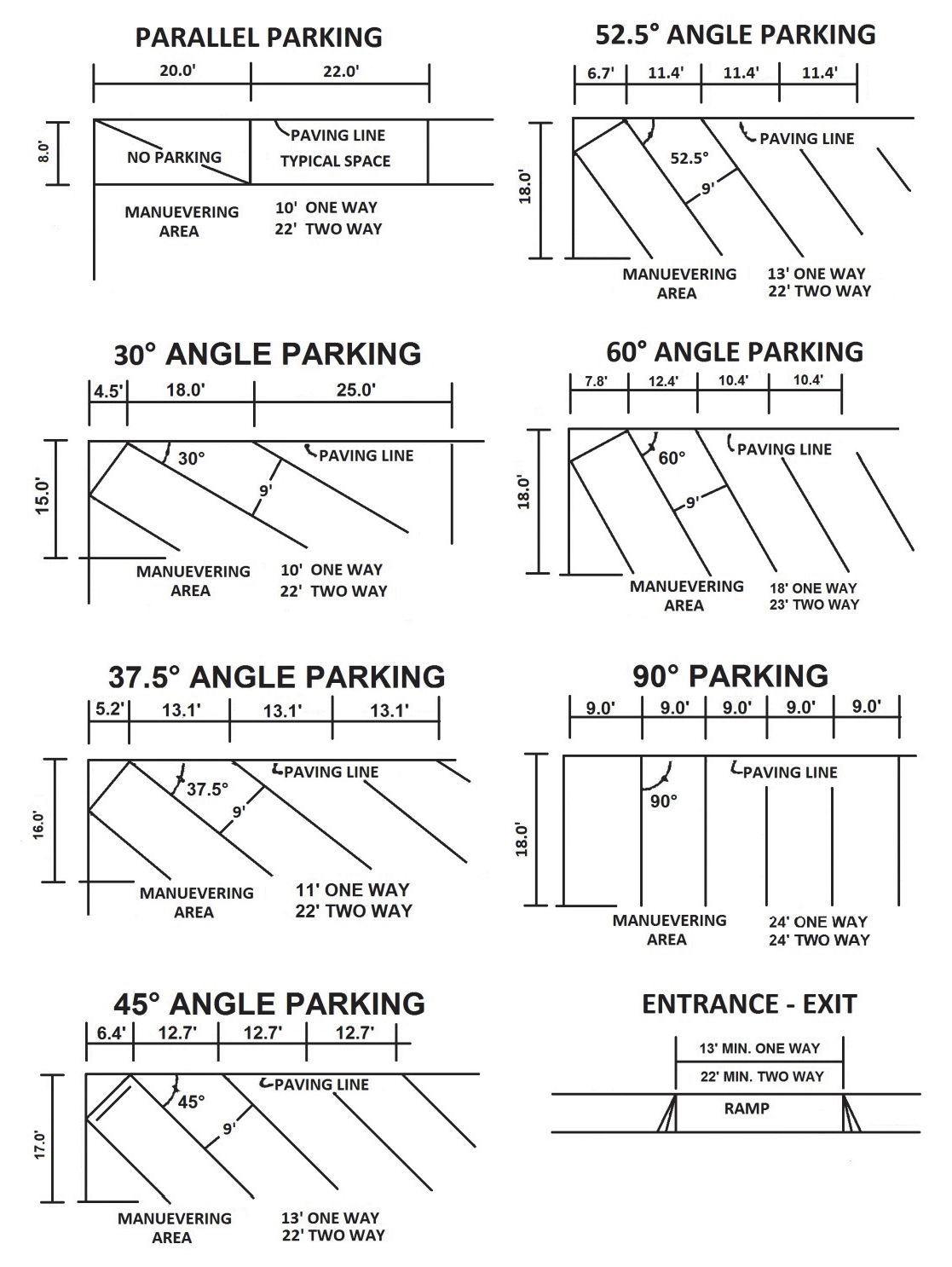
(Ord. No. 85-26, § 1(I.E.23(d)(10)), 11-27-1985; Ord. No. 15-003, § 1, 2-3-2015)
Sec. 126-1341. - Required parking spaces.
(a)
No development permit shall be issued for any dwelling unit, or for any addition to or expansion of a dwelling unit, unless parking spaces, in compliance with all requirements of this article, are provided as follows:
(b)
In the Resort Housing District, off-street parking shall not exceed two per dwelling unit pursuant to subsection 126-637(b)(1)f.
(Ord. No. 85-26, § 1(I.E.23(a)), 11-27-1985; Ord. No. 23-005, § 2, 2-7-2023; Ord. No. 24-005, § 2, 3-5-2024)
Sec. 126-1361. - Required parking spaces.
No development permit shall be issued for any nonresidential use or structure, or for any addition to or expansion thereof, unless parking spaces, in compliance with all requirements of this section, are provided as follows:
(Ord. No. 85-26, § 1(I.E.23(b)(1)), 11-27-1985; Ord. No. 96-01, § 1, 1-16-1996; Ord. No. 97-01, § 1, 1-21-1997; Ord. No. 06-022, § 21, 2-20-2007; Ord. No. 24-019, § 2, 9-9-2024)
Sec. 126-1362. - Bike parking.
(a)
Intent. Bike parking is encouraged at all nonresidential development, especially those with direct access to the shared use path.
(b)
Conditional use guidelines. Each ten bike parking spaces provided, shall be considered the equivalent of one vehicular parking space.
(Ord. No. 85-26, § 1(I.E.23(b)(2)), 11-27-1985; Ord. No. 24-019, § 2, 9-9-2024)
Editor's note— Formerly entitled "Required spaces for other nonresidential uses," which was amended as herein set out by Ord. No. 24-019.
Sec. 126-1363. - Allowance for fewer than required spaces.
The planning commission may, but need not, permit any development to have fewer parking spaces than required in this subdivision if it finds that:
(1)
The developer has, demonstrated, by clear and convincing evidence, that the required number of parking spaces will not be reasonably necessary for the proposed use in the foreseeable future;
(2)
The proposed development includes sufficient open area reserved for all the required parking spaces to be later provided, if deemed necessary by the planning commission, in conformance with all requirements and limitations of this Land Development Code, including developed area limitations, setbacks, etc.; and
(3)
The development permit is conditioned upon the property owner providing all required parking spaces within 90 days after they are deemed to be necessary by the planning commission.
(Ord. No. 85-26, § 1(I.E.23(b)(3)), 11-27-1985)
Sec. 126-1364. - Shared parking requirements.
A shared parking agreement may be submitted in lieu of a parking demand study/analysis and approved by the city manager or designee for off-street parking on contiguous lots under different ownership under the following conditions:
(a)
A minimum ten-year lease agreement between the property owners must be provided. The agreement must be reviewed by the city attorney for form and legal sufficiency and recorded in the official records of Lee County. Any changes to the agreement must be reviewed by the city attorney and the agreement re-recorded.
(b)
Properties must comply with zoning and land use restrictions in the district in which the property is located (i.e., a residentially zoned parcel shall not be used for parking for a commercial use).
(c)
Properties associated with a shared parking agreement must be contiguous.
(d)
An intra-connectivity driveway is required between the contiguous properties. If staff determines an interconnectivity driveway is not feasible, an intra-connectivity pathway may satisfy this standard.
(e)
Separate drainage must be maintained on each property, i.e., through installation of a culvert(s) at the intra-connectivity driveway or pathway.
(Ord. No. 85-26, § 1(I.E.23(b)(4)), 11-27-1985; Ord. No. 86-06, § 1, 4-1-1986; Ord. No. 24-019, § 2, 9-9-2024)
Editor's note— Formerly entitled "Combined parking requirements," which was amended as herein set out by Ord. No. 24-019.
Sec. 126-1365. - Expansion or change of commercial use.
(a)
No expansion of a commercial use of any lot, parcel, premises, or structure, or any part thereof, shall be lawful unless the expanded use is in compliance with the parking space requirements set forth in this subdivision. In a commercial development under unified ownership, which development is conforming in all respects with the requirements of this subdivision, no change of use may occur, or additional use be established, which would cause the development as a whole to have fewer parking spaces than hereby required. If a commercial development under unified ownership does not have sufficient parking spaces, as required by this subdivision, no additional use may be established, and no change of use may occur unless the new use requires the same or a lesser number of parking spaces under this subdivision as the use being replaced.
(b)
In a commercial development which has been divided into cooperative or condominium units, no change of use of any such unit may occur unless such unit has been allocated, or has been deemed to have been allocated, a sufficient number of parking spaces as required hereunder for such use, or unless the new use requires the same or a lesser number of parking spaces under this subdivision as the use being replaced. No additional use may be established in any such unit unless the unit has been allocated, or has been deemed to have been allocated, sufficient parking spaces for all uses thereof.
(Ord. No. 85-26, § 1(I.E.23(b)(5)), 11-27-1985; Ord. No. 86-06, § 1, 4-1-1986)

