
Sanibel City Zoning Code
ARTICLE IV
CONDITIONAL USES
Sec. 126-81.- Purpose and scope.
Recognizing that there are certain classes of uses which are necessary or desirable for citizens and to the growth and development of the city, and further recognizing that these particular uses must be implemented with particular care in order to lessen otherwise adverse impact on the city and neighboring permitted uses, this group of uses is permitted to co-exist with primary intended uses as set forth in the various zones, but only under such circumstances as it can be demonstrated that the administrative standards in this article are met.
(Ord. No. 85-26, § 1(I.I.1), 11-27-1985)
Sec. 126-82. - General requirements.
The planning commission shall authorize conditional uses in the zones in which they are permitted, after public hearing, only upon the following requirements being met:
(a)
The proposed development shall not adversely affect compatibility with other uses, either on, adjacent to, or nearby the parcel; and shall not adversely affect the health, safety and welfare of the community or its goals and objectives. The proposed development shall not adversely affect the traffic flow to a significantly greater extent than permitted uses; however, there shall be a rebuttable presumption of no such relative adverse effects, absent competent, substantial evidence presented to the contrary.
(b)
A request for conditional use approval shall be accompanied by a site development plan prepared in accordance with the requirements of subsection 82-382(13).
(c)
In reviewing requests for conditional uses, the planning commission may impose, as necessary, conditions to protect adjacent or nearby parcels and in furtherance of the public interests, with regard to location, design, intensity of use, architectural treatment, siting, landscaping, maintenance, and operation of the uses.
(d)
The developer must demonstrate that the proposed use is coordinated, to the greatest extent possible, with adjoining developments. Where applicable, this coordination shall include examination of all opportunities to share or combine drives and entry points, parking areas, sewage treatment facilities, pedestrian walkways, and other service facilities.
(e)
The planning commission shall consider the nature of the site, its size, and its configuration to determine whether the parcel is adequate to:
(1)
Accommodate the placement and arrangement of structures so as to promote the best possible vehicular and pedestrian access and internal circulation;
(2)
Maximize energy efficiency and compatibility with adjoining uses on and off the site; and
(3)
Minimize the need for additional off-site transportation improvements.
(f)
In considering a proposed conditional use for approval, the planning commission shall evaluate the proposal in consideration of the following factors:
(1)
Conformance with Sanibel Plan. No conditional use may be approved unless it is in accord with the Sanibel Plan.
(2)
Internal compatibility. Any proposed conditional use must be compatible with other existing or proposed uses on the same site; that is, no use may have any undue adverse impact on any neighboring use. An evaluation of the internal compatibility of a conditional use should be based on the following factors:
a.
The streetscape;
b.
The existence or absence of, and the location of, open spaces, plazas, recreational areas, and common areas;
c.
The use of existing and proposed landscaping;
d.
The treatment of pedestrian ways;
e.
Focal points and vistas;
f.
The use of the topography, physical environment, and other natural features;
g.
Traffic and pedestrian circulation pattern;
h.
The use and variety of building setback lines, separations, and buffering;
i.
The use and variety of building groupings;
j.
The use and variety of building sizes and architectural styles;
k.
The use and variety of materials;
l.
The separation and buffering of parking areas and sections of parking areas;
m.
The variety and design of dwelling types;
n.
The particular land uses proposed, and the conditions and limitations thereon;
o.
The form of ownership proposed for various uses; and
p.
Any other factor deemed relevant to the privacy, safety, preservation, protection, or welfare of any existing or proposed use on the site.
(3)
External compatibility. All proposed conditional uses must be compatible with existing and planned uses of surrounding properties; that is, no internal use may have any avoidable or undue adverse impact on any existing or planned surrounding use. An evaluation of the external compatibility of a proposed conditional use should be based on the following factors:
a.
All of those factors listed in subsection (f)(2) of this section;
b.
The particular uses proposed, and the conditions and limitations thereon;
c.
The type, number, and location of surrounding external uses;
d.
The Sanibel Plan designation and zoning on surrounding lands; and
e.
Any other factor deemed relevant to the privacy, safety, preservation, protection, or welfare of lands surrounding the proposed conditional use and any existing or planned use of such lands.
(4)
Intensity of development. The residential density and intensity of commercial use of a conditional use shall be compatible with (that is, shall have no undue adverse impact upon) the physical and environmental characteristics of the site and surrounding lands. Within the maximum limitation of the Sanibel Plan and this Land Development Code, the permitted residential density and intensity of commercial use in a proposed conditional use may be adjusted in consideration of the following factors:
a.
The locations of various proposed uses within the site and the degree of compatibility of such uses with each other and with surrounding uses;
b.
The amount and type of protection provided for the safety, habitability, and privacy of land uses both internal and external to the site;
c.
The existing residential density and intensity of commercial use of surrounding lands;
d.
The availability and location of utilities, services, and public facilities and services;
e.
The amount and size of open spaces, plazas, common areas, and recreation areas;
f.
The use of energy-saving techniques and devices, including sun and wind orientation;
g.
The existence and treatment of any environmental hazards to the site or surrounding lands;
h.
The access to and suitability of transportation routes proposed within the site and existing external transportation systems and routes; and
i.
Any other factor deemed relevant to the limitation of the intensity of development for the benefit of the public health, welfare, and safety.
(5)
Environmental constraints. The site of the proposed conditional use shall be suitable for use in the manner proposed without hazards to persons, vegetation, or wildlife, either on or off the site, from the likelihood of increased flooding, erosion, or other dangers, annoyances, or inconveniences. Condition of soil, water level, drainage, and topography shall all be appropriate to the pattern and intensity of development intended.
(6)
Off-street parking. Sufficient off-street parking, for bicycles and other vehicles as well as cars, shall be provided. The specific requirements of this Land Development Code shall be used as a guide only. Parking areas shall be constructed in accordance with such standards as are approved by the planning commission to ensure that they are safe and maintainable and that they allow for sufficient privacy for adjoining uses.
(Ord. No. 85-26, § 1(I.I.2), 11-27-1985; Ord. No. 86-25, §§ 12, 13, 6-17-1986; Ord. No. 24-015, § 2, 9-9-2024)
Sec. 126-83. - Reserved.
Editor's note— Ord. No. 23-005, § 2, adopted Feb. 7, 2023, deleted § 126-83 entitled "Resort housing accessory commercial uses," which derived from: Ord. No. 85-26, § 1(I.I.3(e)), adopted Nov. 27, 1985; Ord. No. 87-02, § 14, adopted Jan. 6, 1987; Ord. No. 88-22, § 1, adopted July 5, 1988; Ord. No. 89-23, § 50, adopted Aug. 15, 1989; Ord. No. 91-29, § 1, adopted July 2, 1991; Ord. No. 98-07, § 2, adopted April 21, 1998; and Ord. No. 03-013, § 3, adopted Nov. 18, 2003.
Sec. 126-84. - Foster family homes.
Foster family homes shall be permitted as a conditional use subject to the following conditions set forth in this section:
(1)
No foster family home may be located any closer than 1,000 feet, measured in a straight-line distance from lot line to lot line, from any existing residential child caring facility, assisted living facility or other foster family home.
(2)
A foster family home may be permitted to house only as many foster children as would bring the total occupancy of the dwelling unit to two persons per bedroom.
(3)
Such use must comply with all state licensing requirements which are applicable.
(Ord. No. 85-26, § 1(I.I.3(f)), 11-27-1985; Ord. No. 89-23, § 50, 8-15-1989; Ord. No. 15-007, § 1, 5-5-2015)
Sec. 126-85. - Increased-density below market rate housing.
Increased-density below market rate housing shall be permitted as a conditional use subject to the following conditions set forth in this section:
(1)
The planning commission may recommend to the city council, for below market rate housing, a greater development intensity than the maximum residential density established in section 86-91, but the density approved for below market rate housing shall be compatible with and shall have no detrimental effect on surrounding lands and actual and permitted uses thereof. Any recommended increases in maximum residential density shall require that such additional units be committed to the below market rate housing program.
(2)
Below market rate housing units permitted as a conditional use must comply in all respects with the requirements of chapter 102, article II.
All or a portion of the below market rate housing units may be set aside for either exclusive or preferential assignment to on-island employees, who are financially qualified, of the owner or an entity which transfers such housing or land to the housing foundation, and which maintains a business within the city limits.
(Ord. No. 85-26, § 1(I.I.3(g)), 11-27-1985; Ord. No. 86-32, § 1, 8-19-1986; Ord. No. 89-23, §§ 31, 50, 8-15-1989; Ord. No. 90-07, § 2, 5-15-1990; Ord. No. 24-007, § 2, 5-7-2024)
Sec. 126-86. - Residential child caring facilities and assisted living facilities.
Residential child caring facilities and assisted living facilities shall be permitted as conditional uses subject to the following conditions set forth in this section:
(1)
Such uses shall not be permitted a total occupancy in excess of two persons per bedroom.
(2)
Such uses shall comply with the maximum permitted residential densities established in section 86-91, except that each three bedrooms therein shall be deemed to be the equivalent of one dwelling unit.
(3)
Such uses shall be developed with architectural features compatible and harmonious with surrounding uses and structures.
(4)
Required parking for such uses shall be the same as for multifamily residential developments, plus one additional parking space for an assisted living facility.
(5)
No residential child caring facility or assisted living facility may be located any closer than 1,000 feet, measured in a straight-line distance from lot line to lot line, to any existing foster family home or other residential child caring facility or assisted living facility.
(6)
Any such facility must comply with all state licensing requirements for such foster family home or other residential child caring facility or assisted living facility.
(7)
The planning commission shall require that wastewater disposal facilities provided for the development are adequate to serve the needs of the use as proposed.
(Ord. No. 85-26, § 1(I.I.3(h)), 11-27-1985; Ord. No. 89-23, § 50, 8-15-1989; Ord. No. 15-007, § 2, 5-5-2015)
Sec. 126-87. - Reserved.
Editor's note— Ord. No. 24-005, § 2, adopted March 5, 2024, deleted § 126-87 entitled "Combined residential and commercial development," which derived from: Ord. No. 85-26, § 1(I.I.3(i)), adopted Nov. 27, 1985; Ord. No. 89-15, § 1, adopted May 16, 1989; and Ord. No. 89-23, § 50, adopted Aug. 15, 1989.
Sec. 126-88. - Outdoor storage.
Outdoor storage in conjunction with a permitted commercial use shall be permitted as a conditional use subject to the following conditions set forth in this section:
(1)
Such outdoor storage shall be limited to the minimum amount reasonably necessary to adequately conduct the permitted commercial use.
(2)
All permitted outdoor storage shall be completely enclosed by a vegetation screen or by a combination of a vegetation screen and approved structures. Any part of the enclosure which consists of a vegetation screen shall be sufficiently dense as to reasonably screen the storage area from view from any street or adjoining property. Such vegetation screen shall be composed of native plants which shall be installed and maintained in accordance with the requirements of chapter 122, article II, division 2 for installation and maintenance standards. At the option of the applicant, the outdoor storage area may also be enclosed with a fence located inside the required vegetation screen enclosure, at a height not to exceed that of the vegetation screen or six feet, whichever is higher. Notwithstanding the requirements of chapter 122, article II, division 2 however, the planning commission may require as a condition of approval under this section that the trees, shrubs, and bushes of the vegetation screen be installed and maintained larger than the minimum sizes specified in chapter 122, article II, division 2, so as to accomplish the purpose and intent of this subsection.
(3)
When a vegetation screen required by subsection (2) of this section cannot reasonably be provided because of existing paving or because of the existence of parking spaces or other facilities required by this Land Development Code which could not lawfully and reasonably be relocated on the site, the planning commission may approve some alternative form of screening sufficient to accomplish the purpose therefor.
(Ord. No. 85-26, § 1(I.I.3(j)), 11-27-1985; Ord. No. 86-25, § 14, 6-17-1986; Ord. No. 89-23, § 50, 8-15-1989)
Sec. 126-89. - Rehabilitation centers and social service homes.
Rehabilitation centers and social service homes shall be permitted as conditional uses subject to the following conditions set forth in this section:
(1)
Such uses shall be developed in accordance with all requirements for commercial uses in the district in which they are located, including commercial landscaping requirements.
(2)
Such uses shall not be located adjacent to relatively high-intensity, high-traffic commercial uses.
(3)
Such uses may not be located any closer than 100 feet to an existing dwelling unit which is not located in a commercial district.
(4)
Such uses must comply with all state licensing requirements applicable thereto.
(Ord. No. 85-26, § 1(I.I.3(k)), 11-27-1985; Ord. No. 89-23, § 50, 8-15-1989)
Sec. 126-90. - Drive-in and drive-through facilities.
Drive-in and drive-through facilities in conjunction with a permitted conditional use shall be permitted as a conditional use subject to the following conditions set forth in this section:
(1)
All drive-in or drive-through service areas shall be designed to stack a minimum of four cars per lane, without interfering with on-site or off-site traffic circulation.
(2
All drive-in or drive-through service areas shall be counted toward the maximum permitted commercial floor area for the parcel.
(3)
Nothing in this article or any other provision of this Land Development Code shall be construed to allow drive-up, drive-through, or drive-in lanes with carry-out service windows in or at any restaurant, food service operation, or beverage or liquor store, and drive-up, drive-through, or drive-in lanes with carry-out service windows in or at any restaurant, food service operation, or beverage or liquor store are specifically prohibited.
(Ord. No. 85-26, § 1(I.I.3(l)), 11-27-1985; Ord. No. 86-25, § 15, 6-17-1986; Ord. No. 89-23, § 50, 8-15-1989; Ord. No. 91-37, § 1, 8-20-1991; Ord. No. 93-16, § 2, 8-3-1993; Ord. No. 23-015, § 1, 8-15-2023)
Sec. 126-91. - Eating places, restaurants, grocery stores, etc., not listed as a permitted use.
Eating places, such as restaurants, grocery stores, delicatessen stores, food markets, convenience stores, carry-out food stores not listed as a permitted use, including ice cream shops, and any permitted commercial use involving on-site food preparation or processing shall be permitted as conditional uses subject to the following conditions set forth in this section:
(1)
The planning commission shall require that the wastewater disposal facilities for any use approved pursuant to this section are adequate to serve the needs of the use as proposed, and may require such security as it deems necessary to ensure that the system installed is replaced if it proves to be inadequate or may condition the approval of such use upon such modifications and improvements to the system as are reasonably necessary after the use if developed.
(2)
All restaurants with more than 50 seats must be connected to the city sewer system.
(3)
All restaurants must be located at least 100 feet from any existing dwelling unit, except for a dwelling unit located in a commercial district. Any such use shall be required to be soundproofed to the extent reasonably necessary to ensure compliance with all existing ordinances of the city relating to the creation of noise.
(4)
Nothing in this article or any other provision of this Land Development Code shall be construed to allow formula restaurants.
(Ord. No. 85-26, § 1(I.I.3(m)), 11-27-1985; Ord. No. 86-25, § 16, 6-17-1986; Ord. No. 89-23, § 50, 8-15-1989; Ord. No. 98-05, § 4, 3-17-1998; Ord. No. 91-37, § 1, 8-20-1991; Ord. No. 96-10, § 3, 9-17-1996; Ord. No. 23-015, § 1, 8-15-2023)
Sec. 126-92. - Motion picture theaters, except drive-in, and theaters for live performances.
Motion picture theaters, except drive-in, and theaters for live performances shall be permitted as conditional uses subject to the following conditions set forth in this section:
(1)
No such use shall be located any closer than 100 feet to any existing dwelling unit, except a dwelling unit in a commercial district.
(2)
Any such use shall be required to be soundproofed to the extent reasonably necessary to ensure compliance with all existing ordinances of the city relating to the creation of noise.
(Ord. No. 85-26, § 1(I.I.3(n)), 11-27-1985; Ord. No. 86-25, § 17, 6-17-1986; Ord. No. 89-23, § 50, 8-15-1989; Ord. No. 91-37, § 1, 8-20-1991; Ord. No. 23-015, § 1, 8-15-2023)
Sec. 126-93. - Gasoline service stations.
Gasoline service stations shall be permitted as a conditional use subject to the following conditions set forth in this section:
(1)
All gasoline pumps (including pumps for dispensing any form of motor vehicle fuel) and service islands, as well as adequate area for the parking of automobiles next to such pumps, shall be located within minimum required setbacks and shall be counted toward the maximum permitted commercial floor area for the parcel.
(2)
Lanes for access to gasoline pumps or service islands shall be designed so that one automobile can park at each pump or pump island behind the vehicle being refueled, without interfering with on-site or off-site traffic circulation.
(3)
Outdoor displays of merchandise shall be limited to cans of oil or other vehicle fluids and such minor equipment and accessories as windshield wiper blades, fuses and similar equipment and accessories. Such displays of merchandise shall not be located so as to interfere with on-site traffic circulation.
(4)
A gasoline service station may include an accessory drive-through car wash, provided the required conditions for a car wash as a conditional use are met.
(5)
No vehicle lift or repair facilities shall be located outside of the principal structure.
(6)
Minor adjustments or repairs to automobiles, trucks, trailers, or other vehicles which do not require body work, painting, or removal of engines from frames or dismantling of differentials shall be permitted as an accessory use. Additional adjustments or repairs at gasoline service stations shall only be permitted within zoning districts where such automotive repairs are a permitted principal use.
(7)
The planning commission shall ensure that the wastewater disposal system is adequate for the use as proposed.
(Ord. No. 85-26, § 1(I.I.3(o)), 11-27-1985; Ord. No. 86-25, § 18, 6-17-1986; Ord. No. 89-23, § 50, 8-15-1989; Ord. No. 23-015, § 1, 8-15-2023)
Sec. 126-94. - Vehicle rental and leasing.
Automotive rental and leasing, boat and canoe rentals, motorcycle rentals, including mopeds, and rental of bicycles shall be permitted as conditional uses subject to the following conditions set forth in this section:
(1)
All areas in which rental cars, mopeds, bicycles, and boats are parked or stored shall be located behind minimum required setbacks and shall be counted toward the maximum permitted developed area for the parcel.
(2)
Conditional use permits shall not be issued for the rental of bicycles or other human-powered vehicles which exceed 36 inches total width.
(Ord. No. 85-26, § 1(I.I.3(p)), 11-27-1985; Ord. No. 86-25, § 19, 6-17-1986; Ord. No. 89-23, § 50, 8-15-1989; Ord. No. 91-29, § 2, 7-2-1991; Ord. No. 91-37, § 1, 8-20-1991; Ord. No. 23-015, § 1, 8-15-2023)
Sec. 126-95. - Car washes.
Car washes shall be permitted as a conditional use subject to the following condition set forth in this section:
The planning commission shall ensure that the wastewater disposal system designed and installed for such use shall be installed and maintained in such fashion and to such standards as reasonably necessary to serve the needs of the use as proposed.
(Ord. No. 85-26, § 1(I.I.3(q)), 11-27-1985; Ord. No. 89-23, § 50, 8-15-1989; Ord. No. 91-37, § 1, 8-20-1991; Ord. No. 23-015, § 1, 8-15-2023)
Sec. 126-96. - Docks, boat davits, boat lifts and mooring pilings.
Docks, boat davits, boat lifts, and mooring pilings shall be permitted as a conditional use in the bay beach zone, except in the portion of this zone extending from the west boundary of Lighthouse Park to the west right-of-way boundary of Dixie Beach Boulevard at Woodring's Point. In the portions of this zone where such use is permitted as a conditional use, such structures shall be permitted only upon a finding by the planning commission that all of the following conditions are met:
(1)
Such use shall be an accessory use to a permitted residential use in the adjacent ecological zone.
(2)
The structures shall be located on the same lot as the permitted residential use.
(3)
No lot or parcel used for single-family or duplex dwelling units, or zoned only for such residential uses, may have more than one dock, with facilities for no more than two boats.
(4)
For all docks, boat davits, and boat lifts, permanent double berthing is permitted only when such docking system is specifically identified in an application clearly demonstrating compliance with all the standards of this section, and specifically approved by the conditional use permit.
(5)
Roofing and enclosures shall not be permitted on docks, boat davits, or boat lift structures, including mooring pilings.
(6)
Boat davits and boat lifts shall only be permitted where attached to, or adjacent to, a dock.
(7)
The structures can be placed in the tidal flow in such a manner as to minimize adverse environmental impacts.
(8)
The structures shall be extended seaward, from the mean high water line, no greater distance than is necessary to provide reasonable use of the facility and to provide boat docking or mooring only where the mean low water level is at least 3½ feet above bottom surface, but in no event shall such structure extend seaward more than 150 feet from the mean high water line.
(9)
The dock, boat davit, or boat lift shall not intrude into navigation channels or otherwise obstruct navigation.
(10)
The size of the surface area of the dock platform, not including the walkway to the dock, shall not exceed 200 square feet.
(11)
The dock platform and walkway to the dock shall have a maximum width of four feet.
(12)
Height restrictions.
a.
The height above mean high water, of the lowest horizontal structural member of the walkway to the dock and of the dock platform, shall not exceed, by more than six inches, the minimum height required by state law or regulation.
b.
With an exception for the height of the access walkway as provided for in subsection (10) of this section, the height of the surface of the decking for the walkway to the dock and for the dock platform shall not exceed, by more than 20 inches, the height of the bottom of the lowest horizontal structural member.
c.
The height of required railing shall not exceed, by more than three inches, the minimum required by the building code.
d.
The height of mooring piling shall not exceed ten feet above the mean high water line.
(13)
No dock, boat davits, boat lifts, and mooring pilings shall be located closer than 30 feet to any property line, as extended into the water.
(14)
Piling pairs for the walkway to the dock shall be placed at least 15 feet apart. Pilings shall be no greater in number and size than necessary to support the structure, given the anticipated use and soil conditions.
(15)
The walkway to the dock shall either be interrupted or be elevated to allow public access underneath, with at least six feet of clearance between the beach and the lowest member of the dock, in the area between mean high water and the mean low water line. However, as an alternative, a property owner may grant a public access easement adequate to provide reasonable passage around or across the walkway if proper ramping is provided.
(16)
Deck planks shall be no wider than six inches wide. The deck planks shall be spaced at least one inch apart. Alternative materials may be utilized for decking where it provides an equivalent or greater amount of light penetration as the deck planking standards.
(17)
Materials utilized in marine construction shall not be treated with chemicals which may have a detrimental effect on water quality, including creosote, tri-butyl tin, and all asbestos treatments.
(18)
Turbidity screening shall be employed during subsurface construction, to remain in place a minimum of 24 hours after construction is completed to ensure protection of water quality in the area.
(19)
A marine habitat, such as the placement of rip-rap, shall be provided under the dock platform.
(20)
The dock, boat davit, or boat lift shall be located so as to avoid, as far as possible, the disturbance of any shell bed or grass bed.
(21)
Railings shall be installed along the sides of the dock to prevent the docking or mooring of boats in any area of the dock that the water depth is less than 3½ feet at mean low water.
(22)
Lighting fixtures may be installed upon docks, boat davits, and boat lifts only in accordance with the following standards:
a.
Lighting required under federal laws or regulations as an aid to navigation is permitted on docks, boat davits, and boat lifts, in accordance with United States Coast Guard standards.
b.
Other lighting fixtures may be installed on docks only providing they are mushroom-type fixtures designed to direct light downward, installed at least 25 feet apart, not more than one foot above the surface of the dock, and limited to bulbs equivalent to a maximum of 25 incandescent watts or 4 LED watts and compliant with the lighting standards for marine turtle protection pursuant to section 126-1000.
c.
All existing lighting on docks, boat davits, and boat lifts which does not conform to these standards shall be deemed nonconforming and shall be made to conform.
(23)
A certified topographic survey, by a registered professional surveyor, indicating the mean high water line, approximate mean high and low water depths, the location of any shoals, depressions, holes, and manmade structures and the location of the navigation channel. The mean high water line shall be staked by the surveyor before an application for a permit is submitted and the staking shall be maintained in place until the completion certificate is issued.
(24)
A vegetation survey of the bay bottom, along the full width of the applicant's property, shall be provided. Such survey shall disclose, locate, and identify all existing conditions, such as, but not limited to, grass beds, shell beds, shoals, depressions, and holes.
(25)
As a condition of a development permit for a dock, boat davit, or boat lift, an applicant shall be required to establish compliance with all federal, state, or county permitting requirements.
(26)
Shoal signs shall be posted in any grass beds or shell beds.
(27)
Signs shall be posted at the end of the dock to warn boaters of shallow waters.
(Ord. No. 85-26, § 1(I.I.3(r)), 11-27-1985; Ord. No. 89-08, § 1, 2-21-1989; Ord. No. 89-23, § 50, 8-15-1989; Ord. No. 93-18, § 2, 9-21-1993; Ord. No. 95-19, § 1, 12-19-1995; Ord. No. 24-002, § 2, 2-6-2024)
Sec. 126-97. - Automotive repair shops and marine sales and repair shops.
Automotive repair shops and marine sales and repair shops shall be permitted as conditional uses subject to the following conditions set forth in this section:
(1)
Any such use must be located at least 100 feet from any existing dwelling unit, except for a dwelling unit located in a commercial district.
(2)
No automotive or marine repair area may be located outside of a completely enclosed building.
(Ord. No. 85-26, § 1(I.I.3(s)), 11-27-1985; Ord. No. 86-25, § 20, 6-17-1986; Ord. No. 89-23, § 50, 8-15-1989)
Sec. 126-98. - Coin-operated laundries.
Coin-operated laundries shall be permitted as a conditional use subject to the following conditions set forth in this section:
(1)
The planning commission shall require that the wastewater disposal system designed and installed for any such use is installed and maintained in such fashion and to such standards as are reasonably necessary to serve the needs of the use as proposed.
(2)
The planning commission may require such security as it deems necessary to ensure that the wastewater disposal system is replaced if it proves to be inadequate or may condition the approval of any such use upon such modifications and improvements to the wastewater disposal system as are reasonably necessary after the use if developed.
(Ord. No. 85-26, § 1(I.I.3(t)), 11-27-1985; Ord. No. 86-25, § 21, 6-17-1986; Ord. No. 89-23, § 50, 8-15-1989)
Sec. 126-99. - Living shoreline stabilization project.
The continuing advancements in shoreline restoration and stabilization techniques offer more sustainable and ecologically based enhancement alternatives to seawalls, revetments and erosion control structures, therefore living shoreline stabilization projects (referenced in this section as "project" or "projects") shall be permitted as conditional uses on the banks of human made water bodies (e.g., canals and artificial lakes) and natural water bodies (e.g., San Carlos Bay, Dinkins Bayou, Clam Bayou, and Blind Pass), subject to the general requirements of section 126-82 and the following conditions set forth in this section:
(a)
Projects are prohibited on shorelines along the Gulf of America except for projects to protect public infrastructure.
(b)
The application for conditional use approval under this section shall be prepared by a professional engineer registered in the state having experience in coastal engineering, and with assistance from a professional ecologist or State of Florida licensed landscape architect with knowledge of southwest Florida coastal systems, and shall include:
(1)
An inventory and map of existing grass beds, shell beds and other living components of the marine environment that may be affected by the installation of the proposed project and an assessment of the impact of the proposed project on these identified natural resources;
(2)
An assessment of the potential for harm to existing structures, both public and private, including roads, both on and off the subject parcel, if the proposed project is not installed and if the project is installed;
(3)
Evidence of active, ongoing, and/or progressive shoreline erosion is present on the subject lot which is not caused by runoff from the uplandsand is not due to the typical seasonal fluctuations in shoreline profile; and
(4)
Such other information as may be necessary for a complete determination on the application.
(c)
New rigid, nonflexible structures which resist or redirect wave action or impede sediment accumulation (accretion) are expressly prohibited.
(d)
Projects may not be approved within the bay beach zone under this section unless the project design encourages sediment accretion along the shoreline.
(e)
Projects approved under this section shall be the minimum necessary to accomplish the intended purpose.
(f)
The project shall be designed, installed, and maintained to preserve and protect existing native vegetation that stabilizes the bank or shoreline, filters surface water runoff, or provides terrestrial or aquatic habitat.
(g)
The project shall meet the following minimum requirements:
(1)
Along natural bodies of water, the natural shoreline profile shall be maintained or restored to the extent feasible (if previously altered), but in no case shall the slope be steeper than three feet horizontal to one foot vertical. Within the bay beach zone, the preferred slope shall be no steeper than ten feet horizontal to one foot vertical.
(2)
Along human-made bodies of water, the bank may be altered to include terraces or a graded slope no steeper than two feet horizontal to one foot vertical; a more gentle slope shall be required if indicated by site specific conditions.
(3)
The project shall provide a connection or transition zone between the adjacent uplands and water bodies for the benefit of wildlife to the extent feasible.
(4)
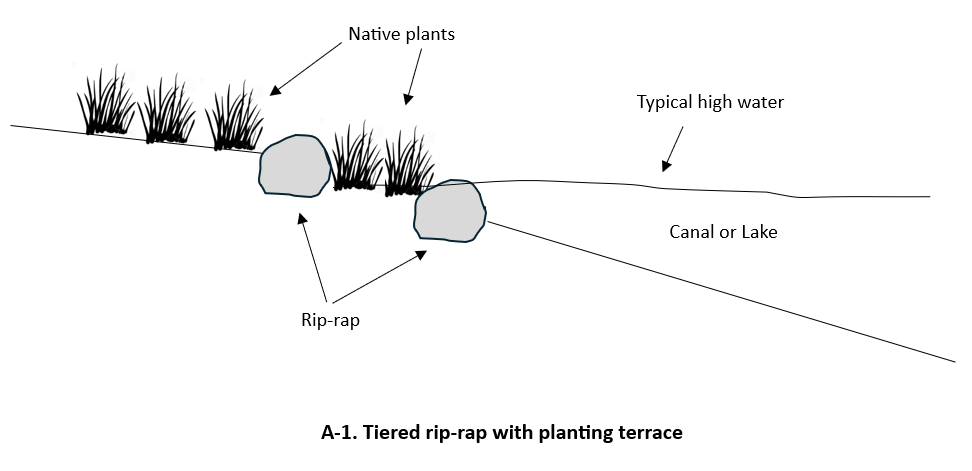
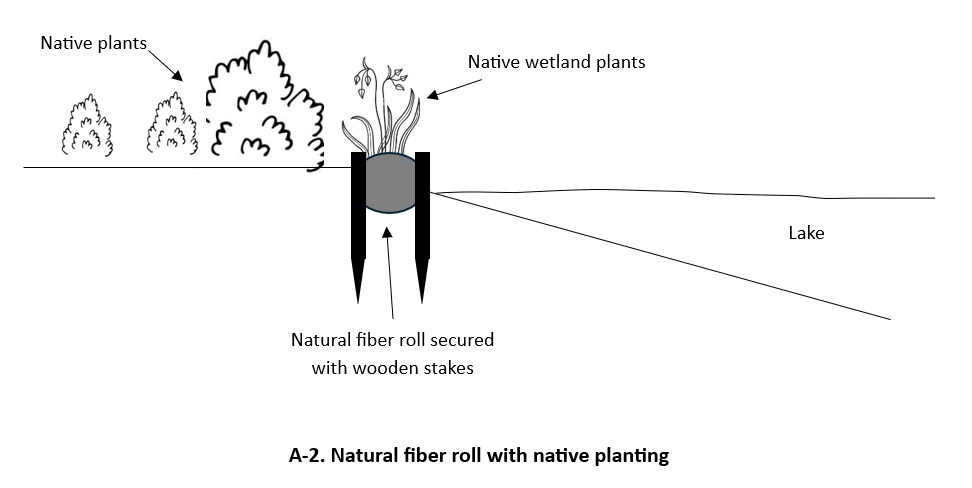
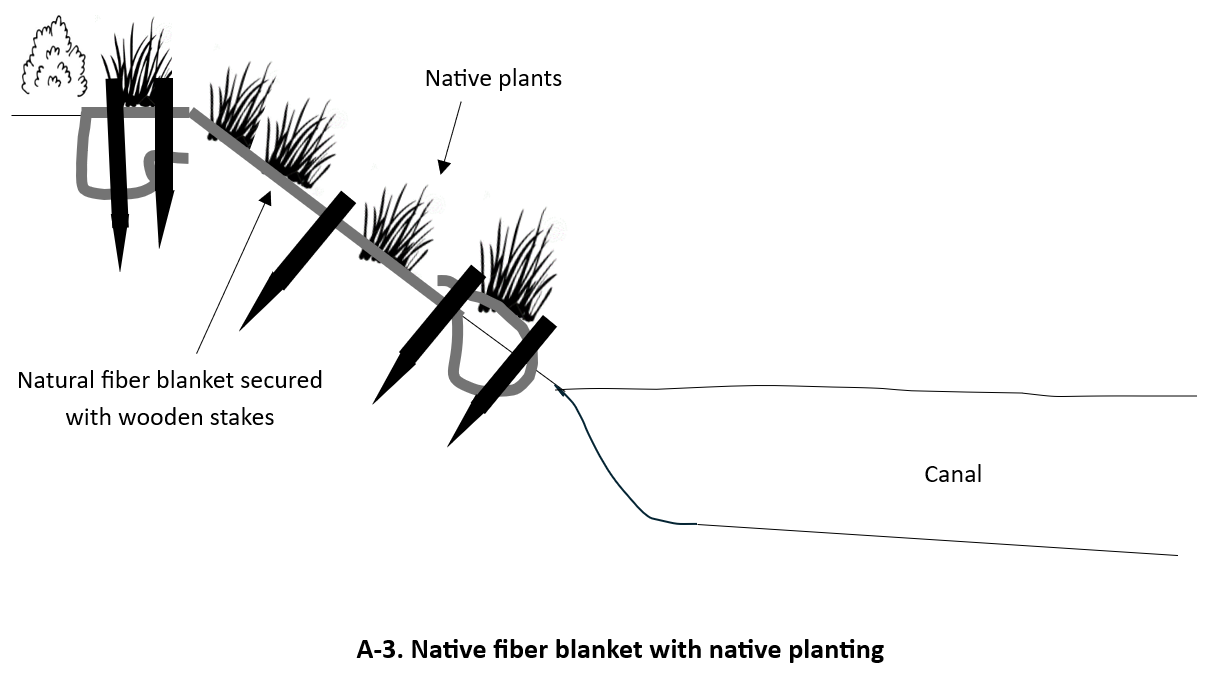
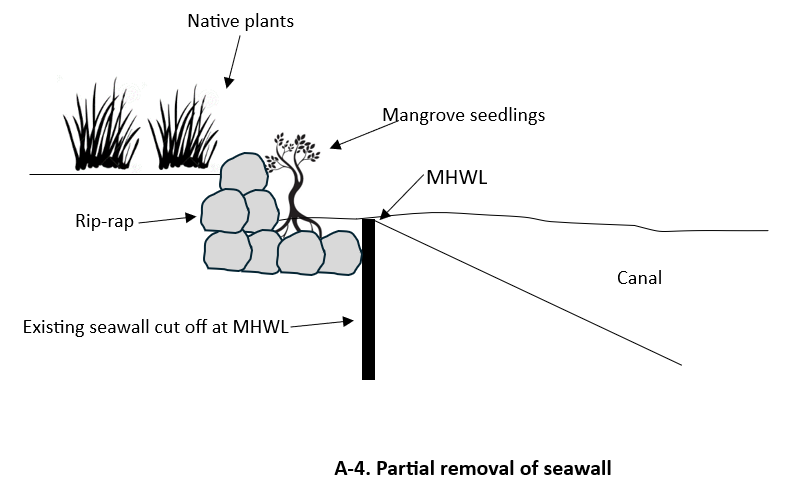
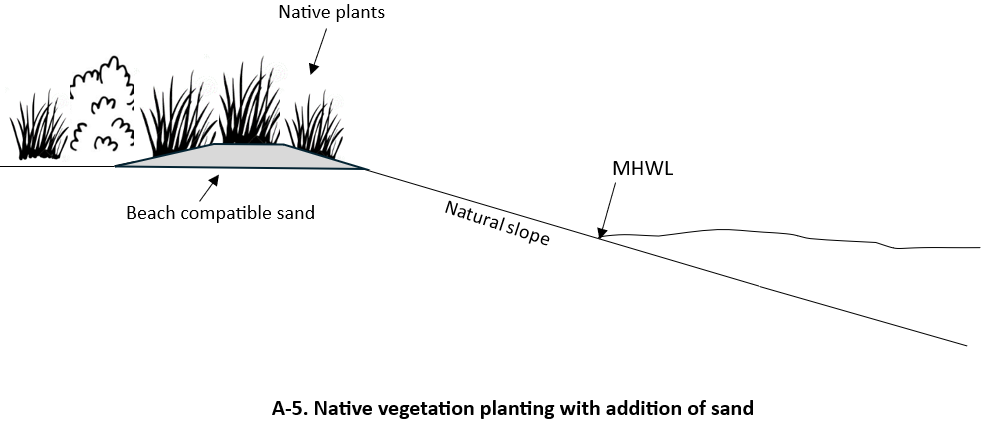
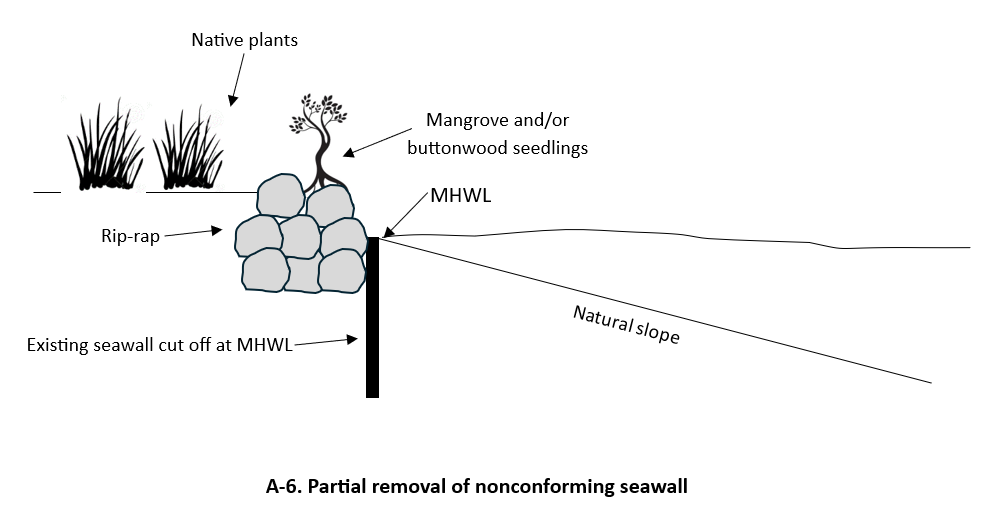
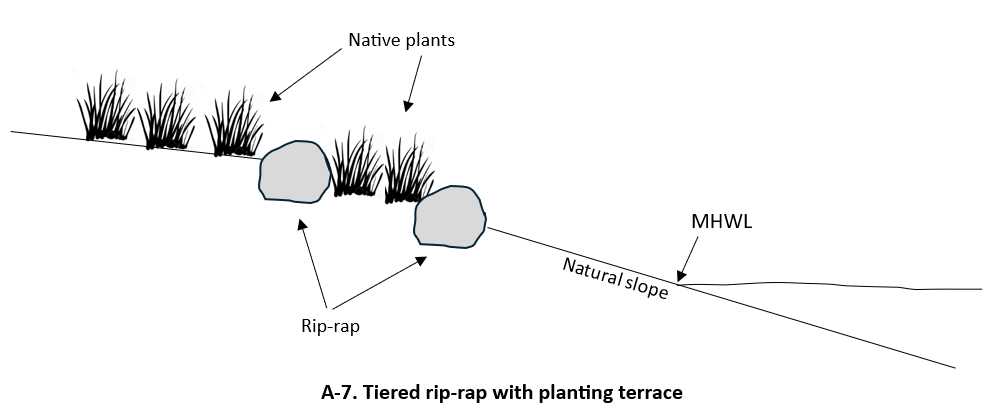
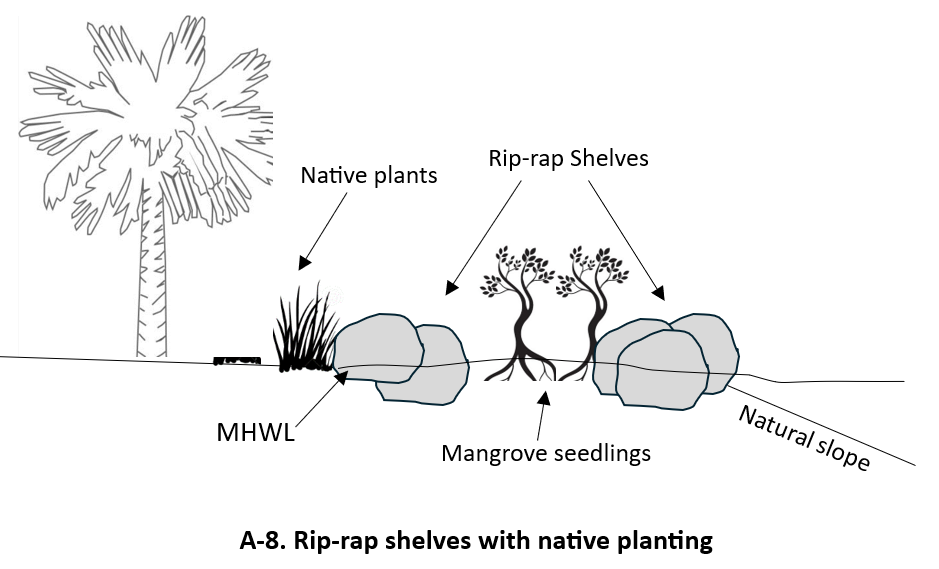
Limerock rip-rap, clean cement grids or pipes, reef balls, oyster bags, natural fiber rolls or mats, or similar material may be integrated into the design in a size and manner where they will not be dislodged, resist or redirect wave action, or impede sediment accumulation provided only the minimum necessary size and quantity is incorporated to create planting areas and stabilize the shoreline through encouraging natural sediment accretion. Refer to Figure A—Example Designs.
Figure A—Example Designs
(5)
Plans must include the locations with elevations of mean low tide and mean high tide in relation to the proposed project. There shall be no filling or dredging at or below the mean high water line associated with the installation of the project when located along natural bodies of water.
(6)
Native plants suitable for shoreline stabilization, provision of wildlife habitat, and water quality enhancement or protection shall be planted three-foot on center in areas where no native vegetation exists. A planting plan shall be incorporated into the design drawings.
(7)
The ends of the project shall be tied into any existing structures on adjoining lots in a manner which contributes to the stability of each structure or project; where an existing structure adjoins the proposed project at only one end, the other end of the proposed project shall be tied into the subject parcel in a manner which minimizes the potential for flank erosion.
(8)
Designs may include the removal of all or part of an existing seawall, revetment or erosion control structure. If an existing seawall is removed, a drainage plan must be submitted to ensure runoff is directed away from the waterbody to an appropriate onsite location.
(h)
The timing and sequence of construction to protect existing habitats or nesting, feeding or reproductive areas shall be based upon recommendations from the city's natural resources department.
(i)
For projects within the bay beach zone, the waterward and landward limits of the bay beach zone shall be established (i.e., field located, corners staked, and coordinates recorded for mapping) by a State of Florida licensed professional surveyor prior to installation of the project. The line 50 feet landward of the mean high water line established by this survey, which is the boundary of the bay beach zone, shall not be moved waterward because of the installation of the project.
(j)
The mean high water line shall be established (i.e., field located, staked, and coordinates recorded for mapping) by a State of Florida licensed professional surveyor prior to the installation of the project and the mean high water line shall not be moved waterward because of the installation of the project.
(k)
Revisions to previously permitted erosion control structures, revetments, or living shoreline stabilization projects due to changes in site conditions from storm events, king tides, or other sea level rise impacts may be applied for through a short-form development permit using the standards of this section.
(Ord. No. 85-26, § 1(I.I.3(u)), 11-27-1985; Ord. No. 86-33, § 4, 9-2-1986; Ord. No. 88-02, § 17, 1-19-1988; Ord. No. 89-23, § 50, 8-15-1989; Ord. No. 22-001, § 2, 4-5-2022; Ord. No. 25-014, § 3, 9-8-2025)
Editor's note— Ord. No. 25-014, amended the title of § 126-99 to read as herein set out. The former § 126-99 was entitled "Alternative shoreline stabilization project."
Sec. 126-100. - Accessory security guardhouses and security gates.
Accessory security guardhouses and security gates without setbacks shall be permitted as a conditional use subject to the following conditions set forth in this section:
(1)
No specific setbacks shall apply to any such conditional use. The planning commission, however, shall require that such uses be located so as to minimize any hazard to traffic or pedestrian safety.
(2)
Security gates without setbacks may be located only so as to prevent access, by way of a private street or driveway, to a residential development of at least ten dwelling units.
(3)
Security gates without setbacks shall be designed so as to provide unimpeded access to emergency vehicles, and the method of access by emergency vehicles must be approved by the city police chief and the city fire control district.
(4)
Accessory security guardhouses without setbacks may only be located in or adjacent to a private street or driveway providing access to a residential development of at least ten dwelling units.
(5)
Accessory security guardhouses need not comply with the requirements of chapter 94.
(6)
Accessory security guardhouses and security gates without setbacks shall be located so that there is as much room as possible, but an absolute minimum area of 20 feet, between any such structure and the traveled portion of any public road, right-of-way.
(Ord. No. 85-26, § 1(I.I.3(v)), 11-27-1985; Ord. No. 86-44, § 7, 11-18-1986; Ord. No. 89-23, § 50, 8-15-1989)
Sec. 126-101. - Seawalls as accessory structures.
Seawalls as accessory structures shall be permitted as a conditional use in the F-mid-island ridge zone and the G-altered land zone, subject to the general requirements of section 126-82 and the following conditions set forth in this section:
(1)
The seawall shall be in a humanmade canal at the following locations only:
Shell Harbor Subdivision;
Sanibel Harbors Subdivision;
Sanibel Isles Subdivision;
Water Shadows Subdivision;
Sanibel Estates Subdivision, Unit No. 4 only; or
Between Periwinkle Way and San Carlos Bay adjoining Mariner Point, Yacht Haven, Tennis Place and Harbor Cottages.
(2)
Repairs to a lawfully existing seawall must meet design standards 5, 9, 11, 13, 15, 17, 18, 19 and 20 of this section through a development permit (refer to seawall repair definition in section 78-1). A conditional use permit is not required.
(3)
Reconstruction of a lawfully existing seawall must meet design standards 5 and 9 through 20 of this section and may be allowed through a development permit (refer to seawall reconstruction definition in section 78-1). A conditional use permit is not required.
(4)
There shall be no more than 150 continuous lineal feet of unseawalled shoreline between existing seawalls where the seawall is proposed.
(5)
Repairs or reconstruction of lawfully existing seawalls located where seawalls are not a permitted use (i.e., nonconforming use) shall be limited to concrete and/or rock and must meet the standards of subsections 126-152(a)(9) through (11).
(6)
Metal sheets may only be used as a temporary (i.e., two years maximum) structure for emergency shoreline stabilization, while a more long-term shoreline stabilization plan is designed and permitted.
(7)
Where native vegetation is present which filters surface water runoff, provides terrestrial or aquatic habitat, or stabilizes the shoreline, such vegetation shall be preserved by installing the seawall landward of such vegetation.
(8)
The seawall shall extend no farther into the waterway or canal than the banks, seawalls or revetments adjoining the property except under the limiting conditions where replacement seawalls are allowed waterward of the existing seawall per section 126-106.
(9)
A seawall shall be constructed in a manner to prevent it from being overtopped and the land behind the structure being eroded under seasonal tidal fluctuations. The top of the seawall cap for properties where no seawall currently exists is limited to a height no more than 4.5 feet NAVD. On properties where there is an existing seawall and a seawall cap repair, seawall replacement, or new seawall waterward of an existing seawall is proposed the new seawall cap is limited to a height no more than 4.5 feet NAVD.
(10)
Weep holes must be regularly spaced above the mean high water line of the seawall to relieve the buildup of pressure on the wall from groundwater and rain percolating through the soil.
(11)
The seawall must be made of materials strong enough to withstand anticipated battering by waves and wave-carried debris. Seawalls in the limited areas where seawalls are a permitted use shall be made of concrete, fiber reinforced polymer composite, rock, or polyvinyl chloride (PVC). Color of composite or polyvinyl chloride panels is limited to light grey to be substantially similar in coloration to concrete. The only rock which may be used is Florida limerock.
(12)
Polyfilter "X" cloth, or equivalent, shall be installed along the back of the seawall between the wall and the uplands when a void is present between seawall panels, to prevent soil from seeping into the adjacent waterway.
(13)
The seawall shall be installed with sufficient tiebacks and anchors to help prevent it from tipping over. Tieback rods shall be protected against corrosion.
(14)
The toe of the seawall shall have adequate penetration into the ground (a minimum of 40 percent of the height of the seawall) to develop the resistance necessary to keep the outward-acting forces of the fill behind the wall from forcing the bottom of the wall outward into the canal.
(15)
There shall be adequate embedment of the wall into the cap (a minimum of one-half the thickness of the cap) to prevent the wall and cap from rotating in different directions.
(16)
The seawall shall be tied into the adjoining seawall or well anchored to the shore with wingwalls or returns to resist flank erosion.
(17)
When reinforcing steel is utilized in the wall and/or cap, current industry standards must be incorporated into the design to prevent corrosion and spalling which would reduce the strength of the wall.
(18)
A turbidity and erosion control plan must be included in the design documents. Turbidity screening shall be employed prior to construction and remain in place a minimum of 24 hours after completion of construction to ensure protection of water quality in the area. Erosion control measures must be installed landward of the seawall upon completion of construction and remain in place until the upland area disturbed during construction is stabilized with vegetation.
(19)
Structural plans must be prepared by a professional engineer with experience in designing marine structures and licensed in the State of Florida to certify the seawall has been designed in conformance with these standards and site specific conditions prior to issuance of a development permit. An as-built certification by the designing engineer that the seawall was built in conformance with the approved structural plans must be submitted prior to issuance of a certificate of completion.
(20)
Environmental enhancement:
a.
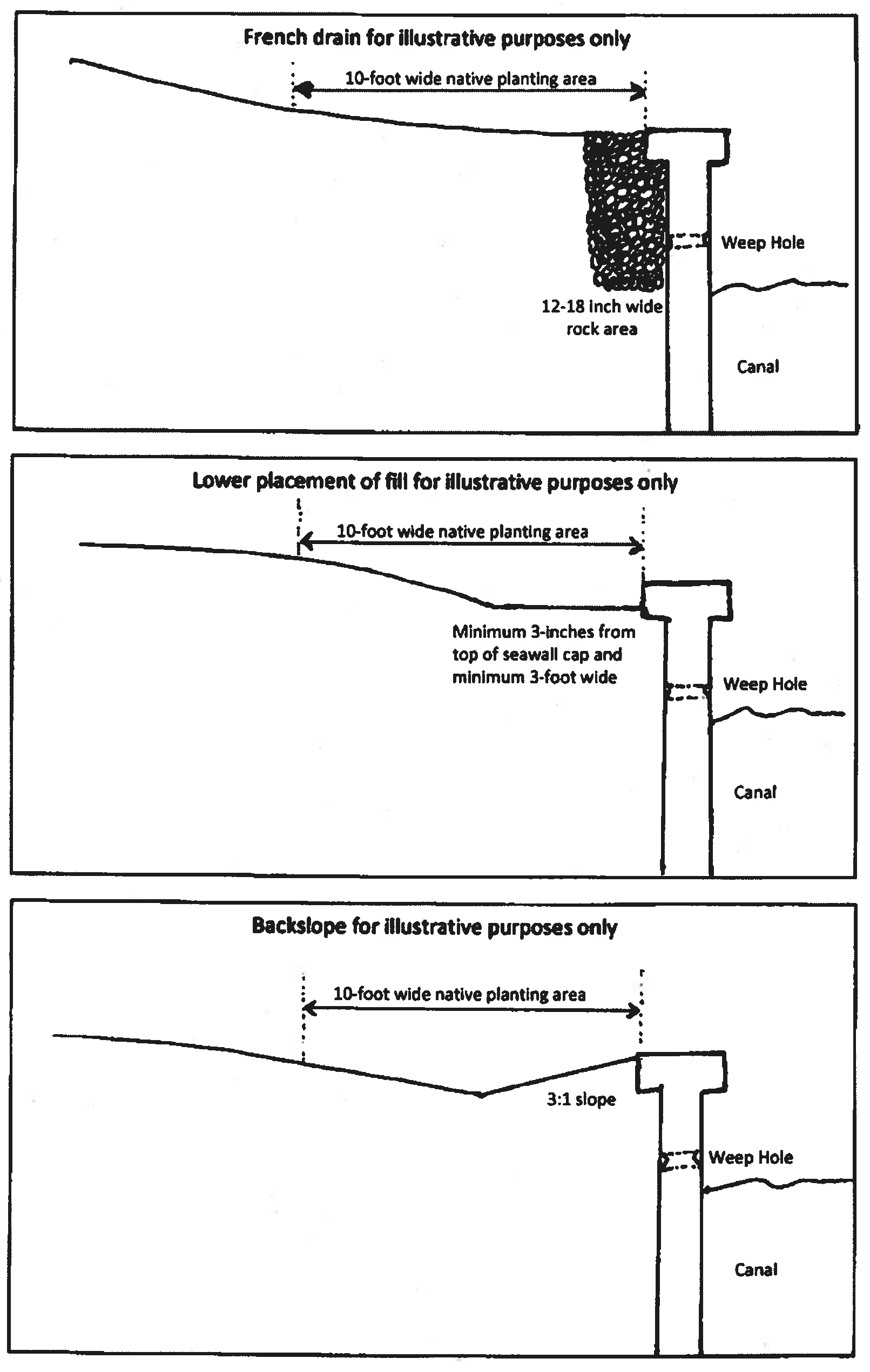
When the design of a replacement seawall or replacement seawall cap is at an elevation greater than the elevation of the existing structure, and when a new seawall is proposed, then the design must include a stormwater detention area landward and adjacent to the seawall to prevent runoff from rainfall and irrigation systems to directly enter the waterway. Examples of methods to detain runoff from direct discharge into the canal include, but are not limited to: (1) installation of a French drain adjacent to the seawall which is composed of crushed rock to encourage infiltration; (2) back sloping the fill; and (3) reducing the fill behind the new seawall cap, new seawall or replacement seawall to be three or more inches below the height of the seawall cap with a level surface for three or more feet in width (refer to illustrations below); and
b.
A ten-foot wide native groundcover planting area directly adjacent to and along the length of the seawall except for a maximum five-foot wide accessway to a dock. Native groundcover plants to be a minimum one-gallon container size planted on three-foot center; soil must be stabilized with a natural fiber filter cloth or native seashore paspalum sod at time of planting.
c.
The stormwater detention area and ten-foot wide native groundcover planting area will not be counted toward the developed area limit.
(Ord. No. 85-26, § 1(I.I.3(w)), 11-27-1985; Ord. No. 88-02, § 11, 1-19-1988; Ord. No. 89-23, § 50, 8-15-1989; Ord. No. 95-18, § 1, 12-19-1995; Ord. No. 22-001, § 2, 4-5-2022)
Sec. 126-102. - Formula retail stores.
Conditional use approval is required for all new formula retail stores, even if the prior use was a formula retail store, regardless of whether the prior formula retail store had obtained conditional use approval for that use. Formula retail stores may be permitted as a conditional use, subject to the following conditions set forth in this section:
(1)
The formula retail store shall be compatible with existing land uses on the same site as the formula retail store and with existing and permitted, adjacent and nearby land uses.
(2)
The formula retail store shall be designed and operated in a non-intrusive manner that preserves and is consistent with the historic, architectural, visual character and ambiance of the commercial sector of the community. Formula, standardized, "cookie-cutter" architecture, including architectural features, is prohibited.
(3)
The floor area of the formula retail store shall not exceed 2,000 square feet of commercial floor area.
(4)
The proposed development intensity of the formula retail store shall not exceed that of other low and moderate intensity retail uses that are permitted on the site of the formula retail store.
(5)
The formula retail store shall not imbalance the variety and mixture of retail, office, and service uses that make up the commercial sector of the community.
A conditional use application for a new formula retail store that results in the total commercial floor area used by formula retail stores in all of the city's commercial districts to exceed 60,000 square feet, or as may be adjusted pursuant to section 126-1024 of this Code, requires planning commission review and city council approval, subject to the following conditions, in addition to the prior five conditions listed in this section:
(6)
The formula retail store, in aggregation with other formula retail stores in the city, shall not produce an imbalance between the resident-serving and resort (tourist) segments of the commercial sector of the community.
(7)
The formula retail store, in aggregation with other formula retail stores in the city, shall not frustrate the city's desire to retain a unique and diverse service and retail base in the local economy and to provide opportunities for small, local businesses.
(8)
The formula retail store, in aggregation with other formula retail stores in the city, shall not discourage the continuation of existing businesses or establishment of new businesses that serve the residential segment of the community.
(9)
The formula retail store, in aggregation with other formula retail stores in the city, shall retain the historical and visual character of the commercial sector.
(10)
The most basic of all of the economic assumptions for Sanibel's planning is that Sanibel's economic fortune is directly related to the viability of its natural systems. The formula retail store, in aggregation with other formula retail stores in the city, must not place added demand on Sanibel's natural and human made infrastructure. Sanibel must protect the environment because of the responsibility entrusted to the people of Sanibel to care for these resources, but also as a component of a sound economic policy. The economic base of Sanibel is the environment.
City council review of the conditional use application will be in accordance with the authorization, requirements and conditions established for the planning commission review of conditional use applications in sections 82-201, 82-202 and 82-203 of this Code.
(Ord. No. 06-022, § 22, 2-20-2007; Ord. No. 17-005, § 2, 11-7-2017)
Sec. 126-103. - Any commercial building exceeding 6,000 square feet of commercial floor area.
Any commercial building exceeding 6,000 square feet of commercial floor area, not including buildings occupied by the following uses that are exempt from this limitation: Grocery stores, hardware stores, restaurants and furniture and home furnishings stores, may only be permitted as a conditional use.
A conditional use application for a commercial building exceeding 6,000 square feet in commercial floor area, requires planning commission review and city council approval, subject to the conditions set forth in this section:
(1)
The size of the commercial building shall be compatible with existing and permitted, adjacent and nearby land uses and with existing land uses on the same site as the commercial building.
(2)
The size of the commercial building shall be designed and operated in a non-intrusive manner that preserves and is consistent with the historic, architectural, visual character and ambiance of the commercial sector of the community.
(3)
Formula, standardized, "cookie-cutter" architecture, including architectural features, is prohibited.
(4)
The commercial building shall be designed in full compliance with:
a.
The architectural standards in section 126-1028;
b.
The site planning standards in section 126-1029; and
c.
The standards for compatibility with wildlife habitat, conservation land and residential areas in section 126-1030.
(5)
The proposed size and development intensity of the commercial building shall not contribute to an imbalance in the mix of businesses that primarily serve the island and its residents and businesses and that primarily serve guests of resort housing developments and day visitors.
City council review of the conditional use application will be in accordance with the authorization, requirements and conditions established for the planning commission review of conditional use applications in sections 82-201, 82-202 and 82-203 of this Code.
(Ord. No. 06-022, § 23, 2-20-2007)
Sec. 126-104. - Variety or department stores or any commercial retail use with more than 2,000 square feet of commercial floor area.
Variety or department stores and any commercial retail use with more than 2,000 square feet of commercial floor area, not including the following uses that are exempt from this limitation: Grocery stores and food markets, hardware stores, and furniture and home furnishings stores, may only be permitted as a conditional use:
A conditional use application for a commercial retail unit exceeding 2,000 square feet in commercial floor area, requires planning commission review and city council approval, subject to the conditions set forth in this section:
(1)
Any commercial retail use with more than 2,000 square feet of commercial floor area shall provide products or services principally for the residents, property owners and guests residing in the resort housing sector of the City of Sanibel.
(2)
Any commercial retail use with more than 2,000 square feet of commercial floor area, as with specific commercial uses that are exempt from this size limitation, shall demonstrate that more than 2,000 square feet of commercial floor area is reasonably necessary for the operation of the business.
(3)
The building containing the use does not appear as standardized design that is replicated from another location.
(4)
The use is not a formula retail store.
(5)
Any commercial retail use with more than 2,000 square feet of commercial floor area shall not frustrate the city's desire to retain a unique and diverse service and retail base in the local economy and to provide opportunities for small, local businesses.
(6)
Any commercial retail use with more than 2,000 square feet of commercial floor area shall not discourage the continuation of existing businesses or establishment of new businesses that serve the residential segment of the community.
(7)
Any commercial retail use with more than 2,000 square feet of commercial floor area shall retain the historical and visual character of the commercial sector.
City council review of the conditional use application will be in accordance with the authorization, requirements and conditions established for the planning commission review of conditional use applications in sections 82-201, 82-202 and 82-203 of this Code.
(Ord. No. 06-022, § 24, 2-20-2007)
Sec. 126-105. - Commercial units with street frontage exceeding 50 linear feet.
(a)
Any commercial unit with street frontage exceeding 50 linear feet for commercial units fronting on and within 200 feet of the right-of-way for an arterial or collector road, not including the following uses that are exempt from this limitation: Grocery stores, hardware stores, restaurants, and furniture and home furnishings stores, may only be permitted as a conditional use.
(b)
A conditional use application for a commercial unit with street frontage exceeding 50 linear feet for commercial units fronting on and within 200 feet of the right-of-way for an arterial or collector road, requires planning commission review and city council approval, subject to the conditions set forth in this section:
(1)
The width of the street frontage of the commercial unit shall be compatible with existing land uses on the same site as the commercial unit and with existing and permitted, adjacent and nearby land uses.
(2)
The width of the street frontage of the commercial unit shall be designed in a manner that preserves and is consistent with the historic, architectural, visual character and ambiance of the commercial sector of the community.
(3)
The commercial building shall be designed in full compliance with:
a.
The architectural standards in section 126-1028;
b.
The site planning standards in section 126-1029; and
c.
The standards for compatibility with wildlife habitat, conservation land and residential areas in section 126-1030.
(4)
The width of the street frontage of the commercial unit shall not frustrate the city's desire to retain a unique and diverse service and retail base in the local economy and to provide opportunities for small, local businesses.
(5)
The width of the street frontage of the commercial unit shall not discourage the continuation of existing businesses or establishment of new businesses that serve the residential segment of the community.
(c)
City council review of the conditional use application will be in accordance with the authorization, requirements and conditions established for the planning commission review of conditional use applications in sections 82-201, 82-202 and 82-203 of this [Land Development] Code.
(Ord. No. 06-022, § 25, 2-20-2007)
Sec. 126-106. - Seawall as accessory structure waterward of existing seawall.
A new seawall shall only be permitted waterward of an existing seawall on a particular property as a conditional use subject to the general requirements of section 126-82 and the following conditions:
(1)
The seawall shall be in a human made canal, only within the following locations:
a.
Shell Harbor Subdivision;
b.
Sanibel Harbors Subdivision;
c.
Sanibel Isles Subdivision;
d.
Water Shadows Subdivision; or
e.
Between Periwinkle Way and San Carlos Bay adjoining Mariner Point, Yacht Haven, Tennis Place and Harbor Cottages.
(2)
There is not an old seawall landward of the existing seawall.
(3)
The property line of the parcel shall not be moved waterward.
(4)
The design of the seawall shall not adversely impact adjacent properties.
(5)
The design of the seawall shall not adversely impact native vegetation.
(6)
The design of the seawall shall not adversely impact native wildlife.
(7)
The design of the seawall shall not adversely impact marine resources.
(8)
The waterward extension of the seawall shall not create a nonconforming marine accessory structure on the property or properties across the canal from the subject property. To ensure the waterward extension standard as detailed in section 126-875 for docks, boat davits and boat lifts that are existing or proposed in the future by a property across the canal from the subject property is not reduced due to the placement of a seawall waterward of an existing seawall, a survey documenting the width of the canal from the waterward face of the seawall on the subject property to the waterward face of an existing seawall across the canal must be provided as part of the permit application to establish the canal width to be utilized for current or future marine accessory structure(s). If the canal width varies, then multiple measurements must be recorded on the survey. If the property across the canal does not have a seawall then the measurement will be to the mean high water level. If the property across the canal has previously installed a seawall in front of a seawall, then a copy of the survey documenting the width of the canal before the replacement seawall was installed across the canal must be submitted to verify the canal width.
(9)
The waterward extension of the seawall shall not adversely impact the adjacent property owners' access to the canal or their marine accessory structures.
(10)
The new seawall shall not extend any further than 12-inches as measured from the existing seawall face to the waterward most face of the proposed seawall. Any void between the existing seawall and new seawall must be filled with appropriate material to allow for relief of hydrostatic pressure.
(11)
Seawall standards (9) through (20) in section 126-101 shall be met.
(12)
Existing docks, boatlifts, and mooring pilings must not be relocated further waterward, except when those accessory marine structures can be relocated in full compliance with chapter 126, article XIV, division 2, subdivision II, with the maximum waterward extension measured from the face of the original seawall.
(13)
If the new seawall extends further than the property owner's existing property line, the owner must procure from the owner(s) on whose land the new seawall extends an easement in a form acceptable to the city, identifying the limits of the new seawall, existing seawall, and subject property boundary, and such easement must be recorded in the public record of the Lee County Clerk of Courts.
(14)
As-built survey including the location of the existing seawall, new seawall, property boundary, any marine accessory structures, delineation of the maximum waterward extension based upon measurement from the original seawall, and elevation of seawall cap must be submitted to the city upon completion of the seawall construction.
(Ord. No. 22-001, § 2, 4-5-2022)

