
Santa Clara County Unincorporated
City Zoning Code
City Zoning Code
ARTICLE 4
- SUPPLEMENTAL STANDARDS AND REGULATIONS
§ 4.10.010.- Purpose.
The purpose of this chapter, Supplemental Use Regulations, is to provide specific supplemental requirements for certain uses whose nature and potential impacts require additional and more specialized findings, over and above the standard use permit or special permit findings. Unless otherwise specifically indicated, these use-specific standards and findings shall apply to the specified uses in all districts in which the uses are allowed, per the provisions of Article 2. The use-specific regulations in this chapter are in addition to any other requirements, findings, and criteria otherwise required by the Zoning Ordinance. The approving authority must find that all of the findings, standards, and criteria have been met before approving the use.
§ 4.10.015. - Accessory dwelling units.
This section refers to uses classified as Accessory Dwelling Units, which includes Standard ADUs, Movable Tiny Homes, and Junior ADUs, as set forth in § 2.10.030. Such uses are subject to all of the following provisions:
A.
Intent. The intent of this section is to provide a valuable and relatively affordable form of housing for family members, the elderly, students, in-home health care providers, individuals with disabilities, and others, within existing neighborhoods and on existing legal lots. It is intended to regulate such housing units to ensure that they are relatively unobtrusive on the site, do not significantly impact adjacent properties, and do not diminish neighborhood character. This section and all other provisions of the zoning ordinance and Ordinance Code are intended to be consistent with, and shall be interpreted in a manner consistent with state law, including, but not limited to Government Code Sections 65852.2 and 65852.22, as those laws may be amended from time to time. If any provisions of the Zoning Ordinance or Ordinance Code are in conflict with state law, then those provisions shall be void and state law shall apply.
B.
General Provisions. All accessory dwelling units, including standard ADUs, Junior ADUs, and movable tiny homes, are required to comply with all of the following provisions. For the purposes of this section, one movable tiny home per lot is allowed in lieu of one standard ADU:
1.
Only one accessory dwelling unit and one junior accessory dwelling unit are allowed per legal lot, with the exception of ADUs within existing multifamily dwelling units pursuant to subsections 4.10.015(C) and 4.10.015(D). See § 4.10.387 and the Urban Primary Unit use classification for limits on the total number of dwelling units, including ADUs and Junior ADUs.
2.
Ministerial building permit applications to establish an accessory dwelling unit or junior accessory dwelling unit shall be reviewed by all applicable County departments and other public agencies for conformance with applicable standards and requirements and either approved or disapproved within 60 days after the County receives a complete application.
3.
No standard ADU or junior ADU may be sold separately from the primary residence or the real property upon which the primary residence is located. This provision does not apply to property built or developed by a qualified nonprofit corporation described in Government Code Section 65852.26.
4.
No building site approval pursuant to Ordinance Code Section C12-300 et seq. shall be required for accessory dwelling units. However, building site approval is required for the existing or proposed primary residence on the lot and shall be obtained before a building permit application for the accessory dwelling unit is submitted. Except where expressly exempt or otherwise provided in this Section 4.10.015, accessory dwelling units are subject to all other applicable requirements of the Ordinance Code, including, but not limited to, requirements applicable to on-site wastewater treatment systems or sewer connections, water supply, setbacks, and height limitations.
5.
Accessory dwelling units shall not be rented for terms shorter than 30 days.
C.
Attached Accessory Dwelling Units. An attached accessory dwelling unit is a standard accessory dwelling unit that shares a roof, a foundation, and a common wall of at least eight horizontal feet with the primary residence. It also includes a dwelling unit located entirely within the living area of the primary residence. Attached accessory dwelling units are subject to all of the following provisions:
1.
Legally established primary residences that are 1,600 square feet or less, shall be allowed to have an attached ADU of no more than 800 square feet (Government Code section 65852.2(c)(2)(C)). Primary residences that are 1,601—2,400 square feet shall be allowed to have an attached ADU of no more than 50 percent of the legally established primary residence (Government Code section 65852.2(a)(1)(D)(iv)). Legally established primary residences exceeding 2,400 square feet shall be allowed to have an attached ADU of no more than 1,200 square feet (Government Code section 65852.2(c)).
2.
Shall be setback at least four feet from side and rear lot lines, and shall be subject to the same front yard setback as the primary residence, with the exception of conversions as stated in subsection 4.10.015(H).
3.
Shall not exceed 16 feet in height if the dwelling unit does not comply with the setback limitations for a single-family residence, prescribed by the applicable zoning district.
If the accessory dwelling unit complies with the setback limitations for a single-family residence, the accessory dwelling unit shall be subject to the same height limitations as the single-family residence in the applicable zoning district, as measured from the lowest finished grade to the highest point of the structure.
4.
Accessory dwelling units are allowed within the areas of a legally established multifamily dwelling structure that are not used as livable space, including, but not limited to, storage rooms, boiler rooms, passageways, attics, basements, or garages, provided each accessory dwelling unit complies with state building standards for dwellings. At least one accessory dwelling unit may be attached within an existing multifamily dwelling structure. However, additional accessory dwelling units may not exceed 25 percent of the existing legally established multifamily dwelling units. This provision shall only be applied once per property.
D.
Detached Accessory Dwelling Units. A detached accessory dwelling unit is a structure that is separated from the primary residence by no less than six horizontal feet. Detached accessory dwelling units are subject to all the following provisions:
1.
Shall have a maximum floor area not exceeding 1,200 square feet.
2.
Shall be setback at least four feet from side and rear lot lines, and shall be subject to the same front yard setback as the primary residence, with the exception of conversions as stated in Section 4.10.015(H).
3.
Shall not exceed 16 feet in height if the dwelling unit does not comply with the setback limitations for a single-family residence, as prescribed by the applicable zoning district.
If the accessory dwelling unit complies with the setback limitations for a single-family residence, the accessory dwelling unit shall be subject to the same height limitations as the single-family residence in the applicable zoning district, as measured from the lowest finished grade to the highest point of the structure.
Detached accessory dwelling units exceeding 16 feet in height shall incorporate a hip, gable, or other similar styled roof design.
4.
An attached garage or carport of up to 400 square feet in floor area may be incorporated in the design of a detached accessory dwelling unit, provided the dwelling portion of the building does not exceed the applicable maximum floor area for the detached accessory dwelling unit (1,200 square feet).
5.
Decks and porches, covered or uncovered, that are attached to a detached accessory dwelling unit are limited to a cumulative 400 square feet beyond the applicable maximum dwelling size (1,200 square feet). This limitation does not apply to any portion of an uncovered deck that is less than 30 inches above finished grade.
6.
An attached junior accessory dwelling unit of up to an additional 500 square feet in floor area may be incorporated into a detached accessory dwelling unit. The cumulative square footage of both accessory dwelling units shall not exceed 1,700 square feet.
7.
For properties with a multifamily dwelling, no more than two detached accessory dwelling units may be located on the same property.
E.
Movable Tiny Homes. Movable tiny homes are subject to all of the following provisions:
1.
Shall adhere to all setback, height, and floor area limitations pursuant to Section 4.10.015(D).
2.
Shall be a self-contained unit that complies with all State of California requirements, is constructed in compliance with American National Standards Institute (ANSI) 119.5 standard as certified by an accredited qualified third-party inspector, and is licensed and registered with the California Department of Motor Vehicles.
3.
Shall not move under its own power.
4.
Shall be no larger than allowed by state law for movement on public highways.
5.
Shall have at least 100 square feet of enclosed space.
6.
Shall be directly connected to an approved water source, an onsite wastewater treatment system or sanitary sewer system, and electric utilities. Holding tanks that are incorporated into the original design of the structure shall not be used for the purposes of waste storage, and shall be directly connected to the approved onsite wastewater treatment system or sanitary sewer.
7.
The undercarriage (wheels, axles, tongue and hitch) shall be hidden from view.
8.
All wheels and leveling or support jacks shall sit on a surface acceptable to the County Building Official or designee.
9.
Mechanical equipment shall be incorporated into the original design of the structure, and shall not be located on the roof or added on to the exterior of the unit.
10.
Shall have the following design elements to maintain the character of the residential neighborhood:
a.
Shall not include corrugated aluminum or fiberglass siding and shall not be a shipping container or cargo container.
b.
Shall use cladding and trim materials on the exterior of movable tiny homes for residential appearance and to provide adequate thermal insulation and weather resistance. Materials may include, but are not limited to, single piece composite, vinyl siding, laminates, or interlocked sheathing.
c.
Windows shall be at least double pane glass and labeled for building use, and shall include exterior trim.
F.
Junior Accessory Dwelling Units. Junior accessory dwelling units are subject to all of the following provisions:
1.
Shall be contained entirely within a single-family residence or a standard accessory dwelling unit.
2.
When located within a single-family residence, the junior accessory dwelling unit shall adhere to all setback and height limitations pursuant to subsections 4.10.015(C)(2) and 4.10.015(C)(3).
When located within a standard accessory dwelling unit, the junior accessory dwelling unit shall adhere to all setback and height limitations pursuant to subsections 4.10.015(D)(2) and 4.10.015(D)(3).
3.
Shall contain a full kitchen or an efficiency kitchen consisting of cooking facilities with appliances, food preparation counters, and storage cabinets that are of reasonable size.
4.
Owner-occupancy of one unit is required in any single-family residence that contains a junior accessory dwelling unit. The owner may reside in either the single-family residence or the junior accessory dwelling unit. Owner-occupancy shall not be required if the owner is a governmental agency, land trust, or housing organization.
5.
No parking space is required for a junior accessory dwelling unit. [See subsection 4.10.015(I).]
G.
Standard accessory dwelling units attached to accessory structures, excluding garage(s). A standard accessory dwelling unit may be attached to an accessory structure provided that the habitable space of the standard accessory dwelling unit does not exceed a maximum size of 1,200 square feet. A standard accessory dwelling unit with a junior accessory dwelling unit that is attached to an accessory structure shall comply with subsection 4.10.015(D)(6).
1.
The portion of the structure utilized as a dwelling unit shall comply with the height and setback regulations in subsection 4.10.015(D)(2).
2.
There shall be no interior access connecting the dwelling unit portion of the structure to the non-dwelling portion of the structure. The common walls (including the floor and ceiling) between any dwelling unit portion and any non-dwelling portion shall comply with all fire separation requirements. Restrictions on heating, plumbing and/or electricity, the layout and partitioning of the non-habitable portion, and other design limitations may be imposed by the zoning administrator to ensure public health and safety.
H.
Conversions. The following provisions apply to accessory dwelling units created by the conversion of an existing and legal detached accessory building constructed with a final inspection prior to January 1, 2017, or from existing floor area within a primary residence.
1.
Detached accessory building conversion. A setback non-conforming detached garage or other accessory building, constructed with a final inspection prior to January 1, 2017, may be rebuilt or converted into an accessory dwelling unit and no additional setback shall be required. An expansion of no more than 150 square feet beyond the same physical dimension of a setback non-conforming accessory building shall be permitted, so long as the expansion does not result in a greater setback encroachment. All applicable building code and other Ordinance Code provisions shall apply.
2.
Within Existing Single-Family Residence. An accessory dwelling unit may be created within the existing space of a single-family residence, including the conversion of an attached garage. The accessory dwelling unit shall have independent exterior access from the existing structure, and the side and rear setbacks shall be sufficient for fire safety. Floor area limitations for the accessory dwelling unit shall be as stated in subsections 4.10.015(C) and (F) for attached accessory dwelling units and junior accessory dwelling units, respectively.
A setback non-conforming single-family residence may be expanded by up to 150 square feet to accommodate an accessory dwelling unit, so long as the expansion does not result in a greater setback encroachment.
I.
Parking.
1.
Number of Spaces. One off-street parking space is required for a standard accessory dwelling unit. No parking space is required for a junior accessory dwelling unit. For applicable parking exemptions, see subsection 4.10.015(I)(3).
3.
Retention of Parking Spaces. Where an existing garage or carport is converted to an accessory dwelling unit that previously provided the required covered off-street parking for the primary residence, a replacement parking space shall not be required.
3.
Special Parking Exemptions. Notwithstanding any other law or local regulation, no additional parking requirements shall apply to an accessory dwelling unit that meets one of the following requirements:
a.
Is within one-half mile of public transit service and a designated point of access, such as a bus stop, light rail station, or any similar facility.
b.
Is within a -h, Historic Preservation Combining Zoning District.
c.
Is part of the existing primary residence or an existing accessory structure.
d.
On-street parking permits are required but are not offered to the occupant of the accessory dwelling unit.
e.
There is a car share vehicle located within one-block of the accessory dwelling unit, which is further defined herein as a designated parking or pickup/delivery location or facility operated by a car share service.
The applicant shall be required to provide evidence to support any of the above exemptions.
J.
Accessory Dwelling Units Subject to Other Discretionary Approvals. Notwithstanding any other provision of this zoning ordinance, all new accessory dwelling units, including those attached to or included in an existing structure, that are located in certain combining districts shall comply with the following standards in lieu of the requirements and review procedures normally required in those combining districts:
1.
New accessory dwelling units located in a -d, -d1, -d2, or -sr combining district shall be permitted by right, subject to compliance with a light reflectivity value (LRV) requirement of 45 or less that shall apply to the façade and roof. No other requirements shall apply. For accessory dwelling units created by converting existing floor area within an existing dwelling, this provision shall not apply unless an addition to the building footprint is proposed.
2.
New accessory dwelling units located in the -h1 combining district shall be permitted by right, subject to compliance with the standards of Section 4.10.015(H)(1), except for properties listed as Priority List 1 or 2 properties identified in Section 3.50.090, which shall be subject to the requirements in Section 3.50.090(D), which include design review and recommendation by the Historic Heritage Commission to ensure the integrity of the historic resource is preserved. For accessory dwelling units created by converting existing floor area within an existing dwelling, this provision shall not apply unless there are proposed changes to exterior of the building.
3.
A cumulative total of 800 square feet for all accessory dwelling units on a lot in the -n1 or -n2 combining district shall not be included in floor area calculations, pursuant to Sections 3.40.030 and 3.40.040.
(Ord. No. NS-1200.371, § 11, 3-10-20; Ord. No. NS-1200.383, § 7, 1-24-23)
§ 4.10.020. - Adult uses.
This section refers to uses classified as Adult Uses as described in Section 2.10.040. Such uses shall be subject to all of the following provisions:
A.
No adult use shall be located within 1,000 feet of any R or A base district;
B.
No adult use shall be located within 1,000 feet of any other adult use; and,
C.
No adult use shall be located within 1,000 feet of any nursery school, elementary school, junior high school, high school or public playground.
(Ord. No. NS-1200.317, § 7, 6-8-04)
§ 4.10.025. - Agriculture: Urban.
This section applies to uses classified as Agriculture: Urban in § 2.10.040. Uses classified as Agriculture: Urban shall be subject to all of the following:
A.
Structures. Structures supporting urban agriculture shall conform to § 4.20.020 for accessory structures; provided, however, that portable and temporary shelter structures, including hoop-houses, greenhouses and modular units, may be placed anywhere outside of the front-yard setback required by the applicable zoning regulations for principal buildings (see tables 2.30-3 and 2.40-2).
B.
Fences. Notwithstanding the limitations on fences in urban residential districts in § 4.20.020, a fence taller than three feet, but not taller than six feet in height may be erected within the front 20 feet of the lot, or within any portion of a lot where a three-foot height limitation may otherwise be applicable. Such front yard fence shall have a "substantially open" composition, where not more than 25 percent of the vertical surface plane is solid when viewed perpendicular to the fence. Such front yard fence shall be removed immediately upon the cessation of the urban agriculture use.
C.
On-Site Sales. On-site sales of agricultural products shall be allowed, subject to all of the following:
1.
Only agricultural products, including value-added products, grown and produced on the site shall be sold.
2.
Sales shall be limited to not more than two days per week in R1, R1E, RHS, R1S, R3S, R2, and R3 districts. Not more than one of the two days may be a weekend day.
3.
A stand or other structure may be used for product sales. In R1, R1E, RHS, R1S, R3S, R2, and R3 districts, such stand or structure shall be portable, and shall be dismantled or removed during non-operating hours.
D.
Composting, Refuse Storage. Compost bins and refuse containers shall be located no closer than five feet to any property line. Composting activity and refuse storage shall be designed and operated to discourage rodents and pest insects.
E.
Signs. On-site signs may be installed to provide identification, information and directions relating to the urban agriculture operation. No sign shall be larger than eight square feet in area, nor taller than 12 feet in height.
F.
Pesticides. Pesticide use shall be subject to applicable federal and state regulations, and may require an operator identification number issued by the county division of agriculture.
(Ord. No. NS-1200.352, § 4, 9-29-15; Ord. No. NS-1200.355, § 5, 4-26-16)
§ 4.10.030. - Agricultural processing.
This section refers to uses classified as Agricultural Processing as described in Section 2.10.040. Such uses shall be subject to all of the following provisions:
A.
Origin of products. The proposed use will process, package and distribute agricultural products grown in the area (Santa Clara County and nearby counties), or distribute and sell agricultural products grown and processed in the area (this does not preclude the importation of agricultural products to maintain a consistent production schedule or stock);
B.
Conserving farmland. The use should be located on marginal agricultural parcels, or marginal portions of non-marginal parcels, and sited to minimize disturbance of productive agricultural soils;
C.
Non-interference. The uses shall be sited so as to not substantially interfere with existing agricultural operations; and
D.
Off-site impacts. New uses shall be sited or mitigated (or both) to avoid significant impacts to adjacent residential uses. This does not preclude the expansion, improvement or refurbishment of existing agriculture-related uses that will encourage the retention of such use within agriculturally designated areas.
§ 4.10.040. - Agricultural employee housing.
This section refers to uses classified as Agricultural Employee Housing as described in § 2.10.030. Such uses shall comply with all requirements of this section.
A.
Definitions: For purposes of this section the following words and phrases have the following meanings:
1.
Agricultural employee means an agricultural employee, operator, or owner primarily engaged in an agricultural operation, as verified through the provisions of subsection 4.10.040(D); and
2.
Agricultural operation means farming and ranching in all their forms and has the same definition as in § B29-2(b) of the Ordinance Code.
B.
Requirements for Seasonal Agricultural Employee Housing:
1.
All seasonal agricultural housing shall include on-site access to either individual or shared living, sleeping, eating, cooking, and sanitation facilities, including a full kitchen and bathroom;
2.
All seasonal agricultural housing facilities that generate wastewater shall be directly connected to approved water and wastewater systems that comply with the Ordinance Code; and
3.
All seasonal agricultural employee housing shall be occupied exclusively by agricultural employees and their family members for no more than a total of 180 days per calendar year. Compliance with these occupancy requirements shall be verified annually in accordance with subsection 4.10.040(D).
C.
Requirements for Small-Scale Permanent Agricultural Employee Housing:
1.
Individual dwelling units shall not exceed 1,200 square feet;
2.
Group living quarters and supporting facilities shall not exceed 400 square feet per agricultural employee;
3.
Residential setbacks and all other development standards of the zoning district shall apply;
4.
All development shall occur on a legally established lot with legal access to a public road; and
5.
All small-scale permanent agricultural employee housing shall be occupied exclusively by agricultural employees and their family members for at least a total of 180 days per calendar year. Compliance with these occupancy requirements shall be verified annually as provided in this subsection 4.10.040(D).
D.
Annual Verification: The owner of each parcel containing agricultural employee housing shall submit a completed annual verification form to the Department of Planning and Development no later than January 31 of each year. The Department shall prepare and maintain a verification form for this purpose. The completed verification form and supporting documentation shall require the property owner to meet all of the following requirements:
1.
Verify and provide substantial evidence that any permanent agricultural employee housing was occupied by agricultural employees for a minimum of 180 days during the preceding calendar year;
2.
Declare that any permanent agricultural employee housing will be occupied by agricultural employees for a minimum of 180 days during the current calendar year;
3.
Designate the specific days (not exceeding 180) that any seasonal agricultural employee housing will be occupied during the calendar year, and verify that the units will be removed from the property outside of the designated occupancy dates;
4.
Verify and provide substantial evidence, through a site plan or map, of the location of all proposed seasonal agricultural employee housing and any shared facilities such as cooking facilities, showers, and restrooms, adequate to support the proposed occupancy; and
5.
Provide evidence of a permit to operate (or exemption) from the California Department of Housing and Community Development, if required by state law.
E.
Recordation of Notice: For permanent agricultural employee housing, a notice shall be recorded pursuant to § 5.20.125 that such housing shall be used only for agricultural employee housing and the conditions and requirements applicable to such use. A property owner shall also provide written disclosure of all such conditions and requirements before any sale, lease or financing of the property.
F.
State and Federal Requirements: Any owner or operator of agricultural employee housing shall comply with all state and federal requirements applicable to such housing, including but not limited to the following:
1.
Where required by state law, a person intending to operate agricultural employee housing shall obtain and maintain a permit to operate (or exemption) from the California Department of Housing and Community Development pursuant to the Employee Housing Act (Health & Safety Code § 17000 et seq.) and regulations promulgated thereunder (California Code of Regulations, Title 25, § 600 et seq.).
2.
Where mobile homes and movable tiny homes are used for agricultural employee housing, additional state permitting requirements may apply under the Mobile home Parks Act (Health & Safety Code § 18200 et seq.) or the Special Occupancy Parks Act (Health & Safety Code § 18860 et seq.) and regulations promulgated thereunder.
G.
Discontinuance of Use: If permanent agricultural employee housing ceases to be occupied by agricultural employees for more than two consecutive calendar years then such housing and ancillary facilities shall be removed from the property within six months and the property owner may be subject to administrative citations, administrative fines, or other enforcement measures until the property is brought into full compliance. In the case of an emergency or other extenuating circumstance such as drought or wildfire, which may temporarily impede ongoing agricultural operations, discontinuance of agricultural employee housing use for longer than two consecutive calendar years may be allowed subject to approval by the Planning Director.
(Ord. No. NS-1200.375(10.20.2020), § 6, 10-20-20)
§ 4.10.050. - Agriculturally related entertainment and commercial uses.
This section refers to uses classified as Agriculturally Related Entertainment and Commercial Uses as described in Section 2.10.040. Such uses shall be subject to all of the following provisions:
A.
Conserving farmland. The use should be located on marginal agricultural parcels or marginal portions of non-marginal parcels, and sited to minimize use of productive agricultural soils;
B.
Non-interference. The use shall be sited so as to not substantially interfere with existing agricultural operations; and
C.
Positive marketing. The proposed use will help to further an image of Santa Clara County as a viable agricultural area and help promote Santa Clara County agricultural products.
§ 4.10.060. - Bed and breakfast inns.
This section refers to uses classified as Bed and Breakfast Inns as described in Section 2.10.040. Such uses shall be subject to all of the following provisions:
A.
Occupancy limitation. No guest shall occupy the premises more than 14 days within any 30-day period.
B.
Interior orientation. Guest rooms shall primarily be accessed through interior entryways. Secondary exterior entryways shall be limited such that the individual guest rooms are not apparent from off the premises.
C.
Cooking facilities. With the exception of coffee makers and similar small beverage-warming appliances, no separate cooking facilities shall be provided within individual guest rooms.
D.
Receptions and gatherings. Small-scale receptions or similar gatherings may be held incidentally to the primary bed and breakfast inn use, subject to all of the following:
1.
The number and duration of the gatherings and the number of participants may be limited by the Planning Commission, based on the location and characteristics of the site (e.g.: size of parcel, level of traffic, number of parking spaces, proximity to adjoining residences, number of restrooms, and location in a rural or urban setting);
2.
The gatherings and all participants shall be restricted to the vicinity of the bed and breakfast inn; and
3.
The gatherings shall not involve the use of amplified sound or lighting that are highly visible from off-site.
§ 4.10.070. - Camps and retreats.
This section refers to uses classified as Camps and Retreats as described in Section 2.10.040. All of the following provisions apply in A, Exclusive Agriculture zoning districts:
A.
Prohibited in Agriculture—Large Scale. Not allowed on any land designated Agriculture—Large Scale by the General Plan.
B.
Agriculture—Medium Scale lands. May be allowed on lands with a General Plan designation of Agriculture—Medium Scale, provided that:
1.
The property is deemed by the decision-maker to be of marginal quality for agricultural purposes because of one or more of the following conditions: poor soil type, lack of water availability, or an abundance of surrounding incompatible non-agricultural uses; and
2.
The proposed uses are intended, designed, and sized to primarily serve the local rural unincorporated population.
§ 4.10.080. - Cemeteries.
This section refers to uses classified as Cemeteries as described in Section 2.10.040. All of the following provisions apply in A, Exclusive Agriculture zoning districts:
A.
Prohibited in Agriculture—Large Scale. Not allowed on any land designated Agriculture—Large Scale by the General Plan.
B.
Agriculture—Medium Scale lands. May be allowed on lands with a General Plan designation of Agriculture—Medium Scale, provided that:
1.
The property is deemed by the decision-maker to be of marginal quality for agricultural purposes because of one or more of the following conditions: poor soil type, lack of water availability, or an abundance of surrounding incompatible non-agricultural uses; and
2.
The proposed uses are intended, designed, and sized to primarily serve the local rural unincorporated population.
§ 4.10.090. - Community care.
This section refers to uses classified as Community Care as described in § 2.10.040. Such uses shall be subject to all of the following provisions:
A.
Public Services. The use is located where public emergency support, including fire, sheriff and paramedic services, will be able to respond as quickly as may be needed by the special nature of the facility.
B.
Dispersal. The use shall not be located in an area with a concentration of similar facilities.
C.
Limitations in RR Districts. Uses classified as Community Care: Expanded, shall be subject to the following criteria when proposed in any RR district:
1.
Minimum lot size shall be five (5) acres.
2.
The maximum floor area of buildings for residential use shall be 10,000 square feet. This limitation shall be applied cumulatively to any facility with multiple residential buildings.
3.
Capacity of residential facilities shall not exceed 36 residents.
4.
The use must be intended, designed, and sized to primarily serve the local rural unincorporated population.
D.
Limitations in A, AR and HS Districts. Uses classified as Community Care: Expanded, shall be subject to the following criteria when proposed in any A, AR, and HS district:
1.
Minimum lot size shall be 10 acres.
2.
The maximum floor area of buildings for residential use shall be 10,000 square feet. This limitation shall be applied cumulatively to any facility with multiple residential buildings.
3.
Capacity of residential facilities shall not exceed 36 residents.
4.
The use must be intended, designed, and sized to primarily serve the local rural unincorporated population.
E.
Agriculture General Plan Designation. In addition to the criteria of subsection D, above, uses classified as Community Care: Expanded are subject to the following additional limitations:
1.
Such uses are not allowed on any land designated Agriculture—Large Scale by the general plan.
2.
Such uses shall only be allowed on lands with a general plan designation of Agriculture—Medium Scale if the subject lot is deemed by the decision-maker to be of marginal quality for agricultural purposes because of one or more of the following conditions: poor soil type, lack of water availability, or an abundance of surrounding incompatible non-agricultural uses.
(Ord. No. NS-1200.345, § 9, 6-10-14; Ord. No. NS-1200.349, § 7, 4-7-15)
§ 4.10.100. - Reserved.
Editor's note— Section 13 of Ord. No. NS-1200.327, adopted Feb. 9, 2010, deleted § 4.10.100, which pertained to corporation yards and derived from Ord. No. NS-1200.307.
§ 4.10.110. - Dairies.
This section refers to uses classified as Dairies as described in Section 2.10.040. Such uses shall be subject to all of the following provisions:
A.
Lot size. The minimum lot size shall be 20 acres;
B.
Proximity to residential uses. The use shall not be located in the immediate vicinity of residential development. For the purposes of this provision, residential development shall be generally considered to be any substantial grouping of residentially developed lots that are each less than 2.50 acres in area. It shall be within the discretionary authority of the Planning Commission to more precisely define "residential development" and "immediate vicinity" as those terms may apply to a particular proposal; and
C.
Environmental impacts. Corrals and pen areas and manure stockpiles shall be designed and situated to prevent groundwater and surface watercourse contamination, and avoid other health or nuisance problems, including vector and fly control per County Department of Environmental Health (DEH) regulations.
§ 4.10.115. - Emergency shelters.
This section refers to uses classified as Emergency Shelters as described in Section 2.10.030. Such uses shall be subject to all of the following:
A.
Supportive Services: The emergency shelter operation shall provide services to assist clients in obtaining and maintaining permanent housing. In addition, the operation shall provide one or more of the following: comprehensive case-management services, skills training, assistance in obtaining employment or public assistance, mental health counseling, conflict resolution, child care.
B.
Duration of Stay: Emergency shelter occupancy shall be provided to clients for no more than two months. Extensions up to a total stay of six months may be provided if the operator can demonstrate that no alternative housing is available.
C.
On-site Staffing: The emergency shelter operator shall provide on-site staff (paid or volunteer) during the hours the shelter is in operation.
D.
Operating Plan: Prior to building permit issuance, or prior to commencing facility operation (whichever would occur first), the organization operating the emergency shelter shall provide to the Planning Office a facility operation plan that details how the facility will conform to the criteria of the most recently published Santa Clara Countywide Quality Assurance Standards for Homeless Housing and Service Programs, prepared by the Santa Clara County Collaboration on Affordable Housing and Homeless Issues. The plan shall also detail the supportive services programs required under subsection A, above.
E.
Common Facilities: The emergency shelter shall be designed and operated to include all of the following:
1.
An interior reception/client-intake area that is no smaller than ten square feet per client (based on facility capacity).
2.
Common resident assembly area, such as living room, dining room, lounge or recreation room, at least 200 square feet in area. This shall be in addition to the minimum area required for reception/client intake area.
3.
Outdoor area at least 600 square feet in area that is screened from off-premises view with a minimum six-foot tall solid fence or wall.
4.
Office space: At least one private office for emergency shelters with up to 14 clients, and one additional office for each additional increment of 14 clients (two required for 15—28 clients, etc.). The offices shall be primarily used to manage the shelter operation and to provide services to clients.
5.
On-site laundry facilities adequate for the number of clients.
6.
Where common (dormitory-style) sleeping areas are provided, a minimum of 80 square feet of floor space shall be provided per bed.
F.
Outdoor Lighting: The emergency shelter shall provide sufficient outdoor lighting to provide visibility at entrances and common outdoor areas. The lighting shall not be directed toward adjacent properties or public rights-of-way.
G.
Refuse Enclosures: Outdoor refuse storage areas shall be enclosed with masonry or concrete walls not less than five feet tall with gated openings as appropriate to provide access.
H.
Separation from Other Shelters: Any new emergency shelter shall be at least 300 feet from any other emergency shelter, measured from the boundaries of the lot upon which the shelter is sited. A single shelter operation may, however, occupy land on more than one abutting lot.
I.
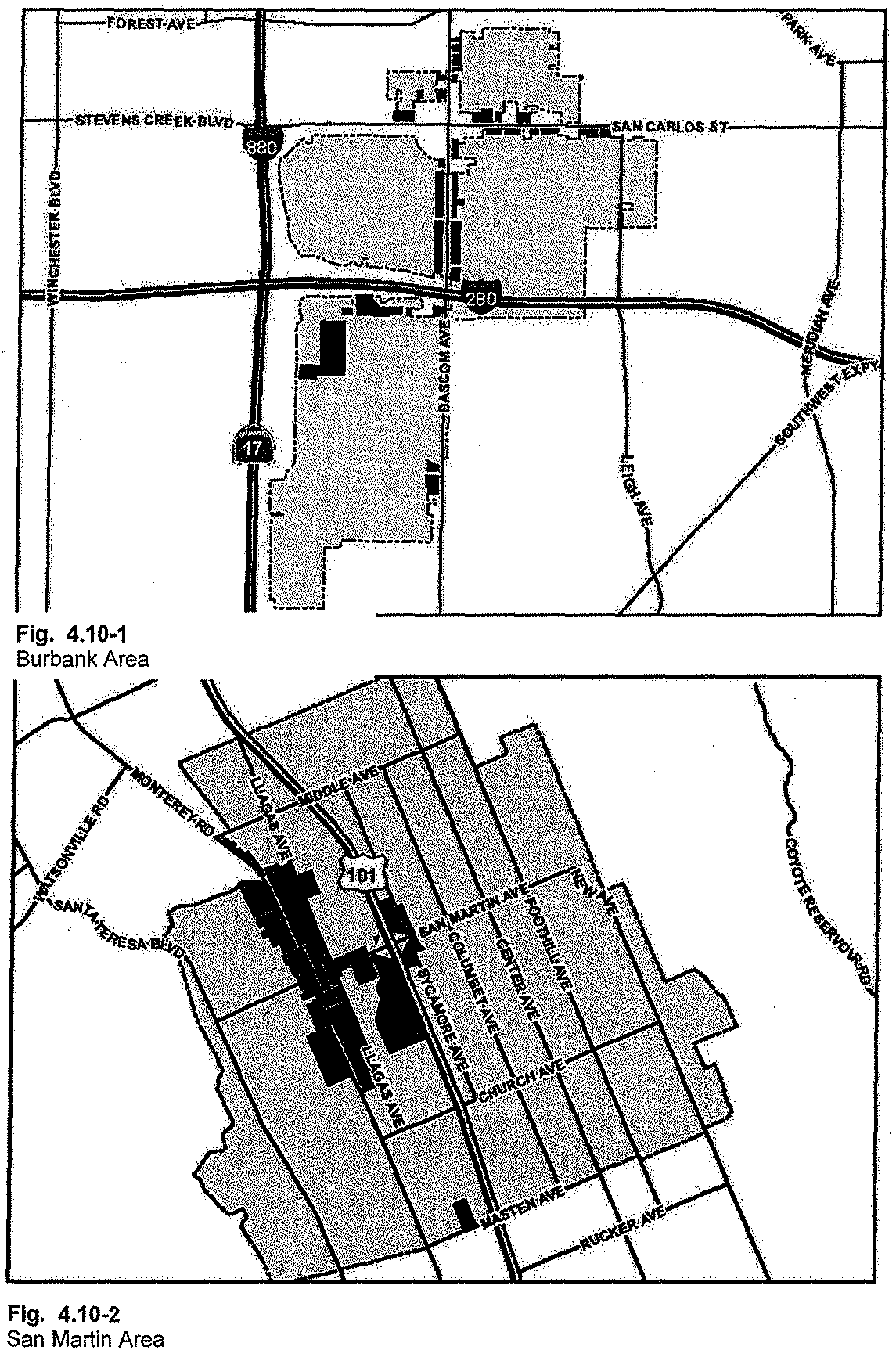
Area Capacity Cap: No emergency shelter shall be established that will result in a total established shelter capacity in excess of 140 clients within each of the areas identified in Figure 4.10-1 and Figure 4.10-2. For the purposes of this section, "established shelter capacity" shall include client capacity of any authorized transitional housing and/or supportive housing facilities, in addition to client capacity of emergency shelters.
J.
Notification of Operation: Within 30 days of commencement of operations, emergency shelter operators shall provide written notice to the Planning Office stating of the date of commencement of operations, address, and capacity of the shelter.
The establishment of a small-scale emergency shelter ancillary to any County-authorized religious institution or nonprofit institution shall be allowed by right. County-authorized religious institutions or nonprofit institutions that include ancillary small-scale shelters shall not be subject to criteria A, D, E, F, G, H or I.
(Ord. No. 1200.345, § 10, 6-10-14)
§ 4.10.120. - Entertainment—Seasonal outdoor.
This section refers to uses classified as Entertainment—Seasonal Outdoor as described in Section 2.10.040. Such uses shall comply with all of the following provisions:
A.
Limitations. The number and size of the indoor and outdoor events and productions shall be limited by the Planning Commission based on the location and characteristics of the site (e.g. size of parcel, types of events and productions, level of traffic, access, number of parking spaces, proximity to adjoining residences, number of restrooms).
B.
Criteria. Such uses shall be subject to all of the following:
1.
The project area shall be situated and designed such that the activities—particularly noise and lights—minimally impact adjacent properties. Setbacks, buffers and other measures shall be utilized to mitigate impacts;
2.
The use shall promote, protect or preserve a registered historic cultural resource;
3.
Activities shall not result in significant loss or conversion of agricultural lands or open space;
4.
The proposed parking plan shall comply with County requirements so as not to detrimentally impact the adjacent neighborhood;
5.
Traffic generated by the use shall not significantly impact the surrounding area;
6.
The use shall have an emergency plan that includes, but is not limited to, plans for evacuation, crowd control, medical emergencies, and security;
7.
Events shall not be conducted beyond 11:00 p.m.;
8.
The proposed use shall not be significantly affected by flooding or result in significant changes to drainage patterns; and
9.
The applicant has or will provide a plan or other evidence that the use will properly dispose of solid waste and litter, minimize the need for additional fire or police protection and not significantly increase the need for or require maintenance of other public facilities or services.
§ 4.10.130. - Feed lots.
This section refers to uses classified as Feed Lots as described in Section 2.10.040. Such uses shall be subject to all of the following provisions:
A.
Lot size. The minimum lot size shall be 20 acres;
B.
Proximity to residential uses. The use shall not be located in the immediate vicinity of residential development. For the purposes of this provision, residential development shall be generally considered to be any substantial grouping of residentially developed lots that are each less than 2.50 acres in area. It shall be within the discretionary authority of the Planning Commission to more precisely define "residential development" and "immediate vicinity" as those terms may apply to a particular proposal; and
C.
Waste control. Manure stockpiles shall be designed and situated to prevent groundwater and surface watercourse contamination, and avoid other health or nuisance problems, including vector and fly control per County Department of Environmental Health (DEH) regulations.
§ 4.10.140. - Golf courses and country clubs.
This section refers to uses classified as Golf Courses and Country Clubs as described in Section 2.10.040. Such uses shall be subject to all of the following provisions:
A.
Limitation in A districts. Uses classified as Golf Courses and Country Clubs are not allowed on any land designated Agriculture—Large Scale by the General Plan. May be allowed on lands with a General Plan designation of Agriculture—Medium Scale, subject to all of the following:
1.
The subject parcel is deemed by the decision-maker to be of marginal quality for agricultural purposes because of one or more of the following conditions: poor soil type, lack of water availability, or an abundance of surrounding incompatible nonagricultural uses;
2.
The proposed uses are intended, designed, and sized to primarily serve the local rural unincorporated population;
3.
The proposed use is contiguous to a designated urban service area or includes an irrevocable offer of development rights for all lands between the use and the urban service area;
4.
The proposed use would serve as a buffer between an agricultural operation and an existing or planned urban residential neighborhood, or other urban use found to be incompatible with agriculture, already located within the urban service area of a city;
5.
A permanent open space easement is provided for the site of the proposed use;
6.
The use includes setbacks, buffers or other measures designed to minimize its impact on existing and potential agricultural uses in the area;
7.
Under no circumstances shall housing be included as part of the use, except for a caretaker unit;
8.
The use must be compatible with and not result in limitations on any agricultural operation;
9.
Facilities associated with the golf course or driving range shall be limited to those which serve golfers on the course or range. For example: locker and shower facilities, pro shop with incidental sales of golfing equipment, snack bar and maintenance operations. Such facilities shall not include restaurants, other retail sales, lodging, health clubs, or similar uses; and
10.
The proposed use shall substantially conform to the adopted Environmental and Design Guidelines for Golf Courses in Santa Clara County.
B.
Criteria for other districts. Uses classified as Golf Courses and Country Clubs permitted in districts other than the A, Exclusive Agriculture district, shall be subject to all of the following:
1.
The proposed use shall substantially conform to the adopted Environmental and Design Guidelines for Golf Courses in Santa Clara County; and
2.
The size, design and intensity of any related use shall be of an appropriate scale to the size of the golf course and country club development.
(Ord. No. NS-1200.343, § 2, 2-10-15)
§ 4.10.150. - Golf driving ranges.
This section refers to uses classified as Golf Driving Ranges as described in Section 2.10.040. Such uses shall be subject to all of the following provisions:
A.
Limitation in A districts. Uses classified as Golf Driving Ranges are not allowed on any land designated Agriculture—Large Scale by the General Plan. May be allowed on lands with a General Plan designation of Agriculture—Medium Scale, subject to all of the following:
1.
The subject parcel is deemed by the Planning Commission to be of marginal quality for agricultural purposes because of one or more of the following conditions: poor soil type, lack of water availability, or an abundance of surrounding incompatible non-agricultural uses;
2.
The proposed uses are intended, designed, and sized to primarily serve the local rural unincorporated population;
3.
The proposed use is contiguous to a designated urban service area or includes an irrevocable offer of development rights for all lands between the use and the urban service area;
4.
The proposed use would serve as a buffer between an agricultural operation and an existing or planned urban residential neighborhood, or other urban use found to be incompatible with agriculture, already located within the urban service area of a city;
5.
A permanent open space easement is provided for the site of the proposed use;
6.
The use includes setbacks, buffers or other measures designed to minimize its impact on existing and potential agricultural uses in the area;
7.
Under no circumstances shall housing be included as part of the use, except for a caretaker unit;
8.
The use must be compatible with and not result in limitations on any agricultural operation; and
9.
Facilities associated with the golf course or driving range shall be limited to those which serve golfers on the course or range (e.g.: locker and shower facilities, pro shop with incidental sales of golfing equipment, snack bar and maintenance operations). Such facilities shall not include restaurants, other retail sales, lodging, health clubs, or similar uses.
B.
Criteria for other districts. Uses classified as Golf Driving Ranges permitted in districts other than the A, Exclusive Agriculture district, shall be subject to all of the following:
1.
Minimum lot size shall be ten acres; and
2.
The use shall not substantially alter the natural environment or be detrimental to the residential neighborhood.
§ 4.10.160. - Helipads.
This section refers to uses classified as Helipads as described in Section 2.10.040. Such uses shall be subject to all of the following provisions:
A.
Siting and buffering. The project area shall be situated and designed such that the helicopter minimally impacts adjacent properties. Setbacks, buffers and other measures shall be utilized to mitigate impacts;
B.
Helicopter capacity. The helicopter capacity shall not exceed six passengers;
C.
Noise study. The applicant shall furnish a noise study demonstrating that the noise generated by this use shall not exceed the exterior noise limits, including those for impulsive noise, established in the County Noise Ordinance;
D.
Federal regulations. Construction of the helipad shall conform to federal aviation design advisory circulars and regulations;
E.
Hours of operation. Specific hours of operation shall be established by the Planning Commission;
F.
Service and repair. Only limited service or repair of the helicopter shall occur on the site; and
G.
Flight limits. A maximum number of flights per day and per week shall be established by the Planning Commission.
§ 4.10.170. - Historic structure—Use conversion.
This section refers to uses classified as Historic Structure—Use Conversion as described in Section 2.10.040. Such uses shall be subject to all of the following provisions:
A.
Intent to preserve. The proposed use conversion shall restore the essential integrity of and return to viability the existing historic structure or resource and its setting.
B.
Review. The proposed use and all related modifications shall be reviewed by the Historical Heritage Coordinator and the Historical Heritage Commission for substantial conformance with the intent of the Zoning Ordinance and with any appropriate and applicable standards and guidelines for historic restoration and preservation.
C.
Additions/alterations. The proposed use shall be contained within the existing historic structure or structures without need for additions or additional separate structures or buildings, unless the proposed additions or additional structures have been evaluated and approved by the Historical Heritage Coordinator and Historical Heritage Commission for compatibility with the existing historic structure.
§ 4.10.180. - Home occupations.
This section refers to uses classified as Home Occupations as described in § 2.10.030. Such uses shall be subject to all of the following provisions, as they apply to each of the subcategories of use:
A.
Home Occupations: General. Uses classified as Home Occupations: General shall be subject to all of the following:
1.
The use shall be clearly incidental and subordinate to the residential use of the property and shall not change the character thereof;
2.
The use shall be conducted within the dwelling by resident occupants, and may include one (1) nonresident employee;
3.
The use shall not create additional pedestrian, automobile or truck traffic in excess of the normal amount typical for the area. Client or customer visits to the site shall normally be limited to not more than three (3) per day, and 10 per week;
4.
No activity shall be allowed that creates offensive noise, dust, smoke, odor, vibrations, glare, or radio or television interference that is noticeable from beyond the property boundaries;
5.
No hazardous materials other than those commonly found within a residence shall be used or stored on the site. Such materials and equipment shall be limited to quantities that do not constitute a fire, health or safety hazard;
6.
Not more than one (1) truck or van, whose capacity shall not exceed one (1) ton, shall be used in any manner with the home occupation. Vehicles should not contain display advertising;
7.
One (1) non-illuminated sign not exceeding one (1) square foot in area may be appropriately placed to identify the home occupation; and
8.
Uses which include the following shall not be allowed as home occupations:
a.
On-site automotive repair or service (includes any mechanism containing an internal combustion engine);
b.
Commercial food preparation other than a cottage food operation, as defined in Section 113758 of the California Health and Safety Code;
c.
Medical or veterinary services;
d.
Massage;
e.
Painting of vehicles, trailers, boats or machinery;
f.
Pest control; or
g.
Any use which violates any applicable law.
B.
Interpretation Procedures. Any person who desires an official written determination as to whether or not a particular use constitutes a general home occupation may request an interpretation by the zoning administrator, in accordance with the following:
1.
Such interpretation shall require completing a home occupation questionnaire, and submitting such questionnaire to the planning office along with a filing fee as required by the Board of Supervisors;
2.
The zoning administrator shall review the submitted documentation and on that basis interpret whether or not the use fits the definition and conforms to the criteria of subsection A of this section. The zoning administrator may arrange a site inspection and may request additional information if a clear determination cannot be made from the submitted material;
3.
When issuing the interpretation, the zoning administrator may establish specific conditions for the use in order to mitigate potential impacts on neighboring properties. The criteria of subsection A of this section shall be incorporated as minimum conditions of approval; and
4.
Within 15 calendar days after the decision of the zoning administrator, any person dissatisfied with the decision may file an appeal to the Planning Commission. Appeals shall be filed with the planning office and shall be accompanied by a fee as prescribed by the Board of Supervisors. The decision of the Planning Commission shall be final.
C.
Home Occupations: Expanded. Uses classified as Home Occupations: Expanded shall comply with the requirements of this section. The purpose of these provisions is to allow, in suitable locations, more intensive home occupation uses which: (1) allow residents greater economic self sufficiency, (2) indirectly support agriculture by enhancing the economic viability of living on agricultural property, (3) minimally impact neighboring properties, and (4) are clearly subordinate to primary residential or agricultural uses, and do not diminish agricultural viability or neighborhood character. Such uses shall be subject to all of the following:
1.
The minimum lot size shall be one (1) acre, gross;
2.
The use shall be clearly incidental and subordinate to the residential and (if applicable) agricultural use of the property and shall not change the character thereof;
3.
The use shall be conducted within the dwelling or accessory building by resident inhabitants, and may include one (1) nonresident (up to full-time) employee;
4.
Accessory buildings containing expanded home occupation uses shall be limited in area to not more than 1,200 square feet (total). A larger building may be used provided the home occupation area is structurally partitioned to not exceed 1,200 square feet;
5.
Storage of equipment and materials outside of buildings shall be limited to a specified area not exceeding 600 square feet, and shall be appropriately screened to be not visible from outside the property boundaries. Equipment and materials shall be limited to quantities that do not constitute a fire, health or safety hazard;
6.
The use shall not create additional pedestrian, automobile or truck traffic in excess of normal amount typical for the area. Client or customer visits to the site shall normally be limited to not more than three (3) per day, and 10 per week;
7.
No activity shall be allowed that creates offensive noise, dust, smoke, odor, vibrations, glare, or radio or television interference that is noticeable from beyond the property boundaries;
8.
Not more than two (2) trucks or vans, whose capacity shall not exceed one (1) ton per vehicle, shall be used in any manner with the home occupation use. Vehicles should not contain display advertising that exceeds the limitations of criterion 9 below;
9.
One (1) non-illuminated sign not exceeding four (4) square feet in area may be appropriately placed to identify the business, but should not be intended as an advertising display to attract customers. Such a sign shall not be located within the required front yard setback, nor within any street right-of-way. There shall be no display of products visible from outside the property boundaries;
10.
Uses which are expressly prohibited or uses which may be authorized subject to discretionary land use approval by other provisions of this zoning ordinance shall not be authorized as expanded home occupations; and
11.
Uses which include the following shall not be allowed as expanded home occupations:
a.
On-site automotive repair or service (includes any mechanism containing an internal combustion engine);
b.
Commercial food preparation other than a cottage food operation, as defined in Section 113758 of the California Health and Safety Code;
c.
Medical or veterinary services;
d.
Massage;
e.
Painting of vehicles, trailers, boats or machinery;
f.
Pest control; or
g.
Any use which violates any applicable law.
(Ord. No. NS-1200.349, § 8, 4-7-15)
§ 4.10.190. - Hospitals and clinics.
This section refers to uses classified as Hospitals and Clinics as described in Section 2.10.040. All of the following provisions apply in the A, Exclusive Agriculture zoning district:
A.
Prohibited in Agriculture—Large Scale. Not allowed on any land designated Agriculture—Large Scale by the General Plan.
B.
Agriculture—Medium Scale lands. May be allowed on lands with a General Plan designation of Agriculture—Medium Scale, provided that all of the following provisions are met:
1.
The property is deemed by the decision-maker to be of marginal quality for agricultural purposes because of one or more of the following conditions: poor soil type, lack of water availability, or an abundance of surrounding incompatible non-agricultural uses;
2.
The proposed uses are intended, designed, and sized to primarily serve the local rural unincorporated population; and
3.
The maximum gross floor area of covered spaces (enclosed and unenclosed structures) shall be limited to no more than 10,000 square feet.
§ 4.10.195. - Industrial Hemp.
This section applies to uses classified as Industrial Hemp as described in § 2.10.040. Such uses shall be subject to all of the following requirements:
A.
Industrial Hemp Registration. Any person engaging in cultivation, seed breeding, or research shall register with the County Agricultural Commissioner prior to operation. A copy of this registration, and the annual renewal registration, shall be filed by the operator with the Planning Office within ten calendar days of issuance.
B.
Criteria for Industrial Hemp. Industrial hemp operations shall comply with all applicable state and federal regulations and shall also be subject to the following requirements:
1.
Buffer and Setback Requirements. The following buffer and setback requirements shall apply:
a.
No industrial hemp operation with a contiguous acreage of up to 250 acres shall be allowed within one-quarter mile from any sensitive receptor, unless specified in § 4.10.195(B)(1)(c). For purposes of this section, sensitive receptors are: city urban service area boundary lines; parcels in the RR, "Rural Residential" zoning district; and legally established child day-care facilities, hospitals, medical facilities, religious institutions, wineries, schools, and playfields.
b.
No industrial hemp operation shall be allowed within 200 feet from any dwelling unit or public or private road right-of-way, unless specified in § 4.10.195(B)(1)(c). An exception to this setback requirement may be granted by the Planning Director through the Planning Clearance process for adjoining parcels proposed for any industrial hemp operation owned or leased by the applicant.
c.
For indoor industrial hemp operations, the buffer and setback requirements specified above shall not be required if appropriate air purification systems and air scrubbers, as determined by the Planning Director or designee, are installed within the premises to control odor. For purposes of this section, indoor industrial hemp operations means operations within a fully enclosed structure.
2.
Maximum Acreage. Each industrial hemp operation for cultivation and/or research shall be limited to a cumulative total of 250 acres.
3.
Planning Clearance Termination and Renewal. The Planning Clearance shall automatically terminate upon non-renewal of the annual County Agricultural Commissioner registration for industrial hemp cultivation.
4.
Signage. Each industrial hemp operation site shall post signage with appropriate size and content as specified by the County Agricultural Commissioner to clearly identify that the site is for industrial hemp operation. The signage shall be located at the main entrance to the parcel, entrance to an indoor facility, and at intervals no less than 600 feet along an exterior perimeter facing a public or private road.
C.
Consent to Enter, Inspection, and Test. The County, or its contractor, may enter and inspect any industrial hemp operation site during business hours without giving notice to verify compliance with this Section. Testing by County officers and employees shall be allowed to verify that the industrial hemp contains less than 0.3 percent Tetrahydrocannabinol (THC), at the cost and expense of the registrant.
D.
Additional provisions for Industrial Hemp: Agricultural Processing. In addition to the applicable provisions of subsection B and C, uses classified as Industrial Hemp: Agricultural Processing are subject to supplemental use regulations for Agricultural Processing as listed in § 4.10.030.
(Ord. No. NS-1200.373, § 3, 8-25-20)
§ 4.10.200. - Kennels—Commercial.
This section refers to uses classified as Kennels—Commercial as described in Section 2.10.040. Such uses shall be subject to all of the following provisions:
A.
Lot size. The minimum lot size shall be 2.50 acres;
B.
Proximity to residential uses. The use shall not be located in the immediate vicinity of residential development. For the purposes of this provision, residential development shall be generally considered to be any substantial grouping of residentially developed lots that are each less than 2.50 acres in area. It shall be within the discretionary authority of the Planning Commission to more precisely define "residential development" and "immediate vicinity" as these terms may apply to a particular proposal;
C.
Confinement and separation from adjacent dwellings. The animals shall be kept within a confined area situated and designed such that the activities—particularly noise, odors, dust and lights—minimally impact adjacent properties. Setbacks, buffers and other measures shall be utilized to mitigate impacts;
D.
Screening. The use shall be screened so as not to be visible from adjacent properties; and
E.
Other requirements. All provisions of Division B31 of the Ordinance Code shall apply to the establishment and operation of a commercial kennel. This includes obtaining a permit from the Director of Animal Control.
(Ord. No. NS-1200.318, § 8, 3-28-06)
§ 4.10.210. - Livestock auction yards.
This section refers to uses classified as Livestock Auction Yards as described in Section 2.10.040. Such uses shall be subject to all of the following provisions:
A.
Lot size. Minimum lot size shall be ten acres; and
B.
Proximity to residential development. The use shall not be located in the immediate vicinity of residential development. For the purposes of this provision, residential development shall be generally considered to be any substantial grouping of residentially developed lots that are each less than 2.50 acres in area. It shall be within the discretionary authority of the Planning Commission to more precisely define "residential development" and "immediate vicinity" as these terms may apply to a particular proposal.
§ 4.10.220. - Mushroom farms.
This section refers to uses classified as Mushroom Farms as described in Section 2.10.040. Such uses shall be subject to all of the following provisions:
A.
Lot size. Minimum lot size shall be ten acres.
B.
Proximity to residential development. The use shall not be located in the immediate vicinity of residential development. For the purposes of this provision, residential development shall be generally considered to be any substantial grouping of residentially developed lots that are each less than 2.50 acres in area. It shall be within the discretionary authority of the Planning Commission to more precisely define "residential development" and "immediate vicinity" as these terms may apply to a particular proposal; and
C.
Environmental impacts. Stockpiling areas for planting material shall be designed and situated to prevent groundwater and surface watercourse contamination, and avoid other health or nuisance problems, including vector and fly control pursuant to County Department of Environmental Health regulations.
§ 4.10.230. - Nonprofit institutions.
This section refers to uses classified as Nonprofit Institutions as described in Section 2.10.040. Such uses shall be subject to all of the following provisions in the A, Exclusive Agriculture zoning district:
A.
Prohibited in Agriculture—Large Scale. Not allowed on any land designated Agriculture—Large Scale by the General Plan.
B.
Agriculture—Medium Scale lands. May be allowed on lands with a General Plan designation of Agriculture—Medium Scale, provided that all of the following are met:
1.
The subject lot is deemed by the decision-maker to be of marginal quality for agricultural purposes because of one or more of the following conditions: poor soil type, lack of water availability, or an abundance of surrounding incompatible non-agricultural uses;
2.
The proposed uses are intended, designed, and sized to primarily serve the local rural unincorporated population; and
3.
The maximum gross floor area of covered spaces (enclosed and unenclosed structures) shall be limited to no more than 10,000 square feet.
§ 4.10.240. - Poultry and egg farms—Commercial.
This section refers to uses classified as Poultry and Egg Farms—Commercial as described in Section 2.10.040. Such uses shall be subject to all of the following provisions:
A.
Lot size. Minimum lot size shall be ten acres;
B.
Proximity to residential development. The use shall not be located in the immediate vicinity of residential development. For the purposes of this provision, residential development shall be generally considered to be any substantial grouping of residentially developed lots that are each less than 2.50 acres in area. It shall be within the discretionary authority of the Planning Commission to more precisely define "residential development" and "immediate vicinity" as these terms may apply to a particular proposal; and
C.
Environmental impacts. Chicken coop areas and chicken manure stockpiles shall be designed and situated to prevent groundwater and surface watercourse contamination, and avoid other health or nuisance problems, including vector and fly control pursuant to County Department of Environmental Health regulations.
§ 4.10.250. - Radio-controlled model aircraft facilities.
This section refers to uses classified as Radio-Controlled Model Aircraft Facilities as described in Section 2.10.040. Such uses shall be subject to all of the following provisions:
A.
Runway location. The facility's runway shall be located no closer than 2,000 feet from a residence, school, place of business, or state highway;
B.
Visibility. The facility shall be situated so that the flight area is fully visible to the aircraft operation and there is no terrain or vegetation to obstruct line of sight;
C.
Management. The facility shall be administered and supervised by a recognized radio-controlled model aircraft organization;
D.
Operational procedures. On-field operational procedures shall be established which include the following:
1.
The use of a frequency control board and colored frequency control mechanisms on transmitters to eliminate frequency interference between flying aircraft;
2.
The posting of flying field rules in a prominent location of flying activity; and
E.
Noise impacts. Noise produced by the proposed use shall not have an adverse impact upon the environment. All powered aircraft shall have mufflers;
F.
Hours of operation. Hours of operation shall be restricted to daylight hours;
G.
Fire measures. Adequate fire vehicle access shall be provided; a fire extinguisher shall be kept in good condition in the pit area of the facility.
§ 4.10.260. - Reception facilities.
This section refers to uses classified as Reception Facilities as described in Section 2.10.040. Such uses shall be subject to all of the following provisions:
A.
Limits on operations. The number and size of receptions and the days and hours of operation may be limited by the Planning Commission based on the location and characteristics of the site (e.g., size of parcel, level of traffic, number of parking spaces, proximity to adjoining residences, number of restrooms).
B.
Los Gatos Hillside Area. Such uses are not allowed within the Los Gatos Hillside Specific Plan Area.
C.
Lighting and noise. Lighting shall be limited such that light sources are generally not visible from off-site where it would significantly impact adjoining neighbors. Noise levels shall conform to applicable provisions of County Noise Ordinance.
§ 4.10.270. - Recreational playgrounds and sports fields.
This section refers to uses classified as Recreational Playgrounds and Sports Fields as described in Section 2.10.040. Such uses shall be subject to all of the following provisions in the A, Exclusive Agriculture zoning district:
A.
Prohibited in Agriculture—Large Scale. Not allowed on any land designated Agriculture—Large scale by the General Plan.
B.
Agriculture—Medium Scale lands. May be allowed on lands with a General Plan designation of Agriculture—Medium Scale, provided that all of the following are met:
1.
The subject lot is deemed by the decision-maker to be of marginal quality for agricultural purposes because of one or more of the following conditions: poor soil type, lack of water availability, or an abundance of surrounding incompatible non-agricultural uses.
2.
The proposed uses are intended, designed, and sized to primarily serve the local rural unincorporated population.
3.
The maximum gross floor area of covered spaces (enclosed and unenclosed structures) shall be limited to no more than 10,000 square feet.
§ 4.10.280. - Recreational vehicle parks.
This section refers to uses classified as Recreational Vehicle Parks as described in § 2.10.030 and § 2.10.040. Such uses shall be subject to all of the following provisions:
A.
General. Recreational Vehicle Parks (RV Parks) are required to obtain a permit from the California Department of Housing and Community Development prior to opening. Nothing in this section shall be construed to abrogate or conflict with any state laws or regulations relevant to RV Parks.
B.
RV Park Boundary. The site plan for a proposed RV Park shall clearly identify the RV Park boundary, which shall at minimum exclude setback areas required by the applicable base zoning district and any required perimeter landscaping.
C.
Compliance with State and Local Laws. RV Parks shall comply with all applicable state laws and regulations; County ordinances, guidelines, and standards; and other local ordinances and regulations. If application of any County ordinance, guideline, or standard would conflict with or be preempted by state law, state law shall govern, but only to the extent of the specific issues of conflict.
D.
Criteria. An RV park (including approved ancillary uses under the same ownership or management), shall comply with all of the following requirements before it may be approved:
1.
Duration of Stays. No recreational vehicle shall stay at an RV Park for more than 30 consecutive days or for more than 30 total days in any 90-day period. An RV Park owner may apply for an exemption from this stay limitation from the County pursuant to Health and Safety Code Section 18865.2. Exemption requests submitted after a use permit is granted shall be processed as a use permit modification. Impacts to be considered in determining whether to grant an exemption shall include, but are not limited to, whether there will be any adverse impact on local school districts due to the additional enrollment of residents from the RV Park.
2.
General Health and Safety. The RV Park shall comply with all applicable state and local health and safety requirements. This may include facilities such as public restrooms, showers, and laundry facilities. All recreational vehicle spaces shall be provided with individual connections to an adequate wastewater disposal system, potable water, electrical hookups, and individual closed trash containers or a common closed trash container as approved by the Department of Environmental Health. The RV Park shall not be located in a 100-year floodplain unless the approved plans show appropriate mitigation in compliance with Ordinance Code Division C12, Chapter VII, Article 5, Provisions For Flood Hazard Reduction.
3.
Fire Safety. The RV Park shall meet all applicable fire safety laws, regulations, and ordinances. All areas within the RV Park shall be provided with adequate emergency vehicle access and fire protection facilities, including water supply through hydrants or other methods in compliance with state regulations. Driveways shall be named with signs placed at intersections, and individual lots shall be identified as required by state regulations.
4.
Access, Circulation and Parking. The RV Park shall provide adequate access, circulation, and on-site parking as required by all applicable laws, regulations and ordinances, and shall provide a sufficient number of on-site parking spaces to prevent any off-site parking by RV Park users, employees, or visitors.
5.
School District Review. This subsection applies if an RV Park owner requests an exemption from the short-term stay requirement in subsection (D)(1) herein. The County decision-making body shall consider comments that are submitted to the County by the affected school district(s) regarding any adverse impact on the district(s) due to the additional enrollment of residents from the RV Park and any district(s) recommendations for appropriate conditions to mitigate or avoid those impacts.
6.
Unoccupied RV Storage. The RV Park may set aside specific designated areas for the storage of unoccupied recreational vehicles. These areas shall be shown on the approved site plan and shall be designed to avoid any impacts to surface or ground-water resources.
7.
Screening and Signage. The RV Park shall be designed to provide adequate perimeter landscaping and fencing to minimize off-site visibility, potential noise, lighting and glare, and impacts from activities at the RV Park that could be a nuisance to neighboring properties. On-site signs advertising the RV Park shall be designed in conformance with the provisions of Chapter 4.40, Signs.
8.
Neighborhood Compatibility. Off-site appearance of the RV Park shall not be detrimental to the character of the surrounding neighborhood or zoning district, as determined by substantial conformance with the adopted "Guidelines for Architecture and Site Approval" and any other applicable guidelines adopted by the County.
9.
Manager/Caretaker Residences. A maximum of one single-family residence and one accessory dwelling unit (ADU) for an on-site manager and/or caretaker shall be allowed and shall be shown on the site plan and approved as part of the use permit.
10.
Noise. Where adjoining uses, such as highways or railroads, will generate a noise level of 60 Ldn or higher at any recreational vehicle space in the RV Park, noise attenuation shall be provided to achieve a noise level of 55 Ldn or lower consistent with the County Noise Ordinance, Section B11-160 et seq. A perimeter berm and/or masonry wall along with screening vegetation is the preferred method of noise reduction. A noise reduction and attenuation plan shall be prepared by a noise evaluation expert acceptable to the County.
(Ord. No. NS-1200.359, § 8, 12-6-16; Ord. No. NS-1200.378, § 5, 5-25-21)
§ 4.10.285. - Recycling facilities: Collection facilities—Consumer recycling.
This section refers to uses in the subcategory "Collection facilities—Consumer recycling" under the classification recycling facilities as described in Section 2.10.040. Such uses shall be subject to all of the following provisions:
A.
The facility shall be established as an ancillary activity to a County-authorized use or host site;
B.
The facility shall occupy a defined area of land not to exceed 640 square feet;
C.
The facility shall be set back at least 30 feet from any property line or right-of-way line, except that for consumer collection receptacles whose combined aboveground dimensions (maximum length + maximum width + maximum height) do not exceed 16 feet, no setback regulations shall apply;
D.
All containers shall be clearly marked to identify the type of recyclable material that may be deposited;
E.
All containers shall be constructed and maintained with durable, waterproof and rustproof material and shall be covered;
F.
The facility shall be clearly marked to identify the name and telephone number of the facility operator;
G.
The site shall be swept and maintained in a dust-free, litter-free condition on a daily basis;
H.
The facility shall be located such that any required parking for the host business is not displaced;
I.
The facility shall not impair the landscaping that may be required for a host business; and
J.
The facility shall not include power-driven sorting and/or consolidation equipment, such as crushers or balers.
(Ord. No. NS-1200.327, § 14, 2-9-10; Ord. No. NS-1200.332, § 7, 11-22-11)
§ 4.10.290. - Religious institutions.
This section refers to uses classified as "Religious institutions" as described in Section 2.10.040. All of the following provisions apply in the A, Exclusive Agriculture zoning district:
A.
Prohibited in Agriculture—Large Scale. Not allowed on any land designated Agriculture—Large Scale by the General Plan.
B.
Agriculture—Medium Scale lands. May be allowed on lands with a General Plan designation of Agriculture—Medium Scale, provided that all of the following are met:
1.
The property is deemed by the Planning Commission to be of marginal quality for agricultural purposes because of one or more of the following conditions: poor soil type, lack of water availability, or an abundance of surrounding incompatible non-agricultural uses.
2.
The proposed uses are intended, designed, and sized to primarily serve the local rural unincorporated population.
3.
The maximum gross floor area of covered spaces (enclosed and unenclosed structures) shall be limited to no more than 10,000 square feet.
§ 4.10.300. - Residential—Communal institutional.
This section refers to uses classified as "Residential—Communal institutional" as described in Section 2.10.030. All of the following provisions apply in the A, Exclusive Agriculture zoning district:
A.
Prohibited in Agriculture—Large Scale. Not allowed on any land designated Agriculture—Large Scale by the General Plan.
B.
Agriculture—Medium Scale lands. May be allowed on lands with a General Plan designation of Agriculture—Medium Scale, provided that all of the following are met:
1.
The property is deemed by the Planning Commission to be of marginal quality for agricultural purposes because of one or more of the following conditions: poor soil type, lack of water availability, or an abundance of surrounding incompatible non-agricultural uses.
2.
The proposed uses are intended, designed, and sized to primarily serve the local rural unincorporated population.
3.
The maximum gross floor area of covered spaces (enclosed and unenclosed structures) shall be limited to no more than 10,000 square feet.
§ 4.10.310. - Retail sales and services: local-serving.
This section refers to uses classified as Retail Sales and Services: Local-Serving as described in Section 2.10.040. Such uses shall be subject to all of the following provisions:
A.
Local-Serving. In rural districts, such uses shall be sized and designed to be local-serving, consistent with the rural character and the environment. The use shall be located to conveniently serve the community.
In R1S and R3S districts applicable to Stanford University lands, "local community" shall refer to the campus residents, pursuant to the applicable provisions of Chapter 2, Land Use, of the 2000 Stanford University Community Plan. A business plan, demonstrating that the business will primarily serve the local community, shall be provided as a basis for review and approval of proposed uses. In R3 Multiple Family districts, "local community" shall refer primarily to the residents of the particular multi-family development.
B.
Size. Maximum area of public-accessible floor space (measured from outer surfaces of enclosing walls, includes bathrooms) shall not exceed 1,200 square feet.
C.
Demand. The number and capacity of other existing similar uses in the area, together with the proposed use, can be supported by the local community.
(Ord. No. NS-1200.351, § 5, 10-20-15)
§ 4.10.320. - Rodeos and equestrian event facilities.
This section refers to uses classified as Rodeos and Equestrian Event Facilities as described in Section 2.10.040. Such uses shall be subject to all of the following provisions:
A.
Lot size. Minimum lot size shall be ten acres.
B.
Proximity to residential development. The use shall not be located in the immediate vicinity of residential development. For the purposes of this provision, residential development shall be generally considered to be any substantial grouping of residentially developed lots that are each less than 2.50 acres in area. It shall be within the discretionary authority of the Planning Commission to more precisely define "residential development" and "immediate vicinity" as they may apply to a particular proposal.
§ 4.10.330. - Schools.
This section refers to uses classified as Schools as described in Section 2.10.040. All of the following provisions apply in the A, Exclusive Agriculture zoning district:
A.
Prohibited in Agriculture—Large Scale. Not allowed on any land designated Agriculture—Large Scale by the General Plan.
B.
Agriculture—Medium Scale lands. May be allowed on lands with a General Plan designation of Agriculture—Medium Scale, provided that all of the following are met:
1.
The property is deemed by the Planning Commission to be of marginal quality for agricultural purposes because of one or more of the following conditions: poor soil type, lack of water availability, or an abundance of surrounding incompatible non-agricultural uses.
2.
The proposed uses are intended, designed, and sized to primarily serve the local rural unincorporated population.
3.
The maximum gross floor area of covered spaces (enclosed and unenclosed structures) shall be limited to no more than 10,000 square feet.
§ 4.10.340. - Reserved.
Editor's note— Sec. 10 of Ord. No. NS-1200.371, adopted Mar. 10, 2020, repealed § 4.10.340, which pertained to Secondary dwellings and derived from Ord. No. NS-1200.310, adopted May 20, 2003; Ord. No. NS-1200.318, adopted Mar. 28, 2006; Ord. No. NS-1200.327, adopted Feb. 9, 2010; Ord. No. NS-1200.332, adopted Nov. 22, 2011; Ord. No. NS-1200.339, adopted Nov. 5, 2013; Ord. No. NS-1200.356, adopted May 10, 2016; Ord. No. NS-1200.360, adopted May 23, 2017; Ord. No. NS-1200.367, adopted June 19, 2018; and Ord. No. NS-1200.370, adopted Jan. 29, 2019.
§ 4.10.345. - Solar energy conversion systems—Commercial.
This section refers to uses classified as "Solar energy conversion systems—Commercial," as described in Section 2.10.040. Commercial solar energy conversion systems shall comply with all of the requirements of this section.
A.
Exclusive agriculture zoning district. Such uses shall be subject to all of the following provisions in the A, Exclusive agriculture zoning district:
1.
Prohibited in Agriculture—Large scale. Such uses are not allowed on any land designated Agriculture—Large scale by the general plan;
2.
Agriculture—Medium scale lands. Such uses may be allowed on lands with a general plan designation of Agriculture—Medium scale, provided that the subject lot is deemed by the decision-maker to be of marginal quality for agricultural purposes because of one or more of the following conditions: poor soil type, lack of water availability, or an abundance of surrounding incompatible non-agricultural uses. Projects must also demonstrate consistency with the provisions of Section 2.20.050, A districts: Agricultural preservation criteria.
B.
Prohibited in certain design review combining districts. Not allowed on any land located within the -d 1 (Santa Clara Valley Viewshed) and -d 2 (Milpitas Hillsides) design review combining districts.
C.
Criteria. Commercial solar energy systems are subject to all of the following provisions:
1.
Setbacks. All structures shall have a minimum setback of 30 feet.
2.
Signage. Signs visible from a public road shall only identify the manufacturer, installer, or owner of the system, or public health and safety information applicable to the installed systems. A facility shall be limited to two signs and aggregate sign area shall be no greater than 200 square feet.
3.
Wildlife passage. In areas identified as containing important wildlife habitat, the facility shall be designed, to the maximum extent feasible, to allow continued use of the site for wildlife habitat and migration across the site.
4.
Construction and operation. The design, construction and operation of the facility shall minimize soil disturbance to the maximum extent possible, and shall not substantially alter drainage from the site.
D.
Williamson Act Limitation. No system shall be allowed on lands subject to a California Land Conservation Act (Williamson Act) contract unless permitted as a compatible use.
E.
Termination and decommissioning. Solar energy conversion systems and all related equipment and accessory structures shall be removed following cessation of use as defined in either Section 5.40.070 or Section 5.65.050 of the Zoning Ordinance. Prior to the issuance of any building permits for the establishment of commercial solar energy conversion systems, a Closure and Rehabilitation Plan shall be submitted to the Planning Office for review and approval. The Plan shall provide for the removal, recycling and disposal of all aboveground structures and facilities to a depth of three feet below grade, the restoration of graded areas to original contours, and re-vegetation of all disturbed areas. To the greatest extent possible, facilities shall use materials that can be recycled following decommissioning.
(Ord. No. NS-1200.331, § 4, 11-9-10; Ord. No. NS-1200.332, § 9, 11-22-11)
§ 4.10.350. - Sport shooting.
This section refers to uses classified as Sport Shooting as described in Section 2.10.040. Such uses shall be subject to all of the following provisions:
A.
Lot size. The minimum lot size shall be 160 acres.
B.
Siting and buffering. The project area shall be situated and designed such that the activity minimally impacts adjacent properties. Setbacks, buffers and other measures shall be utilized to mitigate impacts.
C.
Impacts on agriculture. The use shall not be detrimental to the agricultural/ranching use of surrounding lands.
D.
Noise. The use shall not violate the County Noise Ordinance, as administered by the County Department of Environmental Health.
E.
Size limitation. No more than ten percent of the subject parcel may be used for sport shooting facilities, including all associated facilities, such as parking and sanitary waste disposal systems.
§ 4.10.360. - Stables—Commercial.
This section refers to uses classified as Stables—Commercial as described in Section 2.10.040. Such uses shall be subject to all of the following provisions:
A.
Lot size. The minimum lot size shall be 2.50 acres.
B.
Environmental impacts. Corrals and manure stockpiles shall be designed and situated to prevent groundwater and surface watercourse contamination, and avoid other health or nuisance problems, including vector and fly control per County Department of Environmental Health (DEH) regulations.
C.
Erosion control. An erosion control plan shall be required.
D.
Waste management. A manure management plan shall be required.
§ 4.10.370. - Surface mining.
Part I: State Regulations
A.
Reference. This Section applies to uses classified as Surface Mining as described in Section 2.10.040.
B.
Purpose. The purpose of Section 4.10.370 is to ensure the continued availability of important mineral resources, while regulating surface mining operations as required by California's Surface Mining and Reclamation Act of 1975 (Public Resources Code §§ 2710 et seq., as amended, hereinafter referred to as "SMARA"), Public Resources Code § 2207 (relating to annual reporting requirements), and State Mining and Geology Board regulations for surface mining and reclamation practice (California Code of Regulations, Title 14, Division 2, Chapter 8, Subchapter 1, §§ 3500 et seq., hereinafter referred to as "State regulations") to ensure that the legislative intent of SMARA, as stated in SMARA Section 2712, is met.
C.
Scope. The provisions of this Section shall apply to surface mining operations and reclamation of mined lands within the unincorporated areas of Santa Clara County.
D.
Incorporation by reference. The provisions of SMARA and State regulations as those provisions and regulations may be amended from time to time, are made a part of this Section by reference with the same force and effect as if the provisions therein were specifically and fully set out herein, excepting that when the provisions of this Section are more restrictive than correlative State provisions, this Section shall prevail.
E.
Surface mining subject to use permit. Subject to SMARA Section 2770 and Part II, subpart E of this Section, no person shall conduct a surface mining operation unless a use permit is approved by the Planning Commission pursuant to Chapters 5.20 and 5.65 of the Zoning Ordinance.
F.
Reclamation Plan required and Reclamation Plan requirements. Any person conducting a surface mining operation or who has completed a surface mining operation subsequent to January 1, 1976, shall obtain Planning Commission approval of a reclamation plan for the property that fulfills the requirements of Section 4.10.370, Part I, subpart J (Reclamation Standards) of this Section. Prior to such approval, reclamation plans shall be reviewed by the Planning Commission to assure substantial compliance with SMARA, State regulation and applicable County ordinances. (See Section 4.10.370, Part I, subpart (I)(5) regarding State review.)
1.
The reclamation plan shall be filed with the County Department of Planning and Development, on a form provided by the County, by any person who owns, leases, or otherwise controls or operates on all, or any portion of any, mined lands, and who plans to conduct surface mining operations on the lands.
2.
All documentation for the reclamation plan shall be submitted to the County at one time as a comprehensive package.
3.
The reclamation plan shall substantially comply with the provisions of SMARA Section 2772 and State regulations, Sections 3500 through 3505. Reclamation plans approved after January 15, 1993, reclamation plans for proposed new mining operations, and any amendments to previously approved reclamation plans, shall also substantially comply with the reclamation performance standards in State regulations, Sections 3700 through 3713.
4.
An item of information or a document required pursuant to subsection (3) that has already been prepared as part of a permit application for the surface mining operation, or as part of an environmental document prepared for the project pursuant to Public Resources Code, Division 13 (commencing with section 21000), may be included in the reclamation plan by reference, if that item of information or that document is attached to the reclamation plan when the County submits the reclamation plan to the director of the Department of Conservation for review. To the extent that the information or document referenced in the reclamation plan is used to meet the requirements of subdivision 3, the information or document shall become part of the reclamation plan and shall be subject to all other requirements of this article.
G.
Exemptions. No permit or reclamation plan shall be required by this Section for activities identified in SMARA Section 2714, provided that nothing shall exempt such activities from the requirements of the Santa Clara County Grading Ordinance, where applicable.
H.
Definitions. The definitions contained in SMARA and the State regulations are incorporated by reference. In addition, as used in this Section the following words shall have the following definitions:
1.
CEQA. The California Environmental Quality Act, State of California, as contained in the Public Resources Code Section 21000 et seq.
2.
County. The County of Santa Clara, State of California. For purposes of SMARA, the County is the lead agency as defined in SMARA Section 2728, having the principal responsibility for approving reclamation plans, so long as the County retains jurisdiction over surface mining operations within Santa Clara County.
3.
Planning Director. The Director of the Santa Clara County Department of Planning and Development.
4.
Financial assurance. "Financial assurance" means a monetary assurance that a surface mining operation will be reclaimed in accordance with an approved reclamation plan. The financial assurance may take the form of a surety bond, trust fund, irrevocable letter of credit, or other acceptable financial assurance mechanism as determined by both the County and the California Department of Conservation.
5.
OMR. The California Office of Mine Reclamation, a division of the Department of Conservation, State of California.
6.
On-site construction. "On-site construction" means the activities described in SMARA Section 2714(b), including construction of buildings, roads, or other improvements including landscaping, excavations and grading required to prepare a site for construction of structures, landscaping, or other land improvements, and which is beneficially modified by such construction, is not deemed to be a surface mining operation. Additionally, all required permits for the construction, landscaping, or related land improvements that do not qualify as surface mining operations must be obtained from the County in accordance with applicable provisions of State law and locally adopted plans and ordinances.
7.
SMARA. The Surface Mine and Reclamation Act, as set forth in the California Public Resources Code Section 2710 et seq., as amended.
8.
State regulations. The SMARA Regulations as set forth in the California Code of Regulations, Title 14, Division 2, Chapter 8, Subchapter I, as amended.
9.
Vested right. A "vested right" is the right to conduct a legal use of real property if that right existed lawfully before a zoning or other land use restriction became effective and the use is not in conformity with that restriction when it continues thereafter.
I.
Reclamation Plan approval. Except as otherwise provided in this Section, no person shall conduct surface mining operations unless a reclamation plan has been reviewed by the State Department of Conservation and reviewed and approved by the Planning Commission, which approval can occur concurrently with the use permit.
1.
Applications. Reclamation plans and modifications of such plans shall be submitted and processed in accordance with the procedures in County Zoning Ordinance, Chapter 5.20, Common Procedures.
2.
The Planning Commission must make the following findings before approving a reclamation plan or reclamation plan amendment:
a.
That reclamation plan, or reclamation plan amendment, substantially complies with SMARA Sections 2772 and 2773, and any other applicable provisions;
b.
That the reclamation plan, or reclamation plan amendment, substantially complies with applicable requirements of State regulations (Sections 3500—3505, and Sections 3700—3713);
c.
That the reclamation plan, or reclamation plan amendment, and potential use of reclaimed land pursuant to the plan are consistent with this Section and the County's General Plan and any applicable resource plan or elements.
d.
That the reclamation plan, or reclamation plan amendment, has been reviewed pursuant to CEQA and all significant adverse impacts from reclamation of the surface mining operations are mitigated to a level of insignificance, or a statement of overriding considerations has been adopted pursuant to CEQA; and
e.
That the reclamation plan, or reclamation plan amendment, will restore the mined lands to a usable condition which is readily adaptable for alternative land uses.
3.
Amendment of approved Reclamation Plan. Any person having an approved reclamation plan may file for an amendment of that reclamation plan.
a.
Minor Reclamation Plan amendments. The Zoning Administrator is the decision-making authority for minor reclamation plan amendments. The Zoning Administrator's decision may be appealed to the Planning Commission. The Planning Commission's decision may be appealed to the Board of Supervisors, and the Board of Supervisors' decision may be appealed to the State Mining and Geology Board if the issue is made appealable to the State by SMARA. Minor reclamation plan amendments include any of the following, provided that there is no expansion of the area from which mineral deposits are to be harvested:
i.
Modifications that involve minor changes, such as those that improve drainage, improve slope designs within the reclamation plan boundaries, or improve re-vegetation success;
ii.
Modifications that adjust the reclamation plan boundaries to incorporate areas disturbed prior to January 1, 1976, or existing components of the mining operation that were established in accordance with all other County requirements.
iii.
Approval of interim management plans for idle mines pursuant to subpart L of this Part; or
iv.
Other modifications that the Planning Director determines do not constitute a substantial deviation from the approved reclamation plan.
b.
Major Reclamation Plan amendments. A major reclamation plan amendment is any reclamation plan amendment that does not meet any of the criteria for a minor reclamation plan amendment or constitutes a substantial deviation of the reclamation plan under SMARA. The Planning Commission is the decision-making body for major reclamation plan amendments. The Planning Commission's decision may be appealed to the Board of Supervisors, and thereafter to the State Mining and Geology Board if the issue is made appealable to the State by SMARA. A reclamation plan amendment shall not be approved unless it has been reviewed by the Department of Conservation and it complies with all applicable requirements of SMARA, the State regulations, and this Section.
4.
Review and approval. A reclamation plan or amendment shall not be approved unless the plan or amendment substantially complies with SMARA and this Section. Reclamation plans or amendments determined not to meet these requirements shall be returned to the operator within 60 days, after which the operator has 60 days to revise the plan or amendment to address the identified deficiencies and return the revised plan or amendment to the County Department of Planning and Development for review by the County and the State Department of Conservation and approval by the County.
5.
State review. A new or amended reclamation plan shall not be approved until the County provides the State Department of Conservation with the information required by Public Resources Code Section 2774, subdivisions (c) and (d) as follows.
a.
Prior to approving a reclamation plan or amendment thereof, the County Planning Office shall submit the plan or amendment to the State Department of Conservation for review, along with all required documentation, and shall certify that the plan or amendment complies with the applicable requirements of SMARA, State regulations, and this Section. If the Department prepares written comments, the County Planning Office shall prepare a written response at least 30 days prior to approval of the plan or amendment describing the County's proposed response to any major issues raised by the Department. Where the County's proposed response is at variance with any comments raised by the Department, said written response shall address, in detail, why the County proposes not to adopt the Department's comments. Copies of any written comments received and responses prepared shall be forwarded to the operator. The County Planning Office shall send the Department its final response to the Department's comments within 30 days following its approval of the plan or amendment.
b.
Pursuant to Public Resources Code Section 2774, subdivision (d)(2), the County Planning Office shall give the State Department of Conservation at least 30 days' notice of the time, place, and date of any hearing at which a reclamation plan or amendment is scheduled to be approved. If no hearing is required, the County Planning Office shall provide 30 days' notice to the Department that it intends to approve the plan or amendment.
6.
Recorded notification of Reclamation Plan. Upon approval of the reclamation plan or reclamation plan amendment, the mine operator shall prepare and record a "Notice of Reclamation Plan Approval." The notice shall read: "Mining operations conducted on the hereinafter described real property are subject to a reclamation plan approved by the County of Santa Clara, a copy of which is on file with the County Department of Planning and Development."
J.
Reclamation standards. Compliance with State standards is required. Each new or substantially amended reclamation plan shall substantially comply with the minimum statewide performance standards, as amended, required by SMARA Section 2773(b), and identified in section 3700 et seq. of the State regulations, as applicable.
K.
Financial assurances required.
1.
Purpose. This subpart is intended to ensure that reclamation will proceed in compliance with the approved reclamation plan, as it may be amended, through the maintenance of funds available to the County and the State that are adequate to reclaim the site in the event of a default by the operator.
2.
Requirements, forms, and amount.
a.
The operator shall post a financial assurance instrument or mechanism in a form authorized State Regulations section 3800 et seq. and the Financial Assurance Guidelines adopted by the State Mining and Geology Board.
b.
Financial assurances shall be made payable to the County and to the Department of Conservation. (SMARA, section 2773.1(a)(4).)
c.
The amount of the financial assurance to be posted with the County shall be equivalent to the estimated cost of reclamation of the site from its current condition in a manner consistent with the approved reclamation plan, plus an amount to ensure reclamation of the additional ground disturbance anticipated to occur in the following year. The financial assurance shall be based on a cost estimate prepared using the Financial Assurance Guidelines adopted by the State Mining and Geology Board. All financial assurances shall be approved by the Director, or designee, and provided to the State Department of Conservation for review and comment pursuant to Public Resources Code section 2774, subdivisions (c) and (d).
d.
The financial assurance amount shall be based on an estimate of "third-party" costs to reclaim the mined lands. These costs shall include direct costs for onsite reclamation activities, such as revegetation, grading, and equipment removal, and indirect costs, such as supervision, mobilization, profit and overhead, contingencies, and lead agency monitoring. The operator shall submit to the County for review and approval a reclamation cost estimate using the State Financial Assurance Guidelines or similar instrument.
L.
Idle Mines and Interim Management Plans.
1.
Timing, content, processing. Within 90 days of a surface mining operation becoming idle as defined in SMARA Section 2727.1, the operator shall submit for review and approval an interim management plan.
a.
The interim management plan shall comply with all applicable requirements of SMARA, Section 2770(h), and shall provide measures the operator will implement to maintain the site in compliance with SMARA, including all conditions of the use permit and/or reclamation plan.
b.
The interim management plan shall be processed as an amendment to the reclamation plan, in accordance with Section 4.10.370, Part II, subpart (I)(3), and shall not be considered a project for the purposes of environmental review in compliance with CEQA.
c.
The idle mine shall comply with the financial assurance requirements for reclamation specified in SMARA, Section 2773.1.
2.
Review and decision.
a.
The Zoning Administrator shall be the review authority for an interim management plan associated with mining operation.
b.
An action by the Zoning Administrator on an interim management plan may be appealed pursuant to subpart I, above.
3.
Time limit, extensions. The interim management plan shall remain in effect for a maximum of five years, at which time the County may renew the plan for additional five-year periods at the expiration of each five-year period, require the surface mine operator to commence reclamation in compliance with the approved reclamation plan, or allow the surface mine operator to return to active mining operations.
M.
Inspections.
1.
Inspection schedule. As a condition of approval for a use permit or reclamation plan, or both, the decision-making body may establish a schedule for periodic inspection of the site to evaluate continuing compliance with the permit and/or plan, consistent with subpart M.2. below. In establishing such a schedule, the decision-making body may require the owner or permittee to submit periodic reports prepared by an appropriate qualified professional that describe and analyze compliance with the permit and/or plan.
2.
Inspection. Pursuant to the requirements of state law (SMARA, § 2774), the Department shall cause each surface mining operation to be inspected not less than once in any calendar year, and within six months of the receipt of a surface mining operations report submitted pursuant to Public Resources Code Section 2207. The Department shall cause such an inspection to be conducted by a state-registered geologist, state-registered civil engineer, state-licensed architect, or state-registered forester, who is experienced in land reclamation and who has not been employed by the mining operation in any capacity during the previous 12 months. The operator shall be solely responsible for the reasonable costs of the inspection.
Part II: County Regulations
A.
County standards for surface mining operations. The County has local land use authority regarding surface mining operations with the power to establish and enforce local regulations distinct from but consistent with SMARA and the State regulations. As to non-vested sites, the following standard conditions shall apply to all sites obtaining a use permit, or a major modification thereof, unless the Planning Commission approves a deviation from one or more of these standards, and subject to any requirements or limitations imposed by other regulatory agencies:
1.
Hours and days of operation.
a.
The daily hours for the excavation, processing, and sales shall be between 6:00 a.m. and 8:00 p.m. No commercial excavation shall be operated on Sundays or the following holidays: New Year's Day, Independence Day, Labor Day, Thanksgiving, and Christmas Day; however, the Planning Commission may permit or restrict operations to a different number of hours and days, where conditions warrant such permission or restriction.
b.
In cases of public emergency, these restrictions may be released by the Planning Director. In cases of a private emergency, reasonable and necessary repairs to the equipment and limited operations required to restore normal operation may be permitted by obtaining a temporary permit for periods up to and including 56 hours from the Planning Director. Such temporary permits for private emergency operations may be renewed by the Director for similar periods but not to exceed one week in total.
2.
Appearance. Surface mines shall be operated in a neat and orderly manner, free from junk, trash, or unnecessary debris. Buildings shall be maintained in a sound condition, in good repair and appearance. Weeds shall be cut as frequently as necessary to eliminate fire hazards. Salvageable equipment stored in a non-operating condition shall be suitably screened or garaged where normally visible from public view.
3.
Noise and vibration.
a.
Noise and ground vibration shall be mitigated to a level of insignificance in the absence of an approved Statement of Overriding Considerations pursuant to CEQA. To achieve this, loading points shall not be located closer than 30 feet to any property line, unless otherwise permitted by the Planning Commission.
b.
Noise attenuation measures shall be installed where necessary to reduce noise levels in order to comply with noise standards of the County General Plan and Noise Ordinance.
c.
Use of explosives (blasting) in operations shall be noted on the permit application and subject to Planning Commission conditioning, and shall comply with the noise and vibration standards of the County Noise Ordinance.
4.
Traffic safety.
a.
The site shall provide adequate space for the parking, queuing, and loading of trucks, as well as parking of employee vehicles to minimize the traffic problem to residents on neighboring streets.
b.
Internal haul roads shall be located away from property lines where reasonably practicable.
c.
Haul routes on public roads shall be specified in the use permit conditions.
d.
Number and location of access points shall be specified. Such entrance shall be subject to approval by the agency having jurisdiction. If required, acceleration and deceleration lanes shall be provided which meet County Department of Roads and Airports Standards.
e.
A paved surface, or equivalent alternative, may be required where reasonably practicable for a distance of not less than 100 feet from right-of-way line into the area of operation in order to minimize the deposit of dirt and gravel from trucks onto the public highway. During hauling operations, any spillage or materials on public roads shall be promptly and completely removed by quarry operators.
5.
Control of dust. Surface mines shall be operated so as to limit dust and in compliance with all necessary permits from the Bay Area Air Quality Management District, San Francisco, California.
6.
Setbacks from property lines.
a.
Cut slope setbacks. Cut slopes shall be no closer than 25 feet distant from any adjoining property line, except where adjoining property is being mined; nor 50 feet to any right-of-way of any public street, or official plan line or future width line of a public road.
b.
Ridgeline setbacks. When surface mining occurs in a canyon area which abuts an urban area or the ridgeline is visible from the valley floor, the top of the uppermost cut area shall be as shown in an approved reclamation plan, or in the absence of an approved plan, not less than 50 feet from the top of the ridge existing prior to excavation.
7.
Fencing and posting.
a.
It is the intent of this subsection that fencing will be required only for those portions of an excavation needing fencing for purposes of public safety; other portions may need posting only.
Where excavation is authorized to proceed in stages, only the area excavated plus the area of the stage currently being excavated need be fenced. Adequate fencing shall be provided to exclude unauthorized dumping.
b.
The Planning Commission may require the enclosure of all or a portion of an excavation by an approved fence either along the property line or the periphery of the excavation where deemed necessary for public safety by the Planning Commission. Such fence shall not be closer than ten feet to the top edge of any cut slope. All fences shall have suitable gates at accessways. Gates to be securely locked during hours and days of non-operation.
c.
Fencing type shall be determined by the Planning Commission.
d.
Signs shall be conspicuously posted along the periphery of the property. The signs shall be posted in such a manner and at such intervals as will give reasonable notice to passersby of the matter contained in such notice by stating in letters not less than four inches in height.
WARNING: COMMERCIAL QUARRY ON THESE LANDS;
Santa Clara County Use Permit No: _______
In addition, the signs shall be pictorial in the nature of information being disclosed for non-English readers.
8.
Screening.
a.
Screening shall be required for excavations in urbanized and scenic corridors or locations at the time of excavation so that the screening will provide a reasonable means of securing use and enjoyment of nearby properties.
b.
The screening by means of installation of berms, fences, plantings of suitable shrubs and trees. They shall be placed and maintained in order to minimize visibility from public view of cut slopes or mining operations and equipment.
c.
Such screening when required by the Planning Commission may be along the streets and exterior property lines or the perimeter of the visible portions of the site being operated.
9.
Protection of Streams and Water-Bearing Aquifers.
a.
Surface mining operations shall be conducted in a manner so as to keep adjacent streams, percolation ponds, or water bearing strata reasonably free from undesirable obstruction, silting, contamination, or pollution of any kind. The objective is to prevent discharges, which would result in higher concentrations of silt than existed in off-site water prior to mining operations.
b.
The removal of vegetation and overburden in advance of surface mining shall be kept to the minimum practicable.
c.
Stockpiles shall be managed to limit water and wind erosion.
d.
Permits: Applicants shall comply with those applicable requirements of federal, State, and local law, including but not limited to any permit requirements administered by the U. S. Environmental Protection Agency, U.S. Army Corps of Engineers, U.S. Fish and Wildlife Service, National Marine Fisheries Service, Regional Water Quality Control Boards, State Department of Fish and Game, and local flood control and water distribution agencies regarding all matters which are within the jurisdiction of those agencies, including, but not limited to:
i.
Excavation in the natural or artificially enlarged channel of any river, creek, stream, or natural or artificial drainage channel when such excavation may result in the deposit of silt therein;
ii.
Maximum depth of excavation shall not be below existing streambed or groundwater table except in such cases where the reclamation plan indicates that a lake or lakes will be part of the final use of the land or where such plan indicates that adequate fill to be used to refill such excavation to conform to the approved reclamation plan; and
iii.
Erosion control facilities, such as detention basins, settling ponds, de-silting or energy dissipater ditches, stream bank stabilization, and diking necessary to control erosion.
e.
Excavations, which may penetrate near or into usable water-bearing strata, will not reduce the transmissivity or area through which water may flow unless approved equivalent transmissivity or area has been provided elsewhere, nor subject such groundwater basin or sub-basin to pollution or contamination.
f.
The lowest elevation of any surface mining operations at all times shall be 50 feet above the peak groundwater elevation unless the Planning Commission determines that a lower elevation is sufficient, or a higher elevation is necessary, to ensure protection of groundwater.
i.
Definitions. For purposes of this provision, the following words shall have the following definitions.
aa.
"Groundwater" means that part of the subsurface water which is in the saturated zone.
bb.
"Peak groundwater elevation" means the maximum elevation that groundwater may reasonably be expected to reach over the life of any surface mining operations, accounting for seasonal and annual variations in groundwater elevation.
ii.
Determination of appropriate mining elevation. The Planning Commission's determination of the lowest permissible elevation of any surface mining operation relative to the peak groundwater elevation ("buffer zone thickness" for purposes of this provision) shall be informed by the hydrogeologic report that must be submitted by the applicant, as described in Part II, subpart B below, or by substantially equivalent hydrogeologic studies or analysis for use permit applications deemed complete prior to June 1, 2024. An applicant may propose a buffer zone thickness of less than 50 feet. The Planning Commission may approve an applicant's proposed buffer zone thickness if the Planning Commission finds that the applicant has clearly and convincingly demonstrated that a 50-foot buffer zone is unnecessary and that the applicant's proposed buffer zone thickness is sufficient to ensure that groundwater will be protected. For example, if an applicant shows that a 25-foot clay unit with very low permeability exists between the peak groundwater elevation and the lowest proposed elevation of mining operations, a buffer zone thickness of less than 50 feet may be appropriate if supported by the evidence. Factors that may impact whether the thickness of the buffer zone necessary to ensure protection of groundwater is 50 feet, less than 50 feet, or greater than 50 feet include but are not limited to: characteristics and permeability of material above groundwater; level of confidence in estimates of peak groundwater elevation; robustness and reliability of available data; amount of seasonal fluctuation in groundwater levels; site lithology; whether groundwater is confined or unconfined; and hydraulic conductivity and transmissivity.
10.
Approved plans must be maintained by the Operator. One copy of the approved plans and conditions of operations approved by the Planning Commission as a condition for granting the use permit must be maintained at the principal Santa Clara County office of the mine operator at all times.
11.
Annual reports. The mine operator shall comply with all reporting requirements, including those specified in Part II, subpart C below.
B.
Hydrogeologic Report Required. Any application for a surface mining operation use permit shall include a hydrogeologic report, prepared by an Independent, Qualified Professional, containing the following information:
1.
A map of all appropriate hydrologic information and static groundwater elevations shown in relation to existing surface contours.
2.
Static and peak groundwater elevations throughout the proposed mining site, including any areas where mining or activities incident to mining will take place.
3.
Historical groundwater elevation data (if available) for wet and dry years.
4.
Data regarding the maximum seasonal fluctuation of the groundwater elevation.
5.
The groundwater gradient and flow direction in each groundwater-bearing zone.
6.
Whether any groundwater zone(s) beneath the proposed mining site are confined or unconfined.
7.
The vertical hydraulic conductivity of the material overlying any groundwater zone(s).
8.
Aquifer characteristics including vertical hydraulic conductivity, storativity, and transmissivity.
9.
A complete site stratigraphy showing known geologic formations, rock types, characterization of alluvium, areas of encountered perched groundwater, depth to and thickness of unsaturated zones, water-bearing strata, confining zones, and location of potential and known faults. The site stratigraphy shall include at least two cross-section maps.
10.
Distance to onsite and nearby offsite existing water supply wells and springs.
11.
Baseline water quality.
If such information is not available from existing data, an applicant may be required to drill at least three exploratory borings, construct wells within those borings, and collect monitoring data from those wells over a reasonable time sufficient to obtain the information required above for this hydrogeologic report. An applicant is responsible for ensuring compliance with all applicable regulations and permit requirements relating to boring and well construction, including obtaining any required permit approvals from the Department of Environmental Health and the Santa Clara Valley Water District. For purposes of this subpart B, an "Independent, Qualified Professional" means a consulting firm or individual not directly employed by the mining operator who is certified by the State of California as a hydrogeologist and who has demonstrable experience in conducting hydrogeologic investigations.
C.
Annual Report to Planning Director. In addition to reports required under State law, and in order to ensure compliance with all approved conditions, every surface mining use permittee shall submit a report to the Planning Director by July 1st of each year. The report shall be prepared by qualified, licensed professionals, including, for any hydrogeologic analysis, a California licensed hydrogeologist who has demonstrable experience in conducting hydrogeologic investigations. All costs of such report and its review shall be paid by the operator. The report shall include the following unless waived or modified in writing by the Planning Director:
1.
A report on compliance with each of the conditions of all approvals.
2.
An analysis of any change in any significant environmental condition or mining operation which has not been anticipated in approval of the use permit or reclamation plan.
3.
A current aerial photograph of the entire site (one inch equals 200 feet) showing property lines, facilities, stripped areas, and revegetated areas together with a report on the extent of excavation and reclamation completed in the previous year and projected for the coming year. Each fifth year, a current photogrammetric topographical map prepared from current aerial photographs (one inch equals 200 feet, ten-foot contour interval) showing all the requirements of the above-required aerial photograph shall be submitted.
4.
All groundwater monitoring data collected at the mining site. The report shall note the maximum recorded groundwater elevation, any changes in groundwater levels over time, and any potential impacts to the quality of water, recharge potential, storage capacity, or water levels of groundwater aquifers which are the source of water for domestic, agricultural, or other uses dependent on the water.
a.
If the Planning Director determines that reasonable cause exists to suspect adverse impacts from a mining operation on groundwater supply, an aquifer, or a spring, a complete hydrogeological report meeting the requirements of Part II, subpart B of this Section shall be prepared. At the discretion of the Planning Director, the scope of the report may be limited to address only the impacts identified.
b.
If any other government agency requests a copy of the above-required information about groundwater, the use permittee shall also submit this information to the requesting agency.
D.
Review of mining operations. At the time of issuance of a surface mining use permit or reclamation plan approval, or amendment thereof, a schedule shall be set by the Planning Commission and specified in said approval to review each such approval at a public hearing for compliance with approval conditions. In no case shall the time set for review be in excess of five years. New conditions shall not be imposed by the Planning Commission as part of the review process unless the Planning Commission makes a determination that: (1) there is a threat to public health and safety; (2) there is a significant injurious threat to the environment; (3) there is a nuisance; (4) there is a violation of approval conditions; (5) there is a change in the scope of operations; or (6) the regulations in effect at the time the use permit or reclamation plan approval being reviewed was originally approved, or the approval itself, authorized imposition of new conditions by the County. If one or more new conditions are recommended after public hearing by the Planning Commission for imposition as part of the review process, the Planning Commission may, in its discretion, continue the hearing on the review, and subsequently consider final imposition of such new condition(s) at that continued hearing.
E.
Vested Rights. No person who has obtained a vested right to conduct surface mining operations shall be required to secure a use permit as long as such vested right continues.
1.
Any proposed expansion of any existing surface mining operation that constitutes a substantial change in such operation by exceeding the terms and conditions of a previously granted use permit for the operation, or by exceeding the extent of a vested right to such use, shall be subject to the provisions of Chapter 5.65 and a use permit and reclamation plan shall be required for such activity.
2.
These standards do not apply to commercial excavations that terminated prior to January 1, 1976, and where no further mining has taken place since that date.
Part III: Common Provisions
A.
Successors in interest. Whenever one operator succeeds to the interest of another in any incompleted surface mining operation by sale, assignment, transfer, conveyance, exchange, or other means, the successor shall be bound by the provisions of the approved use permit, if applicable, the approved reclamation plan, the provisions of the zoning ordinance, and the provisions of SMARA (SMARA Section 2779).
B.
Fees. Fees for any of the review, reports, inspections, hearings or other procedures required or authorized pursuant to this Section 4.10.370 shall be established by resolution of the Board of Supervisors which may be amended from time to time and shall reflect the reasonable costs incurred by the County.
C.
Violations and penalties. The Planning Director, the Planning Director's designee, or such other person(s) as may hereafter be designated by the Board of Supervisors shall enforce the provisions of this chapter.
1.
Failure to comply with approved Reclamation Plan. If the County, based upon an annual inspection or otherwise confirmed by an inspection of the mining site, determines that a surface mining operation is not in compliance with its approved Reclamation Plan, the County shall follow the procedures in SMARA Sections 2774.1 and 2774.2 concerning violations and levying penalties of not more than $5,000.00 per day, assessed from the original date of noncompliance.
2.
Failure to comply with Use Permit. If the County, based upon an annual inspection or otherwise confirmed by an inspection of the mining site, determines that a surface mining operation is not in compliance with its use permit the County may revoke, modify, or reaffirm the use permit and shall follow the procedures set forth in County regulations.
(Ord. No. NS-1200.317, § 20, 6-8-04; Ord. No. NS-1200.322, § 1, 6-19-07; Ord. No. NS-1200.340, § 2, 11-26-13; Ord. No. NS-1200.359, § 9, 12-6-16; Ord. No. NS-1200.386, § 1, 6-4-24)
§ 4.10.380. - Temporary residences during house construction.
This section refers to uses classified as Temporary Residences during House Construction as described in Section 2.10.030. A mobile home, recreational vehicle (includes travel trailer), or an existing home on the property may be temporarily occupied during the construction of a dwelling, subject to all of the following provisions:
A.
Building permit. A building permit for the primary residence shall be issued prior to or concurrently with the approved occupancy of the temporary residence.
B.
Cash deposit. The applicant shall post a cash deposit of $5,000.00 to ensure timely removal or conversion of temporary dwelling (not required for travel trailer or recreational vehicle). A contract stipulating the terms of the temporary unit and the deposit refund shall be signed by the applicant. A processing fee shall be required by the Planning Office.
C.
Termination. The temporary dwelling shall be removed from the premises (or converted to an approved non-habitable accessory building) within 90 days after the date of occupancy, at such time when no active building permits appertain to the project, or two years following the initial building permit issuance date for the proposed new house, whichever occurs first.
D.
Sewage disposal. Temporary mobile homes or travel trailers shall be connected to the approved and installed septic system of the proposed new house, unless a sewer connection is available.
§ 4.10.385. - Temporary agricultural residence.
This section refers to uses classified as Temporary Agricultural Residence as described in § 2.10.030. One temporary agricultural residence may be located on a property with an on-site agricultural operation, including an agricultural operation that is under development, subject to all of the following provisions:
A.
Occupancy: At least one occupant shall be primarily engaged in an on-site agricultural operation or the development of an on-site agricultural operation. Family members of the person engaged in the on-site agricultural operation may also live in the residence
B.
On-site operations: The applicant shall demonstrate to the satisfaction of the Planning Director the existence of an on-site agricultural operation, or an acceptable plan to establish an agricultural operation, and the need for on-site employee housing in support of the existing or planned agricultural operation.
C.
Cash Deposit: The applicant shall post financial security with the Planning Office in the amount of $2,500.00 to ensure timely removal of the temporary agricultural residence.
D.
Termination: The temporary agricultural residence shall be removed from the property no later than five years after the planning clearance is issued for the residence.
E.
Water and Wastewater Treatment: All temporary agricultural residences shall be directly connected or have on-site access to approved water and wastewater treatment systems that comply with the Ordinance Code.
F.
Siting Requirements: The applicant shall provide a site plan as detailed in the planning clearance form. All temporary agricultural residences shall comply with all of the following requirements:
1.
All structures and improvements shall be located outside of a floodway, as designated by the Federal Emergency Management Agency and as delineated in the Flood Boundary and Floodway Map (see Ordinance Code § C12-804);
2.
All development shall occur on a legally established lot with legal access to a public road; and
3.
There shall be safe and adequate access for fire and emergency vehicles.
(Ord. No. NS-1200.375(10.20.2020), § 7, 10-20-20)
§ 4.10.387. - Urban Primary Unit.
This section refers to uses classified as Urban Primary Unit as set forth in § 2.10.030. Such uses are subject to the following provisions:
A.
Intent. The intent of this section is to provide an additional form of housing within the urbanized single-family residential areas of the County. This section and all other provisions of the Zoning Ordinance and Ordinance Code are intended to be consistent with, and shall be interpreted in a manner consistent with, state law, including, but not limited to, Government Code Sections 65852.2, 65852.21, and 65852.22, as those laws may be amended from time to time. If any provision of the Zoning Ordinance or Ordinance Code is in conflict with state law, then state law shall control. Eligible parcels that have not been subdivided under an urban lot split, as described in section C12-44, may contain no more than one single-family residence, one ADU, one Junior ADU, and one Urban Primary Unit. Lots resulting from an urban lot split may contain no more than one single-family residence and one of the following: one Urban Primary Unit, one ADU, or one Junior ADU.
B.
General Provisions. All development proposed pursuant to the Urban Primary Unit use classification shall comply with all of the following provisions:
1.
No more than four total residential units are allowed per lot, inclusive of any residential units that may already exist on the lot. On any lot that resulted from an urban lot split as described in Section C12-44, no more than two total dwelling units, one single-family residence and one of the following: one Urban Primary Unit, one ADU, or one Junior ADU shall be allowed.
2.
The parcel shall meet all of the following criteria:
a.
The parcel is an existing legal lot.
b.
The parcel is in a single-family residential zone.
c.
The parcel is wholly within the boundaries of an urbanized area or urban cluster, as designated by the United State Census Bureau when the application is approved.
d.
The parcel does not contain prime farmland or farmland of statewide importance, as designated on maps prepared by the California Department of Conservation, and is not zoned or designated for agricultural protection or preservation by a local ballot measure.
e.
The parcel does not contain wetlands, as defined in the United States Fish and Wildlife Service Manual, Part 660 FW 2 (June 21, 1993).
f.
The parcel is not located within a historic district, nor is the parcel or any resources thereon listed or designated as historic by the County, state, or federal government. Parcels located in a -h combining district are not eligible for an Urban Primary Unit.
g.
The parcel is not in a high or very high fire hazard severity zone as determined by the California Department of Forestry and Fire Protection unless the parcel will comply with fire hazard mitigation measures adopted pursuant to existing building standards or state fire mitigation measures applicable to the development.
h.
The parcel is not part of a hazardous waste site listed pursuant to Government Code § 65962.5 or designated by the Department of Toxic Substances Control pursuant to Health and Safety Code § 25356, unless the State Department of Public Health, State Water Resources Control Board, or Department of Toxic Substances Control has cleared the site for residential use or residential mixed uses.
i.
The parcel is not within a special flood hazard area or regulatory floodway on any official maps published by the Federal Emergency Management Agency unless the parcel satisfies all applicable federal criteria in Government Code § 65913.4(a)(6)(G) and (H).
j.
The parcel is not identified for conservation in an adopted natural community conservation plan pursuant to the Natural Community Conservation Planning Act (Fish and Game Code § 2800 et seq.), habitat conservation plan pursuant to the federal Endangered Species Act of 1973 (16 U.S.C. § 1531 et seq.), or other adopted natural resource protection plan; does not contain habitat for protected species identified as candidate, sensitive, or species of special status by state or federal agencies, fully protected species, or species protected by the federal Endangered Species Act of 1973, the California Endangered Species Act (Fish and Game Code § 2050 et seq.), or the Native Plant Protection Act (Fish and Game Code § 1900 et seq.); and is not subject to a conservation easement.
k.
The proposed development would not involve the demolition or alteration of any of the following types of housing, which shall be substantiated by a title report and/or other credible evidence provided by the applicant:
i.
Housing that is subject to a recorded covenant, ordinance, or law that restricts rents to levels affordable to persons or families of moderate, low, or very low income.
ii.
Housing that is subject to any form of rent or price control through a public entity's valid exercise of its police power.
iii.
Housing that has been occupied by a tenant in the last three years before the date the application is submitted.
iv.
The parcel subject to the proposed housing development is not a parcel on which an owner of residential real property has exercised the owner's rights under Government Code § 7060 et seq. (eviction) to withdraw accommodations from rent or lease within 15 years before the date the application is submitted.
3.
Ministerial building permit applications to establish or modify Urban Primary Units shall be reviewed by all applicable County departments and other public agencies for conformance with applicable standards and requirements without public hearing or discretionary review.
4.
The ownership of any residential units on the same lot may not be sold separately from each other.
5.
If building site approval was previously obtained for the parcel to be developed or for the original lot from which the current parcel was created pursuant to an urban lot split, no additional building site approval shall be required for development of an Urban Primary Unit on the parcel. Unless expressly exempt or otherwise provided in this Section, Urban Primary Units are subject to all other applicable requirements of the Ordinance Code, including, but not limited to, requirements applicable to on-site wastewater treatment systems or sewer connections, water supply, height limitations, and other objective standards in the Zoning Ordinance.
6.
Notwithstanding any other provision in this Section, a proposed Urban Primary Unit application may be denied if the Building Official makes a written finding, based on a preponderance of the evidence, that a proposed project would have a specific, adverse impact on public health and safety or the physical environment, and there is no feasible method to satisfactorily mitigate or avoid the specific, adverse impact. A "specific, adverse impact" means a significant, quantifiable, direct, and unavoidable impact, based on objective, identified written public health or safety standards, policies, or conditions as they existed on the date the application was deemed complete.
7.
Urban Primary Units shall not be rented for terms shorter than 180 days. Future property owners shall be informed of this restriction through a recorded deed notice approved by the County.
8.
Whenever an application to develop an Urban Primary Unit is received by the County, notice of the project including a general description and the location of the development shall be provided to the owners of property within 300 feet of the exterior boundaries of the property involved in the application. Such notice shall be mailed to the last known name and address of such owners as shown upon the records of the County Assessor.
C.
Development Standards. All Urban Primary Units shall comply with all of the following provisions:
1.
May be attached (connected) or detached (separate structures).
2.
The first unit developed on a parcel shall comply with all setbacks applicable to a single-family residence use classification in the underlying zoning district, with the exception of an existing dwelling unit legally constructed prior to January 1, 2022, or a conversion as stated in § 4.10.387(D). The Urban Primary Unit shall be set back at least four feet from all side and rear lot lines and shall be subject to the same front yard setback as a single-family residence in the underlying zoning district, with the exception of conversions as stated in subsection 4.10.387(D).
3.
The Urban Primary Unit shall not exceed 1,600 square feet in floor area. [See § 4.10.015 for ADU and Junior ADU size limitations.]
4.
An attached garage or carport of up to 400 square feet in floor area may be incorporated in the design of a detached Urban Primary Unit, provided the dwelling portion of the building does not exceed the applicable maximum floor area for an Urban Primary Unit (1,600 square feet).
5.
All second-story windows less than eight feet from rear and interior-side property lines shall be clerestory, with the bottom of the glass at least six feet above the finished floor.
6.
Balconies, second-story decks, and rooftop terraces are prohibited for Urban Primary Units partially or completely within any of the residential setbacks of the underlying zoning district.
7.
Outside stairways serving a second story shall not be constructed on any building elevation facing a rear or interior-side property line.
8.
Fire-resistant requirements of County Residential Code section R302.1 shall apply where the distance from the exterior wall to the nearest property line is less than five feet.
9.
The distance between detached buildings on the same lot shall be a minimum of six feet.
10.
If compliance with any development standard in § 4.10.387(C) would preclude construction of an Urban Primary Unit of at least 800 square feet on a qualifying parcel, then such development standard may be reduced or waived to the limited extent necessary to allow such construction, but only if the reduction or waiver does not cause the Building Official to make a finding pursuant to § 4.10.387(B)(6).
D.
Conversions.
1.
An existing single-family residence may be converted to create two separate units (one single-family residence and one Urban Primary Unit). The total square footage of the Urban Primary Unit cannot exceed 1,600 square feet.
2.
Setback requirements shall not be required when converting an existing, legally permitted structure or building within the same footprint of an existing, legally permitted structure for which a final inspection was obtained (if legally required) prior to January 1, 2022. Any additions to such a structure for the purpose of accommodating an Urban Primary Unit must meet the setback and floor area requirements specified in Subsection 4.10.387(C)(2), (3).
E.
Parking.
1.
Number of Spaces required: One off-street parking space is required for an Urban Primary Unit. For applicable parking exemptions, see subsection 4.10.387(E)(2).
2.
Special Parking Exemptions: No parking requirements shall apply to an Urban Primary Unit that meets one of the following requirements as established by evidence provided by the applicant:
a.
The parcel is within one-half mile walking distance of public transit service and a designated point of access, such as a bus stop, light rail station, or any similar facility.
b.
There is a car-share vehicle located within one block or 500 feet (whichever is less) of the dwelling unit, which is defined as a designated parking or pickup/delivery location or facility operated by a car-share service.
F.
Urban Primary Units Subject to Other Discretionary Approvals. Notwithstanding any other provision of this Zoning Ordinance, each Urban Primary Unit located in certain combining districts shall comply with the following standards in lieu of the requirements and review procedures normally required in those combining districts:
1.
New Urban Primary Units in a -d, -d1, -d2, or -sr combining district shall be permitted by right, subject to compliance with a light reflectivity value (LRV) requirement of 45 or less that shall apply to the façade and roof. The maximum horizontal length of a continuous wall plane shall be 80 feet. The maximum height of a wall plane shall be 24 feet. Portions of a wall plane must be offset by at least five horizontal feet to be deemed discontinuous. For Urban Primary Units created by converting existing floor area within an existing dwelling, this provision shall not apply unless an addition to the building footprint is proposed.
2.
Up to 800 square feet for an Urban Primary Unit on a lot in the -n1 or -n2 combining district shall not be included in floor area calculations, pursuant to Sections 3.40.030 and 3.40.040.
(Ord. No. NS-1200.383, § 8, 1-24-23)
§ 4.10.390. - Wind energy conversion systems—Commercial.
A.
Reference. This section refers to uses classified as Wind Energy Conversion Systems—Commercial, as described in Section 2.10.040.
B.
Applicability. Commercial wind energy conversion systems shall comply with all of the requirements of this section. Non-commercial wind systems are regulated as residential or agricultural accessory structures (see Section 4.20.20.M.2.).
C.
Criteria. Commercial wind energy systems are subject to all of the following provisions:
1.
The structure shall be set back from all property lines a minimum distance equal to the height of the tower plus the radius of the blades;
2.
Neighbors shall not have their views obstructed, and shall not be subject to excessive noise or potential physical damage;
3.
Lettering or "art graphics" shall not appear in any part of the windmill, and its color shall help the structure blend into the surrounding environment;
4.
The structure shall be placed in such a manner as to minimize its overall visual impact; and,
5.
The base of the structure shall be protected to prevent climbing by unauthorized persons.
§ 4.10.395. - Wineries.
This section refers to uses classified as Wineries, as described in § 2.10.040. Wineries shall comply with all of the requirements of this section.
A.
Gatherings and events. Public gatherings and events shall be allowed as ancillary to winery operations, as provided in subsections 1 and 2 below. Where numbers of events are specified, each event day shall count as a separate event. Events where outdoor amplified music/sound is proposed shall be subject to the provisions of subsection B, "Outdoor Amplified Sound," below.
Wineries hosting such events shall have wastewater disposal systems capable of accommodating the maximum number of attendees anticipated, in conformance with Sections B11-60 through B11-88 of Division B11, Environmental Health, of the County Ordinance Code. Event operations shall conform with applicable requirements pertaining to water, food service and sanitation. Facilities used for events shall comply with applicable Building and Fire Marshal requirements of the California Building Code and the County Ordinance Code.
1.
Industry/marketing events. Defined as events that function specifically to market wine and winemaking, industry/marketing events include barrel tasting, wine club dinners, Passport Weekend, and harvest festival. Up to 12 such events per calendar year shall be allowed by right. Additional events (above the maximum of 12) shall be subject to the permitting requirements of "Medium Events," or "Large Events" (subsection 2), depending on scale and frequency.
2.
Commercial reception events, facility-rental events, other public gatherings and events. Gatherings and events other than "industry/marketing events" shall be allowed subject to the criteria and procedures provided in subsections a, b and c, below. Threshold attendance numbers shall be based on the maximum number of event attendees that may be onsite at any given time.
a.
Small events. Events where attendance is 50 or fewer shall be allowed by right (for definition of "by right," see § 2.20.020).
Events with attendance of 51—100 shall also be deemed "small events" when the winery facility meets all of the following criteria:
i.
Lot size is 5 acres or larger.
ii.
Event area is set back 50 feet (min.) from nearest property line, 200 feet from nearest non-winery residence.
iii.
Onsite parking conforms with Chapter 4.30, Parking.
iv.
Property is accessible via publicly maintained road, or via private road that conforms to all applicable County Office of Land Development Engineering private road standards.
v.
Driveway conforms to applicable County Office of Land Development Engineering driveway standards.
b.
Medium events. Events with larger attendance than provided for under "small events," with the following limitations, shall be subject to a special permit:
i.
Maximum attendance shall be based on demonstrated capacity of facility, not to exceed a maximum of 250 attendees.
ii.
Not more than 12 medium events per year shall be allowed.
c.
Large events. Events where attendance or frequency (or both) exceeds the thresholds of "medium events," shall be subject to a use permit.
Private, noncommercial gatherings of the property owner or winery operator shall be allowed by right, as provided in Section 2.10.030 for residential accessory uses.
B.
Outdoor amplified sound. A winery using outdoor amplified sound in conjunction with winery events shall submit (or complete) an acoustic evaluation as part of the appropriate discretionary review process and permit. A winery not subject to a discretionary review process and permit as medium-scale or large-scale wineries and intending to conduct, organize, or set-up events using outdoor amplified sound shall obtain an outdoor amplified sound permit pursuant to Chapter VIII of Division B3 of the County Ordinance Code.
C.
Overnight accommodation. The following types of overnight tourism accommodation may be permitted as ancillary to on-site winery operations:
1.
Bed and breakfast inns. Uses classified as bed and breakfast inns associated with winery operations shall be subject to a special permit, provided they are situated within the primary residence on the property.
2.
Agricultural employee housing. Uses classified as Agricultural Employee Housing associated with winery operations may be used to accommodate tourist stays for compensation. Such use as tourism accommodation may only take place during those limited periods of the growing/ harvesting cycle where agricultural employee housing may be temporarily vacant. The duration of such stays shall not exceed 72 hours.
A change in occupancy of an existing agricultural employee housing unit to accommodate tourist stays shall be subject to permitting and requirements of the California Building Code and the County Ordinance Code.
D.
Commercial kitchens. Commercial kitchens for onsite food preparation shall be allowed as ancillary to winery operations, subject to permitting and requirements of the California Building Code, the California Retail Food Code and the County Ordinance Code.
E.
Off-site tasting facility. An off-site tasting facility (licensed as such by the California Department of Alcoholic Beverage Control) shall be subject to a special permit. The associated primary winery facility must be located within Santa Clara County.
(Ord. No. NS-1200.335, § 8, 12-4-12)
§ 4.10.400. - Wireless telecommunication facilities.
This section refers to all uses classified as Wireless Telecommunication Facilities as described in § 2.10.040. Such uses shall be subject to all of the following provisions:
A.
Intent. The intent of these provisions is to encourage co-location of wireless telecommunication facilities where feasible, and to encourage appropriate siting and design for all wireless telecommunication facilities.
B.
Findings. In order to approve a wireless telecommunication facility, the decision-making authority must make the following findings:
1.
The proposed facilities have been co-located where feasible; and
2.
The proposed facilities conform to the applicable provisions of the Wireless Telecommunication Facilities Design Guidelines as adopted by the Board of Supervisors.
C.
Federal law. All Wireless Telecommunications Facilities and the County's permitting and regulation of those facilities shall comply with all applicable state and federal laws and regulations.
D.
Projects Eligible for Ministerial Review. A project defined under the Collocation/Modification - Minor use classification is eligible for ministerial approval.
E.
Collocation/Modification - Major. A project defined under the Collocation/Modification - Major use classification shall be subject to Architecture and Site Approval. A project that complies with all of the following is eligible for the approval process in § 5.40.050 (Architecture and Site Approval Administrative Review for Minor Projects):
1.
No new environmental assessment or mitigation is required.
2.
The collocation or modification is consistent with the approved plans, mitigation requirements, and conditions imposed on the existing facility.
F.
New Facilities. A project defined under the New Facilities use classification shall be subject to Architecture and Site Approval.
(Ord. No. NS-1200.324, § 1, 5-5-09; Ord. No. NS-1200.366, § 6, 5-1-18)
§ 4.20.010.- Purpose.
The purpose of this chapter, Supplemental Development Standards, is to provide supplemental standards for certain structures and facilities, and for types of uses not classified in Article 2, Chapter 2.10. The regulations in this chapter are in addition to any base districts regulations in Article 2 and any combining district regulations contained in Article 3.
(Ord. No. NS-1200.307, § 7, 6-8-04)
§ 4.20.020. - Accessory buildings and structures.
A.
General. Accessory buildings and structures are subject to all of the provisions of this section.
B.
Exemptions. The following accessory structures are exempt from the regulations in this chapter:
1.
Paved driveways, patios, walkways, stairways, decks and similar structures whose height does not exceed 30 inches above grade. A railing no higher than 42 inches above the surface height may be placed around such exempt structures.
2.
Retaining walls.
3.
Any accessory building or structure whose combined above-ground dimensions (maximum length + maximum width + maximum height) do not exceed 16 feet. This exception shall not be applicable to mechanical equipment that is appurtenant to pools or to heating, ventilation, and air conditioning systems, which are regulated by subsections 4.20.020.J. and K.
C.
Agricultural buildings. For the purposes of setbacks and height limitations, all agricultural buildings shall be regulated as accessory buildings.
D.
Urban residential districts. Except as otherwise expressly provided within the zoning ordinance, detached accessory buildings in all R1, R1E, RHS, R1S, R3S, R2 districts, and A1 districts within urban service areas are subject to all of the following regulations:
1.
Height shall not exceed 12 feet and is limited to no more than one story. When such a building has a hip or gable roof, the height is measured from final exterior grade to the average vertical dimension between the ridge and top plate of wall (see Figure 4.20-1). In no case may the ridge height exceed 16 feet. This allowance does not apply to buildings with dormers or gambrel roofs.
This roof-averaging height measurement may also be applied to a modified hip or gable roof structure, provided the distribution of roof massing is generally consistent with the intent of this provision, as determined by the Zoning Administrator.
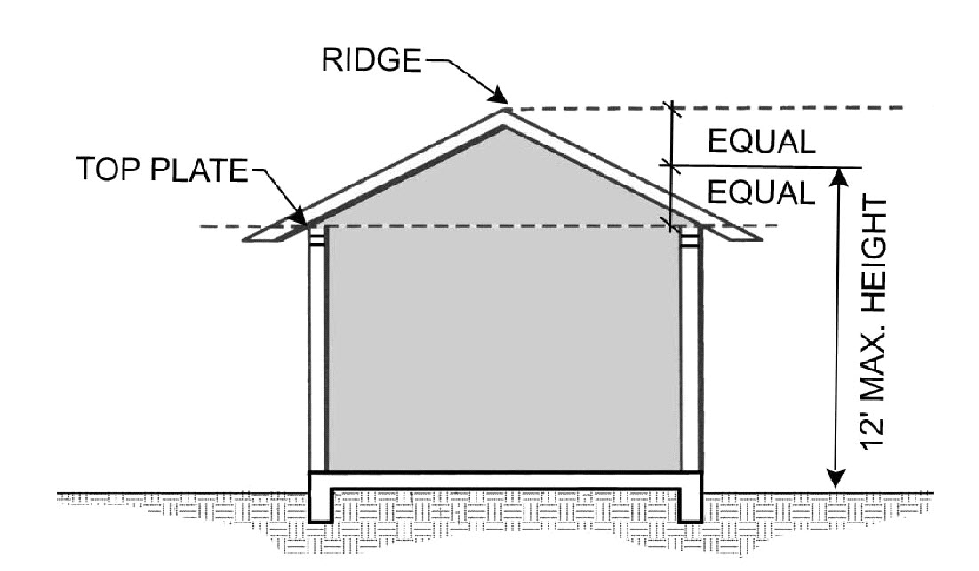
FIGURE 4.20-1: ACCESSORY BUILDING HEIGHT
2.
Location shall be in the rear half of the lot, within the rear yard (defined in Chapter 1.30), or at least 75 feet from the front property line or edge of ultimate right-of-way (see "setback" definition in § 1.30.030). On flag lots and lots having certain other characteristics, the various provisions of subsection 4.20.020.F., shall apply.
3.
Setbacks from side and rear property lines shall be as required by the California Building Code for fire separation.
4.
Separation from any dwelling shall not be less than six feet between exterior walls, and may be further restricted by the provisions of the zoning ordinance or County Ordinance Code. Trellises and other unenclosed structures (two or more open sides) may be placed closer than six feet to a dwelling provided they comply with the setback requirements of dwellings for that district.
5.
Rear yard coverage of detached accessory buildings shall not cumulatively exceed 30 percent.
E.
Rural districts. Except as otherwise expressly provided within this Ordinance, detached accessory buildings and structures in all A, AR, HS, RR and RS districts, and A1 districts outside of urban service areas, are subject to the following regulations:
1.
Height standards vary by lot size, as follows:
a.
If gross lot area is less than two and one-half acres, maximum height allowed is 12 feet, and one story. When such a building has a hip or gable roof, the height is measured to the average vertical dimension between the ridge and top plate of wall (see Fig. 4.20-1). In no case may the absolute height exceed 16 feet. This gable allowance does not apply to buildings with dormers or gambrel roofs. This roof-averaging height measurement may also be applied to a modified hip or gable roof structure, provided the distribution of roof massing is generally consistent with the intent of this provision, as determined by the Zoning Administrator.
b.
If the gross lot area is two and one-half acres or greater, maximum absolute height allowed is 35 feet.
2.
Location shall be in the rear half of the lot, in the rear yard (defined in Chapter 1.30), or at least 75 feet from the front property line or edge of ultimate right-of-way (see "setback" definition in § 1.30.030). On flag lots and lots having certain other characteristics, the various provisions of subsection 4.20.020.F., shall apply.
3.
Accessory buildings or structures exceeding 12 feet in height (16 total feet with gable/hip roof allowance, as provided in subsection 4.20.020.E.1.a., above) on lots two and one-half acres or larger are subject to side and rear yard setbacks of no less than 30 feet. For buildings or structures conforming to the provisions of subsection 4.20.020.E.1.a., setbacks from side and rear property lines shall be as required by the California Building Code for fire separation.
4.
Separation from any dwelling shall not be less than six feet (defined in Chapter 1.30), and may be further restricted by the provisions of this ordinance. Trellises and other unenclosed structures (defined as two or more open sides for purposes of this section) may be placed closer than six feet to the main building provided they comply with the setback requirements of dwellings for that district.
5.
Rear yard coverage of residential accessory buildings shall not cumulatively exceed 30 percent. This provision does not apply to greenhouses or other agricultural buildings.
F.
Special setback standards. The following special setback standards are applicable to accessory buildings and structures as a means of reasonably accommodating unusual and problematic lot circumstances. They shall supersede any conflicting provisions of subsection D. and E.
1.
Parking structure on sloping lots. Where the grade elevation at a point 50 horizontal feet inward from the edge of right-of-way differs 10 vertical feet or more from the elevation at the adjacent edge of pavement, a garage, carport or other parking structure may be located within the required front or side yard of a lot.
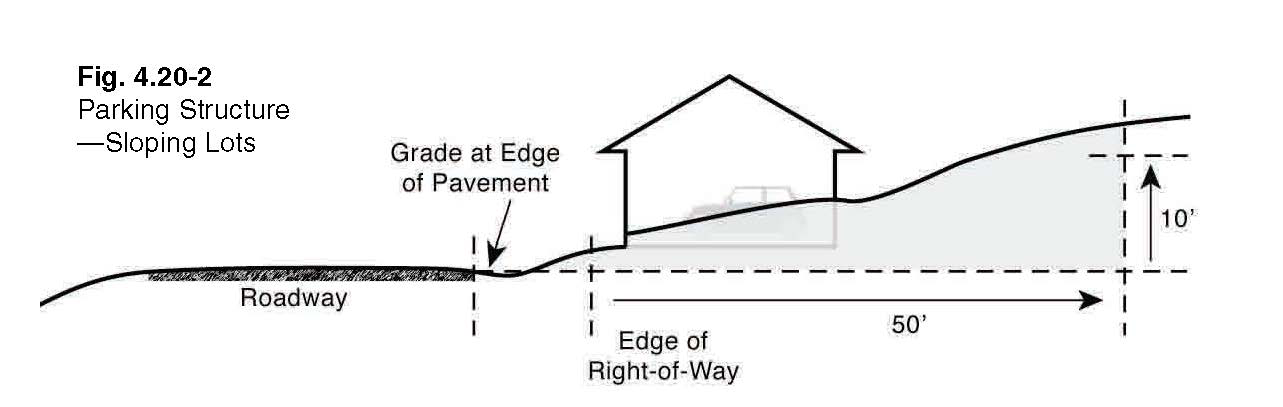
The following requirements shall apply to such setback-exempt parking structures:
a.
Special permit required. This special setback shall be subject to a special permit when such building is located within the required front or side yard setback applicable to dwellings. In addition to the special permit findings of Section 5.60.030, the following findings must be made:
i.
There are no available, practical, or feasible alternative sites for a parking structure that would conform to setbacks; and
ii.
The garage location minimizes grading, or minimizes impacts to trees or other natural features.
b.
Size. Such parking structures may not be larger than 600 square feet.
c.
Sight clearance for traffic safety. Such parking structures must be situated or designed such that adequate sight clearance and safe vehicle movement are afforded to the driver of an exiting vehicle, consistent with Ordinance Code Sections B17-68 and 69.
d.
Height exception allowance. When such parking structures are on land that slopes downward from the street, the downslope side of the parking structure may exceed the maximum allowed height; provided the building conforms to the 12-foot height limitation described in subsection D(1) when measured from a horizontal plane whose elevation is equal to the grade at the front (entry) portion of the building. See Figure 4.20-2.5.
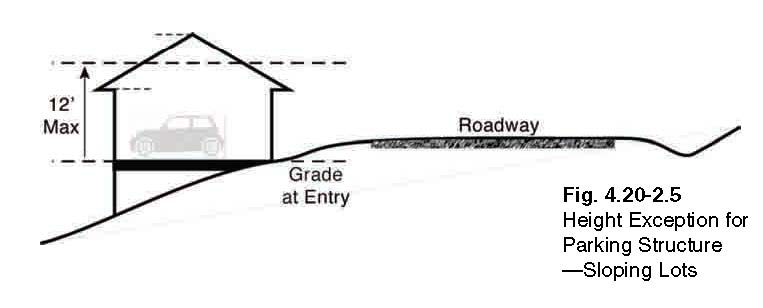
e.
Location. The location of any parking structure established pursuant to these provisions shall be limited to the area of the lot meeting the slope eligibility provisions of this subsection (1).
2.
Interior lot abutting two streets. In the case of an interior lot abutting two or more streets, no detached accessory building shall be erected or altered so as to encroach within the portion of the lot representing one-fourth of the depth of the lot nearest either street. However, no such accessory building must be set back more than 75 feet from either of the front right-of-way lines.
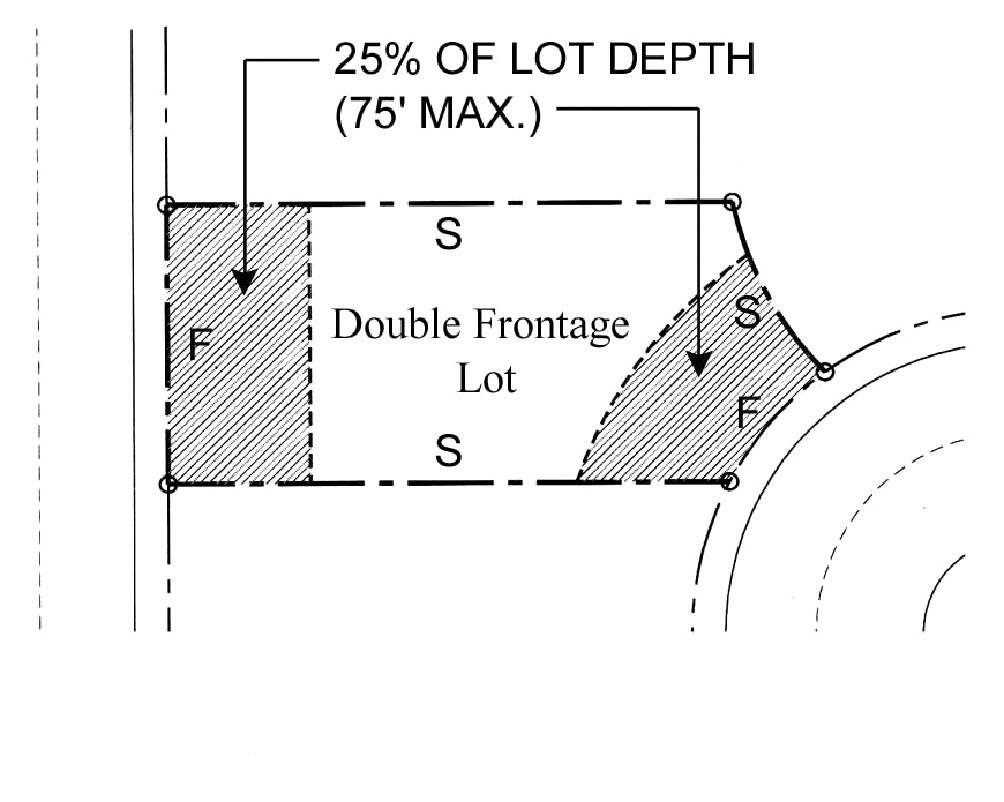
FIGURE 4.20-3: INTERIOR LOT ABUTTING TWO STREETS
3.
Corner lot abutting two streets. In the case of a corner lot abutting two streets, no detached accessory building shall project beyond the minimum side yard setback requirements of the lot to the rear of the corner lot. However, when a corner lot abuts a key lot, no such accessory building shall be located nearer to the right-of-way of the streets upon which such key lot faces than a distance equal to the depth of the front yard required on the key lot.
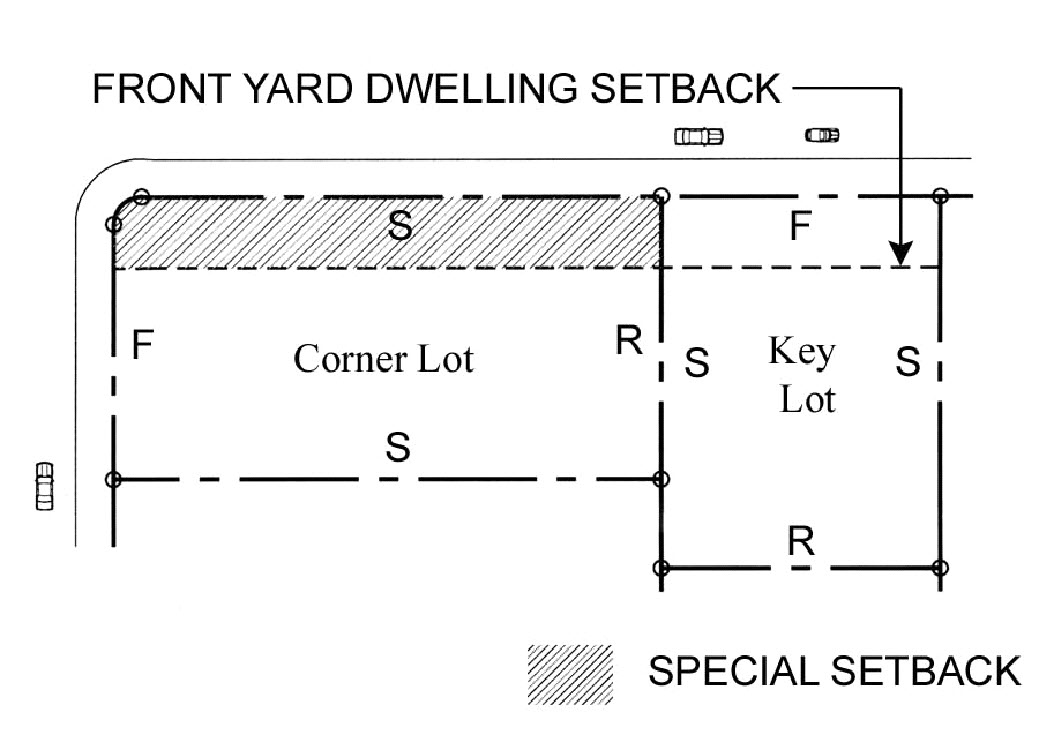
FIGURE 4.20-4: CORNER LOT ABUTTING TWO STREETS
4.
Corner lot abutting three or more streets. In the case of a corner lot abutting three or more streets, no detached accessory building shall be erected or altered so as to be nearer to any right-of-way than one-fourth the width or length of the lot. However, no such accessory building must be set back a distance greater than 30 feet from the determined side lot line abutting a street or a distance greater than 75 feet from either of the front right-of-way lines.
Where such a lot has a discernible rear yard, the normal rear yard placement requirements of subsections 4.20.020.D.2. and 4.20.020.E.2., shall apply.
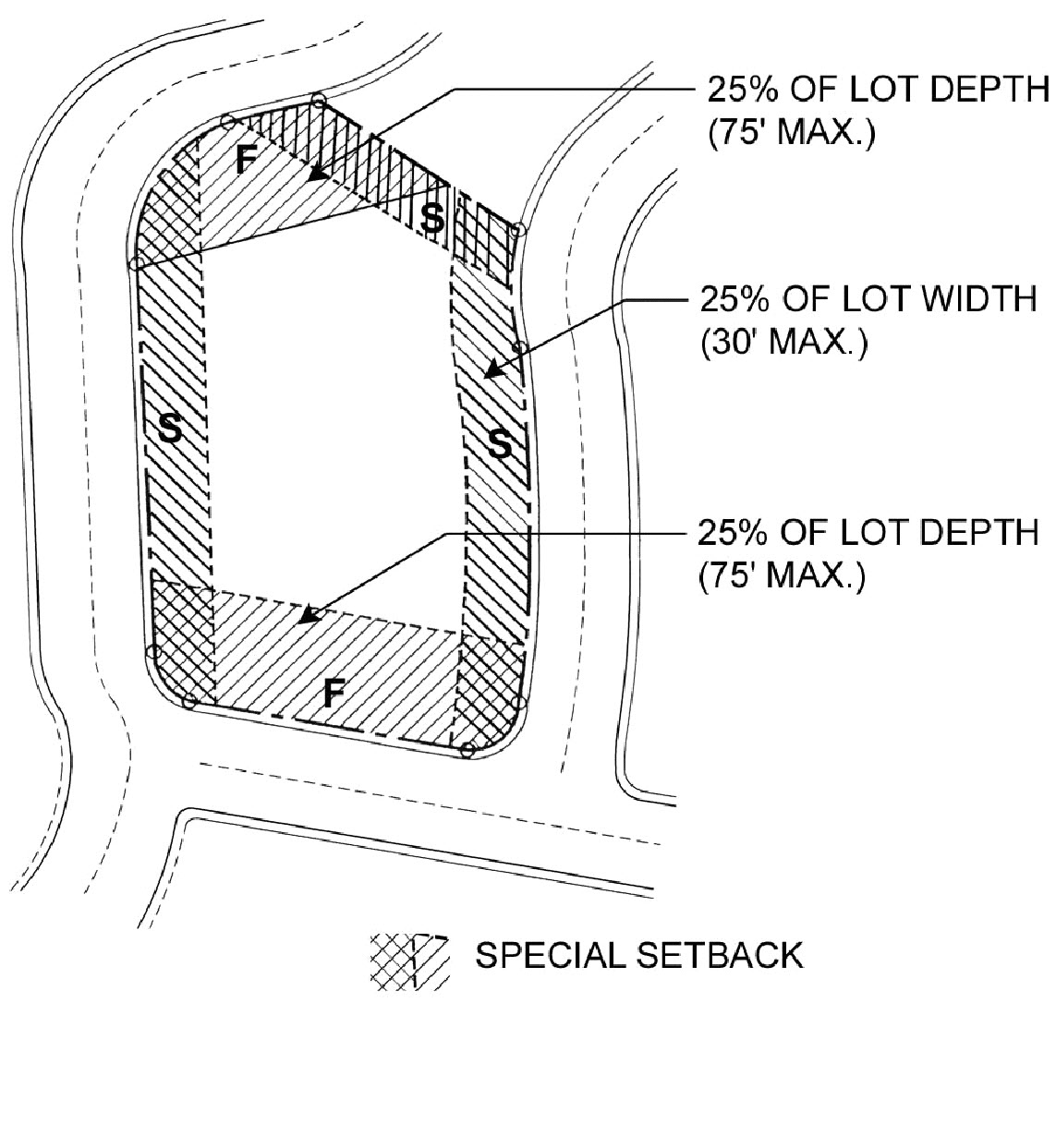
FIGURE 4.20-5: CORNER LOT ABUTTING THREE OR MORE STREETS
5.
Adjacent front yard buffer. No detached accessory building shall be located within five feet of the side line of the front half, or front 75 feet (whichever is less), of any adjacent lot, except as specifically permitted.
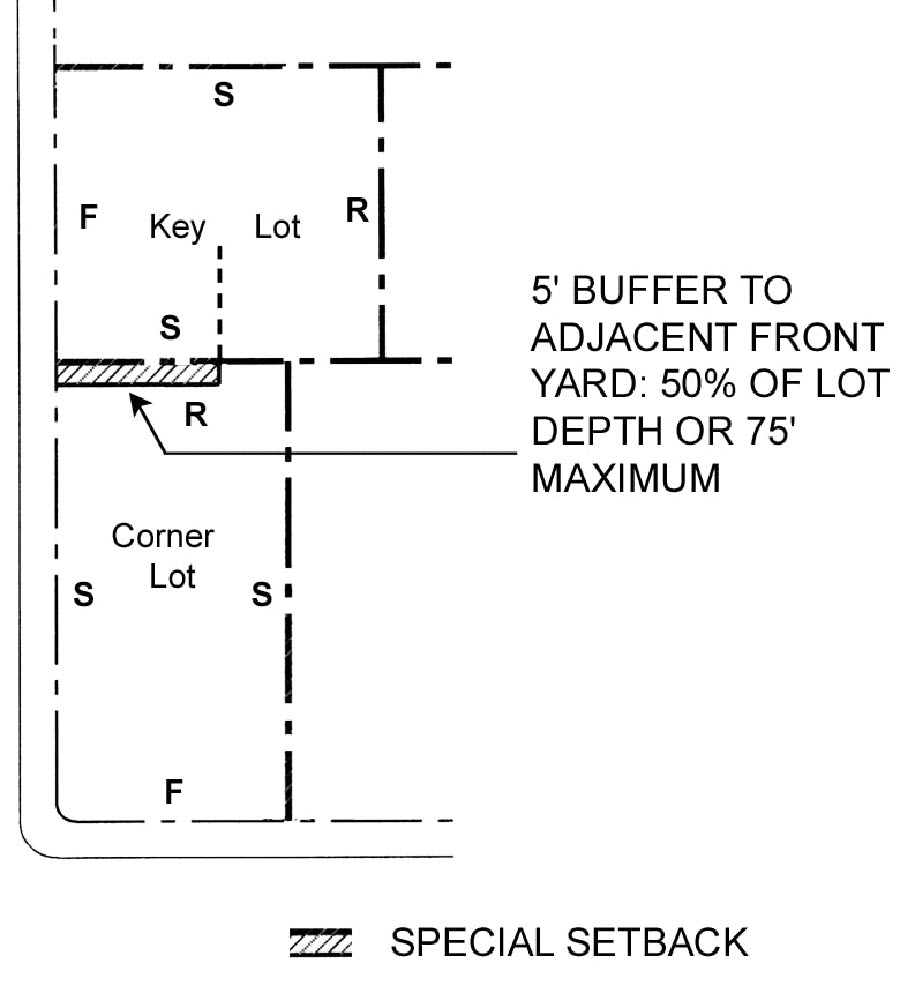
FIGURE 4.20-6: ADJACENT FRONT YARD BUFFER
6.
Flag lot. The rear yard placement limitation of subsections 4.20.020(D)(2) and 4.20.020(E)(2) shall not apply to accessory buildings and solar systems on flag lots. Setbacks from designated front, side and rear lot lines shall be as required for side and rear lot lines by subsections 4.20.020(D)(3) and 4.20.020(E)(3).
7.
Lot abutting an alley. In the case of a lot which abuts an alley, accessory buildings shall not be subject to any setbacks from the alley.
8.
Shallow lot depth. Where lot depth is less than 50 feet, an accessory building may be located anywhere within 25 feet of the property line that is opposite the front property line or edge of right-of-way.
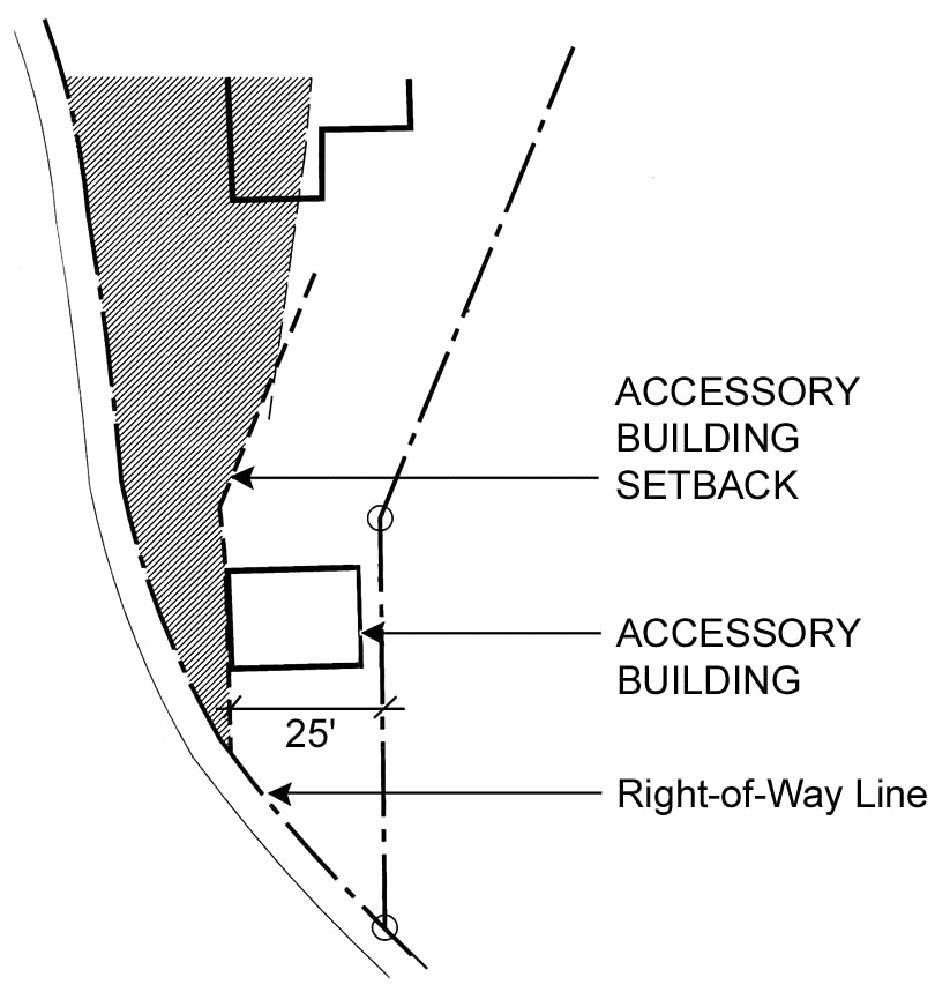
FIGURE 4.20-7: SHALLOW LOT DEPTH
G.
Attached structures. Attached accessory structures in all districts shall comply with the following provisions:
1.
Attached patio covers, carports, trellises and similar unenclosed structures shall conform to the same height, setback and separation requirements as the building to which they are attached. For the purposes of this section, the term "attached" shall include structures that are rigidly joined by structural components.
2.
Attached decks shall meet the same setback requirements as the connected building at any point where the vertical distance between final grade and the surface of the deck exceeds 30 inches, except where the provisions of subsection 4.20.110.A., apply.
H.
Occupancy of accessory buildings. No accessory building shall be used for dwelling purposes or overnight accommodations.
I.
Restrictions on plumbing fixtures. Plumbing in accessory buildings shall be limited as follows:
1.
Residential accessory buildings shall have no more than two internal plumbing fixtures ("internal" excludes outdoor showers, spigots, or other fixtures mounted on an exterior wall), unless otherwise provided in subparagraph 2, below. If a half bath is proposed, the fixtures may include a toilet and a sink within a room minimally sized to accommodate only those two fixtures. For the purposes of this restriction, a water heater shall not be considered a plumbing fixture.
2.
Residential accessory buildings (such as pool houses) with more than two internal plumbing fixtures may be allowed if a special permit is obtained, per Chapter 5.60, and all of the following specific findings are made:
a.
Must conform to the development standards specified in this chapter. More restrictive setbacks may be required in order to mitigate detrimental impacts on neighboring properties.
b.
May not be used for dwelling purposes or overnight accommodation.
c.
Must be of an appropriate size and design for the intended use, and should be configured in a manner that is clearly inappropriate and impractical for dwelling purposes.
J.
Swimming pools. Swimming pools and spa pools shall be located at least five feet from any property line or right-of-way, measured to the interior wall of the pool. Pool filters, pumps and other appurtenant machinery must also be located at least five feet from any property line or right-of-way. Fence enclosure requirements established by the Uniform Building Code or other regulations may further limit the placement of swimming pools within portions of a lot where fence height is restricted to less than five feet.
K.
Air conditioning, heating, or similar outdoor mechanical unit. Ground-mounted heating, ventilation, air conditioning units, or other similar mechanical units, must be located at least five feet from any property line.
L.
Antennas. Non-commercial antennas shall be set back from property lines a minimum distance equal to their height. Antennas shall be limited in height to 55 feet in urban residential districts, or less, if lot dimensions require reduced height to meet the required setback, and 80 feet in rural districts. Height shall be measured from final grade to maximum design height of antenna. These regulations shall apply to both ground-mounted and roof-mounted antennas.
M.
Energy conversion systems. Solar and wind energy conversion systems that are accessory to a principal structure or use and will be used primarily to reduce onsite consumption of utility power shall comply with the applicable provisions of this section.
1.
Solar energy systems. Solar panels and other types of solar energy systems may be placed on any portion of a lot other than within the front yard setback applicable to the principal structure. In the case of a flag lot, such panels may be permitted within a front yard setback, pursuant to subsection 4.20.020(F)(6). In the case of a corner lot, no such panels shall be placed within an exterior side setback adjacent to the street. Solar panels attached to the roof of a building shall not exceed the structure's maximum allowed height by more than five feet.
2.
Small wind energy systems. Wind energy conversion systems (consisting of a wind turbine, a tower, and associated control or conversion electronics) with rated capacity of not more than 50 kilowatts per customer site that will be used primarily to reduce onsite consumption of utility power shall comply with all of the following provisions:
a.
Setbacks. The structure shall be set back from all property lines a minimum distance equal to the height of the system (tower plus the radius of the blades), provided that the system complies with any applicable fire protection setback requirements pursuant to Public Resources Code Section 4290.
b.
Height. System heights of not more than 80 feet shall be allowed on parcels between one and five acres. Tower heights of not more than 100 feet shall be allowed on parcels above five acres. All tower heights shall not exceed the applicable limits established by the Federal Aviation Administration. An application to the Building Inspection Office shall include a copy of the FAA determination letter along with evidence that the proposed height of a tower does not exceed the height recommended by the manufacturer or distributor of the system. A written notification at the time of application shall, for informational purposes only, be sent to the closest airport affected. System height is equal to the height of the tower plus the radius of the blades.
c.
Noise. Noise generated by the system shall not exceed 60 decibels (dBA) or the maximum noise level applicable under the noise element of the general plan for the applicable land use classification or zoning district, as measured at the property line, except during short-term events such as utility outages and severe wind storms.
d.
Airport influence area limitation. A system shall not be allowed within a runway protection zone, inner safety zone, outer safety zone and turning safety zone and shall comply with all federal aviation regulations.
e.
Security enclosure. The base of the structure shall be secured by means of an appropriate enclosure to prevent access or climbing by unauthorized persons.
f.
Lighting. Tower structure lighting shall be for security and aviation safety purposes only. Fixtures for security lighting shall be mounted no higher than 12 feet above grade, and shall be downward facing and properly shielded. Lighting for aviation safety purposes shall be limited to that required by federal law or regulation.
N.
Livestock shelters. In addition to the requirements applicable to accessory buildings in this section, all of the following placement limitations shall apply specifically to stables, barns and other structures designed, intended or used for the shelter or confinement of livestock. Such structures:
1.
Should be located at least 100 feet from any well or established watercourse. Proposals for such structures situated nearer than 100 feet to wells or watercourses (defined in Chapter 1.30) shall be evaluated on a case-by-case basis by the Santa Clara County Department of Environmental Health. The department shall consider various factors, including (but not limited to) topography and drainage, soil and vegetation, hydro-geology, well depth, well casing depth, type and capacity of building, type and number of animals, and existing lot configuration, in approving or disapproving a lesser separation; and
2.
Shall not be constructed on slopes exceeding 15 percent.
O.
Water tanks. The following regulations shall apply to all private, noncommercial water storage tanks that are ancillary to residential development or agriculture:
1.
The following setback requirements shall apply:
a.
Water tanks shall have a minimum front yard setback equal to that required for dwellings in the applicable zoning district; except that on flag lots or lots that otherwise have no direct frontage on a street or right-of-way, the side and rear setbacks provided in subsections b. and c. (below) shall also apply to the designated front yard.
b.
Water tanks that are 12 feet or less in height shall be set back from any side or rear property lines a minimum of three feet.
c.
Water tanks that are greater than 12 feet in height shall be set back from any side or rear property lines a minimum of 30 feet.
d.
Water tanks shall be exempt from the foregoing setback requirements under either of the following circumstances:
(1)
When located within a designated area created for water storage as part of a subdivision, or
(2)
When located on any lot whose area is less than 3,750 square feet.
2.
The maximum height of water tanks, including tower-mounted tanks, shall be 35 feet.
P.
Light poles and flag poles. Light poles and flag poles accessory to residential or agricultural uses shall be limited to 35 feet in height. Such structures shall be set back from property lines a minimum distance equal to the height of the structure. Light fixtures on light poles shall be shielded such that the light source is not visible from beyond the boundaries of the subject property.
(Ord. No. NS-1200.317, § 8, 6-8-04; Ord. No. NS-1200.318, § 10, 3-28-06; Ord. No. NS-1200.327, § 16, 2-9-10; Ord. No. NS-1200.329, § 2, 9-28-10; Ord. No. NS-1200.332, § 10, 11-22-11; Ord. No. NS-1200.337, § 8, 12-18-12; Ord. No. NS-1200.349, § 9, 4-7-15; Ord. No. NS-1200.367, §§ 9—11, 6-19-18)
§ 4.20.030. - Density bonuses and other incentives for affordable housing.
A.
General Provisions. Applicants for housing development proposals may be eligible for a density bonus or other incentives to produce and maintain housing affordable to low and very low income households pursuant to the provisions and requirements of California Government Code Sections 65915 through 65918. Other incentives, such as reductions in standards, parking requirements, mixed use development, or other concessions which effectively reduce the cost of housing units targeted for low and very low income housing may also be provided. For purposes of implementing this provision of the zoning ordinance as part of a subdivision or other housing development proposal, specific instructions and procedures are contained within the pertinent sections of Government Code Sections 65915 through 65918, as amended.
B.
Calculations. The number of additional lots or dwelling units permitted by means of a density bonus allocation shall be achieved by making the appropriate and commensurate reduction in the applicable standards or regulations establishing minimum lot size or minimum lot area per dwelling unit for multi-family zoning districts.
(Ord. No. NS-1200.344, § 1, 6-10-14)
§ 4.20.040. - Development on substandard lots.
A.
Minimum size. Any legally established lot, that is substandard in area (relative to the applicable minimum lot size) may be used as a residential building site provided that its area is not less than 3,750 square feet and it complies with all other applicable land development regulations.
B.
Setback exceptions. See Section 4.20.110 for special setback exceptions for substandard lots.
§ 4.20.050. - Fences.
A.
Fences in urban residential districts. Fences in all R1, R1E, R2, R1S and RHS districts, and A1 districts within urban service areas are subject to all of the following regulations:
1.
Fences or hedges shall not exceed three feet in height within any portion of a lot within 20 feet of the front lot line (or edge of front right-of-way).
2.
Fences shall not exceed eight feet in height within any other portion of a lot, except as specified in Subsection 3 below. This limitation shall not apply to hedges.
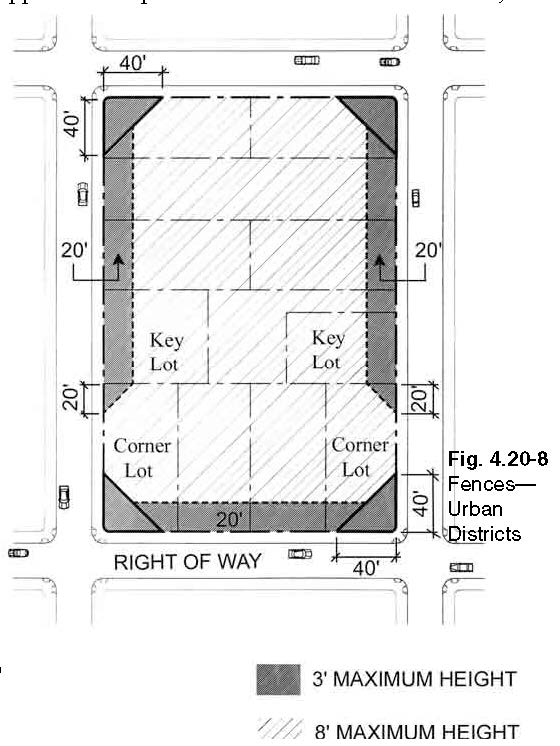
3.
On corner lots, fences or hedges along the exterior side lot line (or edge of side right-of-way) may be as tall as eight feet, except that a three-foot height limitation shall apply within the following areas: (a) within the 40-foot sight clearance triangle defined by Section B17-69 of the County Ordinance Code, which relates to vehicular sight clearance on intersecting streets, and (b) within a 20-foot sight clearance triangle where the rear of a corner lot abuts the front and side yards of a key lot.
4.
Where architecture and site approval is required for the establishment of a use, the regulations specified in this section may be modified through the architecture and site approval process (Chapter 5.40).
5.
Fences that reasonably must exceed the height limitations specified within this section, such as enclosures for tennis courts, or due to physical circumstances such as unusual topography, or for consistency with and preservation of neighborhood character, may be allowed subject to the design review provisions of Chapter 5.50. This provision shall also apply to hedges within 20 feet of the front lot line, or edge of front right-of-way.
6.
Fences in "-d" and "-sr" combining districts shall be subject to the design review provisions of Chapter 5.50.
B.
Fences in rural districts. Fences in A, AR, HS, RR and RS districts and A1 districts outside of urban service areas are subject to all of the following regulations:
1.
Fences or hedges not exceeding six feet in height may occupy any portion of a lot within 20 feet of the edge of any street right-of-way. However, on corner lots where two or more streets intersect, Section B17-69 of the County Ordinance Code relating to sight clearance for fences and hedges applies.
2.
No fence or hedge may be built in a manner that significantly obstructs the view from vehicles exiting a driveway of approaching vehicular or pedestrian traffic. Within a triangle formed by two 20-foot sides measured from the point of intersection along the edge of pavement and the edge of driveway, no fence may exceed three feet in height, unless design review approval is obtained under Chapter 5.50.
3.
Fences not exceeding eight feet in height may occupy any portion of a lot other than the restricted areas described in subparagraphs (1) and (2), above. This limitation shall not apply to hedges.
4.
Where architecture and site approval is required for the establishment of a use, the regulations specified in this subsection may be modified through the architecture and site approval process.
5.
Fences that reasonably must exceed the height limitations specified within this section, such as for tennis courts, or due to physical circumstances such as unusual topography, or for consistency with and preservation of neighborhood character, may be allowed subject to the design review provisions of Chapter 5.50. This provision shall also be applied to hedges within 20 feet of the front lot line, or edge of front right-of-way.
6.
Fences in "-d" and "-sr" combining districts shall be subject to the design review provisions of Chapter 5.50.
_____
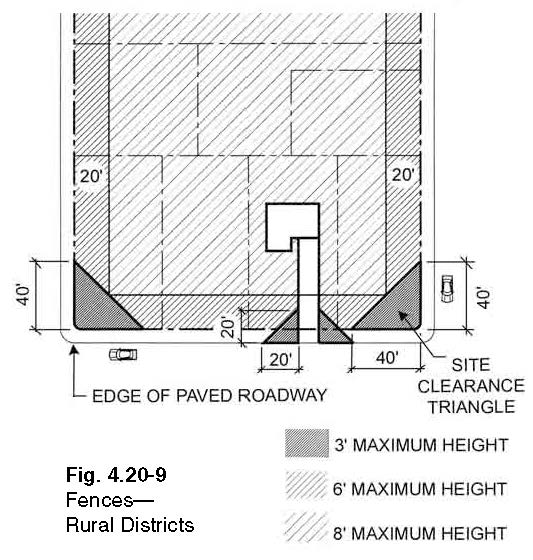
_____
(Ord. No. NS-1200.337, § 9, 12-18-12)
§ 4.20.060. - Manufactured homes.
Manufactured (factory-built) homes and mobile homes shall be certified under the National Manufactured Housing Construction and Safety Standards Act of 1974.
§ 4.20.070. - Motor vehicle repair and storage in residential districts.
A.
Intent. It is the intent of this section to limit certain activities associated with the repair and storage of motor vehicles that occur on residential property so that such activities do not disturb neighboring residents.
B.
Limitations. On any residential lot in any zoning district, the servicing, repairing, assembling, disassembling, wrecking, modifying or otherwise working (hereinafter referred to as "work" within this section) on any motor vehicle or the placing or storing of disabled or inoperative motor vehicles, motor vehicle bodies, parts, equipment, machinery, tools or other metal materials of any kind is only permitted if all of the following are met:
1.
Work may be performed only on a motor vehicle registered to a person residing on the lot.
2.
Storing disabled or inoperative vehicles. A disabled vehicle is one that cannot immediately be started and moved under its own power or is not currently registered for use on the public right-of-way.
a.
Disabled or inoperative vehicles shall be stored in areas screened from public view and from adjacent properties.
b.
No more than two disabled or inoperative vehicles are allowed to be stored or worked on per lot.
3.
Motor vehicle repair and storage shall not constitute a legal, nonconforming use, and this provision shall supersede any contrary provision of Chapter 4.50.
4.
In addition to the above restrictions, the following shall apply to all lots that are less than one gross acre in area:
a.
All motor vehicle bodies, parts, equipment, machinery, tools or other metal materials of any kind shall be stored within a screened or enclosed area.
b.
All work performed on a motor vehicle shall be permitted only during the hours of 7:00 a.m. to 10:00 p.m.
5.
In addition to the above restrictions, on lots less than ten acres, work cannot extend over a period of 72 hours unless the vehicle is moved to an area behind the front yard setback which is not visible from the front property line.
§ 4.20.080. - Outdoor storage: Miscellaneous materials.
A.
General. Outdoor storage of miscellaneous materials, including building materials, appliances, salvaged materials, vehicle or machine parts, scrap metals, junk, and similar items or materials that are deteriorated or dilapidated, are subject to all of the following limitations, with the exception of those materials or items addressed in the provisions of subsection B. (below). These provisions apply to all zoning districts.
1.
Area: No more than 200 square feet on any lot, cumulative, may be used for outdoor storage of such miscellaneous materials.
2.
Height: Materials may not be stored in such a way that they exceed six feet in height.
3.
Visibility: Materials shall not be visible from a public right-of-way or adjacent property, nor located within the required minimum front yard setback of any lot.
B.
Exceptions. Such miscellaneous materials shall not be subject to the area, height and visibility restrictions of subsection A. (above) when any of the following circumstances apply:
1.
The storage is temporary and for the purpose of construction pursuant to and during the time permitted by a valid building permit.
2.
The storage is for purposes of conducting a yard or garage sale, having a duration of no more than three consecutive days. Such sales shall be limited to not more than four per year, and not more than two consecutive weekends.
3.
The storage is incidental and accessory to any permitted agricultural use, or conducted as the legally established primary use within an industrial zoning district.
4.
The provisions of this section do not apply to: (a) motor vehicle repair and storage as described in Section 4.20.070; (b) recreational vehicle storage as described in Section 4.20.090; or (c) refuse storage as described in Section 4.20.100 for multi-family and nonresidential uses.
(Ord. No. NS-1200.317, § 9, 6-8-04; Ord. No. NS-1200.318, § 11, 3-28-06)
§ 4.20.090. - Recreational and similar vehicles.
A.
Storage of Recreational Vehicles. The following provisions apply to recreational vehicles (RVs) and similar vehicles parked or stored on residential lots, and shall apply in all zoning districts. They do not apply to approved commercial or industrial RV storage uses, RV parks, temporary agricultural residences (§ 4.10.385), temporary emergency housing following casualty (§ 4.20.090(B)), temporary residences during house construction (§ 4.10.380), or movable tiny homes (§ 1.30.030) that have been permitted by the County.
1.
No RV, camper, trailer, boat or similar vehicle may be parked or stored within a front or side yard for a period of more than 72 hours within any one calendar month; however, this provision shall not preclude such RV storage on portions of a front or side yard that are at least 75 feet from the front property line.
2.
An RV, camper, trailer, boat or similar vehicle may be stored within a rear yard. On a corner lot abutting a key lot, such vehicles must additionally be set back from the side right-of-way a distance equal to the front yard setback of the adjacent key lot.
3.
Any RV, camper, trailer, boat or similar vehicle stored on a lot must be registered to a resident of that lot.
4.
No RV may be used for dwelling purposes while being parked or stored on the premises. Utility connections are not allowed except when necessary for limited maintenance activity.
5.
Storage of RVs, campers, trailers, boats or similar vehicles in a manner inconsistent with the limitations of this section shall not be allowed, regardless of when such storage may have been established. This provision shall supersede any contrary provision of Chapter 4.50: Nonconforming Uses and Structures.
B.
Use as Emergency Housing Following Casualty. A mobile home or recreational vehicle, including travel trailer, may be temporarily occupied on property where a fire, earthquake or other casualty has rendered the primary residence non-habitable. All of the following requirements shall apply:
1.
The temporary dwelling must be removed from the premises within 90 days after the date of occupancy of the repaired or replacement dwelling, or two years following the date the casualty occurred, whichever occurs first.
2.
Temporary mobile homes or travel trailers must be connected to a sanitary sewer or septic system approved by the Department of Environmental Health for the temporary occupancy use.
(Ord. No. NS-1200.319, § 2, 3-28-06; Ord. No. NS-1200.371, § 12, 3-10-20; Ord. No. NS-1200.375(10.20.2020), § 8, 10-20-20)
§ 4.20.100. - Refuse storage in multi-family and nonresidential development.
A.
General. The provisions of this section apply to all multi-family and nonresidential development.
B.
Location. Trash enclosures shall be located in the side or rear yard unless such location would prevent accessibility by a collection vehicle. In such cases, the Zoning Administrator shall have authority to determine the appropriate location of trash enclosures.
C.
Pickup and disposal. Refuse storage shall be subject to weekly or other regularly scheduled pickup and disposal.
D.
Standards. Trash enclosures shall be constructed and maintained as follows:
1.
They shall be constructed prior to occupancy of the development;
2.
They shall be screened on three sides by a solid masonry or wood wall of at least six feet in height;
3.
They shall be screened from view from public rights-of-way; and
4.
Their locations shall be accessible to refuse-collecting vehicles.
(Ord. No. NS-1200.359, § 10, 12-6-16)
§ 4.20.110. - Setback encroachments and height exceptions.
A.
Setback Encroachment Allowance for Certain Architectural Features.
1.
General. The following architectural features and appurtenant structures may extend into any required front, side or rear yard setback, but not beyond a property line, a distance not exceeding 30 inches beyond any legally constructed exterior wall of a dwelling:
a.
Awnings;
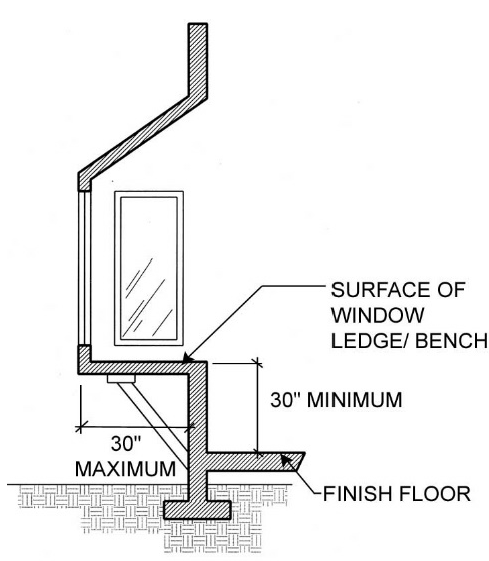
Fig. 4.20-10 Bay Window
b.
Bay windows, limited. For purposes of this section, the bay window must be supported by framing or underpinnings higher than the finished floor level, not creating additional floor area, and the vertical distance between the surface of the interior window ledge or bench and the finished floor must be 30 inches or greater. (See definition in Ch. 1.30);
c.
Chimneys;
d.
Cornices;
e.
Eaves;
f.
Utility meters and appurtenant equipment; and
g.
Architectural features similar in size and nature as determined by the Zoning Administrator.
2.
Decks, porches, and entry stairs. Uncovered decks, porches, and entry stairs may encroach into setbacks to the extent provided in the table below. Covered porches may also encroach into the front yard setback only, to the extent provided in the table below; provided they are not enclosed by walls, screening or other such continuous vertical components. Only necessary support pillars not exceeding two horizontal feet in thickness may be included. For all such decks, porches and entry stairs, a safety railing not exceeding 42 inches in height may be allowed. For the purposes of these sections, multiple decks on a building or structure will be cumulatively considered.
The limitations of this table apply only to those portions of such structures that are more than 30 inches above final grade. Decks and other structures not more than 30 inches above final grade are exempt from setback requirements, per subsection 4.20.020(B)(1).
3.
Accommodation for disabled. Wheelchair ramps, elevators, mechanical access devices and other structures intended to facilitate access for the disabled may be exempted from setback requirements or other development standards, permit requirements or building regulations, pursuant to the County's procedures for "Requests for Reasonable Accommodation" as defined in the County of Santa Clara Housing Element; Appendix 4 of the General Plan, and applicable state and federal regulations.
4.
Basement light-wells, access stairwells. Basement light-wells and below-grade access stairways may encroach into residential setbacks provided their retaining walls are situated at least three feet from property lines. Above-grade railings or walls around such light-wells or access stairways that are 42 inches or less in height are also exempt from residential setbacks.
B.
Height Exceptions. The following architectural features and appurtenant structures may exceed the maximum height requirement for dwellings and accessory buildings as indicated:
1.
Antennas: See subsection 4.20.020(L): Antennas.
2.
Chimneys: Ten additional feet maximum.
3.
Decorative features such as weathervanes and open railings. Includes cupolas, and similar features, not exceeding 24 square feet in area: Five additional feet maximum.
4.
Solar (photovoltaic) panels mounted on roof: Five additional feet maximum.
5.
Air pollution control equipment required and approved by the Bay Area Air Quality Management District or other governmental regulatory agency shall have no maximum height limit, subject to obtaining Architecture and Site Approval (ASA).
6.
Architectural features similar in scale and nature as the above, as determined by the zoning administrator.
C.
Special Setback Exceptions. The following setback exceptions shall supersede the standard residential setbacks specified in any base district or lot-size combining zoning district.
1.
Side setback reduction based on area. A lot whose area is one net acre or less, and is lesser in area than the minimum lot size required by the applicable zoning district, may qualify for reduced side yard setbacks. The following table lists the allowable reduced side yards for ranges of substandard lot sizes.
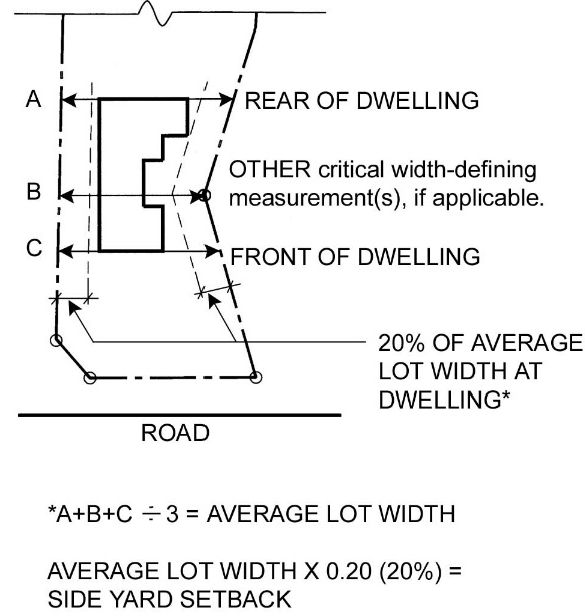
Fig. 4.20-11
2.
Side setback reduction based on width. A narrow lot (having an exceptionally large depth-to-width ratio) shall have minimum side yard setbacks equal to 20 percent of the lot width whenever such setback dimension would be lesser than would otherwise be provided for by the Zoning Ordinance. This allowance shall not, however, allow for an exterior side yard setback on a corner lot to be less than ten feet.
For the purposes of this subsection, width shall be measured across the portion of the lot where the dwelling is or will be located, and the resulting side setback shall be rounded to the nearest whole foot.
3.
Rear setback reduction based on depth. Required residential rear yard setbacks may be reduced to 20 percent of the depth of any lot. For the purposes of this subsection, depth shall be measured through the portion of the lot where the dwelling is or will be located, and the resulting rear setback shall be rounded to the nearest whole foot.
4.
Setback-nonconforming dwellings. Extension of side yard encroachment. Any legally constructed portion of a dwelling that encroaches into a required side yard setback may be extended lengthwise along the dwelling's side wall plane, subject to the following:
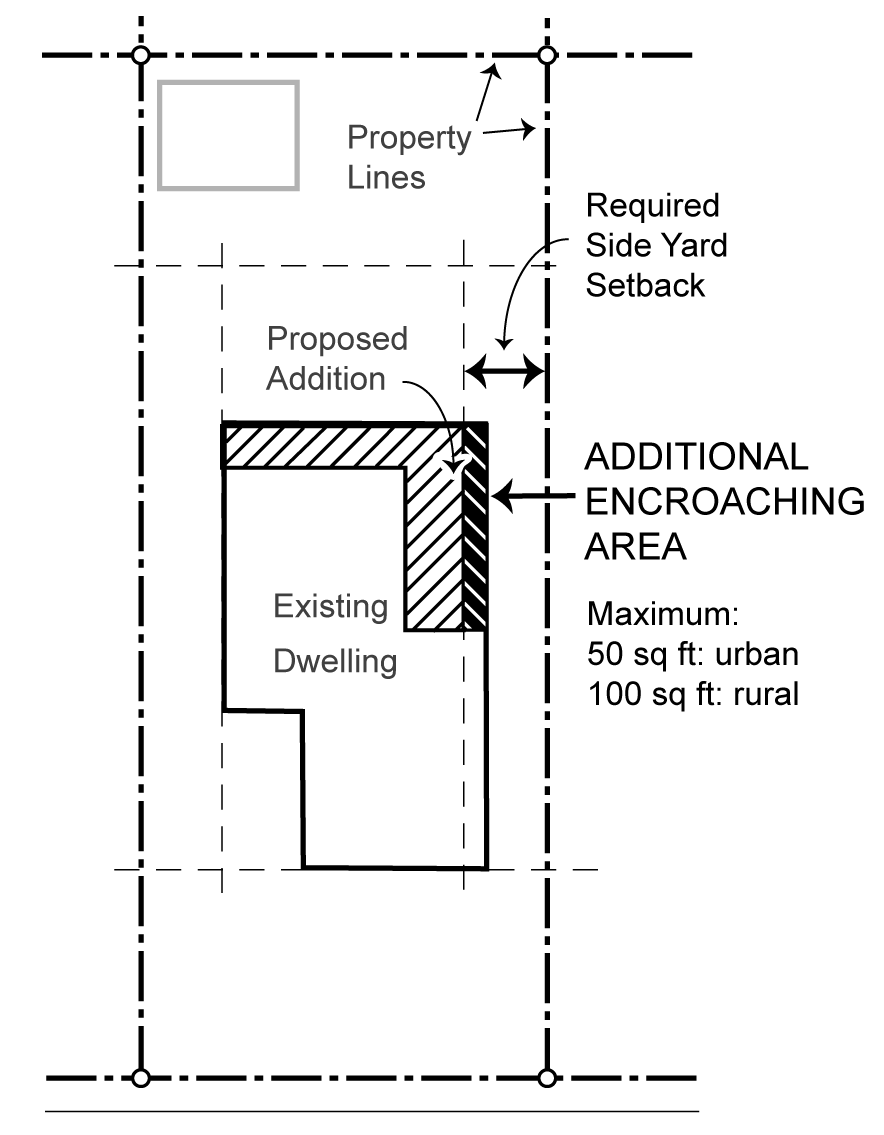
Fig. 4.20-12
a.
The new encroachment shall be limited in area to no more than 50 square feet per lot on lots located within urban service areas, and 100 square feet per lot on lots outside urban service areas. Such allowed encroachment may be adjacent to either (or both) side yard(s) provided the new encroaching area does not cumulatively exceed the applicable maximum (50 or 100 square feet). No such encroachment may extend into any front or rear yard setback.
b.
The floor area limitations of subsection A, above, shall be applied cumulatively to construction permitted after September 21, 1993.
c.
The additional area of encroachment may not be more than one story nor taller than the existing adjoining wall.
d.
No greater setback encroachment may result (i.e., the extension may be no nearer to the side property line than the existing wall being extended).
e.
No portion of a house that is less than three feet from a side property line may be extended under this provision.
5.
Setback-nonconforming buildings. Roof-pitch change. A legally constructed roof that is part of a setback-nonconforming portion of a house may be replaced by roof of the same or a different design, except where such replacement creates additional (nonconforming) floor area, as defined in Section 1.30.030.
6.
Setback-nonconforming buildings. Accessory dwelling unit additions. A setback-nonconforming single-family residence, or setback-nonconforming accessory structure, may be expanded by no more than 150 square feet to accommodate an attached ADU, so long as the expansion does not result in a greater setback encroachment.
7.
Setback-nonconforming dwellings. Casualty reconstruction. See Section 4.50.030, subsection C.
8.
Setbacks established by recorded subdivision. The placement limitations designated by an applicable recorded subdivision map, including, but not limited to, building envelopes, building lines, and setbacks shall supersede the setbacks required by this ordinance, if such limitations are more restrictive than setbacks established by the zoning ordinance.
9.
Setbacks for lots less than one acre within specified substandard subdivisions in the HS zoning district are contained in subsection A of Section 2.20.070. Additional Development Standards for HS Districts.
10.
Setback non-conforming Single-Family Residences. Urban Primary Unit additions. A setback-nonconforming single-family residence may be expanded by no more than 150 square feet to accommodate development of an attached Urban Primary Unit so long as the expansion does not result in a greater setback encroachment.
11.
Setback non-conforming Single-Family Residences. Urban lot splits. A setback nonconforming single-family residence that was previously conforming prior to an urban lot split pursuant to Section C12-44 but is no longer conforming as a result of the urban lot split may not be expanded to further encroach into the setback. Single-family residences that were setback-nonconforming prior to an urban lot split may be expanded per subsections (C)(4)—(9) of this section.
D.
Breezeways.
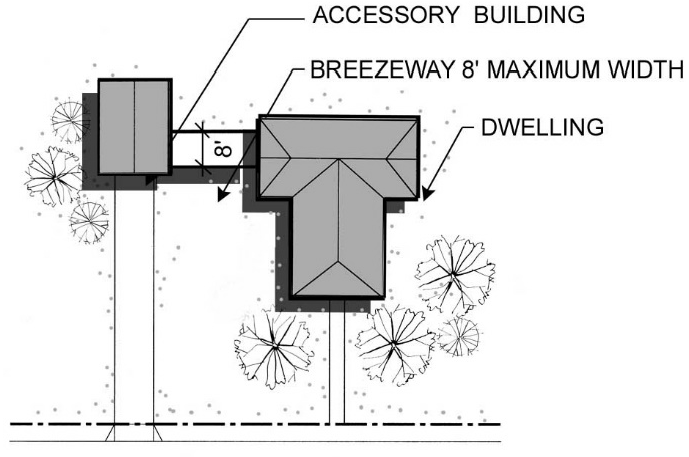
Fig. 4.20-13 Breezeways
1.
Covered Walkway/Limited Breezeway. A limited breezeway may be built to serve as an open walkway between two otherwise detached buildings. The breezeway is considered exempt from the more restrictive setback requirements applicable to either of the buildings connected by the breezeway, if all the following limitations are met:
a.
The roof width, as measured perpendicular to the linear direction of travel from one building to the other, does not exceed eight feet, except as needed at corners;
b.
The breezeway follows a reasonably direct path between each building; and
c.
The breezeway sides are entirely open except for necessary structural supports.
2.
Other Breezeways. Breezeways that exceed the above limitations, or similar structures that connect one or more accessory building to a dwelling, may be allowed provided all portions of the breezeway and connected structures comply with the setbacks applicable to dwellings. Where such a breezeway connects two or more accessory buildings or structures with different setback requirements, the more restrictive setbacks shall apply to all such buildings or structures.
(Ord. No. NS-1200.317, § 10, 6-8-04; Ord. No. NS-1200.318, § 12, 3-28-06; Ord. No. NS-1200.323, § 7, 1-29-08; Ord. No. NS-1200.327, § 17, 2-9-10; Ord. No. NS-1200.332, § 11, 11-22-11; Ord. No. NS-1200.342, § 1, 4-29-14; Ord. No. NS-1200.359, § 11, 12-6-16; Ord. No. NS-1200.370, § 3, 1-29-19; Ord. No. NS-1200.371, § 13, 3-10-20; Ord. No. NS-1200.383, § 9, 1-24-23)
§ 4.20.120. - Tree preservation and removal.
For regulations related to tree preservation and removal, see Division C16 of the County Ordinance Code.
§ 4.20.130. - Inclusionary housing for the unincorporated areas of the County of Santa Clara.
A.
Purpose and intent. The purpose and intent of this Section are as follows:
1.
It is the policy of the County that this Section be interpreted and implemented in a manner to afford the fullest possible weight to the interest of, and the approval and provision of, affordable housing.
2.
Construction of affordable units as well as market-rate units within the unincorporated areas of the County of Santa Clara is consistent with the County's Housing Element goals of protecting the public welfare by fostering a sufficient supply of housing for persons at all economic levels. Requiring the development of affordable housing units in new market rate residential development in the unincorporated areas of the County of Santa Clara will provide affordable housing, which will relieve the burden placed on the housing market throughout the County. Provision of additional housing will also help the County reach its regional share of housing needs and implement the goals and objectives of the General Plan, Housing Element, and the Stanford Community Plan. This ordinance is being adopted as part of incremental steps taken by the County of Santa Clara to require the construction of affordable units when market rate units are constructed.
3.
The adoption of an inclusionary housing program for unincorporated areas in the County will also assist in alleviating constraints on availability of land for affordable housing caused by use of residential land primarily for development of market rate housing because it will require new housing developments to include affordable housing, and will assist in alleviating the impacts of the service needs of market rate households in the County.
4.
Requiring the development of affordable housing units in new market rate residential development in the County of Santa Clara, both outside of and within the Stanford Community Plan Area, recognizes the broad need to provide affordable housing across the County. This ordinance is tailored to provide affordable housing requirements for unincorporated areas of the County that reflects the predominately rural and less intense development patterns of most unincorporated areas in the County. Residential development activity consists primarily of single-family developments within rural areas of the County.
5.
This ordinance [section] also recognizes the unique development characteristics within the Stanford Community Plan Area, which is urban and much higher in density than other unincorporated parts of the County. Construction of affordable units as well as market-rate units within the Stanford Community Plan Area is consistent with the County's Housing Element goals of protecting the public welfare by fostering an adequate supply of housing for persons at all economic levels. Requiring the development of affordable housing units in new market rate residential development in the Stanford Community Plan Area will provide affordable housing, which will relieve the burden placed on the housing market in the surrounding area. Flexibility to build units outside of the Stanford Community Plan Area will provide additional housing units to lower income households in the community, further relieving the burden on the housing market. Provision of additional deed-restricted affordable housing within the Stanford Community Plan will also help the County reach its regional share of housing needs and implement the goals and objectives of the General Plan, Housing Element, and the Stanford Community Plan.
6.
The County desires to provide the residential development community with alternatives to construction of the inclusionary units on the same site as the market rate residential development. Therefore, subsection H (Compliance Options) of this Section includes a menu of options from which a developer may select an alternative to the construction of inclusionary units on the same site as the market rate residential development as required by subsection E (On-Site Inclusionary Housing Requirement) of this Section.
7.
This Section 4.20.130 is adopted pursuant to the County's police power authority to protect the public health, safety, and welfare, and as authorized by paragraph (g) of Government Code Section 65850.
B.
Definitions. In addition to the definitions in Chapter 1 of Division A1 of this Code, the following definitions shall apply and shall supersede the definitions in Section 1.30.030 of this Zoning Ordinance where they conflict:
1.
Affordable Housing Cost: The housing cost for dwelling units as defined by California Health and Safety Code Section 50052.5 for owner-occupied housing and the affordable rent for rental units as defined by California Health and Safety Code Section 50053, as applicable.
2.
Affordable Housing Plan: The plan for meeting the inclusionary housing requirements of this Section that is submitted as part of an application for a Planning Permit for a Residential Development and further described in subsection K (Affordable Housing Plan and Inclusionary Housing Agreement).
3.
Applicant: One or more person(s) or entity(ies) that applies for a Residential Development in the County, regardless of whether the person(s) or entity(ies) have an ownership or leasehold interest in the property on which the development is proposed.
4.
Area Median Income or AMI: The annual median income for Santa Clara County, adjusted for household size, as published periodically in the California Code of Regulations, Title 25, Section 6932, or its successor provision.
5.
Building Permit: The full structural building permits or partial permits (i.e., foundation-only permits).
6.
Certificate of Occupancy: The final inspection approval of the Building Inspection Office on the building permit inspection card for a complete building or structure.
7.
Dwelling Unit: A building or portion thereof that is designed, intended or used for dwelling purposes for one household.
8.
Extremely Low-Income Household: A household as defined in California Health and Safety Code section 50106.
9.
For Sale: Any Dwelling Unit, including a condominium, stock cooperative, community apartment, or attached or detached single-family home, for which a parcel or tentative and final map is required for the lawful subdivision of the parcel upon which the Dwelling Unit is located or for the creation of a unit in accordance with the Subdivision Map Act (California Government Code section 66410 et seq.) or any Residential Development that includes such a For Sale Dwelling Unit.
10.
Inclusionary Housing Fund: A fund or account designated by the County to maintain and account for all monies received pursuant to this Section, as authorized by subsection O (Inclusionary Housing Fund).
11.
Inclusionary Housing Guidelines: The requirements for implementation and administration of this Section adopted by the Planning Commission, applicable to the subject area as identified in this Section.
12.
Inclusionary Unit: A Dwelling Unit required by this Section to be affordable to Extremely Low-, Very Low-, Lower-, or Moderate-Income Households.
13.
Lower-Income Households: Households as defined in California Health and Safety Code section 50079.5.
14.
Market Rate Unit: A new Dwelling Unit in a Residential Development that is not an Inclusionary Unit as defined by this Section, or a Dwelling Unit subject to a long-term affordability agreement, regulatory agreement or deed restriction ensuring affordability, that will expire within one year.
15.
Moderate Income Household: A household as defined in California Health and Safety Code section 50093(b).
16.
Operative Date: The operative date of this Section shall be as follows:
a.
For areas within the Stanford Community Plan Area, the Operative Date shall be July 1, 2019.
b.
For areas outside the Stanford Community Plan Area, the Operative Date shall be June 1, 2021.
17.
Planning Permit: A land use permit or approval including but not limited to a tentative map, parcel map, use permit, architecture and site approval, cluster development permit, development agreement, special use permit, or any other discretionary permit. Does not include General Plan and specific plan amendments, zoning ordinances and amendments, area development policies, or the General Use Permit as described in the Stanford Community Plan.
18.
Rental: A Dwelling Unit that is not a For Sale Dwelling Unit. Does not include any Dwelling Unit, whether offered for rental or for sale, that may be sold individually as the result of the lawful subdivision of the parcel upon which the Dwelling Unit is located in accordance with the Subdivision Map Act.
19.
Residential Development: Any development that would create three or more new, or additional Dwelling Units by any of the following means or combination thereof:
a.
The construction of new Dwelling Units, including additions to existing multifamily structures;
b.
The conversion of a use to a residential use from another use;
c.
The conversion of a use to For Sale residential from a Rental residential use; or
d.
The subdivision of land that would allow residential Dwelling Units.
20.
Student: A matriculated undergraduate or graduate student, but shall not include postdoctoral fellows.
21.
Student Housing: Housing provided solely to Students, including, but not limited to, dormitories, apartments, family student housing, graduate student housing, and other housing provided to matriculated students, but shall not include any housing provided for postdoctoral fellows.
22.
Very Low-Income Household: A household earning no more than the amount defined by California Health and Safety Code section 50105.
C.
Applicability. The provisions of this Section shall apply to all Residential Development in the unincorporated areas of the County, except for any Residential Development exempt under subsection D (Exemptions) or as otherwise noted in this Section.
D.
Exemptions. This Section shall not apply to any of the following:
1.
Projects that are not Residential Developments.
2.
Projects that create less than three Dwelling Units.
3.
Any Residential Development project with an application that was deemed complete pursuant to Section 5.20.080 of this Code prior to the Operative Date of this Section.
4.
Reconstruction of Residential Development that was destroyed by fire, flood, earthquake, or other act of nature, within two years of such an event so long as the number of units does not exceed the number of units before the loss.
5.
Accessory dwelling units, as defined by Section 2.10.030 of the County Code.
6.
Agricultural employee housing, as defined by Section 2.10.030 of the County Code.
7.
Expanded residential community care facilities, as defined by Section 2.10.040 of the County Code.
8.
Student Housing.
E.
On-Site Inclusionary Housing Requirement.
1.
All new Residential Development of three or more units, not within the Stanford Community Plan Area, shall include Inclusionary Units, as follows:
a.
Rental Residential Development. Sixteen percent of the total Dwelling Units in any Rental Residential Development shall be Inclusionary Units made available for rent at an Affordable Housing Cost to lower, very low, or extremely low income households earning no more than 80 percent of the Area Median Income.
b.
For Sale Residential Development. Sixteen percent of the total Dwelling Units in the For Sale Residential Development shall be Inclusionary Units made available for purchase at an Affordable Housing Cost to moderate, lower, very low, or extremely low income households earning no more than 120 percent of the Area Median Income.
c.
Where the calculation of required Inclusionary Units results in a fraction, any decimal fraction above a whole number of Dwelling Units shall either be paid as an in lieu fee pursuant to paragraph 1.c of subsection H (Compliance Options) herein or rounded up to require the provision of an additional Inclusionary Unit.
d.
A developer of a Residential Development project shall not avoid the requirements of this Section by submitting a piecemeal project application. At the time of the application for a Planning Permit, the developer shall identify all contiguous property under common ownership or control and identify the maximum potential residential dwelling units, except for such units listed in paragraphs (3) to (8) of subsection (D) (Exemptions). If the maximum potential residential dwelling units total three or more, an Inclusionary Housing Agreement, as specified in the Guidelines, shall be recorded against the project and all contiguous property under common ownership or control. The Inclusionary Housing Agreement shall require compliance with this Section upon development of each contiguous property when a total of three or more such residential dwelling units are proposed, or as otherwise specified in the Inclusionary Housing Agreement.
2.
All new Residential Development within the Stanford Community Plan Area of three or more units shall include Inclusionary Units, as follows:
a.
Rental Residential Development. Sixteen percent of the total Dwelling Units in any Rental Residential Development shall be Inclusionary Units made available for rent at an Affordable Housing Cost. Of the total number of Inclusionary Units provided, 15 percent shall be affordable to Extremely Low or Very Low Income Households, 45 percent shall be affordable to Low Income Households, and 40 percent shall be affordable to Moderate Income Households.
b.
For Sale Residential Development. Sixteen percent of the total Dwelling Units in the For Sale Residential Development shall be Inclusionary Units made affordable using one of the following methods:
(i)
Inclusionary Units in a For Sale Residential Development may be made available for purchase at an Affordable Housing Cost to those households earning no more than 120 percent of the Area Median Income; or
(ii)
Required Inclusionary Units in a For Sale Residential Development may be banked and developed as Rental Inclusionary Units pursuant to the Inclusionary Housing Guidelines.
c.
Where the calculation of required Inclusionary Units results in a fraction, the on-site requirements shall be the number of Inclusionary Units required, rounded down to the nearest whole number and any decimal fraction above a whole number of Inclusionary Units shall accrue as provided in the Inclusionary Housing Guidelines.
F.
Timing of Construction of Inclusionary Units. All required Inclusionary Units shall be made available for occupancy concurrently with the first Market Rate Units in the Residential Development. The County shall not issue Building Permits for Market Rate Units except where Building Permits for Inclusionary Units are included in the application. A Certificate of Occupancy shall not be issued for Market Rate Units except where a Certificate of Occupancy for Inclusionary Units are issued concurrently in the required inclusionary proportion specified in subsection E (On-Site Inclusionary Housing Requirement).
G.
Additional Standards for Inclusionary Units. Inclusionary Units shall be similar in quality and design to the Market Rate Units in the Residential Development and shall meet all site, design and construction standards in this Code and the Inclusionary Housing Guidelines.
H.
Compliance Options. The compliance options herein may apply as alternatives to providing Inclusionary Units on-site as required by subsection E (On-Site Inclusionary Housing Requirement).
1.
For Residential Development not within the Stanford Community Plan Area, the following options apply:
a.
On-Site. An Applicant may construct on-site Inclusionary Units in the Residential Development as described in paragraph 1 of subsection E (On-Site Inclusionary Housing Requirement).
b.
Off-Site. As an alternative to providing Inclusionary Units on-site, the Applicant may develop Inclusionary Units at another location within the County, subject to requirements outlined in the Inclusionary Housing Guidelines. If the Applicant constructs the Inclusionary Units off-site, the number of Inclusionary Units required shall be at least 16 percent of the combined number of market-rate Dwelling Units in the on-site Residential Development plus the off-site Inclusionary Units. The required off-site Inclusionary Units shall not be used to satisfy inclusionary requirements of any separate market rate or mixed income development (double counting).
c.
In Lieu Fee. For fractional Inclusionary Unit requirements as provided in paragraph 1. of subsection E (On-Site Inclusionary Housing Requirement), or for Residential Developments of less than seven Dwelling Units as an alternative to providing Inclusionary Units, the Applicant may satisfy the inclusionary housing requirement by the payment of a fee to the County in lieu of constructing the affordable units within the Residential Development, provided that such fee is received by the County pursuant to paragraph (ii) herein and that all conditions listed below are satisfied. The in lieu fees satisfying the inclusionary housing requirement shall be as follows:
i.
The amount of in lieu fees shall be established by resolution of the County Board of Supervisors. The amount of the in lieu fee may be updated periodically, as necessary, by the Board of Supervisors.
ii.
Timing of In Lieu Fee Payment to the County:
(I)
For Residential Developments consisting of Single-Family or Two-Family Residential units, as defined by Section 2.10.030 of the County Code, payment of the in lieu fee must be made in full to the County prior to the recordation of a final map or parcel map or prior to recordation of a certificate of compliance if such certificate is required pursuant to Section C12-12 of the County Code.
(II)
For Multifamily Residential Developments, as defined by Section 2.10.030 of the County Code, and all other Developments not subject to paragraph (i) above, payment of the in lieu fee must be made in full to the County prior to the issuance of the Building Permit for the first market rate unit in the Residential Development.
iii.
All in lieu fees collected shall be deposited in the County of Santa Clara Inclusionary Housing Fund established pursuant to subsection O (Inclusionary Housing Fund).
d.
Conversion of Existing Units. The inclusionary housing requirement may be satisfied by the conversion of existing Market Rate Units, whether currently owned by the Applicant or proposed to be acquired, to units affordable to Very Low or Lower Income Households only, if all of the following criteria are met:
i.
Two converted units must be provided for each required Inclusionary Unit in the Residential Development. These units shall be in addition to any Inclusionary Units required by another jurisdiction as a result of rehabilitating the existing units.
ii.
The converted Inclusionary Units shall comply with the site, design, and construction standards provided in the Inclusionary Housing Guidelines, and Applicant shall comply with the notice and relocation requirements in the Inclusionary Housing Guidelines before commencing rehabilitation.
iii.
The conversion of the Dwelling Units shall be completed prior to or concurrently with the Market Rate Residential Development pursuant to subsection F (Timing of Construction of Inclusionary Units).
2.
For Residential Development within the Stanford Community Plan Area, the following options apply as alternatives to providing Inclusionary Units on-site as required by paragraph 2. of subsection E (On-Site Inclusionary Housing Requirement).
a.
On-Site. An Applicant may construct on-site Inclusionary Units in the Residential Development as described in paragraph 2 of subsection E (On-Site Inclusionary Housing Requirement).
b.
Transfers within the Stanford Community Plan Area. Subject to notification to the County Office of Supportive Housing Director and the Department of Planning and Development Director, an Applicant may transfer required Inclusionary Units to another Residential Development within the Stanford Community Plan Area.
c.
Off-Site. As an alternative to providing Inclusionary Units within the Stanford Community Plan Area, the Applicant may develop Inclusionary Units at another location within a six-mile radius of the Stanford Community Plan Area. If the Applicant constructs the Inclusionary Units off-site, the number of Inclusionary Units required shall be at least 16 percent (16%) of the combined number of market-rate Dwelling Units in the on-site Residential Development plus the off-site Inclusionary Units. These units shall be in addition to any Inclusionary Units required or agreed to by Applicant in another jurisdiction.
d.
Conversion of Existing Units. The inclusionary housing requirement may be satisfied by the conversion of existing Market Rate Units, whether currently owned by the Applicant or proposed to be acquired, to units affordable to Very Low or Lower Income Households only, if all of the following criteria are met:
i.
Two converted units must be provided for each required Inclusionary Unit in the Residential Development. These units shall be in addition to any Inclusionary Units required by another jurisdiction as a result of rehabilitating the existing units.
ii.
The converted Inclusionary Units shall comply with the site, design, and construction standards provided in the Inclusionary Housing Guidelines, and Applicant shall comply with the notice and relocation requirements in the Inclusionary Housing Guidelines before commencing rehabilitation.
iii.
The conversion of the Dwelling Units shall be completed prior to or concurrently with the Market Rate Residential Development pursuant to subsection F (Timing of Construction of Inclusionary Units).
I.
Combination of Methods to Provide Inclusionary Housing. The Applicant for a Residential Development must construct Inclusionary Units subject to subsection E (On-Site Inclusionary Housing Requirement) or may propose any combination of basic inclusionary compliance options available to such development in that area pursuant to subsection H (Compliance Options) of this Section. Such proposals shall be made in the Affordable Housing Plan, which is reviewed and approved concurrently with the Planning Permit as provided in subsection K (Affordable Housing Plan and Inclusionary Housing Agreement), and shall be considered by the County in accordance with this Ordinance and the Inclusionary Housing Guidelines. The County may approve the Affordable Housing Plan with the Planning Permit if the combined methods of compliance provide substantially the same or greater level of affordability and the total amount and type of affordable housing provided is the same or greater than that required by this Section.
J.
Continuing Affordability and Occupancy. Inclusionary Units shall be subject to an agreement with the County to ensure the long-term affordability of the Dwelling Units pursuant to the Inclusionary Housing Guidelines. Inclusionary Units shall remain affordable to the targeted income group for no less than 55 years. A longer term of affordability may be required if the Residential Development receives a subsidy pursuant to a subsidy program that requires a longer term of affordability. Households occupying an Inclusionary Unit shall be screened for income-eligibility pursuant to the Inclusionary Housing Guidelines, and shall be subject to the occupancy requirements therein.
K.
Affordable Housing Plan and Inclusionary Housing Agreement. An Affordable Housing Plan and appropriate fee shall be submitted as part of the application for a Planning Permit for a Residential Development or as otherwise specified in the Planning Permit. The Affordable Housing Plan shall provide any information required by the Inclusionary Housing Guidelines. The Affordable Housing Plan shall conform to the provisions of this Section and the Inclusionary Housing Guidelines.
L.
Monitoring of Compliance. The Inclusionary Housing Guidelines shall include provisions for the monitoring by the County of Inclusionary Units for compliance with the terms of this Section and the Inclusionary Housing Guidelines applicable to the area. The Board may adopt fees for the costs of monitoring and compliance by the County.
M.
Waiver.
1.
Notwithstanding any other provision of this Section, one or more of the requirements of this Section may be waived, adjusted, or reduced if an Applicant shows, based on substantial evidence, that the application of such requirement(s) would effect a taking of property under the United States or California constitution or otherwise violate any other federal or state law.
2.
Any request for a waiver, adjustment or reduction of one or more of the requirement(s) of this Section shall be submitted to the County concurrently with the Affordable Housing Plan required by subsection K (Affordable Housing Plan and Inclusionary Housing Agreement) of this Section. The request for a waiver, adjustment, or reduction shall set forth in detail the factual and legal basis for the claim.
3.
The request for a waiver, adjustment, or reduction shall be reviewed and considered in the same manner and at the same time as the Affordable Housing Plan is considered.
4.
In making a determination on an application for waiver, adjustment, or reduction, the Applicant shall bear the burden of establishing that the waiver, adjustment, or reduction is necessary to avoid a taking of property or violation or federal or state law.
5.
The waiver, adjustment, or reduction may be approved concurrently with the Planning Permit only to the extent necessary to avoid an unconstitutional or unlawful result, and after adoption of written findings, based on substantial evidence, supporting the determinations required by this Section.
N.
Implementation and Enforcement.
1.
The Planning Commission shall adopt Inclusionary Housing Guidelines to assist in the implementation and administration of all aspects of this Section. The Planning Commission's action to adopt the Inclusionary Housing Guidelines shall be a final action.
2.
The County Executive shall periodically evaluate the effectiveness of the ordinance codified in this Section, for review by the Planning Commission and the Board of Supervisors.
3.
The County Counsel shall be authorized to enforce the provisions of this Section and any agreements entered into pursuant to this Section, by civil action or any other proceeding or method permitted by law. The County Counsel, in his or her discretion, may take such enforcement action as is authorized under this Code and/or take any other action authorized by law or any agreement, covenant, restriction, condition, or regulatory document executed pursuant to this Section.
4.
The remedies provided for herein shall be cumulative and not exclusive and shall not preclude the County from pursuing or obtaining any other remedy or relief to which it would otherwise be entitled under law or equity.
O.
Inclusionary Housing Fund.
1.
Unless otherwise required by law, all in lieu fees, fees, promissory note repayments, shared appreciation payments, or other funds collected under this Section shall be deposited into a separate account to be designated as the County of Santa Clara Inclusionary Housing Fund.
2.
The moneys in the Inclusionary Housing Fund and all earnings from investment of the moneys in the Inclusionary Housing Fund shall be expended to provide housing affordable to extremely low income, very low income, lower income, and moderate income households in the County of Santa Clara.
(Ord. No. NS-1200.375, § 1, 10-6-20)
Editor's note— Sec. 1 of Ord. No. NS-1200.375, adopted October 6, 2020, amended § 4.20.130 in its entirety to read as herein set out. Former § 4.20.130 pertained to Inclusionary housing for the Stanford University Community Plan Area, and derived from Ord. No. NS-1200.368, adopted September 25, 2018.
§ 4.30.010.- Purpose.
The purpose of this chapter, Off-Street Parking and Loading, is to promote public convenience, order and traffic safety by requiring various types of uses to provide off-street parking, loading and access in a manner that fairly and reasonably corresponds with the particular needs of those uses. These standards are intended to protect neighborhoods from congestion and other detrimental impacts of insufficient parking, and to ensure that parking and loading areas are appropriately situated and designed to preserve the character and integrity of the district.
§ 4.30.020. - General provisions.
A.
New construction or alterations. Except as provided in subsection B, below, all new structures, substantially altered structures, or uses subject to administrative or discretionary review by the planning office shall provide off-street parking facilities to the extent required in this chapter. For the purposes of this section, "substantially altered" means a change resulting in at least a 15-percent increase in demand for parking spaces as compared to the prior structure or use or as compared to the number of spaces currently provided.
B.
Exception for existing residences. Notwithstanding the provisions of subsection A, an existing single-family residence for which the parking does not conform to the provisions of this chapter may be expanded, without having to comply with the provisions of this chapter, provided the use remains exclusively a single-family residence. Such expansion may not result in further reduction of on-site spaces, and it may not otherwise diminish the degree of compliance with any particular provision of this chapter.
C.
Exception for Stanford University. The provisions of this chapter are not applicable to development on lands of Stanford University, except for residential parking requirements applicable to development in R1S and R3S districts. The Zoning Administrator shall evaluate development proposals on a case-by-case basis in providing for parking as stipulated in the effective Stanford University General Use Permit.
D.
Continuing obligation. The provision and maintenance of off-street parking spaces as required by this chapter shall be a continuing obligation so long as the building or use that such spaces serve continues. It shall be a violation of the zoning ordinance to reduce or cause the reduction of the number of spaces below the number required by this chapter. It shall also be a violation of the zoning ordinance to continue any use after such a reduction takes place.
E.
Rounding of numbers. When the parking space requirement results in a fraction of a space, the next higher whole number of spaces shall be provided.
(Ord. No. NS-1200.359, § 12, 12-6-16)
§ 4.30.030. - Parking spaces required—Residential uses.
Table 4.30-1 sets forth the number of parking spaces required for each residential use.
TABLE 4.30-1. PARKING SPACES REQUIRED—RESIDENTIAL USES
NOTES:
1
For properties created via an urban lot split pursuant to Section C12-44 or for Urban Primary Units, parking standards provided in Section 4.10.387(E) shall supersede the requirement of Table 4.30-1 and Section 4.30.070(A)(9).
2.
For Two-Family and Multi-Family residence in the -n3 District, parking standards provided in Section 3.40.050(E) shall supersede the requirement of Table 4.30-1 and Section 4.30.070(A)(9).
3.
Except with such parking requirements are prohibited by state law.
4.
Mixed-use residential projects shall meet the parking requirements of all uses encompassed within the project.
(Ord. No. NS-1200.371, § 14, 3-10-20; Ord. No. NS-1200.375(10.20.2020), § 9, 10-20-20; Ord. No. NS-1200.378, § 6, 5-25-21; Ord. No. NS-1200.383, § 10, 1-24-23Ord. No. NS-1200.384, § 12, 12-12-23)
§ 4.30.040. - Parking spaces required—Nonresidential uses.
Table 4.30-2 sets forth the number of parking spaces needed for each nonresidential use.
A.
Requirement Based on Square Footage. When a number of spaces per square feet is required, that measurement shall be of the gross floor area of each building devoted to such use less any interior space used for parking, loading, heating and air-conditioning equipment, stairs and elevators, mechanical and electrical equipment, and communications equipment, unless otherwise specified.
B.
Requirement Based on Employees. When a number of spaces "per employee" is required, that number shall be based on the maximum number of employees working on the premises at any given time during a normal work schedule.
C.
Company Vehicles. Parking spaces shall be provided for all vehicles used by the operators of the use and parked on the site during any portion of the normal operating hours. This requirement does not apply to vehicles used by employees to get to and from the premises. The spaces for company vehicles are in addition to those required by Table 4.30-2.
D.
Additional Spaces. The approval authority shall have the authority to require additional spaces over and above the requirements in Table 4.30-2 when either: (a) the nature of a specific use is demonstrably more parking-intensive than typical uses under that use classification; or (b) the roads adjacent to that use do not have the physical capacity to provide on-street parking. The requirement for additional parking shall be supported by a parking study prepared by a qualified parking or transportation expert. Conversely, a reduction in required spaces may be allowed per the provisions of § 4.30.100: Parking Exception.
TABLE 4.30-2. PARKING SPACES REQUIRED—NONRESIDENTIAL USE
(Ord. No. NS-1200.319, § 13, 3-28-06; Ord. No. NS-1200.335, § 9, 12-4-12; Ord. No. NS-1200.347, § 3, 8-5-14; Ord. No. NS-1200.354, § 6, 9-29-15; Ord. No. NS-1200.367, § 12, 6-19-18; Ord. No. NS-1200.378, § 7, 5-25-21)
§ 4.30.050. - Shared/mixed use parking.
A.
Single use of space. Except as provided in subsections C and D, an off-street parking space for one use shall not be considered to meet the required off-street parking space requirements for any other use.
B.
Mixed uses. When two or more uses are located on the same lot or within the same building, the number of off-street parking spaces required shall be the sum of the total of the requirements of the various individual uses computed separately, except as otherwise provided in subsections C and D of this section.
C.
Shared parking. In cases where operators of uses wish to cooperatively establish and operate parking facilities and those uses generate parking demands at primarily different times, a reduction in the total number of spaces may be granted by the approval authority, subject to all of the following provisions:
1.
A request for shared parking shall be accompanied by a parking study prepared by a qualified parking or transportation expert;
2.
Off-site parking shall comply with the provisions of § 4.30.080; and
3.
An attached copy of a contract between the parties and their heirs, successors, lessees, or assigns concerned, setting forth the agreement regarding such joint use, shall be filed with the application and shall be recorded if the shared parking is approved.
D.
Cooperative facilities. Required off-street parking spaces for separate uses may be provided through the cooperative establishment and operation of a common parking facility, subject to all of the following provisions:
1.
The common parking shall be subject to approval by the Zoning Administrator or other approval authority for the use;
2.
The total number of spaces provided shall not be less than the sum of the individual requirements, except as otherwise provided in subsection C;
3.
Location of off-site parking shall comply with the requirements of § 4.30.080;
4.
The facility shall conform to all other provisions of this chapter; and
5.
A copy of a contract between the parties setting forth the agreement for such joint use and providing that the agreement runs with the land shall be filed with the application and shall be recorded if the common parking proposal is approved.
(Ord. No. NS-1200.359, § 13, 12-6-16)
§ 4.30.060. - Special parking provisions.
The vehicle and bicycle parking requirements contained in the County Building Code, adopted pursuant to Division C3 of the County Code which adopts and incorporates by reference the 2013 California Building Code, Residential Building Code, and Green Building Standards Code, are incorporated by reference into this section. In the event there is a conflict or inconsistency between Division C3 and this section, Division C3 shall prevail.
A.
Compact spaces. Compact parking spaces may be allowed as follows:
1.
For multiple-family projects containing five or more dwelling units, provided that no more than 25 percent of required parking spaces shall be compact stalls;
2.
For nonresidential uses requiring 20 or more spaces, provided that no more than 25 percent of required parking spaces shall be compact stalls;
3.
Each approved compact space shall be identified with pavement markings designating it as a "compact space"; and
4.
Signs shall be provided to indicate the location of compact parking spaces.
B.
Motorcycle and bicycle spaces. For every four motorcycle or six bicycle parking spaces provided, a credit of one parking space shall be given toward the requirements of this article, provided, however, that the credit for each shall not exceed 1/40 of the total number of automobile spaces required. Bollards shall be installed to separate and protect motorcycle and bicycle spaces from automobile circulation. The minimum dimensions for motorcycle and bicycle spaces, shall be as follows:
1.
Motorcycle spaces shall be a minimum of seven feet in length and three feet four inches in width; and
2.
Bicycle spaces shall be a minimum of six feet in length and two feet six inches in width.
C.
Bicycle storage. In commercial and industrial projects with 20 or more required parking spaces, a rack or other secure device for storing and protecting bicycles from theft shall be installed. The capacity of the secure devices shall be one bicycle per 20 required parking spaces. The devices shall be located so as not to interfere with pedestrian or vehicular traffic.
D.
Accessible parking. Any parking facility serving the public shall include designated parking spaces for individuals with disabilities (accessible spaces) in accordance with Table 4.30. Design standards for accessible parking spaces are provided in the 2013 California Building Code Chapter 11B, as amended from time-to-time.
TABLE 4.30-3. ACCESSIBLE PARKING SPACES
One of every six required accessible spaces, or fraction thereof, shall be a van-accessible space, with a minimum of one van-accessible space per parking facility.
Parking facilities associated with private, multi-family dwellings are subject to the provisions of the 2013 California Building Code Chapter 11A, as amended from time-to-time.
(Ord. No. NS-1200.355, § 6, 4-26-16; Ord. No. NS-1200.367, § 13, 6-19-18)
§ 4.30.070. - Parking design standards.
The provisions of this section apply to all off-street parking spaces unless otherwise indicated.
A.
Residential Uses (Single-Family, Two-Family). The following standards shall apply to residential uses, with the exception of multi-family residential, mixed-use residential, communal residences, and boarding houses:
1.
Each required off-street parking space shall be at least eight and one-half feet wide and 18 feet deep, and shall be of usable shape, location and condition.
2.
Driveways shall provide for at least ten feet of unobstructed width between buildings and property lines. Driveway pavement (or surfacing) shall be at least eight feet wide. Under certain circumstances, greater driveway width may be required by the fire marshal.
3.
Where required, covered parking may consist of an enclosed garage or open carport with at least seven feet of vertical clearance. Parking structure must be located on the same lot as the residence the parking serves.
4.
In situations where two parking spaces are required, tandem parking (cars lined up one behind the other) shall be permitted. In situations where more than two parking spaces are required, tandem parking may be allowed, provided the parking layout provides maneuverability for at least two of the spaces to have free unimpeded access to and from the street.
5.
The surface of all off-street parking areas and driveways shall be treated or paved and maintained such that ongoing use of such driveways and parking areas does not generate significant dust or mud.
6.
Not more than two front yard parking spaces (or corner-lot exterior side-setback parking space) may be counted toward the minimum number of parking spaces required on a given lot.
7.
Driveways and parking areas may not be wider than 40 percent of the width of the lot's frontage along the street, measured where the driveway(s) crosses the edge of right-of-way. Driveways and parking areas cumulatively may not cover more than 40 percent of the land area of the front yard (defined in § 1.30.030). These limitations shall not apply to flag lots, any lot whose street frontage is 25 feet or less, or where the establishment of an accessory dwelling unit or Urban Primary Unit necessitates greater use of the front yard to achieve required off-street parking spaces pursuant to Section 4.10.015(I) or 4.10.387(E).
8.
Vehicles may not be parked on front lawns or other portions of the front yard except designated parking and driveway areas as specified in subsections 5 and 7, above.
9.
Two additional off-street parking spaces for residential uses shall be provided where no on-street parking is available within 100 feet of the particular lot. One additional off-street parking space shall be provided where parking is available only on one side of the street.
B.
Nonresidential and Multifamily Residential Uses. The following provisions shall apply to all uses not subject to subsection A.
1.
The minimum size of parking spaces is as set forth in Table 4.30-4.
2.
The minimum aisle width for parking areas is as follows:
a.
For two-way traffic and double-loaded aisles the minimum aisle width is 26 feet; and
b.
For one-way traffic, the minimum aisle width is as shown on Table 4.30-5.
TABLE 4.30-5. AISLE WIDTHS
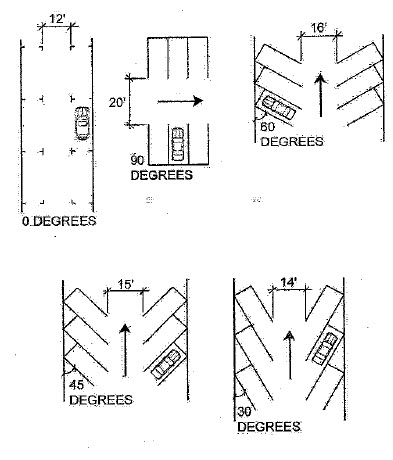
Fig. 4.30-1 Parking Spaces/Aisles
C.
Ingress and Egress. Access to parking areas shall be provided as follows:
1.
Access driveways for multi-family residential uses and all nonresidential uses shall have a minimum width as follows:
a.
Two-way driveways shall have a minimum width of 22 feet; and
b.
One-way driveways shall have a minimum width of 12 feet.
2.
Parking areas shall be designed so that a vehicle within the parking area will not have to enter a public street to move from one location to any other location within the parking area; and
3.
Vehicular access to arterial streets and highways will be permitted only in accordance with driveway locations and access design to be approved by the County Department of Roads and Airports.
D.
Striping and Marking. Parking facilities consisting of six or more spaces shall have all parking stalls and directional arrows delineated with paint acceptable to the approval authority.
E.
Surfacing. Parking spaces, driveways, and maneuvering areas shall be paved and permanently maintained with asphalt or cement. Such areas shall be provided with drainage facilities adequate to dispose of all surface water accumulated within the parking area. Bumper guards shall be provided when necessary to protect adjacent structures or properties. The approval body may modify the provisions of this subsection for surfacing located in the rural base districts. In rural areas, overflow parking for occasional special events shall be designed to be pervious.
F.
Wheel Stops. A wheel stop or curb, if used, shall be placed between two and one-half and three feet from the end of the parking space.
G.
Landscaping. Landscaping and screening shall be provided as set forth by the approving authority. Adequate physical barriers (e.g. curbs) and drainage shall be utilized to protect landscaping from impacts of vehicles.
H.
Lighting. All off-street parking areas within nonresidential projects shall be provided with exterior lighting which meets all of the following minimum standards:
1.
The equivalent of one foot candle of illumination shall be provided throughout the parking area;
2.
All lighting shall be on a time clock or photo-sensor system;
3.
Parking lot illumination devices shall be high-pressure sodium vapor with 90-degree cut-off and flat lenses; and
4.
All lighting shall be designed to confine direct rays to the premises. Any spillover beyond the property line, except onto public thoroughfares, shall be as approved by the approving authority. Any spillover onto public thoroughfares shall not cause a hazard to motorists.
I.
Accessible Spaces. Designated parking spaces for individuals with disabilities shall be designed in accordance with 2013 California Building Code Chapter 11A and 11B, as amended from time-to-time.
(Ord. No. NS-1200.319, § 1, 3-28-06; Ord. No. NS-1200.327, § 18, 2-9-10; Ord. No. NS-1200.351, § 6, 10-20-15; Ord. No. NS-1200.355, § 7, 4-26-16; Ord. No. NS-1200.356, § 2, 5-10-16; Ord. No. NS-1200.360, § 7, 5-23-17; Ord. No. NS-1200.371, § 15, 3-10-20; Ord. No. NS-1200.383, § 11, 1-24-23)
§ 4.30.080. - Location of parking.
A.
On-site. Off-street parking facilities shall normally be located on the same lot as the use that they serve, unless off-site parking is approved as set forth in Subsection B or pursuant to Section 4.30.050, Shared/Mixed Use Parking.
B.
Off-site. Off-site parking may be allowed if the approving authority finds that the parking will be reasonably convenient and accessible to the buildings or use to be served and the parking complies with all of the following provisions:
1.
Off-site parking shall not be located more than 300 feet from the building or use to be served, unless provided otherwise in an adopted master or area plan;
2.
The land on which the off-site parking spaces are located shall be in the same possession as the lot containing the building or uses that the parking spaces serve. The possession may be by deed, long-term lease or easement. The approving authority shall determine the term of the lease or easement. Legal documents acceptable to County Counsel shall be filed with the application and shall be recorded prior to commencement of construction.
§ 4.30.090. - Loading.
A.
Applicability. No building or part thereof having a floor area of 10,000 square feet or more, which is to be occupied by a use requiring the receipt or distribution of material or merchandise by vehicles or trucks, shall be constructed, erected, or moved within or onto any lot unless and until off-street loading spaces as required by this section are provided on the same lot.
B.
Number of spaces. At least one off-street loading space, plus one additional off-street loading space for each 20,000 square feet of floor area, shall be provided. Such off-street loading spaces shall be maintained during the existence of the building or use they are required to serve.
C.
Dimensions of spaces. Each off-street loading space required by this section shall be not less than ten feet wide, 30 feet long and 15 feet high, exclusive of driveways for ingress and egress, and maneuvering areas.
D.
Ingress and egress. Each off-street loading space required by this section shall be provided with driveways for ingress and egress, and maneuvering space of the same type and meeting the same criteria required by Section 4.30.070(B) for off-street parking spaces.
E.
Location. No off-street loading space required by this section shall be closer than 50 feet to any lot in a residential district unless such off-street loading space is wholly within a completely enclosed building or enclosed on all sides by walls not less than eight feet in height.
§ 4.30.100. - Parking exception.
For uses subject to discretionary review, the approving authority may allow a reduction in required parking spaces if it finds that one or more of the following circumstances apply:
A.
The use or building is situated in an area characterized by older buildings which historically have not provided off-street parking consistent with current requirements.
B.
The use or building is in close proximity to public transit facilities, or the client base is demonstrably less inclined to use automobiles than the general public.
C.
The nature or design of a specific use or facility is uniquely different from more standard examples of uses or facilities within the use classification, such that a reduction in required parking is warranted. The reduction in required parking shall be supported by a parking study prepared by a qualified parking or transportation expert.
D.
The lot size and configuration, as well as the existing or potential building size, do not allow a reasonable use of the lot unless parking requirements are modified.
Parking reductions may only be allowed if the impacts of such reduced parking are not significantly contrary to the findings required under the applicable permitting process.
(Ord. No. NS-1200.367, § 14, 6-19-18)
§ 4.40.010.- Purpose.
The purpose of this chapter, Signs, is to promote attractive signage that serves as an economic and aesthetic asset, comprehensively addresses aesthetic concerns of the public regarding visual clutter and visual blight in the environment, and ensures that traffic safety hazards are not created.
For facilities that are open to the public, such as commercial and institutional facilities, the provisions of this chapter shall not apply to indoor signage, nor shall they apply to incidental outdoor visitor-serving signs that are not intended to direct attention to the business. Examples include parking signs, rest room signage, and any non-marketing signs authorized or required by a public agency.
(Ord. No. NS-1200.335, § 10, 12-4-12)
§ 4.40.020. - Review.
Unless otherwise provided in this chapter, all new signs and the replacement or modification of existing signs that are not expressly exempt from this chapter or permitted in the initial approval of a discretionary land use approval shall obtain architecture and site approval, pursuant to Chapter 5.40. This requirement is in addition to any other approval that may be required for a related use or structure.
§ 4.40.030. - Construction and maintenance of signs.
A.
Construction. All signs and supporting structures shall be securely built and erected in conformance with the requirements of this chapter and any other applicable legal requirements.
B.
Maintenance. All signs and supporting structures shall be well maintained and kept in a good state of repair. Without limiting the foregoing requirement, the following maintenance shall be required for all signs and supporting structures:
1.
They shall be kept free of rust, dirt, and chipped, cracked or peeling paint;
2.
Hanging, dangling, torn or frayed parts shall be promptly repaired;
3.
Burned-out bulbs shall be promptly replaced; and
4.
Graffiti and unauthorized stickers shall be promptly removed.
C.
Removal of message surface. If the message surface of a freestanding sign is removed from the supporting structure, except for a temporary period of time while the message is being changed or the surface replaced, the supporting structure shall be removed. Such temporary period shall not exceed 90 days.
§ 4.40.040. - Sign illumination.
A.
Continuous lighting. Unless otherwise expressly provided in this section, signs may be illuminated only with continuous (non-blinking) lighting.
B.
Allowed lighting. Except as provided for fin signs in Section 4.40.050(F), signs may be illuminated only with:
1.
Neon tube lighting, if fully contained within a cabinet covered with a clear glass or plastic face, or if comprised of individual pan channel letters covered with a clear glass or plastic face;
2.
External lighting;
3.
Internal lighting; or
4.
Halolighting.
§ 4.40.050. - Nonresidential uses—Attached signs.
A.
Applicability. This section applies to attached signs for any use that requires a discretionary approval under the Zoning Ordinance.
B.
Quantity.
1.
No more than one sign shall be permitted for each separate ground-level occupancy frontage, except that:
a.
Any ground-level occupancy with more than one occupancy frontage may have one attached sign on each occupancy frontage, not to exceed three frontages;
b.
In addition to the signs allowed by Subsection A, any ground-level occupancy exceeding 20,000 square feet may have up to three signs on one of its occupancy frontages and any ground-level occupancy exceeding 50,000 square feet may have up to five signs on one of its occupancy frontages; and
c.
Any building with a footprint greater than 100,000 square feet which has interior tenant spaces with no occupancy frontages may have up to five signs in addition to those set forth in this subsection.
2.
One sign shall be permitted for each second-story occupancy frontage with direct exterior access to the ground from the second story.
C.
Size.
1.
The aggregate sign area of all attached signs on a ground-level occupancy frontage shall not exceed one square foot for each linear foot of such occupancy frontage to a maximum of 300 square feet per occupancy frontage.
2.
A second-story attached sign(s) shall be limited in area to one-half the allowed first-floor sign area.
3.
The sum of the sign area of the attached signs on any building frontage shall not exceed one square foot for each linear foot of building frontage or the total number of occupancy frontages multiplied by 300 square feet, whichever is less.
D.
Height. No attached sign shall be displayed higher than the finished floor elevation of the third floor of a building.
E.
Setbacks.
1.
Signs facing a residential lot shall be at least 50 feet from the property line of the residential lot.
2.
Signs facing an abutting nonresidential lot shall be at least 25 feet from the property line of such nonresidential lot, unless the abutting nonresidential lot contains a parking lot or driveway at its nearest point to the sign.
F.
Fin signs. Fin signs may be allowed and shall not reduce otherwise allowed signage.
1.
Fin signs shall comply with all of the following provisions:
a.
They shall not exceed six square feet in area per side;
b.
They shall project no more than two feet from the wall to which they are attached;
c.
They shall be located at least seven feet but not more than 12 feet above grade; and
d.
They shall not be illuminated except by external lighting.
2.
Each ground-level occupancy frontage may have one fin sign if the sign is located near its primary entryway and is subject to a master sign program.
G.
Awning signs. Awning signs may be allowed and shall not reduce otherwise allowed signage. They shall comply with all of the following provisions:
1.
They are limited to 25 percent of the exterior surface of the awning up to a maximum of eight square feet;
2.
They shall be located at least seven feet but not more than 12 feet above grade; and
3.
They shall not be illuminated.
H.
Window signs. Window signs may be allowed and shall not reduce otherwise allowed signage. They shall comply with all of the following provisions:
1.
Window signs must comply with all of the following:
a.
The total aggregate sign area of permanent and temporary signs shall not exceed 25 percent of the window frame area;
b.
The sign is not animated; and
c.
Internal displays of stock-in-trade are considered window signs if the display is located within 12 inches of the windowpane and is visible from a public right-of-way.
2.
Window signs shall not be allowed above the first floor, except as follows:
a.
Window signs may be displayed by second-story occupancy frontages with no separate ground-level frontage; and
b.
In the CN district, window signs may be displayed on first- and second-story occupancy frontages.
I.
Marquees.
1.
The maximum sign area of marquees and the maximum amount of other signage on an occupancy frontage with a marquee shall be subject to architecture and site approval but shall not be subject to other size and quantity restrictions in this section.
2.
Marquees shall not be allowed in the OA district.
J.
Lightbox signs. The signage allowed for lightbox signs for gasoline service stations shall be limited to 20 percent of the surface area of the lightbox up to a maximum of eight square feet.
§ 4.40.060. - Nonresidential uses—Freestanding signs.
A.
Applicability.
1.
This section is applicable to freestanding signs for any use that requires a discretionary approval under the Zoning Ordinance.
2.
Where more than one lot is subject to a single development permit, the term "lot" as used in this section shall mean all property covered by the development permit.
B.
Quantity.
1.
One freestanding sign may be allowed on a lot for each street frontage of the lot that measures 100 linear feet or more in length.
2.
For corner lots, no more than one freestanding sign may be located within 100 feet of the corner intersection.
C.
Size.
1.
The aggregate sign area of all freestanding signs on a lot shall not exceed a total area equal to one square foot per each five linear feet of street frontage of the lot.
2.
No freestanding sign shall have an area in excess of 120 square feet.
3.
A freestanding sign shall have a maximum sign area of 40 square feet when facing streets smaller than a designated arterial street.
4.
Any sign on a corner lot that borders streets of unequal width shall be deemed to face the street with the greatest number of through-travel lanes for the purposes of determining the maximum permissible area for the sign.
5.
Notwithstanding other provisions of this section, the maximum sign area for a freestanding sign in the ML and MH districts shall be 40 square feet.
D.
Height. The maximum height of a freestanding sign shall be the square footage of the sign area divided by four. However, in no event shall the height of any sign exceed 20 feet.
E.
Setbacks.
1.
The required front setback of a freestanding sign on a lot shall be the sign height minus four feet multiplied by two, or four feet, whichever is greater.
2.
Each freestanding sign shall be located at least 25 feet from the side and rear property lines of the lot.
F.
Other provisions.
1.
A freestanding sign that is a segmented sign may not have more than four segments.
2.
All freestanding signs shall be located fully within a landscaped area extending from the supporting structure of the sign to a point on all sides that is at least four feet from vertical lines drawn from the outer edges of the sign. For purposes of this provision, "landscaped area" shall mean an area containing live plant material including, but not limited to ground cover, shrubs, grass and trees.
3.
Time and temperature signs.
a.
Any otherwise allowed freestanding sign may include a time and temperature sign not exceeding 15 square feet in sign area.
b.
A time and temperature sign not exceeding 15 square feet in sign area, excluding any frame, may be located on the primary building on a lot.
c.
Any time and temperature sign meeting the requirements of Subsection (F)(3)a or (F)(3)b above shall not reduce otherwise allowable signage.
§ 4.40.070. - Other signs.
The following signs, in addition to those otherwise permitted in this chapter, may be permitted as set forth in this section.
A.
Allowed by right. The following signs are allowed in any base district:
1.
Informational signs that display only the name of the property or premises upon which the sign is located or the owner or lessee of such property or premises, provided that such signs shall not exceed four square feet of sign area.
2.
Advertising signs not exceeding eight square feet in area, that pertain only to the sale, rental or lease of the premises upon which the sign is located.
B.
Allowed with architecture and site approval (ASA). The following signs may be allowed in any base district subject to ASA, per the provisions of Chapter 5.40.
1.
Signs advertising the sale of a subdivision and located on the subdivision property; and
2.
Directional and informational signs of a public or quasi-public nature, including signs serving as directional signs to properties not situated adjacent to the street on which such signs are located, but not including subdivision directional signs.
§ 4.40.080. - Master sign program.
Notwithstanding any other provision of this chapter, a master sign program shall be required for signs serving multiple-occupancy buildings or sites within a city's urban service area and may be required by the approval authority in other areas of the County, depending on the nature of the use proposal. The purpose is to provide for coherent and attractive signs for this type of development.
A.
Contents. The master sign program shall identify the placement, construction, size, materials, colors, method of lighting, and other related requirements for all advertising signs.
B.
Approval. The master sign program shall be subject to architecture and site approval (ASA) as provided in Chapter 5.40.
§ 4.40.090. - Subdivision directional signs.
A.
Prohibited locations. Subdivision directional signs are not permitted within -sr combining districts. Subdivision directional signs are not permitted on land within a city's urban service area if the signs would be prohibited under the applicable city's ordinances.
B.
Architecture and site approval (ASA) required. No person shall place or permit to be placed a subdivision directional sign without first having secured ASA, per the provisions of Chapter 5.40.
C.
Application. An application for a subdivision directional sign shall comply with the following provisions:
1.
The application shall be signed by the owner of the proposed sign and the owner of the land or person in control or possession of the property on which the sign is to be placed; and
2.
A statement signed by the property owner and any person in possession of the property shall be submitted with the application which shall grant the County a right to enter upon the land as may be necessary, without liability, to inspect and to remove the sign, if it does not comply with the Ordinance Code or any applicable permit. Such statement shall also authorize the County to recover all costs from the property owner related to enforcement of sign regulations. The statement upon approval shall be recorded and run with the land, binding successors to the initial parties to the agreement.
D.
Locations. A subdivision directional sign may be located on the property, if it is in accordance with the approved site plan. The sign shall not be located in any of the following areas:
1.
Within the right-of-way of any highway;
2.
Where it would be in violation of Division B17, Chapter II, commencing with Section B17-18, of the Santa Clara County Ordinance Code relating to obstruction of highways; or
3.
Where it would be in violation of the California Business and Professions Code Section 5440 relating to signs adjacent to landscaped section of a freeway.
E.
Sign requirements. Any subdivision directional sign shall meet all of the following requirements:
1.
Not impair the integrity or character of the neighborhood;
2.
Be securely affixed at its approved location;
3.
Have no moving parts and not be lighted;
4.
Not exceed 50 square feet in total area;
5.
Have no additions or appurtenances placed upon it that are not authorized by ASA;
6.
Not exceed seven feet in height from top of sign to ground;
7.
Have a building permit and comply with all building codes and permit requirements if taller than six feet in height from top of sign to ground;
8.
Be maintained in a safe condition; and
9.
Not display any symbol or words that would likely be mistaken for an official traffic control sign.
F.
Time limits. All of the following time limit provisions apply to subdivision directional signs.
1.
The ASA permit shall specify a time limit, which shall not exceed 24 months.
2.
Upon written application to the Zoning Administrator at least 30 days prior to the expiration date of the permit, the Zoning Administrator may extend the permit for up to 24 months from the date of expiration of the original permit.
3.
If at any time during which a permit is in effect no lots remain for sale, the permittee shall inform the Zoning Administrator in writing of said fact no later than 30 days from the final closing of the last lot(s) sold.
G.
Removal of signs. The following provisions apply to the removal of subdivision directional signs:
1.
A subdivision directional sign shall be removed within 30 days of the completion of the sale of all lots, or no later than the expiration date of the permit, whichever comes first.
2.
If an action by the Planning Commission or Board of Supervisors results in the revocation of a permit, the sign shall be removed within ten days of the final decision.
H.
Failure to remove. If the sign is not removed as required by subsection G, all of the following provisions shall apply:
1.
The County may, upon expiration or revocation of the ASA permit, remove any sign placed or maintained in violation of this section after ten days' written notice mailed to the owner of the property on which the sign is located as shown on the latest assessment roll;
2.
Signs removed by the County shall be stored for a period of ten days and, if not claimed within this time, may be disposed; and
3.
For the purpose of removing or destroying any sign retained or placed in violation of the provisions of this section, the County officials authorized to enforce this ordinance may enter upon private property and remove signs without incurring any liability on behalf of themselves or the County.
(Ord. No. NS-1200.359, § 14, 12-6-16)
§ 4.40.100. - Political signs.
A.
Intent. It is the intent of this section to encourage participation by the electorate in political activity but to assure that political signs will be located, constructed and removed in a manner to assure the public safety and general welfare.
B.
Permitted subject to regulation. Notwithstanding any other provision of this chapter, political signs are permitted without an architecture and site approval in any zoning district, subject to all of the following regulations:
1.
No political sign shall be located in violation of Division B17, Chapter II, commencing with Section B17-18, of the County Ordinance Code;
2.
No political sign shall exceed 16 square feet in surface area in any R1, R1E, RHS, R1S or R2 zoning district unless it is located on a vacant lot, in which case it shall not exceed 32 square feet; and
3.
Each political sign shall be removed within ten days following the final election to which such sign relates.
C.
Exception. This section shall not apply to commercial outdoor advertising structures lawfully located in zoning districts under this ordinance and maintained by persons licensed under California Business and Professions Code Div. 3, Ch. 2.
§ 4.40.110. - Agricultural sales and winery signs.
A.
Intent. This section establishes standards so that agricultural product sales may be reasonably and effectively advertised without resulting in significant adverse visual impacts.
B.
Agricultural sales: limited, and wineries. All of the following provisions apply to signs serving uses classified in Chapter 2.10 as Agricultural Sales: Limited, and Wineries:
1.
Number: The total number of onsite and offsite signs associated with an agricultural sales or winery operation shall not exceed six.
2.
Sign area: The sign area of any individual sign shall not exceed 64 square feet. The cumulative sign area of all onsite and offsite signs associated with an agricultural sales or winery operation shall not exceed 128 square feet.
3.
Height: Maximum height of signs shall either be: (a) 12 feet above grade, or (b) 12 feet above the pavement elevation of an adjacent road from which its message is intended to be visible; whichever is higher.
4.
Off-site signs: Up to two signs may be installed on a lot that is in a different location than that of the advertised agricultural sales or winery facility(ies).
5.
Sight clearance: In those areas adjacent to driveways or intersecting streets, signs must be situated such that adequate sight clearance for safe vehicle movement is not compromised, consistent with Ordinance Code §§ B17-68 and B17-69.
6.
Maintenance: Signs shall be maintained such that they are:
(a)
Legible at a reasonable distance;
(b)
Not in an egregious state of disrepair;
(c)
Not associated with an operation that has ceased for more than six months and is not actively pursuing reestablishment; and
(d)
Not associated with a operation where a relocation has rendered obsolete any message content.
7.
Contact information: All signs shall have the name, address, and telephone number of the person responsible for the agricultural sales or winery operation painted or printed indelibly on the back side of the sign.
8.
Discretionary review of alternative signage: Signs conforming to the provisions of this subsection (subsection 4.40.110(B)) shall be allowed by right. Uses classified as Agricultural Sales: Limited or Wineries: Small-Scale may request approval for alternatives to the sign area and height standards (subsections 2 and 3) of this section via the architecture and site approval process. For uses classified as Agricultural Sales: Farmers Markets, Wineries: Medium-Scale, or Wineries: Large-scale, the appropriate decision-making body may approve alternatives to the sign area and height standards (subsections 2 and 3) of this section via the applicable discretionary permit process. The decision-making body must find that the alternative equally achieves, or better achieves, the intent of this section.
9.
Viticulture area signing: Areas of the county that are recognized as American Viticulture Areas (AVA) by the U.S. Department of the Treasury, Bureau of Alcohol, Tobacco, and Firearms, may be identified by roadside signs. Such AVA identifying signage shall be allowed on private property adjacent to County or State roads, without impacting the numbers of other signs provided for in subsections 1 or 4. This provision shall not apply to signs that contain any message content other than that necessary to identify the area as an AVA.
(Ord. No. NS-1200.335, § 11, 12-4-12)
§ 4.40.120. - Computation of sign area.
The computation of sign area shall be as provided in this section.
A.
Message surface.
1.
If the message surface of a sign consists of an integral surface and has a regularly shaped perimeter, the sign area shall be the area within such perimeter, including the face of any frame.
2.
If the message surface consists of noncontiguous segments or has an irregularly shaped perimeter, then the sign area shall be all of the area encompassed within a single continuous rectilinear-perimeter of not more than ten straight lines, enclosing the extreme limits of the message surface (and in no case passing through or between any segments of the message surface) and including any color, material or graphic which is integrated therein which differentiates the message from the background against which it is placed, and the face of any frame.
B.
Multiple message surfaces. If a sign has more than one message surface, the sign area shall be the sum of the areas of all the message surfaces. If two surfaces on the same sign face in opposite directions (i.e., the relative angles between the directions they face is 180 degrees) and the distance between the two surfaces is not more than two feet, then the area of only one of the two surfaces (the largest if they are not equal) shall be included in the computation.
C.
Three-dimensional signs.
1.
With three-dimensional signs, if the sign does not extend more than two feet from the point of sign attachment for attached signs, or two feet in depth for freestanding signs, the sign area shall be measured as if the sign had a flat surface, in accordance with subsection B, above.
2.
If a three-dimensional sign is greater than two feet in depth, the sign area shall be the sum of three areas of the sign measured from each side and the front, in each case measured as if each perspective was a flat surface.
D.
Other message surfaces. In the case of a form of message surface not specifically mentioned herein, the formula for the most similar type of message surface that is mentioned shall apply. The Zoning Administrator shall determine the appropriate formula for such irregular message surfaces, as part of the applicable ASA application process.
(Ord. No. NS-1200.359, § 15, 12-6-16)
§ 4.40.130. - Nonconforming signs.
A sign that was legal when brought into existence, but does not conform to the regulations for the district in which it is located, may be maintained in accordance with this section.
A.
Changes to sign. Except as provided below, no person shall replace, alter, relocate or expand any nonconforming sign or its supporting structure unless such action causes the resulting sign to be fully in conformance with the provisions of this chapter.
1.
This section shall not be construed to prohibit any maintenance of a nonconforming sign that is deemed necessary for public safety.
2.
Changing only the message content on a nonconforming sign shall not be considered an alteration, and shall be allowed.
3.
Replacement, alteration or relocation on the same parcel of a nonconforming sign may be approved by obtaining architecture and site approval, pursuant to Chapter 5.40, provided that all of the following are met:
a.
The resulting sign area is no larger than the original nonconforming sign;
b.
The resulting sign will reduce visual clutter or other adverse visual impacts.
B.
Removal of sign. A nonconforming sign shall be removed under any of the following circumstances:
1.
The building or parcel where the sign is displayed has been unoccupied for a continuous period of not less than six months;
2.
The use to which the sign relates has ceased operations for a continuous period of not less than six months;
3.
The sign has displayed no message for a continuous period of not less than six months; or
4.
The sign has been damaged to the extent that the repair or restoration of the sign and supporting structure will cost more than 50 percent of the cost to replace the sign and supporting structure in its entirety.
§ 4.40.140. - Exemption for Stanford University.
With the exception of residential signage provisions that may be applicable to the R1S and R3S districts, the provisions of this chapter are not applicable to development on lands of Stanford University.
§ 4.40.150. - Definitions.
Except where the context otherwise requires, the definitions in this section govern the construction of the provisions of this chapter.
Animated sign: A sign having action, motion, movement, changeable copy, or flashing color changes that are activated by electrical energy, electronic energy or other manufactured sources of energy supply. This definition does not include wind-activated movement such as in flags, banners or pennants, or mechanical movement signs. Animated signs include grids of flashing lights or mechanical elements in patterns that give the perception of movement, as in chasing lights or programmable displays.
Attached sign: A sign that is either a part of a building or other improvement, or is attached to a building or other improvement. A sign shall be considered to be attached to a building or other improvement only if the sign would fall without support from the building or improvement. Attached signs include, without limitation, flat-mounted signs and projecting signs.
Awning sign: A sign on an awning. Awnings include canvas coverings as well as permanent, projecting canopies.
Continuous lighting: The illumination of a sign by any type of artificial lighting that is maintained in a stationary condition and remains constant in intensity and color at all times when the sign is illuminated.
External lighting: The illumination of a sign by a light source that is not a component of the sign itself.
Fin sign: A two-sided sign that projects out from a building or surface, intended to be viewed from the side.
Freestanding sign: A sign not attached to a building or other improvement but instead permanently erected upon or standing in the ground and usually supported from the ground by one or more poles, columns, uprights, braces or cement anchors. Freestanding signs include monument signs but do not include portable signs.
Halolit; halolighting (either term): Illumination of individual letters, numbers or graphics having an opaque surface by the use of internal, reverse illumination where the light source is not directly visible.
Internal lighting: Illumination of a sign by a light source that is fully incorporated into the sign itself.
Light source: A device which, when activated (electronically or otherwise), emits light. Light sources include, but are not limited to incandescent filament bulb, electric discharge bulb, neon tube and fluorescent tube.
Lightbox: An internally illuminated, cabinet-type fixture at a gasoline service station that is usually located above the gasoline pumps and below a canopy structure that is above the pumps.
Lightbox sign: A sign located on a lightbox.
Marquee: A projecting sign that is part of a permanent entryway or entry canopy and traditionally associated with theatres. For purposes of this chapter, any sign fulfilling the same function as a theatre sign shall be considered a marquee. A marquee sometimes includes a projecting vertical sign that may extend above the cornice line of a building. Marquees may be animated and may include internally illuminated display surfaces for changeable lettering as well as externally mounted lighting.
Master sign program: A sign plan which identifies the placement, construction, size, materials, colors, method of lighting and other related requirements for those signs that are subject to the plan.
Message surface: The surface on a sign from which the message of the sign is visually communicated.
Monument sign: A freestanding sign not erected on one or more poles or similar supports but erected to rest on the ground or to rest on a monument base designed as an architectural unit with the sign.
Neon tube lighting: Any sign that includes one or more directly visible neon tube light sources.
Occupancy frontage: The length of that portion of a building occupied exclusively by an individual tenant or owner and abutting a parking lot or a public right-of-way including, but not limited to a street, plaza or alley. Occupancy frontage is measured parallel to the property line and at grade.
Public right-of-way: For purposes of this chapter, a public street, alley, walkway, or other public outdoor area such as a plaza or a park.
Segment: A separate message compartment in a segmented sign.
Segmented sign: A sign where the message surface contains deliberate visual demarcations used to divide the message area of the sign into separate message compartments.
Sign: Any structure, display, device, balloon or graphic on or attached to any land, building or structure, which is used to communicate any message, or which advertises or promotes any business, product, activity, person or interest. Signs include, but are not limited to letters, numbers, words, illustrations, decorations, decals, emblems, trademarks, logos and lights. Signs do not include noncommercial murals.
Sign area: The total area of the message surfaces of a sign computed as provided in Section 4.40.120.
Subdivision directional sign: A sign directing people to the sale of lots or houses located on a recently completed subdivision, where the sign is located on property not part of the subdivision itself.
Supporting structure: The supports, uprights, braces or framework on which any freestanding sign is mounted, and any guys or anchors used to attach the sign.
Temporary sign: A sign placed for a limited duration of time.
Time and temperature sign: A programmable display sign programmed to show time and temperature only.
Window sign: A sign applied directly onto a window or internal to the window within 12 inches of the window and visible from the public right-of-way. Window signs include without limitation the application of words and logos onto window glass, the use of hanging signs and paper signs, and displays of merchandise in windows.
§ 4.50.010.- Purpose.
The purpose of this chapter, Nonconforming Uses and Structures, is to reasonably provide for the continued operation and maintenance of uses and structures that are legal-nonconforming, as defined herein. This chapter's provisions are also intended to promote the eventual conversion of legal-nonconforming uses and structures into conforming uses and structures. When used in this Zoning Ordinance, the term "nonconforming" shall mean legal-nonconforming.
§ 4.50.020. - Nonconforming uses of land and buildings.
A use that was legal when brought into existence, but does not conform to the current use limitations of the applicable zoning district (including use-specific permitting requirements and use-specific criteria) may be maintained subject to all of the following limitations:
A.
Expansion of use prohibited. A nonconforming use may not be intensified or expanded in area or volume, except as provided in Section 4.50.060.
B.
Modification of use. A nonconforming use may be modified to a use deemed similar in nature, but lesser in intensity and impacts, as determined by the Zoning Administrator, or Planning Commission if the matter is referred to the Planning Commission. The Planning Manager, in consultation with the Zoning Administrator, shall make a determination as to whether the proposed change necessitates a referral to and formal zoning interpretation hearing before the Planning Commission. In such cases, the commission shall have authority to deny the modification or approve it and place appropriate limitations on the modified use and require architecture and site approval for more precise conditioning.
C.
Cessation of use. If any nonconforming use ceases for a continuous period of not less than 12 months, the legal-nonconforming status shall terminate and any future use of the building or lot shall conform to the zoning ordinance.
D.
Modification of building. A building containing a nonconforming use shall not be enlarged or reconstructed, except as provided in § 4.50.060 and § 4.50.070 for certain nonconforming residences. Structural alterations done within any 12-month period, including replacements of walls, electrical fixtures or plumbing, may not exceed 25 percent of the building's construction valuation (computed as the building's legally established floor area multiplied by the building inspection office's current multiplier for calculating the per-square-foot value of new construction).
E.
Destruction of building. If a building containing a nonconforming use is destroyed to the extent of more than 75 percent of its construction valuation (the building's legally established floor area multiplied by the building inspection office's current multiplier for calculating the per-square-foot valuation of new construction), then the right to maintain the nonconforming use shall expire and the use of the building shall thereafter conform to all applicable zoning provisions. This provision shall not apply to residential uses covered under § 4.50.060 or § 4.50.070.
F.
Multiple uses. Where a lot contains a nonconforming use and a separate conforming use, the conforming use may be expanded or rebuilt, or may be changed to another conforming use, irrespective of the property's otherwise nonconforming status. Where two single-family dwellings occupy a single lot where only one dwelling is allowed, the larger of the two dwellings shall be deemed the conforming dwelling for the purposes of this provision.
G.
Permit nonconformance. Any use that is nonconforming solely by virtue of not meeting the currently applicable permitting requirements of this zoning ordinance may become a conforming use by obtaining the appropriate permit(s).
H.
Parking. A use that does not meet the parking requirements of Chapter 4.30, but otherwise is in conformance with the zoning ordinance shall not be subject to the provisions of this chapter solely due to the failure to provide adequate parking facilities. For any new or expanded use, construction, or alteration on the property, subsection 4.30.020(A) shall apply.
(Ord. No. NS-1200.323, § 8, 1-29-08; Ord. No. NS-1200.359, § 16, 12-6-16)
§ 4.50.030. - Nonconforming buildings.
A building or structure whose use conforms to zoning regulations, but is nonconforming with respect to currently applicable setback, height, FAR, or other development regulations, shall be subject to all of the following limitations:
A.
Conforming expansion. Such a building or structure may be expanded or structurally altered provided additions fully comply with applicable development standards, except as provided in subsections B and C, below.
Any setback-nonconforming or height-nonconforming portions of a building may remain only if they substantially maintain their structural form and integrity. In the course of construction, if walls become disconnected from supporting ceiling and roof joists and all bracing perpendicular walls, they relinquish their right to maintain a nonconforming setback encroachment.
Foundation repair may be undertaken or a new foundation or basement may be installed under a setback-nonconforming portion of a building, provided the resulting height of the main floor is no more than 30 inches above its original elevation height.
B.
Setback-nonconforming expansion allowances. A limited expansion of a building along a nonconforming setback line, or the redesign of a roof over a setback-nonconforming portion of a building may be allowed pursuant to subsections 4.20.110(C)(4) and 4.20.110(C)(5).
C.
Setback-nonconforming dwelling: Casualty reconstruction. Where a single-family or two-family dwelling with nonconforming setbacks is involuntarily damaged or destroyed by earthquake, fire, flood, or other casualty event, reconstruction shall not require conformance to currently applicable setbacks, provided all of the following apply:
1.
The setback-nonconforming portion of the original dwelling was constructed with applicable building permits required at the time of construction, or was constructed at a time that predates building permit requirements.
2.
The floor area of the proposed reconstructed dwelling: (a) is not more than 25 percent larger than that of the legally constructed floor area of the original dwelling, or (b) is not more than 500 square feet larger than the legally constructed floor area of the original dwelling; whichever is greater.
3.
Any proposed expansion beyond the original footprint or original number of stories would conform to current setback requirements.
4.
Any setback-nonconforming deck or balcony, covered or uncovered, within the original building footprint may only be replaced with a like deck or balcony.
5.
No portion of the reconstructed dwelling may be nearer than three feet to any property line, regardless of the configuration of the original dwelling.
6.
Failure to apply for a building permit within two years of the casualty event shall be deemed an abandonment of the nonconforming dwelling, and the setback exception pursuant to this section shall not apply.
D.
Nonconforming floor area. A building (or buildings on premises) which exceeds the maximum allowed floor area, or floor area ratio (FAR) may not be enlarged. Any alteration qualifying as a rebuild may be done only if the building is reduced in size to conform to applicable FAR limitations.
(Ord. No. NS-1200.319, § 14, 3-28-06; Ord. No. NS-1200.323, § 9, 1-29-08; Ord. No. NS-1200.342, § 2, 4-29-14)
§ 4.50.040. - Nonconforming lot size.
Lot size requirements specified by this Zoning Ordinance primarily pertain to the minimum size of new lots created through either the subdivision or lot line adjustment processes. A legally established lot that does not conform to the current lot size requirements of the applicable zoning district may be used and developed according to all other applicable zoning regulations, except where a particular use has a specified minimum lot size that is larger than the size of the subject lot.
§ 4.50.050. - Nonconforming signs.
The provisions of Section 4.40.130 shall apply to nonconforming signs.
§ 4.50.060. - Residential uses in nonresidential districts.
A nonconforming residential use that is located in a district where residences are not allowed may be replaced or expanded beyond the limits set forth in Section 4.50.020 if the replacement or expansion complies with all other applicable zoning and land development provisions and a use permit is obtained pursuant to Chapter 5.65. Allowed expansion of such nonconforming residential use shall not result in an increase in the number of dwelling units on the premises. Accessory uses or structures related to the residential structure are not subject to the requirement for a use permit. The approval of a use permit does not change the status of the residential use to a conforming use.
§ 4.50.070. - Multi-family, density-nonconforming.
The reconstruction of any density-nonconforming multi-family dwelling, two-family dwelling, or multiple single-family and/or two-family dwellings on one lot that are damaged or destroyed by fire, earthquake or other casualty event may be allowed if a use permit is obtained, pursuant to Chapter 5.65. If a valid use permit application (complying with all applicable submittal requirements) is not filed within two years of the date of casualty, the right to maintain the nonconforming density shall cease. The approval of a use permit does not change the status of the use to a conforming use.
A.
Criteria for denial. Notwithstanding the provisions of Chapter 5.65, such rebuilding may be prohibited (or reduced to below pre-casualty size or density) only if the building is located in an industrial zone or if both of the following findings are made:
1.
The reconstruction will be detrimental or injurious to the health, safety, or general welfare of persons residing or working in the neighborhood, or will be detrimental or injurious to property and improvements in the neighborhood; and
2.
The nonconforming residential use would be more appropriately moved to a zone in which the use is permitted, or that there no longer exists a zone in which the use would be permitted.
B.
Degree of rebuilding. Unless rebuilding is not approved per Subsection A, the building(s) may be reconstructed up to its pre-casualty size and number of dwelling units. Any accessory pre-casualty nonconforming use (if applicable) may also be resumed, at the discretion of the Planning Commission.
C.
Applicable regulations. Any reconstruction, restoration, or rebuilding undertaken pursuant to this section shall conform to all of the following:
1.
All applicable provisions of California Government Code § 65852.25, relating to the rebuilding of nonconforming residences;
2.
All other applicable provisions of this Zoning Ordinance, and any applicable County-adopted architectural guidelines and standards.
3.
There may be no increase in the size and number of pre-casualty dwelling units.
4.
A building permit shall be obtained within one year of the effective date of the use permit. If that building permit expires without substantial construction having been undertaken, the right to rebuild to the density approved by the use permit shall also expire.
§ 4.50.080. - Uses with active time-limited use permit.
Notwithstanding any other provision of this chapter, whenever a use approved under an active time-limited use permit becomes nonconforming, the permittee may apply to renew the permit prior to the expiration date of the use permit, pursuant to the provisions in this section and the procedures in Chapter 5.65.
A.
Review of Application. When determining whether the use permit should be renewed, the Planning Commission shall consider the objectives of the new zoning provisions as they may relate to such a use. The commission shall also consider whether there have been substantial changes in the use and development of adjacent properties that might warrant denial of the use permit, or require a greater degree of regulation of the use. The Planning Commission may add or delete conditions that it deems reasonable and necessary to protect the environment or preserve the integrity and character of the neighborhood, taking into consideration the goals and objectives of the new zoning provisions.
B.
Findings. The Planning Commission may renew the use permit if it can make all of the following findings:
1.
All the conditions of the current use permit or architecture and site approval (or both) have been met;
2.
There have not been substantial changes in circumstances related to either the use or the surrounding neighborhood that would warrant cessation of the use; and
3.
The Planning Commission makes all the findings required for issuance of a use permit pursuant to Chapter 5.65.
C.
Late Renewals. If the permittee fails to apply for renewal of the use permit prior to the permit expiration date, he or she may file a late-renewal application. Such request must be filed within 24 months of the lapsed expiration date, and must be accompanied by a description of the circumstances warranting special consideration. A separate, late-renewal application fee in an amount prescribed by the Board of Supervisors shall be required. The Planning Commission shall hold a separate hearing on the late-renewal request, and shall have discretion to approve or deny the request based on the project circumstances. Unless otherwise specified by the Planning Commission, a use permit application must be filed within the 30 days following a decision authorizing a late renewal.
(Ord. No. NS-1200.323, § 10, 1-29-08)
§ 4.50.090. - Public nuisances.
Nothing in this chapter shall be construed to limit the ability of the County to terminate any use or require the removal of any structure that is found to be a public nuisance.

