
Santa Fe City Zoning Code
ARTICLE 14
12 - DEFINITIONS
ACCENT LIGHTING
Any directional lighting that emphasizes a particular object or draws attention to a particular area.
ACCESSORY
As applied to a use or structure, means customarily subordinate or incidental to and on the same lot of such use or structure or on a contiguous lot in the same ownership.
ACCESSORY DWELLING UNIT
A dwelling unit that qualifies as an accessory use and structure. See Section 14-6.3(D)(1) (Standards for Specific Accessory Uses).
ACTIVE WATER HARVESTING
Containing precipitation or run-off in a storage tank or other device and distributing that water with a mechanical system by means of gravity or a pump.
ACTUAL CONSTRUCTION
Placing construction materials in permanent position and fastening in a permanent manner; provided that where demolition or removal of an existing structure has been substantially begun preparatory to new construction, such demolition or removal is actual construction as long as the work is diligently carried on until completion of the new construction involved.
ADOBE
Sun-dried block or coursing of dirt, clay, asphalt-impregnated earth or other natural earth materials.
ADULT ARCADE
A place open to the public in which coin-operated or slug-operated or electronically, electrically or mechanically controlled still or motion picture machines, projectors or other image-producing devices, including computer imaging, are maintained to show images to five or fewer persons at any one time and where the images so displayed are distinguished or characterized by the depicting or describing of specified anatomical areas.
ADULT BOOKSTORE or ADULT VIDEO STORE
A commercial establishment that as its principalbusiness offers for sale or rent for any form of consideration any one or more of the following:
(A)
books, magazines, periodicals or other printed matter or photographs, films, motion pictures, videocassettes or video reproductions, slides or other visual representations that depict or describe specified sexual activities or specified anatomical areas; or
(B)
instruments, devices or paraphernalia that are designed for use in connection with specified sexual activities.
ADULT CABARET
A nightclub, bar, restaurant or similar establishment whose primary activities regularly feature and include:
(A)
persons who appear in a state of nudity;
(B)
live performances that are characterized by the exposure of specified anatomical areas or by specified sexual activities; or
(C)
films, motion pictures, videocassettes, slides, computer-generated images or other photographic reproductions that are characterized by the depiction or description of specified anatomical areas or specified sexual activities.
ADULT ESCORT AGENCY
A person that furnishes, offers to furnish or advertises to furnish escorts for a fee, tip or other consideration.
ADULT MOTEL
A hotel, motel or similar commercial establishment that:
(A)
offers accommodations to the public for any form of consideration; provides patrons with closed-circuit television transmissions, films, motion pictures, videocassettes, slides or other photographic reproductions that are characterized by the depiction or description of specified sexual activities or specified anatomical areas and has a sign visible from the public right-of-way that advertises the availability of this adult type of photographic reproductions;
(B)
offers a sleeping room for rent for a period less than ten hours; or
(C)
allows a tenant or occupant of a sleeping room to subrent the room for a period less than ten hours.
ADULT MOTION PICTURE THEATER
A commercial establishment that for any form of consideration, is substantially devoted to showing films, motion pictures, videocassettes, slides, computer-generated images or similar photographic reproductions that are distinguished or characterized by an emphasis on matter depicting, describing or relating to specified sexual activities or specified anatomical areas. The term does not include theaters that primarily feature films rated NC-17, R, PG, PG-13 and films other than unrated or X-rated films.
ADULT NEWSRACK
A coin-operated machine or device that dispenses material substantially devoted to the depiction of specified sexual activities or specified anatomical areas.
ADULT PERFORMANCES AND ENCOUNTERS (LIVE)
A business that offers as the primary purpose:
(A)
physical contact in the form of wrestling or tumbling between persons engaging in specified sexual activities or exposing specified anatomical areas; or
(B)
activities by one or more persons, either male or female, when at least one of the persons is engaging in specified sexual activities or exposing specified anatomical areas; provided that the term does not apply to artist models who pose in art classes for adult students or other settings solely for the purpose of assisting a sculptor, a painter or other artist in rendering an artist rendition or presentation of the model.
ADVERTISING STRUCTURE
A structure, part of a structure or a device attached to, painted on or otherwise represented on a building, fence or other structure, upon which is displayed or included any letter, work, model, banner, flag, pennant, insignia, decoration, direction, advertisement or other attention-getting device, including a sign. Advertising structure does not include a similar structure located within a building except illuminated signs within show windows.
ALCOHOLIC BEVERAGES
Distilled or rectified spirits, potable alcohol, brandy, whiskey, rum, gin and aromatic bitters bearing federal internal revenue strip stamps or any similar alcoholic beverage, including blended or fermented beverages, dilutions or mixtures of one or more of the foregoing containing more than one-half percent alcohol, but excluding medicinal bitters. (Ord. No. 2013-1 § 3)
ALCOHOLIC BEVERAGE DISPLAY AREA
The portion of an alcoholic beverage licensee's premises in which all alcoholic beverages on display for sale are contained. (Ord. No. 2013-1 § 3)
ALCOHOLIC BEVERAGE LICENSEE
The holder of any license or permit authorizing the sale of alcoholic beverages issued under the provisions of the New Mexico Liquor Control Act, but does not mean the holder of a server permit. (Ord. No. 2013-1 § 3)
ALCOHOLIC BEVERAGE SALES ACTIVITIES
The retail sale of alcoholic beverages for offsite consumption. (Ord. No. 2013-1 § 3)
ALTERATION
A change of the architectural features of a structure, including the erection, construction, reconstruction or removal of the structure or any of its parts. Additions are considered alterations.
ANIMAL PRODUCTION
An area which is used for the raising of animals except as limited in Section 14-6.2(H) (Agricultural Uses).
ANTENNA
An exterior transmitting or receiving device that may be mounted on a structure and that is used in communications that radiate or capture electromagnetic waves, digital signals, analog signals, radio frequencies (excluding radar signals), wireless telecommunications signals or other communication signals.
ANTIQUE SHOP
A retail establishment that offers for sale, within a building, articles such as glass, china, furniture or similar furnishings and decorations that have value and significance as a result of age, design or sentiment.
APPELLANT
A person filing an appeal.
APPLICANT
A person who has submitted an application. As used in Section 14-8.14 (Impact Fees), the applicant for a buildingpermit for which an impact fee is due.
APPLICATION
A request for a permit or other approval within the jurisdiction of the land use director, a land use board or the governing body that is required pursuant to Chapter 14, and includes the fees, forms, plans and associated documents.
AQUACULTURE
The cultivation of aquatic animals in a recirculating environment to produce whole fish that are distributed to retailers, restaurants and consumers. (Ord. No. 2016-41 § 5)
AQUAPONICS
The cultivation of fish and plants together in a constructed, recirculating system utilizing natural bacterial cycles to convert fish wastes to plant nutrients, for distribution to retailers, restaurants and consumers. (Ord. No. 2016-41 § 5)
ARCHAEOLOGICAL FEATURES
Nonportable cultural remains, including storage pits, firepits, burials, worksites, middens, architectural remains and undisturbed layers of deposited materials.
ARCHAEOLOGICAL SITE
A concentration of cultural remains inferred to be the locations of specific human activities of the past.
ARCHITECT
A person who is licensed by the state to practice architecture. (Ord. No. 2012-19 § 5)
ARCHIVAL RESEARCH
Research in primary documents that is likely to yield information concerning the human occupation of a site, including deed, census, cartographic and judicial records.
AREA MEDIAN INCOME
The median income for the Santa Fe metropolitan statistical area as adjusted for various household sizes and published and revised periodically by the United States Department of Housing and Urban Development.
ARTIFACT
Portable material remains that exhibit evidence of human use or alteration.
ARTS AND CRAFTS STUDIO
A building that contains artist or craft studio space or schools in which works of art or craft are produced that may be sold on or off the premises.
ASSESSMENT
As used in Section 14-8.14 (Impact Fees), means the determination of the amount of an impact fee.
AVERAGE DAILY TRAFFIC
The total volume of traffic during the time period from 7:00 a.m. to 6:00 p.m. in whole days, greater than one day and less than one year, divided by the number of days in that time period.
AWNING
A roof-like covering projecting from the wall of a building and that is typically made of metal, plastic, canvas or other textile.
BACK-HAUL NETWORK
As used in Section 14-6.2(E) (Telecommunications Facilities), means the lines that connect a provider's towers/cell sites to one or more cellular telephone switching offices or long distance providers or the public switched telephone network.
BANNER
A temporary sign no larger than eighteen (18) square feet made of flexible material (cloth, paper, vinyl, or other lightweight, non-rigid material) on which information relating to an event, function, or activity is painted or printed, which projects from, hangs from, or is affixed to a city-owned support structure. (Ord. No. 2019-5, § 1)
BAR DITCH
A continuous shallow ditch parallel to a roadway that collects and distributes surface run-off from the roadway and adjacent terrain.
BASAL AREA
The cross section area of the stem or stems of a plant or of all plants in a stand expressed as square feet per acre. Bushes and shrubs, including piñon and juniper, are generally measured at or less than one inch above soil level. All other trees generally are measured at 4.5 feet above ground inclusive of bark. Measurements are taken from the uphill side of the slope. For the purposes of explanation only, 60 basal area is approximately equal to evergreen trees, each six (6) feet tall, planted on twelve (12) foot centers over one acre.
BASE FLOOD
The flood having a one percent chance of being equaled or exceeded in any given year.
BASE FLOOD ELEVATION (BFE)
The elevation shown on the FIRM and found in the accompanying Flood Insurance Study (FIS) that indicates the water surface elevation resulting from the flood that has a 1% chance of equaling or exceeding that level in any given year—also called the base flood. (Ord. No. 2012-19 § 5)
BASELINE FLOOR AREA RATIO
As used in the BCD, means the maximum permitted floor area ratio subject to the townscape standards where applicable, not taking into account allowable land-use intensity credits.
BED AND BREAKFAST INN
A dwelling unit that contains no more than twelve guest rooms where lodging, with or without meals, is provided for compensation.
BEDROCK
(Repealed by Ord. No. 2014-31 § 50)
BIO-FILTRATION
A process by which waterborne pollutants are absorbed, captured or broken down by soil or are absorbed by plant materials.
BLOCKFACE
All the parcels on one side of a city block. Each block is separated by an intersecting street.
BOARDING HOUSE
An owner-occupied dwelling unit where lodging for periods of thirty days or longer, with or without meals, is provided for compensation.
BRUSH LAYERING
An erosion control method that places branches perpendicular to a contour on excavated terraces to build living structures, which terraces are then backfilled with soil, covering the branches except for the tips.
BRUSH MATTRESS
An erosion control method where woven pads of live branches are staked to slopes to build living structures for coverage.
BUILDABLE AREA
That portion of a lot upon which buildings may be placed in compliance with required yards, lot coverage restrictions and other applicable provisions of Chapter 14.
BUILDABLE SITE
As used in Section 14-5.6 Escarpment Overlay District and Section 14-8.2 Terrain and Stormwater Management, means a contiguous area of land located within a single lot on which a building with a footprint equal to not less than forty percent of the minimum required net lot area, or two thousand (2,000) square feet, whichever is less, can be developed in compliance with all requirements of those sections, all requirements of the underlying zone and all applicable development standards. (Ord. No. 2014-31 § 51)
BUILDING
A structure or parts of a structure covered and connected by a permanent roof and intended for shelter, housing or enclosure.
BUILDING FRONTAGE
The horizontal distance across the front of a building.
BUILDING OFFICIAL
The director of the inspections and enforcement division or other person designated by the land use director.
BUILDING STRUCTURE
The load-bearing portions of a building, including decking and sheathing for floors, walls and roofs.
BUSINESS
An activity involving wholesale or retail sales or rental of any article, substance or commodity, including building materials and vehicles, and the provision of all commercial services, including financial institutions and personal commercial services. Where the term business is used to describe a type of land use or structure, it includes such use by any organization or individual, whether or not the use is conducted for profit. (Ord. No. 2014-31 § 51)
BUSINESS SERVICES
A business primarily engaged in rendering services to other businesses on a fee or contract basis, including advertising and mailing, building maintenance, employment service, management and consulting services, protective services and equipment rental and leasing.
CALIPER
The diameter of the trunk of a tree as measured six (6) inches above ground level, up to and including four (4) inch diameter, and twelve (12) inches above ground for larger sizes.
CABLE ACT
(Repealed by Ord. No. 2014-31 § 50)
CABLE SERVICE
As used in Section 14-6.2(E) (Telecommunications), means cable service as defined in the Cable Communications Policy Act of 1984, 47 U.S.C. §532, et seq., as now and hereafter amended.
CAMPGROUND
A plot of ground upon which one or more sites for camping are located, established or maintained for occupancy by a tent, trailer, recreational vehicle, cabin, lean-to or similar structure established, maintained and operated for the general public as temporary living quarters.
CANNABIS CONSUMPTION AREA
An area where cannabis products may be served and consumed by smoking, vaping, or ingesting, provided that alcohol cannot be sold or consumed in a cannabis consumption area.
CANNABIS ESTABLISHMENT
A broad term that includes a cannabis testing laboratory , a cannabis manufacturer, a cannabis producer , a cannabis retailer, a cannabis research laboratory , a vertically integrated cannabis establishment , a cannabis producer microbusiness , or an integrated cannabis microbusiness .
CANNABIS MANUFACTURING, LIGHT
A use that involves compounding, blending, extracting, infusing, packaging, or otherwise preparing a cannabis product using nonvolatile solvents, alcohol, or carbon dioxide, or without using solvents.
CANNABIS MANUFACTURING, HEAVY
A use that involves compounding, blending, extracting, infusing, packaging, or otherwise preparing a cannabis product using volatile solvents or other methods that are outside the scope of light cannabis manufacturing.
CANNABIS PRODUCER
A business conducted by a person licensed to cultivate more than two hundred (200) mature cannabis plants, including the planting, growing, harvesting, drying, curing, grading, or trimming of cannabis.
CANNABIS PRODUCER MICROBUSINESS
A small business conducted by a person licensed to cultivate up to two hundred (200) mature cannabis plants at a single location, including the planting, growing, harvesting, drying, curing, grading, or trimming of cannabis.
CANNABIS PRODUCT
A product that is or that contains cannabis or cannabis extracts, including edible or topical products that may also contain other ingredients.
CANNABIS RESEARCH LABORATORY
A facility that produces or possesses cannabis or cannabis products for the purpose of studying cannabis cultivation, characteristics, or uses.
CANNABIS TESTING LABORATORY
A facility where cannabis products are sampled, collected, and tested.
CANOPY
An overhanging shelter or shade.
CAPITAL IMPROVEMENT
As used in Section 14-8.14 (Impact Fees), means any of the following facilities that have a life expectancy of ten or more years and are owned and operated by or on behalf of the city:
(A)
roadway facilities located within the service area, including roads, bridges, bike and pedestrian trails, bus bays, rights of way, landscaping and any local components of state and federal highways;
(B)
traffic signals located within the service area at the intersection of two city-maintained arterial streets;
(C)
neighborhood or pocket parks and related areas and facilities, referred to in Chapter 14 as "neighborhood parks" and community and regional parks, open space and trails and related facilities, referred to in Chapter 14 as "regional parks";
(D)
buildings for fire and rescue and essential equipment costing ten thousand dollars ($10,000) or more and having a life expectancy of ten years or more; or
(E)
buildings for police and essential equipment costing ten thousand dollars ($10,000) or more and having a life expectancy of ten years or more.
CAPITAL IMPROVEMENTS PLAN
As used in Section 14-8.14 (Impact Fees), means a plan that identifies capital improvements or facility expansions for which impact fees may be imposed. Capital Improvements or facility expansions needed to serve projected development in the service area based on the approved land use assumptions are identified in the capital improvement plan for water, wastewater, roads, parks, fire and police development impact fees, April 2003 or similar subsequent report approved by the governing body.
CERTIFICATE OF OCCUPANCY
A written document issued by the land use director certifying that a structure or use of land has been constructed or will be used in compliance with all applicable city codes and ordinances.
CHANNEL
As used in Section 14-8.3 (Flood Regulations), means a portion of a drainageway that has a naturally or artificially developed bed or banks to confine and conduct a continuous or periodic flow of water.
CHECK DAM
A small dam built within a drainage channel to decrease flow velocity and reduce erosion by reducing the channel gradient, minimize scour and promote deposition of sediment.
CHILD DAY-CARE FACILITY
A building, including an occupied residence, and its premises, that is used by the facility's operator to care for children on an all- or part-day basis.
CISTERN
An artificial, closed reservoir for storing water, often underground.
CITY
The City of Santa Fe.
CITY ENGINEER
A designated employee of the city who is both a professional engineer and a state-certified floodplain manager.
CLINIC
A medical, dental or other health care establishment with fewer than five beds or their equivalent where patients are admitted for examination and treatment by two or more health care practitioners sharing one office, and where patients are not lodged overnight.
CLUB
A nonprofit organization and its premises, including a lodge, that caters exclusively to members and their guests for social, intellectual, political, recreational, athletic or other common purposes.
CLUSTER DEVELOPMENT
A development in which dwelling units are grouped together and where common open space is provided.
CLUSTERED SUBDIVISION
A form of development for a single-family subdivision that allows a reduction in lot area, provided there is no increase in the number of lots permitted by the zoning district, and the undeveloped land resulting from the lot reduction is devoted to open space.
CO-LOCATION
The mounting or installation of an antenna on an existing tower or tower alternative. (Ord. No. 2014-31 § 52)
COLLEGE OR UNIVERSITY
An educational institution accredited at the college level by an agency or association recognized by the U.S. secretary of education and legally authorized to offer at least a one-year program of study creditable towards a post-secondary degree.
COMMERCIAL CANNABIS ACTIVITY
Cultivating, producing, possessing, manufacturing, storing, testing, researching, labeling, selling, purchasing for resale, or consigning cannabis products (but excluding personal growing and use, medical cannabis program activities, and cannabis training and education programs).
COMMERCIAL CANNABIS RETAILER
A business conducted by a person that is licensed to sell cannabis products directly to consumers.
COMMERCIAL DEVELOPMENT
For the purpose of the annual water budget in Section 14-8.13, means one or more buildings constructed for nonresidential use. Commercial development includes hotels, motels, offices, stores and other retail establishments and industrial, manufacturing, wholesaling and warehousing activities.
COMMERCIAL RECREATIONAL USE OR STRUCTURE
A facility for commercial recreational purposes such as a theater, bowling alley, pool room, driving range, miniature golf, health club, sports field or amusement park.
COMMERCIAL STABLE
A facility for the business of boarding horses or renting horses to the public.
COMMERCIAL STRUCTURE
A structure that is put to a commercial use as provided in Article 14-6 (Permitted Uses and Use Regulations).
COMMON OPEN SPACE
The outdoor area accessible to all residents within a development, which may be owned in undivided interest by all the residents of the development, and it may remain in its natural state or may be landscaped or improved for passive or active recreational activities. (Ord. No. 2014-31 § 51)
COMPACT CAR
A motor vehicle that is one hundred eighty-one (181) inches or less in length, measured from front to rear bumper.
COMPANY
As used in Section 14-6.2(F) (Electric Facilities), means electric service provider or its contractors or other persons constructing electric facilities and distribution facilities.
COMPOSTING
A process of accelerated biodegradation and stabilization of organic material under controlled conditions yielding a product which can safely be used as fertilizer. (Ord. No. 2016-41 § 5)
COMPOUND
Three or more attached or detached dwelling units on one lot and located in the RC-5, RC-8, RAC, AC or BCD districts. (Ord. No. 2014-31 § 51)
COMMUNITY RESIDENTIAL CORRECTIONS PROGRAM
A community residential program for persons currently in the custody of, or recently released by, correctional authorities which is designed to offer an alternative to imprisonment and/or to facilitate ex-offender reintegration into community life.
CONDUCTOR
As used on Section 14-6.2(F) (Electric Facilities), means a substance or body, usually in the form of a wire, cable or busbar, that allows a current of electricity to pass continuously along it.
CONSTRUCTED RAIN GARDEN
A shallow water retention pond built to store water and provide bio-filtration, where the soil is amended to a minimum depth of eighteen inches with one part organic matter to two parts soil and planted with grasses, shrubs or trees.
CONSTRUCTED WETLAND
An artificial wetland designed and planted to store water and filter, process, absorb or breakdown waste products or pollutants.
CONTIGUOUS LOTS
Two or more lots with one or more common boundaries.
CONTINUING CARE COMMUNITY
A residential community that provides a variety of living accommodations and differing levels of health care services to elderly or persons with disabilities as follows:
(A)
a continuing care community shall include:
(1)
congregate housing in which residents live in rooms without individual kitchen facilities and in which at least the following services are provided: common meal preparation, common dining, recreation and social areas, room cleaning, laundry and transportation; and
(2)
a full nursing care unit with beds;
(B)
a continuing health care community may include:
(1)
independent dwelling units for the elderly or persons with disabilities who are not in need of the level of care or services provided in congregate housing or an extended care facility, but who desire to live in a community where such services are available; and
(2)
an extended care facility; and
(C)
a hospital is not a continuing care community.
CONTOUR LINE
A line adjoining points of equal elevation on a topographic map.
CONTRIBUTING STRUCTURE
A structure, located in a historic district, approximately fifty years old or older that helps to establish and maintain the character of that historic district. Although a contributing structure is not unique in itself, it adds to the historic associations or historic architectural design qualities that are significant for a district. The contributing structure may have had minor alterations, but its integrity remains.
COOL SEASON TURF
Grasses that require large volumes or frequent applications of water, including Kentucky bluegrasses, perennial rye grasses, fine fescues and tall fescues.
COUNTY
The county of Santa Fe.
CROP PRODUCTION
An area used for the raising or harvesting of agricultural crops intended to provide food or fiber.
CULTURAL REMAINS
The remains of prior human occupation or activity over seventy-five years of age, whether portable or nonportable, including historic and prehistoric artifacts, architectural features, human skeletal remains, animal skeletal remains found in an archaeological context, rock carvings and culturally altered landscapes.
CULTURALLY ALTERED LANDSCAPE
A landscape modified by human activity, including roadways, agricultural fields, farming terraces and irrigation ditches or other water control devices.
CUT
The removal of earth material from the surface of the land.
DECK
A structure, without a roof, directly adjacent to a principalbuilding that has an average elevation of thirty inches or greater from finished grade. A deck may be constructed of any material.
DENSITY
The extent of development per unit of area. In residential areas or development projects, density is typically expressed in dwelling units per acre.
DESIGN DEVELOPMENT DRAWINGS
Preliminary submittals drawn to scale that fully delineate the architectural characteristics of a structure, but that are not detailed enough to be considered working or construction drawings.
DESIGN OBJECTIVES
As used for the BCD, means a desirable or optimum set of physical characteristics that distinguish each townscape subdistrict. Design objectives for each subdistrict form the basis for the development of townscape district standards governing the preservation or development, or both, within subdistricts.
DETENTION
The temporary storage of storm water to prevent excessive or excessively rapid runoff.
DEVELOPMENT
A manmade change in improved and unimproved real estate, including buildings or other structures, mining, dredging, filling, grading, paving, excavation or drilling operations, with the exception of routine maintenance and repair.
DEVELOPMENT CONTAINING RESORT FACILITIES, SHORT-TERM RENTAL
A development in which the owners own two (2) or more of the following facilities in common and have obtained a special use permit for operation of those facilities: swimming pools, spa facilities, golf courses, restaurants, or tennis facilities.
DISPLAY LOT
A lot used primarily for the purpose of retail sales.
DISTRIBUTION FACILITIES
As used in Section 14-6.2(F) (Electric Facilities), means the system of lines and poles, including the transformers and switches, and related appurtenances located thereon, that connects between transmission network and customer load that operates at electrical voltages of 40kV or below.
DRAINAGE EASEMENT
The total area of land dedicated or reserved by plat or otherwise acquired by the city, the county or the state primarily for the movement of storm water through a drainageway or land susceptible to flooding and for the maintenance of drainage structures. (Ord. No. 2012-19 § 5)
DRAINAGEWAY
A natural or artificial land surface depression, with or without perceptibly defined bed and banks, to which or through which surface runoff gravitates, collects, impounds or is channeled for disposition.
DRIVE-IN
An establishment that by design, physical facilities, service or packaging procedures encourages or allows customers to receive services, obtain or consume goods or be entertained while remaining in their motor vehicles.
DWELLING, MULTIPLE-FAMILY
A residentialbuilding containing two or more dwelling units on one lot, or two or more detached principal units on one lot.
DWELLING, SINGLE-FAMILY
One principaldwelling unit, occupied by one family, located on a lot without other principal uses or structures. Single-family dwelling includes a manufactured home but does not include a mobile home.
DWELLING UNIT
One or more rooms connected together constituting a separate, independent housekeeping establishment occupied by one family, for either owner occupancy, rental or lease and physically separated from any other dwelling unit that may be in the same structure, and containing independent cooking and sleeping facilities; provided that the term does not include group housing, hotels or motels.
EARTH COLOR or EARTH TONE
Muted and flat colors found in the earth in the area of the development, consistent with a sample palette of earth tone colors maintained by the land use director, and which may include dull or matte off-white (yeso) but not bright white or chocolate brown.
EARTH MATERIAL
Rock, natural soil or fill and any combination of these.
ECOLOGICAL RESOURCE RESTORATION:
(A)
erosion prevention and control, including protection of natural drainage channels and compliance with an approved storm water drainage management plan;
(B)
preservation of significant native trees and other native site vegetation, including protection of natural area buffer zones;
(C)
conservation of water, including preservation of existing native vegetation, reduction in amounts or irrigated areas and similar considerations;
(D)
stream corridor and wetland protection and buffering;
(E)
site topography, including such characteristics as steepness of slopes, existing drainage features, rock outcroppings, river and stream terraces, valley walls, ridgelines and scenic topographic features;
(F)
floodplains and flood ways;
(G)
wildlife movement corridors; and
(H)
hydrology and groundwater flow.
ELECTRIC FACILITIES
As used in Section 14-6.2(F) (Electric Facilities):
(A)
40kV and above transmission lines;
(B)
Switching stations;
(C)
Substations; or
(D)
The placement of 3 or more distribution poles and related lines.
ELECTRIC PROJECT
As used in Section 14-6.2(F) (Electric Facilities), the placement of 40kV and above transmission lines, switching stations, and substations; the upgrade, replacement, or relocation of any 40kV and above transmission lines, switching stations and substations; and the placement of more than 3 new distribution poles (not reviewed through the development review and building permit process).
ELECTRIC STRUCTURE
As used in Section 14-6.2(F) (Electric Facilities), one or more poles connected to each other by braces, cross arms or grounding systems with insulators and other hardware and carrying device electric service.
EMERGENCY
As used in Section 14-6.2(F) (Electric Facilities), means any repair, restoration or replacement of an electric facilities made necessary because of a sudden unexpected event which has created a condition which is an immediate and continuing threat to the safety of property or persons.
EMERGENCY FACILITIES
As used in Section 14-6.2(F) (Electric Facilities), means electric facilities and distribution facilities used to provide service due to emergency conditions.
EMPLOYEE
As used in Section 14-6.3(C)(2) (Standards for Specific Accessory Uses), means a person who is a full- or part-time worker, partner or independent contractor of a home occupation and who visits the site of the home occupation on a regular basis.
EQUIPMENT CABINET
As used in Section 14-6.2(E) (Telecommunications), means a storage cabinet used exclusively for the protection of telecommunications equipment.
EQUIVALENT DWELLING UNIT (EDU)
As used in Section 14-8.14, means a service unit measure representing the impact of a typical single-family dwelling on the park system. A typical single-family dwelling represents, on average, one EDU. Other types of units each represent a fraction of an EDU, based on their relative average household sizes.
ERECT
To build, construct, attach, hang, place, suspend or affix and includes the painting of wall signs.
EROSION
The wearing away of ground surfaces as a result of the movement of wind, water and ice.
EROSION CONTROL STRUCTURES
Manmade improvements that are intended to limit or control erosion.
EXCAVATION
The mechanical removal of earth material.
EXISTING CONDITIONS ASSESSMENT
As used in Section 14-5.2, means written, graphic and photographic documentation of existing conditions in a historic compound as specified by city policy.
EXTENDED CARE FACILITY
A facility that provides health-related care and services on a regular basis to persons who do not require the degree of care and treatment that a hospital is designated to provide, but who, because of their mental or physical condition, require extended care and services that can be made available to them only through an institutional facility that provides at least two and three quarters hours of nursing care to each person daily. Extended care facility includes nursing homes and convalescent homes.
EXTERIOR WALL AND ROOF COVERING
The material or assembly of materials applied to the exterior surface of a wall or roof for weather resistance or appearance, but excluding structural elements of the wall or roof such as decking or sheathing.
FAÇADE
One whole exterior face or elevation of a structure from grade up to and including the top of the parapet. An individual façade is defined as including at least an eight-foot width that is offset from an adjacent plane by at least four feet.
FACEMOUNT ANTENNA
As used in Section 14-6.2(E) (Telecommunications), means a camouflaged antenna attached to and covering a small portion of the surface of a building, architecturally integrated into the supporting structure.
FACILITY EXPANSION
As used in Section 14-8.14 (Impact Fees), means the expansion of the capacity of an existing facility that serves the same function as an otherwise necessary new capital improvement, in order that the existing facility may serve new development. The term does not include the repair, maintenance, modernization or expansion of an existing facility to better serve existing development.
FAMILY:
(A)
a natural person;
(B)
two or more natural persons related by blood, marriage, legal guardianship or adoption, plus resident domestic servants; or
(C)
a group of not more than five natural persons living together in a dwelling unit.
FARM AREA
The area of a lot designated for activities and uses defined as urban agriculture. (Ord. No. 2016-41 § 5)
FARM STAND
A table, stall, tent or other non-permanent structure located on an urban farm and operated by a vendor with a city-issued business license to sell to the public agricultural products grown on the same property where the farm stand is located, not to exceed 48 square feet in size. (Ord. No. 2016-41 § 5)
FARM STRUCTURES
Structures that may include, but are not limited to, sheds (tool and packing), compost bins, shade pavilions, farm stands, trellises or other vertical supports for growing crops, and structures used to extend the growing season such as greenhouses, hoop houses, cold frames, and similar structures. (Ord. No. 2016-41 § 5)
FILL
The artificial deposition of earth material.
FILLING STATION
The buildings and premises where motor vehicle fuels, lubricating oils, grease, batteries, tires and incidental vehicular accessories may be supplied and dispensed at retail, or, in connection with a private operation where the general public is excluded from the use of the facilities, where vehicular lubrication, brake adjustment, washing and related services may be rendered. Filling station does not include facilities that provide major mechanical and body work, straightening of body parts, painting, welding, storage of automobiles not in operating condition or other work involving noise, glare, fumes, smoke or other characteristics found in a repair garage or a body shop.
FINAL ACTION
The action taken that completes review of and decision on an application or appeal; see Section 14-3.17(A)(1).
FINAL APPROVAL
As used in Section 14-8.14, means the date that a plat or development plan is recorded with the county clerk. This date is to be used to determine the beginning of the assessment period for which a permit would be charged impact fees according to a given fee schedule.
FINANCIAL GUARANTEE
A fully funded account approved by the city and established with the City of Santa Fe or a financial institution in the state of New Mexico that may be drawn upon by the city to cover specific improvements or repairs and pursuant to Chapter 55 of NM Statutes 1978.
FLEA MARKET
An outdoor market conducted by an operator as a business where spaces are rented, leased or are otherwise available to individual vendors who offer goods for sale to the public. Fewer than five individual vendors located on a property do not constitute a flea market. Flea markets do not include carnivals or similar functions primarily offering services or recreation.
FLOOD or FLOODING
A general and temporary condition of partial or complete inundation of normally dry land areas from:
(A)
the overflow of inland waters; or
(B)
the unusual and rapid accumulation or runoff of surface waters from any source.
FLOOD FRINGE
The portion of the special flood hazard area that is outside of the floodway. (Ord. No. 2012-19 § 5)
FLOOD HAZARD ZONE
A special flood hazard area, inclusive of the floodway and the flood fringe, where applicable. (Ord. No. 2012-19 § 5)
FLOOD INSURANCE RATE MAP (FIRM)
The official map of a community, on which the federal emergency management agency has delineated both the special flood hazard areas and the risk premium zones applicable to the community. (Ord. No. 2012-19 § 6)
FLOODPLAIN
(Repealed by Ord. No. 2012-19 § 4)
FLOODPLAIN ADMINISTRATOR
The person designated by the land use director to administer the city's flood regulations. The person shall be a state-certified floodplain manager as provided in Section 3-18-7 NMSA 1978.
FLOODPLAIN INSURANCE STUDY
The official report provided by the federal emergency management agency that contains flood profiles, water surface elevation of the base flood, as well as the flood boundary-floodway map and an examination, evaluation and determination of flood hazards and, if appropriate, corresponding water surface elevations, or an examination, evaluation and determination of mudslide (i.e., mudflow) and/or flood-related erosion hazards. (Ord. No. 2012-19 § 5)
FLOOD PROOFING
Any combination of structural and nonstructural additions, changes or adjustments to structures that reduce or eliminate flood damage to real estate or improved real property, water and sanitary facilities or structures and their contents.
FLOODWAY
The channel of a river or other watercourse and the adjacent land area that is reserved to discharge the one-percent chance event without cumulatively increasing the water surface elevation more than one foot in height.
FLORIST
A cultivator of or dealer in flowers or ornamental plants.
FOOTPRINT
The configuration of the area of ground covered by a structure, including all its parts.
FOSTER HOME
A dwelling unit maintained by a person licensed by the appropriate state agencies to have the control of a maximum of eight children, including foster, adopted and natural children, for periods exceeding twenty-four hours.
FREEBOARD
As used in Section 14-8.3 (Flood Regulations), means a factor of safety usually expressed in feet above a flood level for purposes of floodplain management. Freeboard tends to compensate for the many unknown factors that could contribute to flood heights greater than the height calculated for a selected size flood and floodway conditions, such as wave actions, bridge openings and the hydrological effect of urbanization of the watershed.
FRENCH DRAIN
An artificial in-ground trench or other volume of rock or other material that distributes water for plant material use or infiltration.
FUGITIVE WATER
The pumping, flow, release, escape or leakage of water from a pipe, valve, faucet, connection, diversion, well or water supply, transport, storage, disposal or delivery system or facility onto adjacent property or the public or private right-of-way, an arroyo or other water course, whether natural or manmade, or onto a paved or non-planted landscape area.
FUNCTIONALLY DEPENDENT USE
As used in Section 14-3.10 (Development in Special Flood Hazard Areas) means a use which cannot perform its intended purpose unless it is located or carried out in close proximity to water, such as bridges and piers.
FUNERAL HOME
A building used for the preparation of the dead for burial and the display of the dead and ceremonies connected with the dead before burial or cremation.
GABLED ROOF
A type of pitched roof characterized by a vertical triangular portion at two opposite sides of the building and frequently characterized by dormers. The triangular portion extends from the level of the cornice or eaves to the ridge of the roof. See Illustration 14-5.2-7, "Examples of Roof Types".
GARAGE
A structure, or part of a structure used or intended to be used for the parking and storage of vehicles.
GENERAL PLAN
The Santa Fe general plan adopted by Resolution No. 1999-45, as amended.
GIFT SHOP
A retail establishment, a majority of whose gross receipts are derived from the sale of items commonly referred to as gifts or souvenirs, including arts and crafts; toys; clothing, such as caps and t-shirts; house wares, such as novelty or souvenir mugs, glasses and plates; souvenir photographs; collectibles; natural or manmade artifacts; leather goods; jewelry; home furnishings; imported gift items; candy; glassware; and toiletries.
GLARE
The brightness of a light source that causes eye discomfort, including:
(A)
nuisance glare, which means light that creates an annoyance or aggravation, but does not create a potentially hazardous situation; and
(B)
disabling glare, which means light that impairs visibility and creates a potentially hazardous situation for either pedestrians or motorists.
GOVERNING BODY
The city council and the mayor acting in their official capacities during a meeting of a quorum.
GRADE
The ground level of a specified area of land; the act of grading. (Ord. No. 2014-31 § 51)
GRADING
Any excavating or filling or combination of excavating and filling.
GRAY WATER
Untreated household wastewater that has not come into contact with toilet waste. Gray water includes used water from bathtubs, showers, bathroom wash basins, clothes washing machines and laundry tubs, but does not include wastewater from kitchen sinks or dishwashers.
GREENHOUSE
A structure whose roof and sides are made largely of glass or other transparent or translucent material and in which the temperature and humidity can be regulated for the cultivation of delicate or out-of-season plants.
GROCERY STORE, NEIGHBORHOOD
A retail establishment, with or without a related dwelling unit, catering mainly to a local market area, primarily dispensing foods and beverages, but also dispensing certain incidental items not intended for human consumption, but not including the sale of motor vehicle fuels nor any sales or display outside of an enclosed building.
GROSS DENSITY
The housing density calculated by dividing the total number of dwelling units by the total area in residentialdevelopment in accordance with Chapter 14.
GROSS FLOOR AREA
The total floor area, including basements, mezzanines, interior balconies and upper floors expressed in square feet, measured from the outside surface of the outside walls.
GROUND LEVEL URBAN FARMS
The use of a lot on the ground plan for urban agriculture for commercial purposes, whether for profit or non-profit. (Ord. No. 2016-41 § 5)
GROUP HOME
A dwelling unit licensed by the appropriate state agency where full-time shelter, rehabilitation, care and supervision are given on a non-institutional basis to children or adults who are neglected, abandoned, or who have physical, mental or developmental disabilities, mental illness, or substance or alcohol dependence. Live-in nursing care is not a primary part of the services provided. (Ord. No. 2012-11 § 29)
GROUP RESIDENTIAL CARE FACILITY
A non-family dwelling unit where care, supervision and services are provided to residents of any age who have difficulty caring for themselves, including the elderly, persons with disabilities and children living apart from families. This category includes facilities commonly known as group homes, community residential care, board and care or assisted living facilities, halfway houses and foster homes. This category does not include facilities that provide services to nonresident clients; that provide more than incidental or occasional nursing, medical or other therapeutic treatment, such as extended care facilities, hospitals or detoxification centers; or community residential corrections programs.
GROUP RESIDENTIAL CARE FACILITY, LIMITED
A group residential care facility for eight or fewer resident clients who are not participants in a community residential correctional program.
GUEST, SHORT-TERM RENTAL
Any person who rents a short-term rental unit or occupies a short-term rental unit during a rental period.
HEATED LIVING AREA
As used in Section 14-8.14 (Impact Fees) and for the purpose of assessing and collecting impact fees for residentialdwelling units, means all floor area enclosed, heated and intended for daily habitation, including kitchens, bedrooms, living or family rooms, dens, laundry rooms and associated interior stairs and closets. Unless heated and intended as living area, the term excludes garages, solariums and porches. Heated living area is measured from the outside surface of the outside walls enclosing the contiguous floor area.
HIGHEST ADJACENT GRADE
The highest natural elevation of the ground surface prior to construction next to the proposed walls of a structure.
HIPPED ROOF
A type of pitched roof characterized by the intersection of four or more roof planes, the eave lines of which are not parallel. See Illustration 14-5.2-7, "Examples of Roof Types".
HISTORIC COMPOUND
An identifiable grouping of historic resources, including buildings, structures and landscaping elements, as described in Section 14-5.2(K)(2)(a). Historic compounds may be comprised of more than one lot.
HISTORIC COMPOUND PLAN
A comprehensive, long-term plan describing any planned modifications, including demolitions, additions or exterior rehabilitations, to existing structures or buildings, landscaping or new construction in the historic compound.
HISTORIC STRUCTURE
A structure that is fifty years old or older.
HOME OCCUPATION
An occupation or business activity that results in a product or service and that is conducted for gainful employment in a dwelling unit by a person residing in that dwelling unit. A home occupation is customarily incidental to the residential use of the dwelling unit.
HOMEOWNERS' ASSOCIATION
A private nonprofit corporation of homeowners for the purpose of owning, operating and maintaining various common properties.
HOSPITAL
An institution providing primary health services and medical or surgical care to persons, primarily in-patients, suffering from illness, disease, injury, deformity or other abnormal physical or mental conditions, and includes, as an integral part of the institution, related facilities such as laboratories, outpatient facilities or training facilities.
HOST PLATFORM, SHORT-TERM RENTAL
An internet website, a mobile application, or any other forum used to connect a short-term rental owner or operator with guests and to facilitate the booking of a short-term rental unit.
HOTEL
A facility offering transient lodging and accommodations, with or without individual kitchens, to the general public and providing additional services such as restaurants, meeting rooms and recreational facilities.
HOUSING OPPORTUNITY PROGRAM (HOP)
The Housing Opportunity Program set forth in Article 26-1 (Santa Fe Homes Program). (Ord. No. 2012-11 § 30)
HUMAN SERVICES ESTABLISHMENT
A facility, which may or may not be a lodging facility, operated by a organization that provides aid to more than twenty-five persons in need of counseling, food, clothing, lodging, financial or legal assistance, out-patient health services, vocational and educational training and related services. Lodging may be provided on an emergency or transitional basis and consist of dormitory rooms or individual lodging units containing sleeping facilities with or without kitchen or living room facilities available for daily, weekly or monthly stays.
HYDROPONICS
The propagation of plants using a mechanical system designed to circulate a solution of minerals in water, for distribution to retailers, restaurants and consumers. (Ord. No. 2016-41 § 5)
IMPACT FEE ADMINISTRATOR
(Repealed by Ord. No. 2014-28 § 6)
IMPERVIOUS SURFACE
A built or paved area that will not absorb storm water; provided that impervious surface does not include graveled surfaces.
INCOMBUSTIBLE MATERIAL
Any material that will not ignite at or below a temperature of one thousand two hundred degrees Fahrenheit and will not continue to burn or glow at that temperature.
INDIVIDUAL STORAGE AREAS WITHIN A COMPLETELY ENCLOSED BUILDING
Mini-storage units that are not directly accessible from the outside of the building.
INFILL
The development of more intensive land uses on vacant or underutilized sites.
INFILTRATION BASIN
Storage of storm water or other runoff in a facility that empties solely by moving into the soil or through evaporation.
INFILTRATION FIELD OR GALLERY
A below grade water system that collects, infiltrates and distributes storm water or other run-off.
INFRASTRUCTURE
Facilities needed to sustain development activities, including water and sewer lines, electric, gas, telephone service, storm drainage systems and streets and roads.
INSIDE TURNING RADIUS
The radius of the curve made by the inside wheel of the vehicle.
INSTITUTIONAL BUILDING
A building used for governmental, religious, educational, public health care and similar purposes, but does not include clinics and medical offices.
INTEGRATED CANNABIS MICROBUSINESS
A person who is licensed as an integrated cannabis microbusiness and authorized to conduct one or more of the following:
1.
production of cannabis at a single licensed premises; provided that the person shall not possess more than two hundred (200) total mature cannabis plants at any one time;
2.
manufacture of cannabis products at a single licensed premises;
3.
sales and transportation of only cannabis products produced or manufactured by that person;
4.
operation of only one retail establishment; or
5.
couriering of cannabis products to qualified patients, primary caregivers or reciprocal participants, or directly to consumers.
INTENSITY
The extent of development per unit of area; or the level of use as determined by the number of employees and customers and degree of impact on surrounding properties such as noise and traffic.
INTERIOR NONSTRUCTURAL ELEMENTS
Interior walls, doors, floor coverings and ceiling systems that are not part of the building structure.
INTERVAL USE
The use of a unit or units for which the exclusive right of use or occupancy circulates among various owners for a contractually limited period or periods of time.
JOINT USE
As used in Section 14-6.2(F) (Electric Facilities), the use in common of a particular facility by two or more entities, such as the attachment of a telecommunications company's antenna or other telecommunications apparatus on the transmission structure of an electric utility.
JUNKYARD
Any area, lot, land, parcel, building or structure or part of these used for the storage, collection, processing, purchase, sale or abandonment of wastepaper, rags, scrap metal or other scrap; discarded goods, materials or machinery; two or more unregistered, inoperable motor vehicles; or other type of junk. A junkyard does not include such uses conducted entirely in an enclosed building.
KENNEL
A commercial establishment where animals are boarded, kept or maintained.
LAMP
The light-producing source installed in a luminaire.
LAND USE ASSUMPTIONS
As used in Section 14-8.14 (Impact Fees), means a description of the service area and projections of changes in land uses, densities, intensities and population in the service area over at least a five-year period.
LAND USE BOARD
A city board, commission, committee or authority that has jurisdiction over any matter arising under Chapter 14 or otherwise within the jurisdiction of the land use director, including the board of adjustment, the planning commission, the historic districts review board and the archaeological review committee.
LAND USE DIRECTOR
The director of the land use department or the director's designee.
LAND-USE INTENSITY CREDIT
The granting of additional development capacity above the base line floor area ratio, expressed in gross floor areas.
LANDMARK
A site, building, structure or natural feature that has visual, historic or cultural significance and is listed on the State Register of Cultural Properties or the National Register of Historic Places.
LANDMARK STRUCTURE
A structure outside a historic district that otherwise meets the definition of a significant structure. A structure may also be a landmark structure if it is listed on or is eligible to be listed on the State Register of Cultural Properties or the National Register of Historic Places.
LANDSCAPE ARCHITECT
A person who is licensed by the state to design, construct and install decorative and functional alterations and plantings of grounds, including natural and manmade irrigation and drainage facilities.
LANDSCAPE DESIGN INTENT
The project design approach, including the proposed treatment of existing vegetation, if applicable that is:
(A)
primarily native landscape, which may incorporate non-native plant material;
(B)
urban landscape, with street trees or other urban design elements; or
(C)
a combination of Subsections A and B of this definition.
LANDSCAPE TREATMENT
The addition of a predominantly vegetative combination of trees, shrubs, ground cover, rocks, woodchips, gravel, fences, walls, earth berms, planters, water features, art objects and landscape furniture to accomplish functions such as screening, shade, special definition, buffers, erosion control and ornamental enhancement.
LANDSCAPING
The planting and maintaining of live plants and the use of some natural and manufactured materials, including walls, fences and earth berms.
LAUNDROMAT
An establishment providing washing and drying machines on the premises for rent to the general public.
LEGAL LOT OF RECORD
A lot that was created prior to the date of any applicable provision of law that required the lot to be approved as part of a subdivision, or that has been created as part of a subdivision created in accordance with all applicable laws or ordinances, or that has been created by a court order as provided in Section 14-3.7(A)(6), or for which a certificate of compliance has been issued pursuant to Section 14-3.7(A)(7)(b). The lot must be shown on a duly recorded plat or other written instrument that adequately describes the lot, that is recorded with the county clerk, and that documents compliance with this definition. (Ord. No. 2013-16 § 66)
LEGAL NONCONFORMING LOT
A legal lot of record that fails to conform to the standards of this Chapter for lots, such as the area, dimension or location or access requirements.
LEGAL NONCONFORMING STRUCTURE
A structure or portion of a structure that was lawfully constructed but that fails to conform to the standards of Chapter 14 for structures, such as restrictions on area, lot coverage, height, required yards or other characteristics of the structure or its location on the lot as a consequence of annexation of the structure into the city or as a consequence of adoption of or amendments to Chapter 14.
LEGAL NONCONFORMING USE
A use that was lawfully established, but that fails to conform to the use regulations of this chapter as a consequence of annexation into the city or as a consequence of adoption of or amendments to Chapter 14.
LICENSEE
A person who has received written permission or a license to undertake an activity regulated by Chapter 14.
LIGHT ASSEMBLY AND MANUFACTURING
The manufacturing and assembly of small electronic or machine parts, consumer goods, food or food ingredients, dry goods and other goods and services that are produced or assembled inside a building.
LIGHT POLLUTION
The general sky glow caused by the scattering of artificial light in the atmosphere that results in decreased ability to see the natural night sky.
LIGHT TRESPASS
The light emitted by a luminaire that shines beyond the property on which the luminaire is installed.
LINEAR FACILITIES
The lines, cables, fibers or any other such carriers that are linear in nature and that are used for the transmission of water, gas, electricity, data, video images, voice images or other such services.
LIVE CRIB WALLS
A bioengineering method by which box-like structures of interlocking timbers backfilled with alternating layers of soil and branch cuttings are used to stabilize a slope, with roots of cuttings extending into the slope to provide structural support.
LIVE STAKING
A bioengineering method by which plant cuttings are inserted directly into a slope to provide initial slope protection and to strengthen the slope's resistance to erosion and undercutting.
LOADING SPACE
A distinct area logically and conveniently located for bulk pickups and deliveries scaled to the size of the delivery vehicles expected to be used and accessible to such vehicles.
LOADING SPACE, OFF-STREET
The space logically and conveniently located for bulk pickups and deliveries, scaled to delivery vehicles expected to be used and accessible to such vehicles when required off-street parking spaces are filled.
LOT
A tract, plot or portion of a subdivision or other parcel of land with clearly defined boundaries.
LOT FRONTAGE
The part of a lot abutting the street from which primary access to the lot is obtained.
LOT ACCESS DRIVEWAY
A driveway providing access from a lot to a street that the lot does not front on, other than any frontage provided by the driveway, such as occurs with flag lots and common access driveways.
LOT, CORNER
A lot located at the intersection of two or more streets or at the intersection of a common driveway or access road servicing more than one lot. A lot abutting on a curved street or streets shall be considered a corner lot if straight lines drawn from the foremost point of the side lot lines to the foremost point of the lot, or an extension of the lot where it has been rounded by a street radius, meet at an interior angle of less than one hundred thirty-five degrees. See lots marked AE in the Lot Types diagram.
LOT, DOUBLE FRONTAGE
A lot having its front and rear lot lines coincident with streetright-of-way lines.
LOT, INTERIOR
A lot other than a corner lot, with only one frontage on a street other than an alley. See lots marked B in the Lot Types diagram.
LOT, IRREGULAR
A lot, other than a regular lot, not necessarily abutting a public street, that is located, shaped or oriented to adjacent lots in such a way that the usual required yards of this Chapter are impractical and may not be logically determined. See definition of "YARD, SPECIAL".
LOT, REGULAR
A lot abutting a public street that is so located, shaped or oriented to adjacent lots that the required yards of this Chapter may be applied. A regular lot has the location of its front, side and rear required yards determined by and related to adjacent yard patterns.
LOT, REVERSED FRONTAGE
A lot that is at right angles, or approximately right angles, to the general pattern of lots in the area involved. A reversed frontage lot may also be a corner lot or an interior lot, A-D and B-D in the Lot Types diagram, or even, in rare cases, a through lot, which is not illustrated.
LOT SIZE
A general term including the various dimensions of the lot such as area, width and depth; or the area of land included within the boundaries of a lot. (Ord. No. 2014-31 § 52)
LOT, THROUGH
A lot other than a corner lot with frontage on more than one street other than an alley. Through lots with frontage on two streets may be referred to as "double frontage lots". See lot marked C in the Lot Types diagram.
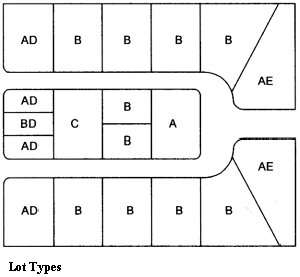
LOWEST FLOOR
As used in Section 14-8.3 (Flood Regulations), means the lowest floor of the lowest enclosed area, including a basement. An unfinished or flood resistant enclosure usable solely for parking or vehicles, building access or storage in an area other than a basement is not considered a building's lowest floor; provided that such enclosure is built in compliance with the applicable non-elevation design requirement of 44 CFR Section 60.3, the National Flood Insurance Program regulations. (Ord. No. 2012-19 § 5)
LUMINAIRE
A complete lighting unit, including the lamps, together with the parts required to distribute the light, to position and protect the lamps and to connect the lamps to the power supply.
MAJOR ROADWAY SYSTEM
As used in Section 14-8.14 (Impact Fees), means all major and minor arterials identified on the Santa Fe functional road classifications map within the urban area.
MANUFACTURED HOME
A structure transportable in one or more sections that is:
(A)
built on a permanent chassis;
(B)
designed for use with or without a permanent foundation;
(C)
constructed to the standards of the United States department of housing and urban development, the National Manufactured Housing Construction and Safety Standards Act of 1974, the Housing and Urban Development Zone Code 2 or the applicable building code, as of the date of the unit's construction;
(D)
installed consistent with the Manufactured Housing Act and with the rules promulgated pursuant to that act relating to permanent foundations; and
(E)
for the purposes of Section 14-8.3 (Flood Regulations), connected to the required utilities.
For floodplain management purposes, manufactured home also includes park trailers, travel trailers and other similar vehicles placed on a site for greater than one hundred eighty consecutive days, but does not include those vehicles as manufactured homes for flood insurance purposes.
MANUFACTURING
The mechanical or chemical transformation of materials or substances into new products, including the assembling of component parts, the manufacturing of products and the blending of materials such as lubricating oils, plastics, resins or liquors.
MARQUEE
An exterior roof-like projection over an entrance or window.
MINI-STORAGE UNITS
The separate storage spaces of varying sizes within one or more structures that are leased or rented on an individual basis.
MIXED USE
The development of a tract of land, building or structure in a compact urban form with two or more different uses, including residential, office, manufacturing, retail, public use, light industrial or entertainment.
MOBILE HOME
A structure that is:
(A)
transportable in one or more sections;
(B)
built on a permanent chassis and designed to be used as a dwelling unit, with or without a permanent foundation; and
(C)
not constructed to the standards of the United States department of housing and urban development, the National Manufactured Housing Construction and Safety Standards Act of 1974, the Housing and Urban Development Zone Code 2 and the Uniform Building Code.
MOBILE HOME PARK
A development in existence prior to December 10, 2012 (effective date of this Ordinance No. 2012-37) consisting of the premises where one or more mobile homes are parked for residential use or where spaces or lots are set aside or offered for sale or rent for use by mobile homes for residential use, including any land, building, structure or facility used by occupants of mobile homes on such premises, but does not include a single mobile home located on a lot in a residential district pursuant to a special use permit. Manufactured homes may be located within mobile home parks as provided in Section 14-7.2(I)(7). (Ord. No. 2012-37 § 6)
MOBILE HOME SPACE
A plot of land within a mobile home park designed for the accommodation of one mobile home or manufactured home. (Ord. No. 2012-37 § 6)
MOBILE HOME STAND
That portion of the mobile home space intended for occupancy by the mobile home or manufactured home proper, consisting of dimensions to be determined by the size of the unit to be accommodated. (Ord. No. 2012-37 § 6)
MODULAR HOME
A prefabricated structure built to all applicable building codes and used as a permanent building or dwelling unit that does not have permanent or temporary axles of its own and that is connected permanently to an on-site foundation made exclusively for that modular home or building.
MOTEL
An establishment providing transient lodging and accommodations, with or without kitchens, to the general public and containing six or more rooms with at least twenty-five percent of all rooms having direct access to the outside premises without the necessity of passing through the main lobby of the building.
MOUNTAINOUS AND DIFFICULT TERRAIN
Any parcel or portion of a parcel that lies in the area labeled as mountainous and difficult terrain on the official zoning map and where over twenty-five percent of the square footage of the parcel has an existing slope of over twenty percent.
MULCH
Any material applied to the surface of the soil to decrease moisture loss and control the growth of weeds; organic mulches include bark and wood chips, straw, grass, hay, compost and seed shells and inorganic mulches include rock and gravel.
MUSEUM
An institution devoted to the procurement, care, study and display to the public of objects that have lasting interest or value. (Ord. No. 2013-16 § 65)
NATURAL PERSON
An individual human being, as opposed to an organization of any form or a business entity.
NATURAL SLOPE
The elevation of the ground surface before any grading.
NET LEASABLE AREA
Present or potentially habitable space designed for owner or tenant occupancy and exclusive use.
NEW CONSTRUCTION
As used in Section 14-8.3 for floodplain management purposes, means structures for which the start of construction commenced on or after the effective date of Ordinance No. 1977-47.
NEW DEVELOPMENT
As used in Section 14-8.14 (Impact Fees), means the subdivision of land; reconstruction, redevelopment, conversion, structural alteration, relocation or enlargement of any structure; or any use or extension of the use of land, any of which increases the number of service units.
NIGHTCLUB
An establishment that provides, in combination with service of alcoholic beverages, amplified live entertainment or amplified music for dancing after the hour of 10:00 p.m.
NONCONTRIBUTING STRUCTURE
A structure, located in an H district, that is less than fifty years old or that does not exhibit sufficient historic integrity to establish and maintain the character of the H District.
NONRESIDENTIAL
All uses not defined as residential.
NOXIOUS WEED
Any living stage, including seeds and reproductive parts, of any parasitic or other plant designated as a noxious weed by the New Mexico Department of Agriculture, including Siberian elm (Ulmus pumila), Russian olive (Elaeagnus angustifolia), tree of heaven (Ailanthus altissima) and salt cedar (Tamarix spp.).
OBJECT
As used in Section 14-5.2 (Historic Districts), means the term used to distinguish from structures those constructions that are primarily artistic in nature or are relatively small in scale and simply constructed, for example, sculpture, monuments, boundary markers, statuary and fountains.
OBSTRUCTION
As used in Section 14-8.3 (Flood Regulations), means any object, structure, embankment, excavation, channel or drainage way that may impede, retard or change the direction of the flow of water, either by itself or by catching or collecting debris carried by water, or that is placed where the flow of water might carry the obstruction downstream to the danger and injury of life or property.
OCCUPANCY
The purpose for which a building is used or intended to be used or the number of people who are allowed to live in a dwelling unit or to occupy an assembly area. Also, the act of occupying or commencing occupation of land or structures.
OFFICE
A room or group of rooms used for conducting the affairs of a business, profession, service, industry or government.
OFF-STREET PARKING
The area of a lot used for required temporary vehicular parking.
ONE PERCENT CHANCE EVENT
A flood having a one percent chance of being equaled or exceeded in any given year. A one percent chance event is the same as a base flood.
OPEN SPACE
An outdoor area that permanently provides light and air and that satisfies, in whole or in part, the community's visual, psychological and recreational needs. (Ord. No. 2014-31 § 51)
OPERATING LICENSE
As used in Section 14-6.2(A)(5) (Short-Term Rental of Dwelling Units), means a business license valid for one year, that authorizes the maintenance and operation of a mobile home park.
OPERATOR, SHORT-TERM RENTAL
A person who, with or without a short-term rental permit or registration, rents or offers to rent a short-term rental unit to guests.
OTHER ADVERTISING STRUCTURE
As used in Section 14-5.2 (Historic Districts), means a canopy, awning or street clock.
OUTDOOR STORAGE
The keeping in an open area of any equipment, goods, junk, material, merchandise or vehicles in the same place for more than twenty-four hours.
OWNER
With regard to real property, a person who holds fee simple title to real property, or a person acting lawfully on behalf of the person who holds title. (Ord. No. 2013-16 § 66)
OWNER-OCCUPANT or RESIDENT OWNER
As used in Subsections 14-6.2(A)(5) (Short-Term Rental of Dwelling Units) and 14-6.3(D)(1) (Accessory Dwelling Units) means a natural person who holds fee simple title and resides on the property. (Ord. No. 2012-19 § 5)
OWNERS' ASSOCIATION
A private nonprofit corporation or similar legal entity of property or condominium owners for the purpose of owning, operating and maintaining various common infrastructure facilities and/or properties. (Ord. No. 2013-16 § 66)
PARCEL
A lot of record or tract of land.
PARKWAY
The part of the streetright-of-way lying between the back of the curb and the outer edge of the right-of-way and typically including the sidewalk and planting strip. (Ord. No. 2013-16 § 65)
PARTY
As used in Section 14-3.17 (Appeals), means an applicant, an appellant or the land use director and all agents and representatives of that person.
PASSIVE RECREATION
Recreational activities that are not dependent on recreational apparatus such as swings, slides, goal posts or backstops and sports that do not comprise organized recreational activities such as baseball, volleyball, football or soccer.
PASSIVE WATER HARVESTING
The collection or storage of precipitation or runoff in surface or in-ground structures with no means of mechanical distribution.
PERFORMANCE STANDARD
A set of criteria or limits relating to elements that a particular use or process may not exceed.
PERMEABLE PAVING
Paving and subgrade that allow surface water to penetrate the paved surface and infiltrate the subsoil.
PERMIT
A document issued by the city that allows a person to begin an activity provided for in Chapter 14.
PERSON
Except where limited to natural persons by definition, context or intent, person includes natural persons, corporations, companies, associations, joint stock companies, associations, firms, partnerships, limited liability companies or other legal entities.
PERSONAL CARE FACILITY FOR THE ELDERLY
A residential facility for twenty-six or more persons sixty years of age or older that provides living and sleeping facilities with common meal preparation, laundry services, room cleaning and assistance in daily living activities, and may provide other services such as transportation for routine social and medical appointments and counseling. A personal care facility for the elderly does not include independent kitchens or complete dwelling units and is not an extended care facility, hotel, motel or residential suite hotel or motel.
PERSONAL SERVICE ESTABLISHMENT
A business primarily engaged in providing frequent or recurrent needed services of a personal nature, including beauty or barber shops, shoe repair shops and tailor shops.
PHARMACY
A place where drugs and other medicines are dispensed.
PLACEMENT
As used in Section 14-6.2(F) (Electric Facilities), means installation of electric facilities, but which are not relocation or replacement as defined in Article 14-12, where similar facilities have not previously existed.
PLANTING STRIP
A linear landscaped area typically located within or adjoining a parkway. (Ord. No. 2013-16 § 66)
PLAT
The map, chart, survey, plan or replat certified by a professional land surveyor that contains a description of subdivided land with ties to permanent monuments.
POLE
As used in Section 14-6.2(F) (Electric Facilities), means steel, wood or other material placed in the ground to hold associated insulators, braces and other attachment hardware for electric service.
PORCH
A roofed space outside the main walls of a structure at street or first floor level, which has a depth of not less than four feet from the outside face.
PORTAL
A long porch or portico with roof, supported by vertical posts.
POTABLE WATER
Water that is suitable for consumption by humans.
PREEXISTING TOWERS AND PREEXISTING ANTENNAS
As used in Section 14-6.2(E), any tower or antenna for which a buildingpermit has been issued prior to the effective date of this section, including permitted towers or antennas that have not yet been constructed so long as such approval is current and not expired and including towers and antennas given interim approvals during the pendency Section 14-6.2(E), and not found by the governing body to be contrary to the purposes of Section 14-6.2(E).
PREMISES
A lot or combination of contiguous lotsdeveloped or approved for development as a unified complex of structures or uses, such as a planned unit development or a commercial or industrial center with common parking or access easements, regardless of whether the lots are held in single ownership and the buildings, structures or other appurtenances on the lots.
PRESERVATION
The act or process of applying measures to maintain and sustain the existing form, integrity and material of a building, structure or district and the existing form of a site.
PRESIDING OFFICER
The person elected or appointed to direct the conduct of a public hearing. The presiding officer of a committee is the chairperson; the presiding officer of the governing body is the mayor or mayor pro tempore.
PRIMARY FAÇADE
One or more principal faces or elevations of a building with features that define the character of the building's architecture.
PRINCIPAL
Primary or predominant, as applied to a use or structure, as distinguished from secondary or accessory.
PRIVATE CLUB or LODGE
A facility for social, cultural or educational activities open only to bona fide members and guests of the private organization operating the club or lodge, except those the chief activity of which is a service customarily carried on as a business.
PRIVATE OPEN SPACE
Open space adjoining each dwelling unit, designed to provide privacy and having one or more points of ingress to the residence.
PROFESSIONAL ENGINEER
A person licensed by the state to practice engineering.
PROFESSIONAL LAND SURVEYOR
A person licensed by the state to practice land surveying.
PROJECT
As used in Sections 14-3.11(C) (Architectural Design Review) and 14-8.7 (Architectural Design Review), means all new exterior construction, except for maintenance, minor repairs, restoration and temporary structures, submitted to the city under a single application.
PROPERTY
A parcel or parcels of land commonly owned and contiguous, excluding streets and rights of way.
PUBLIC BENEFIT USE
Public parks, playgrounds, trails, paths, courtyards or other recreational areas and other public open spaces; scenic and historic sites; and property used by a nonprofit or charitable organization.
PUBLIC IMPROVEMENTS and QUASI PUBLIC IMPROVEMENTS
Certain improvements with a life expectancy of ten or more years ad that will be used by the public or used in common by owners of lots within a subdivision, or used in common by owners or tenants of a commercial or multiple-familyresidentialdevelopment. Public and quasi-public improvements include infrastructure, emergency access and fire suppression, terrain management improvements including revegetation and site restoration, storm drainage facilities and landscaping of common areas as determined by the land use director in accordance with written policies. Infrastructure that will be dedicated to the city or another government agency, to a public utility company or to an owners association is also included. See Section 14-9.1(B).
PUBLIC RIGHT-OF-WAY
The total area of the land deeded, reserved by plat or otherwise acquired by the city, the county or the state primarily for the use of the public for the movement of people, goods and vehicles and for the installation and maintenance of public utilities or drainage ways.
PUBLIC UTILITY
An agency that, under public franchise or ownership or under a certificate of convenience and necessity, provides the public with electricity, gas, heat, steam, communication, rail transportation, water, sewage collection or similar service.
PUBLICLY VISIBLE
The portion of a structure visible from a public street, way or other area to which the public has legal access; and provided that to be publicly visible, a structure need not be adjacent to a public street or way or area to which the public has legal access.
PUMICE WICK
An artificial in-ground trench or other volume of porous rock that stores water for plant material use.
QUALIFIED PROFESSIONAL
As used in Section 14-8.14 (Impact Fees), means a professional engineer, professional land surveyor, financial analyst or planner who provides services within the scope of their license, education or experience.
QUALIFYING OPEN SPACE
(Repealed by Ord. No. 2014-31 § 50)
RAIN BARREL
A small above-ground storage tank, typically twenty-five to two hundred gallons, that collects and stores roof runoff from canals, downspouts or other sources.
RANCH STYLE ROOF
A type of pitched roof with two sloping planes with a pitch less than a six (6) inch vertical rise in a twelve-inch horizontal run.
RECONDUCTOR
As used in Section 14-6.2(F) (Electric Facilities), means to increase the capacity of a line by removing the existing conductor and replacing it with a larger size conductor that will be operated at the same voltage.
RECONNAISSANCE
A visual examination of land surfaces that are to be disturbed, and archival research of that property.
RECONSTRUCT
Substantially replace a structure or portion of a structure.
RECREATION FACILITY
A city-owned facility used for public recreation, including active or passive recreation and sports, playgrounds and trails.
RECREATIONAL VEHICLE
A vehicular-type portable structure without permanent foundation that can be towed, hauled or driven and that is primarily designed as temporary living accommodation for recreational, camping or travel use and includes travel trailers, truck campers, camping trailers and self-propelled motor homes.
REFRAMING
As used in Section 14-6.2(F) (Electric Facilities), means work on a pole or electric structure that involves replacing structural members, improving clearances, and other maintenance, replacement or retrofits on existing poles or electric structures.
RELIGIOUS ASSEMBLY
A use located in a permanent building that provides regular organized religious worship and related incidental activities, except primary or secondary schools and day care facilities.
RELIGIOUS INSTITUTION
A building having the primary purpose of either a church, temple, mosque, or other place of worship or to support and manage the practice of a specific set of religious beliefs.
RELOCATION
As used in Section 14-6.2(F) (Electric Facilities), means removal of existing electric facilities and reinstallation of those facilities or new similar facilities in a new location not more than fifty (50) feet distant from the original location.
REMODELING
A change, including a reconstruction, in an architectural feature of a structure; provided that remodeling does not include the construction of additions.
REPLACEMENT
As used in Section 14-6.2(F) (Electric Facilities), means removal of existing facilities and installation of new similar facilities in a location as close as practicable to the original location.
REPAIR GARAGE
The buildings and premises that are designed and intended for some or all of the purposes indicated under the definition of filling station and designed and intended to perform major mechanical repairs and body work; provided, that body work and painting must be conducted within fully enclosed buildings and self-propelled vehicles not in safe operating condition must be stored in fully enclosed buildings.
RESIDENTIAL
Term used to describe occupancy, structures or districts primarily intended for or restricted to development and use for dwelling units. It does not include hotels or motels.
RESIDENTIAL SUITE HOTEL OR MOTEL
An establishment with two or more guest rooms that offers transient lodging accommodations, including daily accommodations, to the general public whose guest rooms uniformly contain bathroom, sleeping and independent cooking or kitchen or living room facilities, but that does not maintain or operate an on-site bar or restaurant facilities open to the general public; provided that if the residential suite hotel or motel is used by a nonprofit organization that provides human services, lodging for the organization's clients may be provided on a transient or more than thirty-day basis.
RESIDENTIALLY ZONED PROPERTY
Those zones within Santa Fe that primarily permit accommodation of residential housing, including: RR, R-1 through R-6, R-7, R-8, R-9, R-10, R-12, R-21, R-29, R-7-I, RC-5, RC-8 and RAC districts and tracts of land designated by a PRC district master plan or other master plan for residential use.
RESTORATION
The replication or reconstruction of a building's original architectural features.
RESUBDIVISION
The adjustment of plattedlot lines for the following purposes:
(A)
increasing or reducing the size of contiguous lots, but not less than the minimum standard size required by the city, or changing the shape of contiguous lots, commonly known as a lot line adjustment; and
(B)
combining contiguous lots, commonly known as a lot consolidation.
The resubdivision must result in the same or a fewer number of lots.
RETAIL ESTABLISHMENT
A business engaged in selling goods to the general public for personal or household consumption and rendering services incidental to the sale of such goods, including department stores; supermarkets; pharmacies; bakeries; meat markets; liquor stores; hardware, paint or wallpaper stores; camera shops; florist's shops; gift shops; hobby shops; stationery shops; bookstores, apparel shops; shoe stores; variety stores; jewelry stores; stores for sales of gardening supplies and equipment; movie theaters; and bowling alleys.
RETAIL STRUCTURE
A structure housing one or more retail establishments.
RETAIL TENANT
For the purposes of determining the applicability of special requirements that apply to large-scale retail establishments with single retail tenants greater than seventy-five thousand gross square feet or, for the purposes of determining the applicability of the one hundred fifty thousand gross square foot floor area maximum, means a single retail establishment that shares checkstands, management, a controlling ownership interest and storage areas, for example, a plant nursery or a grocery store associated with a general merchandise store, such as a home improvement store.
RETENTION
The storage of storm water or other runoff in a facility that empties solely by infiltration or evaporation and does not have an engineered outlet structure.
RIGHT-OF-WAY
The total area of land deeded, dedicated by plat or otherwise acquired by a governmental unit or private organization primarily for the use of the public for the movement of people, goods and vehicles or by a public or private organization primarily for the installation and maintenance of utilities or by a railroad primarily for the laying of its tracks.
ROADWAY FACILITIES
As used in Section 14-8.14 (Impact Fees), means arterial or collector streets or roads that have been designated on an officially adopted roadway plan of the city or county. For the purposes of Santa Fe's road impact fees, roadway facilities are limited to the major roadway system.
ROOF LEVEL URBAN FARM
The use of a roof for urban agriculture for commercial purposes, whether for profit or non-profit. (Ord. No. 2016-41 § 5)
ROOF MOUNTED ANTENNAS
As used in Section 14-6.2(E) (Telecommunications), includes a telecommunications facility placed on a rooftop through gravity mounts or other surface attachments.
ROOFTOP APPURTENANCE
Skylights, air conditioning units, solar collectors, stairwells, vertical transportation or other roof-mounted mechanical, electrical or communications equipment.
RUNOFF
The water from natural precipitation that flows over the surface of the land and does not percolate into the soil.
SALVAGE YARD
An open use of land on which two or more inoperable vehicles are standing or on which salvaged auto parts, auto bodies, waste or scrap materials of any kind, including building materials, are processed, stored, displayed, sold, exchanged or handled.
SCALE
The relationship of the parts of a building, structure, block or district to each other, to the whole and to the human figure.
SCREENING
A visual barrier composed of suitable live plant material or other natural or artificial materials.
SECTOR PLAN
A plan for an area with multiple ownership, prepared with the participation of the residents and propertyowners, neighborhood associations if any are included in the area, the city and the county and including a plan for road improvements, land uses, land use intensities, schools and parks and drainage. When adopted by the governing body, a sector plan is incorporated into the general plan.
SERVICE AREA
As used in Section 14-8.14 (Impact Fees), means an area within the corporate boundaries or extraterritorial jurisdiction of the city or the boundaries of the county to be served by the capital improvements or facility expansions specified in the capital improvements plan that is designated on the basis of sound planning and engineering standards. The service area for the city's road, traffic signal, neighborhood park, regional park and fire and police impact fees is the area within the corporate boundaries of Santa Fe as well as unincorporated areas within the urban area as set forth in the general plan.
SERVICE ESTABLISHMENT
A business, other than a home occupation, that is primarily engaged in providing services, including personal, business, repair and amusement services; health, legal, engineering and other professional services; educational; membership; and other miscellaneous services.
SERVICE UNIT
As used in Section 14-8.14 (Impact Fees), means the standardized measure of consumption, use, generation or discharge attributable to an individual unit of development calculated in accordance with generally accepted engineering or planning standards for a particular category of capital improvements or facility expansions. The service unit for road and traffic signal impact fees is average daily vehicle-miles of travel. The service unit for neighborhood and regional park impact fees is equivalent dwelling units. The service unit for fire and police impact fees is square feet, which are measured in terms of heated living area for residential uses and gross floor area for nonresidentialdevelopment.
SETBACK
The minimum distance prescribed between the nearest point of a structure and a lot line.
SEXUALLY ORIENTED BUSINESS
An adult arcade, adult bookstore or adult video store, adult cabaret, adult escort agency, adult motel, adult motion picture theater, adult news rack or adult performance and encounter (live)business.
SFHP
The Santa Fe Homes Program.
SFHP DEVELOPMENT
A tract of land or any improvements on the tract that are subject to a SFHP agreement.
SFHP UNIT
A dwelling unit required to be provided on site by a SFHP developer or a SFHPpropertyowner to satisfy the SFHP requirements.
SHELTERED CARE FACILITY
A boarding home or other home for the sheltered care of adult or juvenile persons that, in addition to having the capacity to provide food and shelter to between nine and twenty-five persons unrelated to the proprietor, provides personal care and services, habilitation or supervision beyond food, shelter and laundry; provided that live-in nursing care is not a primary part of the services provided. Sheltered care facility includes group homes, half-way houses, homes for battered persons and children and homes designed to provide a transition from long-term institutional care to normal activities.
SHIELDING
That portion of a luminaire that ensures that no light rays are emitted above the horizontal plane running through the lowest point of the luminaire where light is emitted.
SHORT-TERM RENTAL UNIT
A dwelling unit or accessory dwelling unit, or any portion of a dwelling unit or accessory dwelling unit, that is offered for rent or rented for a period of less than thirty (30) days.
SIGN
Includes every sign, billboard, ground sign, wall sign, roof sign, illuminated sign, projecting sign, temporary sign, marquee, banner, awning, canopy and street clock and includes any announcement, declaration, demonstration, display, illustration or insignia used to advertise or promote the interests of any person when it is placed out-of-doors or in view of the general public, including outdoor electric lights placed in trees, shrubs or other types of vegetation.
SIGN AREA
The net geometric area enclosed by the sign, including all elements such as borders or frames or perforated or solid background, but not including projected area or structural supports for ground signs, unless it is designed in such a manner as to form an integral part of the background of the display.
SIGN, BUILDING MOUNTED
A sign mounted on a building and includes canopy sign, marqueesign, projecting sign, roof sign and wall sign.
SIGN, CANOPY
A sign mounted under and supported by a permanent awning, arcade or portal.
SIGN, DIRECTIONAL
A sign used only for the purpose of indicating the location or direction of an object, place or area and containing no advertising.
SIGN, ELECTRONIC MESSAGING
An electronic changeable copy sign, an electronic graphic display sign, or video display sign as follows:
(A)
Electronic Changeable Copy Sign. A sign or portion thereof that displays electronic, non-pictorial, text information in which each alphanumeric character, graphic, or symbol is defined by a small number of matrix elements using different combinations of light emitting diodes (LEDs), fiber optics, light bulbs or other illumination devices within the display area. Electronic changeable copy signs include computer programmable, microprocessor controlled electronic display.
(B)
Electronic Graphic Display Sign. A sign or portion thereof that displays electronic, static images, static graphics or static pictures, with or without information, defined by a small number of matrix elements using different combinations of light emitting diodes (LEDs), fiber optics, light bulbs or other illumination devices within the display area where the message change sequence is accomplished immediately or by means of fade, repixalization or dissolve modes. Electronic graphic display signs include computer programmable, microprocessor controlled electronic or digital displays. Electronic graphic display signs include projected images or messages with these characteristics onto buildings or other objects.
(C)
Video Display Sign. A sign that changes its message or background in a manner or method of display characterized by motion or pictorial imagery, which may or may not include text and depicts action or a special effect to imitate movement, the presentation of pictorials or graphics displayed in a progression of frames which give the illusion of motion, including but not limited to the illusion of moving objects, moving patterns or bands of light, or expanding or contracting shapes, not including electronic changeable copy signs. Video display signs include projected images or messages with these characteristics onto buildings or other objects.
SIGN FACING or SURFACE
The surface of the sign on, against or through which the message is displayed or illustrated.
SIGN, FREESTANDING
A sign or signstructure that is permanently affixed to the ground supported by uprights or braces placed upon the ground and that is not attached to a building or other structure.
SIGN, HANGING
A sign that is not supported by any means from the ground or sidewalk and that is fastened to or suspended from a structure.
SIGN HEIGHT
The vertical distance from grade to the highest point of the sign.
SIGN, ILLUMINATED
An illuminated sign that has characters, letters, figures, designs or outline illuminated by electric lights or luminous tubes as a part of the sign proper.
SIGNS, NUMBER
For the purpose of determining the number of signs, a single display surface or display device containing elements organized, related and composed to form a unit. Where matter is displayed in a random manner without organized relationship of elements or where there is reasonable doubt about the relationship of elements, each element shall be considered a single sign.
SIGN, PORTABLE
A movable signstructure not permanently attached to the ground or to any other structure.
SIGN, PROJECTING
A sign that is attached to a structure and extends beyond the line of the structure.
SIGN, ROOF
A sign painted, erected or constructed wholly upon or over the roof of a building and supported solely on the roof structure.
SIGN, SANDWICH
A sign that rests on the ground and consists of two sign faces attached at the top, with the sides of the sign forming a triangle and the base of the triangle forming the baseline of the sign.
SIGN, TEMPORARY
A sign that relates to an event, function or activity of a specific, limited duration, including flags, banners, pennants and similar paraphernalia.
SIGN, WALL
A sign that displays a single advertising surface and is painted on or attached to and erected parallel to the face of the outside wall of a building and supported by the wall, fence or building. Wall signs includes flat signs, signs with projecting letters attached to a wall or a painted sign board attached securely to a wall.
SIGNIFICANCE
The determination of the potential value of an archaeological site to increase the knowledge of the prehistory or history of Santa Fe, as set forth in Section 14-3.13 (Archaeological Clearance Permits).
SIGNIFICANT STRUCTURE
A structure located in a historic district that is approximately fifty years old or older, and that embodies distinctive characteristics of a type, period or method of construction. For a structure to be designated as significant, it must retain a high level of historic integrity. A structure may be designated as significant:
(A)
for its association with events or persons that are important on a local, regional, national or global level; or
(B)
if it is listed on or is eligible to be listed on the State Register of Cultural Properties or the National Register of Historic Places.
SIGNIFICANT TREE
A deciduous tree six (6) inches in caliper or greater or an evergreen tree eight (8) feet or greater in height.
SITE WATER BUDGET
(Repealed by Ord. No. 2014-31 § 50)
SLOPE
An inclined ground surface, expressed in terms of measures of horizontal distance to measures of vertical distance or percent of vertical component to horizontal component.
SOIL AMENDMENT
Material added to improve the fertility, permeability or water storage capacity of soil.
SOILS ENGINEERING REPORT
A report prepared by a professional engineer indicating the nature, distribution and strength of existing soils; conclusions and recommendations for grading procedures; design criteria for corrective measures when necessary and opinions and recommendations covering adequacy of sites to be developed by the proposed grading.
SOLID WALL OR FENCE
(Repealed by Ord. No. 2014-31 § 50)
SPECIAL FLOOD HAZARD AREA
The land in the floodplain within the city that has a one percent or greater chance of flooding in any given year. After detailed ratemaking has been completed in preparation for publication of the FIRM, Zone A usually is refined in Zones A, AE, X or shaded X. For the city, the special flood hazard area may be further defined as floodway and flood fringe, where applicable. (Ord. No. 2012-19 § 5)
SPECIFIED ANATOMICAL AREAS
Includes:
(A)
less than completely and opaquely covered human genitals or pubic region or buttock or female breast below a point immediately above the top of the areola; or
(B)
human male genitals in a discernibly turgid state, even if completely and opaquely covered.
SPECIFIED SEXUAL ACTIVITIES:
(A)
human genitals in the state of sexual stimulation or arousal;
(B)
acts of human masturbation, sexual intercourse or sodomy;
(C)
fondling or other erotic touching of human genitals, pubic region, buttock or female breast;
(D)
excretory functions as part of or in connection with any of the activities set forth in Subsections A through C of this definition; or
(E)
a simulation of any of activities provided in Subsections A through D of this definition.
START OF CONSTRUCTION
As used in Section 14-8.3 (Flood Regulations) and for other than new construction or substantial improvements under the federal Coastal Barrier Resources Act (Pub. L. 97-348), means the date the construction permit is issued; provided that the actual start of construction, repair, reconstruction, placement, or other improvement is within one hundred eighty days of the permit date. The actual start of construction means either the first placement of permanent construction of a structure on a site, such as the pouring of slabs or footings, the installation of piles, the construction of columns or any work beyond the stage of excavation; or the placement of a manufactured home on a foundation. Permanent construction does not include land preparation, such as clearing and grading; installation of streets or walkways; excavation for a basement, footings, piers or foundations or the erection of temporary forms; or the installation on the property of accessorybuildings such as garages or sheds not occupied as dwelling units or not as part of the main structure.
STATE
The state of New Mexico.
STORM DRAINAGE FACILITIES
Includes drainage courses, constructed channels, underground storm sewers, streets, drop inlets, detention basins and other drainage improvements.
STORY
The division of a building comprising the space between two successive floors above ground level. (Ord. No. 2014-31 § 51)
STREET
A right-of-way dedicated to public or private use to provide primary vehicular and pedestrian access to adjoining properties and is any public thoroughfare and the approach to a public thoroughfare, the boundaries of which extend to the abutting property line.
STREET FRONTAGE
The length of the boundary of the premises abutting the street.
STREET TREE
A tree that is planted within or along a streetright-of-way, and that can be pruned for pedestrian clearance where appropriate.
STREET WIDTH
The area of street within which vehicles are permitted, including travel lanes and parking areas, but not including shoulders, curbs, sidewalks or swales.
STREETSCAPE
The visual character of a street or section of a street as defined by topography; the pattern of structures and open space; building and wall setbacks; street design; architectural design; and heights, widths and proportions of structures, fixtures and graphics.
STRUCTURAL TRIM
The moldings, battens, cappings, nailing strips, latticing and platforms that are attached to a signstructure.
STRUCTURE
Anything that is constructed or erected with a fixed location on the ground or attached to something having a fixed location on the ground, including buildings, mobile homes, walls, fences, swimming pools, spas, tennis courts, signs, flag poles, microwave satellite receiving dishes, TV antennas and communication devices.
SUBDIVIDE
To divide land into two or more parts by platting or by metes and bounds description to:
(A)
sell for building purposes;
(B)
laying out a municipality or any part of a municipality;
(C)
adding to a municipality;
(D)
laying out suburban lots; or
(E)
resubdivide.
SUBSTANTIAL IMPROVEMENT
As used in Section 14-8.3 (Flood Regulations), means any repair, reconstruction or improvement of a structure, the cost of which equals or exceeds fifty percent of the market value of the structure, either before the improvement or repair is started or, if the structure has been damaged and is being restored, before the damage occurred;. For the purpose of this definition, substantial improvement is considered to occur when the first alteration of any wall, ceiling, floor or other structural part of the building commences, whether or not that alteration affects the external dimensions of the structure. Substantial improvement does not include either:
(A)
any project for improvement of a structure to comply with existing state or local health, sanitary or safety code specifications that are necessary solely to assure safe living conditions; or
(B)
any alteration of a structure listed on the National Register of Historic Places or a state inventory of historic places.
SUBSTANTIALLY DAMAGED
As used in Section 14-8.3 (Flood Regulations), means damage of any origin sustained by a structure whereby the cost of restoring the structure to its before damaged condition would equal or exceed fifty percent of the market value of the structure before the damage occurred.
SUBSTANTIVE CHANGE
As used in Section 14-5.2 (Historic Districts), means a change to a property in the historic districts or a landmarkproperty outside the historic districts that requires review and approval by the historic districts review board.
SUBSTATION
As used in Section 14-6.2(F) (Electric Facilities), means facility equipment that switches, changes, or regulates electric voltage. An electric power station that services as a control and transfer point on an electrical transmission system. Substations route and control electrical power flow, transform voltage levels, and serve as delivery points to industrial customers.
SUBSURFACE AREAS
Areas within a structure, the floor of which is at least six feet below average finished grade.
SUSTAINABLE
The ability of a system to maintain processes, functions and productivity over time using a defined quantity of resources.
SWALE
A shallow excavation constructed perpendicular to overland flow direction to detain storm water runoff, keeping it on-site and allowing it to infiltrate.
SWITCHING STATION
As used in Section 14-6.2(F) (Electric Facilities), means facility equipment used to tie together two or more electric circuits through switches. The switches are selectively arranged to permit a circuit to be disconnected or to change the electric connection between the circuits.
TANK
An artificial reservoir for storing water, often above ground.
TELECOMMUNICATIONS FACILITIES
The plant, equipment and property, including but not limited to, fiber optic lines, cables, wires, conduits, ducts, pedestals, towers, antennas, electronics and other appurtenances used or to be used to transmit, receive, distribute, provide or offer telecommunication services.
TELECOMMUNICATIONS OWNER
Includes every person that directly or indirectly owns, controls, operates or manages plant, equipment or property within the city, used or to be used for the purpose of offering telecommunication service.
TELECOMMUNICATION SERVICES
The providing or offering for rent, sale or lease, or in exchange for other value received, of the transmittal of voice, data, image, graphic and video programming information between or among points excluding only cable services.
TELECOMMUNICATIONS PROVIDER
Includes every person who provides telecommunication service over telecommunications facilities without any ownership or management control of the facilities.
TEMPORARY FACILITIES
As used in Section 14-6.2(F) (Electric Facilities), means electric facilities and distribution facilities used to provide service for less than one year.
TEMPORARY STRUCTURE
A structure erected for a specific purpose, which is removed when the designated time period, activity or use for which it was erected has ceased. See Section 14-6.4(C) (Temporary Structures Treated as Permanent Structures).
TOPSOIL
The uppermost part of a soil, ranging in depth from three to six (6) inches, that can sustain vegetation and is free of caliche, trash or toxic materials.
TOWER
As used in Section 14-6.2(E) (Telecommunications), means any structure that is designed and constructed primarily for the purpose of supporting one or more antennas used for telecommunications services, including self-supporting lattice towers, guyed towers, or monopole towers. The term includes radio and television transmission towers, microwave towers, common-carrier towers, cellular telephone towers, and the like. The term includes the structure and any support thereto.
TOWER ALTERNATIVE
As used in Section 14-6.2(E) (Telecommunications), means manmade trees, clock towers, bell steeples, light poles and similar alternative-design mounting structures that camouflage or conceal the presence of antennas or towers.
TOWNSCAPE
The interrelated elements of the urban landscape, including the physical setting, street patterns, watercourses, vegetation, building placement, building height, scale, wall types and prominent views.
TOWNSCAPE STANDARDS
As used in the BCD, means the specific requirements within a townscape subdistrict that provide for:
(A)
maximum height of structures;
(B)
maximum lot coverage;
(C)
building placement and yard requirements;
(D)
minimum open space requirements;
(E)
landscape treatment;
(F)
height of walls and fences;
(G)
placement of parking;
(H)
curb cuts; and
(I)
portals.
(Ord. No. 2012-11 § 29)
TRACT
An area for which a single project is proposed.
TRANSIENT LODGING
A stay of fewer than thirty consecutive days.
TRANSMISSION FACILITIES
As used in Section 14-6.2(F) (Electric Facilities), means the network of high-voltage lines, transformers, and switches used to move electrical power from generators to the distribution system. Also used to interconnect different utility systems and independent power producers into a synchronized network. Transmission is considered to end when the energy is transformed for distribution to the customer.
TRANSPORTATION TERMINAL
A station where transportation services are provided to the public, primarily transportation of persons as opposed to freight, to a regional area, including the city, or serves as a junction to points outside the city for the conveyance of passengers as a commercial enterprise.
TREATMENT
A plan for the recovery or protection of discovered cultural remains at those archaeological sites that are considered significant, including proposed excavation or preservation methods, proposed analysis techniques and plans for the final disposition of artifacts recovered.
UNDERGROUND SYSTEM
As used in Section 14-6.2(F) (Electric Facilities), means a system of underground primary and/or secondary distribution cables which may have transformers, terminal boxes, switching devices and other facilities necessarily appurtenant to such a system on the surface, or any portion thereof.
UNIT
(Repealed by Ord. No. 2014-31 § 50)
UPGRADE
As used in Section 14-6.2(F) (Electric Facilities), means to rebuild, improve, or increase the voltage or current carrying capability of an electric transmission line, switching station, or substation.
URBAN AGRICULTURE
The use of a lot for the cultivation of agriculture, composting, aquaponics, aquaculture, and/or hydroponics for commercial purposes. (Ord. No. 2016-41 § 5)
URBAN FARM, GROUND LEVEL, LARGE
A ground level urban farm with a farm area greater than one (1) acre, that is used for urban agriculture for commercial purposes, whether for profit or non-profit. (Ord. No. 2016-41 § 5)
URBAN FARM, GROUND LEVEL, MEDIUM
A ground level urban farm with a farm area greater than or equal to ten-thousand (10,000) square feet, but no greater than one (1) acre, that is used for urban agriculture for commercial purposes, whether for profit or non-profit. (Ord. No. 2016-41 § 5)
URBAN FARM, GROUND LEVEL, SMALL
A ground level urban farm with a farm area less than ten thousand (10,000) square feet that is used for urban agriculture for commercial purposes, whether for profit or non-profit. (Ord. No. 2016-41 § 5)
URBAN FARM, ROOF LEVEL, LARGE
A roof level urban farm with a farm area greater than one thousand (1000) square feet, but no greater than five-thousand (5000) square feet that is used for urban agriculture for commercial purposes, whether for profit or non-profit. (Ord. No. 2016-41 § 5)
URBAN FARM, ROOF LEVEL, SMALL
A roof level urban farm with a farm area one thousand (1000) square feet or less that is used for urban agriculture for commercial purposes, whether for profit or non-profit. (Ord. No. 2016-41 § 5)
USDA CLASSIFICATION ZONE
A United States Department of Agriculture system of plant hardiness classifications grouped by the ability to withstand defined temperature ranges.
USED OR OCCUPIED
Includes "intended, designed or arranged to be used or occupied".
UTILITY EASEMENT
An easement acquired, established, dedicated or devoted for public utility purposes.
UTILITY PROVIDER
As used in Section 14-6.2(G) (Underground Electric, Telecommunications and Cable Utility Lines), means electric or cable service providers or their contractors constructing electric, telecommunication or cable utility lines.
UTILITY SHED
A prefabricated, one-story, detached accessorystructure constructed of light material and used as a tool shed, play house or other suitable purpose; provided that the projected roof area shall not exceed one hundred twenty square feet.
VACATION TIME SHARE PROJECT
Real property for which the right to use and occupy a dwelling unit on a periodic basis constitutes a time share arrangement under the laws of New Mexico, in which the exclusive right of use or occupancy of a unit circulates among various owners for a contractually limited period or a private club with shared ownership in a vacation residence similar to the above including interval use.
VERTICALLY INTEGRATED CANNABIS ESTABLISHMENT
A person who is licensed as a vertically integrated microbusiness and authorized to act as any of the following:
1.
a cannabis courier;
2.
a cannabis manufacturer;
3.
a cannabis producer ; or
4.
a cannabis retailer.
VETERINARY ESTABLISHMENT
A facility or place where animals, including agricultural and farm animals, are given medical and surgical care and treatment and the boarding of animals limited to short-term care incidental to the hospital use.
VIEW LINE
As used in Section 14-5.6 (Escarpment Overlay District), means either the boundary between the ridge top subdistrict and foothill subdistrict or the delineated portion of the boundary of the ridge top subdistrict if there is no contiguous foothill subdistrict, as shown on the city's official escarpment overlay district maps.
VOCATIONAL SCHOOL
A secondary or post-secondary education facility that meets state requirements as a vocational facility and that primarily teaches usable skills that prepare students for jobs in a trade.
WALL
A constructed solid barrier of concrete, stone, brick, tile, wood or similar material that borders or is constructed within a field, yard or lot and that limits visibility and restricts the flow of air and light; or the wall of a building or other enclosed structure. (Ord. No. 2014-31 § 51)
WAIVER
As used in Section 14-3.10 (Development in Special Flood Hazard Areas) and 14-8.3 (Flood Regulations), a waiver to flood regulations is equivalent to a variance to National Flood Insurance Program regulations. (Ord. No. 2012-19 § 6)
WAREHOUSE
A building used primarily for the storage of goods and materials.
WARM SEASON GRASS
Grass that requires moderate or infrequent applications of water throughout its life, such as blue grama, buffalo and other grass species.
WATER FEATURE
An ornamental water structure used in a landscape, including fountains, streams and ponds.
WATER HARVESTING
The capture and use of precipitation from surfaces such as roofs, roads, parking lots and landscapes for plant irrigation, soil recharge or the collection and storage for future use.
WATER SURFACE ELEVATION
As used in Section 14-8.3 (Flood Regulations), means the height, in relation to the national geodetic vertical datum (NGVD) of 1929, of floods of various magnitudes and frequencies in the floodplains of riverine areas.
WHOLESALE OPERATIONS
Businesses primarily engaged in selling merchandise or acting as agents or brokers and buying merchandise for retailers; industrial, commercial, institutional or professional business users; or other wholesalers.
XERISCAPE
A water conserving landscape, emphasizing the use of drought tolerant plant material and efficient watering systems. The principles of xeriscape include planning and design, appropriate choice of plants, soil analysis, efficient irrigation, practical and limited use of turf, mulching and proper maintenance.
YARD
The substantially open area adjacent to a property line; see "yard, required."
YARD, FRONT
The part of a lot on the lot frontage side between the front lot line and the closest part of the perimeter of a structure on the lot, extended to both side lot lines.
YARD, REAR
The part of a lot opposite the lot frontage side between the rear lot line and the closest part of the perimeter of a structure on the lot, extended to both side lot lines.
YARD, REQUIRED
A required unoccupied, unobstructed open space adjacent to a property line.
YARD, SIDE
The part of a lot between the side lot lines and the closest part of the perimeter of a structure on the lot, extending from front to rear lot lines.
YARD, SPECIAL
In the case of an irregular lot, means a yard required to perform the same functions as a front, side or rear yard, but adjacent to the lot line so placed or oriented that the standard requirements are not clearly applicable. In such cases, the land use director shall require a special yard with minimum dimensions as would apply for a comparable front, side or rear yard in the district. Such determination shall be based on the relation of the lot in question to the adjoining lots with due regard to the orientation and location of required yards, structures and buildable areas on the lots. (Ord. No. 2013-16 § 66)
YARD, STREET
The yard or required yard adjoining a street.
ZERO LOT LINE
The location of a building wall on a side or rear lot line.

