
Sapulpa City Zoning Code
CHAPTER 19
DOWNTOWN DESIGN CODE AND STANDARDS
Sec. 1900.- Zoning compliance.
A.
Title. These regulations and standards are part of the Sapulpa Downtown Design Code and Standards, which will be referred to as "the downtown code," "this Code," or "these standards".
B.
Findings. In approving this Downtown Design Code and Standards application, the Mayor and City Council find that:
1.
This application supports various City of Sapulpa policies and plans encouraging planned growth and redevelopment in and around the Downtown; and
2.
When a standard contained in this Code varies from a standard contained elsewhere in City Code, the alternate standard in this Code is justified by item "1" above and has been found to promote the public health, safety, and general welfare.
(Ord. No. 2921, § 1, 7-3-2023)
Sec. 1902. - General provisions.
A.
Applicability.
1.
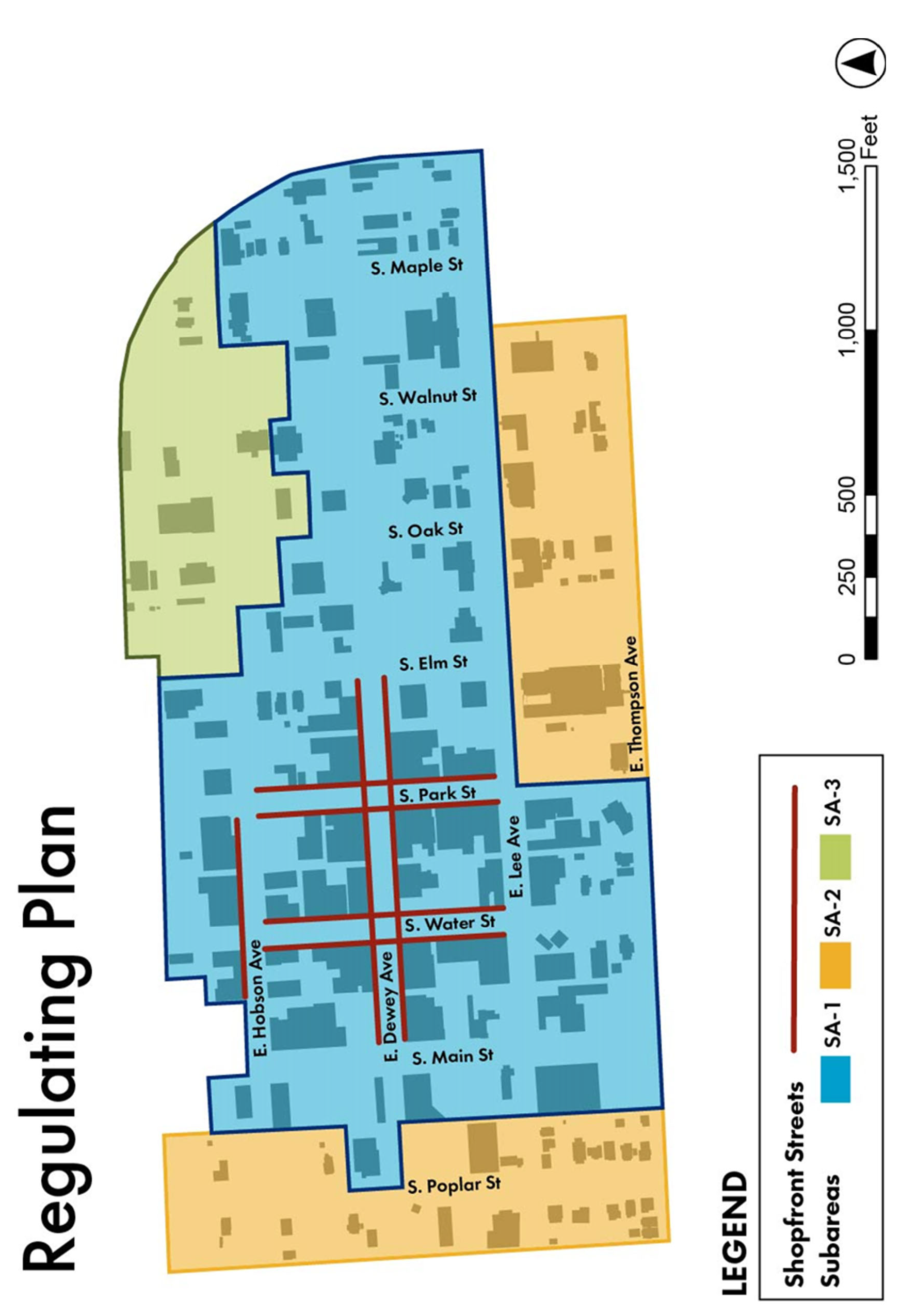
These standards and the downtown code apply to all properties in the boundaries identified in the Downtown Regulating Plan, which is shown on Section 1902.K of this Chapter and is herein incorporated by reference.
2.
This Code does not govern requirements and regulations related to the use of Historic Tax Credits or official Historic Registry status. Applicants should reach out to the applicable government agencies to determine specific requirements regarding seeking the use of these types of funds and designation approval requirements.
B.
Purpose.
1.
The Downtown Code regulations were developed for the purpose of promoting the appropriate redevelopment of land and buildings within the downtown core of Sapulpa and to encourage and attract new retail, commercial, office, and higher density residential uses.
2.
The Downtown Code helps to foster predictable results and a high-quality public realm by prescribing the physical form of buildings and other elements and addressing the relationship between building facades and the public realm, the form and mass of buildings in relation to one another, and the scale and types of streets and blocks.
C.
Intent. The Downtown Code is intended to achieve design excellence in the built environment by:
1.
Facilitating residential and mixed-use development that is visually interesting, pedestrian friendly, and of a quality that benefits the downtown experience and its design character.
2.
Providing building and sit design standards that address the public aspects of private development and how building form, placement and uses contribute to the quality of the public realm.
3.
Providing design standards that promote appropriate and complimentary development and/or redevelopment within the existing historic fabric of downtown.
4.
Providing clear regulations and processes that result in predictable, efficient, and coordinated review and approval.
D.
Administration.
1.
All applications for development within the district code boundary shall submit site plans, building elevations, and all other evidence needed to sufficiently demonstrate conformance with this Code.
2.
Authority. The administration of the Downtown Code will be overseen by the Sapulpa Urban Development Department. A designated staff member will be known as the Downtown Code Administrator and is responsible for the day-to-day administration of this Code and the regulations provided within.
3.
Delegation of authority. The Downtown Code Administrator may designate any staff member to represent them in any function assigned by this Code. The Downtown Code Administrator remains responsible for any final action.
E.
Approval process.
1.
Applicability. All private construction projects are subject to review by the Downtown Code Administrator. All buildings, streets, and public spaces by public entities are also subject to review.
2.
Administrative vs. Historic Preservation Commission Review vs. Board of Adjustment.
a.
Rehab or renovation projects that conform to all standards of this Code may be approved administratively by the Downtown Code Administrator without review by the Historic Preservation Committee.
b.
The Historic Preservation Committee will review and make recommendations to Board of Adjustment for applications that require major modifications.
c.
All new construction projects, even if new construction projects meet all code requirements, shall undergo a courtesy review by the Historic Preservation Commission for the purpose of making recommendations to the Downtown Administrator.
F.
Review process.
1.
Before submitting an application for review, applicants are required to schedule a meeting with the Downtown Code Administrator to discuss the review procedures and applicable standards for approval. This meeting is not intended for approval, but to provide the applicant with an overview of the application requirements and to identify issues or opportunities relating to compliance with the requirements of this Code.
2.
Applications must be submitted to the Downtown Code Administrator and shall provide all the site plan requirements outlined in the Sapulpa Zoning Code, Section 660.3 Site Plan Shall Contain.
3.
All applications must be complete for processing before the Downtown Code Administrator is required to review the application. The Downtown Code Administrator will notify the applicant whether the application is complete or whether additional information is required.
4.
An application is sufficient for processing when it contains information necessary to determine whether or not the development as proposed will comply with the Downtown Code standards.
5.
Upon determination of a complete application, the Downtown Code Administrator will distribute the application for review to applicable City departments and external agencies as needed.
6.
The Downtown Code Administrator will determine whether the application conforms to all applicable requirements of the Code.
7.
Final action on an application will be based solely on compliance with all applicable provisions of this Code and other applicable technical requirements.
8.
If an application is denied, the reasons for denial must be stated in writing, specifying the provisions of the Downtown Code that are not in compliance. A revised application may be submitted for further consideration.
G.
District Code modifications.
1.
Purpose.
a.
This section establishes the procedure for considering requests for modifications to the District Code standards.
b.
It is the applicant's responsibility to adequately demonstrate reasons for the requested modification and to illustrate how the requested modification is a legitimate site constraint and/or how the modification would equal or exceed the established standards.
2.
Guiding principles. Legitimacy for modifications to the Downtown Code shall be weighed against the following guiding principles:
a.
Supports the Sapulpa Downtown Master Plan and policy recommendations contained herein for the Downtown's long-term development vision.
b.
Maintains or creates a safe, walkable, and attractive environment along the street edge.
c.
Maximizes opportunities for redevelopment and investment.
d.
Requires excellence in the design of the public realm and of buildings that front public spaces.
3.
Minor modifications.
a.
During the review process, the Downtown Code Administrator is authorized to approve the following minor code modifications at the request of the applicant.
b.
When the administrative variance is granted, it must be justified by the Downtown Master Plan and this downtown code's purpose and intent.
i.
Increase up to five (5) feet of a maximum front yard setback.
ii.
Increase of up to ten (10) feet of the maximum building height.
iii.
Increase of up to ten (10) feet of the maximum building length required.
iv.
Decrease of up to five (5) percent of the minimum transparency required along street facing facades.
v.
Increase of up to five (5) square feet of a maximum allowed blank wall area on street-facing facades.
4.
Major modifications/variances.
a.
Variances to a standard in this district code, other than identified in "3. Minor Modifications" above, shall be reviewed by the Historic Preservation Commission for recommendation of approval or denial to the Board of Adjustment.
b.
Variances requested for approval or denial by the Board of Adjustment shall be based on the following considerations:
i.
The modification will not result in a substantial departure from the basic urban design principles and vision established by the Downtown Master Plan and design guidelines contained herein.
ii.
The applicant meets the burden of presenting alternative means of compliance that demonstrate how the variance would equal or exceed the existing standards in terms of achieving the guiding principles stated above in subsection 2, Guiding Principles.
iii.
The physical conditions of the property (i.e.: steep slopes, floodplain, lot shape, utilities, existing trees, or easements, etc.) that make compliance impossible.
iv.
That this hardship is not created by the applicant or financial in nature.
c.
Variances to citywide standards not identified in "3. Minor Modifications and 4. Major Modifications" above shall be processed according to their usual procedures.
d.
Variances granted within this downtown code shall only apply to the specific lot seeking such variance, not to the overall downtown. No variance that applies to all lots in this downtown code may be granted except as a downtown code modification to this regulation document.
5.
Appeals.
a.
Applicants have the right to appeal to the District Court a decision given by the Board of Adjustment.
H.
Exceptions. All development authorized by these standards must conform to all other requirements of the City of Sapulpa Zoning Ordinance, except as specifically stated to the contrary in this. When a conflict exists between these standards and the Sapulpa Zoning Code, these standards shall prevail.
I.
Redevelopment thresholds. All exterior renovations, modifications and/or additions to existing structures are subject to review by the Downtown Code Administrator. The following table outlines redevelopment thresholds that trigger conformance with the downtown code:
M = Mandatory conformance
X = No mandatory conformance.
Redevelopment Thresholds Summary Table
J.
Regulating plan.
1.
The Downtown Code Regulating Plan (the "Regulating Plan") in Section 1902.K of this chapter shows the location of the following:
a.
Subareas.
b.
Shopfront streets.
K.
Subareas established.
1.
The following subareas are established in the regulating plan and regulated by this Code:
a.
Subarea 1 (SA-1), is intended to provide mixed use development in the downtown core that supports its role as a focal point for the city.
b.
Subarea 2 (SA-2), is intended to serve as a transition into the downtown and allow for appropriately scaled and designed higher density residential with some supporting retail and commercial uses.
c.
Subarea 3 (SA-3) is intended to serve as a primary area for redevelopment and new development next to the existing rail line and industrial uses.
L.
Text and graphics. Illustrations, photos, and graphics are included in this Code to illustrate the intent and requirements of the text. In the case of a conflict between the text and any illustrations, photos, or graphics otherwise found in these standards or other parts of this Code, the text of the code and standards govern.
M.
Reference to specific brands. These standards and the downtown code include specific products and brands for illustrative purposes only. The use of specific products and brands is not required. Visually similar designs and material quality may be used when approved by the Downtown Code Administrator.
(Ord. No. 2921, § 1, 7-3-2023)
Sec. 1903. - Use standards.
A.
Permitted uses.
1.
The following table states the permitted principal uses authorized within all the subareas of the downtown code. Symbols used in the table have the following meanings:
P = Permitted as a principal use and subject to any use standards of this district code.
A = Permitted as an accessory use and subject to Section 620, Accessory Uses permitted in commercial districts of the Sapulpa Zoning Code.
S = Permitted as a Specific Use Permit and subject to Chapter 18, Section 12, Specific Use Permits of the Sapulpa Zoning Code.
T = Permitted as a Temporary Use.
2.
When a use is permitted in the following table, the use standards of Chapter 9: Use Units of the Sapulpa Zoning Code also apply, except when otherwise stated in these standards.
3.
The Downtown Code Administrator is authorized to prepare a written interpretation of whether a proposed use not specifically listed in this table is so similar in nature to a permitted use that it is also intended to be permitted. Such determination shall be made in conformance with Chapter 1, Section 110 Purpose, interpretation, and jurisdiction of the Sapulpa Zoning Code.
4.
Any use not listed in the table as permitted and not determined by the Downtown Code Administrator to be similar in nature to a listed use, is prohibited.
B.
Live-work unit standards.
1.
Live-work units shall be mixed-use dwellings that are fire separated from adjacent units as attached dwellings, such as townhouses or as part of a larger mixed-use building.
2.
The owner-proprietor of the business shall be the occupant of the residential portion of the unit.
3.
An occupational tax certificate shall be required for the operation of a business. The business shall not be considered a home occupation.
4.
The business use or activity shall not employ more than three (3) persons other than the owner-proprietor.
5.
All permitted businesses allowed in the district are allowed in the live-work unit.
C.
Multi-family development standards.
1.
Multi-family development is only permitted in Subarea 1, if it is part of a larger mixed-use development or redevelopment.
2.
Redevelopment of existing buildings in Subarea 1 with upper story residential units are not subject to parking requirements.
3.
Multi-family development must be located above an active ground floor use when located along a shopfront street identified in the regulating plan.
4.
New multi-family development projects located in Subareas 2 and 3 are subject to parking requirements, see Section 1910.
5.
Quad/tri-plex developments are permitted in Subarea 1 but shall not be developed on a shopfront street.
D.
General standards for all parking structure facades.
1.
All pedestrian level parking structure facades that face a public space shall be designed to incorporate architectural elements and materials that complement the adjacent building or buildings in the area.
a.
Landscaping (trees, shrubs, and green screens) may be utilized for screening purposes but must screen all pedestrian level parking garage facades immediately upon instillation.
b.
The property owner is responsible for maintaining all required landscaping in good health and condition and the removal of any litter that has accumulated in landscaped areas.
E.
Mixed-use and restaurant standards.
1.
In Subarea 2, mixed-use and restaurant development is only allowed on parcels that front E. Lee Ave. and N. Poplar St.
Permitted Use Table
(Ord. No. 2921, § 1, 7-3-2023)
Sec. 1904. - Building types.
Building types regulate the design of buildings in this downtown code. Each building type and standards are described below. All buildings must conform to the applicable standards. A building's type is determined by the Downtown Code Administrator. Building types are for zoning purposes only and not linked to the Building Code.
Note 1: Parking structures are not considered a building type. See Section 1903.D above for parking structure standards.
Note 2: Accessory Dwelling units do not have specialized design standards unless otherwise noted. They are subject to the design standards in which they are permitted.
A.
Single-family. A building type that is a single, detached house on a single lot. This building form may include building details such as a front porch, front stoops, and an attached or detached garage.
B.
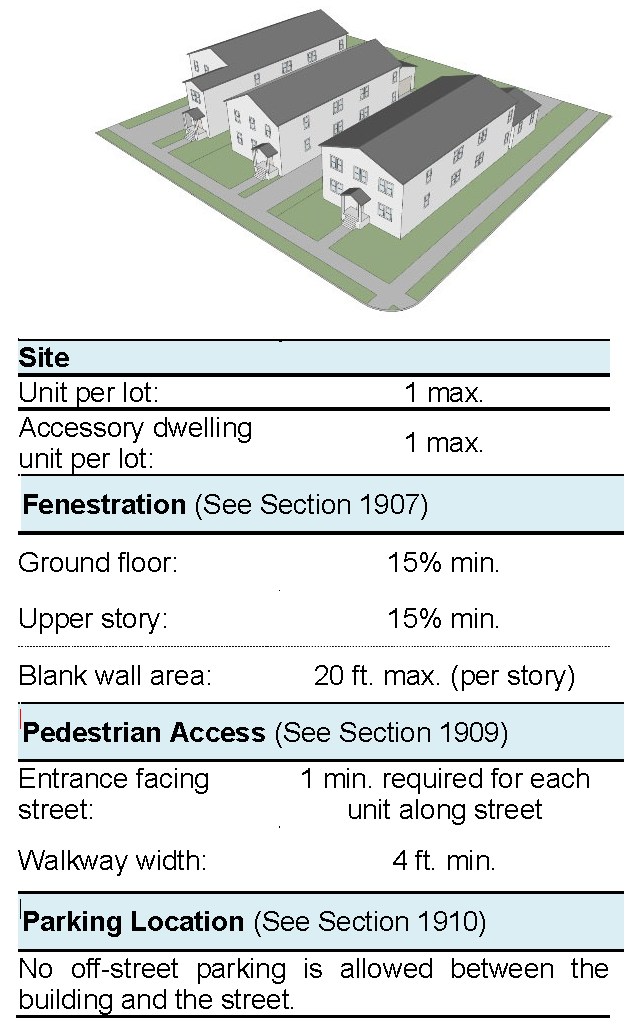
Duplex. A Duplex is a residential building occupied by two (2) dwelling units, both which are located on a single lot that is not occupied by other principal residential buildings. Duplex can be designed in a number of configurations:
•
Two (2) side-by-side units.
•
Split form with one (1) unit facing the primary street and the other facing a secondary street or side yard.
•
A front to back configuration with one (1) unit located directly behind the other unit.
•
A split-level unit with one unit on the ground-level and the other on the upper level.
C.
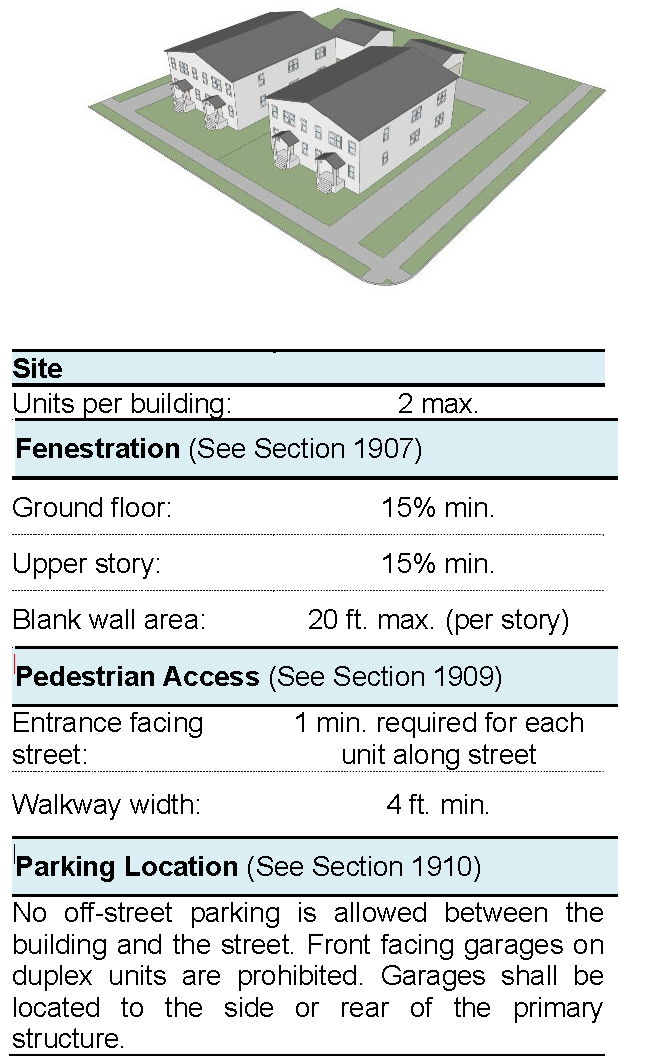
Cottage court. A building type that is a small, detached structure that is clustered around a common open space or courtyard, which is oriented perpendicular to the street. The common open space becomes an important gathering space. This building type fits within single-family and medium density neighborhoods. Parking can occur in many configurations:
•
Rear attached or detached garages tied to individual homes.
•
Rear attached carport.
•
Rear detached communal garages within scattered surface parking lots.
D.
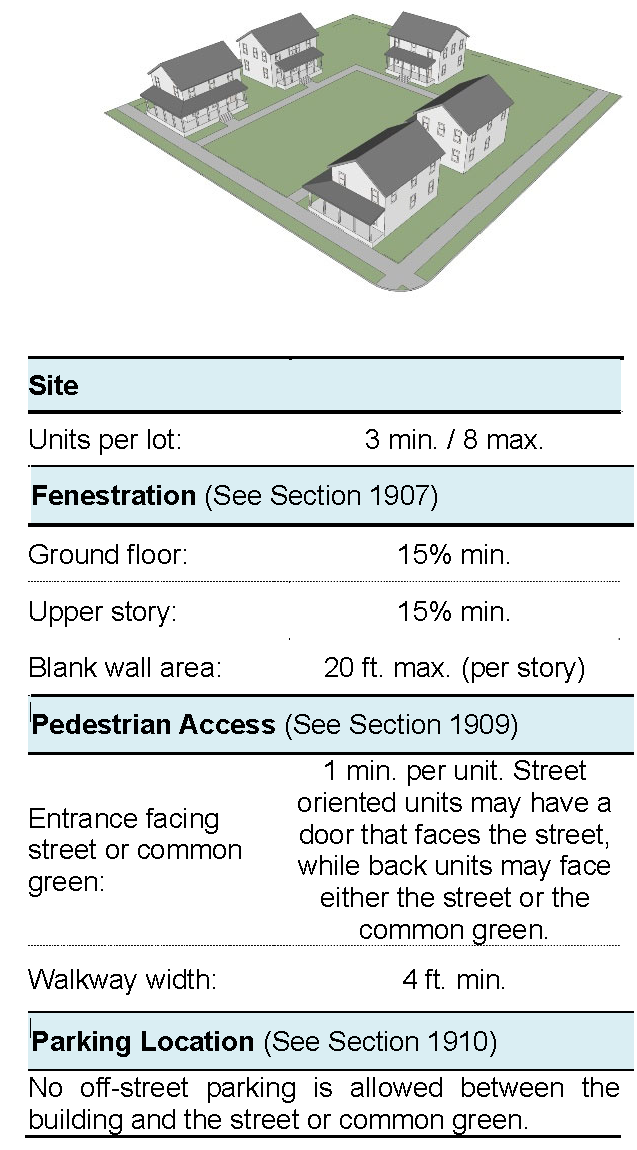
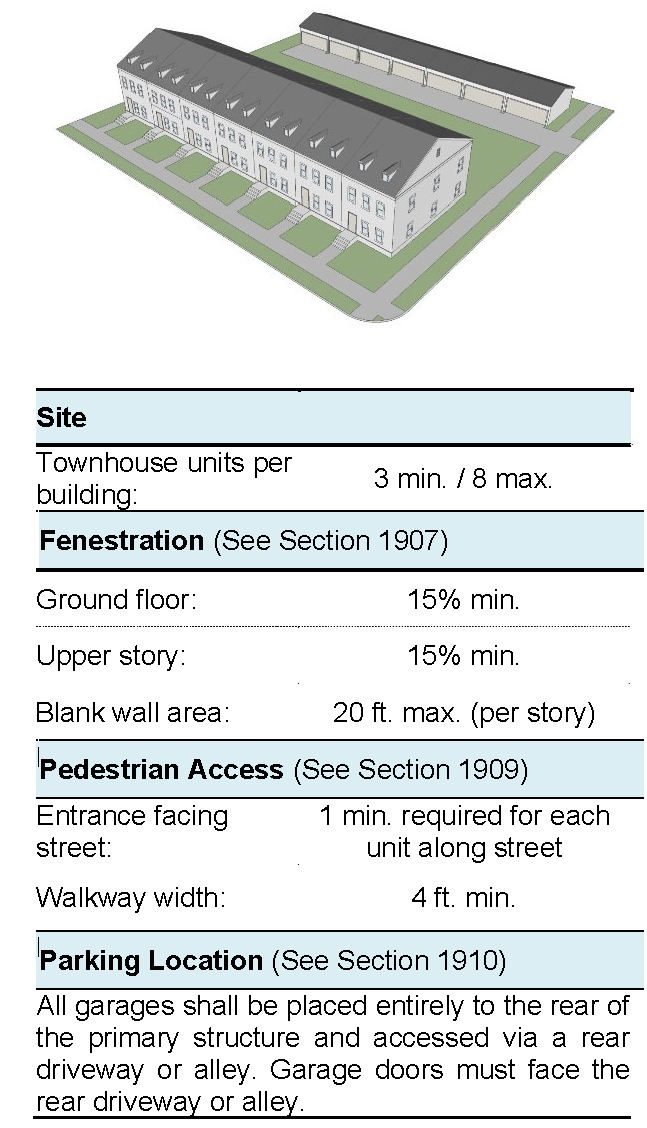
Townhouse. A building type that accommodates three (3) or more dwelling units where each unit is separated by a common side wall. Units cannot be vertically mixed. Not for non-residential use, except live-work. May be located on induvial lots or on a single lot.
E.
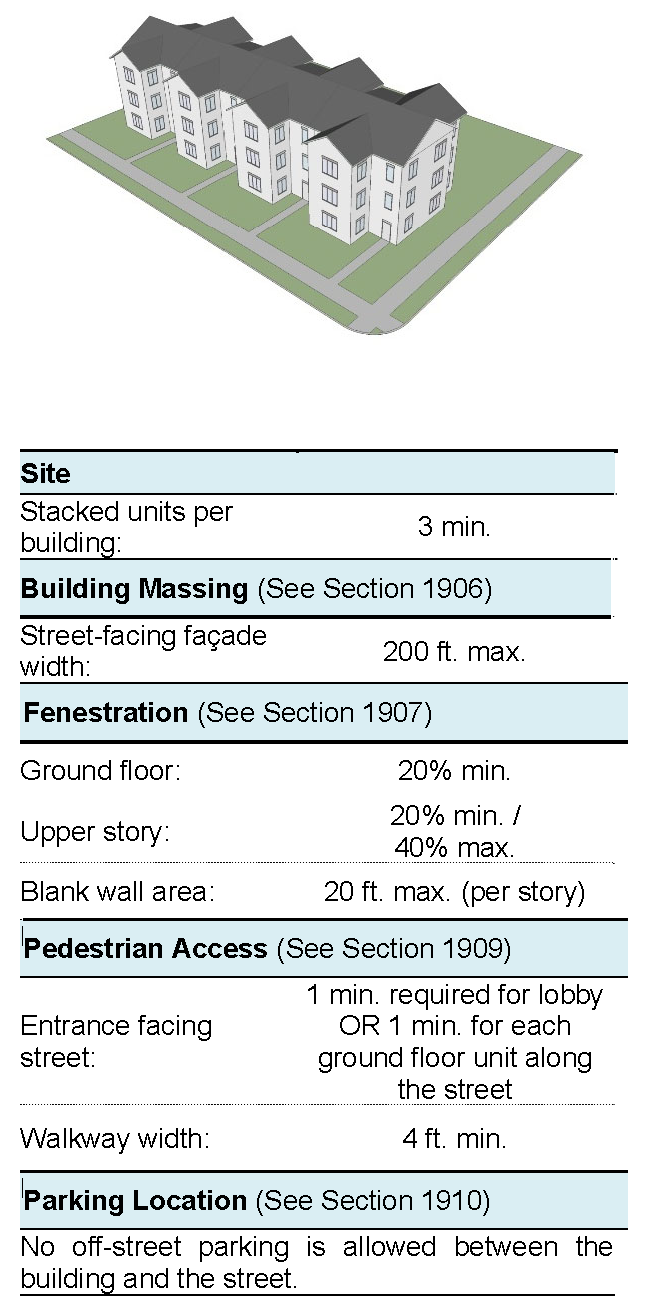
Multi-family. A building type that accommodates three (3) or more dwelling units vertically and horizontally integrated, not including the townhouse building type. Not for non-residential use, except live-work.
F.
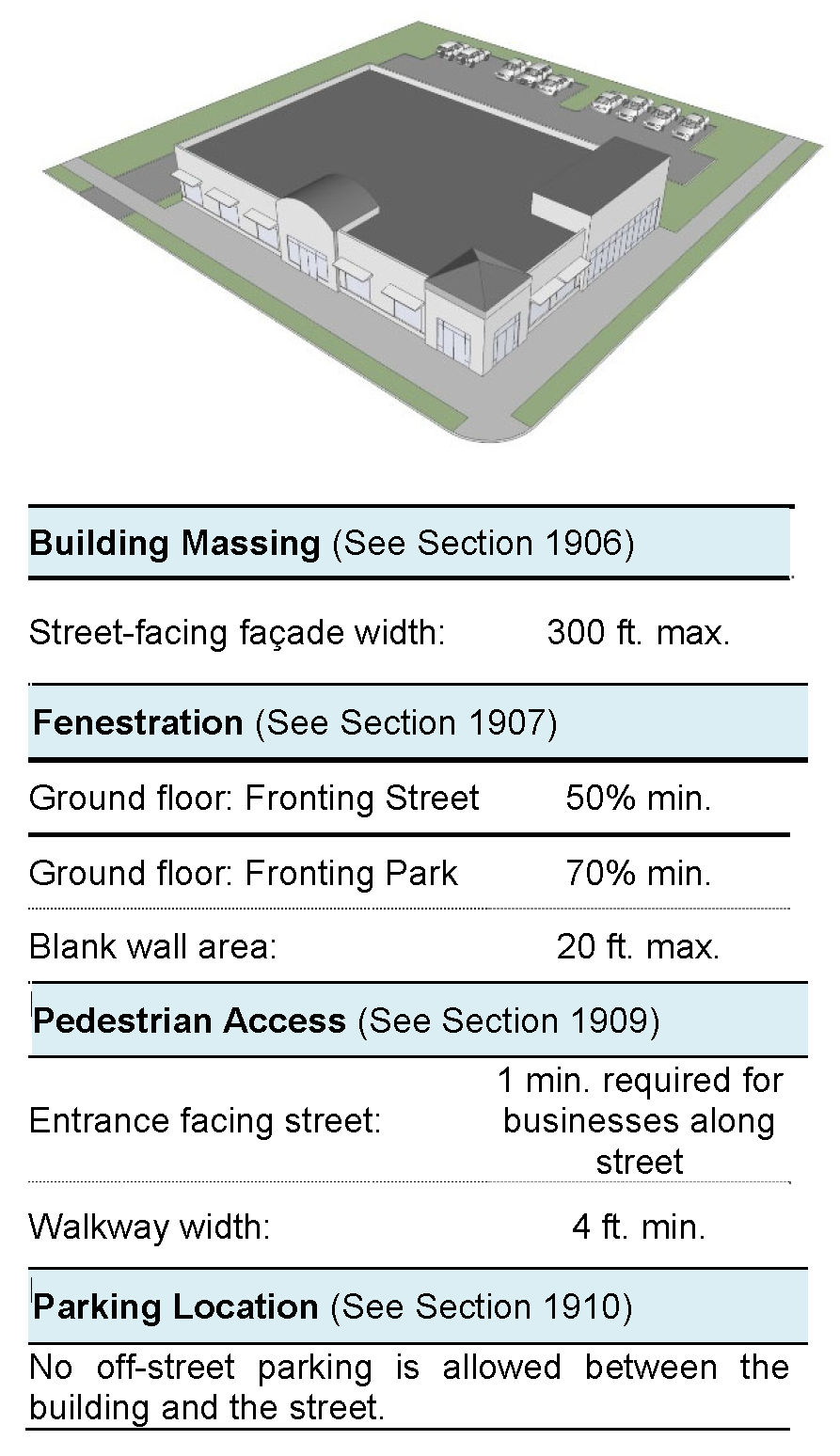
Shopfront. A single-story building type that accommodates retail or other commercial activity. Not for residential uses.
G.
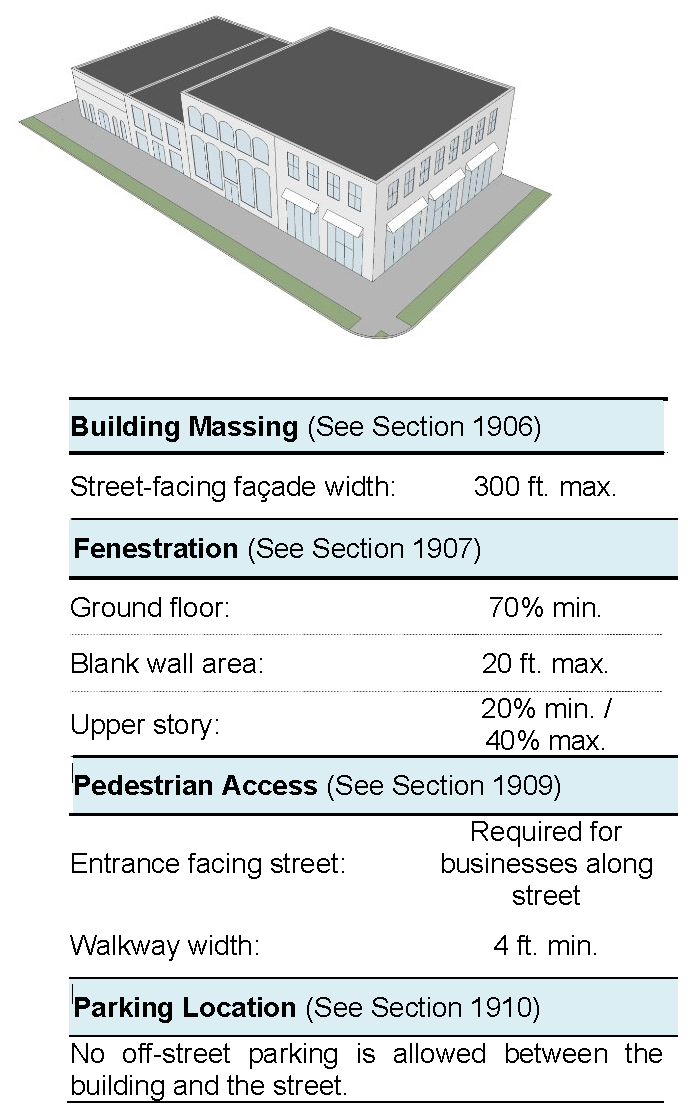
Mixed-use building. A multi-story building type that accommodates ground floor retail, office, convertible, or commercial uses with upper-story residential or office uses.
H.
General building. A multi-story building type that typically accommodates non-residential uses, such as hotel, office, or medical uses on all stories.
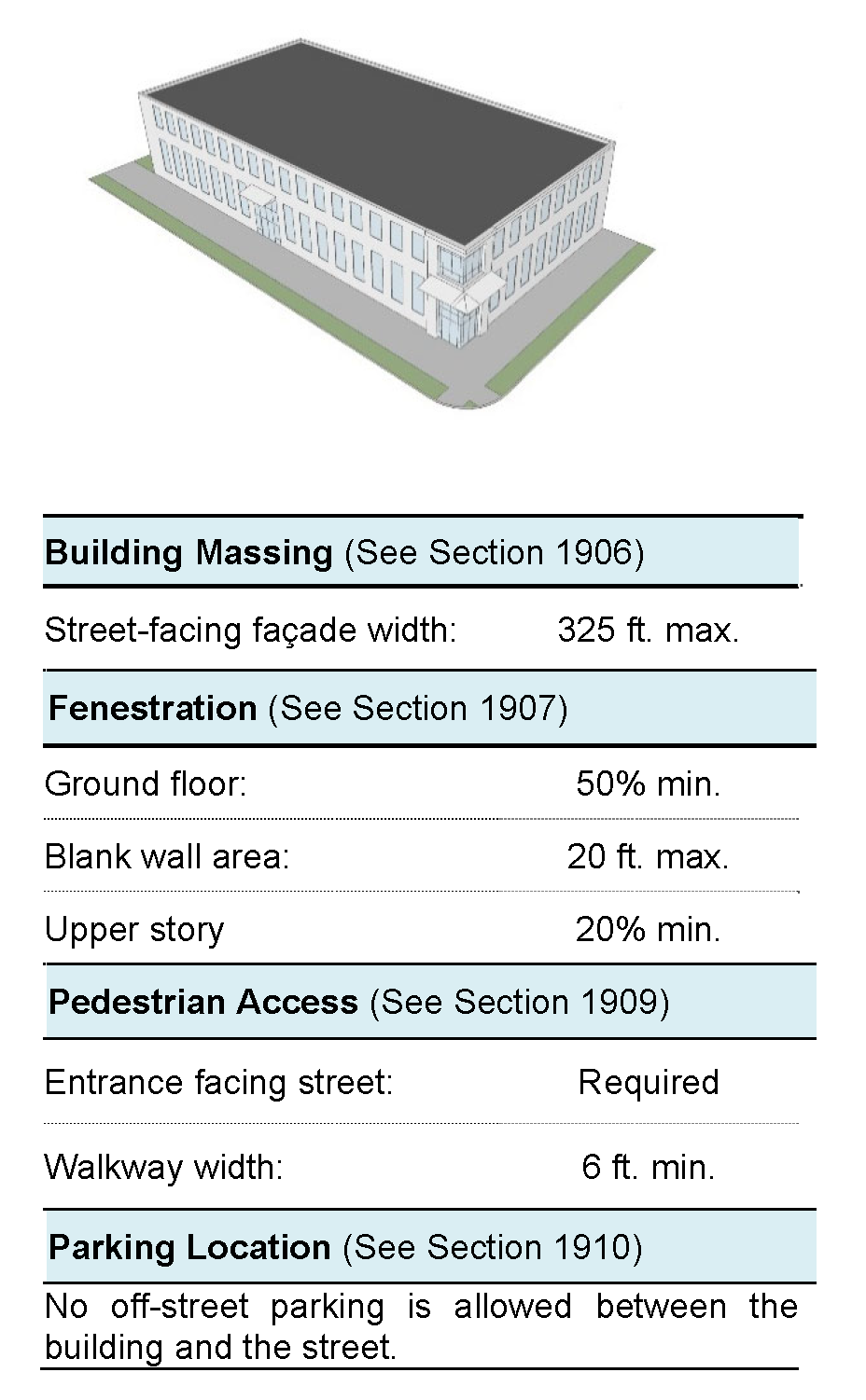
I.
Civic building. A building type that typically accommodates civic, institutional, or public uses. Not intended for commercial, retail, office, or residential uses.
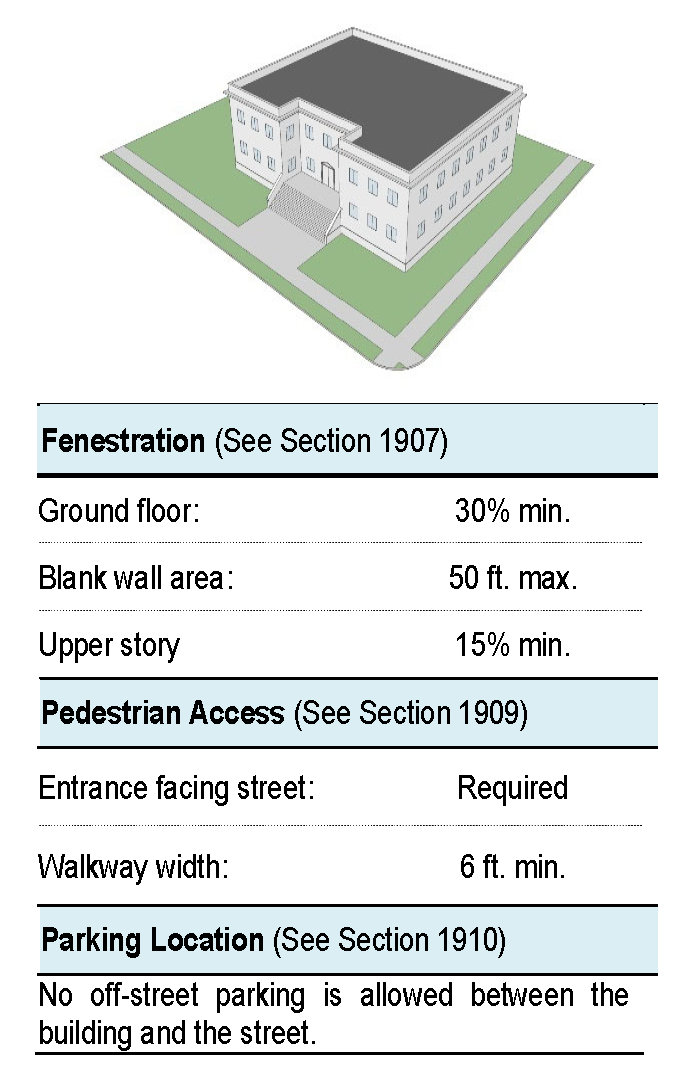
J.
Active uses. The following applies to all building types located in Subarea 1 along designated shopfront streets:
1.
No building façade that abuts a shopfront street may contain storage or equipment rooms along the street frontage.
2.
All building facades that abut a designated shopfront street identified in the Regulating Plan, shall provide active, high pedestrian foot traffic uses. Buildings solely used for storage or equipment rooms are not permitted along such street.
(Ord. No. 2921, § 1, 7-3-2023)
Sec. 1905. - Dimensional standards.
A.
Site and lot standards.
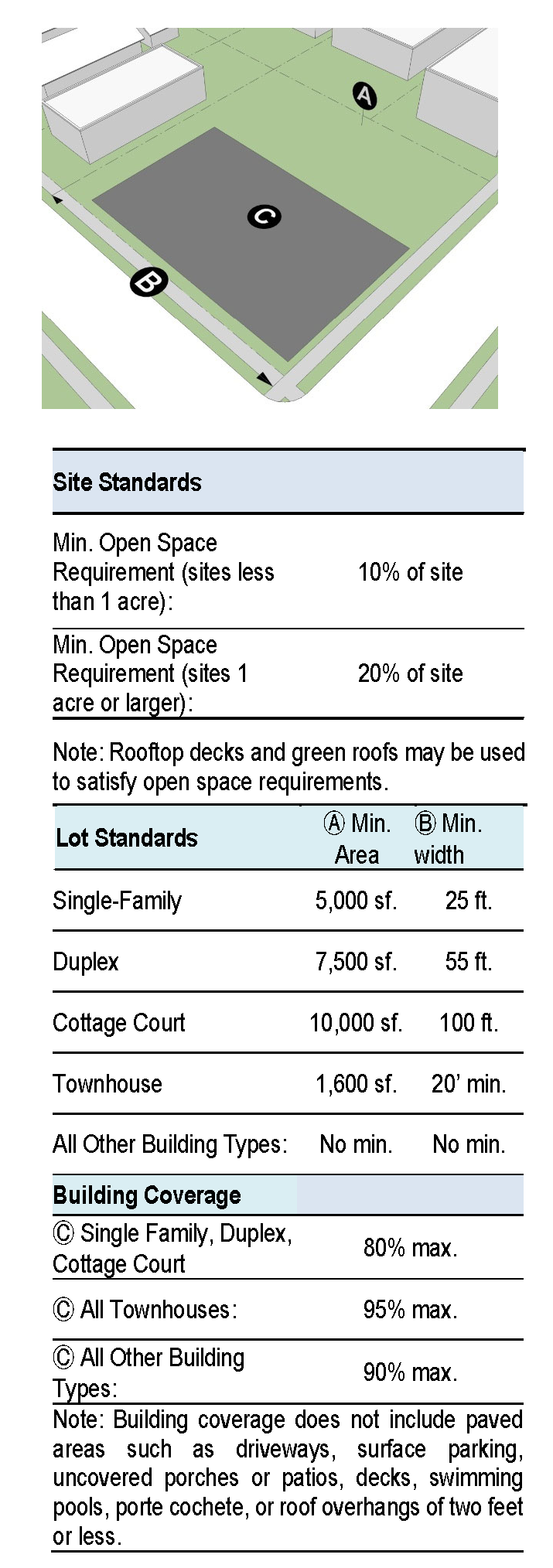
B.
Building placement.
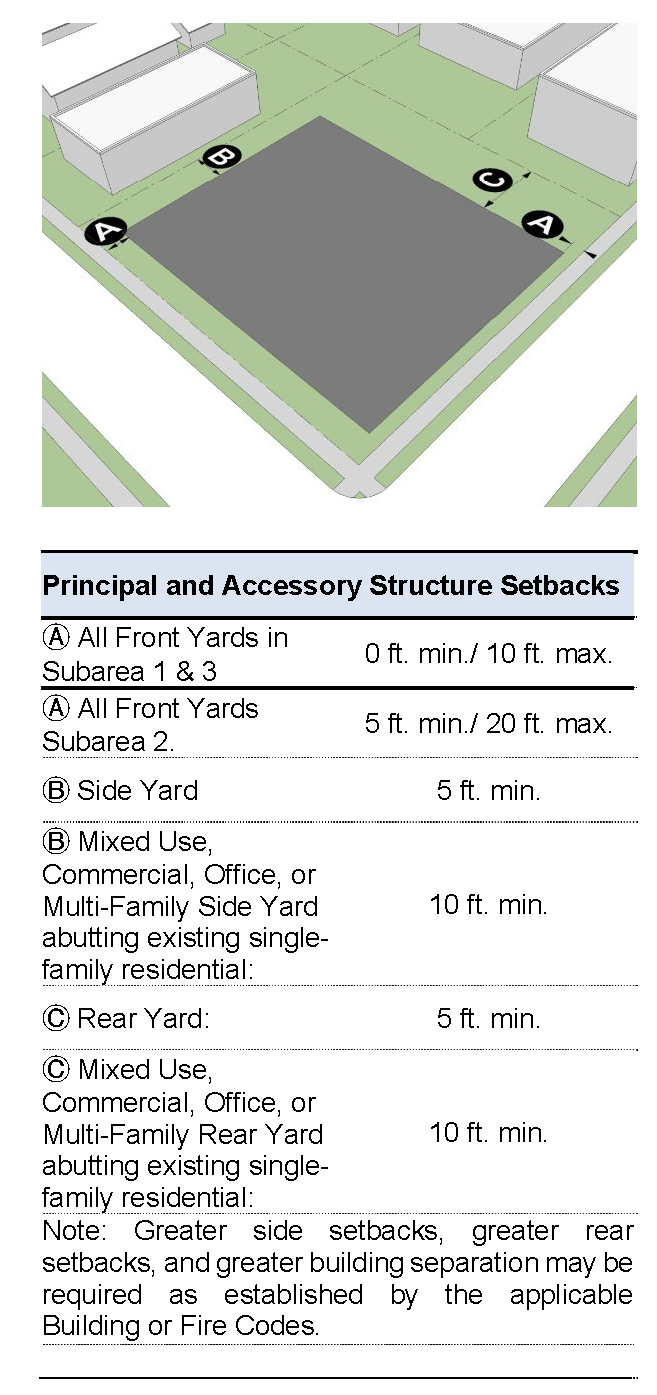
C.
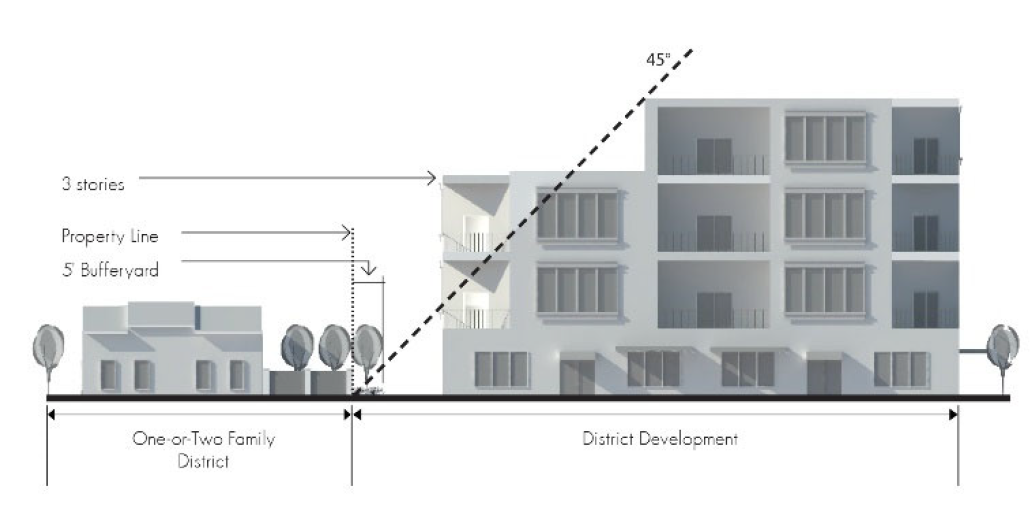
Transitional height plane setback. This standard is intended to establish an appropriate transition in height between established residential dwellings that abut Subareas 1, 2, and 3 and new buildings.
1.
No transitional height plane is required between Subarea 1, 2, and 3.
2.
A transitional height plane setback is required when Subarea 2 or 3 when property is abutting an established one- or two-family zoned property that falls outside Subarea 2 or Subarea 3.
3.
A transitional height plane of forty-five degrees (45°) shall apply to portions of a building above 3 stories starting from the property line of the one- or two-family zoned property. Any portion of the building above 3 stories shall be set back so that the building does not encroach the transitional height plane.
4.
The transitional height plane setback shall not apply to buildings adjacent to one- or two-family zoned property that serves as public open space, such as parks, streets, and drainage ways.
D.
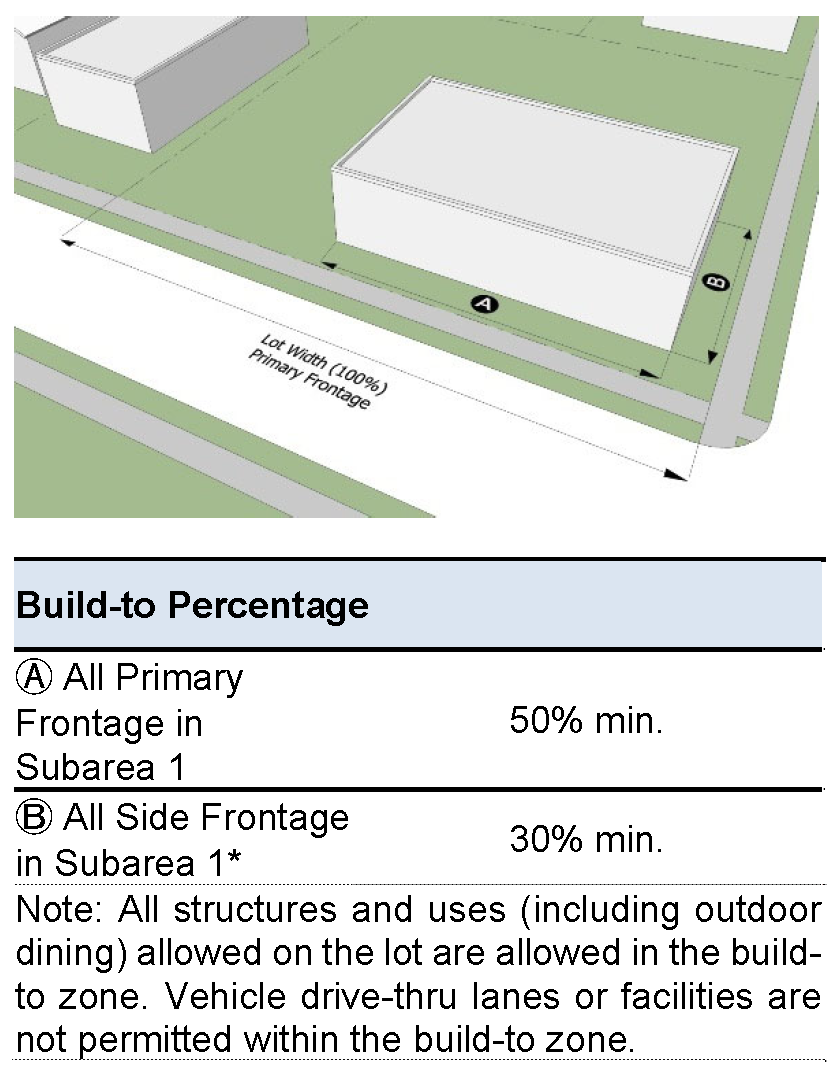
Build-to zone. The build-to zone is the area on the lot where a certain percentage of the front building facade must be located, within the setback range from the edge of the right-of-way. Build-to zones shall apply only to the ground floor of the building.
E.
Non-conforming build-to zone.
1.
Expansion of an existing building which is unable to meet the build-to requirements must comply with the following nonconforming provisions.
2.
Front addition: Any addition to the front of the building must be placed in the build-to zone; however, the addition does not have to meet the build-to percentage for the lot.
3.
Rear addition: Rear additions are allowed because the extension does not increase the degree of nonconformity.
4.
Side addition: Side additions not located within the build-to zone are not allowed because the extension increases the width of the building outside the build-to zone.
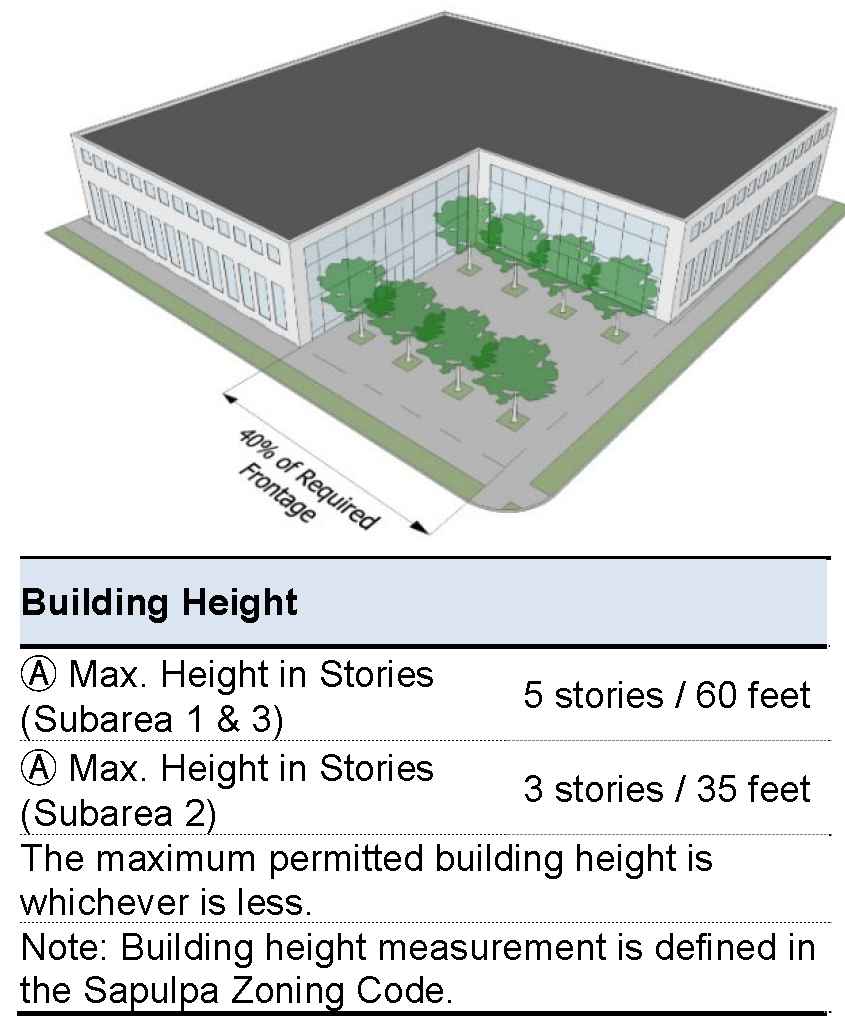
F.
Building frontage alternatives.
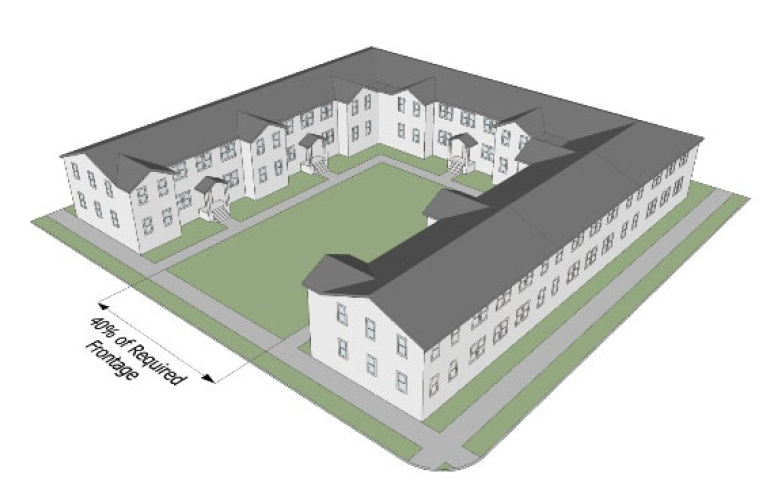
1.
Residential garden court: Forty (40) percent of required frontage.
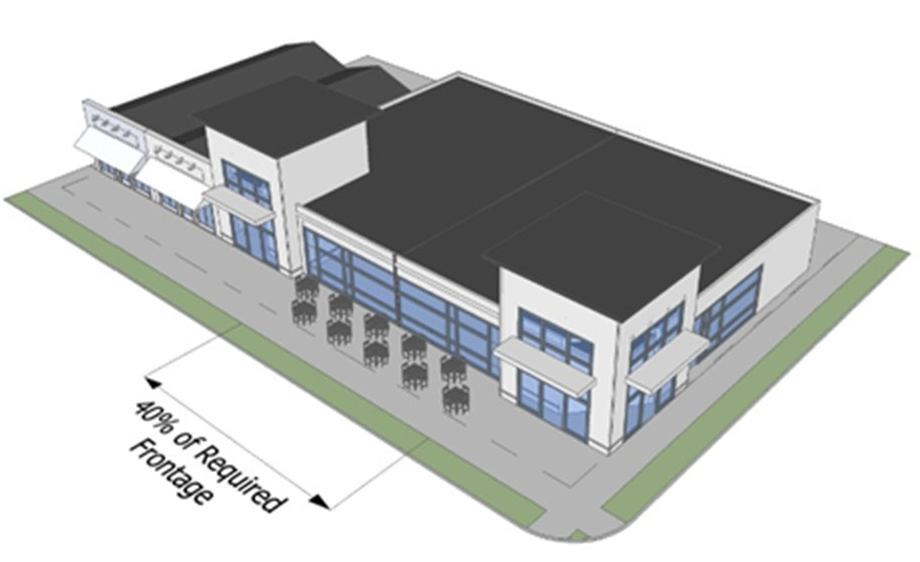
2.
Outdoor seating: Forty (40) percent of required frontage
3.
Plaza: Forty (40) percent of required frontage.
(Ord. No. 2921, § 1, 7-3-2023)
Sec. 1906. - Building massing.
A.
General.
1.
Building massing standards apply to the following building types which include a maximum street-facing façade width:
a.
Multi-family;
b.
Shopfront;
c.
Mixed-use; and
d.
General.
B.
Submittal requirements. All building massing standards with calculations verifying that the building elevations meet the requirements shall be submitted with building facade elevation plans and a site plan for review by the Downtown Code Administrator.
C.
Standards.
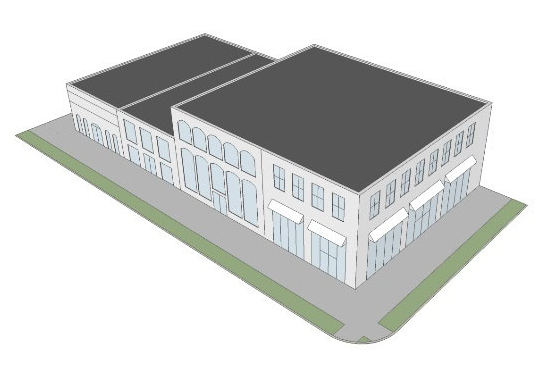
1.
Street-facing building façades must use one of the following to divide the façade into vertical divisions at increments no greater than the maximum width dimension shown for building type, as measured along the base of the façade:
a.
A change of façade material and window systems from grade to roof, and change of building height of at least one story; or
b.
A change in façade composition from grade to the roof; or
c.
Similar means intended to convey the impression of separate buildings.
(Ord. No. 2921, § 1, 7-3-2023)
Sec. 1907. - Fenestration.
A.
Standards.
1.
Fenestration shall conform to the requirements for the particular building type established in Section 1904: Building Types.
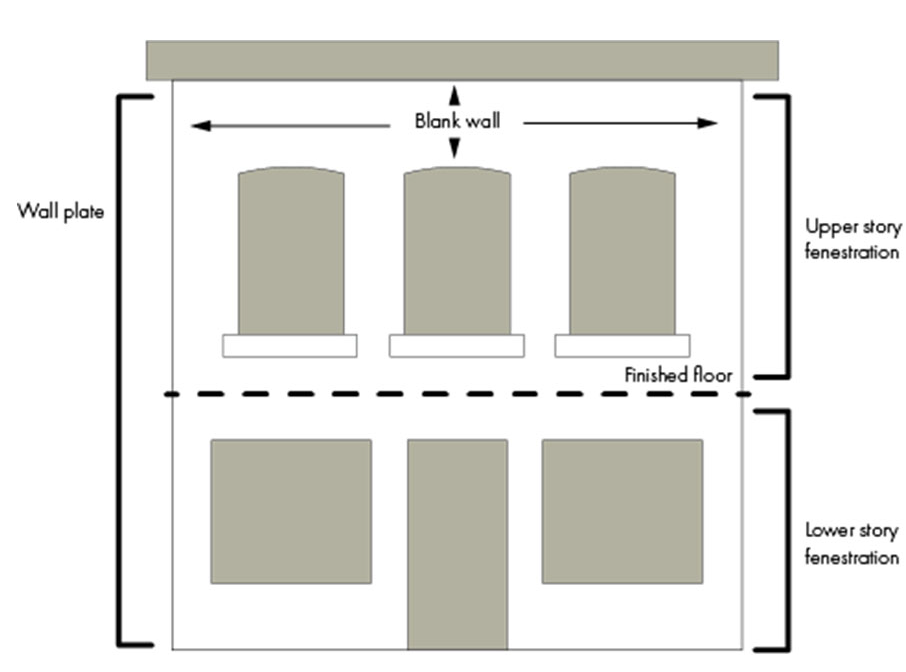
2.
Fenestration is the minimum percentage of window and door glass that must cover a façade. It is calculated based on façade area and by floor.
3.
Fenestration requirements apply to façades that abut a street (not including an alley).
4.
Glass used to satisfy fenestration requirements shall be unpainted, shall have a transparency (visible light transmission) higher than seventy (70) percent, and shall have an external reflectance of less than fifteen (15) percent. Transparency and external light reflectance shall be established using the manufacturer's specifications.
5.
Window frames, sashes, mullions, and similar features that are integral to the window system count towards fenestration requirements. Opaque doors do not.
6.
The façade area used to determine fenestration is measured from the top of the finished floor to the top of the finished floor above.
7.
When there is no floor above, fenestration is measured from the top of the finished floor to the top of the wall plate.
8.
Blank wall area is measured in linear feet applied in both a vertical and horizontal direction.
9.
Blank wall area applies to ground and upper story façades that face a street (not including an alley).
(Ord. No. 2921, § 1, 7-3-2023)
Sec. 1908. - Required materials.
Not less than eighty (80) percent of all new building facades facing publicly accessible streets or open space shall be constructed of the following masonry materials:
1.
Stone;
2.
Brick;
3.
Terra cotta;
4.
Patterned pre-cast concrete;
5.
Cement plaster stucco;
6.
Cement board siding (Hardie board);
7.
Cast stone or refabricated brick panels;
8.
Architectural metal;
9.
Other staff approved materials. Applicant must provide manufacturers product information to show proof that the alterative material meets the same level and design standard of quality, durability, and longevity as other approved masonry materials.
A.
Exceptions. Masonry requirements do not apply to trim work such as gables and soffits. The masonry coverage calculation does not include doors, windows, window box outs, eaves, or bay windows that do not extend to the foundation.
B.
Temporary construction buildings. Temporary building and temporary building material storage areas to be used for construction purposes may be permitted for a specific period of time in accordance with a permit issued by the city and subject to periodic renewal.
C.
Submittal requirements. All building material standards with calculations verifying that the building elevations meet the requirements shall be submitted with building facade elevation plans and a site plan for review by the Downtown Code Administrator.
(Ord. No. 2921, § 1, 7-3-2023)
Sec. 1909. - Pedestrian access.
A.
Required.
1.
An entrance providing both ingress and egress, operable to residents at all times, or customers during business hours, is required to meet the street-facing entrance requirements outlined in Section 1904: Building Types. Additional entrances off another street, pedestrian area, or internal parking area are permitted and encouraged.
2.
When a building type includes a maximum street-facing facade width, the entrance requirements must be met on each required vertical division.
3.
Required walkways must be paved surfaces that connect the pedestrian entrance to the closest public sidewalk.
B.
Submittal requirements.
1.
All pedestrian access standards with access locations verifying that the building elevations meet the requirements shall be submitted with building facade elevation plans and a site plan for review by the Downtown Code Administrator.
C.
Streetscapes.
1.
Both new and proposed streetscapes located within Subareas 1, 2 and 3 shall conform to the standards shown in Chapter 4 of the Sapulpa Downtown Master Plan and the Historic Downtown Design Standards and Guidelines included herein, except when an official City plan or project uses an alternate design.
2.
Streetscapes not identified in subsection 1 above must conform to the City of Sapulpa Street Engineering requirements, except when an official City plan or project uses an alternate design.
(Ord. No. 2921, § 1, 7-3-2023)
Sec. 1910. - Parking and loading.
A.
Vehicular parking.
1.
General requirements.
a.
Off-street parking and loading requirements are subject to Chapter 10, Off-street Parking and Loading of the Sapulpa Zoning Code unless otherwise stated in this district code.
2.
Minimum requirement.
a.
There are no minimum parking requirements for Subarea 1.
b.
Subareas 2 and 3 are subject to Chapter 10, Off-street Parking and Loading of the Sapulpa Zoning Code.
3.
Reduced parking.
a.
New mixed-use development projects located in Subareas 2 and 3 are eligible for a twenty (20) percent reduction in parking requirements.
4.
Shared parking.
a.
Shared use parking facilities may be used to meet minimum parking requirements. The total number of spaces shall not exceed the sum of the maximum spaces allowed for all individual uses sharing the facility.
b.
Shared parking spaces is allowed if the following documentation is submitted in writing as part of the building permit application or site plan review:
i.
The names and addresses of the uses and of the owners or tenants that are sharing the parking;
ii.
The location and number of parking spaces that are being shared;
iii.
An analysis showing that the peak parking demands for the different uses occur at different times, and that the parking area will supply at least the minimum number of required spaces for each use during its respective peak parking times.
iv.
A legal instrument such as an easement or deed restriction that guarantees access to the shared parking for all uses.
5.
Maximum allowed.
a.
For a mixed-use building and mixed-use development projects, the maximum parking allowed shall be the sum of the individual requirements for each use.
6.
Structured parking, general.
a.
All structured parking, regardless of whether or not it is a principal use, accessory use, freestanding, or part of a building, shall conform to the requirements of Section 1903.D: General Standards for all Parking Structure Standards.
B.
Location of parking.
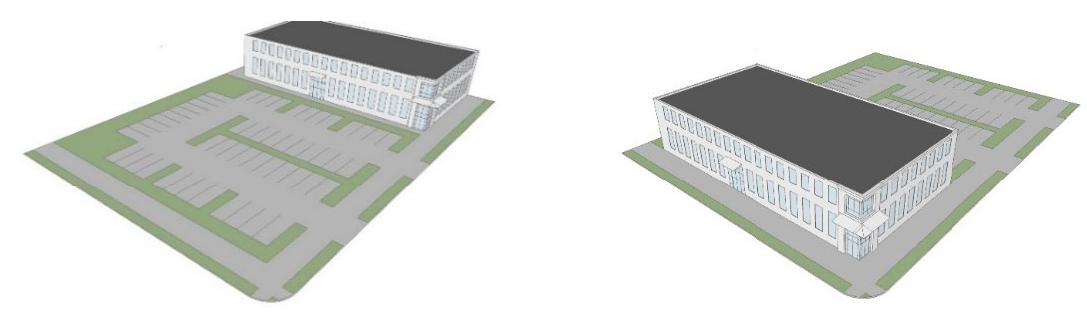
1.
Off-street parking lots, driveways, or drive thru shall not be permitted between a building front and the street. Surface parking lots shall be located behind the building.
2.
If accommodating all parking behind the building is infeasible, parking may be located to the side of the building and shall meet the parking screening requirements outlined in this Code.
3.
Townhouses: Townhouse garages shall only be accessed through a rear alley or shared driveway and shall not face a public street.
4.
Garage and carport location: Buildings shall locate garages behind primary buildings where rear alleys or driveways are provided. If a rear alley or driveway is not provided, all parking for single-family detached shall be located behind the front building line. Garage doors that face the street must be located a minimum of fifteen (15) feet behind the front wall plane of the building.
(Ord. No. 2921, § 1, 7-3-2023)
Sec. 1911. - Parking screening.
A.
General requirements.
1.
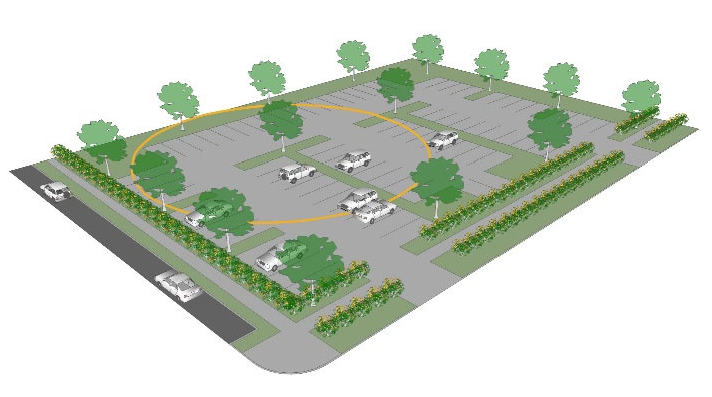
Parking lots and driveways that are located adjacent and parallel to a public street shall be screened from the public right-of-way with landscaping, berms, and/or walls up to three (3) feet in height.
2.
Landscape islands, linear landing strips, bio-swales, and/or rain gardens shall be required in parking lots with twelve (12) or more spaces.
3.
Every parking space is required to be not more than sixty (60) feet from a large canopy tree, planted within a median, strip or island, as measured from the trunk at planting.
B.
Required size of landscape islands and linear landscaping strips containing trees.
1.
Within parking lots with impervious surfaces such as asphalt or concrete: one hundred thirty (130) square feet; eight (8) feet minimum width.
2.
Planted in structural soil: Sixty-four (64) square feet; eight (8) feet minimum width. The use of approved structural soil shall be limited to landscape islands and adjacent walkways and parking area necessary for proper tree growth.
3.
Within parking lots with approved pervious surfaces such as decomposed granite or pervious pavers and for parking areas excluding fire lanes: Sixteen (16) square feet. Tree trunks should be protected by wheel stops or other physical barriers excluding curbs.
4.
Linear landscaping strips are encouraged in lieu of landscaping islands where possible.
(Ord. No. 2921, § 1, 7-3-2023)
Sec. 1912. - Dumpsters.
A.
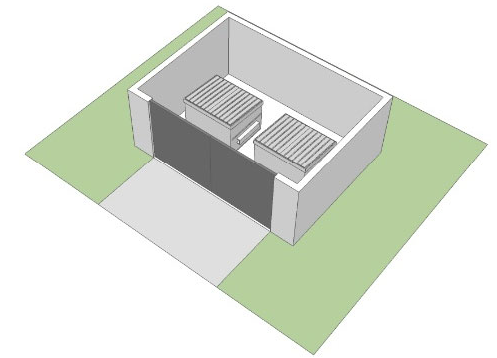
Dumpsters serving residential and non-residential uses and other similar service areas, must be located to the side or rear of buildings and behind the primary structures on street frontages.
B.
All dumpster and recycling collection containers shall be located on a concrete pad and shall be screened on three (3) sides by a fence or wall.
C.
The design, colors, and materials of screening elements shall be architecturally compatible with the character of the building.
(Ord. No. 2921, § 1, 7-3-2023)
Sec. 1913. - Equipment screening.
A.
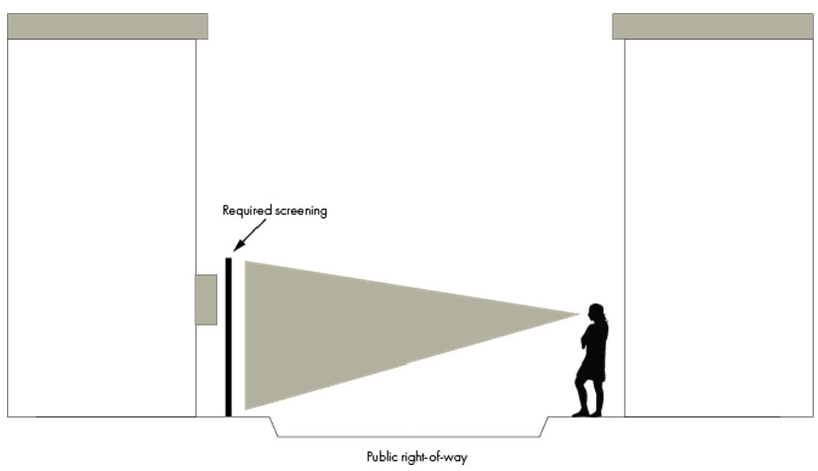
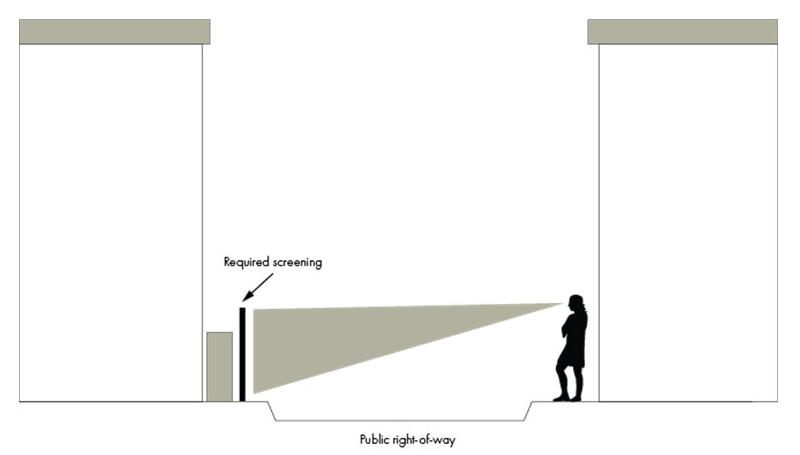
Wall-mounted equipment located on any surface that is visible from a public street (not including an alley) must be fully screened by landscaping or an opaque wall or fence that is compatible with the principle building in terms of texture, quality, material, and color.
B.
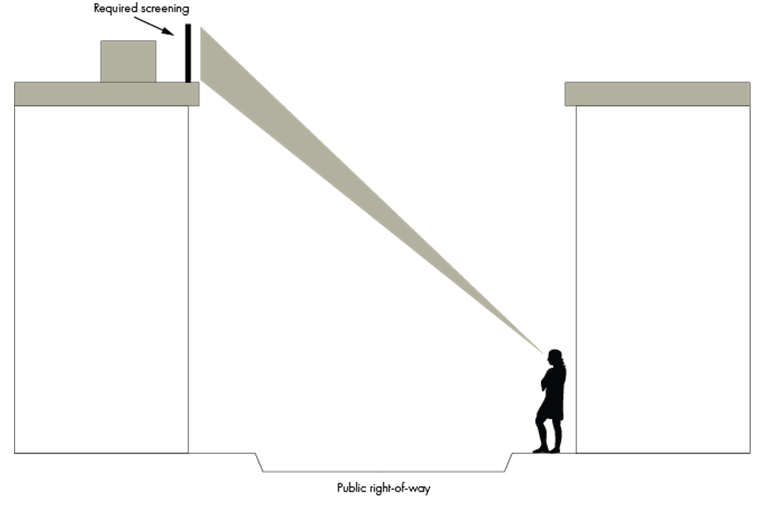
Architectural screening elements of sufficient height shall conceal roof top mechanical equipment from ground level view from abutting property or abutting public street (not including an alley).
C.
Ground mounted mechanical equipment that is visible from a public street (not including an alley) must be fully screened by landscaping or an opaque wall or fence that is compatible with the principle building in terms of texture, quality, material, and color.
(Ord. No. 2921, § 1, 7-3-2023)
Sec. 1914. - Fences and walls.
A.
Design.
1.
All fences and walls located along a public street edge shall be a maximum of four (4) feet tall and must be open style. Single-family and two-family developments located on corner lots with side or rear yards may use maximum of six-foot-tall opaque fence to provide backyard privacy.
2.
All fences and railings shall be architecturally compatible with the character of the building and be constructed of high-quality materials including: Wrought iron, composite fencing, treated wood, aluminum, or metal. Chain link, barbed wire, and concertina wire material is prohibited.
3.
All screening walls shall be architecturally compatible with the character of the building and constructed of high-quality materials including stone, decorative blocks, brick, cast stone, or stucco over standard concrete masonry blocks.
4.
For private residential patios, yards, or outdoor dining patios, a front yard fence, railing, or low walls may extend beyond the building facade if the following requirements are met:
a.
Fences, railings, and walls shall not exceed three (3) feet (thirty-six (36) inches) in total height as measured from the ground to the top of the fence, railing and/or the wall however;
b.
For elevated residential stoops the total fence, railing and/or wall height shall not exceed five (5) feet (sixty (60) inches) total.
(Ord. No. 2921, § 1, 7-3-2023)
Sec. 1915. - Signage.
A.
All signage in Subareas 1, 2, and 3 are subject to Section 921 of the Sapulpa Zoning Code, in addition to the requirements listed herein.
B.
The following signs are prohibited in Subareas 1, 2, and 3:
1.
Internally illuminated signs, except neon signs.
2.
Electronic message boards, moving electronic signs, and video signs.
3.
Internally-illuminated awnings (awnings may be illuminated by an exterior light source).
4.
Monopole/pylon signs.
5.
Illuminated signs that flash.
C.
Ground signs are prohibited in Subarea 1.
D.
Ground signs in Subareas 2 and 3 are not allowed between a building and the street. Ground signs may be placed on the side of the building within fifty (50) feet of the right-of-way.
E.
Roof signs in Subarea 2 are prohibited.
F.
Roof signs in Subareas 1 and 3 shall not extent more than twelve (12) feet above the mean roof level of the structure to which it is affixed.
G.
Windows painted with promotional, or advertising signage are permitted as a temporary use. Permits for a temporary window painting sign shall be good for a period of thirty (30) days, not to exceed two (2) permits in a six (6) month period on a given site.
H.
Neon signs are permitted in Subareas 1 and 3.
I.
Temporary flag signs used for promotional or advertising are not allowed within the public right-of-way.
J.
Chalkboard signs are permitted but shall not block pedestrian movement and must be moved inside at the end of each business day.
K.
Rooftop decks, and green roofs may be used to satisfy open space requirements.
L.
Two dimensional murals are permitted but final artwork must be reviewed by the District Code Administrator and approved by the Historic Preservation Commission. If the mural is denied by the Historic Preservation Committee, the applicant can choose to redesign the artwork and request a new review for approval or the applicant can seek a formal appeal from the Board of Adjustment.
(Ord. No. 2921, § 1, 7-3-2023)

