
Scottsdale City Zoning Code
ARTICLE VIII
SIGN REQUIREMENTS13
Editor's note— Section 1 of Ord. No. 2260, adopted July 18, 1989, specifically repealed former Art. VIII, §§ 8.100—8.500, and § 2 of the ordinance enacted a new Art. VIII, to read as set out in §§ 8.100—8.614. Prior to repeal, Art. VIII pertained to similar provisions and derived from Ord. No. 455, originally adopted June 17, 1969; Ord. No. 1418; Ord. No. 1917, § 1, adopted Oct. 7, 1986; Ord. No. 1950, § 1, adopted July 6, 1987; and Ord. No. 2034, § 1, adopted July 19, 1988. Subsequently, Ord. No. 4117, § 1(Res. No. 9563, Exh. A, § 19), adopted November 19, 2013 deleted the section analysis at Art. VIII.
Cross reference— Nuisance abatement relative to building exteriors, § 18-6; signs in Scottsdale Mall, § 20-116; encroachment of identification and directional signs in public ways, § 47-78.
Sec. 8.101. - Purpose.
I.
It shall be the purpose of this chapter to promote and protect the general health, safety, welfare and community environment by establishing a comprehensive system for the regulation on all advertising devices, displays, signs and their housing, structure or form, while maintaining or improving economic stability through an attractive sign program. It is also the purpose of this chapter to protect the general public from damage and injury which may be caused by the faulty and uncontrolled construction of signs within the city; to protect pedestrians and motorists of the City of Scottsdale from damage or injury caused, or partially attributable to the distractions and obstructions caused by improperly situated signs; to promote the public safety, welfare, convenience and enjoyment of travel and the free flow of traffic within the City of Scottsdale.
II.
It is also the intent of this chapter to enhance or create a more attractive and meaningful business climate; to promote and aid the city's important tourist industry; to enhance, protect, and maintain the physical and natural beauty of the community including its scenic preserves; to preserve the beauty and unique character of the City of Scottsdale, and to ensure that signage is clear, compatible with the character of the adjacent architecture and neighborhoods and provides the essential identity of, and direction to, facilities in the community.
(Ord. No. 2260, § 2, 7-18-89; Ord. No. 3515, § 1, 6-17-03; Ord. No. 4629, § 1(Res. No. 13058, § 1(Exh. A, § 10)), 2-20-24)
Sec. 8.102. - Requirement of conformity.
A.
No sign may be placed or maintained in the city except as provided herein. All signs maintained contrary to the provisions of this Article are declared to be nuisances, and as such may be abated as provided by law.
B.
Any noncommercial sign may be substituted for any commercial sign allowed by this ordinance. The substitution or addition of any noncommercial sign shall not increase or decrease the sign budget for the property on which the noncommercial sign is located.
C.
Only signs erected, maintained, or required by the City or other governmental entity shall be allowed in the public right-of-way or on public property, which include:
1.
Signs for traffic management;
2.
Signs identifying street names;
3.
Qualifying event directional banners;
4.
Signs in a community sign district created by City Council for all or part of the Old Town Area or redevelopment area;
5.
Signs for a governmental purpose, including, but not limited to:
a.
Signs required for public safety purposes as part of a Special Event Permit after the consultation required by Section 22-23 of the Scottsdale Revised Code;
b.
Signs required as part of a City Valet License that the City Manager or designee, in consultation with the Police Chief, Fire Chief, or designees, are necessary for public safety.
6.
In the event a Special Event Permit closes all or a portion of a right-of-way as part of the permitted area, signs within the special event area approved as part of a special event application in accordance with the Chapter 22 of the Scottsdale Revised Code; and
7.
In the event a Valet License grants exclusive use of portions of a right-of-way to the Licensee, signs within the licensed area approved as part of a valet parking license application in accordance with the Chapter 16 of the Scottsdale Revised Code.
D.
No signs shall be placed:
1.
To interfere with the sight distance requirements of the Design Standards and Policies Manual; or
2.
To interfere with the requirements of the Americans with Disabilities Act (ADA), as amended.
E.
Only the City may place a sign on a City structure.
F.
The City may relocate a sign in the public right-of-way for a City construction project.
(Ord. No. 2260, § 2, 7-18-89; Ord. No. 3728, § 1(Exh. 1), 3-20-07; Ord. No. 3971, § 2, 11-1-11; Ord. No. 4117, § 1(Res. No. 9563, Exh. A, §§ 20—23), 11-19-13; Ord. No. 4300, § 1(Res. No. 10727, § 1(Exh. A, § 2), 5-23-17; Ord. No. 4629, § 1(Res. No. 13058, § 1(Exh. A, § 10)), 2-20-24)
Cross reference— Nuisances, Ch. 18.
Sec. 8.103. - Nonconforming signs.
I.
Reasonable repairs and alterations, including changes to the face, color, and letters, may be made to nonconforming signs.
II.
If a nonconforming sign
A.
Is changed structurally;
B.
Is damaged in excess of fifty (50) percent of the replacement cost, established by a qualified appraiser; or
C.
Is temporarily or permanently removed by any means, including an act of God,
then such sign may be restored, reconstructed, altered, or repaired only in conformance with the provisions of this ordinance.
(Ord. No. 2260, § 2, 7-18-89; Ord. No. 2401, § 1, 10-1-91)
Sec. 8.104. - Penalties for violations.
Any person, firm or corporation violating any provisions of this Article, or failing to comply with any order or regulation made hereunder, shall be subject to the penalty provisions of Section 1.1400 of the Zoning Ordinance.
(Ord. No. 2260, § 2, 7-18-89; Ord. No. 3225, § 1, 5-4-99; Ord. No. 3728, § 1(Exh. 1), 3-20-07)
Sec. 8.105. - Revocation of permits.
The general manager shall have the authority to revoke any permit authorizing the erection of a sign which has been constructed or is being maintained in violation of the permit.
I.
Notice of the general manager's decision to revoke a sign permit shall be served upon the holder of the permit:
(a)
By delivering in person a copy of the notice to the holder of the permit, or to one of it's officers, or
(b)
By leaving a copy of the notice with any person in charge of the premises, or
(c)
In the event no such person can be found on the premises, by affixing a copy of the notice in a conspicuous position at an entrance to the premises and by the certified mailing of another copy of the notice to the last known post office address of the holder of the permit.
II.
The holder of the permit may appeal the decision of the general manager to revoke the permit to the Board of Adjustment, in writing, within fifteen (15) days from the date when the notice was served.
III.
If no appeal has been taken at the end of fifteen (15) days, the permit is revoked. The general manager shall then initiate the process for the removal of the illegal sign.
(Ord. No. 2260, § 2, 7-18-89; Ord. No. 2401, § 1, 10-1-91)
Sec. 8.106. - Removal or repair of signs.
I.
The property owner is responsible for the signs on the property.
II.
The property owner shall remove the following signs:
A.
An illegal sign, within ten (10) days after notice.
B.
A temporary sign, within forty-eight (48) hours after notice.
C.
A damaged or vandalized sign, or a sign in disrepair, and not repaired, within:
1.
Ten (10) days after notice; or
2.
Thirty (30) days after the sign is damaged or vandalized, or becomes in disrepair, whichever happens first.
D.
Signs associated with a building or tenant area that is unoccupied within:
1.
Thirty (30) days after notice; or
2.
Sixty (60) days after the building or tenant area is vacated, whichever happens first.
III.
Notice shall be served personally at the property or to the property owner by first class mail.
IV.
The Zoning Administrator may remove the following signs:
A.
Upon a court order, any sign referred to in subsection II above that is not removed within the time allotted.
B.
Any unsafe or defective sign that creates an immediate hazard to persons or property, without notice to the property owner.
VI.
Political signs on public streets: The Arizona Revised Statutes control the removal of political signs.
VII.
The property owner is liable for the cost for the city to remove a sign.
VIII.
The property owner shall repair a damaged or vandalized sign, or a sign in disrepair, within:
A.
Ten (10) days after notice; or
B.
Thirty (30) days after the sign is damaged or vandalized, or becomes in disrepair, whichever happens first.
(Ord. No. 2260, § 2, 7-18-89; Ord. No. 2401, § 1, 10-1-91; Ord. No. 3225, § 1, 5-4-99; Ord. No. 4117, § 1(Res. No. 9563, Exh. A, § 24), 11-19-13)
Sec. 8.107. - Liability for damages.
The provisions of this ordinance shall not be construed to relieve or to limit in any way, the responsibility or liability of any person, firm, or corporation which erects or owns any sign, for personal injury or property damage caused by the sign; nor shall the provisions of this ordinance be construed to impose upon the City of Scottsdale, its officers, or its employees, any responsibility or liability by reason of the approval of any sign under the provisions of this ordinance.
(Ord. No. 2260, § 2, 7-18-89)
Sec. 8.108. - Affect of amendment on pending suits.
The amendment of this ordinance shall not:
(1)
Affect suits pending or rights existing immediately prior to the effective date of this ordinance, or
(2)
Impair or avoid or affect any grant or conveyance made or right acquired or cause of action now existing under any such amended ordinance or amendment thereto, or
(3)
Affect or impair the validity of any bond or other obligation issued or sold in constituting a valid obligation of the issuing authority immediately prior to the effective date of this ordinance.
(Ord. No. 2260, § 2, 7-18-89)
Sec. 8.109. - Reserved.
Editor's note— Ord. No. 4315, § 1(Res. No. 10834, § 1(Exh. A, § 1), adopted July 5, 2017, repealed § 8.109, which pertained to enforcement office and derived from Ord. No. 2260, § 2, adopted July 18, 1989.
Sec. 8.200. - Definitions.
(Note: Graphics in definition section added with 7-TA-2002)
Address Sign is a sign required by Chapter 31 and Chapter 36 of the Scottsdale Revised Code that identifies a building address numbers, building numbers or approved building identification.
Airport. Those areas included within the perimeter fence of the Scottsdale Municipal Airport property.
Animation. The movement or the optical illusion of movement of any part of the sign structure, design or pictorial segment, including the movement of any illumination or the flashing or varying of light intensity; the automatic changing of all or any part of the facing of a sign; the movement of a sign set in motion by the atmosphere. Time and temperature devices shall be considered animated signs. Banners and flags shall be exempted from this definition.
Applicant. A person or entity who applies for a sign permit in accordance with the provisions of this ordinance.
Architectural sign. A sign incorporated into an architectural element such as an archway, fountain or sculptured garden which is integrated with, but subordinate to, the overall architectural element.
Area of sign. In the case of individual characters used as a sign, the area is ninety (90) percent of the area enclosed within the smallest regular geometric figure needed to completely encompass all characters of the sign, including horizontal spacing between characters, except as otherwise provided herein. For signs other than individual characters, the area is the smallest regular geometric figure needed to completely encompass the total area of a cabinet or panel, or the total area within the outer edge of a frame or other material, color, or condition utilized to create an outer border of the sign. The area of sign does not include address signs that are twelve (12) inches or less required by Chapters 31 and 36 of the Scottsdale Revised Code.
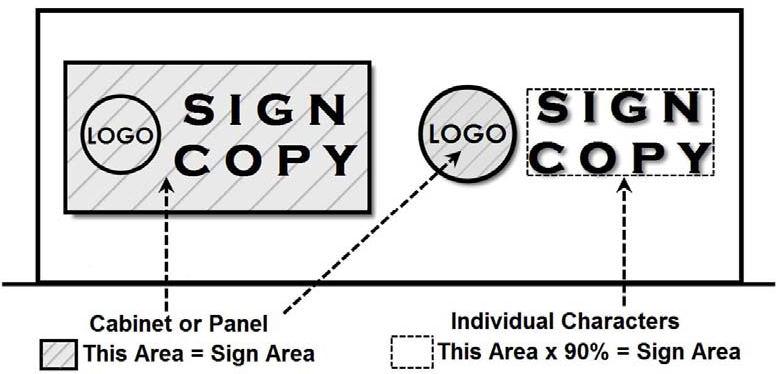
Area of Sign Example
Arterial street. Shall mean the streets designated in the City's Transportation Master Plan with the classification of the Major Arterial and Minor Arterial.
Awning sign. Signs which are placed on or integrated into fabric or other material canopies which are mounted on the exterior of a building.
Banner. A sign composed of flexible material, such as fabric, pliable plastic, paper, or other lightweight material, not enclosed in a rigid frame.
Building front. The lineal distance measured along the exterior wall of the building space occupied by the business that the sign will be placed.
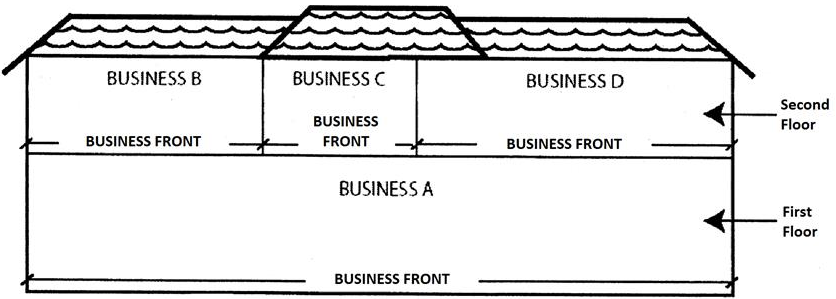
Business Front
Building wall. The individual sides of a building.
Cabinet. A three-dimensional structure which includes a frame, borders and sign panel face and may include internal lighting upon which the sign letters and logos are placed or etched, and is architecturally integrated with the building.
Canopy Fascia Sign is a sign attached to the vertical front face of a canopy, roof overhang, covered walkway, covered porch, or purlin of an open lattice structure.
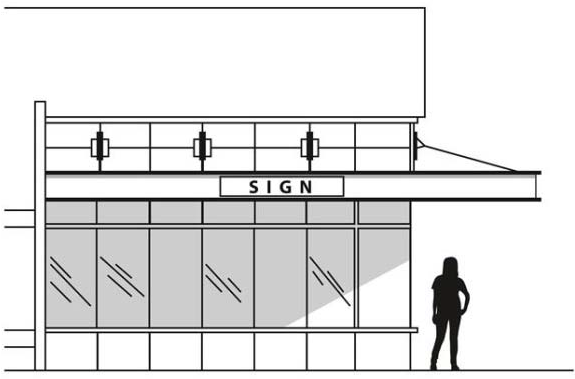
Canopy Fascia Sign Example
Column sign. A monolithic project identification sign with a height not less than three (3) times its width.
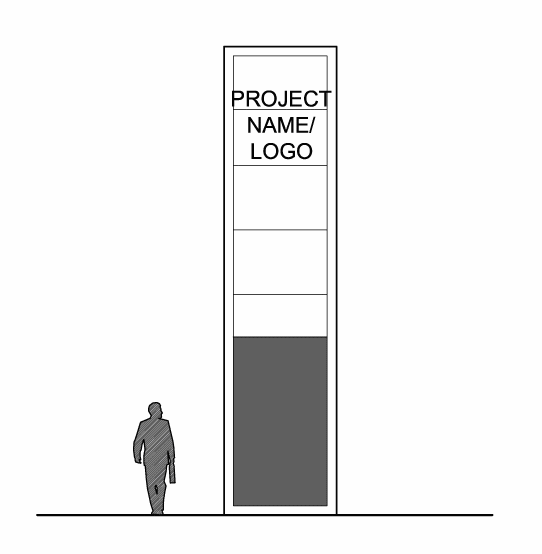
Column Sign Example
Commercial sign. Any sign displaying the identification of or advertisement for a business, product, service or other commercial activity, but does not include any traffic management or street sign erected by any governmental entity, any flag or badge or insignia of the United States, State of Arizona, Maricopa County, City of Scottsdale, or official historic plaque of any governmental jurisdiction or agency, or any sign erected for a governmental use (including the posting of notices required by law).
Community sign district. A group of property owners in a specified area in the city that have been organized into a coordinated group for the purpose of common signage and signage control.
Comprehensive sign program. A sign program submitted under the guidelines of a community sign district intended to encourage flexible signage opportunities which is greater than that allowed in underlying zoning district.
Directory sign. A sign which provides a listing of the names of businesses, activities, addresses, locations, uses or places within a building or complex of buildings for the purpose of identification only.
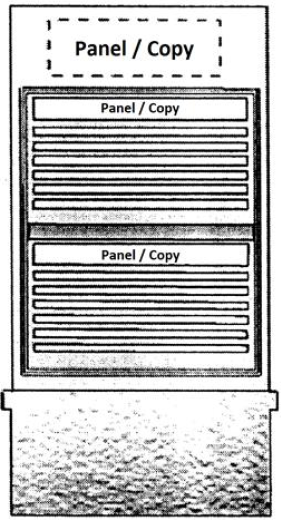
Directory Sign Example
Drive-through sign is a freestanding sign adjacent to a drive-through.
Entry sign is a small sign located adjacent to a primary pedestrian entrance to a dwelling or suite.
Entryway monument sign is a freestanding cabinet or panel sign mounted on, or within a base (above grade), placed at the street or driveway leading into the development project.
Entryway sign is a freestanding sign which is placed on a perimeter or screen wall of a development project, and adjacent to a street or driveway leading into the development project, having individual characters that may be mounted on, or integrated into, a panel.
Flag. A fabric sheet of square, rectangular or triangular shape which is mounted on a pole, cable or rope at one (1) end.
Flag, decorative. A flag which contains no text or graphics.
Freestanding canopy sign is a sign attached to the vertical front face of a freestanding canopy structure that is not attached to a building.
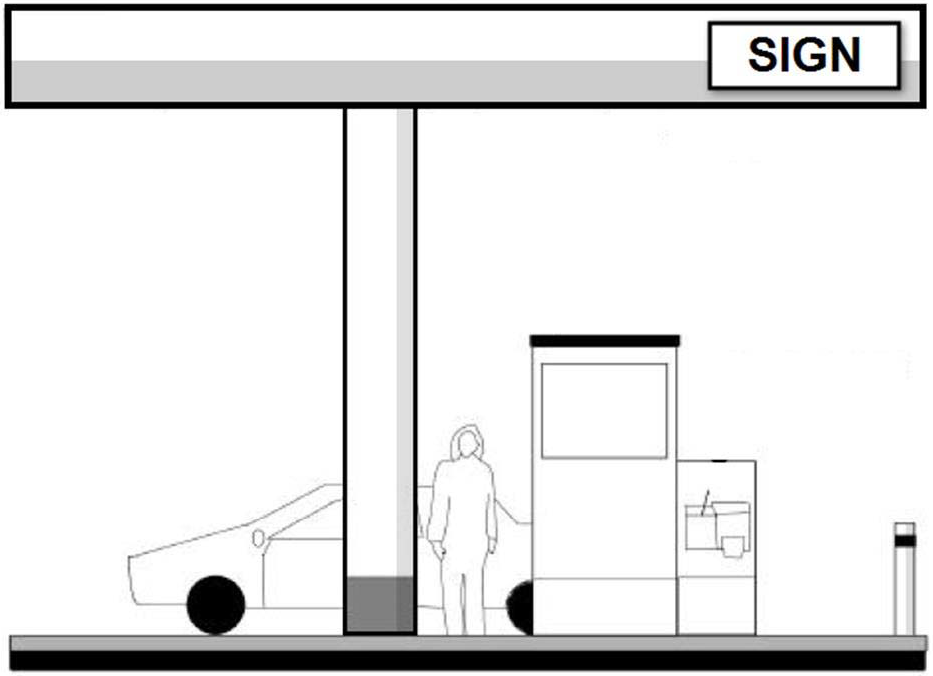
Freestanding Canopy Sign Example
Fuel change panel is a sign used to identify the current price(s) of fuel as required by the Arizona Administrative Code.
Ground level. The finished grade of the adjacent street curb or where there is no street curb, six (6) inches above street grade. In areas within the hillside district, ground level shall be the existing natural grade.
Height. The distance from ground level to the top of the sign structure.
Illegal sign. Any sign erected without first obtaining an approved sign permit, other than nonconforming signs.
Indirect lighting. A source of external illumination located away from the sign, which lights the sign, but which is itself not visible to persons viewing the sign from any street, sidewalk or adjacent property.
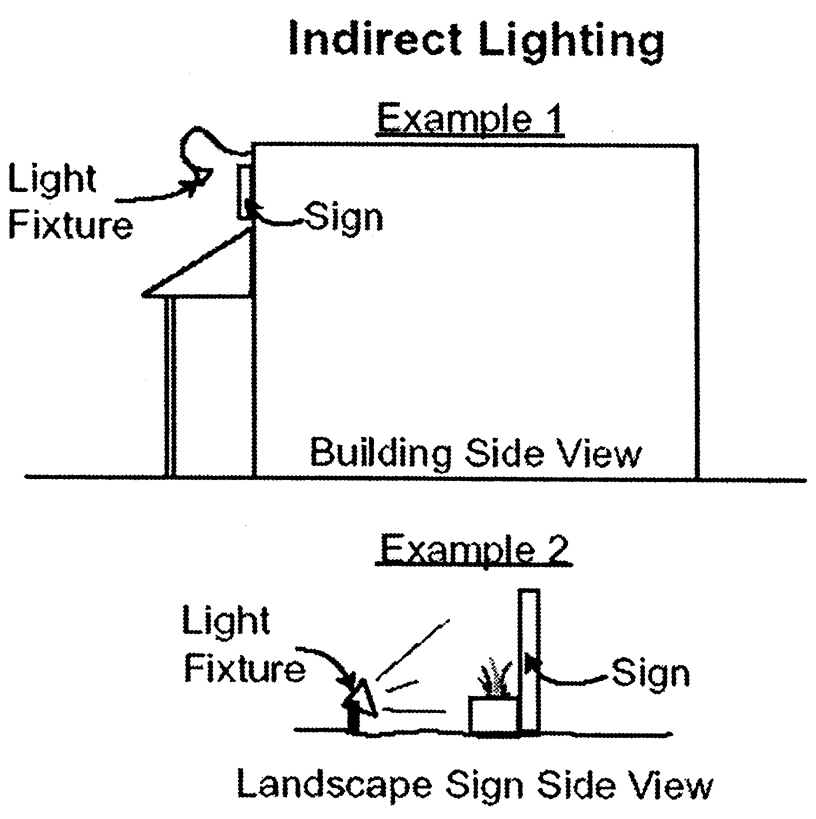
Indirect Lighting
Individual letters. A cut-out or etched letter or logo which is individually placed on a landscape, screen wall, building wall or ground sign.
Internal lighting. A source of illumination entirely within the sign which makes the contents of the sign visible at night by means of the light being transmitted through a translucent material but wherein the source of illumination is not visible.
Internal/indirect lighting. A source of illumination entirely within an individual letter, cabinet or structure which makes the sign visible at night by means of lighting the background upon which the individual letter is mounted. The letters are opaque, and thus are silhouetted against the background. The source of illumination is not visible.
Landscape Area. The specific area (on site) to be landscaped with plant material at the base of the freestanding sign.
Landscape wall sign. A freestanding sign mounted on a screen or perimeter wall and having individual characters that may be mounted on, or integrated into, a panel.
Logo. A graphic symbol representing an activity, use or business.
Lot. The definition of Chapter 48 - Land Divisions shall apply.
Maintenance. The replacing or repairing of a part or portion of a sign necessitated by ordinary wear, tear or damage beyond the control of the owner or the reprinting of existing copy without changing the wording, composition or color of said copy.
Master planned community. A project of at least one hundred sixty (160) acres which is planned, developed or closely coordinated with a unified character and land use scheme, and having a master property owners association which includes all lands within the master planned community.
Master sign program. A specific set of design standards established for the purpose of unifying a variety of signs associated with a multi-tenant or multi-use building or complex of buildings.
Medical facilities. Major campuses or buildings which include public, private or research hospitals, nonprofit or research clinics, or emergency care centers.
Menu sign. A temporary sign used to inform the public of the list of dishes, foods or entrees available in a restaurant and may include the corresponding prices.
Mid-size monument sign. A free-standing cabinet or panel sign architecturally integrated with the project or building design mounted on, or within a base which is detached from any building which has a greater area and height than a monument sign and has less height than a tower sign.
Monument sign is a freestanding sign that may be a cabinet or panel mounted on, or integrated into, a background surface. Monument signs include individual characters that may be mounted on, or integrated into, a panel that is mounted on a background surface.
Noncommercial sign. Any sign that is not a commercial sign.
Nonconforming sign. Any sign which is not allowed under this ordinance, but which, when first constructed, was legally allowed by the City of Scottsdale or the political subdivision then having the control and regulation over construction of signs.
Off-premise Traffic Directional Sign. A portable sign or yard sign that directs traffic to an event that occurs on a different lot than where the sign is located, excluding special events in accordance with Chapter 22 of the Scottsdale Revised Code.
Panel. A two-dimensional visual background behind the sign letters and logos which is visually separated from the mounting upon which the sign letters and logos is placed by the presence of a border, different colors, different materials, or other technique of visual framing around the letters or logo.
Pan-formed letter. An individual letter which is three-dimensional and is constructed by means of a
three-sided metal channel. The open side of the channel may face a wall or be faced
with a translucent panel which is placed away from the wall.
Parapet wall. That portion of a building exterior wall projecting above the plate line of the building.
Permanent sign. Any sign which is intended to be lasting and is constructed from an enduring material such as masonry and metal which remains unchanged in position, character, and condition (beyond normal wear), and is permanently affixed to the ground, wall or building, provided the sign is listed as a permanent sign in the ordinance.
Planned district(s) are Planned Convenience Center PCoC; Planned Neighborhood Center PNC; Planned Community Center PCC; Planned Airpark Core Development PCP; Planned Regional Center PRC; Planned Community P-C; any portion of a Planned Community P-C district with an underlying zoning district comparable to the commercial districts in Table 4.100.B.; Planned Airpark Core Development PCP; Planned Unit Development PUD; Special Campus SC; and Downtown D.
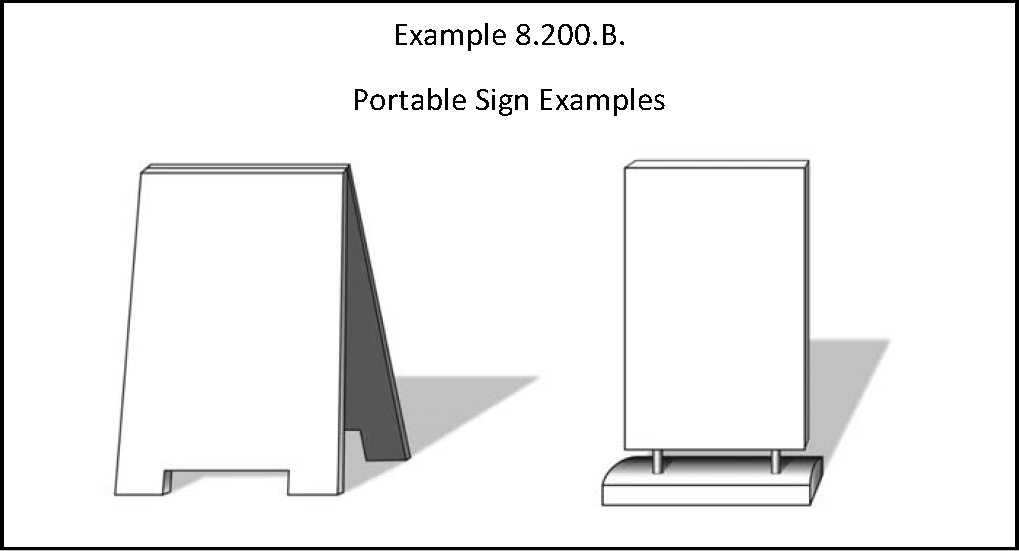
Portable Sign. A sign that is freestanding, movable, and self-supported, and that is not permanently affixed to any building, structure, or embedded into ground.
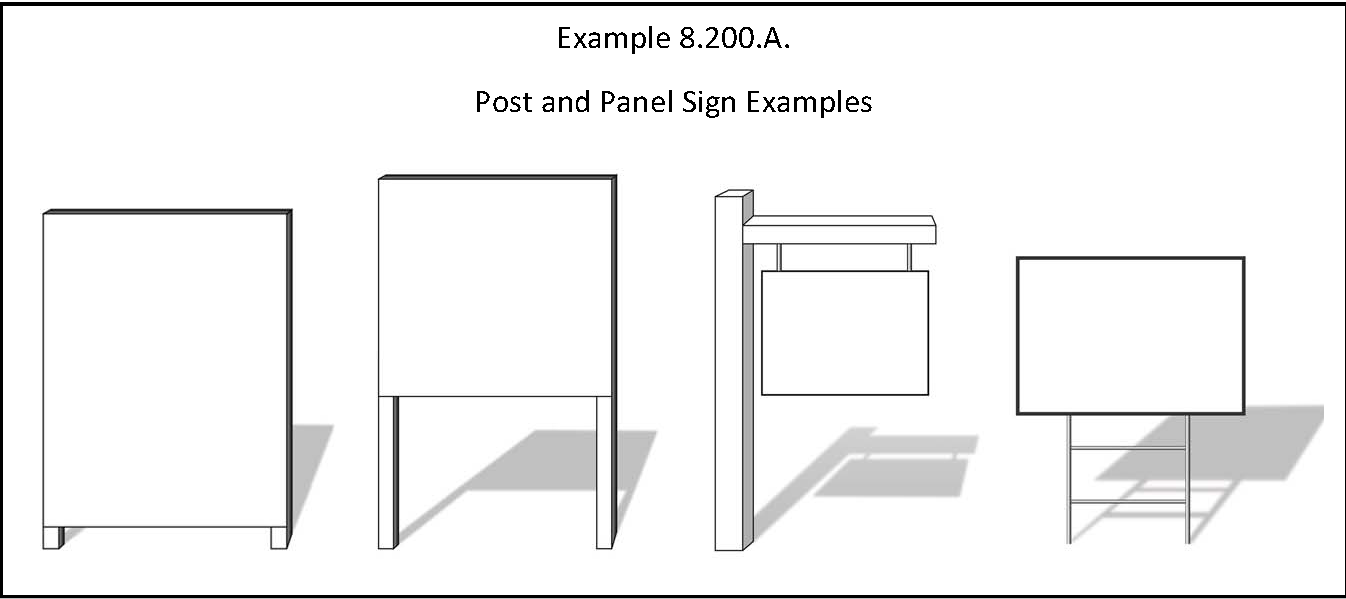
Post and Panel Sign. A sign that is freestanding and not portable, with a durable panel mounted on removable supporting posts that are embedded into the ground without the use of cement, concrete, or other permanent binding material.
Projecting sign. A business identification sign that is mounted perpendicular to the face or corner of a building.
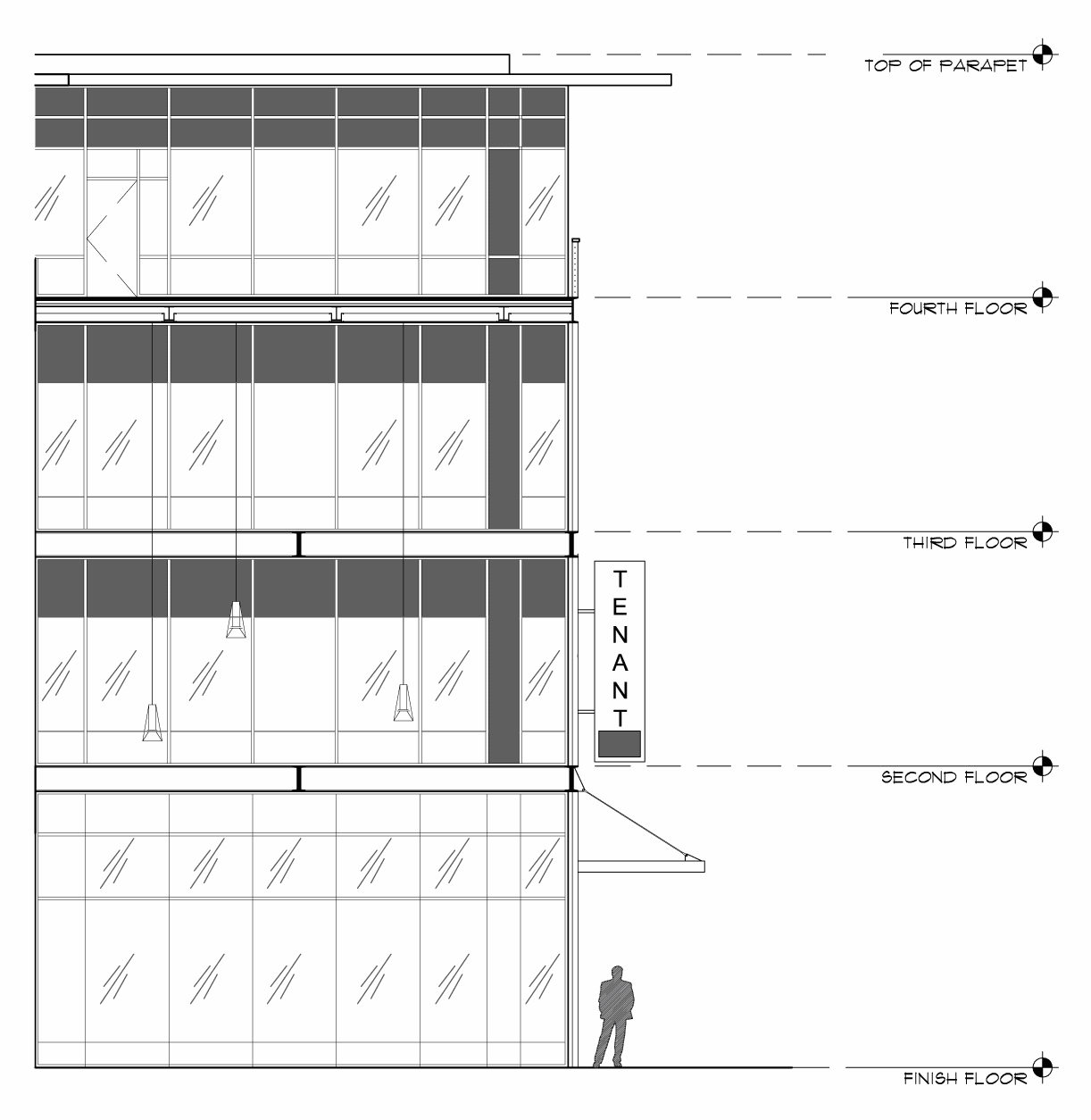
Projecting Sign Example
Public property. Unless otherwise expressly provided, public property means any and all real or personal property over which the city or other governmental entity has or may exercise control, whether or not the city owns the property in fee, and it includes, but is not limited to public buildings, public streets, alleys, sidewalks, rights-of-way and improved or unimproved land of any kind and all property appurtenant to it.
Purlin is a horizontal beam along the length of a canopy or trellis, resting on or supporting rafters or boards.
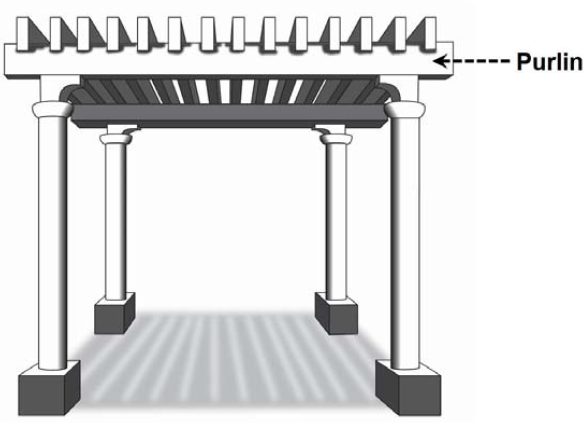
Purlin Example
Raceway is an enclosure for both wiring and electrical components.
Right-of-way, public. Land which by deed, conveyance, agreement, easement, dedication, usage or process of law is reserved for or dedicated to the general public for travelling purposes, including all roads, streets, alleys, sidewalks, trails, paths, utilities, drainage ways, shoulders, and the publicly-owned land immediately abutting and appurtenant to the travelled and drainage ways.
Roof line. The highest point of the main roof structure or the highest point on a parapet, excluding: cupolas, pylons, projections, non-habitable towers and spires, or minor raised portions of the roof.
Scenic corridor. A specific, required landscape setback located along certain major streets, and identified in the city's General Plan.
Scenic corridor monument sign. A freestanding cabinet or panel sign located within a scenic corridor or on a non-scenic corridor roadway of a corner property that has scenic corridor frontage. Mounted on or within a base (above-grade) that is detached from any building, and when located on the street frontage of the site address, containing that address's numerals, and which, for multiple-tenant commercial complexes only, includes no more than two (2) tenant or occupant names.
Shingle sign is a sign suspended from a roof overhang of a covered porch or walkway and perpendicular to a building wall.
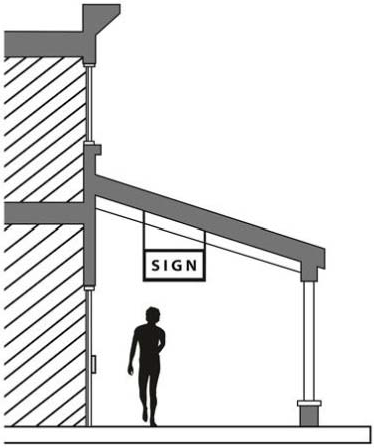
Shingle Sign Example
Sign. Any device for visual communication which is used or is intended to attract the attention of the public, when the display of this device is visible beyond the boundaries of the public or private property upon which the display is made.
Sign wall. Any surface (excluding windows) of a building within twenty-five (25) degrees vertical. Signs on a wall shall be limited to business identification and approved modifiers.
Standing canopy sign. A sign mounted to the top of the leading edge of a canopy located above a storefront parallel to the building façade on which it is mounted.
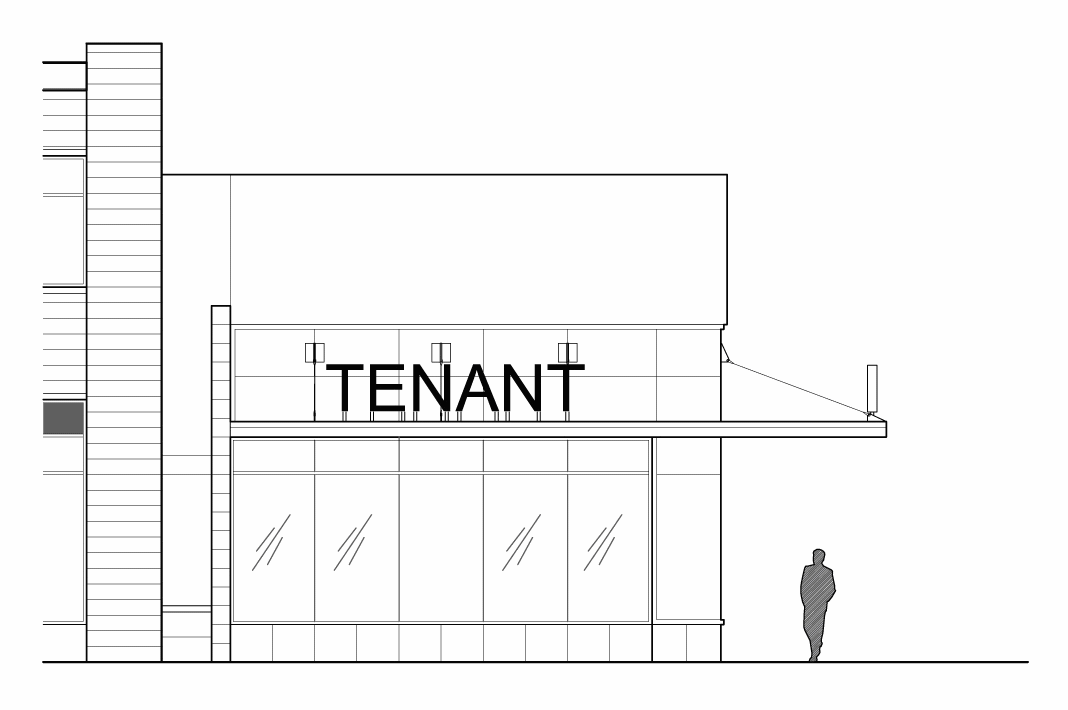
Standing Canopy Sign Example
Sum total sign area. Aggregate area of all building signs, not including address signs twelve (12) inches or less required by Chapter 31 and 36 of the Scottsdale Revised Code, for any individual use and may include the area of a freestanding sign.
Suspended Canopy Sign is a sign suspended under a canopy, roof overhang, covered walkway, covered porch, or open lattice walkway and parallel to a building wall.
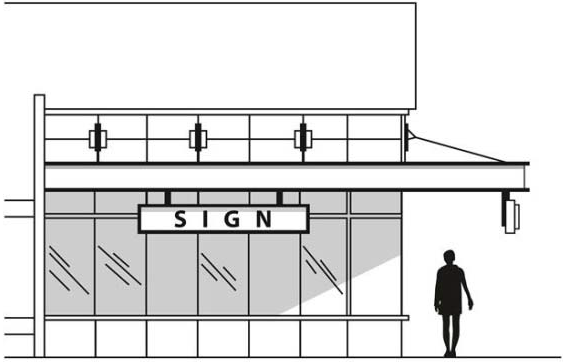
Suspended Canopy Sign Example
Temporary sign. Any sign that is a banner, portable, post and panel sign, or yard sign.
Tower sign. A freestanding cabinet or panel sign architecturally integrated with the building having a minimum height of ten (10) feet to the bottom of the sign. The sign base shall be constructed not to exceed fifty (50) percent of the open space beneath the cabinet or panel.
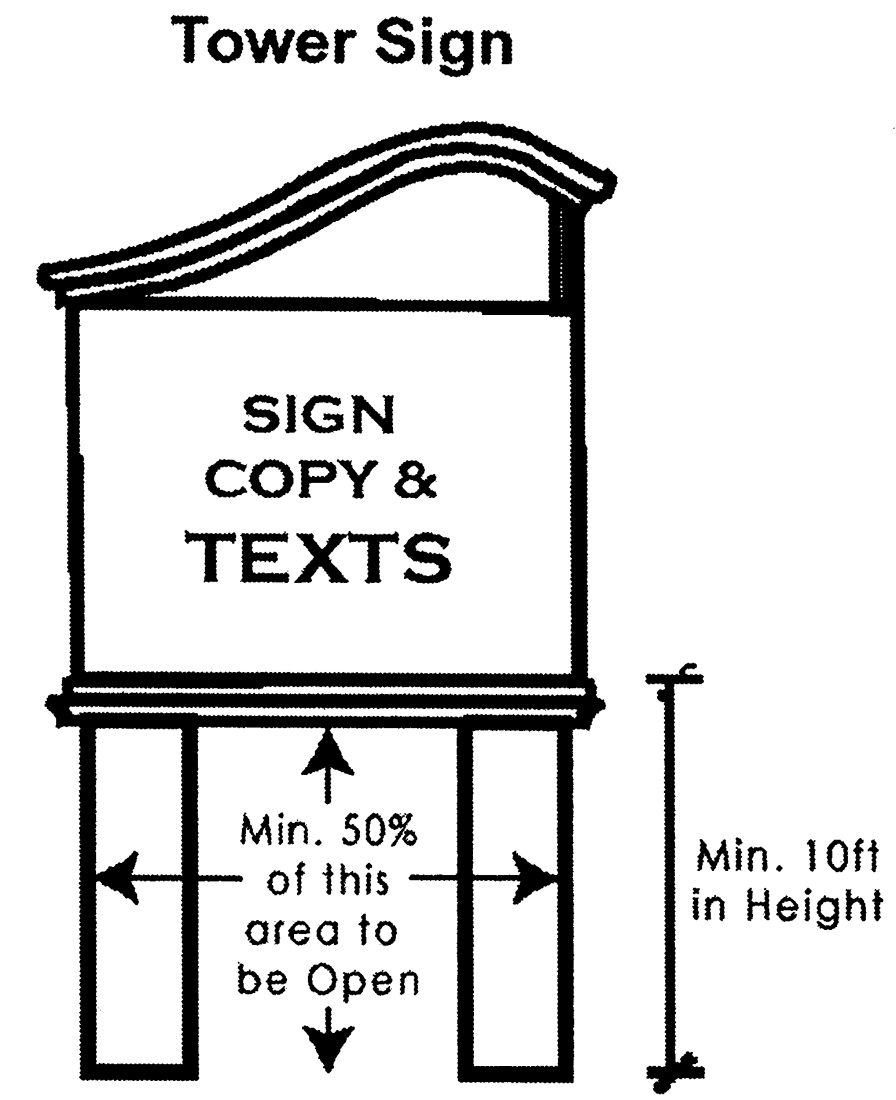
Tower Sign
Traffic directional sign is a freestanding sign placed near the intersection of a driveway and a street, or intersecting drive aisles, to assist the operators of vehicles to locate vehicle turning locations, and to assist in maintaining the free flow of traffic.
Window sign, temporary. Any poster, cut-out letters, painted text or graphics, or other text or visual presentation affixed to the inside or outside of a window pane which is placed to be read from the exterior of a building.
Yard sign is a freestanding sign constructed of canvas, cardboard, cloth, light fabric, paper, pliable plastic, wallboard, or other like material that is affixed to a disposable stake or frame that is embedded into ground.
(Ord. No. 2260, § 2, 7-18-89; Ord. No. 2278, 2-20-90; Ord. No. 2401, § 1, 10-1-91; Ord. No. 2905, § 1, 8-5-96; Ord. No. 3515, § 1, 6-17-03; Ord. No. 3641, § 1(Exh. 1), 10-4-05; Ord. No. 3728, § 1(Exh. 1), 3-20-07; Ord. No. 3824, § 1, 12-9-08; Ord. No. 3971, § 3, 11-1-11; Ord. No. 4117, § 1(Res. No. 9563, Exh. A, § 25), 11-19-13; Ord. No. 4300, § 1(Res. No. 10727, § 1(Exh. A, § 3), 5-23-17; Ord. No. 4315, § 1(Res. No. 10834, § 1(Exh. A, § 2), 7-5-17)
Sec. 8.301. - Approvals required.
A.
Sign illumination, method of attachment, placement, structure, and comprehensive sign programs, master sign programs, and community sign districts created by property owners, are subject to Development Review Board approval as described in Article I.
B.
The Development Review Board shall review and render a decision for sign code exception requests relating signage design, and to the placement of building signs on a building. In no case shall the total sign area increase for the property.
(Ord. No. 2260, § 2, 7-18-89; Ord. No. 2401, § 1, 10-1-91; Ord. No. 3225, § 1, 5-4-99; Ord. No. 3515, § 1, 6-17-03; Ord. No. 4117, § 1(Res. No. 9563, Exh. A, § 26), 11-19-13; Ord. No. 4164, § 1(Res. No. 9857, § 1, Exh. A, § 51), 8-25-14; Ord. No. 4315, § 1(Res. No. 10834, § 1(Exh. A, § 3), 7-5-17)
Sec. 8.302. - Sign programs.
I.
Master sign program.
A.
The purpose of the master sign program is to provide design compatibility for all signs and to integrate the signs with the architectural features of the multi-tenant building or complex of buildings.
B.
Submittal requirements: The property owner(s) or designated agent shall submit an application with a specific set of design standards, including but not limited to, letter and logo sizes, letter style, colors, texture, lighting methods, sign type and architectural features.
C.
Upon approval of the master sign program, all signage contained within the limits of the property, regardless of ownership or tenancy, shall comply with the design standards established by the program.
II.
Community sign district. The community sign district provides for a comprehensive sign program which is intended to encourage more flexible signage opportunities than allowed by the underlying zoning district. Community sign districts are regulated to the extent necessary to be consistent with the purpose and intent of the sign ordinance as specified in Section 8.101.
A.
Property owners may form a community sign district to propose and maintain a comprehensive sign program for additional signage as provided in this section.
1.
A community sign district may be formed by petition of at least seventy-five (75) percent or more of the affected property owners in the community sign district.
2.
The property owner(s) in a community sign district shall coordinate the preparation and submission of the comprehensive sign program.
3.
A community sign district and its comprehensive sign program may be approved for any of the following:
a.
Non-residential development(s) that have a gross floor area of at least three hundred thousand (300,000) square feet;
b.
Planned districts that have a district size of at least fifteen (15) acres;
c.
Part of a Type 1 Area that has a linear frontage on both sides of the street totaling at least one thousand (1,000) feet; and
d.
Part of a Type 2 Area, Type 2.5 Area, or Type 3 Area that is comprised of contiguous lots with a gross lot area of at least five (5) acres.
4.
A community sign district allows for the following bonuses that may be approved with the comprehensive sign program:
a.
Twenty (20) percent increase to the allowed sum total sign area;
b.
Twenty (20) percent increase to the allowed area of signs; and
c.
Twenty (20) percent increase to the allowed height.
5.
Only signs allowed in Article VIII may be approved as part of a comprehensive sign program.
6.
The comprehensive sign program shall include a complete set of standards, including but not limited to, letter size, style, colors, type(s) of sign, placement of signs, number of signs, sign types and sign material.
7.
The property owner(s) shall install and maintain all signage approved in the comprehensive sign program.
B.
The City Council may form a community sign district for all or part of the Old Town Area or a redevelopment district.
1.
The comprehensive sign program shall include a complete set of standards, including but not limited to, letter size, style, colors, type(s) of sign, placement of signs, number of signs, and sign material. In no event may the comprehensive sign program propose signage of a type that is otherwise prohibited by this ordinance.
2.
The comprehensive sign program may include architectural signs in accordance with the following:
a.
Municipal signs may be installed in right-of-way that has a street classification of a minor collector or greater in the Transportation Master Plan, and on property abutting such right-of-way.
b.
Municipal signs may be installed in right-of-way or on property abutting the right-of-way at the intersection of two streets. One of the two intersecting streets shall have a classification of a minor collector or greater in the Transportation Master Plan.
c.
The text shall be limited to the overall identification of all or part of the Old Town Area or redevelopment area.
d.
Maximum area of sign: sixty (60) square feet.
e.
Maximum height of sign: twenty (20) feet.
f.
Maximum number of signs per architectural element: one (1) sign.
g.
Maximum letter height for each architectural sign: two (2) feet.
3.
The comprehensive sign program may include banners mounted on the side of a street light pole in accordance with the following:
a.
The banners may identify all or part of the Old Town Area or redevelopment area.
b.
The banners shall be of new material and may be permanent, subject to Development Review Board approval of a maintenance program.
4.
The comprehensive sign program may include freestanding directory signs designed as architectural elements identifying points of interest in accordance with the following:
a.
Maximum area of sign: fifteen (15) square feet.
b.
Maximum height of sign: seven (7) feet.
5.
The City shall coordinate the preparation and submission of the comprehensive sign program. The application shall detail the responsibility for the installation and maintenance of signage approved in the comprehensive sign program.
C.
No sign identified in this section shall be placed upon real property without the consent of the property owner, nor shall such sign be placed in any public right-of-way, except when placed in accordance with subsection 8.302.II.B. above and other applicable ordinances.
(Ord. No. 2260, § 2, 7-18-89; Ord. No. 2401, § 1, 10-1-91; Ord. No. 2905, § 1, 8-5-96; Ord. No. 3515, § 1, 6-17-03; Ord. No. 3728, § 1(Exh. 1), 3-20-07; Ord. No. 4117, § 1(Res. No. 9563, Exh. A, §§ 27, 28), 11-19-13; Ord. No. 4315, § 1(Res. No. 10834, § 1(Exh. A, § 4), 7-5-17; Ord. No. 4629, § 1(Res. No. 13058, § 1(Exh. A, § 10)), 2-20-24)
Sec. 8.303. - Requirement of permit.
A.
Except as provided below, a sign permit shall be required before the erection, re-erection, construction, alteration, placing, or installation of all signs regulated by this ordinance.
B.
The following signs do not require a permit so long as they are otherwise authorized by this Code, unless a permit is required by Chapters 31 and 36 of the Scottsdale Revised Code:
1.
Signs not visible from a separate lot or street;
2.
Temporary window signs affixed to the window pane;
3.
Any sign authorized by this Code that is equal to, or less than, six (6) square feet shall not require a sign permit unless a permit is otherwise required by Chapter 31 and 36 of the Scottsdale Revised Code;
4.
Signs indicating address numbers, building numbers or building identifications that are required by Chapters 31 and 36 of the Scottsdale Revised Code, with a maximum height of twelve (12) inches;
5.
Maintenance of a sign without changing wording, composition, or colors; and
6.
The relocation of a sign when required by a City construction project.
C.
Signs associated with an approved special event shall be permitted in accordance with Chapter 22 of the Scottsdale Revised Code.
D.
Nothing contained herein shall prevent the erection, construction, and maintenance of official traffic, fire and police signs, signals, devices and marking of the State of Arizona and the City of Scottsdale, or other competent public authorities, or the posting of notices required by law.
(Ord. No. 2260, § 2, 7-18-89; Ord. No. 2401, § 1, 10-1-91; Ord. No. 3728, § 1(Exh. 1), 3-20-07; Ord. No. 4117, § 1(Res. No. 9563, Exh. A, §§ 29—31), 11-19-13; Ord. No. 4300, § 1(Res. No. 10727, § 1(Exh. A, § 4), 5-23-17)
Sec. 8.304. - Permit application and expiration.
I.
After Development Review Board approval, the property owner may apply for a sign permit. The application shall be on the city forms in accordance with Article I.
II.
A sign permit shall expire unless the sign authorized by such permit is erected within 180 days after its issuance, or if the work authorized by the permit is discontinued for 180 days after the last inspection.
(Ord. No. 2260, § 2, 7-18-89; Ord. No. 2401, § 1, 10-1-91; Ord. No. 3378, § 1, 6-4-01; Ord. No. 4117, § 1(Res. No. 9563, Exh. A, § 32), 11-19-13)
Sec. 8.305. - Permit fees.
I.
The owner of a nonconforming sign which has been removed or brought into conformance shall not be required to pay a permit fee in order to obtain a permit for a replacement sign.
II.
Where work for which a permit is required by this ordinance is begun before a permit has been obtained, the fees above specified shall be doubled, but the payment of such double fee shall not relieve any persons from complying fully with the requirements of this ordinance in the execution of the work or from any penalties prescribed herein.
(Ord. No. 2260, § 2, 7-18-89; Ord. No. 2287, § 1, 6-5-90; Ord. No. 2401, § 1, 10-1-91; Ord. No. 2663, § 1, 6-6-94; Ord. No. 3378, § 1, 6-4-01)
Sec. 8.306. - Construction requirements.
I.
All signs shall be constructed in conformance with Chapters 31 and 36 of the Scottsdale Revised Code.
(Ord. No. 2260, § 2, 7-18-89; Ord. No. 2401, § 1, 10-1-91; Ord. No. 4117, § 1(Res. No. 9563, Exh. A, § 33), 11-19-13)
Sec. 8.307. - Inspections.
All signs for which a permit is required shall be subject to the following inspections:
I.
Footing inspection on all freestanding signs. However, the general manager may waive the required inspection for signs five (5) feet or less in height.
II.
Electrical inspection on all illuminated signs.
III.
Inspection of braces, anchors, supports and connections and wall signs.
IV.
Site inspection to insure the sign has been constructed according to approved application and valid sign permit.
(Ord. No. 2260, § 2, 7-18-89; Ord. No. 2401, § 1, 10-1-91)
Sec. 8.308. - Reserved.
Editor's note— Ord. No. 4117, § 1(Res. No. 9563, Exh. A, § 34), adopted November 19, 2013, repealed § 8.308, which pertained to inspection markings. See also the Code Comparative Table.
Sec. 8.401. - Required signs.
I.
All buildings shall be identified by address numbers, building numbers or building identifications as required by Chapters 31 and 36 of the Scottsdale Revised Code. These signs shall not be computed as part of the sign budget allowed, unless the height is greater than twelve (12) inches.
(Ord. No. 2260, § 2, 7-18-89; Ord. No. 2401, § 1, 10-1-91; Ord. No. 4117, § 1(Res. No. 9563, Exh. A, § 39), 11-19-13)
Note— Formerly, § 8.311.
Sec. 8.402. - Sign faces.
All signs may be multifaced.
(Ord. No. 2260, § 2, 7-18-89)
Sec. 8.403. - Reserved.
Editor's note— Ord. No. 4315, § 1(Res. No. 10834, § 1(Exh. A, § 5), adopted July 5, 2017, repealed § 8.403, which pertained to business identification and derived from Ord. No. 2260, § 2, adopted July 18, 1989; Ord. No. 2278, adopted Feb. 20, 1990; Ord. No. 2401, § 1, adopted Oct. 1, 1991; Ord. No. 2514, § 1, adopted Dec. 15, 1992; Ord. No. 3515, § 1, adopted June 17, 2003.
Sec. 8.404. - Reserved.
Editor's note— Ord. No. 4315, § 1(Res. No. 10834, § 1(Exh. A, § 5), adopted July 5, 2017, repealed § 8.404, which pertained to building or complex identification and derived from Ord. No. 2260, § 2, adopted July 18, 1989; Ord. No. 3515, § 1, adopted June 17, 2003.
Sec. 8.405. - Reserved.
Editor's note— Ord. No. 4315, § 1(Res. No. 10834, § 1(Exh. A, § 5), adopted July 5, 2017, repealed § 8.405, which pertained to wall signs and derived from Ord. No. 2260, § 2, July 18, 1989; Ord. No. 2278, adopted Feb. 20, 1990; Ord. No. 4117, § 1(Res. No. 9563, Exh. A, § 40), adopted Nov. 19, 2013.
Sec. 8.406. - Reserved.
Editor's note— Ord. No. 4315, § 1(Res. No. 10834, § 1(Exh. A, § 5), adopted July 5, 2017, repealed § 8.406, which pertained to sign character and derived from Ord. No. 2260, § 2, July 18, 1989; Ord. No. 2278, adopted Feb. 20, 1990.
Sec. 8.407. - Reserved.
Editor's note— Ord. No. 4315, § 1(Res. No. 10834, § 1(Exh. A, § 5), adopted July 5, 2017, repealed § 8.407, which pertained to sign area and derived from Ord. No. 2260, § 2, adopted July 18, 1989; Ord. No. 2401, § 1, adopted Oct. 1, 1991.
Sec. 8.408. - Reserved.
Editor's note— Ord. No. 4315, § 1(Res. No. 10834, § 1(Exh. A, § 5), adopted July 5, 2017, repealed § 8.408, which pertained to freestanding sign and derived from Ord. No. 2260, § 2, adopted July 18, 1989; Ord. No. 2401, § 1, adopted Oct. 1, 1991; Ord. No. 3515, § 1, adopted June 17, 2003; Ord. No. 4117, § 1(Res. No. 9563, Exh. A, § 41), adopted Nov. 19, 2013.
Sec. 8.409. - Reserved.
Editor's note— Ord. No. 4315, § 1(Res. No. 10834, § 1(Exh. A, § 5), adopted July 5, 2017, repealed § 8.409, which pertained to traffic directional signs and derived from Ord. No. 2260, § 2, adopted July 18, 1989.
Sec. 8.410. - Reserved.
Editor's note— Ord. No. 4315, § 1(Res. No. 10834, § 1(Exh. A, § 5), July 5, 2017, repealed § 8.410, which pertained to off-premises traffic directional signs and derived from Ord. No. 2260, § 2, adopted July 18, 1989.
Sec. 8.411. - Scenic corridor.
The following conditions shall apply to the placement of permanent signage within a scenic corridor not in the ESLO Overlay District:
I.
Development Review Board approval: The Development Review Board shall approve the permanent design and color scheme of all permanent signs which are permitted within a scenic corridor. Permanent signs shall be made of durable materials with muted color tones that are common to southwest architectural themes and are also compatible with the landscape character within a scenic corridor.
II.
Placement: No permanent signs shall be placed closer to the right-of-way edge of the adjacent street than eighty (80) percent of the required average width of the scenic corridor.
III.
Sign height: The maximum height of signs within the scenic corridor shall be eighteen (18) feet except under one (1) of the following conditions:
A.
When the sign within the scenic corridor is located seventy-five (75) feet from the adjacent right-of-way edge of the street, the maximum sign height may be raised by two (2) feet.
B.
When the sign within the scenic corridor is located seventy-five (75) feet from the adjacent right-of-way edge of the street the sign area may be increased twenty (20) percent.
C.
In no case shall both of the previous conditions apply to the same sign.
IV.
Permanent signs allowed: All permanent types of signs allowed by this ordinance may be placed within a scenic corridor not located in the ESLO Overlay District, except monument signs, which are not allowed. Alternatively the ESLO Scenic Corridor monument signage as permitted below may be used in any non-ESLO Scenic Corridor; if the ESLO Scenic Corridor monument signage is used then no tower signs shall be allowed on any portion of the property.
V.
Placement of permanent signage. The following conditions shall apply to the placement of permanent signage within a scenic corridor in the ESLO Overlay District:
A.
Development Review Board approval: The Development Review Board shall approve the permanent design and color scheme of all permanent signs which are permitted within a scenic corridor in the ESLO Overlay District. In approving such signage, the Development Review Board shall determine that the proposed sign meets the following standards and design criteria. The Development Review Board shall have no power to review the words, symbols or other content of the message used on the sign.
B.
Signs allowed:
1.
Scenic corridor monument signs shall be the only permanent freestanding signs allowed within or behind the scenic corridor to identify the following uses on parcels of five (5) acres or more that are located adjacent to a general plan scenic corridor designated street: Multiple-tenant commercial buildings or complexes, public and institutional uses, schools, churches and places of worship, hotels and resorts. If a property utilizes a scenic corridor monument sign then that property shall not be allowed tower or mid-sized monument signs anywhere on the property.
2.
All other uses shall be subject to non-ESL zoned scenic corridor sign provisions. Temporary signage may be allowed in accordance with Sections 8.600—8.616.
C.
Number of signs: There shall be only one (1) scenic corridor monument sign per development. However, buildings or complexes with a total floor area of one hundred fifty thousand (150,000) square feet or greater may have a maximum of two (2) scenic corridor monument signs per development.
D.
Placement of signs:
1.
Scenic corridor monument signs shall only be allowed at or near an entry drive into the site from a scenic corridor roadway or at or near an entry drive into the site from a non-scenic corridor roadway of a corner property that has scenic corridor frontage. Scenic corridor monument signs may be placed in a median of an entry drive specified above.
2.
Section 8.408.III. shall not apply to scenic corridor monument signs. Scenic corridor monument signs shall be placed at the property line and located a maximum distance from the edge of the entry drive curb of three (3) times the height of the sign or within an entry drive median. Sign locations shall be consistent with intersection sight distance and traffic safety triangle requirements, whichever applies to the site. If a sign location specified by this section would create a sight distance or safety triangle hazard, the sign location shall be adjusted the minimum amount necessary to prevent the hazard from being created.
3.
Signs shall be located with sensitivity to minimizing native plant disturbance. If necessary, then native plants may be relocated to provide for sign visibility if approved by the development review board.
E.
Sign size:
1.
The maximum height of scenic corridor monument signs shall be five (5) feet including a minimum of a one (1) foot base measured from adjacent natural grade or curb height, whichever is greater.
2.
The sign width shall not be more than ten (10) feet.
3.
If the Development Review Board finds that the design enhancements are consistent with the scenic corridor design guidelines, design enhancements intended to meet the criteria listed below, shall be allowed as follows:
(a)
Up to an aggregate four (4) feet in width resulting in a total of fourteen (14) feet in width for a five (5) foot tall sign.
F.
Design criteria:
1.
Signage shall complement and be compatible with both the character of the roadway segment in which the scenic corridor occurs and the site architecture.
2.
Predominantly natural materials that reflect the rural and rustic desert character of the area, such as wood, rock, stone, rusted or other dull metal finishes shall be used.
3.
Signs shall integrate shapes and design elements having irregular forms that appear to resemble those of nature. Variations in height, length, depth, materials and textures, as well as landscaping elements, shall be encouraged in signage to create a varied elevation.
4.
High contrast shall be employed between background and copy within the designated copy area for improved readability. Color palettes shall include muted tones that blend with the surrounding desert environment, while providing contrast with accent colors for readability within the designated copy area. Colors shall not exceed a light reflective value (LRV) of thirty-five (35) percent, except that sign copy may have a higher light reflective value (LRV) when used with a dark background color; nor shall background colors exceed a value of six (6) and a chroma of six (6) as indicated in the Munsell Book of Color on file in the planning systems department.
5.
Permitted lights on signs. The only lights or illumination permitted on signs shall be reverse channel letter halo illumination, internally illuminated letters or low level signage indirect lighting, all designed to control glare and mute lighting impacts. Light sources shall be shielded from view and shall not allow spillage beyond the signage. Landscaping and landscape accent lighting shall be integrated with signage elements to create focal points that enhance the existing sense of place and shall be directed towards the sign copy and place-making elements (the textures, plants and materials of the sign, not the overall sign).
6.
Revegetation/landscaping within the minimum necessary designated sign visibility corridor, as approved by the Development Review Board, shall comply with section 6.1060.D.2.a. through f. of the environmentally sensitive lands ordinance, except that consistency shall be required with only low-level plant species, which shall be allowed to be maintained at lower heights where taller plant species interfere with sign visibility and readability. Mature plants and trees shall be relocated as necessary to maintain non-interfering, low-level plant species and shall be utilized as appropriate to provide an enhanced native plant setting for the signage.
7.
Cabinet signs fabricated of acrylic, plexiglas®, plastic-faced, or injection molded panels with first-surface, second-surface applied translucent vinyls, films or painted graphics, and/or integrally colored polycarbonate materials that are internally backlighting the whole graphics area, are strictly prohibited.
(Ord. No. 2260, § 2, 7-18-89; Ord. No. 3641, § 1(Exh. 1), 10-4-05)
Sec. 8.412. - Reserved.
Editor's note— Ord. No. 4315, § 1(Res. No. 10834, § 1(Exh. A, § 6), July 5, 2017, repealed § 8.412, which pertained to awning signs and derived from Ord. No. 2260, § 2, adopted July 18, 1989; Ord. No. 3728, § 1(Exh. 1), adopted March 20, 2007.
Sec. 8.413. - Reserved.
Editor's note— Ord. No. 4315, § 1(Res. No. 10834, § 1(Exh. A, § 6), July 5, 2017, repealed § 8.413, which pertained to change panel signs and derived from Ord. No. 2260, § 2, adopted July 18, 1989; Ord. No. 2278, adopted Feb. 20, 1990.
Sec. 8.414. - Reserved.
Editor's note— Ord. No. 4315, § 1(Res. No. 10834, § 1(Exh. A, § 6), July 5, 2017, repealed § 8.414, which pertained to individual letters and derived from Ord. No. 2260, § 2, adopted July 18, 1989.
Sec. 8.415. - Reserved.
Editor's note— Ord. No. 4315, § 1(Res. No. 10834, § 1(Exh. A, § 6), July 5, 2017, repealed § 8.415, which pertained to modifiers and derived from Ord. No. 2260, § 2, adopted July 18, 1989.
Sec. 8.416. - Reserved.
Editor's note— Ord. No. 4315, § 1(Res. No. 10834, § 1(Exh. A, § 6), July 5, 2017, repealed § 8.416, which pertained to directory signs and derived from Ord. No. 2260, § 2, adopted July 18, 1989.
Sec. 8.417. - Window signs.
Such signs placed within three (3) feet of the window pane shall be considered a window sign. Window signs may be internally illuminated only with the use of exposed neon lighting. There shall be a maximum of one (1) sign per use and such sign shall be limited to nine (9) square feet per window panel. The sign area shall be calculated against the square footage allowed the use. Sign copy shall be limited to business identification and a graphic symbol or any combination thereof. In no case shall product signs be allowed.
(Ord. No. 2260, § 2, 7-18-89; Ord. No. 2278, 2-20-90)
Sec. 8.418. - Permanent Window Signs.
1.
Maximum number of signs per business: one (1) sign.
2.
Maximum area of sign: two (2) square feet.
3.
Illumination, if provided, shall be internal.
4.
The sign shall be placed inside the building, and may be displayed in a door or window, but no sign is permitted in unglazed openings.
5.
The sign shall not be calculated in the sign budget for the property.
6.
No permit or approval shall be required for the sign, unless required by Chapters 31 and 36 of the Scottsdale Revised Code.
(Ord. No. 4117, § 1(Res. No. 9563, Exh. A, § 43), 11-19-13; Ord. No. 4315, § 1(Res. No. 10834, § 1(Exh. A, § 6), 7-5-17)
Editor's note— Ord. No. 4315, § 1(Res. No. 10834, § 1(Exh. A, § 6), adopted July 5, 2017, changed the title of § 8.418 from "Open and closed signs" to read as herein set out.
Sec. 8.419. - Special events.
I.
Sign permits for special events shall be limited to forty-eight (48) cumulative days per calendar year per property.
(Ord. No. 2260, § 2, 7-18-89; Ord. No. 2278, 2-20-90; Ord. No. 3515, § 1, 6-17-03; Ord. No. 4117, § 1(Res. No. 9563, Exh. A, § 42), 11-19-13)
Note— Formerly, § 8.418.
Editor's note— Former § 8.419, capital improvement projects was repealed by Res. No. 9563, § 44, adopted November 19, 2013.
Sec. 8.420. - Location requirement.
I.
Obstruction of exits. No sign shall obstruct any door, window or fire escape of any building.
II.
Traffic hazards. No sign shall be erected in such a way as to interfere with or to confuse traffic, to present any traffic hazard, or to obstruct the vision of motorists. The general manager shall require that the sign be placed in a different location or that the sign be set back in order to comply with this requirement.
III.
Signs on vehicles. No sign shall be erected or attached to any vehicle except for signs painted directly on the surface of the vehicle unless otherwise permitted by the City Code. The primary use of such vehicles shall be in operation of the business and not advertising or identifying the business premises. The vehicle shall be parked in a designated parking space, but shall not be parked in the right-of-way.
(Ord. No. 2260, § 2, 7-18-89; Ord. No. 2401, § 1, 10-1-91; Ord. No. 3728, § 1(Exh. 1), 3-20-07; Ord. No. 4117, § 1(Res. No. 9563, Exh. A, § 37), 11-19-13)
Note— Formerly, § 8.312.
Sec. 8.421. - Prohibited movement.
I.
Animated signs. No sign shall be permitted that moves by any means or has animation, except flags.
(Ord. No. 2260, § 2, 7-18-89; Ord. No. 2401, § 1, 10-1-91; Ord. No. 4117, § 1(Res. No. 9563, Exh. A, § 36), 11-19-13)
Note— Formerly § 8.310.
Sec. 8.422. - Sign lighting.
I.
Illumination.
A.
Signs may only be illuminated as provided in this Article.
B.
Permanent signs may be illuminated only by internal, internal indirect or by indirect lighting unless otherwise specified.
C.
Indirect sign lighting shall be shielded so that the illumination source is not visible from any adjacent street or property.
II.
Prohibitions. The following are prohibited:
A.
Flashing, blinking, or rotating light emitting device;
B.
Exposed neon or similar cold or hot cathode, fiber, or rod illumination;
C.
Exposed incandescent, fluorescent, metal halide, mercury vapor, and high and low pressure sodium lamp; and
D.
Exposed light emitting diodes (LEDs), except for indirect lighting.
(Ord. No. 2260, § 2, 7-18-89; Ord. No. 4117, § 1(Res. No. 9563, Exh. A, § 38), 11-19-13)
Note— Formerly, § 8.401.
Sec. 8.423. - Maintenance.
Each sign shall be maintained in working order and repair at all times so that it does not constitute any danger or hazard to public safety, or a visual blight, and is free of peeling paint, or fading; indiscernible text, images or symbols; major cracks; or loose and dangling materials.
(Ord. No. 2260, § 2, 7-18-89; Ord. No. 2401, § 1, 10-1-91; Ord. No. 4117, § 1(Res. No. 9563, Exh. A, § 35), 11-19-13)
Note— Formerly, § 8.309.
Sec. 8.501. - Building Sign General Provisions.
A.
All building signs shall be limited to identifying an onsite business or development.
B.
Placement.
1.
No part of a building sign shall extend above a roof line.
2.
A building sign shall be placed on a wall of the business that the sign identifies.
C.
Maximum sign area of any building sign:
1.
Forty (40) square feet in the Type 1 Area, and
2.
Two hundred fifty (250) square feet elsewhere.
D.
Maximum height of an individual character of a sign: six (6) feet.
E.
Maximum height of a cabinet or panel: six (6) feet.
F.
Individual characters of a sign shall not be mounted to the front of a raceway. When raceways are used, they shall be integrated into the cabinet, screened by a panel, or as the base for the individual letters.
(Ord. No. 4315, § 1(Res. No. 10834, § 1(Exh. A, § 7), 7-5-17)
Editor's note— Ord. No. 4315, § 1(Res. No. 10834, § 1(Exh. A, § 7), adopted July 5, 2017, repealed the former § 8.501, and enacted a new § 8.501 as set out herein. The former § 8.501 pertained to unspecified uses in C-1, C-2, C-3, C-4, C-S, D, PNC, PCC, PCoC, PCP, PRC and PUD and derived from Ord. No. 2260, § 2, adopted July 18, 1989; Ord. No. 2278, adopted Feb. 20, 1990; Ord. No. 2905, § 1, adopted Aug. 5, 1996; Ord. No. 3728, § 1(Exh. 1), adopted March 20, 2007; Ord. No. 3854, § 4, adopted June 9, 1909; Ord. No. 4117, § 1(Res. No. 9563, Exh. A, § 45), adopted Nov. 19, 2013.
Sec. 8.502. - Building Wall Signs.
A.
Placement.
1.
No part of the sign shall be placed a distance greater than twelve (12) inches from the building wall.
B.
Building wall signs are allowed in Table 8.502.A in accordance with the following:
1.
Category A, includes zoning districts shown on Table 4.100.A. Residential Districts, and the Open Space (O-S) district; or, any portion of a Planned Community P-C with an underlying zoning district comparable to the districts shown on Table 4.100.A, and the Open Space (O-S) district; or any portion of a Planned Residential Development (PRD) with an underlying zoning district comparable to the residential districts shown on Table 4.100.A.
2.
Category B, includes multiple-family development's with zoning districts shown on Table 4.100.A. Residential Districts, not including Single-family Residential districts; or, any portion of a Planned Community P-C with an underlying zoning district comparable to the districts shown on Table 4.100.A, not including Single-family Residential districts; or any portion of a Planned Residential Development (PRD) with an underlying zoning district comparable to the residential districts shown on Table 4.100.A. not including Single-family Residential districts.
3.
Category C, includes zoning districts shown on Table 4.100.B. Commercial Districts, 4.100.C. Industrial Districts, and 4.100.D. Mixed Use Districts, Western Theme Park (W-P), and Special Campus (S-C), not including Planned Regional Center (PRC), Service Residential (S-R), and Commercial Office (C-O); or, any portion of a Planned Community (P-C) with an underlying zoning district comparable to the districts shown on Tables 4.100.B., 4.100.C., 4.100.D, Western Theme Park (W-P), and Special Campus (S-C), not including Planned Regional Center (PRC), Service Residential (S-R), and Commercial Office (C-O).
4.
Category D, includes Commercial Office (C-O), Parking P-1 District; Passenger Vehicle Parking, and Limited, and Parking P-2 District; Vehicle Parking, districts; or, any portion of a Planned Community P-C with an underlying zoning district comparable to the Commercial Office (C-O) districts, Parking P-1 District; Passenger Vehicle Parking, and Limited, and Parking P-2 District; Vehicle Parking, districts.
5.
Category E, includes Planned Regional Center (PRC) districts; or, any portion of a Planned Community P-C with an underlying zoning district comparable to the Planned Regional Center (PRC) district.
6.
Category F, includes Service Residential (S-R) districts; or, any portion of a Planned Community P-C with an underlying zoning district comparable to the Service Residential (S-R) district.
(Ord. No. 4315, § 1(Res. No. 10834, § 1(Exh. A, § 7), 7-5-17)
Editor's note— Ord. No. 4315, § 1(Res. No. 10834, § 1(Exh. A, § 7), adopted July 5, 2017, repealed the former § 8.502, and enacted a new § 8.502 as set out herein. The former § 8.502 pertained to unspecified use in I-1 and I-G zones and derived from Ord. No. 2260, § 2, adopted July 18, 1989.
Sec. 8.503. - Additional Building Sign Allowances.
A.
The following building sign types are allowed in the districts described in Category C and Category D, above, and the Planned Regional Center (PRC), and Service Residential (S-R), districts.
1.
Suspended Canopy Sign.
a.
Maximum sign area: Same as the building wall sign area allowed for a business on Table 8.502.A.
i.
Maximum building wall sign sum total sign area per business allowed in Table 8.502.A. shall include the sign area of a Suspended Canopy Sign.
b.
Placement: Parallel to the face of the building wall, and shall not project beyond the face of a canopy, roof overhang, covered walkway, covered porch, or open lattice walkway.
c.
Minimum Clearance: Seven (7) foot, six (6) inches from the bottom of the sign to the grade or finished surface below the sign.
d.
Maximum height of sign: Same as allowed for a building wall sign on Table 8.502.A.
2.
Canopy Fascia Sign.
a.
Maximum sign area: Same as the building wall sign area allowed for a business on Table 8.502.A.
i.
Maximum building wall sign sum total sign area per business allowed on Table 8.502.A. shall include the sign area of a Canopy Fascia Sign.
b.
Placement:
i.
Sign shall not project above or below the fascia or purlin that the sign is attached to.
ii.
No part of the sign shall be placed a distance greater than twelve (12) inches from the canopy fascia.
c.
Maximum height of sign: Same as allowed for a building wall sign on Table 8.502.A.
3.
Shingle Sign.
a.
Maximum sign area: four (4) square feet.
i.
Shingle signs are not included in the maximum sign area and maximum sum total sign area per business allowed on Table 8.502.A.
b.
Placement: Perpendicular to the face of the building wall, within ten (10) of the primary pedestrian entrance of the associated tenant suite, and shall not extend beyond the edge of the overhang of a covered porch or walkway.
c.
Minimum Clearance: Seven (7) foot, six (6) inches from the bottom of the sign to the grade or finished surface below the sign.
4.
Freestanding Canopy Sign.
a.
Maximum number of signs: one (1) per side of canopy.
b.
Maximum sign area: one (1) square foot for each two (2) linear feet of canopy fascia, not to exceed twenty-four (24) square feet on any one side of the exterior face of canopy fascia, and forty-eight (48) square feet per canopy.
i.
Maximum building wall sign sum total sign area per business allowed on Table 8.502.A. shall include the sign area of a Freestanding Canopy Sign.
c.
Placement:
i.
Sign shall be placed a minimum of six (6) inches from the top, six (6) inches from the bottom, and six (6) inches from the end (not including a circular canopy) of the freestanding canopy fascia.
ii.
No part of the sign shall be placed a distance greater than twelve (12) inches from the building wall.
B.
The following building sign types are allowed in the Planned Regional Center (PRC) district or any portion of a Planned Community P-C with an underlying zoning district comparable to the Planned Regional Center (PRC) district as part of an approved master sign program.
1.
Projecting Signs.
a.
Maximum sign area: Same as the building wall sign area allowed for a business on Table 8.502.A., not to exceed thirty-six (36) square feet.
i.
Maximum building wall sign sum total sign area per business allowed in Table 8.502.A. shall include the sign area of a Projecting Sign.
b.
Maximum Quantity per Building: One (1) sign for each fifty (50) lineal feet of building wall.
c.
Placement:
i.
Unless separated by a structure and not visible from an abutting public street, such signs shall not be placed within one-hundred fifty (150) feet from an abutting public street.
d.
Maximum Projection: Forty-eight (48) inches from the wall of the building to the outside edge of the sign.
e.
Minimum Clearance: Eight (8) feet from the bottom of the sign to the grade or finished surface below the sign.
f.
Minimum Separation: Twenty (20) feet between Projecting Signs on the same building wall.
g.
Maximum height of sign: Same as allowed for a building wall sign on Table 8.502.A.
2.
Standing Canopy Signs.
a.
Maximum sign area: Same as the building wall sign area allowed for a business on Table 8.502.A., not to exceed thirty-six (36) square feet.
i.
Maximum building wall sign sum total sign area per business allowed in Table 8.502.A. shall include the sign area of a Standing Canopy Sign.
b.
Placement:
i.
Parallel to the adjacent building façade.
ii.
The front face of the sign shall not project beyond the leading edge of the canopy or lattice.
c.
Design Standards:
i.
The sign shall limited to individual characters.
ii.
Raceways shall be concealed with in the canopy or lattice.
iii.
The Development Review Board may approve individual character up to a maximum of forty (40) inches.
d.
Maximum height of sign: As allowed in the PRC district on Table 8.502.A.
C.
The following building sign type is allowed the zoning district of Category B, Category C, and Category D described above, and Planned Regional Center (PRC), Service Residential (S-R), or any portion of a Planned Community P-C or Planned Residential Development (PRD) with an underlying zoning district comparable to Planned Regional Center (PRC), Service Residential (S-R) districts.
1.
Awning Signs.
a.
Maximum sign area: twenty (20) percent of the total front face area of the awning, or the business front, whichever is less.
i.
Maximum building wall sign sum total sign area per business allowed in Table 8.502.A. shall include the sign area of an Awning Sign.
b.
Placement: sign may be placed on the awning valance, body or wing.
c.
Illumination: The copy of an awning sign may only be illuminated by a light source internal to the awning.
D.
The following building sign types are allowed in all zoning districts:
1.
Entry Signs
a.
Maximum sign area: One (1) square foot
b.
Placement: Within ten (10) feet of the primary entrance of a tenant suite or dwelling unit.
c.
Maximum height: Ten (10) feet from the top of the sign to the grade or finished surface below the sign.
d.
Maximum projection from a building wall: four (4) inches.
2.
Address Signs
a.
Maximum height of letters: Twelve (12) inches.
1.
An address that has a height greater twelve (12) inches is a building wall sign.
b.
Maximum height and width of a backer panel: three (3) inches greater than copy height and width.
c.
Signs placed within a height of eight (8) feet measured from grade or finished surface, may project a maximum of four (4) inches from the building wall.
d.
Signs placed above eight (8) feet measured from grade or finished surface may project a maximum of twelve (12) inches from the building wall.
(Ord. No. 4315, § 1(Res. No. 10834, § 1(Exh. A, § 7), 7-5-17)
Editor's note— Ord. No. 4315, § 1(Res. No. 10834, § 1(Exh. A, § 7), adopted July 5, 2017, repealed the former § 8.503, and enacted a new § 8.503 as set out herein. The former § 8.503 pertained to unspecified uses in S-R zone and derived from Ord. No. 2260, § 2, adopted July 18, 1989; Ord. No. 2278, adopted Feb. 20, 1990.
Secs. 8.504—8.509. - Reserved.
Editor's note— Ord. No. 4315, § 1(Res. No. 10834, § 1(Exh. A, § 7), adopted July 5, 2017, repealed §§ 8.504—8.509. See the Code Comparative Table for complete derivation.
Sec. 8.511. - Freestanding Sign General Provisions.
A.
All onsite freestanding signs shall be limited to identifying an onsite business or development project.
B.
The following shall apply to all freestanding signs.
1.
Placement:
a.
A freestanding sign shall be placed in a manner so not to interfere with traffic in any way, or to confuse traffic, or to present any traffic hazard.
b.
Signs shall not obstruct the sight distance requirements of the Design Standards and Policies Manual.
c.
All permanent freestanding signs shall be set back a minimum of fifteen (15) feet from back of curb, unless a lesser setback is approved.
C.
Landscape Requirements.
1.
Minimum landscape area requirements for column, tower, mid-size monument, monument, and landscape wall signs:
a.
Signs equal to or less than twelve (12) feet in height: two hundred forty (240) square feet.
b.
Signs greater than twelve (12) feet in height: twenty (20) square feet multiplied by the total height of the sign.
D.
Minimum distance between the top of the freestanding sign structure and the sign copy: six (6) inches.
E.
The maximum number of onsite businesses or development projects identified on a freestanding sign shall be in accordance with Table 8.511.E.
F.
Freestanding signs in the Type 1 Area of the Old Town Area:
1.
Column, Drive-Through, Entryway Monument Sign, Entryway Wall Sign, Landscape Wall, Mid-size Monument, Monument, Perimeter Site Wall, and Tower signs are prohibited in the Type 1 Area of the Old Town Area.
G.
Scenic Corridor.
1.
The provisions of Section 8.411. shall apply.
(Ord. No. 4315, § 1(Res. No. 10834, § 1(Exh. A, § 7), 7-5-17; Ord. No. 4629, § 1(Res. No. 13058, § 1(Exh. A, § 10)), 2-20-24)
Editor's note— Ord. No. 4315, § 1(Res. No. 10834, § 1(Exh. A, § 7), adopted July 5, 2017, repealed the former § 8.511, and enacted a new § 8.511 as set out herein. The former § 8.511 pertained to travel accommodations (with one hundred or fewer guest rooms) in R-5, C-2, C-3 and D districts as follows and derived from Ord. No. 2260, § 2, adopted July 18, 1989; Ord. No. 4117, § 1(Res. No. 9563, Exh. A, §§ 46—50), adopted Nov. 19, 2013; Ord. No. 4288, § 1(Res. No. 10650, § 1, Exh. A), adopted Nov. 14, 2016.
_____
Sec. 8.512. - Freestanding Subdivision Signs.
A.
Freestanding signs allowed:
1.
Recorded land divisions in all zoning districts are allowed freestanding signs in accordance with Table 8.512.A.
a.
A recorded condominium land division development project may utilize the freestanding sign allowances of the development project's property zoning in-lieu of freestanding subdivision sign allowances of this section.
2.
Maximum number of freestanding sign types allowed:
a.
A land division with zero (0) to less than ten (10) gross acres: one (1) sign type per street.
b.
A land division with greater than or equal to ten (10) gross acres, and less than one hundred (100) acres: two (2) sign types, or two (2) of the same sign type, per street.
c.
A land division with greater than or equal to one hundred (100) acres: four (4) sign types, a combination of four (4) sign types, or four (4) of the same sign type, per street.
Notes:
1.
Maximum quantity of entryway wall signs: One (1) sign on each side of an entry driveway or street into the land division.
2.
The maximum height of a Landscape Wall Sign is 5 feet. The Development Review Board may approve a Landscape Wall Sign up to a height equal to seventy-five (75) percent of the total height of the wall that the sign will be placed, not exceed eight (8) feet. No sign shall be placed higher than two (2) feet above the average wall height within 25 feet of either side of the sign.
3.
The maximum area of a sign:
a.
Zero to less than forty (40) gross acres: 24 square feet
b.
Greater than or equal to forty (40) gross acres, and less than one hundred (100) acres: 48 square feet
c.
Greater than or equal to one hundred (100) acres: 72 square feet
3.
Placement of Entryway Wall and Entryway Monument Signs:
a.
Entryway wall signs shall be placed on one, or both sides, of the entry driveway or street into the development project, and within twenty-five (25) feet from the back of the curb of the driveway or street, or edge of the pavement when a curb is not provided.
b.
Entryway monument signs shall be placed in a landscape median that is between the inbound and outbound vehicular traffic lanes of the entry driveway or private street; or, the sign may be placed adjacent to the inbound or outbound vehicular traffic lane.
(Ord. No. 4315, § 1(Res. No. 10834, § 1(Exh. A, § 7), 7-5-17)
Editor's note— Ord. No. 4315, § 1(Res. No. 10834, § 1(Exh. A, § 7), adopted July 5, 2017, repealed the former § 8.512, and enacted a new § 8.512 as set out herein. The former § 8.512 pertained to travel accommodations (with one hundred or more guest rooms) in R-5, C-2, C-3 and D districts and derived from Ord. No. 2260, § 2, adopted July 18, 1989; Ord. No. 2278, adopted Feb. 20, 1990; Ord. No. 3515, § 1, adopted June 17, 2003; Ord. No. 4117, § 1(Res. No. 9563, Exh. A, §§ 51—59), adopted Nov. 19, 2013; Ord. No. 4288, § 1(Res. No. 10650, § 1, Exh. A), adopted Nov. 14, 2016.
_____
Sec. 8.513. - Freestanding signs for non-residential developments (excluding the R-5 district) and multiple-family developments in residential districts, and O-S.
A.
Freestanding signs are allowed:
1.
Non-residential development projects with a zoning districts shown on Table 4.100.A. Residential Districts, and Open Space (O-S) district, excluding the Multiple Family Residential (R-5); or, any portion of a Planned Community (P-C), or Planned Residential Development (PRD), with an underlying zoning district comparable to the districts shown on Table 4.100.A. and the Open Space (O-S) district, excluding the Multiple Family Residential (R-5), are allowed the freestanding signs are on Table 8.513.A.
a.
Maximum number of freestanding sign types per street: one (1) sign type.
2.
Multiple family development projects within a zoning districts shown Table 4.100.A. Residential Districts; or, any portion of a Planned Community (P-C), or Planned Residential Development (PRD), with an underlying zoning district comparable to the districts shown on Table 4.100.A., are allowed the freestanding signs on Table 8.513.A.
a.
Maximum number of freestanding sign types per street: one (1) sign type.
(Ord. No. 4315, § 1(Res. No. 10834, § 1(Exh. A, § 7), 7-5-17)
Editor's note— Ord. No. 4315, § 1(Res. No. 10834, § 1(Exh. A, § 7), adopted July 5, 2017, repealed the former § 8.513, and enacted a new § 8.513 as set out herein. The former § 8.513 pertained to travel accommodations in R-4R zones and derived from Ord. No. 2260, § 2, adopted July 18, 1989; Ord. No. 4117, § 1(Res. No. 9563, Exh. A, § 60), adopted Nov. 19, 2013; Ord. No. 4288, § 1(Res. No. 10650, § 1, Exh. A), adopted Nov. 14, 2016.
Sec. 8.514. - Freestanding signs for non-residential developments in the R-5 district.
A.
Freestanding signs are allowed:
1.
Non-residential development in the Multiple Family Residential (R-5) districts; or, any portion of a Planned Community (P-C) with an underlying zoning district comparable to the Multiple Family Residential (R-5) district, are allowed the freestanding signs on Table 8.514.A.
a.
Maximum number of freestanding sign types per street: one (1) sign type.
(Ord. No. 4315, § 1(Res. No. 10834, § 1(Exh. A, § 7), 7-5-17)
Editor's note— Ord. No. 4315, § 1(Res. No. 10834, § 1(Exh. A, § 7), adopted July 5, 2017, repealed the former § 8.514, and enacted a new § 8.514 as set out herein. The former § 8.514 pertained to public uses, institutional uses, schools and places of worship in residential districts and derived from Ord. No. 2260, § 2, adopted July 18, 1989; Ord. No. 4117, § 1(Res. No. 9563, Exh. A, § 61), adopted Nov. 19, 2013.
Sec. 8.515. - All Developments in Commercial, Industrial, Mixed Use, P-1, P-2, S-C, and W-P districts.
A.
Freestanding signs are allowed in the zoning districts of Category E, and in accordance with the development project's gross floor area indicated in B.
1.
Category E, includes: zoning districts shown Table 4.100.B. Commercial Districts, 4.100.C. Industrial Districts, and 4.100.D. Mixed Use Districts, Parking P-1 District, Passenger Vehicle Parking, and Limited, Parking P-2 District, Special Campus (S-C) and Western Theme Park (W-P); and, any portion of a Planned Community (P-C) with an underlying zoning district comparable to the districts shown on 4.100.B., 4.100.C., and 4.100.D., Parking P-1 District, Passenger Vehicle Parking, and Limited, Parking P-2 District, Special Campus (S-C) and Western Theme Park (W-P) shall comply with:
B.
Development projects with a gross floor area:
1.
Less than 30,000 square feet are allowed freestanding signs in accordance with Table 8.515.B.1.
a.
Maximum number of free standing sign types per street: one (1) sign type.
2.
Equal to or greater than 30,000 square feet, and less than 60,000 square feet, are allowed freestanding signs in accordance with Table 8.515.B.2.
a.
Maximum number of free standing sign types per street: one (1) sign type.
3.
Equal to or greater than 60,000 square feet, and less than 100,000 square feet, are allowed freestanding signs in accordance with Table 8.515.B.3.
a.
Maximum number of free standing sign types per street: one (1) sign type.
4.
Equal to or greater than 100,000 square feet allowed freestanding signs in accordance with Table 8.514.B.4.
a.
Maximum number of free standing sign types per street: one (1) sign type.
(Ord. No. 4315, § 1(Res. No. 10834, § 1(Exh. A, § 7), 7-5-17)
Editor's note— Ord. No. 4315, § 1(Res. No. 10834, § 1(Exh. A, § 7), adopted July 5, 2017, repealed the former § 8.515, and enacted a new § 8.515 as set out herein. The former § 8.515 pertained to theaters and derived from Ord. No. 2260, § 2, adopted July 18, 1989; Ord. No. 4117, § 1(Res. No. 9563, Exh. A, §§ 62—66), adopted Nov. 19, 2013.
Sec. 8.516. - Additional freestanding sign allowances.
A.
Entryway Signs.
1.
Entryway signs are allowed in:
a.
Multiple family developments with a zoning district shown on Table 4.100.A. Residential Districts; or, any portion of a Planned Community (P-C) with an underlying zoning district comparable to the districts shown on Table 4.100.A.
b.
Non-residential developments with Resort/Townhouse Residential (R-4R) zoning and Multiple-family Residential (R-5) zoning; or, any portion of a Planned Community (P-C) or Planned Residential Development (PRD) zoning, with an underlying zoning district comparable to the Resort/Townhouse Residential (R-4R) and Multiple-family Residential (R-5) districts.
3.
Maximum Quantity:
a.
One (1) entryway wall sign on each side of an entry driveway; or
b.
One (1) entryway monument sign
4.
Placement:
a.
Entryway wall signs shall be placed on one, or both sides, of the entry driveway or street into the development project, and within twenty-five (25) feet from the back of the curb of the driveway or street, or edge of the pavement when a curb is not provided.
b.
Entryway monument signs shall be placed in a landscape median that is between the inbound and outbound vehicular traffic lanes of the entry driveway or private street; or, the sign may be placed adjacent to the inbound or outbound vehicular traffic lane.
5.
Maximum Height: Five (5) feet.
a.
Exception. The Development Review Board may approve an entryway wall sign up to a height equal to seventy-five (75) percent of the total height of the wall that the sign will be placed, not exceed eight (8) feet. No sign shall be place higher than two (2) feet above the average wall height within 25 feet of either side of the sign.
6.
Maximum Area: Twenty-four (24) square feet
7.
Maximum sum total sign area: Forty-eight (48) square feet.
B.
Gas Station Monument Signs.
1.
Gas Station development projects or development sites are allowed a Gas Station Monument Sign in-lieu of the development's freestanding sign allowed in a Section 8.515.
2.
Maximum Quantity: one (1) sign per street.
3.
Maximum Height: Five (5) square feet.
4.
Maximum Area: Thirty (30) square feet.
5.
Maximum Fuel Change Panel Area: one-half of the area of the sign may be Fuel Change Panels to display fuel prices in accordance with Arizona Administrative Code.
C.
Drive-Through Signs.
1.
Drive-thru signs are allowed in zoning district shown on Table 4.100.B. Commercial Districts, 4.100.C. Industrial Districts, and 4.100.D. Mixed Use Districts, not including the Downtown or Downtown Overlay districts, or any portion of a Planned Community P-C with an underlying zoning district comparable to the districts shown on 4.100.B., 4.100.C., and 4.100.D., not including the Downtown or Downtown Overlay district.
2.
Maximum Quantity: Two (2) sign per drive-through lane.
3.
Placement:
a.
Within ten (10) feet of the drive-through lane; and
b.
At least twenty (20) feet from any street line
4.
Maximum Height: Seven (7) square feet
5.
Maximum Area: Forty-five (45) square feet
6.
Drive-thru sign shall be screened from streets, subject to Development Review Board approval.
D.
Directory Signs.
1.
Multiple family and non-residential development projects with zoning district shown on Tables 4.100.A. Residential Districts; 4.100.B. Commercial Districts, 4.100.C. Industrial Districts, and 4.100.D. Mixed Use Districts, Open Space (O-S), Western Theme Park (W-P), and Special Campus (S-C) zoning; or, any portion of a Planned Community P-C with an underlying zoning district comparable to the districts shown on Tables 4.100.A., 4.100.B., 4.100.C., and 4.100.D. and Open Space (O-S), Western Theme Park (W-P), and Special Campus (S-C) zoning, are allowed directory signs.
2.
Quantity of signs: subject to Development Review Board approval.
3.
Maximum Height:
a.
Seven (7) feet, not including the Planned Regional Center (PRC) district; and
b.
Twelve (12) feet in the Planned Regional Center (PRC) district.
4.
Placement:
a.
Signs equal to, or less than seven (7) feet: Unless separated by a structure and not visible from an abutting street, freestanding directory signs shall not be placed within 100 feet from a street line.
b.
Signs greater than seven (7) feet: Unless separated by a structure and not visible from an abutting street, freestanding directory signs shall not be placed within 150 feet from a street line.
5.
Maximum Area: Four (4) square feet per panel.
6.
Maximum Sum Total Area: Thirty-two (32) square feet.
E.
Traffic Directional Signs.
1.
Multiple family and non-residential development projects with zoning district shown on Tables 4.100.A. Residential Districts; 4.100.B. Commercial Districts, 4.100.C. Industrial Districts, and 4.100.D. Mixed Use Districts, Open Space (O-S), Western Theme Park (W-P), and Special Campus (S-C) zoning; or, any portion of a Planned Community P-C with an underlying zoning district comparable to the districts shown on Tables 4.100.A., 4.100.B., 4.100.C., and 4.100.D. and Open Space (O-S), Western Theme Park (W-P), and Special Campus (S-C) zoning, are allowed traffic directional signs.
2.
Maximum number of signs for each driveway: one (1) sign.
3.
Maximum number of signs for each drive aisle internal to a development project: subject to Development Review Board approval.
4.
Maximum height of sign: three (3) feet.
5.
Placement:
a.
Adjacent to a street and driveway intersection: Within fifty (50) feet from the back of the curb of the driveway, or the edge of the pavement when a curb is not provided; and
b.
Within a development project: Locations shall be approved by the Development Review Board.
6.
Maximum area of sign:
a.
Driveway and drive aisle accessing one (1) lot: four (4) square feet.
b.
Driveway and drive aisle accessing two (2) or more lots: eight (8) square feet.
F.
Column Signs.
1.
Freestanding Column Signs are allowed in development projects that:
a.
Are zoned Planned Regional Center (PRC); or any portion of a Planned Community P-C with an underlying zoning district comparable to Planned Regional Center (PRC) zoning; and
b.
Have a gross floor area equal to, or greater than, 100,000 square feet.
2.
Quantity of signs: One (1) freestanding column sign may be utilized in-lieu of one of the freestanding sign types allowed in Table 8.514.A.4.
3.
Maximum Height: twenty-five (25) square feet
4.
Maximum diameter or width: six (6) feet
5.
Placement:
a.
Signs shall be placed adjacent to an arterial or collector street with a development project street line width equal to, or greater than, 300 feet.
6.
Maximum Area: one hundred fifty (150) square feet
G.
Perimeter Site Wall Signs.
1.
Perimeter site wall signs are allowed in zoning districts shown on Table 4.100.B. Commercial Districts, 4.100.C. Industrial Districts, and 4.100.D. Mixed Use Districts, Western Theme Park (W-P), and Special Campus (S-C) zoning; or any portion of a Planned Community P-C with an underlying zoning district comparable to the districts shown on Tables 4.100.B., 4.100.C., and 4.100.D. and Western Theme Park (W-P), and Special Campus (S-C) zoning.
2.
The Development Review Board may approve a master sign program that includes relocating a portion of the allowed sum total sign area for a business to be located on a development project's perimeter site wall, upon finding that the sign placement improves visibility, limits the proliferation and clutter of signage adjacent to a street, maintains the surrounding character, and achieves a higher quality of sign placement and design.
3.
Maximum Quantity per onsite business: one (1) sign
4.
Maximum Area: ten (10) square feet.
5.
Sum total area of all perimeter site wall signs: (1) square foot for each one thousand (1,000) square feet of gross floor area of a development project.
(Ord. No. 4315, § 1(Res. No. 10834, § 1(Exh. A, § 7), 7-5-17)
Editor's note— Ord. No. 4315, § 1(Res. No. 10834, § 1(Exh. A, § 7), adopted July 5, 2017, repealed the former § 8.516, and enacted a new § 8.516 as set out herein. The former § 8.516 pertained to drive-in theaters and derived from Ord. No. 2260, § 2, adopted July 18, 1989.
Sec. 8.517. - Freestanding Signs in Planned Community (P-C) and Planned Residential Development (PRD) Districts.
A.
Onsite freestanding signs are allowed in the Planned Community (P-C) and Planned Residential Development (PRD) districts.
1.
Minimum Area of the Planned Community (P-C) or Planned Residential Development (PRD) district: one hundred sixty (160) acres.
2.
Maximum Quantity of signs in a Planned Community (P-C) or Planned Residential Development (PRD) district: One (1) sign per street entrance into the district.
3.
Maximum sign area: One hundred (100) square feet
4.
Maximum Height: Eight (8) feet.
5.
Placement:
a.
Maximum number of signs placed adjacent to a street entrance: Two (2) signs.
b.
Within five hundred (500) feet of the Planned Community (P-C) or Planned Residential Development (PRD) district boundary, and within 100 feet of the right-of-way or private street tract that enters into the Planned Community (P-C) or Planned Residential Development (PRD) district.
(Ord. No. 4315, § 1(Res. No. 10834, § 1(Exh. A, § 7), 7-5-17)
Editor's note— Ord. No. 4315, § 1(Res. No. 10834, § 1(Exh. A, § 7), adopted July 5, 2017, repealed the former § 8.517, and enacted a new § 8.517 as set out herein. The former § 8.517 pertained to multifamily and duplex developments and manufactured home parks and derived from Ord. No. 2260, § 2, adopted July 18, 1989; Ord. No. 2278, adopted Feb. 20, 1990; Ord. No. 4117, § 1(Res. No. 9563, Exh. A, §§ 67—70), adopted Nov. 19, 2013.
Secs. 8.518—8.538. - Reserved.
Editor's note— Ord. No. 4315, § 1(Res. No. 10834, § 1(Exh. A, § 7), adopted July 5, 2017, repealed §§ 8.518—8.538. See the Code Comparative Table for complete derivation.
Sec. 8.550. - Reserved.
Editor's note— Former § 8.550, relative to downtown signs, was deleted by Ord. No. 2278, adopted Feb. 20, 1990. The deleted provisions derived from the basic zoning ordinance, No. 455, and Ord. No. 2260, § 2, adopted July 18, 1989.
Sec. 8.600. - Temporary Signs Allowed.
A.
On-Premise Commercial Activity Post-and-Panel Signs.
1.
Allowed on a lot with the zoning district shown on Table 4.100.B. Commercial Districts, 4.100.C. Industrial Districts, and 4.100.D. Mixed Use Districts, or any portion of a Planned Community P-C with an underlying zoning district comparable to the districts shown on Table 4.100.B., 4.100.C., and 4.100.D.:
a.
Sign(s) may be placed on a lot at the beginning of the duration of activity, and removed no more than seven (7) days upon completion of the duration of activity.
i.
The duration of activity is the timeframe between any of the following:
(1)
The approval of a Development Review Board application for a development project on the lot, and the expiration of the application;
(2)
The issuance of a building permit for a development project on the lot and upon the issuance of a Certificate-of-Shell Building or Certificate-of-Occupancy, approval of a final inspection, or the expiration of a building permit; and
(3)
The active marketing of the lot for sale or lease, and the completion of the active marketing of the lot for sale or lease.
b.
Maximum Number:
i.
Lots with a lot width of less than 1,200 feet abutting a street: one (1) sign;
ii.
Lots with a lot width of 1,200 feet and greater abutting a street: two (2) signs;
(1)
One (1) additional sign for each additional 600 feet of lot width above 1,200 feet; however,
(2)
No more than a maximum of six (6) signs per street frontage.
c.
Height:
i.
Five (5) feet; or
ii.
10 feet behind a dedicated scenic corridor easement or adjacent to a property line abutting the Loop 101 Pima Freeway frontage road.
d.
Maximum Area:
i.
16 square feet; or
ii.
32 square feet behind a dedicated scenic corridor easement or adjacent to a property line abutting the Loop 101 Pima Freeway frontage road.
e.
Placement:
i.
On private property.
ii.
Shall be placed in a manner that does not create a traffic hazard, obstruct a public or private sidewalk, trail, or pedestrian pathway.
f.
Prohibited elements: No illumination, searchlights, amplified sound, animation, reflective materials, or attachments including, but not limited to, balloons, flags, pinwheels, ribbons, or speakers.
2.
Allowed on a lot with the zoning district shown on Table 4.100.A. Residential Districts, or the residential portion of a Planned Community P-C, or any portion of a Planned Residential Development PRD with an underlying zoning district comparable to the residential districts shown on Table 4.100.A.:
a.
Sign(s) may be placed on a lot at the beginning of the duration of activity, and removed no more than seven (7) days upon completion of the duration of activity.
i.
The duration of activity is the timeframe between any of the following:
(1)
The approval of a Development Review Board application for a development project on the lot, and the expiration of the application;
(2)
The issuance of a building permit for a development project on the lot and upon the issuance of a Certificate-of-Shell Building or Certificate-of-Occupancy, approval of a final inspection, or the expiration of a building permit; and
(3)
The active marketing of the lot for sale or lease, and the completion of the active marketing of the lot for sale or lease.
b.
Maximum Number:
i.
Lots with a lot width of less than 1,200 feet abutting a street: one (1) sign;
ii.
Lots with a lot width of 1,200 feet and greater abutting a street: two (2) signs;
(1)
One (1) additional sign for each additional 600 feet of lot width above 1,200 feet; however,
(2)
No more than a maximum of four (4) signs per street frontage.
c.
Height: five (5) feet.
d.
Maximum area:
i.
Two (2) acres or less: six (6) square feet.
ii.
Greater than two (2) acres, and less than (10) acres: nine (9) square feet.
iii.
Greater than ten (10) acres: sixteen (16) square feet.
e.
Placement:
i.
On private property.
ii.
Shall be placed in a manner that does not create a traffic hazard, obstruct a public or private sidewalk, trail, or pedestrian pathway.
f.
Prohibited elements: No illumination, searchlights, amplified sound, animation, reflective materials, or attachments including, but not limited to balloons, flags, pinwheels, ribbons, or speakers.
B.
Governmental Agency Post-and-Panel Signs.
1.
Allowed on any lot when required by a governmental agency.
2.
Shall be placed in a manner that does not create a traffic hazard, obstruct a public or private sidewalk, trail, or pedestrian pathway.
C.
On-Premise Portable Signs.
1.
Standards:
a.
Maximum area: six (6) square feet.
b.
Maximum height: three (3) feet.
c.
Shall not be attached or placed on a light pole, traffic control device, or similar devices or structure.
d.
Shall be placed in a manner that does not create a traffic hazard, or obstruct a public sidewalk, trail, or pedestrian pathway.
e.
Shall be placed in a manner that maintains a minimum six (6) foot wide unobstructed private sidewalk, trail, or pedestrian pathway.
f.
Shall be placed in a manner that maintains a minimum feet (10) foot wide distance from any pedestrian stairs or ramp.
g.
Prohibited elements: No illumination, searchlights, amplified sound, animation, reflective materials, or attachments including, but not limited to, balloons, flags, pinwheels, ribbons, or speakers.
2.
On-premise portable signs on a development project are allowed within the zoning districts shown on Table 4.100.B. Commercial Districts, 4.100.C. Industrial Districts, and 4.100.D. Mixed Use Districts, or any portion of a Planned Community P-C with an underlying zoning district comparable to the districts shown on Table 4.100.B., 4.100.C., and 4.100.D, subject to the following:
a.
Unless separated by a structure and not visible from an abutting street, on-premise portable signs shall not be placed within 100 feet from the back of a curb of an abutting street, or within a scenic corridor.
b.
One (1) sign per:
i.
Abutting street frontage; and
ii.
Tenant suite.
(1)
Portable signs for a tenant suite shall be within ten (10) feet of the primary pedestrian entrance to the suite;
3.
On-premise portable signs on a lot are allowed within the zoning districts shown on Table 4.100.A. Residential Districts, or the residential portion of a Planned Community P-C, or any portion of a Planned Residential Development PRD with an underlying zoning district comparable to the residential districts shown on Table 4.100.A, subject to the following:
a.
One (1) sign per abutting street frontage.
b.
On private property.
c.
Period of use of sign:
i.
Between the hours of 7am to 8pm.
D.
Off-Premise Traffic Directional Signs (excluding special event signs).
1.
Placement allowances:
a.
Allowed on private lots, excluding vacant sites, with the zoning district shown on Table 4.100.A. Residential Districts, or the residential portion of a Planned Community P-C, or any portion of a Planned Residential Development PRD with an underlying zoning district comparable to the districts shown on Table 4.100.A.
b.
Shall be placed in a manner that does not create a traffic hazard, or obstruct a public or private sidewalk, trail, or pedestrian pathway.
c.
Shall not be attached or placed on public structures.
d.
Shall not be attached or placed on a light pole, directional sign or supports, traffic control device, utility cabinet, bridges, or other similar structures.
2.
Period of use of sign:
a.
Between 7am and 8pm.
3.
Maximum area per sign: six (6) square feet.
4.
Maximum height: three (3) feet.
5.
Maximum number of signs: six (6) signs.
6.
Maximum distance from the lot on which the activity occurs: ½ mile radius measured from the property line of the lot on which the activity occurs.
7.
Prohibited elements: No illumination, searchlights, amplified sound, animation, reflective materials, or attachments including, but not limited to, balloons, flags, pinwheels, ribbons, or speakers.
8.
Design and construction:
a.
Signs shall have sufficient weight and durability to withstand wind gusts, storms, and other weather elements.
b.
Text, graphics and colors shall not replicate or conflict with the United States Department of Transportation Federal Highway Administration's Manual on Uniform Traffic Control Devices.
c.
Sign shall include a directional arrow that points toward the location of the lot on which the activity occurs.
i.
Directional arrow shall be no less than 12 inches wide and six (6) inches tall.
ii.
Directional arrow shall contrast with the background of the sign surface for readability.
E.
Banners.
1.
Allowed on a lot within the zoning districts shown on Table 4.100.B. Commercial Districts, 4.100.C. Industrial Districts, and 4.100.D. Mixed Use Districts, or any portion of a Planned Community P-C with an underlying zoning district comparable to the districts shown on Table 4.100.B., 4.100.C., and 4.100.D., not including the Service-Residential (S-R) district:
a.
Maximum area: one (1) square foot per one (1) linear foot of building wall, not to exceed 250 square feet.
b.
Maximum height: 36 feet, not to extend above the roof line.
c.
Location: Building façade or wall.
d.
Maximum number of signs: One per business or organization.
2.
Allowed on a lot within the Service-Residential (S-R) district, or any portion of a Planned Community P-C with an underlying zoning district comparable to the Service-Residential (S-R) district:
a.
Maximum area: 12 square feet.
b.
Maximum height: not to extend above the roof line.
c.
Location: Building façade or wall.
d.
Maximum number of signs: One per business or organization.
3.
Maximum duration: 35 consecutive days within a calendar year.
4.
The banners shall be made of weather resistant material.
5.
The perimeter of the banner sign shall be securely fastened to the building façade or wall.
F.
On-premises temporary/security fencing banners.
1.
Allowed on a lot within the zoning district shown on Table 4.100.B. Commercial Districts, 4.100.C. Industrial Districts, and 4.100.D. Mixed Use Districts, or any portion of a Planned Community P-C with an underlying zoning district comparable to the districts shown on Table 4.100.B., 4.100.C., and 4.100.D.
2.
Maximum area: 32 square feet.
3
Maximum height: Not extend above the temporary/security fencing.
4.
Location: On temporary/security fencing not in the right-of-way.
5.
Maximum number of signs: One per street frontage.
6.
Maximum duration: To be removed upon expiration of building permit or approval of final inspection.
7.
The banners shall be made of weather resistant material.
8.
The perimeter of the banner shall be securely fastened to the temporary/security fencing, or printed on to the temporary/security fencing screening.
G.
Window Signs.
1.
Allowed on a lot within the zoning district shown on Table 4.100.A. Residential Districts, Table 4.100.B. Commercial Districts, 4.100.C. Industrial Districts, and 4.100.D. Mixed Use Districts, or any portion of a Planned Community P-C with an underlying zoning district comparable to the districts shown on Table 4.100.A., 4.100.B., 4.100.C., and 4.100.D.
2.
Placement: on the inside or outside surface of the window pane.
3.
Maximum size per window pane:
a.
25 percent of any window pane that is greater than four (4) square feet.
b.
100 percent of any window pane that is equal to, or less than, four (4) square feet.
4.
Maximum sign area of all window signs for any one (1) side of a building:
a.
One (1) square foot for each one (1) linear foot of building wall.
b.
Shall not exceed the sum total sign area allowed for permanent signs.
H.
On-Premise Non-commercial Yard Sign.
1.
Allowed on a lot with the zoning district shown on Table 4.100.A. Residential Districts, or the residential portion of a Planned Community P-C, or any portion of a Planned Residential Development PRD with an underlying zoning district comparable to the residential districts shown on Table 4.100.A.:
a.
Maximum Number:
i.
Lots with a lot width of less than 1,200 feet abutting a street: one (1) sign;
ii.
Lots with a lot width of 1,200 feet and greater abutting a street: two (2) signs;
(1)
One (1) additional sign for each additional 600 feet of lot width above 1,200 feet; however,
(2)
No more than a maximum of four (4) signs per street frontage.
b.
Height: five (5) feet.
c.
Maximum area:
i.
Adjacent to a property line abutting an unclassified street: six (6) square feet.
d.
Placement:
i.
On private property.
ii.
Shall be placed in a manner that does not create a traffic hazard, obstruct a public or private sidewalk, trail, or pedestrian pathway.
e.
Maximum Duration: 126 days
f.
Prohibited elements: No illumination, searchlights, amplified sound, animation, reflective materials, or attachments including, but not limited to balloons, ribbons, or speakers.
(Ord. No. 4300, § 1(Res. No. 10727, § 1(Exh. A, § 6), 5-23-17)
Editor's note— Ord. No. 4300, § 1(Res. No. 10727, § 1(Exh. A, § 6), adopted May 23, 2017, repealed the former § 8.600, and enacted a new § 8.600 as set out herein. The former § 8.600 pertained to similar subject matter and derived from Ord. No. 3515, § 1, adopted June 17, 2003; Ord. No. 3728, § 1(Exh. 1), adopted March 20, 2007; Ord. No. 3971, § 6, adopted Nov. 1, 2011.
Sec. 8.601. - Sign free zone.
A.
Pursuant to A.R.S. 16-1019 as amended, the City Council by resolution may designate commercial tourism, commercial resorts and hotel sign-free zones, not more than two (2) zones may be identified within the City limits. The total area of each of those zones shall not be larger than three (3) square miles, and each zone shall be identified as a specific contiguous area. The City Council must find that based on a predominance of commercial tourism, resort and hotel uses within the zone, the placement of political signs within the rights-of-way in the zone will detract from the scenic and aesthetic appeal of the area within the zone and deter its appeal to tourists.
(Ord. No. 4300, § 1(Res. No. 10727, § 1(Exh. A), 5-23-17)
Editor's note—
Ord. No. 4300, § 1(Res. No. 10727, § 1(Exh. A, § 7), adopted May 23, 2017, repealed
§ 8.601, which pertained to semi-permanent signs allowed and derived from Ord. No.
2260, § 2, adopted July 18, 1989; Ord. No. 3515, § 1, adopted June 17, 2003; Ord.
No. 3728, § 1(Exh. 1), adopted March 20, 2007; Ord. No. 3971, §§ 7, 8, adopted Nov.
1, 2011; Ord. No. 4117, § 1(Res. No. 9563, Exh. A, § 94), adopted Nov. 19, 2013.
Sec. 1(Res. No. 10727, § 1(Exh. A, § 8) of said ordinance then renumbered § 8.602
as 8.601.

