
Scottsdale City Zoning Code
ARTICLE IX
PARKING AND LOADING REQUIREMENTS
Sec. 9.101. - Purpose and scope.
The purpose of preparing and adopting the parking regulations within this Zoning Ordinance is to implement the goals of the City of Scottsdale as they are set forth by the city's General Plan and further refined here. These regulations are to provide adequate parking within the community without sacrificing urban design which enhances the aesthetic environment, encourage the use of various modes of transportation other than the private vehicle and provides a generally pleasant environment within the community. Several purposes are identified herein to achieve the above stated purpose.
The purposes of the parking ordinances of the City of Scottsdale are to:
1.
Provide parking facilities which serve the goal of a comprehensive circulation system throughout the community;
2.
Provide parking, city-wide that will improve pedestrian circulation, reduce traffic congestion, and improve the character and functionality of all developments;
3.
Promote the free flow of traffic in the streets;
4.
Encourage the use of bicycles and other alternative transportation modes;
5.
Design and situate parking facilities so as to ensure their usefulness;
6.
Provide an adequate number of on-site bicycle parking facilities, each with a level of security, convenience, safety, access, and durability;
7.
Provide for adequate parking at transfer centers and selected transit stops in order to encourage the use of mass transit;
8.
Ensure the appropriate development of parking areas throughout the city; and
9.
Mitigate potential adverse impacts upon land uses adjacent to parking facilities.
(Ord. No. 2736, § 1, 3-7-95; Ord. No. 3896, § 1(Exh. § 6), 6-8-10; Ord. No. 3980, § 1(Res. 8895, § 1, Exh. A, § 44), 12-6-11; Ord. No. 4143, § 1(Res. No. 9678, Exh. A, § 244), 5-6-14)
Editor's note— Ord. No. 2736, § 1, adopted Mar. 7, 1995, did not specifically repeal §§ 9.100—9.104, which pertained to off-street parking; hence, §§ 9.100—9.108 adopted in said ordinance have been treated as superseding former §§ 9.100—9.104.
Sec. 9.102. - Applications of and exemptions from parking.
A.
Additions and change of occupancy. The standards for providing on-site parking shall apply at the time of the erection of any main building or when on-site parking is established. These standards shall also be complied with when an existing building is altered or enlarged by the addition of dwelling units or guest rooms or where the use is intensified by a change of occupancy or by the addition of floor area, seating capacity, or seats. Any amendments made pursuant to Ordinance 4500 do not apply to developments that received City Council approval of a Zoning District Map Amendment that includes required parking, prior to the effective date of Ordinance 4500. Any amendments made pursuant to Ordinance 4500 do not apply to developments that received Development Review Board approval that includes required parking, prior to the effective date of Ordinance 4500, unless such Development Review Board approval has expired as specified in Section 1.910. However, the ordinance amendments and new parking requirements enacted by Ordinance No. 4500 shall apply when an existing building or use is substantially altered, enlarged or intensified as determined by the Zoning Administrator.
B.
Required parking must be maintained. Required on-site parking spaces shall be maintained so long as the main building or use remains.
C.
Nonconforming parking. Where vehicle parking space is provided and maintained in connection with a main building or use at the time this ordinance became effective and is insufficient to meet the requirements for the use with which it is associated, or where no such parking has been provided, then said building or structure may be enlarged or extended only if vehicle parking spaces are provided for said enlargement, extension or addition, to the standards set forth in the district regulations. No existing parking may be counted as meeting this requirement unless it exceeds the requirements for the original building and then only that excess portion may be counted.
Any commercial property which provides sufficient parking spaces to supply at least fifty (50) percent of the requirement for the property and which is destroyed by fire, hurricane, flood, or other act of God, may be restored to its original use and building outline, provided the floor area is not increased, without conforming to the parking requirements of this ordinance.
D.
Building permits. No building permit shall be issued until parking requirements have been satisfied. Off-street parking required by this Zoning Ordinance shall not be located within the right-of-way of a street or alley.
E.
Counting flexible units. Whenever a residential building is designed so that it can be used for separate apartments or guest rooms under the City of Scottsdale Building Code, the vehicle parking requirements shall be based upon the highest possible number of dwelling units or guest rooms obtainable from any such arrangement.
F.
Application to multiple tenant developments. Where there is a combination of uses, the minimum required number of on-site parking spaces shall be the sum of the requirements of the individual uses, unless otherwise considered a mixed use development, mixed use commercial center, or as provided per Section 9.104.E. and F. If, in the opinion of the Zoning Administrator, the uses would not be operated simultaneously, the number of vehicle parking spaces shall be determined by the use with the highest parking demand.
G.
Free parking in the Old Town Area. Required parking for developments within the Old Town Area shall be provided at no cost to the patrons, employees, residents, or their guests of the development. If the required parking of a development, which the required parking is on the same site as the development, is only available through the use of a valet services, the valet service shall be provided at no cost to the user.
H.
Prohibited uses of parking areas.
1.
Parking of more than 5 vehicles on any unimproved lot is prohibited, except when used for special events parking. An improved lot shall mean 1 that fulfills the requirements of Section 9.103.
2.
Parking or display of vehicles other than in designated and improved areas shall be prohibited.
3.
Required parking spaces shall not be used for product display or advertising.
(Ord. No. 2736, § 1, 3-7-95; Ord. No. 3896, § 1(Exh. § 6), 6-8-10; Ord. No. 3920, § 1(Exh. § 103), 11-9-10; Ord. No. 3980, § 1(Res. 8895, § 1, Exh. A, § 45), 12-6-11; Ord. No. 4117, § 1(Res. No. 9563, Exh. A, § 95), 11-19-13; Ord. No. 4143, § 1(Res. No. 9678, Exh. A, § 245), 5-6-14; Ord. No. 4265, § 1, 6-21-16; Ord. No. 4500, § 1(Res. No. 12141, § 1, Exh. A). 5-18-21; Ord. No. 4629, § 1(Res. No. 13058, § 1(Exh. A, § 11)), 2-20-24)
Sec. 9.103. - Parking requirements.
A.
General requirement. Except as provided in Sections 9.103.B, 9.104, 9.107, and 9.108, and subsections therein, each use of land shall provide the number of parking spaces indicated for that use in Table 9.103.A. and Section 9.105.
B.
Requirement in the Old Town Area. Except as provided in Sections 9.104, 9.107, and 9.108, and subsections therein each use of land in the Old Town Area shall provide the number of parking spaces indicated for that use in Table 9.103.b. and Section 9.105. Those uses that are not specifically listed in Table 9.103.B. shall provide the number of parking spaces indicated for that use in Table 9.103.A.
C.
Required bicycle parking. Every principal and accessory use of land which is required to provide at least forty (40) vehicular parking spaces shall be required to provide bicycle parking spaces at a rate of one (1) bicycle parking space per every ten (10) required vehicular parking spaces; and after July 9, 2010, new development shall provide, at a minimum, two (2) bicycle parking spaces. No use shall be required to provide more than one hundred (100) bicycle parking spaces.
1.
Subject to the approval of the Zoning Administrator, in the Old Town Area, bicycle parking spaces may be provided within a common location that is obvious and convenient for the bicyclist, does not encroach into adjacent pedestrian pathways or landscape areas, and the location shall be open to view for natural surveillance by pedestrians. Such common bicycle parking areas shall be subject to the approval of the Zoning Administrator.
D.
Bicycle parking facilities design. Required bicycle parking facilities shall, at a minimum, provide a stationary object to which the bicyclist can lock the bicycle frame and both wheels with a user provided U-shaped lock or cable and lock. The stationary object shall generally conform to the Design Standards & Policies Manual. The Zoning Administrator may approve alternative designs. Bicycle lockers and other high security bicycle parking facilities, if provided, may be granted parking credits pursuant to Section 9.104.C., Credit for bicycle parking facilities.
E.
Calculating required parking for transportation facilities. Required parking for park and ride lots and major transfer centers shall be determined by the Zoning Administrator. Subject to the Design Standards & Policies Manual and the following criteria:
1.
Goals of the City with regard to transit ridership along the route on which the transportation facility is located.
2.
Distance from other transportation facilities with parking.
F.
Fractions shall be rounded.
1.
When any calculation for the required parking results in a fraction of a parking space, the fraction shall be rounded up to the next greater whole number.
2.
When any calculation for the provided parking results in a fraction of a parking space, the fraction shall be rounded down to the next greater whole number.
3.
When any calculation of a Parking P-3 District credit, improvement district credit, or in-lieu parking credit results in a fraction of a credit, the fraction shall not be rounded.
G.
Interpreting requirements for analogous uses. The Zoning Administrator shall determine the number of spaces required for analogous uses. In making this determination, the Zoning Administrator shall consider the following:
1.
The number of parking spaces required for a use listed in Table 9.103.A., or Table 9.103.B., that is similar to the proposed use;
2.
An appropriate variable by which to calculate parking for the proposed use; for example, building square footage or number of employees;
3.
Parking data from the same use on a different site or from a similar use on a similar site;
4.
Parking data from professional publications such as those published by the Institute of Transportation Engineers (ITE) or the Urban Land Institute (ULI);
H.
Additional requirements for company vehicles. When parking spaces are used for the storage of vehicles or equipment used for delivery, service and repair, or other such use, such parking spaces shall be provided in addition to those otherwise required by this Zoning Ordinance. Before a building permit is issued the number of spaces to be used for vehicle storage shall be shown on the plans. Unless additional spaces are provided in excess of the required number of spaces, no vehicles in addition to that number shall be stored on the site.
_____
Note: 1. Type 1, Type 2, Type 2.5 and Type 3 Areas are locations of the Old Town Area described by the Old Town Plan.
(Ord. No. 2736, § 1, 3-7-95; Ord. No. 3048, § 2, 10-7-97; Ord. No. 3225, § 1, 5-4-99; Ord. No. 3879, § 1(Exh. § 26), 3-2-10; Ord. No. 3896, § 1(Exh. § 6), 6-8-10; Ord. No. 3899, § 1(Res. No. 8342, Exh. A, §§ 18, 19), 8-30-10; Ord. No. 3920, § 1(Exh. §§ 104—109), 11-9-10; Ord. No. 3926, § 1(Exh. § 13), 2-15-11; Ord. No. 3980, § 1(Res. 8895, § 1, Exh. A, § 46), 12-6-11; Ord. No. 3992, § 1(Res. No. 8922, Exh. A, § 17), 1-24-12; Ord. No. 4099, § 1(Res. No. 9439, Exh. A, §§ 17—23), 6-18-13; Ord. No. 4117, § 1(Res. No. 9563, Exh. A, §§ 96—98), 11-19-13; Ord. No. 4143, § 1(Res. No. 9678, Exh. A, §§ 246—249), 5-6-14; Ord. No. 4265, § 1, 6-21-16; Ord. No. 4500, § 1(Res. No. 12141, § 1, Exh. A). 5-18-21; Ord. No. 4629, § 1(Res. No. 13058, § 1(Exh. A, § 11)), 2-20-24)
Sec. 9.104. - Programs to reduce parking requirements.
The following programs and incentives are provided to permit reduced parking requirements in the locations and situations outlined herein where the basic parking requirements of this Zoning Ordinance would be excessive or detrimental to goals and policies of the city relating to mass transit and other alternative modes of transportation.
A.
Administration of parking reductions. Programs and incentives which reduce parking requirements may be applied individually or jointly to properties and developments. Where reductions are allowed, the number of required parking spaces which are eliminated shall be accounted for both in total and by the program, incentive or credit which is applied. The record of such reductions shall be kept on the site plan within the project review file. Additionally, the reductions and manner in which they were applied shall be transmitted in writing to the property owner.
B.
Credit for on-street parking. Wherever on-street angle parking is provided in the improvement of a street, credit toward on-site parking requirements shall be granted at the rate of one (1) on-site space per every twenty-five (25) feet of frontage, excluding the following:
1.
Frontage on an arterial, major arterial or expressway as designated in the Transportation Master Plan.
2.
Frontage on a street that is planned to be less than fifty-five (55) feet wide curb-to-curb.
3.
Frontage within twenty (20) feet of a corner.
4.
Frontage within ten (10) feet of each side of a driveway or alley.
5.
Frontage within a fire hydrant zone or other emergency access zone.
6.
Locations within the Old Town Area.
C.
Credit for bicycle parking facilities.
1.
Purpose. The City of Scottsdale, in keeping with the federal and Maricopa County Clean Air Acts, wishes to encourage the use of alternative transportation modes such as the bicycle instead of the private vehicle. Reducing the number of vehicular parking spaces in favor of bicycle parking spaces helps to attain the standards of the Clean Air Act, to reduce impervious surfaces, and to save on land and development costs.
2.
Performance standards. The Zoning Administrator may authorize credit towards on-site parking requirements for all uses except residential uses, for the provision of bicycle facilities beyond those required by this Zoning Ordinance, subject to the following guidelines:
a.
Wherever bicycle parking is provided beyond the amount required per Section 9.103.C., required bicycle parking, credit toward required on-site vehicular parking may be granted pursuant to the following:
i.
Old Town Area: one (1) vehicular space per eight (8) bicycle spaces.
ii.
All other zoning districts: one (1) vehicular space per ten (10) bicycle spaces.
b.
Wherever bicycle parking facilities exceed the minimum security level required per Section 9.103.D., required bicycle parking, credit towards required onsite vehicular parking may be granted at a rate of one (1) vehicular space per every four (4) high-security bicycle spaces.
High-security bicycle spaces shall include those which protect against the theft of the entire bicycle and of its components and accessories by enclosure through the use of bicycle lockers, check-in facilities, monitored parking areas, or other means which provide the above level of security as approved by the Zoning Administrator.
c.
Wherever shower and changing facilities for bicyclists are provided, credit towards required on-site vehicular parking may be granted at the rate of two (2) vehicular spaces per one (1) shower.
d.
The number of vehicular spaces required Table 9.103.A., or when applicable Table 9.103.B., shall not be reduced by more than five (5) percent or ten (10) spaces, whichever is less.
D.
Credit for participation in a joint parking improvement project. After April 7, 1995, no new joint parking improvement projects shall be designated in the City of Scottsdale. Existing joint parking improvement projects may continue to exist, subject to the standards under which they were established.
The joint parking improvement project was a program through which a group of property owners with mixed land uses including an area of more than three (3) blocks and at least six (6) separate ownerships could join together on a voluntary basis to form a parking improvement district, providing parking spaces equal to a minimum of thirty (30) percent of their combined requirements according to the ordinance under which they were established. Each participant property could have received credit for one and one-half (1½) times his proportioned share of the parking spaces provided. The project required that a statement be filed with the superintendent of buildings stating the number of spaces assigned to each participating property. No adjustments were to be permitted subsequent to the filing of this statement.
E.
Mixed-use shared parking programs.
1.
Purpose. A mixed-use shared parking program is an option to reduce the total required parking in large mixed-use commercial centers and mixed-use developments in which the uses operate at different times throughout the day. The city recognizes that strict application of the required parking ratios may result in excessive parking spaces. This results in excessive pavement and impermeable surfaces and discourages the use of alternate transportation modes.
2.
Applicability. A mixed-use shared parking program is an alternative to a parking master plan.
3.
Procedure.
a.
A mixed-use shared parking program may be proposed at the time a parking plan is required.
b.
The mixed-use shared parking program may also be requested exclusive of any other site plan review or permitting procedure.
c.
Mixed-use shared parking plans shall be reviewed by, and are subject to the approval of, the Zoning Administrator.
d.
Alternatively, the applicant may elect to have the shared parking plan reviewed by, and subject to the approval of, the City Council in a public hearing.
e.
For changes of use in mixed-use projects, the parking necessary for the new mix of uses shall not exceed the parking required by the previous mix of uses.
4.
Limitations on mixed-use shared parking.
a.
The total number of parking spaces required for a mixed-use commercial center and mixed-use development indicated in Table 9.103.A. or Table 9.103.B. shall not be used to reduce the required parking in the Old Town Area or a development that is defined as mixed-use development or mixed- use commercial center not in the Old Town Area.
b.
The total number of parking spaces required by Table 9.103.A. or Table 9.103.B. shall not be reduced by more than ten (10) percent.
c.
Reductions of more than ten (10) percent of required parking shall be subject to approval by the City Council.
5.
Performance standards. The Zoning Administrator may authorize a reduction in the total number of required parking spaces for two (2) or more uses jointly providing on-site parking subject to the following criteria:
a.
The respective hours of operation of the uses do not overlap, as demonstrated by the application on Table 9.104.A., Schedule of Shared Parking Calculations. If one (1) or all of the land uses proposing to use joint parking facilities do not conform to one (1) of the general land use classifications in Table 9.104.A., Schedule of Shared Parking Calculations, data shall indicate there is not substantial conflict in the principal operating hours of the uses. Such data may include information from a professional publication such as those published by the Institute of Transportation Engineers (ITE) or the Urban Land Institute (ULI), or by a professionally prepared parking study.
b.
A parking plan shall be submitted for approval which shall show the layout of proposed parking.
c.
The property owners involved in the joint use of on-site parking facilities shall submit a written agreement subject to City approval requiring that the parking spaces shall be maintained as long as the uses requiring parking exist or unless the required parking is provided elsewhere in accordance with the provisions of this Article. Such written agreement shall be recorded by the property owner with the Maricopa County Recorder's Office prior to the issuance of a building permit, and a copy filed in the project review file.
Table 9.104.A Schedule of Shared Parking Calculations
F.
Parking master plan.
1.
Purpose. A parking master plan is presented as an option to promote the safe and efficient design of parking facilities for sites larger than two (2) acres or those sites in the Type 1 Area as designated by the Old Town Plan larger than sixty thousand (60,000) square feet. The city recognizes that strict application of the required parking standards or ratios may result in the provision of parking facilities of excessive size or numbers of parking spaces. This results in excessive pavement and impermeable surfaces and may discourage the use of alternate transportation modes. A parking master plan provides more efficient parking through the following requirements.
2.
Applicability. The parking master plan is appropriate to alleviate problems of reuse and is also applicable as an alternative to the above mixed-use shared parking programs.
3.
Procedure.
a.
A parking master plan may be proposed at the time a parking plan is required.
b.
The parking master plan may also be requested exclusive of any other site plan review or permitting procedure.
c.
Parking master plans shall be reviewed by, and are subject to the approval of, the Zoning Administrator.
d.
For changes of use in mixed-use projects, the parking necessary for the new mix of uses shall not exceed the parking required by the previous mix of uses.
4.
Limitations on parking master plans.
a.
The total number of parking spaces required for a mixed-use commercial center and mixed-use development indicated in Table 9.103.A. or Table 9.103.B. shall not be used to reduce the required parking in the Old Town Area or a development that is defined as mixed-use development or mixed-use commercial center not in the Old Town Area.
b.
The Zoning Administrator shall only permit reductions of up to ten (10) percent of the total parking required per Table 9.103.A. or Table 9.103.B.
c.
Reductions of more than ten (10) percent of required parking shall be subject to approval by the City Council.
5.
Elements of a parking master plan. The contents of the parking master plan shall include:
a.
A plan, which graphically depicts where the spaces and parking structures are to be located.
b.
A report, which demonstrates how everything shown on the plan complies with or varies from applicable standards and procedures of the City.
c.
The plan shall show all entrances and exits for any structured parking and the relationship between parking lots or structures and the circulation master plan.
d.
The plan, supported by the report, shall show the use, number, location, and typical dimensions of parking for various vehicle types including passenger vehicles, trucks, vehicles for mobility impaired persons, buses, other transit vehicles and bicycles.
e.
The plan, supported by the report, shall include phasing plans for the construction of parking facilities and any interim facilities planned.
f.
Whenever a reduction in the number of required parking spaces is requested, the required report shall be prepared by a registered civil engineer licensed to practice in the State of Arizona and shall document how any reductions were calculated and upon what assumptions such calculations were based.
g.
Parking ratios used within the report shall be based upon uses or categories of uses already listed within Table 9.103.A., Schedule Of Parking Requirements (the total number of parking spaces required for a mixed-use commercial center and mixed-use development indicated in Table 9.103.A. or Table 9.103.B. shall not be used to reduce the required parking in the Old Town Area or a development that is defined as mixed-use development or mixed-use commercial center not in the Old Town Area.)
h.
Such other information as is determined by the reviewing authority to be necessary to process the parking master plan.
6.
Performance standards. Parking shall comply with the requirements of the Zoning Ordinance as amended except where application of the following criteria can show that a modification of the standards is warranted. This shall be determined by the Zoning Administrator pending review of the materials described in Subsection 5. above.
a.
The parking master plan shall provide sufficient number and types of spaces to serve the uses identified on the site.
b.
Adequate provisions shall be made for the safety of all parking facility users, including motorists, bicyclists and pedestrians.
c.
Parking master plans shall be designed to minimize or alleviate traffic problems.
d.
Parking spaces shall be located near the uses they are intended to serve.
e.
Adequate on-site parking shall be provided during each phase of development of the district.
f.
The plan shall provide opportunities for shared parking or for other reductions in trip generation through the adoption of Transportation Demand Management (TDM) techniques to reduce trip generation, such as car pools, van pools, bicycles, employer transit subsidies, compressed work hours, and High Occupancy Vehicle (HOV) parking preference.
g.
Surfacing of the lot shall be dust-proof, as provided by Section 9.106.C.1.
h.
The parking master plan shall attempt to reduce environmental problems and to further the City's compliance with the federal Clean Air Act amendments of 1990 through appropriate site planning techniques, such as but not limited to reduced impervious surfaces and pedestrian connections.
i.
Compliance with the federal Clean Air Act amendments of 1990 shall be considered.
j.
Reductions in the number of parking spaces should be related to significant factors such as, but not limited to:
i.
Shared parking opportunities;
ii.
Hours of operation;
iii.
The availability and incorporation of transit services and facilities;
iv.
Opportunities for reduced trip generation through pedestrian circulation between mixed-uses;
v.
Off-site traffic mitigation measures;
vi.
Recognized variations in standards due to the scale of the facilities;
vii.
Parking demand for a specified use; and
viii.
The provisions of accessible parking spaces beyond those required per Section 9.105.
k.
Reductions in the number of parking spaces for neighborhood-oriented uses may be granted at a rate of one (1) space for every existing or planned residential unit located within two (2) blocks of the proposed use, and one-half (0.5) space for every existing or planned residential unit located within four (4) blocks of the proposed use.
l.
Parking master plans for Travel accommodations shall specifically include provisions for employee parking, including employees associated with conference and meeting facilities, or similar facilities, and/or additional commercial uses. Required employee parking shall be provided on-site.
7.
Approval. The property owner involved in the parking master plan shall submit a written agreement, subject to City approval, requiring that the parking facility and any associated Transportation Demand Management (TDM) techniques shall be maintained without alteration unless such alteration is authorized by the Zoning Administrator. Such written agreement shall be recorded by the property owner with the Maricopa County Recorder's Office prior to the issuance of a building permit, and a copy filed in the project review file.
G.
Reserved.
H.
Downtown Overlay District Program.
1.
Purpose. This parking program will ease the process of calculating parking supply for new buildings, remodels, or for buildings with new tenants or new building area.
This parking program consists of two (2) elements: Parking required and parking waiver.
2.
Parking required. The amount of parking required shall be:
a.
If there is no change of parking intensity.
i.
If there is no change of parking intensity of the land use on any lot that has a legal land use existing as of July 31, 2003, no additional parking shall be required.
b.
Parking credits.
i.
Parking credits under this program shall be only for: parking improvement districts, permanent parking in-lieu credits, approved zoning variances for on-site parking requirements - unless the Zoning Administrator finds that the justification for the parking variance no-longer exists, and Parking P-3 District, except as provided in Section 9.104.H.2.b.i.(1). Only these parking credits shall carry forward with any lot that has parking credits as of July 31, 2003.
(1)
Parking credits associated with the Parking P-3 District shall continue to apply, unless the Parking P-3 District is removed from the property.
ii.
The Downtown Overlay District does not void public agreements for parking payments of any type of parking program.
iii.
Any parking improvement district credit(s) or permanent parking in-lieu credit(s) that the lot has that are in excess of the current parking demand shall remain with the lot.
iv.
Property owners are still required to pay for any program that allowed them to meet the parking requirements.
c.
Increase in parking.
i.
When a property's parking requirements increase above the parking requirements on July 31, 2003, the new parking requirement is calculated as follows:
(N - O) + T = number of parking spaces required
N = new (increased) parking requirement
O = old parking requirement (on July 31, 2003)
T = total of on-site and any remote parking spaces, plus any parking credits required on July 31, 2003 to meet the old parking requirement (excluding excess on-site and remote parking spaces and any excess parking credits).
ii.
As applicable, Table 9.103.A. Table 9.103.B. shall be used to calculate N and O.
iii.
A waiver to this requirement is in Section 9.104.H.3.
3.
Parking waiver within the Downtown Overlay District.
a.
Purpose. This parking waiver is designed to act as an incentive for new buildings, and for building area expansions of Old Town Area businesses, which the expansion will have a minimal impact on parking demand.
b.
Applicability. Upon application, property owners may have parking requirements waived if they meet both the following criteria:
i.
Are within the Downtown Overlay District, and/or the Downtown District; and
ii.
The new building or the new area of a building expansion is used for retail, office, restaurant or personal care services uses allowed in the underlying district.
c.
Limitations on this parking waiver.
i.
Can be used only once per lot existing as of July 31, 2003.
ii.
Can be used for retail, office, restaurant or personal care services uses allowed in the underlying district at a ratio of one (1) space per three hundred (300) gross square feet.
iii.
Is limited to a maximum of one thousand (1,000) gross square feet of new building, or building area expansion. The one thousand (1,000) gross square feet per lot of new building, or building area expansion may be used incrementally, but shall not exceed one thousand (1,000) gross square feet of the building size of each lot existing as of July 31, 2003.
iv.
Cannot be used on land that is used to meet a property's current parking requirement unless the same number of physical parking spaces are replaced elsewhere on site, or through the purchase of permanent in-lieu parking credits.
(Ord. No. 2736, § 1, 3-7-95; Ord. No. 3520, § 1, 7-1-03; Ord. No. 3543, § 1(Exh. 1), 12-9-03; Ord. No. 3774, § 2, 3-18-08; Ord. No. 3896, § 1(Exh. § 6), 6-8-10; Ord. No. 3920, § 1(Exh. §§ 110—114), 11-9-10; Ord. No. 3980, § 1(Res. 8895, § 1, Exh. A, § 47), 12-6-11; Ord. No. 4005, § 1(Res. No. 8947, Exh. A, § 199, 200), 4-3-12; Ord. No. 4099, § 1(Res. No. 9439, Exh. A, §§ 24, 25), 6-18-13; Ord. No. 4143, § 1(Res. No. 9678, Exh. A, §§ 250—261), 5-6-14; Ord. No. 4500, § 1(Res. No. 12141, § 1, Exh. A). 5-18-21; Ord. No. 4629, § 1(Res. No. 13058, § 1(Exh. A, § 11)), 2-20-24)
Sec. 9.105. - Mobility impaired accessible spaces.
A.
Purpose. The City encourages all development to provide adequate facilities for accessibility to people with mobility impairments covered by the Americans with Disabilities Act (ADA) and the Fair Housing Act (FHA), as amended.
B.
Required accessible parking spaces.
1.
Accessible parking spaces for any building or use shall conform to the ADA, FHA and Article IX.
2.
Outpatient facilities in a hospital. Minimum: ten (10) percent of the provided parking.
3.
Rehabilitation facilities specializing in treating mobility impairments. Minimum: twenty (20) percent of the provided parking.
4.
Other uses. Minimum: four (4) percent of the provided parking.
C.
Reductions in the required accessible parking spaces.
1.
To reduce the number of accessible parking spaces, the property owner shall submit a development application to the Zoning Administrator, including the following:
a.
A report indicating the actual demand for the number of accessible parking spaces in the development project, and
b.
Any other information requested by the Zoning Administrator.
2.
The Zoning Administrator may approve a reduction in the required accessible parking spaces, if:
a.
The development project provides over five hundred (500) parking spaces;
b.
The development project includes major employment use(s);
c.
The development project is within six hundred (600) feet of a public transit route and stop;
d.
The development project has minimal direct daily visitors;
e.
The reduced demand for accessible parking spaces is supported by the request; and
f.
The request is supported by other relevant information determined by the Zoning Administrator.
3.
The accessible parking spaces required shall not be less than two (2) percent of the provided parking spaces, or as required by ADA, whichever results in more accessible parking spaces.
D.
Existing developments.
1.
The location and any restriping of accessible parking spaces shall comply with the approved site plan, and applicable ADA and FHA requirements.
2.
Reconfiguring any onsite parking shall be subject to City approval. All reconfigured accessible parking spaces shall conform with Article IX. and the Design Standards & Policies Manual.
E.
Location of accessible spaces.
1.
Each accessible parking space shall be located adjacent to the shortest route to the accessible building entrance used by the public.
2.
Accessible parking spaces shall be dispersed, but located nearest to accessible entrances, for any building with multiple accessible entrances.
3.
Accessible parking spaces shall be dispersed, but located nearest to accessible entrances, throughout a development project with multiple buildings.
4.
The minimum width of the accessible route shall conform to the ADA, FHA and the Design Standards and Policies Manual.
5.
Accessible parking in a parking structure or podium parking may be provided on one level adjacent to the shortest route to the accessible building entrance.
6.
Where a development project provides fewer than five (5) on-site parking spaces accessed from an alley, the Zoning Administrator may approve a nearby on-street accessible parking space upon finding the space affords:
a.
Greater accessibility to the accessible building entrance, and
b.
Greater convenience.
F.
Standards. Accessible parking spaces and access aisles shall conform to the Design Standards & Policies Manual, and the following:
1.
Minimum accessible parking space width: eleven (11) feet.
2.
Minimum accessible parking space length: In accordance with Section 9.106.
3.
Access aisle width: five (5) feet.
4.
Two (2) adjacent accessible parking spaces may share an access aisle.
G.
Identification. Identification, signage and markings of the accessible parking spaces, access aisles and access routes shall conform to the ADA, FHA, and the Design Standards and Policies Manual.
H.
Slope.
1.
Maximum slope of a ramp from the access aisle to a sidewalk: 1:12 ratio.
2.
Maximum slope and cross slope of the access aisle and route: 1:50 ratio.
I.
Accessible tenant covered parking, podium parking, and parking structure parking spaces for multiple dwelling development projects.
1.
Minimum: the same percentage as non-accessible tenant covered, podium parking, and parking structure parking spaces.
J.
Accessible separate garage parking for multiple dwelling development projects.
1.
Where separate garages for the dwelling units are provided in a multiple dwelling development project, the site plan shall designate which garages are adaptable for accessible parking.
2.
Minimum: the same percentage as non-accessible separate garages.
3.
The dimensions of each accessible parking space and access aisle shall comply with Article IX.
K.
Accessible covered parking, garage, podium parking, and parking structure parking for visitors of multiple dwelling development projects.
1.
Minimum: the same percentage as non-accessible covered parking, garage, podium parking, and parking structure parking spaces.
L.
Common covered accessible parking for employees. The property owner shall provide accessible covered parking space(s) upon request from an employee that is employed by an establishment on the property if the property owner provides non-accessible common covered parking.
M.
Accessible non-residential covered parking, garage, podium parking, and parking structure parking.
1.
Minimum: the same percentage as non-accessible covered parking, garage, podium parking, and parking structure parking spaces.
N.
Reasonable accommodations. Property with a parking structure or podium parking that was permitted before January 26, 1992 with a Certificate of Occupancy issued before January 26, 1993, and which is unable to provide accessible parking within the parking structure or podium parking due to structural or other reasonable limitations, shall provide reasonable accommodations on the property for accessible covered parking, subject to the Zoning Administrator's approval.
O.
Vertical clearance. In addition to ADA and FHA requirements:
1.
Minimum accessible parking space vertical clearance: eight (8) feet two (2) inches.
2.
Minimum vehicular drive aisle vertical clearance to and from covered parking, garage, podium parking, and parking structure accessible parking space(s): eight (8) feet two (2) inches.
P.
Passenger loading zones. Passenger loading zones shall conform to the ADA, FHA and the Design Standards and Policies Manual.
Q.
The ADA, FHA, and Section 504 of the Rehabilitation Act of 1973, as amended, apply if any part of this Section 9.105 is determined unenforceable.
(Ord. No. 2736, § 1, 3-7-95; Ord. No. 3896, § 1(Exh. § 6), 6-8-10; Ord. No. 3920, § 1(Exh. § 115), 11-9-10; Ord. No. 4117, § 1(Res. No. 9563, Exh. A, § 99), 11-19-13)
Sec. 9.106. - Design standards for public and private on-site ingress, egress, maneuvering and parking areas.
A.
Standard Parking space dimension.
1.
Vehicular.
a.
Except for parallel parking spaces, as indicated below, and in Table 9.106.A. parking spaces shall have a minimum width of nine (9) feet and a minimum length of eighteen (18) feet. Parallel parking spaces shall have a minimum width of nine (9) feet and a minimum length of twenty-one (21) feet.
i.
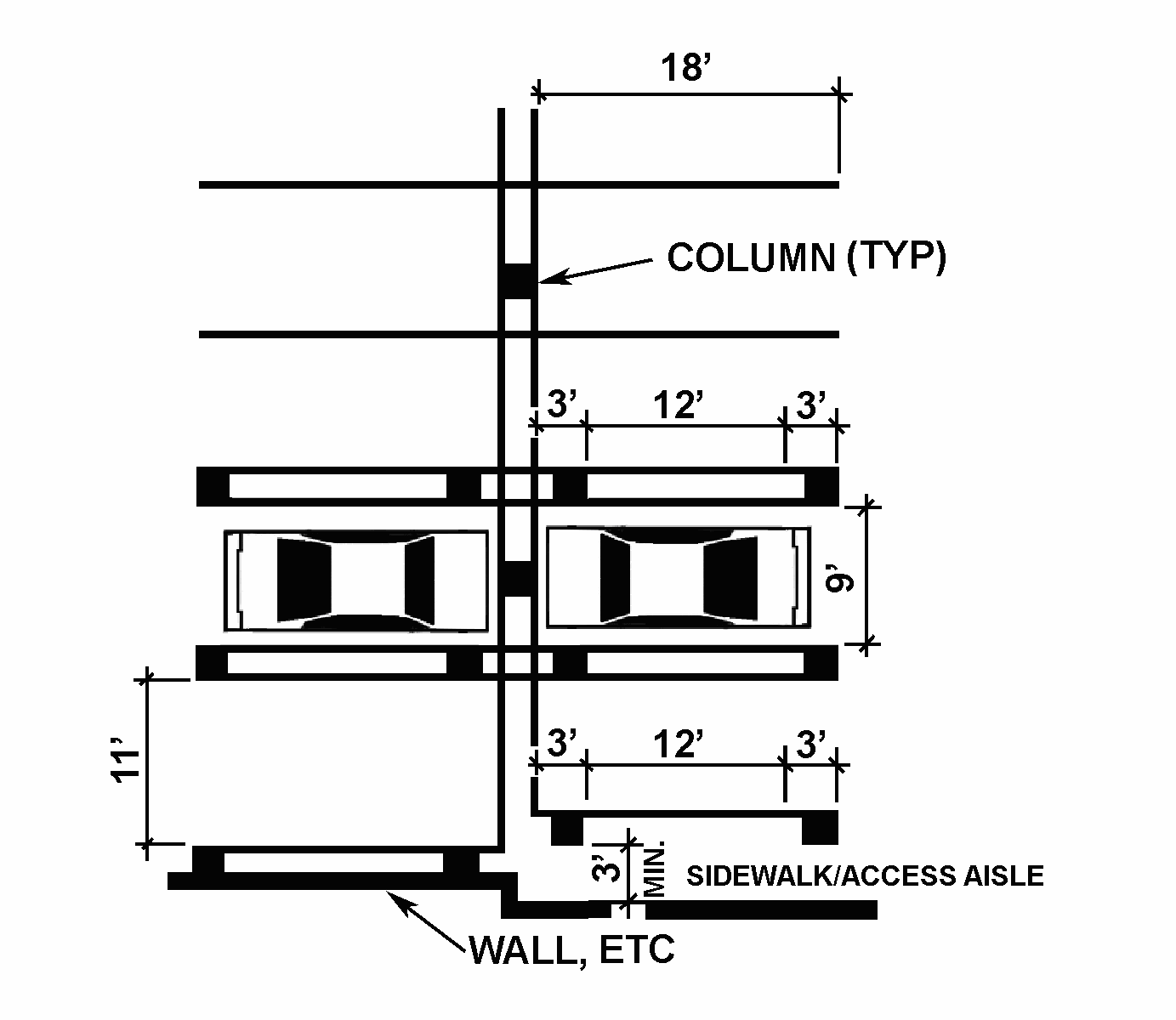
For new development and/or redevelopment constructed after July 9, 2010, when a side of a parking space is adjacent to a wall, column, or other obstruction, except as provided in Sections 9.106.A.1.a.ii. and 9106.A.1.a.iii., that is taller than six (6) inches, and where a minimum three-foot wide unobstructed pedestrian access aisle is not provided between the wall, column, or other obstruction and the parking spaces, the width of the parking space shall be increased by two (2) feet on the obstructed side, as illustrated by Figure 9.106.A.
(1)
The entire required width and length of a parking space(s) shall not be obstructed by a column, or obstruction that is greater than six (6) inches in height, as illustrated by Figure 9.106.A.
ii.
For new development and/or redevelopment constructed after July 9, 2010, when a side of a parking space, excluding a parallel parking space, that is adjacent to a column that is taller than six (6) inches, the obstructed side shall be unobstructed for a minimum of twelve (12) feet, which is between the front three (3) feet and rear three (3) feet of the parking space, as further illustrated by Figure 9.106.A.
FIGURE 9.106.A. Column, etc. Obstructions
iii.
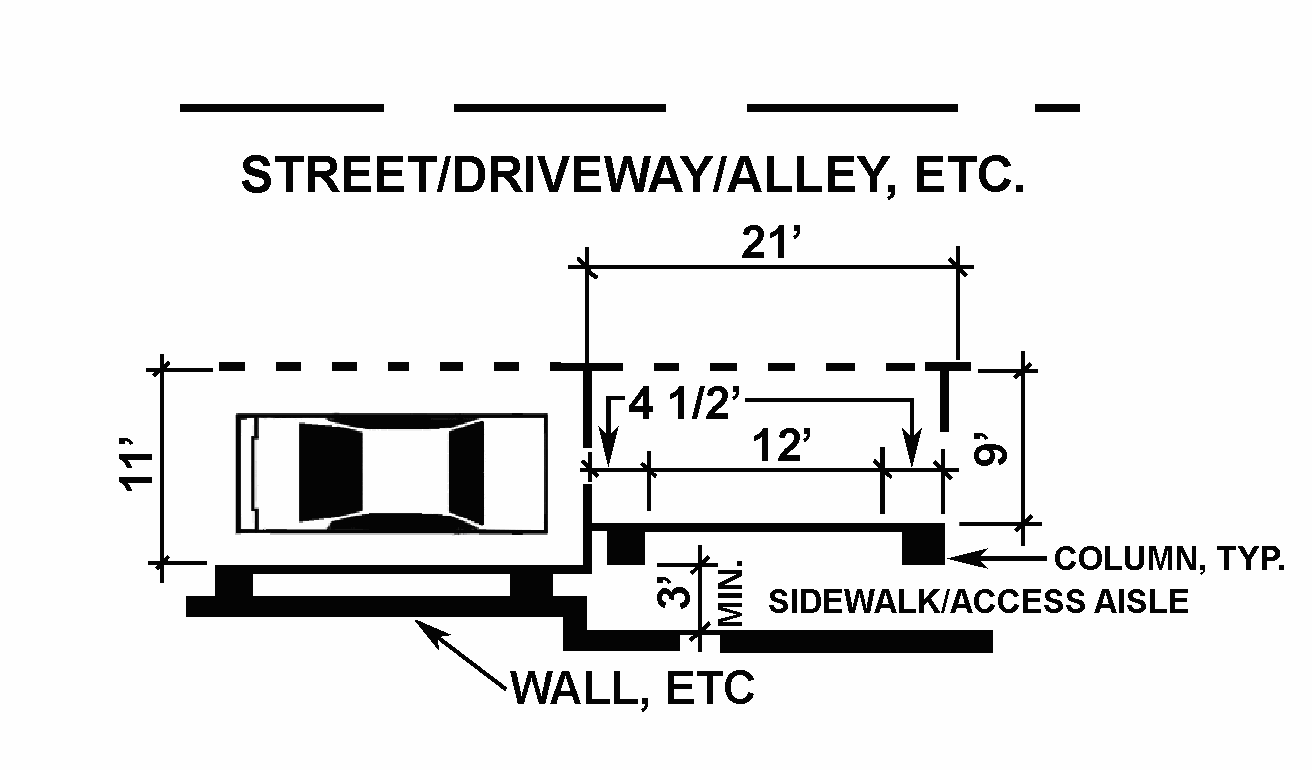
For new development and/or redevelopment constructed after July 9, 2010, when a side of a parallel parking space that is adjacent to a wall, column, or other obstruction that is taller than six (6) inches, the obstructed side shall be unobstructed for a minimum of twelve (12) feet, which is between the front four and one-half (4½) feet and rear four and one-half (4½) feet of the parking space, as further delineated by Figure 9.106.B.
Figure 9.106.B. Parallel Parking Space Side Obstructions
b.
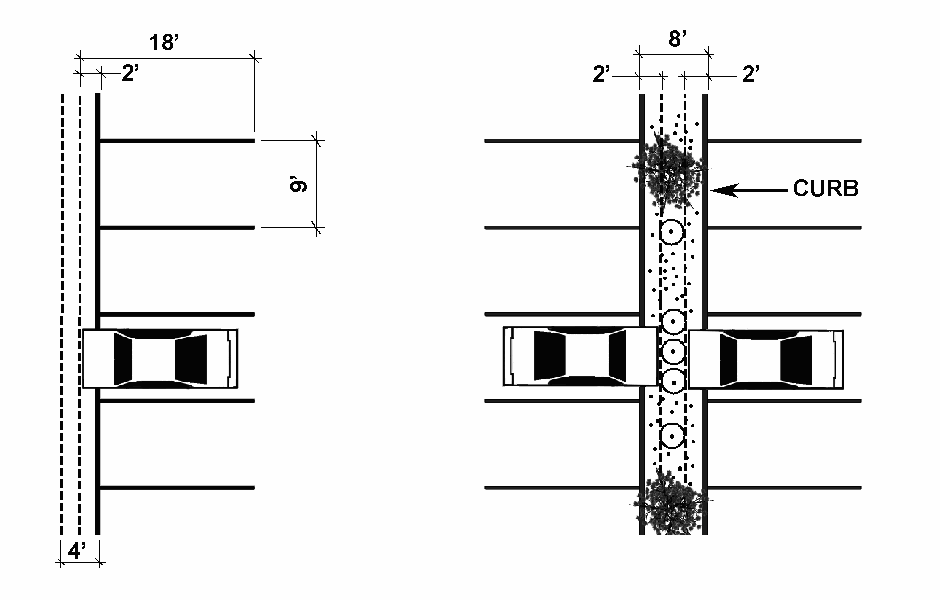
As illustrated in Figure 9.106.C., the front length of the space may over-hang a curb or low planter of a maximum height of six (6) inches and a maximum depth of two (2) feet which may not be calculated as required open space, or required parking lot landscaping. If a low planter is utilized the following conditions shall be met:
i.
Where the front of a parking stall overhangs a curb or planter on one (1) side only, the minimum width of the planter shall be four (4) feet.
ii.
Where the front of a parking stall overhangs a curb or planter on both sides, the minimum width of the planter shall be eight (8) feet.
Figure 9.106.C. Parking Stall Overhangs
c.
Where special circumstances exist, such as, but not limited to, a lot size, the Development Review Board may approve parking space sizes different from the requirements of the sections of 9.106.A.1. and Table 9.106.A.; but may not approve aisle sizes different from the requirements of Table 9.106.A.
2.
Bicycle. Bicycle parking spaces shall have a minimum width of two (2) feet and a minimum length of six (6) feet, unless the spaces are provided by a pre-manufactured bicycle rack or locker which differ from this dimension, in which case the dimension of the pre-manufactured rack or locker shall suffice.
B.
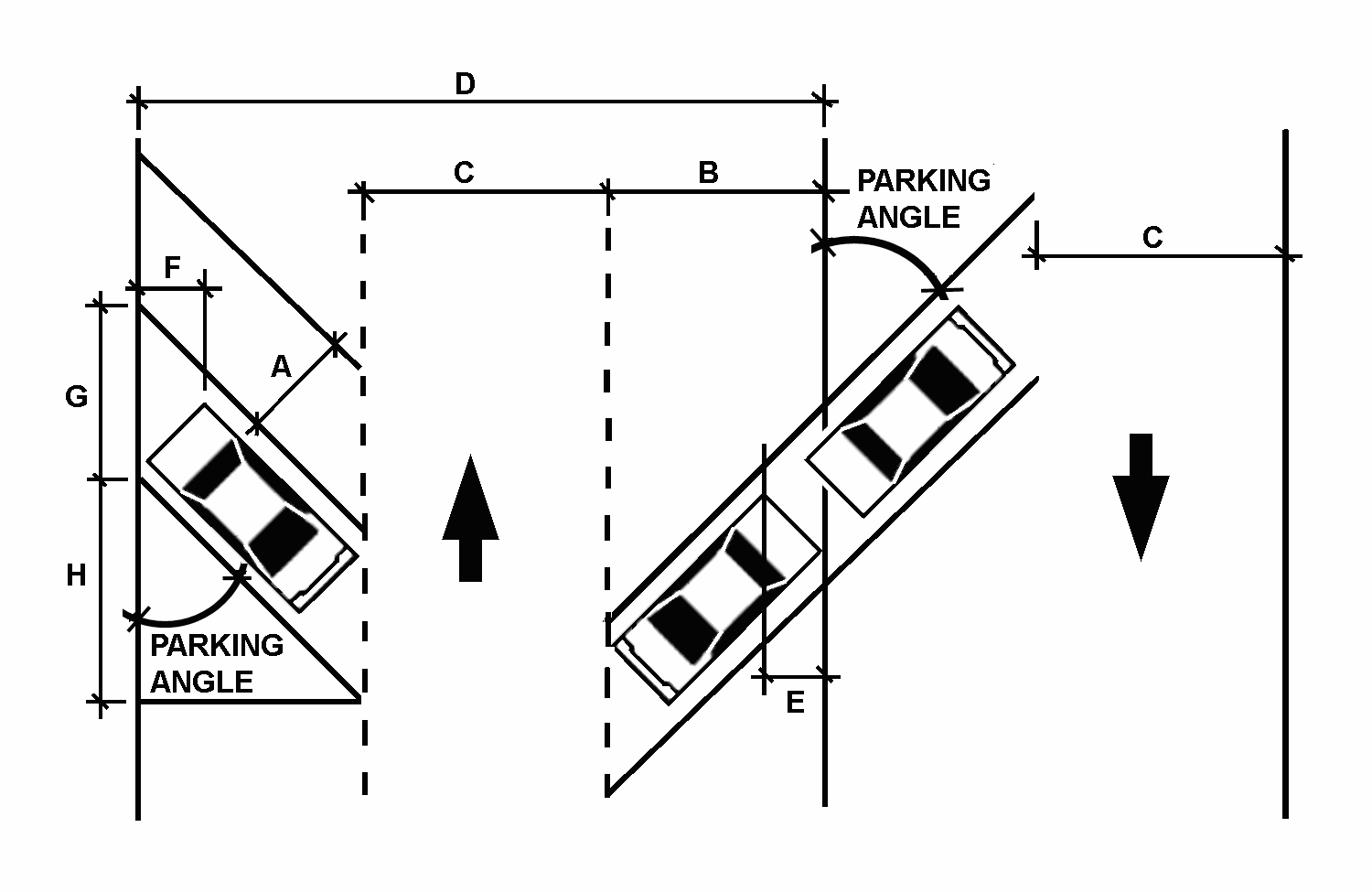
Parking layout. Minimum layout dimensions are established in Table 9.106.A. and Figure 9.106.D. which shall apply to all off-street parking areas with the exception that parking spaces accessed by an alley shall require a minimum of ten (10) feet from the back of the space to the alley centerline.
Note:
1.
All measurements are in feet.
2.
No two-way drive aisle shall be less than twenty-four (24) feet in width.
3.
An accessible parking stall width and access aisle shall comply with Section 9.105.E.
Figure 9.106.D.
C.
Design and improvement standards.
1.
Vehicular.
a.
Residential uses with up to four (4) units: parking, maneuvering, ingress and egress areas, for residential uses, with a total area of three thousand (3,000) square feet or greater, shall be improved in compliance with the Design Standards & Policies Manual and thereafter maintained by surfacing, to prevent emanation of dust, with (1) concrete, asphalt, cement or sealed aggregate pavement; (2) three (3) inches deep crushed rock completely contained in a permanent border; or (3) another stabilization material approved by Maricopa County.
b.
Nonresidential uses and residential uses with more than four (4) units: parking, maneuvering, ingress and egress areas for (1) industrial, commercial, and nonresidential uses, and (2) residential uses with more than four (4) units shall be improved in compliance with the Design Standards & Policies Manual and thereafter maintained with regard to:
i.
Grading and drainage.
ii.
Surfacing, to prevent emanation of dust, with (1) concrete, asphalt, cement or sealed aggregate pavement; (2) three (3) inches deep crushed rock completely contained in a permanent border; or (3) another stabilization material approved by Maricopa County.
iii.
Parking stall layout and markings.
iv.
Protective pipes at driveway entrances.
v.
Curbs, barriers and wheel stops. This requirement shall not apply within the taxilane safety area.
vi.
Directional signs.
c.
Nonresidential uses and residential uses with more than four (4) units: parking areas for (1) industrial, commercial, and nonresidential uses, and (2) residential uses with more than four (4) units shall meet the following standards:
i.
The parking lot shall be designed so that vehicles exiting therefrom will not be required to back out across any sidewalk or street.
ii.
Except as permitted in Section 9.106.C.1.c.ii.(1). All required on-site parking spaces shall be accessed directly from a drive aisle, alley or driveway. All on-site parking facilities shall be provided with appropriate means of vehicular access to a public street.
(1)
Residential parking space may be provided in a two (2) parking space tandem configuration if the tandem spaces are allocated to the same residential dwelling. Tandem parking spaces shall be accessed directly from a drive aisle, alley or driveway.
iii.
All parking lots shall be illuminated in accordance with Section 7.600, Outdoor Lighting, or as determined by the Development Review Board.
iv.
Illumination of an on-site parking area shall be arranged so as not to reflect direct rays of light into adjacent residential districts and streets. In no case shall such lighting cause more than one (1) footcandle of light to fall on adjacent properties as measured horizontally at the lot line, or as approved by the Development Review Board. Shields shall be used where necessary to prevent exposure of adjacent properties.
v.
Any wall, fence or landscaping provided shall be adequately protected from damage by vehicles using the parking lot and shall be properly maintained and kept in good repair at all times.
d.
The effective dates for the improvement standards regarding surfacing set forth in this section shall be:
i.
October 1, 2008 for parking, maneuvering, ingress and egress areas for industrial, commercial, and nonresidential uses, and residential uses with more than four (4) units; and
ii.
October 1, 2009 for parking, maneuvering, ingress and egress areas, for residential uses, with a total area of three thousand (3,000) square feet or greater.
2.
Bicycle.
a.
The type of bicycle parking facility provided shall be determined according to the requirements of Section 9.103.C., Required bicycle parking, and Section 9.104.C, Credit for bicycle parking facilities.
b.
Bicycle facilities shall be located on the same site as the generating land use and within fifty (50) feet of the building entrance in a location which does not extend into pedestrian sidewalks or vehicular traffic lanes.
c.
Lighting shall be provided along the access route from the bicycle facility to the building if the route is not completely visible from lighting on the adjacent sidewalks or vehicular parking facilities. Such lighting shall be provided in accordance with Section 7.600, Outdoor Lighting, or as determined by the Development Review Board.
3.
Covered parking.
a.
No covered parking shall be allowed in a required yard or building setback.
4.
Tandem parking. The zoning administrator may administratively approve tandem parking in the Old Town Area for residential units under the same ownership.
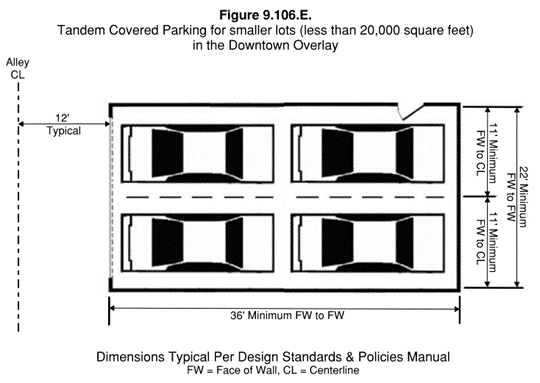
D.
Driveway parking prohibited except in residential districts. Except in residential districts, parking in driveways connecting the public right-of-way with a parking area or garage shall not be permitted on or adjacent to the driveway.
E.
Landscape design.
1.
Parking lot landscaping and landscape islands shall be provided in accordance with Article X.
2.
Parking structures fronting on a public street shall include pedestrian-related amenities such as sitting areas, planters, and visually-interesting wall surfaces at the street level along the street frontage, subject to design approval by the Development Review Board.
F.
Screening.
1.
Parking lot areas and on-site vehicular circulation (including drive-throughs and drive-ins, but excluding access driveways to streets and alleys) shall be screened from all streets and alleys by a three-foot tall masonry wall or berm and/or opaque landscape materials, subject to design approval by the Development Review Board.
2.
Outdoor vehicle display areas shall be screened, subject to design approval by the Development Review Board.
(Ord. No. 2736, § 1, 3-7-95; Ord. No. 2887, § 1, 3-19-96; Ord. No. 2977, § 1, 12-17-96; Ord. No. 3225, § 1, 5-4-99; Ord. No. 3274, § 2, 12-7-99; Ord. No. 3774, § 3, 3-18-08; Ord. No. 3896, § 1(Exh. § 6), 6-8-10; Ord. No. 3920, § 1(Exh. § 116), 11-9-10; Ord. No. 4005, § 1(Res. No. 8947, Exh. A, § 201), 4-3-12; Ord. No. 4099, § 1(Res. No. 9439, Exh. A, §§ 26—28), 6-18-13; Ord. No. 4117, § 1(Res. No. 9563, Exh. A, § 100), 11-19-13; Ord. No. 4143, § 1(Res. No. 9678, Exh. A, § 262), 5-6-14; Ord. No. 4500, § 1(Res. No. 12141, § 1, Exh. A). 5-18-21; Ord. No. 4629, § 1(Res. No. 13058, § 1(Exh. A, § 11)), 2-20-24)
Sec. 9.107. - Remote parking.
A.
Remote parking. Parking off a development site is permitted under the following procedures.
B.
Remote parking agreement. The remote parking agreement shall be subject to approval by the Zoning Administrator and City Attorney. The document shall contain the following and be recorded against the properties where the parking and served use are located.
1.
A term of at least five (5) years, to protect the city's interests in providing long-term, stable parking for the served use.
2.
Discontinuation of the served use if the remote parking becomes unavailable.
3.
Maintenance requirements.
4.
Termination, violations and enforcement provisions.
C.
Zoning Administrator review. The Zoning Administrator shall consider whether the remote parking:
1.
Is within six hundred (600) feet of the property line of the served use.
2.
Is accessible to the served use by a direct, safe, continuous pedestrian way.
3.
Serves the purposes of this Zoning Ordinance.
(Ord. No. 4099, § 1(Res. No. 9439, Exh. A, § 29), 6-18-13)
Editor's note— Ord. No. 4099, § 1(Res. No. 9439, Exh. A, § 29), adopted June 18, 2013, repealed and reenacted § 9.107 in its entirety to read as herein set out. Prior to inclusion of said ordinance, said provisions pertained to locating required parking relative to the use served. See also the Code Comparative Table.
Sec. 9.108. - Special parking requirements in districts.
A.
Planned Regional Center (PRC). The provisions of Article IX shall apply with the following exceptions:
1.
There shall be no parking required for courtyards or other open spaces, except that those portions thereof used for sales or service activities shall provide parking as specified elsewhere by this Zoning Ordinance.
2.
Parking for dwellings shall be covered.
B.
Theme Park District (WP). The provisions of Article IX shall apply with the following exceptions:
1.
The number of spaces required in Table 9.103.A. may be proportionately reduced by the provision of bus parking. Bus parking provided in lieu of automobile parking spaces may account for a maximum reduction of fifty (50) percent of the spaces required in Table 9.103.A.
2.
If any bus parking is provided in lieu of automobile parking spaces, one (1) overflow automobile parking space shall be provided for each twenty-five (25) persons for whom seating is provided as indicated on the approved development plan.
C.
Old Town Area. In Type 1 Areas of the Old Town Area, all parking shall be accessed from an alley or a street adjacent to a side yard. Unless approved by the Development Review Board, there shall be no curb cuts on streets abutting a front yard within any Type 1 Area.
D.
In-lieu parking program in the Downtown Overlay District (DO) and the Downtown District (D).
1.
Purpose. The purpose of the in-lieu parking program is to assist the property owners of small properties to reinvest, develop, and redevelop to the highest and best use of the property, and to accommodate different land uses throughout the life span of a development. In addition, the purpose of the in-lieu parking program is to foster a pedestrian-oriented environment with a sustainable urban design and character for all properties in the Old Town Area, by reducing the total number of physical parking spaces on a property. Also, as specified below, fees associated lieu parking program shall be utilized for parking programs and tram services in the Old Town Area.
2.
Property Size. The in-lieu parking program is limited to properties with a gross lot area of 20,000 square feet or less.
3.
Parking requirements. A property owner may satisfy a property's nonresidential parking requirement by utilizing the City's in-lieu parking program through in-lieu parking payments made to the City's parking program enhancement account for in-lieu parking credits. The regulations of the in-lieu parking program shall not be eligible for a variance. The City shall not be obligated to approve a property owner's request to participate in the in-lieu parking program.
4.
Approvals required.
a.
The City Council shall determine if a property owner is eligible to participate in the in-lieu parking program based on the following considerations:
i.
New development, reinvestment, or redevelopment of the property;
ii.
The use of the property fosters a pedestrian-oriented environment with an urban design and character, and the use of public transit or the tram service;
iii.
Property size and configuration;
iv.
The amount of public parking available to the area;
v.
The future opportunity to provide public parking in the area; or
vi.
Open space and public realm areas are maintained and/or parking lots convert into open space and public realm.
b.
The Zoning Administrator may administratively approve participation in the in-lieu parking program for up to, and including five (5) in-lieu parking credits, provided that the allowance is based on the City Council considerations of Section 9.108.D.3.a. The Zoning Administrator approval shall not exceed a total of five (5) in-lieu parking credits per lot.
i.
An appeal of the Zoning Administrator's, denial for participation in-lieu parking program shall be heard by City Council.
(1)
Appeals must be filed with the City Clerk no later than thirty (30) days after the Zoning Administrator issues any written denial for participation in-lieu parking program.
ii.
The City Council shall evaluate an appeal, and may approve or deny participation in-lieu parking program based on the considerations specified in Section 9.108.D.3.a.
5.
In-lieu parking credit fees. The amount of the in-lieu parking credit fee(s) shall be established by the City Council, and may include penalty fees for late payment, legal fees, administrative fees, an interest rate to account for the time value of money for the in-lieu parking installment purchase option, and any other fee the City Council deems necessary to implement the in-lieu parking program.
6.
Use of in-lieu parking fees. The use of the in-lieu parking fees paid to the City shall be used for the operation of a parking program which may include, but is not limited to, the provision and maintenance of public parking spaces, the operation of tram shuttle services linking public parking facilities and activity centers in the Old Town Area, and services related to the management and regulations of public parking.
7.
In-lieu parking payments. Fractional parking requirements may be paid for on a pro-rata basis. The property owner may purchase, or the City Council may require in-lieu parking credits to be purchased, either as permanent parking credits or as term parking credits in accordance with the following:
a.
Permanent in-lieu parking credits. Parking space credits purchased under this permanent in-lieu option shall be permanently credited to the property. These parking credits may be purchased either by installment payments to the City over a fixed period of time, or by payment of a lump sum fee.
i.
No new permanent in-lieu parking credits may be issued/purchased after June 17, 2021.
b.
Monthly term in-lieu parking credits: Parking credits obtained by payment of a monthly in-lieu fee under this option are only for the term of the activity requiring the parking and are not permanently credited to the property. A monthly term in-lieu parking credit(s) requires a written agreement, satisfactory to the City, binding the property owner to make subsequent monthly payments. The agreement shall include, but not limited to payment procedures approved by the Zoning Administrator. The first monthly payment shall be made in accordance with the agreement.
c.
Evening-use term in-lieu parking credits. Parking credits obtained by payment of a monthly in-lieu fee under this option are only for the term of the activity requiring the parking, limited to uses only open for business between the hours of 5:00 p.m. and 3:00 a.m., and are not permanently credited to the property. An evening-use term in-lieu parking credit requires a written agreement satisfactory to the City binding the property owner to make monthly payments. The agreement shall include, but not limited to payment procedures approved by the Zoning Administrator. The first monthly payment shall be made in accordance with agreement.
(Ord. No. 2736, § 1, 3-7-95; Ord. No. 3225, § 1, 5-4-99; Ord. No. 3520, § 1, 7-1-03; Ord. No. 3543, § 1(Exh. 1), 12-9-03; Ord. No. 3662, § 2, 2-7-06; Ord. No. 3879, § 1(Exh. § 27), 3-2-10; Ord. No. 3896, § 1(Exh. § 6), 6-8-10; Ord. No. 3920, § 1(Exh. § 119), 11-9-10; Ord. No. 4099, § 1(Res. No. 9439, Exh. A, § 30), 6-18-13; Ord. No. 4143, § 1(Res. No. 9678, Exh. A, § 263), 5-6-14; Ord. No. 4500, § 1(Res. No. 12141, § 1, Exh. A). 5-18-21; Ord. No. 4629, § 1(Res. No. 13058, § 1(Exh. A, § 11)), 2-20-24)
Sec. 9.109. - Evening-use parking.
A.
Evening-use parking. Evening-use parking is parking for establishments conducting business between 5:00 p.m. and 3:00 a.m.
B.
Evening-use parking application. The property owner of the served use shall file an application for proposed evening-use parking, including:
1.
A lighting plan for the parking in conformance with Article VII.
2.
An analysis of the location and availability of private parking spaces.
3.
A remote parking agreement in accordance with this article if the parking is not on the same property as the served use.
C.
Zoning Administrator approval of evening-use parking. The Zoning Administrator may approve an application for evening-use parking if the plans and analysis show the parking:
1.
Is within six hundred (600) feet of the property line of the served use.
2.
Is accessible to the served use by a direct, safe, continuous pedestrian way.
3.
Serves the purposes of this Zoning Ordinance.
(Ord. No. 4099, § 1(Res. No. 9439, Exh. A, § 31), 6-18-13; Ord. No. 4143, § 1(Res. No. 9678, Exh. A, § 264), 5-6-14)
Sec. 9.110. - High occupancy vehicle parking.
A.
Parking for carpools, vanpools, and other high occupancy vehicles shall be located nearest the main building entrance with priority over all other parking except for mobility-impaired accessible parking.
(Ord. No. 4099, § 1(Res. No. 9439, Exh. A, § 32), 6-18-13)
Sec. 9.201. - General regulations.
All buildings hereafter erected or established shall have and maintain loading space(s) as determined by Development Review Board approval as outlined in article I, Section 1.900 hereof and subject to conditions herein.
A.
No part of an alley or street shall be used for loading excepting areas designated by the city.
B.
No loading space that is provided in an approved development review shall hereafter be eliminated, reduced or converted, unless equivalent facilities are provided elsewhere.
C.
All loading space shall be surfaced and maintained subject to the standards of Section 9.106.C.1.
(Ord. No. 3225, § 1, 5-4-99; Ord. No. 3774, § 4, 3-18-08; Ord. No. 3896, § 1(Exh. § 6), 6-8-10)

