Seabrook City Zoning Code
ARTICLE 1
- IN GENERAL
Sec. 1.01.- Title.
This ordinance, in accordance with the authority granted by the State of Texas in V.T.C.A., Local Government Code ch. 211, shall be known and may be cited as part III [appendix A] of the Code of the City of Seabrook or the Seabrook Zoning Ordinance.
Sec. 1.02. - Purpose.
The Seabrook Zoning Ordinance is specifically aimed at protecting the public health, safety, morals, and the general welfare of the citizens of the city. The regulations are necessary to encourage the most appropriate use of land; to reduce fire hazards and to improve public safety; to decrease traffic congestion and its accompanying hazards; to prevent the undue concentration of population; to lay a proper foundation for the reasonable termination of land use activities which are not in conformance with the city's long range land use plans; to create a comprehensive and stable pattern of land uses; to maintain and stabilize property values; to develop an efficient and effective basis upon which to provide services for water supply, sanitary and storm sewer systems, pedestrian and automobile circulation, schools, parks, and other public facilities.
Sec. 1.03. - Relationship to the comprehensive city plan.
The regulations contained herein have been developed in accordance with a comprehensive land use planning program for the orderly growth and development of the City of Seabrook. This ordinance has been designed to incorporate and implement the goals, objectives, and policies found in the document entitled: Comprehensive Master Plan 2030, which is the officially adopted long range plan for the City of Seabrook.
Sec. 1.04. - Application of the zoning ordinance.
This ordinance classifies and regulates the use of land and structures within the city limits of Seabrook, as hereinafter set forth. Except as hereinafter provided, no land may be used and no structure may be erected, constructed, moved, altered, enlarged, or rebuilt unless it shall be used and maintained in accordance with the requirements established for the district in which the structure is to be located, and in accordance with the provisions of this ordinance as they pertain to districts.
Sec. 1.05. - Effective date and application.
This ordinance takes effect upon adoption by the city council. Upon that date and thereafter, the provisions of this ordinance supersede all other development regulations governing the development of land within Seabrook. All development applications and proposals filed on or after the effective date of this ordinance, whether for new developments or for additions or expansions of existing developments, shall be processed in accordance with the standards and requirements and pursuant to the procedures herein established, except insofar as such applications are governed by the development regulations adopted prior to the effective date of this ordinance.
Sec. 1.06. - Compliance required.
All development of land within the incorporated boundaries of the City of Seabrook shall conform to the requirements of this ordinance, and no person may use, occupy, sell or develop land, buildings or other structures, or authorize or permit the use, occupancy, sale or development of land, buildings or other structures under his/her control, except in accordance with all applicable provisions of this ordinance.
Sec. 1.07. - Computation of time.
Unless otherwise specifically provided, the time within which an act is to be done shall be computed by excluding the first and including the last day. If the last day is a Saturday, Sunday, or a legal holiday as observed by the city, that day shall be excluded. Whenever a person has the right, or is required to perform some act within the prescribed period, after the service of a notice or other paper upon him/her and the notice or paper is served by mail, three calendar days shall be added to the prescribed time, unless otherwise specifically provided.
Sec. 1.08. - Invalidity and savings clause.
All sections, paragraphs, sentences, clauses, and phrases of this ordinance are severable, and if any such section, paragraph, sentence, clause or phrase is declared unconstitutional or otherwise invalid in any court of competent jurisdiction in a valid judgment or decree, such unconstitutionality or invalidity shall not cause any remaining section, paragraph, sentence, clause, or phrase of this ordinance to fail or become inoperative.
Sec. 1.09. - Provisions of the previous zoning ordinance.
1.09.01. Repeal of Ordinance No. 81-04 with exceptions: Ordinance No. 81-04 as previously amended is hereby repealed except that certain provisions of Ordinance No. 81-04, and other municipal laws which preceded this ordinance, including but not limited to the building code, fire code, and trade code, shall remain in force and shall in no way be substantively modified or nullified by the terms of this ordinance unless otherwise indicated.
1.09.02. Previous specific use permits: In addition, the following establishments have been granted specific use permits under the previous Comprehensive Zoning Ordinance No. 81-04 and must still operate under conditional use permits according to the terms of this ordinance. Therefore, the following ordinances are hereby made amendments to Ordinance No. 93-03.
Ordinance No. 92-20: Allowing pool, billiards and games. Odds "R" Restaurant.
Ordinance No. 91-29: Allowing pool, billiards and games. Uncle Lyndy's Billiards and Games.
Ordinance No. 91-26: Allowing pool, billiards and games. Dave Conway's Sports Bar.
Ordinance 91-16: Allowing the operation of United Pentecostal Church.
Ordinance No. 91-41
Ordinance No. 91-35
Ordinance No. 86-01: Allowing the expansion and operation of Casa Mare Girl Scout Camp.
Also to be included are any other businesses receiving a specific use permit for pool, billiards and games between March 2, 1993, and the date of passage of this ordinance.
1.09.03. Rights for phased projects: Notwithstanding any provisions of this ordinance to the contrary, phased projects shall have the right to complete development as previously approved, in accordance with the current building regulations if the project meets the following criteria:
A.
The overall project is at least two-thirds (66.66 percent) developed as of the effective date of this ordinance based on overall project expense including infrastructure, site work, common area, common amenities, planning/architectural expenses, parking facilities and completed structures and buildings as determined by the city; and
B.
Construction will commence within 60 months of the passage of this ordinance for the additional phase or phases, and continued in accordance with the building permit until completion.
(Ord. No. 96-24, § 1, 1-21-1997)
Sec. 1.10. - Definitions.
For the purpose of these regulations, words used in the present tense include the future tenses; words used in the singular number include the plural, and words in the plural include the singular, except where the natural and obvious construction of the writing indicates otherwise. The word "may" is not discretionary unless the context in which it is used indicates otherwise. The words "must" and "shall" are mandatory in every instance.
For purposes of this ordinance, certain terms and words are to be used and interpreted as hereinafter defined.
Accessory apartment means a single dwelling unit which is clearly secondary and accessory to the main dwelling unit on a residential lot, and containing not more than 1,000 square feet of habitable floor area.
Accessory building means a building customarily incidental and subordinate to the main building or use located on the same lot with the main building.
Accessory use means a land use activity that is customarily incidental, appropriate and subordinate to the principal use of the land or buildings located on the same premises. No use prohibited in a zone can be an accessory use within that zone.
Active sales office, as used herein, means a sales office within a subdivision. Such office shall be currently served by public utilities such as water, gas, electricity and phone and must have regular business hours.
Adult bookstore means an establishment having as a significant portion of its stock in trade books, films, magazines and other periodicals which are distinguished or characterized by an emphasis on depicting or describing "sexual conduct" or "specified anatomical areas."
Adult mini motion picture theater or arcade means an enclosed building with a capacity of less than 50 persons used for presenting material distinguished or characterized by an emphasis on depicting or describing "sexual conduct" or "specified anatomical areas." Any place to which the public is permitted or invited wherein coin- or slug-operated or electronically, electrically or mechanically controlled still or motion picture machines, projectors, or other image-producing devices are maintained to show images to five or fewer persons per machine at any one time, and where the images so displayed are distinguished or characterized by an emphasis on or depicting or describing "sexual conduct" or "specified anatomical areas."
Adult motel means a motel wherein material is presented which is distinguished or characterized by an emphasis on or depicting or describing "sexual conduct" or "specified anatomical areas."
Adult motion picture theater means an enclosed building with a capacity of more than 50 persons used for presenting material distinguished or characterized by an emphasis on depicting or describing "sexual conduct" or "specified anatomical areas."
Adult use means any of the land use activities described in these definitions.
Agent for mobile home park means any person authorized by the permit holder of a mobile home park to operate or maintain a park under the provisions of this ordinance, or any person authorized to act for such a person.
Agriculture means the use of land for agricultural purposes, including farming, dairying, pasturage, horticulture, floriculture, viticulture, animal and poultry husbandry, and the necessary accessory uses for the packing, crating, or storing of produce; provided, however, the operation of any such accessory use must be secondary to that of the normal agricultural activities. The operation of commercial feed lots, sales yards and auction yards for cattle, hogs, or sheep, is deemed an industrial and not an agricultural land use activity.
Alley means a public passage or way affording a secondary means of vehicular access to abutting property and not intended for general traffic circulation.
Alteration andaltered includes the following:
A.
Any addition to the height, depth or width of a structure.
B.
Any change in the location of any of the exterior walls of a structure.
C.
Any increase in the interior accommodations of a structure.
Ambient means the average atmospheric or water condition existing naturally in any particular area of interest at any one time.
Apartment means any building or portion thereof which is designed, built, rented, leased, let or hired out to be occupied, or which is occupied as the home or residence of more than two families living independently of each other and doing their own cooking in the said building.
Automobile means a self-propelled mechanical vehicle designed for use on streets and highways for the conveyance of goods and people including but not limited to the following: Passenger cars, trucks, buses, vans, motor scooters, and motorcycles.
Automobile dealer means any party utilizing a parcel of land, including the structures thereon, for the sale of two or more new, pre-owned or previously used vehicles.
Automobile salvage wrecking yard means a parcel of land where motor vehicles are disassembled, dismantled, junked or wrecked, or where motor vehicles not in operable condition and used automobile parts are stored.
Automobile service station means any parcel of land, including the structures thereon, used for the sale of gasoline, oil, or other fuels, and automobile accessories, and which may include facilities for lubricating, washing, cleaning, mechanical repair, and other normal servicing of automobiles. Painting is not within the scope of "other normal servicing."
Automobile wash means a facility designed primarily for washing automobiles.
Auxiliary parking means any parking provided for commercial uses which is in excess of the mandatory parking requirements contained in this ordinance.
A-weighted sound pressure level means the sound pressure level in decibels as measured on a sound level meter, using the A-weighting network. The level so read shall be designated dB(a) or dBA.
Bar means an establishment for the sale of beer or intoxicating liquor for consumption on the premises, and where the sale of said beverages constitute 75 percent or more of the business income of that establishment, whether it is denoted as a bar, tavern, lounge, pool hall or related name.
Bed and breakfast home means a building or place where lodging is provided by prearrangement for definite periods, for compensation, for not more than five rooms to let.
Berm means an earthen mound designed to provide visual interest, screen undesirable views and/or decrease noise.
Block means a parcel of land entirely surrounded by public highways, streets, streams, railway rights-of-way, parks, etc., or a combination thereof. The planning and zoning commission shall be the city's exclusive authority as to a determination of questions regarding the limits or extent of a block.
Board of adjustment means the board of adjustment as defined by the Home Rule Charter of the City of Seabrook, Texas.
Boardinghouse means a dwelling other than a motel or hotel where, for compensation and by prearrangement for definite periods, meals, or lodging and meals are provided for three or more persons.
Boundary property line means the near side of any street, alley, stream or other permanently dedicated open space from the noise source when such open space exists between the property line of the noise source and adjacent property. When no such open space exists, the common line between two parcels of property shall be interpreted as the boundary property line.
Buffer yard means a land area used to visibly separate one land use from another or to shield or block noise, light or other nuisances. Buffer yards may be required to include fences, walls and earth berms, as well as shrubs and trees.
Building means any structure intended for shelter, housing or enclosure of persons, animals or chattel. When separated by dividing walls without openings, each portion of such structure so separated shall be deemed a separate structure.
A.
Primary: A building in which the primary activity associated with the lot is conducted. In any residential zoning district, any dwelling shall be considered the primary building.
B.
Secondary: A building customarily incidental and subordinate to the primary building located on the same lot.
C.
Storage/portable: A nonresidential, premanufactured or site-built structure, normally less than 150 square feet in floor area, and commonly used for the storage of equipment and other items associated with residential living.
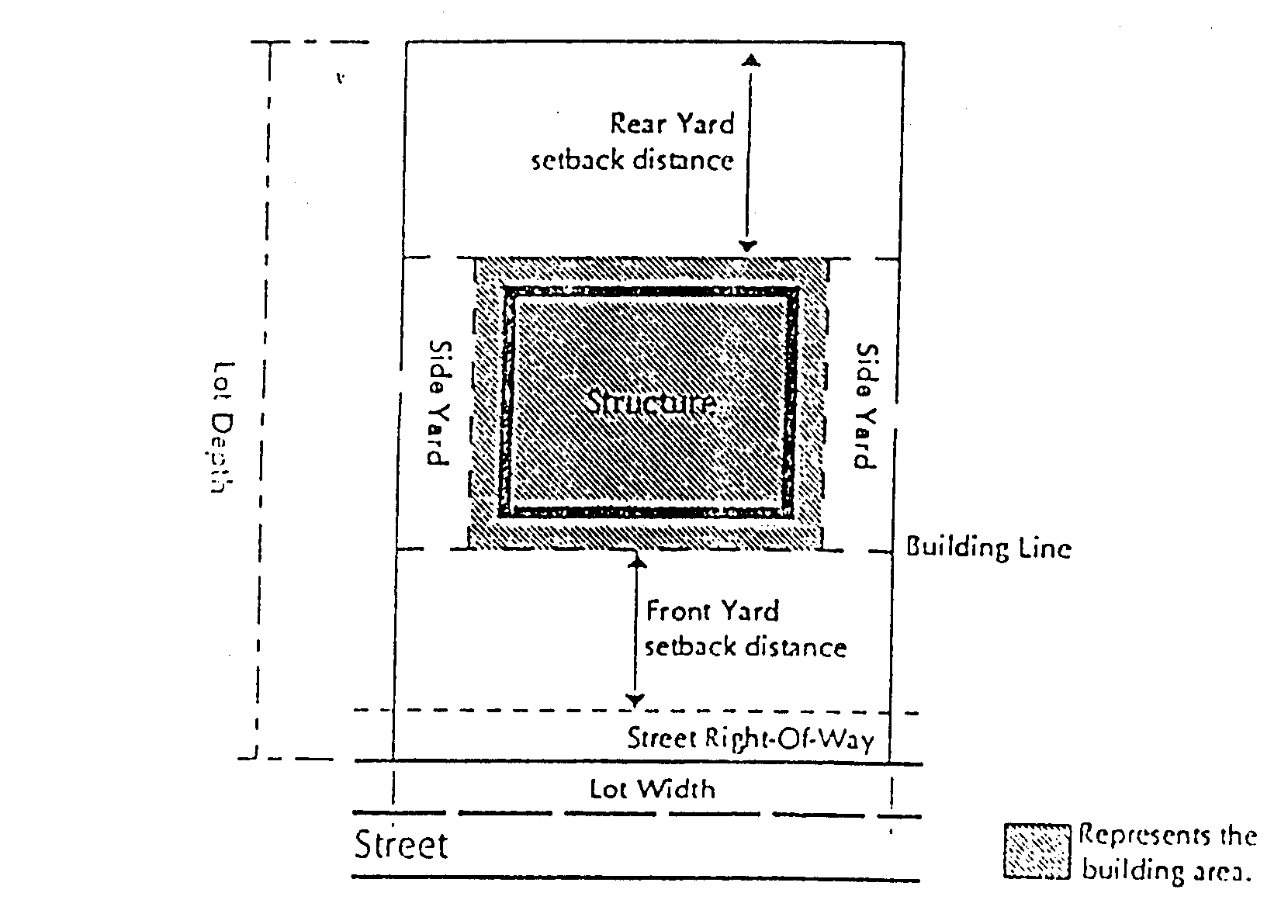
Building area means that portion of a lot upon which buildings may be placed, excluding required yards and limited by the maximum building coverage as specified for each zoning district. (See graphic 1-A at the end of this section of the ordinance.)
Building coverage means the percent of the lot area covered by the building exclusive of all overhanging roofs.
Building height: See "Height."
Building line means a line established generally parallel to the front street line. No building or structure may be permitted in the area between the building line and the street right-of-way line. (See graphic 1-A at the end of this section of the ordinance.)
Building site means a single parcel of land occupied or intended to be occupied by a building or structure.
Business directory sign means an outdoor sign used solely for the purpose of identifying the building name, address, number, primary business or activity conducted in the immediate premises. When a facility contains two or more tenants a directory sign may also identify individual tenants.
Cabaret means a nightclub, theater, or other establishment which features live performances by topless and/or bottomless dancers, "go-go" dancers, exotic dancers, strippers, or similar entertainers, where such performances are distinguished or characterized by an emphasis on depicting or describing "sexual conduct" or "specified anatomical areas."
Caliper means the diameter of a tree at four feet in height.
Carport means a permanent roofed structure open on at least two sides, designed for the parking and shelter of private passenger vehicles.
(CBD) Cannabidiol sales means a retail establishment primarily engaged in the sale of products containing cannabidiol (CBD), derived from hemp or cannabis plants. Such products may include CBD oils and tinctures for sublingual or oral consumption, CBD edibles like gummies, chocolates, and beverages, as well as CBD topicals such as creams, balms, and lotions for skin application. The shop may also offer CBD capsules and supplements containing specific dosages of CBD, as well as CBD vaping products, including e-liquids or cartridges designed for vaporization. However, a CBD shop shall not sell or display tobacco products (cigarettes, cigars, loose tobacco), cannabis paraphernalia (pipes, bongs, rolling papers), accessories that facilitate smoking (lighters, grinders, storage containers), or novelty items associated with tobacco smoking culture. Such establishments are required to comply with all applicable local, state, and federal laws regarding the sale and distribution of both legal and illegal items, including adherence to age restrictions and licensing requirements.
Child day care center means a commercial enterprise where more than 12 children are cared for less than 24 hours in a day. Further information is included in article 4, "Special Use Regulations."
City council means the governing body of the City of Seabrook, Texas.
City planner means an employee of the City of Seabrook, responsible for assisting in the preparation and implementation of the city's comprehensive city plan, and other related plans and ordinances.
Clinic means a facility for the examination and treatment of ill and afflicted human outpatients; provided, however, that patients are not kept overnight except under emergency conditions, including but not limited to dental and physician services.
Code enforcement officer means a municipal staff member who, working under the direction of the director of administration, assists in the implementation of this ordinance.
Coin-operated devices, as used herein, shall be deemed to include such devices as used to display and vend newspapers.
Common open space means a parcel or parcels of land or an area of water or a combination of land and water within the site designated PUD, designed for the use and enjoyment of the residents of the PUD. Common open space as defined herein includes both passively landscaped sites without improvements of any kind or complimentary structures and improvements as are necessary and appropriate for the benefit and enjoyment of the residents of the PUD.
Compensating open space means land or water within the boundaries of a subdivision which shall be owned in common by property owners and maintained at all times. Bodies of water or land owned by the federal, state, county or city government shall never be allowed to meet these requirements.
Compensating open space may consist of land or water reserved to fill an ecological need, such as providing flood control, acting as a sound barrier or serving as pollution control, providing that the area is accessible and does not pose an unnecessary hazard. It may be landscaped land used to visually enhance an area or to provide a barrier designation between different uses within the subdivision or between the subdivision and other areas of the city.
A developer who wishes to designate an area as compensating open space to meet the density requirements, when developing small lots for zero lot line homes, shall have his or her entire site plan approved by the planning and zoning commission in an open meeting before construction begins. The commission shall follow the criteria for approval listed in article 2 for conditional use permits and may deny any request which does not meet the criteria.
Comprehensive city plan means the planning document and related material officially adopted by the City of Seabrook, containing the goals and policies pertaining to land use, community facilities, infrastructure, circulation, housing, and other subjects related to the growth and development of the city.
Condominium means an estate in land and a form of property ownership as defined by Texas State law.
Construction sign means a sign stating the name of the architect, engineer, financing company, owners and the construction company and a brief description of the project under construction as authorized by the code enforcement officer. Only one such sign may be authorized for each building permit.
Convalescent, rest, nursing, or extended care facility means a health care facility where persons are housed, furnished with meals, and provided with continuing nursing care for compensation.
Day care facility: See "Child day care center," above.
Daytime means the hours between sunrise and sunset on any given day.
Decibel means a unit measurement of sound pressure.
Director of administration means an employee of the City of Seabrook who is primarily responsible for the implementation of this ordinance.
Display surface (sign) means the surface made available for the direct mounting or application of letters, graphics and decoration including the mounting and framework surrounding said surface. The supporting standards are not a part of the display surface.
District, zoning, means any section or sections of the City of Seabrook for which regulations governing the use of buildings and/or premises are described in article 3 of this ordinance and as shown on the official zoning map of Seabrook.
Dredge spoils means sludge or other organic matter, gathered by dredging, scraping or excavating natural or manmade bodies of water and ditches.
Drip line means a vertical line extending from the outermost branches of a tree to the ground.
Dwelling or dwelling unit means any portion of a building used, intended or designed as a separate abode for a family.
A.
Attached: A dwelling having one or more walls common with a principal building, or joined to a principal building by a covered porch, loggia, or passageway, the roof of which is a part or extension of the principal building.
B.
Detached: A dwelling which is fully separated from any other building or joined to another building by structural members not constituting an enclosed or covered space.
C.
Mixed use dwelling unit: A dwelling unit which is a part of a project which may be composed of residential, office, and commercial land use activities.
D.
Multiple-family dwelling: A dwelling designed for occupancy by two or more families living independently of each other as tenants, exclusive of recreational vehicle camps, hotels, motels, or resort facilities.
E.
Townhouse or rowhouse dwelling: A one-, two- or three-story single-family dwelling unit that shares no common structure with any other such dwelling except at the adjoining sidewalls. No patios, lanais, balconies or railings may be connected in any manner such that the individual identity of the dwelling is lost. Property lines separate the units. There shall be a minimum of two such attached units to constitute a townhouse.
F.
Zero-lot line dwelling: A single-family dwelling located on a lot in such a manner that one or more of the dwelling's sides rest directly on a lot line.
G.
Duplex: Two single-family dwelling units of one, two or three stories that share no common wall except one adjoining sidewall and common roof and are on one lot and under one ownership.
Easement means a right given by the owner of a parcel of land to another person, public agency or private corporation for a specific and limited use of that parcel.
Face of the building means the general outer surface, not including cornices, bay window or architectural projections.
Family means one or more persons related by blood or marriage, including adopted children, or a group of not to exceed five persons not all related by blood or marriage, occupying premises and living as a single nonprofit housekeeping unit, as distinguished from a group occupying a boardinghouse or lodginghouse, hotel, motel, club, or similar dwelling for group use.
Family day care home means:
A.
Unregistered: A residential dwelling occupied by the caregiver where three or fewer children not belonging to the caregiver are cared for less than 24 hours in a day. An unregistered family day care home is considered a home occupation. Further information is provided in article 4, "Special Use Regulations."
B.
Registered: A residential dwelling occupied by the caregiver where four to 12 children are cared for less than 24 hours in a day. A registered family day care home is a quasi-commercial use and shall not be permitted in any R-LD, R-1 or R-2 zone. The home must be registered with the state and the city. Further information is provided in article 4, "Special Use Regulations."
Farm: See "Agriculture," above.
Floor area means:
A.
Gross: The sum of the horizontal areas of all floors of a building, measured from the exterior faces of exterior walls or from the centerline of the walls separating two buildings, and including but not limited to:
1.
Basements;
2.
Elevator shafts and stairwells of each floor;
3.
Floor space for mechanical equipment with structural headroom of seven feet;
4.
Penthouses;
5.
Interior balconies, mezzanines, enclosed covered porches and steps;
6.
Accessory uses in enclosed covered space, but not including space used for off-street parking.
B.
Net: The total floor area within a building devoted or intended to be devoted to a particular use, within structural headroom of seven feet or more, whether above or below the finished lot grade, and excluding items A.2, A.3, and A.6 above.
C.
Ratio: A mathematical expression determined by dividing the gross floor area of a building by the area of the lot on which it is located.
Footcandle means a unit of illumination intensity.
Frequency means the number of times per second a vibration or sound wave oscillates.
Frontage means the measure of property on one side of a street, closest to the street right-of-way, and between the two side property lines associated with the same tract of land.
Garage means:
A.
Private: An accessory building or a part of a main building used for storage purposes only for automobiles used solely by the occupants and their guests for the building to which it is accessory.
B.
Public: Any garage other than a private garage available to the public, used for the care or servicing of automobiles where such vehicles are parked or stored for remuneration, hire or sale.
Garage apartment means a dwelling unit for one family erected attached to a private garage.
Gasoline service station: See "Automobile service station."
Ground cover means plants, normally reaching an average maximum height of not more than 24 inches at maturity.
Group home means a residential dwelling shared by six or fewer handicapped persons including the resident staff who live together as a single housekeeping unit in a family environment. Further information is provided in article 4, "Special Use Regulations."
Heavy equipment means motorized, self-propelled rolling stock, generally associated with earth moving, grading, scraping, building site preparation, and infrastructure or real estate development.
Height means:
A.
Building: The vertical distance from grade or base flood elevation, whichever is higher, to the highest finished roof surface in the case of flat roofs or to a point at the average height of the highest roof having a pitch. Height of a building in stories does not include basements.
B.
Sign: The vertical distance from the uppermost point of an outdoor advertising sign to the ground immediately below such point.
C.
Story: The vertical distance from top to top of two successive finished floor surfaces.
D.
Wall: The vertical distance to the top measured from the foundation wall, or from a girder or other intermediate support of such wall.
Homeowners' association means a formal nonprofit organization operating under recorded land agreements through which: (1) Each lot and/or homeowner in a residential subdivision or a planned unit development is automatically made a member; and (2) Each lot is automatically made subject to a charge for a proportionate share of the expenses for the organization's activities, such as maintenance of common property; and (3) The fee if unpaid becomes a lien against the nonpaying homeowner's property.
Hospital means an institution providing health services primarily for human inpatient, medical or surgical care for the sick or injured and including related facilities such as laboratories, outpatient departments, training facilities, central service facilities, and staff offices which are an integral part of the facilities.
Hotel or motel means furnished, temporary living quarters that charge daily rates and are normally intended for overnight or a few days' accommodations. Hotels and motels do not include accommodations that are intended for extended stay or permanent living quarters.
Ionizing radiation means gamma rays and X-rays, alpha and beta particles, high speed electrons, neutrons, protons and other nuclear particles; but not sound or radio waves, or visible, infrared or ultraviolet light.
Junkyard means a place where waste, discarded or salvaged metals, used plumbing fixtures, and other materials are bought, sold, exchanged, stored, baled, or cleaned, and the places or yards for the storage of salvaged materials and equipment from housing wrecking and salvaged structural steel materials and equipment, but excluding establishments for the sale, purchase or storage of used cars in operable condition, salvaged machinery, used furniture, and household equipment, and the processing of used, discarded or salvaged materials as a part of manufacturing operations.
Landowner means the legal and beneficial owner of all the land proposed to be included in a development or transaction, including the possessor of an option or contract to purchase, or other persons having an enforceable vested and proprietary interest in such land.
Landscaping means any combination of living plants (such as grass, ground cover, shrubs, vines, hedges or trees) and nonliving landscape materials (such as rocks, pebbles, sand, mulch, walls, fences or decorative paving materials).
Loading space means a space within the main building or on the same lot therewith, provided for the standing, loading or unloading of trucks and having minimum dimensions of 12 by 60 feet.
Location (sign) means a lot, premises, building, wall or any place or surface whatsoever on which a sign is erected, constructed and maintained.
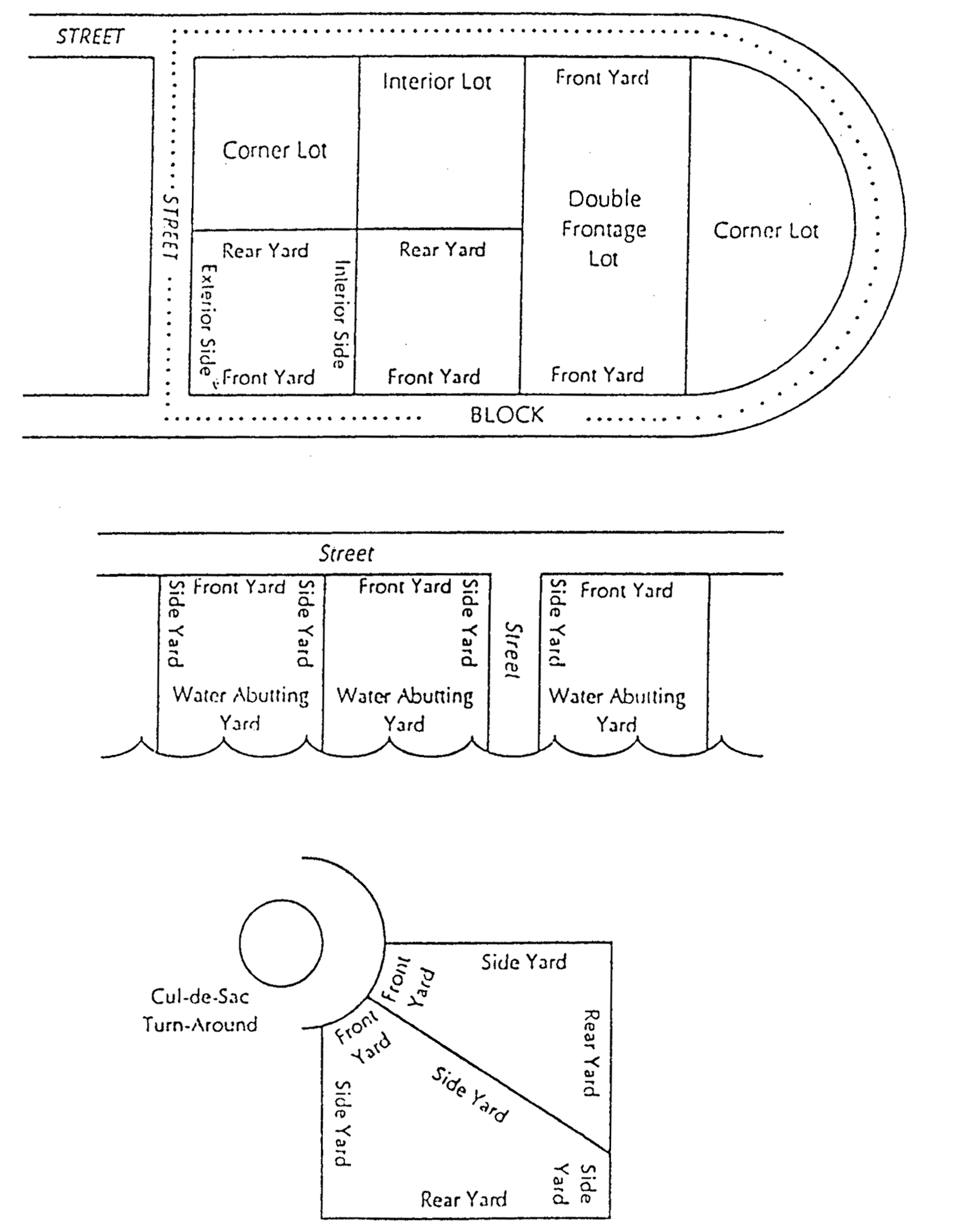
Lot means a parcel of land occupied or intended for occupancy by a use permitted in this ordinance, including one principal building together with its accessory buildings, open spaces and parking spaces required by this ordinance, and having its principal frontage upon a street or upon an officially approved point of access. (See graphic 1-A, at the end of this section of the ordinance.)
A.
Corner: A lot abutting upon two or more streets at their intersection.
B.
Depth: The perpendicular distance between the front and the rear lot lines.
C.
Double-frontage: A lot having direct access to two parallel public streets. For purposes of this ordinance, land abutting such streets shall be considered "front yards." (See graphic 1-B.)
D.
Line: The boundary line of the property.
E.
Frontage: The yard or yards nearest the street.
F.
Rear line: The boundary of a lot which is most distant from, and most nearly parallel to the front lot line.
G.
Side line: Lines running between the front and rear property lines.
H.
Water-abutting: A lot which abuts Taylor Lake, Clear Lake or Galveston Bay.
Manufactured, modular, or industrialized home means a structure, constructed on or after June 15, 1976, according to the rules of the U.S. Department of Housing and Urban Development, transportable in one or more sections, which in the travel mode, is eight body feet or more in width or 40 body feet or more in length, or, when erected on site, is 320 or more square feet in area, and which is built on a permanent chassis and is designed to be used as a dwelling with or without a permanent foundation when connected to the required utilities and includes the plumbing, heating, and electrical systems. This term does not include a recreational vehicle.
Marina means a sheltered water or harbor area with docking facilities for sports and pleasure boats and, upon such approval as may be required, docking facilities for living aboard. A commercial establishment engaged in the sale, maintenance, repair, docking and storage, wet or dry, of boats and watercraft used for pleasure or sport purposes, and accessories, including motors, trailers, equipment and supplies, the sale of fuel, lubricants, provisions, bait and tackle. Service buildings with laundry facilities, showers, toilets, lavatories, and recreational facilities may be included.
Marine means areas of water formed by Galveston Bay, Clear Lake, Taylor Lake, and all other significant bodies of water.
Massage parlor means any place where, for any form of consideration or gratuity, massage, alcohol rub, administration of fomentations, electric or magnetic treatments, or any other treatment or manipulation of the human body occurs as part of or in connection with "sexual conduct," or where any person providing such treatment, manipulation or service related thereto exposes "specified anatomical areas."
Massage therapy clinic means any place of business in which massage therapy is practiced by a massage therapist, as defined by Texas law. "Massage therapy," as a health care service, means the manipulation of soft tissue for therapeutic purposes. The term includes, but is not limited to, effleurage (stroking), petrissage (kneading), tapotement (percussion), compression, vibration, friction, nerve strokes, and Swedish gymnastics, either by hand or with mechanical or electrical apparatus for the purpose of body massage. Massage therapy may include the use of oil, salt glows, heat lamps, hot and cold packs, tub shower, or cabinet baths. Equivalent terms for massage therapy are "massage," "therapeutic massage," "massage technology," "myotherapy," or any derivation of those terms. The terms "therapy" and "therapeutic" do not include diagnosis, the treatment of illness or disease, or any service or procedure for which a license to practice medicine, chiropractic, physical therapy, or podiatry is required by law.
Mixed use project means a real estate complex which may include residential, office, commercial, and other diverse forms of land use activity; frequently created as a planned unit development.
Mobile food vendor means a business or individual that sells foods and beverages from a movable setup, such as a food truck, cart, or trailer. These vendors typically operate at various locations, including street fairs, parks, festivals, construction sites, private parties, and busy urban areas.
Mobile home means a movable, detached single-family dwelling unit, constructed before June 15, 1976, conforming to the minimum housing code requirements of both the state and Seabrook, for permanent longterm occupancy; is constructed or fabricated within a factory, complete with an integral utility system capable of being connected to an outside system; can be transported over the road on its own chassis and wheels to the site where it is to be connected semipermanently to a separate utility system and is not permanently attached to any foundation as required for permanent conventional dwelling or structure.
Mobile home pad area means an area designed for the exclusive use of an individual mobile home.
Mobile home park means any development site, parcel or tract of land designed, maintained or intended to be used for the purpose of providing longterm occupancy for more than 30 days of two or more mobile homes or manufactured homes, including all buildings used or maintained for the use of the residents of the development. This term is not to be used in conjunction with any mobile homes or trailer sales lots which contain unoccupied units that are intended for purposes of inspection and sale. This term shall apply to both the lease and sale of pads or lots.
Mobile vending means the operation of a mobile unit, such as a cart, trailer, or vehicle, that is designed to sell goods and provide services directly to consumers in designated areas. This use encompasses a wide range of retail activities, including the sale of merchandise such as clothing. crafts, electronics, and other consumer goods, as well as the provision of services such as repairs, grooming. or entertainment.
Model studio means any place where, for any form of consideration or gratuity, figure models who display "specified anatomical areas" are provided to be observed, sketched, drawn, painted, sculptured, photographed, or similarly depicted by members of the general public paying such consideration or gratuity.
Motel or motor lodge: See "Hotel" above.
Music venue means a commercial establishment with a building, building complex, and/or an indoor or outdoor area where a component of the business use is to accommodate sound amplified performances, including live amplified music, the presentation of music/sound played on amplified sound equipment operated by the owner, employee, an agent or a contractor commonly known as a "disc jockey," "DJ," and karaoke performance. A music venue is a specific use, where the business may sell tickets, imposes an admission charge, cover charge, or related charge to observe that entertainment or performance.
Nonconformance means a condition of a structure or land which does not conform to the regulations of the zoning district in which it is situated. This may include but is not limited to a failure to conform to use, height, area, coverage, or off-street parking requirements.
Nonconforming use means a structure or a parcel of land occupied by a land use activity that does not conform to the regulations of this zoning ordinance and the district in which it is situated and which has been identified as a nonconforming use by the board of adjustment.
Octave band means a portion of the audible sound spectrum. An octave band analyzer divides the audible sound spectrum into eight octave bands.
Odor threshold means the concentration of odorous matter in the atmosphere necessary to be perceptible to the olfactory nerve. Determination of the odor threshold is prescribed by ASTMD 1391-57, Standard Method for Measuring Odor in the Atmosphere.
Odorous matter means any solid, liquid or gaseous matter, including but not limited to gases, vapors, dusts, fumes and mists which cause an odor sensation to human beings.
Off-premises real estate signs means signs drawing attention to, and providing direction to, real estate for sale or lease located on property other than the property which is the subject of said sign.
Off-premises sign means any outdoor advertising sign which directs attention to a business, commodity, industry or other activity which is sold, offered or conducted elsewhere than on the premises upon which such sign is located, or which is sold, offered or conducted on such premises only incidentally, if at all. The term shall include all structures of whatever material as may be constructed, which are erected, maintained and established for public display of posters, printed signs, pictures or other pictorial or reading matter. Furthermore, the premises must be under a single ownership. Contiguously or remotely leased property is specifically excluded, except that a business directory sign for a strip or shopping center where the sign is erected on contiguous property owned by the shopping or strip center shall be available to lessors of the center.
Office, professional [means] a structure with a room or group of rooms that houses individual or groups of professionals who provide services to their clients as opposed to maintaining and marketing tangible items from an on-premises inventory.
On-premises real estate signs means signs advertising a parcel of property or building for sale and affixed to the building or to the property on which the building stands; affixing the signs to other property whether leased or owned by the same or other property owners is specifically prohibited.
On-premises signs means any advertising sign which identifies or advertises a business, person, commodity, service, entertainment, industry or activity which is sold, offered, or conducted, other than incidentally upon the premises upon which such sign is located, installed, maintained, or to which it is affixed, when such premises is used for business purposes.
Open air market means an identified area on private property under the control of a single person, partnership or corporation set aside for the purpose of display and sale of goods, commodities and services to the public. It is characterized by multiple open air market booths and display areas clearly defined one from the other, arranged in an identifiable pattern with or without overhead shelter, but not generally enclosed by walls. Such booths are ordinarily leased to individual proprietors, companies, organizations, corporations or other entities.
Open air market booth means an individual display or sales area within an open air market, operated by a single proprietor or entity comprising an area of up to 100 square feet. For a sales area of greater than 100 square feet, each additional 100 square feet or fraction thereof shall be considered an additional booth for the purpose of administering this ordinance.
Open space: See "Common open space" and "Compensating open space."
Open storage and display means the storage of any equipment, machinery, commodities, raw semifinished or finished materials, and building materials, which is visible from any public street.
Outdoor advertising sign means any arrangement of letters, figures, symbols or other devices used for advertising, announcements, direction or declaration intending to attract or inform the public, whether such signs are affixed freestanding, attached to, or projected from the exterior walls of a building or other structure or upon constructed surfaces supported by one or more uprights or braces, regardless whether such supports are in or on the ground or otherwise erected, attached or supported. Outdoor advertising signs shall be those signs erected outside the exterior or weather surfaces of the building. The word "sign" shall be interpreted to include the structure of such sign except for the determination of percent of damage to a sign as required elsewhere in this ordinance. Further, the term "outdoor advertising sign" shall include but not be limited to business signs, construction signs, business directory signs, and portable signs, including temporary signs, as herein defined.
Parking, interior, means parking rows which are not located on the periphery of the proposed project site and further, where none of the parking spaces abut any property line associated with the project site.
Parking rows means:
(1)
Single parking row: A single row of spaces for the parking of motor vehicles.
(2)
Double parking row: Two parallel rows of spaces for the parking of motor vehicles arranged so that when parked, the front end of each motor vehicle faces the front end of another motor vehicle.
Parking space means a permanently surfaced area, enclosed or unenclosed, sufficient in size to store one automobile together with a permanently surfaced driveway connecting the parking space with a street or alley and permitting ingress or egress of an automobile. For the purposes of this ordinance, the size of a parking space shall be in conformance with article 4 [5] of this ordinance.
Particulate matter means finely divided solid or liquid matter, other than water, which is released into the atmosphere.
Paving means a system of structuring base material and sealing an impervious wear surface, done in accordance with specifications provided by the code enforcement officer.
Permit means an official document or certificate issued by the City of Seabrook building official authorizing performance of a specified activity.
Person means any individual, firm, corporation, partnership or association of persons of whatever nature or description.
Planned unit development (PUD) means an area with a specified minimum contiguous acreage to be developed as a single entity according to a unified site design plan, containing one or more residential uses, office uses, commercial uses, industrial uses, public or quasi-public uses, or any combination of the same. (See graphic 1-C at the end of this section of the ordinance.)
Planning and zoning commission means the planning and zoning commission as defined by the Home Rule Charter of the City of Seabrook, Texas.
Portable displays shall conform to the same regulations as temporary signs. Portable display, as herein used, refers to outside structures or merchandise, other than products covered by a vendor's license, which are intended to be erected at successive locations, providing that the foregoing definition shall not be deemed to extend to or include coin-operated devices such as used to display and vend newspapers.
Private club means an establishment providing social or dining facilities, and which derives more than 50 percent of its gross sales from the sale of alcoholic beverages.
PUD designation means a graphic notation on the official zoning map of the City of Seabrook, showing that an area is to be developed as a single entity and that specific criteria of this section of the ordinance have been applied to that area.
PUD plan means the plan showing the provisions for the development of the PUD, including drawings that serve as a plat, all covenants relating to use, location and bulk of buildings, intensity of use or density of development, private streets, ways and parking facilities, common open space and public facilities. The phrase "provisions of the plan," when used in this ordinance, means the written and graphic materials referred to in this definition.
Recreational vehicle means a portable vehicle built on a chassis and intended to be used generally for temporary living and sleeping quarters for travel, recreation and vacation purposes. The term includes travel trailers designed to be towed, motor homes designed as temporary dwellings equipped to travel under their own power, and any other portable contrivances intended to be used as temporary living and sleeping quarters which may be moved under its own power, towed or transported by another vehicle. This definition does not include mobile homes.
Residential density means the number of lots, dwelling units, or persons located or residing within a residential area.
A.
Gross: The number of lots, dwelling units, or persons located within the total acreage of a residential area.
B.
Net: The number of lots, dwelling units, or persons located within the total acreage of a residential area, exclusive of street rights-of-way, easements, nonresidential land use parcels, and acreage unsuitable for normal land development purposes.
Restaurant means:
A.
Restaurant-fast food: A restaurant that serves fast food cuisine and has minimal table service, offers a limited menu, cooks in bulk, finished and packaged to order, and is usually available for take away, though seating may be provided. Restaurants-fast food are typically part of a restaurant chain or franchise operations that provides standardized ingredients and/or partially prepared foods and supplies to each restaurant through controlled supply channels. Restaurants-fast food also include characteristics of inclusion of a fast food window/drive through, used to dispense food or beverages for consumption on or off the premises to an individual in a vehicle.
B.
Restaurant-full service: A restaurant with a relatively broad menu along with table, counter and/or booth service and a wait staff. This type of restaurant is often made up of the following types: Fine dining, casual dining, contemporary casual dining, family style, buffet and fast casual dining.
In the case of both fast food and full service restaurants, the sale of food items shall constitute more than 50 percent of the gross receipts.
Retail, heavy: This land use category is characterized by commerce that caters to a broad range of commercial activity. Retail, heavy uses include those found in the Light Commercial category and those venues usually found in shopping centers and adjacent to grocery stores and the like. Retail uses are located adjacent to arterial and major collector roadways in areas that provide buffering to area residences. This category is exclusive of uses that produce excessive noise, airborne particles or offensive odors.
Retail, light: This land use category is characterized by commercial activity that caters to the trade and personal services meeting the needs of adjacent neighborhoods. Land uses produce light traffic volumes and are in harmony with residential uses. Examples include professional offices, gift shops, stationery stores and tailor shops.
Roof sign means an outdoor advertising sign erected over, or attached to, the roof of any building.
School means:
A.
Private: A school under the sponsorship of a private agency or corporation other than a public or religious agency, having a curriculum generally equivalent to public elementary or secondary schools.
B.
Public or parochial: A school under the sponsorship of a public or a religious agency providing elementary or secondary curriculum, but not including private trade or commercial schools.
Screen means an opaque barrier of stone, wood, brick, block, or other permanent material at least six feet in height.
Setback means a distance between the lot line and the building line. (See graphic 1-A at the end of this section of the ordinance.)
Sexual conduct includes the following:
A.
The fondling or touching of human genitals, pubic region, buttocks, or female breasts;
B.
Ultimate sex acts, normal or perverted, actual or simulated, including intercourse, oral copulation, anal copulation, masturbation; and
C.
Excretory functions as part of or in connection with any of the activities set forth in subsections (A) and (B) above.
Sexually oriented business means any of the land use activities described in definitions for: (1) adult bookstore; (2) adult mini motion picture theater or arcade; (3) adult motel; (4) adult motion picture theater; (5) adult use; (6) cabaret; (7) massage parlor; and (8) model studio.
Shipping container/storage container means a portable compartment for the repeated carriage of cargo in bulk or package form that has the following characteristics: (a) It is of a permanent character and accordingly strong enough for repeated use, (b) It is specially designed to facilitate the carriage of goods by one or more modes of transport without intermediate reloading, (c) It is fitted with devices permitting its ready handling particularly its transfer from one mode of transport to another, (d) It is so designed as to be easy to fill and empty, and any enclosure, device, box, container, or anything similar in nature or use to the above. The term shipping or storage container includes all types involved in the maritime, railroad, and trucking industries including but not limited to flat racks, ventilated, half-height, tank, reefers, open-top, canvas top, high cube, bulk, and similar named containers. The term applies to new, used, certificated, documented, licensed, repaired or surplus containers constructed of any material.
Shipyard means a place of business devoted to the sales, rental, fitting-out, and repair of ships and boats. Such services include but are not limited to product sales, rentals, installation and repair of the following: Air conditioning, batteries, radios and electrical equipment, marine engines and motors, upholstering, painting, welding, gasoline and oil, ships chandlery, sail making, pumps, cabinetry and millwork, clothing, and diving gear.
Shopping center means a group of primarily retail and service commercial shops planned, constructed and managed as a total entity with customer and employee parking provided on-site, provision for goods delivery separated from customer access, provision of aesthetically appropriate design and protection from the elements.
Shrub means a woody plant, smaller than a tree, consisting of several small stems from the ground or small branches near the ground.
Sign, for purposes of this section, means outdoor advertising sign.
Sign, banner, means a sign made of any flexible material such as cloth, vinyl, polyester or similar material which is printed with letters or graphics for the purpose of advertising a message, product or opinion and which is mounted in any fashion on a structure or fixture.
Sign, ground, means a sign made of permanent materials supported by one or more columns, poles, uprights, or braces anchored in the ground and not attached to any building.
Sign, monument, means a sign constructed as part of an architecturally designed structure to provide a unique identification of a residential or commercial or industrial development. Such signs carry no advertising or names other than the logo and lettering of the development.
Sign, placard, means a sign constructed of paper or plastic material designed for temporary use and mounted with small fragile sticks or posts. Such signs are typically used for short periods of time to provide directions to events, locations or political uses or sales sites.
Sign, pylon, means a sign mounted in the ground by a single structural tubular pole to which is attached the display surface. Pylon signs shall have a minimum clearance of eight feet from the ground to the bottom of the display surface.
Sign, reader, means a sign designed to carry a changeable message either through internal graphics projections, changeable letters attached onto the display surface, or attachment of covers or banners.
Sign structure means the supports, uprights, bracing and framework of any outdoor advertising sign.
Sign, wall, means a sign attached to the wall or face of a building, or constructed as part of such wall or face, to identify a business or product sold or services in the building. Wall signs may carry product identification, logos, changeable messages, or the name of the business.
Site development plan means a drawing showing the provisions for a proposed project, including such information that enables the drawing to serve as a plat, together with information pertaining to all covenants relating to the site, location and bulk of structures, intensity of use or density of development, location of streets, ways, and parking facilities; common open space and public facilities, and all other reasonable information required by the planning [and zoning] commission as a part of the review process.
Size means the area of the display surface expressed in square feet.
Sludge means:
(1)
Mud, slime, mire, ooze or muddy deposit (as on a riverbed);
(2)
A muddy or slushy mass, deposit or sediment;
(3)
Precipitated solid matter produced by water and sewer treatment processes; or
(4)
Muddy sediment in a steam boiler.
Smoke means the visible discharge of particulate matter from a chimney, vent, or combustion process.
Smoke and head shop means a retail establishment primarily engaged in selling products related to the consumption of tobacco, cannabis, and other herbal substances. It typically offers smoking accessories such as pipes, bongs, rolling papers, and vaporizers, along with various tobacco blends and legal cannabis items, including CBD products and edibles. Additionally, smoke shops may carry merchandise associated with the use of illicit substances. These shops often sell signs, posters, and apparel that promote cannabis culture and alternative lifestyles, including clothing emblazoned with cannabis-themed graphics or slogans. Such establishments are required to comply with all applicable local, state, and federal laws regarding the sale and distribution of both legal and illegal items, including adherence to age restrictions and licensing requirements.
Sound level meter means an instrument used to measure sound intensity.
Special event means any temporary activity or event involving any public show, exhibition, street dance, carnival, circus, concert, fair, festival, trade show, or amusement of any kind outside the confines of a building or permanent structure.
Specified anatomical areas means human genitals, pubic region, buttocks, and female breasts below a point immediately above the top of the areola.
Spectacular sign means a sign that revolves, blinks, or flashes, a sign that mechanically moves or electronically simulates movement, a traveling lights sign and any sign designed to reflect light in a distracting manner. The wattage consumed by the sign shall not be relevant to this definition.
Stable means:
A.
Private: A stable for personal, noncommercial use, with a capacity of not more than four horses, mules, or donkeys.
B.
Public: A stable, other than a private stable, where animals are rented or leased to the public, or where shelter is provided for animals.
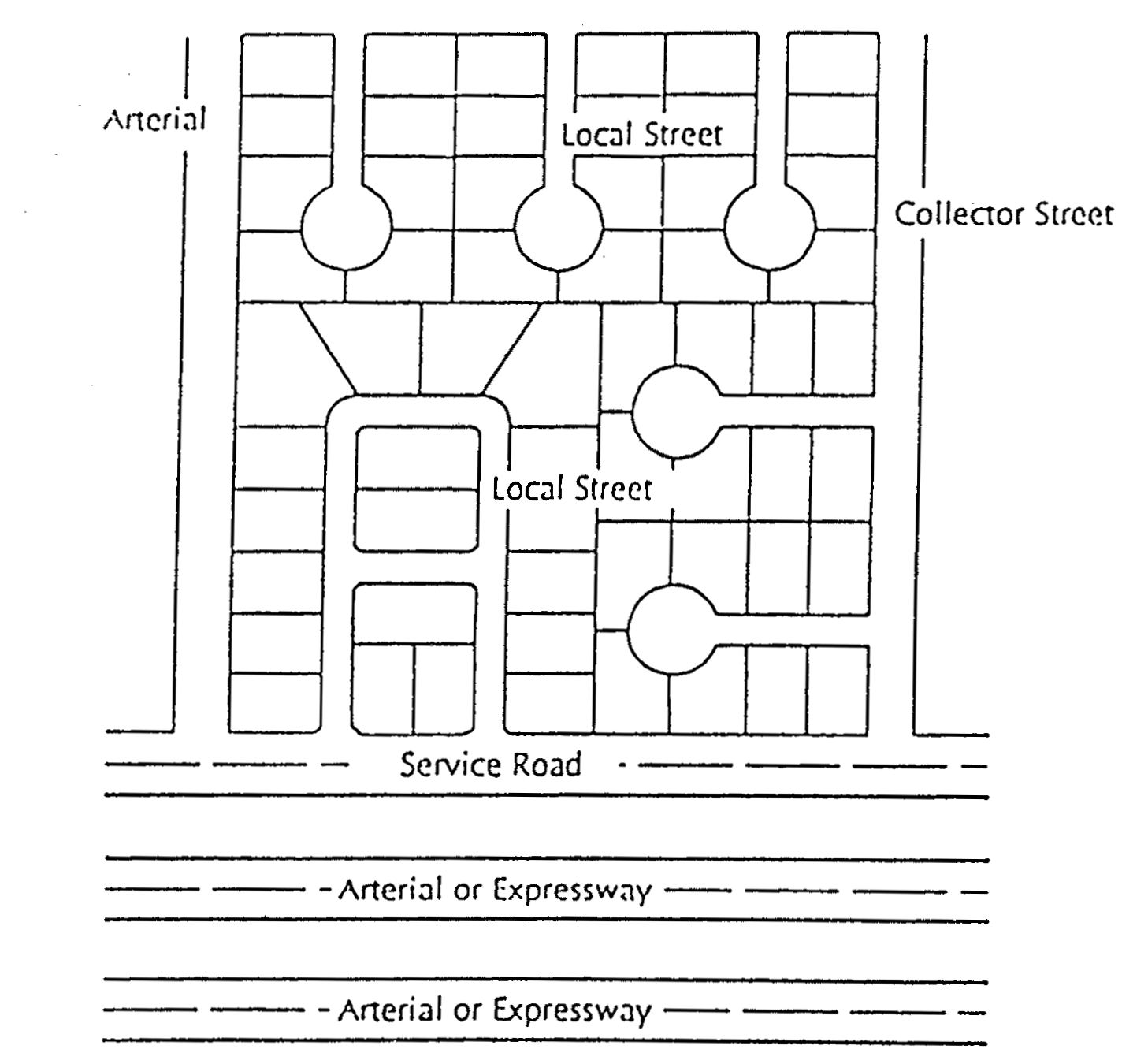
Street means any public thoroughfare which affords the principal link between various land use activities. The City of Seabrook has adopted a function street classification system which is defined as follows (see also graphic 1-D at the end of this section of the ordinance):
A.
Arterial-primary: An expressway, freeway, or primary thoroughfare whose primary function is the movement of traffic.
B.
Arterial-secondary: A thoroughfare whose predominant function is the movement of traffic but which provides more access than normally associated with a primary arterial.
C.
Collector: A street designed to serve equally the functions of access and movement. Collector streets serve as links between local streets and arterials.
D.
Frontage or service road: A collector street generally parallel to and adjacent to arterials, which provide access to abutting properties and protection from through traffic.
E.
Local: A neighborhood or minor street whose primary purpose is to provide access to abutting properties.
F.
Cul-de-sac: A local street having one end open to vehicular traffic and having one end closed or terminated with a turning circle.
Structural alteration means any change in the supporting members of a building such as bearing walls, bearing partitions, columns, beams, or girders, or any substantial change in the roof or in the exterior walls.
Structure means anything constructed or erected, the use of which requires a location on the ground or an attachment to something located on the ground.
Temporary sign means a display, sign, banner or other advertising device constructed of any material, without a structural frame, intended for a limited period of display; a sign intended to be easily removable or intended to be erected at successive locations, and any sign not designed to withstand wind loads of 35 pounds per square foot; the foregoing definition shall not be deemed to extend to or include coin-operated devices such as used to display and sell newspapers.
Toxic and noxious matter means any solid, liquid, or gaseous matter which is present in sufficient quantities to endanger the health, safety, and comfort of persons in the vicinity or which may cause injury or damage to property as defined by the United States Environmental Protection Agency (EPA).
Trailer means:
A.
Camping, recreational, or travel: A mobile living unit for temporary occupancy away from the place of residence of the occupants, and not constituting a principal residence.
B.
Hauling: A vehicle to be pulled behind an automobile or truck and which is designed for hauling animals, produce, goods or commodities, including boats.
Tree means a large woody plant having one or several self-supporting stems or trunks and numerous branches.
Vape shop means a retail establishment primarily engaged in the sale of electronic cigarettes (e-cigarettes), vape pens, and related accessories, as well as various types of e-liquids and vaping products. This includes devices that vaporize a liquid solution (e-liquid) for inhalation, such as e-cigarettes and vape pens, alongside e-liquids that typically consist of propylene glycol, vegetable glycerin, flavorings, and optional nicotine. The shop may also offer various accessories, including coils, batteries, and chargers, as well as ancillary services related to vaping. A vape shop shall not sell or display the following items: Tobacco products (cigarettes, cigars, loose tobacco), cannabis paraphernalia (pipes, bongs, rolling papers), accessories that facilitate the use of cannabis products (lighters, grinders), or novelty items associated with the tobacco smoking culture. Such establishments are required to comply with all applicable local, state, and federal laws regarding the sale and distribution of both legal and illegal items, including adherence to age restrictions and licensing requirements.
Vibration means a temporal and spatial oscillation of displacement, velocity or acceleration in a solid material.
Vibration perception threshold means the minimum ground or structure-borne vibrational motion necessary to cause a person to be aware of the vibration by such direct means as, but not limited to, sensation by touch or visual observation of moving objects.
Woodlands, existing, means existing trees and shrubs of a number, size and species that accomplish the same general function as new plantings.
Yard (see graphic 1-A at the end of this section of the ordinance):
A.
Front: An unoccupied open space on the same lot with a building, between the wall of the building nearest the street on which the lot fronts, and bounded by the line of that wall extended, the sidelines the sameof the lot and the front street line of the lot. The minimum depth of the front yard is the distance between the nearest point of the street wall of the building and the front line of the lot, or that line produced, measured at right angles to the front line of the lot. The front yard of a corner lot consisting of one platted lot is the yard adjacent to that street on which the lot has its least dimension. When this question arises, the code enforcement officer shall make a final determination. If a corner lot consists entirely of unplatted land or a combination of platted land, the front yard is located on the street on which the greater number of lots front, regardless of whether those lots are platted or unplatted. If a corner lot consists of all or more than two platted parcels of land each of whose least dimension is on the same street as the other lots in the block, then the location of the front yard is on the same street as the other lots. Any questions as to the determination of yards associated with corner lots shall be resolved by the code enforcement officer.
B.
Rear: An unoccupied open space on the same lot with a building, between the rear line of a building and bounded by the rear line extended, the side lines of the lot and the rear line of the lot. Where no rear building line exists, a line parallel to the front street line and distant as far as possible and not less than ten feet long is deemed to be the rear line. The depth of the rear yard is the distance between the nearest point of the rear wall of the building and the rear line of the lot.
C.
Side: An unoccupied open space on the same lot with a building, situated between the building and the sideline of the lot and extended through from the front yard to the rear yard. Any line not a rear line or a front line is deemed to be a side yard line.
D.
Water-abutting: A yard which touches Taylor Lake, Clear Lake or Galveston Bay.
Zero lot line means a common lot line on which a wall of a structure may be constructed.
Zoning map means the official zoning map of the City of Seabrook upon which the boundaries of the various zoning districts are drawn and which is an integral part of this zoning ordinance. The zoning map shall be housed, maintained, and revised regularly by the community development department of the City of Seabrook.
(Ord. No. 94-02, § 1, 2-1-1994; Ord. No. 94-03, § 1, 2-1-1994; Ord. No. 95-04, art. 1, 4-4-1995; Ord. No. 95-22, art. 1, 10-17-1995; Ord. No. 2001-02, § 1, 3-6-2001; Ord. No. 2001-19, § 2, 11-20-2001; Ord. No. 2004-12, § 2, 10-5-2004; Ord. No. 2004-14, § 2, 10-5-2004; Ord. No. 2007-11, § 2, 7-17-2007; Ord. No. 2009-32, § 3, 1-5-2010; Ord. No. 2011-14, § 3, 10-4-2011; Ord. No. 2014-19, § 3, 9-2-2014; Ord. No. 2019-33, § 2, 12-3-2019; Ord. No. 2022-01, § 2, 1-4-2022; Ord. No. 2023-16, § 2, 8-15-2023; Ord. No. 2024-27, § 2, 12-3-2024; Ord. No. 2024-28, § 2, 12-3-2024; Ord. No. 2024-29, § 2, 12-3-2024; Ord. No. 2024-30, § 2, 12-3-2024; Ord. No. 2024-32, § 2, 12-3-2024)
GRAPHIC 1-A
SETBACKS, SIDE YARDS AND BUILDING AREA
GRAPHIC 1-B
LOT TYPES
GRAPHIC 1-C
STANDARD RESIDENTIAL DEVELOPMENT OR PLANNED UNIT DEVELOPMENT
The top portion of the drawing illustrates a cul-de-sac design typical of American
subdivisions.
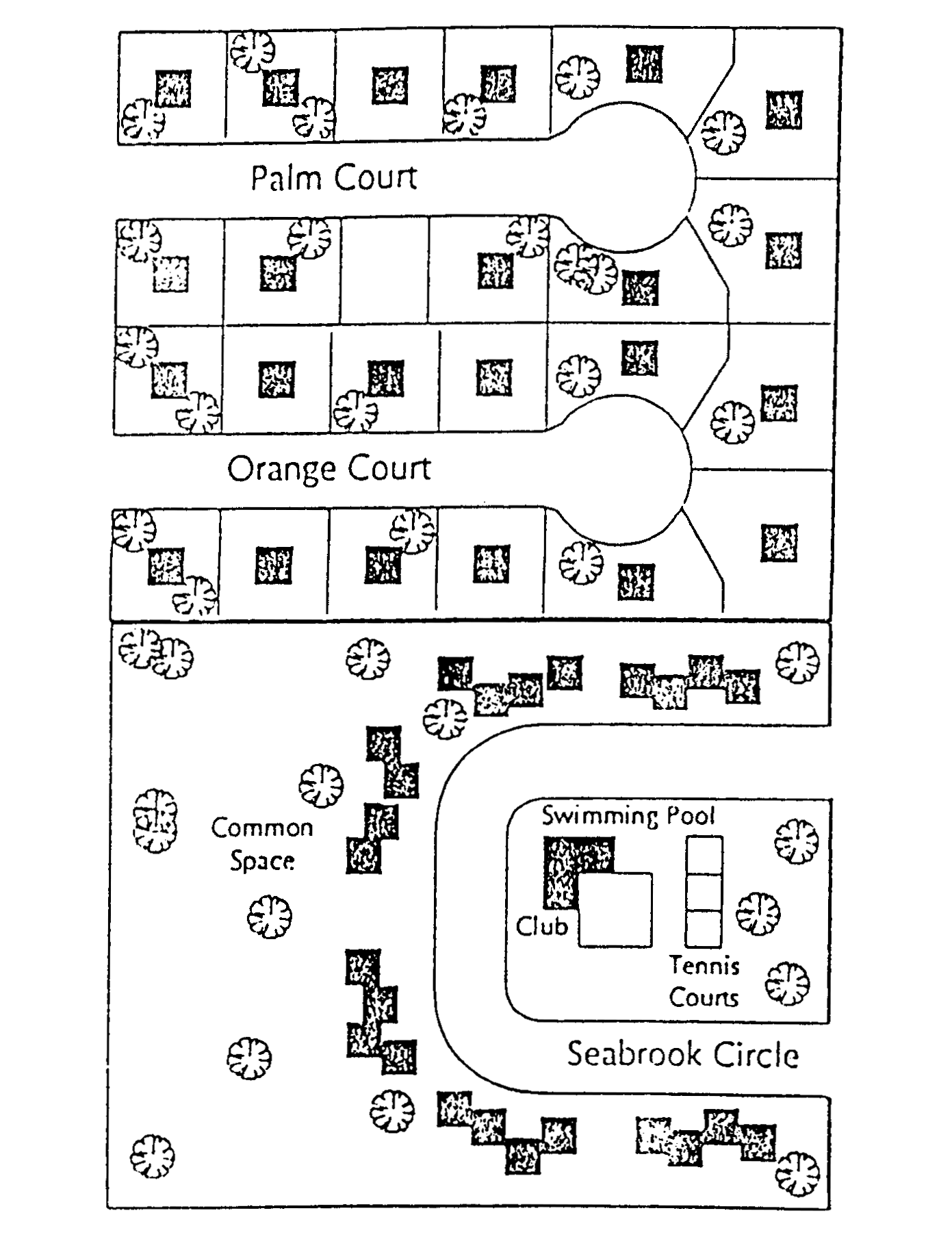
The bottom half of the illustration shows a planned unit, design. It incorporates the same dwelling unit density as the traditional design shown on top. Private yards are exchanged for open spaces and on-site amenities which often include recreational facilities.
GRAPHIC 1-D
THE FUNCTIONAL STREET CLASSIFICATION SYSTEM