
Seabrook City Zoning Code
ARTICLE 4
- SPECIAL USE REGULATIONS
Sec. 4.01.- Purpose.
Within each district there are located certain land uses that are permitted but which require additional regulations to assure compatibility with surrounding land uses. This article establishes regulations for those uses listed in the following sections.
Sec. 4.02. - Group homes.
4.02.01. Group homes defined:
Group homes are residential dwellings shared by six or fewer handicapped persons including the resident staff who live together as a single housekeeping unit in a family environment. Group homes are intended as a place in which the resident staff provides care, education, and participation in community activities for residents.
Group homes do not include alcoholism or drug treatment centers, work release facilities for convicts or former convicts or other housing serving as an alternative to incarceration.
4.02.02. Permissible locations: Group homes shall be permitted as a use permitted by right in the R-LD, R-1, R-2, and R-3 districts. In addition to the district regulations, group homes shall meet the following criteria:
A.
No structural or decorative alteration that will change the single-family character of an existing residential structure or be incompatible with surrounding residences is permitted;
B.
An identification sign not exceeding one square foot in area shall be permitted;
C.
Parking spaces shall be provided for each group home in accordance with article 5 of this ordinance;
D.
With the exception of group homes located in the R-3 district, the boundary of a parcel or lot containing a group home shall be separated from the boundary of any other parcel or lot containing a group home by not less than 400 feet as measured along the shortest street travel distance.
Sec. 4.03. - Child care facilities.
4.03.01. Purpose: Within residential districts throughout Seabrook, there is a need for the provision of child care facilities. The City of Seabrook acknowledges this need for affordable, high-quality child day care and its importance to the well-being of the community. Therefore it is the purpose of this section of the ordinance to provide a process and standards whereby a variety of child care facilities that meet the needs of the community may be established. At the same time, it is the intent of this section of the ordinance to preserve the residential character of neighborhoods. These regulations shall not apply to child care facilities operated by government, charitable, or religious organizations.
4.03.02. Unregistered family day care home defined and standards applied:
Family day care homes are residential dwellings occupied by the caregiver where three or fewer children, not including the caregiver's children, are cared for less than 24 hours in a day.
Family day care homes are considered home occupations and are required to obtain a license as a home occupation with the office of the director of administration [city manager].
The boundary of a parcel or lot containing a family day care home shall be separated from the boundary of any other parcel or lot containing a group day care home by not less than 400 feet as measured along the shortest street traveled distance.
Unregistered family day care homes are permitted in all zones as a home occupation.
4.03.03. Registered family day care homes defined and standards applied:
Registered family day care homes are residential dwellings occupied by the caregiver where four to 12 children are cared for less than 24 hours in a day.
A registered family day care home shall be considered a quasi-commercial use and shall not be permitted in any R-LD, R-1 or R-2 zone.
Registered family day care homes shall meet the following criteria:
A.
The facility, where required, shall comply with all state licensing requirements and all city codes pertaining to buildings, fire safety, and health. The child care operator shall submit proof of state license or registration for the facility prior to the issuance of the city license;
B.
The facility shall conform to the requirements of the district where it is located;
C.
One nonresident employee is permitted;
D.
One off-street parking space shall be provided for each nonresident employee in addition to two spaces required for the residents; the driveway shall be acceptable for this purpose;
E.
If located on an arterial or collector street as defined by the City of Seabrook, an off-street pickup area shall be provided that is acceptable to the city;
F.
One sign, not exceeding one square foot in area, nonilluminated, and mounted flat against the wall of the principal building shall be permitted;
G.
No structural or decorative alteration that will alter the single-family character of an existing residential structure or be incompatible with surrounding residences is permitted; and
H.
The boundary of a parcel or lot containing a group day care home shall be separated from the boundary of any other parcel or lot containing a group day care home by not less than 400 feet as measured along the shortest street traveled distance.
4.03.04. Child day care centers defined and standards applied: Child day care centers are commercial enterprises where more than 12 children are cared for less than 24 hours in a day. In addition to the requirements of the district where the child day care center is located, the center shall also conform to the following criteria:
A.
The facility, where required, will comply with all state licensing requirements and all city codes pertaining to buildings, fire safety, and health;
B.
The facility shall conform to the requirements of the zoning district where it is located;
C.
Signage shall conform to the provisions of article 6 of this ordinance;
D.
Parking and circulations required shall conform to the provisions of article 5 of this ordinance;
E.
On-site vehicle turnaround, or separate entrance and exit points, and passenger loading/unloading areas shall be provided;
F.
Outdoor play areas along common property lines with residential uses shall be screened with not less than a six-foot sight-obscuring wall or fence.
Sec. 4.04. - Home occupations.
4.04.01. Home occupation defined: Occupations ordinarily carried on in a home which are not detrimental to adjoining property, provided that all such uses are located in the dwelling and that does not require the employment of more than one assistant, excluding a member of the family residing on the premises. This use must not increase the ordinary automobile vehicle traffic in the neighborhood nor require additional off-street parking in order to conduct business. This use shall be deemed incidental and shall never be permitted as a principal use, but only as a secondary use, and shall never involve the conduct of a retail business. There shall be no outside storage of any kind, including vehicles or equipment connected with such home occupations. In addition, the home occupation shall not require the use of commercial vehicles for delivery.
A.
No retail business of any sort shall be permitted.
B.
No stock in trade shall be kept nor commodities sold except those made or used on the premises.
C.
The use of the dwelling unit for the home occupation shall be clearly incidental and subordinate to its use for residential purposes by its occupants.
D.
No equipment shall be used which creates offensive noises, vibrations, sound, smoke or dust, odors, heat, glare, x-ray, or electrical disturbance to radio or television.
E.
The repair of automobiles or small engines shall not be permitted.
F.
There shall be no change in the outside appearance of the building or premises, or other visible evidence of the conduct of such home occupation. No signs advertising home occupations shall be allowed in R-1, R-2 or R-3 zoning districts.
G.
No home occupation may be conducted in an accessory building unless it shall be conducted by a permanent resident of the primary dwelling.
H.
No traffic shall be generated by such home occupation in greater volumes than would normally be expected in a residential neighborhood and shall require no additional parking spaces beyond those required for the dwelling unit.
(Ord. No. 2009-32, § 2, 1-5-2010)
Sec. 4.05. - Sexually oriented businesses.
4.05.01. Description: A number of findings from cities in Texas and other states (Detroit, Michigan; Renton, Washington, etc.) indicate that the concentration of certain sexually oriented businesses or so-called "adult entertainment" businesses tends to result in the blighting and deterioration of areas of such concentration. Accordingly, it is necessary that these businesses be regulated so that they have the least negative impact on residential neighborhoods, educational institutions, religious institutions, and public facilities. This section of the Seabrook Zoning Ordinance is a time, place, and manner ordinance aimed at controlling the proximity of such businesses to the neighborhoods and institutions cited above.
4.05.02. Uses regulated: The following uses shall be controlled by this section of the ordinance:
A.
Adult bookstores.
B.
Adult motion picture theaters.
C.
Adult mini motion picture theaters.
D.
Adult motels.
E.
Cabarets.
F.
Massage parlors.
G.
Model studios.
4.05.03. Proximity limited: It shall be unlawful to hereafter establish any adult bookstore, adult motion picture theater, adult mini motion picture theater, adult motel, cabaret, massage parlor, model studio, or sexually oriented business within 1,500 feet of any residential zoning district, lot containing a residence, dwelling or rooming unit, a public school building, a church or house of worship, any other business regulated by section 4.04.02 above, or any public facility or park owned by the City of Seabrook.
4.05.04. Measurement: For the purpose of this section of the ordinance, measurements shall be made in a straight line, without regard to intervening structures or objects, from the nearest portion of the building or structure used for a sexually oriented business to the nearest property line of a residential, dwelling or rooming unit, a public school building, a church or house of worship, any other business regulated by section 4.04.02 above, or any public facility owned by the City of Seabrook.
4.05.05. Operating permit required: The owner of an adult bookstore, adult motion picture theater, adult mini motion picture theater, adult motel, cabaret, massage parlor, model studio or sexually oriented business, or his or her agent for the purpose of managing, controlling, or collecting rents, or any other person managing or controlling a building or premises, any part of which contains an activity listed above, shall obtain an operating permit from the director of administration [city manager] and provide the following information:
A.
The address of the premises.
B.
The name of the owner of the premises and names of the beneficial owners if the property is in a land trust.
C.
The address of the owner and the beneficial owners.
D.
The name of the business or the establishment subject to the provisions of this ordinance.
E.
The name(s) of the owner, beneficial owner or the major stockholders of the business or the establishment subject to this ordinance.
F.
The address of those persons named in paragraph E, above.
G.
The date of initiation of the sexually oriented business use.
H.
The nature of the land use.
I.
If the premises or building is leased, a copy of the lease shall be attached to the registration form.
It shall be unlawful for the owner or person in control of a property to establish or operate thereon or to permit any person to establish or operate a sexually oriented business without first having properly obtained an operating permit. The owner, manager, or agent of a registered sexually oriented business shall display a copy of the permit approved by the director of administration [city manager] in a conspicuous place on the premises.
4.05.06. Limitations on ownership, management or employment: It shall be unlawful for any person to own or manage a sexually oriented business, or employ any person to work in a sexually oriented business, if the individual involved has been convicted of any of the following crimes within the past five years:
A.
Prostitution;
B.
Promotion of prostitution;
C.
Aggravated promotion of prostitution;
D.
Compelling prostitution;
E.
Obscenity;
F.
Sale, distribution, or display of harmful material to minors;
G.
Sexual performance by a child;
H.
Possession of child pornography;
I.
Public lewdness;
J.
Indecent exposure;
K.
Indecency with a child;
L.
Sexual assault or aggravated sexual assault;
M.
Incest, solicitation of a child, or harboring a runaway child;
N.
Criminal attempt, conspiracy, or solicitation to commit any of the foregoing offenses.
4.05.07. Physical contact prohibited: It shall be unlawful for an entertainer in a sexually oriented business to physically touch a patron.
4.05.08. Proof of age required: In order to ensure that minors are not permitted access to a sexually oriented business, it shall be the responsibility of the owner, lessee, and manager of any sexually oriented business to require proof of age identification of all patrons prior to admitting them to a sexually oriented business. No person below the age of 18 years of age shall be admitted.
4.05.09. Clothing requirements: No entertainer in a sexually oriented business shall perform unless that individual wears the following clothing:
A.
Female entertainers: "G string and pasties."
B.
Male entertainer: "G string."
4.05.10. Exterior display: No sexually oriented business shall be conducted in any manner that permits the observation of any material depicting, describing or relating to "specified sexual activities" or "specified anatomical areas" from any public way or from any property not registered as a sexually oriented business. This provision shall apply to any display, decoration, sign, show, window or other opening.
4.05.11. On-premises consumption of alcohol prohibited: It shall be unlawful for any sexually oriented business to sell alcoholic beverages or to permit the on-premises consumption of alcoholic beverages.
State Law reference— City has authority to strictly regulate sexually oriented businesses, V.T.C.A., Local Government Code § 243.001 et seq.
Sec. 4.06. - Broadcast towers and earth satellite receivers.
4.06.01. Commercial tower defined: A tower used for commercial broadcasting purposes. This definition shall include towers owned or operated by utility companies for communication purposes.
4.06.02. Commercial towers: No radio, television, or microwave broadcast tower for commercial purposes shall be located within a distance equal to or less than the height of such tower from any residential structure or from any area zoned for commercial or residential use. Such distance shall be measured as the shortest possible distance in a straight line from the closest point of the tower to the closest point of a residence or residential zone boundary. A building permit shall be required to ensure safe, permanent installation and property location.
4.06.03. Tower dressing: All towers shall be dressed as prescribed by the planning and zoning commission.
4.06.04. Antennas—General: An antenna, requiring structural support cables, including a supporting tower, used for amateur radio, citizens band radio, or television reception shall not be located within a distance equal to or less than the height of such antenna from a residential structure on an adjoining lot. In residential districts, the antenna shall be located to the rear of the residential structure. A building permit shall be required to ensure safe, permanent installation and proper location.
4.06.05. Earth satellite receiving antennas—Larger than 12 feet in diameter: Earth satellite receiving antennas in excess of 12 feet in diameter shall be considered commercial antennas and shall be subject to the regulations governing commercial towers and antennas, and shall be located only in those districts permitting commercial antennas. Such antennas shall conform to the requirements of the district where they are located and shall also conform to the following criteria:
A.
A building permit shall be required to ensure safe, permanent installation and proper location;
B.
No trailer-mounted antenna shall be permitted;
C.
The antenna may be located on any part of the property, but shall not be located within any public or private easement; and
D.
The antenna shall be screened from view by a screening wall or fence not to exceed six feet in height.
4.06.06. Earth satellite receiving antennas—Less than 12 feet in diameter: Satellite dish antennas 12 feet or less in diameter shall be considered noncommercial antennas. Such antennas shall be subject to the following standards:
A.
A building permit shall be required to ensure safe, permanent installation and proper location;
B.
No trailer-mounted antenna shall be permitted;
C.
Antennas shall not be located within any front or side yard.
Sec. 4.07. - Reserved.
Editor's note— Ord. No. 2017-08, § 2, adopted March 21, 2017, repealed § 4.07 which pertained to special events and derived from Ord. No. 93-03, adopted May 4, 1993.
Sec. 4.08. - Standards for high-rise development.
4.08.01. Purpose:
The purpose of the standards for high-rise development, that is buildings more than 40 feet in height, is to provide guidelines for development along the waterfront areas in certain zoning districts to make proposals for high-intensity commercial, mixed use, or residential high-rise projects in these areas and to provide guidance as to what quality of development for such projects will be required for approval. In the marine oriented mixed use (MMU) district and the waterfront activity district (WAD), a conditional use permit for the proposed development shall be required. High-rise developments of any nature shall not be permitted in any other zoning district.
Because the market for this intensive development is driven by water views or waterfront locations, it is vital to the character of the community that such projects do not seal the rest of the community from the value and enjoyment of the waterfront. The standards of this district are intended to protect neighbors from adverse impacts, encourage good design, and create areas that are assets to the community.
4.08.02. General standards:
A.
For purposes of this chapter [section], the term "site" shall be defined as the entire land acreage and any areas located in the water where improvements are proposed. A site plan, showing all land and water, and proposed improvements, shall be required of each proposed high-rise development, in accordance with 4.08.09.
B.
The minimum standards in table 1, dimensional standards, shall be met by all development. However, there are specific requirements addressed in each development application that may reduce the maximum allowances in height and floor area ratio below, or which may impose more than the minimum standards for the other categories listed below. These additional requirements are outlined in 4.08.03, Height performance standards.
TABLE 1—DIMENSIONAL STANDARDS
Notes:
1 As required by building and fire code.
2 From the water's edge or the property line, whichever is closest to the building.
4.08.03. Height performance standards: This chapter (section) does not impose an overall maximum height on high-rise developments in the MMU and WAD districts. Height will be determined by the site size and location and the other standards provided herein. To ensure compatibility and scale with adjacent development, to ensure adequate light and air between structures and to ensure maximum public safety of residents, occupants and the general public, the following height standards shall apply along property lines. Height may increase with the following standards.
A.
Setback from land zoned R-1 and R-2: The maximum allowable height permitted shall be no greater than 40 feet at the required setback line.
B.
Setback from land zoned MMU or WAD: The maximum allowable height permitted at the required setback line shall be equal to or less than 40 feet after which, the height may be increased by two feet for every one-tenth (0.1) foot of additional setback. Such requirements apply to land contiguous to the property subject to the development application.
C.
Setback from street: The maximum allowable height permitted at the required setback line shall be 40 feet after which, the height may be increased by two feet for every one-tenth (0.1) foot of additional setback. This setback shall apply where the property is located on a street that is parallel to the water.
4.08.04. Street setbacks: In the MMU and WAD districts, the required setback from a public or private street or right-of-way, shall be a minimum of 30 feet, which distance shall include a sidewalk and parkway area with a minimum width of 12 feet, and including utility easements. The setback width may be reduced by an amount equal to the width of utility easements if such utilities are located within an existing improved road.
4.08.05. Street trees: All street frontages shall be planted with three canopy trees per 100 feet of street frontage. Where the setbacks are 30 feet or more, the canopy trees shall be planted in a grassed parkway. Where the setbacks are less than 30 feet, the parkway may be paved and trees planted in planters (above or in ground) in the sidewalk, provided they each have a minimum area of 25 square feet.
4.08.06. Bufferyards: Bufferyards shall be provided to protect residential and nonresidential districts. Where the subject development is contiguous with residentially zoned land, the required bufferyard shall have a minimum opacity of 0.5, which is achieved with 3.55 plant units per 100 linear feet of perimeter. Where the subject development is contiguous with property zoned for nonresidential use, the required bufferyard shall have a minimum opacity of 0.2, which is achieved with 1.12 plant units per 100 linear feet of perimeter.
A.
Standard residential bufferyard: The standard 0.5 opacity bufferyard shall be a minimum of 30 feet in width with a plant unit consisting of the plant material for each 100 linear feet of perimeter, or portion thereof, as specified in table 2, minimum buffer requirements.
B.
Standard nonresidential bufferyard: The standard 0.2 opacity bufferyard shall be a minimum of 15 feet in width with a plant unit consisting of the plant material for each 100 linear feet of perimeter, or portion thereof, as specified in table 2, minimum buffer requirements.
TABLE 2—MINIMUM BUFFER
REQUIREMENTS
C.
Alternative buffers: Alternative buffers which achieve the minimum required opacity may be considered.
D.
Plant units: Landscaping is specified in plant units. Contained in table 3, plant unit options, are alternative plant units with different mixtures of landscape material, each of which meet the standard 0.5 opacity. The applicant may select any of the plant unit options provided it meets the required minimum opacity.
TABLE 3—PLANT UNIT OPTIONS
Illustration
[Alternative Unit A]

[Alternative Unit B]

[Alternative Unit C]

[Alternative Unit D]

[Alternative Unit E]

4.08.07. Shading: A three-dimensional model or computer simulated visualization of the project shall be submitted as part of the application process (refer to section 4.08.09, Review of application). Each proposed high-rise development plan that is adjacent to a residential zoned district shall be reviewed for shading impacts of the building. The project shall be required to be modified, or the CUP may be denied where the proposed development shades an adjacent residential zoned district.
4.08.08. Architectural review committee and design standards:
A.
[Purpose:] The purpose of this section is to encourage high-quality, attractive design that will not be out of scale at the pedestrian level, will be visually interesting and pleasing as a whole, will provide for mitigation of hard surfaces through the extensive use of vegetation, and to allow the development that fills a particular market demand, while preserving to the greatest extent possible the community character of the city and minimizing the negative impacts of intense development. Therefore, the design of all high-rise developments shall be subject to architectural review.
B.
Architectural review committee: An architectural review committee (ARC) is hereby established as a subcommittee of the commission, to be composed of three members of the commission, which is charged with reviewing applications for high-rise developments. Such members shall include, to the extent possible, at least one member with architectural or building expertise, real estate expertise, or other related experience or education. The ARC shall review the design elements of each application following staff review and shall make a report of their recommendations and findings to the entire commission and the applicant. All meetings of the ARC shall be posted in accordance with the Open Meetings Act.
C.
Prohibited exterior finished surface materials: The following materials shall be prohibited from use for all exterior finished surfaces: Reflective glass; metal siding (except for rolling shutters); wood shingles; wood siding; vinyl, wood fiber hardboard, and oriented strand board siding; corrugated or ribbed metal; plastic or fiberglass panels; galvanized, aluminum coated, zinc-aluminum coated, or unpainted exterior metal finishes; and unfired or underfired clay, sand, or shale brick.
D.
Alternative materials: Alternative exterior finishes not identified and which are not specifically prohibited in this section may be recommended by the ARC and commission, and approved by council, upon a finding that the alternative material or finish is substantially equal to or better than a specified exterior material or finish in quality, durability, and that
E.
Monotony: Monotony of design in single or multiple building projects shall be avoided. Variation of detail, form, and siding shall be used to prevent a monotonous appearance. Long, monotonous building elevations including, but not limited to, those characterized by unrelieved repetition of shape or form or by an unbroken extension of planes shall be avoided. Excessive ornamentation shall also be avoided to prevent visual clutter.
F.
Color: The design of the building shall be such that its coloration does not stand out so as to emphasize the size and scale of the structure. Bright, glossy colors on major building elements and exterior neon signs are prohibited. Exterior building and roof colors must be nonreflective and neutral in color to blend with the natural environment. Multiple colors and garish or unusual patterns or geometric shapes shall be avoided.
G.
Roofline: The top of any high-rise building shall have a design treatment that clearly provides a building cap, not just a flat top or a top housing the mechanicals for the building. Where there are mechanical protrusions, they shall be integrated into a building cap that is decorative and fits with the rest of the building design. Where the building top has a horizontal dimension of more than 200 linear feet, the building top must be sufficiently articulated or include several floors so as to create a more visually interesting top.
H.
Facade: The facade shall avoid large areas with a consistent plane or regular pattern. The city may require the plane to be broken up by off-sets, curved facades, articulated elements, or changes in the module created by units or balconies. Lower level floors, in particular, shall have details to relate the building to a pedestrian scale, including expanses of windows, articulation of walls and planter areas.
I.
Parking structures or floors:
1.
Stand-alone parking structures: Even if parking structures are connected on one or more levels, parking areas shall be considered to be stand-alone structures if they have a separate rooftop and footprint/foundation.
a.
Roof must be at least 50 percent "green" or landscaped, though parking or recreational or open space uses may be allowed on the other portion.
b.
Cars shall be hidden from view from the street right-of-way by at least partial walls on each parking level, in accordance with code, but no less than 50 percent open.
c.
Landscaping shall be required at the base of 20 percent opacity.
2.
[Parking floors:] Parking floors are those floors in a high-rise building which share the footprint/foundation of the primary building.
a.
Cars shall be hidden from view from the street right-of-way by at least partial walls on each parking level in accordance with code, but no less than 50 percent open.
4.08.09. Review of application: In considering a request for a high-rise development, the following procedures shall apply:
A.
Submittal requirements: The applicant shall submit the following documents:
1.
Application form.
2.
Site plan.
3.
Traffic study showing impacts on adjacent roadways.
4.
Lighting plan.
5.
Signage plan or designs.
6.
Landscaping plan.
7.
Safety plan, which shall require fire marshal approval.
8.
Study showing availability of adequate public facilities, including water and sewer capacity, and any plans on proposed infrastructure requirements.
9.
A three-dimensional model or computer-simulated visualization shall be included to view the project from various viewpoints within the community and from the water.
10.
A feasibility study, prepared by a real estate marketing or development firm, that clearly indicates that there is a market for the project and provides information of sales and leasing rates and the estimated time to completely fill the project. This shall include information on comparable projects in nearby or similar communities, but does not need to include sensitive or proprietary financial information.
11.
Parking analysis.
12.
Architectural renderings and exterior elevations, samples of materials.
B.
Specific standards: The specific standards of 4.08.02 through 4.08.09 shall all be met. Approval shall not be granted where a variance of these standards is required or requested, except as provided in 4.08.08D., alternative materials, above. The city may impose more stringent requirements and conditions such as limitations on height and setbacks, modifications to the site plan, or requiring additional open space, buffers, or landscaping, or any other conditions that would ensure the compatibility of the proposed development with adjacent land uses, and that the intentions of this chapter [section] and the city's master plan are met.
C.
Plan submission and initial review: The planning staff shall meet with the applicant for an initial review of the application, and to approve the method of presentation and the area to be included in the program. Once staff certifies that the application is complete, it shall be submitted for wider staff review and approval. Following completion of staff review, a meeting of the ARC shall be scheduled and the exterior architectural design documents and plans reviewed.
D.
Public hearings: Commission and council shall hold such public hearings following public notice in accordance with Texas law and the City of Seabrook zoning ordinance requirements. Council has final approval authority over all aspects of the proposed development, and retains full legislative discretion on a zoning change application for a high-rise development. An ordinance granting a CUP and listing all conditions of such approval shall be prepared and must be approved by council in accordance with the city Charter.
E.
Applicability of other codes: No approval of a CUP for high-rise development granted pursuant to this section shall relieve the applicant or developer from compliance with any requirements contained in any other city code or ordinance.
(Ord.No. 2006-11, § 2, 8-15-2006; Ord. No. 2012-10, § 2, 4-17-2012)
Sec. 4.09. - Movement of buildings into and within the city.
4.09.01. Restrictions: No building or structure may be moved into any R-LD, R-1, R-2 or R-3 zone from outside the city limits unless it carries the Texas Industrial Building Code Council seal.
4.09.02. When allowed: A building or structure may be moved from place to place within the City of Seabrook or may be moved from outside the city limits to any nonresidential zone, including to the OS Old Seabrook zone, only after the following conditions are met:
A.
The building or structure must meet all city, state and federal codes and regulations and shall carry the Texas Industrial Building Code Council seal or have been inspected by the building official and found to be in conformance with the International Building Code, 2003 edition, prior to being moved into Seabrook.
B.
A performance bond must be submitted payable to the city in the event a certificate of occupancy is not secured within one year from the issuance of the building permit. The bond must be approved by the city attorney and shall be issued for a term no less than 13 months. The bond amount shall be established by the city council.
C.
A valid building permit shall be secured from the City of Seabrook.
4.09.03. Time limitation: The applicant shall have no more than one year from the date of issuance of the building permit to complete any required improvements to the building and secure a certificate of occupancy. Failure to do so will result in forfeiture of the bond.
4.09.04. Exceptions for small buildings: A building with a gross volume of less than 1,000 cubic feet shall not require the posting of a bond or require that a Texas Industrial Building Code Council seal or decal be displayed provided the structural components are exposed to the inspector's view. Such buildings however, are subject to all other provisions of this section.
4.09.05. Notification to police: The movement of any building or structure of a dimension greater than permitted for motor vehicles under the state motor vehicle laws, when such movement is across or along any public right-of-way, shall require the notification of the Seabrook police department not less than 72 hours prior to entering the city limits. A determination shall be made by the chief of police or his or her delegate whether special escorts and specific precautions shall be required.
Sec. 4.10. - Planned unit developments.
4.10.01. Description:
A planned unit development (PUD) is a land use design incorporating the concepts of density transfer and common open space. The PUD designation serves as an "overlay zone." In this capacity, the designation applies a new and different set of developmental guidelines to the base zoning district in which the parcel or property is located.
When a parcel of land receives the PUD designation it continues to retain its standard zoning district classification. However, the added PUD designation enables the developer of the tract to modify the yard and setback requirements in concert with a documented plan that meets the regulations prescribed herein and which has been reviewed and approved by the planning and zoning commission.
In many instances the creative use of the PUD concept facilitates urban design which is more efficient, safe, environmentally sensitive, interesting, visually pleasing, and socially integrated than the standard lot design. Within the City of Seabrook, and in conformance with the goals, objectives, and policies of Comprehensive Master Plan 2030, the PUD designation is aimed at the following purposes:
A.
To encourage a more efficient use of land;
B.
To reflect changes in the technology of land development so that resulting economies may inure to the benefit of those who need shelter;
C.
To lessen the burden of traffic on streets and highways;
D.
To provide common open space for the utilization of neighborhood residents;
E.
To encourage urban design that results in smaller networks of utilities and streets;
F.
To provide for a procedure that can relate the type, design, and layout of urban development to the respective site and the particular demand for land uses in a manner consistent with the preservation of property values within established parts of the City of Seabrook;
G.
To provide for a more desirable environment than would be possible through the strict application of other sections of this ordinance.
4.10.02. PUD location: PUD designation may be applied to property located within any zoning district within the City of Seabrook. PUD designation shall be subject to the regulations contained in this section of the ordinance, and the approval of the city council.
4.10.03. Mixed use projects permitted: Mixed use projects involving both residential and commercial land use activities shall be permitted in any zoning district, subject to the regulations contained in this section of the ordinance, and the approval of the city council.
4.10.04. PUD projects may cross zoning districts: PUD projects may cross two or more zoning districts. The arrangement and the mixture of land use activities shall be subject to the regulations contained in this section of the ordinance, and the approval of the city council.
4.10.05. Minimum common open space: Not less than 20 percent of the land shall be reserved for "common open space," as defined in section 1.10, "definitions." The term "common open space," as used herein, may include boardwalks and 20 percent of parking areas. In calculating the minimum area required, the measurement may also include the area of all dedicated streets entirely within the site and one-half of the area of the boundary streets.
4.10.06. PUD designation procedure: The process for the filing of an application, requirements for notice and advertisement of public meetings, procedures for protest of the establishment of PUD designation and other related action shall be the same as those provided for in the rezoning process as described in article 2, section 2.04, "Amendments to the Zoning Map and Zoning Text," of the Code. In addition to the above, the landowner shall be governed by the following requirements:
A.
Submission of a preliminary PUD plan: The planning and zoning commission shall hold a public hearing on an application for PUD designation. Prior to the approval of such designation, the landowner shall submit a preliminary plan. The following information shall be shown on the preliminary plan:
1.
The name, address and telephone number of the landowner;
2.
The date that the project is submitted to the planning and zoning commission;
3.
The name of the proposed project;
4.
The names and addresses of adjoining property owners within 500 feet of the proposed project site;
5.
A key map;
6.
All existing streets, drives, buildings, watercourses, and bodies of water;
7.
The location and size of existing utilities within or adjacent to the proposed project site; and
8.
The proposed location, type and size of the following:
(a)
Buildings and structures;
(b)
Streets, drives, alleys, and curbs;
(c)
Off-street parking areas with parking spaces individually drawn and counted;
(d)
Sidewalks;
(e)
Landscaping;
(f)
Common open space and amenities sites;
(g)
Sites for solid waste containers; and
(h)
Signs.
The planning and zoning commission is empowered to require additional information necessary for a complete understanding of the proposed PUD. After appropriate review and consideration, the planning and zoning commission shall file a report with the city council, recommending approval, approval with modifications to the PUD plan, or denial of PUD designation of the site.
In accordance with article 2, section 2.04, of this Ordinance, the city council shall hold a public hearing and shall review the PUD report from the planning and zoning commission. The city council may require additional information of the proposed PUD. After appropriate review and consideration, the city council may approve the preliminary PUD plan with or without modifications or deny the PUD.
B.
Submission of a final PUD plan: Before a building permit may be issued or before any development action on a proposed PUD may begin, the landowner shall submit a final plan to the planning and zoning commission for consideration and then city council for final approval. The submission may be for all of the land included within a proposed PUD site or for a part of the site. The submission shall include all of the information prescribed in subsection A., above, and shall additionally include specifications, covenants, easements, conditions, bonds, or other information required by the commission and/or city council.
4.10.07. Standards for PUD development: Within a PUD site, lot lines per se, lot sizes, dimensions, setbacks, and yards shall be freely disposed and arranged in conformity to the PUD plan as approved by the city council. Although lot sizes, dimensions, setbacks, and yards are not specified, the planning and zoning commission shall be guided in its review by the regulations associated with the base district in which the PUD is located.
4.10.08. Creation of a homeowner's or business owner's association: The city may at any time and from time to time accept the dedication of land or any interest therein for public use and maintenance. The city may require the PUD developer to create a homeowner's association or a business owner's association to act as the owner and maintenance agent for common open space areas.
4.10.09. Failure to maintain common areas:
In the event that a homeowner's or business owner's association fails to maintain the common open space or fails to fulfill other conditions associated with PUD designation, the city may serve written notice on the association, setting forth the manner in which the association has failed to fulfill its responsibilities.
Such a notice shall include a demand that the deficiencies be cured within a specified period of time. If the deficiencies are not cured within the specified period of time, the city, in order to preserve the taxable values of the properties in both the PUD area and the surrounding environs, and to prevent the common open space from becoming a public nuisance, may enter upon the common open space, may maintain it, and may perform other related duties until such time as the association resumes its responsibilities. All costs incurred by the City of Seabrook in carrying out the obligations of the association will be assessed against the properties within the PUD regime and shall become a tax lien on those same properties.
4.10.10. Development schedule: Prior to the issuance of any building permits, a construction schedule must be submitted to and approved by the planning and zoning commission for consideration and then city council. The schedule shall include a detailed timeframe in which street, utility and building construction shall be completed. The owner/developer of the PUD shall appear and present a status report before the planning and zoning commission and then city council on no less than a bi-annual basis commencing on the date of approval by city council of the PUD and until completion of the project.
4.10.11. Dissolution of the PUD: Should the PUD project fail to meet the schedule as approved by the city council the PUD classification and related permits shall be immediately terminated and, the land shall return to the zoning that existed immediately prior to the PUD conditional approval.
(Ord. No. 2013-08, § 2, 6-18-2013; Ord. No. 2013-14, § 2, 9-3-2013; Ord. No. 2014-10, § 2, 6-17-2014; Ord. No. 2015-08, § 2, 4-21-2015)
Sec. 4.11. - Conditional use permit criteria and procedures.
4.11.01. Purpose: The purpose of the conditional use permit process is to identify those land uses which may be appropriate within a zoning district but, due to either their location, function, or operation, could have a potentially harmful impact on adjacent properties or the surrounding area; and to provide for a procedure whereby such uses may be permitted by further restricting or conditioning them so as to mitigate or eliminate such adverse impacts.
4.11.02. Authorization of planning and zoning commission: The planning and zoning commission shall make a report to the city council which shall recommend approval or denial of a conditional use permit for a use in any district in which such use is authorized under the comprehensive land use regulation matrix associated with this ordinance, following proper application, and after notice to all landowners within 500 feet of the proposed conditional use, and public hearings, in accordance with the procedures and criteria herein established.
4.11.03. Issuance limitations and forms required: No certificate of occupancy or building permit for a purpose authorized only as a conditional use within a zoning district shall be issued unless the applicant obtains a conditional use permit from the city council. The application for a conditional use permit shall be submitted on a form provided by the director of administration [city manager] and accompanied by a site plan in a form acceptable to the director of administration [city manager]. The planning and zoning commission may require additional information or plans as necessary and appropriate for review.
4.11.04. Procedures: The procedures associated with the review and approval or denial of a conditional use permit shall be the same as those associated with a rezoning, as described in section 2.04 of this ordinance.
4.11.05. Criteria for approval: The planning and zoning commission shall recommend denial of a conditional use if it finds that the proposed use:
A.
Does not conform with applicable regulations and standards established by this ordinance;
B.
Is not compatible with existing or permitted uses on abutting sites, in terms of use, building height, bulk and scale, setbacks and open spaces, landscaping, drainage, or access and circulation features;
C.
Potentially creates greater unfavorable effects or impacts on other existing or permitted uses on abutting sites than those which reasonably may result from the use of the site by a use permitted by right;
D.
Adversely affects the safety of vehicular and pedestrian circulation in the vicinity, including traffic reasonably expected to be generated by the proposed use and other uses reasonably anticipated in the area considering existing zoning and land uses in the area;
E.
Fails to reasonably protect persons and property from erosion, flood or water damage, fire, noise, glare, and similar hazards or impacts;
F.
Adversely affects traffic control or adjacent properties by inappropriate location, lighting, or types of signs;
G.
Fails to provide adequate off-street parking and loading facilities;
H.
Fails to conform with the objectives and the purpose of the zoning district in which the development is located;
I.
Will be detrimental to the public health, safety, or welfare, or materially injurious to properties or improvements in the vicinity, for reasons specifically articulated by the commission; or
J.
The premises or structure(s) are not suitable for the proposed use.
4.11.06. Site plans: Site plans may be required by the planning and zoning commission as a part of the conditional use permit review process. Conditional use site plans considered by the planning and zoning commission shall be approved only after the planning and zoning commission finds that the proposed development, if completed as proposed, will comply with all applicable provisions of this ordinance and all conditions deemed necessary.
4.11.07. Authorization to establish conditions: The planning and zoning commission may recommend, and the city council may establish such conditions of approval as are necessary to assure that the proposed land use meets the criteria set forth in subsection 2.05.04 [4.11.05], which may include without limitation requirements for special yards, lot sizes, open spaces, buffers, fences, walls or screening; requirements for installation and maintenance of landscaping or erosion control measures; requirements for street improvements, regulation of vehicular ingress and egress, and traffic circulation; regulation of signs; regulation of hours or other characteristics of operation; establishment of development schedules or time limits for performance or completion; and such other reasonable conditions as the city council may deem necessary to insure compatibility with surrounding uses and to preserve the public health, safety, and welfare.
4.11.08. Authority to establish conditions: In granting a conditional use permit, the city council may impose conditions which shall be complied with by the owner or grantee before a certificate of occupancy may be issued.
4.11.09. Agreement to abide by conditions prior to issuance: No conditional use permit shall be granted unless the applicant, owner or grantee of the conditional use permit shall accept and agree to be bound by and comply with the written requirements of the conditional use permit, as attached to the site plan drawing (or drawings) and approved by the city council. The code enforcement officer shall maintain a record of all conditional use permits granted by the city.
4.11.10. Validity of a conditional use permit: A conditional use permit shall remain valid until such time as one of the following actions is taken:
A.
The property is rezoned;
B.
Another conditional use permit is approved for the site;
C.
The use of the premises changes and such a change is authorized by the issuance of a new certificate of occupancy;
D.
The city council terminates the conditional use permit due to noncompliance with its conditions;
E.
The use is discontinued for 90 days or longer.
4.11.11. Non-substantial changes: No building, premises, or land used under a conditional use permit may be substantially changed unless a new conditional use permit is granted for the change. In the event a change is determined by both the director of administration [city manager] and the code enforcement officer to be non-substantial, the director of administration [city manager] may approve the change. The director of administration [city manager] shall maintain a record of all such determinations and shall appraise the planning and zoning commission of such determinations.
4.11.12. Penalties: Failure to implement and maintain the conditions as specified by the city council in granting a conditional use permit is a basis for summary termination of said permit and is punishable under the terms of the provisions of this ordinance.
4.11.13. Additional requirements for open air markets:
A.
Each tenant shall be assigned at least one booth.
B.
Booth areas must be clearly defined and identified.
C.
Each designated booth shall be charged with no less than 100 square feet under cover. The square feet of shelter, tent or roofed area devoted to sales, exclusive of pedestrian walkways shall be the area used to determine occupant content under the building code.
D.
Pedestrian areas shall be handicapped accessible.
E.
Utilities and lighting, when provided, shall be permanently installed per the adopted edition of the pertinent building codes and shall be in close proximity to the individual booths.
F.
Publicly accessible restrooms and water fountains shall be available without crossing a public right-of-way and shall be within a distance not greater than 300 feet from any booth in the market. Restroom facilities may be provided by approved portable units. Drinking fountains may be provided by approved bottled water units.
G.
All structures, including temporary structures, shall meet applicable code requirements.
4.11.14. Additional regulations for businesses that derive 75 percent or more of gross revenues from on-premises sale/consumption of alcohol: No bar, as defined by section 1.10, shall be located closer than 500 feet to any property zoned R-1 or R-2. In every zoning district where bars are permitted, prior to such use, the user of the property shall obtain a conditional use permit as provided herein.
4.11.15. Additional regulations for bed and breakfast establishments in R-LD, R-1, R-2 and R-3 residential zoning districts: Bed and breakfast establishments may be permitted as a conditional use in the R-LD, R-1, R-2 and R-3 residential zoning districts under the following conditions, which shall be conditions required for continued operation of use.
A.
The structure must appear to a reasonable person as a single family house or villa.
B.
The minimum area for a bed and breakfast shall be as follows:
1.
Waterfront lot—2/3 acre;
2.
All other lots—1 acre.
C.
Total lot coverage of all buildings and parking areas shall not exceed 50 percent of the lot.
D.
Ample parking shall be provided off the street to accommodate maximum occupancy and employee parking.
E.
One sign, not exceeding six square feet containing only the name of the business and the address, may be erected. The sign may be hung from a post not in excess of four feet off the ground or mounted on the ground. The sign shall not be lit. The sign must be painted the same background color as the predominant color of the structure with contrasting color for the lettering. Lettering may not exceed 12 inches in height.
F.
No bed and breakfast may be established in violation of any deed restrictions or property owner's association regulations. A certified copy of all relevant deed restrictions, homeowners' or property owners' regulations shall be submitted with the application for conditional use permit. If required, an original letter or permit from the property owners or other controlling regulatory entity showing approval of the use and design shall be submitted with the application for conditional use permit.
G.
Bed and breakfast establishments shall design, construct and maintain at least 20 percent of the lot area as botanical gardens, shaded lawn areas, or formal flower gardens.
H.
The Seabrook board of adjustment shall not be permitted to grant variances to any conditions imposed on the bed and breakfast establishment.
I.
The bed and breakfast shall have no full time employees other than the owners who shall live on the property, unless explicitly authorized otherwise by city council in the granting of the conditional use permit.
J.
The site plan submitted shall show the location of all buildings and parking. Changes to the site plan, such as construction of additional buildings, shall require an amendment to the conditional use permit.
(Ord. No. 94-02, § 3, 2-1-1994; Ord. No. 94-26, § 2, 9-20-1994; Ord. No. 98-20, § 6, 11-3-1998; Ord. No. 2003-02, § 2, 3-4-2003; Ord. No. 2003-06, § 3, 7-1-2003; Ord. No. 2007-11, § 3, 7-17-2007)
_____
Sec. 4.12. - Regulations for piers, platforms, docks, and boathouses extending into Galveston Bay, Clear Lake, Taylor Lake, and all bodies of water in the city limits of Seabrook.
BOATHOUSES
PIERS, PLATFORMS AND DOCKS
(Ord. No. 94-28, § 1, 10-4-1994; Ord. No. 2005-01, § 2, 5-3-2005; Ord. No. 2006-09, § 2, 6-6-2006; Ord. No. 2011-10, § 2, 8-2-2011)
_____
Sec. 4.13. - Marina site plan requirements.
a.
Within 180 days after the effective date of this section, all existing marinas within the city shall file a site plan with the department of community development, containing the information described herein.
b.
A new marina shall file a site plan with the department of community development prior to the issuance of a building permit, and after a final subdivision plat has been approved and filed in the county plat records.
c.
Site plans shall be drawn to scale, and be submitted in a 24″ × 36″ format. Six copies shall be submitted to the community development director, and shall be distributed to appropriate staff for review, including the city engineer, the city building official, and other appropriate staff as the director determines. Staff shall have 30 days to review the site plan, and may approve, or, if the site plan does not reflect accurately the information required in 4.13d., approve with conditions, or deny the site plan. Upon approval with conditions, the applicant will have 14 days in which to submit corrected copies to staff, and failure to do so shall result in the review being recorded as a denial. The director of community development shall maintain a file of all marina site plan applications, action taken on such applications, and shall maintain an active file of all approved marina site plans and amendments thereto.
d.
Site plans shall contain the following information:
1.
Boundaries of the property;
2.
Footprints of all buildings, structures and permanent improvements including piers and boat slips;
3.
All roadways or access ways to and within the property, showing paved widths and right-of-way widths, whether public or private;
4.
All parking areas, indicating the number of parking spaces available;
5.
A note detailing the number of piers and boatslips;
6.
All utility and other easements.
e.
Amendments to site plans. An amendment to the site plan shall be required following approval of an original site plan if:
1.
It involves the construction of any improvement which requires a building permit or other permit issued by the city; and
2.
Such construction alters or modifies any of the items required to be shown on a site plan.
Amended site plans shall follow the same submission requirements as original site plans and shall be maintained in the department's files with the originals.
(Ord. No. 2005-09, § 2, 5-3-2005)
Sec. 4.14. - Penalty for violation of section 4.13.
Violation of this ordinance [section 4.13] is subject to the penalty section of said [Seabrook City] Code and ordinance, section 1-15, "General penalty; continuing violations," which provides that any person who shall violate any provision of this ordinance [section 4.13] shall be deemed guilty of a misdemeanor and, upon conviction, shall be fined in an amount not to exceed $2,000.00. Each day of violation shall constitute a separate offense; provided that such fine shall be assessed against any existing marina only if a site plan is not presented to the city within 180 days following the date of this ordinance [Ordinance No. 2005-09] or approved within one year following the date of this ordinance.
(Ord. No. 2005-09, § 3, 5-3-2005)
Sec. 4.15. - The point overlay district regulations.
4.15.01. Purpose: The purpose of The point overlay district is to promote good planning and site design that produces quality developments that are functional community assets and are in keeping with the traditions of the waterfront and history of Seabrook. By way of this overlay district, the city seeks to preserve, protect and enhance the unique environment of "the point" through regulation of development and redevelopment within the district. The standards that follow allow for and promote design integration of the manmade improvements to the land with the natural elements of the land. The city has conducted extensive study for the purposes of establishing the regulations that follow.
4.15.02. Applicability: All new developments and changes to existing developments in the district that require site plan or building permit approval are subject to the requirements of the overlay district in addition to other applicable regulations in the City's Code of Ordinances.
4.15.03. Boundaries of the overlay district: The point overlay district shall consist of the area lying east of the western edge of the Bayport Boulevard (State Highway 146) right-of-way, south of 8th Street, west of Galveston Bay and north of the centerline of Clear Creek Channel. Structures or developments that are attached to any land delineated above and extending over adjacent bodies of water shall also be subject to the requirements of the overlay district.
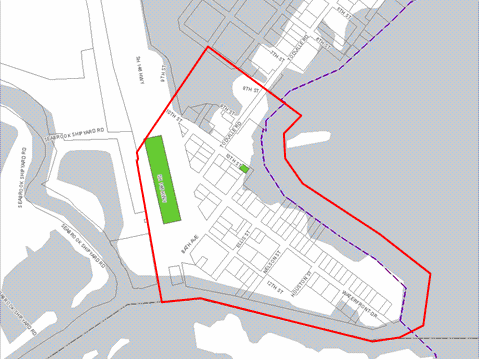
The point overlay district
4.15.04. Uses: L and uses permitted by right and by conditional use shall be governed by Section 3.15, "Comprehensive land use regulation matrix" POD District.
4.15.05. Density: Density shall be governed by the permissible density allowed within the underlying zoning district.
4.15.06. Area regulations: Area regulations shall be governed by the requirements of the underlying zoning district except where a boardwalk must be accommodated, as outlined below.
4.15.07. Boardwalk: Water abutting developments are strongly encouraged to accommodate a continuous public boardwalk adjacent to or over the water that is a minimum of ten feet in width for the entire length of the property that abuts Galveston Bay or Clear Creek.
4.15.08. Design standards:
A.
Architectural considerations: Architectural considerations shall include building siting, massing, proportion, scale, materials, colors, details, facades treatments, fenestration, parapets, site features, lighting and signage. The openness of ground floor facades and view corridors which face pedestrian utilized roadways, circulation routes or waterways shall be maximized to promote pedestrian activity and increase visibility of activity from the interior of the buildings.
B.
Building form: The form of buildings and its architectural details should be designed to create visual interest at the street level using techniques such as incorporating porches, staggering the frontage of the buildings, recessing doors and windows, providing display windows, providing awnings and canopies for weather protection and scale, and visually extending interior spaces outside through paving and glazing.
C.
Site and architectural design features: Site and architectural design features shall substantially advance design standards reflected in local precedents or regional buildings. These may include traditional Coastal Tidewater, Key West, Cape Cod, Pacific Coastal or other appropriate architectural design compatible with a fishing village/nautical context. Materials and colors should be selected to unify the building appearance and fit into the pedestrian realm. The front building setback shall be a minimum of 20 feet from the Waterfront Street right-of-way.
4.15.09. Height: Any structure whose height exceeds 45 feet above the identified base flood elevation shall require a conditional use permit. The height limitations specified in this subsection do not apply to steeples, spires, belfries, cupolas, widow walks or other normal architectural appurtenances placed above the roof level and not intended for human occupancy; however, these design elements may not exceed the maximum height requirement by 20 percent.
4.15.10. Screening: Equipment including, but not limited to, satellite dishes and heating and air conditioning equipment may be installed on top of buildings provided that the equipment is screened from horizontal view.
4.15.11. On-site storage: Any area to be used for outdoor, at-grade, on-site storage shall be designated on the submitted site plan and approved during the design approval process. On-site storage shall not exceed 20 percent of the lot size and shall be arranged so as to preserve views between buildings to Galveston Bay and Clear Creek. All on-site storage, including the storage or parking of trailers and delivery vehicles, must be located behind the plane of the building that faces Waterfront Drive.
4.15.12. Loading docks: Loading docks are prohibited between the Waterfront Street right-of-way and any building facade fronting toward Waterfront Drive. Loading docks shall be situated toward the rear of structures and may be aligned parallel to the sides of buildings that front Waterfront Drive. Loading docks may not be used for any type of long-term storage. Any vehicle, trailer or material left standing in a loading dock for more than a 24-hour period shall be deemed a violation of this ordinance.
4.15.13. Dumpsters: For raised structures, dumpsters shall be located below the building. All dumpsters shall be fully screened and situated on the lot so that it is as unobtrusive and inoffensive to patrons and pedestrians as possible. Gates or other access points for dumpsters shall remain closed at all times other than when the dumpster is being filled or emptied.
4.15.14. Landscaping:
A.
Standard bufferyards: Standard bufferyards shall be a minimum of ten feet in width along the Waterfront Street frontage and shall contain 15 plant units (P.U.) for each 100 linear feet of perimeter. Frontages of less than 100 feet shall be assigned the equivalent fractional plant unit (P.U.) requirement.
B.
Plant units: Landscaping is specified in plant units. Contained in table 1, plant units, are examples of plants and their plant unit equivalencies. The applicant may select any combination of plants to satisfy the plant units (P.U.) required for their specified bufferyard.
TABLE 1-PLANT UNITS
4.15.15. Signs: Signs in this district shall be as prescribed as follows:
A.
Freestanding signs: Freestanding signs shall not be allowed in the overlay district.
B.
Allowed signs: The following signs are allowed, per premises, in the overlay district:
1.
One wall sign, not to exceed one square foot for each linear foot of the width of the main or street building facade;
2.
A second wall sign, not to exceed one-half square foot for each linear foot of the width of the main or street building facade;
3.
One sign projecting perpendicular to the main or street facade, provided that the sign is not larger than ten square feet in area; and
4.
One sign contained within a window consisting of individual letters or symbols, occupying no more than 20 percent of that window's area.
C.
Sign illumination: All exterior signs shall be externally illuminated from above. No exterior signs shall be internally lit or illumination from below.
4.15.16. Utility location: Utilities, including, but not limited to, electrical lines, gas lines, telephone lines, and cable television lines, shall be installed underground unless otherwise approved by city council.
(Ord. No. 2009-12, § 2, 7-21-2009; Ord. No. 2010-14, § 2, 7-6-2010; Ord. No. 2015-04, § 3, 3-17-2015; Ord. No. 2017-28, § 2, 8-1-2017)
Sec. 4.16. - The Seabrook town center commercial development overlay district regulations.
4.16.01. Purpose: The Seabrook town center commercial development overlay district ("STCOD") is intended to promote an attractive mixed-use retail commercial development exhibiting an overall desirable appearance with enduring quality. The overlay will provide direction to the tenant/owner/developer by defining certain design elements and areas which should be common to the project and will unify its overall design. The standards that follow allow for and promote design integration. The city has conducted extensive study for the purposes of establishing the regulations that follow:
4.16.02. Applicability: All new developments and changes to existing developments in the district that require site plan or building permit approval are subject to the requirements of the overlay district in addition to other applicable regulations in the city's Code of Ordinances. Nothing contained in this section 4.16 shall be deemed to reduce applicable requirements contained in other sections of this Code, or any ordinance specifically applicable to a development (e.g., conditional use permit or planned unit development), but instead to enhance the aesthetics and associated uses of this overlay district.
4.16.03. Boundaries of the overlay district: The Seabrook town center commercial development overlay district ("STCOD") shall consist of the area lying west of the western edge of State Highway 146 right-of-way, north of Vermillion Drive rear property lines, east of Loch Lake Drive rear property lines, east of Ed White Elementary School, south of Seabrook Methodist Church, west of Lakeside Drive, south of Humble Drive.
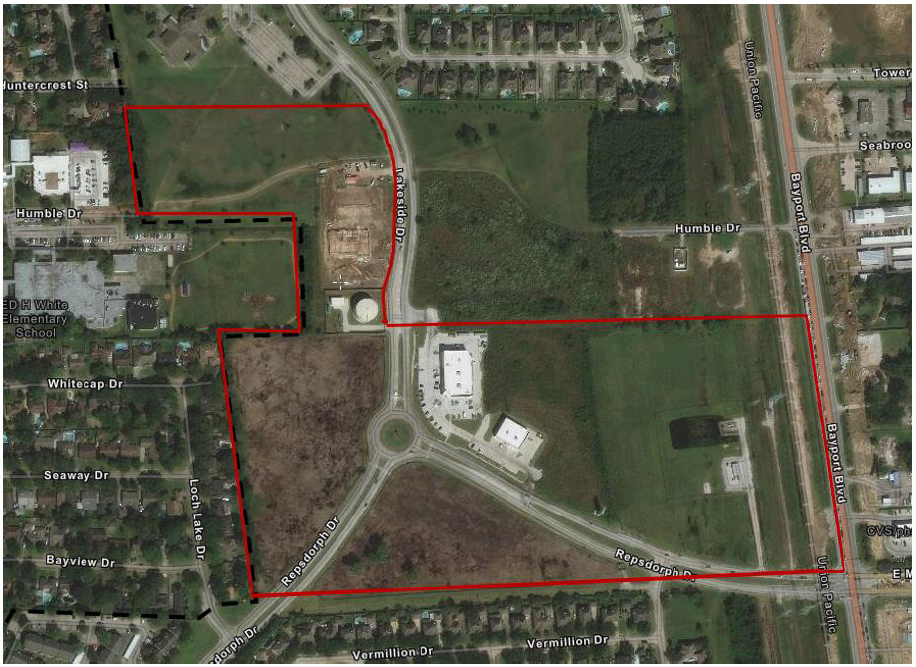
4.16.04. Submission and plan review procedures:
A.
Application submittals: A completed building permit application form and three sets of plans printed at a standard architectural sheet size of a minimum of (24 inches by 36 inches) along with one electronic copy in PDF format, and include the following:
1.
Site survey.
2.
Site improvement details such as building(s), parking lot(s) and or garage, curbing, walks, culvert, fences, water quality elements, screens, and mechanical equipment.
3.
Civil plans that include existing and proposed grades and wet/dry utilities with sizes and locations.
4.
Building plans and elevations (one copy of a colored elevation is needed). Samples of all exterior building materials to show color, texture, and finish.
5.
A separate landscape plan(s) showing all vegetation setbacks, existing and proposed plant material, and irrigation to be installed (irrigation should be to shoulder of road within jurisdictional codes, ordinances, etc).
6.
Site and exterior building lighting plan with lumens per acre calculations and photo metrics including average light levels achieved.
7.
Location and details for all exterior signage whether freestanding or building mounted (signage plan).
8.
Construction access and staging areas.
4.16.05. Uses: Uses permitted by right and by conditional use shall be governed by section 3.15, "comprehensive land use regulation matrix" STCOD district.
4.16.06. Area regulations:
*For lots where buildings abut each other for a contiguous shopping center, the building side setback can be zero feet.
**For lots where the lot line runs in the middle of a driveway for a contiguous shopping center, the landscape setback can be zero feet.
4.16.07. Building height: No building or structure shall have a finished floor whose elevation exceeds 74 feet 11 inches above finished grade. Structures exceeding 50 feet in height shall require a conditional use permit and shall be set back from properties zoned R-1 and R-2 a distance equal to the height of the structure. This setback shall not apply to church steeples, spires, belfries, cupolas, or other normal appurtenances usually required to be placed above the roof level and not intended for human occupancy.
4.16.08. Reserved.
4.16.09. Outside storage and display: Outside storage, display, and sales is only permitted for single tenants that exceed 50,000 square feet of gross interior square footage. Outside storage must be screened from view from all public streets with the use of screening walls, landscaping, or berms. Outside display and sales areas must be out of traffic circulation areas and maintained at all times to keep the area clean and free of debris and trash.
4.16.10. Parking: Concrete paving on any lot shall be used for all paving surfaces of sufficient thickness to withstand the anticipated commercial traffic based on sound geotechnical engineering recommendations for the lot. Paint striping for fire lanes shall be per city requirements. Paint striping for parking and traffic control shall be four inches in width, white traffic paint, of the best commercial quality. Pavers are required at all driveway entry points from a public right-of-way. Pavers shall be set on recessed seven inches paving according to city standards. Pavers to start 15 feet inside of the lot and extend to 25 feet inside the lot and run the full width of the driveway. Pavers shall be modular concrete pavers, "Holland Stone — Antique Buff" color by Pavestone or approved equivalent. Paver areas shall be framed with two Soldier courses and then filled in with a Parquet pattern. Required parking shall be in accordance with section 5, specifically including section 5.04, Table 5-C, "required parking spaces by land use category" of appendix "A" of the Code of Ordinances.
4.16.11. Landscaping: Each lot shall have to be landscaped in accordance with the following guidelines and include a complete irrigation system. Preservation of healthy and desirable trees is encouraged where reasonable and should be considered in the design and layout of each lot.
A.
Plants shall be selected from Table 4-A "approved plant list". These materials have been selected because they are generally native, drought resistant, and non-invasive. These same characteristics should be considered for seasonal color plantings also. Landscaped islands, setback areas, and green spaces to include solid sod Bermuda grass where mulched beds are not used.
B.
All plant material shall be sound, healthy specimens typical of their species, free from injurious insects or disease. Plant proportions shall be those recognized as normal for a well grown plant of that species and size, as used by the American Standard for Nursery Stock. Caliper for sizes shall be taken on the trunk six inches to 12 inches above natural ground.
C.
Street trees and shrubs: One tree will be required for every 50 feet of street frontage per lot to be placed in the landscape setback. These trees can be clustered for planting so long as the quantity is met. Street trees shall be 65 gallon, 3½-inch minimum caliper, and 12 feet to 14 feet in height at time of planting. (Street trees and shrubs will not be required for SH 146 frontage.) Twenty-five shrubs will be required for each 75 feet of street frontage per lot to be placed in the landscape setback. These shrubs shall be planted at 36 inches on center. Shrubs shall be minimum three-gallon size.
D.
Planting islands: Parking rows should have landscaped islands on each end of the rows which shall contain one to two trees in each island depending on the reasonable planting and island size. If, at any time, the required vegetation becomes diseased, deteriorated, or dies, the owner of the premises must replace the vegetation within 30 days of written notice of the city.
TABLE 4-A
4.16.12. Sidewalks: The pedestrian paving will be constructed either within appropriate public street rights-of-way and/or within the landscape setbacks. All walks must be constructed in a consistent workmanlike manner.
A.
Minimum construction requires sidewalks to be four inches thick with #3 reinforcement at 18 inches on center both ways. Public sidewalks located within the city or county right-of-way shall be a minimum of five feet wide. No cold joints are permitted. Complete pours between expansion joints are required. Drill dowels into existing concrete curbs and driveways and use expansion joints with slip dowels at connections of existing and new concrete. Dowels are to be stubbed out where sidewalk is to be continued in the future.
B.
Sidewalk elevations shall match with the existing manhole and valve box elevations. If adjustments of the height are required, owner shall notify the Seabrook Public Works Department (24 hours) prior to sidewalk construction. If adjustments must be made, the owner-builder/site developer will be responsible for such adjustments. Handicap ramps are required at every street and other locations required by Americans with Disabilities Act of 1990 (ADA) as amended.
4.16.13. Site lighting:
A.
A lighting photometric drawing, as part of the lighting plan, shall be submitted depicting the design layout and illustrating a point-by-point foot-candle lighting to achieve a minimum average level of four foot-candles with a maximum/minimum uniformity ratio not to exceed (10:1). All office building lighting will achieve a minimum average lighting level of four foot-candles. The types, size, and style of the lighting fixtures shall also appear in the form of a schedule to the lighting plan.
B.
All parking lot pole mounted lighting shall use the "GE Evolve LED" lighting fixture with a minimum wattage of 315 watts. Fixtures and poles shall have a powder-coated finish and shall be black color finish. Standards for parking lots shall be a maximum of 39 feet tall, on a 30-inch diameter, 30-inch tall concrete base that is painted white to match the traffic marking paint, and shall have a glare light shield fixture. The arrangement of parking lot and driveway lights should provide adequate light coverage at all parcel entries and exits.
C.
Buildings shall be adequately lit at night. Light fixtures shall be attractive, efficient, and shall not create glare or spillover into adjacent properties. No flood lights shall be mounted on buildings except for wall packs at the rear of the buildings. Where used, the wall packs must be shielded to prevent light trespass onto adjoining properties.
D.
Spillover at perimeter property lines shall be 0.00 foot-candles measured along the property line at a height of 30 inches above grade. Lighting fixtures located across or adjacent to R-1 and R-2 single-family residential districts shall use "house side shields" to minimize glare.
E.
Exterior lighting must enhance the atmosphere and safety of all public parking areas, walkways and entrances. Lighting shall be low key and placement of fixtures shall coincide with major walkway areas.
F.
Choice of light fixtures and poles, other than parking lot light fixtures, must reflect the theme and architecture of the project. Structure illumination shall be lit with a concealed, stationary-shielded light source.
G.
All areas within the property must be illuminated with area and decorative lighting continuously during operating hours or from dusk until at least 12:00 a.m. Each owner of a tract within the project shall maintain at least one exterior night light. Where multiple parcels/buildings are under one ownership, for the purposes of this exterior night light requirement, each tract shall be considered a separate tract.
H.
Provided however, notwithstanding subsections A. and B. above, an applicant may present to the planning and zoning commission, on the site plan, specifications which include alternative materials if they meet or exceed the appearance and atmosphere requirements above and appear better suited under the circumstances.
4.16.15. Signage: Signage in the overlay district shall be uniform in materials and general appearance.
A.
Ground sign types: Three types of multitenant on premises ground sign types will be allowed and must all be permitted through the city.
1.
The signage shall be constructed in accordance with Graphic 4-B and 4-H.
GRAPHIC 4-B
60' MAX HEIGHT MULTI-TENANT GROUND SIGN
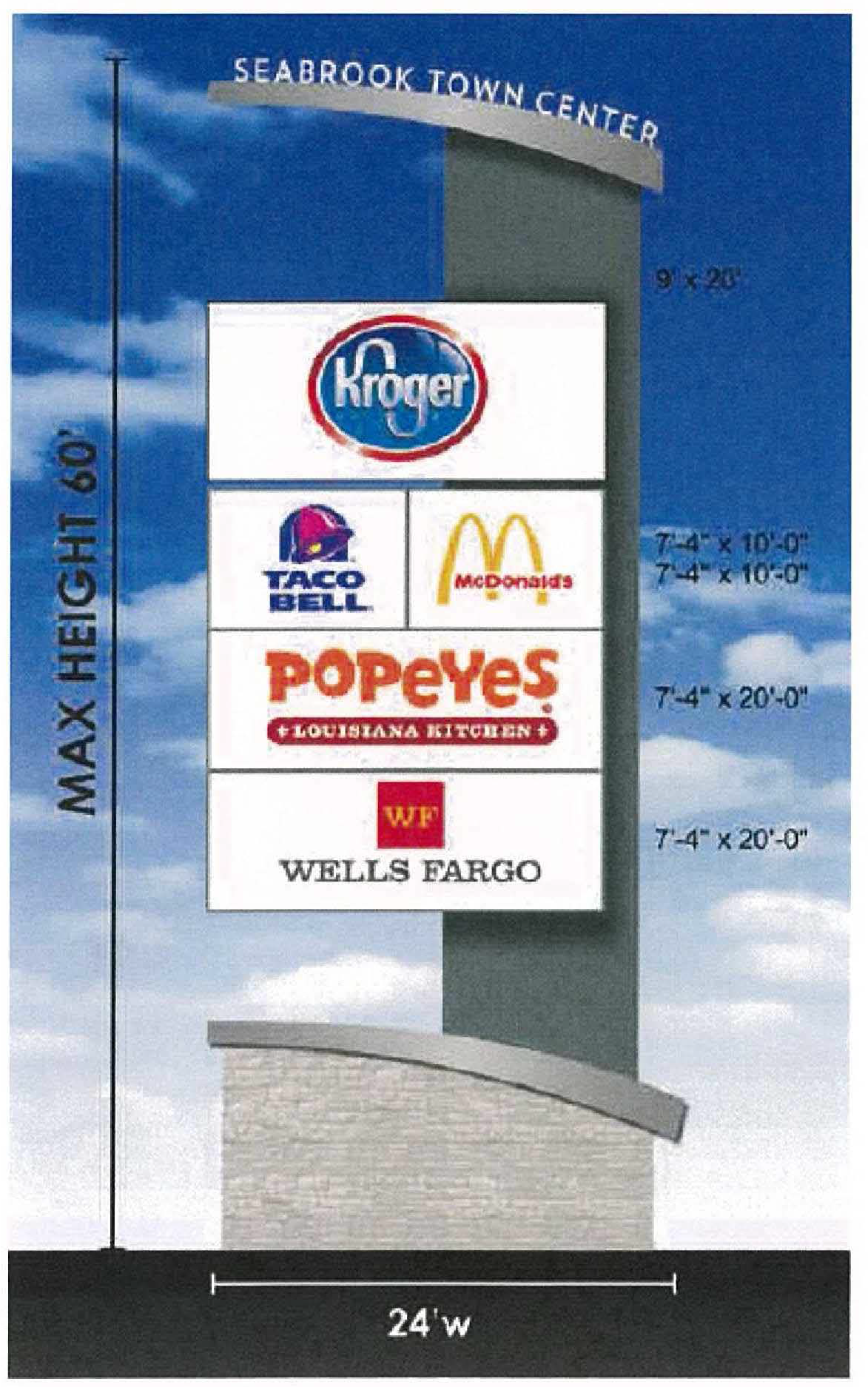
GRAPHIC 4-C
50' MAX HEIGHT MULTI-TENANT GROUND SIGN
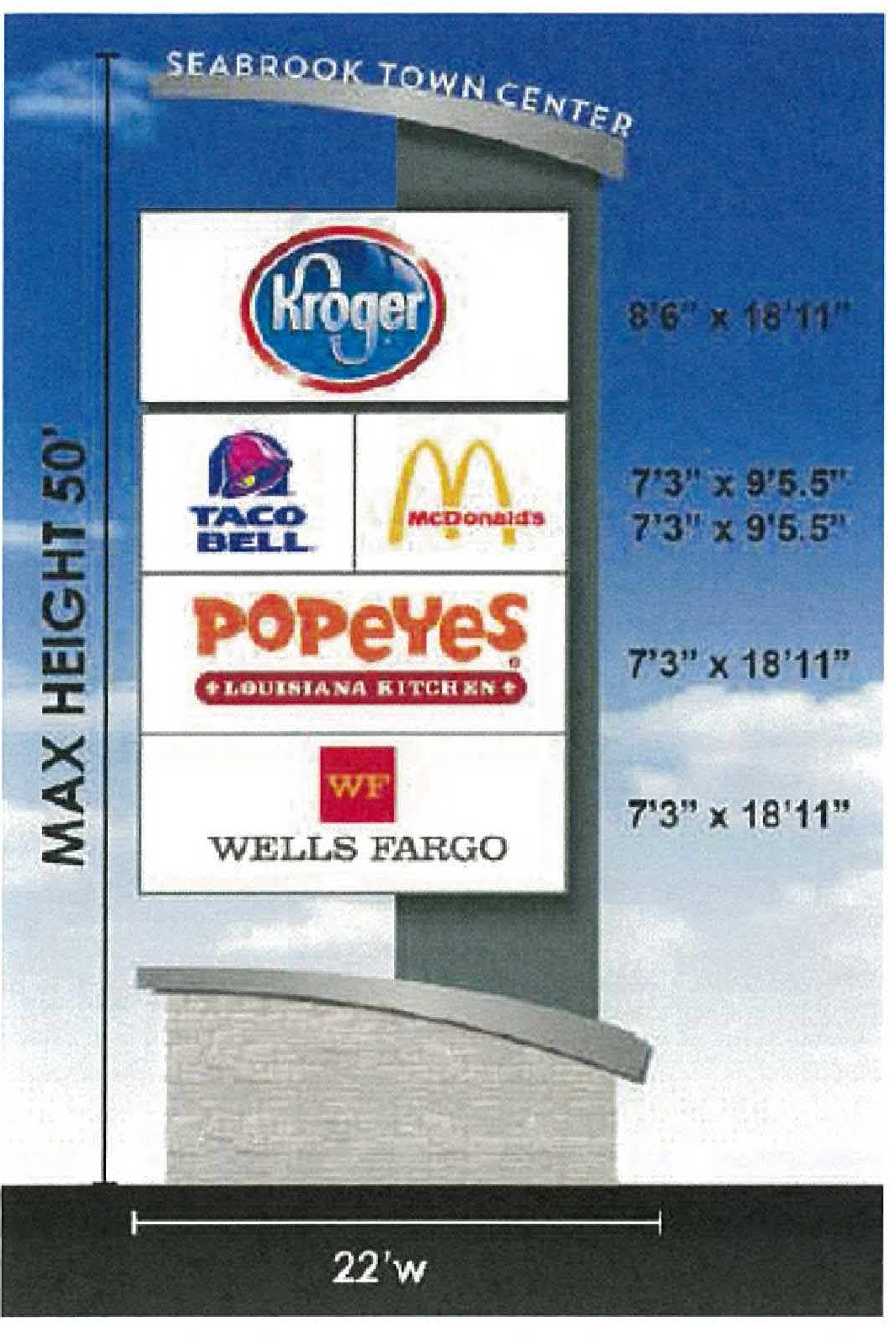
GRAPHIC 4-D
30' MAX HEIGHT MULTI-TENANT GROUND SIGN
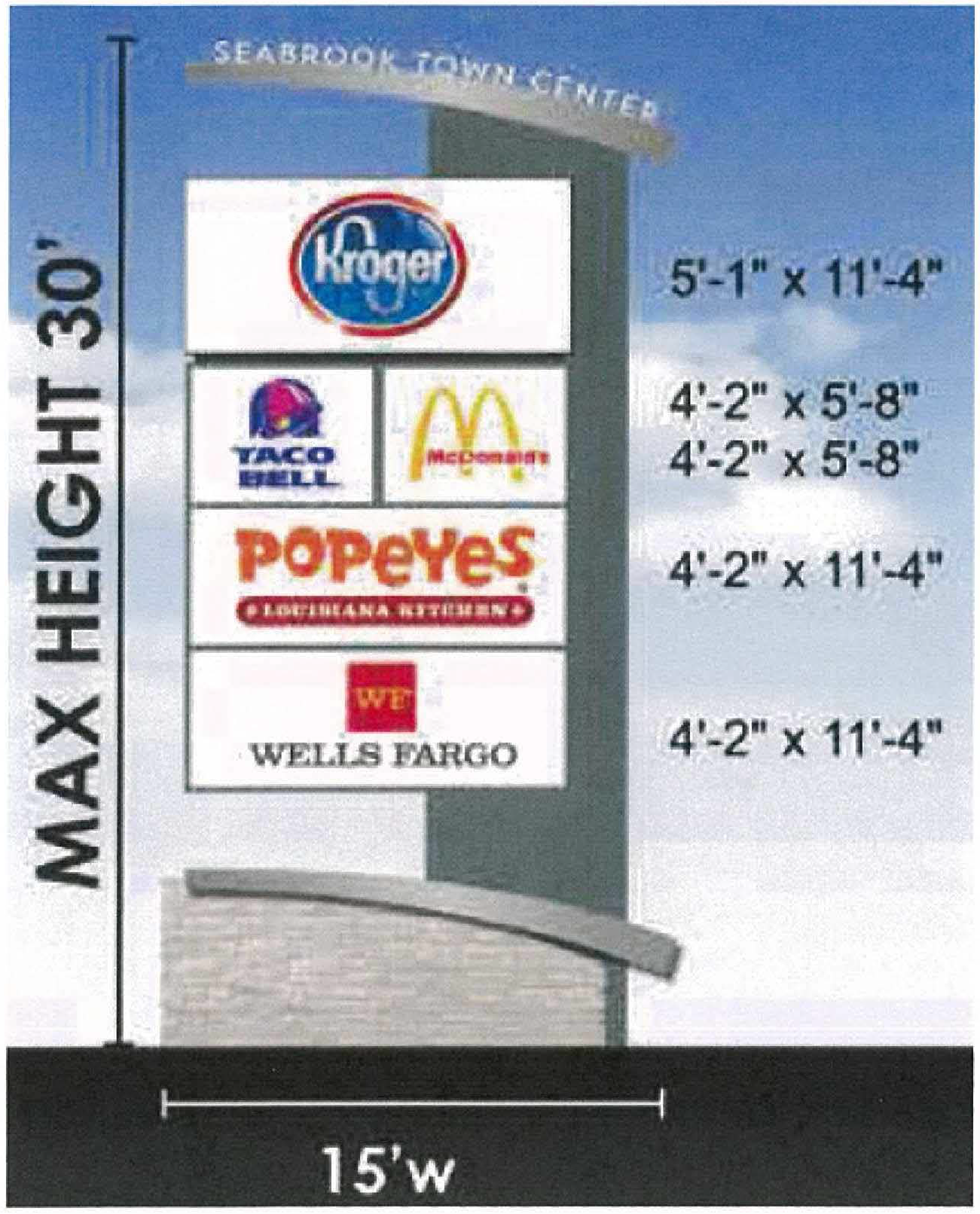
2.
The signage shall be located in accordance with Graphic 4-E.
GRAPHIC 4-E
MULTI-TENANT GROUND SIGN LOCATION MAP
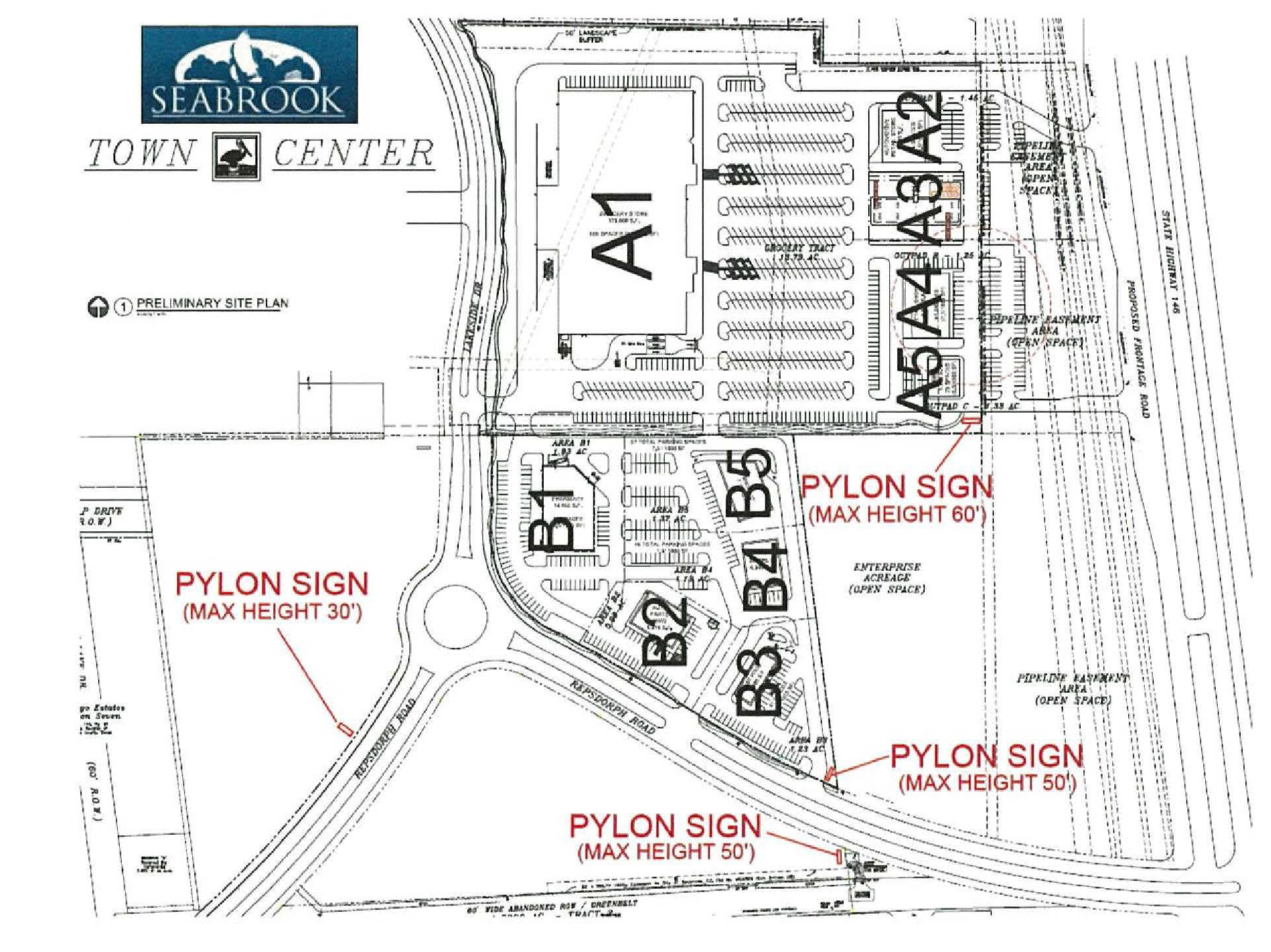
3.
Multi-tenant, single lot signage: One sign of this type will be permitted per applicable lot. A sign of this type shall have a maximum height of eight feet and maximum width of six feet including all structure and finishes.
GRAPHIC 4-F
4.
Single tenant, single lot signage: One sign of this type will be permitted per applicable lot. A sign of this type shall have a maximum height of five feet and maximum width of four feet including all structure and finishes.
GRAPHIC 4-G
B.
Building signs:
1.
Lettering shall not exceed ten feet high and must be in proportion to the building facade area on which they are being placed. Sign area (created as a rectangle around all lettering and images) cannot exceed 80 percent of the width of the space being identified multiplied by a factor of two.
2.
Multi-tenant building signs lettering shall not exceed 36 inches when in a single row of text, and 54 inches total when in two rows of text (providing a six-inch space between the two rows).
3.
Signs may be individual channel letters or wireway mounted, provided the wireway is bottom justified and colored to match the building facade. Box signs will not be allowed. Internally lit or back lit signs are allowed. Logos will not be permitted except for nationally recognized businesses.
4.
Businesses that have frontage on multiple streets shall be allowed one sign per frontage that they face.
C.
Directional signs: Small directional signs may be used where it helps circulation on site. No directions sign shall exceed six square feet in size or 36 inches tall, and lettering should be no more than four inches tall.
GRAPHIC 4-H

4.16.16. External architectural finishes: Buildings located in the overlay district must be uniform in materials and general appearance.
A.
Acceptable materials: Building exterior finishes, other than fenestrations, shall consist of stone, brick, stucco, EIFS, metal panels, painted concrete wall panels, painted or decorative concrete block, and cement board rain screen systems. A minimum of 18 percent of each facade shall consist of brick or stone. Main field colors should consist of earth-tone colors.
B.
Specific colors: When used in the facade of a building. Stone is to be Texas White Limestone in Random Ashlar Pattern, Brick is to be ACME cinnamon brown, standing seam metal roofing shall be Sierra Tan by Berridge Roofing, aluminum storefront is to be clear anodized, and painted concrete block or painted concrete wall panels are to have heavy texture.
4.16.17. Supplementary regulations:
A.
Dumpster enclosures: All trash and utility areas shall be screened from public view and backyard views with masonry wall and can also be further screened by landscape and other devices. Trash areas and dumpster locations shall be permanently fenced or screened with enclosures per Exhibits 2 through 4 so that trash container/dumpster shall not be visible from any public street.
1.
The enclosures shall be constructed in accordance with Graphic 4-I through 4-L and kept closed at all times other than at trash pick-up times.
GRAPHIC 4-I
DUMPSTER ENCLOSURE
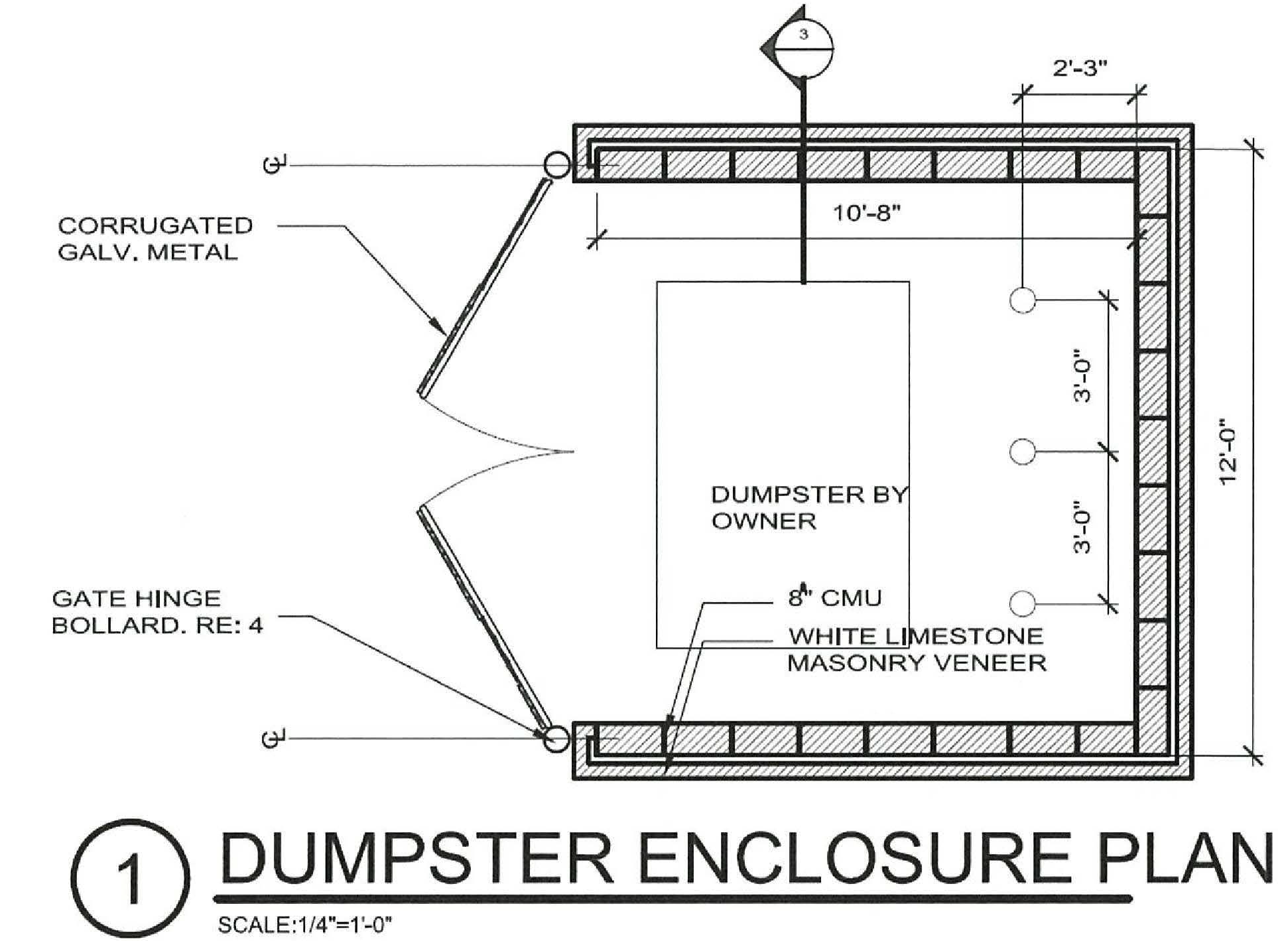
GRAPHIC 4-J
DUMPSTER ENCLOSURE
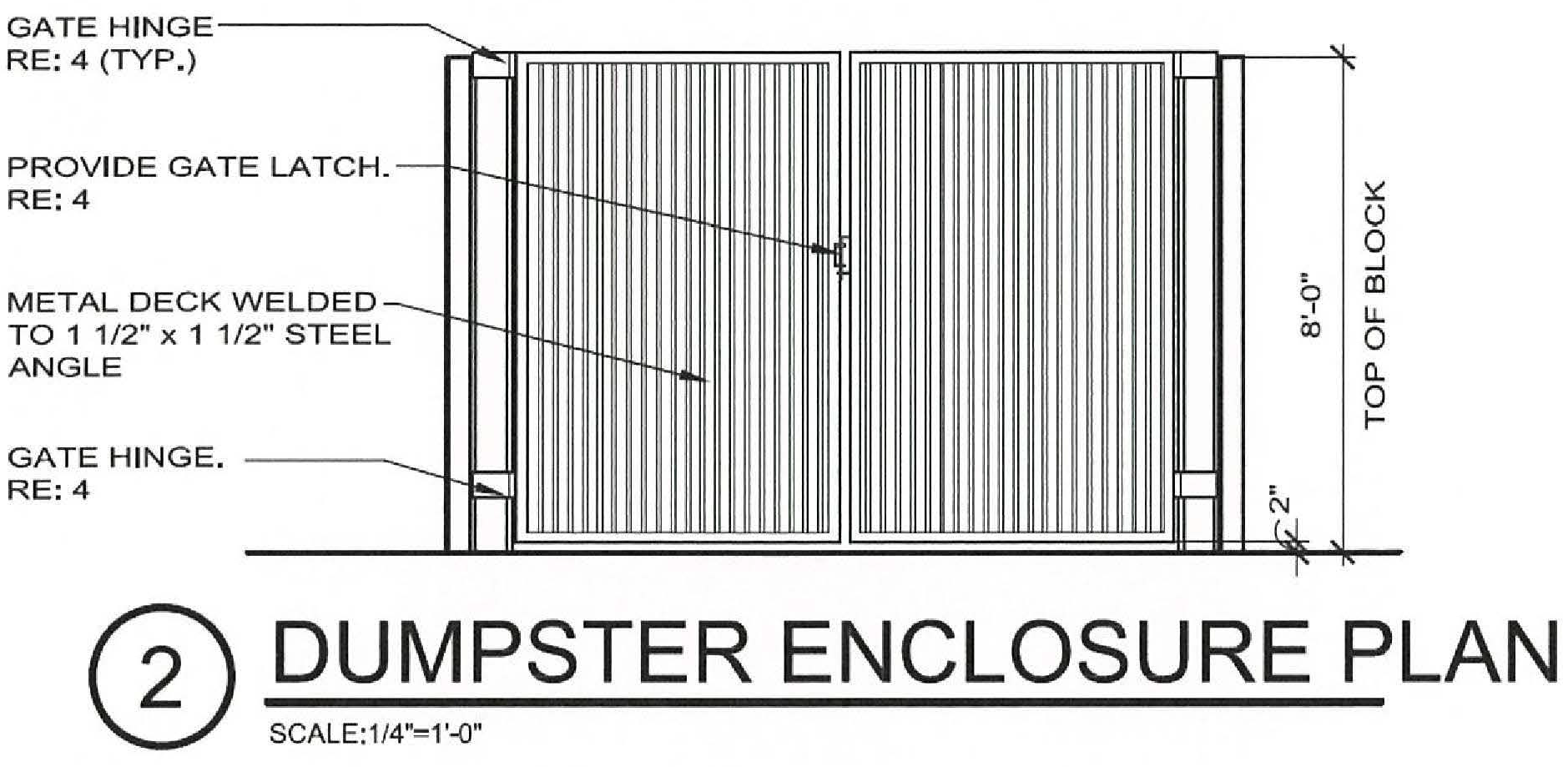
GRAPHIC 4-K
DUMPSTER ENCLOSURE
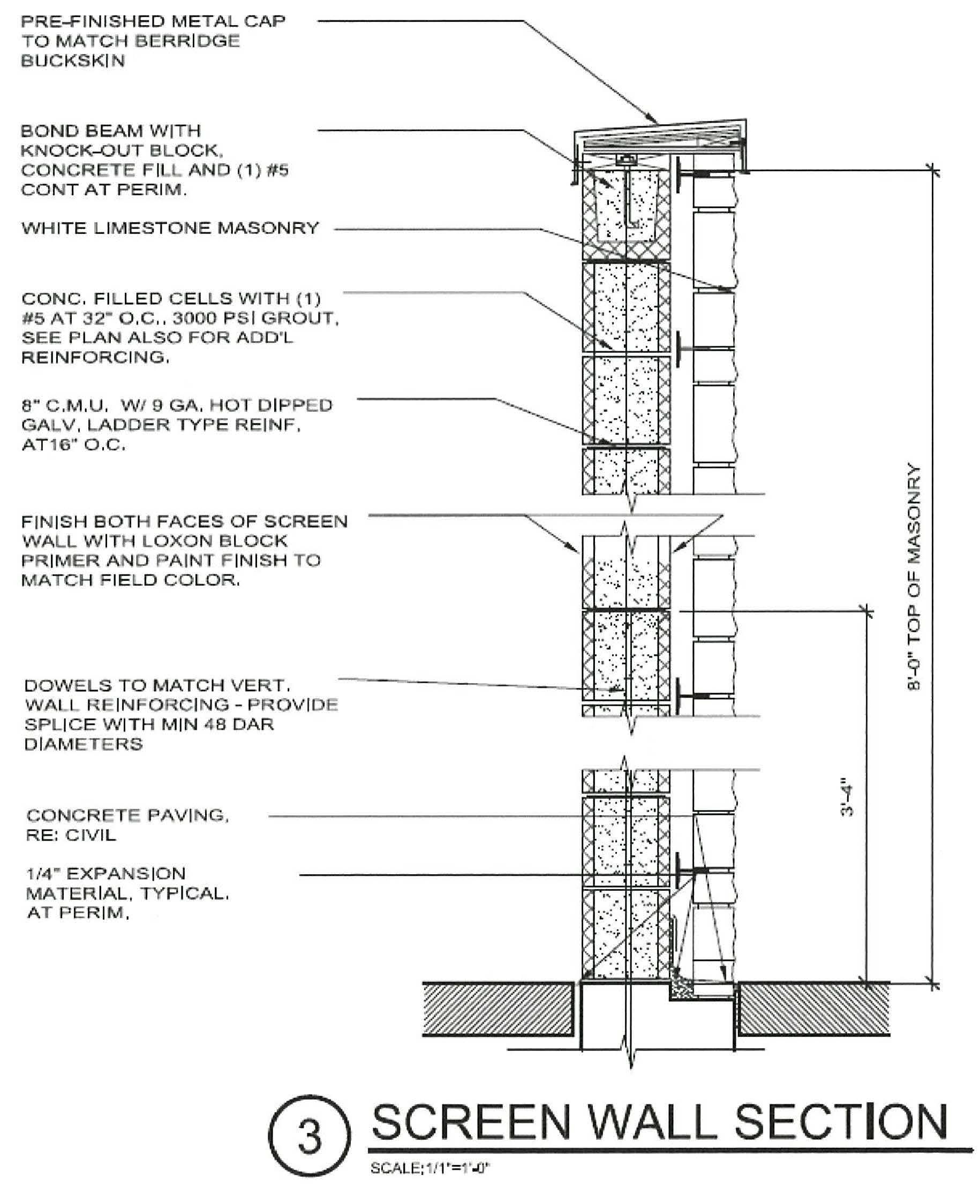
GRAPHIC 4-L
DUMPSTER ENCLOSURE
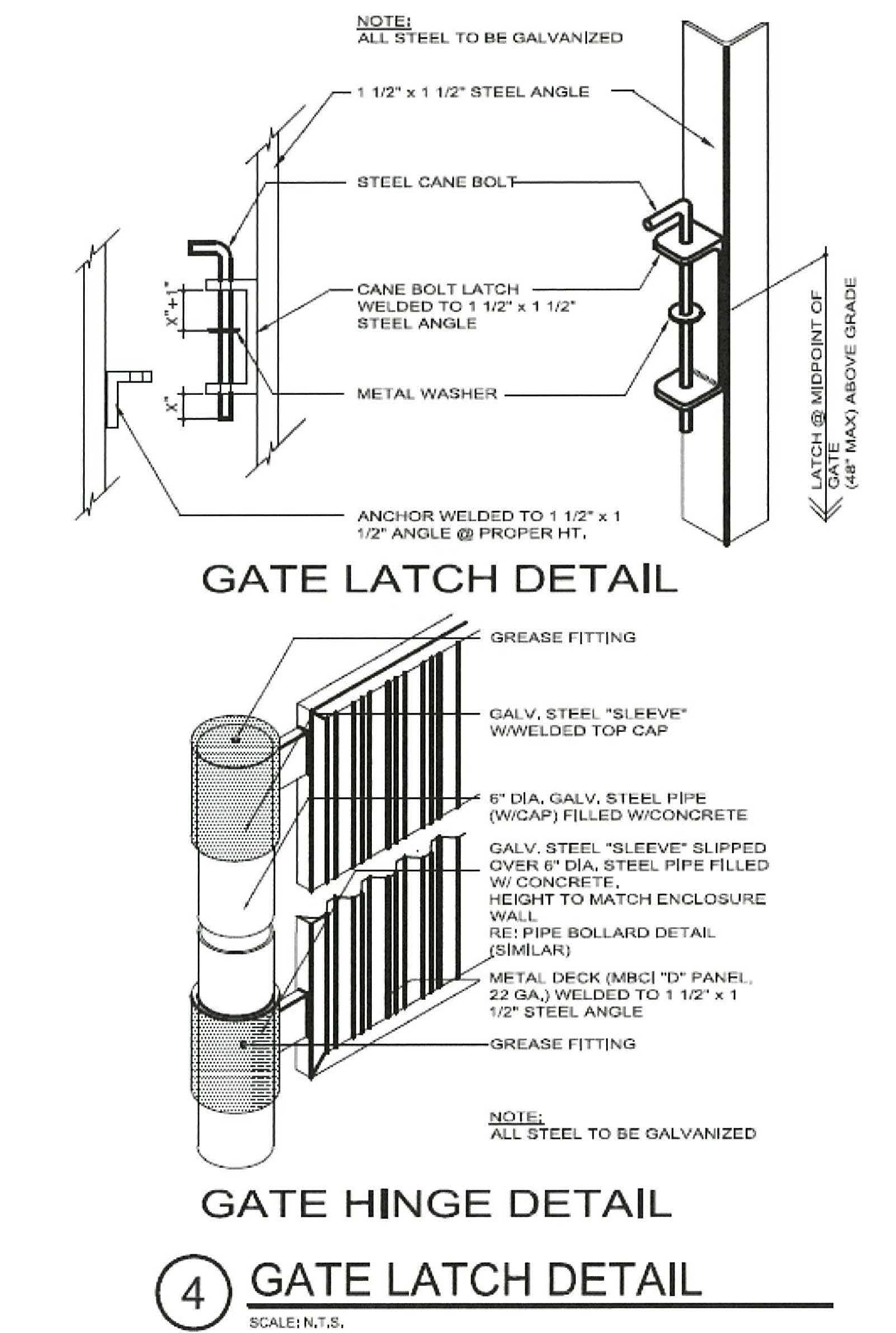
B.
Temporary structures: Structures for uses incidental to construction work on the premises which are removed upon completion or abandonment of construction work are allowed upon permit from the building official.
C.
Temporary structures: No structures, including recreational vehicles, construction trailers, or travel trailers may be used for on-site dwelling purposes.
(Ord. No. 2016-16, § 2(Att. A), 7-5-2016; Ord. No. 2021-01, § 2(Exh, C), 2-2-2021)
Sec. 4.25. - Telecommunication towers and antennae.
4.25.01. Purpose: These regulations are primarily intended to maximize the use of new and existing towers and structures, to prevent the proliferation of unnecessary towers, and to minimize the adverse visual impacts of towers and antennas through design and siting requirements.
4.25.02. Definitions: The following words, terms and phrases, when used in this division, shall have the meanings ascribed to them in this section, except where the context clearly indicates a different meaning:
Amateur radio antenna: A radio communication antennae used by a person holding an amateur station license from the Federal Communications Commission (FCC).
Antenna: A conductor by which electromagnetic waves are sent out or received.
Antenna facility: Any structure used to support antennae.
Co-location: The act of locating wireless communications equipment for more than one use on a single antenna facility.
Equipment storage building or platform: A structure associated with an antenna facility used to store or support devices and material needed for the operation of the associated antenna(e).
Monopole: A self-supporting antenna facility composed of a single spire used to support communications equipment or other visible items.
Stealth facility/tower: An antenna facility that is camouflaged or otherwise hidden from view.
Tower, concealed antennae: An antenna facility that consists of a monopole structure whose antennae are concealed within the tower or do not extend more than 12 inches from the diameter of the pole tower at its narrowest point.
Tower, freestanding: An antenna facility that is not mounted to or otherwise structurally supported by a building or other structure.
Tower, guyed: An antenna facility that is held erect by guy wires or cables.
Tower, lattice: A self-supporting antenna facility having three or more support legs with cross-bracing.
Pictures below are intended for general information and depiction of several different types of antenna facilities/towers and are not intended to represent compliance with the use regulations contained herein.
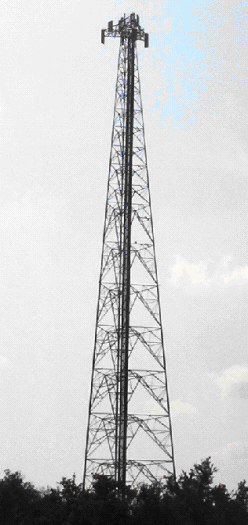
Lattic Tower
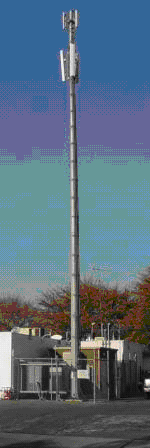
Monopole

Guyed Tower
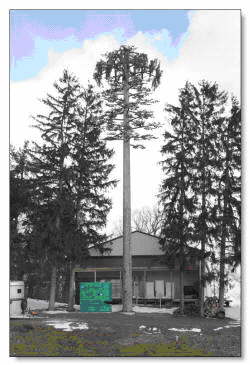
Stealth Facility/
Tower

Antennae
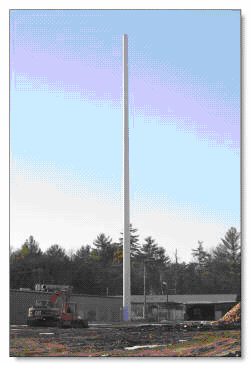
Concealed Antenna Tower
4.25.03. Conditional use permit (CUP) required: Except as otherwise provided in this section, a person may not construct, erect, or maintain a tower or antenna governed by this section on any land located within the city without first receiving a conditional use permit. The procedures of this article relating to the application, processing, and determination of whether to grant a conditional use permit, are in addition to any other provisions and requirements contained in other articles of these zoning regulations relating to conditional use permits.
4.25.04. Exception to CUP: Antennas may be located on any building or structure without obtaining a conditional use permit, if:
A.
The structure, other than a tower on which the tower or antenna will be placed, exceeds 40 feet in height; and
B.
The tower and antenna will add no more than eight (8) feet total to the height of the existing structure; and
C.
The tower or antenna does not contain advertising; and
D.
It complies with the lighting regulations for towers as specified in this article.
E.
It complies with [subsection] 4.16.09A.
4.25.05. Application procedures: An application for a conditional use permit for a tower or antenna must be made to the director of administration. An application will not be considered until it is complete. A complete application must contain the following:
A.
An inventory of the applicant's existing towers that are either within the city or within one mile of the corporate limits, specifying the location, height, and design of each tower. The director may share the information with other applicants for a conditional use permit under this article.
B.
Site plans to scale specifying the location of tower(s), transmission building and other accessory uses, street access, parking, fences, landscaped areas, and adjacent land uses.
C.
A report from a professional structural engineer licensed by the State of Texas documenting the following:
1.
Tower height and design, showing a cross-section of the tower structure.
2.
Total anticipated capacity of the tower structure, including the number and types of antennas which can be accommodated.
D.
A letter of intent to lease excess space on the tower and to lease additional excess land on the tower site when the shared use potential of the tower is absorbed, if structurally and technically possible.
E.
Each applicant must make a good faith effort to substantially demonstrate that no existing towers could accommodate the applicant's proposed antenna by doing the following:
1.
The applicant must contact the owners of all existing towers of a height roughly equal to or greater than the height of the tower proposed by the applicant. A list must be provided of all owners contacted, the date of the contact, and the form and content of the contact. Where an existing tower is known to have capacity for additional antennas of the sort proposed, that application for a new tower is not complete until the owner of the existing tower responds, unless the applicant submits sufficient information for the director of administration to determine that all reasonable efforts to obtain a response have been made and further efforts would be futile.
2.
The applicant must request the following information from each tower owner contacted:
a.
Identification of the site by location, existing uses, and tower height.
b.
Whether each tower could structurally accommodate the antenna proposed by the applicant without requiring structural changes be made to the tower. To enable the owner to respond, the applicant must provide each owner with the height, length, weight, and other relevant data about the proposed antenna.
c.
Whether each tower could structurally accommodate the proposed antenna if structural changes were made, not including totally rebuilding the tower. If so, the owner must specify in general terms what structural changes would be required.
d.
If structurally able, would shared use by the existing tower be precluded for reasons related to RF interference. If so, the owner must describe in general terms what changes in either the existing or proposed antenna would be required to accommodate the proposed tower, if at all.
3.
The director of administration must maintain and provide, on request, records of responses from each owner. Once an owner demonstrates an antenna of the sort proposed by the applicant cannot be accommodated on the owner's tower as described below, the owner need not be contacted by future applicants for antennas of the sort proposed.
4.
Shared use is not precluded simply because a reasonable fee for shared use is charged, or because of reasonable costs necessary to adapt the existing and proposed uses to a shared tower. The director of administration and the city council may consider expert testimony to determine whether the fee and costs are reasonable. Costs exceeding new tower development are presumed unreasonable.
F.
Any other information which may be requested by the director of administration to fully evaluate and review the application and the potential impact of a proposed tower or antenna.
4.25.06. General requirements and regulations:
A.
All freestanding towers must be set back from abutting property lines the distance of the height of the proposed tower.
B.
No freestanding tower may exceed 100 feet in height.
C.
No freestanding tower or antenna may be located within 500 feet of another freestanding tower.
D.
A new tower may not be established if there is a technically suitable space available on an existing tower within the search area that the new cell is to serve. For the purpose of this article, the search area is defined as the grid for the placement of the antenna.
E.
No signs or illumination are placed on an antenna or tower unless required by state or federal regulation.
F.
No advertising is permitted on an antenna or tower.
G.
An annual inspection by a licensed professional engineer must be performed to insure the structural integrity of the tower. The owner must maintain copies of the inspection reports and make them available to the city upon request.
4.25.07. Visual impacts:
A.
Freestanding towers must be concealed antennae towers or stealth facilities.
B.
All towers must either maintain a galvanized steel finish or be painted a neutral color, so as to reduce visual obtrusiveness.
C.
If an antenna is installed on a structure other than a freestanding tower, the antenna and supporting electrical and mechanical equipment must be of a neutral color that is identical to, or closely compatible with, the color of the supporting structure so as to make the antenna and related equipment as visually unobtrusive as possible.
D.
Equipment storage buildings must be constructed of appropriate materials so as to be visually compatible with the character of the surrounding area.
E.
Equipment storage platforms must be completely screened from public view. Chain link fences are permitted, but screen inserts must be utilized and maintained.
F.
Appropriate landscaping may be required where equipment storage buildings or platforms are visible from residential areas or thoroughfares.
4.16.08. Principal, accessory, and joint uses:
A.
Accessory structures used in direct support of a tower are allowed but must not be used for offices, vehicle storage or other outdoor storage. Mobile equipment not used in direct support of a tower shall not be stored or parked on the site of the tower, unless repairs to the tower are being made.
B.
Towers may be located on sites containing another principal use in the same buildable area.
C.
Placement of more than one tower on a lot is permitted, provided all setback and separation requirements are met.
D.
Access drives for antenna facilities must be maintained.
4.25.09. Shared use:
A.
To encourage shared use of towers, no building permit or conditional use permit is required for the addition of antennas to an existing tower as long as the height of the tower or structure on which the antenna is placed is not increased and the requirements of this article and any conditions granting the permit are met.
B.
Any conditional use permit which is granted for a new tower is specifically subject to the condition that the tower owner abides by the following provisions relating to shared use, regardless of whether or not the ordinance granting the permit contains the conditions:
1.
The tower owner must respond in a timely, comprehensive manner to a request for information from a potential shared use applicant;
2.
The tower owner must negotiate in good faith for shared use by third parties; and
3.
The tower owner must allow shared use where the third party seeking the use agrees in writing to pay reasonable, pro rata charges for sharing, including all charges necessary to make modifications of the tower and transmitters to accommodate the shared use, and to observe whatever technical requirements are necessary to allow shared use without creating interference.
C.
The willful failure of an owner whose tower was approved under this article to comply with the requirements of this section is grounds for withholding approval of any application by the owner for a building permit for the approved tower, for revoking the conditional use permit granted for the tower, and for refusing to approve a new conditional use permit for any new tower or antenna.
4.25.10. Abandoned towers:
A.
Any antenna or tower that is not operated for any continuous period of 12 months is deemed abandoned, whether or not the owner or operator intends to make use of the tower. The owner of an abandoned antenna or tower and the owner of the property where the tower is located must remove the tower or antenna. If the antenna or tower is not removed within 60 days of receipt of notice from the city ordering the removal, the city may remove the tower or antenna and place a lien upon the property for the costs of the removal.
B.
If the owner of an abandoned tower or antenna wishes to use the abandoned tower or antenna, the owner first must apply for and receive all applicable permits and meet all of the conditions of this article as if the tower or antenna were a new tower or antenna.
C.
It shall be the sole responsibility of the owner of the property where a communications tower is located to notify the city when a tower has been abandoned.
4.25.11. Pre-existing towers and nonconforming uses: All towers operative prior to the effective date of this article, are allowed to continue their present usage as a nonconforming use and are treated as a nonconforming use in accordance with article 9 of these regulations. Routine maintenance is permitted on the existing towers. New construction other than routine maintenance on an existing communication tower must comply with the full requirements of this article.
4.25.12. Public property: Antennas or towers located on property owned, leased or otherwise controlled by the city are exempt from the requirements of this article.
(Ord. No. 2010-01, § 2, 3-16-2010; Ord. No. 2016-16, § 4, 7-5-2016)
Editor's note— Ord. No. 2016-16, § 4, adopted July 5, 2016, renumbered former § 4.16 as § 4.25.
Sec. 4.26 - Seasonal Christmas tree sales.
4.26.01 Definition: As used in this section, "Christmas tree lot" shall mean any outdoor place where resin-bearing and/or artificial manmade trees and related Christmas holiday items, such as Christmas holiday yard decorations, are sold to the public within prescribed limits set forth in this section.
4.26.02 Enforcement: The community development department of the city shall be vested with the authority to issue all permits required under this section and shall be vested with the authority to inspect lots at all reasonable times and as often as is necessary to carry out the intent of this section.
4.26.03 Permit required: All persons or entities seeking to operate a seasonal Christmas tree lot within the city shall first obtain a permit for such lot from the community development department of the city. Each lot shall require a separate permit and fee. A no-fee permit for Christmas trees lots in the city shall be required of a church or religious organization associated or connected with a church or a bona fide charitable service organization.
4.26.04 Permit fees: A fee which is set out in appendix B—Master fee schedule shall be collected by the city for each permit issued under this section.
4.26.05 Permit requirements:
(a)
No permit shall issue for a seasonal Christmas tree lot until a site plan of the proposed lot is submitted to the community development department of the city, including therein the location and size of the following:
(1)
All tents and/or air-supported structures.
(2)
All portable buildings.
(3)
All electrical services.
(4)
All signage.
(5)
All traffic ingress, egress and parking.
(6)
All site lighting.
(7)
All security fencing.
(8)
All Christmas tree display areas.
(9)
All restroom facilities.
(b)
Additional information provided by the applicant:
(1)
An application fee of $1,000.00, except as provided by 4.26.03;
(2)
Name, legal name of business or entity, business address, phone number, and email address of the applicant;
(3)
Signed and notarized permission from the property owner of the land whereas the seasonal Christmas tree lot is to be located.
(4)
A valid copy of the applicant's sales tax and use permit.
(c)
Failure to obtain a permit prior to any erection or construction of structures upon a lot or sales of any type from the lot, shall constitute a violation of this section.
(d)
Failure to restore the lot to its pre-permit condition after lapse of all Christmas-related business or January 10 of the new year, whichever is sooner, shall constitute a violation of this article.
4.26.06 Conditions for permit:
(a)
The following conditions and restrictions shall apply to all season Christmas tree sales:
(1)
Tents and/or air-supported structures:
a.
Shall be setback from all property lines a minimum of 30 feet.
b.
Shall be limited to one tent and or/air supported structure per site.
c.
Shall be installed in compliance with all adopted fire and building codes.
(2)
Portable buildings, storage structures or trailers:
a.
A temporary building, storage structure or trailer, with a maximum size of 100 square feet, may be placed on the lot during sales operation. Such building, storage structure or trailer must be removed prior to January 10th.
b.
Shall be setback from all property lines a minimum of 30 inches.
c.
No temporary structures, may be used for on-site dwelling purposes.
(3)
Electrical services:
a.
An electrical permit will be required for any electrical power to such building, trailer or site.
(4)
Temporary signage:
a.
All signage shall be in compliance with article 6, sign standards.
(5)
Traffic ingress, egress and parking:
a.
Access to sales lot shall be provided so as not to cause traffic problems on adjacent streets. One customer parking space shall be provided for every 300 square feet of lot sales area. No customer parking will be allowed within the city right-of-way or within a public space.
b.
On-site parking shall be provided on a dust-free, impervious surface area.
c.
Parking on a grass surface is prohibited.
(6)
Site lighting:
a.
All lighting shall be designed and operated so as not to reflect or shine on adjacent properties.
b.
No lighting shall be installed that moves, flashes or have moving, flashing components.
7.
Security fencing:
a.
A security chain link fence with a minimum height of six feet shall be installed around the perimeter of the sales area to prevent access from unauthorized entry.
(8)
Christmas tree display area:
a.
All Christmas trees shall be setback from all property lines a minimum of 30 feet.
b.
No Christmas tree shall be displayed within required parking.
(9)
Restroom facilities:
a.
A minimum of one woman's and one male restroom shall be provided.
b.
The restroom shall be setback a minimum of 30 feet from all property lines.
c.
No restroom shall be located within required parking.
d.
The use of temporary restroom facilities are permissible during the duration of the permit.
(10)
Site cleanup:
a.
All discharge, waste and trash shall be properly disposed of in accordance with the applicable regulations by the close of each day.
b.
Sales lots shall be returned to their original condition prior to January 10th.
4.26.07 Revocation of permit: Any permit issued under this section may be suspended or revoked when it is determined by any law enforcement officer or city ordinance enforcement official that:
(1)
It is used for a location other than that for which it was issued; or
(2)
Any conditions or limitations set forth in this section or pertinent codes have been violated; or
(3)
The possessor of the permit fails, refuses, or neglects to comply with any order or notice served upon him by the city under the provisions of this section within the time period provided therein; or
(4)
There has been any false statement or misrepresentation as to a material fact in the plans, specifications or documentation upon which the permit was based; or
(5)
Any deviation from any element or item contained within the approved site plan or conditions of the permit.
4.26.08 Additional requirements: The requirements of this section shall be in addition to, and not in lieu of, any other permit requirements, code requirements, and ordinances currently in force and effect or hereafter adopted by the city council.
4.26.09 Effective date of permit: The effective date of each permit shall be from November 1 of one year until January 10 of the following year. It shall be a violation of this section to operate or conduct business at a time other than permitted by this section.
4.26.10 Hours of operation: No seasonal Christmas tree lot shall operate outside the hours of 8:00 a.m. to 10:00 p.m.
4.26.11 Insurance requirement.
(1)
The applicant shall maintain commercial general liability and accident insurance in the minimum amounts of $500,000.00 per occurrence.
(2)
Proof of insurance shall be presented to the community development department prior to the issuance of any permit and shall be maintained for the duration of the permit. Copies of the certificates of insurance shall be maintained by the department.
4.26.12 Permit posting: Permits required by this section shall be publicly posted in the area where the activity is conducted or produced, and shall be exhibited upon demand to any law enforcement officer or city ordinance enforcement official. The posted permit shall have emergency contact information for the person(s) responsible for the operation of the seasonal Christmas tree lot.
(Ord. No. 2021-12, § 2, 8-17-2021)
Sec. 4.27. - Portable on-demand storage container.
4.27.01 Applicability. The provisions of this section shall only apply to the use of portable on-demand storage containers on any residential or commercial property.
4.27.02 Definition.
Portable On-Demand Storage Container - Is a self-contained, weather-resistant container used for short-term temporary storage and moving. A portable on demand storage container is delivered by transport for loading and unloading, then belongings are transported to a designated location such as a storage facility, commercial business, or residential use.
4.27.03 Condition and maintenance. A portable on-demand storage container shall be delivered and maintained in good condition, free from rodents, insects, rust, graffiti, and obscene words or pictures. It shall be the responsibility of the property owner or occupant and the supplying company to maintain each container in accordance with the provisions of this section.
4.27.04 Placement and duration of use. A portable on-demand storage container shall be permitted to be placed on a driveway or other improved surface for a period not to exceed 14 days, provided the container is not located within or blocking any public right-of-way or access easement, public sidewalk, or impairing traffic visibility. A container may not be placed on the same parcel of land more than three non-consecutive times in a one-year period. A portable on-demand storage container shall not be placed on a grass surface. No more than two portable on-demand storage containers at any one time shall be permitted to occupy a parcel of land.
4.27.05 Dimensional limitations. The maximum allowable area of a portable on-demand storage container by volume may not exceed 1,360 square feet with the width, height, and length not to exceed 8 feet x 8 feet 6 inches x 20 feet.
4.27.06 Other uses. No person shall place, use, or permit the use of a portable on-demand storage container as an accessory building, storage building, or living unit on residential or commercial property. The Building Official may grant permission for the use of a portable on-demand storage container when the use is associated with a permitted construction project on the same parcel of land and used to store project related tools, materials, or equipment. Once construction has concluded, the portable on demand storage container shall be removed from the premises within ten calendar days.
4.27.07 Enforcement. The community development department of the city shall be vested with the authority to inspect parcels of land at all reasonable times and as often as is necessary to conduct the intent of this section.
4.27.08 Violation—Penalty. Any person who shall intentionally, knowingly, recklessly or with criminal negligence violate any provision of this section shall be deemed guilty of a misdemeanor and, upon conviction, shall be fined in an amount not to exceed $2,000.00. Each day of violation shall constitute a separate offense.
(Ord. No. 2024-01, § 2, 3-5-2024)

