
Seabrook City Zoning Code
ARTICLE 6
- SIGN STANDARDS4
Editor's note—Ord. No. 2018-06, § 2, adopted Feb. 20, 2018, repealed Art. 6 in its entirety and enacted new provisions to read as herein set out. Former Art. 6, §§ 6.01—6.10 pertained to similar subject matter, and derived from Ord. No. 2009-18, § 2, adopted Oct. 6, 2009. See the Code Comparative Table for a complete derivation.
State Law reference— Authority of municipality to regulate signs generally, V.T.C.A., Local Government Code § 216.001 et seq.; regulation of signs by home-rule municipality, V.T.C.A., Local Government Code § 216.901.
Sec. 6.01.- Purpose and intent.
The purpose of this article is to create the legal framework for a comprehensive and balanced system of signage in the city without impermissible content based regulation. These regulations are intended to provide an easy and pleasant communication between people and their environment and avoid visual clutter that is potentially harmful to traffic and pedestrian safety, property values, business opportunities, and community appearance. In addition to protecting the health, welfare, and safety of the community, these standards are adopted in order to:
(1)
Maintain and enhance the aesthetics of our community;
(2)
Enhance automobile and pedestrian safety;
(3)
Encourage the integration of signage with landscaping and building design;
(4)
Protect and enhance scenic views and natural landscapes;
(5)
Protect and enhance economic viability of the city's commercial corridors by assuring aesthetic appeal to businesses and residents alike;
(6)
Promote the use of aesthetically pleasing sign materials, colors, and types; and
(7)
Require safe and effective signage including distinguishing between: lighted/unlighted signs; electronic signs with messages that change; distinguishing between private and public property; the placement of signs on commercial and residential property, and on-premises and off-premises signs; and additional rules imposing time restrictions on signs advertising a one-time event and related permissible regulations.
(Ord. No. 2018-06, § 2, 2-20-2018)
Sec. 6.02. - Definitions.
The following words, terms and phrases, when used in this article, shall have the meanings ascribed to them in this section, except where the context clearly indicates a different meaning:
Administrative official. The department director appointed by the city manager to administer this article, or the department director's designee.
Alter. To change the size, shape or outline, or type of sign or to change the electrical lighting, except for the replacement of lamps not brighter than the original or the replacement of a surface panel.
Architectural detail. Any projection, articulation, relief, cornice, column, change of building material, window, or door opening on any building.
Attach. To stick, tack, nail or otherwise affix a sign to any object.
Awning. A cloth, plastic, or other nonstructural covering that either is permanently attached to a building or can be raised or retracted to a position against the building when not in use.
Banner. See sign, banner.
Building. A structure which has a roof supported by walls for the shelter, support, or enclosure of persons, animals, or chattel.
Certificate of occupancy (C.O.). An official certificate issued by the city which indicates conformance with building, zoning, and health and safety regulations and authorizes legal use and occupancy of the premises for which it is issued.
Civic organization. An organization which offers community programs to citizen, city or civic affairs groups.
Commencement of work. For construction of a sign, commencement of work shall be the point in time when the sign has been delivered to the site and attachment to a building has begun or holes are excavated for ground installation.
Dilapidated or deteriorated condition. Any sign which has any of the following characteristics:
(1)
Where elements of the surface or background can be seen, as viewed from the normal viewing distance, to have portions of the finished material or paint flaked, broken off, or missing, or otherwise not in harmony with the rest of the surface; or
(2)
Where the structural support or frame members are visibly bent, broken, dented, or torn; or
(3)
Where the panel is visibly cracked, or in the case of wood and similar products, splintered in such a way as to constitute an unsightly or harmful condition; or
(4)
Where the sign or its elements are twisted or leaning or at angles other than those at which it was originally erected (such as may result from being blown or the failure of a structural support); or
(5)
Where the message or wording can no longer be clearly read by a person with normal eyesight under normal viewing conditions.
Distance from R.O.W. Distance of signs from R.O.W. shall mean the shortest horizontal distance from the nearest R.O.W. to a vertical line to the ground from the nearest element of the sign.
Donation bin. A bin or similar structure used for the collection of clothes or non-perishable food items.
Erect. To build, construct, attach, hang, place, suspend or affix. This shall also include the painting of signs on the exterior surface of a building or structure.
Facade. Any separate face of a building, including parapet walls and omitted wall lines, or any part of a building which encloses or covers usable space. Where separate faces are oriented in the same direction, or in the directions within 45 degrees of one another, they are to be considered as part of a single facade.
Fund raiser. An activity that takes place for the sole purpose of raising funds to support community service organizations, public charities, or nonprofit organizations.
Height, sign. As applied to a sign, height shall be measured as the vertical distance between the highest part of the sign or its supporting structure, whichever is higher, and finished grade at the center of the base of the sign.
Height, letter/logo. The height of each individual letter, logo, symbol, and/or icon in a sign.

Illumination. The enhancement of a sign utilizing electric lights, luminous tubes or other similar means.
Lease space. An area of a building separated internally and intended for use by an individual tenant.
Logo. Any registered or recognized symbol, letter, or combination of symbols and letters used by an organization, individual, company, or product for advertising to identify that organization, individual, company, or product.
Masonry materials. Masonry materials include brick, stucco, cement, concrete tilt wall, stone, or other masonry or materials of equal characteristics.
Obsolete. Any sign which:
(1)
For at least 30 days, does not identify or advertise a bona fide business, service, owner, product or activity on the premises on which the sign is located; or
(2)
If the premises is leased, relates to a tenant and at least 30 days have elapsed since the date the most recent tenant ceased to operate on the premises; or
(3)
No legal owner can be found and relates to a use or purpose that is no longer in existence.
Off-premises advertising. The offer or display for sale of any goods, wares, merchandise or services on private property separate and apart from the main building or at a location where there is no preexisting principal use. The goods, wares, merchandise or services offered for sale as outdoor sales or services are normally not offered for sale in the main building on the lot or in association with the principal use.
Pad site. A tract, lot, or land lease intended for the single use of a freestanding building typically adjacent to street R.O.W. and may also be a portion of a tractor lot.
Public property. Any property which is owned by a governmental entity. It shall also include property for which the primary use is for the operations of a governmental entity.
Residentially zoned property. Any platted lot within the R-LD, R-1 or R-2 zoning districts.
Right-of-way (R.O.W). A strip of land, other than a drainage or utility easement, occupied or intended to be occupied by a street, crosswalk, railroad, road, electric transmission line, oil or gas pipeline, water main, sanitary or storm sewer main, or for another special purpose.
Setback. The distance from the closest portion, whether the support or edge of the sign, to the property line.
Sidewalk. A pedestrian walkway that is grade-separated from the adjacent street or drive when located adjacent to a street or drive.
Sight triangle. A triangle at an intersection, formed by the two roads or rights-of-way and a third line, which must be kept clear of obstructions such as hedges so that people in one road can see cars approaching on the other.
Sign. An outdoor structure, sign, display, light device, figure, painting, drawing, message, plague, poster, billboard, or other thing that is designed, intended, or used to advertise or inform.
Every sign, name, number, identification, description, announcement, declaration, demonstration, device, display, flag, banner, pennant, illustration, logo, balloon, streamer, valance, advertising display, poster, beacon, light or insignia, and structure supporting any of the same, affixed directly or indirectly to or upon any building or outdoor structure, or erected or maintained upon a piece of land, which directs attention to any object, project, service, place, activity, person, institution, organization, or business.
Sign, advisory board. The planning and zoning commission serves as the advisory board, the board's primary responsibility is to make recommendations to the city council on master sign plans and sign ordinance amendments.
Sign area. A two-dimensional area on a building or other permitted sign structure, that is free of architectural details and is the area that encompasses the proposed sign in its entirety.
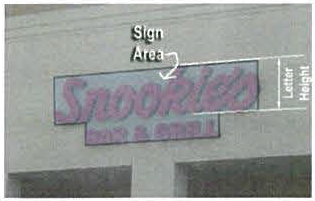
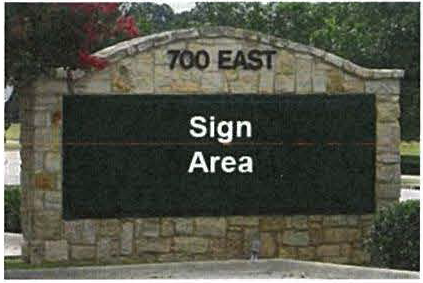
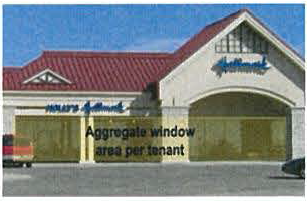
Sign area, aggregate. The sum total of all the window and interior sign area on the aggregate window area available per tenant.
Sign, attached. Any sign attached to, applied on, or supported by any part of a building (including canopy fascia, walls and awnings) which encloses or covers usable space.
Sign, attached business. A permanent attached on-site sign that is used to identify a business, profession, organization, institution, service, activity or other nonresidential use conducted, sold or offered on the site where such sign is located. This sign may also identify the name of the site or development or may identify the occupants within the site or development. A primary business sign is attached to a facade facing a street or vehicular driveway access.
Sign, banner. A temporary on-site sign made of cloth, flexible plastic, canvas or like material.
Sign, barber pole. An attached sign mounted on the face of the building that is cylindrical in shape with striped face, lit internally and rotates during business hours.
Sign base. See sign, monument.
Sign, blade. An attached sign oriented perpendicular to the face of the building which projects more than 12 inches beyond the surface of the building to which it is affixed or supported.
Sign, boxed cabinet. An attached sign that is mounted on the face of a building provides for internal illumination and changing of the message of the sign by replacing a single transparent or translucent material such as a Plexiglas/lexan face. Also referred to as a "pill box" or a "capsule" sign.
Sign, bulletin board. A permanent ground sign or monument sign within a residential subdivision for displaying news and information for subdivision residents.
Sign, business monument. A permanent on-site monument sign that is used to identify a business, profession, organization, institution, service, activity or other nonresidential use conducted, sold or offered on the site where such sign is located. This sign may also identify the name of the site or development or may identify the occupants within the site or development.
Sign, café umbrella. A sign painted on or otherwise affixed to an umbrella at an establishment with outdoor seating.
Sign, channel letter. A fabricated three-dimensional metal or plastic letter which includes a light source and a plastic face. Channel letters are mounted to a wall.
Sign, corporate flag. A sign made of cloth or similar material, attached to a pole used to identify a place of business or organization. This definition does not include the flag of any country, state, city, county or governmental entity.
Sign, directional. A permanent on-site attached sign intended to aid in vehicular movement on the site.
Sign, directory. A permanent on-site attached or monument sign providing direction to or identifying the buildings in the development.
Sign, drive through. A permanent on-site attached or monument sign located immediately adjacent to, within, or over a drive through lane that is associated with sales conducted from an automobile.
Sign, drive through—Non-food service. A drive through sign associated with sales from an automobile that are not related to food service sales.
Sign, estate sale. A temporary ground sign intended to advertise an estate sale, conducted primarily indoors, on residential property.
Sign, existing building for sale/leasing. An on-site sign intended to advertise a building or buildings for sale or lease after the building(s) have been occupied for a year or more.
Sign, existing commercial building for lease or sale ground. A temporary ground sign pertaining to the sale or lease of the building on the lot or tract of land on which the sign is located, or to the sale or lease of one or more structures, or a portion thereof located thereon.
Sign, exposed string lights. Exposed visible light bulbs on an electrical cord typically hung on a patio area for decorative purposes.
Sign face. The surface of one side of a sign.
Sign, flat panel. An attached non-internally illuminated sign that contains routed or embossed text and/or logo affixed on a single metal plate less than two inches in thickness.
Sign, freestanding. A sign made of permanent materials supported by one or more columns, poles, uprights, or braces anchored in the ground and not attached to any building.
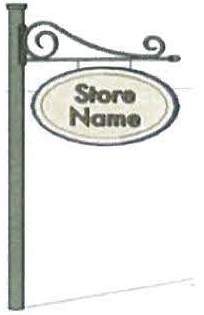
Sign, freestanding suspended sign. A sign mounted above grade adjacent to a business, affixed to a beam or overhang.
Sign, garage/yard sale. A temporary ground or banner sign intended to advertise garage sales or yard sales.
Sign, gasoline pricing. Permanent on-site monuments sign which displays the price per gallon of fuel sold by that business, and which may be periodically changed to reflect changes in fuel prices.
Sign, government. A sign erected by or on behalf of a federal, state or local government or an agency thereof.
Sign, grand opening banner. A banner to advertise grand opening celebrations for individual businesses.
Sign, ground. Any sign connected to the ground by legs, poles, or other supports and which is not an attached, portable, monument, or vehicular sign.
Sign, holiday. Any sign that is associated with the celebration of a recognized holiday or celebration.
Sign, home occupation. An attached on-site sign at the entrance of a home occupation.
Sign, land. A temporary on-site ground sign on vacant land intended to advertise land for sale including un-platted tracts of land.
Sign, light pole banner. A banner sign attached to a light pole along a public street or within a public park.
Sign, menu-board. A drive through sign associated with menu and pricing for food services and may include an audible speaker and microphone integral to the sign.
Sign, model home. A temporary on-site real estate sign identifying a homebuilder's model home open for inspection.
Sign, monument. Any sign which is connected to the ground and which has no clear space for the full width of the sign between the bottom of the sign and the surface of the ground. A monument sign includes a sign face and sign structure, and may also include a sign base and sign cap as described below:
(1)
Sign base. The above-ground foundation of the sign, which includes the exposed concrete footing for the sign.
(2)
Sign face. The surface of the sign in which the sign message is located.
(3)
Sign structure. The structure surrounding the sign face.
(4)
Sign cap. A part of the sign structure located above the sign face that is constructed of a different masonry material and/or extends horizontally from the rest of the sign structure.
Sign, new construction for sale/leasing. A temporary on-site sign intended to advertise a newly constructed existing building or buildings for sale or lease.
Sign, nonresidential development/construction. A temporary on-site ground sign identifying the developing new nonresidential tracts or lots and which can also contain the names of the architects, engineers, contractors and similar artisans in the design or construction of the structure or project. This sign pertains to a new nonresidential development that has been approved by the city and is under construction.
Sign, off-premises. A sign displaying advertising copy that pertains to a business, person, organization, activity, event, place, service, or product not principally located or primarily manufactured or sold on the premises on which the sign is located.
Sign, on-premises. A freestanding sign identifying or advertising a business, person, or activity, and installed and maintained on the same premises as the business, person, or activity.
Sign panel. Any separate, single panel or piece of material containing a word or symbol legend or individual message that is affixed to the face of a sign. Each sign panel shall be uniform in size.
Sign, panel replacement. The replacement of a panel on an existing sign that does not alter the sign.
Sign permit. The official authorization by the city to alter, erect, or display any sign not exempted by this article.
Sign, political. A type of off-site sign which refers only to the candidates or issues involved in a political election. This type of sign is subject to the regulations contained in V.T.C.A., Local Government Code § 216.903.
Sign, portable. Any sign which is not attached or affixed to the ground, a building, vehicle, or other fixed structure or object. Portable signs include those signs installed on wheels, trailers, skids, and similar mobile structures.
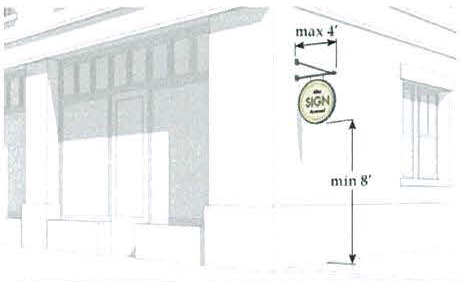
Sign, projecting. A sign mounted perpendicular to an exterior wall of a business.
Sign, reader-board. A sign that utilizes alternating electronic data control components or a sign comprised of non-permanent letters, numerals or symbols, which allows a change of sign copy by adding, removing or rearranging said letters, symbols or numerals.
Sign, residential builder. A temporary on-site sign identifying the builder or general contractor of a residential construction site.
Sign, residential development/construction. A temporary on-site ground sign identifying the developing new residential tracts or lots and which can also contain the names of the builders and similar artisans in the design or construction of the project. This sign pertains to a new residential development of four or more lots that have been approved by the city and is under construction.
Sign, residential real estate. A temporary on-site sign identifying existing residential buildings and/or lots for sale or lease on all residentially zoned and platted lots.
Sign, restricted parking. A temporary or permanent sign in a parking lot that restricts parking for any reason.
Sign, reverse channel. A sign that has opaque channel letter faces and sides with illumination inside the letter cavity that shines out the back of the letter. These backlit letters are mounted away from the wall so a halo forms behind them. A clear polycarbonate back prevents animals from nesting inside the letter. These types of signs are also called "halo lit" or "backlit" letters.
Sign, roof. Any sign that is:
(1)
Erected on a vertical framework supported by and located immediately and entirely over the roof of a building; or
(2)
Attached to a fascia extending above or below the projection of the fascia; or
(3)
Painted or otherwise affixed on a roof; or
(4)
Displayed above the eave line of a sloped roof or parapet of a flat roof.

Sign, sandwich board. A portable sign consisting of two panels of equal size, which are hinged at the top and placed on the ground or pavement so as to be self-supporting.
Sign, service entrance door. Signs attached to an entrance door are allowed for building identification with lettering not to exceed four inches in height and no greater than two square feet. The sign may include the telephone number, business name and suite number.
Sign, special purpose. A temporary sign that is either on-site or off-site that provides identification or information pertaining to a special event or occurrence sponsored by a nonprofit or civic organization.
Sign, spectacular. A sign with flashing, rotating or blinking lights, any sign which mimics a traffic control device or in any way interferes with the safe operation of a motor vehicle. Also, any electronic reader board whose message changes faster that once every eight seconds shall be considered a spectacular sign.
Sign structure. See sign, monument.
Sign, subdivision entry. Any permanent on-site sign identifying a residential subdivision.
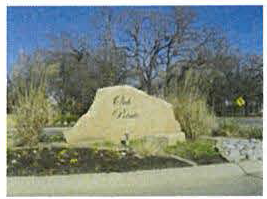
Sign, subdivision marketing/open house. A temporary sign used to market or advertise residential subdivisions/open houses within the city and to direct interested persons to the subdivision/open house location.
Sign, temporary. Any sign constructed of cloth, canvas, light fabric, cardboard, wallboard, or other like materials, with or without frames, and any type sign not permanently attached to the ground, wall, or building, intended to be displayed for a short period of time only.
Sign, upper story. An attached sign located on a multistory building that is either displayed above the ceiling level of the first story and/or displayed 20 feet or more above grade of the closest roadway surface.
Sign, vehicular. Any sign which is attached to or supported by a vehicle, trailer, other sign apparatus, or is located within a vehicle and is visible.

Sign, wall. A sign attached to the wall or face of a building, or constructed as part of such wall or face, to identify a business or product sold or services within the building.
Sign walker/spinner (human directional sign). A person, on the public R.O.W. that is holding, twirling, or wearing a sign, wearing lights, or wearing a costume to advertise/draw attention to a business, project, place, or event.
Sign, wayfinding. A government sign that provides direction to locations and facilities.
Sign, window. Any sign affixed to any internal and/or external surface of a window or is located less than ten feet from the window of any establishment. In addition, any sign displayed in window area that is used to describe in-store sales, promotions, etc.
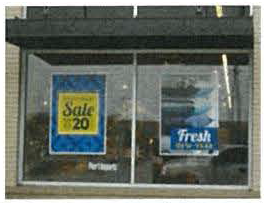
Sign, window display. Any display of goods, merchandise, products or lifestyle images as in a window designed to attract customers.
Sign, wind-driven. Any sign, pennant, flag (other than official flags), ribbons, spinners, streamers or captive balloons, or other objects or material fastened in such a manner as to move upon being subjected to pressure by wind and drawing attention to a business, product, service or activity whether it contains a message or not.
Site. A lot, tract or building pad.
Temporary structure. A structure without any foundation or footings.
Window area, aggregate. The sum total of all the window area on a facade per tenant.
(Ord. No. 2018-06, § 2, 2-20-2018)
Sec. 6.03. - Applicability.
With the exception of the exemptions set forth in subsection (3) of this section, no sign shall be erected, altered, or displayed within the city without a duly approved sign permit.
(1)
Nonconforming existing signs. All signs that are lawfully in existence on the date of adoption of this article may exist in their present form, but no such signs shall be altered or moved unless a permit is issued pursuant to the provisions of this article. Permits granted prior to the passage of this article shall be renewed only if the applicant complies with all provisions of this article.
Any legal, nonconforming sign which has been substantially destroyed or dismantled for any purpose other than maintenance shall be deemed as completely destroyed if the cost of repairing the sign is more than 60 percent of the cost of erecting a new sign of the same type at the same location. Under this provision, the sign shall be removed and a permit shall be required to erect a new sign.
(2)
Prohibited signs. All of the following signs are prohibited.
a.
Signs attached to light fixtures, poles, curbs, sidewalks, gutters, streets, utility poles, public buildings, fences, railings, public telephone poles, or trees, excluding political signs on private property as provided by applicable statute.
b.
Signs which prevent free ingress to or egress from any door, window, or fire escape.
c.
Signs erected or displayed in such a manner as to obstruct free and clear vision at any location, street, intersection, or driveway. All signs placed at any intersection shall prevent such problem by observing a sight triangle as provided for in section 6.02, definitions.
d.
Any sign which interferes with vehicular or pedestrian traffic as a result of the position, size, shape, movement, color, fashion, manner, or intensity of illumination or any other characteristics causing such interference. No person shall erect or allow to be displayed any sign in such a manner as to interfere with, obstruct the view of, or be confused with any authorized traffic sign, signal, or device, including, without limitation, signs making use of the words "stop," "go," "look," "slow," "danger," or any other similar word, phrase, symbol or character, or employ any red, yellow, green, or other colored lamp or light in such a manner as to cause confusion or otherwise interfere with vehicular or pedestrian traffic.
e.
Signs erected or displayed on or over public right-of-way (R.O.W) or other public property, excluding approved way-finding signs and signs erected by the city, county, state or other authorized governmental agency, or with the permission of the city, for public purposes.
f.
Signs directly painted on buildings, except for signs less than a five-square-foot area used for building identification.
g.
Obscene signs in which the dominant theme of material taken as a whole appeals to a prurient interest in sex, or is patently offensive because it affronts community standards relating to the description or representation of sexual matters, and is utterly without redeeming social value.
h.
Portable signs.
i.
Signs illuminated to such intensity or in such a manner as to cause a glare or brightness to a degree that it constitutes a hazard or nuisance to traffic.
j.
Exposed LED lights or other similar lighting installed on or around the framing of windows.
k.
Signs that move or flash or have moving or flashing components; signs that are intermittently lighted or have changing colors; signs that revolve; or any other similarly constructed signs.
l.
Illuminated signs erected or displayed within 150 feet of a single-family residentially zoned property unless the lighting is shielded from view of the residentially zoned property.
m.
Any sign attached to a trailer, skid, or similar mobile structure, or vehicle sign where the primary use of such structure is to provide a base for such sign or to constitute the sign itself. This provision shall not be interpreted to prohibit identification signs on vehicles used for normal business purposes, nor shall it be interpreted to prohibit bumper stickers. Vehicles with signage are in violation of this article if the vehicle is parked in a manner for an extended period or off-site from the business location such as overnight in a manner where it is visible from the street.
n.
Sign walkers/spinners.
o.
Structural, non-structural additions or attachments to monument signs, excluding structural modifications for which a valid permit has been issued.
p.
Any lighting projected onto a building, excluding customary exterior building and site illumination and permitted sign illumination.
q.
Upper story signs, unless approved as part of a master sign plan or variance.
r.
Sign attached to a vehicle advertising the sale of the vehicle in the R.O.W. or where the vehicle is parked in such a way that the sign attracts the attention of or informs persons using the public right-of-way.
s.
Graffiti is specifically prohibited within the city. The owner of property on which graffiti is located shall remove all graffiti with 72 hours of notice.
t.
No new off-premises signs shall be erected or re-erected within the city limits except as provided for in this article or except as installed by the City of Seabrook. This provision does not prohibit the ordinary maintenance of such previously erected signs, but such signs shall not be improved. If a sign is 60 percent or more destroyed, as determined by the code enforcement officer, it shall be removed by the owner and not re-erected.
u.
Spectacular signs are prohibited.
v.
Signs advertising services or commercial operations are prohibited within residential zoning districts. Exception: On-premises signage advertising services or commercial operations for a church and/or a public school.
w.
Inflatable signs.
x.
Roof mounted signs.
(3)
Exemptions. The following signs are exempt from the requirements of this article:
a.
Warning and security signs, including signs placed by a public utility for the safety, welfare, or convenience of the public, including, but not limited to signs identifying high voltage, public telephone, or underground cables.
b.
Government signs including flags, insignia, legal notices, informational, directional, and traffic signs which are legally required or necessary to the essential functions of government agencies.
c.
"No Dumping" and "No Trespassing" signs, less than two square feet in area per sign face.
d.
Signs in public parks placed inside ball field fencing by the city, which are intended for advertising to raise funds for recreation programs which have copy on only one face with the copy facing toward the interior of the field.
e.
Signs attached to a donation bin.
f.
Signs approved as associated with a city manager approved special event permit.
g.
Non-illuminated names of buildings, dates of erection, monument statues, commemorative tablets and the like when carved into stone, concrete, metal, or any other permanent type of construction and made an integral part of an allowed structure or made flush to the ground. Monumental commemorative sculpture and/or graphic art in any medium and including images depicting real or allegorical persons, non-commercial themes or symbols, historical scenes and events or idealized scenes, and inscribed dedications or quotations, permanently attached to and incorporated into the overall design of all or part of one or more facades.
h.
Any traffic sign, public notice or warning required by a valid and applicable federal, state, or local law, regulation, or ordinance.
i.
Traffic control signs on private property, such as stop, yield, and similar signs, and which contain no commercial message.
j.
Address signs.
k.
Retail store window displays of merchandise, freestanding three-dimensional promotional items (with or without proprietary words or symbols solely describing the merchandise and/or merchandise that is sold in the store), and/or display fixtures not affixed to windowpanes.
l.
Holiday season decorations, school, religious organizations and college periodic event signs with no commercial message.
m.
Restricted parking signs required or authorized by city ordinance or by law, including but not limited to handicap parking signs.
n.
Outdoor exposed string lights (patio lights) are permitted in commercial outdoor dining/patio areas.
(4)
Limited exemptions. The following signs are exempt from the requirement for a sign permit as long as they meet the corresponding standards, as listed in Tables 1 and 2.
Table 1: Summary of Sign Regulations for Signs Exempt from the Requirement of a Sign Permit
1.
The angle for V-shaped ground signs shall not exceed 90 degrees.
2.
Temporary ground signs may be displayed at or behind the property line. Temporary ground signs may not be displayed on public R.O.W., including medians.
3.
For temporary ground signs, sign height is measured as the vertical distance between the grade of the closest roadway surface and the top of the sign.
4.
Signs exceeding 32 square feet in area shall be accompanied by a signed and sealed drawing prepared by an engineer licensed to practice in the State of Texas attesting to the fact that the structure will meet the wind loading requirements of the City of Seabrook.
Table 2: Standards for Window Signs
Window signs that meet the following standards shall be exempt from permit requirements. Window signs that do not meet the following standards shall be prohibited unless approved as part of a master sign plan.
* Aggregate sign area is defined as a sum total of all the window and interior sign area on the aggregate window area available per tenant.
** An individual window is defined as an area of fenestration that is totally bounded by the principal.
The following standards shall apply to illuminated open signs:
Table 2.1: Standards for Service Entrance Door Signs
Signs attached to a service entrance door for building identification:
(Ord. No. 2018-06, § 2, 2-20-2018)
Sec. 6.04. - Permitted temporary signs and specific sign regulations.
(a)
Temporary signs requiring a permit.
(1)
Signs exceeding 32 square feet in area shall be accompanied by a signed and sealed drawing prepared by an engineer licensed to practice in the State of Texas attesting to the fact that the structure will meet the wind loading requirements of the City of Seabrook.
(2)
The sign regulations for temporary signs requiring a permit are outlined in Table 3.
Table 3: Regulations for Temporary Signs Requiring a Permit
(Ord. No. 2018-06, § 2, 2-20-2018)
Sec. 6.05. - Permanent signs requiring a permit.
(a)
Signs exceeding 32 square feet in area shall be accompanied by a signed and sealed drawing prepared by an engineer licensed to practice in the State of Texas attesting to the fact that the structure will meet the wind loading requirements of the City of Seabrook.
(b)
Sign regulations. The sign regulations for permanent signs requiring a permit are outlined in Tables 4 (wall mounted signs), and 5 (freestanding signs).
(c)
Signs with changeable electronic copy shall not change more than once every ten seconds and shall not flash, rotate, blink, or mimic traffic control device or in any way interfere with the safe operation of a motor vehicle. Additionally, each text change shall be instantaneous. During daylight hours between sunrise and sunset, luminance shall be no greater that 5,000 nits (candela per square meter). At all other times, luminance shall be no greater than 250 nits (candela per square meter). Each sign shall have a light sensing device that will automatically adjust the brightness of the display as the natural ambient light conditions change, to comply with the limits set herein.
Table 4: Attached/Wall Mounted Signage
* Attached/wall mounted signage shall not project above the roof or a parapet.
| Measuring width of a single plane facade and lease space | 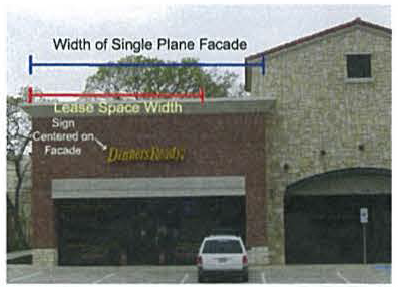 |
Table 5: Freestanding Signs
(1)
The sign base and sign structure for a monument sign shall be brick, stone, or masonry material matching the front façade of the building. The sign face shall be framed by a minimum of six inches of brick, stone, or masonry material matching the front facade of the building.
(2)
Signs with changeable electronic copy shall not change more than once every ten seconds and shall not flash, rotate, blink, or mimic traffic control device or in any way interfere with the safe operation of a motor vehicle. Additionally, each text shall change be instantaneous. During daylight hours between sunrise and sunset, luminance shall be no greater that 5,000 nits (candela per square meter). At all other times, luminance shall be no greater than 250 nits (candela per square meter). Each sign shall have a light sensing device that will automatically adjust the brightness of the display as the natural ambient light conditions change, to comply with the limits set herein.
(3)
Maximum total height is measured from the finished grade at the center of the sign. If the finished grade at the center of the sign is higher than the finished grade of the closest paved surface, then the height shall be measured from the finished grade of the closest paved surface.
(4)
The monument base shall be a maximum of two feet in height and shall be included in the calculation of total height.
(5)
Illuminated, internal, backlit or externally lit address numbers are required on business monument signs and shall be located within the top 20 percent of the sign structure. Address numbers must be a minimum of eight inches in height along State Highway 146 and Nasa Parkway and a minimum of six inches in height on all other streets.
(6)
For multi-tenant developments, the development name, if included as an integral part of the monument structure (i.e., not a separate panel), will not count toward the maximum sign face area as long as the area of the development name does not exceed 20 percent of the allowable maximum sign face area.
(7)
For signs with multiple sign panels, the background color for all sign panels on the sign shall be consistent.
(8)
No sign or portion thereof shall be permitted within the clear sight triangle at any intersection of streets or an intersection of a driveway with a street. A clear sight triangle of 75 feet shall be measured along the center lines from the point of intersection. No sign, other than an official government exempt sign, shall be erected or maintained within the legal right-of-way of any street.
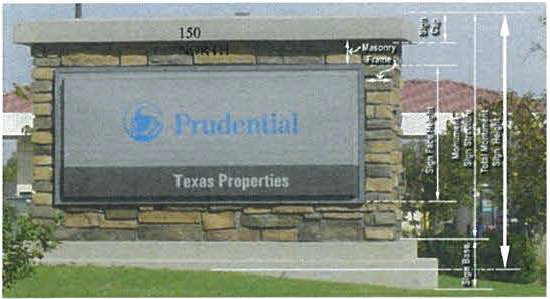
Elements of a Monument Sign
Projecting Sign
Freestanding Suspended Sign
(Ord. No. 2018-06, § 2, 2-20-2018)
_____
Sec. 6.06. - Master sign plans.
(a)
Purpose. The purpose of a master sign plan is to allow an applicant, subject to approval of the city council, the option of designating an area that will define unique characteristics in all sign elements including type, design, and location based upon specific performance criteria. The goal of a master sign plan is to:
(1)
Promote consistency among signs within a development thus creating visual harmony between signs, buildings, and other components of the property;
(2)
Enhance the compatibility of signs with the architectural and site design features within a development; and
(3)
Encourage signage that is in character with planned and existing uses thus creating a unique sense of place.
(4)
Encourage multi-tenant commercial uses to develop a unique set of sign regulations in conjunction with development standards.
(b)
Application process.
(1)
The applicant shall develop a master sign plan for all sign elements in the development based on the sign design guidelines established in subsection (d) of this section.
(2)
The administrative official shall forward the applicant's master sign plan to the planning and zoning commission for review and recommendation. A master sign plan application will be considered by the city council following a recommendation by the planning and zoning commission. The city council shall make the final determination on the master sign plan.
(3)
After approval of a master sign plan for a particular development, all signs in that development shall meet the standards approved in that specific master sign plan.
(c)
Application requirements. A master sign plan application shall be a written and/or illustrated document to depict the proposed signs which shall include:
(1)
Proposed sign palette which may include:
a.
Attached building signs.
b.
Upper story signs.
c.
Monument signs.
d.
Window signs.
e.
Directional signs/way finding.
f.
Directory signs.
g.
Pedestrian oriented signs.
h.
Other.
(2)
Location of all proposed signs included in the sign palette.
(3)
Size and number of all proposed signs including maximum area, letter height, number, height, etc.
(4)
Materials proposed for all signs and sign structures.
(5)
Color and style palette for all signs (letter colors, background colors, text fonts, etc.) including context of where signs are to be placed on any given facade.
(6)
Type of illumination proposed (external, internal, etc.)
(7)
Landscaping and/or ornamental structures including fences, fountains, public art, ground cover, and other landscaping elements that are intended to complement the proposed sign palette and design.
(8)
Any other information as required by the decision making bodies.
(d)
Design guidelines—Master sign plans. Commercial signage is an integral part of the urban design fabric of Seabrook. It is absolutely necessary and shall be deemed as a tool that helps promote the health, safety and welfare of the general public by providing guidance to both the vehicular driver and pedestrian. Due to its visual prominence and effect on the overall design character of our city, signage as part of master sign plans must be considered on the broader scale of community rather than on an individual site basis. Signage is an integral part of the visual urban streetscape and shall not be designed to visually compete with its surroundings, but rather serve to build on the quality of the traveler's and pedestrian's experience.
Design Goals:
(1)
To develop organized hierarchies of signage design types that help identify the location and size standards for individual signs without infringing on the capability of creative design.
(2)
To establish design criteria that promote the overall visual quality of the streetscape environment for the general public while providing reasonable and improved standards for identification of individual properties.
(3)
To improve the overall visual cohesive appearance of the site through signage guidelines, with strong consideration that the visual streetscape.
(4)
To promote a "sense of place" for the City of Seabrook while promoting creative design for individual developments.
(5)
To promote signage as an architectural complement rather than being visually and thematically disconnected.
Master signage plan application: The master signage program application shall include, at a minimum, the following to be deemed a completed application:
(1)
A master site plan showing a location of each of the proposed signage type(s). Dimension and label the sign types and include distance measurement of the signs location from the nearest public right-of-way.
(2)
Provide signage elevations (dimensioned and labeled) indicating proposed text areas, materials, material finishes, colors, lighting and identifiable references as to how the signage design relates to the proposed architecture. Identify any landscaping elements proposed.
(3)
For all signage is to be mounted on building facades, provide accurate building elevations that show signage dimension, signage location, text areas, materials, material finishes, colors and identifiable references as to how the signage design relates to the proposed architecture.
(4)
A master sign plan application will be considered by the city council following a recommendation by the planning and zoning commission.
(Ord. No. 2018-06, § 2, 2-20-2018)
Sec. 6.07. - Administration.
(a)
Role of the administrative official. The city manager shall appoint the administrative official who shall administer and enforce the terms and conditions of this article.
(b)
Sign permit required. No signs, unless exempted under section 6.03(3) and (4), shall be erected, displayed, or altered within the city without a duly approved sign permit from the city. The administrative official or designee shall ensure that all sign permits are granted only in compliance with the provisions of this article.
(c)
Application. Application for a permit shall be made as required by this article and the following information shall be submitted as separate documents:
(1)
Application form shall be completed.
(2)
General plan that illustrates:
a.
Location of the building, structure, or tract to which or upon which the sign is to be attached or erected.
b.
Position of the sign in relation to rights-of-way, easements, buildings, structures, existing signs, etc.
c.
Sign drawing that illustrates height, length, width, and all other dimensions associated with the sign.
(3)
Signature of the owner of the property or the owner's representative stating that the applicant has permission to erect such signs.
(d)
Fees. All fees for sign permits shall be in accordance with the current master fee schedule adopted by the city council.
(e)
Permit expiration. If the work authorized by a permit issued under this article has not been commenced within 180 days after the date of issuance, the permit shall become null and void.
(f)
Responsibility for enforcement. It is the responsibility of the administrative official to interpret and administer the requirements of this article.
(1)
The administrative official may suspend or revoke any permit issued under the provisions of this article whenever it is determined that the permit is issued in error or on the basis of incorrect or false information supplied, or whenever such permit is issued in violation of any of the provisions of this article or any other ordinance of this city or laws of this state or the federal government. Such suspension or revocation shall be effective when communicated in writing to the person to whom the permit is issued, the owner of the sign, or the owner of the site upon which the sign is located. Upon such revocation, all construction related to the revoked permit shall cease.
(2)
The administrative official shall periodically inspect each sign regulated by this article for the purpose of ascertaining whether the same is obsolete and whether it is in need of removal or repair.
(3)
Whenever any work for which a permit is required by this article has been commenced or completed without first obtaining a permit, a special investigation shall be made before a permit may be issued for such work.
(4)
The following signs shall be removed based on the determination of the administrative official:
a.
Unsafe dilapidated or deteriorated signs. If the administrative official determines that any sign is unsafe or insecure, or is dilapidated or deteriorated, he shall give written notice to remove or replace (in accordance with this article) said sign to the person or persons responsible for such sign. If the permit holder, owner of the sign or owner of the site on which the sign is located fails to remove or repair the sign within ten days after such notice or to file an appeal of the decision in accordance with this article, the administrative official is hereby authorized to cause the removal of such sign. Nothing contained herein shall prohibit the immediate removal, without notice, of any sign or portion of a sign which is determined by the administrative official to be an immediate threat or danger to the public health, safety, or welfare. Any expense incident to the removal of a sign pursuant to this paragraph shall be paid by the permit holder, owner of the sign or owner of the site on which the sign is located in addition to any fine hereunder. The removal of the sign or portion of the sign shall be limited to the extent necessary to eliminate the threat to the public health, safety, and welfare.
b.
Signs on utility poles. Any sign that is erected constructed or otherwise attached to a utility pole located upon any public right-of-way or utility easement may be removed by the city unless otherwise permitted by this article. Any such sign removed by city personnel may be held for a period of 24 hours and upon expiration of such time may be disposed. The city is not required to notify the permit holder or owner of the sign that it has been picked up or that disposal of the sign is imminent.
c.
Signs in right-of-way and/or on public property. Any sign that is erected, constructed, or otherwise located within or upon public right-of-way or on public property unless otherwise permitted by this article may be removed by the city. Any such sign removed by city personnel may be held for a period of 24 hours and upon expiration of such time may be disposed. The city is not required to notify the permit holder or owner of the sign that it has been picked up or that disposal of the sign is imminent.
d.
Illegally erected signs. Any sign that is erected, constructed or otherwise displayed, which the administrative official determines to be in violation of this article, may be removed by city personnel. Any such sign removed by city personnel may be held for a period of 24 hours and upon expiration of such time may be disposed. The city is not required to notify the permit holder or owner of the sign that it has been picked up or that disposal of the sign is imminent. For permanent signs, the sign must be removed by the permit holder, owner of the sign, or owner of the site on which the sign is located within a reasonable time period as determined by the administrative official. Upon failure to comply with such notice or to file an appeal of the decision in accordance with this article, the administrative official is authorized to cause the removal of such sign, and any expense incident thereto shall be paid by the permit holder, owner of the sign or owner of the site on which the sign is located in addition to any fine hereunder.
e.
Signs advertising businesses which have closed or have moved. Signs which advertise or otherwise direct attention to a product, service, activity, person, institution, or business which no longer occupies or is conducted, sold, manufactured, produced, or offered upon the premises where the sign is displayed shall be removed within 30 days of notification.
(Ord. No. 2018-06, § 2, 2-20-2018)

