
Seminole County Unincorporated
City Zoning Code
City Zoning Code
PART 11
- PARKING AND LOADING REGULATIONS
Sec. 30.11.1.- Applicability.
30.11.1.1 Minimum parking with adequate provisions for ingress and egress shall be provided at the time of the erection of any main building or structure or at the time any main building is enlarged or increased in capacity by adding dwelling units, guest rooms or floor areas, in accordance with the requirements of this Section.
30.11.1.2 In addition to the above instance, bicycle parking shall be brought into compliance with this Part at the time of any change of use or substantial rehabilitation of a building requiring a building permit.
(Ord. No. 2024-02, § 7(Exh. B), 1-9-24).
Sec. 30.11.2. - General provisions.
30.11.2.1 Permanent reservation. Areas reserved for off-street parking or loading in accordance with this Section shall not change to any other use unless the permitted use which it serves is discontinued or modified, or unless equivalent parking or loading space is otherwise provided. Site Plan approval is required for any modifications to an existing parking area.
30.11.2.2 Additional requirements.
(a)
If the site is located within an Aquifer Recharge Overlay Zoning Classification see Part 10, Chapter 30.
(b)
ADA parking spaces shall be as required and in accordance with the Americans With Disabilities Act and the operative Standard Building Code.
(c)
All unpaved parking spaces shall be clearly delineated on the site plan and shall be organized using wheel stops or other physical markers indicating their designated use. Unpaved areas to be used for parking and/or traffic circulation shall have a gravel, mulch, grass, turf block or other durable dust-free surface acceptable to the Public Works Director, and shall be graded for drainage and maintenance. These areas shall not be counted as part of required buffers or open space, and the applicable on-site retention standard for stormwater drainage shall apply.
(Ord. No. 2024-02, § 7(Exh. B), 1-9-24).
Sec. 30.11.3. - Quantities of parking required.
(a)
The minimum amount of parking required shall be consistent with Table 11.3-A: Minimum Parking Required.
(b)
Developments containing more than one use shall provide parking and loading spaces in an amount equal to the total of the requirements for all uses.
(c)
Parking required may be reduced based on alternatives provided in Table 11.4: Parking Reductions and Exceptions.
(d)
Where referenced, "employees" refers to the total number of employees on the largest shift.
(e)
Proposed parking may not exceed two hundred (200) percent of the minimum parking required unless approved by the Development Services Director.
(f)
Determining required off-street parking and loading and unloading space. When units or measurements determining the number of required off-street parking and off-street loading spaces result in a measurement of a fractional space, any fraction up to and including one-half (½) shall be disregarded and fractions over one-half (½) shall require one (1) off-street parking or off-street loading space; provided, however, that the waiver of fractional units of measurements shall not apply to the first off-street loading and unloading space. As required under the "off-street loading and unloading regulations," the space provided for loading and unloading purposes shall not be construed as providing required off-street parking spaces.
(Ord. No. 2024-02, § 7(Exh. B), 1-9-24).
Sec. 30.11.4. - Parking reductions and exceptions.
30.11.4.1 Administrative variances. Consistent with sound engineering practices or federal or state law, the Development Services Director may approve a variance to the following off-street parking standards under the following conditions:
(a)
When granting such variance would protect and encourage the preservation of large canopy, specimen or historic trees, or significant areas of existing native vegetation or preserve existing historic buildings:
(1)
Reduction of the number of required off-street parking spaces. A maximum reduction of one (1) parking space or five (5) percent of the total number of parking spaces required, whichever is greater, may be permitted.
(2)
Reduction of the size of required off-street parking spaces. Up to fifty (50) percent of the total required two hundred (200) square feet with a minimum width of ten (10) feet and a minimum length of twenty (20) feet ninety-degree parking spaces may be reduced to a stall size of nine (9) feet by eighteen (18) feet to encourage the preservation of significant trees and native vegetation.
(3)
Reduction of the amount of paved area. Paving requirements may be reduced up to twenty-five (25) percent of the total number of required parking spaces. All unpaved parking spaces shall be clearly delineated on the site plan and should be located at the periphery of the building site or otherwise located where such spaces are unlikely to be used on a continuing basis. The unpaved portion shall have a gravel, mulch, grass, turf block or any durable dust-free surface placed atop Geoweb or another structural component to ensure vehicles are supported as approved by the Public Works Director or County Engineer. The area waived from paving requirements shall not be credited as part of the required landscaped area or open space and stormwater management standards shall apply.
(b)
For existing developed properties on small sites when granting such a variance would preserve existing infrastructure:
(1)
For existing developed properties of less than three (3) acres: if complying with the requirements of this Part would render the property unusable for the continuation of uses similar to the historic use of the property or require demolition of existing buildings to achieve an economically viable use, the Development Services Director may grant a reduction in parking or parking lot landscaping requirements sufficient to continue economic viability of the property without the need to demolish buildings on the property or adjacent sites.
30.11.4.2 Parking Reductions:
(a)
Notwithstanding paragraph (b) below, any combination of parking reductions which would result in an overall decrease in required parking of thirty (30) percent or more must be approved by the Development Services Director and may require a parking study.
(b)
An applicant may seek a reduction in the required number of parking spaces based on the following criteria:
(1)
Parking Study: Applicants may choose to submit a parking study, at their own cost, demonstrating a lower demand for parking than required by the standards of this Section. Development Services Director may approve the methodology and the study based on current editions of professionally accepted data sources.
(2)
Car Share Program: One car share space may be provided in lieu of up to five (5) regular parking spaces. Reduction is limited to two car share (2) spaces. Approval requires an executed contract with a car share provider. Car share reduction is limited to residential or office uses in lots requiring at least twenty (20) parking spaces.
(3)
Transit-Oriented Development:
a.
Applicability:
i.
Units or businesses within 2000 feet of a commuter rail or bus rapid transit station.
ii.
Units within 800 feet of bus transit with headways of not less than fifteen (15) minutes from 7:00 am to 7:00 pm.
iii.
The project must follow form and design standards for the MUCD zoning district.
b.
Reduction:
i.
Up to ten (10) percent of parking spaces.
ii.
Up to twenty-five (25) percent of parking spaces for residential or office uses if parking spaces are "unbundled" (sold, leased, or rented with separate pricing and a separate lease / deed of ownership).
30.11.4.3 Shared parking.
(a)
Required parking may be reduced with the use of a Shared Parking Agreement. Shared Parking may be combined with other reductions subject to approval by the Development Services Director provided that other reductions are applied before completing the shared parking calculation.
(b)
Shared parking reductions are available for multiple uses on:
(1)
Single or multiple adjacent sites under single ownership; or
(2)
Multiple adjacent sites with a Shared Use Parking Agreement sharing parking facilities; or
(3)
County-managed facilities.
(c)
The number of minimum required parking spaces may be reduced according to "Table 11.4-A: Shared Parking Table", calculated as follows:
(1)
In the column titled "Minimum Required Parking" apply the minimum required parking spaces for each use as specified in this Section;
(2)
For each following columns (time of day and day of week), multiply the amount in the "Minimum Required Parking" column by the percentage listed in that column. Enter the sum of each column in the bottom row;
(3)
The revised minimum required parking is the highest value in the bottom row of "Table 11.4-A: Shared Parking Table".
Notes:
1
Includes: Residential unit, Dormitories, Boardinghouses, Residential Facility, Assisted Living.
2
Includes: Hotels, Motels, and Other Lodging.
3
Includes: Medical Office, Veterinarians, and Kennels.
4
Includes: General Business, Retail, Recreation and Entertainment, Libraries and Museums, Commercial Non-Retail, Furniture and Appliance Store, Education.
5
Hospitals subject to a parking study.
(Ord. No. 2024-02, § 7(Exh. B), 1-9-24).
Sec. 30.11.5. - Electric vehicle (EV) readiness.
30.11.5.1 Purpose. The requirements of this Part are intended to provide electric vehicle charging abilities distributed throughout the County to serve public mobility needs, prepare for emerging electric vehicle technologies, improve air quality, and achieve County sustainability goals.
30.11.5.2 Applicability. The requirements of this Part shall apply to new development or substantial enlargement of structures. Only the new parking spaces added as part of a substantial enlargement are subject to the requirements of this Section.
30.11.5.3 General Requirements.
(a)
EV Readiness requirements are categorized in two levels as follows:
(1)
EV Capable: These parking spaces prepare for future Electric Vehicle Supply Equipment (EVSE) installation by providing dedicated electrical capacity sufficient for Level 2 charging or greater and conduit to the EV Capable space. These spaces do not require wiring to the space or a receptacle.
(2)
EVSE Installed: These parking spaces are reserved for EVs and provide drivers the opportunity to charge electric vehicles using EV charging stations rated sufficient for Level 2 charging or greater. These spaces should be installed per the requirements of the National Electrical Code (NFPA 70) as adopted and amended by the State of Florida.
30.11.5.4 Number of Spaces Required.
(a)
The EV parking requirements are based on a percentage of the minimum required parking spaces of this Part.
30.11.5.5 Location.
(a)
For Planned Developments and major PD amendments, the number of EV Capable and EVSE Installed required spaces must be indicated on the MDP and placement must be identified during the final engineering/site plan approval. For all other projects the placement of the EV Capable and EVSE Installed required spaces must be identified during the final engineering/site plan approval process.
30.11.5.6 Design.
(a)
Charging equipment must be mounted on the wall or on a structure at the end of the electric vehicle parking space provided.
(b)
No charging devices may be placed within the dimensions of a space, on the sides, or entrance to a space.
(c)
When cords and connectors are not in use, they shall be retracted or stored sufficiently high above the pedestrian surface and the parking lot as to prevent conflicts with pedestrians and vehicles.
(d)
Cords, cables, and connector equipment shall not extend across the path of travel in any sidewalk or walkway.
(e)
Equipment mounted on structures such as pedestals, lighting posts, bollards, or other devices shall be located in a manner that does not impede pedestrian, bicycle, or transit travel.
(f)
Alternative designs may be approved by the Planning Manager.
(g)
Additional landscape screening may be required for mechanical equipment such as transformers associated with charging equipment, consistent with mechanical equipment screening requirements.
30.11.5.7 Accessibility. A minimum of one (1) EVSE Installed space must be ADA accessible. For projects with more than 25 EVSE installed spaces, additional accessible stations must be provided at a rate consistent with accessibility standards for general parking.
30.11.5.8 Signage. All EVSE Installed parking spaces shall be designated with signage consistent with MUTCD standards.
(Ord. No. 2024-02, § 7(Exh. B), 1-9-24).
Sec. 30.11.6. - Design of off-street parking spaces.
30.11.6.1 Landscaping of off-street parking areas. Off-street parking areas must meet the landscape requirements of Chapter 30, Part 14.
30.11.6.2 Dimensional requirements of off-street parking spaces.
(a)
Except where otherwise specified in this Code or Federal or State law, a minimum of twenty (20) percent of required off-street parking space shall consist of a minimum net area of two hundred (200) square feet with a minimum width of ten (10) feet and a minimum length of twenty (20) feet, exclusive of access drives or aisles thereto.
(b)
Up to eighty (80) percent of spaces provided may have a minimum net area of one hundred sixty-two (162) square feet, a minimum width of nine feet (9), and a minimum length of eighteen feet (18). Parallel parking spaces may be reduced to nine feet (9) in stall width.
(c)
Curbs, Wheel Stops, and Encroachments.
(1)
The maximum height of curbs shall be six (6) inches where the overhang of bumpers is anticipated. The maximum height of wheel stops shall be five (5) inches.
(2)
Where the curb abutting the pedestrian walkway is used as a wheel stop, the walkway must be a minimum of seven (7) feet wide to accommodate up to two (2) feet of vehicle overhang.
(3)
Where a curb or wheel stop is provided, the overhang of a motor vehicle past the curb or wheel stop may be counted as part of the required parking module. The adjacent parking stalls may be reduced by two (2) feet as measured from the face of the curb or wheel stop.
(d)
Parking spaces for properties assigned the R-AH zoning classification and buildings with three (3) or more units shall have parking spaces with a minimum net area of one hundred sixty-two (162) square feet, a minimum width of nine (9) feet, and a minimum length of eighteen (18) feet.
(e)
Off-street space requirements at various parking angles. Except as otherwise provided in this Part, off-street parking areas shall be designed as to meet the minimum dimensions as shown in the following table:
(f)
Required parking spaces may be reconfigured or redesigned to accommodate additional parking spaces for smaller vehicles including two-wheeled vehicles and neighborhood electric vehicles provided that:
(1)
The reconfiguration does not exceed the greater of one (1) space or five (5) percent of the minimum required parking spaces except that the Development Services Director may approve the conversion of a larger number of spaces based on evidence provided by the applicant that site users will favor alternative vehicles.
(2)
The conversion must be reversible to provide parking spaces meeting the requirements of this Part with restriping alone.
30.11.6.3 Circulation in Parking Areas:
(a)
Minimum accessway shall be twelve (12) feet for one-way traffic, or twenty-four (24) feet for two-way traffic.
(b)
Schools and Day Care Centers must provide adequate off-street space for loading and unloading of children.
(c)
Off-street loading and unloading area requirements. On the same premises with every building, structure, or part thereof, erected and occupied for manufacturing, storage warehouse, food processing or wholesale distribution plant, goods display, department store, wholesale store, market, hotel, office, hospital, mortuary, laundry, dry cleaning, or other uses similarly involving the receipt or distribution by vehicles of materials or merchandise, there shall be provided and maintained on the lot adequate space for the maneuvering, standing, loading, and unloading services in order to avoid undue interference with public use of the streets or alleys.
(d)
Off-street loading and unloading space defined. An open, hard-surfaced area, other than a street or public way, the principal use of which is for standing, loading and unloading of motor trucks, tractors, and trailers. Such space shall not be less than twelve (12) feet in width, fifty-five (55) feet in length and fourteen (14) feet in height, exclusive of access aisles and maneuvering space.
(e)
Criteria specified. For every building or structure or part thereof having an area 5,000 square feet or more of building floor area and used for the purposes mentioned above, off-street loading and unloading spaces shall be provided in accordance with the following guidelines:
(Ord. No. 2024-02, § 7(Exh. B), 1-9-24).
Sec. 30.11.7. - Miscellaneous design standards.
(a)
Hours of operation. Non-residential uses with after-hour deliveries or service for late-night customers can generate noise and light during evening hours which may adversely impact adjoining residences. When these activities occur on the side of a building site adjoining residences, the hours of operation may be limited during the development approval process to any combination of hours between 7:00 a.m. and 11:00 p.m. as determined on a case-by-case basis by the Planning Manager prior to issuance of any building permit for new construction, a building addition, or a change in use; provided that in no event shall the Development Services Director limit the hours of operation to less than twelve (12) consecutive hours. In the case of a rezoning to Planned Development (PD), the Board of County Commissioners shall make the appropriate findings for such limitations.
(b)
Cross-access easements. All development except single-family residential and duplex uses, with parking lots or other direct access to a public road shall, as part of the development approval process, establish cross-access easements which provide for the internal connection of the parcel to adjacent parcels unless the Public Works Director makes a finding that such joint-access is not feasible or practicable based upon circumstances unique to the properties.
(c)
Setbacks and clearance of residential garages.
(1)
Front-loaded garages on residential lots must be set back a minimum of twenty (20) feet, or the minimum setback of the applicable zoning district, from the property line that the garage door faces
(2)
Garage doors facing a rear alley
a.
If on-street parking is allowed, then the garage door, facing an alley, must be set back from the edge of alley pavement as follows:
i.
Less than eight (8) feet or;
ii.
More than twenty (20) feet.
b.
If on-street parking is not allowed, then the garage door, facing an alley, must be set back more than twenty (20) feet from the edge of alley pavement
(3)
Attached single-family units with garages are required to be served by an alley regardless of unit size, unless otherwise approved by the Board of County Commissioners.
30.11.7.1 Bicycle Parking Requirements.
30.11.7.2 Applicability. Bicycle parking shall be provided in accordance with the standards of this Part and shall be made available prior to the issuance of any Certificate of Occupancy/Completion for the use being served.
30.11.7.3 General Bicycle Parking Requirements.
(a)
Bicycle parking shall consist of short-term bicycle parking and long-term bicycle parking as required.
(1)
Short-term bicycle parking is generally intended to be used for less than two hours. Typical uses include visitors and customers of retail, restaurants, or medical offices. Short-term bicycle parking may include outdoor bicycle parking spaces and bicycle racks not protected from the weather. Short-term bicycle parking should be easily located and accessible to first-time visitors.
(2)
Long-term bicycle parking is generally intended for use for four (4) or more hours. Typical users include residents and employees. Long-term bicycle parking must be in a format intended to provide security for longer term usage such as bicycle lockers, restricted access fenced areas or rooms, or continuously monitored indoor spaces. Where feasible, long-term parking spaces should be covered. Areas provided inside of multi-story office buildings for employees and visitors counted as long-term bicycle parking must be accompanied by an approved bicycle plan showing the access route and describing operational hours and security measures.
(b)
Covered bicycle parking is encouraged wherever the design of the building or use being served accommodates such facilities.
30.11.7.4 Quantity of Bicycle Parking Required.
(a)
The minimum number of bicycle parking spaces required is described in Table 11.7A.
Table Notes:
"sf" indicates square feet.
Visitor spaces for assembly and entertainment uses typically host visitors for two (2) to four (4) hours constituting an intermediate step between short-term and long-term parking, for these uses design variations may be approved by the Development Services Director which increase security, improve weather protection, and provide reasonable wayfinding.
Maximum spaces. For uses requiring more than twenty (25) spaces for a single building, the Development Services Director may waive the excess provided that at least two (2) spaces are located near each public or employee entrance.
30.11.7.5 Location.
(a)
Short-term spaces shall be located within fifty (50) feet of the main entrance to the building as measured along the most direct pedestrian access route. For a building with more than one entrance, the bicycle parking must be distributed along all facades with a main entrance, and located within fifty (50) feet of at least one main entrance, as measured along the most direct pedestrian access route. When more than six (6) spaces are required per entrance, additional parking may be provided at a secondary location, such as a parking garage, not more than 200 feet from the principal entrance with directional signage indicating its location.
(b)
Long-term bicycle parking must be located on the same building site as the use being served. All long-term bicycle parking spaces must be located within 200 feet of a main, operational entrance to the building.
(c)
Bicycle parking facilities may be located in the rear fifty (50) percent of any required front yard setback, but shall not be located in any vehicle parking space required under this Part, except where a vehicle parking space is specifically converted to bicycle parking spaces by approval of the Development Services Director.
(d)
Bicycle parking located within a parking garage must be located within fifty (50) feet of a pedestrian access point which includes an elevator or first floor sidewalk connection. If the bicycle parking is located within an enclosed room within the parking structure, the distance requirement to an elevator or pedestrian entrance is no more than 200 feet.
(Ord. No. 2024-02, § 7(Exh. B), 1-9-24; Ord. No. 2024-21, § 4, 7-23-24).
Sec. 30.11.8. - Parking garage design guidelines.
30.11.8.1 Intent and Purpose. The intent of this Section is to provide for architectural appeal and compatibility of the size, scale, intensity/mass and image of the parking garage structures with adjacent buildings and with the context of the surrounding area/neighborhood.
Parking garages have significant visual impact with their large mass structures on the overall development and image of the community. Parking structures also consume land, interrupt the street wall, and can have a negative impact on the pedestrian realm if not integrated with other land uses, such as street level retail, residential and commercial activities. Parking structures can be visually overpowering if not well designed and sensitively sited.
30.11.8.2 Applicability:
(a)
This Section is supplemental to the other regulations within the Land Development and Building/Fire/Life Safety Codes of the County.
(b)
All future parking garages shall comply in their design to the maximum extent with these guidelines.
(c)
These guidelines shall apply to parking garages (multiple levels) and parking decks (single level) but shall not apply to underground parking structures (at least half the floor height below grade) and shall not apply to parking garages within the interior of projects that are not visible on the exterior street.
30.11.8.3 General Requirements:
(a)
Elevations shall be provided for all facades of a parking garage that are not screened with other buildings.
(b)
A landscape plan shall be provided.
(c)
A circulation plan shall be provided showing both vehicular and pedestrian circulation.
30.11.8.4 Design Principles:
(a)
Parking structures shall complement the nearby buildings: Parking structures shall blend into style and scale of the context and not be designed as purely utilitarian structures.
(b)
Respect pedestrian environment: Design shall respect the human scale incorporating building materials and details that add to or preserve the pedestrian experience.
(c)
Minimal pedestrian/vehicular conflict: Vehicular access, entry, and circulation shall be designed to prioritize pedestrian movement and patterns.
(d)
Architectural Integrity: Parking structures shall have features and building materials that complement the primary or adjacent structures.
(e)
Integrate Landscaping: Substantial landscaping shall buffer views of parking structures, obstruct glare, and provide a transition in scale between the structure and the public realm around it.
30.11.8.5 Design Guidelines:
(a)
Siting:
(1)
Parking structures should be located away from public streets and high pedestrian use areas and screened by other buildings with habitable uses.
(2)
Landscape setbacks with a minimum dimension of ten (10) feet shall be provided on all sides of the parking structure except where habitable building frontages are provided at the ground level. In zoning districts with larger street front setbacks, those larger setbacks shall apply.
(3)
Parking Garages adjacent to plazas or squares are discouraged; if they must occur, they shall be lined with habitable building frontages.
(4)
Locating parking structures adjacent to properties containing or designated for single-family residential uses, schools, or community parks is strongly discouraged. If other locations are not viable, consideration will be given to parking structures that are setback a minimum of twenty (20) feet from these areas, are limited to a maximum height of thirty (30) feet or three (3) stories, and contain buffer landscaping and/or architectural features to screen or minimize views of vehicular uses.
(5)
Avoid garage vehicular exit locations where the glare of headlights on departing cars would illuminate uses across the street.
(6)
Appurtenances (i.e., transformers, ventilation shafts, etc.) shall be located outside of any required setback and shall be screened from public view.
(b)
Structure Design:
(1)
Exterior elevations should incorporate design components and materials utilized and compatible with the primary building(s).
(2)
Garage corners that are visible to the public realm should be treated with architectural features.
(3)
Parapet walls. On all levels where parking is provided adjacent to an exterior wall, all façades shall have exterior opaque walls a minimum height of forty-two (42) inches above any finished grade and any finished floor.
(4)
The sloping nature of the interior structure shall not be exposed, repeated, or revealed on the exterior façade. Ramping in parking structures shall be internalized or screened to avoid an angular geometry to the perimeter of the structure.
(c)
Screening:
(1)
Public façades of Structured Parking: When a parking structure façade is adjacent to or facing any public park or plaza, public right-of-way, public sidewalk, or private street, façades shall comply with the following:
a.
Screening elements shall be designed in a structurally sound manner and have a gap of no more than eighteen (18) inches from the frame of the screening element to the wall opening. Alternative decorative elements which provide an equivalent level of screening may be allowed in an accessory parking structure where such elements are employed to match the architectural character of the main building. Mesh or decorative panels, louvers, green walls, tinted or sandblasted opaque spandrel glass, or similar screening elements shall be used. Where mesh or other materials containing openings are used in conjunction with the screening frame, no individual opening shall exceed four (4) square inches. Chain link fencing and similar screening elements shall be prohibited as an allowable mesh or similar screening element.
b.
A total of at least fifty (50) percent of such exterior building wall, or portion thereof, with adjacent parking spaces shall consist of opaque materials which may include permitted signs, graphic or sculptural art, decorative screening or latticework.
c.
Perforated metal does not effectively prevent glare in all cases, and therefore shall not be used as the primary screening material. It can be used in combination with other screening techniques so that the light spill measured at the parcel line is not more than 0.5 footcandles.
(d)
Lighting:
(1)
Parking garages should utilize full spectrum lighting to increase safety and comfort. The placement of fixtures should be designed to minimize light pollution from the garage.
(2)
Lighting shall be designed to reduce light spillage outside the parking structure according to the following:
a.
Internal illumination shall be screened so that internal light sources shall not be visible from the adjacent public right-of-way or adjacent parcels. Light fixtures directly visible from the exterior of a parking structure shall be directed internally upward or shall contain shielded fixtures to prevent such visibility.
b.
Rooftop lighting shall be located at an elevation height less than the top of the nearest exterior perimeter rooftop wall; or shall be setback a minimum of fifteen (15) feet from the exterior perimeter of the rooftop wall at a maximum mounted height of twelve (12) feet above finished floor with cutoff light fixtures that have a maximum 90-degree illumination.
c.
Lighting levels measured at the property line of parcels adjacent to the structured parking deck shall not be greater than 0.5 footcandles.
(3)
Interior walls and ceilings should be painted a light color to improve illumination and safety.
(4)
All exposed mechanical equipment and piping should be painted to match the interior of the structure.
(5)
Shielding:
a.
Utilize shielded fixtures to minimize light pollution and glare from both within and outside the garage.
b.
Structural shielding, Lighting fixture shielding, or Indirect lighting as depicted below can be used to prevent glare.
c.
Acceptable lighting designs include the following:
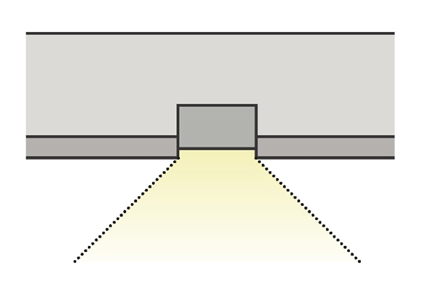
i.
Recessed fixture incorporating a lens cover that is either recessed or flush with the bottom surface of the canopy.
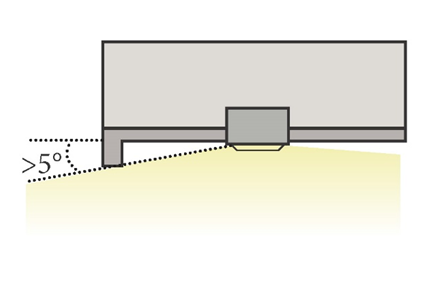
ii.
Recessed fixture incorporating a lens cover that is either recessed or flush with the bottom surface of the canopy.
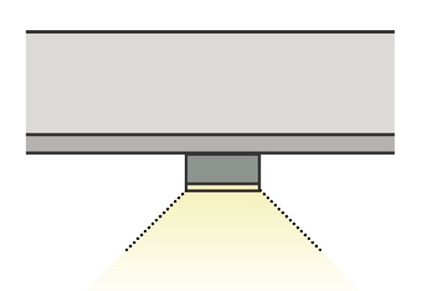
iii.
Light fixture incorporating shields or is shielded by the edge of the canopy itself, so that light is restrained to five (5) degrees or more below the horizontal plane.
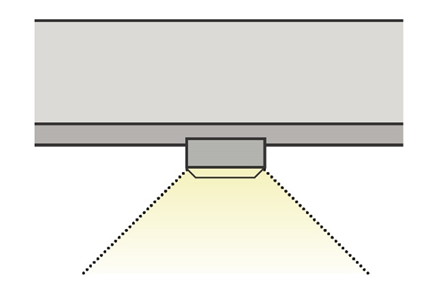
iv.
Surface mounted fixture incorporating a flat glass that provides a cutoff design or shielded light distribution.
v.
Surface mounted fixture measuring no more than two (2) feet by two (2) feet, with a lens cover that contains at least two (2) percent white fill diffusion material.
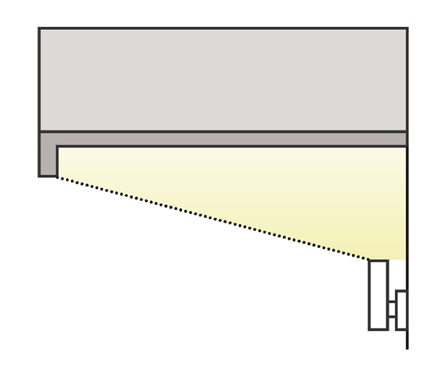
vi.
Indirect lighting where light is beamed upward and then reflected down from the underside of the canopy, provided the fixture is shielded so that direct illumination is focused exclusively on the underside of the canopy.
(e)
Pedestrian Safety:
(1)
Pedestrian circulation should be delineated and separated from automobile circulation. Interior pedestrian paths should be visible to drivers and delineated to differentiate them from vehicle travel aisles.
(2)
Landscaping, walkways, and decorative hardscape should be used to emphasize pedestrian areas.
(3)
Elevator and stair shafts, mechanical rooms, and similar visual disruptions should be located to minimize the obstruction of views between drivers and pedestrians.
(4)
Pedestrian access should be designed to safely avoid pedestrian entry and exit of the garage via vehicular ramps, and provide a minimum five-foot wide pedestrian sidewalk associated with each vehicular access driveway.
(f)
Bicycle Parking:
(1)
Bicycle parking should be located on the level with the most convenient access, and adjacent to a vehicular entry or have a separate protected and signed entrance.
(2)
Bicycle parking in a parking garage must be located within fifty (50) feet of a pedestrian access point which includes an elevator or first floor sidewalk connection. If the bicycle parking is located within an enclosed room, the distance requirement to an elevator or pedestrian entrance is no more than two hundred (200) feet.
(g)
Noise:
(1)
Locate all stationary noise-generating equipment, such as ventilation fans, air compressors, and portable power generators, as far away as possible from businesses, residences, or other noise-sensitive land uses.
(2)
Paving surfaces within parking structures shall be used to reduce tire squeal.
(h)
Special contextual guidelines:
(1)
Office Parks and Multi-family Communities.
a.
Direct, dedicated pedestrian connections shall be provided between parking structures and all buildings served. If these connections are adjacent to surface parking or other vehicular use areas, landscaping shall be provided.
(2)
Mixed-Use Projects.
a.
See additional standards for the MUCD Zoning District.
(Ord. No. 2024-02, § 7(Exh. B), 1-9-24).

