
Seminole County Unincorporated
City Zoning Code
City Zoning Code
PART 14
- LANDSCAPING, SCREENING, BUFFERING, AND OPEN SPACE
Sec. 30.14.1.- Purpose, intent, and definitions.
(a)
The purpose of this Part, in general, is to provide for quality community character, to shade impervious surfaces, to protect against potential land use conflicts, and to define logical areas for pedestrian and vehicular circulation.
The purpose of the water-efficient landscaping criteria included herein is to establish minimum standards for the development, installation, and maintenance of all landscaped areas required by this Code without inhibiting creative landscape design. Specific water conservation measures are required, such as the preservation of existing natural vegetation when appropriate. The establishment of these minimum requirements and the encouragement of resourceful planning are intended to protect and preserve the appearance, environmental quality, character, and value of surrounding neighborhoods and thereby promote the public health, safety and general welfare of the citizens of Seminole County.
(b)
Creative site development concepts shall be used in order to promote water conservation. Water-conserving site development concepts may include, but are not limited to:
(1)
The preservation of existing plant communities;
(2)
The use of native plant species;
(3)
The re-establishment of native plant communities;
(4)
The use of drought-tolerant plant species;
(5)
The use of site-specific plant materials;
(6)
The design, installation, and maintenance of irrigation systems that eliminate the waste of water due to over-application or loss from damage;
(7)
The use of shade trees to reduce transpiration rates of lower-story plant materials;
(8)
Placement of vegetation in such a way that promotes energy conservation through shading;
(9)
The use of pervious paving materials;
(10)
The use of water efficiency in landscaping;
(11)
Other environmentally sensitive site development concepts.
(c)
Vegetation protection and preservation objectives are intended to:
(1)
Reduce the use of irrigation water in open space areas by promoting the preservation of existing plant communities;
(2)
Prevent the removal of existing vegetation in advance of the approval of land development plans;
(3)
Prevent the removal of existing vegetation when no replacement vegetation plan has been prepared for the site.
(d)
To achieve the objectives of these land development regulations, this Code incorporates six (6) basic principles of water-efficient landscaping. These principles are set forth below for the purpose of giving guidance and direction for administration and enforcement:
(1)
Planning and design;
(2)
Appropriate plant selection;
(3)
Practical turf areas;
(4)
Efficient irrigation;
(5)
Use of mulches;
(6)
Appropriate maintenance.
(e)
The provisions of this Part shall apply to all real property situated within the unincorporated areas of Seminole County that are required to be landscaped by this Code.
(Ord. No. 2024-02, § 7(Exh. B), 1-9-24).
Sec. 30.14.2. - Open space.
30.14.2.1 Purpose and Applicability.
(a)
The purpose of this Part is to provide clear standards for the establishment, function, and maintenance of open space areas within all developments.
(b)
Single-family residential development in any zoning district is exempt from this Section except in the Planned Development (PD) District or where specifically required by another Section of this Code. Nonresidential uses, where permitted in a single-family district (i.e., by Special Exception) shall be required to provide open space.
(c)
The character of required open space shall be determined by development type. Open space within nonresidential developments shall meet the requirements of Section 30.14.2.2 while open space within residential developments shall meet the requirements of Section 30.14.2.3. Open space in redevelopment, infill development, or mixed-use developments shall meet the requirements of Section 30.14.2.4.
(d)
The amount of open space required for development shall be determined by the zoning district, development order, or other provisions of this Code applicable to the subject property. If not otherwise specified, the minimum open space shall be twenty-five (25) percent of the gross site area.
30.14.2.2 Nonresidential Open Space.
(a)
The purpose of open space in nonresidential developments is to set aside areas for landscaping, buffering, stormwater retention (subject to paragraph (d) below), recreation, aquifer recharge, and/or preservation of natural resources.
(b)
Open space shall be located entirely within the boundaries of the project and may include required landscaped areas and buffers; recreational lands and facilities accessible to employees and visitors to a site; and areas providing natural resource protection for floodplains, wetlands, aquifer recharge areas, wildlife habitat, and other natural features.
(c)
Within a single-ownership development, open space shall be maintained to preserve its required function(s) by the property owner. Within a subdivision or other form of multiple-ownership configuration, open space shall be in common area tracts and maintained by a property owners association.
(d)
Stormwater retention ponds may be counted toward the minimum required open space area subject to the following criteria:
(1)
The pond shall be sodded or dressed with equivalent ground cover; and
(2)
The pond shall be accessible to all employees and visitors and shall be landscaped and configured in a manner that results in a visual amenity for the site and shall include aesthetic features or amenities such as benches and/or picnic tables.
(3)
For wet ponds, if reclaimed water is unavailable, then the pond shall be designed to be utilized for landscape irrigation.
(4)
For wet ponds, littoral zones of ponds shall be vegetated with emergent native vegetation to the maximum extent possible, provided that maintenance of the pond is not impeded. Plans shall be reviewed and approved by the Natural Resource Officer or designee.
(e)
Natural lakes may be counted toward the minimum required open space area subject to the limitation in paragraph (g) below and the following criteria:
(1)
Only that portion of a lake that lies within the legal description of the project may count toward the required open space area; and
(2)
The lake shall be accessible to all employees or visitors and shall include other amenities including, but not limited to, trail facilities, boardwalks, fountains, benches, and picnic tables.
(f)
Conservation areas, defined for the purposes of this Part as 100-year floodplain and wetlands as delineated by the St. Johns River Water Management District, may be counted toward the minimum required open space area subject to limitations specified in paragraph (g) below.
(g)
Natural lakes and/or conservation areas within a development site shall not be credited to a combined maximum of more than fifty (50) percent of the required open space.
(h)
Site features noted in Section 30.14.2.5 may also be counted as open space.
30.14.2.3 Residential Open Space.
(a)
Required open space in residential developments is intended to provide green space serving as a site amenity; areas for supplemental landscaping; stormwater retention facilities; uses for aquifer recharge; and/or the preservation of natural resources. Residential open space shall include only those lands available for the use and enjoyment of all residents of a development and shall have either an aesthetic or recreational function that shall not conflict with other site features required by this Code.
(b)
Open space shall be located entirely within the boundaries of the project. In no case shall the required open space occupy any portion of a privately owned residential lot.
(c)
Types and locations of open space, including recreational lands, recreational facilities, and natural resource protection areas, shall be clearly shown on a development plan prior to project approval.
(d)
No dwelling unit shall be located more than seven hundred fifty (750) feet from designated open space. The Development Services Director may waive this distance requirement where the developer proposes a major recreational facility that will occupy at least fifty (50) percent of the required open space for the development. No more than thirty-five (35) percent of the dwelling units in the development may be occupied before this facility is completed and available for use.
(e)
Where intervening properties separate a dwelling unit from an open space area, the Development Services Director may require an easement or other means of access for bicycle and pedestrian traffic to minimize the need to cross or travel on roads carrying motorized vehicles.
(f)
Except as provided in this paragraph, no parcel of property or portion thereof, less than forty (40) feet wide and seven thousand five hundred (7,500) square feet in size, shall be counted toward the designated open space requirement. Open space areas less than forty (40) feet in width containing paved or stabilized paths for pedestrians and/or bicycles shall be exempt from this requirement if such paths are part of a comprehensive circulation system serving the entire development. Dog parks and tot lots that are a minimum of seventy-five (75) square feet per dwelling unit are also exempt from this requirement and may count towards open space. Dog parks must contain waste disposal receptacles and appropriate signage.
(g)
Required open space within a subdivision shall be platted as a common area and shall be owned and maintained by a homeowners' association.
(h)
Stormwater retention ponds may be counted toward the minimum area requirement subject to the following criteria:
(1)
The pond shall be sodded or dressed with equivalent ground cover.
(2)
The pond shall have no greater than a 4:1 slope with no fencing.
(3)
The pond shall have a curvilinear shape simulating a natural water body.
(4)
Canopy trees shall be provided at the rate of one (1) per fifty (50) feet of pond perimeter; however, the required number of trees may be clustered for an improved aesthetic effect.
(5)
For wet ponds, if reclaimed water is unavailable, then the pond shall be designed to be utilized for landscape irrigation.
(6)
For wet ponds, littoral zones of ponds shall be vegetated with emergent native vegetation to the maximum extent possible, provided that maintenance of the pond is not impeded. Plans shall be reviewed and approved by the Natural Resource Officer or designee.
(7)
The pond shall be landscaped and configured in a manner that results in a visual amenity for the site and shall include other amenities such as a trail adjacent to the pond, boardwalks, picnic tables, fountains, pavilions, or gazebos. For wet ponds, a littoral zone with plantings is required. Other features in addition to or substituting for the aforementioned may be approved by the Development Services Director consistent with the intent of this Part. The pond and/or adjacent area shall include a minimum of two of the following features:
a.
Fountain
b.
Stabilized walking path
c.
Exercise equipment
d.
Benches for seating
e.
Tot lot or mini-park
(i)
Natural lakes may be counted toward the minimum area requirement subject to the limitations in paragraph (k) below and the following criteria:
(1)
The lakeshore shall be accessible to all residents, and shall include one or more visual or recreational amenities including, but not limited to, trail facilities, boardwalks, fountains, and picnic tables.
(2)
Only that portion of a lake that lies within the legal description of the project may count toward the required open space.
(j)
Conservation areas, defined for the purposes of this Part as the 100-year floodplain or wetlands as delineated by the St. Johns River Water Management District, may be counted toward the minimum area requirement subject to limitations specified in paragraph (k) below.
(k)
Natural lakes and/or conservation areas within a development site shall not be credited to a combined maximum area of more than fifty (50) percent of the required open space area.
(l)
Required landscaped areas and buffers may not be credited toward the required open space area.
(m)
Site features noted in Section 30.14.2.5 may also be counted as open space.
30.14.2.4 Infill, Redevelopment, and Mixed-Use Open Space.
(a)
The purpose of open space in infill development, redevelopment, and mixed use developments is to provide areas for supplemental landscaping; buffering; recreational or aesthetic amenities; stormwater retention; aquifer recharge; and/or preservation of natural resources.
(b)
Open space shall be located entirely within the boundaries of the project. Open space may include: landscaping and buffers; recreational facilities and amenities accessible to all users of the site; recreational facilities and amenities accessible only to residents; stormwater facilities; and areas providing for natural resource protection.
(c)
Types and locations of open space shall be clearly shown on a development plan prior to approval by Seminole County.
(d)
No dwelling unit shall be located more than seven hundred fifty (750) feet from designated open space. The Development Services Director may waive this requirement when the developer proposes a major recreational facility that will provide at least fifty (50) percent of the required open space for development.
(e)
Open space areas shall not be fenced, unless necessary for safety reasons, and shall not contain mechanical units and equipment, storage areas, or other service-related functions.
(f)
Stormwater retention ponds may be counted toward the minimum area requirement subject to the following criteria:
(1)
The pond shall be sodded or dressed with equivalent ground cover; and
(2)
The pond shall be landscaped and configured in a manner that results in a visual amenity for the site, and shall include other amenities such as a trail adjacent to the pond, boardwalks, picnic tables, fountains, pavilions, or gazebos. Other features in addition to or substituting for the aforementioned may be approved by the Development Services Director consistent with the intent of this Part.
(g)
Required open space within infill development, redevelopment, or mixed-use development, which serves primarily the residential portion of a development, shall be platted as a common area and shall be owned and maintained by a homeowner association or other entity which is capable of maintaining the function of the open space, as determined by the Development Services Director. Required open space within infill development, redevelopment, or mixed-use development which serves primarily the nonresidential portion of the development shall be owned and maintained by a property owners' association.
(h)
Natural lakes and/or conservation areas within a development site shall not be credited to a combined maximum of more than fifty (50) percent of the required open space area.
(i)
Open space shall be continuous wherever possible, shall be accessible to all uses within a development when practical and safe, shall contain pedestrian amenities (including lighted, accessible walkways with shade trees), and shall include lighted public plazas serving structures that contain retail and/or office uses. Public plazas shall contain benches with shade trees or permanent coverings.
(j)
Selected facilities located indoors or on rooftops may be permitted where they serve as amenities when available for use and enjoyment by all residents or users of a development. Excluded from eligibility as credited open space are theaters, restaurants, religious facilities, and retail, commercial uses.
(k)
Site features noted in Section 30.14.2.5 may be counted as open space.
30.14.2.5 Permitted Open Space Features.
Table notes:
Y = Permitted to be counted toward area requirements.
N = Not permitted to be counted toward area requirements.
*Floodplains, wetlands, and lakes, together or separately, shall be limited to fifty (50) percent of total open space requirement for any development.
**Borrow pits may count as open space only if sodded, landscaped, and/or configured as a water feature in compliance with Section 65.8(l).
***Permitted in residential developments of five (5) or more units per net buildable acre, where such facilities are located on common property and accessible to all residents.
****If allowed by utility company.
(Ord. No. 2024-02, § 7(Exh. B), 1-9-24).
Sec. 30.14.3. - Buffering.
30.14.3.1 Plant groups. Landscaping materials and configurations will vary depending on the purpose and intent of the landscape treatment. A plant group is a selection of plants that are intended to provide a standard volume of landscaping from ground level to the top of the canopy. When closely planted, a dense barrier is created. The following table shows the various plant groups that may be used to meet the landscaping requirements of this Part, including minimum size at the time of planting. Each plant grouping has the same screening potential in terms of total plant mass; however, some have limits on where they may be used.
Note: See Section 30.14.16(b)(1) and (2) for minimum size at planting.
(Ord. No. 2024-02, § 7(Exh. B), 1-9-24).
Sec. 30.14.4. - Buffering requirements in general.
(a)
Buffers are described in terms of required opacity, or the degree of screening between two (2) adjoining uses or activities. An opacity of 0.1 screens ten (10) percent of an object, while an opacity of 1.0 completely obscures the object from view during summer months after all required plants have reached maturity.
(b)
Buffers shall be located on the outer perimeter of a development site but entirely within the property bounds of such site and shall not include right-of-way or areas that will be dedicated as right-of-way. Buffers may be placed within utility easements, subject to verification that the dedicated use of the easement does not conflict with the function of the buffer. The owner of the property shall be responsible for replacement of landscape materials damaged or removed by the placement or maintenance of utilities within such easements.
(c)
Required buffers shall not contain parking, including vehicle overhang areas in adjacent parking spaces. Driveways and other vehicular maneuvering areas shall not be permitted in a buffer, except that access points to adjacent roads may cross a buffer with minimum possible interference with the buffering function, as determined by the Development Services Director.
(d)
Buffers are required for the following situations:
(1)
For new development adjacent to existing development, required buffers shall be determined according to the land use intensity of the proposed use(s) as compared to the land use intensity of the adjacent use(s). Required opacities are shown in Section 30.14.7(a). Development on small or irregular sites, resource-limited sites, or infill sites shall be developed according to the criteria of Section 30.14.11.
(2)
For new development adjacent to vacant land, required buffers shall be determined according to the land use intensity of the proposed use(s) as compared to the Future Land Use designation of the adjacent property as established by the Seminole County Comprehensive Plan. Required opacities are shown in Section 30.14.7(b). Development on small or irregular sites, resource-limited sites, or infill sites shall be developed according to the criteria of Section 30.14.11.
(3)
For new development adjacent to roads and right-of-way, required buffers shall be determined according to the land use intensity of the proposed use(s) as compared to the functional classification of the road or right-of-way. An unimproved right-of-way shall be assumed to contain the most intense road classification for which it was designed. Required opacities are shown in Section 30.14.7(c). Development on small or irregular sites, resource-limited sites, or infill sites shall be developed according to the criteria of Section 30.14.11.
(4)
Landscape buffers for parking lots shall be provided in accordance with Section 30.14.8.
(5)
Landscape buffers for storage or loading areas that represent a special nuisance shall be provided in accordance with Section 30.14.9.
(e)
Existing natural vegetation may be used in place of a required wall, fence, and/or landscaping where such vegetation consists of canopy and understory trees that meet the minimum buffer component requirements and is of sufficient density to provide one hundred (100) percent opacity to a height of six (6) feet. The landscape plan for the development shall include protection measures to preserve the natural buffer area during and after site development. Nothing provided in this paragraph shall prohibit the removal of invasive species.
(f)
Buffer criteria varying from the requirements of this Part may be authorized by the Board of County Commissioners through approval of a Master Development Plan within the Planned Development (PD) zoning District in accordance with Sec. 30.8.5 or through approval of a special exception under Sec 30.3.1.5. Variations from the provisions of this Part may reduce or increase required opacities, or specify alternative buffer concepts, as appropriate to the site under consideration. In all cases, the relevant Board shall find that approved variations ensure compatibility between adjoining land uses and are consistent with the Comprehensive Plan.
(Ord. No. 2024-02, § 7(Exh. B), 1-9-24).
Sec. 30.14.5. - Standard bufferyards and permitted adjustments.
(a)
The criteria in the table below shall achieve required opacity levels for bufferyards specified in Section 30.14.7.
Notes:
*These buffers only occur where nuisance buffers are required by Section 30.14.9.
**Subject to approval by the Development Services Director.
***Adjacent to a street, may be reduced to three (3) foot metal decorative fence and three (3) foot hedge. The Development Services Director may waive segments of any required fence or wall in order to ensure visibility of traffic for safety purposes.
(b)
Required buffers may be adjusted to add or subtract land area, or to modify specific requirements for structures or landscape plantings. Such adjustments, where permitted, shall be assumed to maintain the required opacities under Sections 30.14.7. These adjustments may be made at the option of the applicant in order to make more efficient use of available land or to address other site design issues requiring greater flexibility in Code requirements; however, the Development Services Director may deny any proposed adjustment upon a finding that it would significantly impair the screening function of the required buffer.
Permitted bufferyard adjustments shall be as follows:
(1)
Increased Buffer Widths. Bufferyards exceeding the standard widths established in paragraph (a) above shall permit a reduction in landscape planting requirements. This reduction shall be applied equally to all plant types specified within the formula for the applicable plant group. In certain cases, the required buffer enhancement may be reduced as a result of increased buffer width. Adjusted buffer enhancement and planting requirements are as shown below:
(2)
Reduced Buffer Widths. Buffers having less than the standard widths established in paragraph (a) above shall be subject to an increased landscape planting requirement. This increase shall be applied equally to all plant types specified within the formula for the applicable plant group. An upgrade in buffer enhancement features shall also be required. Adjusted buffer enhancement and planting requirements are as shown below:
(Ord. No. 2024-02, § 7(Exh. B), 1-9-24).
Sec. 30.14.6. - Determination of land use classifications and intensities.
(a)
This Section classifies uses according to their potential impacts on surrounding properties. The impacts of higher intensity may include greater impervious surface coverage, causing increased stormwater runoff and reduced open space; increased bulk and height of buildings; increased traffic with associated noise and congestion; signs and exterior lighting visible from neighboring property; and late hours of operation. Under these regulations, a developer may either build at a lower intensity that minimizes nuisances to neighbors, or provide a denser buffer if the land is developed at a greater intensity.
The range of intensity classes available to a use does not affect whether the use can locate on a site, but only how the use develops on that site. For example, an office use may meet the standards of any of intensity classes V through IX, depending on building and site design. Performance standards are specified for each intensity class. Exceeding any single standard in an intensity class moves a use to the next higher intensity class.
(b)
All land uses permitted by this Code are assigned a land use category for the purpose of determining buffering requirements. This classification system separates uses on the basis of the type and degree of "nuisance" or negative impact a use is likely to impose on adjacent properties. All uses within a use category are considered to have an equivalent impact on neighboring uses.
(c)
A particular development or proposed development shall be assigned an intensity rating according to the table in paragraph (d) of this Section. Each land use category established in the table has one or more possible intensity ratings, depending on the specific characteristics of the site. The intensity rating for any site shall be determined by the elements that most appropriately measure intensity for a given land use category, such as the impervious surface ratio (ISR), the floor area ratio (FAR), and density.
The most extreme value for any measurement shall determine the intensity rating of the site. For example, the table below shows that an office use has possible land use intensity ratings of V, VI, VII, VIII, and IX.
A single-story office development having an FAR of no more than 0.20 would have an intensity rating of V. However, a site with the same FAR with a building height greater than twenty-five (25) feet and no more than thirty-five (35) feet would have an intensity rating of VII.
(d)
A particular development or proposed development shall be assigned an intensity rating according to the table:
(Ord. No. 2024-02, § 7(Exh. B), 1-9-24).
Sec. 30.14.7. - Required buffers.
(a)
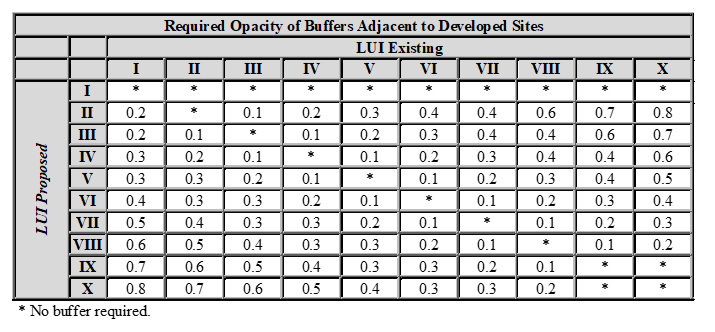
Buffers Adjacent to Developed Property. The standards in the table below address the opacity of the buffer required between proposed and existing uses. The rows show the proposed land use intensity of the subject property, while the columns contain the land use intensity of existing development on the adjoining parcel(s). Asterisks indicate that no buffer is required.
Required opacity shall be reduced by fifty (50) percent where the existing adjacent land use is a single-family home in a HIP, MXD, Industrial, Commercial, or Office future land use designation.
(b)
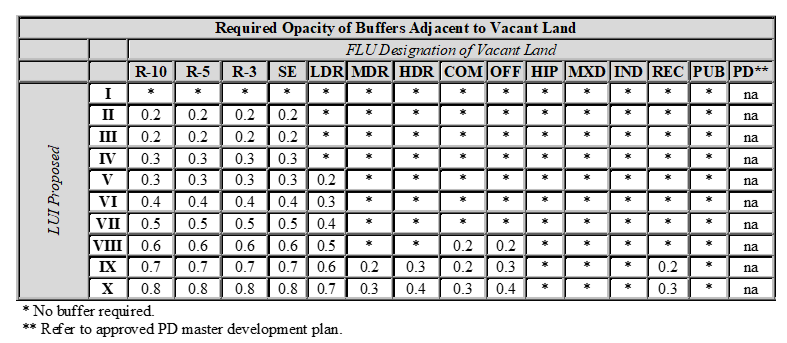
Buffers Adjacent to Vacant Land. The standards in the table below address the opacity of the buffer required between proposed uses and vacant land. The rows show the proposed land use intensity of the subject property, while the columns contain the Future Land Use designation on adjoining parcel(s).
Vacant sites having approved, unexpired development plans shall be evaluated as developed sites.
(c)
Buffers Adjacent to Streets.
(1)
Chuluota Overlay Area Buffers. Nonresidential uses adjacent to County Road 419 within the Chuluota Overlay Area, shall meet the buffering requirements. Residential uses within the Overlay area shall be consistent with Paragraph (2) below.
(2)
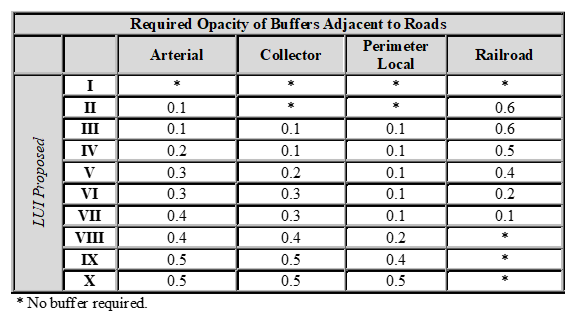
Other Street Buffers. The standards in the table below address the opacity of the bufferyard that is required along arterial, collector and local streets or railroads.
(3)
Landscape Materials. Plant Group "C," shall be used on all street buffers where overhead power lines are present. In the event that canopy trees are required adjacent to power lines under a previously existing development order, developer's commitment agreement, PD master development plan, or other provision(s) of this Code, the Development Services Director may allow the substitution of three (3) understory trees for each required one (1) canopy tree.
30.14.7.1 Buffer Requirements for M-2.
(a)
Landscaping. As required by Sections 30.14.3—30.14.5 of the Land Development Code.
(b)
Front buffer. Front yards shall be not less than fifty (50) feet in depth as measured from the front property line to any building. The twenty-five (25) feet of such yard nearest to the front property line shall remain unpaved except for normal entrance drives and shall be landscaped as required in Part 14. The remaining twenty-five (25) feet may be used for the parking of passenger vehicles only. Front setbacks for property located internal to an industrial park may utilize a front yard setback of not less than twenty-five feet (25') in depth from the front property line if not less than ten feet (10') of such yard nearest to the front property line is retained as a landscaped green area which is unpaved except for normal entrance drives, and sufficient area for the loading and unloading of vehicles is provided, consistent with generally accepted engineering practices and principles.
(c)
Buffering shall comply with Part 14. In any case, where the required buffer width exceeds a setback requirement noted in this Section, the greater standard shall apply.
(Ord. No. 2024-02, § 7(Exh. B), 1-9-24).
Sec. 30.14.8. - Parking buffers.
A parking buffer shall be required where a parking lot, or parking structure, drive aisle, and/or loading dock is located within twenty-five (25) feet of the boundary of a residential district or Future Land Use designation. Such buffer shall be in addition to any buffer required under Section 30.14.7.
(Ord. No. 2024-02, § 7(Exh. B), 1-9-24).
Sec. 30.14.9. - Nuisance buffer yards.
Additional buffering in excess of that required in the tables above shall be required for the following:
(a)
Loading and Refuse Disposal. Where loading or refuse disposal abuts a residential district or is visible from the public right-of-way, an increase in opacity by 0.2 and a minimum six-foot wall shall be required as part of the applicable district boundary or street buffer.
(b)
Outdoor Storage, Equipment Operation, or Material Handling. Where outdoor storage, exterior equipment operation, or material handling abuts a residential district or is visible from a public right-of-way, an increase in opacity by 0.2 and a berm or evergreen hedge of sufficient height to ensure that stored material is not visible shall be required as part of the applicable district boundary or street buffer.
(Ord. No. 2024-02, § 7(Exh. B), 1-9-24).
Sec. 30.14.10. - Calculating the buffer planting.
(a)
The table below provides the plant material for a sample bufferyard. To calculate a bufferyard on a site, take the actual length of the bufferyard and divide by one hundred (100). Then multiply the result by the number of plant groups per one hundred (100) feet required by the table in Section 30.14.5. A sample calculation for opacity 0.2 is shown below.
Table notes:
* (calculated figure) / rounded to next whole number
(b)
The width of roads, driveways, or cross-access easements that interrupt a bufferyard shall not be counted in determining the total linear feet of the bufferyard. In some cases, it may be necessary to locate stormwater retention, utility facilities, or pedestrian/bicycle trails within a required buffer area due to the size, shape, or other characteristics of the development site. In these instances, the Development Services Director may adjust the location and design of the buffer to maintain the required opacity while meeting the unique needs of the subject property.
(Ord. No. 2024-02, § 7(Exh. B), 1-9-24).
Sec. 30.14.11. - Constrained site buffers.
Where a small or irregularly shaped site cannot feasibly meet the standard buffer requirements, the Development Services Director may authorize reduced buffers as follows:
The site shall meet one of the criteria listed below:
Based on required opacity, each buffer shall meet the applicable standard listed below:
Table notes:
*These buffers only occur where nuisance buffers are required by Section 30.14.7.
**Where a required wall or berm is adjacent to a road, the Development Services Director may waive such wall or berm or determine an appropriate alternative based on site visibility, public safety, and similar concerns.
(Ord. No. 2024-02, § 7(Exh. B), 1-9-24).
Sec. 30.14.12. - Maximum feasible buffer.
In cases of redevelopment or expansion of existing uses in which adequate site area for either the standard or constrained bufferyard is not available, the Development Services Director may require that the maximum feasible buffer be installed on any property line where a buffer is needed. The maximum feasible buffer shall consist of a selection of plants and other buffer enhancement features that provide the most effective buffering possible in a given location where the required opacity cannot be met. As part of the maximum feasible buffer determination, the Development Services Director may restrict the intensity of the development by limiting parking, employment, hours of operation, etc.
(Ord. No. 2024-02, § 7(Exh. B), 1-9-24).
Sec. 30.14.13. - Parking lot landscaping.
(a)
Landscaping required under this Section shall be installed in planting islands within a parking lot, or in adjacent planting areas not more than eight (8) feet from the edge of parking spaces or driveway aisles. All such planting areas shall be shown on required site plan(s) for the site.
(b)
A total planting area of thirty (30) square feet per parking space shall be required for any parking area exceeding five (5) spaces. There shall be no more than twenty (20) parking spaces in a continuous row without one or more planting areas as required under this Section. Tree planting islands shall be a minimum of one hundred (100) square feet in size and eight (8) feet in width.
(c)
Minimum landscaping shall consist of one (1) canopy tree or two (2) understory trees per two hundred (200) square feet of required planting area.
(Ord. No. 2024-02, § 7(Exh. B), 1-9-24).
Sec. 30.14.14. - Pedestrian access.
Pedestrian access to neighboring uses through a required buffer may be provided at the option of the abutting property owner(s). Such access shall be designed not to interfere with the screening function of the buffer.
(Ord. No. 2024-02, § 7(Exh. B), 1-9-24).
Sec. 30.14.15. - Screening.
(a)
Screening of Refuse Facilities. All solid waste containers, except approved recycling containers, shall be enclosed on at least three (3) sides with a six (6) foot screen. The screen shall consist of a brick or masonry wall, or other durable, low-maintenance material consistent with the finish of the primary building, as approved by the Development Services Director. Masonry walls shall have a finished surface on the exterior side. Refuse container enclosures shall have gates with spring-loaded hinges or the equivalent, and fasteners to keep them closed at all times except during refuse pick-up. The Development Services Director may require that a hedge or similar landscaping material surround the enclosure walls. The container and enclosure shall be oriented so that the opening faces away from public streets and adjoining properties. A concrete or asphalt pad of appropriate size and construction shall be provided as a base for the container. The container pad shall be at the approximate level of the service vehicle approach area so that the truck's loading mechanism can align with the container's sleeves. The screened enclosure shall not be located in any street right-of-way or required landscape buffer. Containers and enclosures shall be located to allow ease of access for collection trucks and direct access to drive areas. Straight-in or circular drives are encouraged to reduce truck maneuvering problems. No parking or other obstructions shall be permitted in front of such containers and enclosures. Hours of operation for emptying such containers may be specified during the site plan review process based on compatibility with adjacent properties to limit noise.
(b)
Refer to Part 9 for Pool Screen Enclosure standards.
(Ord. No. 2024-02, § 7(Exh. B), 1-9-24).
Sec. 30.14.16. - General provisions for all landscaped areas.
(a)
Landscape Installation and Quality of plant material. When the construction upon or the development of a new site or the redevelopment, reconstruction, upgrading, expansion or change in use of a previously developed site is such that a landscape plan is required, the provisions of this Section shall be applied to all landscaped areas required by this Chapter consistent with the water-efficient landscaping standards established herein and the Florida Friendly Landscaping Program. All plant materials shall be Florida No. 1 grade, or better, according to the current "Grades and Standards for Nursery Plants," published by the State of Florida, Department of Agriculture, except when the Development Services Director finds that the existing native vegetation will provide the necessary visual screening. Existing trees situated in the required buffer may be used to satisfy the buffer tree requirement if they are sufficient in size and number.
(b)
Tree planting standards.
(1)
Canopy trees shall have a minimum height of eight (8) feet and minimum caliper of three (3) inches, measured one (1) foot above ground, immediately after planting. Canopy trees shall not be placed where they interfere with site drainage. Where utility lines are present, understory trees generally shall be substituted for canopy trees using Plant Group C or from Florida Friendly Landscaping Guide to Plant Selection & Landscape Design. Where canopy trees adjacent to utility lines are specified under a pre-existing development order, PD Master Development Plan, or other provision(s) of this Code, they may be waived by the Development Services Director subject to this Code. If they are used in buffers adjacent to utility lines, canopy trees shall be placed at the edge of the buffer furthest from the utility lines. Evergreens, as provided in Plant Group A or from Florida Friendly Landscaping Guide to Plant Selection & Landscape Design shall also be eight (8) feet in height at time of planting.
(2)
Understory trees shall have a minimum height of six (6) feet and minimum caliper of one and one half (1½) inches measured one (1) foot above ground, immediately after planting. Understory trees shall not be placed where they interfere with site drainage.
(c)
Required mix of tree species. When ten (10) or more trees are required to be planted to meet the requirements of this Chapter, a mix of tree species shall be provided, at least one (1) of which shall be native to the Central Florida region. The minimum number of species to be planted are indicated below.
(d)
Shrubs and hedges. Shrubs shall be a minimum of two (2) feet in height immediately after planting. Hedges, where required, shall be planted and maintained so as to form a continuous and unbroken visual screen within a maximum of one (1) year after the time of planting.
(e)
Ground cover. Ground cover plants include plant materials which reach a maximum height of not more than twenty-four (24) inches and may be used in lieu of grass. Ground cover plants must present a reasonably complete coverage at time of planting. Ground cover plants shall be a minimum of one (1) gallon size when planted and spaced a maximum of two (2) feet on center.
(f)
Turfgrass. Grass areas shall be planted in species normally grown as permanent lawns in Seminole County. Grass areas may be sodded, plugged, sprigged or seeded; provided, however, that solid sod shall be used in swales or other areas that are found, by the Development Services Director, to be subject to erosion. Grass sod shall be clean and reasonably free of weeds and noxious pests or diseases. Turfgrass areas should be consolidated and limited to those areas on the site that receive pedestrian traffic, provide for recreational uses, provide soil erosion control such as on slopes or in swales; or where turfgrass is used as a design unifier, or other similar practical use.
(g)
Mulch. In order to preserve soil moisture, all planting areas except annual beds shall be mulched with no less than two (2) inches of organic mulch, such as wood chips, pine needles or oak leaves. Mulch shall be placed directly on the soil or landscaping fabric and planting areas shall be properly edged to retain mulch.
(h)
Installation. All landscaping shall be installed in accordance with professional and generally accepted commercial planting procedures. Soil that is free of limerock, pebbles and other construction debris shall be used. Installation of landscape materials shall be accomplished in accordance with the approved Landscape Plan.
(i)
Required landscape design techniques.
Water use zones. Installed trees and plant materials shall be grouped together into zones according to their water use needs. The water use zones shall correlate with the water use zone designations identified in the Approved Plant Species list set forth in Figure 14.1 of this Part. The water use zones are based on drought tolerance and soil moisture categories listed in the Florida Friendly Plant List and database. There are three categories based on the following:
(1)
High water use zone: A zone containing plants that are generally associated with low to no drought tolerance and wet soils;
(2)
Moderate water use zone: A zone containing plants that are generally associated with medium drought tolerance and medium drained soils; and
(3)
Low water use zone: A zone containing plants that are generally associated with high drought tolerance and well-drained soils.
(4)
Plants with similar cultural (soil, climate, sun, and light) requirements should be grouped together and irrigated according to their water requirements. Turfgrass shall be irrigated in a separate zone from trees, shrubs, and groundcover beds. The proposed water use zones shall be shown on the landscape plan and the irrigation system plan.
a.
Design standards. Low water use zone plant material shall comprise at least twenty (20) percent of the total regulated landscaped areas. High water use zone plant material, which includes most turf grasses, shall comprise no more than forty (40) percent of the total regulated landscape area.
b.
Use of drought-resistant plant material. All new or replacement plantings required for any off-street parking area, landscape area or landscape buffer shall use, to the maximum extent possible, native plant material or other species with equivalent drought-resistant properties. The intent of this requirement is to promote and conserve the County's water resources.
c.
Preservation of existing native plants and materials. Every reasonable effort shall be made in the design and construction of all site improvements and alterations to save existing healthy trees and native vegetation and maintain the existing topography. The Development Services Director may require alternate designs and construction techniques to better achieve tree and native vegetation preservation while still allowing the permitted use of the property. Every reasonable effort shall be made to preserve trees and native vegetation to act as visual and noise buffers along the perimeters of single-family subdivisions and all other developments. Existing native vegetation specified to remain shall be preserved in its entirety, with all trees, understory and ground cover left intact. Areas of existing natural vegetation should not be irrigated.
d.
Irrigation. Irrigation systems, when required, shall be designed to correlate to the organization of plants into zones as described in subsection (1) above. The water use zones shall be depicted on the irrigation plan and landscape plan. A temporary aboveground irrigation system may be used in areas where low-water use zone trees and plant materials are proposed. All permanent underground irrigation systems shall be automatic with cycling capacity and shall be designed to avoid irrigation of impervious surfaces. Irrigation systems shall be maintained to eliminate waste of water due to loss from damaged, missing; or improperly operating sprinkler heads, valves, pipes, or controllers. Irrigation systems are required to be designed, installed; and managed per best management practices as identified in the approved Florida Friendly Design Standards.
e.
Approved Plant Species list. All plant material proposed to be installed on a site to meet the requirements of this Code shall be site appropriate and selected from the Approved Plant Species list set forth in Figure 14.1 of this Part or from Florida Friendly Landscaping Guide to Plant Selection & Landscape Design. Use of any other species shall require prior approval by the Development Services Director. The plants listed in Figure 14.1 of this Part have demonstrated the ability to grow and thrive in the Central Florida Area.
(j)
The following trees are approved for plants as Canopy Street Trees:
(1)
Acer rubrum - Red Maple, native
(2)
Carya spp. - Hickories, native
(3)
Elaeocarpus decipiens - Japanese Blueberry, not native
(4)
Gordonia lasianthus - Loblolly Bay, native
(5)
Liquidambar styraciflua - Sweetgum (use fruitless varieties as street trees), native
(6)
Nyssa sylvatica - Black Gum, native
(7)
Persea borbonia - Red Bay, native
(8)
Pinus eliottii var. densa, var. elliottii - Slash Pine, native
(9)
Pinus palustris - Longleaf Pine, native
(10)
Pinus taeda - Loblolly Pine, native
(11)
Platanus occidentalis - Sycamore, native
(12)
Quercus shumardii - Shumard Oak, native
(13)
Quercus virginiana and cvs. - Live Oak, native
(14)
Tabebuia chrysotricha - Yellow trumpet Tree, not native
(15)
Tabebuia heterophylla - Pink Trumpet Tree, not native
(16)
Ulmus alata - Winged Elm, native
(17)
Ulmus americana - American Elm, native
(18)
Ulmus parvifolia and cvs. - Chinese Elm, Lacebark Elm, not native
(19)
Taxodium distichum - Bald Cypress, native
(k)
Canopy trees and root barriers: Canopy street trees located in planting strips less than ten (10) feet wide require the installation of a root barrier to protect the sidewalk or adjacent hard surface. The root barrier material must be one hundred (100) percent recycled polyethylene installed per the manufacturer's recommendations. The barrier is to be installed linearly directly adjacent to the sidewalk edge and to twenty-four (24) inches depth from finished grade. A total of six (6) feet in length of barrier is required, centered on the trunk of the tree. Vertical ribs are required and must face toward the tree.
(l)
Prohibited plant species. The exotic and nuisance plant species set forth in Figure 14.2 of this Part or invasive and exotic plant species as identified in Section 581.091, Florida Statutes, Rule Chapter 5B-57 and the University of Florida IFAS Extension Invasive Plant List and database shall not be planted.
(Ord. No. 2024-02, § 7(Exh. B), 1-9-24).
Sec. 30.14.17. - Landscaping and traffic circulation.
(a)
Wheel stops/curbing. All landscaped areas shall be protected from vehicle encroachment by wheel stops or curbing. If curbing is raised above abutting landscaped areas, it shall be perforated to permit drainage from the paved ground surface area onto the landscaped area. Where a wheelstop or curb is utilized, the paved area between the curb and the end of the parking spaces may be omitted if the area is landscaped in addition to the required landscaping herein with a material such as ground cover, rock, or gravel, requiring minimal maintenance.
(b)
Joint driveways. Whenever a joint driveway or cross-access easement configuration is required by the County or otherwise installed, the Development Services Director may adjust the location and design of landscape areas required on the building site(s).
(c)
Intersection visibility. When an accessway intersects a public right-of-way, landscaping shall be used to define the intersection; provided, however, that all landscaping within the triangular areas described below shall provide unobstructed cross-visibility at a level between two (2) feet and six (6) feet. Trees may be trimmed if they create a traffic hazard. Landscaping, except grass and ground cover, shall not be located closer than three (3) feet from the edge of any accessway pavement. The aforementioned triangular areas are described as follows:
(1)
The areas of property on both sides of an accessway formed by the intersection of each side of the accessway and the public right-of-way pavement line with two (2) sides of each triangle being ten (10) feet in length from the point of intersection and the third side being a line connecting the ends of the other two (2) sides.
(2)
The area of property located at a corner formed by the intersection of two (2) or more public streets with two (2) sides of the triangular area being measured thirty (30) feet in length along the abutting edges of pavement, from their point of intersection, and the third being a line connecting the ends of the other two (2) lines.
(Ord. No. 2024-02, § 7(Exh. B), 1-9-24).
Sec. 30.14.18. - Landscape plan and irrigation plan submittal requirements.
(a)
A landscape plan and irrigation plan, when required, shall be submitted by the applicant. The landscape plan shall graphically portray the layout of all landscape plant materials, turf areas, walls, fences and buffers, pavement and parking areas, curbing, structures, signs, easements, existing or proposed utility service lines, and all other site improvements. The landscape plan shall list the common and botanical name, size, quantity and spacing of each item. The landscape plan and irrigation plan shall indicate the total regulated landscape area and size of each water use zone by square feet. In addition, the landscape plan shall clearly indicate the location of existing vegetation, which shall remain undisturbed. Any existing trees six (6) inches in diameter or larger proposed for removal shall be clearly indicated. Groups of trees in close proximity may be designated as "clumps" of trees on the plan.
(b)
The irrigation plan shall be submitted showing a detailed layout and description of a permanent underground irrigation system providing one hundred (100) percent coverage of all landscaped areas. The irrigation plan shall include information such as sprinkler head type, pipe size, radius of throw, valve and backflow preventer, and rain sensor device locations.
(c)
All water use zones shall be indicated on the landscape plan and irrigation plan. Turf areas shall be irrigated on separate zones from trees, shrubs, and ground cover beds. A rain sensor device or switch shall be required on any newly installed automatic irrigation system to prevent irrigation during periods of sufficient rainfall. The use of low-volume, emitter, or target irrigation is preferred for trees, shrubs, and ground cover. Significant irrigation overthrow onto impervious surfaces is prohibited. The use of irrigation systems shall comply with all water use restrictions imposed by law.
(d)
The Development Services Director may permit the use of a temporary above-ground irrigation system in areas where drought tolerant/low water use zone plant material is proposed to be planted for the entire landscaped area. An irrigation plan shall not be required in such circumstances.
(e)
When an effluent reuse system is available to serve the premises, and sufficient capacity exists, reclaimed water shall be used to irrigate any area required to be landscaped. The landscape and irrigation plan shall be exempt from the requirements of this Section.
(f)
The landscape plan and irrigation plan shall be reviewed by the Development Services Director, and building permits shall not be issued until a landscape plan and irrigation plan is approved. Irrigation systems shall be installed according to manufacturer's specifications and the Florida Irrigation Society Standards and Specifications for Turf and Landscape Irrigation Systems.
(g)
More restrictive landscaping requirements. When landscaping requirements are included as part of the regulations for any zoning classification, the more restrictive requirements shall govern. It is intended that these regulations be used in conjunction with other landscaping regulations.
(h)
Enforcement. All landscaping required by this Section shall be installed prior to issuance of a certificate of occupancy by the Building Official.
(i)
Maintenance. The property owner, tenant, and any agent of an owner or tenant shall be jointly and severally responsible for the proper maintenance of irrigation systems and all landscaping in good condition so as to present a healthy and orderly appearance, free of refuse and debris and to provide proper maintenance of the plant material in order that it will, at all times, conform to the provisions of this Code. This requirement includes, but is not limited to, the replacement of plants damaged by insects, diseases, vehicular traffic, acts of God, and vandalism. Necessary replacements shall be made within forty-five (45) days after notification by the Development Services Director of a violation of this Section. Shrubs required by this Chapter as part of a hedge or durable landscape screen shall be maintained at the minimum required height or greater. Irrigation systems installed to meet the requirements of this Code shall be maintained in proper operating condition at all times to prevent waste of irrigation water.
(j)
Waiver. The Board of County Commissioners, or designee, may grant a waiver from the provisions of this Section when such waiver is found to not be contrary to the public interest and furthers the intent and purposes of this Chapter.
(k)
Administrative adjustments. The Development Services Director may approve reductions in setbacks and other requirements subject to the provisions of Section 5.19. Approval shall be conditioned on a finding that the administrative adjustment will protect and encourage the preservation of large canopy, specimen, or historic trees if the preservation of existing trees and vegetation can be assured during and after site development.
Table notes:
Water Zone Key:
H = High Water Use Zone — Plants which are associated with moist soils and require supplemental water in addition to natural rainfall to survive. This zone includes shallow rooted turfgrass varieties.
M = Moderate Water Use Zone — Plants which survive on natural rainfall with supplemental water during seasonable dry periods. This zone includes deep rooted turfgrass varieties.
L = Low Water Use Zone — Plants which, once established, survive on natural rainfall without supplemental water. Because of the relatively high water requirements of turfgrass, no presently available varieties are included in this category.
Sources: St. Johns River Water Management District Xeriscape Plant Guide South Florida Water Management District Xeriscape Plant Guide II.
(Ord. No. 2024-02, § 7(Exh. B), 1-9-24).
Sec. 30.14.19. - Fences.
(a)
A building permit is required for any fence or wall to be erected, replaced, or needs major repair. A major repair shall be considered a segment of fence or wall on more than ten (10) percent of the total linear feet of the existing fence or wall, two (2) or more fence or wall panels, or more than eighteen (18) linear feet, whichever is less. Building permit applications must include a certified survey showing the location of the proposed fence or wall; however, the Planning Manager may waive this requirement and allow a plot plan or site plan when the survey corner markers will be made visible for inspection by the Building Inspector. If determination for compliance to approved plans cannot be made by exposed survey corner markers, the Building Inspector may require a string line from survey corner marker to survey corner marker to ensure compliance. If the Building Inspector is still unable to determine if compliance is met due to site conditions, it is the responsibility of the contractor or owner, if owner/builder permits, to provide a site built survey to verify compliance with the approved plans.
(b)
Residential zoning classifications: fences and walls are limited to a maximum height of four (4) feet within the front yard and side street setbacks and six (6) feet six (6) inches within the side and rear yard setbacks except as provided in (f) of this Section. In the case of corner lots, the lot shall be considered to have a front yard or yards on any side or sides abutting a road right-of-way.
(c)
Commercial or Industrial zoning classifications: fences and walls are limited to a maximum height of six (6) feet six (6) inches within the front setback and eight (8) feet within the side and rear yard setbacks except as required to maintain visibility per (c)(4) of this Section and Section 250.91, Code of Ordinances. Notwithstanding any other provisions of this Code, fences shall not be located within a designated buffer unless required under Chapter 30 Part 14.
(d)
Agricultural zoning classifications: fences and walls are limited to a maximum height of five (5) feet and an additional one (1) foot for embellishments within the front yard setback; and eight (8) feet within the side and rear yard setbacks. Fences located within the front yard setback must be open split rail; steel woven wire may be used behind split rail fencing for animal containment, but no barbed wire is permitted. These regulations shall not apply to property having an agricultural classification from the Seminole County Property Appraiser.
(e)
Planned Developments: Unless otherwise stated in the recorded Development Order or Developer's Commitment Agreement, all fences or walls will comply with this Section.
(f)
Setback distance requirements will be as follows:
(1)
No side street setback will be required from any side property line adjoining railroad right-of-way or a limited access highway.
(2)
For corner lots in residentially zoned properties, including residential Planned Developments unless otherwise stated in the development order, the secondary front yard or side street setback may be reduced to five (5) feet provided the visual clearance (sight line triangle) requirements of (c)(4) of this Section can be met and with approval by the Seminole County Traffic Engineering Division. Building permit applications requesting the reduction of the side street setback must include a certified survey indicating the adjacent rights-of-way.
(3)
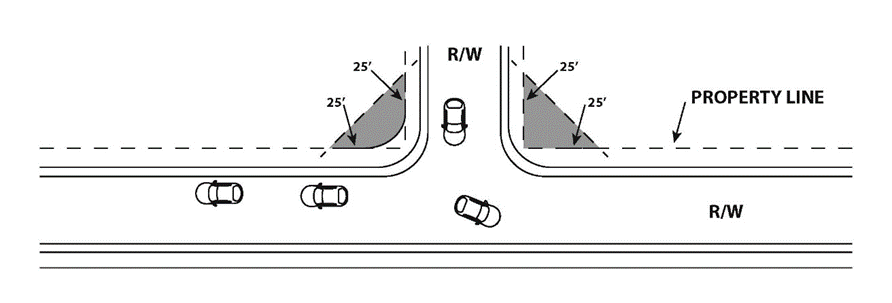
Fences, walls, hedges, plantings, or other obstructions must maintain visual clearance requirements at the intersection on corner lots. The visual clearance triangle must be fifteen (15) feet for residentially and agriculturally zoned property, or twenty-five (25) feet for commercially or industrially zoned property at a street intersection unless otherwise approved by the County Engineer. The visual clearance triangle is measured from the property corner adjoining the intersection of rights-of-way the distance described above with a line joining points on those lines.
(4)
Any fence, wall, hedge, planting (except plants defined as shoreline vegetation in FAC 62-340-450), or other obstruction adjacent to a natural water body is limited to a maximum height of four (4) feet. Any fence or wall greater than four (4) feet must be located a minimum distance of thirty (30) feet from the normal high water elevation of a natural water body. Building permit applications for fences or walls adjacent to a natural water body must include a certified survey no less than five (5) years old indicating the Normal High Water Elevation.
(g)
In all zoning districts, a chain link fence and other non-privacy fences (e.g., clear plastic and metal or aluminum picket fences) that are not opaque but function similarly to a chain link fence in that they do not obstruct the view with a maximum height of six (6) feet six (6) inches may be permitted on a vacant parcel, except as provided in (b) of this Section.
(h)
Entrance walls to a subdivision may be erected closer to streets or roads only on approval of the Board of County Commissioners.
(i)
No barbed-wire fence shall be erected in any residential district except for security of public utilities. Barbed wire may be used on security fences erected in any commercial or industrial district or for security of public utilities, provided such use is limited to three (3) strands, a minimum of six (6) feet above the ground.
(j)
No fence or wall shall be erected or project beyond the property line or be located within required visual clearance areas.
(k)
A fence shall be uniform in construction, design, material, color and pattern, and the fence material shall be a standard material conventionally used by the fence industry. Nontraditional materials, including, but not limited to, tires, mufflers, and hubcaps, are prohibited. Open split-rail fences shall be permitted.
(l)
All fences shall be maintained in their original upright condition.
(m)
Fences and walls designed for painting or similar surface finish shall be maintained in their original condition as designed. Any walls or fences which have been defaced shall be promptly restored to their original condition.
(n)
Missing boards, pickets, posts or bricks shall be promptly replaced with material of the same type and quality, subject to permitting requirements in (a) of this Section.
(o)
Gates and posts are limited to the same maximum heights and required setbacks for fences and walls provided in (b), (c), (d), and (e) of this Section, including architectural embellishments. Gates shall not swing into adjacent properties or encroach into the right-of-way.
(p)
Where grade elevations along adjoining properties differ, fence/wall height shall be measured from the finished ground floor elevation of the property having the higher ground floor elevation.
(q)
Any fence greater in height than provided in this Section or within the required yard setbacks shall not be erected without approval of the Board of Adjustment after a public hearing. Reductions to the side street setback as provided in (f)(2) will not require Board of Adjustment approval unless otherwise determined by the Planning Manager.
(Ord. No. 2024-02, § 7(Exh. B), 1-9-24).
Sec. 30.14.20. - Open space easements.
The following open space easement form is adopted as an approved form consistent with the provisions of this Code:
OPEN SPACE EASEMENT
THIS INDENTURE, made this day of _______, 20___.
WITNESSETH:
WHEREAS, ___________, whose address is ___________, (hereinafter, together with [his/her] heirs and assigns, called the "grantor"), is the owner in fee simple of certain real property described in and depicted on Exhibit A attached hereto (hereinafter called the "Protected Property");
WHEREAS, the grantor desires and intends to establish a limited range of allowable uses of the protected property to maintain a desirable environment for rural residential living at a low density of development [in conjunction with the preservation of a portion of the protected property for agricultural purposes];
WHEREAS, the grantor also desires and intends that the ecological and aesthetic values of the protected property including, without limitation, scenic views over a large open space, be preserved and maintained;
WHEREAS, the grantee (hereinafter, together with its successors and assigns, called the "County") is Seminole County, a political subdivision of the State of Florida, whose address is 1101 East First Street, Sanford, Florida 32771;
WHEREAS, the grantor and the grantee, by the conveyance to the grantee of an open space easement on, over, and across the protected property, desire to prevent the use or development of the protected property for any purpose or in any manner inconsistent with the terms of this open space easement;
WHEREAS, the grantee is willing to accept this open space easement subject to the reservations and to the covenants, terms, conditions, and restrictions set out herein and imposed hereby,
NOW, THEREFORE, the grantor, for and in consideration of the foregoing recitations and of the mutual covenants, terms, conditions and restrictions hereinafter contained, and as an absolute and unconditional gift, does hereby give, grant, bargain, sell and convey unto the grantee, forever, an open space easement in perpetuity on, over and across the protected property consisting solely of the following:
(a)
The right of the grantee to view the protected property in its scenic and open condition at ground level from adjacent publicly accessible roadways and property;
(b)
The right of the grantee to enforce, by proceedings at law or in equity, the covenants hereinafter set forth, it being agreed that there shall be no waiver or forfeiture of the grantee's right to ensure compliance with the covenants and conditions of this grant by reason of any prior failure to act; and
(c)
The right of the grantee to enter the protected property at all reasonable times for the purpose of inspecting the protected property to determine if the grantor is complying with the covenants and conditions of this grant.
And in furtherance of the foregoing affirmative rights of the grantee, the grantor makes the following covenants which shall run with and bind the protected property in perpetuity, namely, that, except in connection with the uses expressly permitted by this open space easement, the grantor, without the prior written consent of the grantee, shall not do the following on the protected property:
(a)
Construct or place buildings or other structures, camping accommodations or mobile homes, commercial advertising signs, billboards or other advertising material or make any other structures or improvements on the protected property;
(b)
Excavate, dredge, fill, mine, dike, drill or change the topography of the protected property or its present condition in any manner except as may be required for agricultural uses expressly reserved by the grantor;
(c)
Cut live trees or other non-agricultural vegetation, except as determined by the grantee to be necessary to protect the natural, scenic, open space and ecological values of the protected property, to prevent imminent hazard, disease, or fire or to restore natural habitat or native vegetation;
(d)
Alter or manipulate ponds and water courses or remove water therefrom;
(e)
Further subdivide the protected property in any manner;
(f)
Pave or cover the protected property with concrete, asphalt, or any other impervious surface;
(g)
Dump, place, or store ashes, trash, garbage, vehicle bodies or parts or other unsightly or offensive material; provided, however, that the grantor may employ sound conservation practices, such as prescribed burning and brush control, in order to restore and manage the natural resources on the protected property; or
(h)
Permit or allow the operation of dune buggies, motorcycles, all terrain vehicles or any other type of motorized vehicle on the protected property.
TO HAVE AND TO HOLD the said open space easement unto the grantee forever.
Except as expressly limited herein, the grantor reserves all rights as owner of the protected property including, but not limited to, the right to use the protected property for [only those agricultural and grazing uses and the residential uses hereinafter described and agreed to by the County], and all other purposes not inconsistent with this grant.
NOTE:
The following uses are an example of uses that could be permitted consistent with the open space purposes of the open space easement. The uses reserved for the grantor would need to be adapted to the particular circumstances of each case.
The grantor may establish only the following uses on the protected property on those portions of the protected property depicted on Exhibit B attached hereto:
(a)
Agriculture or grazing and accessory buildings or structures (the "agricultural use"); and
NOTE:
Depending on the nature of the agricultural use and the particular parcel of property involved, the agricultural use could be subject to further restrictions in terms of total area. Also, silviculture could be substituted for agriculture.
(b)
Single-family residential detached dwellings and accessory buildings or structures (the "residential use").
Accessory means that which is of a nature customarily incidental and subordinate. With respect to the residential use, however, accessory buildings or structures shall include only the following: garages, storage sheds, swimming pools and accessory buildings, septic fields, wells, improved or unimproved roads, and rights-of-way to and between any permitted improvements, and exterior roads, and water retention and detention facilities.
NOTE:
These densities are hypothetical only and are only intended to illustrate the options available.
The density of single-family residential detached dwellings on the protected property shall not exceed one (1) single-family residential dwelling per ten (10) acres, or, if such dwellings are clustered, the gross density of such dwellings shall not exceed one (1) dwelling per five (5) acres. "Density" means the ratio between the total number of dwellings on the protected property and the land area of the protected property including interior streets and the centerlines of peripheral streets and common use areas. "Clustered" means a grouping of buildings such that all of the single-family residential dwellings and accessory buildings and structures are located at a single location on the protected property on lots of one (1) net buildable acre, which location must be approved by the grantee for its consistency with the purposes of this open space easement.
The protected property may be subdivided only to provide for the residential use and may be improved with fencing only if necessary to buffer the residential from the agricultural use.
By its acceptance hereof, the grantee agrees as follows:
(a)
That, if its rights herein are assigned or transferred, to assign or transfer this open space easement only to an assignee or transferee who expressly agrees in the instrument of conveyance to continue to carry out the preservation purposes which this instrument was intended to advance and, in such event, only: (1) to an organization qualifying as an eligible donee under the Internal Revenue Code of 1954, as amended from time to time, and the regulations promulgated thereunder; or (2) to an agency of the State of Florida; or (3) to a unit of local government; or (4) to a not-for-profit corporation or trust whose primary purposes include the preservation of land, natural areas, open space or water areas, or the preservation of native plants or animals, or biotic communities;
(b)
That in the event the grantee or its successors or assigns acquires the fee simple interest in and to the protected property, it shall not cause or permit the merger of such fee simple interest and the open space easement except for valid public purposes as determined by the grantee;
(c)
That each subsequent instrument of conveyance shall expressly require the assignee or transferee to be bound by the terms and provisions hereof including, without limitation, the agreements of the grantee as set forth herein;
(d)
That, if a subsequent unexpected change in the conditions surrounding the protected property makes impossible or impractical the continued use of the protected property for preservation purposes, and if this open space easement is extinguished by judicial proceeding, then all of the grantee's proceeds from the sale, exchange or involuntary conversion of the protected property shall be used by the grantee in a manner consistent with the preservation purposes which this open space easement was intended to advance and otherwise consistent with the public interest as determined by the grantee.
The grantor and the grantee each agree that the donation of this open space easement gives rise to a property right, immediately vested in the grantee. [Grantee acknowledges that grantor has independently obtained an appraisal of the protected property to which grantee has not been a party or participated therein.]
[The grantor agrees that for purposes of determining the distribution of proceeds in the event that this open space easement is extinguished by judicial proceedings, the grantee's share of such proceeds shall be _______% of the fair market value of the protected property, and the grantee is willing to accept such percentage.]
The grantor and, by acceptance hereof, the grantee, agree further as follows:
(a)
Whenever the grantee's approval is required hereunder, such approval may be withheld only upon a reasonable determination by the grantee that the action as proposed would be inconsistent with the purposes of this open space easement.
(b)
Nothing contained in this open space easement shall be construed to entitle the grantee to bring any action against the grantor for any injury to or change in the protected property resulting from causes beyond the grantor's control including, without limitation, fire, flood storm and earth movement, or from any action taken by the grantor under emergency conditions to prevent, abate or mitigate significant injury to the protected property resulting from such causes.
(c)
No right of access by the general public to any portion of the protected property is conveyed by this open space easement, but this provision shall not be deemed to affect the right of the grantor to grant such access.
(d)
The interpretation and performance of this open space easement shall be governed by the laws of the State of Florida.
(e)
If any provision of this open space easement, or the application thereof to any person or circumstance, is found to be invalid, the remainder of the provisions of this open space easement, or the application of such provision to persons or circumstances other than those as to which it is found to be invalid, as the case may be, shall not be affected thereby.
(f)
Exhibit A, attached hereto, a legal description of this open space easement, is hereby made a part hereof.
(g)
The covenants, terms, conditions and restrictions set forth in this open space easement shall be binding upon the grantor and the grantee and their respective agents, personal representatives, heirs, successors and assigns, and shall constitute a servitude running with the protected property in perpetuity. In addition to all other covenants of title, this conveyance includes the covenant of further assurances. (Additional covenant language follows).
(COVENANTS OF TITLE)
IN WITNESS WHEREOF the Grantor has set [his/her] hand the day and year first above written.
GRANTOR: ___________
This instrument was prepared by: ___________
(STANDARD ACKNOWLEDGMENT)
ACCEPTANCE
The foregoing open space easement is hereby duly accepted by the grantee, Seminole County, this _____ day of _______, 19___, and the grantee agrees to be bound by the terms and provision set forth herein.
(STANDARD COUNTY SIGNATURE BLOCK)
EXHIBIT A
Legal Description of Protected Property
[TO BE INSERTED]
(Ord. No. 2024-02, § 7(Exh. B), 1-9-24).

