The purpose of this district is to provide an environment for office and ancillary uses and facilities. This district should be located along major streets and function as a buffer between commercial and residential districts, where property size or other circumstances preclude commercial development adjacent to residential districts.
1230.02 LOCATION OF DISTRICT.
An O Office District should be located as a buffer between uses of substantially different character or intensity.
1230.03 PERMITTED USES.
The following are permitted uses in the O Office District, pursuant to any additional standards set forth herein.
A. Medical offices and clinics for the treatment and aid of humans.
B. Offices.
C. Parks and playgrounds, public.
D. Laboratories and Research Facilities, pursuant to Section 1263.15.
E. Limited Production/Processing Facilities, pursuant to Section 1263.15.
(Ord. 20-48. Enacted 6-22-20.)
1230.04 CONDITIONAL USES.
Conditional Uses are those uses having some special impact or uniqueness that requires a careful review of their location, design, configuration, and special impact to determine the desirability of permitting their establishment on any given site. Permits for Conditional Uses may be granted pursuant to the requirements of Section 1213.05, Conditional Uses. General Standards for conditional use permits are found in Section 1213.05.H, Standards for Conditional Use Permits. Standards for specific conditional uses may be found in Chapter 1263, Conditional Uses or elsewhere as referenced herein.
In order to provide an appropriate environment for office and ancillary uses and facilities, the following may be permitted only as Conditional Uses in the O Office District:
A. Assembly Halls.
B. Colleges.
C. Drive through facilities, pursuant to section 1263.10.
D. Libraries.
E. Mid-rise office development, pursuant to Section 1263.16.
F. Museums.
G. Places of Worship
H. Planned Unit Developments, pursuant to Section 1213.09, Planned Development Review and Chapter 1242, Planned Unit Development Overlay District.
I. Restaurants, sit-down.
J. Utilities (including substations, transmission facilities and related facilities).
(Ord. 18-25. Enacted 4-23-18.)
1230.05 ACCESSORY USES AND STRUCTURES.
A. All general standards for Accessory Uses and Structures and additional standards for specific Accessory Uses and Structures are found in Chapter 1262, Accessory Uses and Structures.
B. The following are permitted Accessory Uses and Structures in the O Office District:
1. Antennae, master radio, television and other telecommunications equipment, pursuant to Section 1262.02.
2. Day Care Centers, Child, pursuant to Section 1263.09.
4. Heating, ventilating and air conditioning equipment, motorized, pursuant to Section 1262.08.
5. Landscape features (including gardens, fountains, sidewalks, and lawns, but excluding fences and walls).
6. Loading, off-street, in rear yard only, pursuant to Chapter 1252, Off-Street Loading Regulations.
7. Maintenance, Storage, Utility and Waste Disposal Facilities, only if totally enclosed. Utility lines shall be entirely enclosed or buried for all new construction.
8. Ornamental Structures, in rear or side yard only, pursuant to Section 1262.10.
9. Outdoor Dining, accessory to a sit-down restaurant, located behind the building setback line, pursuant to Section 1262.11.
10. Parking, off-street, and Driveways, pursuant to Chapter 1251, Off-Street Parking Regulations.
11. Parking Structures, pursuant to Section 1262.11.
12. Recreational facilities, indoor, private.
13. Recreational structures, accessory to a Child Day Care Center, in rear yard only, pursuant to Section 1262.12.
14. Retail establishments including but not limited to bakeries, candy shops, clothing and shoe stores, camera and film processing shops, florists, jewelry stores, drug stores and gift shops.
15. Service establishments including but not limited to laundry and dry cleaning facilities, beauty salons and barber shops, travel agencies, shoe repair shops, banks and other financial institutions.
16. Signage, pursuant to Chapter 1250, Sign Regulations.
1230.06 MINIMUM LOT AREA.
The minimum lot area in the O Office District shall be fifteen thousand (15,000) square feet.
1230.07 MINIMUM LOT WIDTH.
A. Standard Requirement. The minimum lot width shall be one hundred (100) feet.
B. Mid-Rise Office Requirements. Standards for Mid-Rise Office developments are located in Section 1263.16, Mid-Rise Office Development.
1230.08 MINIMUM YARD REQUIREMENTS.
A. Front Yard. Each principal building shall have a front yard setback from the public right-of-way not less in depth than the setback line for its lot as shown on the zoning map. However, no front yard setback shall be less than one-half (1/2) the height of the principal building.
B. Side Yards.
1. General Requirements. Each side yard shall be no less than one-half (1/2) the height of the principal building. Mid-Rise Office standards are located in Section 1263.16, Mid-Rise Office Development.
2. Corner Lots. On a corner lot, the exterior side yard shall be no less than the greater of the following:
a. The required setback as shown on the zoning map
b. One-half (1/2) the height of the principal building
c. The standards for conditional use Mid-Rise Office developments as located in Section 1263.16, Mid-Rise Office Development.
3. Transitions With Residential Districts. Side yards abutting any residential district shall be no less than forty (40) feet. In addition to this increased setback, a landscaped buffer of at least five (5) feet shall also be provided.
C. Rear Yard. Each office development shall maintain a rear yard setback as follows:
1. General Requirements. The rear yard shall be no less than ten (10) feet.
2. Transitions with Residential Districts. Rear yards abutting any residential district shall be no less than forty (40) feet and shall include an appropriate landscape buffer. For rear lot lines which abut a SF or TF district, such buffer shall be a minimum of twenty (20) feet in width.
1230.09 MINIMUM LANDSCAPED AREA.
Grassy yards and landscaped areas shall total no less than twenty percent (20%) of the lot area. This required amount of landscaping may include required yards, lawns, patios, rooftop gardens and parking garage roofs which are covered and maintained with earth and grass or other suitable landscaping features.
1230.10 MAXIMUM HEIGHT.
A. Principal Buildings. The maximum height of a principal structure in the O Office District shall not exceed thirty-five (35) feet above finished grade.
B. Mid-rise Office Conditional Use. Standards for conditional use Mid-Rise Office Development are located in Section 1263.16, Mid-Rise Office Development.
C. Relationship to Lot Width. No building shall be higher than twice the width of the lot on which the building is located.
D. Rooftop Mechanical Equipment. Rooftop mechanical housing and equipment may extend up to ten (10) feet above the maximum height limit and shall be designed as an integral part of the principal building or concealed with similar architectural treatment and materials as the exterior of the building.
E. Accessory Uses and Structures.
1. General Requirements. Pursuant to Chapter 1262,, Accessory Uses and Structures.
2. Mid-rise Office Conditional Use. Standards for conditional use Mid-Rise Office development are located in Section 1263.16, Mid-Rise Office Development.
1230.11 MAXIMUM LOT COVERAGE.
The surface coverage of all above grade structures on a lot shall be no greater than sixty percent (60%) of the lot area.
1230.12 LOCATION OF ACCESSORY USES AND STRUCTURES IN REQUIRED YARDS.
The location of Accessory Uses and Structures in required yards shall be regulated pursuant to Chapter 1262, Accessory Uses and Structures.
1230.13 ALLOWABLE ENCROACHMENTS AND DISTANCE.
Allowable encroachments into the yards are listed in Table 1260.04, Allowable Encroachments.
1230.14 SITE PLAN REVIEW.
No building permit may be issued without first adhering to the site plan review standards set forth in Section 1213.06, Site Plan Review. Additionally, the following requirements shall be observed:
A. The location, relation and separation of uses and buildings shall be designed and constructed so as to provide compatible utilization and functioning of all uses.
B. The principal buildings shall be separated from other site uses according to the following schedule:
1. Accessory Buildings = Ten (10) feet unless attached.
2. Other principal buildings = Twenty (20) feet unless attached.
C. Maintenance, utility, and waste disposal facilities must be located entirely within a principal building or parking structure.
1231.01 PURPOSE.
The purpose of this district is to accommodate small scale retail and service activities serving the convenience commercial needs of the surrounding neighborhoods while protecting the immediate neighborhood from adverse effects. This district shall also apply to those locations, such as rapid transit stops, which are particularly suited to limited retail development.
1231.02 PERMITTED USES.
The following are permitted uses in the C1 Limited Commercial District, pursuant to any additional standards set forth herein.
A. Art galleries and artists’ studios.
B. Bakeries, retail or wholesale.
C. Offices.
D. Parks and playgrounds, public.
E. Retail establishments including but not limited to bakeries, candy shops, clothing and shoe stores, camera and film processing shops, florists, jewelry stores, drug stores and gift shops.
F. Service establishments including but not limited to laundry and dry cleaning facilities, beauty salons and barber shops, travel agencies, shoe repair shops, banks and other financial institutions.
1231.03 CONDITIONAL USES.
Conditional Uses are those uses having some special impact or uniqueness that requires a careful review of their location, design, configuration, and special impact to determine the desirability of permitting their establishment on any given site. Permits for Conditional Uses may be granted pursuant to the requirements of Section 1213.05, Conditional Uses. General standards for conditional use permits are found in Section 1213.05.H, Standards for Conditional Use Permits. Standards for specific conditional uses may be found in Chapter 1263, Conditional Uses, or elsewhere as referenced herein.
In order to accommodate small scale retail and service activities serving the convenience
commercial needs of the surrounding neighborhoods while protecting the immediate neighborhood from adverse effects, the following may be permitted only as Conditional Uses in the C1 Limited Commercial District:
A. Day Care Centers, Adult, pursuant to Section 1263.08.
B. Day care centers, Child, pursuant to Section 1263.09.
C. Drive-through Facilities, pursuant to Section 1263.10.
D. Dwelling units located above the first floor, pursuant to Section 1263.11.
E. Entertainment, live, accessory to a sit-down restaurant.
F. Government offices.
G. Libraries.
H. Museums.
I. Planned Unit Developments pursuant to Section 1213.09, Planned Development Review and Chapter 1242, Planned Unit Development Overlay District.
J. Restaurants, sit-down.
K. Utilities (including substations, transmission facilities and related facilities).
L. Similar uses approved by the City Planning Commission and City Council pursuant to Section.D.2.
(Ord. 18-25. Enacted 4-23-18.)
1231.04 ACCESSORY USES AND STRUCTURES.
A. All general standards for Accessory Uses and Structures and additional standards for specific Accessory Uses and Structures are found in Chapter 1262, Accessory Uses and Structures.
B. The following are permitted Accessory Uses and Structures in the C1 Limited Commercial District:
1. Amusement devices, as defined by the Business Regulation Code, limited to two (2).
2. Antennae, master radio, television and other telecommunications equipment, pursuant to Section 1262.02.
3. Antennae, single, roof-mounted or in rear yard only, pursuant to Section 1262.02.
5. Heating, ventilating and air conditioning equipment, motorized, pursuant to Section 1262.08.
6. Landscape features (including gardens, fountains, sidewalks, and lawns, but excluding fences and walls).
7. Loading, off-street, pursuant to Chapter 1252, Off-Street Loading Regulations.
8. Maintenance, Storage, Utility and Waste Disposal Facilities, only if totally enclosed. Utility lines shall be entirely enclosed or buried for all new construction.
9. Ornamental Structures, in rear or side yard only, pursuant to Section 1262.10.
10. Outdoor Dining, accessory to a sit-down restaurant, located behind the building setback line, pursuant to Section
11. Parking, off-street, and Driveways, pursuant to Chapter 1251, Off-Street Parking Regulations.
12. Recreational structures, accessory to a Child Day Care Center, in rear yard only, pursuant to Section 1262.12.
13. Signage, pursuant to Chapter 1250, Sign Regulations.
1231.05 MINIMUM LOT AREA.
None.
1231.06 MINIMUM AREA PER DWELLING UNIT.
Dwelling unit size shall be as per Section 1225.05, A Apartment District, Minimum Area Per Dwelling Unit.
1231.07 MINIMUM LOT WIDTH.
The minimum lot width in the C1 Limited Commercial District shall be forty (40) feet.
1231.08 MINIMUM YARD REQUIREMENTS.
A. Front Yard. Each principal building shall have a front yard setback from the public right-of-way not less in depth than the setback line for its lot as shown on the zoning map.
B. Side Yards.
1. General Requirements. Each side yard shall be no less than one-fourth (1/4) the height of the principal building.
2. Corner Lots. On a corner lot, the exterior side yard shall be no less than the required setback as shown on the zoning map.
3. Transitions With Residential Districts. Side yards abutting any residential district shall be no less than twenty (20) feet. In addition to this increased setback, a landscaped buffer of at least ten (10) feet shall also be provided and shall include a solid brick wall of at least six (6) feet in height, pursuant to Section 1253.09.B, Buffers for Commercial Uses.
C. Rear Yard.
1. General Requirements. The rear yard shall be no less than forty (40) feet.
2. Transitions with Residential Districts. Rear yards abutting any residential district shall be no less than forty (40) feet and shall include an appropriate landscape buffer. For rear lot lines which abut a SF or TF district, such buffer shall be a minimum of ten (10) feet in width and shall include a solid brick wall of at least six (6) feet in height, pursuant to Section 1253.09.B, Buffers for Commercial Uses.
1231.09 MINIMUM LANDSCAPED AREA.
Grassy yards and landscaped areas shall total no less than twenty percent (20%) of the lot area. This required amount of landscaping may include required yards, lawns, patios, rooftop gardens and parking garage roofs which are covered and maintained with earth and grass or other suitable landscaping features.
1231.10 MAXIMUM HEIGHT.
A. Building Height. The maximum height of a principal structure in the C1 Limited Commercial District shall not exceed thirty-five (35) feet.
B. Rooftop Mechanical Equipment. Rooftop mechanical housing and equipment may extend up to ten (10) feet above the maximum height limit and shall be designed as an integral part of the principal building or concealed with similar architectural treatment and materials as the exterior of the building.
C. Accessory Uses and Structures. The maximum height of Accessory Uses and Structures shall be regulated pursuant to Chapter 1262, Accessory Uses and Structures.
1231.11 MAXIMUM LOT COVERAGE.
The surface coverage of all above grade structures on a lot shall be no greater than forty percent (40%) of the lot area.
1231.12 LOCATION OF ACCESSORY USES AND STRUCTURES IN REQUIRED YARDS.
The location of Accessory Uses and Structures in required yards shall be pursuant to Chapter 1262, Accessory Uses and Structures.
1231.13 ALLOWABLE ENCROACHMENTS AND DISTANCE.
Allowable encroachments into the yards are listed in Table 1260.04, Allowable Encroachments.
1231.14 SITE PLAN REVIEW.
No building permit may be issued without first adhering to the site plan review standards set forth in Section 1213.06, Site Plan Review. Additionally, the following requirements shall be observed:
A. The location, relation and separation of uses and buildings shall be designed and constructed so as to provide compatible utilization and functioning of all uses.
B. The principal buildings shall be separated from other site uses according to the following schedule:
1. Accessory Buildings = Ten (10) feet unless attached.
2. Other principal buildings = Ten (10) feet unless attached.
C. Maintenance, utility, and waste disposal facilities must be located entirely within a principal building or parking structure.
1232.01 PURPOSE.
The purpose of this district to maintain and promote a mix of commercial uses which provide goods and services for the City as a whole and for the convenience of residents of the surrounding neighborhood. This district also accommodates limited multiple-family housing when combined with commercial uses on the ground floor. The development standards and range of allowable uses in this district are designed to maintain a pedestrian oriented environment.
1232.02 PERMITTED USES.
The following are permitted uses in the C2 General Commercial District, pursuant to any additional standards set forth herein.
A. Art galleries and artists’ studios.
B. Bakeries, retail or wholesale.
C. Dry cleaners with plants.
D. Government offices.
E. Job printing and newspaper printing not to exceed ten thousand (10,000) square feet..
F. Medical offices and clinics for the treatment and aid of humans.
G. Offices.
H. Parks and playgrounds, public.
I. Restaurants, carry-out.
J. Restaurants, sit-down.
K. Retail establishments including but not limited to bakeries, candy shops, clothing and shoe stores, camera and film processing shops, florists, jewelry stores, drug stores and gift shops.
L. Service establishments including but not limited to laundry and dry cleaning facilities, beauty salons and barber shops, travel agencies, shoe repair shops, and banks and other financial institutions.
1232.03 CONDITIONAL USES.
Conditional Uses are those uses having some special impact or uniqueness that requires a careful review of their location, design, configuration, and special impact to determine the desirability of permitting their establishment on any given site. Permits for Conditional Uses may be granted pursuant to the requirements of Section 1213.05, Conditional Uses. General standards for conditional use permits are found in Section 1213.05.H, Standards for Conditional Use Permits. Standards for specific conditional uses may be found in Chapter 1263, Conditional Uses, or elsewhere as referenced herein.
In order to promote a mix of commercial uses which provide goods and services for the City as a whole and for the convenience of residents of the surrounding neighborhood, the following may be permitted only as Conditional Uses in the C2 General Commercial District:
A. Amusement devices, as defined by the Business Regulation Code, in excess of two (2), pursuant to Section 1263.01.
B. Animal Hospitals and Veterinarians' Offices, pursuant to Section 1263.02.
C. Assisted Living Facilities, pursuant to Section 1263.04.
D. Automotive fuel stations, with or without convenience retail, pursuant to Section 1263.05.
E. Automotive rental and leasing, pursuant to Section 1263.05.
F. Automotive sales, including repair and storage of automobiles, pursuant to Section 1263.05.
G. Automotive service and repair shops, pursuant to Section 1263.05.
H. Band Shells and Amphitheaters, pursuant to Section 1263.06.
Z. Utilities (including substations, transmission facilities and related facilities).
AA. Similar uses approved by the City Planning Commission and City Council pursuant to Section 1213.05.D.2.
(Ord. 18-25. Enacted 4-23-18.)
1232.04 ACCESSORY USES AND STRUCTURES.
A. All general standards for Accessory Uses and Structures and additional standards for specific Accessory Uses and Structures are found in Chapter 1262, Accessory Uses and Structures.
B. The following are permitted Accessory Uses and Structures in the C2 General Commercial District:
1. Amusement devices, as defined by the Business Regulation Code, limited to two (2).
2. Antennae, master radio, television and other telecommunications equipment, pursuant to Section 1262.02.
3. Antennae, single, roof-mounted or in rear yard only, pursuant to Section 1262.02.
4. Entertainment, live, accessory to a sit-down restaurant.
6. Heating, ventilating and air conditioning equipment, motorized, pursuant to Section 1262.08.
7. Landscape features (including gardens, fountains, sidewalks, and lawns, but excluding fences and walls).
8. Loading, off-street, pursuant to Chapter 1252, Off-Street Loading Regulations.
9. Maintenance, Storage, Utility and Waste Disposal Facilities, only if totally enclosed. Utility lines shall be entirely enclosed or buried for all new construction.
10. Ornamental Structures, in rear or side yard only, pursuant to Section 1262.10.
11. Outdoor Dining, accessory to a sit-down restaurant, located behind the building setback line, pursuant to Section 1262.11.
12. Parking, off-street, and Driveways, pursuant to Chapter 1251, Off-Street Parking Regulations.
13. Parking Structures, pursuant to Section 1262.12.
14. Recreational Structures, accessory to a Child Day Care Center, in rear yard only, pursuant to Section 1262.13.
15. Signage, pursuant to Chapter 1250, Sign Regulations.
16. Storage of privately owned commercial trucks, accessory to the primary use, pursuant to Section 1262.15.
1232.05 MINIMUM LOT AREA.
A. General Requirements. The minimum lot area in the C2 General Commercial District shall be seven thousand five hundred (7,500) square feet.
B. Automotive Uses.
1. Automobile Dealerships. Automobile dealerships in the C2 District shall be located on lots no smaller than eighty-five thousand (85,000) square feet.
2. Automotive Fuel Stations with Convenience Retail or Food Sales. Automotive Fuel Stations with Convenience Retail or Food Sales in the C2 District shall be located on lots no smaller than thirty thousand (30,000) square feet.
3. Automotive Fuel Stations without Convenience Retail or Food Sales. Automotive Fuel Stations without Convenience Retail or Food Sales in the C2 District shall be located on lots no smaller than fifteen thousand (15,000) square feet.
1232.06 MINIMUM AREA PER DWELLING UNIT.
Minimum area per dwelling unit shall be regulated pursuant to Section 1225.05(b), Minimum Area Per Dwelling Unit.
1232.07 MINIMUM LOT WIDTH.
The minimum lot width in the C2 General Commercial District shall be forty (40) feet.
1232.08 MINIMUM YARD REQUIREMENTS.
A. Front Yard. Each principal building shall have a front yard setback from the public right-of-way no less in depth than the setback line for its lot as shown on the zoning map. However, no front yard setback shall be less than one-half (1/2) of the height of the principal building. Any lot in the C2 District shall have, at its setback line as described above, either the principal building or an architectural element, pursuant to Section 1232.14.B, Architectural Element at Setback Line.
B. Side Yards.
1. General Requirements. Each side yard shall be no less than one-third (1/3) the height of the principal building however, no side yard shall be less than five (5) feet, except as otherwise provided below.
2. Corner Lots. On a corner lot, the exterior side yard shall be no less than the required setback as shown on the zoning map.
3. Transitions With Residential Districts. Side yards abutting any residential district shall be no less than twenty (20) feet. In addition to this increased setback, a landscaped buffer of at least ten (10) feet shall also be provided and shall include a solid brick wall of at least six (6) feet in height, pursuant to Section 1253.09.B, Buffers for Commercial Uses.
4. Side Yard Exceptions. Where side yards abut the side yards of other commercially zoned lots, the Board of Zoning Appeals may waive the requirement for a minimum side yard setback.
C. Rear Yard.
1. General Requirements. The rear yard shall be no less than twenty (20) feet.
2. Transitions with Residential Districts. Rear yards abutting any residential district shall be no less than forty (40) feet. In addition to this increased setback, a landscaped buffer of at least twenty (20) feet shall also be provided and shall include a solid brick wall of at least six (6) feet in height, pursuant to Section 1253.09.B, Buffers for Commercial Uses.
1232.09 MINIMUM LANDSCAPED AREA.
The minimum amount of landscaped area shall be no less than twenty percent (20%) of lot area.
1232.10 MAXIMUM HEIGHT.
A. Building Height. The maximum height of a principal structure in the C2 General Commercial district shall not exceed forty (40) feet above finished grade.
B. Rooftop Mechanical Equipment. Rooftop mechanical housing and equipment may extend up to ten (10) feet above the maximum height limit and shall be designed as an integral part of the principal building or concealed with similar architectural treatment and materials as the exterior of the building.
C. Accessory Uses and Structures. The maximum height of Accessory Uses and Structures shall be regulated pursuant to Chapter 1262, Accessory Uses and Structures.
1232.11 MAXIMUM LOT COVERAGE.
None.
1232.12 LOCATION OF ACCESSORY USES AND STRUCTURES IN REQUIRED YARDS.
The location of Accessory Uses and Structures in required yards shall be regulated pursuant to Chapter 1262, Accessory Uses and Structures.
1232.13 ALLOWABLE ENCROACHMENTS AND DISTANCE.
Allowable encroachments into the yards are listed in Table 1260.04, Allowable Encroachments.
1232.14 SITE PLAN REVIEW.
No building permit may be issued without first adhering to the site plan review standards set forth in Section 1213.06, Site Plan Review. Additionally, the following requirements shall be observed:
A. Building Separation. The location, relation and separation of uses and buildings shall be designed and constructed so as to provide compatible utilization and functioning of all uses. The principal building shall be separated from other uses according to the following schedule:
1. Accessory Buildings = Ten (10) feet unless attached.
2. Other Principal Buildings = Twenty (20) feet unless attached.
B. Architectural Element at Setback Line. When an architectural element is located at the minimum setback line in lieu of the principal building, as permitted in Section 1232.08.A, such element shall be reflective of the building’s facade materials and details. Architectural elements shall be a minimum of three (3) feet in height.
C. Maintenance, utility, and waste disposal facilities. These facilities must be located entirely within a principal building or parking structure, or totally enclosed in a six (6) foot brick wall with a solid gate in the rear yard.
1233.01 PURPOSE.
The purpose of this district is to provide an environment for a range of business enterprises such as small scale research, distributing and technical uses that do not produce environmental impacts or nuisances or otherwise create nuisances which could impact nearby residential development.
1233.02 PERMITTED USES.
The following are permitted uses in the C3 Business Commercial District, pursuant to any additional standards set forth herein.
A. Art galleries and artists’ studios.
B. Bakeries, retail or wholesale.
C. Dry cleaners with plants.
D. Fire and police stations.
E. Government offices.
F. Job printing and newspaper printing.
G. Medical offices and clinics for the treatment and aid of humans.
H. Municipal service uses.
I. Offices.
J. Parks and playgrounds, public.
K. Retail establishments including but not limited to bakeries, candy shops, clothing and shoe stores, camera and film processing shops, florists, jewelry stores, drug stores and gift shops.
L. Service establishments including but not limited to laundry and dry cleaning facilities, beauty salons and barber shops, travel agencies, shoe repair shops, and banks and other financial institutions.
1233.03 CONDITIONAL USES.
Conditional Uses are those uses having some special impact or uniqueness that requires a careful review of their location, design, configuration, and special impact to determine the desirability of permitting their establishment on any given site. Permits for Conditional Uses may be granted pursuant to the requirements of Section 1213.05, Conditional Uses. General standards for conditional use permits are found in Section 1213.05.H, Standards for Conditional Use Permits. Standards for specific conditional uses may be found in Chapter 1263, Conditional Uses, or elsewhere as referenced herein.
In order to control the potential negative impacts of business enterprises on the community, the following may be permitted as Conditional Uses in the C3 Business Commercial District:
A. Amusement devices, as defined by the Business Regulation Code, in excess of two (2), pursuant to Section 1263.01.
B. Animal Hospitals and Veterinarians' Offices, pursuant to Section 1263.02.
C. Assembly of finished goods, pursuant to Section 1263.03.
D. Automotive fuel stations, with or without convenience retail, pursuant to Section 1263.05.
E. Automotive rental and leasing, pursuant to Section 1263.05.
F. Automotive sales, including repair and storage of automobiles, pursuant to Section 1263.05.
G. Automotive service and repair shops, pursuant to Section 1263.05.
S. Outdoor Storage, accessory to a permitted use, in rear yard; only, pursuant to Section 1253.09.B, Buffers for Commercial Uses, and Section 1263.17, Outdoor Storage.
T. Packaging of finished goods, pursuant to Section 1263.03.
U. Planned Unit Developments pursuant to Section 1213.09, Planned Development Review and Chapter 1242, Planned Unit Development Overlay District.
V. Recreational facilities, indoor, public or private.
W. Research Facilities, pursuant to Section 1263.15.
X. Schools, Primary and Secondary, Private, pursuant to Section 1263.20.
Y. Schools Specialized Instructional, pursuant to Section 1263.21.
Z. Self Storage Facilities, pursuant to Section 1263.22.
BB. Utilities (including substations, transmission facilities and related facilities).
CC. Similar uses approved by the City Planning Commission and City Council pursuant to Section 1213.05.D.2.
(Ord. 18-25. Enacted 4-23-18.)
1233.04 ACCESSORY USES AND STRUCTURES.
A. All general standards for Accessory Uses and Structures and additional standards for specific Accessory Uses and Structures are found in Chapter 1262, Accessory Uses and Structures.
B. The following are permitted Accessory Uses and Structures in the C3 Business Commercial District:
1. Amusement devices, as defined by the Business Regulation Code, limited to two (2).
2. Antennae, master radio, television and other telecommunications equipment, pursuant to Section 1262.02.
4. Heating, ventilating and air conditioning equipment, motorized, pursuant to Section 1262.08.
5. Landscape features (including gardens, fountains, sidewalks, and lawns, but excluding fences and walls).
6. Loading, off-street, in rear yard only, pursuant to Chapter 1252, Off-Street Loading Regulations.
7. Maintenance, Storage, Utility and Waste Disposal Facilities, only if totally enclosed. Utility lines shall be entirely enclosed or buried for all new construction.
8. Ornamental Structures, in rear or side yard only, pursuant to Section 1262.10.
9. Parking, off-street, and Driveways, pursuant to Chapter 1251, Off-Street Parking Regulations.
10. Parking Structures, pursuant to Section 1262.12.
11. Recreational Structures, accessory to a Child Day Care Center, in rear yard only.
12. Signage, pursuant to Chapter 1250, Sign Regulation
13. Truck storage and storage of vehicles, pursuant to Section 1253.09, Landscape Buffers and Screening, and Section 1262.15, Storage of Vehicles.
14. Warehousing.
15. Wholesale use.
1233.05 MINIMUM LOT AREA.
A. General Requirements.
1. For lots created prior to the effective date of this Zoning Ordinance, the minimum lot area shall be six thousand (6,000) square feet.
2. For lots created after the effective date of this Zoning Ordinance, the minimum lot area shall be twelve thousand (12,000) square feet.
B. Automotive Uses.
1. Automobile Dealerships. Automobile dealerships in the C3 District shall be located on lots no smaller than eighty-five thousand (85,000) square feet.
2. Automotive Fuel Stations with Convenience Retail or Food Sales. Automotive Fuel Stations with Convenience Retail or Food Sales in the C3 District shall be located on lots no smaller than thirty thousand (30,000) square feet.
3. Automotive Fuel Stations without Convenience Retail or Food Sales. Automotive Fuel Stations without Convenience Retail or Food Sales in the C3 District shall be located on lots no smaller than fifteen thousand (15,000) square feet.
1233.06 MINIMUM LOT WIDTH.
A. For lots created prior to the effective date of this Zoning Ordinance, the minimum lot width shall be forty (40) feet.
B. For lots created after the effective date of this Zoning Ordinance, the minimum lot width shall be eighty (80) feet.
1233.07 MINIMUM YARD REQUIREMENTS.
A. Front Yard. Each principal building shall have a front yard setback from the public right-of-way no less in depth than the setback line for its lot as shown on the zoning map. However, no front yard setback shall be less than one-half (1/2) of the height; of the principal building. Any lot in the C3 Business Commercial District shall have, at its setback line as described above, either the principal building or an architectural element, pursuant to Section 1233.13.B, Architectural Element at Setback Line.
B. Side Yards.
1. General Requirements. Each side yard shall be no less than one-third (1/3) the height of the principal building however, no side yard shall be less than five (5) feet, except as otherwise provided below.
2. Corner Lots. On a corner lot, the exterior side yard shall be no less than the required setback as shown on the zoning map.
3. Transitions With Residential Districts. Side yards abutting any residential district shall be no less than twenty (20) feet. In addition to this increased setback, a landscaped buffer of at least ten (10) feet shall also be provided and shall include a solid brick wall of at least six (6) feet in height, pursuant to Section 1253.09.B, Buffers for Commercial Uses.
4. Side Yard Exceptions. Where side yards abut the side yards of other commercially zoned lots, the Board of Zoning Appeals may waive the requirement for a minimum side yard setback.
C. Rear Yard.
1. General Requirements. The rear yard shall be no less than twenty (20) feet.
2. Transitions with Residential Districts. Rear yards abutting any residential district shall be no less than forty (40) feet. In addition to this increased setback, a landscape buffer of at least twenty (20) feet shall also be provided and shall include a solid brick wall of at least six (6) feet in height, pursuant to Section 1253.09.B, Buffers for Commercial Uses.
1233.08 MINIMUM LANDSCAPED AREA.
The minimum amount of landscaped area shall be no less than twenty percent (20%) of the lot area.
1233.09 MAXIMUM HEIGHT.
A. Building Height. The maximum building height in the C3 Business Commercial District shall be thirty-five (35) feet or two and one-half (2 1/2) stories, whichever is less.
B. Rooftop Mechanical Equipment. Rooftop mechanical housing and equipment may extend up to ten (10) feet above the maximum height limit and shall be designed as an integral part of the principal building or concealed with similar architectural treatment and materials as the exterior of the building.
C. Accessory Uses and Structures. The maximum height of Accessory Uses and Structures shall be regulated pursuant to Chapter 1262, Accessory Uses and Structures.
1233.10 MAXIMUM LOT COVERAGE.
The surface coverage of all above grade structures on a lot shall be no greater than fifty percent (50%) of the lot area.
1233.11 LOCATION OF ACCESSORY USES AND STRUCTURES IN REQUIRED YARDS.
The location of Accessory Uses and Structures in required yards shall be regulated pursuant to Chapter 1262, Accessory Uses and Structures.
1233.12 ALLOWABLE ENCROACHMENTS AND DISTANCE.
Allowable encroachments into the yards are listed in Table 1260.04, Allowable Encroachments.
1233.13 SITE PLAN REVIEW.
No building permit may be issued without first adhering to the site plan review standards set forth in Section 1213.06, Site Plan Review. Additionally, the following requirements shall be observed:
A. Building Separation. The location, relation and separation of uses and buildings shall be designed and constructed so as to provide compatible utilization and functioning of all uses. The principal building shall be separated from other uses according to the following schedule:
1. Accessory Buildings = Ten (10) feet unless attached.
2. Other Principal Buildings = Twenty (20) feet unless attached.
B. Architectural Element at Setback Line. When an architectural element is located at the minimum setback line in lieu of the principal building, as permitted in Section 1233.07.A, such element shall be reflective of the building’s façade materials and details. Architectural elements shall be a minimum of three (3) feet in height.
C. Off-Street Parking Buffers. All parking lots located within the front yard setback shall be buffered from view by roadside traffic pursuant to Section 1253.08, Parking Lot Landscaping.
1234.01 PURPOSE.
The purpose of this district is to encourage a compact mix of retail, service, office, housing and public activities to coexist in a manner that reflects human scale and emphasizes pedestrian orientation, taking advantage of the convenience provided by multi-modal transportation options and the vitality that mixed uses can bring to a community. CM Commercial Mixed Use Districts ("CM Districts") can serve both local and regional commercial needs, while reflecting the scale and character of Shaker Heights in a manner which protects adjacent areas from any adverse effects.
The regulations for this district are intended to create areas of concentrated development around key transit stops in order to:
A. Create dense, walkable, mixed-use centers wherein daily goods and services and employment opportunities are located within walking distances of residents.
B. Improve the pedestrian environment through building orientation, attractive building facades, and pedestrian amenities.
C. Expand residential and lifestyle options with increased mobility choices.
D. Enhance the overall quality of life of Shaker Heights' residents, businesses and visitors by creating great places.
E. Take advantage of the benefits of transit, including the value that transit services add to adjacent and surrounding real estate, and increase the physical and cultural prominence of transit in the community.
G. Ensure that new development or redevelopment occurs in a unified manner consistent with transit-oriented development (TOD) plan(s) adopted by the City.
(Ord. 13-16. Passed 5-28-13.)
1234.02 PERMITTED USES.
The following are permitted uses in the CM District, pursuant to any additional standards set forth herein.
A. Art galleries and artist studios, provided that when located on the first floor, the area devoted to public display and retail sales of products is not less than 50% of the area of the first floor devoted to such use.
B. Business services, including but not limited to copying, desktop publishing, photographic services, and other similar uses.
C. Dwelling units located above the first floor
D. Government office buildings, libraries, museums.
E. Offices, including professional offices, medical offices and clinics for the treatment and aid of humans.
F. Public space.
G. Restaurants, including sit-down and carry-out establishments.
H. Retail sales, including but not limited to food and beverage stores, clothing and shoe stores, camera and film processing shops, florists, jewelry stores, drug stores, furniture and home furnishings, books, periodicals, music, office supplies, hardware, video stores, sporting goods and hobbies, gift shops, and other similar uses.
I. Personal service establishments, including but not limited to laundry and dry cleaning facilities, beauty salons and barber shops, travel agencies, shoe repair shops, banks and other financial institutions.
(Ord. 13-16. Passed 5-28-13.)
1234.03 CONDITIONAL USES.
Conditional Uses are those uses having some special impact or uniqueness that requires a careful review of their location, design, configuration, and special impact to determine the desirability of permitting their establishment on any given site. Permits for Conditional Uses may be granted pursuant to the requirements of Section 1213.05, Conditional Uses. General standards for conditional use permits are found in Section 1213.05 H, Standards for Conditional Use Permits. Standards for specific conditional uses may be found in Chapter 1263, Conditional Uses, or elsewhere as referenced herein.
All conditional uses shall meet the design standards and principles in Section 1234.10 as well as additional standards set forth herein.
In order to control the mixture and locations of uses in this district, the following may be permitted only as Conditional Uses in the CM District:
A. Amusement devices, as defined by the Business Regulation Code, in excess of two, pursuant to Section 1263.01.
B. Animal hospitals and veterinarian's offices, pursuant to Section 1263.02.
C. Assembly of finished goods and packaging of finished goods, pursuant to Section 1263.03.
D. Assisted living facilities, pursuant to Section 1263.04.
E. Band shells and amphitheaters, pursuant to Section 1263.06.
F. Convalescent, nursing or rest homes, pursuant to Section 1263.04.
G. Day care centers, adult, pursuant to Section 1263.07.
H. Day care centers, child, pursuant to Section 1263.08.
I. Drive-through facilities, pursuant to Section 1263.10.
J. Dwelling, multiple family, provided that the area devoted to first floor residential uses does not exceed 40% of the total first floor area of the buildings in the district.
K. Fire and police stations, pursuant to Section 1263.12.
Y. Similar uses approved by the City Planning Commission and City Council pursuant to Section 1213.05 D.2.
(Ord. 18-25. Enacted 4-23-18.)
1234.04 ACCESSORY USES AND STRUCTURES.
All general standards for Accessory Uses and Structures and additional standards for specific Accessory Uses and Structures are found in Chapter 1262, Accessory Uses and Structures. The following are permitted Accessory Uses and Structures in the CM District, pursuant to any additional standards set forth herein.
A. Amusement devices, as defined by the Business Regulation Code, limited to two (2).
B. Antennae, master radio, television and other telecommunications equipment, pursuant to Section 1262.02.
C. Antennae, single, roof-mounted or in rear yard only, pursuant to Section 1262.02.
D. Entertainment, live, accessory to a permitted or conditionally permitted use.
F. Heating, ventilating and air conditioning equipment, motorized, pursuant to Section 1262.08.
G. Landscape features (including gardens, fountains, sidewalks, and lawns, but excluding fences and walls).
H. Loading, off-street, in rear yard only, pursuant to Chapter 1252, Off-Street Loading Regulations.
I. Maintenance, storage, utility and waste disposal facilities, only when totally enclosed.
J. Ornamental structures, in rear or side yard only, pursuant to Section 1262.10.
K. Outdoor dining, accessory to a sit-down restaurant, pursuant to Section 1262.11.
L. Parking, off-street, and driveways.
M. Parking structures, pursuant to Section 1262.12.
N. Recreational structures, accessory to a child day care center, in rear yard only, pursuant to Section 1262.13.
O. Signage, pursuant to Chapter 1250, Sign Regulations.
(Ord. 13-16. Passed 5-28-13.)
1234.05 USE REQUIREMENTS FOR LARGE PARCEL DEVELOPMENT.
A. Development proposals that involve at least 1.5 acres or 60,000 square feet of floor area, whichever is less, shall:
1. Include a mix of retail, office, residential or civic uses, so that no one use category exceeds 90% of the total floor area of the proposal.
2. A minimum of 50% of the linear first floor building frontage along primary streets shall be designed for retail, restaurant, and/or service uses, with a floor to ceiling height of at least 10 feet.
3. A minimum of 60% of the street-facing building façade between 2 feet and 8 feet in height shall comprise clear windows that permit views into the interior of the building and/or product display areas.
4. These requirements may be waived for conditional uses based on their location within the CM District.
B. All parking structures shall be primarily lined with other permitted uses along the primary street frontage. (Ord. 13-16. Passed 5-28-13.)
1234.06 LOT AND DENSITY REGULATIONS.
A. Minimum Lot Area. The minimum lot area shall be eight thousand five hundred (8,500) square feet.
B. Minimum Lot Width. The minimum lot width shall be fifty (50) feet.
C. Minimum Area Per Dwelling Unit. The minimum area per dwelling unit shall be regulated pursuant to Section 1225.05, A Apartment District, minimum area per dwelling unit.
(Ord. 13-16. Passed 5-28-13.)
1234.07 YARD REQUIREMENTS.
A. Front Yard.
1. Minimum: Five (5) Feet.
2. Maximum: Ten (10) Feet.
B. Side Yards.
1. General Requirements
a. Minimum: None, provided that abutting walls are constructed of fire proof masonry material in accordance with the ordinances of the City.
b. Maximum: One third (1/3) the height of the principal building.
2. Corner lots: On a corner lot, the exterior side yard shall be as set forth in Section 1234.07 A, Front Yard, above.
3. Transitions with Single-Family and Two-Family Residential Districts: Side yards abutting any single-family or two-family residential district shall be no less than twenty (20) feet. In addition to this increased setback, a landscaped buffer of at least ten (10) feet shall also be provided and shall include a solid brick wall of at least six (6) feet in height, pursuant to Section 1253.09 B, Buffers for Commercial Uses.
C. Rear Yard.
1. General Requirements: The rear yard shall be no less than twenty (20) feet.
2. Transitions with Single-Family and Two-Family Residential Districts: Rear yards abutting any single-family or two-family residential district shall be no less than forty (40) feet. In addition to this increased setback, a landscape buffer of at least twenty (20) feet shall also be provided and shall include a solid brick wall of at least six (6) feet in height, pursuant to Section 1253.09 B, Buffers for Commercial Uses.
(Ord. 13-16. Passed 5-28-13.)
1234.08 HEIGHT REQUIREMENTS.
A. General Requirements.
1. Minimum: Two (2) stories.
2. Maximum: The maximum height of a principal structure shall be pursuant to Figures 1234.08-A and 1234.08-B below. Site-specific height restrictions may be established as part of the overall site plan to promote design compatibility with the surrounding area and to minimize negative visual impacts, particularly on adjacent or nearby residential areas.
B. Measuring Minimum Building Height: The minimum height of a principal structure shall be measured at the street frontage portion of the building. The remainder of the building may step down to one (1) story.
C. Rooftop Mechanical Equipment: Rooftop mechanical housing and equipment may extend up to ten (10) feet above the maximum height limit and shall be designed as an integral part of the principal building or concealed with similar architectural treatment and materials as the exterior of the building.
Figure 1234.08-A
Maximum Height Requirements
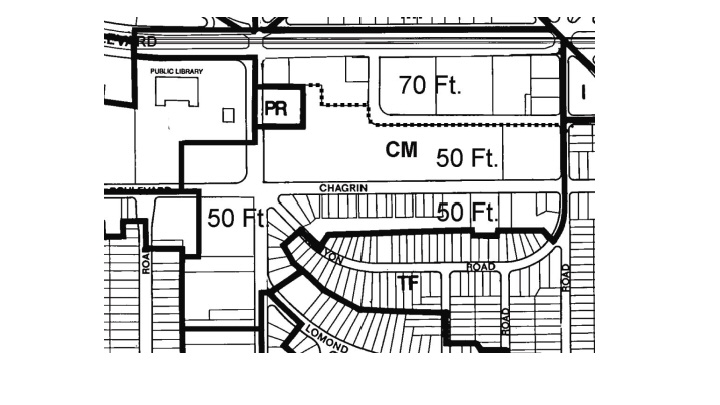
Chagrin/Lee Area CM Commercial Mixed Use District
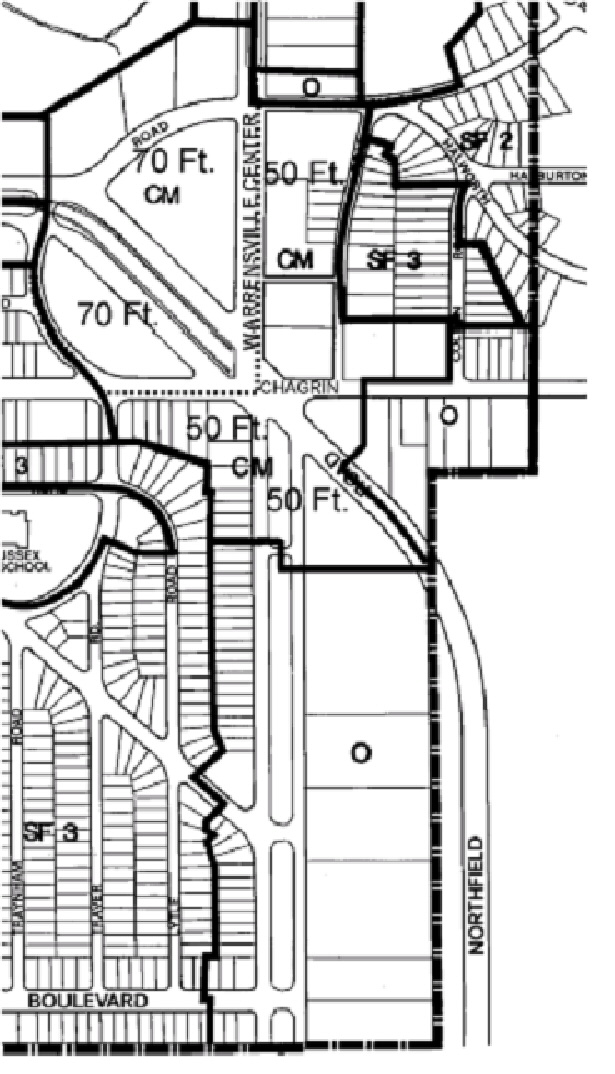
Figure 1234.08-B Maximum Height Requirements Van Aken/Warrensville Area CM Commercial Mixed Use District
(Ord. 13-16. Passed 5-28-13.)
1234.09 PARKING REQUIREMENTS.
A. General Requirements. Off-street parking and associated driveways shall conform to the parking requirements set forth in Chapter 1251, except as modified herein. Where there is a conflict between a provision in this section and a provision in Chapter 1251, the requirements of this Chapter shall prevail.
B. Modified Parking Standards:
1. Required parking may be reduced to 60% of the minimum required in Chapter 1251 when the City Planning Commission determines that, based on credible evidence provided by the applicant, certain factors such as, but not limited to, availability of transit, mix of land uses and shared parking options are likely to result in lower off-street parking demand than indicated by the requirements in Chapter 1251.
2. The maximum amount of parking provided shall not exceed 100% of the standards contained in Chapter 1251. The maximum provision shall not apply to park-and-ride facilities or other parking provided as part of a transit facility.
C. Location of Off-Street Parking Spaces. Off-street surface parking shall not be located between the façade of a building and the primary street. Parking shall be located to the side or rear of a building, and no more than 50% of the lot frontage along the primary street shall be devoted to parking or drives.
D. Compact Parking Spaces. Compact spaces are permitted subject to the following:
1. A maximum of ten percent (10%) of the spaces in any parking facility may be designated and labeled as compact car spaces.
2. Compact car parking spaces shall be designated with a sign.
E. Bicycle Parking. Bicycle parking facilities shall be provided according to Section 1251.13. Bicycle parking facilities shall be located so as to not interfere with pedestrian movement. (Ord. 13-16. Passed 5-28-13.)
1234.10 DESIGN STANDARDS AND PRINCIPLES.
All new development or redevelopment projects in the CM District shall be subject to the following design standards and principles.
A. Consistency with Transit Oriented Development (TOD) Plans. Where a TOD plan has been adopted by the City, the arrangement of land uses, public open spaces and streets should be consistent with the intent of that plan.
B. Building and Site Design.
1. Buildings and sites are encouraged to accommodate a mixture of uses permitted in this district. A mixture of uses is encouraged not just within the overall district, but on individual parcels and within individual buildings. High activity uses such as retail are encouraged on the first floor, with uses such as offices and residential encouraged on second floors.
2. Buildings shall be designed to respect the street context, to form street walls where appropriate, and to respect or create view corridors.
3. Buildings and sites shall be designed to emphasize pedestrian scale, human scale architecture, and landscaping, while avoiding large expanses of paved areas, large featureless buildings, and monotonous or franchise-style architecture. (See Figure 1234.10.)
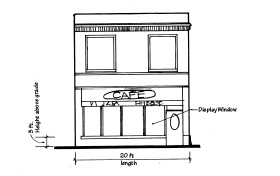
4. All sides of a building open to view by the public shall display a similar level of architectural quality, and shall be subdivided and proportioned using features such as windows, entrances, arcades, awnings, or other such features.
5. Wherever feasible, buildings shall be designed to provide massing configurations with a variety of different wall planes. Plain, monolithic structures with long monotonous walls and roof plane surfaces are prohibited.
6. Each building facade shall incorporate design elements for each 20 horizontal feet, such as changes in color or texture; projections, recesses, and reveals; arcades or pergolas providing pedestrian interest; or equivalent elements that subdivides the wall into human scale proportions.
7. First floor facades facing streets or pedestrian ways should incorporate large amounts (at least 60% of the facade) of clear windows that permit views into the interior of the building and/or product display areas.
8. Building facades shall have highly visible customer service entrances that feature canopies, overhangs, arcades, distinctive roof forms, arches, display windows, or landscaped features. Primary entrances should face, and be visible from the street on which they are located and shall be directly accessible and visible from the sidewalk.
9. Buildings shall have well defined rooflines with attention to architectural detail. Consideration should be given to the prevailing pattern of roofs in the area surrounding and within the district.
10. Sloping roofs, where used, shall have one or more of the following architectural features: gables, hips, horizontal or vertical breaks, or other similar techniques that are integrated into the building architecture.
11. Buildings shall be designed and arranged to define the public and private space with open views and surveillance for public areas and privacy for private areas.
C.Building Materials.
1. Building materials shall be limited to brick, masonry, stucco, wood, fiber cement siding, wood shingle, wood siding, cultured stone, or other similar materials.
2. Prohibited materials include vinyl siding, dryvit-type products on the lowest 8 feet of any structure, split faced block, aluminum or vinyl siding, and other similar materials.
D. Vehicular Circulation and Access.
1. Circulation systems shall be designed to efficiently facilitate traffic flow, yet designed to discourage speeds and volumes that impede pedestrian activity and safety.
2. Street designs are encouraged to incorporate traffic calming devices and techniques.
3. Common or shared access points are encouraged.
4. To the maximum extent feasible, common or shared service and delivery access shall be provided between adjacent parcels or buildings, and provided to the rear of buildings.
5. Safe and adequate sight distance shall be provided at all intersections, as provided in Section 1260.05.
6. Transit stops should be incorporated into site plans, where
feasible.
7. Traffic impact studies, when required by the Zoning Administrator, shall be provided as part of the site plan review process.
E. Pedestrian Access and Circulation.
1. A coordinated pedestrian system shall be provided throughout the development, including connections between uses on the site, and between the site and adjacent properties and rights-of-way. Pedestrian connections shall be provided to properties across streets wherever feasible.
2. The site shall be connected to adjacent properties and pedestrian facilities to the maximum extent feasible.
3. Continuous sidewalks or other pedestrian facilities shall be provided between the primary entrances to buildings, all parking areas that serve the buildings, pedestrian facilities on adjacent properties that extend to the boundaries shared with the development, any public sidewalk along perimeter streets, or other community amenities or gathering spaces.
4. Pedestrian-scale lighting fixtures shall be provided along all sidewalks and walkways to provide ample lighting during nighttime hours.
5. Decorative sidewalk materials, such as brick pavers, shall be provided at key intersections or streets.
6. Street furniture or other amenities are encouraged, such as plazas, benches, and decorative pedestrian light fixtures.
7. Open and public space should be provided as a mixture of green space landscaping and hardscape pedestrian areas:
a. Development proposals that involve a minimum of 1.5 acres or 60,000 square feet of floor area, whichever is less, should provide a minimum of 5% of the project site as public open space.
b. Residential buildings should provide 10% of the site area as open space.
F. Parking Lot Design and Layout.
1. The visual impact of off-street parking lots shall be minimized through the use of interior landscaped islands, and through dividing parking spaces into groupings.
2. The edges of parking lots shall be screened through landscaping or other methods such as decorative fences in accordance with Section 1253.08.
3. Semi-pervious paving materials, such as permeable pavers, porous asphalt or porous concrete, are encouraged so as to permit natural percolation of water. Such materials shall be installed and maintained in accordance with industry and manufacturer standards and the following:
a. The manufacturer's specifications are applicable to the subject property's particular soil type and slope (gradient) so that vehicles are supported without rutting and water percolation is achieved.
b. Semi-pervious parking areas must allow storm water to percolate into the ground at a rate sufficient to accommodate the five-year, 24-hour storm event.
c. For non-residential uses, if only a portion of the parking area is designated for semi-pervious materials, the area designated for semipervious parking shall be located at the perimeter of the parking lot, and if possible, remote or furthest removed from the principal building.
4. Parking structures shall be designed to be compatible with the adjacent buildings and district architecture and shall provide clearly marked pedestrian connections to the sidewalk.
G. Landscaping and Screening.
1. A landscaping plan shall be submitted for the entire site. The standards contained in Chapter 1253 are considered to be minimum standards for this district, with additional landscaping provided where needed to mitigate off-site visual impacts or to improve the internal landscaping on the site.
2. Landscaping shall be used to define public entrances using signature landscaping elements.
3. A year round visual screen shall be provided between the site and any adjacent single family uses, except where planned pedestrian connections are provided.
4. Entryways shall be planted with ornamental plant materials such as ornamental trees, flowering shrubs, and perennials, and ground covers.
5. Landscaping should be designed and constructed to promote on-site water management and infiltration through the use of native plants and porous landscape detention, swales, and filter strips.
H. Streetscape Improvements.
1. A Streetscape Plan shall be submitted for the entire site. The Streetscape Plan shall address the relationship between vehicular and pedestrian traffic, pedestrian facilities, street and sidewalk lighting, landscaping, street furniture, trash receptacles, and transit stops.
2. The design of streets, pedestrian ways, landscaping, lighting, and street furniture shall be coordinated and integrated throughout the site.
3. Vehicular streets and driveways shall be designed to be compatible with pedestrian ways to encourage a pedestrian friendly environment. The width of streets shall be sensitive to pedestrian scale, and shall be minimized to avoid overwhelming the pedestrian scale.
4. Site furnishings such as benches, seating, trash receptacles, bike racks, lighting fixtures, and tree grates shall be provided as part of the Streetscape Plan.
I. Service Area and Mechanical Screening.
1. The location of service areas and mechanical equipment shall be considered as part of the overall site design.
2. Services areas and mechanical equipment shall be screened from public view.
J. Signage. Fully dimensioned drawings, illustrations and details shall be submitted showing the type, location (including the placement of monument signs on the site plan and the placement of signs on buildings), size and materials of all signage, including letter style and type, face (color, material and thickness), returns, type of lighting, and brightness.
1. A master sign plan shall be prepared for coordinated developments and blocks of stores pursuant to Section 1250.09 Local Sign District Regulations to ensure cohesive overall signage for the area.
2. All signs should be of high quality design that provides strong visual interest with three dimensional design.
3. Wall signs:
a. Adequate wall space must be provided in a location that will allow the sign to function properly while also appear as if it "belongs" with the building.
b. Signs shall be comprised of individual letters. Cabinet and box signs are not permitted, however, painted signs made of wood, metal or similar material are permitted.
c. Indirect lighting is preferred.
4. Monument signs:
a. Monument signs should be placed in logical locations near the project's entrance.
b. Monument signs should be designed to relate to and complement the architectural design of the building(s) and other elements of development on the site, including sharing common design elements and building materials.
c. Monument signs with one sign face shall be finished on the "back" side and oriented parallel to the street.
d. Sign bases and cabinets shall be constructed of brick, stone, or metal.
e. Sign faces made of plastic and similar materials are not permitted.
f. Dark colored cabinets are preferred, white backgrounds are discouraged.
g. Adequate landscaping of a type and scale complementary to the overall landscape plan must be provided to integrate the sign into the site and provide a unified design.
5. Sign elements should create an overall cohesive design, reflect simplicity, avoid visual clutter and ensure legibility by adhering to the following guidelines:
a. Be consolidated into a minimum number of elements, whether words, symbols, or graphics.
b. Bright colors should be avoided or very limited in size and used as accents rather than predominant design elements.
c. White backgrounds are discouraged.
d. Signs should have a matte finish, and not have a glossy or reflective finish.
6. Only high quality, durable materials shall be used; Conventional plastic faced box, cabinet, or monument signs and formed plastic or injection molded plastic signs shall not be permitted.
7. Preferred materials and graphic elements include:
a. Mixed media signs incorporating multi-dimensional forms and combinations of colors, shapes, materials, and lighting;
b. Application of innovative technologies;
c. Dimensional letter forms with seamless edge treatments;
d. Reverse channel halo lettering;
e. Cut or fabricated steel, painted and finished;
f. Etched metal or glass, sandblasted glass;
g. Polished metal;
h. Screens, lattice, or mesh;
i. Glazed ceramic tile work forming patterns and/or fields;
j. Etched or carved stone;
k. Fiber optics; and
l. Silhouette illumination.
8. Lighting, if used to illuminate the sign, must be completely shielded from streets and pathways.
a. Light-reflecting backgrounds shall not be used but light-reflecting lettering or halo lighting may be used.
b. When lighting a wall sign the type of light fixture selected should complement the architectural style of the structure and the façade light fixtures and not be added solely to illuminate the sign.
c. Only sign letters and other items of information may be illuminated; illumination of sign backgrounds shall not be permitted.
K. Lighting.
1. A lighting plan shall be prepared, including a photometric illustration.
2. Lighting shall be designed to avoid spillover onto adjacent properties through the use of cutoff shields or other similar features.
L. Sustainability Guidelines. To the maximum extent practicable, new buildings are encouraged to incorporate one or more of the following features:
1. Low-Impact Development (LID) stormwater management features; designed for on-site stormwater mitigation through low impact development techniques as approved by the City Planning Commission.
2. Porous paving blocks and pervious paving materials are encouraged as material for parking lots and/or sidewalks.
3. Energy-efficient materials, including recycled materials that meet the requirements of this Code.
(Ord. 18-25. Enacted 4-23-18.)
1234.11 ALLOWABLE ENCROACHMENTS AND DISTANCE.
Allowable encroachments into the yards are listed in Table 1260.04, Allowable Encroachments. (Ord. 13-16. Passed 5-28-13.)
1234.12 SITE PLAN REVIEW.
No building permit may be issued without first adhering to the site plan review process set forth in Section 1213.06, Site Plan Review. Where there is a conflict between a provision in this Chapter and a provision in Section 1213.06, the requirements of this Chapter shall prevail.
(Ord. 13-16. Passed 5-28-13.)
Shaker Heights City Zoning Code
TITLE THREE
Commercial District Regulations
1230.01 PURPOSE.
The purpose of this district is to provide an environment for office and ancillary uses and facilities. This district should be located along major streets and function as a buffer between commercial and residential districts, where property size or other circumstances preclude commercial development adjacent to residential districts.
1230.02 LOCATION OF DISTRICT.
An O Office District should be located as a buffer between uses of substantially different character or intensity.
1230.03 PERMITTED USES.
The following are permitted uses in the O Office District, pursuant to any additional standards set forth herein.
A. Medical offices and clinics for the treatment and aid of humans.
B. Offices.
C. Parks and playgrounds, public.
D. Laboratories and Research Facilities, pursuant to Section 1263.15.
E. Limited Production/Processing Facilities, pursuant to Section 1263.15.
(Ord. 20-48. Enacted 6-22-20.)
1230.04 CONDITIONAL USES.
Conditional Uses are those uses having some special impact or uniqueness that requires a careful review of their location, design, configuration, and special impact to determine the desirability of permitting their establishment on any given site. Permits for Conditional Uses may be granted pursuant to the requirements of Section 1213.05, Conditional Uses. General Standards for conditional use permits are found in Section 1213.05.H, Standards for Conditional Use Permits. Standards for specific conditional uses may be found in Chapter 1263, Conditional Uses or elsewhere as referenced herein.
In order to provide an appropriate environment for office and ancillary uses and facilities, the following may be permitted only as Conditional Uses in the O Office District:
A. Assembly Halls.
B. Colleges.
C. Drive through facilities, pursuant to section 1263.10.
D. Libraries.
E. Mid-rise office development, pursuant to Section 1263.16.
F. Museums.
G. Places of Worship
H. Planned Unit Developments, pursuant to Section 1213.09, Planned Development Review and Chapter 1242, Planned Unit Development Overlay District.
I. Restaurants, sit-down.
J. Utilities (including substations, transmission facilities and related facilities).
(Ord. 18-25. Enacted 4-23-18.)
1230.05 ACCESSORY USES AND STRUCTURES.
A. All general standards for Accessory Uses and Structures and additional standards for specific Accessory Uses and Structures are found in Chapter 1262, Accessory Uses and Structures.
B. The following are permitted Accessory Uses and Structures in the O Office District:
1. Antennae, master radio, television and other telecommunications equipment, pursuant to Section 1262.02.
2. Day Care Centers, Child, pursuant to Section 1263.09.
4. Heating, ventilating and air conditioning equipment, motorized, pursuant to Section 1262.08.
5. Landscape features (including gardens, fountains, sidewalks, and lawns, but excluding fences and walls).
6. Loading, off-street, in rear yard only, pursuant to Chapter 1252, Off-Street Loading Regulations.
7. Maintenance, Storage, Utility and Waste Disposal Facilities, only if totally enclosed. Utility lines shall be entirely enclosed or buried for all new construction.
8. Ornamental Structures, in rear or side yard only, pursuant to Section 1262.10.
9. Outdoor Dining, accessory to a sit-down restaurant, located behind the building setback line, pursuant to Section 1262.11.
10. Parking, off-street, and Driveways, pursuant to Chapter 1251, Off-Street Parking Regulations.
11. Parking Structures, pursuant to Section 1262.11.
12. Recreational facilities, indoor, private.
13. Recreational structures, accessory to a Child Day Care Center, in rear yard only, pursuant to Section 1262.12.
14. Retail establishments including but not limited to bakeries, candy shops, clothing and shoe stores, camera and film processing shops, florists, jewelry stores, drug stores and gift shops.
15. Service establishments including but not limited to laundry and dry cleaning facilities, beauty salons and barber shops, travel agencies, shoe repair shops, banks and other financial institutions.
16. Signage, pursuant to Chapter 1250, Sign Regulations.
1230.06 MINIMUM LOT AREA.
The minimum lot area in the O Office District shall be fifteen thousand (15,000) square feet.
1230.07 MINIMUM LOT WIDTH.
A. Standard Requirement. The minimum lot width shall be one hundred (100) feet.
B. Mid-Rise Office Requirements. Standards for Mid-Rise Office developments are located in Section 1263.16, Mid-Rise Office Development.
1230.08 MINIMUM YARD REQUIREMENTS.
A. Front Yard. Each principal building shall have a front yard setback from the public right-of-way not less in depth than the setback line for its lot as shown on the zoning map. However, no front yard setback shall be less than one-half (1/2) the height of the principal building.
B. Side Yards.
1. General Requirements. Each side yard shall be no less than one-half (1/2) the height of the principal building. Mid-Rise Office standards are located in Section 1263.16, Mid-Rise Office Development.
2. Corner Lots. On a corner lot, the exterior side yard shall be no less than the greater of the following:
a. The required setback as shown on the zoning map
b. One-half (1/2) the height of the principal building
c. The standards for conditional use Mid-Rise Office developments as located in Section 1263.16, Mid-Rise Office Development.
3. Transitions With Residential Districts. Side yards abutting any residential district shall be no less than forty (40) feet. In addition to this increased setback, a landscaped buffer of at least five (5) feet shall also be provided.
C. Rear Yard. Each office development shall maintain a rear yard setback as follows:
1. General Requirements. The rear yard shall be no less than ten (10) feet.
2. Transitions with Residential Districts. Rear yards abutting any residential district shall be no less than forty (40) feet and shall include an appropriate landscape buffer. For rear lot lines which abut a SF or TF district, such buffer shall be a minimum of twenty (20) feet in width.
1230.09 MINIMUM LANDSCAPED AREA.
Grassy yards and landscaped areas shall total no less than twenty percent (20%) of the lot area. This required amount of landscaping may include required yards, lawns, patios, rooftop gardens and parking garage roofs which are covered and maintained with earth and grass or other suitable landscaping features.
1230.10 MAXIMUM HEIGHT.
A. Principal Buildings. The maximum height of a principal structure in the O Office District shall not exceed thirty-five (35) feet above finished grade.
B. Mid-rise Office Conditional Use. Standards for conditional use Mid-Rise Office Development are located in Section 1263.16, Mid-Rise Office Development.
C. Relationship to Lot Width. No building shall be higher than twice the width of the lot on which the building is located.
D. Rooftop Mechanical Equipment. Rooftop mechanical housing and equipment may extend up to ten (10) feet above the maximum height limit and shall be designed as an integral part of the principal building or concealed with similar architectural treatment and materials as the exterior of the building.
E. Accessory Uses and Structures.
1. General Requirements. Pursuant to Chapter 1262,, Accessory Uses and Structures.
2. Mid-rise Office Conditional Use. Standards for conditional use Mid-Rise Office development are located in Section 1263.16, Mid-Rise Office Development.
1230.11 MAXIMUM LOT COVERAGE.
The surface coverage of all above grade structures on a lot shall be no greater than sixty percent (60%) of the lot area.
1230.12 LOCATION OF ACCESSORY USES AND STRUCTURES IN REQUIRED YARDS.
The location of Accessory Uses and Structures in required yards shall be regulated pursuant to Chapter 1262, Accessory Uses and Structures.
1230.13 ALLOWABLE ENCROACHMENTS AND DISTANCE.
Allowable encroachments into the yards are listed in Table 1260.04, Allowable Encroachments.
1230.14 SITE PLAN REVIEW.
No building permit may be issued without first adhering to the site plan review standards set forth in Section 1213.06, Site Plan Review. Additionally, the following requirements shall be observed:
A. The location, relation and separation of uses and buildings shall be designed and constructed so as to provide compatible utilization and functioning of all uses.
B. The principal buildings shall be separated from other site uses according to the following schedule:
1. Accessory Buildings = Ten (10) feet unless attached.
2. Other principal buildings = Twenty (20) feet unless attached.
C. Maintenance, utility, and waste disposal facilities must be located entirely within a principal building or parking structure.
1231.01 PURPOSE.
The purpose of this district is to accommodate small scale retail and service activities serving the convenience commercial needs of the surrounding neighborhoods while protecting the immediate neighborhood from adverse effects. This district shall also apply to those locations, such as rapid transit stops, which are particularly suited to limited retail development.
1231.02 PERMITTED USES.
The following are permitted uses in the C1 Limited Commercial District, pursuant to any additional standards set forth herein.
A. Art galleries and artists’ studios.
B. Bakeries, retail or wholesale.
C. Offices.
D. Parks and playgrounds, public.
E. Retail establishments including but not limited to bakeries, candy shops, clothing and shoe stores, camera and film processing shops, florists, jewelry stores, drug stores and gift shops.
F. Service establishments including but not limited to laundry and dry cleaning facilities, beauty salons and barber shops, travel agencies, shoe repair shops, banks and other financial institutions.
1231.03 CONDITIONAL USES.
Conditional Uses are those uses having some special impact or uniqueness that requires a careful review of their location, design, configuration, and special impact to determine the desirability of permitting their establishment on any given site. Permits for Conditional Uses may be granted pursuant to the requirements of Section 1213.05, Conditional Uses. General standards for conditional use permits are found in Section 1213.05.H, Standards for Conditional Use Permits. Standards for specific conditional uses may be found in Chapter 1263, Conditional Uses, or elsewhere as referenced herein.
In order to accommodate small scale retail and service activities serving the convenience
commercial needs of the surrounding neighborhoods while protecting the immediate neighborhood from adverse effects, the following may be permitted only as Conditional Uses in the C1 Limited Commercial District:
A. Day Care Centers, Adult, pursuant to Section 1263.08.
B. Day care centers, Child, pursuant to Section 1263.09.
C. Drive-through Facilities, pursuant to Section 1263.10.
D. Dwelling units located above the first floor, pursuant to Section 1263.11.
E. Entertainment, live, accessory to a sit-down restaurant.
F. Government offices.
G. Libraries.
H. Museums.
I. Planned Unit Developments pursuant to Section 1213.09, Planned Development Review and Chapter 1242, Planned Unit Development Overlay District.
J. Restaurants, sit-down.
K. Utilities (including substations, transmission facilities and related facilities).
L. Similar uses approved by the City Planning Commission and City Council pursuant to Section.D.2.
(Ord. 18-25. Enacted 4-23-18.)
1231.04 ACCESSORY USES AND STRUCTURES.
A. All general standards for Accessory Uses and Structures and additional standards for specific Accessory Uses and Structures are found in Chapter 1262, Accessory Uses and Structures.
B. The following are permitted Accessory Uses and Structures in the C1 Limited Commercial District:
1. Amusement devices, as defined by the Business Regulation Code, limited to two (2).
2. Antennae, master radio, television and other telecommunications equipment, pursuant to Section 1262.02.
3. Antennae, single, roof-mounted or in rear yard only, pursuant to Section 1262.02.
5. Heating, ventilating and air conditioning equipment, motorized, pursuant to Section 1262.08.
6. Landscape features (including gardens, fountains, sidewalks, and lawns, but excluding fences and walls).
7. Loading, off-street, pursuant to Chapter 1252, Off-Street Loading Regulations.
8. Maintenance, Storage, Utility and Waste Disposal Facilities, only if totally enclosed. Utility lines shall be entirely enclosed or buried for all new construction.
9. Ornamental Structures, in rear or side yard only, pursuant to Section 1262.10.
10. Outdoor Dining, accessory to a sit-down restaurant, located behind the building setback line, pursuant to Section
11. Parking, off-street, and Driveways, pursuant to Chapter 1251, Off-Street Parking Regulations.
12. Recreational structures, accessory to a Child Day Care Center, in rear yard only, pursuant to Section 1262.12.
13. Signage, pursuant to Chapter 1250, Sign Regulations.
1231.05 MINIMUM LOT AREA.
None.
1231.06 MINIMUM AREA PER DWELLING UNIT.
Dwelling unit size shall be as per Section 1225.05, A Apartment District, Minimum Area Per Dwelling Unit.
1231.07 MINIMUM LOT WIDTH.
The minimum lot width in the C1 Limited Commercial District shall be forty (40) feet.
1231.08 MINIMUM YARD REQUIREMENTS.
A. Front Yard. Each principal building shall have a front yard setback from the public right-of-way not less in depth than the setback line for its lot as shown on the zoning map.
B. Side Yards.
1. General Requirements. Each side yard shall be no less than one-fourth (1/4) the height of the principal building.
2. Corner Lots. On a corner lot, the exterior side yard shall be no less than the required setback as shown on the zoning map.
3. Transitions With Residential Districts. Side yards abutting any residential district shall be no less than twenty (20) feet. In addition to this increased setback, a landscaped buffer of at least ten (10) feet shall also be provided and shall include a solid brick wall of at least six (6) feet in height, pursuant to Section 1253.09.B, Buffers for Commercial Uses.
C. Rear Yard.
1. General Requirements. The rear yard shall be no less than forty (40) feet.
2. Transitions with Residential Districts. Rear yards abutting any residential district shall be no less than forty (40) feet and shall include an appropriate landscape buffer. For rear lot lines which abut a SF or TF district, such buffer shall be a minimum of ten (10) feet in width and shall include a solid brick wall of at least six (6) feet in height, pursuant to Section 1253.09.B, Buffers for Commercial Uses.
1231.09 MINIMUM LANDSCAPED AREA.
Grassy yards and landscaped areas shall total no less than twenty percent (20%) of the lot area. This required amount of landscaping may include required yards, lawns, patios, rooftop gardens and parking garage roofs which are covered and maintained with earth and grass or other suitable landscaping features.
1231.10 MAXIMUM HEIGHT.
A. Building Height. The maximum height of a principal structure in the C1 Limited Commercial District shall not exceed thirty-five (35) feet.
B. Rooftop Mechanical Equipment. Rooftop mechanical housing and equipment may extend up to ten (10) feet above the maximum height limit and shall be designed as an integral part of the principal building or concealed with similar architectural treatment and materials as the exterior of the building.
C. Accessory Uses and Structures. The maximum height of Accessory Uses and Structures shall be regulated pursuant to Chapter 1262, Accessory Uses and Structures.
1231.11 MAXIMUM LOT COVERAGE.
The surface coverage of all above grade structures on a lot shall be no greater than forty percent (40%) of the lot area.
1231.12 LOCATION OF ACCESSORY USES AND STRUCTURES IN REQUIRED YARDS.
The location of Accessory Uses and Structures in required yards shall be pursuant to Chapter 1262, Accessory Uses and Structures.
1231.13 ALLOWABLE ENCROACHMENTS AND DISTANCE.
Allowable encroachments into the yards are listed in Table 1260.04, Allowable Encroachments.
1231.14 SITE PLAN REVIEW.
No building permit may be issued without first adhering to the site plan review standards set forth in Section 1213.06, Site Plan Review. Additionally, the following requirements shall be observed:
A. The location, relation and separation of uses and buildings shall be designed and constructed so as to provide compatible utilization and functioning of all uses.
B. The principal buildings shall be separated from other site uses according to the following schedule:
1. Accessory Buildings = Ten (10) feet unless attached.
2. Other principal buildings = Ten (10) feet unless attached.
C. Maintenance, utility, and waste disposal facilities must be located entirely within a principal building or parking structure.
1232.01 PURPOSE.
The purpose of this district to maintain and promote a mix of commercial uses which provide goods and services for the City as a whole and for the convenience of residents of the surrounding neighborhood. This district also accommodates limited multiple-family housing when combined with commercial uses on the ground floor. The development standards and range of allowable uses in this district are designed to maintain a pedestrian oriented environment.
1232.02 PERMITTED USES.
The following are permitted uses in the C2 General Commercial District, pursuant to any additional standards set forth herein.
A. Art galleries and artists’ studios.
B. Bakeries, retail or wholesale.
C. Dry cleaners with plants.
D. Government offices.
E. Job printing and newspaper printing not to exceed ten thousand (10,000) square feet..
F. Medical offices and clinics for the treatment and aid of humans.
G. Offices.
H. Parks and playgrounds, public.
I. Restaurants, carry-out.
J. Restaurants, sit-down.
K. Retail establishments including but not limited to bakeries, candy shops, clothing and shoe stores, camera and film processing shops, florists, jewelry stores, drug stores and gift shops.
L. Service establishments including but not limited to laundry and dry cleaning facilities, beauty salons and barber shops, travel agencies, shoe repair shops, and banks and other financial institutions.
1232.03 CONDITIONAL USES.
Conditional Uses are those uses having some special impact or uniqueness that requires a careful review of their location, design, configuration, and special impact to determine the desirability of permitting their establishment on any given site. Permits for Conditional Uses may be granted pursuant to the requirements of Section 1213.05, Conditional Uses. General standards for conditional use permits are found in Section 1213.05.H, Standards for Conditional Use Permits. Standards for specific conditional uses may be found in Chapter 1263, Conditional Uses, or elsewhere as referenced herein.
In order to promote a mix of commercial uses which provide goods and services for the City as a whole and for the convenience of residents of the surrounding neighborhood, the following may be permitted only as Conditional Uses in the C2 General Commercial District:
A. Amusement devices, as defined by the Business Regulation Code, in excess of two (2), pursuant to Section 1263.01.
B. Animal Hospitals and Veterinarians' Offices, pursuant to Section 1263.02.
C. Assisted Living Facilities, pursuant to Section 1263.04.
D. Automotive fuel stations, with or without convenience retail, pursuant to Section 1263.05.
E. Automotive rental and leasing, pursuant to Section 1263.05.
F. Automotive sales, including repair and storage of automobiles, pursuant to Section 1263.05.
G. Automotive service and repair shops, pursuant to Section 1263.05.
H. Band Shells and Amphitheaters, pursuant to Section 1263.06.
Z. Utilities (including substations, transmission facilities and related facilities).
AA. Similar uses approved by the City Planning Commission and City Council pursuant to Section 1213.05.D.2.
(Ord. 18-25. Enacted 4-23-18.)
1232.04 ACCESSORY USES AND STRUCTURES.
A. All general standards for Accessory Uses and Structures and additional standards for specific Accessory Uses and Structures are found in Chapter 1262, Accessory Uses and Structures.
B. The following are permitted Accessory Uses and Structures in the C2 General Commercial District:
1. Amusement devices, as defined by the Business Regulation Code, limited to two (2).
2. Antennae, master radio, television and other telecommunications equipment, pursuant to Section 1262.02.
3. Antennae, single, roof-mounted or in rear yard only, pursuant to Section 1262.02.
4. Entertainment, live, accessory to a sit-down restaurant.
6. Heating, ventilating and air conditioning equipment, motorized, pursuant to Section 1262.08.
7. Landscape features (including gardens, fountains, sidewalks, and lawns, but excluding fences and walls).
8. Loading, off-street, pursuant to Chapter 1252, Off-Street Loading Regulations.
9. Maintenance, Storage, Utility and Waste Disposal Facilities, only if totally enclosed. Utility lines shall be entirely enclosed or buried for all new construction.
10. Ornamental Structures, in rear or side yard only, pursuant to Section 1262.10.
11. Outdoor Dining, accessory to a sit-down restaurant, located behind the building setback line, pursuant to Section 1262.11.
12. Parking, off-street, and Driveways, pursuant to Chapter 1251, Off-Street Parking Regulations.
13. Parking Structures, pursuant to Section 1262.12.
14. Recreational Structures, accessory to a Child Day Care Center, in rear yard only, pursuant to Section 1262.13.
15. Signage, pursuant to Chapter 1250, Sign Regulations.
16. Storage of privately owned commercial trucks, accessory to the primary use, pursuant to Section 1262.15.
1232.05 MINIMUM LOT AREA.
A. General Requirements. The minimum lot area in the C2 General Commercial District shall be seven thousand five hundred (7,500) square feet.
B. Automotive Uses.
1. Automobile Dealerships. Automobile dealerships in the C2 District shall be located on lots no smaller than eighty-five thousand (85,000) square feet.
2. Automotive Fuel Stations with Convenience Retail or Food Sales. Automotive Fuel Stations with Convenience Retail or Food Sales in the C2 District shall be located on lots no smaller than thirty thousand (30,000) square feet.
3. Automotive Fuel Stations without Convenience Retail or Food Sales. Automotive Fuel Stations without Convenience Retail or Food Sales in the C2 District shall be located on lots no smaller than fifteen thousand (15,000) square feet.
1232.06 MINIMUM AREA PER DWELLING UNIT.
Minimum area per dwelling unit shall be regulated pursuant to Section 1225.05(b), Minimum Area Per Dwelling Unit.
1232.07 MINIMUM LOT WIDTH.
The minimum lot width in the C2 General Commercial District shall be forty (40) feet.
1232.08 MINIMUM YARD REQUIREMENTS.
A. Front Yard. Each principal building shall have a front yard setback from the public right-of-way no less in depth than the setback line for its lot as shown on the zoning map. However, no front yard setback shall be less than one-half (1/2) of the height of the principal building. Any lot in the C2 District shall have, at its setback line as described above, either the principal building or an architectural element, pursuant to Section 1232.14.B, Architectural Element at Setback Line.
B. Side Yards.
1. General Requirements. Each side yard shall be no less than one-third (1/3) the height of the principal building however, no side yard shall be less than five (5) feet, except as otherwise provided below.
2. Corner Lots. On a corner lot, the exterior side yard shall be no less than the required setback as shown on the zoning map.
3. Transitions With Residential Districts. Side yards abutting any residential district shall be no less than twenty (20) feet. In addition to this increased setback, a landscaped buffer of at least ten (10) feet shall also be provided and shall include a solid brick wall of at least six (6) feet in height, pursuant to Section 1253.09.B, Buffers for Commercial Uses.
4. Side Yard Exceptions. Where side yards abut the side yards of other commercially zoned lots, the Board of Zoning Appeals may waive the requirement for a minimum side yard setback.
C. Rear Yard.
1. General Requirements. The rear yard shall be no less than twenty (20) feet.
2. Transitions with Residential Districts. Rear yards abutting any residential district shall be no less than forty (40) feet. In addition to this increased setback, a landscaped buffer of at least twenty (20) feet shall also be provided and shall include a solid brick wall of at least six (6) feet in height, pursuant to Section 1253.09.B, Buffers for Commercial Uses.
1232.09 MINIMUM LANDSCAPED AREA.
The minimum amount of landscaped area shall be no less than twenty percent (20%) of lot area.
1232.10 MAXIMUM HEIGHT.
A. Building Height. The maximum height of a principal structure in the C2 General Commercial district shall not exceed forty (40) feet above finished grade.
B. Rooftop Mechanical Equipment. Rooftop mechanical housing and equipment may extend up to ten (10) feet above the maximum height limit and shall be designed as an integral part of the principal building or concealed with similar architectural treatment and materials as the exterior of the building.
C. Accessory Uses and Structures. The maximum height of Accessory Uses and Structures shall be regulated pursuant to Chapter 1262, Accessory Uses and Structures.
1232.11 MAXIMUM LOT COVERAGE.
None.
1232.12 LOCATION OF ACCESSORY USES AND STRUCTURES IN REQUIRED YARDS.
The location of Accessory Uses and Structures in required yards shall be regulated pursuant to Chapter 1262, Accessory Uses and Structures.
1232.13 ALLOWABLE ENCROACHMENTS AND DISTANCE.
Allowable encroachments into the yards are listed in Table 1260.04, Allowable Encroachments.
1232.14 SITE PLAN REVIEW.
No building permit may be issued without first adhering to the site plan review standards set forth in Section 1213.06, Site Plan Review. Additionally, the following requirements shall be observed:
A. Building Separation. The location, relation and separation of uses and buildings shall be designed and constructed so as to provide compatible utilization and functioning of all uses. The principal building shall be separated from other uses according to the following schedule:
1. Accessory Buildings = Ten (10) feet unless attached.
2. Other Principal Buildings = Twenty (20) feet unless attached.
B. Architectural Element at Setback Line. When an architectural element is located at the minimum setback line in lieu of the principal building, as permitted in Section 1232.08.A, such element shall be reflective of the building’s facade materials and details. Architectural elements shall be a minimum of three (3) feet in height.
C. Maintenance, utility, and waste disposal facilities. These facilities must be located entirely within a principal building or parking structure, or totally enclosed in a six (6) foot brick wall with a solid gate in the rear yard.
1233.01 PURPOSE.
The purpose of this district is to provide an environment for a range of business enterprises such as small scale research, distributing and technical uses that do not produce environmental impacts or nuisances or otherwise create nuisances which could impact nearby residential development.
1233.02 PERMITTED USES.
The following are permitted uses in the C3 Business Commercial District, pursuant to any additional standards set forth herein.
A. Art galleries and artists’ studios.
B. Bakeries, retail or wholesale.
C. Dry cleaners with plants.
D. Fire and police stations.
E. Government offices.
F. Job printing and newspaper printing.
G. Medical offices and clinics for the treatment and aid of humans.
H. Municipal service uses.
I. Offices.
J. Parks and playgrounds, public.
K. Retail establishments including but not limited to bakeries, candy shops, clothing and shoe stores, camera and film processing shops, florists, jewelry stores, drug stores and gift shops.
L. Service establishments including but not limited to laundry and dry cleaning facilities, beauty salons and barber shops, travel agencies, shoe repair shops, and banks and other financial institutions.
1233.03 CONDITIONAL USES.
Conditional Uses are those uses having some special impact or uniqueness that requires a careful review of their location, design, configuration, and special impact to determine the desirability of permitting their establishment on any given site. Permits for Conditional Uses may be granted pursuant to the requirements of Section 1213.05, Conditional Uses. General standards for conditional use permits are found in Section 1213.05.H, Standards for Conditional Use Permits. Standards for specific conditional uses may be found in Chapter 1263, Conditional Uses, or elsewhere as referenced herein.
In order to control the potential negative impacts of business enterprises on the community, the following may be permitted as Conditional Uses in the C3 Business Commercial District:
A. Amusement devices, as defined by the Business Regulation Code, in excess of two (2), pursuant to Section 1263.01.
B. Animal Hospitals and Veterinarians' Offices, pursuant to Section 1263.02.
C. Assembly of finished goods, pursuant to Section 1263.03.
D. Automotive fuel stations, with or without convenience retail, pursuant to Section 1263.05.
E. Automotive rental and leasing, pursuant to Section 1263.05.
F. Automotive sales, including repair and storage of automobiles, pursuant to Section 1263.05.
G. Automotive service and repair shops, pursuant to Section 1263.05.
S. Outdoor Storage, accessory to a permitted use, in rear yard; only, pursuant to Section 1253.09.B, Buffers for Commercial Uses, and Section 1263.17, Outdoor Storage.
T. Packaging of finished goods, pursuant to Section 1263.03.
U. Planned Unit Developments pursuant to Section 1213.09, Planned Development Review and Chapter 1242, Planned Unit Development Overlay District.
V. Recreational facilities, indoor, public or private.
W. Research Facilities, pursuant to Section 1263.15.
X. Schools, Primary and Secondary, Private, pursuant to Section 1263.20.
Y. Schools Specialized Instructional, pursuant to Section 1263.21.
Z. Self Storage Facilities, pursuant to Section 1263.22.
BB. Utilities (including substations, transmission facilities and related facilities).
CC. Similar uses approved by the City Planning Commission and City Council pursuant to Section 1213.05.D.2.
(Ord. 18-25. Enacted 4-23-18.)
1233.04 ACCESSORY USES AND STRUCTURES.
A. All general standards for Accessory Uses and Structures and additional standards for specific Accessory Uses and Structures are found in Chapter 1262, Accessory Uses and Structures.
B. The following are permitted Accessory Uses and Structures in the C3 Business Commercial District:
1. Amusement devices, as defined by the Business Regulation Code, limited to two (2).
2. Antennae, master radio, television and other telecommunications equipment, pursuant to Section 1262.02.
4. Heating, ventilating and air conditioning equipment, motorized, pursuant to Section 1262.08.
5. Landscape features (including gardens, fountains, sidewalks, and lawns, but excluding fences and walls).
6. Loading, off-street, in rear yard only, pursuant to Chapter 1252, Off-Street Loading Regulations.
7. Maintenance, Storage, Utility and Waste Disposal Facilities, only if totally enclosed. Utility lines shall be entirely enclosed or buried for all new construction.
8. Ornamental Structures, in rear or side yard only, pursuant to Section 1262.10.
9. Parking, off-street, and Driveways, pursuant to Chapter 1251, Off-Street Parking Regulations.
10. Parking Structures, pursuant to Section 1262.12.
11. Recreational Structures, accessory to a Child Day Care Center, in rear yard only.
12. Signage, pursuant to Chapter 1250, Sign Regulation
13. Truck storage and storage of vehicles, pursuant to Section 1253.09, Landscape Buffers and Screening, and Section 1262.15, Storage of Vehicles.
14. Warehousing.
15. Wholesale use.
1233.05 MINIMUM LOT AREA.
A. General Requirements.
1. For lots created prior to the effective date of this Zoning Ordinance, the minimum lot area shall be six thousand (6,000) square feet.
2. For lots created after the effective date of this Zoning Ordinance, the minimum lot area shall be twelve thousand (12,000) square feet.
B. Automotive Uses.
1. Automobile Dealerships. Automobile dealerships in the C3 District shall be located on lots no smaller than eighty-five thousand (85,000) square feet.
2. Automotive Fuel Stations with Convenience Retail or Food Sales. Automotive Fuel Stations with Convenience Retail or Food Sales in the C3 District shall be located on lots no smaller than thirty thousand (30,000) square feet.
3. Automotive Fuel Stations without Convenience Retail or Food Sales. Automotive Fuel Stations without Convenience Retail or Food Sales in the C3 District shall be located on lots no smaller than fifteen thousand (15,000) square feet.
1233.06 MINIMUM LOT WIDTH.
A. For lots created prior to the effective date of this Zoning Ordinance, the minimum lot width shall be forty (40) feet.
B. For lots created after the effective date of this Zoning Ordinance, the minimum lot width shall be eighty (80) feet.
1233.07 MINIMUM YARD REQUIREMENTS.
A. Front Yard. Each principal building shall have a front yard setback from the public right-of-way no less in depth than the setback line for its lot as shown on the zoning map. However, no front yard setback shall be less than one-half (1/2) of the height; of the principal building. Any lot in the C3 Business Commercial District shall have, at its setback line as described above, either the principal building or an architectural element, pursuant to Section 1233.13.B, Architectural Element at Setback Line.
B. Side Yards.
1. General Requirements. Each side yard shall be no less than one-third (1/3) the height of the principal building however, no side yard shall be less than five (5) feet, except as otherwise provided below.
2. Corner Lots. On a corner lot, the exterior side yard shall be no less than the required setback as shown on the zoning map.
3. Transitions With Residential Districts. Side yards abutting any residential district shall be no less than twenty (20) feet. In addition to this increased setback, a landscaped buffer of at least ten (10) feet shall also be provided and shall include a solid brick wall of at least six (6) feet in height, pursuant to Section 1253.09.B, Buffers for Commercial Uses.
4. Side Yard Exceptions. Where side yards abut the side yards of other commercially zoned lots, the Board of Zoning Appeals may waive the requirement for a minimum side yard setback.
C. Rear Yard.
1. General Requirements. The rear yard shall be no less than twenty (20) feet.
2. Transitions with Residential Districts. Rear yards abutting any residential district shall be no less than forty (40) feet. In addition to this increased setback, a landscape buffer of at least twenty (20) feet shall also be provided and shall include a solid brick wall of at least six (6) feet in height, pursuant to Section 1253.09.B, Buffers for Commercial Uses.
1233.08 MINIMUM LANDSCAPED AREA.
The minimum amount of landscaped area shall be no less than twenty percent (20%) of the lot area.
1233.09 MAXIMUM HEIGHT.
A. Building Height. The maximum building height in the C3 Business Commercial District shall be thirty-five (35) feet or two and one-half (2 1/2) stories, whichever is less.
B. Rooftop Mechanical Equipment. Rooftop mechanical housing and equipment may extend up to ten (10) feet above the maximum height limit and shall be designed as an integral part of the principal building or concealed with similar architectural treatment and materials as the exterior of the building.
C. Accessory Uses and Structures. The maximum height of Accessory Uses and Structures shall be regulated pursuant to Chapter 1262, Accessory Uses and Structures.
1233.10 MAXIMUM LOT COVERAGE.
The surface coverage of all above grade structures on a lot shall be no greater than fifty percent (50%) of the lot area.
1233.11 LOCATION OF ACCESSORY USES AND STRUCTURES IN REQUIRED YARDS.
The location of Accessory Uses and Structures in required yards shall be regulated pursuant to Chapter 1262, Accessory Uses and Structures.
1233.12 ALLOWABLE ENCROACHMENTS AND DISTANCE.
Allowable encroachments into the yards are listed in Table 1260.04, Allowable Encroachments.
1233.13 SITE PLAN REVIEW.
No building permit may be issued without first adhering to the site plan review standards set forth in Section 1213.06, Site Plan Review. Additionally, the following requirements shall be observed:
A. Building Separation. The location, relation and separation of uses and buildings shall be designed and constructed so as to provide compatible utilization and functioning of all uses. The principal building shall be separated from other uses according to the following schedule:
1. Accessory Buildings = Ten (10) feet unless attached.
2. Other Principal Buildings = Twenty (20) feet unless attached.
B. Architectural Element at Setback Line. When an architectural element is located at the minimum setback line in lieu of the principal building, as permitted in Section 1233.07.A, such element shall be reflective of the building’s façade materials and details. Architectural elements shall be a minimum of three (3) feet in height.
C. Off-Street Parking Buffers. All parking lots located within the front yard setback shall be buffered from view by roadside traffic pursuant to Section 1253.08, Parking Lot Landscaping.
1234.01 PURPOSE.
The purpose of this district is to encourage a compact mix of retail, service, office, housing and public activities to coexist in a manner that reflects human scale and emphasizes pedestrian orientation, taking advantage of the convenience provided by multi-modal transportation options and the vitality that mixed uses can bring to a community. CM Commercial Mixed Use Districts ("CM Districts") can serve both local and regional commercial needs, while reflecting the scale and character of Shaker Heights in a manner which protects adjacent areas from any adverse effects.
The regulations for this district are intended to create areas of concentrated development around key transit stops in order to:
A. Create dense, walkable, mixed-use centers wherein daily goods and services and employment opportunities are located within walking distances of residents.
B. Improve the pedestrian environment through building orientation, attractive building facades, and pedestrian amenities.
C. Expand residential and lifestyle options with increased mobility choices.
D. Enhance the overall quality of life of Shaker Heights' residents, businesses and visitors by creating great places.
E. Take advantage of the benefits of transit, including the value that transit services add to adjacent and surrounding real estate, and increase the physical and cultural prominence of transit in the community.
G. Ensure that new development or redevelopment occurs in a unified manner consistent with transit-oriented development (TOD) plan(s) adopted by the City.
(Ord. 13-16. Passed 5-28-13.)
1234.02 PERMITTED USES.
The following are permitted uses in the CM District, pursuant to any additional standards set forth herein.
A. Art galleries and artist studios, provided that when located on the first floor, the area devoted to public display and retail sales of products is not less than 50% of the area of the first floor devoted to such use.
B. Business services, including but not limited to copying, desktop publishing, photographic services, and other similar uses.
C. Dwelling units located above the first floor
D. Government office buildings, libraries, museums.
E. Offices, including professional offices, medical offices and clinics for the treatment and aid of humans.
F. Public space.
G. Restaurants, including sit-down and carry-out establishments.
H. Retail sales, including but not limited to food and beverage stores, clothing and shoe stores, camera and film processing shops, florists, jewelry stores, drug stores, furniture and home furnishings, books, periodicals, music, office supplies, hardware, video stores, sporting goods and hobbies, gift shops, and other similar uses.
I. Personal service establishments, including but not limited to laundry and dry cleaning facilities, beauty salons and barber shops, travel agencies, shoe repair shops, banks and other financial institutions.
(Ord. 13-16. Passed 5-28-13.)
1234.03 CONDITIONAL USES.
Conditional Uses are those uses having some special impact or uniqueness that requires a careful review of their location, design, configuration, and special impact to determine the desirability of permitting their establishment on any given site. Permits for Conditional Uses may be granted pursuant to the requirements of Section 1213.05, Conditional Uses. General standards for conditional use permits are found in Section 1213.05 H, Standards for Conditional Use Permits. Standards for specific conditional uses may be found in Chapter 1263, Conditional Uses, or elsewhere as referenced herein.
All conditional uses shall meet the design standards and principles in Section 1234.10 as well as additional standards set forth herein.
In order to control the mixture and locations of uses in this district, the following may be permitted only as Conditional Uses in the CM District:
A. Amusement devices, as defined by the Business Regulation Code, in excess of two, pursuant to Section 1263.01.
B. Animal hospitals and veterinarian's offices, pursuant to Section 1263.02.
C. Assembly of finished goods and packaging of finished goods, pursuant to Section 1263.03.
D. Assisted living facilities, pursuant to Section 1263.04.
E. Band shells and amphitheaters, pursuant to Section 1263.06.
F. Convalescent, nursing or rest homes, pursuant to Section 1263.04.
G. Day care centers, adult, pursuant to Section 1263.07.
H. Day care centers, child, pursuant to Section 1263.08.
I. Drive-through facilities, pursuant to Section 1263.10.
J. Dwelling, multiple family, provided that the area devoted to first floor residential uses does not exceed 40% of the total first floor area of the buildings in the district.
K. Fire and police stations, pursuant to Section 1263.12.
Y. Similar uses approved by the City Planning Commission and City Council pursuant to Section 1213.05 D.2.
(Ord. 18-25. Enacted 4-23-18.)
1234.04 ACCESSORY USES AND STRUCTURES.
All general standards for Accessory Uses and Structures and additional standards for specific Accessory Uses and Structures are found in Chapter 1262, Accessory Uses and Structures. The following are permitted Accessory Uses and Structures in the CM District, pursuant to any additional standards set forth herein.
A. Amusement devices, as defined by the Business Regulation Code, limited to two (2).
B. Antennae, master radio, television and other telecommunications equipment, pursuant to Section 1262.02.
C. Antennae, single, roof-mounted or in rear yard only, pursuant to Section 1262.02.
D. Entertainment, live, accessory to a permitted or conditionally permitted use.
F. Heating, ventilating and air conditioning equipment, motorized, pursuant to Section 1262.08.
G. Landscape features (including gardens, fountains, sidewalks, and lawns, but excluding fences and walls).
H. Loading, off-street, in rear yard only, pursuant to Chapter 1252, Off-Street Loading Regulations.
I. Maintenance, storage, utility and waste disposal facilities, only when totally enclosed.
J. Ornamental structures, in rear or side yard only, pursuant to Section 1262.10.
K. Outdoor dining, accessory to a sit-down restaurant, pursuant to Section 1262.11.
L. Parking, off-street, and driveways.
M. Parking structures, pursuant to Section 1262.12.
N. Recreational structures, accessory to a child day care center, in rear yard only, pursuant to Section 1262.13.
O. Signage, pursuant to Chapter 1250, Sign Regulations.
(Ord. 13-16. Passed 5-28-13.)
1234.05 USE REQUIREMENTS FOR LARGE PARCEL DEVELOPMENT.
A. Development proposals that involve at least 1.5 acres or 60,000 square feet of floor area, whichever is less, shall:
1. Include a mix of retail, office, residential or civic uses, so that no one use category exceeds 90% of the total floor area of the proposal.
2. A minimum of 50% of the linear first floor building frontage along primary streets shall be designed for retail, restaurant, and/or service uses, with a floor to ceiling height of at least 10 feet.
3. A minimum of 60% of the street-facing building façade between 2 feet and 8 feet in height shall comprise clear windows that permit views into the interior of the building and/or product display areas.
4. These requirements may be waived for conditional uses based on their location within the CM District.
B. All parking structures shall be primarily lined with other permitted uses along the primary street frontage. (Ord. 13-16. Passed 5-28-13.)
1234.06 LOT AND DENSITY REGULATIONS.
A. Minimum Lot Area. The minimum lot area shall be eight thousand five hundred (8,500) square feet.
B. Minimum Lot Width. The minimum lot width shall be fifty (50) feet.
C. Minimum Area Per Dwelling Unit. The minimum area per dwelling unit shall be regulated pursuant to Section 1225.05, A Apartment District, minimum area per dwelling unit.
(Ord. 13-16. Passed 5-28-13.)
1234.07 YARD REQUIREMENTS.
A. Front Yard.
1. Minimum: Five (5) Feet.
2. Maximum: Ten (10) Feet.
B. Side Yards.
1. General Requirements
a. Minimum: None, provided that abutting walls are constructed of fire proof masonry material in accordance with the ordinances of the City.
b. Maximum: One third (1/3) the height of the principal building.
2. Corner lots: On a corner lot, the exterior side yard shall be as set forth in Section 1234.07 A, Front Yard, above.
3. Transitions with Single-Family and Two-Family Residential Districts: Side yards abutting any single-family or two-family residential district shall be no less than twenty (20) feet. In addition to this increased setback, a landscaped buffer of at least ten (10) feet shall also be provided and shall include a solid brick wall of at least six (6) feet in height, pursuant to Section 1253.09 B, Buffers for Commercial Uses.
C. Rear Yard.
1. General Requirements: The rear yard shall be no less than twenty (20) feet.
2. Transitions with Single-Family and Two-Family Residential Districts: Rear yards abutting any single-family or two-family residential district shall be no less than forty (40) feet. In addition to this increased setback, a landscape buffer of at least twenty (20) feet shall also be provided and shall include a solid brick wall of at least six (6) feet in height, pursuant to Section 1253.09 B, Buffers for Commercial Uses.
(Ord. 13-16. Passed 5-28-13.)
1234.08 HEIGHT REQUIREMENTS.
A. General Requirements.
1. Minimum: Two (2) stories.
2. Maximum: The maximum height of a principal structure shall be pursuant to Figures 1234.08-A and 1234.08-B below. Site-specific height restrictions may be established as part of the overall site plan to promote design compatibility with the surrounding area and to minimize negative visual impacts, particularly on adjacent or nearby residential areas.
B. Measuring Minimum Building Height: The minimum height of a principal structure shall be measured at the street frontage portion of the building. The remainder of the building may step down to one (1) story.
C. Rooftop Mechanical Equipment: Rooftop mechanical housing and equipment may extend up to ten (10) feet above the maximum height limit and shall be designed as an integral part of the principal building or concealed with similar architectural treatment and materials as the exterior of the building.
Figure 1234.08-A
Maximum Height Requirements
Chagrin/Lee Area CM Commercial Mixed Use District
Figure 1234.08-B Maximum Height Requirements Van Aken/Warrensville Area CM Commercial Mixed Use District
(Ord. 13-16. Passed 5-28-13.)
1234.09 PARKING REQUIREMENTS.
A. General Requirements. Off-street parking and associated driveways shall conform to the parking requirements set forth in Chapter 1251, except as modified herein. Where there is a conflict between a provision in this section and a provision in Chapter 1251, the requirements of this Chapter shall prevail.
B. Modified Parking Standards:
1. Required parking may be reduced to 60% of the minimum required in Chapter 1251 when the City Planning Commission determines that, based on credible evidence provided by the applicant, certain factors such as, but not limited to, availability of transit, mix of land uses and shared parking options are likely to result in lower off-street parking demand than indicated by the requirements in Chapter 1251.
2. The maximum amount of parking provided shall not exceed 100% of the standards contained in Chapter 1251. The maximum provision shall not apply to park-and-ride facilities or other parking provided as part of a transit facility.
C. Location of Off-Street Parking Spaces. Off-street surface parking shall not be located between the façade of a building and the primary street. Parking shall be located to the side or rear of a building, and no more than 50% of the lot frontage along the primary street shall be devoted to parking or drives.
D. Compact Parking Spaces. Compact spaces are permitted subject to the following:
1. A maximum of ten percent (10%) of the spaces in any parking facility may be designated and labeled as compact car spaces.
2. Compact car parking spaces shall be designated with a sign.
E. Bicycle Parking. Bicycle parking facilities shall be provided according to Section 1251.13. Bicycle parking facilities shall be located so as to not interfere with pedestrian movement. (Ord. 13-16. Passed 5-28-13.)
1234.10 DESIGN STANDARDS AND PRINCIPLES.
All new development or redevelopment projects in the CM District shall be subject to the following design standards and principles.
A. Consistency with Transit Oriented Development (TOD) Plans. Where a TOD plan has been adopted by the City, the arrangement of land uses, public open spaces and streets should be consistent with the intent of that plan.
B. Building and Site Design.
1. Buildings and sites are encouraged to accommodate a mixture of uses permitted in this district. A mixture of uses is encouraged not just within the overall district, but on individual parcels and within individual buildings. High activity uses such as retail are encouraged on the first floor, with uses such as offices and residential encouraged on second floors.
2. Buildings shall be designed to respect the street context, to form street walls where appropriate, and to respect or create view corridors.
3. Buildings and sites shall be designed to emphasize pedestrian scale, human scale architecture, and landscaping, while avoiding large expanses of paved areas, large featureless buildings, and monotonous or franchise-style architecture. (See Figure 1234.10.)
4. All sides of a building open to view by the public shall display a similar level of architectural quality, and shall be subdivided and proportioned using features such as windows, entrances, arcades, awnings, or other such features.
5. Wherever feasible, buildings shall be designed to provide massing configurations with a variety of different wall planes. Plain, monolithic structures with long monotonous walls and roof plane surfaces are prohibited.
6. Each building facade shall incorporate design elements for each 20 horizontal feet, such as changes in color or texture; projections, recesses, and reveals; arcades or pergolas providing pedestrian interest; or equivalent elements that subdivides the wall into human scale proportions.
7. First floor facades facing streets or pedestrian ways should incorporate large amounts (at least 60% of the facade) of clear windows that permit views into the interior of the building and/or product display areas.
8. Building facades shall have highly visible customer service entrances that feature canopies, overhangs, arcades, distinctive roof forms, arches, display windows, or landscaped features. Primary entrances should face, and be visible from the street on which they are located and shall be directly accessible and visible from the sidewalk.
9. Buildings shall have well defined rooflines with attention to architectural detail. Consideration should be given to the prevailing pattern of roofs in the area surrounding and within the district.
10. Sloping roofs, where used, shall have one or more of the following architectural features: gables, hips, horizontal or vertical breaks, or other similar techniques that are integrated into the building architecture.
11. Buildings shall be designed and arranged to define the public and private space with open views and surveillance for public areas and privacy for private areas.
C.Building Materials.
1. Building materials shall be limited to brick, masonry, stucco, wood, fiber cement siding, wood shingle, wood siding, cultured stone, or other similar materials.
2. Prohibited materials include vinyl siding, dryvit-type products on the lowest 8 feet of any structure, split faced block, aluminum or vinyl siding, and other similar materials.
D. Vehicular Circulation and Access.
1. Circulation systems shall be designed to efficiently facilitate traffic flow, yet designed to discourage speeds and volumes that impede pedestrian activity and safety.
2. Street designs are encouraged to incorporate traffic calming devices and techniques.
3. Common or shared access points are encouraged.
4. To the maximum extent feasible, common or shared service and delivery access shall be provided between adjacent parcels or buildings, and provided to the rear of buildings.
5. Safe and adequate sight distance shall be provided at all intersections, as provided in Section 1260.05.
6. Transit stops should be incorporated into site plans, where
feasible.
7. Traffic impact studies, when required by the Zoning Administrator, shall be provided as part of the site plan review process.
E. Pedestrian Access and Circulation.
1. A coordinated pedestrian system shall be provided throughout the development, including connections between uses on the site, and between the site and adjacent properties and rights-of-way. Pedestrian connections shall be provided to properties across streets wherever feasible.
2. The site shall be connected to adjacent properties and pedestrian facilities to the maximum extent feasible.
3. Continuous sidewalks or other pedestrian facilities shall be provided between the primary entrances to buildings, all parking areas that serve the buildings, pedestrian facilities on adjacent properties that extend to the boundaries shared with the development, any public sidewalk along perimeter streets, or other community amenities or gathering spaces.
4. Pedestrian-scale lighting fixtures shall be provided along all sidewalks and walkways to provide ample lighting during nighttime hours.
5. Decorative sidewalk materials, such as brick pavers, shall be provided at key intersections or streets.
6. Street furniture or other amenities are encouraged, such as plazas, benches, and decorative pedestrian light fixtures.
7. Open and public space should be provided as a mixture of green space landscaping and hardscape pedestrian areas:
a. Development proposals that involve a minimum of 1.5 acres or 60,000 square feet of floor area, whichever is less, should provide a minimum of 5% of the project site as public open space.
b. Residential buildings should provide 10% of the site area as open space.
F. Parking Lot Design and Layout.
1. The visual impact of off-street parking lots shall be minimized through the use of interior landscaped islands, and through dividing parking spaces into groupings.
2. The edges of parking lots shall be screened through landscaping or other methods such as decorative fences in accordance with Section 1253.08.
3. Semi-pervious paving materials, such as permeable pavers, porous asphalt or porous concrete, are encouraged so as to permit natural percolation of water. Such materials shall be installed and maintained in accordance with industry and manufacturer standards and the following:
a. The manufacturer's specifications are applicable to the subject property's particular soil type and slope (gradient) so that vehicles are supported without rutting and water percolation is achieved.
b. Semi-pervious parking areas must allow storm water to percolate into the ground at a rate sufficient to accommodate the five-year, 24-hour storm event.
c. For non-residential uses, if only a portion of the parking area is designated for semi-pervious materials, the area designated for semipervious parking shall be located at the perimeter of the parking lot, and if possible, remote or furthest removed from the principal building.
4. Parking structures shall be designed to be compatible with the adjacent buildings and district architecture and shall provide clearly marked pedestrian connections to the sidewalk.
G. Landscaping and Screening.
1. A landscaping plan shall be submitted for the entire site. The standards contained in Chapter 1253 are considered to be minimum standards for this district, with additional landscaping provided where needed to mitigate off-site visual impacts or to improve the internal landscaping on the site.
2. Landscaping shall be used to define public entrances using signature landscaping elements.
3. A year round visual screen shall be provided between the site and any adjacent single family uses, except where planned pedestrian connections are provided.
4. Entryways shall be planted with ornamental plant materials such as ornamental trees, flowering shrubs, and perennials, and ground covers.
5. Landscaping should be designed and constructed to promote on-site water management and infiltration through the use of native plants and porous landscape detention, swales, and filter strips.
H. Streetscape Improvements.
1. A Streetscape Plan shall be submitted for the entire site. The Streetscape Plan shall address the relationship between vehicular and pedestrian traffic, pedestrian facilities, street and sidewalk lighting, landscaping, street furniture, trash receptacles, and transit stops.
2. The design of streets, pedestrian ways, landscaping, lighting, and street furniture shall be coordinated and integrated throughout the site.
3. Vehicular streets and driveways shall be designed to be compatible with pedestrian ways to encourage a pedestrian friendly environment. The width of streets shall be sensitive to pedestrian scale, and shall be minimized to avoid overwhelming the pedestrian scale.
4. Site furnishings such as benches, seating, trash receptacles, bike racks, lighting fixtures, and tree grates shall be provided as part of the Streetscape Plan.
I. Service Area and Mechanical Screening.
1. The location of service areas and mechanical equipment shall be considered as part of the overall site design.
2. Services areas and mechanical equipment shall be screened from public view.
J. Signage. Fully dimensioned drawings, illustrations and details shall be submitted showing the type, location (including the placement of monument signs on the site plan and the placement of signs on buildings), size and materials of all signage, including letter style and type, face (color, material and thickness), returns, type of lighting, and brightness.
1. A master sign plan shall be prepared for coordinated developments and blocks of stores pursuant to Section 1250.09 Local Sign District Regulations to ensure cohesive overall signage for the area.
2. All signs should be of high quality design that provides strong visual interest with three dimensional design.
3. Wall signs:
a. Adequate wall space must be provided in a location that will allow the sign to function properly while also appear as if it "belongs" with the building.
b. Signs shall be comprised of individual letters. Cabinet and box signs are not permitted, however, painted signs made of wood, metal or similar material are permitted.
c. Indirect lighting is preferred.
4. Monument signs:
a. Monument signs should be placed in logical locations near the project's entrance.
b. Monument signs should be designed to relate to and complement the architectural design of the building(s) and other elements of development on the site, including sharing common design elements and building materials.
c. Monument signs with one sign face shall be finished on the "back" side and oriented parallel to the street.
d. Sign bases and cabinets shall be constructed of brick, stone, or metal.
e. Sign faces made of plastic and similar materials are not permitted.
f. Dark colored cabinets are preferred, white backgrounds are discouraged.
g. Adequate landscaping of a type and scale complementary to the overall landscape plan must be provided to integrate the sign into the site and provide a unified design.
5. Sign elements should create an overall cohesive design, reflect simplicity, avoid visual clutter and ensure legibility by adhering to the following guidelines:
a. Be consolidated into a minimum number of elements, whether words, symbols, or graphics.
b. Bright colors should be avoided or very limited in size and used as accents rather than predominant design elements.
c. White backgrounds are discouraged.
d. Signs should have a matte finish, and not have a glossy or reflective finish.
6. Only high quality, durable materials shall be used; Conventional plastic faced box, cabinet, or monument signs and formed plastic or injection molded plastic signs shall not be permitted.
7. Preferred materials and graphic elements include:
a. Mixed media signs incorporating multi-dimensional forms and combinations of colors, shapes, materials, and lighting;
b. Application of innovative technologies;
c. Dimensional letter forms with seamless edge treatments;
d. Reverse channel halo lettering;
e. Cut or fabricated steel, painted and finished;
f. Etched metal or glass, sandblasted glass;
g. Polished metal;
h. Screens, lattice, or mesh;
i. Glazed ceramic tile work forming patterns and/or fields;
j. Etched or carved stone;
k. Fiber optics; and
l. Silhouette illumination.
8. Lighting, if used to illuminate the sign, must be completely shielded from streets and pathways.
a. Light-reflecting backgrounds shall not be used but light-reflecting lettering or halo lighting may be used.
b. When lighting a wall sign the type of light fixture selected should complement the architectural style of the structure and the façade light fixtures and not be added solely to illuminate the sign.
c. Only sign letters and other items of information may be illuminated; illumination of sign backgrounds shall not be permitted.
K. Lighting.
1. A lighting plan shall be prepared, including a photometric illustration.
2. Lighting shall be designed to avoid spillover onto adjacent properties through the use of cutoff shields or other similar features.
L. Sustainability Guidelines. To the maximum extent practicable, new buildings are encouraged to incorporate one or more of the following features:
1. Low-Impact Development (LID) stormwater management features; designed for on-site stormwater mitigation through low impact development techniques as approved by the City Planning Commission.
2. Porous paving blocks and pervious paving materials are encouraged as material for parking lots and/or sidewalks.
3. Energy-efficient materials, including recycled materials that meet the requirements of this Code.
(Ord. 18-25. Enacted 4-23-18.)
1234.11 ALLOWABLE ENCROACHMENTS AND DISTANCE.
Allowable encroachments into the yards are listed in Table 1260.04, Allowable Encroachments. (Ord. 13-16. Passed 5-28-13.)
1234.12 SITE PLAN REVIEW.
No building permit may be issued without first adhering to the site plan review process set forth in Section 1213.06, Site Plan Review. Where there is a conflict between a provision in this Chapter and a provision in Section 1213.06, the requirements of this Chapter shall prevail.

